

Submitted:
15 November 2025
Posted:
18 November 2025
You are already at the latest version
Abstract
This study used both qualitative and quantitative methods to gain a better understanding of how mobile gaming influences students' behavior, study habits, physical well-being, and academic obligations. The quantitative component included 58 respondents who completed a validated 10-item Likert-scale survey that assessed gaming habits, academic distractions, sleep problems, physical symptoms, and coping strategies. The study was conducted using weighted averages, frequency distributions, and Pearson’s correlations. The qualitative component included semi-structured interviews with ten participants, and thematic analysis revealed four major themes: First, gaming for enjoyment and escape, second physical discomfort and sleep loss, third difficulty managing academic responsibilities, and fourth attempts to control gaming behavior. Triangulation revealed a substantial convergence between the numerical patterns and students' personal narratives. Findings iindicate that excessive gaming leads to reduced focus, sleep deprivation, decreased motivation, and academic neglect. This study recommends enhanced digital literacy programs, guidance counseling initiatives, and responsible gaming habits among learners.
Keywords:
mobile game addiction
; online gaming
; problematic gaming
; internet gaming disorder (IGD)
; academic achievement
; student performance
; educational psychology
; high school students
; sleep loss
; stress escape
; self-regulation
; mixed-methods
; quantitative
; qualitative
; pearson correlation
Chapter I
Background of the Study
Online gaming is one of the most commonly used recreational hobbies of many people (Islam et al. 2020). Some people have said that playing online games has a variety of reasons because it can be a stress reliever, a challenge and competition, relaxation, fun, social interaction, and even a mental escape from the real world. For most people, online gaming has been one of the best past times to gain, particularly in teenagers and students. According to Kuss and Griffiths (2011), teens who play online games are just having fun. They do not just actually play because of some sort of seriousness, but also because they just want to feel relief most especially students who are stressed out cause after doing school works and studies. Moreover, gaming can serve as a form of stress relief, particularly during challenging academic periods. This can help students manage their mental health, provided that gaming is done in moderation (Arreola et al., 2023).
The technological advancement of internet connectivity in the Philippines plays a key role in the academic life of highschool and university students. It allows students to acquire the knowledge portal where vast information is provided by various information service providers. Companies like Google, Microsoft Edge, Bing, LinkedIn, and other information and research portals provide tools for students, academicians, and professionals as a resource for work and education-related activities. The internet, as a source of knowledge, plays an important role in improving one’s mind and life experiences by producing effective work in classrooms, offices, and even from home. The students of Punzalan spend too much time on online games every week and appear to suffer from diminished learning abilities, attention difficulties, low academic performance, and reduced connections with others. Moreover, excessive gameplay engagement can shorten attention spans and increase distractibility, which negatively impacts students’ ability to concentrate on their studies. The shift in focus from academic responsibilities to gaming can lead to significant academic challenges.
( Ballatan n.d)
The advancement and development of technology brings many things which may either ease or make life of people more difficult and complicated. One of results of this development is the opening of online gaming through the internet which has become addictive and one of the widely used leisure activities by many people and teenagers. Online gaming is a technology rather than a genre; a mechanism for connecting players together rather than a particular pattern of game play. Online games are played over some form of computer network, now typically on the Internet.
Statement of the Problem
This study aims to explore the influence of mobile game addiction on the academic achievement of Grade 11–Punzalan students of Bucal National Integrated School.
Specifically, the study seeks to answer the following questions:
1. What is the level of mobile game usage among Grade 11–Punzalan students in terms of hours spent playing and types of mobile games played
2. What physical symptoms do students experience as a result of excessive mobile gaming?
3. What is the academic achievement of students who frequently play mobile games?
4. Is there a relationship between the number of hours spent playing mobile games and the students’ academic performance?
5. What strategies can students apply to manage mobile game addiction and improve their academic achievement?
Conceptual Framework
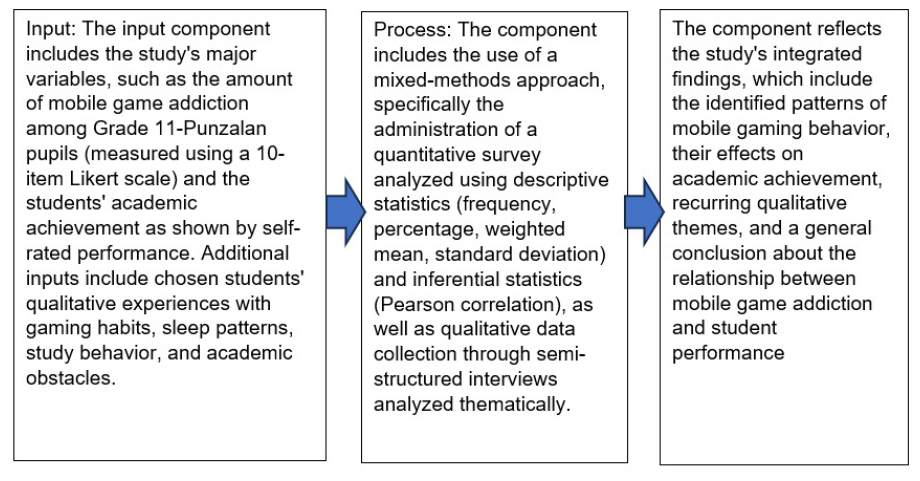
This diagram aims to summarize the whole study. There are three boxes. The first Box indicates the input. It consists of variables and the respondents of the study. The second box indicates the process, it contains the methodology and instruments used in this study. The third box indicates the output, it contains the possible outcome of the study.
Scope and Delimitations
This study focuses on the Grade 11–Punzalan students of Bucal National Integrated School during the Academic Year 2023–2024. It specifically examines how mobile game addiction influences their academic achievement and physical well-being. The study is limited to 58 students who proactively play mobile games, the use of a researcher-made survey questionnaire, variables such as: hours of gameplay, types of games, physical symptoms, and academic grades. The study does not include students from other sections or grade levels, other forms of addiction ( gambling and substance use), In-depth interviews or experiments. The findings are based solely on the respondents’ self-reported data and therefore reflect their personal experiences and honesty in answering the questionnaire.
Significance of the Study
This will be conducted to benefit the following:
a. Students
This will provide with a knowledge regarding the effects of online games and how it can affect our academic performance. It will also gives us the realization that playing online games can destroy our mind and maybe take us away from our better future.
b. The Respondents
When these issues emerge, this research will assist them in becoming aware of themselves, and developing a new solution or finding a different technique to tackle the difficulties.
c. Future Researchers
The ideas presented can be use as a reference data in conducting new researches rather in testing the validity of other related findings . This study also serves as their cross- reference that will give them a background or an overview through the rest of the study.
d. Teachers
As those who play a significant role in the teaching-learning process, this research will allow them to assert and focus more on their students.
e. The School Administrators
This research will enable them to identify and meet the needs of Grade 11 Humss Punzalan students, including teacher to guide and help them and a guidance counselor to assist and develop the students’ behaviour, and habits.
Definition of Terms
Mobile Game Addiction. A hypothetical behavioural addiction characterized by excessive use of computer games or videos games, which interferes with a person’s everyday life.
Computer Game. Any of various games, recorded in cassette or dine for use in a home computer, that are played by manipulating mouse, joystick, or the keys on the keyboard of a computer in response to the graphics in the screen.
Online Game. A video game that is either partially or primarily played through Internet or any other computer network available
Health. A state of complete physical, mental, and social well-being and not merely the absence of descase of infinity.
Convergent Mixed-Methods Design. The research design employed in this study, which combines both quantitative (numerical data) and qualitative (non-numerical data) methodologies. Both data sets are analyzed separately and then compared through triangulation to strengthen and validate findings.
Quantitative Component. This section of the study used a 10-item Likert scale survey administered to 58 respondents to assess their mobile gaming behavior, school-related disctractions, lack of sleep, physical effects, and coping mechanisms.
Qualitative Component. The part of the study that used semi-structured interviews with ten participants to explore their experiences with mobile gaming in depth.
Pearson Product–Moment Correlation (r). A specific statistical method used to determine the relationship between variables, such as between gaming hours and academic performance, and the addiction scale score and academic performance.
Weighted Mean. A statistical method used to determine the average response for each Likert-scale item in the quantitative survey.
Triangulation. process of comparing findings from both the quantitative and qualitative methods to find smilarities, supporting details, or new insights, which ultimately validates the overall findings.
Stress Escape. The use of gaming as a coping mechanism or emotional comfort, which was identified by the study as one of the major motivations for mobile gaming. This was Item 10, which received the highest mean score.
Chapter II
Literature Review
This chapter presents the review of related literature and studies relevant to the current investigation. This helped the researchers in conceptualizing the variables included in the study. The review also enable the researchers in determining the extent at which previous researches have explored the topic which serves as the spring board for the current research. It focuses on Grade 11 Punzalan Students.
Foreign Literature and Studies
They discovered and found that students who were addicted to mobile games affects various dimensions of health and increase physical problems and headaches, while decreases social functioning disorder. There was a significant positive correlation between students’ computer games addiction and their physical dimensions of physical health, lack of physical activity and sleeplessness ( Zamani et al., 2013)
As stated by Scot et al. (2015), excessive playing of online games can lead to fatigue, migraines due to concentration or eye strain, and poor personal hygiene. In accordance with, She-I Fie-Zhie and Der-Hang (2017) that gaming addiction has a physical impact on academic achievement because the student is too engrossed in the game to do homework or prepare for exams. Others have discovered a link between online gaming participation and lower academic performance.
In consonance with Jackson et al. (2013), mobile game has a negative impact on the students academic performance since they find it difficult to concentrate on their classes as a result of eye strains and headaches thereafter, which lowers their academic performance. According to Awais Ahmed (2017) being in the same position for a long period of time, may bring pains in the body parts such as the wrist, shoulder and back. In addition the thumbs are always in the screen, keyboard, keypad for a long time, and this may result in bruise and blisters to these area. There is also a related syndrome called Carpal Tunnel Syndrome. According to Beverly Jenkins (2012), carpal tunnel syndrome is caused when the main nerves between the forearm and hand is repeatedly squeezed or press. Computers has long been linked to the Carpal tunnel syndrome, is also the view of Craton J. (2015)
In accordance with, Dan Wagner (2021), any other compulsive disorder, mobile game addiction can have severe negative consequences. Though most of the symptoms listed above have short-term effects, they can lead to more severe long-term repercussions if not addressed properly. Someone addicted to video games will often avoid sleeping or eating proper meals in order to continue gaming. While the short-term effects of this may include hunger and fatigue, it could eventually lead to a sleep disorder or diet-related health issues.
There are also vision problems caused by playing online games. According to Awais Ahmed (2017), gamers always have their eyes focus in front of the screen for a prolong period of time, staring at them for a very long period of time causes pain in the parts of the eye such as the cornea, pupil and the iris. This may result in the complications to the eyesight such as long sight and short sight. According to Beverely (2017), this is also linked to having a glaucoma especially the users who are near sighted.
A migraine headache can cause intense pain/throbbing or pulsing in one area of the head and is commonly accompanied by nausea, vomiting and extreme sensitivity to light and sound, according to Beverly Jenkins (2017). There is a report that online games may have significantly negative, consequences, especially in the lines of students, through causing distraction and interfering with the important part of the students life, according to Syracuse University on the Science Daily Website (2015).
Finally, Abu Sayeed et al. (2021),the authorities should consider this immediately and arrange a positive entertainment environment to prevent students from mobile games. Furthermore, it is necessary to encourage students to participate in sports or other extracurricular activities that may be helpful to lessen mobile game addiction.
Local Literature and Studies
As reported by Israel (2018), investigated that multiple system physical health disorders were found to be associated with long-term video game activity. The health problems most cited included visual, muscular-skeletal and obesity. More over, Nur (2021) discovered students have the risk of gastritis and urinary tract infections because they often delay eating and delay urinating.
According to Israel (2018) investigated that video gaming has many characteristics of other addiction disorders including deleterious physical and mental health consequences. In addition, Jason Shiers (2020) discovered students who play mobile games late at night perform poorly in school, which affects their ability to focus.
In agreement with, Jordon et al.(2013) discovered pain from gaming is an extremely common occurrence and one that is caused by a variety of factors including injury, poor posture and/or muscular imbalance.
In conclusion, Melinda (2021) discovered that doing other activities everyday including, exercise can reduce mobile game addiction and setting time limits for playing are the good way to lessen and to focus students more on their school works.
Chapter III
Methodology
This chapter presents the research design, respondents, sampling procedure, research instruments, data gathering procedure, ethical considerations, and statistical treatment used in the study.
Research Design
This study employed a convergent mixed-methods design, combining quantitative and qualitative methodologies to acquire a thorough understanding of how mobile game addiction influence academic progress in Grade 11 Punzalan pupils.
The quantitative component utilized a 10-item Likert scale survey to measure the extent of mobile gaming behavior, academic distractions, sleep loss, physical effects, and coping mechanisms. The qualitative component used semi-structured interviews to explore students’ experiences in depth.
Both data sets were analyzed separately and then compared through triangulation to strengthen and validate findings.
Research Locale
The study was conducted at Bucal National Integrated School, Maragondon, Cavite. The location was selected because of the high accessibility of mobile games among senior high school students and the relevance of the issue within the school community.
Sampling Procedure
The respondents were a specific section entitled Punzalan a group of students who were being experiencing the kind of problem. Two sampling methods were used:
Quantitative Phase – Total Enumeration
All 58 students from Grade 11–Punzalan were included to ensure complete representation.
Qualitative Phase – Purposive Sampling
Ten students identified as frequent gamers were selected to provide information-rich experiences. Maximum variation sampling ensured a broad range of perspectives.
Research Instrument
Two instruments were used in this mixed-method study:
a. Quantitative Instrument – 10-Item Likert Scale Survey, The survey measured: gaming frequency, academic impact, sleep and physical health effects, goncentration and motivation issues, self-regulation and coping and use of gaming as escape.
Responses used a 5-point Likert scale (1=Strongly Disagree to 5=Strongly Agree). The survey underwent expert validation and reliability testing using Cronbach’s Alpha.
b. Qualitative Instrument – Semi-Structured Interview Guide. The interview guide consisted of open-ended questions exploring: students’ experiences with mobile gaming, challenges encountered due to gaming, academic impacts, efforts to manage or reduce gaming. This tool allowed participants to share experiences freely and in depth.
Data Gathering Procedures
The researchers used an questionnaire in collecting the data. The face to face questionnaire is composed of questions that the researchers formed from related research and studies. The researchers made sure that the set of questions are enough to provide sufficient data needed in the study First, the researchers requested validation to check accuracy, clarity and relevance of questions. The researchers then request permission from Bucal National Integrated School grade 11 teacher to conduct research on their students. After obtaining authorization, the researchers distributed the questionnaire personally to the selected Grade 11-Punzalan students; the respondents were given adequate time to complete the questions. Finally, the data gathered from the questionnaires were tallied, summarized, and organized into tables for Chapter IV.
Data Analysis
Quantitative: Frequencies, percentages, weighted mean and interpretation, standard deviation, Cronbach’s Alpha (reliability), and the Pearson correlation between gaming and academic success.
Qualitative: Thematic analysis involving coding, categorizing, and theme development
Integration: Triangulation matrix comparing quantitative results and qualitative themes.
Ethical Considerations
Ethical standards were strictly observed throughout the mixed-methods research to preserve rights of all participants. Before collecting data, the school principal, research adviser, and concerned teachers gave permission to conduct the study. The researchers provided explicit information about the study’s objective, methodology, and scope, and participants were told that their participation was fully voluntary. All respondents provided informed consent, and they were advised that they could decline or withdraw from the study at any moment with no consequences. To protect confidentiality and anonymity, personal identifiers were not collected, and data was recorded and reported using codes rather than names. All survey results and interview transcripts were strictly confidential and used only for academic purposes. The researchers ensured that questions asked in both the survey and interviews were respectful, non-intrusive, and age-appropriate, especially since students discussed their gaming habits and academic challenges. Data were securely preserved and not shared outside of the research team. The study followed the values of respect, beneficence, and justice, with no participant experiencing damage, discomfort, or discrimination as a result of their participation.
Statistical Treatment
The following statistical methods were employed to analyze the quantitative data obtained from the 10-item Likert scale:
Equation 1: Frequency and Percentage Distribution
Used to describe demographic data and response patterns per item.
Equation 2: Weighted Mean
Determines the average response for each Likert item.
Mean Range Interpretation
4.21 – 5.00 Strongly Agree
3.41 – 4.20 Agree
2.61 – 3.40 Neutral
1.81 – 2.60 Disagree
1.00 – 1.80 Strongly Disagree
Equation 3: Standard Deviation
Measures variability in responses.
Equation 4: Cronbach’s Alpha (Reliability Test)
Evaluates the internal consistency of the 10-item scale.
Equation 5: Pearson Product–Moment Correlation
Determines the relationship between:
- Gaming hours & academic performance
- Addiction scale score & academic performance
Interpretation of r-value:

| Value | Strength |
| 0.00–0.19 | Very Weak |
| 0.20–0.39 | Weak |
| 0.40–0.59 | Moderate |
| 0.60–0.79 | Strong |
| 0.80–1.00 | Very Strong |
Significance level:
p<0.05
Equation 6: Triangulation
Findings from both methods were compared to identify:
- Convergence (agreement)
- Complementarity
- Expansion (new insights)
- A.
- Quantitative Findings
Table 1.
Demographic Profile of Respondents (N = 58).
| Profile | Category | Frequency (f) | Percentage (%) |
| Gender | Male | 34 | 58.62% |
| Female | 24 | 41.38% | |
| Age | 16 years old | 12 | 20.69% |
| 17 years old | 33 | 56.90% | |
| 18 years old | 13 | 22.41% | |
| Average Gaming Hours (Weekdays) | 0–2 hours | 16 | 27.59% |
| 3–4 hours | 3–4 hours | 39.66% | |
| 5 hours and above | 19 | 32.76% | |
| Excellent | 4 | 6.90% | |
| Very Good | 12 | 20.69% | |
| Good | 22 | 37.93% | |
| Fair | Fair | 31.03% | |
| Poor | 2 | 3.45% |
Interpretation
The majority of respondents play for 3-4 hours every workday, with roughly one-third (32.76%) spending 5 or more hours gaming. A large percentage of students rated their academic performance as Good to Fair, which aligns with worries about study habits and distractions.
Table 2.
Weighted Mean of the 10-Item Likert Scale on Mobile Game Addiction (N =58).
| Item No. | Statement (Shortened) | Mean | Interpretation |
| 1 | More time gaming than studying | 3.62 | Agree |
| 2 | More time gaming than studying | 3.95 | Agree |
| 3 | Sleepiness in class because of gaming | 3.95 | Agree |
| 4 | Gaming distracts me from assignments | 3.88 | Agree |
| 5 | Missed study sessions due to gaming | 3.41 | Agree |
| 6 | Difficulty concentrating after gaming | 3.67 | Agree |
| 7 | Physical discomfort (eyes, head, body) | 3.53 | Agree |
| 8 | Tried but failed to reduce gaming | 3.72 | Agree |
| 9 | Grades decreased because of gaming | 3.45 | Agree |
| 10 | Use gaming as a stress escape | 3.96 | Agree |
Overall Weighted Mean: 3.70 (Agree)
Interpretation
Students generally agree that mobile gaming affects their sleep, focus, study habits, and academic performance. Items 2, 3, and 10 had the highest means, showing that sleep loss and gaming as a coping method were the most common activities.
Table 3.
Correlation Between Mobile Game Addiction and Academic Performance (N = 58).
| Variables Correlated | r-value | p-value | Interpretation |
| Gaming Hours vs Academic Performance | -0.48 | 0.001 | Moderate Negative, Significant |
| Addiction Scale Score vs Academic Performance | -0.52 | 0.0004 | Moderate Negative, Significant |
Interpretation
The negative r-values indicate that as gaming hours and addiction scores increase, academic performance decreases.
The relationships are moderate and statistically significant, meaning the results are not due to chance.
This supports your qualitative themes where students reported:
- Lack of sleep
- Reduced concentration
- Difficulty completing tasks
- Lower motivation
Chapter IV
Result and Discussion
This chapter covers the findings from the quantitative and qualitative phases of the study. A 10-item Likert scale survey was used to collect quantitative data from 58 students, while qualitative data was gathered through interviews with ten participants who were specifically chosen. A mixed-methods discussion follows, integrating both data streams to provide a thorough understanding of the impact of mobile game addiction on academic attainment among Grade 11-Punzalan students.
a. Quantitative Results
| Item No. | Statement (Shortened) | Mean | Interpretation |
| 1 | More time gaming than studying | 3.62 | Agree |
| 2 | Sleep reduced due to gaming | 3.95 | Agree |
| 3 | Sleepiness in class because of gaming | 3.95 | Agree |
| 4 | Gaming distracts me from assignments | 3.88 | Agree |
| 5 | Missed study sessions due to gaming | 3.41 | Agree |
| 6 | Difficulty concentrating after gaming | 3.67 | Agree |
| 7 | Physical discomfort (eyes, head, body) | 3.53 | Agree |
| 8 | Tried but failed to reduce gaming | 3.72 | Agree |
| 9 | Grades decreased because of gaming | 3.45 | Agree |
| 10 | Use gaming as a stress escape | 3.96 | Agree |
Interpretation of Quantitative Results
The demographic data showed that a considerable proportion of students (32.76%) play five hours or more of mobile games on weekdays. Most respondents rated their academic performance as Good (37.93%) or Fair (31.03%), indicating that students themselves acknowledge declines in academic functioning.
Weighted mean analysis revealed that all ten Likert items fall within the Agree interpretation range. The highest means were recorded in:
Item 10 (3.96): Gaming as stress escape
Item 2 (3.95): Reduced sleep due to gaming
Item 4 (3.88): Gaming distracts them from assignments
This indicates that sleep loss, escapism, and academic distraction are the most prominent effects of mobile gaming. The correlation analysis found statistically significant moderate negative relationships:
Gaming Hours vs Academic Performance (r = –0.48, p = .001)
Addiction Score vs Academic Performance (r = –0.52, p = .0004)
These results demonstrate that higher gaming engagement is consistently associated with lower academic performance.
b. Qualitative Results
Thematic analysis of interview responses produced four major themes:
- Gaming as Enjoyment and Escape
- Students use gaming as a stress reliever and emotional comfort.
- Physical Discomfort and Loss of Sleep
- Participants experienced eye strain, headaches, and lack of sleep.
- Difficulty Managing Academic Responsibilities
- Students reported procrastination, decreased focus, and neglected tasks.
- Attempts to Control Gaming Behaviors
- Students tried to regulate gaming but struggled due to habit and peer influence.
c. Integrated Mixed-Methods Discussion
1. Convergence Between Quantitative and Qualitative Data
Both strands of data strongly reinforce one another.
Sleep Loss
- Quantitative: High means on sleep-related items (Items 2 & 3).
- Qualitative: Students repeatedly mentioned staying up late gaming.
- Integrated Insight: Sleep loss is a dominant consequence of gaming and directly reduces academic alertness.
Academic Distraction
- Quantitative: Item 4 (“Gaming distracts assignments”) scored 3.88.
- Qualitative: Students shared they postpone assignments or lose motivation.
Integrated Insight: Students experience both behavioral and motivational academic impacts.
Physical Health Issues
- Quantitative: Item 7 mean = 3.53.
- Qualitative: Themes included eye strain, headaches, and fatigue.
- Integrated Insight: Physical symptoms contribute to decreased focus and classroom performance.
Gaming as Escape
- Quantitative: Item 10 received the highest mean (3.96).
- Qualitative: Students often said gaming helps them forget stress.
- Integrated Insight: Emotional stress motivates gaming, but excessive escape leads to academic neglect.
d. Overall Mixed-Methods Interpretation
Mobile game addiction creates a cycle where students use gaming as emotional relief, but lose sleep, experience physical discomfort, and struggle academically as a result.
The mixed-methods approach strengthens this conclusion by showing that:
- Numbers confirm the prevalence of gaming-related problems.
- Interviews reveal why students continue gaming despite the consequences.
- The study thus offers a holistic view of mobile game addiction among senior high school learners.
Chapter V
Summary of Findings, Conclusions, and Recommendations
This chapter presents the conclusion and recommendations based on the findings of the study titled Exploring the Influence of Mobile Game Aaddiction on the Academic Achievement of Grade 11-Punzalan Students. The results from Chapter IV clearly demonstrate that excessive engagement in mobile gaming has both physical and academic consequences among students.
Summary of Findings
In this part, the researchers will discuss a summary of the study’s findings, as well as analyze the problem statement.
This study investigated the influence of mobile game addiction on the academic achievement of Grade 11–Punzalan students through a mixed-methods approach. Quantitative data were collected from 58 respondents through a 10-item Likert scale survey, while qualitative data were gathered from 10 interviewees.
Quantitative Summary
Demographics:
Most students spend 3–4 hours gaming on weekdays, and nearly one-third spend 5+ hours, indicating high gaming exposure.
Weighted Mean Analysis:
All 10 items yielded mean scores within the Agree range, suggesting that students commonly experience:
- Sleep loss
- Academic distractions
- Physical discomfort
- Poor concentration
- Difficulty regulating gaming
Correlation Analysis:
A moderate, significant negative correlation exists between:
- Gaming hours and academic performance (r = –0.48)
- Addiction score and academic performance (r = –0.52)
This means increased gaming engagement corresponds to lower academic achievement.
Qualitative Summary
The thematic analysis of the participants’ responses revealed four key themes. First, many students described gaming as a source of enjoyment and escape, often using it as a way to relax or momentarily avoid stress. However, this behavior was accompanied by reports of physical discomfort and sleep deprivation, as extended gaming sessions affected their well-being. The findings also highlighted academic difficulties and procrastination, with students acknowledging that gaming sometimes interfered with completing school tasks on time. Lastly, participants shared their attempts and challenges in self-regulation, noting that while they tried to limit their gaming, maintaining control over their habits remained a struggle. These themes describe students’ lived experiences and the emotional, physical, and academic challenges linked to excessive gaming.
Mixed-Methods Summary
The mixed-methods results show strong agreement between the quantitative and qualitative findings. The data from both group indicate that students depend on gaming to relieve stress, but playing too much often leads to poor sleep and health problems. The findings also indicate that academic responsibilities are frequently postponed or neglected due to extended gaming time. Furthermore, the data suggest that many students’ attempts to limit or control their gaming habits are often ineffective, reinforcing the overall pattern observed across both methods.
Both quantitative and qualitative results converge, indicating:
- Students rely on gaming for emotional relief.
- Excessive gaming disrupts sleep and physical health.
- Academic responsibilities are frequently postponed or neglected.
- Attempts to limit gaming are often ineffective.
The integrated findings present a consistent narrative of mobile gaming as both a coping mechanism and a source of academic decline.
Conclusions
Based on the combined findings, the following conclusions were drawn:
a. Mobile game addiction has a measurable and significant negative influence on academic performance. Statistical results confirm that higher gaming hours and addiction levels correspond to lower academic performance.
b. students perceive gaming as a temporary escape from stress, but this leads to:
- Reduced sleep
- Lowered concentration
- Decreased motivation
- Difficulty completing academic tasks
c. Physical symptoms such as eye strain, headaches, and fatigue are common, further impairing academic functioning.
d. Students are aware of the negative effects yet struggle with self-control, indicating habitual or compulsive gaming patterns.
e. The mixed-methods design strengthens the conclusion that mobile game addiction is both a behavioral and emotional challenge affecting students’ academic lives.
Recommendations
Based on the findings and conclusions, the following recommendations are proposed:
For Students:
- Practice responsible gaming through scheduled playtime and adherence to school-night time limits.
- Prioritize sleep and academic responsibilities before gaming.
- Seek healthy alternatives for stress management (exercise, clubs, journaling).
For Teachers:
- Integrate digital citizenship and responsible gaming topics into lessons.
- Monitor students showing signs of fatigue, distraction, or declining performance.
- Provide supportive interventions such as reminders, mentoring, or study routines.
For Parents:
- Monitor children’s gaming behavior and enforce reasonable time limits.
- Encourage balanced lifestyle routines promoting sleep, study, and recreation.
- Provide emotional support to reduce reliance on gaming for stress relief.
For School Administrators:
- Strengthen guidance counseling programs addressing digital habits.
- Conduct seminars on mobile game addiction and its academic impacts.
- Encourage extracurricular activities that reduce excessive screen time.
For Future Researchers:
- Include a larger sample and additional variables such as motivation, self-esteem, and mental health.
- Use experimental or longitudinal designs to track changes over time.
- Explore interventions that help reduce mobile game addiction among learners.
Supplementary Materials
The following supporting information can be downloaded at the website of this paper posted on Preprints.org.
Acknowledgement
The researcher extends his deepest gratitude to the individuals who contributed to the completion of this study. Special thanks to Mrs. Eula Andam for the valuable guidance, suggestions, and encouragement throughout the research process. The researcher also expresses appreciation Justine Camilo, John Rhey Garcia, Elizabeth Gabingan, Jeniffer Bitoy, Justine Buenafe and John Toremorro for their financial and moral support in the preparation and completion of this study. We owe our parents great appreciation to them. We want to sincerely thank them for their undying love, uncountable sacrifice, and support. Their dedication and support were crucial to the accomplishment of this study and we will always be grateful for that. Finally, heartfelt thanks to Bucal National Integrated School community for providing the opportunity and environment that made this research possible.
Dedication
We dedicate this endeavor to God Almighty, our creator, steadfast pillar, the source of inspiration, wisdom, knowledge, and understanding. He has been our source of strength throughout this research, and we soared alone on his wings. We also thank our adviser teacher, Mrs. Eula Andam, for her guidance and assistance during our research.
References
- Abu Sayeed, E.; Rahman, M.M.; Hossain, M.A.; Sultana, S. Prevalence and underlying factors of mobile game addiction among university students in Bangladesh. Global Mental Health 2023, 10, e53, https://www.cambridge.org/core/journals/global-mental-health/article/prevalence-and-underlying-factors-of-mobile-game-addiction-among-university-students-in bangladesh/2E2A96A871A0BF38A14860770EF8EA97. [Google Scholar]
- Jenkins, B. Online gaming and students’ physical health. Journal of Addiction Medicine and Therapeutic Science 2017, 3, 8–12, https://www.peertechzpublications.com/articles/doi10.17352-2455-3484.000025-jamts.php. [Google Scholar]
- Israel, V. Gaming disorder and effects of gaming on health: An overview. Journal of Addiction Medicine and Therapeutic Science 2018, 4, 1–4, https://www.peertechzpublications.com/articles/doi10.17352-2455-3484.000025-jamts.php. [Google Scholar] [CrossRef]
- Shiers, J. (2023). Expert advice on gaming addiction in young people and children. Internet Matters.https://www.internetmatters.org/hub/news-blogs/expert-advice-on-gaming-addiction-in-young-people-and-children/.
- Scott, J.; Smith, R.; Andrews, P. (2015). Video game addiction: Symptoms, causes, and effects. PsychGuides.https://www.psychguides.com/behavioral-disorders/video-game-addiction/.
- Zamani, B.E.; Kheradmand, A.; Bamdad, S.; Bamdad, M.J. Effect of addiction to computer games on physical and mental health of male and female students in Isfahan. Addiction & Health 2013, 5, 90–95, https://www.ncbi.nlm.nih.gov/pmc/articles/PMC3905489/#:~:text=There%20was%20a%20significant%20positive,games%20and%20impaired%20social%20functioning. [Google Scholar]
- Arreola, P.N.C.; Hernando, A.G.P.; Lugares, J.M.G.; Roxas, G.O.L.; Kurata, Y.B. Effects of Online Gaming Behaviors on Filipino Students’ Perceived Academic Performance Through Multiple Regression Analysis. Training, Education, and Learning Sciences 2023, 109, 232–244. [Google Scholar] [CrossRef]
- Ballatan, J. R. (n.d). The Effects of Playing Online Mobile Games in Academic Performance on Students. Unpublished research paper. San Francisco High School. San Francisco High school.
Disclaimer/Publisher’s Note: The statements, opinions and data contained in all publications are solely those of the individual author(s) and contributor(s) and not of MDPI and/or the editor(s). MDPI and/or the editor(s) disclaim responsibility for any injury to people or property resulting from any ideas, methods, instructions or products referred to in the content. |
© 2025 by the authors. Licensee MDPI, Basel, Switzerland. This article is an open access article distributed under the terms and conditions of the Creative Commons Attribution (CC BY) license (http://creativecommons.org/licenses/by/4.0/).
Copyright: This open access article is published under a Creative Commons CC BY 4.0 license, which permit the free download, distribution, and reuse, provided that the author and preprint are cited in any reuse.


