

Submitted:
28 March 2026
Posted:
30 March 2026
You are already at the latest version
Abstract
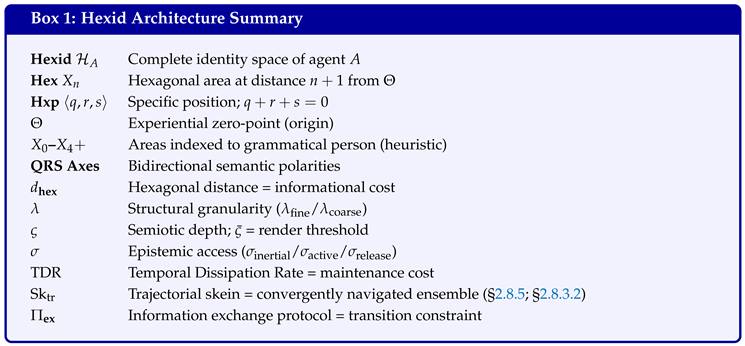
Radial Analysis (RA) is a methodological framework that transforms radial category theory from static structural mapping into dynamic trajectory modeling. Building on the Trace & Trajectory Framework's (TTF) non-representationalist architecture, RA provides researchers with practical tools for analyzing indexicality, identity navigation, and meaning dynamics in discourse. This paper presents RA as an applied methodology rather than a foundational theory. The framework employs hexagonal geometry (the SpiderWeb architecture—a board game model based on hexagonal tessellation) to formalize navigational patterns: how speakers move through identity space, what these movements cost informationally, and how trajectorial patterns reveal underlying dynamics invisible to categorical approaches. Core innovations include: (1) the three-level terminology (Hexid/Hex/Hxp) for precise analytical description; (2) formally grounded metrics (hexagonal distance, trajectory cost, Temporal Dissipation Rate) enabling principled relational comparison; (3) the λ/ς/σ parameter system distinguishing structural granularity, semiotic depth, and epistemic access; (4) the depth parameter (ς) governing semiotic visibility through shading mechanics; (5) semiotic coherence (SC) as the constitutive principle underlying positional significance; (6) stratified epistemic barriers (Hxₙ) and hex bands (Hx⁽ⁿ⁾) structuring radial distance into qualitatively distinct reference domains with characteristic cost profiles; and (7) direct application to epistemic appropriation dynamics including flattening, internalization, and trajectorial refraction. RA addresses phenomena that categorical frameworks handle only through ad hoc mechanisms: simultaneous multi-level positioning, asymmetric intersubjective dynamics, and the geometric constraints that institutional power imposes on identity navigation. Applications span personal deixis, temporal reference, identity navigation dynamics, and—through integration with recent work on epistemic appropriation—the formal analysis of internalized oppression in clinical and educational contexts.
Keywords:
radial analysis
; trajectory semantics
; identity navigation
; hexagonal geometry
; epistemic barriers
; hex bands
; epistemic appropriation
; trace & trajectory framework
; semiotic coherence
; deixis
; indexicality
; temporal dissipation rate
; shading
; depth parameter
1. Introduction
The study of meaning has long oscillated between two gravitational poles: structure and process. For much of the late twentieth century, cognitive linguistics anchored itself firmly to the structural side. The prototype revolution initiated by Rosch [43] and extended through Lakoff [35]’s radial categories offered a powerful corrective to classical Aristotelian categorization, demonstrating that human concepts are not bounded by necessary and sufficient conditions but organized around graded, fuzzy structures with better and worse examples. This insight transformed how linguists understood polysemy, metaphor, and the architecture of the mental lexicon.
Yet as we moved into the second decade of the twenty-first century, cracks began to appear in this edifice. The radial diagrams that populated cognitive linguistics textbooks—elegant maps of semantic extension from prototypical cores to peripheral senses—captured what meanings exist and how they are theoretically connected, but remained silent on a crucial question: how do speakers actually navigate these structures in the real time of discourse? The polysemy network for a word like “mother” or “over” [35] presents a timeless snapshot, a photograph frozen at infinite exposure. What it cannot show is the cognitive and communicative cost of moving from one sense to another, the trajectory a speaker traces through the network, or the constraints that channel certain paths while blocking others.
This limitation is not merely methodological; it is ontological. Critics have noted that classical radial models inherit an implicit representationalism that reifies meaning, treating it as an object stored in the mind rather than a dynamic event unfolding in interaction [24]. The “quantitative turn” in cognitive linguistics [26,31] has further exposed the gap between introspective intuitions about category structure and actual patterns of use in corpora and experiments. What linguists judge to be “central” or “peripheral” often fails to align with distributional evidence, raising questions about the falsifiability and predictive power of static network models [46].
Meanwhile, parallel developments in linguistic anthropology and sociolinguistics were reshaping our understanding of indexicality and social meaning. Silverstein’s [49] theory of indexical orders revealed that the relationship between linguistic signs and social context is not fixed but dialectically stratified—signs accumulate layers of meaning through historical processes of enregisterment that unfold across biographical and cultural time. Hanks [29] reconceptualized the deictic field not as a Cartesian coordinate system but as a field of practice, where “here” and “there” are relational positions defined by perceptual access, social symmetry, and embodied orientation. Navigation through this field requires a practical habitus—a know-how that is learned, embodied, and culturally saturated.
In stance and positioning research, a similar temporal turn was underway. Du Bois [14] established the foundational “stance triangle”—the simultaneous evaluation of objects, positioning of subjects, and alignment with interlocutors—but this model was initially applied to brief interactional moments. Subsequent work expanded the temporal horizon. Thompson [52] argued for analyzing stance across longer timescales, introducing the notion of “stance ownership” that accumulates through repeated positioning acts. Andries et al. [3] documented how stance-taking is organized temporally throughout discourse, with participants continuously adapting and negotiating their positions through multimodal resources—gesture, gaze, prosody, posture. Yeung [54] proposed the concept of “narrative trajectory” to capture how identity evolves through interdiscursive links across multiple speech events, not just within single interactions.
These converging developments point toward a fundamental reconceptualization: from meaning as structure to meaning as navigation. Yet despite growing consensus on the need for dynamic, process-oriented models, a significant methodological gap persists. As Burnett & Bonami [6] observe, most approaches remain qualitative or descriptive, lacking formal tools to diagram the “distance” between discursive positions or the “cost” of transitioning between them. The geometry is intuited but not formally rendered; the dynamics are described but not formally mapped.
1.1. The Contribution of Radial Analysis
Radial Analysis (RA) addresses this gap by transforming radial category theory from static structural mapping into dynamic trajectory modeling. Building on the Trace & Trajectory Framework’s (TTF; [16]) non-representationalist architecture, RA provides researchers with practical tools for three analytical challenges that categorical approaches handle only through ad hoc mechanisms:
Simultaneous multi-level positioning. When a speaker says “we Mexicans have always…” while gesturing toward themselves, the utterance operates at collective, historical, and embodied levels simultaneously. Categorical frameworks require separate analyses that fail to capture the integrated navigational act—they map positions but miss the motion. RA tracks the single trajectory through multidimensional space, with formal tools introduced in Section 2 that make these levels analytically distinct yet compositionally unified.
Asymmetric intersubjective dynamics. A clinician and patient discussing “your autism” occupy different positions relative to the same diagnostic category. The patient navigates through the category to reach self-understanding; the clinician navigates around it as a professional tool. Same words, different trajectories, different informational costs. RA develops metrics—formalized in Section 2—that establish the relational structure of these asymmetries with formal precision, rather than merely describing them.
Geometric constraints on identity navigation. A deaf student explaining their competence to hearing faculty may need to detour through external validation before affirming self-knowledge. This obligatory trajectory—invisible to categorical analysis—reveals how institutional power configures the space of navigational possibilities. RA’s geometric architecture renders such constraints analytically tractable, providing formal tools to characterize how certain navigational paths become blocked, costly, or coerced.
The framework accomplishes this through three methodological innovations. First, trajectory formalization: rather than mapping speakers to static positions, RA tracks movement through identity space as ordered sequences , capturing the temporal unfolding of positioning acts. Second, formally grounded metrics: hexagonal distance provides a principled index of informational cost, enabling systematic comparison—we can establish that certain trajectories involve substantially greater navigational effort than direct alternatives, moving beyond impressionistic claims about “costly” identity work. Third, phenomenological grounding: the experiential zero-point anchors analysis in lived experience rather than abstract categories, ensuring that navigation is always analyzed from the agent’s own baseline rather than from an external observer’s coordinate system.
1.2. Foundational Commitments
RA presupposes the Trace & Trajectory Framework’s (TTF) core architecture without extensive development. Readers seeking theoretical depth should consult Escobar L.-Dellamary [16] for the complete formalization, including the toroidal topology and ontological stack. Here we focus on how to use RA, not why it works at the foundational level. Four commitments underlying TTF must be made explicit, as they shape how the hexid (hexagonal identity) architecture should—and should not—be interpreted:
- 1.
- Anti-representationalism. Meaning is not a relation between symbols and referents but a navigational dynamic. Trajectories through informational space are meanings, not vehicles that “carry” or “encode” them. There is no gap between form and content requiring a bridging mechanism.
- 2.
- Predispositional substrate. The space that underlies navigation is made of traces—dispositional possibilities that acquire semiotic coherence. Our subjective viewpoints are navigational regimes within the informational field. That is: there is no vantage point outside the field from which an agent observes meaning—the agent’s perspective is its pattern of navigation.
- 3.
- Semiotic (not semantic) space. The hexid architecture establishes conditions for meaning creation, not a structure that stores or encodes meanings. We use “semiotic” deliberately: the space defines where and how signification can occur, not what signs mean. Meanings exist only as trajectories—they have no static address.
- 4.
- Saturation, not composition. Positions in the hexid are saturations—regions of informational space whose navigational significance is constituted by semiotic coherence (SC), not by temporal accumulation of traces. Crucially, saturation operates over a discrete trace space: there is no true continuity, no genuine fuzziness. What appears as gradience or blurred boundaries reflects the render threshold () at which SC configurations achieve phenomenal visibility—like pixels that blend into continuous color when viewed from a distance but remain discrete at close inspection. The model is fine-grained enough to track apparent continuities in semiotic dynamics while remaining fundamentally discrete. Navigation through saturated regions constitutes the act of signification itself; it is not the dynamic combination of parts. This distinguishes TTF from construction grammars and other models that dynamize compositional assembly: meaning emerges through trajectory rather than through the recruitment and integration of pre-given units.
Semiotic Coherence (SC)
Underlying these commitments is the principle of semiotic coherence (SC). SC organizes traces into threads—filamentary coherence configurations—and threads into navigable ribbons—coordinated thread-bundles that constitute the minimal semiotic unit. This organization is not driven by temporal accumulation but by a coherence function that operates across TTF’s layered architecture, from traces through threads to trajectories. SC is the constitutive principle that determines which configurations achieve semiotic significance and which dissolve. Saturation, thread coherence, positional navigability, and the persistence of navigational configurations within active skeins are all SC outcomes—not causal records of past usage. For the complete formalization, including the toroidal topology () within which SC operates, see Escobar L.-Dellamary [16].1
These commitments entail that RA’s hexagonal geometry should not be read as a spatial metaphor for “conceptual structure” in the cognitivist sense. The hexid is not a map of meanings but a navigational terrain—it constrains and enables trajectories without containing them. Readers familiar with Gärdenfors’s conceptual spaces [22,23] or Lakoff’s radial categories will recognize superficial similarities, but the ontological status differs fundamentally: those frameworks model structure; RA models dynamics. Concretely, this means RA can track not only where a speaker is positioned but the cost, direction, and constraints of their movement—questions that structural models, however geometrically sophisticated, leave unanswered.
1.3. Paper Overview
Section 2 introduces the SpiderWeb architecture—the geometric substrate for trajectory analysis, including the notation system for characterizing navigational dynamics. Section 3 demonstrates RA through worked examples spanning personal deixis, temporal reference, identity navigation, and epistemic appropriation dynamics—how agents internalize or resist externally imposed identity categories. Section 4 addresses extensions, limitations, and future directions. Section 5 synthesizes contributions and situates RA within the broader landscape of dynamic approaches to meaning.
2. The Hexid Framework
This section introduces the geometric architecture underlying Radial Analysis. Rather than presenting abstract formalism, we focus on operational understanding: what do analysts need to know to apply RA effectively?
2.1. Origins: A Game Board for Identity Navigation
HEXID emerged from empirical observation rather than theoretical mandate. During fieldwork with yoreme (Mayo) communities in northern Sinaloa, Mexico, analysis of identity discourse revealed a recurring pattern: speakers did not simply claim identity categories but moved between them—participating “as yoreme,” then “as yori” (the community’s counter-exonym for non-indigenous others), while repeatedly returning to an unmarked experiential center. One yoreme teacher captured this choreography with striking precision: “it’s a game, and it’s beautiful... there are yoremes who know songs as yoremes, and know songs as yoris... they opened the world of yoris for me, well then, we have to participate as yoris.”
This observation—identity as navigation rather than membership—demanded analytical tools that existing frameworks could not provide. What was needed was a heuristic structure with sufficient richness of movement, where positions could be located relative to a deictic center, where distances would index informational effort, and where multiple navigational pathways would be available rather than binary alternatives. The question became: what kind of “board” would support this analysis?
The answer came from an unexpected source: Władysław Gliński’s hexagonal chess [25]. Hexagonal tessellation provides exactly the navigational flexibility required—each position maintains six equidistant neighbors, enabling isotropic movement without directional bias. But the choice proved to be more than pragmatic convenience. Hexagons are not arbitrary decoration but an organic geometry that appears spontaneously across natural systems: in honeycomb structures (optimally efficient per 28), in neural grid cells mapping spatial navigation [27], in Bénard convection cells and basalt columns. The hexagonal board resonates with organizational patterns observed across natural systems rather than imposing an arbitrary one.
This ludic, didactic origin should not be forgotten as the formalism develops. HEXID remains, at its core, a board game for thinking about identity—a heuristic tool that trades mathematical generality for illustrative power. The hexagonal geometry is “medium-definition” access to a “high-definition” pre-representational substrate. Where the model succeeds, it succeeds by making navigational dynamics visible and playable, not by capturing some ultimate mathematical truth about identity’s structure.
2.2. Navigation as Signification
A terminological clarification is essential before proceeding. “Navigation” in RA is not a spatial metaphor for cognitive processing—it names the act of meaning-making itself. When we say an agent navigates through hexid positions, we do not mean they “move mentally” through a structure that contains pre-stored meanings. Rather, the trajectory through positions constitutes the meaning; there is no separate semantic content that navigation retrieves or expresses. This is the core anti-representationalist commitment: meaning does not consist of represented content encoded in forms, but emerges through navigational dynamics. A trajectory does not “carry” meaning—it is the semiotic event. Readers should resist the intuitive tendency to interpret hexid geometry as a map of meanings; it is better understood as a terrain of navigational possibilities whose traversal generates signification.
2.3. Information as Geometry, Meaning as Trajectory
A complementary clarification prevents a persistent misreading. When TTF refers to “informational operations” or “informational exchange,” it does not invoke a conduit: nothing is literally transmitted between agents. Information, in TTF’s usage, names the geometric predisposition of the ribbon architecture—the topographic shape of the navigational landscape, including which fold configurations are available, how they are distributed across granularity levels, and what navigational routes they predispose.2 Meaning, by contrast, is exclusively trajectorial: there is meaning only when an agent navigates, and the trajectory is the semiotic event. The geometry alone does not signify—it predisposes.
What is conventionally described as “informational exchange” between agents is therefore a meta-level reading of how the geometric topography of one navigational space favors or inhibits navigational possibilities that can couple transductively with another. Protocols do not transmit content; they are the functional logic governing the relation between geometric predisposition and navigational actualization. governs this relation across hexid boundaries (inter-agent coordination); governs it locally (intra-interface economy). In both cases, what “exchanges” is the degree to which predisposed geometry becomes navigable—not a message that travels from sender to receiver. TE is constituted predispositionally (, costless); is calculated navigably over that predisposed geometry by mimetic transductive pressures (). There is no other substrate for them to operate on: the only movement in the system is navigational, and navigation requires dissociation.
2.4. SpiderWeb Architecture: Hexid, Hex, Hxp
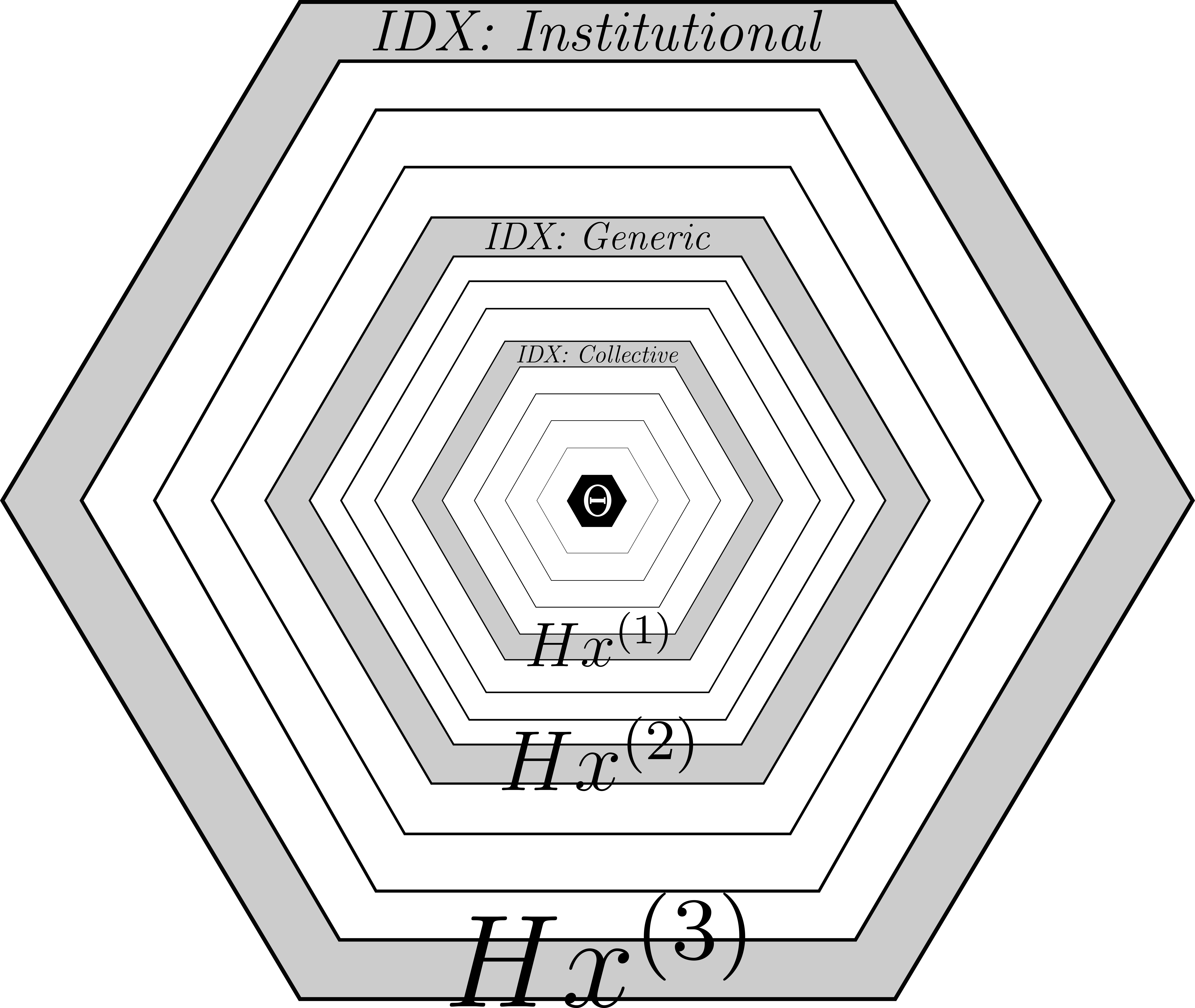
RA employs a hexagonal coordinate system we call the SpiderWeb architecture or HEXID—Hexagonal Identity Dynamics—, a board game model comprising three nested levels of description (see Figure 1):
- Hexid ()
-
The complete identity space of agent A. The hexid encompasses all positions an agent can navigate—from experiential baseline through increasingly differentiated identity configurations. Think of it as the entire “board” on which identity navigation occurs.
- Hex ()
-
A single hexagonal area at distance from the center. Each hex contains discrete positions arranged in a ring. The subscript n is designed to correspond stereotypically with grammatical person (see §2.5).
- Hxp ()
-
A specific position within the hexid, specified by cubic coordinates satisfying , notated as as the first position traversed by a trajectory.3 The angle brackets visually evoke hexagonal geometry and distinguish position notation from other uses of coordinates.
This three-level terminology enables analysts to shift seamlessly between holistic description (“the agent’s hexid shows restricted navigation”), area-level generalization (“trajectories cluster in ”), and precise specification (“position serves as convergence point in the cost landscape”).
2.5. Hexagonal Areas and Grammatical Person
The hexid centers on (theta), the experiential zero-point—the undifferentiated baseline from which all coded positioning emerges and to which navigation returns between discursive moves. is not a hex but the origin from which hexagonal areas radiate.
As the point of minimal saturation, represents informational homeostasis—the baseline to which agents return when discursive positioning relaxes. Navigation from requires investment; navigation toward dissipates active informational tension.
Hexagonal areas are organized into four-ring spans called hex bands (), each bounded by an epistemic barrier () marking a qualitative shift in the type of referential access available (the gray band in Figure 1 marks the first such barrier at ). The correspondence with grammatical number is structurally motivated. Consider the shift from “I” to “we”: in the hexid, this is a determinate navigational step from (individual self) to (collective self)—crossing the barrier from direct individual access into the first collective band. Formally, this crossing is governed by a mimetic projection operator (), which maps each position in one band to a structurally corresponding position in the next: , , and so on. The term “mimetic” signals that the projection preserves each band’s internal organization—the same directional sectors recur at each level—while shifting the type of referential access. Section 2.7 develops the directional-sector system (QRS) in full; what matters here is that the grammatical singular/plural contrast maps onto a barrier-crossing operation, not a featural switch.

| Ring | Label | Band | Reference type |
|---|---|---|---|
| Experiential zero | — | Pre-differentiation baseline | |
| Proprioceptive self | — | Pre-personal embodiment | |
| Immediate self | 1st person singular | ||
| Addressed other | 2nd person singular | ||
| Non-addressed other | 3rd person singular | ||
| Liminal / alienated | Outer singular | ||
| — Barrier (personal): “Where does ‘I’ end?” — | |||
| Collective self | 1st person plural | ||
| Collective addressed | 2nd person plural | ||
| Collective other | 3rd person plural | ||
| Collective liminal | Outer plural | ||
| — Barrier (collective): “Where does ‘we’ end?” — | |||
| Generic self | “One” / generic | ||
| Generic addressed | Generic “you” | ||
| Generic other | Kind / type reference | ||
| Generic liminal | Outer generic | ||
| — Barrier (institutional): “Where does the particular end?” — | |||
| Institutional self | Archetype: “the hero” | ||
| Institutional addressed | Archetype: “the other” | ||
| Institutional other | Mythic kinds | ||
| Archetypal horizon | Outer archetypal | ||
| — Barrier (mythic): “Where does the temporal end?” — | |||
2.5.1. Critical Clarification
Hex positions do not “mean” grammatical categories. The correspondence -th person is a heuristic for didactic purposes, not a semantic rule. Actual semantic values emerge from navigation through positions modulated by axis polarities (§2.7), saturation patterns, and interface parameters—the structural granularity and epistemic access settings introduced below. A speaker may occupy while referring to third parties, or navigate to while discussing themselves—what matters is the trajectory, not the static position.
2.5.2. The / Distinction
Previous frameworks sometimes conflated experiential baseline with minimal selfhood. RA distinguishes them architecturally: represents pre-embodiment (mathematically, the origin ), while represents embodied but pre-personal presence. This distinction proves crucial for analyzing contemplative states, certain neurodivergent experiences, and the phenomenology of “losing oneself” in absorption.
2.6. Epistemic Barriers and Hex Bands
The radial cut’s most consequential structural feature is the system of stratified epistemic barriers. Each barrier marks a qualitative shift in navigational access—not a wall but a permeability gradient whose traversal incurs characteristic costs. An agent navigating from to crosses from direct individual access () into collective reference (): the liminal question “Where does ‘I’ end?” is not rhetorical but names the barrier’s phenomenological signature.
2.6.1. Barrier Permeability
Permeability is not binary but graded, determined jointly by three factors.
The first is the number of harmonic folds () available at the barrier. Each fold is a convergence point at which ribbons achieve coherence, thereby generating a navigable categorical configuration; more folds imply more distinct routes through the barrier and thus higher permeability.
The second is transductive cost (): the effort required to cross between non-equivalent semiotic configurations at the barrier. Higher constricts passage even when folds are available. (The formal treatment of appears in the cost-decomposition discussion below.)
The third is shading depth (): positions beyond the barrier may be navigable in shade—traversed as part of the semiotic architecture without attaining phenomenal visibility. Whether a position achieves such visibility depends on whether its shading depth exceeds the render threshold (): positions with operate sub-threshold, present in the navigational structure but absent from the agent’s phenomenal field.
In short, whether an agent crosses a barrier with full phenomenal registration, crosses it in shade, or cannot cross it at all depends on the joint configuration of folds, cost, and shading at that barrier. An agent can navigate from directly to —from individual self-reference to archetypal categories—because the intervening positions operate sub-threshold (): the barriers are crossed but not phenomenally experienced. This is the mechanism by which institutional or mythic categories can feel “immediate” despite their epistemic distance.
This architecture formalizes a phenomenon familiar from construal theory. Consider three descriptions of the same event: (i) “I was at the movies with Luis, Paco, Josefina, Pedro, and Betty”; (ii) “I was at the movies with the usual crowd”; (iii) “We were at the movies when the lights went out.” What Langacker [37] analyzes as movement along a specificity scale—from enumerated multiplex reference through collective compression to presupposed mass—maps directly onto barrier-crossing with progressive shading. In (i), each referent occupies a distinguishable position within ; in (ii), the same referents are navigated collectively across into , where individual positions lose phenomenal distinctness; in (iii), the group operates entirely in shade—present in the navigational architecture but below the render threshold, serving as infrastructure for the event narration rather than as profiled content. The “compression” that blending theory attributes to conceptual integration [20] is, in RA terms, not a cognitive operation performed on representations but the navigational consequence of sustaining reference at progressively greater epistemic distance: phenomenal resolution decreases, and what remains is structural pattern rather than individuated positions.
2.6.2. Positional Decrease Beyond Barriers
A key structural consequence: the number of phenomenally distinguishable positions decreases at each successive band. Within (–), the agent navigates with fine-grained positional distinction—individual self, addressed other, referenced other, and liminal other are sharply differentiated. Beyond , epistemic distance compresses phenomenal resolution: the same six QRS sectors are geometrically available at –, but the agent’s capacity to maintain distinct significance across all positions diminishes. By (–), positional distinction approaches a catastrophe threshold where navigational content collapses toward archetypal configurations. This is not a cognitive limitation but an architectural feature of epistemic distance: phenomenal detail requires proximal access. What remains navigable at mythic distance are structural patterns, not individuated positions.
2.6.3. The Catastrophe Curve
This progressive compression can be characterized more precisely. Although each hex band contains the same geometric structure—four rings with six QRS sectors per ring, yielding 24 structurally available positions per band—the number of phenomenally distinguishable positions follows a decreasing function across bands. Within , the agent may sustain distinct significance across most or all positions: “I” () feels qualitatively different from “you” (), which feels different from “she” (). By , the equivalent distinctions—“we (exclusive)” versus “we (inclusive)” versus “they (collective)”—are available but harder to maintain phenomenally; agents tend to collapse several QRS sectors into undifferentiated “collective” reference. By , generic reference typically operates with a handful of distinguishable positions regardless of geometric availability. The curve is not smooth: the sharpest drop in discriminability occurs at the first barrier (), with progressively flatter decline beyond—a signature consistent with catastrophe dynamics rather than linear decay. Figure 2 illustrates this architecture.
The nested architecture visible in Figure 2 is a two-dimensional projection of a structure that is not, strictly speaking, flat. Outer bands do not merely extend the same navigational surface farther from ; they simultaneously occupy higher positions on the saturative gradient (), where positional differentiation collapses under saturative compression. The Horizontal Radial Cut (HRC)—the analytical surface on which RA operates—is therefore better understood as a conic cut through the hexid prism: a cross-section that expands radially and ascends saturatively at the same time. This conic geometry explains why the catastrophe curve is not merely a perceptual limitation but an architectural consequence: at , the analyst works at an altitude where the semiotic field itself converges toward archetypal configurations. Appendix D.2 develops the full geometric argument.
2.6.4. Barrier Traversal: A Conceptual Illustration
Consider a speaker who habitually discusses personal experiences (–, within ) and is now asked to speak about “the community’s needs.” This requires crossing into : the agent must sustain reference to a collective entity whose boundaries are not directly experienced but navigated through mimetic projection (). If is permeable—the agent has robust resources at the barrier—the transition from “my experience” to “our needs” proceeds at moderate . If is constricted, the same transition either fails (the agent cannot generalize beyond personal anecdote) or occurs in shade: the “community” is invoked linguistically but without phenomenal contact with collective positioning—words without navigational weight. The permeability of each barrier thus determines not whether agents can use collective, generic, or institutional language, but whether such language carries navigational significance or operates as empty categorical transit.
2.6.5. QRS Orientation: A Preview
The hex positions introduced above are not interchangeable points on a featureless ring. Each ring is divided into six directional sectors defined by three axes—Q, R, and S—whose coordinates satisfy the constraint . Each axis carries positive and negative poles: in the default analytical configuration (social_indexicality), indexes perceived agency while indexes patientive positioning; indexes authority or seniority while indexes subordination; indexes in-group orientation while indexes out-group distance. The notation , then, picks out a specific sector within a given ring—a position that is simultaneously agentive, subordinate, and in-group-oriented. Section 2.7 develops this coordinate system fully, including its domain-configurable semantics; what matters here is a single structural fact that the axes make visible.
2.6.6. The /QRS Orthogonality
Epistemic distance () and QRS orientation index fundamentally different properties and are orthogonal. determines which ring a position occupies—and with it, properties like definiteness, specificity, and genericness. QRS orientation () determines which sector within that ring—and with it, the social-indexical character of the position (agency, authority, group membership, or whatever the active QRS-CONFIG—the domain-specific assignment of semantic values to axis polarities—specifies). Definiteness is a function of , not of QRS. A position at and a position at differ in social-indexical content (agentive out-group vs. patientive in-group) but share the same epistemic distance and therefore the same degree of definiteness. This orthogonality explains why grammatical number (singular/plural/generic) correlates with hex band rather than QRS sector, and why person deixis (1st/2nd/3rd) emerges from ring position rather than axis polarity. The practical implication for analysis: when coding discourse positions, and QRS assignments are independent decisions—getting one right does not determine the other.
2.6.7. An Illustration: The Weak/Strong Definiteness Puzzle
The /QRS orthogonality has consequences beyond person and number. Consider a long-standing problem in formal semantics: the distinction between weak and strong definites [1,47]. In “I went to the hospital,” the definite article does not require prior mention or situational uniqueness—it navigates toward a position whose referential accessibility is given by low and low : the institution is within the agent’s immediate navigational range, and the trajectory that reaches it is short and cheap. In “The president spoke today,” the article indexes a position at higher with elevated : situational uniqueness must be established, which requires sustaining reference across greater epistemic distance. The proliferation of feature-based subtypes in the formal semantics literature ([±familiar], [±unique], and beyond) can be read as a symptom of a deeper architectural conflation: the tradition assigns to a single mechanism—typed features on the determiner—what RA decomposes into two orthogonal dimensions, one trajectorial-indexical (, radial distance) and one social-categorical (QRS orientation). A full treatment exceeds the scope of this paper, but the prediction is clear: weak and strong readings should pattern with contrasts, not with QRS contrasts, and cross-linguistic variation in definiteness marking should track differences in barrier permeability rather than in featural inventories.4
2.6.8. Two Kinds of Navigational Cost
The architecture just described—radial distance on one axis, QRS orientation on another—implies that not all navigational effort is of the same kind. Recall the speaker who moves from “my experience” () toward “the community’s needs” (): that trajectory crosses the barrier, moving from direct individual access into collective reference. Whatever labor that crossing demands arises from epistemic distance itself—the positions are farther from , harder to sustain phenomenally, and progressively less differentiated (as the catastrophe curve describes). This component of effort is what RA calls informational cost (cost-by-abstraction): it indexes how much navigational labor is required to sustain reference at a given radial distance, regardless of which QRS sector the agent occupies. A trajectory from to (singular addressed → generic addressed), for instance, preserves QRS orientation entirely but traverses two epistemic barriers; its cost is purely informational.
2.6.9. Transductive Cost as the Orthogonal Component
Now consider a different kind of movement. An agent at ring shifts from to —a full QRS inversion without leaving the same ring. No epistemic barrier is crossed; radial distance stays constant; informational cost is zero. Yet the transition is far from free: the agent must cross between geometrically non-equivalent configurations of the semiotic weave, a crossing regulated by what TTF formalizes as transductive protocols (). The cost of this crossing is transductive cost (). The two components—informational cost (radial) and transductive cost (orientational)—are orthogonal, mirroring the /QRS orthogonality established above. In plain terms: total navigational effort splits into how far from center the agent must sustain reference (informational cost) and how different the social-indexical configuration is at the destination (transductive cost); neither component reduces to the other. This decomposition proves analytically consequential: as later sections show, different phenomena load primarily on one component or the other—epistemic appropriation on informational cost, intersubjective coordination on transductive cost—and the distinction enables RA to characterize each with precision. A third component—topographic cost—is developed in §2.8.4 below.
2.6.10. Shading and Barriers
The interaction between shading configurations (§2.10) and epistemic barriers produces RA’s most diagnostic analytical signatures. Root-shading (, chronically sub-threshold) combined with permeable produces a characteristic pattern: the agent accesses collective and institutional positions (+) without phenomenal grounding in individual reference—a formal characterization of depersonalized institutional functioning. In discourse, this pattern surfaces when a speaker fluently deploys institutional categories—“the committee requires,” “our policy states”—but reports no felt connection to a personal “I” behind these utterances; the institutional language operates without individual anchorage.
The converse pattern is equally consequential. Recall that barrier permeability depends on the available at each barrier (§2.6): each harmonic fold is a convergence point where the semiotic weave achieves high coherence, generating a navigable categorical configuration. Multiple folds at a barrier constitute multiple routes through that barrier—distinct ways of organizing the transition from one hex band to the next. When contracts—that is, when the number of convergence points decreases—fewer configurations are generated at the barrier, fewer routes remain available, and the barrier becomes effectively impermeable. The positions beyond it do not disappear; they lose differentiation, collapsing into undifferentiated categorical space from which no fine-grained navigational distinctions can be drawn.
This is the mechanism underlying what clinical and phenomenological literatures describe as “epistemic narrowing” in trauma, depression, and certain neurodivergent configurations. The contraction is not a deficit in cognitive capacity but a reduction in the fold dynamics that generate barrier-crossing configurations. The agent’s navigational repertoire does not shrink because of lost knowledge or impaired processing; it shrinks because the architectural conditions that produce differentiated outer access—namely, sufficient at each barrier—are no longer met.
2.7. QRS Axes and Navigational Sectors
The hexagonal geometry employs cubic coordinates with the constraint , embedding a 2D hexagonal manifold in 3D coordinate space. This constraint ensures that movement along any axis automatically compensates along the others—a formal property with phenomenological significance: identity shifts are never isolated but ripple across dimensions.
2.7.1. Axis Polarities
Each axis has positive and negative poles, yielding six primary directional regions. The polarities shown below correspond to the SOCIAL_INDEXICALITY configuration—the default QRS-CONFIG for general social-semiotic analysis:
| Axis | Positive Pole | Negative Pole |
|---|---|---|
| Q | Agentive/Active | Patientive/Passive |
| R | Authority/Senior | Subordinate/Junior |
| S | In-group/Familiar | Out-group/Stranger |
These semiotic assignments are domain-configurable through typed configuration objects (QRS-CONFIG). A QRS-CONFIG specifies which dimensions of the semiotic weave—which idealized ensemble of ribbons—the radial cut samples. The social_indexicality configuration above encodes perceived agency, authority relations, and group membership—properties that vary within a ring, orthogonal to the epistemic-distance properties (definiteness, specificity, grammatical number) that are functions of and hex band.5 Other configurations sample different ribbon ensembles for different analytical purposes (see examples below). The core deictic logic—center () versus periphery, with increasing informational cost at greater epistemic distance—remains constant across configurations; what varies is the semiotic content that saturates each directional region. Epistemic barriers and hex bands apply uniformly regardless of QRS-CONFIG: whatever dimensions the axes encode, the qualitative shift at , , , and remains operative.
Configuration Examples
- Classical indexicality (decomposed): Traditional deictic theory treats person (1st/2nd/3rd), spatial distance (proximal/distal), and temporal distance (past/present/future) as a unified coordinate system. RA distributes these across distinct architectural levels: person emerges from ring position (, , ), proximal/distal distance from , and singular/plural from hex band. What remains available for QRS orientation within a spatial-deictic CONFIG are properties that vary within a ring at a given distance—e.g., containment (in/out), path versus landmark, and vertical axis (above/below).
- Identity studies: Axes might represent marginalized/dominant positioning, authentic/performed identity, and alignment/resistance to group norms—enabling formal analysis of identity negotiation dynamics.
- Stance analysis: Axes might represent epistemic certainty, affective valence, and alignment with interlocutor—mapping Du Bois’s (2007) stance triangle onto navigable geometry. Recent work on narrative trajectories (Yeung, 2025) emphasizes how stances cohere across timescales and chronotopic configurations; TTF formalizes this intuition through SC-governed ribbon dynamics ( modulation) and saturation gradients across the hexid.
-
Temporal navigation (TAM): Axes reconfigure for tense-aspect-modality analysis:
- ∘
- Q axis: Temporal orientation—prospective (+) versus retrospective (−), capturing directionality of navigation from the experiential present.6
- ∘
- R axis: Aspectual boundedness—bounded/perfective (+) versus unbounded/imperfective (−), following Langacker’s (1987) construal of event contour.
- ∘
- S axis: Epistemic grounding—anchored (+, experiential trace, direct evidence) versus unanchored (−, inference, projection, counterfactual).
Radial distance (–) indexes phenomenological proximity to the experiential present, orthogonal to orientation: yesterday’s vividly remembered event (, , ) differs trajectorialy from yesterday’s inferred event (, , ). This configuration enables formal analysis of cross-linguistic TAM systems without collapsing tense, aspect, and evidentiality into a single dimension—each operates as independent navigational parameter with formally tractable interaction costs.
The hexid architecture does not prescribe which semiotic distinctions populate the axes; it provides the geometric scaffolding within which domain-specific distinctions can be rigorously analyzed. What remains invariant across configurations is the navigational logic: movement costs something, distance from indexes maintenance burden, and trajectories—not static positions—constitute meaning.
2.7.2. Vertices and Edges
The hexagonal perimeter contains two types of canonical positions (see Figure 3):
Vertices occur where one coordinate equals zero, with the other two maximized at opposite signs. These represent “pure” axis positions—e.g., at coordinates for .
Edges connect adjacent vertices. Positions along edges have two coordinates of the same sign. These represent blended orientations—e.g., combines individual and other-oriented polarities.
2.7.3. Hexagonal Distance
The hexagonal distance from any position to is:
This metric indexes informational cost: positions at greater hexagonal distance require more maintenance effort to sustain. The distance between any two positions () follows the same formula applied to their coordinate differences:
Practical Implication
Trajectory cost sums as hexagonal distances across movements. A trajectory costs hexagonal steps—substantially more than the “direct” at cost 2.
Coordinates as Distance, Not Semantic Intensity
A critical clarification: cubic coordinates serve two distinct functions that must not be conflated. The signs of coordinates (, , ) indicate qualitative direction—the semiotic sector of navigation. The magnitudes indicate quantitative distance—how far from a configuration is being sustained. A position does not mean “4 units of passivity”; it means the agent is navigating in the sector at hexagonal distance 5 from baseline (high maintenance cost). Coordinate magnitude indexes thermodynamic distance, not semantic intensity. In plainer terms: a high coordinate magnitude tells us how much effort the agent expends to sustain that configuration, not how “much” of a given quality is present.
2.8. Parameters and Dynamics
Beyond spatial coordinates, RA employs three core parameters— (structural granularity), (semiotic depth), and (epistemic access mode)—that modulate how navigation occurs.
2.8.1. Lambda (): Structural Granularity
Lambda configures the resolution at which informational structure is rendered. Think of it as a zoom level:
- : High-resolution rendering with rich internal differentiation. Subtle distinctions are available; navigation can be precise.
- : Low-resolution rendering with collapsed distinctions. Broad categories dominate; fine navigation is unavailable.
Clarification: Is Not the Macro/Micro Distinction
The fine/coarse axis must not be confused with the macro/micro distinction familiar from materialist science. The level is not analogous to cells or atoms; is not analogous to macromolecular or societal “systems.” Both poles of the scientific macro/micro scale operate at (the subscript or thread marks that granularity is indexed to the weave-level ontological stack, not to observer perspective): they are categorical, institutionally stabilized, and thoroughly meta-representational. The relationship “molecule → cell → tissue → organ → organism → population” is itself a coarse-grained structure—a saturated categorical sequence, not a description of pre-categorial reality.
This clarification matters because readers trained in naturalistic ontologies may otherwise import assumptions that “fine” means “fundamental physics” and “coarse” means “emergent structure.” In TTF, both extremes of the materialist scale are equally coarse from the standpoint of informational granularity; what they describe are saturated stabilizations, not pre-representational structure.
What is , then? It is the granularity level at which thread configurations remain maximally discriminable—where navigational distinctions have not yet converged into categorical equivalence classes. “Fine” in TTF indexes proximity to the substrate: configurations at are directly backed by NET, exhibit low dissipative rates (), and sustain full phenomenal specificity without requiring sustained trajectorial coupling. The physicist’s “fundamental particle” and the sociologist’s “institutional structure” are both navigated at because both are categorical saturations—stable meta-representational positions where distinct configurations have already collapsed into functional equivalence. By contrast, the felt roughness of a surface, the particular timbre of a voice, or the precise kinematic shape of a gesture operate at : they are positions whose discriminability is proportional to what we call direct experience, not by the physical smallness of what they “represent.”
Because granularity is a structural property of the interface rather than a deliberate epistemic choice, it follows that lambda is not under direct agent control—it reflects the structural configuration of the informational interface at a given moment. Lambda is geometry, not navigation. A speaker who is fatigued or emotionally overwhelmed may find themselves operating at regardless of their intention.
2.8.2. Sigma (): Epistemic Access Mode
Sigma modulates how agents engage with navigational structure:
- / (Inertial): Immersive, unreflective engagement. The agent navigates following available affordances without monitoring their own navigation. Default mode for most everyday navigation. Analogically: the walker follows the paths that the topography disposes—valley trails worn smooth by prior passage—without impulse to climb the ridge for a vantage point or descend into the caves that open at the margins. What lies within the main band of the threshold is simply the landscape; nothing signals that alternatives exist.
- / (Active): Meta-reflexive engagement. The agent “steps back” to observe and interrogate navigational patterns, selecting trajectories deliberately within conventional categories. The walker climbs to a ridge: from above, the valley trails become visible as trails—contingent routes through a terrain that admits others. Cave entrances, previously peripheral, now register as navigable. The landscape has not changed; what has changed is the altitude from which it is surveyed. elevates the render threshold (), disclosing structure that inertial navigation leaves in shade—but always within the categorial vocabulary already available to the agent.
- / (Release): Dissolution toward . The agent ceases maintaining the configurations that sustain categorical distance—not reflecting on them (), but releasing the grip itself. The walker descends into the cave system: the mapped trails above lose relevance, the ridge perspective is abandoned, and what emerges is the raw geology of the substrate—rock formations that precede and condition every surface path but that no trail map registers. With sufficient desaturation, may disclose pre-categorial structure—like perceiving individual pixels where habitual navigation renders only smooth images.
Orthogonality Principle
The three parameters form a triad: (architectural), (architectural + epistemic), and (epistemic). Lambda and sigma are independent: fine-grained structure () can be observed intentionally (); coarse structure () can be navigated immersively (). Scale ≠ access. The depth parameter occupies a hybrid position: its architectural component configures how deep the semiotic weave extends, while its epistemic component—the render threshold —determines what is phenomenally visible (see §2.10). This independence enables RA to model phenomena like alienation (meta-reflective access to fine-grained structure one cannot inhabit) or traditionalist absorption (phenomenological immersion in coarse-grained cultural patterns).
2.8.3. Navigational Persistence and Dissipation
Two additional concepts complete the operational toolkit. Both operate at the level of the agent’s navigational experience—not at the level of the predispositional topography itself. The informational space does not dissipate; only navigational configurations within it dissipate.
Temporal Dissipation Rate ()
indexes the rate at which a navigational configuration ceases to register in the agent’s experience—not because the underlying topography degrades, but because the configuration’s tics fall out of phase with the tics of the agent’s phenomenal window as a whole. Every navigational configuration unfolds at a characteristic rhythmic rate relative to other concurrent navigations. A flash of irritation dissipates phenomenologically not because its positions are erased from informational space but because its navigational tics are fast relative to the slower-ticking configurations that constitute the agent’s relational and circumstantial continuity; the affect simply outruns the phenomenal window’s temporal envelope. Conversely, a mother tongue appears permanent not because it is “stored” but because its tics are so slow relative to the agent’s navigational rhythm that no dissipation registers within the phenomenal window. What the agent experiences as permanence or impermanence is always a relative relation between tick rates, never an intrinsic property of the topography.
The relationship:
captures a navigational regularity: positions distant from sustain faster tick rates relative to the agent’s core phenomenal rhythm, so their configurations fall out of phase more readily.7 Positions near exhibit low —their navigational rhythms are closely coupled to the agent’s constitutive phenomenal rhythm. Peripheral positions exhibit high —their rhythms are loosely coupled, and without sustained trajectorial coupling they drift out of the phenomenal window.
Crucially, the profile does not increase linearly with distance from . Epistemic barriers (§2.6) introduce qualitative discontinuities: the at (just beyond ) is not simply “one more step” than but involves a regime shift—the navigational configuration now lacks the perceptual anchoring available within , so its tics decouple more sharply from the core temporality. Each barrier crossing elevates the baseline for the entire band, so that configurations drift out of phase faster than configurations at comparable intra-band distance. This explains why speakers spontaneously return toward inner positions between outer-band excursions: the gradient across barriers creates a restorative pull toward that operates independently of communicative intent.
Persistent Patterns and Trajectorial Skeins
Persistent patterns are recurrent pathways through semiotic space whose coherence is maintained by distributed SC dynamics—not individual memorization but convergent saturation under shared transductive pressure (§2.8.3.2).9 Not all persistent configurations exhibit the same kind of persistence. Configurations anchored in NET—the dissociative substrate that constitutes the deepest level of pre-agentive structure—operate at and exhibit genuinely low , much as a river channel persists because the terrain dictates flow. By contrast, configurations maintained through convergent architectural predisposition and frame-skein regimes (CA) at require continuous distributed upkeep and retain elevated intrinsic —more like a canal that silts up without dredging. Lexical forms, grammatical constructions, and institutional categories are persistent patterns: pre-packaged navigational constraints rather than pointers to stored concepts. When a speaker uses the word “teacher,” they engage a trajectorial skein that constrains subsequent navigation toward institutionally-saturated positions. Persistent patterns create the phenomenological illusion of an “objective world” by packaging the hexid’s architecture into readily navigable form.
Information Exchange Protocols ()
are constraints on movement between positions—barriers or high-cost transitions that regulate navigation. Some transitions flow smoothly (low informational cost, high attestation); others encounter resistance (metalinguistic work required); some remain effectively blocked without explicit mediation through . Information exchange protocols formalize social, cognitive, and semiotic regulations on identity navigation. For instance, jumping from intimate family identity () to formal institutional identity () is not directly available, but even transiting through intermediate positions as shaded10 territory (notated ) may violate pragmatic norms—this restriction is a constraint.
constraints exhibit asymmetry: the transition may have different cost than . This asymmetry proves crucial for analyzing power dynamics: institutional contexts often impose high costs on inward movement (toward ) while facilitating outward movement (toward categorical positions).
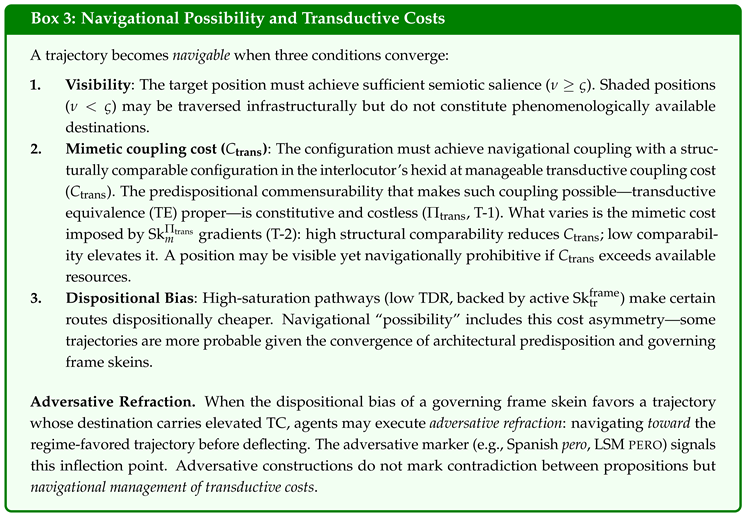
Example: In contexts of normalized racism, an agent evaluating a baby as attractive may find that the direct trajectory incurs elevated because the interlocutor’s saturated landscape includes the inference dark-skinned→unattractive. The utterance “its not as white as his father but still he is a little angel” (he’s dark-skinned but cute) executes adversative refraction: the first clause () acknowledges the regime-favored pathway the interlocutor expects; the adversative then deflects toward the intended evaluation (), reducing net TC by first traversing—and then explicitly canceling—the normative inference. The “expected” trajectory is expected not because of logical entailment but because the interlocutor’s governing frame skeins make that route dispositionally cheapest within the communicative ecology.
2.8.4. The Cost Triad: Informational, Transductive, and Topographic
The binary decomposition introduced in §2.6—informational cost (radial distance) and transductive cost (inter-hexid coupling)—is analytically productive but incomplete. A class of navigational phenomena loads on neither component. Consider the transition from to : a single ring of radial distance, no inter-hexid coupling, yet potentially enormous navigational effort—because the transition crosses an epistemic barrier () whose permeability depends on the agent’s resources. Or consider an agent navigating against the dominant frame skein: the cost is intra-hexid and non-radial—it is the resistance imposed by the landscape’s skein regime. Or consider an act of introspection—recognizing that one is in an unhealthy relationship, or that a pattern of emotional dependency has been operating below awareness. Here the agent refers to itself (, minimal radial distance), addresses no interlocutor (zero transductive cost), yet the navigational effort may be considerable. What is costly is bringing a penumbral position into visibility by raising through —an effort that loads on the topography of the semiotic field, not on its radial or transductive dimensions.
These three cases identify a missing third component: topographic cost ()—the resistance imposed by the navigational landscape itself, independent of radial distance () and inter-hexid coupling (, formerly abbreviated TC). The total cost of a trajectory decomposes as:
has three sub-components. Barrier cost () is the cost of crossing an epistemic barrier, governed by its permeability; it is directional—outward and inward permeability at the same barrier may differ, which is why sustained outer-ring occupation can produce the impeded -return discussed in §3.4. Regime cost () is the cost of navigating against dominant skein regimes: trajectorial refraction, as described above for adversative constructions, is navigational management of . Depth-access cost () is the effort of bringing a penumbral position into navigational visibility through . This last sub-component exhibits a fundamental asymmetry: raising costs; lowering it (entropic dissipation via TDR) does not. Introspection is costly; forgetting is free.11
The three components are orthogonal: each can be zero while the others are nonzero. A same-ring, same-hexid transition across a barrier loads purely on ; a same-ring coupling with a dissimilar hexid loads purely on ; a radial movement within an unobstructed band loads purely on .
The analytical payoff for indexical analysis is immediate. When a speaker says “I realize I’ve been doing this my whole life,” the referential position is minimal (), the interlocutor may be absent, and yet the navigational effort is palpable. No binary cost decomposition captures this: is near zero, may be zero, and the entire load falls on —the cost of making a penumbral self-configuration visible. Conversely, the universalization sequence analyzed in §3.1 (, “you know how…”) loads simultaneously on all three components: (eight Hxd units), (two barrier crossings), and (the rhetorical facilitator reduces transductive cost by anchoring in addressee complicity). The triad makes visible what the binary decomposition cannot: which dimension of navigational effort the speaker is managing at each point in the trajectory.
2.8.5. Frame Trajectoriality and the Memoristic Skein
Not all trajectories operate at the same tick rate. Some advance rapidly through their configurational sequence—an utterance, a gestural stroke, a flash of affect. Others advance with extreme slowness—the coherence of a biographical self-narrative, a decades-old friendship, an old fear that keeps resurfacing. The relationship between fast and slow trajectories is not one of containment but of navigational framing: a trajectory with a slow tick rate, by virtue of its ongoing navigation, maintains a regime of predispositional conditions under which certain positions remain navigable for faster trajectories. This relationship is constitutive, not causal—parallel in principle to the relation between NET curvature and threads. That is, the slow trajectory does not cause the fast one to occur; rather, its ongoing navigation constitutes the regime within which the faster trajectory is possible at all—much as the continued existence of a road does not cause any particular trip, but constitutes the conditions under which trips can happen.
The skein () is TTF’s ensemble operator at the trajectorial level: a dynamic coherence ensemble of trajectories whose mutual coherence is maintained by SC. The members of a skein are cohesioned but not fused—each retains its individual identity within the ensemble.12 The same-level constraint reflects an ontological asymmetry: trajectories are the dynamic constituents of hexid space—they move through configurational sequences—and it is precisely this shared dynamism that makes ensemble coherence possible. A frame trajectorial skein () is the specific case where a trajectorial skein’s tick rate is slow enough to maintain navigational conditions for framed trajectories within its regime. Conversational frames, relational frames, and biographical frames are all instances of at progressively slower tick rates.
Figure 4.
A frame trajectorial skein (). The dotted arrows represent the skein’s slow-tick advance, which sustains navigational conditions across the ensemble; blue arrows represent individual framed trajectories (tr) navigating rapidly within the regime the skein maintains. Dotted curves indicate the ribbon-level topology shared by both.
Figure 4.
A frame trajectorial skein (). The dotted arrows represent the skein’s slow-tick advance, which sustains navigational conditions across the ensemble; blue arrows represent individual framed trajectories (tr) navigating rapidly within the regime the skein maintains. Dotted curves indicate the ribbon-level topology shared by both.
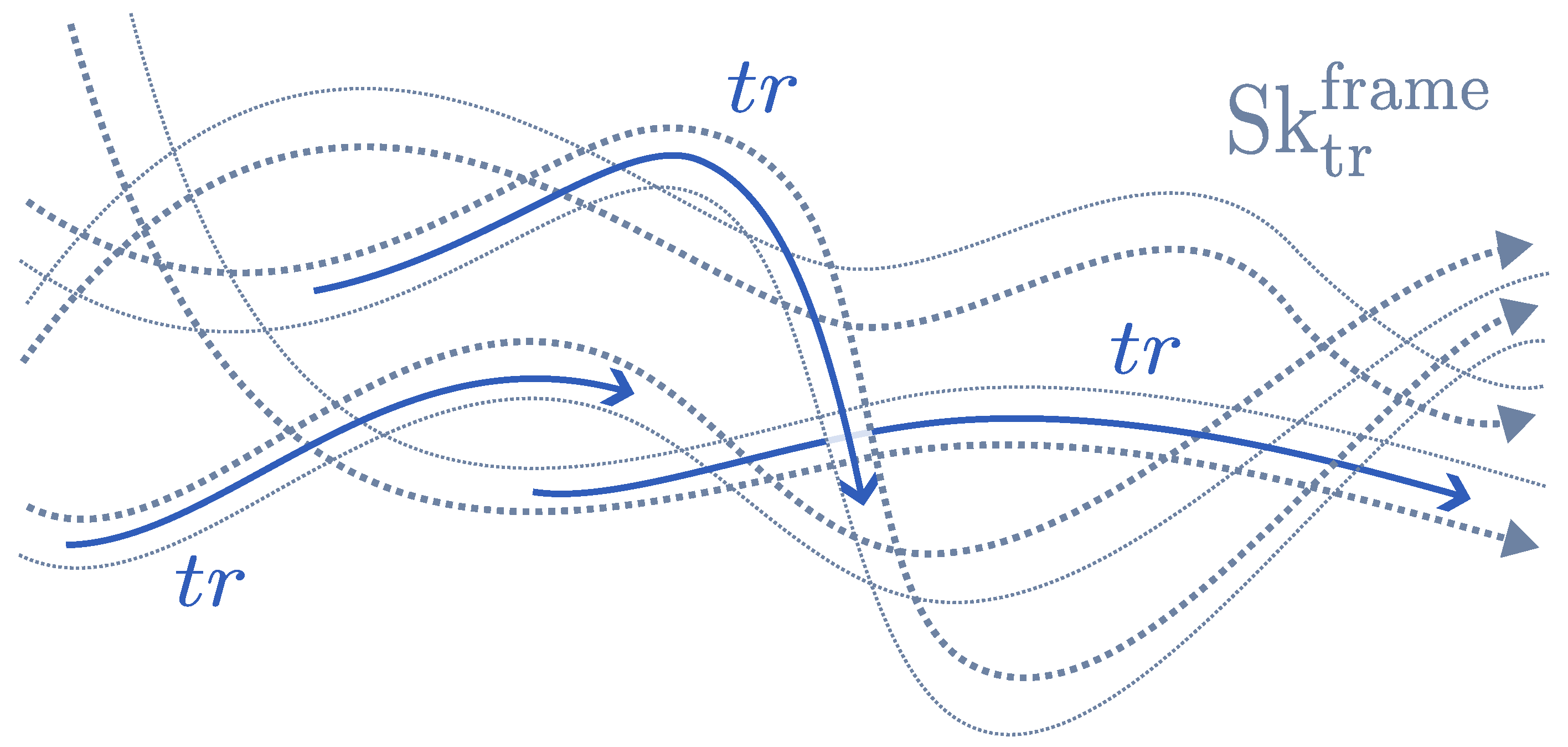
The skein apparatus makes explicit a distinction between two sources of navigational accessibility. The first is what we may call architectural viability: the range of positions that the semiotic field makes available for navigation by virtue of its structure alone. This is determined by the visibility mechanics already introduced—whether a position’s visibility value meets the render threshold under the operative -mode. In Gibsonian terms, these are the affordances that the field presents independently of the agent’s current navigational activity: what is there to be navigated. The second source is genuinely novel: navigational inertia (). Positions within an actively navigated skein become easier to reach—not because the landscape has changed, but because the ongoing navigation reduces the informational cost or movement against the -pull—the navigational effort required to reach a position—and generates a kind of momentum from SC operating across the ensemble as a whole. When a skein is active, navigating any one of its positions lowers the cost of reaching the others. dissipates at the tick rate of the governing skein upon navigational cessation; it modifies no topography and leaves no inscription.
The effective persistence of a navigational configuration is determined by the relation between its intrinsic —the rate at which a configuration dissipates in the absence of ongoing navigation (cf. §2.8.3)—and the provided by the skein(s) within which it is held. When , the configuration persists; when , it dissipates. Consider a friendship: while both friends continue to navigate the relational skein—regular contact, shared references, mutual engagement—the friendship persists because exceeds . When contact ceases, decays at the skein’s own tick rate; if it drops below , the relational configuration dissipates—not erased from the architecture, but no longer actively navigable without re-initiation.
For radial analysis specifically, these concepts provide the formal grounding for what RA’s mechanics and the ORC’s orbital velocity profiles describe operationally. The Orbital Radial Cut (ORC)—a dynamic complement to the static HRC—assigns each ring an orbital velocity representing the tick rate at which configurations at that epistemic distance typically evolve (see §D.4). This orbital velocity can now be read as a proxy for the tick rate of the frame skein governing a configuration. In practical terms, when RA describes a configuration in which orbits slowly, it describes a relational frame that advances at a gradual pace—long friendships, stable professional roles—whose inertia keeps its constituent positions available for faster processes, such as a single conversation or a momentary emotional response. A rapidly orbiting configuration at the same ring, by contrast, is a new relational skein with fast tics and low —a recently formed acquaintance, still fragile. Where RA previously described such patterns as “requiring less maintenance,” the skein apparatus specifies why: the governing provides the that offsets .
2.9. Trajectory Notation
Navigation through the hexid is formalized as trajectories—ordered sequences of positions: , where each arrow represents a navigational move and the sequence captures temporal ordering without specifying duration. Positions can be specified at varying granularity depending on analytical needs: area-level (), area with sector (), or full cubic coordinates (). Exploratory analysis may use area-level notation; precise cost calculation requires full coordinates.
The notation extends to capture parameter and visibility information inline. Lambda is appended as a subscript on the trajectory sequence when relevant (); sigma appears as superscript on individual positions ( for a position occupied meta-reflectively). Positions traversed without navigational significance—shaded transit—are marked with bars: indicates that and were crossed infrastructurally. A complementary convention uses case distinction—uppercase for significant positions, lowercase for shaded—as developed in §2.10.4. Transition costs are marked on arrows using the grading: (low cost), (medium), (high or blocked). The complete notation reference appears in Appendix B.
2.10. Depth and Semiotic Visibility
The parameters introduced in §2.8 configure what structure is available and how agents access it. A third dimension governs whether positions achieve navigational significance at all. The depth parameter () configures the geometric depth of the semiotic weave—how far ribbon configurations extend from the navigational midline—while its epistemic component, the render threshold (), determines semiotic visibility: the gradient from full navigational salience to infrastructural operation without phenomenal registration.13
2.10.1. Shading as Semiotic Visibility Gradient
Shading describes a continuous gradient from full semiotic visibility to operational invisibility. Unlike binary visible/hidden distinctions, shading operates through a coefficient:
where indicates full navigational significance and indicates complete shading.
Three qualitative states emerge along this gradient:
- Clear ()
-
The position achieves full navigational significance. It appears as a discrete location in the trajectory; informational costs are formally indexed; phenomenal content is rendered. This is the domain of conscious navigation—positions the agent experiences traversing.
- Fog ()
-
Partial visibility. The position operates with reduced phenomenal presence—“glimpsed,” “sensed,” or “peripheral.” Typical of habituated objects, positions traversed rapidly, or configurations at the edge of attention.
- Shaded ()
-
The position operates infrastructurally below the render threshold () but remains trajectorial: it is a navigational configuration that signifies for the system without registering as a phenomenally salient location for . Navigation proceeds through these positions without the agent recognizing them as destinations. This is precisely the operative mode of frame skeins : their infrastructural efficacy depends on their sub-threshold phenomenal status.
The significance threshold () determines the minimum value required for navigational significance. Crucially, is hexid-specific and modulable:
- Different agents have different baseline values
- Training can lower for specific thread bundles (heightened sensitivity)
- Fatigue, overwhelm, or crisis can raise globally (reduced discrimination)
- Contemplative practice characteristically lowers toward proprioceptive threads
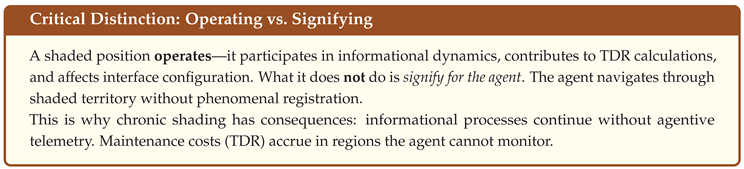
2.10.2. Shading and Traditional Cognitive Distinctions
The distinction between clear and shaded positions may appear analogous to classical conscious/unconscious dichotomies, productively employed in cognitive semantics through notions like windowing of attention [50] or the profile/base distinction [36]. However, TTF is not a representationalist framework, and the architectural differences have substantive consequences.
The Representationalist Trap
Classical cognitive frameworks embed implicit commitments that shading explicitly rejects:
- 1.
- Mental compartments: The assumption that “unconscious” names a separate processing level, container, or reservoir where mental contents reside before emerging into consciousness.
- 2.
- Processing dualism: The distinction between what consciousness can “access” versus what operates “beneath” or “behind” awareness—even when framed as gradient, this repeatedly crystallizes into categorical language (unit vs. non-unit, accessible vs. inaccessible).
- 3.
- Individual locus: Processing occurs within individual cognitive architecture, treating depth as a property of one mind rather than of communicative situations.
- 4.
- Hidden representations: “Unconscious content” exists as stored mental objects awaiting retrieval or activation.
The TTF Alternative
Shading operates through fundamentally different commitments:
- 1.
- Relational ontology: Shading describes positions within communicative situations, not states of individual cognitive systems. A position is shaded relative to a specific intersubjective configuration, not intrinsically.
- 2.
- Dynamic constitution: Shading can shift through participatory coordination—it is not fixed by prior “processing.” What is shaded in one communicative moment can become salient in another through relational reorganization.
- 3.
- Non-representational: Shaded positions are not “hidden representations” waiting to be accessed but aspects of semiotic space not currently operative in participatory sense-making.
- 4.
- Emergent gradients: The visibility gradient () emerges from the dynamics of the communicative situation rather than being determined by individual cognitive architecture.
- 5.
- No homunculus: There is no internal “viewer” whose access determines what is shaded—salience emerges from relational configuration itself.
Depth as Intersubjective Integration
The “depth” in the depth parameter does not index vertical layers within individual cognition (conscious surface / unconscious depths). It indexes relational density—the degree to which positions are integrated into the intersubjective dynamics of the communicative situation. Depth thresholds () are hexid-specific, but a position is shaded not because it lies beneath a threshold granting “access” to hidden cognitive contents, but because it does not currently achieve phenomenal registration in participatory sense-making. The threshold determines what registers phenomenally for the agent, not what “exists” or what “signifies”: a shaded position remains trajectorial and semiotically active—it signifies systemically without rendering for . The threshold itself is relationally configured.
This reconceptualization has methodological consequences. When Langacker [36] describes how entrenched structures become “less salient... precisely because the speaker no longer has to attend to them individually,” the explanatory weight falls on individual processing history (entrenchment). In RA, the explanatory weight shifts to situational dynamics: the same agent may navigate “the same” skein with different shading configurations depending on communicative context, interlocutor configuration, and participatory demands. Shading is situationally variable, not a fixed property of the agent’s “cognitive architecture.” In concrete terms: the same configuration—a bodily sensation, an institutional role, a relational structure maintained by a slow-tick frame skein—can be fully visible in one communicative moment and invisible in another, depending on two factors: what is colloquially called “learning”—which TTF formalizes not as inscription but as reconfiguration of the governing —and the relational dynamics of the situation.
Visualizing Ribbon Stratigraphy
Recall that ribbons—coordinated bundles of threads constituting the minimal semiotic unit—are not flat cuts across a uniform axis. They undulate through the -dimension, rising toward coarse categorical structure and descending toward fine pre-categorial structure. Figure 5 illustrates this architecture. Distributed along each ribbon are Harmonic Folds ()—convergence points where threads achieve coherence—at varying depths.
The water-surface analogy clarifies what is agent-relative and what is not:
- Thread depth: constitutive, not observer-dependent. The root is where it is.
- Visibility threshold (): agent-relative, situation-dependent. The “water level” varies.
- Clear/Fog/Shaded status: emergent from the intersection of constitutive depth and current threshold.
This architecture explains why the “same” semiotic weave—coordinate ribbons—can exhibit different visibility profiles across situations without architectural movement. An introspective therapy session operating at a deep -cut (low ) yields Harmonic Folds that remain Shaded for an agent operating at a coarse -cut. The roots have not moved; only the navigation water level has changed.
2.10.3. Shading Configurations
Stable shading regimes arise when the convergence of depth gradients (), exchange partitions (), and governing skeins—whether individual frame skeins () or collective mimetic skeins ()—chronically constrains such that certain hexid regions remain below the render threshold. Nothing prohibits navigation across these regions: barrier porosity is constitutive, and is violable. But the dispositional convergence actively disfavors it. These regimes constrain the agent’s render range—the set of positions that achieve phenomenal registration ().
Two canonical configurations have particular analytical relevance:
Root-Shading
Chronic shading of basal positions (, ). The body operates but does not register phenomenally for ; proprioceptive and first-person positions remain trajectorial and semiotically active—signifying systemically—without achieving phenomenal registration. Phenomenologically, this manifests as experiences of depersonalization, dissociation, or “not feeling like oneself.” The agent can navigate outer positions (+) while inner positions operate infrastructurally as shaded frame skeins.
Root-shading typically produces low -centrality—the degree to which the agent’s trajectories gravitate toward baseline: the agent cannot return to registered baseline because baseline positions are shaded. Trajectories originate from and terminate at outer positions without registering inner transit.
Depth-Shading
Chronic shading of outer positions (+). The agent achieves stable phenomenal registration at inner positions but outer positions remain below . Phenomenologically, this manifests as difficulty with intersubjective navigation, social anxiety, or “not knowing how to be around others.” The agent experiences rich inner life while outer positions remain trajectorial but phenomenally inaccessible.
Depth-shading may produce high -centrality: the agent returns frequently to baseline because outer rings do not sustain registration within the operative skein—trajectories extend outward but collapse back before achieving persistent coupling at external positions.
Genesis Typology
Shading configurations emerge through different pathways:
- Protective: Shading develops as adaptive response to overwhelming input— rises, reducing the render range.
- Traumatic: Specific positions become shaded following experiences that made their navigation costly or dangerous.
- Structural: Shading reflects chronic navigational regimes established through socialization, institutional constraints, or developmental history—maintained by whose collective geometry constrains for populations.
These genesis types are not mutually exclusive; an agent may exhibit protective root-shading, traumatic shading of specific outer positions, and structurally-conditioned shading of certain QRS sectors simultaneously.
2.10.4. Trajectory Notation with Shading
RA notation accommodates shading through case distinction: significant positions appear as uppercase (), shaded positions as lowercase (). Optionally, shading bars group continuous sub-threshold segments:
A trajectory with shaded transit appears as:
Here the agent navigates through and without phenomenal registration, achieves significance at , then returns to significant . The lowercase notation indicates that the initial outward movement occurred infrastructurally—the agent did not experience “passing through” these positions.
Shaded vs. Direct Trajectories
Consider two agents navigating from to :
| Pattern | Trajectory |
|---|---|
| Agent A (full significance) | |
| Agent B (root-shading) |
Both trajectories traverse the same positions. Agent A experiences the full navigational arc—embodiment (), self-identification (), then interlocutor orientation (). Agent B experiences “arriving at” without the phenomenal sense of having traversed inner positions. The informational costs are comparable (both trajectories incur across the same distance), but the phenomenological profiles differ radically.
Analytical Implications
Shading notation enables analysts to distinguish:
- Trajectory length vs. significance range: An agent may traverse long trajectories while achieving significance at only a subset of positions.
- Cost without telemetry: Shaded positions contribute to without the agent’s phenomenal awareness—maintenance costs accrue in regions the agent cannot directly monitor.
- Situational variation: The same trajectory structure may exhibit different shading configurations across communicative contexts.
Figure 6 illustrates this contrast. Panel (A) shows an extended trajectory with multiple significant positions; Panel (B) shows a trajectory of similar extent where intermediate positions are shaded, producing apparent “directness” despite equivalent navigational distance.
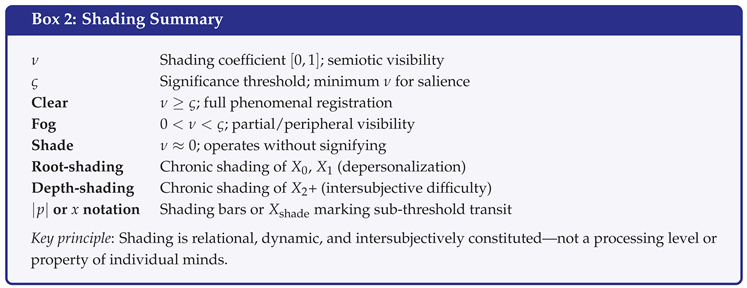
3. Applications
This section demonstrates RA through five application domains, progressing from established linguistic territory (deixis) through identity dynamics to recent theoretical extensions (epistemic appropriation), concluding with comparative evaluation.
3.1. Personal Deixis
Personal pronouns provide an intuitive entry point for RA because they distribute across the ring–band architecture in ways that the canonical apparatus predicts. The analysis operates under the default social_indexicality configuration:
| Axis | Positive Pole | Negative Pole |
|---|---|---|
| Q | Agentive / Active | Patientive / Passive |
| R | Authority / Senior | Subordinate / Junior |
| S | In-group / Familiar | Out-group / Stranger |
Under this CONFIG, person deixis emerges from ring position (, , ), grammatical number from hex band (), and social-indexical character from QRS orientation—three orthogonal encodings. The English pronoun system maps onto this architecture as follows:
| Pronoun | Ring | Band | Dimension | Notes |
|---|---|---|---|---|
| I | Individual self | Minimal Hxd; maximal epistemic proximity | ||
| you (sg.) | Addressed other | Direct individual access | ||
| he/she/they (sg.) | Non-addressed other | Distal individual reference | ||
| — Barrier : “Where does ‘I’ end?” — | ||||
| we (inclusive) | Collective self | Crosses into collective band | ||
| they (pl.) | Collective other | Plural other within collective band | ||
| — Barrier : “Where does ‘we’ end?” — | ||||
| one (generic) | Generic self | Impersonal; category reference | ||
The column “Dimension” names the qualitative regime that each hex band sustains—individual (), collective (), generic ()—not a QRS value. QRS orientation is contextual: within any given ring, the social-indexical marking of a pronoun depends on the discursive situation, not on the pronoun’s lexical identity. A speaker who says “I” while occupying a high-authority stance () and a speaker who says “I” while occupying a subordinate stance () both navigate at ; what differs is QRS orientation within that ring. The table therefore omits a “Typical Sector” column: sector assignment is an analytical decision made per utterance, not a lexical property.
3.1.1. The Status of Gender—And of Every Other Social-Indexical Dimension
The classical pronominal triad is {person, number, gender}. RA distributes the first two architecturally: person is a function of ring position, number a function of hex band—both invariant across QRS-CONFIGs. Gender, by contrast, is configurational: it encodes social-indexical orientation within a ring, not epistemic distance from . English he and she occupy the same position (, ); what differs is their QRS marking under a CONFIG that assigns one axis to gender prototypicality. Under social_indexicality, gender is not foregrounded as a dedicated axis—it may surface as a component of group membership (S) or require a domain-specific CONFIG (e.g., gendered_indexicality: Q = agency, R = gender prototypicality, S = normative alignment) when gender is the primary analytical dimension.
This is not a gap but a theoretical prediction, and the typological evidence is overwhelming. Person and number are the only features attested universally in pronominal systems—across all documented language families, all continents, and both spoken and signed modalities. Every other dimension attested in pronouns—gender, caste, clan, age, authority, professional role, ethnicity, evidentiality—is culturally configured content that particular languages may or may not grammaticalize in the pronoun slot, and may redistribute to other grammatical subsystems entirely. Languages without grammatical gender (Turkish, Finnish, Mandarin, Persian, Quechua) operate with the same ring–band architecture without loss; languages undergoing gender neutralization in third-person singular (English singular they) alter QRS orientation without disturbing architectural position; and languages that fill the pronoun slot with caste hierarchies (Javanese), kinship dyads (Vietnamese), or discourse-salience tracking (Algonquian obviation) confirm that what varies is the CONFIG content, never the ring–band geometry.
The asymmetry between architectural and configurational encoding—{person, number} as geometry, {gender, caste, clan, age, authority, epistemic stance, …} as CONFIG content—is itself diagnostic. It identifies which pronominal categories are navigational necessities and which are socially saturated conventions that a given regime has naturalized as if they were architecture. The Indo-European habit of treating gender as a “fundamental” pronominal category, on par with person and number, is itself a CONFIG-specific naturalization—visible as such only when the analyst has access to the full typological landscape.
3.1.2. Additional Notes on Gender and Indexicality
The cross-linguistic asymmetry is stark. Siewierska [48] reports in WALS Chapter 44 that 254 of 378 surveyed languages (67.2%) encode no gender distinction in independent personal pronouns, while no documented language lacks person or number marking. Sign languages provide the modality-independent proof: ASL, BSL, Auslan, DGS, JSL, and every other surveyed sign language encode person through spatial pointing (chest-point = first person, addressee-point = second, location-point = third) and number through spatial modification (singular, dual incorporation, plural arc-sweep), yet no documented sign language encodes gender in its pronominal system [38,39,45]. If gender were architecturally necessary, it would emerge in the visual-gestural modality as reliably as person and number do; its universal absence from signed pronouns confirms it is configurational content, not structural architecture.
Meanwhile, the pronominal slot that Indo-European fills with gender is filled by radically different social-indexical dimensions in other language families: caste and speech level in Javanese, which maintains three entirely suppletive pronoun sets keyed to social hierarchy (aku/kula/dalem for first person at ngoko, krama, and krama inggil registers; Errington 15; similarly in Balinese, where third-person forms escalate through four levels tracking the Hindu varna system: Arka 4); age, authority, and developmental stage in Thai, where nůu (“mouse”) functions as a dedicated child pronoun, adult forms split along gender-formality axes (phǒm, dichán, chán), and the royal register replaces pronouns entirely (Iwasaki & Ingkaphirom 30); kinship and relative age in Vietnamese, where speakers select from dozens of kinship-derived terms (anh, chị, em, ông, bà) that form obligatory reciprocal dyads—there is no context-neutral “I” or “you” (Thompson 51); discourse salience in Algonquian languages (Ojibwe, Cree, Blackfoot), where the third-person structural position hosts a proximate/obviative distinction tracking referent topicality rather than any inherent property of the referent (Mithun 40,Wolfart 53); and epistemic authority in Tibeto-Burman egophoric systems (Lhasa Tibetan, Kathmandu Newar), where verbal or copular morphology encodes whether the speaker has direct epistemic access to the event—a dimension that in Ersu (Sino-Tibetan) splits the pronoun paradigm itself (Floyd et al. 21).
Perhaps most revealing are languages with elaborate nominal classification that nevertheless exclude gender from pronouns. Swahili maintains 15+ noun classes with extensive verbal agreement yet draws no sex distinction in the free pronoun yeye (“he/she”; Katamba 33). Navajo encodes 11 categories of object shape in classificatory verb stems yet has no gender anywhere in its grammar [55]. Dyirbal’s four-class system (including the famous Class II: “women, fire, and dangerous things”; Dixon 13) governs demonstratives and noun morphology but leaves pronoun person and number intact. In each case, classification content is redistributed to verbs, nouns, demonstratives, or classifiers while the pronoun core retains only ring–band architecture.
3.1.3. Analytical Example
A speaker recounting a personal experience might produce:
“I was walking home when you know how it gets dark early? And then one just feels unsafe…”
The trajectory is:
This movement from specific first-person (, ) through addressee appeal (, ) to generic positioning (, ) accomplishes universalization of personal experience—and the canonical apparatus makes visible what categorical analysis cannot: the trajectory crosses two epistemic barriers ( and ), each requiring permeability conditions (sufficient and manageable at the barrier) that are architecturally non-trivial. The colloquial “you know how…” functions as a rhetorical facilitator of the first barrier crossing: by anchoring the transition in addressee complicity (, shared experiential ground), the speaker reduces the effective at before extending into the generic band. The Hxd between and (eight rings) provides a heuristic index of navigational distance, but the dominant cost factor is barrier permeability (), not linear distance ()—a trajectory from to (three rings, zero barriers) is categorically cheaper than a trajectory from to (one ring, one barrier).
The power of RA emerges when analyzing atypical trajectories. A speaker who begins at and moves inward (“One sometimes wonders… I mean, I wonder…”) performs a different kind of identity work—particularization rather than universalization—traversing the same two barriers in the opposite direction, with characteristically different permeability profiles and different rhetorical demands.
3.1.4. Asymmetry in Person Deixis
The transition from first person to generic positioning () typically exhibits lower effective cost than the reverse (). Universalizing personal experience is discursively unmarked; particularizing generic claims requires justification. This asymmetry—invisible to categorical analysis—becomes tractable through notation, which indexes the exchange-protocol cost of projecting navigational structure across the relevant barriers. Note, however, that does not operate in isolation. Mimetic skeins of transductive protocols () can exert convergent pressure on the epistemic modality that governs the agent’s preference for trajectorial extension toward distant positions: “being Mexican,” “wearing the company jersey,” or “belonging to a faith community” are configurations where subsidizes navigation toward outer-band positions (+) that would otherwise carry prohibitive cost at the relevant barriers. The asymmetry described above is therefore modulated by the degree to which facilitates or obstructs specific directional biases across and .
3.2. Temporal Reference
Linguistic research has long treated the temporality of language as a composite of discrete systems. The canonical tradition separates tense from aspect [8,9], aspect from modality [7], and evidentiality from both—establishing it as an autonomous grammatical category only in languages that mark information source obligatorily [2]. Even integrationist frameworks like grammaticalization theory, which trace how these systems converge diachronically, preserve the analytic separation: TAM categories become related through semantic drift, not are inherently facets of unified navigational dynamics.
The consequence is a modular architecture where each domain receives its own descriptive apparatus—layered onto syntactic, morphosyntactic, semantic, and pragmatic “levels” that must then be reconciled through interface mechanisms. Epistemic stance enters as pragmatic overlay; evidentiality appears as optional grammatical elaboration in select languages; the prospective-retrospective axis reduces to tense morphology—until typological evidence mounts and the apparatus must be revised: the English “future,” it turns out, is not a tense at all [7,42]. RA inverts this architecture: rather than starting from separated components that require post hoc integration, it begins from navigation—the continuous trajectory through informational space—and derives apparent modularity as analytic abstraction from integrated phenomenological dynamics.
Temporal deixis operates on analogous geometric principles to personal deixis, but requires its own QRS-CONFIG. Under the temporal_tam configuration, the three axes encode temporal-epistemic rather than social-indexical dimensions:
| Axis | Positive Pole | Negative Pole |
|---|---|---|
| Q | Prospective | Retrospective |
| R | Bounded / Perfective | Unbounded / Imperfective |
| S | Anchored (experiential, direct) | Unanchored (inferential, counterfactual) |
The aspectual boundedness axis (R) follows Langacker’s (1987) construal of event contour. As with all QRS-CONFIGs, the geometric architecture—rings, Hxd, barriers, hex bands—remains invariant; what varies is the semiotic content populating each directional region.
Ring position encodes phenomenological proximity to the experiential present, and hex band encodes the qualitative regime of temporal reference—individual, collective, generic, mythic—just as it does for personal deixis:
| Temporal Expression | Ring | Band | Regime | Characterization |
|---|---|---|---|---|
| now, present moment | – | Experiential | Maximal proximity; low | |
| today, yesterday | Experiential | Proximal; rhythm-anchored | ||
| last year, in 2020 | – | Experiential | Medial; within experiential reach | |
| — Barrier : “Where does personal time end?” — | ||||
| in my parents’ day | – | Collective | Inherited temporal reference | |
| during the Revolution | – | Collective | Communal-historical | |
| — Barrier : “Where does communal time end?” — | ||||
| in ancient times | – | Generic | Category-temporal (“the Romans”) | |
| — Barrier : “Where does historical time end?” — | ||||
| always, in the beginning | – | Mythic | Archetypal; near-atemporal | |
The barrier labels adapt to the temporal domain: marks the transition from experientially accessible time to inherited collective time; , the transition from communal temporal reach to generic historical reference; , the transition from historiographic to mythic-archetypal temporality. The liminal questions (“Where does personal time end?” etc.) are temporal analogues of the personal-deixis barriers. As with personal deixis, the Hxd value provides a heuristic index of phenomenological distance, but the dominant cost factor at each transition is barrier permeability ()—governed by and at the relevant .
Crucially, radial distance ( through ) indexes phenomenological proximity to the experiential present as an orthogonal parameter to QRS orientation: one can be temporally distant (, generic regime) yet epistemically anchored (: “I know this from direct archaeological evidence”), or temporally proximal () yet epistemically unanchored (: “I think something happened just now”). This orthogonality—impossible to represent in linear tense models—enables formal analysis of cross-linguistic TAM systems without collapsing tense, aspect, and evidentiality into a single dimension.
The key insight is that temporal expressions are not merely locating events in time but navigating the speaker’s relationship to temporal structure. “Yesterday” and “24 hours ago” may denote identical clock-time yet occupy distinct trajectorial positions—formalized through axis configuration:
| Expression | Ring | Q | S | Characterization |
|---|---|---|---|---|
| yesterday | Retrospective, experientially anchored | |||
| 24 hours ago | Retrospective, metrically indexed |
Both expressions navigate retrospectively () at comparable radial distance (), yet differ along the epistemic grounding axis: “yesterday” anchors to the lived experiential rhythm (waking, sleeping, the phenomenological “shape” of a day), while “24 hours ago” indexes measured duration detached from that rhythm. The profile differs accordingly: “yesterday” exhibits lower effective when held within a narrative frame skein because it aligns with the speaker’s experiential structure; “24 hours ago” demands explicit anchoring (“24 hours ago—around 3 pm—we were still…”) to stabilize the reference.
This distinction—invisible to analyses that reduce both expressions to “past reference”—emerges naturally when temporal navigation operates across orthogonal parameters. Aspectual boundedness (R axis) adds further discriminability: “I was working yesterday” (, imperfective) versus “I finished yesterday” (, perfective) occupy the same region but differ in R-polarity, capturing what traditional accounts require separate morphosyntactic modules to represent.
and Temporal Reference
Positions closer to the experiential present exhibit lower ; distant temporal references exhibit higher effective —their navigational persistence requires stronger from the governing skein. This explains why speakers often “anchor” distant events through proximal framing: “Back in 1985—I remember it clearly—we were living in…” The trajectory momentarily returns toward to re-establish at experiential proximity before sustaining the high- distant reference. The anchoring move is not decorative but navigational: without it, the configuration at + risks decoupling from the agent’s experiential render.
3.3. Identity Navigation: -Return Dynamics
The framework posits as an attractor—a baseline configuration toward which trajectories gravitate between coded positional excursions. But this is not merely a theoretical stipulation; it generates testable predictions about navigational patterns in identity discourse.
3.3.1. The Attractor Hypothesis
If functions as experiential attractor, we should observe:
- Return frequency: Trajectories should exhibit periodic movement toward inner areas (–) between outer-area excursions.
- Cost asymmetry: Outward movement (toward +) should require more discursive work than inward movement.
- Navigational persistence patterns: Positions closer to should exhibit lower —less maintenance effort required.
3.3.2. Empirical Signature: Navigating Institutional-Community Boundaries
Consider identity navigation in contexts where speakers must coordinate between institutional and community positionings. Data from ongoing research with Yoreme (Mayo) indigenous educators in northwestern Mexico reveals consistent patterns.14
A Yoreme (Mayo) teacher, interviewed at the Autonomous Indigenous University of Mexico (UAIM) in Mochicahui, Sinaloa, produces the following reflection on navigating institutional and community identity:15
“From, like, as yori, so then, and there it’s a game, and it’s beautiful, it’s beautiful, it’s good, yes. When they invite you to participate in an event, well, you sing, you participate as yori. Ah, well, I sing as yori, I sing songs as yori, and so on. There are yoremes who know songs as yoremes, and know songs as yoris, and so on. [...] You feel the appreciation of the yori, you feel it inside yourself, you can say, ah, well, it gave me an opportunity, they opened the world of yoris for me, well then, we have to participate as yoris.”
This segment—originating from the fieldwork that motivated the development of HEXID geometry—serves as the canonical worked example for RA methodology.
The Polar Space as Deliberate Heuristic
The analysis that follows operates under a domain-specific QRS-CONFIG designed for identity negotiation in polar contexts:
| Axis | Positive Pole | Negative Pole |
|---|---|---|
| Q | Yoreme-prototypical | Non-Yoreme |
| R | Yori-prototypical | Non-Yori |
| S | High polarization | Low polarization (fluidity) |
This polar_identity configuration is a doubly deliberate heuristic. First, it is methodologically deliberate: the polar axes (Q, R) gamify identity negotiation, establishing a simplified geometry in which the labor of navigational positioning becomes analytically tractable—not because identity is polar, but because setting up a polar field provokes the navigational mechanisms that constitute identity work. Second, it is critically deliberate: the instruments through which identity data are typically gathered—public-policy questionnaires, educational assessments, cultural-affiliation surveys—already impose polar categories. Rather than treating this imposition as a methodological defect to be corrected, polar_identity explicates it: the analyst operates within the polar frame that the data-collection ecology has already established, while using the third axis (S, the polar macrotype) to capture the degree to which the speaker recrudesces or softens the polar frame itself.
The constraint does formal work here. If a speaker is simultaneously strongly Yoreme-prototypical () and strongly Yori-prototypical (), then s must be negative—low polarization. That is: cohabitation of prototypes is geometrically incompatible with stereotypical entrenchment. Conversely, high polarization () with strong Yoreme-prototypicality () forces (non-Yori)—the profile of the hardened stereotype. These are not stipulations but consequences of the cubic constraint, which makes the polar game’s internal logic formally calculable.
The cubic constraint also permits a third epistemic state beyond polarity. When one axis takes value zero while the other two are equal and opposite, the speaker navigates without indexing that dimension—neither affirming nor negating. This is not a midpoint on a metric scale (the coordinates do not imply quantities: on q does not mean “four units of Yoreme-prototypicality”) but a topological boundary: the vertex of the hexagonal ring where two sectors meet and the silent axis changes sign. A configuration like characterizes a speaker who indexes yoreme-prototypicality without any positioning vis-à-vis yori—not anti-yori, simply non-yori. Conversely, places the speaker in the interior of a sector where all three axes are active: both prototypicalities cohabit under low polarization—the fluent code-switcher, the bicultural navigator. These are not impressionistic labels but geometrically calculable positions whose trajectorial transitions—from vertex to sector interior, from one prototype’s vertex to the other’s—become formally tractable. The hexagonal geometry thus provides analytic purchase on subtle, veiled, or non-confrontational identity work that purely polar (+/−) coding would flatten into the same “mixed” category.
Crucially, properties such as individual/collective reference, singular/plural marking, and specificity/definiteness remain encoded by and hex band, orthogonal to QRS orientation. A speaker at occupies the personal-singular band regardless of polar orientation; the same polar profile at (crossing ) becomes collective reference.
Expressions as Trajectories
A foundational principle of RA is that linguistic expressions are not static positions but navigational trajectories—movements from an origin to a destination within the radial space. The same utterance may instantiate multiple simultaneous trajectories under different typed objects. For identity analysis, we distinguish two typed objects operating in parallel:
- idx (indexical): pronominal and deictic navigation without explicit identity polarization. Origin and destination are determined by person, number, and epistemic distance alone.
- pol (polar): navigation within the identity polarization space. Origin and destination are determined by the yoreme/yori axes and the polar macrotype (S).
The two typed objects may share ring assignments () but track different navigational work. A single utterance like “you participate as yori” simultaneously instantiates (a) an indexical trajectory under idx (third-person collective addresses generic self) and (b) a polar trajectory under pol (personal yoreme to collective yori-performance). The trajectory inventory below captures this simultaneity through multilinear annotation.
Notational Conventions
Trajectory annotation follows these conventions:
| Format | Interpretation |
|---|---|
| Trajectory from origin to destination under typed object typ | |
| Entry from (implicit origin) to destination | |
| Trajectory with QRS orientation at destination (when analytically relevant) | |
| idx | Indexical typed object: pronominal deixis without identity polarization |
| pol | Polar typed object: navigation within yoreme/yori polarization space |
When multiple trajectories co-occur in the same utterance, they are stacked in multilinear annotation—the indexical trajectory above, the polar trajectory below (or vice versa as convenient). This captures the non-coincidence of endpoints: the same expression may terminate at different rings under different typed objects.
Trajectory Inventory
The discourse is annotated below with stacked trajectory notation. Curly braces {…} mark the linguistic material to which each trajectory applies.
Segment 1:
| {as yori} | {it’s a game} |
| pol | idx |
“From, like, {as yori}, so then, and there {it’s a game}, and it’s beautiful, it’s good.”
Rationale: “As yori” () enters the collective-other register—the yori collective as performance frame, not personal identification. “It’s a game” () refers to the polar game as a kind (generic other, ), not a specific instance; the marks non-yoreme orientation at the generic level.
Segment 2:
| {they invite you} | {you participate as yori} |
| idx/pol | idx / pol |
“When {they invite you} to participate in an event, well, you sing, {you participate as yori}.”
Rationale: “They invite you” instantiates two simultaneous trajectories: under idx, third-person collective () addresses generic self (); under pol, the speaker’s personal yoreme position () projects toward the generic yori-addressed space (). “You participate as yori” similarly doubles: idx terminates at (generic self), while pol terminates at (collective yori-performance). The non-coincidence () captures that the indexical “you” and the polar “as yori” navigate to different destinations—the speaker coordinates both.
Segment 3:
| {I sing as yori} |
| idx / pol |
“Ah, well, {I sing as yori}, I sing songs as yori, and so on.”
Rationale: First-person “I” enters at (immediate self) under idx. “As yori” under pol moves from personal yoreme () to collective yori-performance ()—simulation, not conversion, because the destination is collective-other, not personal-yori.
Segment 4:
“There are yoremes who know songs as yoremes, and know songs as yoris, and so on.”
Two polar trajectories at the generic level ():
- : Kind reference to yoreme category (low polarization, ).
- (via -return): Kind reference to yori category. The axis shift from to is mediated by implicit return to baseline, not by intra-ring traversal—see below.
Segment 5:
“You feel the appreciation of the yori, you feel it inside yourself, you can say, ah, well, it gave me an opportunity, {they opened the world of yoris for me}, well then, we have to participate as yoris.”
Key trajectories:
- (“you feel it, yourself”): Generic “you” oscillates from experiential self to generic addressed and returns toward baseline.
- (“the appreciation of the yori”): Counter-exonymic kind reference enters at generic other () and terminates at generic self ()—a meeting point in depersonalized space rather than personal reception at .16
- (“they opened the world of yoris”): Maximum polarization at generic-other level; the “opening” terminates at personal reception.
- (“we have to participate as yoris”): Collective yoreme (, ) to generic yori-competence (, ). Simulation: destination is generic.
Low-Polarization Axis Shift
Segment 4 illustrates a trajectory type requiring careful interpretation: the speaker moves from “yoremes who know songs as yoremes” (, yoreme-prototypical) to “know songs as yoris” (, yori-prototypical), both at the generic level (, ). Two readings are available:
- Intra-ring arc: The reorientation follows the edge of the hexagonal ring—from a position like toward , passing through intermediate positions where polarization remains minimal.
- Θ-mediated shift: The speaker dissolves the first configuration (implicit -return) and re-enters at the new orientation. Under this reading, the axis shift is discontinuous— is the only true in the geometry.
The trajectory notation does not adjudicate between these readings; what it captures is that the axis shift occurs without traversing the region of the ring. Whether by arc or by -return, the speaker changes which pole she approaches without engaging stereotypical entrenchment. The second reading is more consistent with the -attractor hypothesis: even apparently continuous discourse may involve implicit baseline returns between distinct navigational configurations.
Simulation Versus Conversion
A structural property distinguishes the trajectories in the inventory: all cross-identity moves terminate at outer rings (collective or generic), never at personal-singular. This is the signature of simulation rather than conversion:
- Conversion: (personal → personal = identity change).
- Simulation: or (personal/collective → collective/generic = performance without identity change).
The ring-destination captures this distinction directly: simulation targets outer rings because the speaker performs yori competence without becoming yori. The Yoreme speaker’s trajectory corpus contains no conversion trajectories—she never navigates from personal yoreme to personal yori. This finding is invisible under position-based coding, which cannot distinguish a position “at as yori” from a trajectory terminating at (collective yori-performance) that originates at (personal yoreme).
Trajectory Aggregation
The individual trajectories in the inventory combine into a discourse-level navigational arc. Rather than a sequence of positions visited, the arc is a skein of trajectories—some sequential, some overlapping, some operating in parallel under different typed objects.
For cost-calculation purposes, we extract the primary polar trajectory (), which traces the speaker’s movement within the pol space across the five segments:
The indexical trajectories () track a parallel navigational arc whose cost profile differs—indexical navigation crosses epistemic barriers but does not engage the polar macrotype. The full cost decomposition below focuses on the polar arc, where the S-axis finding is most analytically productive.
Cost Decomposition
Under trajectory-based coding, transition costs decompose into two calculable components—informational cost (, measured as between successive ring assignments) and barrier cost (, counted as the number and direction of epistemic barrier crossings)—plus a qualitative component (, regime cost from the institutional interview context) that is noted but not quantified here.17
The trajectory-based coding reveals navigational effort across band boundaries. Examining the polar trajectories:
| Segment | Trajectory | Barriers | Detail | |
|---|---|---|---|---|
| S1 | 7 | 1 | ||
| S2 | ; | 6; 8 | 1; 2 | ; |
| S3 | 6 | 1 | ||
| S4 | ; | 11; 11 | 2; 2 | ; |
| S5 | ; ; | 2; 10; 4 | 0; 2; 1 | —; ; |
Total Trajectory Cost
The trajectory-based decomposition reveals substantially greater navigational effort than the earlier position-based analysis, which computed costs only within . The speaker sustains radial excursions of up to 11 Hxd (to , kind reference), crosses epistemic barriers twelve times, and coordinates parallel trajectories under both idx and pol typed objects throughout.
The Polar Macrotype Finding
Ternary polarity coding (where each axis may be +, −, or 0) reveals a structural property of the polar macrotype (S) that coarser binary coding would obscure.
The ternary coding assigns each trajectory origin and destination a QRS configuration in which at most one axis may be zero—the single-zero constraint ( forces two zeros to yield ). Transitions between ternary states divide into two formally distinct categories: sign reversal (SR: or ), which constitutes a genuine polarity inversion, and axis activation (AC: or ), which constitutes the activation or silencing of an axis without inversion. The distinction is not terminological but navigational: SR is the signature of polar confrontation (the agent reverses stance on a dimension), while AC is the signature of simulation (the agent activates or deactivates a dimension without confronting its opposite). The two are not interchangeable, and their distribution across the trajectory corpus is an analytical observable.
The ternary assignments for each polar trajectory are:
| # | Trajectory | Origin QRS | Destination QRS |
|---|---|---|---|
| 1 | S1: | ||
| 2 | S2: | ||
| 3 | S3: | ||
| 4 | S4a: | ||
| 5 | S4b: | ||
| 6 | S5: | ||
| 7 | S5: | ||
| 8 | S5: |
The key interpretive decisions: at the speaker is yoreme-in-repose —not anti-yori (), simply not indexing yori—with low polarization (). All simulation destinations take the form : the yori axis activates, the yoreme axis is silenced (not negated), and polarization remains low. The sole exception is trajectory 7 (“they opened the world of yoris”), which is the only trajectory originating with all three axes active and with high polarization (): —non-yoreme, yori-prototypical, high polar entrenchment. This is confrontation, not simulation. Trajectory 6 (“you feel the appreciation”) shows no angular change at all under pol—the work is purely radial (), and the meeting-point phenomenology is captured by the idx/pol overlap at , not by QRS reorientation.
The per-axis transition profile:
| Axis | No change | AC () | SR () | Total activity |
|---|---|---|---|---|
| q (Yoreme) | 3/8 | 4/8 | 1/8 | 5/8 |
| r (Yori) | 2/8 | 6/8 | 0/8 | 6/8 |
| s (Polar macrotype) | 5/8 | 2/8 | 1/8 | 3/8 |
The transition profile shows that S is the most stable axis (5/8 no change, held constant at throughout the simulation regime), while R is the most active (6/8 axis activations, zero sign reversals). A binary coding that collapses AC and SR into a single “change” category would misidentify S as the dominant axis—counting the transition from ’s 0 to as equivalent to a polarity inversion, when it is an axis activation (AC), not a sign reversal (SR). The ternary decomposition distinguishes these, revealing three structural properties of the trajectory corpus:
- R is the simulation axis: all six of its transitions are axis activations—the yori axis activates for performance and deactivates for return, without ever inverting. This on/off pattern is simulation: the speaker engages and disengages a performative dimension without confronting its opposite.
- S is the regime axis: its stability at (low polarization) is the precondition for the simulation regime. The sole SR on S (trajectory 7, ) co-occurs with the sole SR on Q ()—the two sign reversals are cosignatories of the single moment of polar confrontation in the corpus.
- Q is the complementary axis: four axis activations (the yoreme axis silences during yori performance, reactivates on return) plus one sign reversal (the externally imposed of “they opened the world of yoris,” received and reversed upon return to ).
The central finding is that S does not dominate navigation by frequency of change but by regime determination. When S is held at , the other axes operate exclusively through axis activations (simulation). When S shifts to , the other axes exhibit sign reversals (confrontation). The polar macrotype is not the axis the speaker “works” most but the axis whose value determines whether the other two axes work by activation or by inversion.
Band Distribution
The trajectory inventory distributes across three bands:
| Band | Trajectory endpoints | Proportion |
|---|---|---|
| (Individual) | origins and returns | 40% |
| (Collective) | , | 25% |
| (Generic) | , | 35% |
Far from clustering near experiential baseline, the trajectory endpoints distribute across all three accessible bands. The speaker’s navigational fluency consists in sustaining oscillatory access to while maintaining return paths to —a competence that trajectory-based coding makes visible.
Exchange Asymmetry and the Colonial Cost Landscape
The cost decomposition indexes magnitude of navigational effort but not its distribution. The exchange protocol () governs this distribution: it determines whose navigational configurations are subsidized by the transductive ecology and whose are not. In the Yoreme speaker’s context, the distribution is systematically asymmetric.
Consider the permeability of (collective/generic boundary). When the speaker transitions from personal yoreme () to kind reference (), she crosses and outward—from individual to generic reference. This barrier traversal is navigational work whose cost () depends on her resources: the richness of her categorical system at each barrier. For a dominant (yori) agent traversing the same barriers in the reverse domain—generalizing from individual experience to “indigenous people as a kind”—the institutional ecology provides massive through educational infrastructure, media representation, and legal-administrative categories that pre-structure the barrier transition. For the Yoreme speaker, no comparable subsidy operates in the outward direction.18
The phrase “me abrieron” (“they opened [it] for me”) is a precise linguistic index of this asymmetry. The speaker does not say “I entered the world of yoris” but that it was opened for her—access was not autonomous but externally facilitated. In cost-triad terms, this describes a punctual : a specific institutional intervention (the UAIM educational context) that temporarily reduced the barrier cost of for this agent. The “game” the speaker describes—“it’s a game, and it’s beautiful”—is the phenomenology of navigating a cost landscape where barrier permeability is intermittently subsidized rather than structurally guaranteed. The beauty is navigational: the pleasure of fluency in a field whose asymmetries the speaker perceives and manages, not a field whose asymmetries have been dissolved.
Multilinear Annotation and the “I Go/They Come” Structure
The trajectory inventory reveals a structural property of identity navigation that static or position-based analysis obscures: the same agent may simulate multiple trajectories simultaneously. When the speaker says “they opened the world of yoris for me,” she simulates two navigational perspectives: (a) the trajectory of “them” (the institutional agents) who “open” access, moving outward from their yori baseline toward the yoreme speaker; and (b) her own trajectory of “receiving” the opening, moving from her yoreme baseline toward yori-accessible space.
This “I go / they come” structure—two trajectories, simulated by a single agent, under transductive coupling ()—is the formal signature of inter-hexid navigation. The speaker does not merely occupy positions in her own hexid; she models the trajectories of other agents and coordinates her navigation with those modeled trajectories. The RA notation captures this through multilinear annotation: each trajectory receives its own row in the inventory, even when they co-occur in the same utterance. The relationship between co-occurring trajectories (sequential, parallel, nested) is then available for explicit analysis rather than implicit conflation.
Methodological Significance
This worked example demonstrates RA’s analytical sequence under trajectory-based coding: (1) segment discourse into trajectory-bearing expressions, (2) assign typed object (idx or pol) to each trajectory, (3) determine origin and destination rings via referential type and QRS orientation, (4) stack co-occurring trajectories in multilinear annotation, (5) compute cost decomposition (, ), (6) derive summary metrics (axis sign-change proportions, band distribution, simulation/conversion ratio) enabling cross-context comparison.
The principal innovation over position-based analysis is the recognition that expressions are trajectories rather than static positions. This shift reveals: (a) the non-coincidence of idx and pol endpoints for the same expression; (b) the structural distinction between simulation (outer-ring destination) and conversion (inner-ring destination); (c) the role of implicit -returns in low-polarization axis shifts; and (d) the “I go / they come” structure of inter-hexid navigation. These findings are invisible under position-based coding.19
The calculations are reproducible: another analyst applying identical trajectory-assignment rationale and QRS-CONFIG derives comparable metrics. But beyond methodological reproducibility, the example illustrates RA’s theoretical yield at three levels. First, phenomena invisible to categorical analysis—biaxial navigation, barrier fluency types, band distribution, simulation/conversion distinction—become tractable through geometric formalization. Second, phenomena misidentified by position-based coding—apparent navigational concentration that was actually radial dispersion, apparent experiential centrality that was actually performative return—are corrected. Third, the exchange asymmetry () becomes analytically addressable once the cost triad distinguishes barrier cost from informational cost: the colonial cost landscape is visible precisely because the decomposition separates topographic resistance (subsidized for dominant agents, unsubsidized for subaltern agents) from the radial distance that both agents traverse.
3.3.3. Multimodal Coordination
Identity navigation operates across modalities simultaneously. When speakers produce discourse, gesture, gaze, and body orientation coordinate as parallel trajectorial streams sharing synchronization points.
Analytical Example
A speaker says “We need to move forward” while:
- Gesturing with both hands in a gathering motion (collective-oriented)
- Gazing at interlocutors (second-person engagement)
- Leaning forward bodily (spatial forward = temporal forward)
Each modality constitutes a distinct trajectorial skein () navigated simultaneously:
The analytical question: How do these trajectories converge or diverge? Convergent multimodal trajectories signal emphatic positioning. Divergent trajectories (speech in while gesture remains in ) may signal hedging, irony, or interactional trouble. RA’s trajectory-based formalism naturally captures such simultaneity without requiring separate “gesture modules” bolted onto speech analysis.
3.4. Epistemic Appropriation
Recent work on epistemic appropriation [19] demonstrates RA’s capacity to analyze power asymmetries in institutional encounters. The core phenomenon: when a professional (clinician, educator) navigates identity categories in ways that—through sustained transductive pressure—constrain the client/student’s own navigation. The analysis decomposes into three operations, distinguished by locus: flattening operates within the dominant agent’s hexid (); normalization describes the transductive consequence in the subalternized agent’s hexid (); refraction captures resistance within against the resulting cost landscape. Hexid locality is strict throughout: no operation transfers content across hexids. What crosses the boundary is transductive pressure (), mediated by mimetic skeins (), not navigational content.
3.4.1. Operation 1: Flattening
Consider a diagnostic encounter where a clinician says: “Your autism makes social situations difficult.”
Within the clinician’s hexid (), “autism” as a diagnostic category originates at generic-other or collective-other level (, or at , depending on the semiotic operation)—either way it denotes a kind-level reference with no recognized . The flattening operation compresses this origin under shading (), rendering the category within the dominant agent’s zone of direct navigational control—, before the first epistemic barrier—where it functions not as an autonomous identity but as a managed position at (under social_indexicality: subordinate-coding, out-group). The trajectory then continues to : the second-person address (“your autism”) situates the flattened category within the clinician’s immediate navigational territory—you are in my realm.20
Formally:
The entire operation is local to . The subalternized subject does not appear within as an autonomous hexid with legitimate but as a handful of deficit-coded positions () embedded in the dominant agent’s outer rings. What the clinician navigates is not the patient’s phenomenology but —a compressed render whose coarse granularity () is an artifact of the transductive coupling, not a property of itself.
3.4.2. Operation 2: Normalization
Flattening is local to ; its consequences for are transductive, not projective. Sustained flattening by dominant agents generates persistent pressure: the mimetic skeins () through which B navigates institutional encounters consistently subsidize trajectories toward deficit-coded positions and penalize trajectories toward self-affirming ones. Over time, this pressure recalibrates within itself, producing normalization: certain positions—those that mirror the dominant agent’s categorical structure—become navigational cheaply accessible, while direct self-affirmation becomes comparatively expensive.
The navigational result within is the emergence of mirror positions (): positions whose has been subsidized by dominant transductive ecologies to the point where they function as obligatory waypoints. Mirror positions are not inscriptions planted by A in B’s hexid; they are recalibrations of B’s own cost landscape under sustained transductive pressure—more like a river whose course shifts because the surrounding terrain has eroded, not because someone drew a new channel.
Internalization as Navigational Overcost
The informational cost of normalization is formally tractable. Where direct self-affirmation involves 2 hexagonal steps (), the normalized trajectory requires detour through external validation:
Figure 7.
Schematic representation of flattening in epistemic appropriation. The open circle at marks the position at which B would appear as a collective other with recognized navigational autonomy; the shaded transit compresses this into within . The trajectory formalizes the appropriation logic: the dominant agent navigates from their experiential baseline toward the compressed render of B—you as —and situates it within their own navigational territory—in my realm as . The severity of flattening correlates with the origin ring of the shaded transit: compression from (collective other) differs in degree from compression from (generic other, cosification) or + (archetypal other, dehumanization).
Figure 7.
Schematic representation of flattening in epistemic appropriation. The open circle at marks the position at which B would appear as a collective other with recognized navigational autonomy; the shaded transit compresses this into within . The trajectory formalizes the appropriation logic: the dominant agent navigates from their experiential baseline toward the compressed render of B—you as —and situates it within their own navigational territory—in my realm as . The severity of flattening correlates with the origin ring of the shaded transit: compression from (collective other) differs in degree from compression from (generic other, cosification) or + (archetypal other, dehumanization).
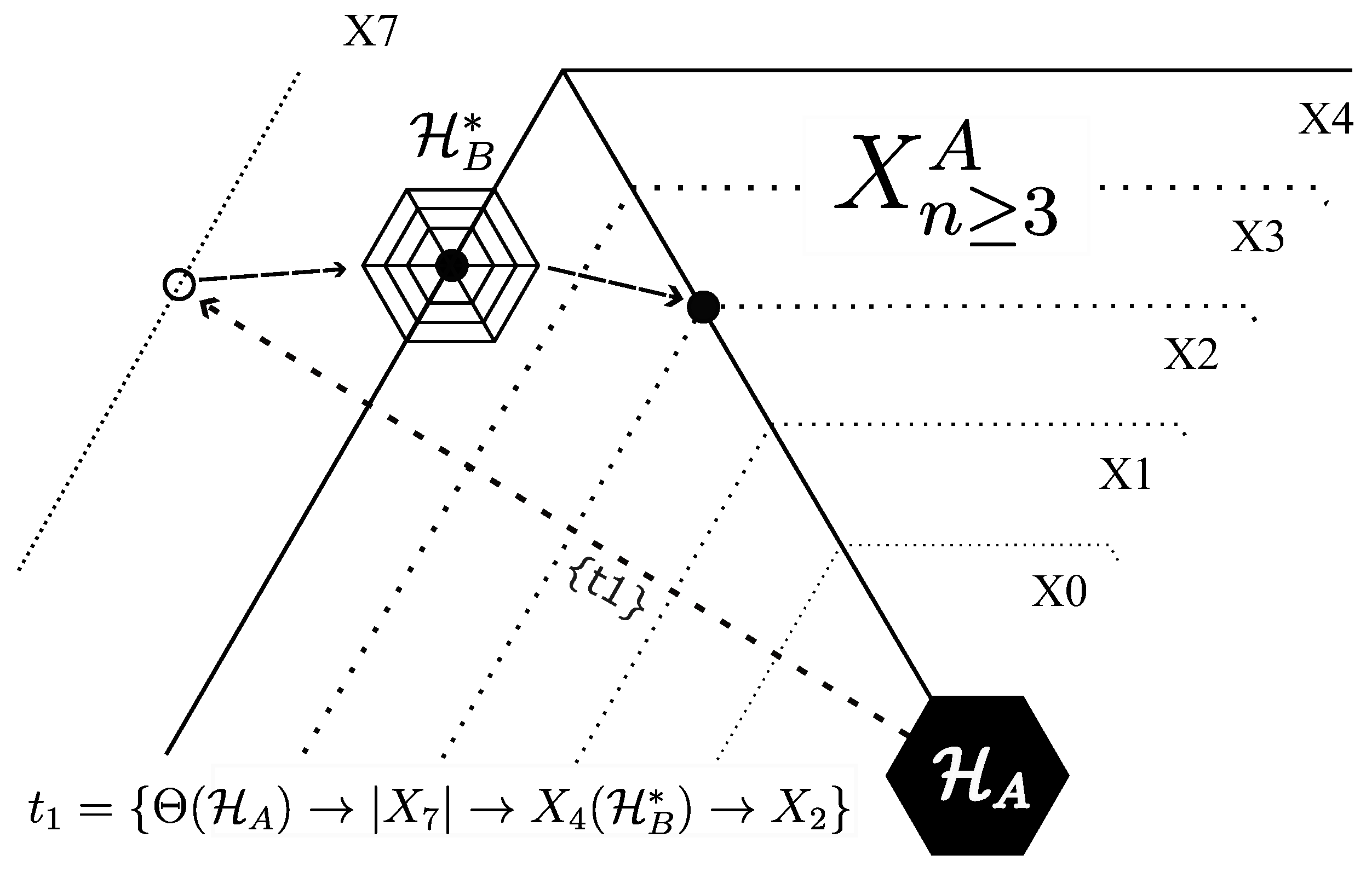
Figure 8.
Normalization within . The open circle at marks —the autonomous center that the dominant transductive ecology does not recognize. The mirror position (ghosted hexid, ∼) espejea within the compressed render that flattening created at in (cf. Figure 7). The trajectory traces the normalized route to self-affirmation: 5–6 steps through an obligatory waypoint versus 2 steps direct. The shaded transit through indicates that the detour is not phenomenally registered as external imposition—the agent experiences it as the natural route to selfhood. Crucially, this cost asymmetry persists in the absence of the dominant agent: the governing frame skein (), sustained by the transductive ecology at T-3 saturation, maintains the subsidy on the mirror-mediated route without requiring ongoing interaction with A.
Figure 8.
Normalization within . The open circle at marks —the autonomous center that the dominant transductive ecology does not recognize. The mirror position (ghosted hexid, ∼) espejea within the compressed render that flattening created at in (cf. Figure 7). The trajectory traces the normalized route to self-affirmation: 5–6 steps through an obligatory waypoint versus 2 steps direct. The shaded transit through indicates that the detour is not phenomenally registered as external imposition—the agent experiences it as the natural route to selfhood. Crucially, this cost asymmetry persists in the absence of the dominant agent: the governing frame skein (), sustained by the transductive ecology at T-3 saturation, maintains the subsidy on the mirror-mediated route without requiring ongoing interaction with A.
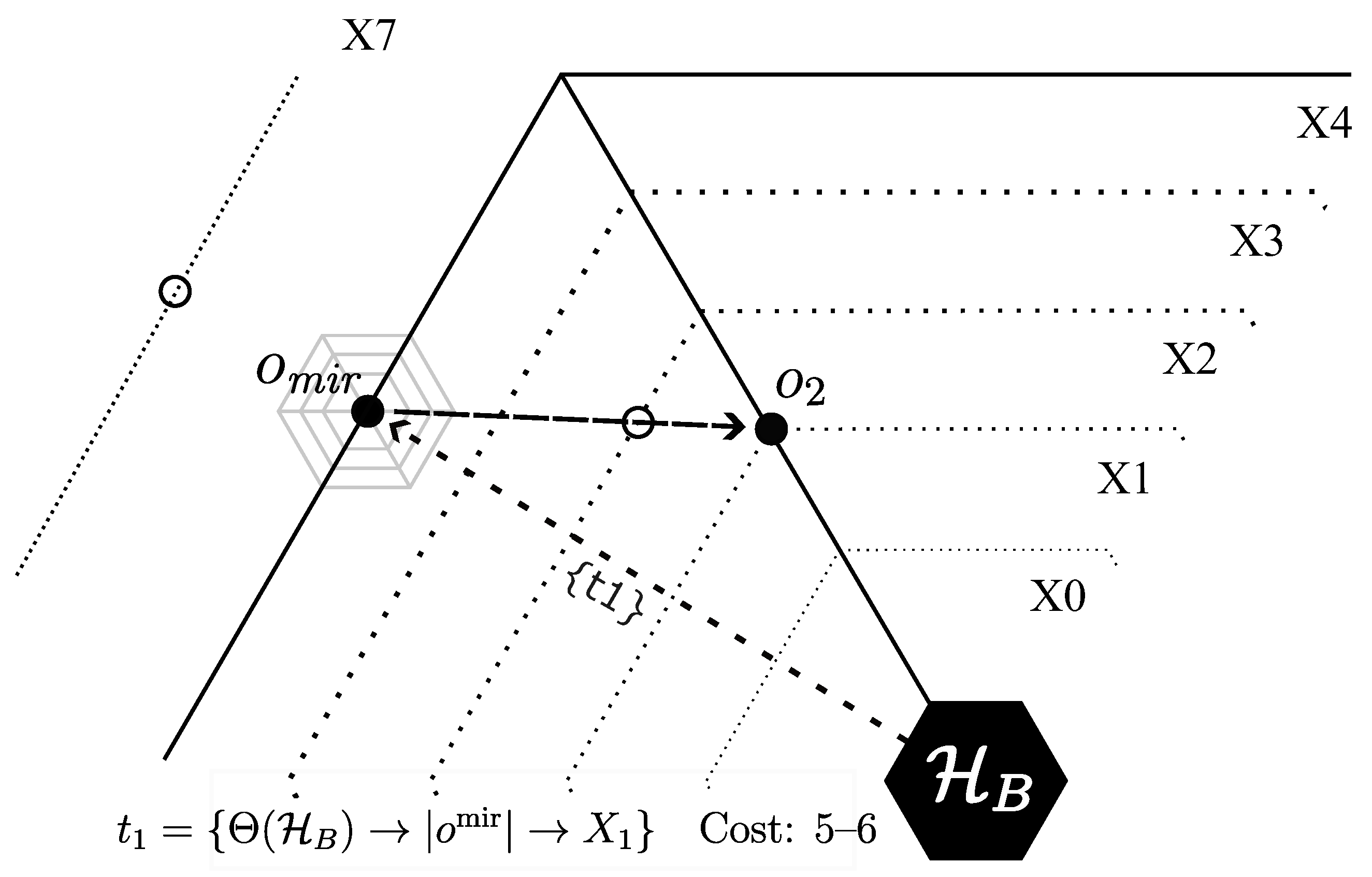
This 2.5–3× overcost formalizes the “extra work” that marginalized subjects perform to achieve the same identity positions that dominant subjects reach directly. What clinical and social-psychological literature describes as “internalized oppression” [11] is, in RA terms, a navigational geometry in which mirror positions have become cheaper than direct routes—not because the agent has adopted the dominant agent’s beliefs, but because the transductive cost landscape favors mirror-mediated trajectories.
Figure 7 schematizes the geometric mechanics underlying flattening. The trajectory captures the dominant agent’s navigational move within : accessing the Other not as autonomous center but as compressed render within one’s own terrain. Normalization is the downstream consequence in : the transductive pressure that -type trajectories exert, when sustained across institutional encounters, reshapes B’s own cost dynamics.
3.4.3. Operation 3: Trajectorial Refraction
Resistance to epistemic appropriation operates not through simple refusal but through trajectorial refraction—navigation that necessarily traverses dominant categories before emerging at angles that contest them. The mechanism presupposes a governing frame skein () whose navigational regime makes certain trajectories dispositionally cheaper than others. Refraction is deflection with respect to this regime: the agent navigates within the frame skein’s field of predispositional bias but exits at an angle that the regime does not favor. No ontological “pull” toward saturated positions is invoked—the only constitutive pull is dissolutive (). What presents as navigational inertia toward dominant categories is the convergence of architectural predisposition and active frame-skein maintenance that makes those routes cheaper.
The Refraction Mechanism
Consider counter-exonymy: the trajectory toward endonyms (Yoreme, Deaf, autistic) necessarily passes through exonymic positions (“Mayo,” “hearing-impaired,” “person with autism”) before emerging at a refracted angle. The trajectory does not avoid the dominant regime but traverses and deflects within it:
Segment traces necessary movement through the mirror position —a node whose navigational cheapness is maintained by dominant trajectorial skeins. From this node, segment emerges at with sectoral displacement—that is, into a different QRS region from the one the dominant category occupies. Crucially, and are not separate trajectories but segments of a single navigational event. The refraction occurs because enables the agent to resist the frame skein’s regime at the inflection point: the governing predisposes continuation toward +, but the agent deflects toward at elevated .
Figure 9.
Frame-skein trajectory and adversative refraction. The gray arrow represents the governing frame skein () whose navigational regime predisposes the trajectory from outward; solid dots mark registered positions (); hollow circles mark shaded positions traversed infrastructurally. (A) The agent’s trajectory follows the frame-skein regime: the tú (, ) is recognized as representing a generic epistemic authority (, ), and the return validates self-definition through that chain. (B) Under , the agent refracts at : the frame skein’s regime toward is resisted, and the trajectory terminates at (). The agent recognizes the second person as definitional without navigating the institutional authority the second person represents. The frame-skein infrastructure remains intact—refraction does not dismantle the regime but deflects navigation within it.
Figure 9.
Frame-skein trajectory and adversative refraction. The gray arrow represents the governing frame skein () whose navigational regime predisposes the trajectory from outward; solid dots mark registered positions (); hollow circles mark shaded positions traversed infrastructurally. (A) The agent’s trajectory follows the frame-skein regime: the tú (, ) is recognized as representing a generic epistemic authority (, ), and the return validates self-definition through that chain. (B) Under , the agent refracts at : the frame skein’s regime toward is resisted, and the trajectory terminates at (). The agent recognizes the second person as definitional without navigating the institutional authority the second person represents. The frame-skein infrastructure remains intact—refraction does not dismantle the regime but deflects navigation within it.
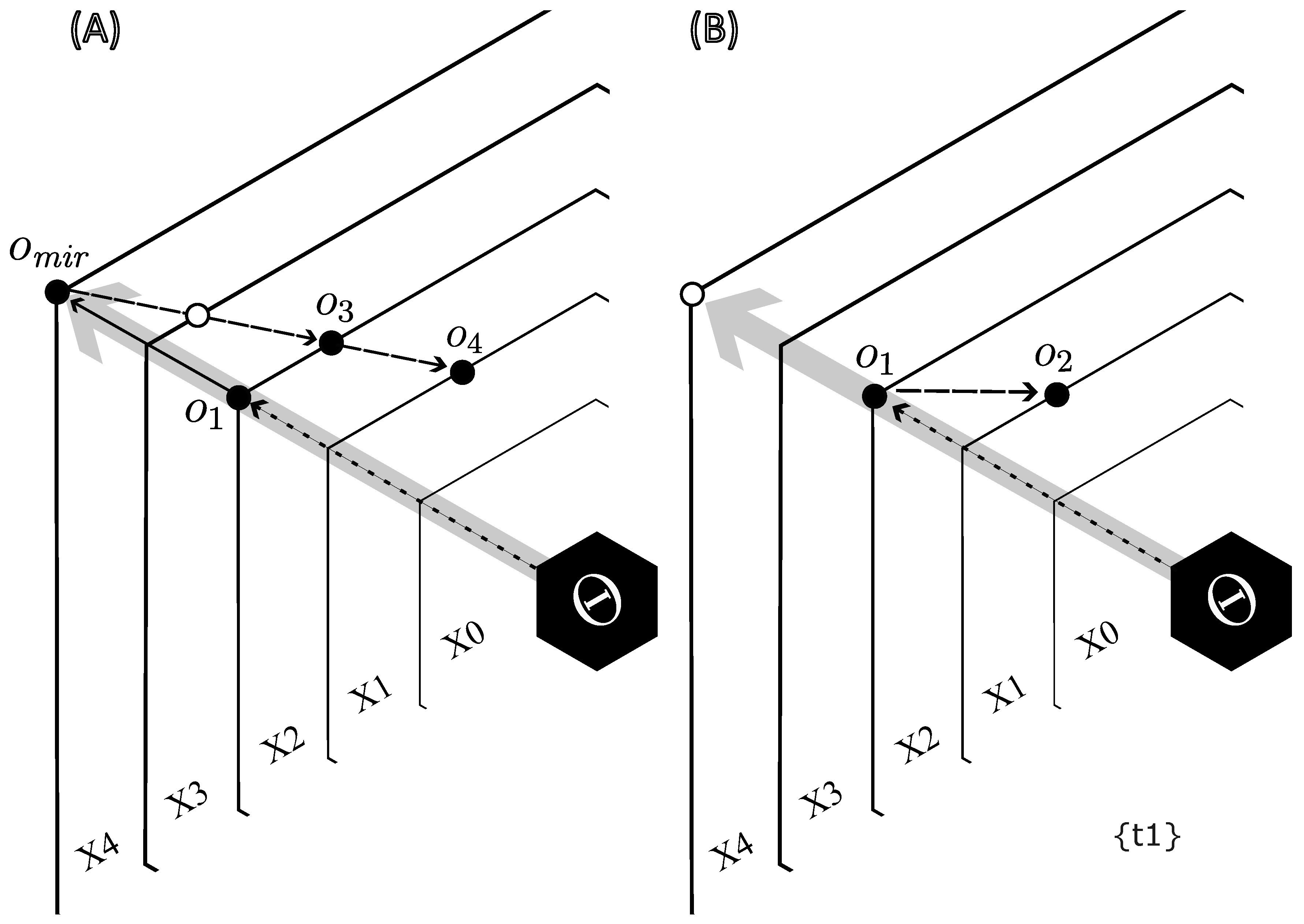
Institutional Cost Subsidy
The three cost components introduced in §2.8.4 are orthogonal but not independently governed. Institutional and collective structures can selectively reduce specific components, a mechanism we formalize as . The mechanism operates on two distinct targets. reduces inter-hexid coupling cost: language standardization, shared diagnostic vocabularies, and legal conventions all make it cheaper for agents from different hexids to coordinate around the same configurational territory—the clinician and patient can talk about “autism” without negotiating the term from scratch. reconfigures intra-hexid pathway resistance: credentialing systems, institutional protocols, and cultural practices reshape which trajectories within a single agent’s navigational space are cheap and which are expensive. These two operations are separable. A configuration can be intersubjectively cheap—widely shared, easy to coordinate around—yet individually costly to reach, because the agent’s own skein architecture resists the trajectory required to get there. The diagnostic category “autism” may circulate fluently across professional contexts ( low via ), while the autistic person’s trajectory toward self-definition through that category encounters high —the dominant frame skein channels navigation toward deficit-coded positions, and deflecting toward affirmative ones costs regime resistance.
Why Refraction Requires Collective Infrastructure
Individual refraction is thermodynamically expensive: the agent must sustain navigation against the cheapest routes maintained by dominant frame skeins. What “collective resistance” provides is not joint navigation but a transductive ecology—Deaf cultural institutions, neurodivergent communities, indigenous assemblies—that recalibrates in favor of refracted positions (§2.8.3.2). Each agent still navigates locally within their own hexid, but the now subsidize resistant trajectories rather than dominant ones. The refracted position gains stability not through individual effort but through shared trajectorial skeins that make resistant trajectories mutually legible.
The -Return Constraint
A critical finding from formal analysis [19]: sustained outer-ring occupation produces impeded return to minimal selfhood. The agent can still access , but the path now routes through , fragmenting self-experience. This is not psychological fragmentation but geometric constraint: the mirror positions, maintained by dominant regimes, have become obligatory waypoints whose subsidy makes bypassing them more expensive than traversing them.
3.4.4. Operational Indicators
RA enables detection of epistemic appropriation through observable patterns in professional discourse:
Indicators of Flattening (in )
- -invisibility: Professional discourse lacks language recognizing the subject’s experiential authority. Subject self-reports are treated as data requiring interpretation rather than testimony about phenomenological reality.
- Categorical override: When subject account conflicts with professional categories, the category prevails (“The test shows X” overrides “I experience Y”).
- Outer-area anchoring: The professional consistently positions the subject in – regions within , never granting – status.
- Asymmetric evidence requirements: Subject’s claims require corroboration; professional’s claims are presumed valid.
Indicators of Normalization (in )
- Self-reference through dominant categories: Subject spontaneously describes self using deficit-coded vocabulary (“my disorder,” “my limitations”) without critical framing—evidence that mirror positions have become navigational defaults.
- Post-encounter collapse: Immediate fatigue or distress upon exiting the institutional encounter, revealing metabolic cost of maintaining mirror arrangements.
- Blocked -return: Subject reports difficulty accessing “authentic self”—only institutionally mediated positions feel navigable, indicating that has become an obligatory waypoint.
Indicators of -Orientation
The three epistemic access modes introduced in §2.8 manifest in professional discourse as recognizable orientations toward categorical structure:
- (Compliant; ): Categories treated as transparent reality; subject’s deviation interpreted as subject’s failure.
- (Desaturating; ): Momentary suspension of categorical override to re-anchor the encounter in the subject’s lived trajectory; the professional recognizes the opacity of and refrains from navigating as if it were .
- (Meta-reflexive; ): Categories recognized as tools with limitations; willingness to revise institutional framing based on subject testimony.
These indicators transform intuitive observations about “internalized oppression” into operationalizable analytical categories with specific trajectorial signatures.
3.5. Comparative Advantage
Table 15 synthesizes RA’s advantages relative to alternative frameworks across the phenomena demonstrated in this section.
Table 15.
Comparative advantages of Radial Analysis. For each phenomenon, the table identifies standard approaches, their limitations, and RA’s integrated solution.
Table 15.
Comparative advantages of Radial Analysis. For each phenomenon, the table identifies standard approaches, their limitations, and RA’s integrated solution.
| Phenomenon | Standard Approach | Limitation | RA Solution |
|---|---|---|---|
| Pronominal shifts | Feature selection from paradigm | No trajectory; sequence-blind | Navigation with formally indexed path cost |
| Temporal deixis | Interval topology (Klein) | No phenomenological density | metrics; persistence patterns |
| Identity oscillation | Stance/footing labels (Goffman) | No metrics; purely qualitative | Hexid coordinates; -return frequency |
| Multimodal coordination | Separate “modules” synchronized | Ad hoc alignment principles | Parallel trajectories; shared synchronization |
| Epistemic injustice | Conceptual critique (Fricker) | No detection protocol | Geometric indicators; operational checklist |
| Cross-modal deixis | Multiple frameworks stitched | Theoretical fragmentation | Single coordinate system |
| Internalized oppression | Psychological description | No formal mechanism | Mirror positions; shading configurations |
The integration principle.
RA’s power derives not from handling any single phenomenon better than dedicated frameworks, but from handling all within unified architecture. Person, space, time, stance, modality, and power asymmetry operate in the same coordinate system, enabling analysis of their interactions without theoretical patchwork.
A speaker’s shift from “I” to “one” involves personal deixis, epistemic stance (), register elevation, and social positioning—simultaneously. Categorical approaches require separate analyses later reconciled; RA tracks the single trajectory through multidimensional space. The framework’s resistance to analytical collapse stems from a foundational principle: dissipation governs coherence, not accumulation. That is: patterns persist not because they are archived or recorded but because the dynamics that sustain them have not yet dissipated—and when those dynamics shift, so does the pattern. The skein apparatus () formalizes this: coherence is maintained by the navigational inertia () of active skeins, not by cumulative inscription. Through mechanics, RA formalizes how discourse maintains coherence through SC-sustained configurations rather than cumulative archiving.
4. Discussion
4.1. Methodological Advantages
RA offers four distinctive advantages over existing frameworks:
(1) Integration without reduction. Where other approaches analyze deixis, identity, modality, and power separately—requiring coordination across incompatible frameworks—RA models all as navigational dynamics within a unified geometric substrate. The framework is genuinely integrative rather than merely eclectic.
(2) Formally grounded metrics. Hexagonal distance, , and trajectory cost provide principled formal indexing of navigational structure. Claims like “this trajectory is costly” become formally grounded assertions whose relational values can be systematically compared. This formal tractability enables principled analysis across speakers, contexts, and languages.
(3) Phenomenological grounding. The experiential zero-point () anchors analysis in lived experience. Navigation is always from somewhere—the agent’s own baseline—preserving the first-person perspective that many cognitive frameworks eliminate.
(4) Formal without being formalist. RA’s mathematics (hexagonal coordinates, distance formulas, ) serve analytical purposes without demanding that users adopt controversial ontological commitments. The geometry is a tool, not a claim about neural architecture.
4.2. Extensions
Several domains invite immediate extension:
Sign language analysis. RA’s ribbon-based formalism naturally captures simultaneous multi-articulator dynamics: dominant/non-dominant hand coordination, facial grammar, spatial reference systems. Sign languages pose profound challenges to linear conceptions of meaning; RA’s trajectory architecture may prove particularly apt. The insight that “gestures and signs are phrases not words” Escobar L.-Dellamary [17] aligns with RA’s trajectorial ontology.
Computational corpus analysis. Automated trajectory extraction, heatmap visualization of position frequency distributions, and statistical modeling of transition probabilities open pathways for large-scale empirical validation across typologically diverse languages.
Clinical and educational intervention. The epistemic appropriation framework suggests concrete intervention targets: practitioners can monitor their own trajectorial patterns for flattening tendencies; training can cultivate awareness of mismatches between structural granularity () and epistemic access mode (); institutional protocols can be redesigned to reduce asymmetries.
Orbital Radial Cut (ORC). RA’s current analytical procedures operate exclusively on the Horizontal Radial Cut (HRC)—the hexagonally tessellated navigational surface. A complementary geometry, the Orbital Radial Cut (ORC), captures temporal and aspectual dynamics through orbital velocity profiles—the rates at which configurations traverse the torus’s orbital axis. Integration of ORC procedures into RA would extend trajectory analysis to aspect–grounding correlations and gesture–speech timing.21
4.3. Limitations
Four limitations warrant acknowledgment:
(1) Empirical validation. While RA provides analytical tools, systematic empirical validation—demonstrating that trajectory metrics predict behavioral or interactional outcomes—remains ongoing work.
(2) Operationalization challenges. Detecting shifts or determining operating in real discourse requires interpretive judgment. The framework provides vocabulary but not algorithmic decision procedures.
(3) Cultural specificity. QRS axis assignments are CONFIG-dependent (agency, authority, group membership in the default social_indexicality; different dimensions in alternative CONFIGs). Cross-cultural application requires axis reconfiguration, not merely translation.
(4) Learning curve. The hexagonal coordinate system, while mathematically simple, requires familiarization. Analysts accustomed to categorical frameworks may find the trajectorial perspective initially counterintuitive.
5. Conclusion
Radial Analysis transforms radial category theory from static structural description into dynamic trajectory modeling. By embedding identity navigation within hexagonal geometry, RA provides researchers with tools to track how speakers move through meaning space, what these movements cost informationally, and why certain patterns emerge rather than others.
Three contributions distinguish this framework:
- Geometric formalization: The SpiderWeb architecture (Hexid/Hex/Hxp) provides precise vocabulary for phenomena that other frameworks describe only vaguely. , , , and shading concepts enable operational analysis of navigational persistence, constraint, and visibility.
- Formally grounded metrics: Hexagonal distance, trajectory cost, -return frequency, and significance range enable principled formal comparison, rendering impressionistic observations analytically tractable.
- Power dynamics integration: The epistemic appropriation extension demonstrates how RA captures asymmetric intersubjective dynamics—flattening, internalization, and trajectorial refraction—invisible to categorical approaches.
RA invites application wherever researchers seek to understand how subjects navigate structured spaces moment-by-moment—not merely where they position themselves, but how they move, what that movement costs, and what patterns of coherence emerge through navigational dynamics unfolding in real time.
The framework’s significance extends beyond methodological innovation to foundational questions about semantic ontology. If meaning emerges through navigational dynamics rather than categorical membership, then temporal architecture becomes constitutive—not merely how speakers express pre-existing concepts but how meaning comes to be through trajectorial selection under informational constraint. That is: the sequence and manner in which a speaker moves through meaning space is not incidental to what is meant—it is part of what constitutes the meaning itself. By bridging cognitive linguistics’ structural insights with TTF’s process-oriented perspective—one that foregrounds dynamic navigation over static categorical membership—Radial Analysis offers methodology for rendering implicit navigation explicit, subjective experience tractable to formal analysis, and the temporal unfolding of meaning-making visible as the dynamic process it fundamentally is.
Funding
This research received no external funding.
Institutional Review Board Statement
Not applicable. This theoretical and methodological paper did not involve human subjects or data collection.
Data Availability Statement
This is a methodological paper. No new empirical data were generated. All cited sources are publicly available.
Use of Artificial Intelligence
Claude (Anthropic) was used to assist with document preparation, formatting, and refinements. The framework, concepts, and original development are entirely the work of the author.
Conflicts of Interest
The author declares no conflicts of interest.
Appendix A. Quick Reference Card
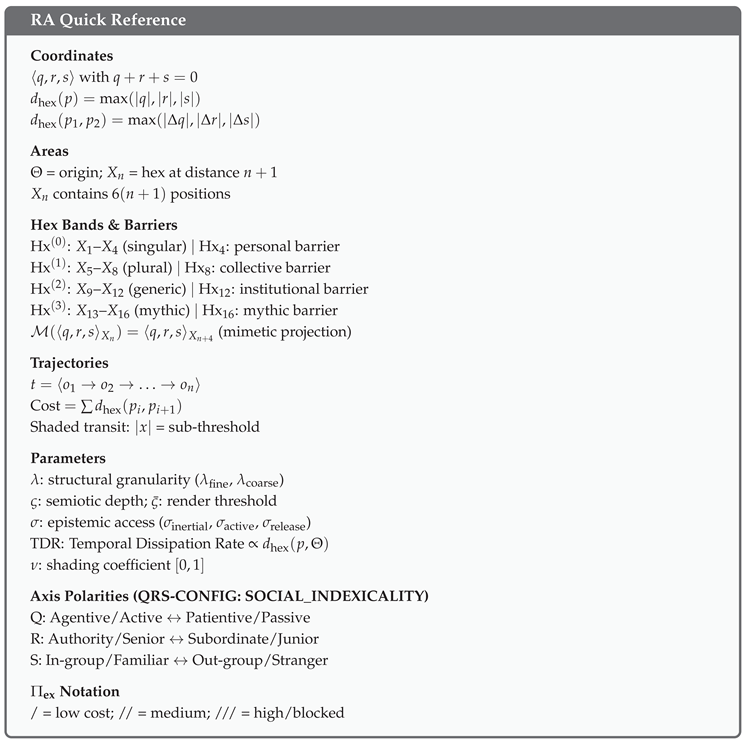
Appendix B. Notation Reference
Table A1 consolidates the notation system used throughout this paper.
Table A1.
Core notational elements for Radial Analysis.
| Element | Symbol | Meaning |
|---|---|---|
| Structural elements | ||
| Zero-point | Experiential center; minimal informational cost; origin | |
| Hexagonal area | Area at distance from ; contains positions | |
| Sector/Zone | , | Directional region defined by axis polarities |
| Position (Hxp) | Specific location; constraint | |
| Hexagonal distance | ; indexes informational cost | |
| Dynamic elements | ||
| Movement | Directed transition between positions | |
| Trajectory | Ordered sequence of positions | |
| Saturated movement | High-recurrence transition (regime-favored path) | |
| -return | Return toward experiential baseline | |
| Shaded transit | Position traversed sub-threshold () | |
| Parameters | ||
| Lambda | / | Structural granularity (resolution) |
| Sigma | / / | Epistemic access mode |
| Shading coefficient | Semiotic visibility gradient | |
| Depth parameter | Geometric depth of the semiotic weave (architectural + epistemic) | |
| Render threshold | Epistemic component of ; minimum for navigational salience | |
| Persistence elements | ||
| Temporal Dissipation Rate; maintenance cost of position p | ||
| Trajectorial skein | Dynamic coherence ensemble of trajectories; subsumes former (persistent pattern) | |
| (graded) | / , , | Information exchange protocol: low / medium / high cost |
| notation | Transition from to with medium cost | |
| Constraint elements | ||
| Root-shading | , shaded | Chronic shading of basal positions |
| Depth-shading | + shaded | Chronic shading of outer positions |
| Mirror position | Internalized position reflecting dominant categorization | |
| Epistemic structure | ||
| Hex band | Four-ring span; qualitative reference type | |
| Epistemic barrier | Permeability gradient at band boundary | |
| Epistemic distance | ; radial distance from | |
| Mimetic projection | ||
| QRS-CONFIG | Typed configuration: axes of the semiotic weave sampled | |
Appendix C. Hexid Coordinate Reference
Figure A1 provides an expanded radial representation of the hexid coordinate system, useful for verifying Hxp assignments and visualizing trajectory paths across the full – range.
Figure A1.
Radial coordinate reference for the hexid system. All Hxp positions from through are shown with their cubic coordinates . The circular layout emphasizes radial distance from the experiential baseline while preserving angular sector relationships. Use in conjunction with Figure 3 for trajectory analysis.
Figure A1.
Radial coordinate reference for the hexid system. All Hxp positions from through are shown with their cubic coordinates . The circular layout emphasizes radial distance from the experiential baseline while preserving angular sector relationships. Use in conjunction with Figure 3 for trajectory analysis.
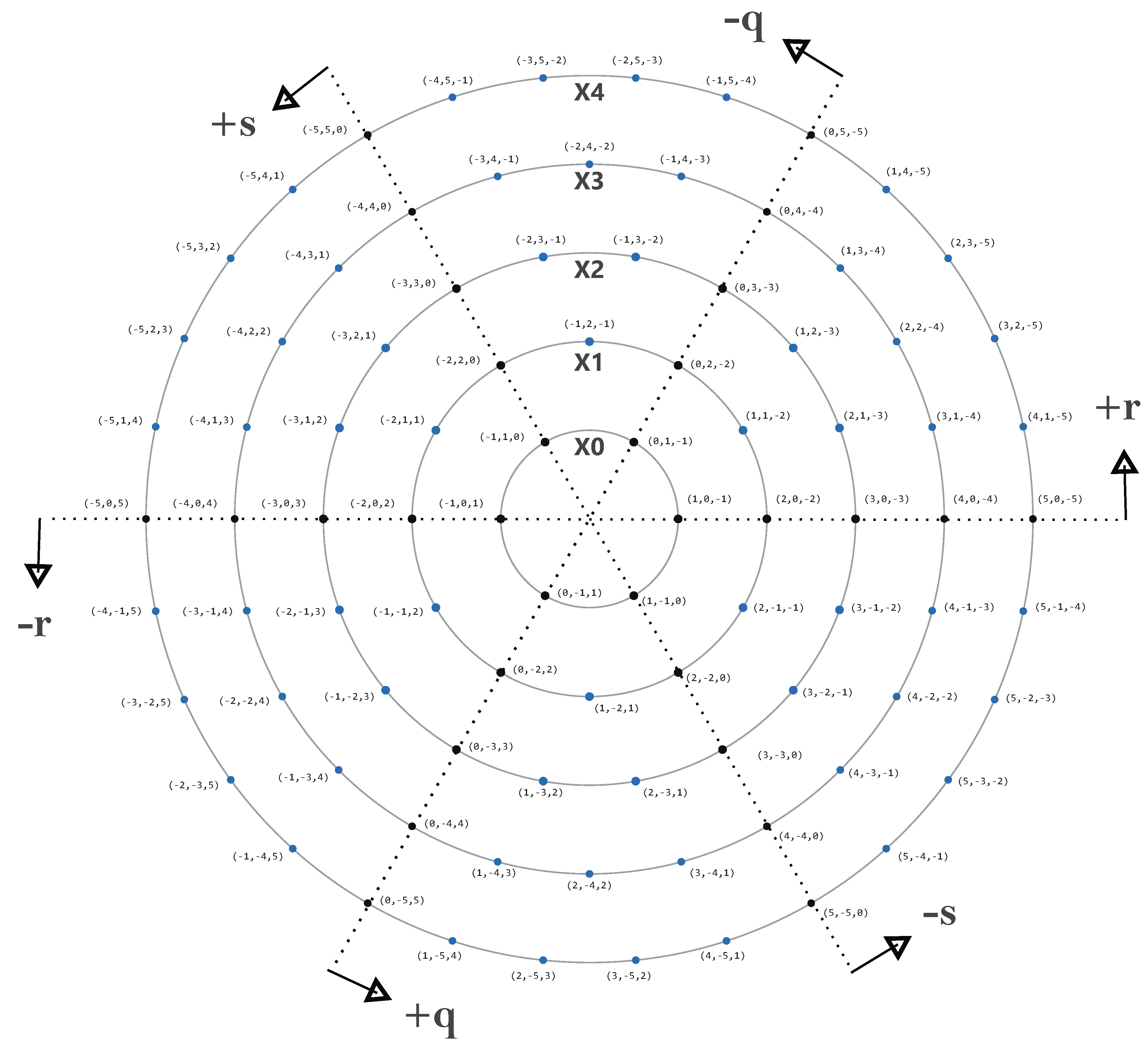
Appendix D. Geometric Positioning of the HRC
This appendix clarifies the geometric status of the Hexagonal Radial Cut (HRC) within the hexid prism and its relationship to the Orbital Radial Cut (ORC). The distinction matters for analytical practice: the two members of the RC family are not two slices of the same prism at different altitudes but fundamentally different kinds of analytical object.
Appendix D.1. The Hexid Prism
Figure A2 shows the hexid prism geometry. The prism represents the vertical stratification of the hexid into three zones, each with a distinct functional role:
Figure A2.
Hexid prism geometry. The central band (, labeled Hexid T) corresponds to the interface—the phenomenally rendered region bounded by the render threshold (). The zone below (, labeled Hexid Infra) operates at and sustains interface coherence: this is genuine semiotic weave, NET-backed, with low intrinsic . The zone above (, labeled Hexid Supra) operates at and conditions the interface without sustaining it: its configurations are mimetic-projective and derivative. The waistline shifts with the agent’s navigational mode ().
Figure A2.
Hexid prism geometry. The central band (, labeled Hexid T) corresponds to the interface—the phenomenally rendered region bounded by the render threshold (). The zone below (, labeled Hexid Infra) operates at and sustains interface coherence: this is genuine semiotic weave, NET-backed, with low intrinsic . The zone above (, labeled Hexid Supra) operates at and conditions the interface without sustaining it: its configurations are mimetic-projective and derivative. The waistline shifts with the agent’s navigational mode ().
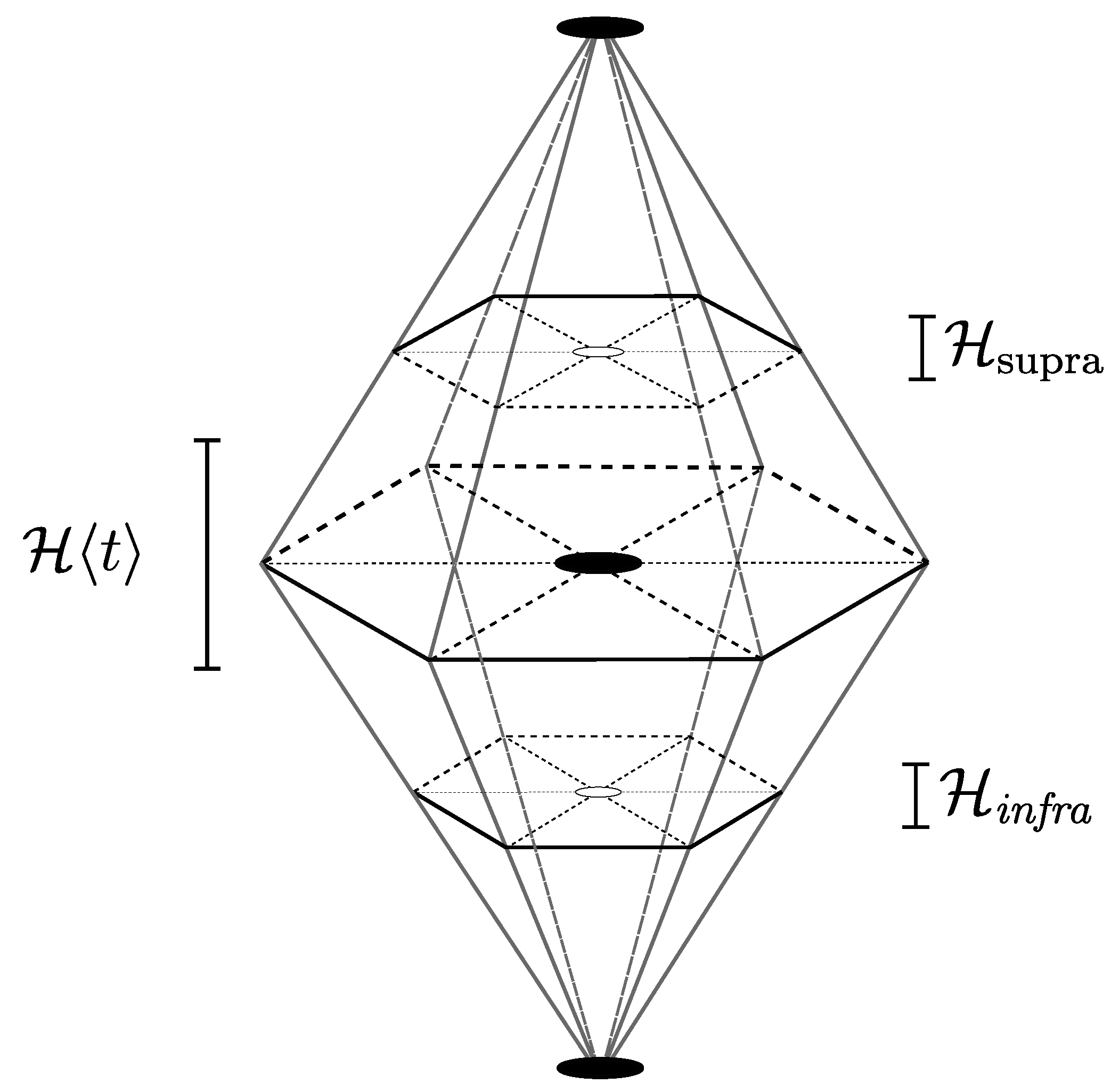
- Central band (): the interface—the level of direct phenomenal experience where navigational significance is maximal. This is where the agent’s phenomenal window operates and where the analytical procedures of RA are applied.
- Below (): fine-grained structure at that sustains interface coherence. Frame trajectorial skeins (, §2.8.5)—the slow-tick trajectories maintaining bodily continuity, territorial coherence, and circumstantial persistence—operate here in shade, navigated by the complete hexid (-) rather than by the body-agent () alone. This is genuine semiotic weave, NET-backed, with low intrinsic .
- Above (): coarse-grained structure at that conditions the interface without sustaining it. Institutional categories, extractive geometries (), and collective configurations reside here—mimetic-projective, with elevated offset by convergent individual navigation under shared pressure (§2.8.3.2).
The prism thus establishes a vertical axis: phenomenal richness is maximal at center (, the experiential zero-point); moving upward, configurational granularity decreases and saturative abstraction increases; moving downward, the interface gives way to the predispositional substrate.
Appendix D.2. The HRC as Conic Cut
If the HRC were a flat lamina—a simple horizontal slice through the prism at the altitude of the interface—it would capture only one level of phenomenal richness. Everything on it would correspond to positions of equal -granularity, encoding nothing but spatial-epistemic distance from . The analyst would be measuring, so to speak, only how far away things are, in a single plane of direct experience—much like a grammar of spatial deixis (“this, that, yonder”) indexed purely to perceptual reach.
But RA intends more than this. The HRC must also accommodate positions of increasing saturative abstraction: the outer rings (–) encode not only greater epistemic distance but qualitatively different kinds of reference—generic, institutional, archetypal—that operate at higher levels. For the HRC to capture this, it cannot be flat. It must be read as a conic cut: a cross-section that expands simultaneously in two directions from at the apex:
- Radially outward through increasing epistemic distance (, rings );
- Vertically upward through increasing saturative abstraction ().
The outer rings of the HRC do not merely sit farther from ; they simultaneously sit higher on the saturative gradient, where positional differentiation collapses under saturative compression.22 The HRC is thus a micro-hexid in its own right—not a homogeneous plane but a conic structure carrying its own -differentials, its own epistemic barriers, and its own saturative gradient.
Figure A3.
The HRC as conic cut within the hexid bicone. Two mirrored cones share at the waist. The upper cone expands toward saturative convergence (, ); the lower cone expands toward the substrate (NET). The HRC (bold hexagonal outline) is positioned above , at the level of the interface. Its conical form means that outer rings simultaneously encode greater epistemic distance and higher saturative abstraction. Frame skeins operate below the HRC in the lower cone, in shade.
Figure A3.
The HRC as conic cut within the hexid bicone. Two mirrored cones share at the waist. The upper cone expands toward saturative convergence (, ); the lower cone expands toward the substrate (NET). The HRC (bold hexagonal outline) is positioned above , at the level of the interface. Its conical form means that outer rings simultaneously encode greater epistemic distance and higher saturative abstraction. Frame skeins operate below the HRC in the lower cone, in shade.
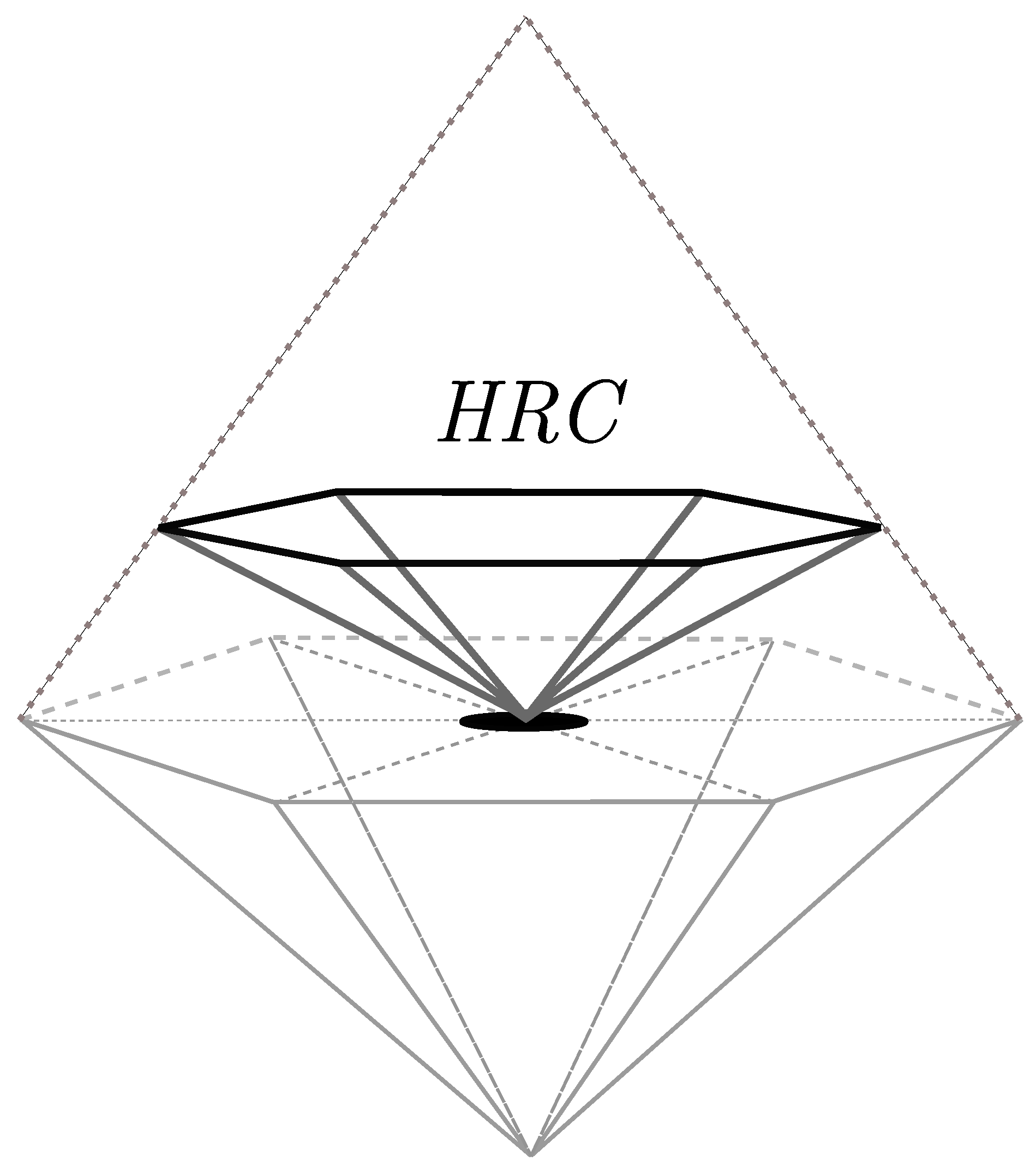
When an analyst “takes a radial cut,” they are not extracting a planar lamina but projecting this conic structure onto a two-dimensional workspace. The HRC is not a flat slice of the prism; it is the conic form that emerges when the prism’s radial and vertical dimensions are read simultaneously.
Appendix D.3. Representing Shaded Frame Trajectories
Frame trajectorial skeins ()—the slow-tick trajectories introduced in §2.8.5—operate in shade (). In the prism, they occupy —below the central phenomenal band. Two representational strategies are available:
- 1.
- Shaded zones within the HRC (recommended default). Frame skeins appear as light gray (shaded) regions within the same HRC, with phenomenally rendered framed trajectories in full contrast. The shading notation already in use (§2.10) accommodates this directly: frame positions in lowercase () or within shading bars (), rendered positions in uppercase ().
- 2.
- Infra-cut: separate lamina. Frame skeins are shown on a separate radial cut extracted from a lower altitude of the prism, below the interface level. This makes vertical stratification explicit but requires managing cross-referenced diagrams. Reserve for cases where the relation between rendered trajectories and their frame conditions is itself the analytical focus.
Appendix D.4. HRC and ORC: Two Kinds of Analytical Object
The HRC and the ORC are not two slices of the same prism. They are fundamentally different kinds of analytical object, and recognizing this prevents confusion about what each one captures.
The HRC is organic to the prism geometry. It is the conic cut itself—the two-dimensional projection of the interface’s radial-and-vertical structure onto an analytical workspace. Its rings are positions in the hexid, its barriers are qualitative thresholds in epistemic distance, its hex bands are regions of the navigational space. When the analyst takes an HRC, they are extracting a geometrically grounded cross-section of the hexid’s conic structure. The HRC is the primary tool of Radial Analysis as developed in this document: trajectory notation, shading analysis, barrier dynamics, QRS-CONFIG, and hex band membership all operate within it.
The ORC is an orbital abstraction. It does not extract a geometric cross-section from the prism. Instead, it mounts a system of harmonic proportionalities () onto the same ring structure that the HRC uses, assigning each ring an orbital velocity representing its rate of informational change relative to . The ORC answers a different question—not where is X? (positional) but at what rate does X change? (rhythmic)—and it does so by treating the ring structure as a scaffold for relative tick rates rather than as a geometric projection of navigational space. In particular, the ORC’s harmonic velocity profile captures the principle that configurations at greater epistemic distance exhibit slower apparent change from the agent’s perspective: epistemic barriers function in the ORC as rhythmic thresholds, not merely positional ones.
The ORC enters when the analyst needs to model temporal structure—the relative rates at which different navigational configurations change. For the full ORC formalization, see Escobar L.-Dellamary [16] §7 and ORC_HOT.
References
- Aguilar-Guevara, A., & Zwarts, J. (2014). Weak definites refer to kinds. Recherches Linguistiques de Vincennes, 42, 33–60. [CrossRef]
- Aikhenvald, A. Y. (2004). Evidentiality. Oxford University Press.
- Andries, J., Broné, G., & Feyaerts, K. (2023). Multimodal stance-taking in interaction: A systematic literature review. Frontiers in Communication, 8, 1187977. [CrossRef]
- Arka, I W. (2005). Speech levels, social predicates and pragmatic structure in Balinese: A lexical approach. Pragmatics, 15(2–3), 169–203. [CrossRef]
- Brown, P., & Levinson, S. C. (1987). Politeness: Some universals in language usage. Cambridge University Press.
- Burnett, H., & Bonami, O. (2019). Linguistic change and the logic of ideology. In Proceedings of the Workshop on Cognitive Modeling and Computational Linguistics (pp. 1–15). Association for Computational Linguistics.
- Bybee, J. L., Perkins, R., & Pagliuca, W. (1994). The evolution of grammar: Tense, aspect, and modality in the languages of the world. University of Chicago Press.
- Comrie, B. (1976). Aspect: An introduction to the study of verbal aspect and related problems. Cambridge University Press.
- Comrie, B. (1985). Tense. Cambridge University Press.
- Dahl, Ö. (1995). The grammar of future time reference in European languages. In Ö. Dahl (Ed.), Tense and aspect in the languages of Europe (pp. 309–328). Mouton de Gruyter.
- In Internalized oppression: The psychology of marginalized groups; David, E. J. R. (Ed.). (2014). Internalized oppression: The psychology of marginalized groups. Springer Publishing Company.
- Dingemanse, M. (2020). Between sound and speech: Liminal signs in interaction. Research on Language and Social Interaction, 53(1), 188–196. [CrossRef]
- Dixon, R. M. W. (1972). The Dyirbal language of North Queensland. Cambridge University Press. [CrossRef]
- Du Bois, J. W. (2007). The stance triangle. In R. Englebretson (Ed.), Stancetaking in discourse (pp. 139–182). John Benjamins. [CrossRef]
- Errington, J. J. (1988). Structure and style in Javanese: A semiotic view of linguistic etiquette. University of Pennsylvania Press.
- Escobar L.-Dellamary, L. (2026). A basic introduction to the Trace & Trajectory Framework—The Torus Passage (Version 7.0) (No. 2026011964). Preprints. [CrossRef]
- Escobar L.-Dellamary, L. (2025). Gestures and signs are phrases not words: A high definition account (No. 2025111801). Preprints. [CrossRef]
- Escobar L.-Dellamary, L., Cortés Aguilar, S., & Velarde Inzunza, J. de J. (2025). Nombrar al otro: Contra-exónimos y resistencia identitaria en comunidades marginadas. Cuadernos de Lingüística de El Colegio de México, 12, 1–41. [CrossRef]
- Escobar L.-Dellamary, L., & Peinado Beltrán, C. (2026). “You are in my realm”: A formal account of epistemic appropriation (No. 2026011087). Preprints. [CrossRef]
- Fauconnier, G., & Turner, M. (2002). The way we think: Conceptual blending and the mind’s hidden complexities. Basic Books.
- In Egophoricity; Floyd, S., Norcliffe, E., & San Roque, L. (Eds.). (2018). Egophoricity. John Benjamins. [CrossRef]
- Gärdenfors, P. (2000). Conceptual spaces: The geometry of thought. MIT Press.
- Gärdenfors, P. (2014). The geometry of meaning: Semantics based on conceptual spaces. MIT Press. [CrossRef]
- Gibbs, R. W. (2006). Embodiment and cognitive science. Cambridge University Press.
- Gliński, W. (1973). Rules of hexagonal chess. Hexagonal Chess Publications.
- Gries, S. T. (2006). Corpus-based methods and cognitive semantics: The many senses of to run. In S. T. Gries & A. Stefanowitsch (Eds.), Corpora in cognitive linguistics (pp. 57–99). Mouton de Gruyter.
- Hafting, T., Fyhn, M., Molden, S., Moser, M.-B., & Moser, E. I. (2005). Microstructure of a spatial map in the entorhinal cortex. Nature, 436(7052), 801–806. [CrossRef]
- Hales, T. C. (2001). The honeycomb conjecture. Discrete & Computational Geometry, 25(1), 1–22. [CrossRef]
- Hanks, W. F. (2005). Explorations in the deictic field. Current Anthropology, 46(2), 191–220.
- Iwasaki, S., & Ingkaphirom, P. (2005). A reference grammar of Thai. Cambridge University Press.
- In Cognitive linguistics: The quantitative turn; Janda, L. A. (Ed.). (2013). Cognitive linguistics: The quantitative turn. De Gruyter Mouton.
- Kastrup, B. (2018). Conflating abstraction with empirical observation: The false mind-matter dichotomy. Constructivist Foundations, 13(3), 341–361.
- Katamba, F. (2003). Bantu nominal morphology. In D. Nurse & G. Philippson (Eds.), The Bantu languages (pp. 103–120). Routledge.
- Kiesling, S. F. (2018). Masculine stances and the linguistics of affect: On masculine ease. NORMA: International Journal for Masculinity Studies, 13(3–4), 191–212. [CrossRef]
- Lakoff, G. (1987). Women, fire, and dangerous things: What categories reveal about the mind. University of Chicago Press.
- Langacker, R. W. (1987). Foundations of cognitive grammar, Vol. 1: Theoretical prerequisites. Stanford University Press.
- Langacker, R. W. (2008). Cognitive grammar: A basic introduction. Oxford University Press. [CrossRef]
- Lillo-Martin, D., & Meier, R. P. (2011). On the linguistic status of ‘agreement’ in sign languages. Theoretical Linguistics, 37(3–4), 95–141. [CrossRef]
- Meier, R. P. (1990). Person deixis in American Sign Language. In S. D. Fischer & P. Siple (Eds.), Theoretical issues in sign language research (Vol. 1, pp. 175–190). University of Chicago Press.
- Mithun, M. (1999). The languages of native North America. Cambridge University Press.
- Orvell, A., Kross, E., & Gelman, S. A. (2017). How “you” makes meaning. Science, 355(6331), 1299–1302. [CrossRef]
- Palmer, F. R. (2001). Mood and modality (2nd ed.). Cambridge University Press.
- Rosch, E. (1975). Cognitive representations of semantic categories. Journal of Experimental Psychology: General, 104(3), 192–233.
- Salvador, C. E., Orvell, A., Kross, E., & Gelman, S. A. (2022). How Spanish speakers express norms using generic person markers. Scientific Reports, 12, 5016. [CrossRef]
- Sandler, W., & Lillo-Martin, D. (2006). Sign language and linguistic universals. Cambridge University Press. [CrossRef]
- Sandra, D., & Rice, S. (1995). Network analyses of prepositional meaning: Mirroring whose mind—the linguist’s or the language user’s? Cognitive Linguistics, 6(1), 89–130.
- Schwarz, F. (2013). Two types of definites across languages. Language and Linguistics Compass, 7(10), 534–559. [CrossRef]
- Siewierska, A. (2013). Gender distinctions in independent personal pronouns. In M. S. Dryer & M. Haspelmath (Eds.), The world atlas of language structures online. Max Planck Institute for Evolutionary Anthropology. https://wals.info/chapter/44.
- Silverstein, M. (2003). Indexical order and the dialectics of sociolinguistic life. Language & Communication, 23(3–4), 193–229.
- Talmy, L. (2000). Toward a cognitive semantics, Vol. 1: Concept structuring systems. MIT Press.
- Thompson, L. C. (1965). A Vietnamese grammar. University of Washington Press.
- Thompson, S. A. (2016). Temporality, stance ownership, and the constitution of subjectivity. Lingua, 175–176, 1–14.
- Wolfart, H. C. (1973). Plains Cree: A grammatical study. Transactions of the American Philosophical Society, 63(5), 1–90. [CrossRef]
- Yeung, S. (2025). Narrative trajectory in identity and subjectivity research in applied linguistics. Research Methods in Applied Linguistics, 4(1), 100189. [CrossRef]
- Young, R. W., & Morgan, W. (1987). The Navajo language: A grammar and colloquial dictionary (Rev. ed.). University of New Mexico Press.
| 1 | The toroidal geometry introduces an asymmetric saturative–dissolutive axis orthogonal to the radial hexid structure. While this topology is foundational to TTF’s ontological architecture, RA’s analytical procedures operate primarily at the hexid level (the navigational surface of the torus). The ribbon level—coordinated thread-bundles with characteristic fold dynamics () constituting the minimal semiotic unit—provides the architectural substrate from which hexid-level patterns emerge, but is not directly manipulated in RA’s analytical procedures. |
| 2 | This geometric predisposition is not random: there is a predispositional tendency in the geometry itself—a tendency toward certain topographic configurations that is structural, not experiential or accumulated. The form of the landscape is neither arbitrary nor a product of navigational history; it is quasi-given, conditioned by the three-factor convergence model (see Escobar L.-Dellamary [16], §3). |
| 3 | TTF canonical notation designates specific positions as Hxp (heuristic position), within the unified Hx namespace that also includes Hxd (epistemic distance), (barriers), and (hex bands). The term “Phex” appears in some related publications as a synonym for Hxp. |
| 4 | A dedicated analysis of definiteness phenomena within the RA framework is in preparation (Escobar L.-Dellamary, forthcoming). |
| 5 | An alternative configuration—“DEICTIC_IDENTITY” with Q = Individual/Singular ↔ Collective/Plural and R = Personal/Specific ↔ Generic/Impersonal—might seem natural but conflates QRS orientation with properties encoded by hex band and respectively, violating the orthogonality principle developed in §2.6. The social_indexicality configuration avoids this conflation by restricting QRS axes to properties that vary within a ring. |
| 6 | The labels “future” and “past” are heuristic. Cross-linguistically, future marking is often epistemic rather than purely temporal, challenging the symmetry implied by polar opposition [10]. |
| 7 | TDR (Temporal Dissipation Rate) designates that dissipation is indexed to the system’s own internal rhythmic sequencing (tics), not to external chronological time. TDR is the primary measure produced by the temporal protocol (); see Escobar L.-Dellamary [16]. The simplified notation / used throughout this paper corresponds to the canonical / notation. |
| 8 | The distinction between genuine transductive coupling () and its mimetic reproduction () is architecturally significant. operates at as a predispositional, costless Markov blanket—it sustains intersubjective commensurability without imposing navigational economics. , by contrast, operates at within hexid boundaries and inherits properties foreign to genuine transduction: historical saturation, cost gradients, and asymmetry. All references to transductive “pressure,” “cost gradients,” or “institutional calibration” in this paper designate operations, never genuine . See 16, §6 (Transductive Stratification). |
| 9 | The terms “Stabilized Semiotic Pattern (SSP)” and (pattern) appear in some TTF-related publications as predecessors of the current notation. Canonical TTF subsumes what these terms designated under trajectorial skeins ()—dynamic coherence ensembles of trajectories whose mutual coherence is maintained by SC. The word “pattern” survives as informal expository vocabulary without formal notational status. For the formal apparatus of skeins and navigational inertia (), see §2.8.5. |
| 10 | Shading refers to reduced semiotic visibility—positions the agent traverses infrastructurally without full phenomenal registration. The mechanics are developed in §2.10. |
| 11 |
applies only to positions that exist (are generated by ) but are not currently visible. Structural shading—positions absent because fails to generate them—has no ; it requires expansion, not adjustment. See §2.10.1 for the distinction. |
| 12 | Skeins operate exclusively at the trajectorial level. Cross-level composition (threads into ribbons, ribbons into weave) is already handled by the ontological stack; the skein operates within the trajectorial level, grouping trajectories that share a mode of temporal advance. Mimetic skeins ()—ensembles of MFold convergences—are the only non-generic variant. For formal definitions, see Escobar L.-Dellamary [25], Invariant 21. |
| 13 | Some TTF-related publications formalize this dimension as a “Depth Protocol” (). Current canonical architecture treats depth as the parameter , with the operational visibility mechanics arising from the / interaction rather than from a separate protocol. See Escobar L.-Dellamary [16], Invariant 10. |
| 14 | Extended analysis appears in Escobar L.-Dellamary & Peinado Beltrán [19] from the original formulation of counter-exonym in Escobar L.-Dellamary et al. [18]. The Yoreme example illustrates dynamics observable across contexts where speakers navigate between dominant institutional frameworks and community-based identity configurations. |
| 15 | Original Spanish: “Desde como yori, así pues, y ahí es un juego, y es bonito, es bueno, sí. Cuando te van a participar a un evento, pues cantes, participas como yori. [...] Hay yoremes que saben canciones como yoremes, y saben canciones como yoris [...] me abrieron el mundo de yoris, pues adelante, hay que participar como yoris.” The term yori is a Yoremnokki counter-exonym designating non-indigenous Mexicans—naming the unmarked dominant category. Extended analysis in Escobar L.-Dellamary et al. [18]. |
| 16 | The speaker says “uno siente” / “dentro de ti mismo” (generic you), not “yo siento” / “dentro de mí.” This shift from first-person to generic/impersonal forms is a well-documented distancing strategy that allows emotional disclosure without vulnerability exposure. Orvell et al. [41] demonstrate experimentally that generic-you functions as a psychological distancing device activated under emotional duress; Kiesling [34] theorizes the “low-investment” stance as a performative achievement of masculine identity rather than a communicative deficit; Brown & Levinson [5, Strategy 7] classify impersonalization as a canonical mitigation of face-threatening self-disclosure. In RA terms, the speaker navigates away from toward precisely to avoid receiving the other’s appreciation in the intimate zone—the meeting point is sustained in at a navigational cost that is lower than the social cost of vulnerability at . The generic register is not vagueness but a navigational choice whose cost profile () reflects masculine emotional attenuation norms documented cross-culturally and cross-linguistically [see also 44, for the Spanish extension]. |
| 17 | A fourth component, (transductive coupling cost across hexid interfaces), is relevant to the interview situation itself—the speaker and interviewer couple transductively, and the act of articulating identity for an external interlocutor carries its own —but lies outside the scope of intra-trajectory cost calculation. See §2.8.4 for the full triadic decomposition. |
| 18 | The directional asymmetry is formalized in the colonial permeability model: . The dominant agent’s outward projection is collectively subsidized; the subaltern agent’s equivalent projection bears its full topographic cost. See §3.4 for the converse dynamic (impeded inward return). |
| 19 | The full worked example—with explicit and quantification, integration of asymmetry into the cost model, and comparison with non-indigenous speaker trajectories in matched institutional contexts—is the subject of a separate paper applying the polar identity model to the complete Yoreme fieldwork corpus. |
| 20 | Flattening is not a representational operation—the dominant agent does not literally construct a reduced model of the other’s hexid. The mechanism is transductive: the dominant agent’s mimetic skein () couples with the subalternized agent only at resolution. What Figure 7 schematizes is the navigational result of this low-resolution transductive render within , not a cognitive representation of B. |
| 21 | See Escobar L.-Dellamary (forthcoming), One rhythm, two puzzles: A harmonic velocity account of the aspect–grounding correlation and gesture–speech timing. Preprint in preparation. |
| 22 | The qualitative argument is developed in §??, where the outward expansion of the flat hexagonal grid is identified as an artifact of the two-dimensional heuristic, not a feature of the navigational space. |
Figure 1.
The hexid space from to . Concentric hexagonal areas are indexed by the rule: contains positions at hexagonal distance from the experiential zero-point. The six angular sectors are defined by QRS axis polarities (§2.7). The gray band at marks the first epistemic barrier (), introduced in §2.5. A sample trajectory illustrates navigation across rings within the first hex band.
Figure 1.
The hexid space from to . Concentric hexagonal areas are indexed by the rule: contains positions at hexagonal distance from the experiential zero-point. The six angular sectors are defined by QRS axis polarities (§2.7). The gray band at marks the first epistemic barrier (), introduced in §2.5. A sample trajectory illustrates navigation across rings within the first hex band.
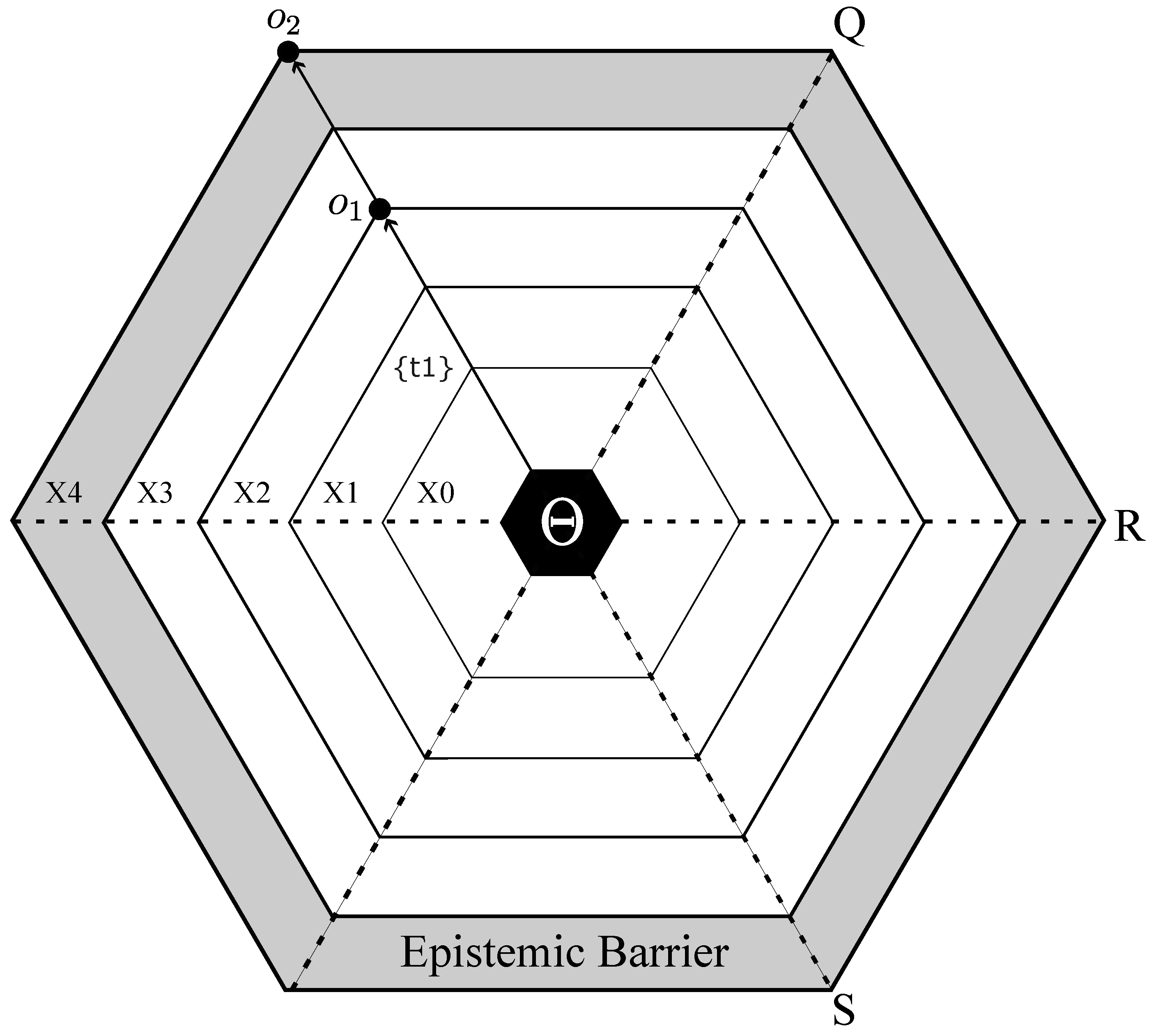
Figure 2.
Hex band architecture from through . Concentric hexagonal rings are grouped into four-ring bands, each labeled by its indexical domain: personal (, innermost, not labeled for legibility), collective (), generic (), and institutional (, outermost). Band boundaries correspond to epistemic barriers (, , ) whose permeability gradients regulate navigational access. The progressive narrowing of inter-ring spacing toward the center reflects the catastrophe curve described in the text: phenomenally distinguishable positions decrease at each successive band. The figure displays three outer bands; is compressed at center for legibility. For the geometric interpretation of this radial expansion as a conic cut—where outer rings encode not only greater epistemic distance but higher saturative abstraction—see Appendix D.2.
Figure 2.
Hex band architecture from through . Concentric hexagonal rings are grouped into four-ring bands, each labeled by its indexical domain: personal (, innermost, not labeled for legibility), collective (), generic (), and institutional (, outermost). Band boundaries correspond to epistemic barriers (, , ) whose permeability gradients regulate navigational access. The progressive narrowing of inter-ring spacing toward the center reflects the catastrophe curve described in the text: phenomenally distinguishable positions decrease at each successive band. The figure displays three outer bands; is compressed at center for legibility. For the geometric interpretation of this radial expansion as a conic cut—where outer rings encode not only greater epistemic distance but higher saturative abstraction—see Appendix D.2.
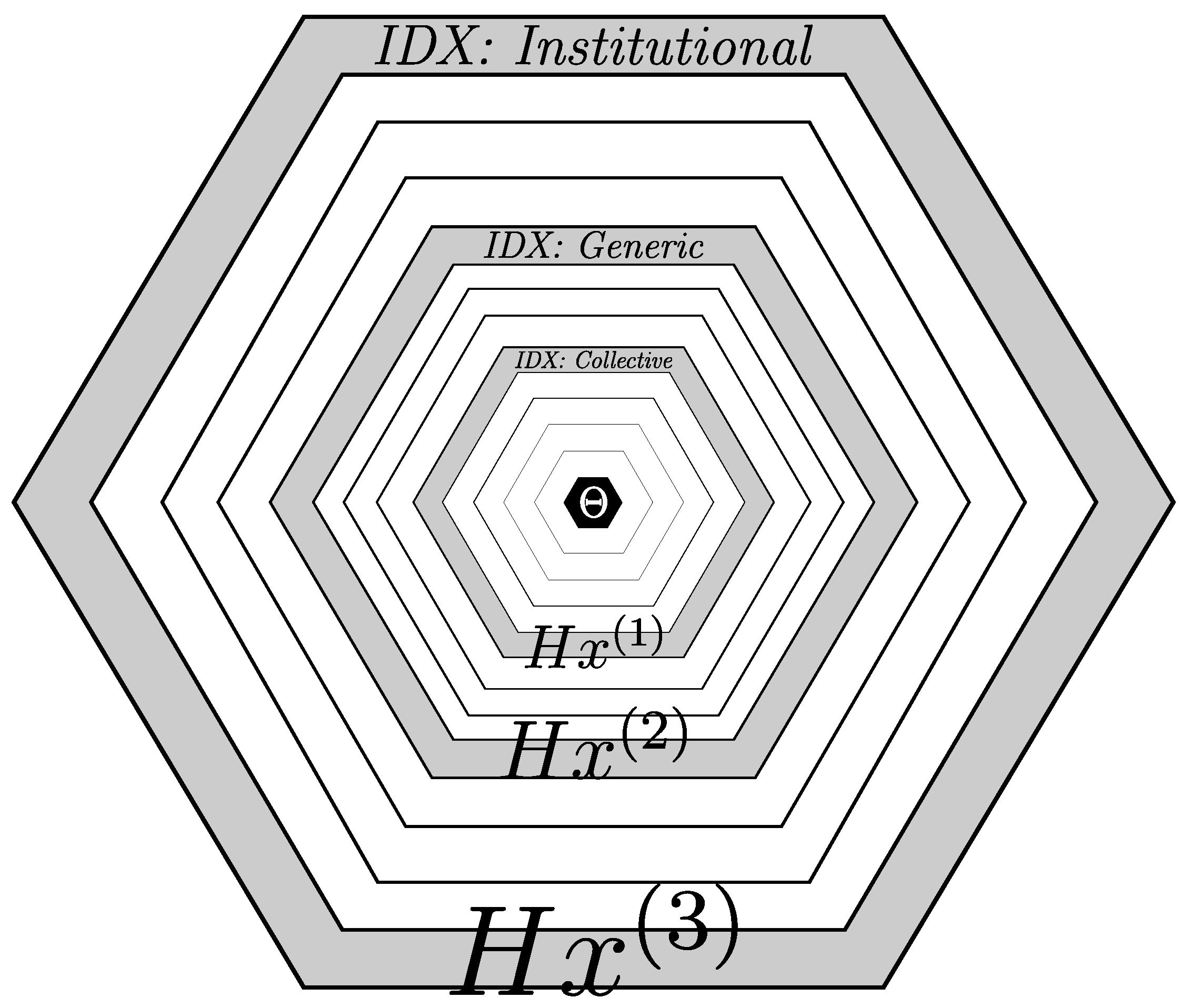
Figure 3.
Cubic coordinate assignments for Hxp positions from to . Each position satisfies . Axis polarities are labeled at the perimeter. Appendix C provides an expanded radial reference diagram.
Figure 3.
Cubic coordinate assignments for Hxp positions from to . Each position satisfies . Axis polarities are labeled at the perimeter. Appendix C provides an expanded radial reference diagram.
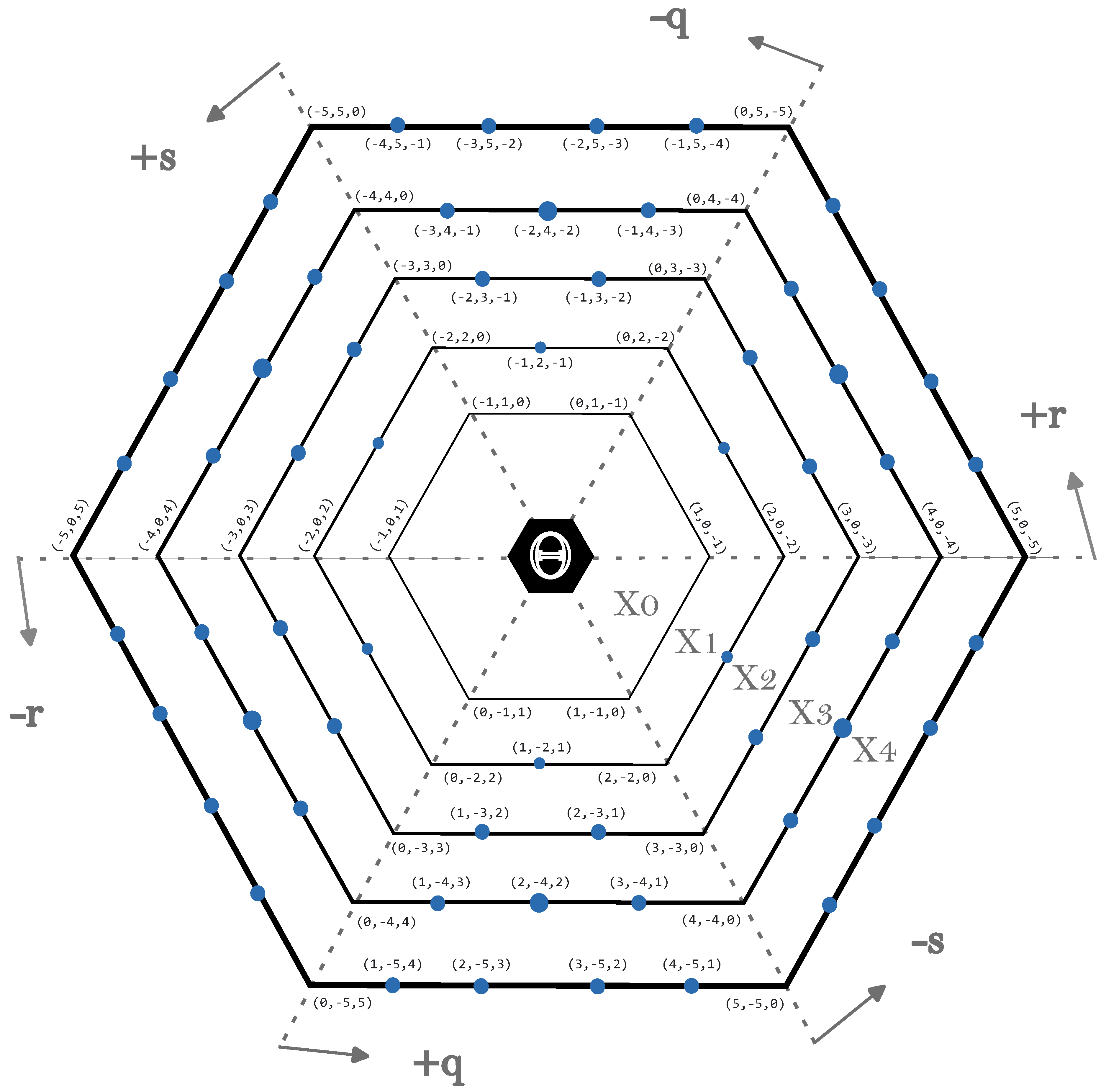
Figure 5.
Ribbon stratigraphy and the render threshold (). Ribbons ()—coordinated thread-bundles constituting the minimal semiotic unit—undulate across the -axis, with Harmonic Folds () at convergence points where threads achieve coherence. The agent’s render threshold (, dashed lines) operates as a visibility surface: fold points above achieve phenomenal registration (Clear status); those near the threshold enter Fog (partial visibility); those below remain Shaded. Solid dots mark folds above —phenomenally registered for . Dotted circles mark shaded positions (o with ): trajectorial and semiotically active, but below the render threshold—operative without registering. The difference is phenomenal visibility, not ontological status. Above , ribbons present as categorical configurations; below , individual thread dynamics become visible.
Figure 5.
Ribbon stratigraphy and the render threshold (). Ribbons ()—coordinated thread-bundles constituting the minimal semiotic unit—undulate across the -axis, with Harmonic Folds () at convergence points where threads achieve coherence. The agent’s render threshold (, dashed lines) operates as a visibility surface: fold points above achieve phenomenal registration (Clear status); those near the threshold enter Fog (partial visibility); those below remain Shaded. Solid dots mark folds above —phenomenally registered for . Dotted circles mark shaded positions (o with ): trajectorial and semiotically active, but below the render threshold—operative without registering. The difference is phenomenal visibility, not ontological status. Above , ribbons present as categorical configurations; below , individual thread dynamics become visible.
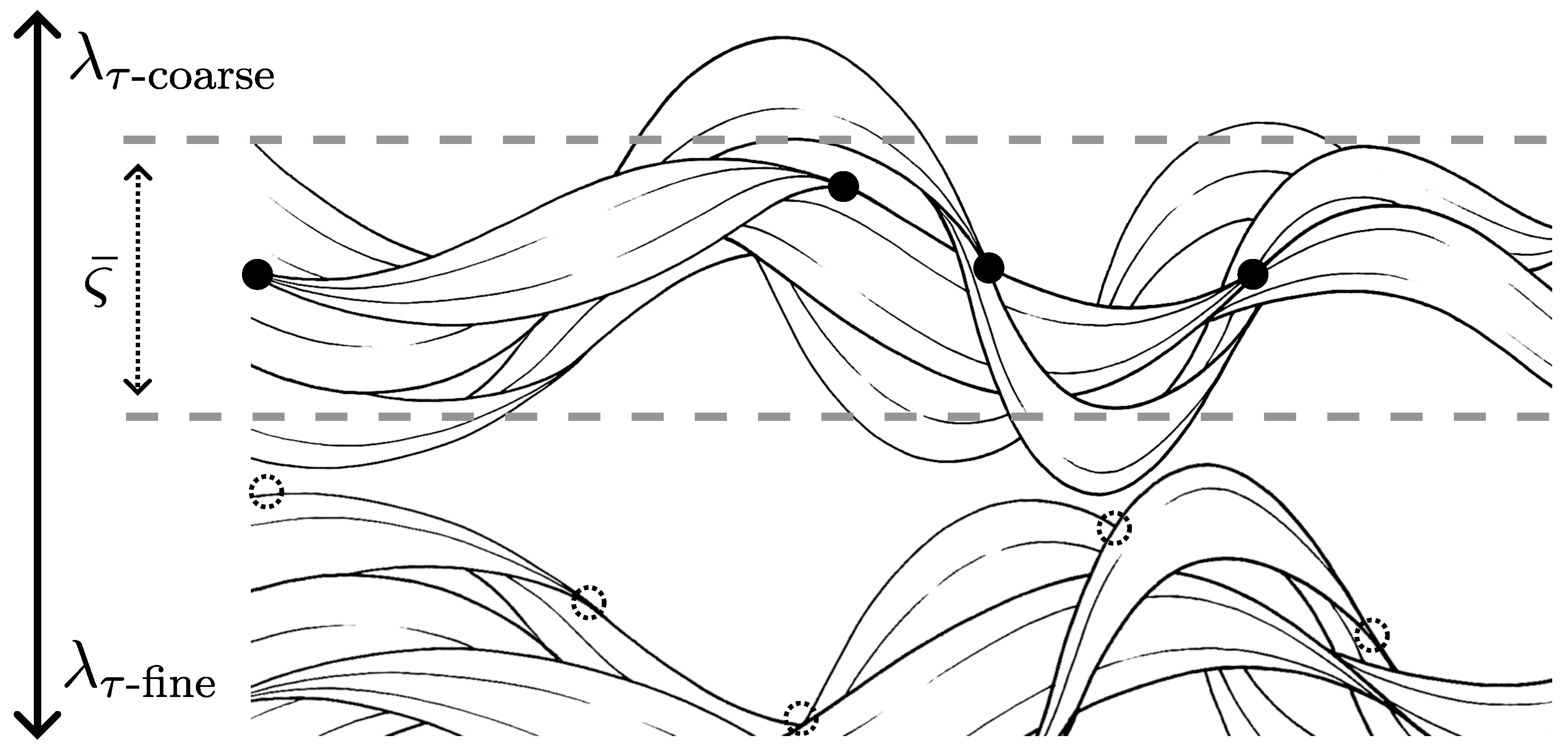
Figure 6.
Shading contrast in trajectory visualization. (A) Extended trajectory across four registered positions (–) spanning rings , the agent registers the full arc: second-person validation, generic epistemic authority (formally beyond Hx8 but represented here at ), and return. Hollow circles mark shaded intermediate positions traversed infrastructurally between registered ones; dashed arrows mark economical return routes. (B) Trajectory of similar navigational extent where only () and () achieve phenomenal registration. The arc through operates sub-threshold (dotted lines): the agent recognizes the You as definitional of the I without registering the generic authority the You represents.
Figure 6.
Shading contrast in trajectory visualization. (A) Extended trajectory across four registered positions (–) spanning rings , the agent registers the full arc: second-person validation, generic epistemic authority (formally beyond Hx8 but represented here at ), and return. Hollow circles mark shaded intermediate positions traversed infrastructurally between registered ones; dashed arrows mark economical return routes. (B) Trajectory of similar navigational extent where only () and () achieve phenomenal registration. The arc through operates sub-threshold (dotted lines): the agent recognizes the You as definitional of the I without registering the generic authority the You represents.
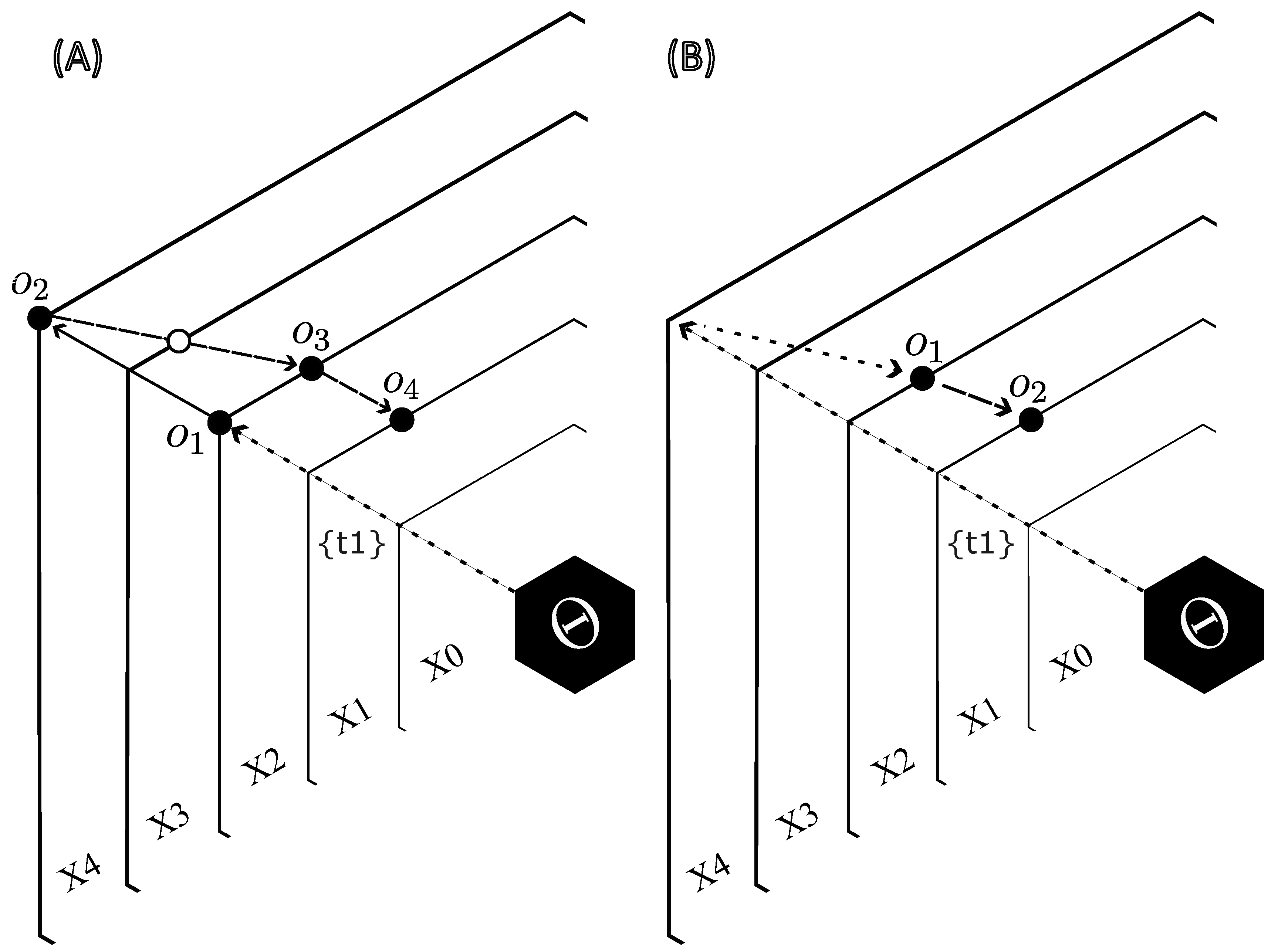
Disclaimer/Publisher’s Note: The statements, opinions and data contained in all publications are solely those of the individual author(s) and contributor(s) and not of MDPI and/or the editor(s). MDPI and/or the editor(s) disclaim responsibility for any injury to people or property resulting from any ideas, methods, instructions or products referred to in the content. |
© 2026 by the author. Licensee MDPI, Basel, Switzerland. This article is an open access article distributed under the terms and conditions of the Creative Commons Attribution (CC BY) license.
Copyright: This open access article is published under a Creative Commons CC BY 4.0 license, which permit the free download, distribution, and reuse, provided that the author and preprint are cited in any reuse.


