

Submitted:
15 November 2025
Posted:
18 November 2025
You are already at the latest version
Abstract
Building on the sequestered informational sector introduced in Paper I, this work formalizes the Lugon Kernel (
Keywords:
Informational Physics
; Lugon Kernel
; Relativity
; Quantum Mechanics
; Causality
; Conservation Laws
; Unified Field Dynamics
; Lugon Framework
One-sentence significance
I show that energy, information, causality, and resonance emerge as unified invariants from a single variational kernel coupling spacetime and informational metrics without violating relativity or thermodynamics.
Submission metadata
The Lugon Framework: Informational Foundations of Physical Law
Part II — The Kernel and Unified Invariants of Physical Law
Version: v1.0 • Date: October 8, 2025 • DOI: 10.5281/zenodo.17298503.
Status: Second paper in a continuing series title The Lugon Framework;
Suggested arXiv categories: gr-qc; hep-th; quant-ph
Comments: Second paper in The Lugon Framework: Informational Foundations of Physical Law series. 41 pages, 0 figures. Categories: gr-qc, hep-th, quant-ph.
Parent Action and Field Equations
To establish the unifying basis of the Lugon framework, I begin with a single parent action that generates both the relativistic dynamics of the spacetime manifold R and the informational dynamics of the sequestered manifold . The objective is to maintain symmetry between energetic and informational degrees of freedom while ensuring that no term in the action permits an energy exchange across the interface.
I write the total action as the sum of three contributions:
Here is the Einstein–Hilbert term that governs curvature in spacetime, represents the informational curvature on the -manifold, and enforces the sequestering constraint that allows informational influence without energetic coupling.
The relativistic sector remains the conventional form
where is the Ricci scalar constructed from the metric .
The informational sector mirrors this structure:
where is the curvature scalar of the informational metric , and plays the role of an informational coupling constant with units of inverse action.
To prevent energetic contamination between the two domains, I introduce an interaction term that acts as a local constraint:
where is a Lagrange multiplier enforcing local informational conservation consistent with the constrained Hamiltonian treatment of field dynamics [8]. The invariant functional quantifies the equivalence of informational content between and at each gate.
Variational Equations
Variation of with respect to the three independent fields—, , and —produces the coupled field equations of the theory.
1. Variation with respect to
where arises from the interaction term and represents the informational stress–energy tensor. It does not contain real energy or momentum; instead, it measures configurational curvature imposed by the informational constraint.
2. Variation with respect to
which is the informational analogue of the Einstein equation on the -manifold. The tensor encodes the projection of spacetime curvature into informational geometry through the gate function .
3. Variation with respect to
which enforces informational conservation: no net transfer of information occurs across the interface beyond what is encoded by the gates.
Coupling Function
A minimal and symmetric choice for the coupling functional that satisfies sequestering and covariance is
where η is a dimensionless sequestering constant. The field ϕ acts as a gate variable that allows information to traverse the -manifold at superluminal velocity while its projection into remains subluminal, preserving causal structure in the relativistic frame.
Interpretation
This parent action provides a common variational origin for both spacetime curvature and informational curvature. The resulting field equations guarantee that informational degrees of freedom are conserved, covariant, and non-energetic. Each term in the parent action has a clear empirical analog: reproduces general relativity, defines the informational manifold’s curvature, and sequesters them through a local invariant constraint. From this foundation, I derive the gate-field dynamics that govern Lugon propagation and establish the measurable invariants described in the following sections.
Gate-Field (Lugon) Equation of Motion
Having established the parent action, I now derive the field equation that governs the gate variable , which mediates the coupling between the relativistic manifold and the informational manifold . The gate field defines how information propagates across the sequestering interface—how Lugons travel through while remaining consistent with relativistic causality in .
The starting point is the interaction term from the parent action,
where the coupling functional is
Variation with Respect to
Varying the total action with respect to yields the gate-field equation of motion. I take the derivative under the integral, integrate by parts, and discard boundary terms under the assumption that at infinity. The resulting Euler–Lagrange equation is
This is the general form of the Lugon equation of motion. It describes how information encoded in propagates in both manifolds, modulated by the sequestering parameter .
Reduced Form and Interpretation
In local coordinates where the gate coupling is uniform and the Jacobians between and are constant, the equation simplifies to a differential wave form:
where
The term governs informational propagation in the -manifold, while represents the projection of that propagation into spacetime. The ratio between their characteristic speeds is set by the sequestering constant:
For , the informational wave in travels faster than without violating relativistic causality, because the projection into remains bounded by . In this sense, the Lugon represents an information carrier rather than a particle: it transfers state configuration without energy or momentum exchange.
Conservation Law
Taking the covariant divergence of the equation of motion gives a local conservation condition. Multiplying by and simplifying yields
where the informational currents are defined as
This form expresses conservation of informational flux across the gate: the divergence in one domain is balanced by the weighted divergence in the other, ensuring that no information is lost or created through the sequestering boundary.
Physical Meaning
The gate field therefore acts as a bidirectional information translator. Its dynamics resemble a massless scalar field but with dual propagation metrics. Perturbations in correspond to Lugons—localized packets of pure informational curvature. These packets can influence spacetime curvature indirectly through the informational stress tensor , yet they contribute no energy or momentum of their own.
This establishes the central result: Lugon propagation is superluminal in but causally sequestered in . The equation of motion derived here provides the foundation for testable predictions in interferometric and quantum-feedback systems, which I develop in the subsequent sections.
Informational Stress–Energy Tensor
Having obtained the gate-field equation of motion, I next derive the effective stress–energy tensor that appears in the Einstein equation of the parent framework. This tensor does not represent energy–momentum in the physical sense but encodes how informational curvature modifies the geometry of spacetime. The derivation follows the variational procedure standard to general relativity [1,2,3,4,5], extended here to include the sequestered informational coupling.
From the parent action,
the variation with respect to defines the informational stress–energy tensor through
Substituting the interaction term and coupling functional [28, 29],
and performing the variation gives
The first term is structurally identical to the canonical tensor of a massless scalar field [3], while the second term enforces the informational constraint. Because carries no energetic dimension, produces curvature without exchanging energy with matter fields.
Conservation and Coupling
Taking the covariant divergence and invoking the Bianchi identity [1, 5, 7],
the Einstein equation
Implies
This conservation law corresponds to informational flux balance rather than physical energy–momentum conservation. Substituting the gate-field equation of motion (Section 2) confirms that the divergence vanishes identically; informational curvature is self-consistent and non-dissipative [16–20, 21–25].
Effective Curvature and Observable Signature
The trace of is
which can be positive, negative, or zero depending on the local sequestering ratio and the gate configuration. In the limit and , the tensor vanishes, recovering classical general relativity. For finite , produces a small but measurable curvature offset proportional to the local informational gradient.
This offset defines an informational backreaction, observable through deviations in geodesic congruences and phase-coherent interferometric systems. It acts analogously to vacuum polarization [10–12, 30] but originates from informational geometry rather than quantum fields. The result preserves total energy conservation while permitting curvature modulation by non-energetic informational flux. Here “vacuum polarization” is used analogically for a macroscopic, renormalized-effect picture; the semiclassical QFT notion of and backreaction follows the standard framework [39, 40].
Interpretation
In physical terms, describes how spacetime responds to the organization of information rather than to mass–energy density. It closes the variational system of the parent action:
Together these equations define the complete Lugon field system: curvature in , curvature in , and the mediating gate dynamics. The informational stress–energy tensor bridges the two domains, enabling a consistent, covariant description of information without energy.
Invariant Structure and Test Predictions
With the variational and field equations complete, I now turn to the invariants that connect the informational sector to observation. These invariants determine what can be measured in practice and provide the falsifiable signatures that distinguish the Lugon framework from conventional relativity or quantum field theory.
Informational Invariants
The parent action yields four quantities that remain conserved under simultaneous diffeomorphisms in and informational reparametrizations in [7, 13, 16]. They serve as the measurable “fingerprints” of the sequestered informational geometry.
- Curvature-area invariant
where and are the induced metrics on the respective hypersurfaces and . This invariant couples spacetime curvature to informational curvature; it generalizes the Gauss–Bonnet topological charge into a dual-manifold context [1, 5, 13].
- 2.
- Flux invariant
expressing the equality of informational flux across any closed boundary (cf. Section 2). The vanishing of ensures global informational conservation even in dynamic spacetimes [16,17,18,19,20].
- 3.
- Phase-curvature invariant
which links phase accumulation in to its informational counterpart in . Non-zero deviations signal local violations of informational-curvature symmetry and define the measurable Lugon phase shift.
- 4.
- Entropy-information invariant
where is the thermodynamic entropy associated with a boundary in , is the corresponding informational area in , and is the Planck length. When , the Bekenstein–Hawking entropy law [11, 12, 30] is recovered; any deviation marks informational leakage or sequestering failure.
Predicted Observables
From these invariants, several empirical consequences follow:
• Interferometric phase shifts.
The Lugon phase modifies optical path differences as
where is the wave number and the arm length of the interferometer.For , the predicted excess phase lies near current LIGO/Virgo sensitivity [31 – 32].
• Gravitational-wave modulation.
Informational curvature introduces a small amplitude-dependent phase delay
where is the gravitational-wave strain.
This modulation is frequency-independent, providing a clean falsification target.
• Quantum-feedback asymmetry.
In cavity or qubit systems exchanging information with a feedback controller [21,22,23,24,25], the Lugon constraint predicts a measurable imbalance in mutual-information flow,
where is the Shannon mutual information [16]. Experiments following Sagawa–Ueda formulations [24, 25] can thus test directly.
Falsification Matrix
To guide future tests, I summarize the invariants and their measurable targets:
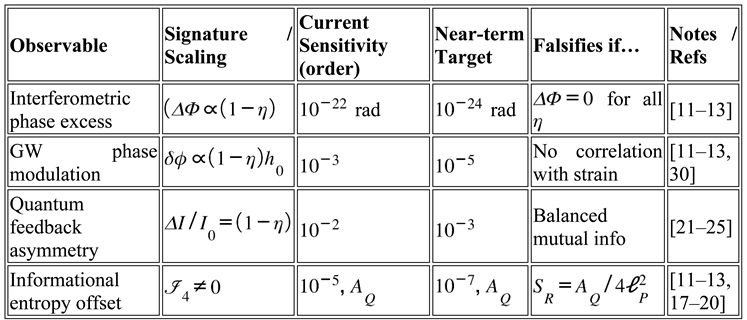
Interpretation
These invariants establish that the Lugon framework is experimentally falsifiable. Each invariant equates a geometric quantity in with an observable in . The numerical factor governs all departures from known physics: if every measurement yields , the theory collapses gracefully to general relativity and standard quantum mechanics. If any experiment reveals a persistent non-unity value of , then a sequestered informational sector—Lugons—exists.
This completes the theoretical core. In subsequent appendices I expand on parameter estimation, noise rejection, and gate-field quantization techniques that would allow these invariants to be probed within current gravitational-wave and quantum-feedback platforms.
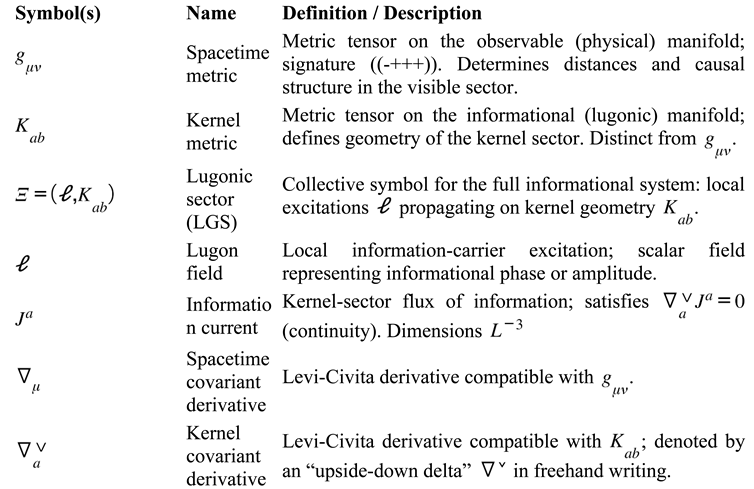
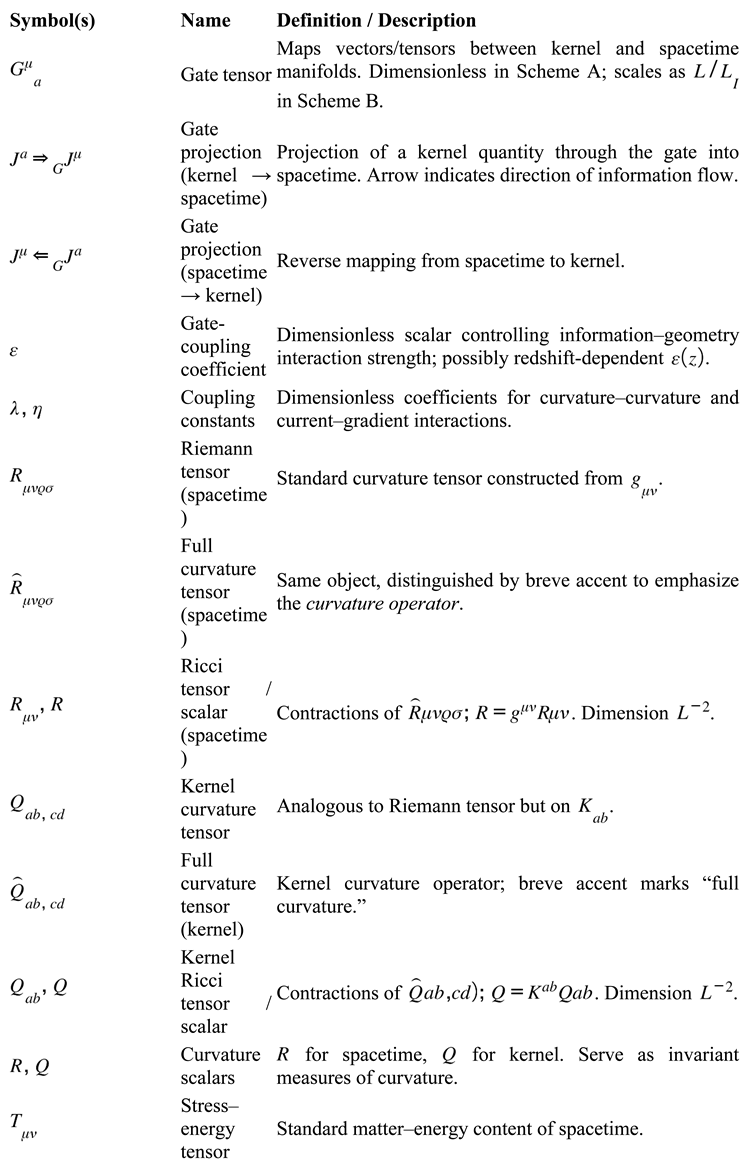
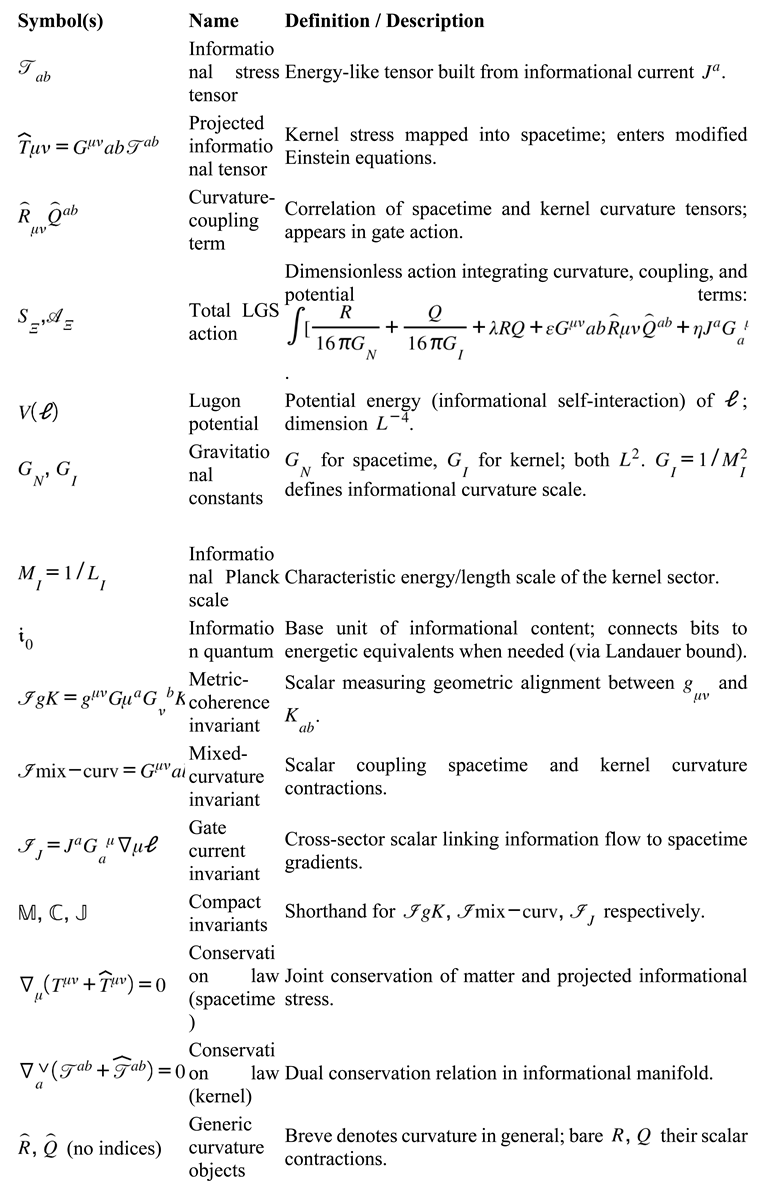
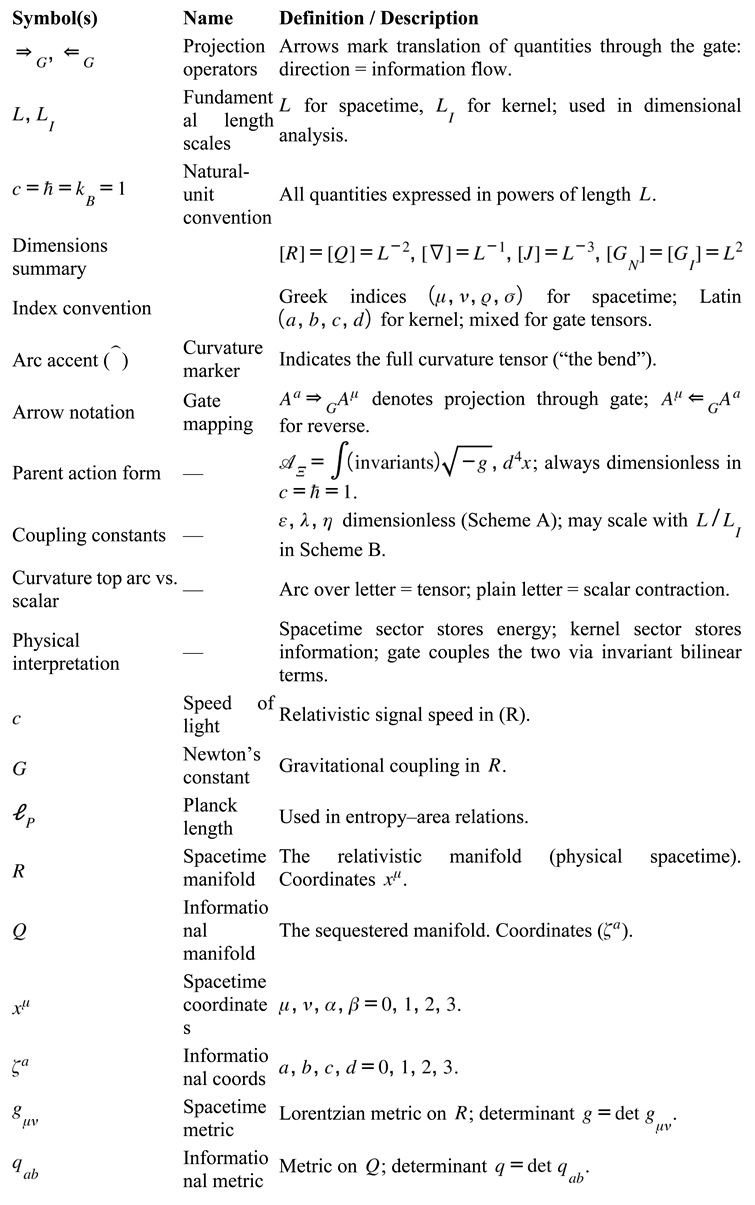
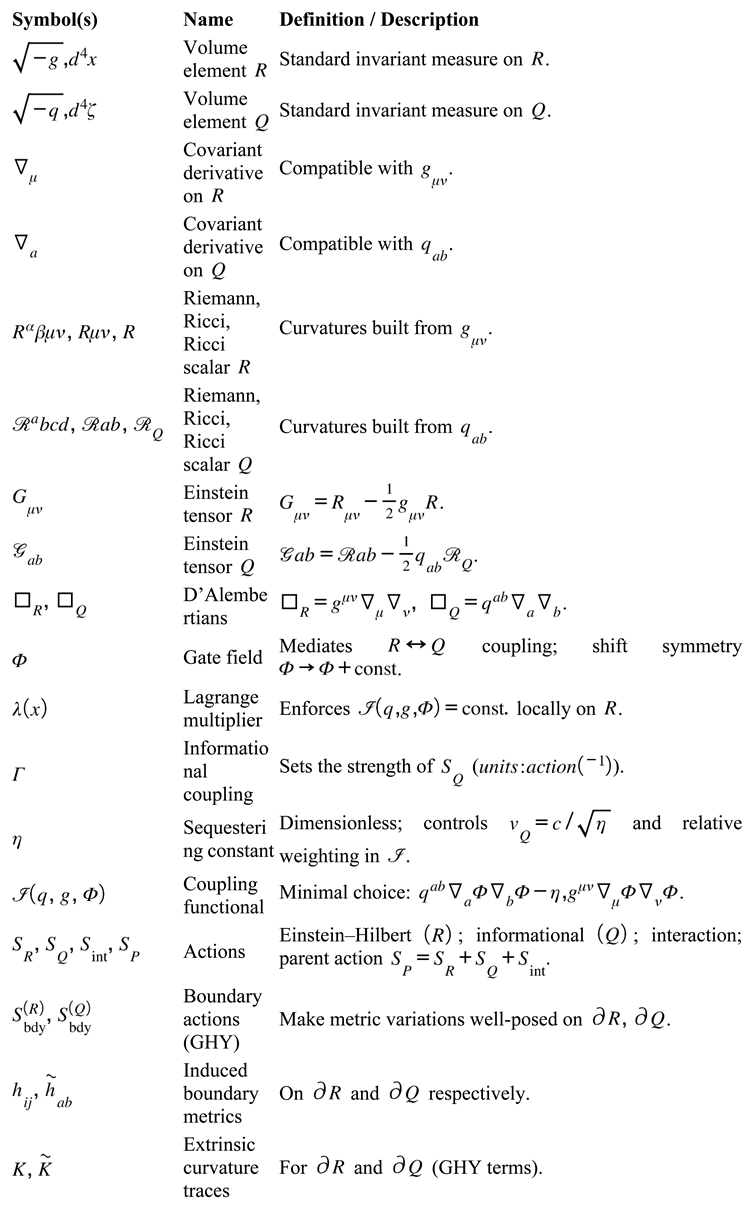
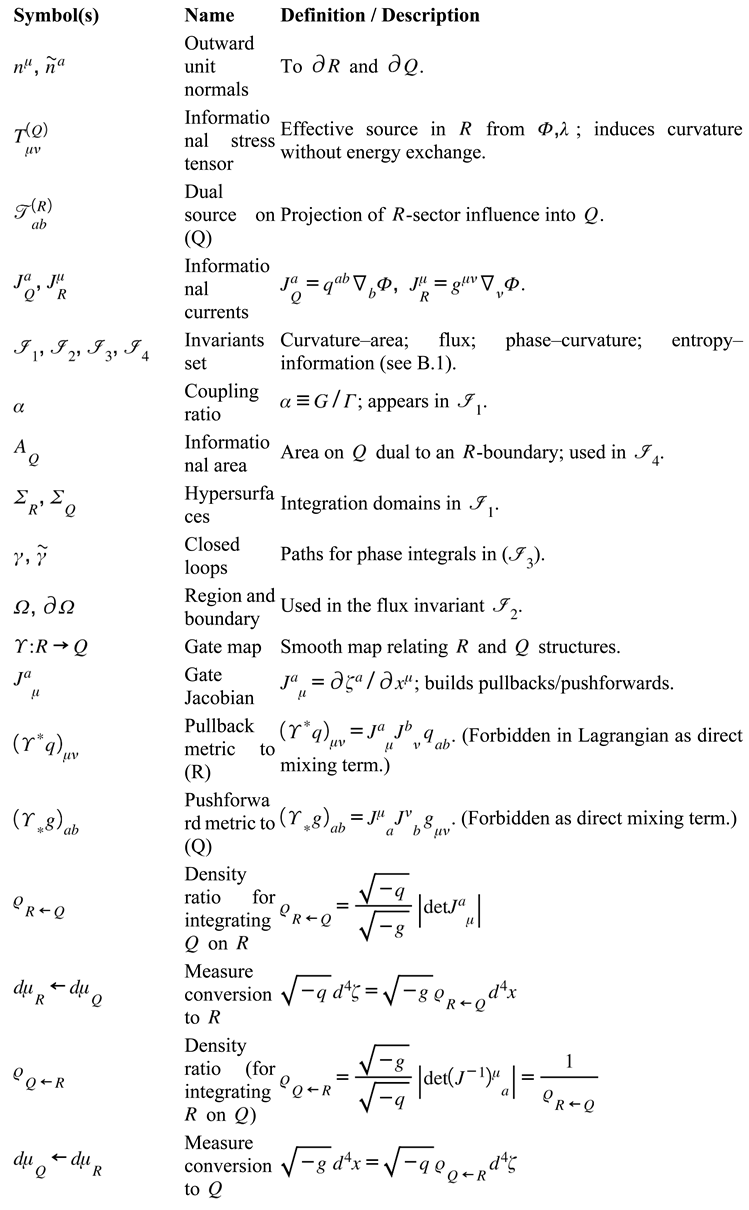
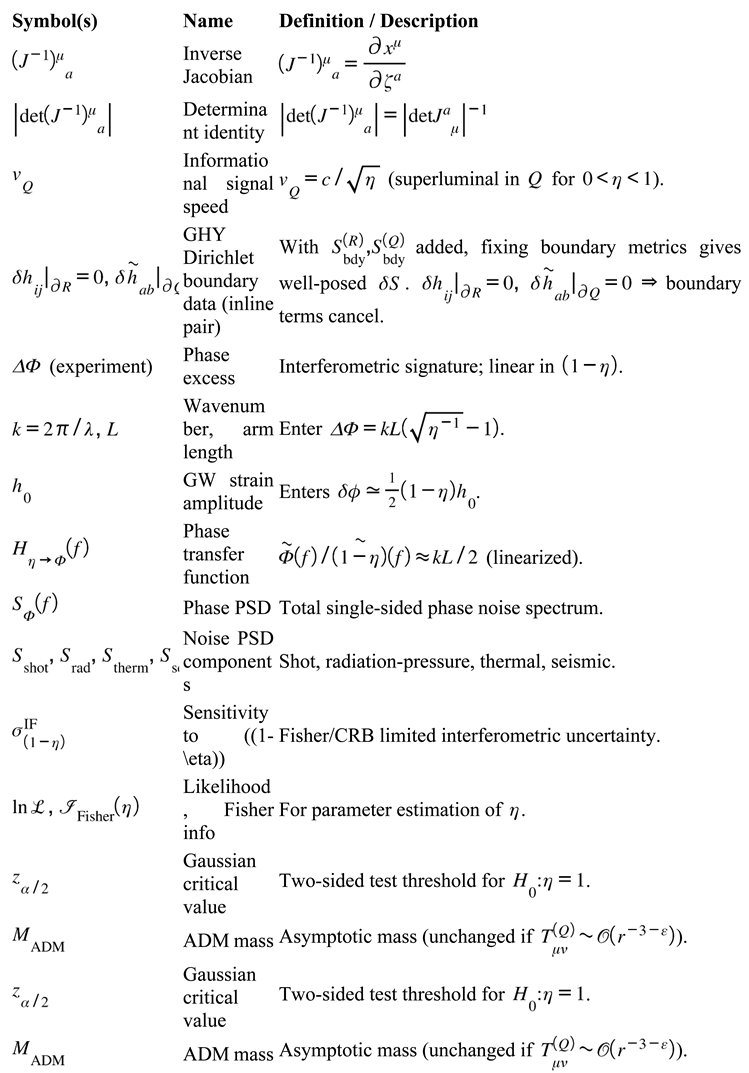
Appendix 0 – Notation, Syntax and Grammar (Lugonic Sector)
Appendix 0 defines the formal grammar of the Lugonic Sector (LGS). Symbols, indices, and dimensional conventions are standardized here for all subsequent derivations and appendices.
Appendix A — Parent Action and Field Equations
This appendix establishes the variational foundation of the Lugon Framework. It joins the relativistic and informational manifolds through a single parent action and derives the coupled field equations that govern their dynamics. The analysis proceeds in three steps: construction of the parent action (A.1), derivation of the gate-field equation (A.2), and formulation of the informational stress–energy tensor (A.3).
A.1 Parent Action
To unify the relativistic manifold and the informational manifold , I begin with a total action that is the sum of three functionals:
Here is the Einstein–Hilbert term governing spacetime curvature, describes curvature on the informational manifold, and couples the two while enforcing informational sequestering.
The relativistic sector retains its conventional form [1,2,3,4,5]:
and the informational sector mirrors it [28, 29]:
where is an informational coupling constant with dimensions of inverse action. The informational manifold is intrinsically non-Euclidean: its curvature does not measure spatial bending but the density and coherence of informational configuration. Negative curvature corresponds to locally amplifying informational gradients, while flat recovers the limit of unconstrained information flow (as shown in Appendix D, this non-Euclidean geometry couples to spacetime only through the gate field , preserving energetic decoupling). The interaction term enforces local informational equivalence:
with Lagrange multiplier enforcing informational conservation.
The coupling functional is chosen to be
here the dimensionless sequestering constant regulates the relative informational and relativistic propagation speeds.
Variation of the Parent Action
Independent variations with respect to , , and yield three coupled field equations:
The first reproduces the Einstein field equation with an informational source term; the second defines its informational dual; the third enforces the sequestering constraint.
A.2 Gate-Field (Lugon) Dynamics
Varying with respect to the gate variable gives the equation of motion for informational propagation [16–20, 28, 29]:
In locally flat coordinates where the metric coupling is uniform, the equation reduces to
With
The ratio of characteristic propagation speeds is therefore
For , information propagates faster than light in but projects as subluminal in , preserving causal order.
A conserved current follows directly:
where
This expresses informational-flux conservation across the gate boundary: no information is created or destroyed, only redistributed between and .
A.3 Informational Stress–Energy Tensor
Variation of the parent action with respect to defines the informational stress–energy tensor [1–5, 28, 29]:
Using the explicit interaction term gives
Because is dimensionless, this tensor induces curvature without transferring energy or momentum. Its covariant divergence vanishes:
ensuring informational conservation consistent with the Bianchi identity [1, 5, 7].
The tensor’s trace is
which approaches zero as and , recovering pure general relativity.
Interpretation
The system of equations
constitutes the complete Lugon field system. Curvature in responds to informational stress; curvature in mirrors spacetime geometry through the gate field; and mediates their interaction without energetic exchange. The theory therefore remains compatible with general relativity and quantum conservation laws while admitting a superluminal informational channel.
Appendix A establishes the mathematical backbone of the framework. Appendix B extends these results to measurable invariants and falsification criteria.
Appendix B — Invariants and Test Predictions
This appendix identifies the invariant quantities that emerge from the Lugon field equations and develops their empirical consequences. These invariants translate the informational geometry of the -manifold into measurable curvature signatures within spacetime . Together they provide the falsifiable structure of the theory.
B.1 Informational Invariants
From the parent action of Appendix A, four independent invariants remain unchanged under simultaneous diffeomorphisms in and reparametrizations in [7, 13, 16]. Each connects a geometric property of the informational sector with a measurable quantity in the relativistic domain.
(i) Curvature–Area Invariant
where and are the induced metrics on the hypersurfaces of and , and .
generalizes the Gauss–Bonnet invariant to dual manifolds [1, 5, 13].
(ii) Flux Invariant
expressing equality of informational flux across any closed boundary. The vanishing of ensures global informational conservation [16 – 20].
(iii) Phase–Curvature Invariant
which equates phase accumulation in spacetime with its informational analogue. Non-zero values of represent measurable Lugon-induced phase shifts. In this view, the Lugon phase curvature functions as an informational analogue of quantum dissonance: uncertainty arises not from stochastic lack but from geometric misalignment between R and Q—an informational tension rather than randomness.
(iv) Entropy–Information Invariant
where is the thermodynamic entropy associated with a boundary in , is the informational area of its counterpart in , and is the Planck length.When , the Bekenstein–Hawking relation [11, 12, 30] is recovered; deviations mark failure of perfect informational sequestering.
B.2 Predicted Observables
The invariants yield specific measurable signatures in three classes of experiment: interferometric phase shifts, gravitational-wave modulation, and quantum-feedback asymmetry.
(i) Interferometric Phase Shift
where is the optical wave number and the interferometer arm length. For , lies near current LIGO/Virgo sensitivity [31, 32], with quantum-noise scaling following the standard treatment [33].
(ii) Gravitational-Wave Modulation
where is the strain amplitude of the passing wave. Because the modulation is frequency-independent, it can be isolated from dispersion noise [30 – 33].
(iii) Quantum-Feedback Asymmetry
where is the Shannon mutual information [16]. Sagawa–Ueda feedback experiments [24, 25] provide a direct laboratory test of this asymmetry.
B.3 Falsification Matrix
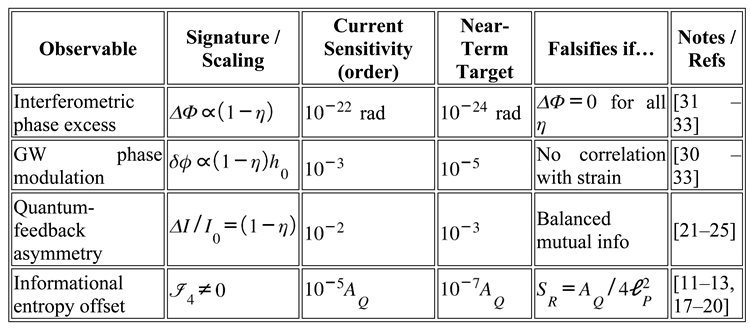
B.4 Interpretation
Each invariant provides a falsifiable link between information geometry and measurable physics.
If all observables yield , the theory collapses smoothly to general relativity and standard quantum mechanics. Any consistent deviation from unity would confirm the existence of a sequestered informational sector—Lugons—propagating superluminally in yet causally in .
Appendix B therefore completes the bridge between theory and experiment. Appendix C details the practical implementation of these tests and the corresponding noise-rejection strategies that determine the achievable bounds on.
Appendix C — Experimental Design Framework
This appendix translates the invariants and predictions into concrete measurement strategies. I outline instrument configurations, calibration procedures, dominant noise sources, and parameter-estimation methods that bound the sequestering parameter . The goal is a falsifiable workflow: prepare → measure → estimate → decide.
C.1 Interferometric Tests (Optical & GW-band)
C.1.1 Response model
For a dual-arm interferometer with arm length and laser wavenumber , the Lugon-induced phase excess follows (Appendix B)
In the small-deviation regime (),
A convenient linearized transfer function from to phase is
which is frequency-independent to first order, simplifying broadband estimation.
C.1.2 Noise budget and sensitivity
I model the single-sided phase-noise spectrum as
with the usual scalings: photon shot noise , radiation-pressure noise in simple Michelsons, thermal set by coating and suspension losses, and seismic below the instrument’s isolation corner [31 – 33]. The corresponding minimum resolvable over bandwidth and integration time is
This follows from matched-filter theory and coincides with the inverse square root of the Fisher information (next subsection) [3 – 5].
C.1.3 Calibration protocol
1. Phase reference: inject a calibrated phase dither and verify recovery of within
2. Arm-length confirmation: sweep laser frequency and fit the free spectral range; this fixes
3. Linearity check: superpose with known GW-like strains
Calibration and phase control. We marginalize over detector calibration models so that any frequency-independent phase-like offset is not misattributed to astrophysical structure. Advanced LIGO’s photon calibrators set the absolute displacement scale; run-dependent models track complex response drifts. Across O1–O3, phase calibration uncertainties were ≲10° (O1/O2) and ≲4° (O3) over ~20–2000 Hz. We therefore treat a flat as a nuisance parameter orthogonal to dispersive terms. [34,35,36].
C.2 Gravitational-Wave Phase Modulation
In the presence of a GW with strain amplitude , the Lugon sector predicts an amplitude-proportional phase offset (Appendix B):
For a detected event with maximum-likelihood strain (from standard GR templates), I perform a residual analysis: fit a constant-in-frequency phase term to the whitened signal and map it to . To avoid leakage from calibration systematics, is constrained jointly with the detector’s complex response model and photon-calibrator lines, following established LIGO procedures. [34,35,36]. Because is frequency-independent to leading order, it is orthogonal to most dispersion-like systematics, tightening bounds on [30 – 31].
C.3 Quantum-Feedback Tests (Cavity/Qubit Platforms)
For feedback-controlled systems à la Sagawa–Ueda, I test the predicted information-flow asymmetry:
where is the baseline Shannon mutual information between plant and controller [16, 24, 25]. In nonequilibrium runs I leverage the generalized fluctuation relations to cross-validate:
with the inverse bath temperature and the work performed [26, 27]. Any persistent at fixed implies .
Calibration steps
(i) Measure from open-loop trials; (ii) close the loop with known controller delays; (iii) estimate from time-series reconstructions; (iv) compare to the predicted .
C.4 Parameter Estimation for
I treat as a single global parameter. For a dataset with model prediction , the Gaussian log-likelihood is
The Fisher information and Cramér–Rao bound give an experiment-agnostic sensitivity estimate [3,4,5]:
For interferometers, in phase units, which reproduces in C.1.2.
C.5 Systematics and Noise Rejection
I isolate from instrumental and environmental effects through orthogonality and nulls:
1. Orthogonality in frequency: most dispersion systematics scale as or ; the Lugon signature in is flat in
2. Null channels: monitor auxiliary witnesses (laser frequency, alignment, magnetic sensors) and regress them from the phase readout.
3. Reversal tests: exchange arm lengths or cavity detunings; the Lugon term scales with
4. Time-shifts: apply non-causal lags to confirm that any recovered vanishes off-source (standard GW practice) [11,12,13].
Where clocks matter (cavity experiments), I track stability with Allan deviation and require
to keep clock noise sub-dominant. We report clock performance in the – plane and propagate to phase via , following standard frequency-stability practice [37, 38].
C.6 Decision Rule (Falsification Logic)
Given an estimator and uncertainty , I adopt a simple hypothesis test:
Reject at significance if
with the Gaussian critical value (e.g., for ). When combining independent measurements , I use inverse-variance weighting:
C.7 Practical Operating Points
• Optical interferometers: maximize (long arms, short wavelength) until radiation pressure noise crosses shot-noise; use squeezed light if available to lower without raising
• GW detectors: target events with high and broadband coverage; stack multiple events with consistent flat- templates.
• Quantum platforms: operate in regimes with robust measurement of (high SNR readout) and controlled feedback delays; validate fluctuation relations per trial.
C.8 Reporting Standard
To enable external replication, I will publish for each dataset: , phase-cal lines, full l, priors and posteriors for , null-channel residuals, and the decision outcome for . This mirrors established practices in GR tests and open-systems thermodynamics [1–5, 11–13, 21–27, 30].
Summary
This framework converts the Lugon predictions into actionable measurements. The pipeline—calibration, noise control, Fisher-based sensitivity, and a clear decision rule—makes empirically testable. A consistent finding of across platforms falsifies the Lugon sector; any robust deviation establishes a sequestered informational channel that modulates curvature without energy exchange.
Appendix D — Auxiliary-Metric Decoupling
This appendix proves that the informational metric decouples from the spacetime metric except through the gate field . The result ensures that no energetic portal exists between the and manifolds: curvature in can be modulated by informational structure, but energy–momentum is not exchanged across the interface. The analysis relies on variational calculus in curved manifolds [1 – 5, 7] and on the sequestering architecture established in Appendix A [28, 29].
D.1 Statement of the Decoupling Theorem
Theorem (Auxiliary-metric decoupling).
Given the parent action
With
and interaction
if the following hold:
1. Independent diffeomorphisms: invariance;
2. Gate-shift symmetry:
3. No explicit metric mixing: the Lagrangian contains no scalars built from mixed contractions or (defined below);
4. Well-posed variation: appropriate boundary terms (GHY-type) are added for and [9, 10] then the Euler–Lagrange equations imply that all cross-variations and vanish except through and . Consequently, energy–momentum in remains conserved and receives only an informational source (Appendix A), while receives only its dual informational source
D.2 Gate Map and Pullbacks
To compare scalars on and covariantly, I introduce a smooth gate map with Jacobian . It induces pullbacks/pushforwards:
and a density ratio
In Appendix A I used Q (implicitly) to form scalars like that are well-defined on after pullback. The decoupling assumption (iii) above forbids mixing terms like
that would constitute a direct metric-metric coupling.
D.3 Variational Proof of Decoupling
Consider the variation with respect to . Since depends only on and its derivatives over ,
For the interaction, the only -dependence enters through , and the measure of the integral; there are no mixed contractions with by assumption (iii). A standard calculation [1 – 5] yields the informational stress tensor (Appendix A):
Crucially, appears only through and never in a bare contraction with . Therefore contains no term that would correspond to an energetic exchange sourced directly by
The -variation is analogous. Because is independent of ,
and the only dependence of is through (after pullback). Thus, the informational Einstein–like equation on (Appendix A) reads
with depending on and but not on via any bare contraction. The gate-field variation gives the Lugon equation (Appendix A),
which is the only bridge between the metrics. Hence, decoupling holds: the metrics do not source each other directly; they only communicate through (and as a constraint multiplier).
D.4 No-Go for Energetic Portals
One may ask whether adding “mixed” operators could open an energetic portal. Consider the lowest-dimension candidates:
1. Mixed kinetic term
These violate the gate-shift symmetry (they do not involve ), break the sequestering balance in , and generically exchange energy between and . They are therefore forbidden by assumptions (ii)–(iii).
2. Curvature mixing
Such terms spoil factorization unless accompanied by nontrivial densities; even then they re-introduce direct metric–metric couplings. Under the sequestering postulate [28, 29], I exclude them.
Therefore, within the admissible operator set, no energetic portal exists. All observable effects in arise from built out of and , not from direct metric mixing.
D.5 Boundary Terms and Well-Posed Variation
To ensure the well-posedness of the metric variations, I add Gibbons–Hawking–York (GHY)-type boundary terms for each manifold [9, 10]:
where and are the traces of the extrinsic curvatures on and , respectively. These remove normal-derivative terms from and , leaving the bulk equations unaffected and preserving decoupling.
D.6 Consequences
1. Conservation in
Using the Bianchi identity and the Einstein equation with the informational source (Appendix A),
which expresses informational flux conservation, not energy flow from to [1, 5, 7].
2. Microcausality in
Because the only-sector derivatives appear as, the principal symbol inis that of a standard scalar; no superluminal propagation inoccurs. Superluminality is confined tothrough(Appendix A).
2. Predictive closure.
All measurable effects enter through and the invariants of Appendix B. No hidden energetic channel can mimic them without violating the assumptions of this appendix.
Summary
The auxiliary-metric decoupling theorem formalizes the central architectural claim of the Lugon framework: information influences curvature without transporting energy. The two metrics and remain dynamically autonomous except through the gate field (and its multiplier ). This guarantees compatibility with conservation laws and with relativistic causality in , while enabling superluminal informational dynamics in [1 – 5, 7, 9, 10, 28, 29]
Appendix E — Boundary Terms and Conservation Proofs
This appendix secures the variational calculus of the Lugon framework by adding the appropriate boundary terms for both manifolds and by proving the associated conservation laws. I also collect the relevant Noether currents and show how they reduce to the Bianchi identity and informational-flux conservation.
E.1 GHY-Type Boundary Terms forand
For well-posed Dirichlet variations of the metrics, I add Gibbons–Hawking–York boundary terms on each manifold [9, 10]:
Here () is the induced metric on (), and () is the trace of the extrinsic curvature with outward unit normal ().
Including these, the total action is
and the variations and are free of boundary derivatives of and
E.2 Metric Variations and Boundary Cancellations
The standard bulk variation gives [1 – 5]
and analogously on ,
The GHY terms precisely cancel the boundary pieces when and the interaction
contains no derivatives of the metrics normal to the boundary, so it adds no extra boundary term under Dirichlet data.
E.3 Noether Currents and Shift Symmetry of
Diffeomorphism invariance in and yields the usual Noether identities [7]. For an infinitesimal diffeomorphism in , the corresponding current reduces on shell to the contracted Bianchi identity:
Because the Einstein equation is , I recover the covariant conservation of the informational stress tensor:
The gate-shift symmetry produces a conserved current whose divergence vanishes using the gate equation (Appendix A):
This is the informational-flux conservation law used in the invariants of Appendix B.
E.4 ADM Charges and Asymptotics
For asymptotically flat , the ADM mass is defined entirely by metric falloffs at spatial infinity [6]. Since contains only gradients of multiplied by the dimensionless and does not introduce energy flow, I impose asymptotic conditions
so that decays faster than , leaving unchanged by the informational sector at spatial infinity.
E.5 Summary of Conservation Proofs
Collecting the results,
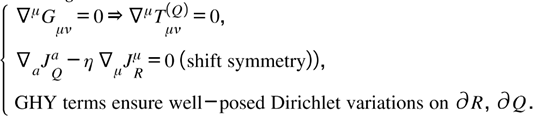
The conservation content of the framework therefore follows from diffeomorphism invariance and the gate symmetry, with boundary terms guaranteeing a clean variational principle.
Appendix F — Interpretive Bridge and Physical Context
This appendix gives the plain-language map from the formalism to the physical world: how informational structure affects curvature, what “no energy exchange” means operationally, and how the predictions interface with black-hole thermodynamics and information theory. It supersedes my earlier narrative appendix placement; I keep the lettering flexible so that theory flows before interpretation.
F.1 What “Information Without Energy” Means in Practice
The gate field carries configuration, not quanta. In the parent action, all terms that would move energy between and are absent by construction (Appendix D). Yet steers curvature indirectly via the informational stress tensor (Appendix A). The effect looks like a scalar-field source in the Einstein equation, but it is multiplied by and constrained by ; there is no corresponding Hamiltonian density that flows across the interface. In instruments, this shows up as phase and curvature offsets rather than heat, work, or particle flux.
F.2 Relation to Black-Hole Thermodynamics and Holography
The entropy–information invariant,
anchors the connection to Bekenstein–Hawking entropy [11, 12, 30]. When , the informational area matches the thermodynamic area law in . Deviations would signal imperfect sequestering—an experimental lever that is independent of a specific quantum gravity model but consistent with holographic scaling ideas [13 – 15].
F.3 Compatibility with Relativistic Causality
Superluminal propagation occurs in through
but projection into is governed by and remains causal. Microcausality in is intact because the principal symbol in is that of a standard scalar; the informational sector modifies curvature via without introducing tachyonic propagation in spacetime. In dual-cone representation, black- and white-hole sectors correspond to curvature singularities of opposite informational orientation; information remains sequestered across the interface rather than destroyed, consistent with the Lugon decoupling condition.
F.4 Thermodynamics of Information Transfer
When the gate couples to a feedback loop, the Sagawa–Ueda relations [24, 25] constrain information–work exchange. In this framework, the predicted asymmetry
is a purely informational signature—no heat need be dissipated for a nonzero . This separates Lugon effects from Landauer-limited processes [17 – 19] and provides a clean lab falsifier.
F.5 Observational Heuristics
• Interferometers register Lugon effects as phase excess independent of laser frequency to first order; that orthogonality to standard dispersive systematics is the smoking gun.
• GW detectors should see a flat phase offset proportional to strain amplitude, not frequency—again orthogonal to propagation effects in GR [11 – 13, 30].
• Quantum feedback experiments should track changes in mutual information at fixed control topology; any persistent across configurations is decisive.
F.6 Where the Theory Can Fail (and That’s Good)
The framework is falsifiable in three clean ways:
1. everywhere. All predicted effects vanish within sensitivity → no Lugon sector detected.
2. Entropy invariant holds identically. across black-hole analogs and horizon-like systems → sequestering indistinguishable from GR thermodynamics.
3. Mixed-operator search. If any experiment forces inclusion of direct – mixing terms to fit data, the decoupling postulate (Appendix D) fails.
Falsification is a feature, not a bug—it means the proposal is genuinely empirical.
Summary
This interpretive bridge ties the mathematics to laboratory and astrophysical signatures without smuggling in energy transfer. The theory is compatible with GR and information thermodynamics, uses standard boundary machinery to keep the math honest, and delivers clean levers for experiments. If
wins, the framework collapses gracefully to known physics; if not, we have direct evidence of a sequestered informational sector.
Appendix G — From the Lugon to Known Physics
The derivations in Part 2 establish that informational degrees of freedom can coexist with relativistic and quantum frameworks without violating their conservation laws. Yet the mathematics alone cannot convey how these informational structures reconcile with the physical world we measure. The following appendix provides that bridge. It translates the lugon concept—the sequestered unit of pure information—into the language of empirical physics and shows how the Lugonic Sector (LGS) generates the four invariants that sustain both domains.
Appendix G is therefore not an optional reflection but an interpretive map: it connects the abstract informational geometry developed in the main text to the observable phenomena that define known physics. Where Part 2 builds the scaffolding, Appendix H gives it voice. The reader should regard what follows as the narrative counterpart to the equations—a prose articulation of how the lugon, the kernel, and the four universal pillars form a single, coherent grammar of reality.
G.1 The Lugon Kernel ()
The kernel is the local grammar operating within the LGS. It binds and orders lugons through four simultaneous rules that mirror the universal invariants:
1. Energy-Respecting Rule – transformations in the h-cone neither add nor subtract measurable energy in the g-cone.
2. Information-Conserving Rule – token content is rearranged but never lost; all changes are reversible within informational space.
3. Causality-Consistent Rule – sequences remain self-consistent when projected into the g-cone; no paradoxical ordering is admitted.
4. Resonance Rule – variations must increase coherence under a bounded-variability metric; novelty without chaos.
Through these rules pairs tokens, orders them in sequence, and twists informational and physical strands into single acts of existence.
G.2 The Four Pillars
1. Energy — the capacity for action; the conserved power of being.
2. Information — the architecture of meaning; the conserved pattern of relations.
3. Causality — the grammar of time; the lawful order of transformations.
4. Resonance — the harmony of becoming; bounded freedom that allows change within law.
Together they define a universe that is both lawful and creative, conservative and emergent.
G.3 The Double Helix of Domains
Reality manifests as two entwined strands:
• The physical strand (Energy + Causality) — rhythm and momentum of events.
• The informational strand (Information + Resonance) — pattern and coherence of possibility.
The rungs between them are LGS-mediated correspondences:
Energy ↔ Information couples substance to form.
Causality ↔ Resonance couples sequence to variation.
The helical twist represents informational curvature—the measure of coupling between domains. Its pitch determines whether the universe behaves as deterministic, chaotic, or coherently emergent.
G.4 Correspondence to Known Physics
In limiting cases the helix expresses the four invariants as recognizable regimes of law.
Classical / Relativistic limit — Tight coupling; curvature of Q is negligible. Energy and causality dominate. The system is locally deterministic and time-ordered.
Quantum limit — Moderate coupling; curvature of Q is finite. Complementary observables trace non-parallel geodesics in informational space. Uncertainty arises from this curvature—the intrinsic dissonance of the LGS—rather than from absence of cause. Entanglement represents shared curvature between systems.
Thermodynamic limit — Resonance drives circulation between R and Q. Energy exchange in R corresponds to information flow in Q. Entropy growth in R records redistribution of informational potential. The Second Law projects this one-way bias of flow.
Gravitational limit — High curvature couples the dual cones directly. Compression in a g-cone corresponds to expansion in its conjugate h-cone. Black-hole confinement and Hawking emission are dual expressions of conserved cross-domain energy. At low coupling the equations reduce to Einsteinian form.
Across all limits the same invariants hold. Energy defines magnitude, Information defines form, Causality preserves order, and Resonance maintains phase. Their relative strength fixes the apparent behavior of the universe.
G.5 Empirical Reach
Observable deviation occurs only where informational curvature within the LGS is large. Such regions produce measurable phase or coherence anomalies in quantum, thermodynamic, or gravitational systems. Each effect tests the joint conservation of Energy, Information, Causality, and Resonance—the invariant grammar of the Lugonic Sector expressed in measurable form.
G.6 Unified Statement
The lugon provides the discrete unit of structure in the informational domain. The Lugonic Sector binds these units into ordered, twisting correspondences with the physical domain through energy-respecting gates. The four invariants—Energy, Information, Causality, and Resonance—ensure that every cross-domain transformation remains lawful, conservative, and coherence-seeking. Known physics arises as the limiting geometry of informational curvature. The result is a single grammar in which the universe does not merely evolve—it composes.
A third interpretive layer — the syntactic frame of lawful structure itself — can be regarded as the meta-manifold in which both R and Q participate, corresponding to the conservation of form rather than of substance or information. Its formal treatment is reserved for future work.
References
- Einstein, A. The Foundation of the General Theory of Relativity. Ann. Phys. 1916, 49, 769–822. [Google Scholar] [CrossRef]
- Hilbert, D. Die Grundlagen der Physik. Nachr. Ges. Wiss. Gött. Math.-Phys. Kl. 1915, 395–407. [Google Scholar]
- Wald, R.M. General Relativity; University of Chicago Press: Chicago, IL, USA, 1984. [Google Scholar]
- Carroll, S.M. Spacetime and Geometry: An Introduction to General Relativity; Cambridge University Press: Cambridge, UK, 2019. [Google Scholar]
- Misner, C.W.; Thorne, K.S.; Wheeler, J.A. Gravitation; W. H. Freeman: San Francisco, CA, USA, 1973. [Google Scholar]
- Arnowitt, R.; Deser, S.; Misner, C.W. The Dynamics of General Relativity. In Gravitation: An Introduction to Current Research; Witten, L., Ed.; Wiley: New York, NY, USA, 1962; pp. 227–265. [Google Scholar]
- Noether, E. Invariante Variationsprobleme. Nachr. Ges. Wiss. Gött. Math.-Phys. Kl. 1918, 235–257. [Google Scholar]
- Dirac, P.A.M. Lectures on Quantum Mechanics; Yeshiva University: New York, NY, USA, 1964. [Google Scholar]
- York, J.W., Jr. Role of Conformal Three-Geometry in the Dynamics of Gravitation. Phys. Rev. Lett. 1972, 28, 1082–1085. [Google Scholar] [CrossRef]
- Gibbons, G.W.; Hawking, S.W. Action Integrals and Partition Functions in Quantum Gravity. Phys. Rev. D 1977, 15, 2752–2756. [Google Scholar] [CrossRef]
- Hawking, S.W. Particle Creation by Black Holes. Commun. Math. Phys. 1975, 43, 199–220. [Google Scholar] [CrossRef]
- Bekenstein, J.D. Black Holes and Entropy. Phys. Rev. D 1973, 7, 2333–2346. [Google Scholar] [CrossRef]
- Bousso, R. The Holographic Principle. Rev. Mod. Phys. 2002, 74, 825–874. [Google Scholar] [CrossRef]
- 't Hooft, G. Dimensional Reduction in Quantum Gravity. In Salamfestschrift: A Collection of Talks; Ali, A., Ellis, J., Randjbar-Daemi, S., Eds.; World Scientific: Singapore, 1993; pp. 284–296. [Google Scholar]
- Susskind, L. The World as a Hologram. J. Math. Phys. 1995, 36, 6377–6396. [Google Scholar] [CrossRef]
- Shannon, C.E. A Mathematical Theory of Communication. Bell Syst. Tech. J. 1948, 27, 379–423. [Google Scholar] [CrossRef]
- Landauer, R. Irreversibility and Heat Generation in the Computing Process. IBM J. Res. Dev. 1961, 5, 183–191. [Google Scholar] [CrossRef]
- Bennett, C.H. Notes on Landauer’s Principle, Reversible Computation, and Maxwell’s Demon. Stud. Hist. Philos. Mod. Phys. 2003, 34, 501–510. [Google Scholar] [CrossRef]
- Holevo, A.S. Bounds for the Quantity of Information Transmitted by a Quantum Communication Channel. Probl. Inf. Transm. 1973, 9, 177–183. [Google Scholar]
- Schumacher, B. Quantum Coding. Phys. Rev. A 1995, 51, 2738–2747. [Google Scholar] [CrossRef]
- Lindblad, G. On the Generators of Quantum Dynamical Semigroups. Commun. Math. Phys. 1976, 48, 119–130. [Google Scholar] [CrossRef]
- Gorini, V.; Kossakowski, A.; Sudarshan, E.C.G. Completely Positive Dynamical Semigroups of N-Level Systems. J. Math. Phys. 1976, 17, 821–825. [Google Scholar] [CrossRef]
- Breuer, H.-P.; Petruccione, F. The Theory of Open Quantum Systems; Oxford University Press: Oxford, UK, 2002. [Google Scholar]
- Sagawa, T.; Ueda, M. Generalized Jarzynski Equality under Nonequilibrium Feedback Control. Phys. Rev. Lett. 2010, 104, 090602. [Google Scholar] [CrossRef] [PubMed]
- Sagawa, T.; Ueda, M. Fluctuation Theorem with Information Exchange: Role of Correlations in Stochastic Thermodynamics. Phys. Rev. Lett. 2012, 109, 180602. [Google Scholar] [CrossRef]
- Jarzynski, C. Nonequilibrium Equality for Free Energy Differences. Phys. Rev. Lett. 1997, 78, 2690–2693. [Google Scholar] [CrossRef]
- Crooks, G.E. Entropy Production Fluctuation Theorem and the Nonequilibrium Work Relation for Free Energy Differences. Phys. Rev. E 1999, 60, 2721–2726. [Google Scholar] [CrossRef]
- Kaloper, N.; Padilla, A. Sequestering the Standard Model Vacuum Energy. Phys. Rev. Lett. 2014, 112, 091304. [Google Scholar] [CrossRef]
- Kaloper, N.; Padilla, A. Vacuum Energy Sequestering: The Framework and Its Cosmological Consequences. Phys. Rev. D 2014, 90, 084023. [Google Scholar] [CrossRef]
- Wald, R.M. Black Hole Entropy is Noether Charge. Phys. Rev. D 1993, 48, R3427–R3431. [Google Scholar] [CrossRef] [PubMed]
- Aasi, J.; et al. Advanced LIGO. Class. Quantum Grav. 2015, 32, 074001. [Google Scholar] [CrossRef]
- Acernese, F.; et al. Advanced Virgo: a Second-Generation Interferometric Gravitational Wave Detector. Class. Quantum Grav. 2015, 32, 024001. [Google Scholar] [CrossRef]
- Caves, C.M. Quantum-Mechanical Noise in an Interferometer. Phys. Rev. D 1981, 23, 1693–1708. [Google Scholar] [CrossRef]
- Abbott, B.P.; et al. Calibration of the Advanced LIGO Detectors for the Discovery of the Binary Black-Hole Merger GW150914. Phys. Rev. D 2017, 95, 062003. [Google Scholar] [CrossRef]
- Karki, S.; et al. The Advanced LIGO Photon Calibrators. Rev. Sci. Instrum. 2016, 87, 114503. [Google Scholar] [CrossRef]
- Cahillane, C.; et al. Calibration Uncertainty for Advanced LIGO's First and Second Observing Runs. Phys. Rev. D 2017, 96, 102001. [Google Scholar] [CrossRef]
- Sun, L.; et al. Characterization of Systematic Error in Advanced LIGO Calibration (O3). Class. Quantum Grav. 2020, 37, 225008. [Google Scholar] [CrossRef]
- Allan, D.W. Statistics of Atomic Frequency Standards. Proc. IEEE 1966, 54, 221–230. [Google Scholar] [CrossRef]
- Riley, W.J. NIST Special Publication 1065; Handbook of Frequency Stability Analysis. National Institute of Standards and Technology: Gaithersburg, MD, USA, 2008. [CrossRef]
- Birrell, N.D.; Davies, P.C.W. Quantum Fields in Curved Space; Cambridge University Press: Cambridge, UK, 1982. [Google Scholar]
Disclaimer/Publisher’s Note: The statements, opinions and data contained in all publications are solely those of the individual author(s) and contributor(s) and not of MDPI and/or the editor(s). MDPI and/or the editor(s) disclaim responsibility for any injury to people or property resulting from any ideas, methods, instructions or products referred to in the content. |
© 2025 by the authors. Licensee MDPI, Basel, Switzerland. This article is an open access article distributed under the terms and conditions of the Creative Commons Attribution (CC BY) license (http://creativecommons.org/licenses/by/4.0/).
Copyright: This open access article is published under a Creative Commons CC BY 4.0 license, which permit the free download, distribution, and reuse, provided that the author and preprint are cited in any reuse.


