

Submitted:
17 November 2025
Posted:
18 November 2025
You are already at the latest version
Abstract
We study the process of opinion formation in an Ising social network of scientific collaborations. The network is undirected. An Ising spin is associated with each network node being oriented up (red) or down (blue). Certain nodes carry fixed, opposite opinions whose influence propagates over the other spins, which are flipped according to the majority-influence opinion of neighbors of a given spin during the asynchronous Monte Carlo process. The amplitude influence of each spin is self-consistently adapted, and a flip occurs only if this majority influence exceeds a certain conviction threshold. All non-fixed spins are initially randomly distributed, with half of them oriented up and half down. Such a system can be viewed as a model of elite influence, coming from the fixed spins, on the opinions of the crowd of non-fixed spins. We show that a phase transition occurs as the amplitude influence of the crowd spins increases: the dominant opinion shifts from that of the elite nodes to a phase in which the crowd spins’ opinion becomes dominant and the elite can no longer impose their views.
Keywords:
opinion formation
; social networks
; Ising spins
1. Introduction
Social networks now exert a significant influence on human society, and as a result, their properties are actively investigated by the scientific community (see e.g., [1,2,3]). Recently, their impact has been argued to extend specifically to opinion formation and even to affect political elections [4,5]. This very problem of opinion formation in a group of electors is actively investigated in the field of sociophysics, using diverse models and methods (see e.g., [6,7,8,9,10,11,12]). Usually in these studies there are two competing opinions of electors, often modeled as network nodes, governed by a local majority rule whereby an elector’s opinion is determined by the majority opinion of its linked neighbors. Thus, each node has red or blue color (or an Ising spin up or down), and the system represents an Ising network of spin halves with N nodes and a huge space of configuration states (see e.g., [11]). An opinion, or spin polarization, of nodes is determined by an asynchronous Monte Carlo process in a system of spins described by an Ising Hamiltonian on a network. A similar Monte Carlo process is used in the models of associative memory [13,14]. A similar process is also considered in Boolean networks [15,16].
Recently it was proposed that such an opinion formation process can also describe a country’s preference to trade in one currency or another (e.g., USD or hypothetical BRICS currency) [17]. An important new element introduced in [17], and then extended in [18], is that the opinion of certain network nodes is considered to be fixed (spin always up or down) and not affected by opinions of other nodes. In addition, in such an Ising Network of Opinion Formation (INOF) model [18] it is assumed that at the initial stage only fixed nodes have a given fixed spin polarization, while all other nodes are white (zero spin) thus producing no influence on the opinions (spins) of other nodes. However, these white nodes are getting their spin polarization up or down during the asynchronous Monte Carlo process of opinion formation on the Ising network. All the above studies have been done for directed networks with the INOF approach of fixed and white nodes applied to Wikipedia Ising Networks (WIN) considering contests between different social concepts, companies, political leaders and countries [18]. When we consider a contest between two political leaders like Trump and Putin in WIN, it is rather natural to assume that all other nodes (Wikipedia articles) have no specific opinion on these two figures at the initial stage of the Monte Carlo process of INOF, so that they are considered as white nodes. However, it may be important to understand the influence of initial random opinions of non-fixed nodes on the contest results. Beyond this, the INOF approach can be applied to social networks, which in many cases are undirected, such as Facebook. We note that the properties of the Ising model on complex networks were studied previously (see e.g., [19,20]), but the opinion formation process was not studied there.
To this end, in this work we apply the INOF approach to a social network of scientists studied by Newman [21,22] with data sets from his database [23,24]. On the basis of this undirected network we study the process and features of opinion formation and analyze the effects of randomized opinions of non-fixed nodes on this process.
The paper is organized as follows: In Section 2 we describe the data sets and the Generalized INOF (GINOF) model; Section 3 presents the results, starting with the original INOF model and then analyzing the phase transition in the GINOF model; a discussion of the results and conclusions are provided in Section 4. Certain data sets are also available at https://www.quantware.ups-tlse.fr/QWLIB/GINOF4socialnets/ marked below as the GINOF web page.
2. Data Sets and Model Description
For our studies we choose the social collaborative network of scientists (nodes), analyzed in [21,22], taken from [23]. The network image is available in Figure 8 at [22] and in [24], where the network nodes are given with the names of scientists. This is an undirected network with weighted symmetric adjacency matrix with the number of links ; the weight of links changes from a minimal to a maximal value; there are no isolated communities in this network. The average number of links per node is . The effects of nonlinear perturbation and dynamical thermalization in this network were recently studied in [25]. The full list of network links and node names are available at [23,24] and the GINOF web page.
As in [25], we construct the Google matrix of the network defined in a standard way [25,26] as where is the matrix of Markov transitions obtained from by normalizing to unity all matrix elements in each column. We use here the standard value of damping factor . There are no dangling nodes in this network. The PageRank vector is the solution of the equation at ; its elements are positive and give a probability to find a random surfer on a node i [26]. By ordering all nodes by a decreasing order of , we obtain the PageRank index K changing from at the maximal to at the minimal . The top 10 PageRank nodes from to 10 are: Barabasi, Newman, Sole, Jeong, Pastorsatorras, Boccaletti, Vespignani, Moreno, Kurths, Stauffer [25]. All links , PageRank indexes with names are available at the GINOF web page given above.
The INOF procedure of opinion formation on Ising networks is described in detail in [18]. It assumes that there is a group of fixed red nodes (spin ) and another group of fixed blue nodes (spin ); all other nodes are white () at the initial state but can change their spins to during an asynchronous Monte Carlo process. Compared to the INOF model [18], here we extend the condition of spin flip and the initial state of white nodes. Thus, to all originally white nodes we attribute vote power, or amplitude influence, determined by coefficients which characterize the level of an elector’s conviction regarding the importance of the election and/or his interest in elections. Initially, all white nodes have the same . For fixed nodes we always have . Also, all previously white nodes are randomly assigned spins or . Thus, for our network we have 188 red and 188 blue nodes with a random distribution of colors (1 node remains white due to the odd number of nodes) and there are also 2 fixed nodes with opposite spins . With this initial configuration of all node spins, the spin i flip condition is determined by accumulated influence of the opinions of linked nodes j:
Here the sum runs over all j nodes linked to i with the contribution of links and vote power . The flip condition of spin i is defined as: for its and its ; for its and its ; for its spin and coefficient remain unchanged. Thus the parameter has a meaning of opinion conviction threshold (OCT) so that if the module of influence of friends is less than then the elector i does not take into account their opinions. Also if then this elector i becomes convinced in the importance of this election and it gets for all future evolution.
This asynchronous Monte Carlo procedure of spin flips is done for all spins (except fixed ones) without repetitions. When the run over all spins is done we arrive to the Monte Carlo time , after that the procedure goes to with another random pathway order of spin flips and so on till when the process is converged to a steady-state. This corresponds to a one pathway realisation for a specific order of spin flips, then the process is repeated for another pathway realization of spin flips order and an average fractions of red and blue nodes (up/down spins) is determined averaging over all pathway realisations and all nodes that gives the total red fraction (by construction since there is no white nodes in this network at the steady-state). Several examples of evolution of red fraction is shown in Figure 1. We also determine the average fraction of red nodes for each node i by averaging over pathway realisations. We use and in this work.
We call the INOF model described above as the Generalized INOF model (GINOF). The main new elements of GINOF are: there now no white nodes at the initial state but all non fixed nodes have now spins up or down chosen as a random spin configuration with half up and half down spins. However, now each spin of this configuration has an amplitude of influence entering in the influence score at (1); initially all non fixed nodes have . A flip of spin i takes place only if its influence score exceeds the opinion conviction threshold with and if then its amplitude of influence becomes for all further iterations. Of course the fixed nodes always have their and their opinions remain fixed.
In a certain sense in the GINOF model the fixed nodes can be viewed as two competing elite groups with opposite opinions that tries to convince other society electors (people crowd) with random opinions (half red and half blue). Also these crowd electors at the initial state of election process have a weak amplitude influence on a score of other electors (). During the election campaign, modeled as a Monte Carlo process, the crowd nodes, with the influence score above the opinion conviction threshold , become active in the election process getting the maximal amplitude influence . For the case with the GINOF model is reduced to the original INOF model studied in [18].
At first glance it seems that the network with nodes considered here is much smaller compared to INOF studies with reported in [18]. However, we point out that even with , the number of configuration states of the Ising network is huge, being . Also, in the studies of other spin systems with an asynchronous Monte Carlo process, a similar number of nodes had been considered with in [14], and in [27,28].
The results for the GINOF model are presented in the next Section. They show that there is a transition between two phases: from a phase where the elite is able to impose its opinion to a phase where the opinion of the elector crowd is dominant over the elite opinion.
3. Results
3.1. INOF Results with White Notes
We first present the results for the INOF model [18] with initial state where non fixed nodes are white. As nodes with fixed opinions we choose the node of Newman (red, spin up) and the node of Barabasi (blue, spin down) (see the network with names of scientists at [22,24]). We use these two fixed nodes for all other network results of this work. We point that such an initial condition of spin polarization also corresponds to the GINOF model at as described in the previous Section.
The histogram of probability distribution of red fractions , obtained in the steady-state (at ), is shown in Figure 2. It is obtained by averaging over pathway realisations and all nodes. The total average fraction of red nodes is being in the favor of Newman. The average polarization of all spins is .
It is interesting to note that the distribution can be significantly affected if in the initial state one replaces a certain white node by initial node with spin up or down (red or blue), which, however, is not fixed and can be flipped during the Monte Carlo process. We show an example of such a striking influence in Figure 3, where the initial white node Sole (see network with names at [24]) is replaced by a blue node (all other nodes are the same as in Figure 2). We see that such a one-node change gives a complete modification of the distribution with the total average probability , favoring Barabasi. The reason for such a strong effect is the fact that the Erdös number [2] of Sole with respect to Newman is (direct link between them) and also that the right part of the whole network (see [24]) is linked with Newman mainly via node Sole. In a certain sense, such a specific placement of a blue node in the initial configuration of colored nodes represents the Erdös barrage, which was also shown to be very efficient in the case of fibrosis disease propagation in the MetaCore network of protein-protein interactions [29].
In the framework of the GINOF model we obtain not only the average value of red opinion but also the average red opinion for each node with K being the PageRank index. The dependence is shown in Figure 4 for the top 40 PageRank nodes with (all values are available at the GINOF web page). For the top 10 PageRank nodes we have values: 0.000, 1.000, 0.991, 0.000, 0.913, 0.913, 0.913, 0.913, 0.913, 0.954 for (see the corresponding 10 names above). Usually the nodes with Erdös number in respect to Newman have value or those very close to 1 and similar for nodes at from Barabasi with . However, there are cases with and (Kurths), indicating that the competition of colors on this social network has a rather complex structure. It is also clear that there is no simple correlation between the top PageRank index and the top values of the probability of red or blue colors.
3.2. Effects of Opinion Conviction Threshold at GINOF
One of the important elements of INOF model is the presence of white nodes at the initial state. This can be considered as a natural choice for Wikipedia and some other directed networks [18,29]. However, for the models of election votes on social networks it may be more consistent to assume that the elite members of society have fixed opposite opinions of leaders of two parties while the crowd of common people or electors have some random red and blue opinions with a low initial interest to elections and hence a low amplitude influence of their votes (e.g., because only a small fraction of such electors participate in an election). Thus we suppose that the GINOF model is more adequate for a situation of elections on social networks.
At first glance it seems that it is sufficient to consider the GINOF model with the opinion conviction threshold taking a certain moderate value of vote amplitude influence W. However, in the frame of GINOF at even a very small value produces a complete change of the probability distribution comparing to the INOF case with white nodes or GINOF case at (see Figure 2 and Figure 5). The reason of this drastic change of distributions is that at even a very small value of leads to the process where the crowd electors easily convince their friends to have red or blue opinion that rapidly increase their vote amplitude influence up to and then the elite influence becomes weak and values are distributed around corresponding to initial fractions of red and blue opinions of non fixed nodes (see Figure 5). In this situation at Figure 5 the elite influence is still present with but we see that even a such small value as gives a qualitative change of the probability distribution of Figure 2.
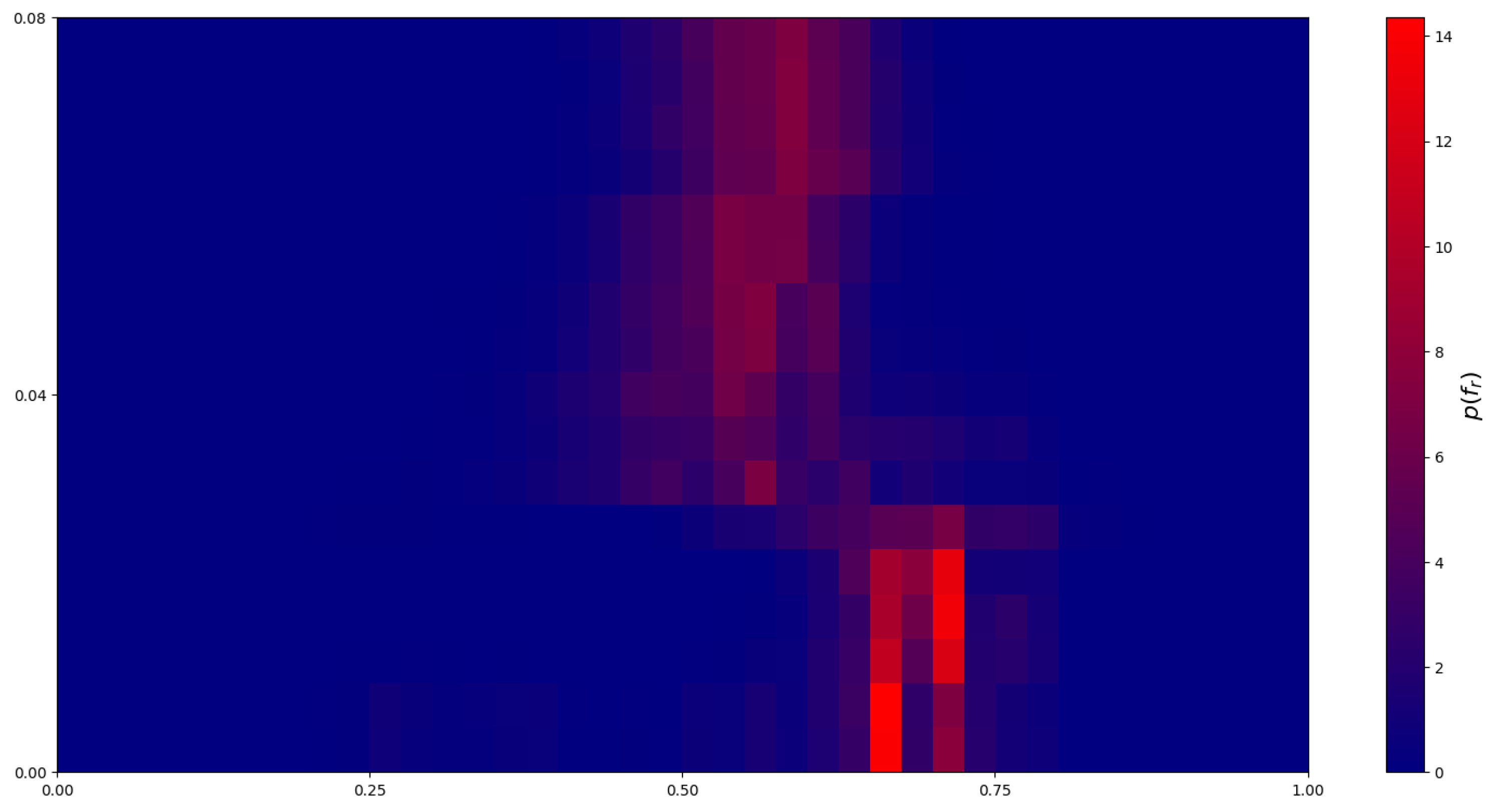
Thus, it is more adequate to introduce the opinion conviction threshold as described in Section 2. We choose so that it is close to the minimum value of the matrix elements of the weighted adjacency matrix (excluding zero elements). The evolution of the probability distribution with an increase in the vote amplitude influence W is shown in Figure 6. For small , the initial distribution at Figure 2 remains practically unchanged; then, with an increase to , it starts to be modified, and at , the initial structure of Figure 2 is completely washed out, with being close to that of Figure 5.
The results of Figure 7 are obtained for one specific initial random configuration of up-down spins of non-fixed nodes, but we have verified that the same results hold for other random configurations.
3.3. Phase Transition of Opinion Formation
The results of Figure 6 indicate that there is a phase transition from the regime at , where the elite imposes its opinion, to a regime at where the elite influence is weak and the elections are mainly affected by votes from crowd electors. This transition is illustrated in Figure 7, which gives the critical vote amplitude influence . We argue that this critical value is determined by the condition that the votes of all neighbors can exceed the opinion conviction threshold so that
In our case, the average number of neighbors is so that for , which gives , which is close to the above numerical value of Figure 7. It is possible that for networks with a high number of links per node a more accurate estimate may be required.
Thus, the obtained results for the GINOF model demonstrate that in the presence of an opinion conviction threshold, the elections on social networks are characterized by a transition from a phase where elections are dominated by the elite opinion to a phase dominated by the votes of crowd electors. This transition takes place when the vote amplitude influence W exceeds the critical value given by the relation (2).
4. Discussion
In this work, we have generalized the model of opinion formation on directed Ising networks (INOF) introduced in [18,30]. This generalized GINOF model is applied to an undirected social network of scientific collaboration studied by Newman in [21,22,23,24]. The new elements of the GINOF model compared to the INOF one are as follows: in addition to fixed-opinion nodes, considered as the society’s elite, all non-fixed nodes are initialized with random opinions—half red and half blue. Furthermore, these non-fixed nodes initially have a weak amplitude influence (), which self-consistently increases during the asynchronous Monte Carlo process that simulates an election campaign. In addition, any change of opinion of a given spin node (a spin flip) takes place only if the modulus of the majority score of a given node’s neighbors’ opinions is above a certain opinion conviction threshold.
We show that for the GINOF model of elections on undirected social networks there is a phase transition from elections dominated by the elite opinion to a phase where the elite cannot affect the elections and the vote results are determined by opinions of electors. We also demonstrate that the Erdös barrage can significantly affect the probability distribution of red and blue nodes.
Author Contributions
All authors equally contributed to all stages of this work.
Funding
The authors acknowledge support from the grant ANR France project NANOX N° ANR-17-EURE-0009 in the framework of the Programme Investissements d’Avenir (project MTDINA).
Acknowledgments
We thank K.M.Frahm for useful discussions.
Conflicts of Interest
The authors declare no conflict of interests.
References
- C. Castellano, S. Fortunato, and V. Loreto, Statistical physics of social dynamics. Rev. Mod. Phys. 2009, 81, 591. [CrossRef]
- S. Dorogovtsev, Lectures in Complex Networks, Oxford University Press, Oxford, UK (2010).
- M. Newman, Networks, Oxford University Press, Oxford, UK (2018).
- Wikipedia contributors, Social media use in politics, Wikipedia, The Free Encyclopedia, https://en.wikipedia.org/wiki/Social_media_use_in_politics (Accessed 24 October 2025).
- T. Fujiwara, K. Muller, and C. Schwarz, The Effect of Social Media on Elections: Evidence from The United States, J. Eur. Economi Ass., jvad058 (2023). [CrossRef]
- S. Galam, Y. Gefen, and Y. Shapi, Statistical physics of social dynamics, Journal of Mathematical Sociology 9(1), 1 (1982); https://www.tandfonline.com/doi/abs/10.1080/0022250X.1982.9989929.
- Galam, S. Majority rule, hierarchical structures, and democratic totalitarianism: A statistical approach. Journal of Mathematical Psychology 1986, 30, 426. [Google Scholar] [CrossRef]
- K. Sznajd-Weron, and J. Sznajd, Opinion evolution in closed community, International Journal of Modern Physics C 11, 1157 (2000). [CrossRef]
- V. Sood, and S. Redner, Voter Model on Heterogeneous Graphs, Phys. Rev. Lett. 94, 178701 (2005). [CrossRef]
- D.J. Watts, and P.S. Dodds, Influentials, Networks, and Public Opinion Formation, Journal of Consumer Research 34, 441 (2007). [CrossRef]
- S. Galam, Sociophysics: A review of Galam models, International Journal of Modern Physics C 19, 409 (2008). [CrossRef]
- V. Kandiah, and D.L.Shepelyansky, PageRank model of opinion formation on social networks, Physica A 391, 5779 (2012). [CrossRef]
- J.J. Hopfield, Neural networks and physical systems with emergent collective computational abilities, Proc. Nat. Acad. Sci. 79(8), 2554 (1982). [CrossRef]
- M. Benedetti, L. Carillo, E. Marinari, and M. Mezard, Eigenvector dreaming, J. Stat. Mech. 013302 (2024). [CrossRef]
- J.C. Rozum, C. Campbell, E. Newby, F.S.F. Nasrollahi. and R. Albert, Boolean Networks as Predictive Models of Emergent Biological Behaviors, Cambridge Univ. Press, (2024). [CrossRef]
- S. Pastva, K.H. Park, O. Huvar, J.C.Rozum, and R. Albert, An open problem: Why are motif-avoidant attractors so rare in asynchronous Boolean networks?, J. Math. Biol. 91, 11 (2025). [CrossRef]
- C. Coquide, J. Lages, and D.L. Shepelyansky, Prospects of BRICS currency dominance in international trade, Appl. Netw. Sci. 8, 65 (2023); https://doi.org/10.1007/s41109-023-00590-3. [CrossRef]
- L. Ermann, K.M. Frahm, and D.L. Shepelyansky, Opinion formation in Wikipedia Ising networks, Information 16, 782 (2025). [CrossRef]
- S.N. Dorogovtsev, A.V. Goltsev, and F.F. Mendes, Ising model on networks with an arbitrary distribution of connections, Phys. Rev. E 66, 016104 (2002). [CrossRef]
- G. Bianconi, Mean field solution of the Ising model on a Barabási–Albert network, Phys. Lett. A 303, 166 (2002). [CrossRef]
- M. E. J. Newman, Scientific collaboration networks. II. Shortest paths, weighted networks, and centrality, Phys. Rev. E 64, 016132 (2001).
- M. E. J. Newman, Finding community structure in networks using the eigenvectors of matrices, Phys. Rev. E 74, 036104 (2006).
- M. E. J. Newman, Network data, http://www.umich.edu/~mejn/netdata, (Accessed 25 October 2025).
- M. E. J. Newman, Community Centrality, http://www.umich.edu/~mejn/centrality (Accessed 25 October 2025).
- K.M. Frahm, and D.L.Shepelyansky, Wealth thermalization hypothesis and social networks. arXiv, 2025; arXiv:2506.17720.
- A. M. Langville, and C. D. Meyer, Google’s PageRank and Beyond: The Science of Search Engine Rankings, Princeton University Press, Princeton (2006).
- R. Albert, and J. Thakar, Boolean modeling: A logic-based dynamic approach for understanding signaling and regulatory networks and for making useful predictions, WIREs Syst. Biol. Med. 6, 353 (2014). [CrossRef]
- S. Tripathi, D.A. Kessler, and H. Levine, Biological Networks Regulating Cell Fate Choice Are Minimally Frustrated, Phys. Rev. Lett. 125, 088101 (2020). [CrossRef]
- K.M. Frahm, E. Kotelnikova, O. Kunduzova, and D.L. Shepelyansky, Fibroblast-Specific Protein-Protein Interactions for Myocardial Fibrosis from MetaCore Network, Biomolecules 14, 1395 (2024). [CrossRef]
- Facebook https://www.facebook.com/ (Accessed 7 November 2025).
- VK vk.com, (Accessed 7 November 2025).
- STRING https://string-db.org/, (Accessed 7 November 2025).
Figure 1.
Evolution of the fraction of red nodes for random pathway realisations. An initial condition has one red fixed node (Newman) and one blue fixed node (Barabasi); they remain fixed during an asynchronous Monte Carlo evolution based on the relation (1); all other nodes are initially white ( in (1)). Here x-axis represents time time of Monte Carlo process, where each unit of marks one complete update of all nodes/spins following the INOF/GINOF model (here ); steady-state configurations are reached at (or earlier).
Figure 1.
Evolution of the fraction of red nodes for random pathway realisations. An initial condition has one red fixed node (Newman) and one blue fixed node (Barabasi); they remain fixed during an asynchronous Monte Carlo evolution based on the relation (1); all other nodes are initially white ( in (1)). Here x-axis represents time time of Monte Carlo process, where each unit of marks one complete update of all nodes/spins following the INOF/GINOF model (here ); steady-state configurations are reached at (or earlier).
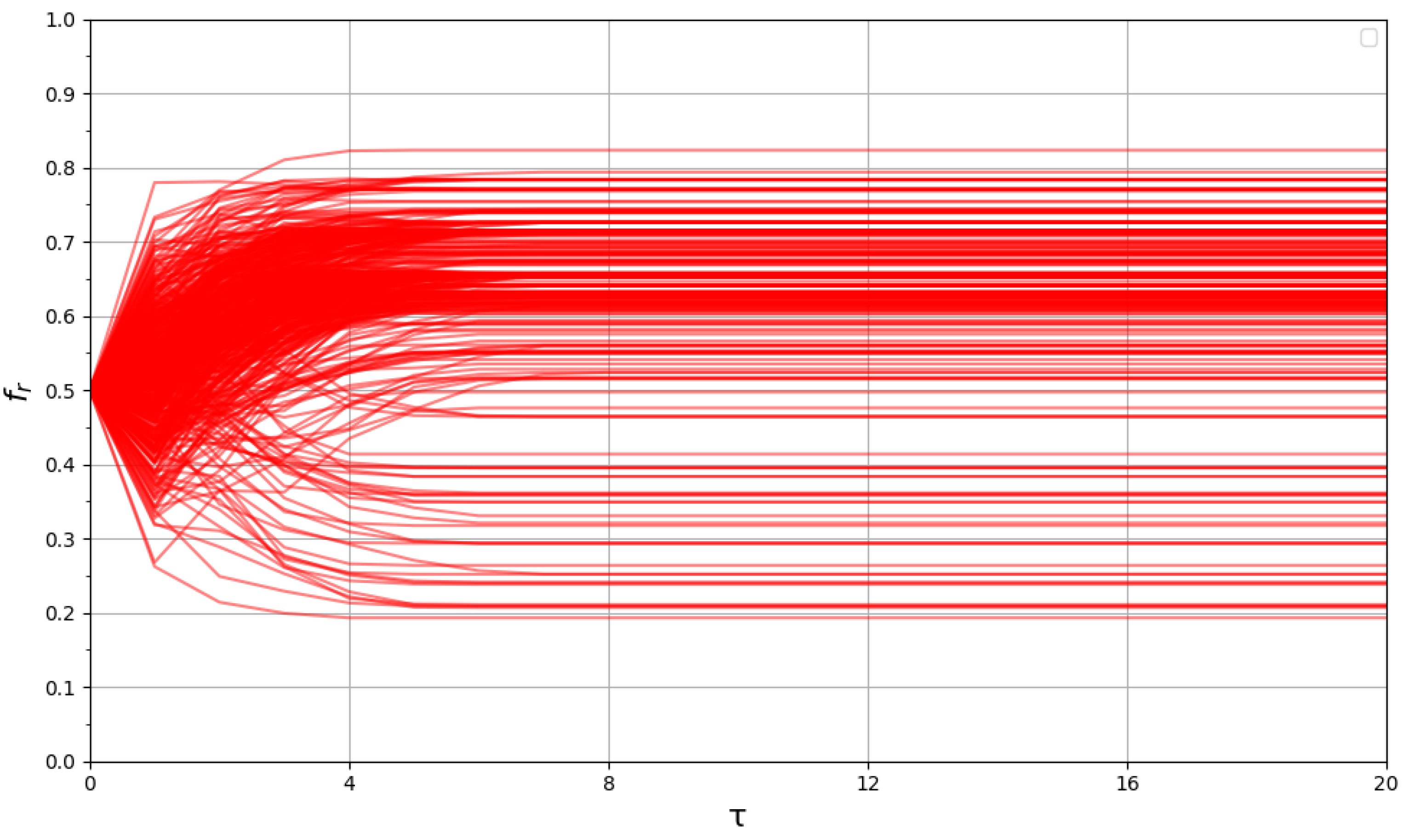
Figure 2.
Probability distribution of red node fractions; the histogram of values is obtained with 50 cells with normalization ; average red value is . Here there are pathway realisations; fixed nodes are Newman (red) and Barabasi (blue), all other nodes are white (spin zero). Initially all non fixed nodes are white for INOF model [or random red/blue for the GINOF model at ]. Vertical dashed line marks average red value .
Figure 2.
Probability distribution of red node fractions; the histogram of values is obtained with 50 cells with normalization ; average red value is . Here there are pathway realisations; fixed nodes are Newman (red) and Barabasi (blue), all other nodes are white (spin zero). Initially all non fixed nodes are white for INOF model [or random red/blue for the GINOF model at ]. Vertical dashed line marks average red value .
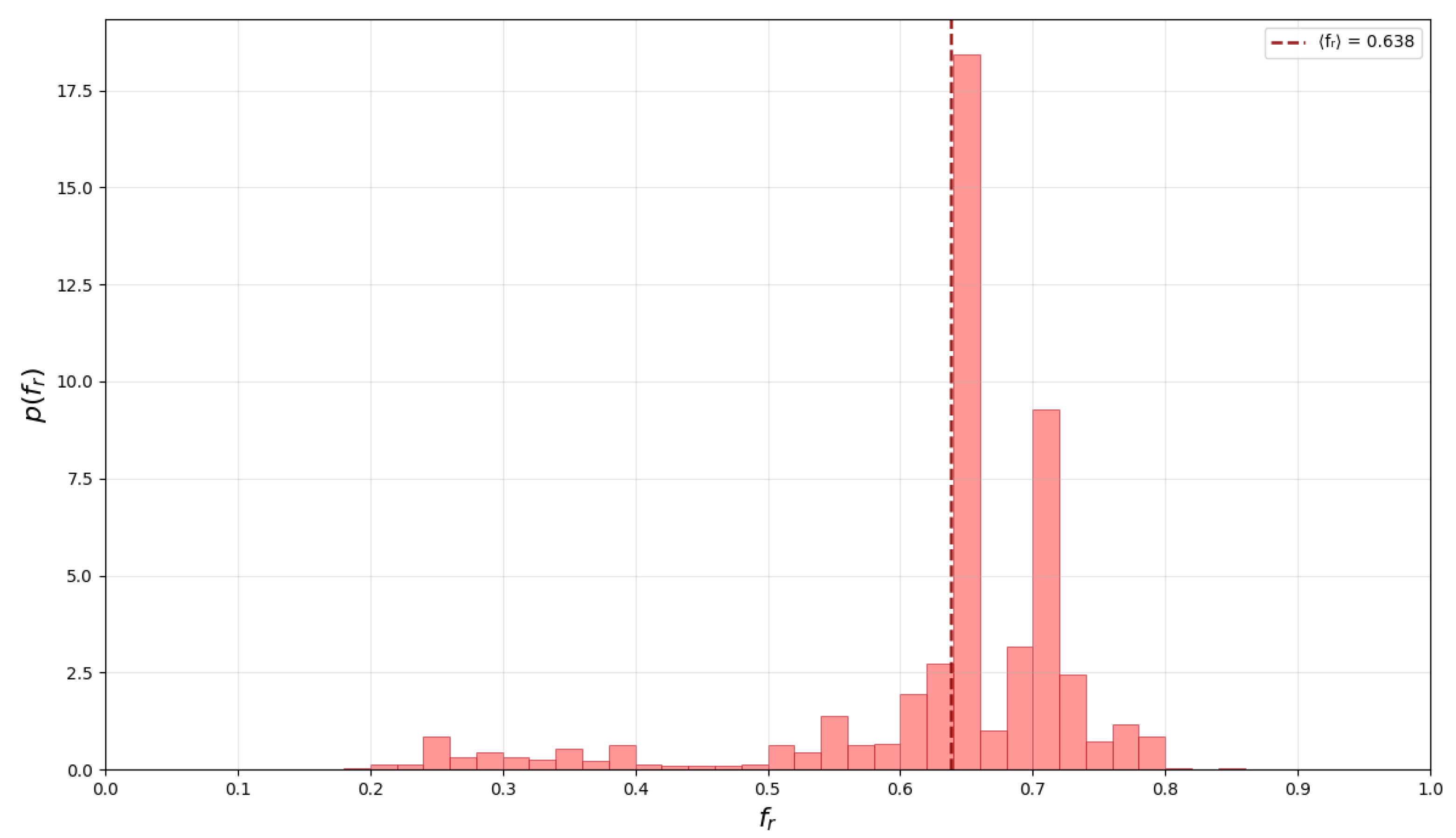
Figure 3.
Same as Figure 2 but with initial state node Sole being blue;
Figure 3.
Same as Figure 2 but with initial state node Sole being blue;
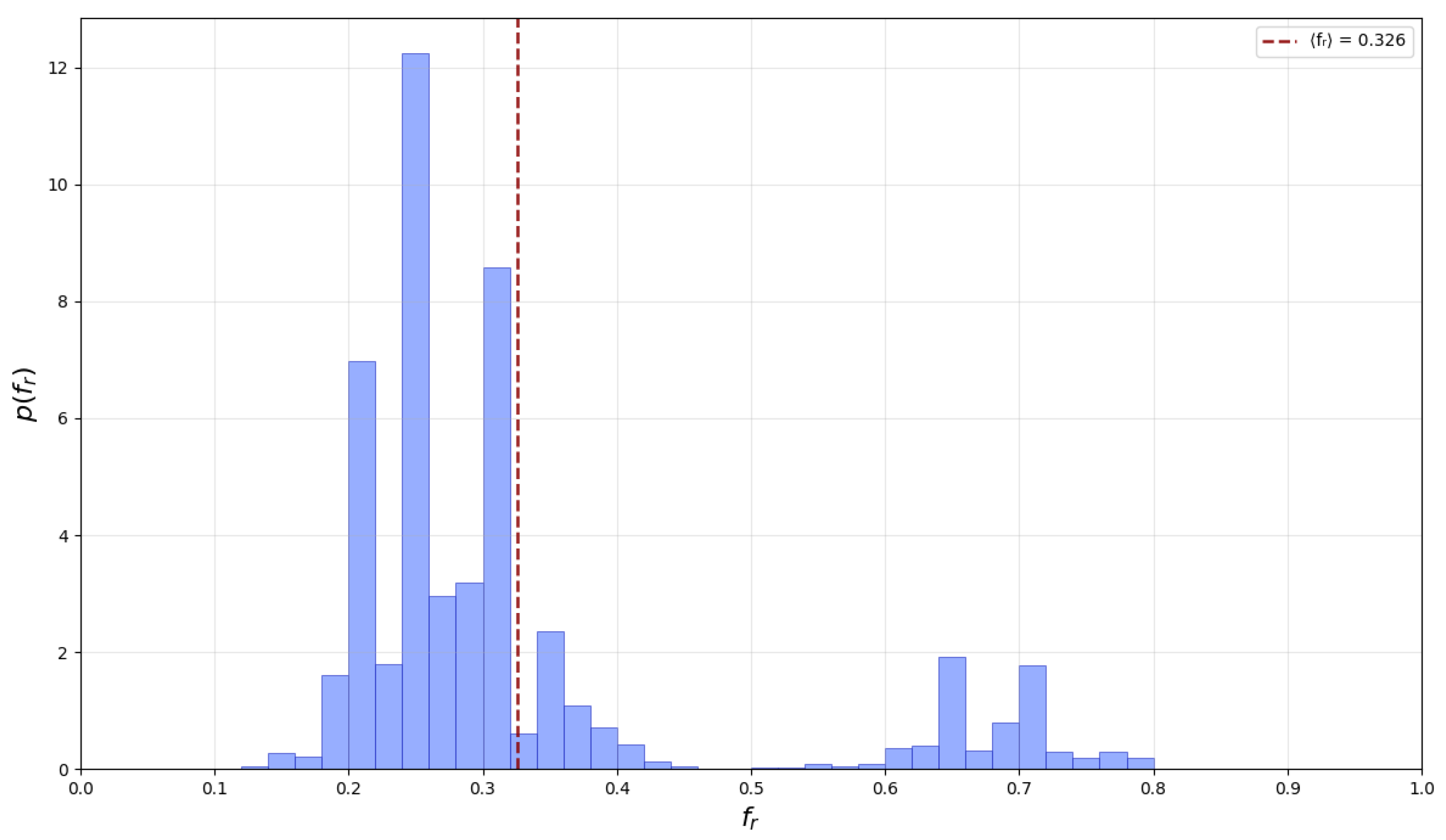
Figure 4.
Dependence of red fraction of nodes on PageRank index K for the case of Figure 2 (K is obtained at damping factor ).
Figure 4.
Dependence of red fraction of nodes on PageRank index K for the case of Figure 2 (K is obtained at damping factor ).
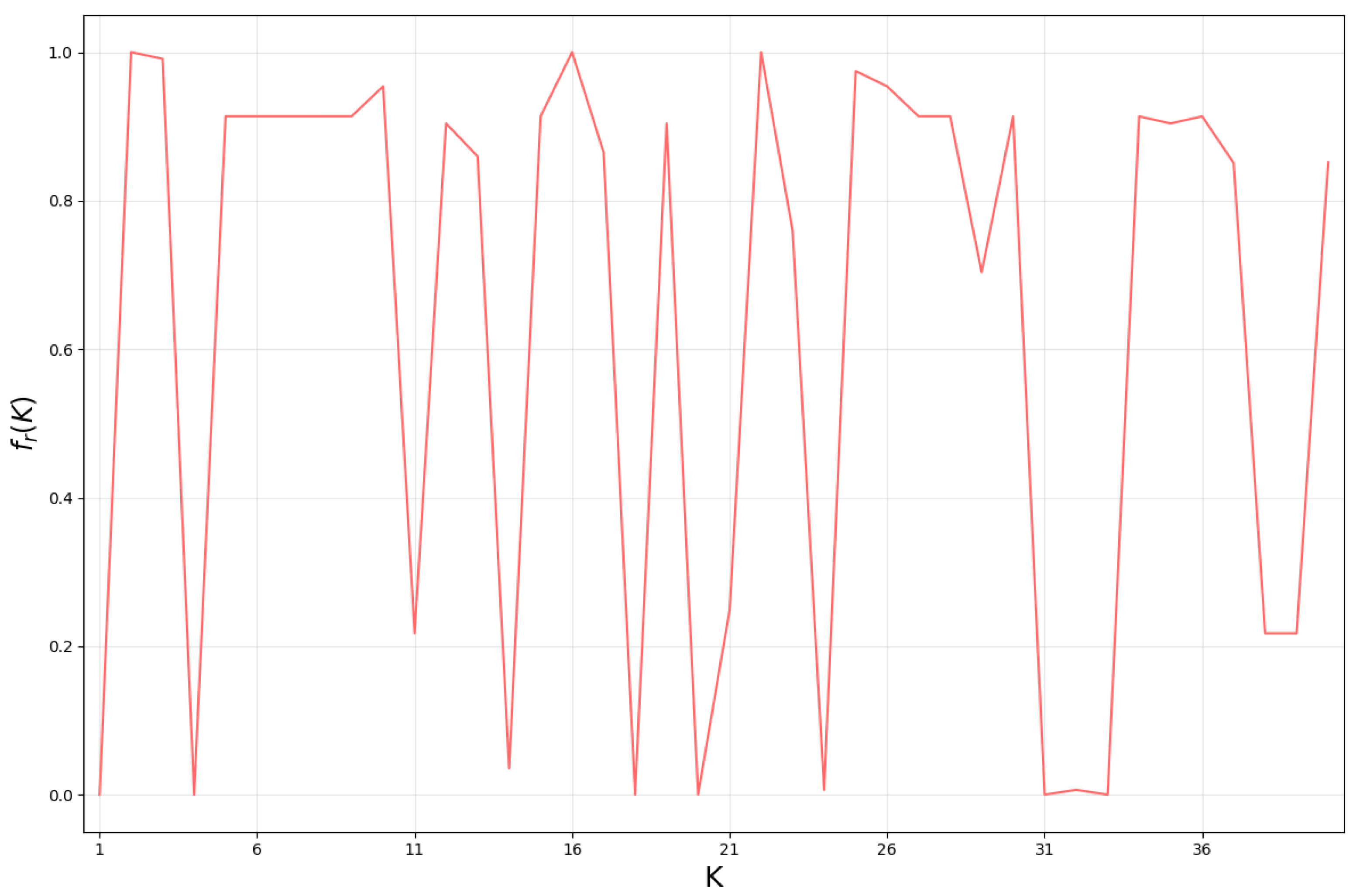
Figure 5.
Same as Figure 2 but for the GINOF model at , , here .
Figure 5.
Same as Figure 2 but for the GINOF model at , , here .
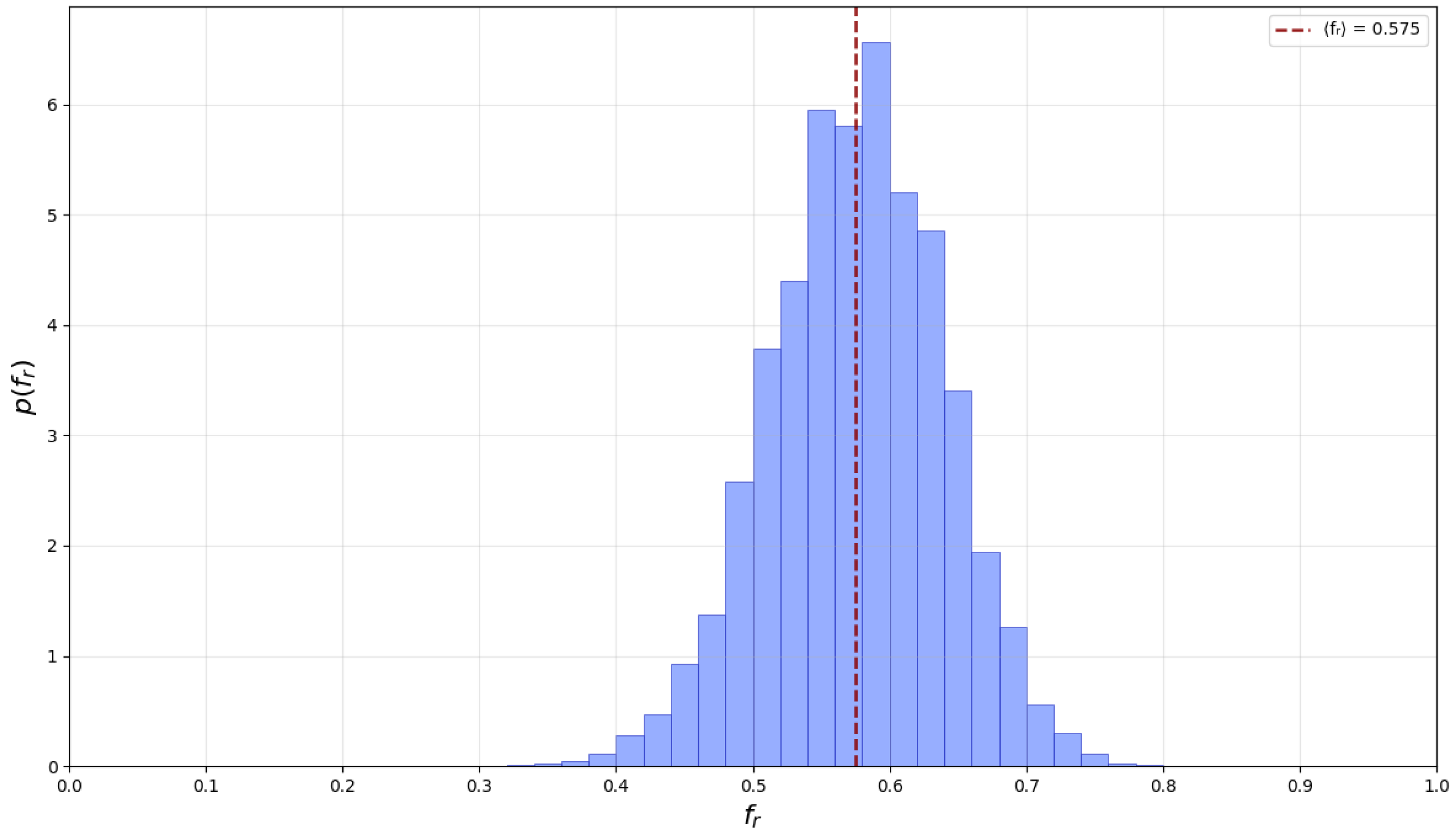
Figure 6.
Same as Figure 2 but for the GINOF model with the opinion conviction threshold at (top); (middle); (bottom), and respectively from top to bottom; here .
Figure 6.
Same as Figure 2 but for the GINOF model with the opinion conviction threshold at (top); (middle); (bottom), and respectively from top to bottom; here .
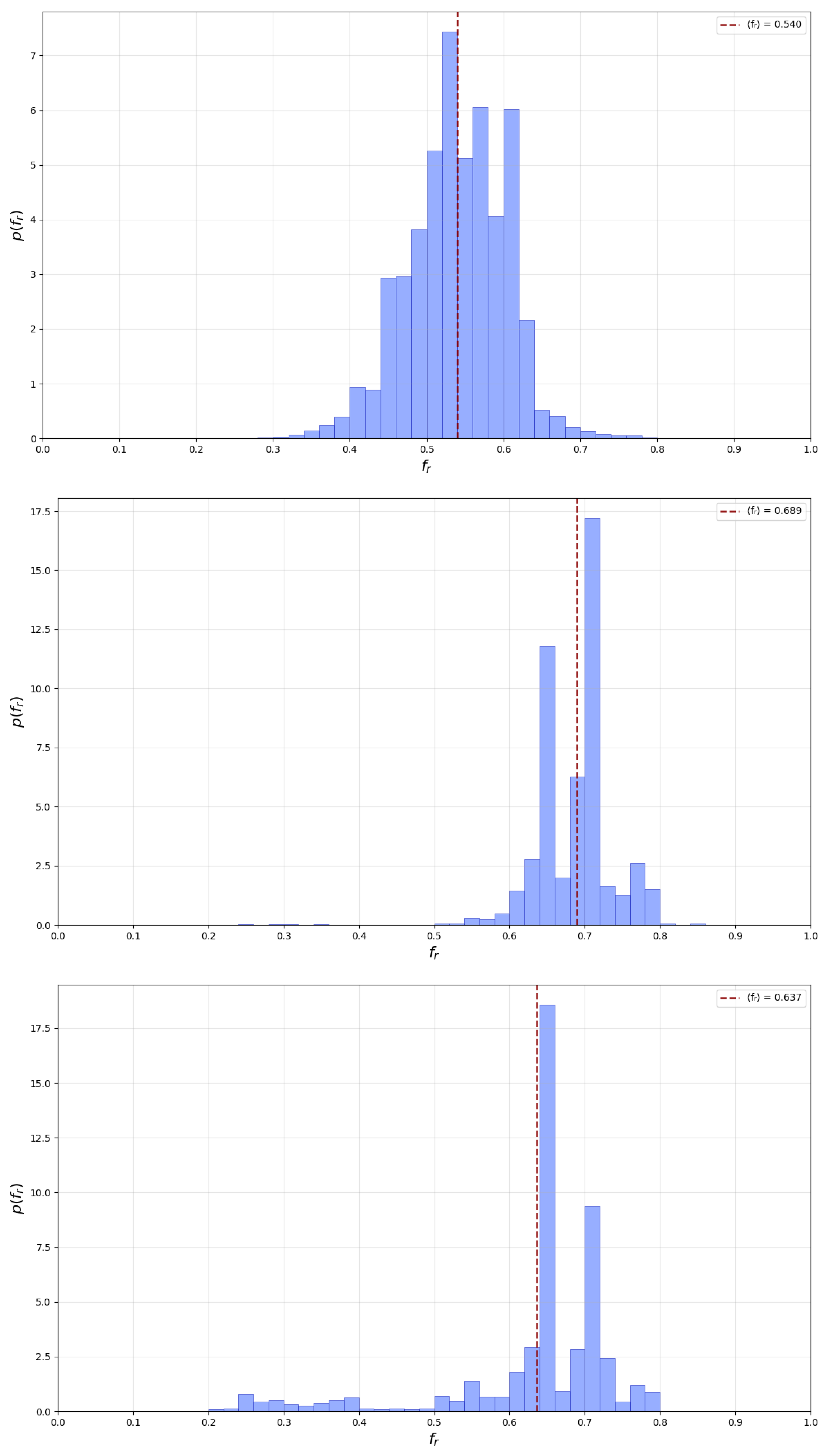
Figure 7.
Probability of red nodes shown by color in dependence on (taken for 40 columns in the range ) and on (taken for 17 W equidistant values in the range ) for the case with the opinion conviction threshold in the GINOF model (there are in total cells). Data are obtained with pathway realisations for each W value.
Figure 7.
Probability of red nodes shown by color in dependence on (taken for 40 columns in the range ) and on (taken for 17 W equidistant values in the range ) for the case with the opinion conviction threshold in the GINOF model (there are in total cells). Data are obtained with pathway realisations for each W value.
Disclaimer/Publisher’s Note: The statements, opinions and data contained in all publications are solely those of the individual author(s) and contributor(s) and not of MDPI and/or the editor(s). MDPI and/or the editor(s) disclaim responsibility for any injury to people or property resulting from any ideas, methods, instructions or products referred to in the content. |
© 2025 by the authors. Licensee MDPI, Basel, Switzerland. This article is an open access article distributed under the terms and conditions of the Creative Commons Attribution (CC BY) license (http://creativecommons.org/licenses/by/4.0/).
Copyright: This open access article is published under a Creative Commons CC BY 4.0 license, which permit the free download, distribution, and reuse, provided that the author and preprint are cited in any reuse.