

Submitted:
14 November 2025
Posted:
17 November 2025
You are already at the latest version
Abstract
The next generation of wireless communication, 6G, promises a leap beyond the advances of 5G, aiming not only to increase speed but also to redefine how people, machines, and environments interact. This paper examines the evolution from 5G Advanced to 6G through a detailed review of 3GPP Releases 15-20, outlining the progression from enhanced mobile broadband to intelligent services supporting holographic communication, remote tactile interaction, and immersive XR applications. Three foundational service pillars are identified in this evolution: immersive communication, everything connected, and high-precision positioning. These advances enable transformative use cases such as virtual surgery, cooperative drone swarms, and AI-driven agriculture, demanding innovations in spectrum utilization (including sub-THz bands), AI-native network architectures, and energy-efficient device ecosystems. Future networks are expected to deliver peak data rates up to 1~Tbps, localization accuracy below 10~cm, and device densities reaching 10M/km2, while sustaining end-to-end latency under 1~ms. Across Releases 15-20, 3GPP has progressively standardized capabilities for XR, positioning, scheduling, and sustainability, while initiatives such as RedCap, Ambient IoT, and NTN extend connectivity toward global, low-power, and cost-effective coverage. Supported by programs like Hexa-X and the Next G Alliance, 6G is positioned as a fundamental redesign of wireless communication centered on intelligence, adaptability, inclusivity, and sustainability.
Keywords:
6G
; 3GPP releases
; immersive communication
; quantum networks
; AI-native architecture
; terahertz
; sustainability
; 6G KPIs
1. Introduction
The evolution of telecommunications over the last few decades has been marked by a remarkable transition from conventional voice communication to the intricate web of connected devices known as the Internet of Things (IoT). Internet’s journey began in the as it transitioned from ARPANET’s closed networks to public accessibility with the launch of the World Wide Web in 1991. During the same period, 1G analog cellular systems of the 1980s were replaced by 2G digital networks in the early 1990s, introducing SMS and basic data capabilities. The 2000s witnessed the global expansion of broadband Internet, alongside the rollout of 3G in 2001, which enabled mobile Internet access, smartphones, and mobile applications, driving a connectivity revolution. By the 2010s, 4G Long Term Evolution (LTE) had been deployed worldwide, delivering high-speed Internet access and powering video streaming, cloud computing, and the foundation of today’s mobile-centric digital ecosystem. A significant leap in telecommunications occurred with the advent of smartphones, which enabled users to access the Internet on the move. By approximately 2005, this mobile Internet era was well underway, supported by the widespread adoption of High Speed Packet Access (HSPA) and LTE technologies [1].
Amidts this, the concept of the Internet of Things (IoT), first introduced by Ashton in 1999, has evolved into a complex ecosystem of interconnected sensors, devices, and platforms [2]. The term was initially used to refer to uniquely identifiable connected objects using Radio Frequency Identification (RFID) technology [3], and it gained momentum much later in the 2020. Despite its technological maturity, large-scale IoT adoption remains constrained by economic, architectural, and performance limitations. Early mobile networks were optimized for human-centric services rather than low-power, high-density, machine-type communications. As a result, the integration of billions of energy-constrained and latency-sensitive devices exposed the inadequacy of traditional architectures. The emergence of 5G through enhanced Mobile Broadband (eMBB), massive Machine Type Communications (mMTC), and ultra Reliable Low Latency Communications (uRLLC) partially addressed these challenges but did not fully realize the vision of a seamlessly connected, intelligent infrastructure. The limited monetization of 5G services and fragmented vertical deployments highlight persistent gaps in scalability, determinism, and sustainability [4]. These limitations motivate the transition toward 6G, envisioned as a native AI-driven, energy-aware, and context-adaptive network capable of supporting extreme connectivity and automation across vertical domains.
With the global rollout of 5G nearing maturity, the question arises: what technological directions and next-generation services will define the post-5G era, and how will they reshape communication infrastructures? Future networks will extend far beyond device-level connectivity, evolving into intelligent information and knowledge systems that underpin smart cities, immersive experiences, and pervasive IoT. The convergence of AI, edge computing, and distributed intelligence will drive this transformation, yet operators continue to face monetization challenges due to high deployment costs and fragmented service ecosystems, underscoring the need for innovation through cross-sector partnerships [5]. Future networks are also expected to contribute directly to achieving UN Sustainable Development Goals (SDGs) by supporting sustainability, circular economy, and low-emission operations [6]. They will enable new verticals, including digital health, smart manufacturing, and intelligent transportation, while lowering entry barriers through hardware–software decoupling, creating opportunities for small and local innovators. In response, 3GPP has initiated the 5G-Advanced phase, encompassing Releases 18–20, to enhance spectral efficiency, energy optimization, and AI-native capabilities. These efforts mark a transitional phase toward 6G, where research initiatives worldwide, spanning academia, industry, and policy domains, are already shaping early frameworks. Although formal standardization has not begun, the emerging vision of 6G anticipates fully integrated sensing, communication, and intelligence, setting the foundation for the next leap in network evolution.
Table 1 provides a comparative overview of global 6G initiatives, highlighting the strategic priorities, progress metrics, and innovation trajectories of major economies. It underscores how nations such as China, South Korea, and the U.S. lead in patent activity and standardization, while regions like the EU and Japan focus on sustainability, sovereignty, and advanced network architectures. In November 2019, China’s Ministry of Science and Technology set up a working group called China 6G Wireless Technology Task Force, responsible for the national 6G research and development, and another working group consisting of government agencies to promote the development of 6G technology. In the U.S. the Alliance for Telecommunications Industry Solutions launched the Next G Alliance in October 2020 to advance North American leadership in 6G. Japan established the Beyond 5G Promotion Consortium and Beyond 5G New Business Strategy Center in December 2020 to promote beyond 5G/6G development in Japan. Europe has also launched various 6G initiatives, notably the Hexa-X project in January 2021, which aims to shape the European 6G vision and develop key 6G technologies to enable the vision. In June 2021, South Korea established a 6G implementation plan to lay the groundwork for 6G research and development, which aims to push to launch commercial 6G services by around 2028.
According to the authors in [5], the next services that will be available to a wide audience are depicted in Figure 1. One of the services expected to spread in the future is Immersive Communications, which combines both the features of the eMBB and uRLLC services defined in 5G. Typical use cases include remote collaboration for joint design and training, gaming and entertainment, and virtual tourism. This service will be the focus of Section 2. A second service will involve not only people but also every type of object connected to the network, accessible remotely and from nearby devices, capable of providing micro services. The types of devices will have different characteristics, as described in Section 3. The concept of mMTC introduced in 5G will be extended in this Everything Connected service because the environments in which the everything connected concept will be provided will be very different, ranging from wide area environments like smart cities to local environments like smart offices and smart buildings, up to personal environments, involving sensors and devices such as smart watches and medical devices with the aim of improving daily lifestyle.
Finally, a third key service is the high-precision positioning, which extends beyond conventional cellular-level localization of smartphones or IoT devices (e.g., tens of meters accuracy). Future networks must provide sub-centimeter to millimeter-level accuracy with update rates on the order of hundreds of milliseconds, enabling safety-critical and real-time operations. Such capabilities are essential for human–robot collaboration, autonomous driving, logistics automation, and drone-based operations in sectors such as smart agriculture, surveillance, and industrial manufacturing. Many vertical applications require joint provisioning of positioning, connectivity, and immersive communication capabilities. For instance, combining precision localization with massive connectivity enables smart warehouses with real-time tracking of goods and context-aware worker assistance. Integrating immersive communication with ubiquitous connectivity supports remote tele-operation, such as headset-assisted drone navigation. Meanwhile, the fusion of precise localization and immersive communications provides the basis for remote driving and intelligent transportation systems [7]. A detailed elaboration of high-precision positioning technologies and requirements is provided in Section 4.
The existing literature in Table 2 includes several papers discussing the expectations for networks by 2030. However, most of these papers address specific aspects rather than providing a comprehensive view, as done in this paper. For instance, in 2018, the ITU identified key market drivers and potential vertical markets for 2030 networks [5] offers a broad overview of future wireless networks, focusing on applications and technological trends but without going into much detail. In [8], the author summarizes recent advancements in Release 17 and 18, while [9] provides a thorough review of the enabling technologies for 6G and outlines the projected timeline for its development. [10] explore XR standardization efforts within 3GPP. Additionally, several industry leaders, including Nokia [11], Ericsson [12], Huawei [13], and Samsung [14], have introduced potential use cases for future networks, which they believe will be supported by the forthcoming technologies.
The transition from 5G to 6G introduces far more demanding performance requirements, motivating the definition of new Key Performance Indicators (KPIs) and advanced architectural designs to support 6G services expected by 2030. Upcoming 3GPP activities, particularly in Release 20, will be instrumental in enhancing data rates, reliability, coverage, latency, and network intelligence, while accelerating the adoption of emerging enabling technologies. Importantly, the three envisioned service domains extend beyond classical 5G capabilities and provide a unified foundation for future vertical applications by abstracting common functional needs and guiding the development of corresponding communication techniques and architectures. As seen historically—voice enabling cellular systems, data enabling the Mobile Internet, and machine-type communication enabling IoT, these service classes are expected to catalyze new innovation and business ecosystems. The key contributions of this paper are as follows:
- A comprehensive overview of the latest advancements in 5G-Advanced and the transition towards 6G, emphasizing the three new foundational services. By introducing specific KPIs for each service, the paper aims to facilitate the design and performance assessment of next-generation networks, establishing a robust framework for future telecommunications systems.
- A critical examination on the developments proposed by the 3GPP in Releases 15 to 20, as well as other potential systems and technologies for Network 2030. It details the requirements for supporting emerging applications across different time horizons, short-term up to 2026, medium-term , and long-term beyond 2030, and identifies the most promising enabling technologies, providing a holistic perspective on the future landscape of telecommunications.
The organization of this review paper across different technologies and supporting discussion is structured as in Figure 2.
2. Evolution of Immersive Communication Services
Immersive Communications (IC) represents an advanced progression of traditional telecommunications services, following the development of voice and video streaming technologies. IC integrates high-quality, realistic human experiences by merging the physical world with digital or simulated environments. This is enabled through multi-channel, multi-sensory interactions using digital devices such as Head Mounted Displays (HMDs) or hologram systems. These technologies allow users to communicate and interact in virtual spaces, regardless of their physical location. Beyond video conferencing, IC has the potential to significantly impact industries such as remote collaboration, education, training, telemedicine, and virtual events. It provides more natural and engaging communication, fostering improved understanding, collaboration, and innovation across distances [41]. Key services within IC focus on delivering immersive experiences. Notable examples include XR, holographic communication, and haptic communication, which may also involve olfactory inputs [42]. XR encompasses AR, MR, and VR. While AR and MR blend physical and digital realms, extending reality, VR is distinct as it entirely replaces the real world with a simulated environment. These technologies have diverse use cases, with AR and MR offering different applications compared to VR [43,44]. Table 3 summarizes representative use cases and requirements for IC and connected devices, highlighting their potential to transform interaction, collaboration, and user experience across various domains.
2.1. Extended Reality (XR)
XR is a broad term that encompasses technologies combining digital and real-world elements to enhance user experiences. At the initial level, AR overlays digital objects such as vehicles, faces, or animals onto the physical world, enriching the user’s perception of reality. AR can be accessed via devices like smartphones or AR glasses, enabling users to view and interact with virtual objects within their physical environment. MR takes this concept further by seamlessly integrating virtual content with the real world. This creates a more interactive and immersive experience, as users can see and engage with virtual objects that appear to coexist naturally with their surroundings. MR typically employs specialized hardware, such as headsets or glasses e.g. Microsoft HoloLens, providing an extended level of interaction and information with up to six Degrees of Freedom (6DoF). This enables the tracking of 3D positions [x, y, z] and three rotational axes, yaw, pitch, and roll. The implementation of XR involves three main steps:
- 1.
- Content Transmission: Video frames are captured by the AR/MR device to initiate the content pipeline.
- 2.
- Rendering: The device processes the captured frames, performing tasks such as object detection, recognition, positioning, and creating a physical-to-virtual mapping. After processing, digital content is overlaid onto the augmented frames and rendered back through the device.
- 3.
- Feedback Collection: The device gathers user feedback to determine what content to deliver next. Depending on the information gathered, e.g., from gloves or inertial sensors, some scene processing can occur directly on the device or be offloaded to a nearby edge server to reduce device workload.
This layered approach enhances the XR experience by balancing local and remote processing, thereby maintaining an interactive, real-time user experience.
2.2. Virtual Reality (VR)
VR offers a fully immersive experience by completely replacing the physical world with a simulated digital environment. Unlike AR or MR, which overlay or integrate digital elements with the real world, VR envelops users in a standalone virtual space accessible through headsets that cover the eyes and often ears. This creates a sensory-rich environment where users can interact with virtual objects using hand controllers and other devices, enhancing the sense of immersion. Understanding the human visual system, particularly the differences in clarity between central and peripheral vision, influenced by cone and rod density in the retina, is essential for optimizing VR hardware and software. By tailoring the optical components and visual content to these visual patterns, VR developers can reduce processing loads while preserving high-quality visuals and user comfort [46]. A fundamental component of realistic VR experiences is the Field of View (FoV), which denotes the horizontal extent of the virtual environment visible through the headset. To deliver a convincing simulation, VR systems aim to approximate the natural human FoV, typically around horizontally. However, most current headsets support a range between and . To optimize both immersion and resource efficiency, content delivery systems employ segmented video streaming, wherein video content is partitioned into spatial or temporal segments, and only the portions within the user’s active FoV are transmitted. This adaptive streaming approach, enabled by real-time user tracking and enhanced by advanced network capabilities, ensures high-quality video rendering while minimizing unnecessary bandwidth usage. As a result, users can experience seamless and responsive virtual environments, even during dynamic movement within the digital space.
2.3. Haptic Communications
Haptic communications (HC) refer to the transmission and interaction of tactile sensations, allowing users to perceive touch through direct interaction with objects or between individuals. Initially confined to physical touch, HC has expanded to include feedback from electronic devices, such as vibrations, taps, and pressure sensations delivered through smartphones, smartwatches, and other devices [47]. This development marks a significant evolution in user device interaction, paving the way for remote haptic communication. Unlike traditional communication methods that primarily rely on audiovisual modalities, HC has the potential to revolutionize various fields by introducing tactile dimensions to remote interactions [48]. Remote HC holds transformative potential in enhancing immersive experiences in technologies such as VR, AR, and MR. For example, HC can improve cloud gaming experiences, making interactions more realistic through touch sensations. However, HC is distinct from MR or VR, as its primary focus lies in providing sensory feedback through haptic interfaces, which collect and reproduce touch or kinesthetic feedback for users [49]. Currently, commercially available haptic interfaces include wearable devices such as gloves, vests, jackets, bracelets, and sleeves, alongside external devices like consoles and smartphones. These interfaces are capable of providing various types of feedback, including vibro-tactile feedback, force feedback, and thermal feedback [50,51,52]. The applications of HC extend into healthcare, especially for individuals with dementia-related conditions such as Alzheimer’s disease, where haptic feedback can provide comfort and reduce anxiety. Moreover, HC enables communication for people with visual or hearing impairments through tactile interaction. It also deepens emotional connections by enriching the sensory and experiential quality of remote communication. Technically, the integration of HC with holographic systems involves three fundamental phases:
- 1.
- Generation of tactile data in this phase employs various sensors to capture tactile attributes such as force, temperature, and texture. Tools such as force sensors, thermistors, and laser scanners measure parameters like friction, hardness, warmth, and roughness to create a tactile profile.
- 2.
- Transmission of haptic data address the bandwidth limitations, haptic data undergoes reduction processes either at the sender’s interface or via an intermediate server. This ensures efficient transmission of tactile data while maintaining fidelity. Additionally, HC systems often involve multiple sub streams originating from various devices or locations, requiring synchronization for optimal tactile experiences [53].
- 3.
- Reproduction of tactile feedback at the recipient’s end, haptic interfaces recreate the transmitted tactile sensations to deliver an immersive touch experience. Ensuring accurate synchronization between sub streams is critical to providing seamless and realistic feedback.
HC Integration with XR Technologies and Future Prospects, where HC is expected to integrate seamlessly with XR technologies, bridging the gap between virtual and physical interactions. Studies have demonstrated promising examples of this integration, enhancing user experiences in virtual environments [54]. However, HC imposes more stringent latency requirements than audio or video communication, with latency thresholds as low as to maintain realistic interactions. Despite this, HC demands significantly lower data rates, typically ranging from , making it more bandwidth efficient compared to video streaming. The continued advancement of HC technologies, particularly in the context of MR or VR systems, offers promising opportunities to redefine remote interactions and augment sensory experiences across various domains.
2.4. Holographic Type Communication (HTC)
Holographic Type Communication (HTC) represents a transformative leap in digital interaction, enabling the transmission and reception of 3D holographic images and videos. Unlike traditional 2D media, holograms create IC experiences by incorporating depth and parallax, allowing users to perceive realistic depictions of objects, people, or environments. This capability holds immense potential to redefine remote interactions by creating virtual environments that closely mimic real-world scenes. HTC relies on three interconnected processes: capturing, transmitting, and rendering holographic content. Each of these processes is highly specialized, leveraging advanced technologies to ensure seamless and lifelike visual experiences while addressing computational and bandwidth challenges [55]. The first step in HTC is the capturing process, which involves generating a 3D representation of an object, individual, or scene. Current technologies primarily utilize Light Detection and Ranging (LiDAR) systems and stereo or multi-camera setups. LiDARs operate using the time of flight (ToF) mechanism, measuring distances by calculating the time it takes for a light pulse to travel to and from a target. These tools provide precise depth information, essential for constructing detailed 3D models. To enhance efficiency, the captured data often undergoes post-processing, including noise reduction and redundancy elimination, to streamline the data stream and reduce its size for transmission.
The second phase is the transmission process, which involves encoding and compressing holographic data to overcome challenges associated with high bit rates and bandwidth constraints. Unlike standard video transmission, this process focuses on maintaining the semantic integrity of holographic images while minimizing latency. Real-time compression algorithms are essential to reduce network congestion and offload computational tasks from end-user devices. These efforts ensure that holographic data is efficiently transmitted without compromising quality, enabling smooth user experiences even under demanding network conditions. The final step in HTC is the rendering process, where 3D holographic images are displayed on various devices such as smartphones, tablets, holographic displays, or AR and VR glasses. These devices enable users to interact with holograms placed in real-world environments, such as viewing a virtual object on a table or navigating around a holographic scene. Rendering typically involves processing in the cloud, though advanced systems leverage edge computing to reduce latency. 6DoF technology further enhances interactivity by tracking head movements and adjusting the rendering perspective in real time. AI also plays a crucial role by generating holographic content when cloud access is delayed or network resources are constrained. HTC’s continued evolution promises to enhance communication across domains, offering unprecedented realism and interactivity in remote collaboration, education, and entertainment.
2.5. Challenges and Enhancement in 3GPP Release 15 to 20
The journey of 5G technology has been characterized by a series of transformative advancements, each addressing the evolving demands of modern communication networks. Starting with Release 15, which laid the foundational framework for high-speed, low-latency connectivity, the 5G standards have progressively evolved to incorporate groundbreaking features and cater to diverse applications, as shown in Figure 3. These include enhancements in data rates, energy efficiency, and resource allocation mechanisms, which have paved the way for seamless communication and advanced use cases. Subsequent releases, such as Release 16, introduced targeted refinements for emerging applications such as IC, focusing on improved energy efficiency and time sensitive traffic handling. Release 17 marked a turning point by addressing the specific needs of XR and HTC, while Release 18 and 19 brought further optimizations to integrate XR into the 5G ecosystem. This evolution reflects a deliberate effort to transform 5G from a high-speed connectivity platform into a comprehensive network capable of supporting immersive, real-time applications in diverse industries, setting the stage for 5G-Advanced [8].
2.5.1. Release 15: The Foundation of 5G Connectivity
Release 15 laid the groundwork for the revolutionary 5G ecosystem, introducing key innovations aimed at enhancing data rates, reducing latency, and improving network efficiency. Central to these advancements were features such as mini slot transmissions, which allowed ultra-rapid data exchanges by breaking down data into smaller, manageable packets, and downlink preemption, which prioritized critical traffic, ensuring uninterrupted service for time-sensitive applications. Additionally, grant-free transmissions eliminated the need for uplink scheduling requests, streamlining communication for applications requiring immediate responses. To further enhance network performance, the Demodulation Reference Signals (DMRS) were optimized to improve MIMO operations, enabling better spatial diversity and signal robustness for end users. Despite its groundbreaking contributions, Release 15 did not specifically target emerging applications like IC, which includes MR, VR, and HTC. While the infrastructure enabled higher capacity and speed, the technical specifications lacked the refinements necessary to support the ultra-low latency and high reliability required by IC applications. This gap laid the foundation for future releases to build upon, targeting specialized use cases while ensuring backward compatibility with the initial standards set by Release 15 [56,57].
2.5.2. Release 16: A Step Toward Immersive Experiences
Release 16 represents a significant milestone in the evolution of 5G, addressing specific requirements of industrial and immersive communication (IC) applications through features that enhance both user experience and network performance. One of the key advancements is dynamic power boosting, which enables UE to prioritize the transmission of time-critical data, thereby minimizing delays for latency-sensitive applications. The uplink pre-emption mechanism further supports this capability by allowing ongoing transmissions to be interrupted when high-priority traffic requires immediate access. Enhancements to Discontinuous Reception (DRX), particularly within Connected Mode DRX (CDRX), have improved energy efficiency by allowing UEs to conserve power during low-activity periods. The introduction of UE Assistance Information (UAI) enables devices to provide feedback for the adaptive configuration of DRX parameters, ensuring optimal operation based on application-specific requirements [57]. Release 16 also introduced Semi-Persistent Scheduling (SPS), or Configured Grant (CG), for uplink resource allocation. Unlike traditional Dynamic Grant (DG) methods that depend on continuous Downlink Control Information (DCI) monitoring, CG allows gNodeBs to reserve dedicated resource blocks over longer durations, reducing signaling overhead and improving transmission consistency. Further performance improvements were achieved through enhanced Carrier Aggregation (CA) and upgraded Multiple Input Multiple Output (MIMO) configurations, which increase the number of supported carriers and layers, leading to higher achievable data rates. Collectively, these enhancements prepare 5G systems to support the growing demands of IC and extended reality (XR) applications envisioned for future releases [58].
Table 4 summarizes the traffic characteristics of various service classes pertinent to 6G applications, including downlink (DL) and uplink (UL) video, audio, control, and data streams. Parameters such as packet arrival rates, typical throughput, packet size distributions, jitter models, and packet delay budgets (PDB) are included to capture realistic service behavior. For example, DL video traffic exhibits high and variable data rates, with packet size and jitter modeled using Truncated Gaussian distributions to reflect dynamic frame variability. In contrast, UL control traffic exhibits high arrival frequency but low data rate, along with stringent delay constraints, which are essential for time-sensitive use cases such as remote actuation and teleoperation. These traffic models provide a reliable foundation for evaluating the performance and efficiency of next-generation wireless systems. Release 16 also extends the 5G framework to industrial applications, emphasizing the Industrial Internet of Things (IIoT) and enhanced ultra-reliable low-latency communications (eURLLC) [59]. Addressing the stringent requirements of industrial environments, the release introduces mechanisms for improved network security the integration of Time-Sensitive Networking (TSN) for deterministic communication and the deployment of Non-Public Networks (NPNs) tailored to enterprise and factory scenarios [60]. To reduce access latency and improve connection setup, a two step Random Access Channel (RACH) procedure was standardized, mitigating preamble collisions and enhancing synchronization efficiency [61]. Additionally, the introduction of Integrated Access and Backhaul (IAB) supports cost-effective mmWave deployments by enabling relay-based backhaul without requiring extensive fiber infrastructure [62]. These advancements collectively strengthen the reliability, scalability, and efficiency of 5G networks, establishing a robust foundation for the transition toward 6G-enabled industrial and IC systems.
2.5.3. Release 17: A Leap Toward Extended Reality
With the rapid advancement of immersive technologies, Release 17 introduced substantial enhancements to support XR and HTC applications. This release formally standardized XR use cases, as outlined in [63], categorizing them into five key domains, social immersive sharing e.g., virtual museums, immersive gaming, 3D communication e.g., XR meetings, interactive online shopping, and industry oriented applications such as AR-assisted emergency response. These categories highlight the adaptability of XR technologies and their applicability across multiple sectors. A primary contribution of Release 17 was the introduction of a comprehensive XR traffic model incorporating DL and UL video, audio data streams, and pose control traffic. This model was designed to address the stringent performance requirements of MR and VR applications. It considered frame based data encoding with stereo vision support and MR-specific uplink components. To reflect real world behavior, parameters such as frame periodicity, jitter, and packet size were modeled using probabilistic distributions. The associated key KPIs focused on maintaining low packet error rates and strict packet delay budgets to ensure user satisfaction. Probabilistic satisfaction thresholds were defined, with baseline performance levels of for total users and for individual frame or packet delivery. These measures emphasized Release 17’s focus on achieving consistent quality and reliability for immersive experiences [58].
Building on the foundations of Release 17 also addressed major challenges related to NTNs, particularly long propagation delays in geostationary satellite systems and dynamic movements of low Earth orbit (LEO) satellites [64]. The release introduced protocol enhancements to improve NTN performance, including modifications to random access procedures and hybrid automatic repeat request (HARQ) mechanisms [64]. It also resolved testing challenges in the RF domain for mmWave technologies [65]. Further improvements were made to mMTC technologies such as LTE-M and NB-IoT, with the addition of 16-QAM modulation to increase data throughput and enhance link performance [66]. Sidelink communication was updated with new features, including relaying and discontinuous reception, aimed at improving QoS and reducing power consumption [67]. Moreover, advanced network slicing capabilities supported by machine learning models were introduced to enhance resource allocation and minimize service interruptions [28]. Release 17 strengthened the 5G ecosystem by expanding its support for XR, NTN, and IoT applications, ensuring higher efficiency, reliability, and adaptability in next-generation wireless communication systems.
2.5.4. Release 18: Advancing 5G into the Future
Release 18 marks the beginning of 5G-Advanced, introducing a range of features aimed at enhancing performance, enabling new vertical applications, and preparing networks for future demands [68]. The release addresses several key challenges, including resource allocation and inter-cell interference in sidelink group communications [67], improvement of Channel State Information (CSI) accuracy through refined codebook and reference signal design [69], and the integration of satellite access networks with terrestrial infrastructures through a unified framework [70]. Major enhancements include carrier aggregation for sidelink communication [67], advanced CSI prediction and compression techniques for high-mobility environments [71], and the standardization of a northbound API framework that enables third-party service providers to access network functionalities [72]. Furthermore, Release 18 enhances support for XR services, centimeter-level positioning, and microsecond-level synchronization, all contributing to increased computational demand within the Radio Access Network (RAN) infrastructure [73].
3GPP Release 18 introduces significant architectural and functional upgrades to strengthen support for XR services, including MR and VR. The integration of XR-specific KPIs allows more accurate performance evaluation and targeted system optimization. Building on the 5G System (5GS) architecture introduced in Release 15, the XR Management (XRM) framework provides an expanded environment for external XR services and applications [74]. Within this framework, the 5G XR Application Provider deploys a 5G XR Aware Application on the UE to communicate with the 5G XR Client and network functions via standardized APIs and interfaces. The architecture incorporates the Application Function (AF) and Application Server (AS), where the AF handles control and policy interactions with the Policy Control Function (PCF) or Network Exposure Function (NEF), while the AS processes XR media functions such as sensor data and tracking inputs to support session management [43,44]. Additionally, the 5G XR Aware Application accesses XRM services through the Uu interface via a gNB or through the PC5 sidelink interface, similar to V2X communications [75,76].
In addition to these architectural refinements, Release 18 incorporates XR-specific optimizations within the 5GS framework. The RAN now includes XR-awareness mechanisms that optimize scheduling based on traffic parameters such as jitter, periodicity, and QoS. New strategies are introduced for mapping Protocol Data Units (PDUs) to QoS flows, including one-to-one mappings and multiplexing schemes [63,77]. Power efficiency is enhanced through Discontinuous Reception (DRX) alignment with XR frame rates e.g., 30, 60, 90 fps, reducing energy consumption while minimizing latency in PDU set transmissions [43,44]. Capacity improvements include optimized grant periods, refined uplink packet signaling at the physical layer, and improved utilization of unused uplink resources through Uplink Control Information (UCI). Furthermore, enhanced Buffer Status Reporting (BSR) at the Radio Link Control (RLC) layer reduces latency and quantization errors [77,78]. Policy control mechanisms are also reinforced to manage multimodal XR traffic by aligning 5G QoS identifiers across audio, video, and tactile streams. Explicit Congestion Notification (ECN) mechanisms allow dynamic adaptation of application parameters such as frame rate and encoding in response to varying network conditions, ensuring consistent and reliable XR performance [77,79].
2.5.5. Release 19 and 20: Future Prospects for 6G
As 3GPP progresses toward Release 19, the focus shifts toward ultra-immersive communication (IC) experiences driven by holographic interactions and advanced XR capabilities. Anticipated developments include sub-millisecond latency benchmarks, enhanced haptic feedback systems, and optimized network slicing for multi-modal traffic flows. Integration with AI-based traffic optimization and emerging 6G-enabling technologies is expected to manage the increasing complexity of IC services. These advancements aim to establish a strong foundation for next-generation immersive communication, further bridging the physical and digital realms [43,48]. Release 19 emphasizes near-term optimizations to support Extended XR experiences. Major enhancements include defining QoS parameters tailored to the bursty UL and DL patterns of XR traffic and improving application-aware RAN scheduling for reduced latency and accurate frame prediction. Power efficiency is strengthened through advanced Discontinuous Reception (DRX) mechanisms designed for XR frame alignment. Additionally, the release advances sidelink capabilities for device-to-device communication to enable lower-latency local processing and relaying. The integration of AI and ML into the RAN supports proactive traffic prediction and channel estimation, while the expansion of Reduced Capability (RedCap) device support enhances efficiency for lightweight AR/VR systems [80].
Looking ahead, Release 20 establishes the foundation for 6G-era immersive communications through transformative innovations. One of the key additions is Integrated Sensing and Communication (ISAC), which utilizes radio signals for environmental mapping and synchronization, supporting applications such as digital twins and augmented reality. The release also strengthens NTN integration, particularly with LEO satellites, to achieve global coverage and consistent performance. Furthermore, the air interface becomes increasingly AI-native, enabling dynamic waveform adaptation, predictive handovers, and traffic-aware resource allocation optimized for immersive use cases. Release 20 explicitly targets holographic communication, focusing on multi-stream coordination and the use of THz bands to achieve extremely high data rates. It also introduces mechanisms to support sub-1 ms time-sensitive networking for haptic feedback systems and explores AI-driven energy management to balance network performance with device power efficiency [81]. These advancements collectively drive the transition toward seamless, multi-sensory immersive environments central to the 6G vision. In 3GPP Release 20, IC services are defined by more granular performance requirements, accommodating diverse XR, metaverse, and holographic use cases. Differentiated end-to-end latency targets include 5–20 ms for computation offloading, 50–100 ms for interactive synchronization, and up to 300 ms for high-definition media streaming. Throughput benchmarks are set at 640 Mbps DL and 100 Mbps UL for active participants, and 320/10 Mbps for passive users. Spatial precision requirements reach ≤10 cm for AR/VR coherence, while reliability spans 99.9%–99.99%, depending on the application’s criticality [81]. 3GPP Releases 16–20 present a coherent roadmap that addresses both the technical and operational challenges of next-generation networks. These releases advance industrial IoT [60,82], integrate satellite communications into 5G ecosystems [83], and lay the foundation for the 5G-Advanced era [84,85]. Beyond improving data rates and coverage [86], they accelerate the realization of Industry 4.0 and beyond, transforming network architectures, device capabilities, and user experiences in the move toward a fully connected intelligent society [73,87].
2.6. Conclusion on the KPIs
The progression from 3GPP Release 15 to the emerging discussions of Release 20 for 6G underscores a radical paradigm shift in the Key Performance Indicators (KPIs) for IC. What began with foundational eMBB in Release 15, laying the groundwork for high-bandwidth video, will mature in Release 20 with KPIs designed for truly multi-sensory and holographic realities. No longer sufficient to merely quantify data throughput Release 16’s early focus or even robust low latency for uRLLC Release 17’s advancements, future metrics will delve into presence fidelity a measure of how indistinguishable virtual interactions are from physical ones. This includes haptic synchronicity and visual coherence across boundless digital spaces enabled by ubiquitous computing offload and AI-driven network intelligence, pushing beyond Release 18’s integration of AI to inherent network cognition. The KPIs of Release 20 will ultimately define a network’s capacity not just to transport data, but to transport consciousness, making the imperceptible latency and infinite connectivity of 6G the very canvas upon which our most profound digital experiences are painted.
3. Evolution of Everything Connected
The number of non-human devices, often referred to as things, connected to the Internet is increasing rapidly worldwide. The IoT includes sensors used for monitoring infrastructure and automating environmental processes. In the future, more devices with better processing capabilities and fewer energy limitations, such as vehicles and machinery in smart factories, will become part of the network. These devices will enable connectivity over varying distances, from body and local area networks to wide and very wide area networks, including cities and large agricultural areas. This vision of IoT connectivity goes beyond individual sensors and actuators, focusing on its importance for interoperability between communication networks, from local to wide areas. It also supports integration between products, processes, and applications. Key technical factors, such as mobility, speed, and data transmission delays, play a significant role in enabling this progress, contributing to the ongoing digital transformation of society. The concept of everything connected encapsulates the vision of a fully connected world, where devices, services, and users seamlessly interact to create an intelligent, immersive, and efficient ecosystem. The 6G network is expected to act as the backbone for this vision, addressing challenges from ultra-dense connectivity to real-time data processing across diverse applications. This section explores specific service types, enhancements across 3GPP releases, and the KPIs that will define the success of these advancements.
Scalability in dense environments is a major challenge in large-scale IoT systems, especially as the number of connected devices continues to grow rapidly. These environments often include a wide variety of devices with very different communication needs, such as high-bandwidth video cameras operating alongside low-power sensors that transmit only small amounts of data. Managing this diverse mix places a heavy load on the network, potentially causing congestion, increased latency, and reduced performance. As more devices are added, maintaining efficient and reliable communication becomes increasingly complex. This is particularly important in contexts where uninterrupted data flow is critical, such as smart cities, industrial automation, and healthcare. To handle these challenges effectively, IoT networks must adopt flexible, adaptive architectures that can dynamically allocate resources based on real-time demand. This ensures that both high- and low-bandwidth devices can function properly without compromising the stability or efficiency of the overall system.
3.1. Specific Services, Types and Things
The spread of connected devices across various domains forms the core of the everything connected paradigm. These devices include smartphones, wearables, IoT sensors, autonomous vehicles, and smart home appliances. Each category presents distinct requirements and challenges for 6G deployment. Table 5 presents representative use cases that illustrate the wide-ranging applications of everything connected in modern digital ecosystems.
3.1.1. Smartphones
Beyond traditional user terminals such as smartphones and tablets, future mobile devices are expected to evolve into multifunctional intelligent platforms that transcend conventional communication and internet access. These next-generation systems will be deeply embedded into users’ daily environments, acting as intelligent control hubs for smart homes, secure access management, and personal data aggregation. According to [88], such smart terminals will play a pivotal role in enabling comprehensive service integration across domains including digital banking, remote work, fitness monitoring, and healthcare management. To support these diverse applications, mobile devices must incorporate high-performance computing capabilities, energy-efficient architectures, and ultra-high-definition display technologies, thereby ensuring seamless multitasking, immersive visualization, and an enhanced user experience. Furthermore, smartphones will continue to function as the central nodes of digital connectivity, facilitating the interaction between users and emerging technologies such as AR and VR, edge computing, and ubiquitous access networks. As [89] highlighted the advent of 6G communication systems will empower smartphones with unprecedented data rates exceeding 1 /, ultra-low latency, and seamless mobility across terrestrial and NTNs. These advances will ultimately redefine mobile intelligence, positioning smartphones as indispensable gateways to the fully connected 6G ecosystem.
3.1.2. Sensors and Actuators
This category encompasses traditional sensing devices capable of environmental data acquisition and transmission, including parameters such as humidity, temperature, and real-time video feeds. It also includes basic actuators that respond to specific triggers by performing actions like opening gates, adjusting thermostats, or initiating automated alerts in response to security breaches. Typically, these devices are characterized by low computational requirements and limited energy demands, particularly when powered through wired connections. The intelligence of these systems generally resides in centralized software platforms where collected data is processed and interpreted [90]. Looking ahead, the integration of sensors and actuators is expected to drive a new wave of applications across domains such as smart agriculture, intelligent transportation systems, and the broader smart city paradigm, extending the capabilities of mMTC as defined in the 5G framework. In these advanced scenarios, simple sensor nodes will increasingly interact with more sophisticated edge or cloud-connected devices that demand higher data rates up to 5/–10/, enhanced processing capabilities, and ultra-low latency under 1 . Moreover, future communication infrastructures must be designed to ensure ubiquitous coverage, regardless of the operating environment, be it domestic, industrial, agricultural, urban, or global contexts, such as logistics chains or military deployments. Beyond mMTC, the Machine Type Communication (MTC) spectrum also includes critical Machine Type Communication (cMTC), which imposes far more stringent requirements, including uRLLC with delays under 10 , precise synchronization, and high reliability. These use cases often occur in controlled and confined environments such as smart factories, where spatial limitations reduce the demands on coverage and energy consumption [91].
3.1.3. IoT Devices
IoT devices form the foundational layer of the everything connected paradigm in 6G networks, evolving from simple sensors to sophisticated systems enabling mMTC. These devices, ranging from environmental monitors and temperature and humidity sensors to industrial actuators and medical implants, exhibit diverse requirements. Low power sensors may operate for years on minimal energy, while advanced industrial nodes demand latency of and 99.999% reliability for time sensitive operations. Future IoT deployments are expected to scale to 10 million devices km, necessitating innovations in energy efficiency target 100 // and security, particularly with the emergence of Ambient IoT. 3GPP Release 18 introduces support for battery-less operation in logistics and asset tracking. As critical enablers of smart cities, precision agriculture, and industrial automation, IoT devices drive the need for unified connectivity frameworks that support seamless interoperability from personal area networks to globally satellite-linked systems, fundamentally transforming data-driven decision-making across vertical domains [90]. IoT will dominate the connected ecosystem, with applications ranging from industrial automation to environmental monitoring. 6G networks must support up to devices per square kilometer, while addressing challenges in power efficiency, scalability, and security.
3.1.4. Drones and Vehicles
This category encompasses mobile platforms such as drones and vehicles, which are typically characterized by substantial physical dimensions, onboard power sources, e.g., batteries and engines, and integrated transceiver chipsets that enable continuous Internet connectivity [92]. Vehicles are transitioning into fully connected systems capable of real-time interaction with other vehicles, infrastructure components such as Road Side Units (RSUs), and vulnerable road users (VRUs), including pedestrians and cyclists. In contrast to drones, which often rely on centralized communication architectures, vehicular communication requires ultra-low latency and localized data exchange to support real-time responsiveness and enhance safety. Vehicular connectivity is primarily driven by three core application domains:
- (1)
- Traffic optimization incorporating dynamic route planning and congestion reduction strategies.
- (2)
- Safety Enhancement enabling advanced features such as cooperative collision avoidance, coordinated driving maneuvers, and risk mitigation for both passengers and surrounding individuals.
- (3)
- Infotainment providing services like multimedia streaming, music access, and social media engagement during transit.
Advanced safety use cases involve collective sensing and decision-making mechanisms, such as sensor and state map sharing, environmental perception via multi-source data fusion, and video feed dissemination for autonomous driving. In certain scenarios, remote driving is facilitated through Vehicle to Everything (V2X) application servers. Beyond traditional Vehicle to Network (V2N) communication, where vehicles interface with remote servers through gNBs, emerging paradigms include:
- V2V facilitating direct communication for cooperative driving and maneuver coordination.
- Vehicle to Infrastructure (V2I) enabling data exchange with roadside infrastructure such as traffic lights or digital signage.
- Vehicle to Pedestrian (V2P) allowing vehicles to communicate with mobile users, including pedestrians and cyclists equipped with user equipment.
The application of UAVs, initially confined to military and recreational uses, is expanding rapidly into civilian and commercial sectors. UAVs integrated with high-resolution cameras, various payloads, e.g., delivery packages, agricultural dispersant, or medical kits, and wireless connectivity have demonstrated utility in domains such as aerial surveillance, precision logistics, environmental exploration, and wireless coverage enhancement, particularly when configured with components like gNBs or Wi-Fi access points [93,94]. Despite their potential, UAV operations pose significant communication challenges due to high mobility, variable altitudes, complex environmental conditions, and the necessity of maintaining strict flight safety protocols [95]. These factors lead to increased handover frequency and path loss variation, particularly in urban environments [96,97]. A prominent emerging service is Urban Air Mobility (UAM), wherein UAVs are deployed for passenger transportation across metropolitan areas, e.g., airport to city center travel, aimed at alleviating surface traffic congestion [98]. Such applications demand highly reliable and low-latency communication links to support flight control, navigation, and real-time data transmission from onboard sensors, e.g., thermal cameras, video feeds, or LiDAR, requiring robust connectivity, latency compliance, and application-specific throughput [99,100].
3.1.5. Autonomous Vehicles
Autonomous vehicles, also called self-driving cars, use sensors and computers to drive themselves without needing a person to control them. They aim to make roads safer by reducing accidents often caused by human mistakes, and they could also help people who can’t drive get around more easily. While the technology is improving quickly, fully self-driving cars aren’t common on public roads everywhere yet, as developers and governments are still working to make sure they are safe and reliable. Autonomous cars, drones, and logistics systems demand ultra-reliable connectivity with latencies below 1 ms. High mobility, dynamic environments, and safety-critical applications make this an essential 6G use case [101].
3.1.6. Smart Home Appliances
Smart home appliances connect to the Internet, allowing remote control via phone apps or voice commands. These devices include thermostats, lights, refrigerators, ovens, and washing machines. They offer convenience, such as preheating ovens on your way home, and efficiency by optimizing energy use. They can automate tasks, learn habits, and integrate with other devices for a seamless home experience. While promising ease and savings, setup and compatibility can sometimes be challenges. The smart home ecosystem, encompassing devices such as connected TVs and energy systems, relies on 6G to maintain high-throughput data transfer and robust security protocols [102,103].
3.1.7. Bio Devices Integration
The proliferation of smart devices is facilitating enhanced human-device interaction through locally embedded technologies capable of executing a wide range of tasks, from basic operations to advanced functionalities. Advanced bio devices, such as smart glasses, are anticipated to integrate services traditionally associated with smartphones, including real-time navigation and contextual information display. Smartwatches further augment user interaction by providing immediate access to notifications such as message previews and incoming call alerts. In the domain of health monitoring, wearable sensors are increasingly used to measure vital physiological parameters, including heart rate, blood pressure, insulin levels, and general fitness indicators. Moreover, location-based devices assist in tracking personal belongings, such as car keys or parked vehicles, enhancing daily convenience. Bio devices also include smart rings embedded with RFID technology, which enable secure access to homes and vehicles by leveraging multiple biometric authentication methods, such as fingerprint, voice, and facial recognition. In addition to conventional wearable sensors, a new generation of bio-sensing terminal,s including brain sensors, skin patches, and bio-implants e.g., pacemakers and insulin monitors, is expected to become widespread. These technologies aim to enhance user perception through haptic feedback and gesture recognition, as well as to support continuous health monitoring [104]. The performance requirements of these devices are highly application-specific. In general, bio-sensing devices operate at moderate data rates, typically below 1 /, and do not necessitate ultra-reliable or low-latency communication, as most data can be retransmitted without time-critical constraints. Acceptable latency for these applications ranges from a few hundred milliseconds to several seconds. Similarly, energy constraints vary depending on the device. Like, pacemakers must utilize batteries capable of providing early low-energy warnings to ensure uninterrupted operation. Localization precision also differs by use case; for general security, a margin of a few meters may suffice, whereas applications such as key tracking demand more precise localization, ideally within 10 cm. Table 6 provides a comprehensive overview of the essential KPIs formulated for the Everything Connected services. These indicators serve as vital benchmarks to assess network performance in terms of connectivity density, latency, reliability, capacity, and energy efficiency. Each KPI reflects the strategic vision of next-generation communication systems, ensuring seamless integration of massive IoT devices, intelligent resource management, and sustainable connectivity within diverse 6G environments.
3.2. Challenges and Enhancements in 3GPP Release 15 to 20
The evolution of 3GPP standards underpins the progress of connected ecosystems. Releases 16 to 20 offer significant advancements tailored to the needs of everything connected.
3.2.1. Release 15: Evolution of LTE-M and NB-IoT in 3GPP Standards
The introduction of LTE-M and NB-IoT in 3GPP Release 15 marked a transformative step towards enabling massive mMTC in the early phase of 5G evolution. Both technologies are based on Orthogonal Frequency-Division Multiplexing (OFDM), but cater to distinct application profiles. LTE-M offers two categories LTE-M1 and LTE-M2 supporting bandwidths of and 5 respectively, with LTE-M1 designed for low data rate services around 1 / including voice capabilities. In contrast, NB-IoT targets ultra low data rate scenarios kbps by employing a significantly narrower uplink bandwidth of and maintaining a 180 downlink. NB-IoT also features specialized control and synchronization channels, such as NPSS, NSSS, NPDCCH, and NPDSCH, ensuring optimized performance for simple IoT tasks. These features are tailored to support a high density of low-cost, low-power devices, aligning with the goals of mMTC.
3.2.2. Release 16: Integration of NTN in 5G
Release 16 set the foundation for 5G evolution with enhancements such as uRLLC and V2X communication. These developments enable autonomous vehicles and industrial IoT, meeting demands for high reliability and low latency [113,114]. The 3GPP expanded the 5G ecosystem to include NTNs, enabling global coverage through satellite constellations, HAPS, and UAVs. These platforms support applications where terrestrial connectivity is infeasible, such as maritime, aerial, and remote area communication. NTNs are categorized into transparent, regenerative, and hybrid architectures. In transparent mode, satellites function as relays with ground-based gNBs handling all protocol layers. The regenerative model hosts the gNB directly on the satellite, handling both user and control plane functionalities. The hybrid approach splits the gNB into a distributed unit onboard and a central unit on the ground, connected via the F2 interface. Frequencies typically used range from 2 GHz to 20 GHz, with system architecture tailored to accommodate high latency links, mobility, and dynamic radio conditions. These enhancements lay the foundation for seamless integration of satellite and terrestrial networks, essential for ubiquitous 5G connectivity.
3.2.3. Release 17: Advancements for RedCap Devices
Expanding 5G capabilities, Release 17 introduced massive IoT and NTNs, including satellite integration. This improves global coverage, addressing connectivity challenges in rural and remote areas [115,116]. To address the growing need for intermediate-performance devices such as wearables, wireless sensors, and industrial applications, the 3GPP introduced RedCap devices in Release 17. These devices bridge the gap between mMTC and eMBB/uRLLC by offering a balanced trade-off between data rate, latency, and power efficiency. RedCap UEs can support bandwidths of 20 or 100 , single transmit and dual receive antennas, and a maximum modulation of 64QAM. Operating in Half-Duplex mode with optional FDD, RedCap omits features like carrier aggregation and dual connectivity to minimize complexity and cost. Additionally, RedCap UEs are configured during the Random Access procedure, where the network adjusts parameters to match their capabilities. Release 18 further expands this concept with eRedCap, which reduces bandwidth below 5 to support specialized use cases like railway communications (FRMCS) and mission-critical public safety networks. eRedCap also incorporates sidelink communication for direct device-to-device connections and introduces enhanced positioning through PRS, Time of Arrival(ToA), and ranging via sidelinks [117].
3.2.4. Release 18: Introduction of Ambient IoT
Release 18 is a pivotal step toward 6G, focusing on AI-driven network optimization, energy efficiency, and support for immersive XR experiences. AI-powered dynamic resource allocation is a hallmark of this release [113,114] and introduces the concept of Ambient IoT, targeting scenarios that demand ultra-low complexity and power consumption, often where batteries cannot be used due to harsh environmental conditions. These devices, often millimeter-scale, are designed for use cases such as object identification in logistics, medical instrumentation, remote status control, and indoor positioning. Ambient IoT aims to overcome the limitations of RFID by supporting larger-scale deployments with improved scanning efficiency and communication range. Four network topologies have been defined to ensure flexible connectivity, including direct communication with base stations, relay-assisted links, and peer-to-peer connections with other UEs. Spectrum access is enabled through licensed and unlicensed modes using FDD or TDD, with data rates ranging from 0.1/–5/, latency up to 10 seconds, and coverage reaching 500 meters in outdoor environments. Devices are categorized into Class A, no energy storage, Class B, with energy storage, and Class C, with RF components, enabling a spectrum of deployment options based on energy availability and communication needs.
3.2.5. Releases 19 and 20: Enhanced Efficiency and Connectivity
Release 19 enhances ultra-low complexity, low-power IoT sensors, improving battery life and energy efficiency for massive mMTC in remote environments. It optimizes narrowband transmission, reduces overhead, and introduces adaptive scheduling for multimodal XR traffic, improving audio, video, and tactile data handling. Congestion-aware mechanisms, like evolved ECN (L4S) marking, improve traffic management, while better Buffer Status Reports (BSR) and DRX alignment aid XR frame synchronization. Positioning improvements support cooperative vehicular applications like collision avoidance, with optimized beamforming for V2X use cases [118]. 3GPP Release 20 places a strong emphasis on energy efficiency by introducing KPIs for both network and UE power management and enabling UE-assisted network power optimization. The release extends positioning capabilities to include satellite-based solutions, ensuring service continuity in GNSS-denied environments and improving connectivity in underserved areas. Positioning precision is enhanced to reach up to 10 , a level of accuracy that is critical for applications such as XR and robotics, while additional KPIs have been defined to capture velocity estimation and orientation accuracy. The integration of sensing and communication (ISAC) is promoted to support multi-agent systems, and multi-traffic aware networking mechanisms are specified to satisfy the strict latency and reliability requirements of XR and metaverse applications [80,81]. Beyond traditional mMTC, Release 20 advances an everything connected paradigm that encompasses dense terrestrial deployments as well as resilient, low-energy satellite-supported connectivity.
3.3. Conclusion on KPIs
he specification targets coverage of approximately 5000 km2 about 1e-5 of Earth’s surface with node densities up to 50 devices/m3, reflecting the proliferation of low-cost, low-power sensing devices. Area traffic capacity requirements are expanded to the range of 5Gbit/s/km2–50Gbit/s/km2, and power efficiency benchmarks are raised above 100 Mbit/s/mW, underscoring sustainability goals for battery-powered systems. Latency requirements are service-dependent, with upper bounds ranging from 10 ms for highly delay-sensitive tactile IoT to 1 s for delay-tolerant environmental sensing, thereby accommodating a broad spectrum of application demands [81,119].

Table 7.
Characteristics and challenges of connected devices.
| Ref. | Device Type | Key Requirements | Challenges | Examples |
|---|---|---|---|---|
| [89] | Smartphones | High throughput, low latency | Energy consumption, seamless handovers | 6G smartphones |
| [111] | IoT Devices | Scalability, low power | Security, interoperability | Industrial sensors, cameras |
| [104] | Wearables | Real time communication, high reliability | Device form factor, energy optimization | AR and VR headsets, smartwatches |
| [101] | Autonomous Vehicles | uRLLC, high mobility support | Network reliability, spectrum efficiency | Self driving cars, drones |
| [112] | Smart Appliances | High bandwidth, security | Privacy, network congestion | Smart TVs, energy systems |
4. Evolution of High Positioning
Accurate positioning has always been a critical requirement in various domains, ranging from navigation to advanced communication systems. To address the need for precise user positioning in diverse environments, a multitude of techniques and systems have been developed and refined over time. For outdoor positioning, satellite based systems such as Global Positioning System (GPS), Galileo, GLONASS, and Beidou collectively forming the Global Navigation Satellite System (GNSS) are extensively employed due to their global accessibility and reliability. However, for indoor environments, alternative methodologies are essential as satellite signals are often obstructed by walls and other physical barriers. Indoor positioning systems utilize a variety of strategies to achieve the desired level of accuracy. Common approaches include fingerprinting, which is widely implemented for Wi-Fi-based positioning, proximity detection relying on passive or limited-range tags such as Bluetooth Low Energy (BLE) and RFID, and dead reckoning. Advanced techniques like Angle of Arrival (AoA) and Angle of Departure (AoD), Time Difference of Arrival (TDoA), and Received Signal Strength (RSS) are also utilized for enhanced precision in constrained environments. Comprehensive surveys detailing these methods and their applications can be found in [97,120,121]. Despite their widespread adoption, existing positioning techniques face significant challenges that limit their accuracy. Factors such as multi-path propagation, which causes signal distortion due to reflections, time synchronization issues between transceivers, loss of LoS signals, and the inherent complexity of antenna and receiver hardware contribute to errors in positioning accuracy [122]. These limitations necessitate ongoing advancements in technology and methodology to mitigate such effects.
The accuracy of positioning systems varies significantly depending on the underlying technology. For instance, Wi-Fi-based systems, utilizing RSS and TDoA techniques, generally achieve an accuracy range of 1–5. Similarly, Bluetooth and ZigBee, employing RSS, TDoA, and AoA methods, provide an accuracy of 2–5. Ultra Wideband (UWB) technology offers superior accuracy, ranging from 0.01–1, by leveraging TDoA and AoA techniques. Cellular systems, depending on RSS and TDoA, achieve an accuracy range of 2.5–25, while satellite-based systems using TDoA provide accuracy levels of 3–5 [123]. Meeting stringent positioning requirements using a single technology is often impractical due to inherent limitations. Consequently, hybrid systems that integrate GNSS with other technologies, such as visible light communication, local sensors, and diverse communication signals, are increasingly being explored to enhance accuracy and reliability. These integrated approaches aim to address the limitations of individual systems and achieve high-resolution positioning in diverse operational scenarios.
4.1. Advanced Applications of High Precision Positioning Systems
4.1.1. Achieving Millisecond-Level Precision for Real-Time Services
The demand for real-time positioning has intensified with the advent of advanced services requiring millisecond-level responsiveness and centimeter-level accuracy. Achieving such precision facilitates critical applications in various sectors, ranging from autonomous systems to emergency response. Real-time kinematic (RTK) positioning plays a central role in this regard. RTK relies on correcting signal errors from satellite-based systems such as GPS, Galileo, GLONASS, and Beidou, thereby enhancing positioning accuracy to sub-centimeter levels. This capability is essential for industries that require precise control over tools, machinery, and vehicles. For instance, gesture and motion recognition systems utilize RTK-enabled cameras to detect fine movements, enabling the automation of complex operations with minimal latency [124]. In addition, real-time services benefit from the integration of advanced sensors, machine learning algorithms, and edge computing. These technologies collectively process vast amounts of data at high speeds, ensuring seamless communication and control. Examples include automated robotic arms in manufacturing and drones used for emergency response. The ability to track the precise location, speed, and orientation of these systems reduces operational risks and enhances efficiency. Future advancements may incorporate quantum positioning systems to further improve accuracy and overcome the limitations of current satellite-based technologies.
4.1.2. Transforming Industrial Operations with Precision in Smart Factories
The integration of high-precision positioning within industrial environments, commonly referred to as smart factories, has revolutionized manufacturing and logistics. These systems optimize material flow, streamline warehousing processes, and improve overall productivity. Precise localization allows for continuous tracking of goods within factories, enabling real-time inventory updates and minimizing delays in supply chain operations [125]. Factory automation heavily relies on autonomous vehicles, such as automated guided vehicles (AGVs) and drones, for tasks like material transportation and inspection. Accurate positioning ensures these vehicles operate safely and efficiently within dynamic factory settings. Advanced monitoring systems now track production machinery and assembly lines in real time, enabling the early detection of faults or performance deviations. This capability enhances quality control and minimizes downtime by allowing immediate corrective actions based on system alerts. High-precision positioning further improves operational safety by continuously tracking workers and equipment, facilitating dynamic safety zones and collision avoidance measures. Such precision is especially vital in high-risk environments with frequent human–machine interactions. As Industry 4.0 continues to evolve, high-precision positioning will become a cornerstone of intelligent, efficient, and safe industrial operations.
4.1.3. Enabling Seamless Communication with V2X Technologies
V2X communication is a cornerstone of intelligent transportation systems. High-precision positioning systems enhance V2X applications by providing accurate relative and absolute locations for vehicles, pedestrians, and roadside infrastructure. In scenarios such as cooperative adaptive cruise control and lane merging, relative positioning is often more critical than absolute positioning. It ensures vehicles maintain safe distances from one another, reducing the likelihood of collisions [126]. Moreover, V2X services extend to pedestrian safety and remote event detection. For example, high-precision positioning can alert vehicles to the presence of vulnerable road users (VRUs) such as pedestrians or cyclists, even in low-visibility conditions. Similarly, the integration of positioning data with traffic management systems enables dynamic rerouting during accidents or roadworks, minimizing congestion and travel delays. As autonomous vehicles become more prevalent, the role of high-precision positioning in V2X systems will continue to expand, supporting safer and more efficient transportation networks.
4.1.4. Context-Aware Assistance Through Smart Environments
High-precision positioning underpins the development of context-aware services in smart environments. These systems leverage real-time data on the locations and movements of people and objects to provide tailored services, such as activity detection, elderly care, and personalized assistance. For instance, in healthcare settings, positioning systems enable real-time monitoring of patients, ensuring timely interventions during emergencies [127]. In residential environments, smart home systems integrate positioning data to automate routine tasks, such as adjusting lighting and temperature based on the occupants’ locations. Similarly, in commercial spaces like shopping malls, retailers utilize positioning systems to analyze customer behavior, delivering targeted advertisements and personalized offers. These applications demonstrate the versatility of high-precision positioning in enhancing user experiences across various domains.
4.1.5. Revolutionizing UAV Operations with Enhanced Localization
The use of UAVs has expanded rapidly in recent years, encompassing applications such as package delivery, precision agriculture, and surveillance. High-precision positioning systems are critical for UAV operations, particularly in urban and dense environments where GNSS signals may be obstructed. These systems ensure accurate navigation and control, enabling UAVs to perform complex tasks with minimal human intervention [128,129]. For instance, in precision agriculture, UAVs equipped with high-precision positioning systems can monitor crop health, apply fertilizers, and identify pest infestations with pinpoint accuracy. Similarly, in logistics, UAVs rely on precise localization to deliver packages efficiently, even in crowded urban areas. As UAV technology advances, the integration of high-precision positioning will play an increasingly important role in expanding its capabilities and ensuring reliable performance.
4.1.6. Enhancing Livestock and Object Tracking in Rural and Urban Areas
High-precision positioning systems facilitate the monitoring and tracking of livestock and small objects in diverse environments. In agriculture, passive or active tags embedded in animals provide real-time data on their movements and locations, enabling farmers to manage herds more effectively. This technology also supports wildlife conservation efforts by tracking migration patterns and identifying potential threats to animal populations. In urban settings, precise positioning systems enhance asset management and theft prevention. For example, businesses can track high-value goods in real time, ensuring their security during transit. Additionally, the integration of positioning data with IoT devices enables seamless tracking and management of assets in smart cities, contributing to more efficient resource utilization.
4.1.7. High-Resolution Mapping for Enhanced Environmental Understanding
High-precision positioning plays a pivotal role in high-resolution mapping and environmental reconstruction. By integrating object localization data with advanced imaging technologies, these systems create detailed maps that support urban planning, disaster management, and infrastructure development. For instance, high-resolution maps generated through UAV surveys can identify areas prone to flooding or landslides, enabling proactive measures to mitigate risks. Moreover, these maps are essential for autonomous systems, providing the spatial awareness required for navigation and decision-making. As mapping technologies continue to evolve, high-precision positioning will remain a fundamental component, driving advancements in environmental monitoring and planning.
4.2. Challenges and Enhancement in 3GPP Release 16 to 20
The evolution from 3GPP Release introduces significant advancements aimed at enhancing network performance, reliability, and intelligence. Each release addresses emerging challenges, paving the way for seamless integration of 5G-Advanced and the foundation of 6G systems.
4.2.1. Release 16: Foundations for High Positioning in 5G NR
3GPP Release 16 introduced the initial framework for high-precision positioning in 5G New Radio (NR), leveraging the Location Management Function (LMF) to estimate UE positions. Key techniques included Enhanced Cell ID (E-CID) for coarse localization, MIMO/beamforming for Angle of Arrival (AoA) and Departure (AoD) measurements, Time Difference of Arrival (TDoA) using Positioning Reference Signals (PRS), and Multi-cell Round-Trip Time (Multi-RTT) for improved range estimation. These methods were designed to support both outdoor and indoor environments, with mmWave frequencies up to 52.6 GHz, enhancing resolution through narrower beams.
4.2.2. Release 17: Enhanced Accuracy for Industrial and Automotive Use Cases
Release 17 significantly enhanced positioning capabilities to meet the stringent requirements of Industrial IoT (IIoT) and V2X applications. It specified sub-meter accuracy, such as horizontal accuracy below for IIoT and in the range of – for V2X. Moreover, Low-Power High-Accuracy Positioning (LPHAP) was introduced to support energy-constrained devices such as warehouse sensors. Sidelink positioning was further improved to enable relative vehicle positioning, which is essential for cooperative collision avoidance. Public safety applications also benefited from achieving sub-meter accuracy in complex and challenging environments.
4.2.3. Release 18: Carrier Phase and Sidelink Innovations
Release 18 focused on carrier phase-based positioning, mimicking GPS techniques for centimeter level accuracy by analyzing phase differences in PRS signals. Sidelink positioning was further refined with SL-PRS/SRS Sidelink Positioning Reference Signals and NR-SL carrier phase measurements, enabling precise relative positioning for V2X and RedCap devices. The release also optimized positioning for UEs in RRC_INACTIVE mode to reduce energy consumption.
4.2.4. Release 19: AI/ML and Advanced Sensor Fusion
Under study in Release 19, AI and ML-driven positioning aims to address NLoS challenges through adaptive algorithms and fingerprinting. Integration with THz sensing and 3D imaging, e.g., Simultaneous Localization and Mapping (SLAM), is expected to enable sub-centimeter precision for robotics and smart factories. Hybrid positioning systems combining LiDAR, cameras, and inertial sensors are also prioritized for complex environments.
4.2.5. Release 20: Ubiquitous 6G Positioning
Release 20 and beyond mark the path toward 6G ubiquitous positioning. The early vision for 6G emphasizes sub-centimeter accuracy, network-native AI, and Integrated Sensing and Communication (ISAC). These advancements will enable applications such as holographic navigation and autonomous swarm coordination. Global coverage will be extended via NTN, ensuring seamless positioning in remote areas. High precision positioning is a central pillar of Release 20, particularly in support of emerging use cases such as cooperative robotics, digital twin synchronization, and real-time XR navigation. The horizontal accuracy specification reaches ≤0.1 m for immersive and industrial applications, with XR-based navigation tolerating up to 0.5 m. Vertical accuracy and motion tracking are treated with equal rigor, targeting ≤10 cm altitude resolution and ≤0.5 m/s velocity estimation error, respectively. These figures are contextualized within availability expectations ranging from 95% to 99.9%, and a positioning latency envelope of 0.1–1 s. Such granularity enables deterministic localization a critical capability for synchronized, autonomous multi-agent systems operating in constrained or GNSS-denied environments [81].
4.3. Communication Requirements and Challenges for Vertical Domains
Automation in vertical domains such as industrial automation, healthcare, transportation, and smart cities is transforming industries by enabling unprecedented levels of efficiency, precision, and connectivity. Communication networks underpinning these domains must cater to stringent requirements of ultra-low latency, high reliability, massive connectivity, and enhanced security. While 5G has introduced significant advancements to meet these demands, the evolution toward 6G is expected to address remaining limitations and anticipate future needs through advanced technologies such as AI, THz spectrum usage, and quantum security. This section explores the communication requirements for automation in vertical domains beyond IC, Everything Connected and High Positioning as supported by 5G and 6G technologies. It highlights key use cases, discusses challenges faced by 5G, and examines how 6G aims to overcome these challenges and enable new capabilities.
The 3GPP, through its Technical Specification Group on Services and system aspects, conducted a comprehensive study on communication for automation in Vertical Domains as part of Release 16 [130]. This study highlights the diverse communication needs of various vertical industries, each defined by distinct use cases and performance expectations. Table 9 summarizes the essential parameters, latency, reliability, availability, bandwidth, and positioning accuracy, outlined in the 3GPP report. These requirements highlight the complexity of designing domain-specific networks that must balance deterministic performance with operational flexibility. Building on these foundations, the evolution toward 6G seeks to transcend the latency, reliability, and scalability limits of 5G by enabling deterministic, adaptive, and intelligent connectivity. With sub-millisecond latency and reliability approaching 99.99999%, 6G will empower real-time coordination in collaborative robotics, autonomous mobility, and smart-grid automation. AI-driven resource orchestration will dynamically manage spectrum and interference, ensuring consistent quality of service under dense network conditions. The adoption of terahertz bands, ultra-massive MIMO, and intelligent reflecting surfaces will support up to one million connected devices per square kilometer, while context-aware network slicing enhances service differentiation and resilience.
Table 8.
KPIs for high positioning in 5G-Advanced and 6G.
| KPI | Definition | 3GPP Release | Target Values | Use Cases |
|---|---|---|---|---|
| Horizontal Accuracy | Error in horizontal position (X/Y coordinates) | Rel-16/17 | m (IIoT), m (V2X) | Smart factories, drones |
| Vertical Accuracy | Error in altitude/depth | Rel-17 | m (IIoT), m (V2X) | Urban air mobility, multi-floor tracking |
| Positioning Latency | Time from measurement to position estimate | Rel-16 | 10–100 ms | Autonomous driving, robotic control |
| Integrity | Confidence level in position accuracy (95% probability bounds) | Rel-17 | 99.9% | Safety-critical applications |
| Update Rate | Frequency of position updates | Rel-18 | 100 Hz (real-time), 1 Hz (low-power) | AR/VR, haptic feedback |
| Coverage | Percentage of area with positioning service | Rel-19 | 99.9% (indoor/outdoor) | Global NTN integration |
| Power Efficiency | Energy consumed per positioning fix | Rel-18 | mW (Ambient IoT), mW (RedCap) | Wearables, asset tracking |
| Scalability | Number of devices positioned per km | Rel-20 | 1M devices/km | Massive IoT, smart cities |
| Multi-Modal Sync | Alignment of data from multiple sensors | Rel-19 | ms skew | Autonomous robots, digital twins |
| Reliability | Probability of meeting accuracy/latency targets | Rel-17 | 99.999% (mission-critical) | Industrial automation, emergency response |
Table 9.
Communication requirements for automation use cases.
| Use Case | End-to-End Latency | Reliability | Availability | Bandwidth Requirements | Positioning Accuracy |
|---|---|---|---|---|---|
| Factory Automation | ms | 99.999% | High (Gbps) | High (sub-meter) | |
| Smart Grids | ms | 99.99% | Moderate | Low | |
| Healthcare (Remote Surgery) | ms | 99.99999% | Very High | Very High ( cm) | |
| Automated Guided Vehicles | ms | 99.999% | Low–Moderate | High ( cm) | |
| Smart Cities (CCTV Surveillance) | ms | 99.9% | High | Moderate |
4.3.1. Applications and Technical Requirements for Future Services
The implementation of advanced communication technologies enables the development of innovative applications that address emerging societal and industrial needs. These applications rely on three key bearer services, as introduced earlier, to ensure robust connectivity and high performance. Before delving into specific application characteristics, it is crucial to evaluate the technical requirements that immersive communication and interconnected services must satisfy. These requirements are quantified using parameters such as data rates, reliability, latency, refresh rates, and device power constraints. Requirements for IC Services Table 7 presents the technical requirements for immersive communication services described in Section II. The parameters for comparison include data rates uplink and downlink, reliability, latency, refresh rates for data generation, and device power constraints. These metrics are derived from established studies [49,131,132] and refined based on the services described in Section II-A. High data rates are essential for services like HC and VR, which demand significant bandwidth for smooth operation. HC additionally requires exceptional refresh rates to accurately replicate tactile feedback in real time. Similarly, low latency is critical for MR and AR, especially in scenarios such as manufacturing assistance and pedestrian navigation, where real-time responsiveness ensures safety and operational efficiency. Reliability remains a key consideration across all immersive communication services, ensuring seamless transmission of data without packet loss. Furthermore, the mobility and energy constraints of devices, particularly in battery operated applications, require innovative power management strategies to sustain long term operations.
Requirements for Everything Connected Devices are outlined in Table 7, which outlines the technical specifications for devices categorized under everything connected, as defined in Section III. These devices are evaluated based on data rate requirements, reliability, latency, mobility, power efficiency, and localization accuracy. Smartphones and autonomous vehicles necessitate medium to high power capabilities, while low-power sensors and implantable medical devices rely on optimized energy efficiency due to their limited battery capacities. Applications involving time sensitive sensors, such as remote drone control or autonomous vehicle operation, demand high reliability and ultra low latency for precise real time responses. Data intensive devices, such as high definition video streaming systems, require stringent data rate specifications to maintain quality. In addition, localization accuracy is critical for systems involving mobile endpoints, ensuring precise positional awareness and operational reliability.
4.3.2. Smart Factory: Automated and Flexible Manufacturing
The advent of Industry 4.0 has transformed traditional manufacturing practices into automated and adaptive processes, collectively referred to as the smart factory. This paradigm shift is driven by the need to enhance competitiveness, reduce operational costs, and enable mass customization. Smart factories leverage advanced technologies, including Cyber-Physical Systems (CPS), Big Data analytics, IoT sensors, and cloud computing, to establish interconnected and efficient manufacturing ecosystems [133,134]. One of the most significant advancements in smart factories is the integration of collaborative robots (co-bots). These robots work alongside human operators, performing repetitive and high precision tasks with minimal latency and moderate data rate requirements. Accurate positioning systems are integral to co-bot operations, particularly in environments requiring human-robot interaction. The implementation of MR and VR further enhances manufacturing processes by enabling virtual prototyping, worker training, and real-time design adjustments. Embedded IoT sensors within machinery facilitate predictive maintenance, minimizing downtime and optimizing productivity. This confluence of technologies fosters a resilient and adaptive manufacturing environment capable of addressing dynamic market demands. Table 10 summarizes representative use cases that demonstrate the growing importance of high precision positioning services across various domains.
Table 10.
Representative use cases for high-precision positioning services.
| Use Case | Description |
|---|---|
| Autonomous Vehicles | Precise positioning at the centimeter level ensures safe navigation of autonomous vehicles and drones in dynamic environments. |
| Smart Agriculture | Precision farming enabled by drones and sensors for real-time crop and soil monitoring. |
| Collaborative Robotics | Accurate synchronization of robots and humans in industrial automation. |
| Drone Delivery | Reliable trajectory control for drone based delivery in both urban and rural settings. |
| Surveillance and Security | High-precision monitoring using drones and cameras for safety-critical operations. |
| Precision Mapping | Accurate geospatial mapping to support urban planning and environmental monitoring. |
| Robot Assisted Surgery | Real-time positioning for enhanced accuracy in medical procedures. |
| Smart Warehousing | Optimized tracking of goods and equipment for inventory management. |
| Disaster Response | Reliable tracking of first responders and assets to improve emergency coordination. |
4.3.3. Smart Cities and Smart Agriculture: Resource Optimization
Smart cities and smart agriculture represent large-scale applications of interconnected devices designed to improve resource utilization, sustainability, and quality of life [111,135,136]. In smart cities, extensive sensor networks collect and analyze data to optimize urban processes such as traffic management, waste disposal, and energy distribution. These networks also enhance public safety through applications like autonomous vehicles and drone assisted surveillance. In the domain of smart agriculture, technologies such as precision irrigation, autonomous harvesting systems, and real-time crop monitoring significantly enhance productivity. Autonomous rovers and drones equipped with advanced sensors provide accurate data on soil health, crop conditions, and weather patterns. These insights enable farmers to make informed decisions, reduce waste, and improve yield quality. Both smart cities and agriculture emphasize the need for reliable communication systems, low latency networks, and robust data processing capabilities. These technologies play a pivotal role in addressing global challenges such as food security, urbanization, and environmental sustainability.
4.3.4. Digital Health: Revolutionizing Patient Care
The integration of advanced communication technologies with healthcare systems has revolutionized patient care and medical services [112,137]. Remote patient monitoring, telemedicine, and real-time data sharing enable timely medical interventions and improved accessibility, particularly in remote or undeserved areas. Emerging applications, such as telesurgery, rely on low-latency networks and high-precision devices to support complex medical procedures. AR and holographic tools enhance collaboration among healthcare professionals, improving diagnostic accuracy and treatment outcomes. The seamless integration of communication networks with medical devices underscores the transformative potential of digital health technologies. These advancements not only enhance patient outcomes but also reduce healthcare costs and improve operational efficiency.
4.3.5. Intelligent Mobility
The proliferation of vehicles and increased urbanization necessitate innovative solutions for traffic management and road safety. Intelligent Transport Systems (ITS) integrate advanced communication networks, IoT devices, and artificial intelligence to enable connected and autonomous mobility [138,139,140]. Key applications include autonomous driving, remote vehicle control, and traffic optimization. It relies on precise localization, high reliability, and low latency to support critical functions such as collision avoidance, lane guidance, and pedestrian detection. Onboard sensors and roadside equipment gather real-time data, enabling dynamic adjustments to traffic flow and reducing congestion. V2X communication further enhances coordination between vehicles, infrastructure, and pedestrians. These advancements highlight the need for standardization in communication protocols and interoperability across diverse transportation systems. The integration of next-generation networks ensures seamless connectivity, facilitating safer and more efficient mobility solutions.
4.4. Conclusion on the KPIs
High-precision positioning in 5G-Advanced and 6G relies on KPIs that measure accuracy, latency, reliability, and coverage. Traditional metrics like horizontal/vertical accuracy and positioning latency remain critical, but newer KPIs such as integrity, update rate, and power efficiency address advanced use cases like autonomous drones, smart factories, and V2X. Emerging requirements also emphasize scalable devices per area and multi-modal synchronization, e.g., combining LiDAR and cellular signals. Below is a structured Table 8 of KPIs, including both standardized 3GPP and emerging metrics.
5. The Road to 6G: Next-Gen Wireless Connectivity and Emerging Technologies
Total envisioned 5G mobile wireless communication technology is still not mature in its global deployment. The most widespread version of 5G currently in use is the Non-Standalone (NSA) configuration, where existing 4G infrastructures serve as the backbone for 5G networks. The complete realization of 5G, built upon a fully integrated 5G infrastructure, remains a significant undertaking and is still years away from being universally available. However, as telecommunications continue to evolve, research is already focusing on the next generation 6G. Projections suggest that the 6G standard could be finalized by 2028, with commercial deployment potentially beginning in 2030. To meet the demands of these transformative applications, three primary parameters must be addressed: performance, architecture, and reliability. In terms of performance, 6G will offer peak speeds of 1,000 Gbps an order of magnitude higher than the maximum 20 Gbps offered by 5G. Latency in 6G is expected to be reduced to a groundbreaking 0.1 milliseconds, with energy and spectral efficiency doubling that of 5G. Furthermore, 6G aims to support the simultaneous connection of up to ten million devices per square kilometer, laying the foundation for an increasingly interconnected world. Table 11 compares 4G, 5G, and 6G communication systems, highlighting 6G’s advancement in latency, reliability, and data rates. Unlike earlier generations limited to sub-100 GHz and partial AI integration, 6G leverages intelligent surfaces, terahertz frequencies, and AI-driven architecture to achieve sub-millisecond latency, terabit-level throughput, and seamless support for autonomous, tactile, and XR applications.
Achieving these objectives will require the utilization of THz frequency bands, which present new challenges in terms of coverage and antenna design. While 4G systems primarily operate below 6 GHz and 5G extends into the mmWave bands up to approximately 100 GHz, early 6G visions, such as those proposed by Samsung Research, anticipate the use of sub-THz frequencies between 100 GHz and 1 THz, enabling ultra high data rates and spatial resolution beyond the capabilities of current networks. This expanded spectrum promises to enable the necessary data throughput but also necessitates the development of novel antennas and advanced duplex technologies to improve network coverage and performance [141]. The envisioned KPIs for 6G include several advancements that build upon the foundations of 5G. Extreme data rates are a central objective, with 6G expected to support maximum data rates of up to 1 Tbps for both indoor and outdoor connectivity. The user-experienced data rate is projected to be 1 Gbps at 95% of user locations, ensuring consistent high-speed access for all users, as shown in Table 12. Enhanced spectral efficiency and coverage will also play a critical role, supported by advanced Multiple Input Multiple Output (MIMO) technology and innovative modulation schemes. These improvements will enable a spectral efficiency of up to 60 bps/Hz. A key improvement will be the uniform distribution of spectral efficiency across the entire coverage area, which will ensure consistent performance. For end users, the spectral efficiency is expected to approach 3 bps/Hz, making high-capacity connectivity possible even in highly mobile and challenging environments.
Wide bandwidths will be required to support extremely high data rates in 6G. This will include expansion into the millimeter-wave (mmWave) and terahertz (THz) frequency bands, which can provide bandwidths of up to 10 GHz and 100 GHz, respectively. The use of visible light communications (VLC) is also expected to supplement these bands, further increasing the available bandwidth. Alongside this, energy efficiency will become a central focus for future networks. Both user equipment and transmission efficiency will be prioritized, with 6G setting an ambitious target of achieving terabits per second per joule. Developing communication strategies that minimize energy consumption while maximizing throughput will remain a key challenge in this area. Another important KPI for 6G will be ultra-low latency. Latency is expected to be reduced to less than 0.1 milliseconds, supported by the use of frequencies exceeding 10 GHz. In addition, latency variation, or jitter, must be kept below 1 microsecond. Achieving these targets will enable real-time communications that are critical for applications such as holographic communication and autonomous systems. Extremely high reliability is another defining feature of 6G. With the deployment of mission-critical applications, such as autonomous vehicles, healthcare systems, and industrial automation, ultra-high reliability will be required to ensure seamless and fail-safe operation. This level of reliability will address limitations in 5G, which cannot currently support safety-critical scenarios at the same level. By comparison, 6G technology is expected to significantly outpace 5G in terms of capabilities, integrating advanced functionalities across the network core, access networks, and user devices. This intelligence will facilitate the development of novel applications, including holographic communication, artificial intelligence-driven services, high-precision manufacturing, and the integration of VLC. These advancements will allow for immersive and globally interconnected services that cannot be fully supported by 5G.
The potential of 6G, as compared to 5G, is therefore clearly evident. For example, the demand for ultra-high-speed, low-latency communication in holographic services already exceeds the current capabilities of 5G. Furthermore, 6G will integrate satellite communication to provide global coverage, extending beyond the terrestrial reach of 5G networks. The introduction of terahertz frequency bands will further increase network capacity, enabling massive data throughput while remaining non-harmful to human health. These developments represent a major advancement in communication technology, paving the way for a more connected, efficient, and intelligent future. A comparative analysis of 5G and 6G is presented in Table 12, which highlights the substantial improvements that 6G aims to deliver in data rates, latency, energy efficiency, and overall network reliability. In addition, Table 13 provides a comparative overview of KPIs proposed by different standardization bodies and industry groups, including 3GPP and ITU-R. This reflects evolving targets across multiple domains such as reliability, latency, scalability, and power efficiency. The alignment among these organizations demonstrates a shared vision to enable diverse 5G-Advanced and 6G use cases.
5.1. Quantum Communications and Secure Data Transmission
Beyond current enabling technologies, several innovations are poised to transform telecommunications in the coming years. Among the most promising is quantum communication, which leverages qubits (quantum bits) as the fundamental unit of data transmission. Unlike classical bits, qubits exploit quantum superposition, enabling them to encode multiple state combinations of 1 and 0 simultaneously. The final computational outcome is determined only upon measurement, at which point the qubit’s quantum state collapses to a definitive value either 1 or 0 [151]. A critical application of quantum communication is Quantum Key Distribution (QKD), which ensures ultra-secure data transmission. In QKD, classical data is encrypted and transmitted over conventional networks, while the decryption keys are encoded in quantum states. Several QKD protocols have been developed, including BB84, BBM92, Six State, E91, S09, and KMB09 [152]. Quantum channels typically rely on optical fiber or free-space transmission, with superposition states induced via precision lasers for fiber or microwave beams for free space.
5.2. Quantum Driven 6G Optimization
Quantum Computing (QC) is emerging as a critical enabler for the extreme performance demands of 6G networks, which require speeds, microsecond latency, and the intelligent orchestration of massive devices [153]. The optimization challenges in 6G, such as dynamic resource allocation, ultra-massive MIMO detection, and real-time routing in ultra-dense heterogeneous networks, are often classified as NP-hard problems that exceed the capacity of classical supercomputers. QC, leveraging quantum parallelism through qubits, offers the potential for an exponential computational speedup to solve these complex combinatorial problems in real-time. Specifically, algorithms like the Quantum Approximate Optimization Algorithm (QAOA) and Quantum Machine Learning (QML) are being investigated to efficiently model network problems into a Quadratic Unconstrained Binary Optimization (QUBO) format, providing a pathway to achieve optimal performance for critical 6G functions like intelligent network slicing, energy efficiency maximization, and uRLLC [153]. Furthermore, quantum-enhanced security, particularly through Quantum Key Distribution (QKD), will be vital to secure the vast and sensitive data flows inherent in the 6G era.
5.3. Toward Trustworthy and Green 6G Networks
Telecommunication networks are evolving toward distributed and disaggregated architectures involving multiple stakeholders and heterogeneous interfaces. In this context, blockchain and Distributed Ledger Technologies (DLT) have emerged as key enablers for enhancing security, transparency, and coordination in decentralized ecosystems [151]. These technologies support traceable and verifiable interactions across complex infrastructures, including the metaverse, where virtual asset creators, hardware vendors, and platform operators collaborate, and smart environments, where entities such as vehicles, pedestrians, and IoT sensors exchange real-time data to improve incident management. As networks advance into higher frequency domains, with 5G extending into mmWave and 6G targeting sub-THz and THz bands, transistor performance becomes a key limitation [154]. Addressing this requires advances in semiconductor materials that deliver high-power, low-noise, and high-linearity performance. Gallium Arsenide (GaAs) supports up to 110 GHz but remains costly, while Gallium Nitride (GaN) offers high-temperature tolerance and energy efficiency up to 500 GHz. Indium Phosphide (InP) achieves frequencies beyond 1 THz due to superior electron mobility, although fabrication remains challenging [155]. Future 6G networks must prioritize both trustworthiness and sustainability. Trustworthiness requires ensuring confidentiality, integrity, and availability, while mitigating data bias and ensuring ethical information dissemination [156]. Sustainability is equally critical, as the ICT sector contributes about 2% of global CO2 emissions, potentially rising to 15% if unmanaged [157,158]. To address this, 3GPP targets a 90% reduction in NR energy consumption compared to LTE [159]. Achieving these objectives depends on energy-efficient architectures and sustainable hardware, forming the foundation for environmentally responsible and resilient 6G systems.
6. 6G Challenges and Future Works
With 6G’s hyper-connected ecosystem, ensuring end-to-end security and privacy becomes crucial. Previous generations faced challenges such as eavesdropping, denial of service (DoS), and malware attacks. These threats are expected to intensify in 6G, particularly due to the incorporation of AI/ML and pervasive connected intelligence. Privacy-enhancing computation (PEC) techniques, including federated learning, differential privacy, and homomorphic encryption, are being explored to address these security and privacy challenges effectively [160,161]. Visible light communication (VLC) is emerging as a promising solution for short-range, high-speed communication in 6G. Compared to traditional RF systems, VLC can offer enhanced security and higher data rates; however, its LOS dependency and limited modulation bandwidth present significant constraints. To achieve ubiquitous connectivity, hybrid RF-VLC systems combined with advanced MIMO configurations are being proposed, allowing seamless operation in diverse environments [13]. Beyond conventional communication, 6G aims to enable cyber physical convergence where machines, humans, and environments interact in real-time. This integration requires research into low-latency sensing, actuation, and secure control frameworks, which are essential for applications such as autonomous vehicles, smart cities, and healthcare robotics [162]. In parallel, quantum computing is expected to play a transformative role in 6G by addressing challenges in optimization, security, and scalability. Quantum key distribution (QKD) and quantum-enhanced modulation schemes promise robust solutions, but their practical deployment demands new hardware and communication protocols [163,164].
To meet the extreme performance demands of 6G, novel multiple access and modulation techniques beyond OFDM are being explored. Approaches such as Filter Bank Multicarrier (FBMC), Universal Filtered Multicarrier (UFMC), and Generalized Frequency Division Multiplexing (GFDM) offer lower peak-to-average power ratio (PAPR) and improved spectral efficiency, though further comparative studies and real-time testing are required to determine optimal schemes [165,166]. Satellite communication is another critical component of the 6G vision, providing global 3D coverage. Integrating terrestrial networks with satellites and UAVs can enhance rural connectivity, emergency response, and maritime communications. Research is necessary to ensure seamless handoffs and coordination across space and ground layers [167]. The use of higher-frequency bands, including mmWave and terahertz (THz) frequencies, raises concerns regarding human exposure. Potential impacts on skin and eye tissues highlight the need for concurrent biomedical studies alongside technological development [168]. Additionally, the dense deployment of diverse devices in 6G networks will require strategies for electromagnetic compatibility (EMC), dynamic spectrum sensing, and interference mitigation, particularly in urban and industrial environments [42,169]. Finally, the societal impact of 6G is substantial. By enabling digital inclusion, smart agriculture, mobile banking, and e-health services, 6G can support the development of emerging economies. Ensuring affordability, scalable infrastructure, and localized innovation will be critical to achieving equitable benefits [170,171]. Alongside technological deployment, ethical considerations such as algorithmic fairness, user consent, and transparency must guide implementation. Public awareness initiatives and policy frameworks are essential to align 6G technologies with societal values and responsible usage [172].
7. Conclusion
This paper provides a comprehensive exploration of the technological evolution from 5G-Advanced to 6G, emphasizing the transformative potential of next-generation networks in enabling innovative services such as immersive communications, ubiquitous connectivity, and ultra-precise positioning. By analyzing key advancements across 3GPP Releases , the study highlights critical developments in XR, holographic communication, haptic feedback, and quantum-secured networks, all of which are poised to redefine user experiences and industrial applications. The paper also underscores the necessity of stringent KPIs for latency, reliability, and energy efficiency, which are essential for supporting emerging use cases like smart factories, autonomous systems, and the metaverse. These insights establish a foundational framework for researchers and industry stakeholders to align future network designs with the demands of 2030 and beyond.
Furthermore, the study identifies key challenges in current 5G deployments, including scalability limitations, energy inefficiencies, and security vulnerabilities, while presenting 6G as a paradigm shift capable of addressing these gaps through AI-driven optimization, THz spectrum utilization, and integrated sensing-communication architectures. The discussion on semiconductor advancements, e.g., GaN, InP, and quantum communications, illustrates the interdisciplinary innovations required to achieve 6G’s ambitious targets, such as 1 Tbps data rates and sub-millisecond latency. Additionally, the paper emphasizes the societal impact of 6G, particularly in enabling sustainable smart cities, precision healthcare, and resilient infrastructure, aligning with global initiatives like the UN Sustainable Development Goals (SDGs). Finally, this work serves as a critical reference for the telecommunications community by synthesizing global research efforts, standardization roadmaps, and industry benchmarks into a cohesive vision for 6G. By bridging theoretical research with practical implementation challenges from network slicing to ambient IoT, the paper not only charts a path for future innovations but also calls for collaborative efforts among academia, governments, and industry to overcome barriers in spectrum allocation, security, and energy sustainability. As 6G transitions from vision to reality, this study lays the groundwork for a hyper-connected, intelligent, and inclusive digital ecosystem that will drive economic growth and societal progress in the next decade.
Author Contributions
Conceptualization, S.A, A.A-S and R.N.; methodology, All Authors; software, -; validation, All Authors; formal analysis, All Authors; investigation, All Authors; resources, A.A.-S and M.H.A.; data curation, All Authors; writing—original draft preparation, All Authors; writing—review and editing, S.A, A.A-S and R.N; visualization, S.A.; supervision, A.A.-S, R.N and N.F.A; project administration, A.A-S and N.F.A.; funding acquisition, A.A-S, R.N and M.H.A; All authors have read and agreed to the published version of the manuscript.’
Funding
This research was funded by the Malaysian National Fundamental Research Grant Scheme (FRGS/1/2024/TK07/UKM/02/5).
Informed Consent Statement
Not applicable.
Data Availability Statement
Data sharing is not applicable to this article.
Conflicts of Interest
The authors declare no conflicts of interest.
Abbreviations
| API | Application Programming Interface |
| BSR | Buffer Status Report |
| CDRX | Connected Discontinuous Reception |
| CSI | Channel State Information |
| DMRS | Demodulation Reference Signal |
| DRX | Discontinuous Reception |
| ECID | Enhanced Cell ID |
| EMC | Electromagnetic Compatibility |
| ETSI | European Telecommunications Standards Institute |
| FRMCS | Future Railway Mobile Communication System |
| GNSS | Global Navigation Satellite System |
| HARQ | Hybrid Automatic Repeat Request |
| HAPS | High-Altitude Platform Station |
| IIoT | Industrial Internet of Things |
| IMT | International Mobile Telecommunications |
| InP | Indium Phosphide |
| IAB | Integrated Access and Backhaul |
| ISAC | Integrated Sensing and Communication |
| ITU | International Telecommunication Union |
| KPI | Key Performance Indicator |
| KVI | Key Value Indicator |
| LEO | Low Earth Orbit |
| LiDAR | Light Detection and Ranging |
| LMF | Location Management Function |
| LPHAP | Low-Power High-Accuracy Positioning |
| LTE-M | LTE for Machine-type Communication |
| MIMO | Multiple Input Multiple Output |
| MR | Mixed Reality |
| mMTC | Massive Machine-Type Communication |
| NB-IoT | Narrowband Internet of Things |
| NPN | Non-Public Network |
| NTN | Non-Terrestrial Networks |
| OFDM | Orthogonal Frequency Division Multiplexing |
| PCC | Policy and Charging Control |
| PCF | Policy Control Function |
| PDB | Packet Delay Budget |
| PRS | Positioning Reference Signal |
| RACH | Random Access Channel |
| RAN | Radio Access Network |
| RedCap | Reduced Capability |
| RLC | Radio Link Control |
| RRC | Radio Resource Control |
| RTK | Real-Time Kinematic |
| RTT | Round Trip Time |
| SDGs | Sustainable Development Goals |
| SNR | Signal-to-Noise Ratio |
| SRS | Sounding Reference Signal |
| Tbps | Terabits per Second |
| TDD | Time Division Duplex |
| TDoA | Time Difference of Arrival |
| TSN | Time-Sensitive Networking |
| UAI | UE Assistance Information |
References
- Holma, H.; Toskala, A.; Nakamura, T. 5G technology: 3GPP new radio; John Wiley & Sons, 2020.
- Schoder, D. Introduction to the Internet of Things. Internet of things A to Z: technologies and applications.
- Alsabah, M.; Naser, M.A.; Mahmmod, B.M.; Abdulhussain, S.H.; Eissa, M.R.; Al-Baidhani, A.; Noordin, N.K.; Sait, S.M.; Al-Utaibi, K.A.; Hashim, F. 6G wireless communications networks: A comprehensive survey. Ieee Access 2021, 9, 148191–148243. [Google Scholar] [CrossRef]
- Series, M. IMT Vision–Framework and overall objectives of the future development of IMT for 2020 and beyond. Recommendation ITU 2015, 2083, 1–21. [Google Scholar]
- Giuliano, R. From 5G-Advanced to 6G in 2030: New Services, 3GPP Advances and Enabling Technologies. IEEE Access 2024. [Google Scholar] [CrossRef]
- Series, M. Future technology trends of terrestrial IMT systems. Int. Telecommun. Union, Geneva, Switzerland, Rep. ITU, 2320. [Google Scholar]
- Saad, W.; Bennis, M.; Chen, M. A vision of 6G wireless systems: Applications, trends, technologies, and open research problems. IEEE network 2019, 34, 134–142. [Google Scholar] [CrossRef]
- Lin, X. An overview of 5G advanced evolution in 3GPP release 18. IEEE Communications Standards Magazine 2022, 6, 77–83. [Google Scholar] [CrossRef]
- Akyildiz, I.F.; Kak, A.; Nie, S. 6G and beyond: The future of wireless communications systems. IEEE access 2020, 8, 133995–134030. [Google Scholar] [CrossRef]
- Gapeyenko, M.; Petrov, V.; Paris, S.; Marcano, A.; Pedersen, K.I. Standardization of extended reality (XR) over 5G and 5G-advanced 3GPP new radio. IEEE network 2023, 37, 22–28. [Google Scholar] [CrossRef]
- Nokia. Taking 5G-Advanced To the Next Level and Bridging Into the 6G Era. https://onestore.nokia.com/asset/213705, 2024. Accessed: Sep. 29, 2024.
- Ericsson. 5G Advanced: Evolution Towards 6G, 2023.
- Huawei. Communications Network 2030. https://www-file.huawei.com/-/media/corp2020/pdf/giv/industry-reports/communications.pdf, 2030. Accessed: Aug. 14, 2024.
- Samsung. Samsung 6G White Paper Lays Out the Company Vision for the Next Generation of Communications Technology, 2020.
- Zhang, Z.; Xiao, Y.; Ma, Z.; Xiao, M.; Ding, Z.; Lei, X.; Karagiannidis, G.K.; Fan, P. 6G wireless networks: Vision, requirements, architecture, and key technologies. IEEE vehicular technology magazine 2019, 14, 28–41. [Google Scholar] [CrossRef]
- Strinati, E.C.; Barbarossa, S.; Gonzalez-Jimenez, J.L.; Ktenas, D.; Cassiau, N.; Maret, L.; Dehos, C. 6G: The next frontier: From holographic messaging to artificial intelligence using subterahertz and visible light communication. IEEE Vehicular Technology Magazine 2019, 14, 42–50. [Google Scholar] [CrossRef]
- Huang, T.; Yang, W.; Wu, J.; Ma, J.; Zhang, X.; Zhang, D. A survey on green 6G network: Architecture and technologies. IEEE access 2019, 7, 175758–175768. [Google Scholar] [CrossRef]
- Jiang, W.; Luo, F.L. Computational radio intelligence: One key for 6G wireless. ZTE Commun. 2019, 17, 1–3. [Google Scholar]
- Dang, S.; Amin, O.; Shihada, B.; Alouini, M.S. What should 6G be? Nat. Electron. 2020, 3, 20–29. [Google Scholar] [CrossRef]
- Tang, F.; Kawamoto, Y.; Kato, N.; Liu, J. Future intelligent and secure vehicular network toward 6G: Machine-learning approaches. Proc. IEEE 2020, 108, 292–307. [Google Scholar] [CrossRef]
- Giordani, M.; Polese, M.; Mezzavilla, M.; Rangan, S.; Zorzi, M. Toward 6G networks: Use cases and technologies. IEEE Commun. Mag. 2020, 58, 55–61. [Google Scholar] [CrossRef]
- Viswanathan, H.; Mogensen, P.E. Communications in the 6G era. IEEE Access 2020, 8, 57063–57074. [Google Scholar] [CrossRef]
- Zhang, S.; Xiang, C.; Xu, S. 6G: Connecting everything by 1000 times price reduction. IEEE Open J. Veh. Technol. 2020, 1, 107–115. [Google Scholar] [CrossRef]
- Chen, S.; Liang, Y.C.; Sun, S.; Kang, S.; Cheng, W.; Peng, M. Vision, requirements, and technology trend of 6G: How to tackle the challenges of system coverage, capacity, user data-rate and movement speed. IEEE Wireless Commun. Mag. 2020, 27, 218–228. [Google Scholar] [CrossRef]
- Ali, S.; Abu-Samah, A.; Abdullah, N.F.; Kamal, N.L.M. A review of 6g enabler: vertical heterogeneous network (v-HetNet). In Proceedings of the 2022 IEEE 20th Student Conference on Research and Development (SCOReD). IEEE; 2022; pp. 180–183. [Google Scholar]
- Guo, W. Explainable artificial intelligence for 6G: Improving trust between human and machine. IEEE Commun. Mag. 2020, 58, 39–45. [Google Scholar] [CrossRef]
- Chowdhury, M.Z.; Shahjalal, M.; Ahmed, S.; Jang, Y.M. 6G wireless communication systems: Applications, requirements, technologies, challenges, and research directions. IEEE Open J. Commun. Soc. 2020, 1, 957–975. [Google Scholar] [CrossRef]
- Tariq, F.; Khandaker, M.R.A.; Wong, K.K.; Imran, M.A.; Bennis, M.; Debbah, M. A speculative study on 6G. IEEE Wireless Commun. Mag. 2020, 27, 118–125. [Google Scholar] [CrossRef]
- Liu, G.; et al. Vision, requirements and network architecture of 6G mobile network beyond 2030. China Commun. 2020, 17, 92–104. [Google Scholar] [CrossRef]
- Tataria, H.; Shafi, M.; Molisch, A.F.; Dohler, M.; Sjöland, H.; Tufvesson, F. 6G wireless systems: Vision, requirements, challenges, insights, and opportunities. Proceedings of the IEEE 2021, 109, 1166–1199. [Google Scholar] [CrossRef]
- Jiang, W.; Han, B.; Habibi, M.A.; Schotten, H.D. The road towards 6G: A comprehensive survey. IEEE Open Journal of the Communications Society 2021, 2, 334–366. [Google Scholar] [CrossRef]
- Huang, Y.; Jin, J.; Lou, M.; Dong, J.; Wu, D.; Xia, L.; Wang, S.; Zhang, X. 6G mobile network requirements and technical feasibility study. China Communications 2022, 19, 123–136. [Google Scholar] [CrossRef]
- Jain, P.; Gupta, A.; Kumar, N. A vision towards integrated 6G communication networks: Promising technologies, architecture, and use-cases. Physical Communication 2022, 55, 101917. [Google Scholar] [CrossRef]
- Wang, C.X.; You, X.; Gao, X.; Zhu, X.; Li, Z.; Zhang, C.; Wang, H.; Huang, Y.; Chen, Y.; Haas, H.; et al. On the road to 6G: Visions, requirements, key technologies, and testbeds. IEEE Communications Surveys & Tutorials 2023, 25, 905–974. [Google Scholar] [CrossRef]
- Merluzzi, M.; Borsos, T.; Rajatheva, N.; Benczúr, A.A.; Farhadi, H.; Yassine, T.; Müeck, M.D.; Barmpounakis, S.; Strinati, E.C.; Dampahalage, D.; et al. The Hexa-X project vision on Artificial Intelligence and Machine Learning-driven Communication and Computation co-design for 6G. IEEE Access 2023, 11, 65620–65648. [Google Scholar] [CrossRef]
- Rasti, M.; Shahraki, N.G.; Kharbouch, A.; Taskooh, S.K.; Aghaei, J.; Nardelli, P.H.; Ivatloo, B.M. Sustainable 6G-enabled Digital Transformation of Energy Sector: KPIs, Challenges, and Possible Solutions. Authorea Preprints 2024. [Google Scholar]
- Osman, H.; Bradford, J.; Mitchell, S. Bridging the Gap Between 6G Technologies and Societal Values: A Comprehensive Analysis of Key Value Indicators (KVIs) and Business Models. In Proceedings of the 2024 IEEE Wireless Communications and Networking Conference (WCNC). IEEE; 2024; pp. 1–5. [Google Scholar]
- Lindenschmitt, D.; Veith, B.; Alam, K.; Daurembekova, A.; Gundall, M.; Habibi, M.A.; Han, B.; Krummacker, D.; Rosemann, P.; Schotten, H.D. Nomadic Non-Public Networks for 6G: Use Cases and Key Performance Indicators. arXiv preprint arXiv:2407.19739, arXiv:2407.19739 2024.
- Mohr, W.; Kaloxylos, A.; Trichias, K.; Willcock, C. The European Vision for 6G Smart Networks and Services. IEEE Communications Magazine 2024, 62, 10–12. [Google Scholar] [CrossRef]
- Blanco, L.; Zeydan, E.; Barrachina-Muñoz, S.; Rezazadeh, F.; Vettori, L.; Mangues-Bafalluy, J. A Novel Approach for Scalable and Sustainable 6G Networks. IEEE Open Journal of the Communications Society 2024. [Google Scholar] [CrossRef]
- Shen, X.; Gao, J.; Li, M.; Zhou, C.; Hu, S.; He, M.; Zhuang, W. Toward immersive communications in 6G. Frontiers in Computer Science 2023, 4, 1068478. [Google Scholar] [CrossRef]
- Akyildiz, I.F.; Guo, H.; Dai, R.; Gerstacker, W. Mulsemedia communication research challenges for metaverse in 6G wireless systems. arXiv preprint arXiv:2306.16359, arXiv:2306.16359 2023.
- 3rd Generation Partnership Project (3GPP). Extended Reality (XR) in 5G. Technical Report TR 26.928 V17.0.0, 3GPP, 2022. Accessed: 2024-10-26.
- System Architecture for the 5G System (5GS). Standard TS 23.501, 2022.
- 3rd Generation Partnership Project (3GPP). Study on XR (Extended Reality) Evaluations for NR. Technical Report 3GPP TR 38.838 V17.0.0, 3GPP, 2021. Release 17.0.0.
- Lee, L.H.; Braud, T.; Hosio, S.; Hui, P. Towards augmented reality driven human-city interaction: Current research on mobile headsets and future challenges. ACM Computing Surveys (CSUR) 2021, 54, 1–38. [Google Scholar] [CrossRef]
- Wang, D.; Guo, Y.; Liu, S.; Zhang, Y.; Xu, W.; Xiao, J. Haptic display for virtual reality: Progress and challenges. Virtual Reality and Intelligent Hardware 2019, 1, 136–162. [Google Scholar] [CrossRef]
- Raisamo, R.; Salminen, K.; Rantala, J.; Farooq, A.; Ziat, M. Interpersonal haptic communication: Review and directions for the future. International Journal of Human-Computer Studies 2022, 166, Art. [Google Scholar] [CrossRef]
- Abiri, A.; Pensa, J.; Tao, A.; Ma, J.; Juo, Y.Y.; Askari, S.J.; Bisley, J.; Rosen, J.; Dutson, E.P.; Grundfest, W.S. Multi-modal haptic feedback for grip force reduction in robotic surgery. Scientific Reports 2019, 9, 5016. [Google Scholar] [CrossRef] [PubMed]
- Choi, S.; Kuchenbecker, K.J. Vibrotactile display: Perception, technology, and applications. Proceedings of the IEEE 2013, 101, 2093–2104. [Google Scholar] [CrossRef]
- Nakanishi, H.; Tanaka, K.; Wada, Y. Remote handshaking: Touch enhances video-mediated social telepresence. In Proceedings of the Proceedings of the SIGCHI Conference on Human Factors in Computing Systems, Apr. [CrossRef]
- Jones, L.A.; Ho, H.N. Warm or cool, large or small? The challenge of thermal displays. IEEE Transactions on Haptics 2008, 1, 53–70. [Google Scholar] [CrossRef]
- Awais, M.; Khan, F.U.; Zafar, M.; Mudassar, M.; Zaheer, M.Z.; Cheema, K.M.; Kamran, M.; Jung, W.S. Towards enabling haptic communications over 6G: Issues and challenges. Electronics 2023, 12, 2955. [Google Scholar] [CrossRef]
- Minopoulos, G.; Psannis, K.E.; Goudos, S.; Nikolaidis, S.; Kokkonis, G.; Ishibashi, Y. Efficient integration of XR with haptic feedback and 5G networks. In Proceedings of the Proceedings of the IEEE 9th International Conference on Information, Communication and Networks (ICICN), Nov. [CrossRef]
- El Essaili, A.; Thorson, S.; Jude, A.; Ewert, J.C.; Tyudina, N.; Caltenco, H.; Litwic, L.; Burman, B. Holographic communication in 5g networks. Ericsson Technology Review 2022, 2022, 2–11. [Google Scholar] [CrossRef]
- 3rd Generation Partnership Project (3GPP). Release 15 Description; Summary of Rel-15 Work Items. Technical Report 3GPP TR 21.915 V15.0.0, ETSI, 2018. Release 15.
- Americas, G. Extended Reality and 3GPP Evolution. Report, 5G Americas, Bellevue, WA, USA, 2022. Accessed: 2024-12-26.
- 3rd Generation Partnership Project (3GPP). Extended Reality (XR) in 5G. Technical Report 3GPP TR 26.928 V17.0.0, 3GPP, 2022. Release 17.0.0.
- Toskala, A. 5G Phase 2 and Beyond; 2019; p. 461 – 476. [CrossRef]
- Nwakanma, C.I.; Anantha, A.P.; Islam, F.B.; Lee, J.M.; Kim, D.S. 3GPP Release-16 for Industrial Internet of Things and Mission Critical Communications. 2020, Vol. 2020-October, p. 403 – 406.
- Kim, J.; Lee, G.; Kim, S.; Taleb, T.; Choi, S.; Bahk, S. Two-Step Random Access for 5G System: Latest Trends and Challenges. IEEE Network 2021, 35, 273–279. [Google Scholar] [CrossRef]
- Inoue, T. 5G NR Release 16 and Millimeter Wave Integrated Access and Backhaul. 2020, Vol. 2020-January, p. 56 – 59.
- Study on XR Enhancements for, NR. Standard TR 38.835, 2023.
- Määttänen, H.L.; Sedin, J.; Parolari, S.; Karlsson, R.S. Radio interface protocols and radio resource management procedures for 5G new radio non-terrestrial networks. International Journal of Satellite Communications and Networking 2023, 41, 276–288. [Google Scholar] [CrossRef]
- Liu, Y.; Sun, X.; Zhou, Y. Technology Enhancement of Millimeter Wave Mobile Terminal RF Testing. 2023.
- Medina-Acosta, G.; Zhang, L.; Chen, J.; Uesaka, K.; Wang, Y.; Lundqvist, O.; Bergman, J. 3GPP Release-17 Physical Layer Enhancements for LTE-M and NB-IoT. IEEE Communications Standards Magazine 2022, 6, 80–86. [Google Scholar] [CrossRef]
- Shrivastava, R.; Hegde, S.; Blume, O. Sidelink Evolution Toward 5G-A/6G Future Considerations for Standardization of Group Communications. IEEE Communications Standards Magazine 2023, 7, 24–30. [Google Scholar] [CrossRef]
- Lin, X. An Overview of 5G Advanced Evolution in 3GPP Release 18. IEEE Communications Standards Magazine 2022, 6, 77–83. [Google Scholar] [CrossRef]
- Jin, H.; Liu, K.; Zhang, M.; Zhang, L.; Lee, G.; Farag, E.N.; Zhu, D.; Onggosanusi, E.; Shafi, M.; Tataria, H. Massive MIMO Evolution Toward 3GPP Release 18. IEEE Journal on Selected Areas in Communications 2023, 41, 1635–1654. [Google Scholar] [CrossRef]
- Saad, M.M.; Tariq, M.A.; Khan, M.T.R. Non-Terrestrial Networks: An Overview of 3GPP Release 17& 18. IEEE Internet of Things Magazine 2024, 7, 20–26. [Google Scholar]
- Suarez, L.; Kovalchukov, R.; Visotsky, E.; Tosato, F. 3GPP Release 18 MIMO Enhancements: Channel State Information for Higher Speed Scenarios. 2023, p. 250 – 256. [CrossRef]
- Eitoku, H. Standardization Trends of Northbound APIs in 3GPP. NTT Technical Review 2024, 22, 54–57. [Google Scholar] [CrossRef]
- Shapira, N. Dynamic vector threading for vRAN, massive MIMO in 5G. Electronic Products 2023, 65, 3. [Google Scholar]
- Application Architecture for MSGin5G Service. Standard TS 23.554, 3GPP, 2023.
- NR; NR and NG-RAN Overall Description. Standard TS 38.300, 2023.
- Architecture Enhancements for V2X Services. Standard TS 23.285, 2022.
- Study on XR (Extended Reality) and Media Services. Standard TR 23.700-60, 2022.
- The 5G Standard. Standard TS 38.401, 2023.
- Larrañaga, A.; Lucas-Estañ, M.C.; Martinez, I.; Gozalvez, J. 5G Configured Grant Scheduling for 5G-TSN Integration for the Support of Industry 4. In 0. In Proceedings of the Proc. 18th Wireless On-Demand Network Systems and Services Conf. (WONS); 2023; pp. 72–79. [Google Scholar] [CrossRef]
- Mobile Metaverse Services. 3GPP TS 22.156, 3rd Generation Partnership Project (3GPP), 2023. Available: https://www.3gpp.org.
- 3rd Generation Partnership Project (3GPP). TR 22.870 V0.2.1: Study on 6G Use Cases and Service Requirements; Stage 1 (Release 20). Technical Report TR 22.870 V0.2.1, 3GPP, 2025. https://www.3gpp.org/ftp/Specs/archive/22_series/22.870/.
- Holma, H.; Toskala, A. Industrial Internet of Things; 2024; p. 521 – 545. [CrossRef]
- Marchese, M.; Patrone, F.; Guidotti, A. The Role of Satellite in 5G and Beyond. Signals and Communication Technology, 1069. [Google Scholar]
- Chen, W.; Lin, X.; Lee, J.; Toskala, A.; Sun, S.; Chiasserini, C.F.; Liu, L. 5G-Advanced Toward 6G: Past, Present, and Future. IEEE Journal on Selected Areas in Communications 2023, 41, 1592–1619. [Google Scholar] [CrossRef]
- Chen, W.; Montojo, J.; Lee, J.; Shafi, M.; Kim, Y. The Standardization of 5G-Advanced in 3GPP. IEEE Communications Magazine 2022, 60, 98–104. [Google Scholar] [CrossRef]
- Walko, J. 5G’s Release 16: The essentials. Electronic Products 2020, 62, 5–6. [Google Scholar]
- Saqib, N.; Abdullah, N.F.; Abu-Samah, A.; Nordin, R. Delay Optimized VNF Placement in 5G Enabled Industry 4.0 Networks Using DRL with Wireless Reliability and Cyberattack Resilience. IEEE Sensors Journal 2025. [Google Scholar] [CrossRef]
- Zong, B.; Wu, S.; Yang, Y.; Li, Q.; Tao, T.; Mao, S. Smart gas sensors: recent developments and future prospective. Nano-Micro Letters 2025, 17, 54. [Google Scholar] [CrossRef]
- El Shunnar, K.; Nisah, M.A.; Kalaji, Z.H. The impact of excessive use of smart portable devices on neck pain and associated musculoskeletal symptoms. Prospective questionnaire-based study and review of literature. Interdisciplinary Neurosurgery 2024, 36, 101952. [Google Scholar] [CrossRef]
- Merenda, M.; Porcaro, C.; Iero, D. Edge machine learning for ai-enabled iot devices: A review. Sensors 2020, 20, 2533. [Google Scholar] [CrossRef]
- Bandara, R.M.P.N.S.; Jayasignhe, A.B.; Retscher, G. The Integration of IoT (Internet of Things) Sensors and Location-Based Services for Water Quality Monitoring: A Systematic Literature Review. Sensors 2025, 25, 1918. [Google Scholar] [CrossRef]
- Adam, M.S.; Nordin, R.; Abdullah, N.F.; Abu-Samah, A.; Amodu, O.A.; Alsharif, M.H. Optimizing disaster response through efficient path planning of mobile aerial base station with genetic algorithm. Drones 2024, 8, 272. [Google Scholar] [CrossRef]
- Gu, X.; Zhang, G. A survey on UAV-assisted wireless communications: Recent advances and future trends. Computer Communications 2023, 208, 44–78. [Google Scholar] [CrossRef]
- Ali, S.; Abu-Samah, A.; Saqib, N.; Abdullah, N.F.; Kamal, N.L.M. 5G Unmanned Aerial Vehicle Placement for Mountainous Environment using Deep Reinforcement Learning. IEEE Access. [CrossRef]
- Mozaffari, M.; Lin, X.; Hayes, S. Toward 6G with connected sky: UAVs and beyond. IEEE Communications Magazine 2021, 59, 74–80. [Google Scholar] [CrossRef]
- Shayea, I.; Dushi, P.; Banafaa, M.; Rashid, R.A.; Ali, S.; Sarijari, M.A.; Daradkeh, Y.I.; Mohamad, H. Handover management for drones in future mobile networks—A survey. Sensors 2022, 22, 6424. [Google Scholar] [CrossRef] [PubMed]
- Ali, S.; Abu-Samah, A.; Abdullah, N.F.; Kamal, N.L.M. Propagation Modeling of Unmanned Aerial Vehicle (UAV) 5G Wireless Networks in Rural Mountainous Regions Using Ray Tracing. Drones 2024, 8, 334. [Google Scholar] [CrossRef]
- Cohen, A.P.; Shaheen, S.A.; Farrar, E.M. Urban air mobility: History, ecosystem, market potential, and challenges. IEEE Transactions on Intelligent Transportation Systems 2021, 22, 6074–6087. [Google Scholar] [CrossRef]
- Zhai, D.; Li, H.; Tang, X.; Zhang, R.; Cao, H. Joint position optimization, user association, and resource allocation for load balancing in UAV-assisted wireless networks. Digital Communications and Networks 2024, 10, 25–37. [Google Scholar] [CrossRef]
- Hentati, A.I.; Fourati, L.C. Comprehensive survey of UAVs communication networks. Computer Standards & Interfaces 2020, 72. [Google Scholar] [CrossRef]
- Garikapati, D.; Shetiya, S.S. Autonomous vehicles: Evolution of artificial intelligence and the current industry landscape. Big Data and Cognitive Computing 2024, 8, 42. [Google Scholar] [CrossRef]
- Sabit, H. Artificial Intelligence-Based Smart Security System Using Internet of Things for Smart Home Applications. Electronics 2025, 14, 608. [Google Scholar] [CrossRef]
- Gozuoglu, A.; Ozgonenel, O.; Gezegin, C. Design and Implementation of Controller Boards to Monitor and Control Home Appliances for Future Smart Homes. IEEE Transactions on Industrial Informatics 2024. [Google Scholar] [CrossRef]
- Rybak, D.; Su, Y.C.; Li, Y.; Ding, B.; Lv, X.; Li, Z.; Yeh, Y.C.; Nakielski, P.; Rinoldi, C.; Pierini, F.; et al. Evolution of nanostructured skin patches towards multifunctional wearable platforms for biomedical applications. Nanoscale 2023, 15, 8044–8083. [Google Scholar] [CrossRef] [PubMed]
- International Telecommunication Union (ITU). IMT-2020 Performance Requirements. Technical Report M.2410-0, ITU-R, 2017. Recommendation ITU-R M.2410-0.
- 3GPP Technical Specification Group. Requirements for Support of Radio Resource Management. Technical Report TS 38.133, 3GPP, 2022.
- 3GPP. Study on Scenarios and Requirements for Next Generation Access Technologies. Technical Report TR 38.913, 3GPP, 2022.
- ETSI. 5G; End to End Key Performance Indicators. Technical Report TR 103 559, ETSI, 2021.
- Ericsson. 5G Radio Access Capabilities and Features. Ericsson White Paper, 2023.
- GSMA. 5G Implementation Guidelines: SA Option 2. Technical Report NG.125, GSMA, 2023.
- Talebkhah, M.; Sali, A.; Marjani, M.; Gordan, M.; Hashim, S.J.; Rokhani, F.Z. IoT and big data applications in smart cities: Recent advances, challenges, and critical issues. IEEE Access 2021, 9, 55465–55484. [Google Scholar] [CrossRef]
- Khattak, S.B.A.; Nasralla, M.M.; Rehman, I.U. The role of 6G networks in enabling future smart health services and applications. In Proceedings of the Proc. IEEE Int. Smart Cities Conf. (ISC2); 2022; pp. 1–7. [Google Scholar]
- Butt, M.M.; Mangalvedhe, N.R.; Pratas, N.K.; Harrebek, J.; Kimionis, J.; Tayyab, M.; Barbu, O.E.; Ratasuk, R.; Vejlgaard, B. Ambient IoT: A missing link in 3GPP IoT devices landscape. arXiv preprint 2023, arXiv:2312.06569. [Google Scholar] [CrossRef]
- 3GPP. Study on Ambient IoT (Internet of Things) in RAN. Technical report tr 38.848, v18.0.0, 3GPP, 2023.
- 3GPP. Study on Ambient Power-enabled Internet of Things. Technical report tr 22.840, v2.0. 3GPP. Study on Ambient Power-enabled Internet of Things. Technical report tr 22.840, v2.0.0, 3GPP, 2023.
- 5G Americas. Evolving Devices for 5G Adaptation. Technical report, 5G Americas, Bellevue, WA, USA, 2023.
- Stuhlfauth, R.; Walther, L. Reduced capabilities (RedCap): a new class of 5G devices. White paper, Rohde & Schwarz, 2023. https://www.rohde-schwarz.com/it/.../white-paper-reduced-capabilities-redcap_registration_256557.html.
- 3GPP. NR; Physical Layer Procedures for Control. Standard ts 38.213, v18.1.0, 3GPP, 2023.
- 3rd Generation Partnership Project (3GPP). Study on XR Enhancements for NR. Technical Report 3GPP TR 38.835 V18.0.0, 3GPP, 2023. Release 18.0.0.
- Zafari, F.; Gkelias, A.; Leung, K.K. A Survey of Indoor Localization Systems and Technologies. IEEE Communications Surveys & Tutorials 2019, 21, 2568–2599. [Google Scholar] [CrossRef]
- Hayward, S.J.; van Lopik, K.; Hinde, C.; West, A.A. A Survey of Indoor Location Technologies, Techniques and Applications in Industry. Internet of Things 2022, 20, 100608. [Google Scholar] [CrossRef]
- Witrisal, K.; Anton-Haro, C.; Grebien, S.; Joseph, W.; Leitinger, E.; Li, X.; Del Peral-Rosado, J.A.; Plets, D.; Vilà-Valls, J.; Wilding, T. Chapter 9—Localization and Tracking. In Inclusive Radio Communications for 5G and Beyond; Academic: New York, NY, USA, 2021; pp. 253–293. [Google Scholar]
- Traboulsi, S. Overview of 5G-Oriented Positioning Technology in Smart Cities. In Proceedings of the Proc. Comput. Sci., Vol. 201, Jul. 2022; pp. 368–374. [Google Scholar]
- Bhiri, N.M.; Ameur, S.; Alouani, I.; Mahjoub, M.A.; Khalifa, A.B. Hand Gesture Recognition with Focus on Leap Motion: An Overview, Real World Challenges and Future Directions. Expert Systems with Applications 2023, 226, 120125. [Google Scholar] [CrossRef]
- Service Requirements for Cyber-physical Control Applications in Vertical Domains. Standard TS 22.104, 3GPP, 2023.
- Enhancement of 3GPP Support for V2X Scenarios. 3GPP TS 22.186, 3rd Generation Partnership Project (3GPP), 2022. Available: https://www.3gpp.org.
- Gouin-Vallerand, C.; Abdulrazak, B.; Giroux, S.; Dey, A.K. A Context-Aware Service Provision System for Smart Environments Based on the User Interaction Modalities. Journal of Ambient Intelligence and Smart Environments 2013, 5, 47–64. [Google Scholar] [CrossRef]
- Li, X.; Tupayachi, J.; Sharmin, A.; Ferguson, M.M. Drone-Aided Delivery Methods, Challenge, and the Future: A Methodological Review. Drones 2023, 7, 191. [Google Scholar] [CrossRef]
- Chi, N.T.K.; Phong, L.T.; Hanh, N.T. The Drone Delivery Services: An Innovative Application in an Emerging Economy. Asian Journal of Shipping and Logistics 2023, 39, 39–45. [Google Scholar] [CrossRef]
- 3GPP. 3rd Generation Partnership Project; Technical Specification Group Services and System Aspects; Study on Communication for Automation in Vertical Domains (Release 16). Technical Report TR 22.804 v16.3.0, 2020.
- Alriksson, F.; Kang, D.H.; Phillips, C.; Pradas, J.L.; Zaidi, A. XR and 5G: Extended Reality at Scale with Time-Critical Communication. Ericsson Technology Review 2021, 2021, 2–13. [Google Scholar] [CrossRef]
- 6G: The Next Horizon. From Connected People and Things To Connected Intelligence. Technical report, Huawei Technologies Co., Shenzhen, China, 2021.
- Mabkhot, M.; Al-Ahmari, A.; Salah, B.; Alkhalefah, H. Requirements of the Smart Factory System: A Survey and Perspective. Machines 2018, 6, 23. [Google Scholar] [CrossRef]
- Fortoul-Diaz, J.A.; Carrillo-Martinez, L.A.; Centeno-Tellez, A.; Cortes-Santacruz, F.; Olmos-Pineda, I.; Flores-Quintero, R.R. A Smart Factory Architecture Based on Industry 4.0 Technologies: Open-Source Software Implementation. IEEE Access 2023, 11, 101727–101749. [Google Scholar] [CrossRef]
- Khan, U.T.; Zia, M.F. Smart city technologies, key components, and its aspects. In Proceedings of the Proc. Int. Conf. Innov. Comput. (ICIC), Lahore, Pakistan; 2021; pp. 1–10. [Google Scholar] [CrossRef]
- Tanveer, S.A.; Sree, N.M.S.; Bhavana, B.; Varsha, D.H. Smart agriculture system using IoT. In Proceedings of the Proc. IEEE World Conf. Appl. Intell. Comput. (AIC), Sonbhadra, India; 2022; pp. 482–486. [Google Scholar] [CrossRef]
- Lu, Y.; Zheng, X. 6G: A survey on technologies, scenarios, challenges, and the related issues. Journal of Industrial Information Integration 2020, 19. [Google Scholar] [CrossRef]
- Deng, X.; Wang, L.; Gui, J.; Jiang, P.; Chen, X.; Zeng, F.; Wan, S. A review of 6G autonomous intelligent transportation systems: Mechanisms, applications and challenges. Journal of Systems Architecture 2023, 142. [Google Scholar] [CrossRef]
- Yan, H.; Li, Y. A survey of generative AI for intelligent transportation systems. arXiv preprint 2023, arXiv:2312.08248. [Google Scholar]
- 5GAA. White Paper C-V2X Use Cases: Methodology, Examples and Service Level Requirements. https://5gaa.org/wp-content/uploads/2019/07/5GAA1919062X-s1.pdf, 2019. Online; accessed 2025-06-26.
- Elmeadawy, S.; Shubair, R.M. 6G Wireless Communications: Future Technologies and Research Challenges. International Journal of Advanced Computer Science and Applications (IJACSA) 2019, 10, 89–95. [Google Scholar] [CrossRef]
- Networld Europe. Strategic Research and Innovation Agenda 2022. https://bscw.5g-ppp.eu/pub/bscw.cgi/d516614/SRIA%202022%20Technical%20Annex%20Published.pdf, 2022. Accessed: Jun. 21, 2025.
- ITU-R. Recommendation ITU-R M.2160-0: Framework and Overall Objectives of the Future Development of IMT for 2030 and Beyond. https://www.itu.int/dms_pubrec/itu-r/rec/m/R-REC-M.2160-0-202311-I!!PDF-E.pdf, 2023. Accessed: Jun. 21, 2025.
- 5G Americas. Mobile Communications Beyond 2020: The Evolution of 5G Towards the Next G. https://www.5gamericas.org/wp-content/uploads/2020/12/Future-Networks-2020-InDesign-PDF.pdf, 2020. Accessed: Jun. 21, 2025.
- Huawei Technologies. 6G The Next Horizon: From Connected People and Things to Connected Intelligence. https://www.huawei.com/en/huaweitech/future-technologies/6g-the-next-horizon, 2021. Accessed: Jun. 21, 2025.
- Next G Alliance. 6G Applications and Use Cases. https://nextgalliance.org/white_papers/6g-applications-and-use-cases/, 2022. Accessed: Jun. 21, 2025.
- B5G Promotion Consortium (Japan). Beyond 5G White Paper: Message to the 2030s. https://b5g.jp/doc/whitepaper_en_1-0.pdf, 2022. Accessed: Jun. 21, 2025.
- TSDSI. 6G Use Cases and Enabling Technologies, 2022. Accessed: Jun. 21, 2025.
- TSDSI. TR 6017 V1.0.0: 6G Use Cases, Requirements and Enabling Technologies, 2022. Accessed: Jun. 21, 2025.
- MediaTek. 6G Vision White Paper. https://d86o2zu8ugzlg.cloudfront.net/mediatekcraft/documents/MediaTek-6G-Vision-White-Paper-EN0122.pdf, 2022. Accessed: Jun. 21, 2025.
- Sridhar, G.T.; P, A.; Tabassum, N. A review on quantum communication and computing. In Proceedings of the Proc. 2nd Int. Conf. Appl. Artif. Intell. Comput. (ICAAIC), Salem, India, May 2023; pp. 1592–1596. [Google Scholar] [CrossRef]
- Hasan, S.R.; Chowdhury, M.Z.; Saiam, M.; Jang, Y.M. Quantum Communication Systems: Vision, Protocols, Applications, and Challenges. IEEE Access 2023, 11, 15855–15877. [Google Scholar] [CrossRef]
- Bouchmal, O. Quantum Computing for Routing Optimization in Next Generation Communication Networks. Phd thesis 1 (research tu/e / graduation tu/e), Electrical Engineering, 2025. Proefschrift.
- Prssinen, A.; Alouini, M.; Berg, M.; Kuerner, T.; Kyi, P.; Leinonen, M.E.; Matinmikko-Blue, M.; McCune, E.; Pfeiffer, E.U.; Wambacq, P. White Paper on RF Enabling 6G Opportunities and Challenges: From Technology to Spectrum, 2021. 6G Research Visions.
- Gashi, B.; John, L.; Meier, D.; Rösch, M.; Wagner, S.; Tessmann, A.; Leuther, A.; Ambacher, O.; Quay, R. Broadband 400-GHz InGaAs mHEMT Transmitter and Receiver S-MMICs. IEEE Trans. Terahertz Sci. Technol. 2021, 11, 660–675. [Google Scholar] [CrossRef]
- Giuliano, R. The Next Generation Network in 2030: Applications, Services, and Enabling Technologies. In Proceedings of the Proc. 8th Int. Conf. Electr. Eng., Comput. Sci. Informat. (EECSI); 2021; pp. 294–298. [Google Scholar] [CrossRef]
- Lin, X. 5: Bridge Toward 6G, 2023; 19, arXiv:cs.NI/2312.15174].
- Zimmer, M.; Holzhausen, A.; Parmar, A. More Emissions Than Meet the Eye: Decarbonizing the ICT Sector, 2023.
- Lòpez-Pèrez, D.; Domenico, A.D.; Piovesan, N.; Xinli, G.; Bao, H.; Qitao, S.; Debbah, M. A Survey on 5G Radio Access Network Energy Efficiency: Massive MIMO, Lean Carrier Design, Sleep Modes, and Machine Learning. IEEE Commun. Surveys Tuts. 2022, 24, 653–697. [Google Scholar] [CrossRef]
- Huawei. Building a Fully Connected, Intelligent World; Huawei: Shenzhen, China, 2021; pp. 120–121. [Google Scholar]
- Alraih, S.; Nordin, R.; Abu-Samah, A.; Shayea, I.; Abdullah, N.F. A survey on handover optimization in beyond 5G mobile networks: Challenges and solutions. IEEE Access 2023, 11, 59317–59345. [Google Scholar] [CrossRef]
- Ericsson. 6G—Connecting a Cyber-Physical World. https://www.ericsson.com/en/reports-and-papers/white-papers/a-research-outlook-towards-6g, 2022. Accessed on: Mar. 23, 2025.
- Kim, J.; Kwak, Y.; Jung, S.; Kim, J. Quantum Scheduling for Millimeter-Wave Observation Satellite Constellation. In Proceedings of the Proceedings of the 17th IEEE VTS Asia Pacific Wireless Communications Symposium (APWCS), Osaka, Japan, August 2021. [Google Scholar]
- 6G Flagship. 6G Flagship Finland. https://www.oulu.fi/6gflagship/, 2022. Accessed on: Feb. 27, 2025.
- Filali, A.; Nour, B.; Cherkaoui, S.; Kobbane, A. 2022; arXiv:cs.NI/2202.06439].
- Alsabah, M.; Naser, M.; Mahmmod, B.; Abdulhussain, S.; Eissa, M.; Al-Baidhani, A.; Noordin, N.; Sait, S.; Al-Utaibi, K.; Hashim, F. 6G Wireless Communications Networks: A Comprehensive Survey. IEEE Access 2021, 9, 148191–148243. [Google Scholar] [CrossRef]
- Shahraki, A.; Abbasi, M.; Piran, M.; Taherkordi, A. A: Comprehensive Survey on 6G Networks, 2021; arXiv:cs.NI/2101.12475].
- Miller, A.; Sears, M.; Morgan, L.; Davis, D.; Hardell, L.; Oremus, M.; Soskolne, C. Risks to Health and Well-Being from Radio-Frequency Radiation Emitted by Cell Phones and Other Wireless Devices. Frontiers in Public Health 2019, 7, 223. [Google Scholar] [CrossRef]
- Skrimponis, P.; Hosseinzadeh, N.; Khalili, A.; Erkip, E.; Rodwell, M.; Buckwalter, J.; Rangan, S. Towards Energy Efficient Mobile Wireless Receivers Above 100 GHz. IEEE Access 2021, 9, 20704–20716. [Google Scholar] [CrossRef]
- Alraih, S.; Shayea, I.; Behjati, M.; Nordin, R.; Abdullah, N.F.; AbuSamah, A.; Nandi, D. Revolution or Evolution? Technical Requirements and Considerations Towards 6G Mobile Communications. Sensors 2022, 22, 762. [Google Scholar] [CrossRef] [PubMed]
- Electronic Environment. How Will 6G Affect EMC? https://www.electronic.se/en/2020/02/25/how-will-6g-affect-emc/, 2020. Accessed on: Apr. 11, 2022.
- De Alwis, C.; Kalla, A.; Pham, Q.; Kumar, P.; Dev, K.; Hwang, W.; Liyanage, M. Survey on 6G Frontiers: Trends, Applications, Requirements, Technologies and Future Research. IEEE Open Journal of the Communications Society 2021, 2, 836–886. [Google Scholar] [CrossRef]
Figure 1.
Evolution of 5G services and its progression toward 6G KPIs.
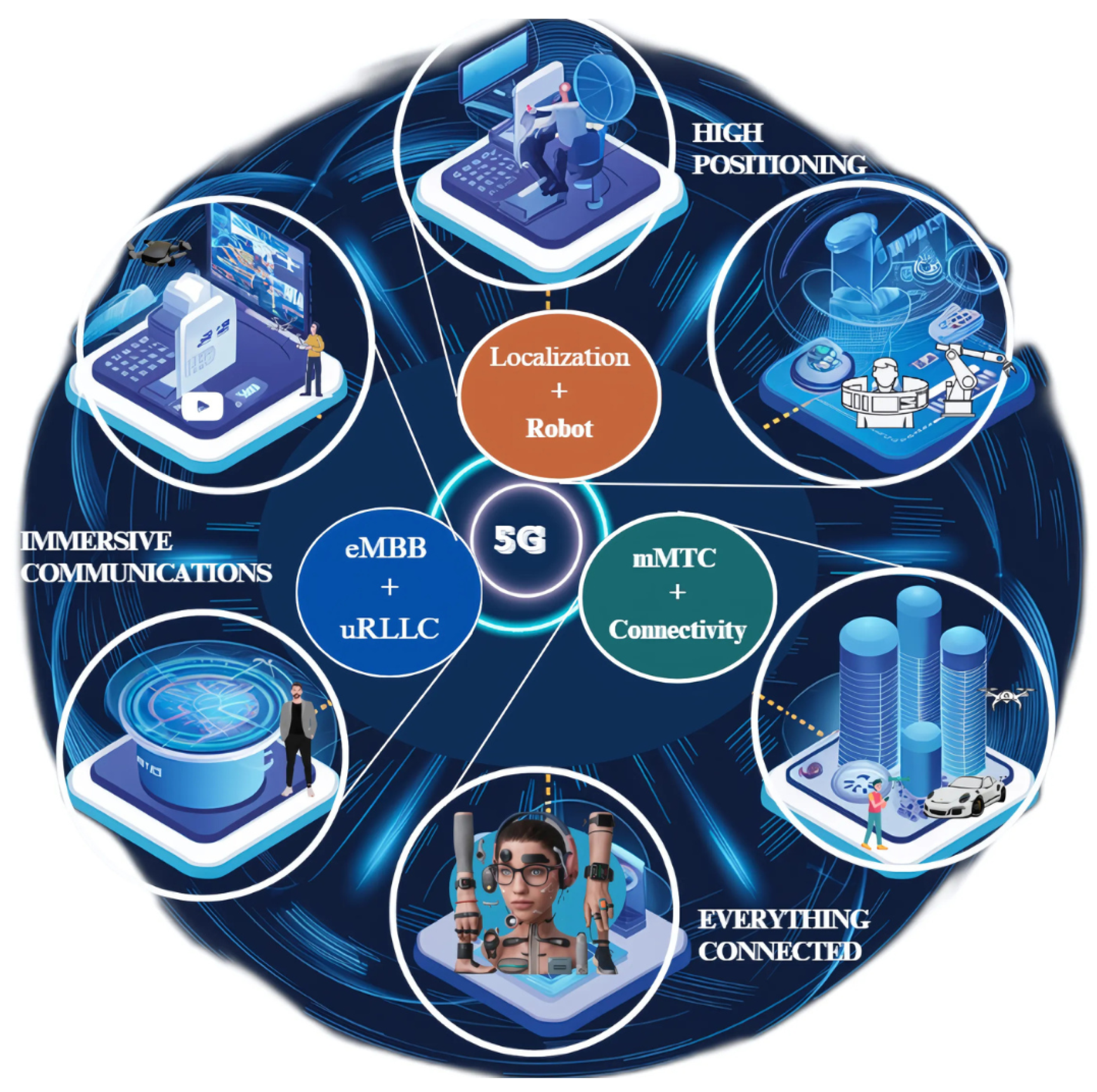
Figure 2.
Organization of this paper.
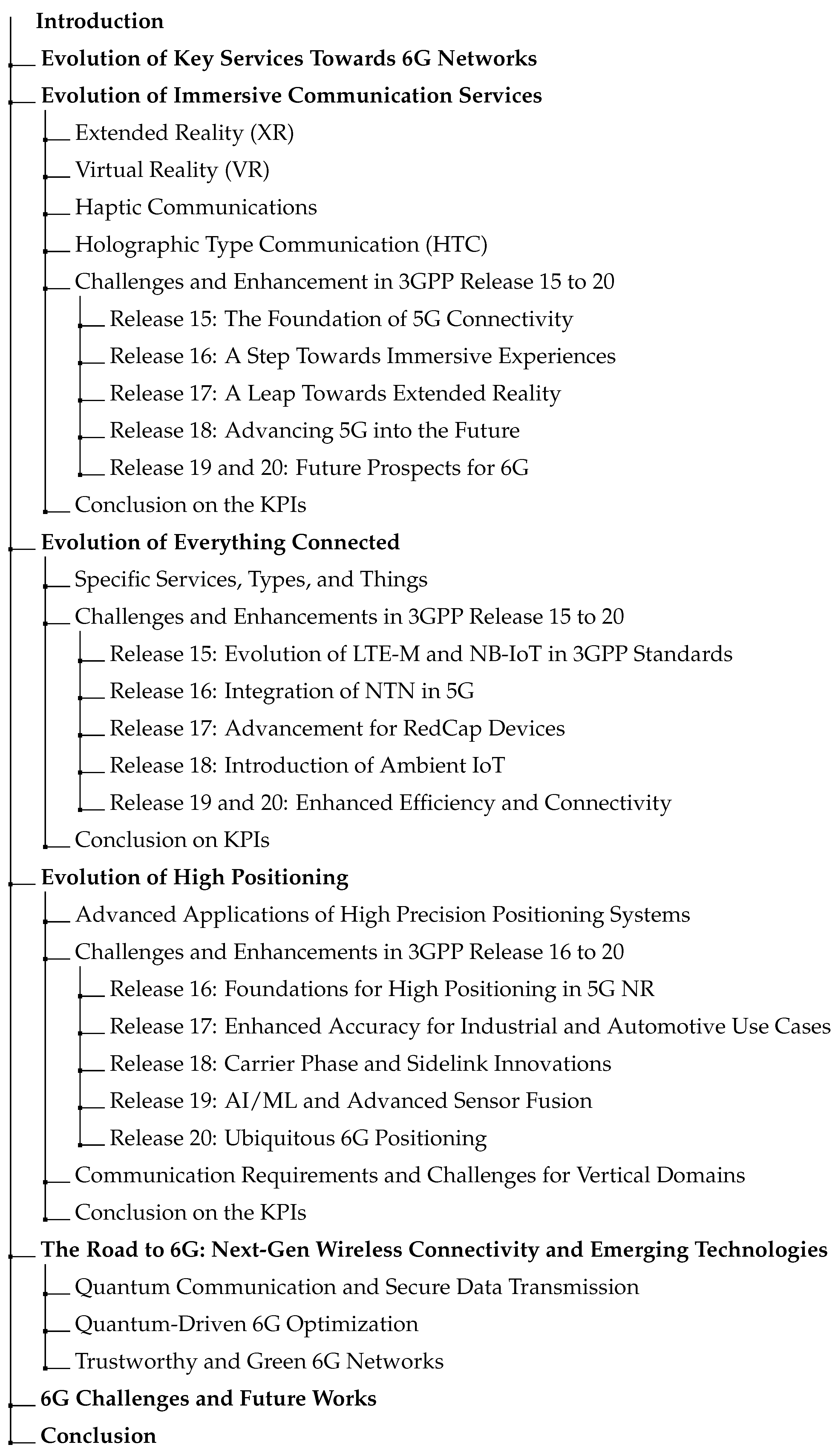
Figure 3.
Timeline of 3GPP milestones driving the transition from 5G to Beyond 6G.
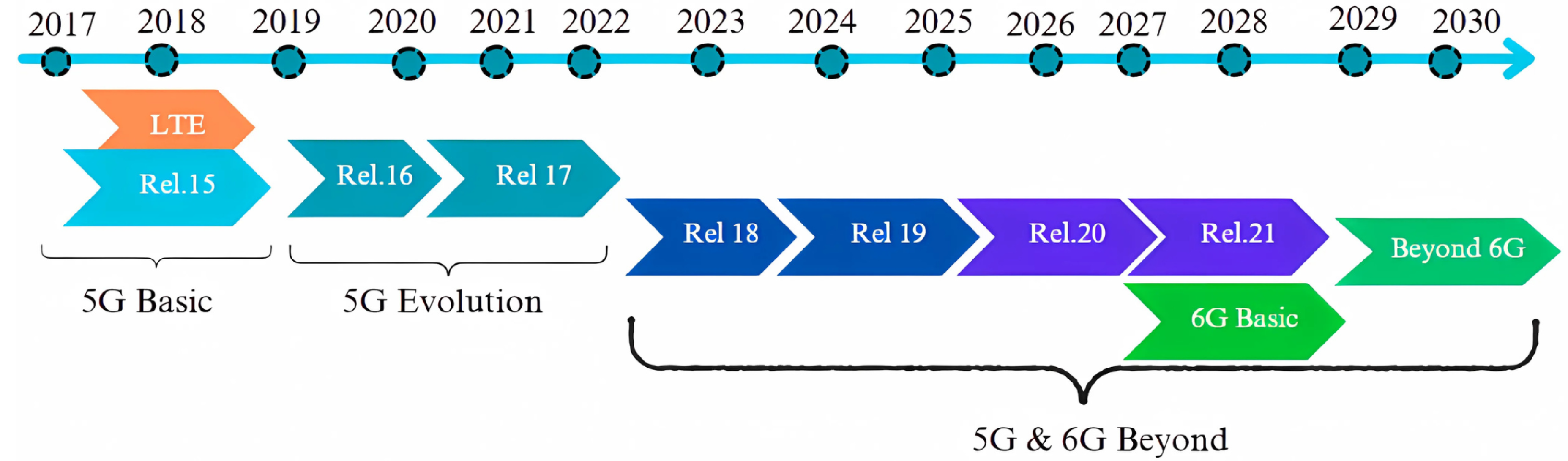
Table 1.
Global 6G Strategic Development and Progress by Leading Economies
| Country | Key Contributions & Current Status | Primary Strategic Focus & Future Goals | Quantitative Metrics |
|---|---|---|---|
| South Korea | Aggressive commercialization timeline targeting 2028. Implements the government-led K-Network 2030 Strategy with strong public–private collaboration. Pioneer in upper-mid band (7–24 GHz), LEO satellite communication, and advanced sensing. | To secure first-mover advantage in 6G through leadership in global standardization and early commercialization. Focused on national competitiveness and technological independence. | 6G Patents: 760; 5G Speed: 814 Mbps; 6G Ready Score: 8.75/10. |
| European Union | Coordinated R&D via the Smart Networks and Services Joint Undertaking (SNS JU) with a €1.8B+ budget. Flagship Hexa-X and Hexa-X-II projects define Europe’s 6G vision and architecture. | To establish technological sovereignty, sustainability, and inclusivity. Focuses on AI-driven networks, secure platforms, and green communication infrastructure. | Aggregated metrics unavailable; major investments under Horizon Europe and Hexa-X II. |
| India | Launched the Bharat 6G Vision and Mission (2023) promoting indigenous R&D and manufacturing. Focused on affordability and sustainability. | To develop AI-enabled, energy-efficient, and affordable 6G solutions. Targets Terahertz and advanced chipset innovation with deployment by 2030. | 6G Patents: 265; 5G Speed: 465 Mbps; 6G Ready Score: 7.50/10. |
| United States | Industry-driven innovation through the Next G Alliance (ATIS) to accelerate North American leadership. NIST’s CTL leads foundational R&D. Emphasizes open, secure, and resilient architectures. | To ensure security, resilience, and innovation in AI-native networks and Integrated Sensing and Communication (ISAC). Prioritizes spectrum expansion and defense applications. | 6G Patents: 2229; 5G Speed: 363 Mbps; 6G Ready Score: 6.88/10. |
| China | Leading in patent filings and early R&D investments. Established the IMT-2030 6G Promotion Group in 2019 to coordinate national efforts. Active in THz research and has launched experimental 6G satellites. | To achieve global technological leadership and standards in 6G by developing Air–Space–Earth–Sea integrated system, deep convergence with AI and sensing. | 6G Patents: 4604; 5G Speed: 142 Mbps; 6G Ready Score: 5.00/10. |
| United Kingdom | Released National 6G Strategy (2023) with £100M R&D funding. Strong role in global standards development and open network ecosystems. | To lead globally in secure, resilient, and AI-empowered 6G systems. Aims to influence standards and promote sustainable digital growth. | 6G Patents: 115; 5G Speed: 392 Mbps; 6G Ready Score: 5.00/10. |
| Japan | Launched the Beyond 5G Promotion Strategy with significant government funding. Pioneering the All-Photonics Network (APN) and NTN integration for ultra-fast, energy-efficient communication. | To build a robust and vibrant society via 6G-enabled resilience, extended coverage, and quantum-safe security. Targets commercial rollout by the early 2030s. | 6G Patents: 155; 5G Speed: 298 Mbps; 6G Ready Score: 3.75/10. |
| Finland | Home to the 6G Flagship program (2018), a leading global research initiative. Core partner in Hexa-X and Hexa-X-II. Pioneer in 6G concept creation. | To maintain leadership in wireless research via human-centric design aligned with UN SDGs. Promotes open collaboration and innovation. | 6G Patents: 12; 5G Speed: 452 Mbps; 6G Ready Score: 3.75/10. |
| Germany | Supported by the BMBF 6G Research Initiative (€700M+). Hosts dedicated 6G hubs (6GEM, 6G-RIC, Open6GHub), combining academia and industry. | To achieve 6G sovereignty through Open 6G Platforms and secure, modular architectures. Emphasis on Terahertz communication and Security by Design. | 6G Patents: 77; 5G Speed: 330 Mbps; 6G Ready Score: 3.13/10. |
| Australia | Engaged in collaborative 6G research addressing unique geographic and industrial challenges. Focused on practical use cases. | To leverage 6G for national productivity in agriculture, mining, and smart cities through secure and reliable networks. | 6G Patents: 55; 5G Speed: 296 Mbps; 6G Ready Score: 1.25/10. |
| Canada | Active in the Joint Principles for 6G, emphasizing open and secure networks. NRC leads national R&D on quantum and digital technologies. | To ensure open, reliable, and collaborative telecom infrastructure while strengthening alliances with international 6G partners. | Quantitative metrics not publicly available. |
Table 2.
Key Contributions from 6G Research Papers.
| Ref. | Topic | Major Contributions |
|---|---|---|
| [15] | Survey | A survey identifying requirements, architecture, and enabling technologies for new applications. |
| [16] | Technologies | Introduces five technology enablers for 6G, widespread AI, 3D coverage, sub-THz distributed security mechanisms, and new architecture. |
| [17] | Green 6G | A survey on 6G architectures and technologies such as 3D coverage, AI, THz, VLC, and blockchain. |
| [18] | AI | A comprehensive treatment of ML-related technology aspects for wireless communications, covering design, management, and computing frameworks. |
| [19] | Vision | Argues that 6G should be human-centric, focusing on security, privacy, and secrecy. Proposes a systematic framework and challenges. |
| [20] | Vehicular | Summarizes IoT, networking, and security technologies for vehicular networks, with a vision for intelligent 6G vehicular networks. |
| [21] | Use Cases | Foresees 6G use cases and enabling technologies. |
| [22] | Survey | Presents human machine interfaces, ubiquitous computing, multisensory data fusion, and new architectures for 6G. |
| [23] | AI | Argues that AI-assisted communication can address increased data production, showing benefits for device-free communication. |
| [24,25] | Reviews | Discusses 5G developments and 6G vision, challenges, and strategies for coverage and mobility in communication systems. |
| [7] | Survey | Provides a vision for 6G applications, technological trends, and enabling technologies. |
| [26] | ML | Discusses challenges and potential research directions for advancing ML in 6G networks. |
| [27] | AI | Discusses explainable AI concepts and proposes an AI framework for future wireless systems. |
| [28] | Survey | Surveys 6G applications, requirements, challenges, and key technologies such as AI, THz, blockchain, and optical wireless communication. |
| [29] | Vision | Extends 5G vision to ambitious 6G scenarios and speculates on required visionary technologies. |
| [30] | Survey | Provides a top-down analysis of 6G systems, addressing societal drivers, technical requirements, challenges across all OSI layers, and advanced frequency utilization. |
| [31] | Survey | Surveys 6G drivers, use cases, KPIs, architectures, enabling technologies, and research efforts, comparing with 5G and outlining a roadmap. |
| [32] | Mobile | Examines KPIs for 6G from service and technical perspectives, addressing challenges for Tbps level data rates and ultra low latency. |
| [33] | Vision | Provides a comprehensive review of 6G, exploring service objectives, design principles, drivers, architectures, and integration of biological, physical, and digital worlds. |
| [34] | Use Cases | Offers a comprehensive overview of 6G vision, requirements, application scenarios, architecture, key technologies, testbeds, and open challenges. |
| [35] | Use Cases | Discusses advancements of the European Hexa-X project, focusing on AI and ML integration for flexible, low complexity networks, addressing technical and regulatory challenges. |
| [36] | Industrial Needs | Analyzes KPIs and enabling technologies for 6G, focusing on unifying ICT capabilities to meet societal and industrial needs through intelligent access and orchestration. |
| [37] | Use Cases | Envisions 6G as a fusion of physical space, cyberspace, and connectivity, emphasizing immersive interactivity, critical KPIs, and enabling technologies. |
| [38] | Energy Sector | Explores 6G’s role in energy sector digitization, emphasizing KPIs for smart grids, challenges, and solutions in seamless communication. |
| [39] | Vision | Proposes an AI and ML embedded distributed management vision for 6G, showing energy efficiency improvements via federated learning in VR streaming use cases. |
| [40] | Use Cases | Explains unique features, proposes tailored KPIs for performance evaluation, and examines enabling technologies in 3GPP Releases. |
Table 3.
Requirements for Immersive Communications Services and Connected Devices [45].
Table 3.
Requirements for Immersive Communications Services and Connected Devices [45].
| Service/Type | Data Rate [] | Reliability [%] | Latency [] | Refresh Rate [fps] | Power Constraints | Mobility [] | Localization Precision [] |
|---|---|---|---|---|---|---|---|
| Mixed/AR | (DL), (UL) | 99.9 | Medium | – | – | ||
| VR | (DL), <2 (UL) | 99 | Low | – | – | ||
| Holographic Type Comms. | (DL), (UL) | 95 | Low | – | – | ||
| Haptic Comms. | (DL and UL) | Medium | – | – | |||
| Personal Devices e.g. Smartphones, HMD | 99.9 | – | Limited | 300 | 1 | ||
| Sensors/Actuators Simple | 0.1 | 50 | – | years | Cell | ||
| Time-sensitive | 0.1 | 99.999 | – | Limited/1 year | |||
| Bio-devices | 99.9 | – | years | 0–10 | 0.1 | ||
| Vehicles and Drones | 99.999 | – | Limited | >300 | 0.1 |
Table 4.
Traffic characteristics and parameters for various data types [45].
Table 4.
Traffic characteristics and parameters for various data types [45].
| Traffic Class | Arrival Rate [fps] | Jitter [ms] | Packet Size [Byte] | PDB [] | Typical Rate [] |
|---|---|---|---|---|---|
| DL Video | 30, 60, 90, 120 | Truncated Gaussian: , , , | Truncated Gaussian: , , , | 10, 15 | 30, 45, 60 |
| UL Video | 60 | No jitter or as for DL Video | Same as DL Video | 30 | 10, 20 |
| DL/UL Audio + Data | 100 | No jitter | 30 | 0.76, 1.2 | |
| UL Control Data | 250 | No jitter | 100 | 10 | 0.2 |
Table 5.
Use cases for everything connected (EC).
| Use Case | Description |
|---|---|
| Smart Cities | Real-time monitoring, connected infrastructure, and smart traffic systems. |
| Smart Homes and Offices | Remote control of appliances, home security, and energy management. |
| Smart Healthcare | Remote patient monitoring enabled by connected medical devices. |
| Supply Chain Management | Predictive maintenance, tracking of goods, and inventory optimization. |
| Connected Vehicles | Data sharing between vehicles for traffic safety and optimization. |
| Smart Agriculture | IoT-enabled precision farming with soil, crop, and weather monitoring. |
| Wearable Devices | Health and fitness tracking using connected biosensors. |
| Smart Factories | Real-time monitoring and control of industrial machinery. |
| Environmental Monitoring | IoT sensors tracking pollution, climate, and environmental changes. |
| Connected Drones | Drones for surveillance, goods delivery, and agricultural applications. |
| KPI Category | Definition | Performance Level | Target Value | Use Cases / Strategic Importance |
|---|---|---|---|---|
| Network Coverage | Total service area with reliable wireless connectivity | Extensive | of service area | Ensures universal access in urban, rural, and remote zones for inclusive connectivity. |
| Connection Density | Active connected devices per unit area | Ultra-dense | devices/km2 | Enables massive IoT mMTC and hyper-connected device ecosystems. |
| Area Traffic Capacity | Aggregate throughput per geographic area | High | 5–50 Gbps/km | Supports immersive 6G services such as holographic communication and XR. |
| Peak Data Rate | Maximum achievable data rate under ideal conditions | Very High | 20 Gbps DL | Determines top-end performance for enhanced mobile broadband eMBB. |
| User Experienced Data Rate | Average rate achievable under real network conditions | High | 100 Mbps | Reflects QoE for end users in typical deployments. |
| Energy Efficiency | Ratio of transmitted bits to consumed energy | Optimized | bit/Joule | Promotes sustainable green communication for energy-constrained devices. |
| Network Energy Consumption | Total power used by network elements | Reduced | lower than baseline | Contributes to lower carbon footprint and operational efficiency. |
| Latency (User Plane) | End-to-end transmission delay for data transfer | Ultra-low | ms | Enables real-time control, automation, and industrial applications. |
| Latency (Control Plane) | Time for connection setup or mobility management | Low | ms | Ensures rapid session establishment and network responsiveness. |
| Mobility Support | Ability to maintain stable connection during motion | Extreme | Up to 500 km/h | Provides seamless service for vehicular, aerial, and high-speed users. |
| Connection Reliability | Probability of successful data delivery | Ultra-reliable | Essential for mission-critical and industrial IoT operations. | |
| Service Availability | Operational uptime of the network | Continuous | 99.999% | Guarantees reliable service continuity and user satisfaction. |
| Packet Loss Rate | Fraction of lost data packets during transmission | Minimal | Maintains high-quality service for AR/VR and real-time applications. | |
| Mobility Interruption Time | Duration of service disruption during handover | Negligible | ms | Supports uninterrupted connectivity across heterogeneous cells. |
| Network Slicing Capability | Number of virtualized slices per coverage area | Dynamic | Up to 10 slices | Allows customized service delivery across industrial sectors. |
| Device Battery Life | Operational lifetime of IoT devices | Extended | years | Supports long-term deployments with minimal maintenance. |
| Deployment Density | Number of access points per area unit | Dense | 40 AP/km | Enhances service continuity, throughput, and coverage efficiency. |
| Spectral Efficiency | Throughput per unit bandwidth | Efficient | 30 bit/s/Hz peak | Reflects improved spectrum usage and air-interface design. |
| Positioning Accuracy | Precision of device location estimation | High | m indoor/outdoor | Supports UAV navigation, location-based services, and smart industry. |
| Security Incident Rate | Detected intrusions or cyber events per year | Very Low | incidents/year | Demonstrates resilience and trust in secure 6G ecosystems. |
Table 11.
Comparison of 6G with 4G and 5G communication systems.
| Issue | 4G | 5G | 6G |
|---|---|---|---|
| AI | No | Partial | Fully |
| Architecture | MIMO | Massive MIMO | Intelligent surface |
| Autonomous Vehicle | No | Partial | Fully |
| End-to-End (E2E) Latency | 100 ms | 10 ms | 1 ms |
| Haptic Communication | No | Partial | Fully |
| Maximum Frequency | 6 GHz | 90 GHz | 10 THz |
| Maximum Spectral Efficiency | 15 bps/Hz | 30 bps/Hz | 100 bps/Hz |
| Mobility Support | 350 km/h | 500 km/h | 1000 km/h |
| Per-Device Peak Data Rate | 1 Gbps | 10 Gbps | 1 Tbps |
| Satellite Integration | No | No | Fully |
| Service Level | Video | VR, AR | Tactile |
| THz Communication | No | Limited | Widely |
| XR | No | Partial | Fully |
Table 12.
Comparison of 5G and 6G network characteristics [34].
Table 12.
Comparison of 5G and 6G network characteristics [34].
| Characteristic | 5G | 6G |
|---|---|---|
| Area traffic capacity | 10 Mb/s/m | 1000–10000 Mb/s/m |
| Artificial Intelligence integration | Partial | Full |
| Automation integration | Partial | Full |
| Center of gravity | User-centric | Service-centric |
| C-plane latency | 10 ms | 1 ms |
| Connection density | 1 Million devices/km | 10 Million devices/km |
| Coverage | 70% | ∼99% |
| Device types | Smartphones, Sensors, Drones | DLT devices, CRAS, NR/BCI equipment, Smart implants |
| Downlink peak data rate | 20 Gbps | 1000 Gbps |
| End-to-end delay requirement | <1 ms | <1 ms |
| Energy efficiency | Not specified | 1000 Tb/J |
| Experienced data rate | 0.1 Gbps | 1 Gbps |
| Experienced spectral efficiency | 0.3 bps/Hz | 3 bps/Hz |
| Extended Reality integration | Partial | Full |
| Frequency bands | Sub-6 GHz, mmWave | THz, Non-RF (optical, VLC) |
| Haptic communication integration | Partial | Full |
| Jitter | Not specified | 10 s |
| Localization precision | <10 cm (2D) | 1 cm (3D) |
| Maximum bandwidth | 1 GHz | 100 GHz |
| Maximum mobility | 500 km/h | 1000 km/h |
| Operating frequency | 3–300 GHz | Up to 1000 GHz |
| Peak spectral efficiency | 30 bps/Hz | 60 bps/Hz |
| Processing delay | 100 ns | 10 ns |
| Radio-only delay requirement | 10 ms | <1 ms |
| Receiver sensitivity | -120 dBm | <-130 dBm |
| Reliability | 99.999% | 99.9999999% |
| Satellite integration | No | Yes |
| Smart city components | Separate | Integrated |
| Time buffer | Non real-time | Real-time |
| U-plane latency | 0.5 ms | 0.1 ms |
| Ultra-sensitive applications | Not feasible | Feasible |
| Uniform user experience | 50 Mbps (2D) | 10000 Mbps (3D) |
| Uplink peak data rate | 10 Gbps | 1000 Gbps |
| Visible Light Communication (VLC) | Partial | Full |
Table 13.
Comparison of target KPIs for 6G across various organizations.
| Target KPI | Networld Europe SRIA 2022 [142] | 5G Americas / Next G Alliance [143,144] | Huawei (China) [145,146] | B5G Consortium (Japan) [147] | TSDSI (India) [148,149] | MediaTek (Taiwan) [150] | ITU IMT-2030 [143] |
|---|---|---|---|---|---|---|---|
| Density | devices/km | devices/km | devices/km | devices/km | devices/km | n/a | – devices/km |
| Energy efficiency (Network/Terminal) | >100% gain vs IMT-2020 | Extremely low power / never charging devices | Network: 100× w.r.t. 5G; Device: 20 years battery | Network: 100× w.r.t. 5G | Battery lifetime up to 20 years | n/a | n/a |
| Mobility | <1000 km/h | >500 km/h | n/a | Up to 1000 km/h | Up to 1000 km/h | n/a | 500–1000 km/h |
| Peak data rate | 1 Tbps | 0.5–1 Tbps | 1 Tbps | 100–200 Gbps | 0.5–1 Tbps | 1 Tbps | 50–200 Gbps |
| Positioning accuracy | <1 cm | 1 mm–10 cm (six DoF: x,y,z) | Outdoor: 50 cm; Indoor: 1 cm | 1–2 cm | <1 cm | 1 cm | 1–10 cm |
| Reliability (BLER) | >1– | >1– | >1– | >1– | >1– | n/a | ∼1– to |
| U-plane latency | <0.1 ms | 0.1–1 ms | 0.1 ms | 0.1–1 ms | 0.1–1 ms | 0.5–5 ms | 0.1–1 ms |
| User data rate | 10 Gbps | DL: up to 1 Gbps; UL: up to 1 Gbps | 10–100 Gbps | 10–100 Gbps | DL: up to 10 Gbps; UL: up to 5 Gbps | >1 Gbps | 300–500 Mbps |
Disclaimer/Publisher’s Note: The statements, opinions and data contained in all publications are solely those of the individual author(s) and contributor(s) and not of MDPI and/or the editor(s). MDPI and/or the editor(s) disclaim responsibility for any injury to people or property resulting from any ideas, methods, instructions or products referred to in the content. |
© 2025 by the authors. Licensee MDPI, Basel, Switzerland. This article is an open access article distributed under the terms and conditions of the Creative Commons Attribution (CC BY) license (http://creativecommons.org/licenses/by/4.0/).
Copyright: This open access article is published under a Creative Commons CC BY 4.0 license, which permit the free download, distribution, and reuse, provided that the author and preprint are cited in any reuse.


