

Submitted:
13 November 2025
Posted:
14 November 2025
You are already at the latest version
Abstract
Background: Peritoneal mesothelioma is a rare malignancy characterized by limited therapeutic options and poor prognosis. Genomic characterization can enhance the un-derstanding of the molecular mechanisms that lead to this disease, and can contribute to improved survival outcomes through therapeutic targets. Methods: Analysis was per-formed using a dataset from the American Association for Cancer Research (AACR) Project Genomics Evidence Neoplasia Information Exchange (GENIE)® database. Data was analyzed to find statistically significant patterns in the genomic data, histological subtype, and clinical demographics. Results: Through the dataset results we found that the most common somatic mutation was found in the BAP1 gene (25.98%). Other common mutations were found in the NF2 (15.19%), TP53 (9.3%) and SETD2 (8.3%) genes. Several pathways were found as potential treatment targets. This includes the chromatin re-modeling, Hippo, and p53 signaling pathways. Given the size of our dataset, we were unable to draw significant conclusions about certain demographics. Conclusions: This study presents data that can help draw conclusions on common mutations, mutual ex-clusivity patterns, and demographics at risk for peritoneal mesothelioma. Looking into peritoneal mesothelioma genomic datasets can provide insight which may help develop possible intervention targets for therapeutic treatment.
Keywords:
Peritoneal mesothelioma
; AACR Project GENIE
; somatic mutations
; BAP1
; NF2
; TP53
; p53
; Hippo signaling pathway
; tumor suppressor genes
1. Introduction
Malignant peritoneal mesothelioma (MPM) is a rare cancerous tumor originating from the lining of the peritoneum. Mesothelioma is primarily associated with asbestos exposure, though inherited mutations may contribute to earlier onset in some patients [1]. Pathologically, the disease has been classified into three subtypes: epithelioid, sarcomatoid, and biphasic, each presenting distinct characteristics in terms of appearance, growth, and prognosis [2]. Regarding future care, there are several ongoing clinical trials exploring novel treatment approaches for mesothelioma, including immunotherapy, intraperitoneal chemotherapy, targeted therapies, and surgery, as well as combined treatments when appropriate [4,5,6]. After surgery, the median survival rate ranges from 12-92 months depending on primary treatment, tumor subtype, and patient factors [8,9]. After treatment, patients may experience symptoms such as sleep disturbances, fatigue, pain, sweating, coughing, appetite loss, and lower emotional well-being based on the type of care received [7].
Geographically, mesothelioma cases are most prevalent in Australia and the United States. In 2019, the age-standardized rate (ASR) was 0.43 cases per 100,000 individuals. Australia has been reported to have the highest mesothelioma rate, with an ASR of 0.57 per 100,000 individuals and 700-800 cases per year. South Africa, which has the lowest mesothelioma incidence rate, affects 1 to 2 per one million people a year, resulting in a total of 211 reported cases across African countries [13,14]. Known risk factors for developing this cancer include asbestos exposure, latency period, genetic predisposition, and patient factors [1,15]. Mortality rates vary depending on patient conditions, age, health factors, and tumor subtypes [10,11,12]. The incidence of the disease has been reported to be higher in males in low-prevalence groups (e.g., industrial groups). A unimodal age distribution is observed for mesothelioma, with most cases occurring in older adults between the ages of 75-84 years [16].
Initial evaluation for suspected mesothelioma typically includes chest X-rays and CT scans to examine mesothelial linings in the walls of serosal cavities, along with open biopsy for potential surgical diagnosis and treatment planning [17]. Since mesothelioma can spread diffusely through different surfaces, surgical approaches may not be a practical option for certain patients. Instead, diagnosis and treatment planning rely on laboratory tests, positron emission tomography scans, and radiographic imaging. Disease stage, metastasis, and careful treatment processes based on patient medical history and conditions are considered when making definitive diagnoses and treatment plans [1,17,18]. To classify the tumor, staging systems categorize tumors based on location and subtype. Pleural mesothelioma is classified by its official staging system known as TNM (tumor size, nodal involvement, and metastasis), while peritoneal and testicular mesothelioma have not established an official staging system. Recent research has found that new investigational therapies, such as targeted therapies, tumor-treating fields, and gene and cell therapies, have been through clinical testing for potential treatments in the future [17,19,20]. Further analysis on mesothelioma pathogenesis is vital for new treatments and diagnoses to help improve emerging treatment strategies to help support the quality of patient and tumor outcomes.
Despite soluble mesothelin-related proteins (SMRP) being a notable diagnostic marker, current studies emphasize possible mutations in the genes BAP1, CDKN2A, and NF2 affecting tumor suppression and genetic profiling risks [21,22,23]. Variants in genes can cause differences in biological and therapeutic outcomes, affecting tumor or treatment response for patients [24,25]. The disease is diagnosed in later stages with a survival rate of 12-92 months based on patient conditions and tumor size. One of the established staging systems, pleural mesothelioma, is divided into four staging phases, with Stage 1 reported to have 9% of cases present, Stage II 14%, and the most notable stages, III and IV, at 65%. Statistics reveal that tumor detection in earlier stages is more difficult compared to later stages, resulting in a lower survival rate [26]. The current gaps in the understanding of the molecular and genetic basis of mesothelioma prolong the timeline for diagnosis and treatment. There arises the need for further research to be conducted on molecules and tumor genes for proper diagnosis and treatment of patients.
The objective of this paper is to recognize genetic factors in mesothelioma in terms of tumor spread, non-responsive treatment, and tumor regression malignancy, which is crucial in progressing new diagnostic methods and therapeutic treatments. Despite current improvements, a thorough understanding of genetic modifications underlying mesothelioma pathogenesis is still in progress and incomplete. This study report is publicly accessible to present a significant mapping of the genetic makeup of mesothelioma and to educate and understand future advancements of new treatments and diagnostic strategies.
2. Materials and Methods
Ethical approval by the institutional review board was waived by Creighton University Institutional Review Board (Phoenix, AZ, USA) because the data used was from the American Association for Cancer Research (AACR) Project Genomics Evidence Neoplasia Information Exchange (GENIE)® database and is therefore already publicly accessible and does not reveal patient information. The cBioPortal (v17.0-public) online software accessed the cohort data on February 6, 2025, including genomic and clinical data entered from 2017 to present.
The AACR GENIE® database utilizes a variety of data from 19 international cancer centers, including whole-genome sequencing (WGS), whole-exome sequencing (WES), and targeted gene panels covering 50-555 genes. These different sequencing methods yielded different levels of coverage. Eighty percent of samples were subjected to targeted panel sequencing, which yielded the greatest coverage of over 500×. Fifteen percent of samples were subjected to WES, yielding 150× coverage. The remaining 5% of samples experienced WGS, resulting in approximately 30× coverage. Thirty-five percent of the cohort were matched tumor-normal pairs, which are essential for filtering germline variants. The remaining 65% were composed of tumor-only sequencing specimens.
Each participating institution utilizes individual programs to identify and label mutations, but all methods fall under GENIE harmonization protocols via the Genome NEXUS. For example, GATK is often used for variant detection and ANNOVAR is then used for annotation. However, each institution may have a different version of this software. In addition, variations can exist within individual institutions, as some data come from comprehensive sequencing methods such as WGS or WES, while other data comes from target panels looking at up to 555 specific genes. Patient responses to treatment and their clinical outcomes are often included in the database, however, this information is not available for peritoneal mesothelioma, as these details were not recorded.
Of the large group of head and neck tumor cases, patients with a pathologic diagnosis of peritoneal mesothelioma were identified and sorted as primary (obtained from the site where the cancer began to grow) or metastatic (of a secondary site that spread from the primary tumor). A chi-squared test was then performed on the groups using the proportion of mutated samples in each to compare their rate of mutation frequencies.
Genomic data (e.g., somatic mutations), histological subtype, and clinical demographics (e.g., age, race, and sex) formed the dataset. Cancer-associated genes essential to the study, such as KMT2D, TP53, and PIK3CA, were included in the majority of panel designs, despite slight differences between institutions. Also consistent across panels was the absence of non-actionable genes and the exclusion of structural variants in the analysis. Greater understanding of genetic drivers or tumor progression, resistance, and metastasis is necessary, as comprehensive knowledge of the genetic alterations comprising MPM pathogenesis is still incomplete. This study is designed to use publicly available data to characterize the somatic genomic landscape of MPM, ultimately aiming to adequately inform work on future therapeutics and screening methodologies.
We focused on homozygous deletions and amplifications to evaluate copy number alterations (CNAs) based on the frequency of repeat events. We calculated tumor mutational burden (TMD) through somatic mutations (synonymous and nonsynonymous) per megabase sequenced. Differences in TMB panel size were accounted for with panel size (e.g., total mutations/1.5 for a 1.5 Mb panel). From there, we used linear regression models designed by the AACR Project GENIE consortium to equate TMB values to WES values for comparison. The models are available via GENIE [15], and they account for features including panel size to increase comparability between sequencing platforms in spite of differences in panel size.
Samples with incomplete data were excluded from the analysis. Analysis was done with R/R Studio (R Foundation for Statistical Computing, Boston, MA, USA), and samples with p<0.05 were considered statistically significant. Relationships between categorical variables were analyzed using a chi-squared test, and presented as the resulting frequencies and percentages. With continuous variables, normality was examined to divide samples into two groups. Then, a two sided Student’s T-test (for normal distribution) or a Mann-Whitney U test (non-normal distribution) was used to present results as a mean ± standard deviations (SD). To control the false discovery rate (FDR), we used a Benjamini-Hochberg correction, which accounted for multiple comparisons.
Somatic mutations were filtered to only include nonsynonymous variants - including missense, nonsense, frameshift, and splice site mutations - with a variant allele frequency (VAF) of at least 5% and coverage of at least 100×. Mutations with no or unclear impact on protein function were excluded. GENIE harmonized mutation annotation format files provided all mutation calls, which provides standardized and consistent formatting for reporting abbreviated gene and protein alteration across the different institutions.
3. Results
3.1. Patient Demographics of Peritoneal Mesothelioma
To analyze general demographic trends, primary and metastatic tumor samples were combined due to the limited sample size. Demographic characteristics for 204 tumor samples from 192 patients are summarized in Table 1. In terms of sex, 80 (41.7%) samples were from male patients and 104 (54.2%) from female patients. There are no demographic data for age for this cohort. Regarding ethnicity, 151 patients (78.6%) were classified as non-Spanish/non-Hispanic, 10 (5.2%) as Spanish/Hispanic, and 25 (13.5%) patients had unknown ethnicity. With regard to race, most patients were White (139; 72.4%), followed by Asian (12; 6.3%), Black (8; 4.2%), and Other (10; 5.2%). Race information was unknown for 21 (10.9%) patients. Of the tumor samples, 146 (71.6%) were from primary tumors, while 25 (12.3%) samples were from metastatic tumors, and 10 (4.9%) lacked information regarding tumor origin.
3.2. Most Prevalent Somatic Mutations and Copy Number Alterations
The most common mutations found, as shown in Figure 1, were BAP1 (n = 53; 25.98%), NF2 (n = 31; 15.19%), TP53 (n = 19; 9.3%), SETD2 (n = 17; 8.3%), TRAF7 (n = 13; 6.4%), LATS1 (n = 6; 2.9%), CREBBP (n = 9; 4.4%), LATS2 (n = 8; 3.9%), PBRM1 (n=8; 3.9%), KMT2D (n=7; 2.9%). TERT and SF3B1 also showed significant mutation frequencies, and of this list of genes, the most commonly mutated was BAP1. Copy number alterations (CNAs) were also examined. Through this, we found loss of heterozygosity (LOH) events were quite prevalent on suppressor genes such as BAP1 (n = 20, 9.8%), CDKN2A (n = 18, 8.8%), and CDKN2B (n = 17, 8.3%). In addition, amplifications also showed prevalence, although significantly less than LOH events. These events impact genes such as WT1 (n = 4, 1.96%) and MCL1 (n = 4, 1.96%). Figure 1 demonstrates recurrent mutations in MPM after running the OncoPrint program.
3.3. Genetic Variations by Race and Sex
When grouping cohort data by sex, there were only three genes for which differences were statistically significant. Women had the majority of the enrichment of mutations in the SETD2 (n = 20 vs n = 4; p = 0.0036) gene and mutations in the CDC42 (n = 6; p = 0.032) gene occurred strictly in women. However, mutations in the SLC45A3 (n = 1; p = 0.027) were identified only in male patients. In this cohort, there are no statistically significant differences in mutation enrichment by race. Table 2 contains the corresponding diagnosis rate and p-value in regard to sex for common genetic mutations associated with mesothelioma.
3.4. Mutation Co-Occurrence and Mutual Exclusivity Relationships
The most significant co-occurrence patterns were observed between BAP1 and PBRM1 (n = 19; p < 0.001) and LATS1 and LATS2 (n = 5; p < 0.001). Other significant co-occurrence patterns were observed between BAP1 and LATS1 (n = 6; p = 0.013) and SETD2 (n = 17; p = 0.003). LATS1 was also identified with significant co-occurrence patterns with PBRM1 (n = 3; p = 0.035). Furthermore, PBRM1 also had significant co-occurrence with KMT2D (n = 2; p = 0.014). Only one significant mutual exclusivity pattern was identified between BAP1 and TRAF7 (n = 0, p < 0.001).
3.5. Primary and Metastatic Mutations
When comparing primary tumors to metastatic, of the significant results, the majority showed mutations found on genes only in metastatic tumors. This group includes mutations found in CHEK2 (n = 2; p = 0.0187), SRSF2 (n = 2; p = 0.0188), PPP2R1A (n = 2, p = 0.199), and CARM1 (n = 2, p = 0.0303). There was one instance of a mutation being found on a gene only in primary tumor samples, which was in the TPM1 (n = 2, p = 0.0230). In the PBRM1 (n = 6 vs. n = 12; p = 0.0262), there were more instances of mutation in patients with primary tumors, however due to the difference in group sizes, a much greater percentage of metastatic tumors displayed a mutation on this gene. There were no genes with similar numbers of mutation enrichment.
4. Discussion
4.1. Study Overview and Key Findings
This study analyzed data on peritoneal mesothelioma through the American Association for Cancer Research (AACR) Project Genomics Evidence Neoplasia Information Exchange (GENIE) database. Analysis of this data revealed recurrent mutations in key tumor-suppressor genes. Among the tumor-suppressor genes analyzed, BAP1, NF2, and TP53 had the most frequent mutations. Regarding sex specific differences in mutated genes, women had significant enrichment in the SETD2 gene. Mutations in CDC42 only occurred in female patients. Mutations in the SLC45A3 gene were only observed in male patients. Based on co-occurrence analysis, BAP1 and PBRM1 is a notable pattern pairing and CHEK2 and SRSF2 when comparing primary and metastatic samples. In this observed dataset, there were no race-specific differences in mutation enrichment.
4.2. Demographic Differences and Mutation Patterns
The observed cohort consisted of 41.7% (n=80) male and 54.2% (n=104) female patients. Notably, female patients had enrichment in the SETD2 gene (female: n=20, male: n=4, p=0.0036). In addition, mutation in the CDC42 gene was only observed in female patients (female: n=6, male n=0, p=0.032). Mutation in the CDC42 gene found exclusively in women suggests that there is a possible sex-linked biological impact that requires further investigation. The SLC45A3 mutation was exclusive to males (male: 1, female: 0, p=0.027), although only one case was observed.
Ethnically, this cohort was predominantly non-Spanish/non-Hispanic (n=151, 78.6%). In addition, a majority of the patients in the cohort identified White (n=139, 72.4%). This is consistent with studies that suggest there is a higher incidence of peritoneal mesothelioma in non-Hispanic White patients [1]. According to literature, in the United States approximately 90% of new peritoneal mesothelioma cases are diagnosed in non-Hispanic white patients [66]. Understanding that peritoneal mesothelioma has a higher incidence rate among non-Hispanic white patients can provide insight into potential contributing factors to the cancer. Although, in this observed dataset, there were no race-specific statistically significant differences in mutation enrichment. Given the relatively low number of non-White patients in this dataset (Asian: n=12, Black: n=8, Other: n=10, unknown: n=21), a larger more representative cohort is needed to draw significant conclusions about race-specific differences in mutations.
4.3. Commonly-Mutated Genes and Altered Pathways
Consistent with previous literature, our peritoneal mesothelioma cohort exhibited significant mutation within the BAP1 gene (25.98%) [1,27,28]. This study also identified common somatic mutations in NF2 (15.19%), TP53 (9.3%) and SETD2 (8.3%). Mutations were also observed in the TRAF7 (6.4%), LATS1 (2.9%), CREBBP (4.4%), LATS2 (3.9%), PBRM1 (3.9%), KMT2D (2.9%) genes, but to a lesser extent. These findings align with prior studies that have determined that the loss or mutation of the BAP1 gene is linked to peritoneal mesothelioma [1,27,28,29]. BAP1 is associated with tumor-suppressor genes and is related to DNA damage repair pathways [27,28,30]. Another common altered pathway, NF2, is associated with the Hippo pathway which is a key component in the regulation of cell proliferation [27,28,31].
Through examination of CNAs, LOH events were predominant in BAP1 (9.8%), CDKN2A (8.8%), CDKN2B (8.3%) and less predominant in WT1 (1.96%) and MCL1 (1.96%). Along with common mutations within BAP1, NF2, TP53, mutation of the CDKN2A/B gene is frequently associated with peritoneal mesothelioma [27,30].
The clinical standard for treatment of peritoneal mesothelioma can be attributed to their interaction with these commonly mutated pathways associated with the mutation of BAP1, NF2, TP53, and CDKN2A/B genes. Results from our study and previous literature suggest that peritoneal mesothelioma tumorigenesis is driven by the deactivation of tumor-suppressor genes rather than the activation of oncogenes [1,27,28,29,30,31,32].
4.4. BAP1 and Chromatin Remodeling
The most frequently mutated gene found in our cohort was BAP1 (n=53, 25.98%). This is consistent with previous studies, one which found a very similar 23% BAP1 mutation among their cohort [33]. Other studies have found that BAP1 loss is often a common defining genomic feature in mesotheliomas [33]. BAP1 plays an essential role in maintaining genomic stability and is involved in transcription, DNA replication, homologous recombination repair, controlling cell death, and remodeling chromatin [30,34,35]. BAP1 encodes a deubiquitylase and is involved in the regulation of H2A-Ub in the repressive group deubiquitinase Complex (PR-DUB) [30]. BAP1 regulates chromatin accessibility by deubiquitylating INO80 via H2A-Ub. Through this, BAP1 ensures genomic stability and efficient DNA replication, and therefore suppresses cancer development [30,36]. Since BAP1 has been identified as a key tumor suppressor, it is a hopeful therapeutic target but has been found to be a complex target that is resistant to many current forms of therapy [30]. Clinical trials [NCT03830229, NCT03654833] are currently studying the role of BAP1 [60,61]. Loss of BAP1 impairs homologous recombination repair, making tumors more susceptible to PARP inhibitors [37]. BAP1 deficiency also leads to the upregulation of EZH2, providing a target for potential therapeutic methods. EZH2 inhibitors are currently being investigated for BAP1 deficient cases of mesothelioma [38]. The EZH2 inhibitor tazemetostat was tested in a clinical trial [NCT02860286] for its efficacy [37,38,39]. The trial results found that at 12 weeks there was a 54% disease control rate. However, no complete responses were observed in the trial [39]. Loss of BAP1 impairs homologous recombination repair, making tumors more susceptible to synthetic lethality from PARP inhibition. In preclinical models, BAP1 deficiency also leads to upregulation of EZH2, histone deacetylases (HDACs), and immune checkpoint molecules such as PD-1, PD-L1, and LAG3, providing multiple potential therapeutic targets. The EZH2 inhibitor tazemetostat is currently being investigated in BAP1-inactivated mesothelioma (e.g., NCT03830229) [60]. While early-phase studies showed a disease control rate of 54% at 12 weeks, complete responses were not observed, suggesting that biomarkers beyond just BAP1 may need to be explored for therapeutic treatment [39]. Many of the therapeutic treatment strategies involving BAP1 remain largely preclinical but some provide future directions that may have promising results [37].
4.5. Hippo Signaling and NF2 Mutation
NF2 gene mutations were the second most common in our cohort with 15.19% of patients presenting NF2 mutations. Similarly, another study found 19% of patients with the NF2 gene mutation in another sample [33]. As stated earlier, NF2, also known as Merlin, is involved in the regulation of cell proliferation and the Hippo signaling pathway [27,28,31]. NF2 regulates the downstream Hippo pathway via association of LATS1/LATS2 which causes the suppression of YAP and TAZ, which are proteins associated with cell growth. Clinically, YAP/TAZ activation is linked to poorer outcomes in mesothelioma patients, making it a potential option for targeted therapy [40]. The mutation of NF2 can lead to the hyperactivation of YAP and therefore leads to uncontrollable cell proliferation and tumor growth [31,41,42,43]. Beyond NF2’s role in LATS1/LATS2, NF2 may also directly interact with transcription factor TEAD4, which is also involved in the Hippo signaling pathway [43]. This direct association can offer an alternative route to Hippo signaling deregulation in peritoneal mesothelioma.
YAP, TAZ, and TEAD4 inhibitors such as IAG933 are phase I clinical trials [NCT04857372] for mesothelioma patients [43,45]. This trial is investigating the efficacy of disrupting the YAP pathway and treating the Hippo signaling pathway [44]. Focusing on the targeting of the NF2 gene mutations and Hippo pathway could be an effective way in treating and slowing the progression of peritoneal mesothelioma [31,44].
4.6. p53 Pathway
The third most common mutation in our cohort occurred in the TP53 gene with 9.3% of the patients presenting a mutation. This is consistent with other literature results that found the mutation rate for TP53 ranges from around 8-14.6% [33,41]. TP53 encodes the p53 protein, a transcription factor that is often referred to as the “guardian of the genome”, and is responsible for responding to DNA damage by aiding cell cycle arrest, senescence, or apoptosis [41,46]. Loss of TP53, and therefore p53, function disrupts cell cycle regulation and leads to genomic instability and uncontrolled cell proliferation and tumorigenesis [33]. In mesothelioma, TP53 is not the only mutation that can disrupt the p53 pathway. Alterations in checkpoint kinases, like CHEK2, and negative regulators, such as MDM2, can alter the p53 pathway [47,48]. In our cohort, CHEK2 mutations were observed in metastatic tumors, which is consistent with literature that states CHEK2 and TP53 mutations have critical roles in tumor suppression. In other types of cancer, CHEK2 and TP53 mutations have linked expression patterns and frequently co-occur, which reinforces that disruption in the p53 pathway can alter DNA damage response [48]. For example, in a study CHEK2 and p53 status was explored in 196 gastric cancer patients [47]. Results found that CHEK2 mutations and p53 status are correlated, ultimately suggesting that there is an interplay between the two DNA damage response components [47]. So, in mesothelioma, damage or loss of the p53 pathway can arise from direct mutations of TP53, mutations in checkpoint kinases (i.e. CHEK2), or the amplification or overexpression of p53 negative regulators (i.e. MDM2).
Regarding potential therapeutic interventions for TP53 mutations, MDM2 inhibitors can restabilize the p53 pathway. For TP53 wild-type tumors, MDM2 inhibitors can stabilize and reactivate p53. In a clinical trial [NCT01877382], an MDM2 inhibitor called milademetan has been explored and results show that inhibition of MDM2 could be a possible method to restabilizing the p53 pathways and suppressing tumor growth activity [47]. In addition, WEE1 inhibition is being clinically researched [NCT01164995, NCT02448329] in p53 mutated cells [49,62,63]. Clinical trial results [NCT01357161] have shown that adavosertib, a WEE1 inhibitor, has anti-tumor activity in TP53 mutated tumors [50,51,64,65]. These observations highlight the p53 pathway as a critical component of mesothelioma biology. The p53 pathway should be further clinically explored as a therapeutic target for peritoneal mesothelioma.
4.7. Co-occurrence and Mutual Exclusivity Patterns
The analysis of our cohort presented several patterns in gene co-occurrence. There were statistically significant results between the BAP1 and PBRM1 (n=19; p<0.001) and LATS1 and LATS2 (n=5; p<0.001) genes. BAP1 and PBRM1 are associated with chromatin remodeling and DNA damage repair and the mutation of these genes concurrently could disrupt proper gene expression [41]. We also observed significant co-occurrence with the LATS1 and LATS2 (n=5; p<0.001) genes. LATS1/LATS2, tumor-suppressor kinases, both have significant roles in the Hippo signaling pathway [31,42,43,44]. In the Hippo signaling pathway, NF2 activates LATS1/LATS2 which then phosphorylates and deactivates YAP and TEADs, leading to uncontrolled cell proliferation and tumorigenesis [31,43,44]. However, in contrast, new results have also found that NF2 can also directly interact with TEAD4, rather than via LATS1/LATS2 and YAP [43]. Literature found that NF2 and TEAD4 directly interact via NF2 interacting with the FERM domain and C-terminal tail of TEAD4 [43]. This means that NF2 can decrease the stability of TEAD4 without interacting with LATS1/LATS2 and YAP [43]. Therefore lack of NF2 can stabilize TEAD4 even if the LATS1/LATS2 and YAP portion of the pathway is still intact [43]. Thus, the LATS1/LATS2 co-occurrence may suggest that in order to uphold TEAD activity, there is genomic selection for loss of LATS kinase function. Although our sample size is small, suggesting that further research would need to be conducted to support the conclusion that both NF2 loss or LATS1/2 loss can lead to TEAD activation [28,43].
The dual deactivation of LATS1/LATS2 likely still disrupts the Hippo signaling pathway and promotes uncontrolled cell proliferation and tumorigenesis. In addition, co-occurrence was observed with BAP1 and LATS1 (n=6; p=0.013) and SETD2 (n=17; p= 0.003). LATS1 and PBRM1 (n=3; p=0.035) and PBRM1 and KMT2D (n=2; p=0.014) genes also had a statistically significant co-occurrence pattern. These patterns suggest a cooperative role in tumorigenesis and mesothelioma growth [52].
In our cohort, we observed only one statistically significant mutually exclusive co-occurrence between BAP1 and TRAF7 (n=0; p<0.001). Due to the fact that these genes are mutually exclusive, it is likely that these genes were never mutated in the same tumor concurrently. BAP1 mutations are frequently associated with chromatin pathway disruption and malignant forms of peritoneal mesothelioma [29,30,53]. TRAF7 is a component in a separate pathway than the pathway BAP1 uses, suggesting why it may be mutually exclusive to BAP1. BAP1 and TRAF7 being mutually exclusive suggests that there are alternative mutations, such as in TRAF7, to promote the cell proliferation and tumorigenesis in mesothelioma [54]. These mutually exclusive patterns within the chromatin remodeling and Hippo pathways could be used to inform future treatment and targeted therapeutic strategies.
4.8. Primary vs. Metastatic Mutation Patterns
In our cohort study, we also compared and looked at patterns between primary and metastatic mutations. Of all the statistically significant results, a majority of the gene mutations were found in metastatic tumors. Mutations in the following genes were only found in metastatic tumors: CHEK2 (n=2; p=0.0187), SRSF2 (n=2; p=0.0188), PPP2R1A (n=2, p=0.199), and CARM1 (n=2, p=0.0303). Mutations within the PBRM1 gene were observed in both metastatic and primary tumors. PBRM1 mutations were numerically more common in primary tumors (n=12) than in metastatic tumors (n=6). Although, due to the smaller size of the metastatic group meant that a larger proportion of the metastatic tumors in our cohort carried PBRM1 mutations in total. These patterns suggest that the enrichment of CHEK2, SRSF2, PPP2R1A, and CARM1 may occur after or during metastasis. While the enrichment of PBRM1 may occur prior to metastasis. These enriched genes all play a role in tumor progression. CHEK2, a tumor-suppressor gene, is relevant in cell cycle regulation and loss of its function can lead to improper cell proliferation [55]. SRSF2 is involved in splicing events and enrichment of this gene may lead to altered RNA processing [56]. PPP2R1A is an important factor in DNA damage/repair [57]. According to literature, enrichment of PPP2R1A and many other genes can lead to tumorigenesis and lead to cancer progression [58]. CARM1 is an arginine methyltransferase protein that is responsible for steps within the RNA production process [59]. In addition to the mutations found in metastatic tumors, we also observed a mutation in TPM1 (n=2, p=0.0230) only in primary tumors. The association of these mutations with metastatic tumors presents the possibility that they are needed or contribute to the dissemination capacity of the peritoneal tumor cells. Although, these associations require further validation and study.
4.9. Study Limitations
This cohort study has several limitations that must be considered when interpreting findings. The AACR GENIE dataset lacks patient outcome measures such as overall or progression-free survival, limiting the ability to correlate genetic alterations with clinical outcomes. The dataset lacks measurement of patient clinical outcomes such as survival or progression free survival. Without access to endpoint data we cannot directly connect or draw conclusions about patterns in prognosis and treatment. Patient treatment histories are also not included in the dataset. This makes it difficult to assess if patients had genomic alterations or resistance or sensitivity to therapies. It is also impossible to tell if some of the gene mutations had arisen due to prior treatments. The cohort size of the dataset is another limitation. The relatively small number of cases for datasets on peritoneal mesothelioma limits statistical analysis. This makes it difficult to detect rare cases and establish associations. Inability to track tumor evolution over time and inability to compare primary and metastatic tumors from patients proved as another limiting factor. These serially collected samples, such as the matching of primary and metastatic tumors from the same patients, limited our ability to determine true driver mutations from secondary non-contributory mutations acquired during tumorigenesis. In addition, the GENIE database combines data from multiple institutions that use different sequencing platforms. So, it is inevitable that there could be some technical variability that could impact the reported and analyzed mutation frequencies. There is also a possibility that the dataset used contains multiple tumor samples from the same patient. Although, prior evaluations suggest that this would have minimal effect on overall trends seen in the data. Since we used genomic data, we cannot evaluate and capture non-genetic driving forces, such as microenvironmental factors, in the progression of peritoneal mesothelioma. There was also a lack of transcriptomic and miRNA data in our used GENIE dataset. Even without coding mutations, microRNA regulation and gene overexpression strongly influence tumor biology. We were unable to coordinate gene activity with mutation status due to the inability to analyze these molecular layers. Transcriptomic data is important for understanding peritoneal mesothelioma and gene overexpression. Without this data, we were unable to link downstream pathway activation to mutation status or actual gene expression. Similarly, our ability to explore epigenetic regulation in tumor progression and initiation was limited due to the fact that no DNA methylation data was available to us during this study. In future studies, incorporating and using DNA methylation data can provide a deeper understanding biologically and can have an impact on prognosis, treatment, and future research. Additionally, the GENIE database groups all histologic subtypes of peritoneal mesothelioma (epithelioid, sarcomatoid, and biphasic) together. Without specific subtype data, we could not analyze certain genomic alterations and enrichments that are found in particular morphologic variants. There was also a lack of immunohistochemistry data. This meant we could not examine how genetic changes translate cause differences in protein expression. Taking these constraints into account, our analysis can offer insight into the mutational and alterations in pathways such as the BAP1 and chromatin, Hippo signaling, and p53 pathways. These results can help us characterize and understand peritoneal mesothelioma, hopefully laying the groundwork for future studies and clinical research for new therapeutic intervention.
5. Conclusions
This study provides a comprehensive analysis of the genomic mutational landscape of peritoneal mesothelioma using the AACR Project GENIE database. Recurrent genomic alterations were identified in BAP1, NF2, TP53, and SETD2. In addition, there were potential therapeutic target within the chromatin remodeling, Hippo signaling, and p53 pathways. Demographic patterns were also analyzed and observed, and co-occurrence and mutually exclusive patterns highlighting distinct genomic patterns. The findings expand the current genomic insight for peritoneal mesothelioma which may guide future research, clinical trial design, and targeted therapeutic intervention.
Author Contributions
Conceptualization, B.H.; methodology, B.H.; validation, B.H., S.N.; formal analysis, M.S., M.W., A.H.; investigation, M.S. and M.W.; resources, B.H.; data curation, M.W.; writing—original draft preparation, M.S., M.W., A.H.; writing—review and editing, all authors; visualization, M.S., M.W., A.H., B.H.; supervision, B.H., S.R.; project administration, M.S., B.H., S.R. All authors have read and agreed to the published version of the manuscript.
Funding
This research received no external funding.
Institutional Review Board Statement
Ethical approval by the institutional review board was waived by Creighton University Institutional Review Board (Phoenix, AZ, USA) because the data used was pulled from the American Association for Cancer Research (AACR) Project Genomics Evidence Neoplasia Information Exchange (GENIE)® database. Therefore, all the data used was already publicly accessible and does not reveal patient information.
Informed Consent Statement
Not applicable.
Data Availability Statement
The data presented in this study are available from the AACR GENIE Database at https://genie.cbioportal.org/ (accessed on 6 February 2025).
Conflicts of Interest
All authors declare no conflict of interest.
Abbreviations
The following abbreviations are used in this manuscript:
| AACR | American Association for Cancer Research |
| ASR | Age-Standardized Rate |
| BAP1 | BRCA1-Associated Protein 1 |
| CARM1 | Coactivator-Associated Arginine Methyltransferase 1 |
| CDKN2A | Cyclin-Dependent Kinase Inhibitor 2A |
| CDKN2B | Cyclin-Dependent Kinase Inhibitor 2B |
| CHEK2 | Checkpoint Kinase 2 |
| CNA | Copy Number Alterations |
| CT | Computed Tomography |
| DNA | Deoxyribonucleic Acid |
| EZH2 | Enhancer of Zeste Homolog 2 |
| FDR | False Discovery Rate |
| GENIE | Genomics Evidence Neoplasia Information Exchange |
| HDAC | Histone Deacetylase |
| H2A-Ub | Monoubiquitinated Histone H2A |
| LATS1 | Large Tumor Suppressor 1 |
| LATS2 | Large Tumor Suppressor 2 |
| LOH | Loss of Heterozygosity |
| MCL1 | Myeloid Cell Leukemia 1 |
| MDM2 | Mouse Double Minute 2 Homolog |
| MPM | Malignant Peritoneal Mesothelioma |
| NF2 | Neurofibromatosis Type 2 |
| PARP | Poly (ADP-ribose) Polymerase |
| PBRM1 | PolyBromo 1 |
| PPP2R1A | Protein Phosphatase 2 Scaffold Subunit Alpha |
| SETD2 | SET Domain Containing 2 |
| SF3B1 | Splicing Factor 3B subunit 1 |
| SRSF2 | Serine and Arginine Rich Splicing Factor 2 |
| TAZ | Tafazzin |
| TEAD4 | TEA domain transcription factor 4 |
| TERT | Telomerase Reverse Transcriptase |
| TMB | Tumor Mutational Burden |
| TPM1 | Tropomyosin 1 |
| TP53 | Tumor Protein p53 |
| TRAF7 | TNF Receptor-Associated Factor 7 |
| KMT2D | Histone-Lysine N-Methyltransferase 2D |
| WEE1 | WEE1 G2 checkpoint kinase |
| WES | Whole-Exome Sequencing |
| WGS | Whole-Genome Sequencing |
| WT1 | Wilms' Tumor 1 |
| YAP | Yes-Associated Protein |
References
- Greenbaum, A.; Alexander, H. R. Peritoneal mesothelioma. Transl Lung Cancer Res 2020, 9 (Suppl 1), S120–S132. [Google Scholar] [CrossRef]
- Inai, K. Pathology of mesothelioma. Environ Health Prev Med 2008, 13, 60–64. [Google Scholar] [CrossRef] [PubMed]
- Gray, S. G.; Mutti, L. Immunotherapy for mesothelioma: a critical review of current clinical trials and future perspectives. Transl Lung Cancer Res 2020, 9 (Suppl 1), S100–S119. [Google Scholar] [CrossRef]
- Nakano, T. Current therapies for malignant pleural mesothelioma. Environ Health Prev Med 2008, 13, 75–83. [Google Scholar] [CrossRef]
- Zalcman, G.; Mazieres, J.; Margery, J.; Greillier, L.; Audigier-Valette, C.; Moro-Sibilot, D.; Molinier, O.; Corre, R.; Monnet, I.; Gounant, V.; et al. Bevacizumab for newly diagnosed pleural mesothelioma in the Mesothelioma Avastin Cisplatin Pemetrexed Study (MAPS): a randomised, controlled, open-label, phase 3 trial. Lancet 2016, 387, 1405–1414. [Google Scholar] [CrossRef]
- Fear, V. S.; Tilsed, C.; Chee, J.; Forbes, C. A.; Casey, T.; Solin, J. N.; Lansley, S. M.; Lesterhuis, W. J.; Dick, I. M.; Nowak, A. K.; et al. Combination immune checkpoint blockade as an effective therapy for mesothelioma. Oncoimmunology 2018, 7, e1494111. [Google Scholar] [CrossRef]
- Granieri, A.; Tamburello, S.; Tamburello, A.; Casale, S.; Cont, C.; Guglielmucci, F.; Innamorati, M. Quality of life and personality traits in patients with malignant pleural mesothelioma and their first-degree caregivers. Neuropsychiatr Dis Treat 2013, 9, 1193–1202. [Google Scholar] [CrossRef]
- Amin, W.; Linkov, F.; Landsittel, D. P.; Silverstein, J. C.; Bashara, W.; Gaudioso, C.; Feldman, M. D.; Pass, H. I.; Melamed, J.; Friedberg, J. S.; et al. Factors influencing malignant mesothelioma survival: a retrospective review of the National Mesothelioma Virtual Bank cohort. F1000Res 2018, 7, 1184. [Google Scholar] [CrossRef]
- Chapel, D. B.; Schulte, J. J.; Absenger, G.; Attanoos, R.; Brcic, L.; Butnor, K. J.; Chirieac, L.; Churg, A.; Galateau-Salle, F.; Hiroshima, K.; et al. Malignant peritoneal mesothelioma: prognostic significance of clinical and pathologic parameters and validation of a nuclear-grading system in a multi-institutional series of 225 cases. Mod Pathol 2021, 34, 380–395. [Google Scholar] [CrossRef] [PubMed]
- Zhao, Z.; Li, J.; Tan, F.; Xue, Q.; Gao, S.; He, J. Assessing the global burden of mesothelioma: trends, socioeconomic influences, and asbestos exposure - a retrospective cohort study. Int J Surg 2025, 111, 93–103. [Google Scholar] [CrossRef] [PubMed]
- Zhu, W.; Liu, J.; Li, Y.; Shi, Z.; Wei, S. Global, regional, and national trends in mesothelioma burden from 1990 to 2019 and the predictions for the next two decades. SSM Popul Health 2023, 23, 101441. [Google Scholar] [CrossRef]
- Van Gelder, T.; Damhuis, R. A.; Hoogsteden, H. C. Prognostic factors and survival in malignant pleural mesothelioma. Eur Respir J 1994, 7, 1035–1038. [Google Scholar] [CrossRef]
- Walker-Bone, K.; Benke, G.; MacFarlane, E.; Klebe, S.; Takahashi, K.; Brims, F.; Sim, M. R.; Driscoll, T. R. Incidence and mortality from malignant mesothelioma 1982-2020 and relationship with asbestos exposure: the Australian Mesothelioma Registry. Occup Environ Med 2023, 80, 186–191. [Google Scholar] [CrossRef]
- Abratt, R. P.; White, N. W.; Vorobiof, D. A. Epidemiology of mesothelioma--a South African perspective. Lung Cancer 2005, 49 Suppl 1, S13–15. [Google Scholar] [CrossRef]
- Tuomi, T.; Huuskonen, M. S.; Virtamo, M.; Tossavainen, A.; Tammilehto, L.; Mattson, K.; Lahdensuo, A.; Mattila, J.; Karhunen, P.; Liippo, K.; et al. Relative risk of mesothelioma associated with different levels of exposure to asbestos. Scand J Work Environ Health 1991, 17, 404–408. [Google Scholar] [CrossRef]
- Chen, Z.; Cai, Y.; Ou, T.; Zhou, H.; Li, H.; Wang, Z.; Cai, K. Global burden of mesothelioma attributable to occupational asbestos exposure in 204 countries and territories: 1990-2019. J Cancer Res Clin Oncol 2024, 150, 282. [Google Scholar] [CrossRef]
- Syed, H. A.; Wallen, J. M. Malignant Mesothelioma. In StatPearls, 2025.
- Kindler, H. L.; Ismaila, N.; Armato, S. G., 3rd; Bueno, R.; Hesdorffer, M.; Jahan, T.; Jones, C. M.; Miettinen, M.; Pass, H.; Rimner, A.; et al. Treatment of Malignant Pleural Mesothelioma: American Society of Clinical Oncology Clinical Practice Guideline. J Clin Oncol 2018, 36, 1343–1373. [Google Scholar] [CrossRef]
- Sinn, K.; Mosleh, B.; Hoda, M. A. Malignant pleural mesothelioma: recent developments. Curr Opin Oncol 2021, 33, 80–86. [Google Scholar] [CrossRef] [PubMed]
- Janes, S. M.; Alrifai, D.; Fennell, D. A. Perspectives on the Treatment of Malignant Pleural Mesothelioma. N Engl J Med 2021, 385, 1207–1218. [Google Scholar] [CrossRef]
- Forest, F.; Patoir, A.; Dal Col, P.; Sulaiman, A.; Camy, F.; Laville, D.; Bayle-Bleuez, S.; Fournel, P.; Habougit, C. Nuclear grading, BAP1, mesothelin and PD-L1 expression in malignant pleural mesothelioma: prognostic implications. Pathology 2018, 50, 635–641. [Google Scholar] [CrossRef] [PubMed]
- Murrone, A.; Cantini, L.; Pecci, F.; Cognigni, V.; Copparoni, C.; Rinaldi, S.; Fiordoliva, I.; Monaco, F.; Rubini, C.; Barbisan, F.; et al. BRCA-associated protein 1 (BAP1) and miR-31 combination predicts outcomes in epithelioid malignant pleural mesothelioma. J Thorac Dis 2021, 13, 5741–5751. [Google Scholar] [CrossRef] [PubMed]
- Zhu, M.; Lu, Z.; Guo, H.; Gu, X.; Wei, D.; Zhang, Z. Diagnostic value of combination of biomarkers for malignant pleural mesothelioma: a systematic review and meta-analysis. Front Oncol 2023, 13, 1136049. [Google Scholar] [CrossRef]
- Pass, H. I.; Alimi, M.; Carbone, M.; Yang, H.; Goparaju, C. M. Mesothelioma Biomarkers: A Review Highlighting Contributions from the Early Detection Research Network. Cancer Epidemiol Biomarkers Prev 2020, 29, 2524–2540. [Google Scholar] [CrossRef] [PubMed]
- Kim, J. E.; Kim, D.; Hong, Y. S.; Kim, K. P.; Yoon, Y. K.; Lee, D. H.; Kim, S. W.; Chun, S. M.; Jang, S. J.; Kim, T. W. Mutational Profiling of Malignant Mesothelioma Revealed Potential Therapeutic Targets in EGFR and NRAS. Transl Oncol 2018, 11, 268–274. [Google Scholar] [CrossRef]
- Tozzi, J. Mesothelioma Statistics: Learn About Key Facts & Trends. MesotheliomaHope.com. https://www.mesotheliomahope.com/mesothelioma/statistics/.
- Boussios, S.; Moschetta, M.; Karathanasi, A.; Tsiouris, A. K.; Kanellos, F. S.; Tatsi, K.; Katsanos, K. H.; Christodoulou, D. K. Malignant peritoneal mesothelioma: clinical aspects, and therapeutic perspectives. Ann Gastroenterol 2018, 31, 659–669. [Google Scholar] [CrossRef]
- Singhi, A. D.; Krasinskas, A. M.; Choudry, H. A.; Bartlett, D. L.; Pingpank, J. F.; Zeh, H. J.; Luvison, A.; Fuhrer, K.; Bahary, N.; Seethala, R. R.; et al. The prognostic significance of BAP1, NF2, and CDKN2A in malignant peritoneal mesothelioma. Mod Pathol 2016, 29, 14–24. [Google Scholar] [CrossRef]
- Cheung, M.; Testa, J. R. BAP1, a tumor suppressor gene driving malignant mesothelioma. Transl Lung Cancer Res 2017, 6, 270–278. [Google Scholar] [CrossRef]
- Carbone, M.; Harbour, J. W.; Brugarolas, J.; Bononi, A.; Pagano, I.; Dey, A.; Krausz, T.; Pass, H. I.; Yang, H.; Gaudino, G. Biological Mechanisms and Clinical Significance of BAP1 Mutations in Human Cancer. Cancer Discov 2020, 10, 1103–1120. [Google Scholar] [CrossRef]
- Fu, M.; Hu, Y.; Lan, T.; Guan, K. L.; Luo, T.; Luo, M. The Hippo signalling pathway and its implications in human health and diseases. Signal Transduct Target Ther 2022, 7, 376. [Google Scholar] [CrossRef]
- Cedres, S.; Valdivia, A.; Priano, I.; Rocha, P.; Iranzo, P.; Pardo, N.; Martinez-Marti, A.; Felip, E. BAP1 Mutations and Pleural Mesothelioma: Genetic Insights, Clinical Implications, and Therapeutic Perspectives. Cancers (Basel) 2025, 17. [Google Scholar] [CrossRef]
- Bueno, R.; Stawiski, E. W.; Goldstein, L. D.; Durinck, S.; De Rienzo, A.; Modrusan, Z.; Gnad, F.; Nguyen, T. T.; Jaiswal, B. S.; Chirieac, L. R.; et al. Comprehensive genomic analysis of malignant pleural mesothelioma identifies recurrent mutations, gene fusions and splicing alterations. Nat Genet 2016, 48, 407–416. [Google Scholar] [CrossRef]
- Gupta, A.; Vasileva, A.; Manthri, S. The Rarest of the Rare: A Case of BAP1-Mutated Primary Peritoneal Mesothelioma. Cureus 2021, 13, e18380. [Google Scholar] [CrossRef]
- Carbone, M.; Adusumilli, P. S.; Alexander, H. R., Jr.; Baas, P.; Bardelli, F.; Bononi, A.; Bueno, R.; Felley-Bosco, E.; Galateau-Salle, F.; Jablons, D.; et al. Mesothelioma: Scientific clues for prevention, diagnosis, and therapy. CA Cancer J Clin 2019, 69, 402–429. [Google Scholar] [CrossRef] [PubMed]
- Machida, Y. J.; Machida, Y.; Vashisht, A. A.; Wohlschlegel, J. A.; Dutta, A. The deubiquitinating enzyme BAP1 regulates cell growth via interaction with HCF-1. J Biol Chem 2009, 284, 34179–34188. [Google Scholar] [CrossRef] [PubMed]
- Elsayed, A. M.; Kittaneh, M.; Cebulla, C. M.; Abdel-Rahman, M. H. An overview of BAP1 biological functions and current therapeutics. Biochim Biophys Acta Rev Cancer 2025, 1880, 189267. [Google Scholar] [CrossRef]
- Straining, R.; Eighmy, W. Tazemetostat: EZH2 Inhibitor. J Adv Pract Oncol 2022, 13, 158–163. [Google Scholar] [CrossRef]
- Zauderer, M. G.; Szlosarek, P. W.; Le Moulec, S.; Popat, S.; Taylor, P.; Planchard, D.; Scherpereel, A.; Koczywas, M.; Forster, M.; Cameron, R. B.; et al. EZH2 inhibitor tazemetostat in patients with relapsed or refractory, BAP1-inactivated malignant pleural mesothelioma: a multicentre, open-label, phase 2 study. Lancet Oncol 2022, 23, 758–767. [Google Scholar] [CrossRef]
- Cunningham, R.; Jia, S.; Purohit, K.; Salem, O.; Hui, N. S.; Lin, Y.; Carragher, N. O.; Hansen, C. G. YAP/TAZ activation predicts clinical outcomes in mesothelioma and is conserved in in vitro model of driver mutations. Clin Transl Med 2023, 13, e1190. [Google Scholar] [CrossRef] [PubMed]
- Hiltbrunner, S.; Fleischmann, Z.; Sokol, E. S.; Zoche, M.; Felley-Bosco, E.; Curioni-Fontecedro, A. Genomic landscape of pleural and peritoneal mesothelioma tumours. Br J Cancer 2022, 127, 1997–2005. [Google Scholar] [CrossRef]
- Yang, H.; Hall, S. R. R.; Sun, B.; Zhao, L.; Gao, Y.; Schmid, R. A.; Tan, S. T.; Peng, R. W.; Yao, F. NF2 and Canonical Hippo-YAP Pathway Define Distinct Tumor Subsets Characterized by Different Immune Deficiency and Treatment Implications in Human Pleural Mesothelioma. Cancers (Basel) 2021, 13. [Google Scholar] [CrossRef]
- Wu, M.; Hu, L.; He, L.; Yuan, L.; Yang, L.; Zhao, B.; Zhang, L.; He, X. The tumor suppressor NF2 modulates TEAD4 stability and activity in Hippo signaling via direct interaction. J Biol Chem 2024, 300, 107212. [Google Scholar] [CrossRef] [PubMed]
- Chapeau, E. A.; Sansregret, L.; Galli, G. G.; Chene, P.; Wartmann, M.; Mourikis, T. P.; Jaaks, P.; Baltschukat, S.; Barbosa, I. A. M.; Bauer, D.; et al. Direct and selective pharmacological disruption of the YAP-TEAD interface by IAG933 inhibits Hippo-dependent and RAS-MAPK-altered cancers. Nat Cancer 2024, 5, 1102–1120. [Google Scholar] [CrossRef]
- ClinicalTrials. gov. A Phase I Study of IAG933 in Patients with Advanced Mesothelioma and Other Solid Tumors; NCT04857372. Updated September 19, 2025. Available online: https://clinicaltrials.gov/study/NCT04857372 (accessed on 29 August 2025).
- Sementino, E.; Menges, C. W.; Kadariya, Y.; Peri, S.; Xu, J.; Liu, Z.; Wilkes, R. G.; Cai, K. Q.; Rauscher, F. J., 3rd; Klein-Szanto, A. J.; et al. Inactivation of Tp53 and Pten drives rapid development of pleural and peritoneal malignant mesotheliomas. J Cell Physiol 2018, 233, 8952–8961. [Google Scholar] [CrossRef] [PubMed]
- Gounder, M. M.; Bauer, T. M.; Schwartz, G. K.; Weise, A. M.; LoRusso, P.; Kumar, P.; Tao, B.; Hong, Y.; Patel, P.; Lu, Y.; et al. A First-in-Human Phase I Study of Milademetan, an MDM2 Inhibitor, in Patients With Advanced Liposarcoma, Solid Tumors, or Lymphomas. J Clin Oncol 2023, 41, 1714–1724. [Google Scholar] [CrossRef] [PubMed]
- Machlowska, J.; Kapusta, P.; Szlendak, M.; Bogdali, A.; Morsink, F.; Wolkow, P.; Maciejewski, R.; Offerhaus, G. J. A.; Sitarz, R. Status of CHEK2 and p53 in patients with early-onset and conventional gastric cancer. Oncol Lett 2021, 21, 348. [Google Scholar] [CrossRef]
- Kong, A.; Mehanna, H. WEE1 Inhibitor: Clinical Development. Curr Oncol Rep 2021, 23, 107. [Google Scholar] [CrossRef] [PubMed]
- Li, S.; Juengpanich, S.; Topatana, W.; Xie, T.; Hou, L.; Zhu, Y.; Chen, J.; Shan, Y.; Han, Y.; Lu, Z.; et al. Adavosertib-encapsulated metal-organic frameworks for p53-mutated gallbladder cancer treatment via synthetic lethality. Sci Bull (Beijing) 2024, 69, 1286–1301. [Google Scholar] [CrossRef]
- Ariyoshi, M.; Yuge, R.; Kitadai, Y.; Shimizu, D.; Miyamoto, R.; Yamashita, K.; Hiyama, Y.; Takigawa, H.; Urabe, Y.; Oka, S. WEE1 Inhibitor Adavosertib Exerts Antitumor Effects on Colorectal Cancer, Especially in Cases with p53 Mutations. Cancers (Basel) 2024, 16. [Google Scholar] [CrossRef]
- Lund-Andersen, C.; Nakken, S.; Nygard, S.; Fromm, B.; Aasheim, L. B.; Davidson, B.; Julsrud, L.; Abrahamsen, T. W.; Kristensen, A. T.; Dybdahl, B.; et al. Integrative genomic analysis of peritoneal malignant mesothelioma: understanding a case with extraordinary chemotherapy response. Cold Spring Harb Mol Case Stud 2019, 5. [Google Scholar] [CrossRef]
- Joseph, N. M.; Chen, Y. Y.; Nasr, A.; Yeh, I.; Talevich, E.; Onodera, C.; Bastian, B. C.; Rabban, J. T.; Garg, K.; Zaloudek, C.; et al. Genomic profiling of malignant peritoneal mesothelioma reveals recurrent alterations in epigenetic regulatory genes BAP1, SETD2, and DDX3X. Mod Pathol 2017, 30, 246–254. [Google Scholar] [CrossRef]
- Zotti, T.; Scudiero, I.; Vito, P.; Stilo, R. The Emerging Role of TRAF7 in Tumor Development. J Cell Physiol 2017, 232, 1233–1238. [Google Scholar] [CrossRef] [PubMed]
- Dietz, M. V.; van Kooten, J. P.; Paats, M. S.; Aerts, J.; Verhoef, C.; Madsen, E. V. E.; Dubbink, H. J.; von der Thusen, J. H. Molecular alterations and potential actionable mutations in peritoneal mesothelioma: a scoping review of high-throughput sequencing studies. ESMO Open 2023, 8, 101600. [Google Scholar] [CrossRef]
- Zhang, J.; Lieu, Y. K.; Ali, A. M.; Penson, A.; Reggio, K. S.; Rabadan, R.; Raza, A.; Mukherjee, S.; Manley, J. L. Disease-associated mutation in SRSF2 misregulates splicing by altering RNA-binding affinities. Proc Natl Acad Sci U S A 2015, 112, E4726–4734. [Google Scholar] [CrossRef] [PubMed]
- PPP2R1A. My Cancer Genome. Available online: https://www.mycancergenome.org/content/gene/ppp2r1a/ (accessed on day month year).
- Toda-Ishii, M.; Akaike, K.; Suehara, Y.; Mukaihara, K.; Kubota, D.; Kohsaka, S.; Okubo, T.; Mitani, K.; Mogushi, K.; Takagi, T.; et al. Clinicopathological effects of protein phosphatase 2, regulatory subunit A, alpha mutations in gastrointestinal stromal tumors. Mod Pathol 2016, 29, 1424–1432. [Google Scholar] [CrossRef] [PubMed]
- Santos, M.; Hwang, J. W.; Bedford, M. T. CARM1 arginine methyltransferase as a therapeutic target for cancer. J Biol Chem 2023, 299, 105124. [Google Scholar] [CrossRef]
- ClinicalTrials. gov. Long-term follow-up of mesothelioma patients with germline mutations in BAP1 and other cancer-associated genes; NCT03830229. Available online: https://clinicaltrials.gov/study/NCT03830229 (accessed on 29 August 2025).
- ClinicalTrials. gov. Mesothelioma stratified therapy (MiST): A multi-arm trial for relapsed mesothelioma using molecular pre-screening to classify patients into treatment arms based on their molecular profile; NCT03654833. Available online: https://clinicaltrials.gov/study/NCT03654833 (accessed on 29 August 2025).
- Embaby, A.; Kutzera, J.; Geenen, J. J.; Pluim, D.; Hofland, I.; Sanders, J.; Lopez-Yurda, M.; Beijnen, J. H.; Huitema, A. D. R.; Witteveen, P. O.; et al. WEE1 inhibitor adavosertib in combination with carboplatin in advanced TP53 mutated ovarian cancer: A biomarker-enriched phase II study. Gynecol Oncol 2023, 174, 239–246. [Google Scholar] [CrossRef] [PubMed]
- ClinicalTrials. gov. Study of ASD1775 (WEE1 inhibitor) in combination with paclitaxel in advance gastric adenocarcinoma patients with TP53 mutations as second-line chemotherapy; NCT02448321. Available online: https://clinicaltrials.gov/study/NCT02448329 (accessed on 29 August 2025).
- NCT01357161. Adavosertib (WEE1 inhibitor) in combination with carboplatin and paclitaxel in women with ovarian cancer. ClinicalTrials.gov. https://clinicaltrials.gov/study/NCT01357161. (accessed on 29 August 2025).
- Oza, A. M.; Estevez-Diz, M.; Grischke, E. M.; Hall, M.; Marme, F.; Provencher, D.; Uyar, D.; Weberpals, J. I.; Wenham, R. M.; Laing, N.; et al. A Biomarker-enriched, Randomized Phase II Trial of Adavosertib (AZD1775) Plus Paclitaxel and Carboplatin for Women with Platinum-sensitive TP53-mutant Ovarian Cancer. Clin Cancer Res 2020, 26, 4767–4776. [Google Scholar] [CrossRef]
- Gregory, S. N.; Sarvestani, A. L.; Blakely, A. M. Malignant peritoneal mesothelioma literature review: past, present, and future. Dig Med Res 2022, 5. [Google Scholar] [CrossRef]
Figure 1.
OncoPrint of recurrent mutations in MPM. Star (*) indicates that not all samples were profiled.
Figure 1.
OncoPrint of recurrent mutations in MPM. Star (*) indicates that not all samples were profiled.
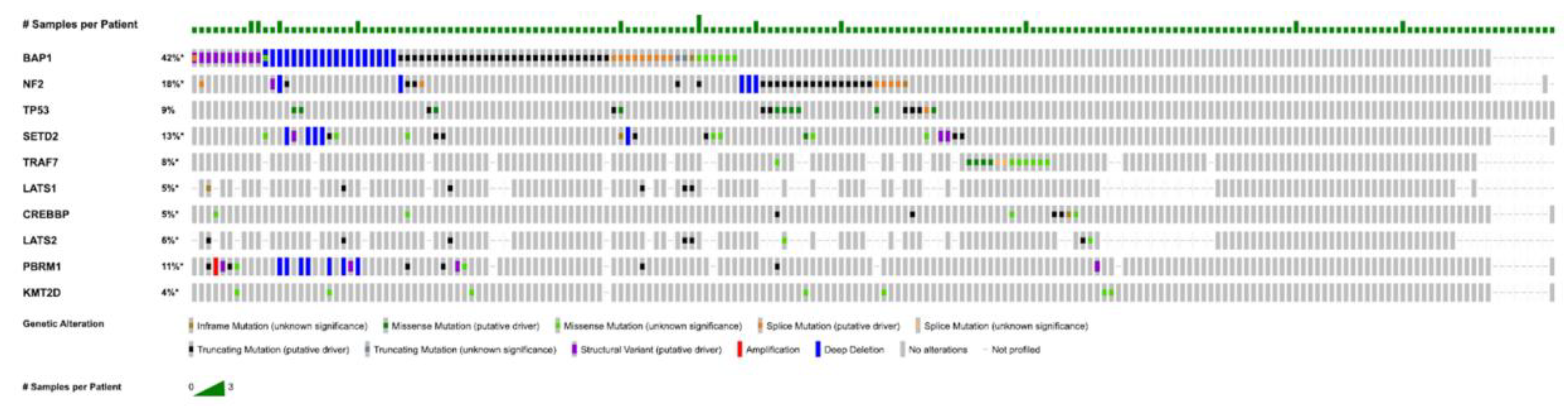

Table 1.
Patient demographics for peritoneal mesothelioma.
| Demographics | Category | N (%) |
|---|---|---|
| Sex | Male Female |
80 (41.7) 104 (54.2) |
| Ethnicity | Non-Hispanic Unknown/Not Collected Hispanic |
151 (78.6) 25 (13.5) 10 (5.2) |
| Race | White Asian Black Other Unknown |
139 (72.4) 12 (6.3) 8 (4.2) 10 (5.12) 21 (10.9) |
| Sample Type | Primary Metastasis Not Collected |
146 (71.6) 25 (12.3) 10 (4.9) |
Table 2.
Sex and associated mutations in patients diagnosed with mesothelioma.
| Gene (Chi-Squared) |
Male, N (%) | Female, N (%) | P value |
|---|---|---|---|
| SETD2 | 4 (4.76) | 20 (19.42) | p = 0.0036 |
| CDC42 | 0 (0.0) | 6 (10.34) | p = 0.032 |
| SLC45A3 | 1 (33.33) | 0 (0.0) | p = 0.027 |
Disclaimer/Publisher’s Note: The statements, opinions and data contained in all publications are solely those of the individual author(s) and contributor(s) and not of MDPI and/or the editor(s). MDPI and/or the editor(s) disclaim responsibility for any injury to people or property resulting from any ideas, methods, instructions or products referred to in the content. |
© 2025 by the authors. Licensee MDPI, Basel, Switzerland. This article is an open access article distributed under the terms and conditions of the Creative Commons Attribution (CC BY) license (http://creativecommons.org/licenses/by/4.0/).
Copyright: This open access article is published under a Creative Commons CC BY 4.0 license, which permit the free download, distribution, and reuse, provided that the author and preprint are cited in any reuse.


