

Submitted:
10 November 2025
Posted:
12 November 2025
You are already at the latest version
Abstract
A growing number of studies show that SMEs are becoming more conscious of the importance of environmental issues. This research delves into how green practices might help small and medium-sized enterprises (SMEs) in Bangladesh improve their environmental performance over the long term. To be more precise, this study intends to investigate the role of green innovation as a mediator between environmentally conscious activities and long-term environmental performance. For research purpose, a standardized questionnaire was circulated among people who belong to SME sector and 403 data were obtained. We have analyzed the acquired data using SmartPLS4 and SPSS. The relationship between the predictor and predicted variables was investigated using Partial Least Squares Structural Equation Modeling (PLS-SEM). Environmental sustainability strategy, green supply chain management, green human resource management, green information technology, all components of green practices—have an immediate effect on sustainable environmental performance, and green innovation both directly affects and mediates the relationship between these two concepts. Industries and government policymakers may learn a lot from this study, which shows that they need to work on methods to improve environmental performance in order to achieve sustainability. Acquiring environmental sustainability can help our nation attain economic prosperity and accomplish three SDGs.
Keywords:
green practices
; environmental sustainability strategy
; green supply chain management
; green human resource management
; green information technology
; sustainable environmental performance
; sme sector
; environmental sustainability
1. Introduction
In modern era, most countries are concentrating on economical proliferation while understating the environmental enhancement (Zheng et al., 2021). Bangladesh is not an anomaly from this pattern even though nature is both root and escort for the nation. Despite the boons from nature, distinct harms are made such as decimating plants, contaminating water or air for industrial revolution. Thereafter nature also takes vicious vengeance in form of several apocalypses which include inundation, droughts, extravagant heat etc. (Zhixia et al., 2018). As Bangladesh has some perilous environmental threats, firms should necessarily make themselves prepped to these perils. Pursuing green practices in the firms is pivotal for the nation to foster sustainable development and becoming a panoramic economic trajectory (Datta, 2024). In environmental context, “green” indicates those good-natured practices that facilitate protecting the environment and nurture natural assets. The SME sector can be a fitted sector for pursuing green practices. SMEs are the backbone of economy in emerging countries which can be portrayed by the employee numbers, operable assets, output sales (Yoshino et al., 2016). SMEs are significant economic strength in developing countries like Bangladesh, contributing more than 40% of the GDP. Its’ contribution to economic progression is substantial but adverse environmental deterioration hinders it (Qamruzzaman & Kler, 2023). SMEs impose a direct influence on environment when it comes to the term like consume energy or climate change (Fawcett & Hampton, 2020; Rehman et al., 2022). As emerging nations are expanding their production, their available natural assets are getting downplayed and pollution are getting more widespread (Udoh et al., 2023). So the environmentalists recommended the organizations to adapt green thinking into their productivity. Same concerns have been incorporated into the environmental management literature (Shahzad et al., 2020). It’s necessary for SMEs to entail sustainable environmental performance in their workforce to attain environmental sustainability. Awwad Al-Shammari et al. (2022) stated that, the adoption of green ideologies can treat the challenges. Nowadays firms are adopting several steps for improving congruence to attain environmental and financial goals (Perez et al., 2023). Green practices (environmental sustainability strategy, green supply chain management, green human resource management, green IT) may aid to boost the sustainable environmental performance of the firm. Furthermore, green innovation can be a crucial strategy for SMEs to acquire a distinctiveness for long term success (Le and Govindan, 2024).
As per recent data, it can be stated that SME generates 35.41% employment and 48.41% contribution to the GDP growth of Bangladesh (CIPE, 2022). The EPI (Environmental Performance Index) score of Bangladesh is 28.1 out of 100 and as a country it ranks 175 out of 180 countries which indicates the vulnerable condition (EPI, 2024). These findings accentuate the exigency of enhancing sustainable environmental performance in the firms for attaining environmental sustainability and economic progression. Besides that, SMEs stumble to shine because of the definite assets, awareness or conventional thought process. Also, many firms are still insouciant about green practices as they are not fully cognizant of this. However, the knowledge of green practices and green innovation can help them to expand their business by furthering environmental sustainability.
As ecological deterioration is a generic concern right now, stakeholders are cognizant of lessening climatic vulnerabilities through a sustainable model. The inclusion of green innovation can facilitate sustainable environmental performance of the firms. Green innovation can provide high grade results in form of electing green raw materials, using water, natural assets efficiently, settlement of the garbage etc. (Ullah et al., 2022). There are segregated studies where isolated green practices settle environmental outcomes but very few studies encompass all these green practices together with the mediation role of green innovation. The intention of the study is to acquaint; how to attain environmental sustainability and economic progression by improving environmental performance over the long-term.
In today’s world, economic performance is not the only thing to be considered but attaining environmental performance is also vital (Qamruzzaman & Kler, 2023) . As global marketplace prefers eco-friendly initiatives, SMEs need to be foresighted for boosting productivity to remain dynamic. Green innovation for SMEs can elevate environmental performance by managing resources or alleviating pollution which facilitates environmental responsibility (Lutfi et al., 2023). This study can amplify environmental knowledge of firm owners as well as employees. Our study can pitch in accomplishing 3 Sustainable Development Goals (SDGs) among the 17 SDGs and they are: Industry, Innovation and Infrastructure (SDG9), Responsible Consumption and Production (SDG12) and also Climate Action (SDG13).
The elementary question of the research is how we may enhance sustainable environmental performance in SMEs through green practices so that Bangladesh can fulfill the commitment to SDG goals and the economy can progress.
Against the backdrop of research questions, the rudimentary objective of the study is to render an understanding how a firm can enrich sustainable environmental performance through green practices.
2. Literature Review and Development of Constructs
2.1. Green Practices (GP)
Businesses across the globe implement green practices intentionally with a view to lessening environmental impacts for a sustainable universe (Miroshnychenko et al., 2017). The methods and applications which are implemented by businesses to protect environment can be denoted as green practices (Govindan et al., 2015). The concept of “Green Practices” is implemented in four domains:
Firstly, A firm’s strategic orientation sets internal goals and formal policies that support environmental stewardship (Nijhof et al., 2019). Execution of those strategies that foster environmental sustainability can influence firm’s overall performance positively (Good et al., 2023a).
Secondly, Green Supply Chain Management can be depicted as, assimilation of ecological consideration into supply chain management (Miroshnychenko et al., 2017). Green Supply Chain Management (GSCM) implements strategic intent from purchasing and design to production, packaging, distribution, and disposal (Younis et al., 2016). Managerial obligation to execute green practices may be attained by the enhancement of eco-practices and operational credentials which heaves economic performance (P. J. Singh et al., 2013).
Thirdly, Green HRM is one of those notion which transpose HRM exercises into green practices (Farzana, 2020). Green Human Resource Management (GHRM) incorporates environmental ideals into hiring, training, performance evaluation, and employee engagement (Leidner et al., 2019).
Fourthly, Green IT is one of the incarnations of green business practices (Brooks et al., 2012). Green Information Technology (Green IT or GIT) helps organizations use energy-efficient systems, sustainably manage e-waste, and optimize digital infrastructure to reduce resource consumption and carbon emissions (Dahmani, 2024).
2.1.1. Environmental Sustainability Strategy (ESS)
Environmental sustainability strategy can be defined as an enterprise’s strategic adherence to carry out its business functions in a manner that reduce environmental harm, and foster environmental responsibility. This strategy includes specific functional behaviors, environmental consciousness, and organization’s commitment to consolidating sustainability to its principles and long-term goals (Rehman et al., 2022). Further elaboration states that ESS encompasses strategies focused at pollution minimization, waste reduction, green technology incorporation, and eco-friendly product creations (Christmann, 2000). When firms enforce an ESS, they can minimize the negative consequences of their activities on nature. Moreover, they may reinforce their competitive situation as well (Good et al., 2023).
2.1.2. Green Supply Chain Management (GSCM)
The strategy that bring the stream of materials within production chain by diverse stages like procurement, manufacturing, final product promotion to safeguard environment through shielding natural possessions as well as decreasing climate change is Green Supply Chain Management (Sahoo & Vijayvargy, 2020). GSCM can be referred as gush of public along with accountable linkage between suppliers and allies (Khoury et al., 2022). GSCM turned into the epicenter of attention from SMEs to large ones for industrial compulsion and environmental guidelines (N. U. Khan et al., 2021). Multiple prospects are accessible for decoking inventions besides generating green products, for which GSCM might be the resolution.
2.1.3. Green Human Resource Management (GHRM)
Green Human Resource Management (GHRM) denotes incorporation of green principles into HR practices. It can be done by evolving workforces’ ecological skills, inspiring active involvement in green practices, and harmonizing HR activities with enterprises sustainable environmental goals (Ahmad et al., 2023). Renwick et al. (2013) illustrated that GHRM describes the environmental dimension of HRM by focusing on sustainable practices within the enterprise. Niazi et al. (2023) stated that development of GHRM from HRM encompasses additional extension including green competencies, green possibilities towards workforce.
2.1.4. Green Information Technology (GIT)
Mallawarachchi and Karunasena (2012) illustrated that transmission of electronic waste happens almost in every countries, which marks organizational inadequate capability of handling e-wastes. GIT represents as sustainable solution of redesigning IT infrastructure (Energy-efficient IT setups, Cloud Computing, Virtualization, ERP Systems etc.) to curb firm’s carbon footprint as well as environmental effect (Arulrajah & Senthilnathan, 2020; Gimenez et al., 2015). GIT denotes usage of technology driven offerings by means of different steps; planning, manufacturing, functioning and discarding. Such technology driven offerings had better aim to guard humankind as well as environment (Molla et al., 2011).
2.2. Green Innovation (GI)
Green innovation (GI) refers to such practices that embrace environmentally-friendly technique in product design and production to mitigate environmental harm. These practices purpose is to reduce emission, use resources efficiently, and promote sustainability goals (Owusu et al., 2024). Chen et al. (2006) describes GI as the innovation in technologies related to goods and processes that consists waste recycling, pollution reduction, and energy-efficiency. It is a system of doing things in organization in response of ecological degradation resulting from unethical business operations. GI practices are gaining admiration as a consequence of the interest towards businesses, shareholders as well as environment (Afridi et al., 2023). Ecological sustainability is considered as a leading policy to uplift GI which fulfills consumer demand (Albino et al., 2009).
2.3. Sustainable Environmental Performance
Sustainable environmental performance refers to firm’s capability to lessen its ecological footprint through environmentally-responsible actions (Wang & Bian, 2022). Enterprises can minimize its environmental footprint by lowering emission and waste while strengthening business proficiency and financial success (Bhat et al., 2024). Sustainable environmental performance of SMEs in Bangladesh are usually assessed through parameters such as emission minimization, energy-saving, waste management, and pollution mitigation (Hasan et al., 2021). Tan et al. (2022) stated that Bangladeshi SMEs that harmonize their environmental strategies with green practices are likely to show noticeable progress in sustainable environmental performance.
3. Theory and Hypotheses Development
Nowadays sustainability concept is a precedence for the businesses as the consciousness of assimilating green into the corporate plan has acquired a big thrust (Aftab et al., 2023). Theoretical statements of the study denote that, presumed association between the variables in this study is pretty forthright and also positive. Our study encourages linkage between green practices and sustainable environmental performance of SME sector bolstered by various theoretical framework. One of the vital theory is Resource-Based-View (RBV) (Barney, 1991). This theory indicates that accession to the firm’s resources and abilities has a great magnitude to attain competitive benefits which facilitate the firm’s performance. Corresponding to RBV theory, distinct resources has varied proficiency which aid the firm to obtain improved outcomes (Khan et al., 2023). As SMEs of Bangladesh are mostly relied on natural resources, NRDT theory (Natural Resource Dependency Theory) can be suitable for this study. Enterprises depending on natural resources can cultivate environment friendly initiatives which will freeze out the declination of nature and assure permanence of the firm (Ali et al., 2024). In our study; we are employing AMO theory (Ability-Motivation-Opportunity) evolved by (Appelbaum, 2000). AMO theory aids workers by progressing environmental literacy which vouches firm’s green goals (Wen et al., 2021). Beck and Ajzen (1991) proposed the TPB (Theory of Planned Behavior) that addresses the factors which affects the behavior of workers. Employees behavior is one of the most substantial factors as employees determination to adopt green practices can ameliorate sustainable environmental performance.
3.1. Green Practices and Sustainable Environmental Performance
3.1.1. Environmental Sustainability Strategy and Sustainable Environmental Performance
Environmental Sustainability Strategy (ESS) considerably improves ecological outcomes by incorporating sustainable practices, knowledge, commitment into organizational strategy. This affirms a direct positive relationship allowing enterprises to minimize waste, emissions, and resource usage (Rehman et al., 2022). Further study found that inclusion of environmental sustainable strategies in enterprises pave the way to substantial development on sustainable environmental performance (Al Doghan et al., 2022).
3.1.2. Green SCM and Sustainable Environmental Performance
The incorporation of green SCM initiatives allow manufacturing enterprises to reduce environmental footprint while adhering to regulatory and stakeholders’ expectations. So, GSCM is vital for the enhancement of sustainable environmental performance by fostering environmentally friendly practices throughout supply chain (Abu Seman et al., 2019). Al-Sheyadi et al. (2019) demonstrated that when organizations adopt GSCM practices such as environmental management systems, eco-design, and external collaboration, they achieve greater reductions in emission and waste which mitigate ecological footprint.
3.1.3. Green HRM and Sustainable Environmental Performance
Wen et al. (2021) illustrated that green HRM practices positively influence ecological stewardship in SMEs by refining employee eco-friendly behavior, which in turn increases long-term environmental performance. Several studies show that GHRM practices meaningfully improve sustainable environmental performance by encouraging employee engagement and environmentally friendly behavior (Nisar et al., 2024). Kuo et al. (2022) suggested that GHRM initiatives (green recruitment and training, green performance appraisal, green compensation) positively impact the environmental performance of the enterprise for long-term.
3.1.4. Green IT and Sustainable Environmental Performance
Green IT delivers long-term environmental performance by improving energy efficiency and minimizing emissions through efficient IT system. Gimenez et al. (2015) discovered that GIT has a substantial positive impact on environmental outcomes. Hameed et al. (2023) stated that GIT plays significant role in improving environmental performance of SMEs by facilitating the adoption of eco-friendly technologies and sustainable practices. This engagement directly amplifies sustainable environmental performance via optimized, accountable IT usage and disposal (Ojo & Fauzi, 2020).
H1.
Green practices positively impact sustainable environmental performance of SME sector.
3.2. Green Innovation and Sustainable Environmental Performance
Polas et al. (2023) illustrated that green innovation benefits the environmental sustainability through modern methods, procedures, mechanisms, and merchandises. Aftab et al. (2023) discovered that GI substantially boosts ecological outcome by fostering cleaner manufacturing processes and lowering harmful emissions. GI is increasingly viewed as a strategic driver of both sustainability and efficiency. It goes beyond compliance, integrating eco-friendly practices into core operations. This positions GI as a vital enabler of improved sustainable environmental performance (Kuo et al., 2022).
H2.
Green innovation positively impacts sustainable environmental performance of SME sector.
3.3. Mediating Effect of Green Innovation
ESS delivers a comprehensive framework that leads organizational efforts toward environmental responsibility. An explicit and forward looking ESS frequently promote culture that supports research, development, and GI (Walsh & Dodds, 2017). Albino et al. (2009) illustrated that this GI may serve as the mediator by which ESS contributes on long-term environmental performance. Empirical findings reveal that GI considerably mediates the relationship between GSCM and sustainable environmental performance. The study demonstrates GSCM enhance GI, which positively influence environmental outcome (Abu Seman et al., 2019). Aftab et al. (2023) stated that GI acts as an instrumental channel through which GHRM improves enterprises ecological performance. The mediating effect emphasizes that the impact of GHRM on environmental outcomes substantially strengthen when enterprises actively strive for GI. GIT consists of digital tools and platforms that support ecologically sustainable practices, such as energy-efficient data centers and monitoring systems. Several studies found that these technologies foster real-time data collection, process optimization, and innovation in resource consumption (Murugesan, 2008). Thus, GIT may stimulate sustainable environmental performance by mediating GI. Hence, an extensive inspection of the previous literature suggests that GI significantly mediates the enhancement of GP on EP. Therefore, the following hypothesis has been proposed:
H3.
Green innovation mediates the relationship between green practices and sustainable environmental performance of SME sector.
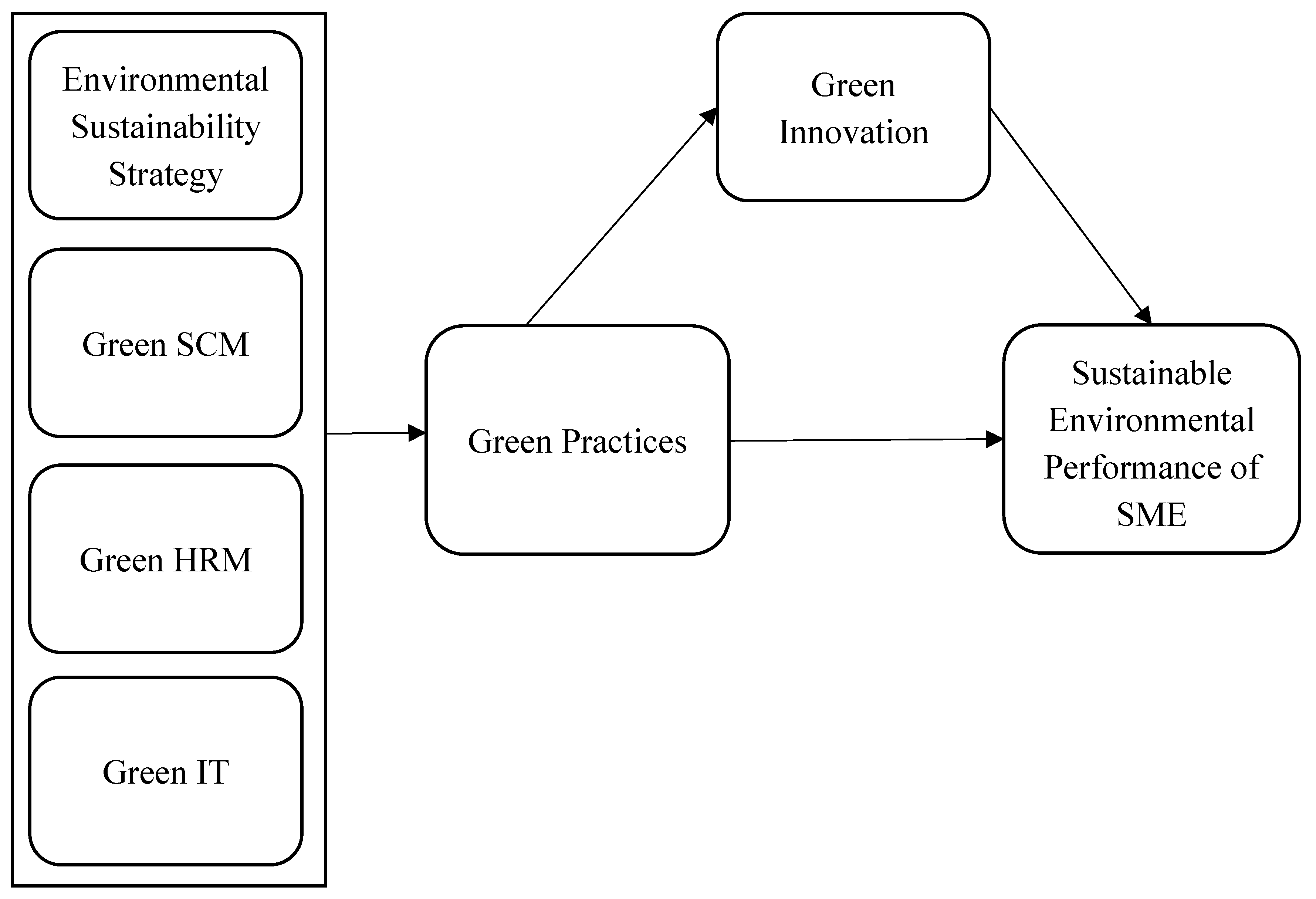
On the basis of the literature review, a positive correlation between green practices (ESS, GSCM, GHRM, GIT) and sustainable environmental performance of SME sector can be expected which is accelerated by the mediating effect of GI. This study develops this following conceptual framework:
Figure 1.
Conceptual Framework (Source(s): Authors’ own work).
4. Research Methodology
4.1. Research Design
With a view to get bias free, credible outcomes from the quantitative study which accumulate essentials of research plan in an organized manner can be stated as research design (Trochim et al., 2017). Research questions, objectives of the study, data collection methods, interpretation of results, expected findings should be aligned with research design. This study will follow quantitative research design.
4.2. Data Sampling
In order to get authentic perception regrading sustainable environmental performance of SME sector in Bangladesh, people associated with different types of SMEs were certainly selected as per study’s sample frame. A well-planned questionnaire was circulated among SMEs of diverse industries (Textiles, Agro firms, Fish hatcheries, Boutiques, Handicrafts, IT firms, Solar panel manufacturers, Medium sized restaurants, Food carts, Travel agencies etc.) for data collection. Questionnaires has been disseminated amid respondents to utilize non-probability purposive sampling technique. Purposive sampling method is used as it entails collecting responses from individuals who are likely to yield the most relevant responses (Campbell et al., 2020). From 403 respondents of SME, responses were obtained. Black and Babin (2019) stated the ten times rule that the minutest sample size needs to be 10 fold of the items for the inquisition of the research. For our study, we harnessed 32 items; so our sample size should not be less than 320. From the SME sector, we managed 403 data that considers adequate grounded on the settled rule which assures a rational analysis of ensuring sustainable environmental performance.
4.3. Measurement Instrument
For executing the research objectives avowed in this study, a multi-item measuring approach was operated to accumulate data for distinct construct. Prior researches treated as a cornerstone for arranging structured survey questionnaire. In those researches, researchers used 5-point Likert scale where they calculated the response from “1= strongly disagree” to “5= strongly agree. In order to evaluate ESS, 5 items were chosen from prior studies (Rehman et al., 2022; Ullah et al., 2022). With a view to evaluating GSCM, 5 items were chosen from prior studies (Umar et al., 2021). Then to evaluate GHRM, 5 items were chosen from prior studies (S. K. Singh et al., 2020; Wen et al., 2021). Additionally, to evaluate GIT, 5 items were chosen from prior studies (Arulrajah & Senthilnathan, 2020). Furthermore, to evaluate the mediating construct, GI, 6 items were chosen from prior studies (Bhat et al., 2024; S. K. Singh et al., 2020). Last of all, to evaluate the outcome construct, sustainable environmental performance, 6 items were chosen from prior studies (Rehman et al., 2022; S. K. Singh et al., 2020; Zaid et al., 2018).
4.4. Data Analysis Techniques
To analyze the data accumulated from the elected entities, the aid of statistical tools: SmartPLS4 and SPSS25 has been taken. In order to transform data into descriptive statistics construction, SPSS has been considered (Hair et al., 2011). PLS-SEM has been used to estimate and analyze the credibility as well as reliability of the hypothesized relationships between independent and dependent variables depicted in conceptual framework. Data analysis part is divided into two steps by following the suggestion of (Anderson & Gerbing,1988). At first, measurement model was conducted to assess the credibility and reliability of constructs. Then the precision of the hypothesis was determined by harnessing a structural model (hypothesis testing) to administer factual evidence either to accept the theory or to generate contradiction.
5. Data Analysis and Results
5.1. Respondent’s Profile
Table 1 summarizes the demographic profile of surveyed respondents and the descriptions used in this research. The table represents that major respondents (47.9%) belong to the age group (25-34). Among the respondents of the study, male respondents (66.5%) are nearly two times higher than female ones (33.5%). From the demographic results it can be seen that most of the respondents have completed their graduation (31%), the second highest educational qualification is post-graduation (26.3%). In this study, major responses have come from job holders (38.5%) who work in different SMEs; service sector of SME (27.8%) has exhibited the second largest response; then third highest response is found from people who are involved in business (24.1%); after that a small amount of response has come from students (with part-time job and business) (9.7%). Out of all respondents, majority of respondents have more than 6 years of working experience (24.8%) in SME sector of Bangladesh.
5.2. Measurement Model for First-Order Constructs
5.2.1. Item Loading, Composite Reliability, and Convergent Validity for First-Order Constructs
Factor loading indicates how strongly each item in the correlation matrix is associated with a specific principal component. Table 2 displays the factor loading, where the loading values are adequate for representing the respective constructs. To establish the construct reliability and convergent validity, several statistical measures were performed, including factor loading, composite reliability (CR), and average variance extract (AVE). Hair et al. (2011) illustrated that an AVE value above 0.50 points to the acceptable level of convergent validity. Since the AVE values for all the measurement constructs used in this study transcend 0.50 threshold, the constructs illustrate sufficient convergent validity (Hair et al., 2019; Henseler et al., 2014). The CR values for the constructs in this study, ranging from 0.818 to 0.862, are well above the baseline of 0.70, as recommended by Hair et al. (2019). This reflects that each latent construct is consistently represented by its corresponding measurement items.
5.2.2. Discriminant Validity for First-Order Constructs
Following the evaluation of the convergent validity and reliability, the discriminant validity of the constructs was assessed. Discriminant validity examines the extent to which the constructs in the study are distinct from one another. To confirm that the latent variables are distinct and free from collinearity, we applied two approaches: the Fornell-Larcker Test and the HTMT ratio.
As shown in Table 3, the square root of AVE (diagonal values) is greater than the inter-construct correlations, suggesting no significant concerns regarding discriminant validity. This verifies that all latent variables are empirically distinct from one another (Fornell & Larcker, 1981).
Additionally, the study executed the HTMT ratio (Table 4), which is regarded as a more comprehensive method for measuring the discriminant validity (Henseler et al., 2014). In order to achieve HTMT values below the recommended threshold 0.90, as suggested by Henseler et al. (2015). Following this adjustment, the HTMT ratios for all measurement variables in the study were found to be below the recommended threshold of 0.90, it can be determined that the constructs demonstrate sufficient discriminant validity.
5.3. Measurement Model for Second-Order Constructs
5.3.1. Composite Reliability and Convergent Validity for Second-Order Constructs
The second order construct, like the first order constructs, satisfies the requirements for convergent validity and reliability. Table 5 reflects that the CR value of 0.890 and AVE of 0.669 both surpass the acceptable thresholds, thereby affirming the construct’s validity is rational.
5.3.2. Discriminant Validity for Second-Order Constructs.
5.4. Explanatory Power of the Model
The R2 value, or the coefficient of determination, expresses the proportion of variance in the endogenous variables that is considered by the exogenous variables in the model. Henseler et al. (2014) stated that R² values of 0.75, 0.50, and 0.25 point to substantial, moderate, and weak levels of predictive power, respectively. In the current study, the model generates an R² value of 0.438 (Table 8), indicating that GP with GI as a mediator, explain 43.8% of the variance in EP. This indicates a moderate level explanatory power of the model.
5.5. Structural Model
5.5.1. Results of Direct Path Analysis
A structural model was developed based on the relationships outlined in the research framework of this study. The relationships between the exogenous and endogenous variables were examined through the path coefficients (β), T statistics, and p values. A bootstrap sample was performed, involving 403 cases and 5000 resamples. The significance of p-value influences whether the authors’ proposed hypotheses are accepted or rejected. The hypotheses were tested at a significant level of p < 0.05. The findings show that all the hypotheses are statistically significant. H1 (GP → EP) exhibit a significant positive relationship between GP and EP, with β = 0.452, t = 5.914, and p < .01. Again, H2 (GI → EP) with β = 0.268, t = 3.356, and p < .01 reveals GI is positively related to EP and the result is statistically significant at p < 0.01 (Table 9).
5.5.2. Results of Indirect Path Analysis
The mediating role of GI was evaluated by analyzing the specific indirect effects within the model. The analysis examined whether GI acts as a mediator in the relationship between GP and EP. The results related to H3 (GP → GI → EP; β = 0.179, t = 3.105, p < .01) substantiate that GI plays a significant mediating role in the relationship between GP and EP. This indicates that GP enhances EP not only through a direct path but also indirectly via its positive impact on GI, which in turn contributes to EP (Table 10).
Figure 2 demonstrates the hypotheses results, indicating the path coefficient and significance level, alongside the explanatory power of the model.
6. Discussion on Findings
Notwithstanding expansive research on the relationship between ESS, GSCM, GHRM, GIT and sustainable environmental performance; there are very few studies have incorporated all the green practices together. Extensive studies on segregated green practices yielded eclectic findings on sustainable environmental performance and missed to encompass a comprehensive outlook. Our findings portray that, the unification of GP is a combined competency and the influence on sustainable environmental performance is more grasped when distinct elements of GP are considered as a single construct. Shah and Ward (2003) stated that a package of resources (rather than a segregated resource) cultivated in a firm can make an organization more dynamic and provide competitive benefits. Intermingling of distinct environmental actions expand more value which surpass the total value acquired from cultivating these actions individually (Al-Sheyadi et al., 2019). This study probes the mechanism that SME sector can thrive sustainable environmental performance through GP. In H1; we can see that, there is a positive correlation between GP and EP (β value= 0.452, p value= 0.000). In some studies, ESS, GSCM, GHRM and GIT separately impacts environmental outcomes positively (Acquah et al., 2020; Lunardi et al., 2015; Rehman et al., 2022). Correspondingly in some other studies, we found that, isolated GP such as GHRM has an insignificant impact on environmental outcome (Niazi et al., 2023). This shows a varied outcome on sustainable environmental performance when isolated elements are counted. But as per our findings; when we consider all the elements as a single construct and amalgamate them in a firm, GP positively impact sustainable environmental performance and create more holistic view. As per our findings; if a firm prefers interconnection of all the environmental actions, they can attain robust advantages which may steer them to economic success as well as environmental sustainability. Besides that, it will encourage lessening of waste and efficient use of the resources which directly aligns with the SDG 12.
Regarding H2, GI favorably impacts EP (β value= 0.268, p value= 0.001). GI statistically impacts environmental performance significantly (Awwad Al-Shammari et al.,2022; Hussain et al.,2022). Today’s customers lean towards those businesses which promote sustainability. Nonetheless, businesses which concentrate on GI can secure environmental performance for the long period and motivate customers (Yousaf, 2021). If GI gets encouraged; industry will be facilitated by technological enhancement and environmental infrastructure which aligns with SDG 9.
The study also ascertains that GI can be a vital mediator between GP and EP. According to H3, it can be stated that GI positively mediates the relation between GP and EP(β value = 0.179, p value = 0.002). This result is corresponding to previous result whereas GI works as a perfect mediator between GSCM, GHRM and environmental performance (Aftab et al., 2023; N. U. Khan et al., 2021). Green practices with the mediation of GI can downsize emissions like depleting carbon footprint which correspond to climate action mollification (SDG 13).
Integrating all the elements together, GP can play a pivotal role in adapting EP in the firms (Table 11).
7. Implications and Conclusions
7.1. Practical Implications
This study highlights incorporating green practices for long term success of organizations. Embracing green practices such as ESS, GSCM, GHRM, GIT; an organization can be more efficient in attaining sustainability. According to our research, assimilating ESS to organizational objectives can enrich firm’s performance significantly. Thereafter, if SMEs want to do the part for environment, they can adopt GSCM practices such as environmental packaging, reducing use of hazardous materials etc.
Additionally, firms can assimilate GHRM practices and policies to the green practices to attain operational efficacy (Acquah et al., 2020). Also our findings from the research denotes that, employee’s satisfaction and motivation are prominent to secure environmental success.
Furthermore, employees must be conscious of green technologies and services. The higher the firm modernizes their effort and search out green services, the higher GIT gets executed in the firm (Lunardi et al., 2015). In addition, a GI-based strategy can significantly increase sustainable environmental performance (Awwad Al-Shammari et al., 2022). Our finding denotes that, integration of GI as a mediator positively ameliorates sustainable environmental performance by linking green practices. This holistic approach can boost environmental sustainability, economic success and employee productivity of firms.
7.2. Policy Implications
The authority should make policies to accomplish organizational objectives. Thus the policies should be made by policy makers like this way; how they can lessen waste, deplete pollution etc. Adopting these policies will help to enrich the reputation of the firm. Government should take steps to assure environmental performance in the SMEs for long-term. The study’s excellent result inspire researchers, organizations, and the government to analyze sustainable environmental performance using green practices and green innovation.
7.3. Conclusions
From our study, the correlation between green practices and sustainable environmental performance is very strong and green innovation positively mediates the relation between them. The established four theories explain how green practices enhance environmental outcomes and how green innovation acts as a mediator. The study encourages that SMEs of our country should engage themselves in green practices and should take green innovation in their strategy. By adopting multifaceted green strategies which include all these elements, SME sector of Bangladesh may be capable of building more vigorous and more eco-friendly stand for success which will elevate global market attraction and also local business credibility.
8. Limitations and Future Research Directions
Despite the contribution and implications, this study contains some limitation which can be completed in future studies. Firstly, it wasn’t possible to cover all the SMEs as the sector is so large. Future researchers can acquire data from other industries rather than SMEs and compare diversity. Also this research didn’t ascribe other probable mediators such as green capability. Researchers will be facilitated by more knowledge of the interrelated nature of the green practices and sustainability performance and firms will get benefit to become more environmentally aware.
Appendix A

Table A1.
Measurement Items.
| Items | Constructs and Questionnaires |
|---|---|
| Environmental Sustainability Strategy (Rehman et al., 2022; Ullah et al., 2022) | |
| ESS1 | Our business should integrate environmental issues into strategic planning process. |
| ESS2 | Our business believes quality which includes reducing the environmental impact of products and processes. |
| ESS3 | Sustainability is an integral part of our business plans and operations. |
| ESS4 | Our business is knowledgeable about climate change. |
| ESS5 | Our commitment to environment will allow us to gain more customers. |
| Green Supply Chain Management (Umar et al., 2021) | |
| GSCM1 | Our business should ensure suppliers meet their environmental objectives. |
| GSCM2 | Suppliers should require utilizing environmental packaging, i.e., degradable and harmless. |
| GSCM3 | Suppliers should design their products that lessens the utilization of materials or energy. |
| GSCM4 | I believe, decreasing toxic and hazardous chemicals in manufacturing process is important. |
| GSCM5 | Our business should encourage cross-function cooperation for environmental improvement. |
| Green Human Resource Management (S. K. Singh et al., 2020; Wen et al., 2021) | |
| GHRM1 | Job positions of our business should demand employees who have knowledge about environmental management. |
| GHRM2 | Our business would love to hire employees who have environmental knowledge. |
| GHRM3 | Company should set green goals for employees. |
| GHRM4 | Training should be provided to promote green values, knowledge and skills to improve understanding of environmental protection. |
| GHRM5 | Employee should get reward for acquiring specific environmental competencies. |
| Green IT (Arulrajah & Senthilnathan, 2020) | |
| GIT1 | Our business uses paperless systems (e.g: digital invoices) which reduce waste and cost. |
| GIT2 | Our business should use energy efficient computers and devices for lower power consumption. |
| GIT3 | I believe E-waste should be recycled to reduce environmental pressure. |
| GIT4 | I believe IT systems improve service efficiency, reducing physical resource usage. |
| GIT5 | Our business should use energy-efficient networks as there is high efficiency in energy utilization. |
| Green Innovation (Bhat et al., 2024; S. K. Singh et al., 2020) | |
| GI1 | The company should select environment friendly materials that produce a lower amount of pollution and consume low energy. |
| GI2 | I believe our company should invest more in R&D to produce quality eco-friendly products. |
| GI3 | Our company’s manufacturing process should effectively reduce hazardous substance or waste. |
| GI4 | The company’s production process should be operationalized to reduce emissions and the negative effects on ecology. |
| GI5 | The manufacturing process of the company should reduce the consumption of water, electricity, coal or oil. |
| GI6 | Our business should recycle their waste before discharging it. |
| Sustainable environmental performance (Rehman et al., 2022; S. K. Singh et al., 2020; Zaid et al., 2018) | |
| EP1 | Our business should minimize its consumption of resources (raw materials, water, and energy). |
| EP2 | Our business believes in protecting biodiversity and protected areas. |
| EP3 | Our business should encourage lower discharge of noxious chemicals into the air and water. |
| EP4 | Our business should minimize residual materials. |
| EP5 | I believe environmental activities can significantly reduce overall costs of the business. |
| EP6 | I believe sustainable environmental performance will improve reputation of my company. |
References
- Abu Seman, N. A., Govindan, K., Mardani, A., Zakuan, N., Mat Saman, M. Z., Hooker, R. E., & Ozkul, S. (2019). The mediating effect of green innovation on the relationship between green supply chain management and environmental performance. Journal of Cleaner Production, 229, 115–127. [CrossRef]
- Acquah, I. S. K., Agyabeng-Mensah, Y., & Afum, E. (2020). Examining the link among green human resource management practices, green supply chain management practices and performance. Benchmarking: An International Journal, 28(1), 267–290. [CrossRef]
- Afridi, S. A., Afsar, B., Shahjehan, A., Khan, W., Rehman, Z. U., & Khan, M. A. S. (2023). Impact of corporate social responsibility attributions on employee’s extra-role behaviors: Moderating role of ethical corporate identity and interpersonal trust. Corporate Social Responsibility and Environmental Management, 30(2), 991–1004. [CrossRef]
- Aftab, J., Abid, N., Cucari, N., & Savastano, M. (2023). Green human resource management and environmental performance: The role of green innovation and environmental strategy in a developing country. Business Strategy and the Environment, 32(4), 1782–1798. [CrossRef]
- Ahmad, F., Hossain, M. B., Mustafa, K., Ejaz, F., Khawaja, K. F., & Dunay, A. (2023). Green HRM Practices and Knowledge Sharing Improve Environmental Performance by Raising Employee Commitment to the Environment. Sustainability, 15(6), Article 6. [CrossRef]
- Al Doghan, M. A., Abdelwahed, N. A. A., Soomro, B. A., & Ali Alayis, M. M. H. (2022). Organizational Environmental Culture, Environmental Sustainability and Performance: The Mediating Role of Green HRM and Green Innovation. Sustainability, 14(12), Article 12. [CrossRef]
- Albino, V., Balice, A., & Dangelico, R. M. (2009). Environmental strategies and green product development: An overview on sustainability-driven companies. Business Strategy and the Environment, 18(2), 83–96. [CrossRef]
- Ali, S. R., Al masud, A., Hossain, Md. A., Islam, K. M. Z., & Shafiul Alam, S. M. (2024). Weaving a greener future: The impact of green human resources management and green supply chain management on sustainable performance in Bangladesh’s textile industry. Cleaner Logistics and Supply Chain, 10, 100143. [CrossRef]
- Al-Sheyadi, A.; Muyldermans, L.; Kauppi, K. The complementarity of green supply chain management practices and the impact on environmental performance. Journal of Environmental Management 2019, 242, 186–198. [Google Scholar] [CrossRef] [PubMed]
- Anderson, J. C.; Gerbing, D. W. Structural equation modeling in practice: A review and recommended two-step approach. Psychological Bulletin 1988, 103, 411–423. [Google Scholar] [CrossRef]
- Appelbaum, E. (2000). Manufacturing Advantage: Why High-performance Work Systems Pay Off. Cornell University Press.
- Arulrajah, A., & Senthilnathan, S. (2020). Green Information Technology and Environmental Performance of the Banks (SSRN Scholarly Paper No. 3660157). Social Science Research Network. [CrossRef]
- Awwad Al-Shammari, A. S., Alshammrei, S., Nawaz, N., & Tayyab, M. (2022). Green Human Resource Management and Sustainable Performance With the Mediating Role of Green Innovation: A Perspective of New Technological Era. Frontiers in Environmental Science, 10. [CrossRef]
- Barney, J. (1991). Firm Resources and Sustained Competitive Advantage—Jay Barney, 1991. https://journals.sagepub.com/doi/abs/10.1177/014920639101700108.
- Beck, L.; Ajzen, I. Predicting dishonest actions using the theory of planned behavior. Journal of Research in Personality 1991, 25, 285–301. [Google Scholar] [CrossRef]
- Bhat, A. A., Mir, A. A., Allie, A. H., Ahmad Lone, M., Al-Adwan, A. S., Jamali, D., & Riyaz, I. (2024). Unlocking corporate social responsibility and environmental performance: Mediating role of green strategy, innovation, and leadership. Innovation and Green Development, 3(2), 100112. [CrossRef]
- Black, W., & Babin, B. J. (2019). Multivariate Data Analysis: Its Approach, Evolution, and Impact. In B. J. Babin & M. Sarstedt (Eds.), The Great Facilitator: Reflections on the Contributions of Joseph F. Hair, Jr. To Marketing and Business Research (pp. 121–130). Springer International Publishing. [CrossRef]
- Brooks, S., Wang, X., & Sarker, S. (2012). Unpacking Green IS: A Review of the Existing Literature and Directions for the Future. In J. vom Brocke, S. Seidel, & J. Recker (Eds.), Green Business Process Management: Towards the Sustainable Enterprise (pp. 15–37). Springer. [CrossRef]
- Campbell, S., Greenwood, M., Prior, S., Shearer, T., Walkem, K., Young, S., Bywaters, D., & Walker, K. (2020). Purposive sampling: Complex or simple? Research case examples. Journal of Research in Nursing, 25(8), 652–661. [CrossRef]
- Chen, Y.-S., Lai, S.-B., & Wen, C.-T. (2006). The Influence of Green Innovation Performance on Corporate Advantage in Taiwan. Journal of Business Ethics, 67(4), 331–339. [CrossRef]
- Christmann, P. (2000). Effects of “Best Practices” of Environmental Management on Cost Advantage: The Role of Complementary Assets. Academy of Management Journal, 43(4), 663–680. [CrossRef]
- CIPE. (2022). Small and Medium Enterprises in Bangladesh: An Assessment Report. Center for International Private Enterprise. https://www.cipe.org/resources/small-and-medium-enterprises-in-bangladesh-an-assessment-report/.
- Dahmani, S. (2024). Computational Intelligence for Green Cloud Computing and Digital Waste Management. In Computational Intelligence for Green Cloud Computing and Digital Waste Management (pp. 248–266). IGI Global Scientific Publishing. [CrossRef]
- Datta, R. K. (2024). Bangladesh towards green growth: A review of environmental sustainability indicators. Journal of Environmental Science and Economics, 3(2), 17–40. [CrossRef]
- EPI. (2024, November 8). About the EPI. Environmental Performance Index. https://epi.yale.edu/about-epi.
- Farzana, K. (2020). Green HRM: Sustainable Practices to Promote Employment. [CrossRef]
- Fawcett, T., & Hampton, S. (2020). Why & how energy efficiency policy should address SMEs. Energy Policy, 140, 111337. [CrossRef]
- Fornell, C.; Larcker, D. F. Evaluating Structural Equation Models with Unobservable Variables and Measurement Error. Journal of Marketing Research 1981, 18, 39–50. [Google Scholar] [CrossRef]
- Gimenez, C., Sierra, V., Rodon, J., & Rodriguez, J. A. (2015). The role of information technology in the environmental performance of the firm: The interaction effect between information technology and environmental practices on environmental performance. Academia Revista Latinoamericana de Administración, 28(2), 273–291. [CrossRef]
- Good, J., Singh, P., & Ezzedeen, S. (2023). Environmental Sustainability Strategy, Creativity, Innovation and Organizational Performance: The Role of Green Human Resource Management. American Business Review, 26(2). [CrossRef]
- Govindan, K., Khodaverdi, R., & Vafadarnikjoo, A. (2015). Intuitionistic fuzzy based DEMATEL method for developing green practices and performances in a green supply chain. Expert Systems with Applications, 42(20), 7207–7220. [CrossRef]
- Hair, J. F., Ringle ,Christian M., & and Sarstedt, M. (2011). PLS-SEM: Indeed a Silver Bullet. Journal of Marketing Theory and Practice, 19(2), 139–152. [CrossRef]
- Hair, J. F., Risher, J. J., Sarstedt, M., & Ringle, C. M. (2019). When to use and how to report the results of PLS-SEM. European Business Review, 31(1), 2–24. [CrossRef]
- Hameed, Z., Naeem, R. M., Misra, P., Chotia, V., & Malibari, A. (2023). Ethical leadership and environmental performance: The role of green IT capital, green technology innovation, and technological orientation. Technological Forecasting and Social Change, 194, 122739. [CrossRef]
- Hasan, M. N., Anastasiadis, S., & Spence, L. J. (2021). Polluting SMEs and the construction of their environmental behaviours: Evidence from Bangladesh. Business Strategy & Development, 4(2), 109–122. [CrossRef]
- Henseler, J., Dijkstra, T. K., Sarstedt, M., Ringle, C. M., Diamantopoulos, A., Straub, D. W., KetchenJr., D. J., Hair, J. F., Hult, G. T. M., & Calantone, R. J. (2014). Common Beliefs and Reality About PLS: Comments on Rönkkö and Evermann (2013). Organizational Research Methods, 17(2), 182–209. [CrossRef]
- Henseler, J., Ringle, C. M., & Sarstedt, M. (2015). A new criterion for assessing discriminant validity in variance-based structural equation modeling. Journal of the Academy of Marketing Science, 43(1), 115–135. [CrossRef]
- Hussain, Y., Abbass, K., Usman, M., Rehan, M., & Asif, M. (2022). Exploring the mediating role of environmental strategy, green innovations, and transformational leadership: The impact of corporate social responsibility on environmental performance. Environmental Science and Pollution Research, 29(51), 76864–76880. [CrossRef]
- Khan, N. U., Anwar, M., Li, S., & Khattak, M. S. (2021). Intellectual capital, financial resources, and green supply chain management as predictors of financial and environmental performance. Environmental Science and Pollution Research, 28(16), 19755–19767. [CrossRef]
- Khan, S. A. R., Ahmad, Z., Sheikh, A. A., & Yu, Z. (2023). Green technology adoption paving the way toward sustainable performance in circular economy: A case of Pakistani small and medium enterprises. International Journal of Innovation Science, 16(5), 801–822. [CrossRef]
- Khoury, R. E., Nasrallah, N., Atayah, O. F., Dhiaf, M. M., & Frederico, G. F. (2022). The impact of green supply chain management practices on environmental performance during COVID-19 period: The case of discretionary companies in the G-20 countries. Benchmarking: An International Journal, 30(6), 2139–2165. [CrossRef]
- Kuo, Y.-K., Khan, T. I., Islam, S. U., Abdullah, F. Z., Pradana, M., & Kaewsaeng-on, R. (2022). Impact of Green HRM Practices on Environmental Performance: The Mediating Role of Green Innovation. Frontiers in Psychology, 13. [CrossRef]
- Le and Govindan. (2024). Boosting green innovation on corporate performance: Managerial environmental concern’s moderating role—Le—2024—Business Strategy and the Environment—Wiley Online Library. https://onlinelibrary.wiley.com/doi/full/10.1002/bse.3795.
- Leidner, S., Baden, D., & Ashleigh, M. J. (2019). Green (environmental) HRM: Aligning ideals with appropriate practices. Personnel Review, 48(5), 1169–1185. [CrossRef]
- Lunardi, G. L., Dolci, D. B., Salles, A. C., & Alves, A. P. F. (2015). Green IT: an Empirical Study regarding Organizational Actions and Impacts on Environmental Performance. http://aisel.aisnet.org/confirm2015/35.
- Lutfi et al. (2023). Green Environmental Management System to Support Environmental Performance: What Factors Influence SMEs to Adopt Green Innovations? https://www.mdpi.com/2071-1050/15/13/10645.
- Mallawarachchi, H., & Karunasena, G. (2012). Electronic and electrical waste management in Sri Lanka: Suggestions for national policy enhancements. Resources, Conservation and Recycling, 68, 44–53. [CrossRef]
- Miroshnychenko, I., Barontini, R., & Testa, F. (2017). Green practices and financial performance: A global outlook. Journal of Cleaner Production, 147, 340–351. [CrossRef]
- Molla, A., Cooper, V., & Pittayachawan, S. (2011). The Green IT Readiness (G-Readiness) of Organizations: An Exploratory Analysis of a Construct and Instrument. Communications of the Association for Information Systems, 29(1). [CrossRef]
- Murugesan, S. (2008). Harnessing Green IT: Principles and Practices. IT Professional, 10(1), 24–33. [CrossRef]
- Niazi, U. I., Nisar, Q. A., Nasir, N., Naz, S., Haider, S., & Khan, W. (2023). Green HRM, green innovation and environmental performance: The role of green transformational leadership and green corporate social responsibility. Environmental Science and Pollution Research, 30(15), 45353–45368. [CrossRef]
- Nijhof, A., Schaveling, J., & Zalesky, N. (2019). Business, society, and the need for stewardship orientation. Journal of Organizational Change Management, 32(1), 145–163. [CrossRef]
- Nisar, Q. A., Haider ,Shahbaz, Ali ,Faizan, Gill ,Sonaina Saif, & and Waqas, A. (2024). The Role of Green HRM on Environmental Performance of Hotels: Mediating Effect of Green Self-Efficacy & Employee Green Behaviors. Journal of Quality Assurance in Hospitality & Tourism, 25(1), 85–118. [CrossRef]
- Ojo, A. O., & Fauzi, M. A. (2020). Environmental awareness and leadership commitment as determinants of IT professionals engagement in Green IT practices for environmental performance. Sustainable Production and Consumption, 24, 298–307. [CrossRef]
- Owusu, E. A., Zhou, L., Kwasi Sampene, A., Sarpong, F. A., & Arboh, F. (2024). Fostering Environmental Performance Via Corporate Social Responsibility and Green Innovation Initiatives: Examining the Moderating Influence of Competitive Advantage. SAGE Open, 14(2), 21582440241242847. [CrossRef]
- Perez, J. A. E., Ejaz, F., & Ejaz, S. (2023). Green Transformational Leadership, GHRM, and Proenvironmental Behavior: An Effectual Drive to Environmental Performances of Small- and Medium-Sized Enterprises. Sustainability, 15(5), Article 5. [CrossRef]
- Polas, M. R. H., Kabir, A. I., Jahanshahi, A. A., Sohel-Uz-Zaman, A. S. Md., Karim, R., & Tabash, M. I. (2023). Rural entrepreneurs behaviors towards green innovation: Empirical evidence from Bangladesh. Journal of Open Innovation: Technology, Market, and Complexity, 9(1), 100020. [CrossRef]
- Qamruzzaman, Md., & Kler, R. (2023). Do Clean Energy and Financial Innovation Induce SME Performance? Clarifying the Nexus between Financial Innovation, Technological Innovation, Clean Energy, Environmental Degradation, and SMEs Performance in Bangladesh. International Journal of Energy Economics and Policy, 13(3), 313–324. [CrossRef]
- Rehman, S. U., Bresciani, S., Yahiaoui, D., & Giacosa, E. (2022). Environmental sustainability orientation and corporate social responsibility influence on environmental performance of small and medium enterprises: The mediating effect of green capability. Corporate Social Responsibility and Environmental Management, 29(6), 1954–1967. [CrossRef]
- Renwick, D. W. S., Redman, T., & Maguire, S. (2013). Green Human Resource Management: A Review and Research Agenda. International Journal of Management Reviews, 15(1), 1–14. [CrossRef]
- Sahoo, S., & Vijayvargy, L. (2020). Green supply chain management practices and its impact on organizational performance: Evidence from Indian manufacturers. Journal of Manufacturing Technology Management, 32(4), 862–886. [CrossRef]
- Shah, R., & Ward, P. T. (2003). Lean manufacturing: Context, practice bundles, and performance. Journal of Operations Management, 21(2), 129–149. [CrossRef]
- Shahzad, M., Qu, Y., Javed, S. A., Zafar, A. U., & Rehman, S. U. (2020). Relation of environment sustainability to CSR and green innovation: A case of Pakistani manufacturing industry. Journal of Cleaner Production, 253, 119938. [CrossRef]
- Singh, P. J., Mittal, V. K., & Sangwan, K. S. (2013). Development and validation of performance measures for environmentally conscious manufacturing. International Journal of Services and Operations Management. https://www.inderscienceonline.com/doi/10.1504/IJSOM.2013.051829.
- Singh, S. K., Giudice, M. D., Chierici, R., & Graziano, D. (2020). Green innovation and environmental performance: The role of green transformational leadership and green human resource management. Technological Forecasting and Social Change, 150, 119762. [CrossRef]
- Tan, K., Siddik, A. B., Sobhani, F. A., Hamayun, M., & Masukujjaman, M. (2022). Do Environmental Strategy and Awareness Improve Firms’ Environmental and Financial Performance? The Role of Competitive Advantage. Sustainability, 14(17), Article 17. [CrossRef]
- Trochim et al. (2017). The Evaluation of Large Research Initiatives—William M. Trochim, Stephen E. Marcus, Louise C. Mâsse, Richard P. Moser, Patrick C. Weld, 2008. https://journals.sagepub.com/doi/abs/10.1177/1098214007309280.
- Udoh, I., Ukere, I., & Ekpenyong, A. (2023). Environment and Growth Sustainability: An Empirical Analysis of Extended Solow Growth Model. Journal of Environmental Science and Economics, 2(2), 7–17. [CrossRef]
- Ullah, S., Mehmood, T., & Ahmad, T. (2022). Green intellectual capital and green HRM enabling organizations go green: Mediating role of green innovation. International Journal of Innovation Science, 15(2), 245–259. [CrossRef]
- Umar, M., Khan, S. A. R., Yusliza, M. Y., Ali, S., & Yu, Z. (2021). Industry 4.0 and green supply chain practices: An empirical study. International Journal of Productivity and Performance Management, 71(3), 814–832. [CrossRef]
- Walsh, P. R., & Dodds, R. (2017). Measuring the Choice of Environmental Sustainability Strategies in Creating a Competitive Advantage. Business Strategy and the Environment, 26(5), 672–687. [CrossRef]
- Wang, X., & Bian, W. (2022). Analyzing the Role of Corporate Social Responsibility for Sustainable Environmental Performance: Mediating Roles of Environmental Strategy and Environmental Outcomes. Frontiers in Psychology, 13. [CrossRef]
- Wen, J., Hussain, H., Waheed, J., Ali, W., & Jamil, I. (2021). Pathway toward environmental sustainability: Mediating role of corporate social responsibility in green human resource management practices in small and medium enterprises. International Journal of Manpower, 43(3), 701–718. [CrossRef]
- Yoshino, N., Taghizadeh-Hesary ,Farhad, Charoensivakorn ,Phadet, & and Niraula, B. (2016). Small and Medium-Sized Enterprise (SME) Credit Risk Analysis Using Bank Lending Data: An Analysis of Thai SMEs. Journal of Comparative Asian Development, 15(3), 383–406. [CrossRef]
- Younis, H., Sundarakani, B., & Vel, P. (2016). The impact of implementing green supply chain management practices on corporate performance. Competitiveness Review, 26(3), 216–245. [CrossRef]
- Yousaf, Z. (2021). Go for green: Green innovation through green dynamic capabilities: accessing the mediating role of green practices and green value co-creation. Environmental Science and Pollution Research, 28(39), 54863–54875. [CrossRef]
- Zaid, A. A., Jaaron, A. A. M., & Talib Bon, A. (2018). The impact of green human resource management and green supply chain management practices on sustainable performance: An empirical study. Journal of Cleaner Production, 204, 965–979. [CrossRef]
- Zheng et al. (2021). Factors Affecting the Sustainability Performance of Financial Institutions in Bangladesh: The Role of Green Finance. https://www.mdpi.com/2071-1050/13/18/10165.
- Zhixia, C., Hossen, Md. M., Muzafary, S. S., & Begum, M. (2018). Green Banking for Environmental Sustainability-Present Status and Future Agenda: Experience from Bangladesh. Asian Economic and Financial Review, 8(5), 571–585. [CrossRef]
Figure 2.
Results of path coefficient with p-value (Source(s): Authors’ own work).
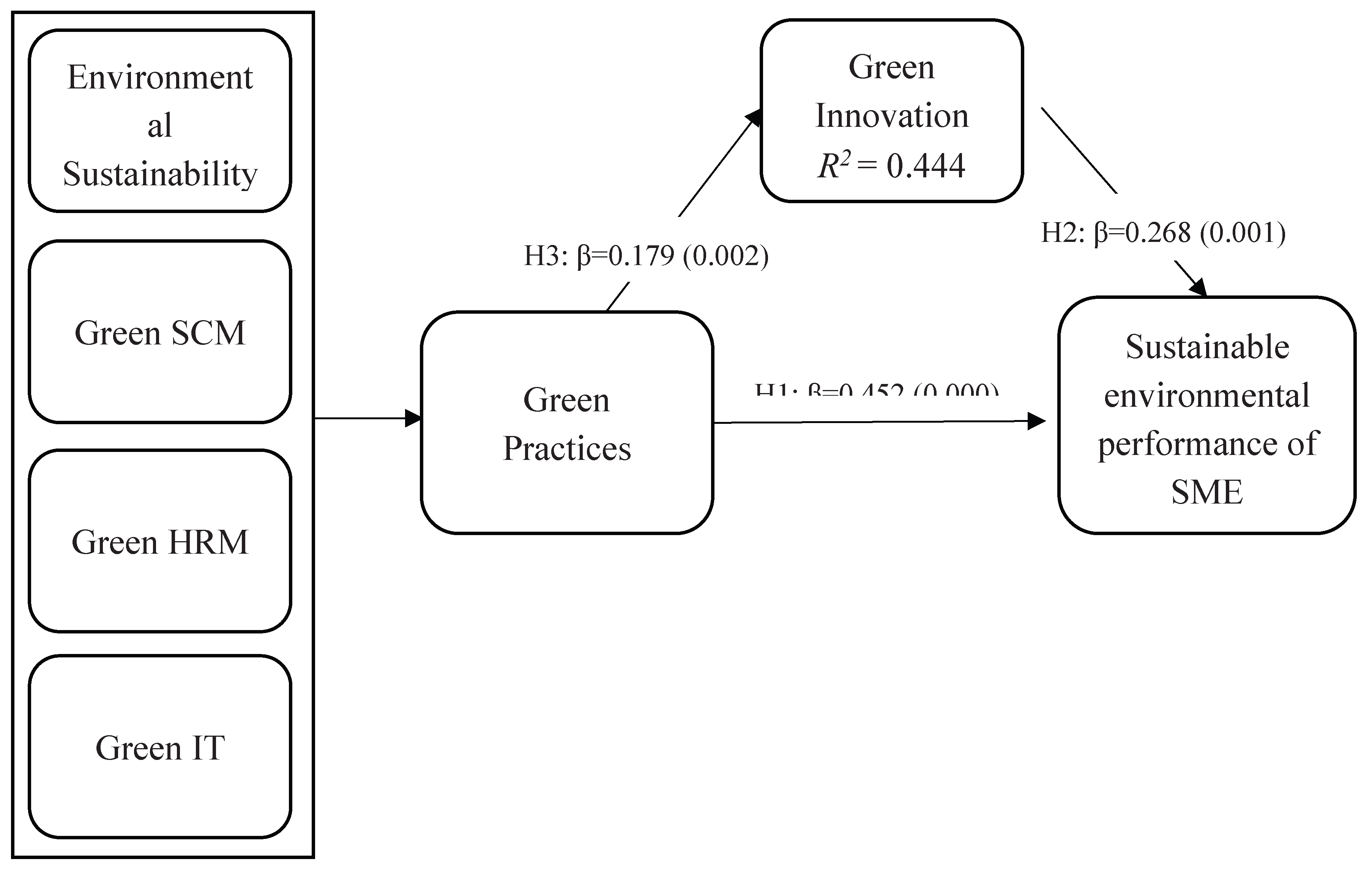
Table 1.
Demographic Profile of the Respondents.
| Demographic Variable | Category | Frequency (n=403) | Percent (%) |
| Age | 18–24 | 78 | 19.4 |
| 25–34 | 193 | 47.9 | |
| 35–44 | 64 | 15.9 | |
| 45–54 | 40 | 9.9 | |
| 55 and above | 28 | 6.9 | |
| Gender | Female | 135 | 33.5 |
| Male | 268 | 66.5 | |
| Education | SSC | 20 | 5.0 |
| HSC | 25 | 6.2 | |
| Diploma | 49 | 12.2 | |
| Graduation | 125 | 31.0 | |
| Graduation with Professional Degree | 38 | 9.4 | |
| Post-Graduation | 106 | 26.3 | |
| Post-Graduation with Professional Degree | 40 | 9.9 | |
| Occupational Status | Business | 97 | 24.1 |
| Job Holder | 155 | 38.5 | |
| Service Sector of SME | 112 | 27.8 | |
| Student (with part-time job/business) | 39 | 9.7 | |
| Years of Experience | Less than 1 year | 63 | 15.6 |
| 1–2 years | 85 | 21.1 | |
| 2–3 years | 68 | 16.9 | |
| 3–4 years | 33 | 8.2 | |
| 4–5 years | 28 | 6.9 | |
| 5–6 years | 26 | 6.5 | |
| More than 6 years | 100 | 24.8 |
Source(s): Authors’ own work.
Table 2.
Item Loading Value, Composite Reliability, and Convergent Validity of First-Order Constructs.
Table 2.
Item Loading Value, Composite Reliability, and Convergent Validity of First-Order Constructs.
| Constructs | Items | Loading Value | CR | AVE |
| Environmental Sustainability Strategy | ESS1 | 0.789 | 0.862 | 0.610 |
| ESS2 | 0.759 | |||
| ESS3 | 0.822 | |||
| ESS5 | 0.753 | |||
| Green SCM | GSCM1 | 0.753 | 0.830 | 0.550 |
| GSCM2 | 0.716 | |||
| GSCM3 | 0.764 | |||
| GSCM5 | 0.732 | |||
| Green HRM | GHRM1 | 0.721 | 0.818 | 0.601 |
| GHRM2 | 0.827 | |||
| GHRM4 | 0.775 | |||
| Green IT | GIT3 | 0.756 | 0.828 | 0.617 |
| GIT4 | 0.800 | |||
| GIT5 | 0.800 | |||
| Green Innovation | GI1 | 0.751 | 0.856 | 0.597 |
| GI2 | 0.760 | |||
| GI3 | 0.815 | |||
| GI4 | 0.763 | |||
| Sustainable environmental performance of SME |
EP2 | 0.769 | 0.853 | 0.592 |
| EP3 | 0.799 | |||
| EP4 | 0.771 | |||
| EP6 | 0.737 |
Source(s): Authors’ own work.
Table 3.
Fornell and Larcker Test for First-Order Constructs.
| ESS | GSCM | GHRM | GIT | GI | EP | |
| ESS | 0.781 | |||||
| GSCM | 0.585 | 0.741 | ||||
| GHRM | 0.505 | 0.605 | 0.775 | |||
| GIT | 0.548 | 0.549 | 0.559 | 0.785 | ||
| GI | 0.540 | 0.555 | 0.537 | 0.547 | 0.773 | |
| EP | 0.559 | 0.486 | 0.466 | 0.547 | 0.570 | 0.769 |
Source(s): Authors’ own work.
Table 4.
Heterotrait-monotrait (HTMT) Ratio for First-Order Constructs.
| ESS | GSCM | GHRM | GIT | GI | EP | |
| ESS | ||||||
| GSCM | 0.774 | |||||
| GHRM | 0.695 | 0.871 | ||||
| GIT | 0.745 | 0.776 | 0.819 | |||
| GI | 0.686 | 0.738 | 0.740 | 0.746 | ||
| EP | 0.710 | 0.645 | 0.641 | 0.743 | 0.725 |
Source(s): Authors’ own work.
Table 5.
Composite Reliability and Convergent Validity of Second-Order Constructs.
| Constructs | Loading Value | CR | AVE | |
| GP | ESS | 0.823 | 0.890 | 0.669 |
| GSCM | 0.808 | |||
| GHRM | 0.816 | |||
| GIT | 0.836 |
Source(s): Authors’ own work.
Table 6.
Fornell-Larcker Test of Second-Order Constructs.
| GP | GI | EP | |
| GP | 0.818 | ||
| GI | 0.666 | 0.773 | |
| EP | 0.631 | 0.569 | 0.770 |
Source(s): Authors’ own work.
Table 7.
Heterotrait-monotrait (HTMT) Ratio of Second-Order Constructs.
| GP | GI | EP | |
| GP | |||
| GI | 0.826 | ||
| EP | 0.778 | 0.725 |
Source(s): Authors’ own work.
Table 8.
Results of R2.
| R-square | R-square adjusted | |
| EP | 0.438 | 0.435 |
| GI | 0.444 | 0.443 |
Source(s): Authors’ own work.
Table 9.
Results of direct path analysis.
| Hypotheses | Path | Β | STDEV | T statistics | p values | Results |
| H1 | GP → EP | 0.452 | 0.076 | 5.914 | 0.000 | Supported |
| H2 | GI → EP | 0.268 | 0.080 | 3.356 | 0.001 | Supported |
Source(s): Authors’ own work.
Table 10.
Results of specific indirect effect.
| Hypothesis | Path | Β | STDEV | T statistics | P values | Result |
| H3 | GP → GI → EP | 0.179 | 0.058 | 3.105 | 0.002 | Supported |
Source(s): Authors’ own work.
Table 11.
Summary of Hypothesis Outcomes and Behavioral Implications.
| Construct | Direct Effect on EP | Mediated via GI | Implications |
|---|---|---|---|
| Green practices | ✔ Significant | ✔ Significant | Incorporating all the elements (ESS, GSCM, GHRM, GIT) together in firms propel EP forthrightly |
| Green Innovation | ✔Significant | - | Performs as it correlates between GP and EP |
Source(s): Authors’ own work.
Disclaimer/Publisher’s Note: The statements, opinions and data contained in all publications are solely those of the individual author(s) and contributor(s) and not of MDPI and/or the editor(s). MDPI and/or the editor(s) disclaim responsibility for any injury to people or property resulting from any ideas, methods, instructions or products referred to in the content. |
© 2025 by the authors. Licensee MDPI, Basel, Switzerland. This article is an open access article distributed under the terms and conditions of the Creative Commons Attribution (CC BY) license (http://creativecommons.org/licenses/by/4.0/).
Copyright: This open access article is published under a Creative Commons CC BY 4.0 license, which permit the free download, distribution, and reuse, provided that the author and preprint are cited in any reuse.


