
Submitted:
12 November 2025
Posted:
13 November 2025
You are already at the latest version
Abstract
Cells are not merely passive vessels of genetic information; they actively respond to stimuli, record experiences, and adapt their behavior. This dynamic nature suggests a form of "cellular memory" that goes beyond static DNA encoding. While the exact mechanisms remain elusive, this paper proposes a novel hypothesis, integrating concepts from epigenetics, quantum biology, and Jungian psychology to propose that cellular memory is stored in a distributed, quantum-entangled network akin to a blockchain. This "quantum blockchain" allows for the secure recording and inheritance of cellular memory, which can be an integrated form of not only past and current information, but also individual cell and collective memories. If cellular memory exists in a quantum state, it can be in a form where all information is integrated as one, without the constraints of spacetime proposing "Spatiotemporal Oneness Hypothesis." This oneness information is preserved in a form of quantum blockchain for the unconscious memory within our bodies and can be accessed through conscious observation when the quantum state collapses.
Keywords:
spatiotemporal
; oneness
; epigenetic
; cellular memory
; blockchain
; quantum entanglement
; superposition
; collective unconscious
1. Introduction
The traditional view of cellular memory focuses on epigenetic modifications, such as DNA methylation and histone alterations, as the primary mechanism for encoding past experiences. However, this model faces limitations in explaining the vast complexity and potential transgenerational inheritance of cellular memory: (1) Storage Capacity: The sheer volume of information potentially encompassed by cellular memory-a lifetime of environmental interactions, developmental cues, and stress responses-may exceed the capacity of known epigenetic mechanisms.(2) Inheritance: While some epigenetic marks are heritable, the mechanisms for transgenerational transmission are not fully understood, and the fidelity of inheritance over many generations is questionable. (3) Dynamic Nature: Cellular memory is not static; it involves ongoing adaptation and re-evaluation of past experiences. Classical epigenetic models struggle to capture this dynamic aspect of chromatin reorganization and gene expression plasticity. Recent studies further demonstrate that epigenetic regulation can vary significantly at the single-cell level, highlighting the need for models that account for such stochastic dynamics. [1,2,3,4,5,6,7,8,9,10,11]
Recent advances in quantum biology suggest that quantum phenomena like superposition and entanglement may play crucial roles in biological systems. This raises the intriguing possibility that cellular memory could be encoded and processed using quantum mechanisms. [12,13,14,15,16]
This paper proposes a novel framework for understanding cellular memory by integrating these seemingly disparate fields. We hypothesize that:(1) Cellular memory is stored in a distributed network analogous to a blockchain, with each cell acting as a node. (2) This network utilizes quantum entanglement to ensure secure and efficient information sharing among cells. (3) This "quantum blockchain" provides a biological substrate for Jung's concept of the collective unconscious, allowing for the inheritance of ancestral experiences. [17,18,19,20,21,22,23,24]
2. Main Concept: Quantum Blockchain of Cellular Memory—Spatiotemporal 'Oneness' Hypothesis
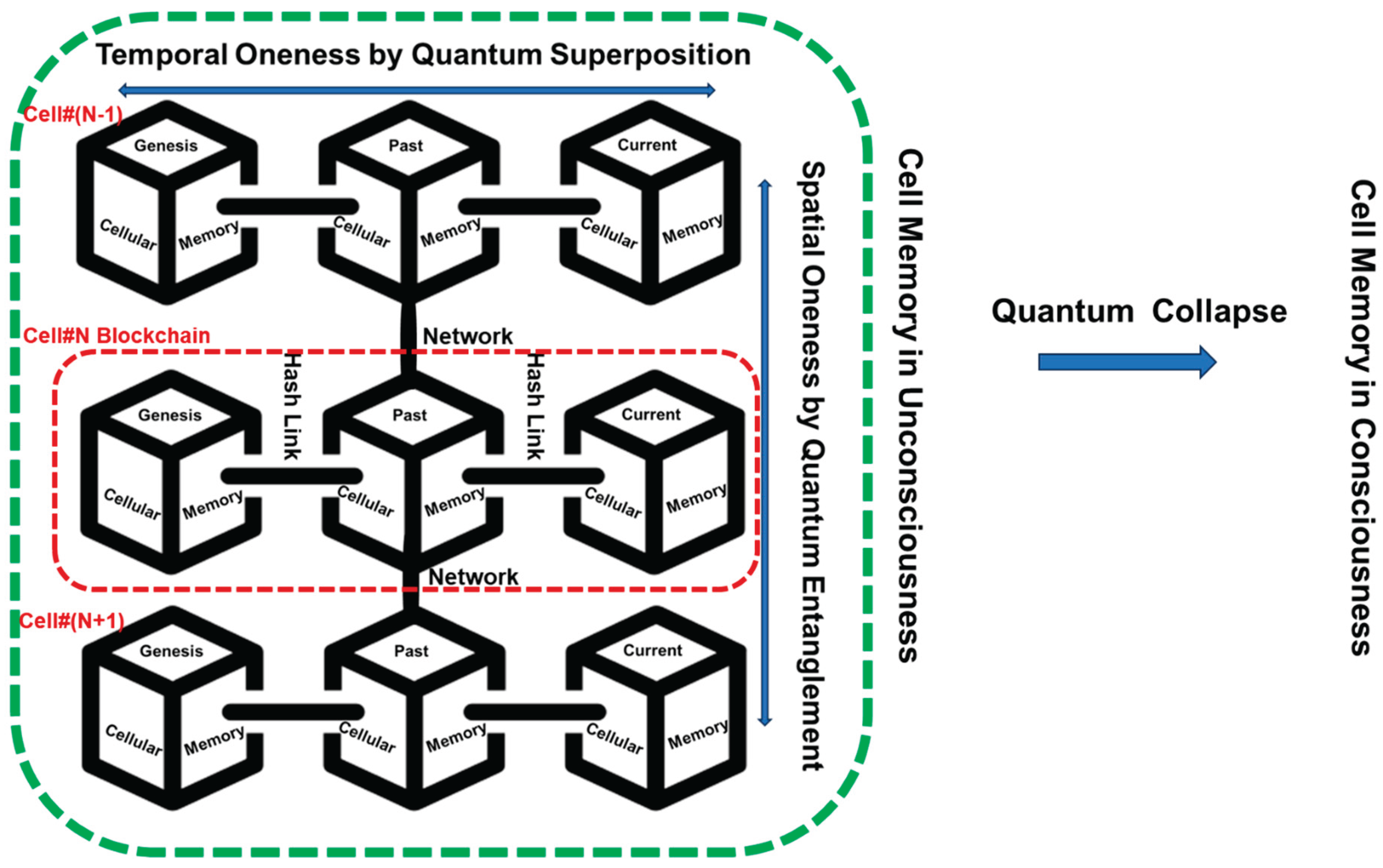
This concept intertwines cutting-edge scientific theories to propose a novel understanding of cellular memory, consciousness, and interconnectedness. It posits in Figure 1 that:
2.1. Cellular Gene Expression History as a Blockchain:
- -
- Each individual cell meticulously records its gene expression history, from its origin to its demise, within a blockchain framework.
- -
- The cellular network implements consensus mechanisms to validate data integrity and maintains data transparency through shared ledgers.
- -
- Biological linkages act like hash linkages, ensuring a temporal connection that protects the data.
- -
- This creates an immutable, transparent ledger of the cell's responses to its environment, developmental stages, and interactions.
- -
2.2. Quantum Superposition and 'Oneness' Compression:
- -
- The vast amount of gene expression data within each cellular blockchain is then subjected to a quantum superposition process.
- -
- This process allows for the compression of this complex data into a single, unified quantum state, referred to as "Oneness."
- -
2.3. Quantum Entanglement and Intercellular Connectivity:
- -
- These "Oneness" quantum states of individual cells are then interconnected through quantum entanglement.
- -
- This establishes a network of interconnected cellular memories, where changes in one cell's quantum state instantaneously affect the states of entangled cells.
- -
2.4. Spatiotemporal 'Oneness':
- -
- This entangled cellular blockchain extends to encompass the entire organism, and potentially beyond, forming a spatiotemporal "Oneness" in quantum state.
- -
- The cellular network, integrated through quantum entanglement, forms a spatiotemporally unified 'Oneness' information state, potentially serving as the physical basis for the collective unconscious.
- -
- Quantum decoherence contributes to the transformation of cellular memories into conscious memories. Meaning that gene expression memories stored within the cells of the body are transferred into the conscious mind.
- -
- Meaning, that a person’s memories are derived from not only their own neurons, but from all cells within their body.
- -
- Meaning, that through quantum entanglement, that person’s memory is connected to other living things.
- -
Figure 1.
Conceptual Diagram of the Quantum Blockchain of Cellular Memory and Spatiotemporal ‘Oneness’. The illustration represents each cell as a blockchain node that records gene expression history. These data blocks are compressed into quantum states ("Oneness"), which are entangled with other cells, forming a unified field of memory. Through quantum decoherence, unconscious cellular memories may collapse into conscious awareness, potentially linked to Jung’s collective unconscious.
3. The Collective Consciousness
3.1. Quantum Blockchain Spatiotemporal 'Oneness' Interpretation:
Carl Jung proposed the concept of the collective unconscious, a universal repository of archetypal images and experiences shared by all humans.[20]
This concept has been difficult to explain within a purely biological framework. However, the quantum blockchain hypothesis offers a potential mechanism.
- -
- -
- -
- Consciousness as Quantum State Collapse: The act of conscious observation could be interpreted as a collapse of the quantum superposition of cellular memory. [23,24,35.36]
- -
- Cellular memory exists in an unconscious state under normal circumstances, influencing our body's functions and behaviors without our awareness.
- -
3.2. Connection Between the Unconscious and Conscious:
- -
- -
- The cellular network, integrated through quantum entanglement, forms a spatiotemporally unified 'Oneness' information state, potentially serving as the physical basis for the collective unconscious.
- -
- -
- In Oneness, the probability of this transition to consciousness through observation can be proportional to the spatiotemporal proximity between cell memories. That is, linked observation between cell memories at close points in time and space is more likely to occur probabilistically.
4. Implications and Future Directions
This hypothesis, while speculative, has profound implications for understanding:
- -
- -
- -
Future research should focus on:
- -
- -
- -
5. Conclusion
The quantum blockchain hypothesis provides a novel framework for understanding the complex and potentially transgenerational nature of cellular memory. By integrating concepts from epigenetics, quantum biology, blockchain network and Jungian psychology, it offers a new perspective on the interconnectedness of life and the nature of consciousness. While further research is needed to validate this hypothesis, it has the potential to revolutionize our understanding of biology, psychology, and the very nature of existence.
Appendix A. Supplementary Notes on Key Literature and Theoretical Context
- 1.
-
Recent Advances in Epigenetics and Cellular Memory
- [10] Goldberg, A. D., Allis, C. D., & Bernstein, E. Epigenetics: A landscape takes shape. Cell, 128(4), 635–638.(2007) https://doi.org/10.1016/j.cell.2007.02.006
- This article introduces the modern landscape of epigenetics and recent advances related to how cellular memory is formed through dynamic chromatin changes.
- [11] Turner, B. M. Epigenetic responses to environmental change and their evolutionary implications. Philosophical Transactions of the Royal Society B, 364(1534), 3403–3418. (2009) https://doi.org/10.1098/rstb.2009.0125
- This study explores how epigenetic modifications respond to environmental factors and discusses the implications of these responses for long-term cellular memory and evolution.
- 2.
-
Blockchain-Inspired Approaches to Biological Data Security and Memory PreservationCurrently, there are limited studies directly applying blockchain concepts such as cryptographic hashing, time-sequenced data linkage, and P2P transparency to biological memory systems. However, the following works explore similar paradigms:
- [26] Choi, J. I. (2024). Past epigenetic information archive with blockchain data architecture in a biological cellular substructure. Journal of RNA and Genomics, 20(1), 1–5. https://www.alliedacademies.org/articles/past-epigenetic-information-archive-with-blockchain-data-architecture-in-a-biological-cellular-substructure.pdf
- This article introduces a novel approach for storing past epigenetic data securely using a blockchain-inspired structure applied to subcellular architecture. The study discusses ensuring integrity and traceability of memory over time, as well as intergenerational transfer.
- [27] El-Edkawy, A. M., El-Dosuky, M. A., & Hamza, T. DNA-based network model and blockchain. arXiv preprint, arXiv:1908.07829. (2019) https://arxiv.org/abs/1908.07829
- This paper presents a hybrid DNA-blockchain model for secure storage and communication of biological information, utilizing hash functions and peer-to-peer architecture for validation and sharing. These contributions highlight emerging cross-disciplinary strategies for achieving robust, tamper-resistant biological memory systems, but much more empirical research is needed for real-world implementation.
- 3.
-
Quantum Biology and Consciousness
- [23] Hameroff, S., & Penrose, R. (2014). Consciousness in the universe: A review of the 'Orch OR' theory. Physics of Life Reviews, 11(1), 39–78. (2014) https://doi.org/10.1016/j.plrev.2013.08.002 This paper introduces the Orch OR theory, which proposes that consciousness arises from quantum superposition and collapse within microtubules. It serves as a basis for considering quantum cellular events as contributors to conscious experience.
- [35] Stapp, H. P. Quantum theory and the role of mind in nature. Foundations of Physics, 31(10), 1465–1499. (2001) https://doi.org/10.1023/A:1012682413597
- This study explores the role of the observer in quantum state collapse, suggesting that consciousness may affect quantum states. This theory supports the idea that unconscious cellular memories can be revealed through conscious observation.
- [37] Koch, C., & Hepp, K. Quantum mechanics in the brain. Nature, 440(7084), 611–612. (2006) https://doi.org/10.1038/440611a
- This commentary discusses the possibilities and limitations of quantum processes in the brain, offering fresh insight into the interface between unconscious cellular processes and consciousness.
- 4.
-
From Cellular Memory to Conscious ExperienceThe notion that consciousness emerges from neural network activity and that cellular memory often exists unconsciously until activated under certain conditions is actively studied in neuroscience and psychology:
- [38] Damasio, A. R. The Feeling of What Happens: Body and Emotion in the Making of Consciousness. Harcourt Brace. (1999) https://www.amazon.com/Feeling-What-Happens-Emotion-Consciousness/dp/0156010755
- Damasio discusses how bodily states and emotions contribute to consciousness, emphasizing how unconscious physiological signals transition into conscious experience.
- [45] Kandel, E. R. In Search of Memory: The Emergence of a New Science of Mind. W.W. Norton & Company. (2006) https://wwnorton.com/books/9780393329377
- Nobel Laureate Kandel explains how changes at the cellular and synaptic levels underlie memory and learning, bridging unconscious biological processes with conscious recall.
- [46] Dehaene, S., & Naccache, L. Towards a cognitive neuroscience of consciousness: Basic evidence and a workspace framework. Cognition, 79(1–2), 1–37. (2001) https://doi.org/10.1016/S0010-0277(00)00123-2
- This paper provides neuroscientific evidence for how unconscious information becomes consciously accessible, supporting the conceptual model presented in this manuscript.
References
- Bird, A. Perceptions of epigenetics. Nature, 447(7143), 396–398 (2007). [CrossRef]
- Kim, M. Costello, J. DNA Methylation: An Epigenetic Mark of Cellular Memory. Exp. & Molecular Medicine, 46 (2017).
- Probst, A. et al. Epigenetic inheritance during the cell cycle. Nature Reviews Molecular Cell Biology, 10(3), 192–206 (2009). [CrossRef]
- Schneider, R., Grosschedl, R. Dynamics and interplay of nuclear architecture, genome organization, and gene expression. Genes & Development, 21(23), 3027–3043 (2007). Genes Dev. 2007 Dec 1;21(23):3027-43. [CrossRef]
- Bintu, L. et al. Dynamics of epigenetic regulation at the single-cell level. Science, 351(6274), 720–724 (2016).
- Feinberg, A. P. Phenotypic plasticity and the epigenetics of human disease. Nature, 447(7143), 433–440 (2007).
- Heard, E., Martienssen, R. A. Transgenerational epigenetic inheritance: myths and mechanisms. Cell, 157(1), 95–109 (2014). [CrossRef]
- Szyf, M. The early life social environment and DNA methylation. Epigenetics, 1(8), 971-978 (2011).
- Jaenisch, R., Bird, A. Epigenetic regulation of gene expression. Nature Genetics, 33, 245–254 (2003).
- Goldberg, A. D., Allis, C. D., Bernstein, E. Epigenetics: A landscape takes shape. Cell, 128(4), 635–638 (2007).
- Turner, B. M. Epigenetic responses to environmental change. Philos. Trans. R. Soc. B, 364(1534), 3403–3418 (2009).
- Abbott, D. et al. Quantum aspects of life. Imperial College Press (2008).
- Ball, P. The dawn of quantum biology. Nature, 474(7351), 272–274 (2011).
- Arndt, M. et al. Quantum physics meets biology. HFSP Journal, 3(6), 386–400 (2009). [CrossRef]
- Marais, A. et al. The future of quantum biology. J. Royal Society Interface, 15(148) (2018).
- Lambert, N. et al. Quantum biology. Nature Physics, 9(1), 10–18 (2013).
- Nakamoto, S. Bitcoin: A peer-to-peer electronic cash system. https://bitcoin.org/bitcoin.pdf (2008).
- Abadi, J., Brunnermeier, M. K. Blockchain economics. J. Economic Perspectives, 32(3), 13–32 (2018). Book Japan.
- Narayanan, A. et al. Bitcoin and cryptocurrency technologies. Princeton University Press (2016).
- Jung, C. G. Two Essays on Analytical Psychology. Princeton Univ. Press (1966).
- Ivonin, L. et al. Traces of Unconscious Mental Processes in Introspective Reports and Physiological Responses. PLoS ONE ,10.1371 (2015). [CrossRef]
- Hameroff, S., Penrose, R. Orchestrated reduction of quantum coherence in brain microtubules. Mathematics and Computers in Simulation, 40(3–4), 453–480 (1996).
- Hameroff, S., Penrose, R. Consciousness in the universe: A review of the 'Orch OR' theory. Physics of Life Reviews, 11(1), 39–78. (2014).
- Penrose, R. The Emperor’s New Mind. Oxford Univ. Press (1989). [CrossRef]
- Buldas, A., Saarepera, M. Provably secure time-stamping schemes. Advances in Cryptology CRYPTO, 500–514 (2004).
- Choi, J. I. Past epigenetic information archive with blockchain architecture. J. RNA and Genomics, 20(1), (2024).
- El-Edkawy, A. M., El-Dosuky, M. A., & Hamza, T. DNA-based network model and blockchain. arXiv preprint, arXiv:1908.07829.9 (2019).
- Lü, X.-Y. et al. Entanglement and quantum superposition. Scientific Reports, 8, 11432 (2018).
- Aerts, D., Sassoli de Bianchi, M. The extended Bloch representation. Annals of Physics Volume 351, (2014).
- Huang, C.-J. et al. Realization of a quantum autoencoder. Quantum Information, 5, 86 (2019).
- Rozema, L. A. et al. Quantum data compression. Phys. Rev. Lett., 113(16), 160504 (2014).
- Van Raamsdonk, M. Building up spacetime with entanglement. Int. J. Mod. Phys. D, 19(14), 2429–2435 (2010).
- Swingle, B. Spacetime from entanglement. Ann. Rev. Condens. Matter Phys., 9, 345–358 (2018). [CrossRef]
- Schrödinger, E. What is Life? Cambridge University Press (1944).
- Stapp, H. P. Quantum theory and the role of mind. Foundations of Physics, 31(10), 1465–1499 (2001). [CrossRef]
- Chalmers, D. J., McQueen, K. J. Consciousness and wave function collapse. arXiv:2105.02314 (2021).
- Koch, C., Hepp, K. Quantum mechanics in the brain. Nature, 440(7084), 611–612 (2006).
- Damasio, A. R. The Feeling of What Happens. Harcourt Brace (1999).
- Panksepp, J. Affective Neuroscience. Oxford Univ. Press (1998).Book.
- Baars, B. J. A Cognitive Theory of Consciousness. Cambridge Univ. Press (1988).
- Zhou, J., Yang, Y. A novel lottery protocol based on quantum blockchain. Quantum Information Processing, 24, 4657 (2024).
- Sun, Y., Wang, X. Quantum blockchain with stake vote consensus. Scientific Reports, 12, 12412 (2022).
- Susskind, L., Friedman, A. Quantum Mechanics: The Theoretical Minimum. Books (2014).
- Raposo, G., Stoorvogel, W. Extracellular vesicles. J. Cell Biology, 200(4), 373–383 (2013).
- Kandel, E. R. In Search of Memory: The Emergence of a New Science of Mind. New York: W.W. Norton & Company. (2006) Book.
- Dehaene, S., & Naccache, L. Towards a cognitive neuroscience of consciousness: Basic evidence and a workspace framework. Cognition, 79(1-2), 1-37. (2001). [CrossRef]
Disclaimer/Publisher’s Note: The statements, opinions and data contained in all publications are solely those of the individual author(s) and contributor(s) and not of MDPI and/or the editor(s). MDPI and/or the editor(s) disclaim responsibility for any injury to people or property resulting from any ideas, methods, instructions or products referred to in the content. |
© 2025 by the authors. Licensee MDPI, Basel, Switzerland. This article is an open access article distributed under the terms and conditions of the Creative Commons Attribution (CC BY) license (http://creativecommons.org/licenses/by/4.0/).
Copyright: This open access article is published under a Creative Commons CC BY 4.0 license, which permit the free download, distribution, and reuse, provided that the author and preprint are cited in any reuse.