

Submitted:
11 November 2025
Posted:
13 November 2025
Read the latest preprint version here
Abstract
Recent research suggested that there is around 6 × 1080 bits of information stored in all the particles of the observable universe. Today’s understanding of the information relates information to elementary particles. The open question is how information is related to time and to the universe. We do not have any evidence that elementary particles exist in time; we study their physical properties only in space. This suggests that information is time-invariant, it does not exist in time, and also the universe is time-invariant, both exists only in space.
Keywords:
information
; time
; space
; universe
1. Introduction
Around 6 × 1080 bits of information stored in the matter of the observable universe [1] raises a question about how many bits of information are in the entire universe, which also includes the unobservable part of the universe. NASA measured that the universe has an Euclidean shape [2], and so the number of bits of information in the infinite universe should be infinite. The crucial question is whether information and universe exist also in time or only in space.
A photon is seen a classical carrier of information. A photon takes 8 minutes and 27 seconds to reach from the Sun to the Earth. The fact is that we do not have any perception and any experimental confirmation that photon moves in time. Time is a duration of photon motion in space when measured by the observer [3]. This undeniable experimental fact opens a paradigm shift view where information and the universe are of a higher ontological status than time.
The General Information Theory suggests that information exists in time and that the entropy of information increases in time [4]. The weak point of this model is that there is no experimental evidence to support the existence of information in time and the increase in information entropy in time.
2. Ontological Superiority of Information Over Time
Recent research confirms, clocks and time are human inventions to measure the velocity of motion of different physical objects in space. Universe exists in time-invariant space that we humans experience as NOW. From an ontological point of view, matter and information have a higher ontological status than time. The increase of entropy of a given system occurs only in space, and we measure it with clocks. The linear time past-present-future exists only as a psychological frame in which we experience the increase of entropy of a given physical system that exists in time-invariant space [3], see Figure 1:
The entire universe is entangled via time-invariant space [5]. Seeing entanglement occurring in some physical time generates unsolvable problems, and seeing information occurring in time also leads to misunderstandings. Today’s understanding of information is bound to elementary particles [1], and these particles exist only in time-invariant space.
With the understanding that elementary particles and information are immanent elements of the universe, and psychological time exists only in the human brain [3], we have a new perspective on the information that allows us a better understanding of the universe.
Fundamental unit of information 1 bit is time-invariant; it exists only in time-invariant space that humans experience as NOW [6]. Information, elementary particles and entire universe exist in time-invariant space [3]. Imagine we have a source of information and the receiver of information, see Figure 2. On the way from the source to the receiver, a part of the information is lost due to the technical properties of the information line. In this case, the entropy of information increases, but not in time; it increases only in time-invariant space.
This paradigm shift view, where information has a higher ontological status than time, offers a new view on several cosmological questions.
3. Information, Entropy, Cosmology
One of the well-known paradoxes in contemporary cosmology is Steven Hawking's information loss paradox of black holes, which, after 50 years of study, remains a subject of scientific discussion [7]. These theoretical discussions overlook the discovery of astrophysical jets emanating from the central black holes named also active galactic nuclei (AGN) [8]. In AGNs, old matter with high entropy is transformed into fresh energy with low entropy in the form of astrophysical jets. AGNs are rejuvenating systems of the universe that have no beginning and will not have an end. There is no energy loss and there is no information loss in the universe [9].
Given that each particle of the universe contains 1509 bits of information [1], and particles cannot be destroyed [9], the information base of the universe is constant. The second entropy law of thermodynamics is valid only for matter that is composed of atoms and is 3-dimensional. An increase of entropy means that a given physical system transforms its atomic structure from lighter to heavier atoms, and the amount of free energy in such a system diminishes. Elementary particles that carry information are 4-dimensional [10], and at the 4th dimension, the first law of thermodynamics is valid: energy and information cannot be destroyed and cannot be created.
Stephen Hawking's idea is that the universe exploded out of a mathematical point. Before there was anything, which means also there was no information. This mathematical point had infinite pressure and density that, at the moment of explosion, became finite [11]. The idea of the beginning of the universe out of nothing is not falsifiable. The Big Bang model is based on the misinterpretation of the CMB and the misinterpretation of cosmological redshift. CMB is the radiation of existing superfluid space, and cosmological redshift is gravitational redshift, where light, when pulling out of the strong gravitational fields of distant galaxies, experiences an energy loss [12]. Rigorous analysis of time confirms that time is merely the mathematical parameter for the description of a particle's motion. Time is not a primordial physical reality as information is. Time is an emergent physical reality that enters existence in the process of measurement [13]. There is no physical time in the universe in which information would exist.
5% of the energy of the universe is in the form of ordinary matter, 95% is in the form of the superfluid space, whose old name is ether [10]. Superfluid space is a syntropy type of energy, and matter is an entropy type. Besides this, matter is composed of the elementary particles that are different vortexes of the superfluid space. That’s why proton and electron have infinite lifetime, they are syntropic energy structures. Life maintains negentropy because it is not only a molecular system, but also a system that operates on the subatomic level. The entropy law is valid only for manmade machines. In the universe rules the law of energy preservation. The increase of the entropy that we observe in the universe is only a partial process. In black holes, old matter with high entropy is transformed into fresh gas in the form of astrophysical jets with low entropy. The universe is a self-maintaining uncreated system.
4. Conclusions
For a century, in quantum physics, time has been understood as a mathematical parameter that helps the description of elementary particles physical properties. However, the illusion of a physical time is still persistent. Advances in information theory will confirm that information is time-invariant. A step more into a paradigm shift, where time is not a physical reality but merely a scientific tool.
References
- Melvin M. Vopson, Estimation of the information contained in the visible matter of the universe, AIP Advances, Volume 11, Issue 10 (2021). [CrossRef]
- NASA (2025) https://map.gsfc.nasa.gov/universe/uni_shape.html.
- Amrit Sorli, Implications of Time-Invariant Superfluid Quantum Space Model in Fundamental Physics and Cosmology, Applied physics research, Vol. 17, No. 1, 2025. [CrossRef]
- Yilun Liu, Lidong , General Information Theory: Time and Information Zhu (2019) https://arxiv.org/pdf/1908.00301v1. [CrossRef]
- Fiscaletti, D., Sorli, A. Searching for an adequate relation between time and entanglement. Quantum Stud.: Math. Found. 4, 357–374 (2017). [CrossRef]
- Šorli, Amrit; Čelan, Štefan, Time, observer, and consciousness, Physics Essays, Volume 35, Number 2, June 2022, pp. 123-126(4) https://www.ingentaconnect.com/content/pe/pe/2022/00000035/00000002/art00004;jsessionid=2pnutn6h6ol0l.x-ic-live-02 Entire article is available here https://bijective-physics.org/pdf/2022-Time-observer-and-consciousness.pdf. [CrossRef]
- Xavier Calmet and Stephen D. H. Hsu, A brief history of Hawking's information paradox, 2022 EPL 139 49001 https://iopscience.iop.org/article/10.1209/0295-5075/ac81e8. [CrossRef]
- Fender, R.P., Motta, S.E. The connection between the fastest astrophysical jets and the spin axis of their black hole. Nat Astron (2025). [CrossRef]
- Amrit Srecko Sorli, Rado Gorjup, Niko Gorjup, Tomaz Makovec, Akash Saroj, Akash Ranjan, Piyush Singh, Re-examination of Penrose's and Kerr's singularities and the origin of protons in astrophysical jets, Advanced Studies in Theoretical Physics, Vol. 18, 2024, no. 2, 61-82 https://www.m-hikari.com/astp/astp2024/astp1-4-2024/92117.html. [CrossRef]
- Amrit S. Sorli, Einstein Legacy: Ether Relativity and Cosmology, International Journal of Quantum Foundations, Volume 11, Issue 4, pages 527-559 (2025) https://ijqf.org/archives/7583.
- J. B. Hartle and S. W. Hawking, Wave function of the Universe, Phys. Rev. D 28 (1983) 2960. [CrossRef]
- Sorli, A., Jafari, S., Fiscaletti, D., Gorjup, N., Gorjup, R., & Makovec T. (2023). Evidence-Based Cosmology – Black holes are rejuvenating systems of the universe. Reports in Advances of Physical Sciences, 7, 2350012. [CrossRef]
- Fiscaletti, D., Sorli, A. Perspectives of the Numerical Order of Material Changes in Timeless Approaches in Physics. Found Phys 45, 105–133 (2015). [CrossRef]
Figure 1.
Elementary particles, information, and psychological time.
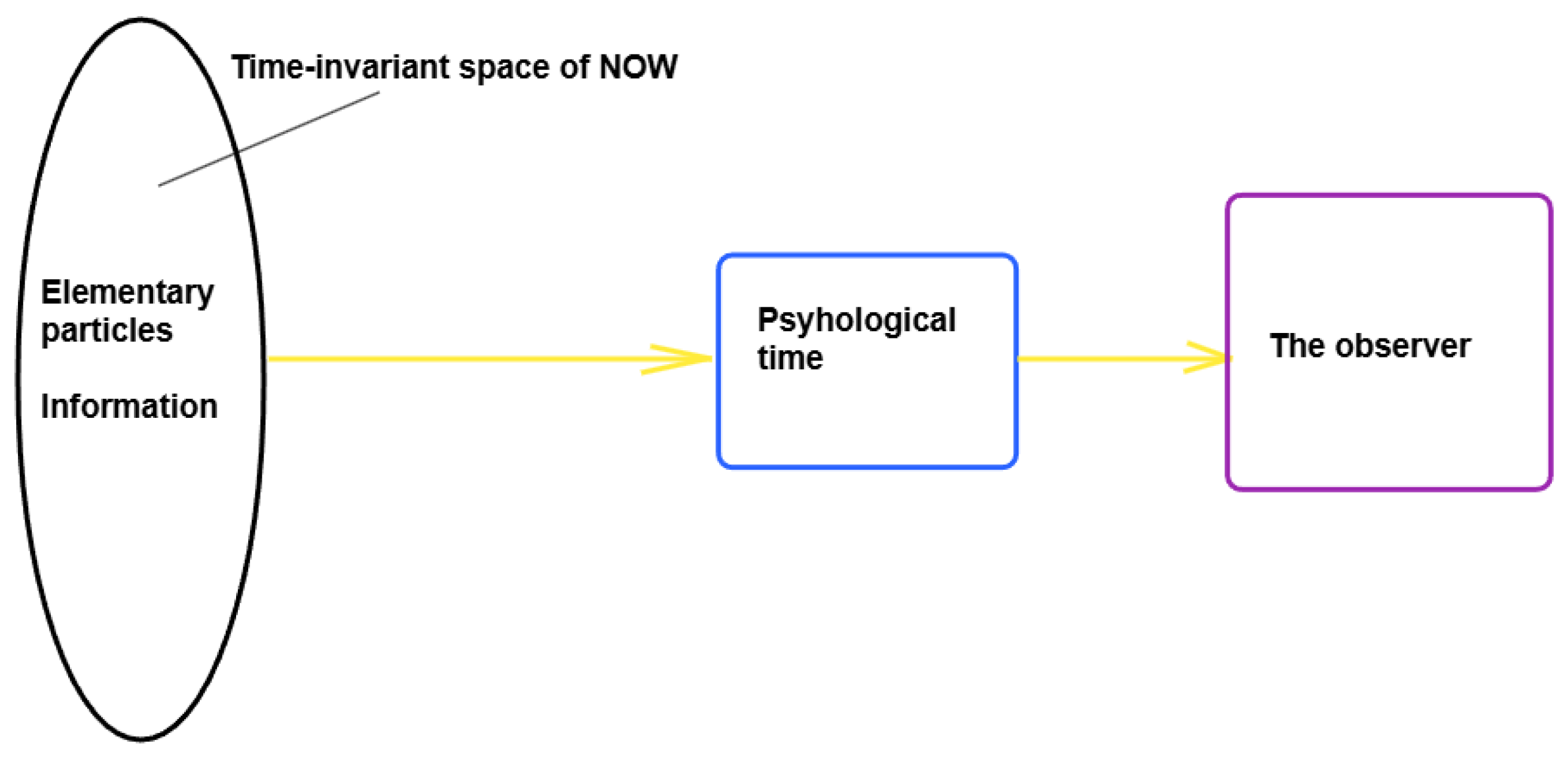
Figure 2.
Entropy of information occurs only in time-invariant space.

Disclaimer/Publisher’s Note: The statements, opinions and data contained in all publications are solely those of the individual author(s) and contributor(s) and not of MDPI and/or the editor(s). MDPI and/or the editor(s) disclaim responsibility for any injury to people or property resulting from any ideas, methods, instructions or products referred to in the content. |
© 2025 by the authors. Licensee MDPI, Basel, Switzerland. This article is an open access article distributed under the terms and conditions of the Creative Commons Attribution (CC BY) license (http://creativecommons.org/licenses/by/4.0/).
Copyright: This open access article is published under a Creative Commons CC BY 4.0 license, which permit the free download, distribution, and reuse, provided that the author and preprint are cited in any reuse.