

Submitted:
10 November 2025
Posted:
11 November 2025
You are already at the latest version
Abstract
Background/Objectives:
Almost all orthopedic infections require a combination of surgi-cal debridement with targeted antimicrobial treatment. The number of debridement may vary considerably between infection episodes. The case-mix is enormous and so-called "second looks" are frequent. We investigate which bacteria are associated with second looks to achieve local infection control.
Methods:
We used a composite database stem-ming from three prospective randomized-controlled trials (RCTs) 2019-2025 with proto-colled surgical debridement (initial debridement). In these RCTs, we allowed additional debridement only in case of persistent (during several days) or progredient local infection.
Results:
Overall, 201/1,067 (18.8%) orthopedic infections required multiple debridement (median two second looks, range 2–8 surgeries). Gram-negative pathogens revealed the highest risk for "second looks" (28.2%), followed by implant-related infections (25.4%). Cutibacteria yielded the lowest risk (11.7%). In the multivariable logistic regression model, Gram-negative infections (odds ratio 2.04, 95%CI 1.20-3.47) and infected implants (OR 2.18, 95%CI 1.56-3.03) were independently associated to multiple interventions, in con-trast to Staphylococcus aureus, enterococci or streptococci.
Conclusions:
When analyzing orthopedic infections included in prospective RCTs, Gram-negative pathogens groups significantly associate with the need for second looks, which matches our own experience. Today findings support preoperative counseling, antibiotic stewardship, and operative planning for a staged management in infection cases with a high risk of clinical failure.
Trials registrations: NCT04048304, NCT04081792, NCT05499481.
Keywords:
orthopedic infection
; surgical debridement
; multiple procedure
1. Introduction
Orthopedic infections (bone, joint, implants) represent a significant challenge, both in their incidence, costs, and management. A key aspect of this complexity is the frequent need for multiple surgical interventions - re-debridement (second looks) - for adequate source control, particularly in implant-associated infections [1,2,3,4,5,6]. Yet the number of debridement required to achieve local infection control varies across patients, centers and infections, with consequences regarding morbidity, length of hospital stay, costs, wound problems, reeducation and recovery [7]. Sometimes, second looks get infected with new, and more resistant, pathogens [8,9]. The indication for a second look must be thoroughly weighed against all possible negative consequences. And yet, this indication very frequently remains subjective in the eyes of the responsible surgeon and his/her experience.
Among a myriad of reasons, pathogen biology might be a plausible driver for second looks. Differences in their virulence, toxins, and antimicrobial resistance, as well as polymicrobial presentations, may influence the ease - or difficulty - of achieving source control [4,5] after the first debridement. Orthopedic surgeons often advocate that for example Staphylococcus aureus is independently linked to multiple debridement, although solid scientific data are lacking. Due to this subjectivity, retrospective case-control studies cannot assess strictly microbiological associations with second looks, because the surgical indication for a second look can reveal a mix of many objective and subjective parameters such as the surgeon’s opinion, objective local worsening, or the patient’s wish, rapid availability of surgery slots, and insurance levels (among many more). Equally, it is not possible to assess a past indication in sufficient detail from medical files. The questions concerning second looks must be addressed in prospective trials that statistically control for their large case-mix per randomization.
We aim to address this important scientific gap by analyzing whether there is a correlation between the number of surgical interventions and the type of intraoperative microbiology of the first debridement. Clarifying this relationship could inform operative planning (extent of debridement, need for staged procedures), counseling on expected trajectories, antibiotic stewardship, and resource allocation. It may also help benchmark quality across centers by adjusting for the case-mix among adult orthopedic patients.
2. Materials and Methods
In our hospital, we run three RCT’s (SALATIO [10], SASI [11] and TECH [12] infection studies) randomizing on the duration of postsurgical antibiotic treatment. In all RCTs, the scheduled number of surgical interventions is one. Only in case of uncontrolled infection with clinical persistence of infection (during several days) or local re-worsening, the surgeons performed a 2nd or a 3rd look. In case of more than three interventions, the participating patients were excluded from the per protocol analyses of each RCTs. For this study, we include all orthopedic infections included in the RCTs from 1st June 2019 to 31st May 2025.
We diagnosed an “orthopedic infection” as concordant growth of the same bacterial pathogen(s) in at minimum two deep intraoperative tissue or bone cultures, together with and/or clinical signs of infection (purulence, drainage or sinus tract, erythema, warmth, pain). Histology or radiologic evidence (e.g., osteomyelitis, fluid collections, inflammatory changes) were facultative for diagnosis. “Implant” denoted any foreign material, excluding temporary wires or external fixator pins outside of the infected area. For practical study reasons, we classified the operated sacral osteomyelitis cases as “orthopedic infections”. Importantly, we recorded the number of surgical debridement only if they were for infection, and not due to non-infectious primary reasons such as seroma or hematoma. Likewise, we excluded previously planned second looks for infection [13], open fractures [14], elective correction [15], or elective implant removal [7]. We also excluded surgery for infection recurrences or for infections; i.e., unplanned revisions for infection relapse after the end of the scheduled antibiotic treatment. Hence, in terms of infection, our second looks concerned persistent local infection under surgical and antimicrobial therapy.
Study Objectives and Statistical Analyses
As the primary and sole objective, we linked the intraoperative microbiological results of the initial debridement to the risk for second looks due to infection. We performed group comparisons using the Pearson- chi2-test, the Mann-Whitney-U-test, or the Kruskal-Wallis-test, as appropriate. For stratified analyses, we arbitrarily grouped the microorganisms into eight clinical categories: (1) S. aureus, (2) CoNS, (3) cutibacteria, (4) streptococci, (5) enterococci, (6) other Gram-positives, (7), Gram-negative rods, and (8) polymicrobial infections. In a second step, a multivariate logistic regression model adjusted for the large case-mix. The pathogen categories were mandatorily included into this final model, with CoNS used as the reference category. Polymicrobial infections are analyzed separately because of inherent interaction with other categories. We performed all analyses using RStudio (R Foundation, Austria) and considered p-value < .05 (two-tailed) as significant.
3. Results
We included 1,067 independent orthopedic infections in adult patients into the composite database. Of those, 374 involved retained implants, 381 osteomyelitis cases, 305 spine, and 381 diabetic foot infections. S. aureus (n=202, 18.9%), CoNS, (n=174, 16.3%), cutibacteria (n=103, 9.7%), and Gram-negative organisms (n=103, 9.7%) were the most frequent bacteria. Polymicrobial infections accounted for 283 cases (26.5%) (Table 1). We did not assess the presence of small-colony variants among the S. aureus, because we would associate them as a risk for ultimate relapse rather than as a risk for early second look [16].
Overall, 201 patients (18.8%) required a second look within 1 to 2 weeks after the first debridement. The median number of additional debridement was 2 across all microbiological strata, with a range of 2-8 interventions. In group comparisons, the risk for a second looks varied across pathogen groups (Kruskal-Wallis-test; p = .009).: Gram-negative infections revealed the highest risk (28.2%), followed by enterococci (22.2%) and polymicrobial infections (21.2%). The lowest risk yielded cutibacteria (11.7%) (Table 2).
Upon these first results, we added direct binomiale head-to-head comparisons between clinically important and frequent pathogen groups (Table 3). Equally, these second comparisons also showed a higher risk for second looks in Gram-negative infections compared to Gram-positive infections (28.2% vs. 17.1%, p = .001). Again, we observed no differences among the Gram-positive groups, such as between S. aureus and CoNS (19.3% vs. 16.7 %, p= 0.51) or S. aureus against the streptococci (19.3% vs. 20.3%, p = .86). Overall, implant-related infections required a second look more often than native bone infections or those with removed implants (25.4% vs. 15.3%, p< .001) (Table 3). The number of debridement between poly- and monomicrobial infections were similar (Table 3, Figure 1).
Case mix Adjustment
We added a logistic regression analysis with the outcome “second look” to adjust for the case-mix. In its multivariate model, infected implants were independently associated with multiple debridement (odds ratio 2.18, 95% confidence interval 1.56-3.03). However, the biggest odds were seen for Gram-negative (OR 2.04, 95%CI 1.20-3.47) and polymicrobial infections (OR 1.73, 95%CI 1.13–2.65). However, the latter results rather reflected the Gram-negative involvement within the group of “polymicrobial infections”. Gram-positives such as S. aureus, CoNS, cutibacteria, streptococci, and enterococci did not alter the risk for second looks (Table 4). Due to a substantial heterogeneity within the Gram-negative pathogen group (Table 1), and anticipated underpowering due to further stratification among the Gram-negatives, we were unable to dissociate the influence of (inherent) antibiotic resistance (among all Gram-negatives) in terms of early reinterventions. Half of our Gram-negative species were inherently (naturally) resistant to antibiotic classes (peni-cillins and 1st-3rd generation cephalosporins) used in orthopedic wards. Among the Gram-positives, only less than 5% of S. aureus, but the majority of CoNS were formally resistant to methicillin. Formally, most CoNS were associated to implant infections (data not shown).
4. Discussion
According to our single-center, composite prospective cohort with more than thousand episodes of moderate to severe orthopedic infections, the indication for unplanned second look was 18.8%. This overall risk significantly varied among all pathogen groups and revealed surprising findings. In striking opposition to our prior presumption, it was neither S. aureus [17,18], nor other Gram-positives such as enterococci [19] or streptococci [20] that predicted ultimate re-debridement. It was a Gram-negative involvement, and implant-related infections, that were associated with doubled odds of a multiple debridement (odds ratios of 2.04 and 2.18, respectively). Nota bene, a persistently infected implant is not only a risk for infection recurrence [17,19,20], but also for a second surgical intervention to achieve local infection control. Polymicrobial infections tended to re-interventions (albeit not significantly). However, we attributed this tendency to the Gram-negative parts of the polymicrobial infections. Unsurprisingly, the skin commensal Cutibacterium spp. that is mostly causative of low-grade infections [21], yielded the lowest risk. We think our findings have practical implications. Firstly, they may support counseling that Gram-negative involvement carries a higher likelihood of requiring more than one debridement. Secondly, they argue for proactive operative planning (e.g., awareness for staged procedures, broader irrigation/debridement), and an early reassessment when infected implants are retained. Thirdly, they can inform benchmarking, infection control, antibiotic stewardship, and quality improvement when comparing across services.
Our results are in line with existing trends and traditions. They re-confirm the indication to remove all infected implants to perform the best debridement possible (if feasible). Secondly, the “persistence” of Gram-negative bacteria against a single debridement follows a general trend in infectiology and healthcare epidemiology. Gram-negative infections have become more and more prevalent in virulent bacterial infections, including for orthopedic surgery such as for healthcareimplkant-associated spine infections [22] or community-acquired diabetic foot infections [23,24]. Gram-negatives start to prevail over Gram-positives in many regions of the world [25,26], for which all reasons remain unsolved and represent a subject of ongoing debate. For sure, Gram-negative infections parallel the epidemics of acquired or natural antimicrobial resistance; and/or of systemic antibiotic use prior to hospitalization [27]. The prevalence of Gram-negative orthopedic infections and their antibiotic resistance is highly intermixed [24,26,28,29]. In our analysis, we could not stratify the natural resistance to link with the risk of second looks, because of the anticipated underpowering of the corresponding analyses. Moreover, a high proportion of resistant Gram-negatives in our RCTs received a broad-spectrum antibiotic coverage.
The scientific literature regarding our study question is very sparse, retrospective and underpowered. Existing literature rather explores - mostly indirectly - the independent impact of specific pathogens on the final outcomes after therapy; with occasional notice of the number of surgical debridement during treatment. The bulk of available literature reports the DAIR approach for acute arthroplasty infections [4,5,6,30,31] (debridement, antibiotics and implant retention; when explanting intermediary spacers [32,33]), or concerns fracture-related infections [34,35,36] with few other surgeries [37,38]. Of note, in these retrospective papers, a “second look” is mentioned, but not further investigated. To the best of our knowledge, no prospective study has addressed our question directly. Retrospectively, Chang and colleagues [6] reported that polymicrobial infections tend to be associated with failure in DAIR, although the difference did not reach statistical significance. Specifically, they defined DAIR failure as the need for repeated DAIR or a two-stage revision; nota bene after the end of treatment for the index infection. Hence, their “second look” was again a DAIR approach. This paper is echoed by Chen [4] et al., finding a significant difference in DAIR failure between poly- and monomicrobial infections (55% vs. 21%). However, their cohort comprised only 106 arthroplasty infections in total, of which, moreover, only nine polymicrobial cases. In a much larger multicenter cohort study, Zhu [5] et al. identified S. aureus (OR 4.70) and Gram-negative pathogens (OR 2.56) as independent risk factors for DAIR failure; again, after the end of therapy. DiPaola et al. [39] developed a predictive model to stratify patients needing single vs. multiple debridement in spinal infections. Positive MRSA (methicillin-resistant S. aureus) cultures (OR 2.71) represented the strongest predictor for multiple debridement. In another study by Billières et al. [40], retrospectively analyzing spine infection, no variable associated with remission. In particular, remission was unrelated to the number of second looks (hazard ratio 0.9; 95%CI 0.8-1.1), S. aureus (HR 0.9; 95%CI 0.8-1.1), intraosseous antibiotic use (HR 1.2; 0.6-2.4), or the total duration of antibiotic treatment (HR 1.0; 0.99-1.01) [40]. All these publications were retrospective with difficulties to adjust for the large case-mix. All of them were rather underpowered; at least regarding the population size for further stratified analyses.
The Wuarin study [8] bears the closest resemblance to ours. Their investigation, including a total 2480 orthopedic infections, focused on repeated debridement in relation to the optimal perioperative prophylaxis during second looks. Overall, 1617 (65%) episodes were debrided once, compared to 862 cases with second looks (35%). Furthermore, this study underlines that “second looks” can become harmful. Epidemiology speaking, they can be an independent factor for new (and resistant) surgical site infections at the index site, despite ongoing antibiotic treatment for the index infection, especially when the second look (still) cannot close the wound. This secondary risk can reach 7% to 10% [8].
Our study has strengths and limitations. The major strength is the design. In our single-center, we used the data of three prospective RCTs on antibiotic durations. The sample size of these RCTs surpasses 1000 infection episodes. Importantly, per protocol, the number of debridement was fixed to one intervention; with second looks permitted in case of obvious failure to control infection. A second strength is the experience of our orthopedic and plastic surgeons with orthopedic infections and with debridement. The main limitation is the heterogeneity of infection types (implant-related, native bone/joint, spine, diabetic foot infections), which may introduce clinical variability that is not fully captured by the current statistical models. Secondly, we only analyzed the risk for early second looks during therapy; and not recurrence of infection after the treatment. In other words, our outcome was a clinically important early “persistence” of infection despite adequate antibiotic therapy, and not ultimate failure. Both outcomes must not be confounded. For the first, almost no literature exists. For the latter, there is abundance of scientific publications.
5. Conclusions
According to our recent single-center, prospective study including 1,067 orthopedic infections in adult patients, the presence of Gram-negative pathogens (and not Gram-positives) and infected implants associate with the need for “second looks”. This new information is useful for the counseling of patients, antibiotic stewardship issues, infection control, and the planning of surgical management. Ideally, every infected implant should be removed.
Author Contributions
Conceptualization, I.U.; methodology, I.U.; software, F.Z.; validation, F.Z. and I.U.; formal analysis, F.Z and I.U.; investigation, F.Z.; resources, I.U.; data curation, F.Z., A.J., R.S., T.G., N.K., S.K., D.A., F.W.A.W., and I.U.; writing—original draft preparation, A.J. and F.Z.; writing—review and editing, I.U., D.A., and F.Z; visualization, S.K.; F.Z.; supervision, I.U.; project administration, T.G., N.K., D.A., F.W.A.W., I.U. All authors agreed to this published version.
Funding
This research received no external funding.
Institutional Review Board Statement
The study was conducted in accordance with the Declaration of Helsinki in the framework of the Ethical Approvals for the RCTs (Swiss Federal Complementary Database BASEC no. 2019-00646, 2019-00778, 2022-01012; Ethical Committee of Zurich).
Informed Consent Statement
Informed consent was obtained from all included patients.
Data Availability Statement
We may provide anonymized key variables upon a reasonable scientific request to the corresponding author.
Acknowledgments
We are indebted to the Institute for Microbiology, University of Zurich, for microbiological analyses. We thank the Unit for Clinical Applied Research (UCAR) for help.
Conflicts of Interest
The authors declare no conflicts of interest.
Abbreviations
The following abbreviations are used in this manuscript:
| CoNS | Coagulase-negative Staphylococci |
| RCT | Randomized clinical trial |
| DFI | Diabetic foot infection |
| SSI | Surgical site infection |
| DAIR | Debridement, antibiotics and implant retention |
References
- Weinstein, M.A.; McCabe, J.P.; Cammisa, F.P. Postoperative Spinal Wound Infection: A Review of 2,391 Consecutive Index Procedures. J. Spinal. Disord. 2000, 13, 422–426. [Google Scholar] [CrossRef]
- Taherpour, N.; Mehrabi, Y.; Seifi, A.; Eshrati, B.; Hashemi Nazari, S.S. Epidemiologic Characteristics of Orthopedic Surgical Site Infections and Under-Reporting Estimation of Registries Using Capture-Recapture Analysis. BMC. Infect. Dis. 2021, 21, 3. [Google Scholar] [CrossRef] [PubMed]
- Farshad, M.; Bauer, D.E.; Wechsler, C.; Gerber, C.; Aichmair, A. Risk Factors for Perioperative Morbidity in Spine Surgeries of Different Complexities: A Multivariate Analysis of 1,009 Consecutive Patients. Spine. J. 2018, 18, 1625–1631. [Google Scholar] [CrossRef] [PubMed]
- Chen, W.; Klemt, C.; Smith, E.J.; Tirumala, V.; Xiong, L.; Kwon, Y.-M. Outcomes and Risk Factors Associated With Failures of Debridement, Antibiotics, and Implant Retention in Patients With Acute Hematogenous Periprosthetic Joint Infection. J. Am. Acad. Orthop. Surg. 2021, 29, 1024–1030. [Google Scholar] [CrossRef] [PubMed]
- Zhu, M.F.; Kim, K.; Cavadino, A.; Coleman, B.; Munro, J.T.; Young, S.W. Success Rates of Debridement, Antibiotics, and Implant Retention in 230 Infected Total Knee Arthroplasties: Implications for Classification of Periprosthetic Joint Infection. J. Arthroplasty. 2021, 36, 305–310.e1. [Google Scholar] [CrossRef]
- Chang, M.J.; Ro, D.H.; Kim, T.W.; Lee, Y.S.; Han, H.-S.; Chang, C.B.; Kang, S.-B.; Lee, M.C. Worse Outcome of Debridement, Antibiotics, and Implant Retention in Acute Hematogenous Infections than in Postsurgical Infections after Total Knee Arthroplasty: A Multicenter Study. Knee. Surg. Relat. Res. 2022, 34, 38. [Google Scholar] [CrossRef]
- Hernigou, P.; Scarlat, M.M. Implant removal in orthopaedic surgery: far more than a resident’s simple task. Int. Orthop. 2025, 49, 1767–1773. [Google Scholar] [CrossRef]
- Wuarin, L.; Abbas, M.; Harbarth, S.; Waibel, F.; Holy, D.; Burkhard, J.; Uçkay, I. Changing Perioperative Prophylaxis during Antibiotic Therapy and Iterative Debridement for Orthopedic Infections? PLoS. One. 2019, 14, e0226674. [Google Scholar] [CrossRef]
- Friedl, S.; Faulhaber, S.; Hupp, M.; Uçkay, I. Selection of new pathogens during antibiotic treatment or prolonged antibiotic prophylaxis in orthopedic surgery, Euro. Soc. Medicine. 2024, 12, 1–23. [Google Scholar]
- Uçkay, I.; Wirth, S.; Zörner, B.; Fucentese, S.; Wieser, K.; Schweizer, A.; Müller, D.; Zingg, P.; Farshad, M. Study Protocol: Short against Long Antibiotic Therapy for Infected Orthopedic Sites - the Randomized-Controlled SALATIO Trials. Trials. 2023, 24, 117. [Google Scholar] [CrossRef]
- Betz, M.; Uçkay, I.; Schüpbach, R.; Gröber, T.; Botter, S.M.; Burkhard, J.; Holy, D.; Achermann, Y.; Farshad, M. Short Postsurgical Antibiotic Therapy for Spinal Infections: Protocol of Prospective, Randomized, Unblinded, Noninferiority Trials (SASI Trials). Trials. 2020, 21, 144. [Google Scholar] [CrossRef] [PubMed]
- Waibel, F.; Berli, M.; Catanzaro, S.; Sairanen, K.; Schöni, M.; Böni, T.; Burkhard, J.; Holy, D.; Huber, T.; Bertram, M.; et al. Optimization of the Antibiotic Management of Diabetic Foot Infections: Protocol for Two Randomized Controlled Trials. Trials. 2020, 21, 54. [Google Scholar] [CrossRef] [PubMed]
- Brügger, J.; Saner, S.; Nötzli, H.P. A Treatment Pathway Variation for Chronic Prosthesis-Associated Infections. JBJS. Open. Access. 2020, 5, e20.00042. [Google Scholar] [CrossRef] [PubMed]
- Gümbel, D.; Matthes, G.; Napp, M.; Lange, J.; Hinz, P.; Spitzmüller, R.; Ekkernkamp, A. Current management of open fractures: results from an online survey Arch. Orthop. Trauma. Surg. 2016, 136, 1663–1672. [Google Scholar] [CrossRef]
- Choi YR, Kim BS, Kim YM, Park JY, Cho JH, Ahn JT, Kim HN. Second-look arthroscopic and magnetic resonance analysis after internal fixation of osteochondral lesions of the talus. Sci. Rep. 2022, 12, 10833. [Google Scholar] [CrossRef]
- Sendi, P.; Rohrbach, M.; Graber, P.; Frei, R.; Ochsner, P.E.; Zimmerli, W. Staphylococcus aureus small colony variants in prosthetic joint infection. Clin. Infect. Dis. 2006, 43, 961–967. [Google Scholar] [CrossRef]
- Betz, M.; Abrassart, S.; Vaudaux, P.; Gjika, E.; Schindler, M.; Billières, J.; Zenelaj, B.; Suvà, D.; Peter, R.; Uçkay, I. Increased Risk of Joint Failure in Hip Prostheses Infected with Staphylococcus Aureus Treated with Debridement, Antibiotics and Implant Retention Compared to Streptococcus. Int. Orthop. 2015, 39, 397–401. [Google Scholar] [CrossRef]
- Arciola, C.R.; An, Y.H.; Campoccia, D.; Donati, M.E.; Montanaro, L. Etiology of Implant Orthopedic Infections: A Survey on 1027 Clinical Isolates. Int. J. Artif. Organs. 2005, 28, 1091–1100. [Google Scholar] [CrossRef]
- Martin, A.; Loubet, P.; Salipante, F.; Laffont-Lozes, P.; Mazet, J.; Lavigne, J.P.; Cellier, N.; Sotto, A.; Larcher, R. Clinical Features and Outcomes of Enterococcal Bone and Joint Infections and Factors Associated with Treatment Failure over a 13-Year Period in a French Teaching Hospital. Microorganisms. 2023, 11, 1213. [Google Scholar] [CrossRef]
- Akgün D, Trampuz A, Perka C, Renz N. High failure rates in treatment of streptococcal periprosthetic joint infection: results from a seven-year retrospective cohort study. Bone. Joint. J. 2017, 99-B, 653-659. [CrossRef]
- Achermann, Y.; Goldstein, E.J.; Coenye, T.; Shirtliff, M.E. Propionibacterium acnes: from commensal to opportunistic biofilm-associated implant pathogen. Clin. Microbiol. Rev. 2014, 27, 419–440. [Google Scholar] [CrossRef]
- Ansorge, A.; Betz, M.; Wetzel, O.; Burkhard, M.D.; Dichovski, I.; Farshad, M.; Uçkay, I. Perioperative Urinary Catheter Use and Association to (Gram-Negative) Surgical Site Infection after Spine Surgery. Infect. Dis. Rep. 2023, 15, 717–725. [Google Scholar] [CrossRef] [PubMed]
- Soldevila-Boixader, L.; Murillo, O.; Waibel, F.W.A.; Schöni, M.; Aragón-Sánchez, J.; Gariani, K.; Lebowitz, D.; Ertuğrul, B.; Lipsky, B.A.; Uçkay, I. The increasing prevalence of Enterobacteriaceae as pathogens of diabetic foot osteomyelitis: A multicentre European cohort over two decades. Int. J. Infect. Dis. 2025, 154, 107843. [Google Scholar] [CrossRef] [PubMed]
- Saltoğlu, N.; Ergönül, Ö.; Tülek, N.; Yemisen, M.; Kadanalı, A.; Karagöz, G.; Batırel, A.; Ak, O.; Sönmezer, C.; Eraksoy, H.; et al. Influence of Multidrug Resistant Organisms on the Outcome of Diabetic Foot Infection. Int. J. Infect. Dis. 2018, 70, 10–14. [Google Scholar] [CrossRef] [PubMed]
- Ahmed, M.N.; Tluanpuii, V.; Trikha, V.; Sharma, V.; Farooque, K.; Mathur, P.; Mittal, S. Unraveling antibiotic susceptibility and bacterial landscapes in orthopedic infections at India’s apex trauma facility. J. Clin. Orthop. Trauma. 2024, 57, 102552. [Google Scholar] [CrossRef]
- Ferreira, N.; Tsang, S-TJ. ; Jansen van Rensburg, A.; Venter, R.; Epstein, G.Z. Unexpected high prevalence of Gram-negative pathogens in fracture-related infection: is it time to consider extended Gram-negative cover antibiotic prophylaxis in open fractures? SA. Orthop. J. 2023, 22, 146–150. [Google Scholar]
- Jamei, O.; Gjoni, S.; Zenelaj, B.; Kressmann, B.; Belaieff, W.; Hannouche, D.; Uçkay, I. Which Orthopaedic Patients Are Infected with Gram-negative Non-fermenting Rods? J. Bone. Jt. Infect. 2017, 2, 73–76. [Google Scholar] [CrossRef]
- Uçkay, I.; Bernard, L. Gram-negative versus gram-positive prosthetic joint infections. Clin. Infect. Dis. 2010, 50, 795. [Google Scholar] [CrossRef]
- Gómez-Junyent, J.; Lora-Tamayo, J.; Sorlí, L.; Murillo, O. Challenges and strategies in the treatment of periprosthetic joint infection caused by multidrug-resistant Gram-negative bacteria: a narrative review. Clin. Microbiol. Infect. 2025, 31, 1458–1466. [Google Scholar] [CrossRef]
- Aboltins, C.A.; Page, M.A.; Buising, K.L.; Jenney, A.W.J.; Daffy, J.R.; Choong, P.F.M.; Stanley, P.A. Treatment of Staphylococcal Prosthetic Joint Infections with Debridement, Prosthesis Retention and Oral Rifampicin and Fusidic Acid. Clin. Microbiol. Infect. 2007, 13, 586–591. [Google Scholar] [CrossRef]
- Zenke, Y.; Motojima, Y.; Ando, K.; Kosugi, K.; Hamada, D.; Okada, Y.; Sato, N.; Shinohara, D.; Suzuki, H.; Kawasaki, M.; Sakai, A. DAIR in treating chronic PJI after total knee arthroplasty using continuous local antibiotic perfusion therapy: a case series study. BMC. Musculoskelet. Disord. 2024, 25, 36. [Google Scholar] [CrossRef]
- Goumenos, S.; Hardt, S.; Kontogeorgakos, V.; Trampuz, A.; Perka, C.; Meller, S. Success Rate After 2-Stage Spacer-Free Total Hip Arthroplasty Exchange and Risk Factors for Reinfection: A Prospective Cohort Study of 187 Patients. J. Arthroplasty. 2024, 39, 2600–2606. [Google Scholar] [CrossRef]
- Batailler, C.; Cance, N.; Lustig, S. Spacers in two-stage strategy for periprosthetic infection. Orthop. Traumatol. Surg. Res. 2025, 111, 104074. [Google Scholar] [CrossRef] [PubMed]
- Fang, C.; Wong, T.M.; To, K.K.; Wong, S.S.; Lau, T.W.; Leung, F. Infection after fracture osteosynthesis - Part II. J. Orthop. Surg. (Hong Kong). 2017, 25, 2309499017692714. [Google Scholar] [CrossRef] [PubMed]
- Metsemakers, W.J.; Kuehl, R.; Moriarty, T.F.; Richards, R.G.; Verhofstad, M.H.J.; Borens, O.; Kates, S.; Morgenstern, M. Infection after fracture fixation: Current surgical and microbiological concepts. Injury. 2018, 49, 511–522. [Google Scholar] [CrossRef] [PubMed]
- Chung, H. ; Sohn, H-S. Fracture-related infections: a comprehensive review of diagnosis and prevention. J. Musculoskelet. Trauma. 2025, 38, 86–95. [Google Scholar]
- Meier, R.; Wirth, T.; Hahn, F.; Vögelin, E.; Sendi, P. Pyogenic Arthritis of the Fingers and the Wrist: Can We Shorten Antimicrobial Treatment Duration? Open. Forum. Infect. Dis. 2017, 4, ofx058. [Google Scholar] [CrossRef]
- Jackson, R.S.; Carter, Y.M.; Marshall, M.B. Surgical Management of the Infected Sternoclavicular Joint. Operative Techniques in Thoracic and Cardiovascular Surgery. 2013, 18, 42–52. [Google Scholar] [CrossRef]
- DiPaola, C.P.; Saravanja, D.D.; Boriani, L.; Zhang, H.; Boyd, M.C.; Kwon, B.K.; Paquette, S.J.; Dvorak, M.F.S.; Fisher, C.G.; Street, J.T. Postoperative Infection Treatment Score for the Spine (PITSS): Construction and Validation of a Predictive Model to Define Need for Single versus Multiple Irrigation and Debridement for Spinal Surgical Site Infection. Spine. J. 2012, 12, 218–230. [Google Scholar] [CrossRef]
- Billières, J.; Uçkay, I.; Faundez, A.; Douissard, J.; Kuczma, P.; Suvà, D.; Zingg, M.; Hoffmeyer, P.; Dominguez, D.E.; Racloz, G. Variables Associated with Remission in Spinal Surgical Site Infections. J. Spine. Surg. 2016, 2, 128–134. [Google Scholar] [CrossRef]
Figure 1.
Number of debridement in monomicrobial and polymicrobial infections.
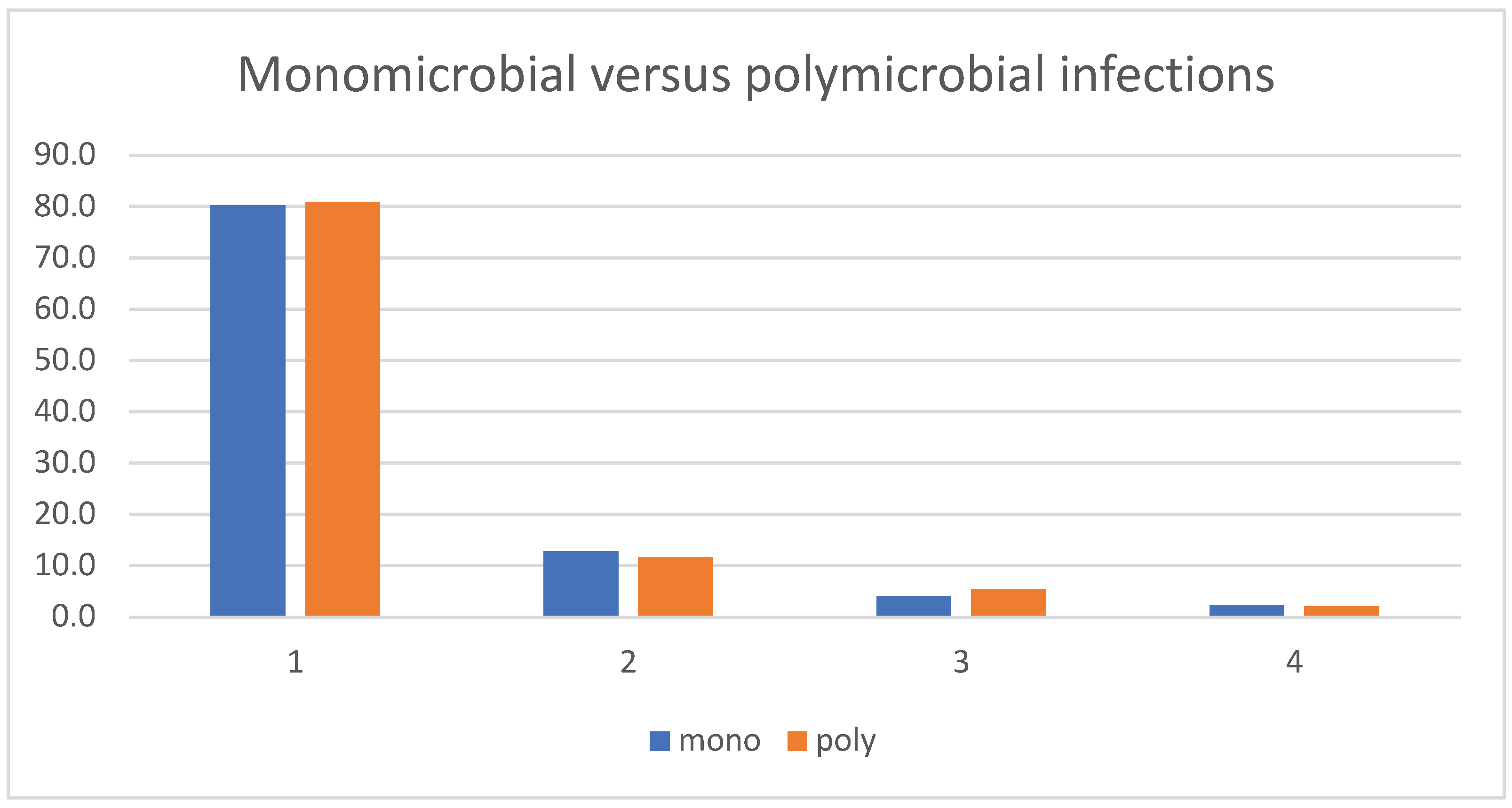

Table 1.
Pathogen distribution (n=1,067, 100%).
| Gram-Positive | 532 (49.8%) | ||
|---|---|---|---|
| S. aureus | 202 (18.9%) | Coagulase-negative staphylococci | 174 (16.3%) |
| Methicillin sensitive | 184 | S. epidermidis | 128 |
| Methicillin resistant | 18 | S. lugdunensis | 18 |
| S. caprae | 15 | ||
| Cutibacterium spp. | 103 (9.7%) | S. hominis | 3 |
| S. saccharolyticus | 2 | ||
| Streptococcus spp | 34 (3.2%) | S. capitis | 2 |
| S. pneumoniae | 3 | S. simulans | 1 |
| S. dysgalactiae | 7 | S. pseudointermedius | 1 |
| S. agalactiae | 10 | S. warneri | 1 |
| S. bovis | 2 | S. haemolyticus | 3 |
| S. gordonii | 2 | ||
| S. anginosus | 2 | Enterococcus spp. | 9 (0.8%) |
| S. sanguis | 1 | E. faecalis | 8 |
| S. mitis | 5 | E. faecium | 1 |
| Other streptococci | 2 | Other Gram-positive | 10 (0.9%) |
| Gram-Negative | 103 (9.7%) | ||
| P. aeruginosa | 25 | ||
| Enterobacter sp. | 22 | ||
| Escherichia coli | 19 | ||
| Klebsiella sp. | 11 | ||
| Proteus sp. | 10 | ||
| Serratia marcescens | 7 | ||
| Citrobacter sp. | 2 | ||
| Other | 7 | ||
| Polymicrobial | 283 (26.5%) | ||
| Culture-Negative | 149 (14%) |
Values are expressed as absolute numbers with percentages in parentheses.
Table 2.
Surgical intervention counts by pathogen groups.
| Median Number of Surgical Interventions (ranges) | Risk for second looks | |
|---|---|---|
| S. aureus | 2 (2-6) | 39/202 (19.3%) |
| CoNS | 2 (2-8) | 29/174 (16.7%) |
| Cutibacterium spp | 2 (2-4) | 12/103 (11.7%) |
| Streptococcus spp. | 2 (2-4) | 7/34 (20.6%) |
| Enterococcus spp. | 2 (2-2) | 2/9 (22.2%) |
| Other Gram-Positive | 2 (2-2) | 2/10 (20%) |
| Gram-Negative | 2 (2-8) | 29/103 (28.2%) |
| Polymicrobial | 2 (2-5) | 60/283 (21.2%) |
| Culture-Negative | 2 (2-7) | 21/128 (14.1%) |
a Values expressed as the median with the range in parentheses.
Table 3.
Head-to-head comparisons between pathogen groups.
| Single Debridement | Multiple Procedures | p-value | |
|---|---|---|---|
| Gram-Positive infections vs. Gram-Negative infections |
441/532 (82.9%) | 91/532 (17.1%) | |
| .001 | |||
| 74/103 (71.8%) | 29/103 (28.2%) | ||
| Monomicrobial vs. Polymicrobial infections |
515/635 (81.1%) | 120/635 (18.9%) | |
| .42 | |||
| 223/283 (78.8%) | 60/283 (21.2%) | ||
|
S. aureus vs. CoNS |
163 /202 (80.7%) | 39/202 (19.3%) | |
| .51 | |||
| 145/ 174 (83.3%) | 29/174 (16.7%) | ||
|
S. aureus vs. Streptococcus spp. |
163 /202 (80.7%) | 39/202 (19.3%) | |
| .86 | |||
| 27/34 (79.4%) | 7/34 (20.6%) | ||
| Implant-related infections vs Native infections |
279/374 (74.6%) | 95/374 (25.4%) | |
| .00001 | |||
| 587/693 (84.7%) | 106/693 (15.3%) |
Table 4.
Multivariable logistic regression: predictors of a second look.
| Parameter | Odds Ratio | 95% CI | p-Value |
|---|---|---|---|
| Implant-related infections | 2.18 | 1.56 - 3.03 | <.001 |
| Cutibacterium spp. | 0.57 | 0.29 - 1.14 | .113 |
| Gram-Negative | 2.04 | 1.20 - 3.47 | .009 |
| S. aureus | 1.38 | 0.86 - 2.20 | .18 |
| Streptococcus spp. | 1.22 | 0.50 - 2.99 | .662 |
| Enterococcus spp. | 1.25 | 0.25 - 6.28 | .79 |
| Polymicrobial | 1.73 | 1.13 - 2.65 | .012 |
| Other Gram-positive | 1.23 | 0.25 - 6.08 | .799 |
| Culture-Negative | 1.22 | 0.24 - 6.27 | .83 |
p-value <.05 was considered significant (in bold).
Disclaimer/Publisher’s Note: The statements, opinions and data contained in all publications are solely those of the individual author(s) and contributor(s) and not of MDPI and/or the editor(s). MDPI and/or the editor(s) disclaim responsibility for any injury to people or property resulting from any ideas, methods, instructions or products referred to in the content. |
© 2025 by the authors. Licensee MDPI, Basel, Switzerland. This article is an open access article distributed under the terms and conditions of the Creative Commons Attribution (CC BY) license (http://creativecommons.org/licenses/by/4.0/).
Copyright: This open access article is published under a Creative Commons CC BY 4.0 license, which permit the free download, distribution, and reuse, provided that the author and preprint are cited in any reuse.


