

Submitted:
08 November 2025
Posted:
10 November 2025
You are already at the latest version
Abstract
Tourism, although a key driving force for the flourishing of local/regional and national economies, is also a source of distinct negative repercussions, e.g. intense use of scarce resources and environmental deterioration, social marginalization, degradation of the quality of life of host communities, to name but a few. These repercussions seem to be further deteriorating under overtourism conditions, noticed in a number of highly-rated tourist destinations around the globe. Identification of host community’s perceptions as to the tourism footprint/burden is essential in contemporary policy research, seeking to: realize local perspectives, values and expectations as to the acceptable type/level of tourism development of their land; and highlight potential policy directions for future action that ensure sustainability and resilience objectives. Grounded in overtourism im-pacts’ assessment in a highly-rated insular destination, i.e., Santorini Island, Greece, this work aims at gathering community’s perceptions as to the drawbacks of the current tourism trajectory by use of a questionnaire survey. Results demonstrate that although respondents realize the crucial role of tourism in the island’s economic profile, they also recognize the rapidly escalating enlargement of the sector as a non-sustainable one in the long run, with severe repercussions in both environmental terms and quality of commu-nity’s everyday life.
Keywords:
Mediterranean islands
; overtourism
; community engagement
; planning
; Santorini island
1. Introduction
Tourism is a steadily evolving sector around the globe, a growth that is largely grounded in critical key drivers, such as the rising mobility patterns, the more affordable transport and accommodation options as well as the globally growing middle class population, all expected to further reinforce the firmly escalating tourism demand [1]. As such, tourism is globally perceived as a key economic driver and a developmental lever for the flourishing of the local/regional and national economies; while, as a labour-intensive activity, tourism results in undeniable positive outcomes in terms of economic wealth, employment and income opportunities.
However, tourism development is also accompanied by distinct adverse repercussions, such as the intense use of resources and environmental deterioration, the social marginalization and degradation of the quality of life, the gentrification and rising costs for host communities, the piercing land use change and privatization of public space, etc.; thus largely affecting long term sustainability and resilience objectives of destinations. This holds even truer in the context of insular regions, i.e. highly-rated tourism destinations, but also territories marked by insularity challenges and vulnerabilities, e.g. confined natural resources and limited access to the global supply chain, high import costs, cultural and environmental fragility, climate change vulnerability [2], to name but a few. In these regions, the prevalence of the mass tourism model and their high dependence on tourism are negatively affecting stability and sustainability achievements, resulting in: land use changes, especially in the vulnerable coastal parts, due to the immense deployment of tourism infrastructure and facilities; irrational management of scarce water and land resources; pollution as a result of the unmanageable volume of waste; CO2 emissions due to intense transportation; etc. [3]. Thus, although tourism in insular territories is often featured as a potential source of livelihood; a developmental lever that can provide jobs and income [4]; and a catalyst for social and territorial cohesion as well as local economic growth on the island scale [5], it is also a source of significant pressure on multiple levels (social, spatial, cultural, environmental, political, etc.). In addition, under conditions of climate change, but also of other recent global crises (economic, energy, health, geopolitical tensions, etc.) largely affecting insular territories, the rapidly evolving monocultural model of tourism in island regions endangers sustainability objectives in the long run [3].
Currently, the adverse repercussions of tourist pressure are observed in many tourist destinations around the globe – insular regions included – bringing forward the concept of overtourism, namely a complex and multifaceted term that attracts today the interest of the research and policy agenda, but also of host communities. Actually, overtourism appears today rather persistently in the public, political and academic debate and is perceived as a pressing, of global reach, alarming trend [6]. In addition, overtourism seems to represent a political reality with strong European (intensity of overtourism phenomenon in the European continent), digital, politicization and media coverage dimensions [7]. Indeed, the overtourism trend has given rise to a widespread concern with regard to its impacts on various destinations, both urban and regional/insular ones; with such impacts being largely perceived as being rather place-specific, and being influenced by factors such as infrastructure deployment, governance, and the social context [8]. In addition, overtourism has also been the subject of a rapidly expanding volume of academic research, with the frequency of the term’s use being sharply increased in relevant articles, tackling various dimensions of the overtourism phenomenon [9,10]. Indicatively, the very essence and understanding of the term and its complex, multilevel and multifaceted repercussions; the factors enabling the overtourism state; and the pool of potential policy measures for handling overtourism or mitigating its adverse outcomes fall among the topics that gain the interest of the research and policy community, while challenging the dominant economic growth paradigm of the tourism sector, namely the ‘visitors’ economy [11].
But how is the overtourism term actually defined? This question does not have a clear-cut answer. In fact, currently a commonly agreed definition of overtourism – occasionally referred as ‘overcrowding’ or ‘visitor pressure’ [12] – does not exist. In addition, while the term is initially used to highlight the adverse impacts of tourism mainly in city contexts, e.g. Venice, Barcelona [10,13,14], it is expanded to incorporate also other types of territories, e.g. nature-based destinations such as national parks, coastal areas or islands, rural heritage sites, mainly due to their high tourism attractiveness as well as high vulnerability [7,15].
In the effort to grasp the very essence of the overtourism term, the exponentially expanding literature on this topic [16] displays that the term still remains obscure and lacks a clear-cut, widely accepted, definition as well as a well-documented and commonly agreed methodological approach in order for this to be identified and assessed. In fact, a range of overtourism definitions can be identified in the literature, expressing different viewpoints on the topic. In a relevant to overtourism work, Leka et al. [17] identify the varying literature-based meanings attached to overtourism, with the term being commonly grasped as: an unsustainable tourism model [18]; a state of “too many tourists at a place and in an unsustainable way” [19] (p. 48); a threat to quality of life [20], heritage [21], natural and socio-cultural resources [20], and place attachment [22]; and a phenomenon mainly associated with the volume, type and time frame of tourist flows, coupled with the carrying capacity and fragility of the destination. Furthermore, literature exploration by Leka et al. [17] have illuminated a number of studies that stress the physical, cultural, economic, social, psychological, political, spatial, etc. dimensions of overtourism. As such are referred the works of:
- Peeters et al. [15] (p. 22), defining overtourism as “… a state that is tightly linked to a situation in which tourism impacts, at certain times and in certain locations, exceed physical, ecological, social, economic, psychological, and/or political capacity thresholds”, associated with the large volume of visitors.
- Mihalic [18], perceiving overtourism as the rapid escalation and growth of tourism supply and demand, which result in the excessive use of destinations' natural resources and the destruction of their cultural attractions, while also negatively affecting the local socioeconomic environment in the long run.
- UNWTO [1], stressing the social dimension and perceiving overtourism on the ground of the impacts of tourism on a destination, or parts thereof that are excessively influencing perceived quality of life of citizens and/or quality of visitors' experiences in a negative way.
- Vourdoubas [23], featuring overtourism as a phenomenon occurring mainly in popular tourism destinations and being mostly expressed by the large number of tourists – a “tourism storm” or “tourism invasion” – that overwhelms the destination and results in negative impacts on the local communities, the environment, and the visitors’ experience.
- Milano et al. [24] and García-Buades et al. [25], stating that overtourism is a state of an excessive growth of visitors, which leads to overcrowding in specific areas, while, in turn, renders residents the ‘victims’ of the impacts of tourist peaks that cause permanent changes to their lifestyles, limit their access to amenities and damage in general their well-being.
- Saveriades [26], highlighting also the social dimension and claiming that overtourism is associated with the maximum level of use (in terms of numbers and activities) that can be absorbed by a destination so that an acceptable decline in the quality of experience of visitors and acceptable adverse impact on the host community to be ensured.
- Goessling et al. [22], conceptualizing overtourism as a psychological reaction to tourist pressure, being the result of the damage of ‘place-residents’ interrelationships, which cause the shift of residents’ attitudes towards tourism.
- Capocchi et al. [9], pointing out the subjective nature of overtourism, where locals, tourists or both realize a destination as having that number of tourists that is: changing its character, affecting its authenticity, and leading to irritation and annoyance.
- Milano et al. [11], suggesting that overtourism can be grasped as a multifaceted and self-perpetuating system, placing priority to economic growth through mass tourism and gradually mobilizing a ‘visitor economy’ that leads to economic restructuring at the destination level.
- Alsharif et al. [27], pointing out that overtourism does not purely refer to the number of tourists in a certain destination, but actually features a destination’s state where a certain mismatch between tourist flows and the destination’s ecological, social, psychological, political or perceptual capacity is noticed.
While the aforementioned definitions and dimensions of overtourism reflect the diversifying viewpoints on the topic, a certain consensus is reached as to the impacts of overtourism on local communities, with tourism overcrowding and an overdeveloped tourism industry being grasped as factors responsible for the degradation of the natural / cultural resources and landscape as well as the deterioration of the quality of life of residents and the experiences gained by tourists in a certain destination [10,28,29,30]. Further to that, a certain consensus is also reached as to the role of local communities in both identifying the impacts of overtourism in their homeland, the way these are perceived by them; and being part of the tourism planning and management process for more informed and win-win (local population and visitors) policy decisions to be attained [15,31,32].
Currently, however, most overtourism studies pay attention to quantitative assessment of tourism dynamics – demand and supply – for identifying inefficiencies and articulating relevant policy interventions. Thus existing literature has so far investigated the impacts of tourism development – both positive and negative – in economic, but also in environmental, social, spatial etc. terms at a region’s level – macro-level. On the contrary, little attention has been given to the way such impacts are perceived or experienced by the local population of a destination – micro level. That said, a certain gap is noticed with regard to studies engaging community actors and residents – i.e. the groups that feel most directly the pressure generated by tourism [33] – for qualitatively assessing/prioritizing overtourism impacts and articulating place-based remedy measures at a certain destination. This holds also true for the study region of this work – Santorini Island – despite the fact that this island lies high in the list of areas suffering by overtourism [34]. Such a community engagement approach calls for consideration of the overtourism concept in the policy cycle, and the broadening of local communities’ role in the tourism planning process, in an effort to embed the local flavour both in the agenda-setting and the policy formulation stage of this cycle. As a result, the scope of policy formulation will be broadened; the distributed knowledge as to the way local population / actors experience the adverse repercussions of overtourism will be collected; and more balanced policies will be articulated for safeguarding residents’ quality of life, while preserving tourists’ experience and economic benefits at the destination.
In such a context, the focus of the present work is on gathering population’s perceptions as to the repercussions of overtourism in their homeland and quality of life in Santorini Island. Towards this end, a questionnaire survey is conducted, aiming at gathering community’s experiences and illuminating the impacts of overtourism through the lens of the local population. The structure of this work has as follows: in Section 2 the methodological approach is illuminated; Section 3 elaborates on the study region, while also summarizes critical overtourism implications in Santorini Island – macro level – that are based on previous work of the authors; Section 4 discusses the very essence of the questionnaire survey – micro level –, as well as the results obtained by data elaboration through statistical and Importance-Performance Analysis; Section 5 attempts to roughly combine results obtained at the macro- (whole area of Santorini Island) and the micro-level (questionnaire survey results) as a means for drafting policy priorities; while, finally, in Section 6 conclusions are drawn.
2. Materials and Methods
The work carried out in this research article attempts to step further previous endeavour of the authors that aimed at establishing a methodological framework for exploring the impacts of overtourism in environmental, economic, social and spatial terms; and had as a case study Santorini Island [17]. Out of this research endeavour, conducted at the municipality level with an emphasis on Santorini Island – macro-level – some data-enabled, key findings have emerged, connoting specific fields of policy intervention, either sectoral or spatial for mitigating adverse implications of tourism in Santorini Island.
Taking into consideration results obtained from the aforementioned work; the gap in scientific research with regard to addressing local population perceptions in the study of overtourism phenomenon and its implications; as well as the intensity of tourism phenomenon and related overtourism signs in this specific destination, the following research questions lie at the heart of this work:
- How does the local community – micro-level – perceive the issue of overtourism and its impacts on the study area?
- What are the important policy issues that arise from the community perspective?
- Do local people realize the medium to long term challenges and risks of overtourism, as these are unveiled at the macro level or they grasp only the short term annoyance in their everyday activities, especially during the tourism peak season?
- Do they consider the current tourism model as a sustainable one in the long run or they realize the need to shift towards a more sustainable and resilient one?
Taking into consideration the criticality of the aforementioned questions in areas that are suffering from overtourism, an attempt to illuminate these dimensions is carried out by means of a questionnaire research in a very distinct overtourism example, i.e., Santorini Island. While the citizens’ perspective lies at the heart of this work – micro level – authors considered as highly important also to try to combine outcomes of this research with those recently delivered by them in the study region with reference to the macro-level.
Within such a context, the methodological approach developed in this work is presented in Figure 1 and features an attempt to combine results emanating from the macro- and micro-level in order for critical overtourism dimensions to be identified and feed policy analysis. More specifically, in Figure 1 the content of the white boxes emanates from the previous authors’ work [17], the key outcomes of which that are relevant to the present article are shortly presented in Section 3 below. On the contrary, the content of the blue boxes constitutes work developed in this research paper.
The steps of the proposed methodological approach have as follows:
- The first step aims at gathering insights into the study region –macro-level – in order for the ground of research (environmental, cultural, economic, social, etc.) to be fully grasped (box 1).
- The second step relates to the assessment of overtourism impacts in environmental, economic, social, and spatial terms –macro-level – that is accomplished by use of a range of literature well-established indicators (box 2). Information related to this step is provided by previous work of authors on the topic [17] and features long term implications of overtourism at the island’s level.
- The third and fourth step aim at illuminating the impacts of overtourism, the way these are identified through the lens of the local community – micro-level. A questionnaire survey is carried out in this respect, while qualitative data collected are elaborated by use of the SPSS software (boxes 3 and 4).
- The fifth step is an effort to classify/prioritize overtourism repercussions as well as potential options for the future tourism profile of Santorini Island, as these were stated through the lens of questionnaire respondents – micro-level (box 5). Towards this end, an Importance-Performance Analysis (IPA) is conducted.
- Finally, in the last step (box 6), an attempt to combine work carried out at the macro- and the micro-level is undertaken. Such an effort aimed at highlighting issues that need to be placed in the policy discourse, thus resulting in more evidence-based policy action for attaining mitigation of overtourism impacts in Santorini Island.
3. The Study Region
The study region – Santorini Island – is part of the Cyclades islands’ complex (Figure 2a), Southern Aegean Region, Greece, namely an insular part of the Greek territory that contains highly-rated, mainly mass, tourist destinations of global reach. The Island of Santorini (or Thera) is actually the flagship and the main tourist destination of the Municipality of Thera which, additionally, incorporates the smaller island of Thirasia and the uninhabited islets of Palaia Kameni, Nea Kameni, Aspronisi, Christiani, Askania and Esxati (Figure 2b). The municipality covers an area of 90.69 km2, while its population in 2021 amounts to 15,480 inhabitants. Worth noticing is the remarkable increase of the municipality’s population in the time span 2001-2021 (+12.79%), surpassing the rising population trend of Southern Aegean Region as a whole (+9.84%), while opposing to the declining population trend of the Greek country as a whole (-4.13%).
Santorini Island, but also the whole area of Thera Municipality, disposes remarkable natural and cultural assets. In fact the whole municipality is marked as ‘Landscape of Outstanding Natural Beauty’, while its rich cultural heritage incorporates historical / archaeological sites and traditional settlements. The special geomorphology of the area witnesses its volcanic origin, while the local economy has traditionally been traced out by the exceptional agricultural production, leading to well known Protected Designation of Origin (PDO) products (e.g., wine, small tomatoes, fava bean). These have so far marked the local production identity and land use pattern; while have, among others, strengthened the island’s extroversion [17]. However, the distinct uniqueness of the natural and cultural identity, the distinguishable geomorphological origin and volcanic scenery, the majestic views in the Aegean Sea and the unique architecture of Santorini Island have gradually transformed this island into an extremely popular tourist destination of global reach, a Cycladic tourism hotspot and a “global tourism power” [35].
Having in mind that overtourism is the outcome of a rapidly evolving tourism demand and supply in a destination [16], Leka et al. [17] have studied the dynamics of the tourism sector – demand and supply – in Santorini Island as well as the impacts of this rapidly escalating sector in environmental, economic, social and spatial terms. In fact in this work, assessment of tourism dynamics through time by use of both quantitative and qualitative indicators has unveiled an alarming island’s state, with certain capacity thresholds being already reached or even overcome. Alarming are also the implications of the tourism overload in the island’s landscape due to the excessive built up expansion for serving the tourism demand, but also in the agricultural sector, thus placing at stake well established, traditional production patterns and Protected Designation of Origin (PDO) products, steering for many decades the island’s extroversion and being part of the local tradition and identity. Similar are the findings with regard to changes in land use patterns, being chiefly a result of the intensity of tourist accommodation expansion even within Natura 2000 and Archaeological Zones, or in close proximity to them [17].
More specifically, the escalating trends of the tourism sector in Santorini Island, both in terms of supply and demand [17] and the distinct transition of the island into an overcrowded tourism destination – a remarkable example of destinations suffering from overtourism [34] – have quite noticeable repercussions in environmental, economic, social and spatial terms, the most profound and critical of which are summarized as follows [17]:
- Gradual shift of the local production identity from an agrarian society to a thriving service-oriented economy, mainly a ‘visitor economy’. This is due to the gradual prevalence of the tourism sector in the local economic profile; and is largely witnessed by the employment share of the tertiary sector that has shifted from 68.77% in 2001 to 90.66% in 2021, with the primary and secondary sectors demonstrating quite visible downturn signs through time. Taking into account the high vulnerability of the tourism sector, such a rather monocultural economic profile places medium to long term sustainability objectives and flourishing of the island at stake.
- Vegetation health and coverage, as captured by the Normalized Difference Vegetation Index (NDVI), is rapidly decreasing, with a more rapid decrease pace being displayed in the central and southern part of the island. This part is also characterized by the shrinkage of agricultural land over the past three decades, and a significant percentage of wider agricultural zones being currently left uncultivated. Decrease in vegetation coverage in the central and southern part is interpreted by the fact that this constitutes the most heavily impacted island’s part by construction (artificial land, Figure 3a), followed by the northern part. In addition, large scale tourism infrastructure – i.e., 4* and 5* hotels of significant bed capacity, pools and other auxiliary spaces – covering large plots are located in the central and northern part of the island (Figure 3b and 3c).
- Vegetation degradation and loss. This, as close inspection of the NDVI loss shows, is considerably affecting the vineyards (Figure 3a), i.e. a very important primary resource for the production of the famous local wine of Santorini – a PDO product – and a milestone of the local agricultural tradition. This degradation is interpreted as a combined effect of climate change and drought, coupled with the sprawling of new constructions (or relevant preparatory works) taking place since 2017 in such fields. According to the results presented by Leka et al. [17], the central part of Santorini Island is very heavily affected by built-up areas, while significant pressure is currently identified in both the northern (Oia settlement) and the southern part and particularly the outstanding archaeological space of Akrotiri (Figure 3b and 3c).
- Quite noticeable loss of housing affordability. This is a critical overtourism repercussion, definitely affecting various groups of local population, while creating hostile feelings against the tourism phenomenon in the island. In quantitative terms, the mean rental price and the mean price for sale in Santorini Island is 56% and 100% higher respectively than the average for Cyclades and Attika Region.
- Airbnb accommodation expansion. The tourism supply in the Municipality of Thera in general and Santorini Island in particular is also further enriched by the rapid increase of Airbnb accommodation. In 2023, the number of Airbnb accommodations rises to 4783 units and 10750 beds [38], which sounds to be a quite large number, taking into consideration that the Athens metropolitan capital disposes 11314 Airbnb beds.
4. Overtourism Repercussions Through the Lens of the Locals – Methodology and Results
“… while Santorini’s white and blue cliff sides are undeniably picturesque, the experience is less enjoyable when visitors are forced to fight crowds at popular viewpoints” [39]
As empirical studies show, attitudes of the local community towards tourist development in general and volume of tourism flows in particular vary, with this variation reflecting the diversified capacity of local people to emotionally cope with crowding effects. This capacity is based on a range of factors, such as the community’s dependence on the tourism sector, the types of interaction between residents and visitors, the fair sharing of tourism benefits, the proximity of someone’s residence to tourism zones as well as the individual socio-economic features (e.g., education level) (Alrwajfah et al. 2019) [40]. In general, the intense influx of visitors in a destination is adversely affecting living conditions of local communities, taking the form of, among others, rising subsistence costs, residents’ displacement due to the proliferation of tourist accommodations, erosion of cultural identity. Thus community engagement in tourism planning, place-branding and tourism-related initiatives are critical for ensuring a benefit-sharing, sustainable and inclusive tourism growth [15,17,31,32,41]. As various studies claim, articulation and successful implementation of any sustainable tourism strategy must be sensitive to the impacts detected by the society [1]; and reflect, the one or the other way, the residents’ vision and expectations with respect to their own homeland [42]. Consideration of varying local community views, in this respect, is critical in order for a win-win end state at a certain destination to be attained, to the benefit of both local community and visitors.
Having this in mind, in this section the core of this research article is presented. This is associated with a questionnaire survey conducted in Santorini Island, which aimed at capturing local community perceptions as to the impacts of overtourism on both their land and daily lives; and collect local views as to the options available for shifting to more sustainable tourism pathways. The structure and organization of the questionnaire survey and the results obtained are presented in the following subsections.
4.1. Structure of the Questionnaire Research
In order to gather insight into the way both residents and frequent visitors of Santorini experience the repercussions of overtourism, a cross-sectional questionnaire survey was carried out (see Stage 3 in Figure 1). This survey aimed at exploring mainly residents but also visitors’ perceptions as to the tourism dynamics and the (over)tourism-related impacts; and sketching policy priorities that can pave future sustainable tourist pathways of Santorini Island. The questionnaire used in this respect comprised 20 questions, falling into the main thematic groups demonstrated in Table 1. It should also be noted that due to the fact that the questionnaire was planned to be distributed through various social media platforms and thus would be accessible to a wider audience, respondents – the way their socio-demographic profiles unveiled – were actually classified into three main groups, namely the: a) currently permanent residents, b) former island’s residents (those who have lived in the island in the past for several years), and c) visitors’ group (tourists) with at least one prior stay in Santorini Island.
Taking into consideration the varying communication capabilities of respondents and in order for broad accessibility to the addressed audience to be attained, the recruitment strategy followed in the end a mixed-mode approach, comprising online dissemination through social media networks (Facebook, Instagram) and e-mail invitations, complemented by on-site questionnaire distribution to reach participants less likely to engage digitally. Thus the questionnaire was distributed both digitally via Google Form and through Face to Face (F2F) interaction (interview by use of a printed questionnaire form). Data collection occurred between 24 February and 18 June 2024, resulting in 331 total responses (approximately 92.4% online and 7.6% paper-based). After data validation— removal of incomplete or non-eligible cases, e.g., tourists with no prior visitation—324 valid questionnaires were retained for further analysis. Out of these valid responses:
- 232 respondents (71,6%) were currently permanent municipal residents;
- 52 respondents (16,04%) were former residents, residing in the municipality of Thira for several years; and
- 40 respondents (12,34%) fall into the visitors’ group (tourists).
The visitors’ group is composed by 57.5% of respondents who reported themselves as regular visitors of Santorini Island; 20.0% of respondents who reported that they have visited Santorini a few times (e.g., 2–3 visits); and a remaining 22.5% of respondents who reported just one previous visit. Thus almost two thirds of the visitors’ group (tourists) comprises repetitive visitors, who were perceived by this study as respondents who are capable of articulating a more mature and experience-based perspective as to the tourism satisfaction gained in Santorini Island.
Questionnaire data were analyzed by use of the IBM SPSS Statistics in conjunction with Python. More specifically, implementation of core statistical procedures by use of SPSS was primarily carried out for gathering insight into the data set; whereas Python was used for carrying out the Importance–Performance Analysis (IPA) and generating customized graphical outputs.
4.2. Statistical Analysis of Questionnaire Data
At the stage of data analysis by use of SPSS, a multilevel analytical approach was adopted, thus ensuring both statistical rigor and interpretive clarity. This comprised three main stages, namely:
- Descriptive statistics: Frequencies and percentages were calculated for key demographic and contextual variables, including sex, age group, occupation, residency status (municipal zone and length of residence), as well as frequency of visit (for visitors).
- Comparative analysis: Cross-tabulations were performed to compare responses of the main subgroups (e.g., residents vs visitors; respondents related or non-related to tourism; sex and age groups).
- Visualization: Graphical representations were deployed to facilitate interpretation.
Profiling of the sample respondents (Figure 4) shows: a slight dominance of female ones across all age groups; the prevalence of the economically-active, middle-aged group (age group 35-64), followed by the age group of 15-34; a rather small number of respondents in the age group 65+. This pattern holds true for both the group of ‘currently permanent municipal residents’ and the one of ‘former residents’, while is also evident in the ‘Visitors’ group.
The spatial distribution of respondents (reference to the ‘currently municipal residents’ group exclusively) (Table 2 and Figure 5) seems to follow an uneven pattern. More specifically, the majority of respondents reside in the Central part of the island (72.8% of respondents). Next comes the Southern (13.4% of respondents) and the Northern part (10.8% of respondents), while Akrotiri (2.6% of respondents) and Therasia (0.4% of respondents) own much smaller respondents’ shares. A similar pattern is observed among respondents related to the tourism sector as either employees or business owners, with the majority of them being located in the Central part (70.9% of respondents), followed by the Southern part (15.0%), the Northern part (11.0%), Akrotiri (2.4%) and Therasia (0.7%). This spatial pattern is in alignment with the higher residential density and tourism intensity in the island’s central corridor.
The statistically-significant deviation from a uniform distribution is attributable to the strong tourist specialization of the Central part (high density of attractions and accommodation, superior accessibility, and cruise-related flows), featuring a disproportionate share of visits in Santorini Island. This pattern highlights the demographic prominence of the Central part within the respondents’ sample (72.8%), likely reflecting its higher residential density and tourism intensity. At the same time, gathering of responses from all five thematic areas of Santorini Island (Table 2) ensured a broad geographic coverage and supported the spatial validity of the research survey, enabling thus a nuanced understanding of sub-regional variations across the island.
Slightly more than half of the permanent population of the sample [54.6% or 137 respondents out of the currently permanent population group of 232 respondents] reported professional engagement in tourism as either employees or tourism business owners. The remaining 45.4% indicated no occupational link to the tourism sector. This balanced composition captures the dual perspective within the community, namely those economically dependent on tourism and those at a distance from the direct economic benefit from the sector, thereby providing a nuanced foundation for analyzing perceptions of tourism impacts and local development priorities.
Despite the paramount importance attached to the tourism sector in Santorini’s economic profile – Santorini and Mykonos are perceived as the flagship of the Greek tourism brand –, the majority of respondents consider that tourism activity has been over-intensified during the last decade (Question 11). In fact, out of the whole respondents’ sample (324 respondents), those who hold this view by rating intensification of the tourism activity as “very much” and “a lot”, account for 70.06% (227 respondents) and 22.53% (73 respondents) respectively (Figure 6a).
Similar seems to be the respondents’ view as to the importance of the tourism sector in the local economy (Question 14), where they recognize the large contribution of the sector. Actually the response “extremely important” gathers 55.56% (180 responses) and the “very important” 38.58% (124 responses). Thus an overwhelming consensus is reached as to the pivotal role tourism has, during the last few decades, acquired in Santorini’s economic profile (Figure 6b), although rather overemphasized during the last decade, rendering thus Santorini Island a distinct example of overtourism in the global scenery [34,43,44].
The rising intensity of the tourism sector has apparently influenced the quality of life of local population, especially during the peak tourist season. This is evident from their reaction to the relevant question (Question 15), where the responses “very bad” and “bad” as to the influence of the rising tourism intensity in residents’ daily life gathered 45.9% (147 respondents) and 41.3% (132 respondents) respectively. Thus the majority of respondents converges to the view that both the current form and the rising intensity of tourism is a main source of discomfort and undermines the quality of life of local population (Figure 7a). Furthermore, discomfort and deterioration of the quality of life of local population are mainly, according to respondents, due to the road traffic/congestion, crowding in public space, waste management and health services’ capacity (Question 16) (Figure 7b).
Of interest in this respect is that respondents rate lower aspects such as environmental pressure, adequacy of local resources and their overconsumption due to the steadily escalating tourist flows, as well as carrying capacity of cultural resources. This finding can eventually be interpreted by the fact that respondents were mainly reporting on the everyday life disturbance in the area surrounding their neighbourhood, lacking or disposing limited knowledge as to the severe repercussions of overtourism in Santorini Island as a whole, namely in a broader spatial context and a longer run.
Of great interest was respondents’ view as to whether the current mass tourism model is beneficial for the island’s sustainable future or this should be somehow changed (Question 19). The majority of respondents of the questionnaire sample (78.70%, 255 respondents) favored a shift towards alternative tourism forms, taking into account the abundance and value of natural and cultural resources of Santorini Island and the necessity to pave more sustainable and resilient future tourism paths. A further 12.65% (41 respondents) were also placed opposite to the current mass tourism model, stressing the necessity for a shift towards the primary and secondary production sectors that have a strong tradition in Santorini Island, are part of the local identity and have delivered renowned products of origin. On the opposite side of the aforementioned views stands a small minority (8.64%, 28 respondents), who claim that the current mass-tourism model should remain to the benefit of the local economy (Figure 8). Out of the 28 respondents supporting the mass tourism model, 26 are permanent residents, while 22 out of them are respondents directly related to tourism activity.
4.3. Importance-Performance Analysis (IPA)
The Importance-Performance Analysis (IPA), carried out in Stage 5 of the methodological framework (see Figure 1) originates as a business research technique, useful for formulating management strategies [45]. Its power lies on its diagnostic nature and its capability to enable the identification of attributes of a product or service for which, given their importance, the product or service either underperforms or overperforms [46]. Despite its origin, however, IPA has been proven a quite useful tool in various fields, including tourism, education, healthcare, public administration etc. for properly guiding related strategies [47].
At the heart of the IPA’s rationale lies an expectation-disconfirmation model. This aims at featuring customer’s satisfaction as a function of importance (or, alternatively, expectations) and performance of different product or service attributes [45,48]. Such a combined consideration of importance and performance aspects of products or services is sketched in a two-dimensional plot (Figure 9) for facilitating data interpretation and thus enabling prioritization of management decisions. In addition, by plotting these two dimensions on a two-dimensional matrix, the IPA enables the visual categorization of attributes into management quadrants, thereby assisting the efficient allocation of limited resources [49,50].
Interpretation of the four quadrants of Figure 9 has as follows [47]: Quadrant 1 – ‘keep up the good work’ – represents major strengths and potential competitive advantages of a product or service, i.e. well performing attributes and need for steadily investing in these strengths in order for these to be sustained. Quadrant 2 – ‘possible overkill’ area – is associated with attributes of low importance to customers, thus high performance noticed in this quadrant implies eventually resource waste and a need for resource reorientation/reallocation to other attributes of the product or service. Quadrant 3 – ‘low priority’ area – incorporates attributes that display a low performance, but do not gain the interest of managers since they are relatively unimportant to customers (low importance). Finally, Quadrant 4 – the ‘concentrate here’ area – is the most crucial one in the plot, featuring underperforming attributes of product or service which are of great importance for customers, thus indicating the highest priority in terms of investments or policy formulation for restoring competitiveness.
In the following, the IPA technique was used for featuring policy considerations / priorities in Santorini Island the way these were identified through the lens of respondents engaged in the questionnaire survey. Particularly, having in mind that collection of views of respondents, engaged in the questionnaire survey in Santorini Island, had as its primary goal to use relevant data for: featuring, through the lens of respondents, the adverse repercussions of (over)tourism on residents’ daily life and the options available for a sustainable tourism model; and addressing related issues at the stage of policy formulation, at the heart of the stage of implementing the IPA technique lies data collected by two questions, namely: Question 16, collecting/illuminating the main adverse impacts of (over)tourism emanating from the survey; and Question 18, highlighting respondents’ reaction as to the alternative tourism forms a sustainable and resilient future of Santorini Island should display.
A problem that needed to be properly handled was that responses to Questions 16 and 18 did not actually conformed to the 1–5 (“agree/disagree”) traditional Likert-type scales. Instead, they were presented in a checklist form, where respondents could pick up more than one items. Thus the two key IPA dimensions – Importance and Performance – were approximated by use of these checklist responses, using standard IPA methodologies and practices, commonly applied in destination studies [45,47,48,51,52]. Thus in this case study:
- Importance was inferred from the number of times each item was selected (i.e., an issue ticked by many respondents was treated as more important) or, stated differently, it was defined as the proportion of respondents who identified a given attribute as a pressure or burden (in Question 16) or selected an attribute as important (in Question 18) [48,52].
- Performance reflects the current level of functioning of each attribute, whether based on respondents’ perceptions or emerging by system-generated evidence. In combination with Importance, it enables prioritization of management interventions. In the present study, the Performance scores were obtained from system-based measurements, capturing the observed operational performance of each attribute. These measures were standardized and rescaled to a continuous [0,1] interval to ensure comparability, allowing thus the paired analysis of Importance and Performance to highlight areas requiring management attention [45,47].
Applying this framework to Santorini Island enabled a structured assessment of how residents and visitors grasp the relative importance and perceived performance or delivery of the impacts of overtourism (Question 16 – Q16) and alternative tourism options as a means for mitigating overtourism load (Question 18 – Q18). Attributes (x for Q16 and y for Q18) were assigned to IPA quadrants based on their position relative to the dataset-specific sample means, namely for Question 16, and ; and for Question 18, and . These thresholds formed the ground for structuring the IPA matrices, reported in Table 3 and Table 4 and illustrated in Figure 10 and Figure 11 respectively.
Out of the Importance-Performance Analysis of the data sets of Questions 16 and 18, the following key conclusions can be drawn:
- Quadrant 4 (Concentrate here): As far as the impacts of overtourism are concerned (Question 16), this quadrant contains attributes that are rated high in importance. As such are considered the: ‘road congestion/traffic’, ‘waste management’, ‘crowding in public spaces’, ‘capacity of health services’, ‘pressure on living costs’ and ‘respect for residents’ (x1-x6 in Table 3) (Figure 10). This result is in alignment with findings at the macro level [17], where a rapid expansion of the built up environment in specific island’s spots is identified, establishing thus overcrowded and congested urban slots. In addition, work at the macro-level displayed that the costs of renting or buying a house are far more high that the ones in the rest of the Cyclades Island’ complex and the Athens metropolitan area. This pressure in the real estate market is also rated high in importance by the respondents. Speaking of the options available for featuring the future of tourism in Santorini Island (Question 18), the most preferable alternative tourism forms that are grounded in the abundance of the island’s local assets are ‘Volcano/Caldera geotourism’, ‘natural scenery’, ‘history/museum’s, and ‘local products/gastronomy’ (y1-y4 in Table 4) (Figure 11). Worth noticing is that in both cases (Questions 16 and 18) attributes that are rated as highly important by respondents are at the same time underperforming (i.e., display a low performance). This, in turn, highlights policy fields for action in order for a better performance to be attained.
- Quadrant 2 (Possible overkill): With respect to the impacts of overtourism (Question 16), this quadrant contains the attributes ‘environmental pressure’, ‘public resources / utilities’, ‘cultural carrying capacity’ and ‘perceived crime/safety’ (x7-x10) (Figure 10). Importance of all four attributes is rated rather lower by respondents, while these seem to be better performing. On the contrary, results at the macro-level stress the deterioration of environmental parameters and landscape quality through time due to the expansion of the built up space and tourism infrastructure. An effort to interpret this contradiction leads to the conclusion that lower priority attached to these attributes by respondents (micro-level) is the outcome of the lack of knowledge as to the long term environmental implications of the rising in intensity mass tourism model that are already taking place in Santorini Island as a whole (macro-level). Speaking of the key drivers of the tourism model in Question 18, ‘entertainment/nightlife’, ‘cruise-related offer’ and ‘sea/sun & beaches’ (y7-y9) (Figure 11) are gaining low importance by respondents. However, they display higher performance gains, being mainly the outcome of the emphasis placed on the mass tourism model, having at its heart the aforementioned attributes. Taking into consideration results at the macro-level, demonstrating that overestimation of these attributes in Santorini’s tourism model has led to violation of carrying capacity, further exploitation of these attributes in Santorini’s tourist model needs to be restrained.
- Quadrant 3 (Low priority): None of the x and y attributes (Table 3 and Table 4) falls into the category of attribute marked by both low importance and low performance. This implies that even the least important tourism pressures (Q16) and offerings (Q18) are performing at or above the estimated mean values for each one of the studied data sets.
Quadrant 1 (Keep up the good work): This quadrant is notably empty, highlighting that Santorini has not yet achieved strong performance in most of the attributes valued as important by the respondents in the questionnaire survey. The absence of attributes in this quadrant indicates that, from the perspective of both residents and visitors, Santorini lacks policy areas or tourism assets that are simultaneously highly valued and effectively managed. This highlights a strategic inefficiency in the island’s tourism model, where although certain conventional attractions perform well, these do not represent those attributes that respondents deem as most important for attaining long-term sustainability objectives.
5. Discussion
Tourism nowadays definitely constitutes an important economic sector of countries surrounding the Mediterranean Basin and a key lever for the flourishing of coastal and insular economies of the majority of islands floating in the Mediterranean [17,41]. However, the rapidly escalating tourist flows in the highly-attractive Mediterranean coastal and insular destinations [53] has led many of them, including Santorini Island, to receive an excessive volume of tourist flows. Such flows, additionally, exceed in many cases the carrying capacity of these destinations in environmental, social, cultural, psychological, political, etc. terms and definitely lead to the state of overtourism. This state is currently set at the heart of the scientific and policy discourse, particularly in the geographically confined territories such as the insular ones, with the focus being on the impacts of the overtourism phenomenon on the natural and manmade environment, but also on the quality of life of local communities as well as the quality of the tourism experience per se [17,54,55]. In fact the combination of the overtourism phenomenon with the particular challenges introduced by the insularity context and the climate change repercussions creates an explosive mixture – a ‘red code’ for insular regions – that requires immediate policy consideration and action in order for the negative impacts, experienced by such territories, to be confined.
Acknowledgement of the above explosive mixture has, currently, motivated the integration of sustainability objectives into tourism planning and management endeavours, thus giving rise to a paradigm shift that aligns with the 2030 UN Agenda and the SDGs, and seeks to achieve the right balance among economic growth, environmental stewardship and social responsibility [56]. Within such a paradigm shift, quantitative and qualitative adverse impacts of tourism overload in destinations need to be addressed; and a holistic, integrated and long term planning approach that steers the transition from ‘tourism growth’ – a quantitative assessment placing emphasis on number of visitors, economic output etc. – to ‘sustainable tourism’ needs to be adopted. The latter calls for both quantitative and qualitative assessments and steady monitoring; while attempts to successfully compromise growth objectives with the health of natural and manmade ecosystems. Such an effort also implies the: steady, data-enabled assessment of destination’s tourism capacity; featuring of the interaction of tourism with other economic sectors, hosting communities, natural and cultural capital; and harmonization of the tourism development pattern with other policy directions at the destination’s level. In addition, risks that a certain destination is confronted with are worth noticing in the planning endeavour in order for policy choices to be aligned with the management of or the efficient adaptation to such risks.
Further to the aforementioned key considerations embedded in the planning effort towards a sustainable tourism destination – the macro-level – of critical importance in this respect is community engagement – the micro-level – in featuring the destination’s brand so that this conforms to the expectations, local identity, traditions and historical trajectory of each destination as well as ensures a broad consensus among actors and stakeholders at the local (destination) level. Engagement of local actors and stakeholders in the planning process acts as a ‘bridge’ for both downscaling the findings of studies at the macro-level to local people and upscaling the views and expectations of local people to policy discourse made at the macro-level. In addition, community engagement in tourism planning can raise awareness of local population and stakeholders as to the medium to long term repercussions of (over)tourism activity, allowing thus for eventually ‘painful’ but necessary and more environmentally-friendly and socially-responsible decisions to be made at a certain destination. This seems to be a critical point, since in most of the cases knowledge as to the medium to long term implications of overtourism at a destination that are identified through macro-level studies are not really diffused to audience at the local level. In addition, local communities do not really understand/realize the long-term impacts of overtourism, with the discussion in most cases being limited to the everyday difficulties and insufficient service delivery to local population due to the overloading of infrastructure and services. This knowledge gap is also noticed in the case study of this work, i.e., Santorini Island, where important repercussions in environmental, cultural, resource consumption etc. terms are rated lower than the everyday bottlenecks due to tourism overload (see Figure 7b above). Failure to effectively manage interaction between the macro- and the micro-level in tourism planning has so far demonstrated the adverse impacts witnessed in various world destinations suffering from overtourism, with exceptional examples from the European territory being Barcelona [56] or Venice [57].
The study region of this work, i.e., Santorini Island, is currently a globally highly-appreciated tourist destination, with tourism being the island's dominant economic lever. The prevailing mass tourism model has yielded significant economic benefits at the national and regional/local level; while noticeable is also the continuously escalating tourist demand that has motivated the rising of accommodation infrastructure [hotels and short-term rental accommodations (Airbnb)] mainly in the Central and the Southern part to the detriment of other productive activities. Expansion of tourism activity in Santorini Island, as depicted in macro-level studies, has led to adverse overtourism effects, with particularly negative impacts in environmental and socioeconomic terms. Such impacts are signalizing severe structural changes and the tertiarization of the local economy; and are roughly summarized in previous authors’ work as follows [17]:
- Santorini Island as a whole is marked by significant environmental vulnerability, maximized in the archaeological zone of Akrotiri Thematic Area. However, building within protected areas currently reaches up to 12.7% of land.
- Vegetation health and coverage, as captured by NDVI, is recently rapidly decreasing, actually in a more rapid pace in the island’s Central and Southern part.
- Agricultural land, as captured by Corine Land Cover, is rapidly shrinking over the past three decades, rising to a 25% at the island’s level and above 40% in the Northern part as well as the Therasia land. Furthermore, a considerable part of the remaining agricultural land is currently left uncultivated, especially in the Central and Southern part.
- Large scale tourism infrastructure (4* and 5* hotels of large bed capacity, pools and other auxiliary spaces, covering large plots) is estimated to a significant coverage of total artificial land (12-18%), mainly located in the Northern and Central part. Such infrastructure is also dominant in the Akrotiri Thematic Area.
- Santorini Island overall presents a remarkable example of significant loss of housing affordability, where mean rental price and mean price for sale is 56% and 100% higher respectively than the average price for Cyclades and the Attika Region.
Speaking of the micro-level, results of the questionnaire survey, conducted in this work, revealed a near-unanimous recognition of tourism’s importance (Question 14: “extremely/very important” ≈ 94%) alongside strong perceptions of degraded daily life, especially in peak season (Question 15: “bad/very bad” ≈ 87%) and a broad mandate to abandon the current mass-tourism model (Question 19: ≈ 79% in favour of shifting to alternative/sustainable forms). However, although residents’ views converge to the need for change, their lived experience is mainly focusing on immediate frictions (traffic, crowding, degraded service provision). The medium to long term destination’s trajectory, revealed by macro-level study/indicators and highlighting structural risks, economic monoculture, loss of agricultural identity/landscape integrity, and environmental vulnerability requiring medium-to-long-term rebalancing do not really seem to be at the heart of community’s understanding.
The IPA matrix (Q16 pressures / Q18 priorities) places ‘traffic congestion’, ‘waste management capacity’, ‘crowding in public spaces’, ‘health services capacity’, ‘living cost pressure’ and ‘respect to residents’ (x1-x6 in Question 16); and ‘Volcano/Caldera geotourism’, ‘natural scenery’, ‘history/museums’ and ‘local product/gastronomy’ (y1-y4 in Question 18) in the “Concentrate here” quadrant, i.e. attributes of high importance but low performance, therefore fields demanding urgent handling. Conversely, elements like ‘sea & sun’ and ‘entertainment/nightlife’ appear closer to the “possible overkill” rectangle (lower importance, relatively better performance) suggesting scope to reallocate effort. Notably, “Keep up the good work” is empty, i.e. there are no high-importance attributes currently performing well, a fact that underlines a gap in strategic planning and related policy formulation for handling overtourism implications in Santorini Island.
The IPA findings collectively suggest that Santorini’s tourism development strategy must evolve from a model of tourist expansion to one that reconsiders tourism sectoral and spatial priorities, and deepens interlinkages with primary and secondary sectors, while at the same time respecting environmental, social, cultural, etc. constraints. Towards this end, strategic priorities include:
- Spatial redistribution of visitor flows and deployment of smart-tourism tools for effectively managing demand and mitigating congestion.
- Investments in critical infrastructure, particularly in waste management and health service provision, to safeguard the well-being of both residents and visitors, while reducing environmental and social strain.
- Rebalance of resource allocation by shifting part of resources dedicated to the promotion of over-performing attractions to interventions addressing systemic pressures, such as overcrowding and environmental stress.
- Monitor cultural integrity and cost-of-living trends to ensure that tourism growth does not erode local identity, community cohesion or housing affordability of local population.
Consideration of the results obtained at the macro-level [17] and the ones produced in this work at the micro-level definitely demonstrates the necessity for a strategic reorientation of the island’s tourism policy. Such a reorientation should: align with the broader global concerns for sustainable tourism; reinforce long-term resilience of the tourism profile of Santorini Island; and ensure the island’s integrity against the climate change repercussions. Currently, implementation of Local Urban Plans throughout the whole Greek territory seems to open a ‘window of opportunity’ for the Municipality of Thira to reconsider priorities and become the protagonist in the establishment of a creative dialogue both among locals as well as among stakeholders across the various decision-making levels in order for a more sustainable and resilient future for Santorini Island to be articulated. Such a task is in any case fraught with difficulties, taking into account the hierarchical system of spatial planning and the power of the higher hierarchical levels (national and regional); the lack of established interaction paths among the various levels and related participatory culture in co-designing and co-deciding policy interventions; the fact that local administrations are lagging behind in embedding such challenges in their agendas [58]; and the value of the economic contribution of tourism in the national economy, being a decisive factor for establishing strategic policy directions at the national level that must be properly downscaled at lower levels. It is worth noticing that this economic contribution in case of Greece is highly appreciated, with tourism being perceived as one of the most important sectors – the heavy industry of the national economy – contributing, directly and/or indirectly, approximately 1/3 of the country's GDP.
6. Conclusions
“…. Of course, the answer is not to attack tourism. Everyone is a tourist at some point in his/her life. Rather, we have to regulate the sector, return to the traditions of local urban planning, and put the rights of residents before those of big businesses”.Ada Colau, Mayor of Barcelona 2015-2023 [59]
The traditional mass tourism model in the Mediterranean coastal and insular territories, being the outcome of policy decisions of the recent decades, has given rise to income and prosperity in many local communities surrounding the Mediterranean Sea and has rendered tourism a leading economic sector in this world’s region. In contrast to the aforementioned positive outcomes of this model, however, this has also placed an enormous pressure on the natural and manmade environment, being the source of, among others, increased pollution; wide-spread construction and high urbanization rates of the coastline [54]; overconsumption of scarce resources (land, water, food, energy etc.) [17]; prevalence of a monocultural economic profile, lacking economic diversification; loss of local identity and deterioration of everyday life for local communities [41]; precarious working conditions; commodification and degradation of cultural heritage [60,61]. That said, the rapidly escalating tourist flows at specific places and time slots (peak season) of a destination are currently affecting a large number of Mediterranean destinations, witnessing that such a mass model is no longer viable.
The immense pressure exerted on destinations by the escalating tourist flows has given rise to the emergence of new concepts, such as overtourism, carrying capacity, touristification, and tourismphobia, being currently at the heart of the research and policy discourse. As various researchers claim, these terms, although firstly discussed in relation to the urban destinations’ context (e.g., Venice, Barcelona, Amsterdam), they are rather mostly associated with vulnerable coastal, insular and rural heritage sites [15]. Speaking of the insular territories, lying at the heart of this work, vulnerability to overtourism is largely related to the very specifics of the insularity context, largely linked to the confined physical space and limited availability of natural resources; the insufficient infrastructure deployment; the environmental fragility both in (coastal) land and at sea; the distinct socioeconomic identity, largely linked to the sea; and the high vulnerability to climate-related threats.
The adverse repercussions of overtourism call for policy reaction and interventions that are generally not compatible or even contradicting to the ‘growth paradigm’ the mass tourism model and related policy has so far promoted in many destinations; and highlight the drawbacks of this paradigm and the need for shifting from the “growth for development” to a “degrowth for liveability” stream [7]. This shift actually emphasizes the importance of ‘quality over quantity’, rendering quality a critical concern for articulating strategies that are capable of mitigating overtourism effects. In addition, the focus on ‘quality’ gives prominence to the local population of the destination, being mainly the recipient but also the ‘victim’ of the adverse overtourism repercussions. Along these lines, various researchers consider degrowth as one possible response to the overtourism challenge and its implications [62], reflecting both a radical criticism in the capitalist “growth paradigm” [63] and a new vision for embedding social-ecological transformations in the planning and policy making realm [64].
Currently, the rapidly rising mediatisation and politicisation of the overtourism concern at the local level is gradually rendering it a part of local policy agendas as an actual or a potential threat of relevant destinations [7]. Such agendas often bring into the tourism planning process local community actors and stakeholders in the effort to co-design a future image of a destination that is driven by principles such as environmental and social justice, sustainability, solidarity and collective identity. Participatory governance of tourist destinations and horizontal/vertical interaction among a variety of actors in tourism planning is currently a crucial planning approach in this respect. This is justified by the very nature of tourism itself, namely a place-based and labour-intensive activity that is highly interconnected with the socio-economic and spatial context of the destination, thus implying tight connections with both the natural and the manmade environment. That said, tourism planning and management at a certain destination should be grounded in a collective process, engaging actors and stakeholders from both the tourism sector per se but also outside the tourism domain [65,66]. Taking into consideration that tourism products are built up or make extensive use of local natural and cultural assets, participatory governance presents a certain pathway for collectively assessing place-specific challenges of overtourism and developing case-specific policy reaction. Such collective action is a means for articulating policy remediation measures that aim at compromising community needs and rights with visitors’ convenience at the destination. In fact participatory governance, as various researchers claim, constitutes a ‘negotiation mechanism’ [66] that is grounded in a variety of societal actors and stakeholders from diverse decision-making levels, expressing varying perspectives and stakes; and seeks to reach consensus in formulating and implementing policy decisions that can tackle overtourism inefficiencies.
Overtourism discourse is currently rated high in the academic and policy agenda, claiming for a paradigm shift for effectively handling tourism, sustainability and carrying capacity of destinations and their interrelationships. Such a paradigm shift is place-based and human-centred; and is fraught with many difficulties that are due to the very nature of tourism and its dependence on factors controlled outside the destinations (e.g. Tour Operators, tourism platforms including booking and experience platforms) that are of decisive importance in triggering or accelerating overtourism conditions. Participatory governance, adopting the quadruple helix approach – i.e., decision makers, research community, stakeholders and local communities – in the tourism planning process seems, apart from a negotiation mechanism, to be an effective means for: realizing and embedding constraints, values, views and expectations in the way local resources and identity are managed; establishing community-driven, qualitative and authentic, long lasting tourism products; and promoting an environmentally-friendly and socially-just tourism pattern for spreading its benefits sectorally, spatially and temporally [54].
Supplementary Materials
All supporting information is incorporated in the manuscript.
Author Contributions
Akrivi Leka (AK) and Anastasia Stratigea (AS) have equally contributed to the conceptualization of this work, as well as the writing, reviewing and editing of all sections. Panayiotis Prekas (PP) has contributed to data collection / curation (Section 4).
Funding
“This research received no external funding”.
Data Availability Statement
Data used are contained within the article.
Acknowledgments
Authors would like to acknowledge the support of all those engaged in the questionnaire survey, providing valuable information for the accomplishment of this work.
Conflicts of Interest
“The authors declare no conflicts of interest.”
References
- UNWTO “Overtourism”? Understanding and managing urban tourism growth beyond perceptions. United Nations World Tourism Organization: Madrid, Spain; 2018, https://www.e-unwto.org/doi/book/10.18111/9789284420070 (accessed on 6 September 2025).
- UN Tourism (n.d.) Tourism in Small Island Developing States (SIDS). Available online: https://www.unwto.org/sustainable-development/small-islands-developing-states (accessed on 9 September 2025).
- Leka, A.; Lagarias, A.; Panagiotopoulou, M.; Stratigea, A. Development of a Tourism Carrying Capacity Index (TCCI) for sustainable management of coastal areas in Mediterranean Islands – Case Study Naxos, Greece. Ocean & Coastal Management 2022, 216, 105978. [Google Scholar] [CrossRef]
- Graci, S.; Dodds, R. Sustainable Tourism in Island Destinations; Routledge: Oxon, UK, 2010. [Google Scholar]
- Coppin, F.; Guichard, V. Tourism as a tool for social and territorial cohesion - Exploring the innovative solutions developed by INCULTUM pilots. In Innovative Cultural Tourism in European Peripheries; Borowiecki, K. J., A. Fresa and Martín Civantos, J.M., Eds.; Routledge: London, UK, 2025; pp. 7–27. [Google Scholar]
- Adie, B. A.; Falk, M. Residents’ perception of cultural heritage in terms of job creation and overtourism in Europe. Tourism Economics 2021, 27(6), 1185–1201. [Google Scholar] [CrossRef]
- Clorruble, C. (2021), Overtourism and the policy agenda: from destinations to the European Union - Balancing growth and sustainability. College of Europe, Department of European Political and Governance Studies, Bruges Political Research Papers, 83 / 2021, https://www.coleurope.eu/sites/default/files/research-paper/wp83_corruble_0.pdf (accessed on 19 August 2025).
- Santos-Rojo, C.; Llopis-Amorós, M.; García-García, J.M. Overtourism and sustainability: A bibliometric study (2018–2021). Technol. Forecast. Soc. Chang. 2023, 188, 122285. [Google Scholar] [CrossRef]
- Capocchi, A.; Vallone, C.; Pierotti, M.; Amaduzzi, A. Overtourism: A literature review to assess implications and future perspectives. Sustainability 2019, 11(12), 3303. [Google Scholar] [CrossRef]
- Koens, K.; Postma, A.; Papp, B. Is overtourism overused? Understanding the impact of tourism in a city context. Sustainability 2018, 10(12), 4384. [Google Scholar] [CrossRef]
- Milano, C.; Novelli, M.; Russo, A.P. Anti-tourism activism and the inconvenient truths about mass tourism, touristification and overtourism. Tourism Geographies 2024, 26(8), 1313–1337. [Google Scholar] [CrossRef]
- Weber, F.; Stettler, J.; Crameri, U.; Eggli, F. Measuring overtourism. Indicators for overtourism: Challenges and opportunities. Lucerne University of Applied Sciences and Arts, Hochschule Luzern, Institut für Tourismus Wirtschaft, ISBN: 978-3-033-07773-7, 2020, Available online: https://www.researchgate.net/publication/344282239_Measuring_Overtourism_Indicators_for_overtourism_Challenges_and_opportunities (accessed on 22 August 2025).
- Wall, G. From carrying capacity to overtourism: A perspective article. Tourism Review 2020, 75(1), 212–215. [Google Scholar] [CrossRef]
- Zemla, M. Overtourism and local political debate: Is the over-touristification of cities being observed through a broken lens? Entrepreneurship – Education 2024, 20(1), 215–225. [CrossRef]
- Peeters, P.; Gössling, S.; Klijs, J.; Milano, C.; Novelli, M.; Dijkmans, C.; Eijgelaar, E.; Hartman, S.; Heslinga, J.; Isaac, R.; Mitas, O.; Moretti, S.; Nawijn, J.; Papp, B.; Postma, A. Research for TRAN Committee - Overtourism: Impact and possible policy responses, European Parliament, Policy Department for Structural and Cohesion Policies, Brussels, 2018, https://www.europarl.europa.eu/RegData/etudes/STUD/2018/629184/IPOL_STU(2018)629184_EN.pdf (accessed on 26 SJuly2025).
- Buitrago, E.M.; Yñiguez, R. Measuring overtourism: A necessary tool for landscape planning. Land 2021, 10(9), 889. [Google Scholar] [CrossRef]
- Leka, A., Lagarias, A., Stratigea, A., Prekas, P. A methodological framework for assessing overtourism in insular territories—Case study of Santorini Island, Greece. In A. Skopeliti, A. Stratigea, V. Krassanakis, A. Lagarias (Eds.), Geographic Information Systems and Cartography for a Sustainable World, Special Issue, International Journal of Geo-Information 2025, 14, 106, https://www.mdpi.com/2220-9964/14/3/106.
- Mihalic, T. Conceptualizing overtourism: A sustainability approach. Annals of Tourism Research 2020, 84, 103025. [Google Scholar] [CrossRef]
- Gowreesunkar, V. G.; Thanh, T. V. Between overtourism and under- tourism: Impacts, implications, and probable solutions. In Overtourism: Causes, Implications and Solutions; Séraphin, H., Gladkikh, T., Vo Thanh, T., Eds.; Palgrave Macmillan: Cham, Switzerland, 2020; pp. 45–68. [Google Scholar] [CrossRef]
- Mihalic, T.; Kuščer, K. Can overtourism be managed? Destination management factors affecting residents’ irritation and quality of life. Tourism Review 2021, 77(1), 16–34. [Google Scholar] [CrossRef]
- Adie, B. A.; Falk, M. Residents’ perception of cultural heritage in terms of job creation and overtourism in Europe. Tourism Economics 2021, 27(6), 1185–1201. [Google Scholar] [CrossRef]
- Goessling, S.; McCabe, S.; Chen, N. A socio-psychological conceptualisation of overtourism. Annals of Tourism Research 2020, 84, 102976. [Google Scholar] [CrossRef] [PubMed]
- Vourdoubas, J. Evaluation of overtourism in the island of Crete, Greece. European Journal of Applied Science, Engineering and Technology 2024, 2(6), 21–32. [Google Scholar] [CrossRef]
- Milano, C.; Cheer, J. M.; Novelli, M. Overtourism: an evolving phenomenon. In Overtourism: Excesses, discontents and measures in travel and tourism; Milano, C., Cheer, J. M., Novelli, M., Eds.; CAB International: Oxfordshire, UK, 2019; pp. 1–17. [Google Scholar]
- García-Buades, M. E.; García-Sastre, M. A.; Alemany-Hormaeche, M. Effects of overtourism, local government, and tourist behavior on residents’ perceptions in Alcúdia (Majorca, Spain). Journal of Outdoor Recreation and Tourism 2022, 39, 100499. [Google Scholar] [CrossRef]
- Saveriades, A. Establishing the social tourism carrying capacity for the tourist resorts of the east coast of the Republic of Cyprus. Tourism Management 2000, 21(2), 147–156. [Google Scholar] [CrossRef]
- Alsharif, A.H.; Mohd Isa, S.; Md Salleh, N.Z.; Abd Aziz, N.; Abdul Murad, S.M. Exploring the nexus of over-tourism: Causes, consequences, and mitigation strategies. J. Tour. Serv. 2025, 16, 99–142. [Google Scholar] [CrossRef]
- Adie, B. A. , Falk, M., & Savioli, M. Overtourism as a perceived threat to cultural heritage in Europe. Current Issues in Tourism 2020, 23, 1737–1741. [Google Scholar] [CrossRef]
- Capocchi, A.; Vallone, C.; Amaduzzi, A.; Pierotti, M. Is ‘overtourism’ a new issue in tourism development or just a new term for an already known phenomenon? Curr. Issues Tour. 2020, 23(18), 2235–2239. [Google Scholar] [CrossRef]
- Goodwin, H. Overtourism: Causes, symptoms and treatment. Tourismus Wissen – Quarterly 2019, 110–114, https://responsibletourismpartnership.org/wp-content/uploads/2019/06/TWG16-Goodwin.pdf (accessed on 28 September 2025).
- Caro-Carretero, R., & Monroy-Rodríguez, S. Residents’ perceptions of tourism and sustainable tourism management: Planning to prevent future problems in destination management - The case of Cáceres, Spain. Cogent Social Sciences 2025, 11(1). [CrossRef]
- Gil-Cordero, E.; Maldonado-Lopez, B.; Ledesma-Chaves, P. Metaverse and overtourism: Positive and negative impacts of tourism development on local residents. Journal of Management Development 2025, 1–23. [Google Scholar] [CrossRef]
- Yaprak, B.; Okkiran, S.; Vezali, E. Reframing Sustainability in the Context of Overtourism: A Comparative Five-Dimensional Resident-Centered Model in Athens and Istanbul. Sustainability 2025, 17, 6789. [Google Scholar] [CrossRef]
- Wilson, N. The major holiday hotspots cracking down on overtourism. Independent 2025, Available online: https://www.independent.co.uk/travel/sustainable-travel/overtourism-countries-tax-where-b2747853.html (accessed on 18 September 2025).
- Forbes platform Beautiful Greek Santorini Island, Another European Paradise Confronting Overtourism in Photos. https://www.forbes.com/sites/ceciliarodriguez/2024/09/01/beautiful-greek-santorini-island-another-european-paradise-lost-to-overtourism-in-photos/ (accessed on 10 September 2025).
- Airbnb accommodation. Available online: https://bfortune.opendatasoft.com/explore/dataset/Airbnb-listings/export/?disjunctive.neighbourhood&disjunctive.column_10&disjunctive.city&q=santorini (accessed on 8 October 2025).
- Brajcich, K. What is overtourism and why is it a problem? Sustainable Travel International, 2024, https://sustainabletravel.org/what-is-overtourism/.
- Alrwajfah, M.; Almeida-García, F.; Cortés-Macías, R. Residents’ perceptions and satisfaction toward tourism development: A case study of Petra region, Jordan. Sustainability 2019, 11(7), 1907. [Google Scholar] [CrossRef]
- Koutsi, D.; Stratigea, A. Tourism governance for reaching sustainability objectives in insular territories – Case study Dodecanese Islands’ complex, Greece. In Proceedings of the Computational Science and Its Applications – ICCSA 2023, Lecture Notes in Computer Science, Part VII, Vol. 14110; Gervasi, O. et al., Eds.; Springer, Cham, Print ISBN 978-3-031-37122-6, 2023; pp. 289–306. [CrossRef]
- Arteaga, J.; Hernández, A. Citizen engagement versus tourism-phobia: The role of citizens in a country’s brand. Mexico, 2017, Special Report, https://ideas.llorenteycuenca.com/wp-content/uploads/sites/5/2017/09/170905_DI_Informe_Marca_Pa%C3%ADs_ENG.pdf (accessed on 22 August 2025).
- Bateman, J. Santorini under pressure: The threat of overtourism, 2019, Available online: https://www.greece-is.com/santorini-pressure-threat-overtourism/ (accessed on 18 October 2025).
- O'Toole, L. Beautiful European Island under pressure where even tourists complain about the tourists, Daily Express, 2024, Available online: https://www.express.co.uk/news/world/1910789/santorini-greece-overtourism-tourists-news (accessed on 18 October 2025).
- Martilla, J. A.; James, J. C. Importance–Performance Analysis. Journal of Marketing 1977, 41(1), 77–79. [Google Scholar] [CrossRef]
- Abalo, J.; Varela, J.; Manzano, V. Importance values for Importance–Performance Analysis: A formula for spreading out values derived from preference rankings. Journal of Business Research 2007, 60(2), 115–121. [Google Scholar] [CrossRef]
- Sever, I. Importance–Performance Analysis: A valid management tool? Tourism Management 2015, 48, 43–53. [Google Scholar] [CrossRef]
- Oh, H. Revisiting importance–performance analysis. Tourism Management 2001, 22(6), 617–627. [Google Scholar] [CrossRef]
- Mikulić, J., & Prebežac, D. Rethinking the importance grid as a research tool for quality managers. Total Quality Management & Business Excellence 1006, 22(9), 993–1006. [CrossRef]
- Mikulić, J., Prebežac, D., & Dabić, M. Importance-performance analysis: Common misuse of a popular technique. International Journal of Market Research 2016, 58(6), 775–778. [CrossRef]
- Azzopardi, E.; Nash, R. A critical evaluation of importance–performance analysis. Tourism Management 2013, 35, 222–233. [Google Scholar] [CrossRef]
- Lai, I. K. W.; Hitchcock, M.; Yang, T. Importance–performance analysis in tourism: A framework for researchers. Tourism Management 2015, 48, 242–267. [Google Scholar] [CrossRef]
- Tresserras, J.J. (n.d.). Tourism in the Mediterranean: Trends and Perspectives. Economy and Territory / Productive Structure and Labour Market, European Institute of the Mediterranean (IEMed), https://www.iemed.org/wp-content/uploads/2021/06/Tourism-in-the-Mediterranean-Trends-and-Perspectives.pdf (accessed on 9 October 2025).
- Lagarias, A.; Stratigea, A.; Theodora, Y. Overtourism as an emerging threat for sustainable island communities – Exploring indicative examples from the South Aegean Region, Greece. In Proceedings of the Computational Science and Its Applications – ICCSA 2023 Workshops. Lecture Notes in Computer Science, Part VII, Vol. 14110; Gervasi, O., Murgante, B., Rocha. A. M. A. C., Garau, Ch., Scorza, F., Karaca, Y., Torre, C.M., Eds.; Springer Nature: Cham, Switzerland, 2023; pp. 404–421. [CrossRef]
- Yu, J.; Egger, R. Tourist experiences at overcrowded attractions: A text analytics approach. In Information and Communication Technologies in Tourism, Proceedings of the ENTER 2021 eTourism Conference, Virtual Conference, January 19–22; Wörndl, W., Koo, C., Stienmetz, L.J., Eds.; Springer: Cham, Switzerland, 2021; pp. 231–243. [CrossRef]
- Donaire, A.J.; Galí, N.; Coromina, L. Evaluating tourism scenarios within the limit of acceptable change framework in Barcelona. Annals of Tourism Research Empirical Insights 2024, 5(2), 100145. [Google Scholar] [CrossRef]
- Seraphin, H.; Sheeran, P.; Pilato, M. Over-tourism and the fall of Venice as a destination. Journal of Destination Marketing & Management 2018, 9, 374–376. [Google Scholar] [CrossRef]
- Guitart, N. and Serrat, R. A methodological proposal for public responses to overtourism and its integration in urban destinations’ policies. In Sostenibilidad Turística: overtourism vs undertourism; Pons, G.X., Blanco-Romero, A., Navalón-García, R, Troitiño-Torralba, L., Blázquez-Salom, M., Eds.; Mon. Soc. Hist. Nat. Balears 2020, 31, 265–281, https://bshnb.shnb.org/wp-content/uploads/2020/11/Sostenibilidad-Turistica-TOT.pdf,.
- Responsible tourism, https://responsibletourismpartnership.org/overtourism-solutions/ (accessed on 19 September 2025).
- Lenzen, M.; Sun, Y.Y.; Faturay, F.; Ting, Y.P.; Geschke, A.; Malik, A. The carbon footprint of global tourism. Nature Climate Change 2018, 8, 522–528. [Google Scholar] [CrossRef]
- Fletcher, R.; Blanco-Romero, A.; Blázquez-Salom, M.; Cañada, E.; Murray Mas, I.; Sekulova, F. Pathways to post-capitalist tourism. Tourism Geographies 2021, 25(2–3), 707–728. [CrossRef]
- Windegger, F. Addressing the Limits to Growth in Tourism - A Degrowth Perspective. In From Overtourism to Sustainability Governance - A New Tourism Era; Pechlaner, H., Innerhofer, E., Philipp, J., Eds.; pp. 137–153, Routledge, London, UK, 2024; eBook. ISBN 9781003365815.
- Dale, G. The growth paradigm: A critique. International Socialism – A quarterly review of socialist theory 2012, 134, 2, https://isj.org.uk/the-growth-paradigm-a-critique/ (accessed on 2 October 2025).
- Asara, V.; Otero, I.; Demaria, F.; Corbera, E. Socially sustainable degrowth as a social-ecological transformation: Repoliticizing sustainability. Sustainability Science 2015, 10, 375–384. [Google Scholar] [CrossRef]
- Koens, K.; Milano, C. Urban tourism studies: A transversal research agenda. Tourism, Culture & Communication 2024, 24(4), 275–286. [Google Scholar] [CrossRef]
- Horgan, D.; Koens, K. Don't write cheques you cannot cash - Challenges and struggles with participatory governance. In From Overtourism to Sustainability Governance - A New Tourism Era; Pechlaner, H., Innerhofer, E. and Philipp, J., Eds.; Routledge, London, UK, 2024; pp. 227–240.
Figure 1.
Steps of the methodological approach.
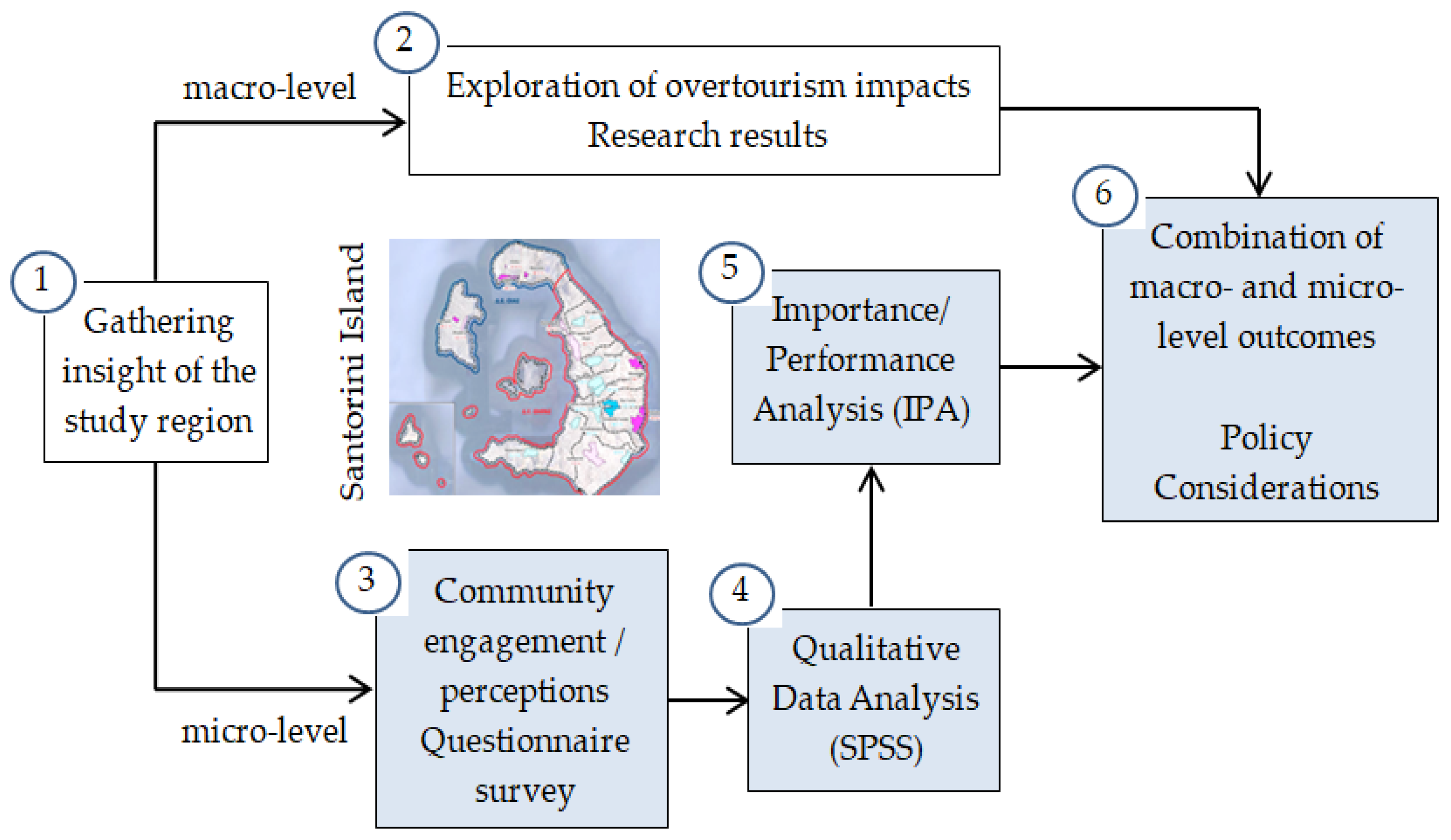
Figure 2.
(a) Location of Santorini in the Cyclades island complex, Source: [36]; (b) Municipality of Thera. Source: [37].
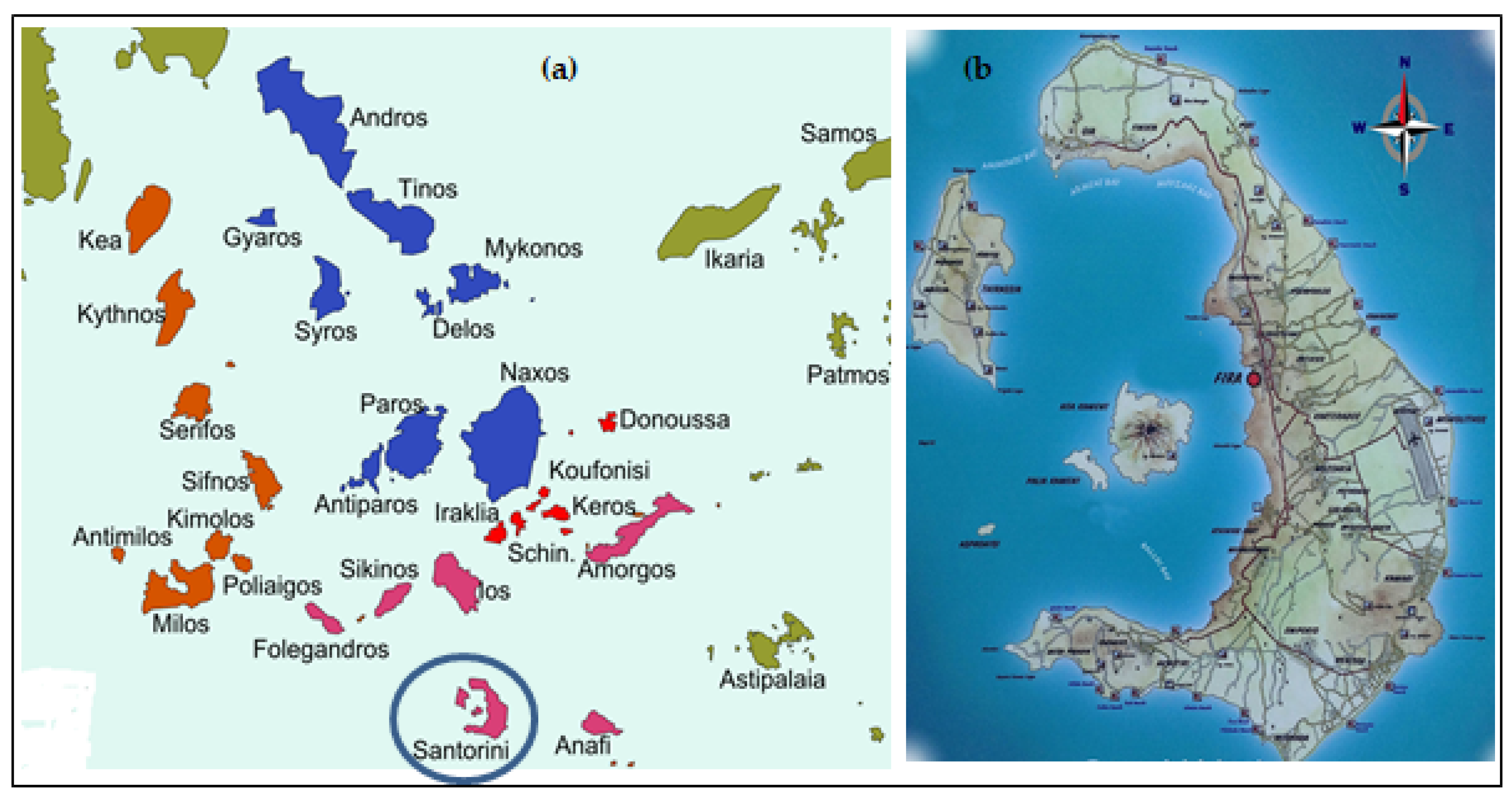
Figure 3.
(a) Pattern of built-up space in 2018; (b) Kernel density estimation of hotel accommodation (radius 1000m) in 2023; (c) Kernel density estimation of Airbnb accommodation (radius 1000m) in 2023. Source: [17].
Figure 3.
(a) Pattern of built-up space in 2018; (b) Kernel density estimation of hotel accommodation (radius 1000m) in 2023; (c) Kernel density estimation of Airbnb accommodation (radius 1000m) in 2023. Source: [17].
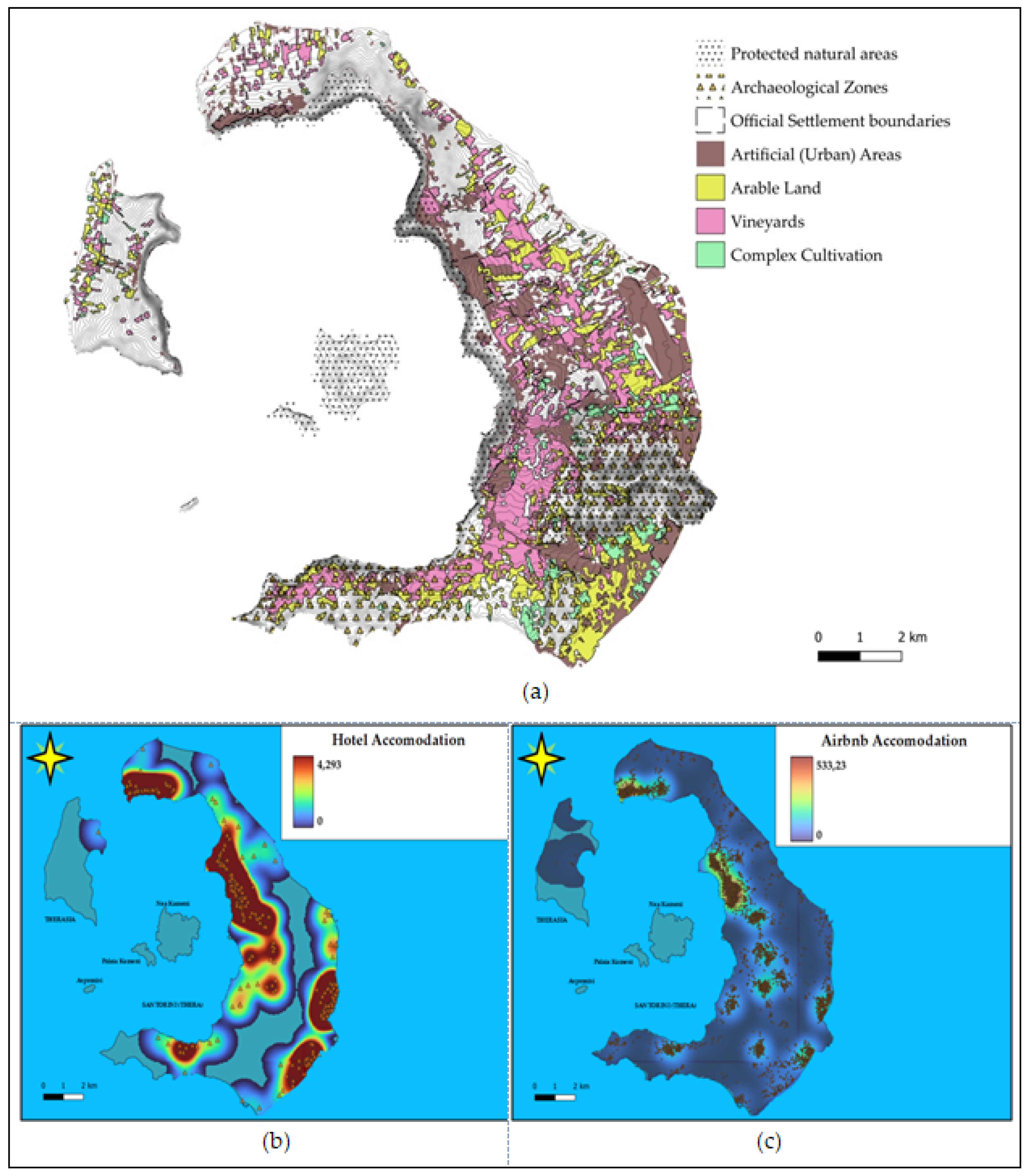
Figure 4.
Age groups and gender of respondents in the questionnaire survey, Source: Own Elaboration.
Figure 4.
Age groups and gender of respondents in the questionnaire survey, Source: Own Elaboration.
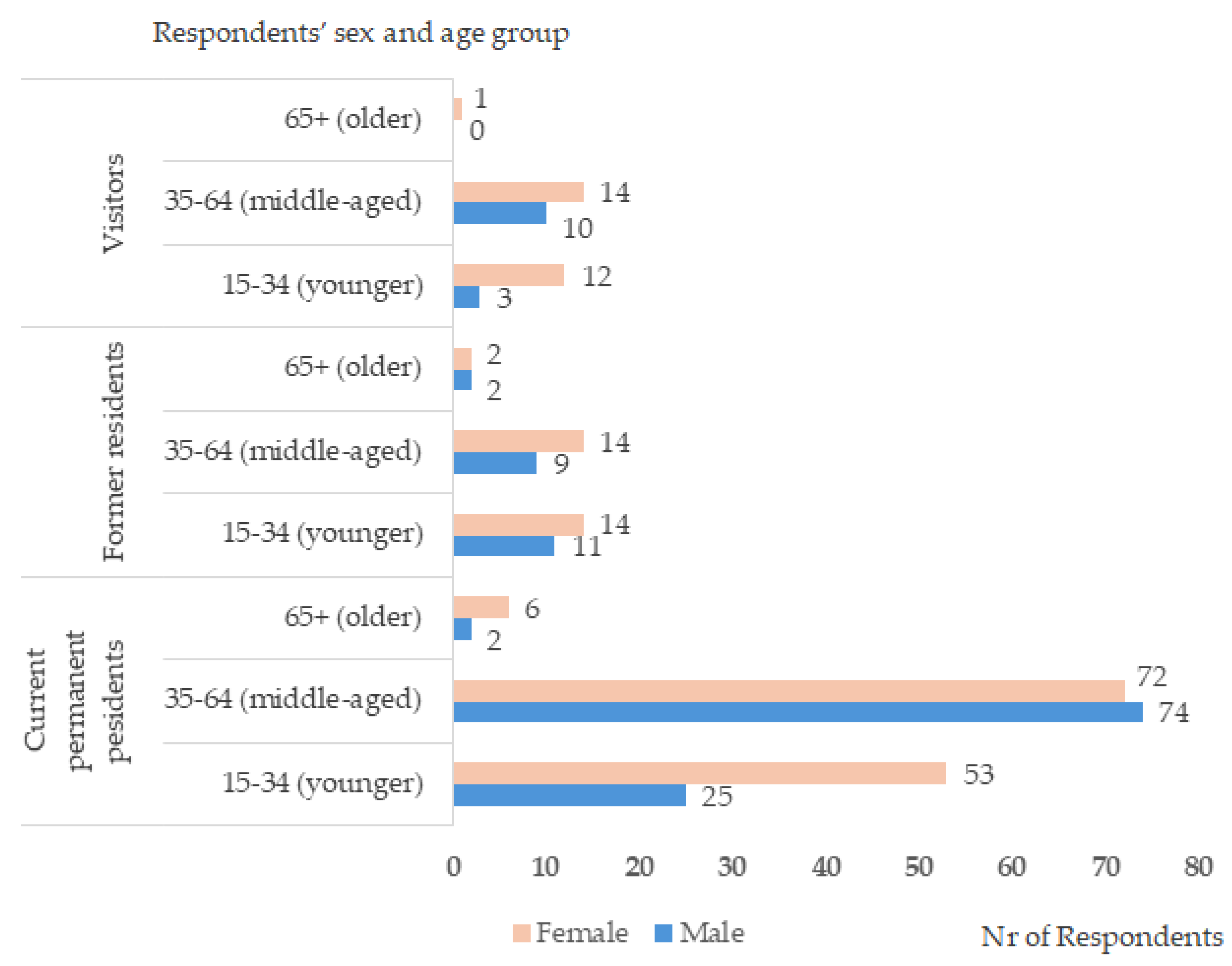
Figure 5.
(a) The five thematic areas, emerged by the grouping of the fourteen municipal zones of Thira Municipality; (b) Spatial distribution of respondents falling into the currently permanent residents’ group across the five thematic areas. Source: Own elaboration.
Figure 5.
(a) The five thematic areas, emerged by the grouping of the fourteen municipal zones of Thira Municipality; (b) Spatial distribution of respondents falling into the currently permanent residents’ group across the five thematic areas. Source: Own elaboration.
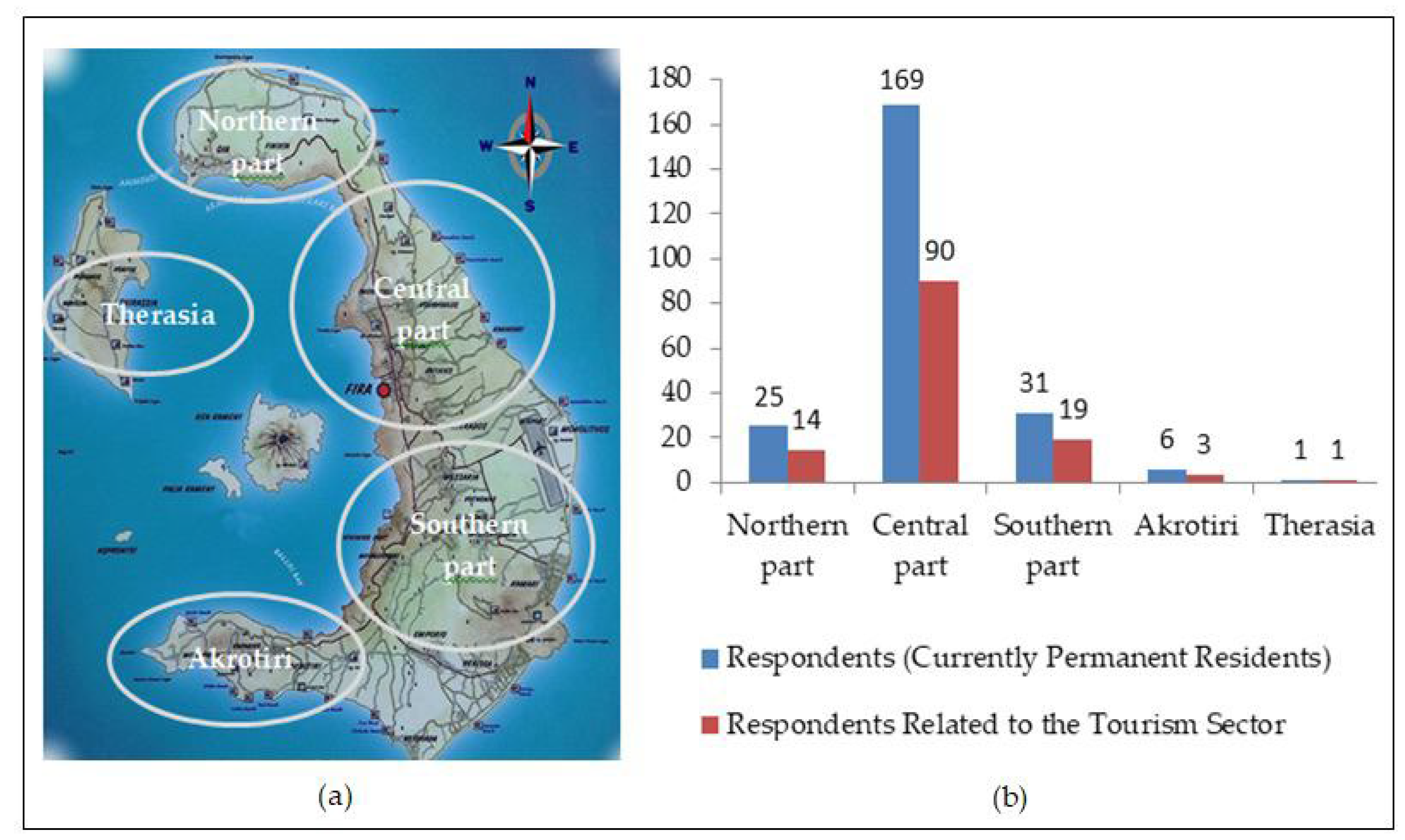
Figure 6.
(a) Rising intensity of tourism activity (Question 11), Source: Own elaboration; (b) Pivotal role of tourism in the local economic profile (Question 14), Source: Own elaboration.
Figure 6.
(a) Rising intensity of tourism activity (Question 11), Source: Own elaboration; (b) Pivotal role of tourism in the local economic profile (Question 14), Source: Own elaboration.
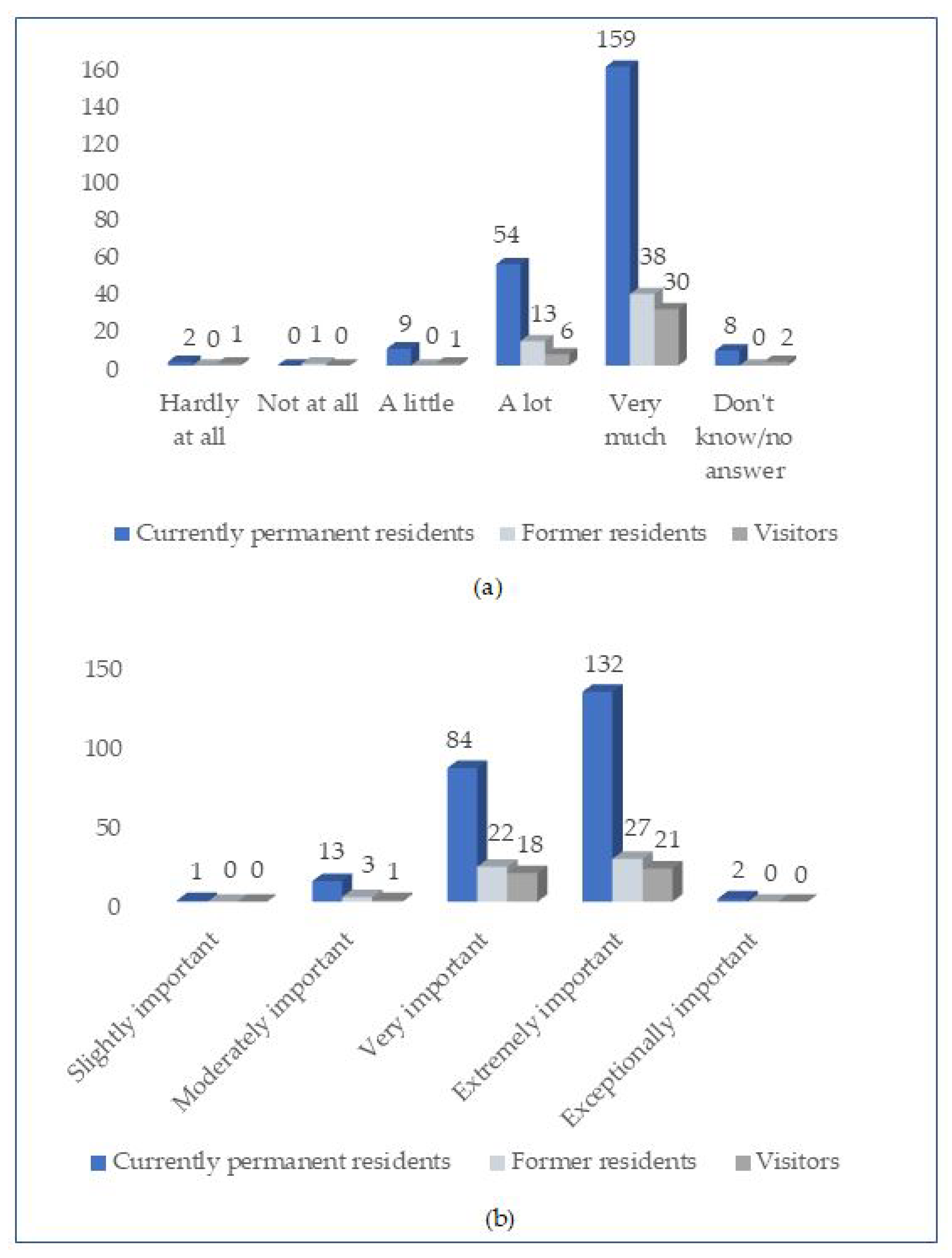
Figure 7.
(a) Impacts of tourism on the quality of daily life of population, Source: Own elaboration (Question 15); (b) Key issues raised by respondents as to the adverse repercussions of (over)tourism in Santorini Island (Question 16), Source: Own elaboration.
Figure 7.
(a) Impacts of tourism on the quality of daily life of population, Source: Own elaboration (Question 15); (b) Key issues raised by respondents as to the adverse repercussions of (over)tourism in Santorini Island (Question 16), Source: Own elaboration.
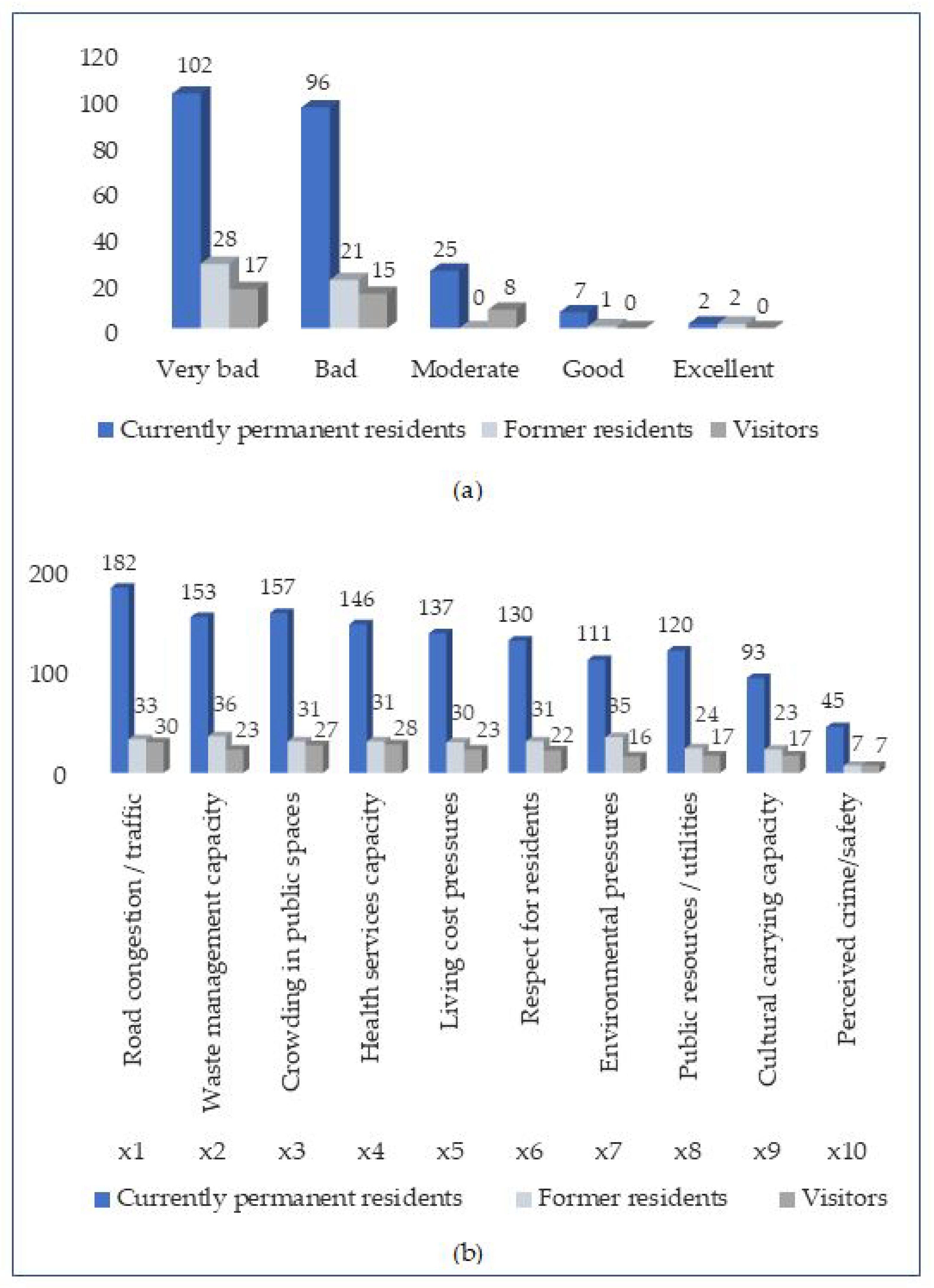
Figure 8.
Respondents’ view as to the potential future pathways of Santorini Island and the position of tourism in the island’s developmental profile (Question 19), Source: Own elaboration.
Figure 8.
Respondents’ view as to the potential future pathways of Santorini Island and the position of tourism in the island’s developmental profile (Question 19), Source: Own elaboration.
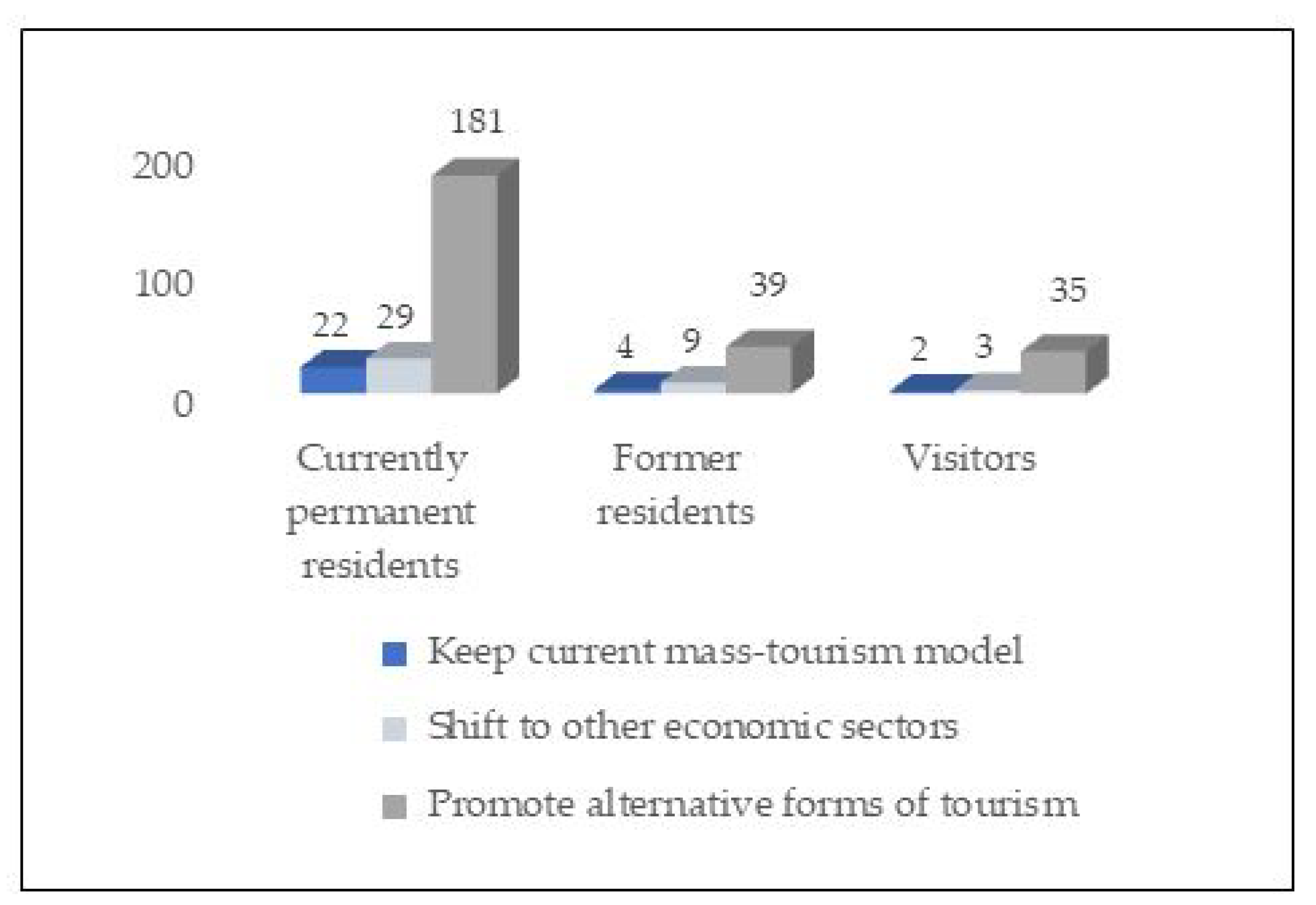
Figure 9.
The rationale of the IPA technique. Source: Adopted from [47].
Figure 9.
The rationale of the IPA technique. Source: Adopted from [47].
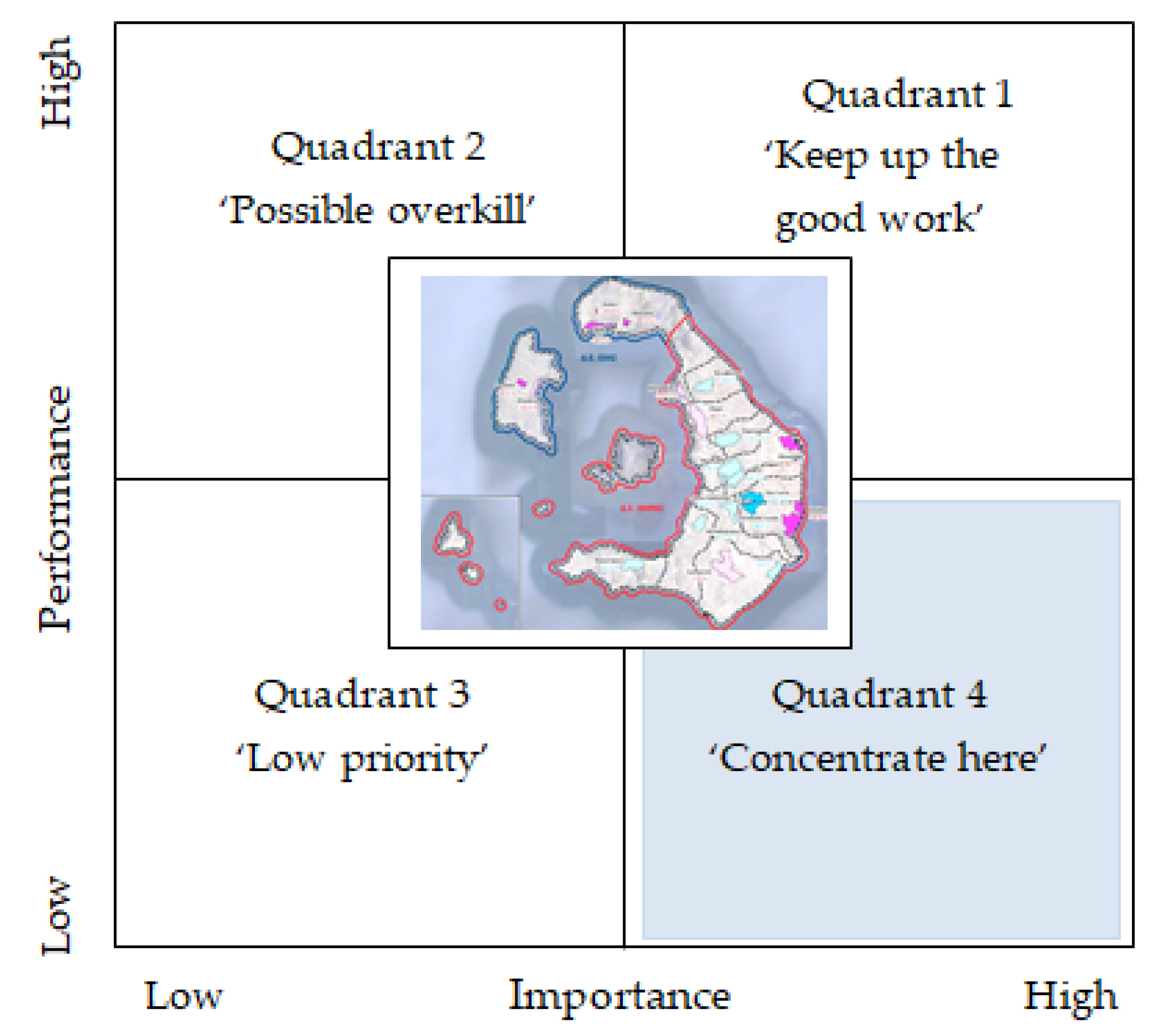
Figure 10.
Importance–Performance Analysis (IPA) of Santorini (over)tourism pressures (Question 16). Source: Own elaboration.
Figure 10.
Importance–Performance Analysis (IPA) of Santorini (over)tourism pressures (Question 16). Source: Own elaboration.
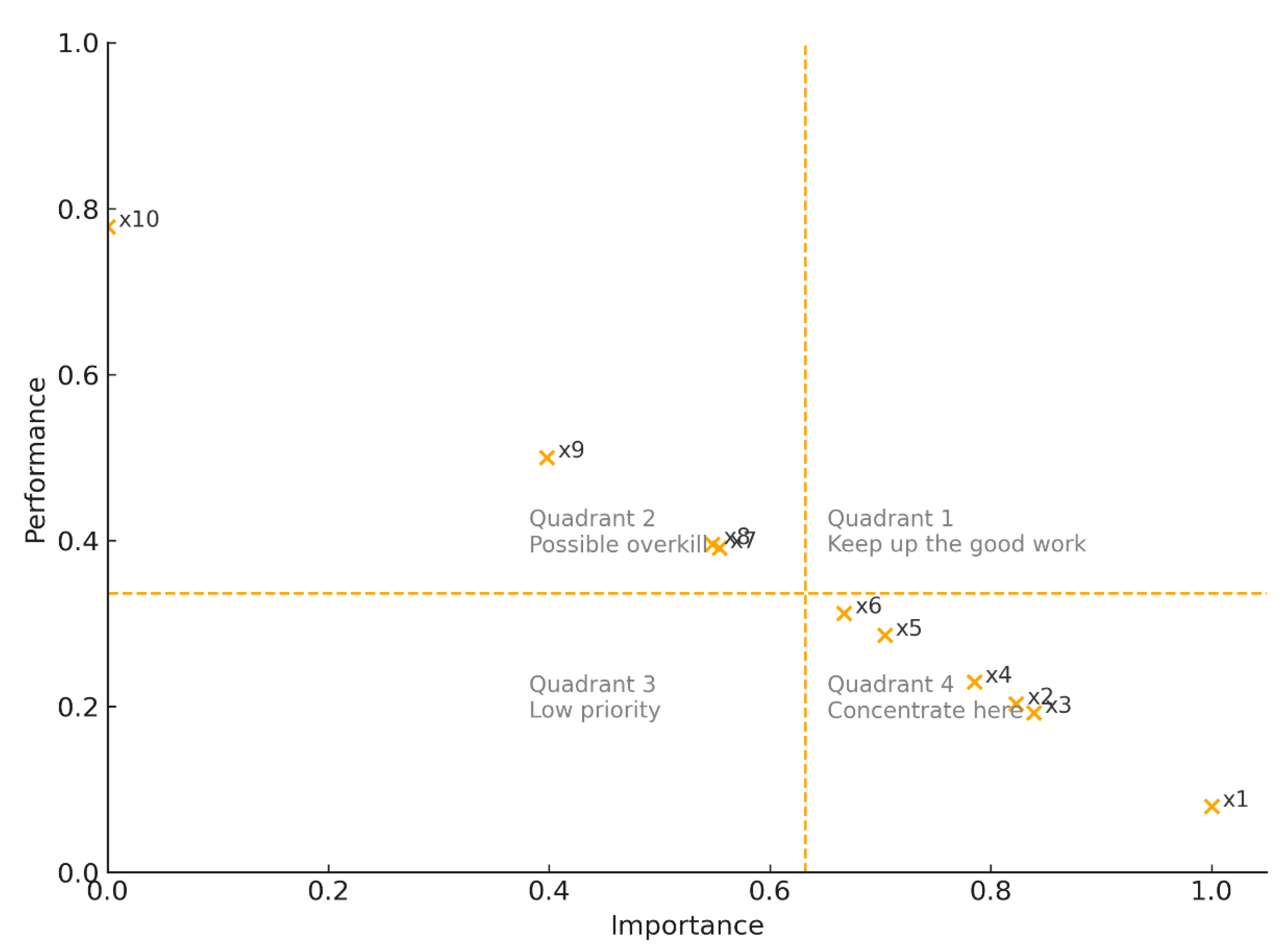
Figure 11.
Importance–Performance Analysis (IPA) of key comparative advantages of Santorini Island in support of a sustainable and resilient tourism model (Question 18). Source: Own elaboration.
Figure 11.
Importance–Performance Analysis (IPA) of key comparative advantages of Santorini Island in support of a sustainable and resilient tourism model (Question 18). Source: Own elaboration.
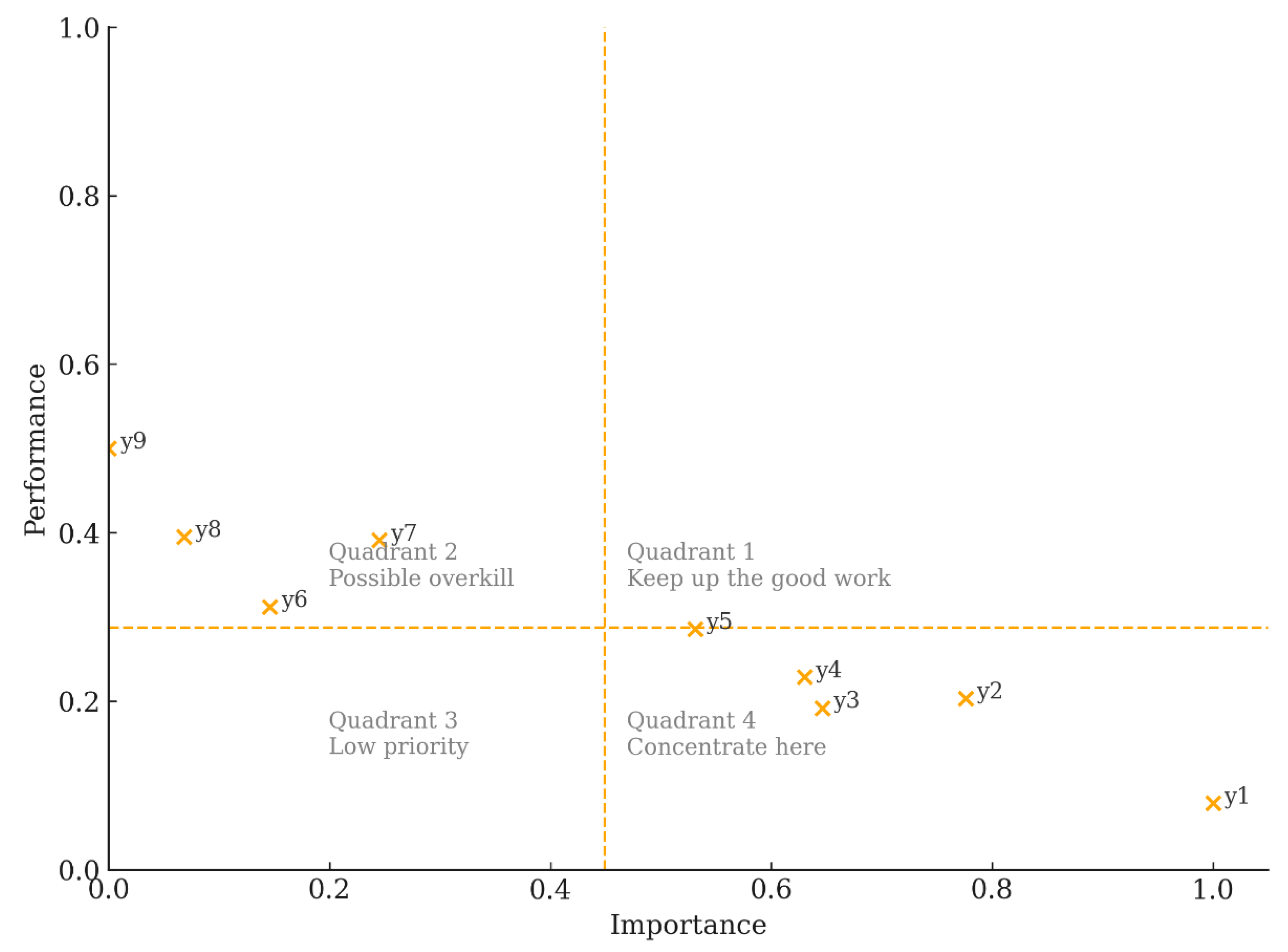

Table 1.
Thematic groups and structure of the questionnaire.
| Thematic Groups | Questions | Type of data collected |
|---|---|---|
| Demographics / Profiling of Respondents | Q1–Q10 | Sex and age group; occupation; residency status (currently permanent and former residents); residency length (currently permanent and former residents); frequency of visit (visitors); municipal zone of residence (permanent residents); relation to the tourism-sector (employee or owner of tourism business). |
| Tourism Intensity & Seasonality | Q11–Q13 | Perceived change in tourism activity over the last decade; preferred time to visit; season preference. |
| Developmental Profile & Daily Life | Q14–Q15 | Perceived importance of tourism in the developmental profile of Santorini Island; quality of everyday life during peak tourist season. |
| Pressures/Problems that are due to (over)tourism | Q16 | Residents: congestion; waste management capacity; crowding; health infrastructure; living costs; environmental stress; concern for local identity; |
| Q17 | Tourists: intention to visit (tourist experience / attractiveness of destination). | |
| Policy priorities towards a sustainable tourist model | Q18 | Geotourism (Volcano/Caldera); natural tourism; heritage/archaeological tourism; gastronomy tourism; architectural tourism; religious tourism; entertainment/nightlife; maritime / cruise tourism. |
| Governance & Participation | Q19–Q20 | Views on current mass-tourism model vs. alternative/low-impact forms; willingness to participate in local decision-making. |
Table 2.
Spatial distribution of currently permanent population.
| Thematic Area | Municipal Zone | Spatial distribution of permanent residents * Nr / (%) |
Spatial distribution of permanent residents related to the tourism sector ** Nr / (%) |
| Northern part | Oia, Imrovigli, Vourvoulos | 25 / (10.8) | 14 / (11.0) |
| Central part | Messaria, Thira, Karterados, Pyrgos,Vothonas, Exo Gonia, Episkopi Gonias | 169 / (72.8) | 90 / (70.9) |
| Southern part | Emporeio, Megalochori | 31 / (13.4) | 19 / (15.0) |
| Akrotiri | Akrotiri | 6 / (2.6) | 3 / (2.4) |
| Therasia | Therasia | 1 / (0.4) | 1 / (0.7) |
* The group of permanent residents counts for 232 persons (respondents). ** The group of permanent residents related to the tourism sector either as employees or business owners counts for 127 persons (respondents)
Table 3.
Data presented in the Importance–Performance Analysis (IPA) of Santorini (over)tourism pressures (Q16). Source: Own elaboration by use of SPSS and Python.
Table 3.
Data presented in the Importance–Performance Analysis (IPA) of Santorini (over)tourism pressures (Q16). Source: Own elaboration by use of SPSS and Python.
| Attribute | Label | Mean Importance | Mean Performance |
| x1 | Road congestion / traffic | 1 | 0.079 |
| x2 | Waste management capacity | 0.823 | 0.203 |
| x3 | Crowding in public spaces | 0.839 | 0.192 |
| x4 | Health services capacity | 0.785 | 0.229 |
| x5 | Living cost pressures | 0.704 | 0.286 |
| x6 | Respect for residents | 0.667 | 0.312 |
| x7 | Environmental pressures | 0.554 | 0.391 |
| x8 | Public resources / utilities | 0.548 | 0.395 |
| x9 | Cultural carrying capacity | 0.398 | 0.5 |
| x10 | Perceived crime/safety | 0 | 0.778 |
Table 4.
Data presented in the Importance–Performance Analysis (IPA) of Santorini Island – Key comparative advantages/options in support of a future sustainable tourism path (Q18). Source: Own elaboration by use of SPSS and Python.
Table 4.
Data presented in the Importance–Performance Analysis (IPA) of Santorini Island – Key comparative advantages/options in support of a future sustainable tourism path (Q18). Source: Own elaboration by use of SPSS and Python.
| Attribute | Label | Mean Importance | Mean Performance |
| y1 | Volcano/Caldera geotourism | 1 | 0.079 |
| y2 | Natural Scenery | 0.776 | 0.203 |
| y3 | History/museums | 0.646 | 0.192 |
| y4 | Local products/gastronomy | 0.63 | 0.229 |
| y5 | Architecture/settlements | 0.531 | 0.286 |
| y6 | Churches/monasteries | 0.146 | 0.312 |
| y7 | Entertainment/nightlife | 0.245 | 0.391 |
| y8 | Cruise-related offer | 0.068 | 0.395 |
| y9 | Sea/sun & beaches | 0 | 0.500 |
Disclaimer/Publisher’s Note: The statements, opinions and data contained in all publications are solely those of the individual author(s) and contributor(s) and not of MDPI and/or the editor(s). MDPI and/or the editor(s) disclaim responsibility for any injury to people or property resulting from any ideas, methods, instructions or products referred to in the content. |
© 2025 by the authors. Licensee MDPI, Basel, Switzerland. This article is an open access article distributed under the terms and conditions of the Creative Commons Attribution (CC BY) license (https://creativecommons.org/licenses/by/4.0/).
Copyright: This open access article is published under a Creative Commons CC BY 4.0 license, which permit the free download, distribution, and reuse, provided that the author and preprint are cited in any reuse.


