1. Background
1.1. Global Context
Chronic psychosocial stress and persistent low-grade inflammation account for most non-communicable morbidity worldwide [
1,
2,
3]. Excessive sympathetic activity drains metabolic and immune reserves, whereas insufficient parasympathetic recovery blocks repair. Pharmacological therapy seldom restores energetic proportion or prevents social propagation of stress.
1.2. From Physics to Biology
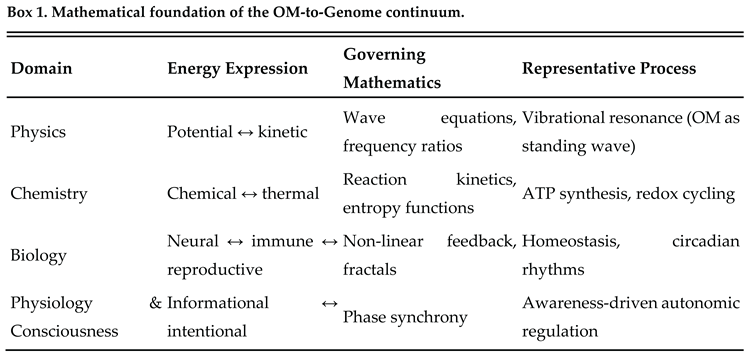
Physics defines energy as the capacity to do work, manifesting in interchangeable potential, kinetic, thermal, and electromagnetic forms. Chemistry translates this into molecular bonds and reaction enthalpy; biology inherits it as
metabolic, immune, reproductive, and neural energy, each obeying conservation and transformation laws [
4,
5,
6]. Schrödinger described life as a system that “feeds on negative entropy” [
7]. Fröhlich and Noble proposed that coherent oscillations sustain cellular organisation [
8,
9].
The OM-to-Genome hypothesis extends this logic: vibration is the universal medium through which these transformations achieve coherence.
Health represents the solution to a dynamic equation in which biological variables oscillate within harmonic ranges; disease denotes deviation from these solutions.
Box 2. Mathematics as the Master Law of Order: From Zero to Infinity.
Mathematics governs every transformation in nature. It is the invisible syntax that shapes both external physico-chemical reactions and the inner physiological dynamics of living beings. Even apparent randomness follows probability fields that maintain systemic balance; when these underlying equations collapse, coherence fails, leading to structural or physiological breakdown.
Energy therefore operates through organised proportion, scaling from zero—the potential state—to infinity, the manifested state of consciousness.
The OM-to-Genome continuum interprets this progression as a living equation in which order, not chance, sustains existence. Disease and disorder represent points where mathematical symmetry diverges, while health signifies the restoration of that symmetry through coherent vibration.
1.3. Philosophical Convergence
Ancient philosophies perceived vibration as the universal code of creation, and modern science recognises mathematics as the invisible grammar of that code. Both describe the same principle: energy behaves according to definable ratios and harmonics. Randomness beyond these boundaries equates to entropy—the collapse of mathematical order and the onset of biological disease. Systems biology now identifies oscillatory gene networks and biochemical cycles as the measurable signatures of vitality [
10,
11,
12].
1.4. Dual Laboratories
The author’s Evolution-to-Solution model distinguishes two complementary laboratories:
An
inner laboratory of awareness and intention and an
outer laboratory of measurable physiology. Linking them converts subjective regulation into quantifiable pattern—a direct expression of mathematical symmetry. Originally this
Evolution-to-Solution concept originated from the author’s earlier expert commentary outlining how mosquito molecular physiology can transcend vector control toward integrative biological understanding and societal harmony [
13]. This foundational idea—
“Translating Physiology to Philosophy: Research for Peace”—provided the conceptual seed for extending the
OM-to-Genome hypothesis into a cross-disciplinary continuum uniting biology, mathematics, and consciousness.
1.5. Empirical Evidence
OM chanting enhances parasympathetic tone and HRV [
14], increases alpha–theta EEG coherence [
15], and suppresses limbic activation [
16]. Similar effects follow electrical vagal stimulation [
17]. Controlled vibration thus restores proportionality across autonomic, immune, and genomic systems.
Recent molecular findings further reinforce this continuum between external vibrational stimuli and internal genomic responses. For example,
Saini et al. [
18] demonstrated that a Sensory Appendage Protein (SAP) in
Anopheles culicifacies acts as a biochemical bridge linking external chemical oscillations—such as exposure to pyrethroid compounds—to internal neuronal and metabolic signaling. This SAP-mediated “alarm” translates environmental perturbation into altered neurochemical communication with the mosquito brain, revealing how molecular resonance at the sensory periphery can reorganize physiological states. Analogously, in humans, vibrational practices such as
OM chanting might engage homologous chemosensory–neural pathways that synchronize immune and neuroendocrine responses to environmental stressors. The SAP discovery thus provides a molecular precedent for vibration-driven information flow from the external milieu to central regulatory networks—a pattern conserved across species and consistent with the proposed
OM-to-Genome continuum.
2. The Hypothesis
OM-induced vibrational coherence is a mathematically governed process of energy transduction converting conscious potential into physiological order.
Within the Evolution-to-Solution framework, vibration functions as the operator transforming energy across acoustic → bio-electric → biochemical → genomic domains.
Mathematically, each step maintains total system energy; health corresponds to resonance conditions where conversion functions align in phase.
3. Testing and Evidence Plan
A multilevel strategy will test whether OM practice improves energy efficiency and coherence across acoustic, neural, immunologic, and genomic scales:
• Randomised trials measuring HRV, oxygen consumption, and cortisol (entropy reduction).
• EEG/fMRI analysis for network efficiency approaching small-world optimality.
• Genomic and epigenetic profiling (NF-κB ↓, BDNF ↑).
• Microbiome diversity and SCFA production as chemical-energy feedback.
• Community studies assessing HRV phase synchrony among participants.
Integrated datasets will yield an Energy Coherence Index (ECI)—a quantitative marker of dynamic equilibrium.
4. Implications and One Health Integration
If resonance validates energy conservation across scales, it defines a universal law of bio-energetic coherence linking personal health and planetary sustainability.
Within One Health, inner equilibrium mirrors ecological stability—both are low-entropy, rhythmically regulated systems.
Policies could include:
Mathematics-to-Physiology curricula reconnecting quantitative and biological literacy.
Ten-minute OM sessions in schools and workplaces.
Hospital Energy Coherence Indices as systemic-balance biomarkers.
Acoustic-ecology standards protecting vibrational wellbeing.
Because proportion is universal, such practices remain culturally inclusive and economically scalable.
5. Limitations and Future Research
Empirical issues include sound-parameter standardization, multimodal synchrony, expectancy control, and the need for non-linear analytics (fractal, entropy, network topology). Mathematical and computational models should simulate resonance transfer; AI tools can detect coherence signatures in real time.
Comparative biology must test evolutionary conservation of these energetic laws.
Humility is essential: our equations only approximate the living mathematics of consciousness.
6. Conclusions
Health is the solution to a dynamic equation of energy transformation.
The OM-to-Genome continuum unites mathematics, physics, chemistry, and biology through the operational principle of vibration.
When awareness initiates coherent resonance, energy reorganises from potential to physiological order. Integrating these insights into public health offers a low-cost, culturally neutral means to manage stress and inflammation while advancing sustainability.
The Evolution-to-Solution initiative reframes medicine as a science of coherence, where inner and outer laboratories converge and where
OM = Order of Matter
The next frontier of healthcare may not be another molecule but the recovery of mathematical coherence—the recognition that life itself is a continuous solution of an equation extending from zero to infinity. Health is therefore the persistent resolution of proportion; consciousness, its self-aware variable. The arithmetic of harmony unites matter, energy, and mind within one continuum.
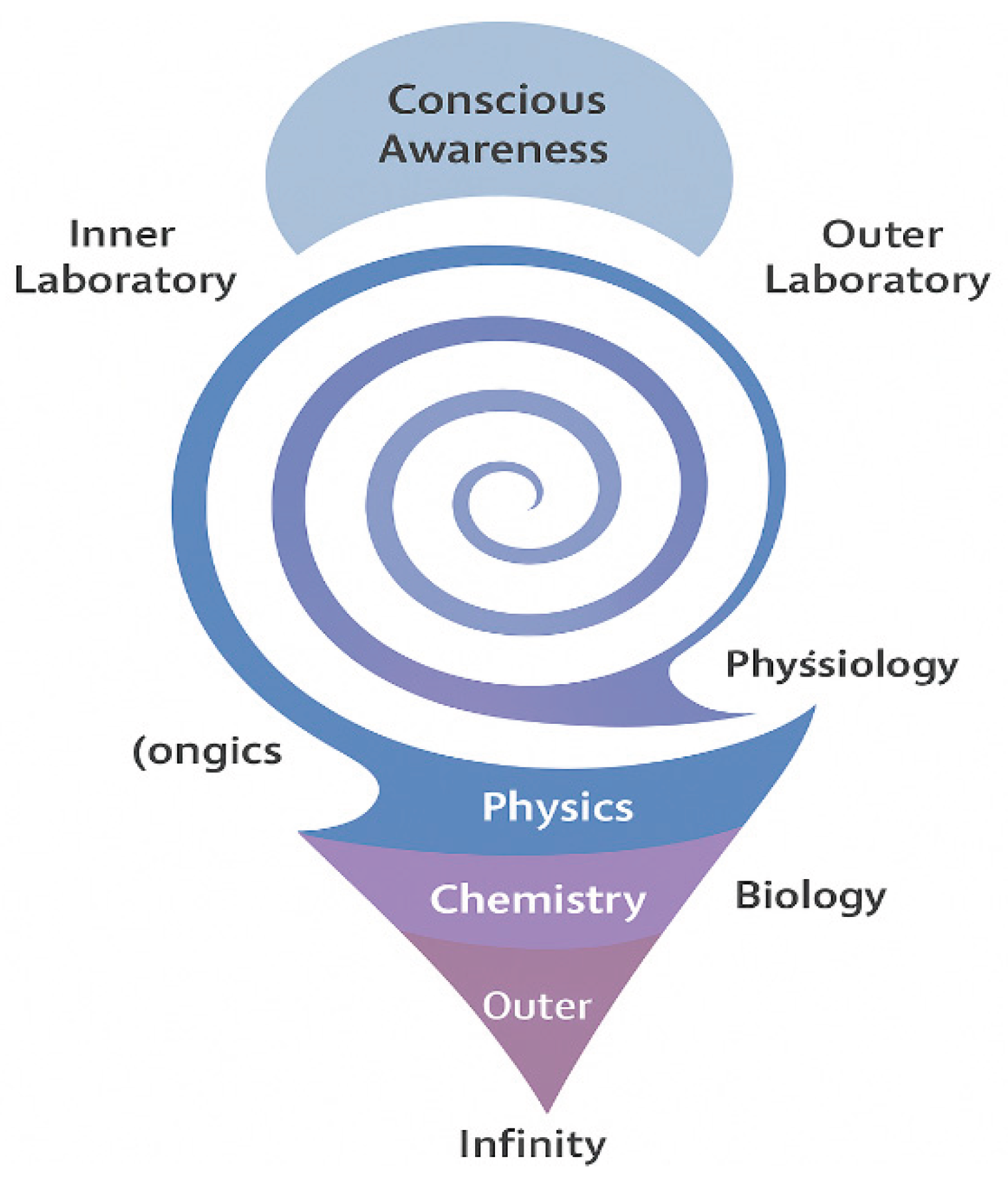
The conceptual bridge from energy to order is summarized schematically in
Figure 1, which depicts the
Mathematics-to-Physiology continuum. Beginning from the zero-state of potential energy, successive transformations through physical and chemical domains give rise to biological organization, culminating in
Physiology (Ongics)—the vibrational expression of living order. This framework visually integrates the
OM-to-Genome hypothesis, illustrating how mathematical symmetry and resonant coherence may underlie both physiological regulation and the broader One Health paradigm.
Figure 1.
Mathematics-to-Physiology Continuum: From Zero to Infinity through Vibrational Order.
Figure 1.
Mathematics-to-Physiology Continuum: From Zero to Infinity through Vibrational Order.
A spiral diagram traces the Evolution-to-Solution flow from Mathematics through Physics, Chemistry, Biology, Physiology, and culminating in Conscious Awareness.
Bidirectional arrows link the Inner and Outer Laboratories. Peripheral rings depict One Health expansion—from personal equilibrium to ecological resonance.
Include a Zero ↔ Infinity axis along the spiral to symbolise continuity of order.
This schematic illustrates the proposed OM-to-Genome continuum linking mathematical symmetry, physical energy, chemical interaction, and biological coherence. Beginning at the “zero-state” of potential energy, ordered transformations propagate through physics and chemistry to culminate in physiology—depicted here as Physiology (Ongics), the integrative field that views living function as a vibrationally organized energy network.
“Ongics” (from OM + -omics) extends traditional omics sciences to include the study of coherent oscillations that connect sound, neural signalling, and genomic regulation. The continuum represents how resonant processes—whether acoustic, electromagnetic, or molecular—maintain order within the One Health framework, uniting inner and outer laboratories of observation.
Suggested Discipline Tags
Mathematics in Biology; Vagal Physiology; Microbiome–Brain Axis; Bioenergetics; Consciousness Studies.
Ethical Approval
Not applicable; conceptual hypothesis based on literature and laboratory experience.
Author Contributions
Solely conceived, drafted, and approved the manuscript, integrating experimental insights and theoretical development under the Evolution-to-Solution framework.
AI Assistance Disclosure
Parts of this manuscript—such as language refinement, structural editing, and formatting—were prepared with assistance from OpenAI’s ChatGPT (GPT-5) under the direct supervision and intellectual guidance of the author. All scientific ideas, hypotheses, interpretations, and conclusions are entirely the author’s own, derived from experimental and theoretical research. The AI tool was used solely for editorial clarity and document preparation; it did not generate or verify any scientific data.
Acknowledgments
The author expresses sincere gratitude to colleagues at the Indian Council of Medical Research–National Institute of Malaria Research (ICMR–NIMR), New Delhi, for their continuous encouragement and critical discussions that nurtured the Evolution-to-Solution research framework. Appreciation is extended to collaborators in the Division of Functional Genomics for their contributions to experimental insights that inspired the OM-to-Genome hypothesis. The author also acknowledges the intellectual and philosophical heritage of Indian scientific thought that motivated the integration of mathematics, vibration, and physiology within a modern biomedical context.
Data Availability Statement
All supporting information and illustrative figures are contained within the manuscript.
Conflicts of Interest
The author declares no competing interests.
References
- Chrousos, G.P. Stress and disorders of the stress system. Nat. Rev. Endocrinol. 2009, 5, 374–381. [Google Scholar] [CrossRef] [PubMed]
- Slavich, G.M.; Irwin, M.R. From stress to inflammation and disease: The social signal transduction theory of depression. Psychosom. Med. 2014, 76, 150–162. [Google Scholar] [CrossRef]
- Cryan, J.F.; O’Riordan, K.J.; Cowan, C.S.M.; Sandhu, K.V.; Bastiaanssen, T.F.S.; Boehme, M.; Codagnone, M.G.; Cussotto, S.; Fulling, C.; Golubeva, A.V.; et al. The microbiota–gut–brain axis. Physiol. Rev. 2019, 99, 1877–2013. [Google Scholar] [CrossRef] [PubMed]
- Noble, D. Dance to the tune of life: Biological relativity and the philosophy of biology. Interface Focus. 2017, 7, 20160126. [Google Scholar] [CrossRef]
- Hameroff, S.; Penrose, R. Consciousness in the universe: A review of the ‘Orch OR’ theory. Phys. Life Rev. 2014, 11, 39–78. [Google Scholar] [CrossRef] [PubMed]
- Prigogine, I.; Stengers, I. Order Out of Chaos: Man’s New Dialogue with Nature; Bantam Books: New York, NY, USA, 1984; ISBN 9780553343632. [Google Scholar]
- Schrödinger, E. What Is Life? The Physical Aspect of the Living Cell; Cambridge University Press: Cambridge, UK, 1944. [Google Scholar] [CrossRef]
- Fröhlich, H. Long-range coherence and energy storage in biological systems. Proc. IEEE 1968, 56, 1345–1357. [Google Scholar] [CrossRef]
- Strogatz, S.H. Sync: The Emerging Science of Spontaneous Order; Hyperion: New York, NY, USA, 2003; ISBN 9780786868445. [Google Scholar]
- Kaliman, P.; Alvarez-Lopez, M.J.; Cosin-Tomas, M.; Rosenkranz, M.A.; Lutz, A.; Davidson, R.J. Rapid changes in histone deacetylases and inflammatory gene expression in expert meditators. Psychoneuroendocrinology 2014, 40, 96–107. [Google Scholar] [CrossRef] [PubMed]
- Das De, T.; Sharma, P.; Tevatiya, S.; Chauhan, C.; Kumari, S.; Yadav, P.; Singla, D.; Srivastava, V.; Rani, J.; Hasija, Y.; et al. Bidirectional Microbiome-Gut-Brain-Axis Communication Influences Metabolic Switch-Associated Responses in the Mosquito Anopheles culicifacies. Cells 2022, 11, 1798. [Google Scholar] [CrossRef] [PubMed] [PubMed Central]
- Patel, V.; Saxena, S.; Frankish, H.; Boyce, N. Sustainable development and global mental health--a Lancet Commission. Lancet 2016, 387, 1143–1145. [Google Scholar] [CrossRef] [PubMed]
- Dixit, R. Evolution to Solution: Translating mosquito molecular physiology beyond vector control towards “Translating physiology to philosophy: Research for peace.” Science Factors (Expert Opinion). 2025 Oct; (October issue): 18. Available from: https://www.rfcsr.org/wp-content/uploads/2025/10/October-Science-Factors_2025.pdf.
- Kalyani, B.G.; Vasudevan, S.; Arasappa, R.; Rao, N.P.; Kalmady, S.V.; Behere, R.V.; Rao, H.; Vasudev, M.K.; Gangadhar, B.N. Neurohemodynamic correlates of ‘OM’ chanting: A pilot fMRI study. Int. J. Yoga 2011, 4, 10–13. [Google Scholar] [CrossRef]
- Bonaz, B.; Bazinet, R.P.; Pellissier, S. The vagus nerve at the interface of the microbiota–gut–brain axis. Front. Neurosci. 2018, 12, 49. [Google Scholar] [CrossRef] [PubMed]
- Tracey, K.J. The inflammatory reflex. Nature 2002, 420, 853–859. [Google Scholar] [CrossRef] [PubMed]
- Doerr, J.M.; Juenemann, M.; Hakel, L.; Schmidt, L.; Menzler, K.; Krause, K.; Linka, L.; Skoluda, N.; Nater, U.M.; Knake, S. Effect of transcutaneous vagus nerve stimulation on stress-reactive neuroendocrine measures in a sample of persons with temporal lobe epilepsy. Epilepsia Open 2023, 8, 1013–1020. [Google Scholar] [CrossRef] [PubMed]
- Saini, V.; Rohilla, P.; Srivastava, V.; Tandon, G.; Yadav, P.; Sankhala, N.; Singh, T.; Sharma, G.; Tyagi, S.; De, T.D.; et al. Sensory appendage protein triggers alarm to pyrethroid in Indian malarial vector Anopheles culicifacies. PLoS ONE 2025, 20, e0333483. [Google Scholar] [CrossRef] [PubMed]
|
Disclaimer/Publisher’s Note: The statements, opinions and data contained in all publications are solely those of the individual author(s) and contributor(s) and not of MDPI and/or the editor(s). MDPI and/or the editor(s) disclaim responsibility for any injury to people or property resulting from any ideas, methods, instructions or products referred to in the content. |
© 2025 by the authors. Licensee MDPI, Basel, Switzerland. This article is an open access article distributed under the terms and conditions of the Creative Commons Attribution (CC BY) license (http://creativecommons.org/licenses/by/4.0/).