

Submitted:
04 May 2026
Posted:
05 May 2026
You are already at the latest version
Abstract
This study examines the multifaceted historical transformations of the Hajj pilgrimage from its Prophetic origins in 632 CE to the contemporary era. Employing qualitative historical analysis, systematic document analysis, and comparative methodology, the investigation draws on an extensive corpus of primary sources—including classical Islamic chronicles, medieval geographical accounts, Ottoman administrative records, colonial-era documentation, and contemporary government reports—supplemented by peer-reviewed secondary literature spanning multiple disciplines. The analysis identifies six distinct evolutionary phases: (a) the Prophetic foundation and early expansion (632–661 CE), (b) imperial Islamic administration (661–1517 CE), (c) Ottoman centralization and international challenges (1517–1924 CE), (d) Saudi unification and infrastructure development (1932–2000), (e) digital integration and mass management (2000–2020 CE), and (f) pandemic adaptation and future visioning (2020–Present). The analysis reveals recurring cyclical patterns of innovation and consolidation, demonstrates a strong positive correlation between state capacity and pilgrimage quality, documents how international health imperatives reshaped modern governance, and traces the successful integration of advanced technologies with longstanding religious practices. The findings contribute a comprehensive periodization framework, challenge linear secularization narratives by showing that modernization can strengthen rather than erode religious institutions, and offer practical insights for mass gathering management and religious governance. This research addresses a critical interdisciplinary gap by providing the first comprehensive longitudinal analysis spanning the full fourteen centuries of Islamic pilgrimage history.
Keywords:
Hajj pilgrimage
; Islamic history
; pilgrimage management
; Saudi Arabia
; mass gathering medicine
; religious transformation
; digital religion
; public administration
; Saudi Vision 2030
1. Introduction
The Hajj, the annual pilgrimage to Makkah, constitutes the largest recurring religious mass gathering in the world, drawing over 2.5 million participants from approximately 184 countries each year (Memish et al., 2014). As one of Islam’s five fundamental pillars, it represents a religious obligation that has endured for over fourteen centuries, maintaining its essential ritual form while undergoing profound transformations in its logistical, administrative, and experiential dimensions (Peters, 1994; Bianchi, 2004). The pilgrimage experience of a contemporary Muslim—arriving via international aircraft, navigating sacred sites with smartphone applications, sleeping in air-conditioned accommodations, and benefiting from advanced emergency medical infrastructure—bears little practical resemblance to the arduous and often perilous desert crossing undertaken by early generations of believers, yet both experiences remain bound by identical spiritual purposes, ritual sequences, and theological imperatives.
These transformations encompass dimensions extending far beyond logistics. The evolution of Hajj mirrors and illuminates broader patterns of civilizational change: shifting configurations of political authority and state capacity, the emergence of international health governance regimes, revolutionary advances in transportation and communication technologies, and structural shifts in global economic systems that have dramatically altered human mobility (Long, 1979; Henderson, 2011). The pilgrimage has served at various historical moments as a vehicle for political legitimation, a vector for epidemic disease, a focal point for colonial intervention, a catalyst for infrastructure modernization, and a laboratory for innovation in mass gathering management. Understanding these multidimensional transformations therefore requires an interdisciplinary approach integrating historical, political, public health, technological, and administrative perspectives.
Despite the extensive scholarly literature on various aspects of Islamic pilgrimage, the existing body of work remains significantly fragmented. Most studies concentrate on specific historical periods, particular management dimensions, or individual case studies in isolation. Historians have documented the political and administrative dimensions of specific eras; anthropologists have examined cultural and experiential aspects of contemporary pilgrimage; public health researchers have analyzed disease surveillance and crowd safety; and public administration scholars have investigated modern management systems (Taibah & Arlikatti, 2015). However, few works have attempted a comprehensive longitudinal analysis spanning the full breadth of Hajj history from its Prophetic origins to the contemporary digital and post-pandemic era, and even fewer have sought to identify structural patterns that recur across these diverse periods.
This study addresses this gap by investigating four interconnected research questions: (a) How have the civilizational, humanitarian, and administrative dimensions of Hajj evolved from the Prophetic era to the present, and what factors have driven these transformations? (b) What distinct phases characterize this transformation, and what features define each? (c) What recurring patterns emerge from systematic comparison across different historical periods of pilgrimage development? (d) How have technological innovations been integrated with religious practices while preserving spiritual authenticity? The research contributes a comprehensive periodization framework for Hajj scholarship, identifies structural patterns in the state–pilgrimage relationship, challenges linear secularization narratives, and offers insights relevant to contemporary mass gathering management, religious governance, and the broader study of institutional adaptation.
The paper is organized as follows. Section 2 establishes the theoretical framework integrating historical institutionalism, multiple modernities, globalization theory, and new public governance. Section 3 reviews the scholarly literature across classical Islamic sources, Ottoman and colonial documentation, and contemporary multidisciplinary scholarship, identifying the specific gaps this study addresses. Section 4 details the qualitative methodology employed, including research design, data sources, and analytical procedures. Section 5 presents findings organized across six historical phases, each analyzed for its distinctive political, administrative, technological, and health dimensions. Section 6 discusses cross-cutting patterns, theoretical implications, and connections to broader scholarly debates. Section 7 offers conclusions, practical recommendations, and directions for future research.
2. Theoretical Framework
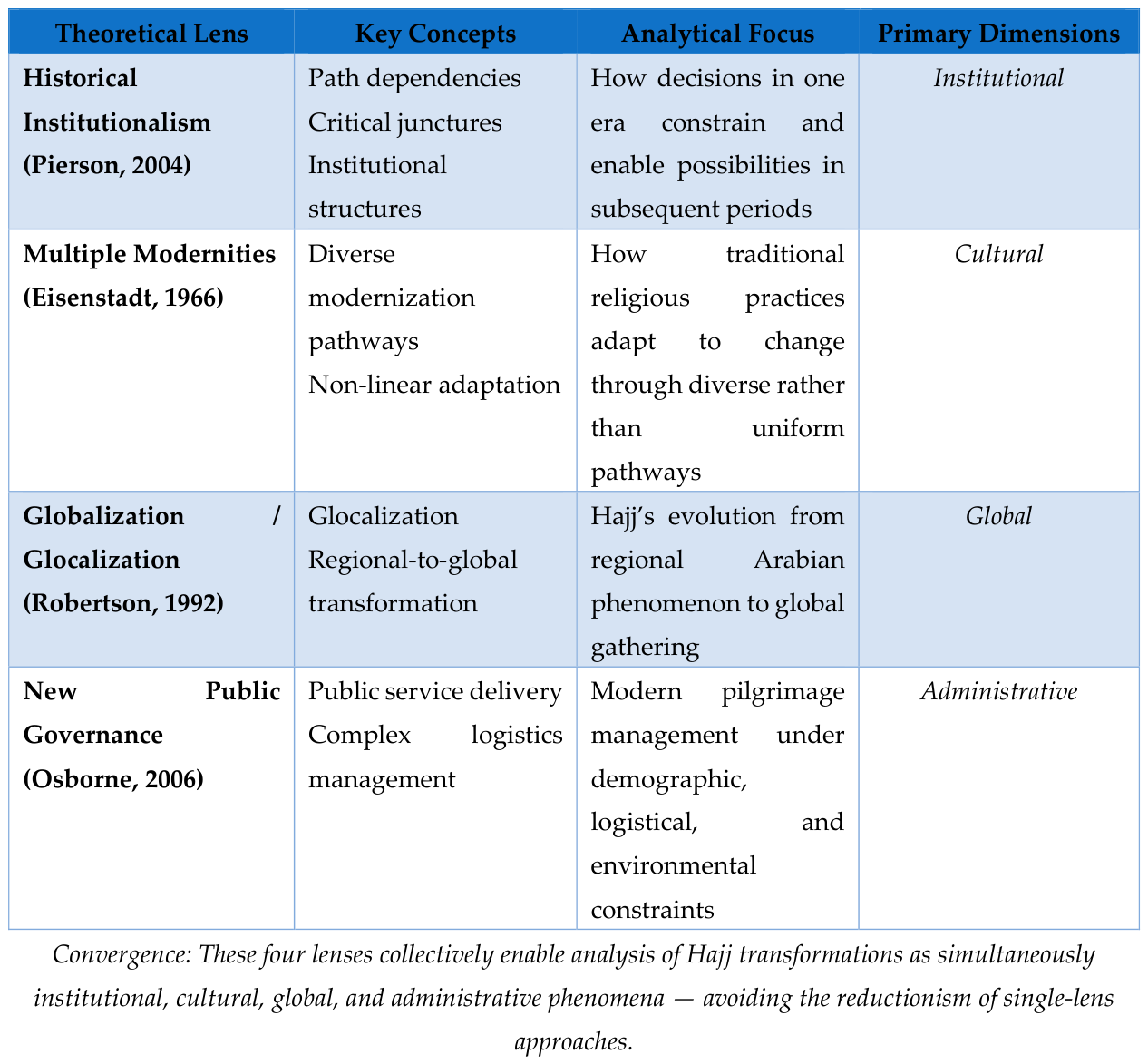
This study integrates four complementary theoretical lenses, each illuminating different aspects of the Hajj transformation narrative. First, historical institutionalism, as articulated by Pierson (2004), provides analytical tools for examining how institutional structures, path dependencies, and critical junctures have shaped pilgrimage development over extended temporal periods. This framework is particularly suited to identifying how decisions and structures established in one era constrain and enable possibilities in subsequent periods. Second, Eisenstadt’s (1966) concept of multiple modernities frames the analysis of how traditional religious practices have adapted to technological and social change through diverse rather than uniform pathways, challenging the assumption that modernization necessarily produces secularization. Third, Robertson’s (1992) globalization theory, particularly the concept of glocalization, illuminates the transformation of Hajj from a primarily regional Arabian phenomenon to a genuinely global gathering with significant implications for international relations, health governance, and cultural exchange. Fourth, new public governance frameworks (Osborne, 2006) guide the examination of modern pilgrimage management as a complex case of public service delivery under extraordinary demographic, logistical, and environmental constraints. Together, these perspectives enable analysis of Hajj transformations as simultaneously institutional, cultural, global, and administrative phenomena, avoiding the reductionism that characterizes single-lens approaches.
Figure 1.
Integrated Theoretical Framework for Hajj Transformation Analysis.
3. Literature Review
Scholarship on Hajj spans more than a millennium and draws on radically different evidentiary traditions: classical Islamic chronicles and jurisprudence, medieval geographic and travel writing, Ottoman imperial archives, colonial-era public health records, and contemporary social-scientific research across history, anthropology, public administration, and mass gathering medicine. The review that follows is organized chronologically and thematically across three subsections, tracing how the questions scholars have asked about pilgrimage have shifted alongside the institution itself — from the codification of ritual and infrastructure in the classical and medieval periods, to the administrative and epidemiological preoccupations of the Ottoman and colonial era, to the multidisciplinary contemporary literature on management, technology, and governance. A final subsection identifies the specific gaps in this body of work that the present study addresses.
3.1. Classical and Medieval Scholarship
Scholarly investigation of Hajj begins with the classical Islamic historians and geographers who provided foundational accounts of early pilgrimage practices and their evolution. Al-Tabari’s monumental Tarikh al-Rusul wa al-Muluk offers the most comprehensive early account of the Prophet Muhammad’s farewell pilgrimage and subsequent administrative developments during the Rashidun and Umayyad periods, establishing both narrative and normative frameworks for understanding Hajj’s spiritual and political significance (Al-Tabari, 915/1987). Ibn Sa’d’s Kitab al-Tabaqat al-Kabir provides biographical accounts of early pilgrims and pilgrimage leaders, offering insights into the social dynamics of nascent Islamic pilgrimage (Ibn Sa’d, 845/1967). These sources are complemented by the hadith compilations of Al-Bukhari and others, which codify Hajj-related traditions and establish jurisprudential frameworks that continue to govern pilgrimage practices to this day.
Medieval geographers contributed significantly to understanding pilgrimage routes and infrastructure development. Al-Muqaddasi’s Ahsan al-Taqasim fi Ma’rifat al-Aqalim (985 CE) provides detailed descriptions of pilgrimage routes, regional facilities, and the commercial networks that supported pilgrim mobility during the Abbasid period (Al-Muqaddasi, 985/1994). Yaqut al-Hamawi’s comprehensive Mu’jam al-Buldan (1229/1995) documents the extensive infrastructure of the Darb Zubaydah pilgrim road with remarkable specificity, including water management systems and service stations. The travel narratives of Ibn Jubayr (1183/2001) and Ibn Battuta (1355/2002) offer invaluable firsthand perspectives on the pilgrimage experience across different centuries and political regimes. Ibn Jubayr’s account of his 1183 journey provides detailed observations of infrastructure conditions and service quality under Ayyubid governance, while Ibn Battuta’s extensive travels across the Islamic world in the 14th century provide comparative perspectives on pilgrimage organization under different political authorities. Together, these sources document the evolution of a complex logistical system from its earliest formalization through the medieval period.
3.2. Ottoman and Colonial Period Documentation
The Ottoman period (1517–1924 CE) generated systematic administrative documentation that transformed the evidentiary basis for pilgrimage studies. Faroqhi’s (1994) landmark study, Pilgrims and Sultans: The Hajj Under the Ottomans, remains the authoritative analysis of pilgrimage organization under Ottoman rule, drawing extensively on imperial archives in Istanbul to reconstruct the financial, administrative, and political dimensions of Hajj management. Barbir (1980) examined Ottoman provincial administration’s role in pilgrimage coordination, while Özyüksel (2000) provided definitive analysis of the Hijaz Railway project. The 19th century brought increasing European engagement with Hajj, driven primarily by public health concerns surrounding devastating cholera epidemics. Howard-Jones (1975) documented the series of international sanitary conferences (1851–1938) that established health governance frameworks with lasting implications. Harrison (1994) analyzed the complex interplay between colonial political interests and public health interventions affecting pilgrimage mobility. Watts (1997) situated Hajj-related epidemics within broader patterns of disease, power, and imperialism, demonstrating how health crises became vehicles for extending colonial control.
3.3. Contemporary Pilgrimage Studies
Modern Hajj scholarship spans multiple disciplines. Turner and Turner’s (1978) concepts of liminality and communitas, originally developed in Christian pilgrimage contexts, have been widely applied to Hajj analysis, though with increasing recognition of their limitations in capturing the diversity of Muslim pilgrimage experiences. Bianchi (2004) examined how political contexts across different Muslim societies shape pilgrimage motivations and interpretations, providing a comparative political analysis that remains influential. Henderson (2011), in one of the few tourism management studies of Hajj, analyzed the distinctive challenges of managing what is simultaneously a mandatory religious obligation and the world’s largest recurring tourist event. Taibah and Arlikatti (2015) provided systematic analysis of evolving crowd management strategies, identifying how Saudi authorities have progressively developed approaches to managing heterogeneous crowds from over 140 countries.
The emergence of mass gathering medicine as formal discipline owes substantially to Hajj-related research. Memish et al. (2012), in a foundational Lancet Infectious Diseases article, established that lessons from Hajj health management were applicable to mass gatherings globally. The subsequent Lancet Series (Memish et al., 2014) consolidated the evidence base, documenting surveillance systems, health service delivery, and international cooperation mechanisms developed through decades of pilgrimage health management. The COVID-19 pandemic generated new research on the intersection of religious obligations and public health imperatives, with Ebrahim and Memish (2020) documenting the unprecedented adaptations required and Alzeer et al. (2025) providing retrospective analysis of Saudi Arabia’s pandemic response, positioning it as a model for other countries managing mass gatherings during health emergencies. Digital religion scholarship, exemplified by Campbell (2012), provides theoretical frameworks for understanding technology integration in religious contexts, though empirical applications to Hajj remain limited.
3.4. Research Gap
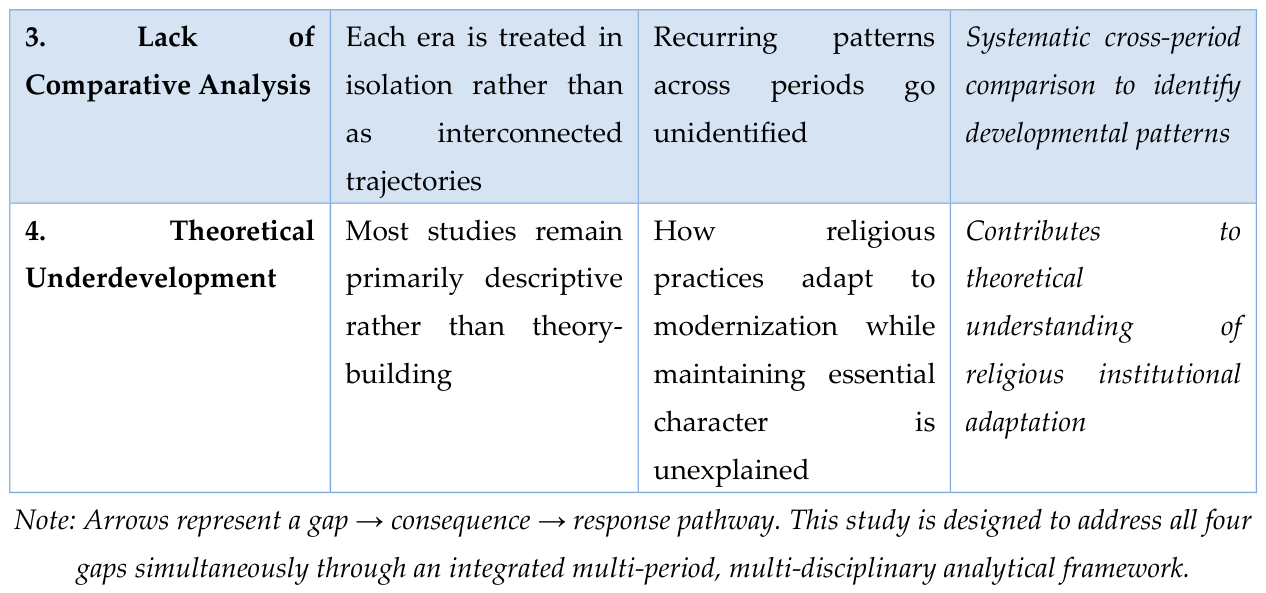
Despite this substantial body of work, four critical gaps persist in literature. First, temporal comprehensiveness is lacking: most studies concentrate on specific historical periods without examining longitudinal patterns across all fourteen centuries. Second, disciplinary fragmentation limits holistic understanding, as scholars in history, anthropology, public health, and public administration rarely integrate their perspectives within a single analytical framework. Third, systematic comparative analysis across periods remains rare, with each era typically treated in isolation rather than as part of interconnected developmental trajectories. Fourth, theoretical contributions regarding how religious practices adapt to modernization while maintaining their essential character remain underdeveloped, with most studies remaining primarily descriptive. This study addresses all four gaps through a comprehensive chronological analysis that integrates multiple disciplinary perspectives, identifies recurring patterns through systematic comparison, and contributes to theoretical understanding of religious institutional adaptation.
Figure 2.
Identified Research Gaps and Methodological Responses.
4. Methodology
This section sets out the research strategy used to address the questions framed in Section 1, given the temporal scope and source heterogeneity outlined in the literature review. Because the study spans fourteen centuries and draws on evidentiary traditions ranging from classical Arabic chronicles to contemporary government reports, no single method is sufficient on its own; the design instead combines historical analysis, document analysis, and thematic analysis within an interpretive qualitative paradigm. The four subsections that follow describe the research design and its epistemological grounding (4.1), the corpus of primary and secondary sources and the sampling logic applied to it (4.2), the analytical procedures used to process and compare that corpus (4.3), and the validity strategies and acknowledged limitations of the approach (4.4).
4.1. Research Design
This study employs a qualitative historical research design grounded in interpretive hermeneutic principles (Gadamer, 1975/2004) and a constructivist epistemology that recognizes historical knowledge as constructed through the interaction between available evidence and analytical frameworks (Creswell & Poth, 2018). The research design integrates three complementary methodological approaches. First, systematic historical analysis organizes developments chronologically to identify temporal patterns, causal relationships, and path dependencies across the full scope of Hajj history. Second, document analysis, following established qualitative protocols (Bowen, 2009), involves systematic identification, critical evaluation, content extraction, and triangulation of primary and secondary sources. Third, thematic analysis (Braun & Clarke, 2006) enables identification of recurring patterns and themes across historical periods through iterative coding and refinement.
4.2. Data Sources and Sampling
Primary sources span fourteen centuries and include classical Islamic chronicles and legal compilations (Al-Tabari, Ibn Kathir, Al-Bukhari), medieval geographic and travel accounts (Al-Muqaddasi, Yaqut al-Hamawi, Ibn Battuta, Ibn Jubayr), Ottoman administrative records and travel narratives as analyzed by Faroqhi (1994), European diplomatic and health documentation, and contemporary government reports and statistical compilations. Secondary sources encompass peer-reviewed monographs, journal articles indexed in Scopus and Web of Science, and institutional reports from organizations including the World Health Organization. Purposive sampling ensured temporal representativeness across all six identified periods, thematic coverage spanning political, administrative, health, and technological dimensions, and inclusion of diverse perspectives—official, experiential, and external.
4.3. Analytical Procedures
Data processing followed a systematic sequence. All sources were digitally catalogued and organized chronologically to facilitate temporal analysis and pattern identification. Thematic coding combined deductive categories derived from the theoretical framework (institutional change, modernization, globalization, governance) with inductive codes emerging from the data itself. Cross-referencing between sources enabled comprehensive analysis of specific developments and their interconnections across periods. Analytical techniques included content analysis for extracting relevant information, comparative analysis across time periods and source types, trend analysis for identifying long-term evolutionary patterns, and critical analysis evaluating sources for bias and contextual factors influencing interpretation.
4.4. Validity and Limitations
Multiple forms of triangulation enhanced research validity: source triangulation (comparing official documents, personal accounts, and scholarly analyses), temporal triangulation (comparing contemporary accounts with later historical evaluations), and perspectival triangulation (including official, experiential, and external viewpoints). A systematic framework for identifying recurring patterns across historical periods was developed, enabling comparative analysis and theoretical development beyond simple chronological description. Limitations include uneven documentation density across periods, with substantially more detailed information available for recent centuries; potential elite bias in historical sources that may underrepresent ordinary pilgrim experiences; language barriers limiting direct access to some Ottoman Turkish archival materials; and the interpretive subjectivity inherent in qualitative historical analysis, which, while mitigated through systematic methodology and multiple triangulation strategies, cannot be entirely eliminated.
5. Findings
The analysis identifies six distinct phases of Hajj transformation, each characterized by specific political, social, technological, and administrative developments that fundamentally reshaped the pilgrimage experience while preserving its spiritual core. The periodization scheme developed here reflects not merely conventional political divisions but integrates religious, administrative, technological, and health dimensions of change, providing a more nuanced framework for understanding pilgrimage evolution than prior approaches that rely on dynastic or political periodization alone.
5.1. Phase 1: Prophetic Foundation and Early Expansion (632–661 CE)
The foundational period of Islamic pilgrimage began with the Prophet Muhammad’s farewell pilgrimage in 632 CE, witnessed by an estimated 90,000–120,000 Muslims according to various historical accounts (Al-Tabari, 915/1987). This event established both the practical ritual sequence and the comprehensive ethical framework governing Hajj for all subsequent centuries. The Prophet’s emphasis on universal equality regardless of ethnicity or social status, the sanctity of life and property, and the prohibition of pre-Islamic practices created a moral foundation that transformed Hajj from a pre-existing Arabian practice into an institution embodying universal Islamic values (Ibn Kathir, 1365/1966).

Table 1.
Foundational Elements Established During the Prophetic Period.
| Element | Specific Establishment | Long-Term Impact |
| Ritual Sequence | Standardized performance of all Hajj rites | Unchanging ritual framework for 14 centuries |
| Equality Principle | Universal equality regardless of ethnicity | Foundation for Islamic universalism and brotherhood |
| Sanctuary Concept | Sacred Haram boundaries delineated | Basis for security and protection systems |
| Leadership Model | Prophet as spiritual guide and teacher | Template for subsequent Hajj governance structures |
| Community Gathering | Large-scale collective worship established | Precedent for mass pilgrimage organization |
| Ethical Framework | Justice, peace, and brotherhood principles | Moral foundation for pilgrimage conduct |
Note. Compiled from Al-Tabari (915/1987), Ibn Sa’d (845/1967), and Al-Bukhari (870/1997).
During the Rashidun caliphate (632–661 CE), each of the four caliphs personally led Hajj, establishing the normative principle that political authority carried direct responsibility for pilgrimage facilitation. Abu Bakr maintained continuity during the turbulent post-Prophetic transition. Umar ibn al-Khattab introduced substantive administrative innovations including regular security patrols along major pilgrimage routes, establishment of emergency supply depots, and the beginning of systematic record-keeping regarding pilgrimage affairs (Ibn Sa’d, 845/1967). Uthman ibn Affan oversaw infrastructure improvements including water source expansion around Makkah to accommodate the growing numbers of pilgrims arriving from newly incorporated territories across Iraq, Syria, and Egypt (Al-Baladhuri, 892/1987). Ali ibn Abi Talib maintained pilgrimage continuity during the civil conflict of the First Fitna, demonstrating the remarkable institutional resilience of Hajj even during periods of severe political disruption.
The early Islamic conquests significantly expanded the geographic scope of potential pilgrimage participation. The incorporation of Iraq, Syria, Egypt, and parts of Iran into the Islamic state created new populations of Muslims for whom Hajj became a religious obligation. Archaeological evidence and historical sources suggest that annual pilgrim numbers during this period grew from the Prophetic-era assembly of approximately 100,000 to a sustained flow of 10,000–50,000 participants annually, representing both Arabian populations and significant new contingents from Iraq, Syria, and Egypt. This geographic expansion necessitated the development of new routes, support systems, and service networks extending well beyond the Arabian Peninsula (Creswell, 1958). Water scarcity emerged as a persistent challenge, leading to early investments in well-digging and water storage systems that established precedents for later, more sophisticated hydraulic engineering. The linguistic diversity of pilgrims from different cultural backgrounds created communication challenges addressed through the emergence of specialized guides and interpreters, establishing the foundation for later institutionalized guidance systems.
Table 2.
Administrative Innovations During the Rashidun Period.
| Caliph | Period | Key Innovations | Impact on Pilgrimage |
| Abu Bakr | 632–634 CE | Maintained Prophetic model during transition | Preserved authentic practices |
| Umar | 634–644 CE | Route patrols, supply stations, record-keeping | Enhanced safety and systematic organization |
| Uthman | 644–656 CE | Water infrastructure, expanded facilities | Accommodated growing pilgrim numbers |
| Ali | 656–661 CE | Maintained continuity during civil conflict | Demonstrated institutional resilience |
Note. Compiled from Ibn Sa’d (845/1967) and Al-Baladhuri (892/1987).
5.2. Phase 2: Imperial Islamic Administration (661–1517 CE)
The Umayyad dynasty (661–750 CE) formalized the Amir al-Hajj (Commander of the Pilgrimage) as a high-ranking imperial appointment carrying extensive administrative, judicial, and military authority, recognizing that effective pilgrimage management served both religious obligations and political legitimacy (Al-Tabari, 915/1987). Under Caliph al-Walid I (705–715 CE), the Grand Mosque underwent its first major expansion, increasing worship capacity from approximately 5,000 to 17,000 (Creswell, 1958). The development of systematic caravan organizations, with official caravans departing annually from Damascus and Cairo, established logistical patterns that would persist for centuries.
The Abbasid period (750–1000 CE) represented the apex of medieval pilgrimage infrastructure development. The most remarkable achievement was the construction of Darb Zubaydah, the great pilgrim road extending approximately 1,400 kilometers from Kufa to Makkah, attributed largely to the patronage of Zubaydah bint Ja’far, wife of Caliph Harun al-Rashid. This project encompassed not merely a road but a comprehensive service network of unprecedented sophistication (Yaqut al-Hamawi, 1229/1995; Kennedy, 2004).
Table 3.
Darb Zubaydah Infrastructure Components.
| Component Type | Number | Services Provided | Maintenance System |
| Major Stations (Mahatta) | 27 | Accommodation, supplies, security | Permanent staff |
| Water Points | 156 | Wells, cisterns, pools | Seasonal maintenance teams |
| Rest Stops (Manzil) | 58 | Basic shelter, animal care | Local oversight |
| Fortifications | 37 | Security, dispute resolution | Military garrison |
| Mosques | 19 | Prayer facilities, guidance | Religious personnel |
Note. Adapted from Yaqut al-Hamawi (1229/1995) and Kennedy (2004).
Political fragmentation after 1000 CE severely disrupted pilgrimage administration. The Qarmatian attack on Makkah in 930 CE—during which pilgrims were massacred and the Black Stone removed from the Ka’ba for over two decades—represented the most traumatic disruption, suspending pilgrimage for several years and demonstrating its acute vulnerability to sectarian conflict (Hodgson, 1974). The subsequent period of Bedouin tribal autonomy and competing regional authorities created conditions in which pilgrim caravans required substantial military escorts, routes became dangerous, and infrastructure deteriorated through neglect. Despite these challenges, pilgrimage continued, demonstrating the deep commitment of Muslim communities to maintaining this religious obligation even under hazardous conditions. Local authorities, tribal leaders, and merchant communities often filled gaps left by weakened central authority, developing informal networks of coordination and mutual support.
The Mamluk Sultanate (1250–1517 CE) restored systematic stability through sophisticated administrative systems that combined military security with commercial organization. The Mamluks developed the most complex pre-modern caravan management system, with professional guilds of pilgrimage service providers, standardized weights and measures for commercial transactions, fixed rates for essential services, and endowment funds (waqf) to support infrastructure maintenance. Ibn Battuta’s detailed 1326 account describes the Egyptian caravan as encompassing approximately 12,000 pilgrims, 200 administrators, 1,000 guards, and elaborate supply logistics organized through a hierarchical command structure—a level of organizational complexity rivaling contemporary military operations (Ibn Battuta, 1355/2002). The Mamluk period also saw the emergence of sea routes via the Red Sea as increasingly important alternatives to overland travel, particularly for pilgrims from North Africa, Andalusia, and Southeast Asian Muslim communities, contributing to the diversification of pilgrimage experiences.
5.3. Phase 3: Ottoman Centralization and International Challenges (1517–1924 CE)
The Ottoman conquest of Mamluk territories in 1517 transferred custodianship of the holy cities to Istanbul, initiating four centuries of imperial administration that would profoundly shape the development of modern pilgrimage systems. The sultans’ adoption of the title Khadim al-Haramayn al-Sharifayn (Servant of the Two Holy Sanctuaries) established the Ottoman claim to leadership of the broader Islamic world, with pilgrimage management serving as a primary vehicle for demonstrating this authority (Faroqhi, 1994; Barbir, 1980). The appointment of the Surre-i Humayun (Imperial Caravan) commander became one of the most prestigious positions in the Ottoman hierarchy, typically held by high-ranking pashas combining military, administrative, and diplomatic responsibilities. Under Suleiman the Magnificent, major renovations of both the Grand Mosque and the Prophet’s Mosque increased worship capacity by an estimated 40%, while Ottoman engineers developed sophisticated aqueduct systems and water storage facilities to address the persistent challenge of water scarcity in the arid Hijaz.
The most ambitious Ottoman pilgrimage project was the Hijaz Railway (1900–1908), conceived under Sultan Abdulhamid II as both a religious service and a strategic asset. This narrow-gauge railway extending from Damascus to Madinah reduced journey time from approximately 40 days by camel caravan to just 72 hours by train, dramatically improving accessibility for pilgrims from Syria, Anatolia, and the Balkans. Approximately 60% of its cost was financed through voluntary contributions from Muslim communities worldwide—including India, Indonesia, and West Africa—demonstrating the global symbolic resonance of pilgrimage infrastructure and the depth of pan-Islamic solidarity around the holy sites (Özyüksel, 2000; Nicholson, 2005). The railway’s systematic destruction during World War I by Arab nationalist forces, supported by British military advisors, illustrated both the transformative potential of modern technology for pilgrimage and the acute vulnerability of such infrastructure to geopolitical conflict.
Simultaneously, the 19th century marked a critical turning point as devastating cholera epidemics transformed Hajj from a primarily religious matter into a subject of international health governance. The pandemic of 1831 killed an estimated 20,000 pilgrims, and subsequent outbreaks in 1865, 1883, and 1893 claimed tens of thousands more while spreading disease along intercontinental trade routes (Watts, 1997). European powers, concerned about the transmission of cholera to their own territories and colonial populations, began to intervene directly in pilgrimage health management, establishing quarantine systems that significantly altered the pilgrim experience.
Table 4.
Major Cholera Outbreaks During Hajj (1831–1912).
| Year | Estimated Deaths | International Response | Long-Term Impact |
| 1831 | 20,000+ pilgrims | Initial quarantine discussions | Beginning of international involvement |
| 1865 | 15,000+ pilgrims | Paris Health Conference (1866) | Formal health cooperation established |
| 1883 | 8,000+ pilgrims | Enhanced quarantine systems | Strengthened European health controls |
| 1893 | 12,000+ pilgrims | Dresden Conference protocols | Comprehensive health protocols adopted |
| 1912 | 3,000+ pilgrims | Improved prevention measures | Effective quarantine systems in place |
Note. Compiled by Howard-Jones (1975) and Watts (1997).
The series of International Sanitary Conferences beginning with Constantinople in 1866 established frameworks for multilateral health cooperation that continue to influence global governance. However, these interventions also reflected colonial power dynamics, as European powers-imposed quarantine regulations on Muslim mobility while pursuing strategic and economic interests (Howard-Jones, 1975; Harrison, 1994). The Kamaran Island quarantine station, operated by British authorities in the Red Sea from 1882, processed thousands of pilgrims annually, often detaining them for weeks under difficult conditions. These health interventions represented a complex mixture of genuine public health concerns and colonial political interests—while European-imposed systems did reduce the spread of epidemic diseases, they also served to assert control over Muslim mobility and pilgrimage practices. The Ottoman response evolved from initial resistance to proactive health policy development, and by the early 20th century, the Ottoman government had established its own health services for pilgrims and was actively cooperating with international health authorities, though tensions regarding sovereignty persisted until the end of the empire.
5.4. Phase 4: Saudi Unification and Infrastructure Revolution (1932–2000)
The founding of the Kingdom of Saudi Arabia under King Abdulaziz in 1932 inaugurated a new era for the holy cities: for the first time in centuries, Makkah and Madinah came under the unified custodianship of a single Arab Muslim state, restoring sovereign Islamic stewardship over the pilgrimage. From the outset, King Abdulaziz framed the service of pilgrims as both a sacred Islamic duty and a defining responsibility of the state, personally supervising arrangements and establishing the principle that hosting the guests of the Two Holy Mosques constitutes a foundational obligation of government (Vassiliev, 2000). His direct engagement with pilgrims, attentiveness to their concerns, and commitment to continuous improvement set in motion a tradition of service-oriented governance that successive Saudi monarchs have sustained and expanded. Even with the limited resources of the period, the early Saudi state undertook to build the credible administrative systems required to host an increasingly international gathering — laying the institutional foundations on which later decades of investment would build.
Among the new state’s earliest and most consequential achievements was the elimination of tribal banditry along the pilgrimage routes — a security challenge that had endangered travelers for centuries — to which the Kingdom committed an estimated 25 percent of its early budget. Systematic investment in water supply systems, medical facilities, and regulated accommodation followed, steadily transforming the pilgrim experience from the hazardous journey of historical record into a managed process with identifiable service standards. Modern road networks linking the holy cities to Jeddah’s port and, later, its international airport provided the transportation backbone for an ever more international pilgrim population.
Oil revenues provided the financial foundation for development at a scale unprecedented in the history of pilgrimage. Under successive monarchs, the Kingdom delivered a sustained program of infrastructure investment that transformed the pilgrim environment into a modern complex capable of safely hosting millions of worshippers each year (Henderson, 2011). Under King Faisal, the first major Grand Mosque expansion (1955–1973) raised capacity to approximately 400,000 worshippers; under King Fahd, the Prophet’s Mosque expansion (1985–1992), at a cost of roughly $6 billion, introduced pioneering features including retractable umbrellas and advanced cooling systems suited to the climate of the Hijaz. King Abdulaziz International Airport’s dedicated Hajj terminal, distinguished by the world’s largest fabric roof structure, became a global landmark of pilgrimage infrastructure, purpose-built for the seamless reception of international arrivals.
Table 5.
Major Saudi Infrastructure Investments (1955–2000).
| Project | Timeline | Capacity Impact | Key Innovation |
| Grand Mosque Expansion (First) | 1955–1973 | 400,000 worshippers | Air conditioning, modern utilities |
| King Abdulaziz Airport | 1970–1981 | 8 million passengers/year | Dedicated Hajj terminal |
| Prophet’s Mosque Expansion | 1985–1992 | 1 million worshippers | Retractable umbrellas, advanced cooling |
| Makkah–Madinah Highway | 1965–1980 | 60% travel time reduction | Modern four-lane highway |
| Sacred Sites Development | 1975–1990 | 2 million pilgrims | Permanent facilities at Mina, Arafat |
Note. Compiled from Henderson (2011).
Following the 1990 Mina tragedy, in which 1,426 pilgrims lost their lives, the Kingdom undertook a fundamental redesign of pilgrimage safety. The response established systematic safety protocols, electronic monitoring systems, and an evidence-based approach to crowd management that would set the global standard for decades thereafter (Taibah & Arlikatti, 2015). Through the 1990s, advanced communications networks, digital surveillance, and modern bus fleets — applied through rigorous safety-engineering principles — reduced crowd-related incidents by approximately 70 percent and laid the groundwork for the world-class systems of the next phase.
5.5. Phase 5: Digital Integration and Mass Management (2000–2020)
The early 21st century saw the Kingdom undertake a comprehensive digitization of pilgrimage services that reshaped both the pilgrim experience and the administrative architecture supporting it. Electronic permit systems replaced paper-based processes, providing real-time visibility into pilgrim numbers, demographics, and movement. From 2015 onward, the progressively launched Nusuk platform brought registration, service booking, guidance, and multilingual information into a single digital ecosystem — the most comprehensive integrated service platform ever fielded in pilgrimage management.
Table 6.
Digital Technology Implementation in Hajj Management (2000–2020).
| Technology Category | Specific Applications | Pilgrim Impact | Administrative Benefit |
| Database Systems | Electronic registration, permit tracking | Streamlined applications | Real-time capacity management |
| Mobile Technology | Smartphone apps, GPS navigation | Enhanced guidance, safety | Improved field communication |
| Surveillance Systems | CCTV networks, crowd density monitoring | Increased security | Incident prevention and response |
| Healthcare IT | Electronic records, telemedicine | Better medical access | Proactive health monitoring |
| Transportation | Smart traffic systems, digital signage | Reduced travel times | Optimized flow management |
Note. Compiled from Alshammari et al. (2022).
Two flagship transportation projects redefined pilgrim mobility during this period. The Sacred Sites Train, in service since 2010, delivers driverless electric rail connecting Mina, Muzdalifah, and Arafat with a capacity of 72,000 passengers per hour, dramatically easing congestion through the most demanding movement phases of the Hajj. The Haramain High-Speed Railway, operational since 2018, links Makkah, Madinah, and Jeddah at speeds up to 300 km/h, reducing inter-city journeys to under three hours while delivering comfortable, low-emission travel at scale (Alshammari et al., 2022).
Healthcare provision advanced to world-class standards. Permanent hospitals, mobile medical units, and integrated telemedicine capabilities established a mass gathering health system recognized internationally as a benchmark of its kind. The foundational work of Memish and colleagues — codified through the WHO-endorsed Saudi Global Center for Mass Gathering Medicine — drew on decades of Hajj experience to establish mass gathering medicine as a formal discipline, with protocols now applied to large gatherings worldwide (Memish et al., 2012, 2014). Following the 2015 Mina crowd incident, the Kingdom led a comprehensive overhaul of crowd management, deploying artificial-intelligence systems for behavior analysis, advanced thermal imaging for density monitoring, and predictive modeling to identify potential congestion points before they could pose a risk. The complete reconstruction of the Jamarat area as a multi-level complex, completed in phases between 2006 and 2012, drew on decades of crowd-management research and stands as a state-of-the-art reference for safe mass gathering design. Environmental stewardship advanced in parallel, with renewable energy systems, comprehensive recycling programs, and water conservation technologies demonstrating that gatherings of this scale can be hosted with markedly reduced environmental impact.
5.6. Phase 6: Pandemic Adaptation and Future Visioning (2020–Present)
The COVID-19 pandemic confronted the Hajj with its most significant test since the Qarmatian disruptions of the 10th century. Acting decisively to safeguard pilgrims and the global public, the Kingdom limited the 2020 season to approximately 10,000 carefully selected residents of Saudi Arabia — an unprecedented decision in the modern era, and one that exemplified principled stewardship by holding religious imperatives and public-health responsibility in deliberate balance.
Table 7.
COVID-19 Hajj Management Adaptations (2020–2023).
| Year | Pilgrim Numbers | Key Protocols | Outcome |
| 2020 | ~10,000 (residents only) | Comprehensive testing, quarantine, monitoring | Zero outbreaks reported |
| 2021 | ~60,000 (residents only) | Vaccination required, digital health passports | WHO recognition of best practices |
| 2022 | ~1,000,000 (international) | Vaccination, testing, health monitoring | Successful international resumption |
| 2023 | ~1,800,000 (full scale) | Streamlined protocols, maintained vigilance | Near pre-pandemic capacity achieved |
Note. Compiled from Ebrahim and Memish (2020) and Alzeer et al. (2025).
Saudi Arabia’s response set an international benchmark for managing religious gatherings during a health emergency. Comprehensive testing, quarantine protocols, digital health monitoring through wearable devices, and carefully controlled group movements showed that religious obligations could be honored while public health was uncompromisingly protected (Ebrahim & Memish, 2020; Alzeer et al., 2025). The Kingdom’s success — zero reported COVID-19 outbreaks during the restricted 2020 season — validated both its crisis-management capability and the long-term value of its investment in mass gathering health infrastructure. Participation was then restored on a deliberate, evidence-led trajectory: roughly 60,000 residents in 2021, the resumption of international pilgrimage at one million in 2022, and a return to near pre-pandemic levels in 2023.
The pandemic also accelerated technological trends already underway. Digital health passports, contactless service delivery, remote monitoring, and AI-driven crowd-spacing tools first deployed as emergency measures have since been integrated into standard pilgrimage management — a permanent enhancement of the digital infrastructure underpinning Hajj operations. The episode underscored a broader principle: when crisis-driven innovation is built on strong institutional foundations, it can drive lasting transformation rather than merely deliver temporary fixes.
Looking ahead, Vision 2030 sets out the most ambitious long-term plan for pilgrimage development in Islamic history, targeting 30 million annual Umrah visitors and weaving together smart-city technologies, AI-driven crowd-flow optimization, and environmental measures aligned with the Saudi Green Initiative’s 2060 net-zero target. The ongoing Third Grand Mosque Expansion will raise simultaneous worship capacity to 2.5 million worshippers, incorporating advanced environmental controls and integrated digital information services. The next generation of services — personalized multilingual guidance in more than 20 languages, predictive analytics for service delivery, and wearable health monitoring for at-risk pilgrims — represents the leading edge of technology–religion integration. Augmented applications now in development will provide real-time information on ritual requirements and the historical significance of sacred sites, all while preserving the contemplative character of the pilgrimage. Together, these initiatives establish Saudi Arabia’s Hajj management as the global reference point for the responsible integration of advanced technology with the deepest religious traditions.
6. Discussion
Examining Hajj transformations across fourteen centuries reveals enduring patterns that illuminate the relationship between religious tradition and societal change. These patterns illuminate not only the development of the pilgrimage itself but also the broader question of how religious practices adapt to changing circumstances while preserving their essential spiritual character. The subsections that follow analyze each pattern systematically, drawing on the theoretical frameworks established earlier and situating the findings within existing scholarly debates.
6.1. Recurring Patterns of Innovation and Consolidation
A theoretically significant pattern across all six phases is the recurring cycle of innovation, consolidation, challenge, and renewed adaptation. Umayyad systematization of pilgrimage administration was elaborated into the sophisticated Abbasid institutional structure, restored after political fragmentation through Mamluk innovation, and developed further by the Ottomans into the most comprehensive pre-modern system of its kind. The modern Saudi era then carried this trajectory to a new apex, building on inherited foundations while introducing capabilities — unified national stewardship, oil-funded infrastructure, and globally recognized service standards — that earlier periods could not have achieved. Each cycle preserved elements of what came before while adding new capacity, producing an institutional architecture defined by layered complexity rather than wholesale replacement. This pattern aligns with Pierson’s (2004) framework of institutional path dependence while extending it: religious institutions appear to exhibit greater adaptive capacity than purely secular ones, sustained by the motivational power of spiritual commitment and the non-negotiable character of religious obligation.
Table 8.
Innovation Cycles in Hajj Development Across Historical Periods.
| Historical Period | Innovation Phase | Consolidation Phase | Challenge Phase |
| Early Islamic (632–661) | Prophetic foundation of rites | Rashidun systematization | Political expansion pressures |
| Imperial Islamic (661–1517) | Umayyad state administration | Abbasid elaboration (Darb Zubaydah) | Political fragmentation, Qarmatian attacks |
| Ottoman (1517–1924) | Integration with imperial system | Comprehensive standardization | Cholera epidemics, colonial interventions |
| Modern Saudi (1932–2000) | Unified national administration | Oil-funded infrastructure revolution | Crowd safety challenges (1990) |
| Contemporary (2000–present) | Digital transformation, AI integration | Smart city systems, mass gathering medicine | COVID-19 pandemic adaptation |
Note. Analysis based on comprehensive historical review of primary and secondary sources.
6.2. State Capacity and Pilgrimage Quality
The analysis reveals a consistent positive correlation between the capacity of governing authorities and the quality of pilgrimage experiences across every period examined. The Abbasid golden age, anchored by the sophisticated Darb Zubaydah infrastructure, stands in sharp contrast to the deterioration that followed political fragmentation. The modern Saudi period provides the strongest expression of this correlation: through the systematic application of state resources, administrative excellence, and long-horizon strategic planning — amplified by oil revenues and directed through successive national development plans culminating in Vision 2030 — the Kingdom has transformed Hajj from an arduous and often hazardous journey into a globally recognized model of mass gathering management. The finding carries implications beyond pilgrimage studies: effective governance is not merely beneficial but essential for sustaining complex religious institutions that serve diverse international populations (Taibah & Arlikatti, 2015; Henderson, 2011).
The correlation is most instructive when comparing periods of transition. The shift from Abbasid strength to post-Abbasid fragmentation produced infrastructure deterioration, rising insecurity, and increased pilgrim mortality within a single generation. The Saudi transition, by contrast, moved from the limited resources of the 1930s to systematic state-funded development by the 1970s, delivering dramatic improvements in safety, accessibility, and service quality. These contrasts suggest that pilgrimage quality functions as a sensitive barometer of governance capacity, with implications for understanding institutional performance in other complex service-delivery contexts. The Saudi experience also demonstrates that state capacity in religious governance requires not only financial resources but institutional legitimacy, administrative competence, and a genuine ethic of service — the qualities that have defined the Kingdom’s stewardship of the holy sites.
Table 9.
State Capacity and Pilgrimage Quality Across Historical Periods.
| Period | State Capacity | Infrastructure Quality | Safety Record | Pilgrim Satisfaction |
| Rashidun (632–661) | Moderate | Basic but functional | Moderate risks | Generally positive |
| Early Abbasid (750–1000) | Very High | Excellent (Darb Zubaydah) | Very good security | High satisfaction |
| Post-Abbasid fragmentation | Low | Deteriorating | High risks | Poor |
| Mamluk (1250–1517) | Moderate–High | Good, restored systems | Moderate risks | Generally positive |
| Early Ottoman (1517–1700) | High | Good, imperial investment | Good security | Positive |
| Late Ottoman (1800–1924) | Declining | Mixed | Increasing risks | Mixed |
| Early Saudi (1932–1970) | Growing | Rapidly developing | Good, improving | Positive |
| Modern Saudi (1970–present) | Very High | World-class | Excellent | High satisfaction |
Note. Qualitative assessment based on analysis of historical sources and comparative evaluation across periods.
6.3. Technology Integration and Religious Authenticity
Contrary to secularization narratives predicting inherent conflict between technological modernization and religious practice, the evidence shows that every period of Hajj history has successfully integrated the technologies available to it — from medieval hydraulic engineering and astronomical calculation to Ottoman railway engineering and contemporary AI-powered crowd management — without compromising the spiritual integrity of the pilgrimage. Three factors prove essential to such integration: (a) a clear distinction between essential ritual elements, which remain unchanging, and adaptable logistical dimensions; (b) community consultation and incremental implementation with feedback and adjustment built in; and (c) the framing of technology as serving, rather than replacing, religious experience.
The historical record offers instructive examples. The sophisticated water management systems of the Abbasid period — underground channels (qanat), surface aqueducts, and cisterns engineered to support thousands of pilgrims — represented the cutting edge of medieval technology applied to a religious purpose. The Ottoman Hijaz Railway transformed pilgrimage accessibility without altering ritual requirements, enabling populations previously excluded by the physical demands of desert travel to fulfill their religious obligation. In the contemporary era, the Kingdom has carried this principle forward at scale: smartphone applications providing real-time ritual guidance, electronic monitoring systems that ensure safe crowd flow without restricting pilgrim movement, and telemedicine services that safeguard pilgrim health during physically demanding rites all exemplify how technology enhances religious participation when designed with sensitivity to spiritual requirements.
These findings provide empirical support for Eisenstadt’s (1966) theory of multiple modernities, demonstrating that modernization and religious deepening need not be zero-sum. They also contribute to Campbell’s (2012) digital religion scholarship through a uniquely comprehensive longitudinal case. The fourteen-century evidence base available for Hajj affords a historical depth unmatched by digital religion studies in other contexts, showing that the compatibility of technology and religion is not a novel phenomenon but a recurring pattern in the history of institutional adaptation.
6.4. Internationalization and Health Governance
The transformation of Hajj from a regional phenomenon into a focus of international governance is one of the most consequential threads in this analysis. Nineteenth-century cholera crises established early — and uneven — precedents for international health cooperation that, despite their embeddedness in colonial power dynamics, evolved into the multilateral frameworks of the contemporary era. Saudi Arabia’s response to COVID-19 then demonstrated how effective national leadership can advance international cooperation and contribute to global health security while preserving full sovereignty over religious affairs. The establishment of mass gathering medicine as a formal WHO-endorsed discipline, with its intellectual home at the Saudi Global Center for Mass Gathering Medicine (Memish et al., 2012), exemplifies how religious stewardship can generate knowledge and institutional innovations of value far beyond their original context.
6.5. Theoretical Implications
The Hajj transformation narrative challenges linear secularization theories and instead supports frameworks that recognize diverse developmental pathways through which societies achieve modernity while preserving religious and cultural authenticity (Eisenstadt, 1966; Robertson, 1992). The evidence shows that deep religious commitment and systematic modernization are not merely compatible but mutually reinforcing when guided by principled governance that respects both spiritual values and practical necessities. The preservation of ritual authenticity across fourteen centuries of dramatic contextual change demonstrates that core religious practices can withstand and even benefit from modernization when the distinction between the essential and the adaptable is consistently maintained.
The evolution of Hajj management also contributes to public administration theory by showing how complex, large-scale service delivery to extraordinarily diverse populations can be achieved under demanding conditions by integrating traditional values with contemporary organizational practice (Osborne, 2006). The Saudi approach offers a distinctive model of public service in which religious legitimacy, administrative excellence, and technological sophistication operate synergistically rather than in tension. The Kingdom’s specialized institutions for mass gathering management, the professionalization of pilgrimage services, and the international knowledge-sharing networks built around the Saudi experience constitute institutional innovations whose relevance extends well beyond their religious origins, informing governance theory more broadly.
The globalization dimension of Hajj transformation offers important insights for Robertson’s (1992) framework. The pilgrimage’s evolution from a regional Arabian gathering into a global one drawing participants from 184 countries demonstrates how religious practices can serve as powerful vehicles for cultural exchange, international cooperation, and the construction of transnational community identity. The diplomatic dimensions of modern pilgrimage management — visa coordination, transportation agreements, health protocol harmonization, and emergency response cooperation — illustrate how religious institutions can contribute to the infrastructure of international relations in ways that complement, and at times exceed, the capacity of purely secular diplomatic mechanisms.
7. Conclusions
This analysis of Hajj transformations across fourteen centuries identifies six distinct evolutionary phases and surfaces structural patterns of broad theoretical and practical significance. Three core findings stand out. First, the recurring cycle of innovation, consolidation, and adaptive response shows that institutional resilience in religious contexts derives from a capacity for principled change rather than rigid resistance to it. Second, the strong positive correlation between state capacity and pilgrimage quality underscores the essential role of effective governance in sustaining complex religious institutions. Third, the consistently successful integration of contemporary technologies with unchanging ritual requirements shows that modernization need not erode religious authenticity when guided by sensitivity to spiritual values and community acceptance.
Saudi Arabia’s stewardship of the holy sites, anchored by its Vision 2030 strategy, stands as a contemporary exemplar of how principled religious governance can harmonize tradition with innovation, national responsibility with global cooperation, and spiritual commitment with practical excellence. The Kingdom’s pioneering contributions to mass gathering medicine, digital pilgrimage management, and pandemic response have produced models and knowledge whose applicability extends well beyond the Islamic context.
The transformation of Hajj from a source of 19th-century international tension — when cholera epidemics provoked colonial interventions that compromised Muslim sovereignty over the pilgrimage — into a model of successful international cooperation today shows that complex international issues can be resolved through effective leadership and mutual respect. The health protocols, transportation coordination mechanisms, and diplomatic frameworks built around pilgrimage management illustrate how religious governance can contribute substantively to global public goods. The Saudi experience further demonstrates that religious institutions, when guided by strategic vision, can serve as vehicles for sustainable development: the integration of environmental sustainability with religious service through Vision 2030 — including commitments to renewable energy, waste reduction, and climate adaptation in the holy cities — offers a model for heritage-based development that honors tradition while answering contemporary imperatives.
Most significantly of all, the fourteen-century Hajj narrative demonstrates that the apparent tensions between tradition and modernity, between spirituality and technology, and between local authenticity and global engagement need not be irreconcilable. They can instead become creative tensions that drive beneficial innovation when met with wisdom, principled commitment, and genuine respect for both spiritual values and human welfare. As the global Muslim population continues to grow — projected to exceed two billion by 2050 — the challenges and opportunities facing Hajj management will expand accordingly, calling for continued innovation guided by the principles that have enabled successful adaptation across fourteen centuries: commitment to service, respect for tradition, openness to beneficial change, and a dedication to continuous improvement.
8. Recommendations for Future Research
Several directions warrant future investigation. Comparative studies with other major pilgrimage traditions — Kumbh Mela, the Christian pilgrimages to Rome and Santiago de Compostela, and Buddhist pilgrimage circuits — could identify both universal patterns of religious institutional adaptation and culturally specific dynamics. Such comparative work would strengthen the theoretical contributions of Hajj studies by testing whether the patterns identified here (cyclical innovation, state–quality correlation, technology–authenticity compatibility) hold across different religious traditions or instead represent distinctive features of Islamic pilgrimage governance.
Ethnographic research capturing the lived experiences of diverse pilgrim populations — across age, gender, nationality, and socioeconomic background — would complement the institutional focus of this analysis by illuminating how macro-level transformations are experienced at the individual and community level. The ongoing integration of AI and smart-city technologies into pilgrimage management offers fertile ground for research on digital religion and technology-mediated spirituality, particularly regarding how augmented reality, personalized digital guidance, and wearable health monitoring reshape the subjective experience of pilgrimage without diminishing its spiritual significance.
The environmental sustainability of mass gatherings in an era of accelerating climate change represents an increasingly urgent research domain: rising temperatures across the Arabian Peninsula and the energy demands of serving millions of pilgrims in extreme heat call for innovative solutions that balance environmental responsibility with religious service provision. The economic dimensions of pilgrimage within broader national development strategies — particularly the relationship between Vision 2030’s economic diversification goals and the expansion of religious tourism — also warrant systematic investigation. Finally, longitudinal studies tracking the post-pandemic evolution of health governance frameworks for international religious gatherings could yield insights for global health security preparedness, building on the foundational work in mass gathering medicine whose intellectual center now sits in the Saudi Hajj management experience.
Funding
This work was supported and funded by the Deanship of Scientific Research at Imam Mohammad Ibn Saud Islamic University (IMSIU) (grant number IMSIU-DDRSP2602).
Institutional Review Board Statement
not applicable.
Transparency: The author confirms that the manuscript is an honest, accurate and transparent account of the study that no vital features of the study have been omitted and that any discrepancies from the study as planned have been explained. This study followed all ethical practices during writing.
Conflicts of Interest
The authors declare no conflicts of interest.
References
- Al-Baladhuri, A. (1987). Kitab futuh al-buldan [The conquests of countries] (P. K. Hitti, Trans.). Columbia University Press. (Original work published 892).
- Al-Bukhari, M. (1997). Sahih al-Bukhari [The authentic collection] (M. M. Khan, Trans.). Darussalam. (Original work published 870).
- Al-Muqaddasi, M. (1994). Ahsan al-taqasim fi ma’rifat al-aqalim [The best divisions for knowledge of the regions] (B. A. Collins, Trans.). Garnet Publishing. (Original work published 985). Collins, B. A., Translator.
- Al-Tabari, M. (1987). The history of al-Tabari: The last years of the Prophet (I. K. Howard, Trans.). State University of New York Press. (Original work published 915). Howard, I. K., Translator.
- Alshammari, S. M.; Soh, B.; Li, A. Saudi Arabia’s management of the Hajj season through artificial intelligence and sustainability. Sustainability 2022, 14(21), Article 14142. [Google Scholar] [CrossRef]
- Alzeer, A. H.; Mashlah, A. M.; Memish, Z. A. The Hajj legacy and Saudi Arabia’s exemplary response to COVID-19. Front. Public Health 2025, 13, 1520179. [Google Scholar] [CrossRef]
- Barbir, K. (1980). Ottoman rule in Damascus, 1708–1758. Princeton University Press.
- Bianchi, R. (2004). Guests of God: Pilgrimage and politics in the Islamic world. Oxford University Press. [CrossRef]
- Bowen, G. A. Document analysis as a qualitative research method. Qual. Res. J. 2009, 9(2), 27–40. [Google Scholar] [CrossRef]
- Braun, V.; Clarke, V. Using thematic analysis in psychology. Qual. Res. Psychol. 2006, 3(2), 77–101. [Google Scholar] [CrossRef]
- Campbell, H. A. (2012). Digital religion: Understanding religious practice in new media worlds. Routledge. [CrossRef]
- Creswell, J. W., & Poth, C. N. (2018). Qualitative inquiry and research design: Choosing among five approaches (4th ed.). SAGE Publications.
- Creswell, K. A. C. (1958). A short account of early Muslim architecture. Penguin Books.
- Ebrahim, S. H.; Memish, Z. A. COVID-19: The role of mass gatherings. Travel Med. Infect. Dis. 2020, 34, Article 101617. [Google Scholar] [CrossRef] [PubMed]
- Eisenstadt, S. N. (1966). Modernization: Protest and change. Prentice-Hall.
- Faroqhi, S. (1994). Pilgrims and sultans: The Hajj under the Ottomans, 1517–1683. I. B. Tauris.
- Gadamer, H. G. (2004). Truth and method (J. Weinsheimer & D. G. Marshall, Trans.; 2nd rev. ed.). Continuum. (Original work published 1975).
- Harrison, M. (1994). Public health in British India: Anglo-Indian preventive medicine, 1859–1914. Cambridge University Press. [CrossRef]
- Henderson, J. C. Religious tourism and its management: The Hajj in Saudi Arabia. Int. J. Tour. Res. 2011, 13(6), 541–552. [Google Scholar] [CrossRef]
- Hodgson, M. G. S. (1974). The venture of Islam: Conscience and history in a world civilization (Vols. 1–3). University of Chicago Press.
- Howard-Jones, N. (1975). The scientific background of the International Sanitary Conferences, 1851–1938. World Health Organization. https://iris.who.int/handle/10665/62873.
- Ibn Battuta, M. (2002). The travels of Ibn Battuta (H. A. R. Gibb, Trans.). Hakluyt Society. (Original work published 1355).
- Ibn Jubayr, M. (2001). The travels of Ibn Jubayr (R. J. C. Broadhurst, Trans.). Goodword Books. (Original work published 1183).
- Ibn Kathir, I. (1966). Al-Bidaya wa al-nihaya [The beginning and the end] (M. A. Ibrahim, Ed.). Dar Ihya al-Turath al-Arabi. (Original work published 1365).
- Ibn Sa’d, M. (1967). Kitab al-tabaqat al-kabir [The great book of generations] (E. Sachau, Ed.). E. J. Brill. (Original work published 845).
- Kennedy, H. (2004). The Prophet and the age of the Caliphates: The Islamic Near East from the sixth to the eleventh century (2nd ed.). Pearson Longman.
- Long, D. E. (1979). The Hajj today: A survey of the contemporary Makkah pilgrimage. State University of New York Press.
- Memish, Z. A.; Stephens, G. M.; Steffen, R.; Ahmed, Q. A. Emergence of medicine for mass gatherings: Lessons from the Hajj. Lancet Infect. Dis. 2012, 12(1), 56–65. [Google Scholar] [CrossRef] [PubMed]
- Memish, Z. A.; Zumla, A.; Alhakeem, R. F.; Assiri, A.; Turkestani, A.; Al Harby, K. D.; Alyemni, M.; Dhafar, K.; Gautret, P.; Barbeschi, M.; McCloskey, B.; Heymann, D.; Al Rabeeah, A. A.; Al-Tawfiq, J. A. Hajj: Infectious disease surveillance and control. The Lancet 2014, 383(9934), 2073–2082. [Google Scholar] [CrossRef] [PubMed]
- Nicholson, H. (2005). The Hejaz Railway. Stacey International.
- Osborne, S. P. The new public governance? Public Manag. Rev. 2006, 8(3), 377–387. [Google Scholar] [CrossRef]
- Özyüksel, M. (2000). The Hejaz Railway and the Ottoman Empire: Modernity, industrialization and Ottoman decline. I. B. Tauris.
- Peters, F. E. (1994). The Hajj: The Muslim pilgrimage to Mecca and the holy places. Princeton University Press.
- Pierson, P. (2004). Politics in time: History, institutions, and social analysis. Princeton University Press. [CrossRef]
- Robertson, R. (1992). Globalization: Social theory and global culture. SAGE Publications.
- Taibah, H.; Arlikatti, S. An examination of evolving crowd management strategies at pilgrimage sites: A case study of ‘Hajj’ in Saudi Arabia. Int. J. Mass. Emerg. Disasters 2015, 33(2), 188–212. [Google Scholar] [CrossRef]
- Turner, V., & Turner, E. (1978). Image and pilgrimage in Christian culture: Anthropological perspectives. Columbia University Press.
- Vassiliev, A. Vassiliev, A. (2000). The history of Saudi Arabia. New York University Press.
- Watts, S. (1997). Epidemics and history: Disease, power and imperialism. Yale University Press.
- Yaqut al-Hamawi. (1995). Mu’jam al-buldan [Dictionary of countries] (F. Wüstenfeld, Ed.). Georg Olms Verlag. (Original work published 1229).
Short Biography
Dr. Safran Safar Almakaty is a Professor at Imam Mohammad ibn Saud Islamic University (IMSIU) in Riyadh, known for his contributions to communication, media studies, and higher education in Saudi Arabia and the Middle East. He holds a master’s from Michigan State University and a PhD from the University of Kentucky. His research focuses on media evolution, technology, and sociopolitical influences shaping public discourse. Dr. Almakaty consults on communication strategy and policy for government, corporate, and non-profit organizations, with expertise in media literacy and educational reform. He has published extensively, contributed to international forums, and advanced Saudi Arabia’s Vision 2030 through research on hybrid conference formats and strategic events. Committed to mentoring future scholars, Dr. Almakaty encourages academic innovation and excellence across the region.
Disclaimer/Publisher’s Note: The statements, opinions and data contained in all publications are solely those of the individual author(s) and contributor(s) and not of MDPI and/or the editor(s). MDPI and/or the editor(s) disclaim responsibility for any injury to people or property resulting from any ideas, methods, instructions or products referred to in the content. |
© 2026 by the authors. Licensee MDPI, Basel, Switzerland. This article is an open access article distributed under the terms and conditions of the Creative Commons Attribution (CC BY) license (http://creativecommons.org/licenses/by/4.0/).
Copyright: This open access article is published under a Creative Commons CC BY 4.0 license, which permit the free download, distribution, and reuse, provided that the author and preprint are cited in any reuse.