

Submitted:
07 April 2026
Posted:
08 April 2026
You are already at the latest version
Abstract
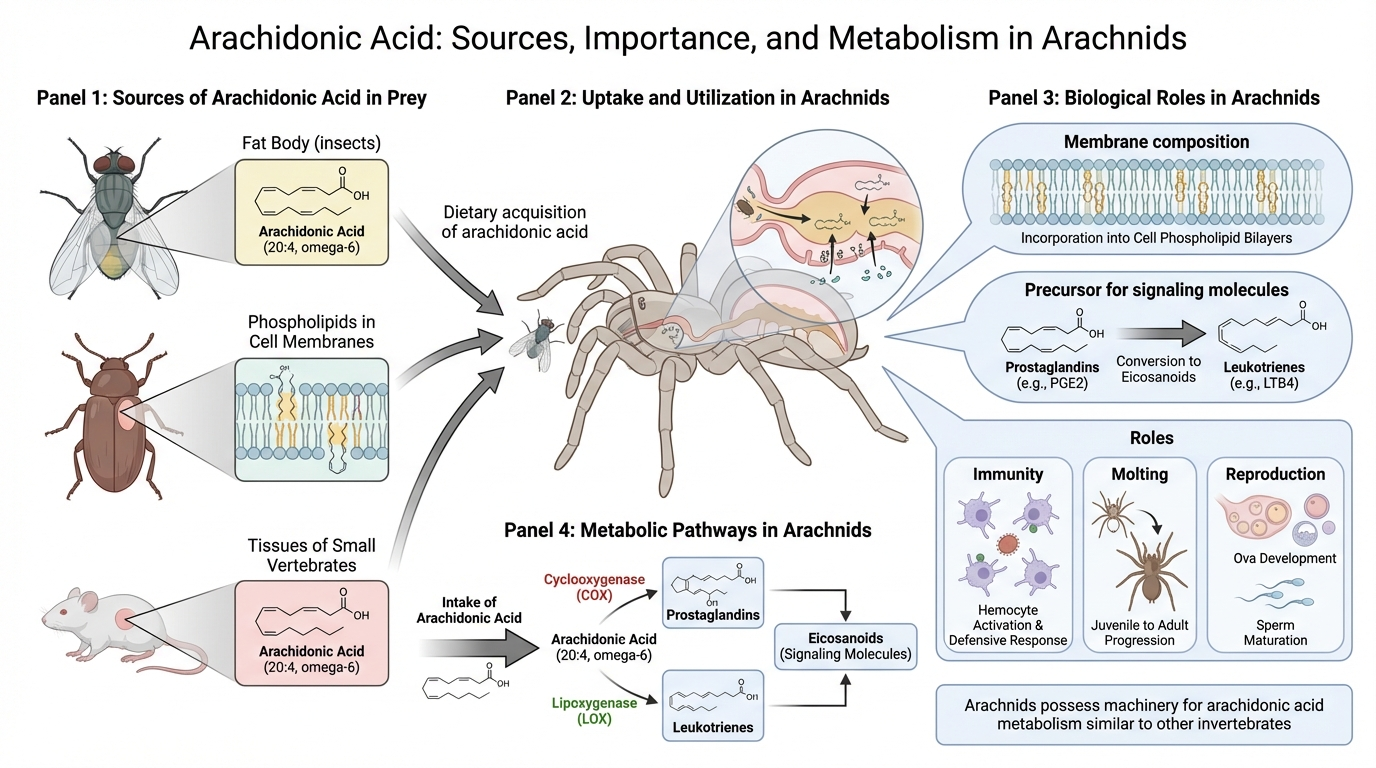
This review examines spider nutritional physiology, which remains incompletely characterized despite spiders’ importance in ecosystems and experimental settings. In captivity (including research facilities, zoological institutions, and private collections), feeding practices are often generalized and may not address metabolic demands that vary across taxa. Consequently, links between nutrition and outcomes such as growth, reproduction, and condition in captive spiders remain insufficiently delineated. Recent work in arachnid physiology and lipid metabolism indicates that some husbandry practices warrant reevaluation. Arachidonic acid (ARA), an omega-6 fatty acid and precursor to eicosanoid signaling molecules, contributes to lipid-mediated pathways across animal taxa. In arthropods, eicosanoid pathways have documented roles in processes such as development and reproduction; corresponding mechanisms in spiders are less defined, leaving an important gap in arachnid nutrition research. This review synthesizes evidence on the metabolic roles, dietary sources, and physiological relevance of ARA in spider nutrition. Available findings link lipids such as ARA with reproduction, cuticular maintenance, and metabolic function; low availability has been associated with stress responses, impaired development, and reduced fecundity in some captive contexts (Ginjupalli et al., 2015; Kangpanich et al., 2016; Stanley & Kim, 2018). Integrating lipid analyses into captive management can support animal welfare, improve comparability across studies, and inform feeding practices for arachnids.
Keywords:
arachidonic acid
; spider physiology
; nutritional biochemistry
; lipid metabolism
; captive husbandry
; eicosanoid signaling
; arachnid nutrition
Copyright: This open access article is published under a Creative Commons CC BY 4.0 license, which permit the free download, distribution, and reuse, provided that the author and preprint are cited in any reuse.


