

Submitted:
03 November 2025
Posted:
05 November 2025
You are already at the latest version
Abstract
To address social challenges arising from extensive exploitation of rural tourism resources—including degradation of natural ecosystems and erosion of ethnic cultural heritage—this study establishes a synergistic assessment framework constrained by habitat quality, resource endowment, and facility accessibility. By integrating the InVEST model, kernel density function, and cumulative cost distance algorithm, we developed a spatial overlay analysis tool to evaluate these three dimensions in the dry-hot valley of Lujiang Dam (LJD) within China's Nujiang River Basin. This approach identified natural spatial suitability for tourism development (NSSTD). Key findings reveal that LJD exhibits high overall habitat quality (844.88 km², 64.55% of total area), yet demonstrates pronounced spatial heterogeneity—prime habitats concentrate in western and southeastern sectors, contrasting with a central low-quality habitat belt. Natural/cultural resources display a barbell-shaped spatial configuration, clustering at southern and northern extremities. Tourism accessibility manifests concentric spatial patterns, with 88.08% of resources accessible within 90-minute travel thresholds. NSSTD zones (54.74 km²) predominantly located in southern LJD encompass 17 land-use types and 70.73% of villages. These results provide critical spatial decision-making support for: Sustainable tourism resource management in dry-hot valleys, precise village planning, territorial spatial optimization strategies. The methodology demonstrates operational value in balancing ecological conservation and rural development priorities.
Keywords:
rural tourism resource
; spatial configuration
; habitat quality
; multi-constraint synergy
; dry-hot valley
1. Introduction
As a critical driver of regional socioeconomic development, tourism serves as a vital catalyst for urban-rural economic growth and cross-cultural exchange, generating substantial income, employment opportunities, and wealth accumulation [1,2]. Governments worldwide have prioritized tourism development through policy interventions to maximize its socioeconomic benefits, particularly in economically disadvantaged rural regions. Nevertheless, the unregulated expansion of rural tourism has precipitated significant environmental and cultural crises [3,4]. The single-minded pursuit of economic gain jeopardises ecological security through multiple pathways [5], such as overexploitation of land resources [6], degradation of habitat quality and biodiversity [7,8], and irreversible damage to cultural landscape heritage [9]. These impacts not only undermine tourism experiences but also contravene conservation objectives, ultimately diminishing regional sustainable development capacity. To reconcile these conflicts, this study advocates for a multi-constraint synergistic framework grounded in environmental and cultural preservation. By systematically investigating the spatial allocation mechanisms of tourism resources, our approach aims to inform evidence-based strategies for sustainable rural tourism planning.
Rural habitat quality and its spatial configuration constitute the ecological substrate of tourism attractiveness, fundamentally determining the sustainability of rural tourism development. As tourism intrinsically depends on habitat integrity, ecological resources emerge as both core experiential elements and primary attractions [10]. Effective ecosystem conservation is therefore imperative for securing sustained ecological dividends and maintaining tourism competitiveness. Habitat quality, defined as the capacity of ecosystems to provide viable conditions for species survival and reproduction [11], serves as a critical metric for biodiversity conservation [12]. This parameter engages in a dynamic equilibrium with tourism development. Graded habitat landscapes enhance destination appeal and facilitate spatial expansion of tourism activities [13], while intensive recreational utilization threatens habitat carrying capacity through landscape fragmentation [14]. Such tensions predominantly stem from unregulated tourist influxes and inadequate management protocols, which amplify nonlinear risks to fragile habitats through threshold effects [15]. Scientifically rigorous habitat quality assessments provide dual benefits-enhancing community well-being through ecosystem service optimization and stabilizing rural ecological systems [16]. Recent methodological advancements integrate holistic approaches including: territorial tourism indices (TTI) for demand-supply matching, ecological footprint analysis quantifying resource appropriation, multi-criteria habitat quality modeling [17,18]. These frameworks enable win-win strategies that reconcile ecological integrity preservation with responsible resource utilization, offering actionable pathways for sustainable tourism planning.
The InVEST model has gained recognition as an effective tool for habitat quality evaluation [19], Its capacity to identify critical landscape elements in ecologically imbalanced zones enables precise mapping of habitat quality distributions, to guide the spatial allocation of tourism resources [9]. By reconciling habitat quality disparities through adaptive landscape management, this approach supports sustainable tourism development[20]. Recent methodological advancements in ecotourism research reflect three paradigm shifts: a transition from single-factor to multi-criteria frameworks, integration of qualitative and hybrid modeling techniques, and enhanced spatiotemporal resolution [21]. These innovations have improved resource utilization efficiency, fostered high-value tourism economies [22], and mitigated ecosystem pressures in expanding tourist zones [23]. However, critical gaps persist in systemically linking habitat assessments with development decisions, particularly in identifying tourism-compatible ecological spaces and modeling conservation-utilization equilibria. Under stringent ecological constraints, achieving high-quality rural development necessitates spatial intensification of ecological services within limited areas, coordinated exploitation of latent resources, and differentiated planning based on spatial typologies. This requires a multidimensional framework that identifies ecological supply spaces while preserving landscape authenticity, deciphers heterogeneous resource allocation patterns, and formulates tiered strategies through carrying capacity zoning—essential for balancing ecological integrity with sustainable tourism growth.
Rural natural and cultural landscape resources constitute the fundamental drivers of rural tourism economies, necessitating comprehensive insights into resource distribution patterns, infrastructure conditions, and operational constraints for effective ecotourism planning and management. Harnessing local governance of these resources requires embedded engagement with community customs and participatory frameworks to optimize infrastructure utilization and labor allocation [24]. Methodologically, field investigations—including community interviews, focus group discussions, and observational surveys aligned with governmental land resource census protocols—serve as critical identification mechanisms [25]. Advanced spatial analytics integrating remote sensing (RS) and geographic information systems (GIS) have overcome traditional data acquisition barriers, enabling precision mapping of tourism resources [26]. Holistic assessment frameworks coupled with adaptive planning mitigate pressures from habitat degradation, climate stressors, and resource scarcity linked to overexploitation [27]. Beyond tourism-specific measures, environmental regulation and conservation technologies emerge as pivotal for sustainable resource stewardship [28], with cross-national econometric analyses confirming the synergistic impacts of tourism development, eco-technological innovation, and regulatory interventions on rural resource governance [29]. While spatial allocation strategies theoretically enable dynamic supply-demand equilibria in tourism destinations, practical implementation faces persistent challenges, notably the misalignment between resource development assessments and facility accessibility metrics that transportation networks and critical infrastructure nodes. Prevailing models exhibit three systemic flaws: reductionist single-dimensional focus, overemphasis on resource extraction metrics at the expense of cultural preservation, and neglect of facility accessibility constraints. To address these gaps, multi-objective synergistic evaluation frameworks offer robust simulation capabilities for optimizing rural resource spatial configurations, thereby providing evidence-based strategies for balanced tourism planning that harmonizes ecological, cultural, and infrastructural imperatives.
The pressure systems influencing rural tourism development rarely manifest in isolation, with transport infrastructure expansion emerging as a predominant stressor alongside habitat quality and resource endowment constraints [30]. A robust bidirectional relationship exists between tourism growth and transport networks [31], infrastructure development enhances regional accessibility, fostering tourism-economic connectivity [32], while reciprocally, tourism prosperity stimulates peripheral infrastructure upgrades [33]. Nevertheless, infrastructure synergies—particularly road construction—exert substantial ecological pressures, degrading habitat integrity through landscape fragmentation [34]. Spatial accessibility evaluation frameworks are recognized as pivotal tools for optimizing infrastructure equity and configuration [35], employing methodologies spanning buffer analysis, gravity modeling, cost-distance algorithms, and network analytics to inform destination management [36,37,38,39]. However, conventional unidimensional analytical approaches fail to elucidate the complex interdependencies between service infrastructure and resource allocation patterns [40], nor do they adequately quantify infrastructure-resource-habitat nexus. Critical knowledge gaps persist regarding: spatial configuration mechanisms governing tourism service systems, cost-benefit dynamics of repurposing existing facilities (motorway exit stations, stations, market towns) for development efficiency, and multimodal accessibility requirements balancing vehicular mobility and pedestrian access for both tourists and communities. These lacunae underscore the imperative for advanced accessibility modeling that integrates multi-criteria assessments, enabling sustainable tourism strategies that harmonize infrastructure optimization, ecological conservation, and community inclusivity.
Rural tourism functions as a complex adaptive system where synergistic interactions, constraint mechanisms, and cascading effects coexist among ecological, resource, and infrastructural subsystems, with perturbations in any subsystem triggering systemic transformations. Achieving equilibrium between sustainable tourism development and the coordinated operation of these subsystems has emerged as a critical priority [3]. Epistemologically, interdisciplinary synthesis and complexity theory frameworks offer robust analytical paradigms, enabling the deconstruction of nonlinear dynamics and emergent interactions among evolving system components [41]. Coupling coordination models, widely applied in spatial planning and organizational management [42], provide methodological foundations for multi-constraint synergistic assessments that enhance resource utilization efficiency, system adaptability, and innovation capacity [32]. Environmental constraint evaluations have proven instrumental across domains including arable land optimization [43], public space [44], carbon emission [45], and ecosystem resilience enhancement [46].
The essence of rural tourism development lies in the dynamic interplay among three core elements which habitat quality (ecological foundation of tourism attractiveness), resource endowment (economic driver), and facility accessibility (spatial enabler). Prevailing models exhibit three critical limitations: reductionist focus on singular subsystems of environmental impact assessments, prioritizing cost-benefit optimization in isolation [35,47], inadequate integration of ecological-resource synergies, and neglect of spatial configuration mechanisms between facility networks and resource distribution. These gaps are exacerbated in ecologically fragile zones like dry-hot valleys, where acute conflicts arise from environmental sensitivity, resource fragmentation, and infrastructural deficiencies. Addressing these challenges, this study develops a multi-constraint assessment framework integrating InVEST habitat modeling, kernel density function, and cumulative cost-distance algorithms to systematically evaluate spatial congruence patterns in China’s Nujiang River Basin. We investigate the spatial configuration characteristics of ecological-resource-infrastructure systems in fragile environments, the model’s ability to identify previously undetected suitable and unsuitable development zones, and differentiated spatial strategies that leverage the unique resources of the region. This methodology advances tourism planning paradigms by reconciling ecological conservation with sustainable resource utilization, offering actionable insights for territorial spatial optimization and community-centric development.
2. Materials and Methods
2.1. Study Area
The Nu River-Salween, an international river traversing China and Myanmar, originates from the Tibetan Plateau and discharges into the Andaman Sea. Within this transboundary basin, the dry-hot valley of LJD constitutes the largest such geomorphological unit in the mid-reaches of the Nu River Basin (Figure 1). Bordered by the Gaoligong Mountains to the west and the Nu Mountains to the east, this 1,308.88 km² valley features parallel north-south mountain ranges and river systems, administratively encompassing Lujiang Town and Mangkuan Yi-Dai Ethnic Township with jurisdiction over 41 villages. Renowned for its ecological complexity and ethnic diversity, the area sustains unique vertical gradient microclimates and preserves the cultural heritage of Nu, Lisu, and Dai ethnic communities [48]. China’s rural revitalization initiatives, particularly Yunnan Province’s “Greater Western Yunnan Tourism Loop” development strategy, have catalyzed unprecedented tourism growth while intensifying pressures on fragile ecosystems and cultural landscapes [49]. Current research on heritage site threats predominantly addresses either environmental or anthropogenic factors [50], yet the compounding impacts of unregulated tourism infrastructure expansion remain understudied. Without systematic spatial planning integrating ecological and cultural preservation, escalating development may irreversibly degrade both natural capital and socioeconomic sustainability. As a critical ecotone exhibiting concentrated ethnic settlements, altitudinal biodiversity, and evolving development tensions, LJD serves as an exemplary microcosm for examining sustainable tourism paradigms in China’s mountainous frontiers.
2.2. Multi-Constraint Synergistic Analysis Framework
This study establishes a tri-constraint synergistic framework integrating habitat quality, resource endowment, and facility accessibility (Figure 2), where ‘constraints’ denote critical systems regulating rural tourism development potential through limitation and optimization mechanisms. The habitat quality constraint operationalizes ecosystem service theories and habitat suitability modeling. The resource endowment constraint quantifies the spatial clustering of competitive assets that natural landscapes and cultural heritage drive regional tourism appeal [51]. Facility accessibility constraints derive from knowledge contributions such as spatial equity and gravity modelling [40], emphasising the impact of infrastructure on the efficiency of rural tourism resource utilisation, as well as the cost of tourist experience and the ease of community participation. Building upon coupled coordination theory [52], we adopt an equal-weight assumption for constraint interactions to decode spatial allocation mechanisms through four methodological phases: (1) Using the InVEST model to assess the habitat space suitable for tourism development (HSSTD). (2) Draw the spatial distribution characteristics of rural tourism resources through descriptive statistics, GIS spatial analysis and other techniques. (3) Evaluate the accessibility characteristics of established facilities in rural tourism resource clusters. (4) Identify the NSSTD through spatial superposition analysis.
2.3. Data Collection
The data utilized in this study are current as of November 2023 (Table 1). It should be noted that the land use was reclassified according to China’s ‘Guidelines for Classification of Land Use and Sea Use for Territorial Spatial Survey, Planning, and Use Control’. Rural tourism resource datasets were compiled through a synthesis of governmental statistical reports and field surveys conducted by the research team from March 2021 to November 2023 under the Landscape and Planning Management Practice Project conducted by the research team for the study area. Census protocols adhered to the ICOMOS Principles Concerning Rural Landscape Heritage (2017), defining cultural landscapes as integrated systems delivering multifunctional benefits—encompassing socioeconomic value, cultural sustenance, and ecosystem services. Resource categorization followed the Chinese National Standard ‘Classification, Investigation, and Evaluation of Tourism Resources’ (GB/T 18972-2017), enabling the construction of a geospatial database for rural tourism assets.
2.4. Methods
2.4.1. InVEST Model
This study employs the Habitat Quality (HQ) module of the Integrated Valuation of Ecosystem Services and Tradeoffs (InVEST) model (v3.14.1), developed by Stanford University, to assess spatial heterogeneity of habitat quality [53]. As a scientific toolkit for quantifying ecosystem services, ecological risk, and spatial planning outcomes, the model operationalizes threat source identification through land use typology analysis [54], establishing threat-habitat interaction matrices to compute adverse impacts via habitat degradation degree (HDD) and habitat quality index (HQI) core metrics. The analytical framework incorporates linear/exponential distance decay functions to simulate threat intensity attenuation across ecological spaces, with algorithm parameters calibrated following China’s ‘Guidelines for Classification of Land Use and Sea Use for Territorial Spatial Survey, Planning, and Use Control’. The formula is:
where refers to the linear distance between grids and , and refers to the maximum action distance of the threat source .
Calculation of the degree of habitat degradation, the formula is:
where refers to the degree of habitat degradation of the th habitat image element in habitat type . refers to the number of threat factors for the habitat, refers to all rasters on the threat raster map, and refers to a set of rasters on the threat raster map. refers to the weight of the threat factor . refers to the number of threat factors on each raster. refers to the effect (linear or exponential) of threat factor on each raster of the habitat. refers to the effect of local conservation policies. refers to the relative sensitivity of each habitat to different threat factors.
Habitat quality index calculation, the formula is:
where refers to the habitat quality score for the th habitat image element in habitat type , taking values in the range [0, 1]. refers to the suitability of habitat type . refers to the half-saturation parameter, which usually takes the value of 0.5. refers to the model default parameter.
Drawing on empirical precedents of habitat quality assessments in lacustrine ecosystems [55], , watershed contexts [56], and protected areas [57], coupled with the InVEST technical guidelines, we developed a threat factor framework tailored to the dry-hot valley’s environmental profile — characterized by limited paddy fields and irrigated lands versus abundant horticultural areas. Six land-use categories were identified as threat factors: croplands, orchards, urban zones, rural settlements, bare lands, and construction sites. Each category was parameterized with maximum stress distance, degradation weight, and disturbance typology (Table 2). The habitat quality index system was subsequently operationalized through two diagnostic dimensions: habitat suitability coefficients across land-use types, and threat sensitivity gradients (Table 3), establishing the first standardized assessment protocol for xeric valley ecosystems.
2.4.2. Geographic Concentration Index and Kernel Density Estimation
Geographic Concentration Index
The geographic concentration index quantifies the spatial agglomeration intensity and distribution equilibrium of rural tourism resource clusters [58]. This index ranges from 0% to 100%, with higher values indicating greater resource concentration across villages, whereas lower values denote dispersion patterns. Let be the benchmark concentration index under uniform distribution [59], , clustered distributions are identified when , with dispersed patterns otherwise. the formula is:
where refers to the number of resource sites in village , refers to the total number of resource sites, and refers to the total number of villages.
Kernel Density Estimation (KDE)
The KDE was used to estimate the spatial agglomeration characteristics of natural and cultural landscape resources [60]. It is assumed that X1,X2,...,Xn are independent and identically distributed samples drawn from the overall population with distribution density function . The method nonparametrically estimates at any spatial coordinate . The formula is:
where refers to the number of resource sites, ( refers to the distance from kernel density valuation point to , refers to the kernel function, and refers to the width of the surface extended in space with as the origin.
Coefficient of Variation (CV)
A secondary validation was performed using the CV to quantify spatial dispersion patterns of potential tourism resources through Voronoi polygon area analysis. Validation thresholds were defined following Duyckaerts C’s operational framework [61], if then it is random distribution, if , it refers to uniform distribution, if , it refers to clustered distribution. This nonparametric approach statistically verifies the spatial autocorrelation intensity derived from kernel density estimations. The formula is:
where refers to the total number of Voronoi polygons, refers to the area of the Voronoi polygon of th, and refers to the average value of .
2.4.3 Cumulative Cost Distance Algorithm
This study applies the cumulative cost distance algorithm to assess the accessibility of rural resource nodes, a GIS-based spatial optimization method that quantifies fine-grained accessibility patterns in small-scale spaces such as villages and towns through resistance surface modeling [62]. The formula is:
where refers to the depletion value of the th image element, refers to the depletion value of the ()th image element in the direction of motion, and refers to the total number of image elements.
This study simulates multimodal accessibility (walking/driving) of rural tourism resources to assess regional cluster connectivity, accounting for their dual service roles to tourists and villagers. The methodology involves the following steps:
Rasterizing geographic elements such as land, water and roads within the study area are rasterised and the corresponding time-cost values are set. In order to finely describe the accessibility of resource sites at the village and township scale, the raster size was selected to be 100 m × 100 m grids. (2) The road system was classified into expressways, national highway, provincial highway, county roads, village-township roads, and the land and water were classified into 17 types. Referring to established research results on similar regions [63,64], the assignment criteria for each type of indicator were further optimised (Table 4). (3) The affiliated cost attributes of each type of vector elements are used to construct the cost raster databases. (4) The Cost Distance tool in ArcGIS was used to calculate the cost-weighted distances between motorway exit stations, stations, market towns and resource sites, and to map the walking and driving accessibility features, respectively.
2.4.4. GIS-Based Equal-Weight Spatial Overlay Analysis
Building upon the aforementioned analytical outputs, this study employs a Equal-weight Spatial Overlay Analysis to integrate spatial characteristic that habitat quality, resource distribution, and facility accessibility, enabling systematic identification of potential tourism development zones. As a proven spatial optimization technique [65], this method has demonstrated efficacy in territorial zoning [66] and land use planning [67]. The algorithm operationalizes Boolean logic combinations to delineate NSSTD through three-dimensional constraint mapping, effectively revealing latent landscape configurations that balance ecological integrity with tourism infrastructure requirements. The formula is:
Where and refer to the vector targets of the resource agglomeration dataset and the accessibility dataset, respectively, and refers to the domain of influence for and to perform the overlay calculations in the ecological supply space. are analysed as the smallest computational units in the overlay analysis, and these computations are independent of each other and parallelisable.
3. Results and Analyses
3.1. Characteristics of Spatial Distribution of Potential Ecological Supply
The InVEST model-derived habitat quality map (Figure 3a) reveals high overall habitat quality in the study area, with premium zones concentrated in western and southeastern sectors contrasting with degraded central habitats. The Gaoligongshan Nature Reserve was identified as the optimal habitat quality unit. The habitat distribution space was divided into five categories by the Jenks natural breaks classification [9], with category Ⅰ regarded as low-quality habitat space, category Ⅱ and Ⅲ regarded as medium-quality habitat space, and category Ⅳ and Ⅴ regarded as high-quality habitat space. Class I: 33.86 km², 2.59%; Class II: 309.98 km², 23.68%; Class III: 120.16 km², 9.18%; Class IV: 344.64 km², 26.33%; Class V: 500.24 km², 38.22%.
Class I areas represent village and town construction space with poor habitat quality, while Class IV and V areas are the core and buffer zones of the Gaoligongshan Nature Reserve, areas with the highest quality ecological resources and candidates for the proposed national park, which need to be strictly protected. Therefore, the study determines that Class II and Class III areas are suitable habitat spaces for rural tourism development, collectively 430.14km2, accounting for 32.86% of the total area of the region. However, the area also contains a large amount of ecological protection forest land, permanent basic farmland and arable land reserve (Figure 3b), with a total area of 162.82 km². These sites must be strictly protected according to the ‘Guidelines for the Preparation of Practical Village Plans for Yunnan Province’s “Multi-plan integration”’. Through the spatial superposition of constrained deletion, the HSSTD was obtained (Figure 3c), with an area of 267.32 km², which was distributed along the west side of the Nujiang River in a belt-like manner, concentrating in the southern part of the area. Village-scale analysis showed Daojie, Jiangdong, Dalang, Denggao, and Baotang containing the highest proportions of premium habitats in class IV and V, but the opposite is true for Dundong, Shiti, Moca, Xincheng, and Mangdan villages (Figure 3d), while southern Baihua, Moca, Mangdan and Xincheng villages, as well as central Mangliu and Manghe villages, and northern Mangkuan village, demonstrated superior tourism development potential, collectively accounting for 29.33% of HSSTD (Figure 3e ).
3.2. Typology and Spatial Aggregation Patterns of Rural Tourism Resources
The resource inventory classified 2,875 tourism assets into 2 macro-categories, 7 primary classes, and 16 subclasses (Table 5), with natural landscapes dominating (2,342 sites, 81.46%) over cultural resources (533 sites, 18.54%). The largest main categories of tourism resources are vegetation landscape resources, accounting for 76.21%, utilitarian buildings and core facilities, accounting for 9.91%, and intangible cultural heritage, accounting for 4.53%.
‘Barbell-shaped’ structure of agglomeration distribution characteristics. the geographic concentration index(=27.67, =15.43) and Voronoi-derived coefficient of variation (CV=548.20%, >64%) jointly confirmed clustered distributions (Figure 4a). For the kernel density analysis of natural landscapes, the Jenks of GIS is used, which is divided into five categories, and the kernel density characteristic map of natural landscape resources is obtained (Figure 4b). Considering the overall large number of natural resources and the relatively narrow development spillover effect, the range of threshold lower than 5.25 is regarded as a low resource agglomeration area, and those larger than 5 are regarded as a high resource agglomeration area, presenting Mangkuan-Xinguang Village agglomeration area, Propmiao Village agglomeration area and Mangdan Village agglomeration area. The same method is used to obtain the characteristic map of kernel density of cultural landscape resources (Figure 4c), because the overall number of cultural landscape resources is relatively small compared to natural landscape, we regard the range of threshold lower than 1.14 as low resource agglomeration area, and those greater than 1.14 as high resource agglomeration area, exhibited axial aggregation along the Nu River, which are Mangdan-Moca Village agglomeration area and Xinguang-Sia Village agglomeration area, albeit with greater dispersion than natural landscape assets. Overlay analysis delineated polarized resource agglomerations—concentrated in southern/northern sectors and dispersed centrally—forming a barbell structure (Figure 4d). Spatial congruence analysis demonstrated 82% overlap between resource clusters and ethnic settlements (Figure 4e-f), highlighting the interdependence of tourism assets and minority cultural landscapes.
3.3. Spatial Accessibility Characteristics of Rural Tourism Resources
Accessibility analysis reveals ‘concentric layered’ patterns. By combining the spatial distribution of rural tourism resources in LJD with the accessibility analysis, this study classifies the accessibility space into 3 classes and 7 seven hierarchical tiers according to the travelling time. High accessibility area (<30 min), medium accessibility area (30-60 min, 60-90 min), and low accessibility area (90-120 min, 120-150 min, 150-180 min, >180 min). And the weight of each class range was counted according to the resource type, as a way to reveal the public infrastructure accessibility pointing characteristics of rural tourism resources. The distribution of rural tourism resources in terms of walking accessibility (Figure 5a) shows a distribution characteristic of ‘large dispersion and small aggregation’. Resource sites within the 30-minute walking distance are mainly localized clusters along Provincial Highway 230, especially in the villages of Mangdan, Moca and Bengmiao in the southern part of the study area . Driving accessibility demonstrates distinct concentric zones (Figure 5b) with obvious differences in the distribution of rural tourism resources within different access ranges. Through the spatial superposition analysis of the accessibility range of walking and driving, it is found that the driving accessibility space covers 88.31% of the walking areas, establishing driving access as the primary analytical framework.
By comparing the relationship between travel time consumption and the spatial distribution of rural tourism resources (Figure 5c), it is found that, with the increase of travel time, the cumulative percentage of the main categories of rural tourism resource sites increases, and the percentage of the resource sites within 30 minutes reaches 42.02%, within 60 minutes reaches 79.31%, within 90 minutes reaches 88.08%, and the travel time in the range of 180 minutes has reached 99.02%. Comparing the matching relationship between the spatial hierarchy of accessibility and the spatial distribution of the main category of rural tourism resource sites (Figure 5d), it is found that with the increase of the travelling time consuming, each main category of rural tourism resource sites gradually decreases. Sectoral analysis identifies water resources (85.7%), vegetation (86.2%), and tourism commodities (85.9%) as dominant within 90-minute drive ranges, collectively constituting 74.37% of total assets. This spatial congruence between resource clusters and service infrastructure confirms high development viability with minimized implementation costs in LJD.
3.4. Delineating Natural Spatial Suitability for Tourism Development
Integrating spatial overlay analysis with exclusion criteria that areas <10 ha that refers to the average construction land size of the built rural tourism scenic spots of 3A grade, and >180-minute travel time excluded, this study identified 54.74 km² of NSSTD (4.18% of total area) through synthesizing habitat suitability (Figure 3c), resource clusters (Figure 4d), and vehicular accessibility (Figure 5b). The NSSTD exhibits pronounced spatial heterogeneity (Figure 6a), with high-density southern clusters versus sparse northern distributions. The NSSTD covers 29 villages, accounting for 70.73% of the total number of villages. Moka village dominates with 11.47 km² (20.95% of total NSSTD), followed by four contiguous villages (Mangdan, Xinzai, Mangbang, Bingmen) contributing 31.74 km² (57.98%). Linear distributions along the Nu River and Provincial Road 230 account for 17.22 km² (31.46%) across 10 villages (1-3 km² each), while fragmented remnants (5.78 km², 10.56%) occur in 14 peripheral villages (Figure 6c).
The NSSTD comprises 17 land-use types (Figure 6b), with three dominant categories identified through composition analysis, horticultural land (GA:30.55 km², 55.79%), woodland (WOL:11.90 km², 21.74%), and inland water bodies (LBW:5.85 km², 10.68%), collectively constituting 88.21% of NSSTD. Secondary contributors include wetlands (WLs:3.71%), transportation land (TL:2.52%), cropland (AL:1.99%), and residential land (RL:1.92%), with marginal categories aggregating 1.61% (Figure 6d).
4. Discussion
4.1. Spatial Allocation Mechanisms of Rural Tourism Resources
Rapid and extensive rural tourism development has brought about a series of environmental and cultural challenges. Based on the limitations of existing studies that focus on a single dimension or a two-dimensional approach [9], we constructed a three-dimensional constrained synergy framework to assess the spatial allocation of rural tourism resource development, which is based on Three mechanisms underpin this framework that ecological Constraint Prioritization, landscape resource-cultural synergy, and infrastructure-driven optimization. We found that not all tourism resource-rich areas are suitable for rural tourism development, and we were able to identify suitable, unsuitable and potentially blind areas for tourism development under multi-constraints compared to single-dimension studies.
Ecological environment, landscape type and cultural heritage are key assessment indicators of ecological security of regional habitats [68], and the assessment of habitat quality can effectively identify the environmental conditions, resource status, and degree of disturbance of habitats, and explain the health and stability of ecosystems. In response to the fragile natural landscape and ethnocultural landscape resource characteristics of the dry and hot river valley zone, we firstly emphasise that habitat quality assessment of ecological resource spaces requires the strict implementation of spatial development interventions to protect the integrity of ecosystems [69], a perspective that reinforces the sustainability of rural ecotourism development under our proposed multi-constraint synergistic framework. In the process of constructing the threat factors, combining the environmental characteristics of the study area, which has less paddy fields and irrigated lands, but more horticultural areas, we combined the paddy and irrigated ields and irrigated lands indicators into cultivated land threat factor, and included the horticultural areas into the threat factor system, and constructed an indicator system suitable for assessing the quality of habitats in the dry hot valley zone. This is not considered in existing studies [56,57], and our study improves the habitat quality assessment system and increases its generalisability. Notably, this study explores in more detail the constraint analysis method for identifying natural spaces suitable for tourism development, and we found that not all natural spaces are suitable for rural tourism development. Class IV and V areas, on the other hand, are the core and buffer zones of the Gaoligongshan Nature Reserve, areas with the highest quality ecological resources that require strict protection and cannot be used as priority areas for rural tourism development. In the process of identifying HSSTD, we also overlap the control areas of ecologically protected forest land, permanent basic farmland and arable reserve land required by the territorial spatial planning, to ensure that high-quality habitat zones in the region can be effectively protected. This perspective refines the assessment principle of considering only Class V habitat zones as high habitat protection zones [9]. Class I areas are settlement agglomerations and agricultural production areas with poor habitat quality. According to field surveys and comparative validation, these areas are surrounded by a lot of abandoned land and forested land, and ecological restoration measures to improve habitat quality are the primary strategy. The Gaoligong Mountains in the western part of the Lujiang Dam have the best natural landscape resources and are a candidate area for China’s national park construction, with a superior ecological background; in any case, the primary task in these areas remains ecological protection, while development takes a secondary position. The areas along the Nu River in the central part of the country are a cluster of settlements with relatively few high-quality natural landscape resources, but the development of rural tourism in these areas plays a key role in promoting the overall revitalisation of villages. For example, although villages such as Mangdan and Moka lack high-quality natural landscape resources, they contain rich cultural heritage and distinctive ethnic minority characteristics. This difference in resource endowment supports that we should dynamically adjust and select a suitable resource assessment index system in the process of rural tourism development.
On the other hand, in the assessment of the spatial distribution characteristics of rural tourism resources, we compared and analysed the results with similar studies, and found that while there were similarities with established studies, our study highlighted some feasibility differences. Some studies emphasise the importance of comprehensively analysing the uniqueness and spatial distribution of rural tourism resources in different regions, which is consistent with our study [70] We also support the view that the sustainable development of rural tourism must be based on the protection of the ecological environment and the preservation of cultural heritage [9]. However, we delve deeper into the constraints of landed factors such as ecological protection, resource types, and facility accessibility at the township scale.
We focused on mining the agglomeration characteristics of different types of rural tourism resources at the township scale, constructed a macro categories-primary classes-subclasses of rural tourism resources, and carried out a comprehensive and refined spatial configuration assessment from the two major categories of natural landscapes and cultural landscapes to make up for the inadequacy of the established large-scale macro-analysis framework based on panel data. It is found that the spatial kernel density of rural tourism resources is highly coincident with the population centres of settlements and ethnic minorities. On the one hand, it shows that the rural tourism resource agglomerations in the study area are rich in ethnic and cultural characteristics, and the settlements can better protect the natural landscape and pass on the historical and cultural heritage in the process of expansion. In addition, sustainable development of rural tourism resources can both expand tourism development and effectively enhance the well-being of community residents. Through this methodology, we attempt to address the spatial allocation imbalance of rural tourism resources development focusing on the pursuit of tourism economic development caused by the insufficient exploration of traditional assessment perspectives at the township scale.
In-depth assessment of differences in resource endowment along with habitat quality must thoroughly analyse the unique characteristics and resource types of each village domain [70], so that adaptive strategies can be adopted in the implementation chain, which is the key to optimising the spatial allocation of resources, and we support this view. The assessment results show that the high rural tourism resource concentration areas are not distributed in high habitat quality areas, but are more clustered in low and medium habitat quality areas. Two types of tourism development and supply space are formed: medium-habitat high-resource and low-habitat high-resource areas. However, low-habitat high-resource areas are not priority development zones, but need to be ecologically restored first to improve habitat quality, which is a spatial blind spot that is not easy to be found in the traditional one-dimensional assessment. The ‘Structure Hole’ of rural tourism resource concentration and distribution features a ‘structural hole’ defect, which brings pressure on the integrated development and infrastructure construction of rural tourism development zones. The villages of Conggang, manghe, baihualing and tangxi, whose development is spatially restricted by the Nujiang River to the east and the Gaoligong Mountain Nature Reserve to the west, have a high concentration of ethnic cultures, and require special policies to synergise the development of rural tourism and ecological protection. In contrast, a tailor-made rural tourism development strategy based on ecotourism and regional coordinated development perspectives is more similar to our view [71], which emphasises that a comprehensive consideration of rural ecotourism resource development strategies must be adapted to the individual development measures of different village resource characteristics in LJD.
In addition, while revealing differences in habitat quality and resource endowment, we also assessed the spatial configuration conditions of established services, which enables a more scientific identification of NSSTD. Rural infrastructure is a historical representation of the evolution of regional population migration and settlement, and is fundamental to guaranteeing the high quality and low-cost allocation of rural tourism resources, as well as the sustainability of rural communities’ participation in tourism. The synergistic analysis of the three is a lesser concern of established studies. It is found that the spatial distribution of infrastructure and resources is highly matched, with significant spatial direction of accessibility. However, the spatial pattern of rural tourism resources’ accessibility in “concentric layered” also suffers from similar “structural holes” in the spatial distribution of resources, and appears in the same villages, where the breakpoints of the north-south transport network in the study area are in the range of 120-180 minutes travelling time. 180 minutes. This is mainly due to the fact that there is only one provincial highway linking the north and south ends of the area, with poor peer-to-peer capacity of the feeder roads. Unexpectedly, a 3A level scenic spot of Baihua Ling has been developed here, which is in the buffer zone of the nature reserve. The scenic area development is positioned as bird-watching and experiencing Lisu culture, which attracts bird lovers and trekking explorers from all over the world every year. This case study illustrates that there is a demand in the tourist market for the development of rare rural tourism resources, which needs to be paid attention to in the formulation of rural tourism development strategies.
4.2. Suggestions for Planning and Management of Rural Tourism Resources in the Dry and Hot River Valley Zone
Our emphasis on a multi-constraint synergistic approach is consistent with the recommendation to emphasise homeland spatial governance in the Dry Tropics River Valley region, which faces the dual pressures of ecological degradation and traditional cultural preservation [72], where there is an urgent need to formulate a differentiated development strategy in terms of spatial integrated assessment and adaptive utilisation. This consensus strengthens the application of our findings to the detailed planning stage of full-factor territorial spatial governance and management. LJD identifies that NSSTD is consistent with the overall regional development plan, but there are still development strategies that need to be refined in depth. The following spatial areas are mainly targeted.
High-habitat areas. Mainly distributed in the western Gaoligongshan Nature Reserve and the surrounding buffer zone, development needs to be strictly restricted and ecological protection prioritised. The government needs to build a multi-constraint synergistic model monitoring and implementation platform to identify changes in suitable development areas in real time and avoid ecologically sensitive areas.
(2) Low-habitat areas. Refine the identification of priority ecological restoration space and formulate a sustainable ecological restoration implementation plan. Encourage villagers to participate in ecological, low-impact agricultural, cultural and tourism activities such as farming experience, kapok viewing festival, coffee picking, etc., and strengthen the two-way feedback between cultural heritage and economic benefits.
(3) High-resource, high-accessibility areas. These areas are mainly ethnic villages around the market town where travelling takes less than 30 minutes, such as Moca and Mangdan villages in the south and Mangkuan village in the north. Multi-functional rural tourism space with digital intelligence and deep integration of agriculture, culture and tourism should be explored based on the established tourist attractions.
(4) High-resource medium accessibility areas. These areas are distributed in areas within 30-90 minutes of travelling time consuming, such as Damwan and Xinzhai in the south, Bongmuang Village, and Ou Lai Village in the north. These areas need to set up new rural tourism development engines, strengthen the design and construction of tourism services, focus on coffee, old and valuable trees and other resources excavation, and develop Dai cultural festivals and other special tourism.
(5) Areas with low accessibility to rare resources. These areas are mainly ‘structural hole’ areas, where there are convenient potential resources and opportunities for deep mountain exploration in the Gaoligong Mountains and beach experience in the Nujiang River. There is a need to upgrade the transport nodes along Provincial Highway 230, increase the construction of feeder road networks, and establish additional tourist service centres to enhance the visitor experience and community well-being.
4.3. Research Limitations and Further Guidance
While this study establishes a replicable assessment framework based on the principles of scientific rigour and objectivity, there are some inherent limitations that warrant in-depth exploration. This study excludes dynamic factors that affect land use attribute transformation and facility planning policies, which may result in some spaces that could support tourism development not being fully assessed. In order to optimise such limitation problems, subsequent studies can develop dynamic models to consider the temporal changes in land use transformation and facility planning policies, and use advanced technologies such as multi-spectral remote sensing and real-time UAV acquisition to obtain time series data for in-depth exploration. In the rural tourism resource agglomeration characterisation, a nationally recognised classification system was used in this study, but faceted and banded natural tourist landscape resources were not fully assessed, which may have narrowed the scope of NSSTD. The rural tourism development value, demand groups and development priorities of different types of resources were also not fully assessed and compared. It was found that the proportion of tourism resources within the range of travelling time consuming 180 minutes was more than 99%, therefore, these limitations have little impact on the overall assessment results of NSSTD and are not critical factors, but they have to be explored in depth in the subsequent studies. We used spatial superposition analysis to carry out spatial identification under the three key constraints, which is usually applicable to the comparison of inconsistent dimensions, but the limitation is that it reflects the relative relationship between two variables, so obtaining clearer constraint matching values and unifying dimensions are still urgent challenges to be solved. What’s more, rural tourism development is a sustainable ecosystem that contains indicators of economic, technological, and guest demand variability in addition to habitat quality, resource endowment characteristics, and facility accessibility, and future research should consider more constraints for a comprehensive assessment. Crucially, after comparing the national spatial planning programmes published by the government, the analysis results of the multi-constraint synergistic assessment framework that we established can better reflect the spatial allocation of rural resources and make up for the characteristics of the spatial distribution of the different types of resources and the development needs that have not been comprehensively taken into account in the planning, demonstrating operational validity despite these gaps.
5. Conclusion
This study pioneers a replicable framework for ecologically fragile regions by synergizing habitat quality constraints, accessibility metrics, and tourism resource assessments. Applied to LJD dry-hot valley study to verify its feasibility and effectiveness. The methodology validates through four steps: InVEST-based habitat stratification; Kernel Density Function mapping of 2,875 resource sites; tiered accessibility modeling; spatial overlay identification of NSSTD.
This study focuses on assessing the impacts of habitat quality, resource endowment and facility accessibility on the spatial development of tourism by mapping the spatial development characteristics with different constraints. Emphasising that rural tourism cannot simply be seen as a means of economic growth, but rather as an important way of promoting sustainable local development and cultural heritage, provides insights into the spatial development of tourism in similar regions. Key innovations include:
(1) Habitat-Development Nexus. The overall habitat quality level of LJD is high, but the spatial distribution varies significantly. It showed a high-quality habitat zone (Class IV-V, 844.88 km²) in the west and southeast, while the central part was a low-habitat-quality agglomeration zone. Medium-quality habitats (Class II-III, 430.14 km²) emerge as optimal development zones, challenging conventional high-quality area prioritization.
(2) Cultural-Ecological Synergy. Rural tourism resource sites are centrally distributed with significant differences in spatial distribution. ‘Barbell-shaped’ resource clusters demonstrate spatial congruence with ethnic settlements, validating cultural landscapes as tourism anchors.
(3) Infrastructure Primacy. The accessibility of rural tourism resources forms a ‘concentric layered’ spatial pattern, and the distribution density of rural tourism resources gradually decreases with the increase of travelling time, and the proportion of rural tourism resources within 60 minutes of travelling time reaches 79.31%, and reaches 99.02% in 180 minutes. Driving coverage over walkable areas establishes transport networks as development accelerators.
(4) Optimising land use. The study identified NSSTD (54.74 km2) with significant spatial differences, with denser villages in the south and relatively sparse in the north. Covering 29 villages and containing 17 land types, orchard (55.81%), forest land (21.74%), and inland water body (10.69%) are the land types that can support the largest area of rural tourism development, and this type of land attribute is useful for guiding low-impact utilization strategies.
The multi-constraint synergistic analysis model proposed in this study has a certain degree of universality, it transcends growth-centric paradigms, repositioning rural tourism as a catalyst for coupled cultural preservation and ecosystem resilience. Its operationalization in territorial spatial planning demonstrates consistency with governmental schemes, particularly in safeguarding Gaoligong’s core habitats while channeling development to southern corridors. Future applications should integrate dynamic land-use modeling to enhance adaptive governance across mountainous frontiers. The multi-constraint synergistic analysis model can scientifically reveal the spatial distribution characteristics of rural tourism resources and identify the natural space suitable for tourism development, which not only reveals the characteristics of the territorial system of rural human-land relations, but also provides practical suggestions for the formulation of planning and management strategies for rural tourism resources and the compilation of rural detailed planning and territorial spatial planning.
Author Contributions
Dongqiang Zhang: Writing – original draft, Methodology, Conceptualization, Formal analysis, Visualization. Jun Cai: Writing – review & editing, Methodology, Conceptualization. Haiyan Li: Writing – resources, Software, Visualization, Funding acquisition. Yishuang Wu: Writing – review & editing.
Funding
This work was supported by the National Natural Science Foundation of China (Grant / Award Number: 52278048); Applied Basic Research Program Project of Yunnan Province (Grant / Award Number: 202101BA070001-086 & 202101BA070001-199) and the Research and Innovation Team Project of Baoshan University (Grant / Award Number: BYTD202302). We are grateful for the invaluable field research support extended by the government of Baoshan City, Yunnan Province.
Informed Consent Statement
We declare that have no competing financial interests or personal relationships are known by the authors that may have influenced the work presented in this paper. Dongqiang Zhang , Jun Cai , Haiyan L , Yishuang Wu. Nov. , 1, 2025
Data Availability Statement
Data will be made available on request.
Conflicts of Interest
The authors declare no conflicts of interest.
Abbreviations
The following abbreviations are used in this manuscript:
| LJD | Lujiang Dam |
| NSSTD | Natural spatial suitability for tourism development |
| HSSTD | Habitat space suitable for tourism development |
| TTI | Territorial tourism indice |
| RS | Remote sensing |
| GIS | Geographic information systems |
| HQ | Habitat Quality |
| HDD | Habitat degradation degree |
| HQI | Habitat quality index |
| CV | Coefficient of Variation |
References
- Jannat, A.; Islam, Md. M.; Aruga, K. Revealing the Interrelationship of Economic, Environmental, and Social Factors with Globalization in G-7 Countries Tourism Growth: A CS-ARDL Approach. Sustainable Futures 2025, 9, 100483. [CrossRef]
- Singh, D.; Alam, Q. Is Tourism Expansion the Key to Economic Growth in India? An Aggregate-Level Time Series Analysis. Annals of Tourism Research Empirical Insights 2024, 5 (2), 100126. [CrossRef]
- Hao, Z. An Empirical Analysis of Tourism Eco-Efficiency in Ecological Protection Priority Areas Based on the DPSIR-SBM Model: A Case Study of the Yellow River Basin, China. Ecological Informatics 2022.
- Neto, F. A New Approach to Sustainable Tourism Development: Moving beyond Environmental Protection. Natural Resources Forum 2003.
- Qiu, X.; Fang, Y.; Yang, X.; Zhu, F. Tourism Eco-Efficiency Measurement, Characteristics, and Its Influence Factors in China. 2017.
- Wang, Q.; Bai, X.; Zhang, D.; Wang, H. Spatiotemporal Characteristics and Multi-Scenario Simulation of Land Use Change and Ecological Security in the Mountainous Areas: Implications for Supporting Sustainable Land Management and Ecological Planning. Sustainable Futures 2024, 8, 100286. [CrossRef]
- Chung, M. G.; Dietz, T.; Liu, J. Global Relationships between Biodiversity and Nature-Based Tourism in Protected Areas. Ecosystem Services 2018, 34, 11–23. [CrossRef]
- Mehlomakhulu, Z.; Buschke, F. T. Natural and Built Capital as Factors Shaping Tourism in a South African Key Biodiversity Area. Journal of Outdoor Recreation and Tourism 2023, 43, 100670. [CrossRef]
- Hu, Q.; Xiang, L.; Lin, A.; Hou, Y.; Dai, Y. Exploring the Spatial Configuration of Tourism Resources through Ecosystem Services and Ethnic Minority Villages. Ecological Informatics 2024, 79, 102426. [CrossRef]
- Williams, P. W.; Ponsford, I. F. Confronting Tourism’s Environmental Paradox: Transitioning for Sustainable Tourism. 2009.
- Terrado, M.; Sabater, S.; Chaplin-Kramer, B.; Mandle, L.; Ziv, G.; Acuña, V. Model Development for the Assessment of Terrestrial and Aquatic Habitat Quality in Conservation Planning. Science of The Total Environment 2016, 540, 63–70. [CrossRef]
- Sallustio, L.; De Toni, A.; Strollo, A.; Di Febbraro, M.; Gissi, E.; Casella, L.; Geneletti, D.; Munafò, M.; Vizzarri, M.; Marchetti, M. Assessing Habitat Quality in Relation to the Spatial Distribution of Protected Areas in Italy. Journal of Environmental Management 2017, 201, 129–137. [CrossRef]
- Zasada, I.; Häfner, K.; Schaller, L.; Van Zanten, B. T.; Lefebvre, M.; Malak-Rawlikowska, A.; Nikolov, D.; Rodríguez-Entrena, M.; Manrique, R.; Ungaro, F.; Zavalloni, M.; Delattre, L.; Piorr, A.; Kantelhardt, J.; Verburg, P. H.; Viaggi, D. A Conceptual Model to Integrate the Regional Context in Landscape Policy, Management and Contribution to Rural Development: Literature Review and European Case Study Evidence. Geoforum 2017, 82, 1–12. [CrossRef]
- Cao, H.; Wu, Z.; Zheng, W. Impact of Touristification and Landscape Pattern on Habitat Quality in the Longji Rice Terrace Ecosystem, Southern China, Based on Geographically Weighted Regression Models. Ecological Indicators 2024, 166, 112259. [CrossRef]
- Canteiro, M.; Córdova-Tapia, F.; Brazeiro, A. Tourism Impact Assessment: A Tool to Evaluate the Environmental Impacts of Touristic Activities in Natural Protected Areas. Tourism Management Perspectives 2018, 28, 220–227. [CrossRef]
- Zheng, L. Quantifying the Spatial Impact of Landscape Fragmentation on Habitat Quality: A Multi-Temporal Dimensional Comparison between the Yangtze River Economic Belt and Yellow River Basin of China. Land Use Policy 2023.
- Guo, B. Evaluating the Mitigating Potential of Tourism on Economic Growth-Induced Ecological Footprint: Insights from Asian Countries. Heliyon 2024, e38603. [CrossRef]
- Ali, Q. The Impact of Tourism, Renewable Energy, and Economic Growth on Ecological Footprint and Natural Resources: A Panel Data Analysis. Resources Policy 2021.
- Rachid, L.; Elmostafa, A.; Mehdi, M.; Hassan, R. Assessing Carbon Storage and Sequestration Benefits of Urban Greening in Nador City, Morocco, Utilizing GIS and the InVEST Model. Sustainable Futures 2024, 7, 100171. [CrossRef]
- d’Angella, F.; Maccioni, S.; De Carlo, M. Exploring Destination Sustainable Development Strategies: Triggers and Levels of Maturity. Sustainable Futures 2025, 100515. [CrossRef]
- Ren, L. Can Ecotourism Contribute to Ecosystem? Evidence from Local Residents’ Ecological Behaviors. Science of the Total Environment 2021.
- Liao, Z.; Liang, S. Construction and Evolutionary Factors of Spatial Correlation Network of China’s Provincial Tourism Resource Conversion Efficiency. Heliyon 2024, 10 (8), e28740. [CrossRef]
- Du, J.; Zhao, B.; Feng, Y. Spatial Distribution and Influencing Factors of Rural Tourism: A Case Study of Henan Province. Heliyon 2024, 10 (7), e29039. [CrossRef]
- Rosalina, P. D. Rural Tourism Resource Management Strategies: A Case Study of Two Tourism Villages in Bali. Tourism Management Perspectives 2023.
- Mteti, S. H.; Mpambije, C. J.; Manyerere, D. J. Unlocking Cultural Tourism: Local Community Awareness and Perceptions of Cultural Heritage Resources in Katavi Region in Southern Circuit of Tanzania. Social Sciences & Humanities Open 2025, 11, 101295. [CrossRef]
- Comino, E. Exploring the Environmental Value of Ecosystem Services for a River Basin through a Spatial Multicriteria Analysis. Land Use Policy 2014.
- Zhang, L.; Godil, D. I.; Bibi, M.; Khan, M. K.; Sarwat, S.; Anser, M. K. Caring for the Environment: How Human Capital, Natural Resources, and Economic Growth Interact with Environmental Degradation in Pakistan? A Dynamic ARDL Approach. Science of The Total Environment 2021, 774, 145553. [CrossRef]
- Zakari, A.; Khan, I.; Alvarado, R. The Impact of Environmental Technology Innovation and Energy Credit Rebate on Carbon Emissions: A Comparative Analysis. J of Intl Development 2023, 35 (8), 2609–2625. [CrossRef]
- Liu, X. Tourism Development, Environmental Regulations, and Natural Resource Management: Evidence from G20 Countries. Resources Policy 2023, 86, 104224. [CrossRef]
- Zou, Y.; Song, M.; Zhang, W.; Wang, Z. The Impact of High-Speed Rail Construction on the Development of Resource-Based Cities: A Temporal and Spatial Perspective. Socio-Economic Planning Sciences 2023, 90, 101742. [CrossRef]
- Falk, M. T.; Hagsten, E. A Threat to the Natural World Heritage Site Rarely Happens Alone. Journal of Environmental Management 2024, 360, 121113. [CrossRef]
- Zhuang, S.; Xia, N.; Gao, X.; Zhao, X.; Liang, J.; Wang, Z.; Li, M. Coupling Coordination Analysis between Railway Transport Accessibility and Tourism Economic Connection during 2010–2019: A Case Study of the Yangtze River Delta. Research in Transportation Business & Management 2024, 55, 101134. [CrossRef]
- Kim, M. J. Does Active Transport Create a Win-Win Situation for Environmental and Human Health? The Moderating Effect of Leisure and Tourism Activity. Journal of Hospitality and Tourism Management 2022.
- Zhang, H.; Zhang, C.; Hu, T.; Zhang, M.; Ren, X.; Hou, L. Exploration of Roadway Factors and Habitat Quality Using InVEST. Transportation Research Part D: Transport and Environment 2020, 87, 102551. [CrossRef]
- Uchiyama, Y.; Kohsaka, R. Cognitive Value of Tourism Resources and Their Relationship with Accessibility: A Case of Noto Region, Japan. Tourism Management Perspectives 2016.
- Vafeiadis, E.; Elldér, E. Correlates of Perceived Accessibility across Transport Modes and Trip Purposes: Insights from a Swedish Survey. Transportation Research Part A: Policy and Practice 2024, 186, 104147. [CrossRef]
- Czesak, B.; Różycka-Czas, R. Assessing Accessibility and Crowding in Urban Green Spaces: A Comparative Study of Approaches. Landscape and Urban Planning 2025, 257, 105301. [CrossRef]
- Du, H. Urban Landscape Accessibility Evaluation Model Based on GIS and Spatial Analysis. Results in Engineering 2025, 25, 103723. [CrossRef]
- Yang, L. Assessing Accessibility to Peri-Urban Parks Considering Supply, Demand, and Traffic Conditions. Landscape and Urban Planning 2025.
- Wang, Q.; Lu, S. The Influence of Hybrid Accessibility on Tourism Economy in Prefecture-Level Cities: Evidence from China’s High-Speed Rail Network. Journal of Transport Geography 2022, 104, 103417. [CrossRef]
- Holdschlag, A.; Ratter, B. M. W. Caribbean Island States in a Social-Ecological Panarchy? Complexity Theory, Adaptability and Environmental Knowledge Systems. Anthropocene 2016, 13, 80–93. [CrossRef]
- Zhu, S.; Huang, J.; Zhao, Y. Coupling Coordination Analysis of Ecosystem Services and Urban Development of Resource-Based Cities: A Case Study of Tangshan City. Ecological Indicators 2022, 136, 108706. [CrossRef]
- Yang, H.; Zou, R.; Hu, Y.; Wang, L.; Xie, Y.; Tan, Z.; Zhu, Z.; Zhu, A.-X.; Gong, J.; Mao, X. Sustainable Utilization of Cultivated Land Resources Based on “Element Coupling-Function Synergy” Analytical Framework: A Case Study of Guangdong, China. Land Use Policy 2024, 146, 107316. [CrossRef]
- Kumar Mohapatra, S.; Mishra, S.; Tripathy, H. K.; Alkhayyat, A. A Sustainable Data-Driven Energy Consumption Assessment Model for Building Infrastructures in Resource Constraint Environment. Sustainable Energy Technologies and Assessments 2022, 53, 102697. [CrossRef]
- Cui, Y.; Li, L.; Lei, Y.; Wu, S. The Performance and Influencing Factors of High-Quality Development of Resource-Based Cities in the Yellow River Basin under Reducing Pollution and Carbon Emissions Constraints. Resources Policy 2024, 88, 104488. [CrossRef]
- Ping, J.; Chang-Yan, T.; Shun-Jun, H. Estimation of Ecosystem Water Consumption and the Suitable Scale of Cultivated Land in the Karamay Region and Muzat River Basin Based on the Optimized SEBAL Energy Balance Model and Water Resource Constraint Model. Heliyon 2024, 10 (7), e28190. [CrossRef]
- Zhang, Y. Exploring the Nexus of Smart Technologies and Sustainable Ecotourism: A Systematic Review. 2024.
- Zhao, F. Assessment of the Sustainable Development of Rural Minority Settlements Based on Multidimensional Data and Geographical Detector Method: A Case Study in Dehong, China. 2021.
- Huang, G.; Zhou, W.; Ali, S. Spatial Patterns and Economic Contributions of Mining and Tourism in Biodiversity Hotspots: A Case Study in China. Ecological Economics 2011, 70 (8), 1492–1498. [CrossRef]
- Falk, M. T.; Hagsten, E. Threat Perception and Adaptive Capacity of Natural World Heritage Site Management. Environmental Management 2023, 71 (2), 285–303. [CrossRef]
- Li, G.; Zhang, Y.; Wang, Y.; Wang, Y.; Tian, J. Evaluation and Analysis of Tourism Resources and Environmental Carrying Capacity (TRECC) of 278 Cities in China: A Pressure-Support Perspective. Journal of Cleaner Production 2023, 420, 138359. [CrossRef]
- Yang, Z.; Hu, J.; Wang, Z.; Chen, S. A New Model Based on Coupling Coordination Analysis Incorporates the Development Rate for Urbanization and Ecosystem Services Assessment: A Case of the Yangtze River Delta. Ecological Indicators 2024, 159, 111596. [CrossRef]
- Chen, Z.; Chen, Y.; Zhang, H.; Zhang, H.; Xu, M. Understanding Spatiotemporal Changes and Influencing Factors in the Habitat Quality of Coastal Waters: A Case Study of Jiangsu Province, China (2006–2020). Ecological Indicators 2025, 170, 113125. [CrossRef]
- Dai, Y.; Diao, Y.; Dai, C.; Li, Y.; Sun, G.; Zahoor, B.; Li, D. Spatial-Temporal Dynamics and Evolution of Ecological Security in a Rapid Urbanization City, Southwest China. Front. Ecol. Evol. 2022, 10, 914567. [CrossRef]
- Wei, Q.; Abudureheman, M.; Halike, A.; Yao, K.; Yao, L.; Tang, H.; Tuheti, B. Temporal and Spatial Variation Analysis of Habitat Quality on the PLUS-InVEST Model for Ebinur Lake Basin, China. Ecological Indicators 2022, 145, 109632. [CrossRef]
- Abebe, W. B.; Dersseh, M. G.; Goshu, G.; Abera, W.; Abraham, E.; Mekonnen, M. A.; Fohrer, N.; Tilahun, S. A.; McClain, M. E.; Payne, W. A.; Blaszczak, J. R. Modeling Changes in Nutrient Retention Ecosystem Service Using the InVEST-NDR Model: A Case Study in the Gumara River of Lake Tana Basin, Ethiopia. Ecohydrology & Hydrobiology 2025, S1642359325000011. [CrossRef]
- Zhang, X.; Liao, L.; Huang, Y.; Fang, Q.; Lan, S.; Chi, M. Conservation Outcome Assessment of Wuyishan Protected Areas Based on InVEST and Propensity Score Matching. Global Ecology and Conservation 2023, 45, e02516. [CrossRef]
- Li, X.; Yang, Q.; Lyu, X.; Ye, Y.; Zhang, B. Multidimensional Framework for Analyzing the Distribution Patterns of Traditional Villages in the Karst Landscape Regions of China. Ecological Informatics 2023, 77, 102184. [CrossRef]
- Zhu Z.; Wang R.; Hu J.; Li Y. Classification and Spatial Distribution Pattern of Rural Leisure Tourism Destinations in Jiangxi Province. Resources and Environment in the Yangtze Basin 2020, 29 (4), 824–835.
- Hu, Q.; Yang, P.; Ma, J.; Wang, M.; He, X. The Spatial Differentiation Characteristics and Influencing Mechanisms of Intangible Cultural Heritage in China. Heliyon 2024, 10 (22), e38689. [CrossRef]
- Duyckaerts, C.; Godefroy, G. Voronoi Tessellation to Study the Numerical Density and the Spatial Distribution of Neurones. Journal of Chemical Neuroanatomy 2000, 20 (1), 83–92. [CrossRef]
- Jinghu Pan; Yibo Cong. Spatial Accessibility of Scenic Spot at 4A Level and Above in China. Scientia Geographica Sinica 2012, 32 (11), 1321–1327. [CrossRef]
- Yelv Tu; Xiaoshu Cao; Lingling Yao. An analysis of rural settlement patterns and their effect mechanisms based on road traffic accessibility in poverty alleviation area. Human Geography 2024, 39 (1), 122–129. [CrossRef]
- Zhenbo Wang; Jiangang Xu; Chuangeng Zhu; Yi Qi; Lu Xu. The County Accessibility Divisions in China and Its Correlation with Population Distribution. Acta Geographica Sinica 2010, 65 (4), 416–426.
- Yang Y.; Wu L.; Guo J.; Liu S. Assessment of Suitability of LandSpace Development Based on Parallel Spatial Overlay Analysis. “Journal of Northeastern University (Natural Science) 2021, 42 (11), 1585–1590.
- Wang X.; Wang M.; Feng J.; Gao Z. Study on division method of underground water source protection area: case study of Dawenkou basin. Yangtze River 2021, 52 (4), 61–67. [CrossRef]
- Tao J.; Xu D.; Dai Y.; Zhang G.; Ji B.; Zhang X. The Empirical Research on Coordinative Processing of Forest Land Data in One Map of Forestry and Land. Forest Resources Management 2017, No. 1, 37–42. [CrossRef]
- Li, J.; Fu, J.; Zhang, Z.; Guo, X.; Hong, W.; Yuan, F.; Cong, Y.; Gao, J. Spatial Pattern and Screening Framework of National Park Agglomerations in the Greater Shangri-La Region, China. Ecological Indicators 2023, 154, 110552. [CrossRef]
- Dai, Y. Identifying the Ecological Security Patterns of the Three Gorges Reservoir Region, China. Environ Sci Pollut Res 2022, 29 (30), 45837–45847. [CrossRef]
- Li, G.; Zhang, Y.; Wang, Y.; Wang, Y.; Tian, J. Evaluation and Analysis of Tourism Resources and Environmental Carrying Capacity (TRECC) of 278 Cities in China: A Pressure-Support Perspective. Journal of Cleaner Production 2023, 420, 138359. [CrossRef]
- Yang, Q.; Tian, X.; Wang, H.; Tan, T. Exploration of the Coupling Coordination between Rural Tourism Development and Agricultural Eco-Efficiency in Islands: A Case Study of Hainan Island in China. Journal for Nature Conservation 2025, 84, 126822. [CrossRef]
- Zhu, W.; Zhang, Z.; Zhang, H.; Tovuudorj, R. Integrating Spatial Patterns and Driving Factors of Cultural Ecosystem Services into Territorial Spatial Governance: A Case Study of the Horqin Sandy Land with Multi-Ethnic Settlements. Habitat International 2024, 148, 103093. [CrossRef]
Figure 1.
Location of the Study Area.
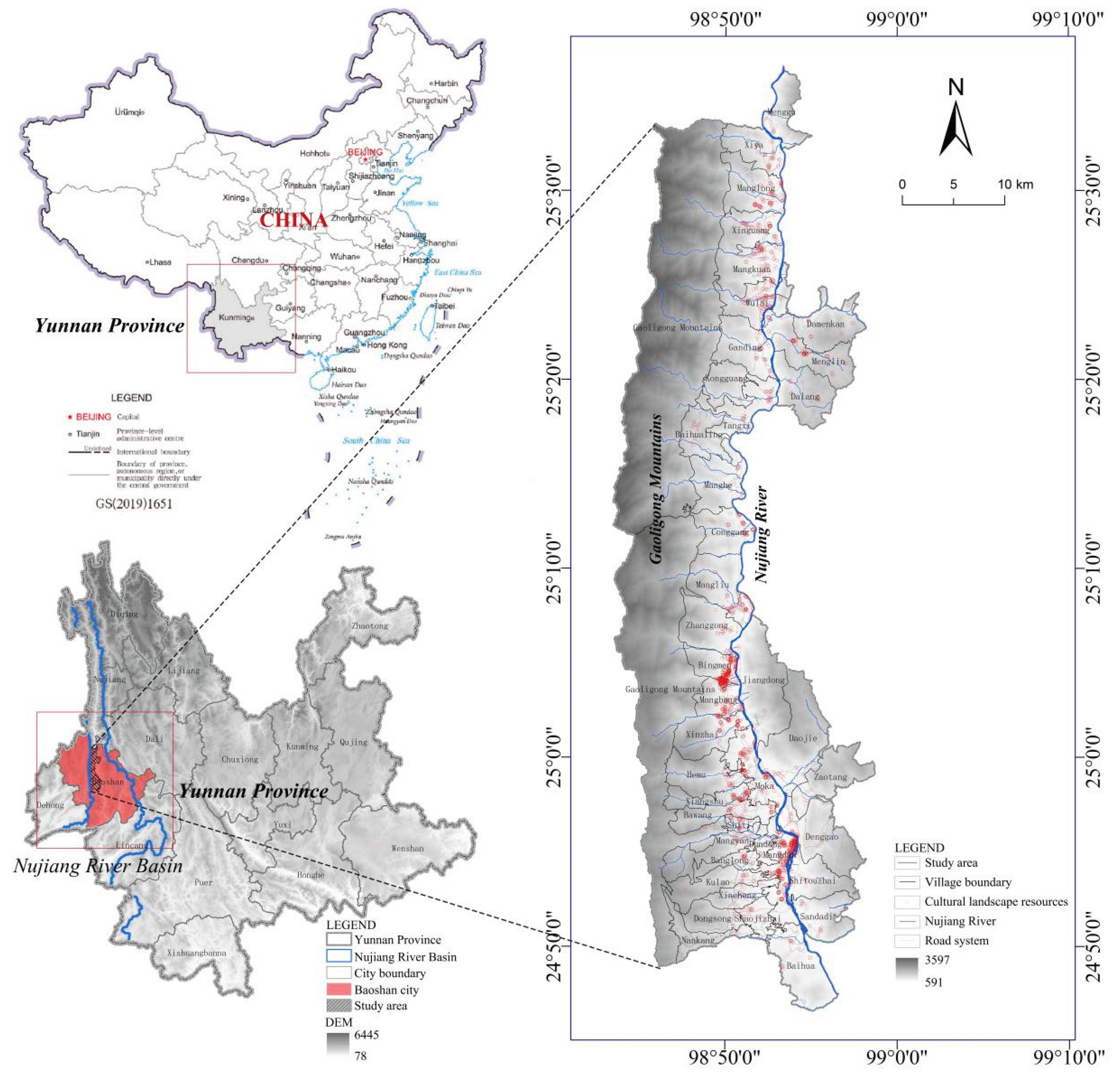
Figure 2.
Theoretical Framework of Multi-Constraint Synergy.

Figure 3.
Habitat Quality (HQ) Assessment Features: (a) Spatial distribution of HQ; (b) Strictly protected land; (c) HSSTD delineation; (d) Village-scale HQ distribution; (e) Village-scale HSSTD distribution.
Figure 3.
Habitat Quality (HQ) Assessment Features: (a) Spatial distribution of HQ; (b) Strictly protected land; (c) HSSTD delineation; (d) Village-scale HQ distribution; (e) Village-scale HSSTD distribution.

Figure 4.
Spatial Distribution Characteristics of Tourism Resources: (a) Voronoi polygon analysis; (b) Kernel density of natural landscapes; (c) Kernel density of cultural landscapes; (d) Resource cluster distribution; (e) Community kernel density; (f) Ethnic minority population distribution.
Figure 4.
Spatial Distribution Characteristics of Tourism Resources: (a) Voronoi polygon analysis; (b) Kernel density of natural landscapes; (c) Kernel density of cultural landscapes; (d) Resource cluster distribution; (e) Community kernel density; (f) Ethnic minority population distribution.
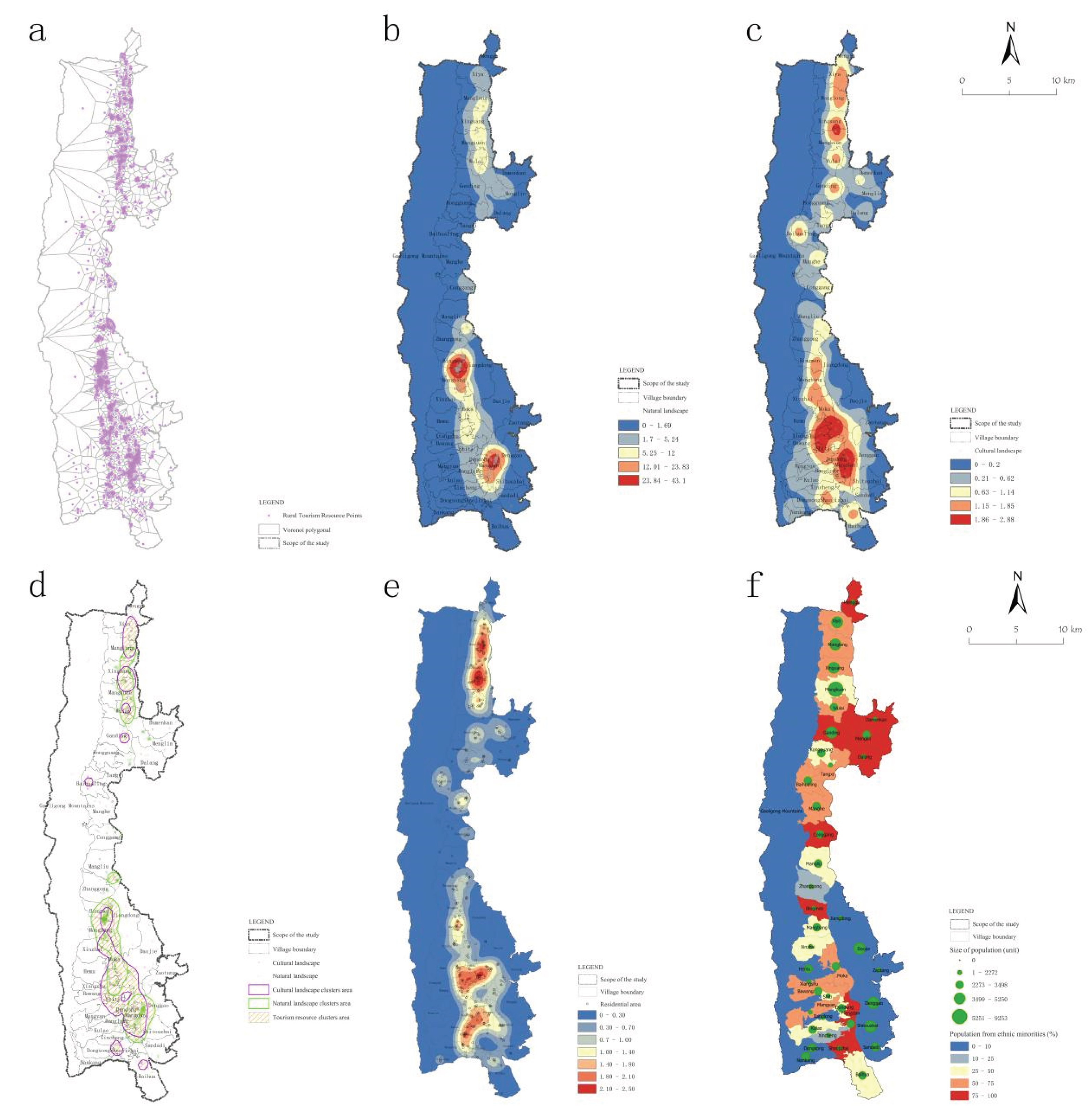
Figure 5.
Spatial Accessibility Characteristics: (a) Walking accessibility distribution; (b) Driving accessibility distribution; (c) Cumulative resource proportion by travel time; (d) Resource category proportion by accessibility range.
Figure 5.
Spatial Accessibility Characteristics: (a) Walking accessibility distribution; (b) Driving accessibility distribution; (c) Cumulative resource proportion by travel time; (d) Resource category proportion by accessibility range.
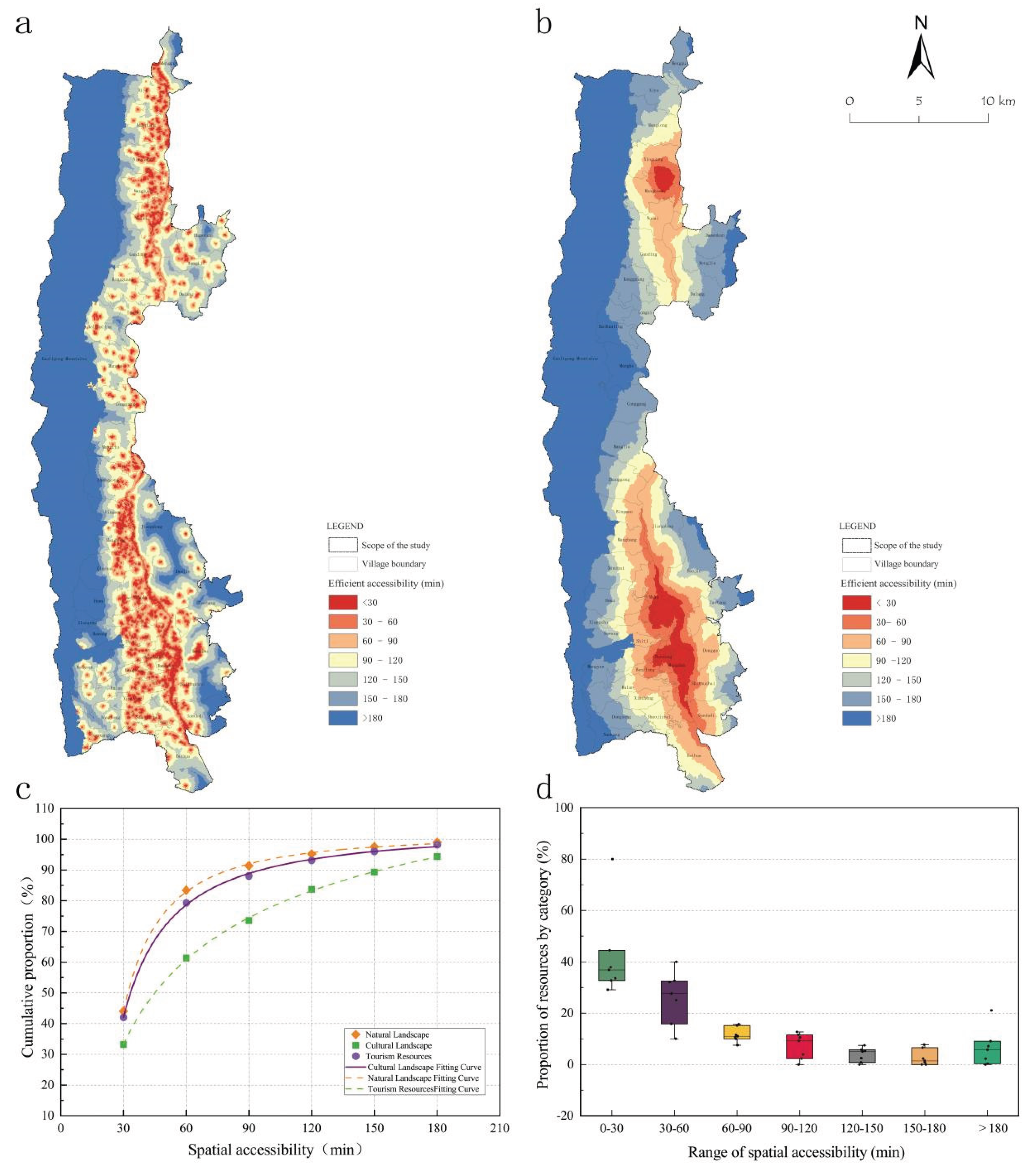
Figure 6.
Spatial Characteristics of Natural Spatial Suitability for Tourism Development (NSSTD): (a) NSSTD spatial patterns; (b) Land cover types in NSSTD; (c) NSSTD per village; (d) Land cover differences.
Figure 6.
Spatial Characteristics of Natural Spatial Suitability for Tourism Development (NSSTD): (a) NSSTD spatial patterns; (b) Land cover types in NSSTD; (c) NSSTD per village; (d) Land cover differences.
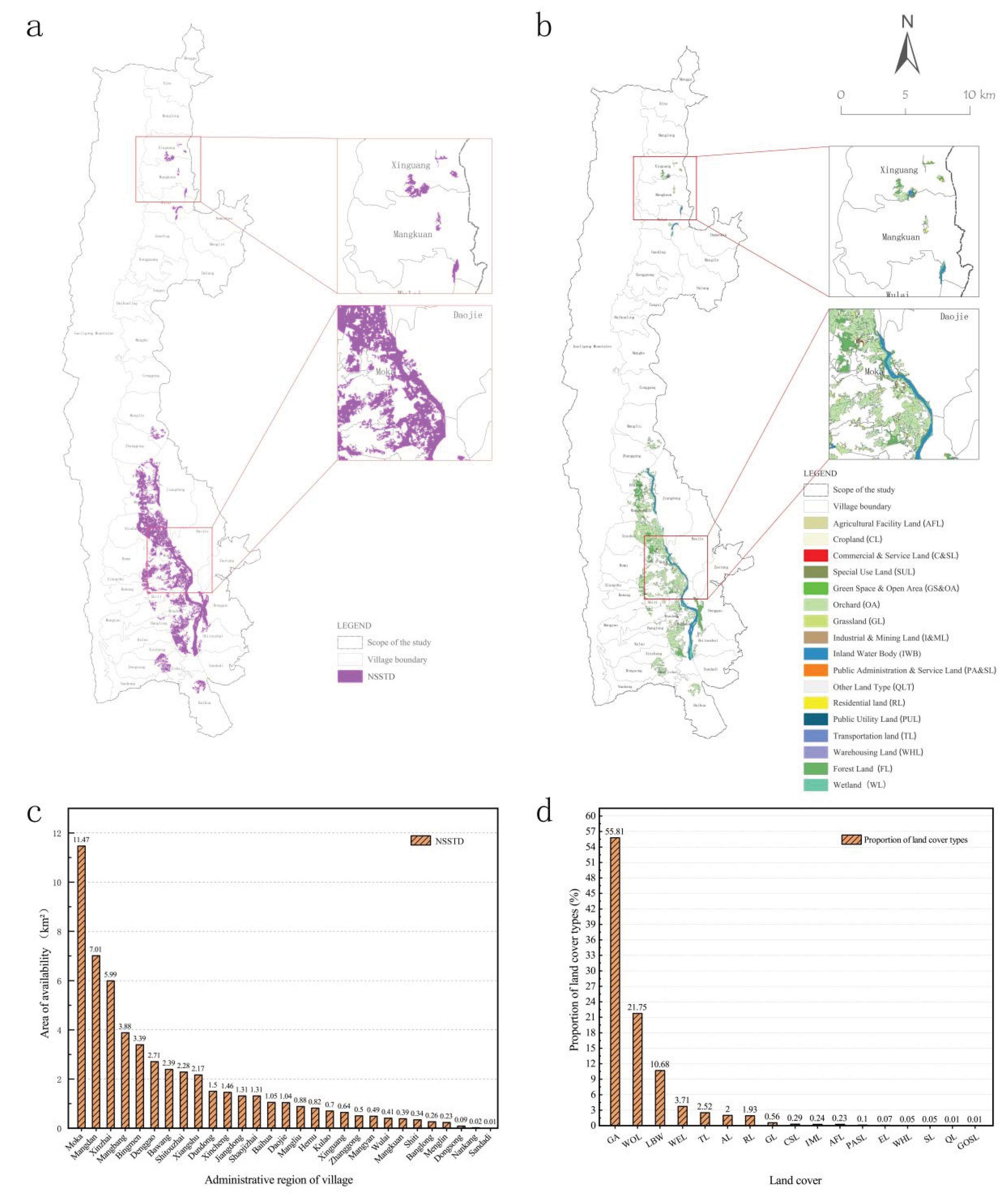

Table 1.
Data Collection and Sources.
| Data | SOURCE / LINKS |
| DEM | Spatial resolution 30m, geospatial data cloud(https://www.gscloud.cn) |
| Nature reserves | Resource and environmental sciengce data platform(https://www.resdc.cn/) |
| Land-use/Land cover | Results of the Third National Land Survey 2022 Change Survey |
| Administrative boundaries, facilities, road network | Bureau of Natural Resources, Bureau of Water Affairs |
| Arable land protection | Bureau of Natural Resources |
| Population structure and ethnicity | People’s governments of townships |
| Rural tourism resource sites | Statistical report of the township functionaries and field survey |
Table 2.
Habitat threat sources and related parameters.
| Threater factor r | Max impact distance dmax | Weight wr | Decay typei |
| Croplands | 4 | 0.6 | linear |
| Orchards | 1 | 0.3 | linear |
| Urban zones | 8 | 0.9 | exponential |
| Rural settlements | 6 | 0.6 | exponential |
| Other construction sites | 5 | 0.5 | exponential |
| Bare lands | 2 | 0.1 | linear |
Table 3.
Habitat suitability of land use types and sensitivity to different threat sources.
| Land use type | Habitat quality score | Croplands | Orchards | Urban zones | Rural settlements | Other construction sites | Bare lands |
| Nodata | 0 | 0 | 0 | 0 | 0 | 0 | 0 |
| Arboreal Forest | 1 | 0.7 | 0.5 | 0.7 | 0.6 | 0.8 | 0.3 |
| Shrubland | 0.9 | 0.5 | 0.3 | 0.8 | 0.7 | 0.7 | 0.4 |
| Other Woodland | 0.8 | 0.6 | 0.4 | 0.8 | 0.7 | 0.8 | 0.4 |
| Orchard | 0.5 | 0.5 | 0.4 | 0.7 | 0.7 | 0.7 | 0.4 |
| Horticultural Land | 0.6 | 0.5 | 0.4 | 0.8 | 0.6 | 0.7 | 0.3 |
| Cropland | 0.4 | 0.3 | 0.2 | 0.6 | 0.5 | 0.4 | 0.1 |
| Tidal Flat Wetland | 0.7 | 0.5 | 0.3 | 0.8 | 0.5 | 0.6 | 0.3 |
| Grassland | 0.6 | 0.6 | 0.5 | 0.6 | 0.6 | 0.4 | 0.3 |
| Aquatic Zones | 0.9 | 0.7 | 0.5 | 0.7 | 0.6 | 0.6 | 0.2 |
| Bare lands | 0.1 | 0.1 | 0.1 | 0.1 | 0.1 | 0.1 | 0.1 |
| Urban zones | 0 | 0 | 0 | 0 | 0 | 0 | 0 |
| Rural settlements | 0 | 0 | 0 | 0 | 0 | 0 | 0 |
| Other construction sites | 0 | 0 | 0 | 0 | 0 | 0 | 0 |
Table 4.
Assignment of Accessibility Calculation.
| Land use type | Speed (km/h) | Time cost (min) | Land use type | Speed (km/h) | Time cost (min) |
| Cropland | 3.24 | 1.85 | Public Utility Land | 2 | 3 |
| Orchards | 3.24 | 1.85 | Green Space & Open Area | 5 | 1.2 |
| Forest Land | 1.62 | 3.7 | Special Use Land | 1 | 6 |
| Grassland | 4.86 | 1.23 | Other Land Types | 1.62 | 3.7 |
| Wetland | 2 | 3 | Nature Reserve | 1 | 6 |
| Agricultural Facility Land | 4 | 1.5 | Inland Water Bodies | 30 | 0.2 |
| Residential Land | 5 | 1.2 | Expressway | 120 | 0.05 |
| Public Administration & Service Land | 5 | 1.2 | National Highway | 80 | 0.08 |
| Commercial & Service Land | 5 | 1.2 | Provincial Highway | 60 | 0.1 |
| Industrial & Mining Land | 1 | 6 | County Road | 40 | 0.15 |
| Warehousing Land | 1 | 6 | Village-Township Road | 35 | 0.17 |
Table 5.
Types and Characteristics of Rural Tourism Resources.
| Macro-categories | Primary classes | Subclasses | Key features of the landscape resource | Quantity |
| Natural landscape resources | geological landscape | Natural Landscape Complex | National parks, high mountain valleys, ecological conservation areas | 5 |
| Addresses and tectonic traces | fossil remains | 1 | ||
| Natural markers and natural phenomena | Coffee geographical indications, small-grain coffee-growing areas, vegetable-growing areas | 2 | ||
| Waterscape | river system | Nujiang Grand Canyon, Nujiang River | 13 | |
| lakes and marshes | Reservoirs, marshes, wetlands | 96 | ||
| surface water | geothermal hot spring | 17 | ||
| sea level | Sandy beaches, islands | 17 | ||
| bioscape | Vegetation landscape | Ancient and valuable trees (groups), lovely fruit tree parks, kapok corridors, community preserves | 2191 | |
| Cultural landscape resources | installations | Human Landscape Complex | Dai Town, Recreation Resort, Water Splashing Square | 26 |
| Utility buildings and core facilities | Ancient bridges, ancient ferries, caves, dwellings, agricultural gardens | 285 | ||
| Landscape & Vignette Architecture | Ancient Roads, Ancient Buildings | 26 | ||
| remains | Material cultural remains | industrial heritage | 4 | |
| Intangible cultural heritage | Lisu and Dai customs and traditions | 130 | ||
| travel purchase | Agricultural products | Fruit and vegetable picking garden, fruit and vegetable base, coffee plantation | 10 | |
| Humanities | the seasons and seasons (idiom); seasonal patterns | Water Festival, Bird Watching Festival, Picking Festival | 52 | |
| total | 7 | 16 | —— | 2875 |
Disclaimer/Publisher’s Note: The statements, opinions and data contained in all publications are solely those of the individual author(s) and contributor(s) and not of MDPI and/or the editor(s). MDPI and/or the editor(s) disclaim responsibility for any injury to people or property resulting from any ideas, methods, instructions or products referred to in the content. |
© 2025 by the authors. Licensee MDPI, Basel, Switzerland. This article is an open access article distributed under the terms and conditions of the Creative Commons Attribution (CC BY) license (http://creativecommons.org/licenses/by/4.0/).
Copyright: This open access article is published under a Creative Commons CC BY 4.0 license, which permit the free download, distribution, and reuse, provided that the author and preprint are cited in any reuse.


