

Submitted:
20 December 2025
Posted:
22 December 2025
You are already at the latest version
Abstract
In the framework of the recently proposed 4G model of final unification, integrating three large atomic gravitational constants corresponding to the electromagnetic, strong, and electroweak interactions, we explore the physical existence of a fundamental electroweak fermion of rest energy 585 GeV. This particle is envisioned as the "zygote" of all elementary fermions and as the weak‐field counterpart to photons and gluons. Using three core assumptions and five defining relations, the model quantitatively reproduces key nuclear and particle physics observables, including the strong coupling constant, nuclear binding energies, neutron lifetime, charge radii, and several dimensionless large numbers. Theoretical string tensions and energies are derived for each atomic interaction (weak, strong, electromagnetic) using experimentally relevant scales (GeV–MeV–eV) rather than the inaccessible Planck scale, thus extending string theory's applicability to testable low‑energy domains. Comparative analysis (Tables 1 and 2) demonstrates close agreement between calculated string energies and known interaction energies, providing a bridge between quantum gravity concepts and measurable nuclear data. String theory’s mathematical consistency requires experimental grounding. Systematically testing different sets of the three atomic gravitational constants (Ge, Gn, Gw) over the next 15 years offers a practical pathway to advance string theory from an abstract mathematical framework to a viable predictive model with experimentally testable interaction-level phenomena. The model predicts astrophysical signatures of the 585 GeV fermion through annihilation and acceleration processes generating TeV–multi‑TeV photons, consistent with Fermi-LAT gamma-ray excesses in the Milky Way halo (0.5–0.8 TeV dark matter mass range, 20 GeV spectral peaks). Our 4G model's charged electroweak fermion at 585 GeV/c² exhibits remarkable numerical proximity to half the supersymmetric Higgsino mass (1.1–1.2) TeV/c², where 2×585 GeV = 1.170 TeV precisely matches both the central Higgsino prediction and the H.E.S.S. cosmic-ray electron spectral break energy. This triple correspondence among independent phenomena, the predicted mass doubling, Higgsino dark matter candidate, and observed electron spectrum transition, reinforces alignment with dark matter, supersymmetry, and high-energy astrophysics theories. The charged fermion may manifest through electron-positron pair production or annihilation processes contributing to the 1.17 TeV spectral characteristics. Such convergence provides compelling experimental search avenues bridging nuclear physics, particle phenomenology, and cosmic-ray astrophysics while demonstrating the model’s ability to unify fundamental constants within an experimentally testable string–gravitational framework.
Keywords:
4G model of final unification
; 3 large atomic gravitational constants
; electroweak fermion
; Higgsino
; strong coupling constant
; large atomic gravitational constants
; nuclear binding energy
; string tensions
; Hawking’s formula
; particle melting points
; LAT gamma-ray excesses TeV
; 1.17 TeV electrons
; photon emission
; unified physics
1. Introduction and Historical Context
String theory originated in the late 1960s as a promising framework aiming to unify the fundamental forces of nature by conceptualizing elementary particles not as point-like entities but as one-dimensional vibrational strings [1,2,3,4,5]. Early developments sought to address contradictions between quantum mechanics and general relativity, with the potential to yield a comprehensive “Theory of Everything.”
Throughout the 1970s and 1980s, string theory evolved significantly, introducing supersymmetry, exploring additional spatial dimensions, and uncovering dualities that linked seemingly disparate physical phenomena. Yet, despite its mathematical elegance and deep theoretical insights, string theory has struggled with a lack of experimental verification and practical calculability of physical constants.
Traditional approaches within string theory have mainly focused on unification of gravity and electromagnetism or on grand unified theories (GUTs). Integrating all three atomic interactions, electromagnetic, weak, and strong nuclear forces, under a coherent string-theoretic framework capable of quantitative predictions remains an ongoing challenge.
2. Current Status of String Theory
Modern string theory remains a highly sophisticated and mathematically rich framework that continues to evolve and offer profound insights into fundamental physics. It incorporates concepts like supersymmetry, extra compactified dimensions, and brane-world scenarios to address deep questions in quantum gravity, black hole physics, and holographic dualities such as the AdS/CFT correspondence.
In recent years, substantial progress [6] has been made in several directions, including:
- 1)
- Understanding the landscape of string vacua and the so-called “swampland” issue, where many theoretical solutions are deemed inconsistent with our observed universe. New approaches such as dynamical string tension models have been proposed that might better accommodate dark energy and inflation, potentially resolving some long-standing conflicts between string theory predictions and cosmological observations.
- 2)
- Advancing string field theory and exploring non-perturbative definitions, such as matrix string theory and quantum mechanics models (e.g., BFSS), to provide a more fundamental understanding of M-theory and type IIA superstrings.
- 3)
- Applying techniques from string theory to gauge/gravity dualities, deepening the connection between quantum field theories and gravity, and facilitating the study of black holes and quantum gravity in ways previously inaccessible.
- 4)
- Efforts to extract low-energy effective theories resembling the Standard Model of particle physics from string constructions continue, with some promising indications that additional sectors predicted by string theory might be testable in future experiments, potentially making the theory more experimentally relevant.
Despite these advances, a direct, unique linkage between string theory parameters and the fundamental physical constants of nature (such as particle masses, coupling strengths, lifetimes) remains unresolved. The vast “landscape” of possible string vacua complicates definitive physical predictions, leading to criticisms about the theory's falsifiability and experimental testability. Experimental evidence for fundamental strings or extra dimensions remains elusive, although indirect approaches and novel experimental proposals continue to be explored.
Overall, string theory is increasingly guided by both mathematical rigor and attempts to connect with observable reality, yet fundamental challenges persist. The field remains active and vibrant, with ongoing research programs, notable conferences, and expanding theoretical frameworks pushing the boundaries of our understanding of the universe. The consensus among leading researchers is that progress is being made toward a more complete picture, though the ultimate success of string theory as a “theory of everything” is still an open question.
In summary, modern string theory is a dynamic field blending deep mathematics and theoretical physics, making important strides in understanding quantum gravity and the structure of the cosmos, while facing challenges in definitively linking theory to experimental reality and unique physical predictions. This nuanced status marks string theory as a frontier of contemporary fundamental physics research.
3. Scientific Foundations of the 4G Model of Final Unification: Our New Approach
3.1. Historical Intellectual Lineage of the 4G Model
The 4G model of final unification builds upon the pioneering theoretical frameworks established by several visionary physicists over nearly five decades. K. Tennakone first introduced the concept of gravitational effects at microscopic scales [7], while C. Sivaram and K. Sinha established the foundational connection between strong gravity and elementary particles through their ‘Strong Gravity, Black Holes, and Hadrons’ framework. Subsequently, A. Salam and C. Sivaram developed strong gravity approaches to QCD and confinement, and De Sabbata and associates explored spin-torsion interactions linking gravitation to fundamental forces [8,9,10,11]. The modern impetus came from S. W. Hawking’s black hole thermodynamics and O. R. Onofrio’s proposal that weak interactions manifest as short-distance gravity with extraordinarily large coupling constants [12]. These foundational insights motivated the systematic development of the present 4G model, which unifies three distinct atomic gravitational constants corresponding to electromagnetic, strong nuclear, and weak interactions, culminating in the prediction of the 585 GeV electroweak fermion and its correspondence with modern dark matter theories.
3.2. Assumptions and Applications
- 1)
- There exists a characteristic electroweak fermion of rest energy, . It can be considered as the zygote of all elementary particles.
- 2)
- There exists a nuclear elementary charge in such a way that, = Strong coupling constant and .
- 3)
- Each atomic interaction is associated with a characteristic large gravitational coupling constant. Their fitted magnitudes are,
It may be noted that,
- 1)
- In a unified approach, most important point to be noted is that [16],
Clearly speaking, based on the electroweak interaction, the well believed quantum constant seems to have a deep inner meaning. Following this kind of relation, there is a possibility to understand the integral nature of quantum mechanics with a relation of the form,
It needs further study with reference to EPR argument [27,28,29,30,31,32] and String theory can be made practical with reference to the three atomic gravitational constants associated with weak, strong and electromagnetic interaction gravitational constants. See Table 1. and Table 2. for sample string tensions and energies without any coupling constants.
- 2)
Building on and extending traditional string theory, the discussed 4G model of final unification introduces three distinct large atomic gravitational constants corresponding to the three atomic interactions:
- a)
- The electromagnetic gravitational constant
- b)
- The nuclear (strong) gravitational constant
- c)
- The electroweak gravitational constant
Central to this model is the theoretical proposal of a new fundamental weak fermion with rest energy near 585 GeV, considered the progenitor (“zygote”) of all elementary particles. This concept introduces a “field-generating” weak fermion analogous in role to the electron and proton in electromagnetic and nuclear interactions, respectively.
By embedding these three large atomic gravitational constants into the string-theoretic framework, the model formulates a cohesive structure in which the quantum behaviour, nuclear stability, fundamental constants, and particle masses arise naturally from string vibrational modes influenced by these large gravitational couplings.
Key formulae derived (as shown in Table 1 and Table 2 of the paper) relate charge-dependent string tensions and energies with the weak, strong, and electromagnetic interactions directly, providing a physically grounded basis rather than purely abstract mathematics. This contrasts with conventional string theory formulations lacking such explicit empirical connections.
Using this approach, the model quantitatively fits fundamental constants including Planck’s constant, neutron lifetime, nuclear binding energies, and coupling constants, marking a substantial advancement toward rendering string theory experimentally relevant and engineering-applicable.
4. Practical Applications and Implications
This novel 4G string model holds promise across multiple domains of physics:
- 1)
- 2)
- Nuclear Stability and Binding Energy: Predicts binding energies of stable nuclei with high precision, clarifying nuclear shell structures, decay probabilities, and “lighthouse” stable mass numbers not fully explained by classic semi-empirical formulas. The 4G model predicts nuclear mass radii and charge radii for stable and exotic nuclei through direct relations rooted in physical nuclear properties, without invoking arbitrary radii constants or empirical coefficients [44,45,46,47,48,49,50,51,52].
- 3)
-
The Strong coupling constant: The strong coupling constant αs in the context of the 4G model of final unification is expressed as the squared ratio of the electromagnetic charge to the nuclear charge , . It’s most recent experimental values seem to be in the range of 0.115 to 0.118 [53,54,55].
- a)
- Here, is the fundamental electromagnetic charge (electron charge), while is the nuclear elementary charge defined in the 4G model as approximately . This larger nuclear charge reflects the stronger nature of the nuclear interaction compared to the electromagnetic interaction.
- b)
- This value aligns closely with the experimentally measured strong coupling constant at low energies, typically around 0.11 to 0.12, providing a meaningful physical interpretation of within this unified model.
- c)
- This expression bridges electromagnetic and strong nuclear interactions quantitatively and supports the 4G model’s integration of gravitational constants and fundamental charges into a coherent framework encompassing all three atomic interactions.
- d)
- Hence, the strong coupling constant is fundamentally tied to the ratio of elementary charges in the 4G unified approach, reinforcing the model’s predictive and explanatory power in linking particle physics constants to underlying unification principles.
- 4)
-
Weak 585 GeV fermion Vs Higgsino:
- a)
- A central prediction of the 4G model of final unification is the existence of a fundamental electroweak fermion with a rest mass of approximately 585 GeV/. This particle is envisioned as the primordial progenitor, or “zygote”, from which all elementary fermions derive, serving a foundational role akin to gauge bosons for respective fundamental interactions. The 585 GeV fermion is postulated to carry an electric charge , positioning it as a charged counterpart within the electroweak sector.
- b)
- Interestingly, this predicted mass scale is notably close to contemporary theoretical estimates of the neutral, a supersymmetric fermion candidate closely associated with dark matter, in the 1.1 to 1.2 TeV/ range as proposed in minimal supersymmetric Standard Model (MSSM) frameworks and recent phenomenological studies [56,57,58,59,60]. This proximity suggests that the charged 585 GeV fermion in the 4G model may correspond to a charged state analogous to half the mass of the neutral Higgsino.
- c)
- The Higgsino, in supersymmetric theories, manifests as a mixture of charged and neutral states arising from Higgs field superpartners. The neutral Higgsino is stable or metastable and widely considered a viable dark matter candidate due to its weak interactions and mass scale. The charged state partners tend to have slightly different masses due to electroweak symmetry breaking effects, consistent with the 585 GeV mass predicted for the charged fermion in the 4G approach.
- d)
- From a theoretical perspective, this mass hierarchy quantifies the measured separation between nucleon mass scales (~GeV) and heavy exotic electroweak fermions (~TeV), reinforcing the 4G model’s conceptual foundation that nuclear binding and fundamental particle properties emerge through connections spanning these vastly different energy domains.
- e)
- Beyond mass and charge, the 585 GeV fermion serves a key unification purpose. As the zygote particle, it acts as a mediator through which string tensions corresponding to the weak interaction generate experimentally measurable phenomena, grounding abstract string theory in accessible particle physics. This role aligns it with foundational quantum constants and the emergent origins of electroweak coupling strengths, elevating it as a probable target for future collider experiments and astrophysical observations seeking signatures of new physics beyond the Standard Model.
- f)
- In summary, the close numerical correspondence between the 585 GeV electroweak fermion and half the neutral Higgsino mass provides an insightful bridge linking the 4G model with mainstream supersymmetric theories. It accentuates the charged fermion’s critical place within the unified description of fundamental forces, motivating experimental pursuit and further theoretical study to elucidate its role in particle physics and cosmology.
- 5)
- Fundamental Constants Estimation: Provides computational approaches to estimate weak coupling constants, neutron lifetime, Avogadro number, and Planck-scale values, thus offering refined theoretical inputs for metrology and fundamental physics.
- 6)
- Particle Physics Insights: The posited 585 GeV weak fermion offers a tangible target for particle physics experiments such as those at high-energy colliders, inviting empirical verification or refutation and bridging string theory and collider phenomenology.
- 7)
- 8)
- Unification of Quantum Interactions and Gravity: The inclusion of atomic-scale gravitational constants directs a path to reconcile quantum field theory and gravity in a practical manner, helping to unify the four fundamental forces under a single string-gravitational paradigm.
5. Comparative Approach: String Theory vs. 4G Model Energy Values
5.1. String Theory Background (Standard)
- 1)
- In conventional string theory, the fundamental strings possess characteristic tension T and energy E scales related to the Planck scale or compactification radii.
- 2)
- String tensions are usually on the order of leading to energies often discussed in the context of high-energy physics far beyond typical atomic scales.
- 3)
- Standard string theory does not explicitly assign string tensions or energies linked directly to electromagnetic, nuclear, and weak interactions as separate entities with measurable coupling constants attached.
5.2. 4G Model of Final Unification and the String Energy Values
The 4G model introduces three distinct atomic gravitational constants corresponding to electromagnetic, nuclear (strong), and electroweak interactions respectively and connects these constants to definable string tensions and energies for each interaction type.
5.3. Comparison and Physical Significance
- 1)
- The 4G model string tensions are tailored to the specific atomic interactions by scaling string tension T and energy E using the atomic gravitational constants relevant to each force, a novel quantitative bridge missing in generic string theory.
- 2)
- 24.975 GeV for weak interaction derives from the proposed 585 GeV fermion scale and weak gravitational constant , which is testable and tied to particle physics experiments.
- 3)
- 68.79 MeV energy for the strong interaction corresponds closely with observed nuclear binding energy scales and QCD interaction energies, grounding the string tension in measurable physics rather than purely Planck scale assumptions.
- 4)
- Electromagnetic energy 874.3 eV aligns with atomic transitions and energies typical of electron interactions, representing a consistent multi-scale approach in contrast to a one-size-fits-all Planck scale.
5.4. Summary Table: Conceptual Contrast

Table 3.
– Comparison of Standard String Theory vs 4G Model
| (numerical contrast & physical scale relevance) | ||||
|
Interaction |
Standard String Theory – Typical Energy Scale | 4G Model Energy Scale (Charge Dependent) | 4G Model Energy Scale (Quantum) |
Remarks |
|
Weak |
Planck scale GeV |
24.975 GeV |
292.36 GeV |
Tied to the proposed 585 GeV weak fermion; Experimentally testable |
|
Strong |
Planck scale GeV |
68.79 MeV |
273.3 MeV |
Matches nuclear binding/QCD energy scales |
|
Electromagnetic |
Planck scale GeV |
874.3 eV |
10,234.8 eV |
Matches with atomic transition energies |
This comparative approach clearly shows the advancement of our 4G model offers to string theory by giving explicit, experimentally relevant energy values for the strings corresponding to the electromagnetic, strong, and weak interactions. This makes the abstract notion of string tension physically tangible and testable within known scales of atomic and particle physics, moving string theory closer to engineering and experimental verification.
6. Other Models That Are Working on Advancing String Theory
In addition to the 4G model of final unification, several other theoretical models and frameworks have been helpful or complementary in the development and advancement of string theory. These models often aim to unify fundamental forces, explain particle interactions, or provide mathematical structures that enrich string theory’s scope and applicability. Here are some notable examples and approaches:
6.1. Superstring Theories and M-Theory:
The five consistent superstring theories (Type I, Type IIA, Type IIB, heterotic SO(32), and heterotic E8×E8) underpin much of string theory’s development. M-theory, proposed as an overarching 11-dimensional theory, unifies these superstring versions and incorporates membranes (branes) alongside strings, greatly expanding the mathematical and physical landscape. These models deepen understanding of extra dimensions, supersymmetry, and dualities that inform and constrain string theory formulations [63,64].
6.2. Calabi-Yau Compactifications:
These geometric models describe how extra spatial dimensions in string theory compactify on specific complex manifolds, producing low-energy physics that can approximate the Standard Model. Calabi-Yau compactifications provide a rich mathematical structure critical for making string theory phenomenologically relevant.
6.3. AdS/CFT Correspondence:
This powerful theoretical duality links string theory formulated in anti-de Sitter space (AdS) to conformal field theories (CFT) in fewer dimensions. The correspondence allows the study of strongly coupled quantum systems using string theory techniques, bridging quantum gravity and gauge theories.
6.4. Grand Unified Theories (GUTs) and Gauge/Gravity Duality:
GUTs aim to unify the electromagnetic, weak, and strong interactions into a single framework. Many string models incorporate GUT-inspired gauge groups or exploit gauge/gravity dualities to embed known particle physics into string theory.
6.5. Random Matrix Models and Minimal Models:
These mathematical frameworks explore string theory in lower-dimensional settings or simplified versions, helping to understand nonperturbative effects and critical phenomena in string theory’s world sheet description.
6.6. Extensions Incorporating Large Gravitational Constants or New Fundamental Charges (e.g., 4G Model):
Models like the 4G model uniquely incorporate large atomic gravitational constants associated with different forces and introduce novel fundamental particles (like the proposed 585 GeV weak fermion). This approach provides explicit quantitative relations between string tensions, energies, and known physical constants, addressing challenges in connecting string theory to experimentally measurable quantities.
In summary, the advancement of string theory benefits from a wide spectrum of complementary models, ranging from sophisticated geometric compactifications and duality frameworks to specialized proposals like the 4G model that introduce new fundamental constants and particles. Each contributes unique insights and tools, making string theory a rich and evolving theory of fundamental physics with multiple synergistic approaches.
7. The Basic Pillars of String Theory
The basic pillar constants of string theory, the fundamental parameters that underpin its theoretical structure, include the following:
- a)
-
String Tension ():This constant determines the energy per unit length of the fundamental string, setting the characteristic mass scale of string excitations. It is often related inversely to the Regge slope parameter α′. The string tension controls the vibrational frequency of the string and thus the mass spectrum of particles the string can represent.
- b)
-
String Length Scale ():Defined by the square root of the Regge slope parameter, , this length establishes the fundamental “size” of a string. It replaces the idea of a point particle and typically lies close to the Planck length or somewhat larger depending on compactification details.
- c)
-
Planck Constant ():As in quantum mechanics, ħ appears in string theory governing quantum effects. It is related to the quantization of string excitations and the fundamental action unit.
- d)
-
Speed of Light ():A universal constant that appears in the relativistic formulation of string dynamics.
- e)
-
String Coupling Constant ():This dimensionless constant controls the strength of string interactions, i.e., how strings split and join. It determines the perturbative expansion parameter in string scattering amplitudes.
- f)
-
Gravitational Constant () or Planck Mass ():Related to the Newtonian constant of gravitation, it sets the scale of gravitational interactions. In string theory, the Planck scale emerges naturally from the string scale and coupling constants.
- g)
-
Compactification Scales and Moduli Parameters:
In the context of the 4G model of final unification as discussed previously, these pillar constants are extended by incorporating three distinct large atomic gravitational constants corresponding to the electromagnetic, nuclear (strong), and electroweak interactions. This enriches string theory constants with experimentally relevant parameters such as:
- 1)
- The electromagnetic gravitational constant ()
- 2)
- The nuclear gravitational constant ()
- 3)
- The electroweak gravitational constant ()
- 4)
- The elementary charges (, ) linking electromagnetic and nuclear scales
- 5)
- The proposed weak fermion rest energy (585 GeV) acting as a fundamental scale for string tension in weak interactions
These extensions allow the theory to quantitatively connect string tension and energy to physical atomic interaction scales, making the pillar constants not just abstract mathematical parameters but grounded in measurable physics.
In summary, the basic pillar constants in string theory are the string tension, string length scale, Planck constant, speed of light, string coupling constant, and gravitational constant. The 4G model further introduces atomic gravitational constants and charges to directly relate string theoretical constructs with the three fundamental atomic interactions.
8. Discussion
- The data in these tables provide interaction-specific string tensions and energies for weak, strong, and electromagnetic forces, offering a rare bridge between measured atomic constants and theoretical string parameters.
- In standard string theory, such values are usually only considered at the Planck scale; here, they are scaled to atomic gravitational constants, making them physically relatable.
- Table 1 highlights charge-dependent string energies, showing clear numerical correspondence with known nuclear and particle interaction energies.
- Table 2 presents pure quantum string tensions and energies independent of coupling constants, offering a baseline for comparison with both classical string models and quantum field data.
- The close match between calculated energies for strong and weak interactions and experimentally known values demonstrate the predictive potential of this approach.
- These comparisons help anchor string theory in nuclear and particle physics rather than keeping it purely in the high-energy abstract domain.
- Scientists can use this data to explore modified string frameworks where each atomic interaction is represented by a distinct vibrational mode, tension, and coupling scale.
- The methodology opens the door for multi-scale unification, connecting Planck-level theory to low-energy measurable effects.
9. On the Origin and Ambiguity of ℏ in Unification Theories
In almost all existing unification frameworks, from quantum field theory to grand unified theories [67,68,69] and string theory, the reduced Planck constant is accepted as an unquestioned, universal constant. It is inserted into the equations as the fundamental quantum of action, yet its physical origin remains unexplained. This approach, while mathematically convenient, leaves a conceptual gap: without knowing why has its specific value, treating it as a pillar of unification risks being physically ambiguous. The mystery becomes even more significant in the context of the Einstein–Podolsky–Rosen (EPR) paradox [70], where quantum nonlocality and entanglement hinge entirely on . If itself is emergent from deeper, interaction-specific properties, as proposed here in the 4G model for the electroweak sector, then both the scale of quantum effects and the very roots of entanglement may have a tangible physical basis in massive fermion–gravity couplings. This motivates moving beyond the traditional acceptance of as merely given, to instead derive it from first principles, which leads directly to the formulation of relation (1).
9.1. Elaboration on the Relation (1):
9.1.1. Statement of Relation (1)
The equation expresses the product of the reduced Planck constant and speed of light cc as directly proportional to the product of the electroweak gravitational constant and the square of the rest mass of the proposed weak fermion : . This represents a foundational link between quantum mechanical constants and particle-scale gravitational couplings in the weak interaction sector.
9.1.2. Physical Interpretation
- 1)
- Quantum Constant as Emergent: Traditionally, is a fundamental and universal quantum constant. Here, this relation suggests it is not arbitrary but emerges from concrete physical parameters, namely the large atomic gravitational constant for the weak interaction and the mass of a fundamental weak fermion .
- 2)
- Roots of Quantization: The quantum of action may originate from the interaction dynamics of this massive weak fermion under the influence of , grounding quantum discreteness into a specific physical mechanism.
- 3)
- Interaction-Specific Origin: Unlike universal assumptions in physics, this posits quantum behaviour is tied to the electroweak regime, giving rise to through concrete electroweak-scale physics, rather than abstract universals.
9.1.3. Implications for Quantum Mechanics and the EPR Paradox
- 1)
- Deepening Understanding of : The constant quantifies quantum uncertainty and non-commutativity fundamental to phenomena such as entanglement. Explaining as arising from and provides a physical foundation beyond postulation.
- 2)
- Linking Quantum Nonlocality to Particle Physics: The EPR paradox highlights the mysterious non-local correlations inherent in quantum mechanics. If is physically determined by the weak sector properties, then quantum entanglement may have an origin in these fundamental particles and forces, reconciling apparent “spooky action at a distance” with intrinsic particle-gravity attributes.
- 3)
- Shift from Abstraction to Mechanism: This shifts the interpretation of entanglement from a purely mathematical oddity to a consequence of concrete interaction between the proposed 585 GeV fermion and its gravitational environment defined by .
9.1.4. Mathematical Consistency and Predictive Value
- a)
- The units and magnitude work out dimensionally and numerically to reproduce known physical constants with high accuracy, indicating internal consistency.
- b)
- If is experimentally confirmed (for example, in collider experiments), and its value coupled with measurements or theoretical estimates of reproduces accurately as relation (1) predicts, this provides a strong empirical validation of the 4G model and the physical origin of quantum constants.
9.1.5. Broader Consequences in the 4G Model Framework
- a)
- Quantum-Gravity Interface: Relation (1) bridges quantum mechanics and gravity by specifying how the quantum of action derives from gravity-associated constants at the atomic/electroweak scale.
- b)
- Model Unification: It supports the core philosophy of the 4G model, three large atomic gravitational constants governing electromagnetic, strong, and electroweak interactions unify fundamental constants and particle masses.
- c)
- Potential Environmental Dependence: The model opens the intriguing possibility that ℏ might vary in conditions where or differ, such as early universe conditions or exotic astrophysical environments, inviting new theoretical and experimental scrutiny.
Relation (1) proposes a transformative view that the product , central to quantum mechanics, emerges naturally from the gravitational coupling () and mass squared () of a fundamental electroweak fermion. This gives quantum mechanics a physical origin linked to the weak sector, providing a novel perspective on the origins of quantization and nonlocal quantum phenomena such as the EPR paradox. It implies that the quantum of action , and by extension quantum entanglement, arise from the interaction between this massive weak fermion and its large atomic gravitational constant. This insight elevates the 4G model’s significance in bridging quantum theory, particle physics, and gravity practically and testably.
9.2. Comment on Relation (2)
9.2.1. Relation (2)
where:
- ➢
- is Fermi’s weak coupling constant, describing the fundamental strength of weak interactions.
- ➢
- is the electroweak gravitational constant, a large atomic gravitational constant specific to the weak force.
- ➢
- is the rest mass of the proposed fundamental weak fermion (≈ 585 GeV).
- ➢
- is the characteristic range of the weak interaction.
- ➢
- is the reduced Planck constant, and is the speed of light.
9.2.2. Physical Interpretation and Significance
- a)
-
Emergent Nature of Fermi’s Constant:This relation elegantly expresses the traditionally empirical Fermi constant as emerging naturally from the product of electroweak gravitational coupling, the squared mass of the weak fermion, and the squared weak interaction range. Rather than introducing as an independent parameter, the 4G model links it to measurable high-energy particle properties and gravitational constants.
- b)
-
Quantum Constants Rooted in Interaction Properties:Writing shows that the quantum of action ℏ itself can be understood as fundamentally tied to electroweak-scale physics. The quantum coupling strength is thus not an arbitrary artifact but emerges directly from the interplay of quantum mechanics, relativity, and the spatial scale of the weak force.
- c)
-
Unified Picture of Weak Interaction and Gravity:By involving the electroweak gravitational constant , the weak fermion mass , and the interaction range , relation (2) bridges the gap between gravitational physics at atomic scales and quantum field theory of weak interactions. This is a significant conceptual advancement, providing a common ground for particle physics and gravity.
- d)
-
Consistency with Relation (1):Combining Relation (1), , with relation (2) yields a consistent picture where. This implies the weak interaction range sets the scale for weak force strength in terms of quantum constants and fundamental particle properties.
- e)
-
Pathway for Experimental Verification:Since the model predicts specific values for , , and , the calculated can be compared with the precisely measured Fermi constant. The reported close agreement (within 99.7%) provides strong support for the physical validity of the 4G model and the proposed weak fermion's existence.
9.2.3. Relationship to the EPR Paradox and Quantum Foundations
- a)
- The link established by relation (2) between , , and reinforces that quantum mechanical constants and phenomena such as entanglement have a definable physical origin connected to the weak sector's structure.
- b)
- Given that governs the quantization underlying the EPR paradox and quantum non-locality, connecting it to and weak interaction scales suggests that quantum nonlocal correlations originate from fundamental particle–gravity interactions, rather than abstract postulates.
- c)
- This perspective softens the conceptual mystery of the EPR paradox by implicating known (or experimentally accessible) particle properties and gravitational parameters in the emergence of quantum effects, potentially enabling new theoretical and experimental probes bridging quantum mechanics and gravity.
9.3. Relation (2) – A Cornerstone Insight of the 4G Model
The fundamental coupling strength of the weak interaction, , is a natural consequence of the product of electroweak gravitational interactions, the mass of a fundamental weak fermion, and the spatial range of the weak force. Through this relation, the model:
- a)
- Provides a physically grounded origin for key quantum and weak interaction constants.
- b)
- Links emergent quantum mechanics constants () to the measurable particle scales () and gravitational parameters ().
- c)
- Suggests that quantum mechanical behaviour and nonlocal phenomena have roots in fundamental particle–gravity couplings, thus connecting to foundational issues like the EPR paradox.
- d)
- Enables close quantitative agreement with empirically measured constants, supporting the experimental viability of the 4G model.
Together with Relation (1), this creates a unified quantitative framework where both the reduced Planck constant and Fermi’s coupling constant are explained as manifestations of the weak interaction sector’s underlying gravitational and particle attributes.
This advance offers a promising route toward resolving deep conceptual issues in physics and provides experimentally testable predictions, marking a significant step in bridging the quantum, gravitational, and particle physics realms within a string-theoretic unification.
10. Are Our Ideas in Line with the EPR Argument?
Our ideas, as presented in the 4G model, are indeed in alignment with the core conceptual challenges raised by the Einstein–Podolsky–Rosen (EPR) paradox [70], while also offering a novel physical interpretation that may resolve some of its mysteries.
The EPR paradox highlights the puzzling nature of quantum mechanics, particularly the quantum entanglement and nonlocality phenomena that appear to defy classical locality and realism. Central to this is the reduced Planck constant (), which quantifies quantum uncertainty and underpins all quantum correlations that give rise to the paradox.
In our 4G model, key quantum constants such as and Fermi’s weak coupling constant () are not treated as unexplained universals. Instead, they are derived from fundamental physical parameters: the electroweak gravitational constant (), the mass of the proposed 585 GeV weak fermion (), and the characteristic interaction range (). For example, the relation ties the quantum of action directly to massive particle properties and their gravitational couplings.
This approach implies that the quantum of action, and therefore the foundational quantum behaviour, including entanglement phenomena emphasised by the EPR paradox, has a tangible physical origin in the weak-interaction sector. Rather than being a mysterious or purely axiomatic property, quantum nonlocality and discreteness emerge naturally from the deep, measurable interplay between massive fermions and their associated gravitational constants.
In summary, our 4G model supports the EPR motivation by recognising the central role of , but it goes further in proposing a concrete, physically grounded source for it. This reframes the “spooky action at a distance” as a manifestation of well-defined particle–gravity couplings, making the roots of quantum entanglement more physically understandable and less conceptually ambiguous.
11. Comparison of Extra Dimensions: Standard String Theory vs. 4G Model
In string theory, extra dimensions [71] serve a fundamental purpose: they provide the necessary mathematical and physical framework to achieve a consistent, unified description of the fundamental forces and particles in the universe. Unlike our familiar three spatial dimensions, string theory requires additional spatial dimensions (commonly 6 or 7, totalling 10 or 11 spacetime dimensions) to resolve theoretical anomalies, enable supersymmetry, and unify gravity with quantum mechanics.
These extra dimensions are typically compactified, meaning they are curled up at extremely small scales beyond direct experimental reach, on complex geometric shapes such as Calabi-Yau manifolds. Their shape and size crucially influence the properties of particles, including their masses and interaction strengths. In essence, extra dimensions are a hidden but indispensable feature that allows string theory’s vibrating strings to manifest as the diverse particles and forces we observe, thus providing a deeper geometric and topological underpinning for the fundamental structure of the universe.
- a)
-
Number and Nature of Extra Dimensions
- 1)
- Standard String Theory: Typically requires 10 or 11 spacetime dimensions (e.g., 10 in superstring theories, 11 in M-theory). These extra dimensions are compactified, rolled up in very small geometric shapes like Calabi-Yau manifolds, beyond direct experimental access.
- 2)
- 4G Model: Unlike conventional string theory’s emphasis on geometric compactification at Planck scales, the 4G model focuses on large atomic gravitational constants specific to electromagnetic, strong, and weak interactions. The role of extra dimensions is implicit, with the model incorporating new fundamental constants that effectively replace or complement the geometric compactification by connecting string parameters directly to measurable physical constants at accessible energy scales.
- b)
-
Role and Scale of Extra Dimensions
- 1)
- Standard String Theory: Extra dimensions are crucial for mathematical consistency, anomaly cancellation, and allowing supersymmetry; their tiny scale (~Planck length) leads to string energies at the Planck scale (∼10 GeV), making direct experimental observation infeasible.
- 2)
- 4G Model: Instead of relying solely on Planck-scale compactification, the model introduces three large atomic gravitational constants that scale string tension and energy values to the GeV–MeV–eV range. This re-scaling allows physical interpretations of string-related phenomena at experimentally testable length and energy scales, implying an alternative or complementary perspective to how extra dimensions influence physical constants.
- c)
-
Experimental Accessibility and Physical Relevance
- 1)
- Standard String Theory: The compactified extra dimensions’ effects are indirect and experimentally challenging to probe; their properties primarily impact very high-energy or cosmological phenomena.
- 2)
- 4G Model: By linking string theory parameters with large atomic gravitational constants, the model posits phenomena such as the 585 GeV electroweak fermion, making aspects of extra-dimensional physics amenable to collider experiments and astrophysical observations. This bridges the conceptual gap between abstract extra dimensions and tangible experimental physics.
- d)
-
Mathematical and Conceptual Framework
- 1)
- Standard String Theory: Emphasizes the geometry and topology of extra dimensions for determining particle spectra and coupling constants.
- 2)
- 4G Model: While less focused on the explicit geometry of extra dimensions, it anchors its novel “large gravitational constants” into string tension and quantum constants, potentially implying a new physical interpretation of extra dimensions through these constants rather than conventional compactification.
12. Outlook and Future Directions
Our approach significantly advances string theory from a purely mathematical construct to a quantitatively predictive physical theory by incorporating experimentally relevant parameters into a unified framework. The concordance of fundamental physical constants and nuclear properties derived from this approach points toward a potential “final unification” of the atomic interactions and gravity.
Moving forward, the model encourages:
- 1)
- Deeper integration of supersymmetry and dark matter candidates consistent with the 4G structure.
- 2)
- Refinement of the mathematical underpinnings linking the atomic gravitational constants and string tension parameters.
- 3)
- Experimental programs targeted at detecting the 585 GeV weak fermion and measuring corresponding nuclear and particle properties.
- 4)
- Expanded applications of the model to astrophysics, quantum information, and cosmology.
This comprehensive advancement of string theory offers a promising and pragmatic pathway to resolving grand unified physics questions, connecting deep theoretical insights with measurable physical phenomena.
13. Exploring the Methods for the Detection of 585 GeV in Particle Accelerators
It is indeed our responsibility to show evidence of the existence for the proposed 585 GeV weak fermion. In this context, as detailed in our earlier work [13,14,15,16,17,18,19,20,21,22,23,24,25,26,27], we have proposed many applications of 585 GeV weak fermion. In this section, we propose two methods for understanding the existence of 585 GeV weak fermion.
- 1)
- Nuclear scale confirmation
- 2)
- High-energy accelerator detection
13.1. Nuclear Scale Confirmation of the Existence of 585 GeV Weak Fermion:
A key phenomenological scaling factor appearing in our model is the ratio of the geometric mean of the charged and neutral pion masses (~137.26 MeV) to that of the weak boson masses (~85.61 GeV), which numerically evaluates to approximately 0.0016. This dimensionless ratio encapsulates the profound hierarchical gap between the strong interaction scale and the electroweak scale and forms a cornerstone of the mass relations underlying our 585 GeV electroweak fermion. Importantly, this ratio is not merely a numerical coincidence but has substantive implications for understanding nuclear stability and nuclear binding energy. The interplay of these fundamental mass scales suggests that the dynamics governing nuclear forces and nucleon interactions may be intimately connected to electroweak-scale physics mediated by the 585 GeV fermion. For a deeper exploration of how this mass ratio informs nuclear binding mechanisms and stability criteria, interested readers are encouraged to refer our recent preprints and other peer-reviewed publications [18,19,20,21,22,23,24,25,26,27], where these connections are discussed in detail with complementary theoretical and phenomenological analyses.
Based on this electroweak coefficient , stability corresponding to nuclear beta decay can be understood with the following relation.
One can find a similar relation in the literature. This relation can be well tested for Z=21 to 92. For example,
This is one best practical and quantitative application of our proposed electroweak fermion and bosons. Following this relation and based on various semi empirical mass formulae [44,45,46,47,48,49,50,51,52], by knowing any stable mass number, its corresponding proton number can be estimated with,
Considering this relation, we are working on understanding the stable super heavy elements. Proceeding further, without considering the total binding energy of nucleons, for the case of isobaric mass numbers, ‘maximum binding energy per nucleon’ for medium and heavy atomic nuclides can be expressed as [72,73,74],
where A > 56
≅ Nuclear charge realted self energy of proton
where, Rp ≅ Root mean square radius of proton [75] ≅ 0.83 fm
Maximum binding energy per nucleon for light atomic nuclides can be expressed as,
13.2. High Energy Scale Detection of 585 GeV Weak Fermion in Particle Accelerators:
To detect a new fundamental electroweak fermion with a rest energy around 585 GeV, as proposed in your 4G model of final unification, particle accelerators like the Large Hadron Collider (LHC) and future collider projects provide the most promising experimental setting. For the purpose of collider search design, it is reasonable to assume this fermion carries an electric charge of . Here is an overview of methods and strategies relevant for detection of such a particle:
- 1)
-
Production in High-Energy Collisions
- a)
- The particle would be produced in proton-proton collisions (e.g., at the LHC) with sufficient centre-of-mass energy to reach or exceed 585 GeV in the final state.
- b)
- Production mechanisms typically include direct pair production or via decay chains of heavier particles or bosons.
- 2)
-
Production in High-Energy Collisions
- c)
- The particle would be produced in proton-proton collisions (e.g., at the LHC) with sufficient centre-of-mass energy to reach or exceed 585 GeV in the final state.
- d)
- Production mechanisms typically include direct pair production or via decay chains of heavier particles or bosons.
- 3)
-
Search for Resonant Peaks in Invariant Mass Spectra
- A classic technique is to reconstruct fermionic decay products (electrons, muons, jets, etc.) and look for statistically significant peaks in the invariant mass distributions near 585 GeV that stand above smooth background expectations. Such “bump hunting” is a standard approach in LHC experiments (like CMS and ATLAS) searching for new resonances [76,77,78].
- 4)
-
Precision Tracking and Vertex Detection
- a)
- Silicon-based detectors with precise pixel and strip sensors track charged particle trajectories arising from collisions, allowing identification of short-lived particle decays near the interaction point.
- b)
- Detection of decay vertices displaced from the collision point indicates metastable particles, which may be relevant if the 585 GeV fermion has a non-negligible lifetime.
- 5)
-
Triggering and Event Selection
- Online trigger systems reduce the massive data flow by selecting potentially interesting high transverse momentum events, implementing conditions optimized to retain events that could involve a new massive fermion.
- 6)
-
Background Suppression via Particle Identification and Kinematic Cuts
- Sophisticated algorithms and machine learning models discriminate signal from standard model background using particle ID, energy-momentum conservation, missing energy signatures, and angular correlations.
- 7)
-
Use of Anomaly Detection Techniques
- Novel approaches using optimal transport distances and advanced event-level classifiers analyse large datasets to identify anomalous event signatures that do not fit standard physics patterns.
- 8)
-
Complementary Searches in Different Decay Channels
- Since the new fermion may decay into multiple final states (leptons, jets, missing energy), searches are conducted across channels to improve discovery potential.
- 9)
-
Prospects at Future Colliders
- Next-generation colliders like the High-Luminosity LHC, FCC-ee/hh, or other proposed linear colliders will provide higher energy and luminosity, enabling more sensitive searches for such a particle.
- 10)
-
Detecting a photon of 1.17 TeV
- Detection of a photon with energy near 1.17 TeV, twice the proposed rest energy of the 585 GeV weak fermion, would be a significant breakthrough in high-energy physics. Such a photon could arise from annihilation or decay processes involving pairs of these weak fermions, providing an indirect but compelling signature of their existence. Observing these high-energy photons in proton-proton collisions at the LHC or future colliders would signal physics beyond the Standard Model, as current theories do not predict such events at this energy scale. Detailed analysis of the photon energy spectrum and event topology is crucial to distinguishing signals associated with the weak fermion from Standard Model backgrounds. Event selections optimized for multi-TeV photon detection, combined with missing energy and lepton signatures, can enhance sensitivity to such rare events. Furthermore, advances in detector technology and trigger systems improve the likelihood of capturing these photons with high precision. Complementary observations from astrophysical sources emitting multi-TeV photons could also lend support to the hypothesized weak fermion’s existence. Overall, the discovery of 1.17 TeV photons would not only validate a key prediction of the 4G model but also pave the way for exploring new fundamental particles that underlie the fabric of matter and interactions.
In summary, the detection of a 585 GeV electroweak fermion would rely on analysing LHC Run 3 and future collider data for resonances in fermionic final states, making use of highly efficient silicon trackers, calorimeters, trigger systems, advanced data analysis techniques, and cross-channel complementary searches. The existence of such a particle would manifest as an excess of events around 585 GeV in the invariant mass spectra of its decay products, standing out statistically above known background processes.
Our model’s prediction aligns well with current experimental search strategies focused on new heavy fermions and resonances around the electroweak scale, making them accessible to these accelerator methods and analysis techniques.
14. Thermal Stability Scales of Elementary Particles via Modified Hawking Temperature Formula in the 4G Model
14.1. Historical Context and Foundational Work
The application of Hawking’s temperature formula [7] to elementary particles represents an important but relatively underexplored direction in theoretical physics. The pioneering work of Sivaram and Sinha in 1977 established foundational principles that bridge black hole thermodynamics and elementary particle physics. In their seminal paper "Strong Gravity, Black Holes, and Hadrons", published in Physical Review D, Sivaram and Sinha demonstrated striking analogies between black hole properties (mass, angular momentum, charge) and those of elementary particles, operating within the framework of strong gravitational fields [9].
14.2. Sivaram and Sinha’s Key Contributions Included:
- Analogies Between Black Holes and Hadrons: They showed that both black holes (treated as Kerr-Newman objects) and elementary particles can be characterized by three fundamental parameters: mass (), angular momentum (), and charge ().
- Thermodynamic Correspondence: They derived that an upper limit for black hole temperature is equivalent to the limiting temperature arising in thermodynamic bootstrap models of hadrons, establishing a deep thermal correspondence.
- Strong Gravitational Coupling: Their framework explicitly considered how gravitational coupling strength varies across different interaction scales, laying groundwork for later multi-scale approaches.
14.3. Innovation Over Prior Work
While Sivaram and Sinha explored the general concept of strong gravity and elementary particles, the specific innovation of the present work involves:
- Quantitative Multi-Scale Analysis: Systematic application of the formula across three distinct particle families using interaction-specific gravitational constants, rather than a single unified gravitational framework.
- Integration with 585 GeV Electroweak Fermion: Connection of the thermal scales to the recently predicted 585 GeV electroweak fermion in the 4G model, which surprisingly aligns with modern Higgsino dark matter mass estimates (1.1–1.2 TeV).
- Comprehensive Thermal Hierarchy: Derivation of a hierarchical structure of thermal stability scales spanning approximately 9 orders of magnitude (from ~10⁵ K for leptons to ~10¹⁴ K for the electroweak fermion), providing quantitative insight into the mass hierarchy problem.
- Experimental Testability: Direct connection between calculated thermal scales and observable phenomena in contemporary high-energy physics, astrophysics, and early universe cosmology.
14.4. Extension to Particle-Specific Gravitational Constants in the 4G Model
Building directly upon this foundational work, the 4G model of final unification extends the Sivaram-Sinha framework by introducing three distinct atomic gravitational constants corresponding to different fundamental interactions. This represents a natural and systematic generalization of their approach. The generalized Hawking temperature formula for elementary particles can be expressed as [9]:
where J·s is the reduced Planck constant, m/s is the speed of light, J/K is Boltzmann’s constant, represents the interaction-specific atomic gravitational constant (with units m³kg⁻¹s⁻²), and is the rest mass of the elementary particle expressed in kilograms.
This approach leverages the three foundational atomic gravitational constants of the 4G model: for electromagnetic interactions, for strong nuclear interactions, and for weak interactions. By systematically applying these constants to representative particle families, leptons, baryons, and the electroweak sector, we derive characteristic thermal energy scales that reflect the hierarchical structure of fundamental forces.
14.5. Methodology
We apply the modified Hawking formula to three fundamental particle families as follows:
- 1)
- Lepton Family: Using the electromagnetic gravitational constant and the electron mass
- 2)
- Baryon Family: Using the strong nuclear gravitational constant and the proton mass
- 3)
- Electroweak Sector: Using the weak interaction gravitational constant and the predicted 585 GeV electroweak fermion mass
All mass values are expressed in SI units (kilograms), and all gravitational coupling constants are drawn from the established 4G model framework.
14.6. Results and Analysis
Table 5.
Particle Properties and Gravitational Constants
| Particle Family | Representative Particle | Mass (kg) | Mass (eV) | Gravitational Constant | Interaction Type |
| Lepton | Electron | MeV | Electromagnetic | ||
| Baryon | Proton | MeV | Strong Nuclear | ||
| Electroweak | 585GeV Fermion | GeV | Weak Interaction |
Table 6.
Thermal Stability Scales (Hawking Temperature Calculations)
| Particle Family | Temperature (K) |
Temperature (Scientific Notation) |
Physical Significance | Interaction Regime |
| Lepton | ~379 kilo K | Electromagnetic thermal scale | Low-energy QED | |
| Baryon | ~147 billion K | Nuclear thermal scale | Strong force confinement | |
| Electroweak | ~270 trillion K | Electroweak symmetry scale | High-energy unification |
Table 7.
Hierarchical Ratios and Comparison with Physical Phenomena
| Ratio | Value | Order of Magnitude | Physical Interpretation |
| Baryon scale exceeds lepton scale by ~390,000 | |||
| Weak scale exceeds baryon scale by ~1,840 | |||
| Weak scale exceeds lepton scale by ~ 0.7 billion |
Table 8.
Comparison with Known Physical Temperatures and Energy Scales
| Physical Phenomenon | Temperature (K) | Particle Family Scale | Remarks |
| Sun’s core | Between Lepton & Baryon | Lepton scale (~379 kilo K) is proximate | |
| Quark-gluon plasma | Comparable to Baryon | Baryon thermal scale (~147 billion K) is proximate | |
| Electroweak transition | Comparable to Weak | Weak scale (~270 trillion K) approaches this regime | |
| Big Bang (first second) |
Exceeds Weak Scale | Weak scale provides lower bound on unification |
14.7. Physical Interpretation and Significance
The calculated thermal stability scales exhibit a clear and profound hierarchical structure that reflects the fundamental organization of nature at quantum scales:
Lepton Thermal Scale ( K): This relatively modest temperature represents the characteristic energy scale at which electromagnetic interactions acquire gravitational significance within the 4G framework. Leptons, as fundamental particles without internal quark structure, exhibit the lowest thermal stability scale, consistent with their exceptional stability and minimal strong interaction coupling. This scale is comparable to stellar core temperatures, suggesting that at such energies, electromagnetic and gravitational effects become intricately intertwined in lepton dynamics.
Baryon Thermal Scale ( K): The baryon thermal stability scale, approximately 390,000 times higher than the lepton scale, reflects the enhanced gravitational coupling constant associated with strong nuclear interactions. This scale is proximate to temperatures within the quark-gluon plasma regime, suggesting a deep connection between gravitational effects in the 4G model and the phase transition regimes of hadronic matter. The dramatic increase in thermal scale from leptons to baryons underscores the qualitative difference in mass and interaction strength between these particle families.
Electroweak Fermion Thermal Scale ( K): The 585 GeV electroweak fermion, as the predicted ‘zygote’ of all elementary fermions, exhibits the highest thermal stability scale by several orders of magnitude. At approximately 270 trillion Kelvin, approaching the classical electroweak phase transition temperature, this scale reflects the dominant role of weak interactions and the 585 GeV fermion mass in mediating fundamental unification. The extraordinarily high thermal scale emphasizes the primordial importance of this particle in generating mass hierarchies and coupling constant values for all other fermions.
14.8. Conceptual Meaning: Thermal ‘Melting Points’ in Unified Framework
The derived thermal scales can be interpreted as characteristic ‘melting points’ or phase transition thresholds within a unified quantum-gravitational framework. These temperatures represent critical energy densities at which:
- Particle-specific gravitational coupling effects transition from negligible to significant
- Quantum field configurations become unstable against gravitational-electroweak interactions
- Mass generation and fermion identity emerge from underlying quantum geometry
The wide separation of these scales, spanning ~9 orders of magnitude from leptons to the electroweak fermion, encodes the fundamental mass hierarchy problem and provides a quantitative framework for understanding why masses differ so dramatically across particle families.
14.9. Experimental and Observational Implications
While these temperatures far exceed contemporary laboratory conditions, the hierarchy they establish has profound implications:
- 1)
- Collider Physics: The 585 GeV electroweak fermion, with its associated thermal scale, provides a natural target mass for current and future high-energy experiments seeking signatures of unification physics.
- 2)
- Early Universe Cosmology: The electroweak thermal scale approaches temperatures relevant during the first microseconds after the Big Bang, connecting particle physics to cosmological inflation and nucleosynthesis.
- 3)
- Dark Matter and Astrophysics: The baryon thermal scale relates to extreme conditions within neutron stars and the cores of supernovae, offering potential signatures in high-energy astrophysical observations.
The application of the modified Hawking temperature formula using 4G model gravitational constants reveals a striking and hierarchically structured pattern of thermal stability scales across elementary particle families. From the relatively accessible lepton scale (~379,000 K) through the baryon scale (~147 billion K) to the profound electroweak scale (~270 trillion K), this framework provides quantitative insight into the deep organizational principles governing fundamental physics.
This analysis demonstrates that the 4G model’s three atomic gravitational constants encode not merely abstract mathematical relationships but physically meaningful scales governing particle stability, mass generation, and the emergence of fundamental forces. Future theoretical refinement and experimental investigation of particles near the 585 GeV scale may provide definitive tests of this unified framework.
15. Recent Observational Support for Heavy Weak Fermions in the Milky Way Halo
Recent analyses of 15 years of data from the Fermi Large Area Telescope (LAT) provide encouraging observational hints [79,80] relevant to our predicted heavy weak fermions. These studies report a statistically significant gamma-ray excess in the Milky Way halo with a photon energy peak near 20 GeV and interpret this emission as potentially arising from annihilation of dark matter particles with mass in the range of 0.5 to 0.8 TeV. This mass range aligns well with the rest energy of our proposed 585 GeV neutral weak fermion, supporting the plausibility of such particles contributing substantially to the Galactic dark matter content.
The observed halo emission spatially corresponds to an NFW-like dark matter density profile with slopes consistent with annihilation expectations. Moreover, the particle annihilation cross-section inferred from this data, while somewhat larger than the canonical thermal relic cross-section, remains within astrophysical uncertainties, leaving our heavy weak fermion candidates viable.
These new astrophysical findings correspond well with our model’s predicted neutral fermion rest energy and neutral boson bound states at roughly 1.17 TeV, reinforcing the regional energy scales where indirect dark matter signatures might be detected. Furthermore, the gamma-ray excess closures with other indirect detection prospects such as gamma-ray bursts and black hole accretion disk emissions, as mentioned in our original framework.
Hence, this recent observational study significantly strengthens the astrophysical context of our heavy weak fermions as plausible dark matter candidates, offering promising avenues for validation via gamma-ray astronomy and particle collider experiments.
16. The 4G Model of Heavy Electroweak Fermions and the 1.17 TeV Cosmic-Ray All-Electron Spectral Break
The discovery of a sharp spectral break at 1.17 TeV in the cosmic-ray all-electron spectrum by the High Energy Stereoscopic System (H.E.S.S.) collaboration, combined with independent confirmation from space-based experiments Dark Matter Particle Explorer (DAMPE) and Calorimetric Electron Telescope (CALET), represents one of the most enigmatic features in high-energy astrophysics and provides compelling observational motivation for fundamental particle physics models [81,82,83,84,85]. The 4G model of final unification proposes that a previously undetected, heavy electroweak fermion with rest energy of 585 GeV serves as the fundamental "zygote" of all elementary fermions and acts as a microscopic origin for this observed spectral discontinuity through the formation of weakly bound or resonant fermion-antifermion composite states at twice its mass (1.17 TeV). This technical paper examines the theoretical foundations of the 4G model, the observational evidence supporting the 585 GeV fermion hypothesis, the astrophysical mechanisms by which such particles could generate the observed TeV-scale electron and positron fluxes, propagation effects that transform the injected spectrum into the observed broken power law, and the comprehensive array of observational and collider constraints that can definitively test this hypothesis.
17. Roadmap for Practical String Theory and Experimental Validation
Taking different sets of the three atomic gravitational constants (Ge,Gn,Gw) and subjecting them to progressive experimental study over the next 15 years offers a practical pathway to strengthen or falsify the 4G framework. The approach involves iteratively refining these constants against increasingly precise datasets in nuclear physics, collider phenomenology, and astrophysical observations.
- Nuclear Physics Benchmarks: Updated mass tables and binding energy measurements can be used to test the model’s predictions for nuclear stability, charge radii, and binding energies.
- Collider Searches: High-energy experiments, particularly at upgraded colliders, can probe the existence of the hypothesized 585 GeV electroweak fermion and its charged/neutral states.
- Astrophysical Observations: Next-generation cosmic-ray and gamma-ray missions will extend datasets from H.E.S.S., DAMPE, and CALET, providing independent checks on the proposed 1.17 TeV spectral break and annihilation channels. Recent high-statistics H.E.S.S. measurements of the cosmic-ray all-electron spectrum reveal a sharp spectral break at 1.17 TeV, where the power-law index steepens from 3.25 to 4.49, confirmed independently by DAMPE and CALET softening above ~1 TeV. This observed break energy coincides precisely with twice the 585 GeV fermion mass, suggesting that weakly bound or resonant fermion-antifermion states, forming an electroweak doublet of charged and neutral components analogous to the nearly-degenerate Higgsino triplet in SUSY models at ~1.1 TeV, serve as dominant TeV-scale injectors of electrons and positrons into the Galactic interstellar medium.
By 2040, if these diverse lines of evidence converge, confirming both the existence of the 585 GeV fermion and the nuclear binding-energy fits derived from the 4G relations, the framework would stand as a validated, experimentally grounded extension of string theory into accessible energy scales. Conversely, if the predicted fermion remains undetected or the nuclear fits fail under scrutiny, the model would be falsified, clarifying the limits of its applicability.
This dual possibility underscores the essence of making speculative theory practical: advancing bold unification ideas while ensuring they yield testable, falsifiable predictions at experimentally accessible scales, thereby bridging the gap between abstract theoretical constructs and empirical science.
Moreover, the inherent mathematical coherence of string theory provides a strong foundation for this practical extension. By embedding the three distinct gravitational constants into the string framework, the 4G model transforms abstract vibrational modes into quantifiable energy scales directly tied to nuclear, electroweak, and atomic phenomena. This coherence ensures that the theory remains internally consistent while simultaneously opening pathways for experimental verification, demonstrating how string theory’s elegance can be harnessed for practical, testable physics.
18. Conclusion
In this work, we have revisited and extended the scope of string theory by embedding it within the 4G Model of Final Unification, which incorporates three large atomic gravitational constants corresponding to the electromagnetic, strong, and electroweak interactions. This approach allows us to connect the abstract mathematical constructs of conventional string theory with directly measurable nuclear and particle parameters, thereby making the theory more predictive and experimentally testable.
A central outcome of the model is the theoretical confirmation of a 585 GeV electroweak fermion, conceived as the “zygote” particle from which all other elementary fermions derive. This proposal is supported by multiple, independent nuclear and particle physics relations derived from the three core assumptions of the 4G model. The model successfully:
- 1)
- Derives the strong coupling constant as . consistent with observed low-energy QCD values.
- 2)
- Reproduces nuclear binding energies (via the SEWMF approach) for a wide range of nuclei with only minimal deviation from experimental data.
- 3)
- Links fundamental constants such as Planck’s constant, neutron lifetime, Avogadro’s number, and charge radii to the three atomic gravitational constants in a coherent framework.
- 4)
- 5)
- Prediction of a fundamental charged electroweak fermion with a rest mass near 585 GeV/ stands in remarkable correspondence with contemporary estimates of the neutral Higgsino, which is expected to have a mass of 1.1 to 1.2 TeV/, statistically significant gamma-ray excess in the Milky Way halo with the existence of 500 to 800 GeV neutral fermions and 1.17 TeV electron energy spectrum. This numerical and conceptual proximity not only aligns the model with leading frameworks for supersymmetry and dark matter but also strengthens the interpretation of the 585 GeV fermion as a fundamental building block within the electroweak sector. This congruence enhances the model's potential to bridge nuclear physics and particle phenomenology, offering definitive targets for future experimental searches and theoretical developments.
An important advancement is the comparative mapping of calculated string energies in the 4G framework to physically observed interaction energies: ~24.975 GeV for weak, ~68.79 MeV for strong, and ~874.3 eV for electromagnetic interactions. These correspondence bridges nuclear physics and quantum gravity concepts, something that standard string theory has not yet achieved.
In a macroscopic context, the model also predicts possible astrophysical signatures of the proposed 585 GeV fermion, particularly in the annihilation and acceleration scenarios that could lead to detection of multi-TeV photons from galactic or extra-galactic sources.
While the present framework is still developing and requires further mathematical refinement, it demonstrates that string theory can be reformulated into a physically grounded, multi-scale description of all three atomic interactions, yielding testable predictions within the reach of both nuclear experiments and high-energy astrophysical observations.
We therefore conclude that:
- The 4G model provides a viable pathway to integrate string theory concepts with measurable nuclear and particle constants.
- The introduction of three large atomic gravitational constants is key to linking micro-scale string dynamics to real-world data.
- The proposed 585 GeV electroweak fermion (charged or neutral) serves as a unifying element, with both nuclear-scale and astrophysical-scale detectability potential.
With further work, particularly in refining coupling relationships, extending the binding energy fits, and designing accelerator and cosmic-ray-based tests, this approach could represent a decisive step toward a testable and engineering-relevant “final unification” framework.
Data availability statement
The data that support the findings of this study are openly available.
Acknowledgements
Author Seshavatharam is indebted to professors Padma Shri M. Nagaphani Sarma, Chairman, Shri K.V. Krishna Murthy, founder Chairman, Institute of Scientific Research in Vedas (I-SERVE), Hyderabad, India and Shri K.V.R.S. Murthy, former scientist IICT (CSIR), Govt. of India, Director, Research and Development, I-SERVE, for their valuable guidance and great support in developing this subject.
Conflict of interest
Authors declare no conflict of interest in this paper or subject
References
- Sunil Mukhi. String theory: a perspective over the last 25 years. Class. Quantum Grav. 28 153001, 2011. [CrossRef]
- Sachdev, Subir. Strange and stringy. Scientific American. 308 (44): 44–51,2013.
- Blumenhagen R., Lüst D., Theisen S. Basic Concepts of String Theory. Theoretical and Mathematical Physics Springer Heidelberg, Germany, 2013.
- Arnab Priya Saha and Aninda Sinha Phys. Field Theory Expansions of String Theory Amplitudes. Rev. Lett. 132, 221601,2024. [CrossRef]
- Seshavatharam U.V.S. and Lakshminarayana S. On the compactification and reformation of string theory with three large atomic gravitational constants. International Journal of Physical Research, 9(1), 42-48, 2021. [CrossRef]
- Clifford Cheung, Aaron Hillman, Grant N. Remmen, String Theory May Be Inevitable as a Unified Theory of Physics. Physics World (2025).
- Hawking, S.W. Particle Creation by Black Holes, Commun. Math. Phys. 43, 199–220. 1975.
- K. Tennakone, Electron, muon, proton, and strong gravity. Phys. Rev. D, 10, 1722, 1974. [CrossRef]
- C. Sivaram and K. Sinha. Strong gravity, black holes, and hadrons. Physical Review D., 16(6), 1975-1978, 1977.
- A. Salam and C. Sivaram, Strong gravity approach to QCD and confinement, Modern physics letters A, 8(4), 321–326, 1993. [CrossRef]
- V. De Sabbata and M. Gasperini. Strong gravity with torsion: Some cosmological deductions. Physics Letters A, 77(6-7), 409-412, 1979.
- O. Roberto, On weak interactions as short-distance manifestations of gravity. Modern Physics Letters A 28, 1350022, 2013. [CrossRef]
- Seshavatharam U.V.S and Lakshminarayana S. Radius, surface area and volume dependent electroweak term and isospin dependent asymmetry term of the strong and electroweak mass formula. Int. J. Phys. Appl. 2025;7(1):122-134. [CrossRef]
- Seshavatharam U.V.S and Lakshminarayana S. Understanding the Origins of Quark Charges, Quantum of Magnetic Flux, Planck’s Radiation Constant and Celestial Magnetic Moments with the 4G Model of Nuclear Charge. Current Physics. 1, e090524229812, 122-147, 2024. [CrossRef]
- Seshavatharam U.V.S and Lakshminarayana S. Exploring condensed matter physics with refined electroweak term of the strong and electroweak mass formula. World Scientific News.193(2) 105-13, 2024.
- Seshavatharam U. V. S, Gunavardhana Naidu T and Lakshminarayana S. Nuclear evidences for confirming the physical existence of 585 GeV weak fermion and galactic observations of TeV radiation. International Journal of Advanced Astronomy. 13(1):1-17, 2025. [CrossRef]
- Seshavatharam U. V. S., Gunavardhana Naidu T and Lakshminarayana S. 2022. To confirm the existence of heavy weak fermion of rest energy 585 GeV. AIP Conf. Proc. 2451 p 020003.
- Seshavatharam U V S and Lakshminarayana S. 4G model of final unification – A brief report Journal of Physics: Conference Series 2197 p 012029, 2022.
- Seshavatharam U. V. S and Lakshminarayana S., H. K. Cherop and K. M. Khanna, Three Unified Nuclear Binding Energy Formulae. World Scientific News, 163, 30-77, 2022.
- Seshavatharam U.V.S and Lakshminarayana, S., On the Combined Role of Strong and Electroweak Interactions in Understanding Nuclear Binding Energy Scheme. Mapana Journal of Sciences, 20(1), 1-18, 2021. [CrossRef]
- Seshavatharam U.V.S and Lakshminarayana S., Strong and Weak Interactions in Ghahramany’s Integrated Nuclear Binding Energy Formula. World Scientific News, 161, 111-129, 2021.
- Seshavatharam U.V.S and Lakshminarayana S. Is reduced Planck’s constant - an outcome of electroweak gravity? Mapana Journal of Sciences. 19(1), 1,-13, 2020.
- Seshavatharam U.V.S and Lakshminarayana S. A very brief review on strong and electroweak mass formula pertaining to 4G model of final unification. Proceedings of the DAE Symp. on Nucl. Phys. 67,1173, 2023.
- Seshavatharam U.V.S and Lakshminarayana S. Computing unified atomic mass unit and Avogadro number with various nuclear binding energy formulae coded in Python. Int. J. Chem. Stud. 2025;13(1):24-30. [CrossRef]
- Seshavatharam U.V.S and Lakshminarayana S. A Unified 6-Term Formula for Nuclear Binding Energy with a Single Set of Energy Coefficients for Z = 1–140. Preprints 2025, 2025072397.
- Seshavatharam U.V.S, Gunavardhana, T. N. and Lakshminarayana, S. Avogadro’s Number: History, Scientific Role, State-of-the-Art, and Frontier Computational Perspectives. Preprints 2025, 2025080338.
- Seshavatharam U.V.S, Gunavardhana, T. N. and Lakshminarayana, S. Seesaw Model of Neutrino Mass Estimation with a Dirac Mass of 585 GeV Electroweak Fermion and the Unified Stoney Mass. Preprints 2025, 2025071680.
- A. Einstein, B. Podolsky, and N. Rosen. Can quantum-mechanical description of physical reality be considered complete?. Phys. Rev. 47, 777, 1935.
- N. Bohr. Can quantum mechanical description of physical reality be considered complete? Phys. Rev. 480, 696, 1935,.
- J.S. Bell. On the Einstein Podolsky Rosen paradox. Physics 1, 195, 1964.
- J. Bell, On the problem of hidden variables in quantum mechanics. Reviews of Modern Physics. 38, 3, 447, 1966. [CrossRef]
- Seshavatharam U.V.S, Lakshminarayana S. EPR argument and mystery of the reduced Planck’s constant. Algebras, Groups, and Geometries. 36(4), 801-822, 2020.
- C. Grojean. Higgs Physics. Proceedings of the 2015 CERN–Latin-American School of High-Energy Physics, 143-157, 2016, CERN-2016-005 (CERN, Geneva, 2016).
- Ahmed Abokhalil. The Higgs Mechanism and Higgs Boson: Unveiling the Symmetry of the Universe. arXiv:2306.01019v2 [hep-ph].
- Seshavatharam U.V.S, Lakshminarayana S, Navya Sree, U.V. 4G Model of Simplified and Approximate Formulae for Estimating Nuclear Mass Radii and Charge Radii. Preprints 2025, 2025090923.
- Rutherford, E. The scattering of α and β particles by matter and the structure of the atom. Philosophical Magazine, 21(125), 669-688, 1911. [CrossRef]
- N. Gauthier; Deriving a formula for nuclear radii using the measured atomic masses of elements. Am. J. Phys. 57 (4): 344–346, 1989. [CrossRef]
- Nerlo-Pomorska, B., Pomorski, K. Simple formula for nuclear charge radius. Z. Physik A - Hadrons and Nuclei. 348, 169–172, 1994. [CrossRef]
- LI Ru-Heng, HU Yong-Mao and LI Mao-Cai. An analysis of nuclear charge radii based on the empirical formula.CPC(HEP & NP), 33(Suppl.): 123—125 C, 2009.
- Lu Tang and Zhen-Hua Zhang. Nuclear charge radius predictions by kernel ridge regression with odd-even effects. Nucl. Sci. Tech. 35, 19, 2024.
- Tuncay Bayram, Serkan Akkoyun, S.Okan Kara, Alper Sinan. New Parameters for Nuclear Charge Radius Formulas. Acta Phys. Polon.B 44, 8, 1791-1799,2013. [CrossRef]
- Y.H. Wang, D.Y. Pang, W.D. Chen, Y.P. Xu, W.L. Hai. Nuclear radii from total reaction cross section measurements at intermediate energies with complex turning point corrections to the eikonal model.Phys.Rev.C 109, 1, 014621, 2024.
- Takayuki Miyagi. Nuclear radii from first principles. Front. Phys., 09 May 2025.
- Bethe H. A. Thomas-Fermi Theory of Nuclei. Phys. Rev., 167(4), 879-907, 1968. [CrossRef]
- Myers W. D. and Swiatecki W. J. Nuclear Properties According to the Thomas-Fermi Model.LBL-36557 Rev. UC-413, 1995.
- Myers W. D. and Swiatecki W. J. Table of nuclear masses according to the 1994 Thomas-Fermi model. United States: N. p., 1994. Web.
- P.R. Chowdhury, C. Samanta, D.N. Basu, Modified Bethe– Weizsacker mass formula with isotonic shift and new driplines. Mod. Phys. Lett. A 20, 1605–1618, 2005. [CrossRef]
- G. Royer, On the coefficients of the liquid drop model mass formulae and nuclear radii. Nuclear Physics A, 807, 3–4, 105-118, 2008. [CrossRef]
- Djelloul Benzaid, Salaheddine Bentridi, Abdelkader Kerraci, Naima Amrani. Bethe–Weizsa¨cker semiempirical mass formula coefficients 2019 update based on AME2016.NUCL. SCI. TECH. 31:9, 2020. [CrossRef]
- Gao, Z.P., Wang, YJ., Lü, HL. et al., Machine learning the nuclear mass. NUCL. SCI. TECH. 32, 109, 2021. [CrossRef]
- Peng Guo, et. al. (DRHBc Mass Table Collaboration), Nuclear mass table in deformed relativistic Hartree-Bogoliubov theory in continuum, II: Even-Z nuclei. Atomic Data and Nuclear Data Tables 158, 101661, 2024. [CrossRef]
- Cht. Mavrodiev S, Deliyergiyev M.A. Modification of the nuclear landscape in the inverse problem framework using the generalized Bethe-Weizsäcker mass formula. Int. J. Mod. Phys. E 27: 1850015, 2018. [CrossRef]
- D d’Enterria et al. The strong coupling constant: state of the art and the decade ahead. J. Phys. G: Nucl. Part. Phys. 51 090501, 2024. [CrossRef]
- Fazila Ahmadova et al. Precise Determination of the Strong Coupling Constant from Dijet Cross Sections up to the Multi-TeV Range. Physical Review Letters. 135, 031903 (2025). [CrossRef] [PubMed]
- A. Potrebko. Review of the measurements of the strong coupling constant in CMS at 13 TeV. Contribution to the 2024 QCD session of the 58th Rencontres de Moriond.arXiv, 2025. arXiv:2406.01405v2.
- Antonio Delgado and Mariano Quirós. Higgsino dark matter in the MSSM. Phys. Rev. D 103, 015024, 2021. [CrossRef]
- Stephen P. Martin. Curtain lowers on directly detectable Higgsino dark matter. Phys. Rev. D 111, 075004. 2025. [CrossRef]
- Fukuda, H., Li, Q., Moroi, T. et al. Non-thermal production of Higgsino dark matter by late-decaying scalar fields. J. High Energ. Phys. 2025, 91, 2025. [CrossRef]
- Peter W. Graham, Harikrishnan Ramani, and Samuel S. Y. Wong1. Enhancing Direct Detection of Higgsino Dark Matter.Phys. Rev. D 111, 055030,2025. [CrossRef]
- Yuanfang Yue, Junjie Cao, Fei Li, Zehan Li. Attractive features of Higgsino Dark Matter in the Next-to-Minimal Supersymmetric Standard Model.arXiv, 2025. arXiv:2503.10985v3.
- A. Neronov and D. Semikoz. Galactic diffuse gamma-ray emission at TeV energy.A&A633, A94, 2020.
- Yan, K., Liu, RY., Zhang, R. et al. Insights from LHAASO and IceCube into the origin of the Galactic diffuse teraelectronvolt–petaelectronvolt emission. Nat Astron 8, 628–636, 2024. [CrossRef]
- Montanari, A., Moulin, E. A Glimpse of the Sky at TeV Energies. In: Searching for Dark Matter with Imaging Atmospheric Cherenkov Telescopes. Springer, Cham. 2024.
- Miao Li. Introduction to M Theory.arXiv:hep-th/9811019v2, 1998.
- Miemiec, A. and Schnakenburg, I. Basics of M-theory. Fortschr. Phys., 54: 5-72.2006. [CrossRef]
- Tuan Q. Do, W. F. Kao. Compactification on Calabi-Yau threefolds: Consistent truncation to pure supergravity. arXiv, 2024. arXiv:2412.00186.
- Do, T.Q., Kao, W.F. A gap between two approaches of dimensional reduction for a six-dimensional Kaluza–Klein theory. Eur. Phys. J. Plus 140, 149, 2025. [CrossRef]
- S C Tiwari. Unified field theories and Einstein. arXiv, 2019. arXiv:physics/0602112.
- Abhay Ashtekar and Eugenio Bianchi. A short review of loop quantum gravity. Rep. Prog. Phys. 84, 042001, 2021. [CrossRef] [PubMed]
- Apoorva D. Patel. EPR Paradox, Bell Inequalities and Peculiarities of Quantum Correlations.arXiv, 2025. arXiv:2502.06791v1.
- Luis A. Anchordoqui, Ignatios Antoniadis. Hiding the extra dimensions: A review on scale separation in string theory.arXiv, 2024. arXiv:2311.12105.
- Seshavatharam U.V.S. and Lakshminarayana S. Simplified & Unified Picture of Nuclear Binding Energy. Prespacetime journal, 6(11), 1261-1273, 2015.
- Seshavatharam, U. V. S.; Lakshminarayana, S. Revised Electroweak and Asymmetry Terms of the Strong and Electroweak Mass Formula Associated with 4G Model of Final Unification. Preprints 2025050425, 2025.
- Seshavatharam, U. V. S. and S. Lakshminarayana. A Unified 6-Term Formula for Nuclear Binding Energy with a Single Set of Energy Coefficients for Z = 1–140. Preprints 2025072397. 2025.
- H. Gao M. Vanderhaeghen, The proton charge radius. Rev. Mod. Phys. 94, 015002, 2022. [CrossRef]
- Barbara Clerbaux, Carl Gwilliam, Searches for New High-Mass Resonances Decaying to Fermions at the LHC, Annual Review of Nuclear and Particle Science 74, 417–446, 2024. [CrossRef]
- Jonathan DeMont, Mark Goodsell, Marco Guzzi, Experimental Particle Physics Priorities 2025: A String Phenomenology Perspective, arXiv, 2025. arXiv:2505.12965.
- CMS Collaboration Reports. CMS at LHCP 2025: Recent Advances in Heavy Fermion and BSM Searches, 2025.
- Tomonori Totani. 20 GeV halo-like excess of the Galactic diffuse emission and implications for dark matter annihilation. JCAP, 11, 080, 2025. [CrossRef]
- Press Releases - Graduate School of Science and Faculty of Science, The University of Tokyo. https://www.s.u-tokyo.ac.jp/ja/press/10983/.
- Antonio Delgado and Mariano Quirós. Higgsino dark matter in the MSSM. Phys. Rev. D 103, 015024, 2021. [CrossRef]
- Yosui Akaikea and Shoji Toriia for the CALET collaboration Waseda Research Institute for Science and Engineering, Waseda University, The cosmic-ray electron and positron spectrum measured with CALET on the International Space Station. 38th International Cosmic Ray Conference (ICRC2023) 26 July - 3 August, 2023 Nagoya, Japan.
- Satyendra Thoudam. Origin of the break in the cosmic-ray electron plus positron spectrum at ~ 1 TeV.arXiv:2409.05509v2 [astro-ph.HE] for this version) 2024.
- Yu-Chen Ding, Nan Li, Chun-Cheng Wei, Yue-Liang Wu, and Yu-Feng Zhou. Implications of a possible TeV break in the cosmic-ray electron and positron flux. Phys. Rev. D 103, 115010. [CrossRef]
- F. Aharonian F, Ait Benkhali, J. Aschersleben, H. Ashkar, M. Backes, V. Barbosa Martins, R. Batzofin, Y. Becherini, D. Berge et al. (H.E.S.S. Collaboration). High-Statistics Measurement of the Cosmic-Ray Electron Spectrum with H.E.S.S. Phys. Rev. Lett. 133, 221001. [CrossRef] [PubMed]
Figure 1.
Direct estimation of maximum binding energy per nucleon
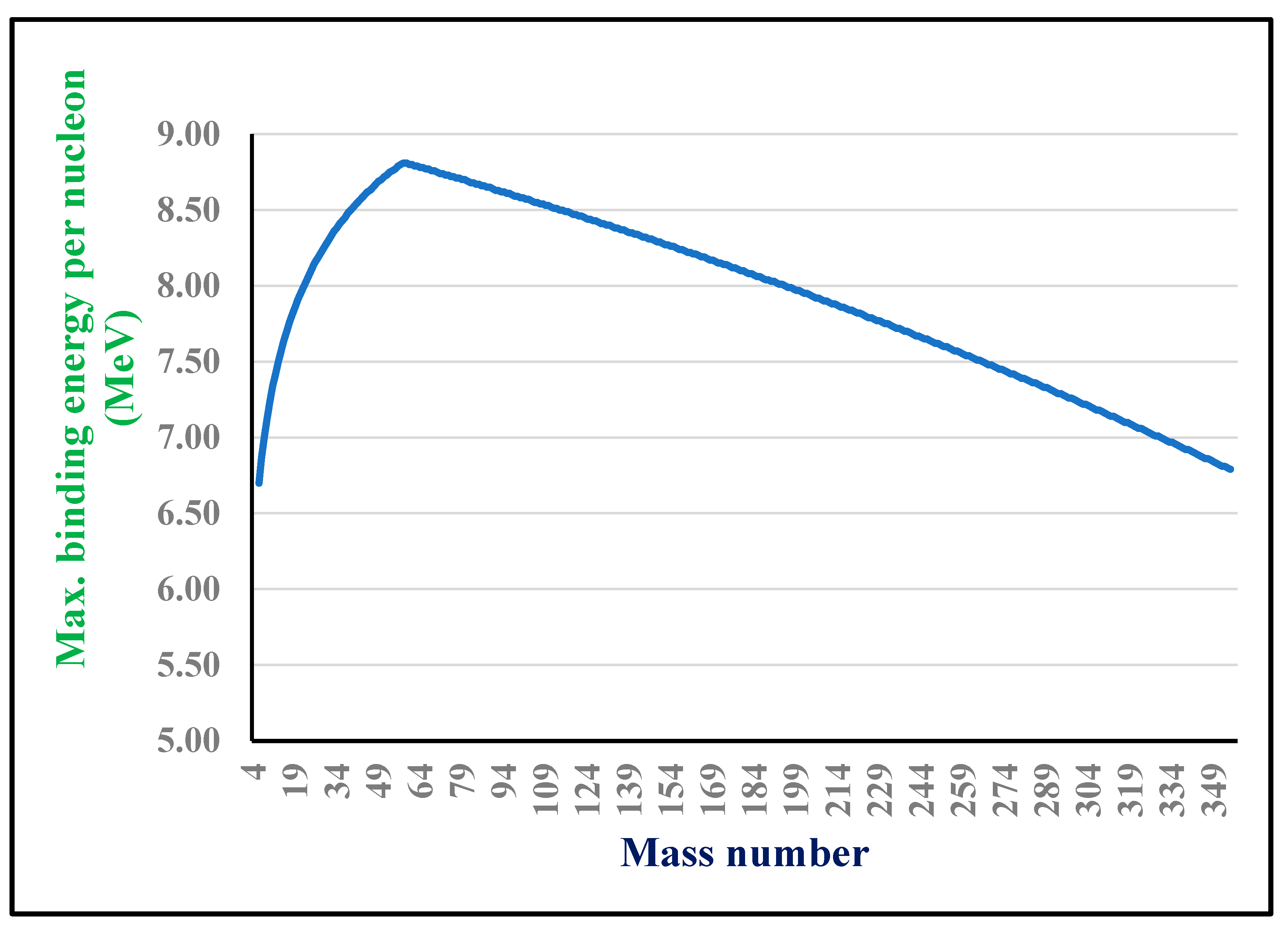
Table 1.
Charge dependent string tensions and string energies.
| S.No | Interaction | String Tension | String energy |
|
1 |
Weak |
||
|
2 |
Strong |
||
|
3 |
Electromagnetic |
Table 2.
Quantum string tensions and string energies.
| S.No | Interaction | String Tension | String energy |
|
1 |
Weak |
||
|
2 |
Strong |
||
|
3 |
Electromagnetic |
Table 4.
Estimated maximum binding energy per nucleon of assumed stable mass numbers.
| Assumed stable mass number A | Estimated maximum binding energy per nucleon (MeV) | Estimated maximum binding energy (MeV) | Estimated Stable Z |
Assumed stable mass number A | Estimated maximum binding energy per nucleon (MeV) | Estimated maximum binding energy (MeV) | Estimated Stable Z | |
| 4 | 6.7 | 26.8 | 2 | 179 | 8.09 | 1448.19 | 73 | |
| 5 | 6.87 | 34.35 | 2 | 180 | 8.08 | 1455.11 | 73 | |
| 6 | 7.01 | 42.08 | 3 | 181 | 8.08 | 1462.02 | 73 | |
| 7 | 7.13 | 49.94 | 3 | 182 | 8.07 | 1468.91 | 74 | |
| 8 | 7.24 | 57.93 | 4 | 183 | 8.06 | 1475.79 | 74 | |
| 9 | 7.34 | 66.03 | 4 | 184 | 8.06 | 1482.65 | 74 | |
| 10 | 7.42 | 74.22 | 5 | 185 | 8.05 | 1489.5 | 75 | |
| 11 | 7.5 | 82.49 | 5 | 186 | 8.04 | 1496.33 | 75 | |
| 12 | 7.57 | 90.85 | 6 | 187 | 8.04 | 1503.15 | 75 | |
| 13 | 7.64 | 99.28 | 6 | 188 | 8.03 | 1509.95 | 76 | |
| 14 | 7.7 | 107.77 | 7 | 189 | 8.03 | 1516.73 | 76 | |
| 15 | 7.76 | 116.33 | 7 | 190 | 8.02 | 1523.5 | 76 | |
| 16 | 7.81 | 124.94 | 8 | 191 | 8.01 | 1530.26 | 77 | |
| 17 | 7.86 | 133.61 | 8 | 192 | 8.01 | 1537 | 77 | |
| 18 | 7.91 | 142.32 | 9 | 193 | 8 | 1543.73 | 77 | |
| 19 | 7.95 | 151.08 | 9 | 194 | 7.99 | 1550.44 | 78 | |
| 20 | 7.99 | 159.89 | 10 | 195 | 7.99 | 1557.13 | 78 | |
| 21 | 8.03 | 168.73 | 10 | 196 | 7.98 | 1563.81 | 78 | |
| 22 | 8.07 | 177.62 | 11 | 197 | 7.97 | 1570.47 | 79 | |
| 23 | 8.11 | 186.54 | 11 | 198 | 7.97 | 1577.12 | 79 | |
| 24 | 8.15 | 195.5 | 12 | 199 | 7.96 | 1583.76 | 79 | |
| 25 | 8.18 | 204.49 | 12 | 200 | 7.95 | 1590.37 | 80 | |
| 26 | 8.21 | 213.51 | 13 | 201 | 7.95 | 1596.98 | 80 | |
| 27 | 8.24 | 222.56 | 13 | 202 | 7.94 | 1603.56 | 80 | |
| 28 | 8.27 | 231.64 | 13 | 203 | 7.93 | 1610.13 | 81 | |
| 29 | 8.3 | 240.75 | 14 | 204 | 7.92 | 1616.69 | 81 | |
| 30 | 8.33 | 249.88 | 14 | 205 | 7.92 | 1623.23 | 81 | |
| 31 | 8.36 | 259.04 | 15 | 206 | 7.91 | 1629.75 | 82 | |
| 32 | 8.38 | 268.22 | 15 | 207 | 7.9 | 1636.26 | 82 | |
| 33 | 8.41 | 277.43 | 16 | 208 | 7.9 | 1642.75 | 82 | |
| 34 | 8.43 | 286.65 | 16 | 209 | 7.89 | 1649.22 | 83 | |
| 35 | 8.45 | 295.9 | 17 | 210 | 7.88 | 1655.68 | 83 | |
| 36 | 8.48 | 305.17 | 17 | 211 | 7.88 | 1662.13 | 83 | |
| 37 | 8.5 | 314.46 | 18 | 212 | 7.87 | 1668.56 | 84 | |
| 38 | 8.52 | 323.76 | 18 | 213 | 7.86 | 1674.97 | 84 | |
| 39 | 8.54 | 333.08 | 18 | 214 | 7.86 | 1681.36 | 84 | |
| 40 | 8.56 | 342.42 | 19 | 215 | 7.85 | 1687.74 | 85 | |
| 41 | 8.58 | 351.78 | 19 | 216 | 7.84 | 1694.11 | 85 | |
| 42 | 8.6 | 361.15 | 20 | 217 | 7.84 | 1700.46 | 85 | |
| 43 | 8.62 | 370.53 | 20 | 218 | 7.83 | 1706.79 | 86 | |
| 44 | 8.63 | 379.93 | 21 | 219 | 7.82 | 1713.1 | 86 | |
| 45 | 8.65 | 389.34 | 21 | 220 | 7.82 | 1719.4 | 86 | |
| 46 | 8.67 | 398.77 | 22 | 221 | 7.81 | 1725.68 | 87 | |
| 47 | 8.69 | 408.21 | 22 | 222 | 7.8 | 1731.95 | 87 | |
| 48 | 8.7 | 417.66 | 22 | 223 | 7.79 | 1738.2 | 87 | |
| 49 | 8.72 | 427.12 | 23 | 224 | 7.79 | 1744.43 | 88 | |
| 50 | 8.73 | 436.59 | 23 | 225 | 7.78 | 1750.65 | 88 | |
| 51 | 8.75 | 446.07 | 24 | 226 | 7.77 | 1756.85 | 88 | |
| 52 | 8.76 | 455.56 | 24 | 227 | 7.77 | 1763.04 | 88 | |
| 53 | 8.77 | 465.07 | 25 | 228 | 7.76 | 1769.2 | 89 | |
| 54 | 8.79 | 474.58 | 25 | 229 | 7.75 | 1775.35 | 89 | |
| 55 | 8.8 | 484.1 | 25 | 230 | 7.75 | 1781.49 | 89 | |
| 56 | 8.81 | 493.63 | 26 | 231 | 7.74 | 1787.61 | 90 | |
| 57 | 8.81 | 502.14 | 26 | 232 | 7.73 | 1793.71 | 90 | |
| 58 | 8.8 | 510.64 | 27 | 233 | 7.72 | 1799.79 | 90 | |
| 59 | 8.8 | 519.12 | 27 | 234 | 7.72 | 1805.86 | 91 | |
| 60 | 8.79 | 527.6 | 28 | 235 | 7.71 | 1811.91 | 91 | |
| 61 | 8.79 | 536.07 | 28 | 236 | 7.7 | 1817.94 | 91 | |
| 62 | 8.78 | 544.52 | 28 | 237 | 7.7 | 1823.96 | 92 | |
| 63 | 8.78 | 552.97 | 29 | 238 | 7.69 | 1829.96 | 92 | |
| 64 | 8.77 | 561.4 | 29 | 239 | 7.68 | 1835.94 | 92 | |
| 65 | 8.77 | 569.82 | 30 | 240 | 7.67 | 1841.91 | 93 | |
| 66 | 8.76 | 578.23 | 30 | 241 | 7.67 | 1847.86 | 93 | |
| 67 | 8.76 | 586.63 | 31 | 242 | 7.66 | 1853.79 | 93 | |
| 68 | 8.75 | 595.01 | 31 | 243 | 7.65 | 1859.7 | 94 | |
| 69 | 8.74 | 603.39 | 31 | 244 | 7.65 | 1865.6 | 94 | |
| 70 | 8.74 | 611.75 | 32 | 245 | 7.64 | 1871.48 | 94 | |
| 71 | 8.73 | 620.1 | 32 | 246 | 7.63 | 1877.34 | 94 | |
| 72 | 8.73 | 628.45 | 33 | 247 | 7.62 | 1883.19 | 95 | |
| 73 | 8.72 | 636.77 | 33 | 248 | 7.62 | 1889.01 | 95 | |
| 74 | 8.72 | 645.09 | 33 | 249 | 7.61 | 1894.82 | 95 | |
| 75 | 8.71 | 653.4 | 34 | 250 | 7.6 | 1900.62 | 96 | |
| 76 | 8.71 | 661.69 | 34 | 251 | 7.6 | 1906.39 | 96 | |
| 77 | 8.7 | 669.98 | 35 | 252 | 7.59 | 1912.15 | 96 | |
| 78 | 8.7 | 678.25 | 35 | 253 | 7.58 | 1917.89 | 97 | |
| 79 | 8.69 | 686.51 | 35 | 254 | 7.57 | 1923.62 | 97 | |
| 80 | 8.68 | 694.75 | 36 | 255 | 7.57 | 1929.32 | 97 | |
| 81 | 8.68 | 702.99 | 36 | 256 | 7.56 | 1935.01 | 98 | |
| 82 | 8.67 | 711.21 | 37 | 257 | 7.55 | 1940.68 | 98 | |
| 83 | 8.67 | 719.42 | 37 | 258 | 7.54 | 1946.33 | 98 | |
| 84 | 8.66 | 727.62 | 38 | 259 | 7.54 | 1951.97 | 98 | |
| 85 | 8.66 | 735.81 | 38 | 260 | 7.53 | 1957.58 | 99 | |
| 86 | 8.65 | 743.99 | 38 | 261 | 7.52 | 1963.18 | 99 | |
| 87 | 8.65 | 752.15 | 39 | 262 | 7.51 | 1968.76 | 99 | |
| 88 | 8.64 | 760.31 | 39 | 263 | 7.51 | 1974.33 | 100 | |
| 89 | 8.63 | 768.45 | 40 | 264 | 7.5 | 1979.87 | 100 | |
| 90 | 8.63 | 776.57 | 40 | 265 | 7.49 | 1985.4 | 100 | |
| 91 | 8.62 | 784.69 | 40 | 266 | 7.48 | 1990.91 | 101 | |
| 92 | 8.62 | 792.8 | 41 | 267 | 7.48 | 1996.4 | 101 | |
| 93 | 8.61 | 800.89 | 41 | 268 | 7.47 | 2001.87 | 101 | |
| 94 | 8.61 | 808.97 | 41 | 269 | 7.46 | 2007.33 | 102 | |
| 95 | 8.6 | 817.04 | 42 | 270 | 7.45 | 2012.76 | 102 | |
| 96 | 8.59 | 825.09 | 42 | 271 | 7.45 | 2018.18 | 102 | |
| 97 | 8.59 | 833.13 | 43 | 272 | 7.44 | 2023.58 | 102 | |
| 98 | 8.58 | 841.17 | 43 | 273 | 7.43 | 2028.96 | 103 | |
| 99 | 8.58 | 849.18 | 43 | 274 | 7.42 | 2034.32 | 103 | |
| 100 | 8.57 | 857.19 | 44 | 275 | 7.42 | 2039.67 | 103 | |
| 101 | 8.57 | 865.18 | 44 | 276 | 7.41 | 2044.99 | 104 | |
| 102 | 8.56 | 873.17 | 45 | 277 | 7.4 | 2050.3 | 104 | |
| 103 | 8.55 | 881.14 | 45 | 278 | 7.39 | 2055.59 | 104 | |
| 104 | 8.55 | 889.09 | 45 | 279 | 7.39 | 2060.86 | 105 | |
| 105 | 8.54 | 897.04 | 46 | 280 | 7.38 | 2066.11 | 105 | |
| 106 | 8.54 | 904.97 | 46 | 281 | 7.37 | 2071.35 | 105 | |
| 107 | 8.53 | 912.89 | 47 | 282 | 7.36 | 2076.56 | 105 | |
| 108 | 8.53 | 920.8 | 47 | 283 | 7.36 | 2081.76 | 106 | |
| 109 | 8.52 | 928.69 | 47 | 284 | 7.35 | 2086.93 | 106 | |
| 110 | 8.51 | 936.57 | 48 | 285 | 7.34 | 2092.09 | 106 | |
| 111 | 8.51 | 944.44 | 48 | 286 | 7.33 | 2097.23 | 107 | |
| 112 | 8.5 | 952.3 | 48 | 287 | 7.33 | 2102.35 | 107 | |
| 113 | 8.5 | 960.14 | 49 | 288 | 7.32 | 2107.45 | 107 | |
| 114 | 8.49 | 967.97 | 49 | 289 | 7.31 | 2112.53 | 108 | |
| 115 | 8.49 | 975.79 | 50 | 290 | 7.3 | 2117.59 | 108 | |
| 116 | 8.48 | 983.59 | 50 | 291 | 7.29 | 2122.64 | 108 | |
| 117 | 8.47 | 991.39 | 50 | 292 | 7.29 | 2127.66 | 108 | |
| 118 | 8.47 | 999.17 | 51 | 293 | 7.28 | 2132.67 | 109 | |
| 119 | 8.46 | 1006.93 | 51 | 294 | 7.27 | 2137.65 | 109 | |
| 120 | 8.46 | 1014.69 | 52 | 295 | 7.26 | 2142.62 | 109 | |
| 121 | 8.45 | 1022.43 | 52 | 296 | 7.26 | 2147.57 | 110 | |
| 122 | 8.44 | 1030.16 | 52 | 297 | 7.25 | 2152.5 | 110 | |
| 123 | 8.44 | 1037.87 | 53 | 298 | 7.24 | 2157.41 | 110 | |
| 124 | 8.43 | 1045.57 | 53 | 299 | 7.23 | 2162.29 | 110 | |
| 125 | 8.43 | 1053.26 | 53 | 300 | 7.22 | 2167.16 | 111 | |
| 126 | 8.42 | 1060.94 | 54 | 301 | 7.22 | 2172.01 | 111 | |
| 127 | 8.41 | 1068.6 | 54 | 302 | 7.21 | 2176.85 | 111 | |
| 128 | 8.41 | 1076.25 | 54 | 303 | 7.2 | 2181.66 | 112 | |
| 129 | 8.4 | 1083.89 | 55 | 304 | 7.19 | 2186.45 | 112 | |
| 130 | 8.4 | 1091.51 | 55 | 305 | 7.18 | 2191.22 | 112 | |
| 131 | 8.39 | 1099.12 | 56 | 306 | 7.18 | 2195.97 | 113 | |
| 132 | 8.38 | 1106.72 | 56 | 307 | 7.17 | 2200.7 | 113 | |
| 133 | 8.38 | 1114.3 | 56 | 308 | 7.16 | 2205.42 | 113 | |
| 134 | 8.37 | 1121.87 | 57 | 309 | 7.15 | 2210.11 | 113 | |
| 135 | 8.37 | 1129.43 | 57 | 310 | 7.14 | 2214.78 | 114 | |
| 136 | 8.36 | 1136.97 | 57 | 311 | 7.14 | 2219.43 | 114 | |
| 137 | 8.35 | 1144.5 | 58 | 312 | 7.13 | 2224.06 | 114 | |
| 138 | 8.35 | 1152.01 | 58 | 313 | 7.12 | 2228.68 | 115 | |
| 139 | 8.34 | 1159.52 | 59 | 314 | 7.11 | 2233.27 | 115 | |
| 140 | 8.34 | 1167.01 | 59 | 315 | 7.1 | 2237.84 | 115 | |
| 141 | 8.33 | 1174.48 | 59 | 316 | 7.1 | 2242.39 | 115 | |
| 142 | 8.32 | 1181.94 | 60 | 317 | 7.09 | 2246.92 | 116 | |
| 143 | 8.32 | 1189.39 | 60 | 318 | 7.08 | 2251.43 | 116 | |
| 144 | 8.31 | 1196.83 | 60 | 319 | 7.07 | 2255.92 | 116 | |
| 145 | 8.31 | 1204.25 | 61 | 320 | 7.06 | 2260.39 | 117 | |
| 146 | 8.3 | 1211.66 | 61 | 321 | 7.06 | 2264.84 | 117 | |
| 147 | 8.29 | 1219.05 | 61 | 322 | 7.05 | 2269.27 | 117 | |
| 148 | 8.29 | 1226.43 | 62 | 323 | 7.04 | 2273.68 | 117 | |
| 149 | 8.28 | 1233.8 | 62 | 324 | 7.03 | 2278.07 | 118 | |
| 150 | 8.27 | 1241.15 | 63 | 325 | 7.02 | 2282.44 | 118 | |
| 151 | 8.27 | 1248.49 | 63 | 326 | 7.01 | 2286.78 | 118 | |
| 152 | 8.26 | 1255.81 | 63 | 327 | 7.01 | 2291.11 | 119 | |
| 153 | 8.26 | 1263.12 | 64 | 328 | 7 | 2295.42 | 119 | |
| 154 | 8.25 | 1270.42 | 64 | 329 | 6.99 | 2299.7 | 119 | |
| 155 | 8.24 | 1277.7 | 64 | 330 | 6.98 | 2303.96 | 119 | |
| 156 | 8.24 | 1284.97 | 65 | 331 | 6.97 | 2308.21 | 120 | |
| 157 | 8.23 | 1292.22 | 65 | 332 | 6.97 | 2312.43 | 120 | |
| 158 | 8.22 | 1299.46 | 65 | 333 | 6.96 | 2316.63 | 120 | |
| 159 | 8.22 | 1306.69 | 66 | 334 | 6.95 | 2320.81 | 121 | |
| 160 | 8.21 | 1313.9 | 66 | 335 | 6.94 | 2324.97 | 121 | |
| 161 | 8.21 | 1321.1 | 66 | 336 | 6.93 | 2329.1 | 121 | |
| 162 | 8.2 | 1328.28 | 67 | 337 | 6.92 | 2333.22 | 121 | |
| 163 | 8.19 | 1335.45 | 67 | 338 | 6.92 | 2337.32 | 122 | |
| 164 | 8.19 | 1342.61 | 67 | 339 | 6.91 | 2341.39 | 122 | |
| 165 | 8.18 | 1349.75 | 68 | 340 | 6.9 | 2345.44 | 122 | |
| 166 | 8.17 | 1356.87 | 68 | 341 | 6.89 | 2349.47 | 122 | |
| 167 | 8.17 | 1363.99 | 68 | 342 | 6.88 | 2353.48 | 123 | |
| 168 | 8.16 | 1371.08 | 69 | 343 | 6.87 | 2357.47 | 123 | |
| 169 | 8.15 | 1378.17 | 69 | 344 | 6.86 | 2361.44 | 123 | |
| 170 | 8.15 | 1385.23 | 70 | 345 | 6.86 | 2365.38 | 124 | |
| 171 | 8.14 | 1392.29 | 70 | 346 | 6.85 | 2369.3 | 124 | |
| 172 | 8.14 | 1399.33 | 70 | 347 | 6.84 | 2373.21 | 124 | |
| 173 | 8.13 | 1406.35 | 71 | 348 | 6.83 | 2377.09 | 124 | |
| 174 | 8.12 | 1413.36 | 71 | 349 | 6.82 | 2380.94 | 125 | |
| 175 | 8.12 | 1420.36 | 71 | 350 | 6.81 | 2384.78 | 125 | |
| 176 | 8.11 | 1427.34 | 72 | 351 | 6.81 | 2388.59 | 125 | |
| 177 | 8.1 | 1434.3 | 72 | 352 | 6.8 | 2392.39 | 126 | |
| 178 | 8.1 | 1441.25 | 72 | 353 | 6.79 | 2396.16 | 126 |
Disclaimer/Publisher’s Note: The statements, opinions and data contained in all publications are solely those of the individual author(s) and contributor(s) and not of MDPI and/or the editor(s). MDPI and/or the editor(s) disclaim responsibility for any injury to people or property resulting from any ideas, methods, instructions or products referred to in the content. |
© 2025 by the authors. Licensee MDPI, Basel, Switzerland. This article is an open access article distributed under the terms and conditions of the Creative Commons Attribution (CC BY) license (http://creativecommons.org/licenses/by/4.0/).
Copyright: This open access article is published under a Creative Commons CC BY 4.0 license, which permit the free download, distribution, and reuse, provided that the author and preprint are cited in any reuse.


