

Submitted:
17 November 2025
Posted:
18 November 2025
You are already at the latest version
Abstract
This study examines the relationship between Wasta—a social network based on family, lineage, tribe, and extended family ties—practiced by senior HRM employees, and how it affects entrepreneurial creativity, innovation, and sustainable development in the MENA region. The study also explores why entrepreneurs and countries in the MENA region are not ranked among the top 100 innovators in the Global Innovation Index. Additionally, it addresses why Wasta, as practiced by HRM employees, can impede sustainable development. The author drew on Amabile's Componential Theory of Organizational Creativity and Model of Creativity and Innovation in Organizations. Evidence was gathered from articles on Wasta, secondary data from the Global Innovation Index (GII) for 2025, and the Global Entrepreneurship Monitor (GEM NECI) in 2024. Secondary datasets were analyzed using constant comparative analysis of documents. These datasets included accessible online indices, the Global Innovation Index in 2025, the World's Most Innovative Companies Index by Forbes, and the Top 100 Global Innovators 2024 Rankings by Clarivate. The study develops a theoretical framework for the link between Wasta and sustainable development. It concludes that Wasta, when practised by senior HRM employees, is likely a reason why MENA entrepreneurs fall short in achieving sustainable development and why the region's countries are not among the top 100 innovative countries globally. The study answers why Wasta hinders sustainable development among MENA entrepreneurs. It recommends that entrepreneurs recognise the importance of fair HRM practices in hiring, supervisor selection, candidate selection, and promotions to foster innovation and sustainable development. The conclusions may also encourage policymakers to create and enforce new rules to reduce Wasta if they aim to stimulate innovation, sustainable development, and economic advantage in the MENA region.
Keywords:
Wasta
; HRM practices
; Global Innovation Index
; sustainable development
1. Introduction
Innovation is the transformation and commercialisation of creative ideas into products or services. Strategically, innovation is a competitive advantage that entrepreneurs strive to maintain to stand out and beat the competition. The United Nations Conference on Trade and Development (UNCTAD) has reported modest performance in nationwide innovation practices across several Arab MENA countries. According to the UNCTAD, innovation intake does not translate into innovation outcomes. Many wealthy MENA governments, such as Iran, the UAE, Qatar, and KSA, work with a view to innovation inputs (i.e., they invest in ICT, infrastructure, and human capital). They exceed the global average and trends but perform inefficiently across multiple innovation output indicators, such as patents, knowledge creation, knowledge diffusion, technical and scientific publications, and creative outputs. Entrepreneurs and countries understand that a business's competitive advantage is a cornerstone that can be achieved through sustainable innovation; they seek it because it opens new markets, increases sales, generates more revenue, diversifies a country’s economy, and increases a country’s Gross Domestic Product (GDP). On the other hand, Wasta, a social network and set of interpersonal connections rooted in family, tribe, and extended relationships, practised by senior human resource management (HRM), has negative influences on employee well-being and overall organisational performance [1]. These negative influences include low motivation, low competence, lack of loyalty, low engagement, psychological distress, lack of commitment, high turnover, reduced creativity, and frustration [2,3].
According to the Global Entrepreneurship Monitor Releases Ranking of Countries for Conditions to Start a Business in 2024, entrepreneurs in seven countries in the MENA region enjoy strong government support and financing. For example, Turkey, Morocco, Oman, the United Arab Emirates, Qatar, Jordan, Israel, and Saudi Arabia have been ranked among the top ten countries that nurture innovation by meeting almost all 12 entrepreneurial environment conditions. However, none of these countries ranked among the top ten best entrepreneurial conditions to start a business also ranks among the most innovative countries in the world according to the Global Innovation Index 2025 (Table 2) or the World's Most Entrepreneurial Countries, 2024 (Table 1). For example, Oman still ranks behind many countries that spend less on supporting entrepreneurs, according to the innovation ranking (e.g. Oman ranked 69 in 2025). When it comes to the number of patents (i.e., it is a kind of intellectual property that provides a lawful privilege for the originator to ban others from making or selling an invention for a limited time) granted (Table 2) none of these countries ranked in top ten best entrepreneurial conditions to start a business ranks in top ten among the countries with the most significant number of patents. For example, Table 2 shows that only Saudi Arabia ranks 20th (the last in the top 20 list), while the country ranks 3rd among the most governments that support and finance entrepreneurs. This index analysis leads to three research questions. First, how does Wasta relate to sustainable development? Second, why are many countries and their entrepreneurs in the MENA region not ranked among the top 100 innovators in the Global Innovation Index? Finally, and third, why does Wasta impede sustainable development?
The modest innovation performance in the MENA region could be attributed to four factors: economic diversification, labor-market inefficiencies, poor quality of the educational system, and the private sector's role in research and development (R&D). The literature on innovation barriers in the MENA region is unanimous in its view that research and development (R&D) expenditure influences a country's innovation capability [4]. According to Morrar [4], there is a significant concern in considerable of the MENA region countries concerning the shortcomings of innovation, precisely due to the lack of proper policy mechanisms, quality of these countries' innovation systems, the absence of proper economic systems, the inadequate schooling systems and increasing unemployment among young graduates (i.e., the gap between the schooling system and the needs in the labor market) [5] In addition, the announcement of the Global Innovation Index (GII) 2018 indicates that most MENA countries ranked at the bottom of the GII 2018 rankings, and the institutional framework in the MENA region is one of the leading barriers to innovation. The institutional framework includes regulations, laws, procedures, and stakeholders, along with their functions and norms, which shape the behavior and socioeconomic conditions in which employees in organisations work. However, there is a need to examine the influence of Wasta practiced by senior HRM employees in the MENA region on creativity and innovation and how that can hamper entrepreneurial innovation and impede sustainable development (i.e., he economic development that aims to balance social, economic, and environmental concerns). The literature review shows that creativity and innovation relate to expertise, task motivation, creativity skills [6], resources, organisational motivation, and management practices [7]. However, researchers have not explained why or how Wasta relates to creativity and innovation in the MENA. Hence, this study seeks to fill a gap in the literature by answering the three research questions above and developing a theoretical framework for the relationships among Wasta, creativity, innovation, and sustainable development in the MENA region. By answering the above questions, the study explains why Wasta hampers the MENA entrepreneurs' innovation progress and keeps MENA countries from becoming more innovative and achieving better, more sustainable economies; how Wasta relates to sustainable education; and why Wasta impedes sustainable development.
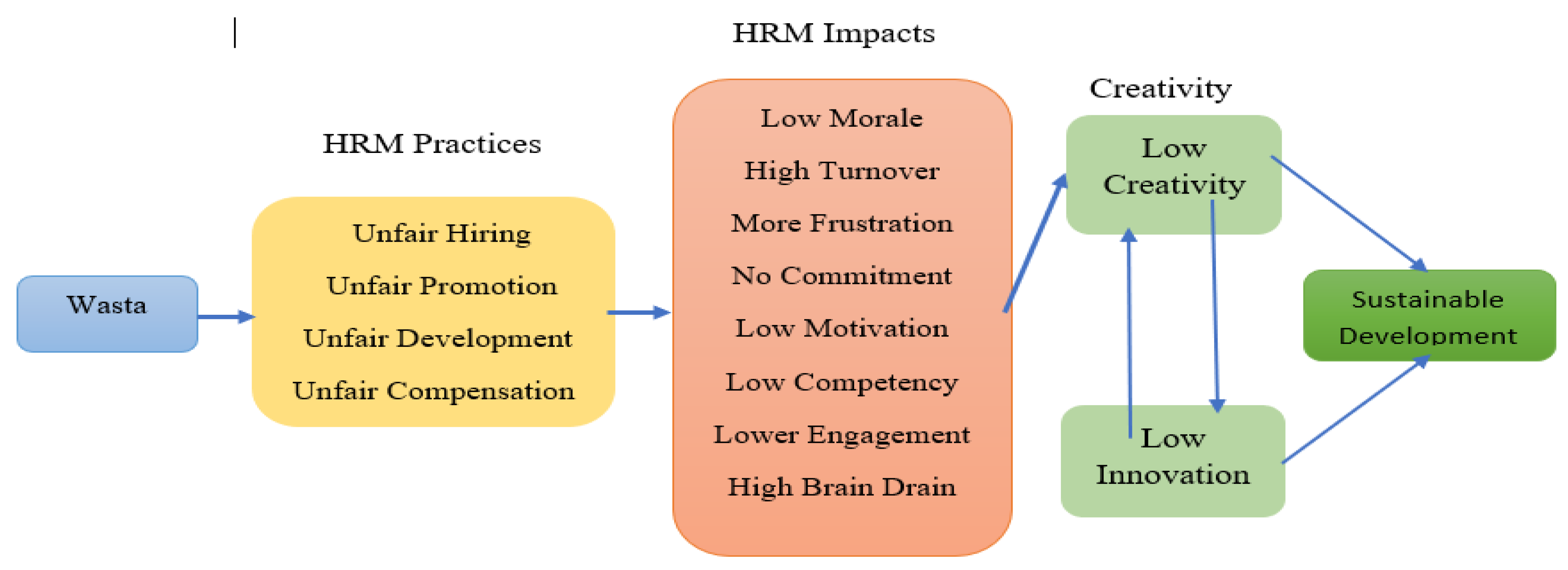
By addressing these questions, this study expands the Wasta theoretical model (Figure 1) to explain relationships among Wasta, creativity, innovation, corruption, and sustainable development for future research. Applying the Amabile model to the MENA context, the study also identifies direct and indirect barriers to entrepreneurial innovation and sustainability. Policymakers may use these findings to develop more effective HRM policies that minimize the impact of Wasta, thereby enhancing innovation capability and sustainable growth. Entrepreneurs should recognize the importance of fair HR managers and supervisors in hiring and promotion decisions.
2. Literature Review
2.1. The Global Innovation Index Versus the MENA Region Countries’ Ranking
The GII is an annual ranking of nations worldwide, based on their innovation features and performance [8]. GII is one of the most extensive surveys for drawing international comparisons in innovation geographies and was created by Cornell University, the European Institute of Business Administration, and the World Intellectual Property Organization (WIPO). GII 2018 retains precise metrics for 133 nations (around 93% of the world’s countries). It contains four significant dimensions: the general GII, the Input and Output Sub-Indices, and the Innovation Efficiency Ratio. However, the broad GII serves as the standard for the Input and Output Sub-Indices [8]. In the overall GII Index, MENA region countries lag behind Europe, Southeast Asia, East Asia, North America, and Oceania. Moreover, many Arab countries have shown the following trends in the GII since 2011. The GII lists 21 MENA region countries for which GII, innovation input and output, and the innovation efficiency ratio indices were available in the GII 2024 Report. Concerning the GII index, the author finds that Israel is the only country among the top 20 most innovative countries, only the United Arab Emirates, Turkey, and Saudi Arabia are in the top 50 most innovative countries, and only Iran, Morocco, Kuwait, Bahrain, Jordan, Oman, Tunisia, Egypt, and Lebanon are classified by the GII in the top 100 most countries.
2.2. Wasta in the MENA and Human Resource Management Practices
Wasta is the social network phenomenon of utilising personal connections to obtain jobs and access government services, tenders, licenses, etc., which would usually take a lot of effort or time to obtain [9]. In other words, Wasta is a shortcut for people who use Wasta individuals to get what they want without being qualified for a specific need. According to [10], Wasta is a social network and set of interpersonal relationships embedded in family, kinship, and tribal relationships. Families are the foundation and backbone of society in MENA and Arab communities (Barakat, 1993). That is why a family is an undisputed value in the MENA region.
Regardless of lineage association, MENA communities, and the Arab Society specifically, are relationship-oriented cultures that focus mainly on building and reinforcing connections within the business rather than on closing a deal [11]. Wasta in the MENA is built on social relationships and impacts business decision-making [10,12]. Some of these business decisions are made by HRM senior employees, including hiring, promoting, compensating, and developing employees. Hence, senior executive power or senior HRM authority allocation can negatively influence sustainable development if they make decisions to hire, promote, or develop less talented and qualified candidates and applicants [13].
According to Hofstede [14], the Arab countries in the MENA region Score high in collectivism (COL), harmony (HAR), and power distance (PD), which is an unequal distribution of power. These national dimensions of COL, HAR, and PD influence Wasta practice in the MENA and the Arab society [15] For instance, in Arab culture, PD promotes the use of Wasta to gain access to high-level individuals in society [16]. Wasta also relates to harmony, which is highly valued in the MENA region, where people are more likely to engage in behaviors that promote harmony and to refrain from behaviors that risk it [17]. In addition, uncertainty avoidance (UAE) may play a vital role in decision-making when negotiating with friends, family members, or strictly known strangers [16]. The impact of culture on Wasta is confirmed by Yahchouchi [18], who argued that Lebanese nationwide culture fosters relations-oriented leadership in firms rather than encouraging task-oriented leadership. Wasta is widespread across the Gulf Cooperation Council (GCC) countries, a part of the MENA region [19]. Moreover, Qatar, Saudi Arabia, Kuwait, and Sudan are some countries where Wasta has been empirically tested and confirmed by Alenezi, Hassan, Abdelrahim, and Albadry (2022, March) and Abdelrahim (2023). Ramafdy [19] and Iles, Almhedie, and Baruch [20] argue that Wasta is widely practiced by senior HRM employees in the MENA region, as people need it to secure jobs or promotions. The MENA region's culture is family-based, with family wealth and prestige determining status, power, and influence. In other words, Wasta is used not only to arrange for family members and close ones to obtain preferred jobs but also to secure their promotion [21].
HRM in the MENA region is significantly affected by national politics, global politics, national culture, religion, and Wasta [20]; according to Iles et al. [20], Wasta, cronyism, favoritism, personal considerations, and conflicts of interest influence HRM employees in the MENA region countries. For example, favoritism, comforting merit, salary recommendations, obedience, competence measures in a partisan manner, allowing liking, and exchanging favors impact performance ratings and development placements. Customary practices include utilising nepotism to acquire favors and advantages for family, relatives, and friends in selection, promotion, training, delegation, discipline, and reward.
As in the GCC countries, Wasta is widely used in the MENA because it fosters a sense of fulfillment, pride, gratification, and prestige [22]. According to the Hedonistic theory developed by Bentham [23], the feelings of fulfillment, pride, gratification, prestige, and the absence of discomfort when using Wasta are the key factors in Wasta practice among HRM senior employees. The theory proposes that individuals seek pleasure and bypass pain or sadness. Accordingly, a considerable number of people in the MENA exercise Wasta to seek happiness. The sensation of joy and happiness made by Wasta is disseminated by Wasta seekers and the Wasta people. According to Hunting and Weir [16], Wasta is a form of social capital (Routledge & Von Amsberg [24] that entitles people to leverage their social networks to overcome barriers to business [25].
In conclusion, Wasta's intention has changed over the last few decades from an intermediary role (i.e., helping resolve intergroup disputes) to an intercessory role (i.e., helping individuals obtain employment, promotions, etc.). Intercessory Wasta has opened the door to wrongdoing, such as favoring relatives and friends [26]. Wasta allows people to use their connections for personal interests [17]. Following the above-mentioned discussion and conclusion, the author posits propositions 1 and 2 (P1 and P2).
P1: Some cultural values, such as COL, PD, UAE, and HAR, influence Wasta practice in the MENA region.
P2: Wasta, as a cultural norm, is more likely to influence HRM senior employees working for entrepreneurs in the MENA region in hiring, promotion, and employee development.
2.3. Human Resource Management Wasta Practices Versus Employee Behavior and 2.4. Entrepreneurial Innovation
In Arab and Middle Eastern nations, sacred and cultural elements are believed to be powerful in shaping HRM approaches and practices [27,28]. For example, some cultural issues create a particular threat to the advancement of corporate performance in Saudi Arabia [29,30]. Aldossari and Robertson [31] suggest that the overall tradition of Wasta practice in Saudi Arabia stems from the powerful cultural collectivism within the Saudi community. Saudi Arabia is just one example of several MENA countries that follow suit. The same happens in other countries, such as Sudan, Egypt, Jordan, and Lebanon. Hence, Wasta, created through family relations, influences the appraisal approach in this country [32]. One of the core areas of Wasta practice in organisations is senior HRM employees [33]. For instance, employees in SACO generally perceive that managers' loyalty and performance evaluations are higher for employees linked to them through Wasta. Accordingly, the author believes that senior HRM managers working for entrepreneurs in the MENA region are more likely to be influenced by Wasta when evaluating employee performance and appraisal (i.e., hiring and promotion). According to Alsarhan and Valax [33], Wasta practice has damaging consequences for firm performance through its effect on worker morale, frustration, motivation, turnover, job satisfaction, brain drain, and workplace diversity [33]. Hence, the author Wasta's practice by HRM senior employees working for entrepreneurs in the MENA region is more likely to influence employee job satisfaction, motivation, engagement, commitment, turnover, performance, frustration, drained brain, morale, and organisational citizenship behavior, and the author posits proposition 3 (P3).
P3: Wasta practice by HRM senior employees working for entrepreneurs in the MENA is more likely to influence employee job satisfaction, motivation, engagement, commitment, turnover, performance, frustration, drain brain, morale, and organizational citizenship behavior negatively.
2.5. How Wasta Influences Entrepreneurs' Creativity, Innovation, and Sustainable Development
HRM practices are closely linked to innovation because they foster intrinsic motivation, loyalty, employee commitment, and learning, all of which are conducive to innovation [34,35]. In addition, the latter authors believe that the relationship between HRM practices and innovation, mediated by creativity, also exists [36]. According to Loewenberger [37], HRM is a vital part of organisational creativity and innovation, and therefore, it is a vital part of sustainable performance and development. Wasta constitutes an important component of the national culture of the MENA region [38]. The most common context for Wasta use in HRM is the recruitment process and other HRM practices that lead to the hiring of unqualified employees [33]. Some scholars, such as Aladwan et al. [39] and Branine and Analoui [40], argue that the practice of Wasta is the main, and arguably the most effective way for Arabs, in general, to get employed. The Arabs make up the majority of the population in the MENA region. Some scholars, such as Alkhanbshi and Al-Kandi [41], have argued that female workers are impacted by Wasta practice. This is the overall utilisation of Wasta in the workplace and the central role it takes in any HRM practice. For instance, private and public banks in Saudi Arabia are endlessly battling against the Wasta practice [42]. In addition, evidence also indicates that increased levels of Wasta practice are considered corruption that lowers levels of effective entrepreneurship and vice-versa” [43]. Furthermore, Wasta adversely affects firms' overall performance by influencing employee turnover, frustration, motivation, job satisfaction, workplace diversity, morale, commitment, and brain drain [39]. Adoption of innovation requires employee commitment and effort. The adoption of inventions requires employee commitment and effort, which constitutes an innovation barrier [44]. Hence, the lack of employee commitment to creativity and innovation caused by HRM Wasta practices negatively impacts entrepreneurial innovation. Accordingly, the author argues that HRM managers' practice of Wasta in the MENA region could negatively affect entrepreneurial innovation by undermining employee motivation through employee management practices [6]. The Componential Theory of Organizational Creativity and Innovation postulates that organisational creativity is a result of employees' or teams’ expertise, task motivation, and creativity skills, and creativity feeds organisational innovation, which in turn, is a result of the organisation's management practices [6,45,46,47]. Since HRM management practices in hiring and promotion are influenced by Wasta among Middle Eastern entrepreneurs, and innovation is usually a product of entrepreneurial activities, the author expects that Wasta hampers innovation in some businesses in the MENA region and posits propositions 4 and 5 (P4 and P5).
P4: The practice of Wasta by HRM managers among the MENA entrepreneurs influences the Middle Eastern and North African Entrepreneurial innovation.
P5: Lower employee motivation, resulting from Wasta practices by senior HRM employees in the MENA region, will negatively influence employees’ and teams’ creativity and, thereby, entrepreneurs’ innovation.
When it comes to how Wasta is practiced by the HRM senior employees, which hampers entrepreneurs’ innovation, and therefore, sustainable development, the author first relates Wasta to corruption and then links corruption to sustainable development, according to Aidt [48], sustainability, which is gauged by an increase in a country's real prosperity per capita. Empirical examination consistently shows that cross-national corruption lowers growth in actual per capita prosperity. Corruption is strongly and negatively related to sustainability [48], and Wasta is corruption [49]. Wasta has also been found to be favoritism [50], and favoritism is corruption [51]. Hence, the author believes that senior HRM employees' Wasta practice, as a new HRM practice, hinders entrepreneurs' sustainable innovation and entrepreneurial performance in the MENA region [52]. The author argues that Wasta practiced by senior HRM employees will impede entrepreneurial sustainable development because Wasta causes corruption, which hinders sustainable development in the organisation, and posits proposition six (P6).
P6: Wasta practised by senior HRM employees will impede sustainable entrepreneurial development in the MENA region because Wasta fosters corruption, which hinders sustainable development within organisations, thereby supporting the proposition.3. Methodology
3.1. Research Design
The author used a case study as a mythological approach to gather meaningful datasets and analyze them. The author uses a methodological approach to generate an in-depth understanding of Wasta as a contemporary issue or phenomenon in the MENA region, a bounded cultural system. The MENA region includes Syria, Iraq, Lebanon, Jordan, Israel, Kuwait, Iran, Bahrain, Qatar, Saudi Arabia (KSA), United Arab Emirates (UAE), Oman, Yemen, Algeria, Egypt, Libya, Morocco, Sudan, Tunisia, and Morocco-Western Sahara. In social science qualitative research, researchers widely use case study research as a method of data analysis [53]. Researchers in the social sciences are particularly well-suited to utilise it because there is a need to obtain an in-depth appreciation of Wasta as an issue of interest in its natural, real-life context in the MENA region countries. In addition, the author believes that a case study offers the possibility of greater depth of understanding of Wasta practice as an issue that hampers entrepreneurial creativity and innovation, and therefore sustainable development in the MENA region. Furthermore, the author believes that the case study design is preferred as a research strategy because it seeks to answer the “how,” “why,” and “what” questions, which are the researcher's areas of interest.
To answer the “why”, “what”, and “how” questions, the author employs a qualitative analysis technique, constant comparison, to examine records across several indices. Constant comparison analysis compares two or more data sets, documents, resources, or other objects, such as indices. Decision-tree analytics, filtering, and pattern analysis are types of comparative analysis. Constant comparison analysis systematically analyzes dissimilarities and similarities across discrepancies, allowing a researcher to assemble connections among earlier-built classifications, particularly in evaluating conclusions across various sources. The secondary datasets analyzed include accessible online indices, electronic and databases from the Global Innovation Index (GII) in 2025 (https://www.wipo.int/en/web/global-innovation-index), the Global Entrepreneurship Monitor's National Entrepreneurship Context Index (GEM NECI) in 2025 (https://www.gemconsortium.org/news/global-entrepreneurship-monitor-releases-ranking-of-countries-for-conditions-to-start-a-business), the World's Most Innovative Companies Index (Forbes), and the Top 100 Global Innovators 2024 Rankings Report (Clarivate)( https://www.forbes.com/innovative-companies/list/#tab:rank), the Most Entrepreneurial Countries (https://www.usnews.com/news/ best-countries/rankings/entrepreneurial), the top 100 Global Innovators 2024 Rankings Report (Clarivate) https://clarivate.com/top-100-innovators/, the World’s Most Entrepreneurial Countries, 2024 (https://ceoworld.biz/2024/04/05/worlds-most-entrepreneurial-countries-2024/), and the Patents by Country / Number of Patents Per Country 2024 (https://worldpopulationreview .com/ country-rankings/patents-by-country). (Table 3).
3.2. Secondary Data Collection
This section identifies diverse global innovation ranking indices at the country and organisational levels. These indices include the Global Innovation Index (GII) in 2025, the Global Entrepreneurship Monitor's National Entrepreneurship Context Index (GEM NECI) in 2025, the World's Most Innovative Companies Index (Forbes), and the Top 100 Global Innovators 2024 Rankings Report (Clarivate), the Most Entrepreneurial Countries, top 100 Global Innovators 2024 Rankings Report (Clarivate), the World’s (Most Entrepreneurial Countries, 2024), and the Patents by Country / Number of Patents Per Country 2024 (Table 3) aiming to unravel the relations between Wasta practiced by HRM senior employees, entrepreneurial creativity, innovation, and sustainable development in the MENA region countries. The focus is on identifying and understanding key indicators that shape innovation rankings among countries and entrepreneurs, including innovation inputs and outputs.
3.3. Exploring Ranking Indices
Delving into the nuances of global innovation ranking indices and systems provides rich insights into their distinctive approaches to ranking countries and companies. From the quantitative measures to constant comparison analysis, which compares two or more data sets, documents, resources, or other objects, this analysis aims to unravel the ranking criteria that form the foundation of the GII index as the main innovation index ranking yearly, allowing for a comparative evaluation of its inputs and outputs with other innovation indicators. For example, the key innovation inputs indicators are the following, as defined by the GII:
1. Institutions (Institutional environment, Regulatory environment, Business environment)
2. Human capital and research (Education, Tertiary education, Research and development).
3. Infrastructure (Information and communication technologies, General infrastructure, Ecological sustainability).
4. Market sophistication (Credit, Investment, Trade, diversification, and market scale).
5. Business sophistication (Knowledge workers, Innovation linkages, Knowledge absorption). Innovation input pillars capture areas of the economy that foster innovation. The idea is that today’s innovation inputs create the basis for tomorrow’s innovation outputs.
On the other hand, the key innovation outputs indicators are the following, as defined by the GII:
1) Knowledge and technology outputs (Knowledge creation, Knowledge impact, Knowledge diffusion).
2) Creative outputs (Intangible assets, Creative goods and services, Online creativity). Innovation outputs (knowledge, technology, and creative outputs) reflect the results of economic innovation activities.
The general GII innovation score is the average of input and output scores, based on which the GII ranks countries worldwide.
The National Entrepreneurial Context Index (NECI) and the number of Entrepreneurial Framework Conditions (EFCs) developed by Global Entrepreneurial Monitor (GEM) rank the most entrepreneurial countries every year as scoring sufficiently or better (score ≥ 5) on a scale ranging from zero (the least sufficient) to ten (the most sufficient). The GEM’s National Entrepreneurial Context Index (NECI) measures the quality of a country’s entrepreneurial environment, which fosters innovation. The MEM NECI is based on the average of the thirteen Entrepreneurial Framework Conditions (EFCs) that can enhance or hinder new business creation and that policymakers pay attention to. These thirteen EFCs include Entrepreneurial Finance, Government Policy (support and relevance), Entrepreneurial Education at School, Research and Development Transfers, Ease of Entry (market dynamics), Physical Infrastructure, Social and Cultural Norms, Ease of Access to Entrepreneurial Finance, Government Entrepreneurial Programs, Government Policy (Taxes and Bureaucracy), Entrepreneurial Education Post-School), and Commercial and Professional Infrastructure.
In addition, the World’s Most Entrepreneurial Countries Index, 2024, developed by CEOWORLD Magazine, ranks the economies of 190 countries worldwide based on entrepreneurs’ innovation. The index analyses 18 indicators across 6 leading categories: infrastructure, openness to business, competitiveness, innovation, access to capital, and labor skills. Furthermore, the World’s Most Innovative Companies Index (WMICI) ranks the most innovative companies worldwide; therefore, the WMICI indirectly also ranks the most innovative countries worldwide every year. Finally, the Top 100 Global Innovators Ranking Index (T100 GII), developed by Clarivate, ranks the world's most innovative companies yearly. The T100 GII measures innovation accumulation, contribution, and global innovation worldwide. Companies that rank in the top 100 innovators gain a place in research organisations that invest in innovation with passion and consistency. The companies demonstrate excellence.
3.4. Choosing Constant Comparison Analysis Technique
Constant comparison analysis is well known and used by renowned researchers, including the developers of grounded theory (Glaser & Strauss [54], Glaser [55], and Strauss [56]. These researchers have been credited with creating constant comparison analysis. According to Strauss and Corbin [57], constant comparison analysis has five principal characteristics:
1. to construct a theory as opposed to examining it;
2. to equip investigators with analytic instruments for dissecting data
3. to help researchers comprehend numerous implications from the dataset(s) presented
4. to deliver researchers with a methodical and creative technique for interpreting dataset(s)
5. to aid researchers in pinpointing, creating, and interpreting relationships among dataset components when forming a theme.
Constant comparison analysis has been revised to examine data collected in a single round and a single document from a single case, making it an exceptionally adaptable analytical technique.
3.5. Data Analysis and Procedures
To enable consistent comparison analysis of innovation ranking indices from digital or printed sources, the author collected secondary datasets. These datasets include online indices and electronic databases. Sources cover the Global Innovation Index (GII) 2025, the Global Entrepreneurship Monitor's National Entrepreneurship Context Index (GEM NECI) 2025, the World's Most Innovative Companies Index (Forbes), the Top 100 Global Innovators 2024 Rankings Report (Clarivate), the Most Entrepreneurial Countries rankings, the World’s Most Entrepreneurial Countries 2024, and Patents by Country/Number of Patents Per Country 2024. See Table 3 for a full list of sources.
3.6. The Study Results
The author followed Frels's [58] procedures as guidelines to conduct a constant comparison analysis of text in digital form (e.g., a set of electronic indices, articles, etc.), before using a constant comparison analysis and an alternative comparative analysis (a constant analysis technique index by index). The researcher chunks the information into smaller, concise, and meaningful parts. The author first read through the entire set of information, which had been chunked earlier. Next, the author chunked the information in the indices into even shorter, meaningful components. Then, the author assigned each piece of information an illustrative tag or code, so that the matching information was assigned the same code (Table 1). The author then systematically compared each unique piece of data with earlier codes, such that matching or comparable chunks of information are labelled with the exact code. After the author had coded all the information, the author clustered codes by similarly identified themes, and each theme was based on each identified cluster. Table 1 illustrates themes of innovation inputs (support) in indices. The author concludes that most innovation inputs are focused on supporting innovation, which, in turn, helps entrepreneurs and countries achieve sustainable development. As per the grounded theory, the study data theoretical saturation was reached when no further or pertinent information about innovation ranking seemed to add new knowledge to the topic (Morse, 1995; Strauss and Corbin, 1990

Table 1.
The Themes, Codes, and Factor Constant Comparison Analysis Techniques.
| Source of Information | Themes | Factors Identified |
| Literature Reviewed Articles | Theme 1: Culture Theme 2: HRM Practices Theme 3: HRM Impacts Theme 4: HRM Impacts Theme 5: Innovation |
1. PD, COL, HAR, UAE 1. Wasta 2. Unfair Hiring 2. Unfair Promotion 2. Unfair Development 2. Unfair Compensation 3. Low Morale 3. High Turnover 3. More Frustration 3. No Commitment 3. Low Motivation 3. Low Competency 3. Lower Engagement 4. Creativity 4. Innovation 5. Sustainable Development |
| Conditions to start a business based on Global Entrepreneurship Monitor's National Entrepreneurship Context Index (GEM NECI) in (2023). | Theme 1: the quality of a particular economy’s entrepreneurial environment that fosters innovation in a country Theme 2: Factors that enhance, hinder, or hinder entrepreneurial creativity and innovation. |
1. Creativity 2. Innovation |
| The GEM’s National Entrepreneurial Context Index (NECI) | Theme 1: Entrepreneurial conditions. | Innovation |
| Global Innovation Index by Country 2025 | Theme 1: Innovation inputs. | Innovation outputs (patents, knowledge creation, knowledge diffusion, patents, technical and scientific publications) |
| The World's Most Innovative Companies Index (Forbes) | Theme 1: Innovation impact ranking. | Innovative companies |
| The World’s Most Entrepreneurial Countries, 2024 | Theme 1: Easy access to capital for entrepreneurs, Skilled workforce, and competitive business environment. Theme 2: Entrepreneurial environment. |
Innovation |
| Patents by Country / Number of Patents Per Country 2024 | Theme 1: requirements, Patent laws, procedures, national laws, procedures. | Creativity Patents |
Source: The author’s own work.
In conclusion, the study's results, presented in the table, provide valuable insights into the diverse factors and themes shaping innovation. From the GII, the World's Most Entrepreneurial Countries, 2024; Patents by Country; the World's Most Innovative Companies Index (Forbes); and the Top 100 Global Innovators 2024 Rankings Report (Clarivate), these results underscore the multifaceted nature of entrepreneurial innovation, creativity, and sustainable development. Furthermore, the emphasis on innovation, creativity, and HRM Wasta practice shows how these factors are critical for sustainable development.
4. Conclusions
Throughout this research study, the author proposed an assessment of Wasta and its influence on HRM senior employees, entrepreneurial creativity, innovation, and sustainable development in the MENA region. The author endeavours to explain Wasta as a hindrance to entrepreneurial innovation and sustainable development, and to explore its relationship with Amabile's Componential Theory of Creativity and Innovation in Organizations. Additionally, this study's outcomes confirmed the damaging influence of Wasta on firms' overall performance, as supported by the literature and theory. The findings of this study are consistent with those of Overton [59] and Abdelrahim [60], who found that national culture directly influences a country’s innovation levels. However, this study argues that national culture influences innovation and sustainable development through Wasta practices. In addition, this study showed that the damaging consequences of Wasta on firms' performance are unavoidable outcomes of its effects on employees’ morale, brain drain, frustration, motivation, job satisfaction, diversity, and turnover. The findings of this study are consistent with the Componential Theory of Creativity and Innovation in Organizations developed by Teresa Amabile [6]. Furthermore, these study results are compatible with the outcomes of several aforementioned studies conducted in the MENA region, which affirm how Wasta creates negative impacts on organisations, given the broad variety of hostile influences, which not only fall on people in the workplace but also spread to the entirety of society, as well as the country's rates of innovation and sustainable development. It appears increasingly critical for entrepreneurs, business leaders, and HRM experts to understand the complex nature of Wasta and develop an innovative strategy for it.
In conclusion, the study develops a theoretical framework for the relationship between Wasta and sustainable development. In addition, the study concludes that Wasta practiced by senior HRM employees is more likely to explain why MENA entrepreneurs lag in achieving sustainable development and why their countries are not ranked among the top 100 most innovative countries worldwide. Furthermore, the study's conclusions answer the question of “why Wasta impedes sustainable development among the MENA entrepreneurs”. The report recommends that entrepreneurs understand that hiring fair HRM, selecting supervisors, selecting candidates, and promoting existing employees are critical to their innovation and sustainable development. Moreover, the study's conclusions might encourage policymakers to develop and implement new rules and regulations to tackle Wasta practices in the MENA region if they seek to foster innovation and sustainable development and ultimately acquire an economic comparative advantage. This study considers Jaganjac, Nikolić, and Lazarević's [61] study on Gren training recommendations. Similar to the Green training, this study recommends cultural and ethical training and development that reflect the set of commitments, attitudes, knowledge, abilities, skills, and employee engagement. Education about environmental protection and green behaviours leads to a positive attitude of managers and employees towards socially responsible behaviour, activities and practices.
This study is exploratory and relies solely on theory and literature to support the arguments. Future research should examine more studies empirically using primary or secondary datasets. Moreover, the study concludes that Wasta practiced by senior human resource management employees is more likely to explain why MENA entrepreneurs are less creative and less innovative, lag in achieving sustainable development, and why their countries are not ranked among the top 100 most innovative countries worldwide.
The authors suggest that policymakers should draft new laws to tackle Wasta and ensure their effective implementation. In addition, the author recommends that entrepreneurs be more cautious when selecting and hiring their top-level managers, particularly HRM managers and supervisors.
Appendices
Table 2.
The Summary of the Global Innovation Index Ranking, 2025, for the MENA Countries.
| Number | Rank | Country | Score |
| 1 | 15 | Israel | 52.7 |
| 2 | 32 | United Arab Emirates | 42.8 |
| 3 | 37 | Turkey | 39.0 |
| 4 | 47 | Saudi Arabia | 33.9 |
| 5 | 49 | Qatar | 33.9 |
| 6 | 64 | Iran | 28.8 |
| 7 | 66 | Morocco | 28.8 |
| 8 | 71 | Kuwait | 28.1 |
| 9 | 72 | Bahrain | 27.6 |
| 10 | 73 | Jordan | 27.5 |
| 11 | 74 | Oman | 27.1 |
| 12 | 81 | Tunisia | 25.4 |
| 13 | 86 | Egypt | 23.7 |
| 14 | 94 | Lebanon | 21.5 |
| 15 | 115 | Algeria | 16.2 |
| 16 | 127 | Mauritania | 13.2 |
| 17 | NA | Iraq | NA |
| 18 | NA | Yemen | NA |
| 19 | NA | Sudan | NA |
| 20 | NA | Syria | NA |
| 21 | NA | Libya | NA |
Source: The author’s work based on the Global Innovation Index Database, WIPO, 2024.
Table 2.
The World's Most Entrepreneurial Countries, 2024.
| Rank | Country | Score |
| 1 | United States | 42.88 |
| 2 | Germany | 41.05 |
| 3 | United Kingdom | 35.8 |
| 4 | Israel | 34.25 |
| 5 | United Arab Emirates | 31.01 |
| 6 | Poland | 29.75 |
| 7 | Spain | 29.01 |
| 8 | Sweden | 28.16 |
| 9 | India | 25.47 |
| 10 | France | 25.34 |
| 11 | Australia | 25.05 |
| 12 | Estonia | 24.64 |
| 13 | Ireland | 24.37 |
| 14 | Malaysia | 23.6 |
| 15 | Saudi Arabia | 22.98 |
| 16 | South Korea | 22.43 |
| 17 | Canada | 21.8 |
| 18 | Philippines | 21.62 |
| 19 | Denmark | 21.42 |
| 20 | Switzerland | 21.34 |
| 21 | Taiwan | 21.24 |
| 22 | Japan | 20.71 |
| 23 | Singapore | 20.05 |
| 24 | China | 20.04 |
| 25 | Austria | 19.92 |
| 26 | Portugal | 19.73 |
| 27 | Belgium | 19.72 |
| 28 | Italy | 19.46 |
| 29 | New Zealand | 18.55 |
| 30 | Thailand | 18.32 |
| 31 | Colombia | 18.25 |
| 32 | Bulgaria | 18.05 |
| 33 | Chile | 17.41 |
| 34 | Czech Republic | 17.37 |
| 35 | Mexico | 17.37 |
| 36 | Norway | 17.22 |
| 37 | Cyprus | 17.16 |
| 38 | Argentina | 16.96 |
| 39 | Latvia | 16.76 |
| 40 | Serbia | 16.55 |
| 41 | Brazil | 16.4 |
| 42 | Romania | 16.25 |
| 43 | Hungary | 16.19 |
| 44 | Netherlands | 16 |
| 45 | Indonesia | 15.42 |
| 46 | Greece | 15.23 |
| 47 | Croatia | 15.2 |
| 48 | South Africa | 15.12 |
| 49 | Luxembourg | 15.05 |
| 50 | Rwanda | 14.96 |
| 51 | Turkey | 14.95 |
| 52 | Slovenia | 14.86 |
| 53 | Slovakia | 14.8 |
| 54 | Russia | 14.79 |
| 55 | Belarus | 14.71 |
| 56 | Peru | 14.65 |
| 57 | Iceland | 14.65 |
| 58 | Qatar | 14.54 |
| 59 | Armenia | 14.41 |
| 60 | Malta | 14.4 |
| 61 | Morocco | 14.32 |
| 62 | Moldova | 14.23 |
| 63 | Kenya | 14.2 |
| 64 | Nigeria | 14.11 |
| 65 | Azerbaijan | 14.07 |
| 66 | Finland | 14 |
| 67 | Kazakhstan | 13.87 |
| 68 | Puerto Rico | 13.86 |
| 69 | Uruguay | 13.84 |
| 70 | North Macedonia | 13.59 |
| 71 | Georgia | 13.57 |
| 72 | Lithuania | 13.55 |
| 73 | Ukraine | 13.53 |
| 74 | Vietnam | 13.44 |
| 75 | Jordan | 13.38 |
| 76 | Tunisia | 13.38 |
| 77 | Ghana | 13.35 |
| 78 | Ecuador | 13.34 |
| 79 | Bahrain | 13.34 |
| 80 | Sri Lanka | 13.18 |
| 81 | Dominican Republic | 13.16 |
| 82 | Albania | 13.16 |
| 83 | Costa Rica | 13.06 |
| 84 | Bangladesh | 12.99 |
| 85 | Jamaica | 12.91 |
| 86 | Botswana | 12.85 |
| 87 | Lebanon | 12.8 |
| 88 | Iran | 12.66 |
| 89 | Cameroon | 12.65 |
| 90 | Egypt | 12.59 |
| 91 | Uganda | 12.59 |
| 92 | Venezuela | 12.59 |
| 93 | Trinidad &Tobago | 12.52 |
| 94 | Paraguay | 12.39 |
| 95 | Bolivia | 12.32 |
| 96 | Algeria | 12.28 |
| 97 | Ethiopia | 12.27 |
| 98 | Zambia | 12.27 |
| 99 | Pakistan | 12.24 |
| 100 | El Salvador | 12.18 |
Source. CEOWORLD Magazine - Latest - Special Reports - World’s Most Entrepreneurial Countries, 2024.
Table 3.
Patents by Country / Number of Patents Per Country, 2024-Ranking of 100 countries.
| Rank | Country | Total Patents Grants/Number of Patents |
| 19 | Israel | 5,358 |
| 22 | Turkey | 3,449 |
| 23 | Saudi Arabia | 2,684 |
| 26 | Iran | 2,250 |
| 37 | United Arab Emirates | 1,048 |
| 43 | Algeria | 610 |
| 46 | Morocco | 579 |
| 48 | Egypt | 495 |
| 56 | Bahrain | 197 |
| 73 | Syria | 65 |
| 75 | Jordan | 61 |
| 98 | Oman | 23 |
| 99 | Kuwait | 19 |
Source: The author's work derived from the Global Entrepreneurial Monitor 2023/2024 Global Report.
The Datasets Sources and their website links:-
- Conditions to start a business based on Global Entrepreneurship Monitor's National Entrepreneurship Context Index (GEM NECI) in (2023). https://www.gemconsortium.org/reports/latest-global-report
- the Most Entrepreneurial Countries https://www.usnews.com/news/best-countries/rankings/entrepreneurial
- Global Innovation Index by Country 2025 https://www.wipo.int/web-publications/global-innovation-index-2025/en/index.html
- The World's Most Innovative Companies Index (Forbes) https://www.forbes.com/innovative-companies/list/#tab:rank
- Top 100 Global Innovators 2024 Rankings Report (Clarivate) In this report, we rank the top 100 organizations leading the world in technology research and innovation. We measured global innovation by combining modern analytical architecture with our 60 years of experience to identify the top innovators transforming the world as we know it. https://clarivate.com/top-100-innovators/
- The World’s Most Entrepreneurial Countries, 2024 https://ceoworld.biz/2024/04/05/worlds-most-entrepreneurial-countries-2024/
- Patents by Country / Number of Patents Per Country 2024 https://worldpopulationreview.com/country-rankings/patents-by-country https://worldpopulationreview.com/country-rankings/patents-by-country
References
- Khalfan, S. (2024). Wasta in business management: a critical review of recent developments and future trends in the tourism sector. Humanities and Social Sciences Communications, 11(1), 1-10. [CrossRef]
- Talib, A. A. (2017). WASTA: The good, the bad and the ugly. Middle East Journal of Business, 12(2), 3-9.
- Ta’Amnha, M., Sayce, S., & Tregaskis, O. (2016). Wasta in the Jordanian context. In Handbook of human resource management in the Middle East (pp. 393-411). Edward Elgar Publishing.
- Morrar, R. (2018). Innovation in the MENA Region. Strategic Sectors| Economy & Territory.
- ESCAP, U., ECA, U., ECE, U., ESCWA, U., & ECLAC, U. (2017). World economic situation and prospects 2017.
- Amabile, T. M. (1983b). The social psychology of creativity: A componential conceptualization. Journal of personality and social psychology, 45(2), 357. [CrossRef]
- Amabile, T.M. (1988b). “From individual creativity to organizational innovation. In K.
- Dutta, S., Lanvin, B., & Wunsch-Vincent, S. (Eds.). (2018). The global innovation index 2018: Energizing the world with innovation.
- Alenezi, M., Hassan, S., Abdelrahim, Y., & Albadry, O. (2023). Wasta and Favoritism: The Case of Kuwait. In International Conference on Business and Technology (pp. 705-716). Springer, Cham.
- Cunningham, R. B., & Sarayrah, Y. K. (1993). Wasta: The hidden force in Middle Easternsociety. Praeger Publishers.
- Gesteland, R. (2005). Cross-cultural business behavior: Negotiating, selling, sourcing and managing across cultures (4th ed.). Copenhagen, Denmark: Copenhagen Business School Press.
- Cunningham, R. B., Sarayrah, Y. K., & Sarayrah, Y. E. (1994). Taming" wasta" to achieve development. Arab Studies Quarterly, 29-41.
- Huang, J., Xiang, Y., & Zhang, Z. (2025). Corporate low carbon governance: examining the influence of female executive power on carbon performance in Chinese listed companies. Humanities and Social Sciences Communications, 12(1), 1-14. [CrossRef]
- Hofstede, G. (1983). The cultural relativity of organizational practices and theories. Journal of international business studies, 14, 75-89. [CrossRef]
- Aldossari, M., & Robertson, M. (2014). The role of wasta in shaping the psychological contract: A Saudi Arabian case study. Paper presented at 74th Annual Meeting of the Academy of Management, Philadelphia, United States. [CrossRef]
- Hutchings, K., & Weir, D. (2006b). Understanding networking in China and the Arab World: Lessons for international managers. Journal of European Industrial Training, 30(4), 272-290. [CrossRef]
- Matsumoto, D. (2000). Culture and Psychology: People Around the World. Australia: Wadsworth Thomson Learning.
- Yahchouchi, G. (2009). Employees’ perceptions of Lebanese managers’ leadership styles and organizational commitment. International Journal of Leadership Studies, 4(2), 127-140.
- Ramady, M. A. (Ed.). (2016). The political economy of wasta: Use and abuse of social capital networking (p. vii). Switzerland: Springer International Publishing.
- Iles, P., Almhedie, A., & Baruch, Y. (2012). Managing HR in the Middle East: Challenges in the public sector. Public personnel management, 41(3), 465-492. [CrossRef]
- Stefanidis, A., Banai, M., & Dagher, G. K. (2022). Socio-cultural capital in the Arab workplace: Wasta as a moderator of ethical idealism and work engagement. Employee Relations: The International Journal, 45(1), 21-44. [CrossRef]
- Barnett, A., Yandle, B., & Naufal, G. (2013). Regulation, trust, and cronyism in Middle Eastern societies: The simple economics of “wasta”. The Journal of Socio-Economics, 44, 41-46. [CrossRef]
- Bentham, J. (1996). The collected works of Jeremy Bentham: An introduction to the principles of morals and legislation. Clarendon Press.
- Routledge, B. R., & Von Amsberg, J. (2003). Social capital and growth. Journal of Monetary Economics, 50(1), 167-193. [CrossRef]
- Xin, K. K., & Pearce, J. L. (1996). Guanxi: Connections as substitutes for formal institutional support. Academy of management journal, 39(6), 1641-1658. [CrossRef]
- Wunderle, W. D. (2008). A manual for American servicemen in the Arab Middle East: Using cultural understanding to defeat adversaries and win the peace. Skyhorse Publishing Inc..
- Budhwar, P., & Mellahi, K. (2007). Introduction: human resource management in the Middle East. The International Journal of Human Resource Management, 18(1), 2-10. [CrossRef]
- Metcalfe, B. D. (2007). Gender and human resource management in the Middle East. The International Journal of Human Resource Management, 18(1), 54-74. [CrossRef]
- Assad, S. W. (2002). Sociological analysis of the administrative system in Saudi Arabia: In search of a culturally compatible model for reform. International Journal of Commerce and Management, 12(3/4), 51-82. [CrossRef]
- Idris, A. M. (2007). Cultural barriers to improved organizational performance in Saudi Arabia. SAM Advanced Management Journal, 72(2), 36.
- Aldossari, M., & Robertson, M. (2016). The role of wasta in repatriates’ perceptions of a breach to the psychological contract: A Saudi Arabian case study. The International Journal of Human Resource Management, 27(16), 1854-1873. [CrossRef]
- Branine, M., & Pollard, D. (2010). Human resource management with Islamic management principles: A dialectic for a reverse diffusion in management. Personnel Review, 39(6), 712-727. [CrossRef]
- Alsarhan, F., & Valax, M. (2021). Conceptualization of wasta and its main consequences on human resource management. International Journal of Islamic and Middle Eastern Finance and Management, 14(1), 114-127. [CrossRef]
- Easa, N. F., & Orra, H. E. (2021). HRM practices and innovation: An empirical systematic review. International Journal of Disruptive Innovation in Government, 1(1), 15-35. [CrossRef]
- Alsarhan, F., Ali, S. A., Weir, D., & Valax, M. (2021). Impact of gender on use of wasta among human resources management practitioners. Thunderbird International Business Review, 63(2), 131-143. [CrossRef]
- Seeck, H., & Diehl, M. R. (2017). A literature review on HRM and innovation–taking stock and future directions. The International Journal of Human Resource Management, 28(6), 913-944. [CrossRef]
- Loewenberger, P. (2016). Human resource development, creativity and innovation. In Human resource management, innovation and performance (pp. 48-65). London: Palgrave Macmillan UK.
- Kassab, E. (2016). Influence of wasta within human resource practices in Lebanese universities (Doctoral dissertation, CQUniversity).
- Aladwan, K., Bhanugopan, R., & Fish, A. (2014). Managing human resources in Jordanian organizations: challenges and prospects. International journal of Islamic and middle eastern finance and management, 7(1), 126-138. [CrossRef]
- Branine, M., & Analoui, F. (2006). Human resource management in Jordan. In Managing human resources in the Middle-East (pp. 145-159).
- Alkhanbshi, A. S., & Al-Kandi, I. G. (2014). The religious values and job attitudes among female Saudi bank employees: A qualitative study. Journal of WEI Business and Economics, 3(1), 28-35.
- Fawzi, N., & Almarshed, S. (2013). HRM context: Saudi culture,” Wasta” and employee recruitment postpositivist methodological approach, the case of Saudi Arabia. Journal of Human Resources Management and Labor Studies, 1(2), 25-38.
- Avnimelech, G., Zelekha, Y., & Sharabi, E. (2014). The effect of corruption on entrepreneurship in developed vs non-developed countries. International Journal of Entrepreneurial Behavior & Research, 20(3), 237-262. [CrossRef]
- Madrid-Guijarro, A., Garcia, D., & Van Auken, H. (2009). Barriers to innovation among Spanish manufacturing SMEs. Journal of small business management, 47(4), 465-488. [CrossRef]
- Amabile, T. M., & Amabile, T. M. (1983a). The case for a social psychology of creativity. The Social Psychology of Creativity, 3-15. [CrossRef]
- Amabile, T. M. (1982a). Social psychology of creativity: A consensual assessment technique. Journal of personality and social psychology, 43(5), 997. [CrossRef]
- Amabile, T.M. (1988a). “A model of organizational innovation.” In B.M. Staw & L.L. Cummings (Eds.), Research in organizational behavior, Vol. 10. Greenwich, CT: JAI Press.
- Aidt, T. S. (2010). Corruption and sustainable development. International handbook on the economics of corruption, 2, 1-52.
- Abdelrahim, Y. (2023). Wasta and Corruption: The Case of Sudan. Humanities & Natural Sciences Journal, 4(2), 1157-1168.
- Alenezi, M., Hassan, S., Abdelrahim, Y., & Albadry, O. (2022, March). Wasta and favoritism: The case of Kuwait. In International Conference on Business and Technology (pp. 705-716). Cham: Springer International Publishing.
- Tytko, A., Smokovych, M., Dorokhina, Y., Chernezhenko, O., & Stremenovskyi, S. (2020). Nepotism, favoritism and cronyism as a source of conflict of interest: corruption or not?. Amazonia investiga, 9(29), 163-169. [CrossRef]
- Waheed, A., Miao, X., Waheed, S., Ahmad, N., & Majeed, A. (2019). How new HRM practices, organizational innovation, and innovative climate affect the innovation performance in the IT industry: A moderated-mediation analysis. Sustainability, 11(3), 621. [CrossRef]
- Von Coombs, H. (2022). The complex identities of international student-athletes competing in the NCAA: an exploratory qualitative case study (Doctoral dissertation, Northcentral University).
- Routledge.Glaser, B., & Strauss, A. (2017). Discovery of grounded theory: Strategies for qualitative research. Routledge.
- Glaser, B. G. (1978). Theoretical sensitivity. mill valley.
- Strauss, A. L. (1987). Qualitative analysis for social scientists. Cambridge university press.
- Strauss, A., & Corbin, J. (1990). Basics of qualitative research (Vol. 15). Newbury Park, CA: sage.Strauss, A., & Corbin, J. (1998). Basics of qualitative research techniques.
- Frels, R. K. (2010). The experiences and perceptions of selected mentors: The dyadic relationship in school-based mentoring. Sam Houston State University.
- Overton, J. (2020). Why DoSome Wine Regions Not Succeed?. Fermented landscapes: Lively processes of socio-environmental transformation, 57.
- Abdelrahim, D. Y. (2020). The influence of culture on rates of innovation: Re-examining Hofstede’s cultural dimensions. International Journal of Management, 11(9). [CrossRef]
- Jaganjac, J., Nikolić, J. L., & Lazarević, S. (2024). The importance of green human resource management practices for sustainable organizational development: Evidence from Serbia and Bosnia and Herzegovina. JEEMS Journal of East European Management Studies, 29(1), 157-180. [CrossRef]
Figure 1.
The Theoretical Framework for the Relationship between Wasta, HRM Practices, Creativity, Innovation, and Sustainable Development in the MENA Region Countries.
Figure 1.
The Theoretical Framework for the Relationship between Wasta, HRM Practices, Creativity, Innovation, and Sustainable Development in the MENA Region Countries.
Disclaimer/Publisher’s Note: The statements, opinions and data contained in all publications are solely those of the individual author(s) and contributor(s) and not of MDPI and/or the editor(s). MDPI and/or the editor(s) disclaim responsibility for any injury to people or property resulting from any ideas, methods, instructions or products referred to in the content. |
© 2025 by the authors. Licensee MDPI, Basel, Switzerland. This article is an open access article distributed under the terms and conditions of the Creative Commons Attribution (CC BY) license (http://creativecommons.org/licenses/by/4.0/).
Copyright: This open access article is published under a Creative Commons CC BY 4.0 license, which permit the free download, distribution, and reuse, provided that the author and preprint are cited in any reuse.


