
Submitted:
29 October 2025
Posted:
30 October 2025
You are already at the latest version
Abstract
The rapid decline in the costs of wind and solar power is accelerating the low-carbon transition of the power system. However, with the advancement of new-type power system construction, load control for power grid companies is facing multiple constraints. Based on the actual operational context of power grid companies in China, in this paper we systematically analyze the key constraining factors on load control from an industrial chain perspective. Firstly, we identify the constraining factors which affect the load control of power grid companies from the industrial chain viewpoint. Then, we propose an analytical method for key constraining factors based on a novel interactive group Decision Making Trial and Evaluation Laboratory (DEMATEL) approach. Finally, using Yunnan Power Grid Company in China as a case study, we identify specific constraining factors, including power generation costs, electricity pricing policies, distribution equipment capacity, and the level of grid intelligence, thereby providing a theoretical basis and practical pathways for enhancing the effectiveness of load control.
Keywords:
industrial chain
; sustainable development
; load control
; key constraining factors
; interactive group DEMATEL
1. Introduction
The rapid decline in the costs of wind and solar power is accelerating the low-carbon transition of the power system [1]. However, wind and photovoltaic power generation exhibit significant randomness and volatility. The increasing penetration of renewable energy generation places higher demands on its large-scale optimal allocation and the secure operation of the power grid [2]. It is projected that within the next decade, the daily fluctuation of newly added global renewable energy generation capacity will exceed 500 GW [3]. Furthermore, intensifying climate change amplifies these challenges: it not only increases the uncertainty of renewable energy output and the demand for climate-sensitive cooling and heating loads but also introduces greater variability beyond average climatic conditions [4]. Extreme weather events—such as prolonged periods of very high wind speeds or highly variable solar irradiation—can trigger sudden and unpredictable demands for large-scale flexible energy resources, thereby threatening the stable operation of the power system. Against this backdrop, load control, as a core function of power grid companies in power system operation, is seeing its importance increasingly highlighted [5,6]. Load control by grid companies achieves supply-demand balance by adjusting demand-side resources, ensuring the system’s secure, stable, and economical operation. With the deep integration of high-penetration renewable energy and the advancement of electricity market reforms, the load control paradigm is shifting from the traditional “generation following load” model towards a synergistic interaction of “generation-grid-load-storage” [7]. Concurrently, the low-emission advantages of renewable energy must not remain confined to the pilot stage but require scaled development. This necessitates efficient power allocation and utilization across wide areas, continuously increasing the share of clean energy, and driving the overall green transformation of China’s power industry chain [8]. Therefore, from the perspective of industrial chain sustainability, researching the key constraints on load control is of significant importance for enhancing system flexibility, promoting renewable energy integration, and achieving the carbon peak and carbon neutrality goals.
However, existing research predominantly focuses on technical aspects of load forecasting or optimization of individual segments, lacking a comprehensive analysis of the systemic constraints on load control from the holistic perspective of the entire industrial chain. For instance, while Stitt et al. [9] discussed key implementation factors for direct load control systems, they did not delve deeply into the synergistic interaction mechanisms among generation, distribution, and consumption segments. Similarly, although Zhang et al. [10] considered the impact of policy factors on load forecasting, they failed to incorporate the industrial chain synergy mechanism into an overall analytical framework. In practical applications, the volatility induced by renewable energy and extreme climate events imposes higher demands on the adaptability of load control [11], while changes in electricity pricing policies brought about by power market reforms [12] and constraints on distribution equipment capacity [13] further exacerbate the complexity of system operation. The deficiencies in systemic and synergistic analysis within existing research make it difficult to effectively address the challenges of load control under multi-factor coupling conditions.
This paper takes Chinese power enterprises as the research object to conduct a systematic study on the aforementioned issues. The main contributions of this research are reflected in the following three aspects: First, based on the holistic perspective of the industrial chain, we systematically identify the constraining factors in the load control of power enterprises, breaking through the limitation of existing literature that mostly focuses on technical details or single segments, and filling the research gap in systematic analysis in this field. Second, we propose a novel interactive group DEMATEL method that may effectively handle the complex causal relationships among multiple factors, providing new methodological support for the scientific identification and evaluation of factors influencing load control. Finally, taking Yunnan Power Grid Company in China as a case study for empirical research, we identify key constraining factors such as power generation costs, electricity pricing policies, distribution equipment capacity, and grid intelligence level, and accordingly propose collaborative optimization strategies, providing a theoretical basis and practical reference for power grid companies to enhance their load control capabilities and address the challenges brought by high penetration of renewable energy integration.
The structure of this paper is organized as follows: Section 2 provides a review of relevant domestic and international research literature. Section 3 conducts a preliminary analysis of the constraints on power grid companies’ load control from an industrial chain perspective. Section 4 suggests an analytical method for identifying key constraining factors, based on a novel interactive DEMATEL approach. Section 5 presents a case study applying this method to Yunnan Power Grid Company, leading to the identification of specific key constraints. Finally, Section 6 concludes the paper.
2. Literature Review
2.1. Collaborative Optimal Dispatch of Power Systems
Driven by the “Dual Carbon” goals, the large-scale integration of new energy sources and novel load types has introduced new challenges for the collaborative optimal dispatch of power systems [2,14]. Existing literature has conducted extensive research on the Economic Dispatch Problem (EDP), developing various centralized solution algorithms such as the Lagrange relaxation method [15], mixed-integer linear programming [16], and fuzzy optimization [17], among others. Although numerous methods have been proposed to solve the EDP, the core objective in constructing these overall planning models has consistently been the allocation of generation power at the minimum total operating cost. Clearly, abstracting the EDP into a simple single-objective planning problem is biased. In reality, besides minimizing total operating costs, multiple objectives such as grid security and stability must be considered, making the practical EDP a typical multi-objective planning problem [18]. Furthermore, in recent years, with the rapid development of renewable energy, the deployment of large-scale energy storage equipment, increasing stochastic electricity demand from electric vehicles, and the integration of new business models like virtual power plants, future power systems will exhibit a highly decentralized structure. This trend renders traditional centralized decision-making methods less effective in meeting distribution grid requirements, thereby drawing significant attention from researchers towards distributed solution methods [19-21]. Four typical categories of distributed solution methods have emerged: decomposition-based methods [14], game theory-based methods [22], learning-based optimization methods [23], and consensus-based methods [24,25]. It is crucial to emphasize that these four categories fundamentally assume decision-making within a stable, secure communication system with low information latency. Real-world scenarios are far more complex than those assumed in existing method designs. Consequently, there is an urgent academic need for systematic and in-depth research on distributed collaborative optimization dispatch problems under general conditions.
A review of existing literature on optimal load control reveals that the vast majority of studies focus on system-level collaborative optimization methods, attempting to gradually enhance the quality and level of load control decisions in power enterprises through algorithmic improvements. In reality, solving the optimal load control decision-making problem for power enterprises systematically is difficult to achieve through optimization analysis confined to a single segment. Therefore, based on the perspective of complex systems science, in this paper we systematically analyze the key constraining factors on load control from an industrial chain viewpoint, aiming to lay a preliminary foundation for future exploration of global optimization methods for power enterprise load control from the same perspective.
2.2. DEMATEL Method for Complex Systems
The Decision-Making Trial and Evaluation Laboratory (DEMATEL) is a method for conducting structured causal analysis of factors within complex systems, originally developed by American scholars Fontela and Gabus in the 1970s. Over the past decade, this method and its extensions have garnered significant attention from scholars in the fields of management science and systems engineering both domestically and internationally [26,27]. To date, it has been widely applied across numerous domains such as blockchain [28,29], performance measurement [30,31], green supply chain management [27,32], low-carbon management [33,34], and safety management [35,36]. However, the vast majority of related studies are application-oriented or represent outcomes combining DEMATEL with other methods, with relatively limited innovation at the methodological level. Furthermore, existing research has primarily focused on extending the forms of expressing expert preference information, particularly the construction of linguistic scales (including the form of preferences and the granularity of linguistic term sets). To handle the fuzziness and uncertainty inherent in expert judgments, scholars have proposed various mathematical representation forms, including point estimates [37-40], interval estimates [41], fuzzy numbers [42,43], grey numbers [44,45], and Z-numbers [46,47], among others. Among these, fuzzy numbers and their variants (such as triangular fuzzy numbers [48], trapezoidal fuzzy numbers [49], intuitionistic fuzzy numbers [50], Pythagorean fuzzy numbers [51], q-rung orthopair fuzzy numbers [52], spherical fuzzy numbers [53], etc.) account for over 80% of the applications, exhibiting a trend towards increasing complexity and mathematical sophistication.
However, from the perspective of deep-level methodological mechanism cognition, existing DEMATEL expert preference expression methods still exhibit significant limitations at the mechanistic level. Firstly, although the increasingly complex and diverse expression methods for DEMATEL expert information have positive significance at the mathematical measurement level for addressing the fuzziness and hesitation uncertainty present in expert judgment processes, their contribution to fundamental methodological innovation and practical promotion remains extremely limited. On one hand, new forms of DEMATEL expert preference information expression that appear “varied and diverse” on the surface continue to emerge, but their necessity and effectiveness still lack sufficient demonstration. On the other hand, the fascination with attempting to use purely mathematical techniques to solve the fuzziness and uncertainty in expert judgment processes somewhat detaches from the essential requirement of practical applicability of the method. Secondly, the mathematical processing of complex fuzzy uncertain information expressions themselves is also subject to questioning and criticism from experts and scholars due to numerous technical limitations. For example, methods such as Pythagorean fuzzy numbers are not accurate enough in characterizing the degree of hesitation, and most fuzzy sets struggle to comprehensively capture the characteristics of expert judgments [34,54,55]; simultaneously, the need to introduce additional assumptions and auxiliary functions (such as membership functions) also affects the reliability of the results [56]. To overcome the aforementioned shortcomings, in this paper, we suggest a novel interactive group DEMATEL method from the perspective of integrating subjective and objective data to systematically analyze the key constraining factors of load control in power enterprises.
In summary, existing research has systematically revealed the main challenges faced by power grid load optimization control, focusing on collaborative optimization methods to enhance the quality and level of decision-making in load regulation for power enterprises. However, from the perspective of industrial chain sustainability, current analyses of key constraints on load control for power grid companies still exhibit the following shortcomings: Firstly, the research focus is relatively narrow, with most studies starting only from the demand-side management of distribution system operators [12,21], failing to fully reflect the impact of multi-sector collaboration within the power supply chain on load control [57]. Secondly, existing analyses of factors influencing load control are mostly limited to single factors (such as policy [10] or weather [11]) or a few factors (such as meteorology, date, region, etc. [58]), lacking a systematic examination of the complex interdependencies among different constraints. Currently, only a few studies exist, such as Gedam et al. [59] who used the DEMATEL method to analyze human and organizational barriers to sustainable development in the Indian power industry, Li et al. [60] who identified key influencing factors in the transition of Chinese coal-fired power plants based on an improved fuzzy DEMATEL method, and Du et al. [61] who combined DEMATEL with the MARCOS method in a rough fuzzy environment to construct an evaluation model for the carbon neutrality potential of urban power grids considering internal and external uncertainties and attribute correlations. However, these studies are mostly application-oriented or methodological combinations, and have not yet overcome the significant limitations at the mechanistic level of existing DEMATEL expert preference expression methods. In particular, the traditional DEMATEL method over-relies on subjective expert judgment, easily introducing significant bias, which consequently compromises the reliability of the analysis results. Therefore, based on complex systems thinking, this paper systematically identifies the key constraining factors on load control for power enterprises from an industrial chain perspective and proposes a novel interactive group DEMATEL method that integrates interactive group experts’ information to scientifically identify key influencing factors, thereby enhancing the accuracy and reliability of load control decisions.
3. Preliminary Identification of Constraints
Against the backdrop of the global low-carbon transition in the energy system, systematically addressing the challenges brought by the integration of high-proportion, volatile, and intermittent renewable energy sources to achieve their safe, economical, and efficient large-scale utilization is an important research topic that urgently requires exploration by all sectors of society [2]. However, constrained by the “energy trilemma,” the core issue to be solved in the aforementioned topic is the spatiotemporal mismatch between the traditional rigid power system and emerging flexible renewable energy sources [62]. To address this core issue, it is necessary to adopt a systematic analytical framework that transcends a single technological or policy perspective to effectively identify the preliminary constraints on load control for power grid companies from the viewpoint of industrial chain sustainability. Therefore, the following section constructs an analytical framework of “Power Supply Chain - Technology and Economics - Policy and Market” from the integrated three-dimensional perspective of the physical foundation, driving engines, and regulatory framework of the power system, as shown in Figure 1.
In Figure 1, the power supply chain constitutes the physical constraints of the system, encompassing the power source structure, grid capability, and load characteristics. It directly determines the grid integration and consumption capacity of renewable energy, serving as the objective carrier and ultimate foundation for the system transformation. The technological and economic dimension provides feasibility constraints for the transition, addressing the questions of “how to achieve it” and “whether it is cost-effective” through technological performance, cost-benefit analysis, and business model innovation, thereby supporting the physical transformation of the system. Policies and markets function as the institutional framework, shaping the behavioral motivations and investment decisions of all parties through policy objectives, market mechanisms, and price signals, providing incentives and rules for system evolution. Therefore, these three dimensions form an inseparable organic whole.
Based on the above analytical framework, and through systematic understanding and in-depth analysis of the relationships among various segments of the power grid industry chain, supplemented by interviews with Chinese power experts and practitioners engaged in power load control management, preliminary constraints have been identified from three aspects: the power supply chain (generation side, transmission and distribution side, consumption side), policy and market, and technology and economics. Details are provided in Table 1.
4. Analysis of Key Constraining Factors for Power Load Control Based on a Novel Interactive Group DEMATEL Method
The Decision-Making Trial and Evaluation Laboratory (DEMATEL), developed by the Battelle Memorial Institute in Geneva, aims to analyze complex system factor problems in fields such as energy, technology, society, and the environment. This method integrates qualitative analysis and quantitative evaluation to reveal causal relationships within complex systems [32]. Currently, the DEMATEL method has been widely applied domestically and internationally in various domains including accident analysis, risk management, and decision analysis. It can not only transform the direct influence relationships between system factors into the cause degree and center degree of system factors through graph theory but can also further identify key influencing factors in complex system problems.
However, it should be noted that the traditional DEMATEL method overly relies on the subjective judgment information of decision analysts (experts), which may contain significant judgment errors, leading to prominent issues such as poor reliability in the method’s decision outcomes. To address this problem, the authors argue that the DEMATEL method should be preceded by adequate preparation of relevant qualitative and quantitative data information for each system factor. Only in this way can the fuzziness and uncertainty of expert judgment be reduced at the source. Therefore, this paper proposes a new qualitative-quantitative integrated DEMATEL method to analyze the key influencing factors of power load control.
4.1. Expert Weighting Model Based on Quantitative Assessment of Professional Competence
In group decision-making, evaluating the professional competence of experts is crucial. The most ideal approach is to determine this based on the actual accuracy rates of experts’ past decisions. However, this method faces significant limitations in practical application: on one hand, data regarding the quality of experts’ past decisions is often difficult to obtain systematically; on the other hand, in many critical fields (such as medical diagnosis, financial risk assessment, etc.), acquiring authoritative “ground truth labels” is extremely costly, and may even be unfeasible due to ethical considerations, timeliness, or resource constraints [78]. Therefore, a feasible and effective alternative is needed. To address this, this study adopts a comprehensive indicator composed of the expert’s professional position, years of work experience, and educational level as the basis for measuring their professional competence.
Definition 1: Letandrepresent the expert professional position, years of work experience, and education level score of expert, respectively. The professional degree of expertis then defined as:
Among these, professional position reflects an expert’s seniority and influence within the field, with higher positions typically representing a broader perspective and more widely recognized contributions; years of work experience reflect the accumulation of practical knowledge, as long-term practitioners often possess a deeper understanding of industry evolution and complex scenarios; educational level correlates with their theoretical training and systematic analytical capabilities, with higher academic qualifications often corresponding to superior logical thinking and knowledge integration abilities. Higher scores across these indicators signify a stronger capacity for mastering domain knowledge, addressing practical problems, and forming accurate judgments.
Based on the discussion of professional degree, the expert weight is constructed as follows:
Calculating expert weights based on professional degree offers both theoretical rationality and practical advantages: First, this method enhances the reliability of weight allocation by assigning higher weights according to professional degree, which aligns with decision optimization principles; second, the selected indicators are easy to obtain and verify, overcoming the high costs and implementation barriers associated with relying on actual performance data; finally, the multi-dimensional integration avoids biases inherent in single indicators, providing a more comprehensive reflection of an expert’s professional level.
4.2. Expert Consensus Measurement
Since achieving complete unanimity among a group of experts is both highly difficult and unnecessary in most group decision-making scenarios [79,80], this paper adopts a soft consensus approach for reaching agreement, using the distance between each expert’s preferences and the group preferences as the measure of consensus level.
Definition 2: Letbe the evaluation value of expertin the-th round, andbe the evaluation value of expertin the-th round. Then the consensus degree of expertin the-th round is defined as:
In (3), represents the opinion similarity between expert and in the -th round. The smaller , the worse the consensus level of expert will be. Incorporating expert weights, the group consensus level in the -th round is:
If the group consensus level (where is the consensus threshold), it is considered that all experts have reached consensus, and the larger is, the higher the degree of consensus. Otherwise, a feedback process is implemented to improve the consensus level.
4.3. Hierarchical Consensus Adjustment Strategy
To more flexibly guide members in adjusting their preferences to enhance the group consensus level, this paper constructs a hierarchical consensus model and formulates corresponding consensus adjustment strategies based on the phased consensus level achieved by the group. First, by setting the average values of expert weights and consensus degrees as threshold benchmarks for dimension division, the ICA (Important-Consensus Analysis) chart is partitioned into four quadrants (or categories). Then, an ICA chart is designed to implement the analysis of expert importance and consensus degree (see Figure 2), where the X-axis and Y-axis represent expert importance and consensus degree, respectively. The evaluation values of all experts are mapped to a two-dimensional coordinate system through their weights and consensus degrees (see the black dots in Figure 2). The detailed descriptions of the four quadrants in Figure 2 are as follows:
(1) The first quadrant is described as the “ideal zone.” Experts in this region possess both high importance and high consensus. This indicates that they are not only authoritative in their professional field but also that their opinions are highly aligned with the mainstream views of the group. They serve as the core and stabilizers for achieving consensus. Such experts are regarded as a cohesive cluster and represent the most reliable and critical source of opinions within the group.
(2) The second quadrant is described as the “consensus-priority zone.” Experts in this region exhibit high consensus but low importance. Their opinions align with the mainstream views of the group, but their professional authority or influence is relatively limited. While their views reflect general group sentiment, their input requires cautious consideration in decision-making due to lower expertise, making them more suitable as supplementary forces for consensus building.
(3) The third quadrant is described as the “most isolated zone.” Experts in this region exhibit both low importance and low consensus. Their opinions lack professional weight and significantly deviate from the mainstream views of the group. These experts are relatively isolated, and their contributions to reducing systemic uncertainty are minimal. Forcibly integrating them into the cluster may be inefficient; when consensus is already high, allowing them to maintain independence might be a preferable option.
(4) The fourth quadrant is described as the “expert weight priority zone.” Experts in this region exhibit high importance but low consensus. They are authoritative experts in their field, yet their viewpoints significantly diverge from the mainstream views of the group. These experts are key individuals, but their dissent may hinder consensus formation. Focused attention and guidance are required to address their opinions, as their alignment is crucial for enhancing the overall consensus level.
Then, set consensus thresholds . The dual thresholds represent a key optimization of the consensus management strategy, dividing the consensus level into three grades (high, medium, low) and achieving a shift from a binary judgment of “whether consensus is reached” to a precise diagnosis of “to what degree.” Based on this, a dynamic hierarchical strategy can be formulated: terminate the process when consensus is high; provide precise guidance to core dissenting experts ( or ) when consensus is medium; and implement comprehensive intervention in expert interaction when consensus is low. This not only significantly improves the efficiency of consensus achievement but also markedly reduces decision-making costs by optimizing resource allocation and focusing on key points of disagreement, thereby enabling refined control over complex decision-making processes. Finally, based on the above-mentioned, a feedback recommendation mechanism for subgroup opinion adjustment targeting different expert groups’ consensus levels is constructed.
Rule : If , the entire group is at a low consensus level, and the opinion similarity among subgroups is low. In this context, to improve the efficiency of consensus achievement, all experts need to adjust their opinions. First, select the expert opinion with the highest importance from quadrant as reference information. The reference expert is defined as:
Then, construct a modification reference set to guide expert in opinion adjustment to expand the decision space:
Rule : If , the entire group is at a medium consensus level. Generally speaking, after several rounds of opinion adjustments, when the group consensus level exceeds the preset minimum threshold, conducting large-scale opinion adjustments would lead to a waste of resources and time. Therefore, in this context, priority is given to adjusting the opinions of experts in quadrant . First, select the expert opinion with the highest similarity from quadrant as reference information. The reference expert is defined as:
Next, construct a modification reference set to guide expert in opinion modification to expand the decision space:
If experts in quadrant refuse to adjust their opinions or the adjustment made by experts in quadrant is too small, resulting in the group consensus remaining below , then it is necessary to adjust the opinions of experts in quadrant . First, select the expert opinion with the highest similarity from quadrant or quadrant as reference information. The reference expert is defined as:
Subsequently, construct a modification reference set to guide expert in opinion modification to expand the decision space:
Rule : If , when the group’s consensus level is sufficiently high, the consensus adjustment process ends and proceeds to the next stage of factor analysis.
4.4. Key Constraining Factors Analysis Method for Power Grid Load Control from the Perspective of Industrial Chain Sustainable Development
This paper takes expert importance and consensus as driving elements, constructs an expert opinion interaction mechanism through the ICA chart, designs a hierarchical consensus adjustment strategy, analyzes the complex causal relationships among factors within the system, and accordingly proposes a novel interactive DEMATEL decision-making method. The specific construction idea is shown in Figure 3.
Following the above methodological construction idea, the implementation steps of the interactive group DEMATEL decision-making method are given as below:
Step 1: Determine the system factor set for this complex problem analysis. Based on the preliminary identification of influencing factors for power load control in Chinese power grid companies in Section 3, determine the factor set for this practical problem .
Step 2: Data and information preparation. The system decision-making body should organize relevant personnel before the formal group DEMATEL analysis to collect, organize, and conduct in-depth analysis of information related to system indicator factors through multiple channels including field research, network technology (web crawling, etc.), professional databases (CNKI, Web of Science, Elsevier, Emerald, Gale, Wiley, etc.), relevant statistical yearbooks, and related data platforms. This establishes a solid preliminary information foundation for subsequent group experts to conduct analysis and judgment, fully reflecting the integration of qualitative and quantitative data information support.
Step 3: Construct an initial direct influence matrix reflecting the practical problem. After completing the preliminary identification of influencing factors for power load control in China, invite m experts with extensive experience in the power field, including university scholars, power enterprise experts, and experts from relevant government management departments, to judge the inter-influence relationships among various factors according to the scale in Table 2. By averaging the scores from each expert, finally form a direct influence matrix as shown in Equation (11), with the specific calculation formula as follows:
In Equation (11), the direct influence matrix element represents the degree of direct influence of indicatoron indicatorgiven by expert after the -th round of interaction. Additionally, the decision-maker provides consensus thresholds .
Step 4: Calculate expert weights and expert consensus degree. Based on the discussion of expert professional degree in Section 4.1, the expert weight is derived using formulas (1) and (2). Based on formula (3) in Section 4.2, the consensus degree of expert in the -th round is obtained, and the group consensus degree is further calculated using formula (4). Then, it is determined whether is satisfied. If yes, the process proceeds to Step 8; otherwise, it moves to Step 5.
Step 5: Draw the ICA chart. Based on the discussion in Section 4.3, draw the ICA chart and classify the experts in the -th round of interaction into four quadrants: ideal zone, consensus-priority zone, most isolated zone, and expert weight priority zone.
Step 6: Revise the experts’ direct influence matrix. Following the hierarchical consensus strategy proposed in this paper, provide corresponding opinion interaction strategies for the experts in the -th round of interaction (specific interaction rules are detailed in Section 4.3). Specifically, if , interact according to rule ; if interact according to rule ; if , proceed to Step 8.
Step 7: Integrate group expert judgment information. First, obtain the group expert opinion matrix by weighted averaging, where
Step 8: Construct the normalized direct influence matrix. Normalize the direct influence matrix to obtain the normalized influence matrix . The specific formula is:
Step 9: Calculate the comprehensive influence relationship matrix reflecting the practical problem. Based on , derive the comprehensive influence matrix as follows:
where is the identity matrix.
Step 10: Calculate the influence degree vector and the influenced degree vector for each factor. The specific formulas are as follows:
In Equation (15), represents the comprehensive influence degree of factor on other factors, and reflects the comprehensive influence degree of all other factors on factor .
Step 11: Calculate the centrality degree and causality degree for each factor. The expressions are as follows:
In Equation (16), when the causality degree , factor is a cause factor; when the causality degree , factor is an effect factor.
Step 12: Plot the cause-effect relationship diagram of the centrality degree and causality degree of each factor, and identify the key factors for power load control of Chinese power grid enterprises using the quadrant-driven method.
5. Case Study
To further validate the practical applicability of the method proposed in Section 4, this section conducts a case study based on the real-world context of Yunnan Power Grid Company in China. Unlike the general electricity supply and demand situation, Yunnan Province’s power structure exhibits distinct regional characteristics. Yunnan’s power structure is dominated by clean energy, with hydropower holding an absolute advantage (accounting for approximately 55.04% of installed capacity and about 71.11% of power generation). New energy sources such as photovoltaic and wind power have grown rapidly in recent years (photovoltaic accounts for about 24.51% of installed capacity, wind power about 11.01%), while thermal power serves as a regulating power source (about 9.44%). Affected by the variability of water inflow, hydropower generation fluctuates significantly, while photovoltaic power generation has increased rapidly, becoming the third largest energy source. In terms of policy, Yunnan leverages its hydropower advantage to promote electrification and expands electricity consumption through preferential electricity prices. Simultaneously, the development of new energy is constrained by integration capacity and grid conditions, necessitating optimized layout. In recent years, the scale of new energy grid integration in Yunnan Province has achieved leapfrog growth. In 2024, the total installed capacity of new energy further exceeded 50 million kilowatts (33.8306 million kW for photovoltaic, 16.2838 million kW for wind power), with a utilization rate reaching 98.5%. The maximum daily power generation reached 380 million kWh, making it the second largest power source after hydropower. At the policy level, Yunnan has ensured efficient grid integration of new energy through measures such as opening a “green channel” for grid connection, reducing approval times (averaging a 64% reduction), and accelerating supporting grid projects (construction cycles shortened by 30%). In 2024, electricity generation from new energy reached 66.9 billion kWh, showing significant year-on-year growth and providing important support for ensuring power supply and the West-East Electricity Transmission project. However, alongside the increasing share of new energy generation, its inherent instability poses significant challenges to the load control operations of Yunnan Power Grid Company. Therefore, a systematic analysis of the key constraints affecting power load control in Yunnan is necessary to provide a theoretical basis and methodological support for macro-level decision-making.
Based on the aforementioned case background, first, seven experts highly familiar with the Yunnan power grid, including power experts, relevant university professors, and researchers from power research institutions, were invited to conduct an in-depth investigation of the Yunnan power grid to fully grasp the current status of power load control in the case enterprise. The specific details of the seven experts are introduced in Table 3. To construct a scientific and rigorous expert weight calculation model, this study adopts a multi-criteria quantitative evaluation model, the core of which is to build a comprehensive indicator to objectively measure the professional competence of experts. The quantitative rules for each dimension of professional competence are as follows: The professional position score is assigned based on the expert’s positional level within their respective institution to reflect their industry influence and decision-making experience. The specific scoring criteria are: ordinary engineer or lecturer is assigned a point, senior engineer or associate professor 2 points, department director or professor 3 points, and enterprise senior management or chief scientist 4 points. The work experience score evaluates the expert’s practical experience using a linear function, calculated starting from zero years, with a three-year interval. Experts with zero to three years of work experience score 1 point, more than three years to six years score 2 points, and so on. The education level score is also considered using a linear scale: a bachelor’s degree is assigned 1 point, a master’s degree 2 points, and a doctoral degree 3 points. Accordingly, based on formulas (1) and (2), the expert professional competence scores and expert weights are obtained. Following Steps 1 and 2, and based on clarifying the relevant constraints, the case enterprise was requested to provide qualitative and quantitative data related to the factors, forming a sufficient information base (this information is not displayed due to confidentiality requirements). Based on the above preparations, five experts were asked to independently judge the direct influence intensity between factors in the power grid enterprise load control system, and the consensus thresholds were set as . Then, following Step 4, the expert consensus degrees and the group consensus degree , were calculated, and according to Step 5, an ICA chart was drawn, detailed in Figure 4 (due to space limitations, this paper only shows the expert interaction process at the dimensional level. ).
Subsequently, following Step 6, the experts’ direct influence matrix is revised. As shown in Figure 4, expert opinions are scattered at this point, with ,,, and . At this stage, . Therefore, it is necessary to guide all experts to engage in opinion interaction according to rule of the hierarchical adjustment strategy outlined in Section 4.3. After the first round of interaction, we have , , , and . At this point, , meaning . Following rule in Section 4.3, priority is given to guiding the interaction of experts in . After the second round of interaction, as shown in Figure 4.3, through two rounds of targeted interaction, expert opinions have achieved high convergence and uniformity. The vast majority of experts are clustered in quadrant , indicating that their opinions not only hold high professional importance but also align highly with the group consensus, forming a stable and reliable effective expert subgroup. At this stage, , and no further adjustment is needed. Meanwhile, only experts and remain in quadrant , the “most isolated zone.” The opinions of experts in this zone have relatively low importance, and their viewpoints still exhibit some discrepancy with the group consensus. However, due to their limited influence and the already high overall group consensus level, according to the hierarchical interaction strategy, their opinions can be considered acceptable minor divergences or marginal viewpoints. To save interaction costs, no specific intervention for them is necessary. This result demonstrates the effectiveness of the ICA chart-based hierarchical interaction strategy in achieving consensus efficiently and accurately.
After the expert group reaches consensus, integrate the group expert judgment information through Step 7 to establish the group expert direct judgment matrix (as shown in columns 2-4 of Table 3) and the normalized direct influence matrix (columns 5-7 of Table 3). Step 9 was then used to calculate the comprehensive influence matrix for this practical problem (columns 8-10 of Table 3). Subsequently, following Steps 10 and 11, the influence degree, influenced degree, centrality degree, and causality degree of each factor in the system were calculated, with the results shown in columns 11-14 of Table 3. Evidently, the policy and market dimension has the highest centrality degree (21.51), indicating its core position within the constraint factor system and its most significant comprehensive impact on the overall mechanism of power grid enterprise load control. The power supply chain dimension has the highest influence degree (11.18), illustrating its strongest effect on external factors, while the policy and market dimension has the largest influenced degree (11.74), reflecting its susceptibility to significant constraints from other factors.
Finally, based on Step 12, the inter-dimensional cause-effect relationship diagram (Figure 5.1) is plotted. As shown in Figure 5.1, there are interactions between the dimensions along with clear causal directions. Among them, the power supply chain (causality degree: 1.41) and technology-economy (causality degree: 0.56) have positive causality degrees, belonging to cause factors that can actively drive changes in other dimensions within the system; the policy and market dimension has a negative causality degree (-1.97), indicating that it is an effect factor, influenced more by the power supply and technology-economy dimensions. This causal structure demonstrates that the stability of the power supply chain together with technological and economic feasibility form an important prerequisite for policy formulation and market mechanism adjustments. Regarding the influence transmission mechanism, although policy and market is an effect factor, it acts as a hub in the system due to its highest centrality degree, and its feedback and regulatory role remains crucial. This result highly aligns with the actual mechanism in the current power system transition where infrastructure and advanced technologies drive policy evolution, indicating that the effective implementation of load control by power grid enterprises must be based on power supply guarantee and technology-economy optimization, thereby providing a decision-making basis for policy and market, and ultimately achieving the goal of industrial chain sustainable development.
Similarly, the group expert direct judgment matrix at the factor level can be obtained (details in Table 4), and based on this, the factor analysis results for power load control of Yunnan Power Grid Company are calculated (Table 5 and Figure 6). Subsequently, following Step 12, the cause-effect relationship diagram of the system factors is plotted (Figure 5.2), and further, the “Quadrant-Cause Effect Diagram” is drawn using the quadrant method (Figure 7). Based on this, the factors distributed in the first quadrant are identified as the key constraining factors in the power grid enterprise load control system.
As shown in Figure 7, the key constraining factors for power load control in Yunnan Power Grid Company are power generation costs, grid intelligence level, distribution equipment capacity, and electricity pricing policy. Specifically, factor represents the fundamental economic constraint for the entire power system transformation. In particular, the system balancing costs brought by high penetration of renewable energy integration serve as the core driver pushing load control from an “optional” to a “mandatory” measure. One of the primary purposes of load control is to reduce the demand for high-cost power generation facilities constructed to meet short-term peak loads. This push-and-pull relationship constitutes the core economic logic behind the development of load control. Grid intelligence levelforms the technical foundation for achieving precise and automated load control. Without advanced sensing, communication, and control technologies, it would be impossible to perceive grid status in real-time or precisely control massive distributed load resources. It represents the key enabling link that transforms load control from a concept into reality. Factor represents the rigid physical bottleneck faced by load control. Currently, distribution networks in many regions are operating near full capacity, and the integration of distributed energy resources (such as photovoltaic systems) and charging piles further exacerbates congestion. Load control represents the most economical and rapid means to address local capacity shortages, making distribution network capacity the direct breakthrough point for its development. Factor constitutes the most direct and effective economic lever for regulating supply and demand. Policies such as time-of-use pricing and peak pricing directly determine the commercial value of load control and user participation willingness, fundamentally driving the formation of market mechanisms and changes in user behavior.
Therefore, facing the strategic goal of industrial chain sustainable development and the practical needs of energy transition, power grid enterprises must shift from passive operation to active strategic planning. The analysis of key constraints on load control indicates that enterprises should concentrate resources on resolving fundamental contradictions, transforming from grid operators focused on “heavy assets and supply assurance” into builders of a grid ecosystem characterized by “effective pricing, data proficiency, and system optimization.” Achieving this transformation hinges on utilizing electricity pricing policy as the market engine, leveraging intelligent technology to empower the entire power operation process, efficiently addressing the physical bottleneck of distribution capacity, successfully overcoming the economic constraints of power generation costs, and meeting the electricity demands of users, thereby catalyzing system-wide optimization and upgrading. Specifically, enterprises should actively participate in the design and advocacy of electricity pricing policies, promoting the establishment of pricing mechanisms that better reflect spatiotemporal supply-demand relationships and incentivize flexible resources. Simultaneously, load control should be strategically employed as a tool to hedge against high power generation costs, reducing overall system supply costs through precise control, thus finding a balance between corporate operations and user interests, and reshaping the enterprise’s value proposition in the new energy era. Furthermore, prioritizing distribution network expansion and intelligent upgrades in investment decisions is critical. This not only addresses current interconnection bottlenecks but also positions the enterprise to seize the strategic high ground in future distributed energy and diversified load services, laying the groundwork for sustainable development of power grid enterprises.
6. Conclusions
Power load control by grid companies is a core link in ensuring the safe and stable operation of the power system, and its importance is reflected in three aspects: first, precise regulation avoids chain faults caused by grid overload, ensuring power supply reliability; second, it optimizes power resource allocation and enhances new energy integration capacity; third, it balances supply-demand contradictions, especially during extreme weather or peak electricity consumption periods, where dynamic load management is needed to maintain grid frequency and voltage stability. Furthermore, load control can extend equipment lifespan and reduce line losses, making it a key technical means for the economical and efficient operation of the power grid. This shows that how to manage power load control for power enterprises is not only an important topic requiring in-depth research, but also, given that Chinese power enterprises currently face multiple constraints, it is necessary to systematically understand the key constraints on load control for Chinese power enterprises from the perspective of complex systems science. Considering that existing DEMATEL methods overly pursue mathematical complexity while neglecting the decision-supporting role of highly integrated qualitative and quantitative data, in this paper, we innovatively propose a novel interactive group DEMATEL-based analysis method for identifying key constraints on power enterprise load control. Applying the proposed new method to the case study of Yunnan Power Grid Company shows that for Yunnan Power Grid Company, in the process of power load control, four key constraints need to be emphasized: power generation costs, electricity pricing policies, grid intelligence level, and distribution equipment capacity. For example, from the perspective of power generation costs, how Yunnan Power Grid optimizes the three-dimensional cost structure of “traditional energy stabilizing the base, new energy reducing costs, and system regulation increasing expenses” is an important breakthrough point for the next step in improving power load control levels.
The scientific contributions of this paper mainly lie in the following two aspects. On one hand, based on the perspective of industrial chain sustainable development, 17 constraints for power enterprise load control in the Chinese context are proposed from three aspects: power supply chain, policy and market, and technology and economy. On the other hand, a novel interactive group DEMATEL method is suggested to identify key constraints on power enterprise load control, which could provide theoretical and methodological support for power enterprises to systematically understand the complexity of power load control. Furthermore, the novel interactive group DEMATEL method may realize effective improvement of analysis quality through expert interaction and solve well the issue of analysis of key constraining factors for power grid companies.
Acknowledgments
The paper is supported by the Key Technology Projects of Southern Power Grid of China (grant number YNKJXM20222375); Philosophy and Social Research Innovation Team of Kunming University of Science and Technology (grant number CXTD2023004).
Conflict of Interest
The authors declare that they have no known competing financial interests or personal relationships that could have appeared to influence the work reported in this paper.
References
- Wang, Y.; Wang, R.; Tanaka, K.; Ciais, P.; Penuelas, J.; Balkanski, Y.; Sardans, J.; Hauglustaine, D.; Liu, W.; Xing, X.; Li, J.; Xu, S.; Xiong, Y.; Yang, R.; Cao, J.; Chen, J.; Wang, L.; Tang, X.; Zhang, R. Accelerating the Energy Transition towards Photovoltaic and Wind in China. Nature 2023, 619, 761–767. [Google Scholar] [CrossRef]
- Ma, L.; Hui, H.; Wang, S.; Song, Y. Coordinated Optimization of Power-Communication Coupling Networks for Dispatching Large-Scale Flexible Loads to Provide Operating Reserve. Appl. Energ. 2024, 359, 122705. [Google Scholar] [CrossRef]
- Dong, Y.; Shan, X.; Yan, Y.; Leng, X.; Wang, Y. Architecture, Key Technologies and Applications of Load Dispatching in China Power Grid. Mod. Power Syst. and Cle. 2022, 10, 316–327. [Google Scholar] [CrossRef]
- Zheng, D.; Yan, X.; Tong, D.; Davis, S.; Caldeira, K.; Lin, Y.; Guo, Y.; Li, J.; Wang, P.; Ping, L.; Feng, S. L.; Liu, Y.; Cheng, J.; Chen, D.; He, K.; Zhang, Q. Strategies for Climate-Resilient Global Wind and Solar Power Systems. Nature, https://www.nature.com/articles/s41586-025-09266-7. 2025; 1–3. [Google Scholar]
- Jiang, B.; Muzhikyan, A.; Farid, A.M.; Youcef-Toumi, K. Demand Side Management in Power Grid Enterprise Control: A Comparison of Industrial & Social Welfare Approaches. Appl. Energ. 2017, 187, 833–846. [Google Scholar] [CrossRef]
- Koutsopoulos, I.; Tassiulas, L. Challenges in Demand Load Control for the Smart Grid. IEEE Netw. 2011, 25, 16–21. [Google Scholar] [CrossRef]
- Sun, H.; Zhai, H.; Wu, X. Research and Application of Multi-Energy Coordinated Control of Generation, Network, Load and Storage. Trans. China Electrotech. Soc. 2021, 36, 3264–3271. (in Chinese). [Google Scholar] [CrossRef]
- Bishan, W. Optimized Model of Energy Industry Chain Considering Low-Carbon Development Mechanism. Energ. Source. Part A 2020, 42, 2593–2602. [Google Scholar] [CrossRef]
- Stitt, J.R. Implementation of A Large-Scale Direct Load Control System-Some Critical Factors. IEEE Trans. Powe App. Syst. 2007(7), 1663–1669. [CrossRef]
- Zhang, B.; Zhao, X.; Dou, Z.; Liu, L. A New Medium and Long-Term Power Load Forecasting Method Considering Policy Factors. IEEE Access 2021, 9, 160021–160034. [Google Scholar] [CrossRef]
- Rong, J.; Ming, Zhou, M. ; Zhang, Z.; Li, G. Coordination of Preventive and Emergency Dispatch in Renewable Energy Integrated Power Systems under Extreme Weather. Iet. Renew. Power Gen. 2024, 18, 1164–1176. [Google Scholar]
- Miri, M.; McPherson, M. Demand Response Programs: Comparing Price Signals and Direct Load Control. Energy 2024, 288, 129673. [Google Scholar] [CrossRef]
- Alharbi, W.; Almutairi, A. Planning Flexibility with Non-Deferrable Loads Considering Distribution Grid Limitations. IEEE Access 2021, 9, 25140–25147. [Google Scholar] [CrossRef]
- Zhou, X.; Chang, C.Y.; Bernstein, A.; Zhao, C.; Chen, L. Economic Dispatch with Distributed Energy Resources: Co-Optimization of Transmission and Distribution Systems. IEEE Control Syst. Lett. 2020, 5, 1994–1999. [Google Scholar] [CrossRef]
- Lin, F.J.; Liao, J.C.; Zhang, Y.M.; Huang, Y.C. Optimal Economic Dispatch and Power Generation for Microgrid Using Novel Lagrange Multipliers-Based Method with HIL Verification. IEEE Syst. J. 2023, 17, 4533–4544. [Google Scholar] [CrossRef]
- Alharbi, W.; Almutairi, A. Planning Flexibility with Non-Deferrable Loads Considering Distribution Grid Limitations. IEEE Access 2021, 9, 25140–25147. [Google Scholar] [CrossRef]
- Marzbani, F.; Abdelfatah, A. Economic Dispatch Optimization Strategies and Problem Formulation: A Comprehensive Review. Energies 2024, 17, 550. [Google Scholar] [CrossRef]
- Khalil, M.I. K.; Rahman, I.U.; Zakarya, M.; Zia, A.; Khan, A.A.; Qazani, M.R.C.; AI-Bahri, M.; Haleem, M. A Multi-Objective Optimisation Approach with Improved Pareto-Optimal Solutions to Enhance Economic and Environmental Dispatch in Power Systems. Sci. Rep-Uk. 2024, 14, 13418. [Google Scholar] [CrossRef]
- Wang, H.; Li, C.; Li, J.; He, X.; Huang, T. A Survey on Distributed Optimisation Approaches and Applications in Smart Grids. J. Control Decis. 2019, 6, 41–60. [Google Scholar] [CrossRef]
- Yang, Y.; Yang, P.; Zhao, Z.; Lai, L. A Multi-Timescale Coordinated Optimization Framework for Economic Dispatch of Micro-Energy Grid Considering Prediction Error. IEEE T. Power Syst. 2023, 39, 3211–3226. [Google Scholar] [CrossRef]
- Zhang, M.; Xu, Y.; Sun, H. Optimal Coordinated Operation for A Distribution Network with Virtual Power Plants Considering Load Shaing. IEEE T. Sustain. Energ. 2022, 14, 550–562. [Google Scholar] [CrossRef]
- Jiang, T.; Chung, C.Y.; Ju, P.; Gong, Y. A Multi-Timescale Allocation Algorithm of Energy and Power for Demand Response in Smart Grids: A Stackelberg Game Approach. IEEE T. Sustain. Energ. 2022, 13, 1580–1593. [Google Scholar] [CrossRef]
- Hu, C.; Wen, G.; Wang, S.; Fu, J.; Yu, W. Distributed Multiagent Reinforcement Learning with Action Networks for Dynamic Economic Dispatch. IEEE T. Neur. Net. Lear. 2023, 35, 9553–9564. [Google Scholar] [CrossRef]
- Khan, A.; Khattak, A.U.; Khan, B.; Ali, S.M.; Ullah, Z.; Mehmood, F. Intelligent Renewable Energy Agent-Based Distributed Control Design for Frequency Regulation and Economic Dispatch. Int. T. Electr. Energy 2024, 2024, 5851912. [Google Scholar] [CrossRef]
- Guo, F.; Xu, B.; Zhang, W.A.; Wen, C.; Zhang, D.; Yu, L. Training Deep Neural Network for Optimal Power Allocation in Islanded Microgrid Systems: A distributed learning-based approach. IEEE T. Neur. Net. Lear. 2021, 33, 2057–2069. [Google Scholar] [CrossRef]
- Irfan, M.; Rauniyar, A.; Hu, J.; Singh, A.K.; Chandra, S.S. Modeling Barriers to the Adoption of Metaverse in the Construction Industry: An Application of Fuzzy-DEMATEL Approach. Appl. Soft. Comput. 2024, 167, 112180. [Google Scholar] [CrossRef]
- Lo, H. W.; Lin, S.W. Bottom-Up Green Manufacturing Strategy in the Wire and Cable Industry: A Z-DEMATEL Approach for Identifying Critical Success Criteria. J. Ind. Inf. Integr. 2025, 44, 100761. [Google Scholar] [CrossRef]
- Liang, X.; Fan, S; Li, H. ; Jones, G.; Yang, Z. Navigating Uncertainty: A Novel Framework for Assessing Barriers to Blockchain Adoption in Freeport Operations. J. Mar. Sci. Eng. 2025, 13, 249. [Google Scholar] [CrossRef]
- Quayson, M.; Bai, C.; Sarkis, J.; Hossin, M.A. Evaluating Barriers to Blockchain Technology for Sustainable A Supply Chain: A Fuzzy Hierarchical Group DEMATEL Approach. Oper. Manage. Res. 2024, 17, 728–753. [Google Scholar] [CrossRef]
- Sakshi, A.; Deepti, A. Performance Evaluation of Sustainable Downstream Logistics: A Hybrid Multi Criteria Decision Making Framework. SN Oper. Res. Forum 2024, 5, 1–34. [Google Scholar] [CrossRef]
- Lopez, D.S.; Garshasbi, M.; Kabir, G.; Bari, A.; Ali, S.M. Evaluating Interaction Between Internal Hospital Supply Chain Performance Indicators: A Rough-DEMATEL-Based Approach. Int. J. product. Perfor. 2022, 71, 2087–2113. [Google Scholar] [CrossRef]
- Gupta, V.; Jayant, A.; Singh, K.; Kumar, N. Implementation of Low Carbon Supply Chain Management Practices (LCSCMP) in Indian Manufacturing Industries Using ISM-DEMATEL. J. Adv. Manuf. Syst. 2024, 23, 985–1006. [Google Scholar] [CrossRef]
- Yüksel, S.; Eti, S.; Dinçer, H.; Gokalp, Y.; Olaru, G.O.; Oflaz, N.K. Innovative Financial Solutions for Sustainable Investments Using Artificial Intelligence-Based Hybrid Fuzzy Decision-Making Approach in Carbon Capture Technologies. Financ. Innov. 2025, 11, 1–30. [Google Scholar] [CrossRef]
- Wang, Z.; Wang, W.; Li, D.; Wang, Y.; Yu, L.; Zhou, S.; Zhou, H. Factors Influencing Contractors Low-Carbon Construction Behaviors in China: A LDA-DEMATEL-ISM Approach. Environ. Sci. Pollut. R. 2024, 31, 49040–49058. [Google Scholar] [CrossRef]
- Zeng, J.H.; Huang, J.Y.; Zhong, Q.W.; Zhu, D.W.; Dai, Y. Risk Evaluation for Human Factors of Flight Dispatcher Based on the Hesitant Fuzzy TOPSIS-DEMATEL-ISM Approach: A Case Study in Sichuan Airlines. Int. J. Comput. Int. Sys. 2024, 17, 271. [Google Scholar] [CrossRef]
- Zhang, J.; Zhang, S.; Liang, Z.; Lang, X.; Shi, M.; Qiao, J.; Wei, J.; Dai, H.; Kang, J. A Risk Assessment Method Based on DEMATEL-STPA and Its Application in Safety Risk Evaluation of Hydrogen Refueling Stations. Int. J. Hydrogen Energ. 2024, 50, 889–902. [Google Scholar] [CrossRef]
- Amiri, A.S.; Torabi, S.A.; Tavana, M. An Assessment of the Prominence and Total Engagement Metrics for Ranking Interdependent Attributes in DEMATEL and WINGS. Omega 2025, 130, 103176. [Google Scholar] [CrossRef]
- Xu, W.; Wang, L.; Zhuang, Q.; Yu, N.; Guan, M.; Tian, Z.; Huang, J. Management of Products in the Apparel Manufacturing Industry Using DEMATEL-Based Analytical Network Process Technique. Oper. Manage. Res. 2024, 1–14. [Google Scholar] [CrossRef]
- Sheng, L.; Gu, Z.; Chang, F. A Novel Integration Strategy for Uncertain Knowledge in Group Decision-Making with Artificial Opinions: A DSFIT-SOA-DEMATEL Approach. Expert Syst. Appl. 2024, 243, 122886. [Google Scholar] [CrossRef]
- Sun, Y.H.; Huang, Z.H.; Chi, F.D. Analysis of Systemic Factors Affecting Carbon Reduction in Chinese Energy-Intensive Industries: A Dural-Driven DEMATEL Model. Energy 2023, 285, 129319. [Google Scholar] [CrossRef]
- Wang, Z.; Xu, G.; Wang, H.; Ren, J. Distributed Energy System for Sustainability Transition: A Comprehensive Assessment Under Uncertainties Based on Interval Multi-Criteria Decision Making Method by Coupling Interval DEMATEL and Interval VIKOR. Energy 2019, 169, 750–761. [Google Scholar] [CrossRef]
- Ebrahimi, H.; Zarei, E.; Ansari, M.; Nojoumi, A.; Yarahmadi, R. A System Theory Based AccidentAnalysis Model: STAMP-Fuzzy DEMATEL. Safety Sci. 2024, 173, 106445. [Google Scholar] [CrossRef]
- Li, L.; Xu, K.; Yao, X.; Li, J. A Method for the Core Accident Chain Based on Fuzzy-DEMATEL-ISM: An Application to Aluminium Production Explosion. J. Loss. Prevent. Proc. 2024, 92, 105414. [Google Scholar] [CrossRef]
- Konstantinou, T.; Gkritza, K. Examining the Barriers to Electric Truck Adoption as a System: A Grey-DEMATEL Approach. Transp. Res. Interdisc. 2023, 17, 100746. [Google Scholar] [CrossRef]
- Sun, H.; Mao, W.; Dang, Y.; Xu, Y. Optimum Path for Overcoming Barriers of Green Construction Supply Chain Management: A Grey Possibility DEMATEL-NK Approach. Comput. Ind. Eng. 2022, 164, 107833. [Google Scholar] [CrossRef]
- Liu, C.; Huang, S.; Hsieh, M.; Lin, C.; Tzeng, G. Improving The Poverty-Alleviating Effects of Bed and Breakfast Tourism Using Z-DEMATEL. Int. J. Fuzzy Syst. 2023, 25, 1907–1921. [Google Scholar] [CrossRef]
- Hsu, W.C.J.; Liou, J.J.H.; Lo, H.W. A Group Decision-Making Approach for Exploring Trends in the Development of the Healthcare Industry in Taiwan. Decis. Support Syst. 2021, 141, 113447. [Google Scholar] [CrossRef]
- Li, P.; Xu, Z.; Wei, C.; Bai, Q.; Liu, J. A Novel PROMETHEE Method Based on GRA-DEMATEL for PLTSs and Its Application in Selecting Renewable Energies. Inform. Sciences 2022, 589, 142–161. [Google Scholar] [CrossRef]
- Yilmaz, I.; Erdebilli, B.; Naji, M.A.; Mousrij, A. A Fuzzy DEMATEL Framework for MaintenancePerformance Improvement: A Case of Moroccan Chemical Industry. J. Eng. Res. 2023, 11, 100019. [Google Scholar] [CrossRef]
- Zhou, L.; Tang, M.; Liu, J. Analysis of Factors Influencing MOOC Quality Based on I-DEMATEL-ISM Method. Systems and Soft Computing 2025, 7, 200220. [Google Scholar] [CrossRef]
- Gandhi, N.R.; Pandiammal, P.; Nivetha, M. Decision Making on Synthesizing Nanoparticles Using Pythagorean New DEMATEL Approach. Mater. Today 2023, 80, 1816–1821. [Google Scholar] [CrossRef]
- Yüksel, S.; Ecer, F.; Krishankumar, R.; Dincer, H.; Gökalp, Y. TRIZ-Driven Assessment of Sector-Wise Investment Decisions in Renewable Energy Projects Through a Novel Integrated Q-ROF-DEMATEL-SRP Model. Energy 2025, 314, 133970. [Google Scholar] [CrossRef]
- Alimohammadlou, M.; Khoshsepehr, Z. The Role of Society 5.0 in Achieving Sustainable Development: A Spherical Fuzzy Set Approach. Environ. Sci. Pollut. R. 2023, 30, 47630–47654. [Google Scholar] [CrossRef]
- Aydoğdu, E.; Güner, E.; Aldemir, B.; Aygün, H. Complex Spherical Fuzzy TOPSIS Based on Entropy. Expert Syst. Appl. 2023, 215, 119331. [Google Scholar] [CrossRef]
- Fetanat, A.; Tayebi, M. Sustainability Prioritization of Technologies for Cleaning Up Soils Polluted with Oil and Petroleum Products: A Decision Support System Under Complex Spherical Fuzzy Environment. Chemosphere 2022, 308, 136328. [Google Scholar] [CrossRef] [PubMed]
- Song, W.Y.; Zhu, Y.; Zhao, Q.H. Analyzing Barriers for Adopting Sustainable Online Consumption: A Rough Hierarchical DEMATEL Method. Comput. Ind. Eng. 2020, 140, 106279. [Google Scholar] [CrossRef]
- Zang, T.; Wang, S.; Wang, Z.; Li, C.; Liu, Y.; Xiao, Y.; Zhou, B. Integrated Planning and Operation Dispatching of Source–Grid–Load–Storage in a New Power System: A Coupled Socio–cyber–Physical Perspective. Energies 2024, 17, 3013. [Google Scholar] [CrossRef]
- Chen, H.; Zhu, M.; Hu, X.; Wang, J.; Sun, Y.; Yang, J. Research on Short-Term Load Forecasting of New-Type Power System based on GCN-LSTM Considering Multiple Influencing Factors. Energy Reports 2023, 9, 1022–1031. [Google Scholar] [CrossRef]
- Gedam, V.V.; Raut, R.D.; Priyadarshinee, P.; Chirra, S.; Pathak, P. Analysing the Adoption Barriers for Sustainability in the Indian Power Sector by DEMATEL Approach. Int. J. Sustain. Eng. 2021, 14, 471–486. [Google Scholar] [CrossRef]
- Li, Y.; Zhao, K.; Zhang, F. Identification of Key Influencing Factors to Chinese Coal Power Enterprises Transition in the Context of Carbon Neutrality: A Modified Fuzzy DEMATEL Approach. Energy 2023, 263, 125427. [Google Scholar] [CrossRef]
- Du, P.; Gong, X.; Han, B.; Zhao, X. Carbon-Neutral Potential Analysis of Urban Power Grid: A Multi-Stage Decision Model based on RF-DEMATEL and RF-MARCOS. Expert Syst. Appl. 2023, 234, 121026. [Google Scholar] [CrossRef]
- Yang, Y.; Wu, W.; Xu, S.; Lin, C. Allocating Cost of Uncertainties from Renewable Generation in Stochastic Electricity Market: General Mechanism and Analytical Solution. IEEE T. Power Syst. 2024, 39, 4224–4239. [Google Scholar] [CrossRef]
- Peng, Y.; Zhou, Q.; Qin, X.; Qin, X.; Ding, B. Power System Flexibility Indicators Considering Reliability in Electric Power System with High-Penetration New Energy. ICPEA. 2022, 469–474. [Google Scholar] [CrossRef]
- Li, Z.; Pu, H.; Li, T. Knowledge Mapping and Evolutionary Analysis of Energy Storage Resource Management Under Renewable Energy Uncertainty: A Bibliometric Analysis. Front. Energy Res. 2024, 121394318. [Google Scholar] [CrossRef]
- Zhang, Q.; Li, G.; Chen, X.; Yang, A.; Zhu, K. Enhancing Renewable Energy Integration via Robust Multi-Energy Dispatch: A Wind–PV–Hydrogen Storage Case Study with Spatiotemporal Uncertainty Quantification. Energies 2025, 18, 4498. [Google Scholar] [CrossRef]
- Wang, S.; Yang, F.; Li, W.; Zhang, L.; Shi, Y. Research and Application of Electricity Substitution Indicators in Industrial Parks. IAEAC 2024, 1243–1246. [Google Scholar] [CrossRef]
- Ndlela, N.W.; Moloi, K.; Kabeya, M. Comprehensive Analysis of Approaches for Transmission Network Expansion Planning. IEEE Access 2024, 12, 195778–195815. [Google Scholar] [CrossRef]
- Ozkop, E. A Survey on Direct Load Control Technologies in the Smart Grid. IEEE Access. 2024, 12, 4997–5053. [Google Scholar] [CrossRef]
- Xiao, J.; Zhou, Y.; She, B.; Bao, Z. A General Simplification and Acceleration Method for Distribution System Optimization Problems. Prot. Contr. Mod. Pow. 2025, 10, 148–167. [Google Scholar] [CrossRef]
- Tan, Z.; Qin, Y.; Sun, Z.; Wang, Y.; Li, J.; Xu, W. Review of Research on Evaluation Index System of Integrated Energy System in Low-Carbon Park. IAECST. 2023, 1599–1606. [Google Scholar] [CrossRef]
- Zarei, A.; Ghaffarzadeh, N.; Shahnia, F. Optimal Scheduling of Demand Response-Based AC OPF by Smart Power Grid’ Flexible Loads Considering User Convenience, LSTM-Based Load Forecasting, and DERs Uncertainties. IEEE Access 2024, 12, 171617–171633. [Google Scholar] [CrossRef]
- Lee, E.; Baek, K.; Kim, J. Customer Targeting for Load Flexibility via Resident Behavior Segmentation. IEEE T. Smart Grid 2024, 15, 1574–1583. [Google Scholar] [CrossRef]
- Wang, M.; Zhao, H.; Liu, C.; Huang, X. Analytical Dynamic Energy-Carbon Flow Model and Application in Cost Allocation for Integrated Energy Systems. IEEE T. Smart Grid 2024, 15, 2681–2695. [Google Scholar] [CrossRef]
- Pavlík, M.; Kurimský, F.; Ševc, K. Renewable Energy and Price Stability: An Analysis of Volatility and Market Shifts in the European Electricity Sector. Appl. Sci. 2025, 15, 6397. [Google Scholar] [CrossRef]
- Khmad, Z.K.; Amin, U.; Ijaz, H.U. Efficient Short-Term Electricity Load Forecasting for Effective Energy Management. Sustain. Energy Techn. 2022, 53, 102337. [Google Scholar] [CrossRef]
- Su, H.Y.; Lai, C.C. Toward Improved Load Forecasting in Smart Grids: A Robust Deep Ensemble Learning Framework. IEEE T. Smart. Grid 2024, 15, 4292–4296. [Google Scholar] [CrossRef]
- Khatua, K.P.; Ramachandaramurthy, K.V.; Kasinathan, P.; Yong, J.Y.; Pasupuleti, J.; Rajagopalan, A. Application and Assessment of Internet of Things Toward the Sustainability of Energy Systems: Challenges and Issues. Sustain. Cities. Soc. 2020, 53, 101957. [Google Scholar] [CrossRef]
- Ramos, E.; Rabiee, M.; Tarei, P.K.; Coles, P.S. A Diverse, Unbiased Group Decision-Making Framework for Assessing Drivers of the Circular Economy and Resilience in an Agri-Food Supply Chain. Prod. Plan. Control. 2025, 36, 1453–1473. [Google Scholar] [CrossRef]
- Cheng, D.; Yuan, Y.; Wu, Y. Maximum Satisfaction Consensus with Budget Constraints Considering Individual Tolerance and Compromise Limit Behaviors. Eur. J. Oper. Res. 2022, 297, 221–238. [Google Scholar] [CrossRef]
- Liang, Y.; Ju, Y.; Tu, Y.; Martínez, L. Minimum Cost Consensus Model with Altruistic Preference. Comput. Ind. Eng. 2023, 179, 109229. [Google Scholar] [CrossRef]
Figure 1.
Conceptual Framework of Constraint Dimensions for Power Grid Enterprise Load Control from the Perspective of Industrial Chain Sustainable Development.
Figure 1.
Conceptual Framework of Constraint Dimensions for Power Grid Enterprise Load Control from the Perspective of Industrial Chain Sustainable Development.
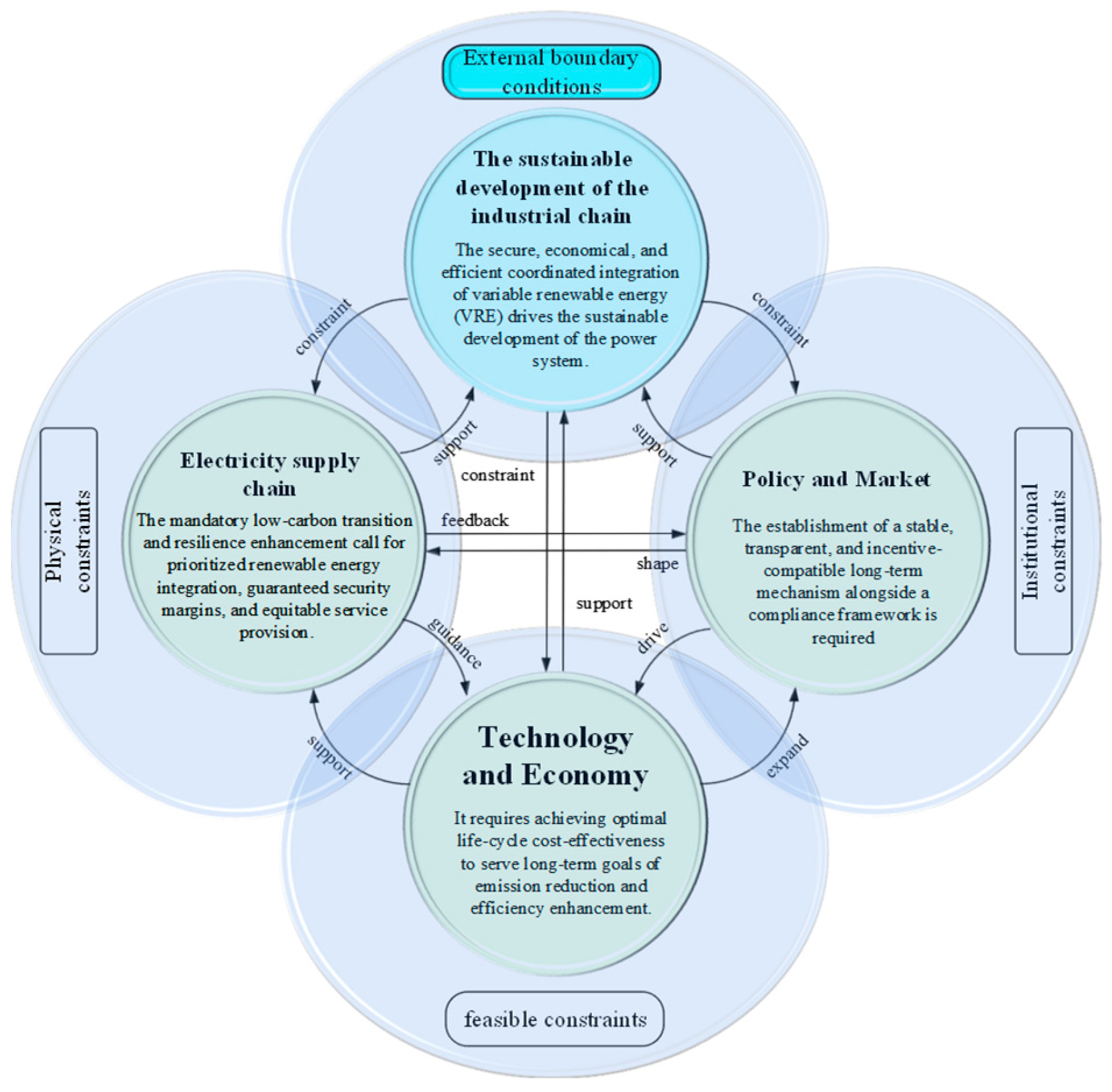
Figure 2.
Example of an Important-Consensus Analysis (ICA) Chart.
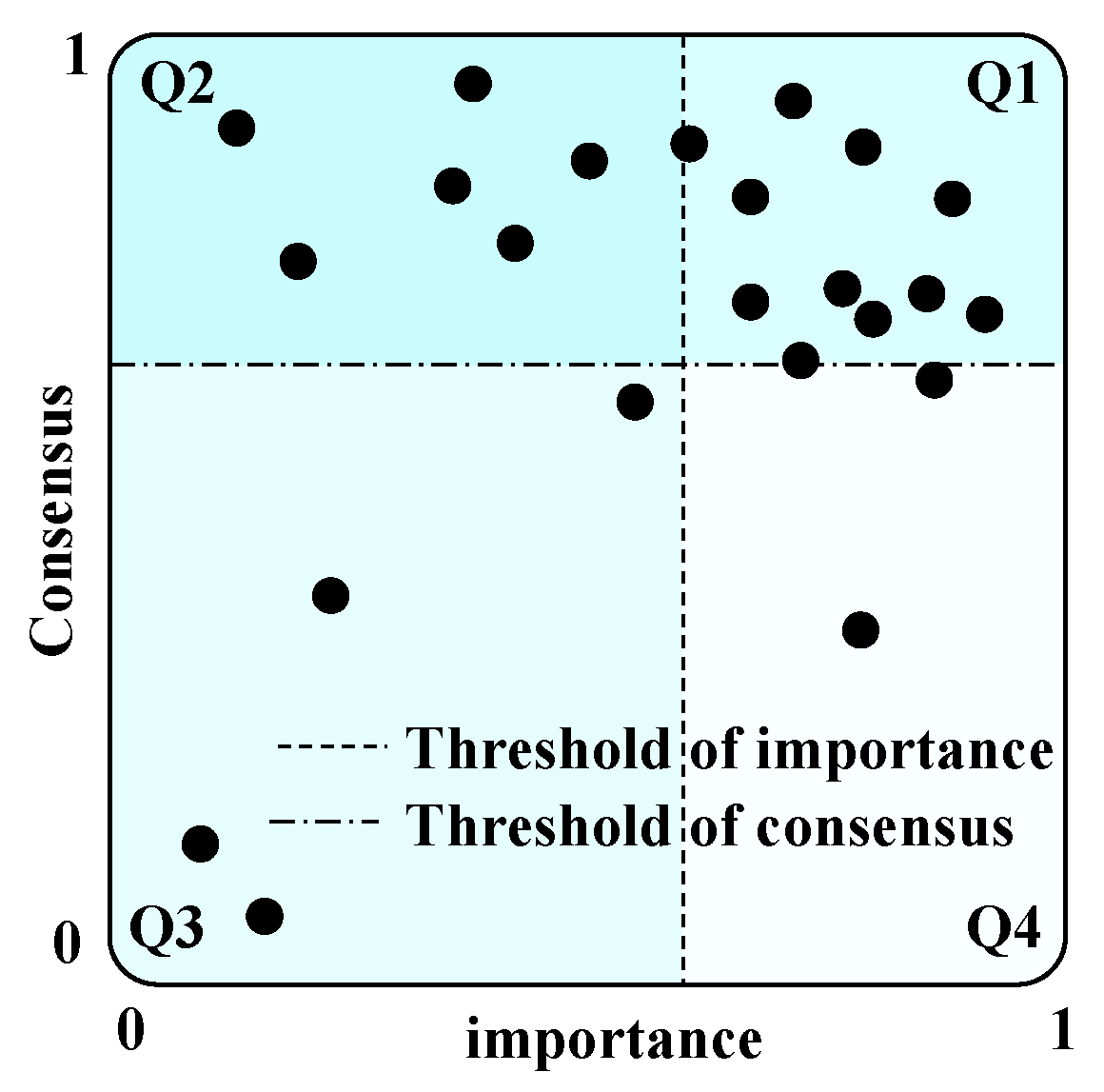
Figure 3.
The process for exploring the key constraints on load control of power grid enterprises from the perspective of sustainable development of the industrial chain.
Figure 3.
The process for exploring the key constraints on load control of power grid enterprises from the perspective of sustainable development of the industrial chain.
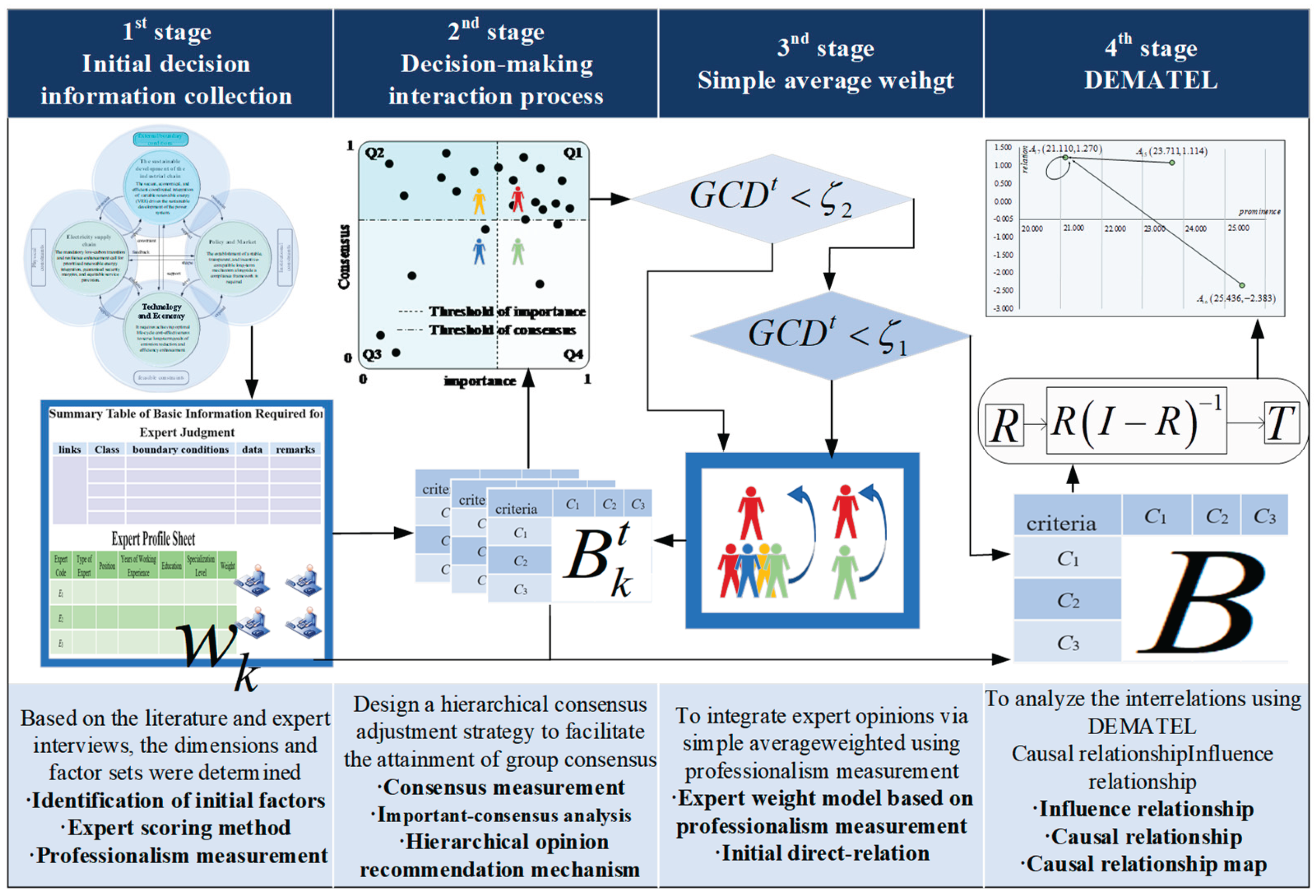
Figure 4.
ICA Chart of Expert Opinion Feedback at Different Interaction Rounds.
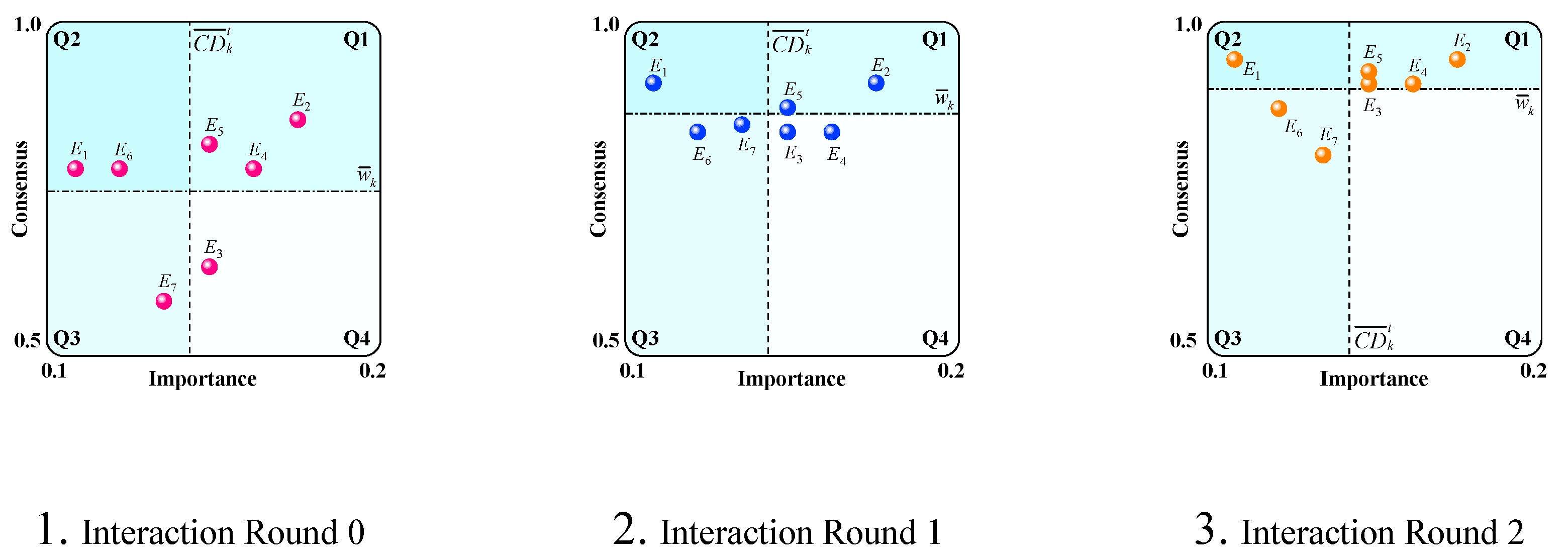
Figure 5.
Cause-effect relations diagram of the dimensions and criteria.
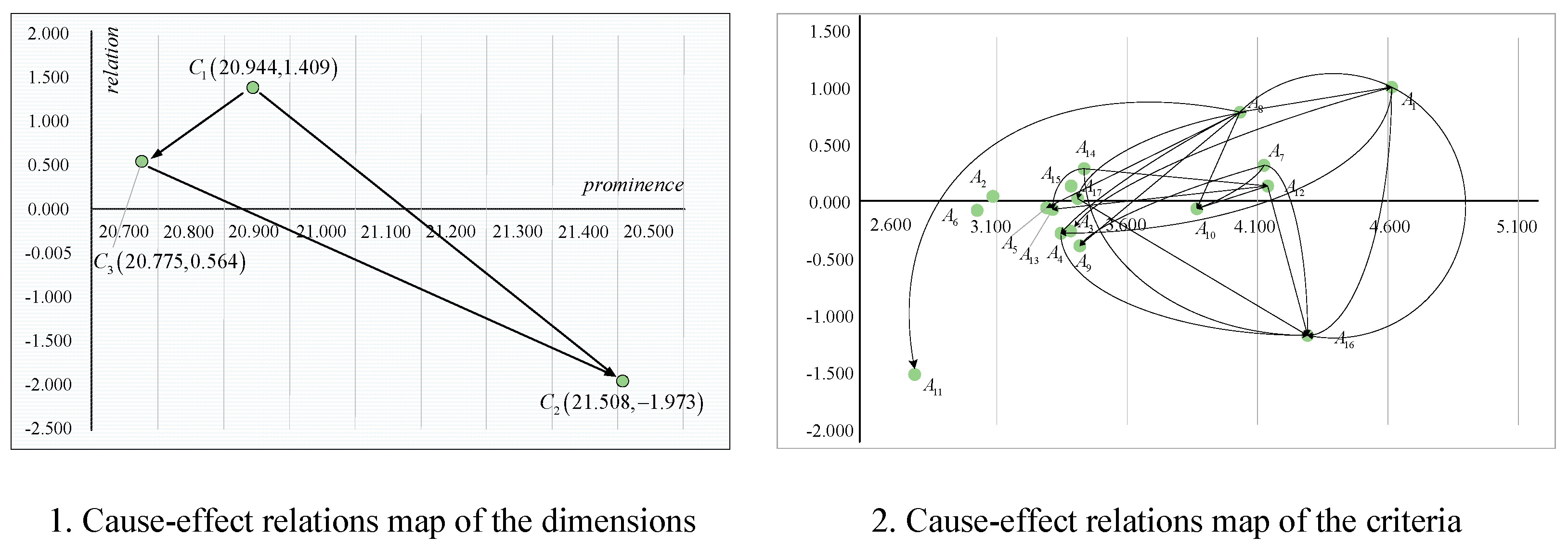
Figure 6.
Analysis Results of Power Load Control Factors for Yunnan Power Grid Company.
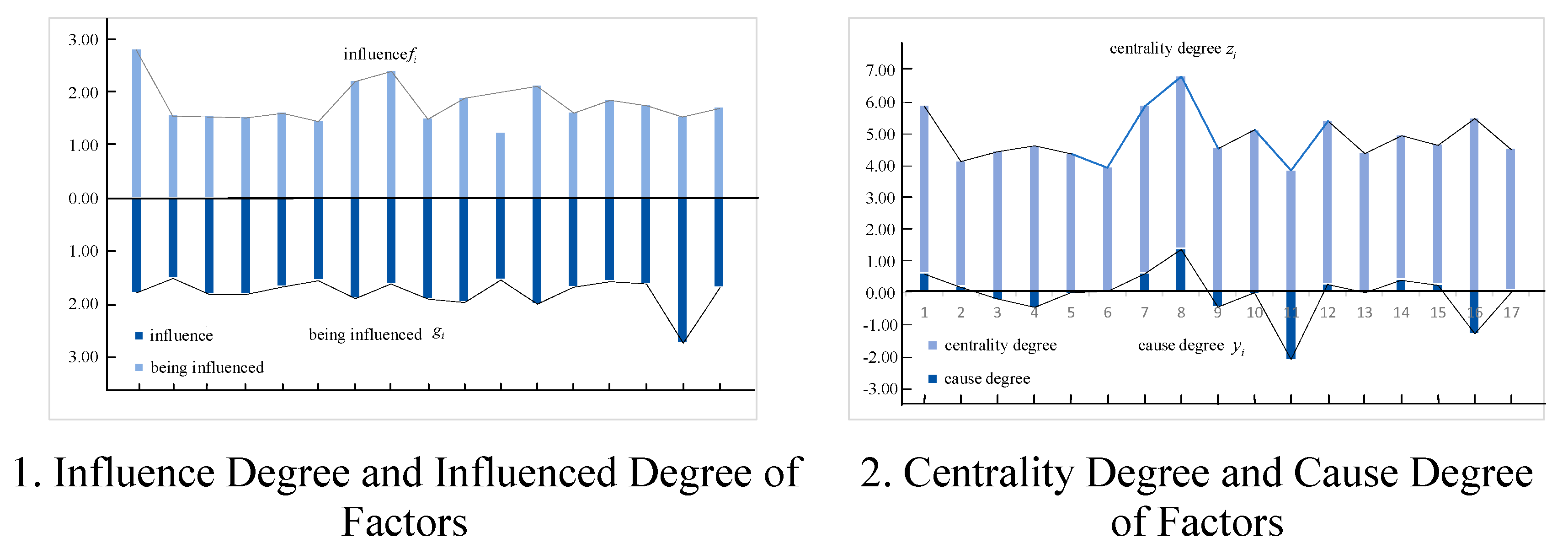
Figure 7.
Quadrant-Cause-Effect Diagram of Power Load Control Factors for Yunnan Power Grid Company.
Figure 7.
Quadrant-Cause-Effect Diagram of Power Load Control Factors for Yunnan Power Grid Company.
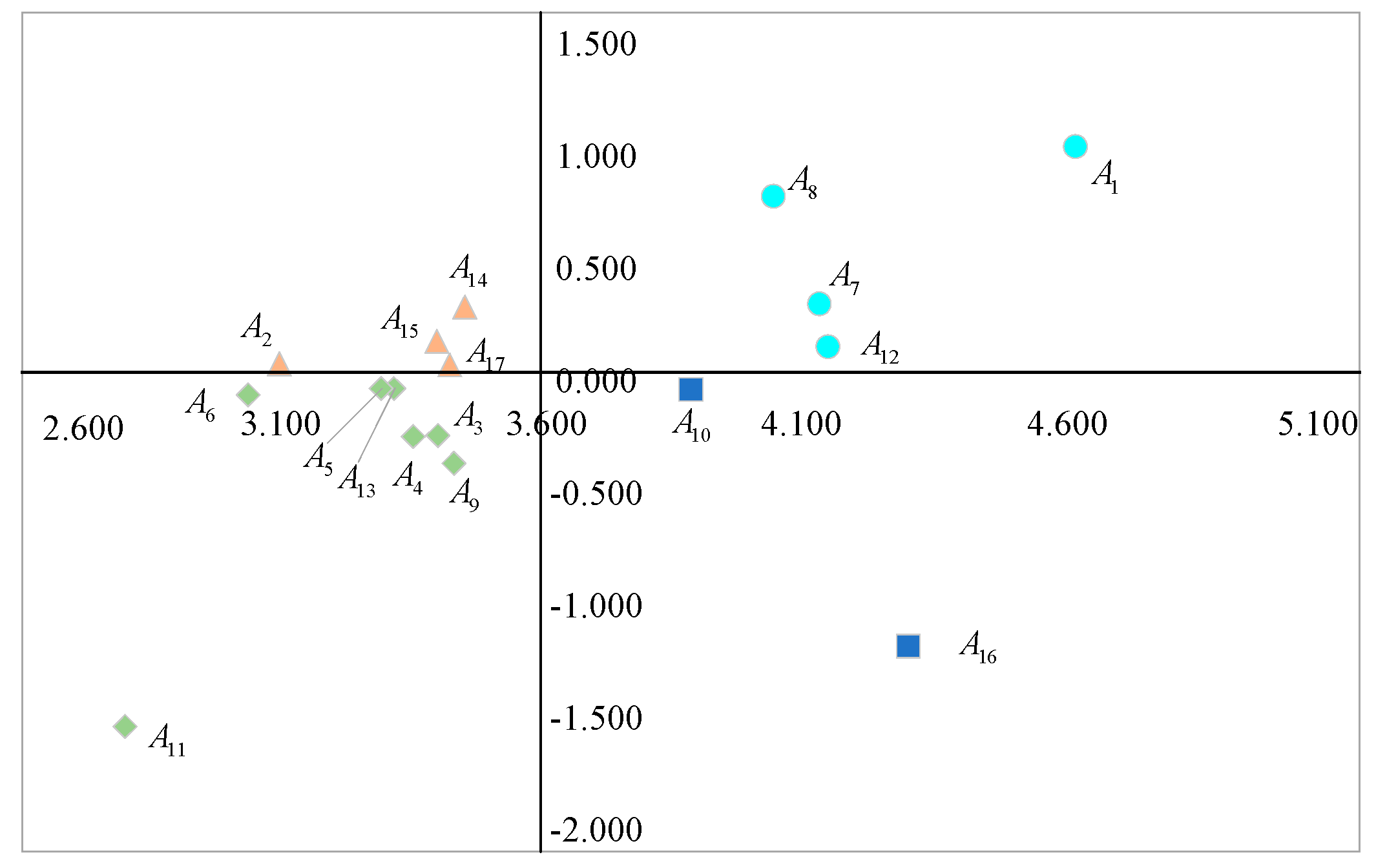

Table 1.
Constraint Dimensions, Criteria, and Elements for Power Grid Enterprise Load Control from the Perspective of Industrial Chain Sustainable Development.
Table 1.
Constraint Dimensions, Criteria, and Elements for Power Grid Enterprise Load Control from the Perspective of Industrial Chain Sustainable Development.
| Dimensions | Criteria & Elements | Notes |
|
Power Supply Chain Sources: [62-73] |
Generation Side | |
| Power generation costs | Marginal cost or levelized cost of energy after accounting for system balance and flexibility, with system costs becoming significant under high renewable energy penetration. | |
| Flexibility of conventional energy sources | The ability of conventional generation units to adjust their output to accommodate renewable energy fluctuations is crucial for enhancing system regulation capacity. | |
| Application of energy storage technologies | The technology of storing electrical energy through batteries and other means to mitigate fluctuations and achieve peak shaving and valley filling, with key parameters including capacity and response speed. | |
| Renewable energy volatility | The unpredictability and instability of renewable energy output (such as wind and solar) affect grid balance and regulation requirements. | |
| Clean energy supply proportion | The proportion of renewable energy in total electricity generation is a core indicator of the low-carbon transition in the power sector. | |
| Transmission and Distribution Side | ||
| Maximum transmission capacity of transmission lines | The maximum power that can be transmitted by a transmission line under safe and stable conditions affects the renewable energy integration capacity. | |
| Level of grid intelligence | The capability of utilizing sensing, communication, and AI technologies to achieve grid condition awareness and optimized operation serves as the foundation for precise control. | |
| Distribution equipment capacity | The rated capacity of distribution facilities; integration of distributed energy resources may cause local overloads, necessitating capacity expansion and upgrades. | |
| Energy utilization rate | The ratio of actual transmitted power to rated capacity; improving the utilization rate requires balancing reliability and flexibility. | |
| User Side | ||
| Demand response mechanisms | Guiding electricity consumers to adjust their usage patterns through pricing or incentive mechanisms, thereby tapping into the flexibility resources on the demand side. | |
| User behavior characteristics | User electricity consumption habits, price sensitivity, and participation willingness affect load forecasting accuracy and response effectiveness. | |
| Policy and Market Factors Sources: [74] |
Electricity Pricing Policy | Government-established electricity pricing rules influence power generation revenue, consumer behavior, and the competitiveness of renewable energy. |
| Electricity Market Reform | It refers to the process of reforming the traditional vertically integrated power industry structure by introducing competition mechanisms and establishing wholesale (e.g., spot markets, medium-to-long-term markets) and retail markets. | |
| Government Regulatory Intensity | The intensity of government supervision and management of the electricity market ensures fair competition and reliable system operation. | |
| Technology and Economics Sources: [75-77] |
Load Forecasting Accuracy | The accuracy of future electricity demand forecasting affects system dispatch and renewable energy integration. |
| Multi-Energy Complementary Synergistic Benefits | Quantifying the synergistic optimization potential of power-heat-hydrogen-storage systems, enhancing renewable energy integration efficiency and long-term economic viability through multi-energy complementary conversion. | |
| Equipment Whole-Life-Cycle Cost | Encompassing the total economic investment throughout the entire lifecycle of key grid equipment (such as transformers, energy storage systems), from procurement and installation to decommissioning and recycling, it serves as a core evaluation metric for avoiding short-term behavior and ensuring long-term sustainability. |
Table 2.
Evaluation Linguistic Scale.
| Linguistic Term Set | Evaluation Value |
| No Influence | 0 |
| Relatively Low Influence | 1 |
| Low Influence | 2 |
| High Influence | 3 |
| Relatively High Influence | 4 |
Table 3.
Group Expert Direct Influence Matrix, Comprehensive Influence Matrix, and Analysis Results of the Load Control Dimension Level for Power Grid Enterprises.
Table 3.
Group Expert Direct Influence Matrix, Comprehensive Influence Matrix, and Analysis Results of the Load Control Dimension Level for Power Grid Enterprises.
| 因素 | B | R | T | F | G | Z | Y | Cause/effect | ||||||
| C1 | C2 | C3 | C1 | C2 | C3 | C1 | C2 | C3 | ||||||
| C1 | 0.00 | 3.00 | 3.00 | 0.00 | 0.41 | 0.41 | 3.25 | 3.13 | 3.39 | 11.18 | 9.77 | 20.94 | 1.41 | cause |
| C2 | 4.00 | 0.00 | 3.87 | 0.55 | 0.00 | 0.53 | 4.26 | 3.41 | 4.07 | 9.77 | 11.74 | 21.51 | -1.97 | effect |
| C3 | 3.32 | 3.00 | 0.00 | 0.45 | 0.41 | 0.00 | 3.67 | 3.23 | 3.21 | 10.67 | 10.11 | 20.78 | 0.56 | cause |
Table 4.
Initial Direct Influence Matrix of Factors for Power Load Control in Yunnan Power Grid Company.
Table 4.
Initial Direct Influence Matrix of Factors for Power Load Control in Yunnan Power Grid Company.
| criteria | A1 | A2 | A3 | A4 | A5 | A6 | A7 | A8 | A9 | A10 | A11 | A12 | A13 | A14 | A15 | A16 | A17 |
| A1 | 0.00 | 4.00 | 4.00 | 1.00 | 2.00 | 3.00 | 3.89 | 2.00 | 2.00 | 2.00 | 1.00 | 4.00 | 1.00 | 1.00 | 3.00 | 4.00 | 2.00 |
| A2 | 2.16 | 0.00 | 2.11 | 3.11 | 1.00 | 1.00 | 1.11 | 1.00 | 1.00 | 1.00 | 1.00 | 1.00 | 1.00 | 1.00 | 1.27 | 2.00 | 1.00 |
| A3 | 1.00 | 1.43 | 1.18 | 1.00 | 1.00 | 1.12 | 2.00 | 2.55 | 2.15 | 1.00 | 1.00 | 1.00 | 1.00 | 1.00 | 1.00 | 1.00 | 1.00 |
| A4 | 1.00 | 1.42 | 1.11 | 0.00 | 1.11 | 1.00 | 1.00 | 1.00 | 1.00 | 1.00 | 1.00 | 2.74 | 1.00 | 1.13 | 1.00 | 4.00 | 1.00 |
| A5 | 2.00 | 1.00 | 2.00 | 2.00 | 0.00 | 1.00 | 1.26 | 1.00 | 1.00 | 1.00 | 1.00 | 1.00 | 1.36 | 1.00 | 1.00 | 3.00 | 2.00 |
| A6 | 1.00 | 1.00 | 1.00 | 1.00 | 1.00 | 0.00 | 2.26 | 2.00 | 3.00 | 1.00 | 1.00 | 1.00 | 1.00 | 1.00 | 1.00 | 1.00 | 1.00 |
| A7 | 2.32 | 1.42 | 2.22 | 1.11 | 1.11 | 2.22 | 0.00 | 2.00 | 3.26 | 3.26 | 2.00 | 1.00 | 1.00 | 1.13 | 3.27 | 2.00 | 2.00 |
| A8 | 3.11 | 2.00 | 0.00 | 3.13 | 3.11 | 2.00 | 2.00 | 1.00 | 3.36 | 2.00 | 1.00 | 1.00 | 1.00 | 1.00 | 2.00 | 3.00 | 3.00 |
| A9 | 1.00 | 1.00 | 1.00 | 1.00 | 1.00 | 2.31 | 2.35 | 2.15 | 0.00 | 1.00 | 1.00 | 1.00 | 1.00 | 1.00 | 1.00 | 2.00 | 1.00 |
| A10 | 2.00 | 1.00 | 2.00 | 1.00 | 1.00 | 1.00 | 2.00 | 1.00 | 2.00 | 0.00 | 3.00 | 2.74 | 1.74 | 1.13 | 2.00 | 2.00 | 1.00 |
| A11 | 1.00 | 1.00 | 1.00 | 1.00 | 1.00 | 1.00 | 1.00 | 1.00 | 1.00 | 2.00 | 0.00 | 1.00 | 1.00 | 1.40 | 1.00 | 0.68 | 1.00 |
| A12 | 1.66 | 1.00 | 1.00 | 3.00 | 1.00 | 1.00 | 1.00 | 1.00 | 1.00 | 4.00 | 3.26 | 0.00 | 3.74 | 2.73 | 1.00 | 3.18 | 1.00 |
| A13 | 1.00 | 1.00 | 1.00 | 1.00 | 1.00 | 1.00 | 1.00 | 1.00 | 1.00 | 1.74 | 1.00 | 3.16 | 0.00 | 3.73 | 1.00 | 1.73 | 1.00 |
| A14 | 1.13 | 1.00 | 1.00 | 2.00 | 1.00 | 1.00 | 1.13 | 1.00 | 1.00 | 1.13 | 1.00 | 4.00 | 4.00 | 0.00 | 1.13 | 3.51 | 1.13 |
| A15 | 2.00 | 1.00 | 2.00 | 1.00 | 1.00 | 1.00 | 2.47 | 1.00 | 2.24 | 3.50 | 1.00 | 1.00 | 1.00 | 1.00 | 0.00 | 2.00 | 1.00 |
| A16 | 1.00 | 1.00 | 1.00 | 2.00 | 2.00 | 1.00 | 1.15 | 1.00 | 1.00 | 1.00 | 1.00 | 1.51 | 1.51 | 1.51 | 1.00 | 0.00 | 3.00 |
| A17 | 2.00 | 1.00 | 2.00 | 1.00 | 4.00 | 1.00 | 1.15 | 1.00 | 1.00 | 1.00 | 1.00 | 1.00 | 1.00 | 1.00 | 1.00 | 4.00 | 0.00 |
Table 5.
Interrelations and cause-effect relationships between criteria.
| Code | Dimension | F | G | Z | Y | Cause/effect |
| A1 | Power Generation Costs | 2.814 | 1.798 | 4.666 | 0.499 | cause |
| A2 | Flexibility of Conventional Energy Sources | 1.565 | 1.524 | 3.479 | 0.133 | cause |
| A3 | Application of energy storage technologies | 1.554 | 1.825 | 3.889 | -0.243 | effect |
| A4 | Renewable energy volatility | 1.537 | 1.814 | 4.047 | -0.471 | effect |
| A5 | Clean energy supply proportion | 1.621 | 1.678 | 3.824 | -0.075 | effect |
| A6 | Maximum transmission capacity of transmission lines | 1.471 | 1.556 | 3.450 | -0.005 | effect |
| A7 | Level of grid intelligence | 2.221 | 1.903 | 4.661 | 0.498 | cause |
| A8 | Distribution equipment capacity | 2.412 | 1.624 | 4.788 | 1.181 | cause |
| A9 | Energy utilization rate | 1.510 | 1.911 | 3.981 | -0.443 | effect |
| A10 | Demand response mechanisms | 1.900 | 1.969 | 4.476 | -0.080 | effect |
| A11 | User behavior characteristics | 1.240 | 1.549 | 3.358 | -1.913 | effect |
| A12 | Electricity Pricing Policy | 2.133 | 2.006 | 4.530 | 0.202 | cause |
| A13 | Electricity Market Reform | 1.623 | 1.685 | 3.845 | -0.064 | effect |
| A14 | Government Regulatory Intensity | 1.865 | 1.575 | 4.009 | 0.327 | cause |
| A15 | Load Forecasting Accuracy | 1.759 | 1.629 | 3.889 | 0.188 | cause |
| A16 | Multi-Energy Complementary Synergistic Benefits | 1.546 | 2.746 | 4.803 | -1.200 | effect |
| A17 | Equipment Whole-Life-Cycle Cost | 1.717 | 1.695 | 3.950 | 0.023 | cause |
Disclaimer/Publisher’s Note: The statements, opinions and data contained in all publications are solely those of the individual author(s) and contributor(s) and not of MDPI and/or the editor(s). MDPI and/or the editor(s) disclaim responsibility for any injury to people or property resulting from any ideas, methods, instructions or products referred to in the content. |
© 2025 by the authors. Licensee MDPI, Basel, Switzerland. This article is an open access article distributed under the terms and conditions of the Creative Commons Attribution (CC BY) license (http://creativecommons.org/licenses/by/4.0/).
Copyright: This open access article is published under a Creative Commons CC BY 4.0 license, which permit the free download, distribution, and reuse, provided that the author and preprint are cited in any reuse.


