

Submitted:
27 October 2025
Posted:
30 October 2025
You are already at the latest version
Abstract
The main objective of behavior-based safety approaches is to prevent accidents by enhancing employee safety involvement. This study examines the relationships between employee involvement in workplace safety and factors such as management fatalistic beliefs, rule violations, management commitment to safety, safety resources, and training, using a model developed within an antecedent-mediator-successor framework. Creating a sustainable workplace environment involves not only employee safety but also environmental and social responsibilities. Using a quantitative research approach, the study tested eight hypotheses with a sample of 391 managers from the metal sector in Denizli province. The study employed a cross-sectional survey design with data collected through a structured questionnaire. Factor and path analyses were conducted using SmartPLS software (version 4.1.1.5). Statistically significant direct relationships were found among fatalism and rule violations (p < 0.001), rule violations and management involvement (p < 0.001), and several other key relationships. The findings indicate that managerial perceptions and roles significantly influence employee involvement in safety practices. It is recommended that fatalistic beliefs be considered in management recruitment criteria, and managerial groups with high fatalistic beliefs should receive training on the link between unsafe behaviors and accidents. The findings offer crucial insights into how managerial perceptions and safety practices contribute to organizational resilience and the long-term sustainability of the workforce.
Keywords:
fatalism
; management safety commitment
; management safety involvement
; safety training
; rule violations
; employee safety involvement
1. Introduction
Occupational hazards vary considerably across industries, with the metal industry being among the most dangerous. Annually, approximately 340 million occupational accidents and 160 million occupational diseases occur worldwide, resulting in around 3 million fatalities [1,2,3]. In Turkey, Social Security Institution data reveals that approximately 511.000 people suffer from occupational accidents, and 1.200 from occupational diseases, with roughly 1.400 fatalities [4]. According to Ceylan et al. [5], the number of fatal occupational accidents in Turkey is relatively high compared to EU countries.
On the other hand, occupational accidents predominantly occur in small and medium-sized enterprises on a global scale [2]. Similarly, in Turkey, Social Security Institution statistics [4] indicate that accidents occur mainly in small and medium-sized enterprises. Literature [6,7,8,9] suggests that variations in managerial elements regarding Occupational Health and Safety (OHS) contribute to this disparity. For instance, when comparing two companies where the same employee performs the same job, differences in accident risks can be attributed to managerial safety practices and perspectives on safety. A study comparing enterprises with high and low occupational accident rates found that management's commitment to occupational safety and the participation of both employees and management in safety programs were distinguishing factors in workplaces with low accident rates [10].
Managers' fatalistic beliefs may lead them to adopt a less proactive and flexible approach. Over time, this situation spreads to employees and threatens sustainability. This is because fatalistic beliefs in the workplace shape employees' perceptions of risk, and these beliefs increasingly influence managers' decisions. In other words, it is a cycle. Managers who ignore this belief systems may fail to ensure workplace safety, and a decline in employee participation may be observed. [11,12]. OHS is increasingly recognized as a fundamental pillar of organizational sustainability. Sustainable workplaces extend beyond mere adherence to accident prevention protocols; they are fundamentally defined by their capacity to ensure long-term employee well-being, reduce absenteeism and presenteeism, and cultivate enhanced productivity and innovation. Investments in OHS are crucial for building more resilient organizational systems, minimizing operational disruptions, and strengthening business continuity, all of which are integral to achieving comprehensive economic, social, and environmental sustainability [13]. Furthermore, effective OHS management is indispensable for sustainable industrial development, aligning directly with key United Nations' Sustainable Development Goals (SDGs), notably Goal 8 (decent work and economic growth), Goal 3 (good health and well-being), and Goal 12 (responsible consumption and production) [14]. Consequently, comprehending the factors that influence workplace safety is paramount, not solely for preventing accidents but also for fostering broader objectives of organizational resilience and sustainable production.
However, in regions with high fatalism, such as Turkey, safety practices are often compromised due to fatalistic beliefs among employees and managers, leading to increased rule violations [15,16]. Fatalism is conceptually understood across a wide spectrum, ranging from a strict conviction in the unchangeable destiny of events to a broader acceptance of challenging living conditions [17]. This inherent fatalistic tendency directly influences an individual's responses to events and situations. Consequently, fatalism acts as a latent factor that can determine whether crucial concepts such as proactive action, problem-solving, effective implementation, entrepreneurship, initiative, and the motivation to achieve will manifest in various contexts [18]. Accordingly, it can be stated that fatalistic beliefs affect the perception of accidents, encouraging employees to take more risks and violate and neglect safety rules. This perception is especially detrimental in small and medium-sized enterprises, where limited financial resources lead to safety being perceived as a non-essential cost unrelated to production [18].
Behaviour-based safety interventions have proven effective in reducing accident rates by promoting safe behaviours among employees [7,20,21]. Management's apparent commitment to creating a safety climate is the primary driving force [22,23], as top management plays a central role in organizational safety. Since occupational safety is a managerial issue, management's commitment and participation in occupational safety positively influence employees’ perceptions and attitudes, encouraging behaviours that prioritize occupational safety. While a high level of management commitment and involvement in safety is necessary to guide employees toward safe behaviours, a low-tolerance approach to fatalism and rule violations should be adopted [8,23,24]. All necessary health and safety measures should be taken by all levels of management, and the importance of occupational safety should be communicated directly and indirectly to employees [25,26]. Effective safety management requires comprehensive measures, including training, resource allocation, and strong communication, to create and maintain a safety culture [26,27]. Studies conducted in various sectors [8,20,25,27,28,29] also demonstrate that management's perceived commitment to safety can enhance employees' safety performance.
According to Heinrich et al. [30], approximately 88% of accidents are caused by unsafe employee behaviour. However, compliance with professional rules and procedures alone is insufficient to prevent accidents; management support is also necessary [26,30,31]. For example, Smith et al. [23] compared two companies with high and low occupational accident rates. The results showed that the company with a low occupational accident rate had a more robust managerial performance in preventing accidents. Subsequent studies on safety climate concluded that managerial roles affect safety climate. In particular, the study conducted by Brown and Holmes [32] reveals that the only difference between companies with high and low accident rates is the importance attached to safety climate. Over the years, studies on safety climate [7,22] have found that management commitment to safety and employee involvement are two common factors.
Moreover, high levels of safety commitment and employee involvement positively mediate the abandonment of inappropriate work practices [26,33]. Finally, it is not possible to completely prevent accidents in high-risk sectors, with the metal sector being one such example. Due to its superior properties and the rapid expansion of its applications driven by technological developments, the metal industry is widely utilized. This sector, serving as the backbone of all industries, is one of Turkey’s most important industrial branches in terms of its labor force and economic size [34]. The main reasons for the high number of accidents in the metal sector can be attributed to fatalism, violation of safety procedures by employees and lack of management commitment. The selection of research variables was based on the fact that managers play a critical role in developing a safety culture and reducing accident rates. The fact that managers play a critical role in developing occupational safety culture and reducing accidents has been effective in the selection of research variables [8,10,28].
Thus, the current study aims to answer the following question: What is the causal relationship (antecedent- mediation-succession) between the elements that affect employee involvement in safety activities that ensure workplace safety, specifically in terms of managerial perceptions, including fatalism, rule violations, management involvement, management commitment, and training and resources?
Within Turkey’s broader context of high occupational accident rates, the metal industry stands out as one of the five sectors most severely affected. In 2022 alone, it accounted for 50,173 reported accidents, 134 diagnosed occupational diseases, and 75 work-related fatalities [4]. Given the high-risk nature of this industry, effective safety management practices are crucial. According to Zhang et al. [35], the analysis of the causes of recurring accidents indicated management disregard for safety laws and regulations (100% frequency), lack of safety priority (100%), limited role of functional departments (86,6%) and inadequate safety training (80,6%).
In this study, we aim to examine the impact of managers' perceptions of fatalistic beliefs on safety rule violations and employee involvement. While existing literature generally focuses on employees' perceptions and experiences [e.g.,35,36], this study exclusively investigates the influence and perspective of managers, particularly their roles and perceptions in increasing employee involvement. Exploring the perspective and influence of managers and perceptions in enhancing employee involvement, especially in creating a safe workplace culture, is a rare topic in the literature. This study aims to fill this gap by focusing on managers' perceptions. The value and originality of the study are enhanced by the following factors: (i) the study was conducted in the high-risk metal sector, which is one of the important industries in Turkey; (ii) the difficulty in collecting data from managers due to time constraints, busy schedules, and reluctance to participate; and (iii) the examination of direct and indirect relationships between more effective variables compared to other studies on safety climate and safety behaviour.
This study, grounded in Zohar's [37] safety climate model, which underscores the influence of management perceptions on safety culture, investigates the causal impact of managerial fatalism on safety-related outcomes within the high-risk metal industry. Specifically, it addresses how managerial fatalistic beliefs affect these outcomes, mediated by factors like rule violations and management commitment. This research not only advances theoretical understanding of how managerial beliefs shape the workplace safety climate but also provides practical recommendations for cultivating a more effective and sustainable safety environment.
2. Hypothesis Development
Fatalism
Fatalism is a control mechanism that aims to attribute external events, such as accidents, to beliefs or cultural values. Numerous studies indicate an inverse relationship between employees' fatalistic beliefs and their commitment to occupational safety [19,23,24,28]. Some situations are left to chance due to heightened levels of fatalism and optimism, which are contingent on the social structure. Mitigating such negative attitudes through managerial efforts such as OHS training, prioritization of safety, and safety supervision is possible. In this way, changes in behaviour among employees can be observed [38]. On the other hand, managerial communication of information is perceived as a means to cope with fatalistic beliefs. This can be explained by the interplay among knowledge, attitude, and behaviour. To address fatalism effectively, management needs to ensure a consistent flow of information to employees [16,28,38]. Fatalistic beliefs contribute towards rule violations [39,40]. However, it is possible to prevent it. However, a fatalistic attitude toward management can destabilize the entire team. Fatalism, as a belief system regarding events beyond individuals' control, necessitates managerial resistance. In the workplace, this attitude can lead employees to place less importance on safety practices and risk management. Nonetheless, resisting fatalistic attitudes plays a critical role in achieving sustainability goals by strengthening employees' safety awareness and encouraging them to behave more proactively [12]. According to Ünal [38], administrative supports workers were approximately three times more effective on behaviour to prevent occupational accidents than their fatalistic beliefs.
Rule Violations
Rule violations encompass deviations from or breaches of rules and regulations pertaining to OHS matters. Addressing rule violations is critical in preventing accidents. Violations or risky behaviours of employees, especially in safety-related issues, often stem from well-intentioned shortcuts aimed at enhancing job efficiency by bypassing safety rules. Unsafe behaviours resulting from a lack of knowledge and experience or managerial pressures are also prevalent. Furthermore, the perceived commitment of management to safety significantly influences deployment and safe performance [8]. Rule violations can profoundly affect management's perceived safety involvement and commitment [41].
In the study conducted by Brandhorst and Kluge [24], it was stated that employees’ wages depend on their performance, thereby precipitating hasty behaviour and increasing occupational safety tension. Performance-related pay emerged as a crucial factor underlying safety rule violations. It is inferred that safety promotion programs may only become effective if goal conflicts create safety tensions. Managerial roles encompass a spectrum of measures aimed at deterring rule violations, including high levels of supervision, imposition of penalties, provision of rewards, coaching, effective communication, participation, commitment, training, and resource allocation to employees on OHS issues [42].
Strong deterrents to rule violations entail managerial interventions such as persuading employees to comply with rules, high levels of supervision, imposition of penalties [43], provision of rewards, on-the-job training, coaching, effective communication, management involvement in safety (participation), management commitment to safety [44], training and resource allocation to employees on OHS issues [45]. Accordingly, the following hypothesis is proposed:
H1: A statistically significant relationship exists between management’s fatalistic beliefs and rule violations.
Management Safety Commitment and Safety Involvement
Management commitment to safety refers to the extent to which senior management demonstrates concern for and dedication to safety issues. Management involvement in safety means that management actively contributes to safety processes. Although management involvement and management commitment are distinct concepts, they are interrelated and mutually supportive. Management commitment to safety promotes management involvement and adherence to safety rules by supporting organizational support, open communication and management participation in decision-making processes [46]. In essence, management involvement and commitment to safety have a significant impact on health and safety resources and training by fostering a culture of safety, ensuring access to essential resources, providing relevant training, promoting communication, enforcing safety protocols, and driving continuous improvement in safety practices.
Studies [23,47] underscore the close link between these two concepts. Smith et al. [23] also noted the strong relationship between management involvement and commitment, independent of the safety climate concept. Managerial factors such as training, involvement and commitment, which serve as awareness-raising practices, can be used to prevent safety violations by employees. Enhancing employees’ awareness of hazards and informing employees on the potential risks associated with rule violations are managerial activities that reduce occupational accidents [42]. Consequently, the following hypotheses are proposed:
H2: A statistically significant relationship exists between rule violations and management safety involvement.
H3: A statistically significant relationship exists between rule violations and management commitment to safety.
H4: A statistically significant relationship exists between management safety involvement and management commitment to safety.
Resource Allocation and Employees' OHS Training
Safety training improves employees' awareness and skills, fostering a positive attitude towards risk and a safe workplace environment [48]. OHS training can be characterized as a method to enhance employees’ knowledge, skills and safety awareness related to their work. Resource allocation encompasses the provision of equipment necessary for employees to perform their work safely. Management's commitment to safety can prioritize the health and safety of employees, ensuring the provision of necessary resources to achieve health and safety objectives [49,50]. Consistent prioritization of health and safety by management influences the rest of the workgroup to follow suit. According to Abukhashabah et al. [51], the leading causes of occupational accidents are rashness and lack of professional and procedural knowledge stemming from inadequate training and OHS resources. OHS training should effectively communicate workplace-related risks. In addition, management’s resource allocation, training programs, and procedural competencies contribute to fostering a positive organisational climate [52]. Specifically, management’s contribution to the safety climate is expected to improve employee commitment to safety and safe behaviours [32]. Accordingly, the following hypotheses are proposed:
H5: A statistically significant relationship exists between management involvement and resource allocation and employees' OHS training.
H6: A statistically significant relationship exists between management commitment and resource allocation to the OHS training for employees.
Employee Involvement and Empowerment
Safety participation entails the voluntary participation of employees in safety activities. Employees do not directly contribute to their safety. However, they contribute to developing a work environment that supports safety, thereby positively influencing the safety climate of the workplace. Safety participation encompasses not only individual employee engagement but also the assistance of colleagues in safety-related issues [53,54]. Vitrona et al. [55] emphasize in their study that employee participation yields better results in achieving sustainable goals. In this context, the active involvement of employees emerges as a critical element for sustainable and effective interventions. This interaction fosters comprehensive safety involvement by ensuring the participation of all employees. Top management should encourage this type of employee involvement in safety and authorize employees to intervene in safety-related issues. This approach is grounded in the philosophy that "the one who does the job knows best". Therefore, the following hypotheses are proposed:
H7: A statistically significant relationship exists between management's involvement and employee involvement and empowerment in health and safety.
H8: A statistically significant relationship exists between OHS training and resource allocation for employees and employee involvement and empowerment.
Theoretical Framework and Model Design
The research model was developed using Zohar's [37] safety climate model as its foundation. This framework highlights the critical role of managerial practices in shaping employees' perceptions of organizational safety priorities, aligning with our study's focus on managerial fatalism and its impact on safety outcomes. Zohar's work demonstrates that management practices significantly influence not only safety perceptions but also employee safety behaviors and overall organizational safety performance. A positive safety attitude can sustainably influence employees and subtly improve safety behavior [56].
We acknowledge that OHS practices and managerial attitudes have far-reaching implications beyond immediate safety outcomes, contributing to sustainable production and organizational resilience. Consistent with Zohar's model, management's commitment to safety fosters a culture of prevention and empowerment, supporting long-term workforce sustainability and efficient industrial system functioning. By linking managerial fatalism, rule violations, and safety involvement to employee engagement, our model illuminates the pathways through which OHS contributes to sustainable workplace performance and enduring organizational value.
In this study, safety climate refers to the collective perception of safety priority and management's approach to safety. Fatalism is conceptualized as a fundamental antecedent that negatively impacts the safety environment by increasing rule violations and reducing management commitment. Conversely, management's commitment to safety, active participation, and the provision of necessary resources and training are positioned as key mediators that mitigate fatalism's negative impact and promote employee empowerment. Therefore, in line with Zohar's [37] safety climate theory, fatalism and management attitudes are defined as antecedent variables influencing employee safety behavior. A structural equation model (SEM) was developed, guided by prior literature, to address the research questions, and is illustrated in Figure 1.
This study offers an original contribution to the existing body of research for three reasons: 1. Although model tests have been conducted that address the antecedent-mediating-succession relationship between the six dimensions included in our research, no study has comprehensively addressed all six dimensions together. 2. Other studies in this field have largely been based on employee perceptions. This study will contribute to the literature as one of the rare examples that consider managerial perceptions in the field of OHS. Numerous studies have shown that positive perceptions of various managerial activities, such as commitment and participation of managers, are crucial in improving OHS [7,8,54,57]. Therefore, determining the various aspects of the safety climate examined in the study and identifying the role and causal relationship between safety climate and managerial perceptions can be foundational in increasing employee involvement in OHS activities in practice. 3. One of the antecedents of employee participation in OHS activities and safe behaviour is their positive perception of their management's commitment to safety [7,54]. Research identifying the elements of employee safety involvement from the perspective of managers can produce results on actions that can improve this perception in practice. Thus, improving managers' perceptions of employee involvement can also contribute to employees' perceptions of management's commitment to safety.
3. Methods
This section details the study’s sample, data collection techniques, and the utilized scales.
Sample and Data Collection
The research field comprises workplaces and managers operating in the metal sector in Denizli province of Turkey. Denizli was chosen for the research since one of the four highest localization coefficients obtained in this province comes from the metal sector [53]. The managers covered in this research include entry-level managers (e.g., supervisors in charge, foremen, specialists/assistant specialists, chargehands), mid-level managers (e.g., engineers, technical specialists, team leaders, planning-production specialists), and senior managers (managers, assistant managers, employer representatives).
The study's target population comprises individuals employed in dangerous and extremely dangerous metalworking environments in Denizli, Turkey. Data for this population were sourced from the Social Security Institution, indicating 6.655 insured employees across 852 workplaces. The sampling frame specifically included companies operating in Denizli province that are registered with the Social Security Institution and fall under NACE code sections 24 and 25. Within these companies, the study focused on employees in lower, middle, and upper management positions working in workplaces classified as dangerous and extremely dangerous. The metal sector in this study is defined as a combination of economic activities listed under “manufacture of basic metals” (Section 24) and “manufacture of fabricated metal products, except machinery and equipment” (Section 25) within the NACE economic activity classification system.
The study is cross-sectional and the survey method was used. The survey was conducted with managers working in lower, middle, or upper management at 27 different small/medium/large companies within the metal industry. Field visits were made to these companies for the implementation of surveys, and preliminary information about the objectives and implementation of the survey was provided. Separate information sessions were organized for different management groups, especially in medium- and large-scale enterprises, in order to disseminate preliminary information. A total of 430 surveys were distributed, yielding 391 valid responses. The minimum sample size was determined using Faul et al. [58]'s G* Power program. Hence, given f2=0.15, ∤=0.05, and five predictors, at least 138 sample members are required to achieve a power level of 0.80 [59]. This result indicates that the research sample (n=391) is statistically representative of the research population since it is greater than the estimated sample size. Furthermore, based on these results, it can be said that sample surpasses the recommended ratio of five respondents per item proposed by [60]. While a ratio of ten respondents per item is considered suitable for SEM (26*10=260) [60], the study’s sample size (391/260=%150) meets the criteria outlined by Andersen and Gerbing for conducting SEM [61].
This study employed a two-tiered stratified sampling method to ensure the heterogeneity of economic activities within the metal sector did not compromise the representativeness of the sample and to enhance statistical sensitivity. Thus, during sample selection, activities classified under NACE code sections 24 and 25 were identified as distinct strata. As a result, a total of 27 workplaces were selected for the research sample. Specifically, there are 284 workplaces under NACE code section 24 and 568 under NACE code section 25 in Denizli. The economic activities carried out, the amount, and NACE code section of the companies in our sample are as follows: Manufacture of metal fire cabinets - 3 workplaces (25), machine manufacturing/installation and repair - 5 workplaces (24), metal cable production - 2 workplaces (25), rolling mill - 2 workplaces (24), copper production from raw materials - 2 workplaces (24), sharpening of metal parts - 2 workplaces (25), radiator production - 1 workplace (25), metal tank production - 2 workplaces (25), fire escape manufacturing - 2 workplaces (25), steel rims manufacturing - 1 workplace (25), manufacturing of shower cabins with metal components - 1 workplace (25), metal product cutting and curling operations - 1 workplace (25), steel shelf and structure production - 1 workplace (25), steel rope production - 1 workplace (25), hand tools manufacturing - 1 workplace (25). The sample comprises 9 establishments under NACE code sections 24 and 18 under NACE code sections 25. The research was conducted only with those in managerial positions. A second stratum was defined to represent lower-, middle-, and upper-level managers during the sample selection process. The ratio of managers to employees in metalworking companies varies. This depends on the size of the company [62]. In our sample, across 27 workplaces, there were 855 lower, middle, and upper-level managers and 3,084 employees. This yielded a manager-to-employee ratio of 0.264 within our sample workplaces. Assuming this ratio is representative of the entire metal sector in Denizli province, and given a total of 6.655 employees in the sector, the estimated manager population was 1.757. We aimed to achieve a ratio of 45%, 35% and 20% for the lower, middle and upper management groups respectively. The ratios achieved in the study were approximately 46%-35%-19% (see Table 1).
Scales
Six dimensions consisting of twenty-six items were used in this study. The five-item Fatalism Concerning Accident Prevention (FATAL), three-item Management's Attitude towards Rule Violations (RUL_VIO), and four-item Management's Safety Commitment (MAN_COM) scales were adapted based on Rundmo and Hale [63], while the six-item Management's Safety Involvement (MAN_INV), five-item Employee Involvement and Empowerment In Health and Safety (EMP_INV) and three-item Health and Safety Resources and Training (RES_TRA) scales were adapted from Agumba et al. [31] (See Appendix A).
A 5-point Likert scale system was utilized in all the scales. The participants indicated their level of agreement with statements ranging from “1 (Strongly Disagree)” to “5 (Strongly Agree)”.
Data Analysis
The data were subjected to a two-stage analysis. In the first stage, an exploratory factor analysis (EFA) was conducted using SPSS 23 to assess whether the variables observed in the EFA could be represented by a reduced set of latent variables. In the second stage, the research model was tested through confirmatory factor analysis using Partial Least Squares - Structural Equation Model (PLS-SEM) with SmartPLS software (version 4.1.1.5).
4. Result
Research demonstrates a significant association between fatalism and rule violations [38,39,40]. Consequently, preventing rule violations and fatalism is necessary to reduce workplace accidents. Furthermore, management commitment to and involvement in safety have been linked to rule violations [41]. Management's involvement in and commitment to safety can foster employee engagement and thereby reduce rule violations. Such dedication can also provide the necessary resources and motivation to achieve safety objectives, including safety training [49,50]. Employee engagement in safety is positively correlated with safety resources offered through safety training, which raises awareness and enhances employees' safety knowledge and skills [7].
Exploratory Factor Analysis
Before starting the analysis, the values of the variables included in the FATAL and RUL_VIO scales were reverse-encoded by using the recoding process in order to account for the questions using negation in their syntax in the survey. Then, an EFA was performed using the varimax rotation method to determine whether the 26 observed variables could be represented by a smaller number of latent variables. As a result of the first analysis, Emp_Inv_1, Fatal_4, Man_Inv_5 and Man_Inv_6 were removed from the dataset since they were tied to more than one factor, and the analysis was repeated. The analysis indicated the sample size was sufficient and the dataset was suitable for factor analysis, with a KMO value of 0.845 and Bartlett's Test of Sphericity value of p<0.001 [60,61].
Although the eigenvalue criterion indicated four factors above 1, the Scree Plot and conceptual consistency suggested a six-factor structure, which was therefore retained. Accordingly, based on the meaningful clustering of the items after the Varimax rotation, a six-factor structure was preferred. This decision was supported by the theoretical model, which conceptually anticipated six distinct dimensions. Although the last two factors had eigenvalues slightly below 1.0, they were retained due to their theoretical relevance and clear conceptual distinction. After rotation, all items loaded above 0.50 on their respective factors, supporting the structural integrity of the model.
The first factor, consisting of four variables, represents management commitment (MAN_COM), with an eigenvalue of 6.513 and a total variance of 29.6%. The second factor, also with four variables, represents management involvement (MAN_INV), with an eigenvalue of 2.995 and a total variance of 13.6%. The third factor with four variables reflects employee involvement (EMP_INV), with an eigenvalue of 1.538 and a total variance of 7.0%. The fourth factor with three variables corresponds to employee fatalism perceptions (FATAL), with an eigenvalue of 1.424 and a total variance of 6.5%. The fifth factor, consisting of three variables, reflects safety rule violations (RUL_VIO), with an eigenvalue of 0.972 and a total variance of 4.4%. Lastly, the sixth factor, with three variables, represents employee training and resource allocation (RES_TRA), with an eigenvalue of 0.902 and a total variance of 4.1%. Together, these six factors explained 65.2% of the total variance, indicating satisfactory construct validity for social science research.
These findings suggest that the scale demonstrates a conceptually consistent and statistically valid six-factor structure.
Confirmatory Factor Analysis
In the exploratory phase, data for the 21 variables loaded onto the six factors were entered into SmartPLS software (version 4.1.1.5) for PLS-SEM analysis [66]. The data were then tested following the procedure recommended by Sarstedt et al. [67].
Estimation of PLS-SEM Model. The PLS algorithm developed by Lohmöller [64] was employed using SmartPLS software (version 4.1.1.5) to estimate the structural model. Figure 2 presents the standardized path coefficients and the R² values of the endogenous constructs. As shown in the figure, FATAL explains 15.3% of the variance in RUL_VIO (R² = 0.153). RUL_VIO accounts for 3.0% of the variance in MAN_INV (R² = 0.030), while RUL_VIO and MAN_INV together explain 35.2% of the variance in MAN_COM (R² = 0.352). MAN_INV and MAN_COM jointly explain 45.7% of the variance in RES_TRA (R² = 0.457), and MAN_INV and RES_TRA together explain 45.3% of the variance in EMP_INV (R² = 0.453). The explained variance (R²) of endogenous constructs will be interpreted in the subsequent section, 'Evaluation of the Structural Equation Model'.
The PLS algorithm developed by Lohmöller [68] was employed using SmartPLS software (version 4.1.1.5) to estimate the structural model. Figure 2 presents the standardized path coefficients and the R² values of the endogenous constructs. As shown in the figure, FATAL explains 15.3% of the variance in RUL_VIO (R² = 0.153). RUL_VIO accounts for 3.0% of the variance in MAN_INV (R² = 0.030), while RUL_VIO and MAN_INV together explain 35.2% of the variance in MAN_COM (R² = 0.352). MAN_INV and MAN_COM jointly explain 45.7% of the variance in RES_TRA (R² = 0.457), and MAN_INV and RES_TRA together explain 45.3% of the variance in EMP_INV (R² = 0.453).
In terms of path coefficients, FATAL's effect on RUL_VIO was 0.392; RUL_VIO's effects on MAN_INV and MAN_COM were calculated as 0.173 and 0.153 respectively, and MAN_INV's effects on MAN_COM, RES_TRA, and EMP_INV were calculated as 0.547, 0.511 and 0.401 respectively. Finally, the effect of RES_TRA on EMP_INV was calculated to be 0.340. Although the direction and magnitude of these paths are meaningful, the statistical significance and relevance of these relationships will be evaluated in the section, ‘Evaluation of the Structural Model’ using bootstrapping results.
Evaluation of the Measurement Model. The measurement model was assessed based on three components: convergent validity, internal consistency reliability, and discriminant validity. Table 2 shows the analysis findings and evaluation criteria for convergent validity and internal consistency reliability. As can be seen in Table 2, in order to confirm convergent validity, the indicators required to ensure convergence validity must be above 0.700, the indicator reliability must be above 0.500, and AVE must be above 0.500 [67].
Initial analysis revealed that all indicator loads except Fatal5 (0.672) and Man_Inv4 (0.689) were above 0.700 (see Figure 2). The analysis was repeated by removing Fatal5 and Man_Inv4 from the dataset. The analysis found the indicators to be within the range of 0.725 and 0.905, while the AVE values are within the range of 0.598 and 0.705. While the indicator reliability values for 20 of the variables were found to be between 0.525 and 0.819, which is above the threshold of 0.500 (Table 2). To ensure internal consistency reliability, the study adhered to established criteria: Cronbach's Alpha values should ideally range between 0.700 and 0.900, while both rho_A and Composite Reliability (CR) values for each latent variable should exceed 0.700 [67]. The analysis of Table 2 confirmed that the Cronbach's Alpha values for the latent variables ranged from 0.720 to 0.791, the rho A coefficients were between 0.717 and 0.822, and the CR values fell between 0.843 and 0.877 (Table 2). These results collectively indicate that the internal consistency reliability of the model is satisfactory.
The Heterotrait-Monotrait Ratio of Correlations (HTMT) approach, put forth by Henseler, Ringle & Sarstedt [69], was utilized to test discriminant validity. This approach suggests that if the HTMT ratio between the latent variables is below 0.900, sufficient discriminant validity has been established between the constructs. Additionally, Sarstedt et al. [67] recommend an extra layer of caution and suggest the HTMT ratio to be under 0.850 rather than 0.900. As shown in Table 3, all results were within the range of 0.078 to 0.838. A closer examination revealed that the EMP_INV, FATAL, MAN_COM, MAN_INV, RES_TRA, and RUL_VIO scales used in the research demonstrated a high level of discriminatory validity.
Evaluation of the Structural Equation Model. In evaluating the structural equation model shown in Figure 1, we first examined multicollinearity among the observed variables included in the model. In order to avoid multicollinearity, all independent variables' threshold values for the variance inflation factor (VIF) should be below 5 or, with a more cautious approach, below 3 [67]. The test results showed that the VIF values of the independent variables ranged from 1.282 to 2.117. Since these VIF results are below the prudent threshold value, there is no multicollinearity among the independent variables.
The explanatory power of the model is assessed using R² values, which represent the proportion of variance in the dependent variable that is predictable from the independent variables. According to Cohen's [59] guidelines, R² values are classified as weak (0.25), moderate (0.50), or substantial (0.75). As seen in Table 4, the endogenous constructs, Employee Involvement and Empowerment (EMP_INV) and Resources and Training (RES_TRA), exhibit R² values of 0.434 and 0.451, respectively. Accordingly, the R² values obtained in this study indicate that the model explains the endogenous constructs at moderate to substantial levels, particularly for RES_TRA and EMP_INV.
The magnitude of the effect of each exogenous latent variable on the endogenous latent variables in the structural model (ƒ2) was also examined. ƒ2 values are classified into three categories: a threshold of 0.35 indicates a strong effect, 0.15 a moderate effect, and 0.02 a weak effect [59]. According to Cohen's [59] guidelines, the path from FATAL to RUL_VIO demonstrates a moderate effect size (f² = 0.146), indicating a medium impact of fatal events on rule violations. Similarly, MAN_INV showed large effects on both MAN_COM (ƒ² = 0.417) and RES_TRA (ƒ² = 0.307), underscoring the central role of management involvement in shaping communication and resource transfer within the system. Conversely, the effect of RUL_VIO on MAN_COM (f² = 0.028) and MAN_COM ➔ RES_TRA (ƒ² = 0.076) were very small, implying a negligible direct influence. The other relationships, RUL_VIO ➜ MAN_INV (ƒ² = 0.049), MAN_INV ➜ EMP_INV (ƒ² = 0.130), and RES_TRA ➜ EMP_INV (ƒ² = 0.146), reflected small to medium effects, suggesting moderate but meaningful contributions. These results suggest that while most relationships are statistically significant, only those involving management involvement as a predictor demonstrate notable practical significance in influencing their respective outcomes within the model.
The model's goodness-of-fit was evaluated using the Standardized-Root Mean Square Residual (SRMR), Normed Fit Index (NFI), d_ULS, d_G and Goodness-of-Fit (GoF) index. The SRMR, a measure of goodness-of-fit introduced in SmartPLS, should be below 0.08, as defined by Henseler et al. and Hu et al. [70,71], whereas the GoF value should be above 0.36, as defined by Tenenhaus et al. and Wetzels et al. [72,73]. Also, the NFI should be greater than 0.900 [74].
The model's SRMR value was found to be 0.080, which is the threshold value, indicating acceptable model fit. The NFI value was 0.693, which fell below the ideal threshold value (≥0.90), but this index is less important in PLS-SEM compared to covariance-based SEM. Both the d_ULS (1.450) and d_G (0.455) values were low, indicating minimal discrepancy between the empirical and model-implied covariance matrices. The average of R2 was found to be 0.300, the average AVE of latent constructs was 0.650, and the GoF index was 0.441. Therefore, the goodness-of-fit quality of the model was found to be satisfactory.
A bootstrapping procedure with 5000 subsamples was performed to test the hypotheses of the study. Here, the statistical significance of the relationships between the constructs is evaluated by examining the results of the t-test and the path coefficient β. The test found strong path coefficients for the relationships between the variables in the structural model (β values). The structural model results demonstrated that all hypothesized paths were statistically significant, with t-values exceeding the critical threshold of 1.96, indicating reliable and meaningful relationships among constructs (see Table 5).
To test the study's hypotheses, a bootstrapping procedure with 5000 subsamples was performed, revealing robust and statistically significant path coefficients across the structural model. The t-values, well above the critical threshold of 1.96 (p < 0.01 for all paths), confirm the reliability and meaningfulness of the relationships (see Table 5). Critically, the 95% bias-corrected confidence intervals provide a crucial additional dimension, as their exclusion of zero (0) not only confirms statistical significance but also demonstrates the high reliability and precision of the estimated effect sizes.
Specifically, the effects of MAN_INV on both MAN_COM (β = 0.537, t = 13.072) and RES_TRA (β = 0.498, t = 9.885) are the strongest positive and significant effects in the model. The narrow confidence intervals for these two effects ([0.452, 0.612] and [0.396, 0.591]) underscore that these path coefficient estimates were made with high precision and reliability. These findings definitively establish the central role of managerial involvement in promoting safety-related outcomes. The positive effect of FATAL on RUL_VIO (β = 0.356, t = 6.551) is also substantial. With a confidence interval of [0.236, 0.454], this effect is shown to have a robust magnitude beyond mere significance. The effects of RES_TRA (β = 0.374, t = 5.687, CI: [0.242, 0.499]) and MAN_INV (β = 0.353, t = 5.919, CI: [0.237, 0.473]) on EMP_INV also have significant effect sizes (Table 5). These results support the critical influence of managerial and educational components as key determinants shaping employee safety involvement.
The positive effect of RUL_VIO on MAN_COM (β = 0.139, t = 3.000) possesses the smallest path coefficient in the model. Nevertheless, its confidence interval of [0.048, 0.230] definitively confirms that this relationship, despite its weaker magnitude, is both reliable and statistically significant. Similarly, the fact that the confidence intervals for the other relationships, such as RUL_VIO ➔ MAN_INV (β = 0.215, t = 4.152) and MAN_COM ➔ RES_TRA (β = 0.249, t = 4.672), also do not include the value of zero implies that the estimated effect sizes for all these relationships are also highly likely to be positive and significant in the population (Table 5).
Overall, these results confirm that fatalistic beliefs, rule violations, and managerial involvement are key determinants within the proposed model. They also underscore the critical pathways through which managerial and psychological safety factors jointly shape employee safety involvement within organizational settings.
The indirect relationships between the constructs that were not directly connected within the model were also examined using the bootstrapping procedure. Statistically significant indirect relationships were observed between FATAL → MAN_INV (β = 0.077, t = 3.042, p = 0.002), FATAL → MAN_COM (β = 0.050, t = 2.572, p = 0.010), FATAL → RES_TRA (β = 0.038, t = 2.849, p = 0.004), and FATAL → EMP_INV (β = 0.027, t = 2.636, p = 0.008) (Table 6). Additionally, as shown in Table 6, significant indirect effects were found for RUL_VIO → MAN_INV → RES_TRA (β = 0.107, t = 3.737, p <0.001), RUL_VIO → MAN_COM → RES_TRA (β = 0.035, t = 2.181, p = 0.029), RUL_VIO → MAN_INV → EMP_INV (β = 0.076, t = 3.302, p = 0.001), and MAN_COM → RES_TRA → EMP_INV (β = 0.093, t = 3.610, p <0.001). Crucially, the bias-corrected confidence intervals (CI) for all indirect effects do not include the value of zero, which definitively confirms that all chained relationships in the model represent statistically significant and reliable mediation pathways (see Table 6).
In total, all fifteen relationships—eight direct and seven indirect—among the six latent variables in the model were statistically significant, with eleven of them showing high statistical significance (p < 0.001) (Table 6). This finding indicates a well-integrated structural model in which both direct and mediated pathways play critical roles in explaining the relationships among the constructs. Overall, the results suggest that fatalistic tendencies and rule violations exert their influence on employee safety involvement primarily through managerial and motivational mechanisms. Furthermore, the bias-corrected confidence intervals for all fifteen total effects similarly exclude zero, providing robust evidence for the overall significance and reliability of the cumulative effects in the model (see Table 6).
5. Discussion
This study examined the relationships between fatalism, rule violation, management involvement, management commitment, resource and training allocation, and employee involvement and empowerment through a structural equation model (SEM) based on previous literature. Fifteen statistically significant relationships—eight direct and seven indirect—were identified.
A statistically significant relationship was found between fatalism and rule violations (H1). Our findings are consistent with previous studies that identified a positive relationship between fatalistic beliefs and rule violations [39,40] and an inverse relationship between fatalistic beliefs and safe work practices and commitment [28]. Our findings also align with previous studies demonstrating an inverse relationship between fatalistic perceptions and safety attitudes and behaviours [63,75]. Therefore, it has been empirically proven that, regardless of the precautions taken, managers who adopt the fatalistic belief that “if it is fated to be, it is impossible to prevent the occurrence of a work accident” may neglect OSH rules and regulations by prioritizing production instead.
Managerial fatalistic attitudes can impede the development of a sustainable workplace environment by fostering unsafe practices and disregarding both human and environmental considerations. Increased accident rates stemming from such fatalistic beliefs can lead to higher resource consumption, including rework, medical treatment, and downtime, as well as increased carbon emissions due to unplanned disruptions. This directly undermines environmental sustainability indicators, such as carbon footprint reduction and resource efficiency, and conflicts with SDG 12 (Responsible Consumption and Production. Moreover, inadequate safety practices disproportionately affect vulnerable worker groups, leading to greater inequalities in workplace health outcomes, which contradicts social sustainability principles like health equity and decent working conditions, as outlined in SDG 3 (Good Health and Well-being), SDG 8 (Decent Work and Economic Growth), and SDG 10 (Reduced Inequalities).
Conversely, managers who believe that 'even if a work accident occurs after every precaution has been taken, it should not be considered within the scope of fate' tend to strictly adhere to OHS rules and regulations. This proactive safety orientation not only fosters a healthier and safer work environment but also supports broader sustainability goals. For instance, improved safety compliance can reduce absenteeism, prevent long-term health damage, and decrease turnover—contributing to workforce resilience and long-term productivity, which are essential components of sustainable industrial systems. Furthermore, minimizing occupational injuries reduces the need for emergency interventions and energy-intensive responses, indirectly lowering the environmental impact of workplace incidents and aligning with climate action efforts (SDG 13).
A statistically significant relationship was found between management involvement and rule violations (H2). This finding is consistent with previous literature [35,76]. Mason et al. [42] state that, in terms of involvement in safety, management's use of statements prioritizing safety and making their involvement in safety-related tasks or activities felt across the organization will have a negative impact on employees' tendency to violate the rules. Nordfjærn et al. [77] emphasize the importance of management involvement in promoting a safe workplace environment. Moreover, management involvement is a key factor in improving safety performance at the organizational level [78]. Therefore, it can be concluded that increased management involvement in safety initiatives is likely to reduce rule violations. Conversely, if rule violations increase, targeted management interventions focused on safety may be necessary.
A statistically significant relationship was found between management commitment and rule violations (H3), and management involvement (H4). Many studies have shown that management commitment to safety is negatively affected by rule violations [32,36,63,79], and positively affected by management involvement [25]. Given that the RUL_VIO scale items, which measure management's tolerance for rule violations, were reverse-encoded, the observed positive effect on management commitment is logically consistent with literature as a lower tolerance for rule violations (i.e., a higher RUL_VIO score) promotes management commitment to safety. Timbang et al. [80] found that management commitment to safety is even more important than management style. This underscores the importance of emphasizing managerial roles to improve the safety performance of employees. There is an inverse relationship between rule violations and safety attitudes and behaviours. Smith et al. [4] attributed the difference in accident rates between companies to variations in top management involvement and commitment. In addition to improving safety, an increase in workplace profitability [81] and in the establishment of procedures and employee compliance with these procedures [82] has been observed when management involvement and commitment are practiced. In fact, management often uses participatory activities to express its commitment to safety [47]. Therefore, it can be stated that management commitment and participation work together in a mutually supportive way.
It is found that employee training and resource allocation are positively affected by management involvement (H5) and management commitment (H6).
Several studies [eg.31,44] demonstrate that management commitment to safety encompasses safety training, resource allocation, and active involvement in safety issues [83], including the provision of a budget for safety training activities and resources for employees. Both training and resource allocation are core responsibilities of management and serve as indicators of their commitment to safety. However, it is crucial for management to support employee training, provide safety equipment, and encourage employee involvement [84]. Swedler et al. [36] concluded that safety training and management involvement in safety positively influence the reduction of accident rates, thereby improving the safety performance of employees [85]. Similarly, management commitment to safety has a positive impact on safety performance [41,86]. Consequently, fostering a culture that prioritizes and reinforces strong safety performance is achievable through management’s commitment and involvement in safety initiatives [49].
It is found that employee involvement and empowerment are positively affected by management involvement (H7) and employee training and resource allocation (H8).
Research indicates that management involvement and employee involvement in safety [54,87], as well as employee training and resource allocation [31,44,88,89], can positively affect safety. Safety practices in the workplace are enhanced when all levels of management are involved in safety. In this sense, providing safety training, necessary safety equipment, and allocating funding to eliminate risks would contribute to increasing employees' safety awareness and their participation in safety measures. [44] concluded that safety training positively affects employees' participation and managers' commitment to safety, suggesting that higher quality and consistency in safety training lead to greater participation. In other words, safety training emphasizes the importance of employee involvement in occupational safety and reinforces management’s commitment to safety [6,90]. Swedler et al. [36] argue that increased safety training should be provided by management to positively influence the safety climate, which is thought to reduce accident rates. Expectations for management and employee involvement in safety practices in workplaces are well established [44,91]. In this respect, the active involvement of top management in safety practices, through training and resource allocation, is expected to further support employee involvement. Thus, it can be inferred that adherence to safe behaviours among employees is likely to increase in organizations with ineffective safety supervision and audits.
In the process of determining the indirect effects on dependent variables through independent variables, various mediating variables were also observed. Rule violation was identified as a mediating variable between the independent variable "fatalism" and the dependent variables "management involvement" and "management commitment". Individuals with fatalistic beliefs often rely on their internal locus of control within the framework of their beliefs, values, and spirituality to cope with various everyday problems. This tendency may encourage employees of small and medium-sized companies to act contrary to occupational safety rules and procedures [81,92]. Particularly for managers who prioritize production and efficiency, a reluctance to follow work safety procedures leads to low safety involvement and commitment. Thus, following this line of reasoning, fatalistic beliefs amongst managers indirectly affect their involvement and commitment regarding OHS issues through rule violations.
Management involvement in safety was found to be a mediating variable between the independent variable "rule violations" and the dependent variable “training and resource allocation". While training provision for OHS can impact rule violations to a certain extent, management involvement increases the quality and effectiveness of training [35,83,93]. "Management involvement" was found to be a mediating variable between the independent variable "rule violations", and the dependent variable "employee involvement and empowerment". Rundmo's [76] study examining the relationship between attitude, risk perception, and behaviour found that managers' commitment to safety was at a less-than-ideal level, leading to the acceptance of behaviours that violate rules by managers. High managerial sensitivity to rule violations and risk-taking behaviours increases management's involvement in safety, thereby encouraging employee involvement at the managerial level [6,90,91]. Organizational factors that aim to meet employees' organizational development and psychosocial needs, even if not directly related to improving the organizational safety climate, still impact safety.
Thus, allocating safety training and resources for staff can play a mediating role in strengthening the impact of the independent variable management commitment on employee participation. Employee perceptions of OHS resources and training are linked to management commitment and involvement [7,83]. Furthermore, activities aimed at developing management commitment and OHS training are reported to positively impact the safety climate of an organization [36]. On the other hand, low management commitment to safety negatively affects employee involvement [25,81]. Fernández-Muñiz et al. [19] found that management commitment also positively affects the safety management system, which consists of policies, incentives, preventive and emergency planning, education, and communication. Agumba and Haupt [83] list the key elements of OHS as management commitment, including OHS resources and training, management involvement, employee participation, and authorization.
This study's findings highlight that effective OHS management and active employee safety involvement are crucial for achieving sustainable workplace outcomes, extending beyond mere accident prevention. It emphasizes that addressing managerial fatalism and fostering proactive safety engagement are vital. This not only helps reduce rule violations but also supports workforce stability, decreases absenteeism and presenteeism, and ultimately advances sustainable industrial performance.
From a sustainability viewpoint, these outcomes contribute to several measurable indicators. For example, lower accident rates and improved adherence to safety standards result in fewer operational disruptions, reduced medical interventions, and less material waste. This collective impact helps minimize the carbon footprint of operations and enhances resource efficiency, aligning with SDG 12 (Responsible Consumption and Production) and SDG 13 (Climate Action). Furthermore, robust OHS practices promote workplace health equity by ensuring all employees, regardless of their job level or socioeconomic background, benefit from safer working conditions. This directly supports SDG 3 (Good Health and Well-being) and SDG 10 (Reduced Inequalities).
Increased employee involvement in safety significantly contributes to organizational resilience, alongside improving long-term labor productivity and job satisfaction, which aligns with Sustainable Development Goal 8 (Decent Work and Economic Growth). By effectively addressing and mitigating the negative impacts of fatalistic managerial attitudes, such as the normalization of risk and the neglect of safety rules, organizations can foster the development of safer, more inclusive, and more efficient production systems. These findings are consistent with broader sustainability frameworks, affirming that responsible OHS practices are crucial. They not only prevent immediate harm but also contribute to achieving long-term objectives related to environmental performance, social justice, and economic continuity, especially within high-risk sectors like the metal industry.
Practical Managerial Implications
The findings of this study offer several actionable insights for managers operating in high-risk industries such as the metal sector. First, given the observed impact of fatalistic beliefs on safety rule violations, it is crucial to integrate belief-oriented assessments into managerial recruitment and development processes. Targeted training programs should aim to shift managerial mindsets from fatalism toward proactive accident prevention, aligning with prior research that emphasizes the modifiability of safety-related attitudes [95,96]. Second, managers must consistently prioritize safety over production by visibly demonstrating their commitment and effectively communicating the importance of OHS. As Zohar’s [37] safety climate framework highlights, visible management involvement is essential for establishing and reinforcing shared safety norms. Third, ensuring adequate allocation of financial and material resources, including proper safety equipment and continuous training for all employees, is vital for maintaining a safe work environment. This aligns with studies indicating that tangible managerial support is a strong predictor of employee compliance and engagement in safety practices [97]. Fourth, organizations should actively foster employee involvement in safety-related activities by creating mechanisms for feedback, recognition, and empowerment, thereby enhancing ownership and accountability [98]. Lastly, integrating OHS into long-term strategic planning contributes not only to reducing workplace accidents but also to advancing broader sustainability goals by lowering resource consumption and improving workforce well-being, in line with Sustainable Development Goals (SDG 3, 8, and 12). Collectively, these measures help build resilient organizational systems rooted in safety, responsibility, and sustainability.
6. Conclusions
This study highlights the significant impact of managerial perceptions and attitudes on employee involvement in workplace safety practices. The findings provide valuable insights for policy makers and companies seeking to enhance occupational safety practices and develop more effective management strategies.
The study identifies the direct and indirect relationships between fatalistic beliefs, rule violations, managerial safety commitment and involvement, safety training and resource allocation, and employee safety involvement within management groups in the metal sector, which includes hazardous and extremely hazardous workplaces. The research findings indicate that managers' fatalistic beliefs have a negative impact on employee safety involvement, both directly and indirectly, by weakening managerial involvement, commitment, and resource allocation. These indirect relationships demonstrate that managerial factors, particularly managerial involvement and commitment, play a critical role in how fatalistic tendencies and rule violations affect employee safety participation.
The study identifies the direct and indirect relationships between fatalistic beliefs, rule violations, managerial safety commitment and involvement, safety training and resource allocation, and employee safety involvement within management groups in the metal sector, which includes hazardous and extremely hazardous workplaces. The research findings indicate that managers' fatalistic beliefs have a negative impact on employee safety involvement, both directly and indirectly, by weakening managerial involvement, commitment, and resource allocation. These indirect relationships demonstrate that managerial factors, particularly managerial involvement and commitment, play a critical role in how fatalistic tendencies and rule violations affect employee safety participation.
These relationships, previously underexplored in the literature, have been specifically examined and extended to managerial groups in the metal sector in Denizli, Turkey. These relationships, which are currently limited in the literature, have been extended to managerial groups in the Turkish metal sector.
This study validates and extends Zohar's [99] conceptual framework of safety climate among managers in the Turkish Denizli metal industry. The findings confirm that managers' commitment and participation in employee safety align with the theory's central principle that management's safety commitment shapes the safety climate [99,100]. Furthermore, the study demonstrates that managers' risk-taking beliefs negatively affect both employee safety participation and the overall organizational safety climate. This research thus strengthens the theoretical foundation by incorporating observable behaviors and specific variables such as fatalism, rule violations, management commitment, participation, and training.
To ensure the effective participation of employees in safety-related activities, it is necessary to identify and implement organizational actions that will improve perceptions of management-level safety involvement and commitment. Moreover, another important indicator shaping safety involvement is the availability of opportunities such as safety training and safety resources/equipment for employees. Addressing perceptions of weak fatalism among employees and enforcing managerial actions that prevent rule violations will also increase management's safety participation and commitment. In particular, improving perceptions of fatalism among immediate supervisors the closest management group to operational employees may help reduce rule violations and positively affect perceptions of management commitment and involvement. Thus, increasing management commitment and involvement will encourage greater employee safety involvement. Finally, additional supportive activities, such as psychosocial or vocational training, may enhance employee involvement and further reinforce the model developed in this study.
The effect size (f²) results further reinforce these conclusions. Specifically, managerial involvement exhibited a large effect on managerial commitment (f² = 0.417) and a moderate effect on safety training and resource allocation (f² = 0.307). This indicates that managers' active participation substantially strengthens both commitment and the provision of safety resources. Similarly, rule violations and fatalistic beliefs demonstrated small-to-moderate effects on subsequent safety-related behaviors, suggesting that while these factors are influential, managerial actions play a more decisive role in shaping the overall safety climate.
This model reveals that managers' fatalistic beliefs negatively impact employees' safety involvement in a narrow sense and the organisation's broader safety climate. Moreover, the mediation analysis confirms that these effects primarily operate through managerial commitment and involvement, and safety resource and training, demonstrating that management-level actions serve as critical mechanisms linking fatalistic beliefs to employee safety involvement. The fatalistic beliefs of all managers, from immediate supervisors to senior managers, should be assessed when they are hired or appointed to managerial positions. Otherwise, managers with fatalistic beliefs will weaken employee safety involvement, leading to an inevitable increase in work accidents and occupational diseases. In the long term, creating an organizational climate that minimizes fatalistic beliefs among all managers and employees can significantly enhance employee safety involvement.
This study contributes to the broader organizational behavior and safety culture literature by revealing how managerial fatalism—specifically within the culturally distinct context of the Turkish metal industry—affects safety rule violations and managerial commitment. These findings suggest that fatalism operates as a socio-cultural determinant of unsafe behaviors, offering a valuable extension to existing safety climate and behavior change theories. The results are relevant not only for the Turkish context but also for other high-risk sectors operating in similar cultural environments.
In conclusion, this study emphasises that fostering a proactive safety climate and effectively addressing managerial fatalism are crucial for maintaining sustainable business operations. Effective OHS strategies not only prevent occupational accidents but also contribute significantly to achieving key sustainability outcomes, including organizational resilience, enhanced employee well-being, and regulatory compliance. Policymakers and practitioners in high-risk industries must recognize the strategic value of integrating OHS management into their broader sustainability agendas, thereby promoting sustainable industrial growth and aligning with international development targets such as the SDGs.
The present study has two limitations. Firstly, the variables addressed in the research do not encompass all dimensions of employees' participation in occupational safety in a narrow sense and safety culture in a broad sense. Furthermore, the results of the research are limited to the perceptions of managers and do not reflect the broader perspective of employees and the business world. Secondly, due to the vast number of activity groups and business ventures within the metal industry, this study has limited itself to activity groups 24 and 25 (see 2.1, Sample and Data Collection). However, to ensure the generalizability of the findings, participants were chosen from employees working in dangerous and extremely dangerous industries. Moreover, information was gathered from managers at metal industry workplaces in Turkey's Denizli province, where the dominant religion, Islam, significantly influences beliefs around fatalism. As a result, the outcomes can vary across sectors, cultural and religious contexts, and countries. Thus, further research is needed to gain comparable insights across different countries, societies, cultural and religious backgrounds, and business areas. Finally, as the sample only includes members of the manager group of employees, it cannot be generalized to other employee groups.
Further research conducted on various employee groups other than managers will thus help researchers understand the various driving forces affecting perceptions of fatalism and OHS, as well as how they interact. The results of this study have the potential to form a basis for future research, suggesting that the differences between managers' and employees' perceptions should be investigated, or that more comprehensive analyses should be carried out by combining the data from both groups.
Appendix A

Table A1.
Dimensions and Items.
| Codes | Variables |
| FATAL | FATALISM CONCERNING ACCIDENT PREVENTION |
| Fatal_1 | Accidents just happen, there is little one can do to avoid them. |
| Fatal_2 | What happens at work is a matter of chance. |
| Fatal_3 | The use of machines and technical equipment make accidents unavoidable. |
| Fatal_4 | Accident prevention pays off. |
| Fatal_5 | Accidents seem inevitable despite the efforts of the Company to prevent them. |
| RUL_VIO | MANAGEMENT ATTITUDE TOWARDS RULE VIOLATIONS |
| Rul_Vio_1 | Sometimes it is necessary to turn the blind eye to rule violations. |
| Rul_Vio_2 | Sometimes production has to be given priority before safety. |
| Rul_Vio_3 | I have to be more interested in production then safety. |
| MAN_COM | MANAGEMENT SAFETY COMMITMENT |
| Man_Com_1 | I am heavily involved in safety goal setting. |
| Man_Com_2 | I help employees to work more safely. |
| Man_Com_3 | I think a lot on how to prevent accidents. |
| Man_Com_4 | I am heavily committed to safety. |
| MAN_INV | MANAGEMENT SAFETY INVOLVEMENT |
| Man_Inv_1 | I/We take responsibility for H&S by, for example, stopping dangerous work on site, and so on. |
| Man_Inv_2 | I/We encourage discussions on H&S with employees. |
| Man_Inv_3 | I/We regularly visit workplaces to check work conditions or communicate with workers about H&S. |
| Man_Inv_4 | I/We reward workers who make an extra effort to do work in a safe manner. |
| Man_Inv_5 | I/We encourage and support worker participation, commitment and involvement in H&S activities. |
| Man_Inv_6 | I/We regularly conduct toolbox talks with the workers. |
| RES_TRA | HEALTH AND SAFETY RESOURCES AND TRAINING |
| Res_Tra_1 | I/We provide correct tools and equipment to execute construction work. |
| Res_Tra_2 | I/We buy hardhats, gloves, overalls, and so on for workers. |
| Res_Tra_3 | I/We ensure that our workers are properly trained to take care of and use personal protective equipment. |
| EMP_INV | EMPLOYEE INVOLVEMENT AND EMPOWERMENT IN H&S |
| Emp_Inv_1 | Our workers are involved in H&S inspections. |
| Emp_Inv_2 | Our workers help in developing H&S rules and safe-work procedures. |
| Emp_Inv_3 | Our workers are consulted when the H&S plan is compiled. |
| Emp_Inv_4 | Our workers are involved in the production of H&S policy. |
| Emp_Inv_5 | Our workers can refuse to work in potentially unsafe, unhealthy conditions. |
References
- Hoang BH, Mai TH. Policy on work accident, occupational disease insurance in Vietnam. Fin. Manag. Stud. 2023, 6, 2545–2550. [Google Scholar] [CrossRef]
- International Labour Organization. Improving Occupational Safety and Health in Small and Medium-Sized Enterprises. Participant Handbook, 2021.
- Nassirou-Sabo H, Toudou-Daouda M. Assessment of knowledge, attitudes, and practices of occupational risks and diseases among healthcare providers of the Regional Hospital Center of Dosso, Niger. SAGE Open Med. 2024, 12, 20503121231224549. [Google Scholar] [CrossRef]
- Social Security Institution. Available online: https://www.sgk.gov.tr/Istatistik/Yillik/fcd5e59b-6af9-4d90-a451-ee7500eb1cb4/ (accessed on day month year).
- Ceylan H, Kaplan A, Bekar M. High-risky sectors in terms of work accidents in Turkey. Ulus. Muh. Aras. Gel. Derg. 2022, 14, 45–57. [Google Scholar] [CrossRef]
- Ajmal M, Isha ASN, Nordin SM, Al-Mekhlafi ABA. Safety-management practices and the occurrence of occupational accidents: Assessing the mediating role of safety compliance. Sustainability 2022, 14, 4569. [Google Scholar] [CrossRef]
- Bayram M, Arpat B, Ozkan Y. Safety priority, safety rules, safety participation and safety behaviour: The mediating role of safety training. Int. J. Occup. Saf. Ergonom. JOSE 2022, 28, 2138–2148. [Google Scholar] [CrossRef] [PubMed]
- Berhan, E. Management commitment and its impact on occupational health and safety improvement: A case of iron, steel and metal manufacturing industries. Int. J. Workpl. Health Manag. 2020, 13, 427–444. [Google Scholar] [CrossRef]
- Srinivas R, Swamy DR, Nanjundeswaraswamy TS. Quality management practices in oil and gas industry. Int. J. Qual. Res. 2020, 14, 421–438. [Google Scholar] [CrossRef]
- Ooshaksaraie M, Azadehdel MR. Assessing management involvement in safety issues: The case of the metal products industry in Iran. Asian Acad. Manag. J. 2013, 18, 109–122. [Google Scholar]
- Mbebeb, F. E. Occupational fatalism as predictor of risk behavior patterns of workers in high-risk work settings. International Journal of Applied 2020, 10, 32–42. [Google Scholar] [CrossRef]
- Pajardi, D. , Vagni, M., La Spada, V., & Cubico, S. International cooperation in developing countries: Reducing fatalism and promoting self-efficacy to ensure sustainable cooperation. Sustainability 2020, 12, 547. [Google Scholar] [CrossRef]
- Šarotar Ž, Simona MM, Ana MG. Sustainable approach to occupational health and safety care. Journal of chemical health risks 2024, 14, 801–815. [Google Scholar]
- United Nations Türkiye. (2024, November 5). Our work on the Sustainable Development Goals in Türkiye. https://turkiye.un.org/en/sdgs.
- Akbolat M, Amarat M, Yildirim Y, Yildirim K, Taş Y. Moderating effect of psychological well-being on the effect of workplace safety climate on job stress. Int. J. Occup. Saf. Ergonom.: JOSE 2022, 28, 2340–2345. [Google Scholar] [CrossRef]
- Liu M, Wu J, Yousaf A, Wang L, Hu K, Plant KL, McIlroy RC, Stanton NA. Exploring the relationship between attitudes, risk perceptions, fatalistic beliefs, and pedestrian behaviors in China. Int. J. Environ. Res. Public Health 2021, 18, 3378. [Google Scholar] [CrossRef]
- Whelan, CT. Marginalization, deprivation, and fatalism in the Republic of Ireland: Class and underclass perspectives. Eur Sociol Rev. 1996, 12, 33–35. [Google Scholar] [CrossRef]
- Orhan, K. Validity and reliability study of fatality tendency scale. Uluslararası Medeniyet Çalışmaları Dergisi. 2017, 2, 83–102. [Google Scholar] [CrossRef]
- Fernández-Muñiz B, Montes-Peón JM, Vázquez-Ordás CJ. Relation between occupational safety management and firm performance. Saf. Sci. 2009, 47, 980–991. [Google Scholar] [CrossRef]
- Chen WT, Merrett HC, Huang Y-H, Bria TA, Lin Y-H. Exploring the relationship between safety climate and worker safety behavior on building construction sites in Taiwan. Sustainability 2021, 13, 3326. [Google Scholar] [CrossRef]
- Ruttenberg R, Rice C. Assessing the impact of health and safety training: Increased behavioral change and organizational performance. Am. J. Ind. Med. 2019, 62, 986–995. [Google Scholar] [CrossRef] [PubMed]
- Purnama B, Soekiman A. Supervisory behavior that affects worker’s safety behavior in construction project. Budapest Int. Res. Crit. Inst. J. (BIRCI-Journal) 2022, 5, 24682–24694. [Google Scholar]
- Smith MJ, Cohen HH, Cohen A. Characteristics of successful safety programs. J. Saf. Res. 1978, 10, 5–15. [Google Scholar]
- Brandhorst S, Kluge A. When the tension is rising: A simulation-based study on the effects of safety incentive programs and behavior-based safety management. Safety 2021, 7, 9. [Google Scholar] [CrossRef]
- Mashi MS, Subramaniam C, Johari J. The effect of management commitment to safety, and safety communication and feedback on safety behavior of nurses: The moderating role of consideration of future safety consequences. Int. J. Hum. Resour. Manag. 2020, 31, 2565–2594. [Google Scholar] [CrossRef]
- Yılmaz C, Turan AH. The causes of occupational accidents in human resources: The human factors theory and the accident theory perspective. Int. J. Occup. Saf. Ergonom.: JOSE 2023, 29, 796–805. [Google Scholar] [CrossRef]
- Ajayi SO, Adegbenro OO, Alaka HA, Oyegoke AS, Manu PA. Addressing behavioural safety concerns on Qatari Mega projects. J. Build. Eng. 2021, 41, 102398. [CrossRef]
- Akbolat M, Durmuş A, Ünal Ö, Çakoğlu S. The effect of the fatalistic perception on the perceptions of occupational health and safety practices: The case of a hospital. Work 2022, 71, 1113–1120. [Google Scholar] [CrossRef] [PubMed]
- Tawfeeq OM, Thiruchelvam SA, Abidin IBZ. Impact of Safety Management Practices on Safety Performance in Workplace Environment: A Case Study in Iraqi Electricity Production Industry. Eng. Technol. Appl. Sci. Res. 2024, 14, 13539–13546. [Google Scholar] [CrossRef]
- Heinrich HW, Petersen D. Industrial Accident Prevention, 5th ed.; McGraw-Hill: New York, USA, 1980. [Google Scholar]
- Agumba JN, Pretorius JH, Haupt TC. Health and safety management practices in small and medium enterprises in the South African construction industry. Acta Structilia: J. Physiol. Dev. Sci. 2013, 20, 66–88. [Google Scholar] [CrossRef]
- Brown RL, Holmes H. The use of a factor-analytic procedure for assessing the validity of an employee safety climate model. Accid. Anal. Prev. 1986, 18, 455–470. [Google Scholar] [CrossRef]
- Chen WT, Merrett HC, Huang Y-H, Lu ST, Sun WC, Li Y. Exploring the multilevel perception of safety climate on Taiwanese construction sites. Sustainability 2019, 11, 4596. [Google Scholar] [CrossRef]
- Rajak R, Chattopadhyay A, Maurya P. Accidents and injuries in workers of iron and steel industry in West Bengal, India: Prevalence and associated risk factors. Int. J. Occup. Saf. Ergonom.: JOSE 2022, 28, 2533–2540. [Google Scholar] [CrossRef]
- Zhang J, Fu J, Hao H, Fu G, Nie F, Zhang W. Root causes of coal mine accidents: Characteristics of safety culture deficiencies based on accident statistics. Process Saf. Environ. Prot.: Trans. Inst. Chem. Eng., Part B 2020, 136, 78–91. [CrossRef]
- Swedler DI, Verma SK, Huang Y-H, Lombardi DA, Chang W-R, Brennan M, Courtney TK. A structural equation modelling approach examining the pathways between safety climate, behaviour performance and workplace slipping. Occup. Environ. Med. 2015, 72, 476–481. [Google Scholar] [CrossRef] [PubMed]
- Zohar, D. A group-level model of safety climate: Testing the effect of group climate on microaccidents in manufacturing jobs. J Appl Psychol. 2000, 85, 587–596. [Google Scholar] [CrossRef]
- Ünal, Ö. During COVID-19, which is more effective in work accident prevention behavior of healthcare professionals: Safety awareness or fatalism perception? Work 2020, 67, 783–790. [Google Scholar] [CrossRef] [PubMed]
- Lapidus, AA. Assessment of the fatal outcome in case of violation of the occupational safety rules in the construction industry. Bez. Truda v Promislennosti 2023, 4, 59–66. [Google Scholar] [CrossRef]
- Viscusi WK, Cramer RJ. How regulations undervalue occupational fatalities. Regul. Gov. 2023, 17, 250–271. [Google Scholar] [CrossRef]
- Setyawan A, Nainggolan F, Fauzi A. Influence of management commitment, leadership, employee engagement, and training on safety performance at a manufacturing industry in Batam. J. Bus. Stud. Manag. Rev. 2021, 4, 132–136. [Google Scholar] [CrossRef]
- Mason RL, Tracy ND, Young JC. Decomposition of T2 for multivariate control chart interpretation. J. Qual. Technol. 1995, 27, 99–108. [Google Scholar] [CrossRef]
- Håvold, JI. Safety culture and safety management aboard tankers. Reliab. Eng. Syst. Saf. 2010, 95, 511–519. [Google Scholar] [CrossRef]
- Bayram M, Burgazoglu H. The relationships between control measures and absenteeism in the context of internal control. Saf. Health Work 2020, 11, 443–449. [Google Scholar] [CrossRef]
- Yule S, Flin R, Murdy A. The role of management and safety climate in preventing risk-taking at work. Int. J. Risk Assess. Manag. 2007, 7, 137. [Google Scholar] [CrossRef]
- Zara J, Nordin SM, Isha ASN. Influence of communication determinants on safety commitment in a high-risk workplace: A systematic literature review of four communication dimensions. Front. Public Health 2023, 11, 1225995. [CrossRef]
- Hassan Z, Subramaniam C, Mohd. Zain ML, Ramalu SS, Mohd Shamsudin F. Management commitment and safety training as antecedent of workers safety behavior. Int. J. Suppl. Chain Oper. Manag. Logist. 2020, 1, 12–20. [Google Scholar] [CrossRef]
- Xu S, Sun M, Fang W. A Bayesian-based knowledge tracing model for improving safety training outcomes in construction: An adaptive learning framework. Develop. Built Environ. 2023, 13. [CrossRef]
- Nyawera, JX. The study of process health and safety management deficiencies relative to hazardous chemical exposure. (Doctoral dissertation).
- Shabani S, Bachwenkizi J, Mamuya SH, Moen BE. The prevalence of occupational injuries and associated risk factors among workers in iron and steel industries: A systematic review and meta-analysis. BMC Public Health 2024, 24, 2602. [Google Scholar] [CrossRef]
- Abukhashabah E, Summan A, Balkhyour M. Occupational accidents and injuries in construction industry in Jeddah city. Saudi J. Biol. Sci. 2020, 27, 1993–1998. [Google Scholar] [CrossRef]
- Naghavi-Konjin Z, Mortazavi SB, Mahabadi HA, Hajizadeh E. Identification of factors that influence occupational accidents in the petroleum industry: A qualitative approach. Work 2020, 67, 419–430. [Google Scholar] [CrossRef]
- Liang Q, Mei L, Xu J, Zhou Z. Barriers to safety participation of construction workers in project organization from a stress perspective. J. Manag. Eng. 2024, 40. [Google Scholar] [CrossRef]
- Neal A, Griffin MA. Safety climate and safety behaviour. Austr. J. Manag. 2002, 27 (Suppl. 1), 67–75. [Google Scholar] [CrossRef]
- Vitrano, G. , Micheli, G. J. L., Guglielmi, A., De Merich, D., Pellicci, M., Urso, D., & Ipsen, C. Sustainable occupational safety and health interventions: A study on the factors for an effective design. Safety Science 2023, 166, 106249. [Google Scholar] [CrossRef]
- Li, vd. ,, Li, Y., Wu, X., Luo, X., Gao, J., & Yin, W. Impact of safety attitude on the safety behavior of coal miners in China. Sustainability 2019, 11, 6382. [Google Scholar] [CrossRef]
- GEKA. Denizli için yeni ve stratejik sektör analizleri. [cited 2023 May 21]. Available from: https://www.kalkinmakutuphanesi.gov.tr/assets/upload/dosyalar/denizli-sektor-analiz.pdf.
- Faul F, Erdfelder E, Buchner A, Lang AG. Statistical power analyses using G*Power 3.1: Tests for correlation and regression analyses. Behav. Res. Methods 2009, 41, 1149–1160. [Google Scholar] [CrossRef]
- Cohen, J. Statistical analysis for the behavioral sciences. Lawrence Erlbaum, 1988.
- Hair JF, Anderson RE, Babin BJ, Black WC. Multivariate data analysis: A global perspective, 7th ed. 2010.
- Andersen JC, Gerbing DW. Structural equation modeling in practice: A review and recommended two-step approach. Psychol. Bull. 1998, 103, 411–423. [Google Scholar]
- Bayram, M. Metal sektöründe iş sağlığı ve güvenliği sorunları [Occupational health and safety problems in the metal industry] In Arpat B., Namal MK. (Eds.), Occupational health and safety problems in Turkey: Sectoral evaluations (69–122). Paradigma Akademi Publishing.
- Rundmo T, Hale AR. Managers’ attitudes towards safety and accident prevention. Saf. Sci. 2003, 41, 557–574. [Google Scholar] [CrossRef]
- Bartlett, MS. A note on the multiplying factors for various χ2 approximations. J. R. Stat. Soc. Ser. B Stat. Methodol. 1954, 16, 296–298. [Google Scholar] [CrossRef]
- Kaiser, HF. An index of factorial simplicity. Psychometrika 1974, 39, 31–36. [Google Scholar] [CrossRef]
- Ringle, C. M. , Wende, S., and Becker, J.-M. 2024. "SmartPLS 4." Bönningstedt: SmartPLS. https://www.smartpls.com.
- Sarstedt M, Ringle CM, Hair JF. Partial least squares structural equation modeling. Handbook of Market Research 2021, 3, 587–632. [Google Scholar]
- Lohmoller, JB. Foundations of partial least squares. In: Latent Variable Path Modeling with Partial Least Squares. Physica-Verlag HD; 1989; 63–63. [Google Scholar]
- Henseler J, Ringle CM, Sarstedt M. A new criterion for assessing discriminant validity in variance-based structural equation modeling. J. Acad. Mark. Sci. 2015, 43, 115–135. [Google Scholar] [CrossRef]
- Henseler J, Ringle CM, Sinkovics RR. The use of partial least squares path modeling in international marketing. In: Sinkovics RR, Ghauri PN, editors. New Challenges to International Marketing (Advances in International Marketing, Vol. 20). Emerald Group Publishing Limited; 2009:277-319. [CrossRef]
- Hu LT, Bentler PM. Cutoff criteria for fit indexes in covariance structure analysis: Conventional criteria versus new alternatives. Struct. Equ. Model. A Multidiscip. J. 1999, 6, 1–55. [Google Scholar] [CrossRef]
- Tenenhaus M, Vinzi VE, Chatelin YM, Lauro C. PLS path modeling. Comput. Stat. Data Anal. 2005, 48, 159–205. [Google Scholar] [CrossRef]
- Wetzels M, Odekerken-Schröder G, van Oppen C. Using PLS path modeling for assessing hierarchical construct models: Guidelines and empirical illustration. MIS Q. 2009, 33, 177. [Google Scholar] [CrossRef]
- Bentler PM, Bonett DG. Significance tests and goodness of fit in the analysis of covariance structures. Psychol. Bull. 1980, 88, 588–606. [Google Scholar] [CrossRef]
- Silva JL, da Oliveira F, de Bernardo MH. Fatalism and occupational accidents: A reading of the experience of injured people from Martín-Baró. Estud. Psicol. Campinas 2021, 38. [Google Scholar] [CrossRef]
- Rundmo, T. Safety climate, attitudes and risk perception in Norsk Hydro. Saf. Sci. 2000, 34, 47–59. [Google Scholar] [CrossRef]
- Nordfjærn T, Nordgård A, Mehdizadeh M. Aberrant driving behaviour among home healthcare workers. Transp. Res. Part F Traffic Psychol. Behav. 2023, 98, 104–122. [Google Scholar] [CrossRef]
- Cox SJ, Cheyne AJT. Assessing safety culture in offshore environments. Saf. Sci. 2000, 34, 111–129. [Google Scholar] [CrossRef]
- Mohamad B, Abbas Adamu A, Akanmu MD. Structural model for the antecedents and consequences of internal crisis communication (ICC) in Malaysia oil and gas high-risk industry. SAGE Open 2022, 12, 215824402210798. [Google Scholar] [CrossRef]
- Timbang A, Prasad DR, Azri MH. The perspective of leadership and management commitment in process safety management. Indian Chem. Eng. 2023, 65, 381–394. [Google Scholar] [CrossRef]
- Udoh IS, Okwudu A, Uduak EJ. Top Management Commitment and Sales Force Performance of Beverage Manufacturing Companies in Nigeria. Int. J. Bus. Manag. Rev. 2022, 10, 1–12. [Google Scholar] [CrossRef]
- Wijaya S, Tarigan Z, Siagian H. The role of top management commitment, employee empowerment and total quality management in production waste management and enhancing firm performance. Uncertain Supply Chain Manag. 2023, 11, 1369–1382. [Google Scholar] [CrossRef]
- Agumba JN, Haupt TC. The influence of health and safety practices on health and safety performance outcomes in small and medium enterprise projects in the South African construction industry. J. South. Afr. Inst. Civ. Eng. 2018, 60. [Google Scholar] [CrossRef]
- Srinivas R, Swamy DR, Nanjundeswaraswamy TS. Quality management practices in oil and gas industry. Int. J. Qual. Res. 2020, 14, 421–438. [Google Scholar] [CrossRef]
- Aca Z, Akdamar E. Decent work in Turkey: Field research on its context, conceptualization, and assessment. J. Manag. Econ. Res. 2022, 20, 271–29. [Google Scholar]
- Nelson A, Zega YA. Influence of occupational health safety (OHS) culture, commitment management, OHS training on OHS performance in oil & gas contractors company in Batam Island. J. Bus. Stud. Manag. Rev. 2021, 4, 111–118. [Google Scholar] [CrossRef]
- Bayram, M. Safety training and competence, employee participation and involvement, employee satisfaction, and safety performance: An empirical study on Occupational Health and Safety Management System implementing manufacturing firms. Alphanumeric J. 2019, 7, 301–318. [Google Scholar] [CrossRef]
- Afolabi FJ, de Beer P, Haafkens JA. Occupational risk perception and the use of personal protective equipment (PPE): A study among informal automobile artisans in Osun State, Nigeria. SAGE Open 2021, 11, 215824402199458. [Google Scholar] [CrossRef]
- Eyi S, Eyi İ. Nursing students’ occupational health and safety problems in surgical clinical practice. SAGE Open 2020, 10. [Google Scholar] [CrossRef]
- Ajmal M, Bin Isha A, Sabir AA, Nordin SM. Management commitment to safety and safety training: Mediating role of safety compliance for occupational accidents A study on oil and gas industry of Malaysia. Acad. J. Soc. Sci. 2021, 5, 303–318. [Google Scholar]
- Okonkwo PN, Wium J. Health and safety management systems within construction contractor organizations: Case study of South Africa. J. Constr. Eng. Manag. 2020, 146, 05020003. [Google Scholar] [CrossRef]
- Audet J, Lecours A, Nastasia I. Experiences in the return-to-work process of workers having suffered occupational injuries in small and medium size enterprises. Work 2023, 74, 265–281. [Google Scholar] [CrossRef]
- Liu SX, Chen HZ, Mei Q, Zhou Y, Edmund NNK. Impact analysis of behavior of front-line managers on employee safety behavior by integrating interpretive structural modeling and Bayesian network. Int. J. Occup. Saf. Ergonom.: JOSE 2022, 28, 2426–2438. [Google Scholar] [CrossRef]
- Xia N, Xie Q, Hu X, Wang X, Meng H. A dual perspective on risk perception and its effect on safety behavior: A moderated mediation model of safety motivation, and supervisor’s and coworkers’ safety climate. Accid. Anal. Prev. 2020, 134, 105350. [Google Scholar] [CrossRef]
- Neal A, Griffin MA. A study of the lagged relationships among safety climate, safety motivation, safety behavior, and accidents at the individual and group levels. J Appl Psychol. 2006, 91, 946–953. [Google Scholar] [CrossRef] [PubMed]
- Hofmann DA, Morgeson FP, Gerras SJ. Climate as a moderator of the relationship between leader-member exchange and content specific citizenship: Safety climate as an exemplar. J Appl Psychol. 2003, 88, 170–178. [Google Scholar] [CrossRef] [PubMed]
- Christian MS, Bradley JC, Wallace JC, Burke MJ. Workplace safety: A meta-analysis of the roles of person and situation factors. J Appl Psychol. 2009, 94, 1103–1127. [Google Scholar] [CrossRef] [PubMed]
- Vinodkumar MN, Bhasi M. Safety management practices and safety behaviour: Assessing the mediating role of safety knowledge and motivation. Accid Anal Prev. 2010, 42, 2082–2093. [Google Scholar] [CrossRef]
- Zohar, D. Safety climate in industrial organizations: Theoretical and applied implications. J Appl Psychol. 1980, 65, 96–102. [Google Scholar] [CrossRef]
- Zohar, D. Thirty years of safety climate research: Reflections and future directions. Accid Anal Prev. 2010, 42, 1517–1522. [Google Scholar] [CrossRef]
Figure 1.
Research model.
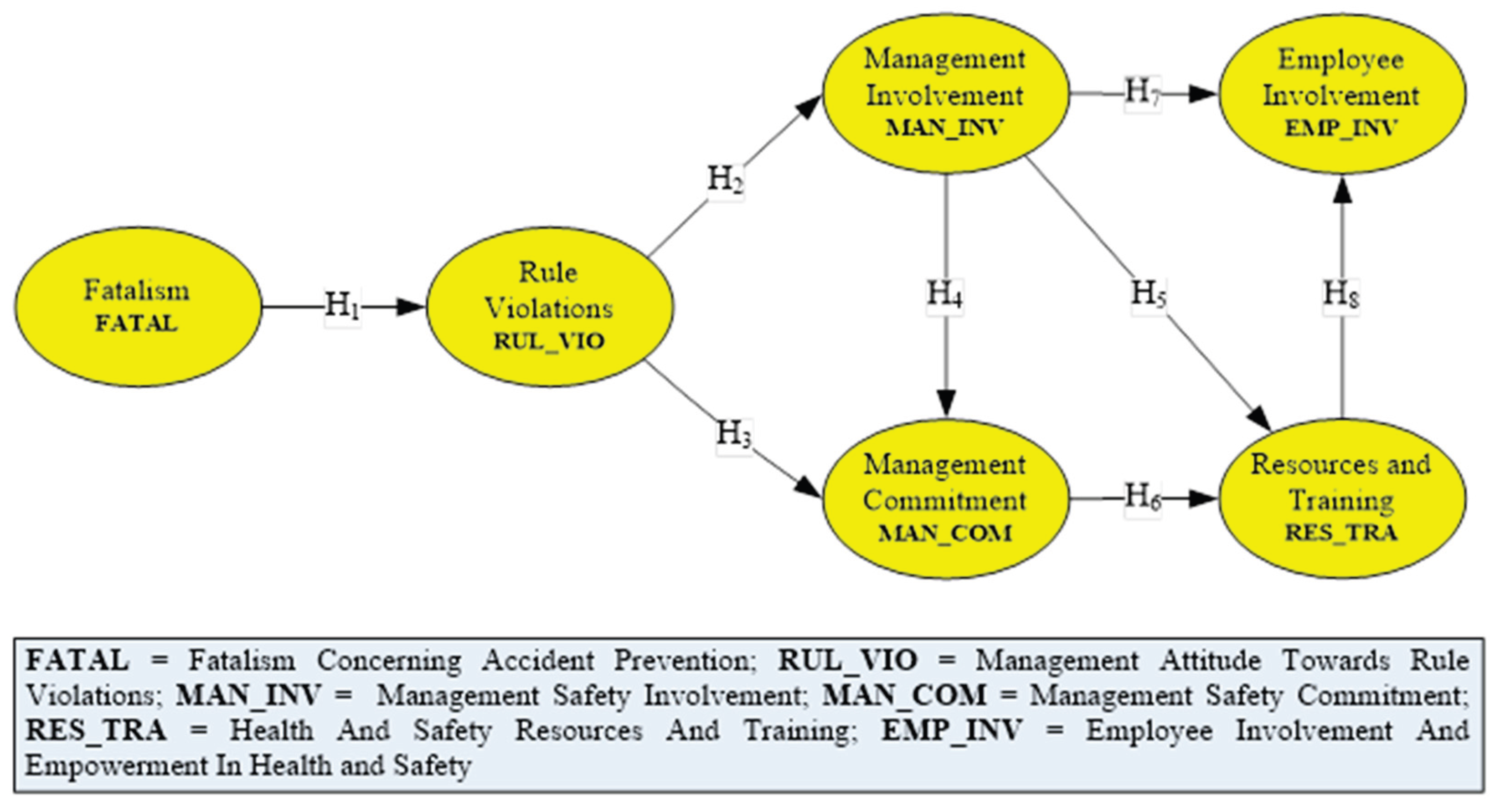
Figure 2.
PLS-SEM results.
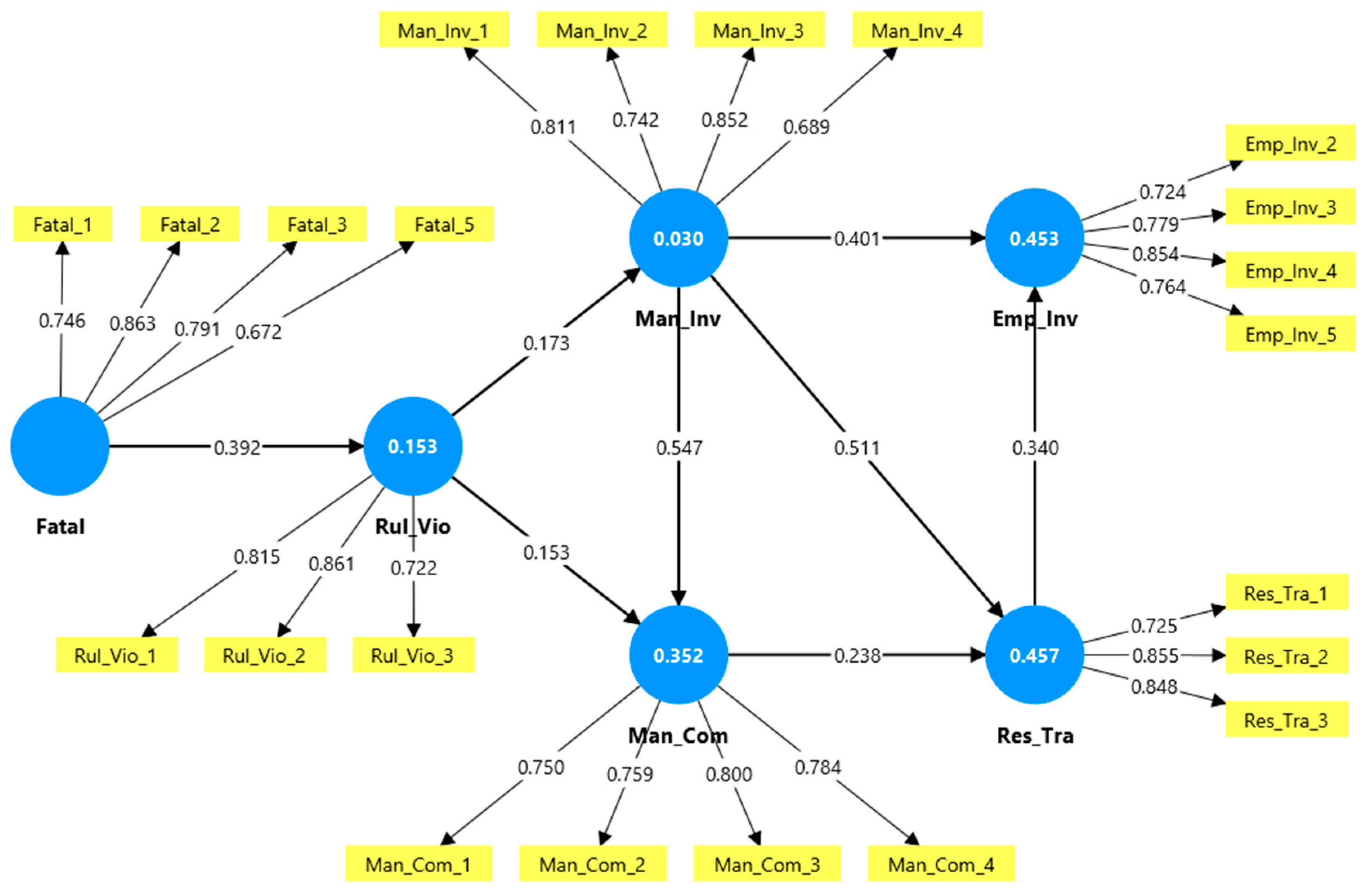
Table 1.
Participant Demographics (N = 391).
| Gender | N | % | Marital status | N | % | |||
| Male | 345 | 88,2 | Married | 292 | 74,7 | |||
| Female | 46 | 11,8 | Single | 99 | 25,3 | |||
| Total | 391 | 100 | Total | 391 | 100 | |||
| Age | N | % | Educational level | N | % | |||
| 18-30 | 115 | 29,4 | Primary school graduate | 31 | 7,9 | |||
| 31-40 | 158 | 40,4 | Secondary school graduate | 23 | 5,9 | |||
| 41-50 | 100 | 25,6 | High school graduate | 79 | 20,2 | |||
| 51 years old and above | 18 | 4,6 | University graduate | 258 | 66,0 | |||
| Total | 391 | 100 | Total | 391 | 100 | |||
| Administrator Groups | ||||||||
| POSITION | Entry-level managers |
Mid-level Managers |
Upper-level Managers |
|||||
| Supervisor in Charge | Engineer | Manager/Assistant Manager | ||||||
| Foreman | Technical Specialist | Employer | ||||||
| Specialist/Assistant Specialist | Team leader | Employer Representative (Person responsible for the entire management of a workplace ) | ||||||
| Chargehand | (Planning-production) Individual Responsible | |||||||
| 181 (46,3%) | 134 (34,3%) | 76 (19,4%) | ||||||
| 391 – 100% | ||||||||
Table 2.
The Assessment of Discriminant Validity and İnternal Consistency Reliability.
| Latent variable | Variable | Convergent validity | Internal consistency reliability | ||||
| Loadings | Indicator reliability | AVE | Cronbach’s Alpha | rho_A | CR | ||
| > 0.700 | > 0.500 | > 0.500 | 0.700 – 0.900 | > 0.700 | > 0.700 | ||
| FATAL | Fatal_1 | 0.783 | 0.612 | 0.705 | 0.791 | 0.822 | 0.877 |
| Fatal_2 | 0.905 | 0.819 | |||||
| Fatal_3 | 0.827 | 0.684 | |||||
| MAN_COM | Man_Com_1 | 0.744 | 0.553 | 0.598 | 0.776 | 0.776 | 0.856 |
| Man_Com_2 | 0.763 | 0.583 | |||||
| Man_Com_3 | 0.800 | 0.639 | |||||
| Man_Com_4 | 0.786 | 0.617 | |||||
| MAN_INV | Man_Inv_1 | 0.834 | 0.696 | 0.683 | 0.767 | 0.776 | 0.866 |
| Man_Inv_2 | 0.771 | 0.594 | |||||
| Man_Inv_3 | 0.871 | 0.758 | |||||
| RES_TRA | Res_Tra_1 | 0.725 | 0.525 | 0.659 | 0.739 | 0.751 | 0.852 |
| Res_Tra_2 | 0.853 | 0.728 | |||||
| Res_Tra_3 | 0.850 | 0.723 | |||||
| RUL_VIO | Rul_Vio_1 | 0.799 | 0.639 | 0.642 | 0.720 | 0.717 | 0.843 |
| Rul_Vio_2 | 0.854 | 0.730 | |||||
| Rul_Vio_3 | 0.746 | 0.557 | |||||
| EMP_INV | Emp_Inv_2 | 0.728 | 0.529 | 0.611 | 0.787 | 0.793 | 0.862 |
| Emp_Inv_3 | 0.782 | 0.612 | |||||
| Emp_Inv_4 | 0.851 | 0.724 | |||||
| Emp_Inv_5 | 0.760 | 0.578 | |||||
Table 3.
The Assessment of Discriminatory Validity.
| EMP_INV | FATAL | MAN_COM | MAN_INV | RES_TRA | RUL_VIO | |
| EMP_INV | ||||||
| FATAL | 0.078 | |||||
| MAN_COM | 0.579 | 0.149 | ||||
| MAN_INV | 0.758 | 0.245 | 0.730 | |||
| RES_TRA | 0.788 | 0.152 | 0.697 | 0.838 | ||
| RUL_VIO | 0.299 | 0.458 | 0.339 | 0.284 | 0.295 |
Table 4.
The explanatory power of the model and the effect size.
| Link | R² | ƒ2 |
| FATAL ➔ RUL_VIO | 0.127 | 0.146** |
| RUL_VIO ➔ MAN_INV | 0.046 | 0.049* |
| RUL_VIO ➔ MAN_COM | 0.340 | 0.028* |
| MAN_INV ➔ MAN_COM | 0.417*** | |
| MAN_INV ➔ RES_TRA | 0.451 | 0.307*** |
| MAN_COM ➔ RES_TRA | 0.076* | |
| MAN_INV ➔ EMP_INV | 0.434 | 0.130** |
| RES_TRA ➔ EMP_INV | 0.146** |
Note: *Weak effect, **Moderate effect, ***Strong effect.
Table 5.
The Results of Hypotheses Testing.
|
Hypoteses No. |
Link | Path Coefficient (β) | Standard Deviation | t Statistics | Confidence Intervals (95% Bias Corrected) | Results |
| H1 | FATAL ➔ RUL_VIO | 0.356 | 0.054 | 6.551** | [0.236;0.454] | SP |
| H2 | RUL_VIO ➔ MAN_INV | 0.215 | 0.052 | 4.152** | [0.110;0.312] | SP |
| H3 | RUL_VIO ➔ MAN_COM | 0.139 | 0.046 | 3.000* | [0.048;0.230] | S |
| H4 | MAN_INV ➔ MAN_COM | 0.537 | 0.041 | 13.072** | [0.452;0.612] | SP |
| H5 | MAN_INV ➔ RES_TRA | 0.498 | 0.050 | 9.885** | [0.396;0.591] | SP |
| H6 | MAN_INV ➔ EMP_INV | 0.353 | 0.060 | 5.919** | [0.237;0.473] | SP |
| H7 | MAN_COM ➔ RES_TRA | 0.249 | 0.053 | 4.672** | [0.148;0.357] | SP |
| H8 | RES_TRA ➔ EMP_INV | 0.374 | 0.066 | 5.687** | [0.242;0.499] | SP |
Note: *p < 0.01; **p < 0.001; S = Supported; SP = Strongly Supported.
Table 6.
The Results of Indirect and Total Effects.
| Link | Path Coefficient (β) | Standard Deviation | t Statistics | Confidence Intervals (95% Bias Corrected) | Results |
| Indirect effects | |||||
| FATAL ➔ RUL_VIO ➔ MAN_INV | 0,077 | 0,025 | 3,042* | [0,032;0,129] | S |
| FATAL ➔ RUL_VIO ➔ MAN_COM | 0,050 | 0,019 | 2,572* | [0,016;0,090] | S |
| FATAL➔RUL_VIO➔MAN_INV➔RES_TRA | 0,038 | 0,013 | 2,849* | [0,016;0,068] | S |
| FATAL➔RUL_VIO➔MAN_COM➔RES_TRA | 0,012 | 0,006 | 1,977* | [0,004;0,028] | S |
| FATAL➔RUL_VIO➔MAN_INV➔ EMP_INV | 0,027 | 0,010 | 2,636* | [0,011;0,051] | S |
| RUL_VIO ➔ MAN_INV ➔ RES_TRA | 0,107 | 0,029 | 3,737** | [0,054;0,165] | SP |
| RUL_VIO ➔ MAN_COM ➔ RES_TRA | 0,035 | 0,016 | 2,181* | [0,011;0,073] | P |
| RUL_VIO ➔ MAN_INV ➔ EMP_INV | 0,076 | 0,023 | 3,302* | [0,036;0,124] | P |
| MAN_COM ➔ RES_TRA ➔ EMP_INV | 0,093 | 0,026 | 3,610** | [0,052;0,154] | SP |
| Total effects | |||||
| FATAL ➔ EMP_INV | 0,050 | 0,016 | 3,155* | [0,025;0,086] | S |
| FATAL ➔ MAN_COM | 0,091 | 0,027 | 3,372* | [0,046;0,151] | S |
| FATAL ➔ MAN_INV | 0,077 | 0,025 | 3,042* | [0,036;0,135] | S |
| FATAL ➔ RES_TRA | 0,061 | 0,019 | 3,239* | [0,030;0,104] | S |
| FATAL ➔ RUL_VIO | 0,356 | 0,054 | 6,551** | [0,255;0,465] | SP |
| MAN_COM ➔ EMP_INV | 0,093 | 0,026 | 3,610** | [0,050;0,151] | SP |
| MAN_COM ➔ RES_TRA | 0,249 | 0,053 | 4,672** | [0,150;0,359] | SP |
| MAN_INV ➔ EMP_INV | 0,589 | 0,034 | 17,320** | [0,523;0,655] | SP |
| MAN_INV ➔ MAN_COM | 0,537 | 0,041 | 13,072** | [0,457;0,617] | SP |
| MAN_INV ➔ RES_TRA | 0,632 | 0,037 | 17,280** | [0,554;0,698] | SP |
| RES_TRA ➔ EMP_INV | 0,374 | 0,066 | 5,687** | [0,244;0,502] | SP |
| RUL_VIO ➔ EMP_INV | 0,140 | 0,032 | 4,336** | [0,080;0,205] | SP |
| RUL_VIO ➔ MAN_COM | 0,255 | 0,055 | 4,609** | [0,149;0,363] | SP |
| RUL_VIO ➔ MAN_INV | 0,215 | 0,052 | 4,152** | [0,118;0,321] | SP |
| RUL_VIO ➔ RES_TRA | 0,171 | 0,038 | 4,491** | [0,101;0,249] | SP |
Note: *p < 0.01; **p < 0.001; S = Supported; SP = Strongly Supported.
Disclaimer/Publisher’s Note: The statements, opinions and data contained in all publications are solely those of the individual author(s) and contributor(s) and not of MDPI and/or the editor(s). MDPI and/or the editor(s) disclaim responsibility for any injury to people or property resulting from any ideas, methods, instructions or products referred to in the content. |
© 2025 by the authors. Licensee MDPI, Basel, Switzerland. This article is an open access article distributed under the terms and conditions of the Creative Commons Attribution (CC BY) license (http://creativecommons.org/licenses/by/4.0/).
Copyright: This open access article is published under a Creative Commons CC BY 4.0 license, which permit the free download, distribution, and reuse, provided that the author and preprint are cited in any reuse.


