

Submitted:
28 October 2025
Posted:
29 October 2025
You are already at the latest version
Abstract
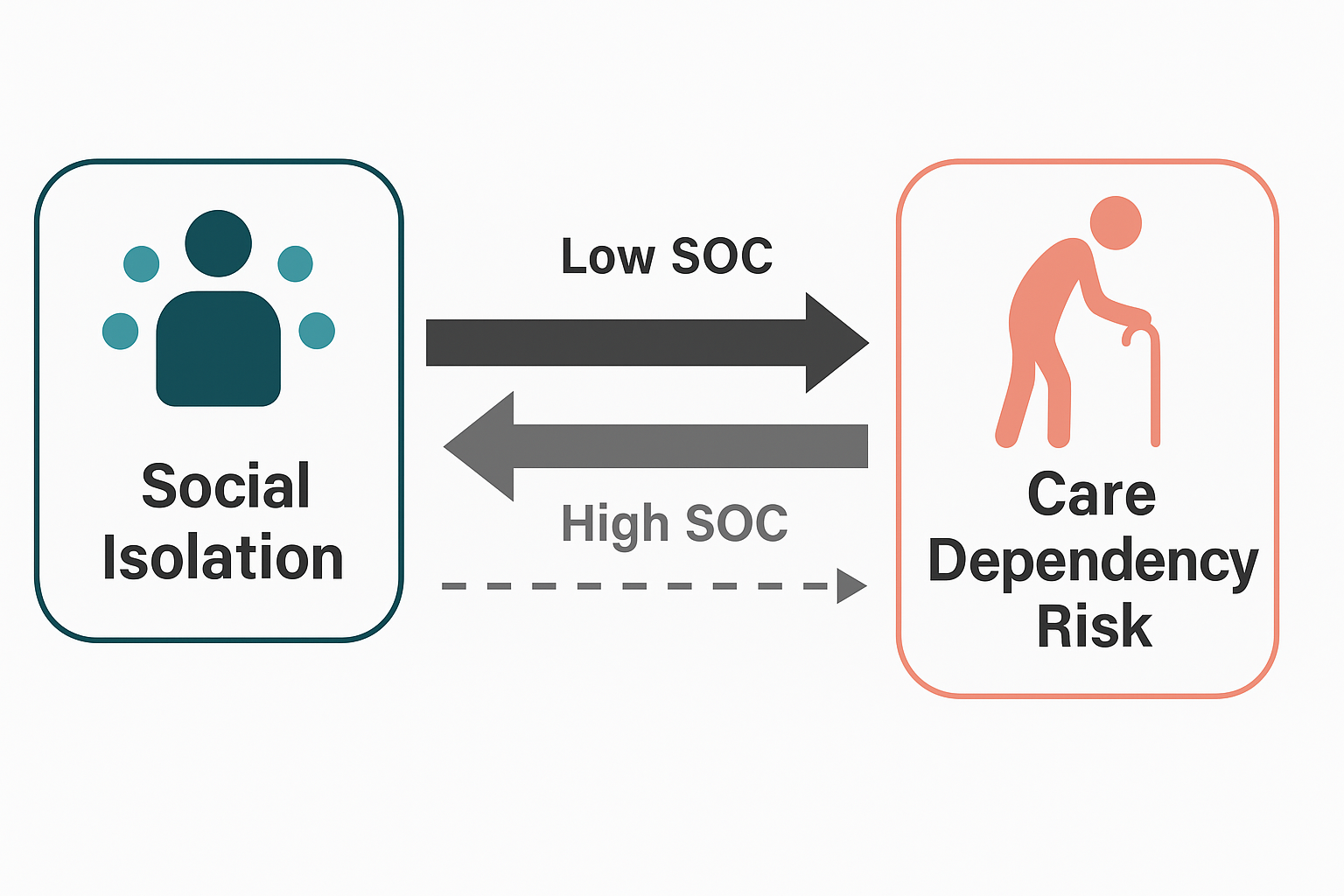
Background/Objectives: In Japan, the rapid aging of the population has increased the need for strategies to extend healthy life expectancy and prevent care dependency. Social isolation has been identified as a major risk factor for adverse physical and psychological outcomes, but its interaction with psychological resilience factors remains unclear. This study aimed to examine the association between social isolation and the risk of care dependency among community-dwelling older adults, and to investigate whether the sense of coherence (SOC) moderates this relationship.
Methods: A cross-sectional survey was conducted in City A, Kagawa Prefecture, in-volving 519 residents aged 65 years or older. Social isolation was assessed using the Japanese version of the Lubben Social Network Scale-6 (LSNS-6), and SOC was measured with a validated three-item scale from the University of Tokyo. The risk of care dependency was evaluated using a 15-item checklist developed by the Tokyo Metropolitan Institute of Gerontology. Nutritional status was measured using the Mini Nutritional Assessment–Short Form. Multiple imputation (m = 50) handled missing data. Standardized linear regression analyses estimated main and interaction effects, followed by robustness checks using robust, gamma, and bootstrap analyses.
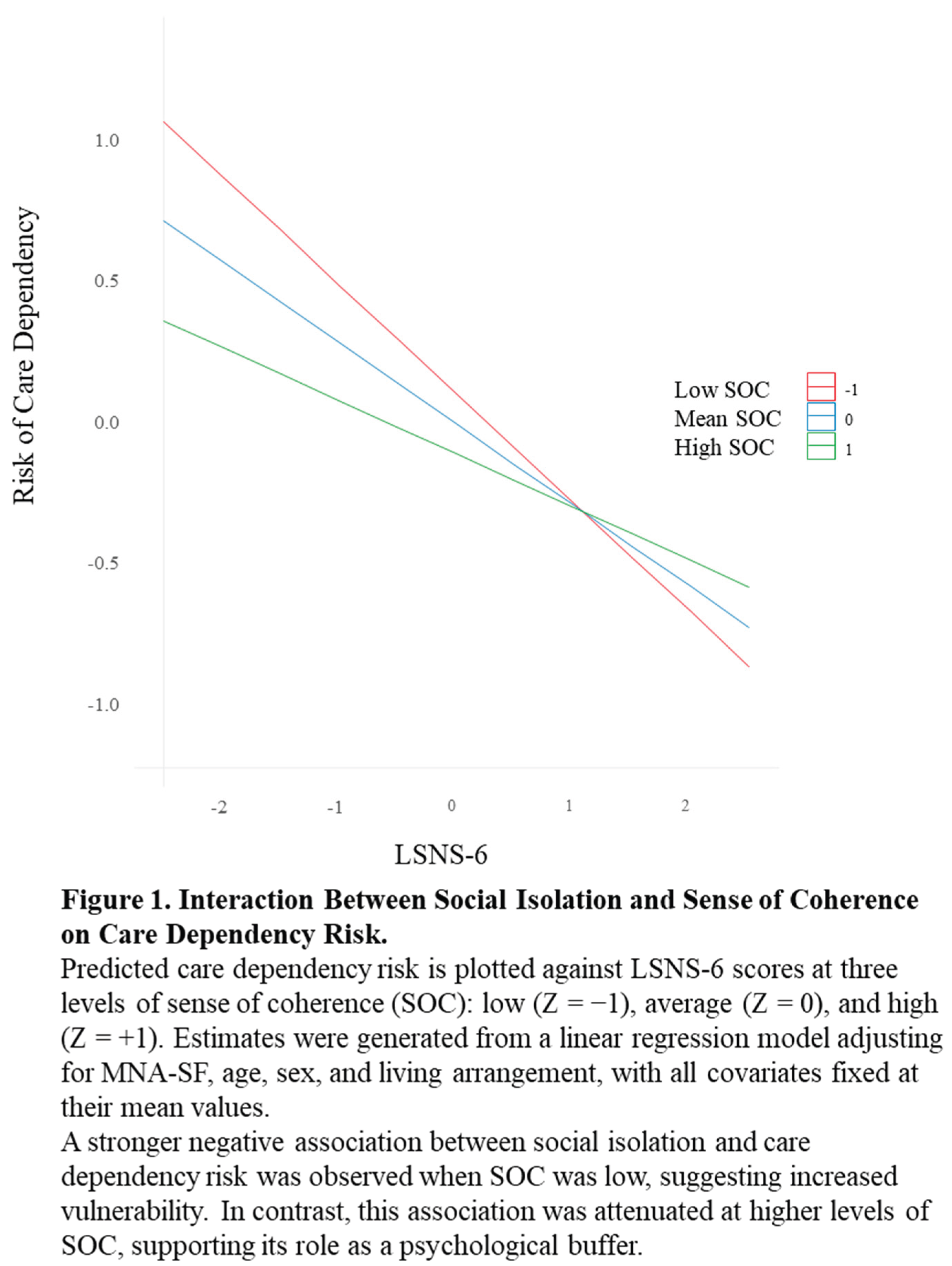
Results: Lower levels of social connectedness were significantly associated with a higher risk of care dependency. SOC significantly moderated this relationship (β = 0.100, p = .004), indicating that the negative impact of social isolation was more pronounced among individuals with lower SOC.
Conclusions: SOC may function as a psychological buffer mitigating the adverse im-pact of social isolation. Enhancing internal coping resources could be a useful strategy for preventive care programs among older adults. This study was not registered.
Keywords:
social isolation
; sense of coherence
; care dependency
; older adults
; community setting
1. Introduction
Population aging is accelerating globally, and Japan represents one of the most rapidly aging societies in the world. Extending healthy life expectancy and preventing care dependency have become urgent public health priorities. Identifying the factors that contribute to care needs before older adults require long-term care is essential for timely intervention and the establishment of a sustainable care system. These risk factors are multifactorial, reflecting the complex interplay among physical, psychological, and social components that intensify with age [1].
Among these factors, social isolation has gained increasing attention as a critical determinant of health. Previous studies have linked social isolation to a wide range of adverse outcomes, including increased mortality, depressive symptoms, functional decline, and limitations in activities of daily living [2,3,4]. In Japan, the proportion of older adults living alone continues to rise. According to the White Paper on the Aging Society (2024), 15.0% of men and 22.1% of women aged 65 years and older were living alone in 2020, and these rates are projected to increase to 26.1% and 29.3%, respectively, by 2050 [5]. Against this backdrop, preventing social isolation has become a national concern, especially amid growing shortages of care workers that threaten the sustainability of the long-term care system.
To address these challenges, Japan’s national policies emphasize the principles of self-help and mutual support, highlighting the importance of enhancing older adults’ self-management abilities and internal resources [6]. Similarly, the World Health Organization (WHO, 2015) identified intrinsic capacity, resilience to stress, and self-directed behavior as key elements of healthy aging, underscoring the theoretical and practical importance of mobilizing internal resources in addition to external support systems [7].
One such internal resource is the Sense of Coherence (SOC), a concept proposed by Antonovsky [8]. SOC represents a psychological orientation that enables individuals to perceive life as comprehensible, manageable, and meaningful. A growing body of evidence demonstrates that older adults with higher SOC tend to exhibit better physical and mental health, including lower risks of chronic illness, depression, and functional impairment [9,10,11,12,13,14,15]. These findings suggest that SOC functions as a protective psychological factor against age-related health decline.
Recent studies have explored whether SOC also mitigates the negative consequences of social isolation. Several investigations have reported a protective role of SOC. For example, Giglio et al. [10] found that higher SOC was associated with better health-related quality of life among community-dwelling older adults in Spain, while Adebusoye et al. [15] reported similar findings in Nigerian populations. These results imply that SOC may serve as a health-promoting psychological resource, particularly among socially vulnerable groups.
However, the buffering role of SOC has not been consistently demonstrated. Van Woerden et al. [16] reported that SOC buffered the adverse effects of long-term conditions and disability on quality of life, but not those of loneliness or social isolation. Similarly, Lin et al. [17] found that SOC mediated—but did not moderate—the relationship between aging-related self-stereotypes and social isolation. Park et al. [18] further observed that among older Korean Americans, the harmful effects of social isolation were mitigated more by family and community cohesion than by SOC alone. These inconsistencies suggest that the protective role of SOC may vary across individual, cultural, and environmental contexts, warranting further investigation.
Based on these theoretical perspectives and prior research, this study aimed to examine the association between social isolation and the risk of care dependency among community-dwelling older adults in Japan and to investigate whether SOC moderates this relationship. We hypothesized that SOC would buffer the negative association between social isolation and care dependency, such that the association would be weaker among individuals with higher SOC.
2. Materials and Methods
2.1. Study Design and Participants
This cross-sectional study targeted community-dwelling older adults aged ≥ 65 years residing in a district of Takamatsu City, Kagawa Prefecture, Japan. The survey area corresponded to a neighborhood federation that combined both urban and rural characteristics.Participants were identified from the federation roster. As of April 2023, 726 eligible residents were invited to participate in a complete census survey. Although a full enumeration was attempted, the obtained dataset was treated as a sample due to nonresponse and other exclusions.
Eligibility included all older adults living in the community, regardless of household composition. Individuals with severe cognitive impairment or psychiatric conditions preventing independent questionnaire completion were excluded. Written information describing the study’s purpose, procedures, voluntary participation, and data protection was provided in advance, and written informed consent was obtained from all participants.The study was approved by the Ethics Committee of the Faculty of Medicine, Kagawa University (Approval No. 2023-027).
2.2. Measures
2.2.1. Social ISOLATION
Social isolation was assessed using the Japanese version of the Lubben Social Network Scale-6 (LSNS-6) [19], a validated measure of perceived social connectedness among older adults. The LSNS-6 comprises six items—three assessing family ties and three assessing friendships—each rated on a 6-point scale (0–5). Total scores range from 0 to 30, with lower scores indicating stronger social isolation.In this study, lower LSNS-6 scores were operationalized as indicators of social isolation, consistent with prior research defining isolation as limited interpersonal interaction and network size [21]. Although formal support is not included, the LSNS-6 effectively captures informal social connectedness, aligning with international efforts to standardize measurement of isolation [22].
2.2.2. Sense of COHERENCE (SOC)
SOC was measured using the Japanese version of the SOC-3-UTHS, developed at the University of Tokyo [23]. This brief scale includes three items representing comprehensibility, manageability, and meaningfulness. Each is rated on a 7-point scale (total range = 3–21); higher scores indicate a stronger SOC.The short form was selected for its reliability, validity, and suitability for older populations, while minimizing respondent burden given the comprehensive nature of the questionnaire.
2.2.3. Nutritional Status
Nutritional status was evaluated using the Japanese version of the Mini Nutritional Assessment-Short Form (MNA-SF) [24,25]. The MNA-SF consists of six items covering food intake, weight loss, mobility, psychological stress or acute illness, neuropsychological problems, and either body-mass index or calf circumference. Scores range 0–14, with ≥ 12 = normal nutritional status, 8–11 = risk of malnutrition, ≤ 7 = malnourished.
2.2.4. Risk of Care Dependency
The 15-item Care Prevention Checklist, developed by Shinkai et al. [28], was used to assess risk of care dependency. Although initially designed to screen for frailty, this tool is widely accepted as a multidimensional proxy for future care needs. It evaluates physical, nutritional, cognitive, psychological, sensory, lifestyle, and social participation domains. Each item is binary, with total scores 0–15; higher scores indicate greater risk.
The validity of this checklist has been demonstrated across multiple studies, including longitudinal research showing associations with subsequent disability and mortality [27,29]. Other indices (e.g., Barthel Index [30] and Lawton IADL scale [31]) were reviewed but focus primarily on physical function. The 25-item Basic Checklist of Japan’s Ministry of Health, Labour and Welfare was also considered but deemed overly lengthy and less sensitive to psychosocial aspects. The 15-item version was therefore chosen for its balance of comprehensiveness and feasibility.
2.3. Data Collection
Data were collected between October and November 2023 in cooperation with neighborhood associations. Paper-based, self-administered questionnaires were distributed by trained local volunteers and returned via mail, direct hand-back, or submission to the neighborhood office. Of 726 distributed questionnaires, 519 were returned, yielding a valid response rate of 71.5%.Each questionnaire was accompanied by an information sheet explaining study aims, voluntary participation, and confidentiality. Written informed consent was implied upon submission of the completed form.
2.4. Missing Data Handling
Missing data for key variables (e.g., LSNS-6, MNA-SF, age) were handled using multiple imputation by chained equations (MICE) in R. Fifty imputations (m = 50, seed = 1111) were conducted for the main analysis and twenty (m = 20, seed = 2025) for sensitivity testing.
All analytical variables (excluding interaction terms) were included in the imputation model. Predictive mean matching was used for continuous variables, and logistic regression for categorical variables. Estimates from imputed datasets were pooled using Rubin’s rules.
Comparisons of pre- and post-imputation means and standard deviations confirmed negligible change, and visual inspection revealed no distortion of distributions; bias from imputation was therefore considered minimal.
2.5. Statistical Analysis
Analyses were performed using R version 4.3.3 [32]. Continuous variables (LSNS-6, SOC, MNA-SF, age, Care Prevention Checklist score) were standardized (Z-scores).
A basic linear regression model examined associations between LSNS-6, SOC, MNA-SF, age, sex, and living arrangement (living alone vs. not) and the Care Prevention Checklist score. To test moderation, an extended model added the interaction term (LSNS-6 × SOC). Model fit was compared using the Akaike Information Criterion (AIC) and adjusted R². The robustness of the findings was evaluated using multiple complementary approaches, including sensitivity analyses with varying numbers of imputations, robust regression with Huber’s M-estimator to account for outliers, gamma regression with a log link to accommodate non-normal distributions, and bootstrap validation based on 1,000 resamples. Interaction effects were further examined and visualized by plotting the predicted values using standardized datasets.
3. Results
3.1. Participant Characteristics
Table 1 summarizes the characteristics of the 519 participants.
The mean age was approximately 78 years, and about 30% lived alone. Although the proportion of individuals living alone differs slightly from national estimates, this study focused on associations among psychosocial and health-related variables rather than population prevalence. Descriptive statistics (means ± standard deviations) for the main study variables—LSNS-6, SOC, MNA-SF, and Care Prevention Checklist scores—are presented in Table 1.
3.2. Main Analysis
Table 2 presents the results of the linear regression models conducted with and without the interaction term (m = 50; estimates pooled using Rubin’s rules).
In the basic model, LSNS-6, SOC, MNA-SF, and age were significant predictors of care-dependency risk, whereas sex and living arrangement were not. In the extended model, the interaction between LSNS-6 and SOC reached statistical significance, indicating that the protective association of social connectedness with lower care-dependency risk was stronger among participants with lower SOC.
3.3. Model Comparison: With vs. Without the Interaction Term
Model fit was compared using the Akaike Information Criterion (AIC) and adjusted R² values. As shown in Table 2, both indices slightly favored the extended model, supporting the inclusion of the interaction term. Subsequent sensitivity and robustness analyses were therefore based on this extended model structure.
3.4. Robustness Analyses
Several supplementary analyses were performed to confirm the robustness of the findings.
First, sensitivity analyses assessed whether varying the number of imputations affected the results. Re-estimation of the interaction model using a reduced number of imputations (m = 20, seed = 2025) produced coefficients and significance levels comparable with the main analysis (m = 50), confirming stability across imputation settings (Table 3).
Across additional analytic approaches—including robust regression using Huber’s M-estimator, gamma regression with a log link, and bootstrap resampling—the key predictors remained consistent. The interaction term (LSNS-6 × SOC) remained positive in direction and statistically stable, though marginal in the gamma model (p = 0.077). These results collectively support the robustness of the primary findings under diverse model assumptions (Table 4).
3.5. Bootstrap Validation of the Interaction Effect
Bootstrap analysis based on 1,000 replications yielded a 95% confidence interval for the interaction term of [0.086, 0.381]. This result indicates a consistently positive moderating effect of SOC, reinforcing the reliability of the observed interaction.
3.6. Visualization of the Interaction Effect
Figure 1 illustrates the predicted relationship between LSNS-6 and care-dependency risk across SOC levels.
4. Discussion
This study examined the association between social isolation and the risk of care dependency among community-dwelling older adults in Japan and explored whether the Sense of Coherence (SOC) moderates this relationship. Consistent with previous research, social isolation was significantly associated with higher care-dependency risk [2,3]. Furthermore, SOC moderated this association, suggesting that it functions as a psychological protective resource buffering the adverse effects of social isolation.Authors should discuss the results and how they can be interpreted from the perspective of previous studies and of the working hypotheses. The findings and their implications should be discussed in the broadest context possible. Future research directions may also be highlighted.
4.1. Social Isolation and the Risk of Care Dependency
The observed link between social isolation and care-dependency risk aligns with existing evidence that insufficient social connection contributes to poor health outcomes through multiple pathways. These include reduced physical activity, unhealthy lifestyle behaviors, and limited instrumental or emotional support. In addition, chronic stress responses associated with social isolation—such as inflammation and altered neuroendocrine activity—may accelerate physiological deterioration and heighten vulnerability. These mechanisms underscore that care-dependency risk is multifactorial, involving both physical and social determinants of health.
Interestingly, neither sex nor living alone was significantly related to care-dependency risk in this study. One plausible explanation is that participants were relatively healthy and functionally independent. Moreover, household composition may not accurately represent the quality or availability of social support. Previous research indicates that the structure and perceived quality of social networks may exert greater health influence than mere living arrangements [33]. Accordingly, the use of network-based quantitative measures such as the LSNS-6 emphasizes the importance of assessing social connectedness more precisely.
4.2. The Buffering Role of SOC
A major contribution of this study is the identification of SOC as a moderating factor in the relationship between social isolation and care-dependency risk. Rather than directly lowering risk, higher SOC appeared to mitigate the negative effects of isolation, consistent with Antonovsky’s salutogenic model [8], which conceptualizes SOC as a psychological orientation enabling individuals to view stressors as comprehensible, manageable, and meaningful.
In older adulthood, a strong SOC may enhance resilience, facilitating maintenance of health-promoting behaviors even when external social support is limited. However, this buffering effect may depend on the individual’s perception of isolation as a stressor; if isolation is not perceived as threatening, SOC-related coping mechanisms may not be activated.
This finding differs from that of Lin et al. [17], who reported a mediating—but not moderating—role of SOC in the relationship between aging-related self-stereotypes and social isolation. Differences in outcome variables (care dependency vs. perceived isolation), cultural contexts, and analytical design (observational vs. structural modeling) may explain the discrepancy. Although SOC was initially regarded as a stable trait, emerging evidence suggests it can be enhanced through targeted interventions such as psychoeducational programs, reminiscence therapy, and mindfulness training [34]. Such findings highlight SOC as a potentially modifiable psychological resource relevant for preventive strategies.
4.3. Cultural and Practical Implications
Interpretation of these findings should consider Japan’s sociocultural context. Collectivist values emphasizing interpersonal harmony may heighten the psychological distress associated with isolation. Prior research suggests that social isolation exerts stronger psychological effects in interdependent cultures than in individualistic ones [35]. Moreover, older Japanese adults may hesitate to express emotional distress or seek social support, which could amplify isolation’s adverse consequences. These cultural tendencies underline the importance of assessment tools and interventions sensitive to familial and relational dimensions.
From a public-health perspective, integrating SOC-enhancing components into Japan’s community-based integrated care system could strengthen preventive efforts. Combining psychological support and self-reflection-based programs with community-engagement initiatives may simultaneously reduce isolation and reinforce internal coping capacities. Including SOC and social-network assessments such as the LSNS-6 in routine screenings could identify individuals with low resilience and high care-dependency risk, enabling early, targeted interventions.
4.4. Limitations and Future Directions
Several limitations should be acknowledged.
First, the cross-sectional design prevents causal inference; although social isolation may increase care-dependency risk, reverse causality is possible.
Second, reliance on self-reported measures (e.g., SOC, social networks) may have introduced response bias.
Third, while the three-item SOC-3-UTHS is validated for older Japanese adults, its brevity may not capture the construct’s full multidimensionality.
Fourth, the 15-item Care Prevention Checklist focuses strongly on behavioral and lifestyle aspects but includes fewer items on emotional state compared with the 25-item Basic Checklist, potentially limiting psychological coverage.
Fifth, although sex was controlled for in regression models, interaction or stratified analyses were not conducted due to limited sample size; future studies should examine sex-specific differences.
Finally, as this research was confined to one neighborhood federation, generalization to other regions or cultures should be made cautiously.
Despite these limitations, this study provides evidence that social isolation is associated with increased risk of care dependency and that SOC serves as a psychological buffer supporting independent living in later life. Incorporating SOC assessment and enhancement into community prevention strategies may promote more personalized and sustainable support systems for older adults. To clarify causal mechanisms, future longitudinal and interventional studies are warranted.
5. Conclusions
This study demonstrated that social isolation is significantly associated with an increased risk of care dependency among community-dwelling older adults in Japan. The Sense of Coherence (SOC) functions as a psychological buffer mitigating this negative association, suggesting that enhancing SOC may help maintain independent living and reduce the risk of care dependency. Integrating SOC assessment and strengthening interventions into community-based preventive care may contribute to a more sustainable and person-centered support system for aging populations.
Author Contributions
Conceptualization, S.H.; Methodology, S.H. and K.M.; Data collection, S.H.; Formal analysis, S.H.; Writing—original draft preparation, S.H.; Writing—review and editing, S.H. and K.M.; Supervision, K.M. All authors have read and agreed to the published version of the manuscript.
Funding
This research received no external funding. The funders had no role in the design of the study; in the collection, analyses, or interpretation of data; in the writing of the manuscript; or in the decision to publish the results.
Institutional Review Board Statement
The study was conducted in accordance with the Declaration of Helsinki and approved by the Ethics Committee of the Faculty of Medicine, Kagawa University (Approval No. 2023-027, June 6, 2023).
Informed Consent Statement
Written informed consent was obtained from all subjects involved in the study.
Data Availability Statement
The datasets generated and analyzed during the current study are available from the corresponding author upon reasonable request.
Public Involvement Statement
No public involvement in any aspect of this research.
Guidelines and Standards Statement
This manuscript was drafted in accordance with the Strengthening the Reporting of Observational Studies in Epidemiology (STROBE) statement for cross-sectional studies.
Use of Artificial Intelligence
AI or AI-assisted tools were not used in drafting, analyzing, or interpreting any aspect of this manuscript.
Acknowledgments
The authors are deeply grateful to Associate Professor Masafumi Kirino, Faculty of Health and Welfare Science, Okayama Prefectural University, for his valuable support with statistical analysis.The authors also thank the community volunteers and staff members who assisted with participant recruitment and data collection.
Conflicts of Interest
The authors declare no conflict of interest.
Abbreviations
All abbreviations are defined in the text at their first mention.
References
- Fried LP, Tangen CM, Walston J, Newman AB, Hirsch C, Gottdiener J, et al. Frailty in older adults: evidence for a phenotype. J Gerontol A Biol Sci Med Sci. 2001;56(3):M146–56. [CrossRef]
- Nicholson NR. A review of social isolation: an important but underassessed condition in older adults. J Prim Prev. 2012;33(2–3):137–52. [CrossRef]
- Shankar A, McMunn A, Banks J, Steptoe A. Loneliness, social isolation, and behavioral and biological health indicators in older adults. Health Psychol. 2011;30(4):377–85. [CrossRef]
- Wang J, Lloyd-Evans B, Giacco D, Forsyth R, Nebo C, Mann F, et al. Social isolation in mental health: a conceptual and methodological review. Soc Psychiatry Psychiatr Epidemiol. 2017;52:1451–61. [CrossRef]
- Cabinet Office, Government of Japan. Annual report on the ageing society: 2024 White Paper. 2024. Available from: https://www8.cao.go.jp/kourei/whitepaper/w-2024/html/zenbun/index.html (in Japanese).
- Ministry of Health, Labour and Welfare. The 8th Long-Term Care Insurance Project Plan: Basic Guidelines. 2021. Available from: https://www.mhlw.go.jp/content/12300000/000598356.pdf (in Japanese).
- World Health Organization. World report on ageing and health. Geneva: WHO; 2015. Available from: https://www.who.int/publications/i/item/9789241565042.
- Antonovsky A. Unraveling the mystery of health: how people manage stress and stay well. San Francisco: Jossey-Bass; 1987.
- Eriksson M, Lindström B. Antonovsky’s sense of coherence scale and the relation with health: a systematic review. J Epidemiol Community Health. 2006;60(5):376–81. [CrossRef]
- Giglio R, Rodríguez-Blázquez C, De Pedro-Cuesta J, Forjaz M. Sense of coherence and health of community-dwelling older adults in Spain. Int Psychogeriatr. 2014;27:621–8. [CrossRef]
- Lv J, Qian M, Deng M, Yu M. The association between sense of coherence and health outcomes among community-dwelling older adults: a systematic review. Interdiscip Nurs Res. 2023;2:46–57. [CrossRef]
- Koppner J, Lindelöf A, Iredahl F, Nilsson S, Thorsell A, Larsen H, et al. Sense of coherence, mental health, and hair cortisol concentrations among older people during the COVID-19 pandemic: a cross-sectional study. BMC Public Health. 2024;24:19034. [CrossRef]
- Possebon A, Martins A, Danigno J, Langlois C, Silva A. Sense of coherence and oral health in older adults in Southern Brazil. Gerodontology. 2017;34:377–81. [CrossRef]
- Komeili T, Khahan-Yazdi I, Sadri M, Shokouhi-Tabar M, Heidari M, Taheri-Kharameh Z. Sense of coherence as a protective factor of health-related quality of life in Iranian older adults. Discov Soc Sci Health. 2024. [CrossRef]
- Adebusoye L, Oyinlola O, Cadmus E, Obadare A. Factors associated with the sense of coherence among older adults attending a geriatric centre in Nigeria. Ageing Int. 2024. [CrossRef]
- Van Woerden HC, Angus N, Kiparoglou V, Atherton I, Leung J. Long-term conditions in older people are linked with loneliness, but a sense of coherence buffers the adverse effects on quality of life: a cross-sectional study. J Multidiscip Healthc. 2021;14:2467–75. [CrossRef]
- Lin Y, Zhang B, Ma Y. How do aging self-stereotypes relate to social isolation in older adults? The intervening roles of sense of coherence and cellphone use. Psychol Rep. 2024;127(3):1100–16. [CrossRef]
- Park NS, Jang Y, Yoon JW, Chung S, Chiriboga DA. Relationship of social isolation with mental distress among older Korean Americans: the moderating role of social cohesion. Health Soc Care Community. 2022;30(6):e4909–19. [CrossRef]
- Kurimoto A, Awata S, Ohkubo T, Tsubota-Utsugi M, Asayama K, Takahashi K, et al. Reliability and validity of the Japanese version of the abbreviated Lubben Social Network Scale. Nihon Ronen Igakkai Zasshi. 2011;48(2):149–57. (in Japanese). [CrossRef]
- Lubben J, Blozik E, Gillmann G, Iliffe S, von Renteln Kruse W, Beck JC, et al. Performance of an abbreviated version of the Lubben Social Network Scale among three European community-dwelling older adult populations. Gerontologist. 2006;46(4):503–13. [CrossRef]
- Röhr S, Wittmann F, Engel C, Enzenbach C, Witte AV, Villringer A, et al. Social factors and the prevalence of social isolation in a population-based adult cohort. Soc Psychiatry Psychiatr Epidemiol. 2022;57(10):1959–68. [CrossRef]
- Zavaleta D, Samuel K, Mills C. Measures of social isolation. Soc Indic Res. 2017;131:367–91. [CrossRef]
- Togari T, Yamazaki Y, Nakayama K, Shimizu J. Development of a short version of the sense of coherence scale for population survey. J Epidemiol Community Health. 2007;61(10):921–2. [CrossRef]
- Rubenstein LZ, Harker JO, Salvà A, Guigoz Y, Vellas B. Screening for undernutrition in geriatric practice: developing the short-form mini-nutritional assessment (MNA-SF). J Gerontol A Biol Sci Med Sci. 2001;56(6):M366–72. [CrossRef]
- Kaiser MJ, Bauer JM, Ramsch C, Uter W, Guigoz Y, Cederholm T, et al. Validation of the Mini Nutritional Assessment short-form (MNA-SF): a practical tool for identification of nutritional status. J Nutr Health Aging. 2009;13(9):782–8. [CrossRef]
- Satake S, Senda K, Hong YJ, Miura H, Endo H, Sakurai T, et al. Validity of the Kihon Checklist for assessing frailty status: Kihon Checklist as frailty scale. Geriatr Gerontol Int. 2016;16(6):709–15. (in Japanese). [CrossRef]
- Shinkai S, Watanabe N, Yoshida H, Fujiwara Y, Nishi M, Fukaya T, et al. Validity of the “Kaigo-Yobo Checklist” as a frailty index. Nihon Koshu Eisei Zasshi. 2013;60(5):262–74. (in Japanese). [CrossRef]
- Shinkai S, Watanabe N, Yoshida H, Fujiwara Y, Amano H, Lee S, et al. Research on screening for frailty: development of “the Kaigo-Yobo Checklist.” Nihon Koshu Eisei Zasshi. 2010;57(5):345–54. (in Japanese). [CrossRef]
- Murayama H, Nishi M, Shimizu Y, Kim MJ, Yoshida H, Amano H, et al. The Hatoyama Cohort Study: design and profile of participants at baseline. J Epidemiol. 2012;22(6):551–8. [CrossRef]
- Mahoney FI, Barthel DW. Barthel Index (BI). In: McDowell I, editor. A compendium of tests, scales and questionnaires. 1st ed. London: Psychology Press; 2020. p.421–5.
- Lawton M, Brody E. Assessment of older people: self-maintaining and instrumental activities of daily living. Gerontologist. 1969;9(3):179–86.
- R Core Team. R: A language and environment for statistical computing. Vienna: R Foundation for Statistical Computing; 2024. Available from: https://www.R-project.org/.
- Tomaka J, Thompson S, Palacios R. The relation of social isolation, loneliness, and social support to disease outcomes among the elderly. J Aging Health. 2006;18(3):359–84. [CrossRef]
- Super S, Wagemakers MAE, Picavet HSJ, Verkooijen KT, Koelen MA. Strengthening sense of coherence: opportunities for theory building in health promotion. Health Promot Int. 2016;31(4):869–78. [CrossRef]
- Markus HR, Kitayama S. Culture and the self: implications for cognition, emotion, and motivation. Psychol Rev. 1991;98(2):224–53. [CrossRef]

Table 1.
Characteristics of the Participants (N = 519).
| Variable | Value (mean ± SD or n [%]) |
| Age | 77.89 ± 7.61 |
| Female | 354(68.2%) |
| Living alone | 155(29.9%) |
| Social network (LSNS-6) | 14.91 ± 6.03 |
| Sense of coherence (SOC) | 15.65 ± 3.61 |
| Nutritional status (MNA-SF) | 11.68 ± 2.48 |
| Risk of Care dependency (Care Prevention Checklist ) | 3.14 ± 2.21 |
Note. LSNS-6 = Lubben Social Network Scale–6 (Kurimoto et al., 2011); SOC = Sense of Coherence, measured using the Japanese version of the SOC-3-UTHS, developed by the University of Tokyo (Togari, 2007); MNA-SF = Mini Nutritional Assessment–Short Form (Rubenstein et al., 2001); Care Prevention Checklist = 15-item screening tool developed by Shinkai et al. (2010).
Table 2.
Comparison of Linear Regression Models: With and Without Interaction Term (m = 50).
| Model1 | Model2 | ||||||
| Variable | β | SE | p-value | β | SE | p-value | |
| Intercept | 0.027 | 0.068 | .696 | -0.002 | 0.068 | .976 | |
| LSNS-6 | -0.251 | 0.041 | < .001 *** | -0.248 | 0.041 | < .001 *** | |
| SOC | -0.119 | 0.04 | .003 ** | -0.116 | 0.04 | .004 ** | |
| MNA-SF | -0.221 | 0.046 | < .001 *** | -0.224 | 0.046 | < .001 *** | |
| Age | 0.263 | 0.043 | < .001 *** | 0.25 | 0.043 | < .001 *** | |
| Female (ref: male) | -0.03 | 0.085 | .724 | -0.032 | 0.084 | .709 | |
| Living alone | 0.036 | 0.095 | .706 | 0.041 | 0.095 | .665 | |
| LSNS-6×SOC | — | — | — | 0.1 | 0.035 | .004 ** |
Note. All continuous variables (LSNS-6, SOC, MNA-SF, Age) were standardized (Z-transformed) before analysis. LSNS-6 = Lubben Social Network Scale–6; SOC = Sense of Coherence; MNA-SF = Mini Nutritional Assessment–Short Form; SE = Standard error. “—” indicates that the variable was not included in the model. *p < .05; **p < .01; ***p < .001. Adjusted R² = .291 (Model 1), .302 (Model 2); AIC = 1156.13 (Model 1), 1149.63 (Model 2). AIC = Akaike Information Criterion. Lower values indicate better model fit. The small AIC difference supports model integration.
Table 3.
Comparison of Regression Coefficients Between Main and Sensitivity Analyses.
| Variable | β̂ (m = 50) | SE | p-value | β̂ (m = 20) | SE | p-value | |
| Intercept | -0.034 | 0.069 | .624 | -0.033 | 0.069 | .638 | |
| LSNS-6 | -0.281 | 0.041 | <.001 *** | -0.285 | 0.04 | <.001*** | |
| OC | -0.103 | 0.041 | .013 * | -0.1 | 0.041 | .014 * | |
| MNA-SF | -0.158 | 0.041 | <.001 *** | -0.159 | 0.041 | <.001*** | |
| Age | 0.239 | 0.043 | <.001 *** | 0.239 | 0.043 | <.001*** | |
| Female (ref: male) | -0.009 | 0.085 | .92 | -0.009 | 0.085 | .918 | |
| Living alone | 0.047 | 0.094 | .617 | 0.045 | 0.094 | .629 | |
| LSNS-6 × SOC | 0.1 | 0.037 | .007 ** | 0.097 | 0.035 | .006 ** |
Note. m = number of imputations. All continuous variables were standardized (Z-transformed). LSNS-6 = Lubben Social Network Scale–6; SOC = Sense of Coherence; MNA-SF = Mini Nutritional Assessment–Short Form; SE = Standard error. *p < .05; **p < .01; ***p < .001.
Table 4.
Robustness Checks Using Robust Liner Regression (rlm) and Gamma Regression (glm).
| Robust linear model | Gamma Regression model | ||||||
| Variable | β̂ (rlm) | SE | t-value | β̂ (glm) | SE | p-value | |
| Intercept | 2.999 | 0.145 | 20.63 | 1.39 | 0.037 | <.001 *** | |
| LSNS-6 | -0.638 | 0.083 | -7.65 | -0.142 | 0.021 | <.001 *** | |
| SOC | -0.261 | 0.083 | -3.16 | -0.051 | 0.021 | .015 * | |
| MNA-SF | -0.347 | 0.086 | -4.04 | -0.09 | 0.022 | <.001 *** | |
| Age | 0.494 | 0.09 | 5.5 | 0.125 | 0.023 | <.001 *** | |
| Female (ref: male) | -0.118 | 0.177 | -0.67 | -0.024 | 0.045 | .6 | |
| Living alone | 0.118 | 0.197 | 0.6 | 0.004 | 0.05 | .929 | |
| LSNS-6 × SOC | 0.201 | 0.072 | 2.78 | 0.033 | 0.018 | †.077 |
Note. All continuous variables were standardized (Z-transformed). The rlm (robust linear regression) model does not provide p-values; significance was evaluated based on t-values. † p < .10 (trend-level); * p < .05; ** p < .01; *** p < .001 LSNS-6 = Lubben Social Network Scale–6; SOC = Sense of Coherence; MNA-SF = Mini Nutritional Assessment–Short Form; SE = Standard error.
Disclaimer/Publisher’s Note: The statements, opinions and data contained in all publications are solely those of the individual author(s) and contributor(s) and not of MDPI and/or the editor(s). MDPI and/or the editor(s) disclaim responsibility for any injury to people or property resulting from any ideas, methods, instructions or products referred to in the content. |
© 2025 by the authors. Licensee MDPI, Basel, Switzerland. This article is an open access article distributed under the terms and conditions of the Creative Commons Attribution (CC BY) license (http://creativecommons.org/licenses/by/4.0/).
Copyright: This open access article is published under a Creative Commons CC BY 4.0 license, which permit the free download, distribution, and reuse, provided that the author and preprint are cited in any reuse.


