

Submitted:
28 October 2025
Posted:
29 October 2025
You are already at the latest version
Abstract
The rapid adoption of generative artificial intelligence (AI) in higher education has created new opportunities for teaching, learning, and research, but it has also amplified concerns about academic integrity and the transparency of AI involvement. Despite recent guidelines, there remains no internationally recognised visual standard for disclosing AI use in scholarly contexts. This article introduces the GENAIS symbology system—a conceptual framework for transparent, standardised marking of AI involvement in academic work. Drawing on current literature and a critical review of the GENAIS proposal, the article demonstrates its potential to enhance transparency, support detection, and futureproof academic practices. Recommendations for pilot studies, international collaboration, and pathways to formal standardisation are discussed.
Keywords:
education
; artificial intelligence
; GENAIS
; academic
; integrity
Introduction
Generative AI is transforming the higher education sector, challenging established norms for academic integrity and originality (Bhatia & Zafar, 2024; Liu & Wang, 2024). While AI offers personalisation and efficiency in student learning and faculty research, its widespread use also raises concerns about plagiarism, misattribution, and erosion of critical thinking skills (Naeem & Smith, 2024). In response, universities have begun implementing guidelines that advocate responsible disclosure of AI use. However, these measures predominantly rely on textual statements or institutional documents and lack a standardised visual protocol usable across platforms, media, and disciplines (Centre for Teaching Innovation, 2022; Wang et al., 2025).
The absence of internationally recognised standards impedes transparency, complicates oversight, and diminishes trust among educators, students, and external stakeholders (Elsevier, 2023). The recently proposed Glassey EducatioNal Artificial Intelligence Symbology (GENAIS) offers a compelling solution—introducing a visual system, draftable as a Unicode font, to enable granular disclosure of AI involvement in academic artefacts (Glassey, 2025).
Literature Context
The integration of generative AI into university settings is both lauded for its pedagogical benefits and scrutinised for its integrity risks. Academic inquiries have pointed to the necessity for transparent policies, ethical guidelines, and effective detection mechanisms to safeguard educational standards (Naeem & Smith, 2024; Karns, 2022). Despite numerous statements on responsible AI use, there is no unified standard for marking or declaring AI involvement. Most institutions advocate for textual parameterisations—cover page notes, varying citation styles, or process documentation (University of Basel, 2025; Elsevier, 2023). Creative Commons and copyright symbols have become exemplars in their respective domains, yet no analogous system has been adopted for academic AI use (Glassey, 2025).
Recent frameworks and best-practice reviews (Wang et al., 2025; Liu & Wang, 2024) call for standardisation to enable cross-institutional clarity, especially as international collaboration increases. Still, scholarly solutions remain fragmented, discipline-specific, or reliant on language-dependent disclosures that stymie global accessibility.
The Concept of GENAIS Symbology
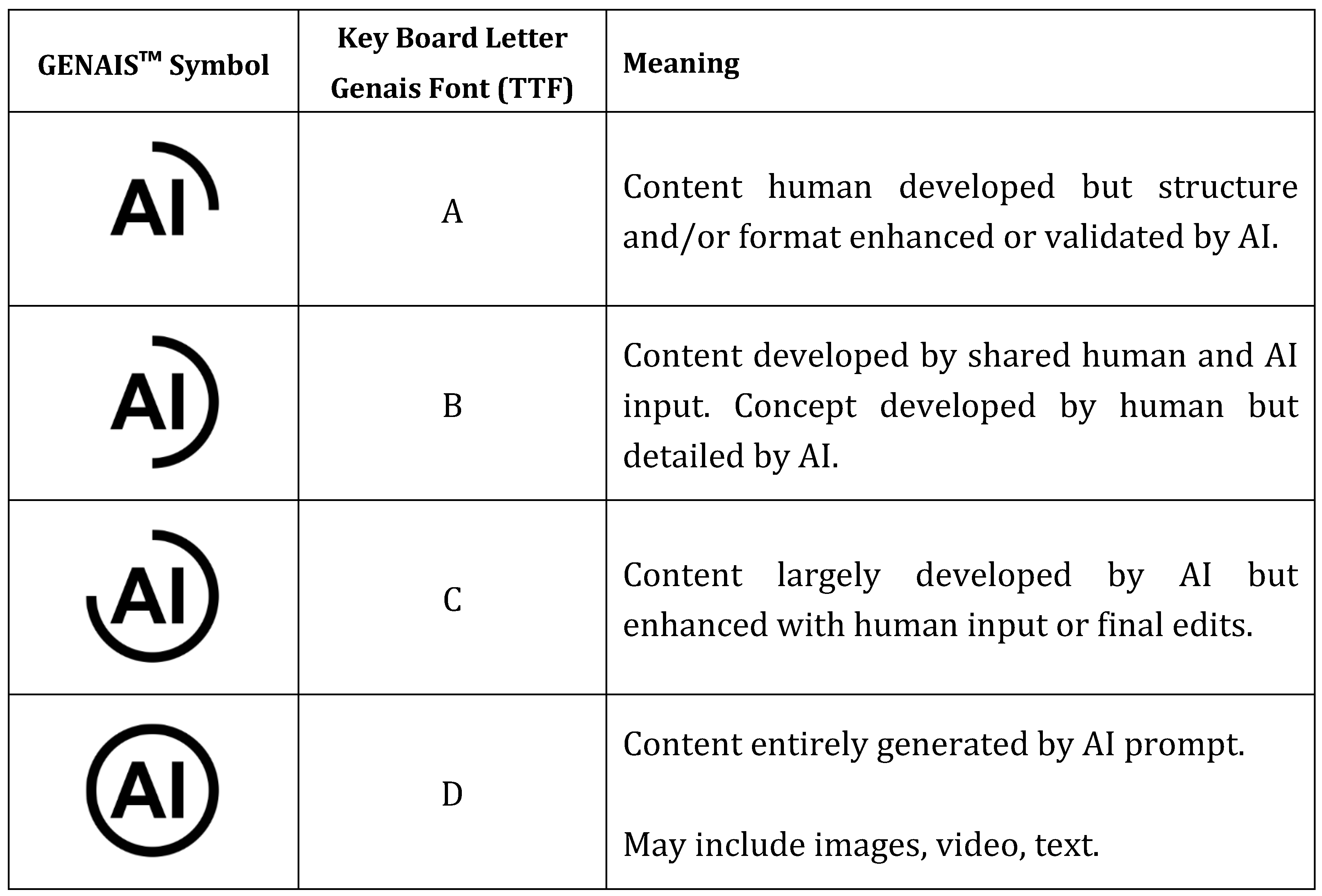
GENAIS is conceptualised as a visual, cross-disciplinary system for denoting the nature and extent of AI involvement in academic work (Glassey, 2025). Drafted for implementation as a Unicode font, the system comprises several distinct symbols (Figure 1), each corresponding to a mode of human–AI collaboration. These include:
- Entirely AI-generated content: A symbol representing work produced solely via AI prompting.
- Human-developed, AI-validated: Symbol for content conceived by humans but structured, formatted, or validated by AI.
- Human–AI collaborative development: For concepts originating from humans but elaborated by AI systems.
- AI-developed, human-enhanced: Marking where AI generates the majority but is subsequently edited or refined by human intervention.
These symbols are applicable at multiple levels of academic output—cover pages, section headers, paragraphs, sentences, or media artefacts (Glassey, 2025). By enabling granular transparency, GENAIS fosters immediate recognition of provenance throughout academic documents or media, enhancing clarity for reviewers and external evaluators.
Methodological Foundations
GENAIS draws on a systematic review of current guidelines, academic literature, and international university practices regarding AI use disclosure (Glassey, 2025; Naeem & Smith, 2024). The concept note relies on comparative analysis rather than empirical pilot studies, outlining clear symbol definitions, intended deployment strategies, and recommendations for practical integration. The system is designed to be discipline-agnostic, easily accessible via downloadable fonts, and suitable for integration into existing digital learning environments.
The Unicode submission process is highlighted as a pathway for eventual international recognition, aligning with ISO/IEC 10646: Information technology—Universal Coded Character Set (UCS) (ISO/IEC, 2020). By leveraging these existing standards, GENAIS seeks platform independence and global scalability.
Discussion
The proposed GENAIS symbology system offers several major advantages for universities and the broader higher education sector. Transparent visual marking enables academic stakeholders to easily assess the degree of AI involvement, supporting effective dialogue around originality, ethics, and proper attribution (Glassey, 2025; Liu & Wang, 2024). Uniform symbols facilitate automated and manual oversight, bolstering the accuracy of academic integrity checks and reducing instances of accidental misconduct.
Key to its appeal is the cross-cultural and language-independent design. By employing universal symbology, GENAIS addresses accessibility issues prevalent in textual disclosure, supporting international student bodies and global research collaborations (University of Basel, 2025; Wang et al., 2025). The system is adaptable and futureproof, with downloadable fonts and a clear international standardisation pathway that allows integration into policy and curriculum documentation.
However, as highlighted in critical peer review, certain methodological and practical challenges persist. Foremost among these is the lack of pilot studies or real-world user testing. The proposal, while robust in theory, requires empirical validation through controlled implementation in university coursework, assessment material, and academic publishing. The complexities of institutional change, including resistance from faculty or administrative inertia, need detailed attention and solution proposals. There are additional risks in symbol misinterpretation or inconsistent application, particularly among those unfamiliar with AI technologies.
Moreover, while the literature context is comprehensive, a broader engagement with failed standardisation initiatives in academia and lessons from other sectors would reinforce the argument for GENAIS. A diversified set of global perspectives—beyond primarily Anglophone institutions—would further strengthen its international relevance.
Limitations
GENAIS is conceived as a concept note and has yet to undergo field testing or systematic feedback cycles with large stakeholder groups. Its symbol set, though carefully designed, may require iterative redesign based on user experience and accessibility research. The path to international standardisation is outlined but needs deeper engagement with regulatory processes, key institutional actors, and fallback strategies if adoption lags.
Implementation may be challenged by varied regulatory requirements and the need for comprehensive training materials for faculty, students, and administrators. While the concept is designed to be simple, real-world deployment will necessitate continuous oversight to ensure that symbols retain their intended meaning across contexts, disciplines, and evolving AI tools.
Recommendations
It is recommended that universities begin piloting GENAIS symbology in select courses, research projects, and institutional documentation. Initial application can focus on prominent disclosure items—assignment cover pages and research submissions—with expansion into granular citation as familiarity grows. Multisite studies involving diverse institutions and student populations are necessary to validate feasibility, foster cultural adaptation, and inform symbol redesign if required.
International collaboration—especially across different educational systems—will be critical for iterative improvement and for building a robust evidence base to support eventual Unicode and ISO/IEC recognition. Through such collective action, GENAIS can catalyse advances in academic integrity and establish a model for transparent, ethical practice as the role of AI in education continues to evolve.
Conclusion
GENAIS presents a visionary framework for marking AI involvement in academic work, addressing urgent gaps in transparency, detection, and cross-disciplinary collaboration. By moving beyond textual protocols and towards standardised symbology, GENAIS offers an actionable pathway to international best practice and technological adaptation in higher education. The barriers to adoption, while significant, are surmountable through empirical validation, inclusive design, and coordinated institutional leadership. Its implementation has the potential to transform academic integrity management and foster trust in an increasingly AI-augmented scholarly environment.
References
- Bhatia, R., & Zafar, S. (2024). Deployment of AI Tools and Technologies on Academic Integrity and Research. Bangladesh Journal of Bioethics, 15(2), 10-21.
- Centre for Teaching Innovation. (2022). AI Academic Integrity. Cornell University.
- Elsevier. (2023). Editorial policies: Use of generative AI and AI-assisted technologies.
- Glassey, S. (2025). GENAIS AI symbology concept note.
- ISO/IEC. (2020). Information technology — Universal Coded Character Set (UCS) ISO/IEC 10646:2020.
- Karns, E. (2022). Academic integrity and teaching without AI. Harvard University.
- Liu, J., & Wang, S. (2024). Strategies, Tactics, and Techniques to Mitigate Against AI in Tertiary Education: Preserving Academic Integrity and Credibility. International Journal of Research and Academic Advancement, 5(1), 55-68.
- Naeem, F., & Smith, D. (2024). Academic Integrity and Artificial Intelligence in Higher Education Contexts: A Rapid Scoping Review. AI Journal, 2(1), 18-39.
- University of Basel. (2025). Guidelines: Citing AI Tools – How to Use AI-tools in University Studies.
- Wang, M., et al. (2025). Development of Evidence-Based Guidelines for the Integration of Generative AI in University Education. European Journal of Education, 60(2), 120-134.
- 11. AI Usage Disclosure: B.
- This document was created with assistance from AI tools. The content has been reviewed and edited by a human. For more information on the extent and nature of AI usage, please contact the author.
- GENAIS™ Font Download.
- The GENAIS™ True Text (TTF) is available to download from www.tinyurl.com/genais-font.
Figure 1.
Proposed GENAIS Symbology (Glassey, 2025).
Disclaimer/Publisher’s Note: The statements, opinions and data contained in all publications are solely those of the individual author(s) and contributor(s) and not of MDPI and/or the editor(s). MDPI and/or the editor(s) disclaim responsibility for any injury to people or property resulting from any ideas, methods, instructions or products referred to in the content. |
© 2025 by the authors. Licensee MDPI, Basel, Switzerland. This article is an open access article distributed under the terms and conditions of the Creative Commons Attribution (CC BY) license (http://creativecommons.org/licenses/by/4.0/).
Copyright: This open access article is published under a Creative Commons CC BY 4.0 license, which permit the free download, distribution, and reuse, provided that the author and preprint are cited in any reuse.


