

Submitted:
27 October 2025
Posted:
29 October 2025
You are already at the latest version
Abstract
This study investigates regional development in forestry from the point of view of the bioeconomy. This is examined through a qualitative content analysis of different strategic documents of regional and territorial local plans with the aim of examining which topics are associated with forestry at different strategic documents (n = 67). Using the example of a private forest owner, it is then shown how this is specifically implemented. To gain feedback for assessed strategic documents, we compared the economic results of state, municipal, and private forest owners. The Czech Republic was chosen as an example of a European Union member state. The research assumption is that the lower the territorial local level, the greater the importance local governments attach to forestry. The main featured topics are featured water regime, sustainable forestry and biodiversity support, climate change, maintenance infrastructure, social functions, and economic competitiveness. The results show that the assumption that the lower the territorial planning level, the more forestry is featured in strategies was not confirmed. The relationship is rather the opposite. The presented economic results clearly demonstrate that financial contributions to forest management are a logical consequence of policies. These results correlated with those of the content analysis.
Keywords:
forestry
; management planning
; regional development
; bioeconomy
; local action group
; Czech Republic
1. Introduction
Forestry has deep roots in human history. Its development has been captured very well in [1], for example. The emergence of forestry can be dated between the Middle Ages and the Modern Age. This period was characterized by the growth of cities; industrial development; changing ways of life; the switch from bartering to money management, favoured by the discovery of America; other world movements; and the resulting changes in economic theory between the 14th and 15th centuries. In the 14th century, the need for forest protection was first recognized, exemplified in Central Europe by the publication of The Codex Carolinus in 1355 [2], a legal code proposed by Charles IV that addressed the issue of illegal logging and subsequent penalties.
Over the years, forestry has developed in response to historical, political, and cultural developments. Today, we can define forestry, according to [3], as the profession embracing science, art, and the practice of creating, managing, using, and conserving forests and associated resources for human benefit in a sustainable manner to meet desired goals, needs, and values.
Forestry includes a whole range of related disciplines, including forest policy. This can be defined as an analytical political process, which includes formulating the goals of human activity in the care and use of forests through their implementation in feedback ratings [4]. At the beginning of this process, there are various conflicts of interest (such as forest products and services and forests as part of the landscape and the environment), which should be regulated through relevant programs (or a set of plans). For this purpose, forest policymakers work with information tools (consulting, education, research, public relations, regional forest management plans, etc.), economic instruments (e.g., financial subsidies, management and marketing, evaluation and certification), and regulatory instruments (legal norms/legislations, strategies, forest management plans, regulations, directives, etc.).
It is through forest planning that forest policy objectives are given a concrete form. According to [5], the concept of forest management planning has developed over the centuries in a very holistic way, as societal expectations about the role of forests have diversified. The basic tool of forest management planning is a management plan. This can be defined as a predetermined course of action and direction to achieve a set of results, usually specified as goals, objectives, and policies [3].
The objectives of forest planning can be diverse, from setting strategic visions to assessing the current state of the forest, identifying the results and outputs of forest management, and setting political goals [5].
According to [5], the hierarchy of forest planning is generally based on the objectives of the national forest policy, which can be reflected in the regional strategic forest plan, which is in turn reflected in the forest management plan. Here, the objectives are applied mainly through the forest owner, specifically through the operational plan, which determines a schedule of specific activities, based on the implementation plan, that are then carried out (realized).
In contrast, there are many different definitions of regional development in the available literature, which differ in their degree of specificity. According to [6], we can define regional development as a set of activities aimed at improving the economic well-being of a territory and the quality of life of its inhabitants. These activities may include economic strategies, research, entrepreneurship, the labour market, technological innovation, political lobbying, and development of the social area and environment. More specific examples include understanding regional development as an effort to reduce social inequalities and promote environmental sustainability, inclusive governance, and cultural diversity, as explained in [7].
In the context of this study, we consider regional development as a set of activities on which local actors agree in order to contribute to the development of a region in terms of environmental, economic, and social aspects.
This study aims to investigate regional development in forestry from the point of view of a bioeconomy through a qualitative content analysis of different regional and territorial planning documents. It also aims to examine which topics are associated with forestry at different territorial levels (n = 67) through the following research questions:
-
How is forestry included in strategic development plans at the supranational, national, regional, and local levels?
- o
- How does this specifically affect the forest bioeconomy and what are its impacts?
- o
- How does forestry planning specifically reflect the regional development requirements of these documents?
The research hypothesis is that the lower the territorial level, the greater the importance local governments attach to forestry, which should be reflected in the strategic documents. This hypothesis is examined using topics in connection with forestry that resonate at individual levels. This hypothesis is examined using topics in connection with forestry that resonate at individual levels. The topics are for example: Sustainable forestry and biodiversity; adaptation and mitigation of climate change; international cooperation; forest products; wooden buildings; renewable energy sources etc.
2. Theoretical Framework
Forestry is typical in rural areas or the countryside, where it contributes to local economic and social development [8]. In [9], the use of different theories of regional development for the forest-based sector was examined at national, regional, and local levels.
The conclusions of the above study [9] show that no theory alone can fully capture the specific characteristics of the forest-based sector. Local conditions and the influence of policies and human activities, which vary from region to region, need to be considered in forestry development. Therefore, a single theoretical framework cannot be used. According to [10], sustainable forest use contributes to the socio-economic development of rural areas. In the long term, there is a need to focus more on the adoption of sustainable production methods capable of reconciling economic, social, and environmental interests.
The European Commission [11] defines rural development as part of the second pillar of the Common Agricultural Policy. It sees rural development through this pillar as an effort to increase the competitiveness of agriculture and forestry, ensuring sustainable management of natural resources and climate action and achieving balanced territorial development of rural economies and communities, including job creation and retention.
In addition to financial instruments, strategic and spatial planning is important for rural development. This paper deals exclusively with strategic planning, which is often confused with spatial planning (this is mentioned, for example, in [12]). In addition, strategic spatial planning also exists, which was defined by [13] as a process through which a variety of public and private actors with a stake in the region—such as public-sector planners, politicians, private land holders, and organizations representing community and environmental issues—come together in diverse institutional settings to prepare strategic plans by developing interrelated strategies for the management of spatial change. Strategic documents can often lead to changes in the spatial plan. This also works the other way around, with the spatial plan acting as a guide for the creation of a strategic plan [14].
According to [15], strategic planning and spatial planning are different but complementary tools for territorial development. Strategic planning focuses on why a municipality wants to develop—that is, on the content and direction of development. It is a voluntary process based on the powers of local government, with the aim of setting a vision, priorities, and specific steps to improve people’s quality of life or to strengthen the local economy. Strategic planning is not legally mandatory and is regulated in detail by law for municipalities [16].
From the point of view of analysis at the European Union (hereinafter referred to as the EU) member-state level, it is possible to describe the anchoring of spatial and regional planning with an impact on forestry on a selected member state. As an example, a Central European state is the best choice.
The Czech Republic (hereinafter referred to as CZ), is an exemplary state that has deep roots during the Austro-Hungarian Empire (covering more than seven countries in today’s EU) and was subsequently affected by the First and Second World Wars and later experienced the rise of communism, which was ended by a coup. This state later became a member state of the EU. Out of a total of 27 members, 10 countries joined together in 2004. According to [17], CZ can be understood as an average country with adequate forest cover, forest productivity (amount of wood in m3 per 1 ha), and economic results.
On the contrary, spatial planning is enshrined in legislation of the CZ, specifically in the Building Act 283/2021 Coll. [18]. Spatial planning focuses on spatial organization—i.e., where and how the area can be used. This results in legally binding documents that determine the rules for investors, owners, and public institutions. Strategic and spatial planning should be interconnected; however, in practice, they often operate separately, which reduces the effectiveness of planning. A strategic plan can determine the development direction and motivate progress, but only the spatial plan gives it specific spatial options. Without harmonization of both documents, there is a risk of conflicts of interest, project delays, or inefficient use of the area.
The spatial plan classifies individual types of areas according to their permissible functional use. Forest areas and natural and landscape areas are relevant for forestry [18].
In the CZ, the Ministry for Local Development has developed a Rural Development Concept [19]. According to this, rural development is a deliberate and coordinated process that aims to permanently improve the quality of life of residents in rural areas. This process is comprehensive—it includes economic, social, environmental, and cultural components. It is a set of investments, policies, and activities that support sustainable agricultural operations, diversification of the local economy, and development of infrastructure and services and strengthen the participation of local communities in determining the direction of their region.
The presented research focuses on strategic plans and their implementation in the field of forestry, which has already been the subject of research by several authors, using examples from the European area (for example, [20,21,22,23,24]).
The authors of [25] studied how different European regions manage and implement forestry strategies within the broader bioeconomy, focusing on the level of societal involvement. Their findings show that forestry strategies are more often developed and implemented at the regional level rather than the national level, reflecting the specific needs and opportunities of each region. They also identified that the involvement of NGOs, civil society, and the wider public is limited in the implementation of these strategies.
The authors of [26] emphasized that to achieve true sustainability of forest resources, it is necessary to improve the quality and availability of data used for decision-making processes. Cooperation between member states and regional authorities is key in this regard.
Increasing public support and attention to forestry is recommended by [27]. In this study [27] is pointed to the need to increase the use of forestry’s potential for regional development.
The authors added in [28] that it is necessary to integrate ecological, economic, and social aspects in strategic decision-making regarding forest resource management.
According to [29], foreign direct investment can also play a strategically important role and should be encouraged. These investments can be directed towards the development of plantations, processing plants, paper and pulp production, and other forestry-related sectors.
The importance of government plans, policies, and public support, especially at the regional and local level, for the long-term sustainable development of forestry is emphasized in [30]. These plans are usually formalized in strategic documents.
A key opportunity for strategic forestry in the circular bioeconomy, particularly through policy support at the national level, is presented in [31]. This support includes increased funding for research and innovation, the development of supporting policies, and the strengthening of environmental measures such as carbon taxation. The authors identified a lack of objectives for forest development and insufficient cooperation and knowledge sharing as challenges in strategic planning.
Forest planning usually includes several different types of plans. According to [5], the hierarchy of forest plans is based on an implementation plan, which sets out in detail how each operation in each area will be carried out. Overarching this is an operational plan, which determines and schedules activities needed in each part of the forest and allocates resources based on the forest management plan (it is usually prepared for a period of 10 years, with a tolerance of ± 5 years, and is usually mandatory according to the legislation of the given state). This is considered the most important strategy and contains sets of objectives for the concrete forest management unit and defines the actions needed to achieve them.
The forest management plan is based on the regional strategic forest plan, which is usually prepared by a regional government or a designated state institution. It contains sets of strategic plans for forests products and services, forest industries, and land use allocation.
Forest policies or strategies are usually prepared at the national level and are the basis for a regional strategic forest plan. They contain sets of national-level objectives for forests and their goods and services. Within the EU member states, this is usually based on a combination of national requirements but also incorporates the requirements of the forestry policy created at the European Commission level. Action plans for these policies are further developed to specify national and EU forestry policies.
In addition, so-called National Forest Programmes were formulated at the level of the entire European continent (Pan-European Process) and are a comprehensive social and political framework to achieve sustainable forest management in a country in accordance with their respective national conditions, objectives, and priorities [32].
Within the EU, strategic documents on bioeconomy have been studied in [33], among others. The authors state that each EU country emphasizes the importance of the bioeconomy in several of its annual reports, including, for example, reports on the state of forests and forestry. They also demonstrate this importance through the amount of financial resources they spend on supporting the bioeconomy. However, their analysis has shown that the perception and definition of the bioeconomy vary from country to country. This is also confirmed, for example, in [23].
In the CZ, a separate conceptual document has not yet been published that would address the bioeconomy at the national level. The ideas and principles of the bioeconomy have long appeared in a few national strategies across different ministries. The most prominent can be found in the Strategy of the Ministry of Agriculture of the CZ [34]. Another important national conceptual document that reflects the ideas of the bioeconomy is the Strategic Framework of the CZ 2030.
Forest bioeconomy in the CZ has been studied by, for example, [23,35]. According to [33] and [36], there is no common agreed-upon definition of forest bioeconomy, and it plays different roles in different EU countries.
The acceptance of bioeconomy principles in strategic documents on a European level was addressed, for example, in [23,37]. At the regional level in the CZ, the application of strategic documents, for example, to regional planning [38] was addressed in [39], in which direct bioeconomy strategies were not identified in any of the regions examined. However, some strategies that are at least partially related to the bioeconomy were recorded. Based on this, it can be stated that even though efforts to incorporate the concept of a bioeconomy have been observed in all regions, developments towards supporting the bioeconomy are still in their initial phase.
3. Materials and Methods
The presented research questions and aim are examined through a methodological approach of a content analysis of selected conceptual documents.
This study features relevant concepts with an impact on forestry at individual territorial levels. First, the national and supranational levels (here understood for the EU level - i.e., valid for all EU member states)were analyzed, and then local and municipal concepts were approached along with community-led local development strategies within local action groups (defined as, according to [40], a myriad of public, business and non-profit sectors, such as neighbourhoods associations, municipalities, third-sector organizations, economic, educational, and religious institutions). LAG partners reflect intrinsic territorial specificities; e.g., agricultural associations will be strong in rural LAGs.
For the purposes of this study, the CZ was chosen as an example of an EU member state. It can be stated that the EU member states act very similarly within the framework of strategic and planning documents. The results can therefore approximate the functioning of regional development in forestry from the point of view of a bioeconomy at the EU member-state level.
For the content analysis, municipalities and LAGs were selected, the territory of which is managed by one of the significant actors in forestry in the CZ—Archbishop’s Forests and Estates Olomouc (AFEO). The AFEO is a forestry company that manages up to 40 thousand hectares of forest land and represents one of the largest private owners in the CZ. The area of forest land represents approximately 1.5% of the area of all forests in the CZ. AFEO was officially founded in 2013 and is therefore an ideal example company for which to determine the influence of strategic documents, although this can only be taken as indicative.
Specifically, the following concepts were selected for analysis:
-
Supranational and national territorial level:
- o
-
Supranational concepts and conventions on forestry-related topics (sustainable development, environmental protection, and sustainable management of natural resources):
- o
-
Forestry in basic multi-sectoral national strategies:
- o
-
Sectoral national strategies on forestry-related topics (sustainable development, environmental protection, and sustainable management of natural resources):
- ▪
- State Environmental Policy of the Czech Republic 2030 with a view to 2050 [49];
- ▪
- Strategy for Adaptation to Climate Change in the Conditions of the Czech Republic [50];
- ▪
- State Nature and Landscape Protection Program of the Czech Republic for the Period 2020–2025 [51];
- ▪
- Biodiversity Protection Strategy of the Czech Republic 2016–2025 [52];
- ▪
- Concept for Protection against the Consequences of Drought for the Territory of the Czech Republic [53].
- o
-
Forestry in sectoral national strategies:
-
Territorial level of municipalities and local action groups:
- o
-
Forestry in the strategies of municipalities whose territories are managed by AFEO:
- ▪
- There are 70 municipalities in total, but only 34 of them have local plans (the rest (36) have no local plans related to this study).
- o
-
Forestry in the strategies of LAGs whose territory is managed by AFEO:
- ▪
- A total of 17 LAGs were considered in the analysis. Which represents all action groups that cover the given municipalities (LAGs usually bring together several municipalities together).
In total, 16 strategic documents at the national and supranational levels, 34 local plans from municipalities and 17 LAGs’ strategies were analyzed—a total of 67 analyzed documents.
All these documents are publicly accessible: a) on the webpage portals of the relevant ministries (Ministry of the Environment of the CZ: https://mzp.gov.cz/cz; Ministry of Agriculture of the CZ: https://mze.gov.cz/public/portal/mze/en; Ministry of Regional Development of the CZ: https://mmr.gov.cz/en/homepage) and b) on the official boards of specific municipalities that are administered by municipalities with extended powers of the II. or III. level and fall within the Olomouc (https://www.olkraj.cz/olomouc-region-official-website), Zlín (https://zlinskykraj.cz/) and Moravian-Silesian regions (https://www.msk.cz/index-en.html).
In addition to these analyzed documents, it is also necessary to consider existing legislation, which is the result of some already passed, existing documents. Legislation directly influences the possibility of incorporating policies, plans, and strategies into practice.
The strategies, conventions, policies, or intentions themselves are also a reflection of changing environmental conditions. Their driving forces are natural disturbances and geopolitical events. The latter also occur as an indirect effect of the owners and of what they enforce. They are incorporated into strategies, conventions, intentions, policies, and subsequently into legislation. The whole scheme of this process, as understood for the purpose of the presented study, is shown in Figure 1. Arrows show the influences and processes that shape different perspectives; here, we expect to observe connections, functions, and impacts.
The content analysis of the conceptual documents was based on a search for the keywords “forest”, “forestry”, “forest management” and “forest ecosystem”. If these words were found, the context in which these words were used was analyzed and the specific topic in connection with forestry that is addressed in the document was noted. Keywords were searched for in both the analytical and draft parts of the documents, with the analysis focusing primarily on the draft parts, where greater thematic variability was identified. The topics were then coded into individual topics and compared by territorial level. As part of this comparative analysis, the results were visualized using graphic outputs to show the frequency of occurrence of individual topics at different territorial levels. This approach made it possible to evaluate the differences and similarities in the approach to forestry between individual strategies and concepts and thus to achieve the research objectives.
To test the hypothesis “How does this specifically affect the forest bioeconomy and what are its impacts?”, the impact was assessed based on the economic results of forest management.
To assess the impact on the forest bioeconomy, a clear indicator was used: the economic result achieved through the management of 1 ha for a given period (in EUR per 1 ha of forest property; 1 EUR = 25 CZK). To assess whether the application and establishment of concepts and strategies have an impact on the forest bioeconomy, a comparison was made to the economic results of forest owners (without contributions to forest management) and included contributions to forest management for previous programming periods, namely, 2014 to 2020 and 2021 to 2027 (the results for 2021, 2022, and 2023; the results for other periods are not known). This result may reflect the impacts and effects of individual legislative changes, which are the result of local and regional policies and changes in connection with the adjustment of various subsidy measures that forest owners can use and which are defined precisely through convention and strategies.
The economic result for AFEO, as a private forest owner who manages 40 thousand hectares of forest, was documented. The impact of local and municipal strategies was assessed based on these results. The data regarding the forest bioeconomy for AFEO, as the analyzed forestry company, were drawn primarily from publicly available annual reports, which every economic subject paying taxes in the EU must publish.
Revenue includes revenue from its own production, sales of services, and revenue from goods (the analyzed company is a limited liability company and does not own land but manages it according to a lease agreement; it also owns a wood-processing facility—a sawmill for cutting wood).
An additional comparison was made based on the economic results for state, municipal, and private forest owners. These data are published annually by the Czech Statistical Office and are freely available here: https://csu.gov.cz/
Contributions to forest management, from which financial subsidies can be drawn, are presented by regional authorities, the State Agricultural and Intervention Fund, and the Ministry of Agriculture of CZ. The purpose of the subsidies is primarily to finance silviculture activities, protective measure for forest stands and horse riding, the forest infrastructure, technical equipment, etc.
4. Results
4.1. Regional Development in Forestry: Content Analysis of Selected Conceptual Documents
The analyzed parts of the documents showed significant differences between the different territorial levels of the strategic concepts. At the national and supranational level, forestry is described in detail in all areas from various perspectives, including environmental, economic, and social.
In contrast, in the analyzed parts of municipality and LAG documents, information on forestry is either not available at all, is limited to information on the share of forest areas in the total area of the municipality or region, or is available on the share of forestry in the local economy (through the presence of economic entities or employees according to their affiliation to CZ-NACE codes [56]). More detailed information on forestry is not available in any LAG strategy and is only available in a third of municipal strategies. Municipal strategies include data on the state of forests, management of forest resources, and adaptation of forestry to current challenges, such as climate change or bark beetle disasters. These documents often describe flora and fauna; the management of municipal forests, including the employment of seasonal workers; and forest protection.
In the draft parts of the analyzed strategies, most mentions of forestry are found in national and supranational strategies in contrast to the strategies of municipalities and local action groups. There is no mention of forestry in more than 2/3 of the draft parts of municipal and local action group strategies. In national and supranational concepts, forestry is mentioned in all strategies. It is observed that the lower the territorial level, the less forestry is addressed. However, if the topic of forestry is mentioned in drafted municipal and local action group strategies, it is at a greater level of detail than in national and supranational concepts, where the topic of forestry is addressed at a more general, declarative level.
More than half of municipal strategies and more than 10% of local action group strategies do not mention forestry in either the analytical or draft parts.
4.2. Details of Topics in the Analyzed Documents
A more detailed analysis revealed several recurring topics related to forestry in the concepts. The occurrence of these topics was diverse, varying according to the individual territorial levels. The following topics were noted:
- Sustainable forestry and biodiversity;
- Climate change adaptation and mitigation;
- Water regime in forests;
- Economic competitiveness of forestry;
- Social and non-productive functions of forests;
- Forest maintenance and forest infrastructure;
- Other topics.
4.2.1. Sustainable Forestry and Biodiversity
At the supranational and national levels, the most common topics in the draft sections of strategies are those focused on environmental and biodiversity protection. This theme occurs in all the strategies analyzed. A key priority is to halt deforestation and restore forest ecosystems, which includes ensuring their health and stability. Emphasis is placed on the tree species composition of planted forest stands, which should correspond to habitat conditions (state) and prevent soil degradation. Sustainable forest management, which promotes environmentally friendly and economically viable management methods, is also a frequent theme. Species and landscape diversity is supported, with a preference for more resistant tree species.
National and supranational strategies often include recommendations to reduce management intensity, increase forest species diversity, and leave some wood to decay naturally. Emphasis is also placed on protecting species and minimizing forest fragmentation to ensure healthy biodiversity development. A specific example is selective management methods that support the natural restoration of ecosystems; increasing forest areas and supporting afforestation are also often mentioned.
On the other hand, the topic of environmental protection and biodiversity is addressed less in the strategies of municipalities and LAGs. In municipalities, it occurs only in certain parts of strategies, while it is included in less than half of LAG strategies. Nevertheless, in municipalities, this topic is mentioned most often compared to other topics. The reason for this is that forestry is generally underrepresented in municipal strategies (see below). In LAGs, it is also one of the most common topics. The content of these topics is very similar to that of supranational and national strategies.
The strategies focus on adjusting forest stands towards a natural structure and tree species composition to strengthen the ecological stability of forests and their resistance to external influences such as climate change and pests. These adjustments include the support of habitat-appropriate tree species that contribute to long-term ecological balance. The strategies also include afforestation strategies, but at the same time, emphasis is placed on the consistent protection of greenery growing outside the forest. Strategies focus on activities that support biodiversity, such as the restoration of the species and age structure of forests and the natural regeneration of forest stands, and include sustainable forest management and environmentally friendly practices. The strategies also mention the development of small businesses or small-scale agriculture and forestry with an emphasis on organic operations.
4.2.2. Climate Change Adaptation and Mitigation
The second most common topic at the national and supranational strategies is climate change and its mitigation through forests and forest management. The topic is included in more than half of the analyzed strategies.
The priority of the strategies related to this topic is the restoration and protection of forests, which are important for carbon sequestration, to reduce floodplain risks, and to support drought resistance. Adaptation of forests to the extreme manifestations of climate change, such as bark beetle disasters or long-term drought, is also important. The strategies also focus on strengthening the role of forests as renewable energy sources and ensuring their ecological stability in changing climate conditions.
The topic of climate change is mentioned only within larger municipal strategies, yet it is the most frequently mentioned topic, together with sustainable forestry and biodiversity. In the case of LAGs, the topic is only mentioned within strategies. The content of the strategies is very similar to that at the national and supranational level, but it is noticeable that these documents exhibit a higher level of detail.
The strategies focus on supporting adaptation to climate change, risk prevention, and increasing resilience to natural disasters such as rain-related disasters, windstorms, and forest fires, with an emphasis on sustainable landscape management. Specifically, the strategies include an assessment of the state of forest stands, especially in the context of bark beetle disasters. The strategies support both investment projects and awareness campaigns aimed at increasing landscape resilience, including the creation of watercourses, pools, and infiltration strips. The initiatives also focus on improving the environment through community energy and other climate-friendly solutions.
4.2.3. Water Regime in Forests
Another frequent topic mentioned in national and supranational strategies concerns the water regime in forests, which is included in more than half of the analyzed strategies.
The strategies focus on the role of forests in protecting water resources and ensuring a stable water regime in the landscape. According to the analyzed strategies, forests support the natural infiltration of water into the soil, which helps restore groundwater resources and stabilizes the water regime of the rural landscape. Water retention in forest ecosystems is key to maintaining enough water in the landscape; protecting soil from erosion is also essential.
With one exception, this topic does not appear at all in municipal strategies, while it appears in less than 1/3 of LAG strategies. In contrast to national and transnational strategies, a higher level of detail is evident in the latter.
The strategies focus on the implementation of measures for water retention in the landscape, especially in forest land, as part of flood protection measures and improving the water regime. Water regime modifications include water channeling and the creation of small water features that support natural water retention. These strategies seek to prevent natural events such as floods and promote long-term water regime stability.
4.2.4. Economic Competitiveness of Forestry
The topic of economic competitiveness of forestry is also present in 1/3 of national and supranational strategies.
The strategies emphasize the economic benefits of forests, which play a significant role in improving living conditions, especially for poor and vulnerable groups of the population. Forestry contributes to the development of the bioeconomy, job creation, and income security for foresters. The bioeconomy concept is very new in these strategies.
The social benefits of forests include the support of cultural and health functions that forests provide to society. The economic competitiveness of forestry is strengthened by supporting innovative and SMART solutions in forestry activities. Many authors consider that innovations within the forestry economy support the bioeconomy. Examples are presented in the following.
This topic does not appear at all in municipal strategies. However, it is represented in more than half of LAG strategies, which is significantly more than in national and supranational strategies. One reason for this may be that it is a topic that can be supported by EU financial funds, to which LAGs often adapt their strategies. LAGs are thematically more detailed.
LAGs focus mainly on supporting small- and medium-scale forestry entrepreneurs and promoting forestry products and their marketing. The emphasis is on modernizing wood-processing and forestry enterprises through innovations and equipment, such as machinery, equipment, IT technologies, and other necessary tools. Investments in income diversification help rural forestry enterprises to remain competitive and create new job opportunities. At the same time, supporting local wood production and wood processing is key and can be understood as supporting the bioeconomy.
4.2.5. Social and Non-Productive Functions of Forests
The topic of non-productive functions of forests, e.g., the use of forests for recreation and tourism, does not appear in national and supranational strategies, with the only exception being the Framework Convention on the Protection and Sustainable Development of the Carpathians [45]. The CZ is one of eight countries that have adopted this convention. Similarly, within the EU, one can also find, for example, the Alpine Convention [57], which operates on the same principle and was the basis for the creation of the Carpathian Convention [45]. This strategy discusses the sustainable development of tourism and the importance of forests for maintaining cultural heritage and traditional knowledge.
This topic also does not appear in n municipal strategies, with one exception addressing local foresters marking tourist routes. On the contrary, in LAG strategies, this is the most frequently represented topic.
LAG strategies focus on supporting non-productive forest functions, in particular strengthening their recreational and environmental use. This includes the construction of recreational infrastructure, such as bicycle paths, nature trails, rest areas, bridges, information panels, and game elements, to make forest areas more attractive for tourism. Non-productive investments are also mentioned, which include measures to ensure the safety of visitors, such as railings, footbridges, and waste disposal facilities. The activities are intended to contribute to better use of forests for society.
4.2.6. Forest Maintenance and Forest Infrastructure
A theme exclusive to local and regional strategies is the support of equipment and infrastructure for forest maintenance; this theme does not appear at a national and supranational level. On the other hand, it is a frequent theme in LAG strategies. More than half of LAGs have included the theme in their strategies.
The strategies emphasize the need for investments in the modernization of forestry technologies, machinery, and infrastructure to increase the efficiency of forestry. Investments are focused on the acquisition and modernization of forestry machinery, such as tractors and forwarders, and on improving the quality of wood processing operations. At the same time, emphasis is placed on the repair and expansion of forest roads, which are often in poor condition. Modernization also includes buildings and equipment and the optimization of non-productive infrastructure in forests. The aim of these measures is to improve the condition of forests and support the long-term sustainability and competitiveness of the sector.
The theme is addressed only by some of the analyzed municipal strategies, which involve the acquisition of equipment for forest management, usually if the municipality itself owns and manages some forests.
4.2.7. Other Themes
During content analysis of the strategies, we primarily focused on the most common topics that appear in the concepts. However, all topics related to forestry, including less common ones, were recorded. At the supranational and national territorial levels, these include sustainable production and consumption of forest products such as wood, and the importance of strengthening capacities and financial resources for sustainable forest management. The involvement of local communities, the private sector, and other stakeholders is also mentioned, as is the need for international cooperation in forest protection. There are also references to the use of renewable energy sources and support for innovation, for example, in the field of modern wooden buildings and agroforestry. There is also a need to support research and innovation in forestry, as well as measures against the excessive population of ungulates.
In municipal strategies, other topics only appear in some cases. There were references to innovations in forestry and to strengthening the identity of residents through local forests. Other topics appear only in some cases for LAGs as well. Specifically, strategies identified the need for cooperation between the public sphere and forestry entrepreneurs and for educational events for workers as well as the wider public.
To present an overall summary of the prevalence of individual topics related to forestry in the analyzed documents in terms of their quantitative ratio, we present a comparison in Figure 2.
If we look at the individual levels, we can determine the frequency of these topics in strategies within individual territorial levels. Points are marked in the following intervals according to the percentage of occurrence: ●●● = Occurred in 51–100% of analyzed strategies; ●● = Occurred in 26–50% of analyzed strategies; ● = Occurred in 1–25% of analyzed strategies. The comparison results are shown in Table 1.
4.3. Impacts of a Forest Bioeconomy on Forest Management
The results of forest management must be assessed from the perspective of the occurrence of natural disturbances and geopolitical events (in recent years, forests in Central Europe have been affected by the collapse of spruce monocultures—which has caused problems related to wood removal, a large amount of low-quality wood, droughts, and also local flooding). A coronavirus disease (recorded in 2019) measures (which generally reduced the demand for wood), problems linked to workers and capacities, the war in Ukraine, etc., have also had a geopolitical influence.
The overall economic management results for state, municipal, and private forests are shown in Figure 3. A comparison of the economic results within the framework of financial contributions to forest management is also presented together with the management results of the analyzed enterprise AFEO.
The presented results clearly demonstrate that within the framework of financial contributions to forest management, which are a logical consequence of policy measures, there is an effort to economically support owners in times of crisis and to significantly improve economic management. This has had the greatest effect in municipal forests. This is also in agreement with (correlated with) the results of the content analysis; namely, at the local level, the operation of LAGs has one of the greatest impacts on forestry. On the other hand, it is revealed that municipal forests achieve the lowest economic results (without financial contributions). This may be caused by many factors. First, it could be caused by the area of the property and the impossibility of influencing the natural conditions (municipal forests often have small-scale areas) under which they are managed. Naturally, the larger the forest area, the better the conditions for management are for the forest owner (economic costs are spread out, natural selection is more diverse, and management can be better structured). In the case of private entities (private forest owners), there is logically a greater emphasis on economic results, while in state forests, protected areas, and other non-productive forest functions and ecosystem services are supported, for example, according to policies.
5. Discussion
In the present study, the topics that represent the greatest challenges for forestry and its contribution to the socio-economic development of the territory, according to the selected strategic documents, are examined. These topics are often emphasized in strategic documents as the key to solving the socio-economic problems associated with the development of rural areas. The available literature covers a variety of topics that can be addressed through forestry.
Forestry is a key pillar of the bioeconomy, which the authors of [64] define as “the sustainable production of renewable bioresources and their processing into food, feed, industrial goods and bioenergy.” According to their research, forestry as part of the bioeconomy significantly contributes to sustainable development. This importance can be demonstrated, for example, by the share of forestry in the total GDP, which was determined in [65]. In 2019, forestry accounted for 1.21% of the total GDP in the CZ [61], which is above the European average. In the report in [65], based on data from 2015, it was found that for example in Finland, forestry and related sectors accounted 513 million € of the total bioeconomy.
The importance of forestry for the development of the bioeconomy in Nordic countries is emphasized in [66]. This importance is especially noted in supporting employment and regional innovation. The use of forest biomass for energy purposes plays a crucial role in these countries, mainly due to its potential to reduce dependence on fossil fuels. Forestry thus offers significant potential as a driver of environmentally friendly and socially sensitive economic growth, especially in rural areas. The authors of [27] also note that forestry, as part of the bioeconomy, supports regional development mainly through the sustainable use of forest resources. Employment plays a key role, especially in rural areas where forests are predominantly located.
The authors of [26] confirm these findings and add that forestry has a positive impact on job creation, ecosystem services, and supporting local economies.
In [20], a socio-economic assessment of the impacts of forestry on rural development, specifically at a regional level in the United Kingdom, is presented. The author emphasizes the importance of forestry in generating economic activity through logging and forestry employment. This research shows that the presence of forests and forest landscapes positively influences other sectors of the economy, such as tourism and recreation. In some cases, these effects can even have a more significant role in regions than the economic impacts of logging itself. Although these impacts do not have a direct economic impact, they significantly improve the quality of life of residents.
Similar conclusions are drawn in the study in [27], which demonstrates the positive impact of forestry on socio-economic development using the example of Greece. Forestry in this context contributes both direct and indirect effects. The direct effects include employment and income from wood sales, while the indirect effects focus on biodiversity protection and climate change prevention. Forests are also popular places for outdoor activities and tourism due to their aesthetic benefits and recreational opportunities.
The importance of forest ecosystems, not only as a source of wood but for other products as well, is also described in [28]. According to the authors, forest ecosystems protect the landscape from erosion, regulate water flows, and support tourism.
Forestry is analyzed using the examples of Croatia, Latvia, Poland, and Romania in [67], Finland, France, Italy, Lithuania [68]. The main challenges in these countries include increasing the volume of raw wood materials, improving the species composition for higher productivity and introducing efficient mechanized operations in pre-production clearing and innovative forest management.
According this study [68], the main topics solved by strategies from the point of view of forests and role of them in bioeconomy are sustainable development, biomass accessibility, forest biodiversity, climate change, social values and benefits of forests, efficiency of forests, competitiveness of forest sector, forests and employment, forest owners, role of forests products and involvements of the key actors form the forests sector to bioeconomy.
Other factors that contribute to the development of forestry were identified in [30]. These include government plans and local policies, the level of investment in research and development, the quality of education and talent support, and the business environment.
Using the example of the CZ, [69] highlighted that the importance of forestry in terms of job opportunities is particularly evident in border areas. In addition to its direct contributions, this sector also contributes to the development of other areas such as tourism, recreation, and services. Forestry therefore plays a significant role in strengthening the overall social capital of rural areas.
The results of an analysis of the forest bioeconomy according to [23] can be used by relevant stakeholders in countries to develop a new business plan or promote their current business activities, for example. By implementing the bioeconomy strategy, the local rural economy, particularly in the forest-based sector, can also be promoted. The FAO [70] also attempted to mitigate climate change by providing forest biomass for bioenergy.
There is currently no strategy in the CZ to support the forest bioeconomy in the coming years. Currently, the so-called Platform for Forest Bioeconomy [71] is being created, which is a team to promote the forest bioeconomy [72]. The aims of the team, among other things, are integrating policies that feature certain aspects of the circular bioeconomy into a comprehensive strategic document in the CZ and developing an integrated system of policy instruments that are optimized in terms of minimizing government spending on introducing a bioeconomy and maximizing bioeconomy production. The first step for policy integration should be a comparison of the functions of strategic and conceptual documents within the framework of regional development, as presented in this study.
In future research, studies should focus on comparing the aims of strategic documents as well as their impact on specific economic results (products and services, assessment of supply and demand), including an assessment of employment in the local bioeconomy in relation to regional development, among others (e.g., economic indicators such as gross value added from forest bioeconomy, labour productivity in forestry, economic results compare to site productivity in forest bioeconomy, or other research directions).
6. Conclusions
Our assumption that the lower the territorial level, the more importance is attached to the topic of forestry was not confirmed. The connection is rather the opposite. At the supranational and national level, forestry is addressed in various contexts much more often than at the level of municipalities and regions. However, the level of detail shows the opposite trend—the highest level of detail is found in municipal strategies, followed by regional and finally supranational and national strategies.
The main topics that are featured in the analyzed strategic documents include the following: water regime, sustainable forestry and biodiversity support, climate change, maintenance infrastructure, social functions, and economic competitiveness. At the local level, they are biodiversity, climate change, and sustainability.
Using the example of a forestry company, we then showed how this is specifically implemented. The economic results comparison shows that the best results are consistently achieved by state forests. In addition, the economic contribution of the state through subsidies is particularly significant for municipal forests. This can be understood as the result of the action of individual strategies and documents.
It was observed that at the local level, one of the most important contributors to forestry is LAGs, which are very active and often aware of the importance of forests. This contrasts with spatial plans. Also of particular importance is an increased area of forest land.
Linking policies to direct economic results is a clear indicator of whether the policies are working or not. In this study, we consider regional development as a set of activities through which local actors agree to contribute to the development of the region in terms of the environment, economy, and social aspects. Forestry is therefore very important. It is neglected in some policies at different levels, which is clear from the results of the content analysis.
The results can therefore approximate the function of regional development in forestry from the point of view of the bioeconomy at the EU member-state level.
Author Contributions
Conceptualization, K.H. and Z.Š.; methodology, K.H. and Z.Š.; validation, K.H., Z.Š., and O.H.; formal analysis, K.H. and Z.Š.; investigation, K.H. and Z.Š.; resources, K.H. and Z.Š.; data curation, K.H. and Z.Š.; writing—original draft preparation, K.H. and Z.Š.; writing—review and editing, K.H. and Z.Š.; visualization, K.H., Z.Š., and O.H.; supervision, K.H. and Z.Š.; project administration, K.H.; funding acquisition, K.H. All authors have read and agreed to the published version of the manuscript.
Funding
This research was funded by the Technological Agency of the Czech Republic, grant number TQ01000532 “Proposal possibilities for sustainable regional development of forestry from the bioeconomy point of view”.
Data Availability Statement
The original contributions presented in this study are included in the article. Further inquiries can be directed to the corresponding author. No new data were created or analyzed in this study. Data sharing is not applicable to this article.
Acknowledgments
We would especially like to thank Ernest Weber (Vriedberg) and Gustav Schulze (Nikolsburg) for their support and very valuable advice on the manuscript.
Conflicts of Interest
The authors declare no conflicts of interest. The funders had no role in the design of the study; in the collection, analyses or interpretation of data; in the writing of the manuscript; or in the decision to publish the results.
References
- Fernow. B.E. A Brief History of Forestry in Europe, the United States and Other Countries, Revised and Enlarged Edition; University Press: Toronto, ON, Canada; Forestry Quarterly: Cambridge, MA, USA, 1911.
- Spirit, M. Úvod do studia práva. [s.l.]: Grada Publishing a.s. 186 s. 2010. Available online: https://books.google.cz/books?id=BewIdCXiTS4C&redir_esc=y (accessed on 19 September 2025).
- Helms, J.A. (Ed.) Terminology of forest science, technology, practice, and products. The dictionary of forestry. Society of American Foresters, Bethesda, Md: Washington, DC, USA, 1998.
- Krott, M. Forest Policy Analysis; Springer: Berlin/Heidelberg, Germany, 2005.
- van Hensbergen, H.; Shono, K.; Cedergren, J. A Guide to Multiple-Use Forest Management Planning for Small and Medium Forest Enterprises; Forestry Working Paper, No. 39.; FAO: Rome, Italy, 2023. [CrossRef]
- Beer, A.; Haughton, G.; Maude, A. Developing Locally: An International Comparison of Local and Regional Economic Development; Caroline Wilding 2003; The Policy Press University of Bristol, Bristol, UK, 2003; pp. 208.
- Haughton, G.; Counsell, D. Regions, Spatial Strategies, and Sustainable Development; Psychology Press: London, UK, 2004.
- Sadanandan Nambiar Ao, E.K. Forestry for rural development, poverty reduction and climate change mitigation: We can help more with wood. Aust. For. 2015, 78, 55–64. [CrossRef]
- Tykkyläinen, M.; Hyttinen, P.; Mononem, A. Theories on regional development and their relevance to the forest sector. Silva Fenn. 1997, 31, 447–459.
- Iacob, S.E. The role of the forest resources in the socioeconomic development of the rural areas. Procedia Econ. Financ. 2015, 23, 1578–1583.
- European Copmmision. Regulation (EU) 2021/2115 of the European Parliament and of the Council of 2 December 2021 Establishing Rules on Support for Strategic Plans to Be Drawn Up by Member States Under the Common Agricultural Policy (CAP Strategic Plans) and Financed by the European Agricultural Guarantee Fund (EAGF) and by the European Agricultural Fund for Rural Development (EAFRD) and Repealing Regulations (EU) No 1305/2013 and (EU) No 1307/2013. Available online: https://eur-lex.europa.eu/eli/reg/2021/2115/oj/eng (accessed on 18 September 2025).
- Nowak, M.; Pantyley, V.; Blaszke, M.; Fakeyeva, L.; Lozynskyy, R.; Petrisor, A.-I. Spatial Planning at the National Level: Comparison of Legal and Strategic Instruments in a Case Study of Belarus, Ukraine, and Poland. Land 2023, 12, 1364. [CrossRef]
- Hersperger, A.M.; Grădinaru, S.; Oliveira, E.; Pagliarin, S.; Palka, G. Understanding strategic spatial planning to effectively guide development of urban regions. Cities 2019, 94, 96–105. [CrossRef]
- Schmid, F.B.; Kienast, F.; Hersperger, A.M. The compliance of land-use planning with strategic spatial planning–insights from Zurich, Switzerland. Eur. Plan. Stud. 2021, 29, 1231–1250. [CrossRef]
- Půček, M. Strategické versus územní plánování. Online. Urbanismus a územní rozvoj, 2009, roč. 12, č. 1–2, s. 3–7. Available online: https://www.uur.cz/media/3i4pwfpt/02_strategicke.pdf. (accessed on 19 September 2025).
- The Parliament of the Czech Republic. Act No. 248/2000 Coll. on the Support of Regional Development Describes the Regional Development Strategy of the Czech Republic; Parliament of the Czech Republic: Prague, Czech Republic, 2000.
- Eustafor. Forests, Forestry and Logging. 2025. Available online: https://ec.europa.eu/eurostat/statistics-explained/index.php?title=Forests,_forestry_and_logging#Forest_areas_in_the_EU_are_expanding (accessed on 19 September 2025).
- Czech Republic. Act No. 283/2021 Coll., Building Act. In: Collection of Laws of the Czech Republic [Online]. 2021. Available online: https://www.zakony.gov.cz/cs/2021-283 (accessed on 19 September 2025).
- Ministry of Regional Development of the Czech Republic. Rural Development Concept. 2019; p. 216. Available online: https://mmr.gov.cz/cs/ministerstvo/regionalni-rozvoj/regionalni-politika/koncepce-a-strategie/koncepce-rozvoje-venkova (accessed on 19 September 2025).
- Slee, B. The socio-economic evaluation of the impact of forestry on rural development: A regional level analysis. Forest Policy and Economics. 2006, 8, 542–554. [CrossRef]
- Kubeczko, K.; Rametsteiner, E.; Weiss, G. The role of sectoral and regional innovation systems in supporting innovations in forestry. For. Policy Econ. 2006, 8, 704–715. [CrossRef]
- Di Letizia, G.; De Lucia, C.; Pazienza, P.; Cappelletti, G.M. Forest bioeconomy at regional scale: A systematic literature review and future policy perspectives. For. Policy Econ. 2023, 155, 103052.
- Purwestri, R.C.; Hájek, M.; Šodková, M.; Sane, M.; Kašpar, J. Bioeconomy in the National Forest Strategy: A Comparison Study in Germany and the Czech Republic. Forests 2020, 11, 608. [CrossRef]
- von Detten, R. Sustainability as a guideline for strategic planning? The problem of long-term forest management in the face of uncertainty. Eur. J. Forest Res. 2011, 130, 451–465. [CrossRef]
- European Forestry Institute. Bioregions Facility 5 years in review 2020-2025: Activities and Impact. 2025. p. 27. Available online: https://bioregions.efi.int/bioregions-facility-5-years-in-review-2020-2025-activities-and-impact/ (accessed on 19 October 2025).
- Imbrenda, V.; Coluzzi, R.; Mariani, F.; Nosova, B.; Cudlinova, E.; Salvia, R.; Quaranta, G.; Salvati, L.; Lanfredi, M. Working in (Slow) Progress: Socio-Environmental and Economic Dynamics in the Forestry Sector and the Contribution to Sustainable Development in Europe. Sustainability 2023, 15, 10271. [CrossRef]
- Kalogiannidis, S.; Kalfas, D.; Loizou, E.; Chatzitheodoridis, F. Forestry Bioeconomy Contribution on Socioeconomic Development: Evidence from Greece. Land 2022, 11, 2139. [CrossRef]
- Marchetti, M.; Vizzarri, M.; Lasserre, B.; Sallustio, L.; Tavone, A. Natural capital and bioeconomy: Challenges and opportunities for forestry. Ann. Silvic. Res. 2014, 38, 62–73. https://dx.doi.org/10.12899/ASR-1013.
- Pereyra, M.; Cecilia Alonso, C. FDI for forestry: An impact evaluation of regional development. In Review of Regional Research: Jahrbuch für Regionalwissenschaft; Gesellschaft für Regionalforschung (GfR); Springer: Berlin/Heidelberg, Germany; Volume 44; pp. 1–20. [CrossRef]
- Barañano, L.; Unamunzaga, O.; Garbisu, N.; Briers, S.; Orfanidou, T.; Schmid, B.; Martínez de Arano, I.; Araujo, A.; Garbisu, C. Assessment of the Development of Forest-Based Bioeconomy in European Regions. Sustainability 2022, 14, 4747. [CrossRef]
- Toppinen, A.; D’amato, D.; Stern, T. Forest-based circular bioeconomy: Matching sustainability challenges and novel business opportunities. For. Policy Econ. 2020, 110, 102041. [CrossRef]
- 14–16 September 2000, The Ministerial Conference on the Protection of Forests in Europe. The Role of National Forest Programmes in thePan-European Context. In Proceedings of the Workshop on the Role on National Forest Programmes in Europe, Tulln, Vienna, Austria, 14–16 September 2000.
- Rinn, R.; Palátová, P.; Kalábová, M.; Jarský, V. Forest Bioeconomy from the Perspectives of Different EU Countries and Its Potential for Measuring Sustainability. Forests 2023, 14, 33. [CrossRef]
- Ministry of Agriculture of the Czech Republic. Strategy of the Ministry of Agriculture of the Czech Republic with a View to 2030. Available online: https://mze.gov.cz/public/portal/mze/ministerstvo-zemedelstvi/koncepce-a-strategie/strategie-resortu-ministerstva-1 (accessed on 19 September 2025).
- Palátová, P.; Purwestri, R.; Marcinekova, L. Forest bioeconomy in three European countries: Finland, the Czech Republic and the Slovak Republic. Int. For. Rev. 2022, 24, 594–606. [CrossRef]
- Ludvig, A.; Zivojinovic, I.; Hujala, T. Social Innovation as a Prospect for the Forest Bioeconomy: Selected Examples from Europe. Forests 2019, 10, 878. [CrossRef]
- Navrátilová; Giertliová, B.; Hajdúchová, I.; Šálka, J. Acceptance of bioeconomy principles in strategic documents on European and Slovak level. SHS Web Conf. 2021, 92, 02044.
- Europena Commision. Commission Regulation (EC) No 105/2007 of 1 February 2007 amending the annexes to Regulation (EC) No 1059/2003 of the European Parliament and of the Council on the establishment of a common classification of territorial units for statistics (NUTS). 2007. Available online: https://eur-lex.europa.eu/legal-content/EN/TXT/?uri=CELEX:32007R0105 (accessed on 19 September 2025).
- Volrábová, K. Bioekonomika z Pohledu Regionů v České Republice. Bachelor Thesis, Czech University of Life Science, Praha, Czech Republic, 2024. Available online: https://theses.cz/id/u6xl4z/53045404 (accessed on 19 September 2025).
- Gonçalves, M.d.O.; Mourato, J.M.; Pereira, A.; Cavaco, C. Examining local action groups as territorial development polities: CLLD in Lisbon Metropolitan Area. Eur. Plan. Stud. 2024, 32, 2597–2618. [CrossRef]
- United Nations. Transforming Our World: The 2030 Agenda for Sustainable Development; United Nations General Assembly; Seventieth Session; United Nations: New York, NY, 2015.
- United Nations. UN Strategic Plan for Forests 2017–2030 Is General Assembly Resolution 71/285, Adopted on 27 April 2017, with the Symbol A/RES/71/285. 2017. Available online: https://documents.un.org/doc/undoc/gen/n17/115/46/pdf/n1711546.pdf (accessed on 18 September 2025).
- European Commission. Reflection Paper: Towards a Sustainable Europe by 2030. COM(2019) 22 Final. Brussels, 30 January 2019. Available online: https://eur-lex.europa.eu/resource.html?uri=cellar:21b348d0-261f-11e9-8d04-01aa75ed71a1.0001.02/DOC_1&format=PDF (accessed on 18 September 2025).
- European Commission. New EU Forest Strategy for 2030. Communication from the Commission to the European Parliament, the Council, the European Economic and Social Committee and the Committee of the Regions, COM (2021) 572 Final; European Commission: Brussels, Belgium, 2021.
- United Nations Environment Programme. Framework Convention on the Protection and Sustainable Development of the Carpathians. 2006. Available online: https://faolex.fao.org/docs/pdf/mul45448.pdf (accessed on 19 September 2025).
- Office of the Government of the Czech Republic. Strategic Framework Czech Republic 2030. Department of Sustainable Development Strategic Framework Czech Republic 2030. 2017. 116 + 274 Pages of Annexes. Available online: https://vlada.gov.cz/assets/ppov/udrzitelny-rozvoj/projekt-OPZ/Strategic_Framework_CZ2030.pdf (accessed on 19 September 2025).
- Ministry for Regional Development. Regional Development Strategy 2021+. 2020; 196p. Available online: https://mmr.gov.cz/cs/microsites/uzemni-dimenze/regionalni-rozvoj/strategie-regionalniho-rozvoje-cr-2021. (accessed on 19 September 2025).
- Ministry for Regional Development of the Czech Republic. Regional Development Concept. 2019; 216p. Available online: https://mmr.gov.cz/getmedia/279d5264-6e9e-4f80-ba4a-c15a26144cd0/Koncepce-rozvoje-venkova_202001.pdf.aspx?ext=.pdf (accessed on 19 September 2025).
- Ministry of the Environment of the Czech Republic. State Environmental Policy of the Czech Republic 2030 with a View to 2050. 2020; 194p. Available online: https://apps.mzp.cz/web/edice.nsf/a02fcb9439f4537fc1256fbe00491592/3b6673e016fb1765c12587a4003c722f?OpenDocument (accessed on 19 September 2025).
- Ministry of the Environment of the Czech Republic. Climate Change Adaptation Strategy in the Czech Republic. 2021; 234p. Available online: www.mzp.cz/cz/zmena_klimatu_adaptacni_strategie (accessed on 19 September 2025).
- Ministry of the Environment of the Czech Republic. State Program for Nature and Landscape Protection of the Czech Republic for the Period 2020–2025. 2020; 118p. Available online: https://mzp.gov.cz/cz/kontakty-pro-media/publikace/statni-program-ochrany-prirody-a-krajiny-ceske-republiky-pro-obdobi (accessed on 19 September 2025).
- Ministry of the Environment of the Czech Republic. Biodiversity Protection Strategy of the Czech Republic 2016–2025. 2016; 136p. Available online: https://mzp.gov.cz/cz/kontakty-pro-media/publikace/statni-program-ochrany-prirody-a-krajiny-ceske-republiky-pro-obdobi (accessed on 19 September 2025).
- Ministry of Agriculture of the Czech Republic. Concept of Protection Against the Consequences of Drought for the Territory of the Czech Republic for the Period 2023–2027. 2023; 65p. Available online: https://mze.gov.cz/public/portal/mze/voda/zvladani-sucha-a-stavu-nedostatku-vody/koncepce-ochrany-pred-nasledky-sucha-pro/koncepce-ochrany-pred-nasledky-sucha-pro (accessed on 19 September 2025).
- Ministry of Agriculture of the Czech Republic. Concept of State Forestry Policy Until 2035. 2020; 32p. Available online: https://mze.gov.cz/public/portal/mze/-q321885---f1OQNPBk/koncepce-statni-lesnicke-politiky-do?_linka=a563502https://mze.gov.cz/public/portal/mze/-q321885---f1OQNPBk/koncepce-statni-lesnicke-politiky-do?_linka=a563502 (accessed on 19 September 2025).
- Czech Forest State Enterprise. Strategy of Development of the Czech Forest State Enterprise, State Company. 2020; 48p. Available online: https://lesycr.cz/wp-content/uploads/2021/01/Strategie-rozvoje_2020.pdf (accessed on 19 September 2025).
- Czech Statistical Office. Classification of Economic Activities (CZ-NACE 2025). 2025. Available online: https://apl2.czso.cz/iSMS/en/klaslist.jsp?fnazev=NACE&def=1 (accessed on 19 September 2025).
- Alpine Convention. Framework Convention. 1991; 9p. Salzburg. Availabe online: https://www.alpconv.org/fileadmin/user_upload/Convention/EN/Framework_Convention_EN.pdf (accessed on 19 September 2025).
- Archbishop’s Forests and Estates Olomouc. Annual Reports from 2023. Available online: https://www.ado.cz/wp-content/uploads/2024/07/vyrocni-zprava-2023.pdf (accessed on 19 September 2025).
- Ministry of Agriculture of the Czech Republic. Report on the State of Forests and Forest Management 2016. 2017. Available online: https://mze.gov.cz/public/portal/mze/publikace/zprava-o-stavu-lesa-a-lesniho-hospodarstvi-cr/zprava-o-stavu-lesa-a-lesniho-2016 (accessed on 19 September 2025).
- Ministry of Agriculture of the Czech Republic. Report on the State of Forests and Forest Management 2018. 2019. Available online: https://mze.gov.cz/public/portal/mze/publikace/zprava-o-stavu-lesa-a-lesniho-hospodarstvi-cr/zprava-o-stavu-lesa-a-lesniho-4 (accessed on 19 September 2025).
- Ministry of Agriculture of the Czech Republic. Report on the State of Forests and Forest Management 2020. 2021. Available online: https://mze.gov.cz/public/portal/mze/publikace/zprava-o-stavu-lesa-a-lesniho-hospodarstvi-cr/zprava-o-stavu-lesa-a-lesniho-2020 (accessed on 19 September 2025).
- Ministry of Agriculture of the Czech Republic. Report on the State of Forests and Forest Management 2022. 2023. Available online: https://mze.gov.cz/public/portal/mze/publikace/zprava-o-stavu-lesa-a-lesniho-hospodarstvi-cr/zprava-o-stavu-lesa-a-lesniho-hospodarstvi-2022 (accessed on 19 September 2025).
- Ministry of Agriculture of the Czech Republic. Report on the State of Forests and Forest Management 2023. 2025. Available online: https://mze.gov.cz/public/portal/mze/publikace/zprava-o-stavu-lesa-a-lesniho-hospodarstvi-cr/zprava-o-stavu-lesa-a-lesniho-hospodarstvi-2023 (accessed on 19 September 2025).
- Aguilar, A.; Twardowsko, T.; Wohlgemth, R. Bioeconomy for sustainable development. Biotechnol. J. 2019, 14, 1800638. [CrossRef]
- Kuosmanen, T.; Kuosmanen, N.; El-Meligi; A., Ronzon, T.; Gurria, P., Iost; S., M’Barek; R. How big is the bioeconomy? Reflection from an economic perspective. European Commission. 2020. 51 p. Available online: https://publications.jrc.ec.europa.eu/repository/bitstream/JRC120324/how-big-is-the-economy.pdf (accessed on 19 October 2025).
- Refsgaard, K.; Kull, M.; Slätmo, E.; Meijer, M.W. Bioeconomy—A driver for regional development in the Nordic countries. New Biotechnol. 2021, 60, 130–137. PMID: 33045419. [CrossRef]
- Mederski, P.S., Stelian B. A.; Đuka, A.; Lazdiņš, A. Challenges in forestry and forest engineering–Case studies from four countries in East Europe. Croat. J. For. Eng J. Theory Appl. For. Eng. 2021, 42, 117–134. [CrossRef]
- Pülzl, H.;Giurca, A.;Kleinschmit, D.; Arts, B.; Mustalahti, I.; Sergent, A.; Secco, L.; Pettenella, D.; Brukas, V. The role of forests in bioeconomy strategies at the domestic and EU level. In G. Winkel (Ed.), Towards a sustainable European forest-based bioeconomy: assessment and the way forward (pp. 36-51). (What Science can tell us; No. 8). European Forest Institute. Available online: http://www.efi.int/files/attachments/publications/wsctu_8_2017.pdf (accessed on 19 October 2025).
- Kupčák, V. Regional importance of forests and forestry for rural development. Acta Univ. Agric. Silvic. Mendel. Brun. 2011, 59, 137–142. [CrossRef]
- Food And Agriculture Organization of the United Nations. Implications of Woodfuel Use for Greenhouse Gas Emissions. In Asia-Pacific Forestry Sector Outlook Study: Regional Study on Wood Energy Today and Tomorrow in Asia; Working Papers Series. Field Document No. 50; Regional Wood Energy Development Programme in Asia; Food And Agriculture Organization of the United Nations: Bangkok, Thailand, 1997.
- Czech University of Life Science. Platform for Forest Bioeconomy. 2025. Available online: https://bioeconomy.czu.cz/cs/r-14276-o-nas (accessed on 19 September 2025).
- Czech University of Life Science. Team for Forest Bioeconomy. 2025. Available online: https://www.fld.czu.cz/cs/r-6824-katedry-a-soucasti/r-7478-ostatni-pracoviste/r-16459-tym-pro-lesni-bioekonomiku-fld (accessed on 19 September 2025).
Figure 1.
The scheme of the methodological approach, conducted through the content analysis of selected conceptual documents with respect to legislation and the impact of natural disturbances and geopolitical events.
Figure 1.
The scheme of the methodological approach, conducted through the content analysis of selected conceptual documents with respect to legislation and the impact of natural disturbances and geopolitical events.
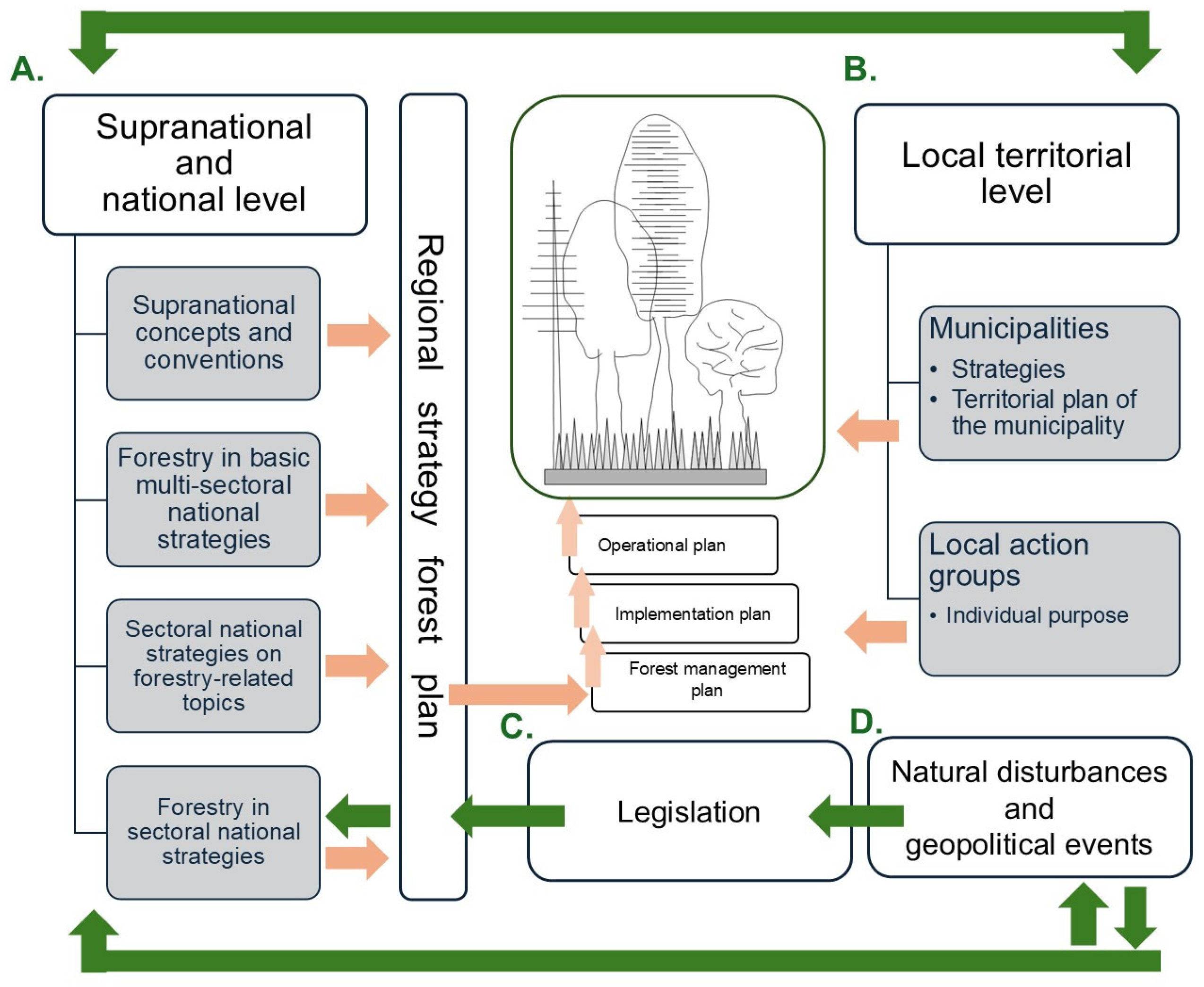
Figure 2.
The quantitative ratio (in %) of individual topics related to forestry in the analyzed documents at different levels.
Figure 2.
The quantitative ratio (in %) of individual topics related to forestry in the analyzed documents at different levels.
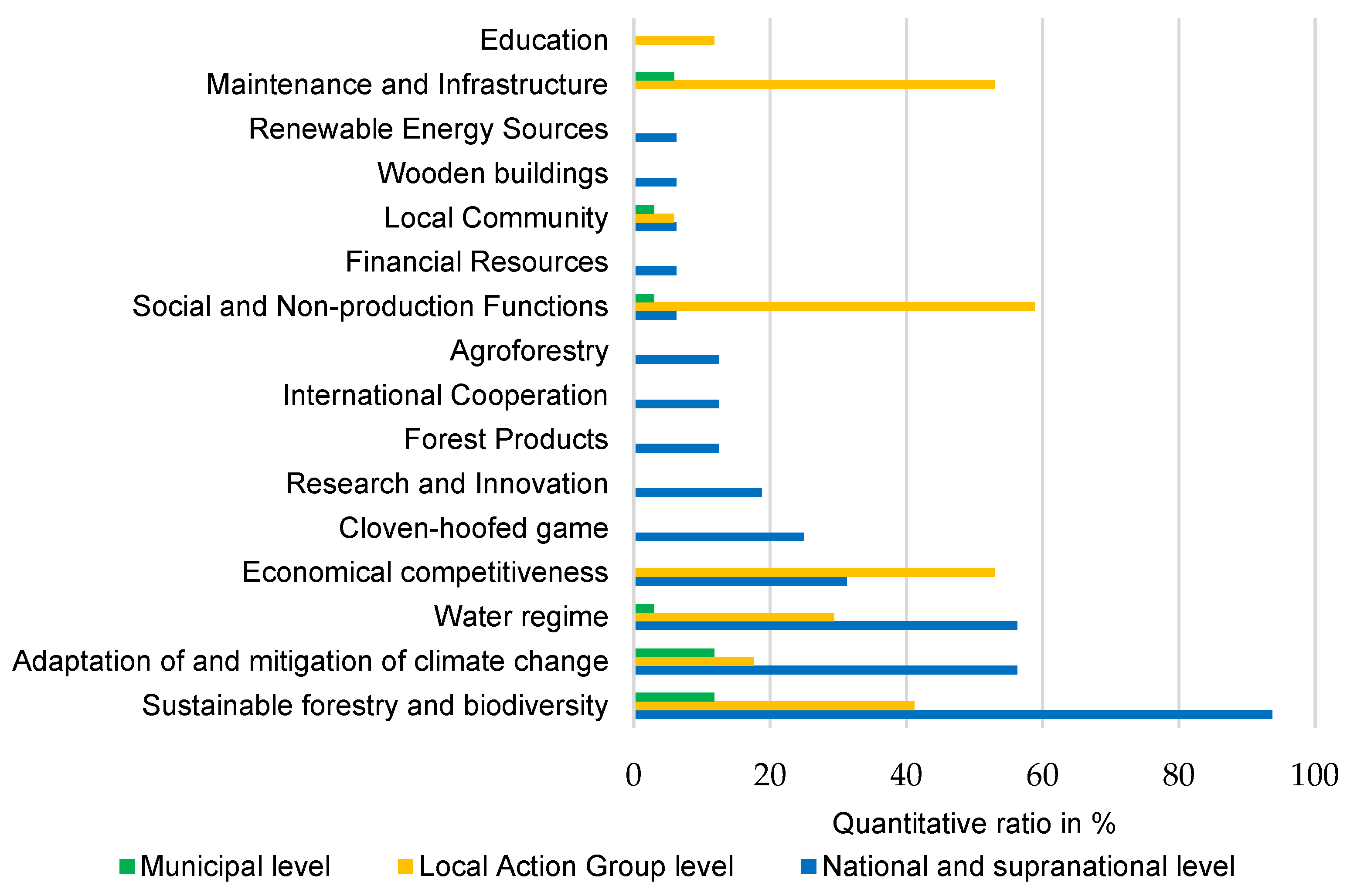
Figure 3.
A comparison of economic results for individual types of owners, including financial contributions to forest management, with AFEO results from 2012 to 2023. Source data from [58,59,60,61,62,63].
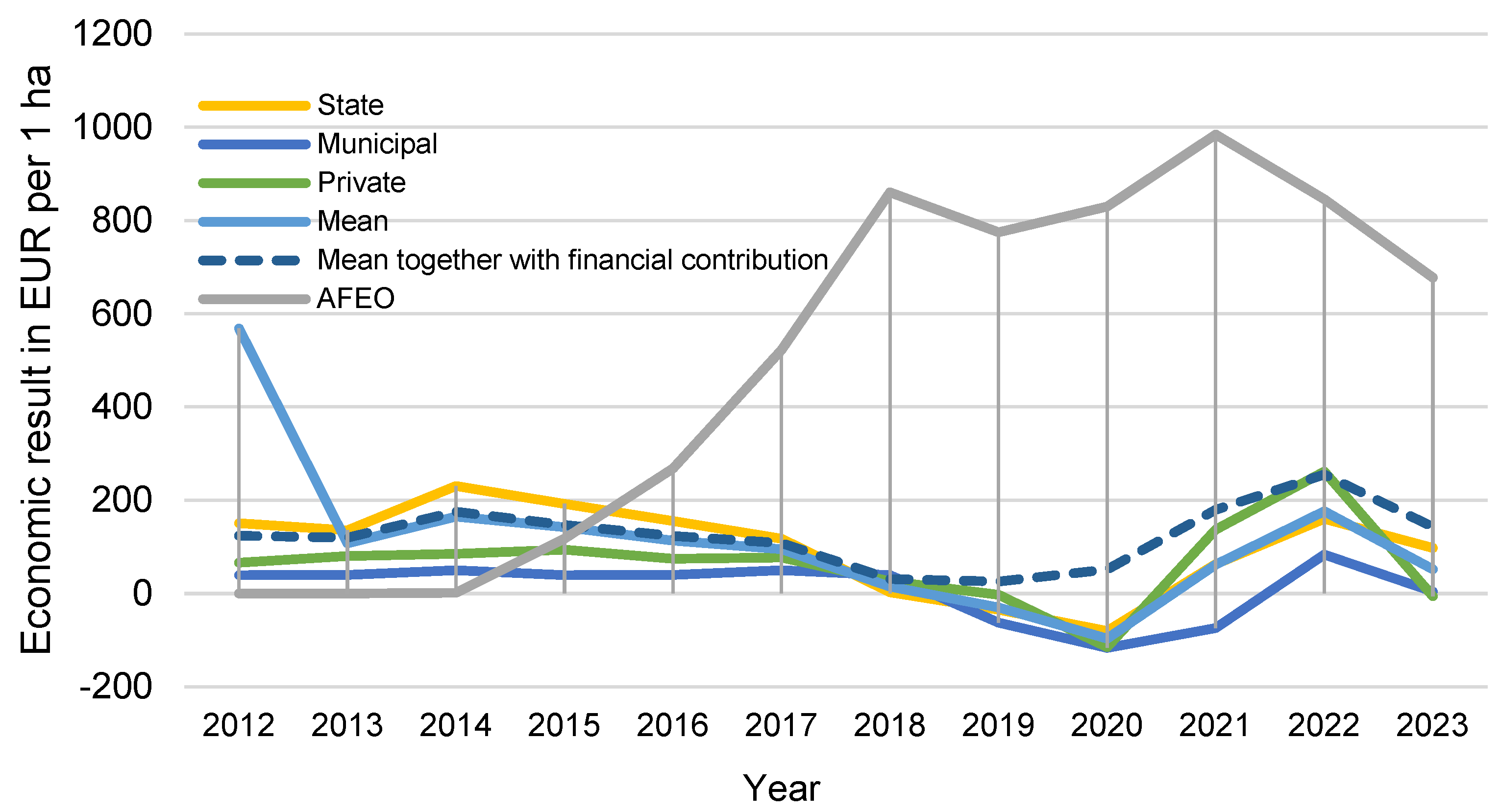

Table 1.
The frequency of representation of topics in strategies within individual territorial levels.
Table 1.
The frequency of representation of topics in strategies within individual territorial levels.
| Topic | Supranational and National Strategies | Local Action Group strategies | Municipal Strategies (or Plans) |
| Sustainable Forestry and Biodiversity | ●●● | ●● | ● |
| Adaptation and Mitigation of Climate Change | ●●● | ● | ● |
| Water Regime | ●●● | ●● | ● |
| Economic Competitiveness | ●● | ●●● | |
| Cloven-hoofed Game | ● | ||
| Research and Innovation | ● | ||
| Forest Products | ● | ||
| International Cooperation | ● | ||
| Agroforestry | ● | ||
| Social and Non-production Functions | ● | ●●● | ● |
| Financial Resources | ● | ||
| Local Community | ● | ● | ● |
| Wooden buildings | ● | ||
| Renewable Energy Sources | ● | ||
| Maintenance and Infrastructure | ●●● | ● | |
| Education | ● |
Disclaimer/Publisher’s Note: The statements, opinions and data contained in all publications are solely those of the individual author(s) and contributor(s) and not of MDPI and/or the editor(s). MDPI and/or the editor(s) disclaim responsibility for any injury to people or property resulting from any ideas, methods, instructions or products referred to in the content. |
© 2025 by the authors. Licensee MDPI, Basel, Switzerland. This article is an open access article distributed under the terms and conditions of the Creative Commons Attribution (CC BY) license (http://creativecommons.org/licenses/by/4.0/).
Copyright: This open access article is published under a Creative Commons CC BY 4.0 license, which permit the free download, distribution, and reuse, provided that the author and preprint are cited in any reuse.


