

Submitted:
25 October 2025
Posted:
27 October 2025
You are already at the latest version
Abstract
Osteoarthritis (OA) is a leading form of arthritis that significantly impacts individuals' quality of life and places an immense burden on healthcare systems globally. Traditional management strategies often fall short in addressing the disease's underlying pathophysiology. The emergence of robotic-assisted surgical techniques offers a promising avenue for enhancing both surgical precision and patient outcomes. Notably, AI-assisted robotics has the potential to bridge significant gaps in current surgical practices, such as personalized planning and intraoperative adjustments. This review critically analyzes the comparative efficacy of robotic-assisted techniques versus traditional methods in total knee arthroplasty (TKA) and discusses the integration of artificial intelligence (AI) in optimizing surgical outcomes. While early findings suggest improved postoperative performance and reduced length of hospital stays, significant challenges, including the generalizability of current algorithms and their integration into clinical practice, remain. This paper highlights the necessity for further research to solidify these technologies' role in future OA management.
Keywords:
osteoarthritis (OA)
; total knee arthroplasty (TKA)
; robotic-assisted surgery
; artificial intelligence (AI)
; machine learning (ML)
; patient outcomes
; surgical precision
; predictive modeling
Introduction
Osteoarthritis (OA) is the most prevalent form of arthritis worldwide [1]. It involves cartilage deterioration within joints, formation of osteophytes, sclerosis of subchondral bone, and weakening of surrounding musculature [2]. These pathological changes result in pain, functional limitations, and disability, imposing a significant individual and societal burden. Common symptoms of OA include joint pain, stiffness, and restricted movement. The disease frequently affects the hips, knees, hands, feet, and spine, often involving multiple joints [2]. Diagnosis can be established through clinical assessment, imaging techniques, or a combination of both [3]. Estimates indicate that in the United States, 21 million adults had OA in 1995, increasing to 27 million by 2005 [4]. Data from the 2017 Global Burden of Disease study show that OA’s incidence rate has grown annually by approximately 0.32% (95% CI 0.28 to 0.36), representing about a 9% increase from 1990 to 2017 [5]. The aging population and rising obesity rates further contribute to the increasing prevalence of age-related conditions like OA and its comorbidities, which continue to pose a substantial societal challenge [6]. OA can also affect mental health and overall quality of life, making its burden not only an economic issue but also a social and psychological concern [7]. Risk factors include individual factors such as age, gender, obesity, genetics, and diet, as well as joint-specific factors like trauma and abnormal loading [3]. Although aging is the primary risk factor, OA can develop independently of age [8].
Traditionally, research and clinical management of OA have relied on a combination of clinical symptoms, imaging findings, and biological markers to monitor disease progression, detect early joint degeneration, and predict long-term outcomes [9]. Current treatments mostly address symptoms primarily pain relief and inflammation reduction without targeting the disease’s underlying mechanisms [10]. Pharmacological options, such as NSAIDs and intra-articular corticosteroids, offer short-term relief but do not alter disease progression [11]. Surgical interventions, including joint replacement, are typically reserved for advanced cases with irreversible joint damage, emphasizing the importance of early diagnosis and more effective therapies [12]. Although these approaches provide valuable insights, they have limitations, especially in detecting early-stage OA and understanding its complex progression. Recently, artificial intelligence (AI) has shown potential to overcome some of these limitations. Deep learning models, especially convolutional neural networks (CNNs), can analyze large volumes of medical images to identify subtle joint tissue changes that are often undetectable with traditional radiography [13]. AI enables early detection of OA through assessment of cartilage thinning, bone abnormalities, and microstructural alterations, providing consistent and objective evaluations that reduce variability among observers [14]. Additionally, AI enhances the prediction of disease progression by integrating diverse datasets, including clinical, genetic, and biomechanical information [15]. These models can identify patients at higher risk of rapid disease progression, facilitating earlier and more tailored interventions. AI is also advancing drug discovery efforts by predicting new therapeutic targets and repurposing existing drugs [16]. In the realm of rehabilitation and regenerative medicine, AI-assisted technologies, such as those used in Winter Paralympics sports robots, optimize motor training and support recovery for OA patients.
This review aims to critically analyze the evolving landscape of surgical treatments for osteoarthritis, comparing the clinical and technological advantages of AI-assisted robotic surgeries, traditional robotic systems, and open surgical techniques. While AI-assisted robotics offers promising improvements in surgical precision and personalization through adaptive planning, real-time feedback, and data-driven insights, the evidence supporting these claims remains limited and emerging. By synthesizing current research, we highlight innovative contributions of AI integration beyond conventional robotics, such as enabling dynamic intraoperative adjustments and predictive outcome modeling. Unlike traditional systematic reviews, this analysis adopts a forward-looking perspective, emphasizing key knowledge gaps including the long-term outcomes of AI-assisted systems and identifying future directions in this rapidly evolving field.
Method
Search Strategy
A comprehensive literature search was conducted across PubMed, Embase, Google Scholar, and Web of Science. Key terms included ("osteoarthritis" OR "knee/hip arthroplasty") AND ("AI-assisted surgery" OR "robotic surgery" OR "open surgery") AND ("clinical outcomes" OR "precision" OR "cost-effectiveness"). The search prioritized comparative studies (RCTs, cohort studies, meta-analyses) evaluating AI-assisted robotic versus traditional robotic versus open techniques, with exclusion of single-arm studies, animal research, and non-English publications. The strategy aimed to balance comprehensiveness with focus on emerging AI applications while acknowledging potential biases from industry-funded robotics research and heterogeneous outcome reporting.
Results
Surgical Paradigms in Osteoarthritis
- Long-Term OA Prevention and Surgical Goals
The efficacy of surgical interventions in preventing or delaying OA progression hinges on their ability to address pre-osteoarthritic deformities congenital or acquired structural joint abnormalities[17]. While total knee and hip arthroplasty (TKA, THA) dominate OA management, early joint-preserving procedures aim to mitigate OA development by correcting deformities before irreversible joint damage occurs.
- 2.
- Joint-Preserving Surgery: Evidence and Limitations
Despite OARSI guidelines endorsing such techniques for young adults [18], evidence remains limited to case series, with no robust RCTs validating their preventive efficacy. Procedures like periacetabular osteotomy (for hip dysplasia) reposition malaligned joints to restore biomechanics. However, long-term data are sparse; a 30-year case series found only 29% of patients avoided OA progression or THA, while >70% required further surgery [19].
- 3.
- Arthroscopy: From Historical Use to Current Consensus
Arthroscopic debridement, once routine for knee OA, is no longer recommended. RCTs show no superiority over sham surgery, lavage, or physical therapy in pain relief or functional improvement [20,21,22]. This underscores the importance of evidence-based deprescribing in OA care [18].
- 4.
- Arthroplasty: Indications and Long-Term Outcomes
Reserved for end-stage OA, arthroplasty replaces damaged joints to alleviate pain and restore function. Guidelines mandate strict criteria: severe pain, functional disability, and failed conservative therapies [23,24]. Though THA and TKA improve quality of life [25,26,27], implant survival declines in younger patients. Lifetime revision risks reach 35% for those under 60, versus 5% for patients >70 [25]. Registry data from 63,158 patients (Table 1) reveal 20-year implant survival rates of ~85% for THA and ~90% for TKA. The tripling of TKA rates in 45–64-year-olds (1999–2008) highlights the need for caution in early intervention. Current therapeutic approaches for osteoarthritis remain predominantly symptom-focused, primarily targeting pain relief and inflammation control through pharmacological interventions rather than modifying disease progression [10]. This symptomatic management paradigm underscores the critical need for advanced diagnostic modalities capable of early detection and personalized treatment strategies that address OA's complex pathophysiology [26].
- 5.
- Balancing Innovation and Prudent Practice
While surgical options for OA are diverse, their indication must prioritize long-term benefit over short-term gains. Recent advances in artificial intelligence (AI) offer promising solutions to address key limitations in conventional osteoarthritis (OA) diagnosis and management. Deep learning algorithms, particularly convolutional neural networks (CNNs), have shown remarkable capability in processing large volumes of medical imaging data to detect subtle articular changes - including early cartilage thinning and microstructural bone abnormalities - that often elude traditional diagnostic methods.
[31], the clinical benefits of robotic systems remain debated. Asian healthcare systems have witnessed particularly rapid adoption, with four Hong Kong public hospitals acquiring Mako systems and over ten institutions utilizing loaned robotic platforms [29]. The Mako system's CT-based preoperative planning, haptic guidance, and soft-tissue balancing algorithms have contributed to its dominant market position (4.4% 30-day readmission rate vs. 10.1% for Cori/Navio) [33,34,35].
Traditional Robotic Surgeries in Osteoarthritis Management
The advent of computer-navigated systems revolutionized orthopedic surgery by enhancing intraoperative precision in implant placement and limb alignment [27]. These technological advancements initially promised improved postoperative outcomes and reduced hospital stays, leading to the gradual adoption of robotic-assisted systems across surgical specialties. The robotic TKA (R-TKA) era began with the introduction of the Mako system (Stryker, USA) in Hong Kong in January 2019, followed by competing platforms like Cori/Navio (Smith & Nephew) and Rosa (Zimmer Biomet)[28]. As illustrated in Figure 1, this represents a significant milestone in the surgical evolution of osteoarthritis management.
Despite enhanced surgical precision offered by computer navigation and robotic technologies, their efficacy in improving clinical outcomes and reducing hospital stays remains debated. In Asia, robotic-assisted total knee arthroplasty (R-TKA) adoption has grown steadily, particularly in public healthcare systems, driven by availability and encouraging early results. The Mako system (Stryker), introduced in Hong Kong in 2019, dominates the market, with four public hospitals purchasing units and over ten institutions utilizing loaned systems (including Cori/Navio and Rosa). However, high acquisition and maintenance costs hinder widespread implementation [29]. Globally, R-TKA adoption is increasing, as demonstrated by Wang et al. [30] with studies confirming its advantages over conventional TKA (C-TKA), including superior accuracy in coronal plane alignment (reducing outliers by 2.5°–3°) [31]. and optimized limb positioning. These systems may also reduce healthcare costs long-term through shorter hospital stays and lower 30-day readmission rates (Mako: 4.4% vs. Cori/Navio: 10.1%, p < 0.001; Rosa: 7.7%, p = 0.049) [32,33], though some studies report comparable outcomes across platforms. Mako’s popularity stems from its CT-based planning, haptic guidance, and soft-tissue balancing algorithms [34,35]. While R-TKA represents the gold standard for advanced knee osteoarthritis (AKO) [36,37,38]. emerging AI and machine learning (ML) tools are transforming preoperative planning and outcome prediction. These technologies leverage large datasets to improve decision-making in patient selection, implant sizing, and progression forecasting [37,38]. Further validation is needed to address limitations in generalizability and long-term reliability.
AI-Assisted Robotic Surgeries
AI is a broad term referring to technologies that simulate human intelligence to automate tasks with high accuracy and precision. AI’s integration in orthopedic surgery follows a closed-loop paradigm (Figure 2), spanning preoperative planning, intraoperative guidance, and postoperative monitoring to optimize outcomes.
AI can handle very large, complex datasets, and generate predictions to improve accuracy and efficiency of healthcare decisions, such as KOA and TKA [38]. Machene Learning (ML) algorithms have also been used to develop models to assist with pre-TKA planning and predict the value metrics of TKA[39], such as predicting implant size reconstructing three-dimensional CT data of lower limb to facilitate robotic-assisted TKA, and assisting with component positioning and alignment[40]. In terms of economic implications, ML potentially improves surgical precision and reduces the cost of manual labor. Regarding value metrics, ML methods have been used to predict the length of hospital stay, hospitalization charges, and discharge disposition. It impacts the economic burden of TKA and thus potentially affects decisions on payment models in healthcare settings. Multiple machine learning models have been developed for radiological diagnosis and severity grading of KOA (based on the most widely used Kellgren-Lawrence Classification System)[40].Tiulpin et al. [41] created an automated grading model utilizing a Deep Siamese Convolutional Neural Network. Initially, the model was trained on 18,376 knee radiographs from the Multicenter Osteoarthritis Study, a prospective, observational study focusing on KOA in older Americans. It was then fine-tuned for hyperparameters using 2,957 radiographs from the Osteoarthritis Initiative, a multicenter longitudinal study of knee osteoarthritis, and ultimately tested on 5,960 randomly selected KOA radiographs from the same dataset that were not part of the training phase. The model achieved a kappa coefficient of 0.83 and an average multiclass accuracy of 67%, reflecting excellent agreement comparable to intra- and inter-rater reliability among arthroplasty surgeons [42,43]. AI also shows promise in predicting post-TKA patient dissatisfaction. For example, Kunze et al.[44] developed a random forest algorithm with an AUC of 0.77 for identifying patients likely to experience dissatisfaction. Similarly, Farooq et al. [45] found that machine learning models significantly outperformed binary logistic regression, achieving an AUC of 0.81 versus 0.60. Since approximately 20% of patients are dissatisfied after TKA and current statistical models do not fully explain the causes, supervised machine learning offers an alternative approach to identify predictors of dissatisfaction automatically. Utilizing AI and related technologies in the preoperative phase could improve access to information and help standardize patient education regarding knee arthroplasty. A comprehensive review of multiple studies identified perioperative and intraoperative AI applications as the second most researched area in knee arthroplasty, with 42 out of 182 articles (22.08%), underscoring AI's potential impact on surgical planning and execution. Additionally, AI's intraoperative roles extend beyond robotic assistance, primarily in determining optimal implant sizes and soft tissue balancing [46].
One important limitation of this study design is that the training dataset does not contain complete patient medical data (e.g., comorbidities) and only includes the patients from a small number of hospitals, limiting its generalizability[47] . Overall, ML has not been extensively applied in predicting post-TKA complications, and further efforts in model development with rigorous internal and external validation are warranted. AI and ML models improve automatic grading of knee radiographs, patient selection for TKA, and predictin of postoperative outcomes of patient-reported outcome measures, patient satisfaction, and short-term complications. The weaknesses of current AI algorithms include the lack of external validation, inherent biases of clinical data, the need for large datasets for training, and significant research and regulatory gaps. significant research and regulatory gaps exist, given the novel nature of this technology. There is a paucity of literature on the use of machine learning algorithms to predict the need for arthroplasty, and current machine learning models are unable to predict the long-term outcomes of TKA. ML models are limited by the biases of current clinical data, and future implementation of these algorithms into routine hospital care will also come with regulatory concerns of algorithm quality control, security issues and adversarial attacks.
Discussion
The management of osteoarthritis has been traditionally anchored in symptomatic treatment approaches, with limited efficacy in addressing disease progression. Emerging evidence points towards a paradigm shift with the integration of robotic systems and AI into surgical interventions. Robotic-assisted total knee arthroplasty (R-TKA) signifies a considerable advancement in surgical precision, with studies indicating a reduction in complications and improved alignment of implants compared to conventional methods[3]. The ability of these systems to provide more accurate and individualized surgical plans can drastically alter patient outcomes, potentially lowering the likelihood of revision surgeries[14]. AI integration further enhances the capabilities of robotic systems by enabling adaptive decision-making, real-time feedback, and predictive modeling for post-operative outcomes. Machine learning algorithms have shown promise in improving preoperative patient selection and risk assessment, which is critical when considering the increasingly complex profiles of candidates for TKA[11] For instance, algorithms that analyze large datasets can identify subtle changes in joint structures, allowing for earlier intervention and optimal surgical timing[2]. Moreover, the implementation of AI-driven models can assist in customizing surgical approaches, thereby enhancing the personalization of treatments for individuals with unique anatomical and pathological presentations[15]. When evaluating surgical options for osteoarthritis, key differences emerge in precision, recovery, and cost (Table 2). While traditional robotic systems reduce alignment outliers to ±1° versus ±3° in open surgery, AI-assisted platforms may achieve sub-degree precision through adaptive planning algorithms.
However, the adoption of these novel techniques is clouded by several limitations. First, many current AI algorithms lack robust external validation and may be prone to biases related to the training datasets[11]. Such inherent biases can compromise their reliability in diverse healthcare settings. Furthermore, the generalizability of findings from robotic-assisted techniques remains a concern, as most studies originate from specialized centers; hence, the applicability of results to broader populations must be approached with caution[1]. In addition, the regulatory environment surrounding AI integration in surgical practice raises critical questions regarding quality control, patient safety, and ethical usage[11]. This review acknowledges several limitations. The heterogeneity of study designs, which may affect the comparability of results and recommendations.The limited understanding of long-term outcomes associated with robotic-assisted surgeries, necessitating further longitudinal studies to establish definitive benefits. Also, a lack of comprehensive data on patient demographics and comorbidities within available research, restricting the generalizability of findings to the broader population.
Conclusions
The integration of robotic systems and AI in the management of osteoarthritis, particularly concerning total knee arthroplasty, heralds a transformative direction in orthopedic surgery. Initial outcomes demonstrate the potential for enhanced precision, reduced complications, and improved patient satisfaction. Nevertheless, as we stand on the precipice of this new era, it is imperative to address existing gaps in knowledge and regulatory frameworks. Future research must prioritize external validation of AI algorithms and focus on long-term outcomes to fully encapsulate the benefits of these novel interventions. The journey towards optimal OA management must embrace not only technological advancements but also a holistic view of patient care that includes preventive and rehabilitative strategies alongside surgical innovation
References
- Tang, S.a. , et al., Osteoarthritis. Nature Reviews Disease Primers, 2025. 11(1): p. 1-22.
- Hawker, G.A. and L.K. King, The burden of osteoarthritis in older adults. Clinics in Geriatric Medicine, 2022. 38(2): p. 181-192.
- King, L. , Osteoarthritis and comorbidity: time for action. Osteoarthritis and Cartilage, 2023. 31(4): p. 423-424.
- Peat, G. and M. Thomas, Osteoarthritis year in review 2020: epidemiology & therapy. Osteoarthritis and cartilage, 2021. 29(2): p. 180-189.
- Ding, Y. , et al., Global, regional, and national trends in osteoarthritis disability-adjusted life years (DALYs) from 1990 to 2019: a comprehensive analysis of the global burden of disease study. Public Health, 2024. 226: p. 261-272.
- Leifer, V.P., J. N. Katz, and E. Losina, The burden of OA-health services and economics. Osteoarthritis and cartilage, 2022. 30(1): p. 10-16.
- O’Sullivan, O. , Osteoarthritis: Pathophysiology and Classification of a Common Disabling Condition, in The Palgrave Encyclopedia of Disability. 2024, Springer. p. 1-11.
- Kang, Y. , et al., The burden of knee osteoarthritis worldwide, regionally, and nationally from 1990 to 2019, along with an analysis of cross-national inequalities. Archives of Orthopaedic and Trauma Surgery, 2024. 144(6): p. 2731-2743.
- Hawker, G.A. , Osteoarthritis is a serious disease. Clin Exp Rheumatol, 2019. 37(Suppl 120): p. 3-6.
- Buttgereit, F., G. -R. Burmester, and J.W. Bijlsma, Non-surgical management of knee osteoarthritis: where are we now and where do we need to go? RMD open, 2015. 1(1): p. e000027.
- Bannuru, R.R. , et al., OARSI guidelines for the non-surgical management of knee, hip, and polyarticular osteoarthritis. Osteoarthritis and cartilage, 2019. 27(11): p. 1578-1589.
- Jevsevar, D.S. , Treatment of osteoarthritis of the knee: evidence-based guideline. JAAOS-Journal of the American Academy of Orthopaedic Surgeons, 2013. 21(9): p. 571-576.
- Liu, F. , et al., Deep learning approach for evaluating knee MR images: achieving high diagnostic performance for cartilage lesion detection. Radiology, 2018. 289(1): p. 160-169.
- Antony, J. , et al. Quantifying radiographic knee osteoarthritis severity using deep convolutional neural networks, 2016. [Google Scholar]
- Kokkotis, C. , et al., Machine learning in knee osteoarthritis: A review. Osteoarthritis and Cartilage Open, 2020. 2(3): p. 100069.
- Bay-Jensen, A.-C. , et al., Biochemical marker discovery, testing and evaluation for facilitating OA drug discovery and development. Drug discovery today, 2018. 23(2): p. 349-358.
- Madry, H. , Surgical therapy in osteoarthritis. Osteoarthritis and cartilage, 2022. 30(8): p. 1019-1034.
- Zhang, W. , et al., OARSI recommendations for the management of hip and knee osteoarthritis, Part II: OARSI evidence-based, expert consensus guidelines. Osteoarthritis and cartilage, 2008. 16(2): p. 137-162.
- Lerch, T.D. , et al., One-third of hips after periacetabular osteotomy survive 30 years with good clinical results, no progression of arthritis, or conversion to THA. Clinical Orthopaedics and Related Research®, 2017. 475: p. 1154-1168.
- Chang, R.W. , et al., A randomized, controlled trial of arthroscopic surgery versus closed-needle joint lavage for patients with osteoarthritis of the knee. Arthritis & Rheumatism: Official Journal of the American College of Rheumatology, 1993. 36(3): p. 289-296.
- Moseley, J.B. , et al., A controlled trial of arthroscopic surgery for osteoarthritis of the knee. New England Journal of Medicine, 2002. 347(2): p. 81-88.
- Kirkley, A. , et al., A randomized trial of arthroscopic surgery for osteoarthritis of the knee. New England Journal of Medicine, 2008. 359(11): p. 1097-1107.
- Bayliss, L.E. , et al., The effect of patient age at intervention on risk of implant revision after total replacement of the hip or knee: a population-based cohort study. The Lancet, 2017. 389(10077): p. 1424-1430.
- Losina, E. , et al., The dramatic increase in total knee replacement utilization rates in the United States cannot be fully explained by growth in population size and the obesity epidemic. JBJS, 2012. 94(3): p. 201-207.
- Ehmig, J. , et al., MR-imaging in osteoarthritis: current standard of practice and future outlook. Diagnostics, 2023. 13(15): p. 2586.
- Zhang, Y. , Jordan jM. Epidemiology of Osteoarthritis Clin. Geriatr Med Aug, 2010. 26(3): p. 355-369.
- Shah, S.M. , After 25 years of computer-navigated total knee arthroplasty, where do we stand today? Arthroplasty, 2021. 3: p. 1-8.
- Chan, K.C. , et al., Robotic total knee arthroplasty safely reduces length of stay in an Asian public healthcare system. Bone & Joint Open, 2025. 6(1): p. 12.
- Steffens, D. , et al., Implementation of robotic-assisted total knee arthroplasty in the public health system: a comparative cost analysis. International Orthopaedics, 2022: p. 1-8.
- Wang, J.C. , et al., Computer-navigated and robotic-assisted total knee arthroplasty: increasing in popularity without increasing complications. The Journal of Arthroplasty, 2022. 37(12): p. 2358-2364.
- Deckey, D.G. , et al., Robotic-assisted total knee arthroplasty improves accuracy and precision compared to conventional techniques. The bone & joint journal, 2021. 103(6 Supple A): p. 74-80.
- Shah, R. , et al., Robotic total knee arthroplasty: A missed opportunity for cost savings in Bundled Payment for Care Improvement initiatives? Surgery, 2021. 170(1): p. 134-139.
- Batailler, C. , et al., MAKO CT-based robotic arm-assisted system is a reliable procedure for total knee arthroplasty: a systematic review. Knee Surgery, Sports Traumatology, Arthroscopy, 2021. 29(11): p. 3585-3598.
- Leelasestaporn, C. , et al., Comparison of 1-year outcomes between MAKO versus NAVIO robot-assisted medial UKA: nonrandomized, prospective, comparative study. Knee Surgery & Related Research, 2020. 32: p. 1-9.
- Rajgor, H.D. , et al., Mako versus ROSA: comparing surgical accuracy in robotic total knee arthroplasty. Journal of Robotic Surgery, 2024. 18(1): p. 33.
- Lee, L.S. , et al., Artificial intelligence in diagnosis of knee osteoarthritis and prediction of arthroplasty outcomes: a review. Arthroplasty, 2022. 4(1): p. 16.
- Cabitza, F., A. Locoro, and G. Banfi, Machine learning in orthopedics: a literature review. Frontiers in bioengineering and biotechnology, 2018. 6: p. 75.
- Myers, T.G. , et al., Artificial intelligence and orthopaedics: an introduction for clinicians. JBJS, 2020. 102(9): p. 830-840.
- LeCun, Y., Y. Bengio, and G. Hinton, Deep learning. nature, 2015. 521(7553): p. 436-444.
- Bini, S.A. , Artificial intelligence, machine learning, deep learning, and cognitive computing: what do these terms mean and how will they impact health care? The Journal of arthroplasty, 2018. 33(8): p. 2358-2361.
- Tiulpin, A. , et al., Automatic knee osteoarthritis diagnosis from plain radiographs: a deep learning-based approach. Scientific reports, 2018. 8(1): p. 1727.
- Gossec, L. , et al., Comparative evaluation of three semi-quantitative radiographic grading techniques for knee osteoarthritis in terms of validity and reproducibility in 1759 X-rays: report of the OARSI–OMERACT task force. Osteoarthritis and cartilage, 2008. 16(7): p. 742-748.
- Riddle, D.L., W. A. Jiranek, and J.R. Hull, Validity and reliability of radiographic knee osteoarthritis measures by arthroplasty surgeons. Orthopedics, 2013. 36(1): p. e25-e32.
- Kunze, K.N. , et al., Development of machine learning algorithms to predict patient dissatisfaction after primary total knee arthroplasty. The Journal of arthroplasty, 2020. 35(11): p. 3117-3122.
- Farooq, H. , et al., Predictors of patient satisfaction following primary total knee arthroplasty: results from a traditional statistical model and a machine learning algorithm. The Journal of Arthroplasty, 2020. 35(11): p. 3123-3130.
- Enni, J.B.A. and D.K. Agrawal, Application of Artificial Intelligence and its Subsets in Various Stages of Knee Arthroplasty from Pre-op to Post-op: An Overview. Journal of orthopaedics and sports medicine, 2025. 7(1): p. 96.
- Harris, A.H. , et al., Can machine learning methods produce accurate and easy-to-use prediction models of 30-day complications and mortality after knee or hip arthroplasty? Clinical Orthopaedics and Related Research®, 2019. 477(2): p. 452-460.
Figure 1.
Surgical evolution in Osteoarthritis.
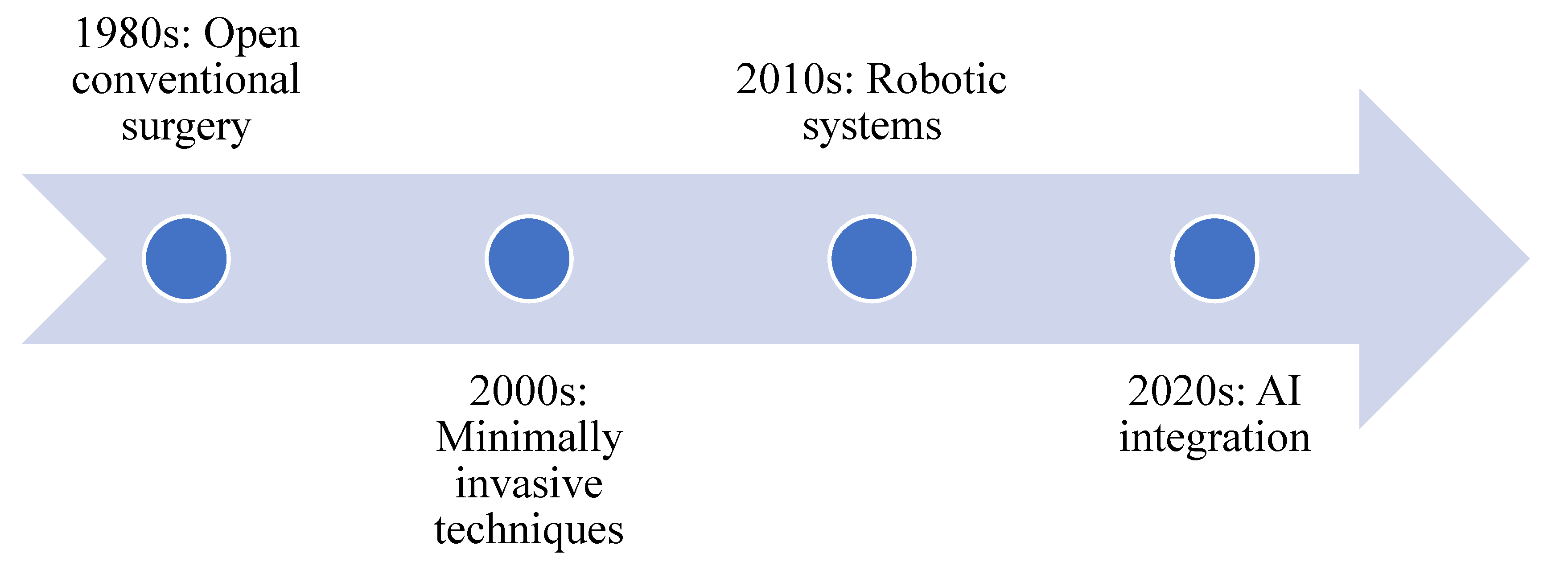
Figure 2.
AI’s integration in orthopedic surgery follows a closed-loop paradigm.


Table 1.
Surgical Treatments Modalities in OA Management.
| Category | Joint-Preserving Surgery | Arthroscopy | Conventional Arthroplasty |
|---|---|---|---|
| Indications | Early OA with deformities | Historical use (now not recommended) | End-stage OA |
| Evidence Level | Limited (case series) [19] | Strong against use [20,21,22] | Strong (registries) [28] |
| 10-Year Success | 29% avoid THA [19] | No benefit | 85-90% survival [28] |
| Advantages | Joint preservation | Minimally invasive | Gold standard |
| Disadvantages | 71% progress to THA [19] | No better than sham [21] | Revision risks |
| Best Candidates | Young adults (<50) | N/A | >60 years old |
Table 2.
Comparing Surgical Techniques for Osteoarthritis Management.
| Metric | Open Surgery | Traditional Robotic | AI-Assisted Robotic |
|---|---|---|---|
| Alignment Accuracy | ±3° outliers common | Fewer outliers (±1°) | Adaptive precision (±0.5°?) |
| Patient Satisfaction | 80–85% at 1 year | 85–90% (faster early recovery) | Potential for personalization |
| Hospital Stay | 2–5 days | 1–3 days | 1–2 days (early data) |
| Complications | Infection, malalignment | Pin-site fractures, tech fails | Algorithmic bias risks |
| Cost | 10K–10K–15K | 15K–15K–20K (+robot amortized) | $20K+ (AI licensing) |
| Learning Curve | Surgeon-dependent | 20–50 cases | 50+ cases (AI integration) |
Disclaimer/Publisher’s Note: The statements, opinions and data contained in all publications are solely those of the individual author(s) and contributor(s) and not of MDPI and/or the editor(s). MDPI and/or the editor(s) disclaim responsibility for any injury to people or property resulting from any ideas, methods, instructions or products referred to in the content. |
© 2025 by the authors. Licensee MDPI, Basel, Switzerland. This article is an open access article distributed under the terms and conditions of the Creative Commons Attribution (CC BY) license (http://creativecommons.org/licenses/by/4.0/).
Copyright: This open access article is published under a Creative Commons CC BY 4.0 license, which permit the free download, distribution, and reuse, provided that the author and preprint are cited in any reuse.


