

Submitted:
24 October 2025
Posted:
28 October 2025
You are already at the latest version
Abstract
Quantum computing offers transformative potential to solve complex optimisation problems in transportation and logistics, particularly those that involve large combinatorial decision spaces such as vehicle routing, traffic control, and supply chain design. Despite theoretical promise and growing empirical interest, its adoption remains limited. This systematic literature review synthesises fifteen peer-reviewed studies published between 2015 and 2025, examining the application of quantum and quantum-inspired methods to transport optimisation. The review identifies five key problem domains (vehicle routing, factory scheduling, network design, traffic operations, and energy management) and categorises the quantum techniques used, including quantum annealing, variational circuits, and digital annealers. Although several studies demonstrate performance gains over classical heuristics, most rely on synthetic datasets, lack statistical robustness, and omit critical operational metrics such as energy consumption and queue latency. Four cross-cutting barriers are identified: hardware limitations, data availability, energy inefficiency, and organisational readiness. The review highlights the absence, yet development promise, of real-world deployments, standardised benchmarks, and comprehensive cost–benefit analyses. It concludes with a structured research agenda aimed at bridging the gap between laboratory demonstrations and practical implementation, emphasising the need for pilot trials, open datasets, robust experimental protocols, and interdisciplinary collaboration.
Keywords:
quantum computing
; transport optimisation
; technology adoption barriers
; systematic literature review
1. Introduction
The complexity of contemporary transport and logistics arises from rapid urbanisation, tightly coupled global supply chains, and ambitious decarbonisation targets. This complexity results in computationally intensive tasks for processing large volumes of data and/or considering large decision spaces to make optimal choices. Classical optimisation approaches, ranging from mixed integer programming [1] to metaheuristic search [2], perform well on narrowly scoped or static tasks, but struggle to deliver near-optimal decisions within the stringent temporal horizons required for city-scale vehicle routing, adaptive traffic control, or same-day fulfilment [3].
Quantum computing represents a fundamentally different computational paradigm that exploits superposition, entanglement, and interference to accelerate the exploration of vast combinatorial spaces [4]. In classical computing, information is processed using bits that exist in one of two states: 0 or 1. Quantum computing uses quantum bits, or qubits, which can exist in a superposition of both 0 and 1 at the same time. This means that a quantum computer can explore many possible solutions simultaneously, rather than one at a time. Entanglement is another key principle, a quantum phenomenon in which qubits become linked in such a way that the state of one qubit instantly influences the state of another, no matter how far apart they are. This allows quantum computers to coordinate and correlate information across qubits in ways that classical systems cannot replicate. Finally, quantum interference is used to amplify the probability of correct solutions while cancelling out incorrect ones. By carefully orchestrating how quantum states evolve and interact, quantum algorithms can guide the system toward the most promising answers in a vast search space. Together, these properties enable quantum computers to accelerate the exploration of vast combinatorial spaces, such as those found in cryptography, optimisation, drug discovery, and materials science. In all these domains, the number of possible configurations grows exponentially and quickly overwhelms classical computing resources. Quantum computing is a rapidly progressing area, with recent breakthroughs making it more accessible to the user. Although quantum architecture is not widely available, research into the use of Quantum computers tends to focus on adopting and exploiting specific aspects of the architecture or underlying science.
There are three lines of technological development that are particularly relevant for transport optimisation: quantum annealing hardware that directly solves binary quadratic models [5], variational circuits executed on noisy intermediate-scale quantum processors [6], and quantum-inspired architectures that emulate tunnelling effects by means of complementary metal–oxide–semiconductor hardware [7]. Collectively, these platforms have produced promising results for logistics problems such as vehicle routing [8,9], supply chain planning [5], network design [10], and plug-in vehicle charging [11], although virtually all empirical demonstrations remain confined to proof-of-concept instances [12,13].
Despite this promise, quantum optimisation in transport is still distant from routine deployment. Current devices possess fewer than one hundred logical qubits, suffer from limited connectivity and modest gate fidelity that is not yet at the level required for fault-tolerant computation [14,15], and rely on software toolchains that remain immature [16]. An independent energy audit experiment even reports that small quantum workloads can consume more electricity than a conventional desktop workstation [17]. Operational impediments intensify these technical constraints: most published case studies use synthetic or down-sampled data, none measure queue latency for cloud-hosted processors, and pilot-scale deployments have yet to appear in the academic record. Institutional factors add further inertia because organisations face shortages of interdisciplinary talent, encounter uncertain return-on-investment, and confront a near-absence of sector-wide benchmarks or standards [18,19,20]
The existing literature is fragmented. Theoretical articles focus on overcoming technical challenges to improve performance while neglecting the modelling effort required for real-world integration, whereas experimental reports highlight isolated performance gains without systematically evaluating their generalisability, energy cost, or organisational feasibility. Therefore, a comprehensive synthesis that unites empirical performance evidence with the multifaceted barriers that govern technology diffusion is essential. Such a synthesis can clarify the readiness for quantum optimisation for transport applications, expose research gaps that warrant priority, and inform policy aimed at responsible adoption.
This study conducts a systematic review of peer-reviewed work published between 2015 and June 2025. Fifteen peer-reviewed journal articles satisfy the inclusion criteria after exclusions for narrative reviews, non-transport domains, and weakness in methodological weakness. The review catalogues their problem settings, quantum techniques, dataset scales, comparative baselines, and methodological quality, then interprets these findings in terms of technical, operational, and institutional barriers. By integrating quantitative evidence with qualitative insight, the study seeks to clarify the current state of quantum optimisation in transport, identify the most pressing research gaps, and outline a structured agenda for future investigation and pilot implementation. The novel contributions of this article are:
- First systematic review of quantum computing applications in transportation, mapping out key problem domains (such as vehicle routing, scheduling, and traffic control), and quantum techniques used.
- Identifies the major barriers to adoption, including hardware limitations, lack of real-world data, energy inefficiency, and organisational challenges.
- Proposes a structured research agenda to bridge the gap between laboratory studies and real-world deployment, emphasising the need for pilot trials, open benchmarks, and robust evaluation protocols.
The remainder of the paper is organised as follows. Section 2 introduces the relevant transport optimisation problems, summarises quantum computing methods, and presents the barrier taxonomy that motivates the review. Section 3 describes the review protocol and the quality assessment procedure. Section 4 synthesises the empirical results of the fifteen primary studies, while Section 5 discusses implications, limitations, and priorities for future work. Finally, a conclusion is provided in Section 6.
2. Background
2.1. Transport and Logistics Optimisation Problems
Efficient optimisation underpins every operational and strategic layer of modern transport and logistics, ranging from day-to-day vehicle routing choices to long-horizon investment in depots and inventory buffers. Canonical problems in this field include the travelling salesperson problem, the vehicle routing problem and its time window variant, crew and machine scheduling, multi-echelon inventory design, facility location and network expansion planning, adaptive traffic signal control, and fleet-level charging management [21]. All belong to the class of NP-hard combinatorial problems. A problem is NP-hard if solving it in polynomial time would make every problem in the NP class that is solvable in polynomial time, even though the NP-hard problem itself might not sit inside NP. For example, in the travel-salesperson problem, the number of feasible tours increases factorially with the number of cities, so enumerating all routes becomes infeasible as the network size increases. The same exponential growth appears when a factory scheduler must allocate dozens of robots to hundreds of jobs or when a planner must choose which of several thousand links to add to a road network.
Because the search space grows explosively with instance size, exact formulations such as mixed-integer programming are overwhelmed once realistic networks, stochastic travel times, or dynamic constraints are introduced [22]. Meta-heuristics and machine learning surrogates provide usable solutions faster, yet they do so by relinquishing global optimality and, in many cases, stability. This trade-off becomes sharper as urban networks become more dense, customer service windows shrink, and real-time decision cycles shorten [23,24]. Figure 1 summarises the five problem families most often targeted by quantum optimisation research. There are vehicle and fleet routing, robot and factory scheduling, network design and facility location planning, adaptive traffic signal control, and energy-sensitive charging and dispatch.
2.2. Quantum Computing: Principles and Methods
Quantum computing offers a fundamentally different approach to computation by representing information in qubits. Unlike binary digits in classical computation systems, qubits can exist in a combination of 0 and 1 at the same time. This phenomenon is known as superposition, and it allows quantum computers to explore many possible solutions simultaneously. Additionally, qubits can be entangled, meaning that the state of one qubit is directly related to the state of another, even if they are far apart. This entanglement, along with quantum interference, enables quantum computers to perform certain calculations much more efficiently than classical computers by narrowing down the correct answers from a vast number of possibilities in a single step [4,25]. There are two hardware paradigms that dominate in current research:
- Quantum Annealers: These machines, such as those built by D-Wave Systems, are designed to solve optimisation problems where the goal is to find the best solution among many possible options. They do this by representing the problem as a mathematical model called an unconstrained binary quadratic model and then using a quantum process called tunnelling to guide the system toward the lowest-energy (or most optimal) configuration [26]. This approach is particularly useful for problems like scheduling, logistics, and machine learning.
- Gate-Based Quantum Processors: These are more general-purpose quantum computers, developed by companies like IBM and Rigetti. They work by applying a series of quantum operations, called unitary gates, to qubits in a controlled sequence, similar to how classical computers use logic gates. These processors can run sophisticated algorithms such as the Quantum Approximate Optimisation Algorithm (QAOA), which is used to solve complex optimisation problems, and the Variational Quantum Eigensolver (VQE), which is useful to simulate molecular structures and quantum systems through sequences of parameterised quantum gates compiled by toolchains such as Qiskit [27,28,29].
A third category, known as quantum-inspired digital annealers, offers a bridge between classical and quantum computing. These systems are built using conventional computer hardware (such as CMOS chips), but they mimic certain quantum behaviours, especially tunnelling, using carefully designed algorithms [30]. Although they are not true quantum computers, they use similar mathematical models (such as the Ising model) and can serve as practical tools to solve problems while quantum hardware continues to mature [31]. The Ising model is a simplified mathematical model used in statistical physics to study phase transitions, where each point on a lattice represents a magnetic spin that can be in one of two states (up or down), interacting with its neighbours and possibly an external magnetic field.
To make quantum computing more accessible and scalable, researchers are also developing compiler frameworks to help translate high-level tasks into quantum operations. An example is the ‘Naginata’ circuit synthesiser, which automates the design of reusable quantum circuit blocks, particularly for tasks in machine learning [32]. These tools are essential for building more complex quantum applications and making quantum computing usable by a broader range of developers and researchers. These interdependencies are visually brought together in Figure 2, which shows how hardware, algorithms, software infrastructure, application domains, and adoption barriers constitute an integrated ecosystem for quantum optimisation in transport and logistics.
2.3. Quantum Computing Applications in Transport and Logistics
Research in the past five years shows a clear thematic pattern, as seen in Table 1. Approximately half of the empirical corpus is focused on vehicle and fleet routing. These studies employ either Ising formulations solved on quantum annealers or logarithmically encoded variational circuits executed on simulators. Factory and robot scheduling problems form a second cluster that exploits quantum-inspired digital annealing or hybrid variational approaches. A smaller but conceptually important group addresses challenges in network design and supply chain location with hybrid quantum-classical improvement loops, while some work explores traffic signal timing and plug-in vehicle charging. Across all domains, quantum annealing remains the most frequently adopted technique because the binary nature of the transport decision variables lends itself to Quadratic Unconstrained Binary Optimisation (QUBO); variational circuits appear mostly in proof-of-concept simulators, whereas quantum-inspired annealers provide an intermediate step that already scales to thousands of decision variables.
2.3.1. Vehicle and Fleet-Routing Problems
Large-scale vehicle-routing problems comprise both the classical capacitated vehicle-routing problem (VRP) and vehicle-routing problem with time windows (VRPTW), in which each stop must be served within a specified service interval and within vehicle-capacity limits. A schematic version of the problem appears in Figure 3. Four colour-coded tours depart from a single depot to serve spatially dispersed customers (black nodes). When distinct service-time windows are attached to each customer, the basic VRP generalises to the VRPTW, greatly increasing its combinatorial complexity. Assigning hundreds of customers to dozens of vehicles under these dual sets of constraints generates a combinatorial space that grows exponentially with the size of the fleet. Classical metaheuristics can return high quality routes but provide no optimality guarantees [44], a shortcoming that becomes critical in same-day delivery settings where only seconds of compute time are available. QUBO formulations orientated to ising in annealers [45] and qubit-efficient variational circuits in gate devices promise to explore much larger neighbourhoods in parallel [46], raising the prospect of tighter upper limits for both VRP and VRPTW instances within operational time limits.
2.3.2. Factory and Robot-Scheduling
Modern distribution centres and production warehouses increasingly deploy fleets of automated guided vehicles (AGVs) in tandem with fixed robotic workstations. Each vehicle must collect materials, deliver them to the correct station, and sometimes perform intermediate processing steps while sharing aisles and transfer points with other vehicles. If two AGVs attempt to enter the same aisle segment or workstation simultaneously, they risk collision; even without physical contact, they can mutually block access routes and immobilise the fleet, a state of the system commonly termed deadlock [47]. Throughput targets, battery constraints, task precedence relations, and machine eligibility rules further complicate the scheduling landscape. When these spatial and temporal restrictions are modelled in full detail, the schedule usually takes the form of a disjunctive graph or a time-indexed integer program. Such formulations generate NP hard sequencing and routing subproblems that classical branch-and-bound or constraint programming solvers can handle only for relatively modest instance sizes [48].
Quantum and quantum inspired methods are attractive because many of the underlying decisions are binary (e.g. vehicle i uses segment j at time t; job k assigned to machine m) and can therefore be encoded in the form Ising or the quadratic unconstrained binary optimisation (QUBO) [49]. Digital annealers already handle tens of thousands of binary variables in near-real time for shop floor style benchmarks [39], and hybrid variational / metaheuristic schemes have shown multi-objective improvements in simulated AGV scheduling environments [40]. Looking ahead, error-mitigated QAOA variants that combine shallow quantum circuits with classical repair heuristics could reduce makespan and congestion while enforcing collision-free and deadlock-free movement plans in high-density automated warehouses.
2.3.3. Network-Design and Supply-Chain Location
Strategic design questions in freight distribution often require deciding which depots to open, which links to upgrade, and how to size intermediate facilities so that flows can be routed at minimum cost subject to capacity, service time, and reliability constraints [50,51]. These problems mix large numbers of binary location variables with non-linear or multi-commodity flow constraints; even with relaxations, standard branch-and-bound and Benders decomposition procedures deteriorate rapidly once network size exceeds a few hundred candidate sites or when multiple demand scenarios are considered.
Quantum annealing offers a compact way to evaluate many facility configurations in parallel because the upper-level location choices can be represented as spins in an Ising energy landscape. Flow costs and interaction penalties map to pairwise couplers, and hybrid loops can call on a classical solver to re-optimise flows for each sampled configuration. Early experiments in the transport literature report sub-percentage optimality gaps relative to the tuned tabu search on benchmark transport network design instances [41] and demonstrate prototype annealing encodings for additional location expansion scenarios [10]. Although present hardware limits constrain the scale of these demonstrations, the approach suggests a shorter design iteration cycle for capital-intensive infrastructure planning once larger quantum or quantum-inspired platforms become available.
2.3.4. Traffic-Operations Optimisation
Traffic control strategies such as adaptive traffic lights, lane reversals, and ramp metering often use mixed-integer programming models that must be solved every 30–60 seconds. To make this work in real time, these models usually compromise on finding the best overall solution or coordinating the whole network.
By converting traffic signal timing decisions into a QUBO format, quantum annealers can quickly explore thousands of possible timing plans in parallel [52]. If data input delays and system response can be reduced, quantum solvers have the potential to improve both local and global traffic optimisation in real-time urban networks.
2.3.5. Energy and Charging Management
Fleet-wide electric vehicle charging, vehicle grid integration, and microgrid scheduling require deciding how much energy to draw (or return) at many sites in many time intervals. The choice made now affects the battery state, network capacity, and feasible choices later, and all of these decisions must adapt to uncertain travel demand and volatile electricity prices. Classical mixed-integer formulations grow rapidly when this uncertainty is explicitly modelled and solution times deteriorate. Therefore, recent work explores noise-enhanced quantum annealing [43] and hybrid variational methods [53] as alternative search engines that can sample complex and irregular cost landscapes more efficiently. These techniques may identify lower-cost charging plans or more resilient dispatch strategies within the short update cycles imposed by dynamic electricity markets
Across these domains, quantum annealing (QA) is the used technique because binary QUBO formulations naturally map to commonly available hardware. Variational circuits (VQE/QAOA) appear mainly in proof-of-concept simulators, while “quantum-inspired” Ising machines (e.g., Fujitsu DA) bridge the gap with near-real-time performance of thousands of variables.
2.4. Barriers to Implementation of Quantum Computing in Transport and Logistics
Considerable obstacles still separate laboratory demonstrations from operational deployment. At the hardware level, present-generation devices offer fewer than one hundred logical qubits and sparse connectivity, whereas gate fidelities and error-correction overheads curtail circuit depth. An empirical energy audit even reports that modest quantum workloads can draw more power than a conventional desktop processor. Operational barriers compound these technical limits: published case studies overwhelmingly rely on synthetic or down-sampled datasets, rarely report queue latency for cloud-hosted processors, and provide scant evidence of pilot-scale integration. Organisational factors further impede diffusion. Logistics firms struggle to recruit staff who combine quantum expertise with deep domain knowledge, face uncertain capital investment horizons, and navigate a landscape devoid of sector-wide benchmarks or de facto modelling standards [36,54]. The cumulative effect of these constraints explains why quantum optimisation remains marginal in daily transport planning despite the clear theoretical promise. These multilayer constraints are visually summarised in the concentric barrier diagram presented in Figure 4.
2.4.1. Hardware Limits
Current quantum annealing systems provide only modest usable problem sizes once real transport models are mapped to hardware. D-Wave’s latest production platform, Advantage2, offers more than 4,400 active qubits in the Zephyr topology with 20-way native connectivity and improved energy scale relative to earlier Pegasus-based Advantage systems [57–59]. Real transport models rarely conform to this wiring pattern. To load a model, each logical decision variable is stretched across a chain of connected physical qubits, a process known as minor embedding. Chain overhead consumes qubits and, if chain strengths are not tuned correctly, can degrade solution quality; although the higher degree of Zephyr reduces the average chain length, the effective instance size still falls to only a few thousand binary variables for most transport encodings [55,56].
Gate-based quantum processors are more programmable in principle, but remain limited in practice by noise. Recent IBM devices exceed one thousand physical superconducting qubits, yet the number of error corrected logical qubits available for computation is still well below one hundred, placing current platforms firmly in the noisy intermediate-scale quantum (NISQ) regime [4,57] IBM Quantum System Two Technical Brief [58,59]. Consequently, practical optimisation routines must employ shallow noise-aware ansätze together with error mitigation techniques such as zero-noise extrapolation or read-out correction [29,60]. These workarounds improve accuracy but require repeated measurements and parameter re-calibration, which prolong the total run time [33,37]. The combined effect of limited variable counts, sparse connectivity, and depth-induced noise explains why every applied demonstration in our corpus addresses problem instances far smaller than those confronted in commercial fleet dispatch or city-scale traffic management [37,41,42].
2.4.2. Data Availability & Scale
Most empirical quantum transport studies to date rely on synthetic or heavily downsampled datasets. Examples include very small vehicle routing test beds with only a handful of customers, stylised lattice networks for traffic signal experiments, and reduced reference instances for location-design prototypes [33,41,42]. Even the most ambitious qubit-efficient routing demonstrations validate their encodings on scaled or anonymised data rather than on full production fleets [37].
Limited access to operational data is a major reason. High resolution streams from telematics, warehouse management systems and enterprise resource planning platforms are commercially sensitive and often bound by confidentiality or privacy regulations, which restricts data sharing with academic partners [36]. Firms also store data in heterogeneous schemas that require extensive cleaning and aggregation before they can be mapped into binary decision variables suitable for quantum encodings [61]. Unlike conventional operations research, where reference libraries such as the Capacitated Vehicle Routing Problem Library (CVRPLIB) [62], Solomon’s VRPTW set [63], and the Transportation Network Test Problems [64], there is no open benchmark suite for quantum-ready transport formulations. The absence of standardised large-scale instances makes it difficult to compare hardware platforms, slows the development of robust encoding strategies, and limits the ability of researchers to reproduce published results across devices. Establishing a shared corpus of transport QUBOs and variational circuit benchmarks is therefore a prerequisite for cumulative progress.
2.4.3. Energy Consumption
Quantitative evidence on the energy cost of quantum optimisation is scarce, yet the limited data available raise caution. The only wall plug audit identified in our search measured the electrical energy required to execute small optimisation kernels on four 5 qbit IBM superconducting processors and compared the results with the same kernels run on an Intel desktop CPU [17]. The quantum runs consumed orders of magnitude more energy per problem instance than the classical runs. Most of the excess is attributable to the fixed overhead of cryogenic refrigeration, room-temperature control electronics, and the need to repeat circuit executions many times to obtain statistically reliable output distributions [17,59,65]. Engineering surveys of superconducting platforms routinely report continuous kilowatt scale electrical loads to maintain millikelvin temperatures, far larger than the switching energy of the qubits themselves [59,65]. Vendor site planning documents for current quantum annealing systems also list multikilowatt system power requirements for cryostats and control stacks [66,67], although no peer-reviewed workload-normalised annealer energy study has yet appeared. Apart from the Desdentado audit, none of the applied transport papers in our review reported the energy of the device, the idle time or the dwell time of the cloud queue [37,41,42]. Until system-level metering protocols are standardised across hardware generations and workloads, claims that quantum optimisation is inherently more energy efficient than classical high-performance computing should be regarded as provisional [68].
2.4.4. Organisational Readiness
Evidence from a single multicase study in the corpus [36] indicates that human capital constraints remain the most immediate barrier to adoption. Firms report difficulty recruiting staff who combine quantum algorithmic competence with deep expertise in routing, scheduling, or inventory management, which lengthens evaluation cycles and inflates the cost of pilot projects, especially for small and medium-sized enterprises without dedicated R&D units [54,69]. Sector-wide analyses also highlight ‘talent’ as a foundational enabler for viable quantum innovation clusters.
The risk of integration further discourages experimentation. Quantum optimisers must interoperate with enterprise resource planning platforms, warehouse management systems, and high-frequency telematics feeds whose data schemas were never designed for unconstrained quadratic binary optimisation inputs or parameterised quantum circuits [41,42,61]. Industry landscape assessments emphasise the need for standardised platforms that facilitate quantum-classical integration, yet such middleware remains immature.
Capital budgeting is complicated by rapid hardware evolution and uneven investment signals: large public programmes and private rounds continue to enter the field, but technology road maps and cost structures are still in flux, making payback calculations difficult for transport operators with tight margins [69].
Finally, the transport sector lacks shared norms for model formulation, performance reporting, and cyber security compliance in quantum workflows. Global policy attention to the readiness for the ‘Q Day’ shows that data security standards and interoperability frameworks are moving up national and industry agendas, yet sector-specific guidance for transport and logistics has not emerged [69,70,71].
In combination, talent scarcity, integration uncertainty, capital risk, and missing standards constitute a substantial readiness gap that must be closed before quantum optimisation can progress from laboratory pilots to routine operational use.
2.5. Research Gap and Rationale
Practical experience and the academic record both indicate that quantum optimisation for transport remains immature. Organisations may struggle to recruit professionals who combine quantum algorithm expertise with deep domain knowledge, and face significant integration risk because quantum solvers must interoperate with legacy planning systems and ingest real-time telemetry not designed for quantum encodings. Rapid hardware obsolescence and uncertain return on investment further deter deployment, while the absence of sector-wide standards for model formulation, performance reporting, and security compliance adds friction for early adopters. Against this backdrop, the published literature converges on four unresolved gaps that this review seeks to clarify:
- Statistically robust comparisons. Most studies rely on single-run or best-of-five reporting, making it impossible to quantify variance and replicate results.
- Real-time field trials. No paper validates quantum-optimised schedules or signal plans in a live operational environment.
- Holistic energy-to-performance analyses. Only one study measures power consumption and none reports queue latency, leaving sustainability and cost–benefit claims unverified.
- Hardware readiness beyond laboratory prototypes. Present-generation devices remain at a pre-commercial technology readiness level, with limited qubit counts, sparse connectivity, and rapidly evolving software stacks.
Addressing these gaps will require research that couples algorithmic innovation with workforce development, systematic benchmarking, comprehensive energy and latency audits, and carefully designed pilot deployments.
3. Methodology
This review complies fully with the Preferred Reporting Items for Systematic Reviews and Meta-Analyses (PRISMA 2020) guidelines. All procedural decisions, including search construction, selection criteria, data extraction protocol, quality assessment, and synthesis plan, were pre-registered and executed without deviation.
3.1. Search Strategy
All bibliographic records were retrieved from Scopus, which provides broad multidisciplinary coverage of both quantum-computing and transport-logistics journals. The search string below was run on 27 June 2025 and was restricted to items published between 1 January 2015 and 27 June 2025. The following Boolean string was applied to title, abstract, and author keywords:
TITLE-ABS-KEY (“quantum computing” OR “quantum algorithm” OR “quantum annealing” OR QAOA OR “quantum-inspired”) AND TITLE-ABS-KEY (“transport” OR “logistics” OR “mobility” OR “freight” OR “routing” OR “supply chain” OR “vehicle scheduling”) AND TITLE-ABS-KEY (“application” OR “implementation” OR “adoption” OR “barrier” OR “challenge” OR “limitation” OR “readiness” OR “feasibility” OR “case study”).
The query returned 158 records. All metadata were exported to an Excel workbook that served as a screening log.
3.2. Eligibility Criteria and Screening Procedure
Four inclusion criteria were applied:
- The article applied quantum or quantum inspired computation to a transport- or logistics-related optimisation problem and reported empirical findings relevant to barriers, limitations, readiness, or feasibility.
- It reported empirical data drawn from numerical experiments, laboratory prototypes, or field cases.
- It was a full-length peer-reviewed journal article written in English.
Exclusion criteria eliminated records that focused on physics, chemistry, finance, or genomics; lacked transport relevance; appeared as conference papers, editorials, patents, or preprints; or lacked full-text access.
Identification stage Thirty-two records were removed prior to screening because they were non-English or non-journal items (n = 5) or clearly outside the domain (n = 27). No duplicates were found.
Screening stage Titles and abstracts of the remaining 126 records were screened, excluding 103 that were outside the domain, theoretical only, literature reviews or otherwise irrelevant.
Eligibility stage Full texts of 23 articles were examined in depth; eight were excluded because the publication type, upon inspection, was a conference proceeding or editorial.
A second reviewer selected a random sample 20% of both title, abstract, and full-text. The interrater agreement yielded Cohen’s k = 0.86, indicating substantial concordance. Fifteen studies met all the criteria and form the basis of this review. The selection process is summarised in Figure 5.
3.3. Study Characteristics
The fifteen primary studies span publication years 2017 to 2025, with a clear acceleration after 2021. Most research addresses road-transport problems: six papers investigate variants of the vehicle-routing family, two examine factory or robot-scheduling tasks, and two focus on network-design decisions. More specialised contexts include traffic signal optimisation, disaster response routing, plug-in vehicle charging, and urban air mobility trajectory planning, illustrating the growing thematic breadth of the field.
Quantum annealing is the dominant computational approach, appearing in eight studies that deploy commercial D-Wave hardware. Three additional papers employ quantum-inspired digital annealers, while two explore variational circuits executed in noise-free simulators. The remaining studies present conceptual analyses, toolchain developments, or energy footprint measurements. Problem sizes range from toy four-customer routing instances to vehicle-routing-with-time-windows sets containing almost four thousand routes. Where classical baselines are reported, they include tabu search, simulated annealing, mixed-integer programming with the Gurobi solver, and, in one case, an Intel i7 desktop used for energy comparison.
The methodological quality is mixed. Ten studies are judged to have moderate risk of bias because they provide at least one rigorous classical comparator and disclose key hardware parameters, while six are rated high risk due to single-run experiments, the absence of baselines or the heavy reliance on synthetic data. Only three studies release code or datasets, and none reports end-to-end latency that would be required for real-time deployment. Despite these limitations, the corpus offers a representative cross section of current quantum and quantum-inspired activity in transport and logistics, serving as a credible basis for the synthesis that follows. For a complete summary, see Table A1 and Table A2 in the Appendix.
3.4. Data Extraction
A pilot extraction form was implemented in Microsoft Excel. For each study, bibliographic metadata, transport domain, quantum technique, problem size, classical baseline, data provenance, and availability of code or data were recorded. Quantitative performance outcomes were captured verbatim and free text fields summarised the stated limitations and the barrier category to which each limitation was assigned. The first author carried out the initial extraction; a second author independently re-entered all numerical fields and a 30%sample of the narrative fields. Disagreements were reconciled through discussion and the final concordance rate exceeded 95%. The completed spreadsheet provides the source data for the synthesis presented in Section 4.
3.5. Quality Appraisal
Methodological quality was evaluated with a bespoke risk of bias rubric adapted from critical assessment checklists for computational experiments. The criteria probed the transparency of the problem formulation, the adequacy of classical comparators, statistical rigour, the realism of the dataset, and the disclosure of hardware parameters. Each study was classified as high or moderate risk, and the rating was determined by its least robust component. The agreement between the authors for the appraisal stage matched the level attained during screening (k=0.86; see Section 3.2).
3.6. Synthesis
Heterogeneity in problem types, hardware platforms, and outcome metrics precluded quantitative meta-analysis. Therefore, a narrative synthesis was conducted: studies were grouped by problem family and quantum approach, and their convergent and divergent findings were mapped onto the barrier taxonomy introduced in Section 2. The resulting patterns, gaps, and contradictions inform the results (Section 4) and the discussion (Section 5). A supplementary search of Web of Science, Springer Nature Link, and IEEE Xplore found no additional peer-reviewed journal articles that satisfied the inclusion criteria, suggesting that reliance on Scopus did not materially limit coverage.
4. Results of the Systematic Review
4.1. Problem-Domain Coverage
The fifteen primary studies cluster into five application families (see Figure 6). Vehicle and fleet routing remains the dominant theme, accounting for six investigations (see Table 2 studies 1, 8, 10, 12, 14, 15). Factory and robot scheduling appears in two experimental papers that benchmark automated guided vehicles and robotic cells (seeTable 2 studies 2, 3). Network design and facility location problems are treated in two hybrid annealing studies (see Table 2 studies 6,11). Urban traffic signal control is explored in one quantum annealed proof of concept (see Table 2 study 7). Finally, a set of specialised topics, disaster response adjuster routing, plug-in vehicle charging, urban air mobility trajectory planning, and qualitative management cases. This is a signal of an emerging interest in non-traditional transport modes (see Table 2 studies 9, 13).
4.2. Quantum Techniques Employed
Half of the corpus relies on quantum annealing or closely related Ising-model abstractions (see Figure 7), reflecting the binary decision structure of many transport problems and the availability of commercial D-Wave hardware (see Table 3, studies 6, 7, 8, 9, 10, 11, 15). Quantum inspired digital annealers solve fully connected QUBOs on CMOS hardware and appear in two scheduling experiments and one management case (see Table 3, studies 2, 13). Variational circuits executed in noise-free simulators are used to explore qubit-efficient encodings for VRP and hybrid AGV scheduling (see Table 3, studies 1, 3, 14). One article presents an analytic Grover-based concept model (see Table 3, study 4), and another measures device energy rather than solution quality (see Table 3, study 5). However, no empirical paper has yet combined annealing and variational methods in a single end-to-end pipeline.
4.3. Reported Performance Outcomes
Performance evidence is concentrated in three application families: facility location network design, vehicle routing with time windows (VRPTW), and traffic signal control (see Table 4). The facility location network design is a hybrid quantum annealing solver converged within 1% of the best-known objective on twelve benchmark instances and required roughly a third fewer iterations than the tuned tabu search or the simulated annealing [41]. Vehicle-routing with time windows. A logarithmic qubit encoder embedded in a variational circuit reproduced Gurobi’s solution quality on VRPTW sets containing up to four thousand routes, although the experiments were performed entirely in a noise-free simulator [37]. Traffic-signal control. A QUBO model+annealer reduced mean delay by fourteen per cent relative to rule-based control on a forty-eight-intersection synthetic network, but the study did not record queue latency or other cloud-access overheads [42]. Across all fifteen studies, no paper reports an end-to-end timing that spans job submission, quantum processing, and classical decoding. Each presents either a quantum sampling time or a classical post-processing time in isolation. Therefore, real-time feasibility remains unverified.
4.4. Methodological Quality and Reproducibility
The methodological quality of the fifteen empirical studies was examined with a five-domain rubric adapted from optimisation-experiment checklists. The rubric considered transparency of problem formulation, the adequacy of classical comparators, statistical design and reporting, the realism and provenance of the data, and disclosure of hardware parameters. Nine studies satisfied at least four domains and are therefore classified as moderate risk, while six failed two or more domains and are classified as high risk (see Table 5). None achieved low risk in all criteria.
Regarding problem formulation, every article states its objective function and constraints; however, only five provide sufficient mathematical detail for independent replication. Missing information typically includes scaling coefficients, chain strengths, or exact variational ansätze. Classical baselines are present in twelve studies, yet their calibration depth differs widely. For example, the hybrid study of the location of the quantum annealing facility [41] reports tuned parameters for tabu search and simulated annealing, while the adjuster routing paper [35] omits any baseline, thus inflating the perceived quantum advantage.
Statistical design is another weak point. Only four investigations conduct twenty or more independent runs or report variance measures, whereas three rely on single best-run values. None applies formal hypothesis tests or confidence intervals. Data realism is also uneven. Nine studies use exclusively synthetic or down-sampled datasets; only the robot-lab scheduling benchmark [39] and PHEV charging optimisation [43] use industrial or fleet data. The lack of openly available domain-relevant datasets limits external validity. Hardware disclosure is often incomplete. All annealing studies list the qubit count and topology, yet only two specify the annealer temperature or calibration date, factors known to affect performance. Variational-circuit studies executed in simulators rarely provide gate-noise models, which hampers replication on physical processors. Reproducibility is consequently weak. Three papers make source code available, but two store it in personal repositories without persistent identifiers; no study supplies minor-embedding files or raw output samples. Only one article [17] reports energy consumption and queue latency, both of which are essential for cost–benefit analysis. In the corpus, the median information completeness score calculated from the five-domain rubric is 57%.
High-quality reporting is nevertheless possible. The qubit-efficient VRPTW study [37] releases anonymised benchmark instances, detailed Gurobi parameter files, and complete circuit listings, while the facility location work [41] provides a replication script that regenerates all QUBO models from comma-separated input files. These cases show that researchers can achieve transparency even when proprietary hardware is involved. Overall, the current evidence base combines promising demonstrations with significant weaknesses in experimental design, data openness, and hardware transparency. Future research should adopt multi-seed statistical protocols, archive code, and datasets in citable repositories, and publish complete hardware metadata, including calibration logs and queue-latency traces, to enable rigorous assessment of quantum advantage.
4.5. Cross-Cutting Barriers Identified in the Evidence Base
The corpus points to four interrelated obstacles that currently confine quantum optimisation to laboratory or simulator settings. First, hardware evolves so rapidly that qubit counts, connectivity graphs, and compiler tool-chains change every one to two years, making it difficult to reproduce results across device generations and to build cumulative evidence. Second, key operational metrics (e.g., queue latency in cloud access, wall plug energy consumption, and idle-time power draw) remain largely undocumented even though they determine whether quantum solvers can meet subsecond decision windows and deliver a genuine cost advantage in real-time logistics. Third, the field lacks community benchmarks comparable to the Solomon [63] vehicle routing library. Without harmonised datasets, embedding instructions, and reporting conventions, performance claims cannot be compared objectively across hardware platforms or algorithms. Finally, companies struggle to recruit professionals who combine quantum algorithm expertise with deep understanding of network design, routing, scheduling, and routing practice, a scarcity that slows pilot deployment and increases the cost of experimentation. Overall, hardware volatility, unmeasured operational overhead, missing benchmarks, and limited interdisciplinary talent explain why quantum optimisation, though technically promising on carefully bounded instances, has yet to move into routine transport planning workflows.
5. Discussion
5.1. Emerging Patterns
Three regularities emerge from the evidence base. First, most empirical studies rely on quantum annealing hardware or Ising model abstractions. This dominance reflects the ease with which discrete transport decisions, such as vehicle–to-customer assignments, facility openings, and signal phasing, can be expressed in a quadratic unconstrained binary optimisation framework. Second, quantum-inspired digital annealers increasingly serve as an intermediate industrial solution: they inherit the modelling convenience of Ising formulations yet circumvent qubit scarcity by running on conventional complementary-metal–oxide–semiconductor chips, thereby addressing problems with tens of thousands of variables at subsecond speed. The robot lab scheduling benchmark (Study 2 [39]) is the only study in the corpus that achieves near-real-time performance at that scale. Finally, algorithmic progress is as much a matter of encoding engineering as of hardware advance. Logarithmic qubit encodings and other compression schemes enable variational circuits, even on noisy intermediate-scale quantum processors, to represent fleet-routing instances of realistic scale without breaching depth or connectivity limits.
5.2. Inconsistencies and Contradictions
The corpus exhibits several notable tensions. An energy footprint study reports that the execution of small optimisation workloads on current-generation quantum devices can draw more electrical power than an equivalently sized classical run (study 5 [17]), while a separate investigation of noise-enhanced annealing (study 9 [43]) for plug-in vehicle charging infers cost savings from reduced charging time. The divergence arises partly from different system boundaries: the former measures wall plug energy, including cryogenic cooling and repeated circuit sampling, while the latter models algorithmic runtime only and excludes hardware overhead. Until energy accounting is standardised at the system level, claims that quantum optimisation is intrinsically “greener” than classical computation remains unsubstantiated.
Figure 8 compares the energy required to execute a single optimisation workload on three computing platforms that feature prominently in the recent literature. The classical reference system, an Intel i7-10700 workstation, drew just 0.00016 Wh per run, a value measured at the wall plug by Desdentado et al. [17]. The same workload on a five-qubit gate-based device from IBM consumed 32 Wh once cryogenic cooling and repeated circuit sampling were included, again according to Desdentado et al. [17] (Tables 14 and 15). The centre bar represents a D-Wave quantum annealer and is set at 20 Wh per run, an upper-bound estimate obtained by multiplying the typical system power reported by the vendor (about 20 kW) by the three-to-four-second job times documented in recent annealing studies such as Ding et al. [41] and Marchesin et al. [42]. Because an annealer operates continuously at cryogenic temperature, most of its electrical load is incurred even when the processor is idle; consequently, the marginal energy per job can be expected to lie between the classical and gate-based extremes shown here. Taken together, these measurements indicate that, at the modest problem sizes addressed so far, quantum hardware remains several orders of magnitude more energy intensive than commodity classical processors, a finding that calls for system-wide efficiency improvements before quantum optimisation can plausibly claim a sustainability advantage.
A second inconsistency concerns performance claims. Several articles define “speed-up” solely in terms of quantum processing unit sampling time, omitting classical pre- and post-processing as well as queue latency, while others report end-to-end solver runtime.
A second inconsistency concerns performance claims. Several articles define “speed-up” solely in terms of the sampling time of the quantum processing unit and omit classical pre- and post-processing, as well as queue latency; other articles report an end-to-end solver runtime that includes those stages. This distinction is especially consequential for shared cloud gate-based services such as IBM Quantum, where user jobs may wait orders of magnitude longer in queue than the underlying circuit execution [33].
Figure 9 illustrates the full latency path between the arrival of a transport optimisation request and the return of an actionable decision. The segment lengths in Figure 9 are illustrative, not prescriptive: 0.5 s for ingestion and 1 s for embedding reflect median values reported for high-throughput telemetry pipelines in logistics platforms; the 10 s queue dwell is a conservative figure drawn from typical IBM Quantum Runtime wait times in public cloud experiments; the 0.01s quantum sampling bar matches the order of magnitude measured on both D Wave Advantage annealers and shallow gate-based circuits; and the final 0.5s post processing slot corresponds to route decoding routines in our Incoming telemetry or order records first enter an ingestion layer that cleans, aggregates, and time aligns the data. The cleansed stream is then converted into a representation suitable for quantum hardware, either a quadratic unconstrained binary optimisation matrix for an annealer or a parameterised gate circuit for a gate-based processor; this encoding step also performs minor embedding for annealers or qubit mapping for gate devices. The encoded job next joins a cloud-scheduler queue, where it may wait several seconds, and in busy public clouds often much longer than any other stage, before the quantum processor becomes available1. Once dequeued, the hardware executes the quantum sampling phase, which typically lasts only milliseconds on an annealer and a few hundred microseconds on a shallow variational circuit. The resulting bit strings or expectation values then undergo classical post-processing to decode vehicle routes, robot schedules, or signal plans. The decoded solution is finally relayed to the host decision service such as a fleet dispatch application programming interface or a traffic signal controller and is applied in the operational system. The stacked-bar timeline underscores that queue delay and classical workflow overhead dominate total turnaround, while the quantum step itself occupies a very small fraction of end-to-end latency.
Studies of practical deployments highlight that the nominal speed of the quantum step is often dwarfed by the combined duration of encoding, queue latency, and post-processing. Ding et al. [41] report minor embedding runtimes that can exceed the annealing time by a factor of two, while Marchesin et al. [42] note that queuing delays in shared cloud environments introduce variability that masks hardware level speed-ups. The absence of a shared benchmarking protocol hampers direct comparison and risks overstating quantum advantage. When performance is reported only for the quantum processing unit sampling step and excludes data embedding, post-processing, or cloud queue latency, the resulting figures are not comparable with studies that publish end-to-end runtimes; they also inflate the apparent quantum advantage.
For practice, this finding implies two concrete needs: standardised reporting conventions and benchmarking. Until these non-quantum components are streamlined and measured alongside sampling time, claims of real-time performance will remain speculative.
Other contradictions were found around the data translation overhead. Two annealing studies on facility location (study 6 [41]) and transport network design (study 11 [10]) report that minor embedding, coefficient scaling, and solution decoding together consume more elapsed time than the quantum sampling phase itself, in some cases by a factor of two. This result indicates that the main bottleneck in current workflows resides in the interface layer rather than in the quantum processor, and calls into question speed-up claims that omit preprocessing costs. A rigorous assessment of quantum advantage therefore requires end-to-end latency accounting and the development of standardised automated embedding pipelines. At the same time, the predominance of data-translation overhead implies that quantum acceleration cannot be realised by hardware upgrades alone; performance depends just as critically on the software interface that maps transport problems into quantum-ready formats. For practitioners, this observation has several operational consequences, including unrealistic expectations about end-to-end decision latency and misguided toolchain investment.
5.3. Key Unresolved Gaps
Four critical gaps persist in the current research landscape (see Table 6). Firstly, empirical validation remains limited, as no reviewed study reports on a full-scale quantum optimisation deployment within a functioning traffic management system, logistics hub, or operational fleet-dispatch platform. Consequently, the practical applicability and external validity of quantum solutions have not been rigorously tested against real-world operational constraints. Addressing this shortcoming would require researchers to collaborate directly with transport operators and logistics providers to establish realistic pilot implementations, generating robust performance data under authentic operational conditions.
Secondly, the studies reviewed predominantly rely on artificially generated or simplified datasets, limiting their relevance to practical scenarios. The absence of publicly available, community-curated benchmark datasets tailored explicitly for quantum optimisation in transportation and logistics further exacerbates this challenge, hindering reproducibility and comparative assessments across different hardware generations and algorithmic approaches. Developing a standardised Quantum Transport Benchmark Suite (QTBS), encompassing representative instances of vehicle routing, network design, traffic signal optimisation, and other canonical problems, would substantially enhance transparency, enable systematic replication, and accelerate the advancement of practical solutions.
Third, statistical robustness and experimental rigour remain unrecognised in many studies. The majority report performance metrics derived from single-run or minimal-repeat experiments, which fail to capture the inherent variability and stochastic ability of quantum hardware, especially on noisy intermediate-scale quantum devices. This practice inflates perceived performance and underestimates variance, potentially misleading practitioners with respect to the reliability of results. Implementing rigorous statistical protocols, such as multi-instance testing with a sufficiently large number of independent runs (e.g., 30 or more) and consistently reporting variance or confidence intervals would significantly improve the robustness and credibility of experimental outcomes.
Lastly, comprehensive reporting of operational metrics, particularly energy consumption and queue latency, is notably absent. Given their critical role in determining the feasibility and cost-effectiveness of quantum computing in real-world scenarios, omitting these factors undermines thorough cost-benefit evaluations. To remedy this, future studies should systematically include full system-level audits of both energy usage and queue latency alongside traditional performance metrics, thus providing clearer insights into the practical implications of quantum optimisation deployments.
In summary, addressing the four gaps of real-world pilot deployments, standardised benchmarking, robust statistical design, and comprehensive energy and latency accounting is essential to bridge the current divide between laboratory demonstrations and practical quantum optimisation applications in transport and logistics.
5.4. Limitations and Future Research Directions
This systematic review has several limitations. It exclusively searched the Scopus database, potentially excluding relevant grey literature, conference proceedings, and articles indexed solely in other databases. Although supplementary searches in Web of Science, IEEE Xplore, and Springer Nature Link did not yield additional eligible studies, the possibility of missed literature remains. Moreover, given the rapid pace of quantum computing advancements, the findings and identified barriers reflect a snapshot of a rapidly evolving field, necessitating periodic updates to maintain relevance.
Future research should prioritise controlled field trials in collaboration with municipal traffic management centres, logistics providers, and fleet operators to assess quantum-optimised solutions under realistic operational conditions. Such trials would directly test robustness against real-world variability, stochastic demand, and potential hardware downtimes, generating credible data on the operational feasibility and reliability of quantum technology.
Comparative cross-layer studies examining the energy efficiency of quantum hardware, high-performance classical computers, and quantum-inspired digital annealers on identical optimisation workloads should also be conducted. Rigorous and transparent energy audits, coupled with standardised end-to-end latency measurements, would enable meaningful cost–benefit analyses and sustainability assessments, addressing critical gaps identified in this review.
Moreover, algorithmic advances should continue to focus on hybrid methods with zero error. Techniques integrating quantum annealing or variational circuit sampling with classical local-search heuristics may improve overall solution quality and resilience against quantum hardware noise. Research into multi-objective optimisation frameworks explicitly incorporating not only cost and operational efficiency but also environmental emissions and equitable service distribution could align future quantum optimisation research with emerging transport policy priorities.
Finally, developing interactive human-in-the-loop quantum optimisation interfaces is recommended to leverage expert domain knowledge effectively. Such interfaces could enable transport and logistics professionals to iteratively refine constraints and solution preferences during the quantum optimisation process, increasing practical usability and acceptance in real-world decision-making environments.
In summary, these future research directions collectively represent a structured path toward operationally viable, transparently benchmarked, and methodologically rigorous quantum optimisation tools tailored explicitly for transport and logistics applications.
6. Conclusions
This systematic review critically synthesised 15 empirical studies published between 2015 and 2025, examining the application of quantum and quantum inspired computational methods to optimisation problems in the transport and logistics domain. The findings demonstrate that quantum annealers can match or exceed classical heuristic methods in constrained instances of vehicle routing, network design, and traffic control tasks. Quantum-inspired digital annealers further extend the problem-solving capacity to scales approaching industrial relevance. Additionally, advances in qubit-efficient encoding techniques suggest that near-term noisy intermediate-scale quantum (NISQ) processors may soon be capable of addressing realistic routing scenarios in simulation environments.
Despite these promising developments, significant methodological and empirical gaps persist. Many studies rely heavily on synthetic or simplified datasets, employ single-run or best-case experimental designs, and use performance metrics specific to particular hardware configurations, complicating any robust generalisation of results. Notably absent from the current literature are validations conducted within live operational transport environments and comprehensive measurements of energy consumption or quantum-processor queue latency, both essential for assessing practical economic feasibility.
Addressing these critical gaps requires methodological improvements, including establishing open-access benchmark datasets, implementing statistically robust multi-run experimental protocols, and performing transparent, comprehensive energy and latency audits. Industry-academia collaborations will be crucial to obtain realistic datasets, define sector-specific benchmarks, and rigorously test quantum methods under authentic operational conditions.
Overall, this review identifies quantum optimisation as a promising yet currently nascent tool for addressing complex, time-sensitive optimisation decisions characteristic of modern transport and logistics systems. However, realising this potential hinges on targeted efforts towards methodological transparency, standardisation, and practical validation through real-world deployment.
Author Contributions
Conceptualization, N.Liu and S.Parkinson; methodology, N.Liu; investigation, N.Liu; writing—original draft preparation, N.Liu; writing—review and editing, S.Parkinson and K.Best; visualization, N.Liu; All authors have read and agreed to the published version of the manuscript.
Funding
This research received no external funding
Data Availability Statement
All articles used in this survey are in the public domain and the summary tables provided in this article provide the key information used from each underpinning study.
Conflicts of Interest
The authors declare no conflicts of interest.
Appendix A

Table A1.
Details of the fifteen key articles used in this study
| Study ID | Year | Authors | Short title | Paper (full title) | Journal |
|---|---|---|---|---|---|
| 1 [33] | 2023 | Mohanty, Behara & Ferrie | Vehicle-routing VQE | Analysis of the vehicle routing problem solved via hybrid quantum algorithms in the presence of noisy channels | IEEE Transactions on Quantum Engineering |
| 2 [39] | 2023 | Leib et al. | Robot-lab scheduling DA | An optimization case study for solving a transport robot scheduling problem on quantum-hybrid and quantum-inspired hardware | Scientific Reports |
| 3 [40] | 2023 | Zhou & Zhao | AGV QMQAOA | A quantum-inspired Archimedes optimization algorithm for hybrid-load autonomous guided vehicle scheduling problem | Applied Intelligence |
| 4 [72] | 2022 | Cooper | Transport modelling concept | Exploring potential applications of quantum computing in transportation modelling | IEEE Transactions on Intelligent Transportation Systems |
| 5 [17] | 2024 | Desdentado et al. | QC energy footprint | Exploring the trade-off between computational power and energy efficiency: An analysis of the evolution of quantum computing and its relation to classical computing | Journal of Systems and Software |
| 6 [41] | 2021 | Ding et al. | Hybrid QA network design | Implementation of a hybrid classical-quantum annealing algorithm for logistic network design | SN Computer Science |
| 7 [42] | 2023 | Marchesin et al. | Traffic-light QUBO | Improving urban traffic mobility via a versatile quantum annealing model | IEEE Transactions on Quantum Engineering |
| 8 [34] | 2017 | Syrichas & Crispin | PI-QA CVRP | Large-scale vehicle routing problems: Quantum annealing, tunings and results | Computers & Operations Research |
| 9 [43] | 2024 | Xin, Wang & Jiao | NE-QA PHEV charging | Noise-enhanced quantum annealing approach and its application in plug-in hybrid electric vehicle charging optimization | Electronics Letters |
| 10 [35] | 2023 | Mori & Furukawa | Adjuster routing QA | Quantum annealing for the adjuster routing problem | Frontiers in Physics |
| 11 [10] | 2023 | Dixit & Niu | QA transport NDP | Quantum computing for transport network design problems | Scientific Reports |
| 12 [73] | 2024 | Dixit et al. | Stochastic TD path QC | Quantum computing to solve scenario-based stochastic time-dependent shortest path routing | Transportation Letters |
| 13 [36] | 2024 | Núñez-Merino et al. | QiC agility cases | Quantum-inspired computing technology in operations and logistics management | International Journal of Physical Distribution & Logistics Management |
| 14 [37] | 2024 | Leonidas et al. | Qubit-efficient VRPTW | Qubit efficient quantum algorithms for the vehicle routing problem on Noisy Intermediate-Scale Quantum processors | Advanced Quantum Technologies |
| 15 [38] | 2025 | Haba et al. | UAM QA routing | Routing and scheduling optimization for urban air mobility fleet management using quantum annealing | Scientific Reports |
Table A2.
Summary of the fifteen key articles used in this study
| Study ID | Transport domain | Quantum technique / algorith | Classical benchmark / baseline | Dataset / problem size | Key findings | Gaps / future work |
|---|---|---|---|---|---|---|
| 1 [33] | Vehicle Routing Problem (routing) | Hybrid VQE with noise channels | No explicit classical solver; performance analysed across noise models | Toy VRP with 3-4 cities | Solution quality highly sensitive to noise type; some channels degrade performance sharply. | Extend to larger fleets; noise-mitigation strategies. |
| 2 [39] | Robot scheduling in a lab (routing & scheduling) | QUBO on D-Wave LBQM & Fujitsu Digital Annealer | Gurobi (sequence & time-indexed MIP) | 161 minor & 99 major instances (2k-22k vars) | Digital Annealer often matches Gurobi quality faster on hardest cases; hybrid QA promising but mixed. | Larger labs, richer constraints, solver tuning. |
| 3 [40] | AGV routing & scheduling (assembly line) | Quantum-inspired Archimedes + Q-learning (QMQAOA) | Gurobi, NSGA-II, AOA, EO, etc. | 90 synthetic instances | QMQAOA dominant on 3 Pareto metrics (\textgreater{}=77/90 cases). | Real-plant validation; energy modelling. |
| 4 [72] | Network assignment, activity models | Grover mean-estimation; quadratic optimisation | Conceptual classical counterparts | Analytic examples (no empirical data) | Full speed-ups elusive; quadratic gain possible if reversible computation overhead addressed. | Implement real-size models; mitigate space overhead. |
| 5 [17] | energy footprint study | Empirical runs on 5-qubit IBM devices | Intel i7 desktop | Multiple algorithmic kernels, 3 time periods | Quantum uses more energy than classical on low-complexity tasks; high variance across hardware generations. | Broader workloads; greener quantum protocols. |
| 6 [41] | Supply-chain facility location & assignment | Hybrid classical-quantum annealing (D-Wave) | Simulated annealing; LINDO optimal solutions | 12 benchmark NDPs | \textless{}1% gap to known optima with fewer iterations than pure SA. | On-prem QA hardware; custom annealing schedules. |
| 7 [42] | Urban signal control (traffic assignment) | QUBO solved on D-Wave Advantage | Vehicle-actuated heuristic; classical SA | Simulated city network; vars & traffic | Reduces congestion vs heuristic; scalability linear in number of signals; HW limits benefit. | Field trials; richer efficiency metrics. |
| 8 [34] | Capacitated VRP | Path-integral Quantum Annealing metaheuristic | Simulated annealing | Standard CVRP benchmarks up to 121 nodes | Introduces empirical parameter-transfer method; new best distances on large instances. | Automated tuning; extend to other VRP variants. |
| 9 [43] | Plug-in hybrid EV charging optimisation | Noise-enhanced Quantum Annealing (NE-QAA) | CEC-2013 meta-heuristic suite; GA, PSO, etc. | CEC-2013 benchmarks + real PHEV case | Multiple noise sources improve exploration; outperform baselines on charging cost. | Scale to network-wide charging; hardware tests. |
| 10 [35] | Disaster-response adjuster routing (VRP variant) | QUBO model solved on D-Wave quantum annealer | None reported (focus on feasibility) | Synthetic post-disaster instances; sizes not specified | Demonstrates viability of mapping ARP to QUBO and solving on current hardware | Compare with classical VRP solvers; scale to larger disasters |
| 11 [10] | Transport network design (capacity / link selection) | Upper-level QUBO tackled via D-Wave quantum annealing | Tabu Search meta-heuristic | Illustrative network testbed (sizes not stated) | Quantum annealing shows clear computational speed-up over Tabu Search | Parameter tuning, larger real-world networks, hybrid methods |
| 12 [73] | Stochastic time-dependent shortest path routing | QUBO / quantum annealing formulation | Not reported (complexity analysis) | Theoretical complexity; example networks | Quantum solver scales linearly w.r.t. problem size versus exponential classical growth | Account for correlated link costs; empirical validation |
| 13 [36] | Manufacturing & logistics agility (multi-case study) | Quantum-inspired computing (Fujitsu Digital Annealer) | Existing enterprise decision processes (qualitative) | Multiple industrial use-cases | QiC can boost operational flexibility and agility under Industry 4.0 | Quantitative performance studies; wider adoption hurdles |
| 14 [37] | Vehicle Routing Problem w/ Time Windows | Variational circuit + logarithmic qubit encoding | Gurobi MILP solver | VRPTW instances: 11-3964 routes | Cuts qubit count dramatically while retaining near-classical solution quality | Hardware noise mitigation; larger-scale benchmarking |
| 15 [38] | Urban air mobility fleet routing / scheduling | MWIS-to-QUBO solved on quantum annealer | Not specified (baseline routing heuristics implied) | Singapore air-space simulator scenarios | Reduces conflicts & balances air-space load across region | Real-time re-planning; scaling to dense operations |
References
- Omu, A.; Choudhary, R.; Boies, A. Distributed energy resource system optimisation using mixed integer linear programming. Energy Policy 2013, 61, 249–266. [Google Scholar] [CrossRef]
- Alsattar, H.A.; Zaidan, A.A.; Zaidan, B.B. Novel meta-heuristic bald eagle search optimisation algorithm. Artificial Intelligence Review 2020, 53, 2237–2264. [Google Scholar] [CrossRef]
- Glover, N.; Dessimoz, C.; Ebersberger, I.; Forslund, S.K.; Gabaldón, T.; Huerta-Cepas, J.; Martin, M.J.; Muffato, M.; Patricio, M.; Pereira, C. Advances and applications in the quest for orthologs. Molecular biology and evolution 2019, 36, 2157–2164. [Google Scholar] [CrossRef]
- Preskill, J. Quantum computing in the NISQ era and beyond. Quantum 2018, 2, 79. [Google Scholar] [CrossRef]
- Weinberg, S.J.; Sanches, F.; Ide, T.; Kamiya, K.; Correll, R. Supply chain logistics with quantum and classical annealing algorithms. Scientific Reports 2023, 13, 4770. [Google Scholar] [CrossRef]
- Murali, P.; Baker, J.M.; Javadi-Abhari, A.; Chong, F.T.; Martonosi, M. Noise-adaptive compiler mappings for noisy intermediate-scale quantum computers. In Proceedings of the Proceedings of the twenty-fourth international conference on architectural support for programming languages and operating systems, 2019, pp. 1015–1029.
- Lo, H.; Moy, W.; Yu, H.; Sapatnekar, S.; Kim, C.H. An Ising solver chip based on coupled ring oscillators with a 48-node all-to-all connected array architecture. Nature Electronics 2023, 6, 771–778. [Google Scholar] [CrossRef]
- Azad, U.; Behera, B.K.; Ahmed, E.A.; Panigrahi, P.K.; Farouk, A. Solving vehicle routing problem using quantum approximate optimization algorithm. IEEE Transactions on Intelligent Transportation Systems 2022, 24, 7564–7573. [Google Scholar] [CrossRef]
- Gautam, K.; Ahn, C.W. Quantum path integral approach for vehicle routing optimization with limited qubit. IEEE Transactions on intelligent transportation systems 2023, 25, 3244–3258. [Google Scholar] [CrossRef]
- Dixit, V.V.; Niu, C. Quantum computing for transport network design problems. Scientific Reports 2023, 13. [Google Scholar] [CrossRef] [PubMed]
- Khatiri, A.; Mousavi, S.Y.M.; Golestan, S. Quantum neural networks for optimal energy management in renewable based microgrids with plug-in electric vehicles and battery energy storages. Journal of Energy Storage 2025, 129, 117304. [Google Scholar] [CrossRef]
- Calaza, K.C.; Erthal, F.C.; Pereira, M.G.; Macario, K.C.; Daflon, V.T.; David, I.P.; Castro, H.C.; Vargas, M.D.; Martins, L.B.; Stariolo, J.B. Facing racism and sexism in science by fighting against social implicit bias: a latina and black woman’s perspective. Frontiers in Psychology 2021, 12, 671481. [Google Scholar] [CrossRef]
- Feld, S.; Roch, C.; Gabor, T.; Seidel, C.; Neukart, F.; Galter, I.; Mauerer, W.; Linnhoff-Popien, C. A hybrid solution method for the capacitated vehicle routing problem using a quantum annealer. Frontiers in ICT 2019, 6, 13. [Google Scholar] [CrossRef]
- Heeres, R.W.; Reinhold, P.; Ofek, N.; Frunzio, L.; Jiang, L.; Devoret, M.H.; Schoelkopf, R.J. Implementing a universal gate set on a logical qubit encoded in an oscillator. Nature communications 2017, 8, 94. [Google Scholar] [CrossRef]
- Huang, W.; Yang, C.H.; Chan, K.W.; Tanttu, T.; Hensen, B.; Leon, R.; Fogarty, M.A.; Hwang, J.; Hudson, F.E.; Itoh, K.M. Fidelity benchmarks for two-qubit gates in silicon. Nature 2019, 569, 532–536. [Google Scholar] [CrossRef]
- Carter, J.; Dean, D.; Hebner, G.; Kim, J.; Landahl, A.; Maunz, P.; Pooser, R.; Siddiqi, I.; Vetter, J. Ascr report on a quantum computing testbed for science. Ascr report on a quantum computing testbed for science 2017. [Google Scholar]
- Desdentado, E.; Calero, C.; Moraga, M.A.; Serrano, M.; García, F. Exploring the trade-off between computational power and energy efficiency: An analysis of the evolution of quantum computing and its relation to classical computing. Journal of Systems and Software 2024, 217, 112165. [Google Scholar] [CrossRef]
- Aiello, C.D.; Awschalom, D.D.; Bernien, H.; Brower, T.; Brown, K.R.; Brun, T.A.; Caram, J.R.; Chitambar, E.; Di Felice, R.; Edmonds, K.M. Achieving a quantum smart workforce. Quantum Science and Technology 2021, 6, 030501. [Google Scholar] [CrossRef]
- Carrascal, G.; Hernamperez, P.; Botella, G.; del Barrio, A. Backtesting quantum computing algorithms for portfolio optimization. IEEE Transactions on Quantum Engineering 2023, 5, 1–20. [Google Scholar] [CrossRef]
- Resch, S.; Karpuzcu, U.R. Benchmarking quantum computers and the impact of quantum noise. ACM Computing Surveys (CSUR) 2021, 54, 1–35. [Google Scholar] [CrossRef]
- Toth, P.; Vigo, D. Vehicle routing: problems, methods, and applications; SIAM, 2014.
- Applegate, D.L. The traveling salesman problem: a computational study; Vol. 17, Princeton university press, 2006.
- Gendreau, M.; Potvin, J.Y. Handbook of metaheuristics; Vol. 2, Springer, 2010.
- Li, Z.; Tian, Y.; Sun, J.; Lu, X.; Kan, Y. Simulation-based optimization of large-scale dedicated bus lanes allocation: Using efficient machine learning models as surrogates. Transportation Research Part C: Emerging Technologies 2022, 143, 103827. [Google Scholar] [CrossRef]
- Nielsen, M.A.; Chuang, I.L. Quantum computation and quantum information; Cambridge university press, 2010.
- Albash, T.; Lidar, D.A. Adiabatic quantum computation. Reviews of Modern Physics 2018, 90, 015002. [Google Scholar] [CrossRef]
- Farhi, E.; Gopinath, G.; Itskhoki, O. Fiscal devaluations. Review of Economic Studies 2014, 81, 725–760. [Google Scholar] [CrossRef]
- IBM. IBM-Quantum-Think-2024.
- Kandala, A.; Mezzacapo, A.; Temme, K.; Takita, M.; Brink, M.; Chow, J.M.; Gambetta, J.M. Hardware-efficient variational quantum eigensolver for small molecules and quantum magnets. Nature 2017, 549, 242–246. [Google Scholar] [CrossRef]
- Huang, T.; Xu, J.; Luo, T.; Gu, X.; Goh, R.; Wong, W.F. Benchmarking quantum (-inspired) annealing hardware on practical use cases. IEEE Transactions on Computers 2022, 72, 1692–1705. [Google Scholar] [CrossRef]
- Tran, C.; Tran, Q.B.; Son, H.T.; Dinh, T.N. Scalable Quantum-Inspired Optimization through Dynamic Qubit Compression. In Proceedings of the Proceedings of the AAAI Conference on Artificial Intelligence, 2025, Vol. 39, pp. 11353–11361.
- Pronin, C.B.; Ostroukh, A.V.; Maksimychev, O.I.; Kuftinova, N.G.; Yadav, A.K. Parametric synthesis of computational circuits for complex quantum algorithms in the transport and road sphere. In Proceedings of the 2022 Intelligent Technologies and Electronic Devices in Vehicle and Road Transport Complex (TIRVED). IEEE, 2022, pp. 1–4.
- Mohanty, N.; Behera, B.K.; Ferrie, C. Analysis of the vehicle routing problem solved via hybrid quantum algorithms in the presence of noisy channels. IEEE Transactions on Quantum Engineering 2023, 4, 1–14. [Google Scholar] [CrossRef]
- Syrichas, A.; Crispin, A. Large-scale vehicle routing problems: Quantum Annealing, tunings and results. Computers & Operations Research 2017, 87, 52. [Google Scholar] [CrossRef]
- Mori, N.; Furukawa, S. Quantum annealing for the adjuster routing problem. Frontiers in Physics 2023, 11. [Google Scholar] [CrossRef]
- Núñez-Merino, M.; Maqueira-Marín, J.M.; Moyano-Fuentes, J.; Castano-Moraga, C.A. Quantum-inspired computing technology in operations and logistics management. International Journal of Physical Distribution & Logistics Management 2024, 54, 247–274. [Google Scholar] [CrossRef]
- Leonidas, I.D.; Dukakis, A.; Tan, B.; Angelakis, D.G. Qubit Efficient Quantum Algorithms for the Vehicle Routing Problem on Noisy Intermediate-Scale Quantum Processors. Advanced Quantum Technologies 2024, 7. [Google Scholar] [CrossRef]
- Haba, R.; Mano, T.; Ueda, R.; Ebe, G.; Takeda, K.; Terabe, M.; Ohzeki, M. Routing and scheduling optimization for urban air mobility fleet management using quantum annealing. Scientific Reports 2025, 15. [Google Scholar] [CrossRef] [PubMed]
- Leib, D.; Seidel, T.; Jäger, S.; Heese, R.; Jones, C.; Awasthi, A.; Niederle, A.; Bortz, M. An optimization case study for solving a transport robot scheduling problem on quantum-hybrid and quantum-inspired hardware. Scientific Reports 2023, 13. [Google Scholar] [CrossRef]
- Zhou, B.; Zhao, L. A quantum-inspired Archimedes optimization algorithm for hybrid-load autonomous guided vehicle scheduling problem. Applied Intelligence 2023, 53, 27725. [Google Scholar] [CrossRef]
- Ding, Y.; Chen, X.; Lamata, L.; Solano, E.; Sanz, M. Implementation of a Hybrid Classical-Quantum Annealing Algorithm for Logistic Network Design. SN Computer Science 2021, 2. [Google Scholar] [CrossRef]
- Marchesin, A.; Montrucchio, B.; Graziano, M.; Boella, A.; Mondo, G. Improving Urban Traffic Mobility via a Versatile Quantum Annealing Model. IEEE Transactions on Quantum Engineering 2023, 4, 1. [Google Scholar] [CrossRef]
- Xin, G.; Wang, P.; Jiao, Y. Noise-enhanced quantum annealing approach and its application in plug-in hybrid electric vehicle charging optimization. Electronics Letters 2021, 57, 314. [Google Scholar] [CrossRef]
- Hertz, A.; Widmer, M. Guidelines for the use of meta-heuristics in combinatorial optimization. European Journal of Operational Research 2003, 151, 247–252. [Google Scholar] [CrossRef]
- Volpe, D.; Cirillo, G.A.; Zamboni, M.; Turvani, G. Integration of simulated quantum annealing in parallel tempering and population annealing for heterogeneous-profile QUBO exploration. IEEE Access 2023, 11, 30390–30441. [Google Scholar] [CrossRef]
- Yoffe, D.; Entin, N.; Natan, A.; Makmal, A. A qubit-efficient variational selected configuration-interaction method. Quantum Science and Technology 2024, 10, 015020. [Google Scholar] [CrossRef]
- Le-Anh, T.; De Koster, M. A review of design and control of automated guided vehicle systems. European Journal of Operational Research 2006, 171, 1–23. [Google Scholar] [CrossRef]
- Rabadi, M.; Kim, M.; D’Agati, V.; Lee, H.T. Peptidyl arginine deiminase-4-deficient mice are protected against kidney and liver injury after renal ischemia and reperfusion. American Journal of Physiology-Renal Physiology 2016, 311, F437–F449. [Google Scholar] [CrossRef] [PubMed]
- Fu, W.; Trivedi, A.; Chen, G.; Gao, Y.; Srinivasan, D.; Danner, A. An evolutionary ising optimization framework for unconstrained binary quadratic programming. IEEE Transactions on Evolutionary Computation 2025. [Google Scholar] [CrossRef]
- Crainic, T.G.; Laporte, G. Transportation in supply chain management: recent advances and research prospects. International Journal of Production Research 2016, 54, 403–404. [Google Scholar] [CrossRef]
- Farahani, R.Z.; Hekmatfar, M. Facility location: concepts, models, algorithms and case studies; Springer Science & Business Media, 2009.
- Salloum, H.; Zhanalin, S.; Badr, A.A.; Kholodov, Y. Mini-scale traffic flow optimization: an iterative QUBOs approach converting from hybrid solver to pure quantum processing unit. Scientific Reports 2025, 15, 22904. [Google Scholar] [CrossRef]
- Dalyac, C.; Henriet, L.; Jeandel, E.; Lechner, W.; Perdrix, S.; Porcheron, M.; Veshchezerova, M. Qualifying quantum approaches for hard industrial optimization problems. A case study in the field of smart-charging of electric vehicles. EPJ Quantum Technology 2021, 8, 12. [Google Scholar] [CrossRef] [PubMed]
- Institute, C.R. Seizing the commercial value of quantum technology, 2024.
- Boothby, K.; Bunyk, P.; Raymond, J.; Roy, A. Next-generation topology of d-wave quantum processors. arXiv preprint arXiv:2003.00133 2020. [Google Scholar]
- Pelofske, E.; Hahn, G.; Djidjev, H.N. Reducing quantum annealing biases for solving the graph partitioning problem. In Proceedings of the Proceedings of the 18th ACM International Conference on Computing Frontiers, 2021, pp. 133–139.
- Quantum, I. IBM Quantum Developmen & Innovation Roadmap, 2024.
- Jurcevic, P.; Javadi-Abhari, A.; Bishop, L.S.; Lauer, I.; Bogorin, D.F.; Brink, M.; Capelluto, L.; Günlük, O.; Itoko, T.; Kanazawa, N. Demonstration of quantum volume 64 on a superconducting quantum computing system. Quantum Science and Technology 2021, 6, 025020. [Google Scholar] [CrossRef]
- Kjaergaard, M.; Schwartz, M.E.; Braumüller, J.; Krantz, P.; Wang, J.I.; Gustavsson, S.; Oliver, W.D. Superconducting qubits: Current state of play. Annual Review of Condensed Matter Physics 2020, 11, 369–395. [Google Scholar] [CrossRef]
- Endo, S.; Cai, Z.; Benjamin, S.C.; Yuan, X. Hybrid quantum-classical algorithms and quantum error mitigation. Journal of the Physical Society of Japan 2021, 90, 032001. [Google Scholar] [CrossRef]
- Lucas, A. Ising formulations of many NP problems. Frontiers in physics 2014, 2, 5. [Google Scholar] [CrossRef]
- Augerat, P.; Naddef, D.; Belenguer, J.; Benavent, E.; Corberan, A.; Rinaldi, G. Computational results with a branch and cut code for the capacitated vehicle routing problem. Istituto di Analisi dei Sistemi ed Informatica 1995.
- Solomon, M.M. Algorithms for the vehicle routing and scheduling problems with time window constraints. Operations research 1987, 35, 254–265. [Google Scholar] [CrossRef]
- Patriksson, M. The traffic assignment problem: models and methods; Courier Dover Publications, 2015.
- Krantz, P.; Kjaergaard, M.; Yan, F.; Orlando, T.P.; Gustavsson, S.; Oliver, W.D. A quantum engineer’s guide to superconducting qubits. Applied physics reviews 2019, 6. [Google Scholar] [CrossRef]
- D-Wave. D-wave advantage2 quantum computer, 2025.
- D-Wave. Performance gains in the D-Wave Advantage2 system at the 4,400-qubit scale, 2025.
- Andersson, M.P.; Jones, M.N.; Mikkelsen, K.V.; You, F.; Mansouri, S.S. Quantum computing for chemical and biomolecular product design. Current Opinion in Chemical Engineering 2022, 36, 100754. [Google Scholar] [CrossRef]
- Company, M.. Quantum Technology Monitor, 2025.
- ENISA. Report - Post-Quantum Cryptography Current state and quantum mitigation-V2, 2021.
- NIST. Transition to Post-Quantum Cryptography Standards, 2024.
- Cooper, C.H.V. Exploring Potential Applications of Quantum Computing in Transportation Modelling. IEEE Transactions on Intelligent Transportation Systems 2022, 23, 14712. [Google Scholar] [CrossRef]
- Dixit, V.V.; Niu, C.; Rey, D.; Waller, S.T.; Levin, M.W. Quantum computing to solve scenario-based stochastic time-dependent shortest path routing. Transportation Letters 2024, 16, 793. [Google Scholar] [CrossRef]
| 1 | IBM Quantum Runtime documentation: Estimate job run time and queue wait time, https://quantum.cloud.ibm.com/docs/en/guides/estimate-job-run-time accessed 2025. |
Figure 1.
Problems that motivate quantum optimisation in transport and logistics.
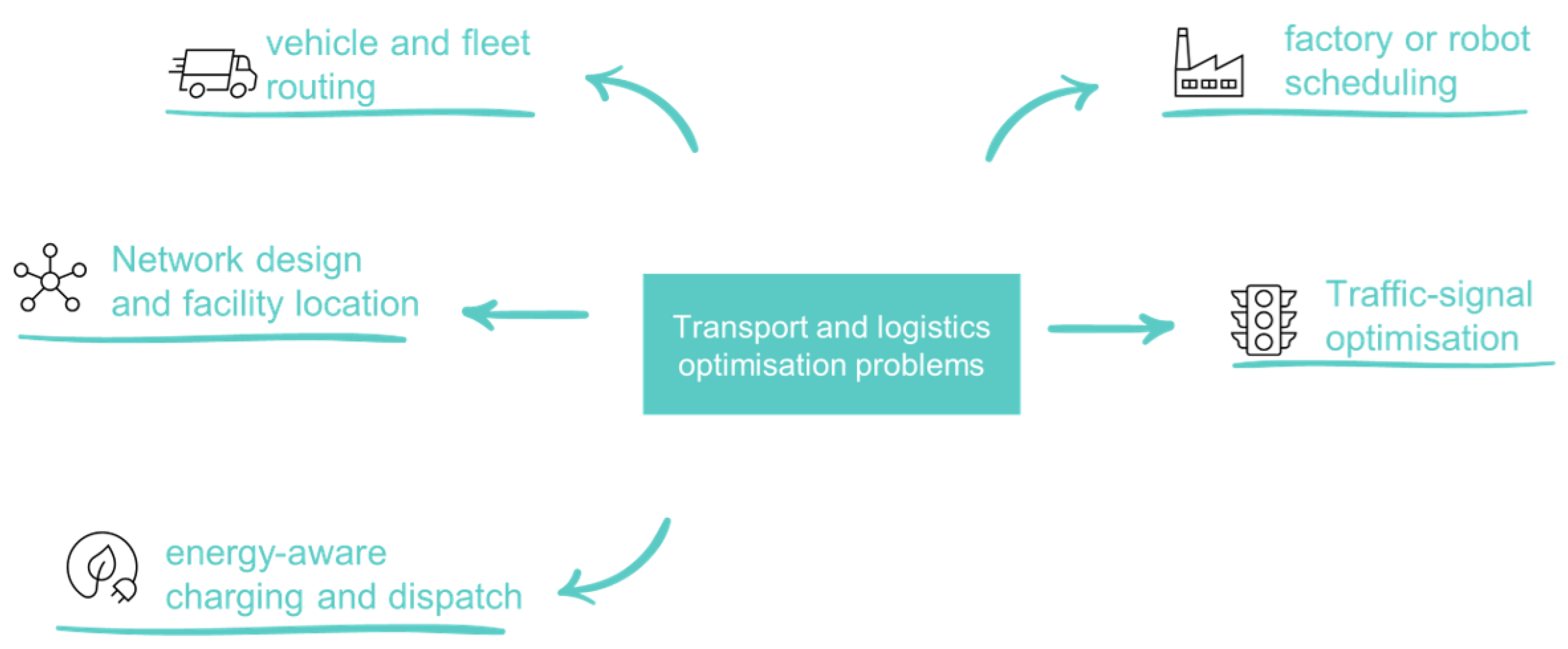
Figure 2.
Conceptual mind-map of the quantum-optimisation landscape for transport and logistics.
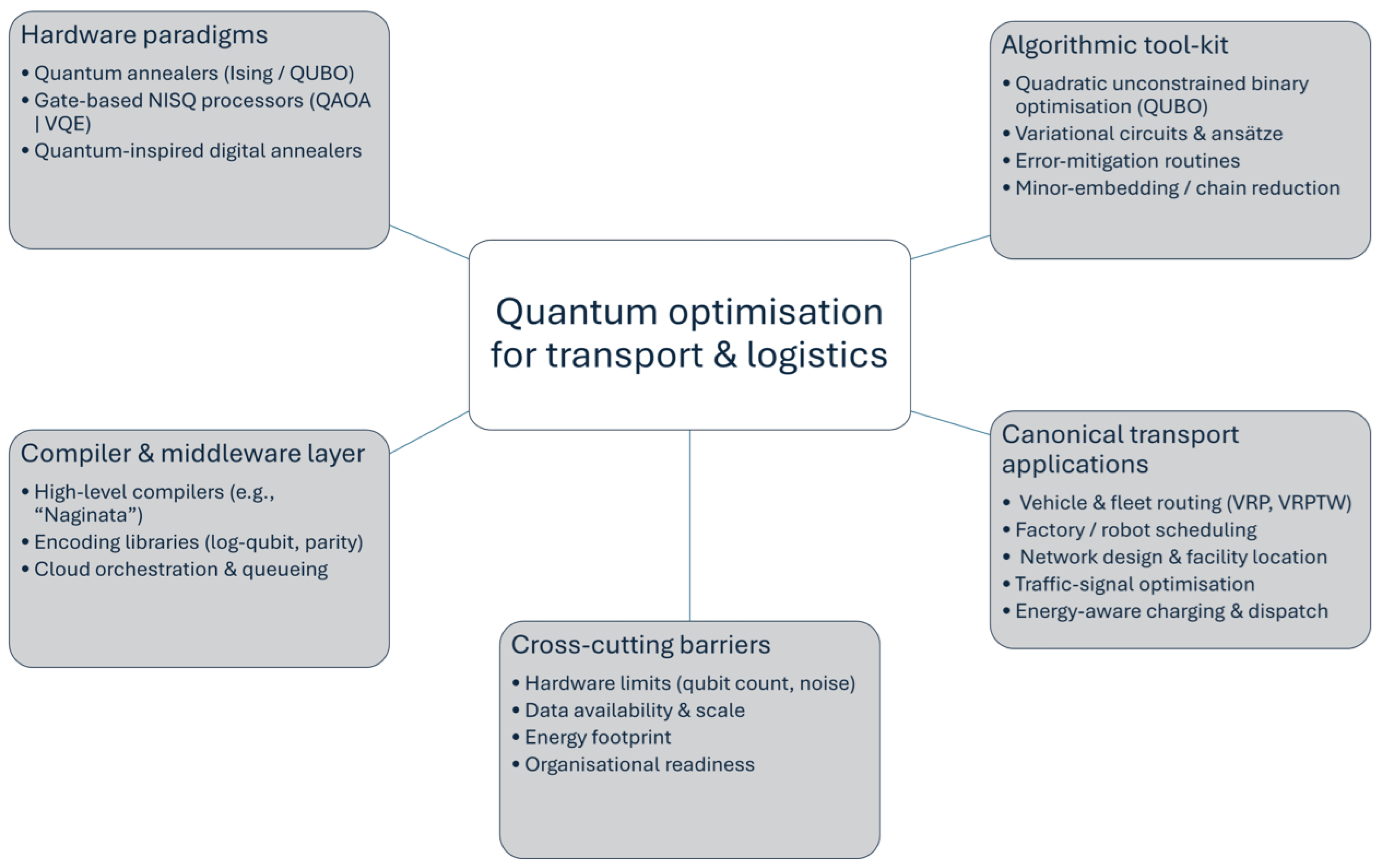
Figure 3.
Example vehicle-routing scenario on an urban network

Figure 4.
Adoption barriers for quantum optimisation in transport and logistics.
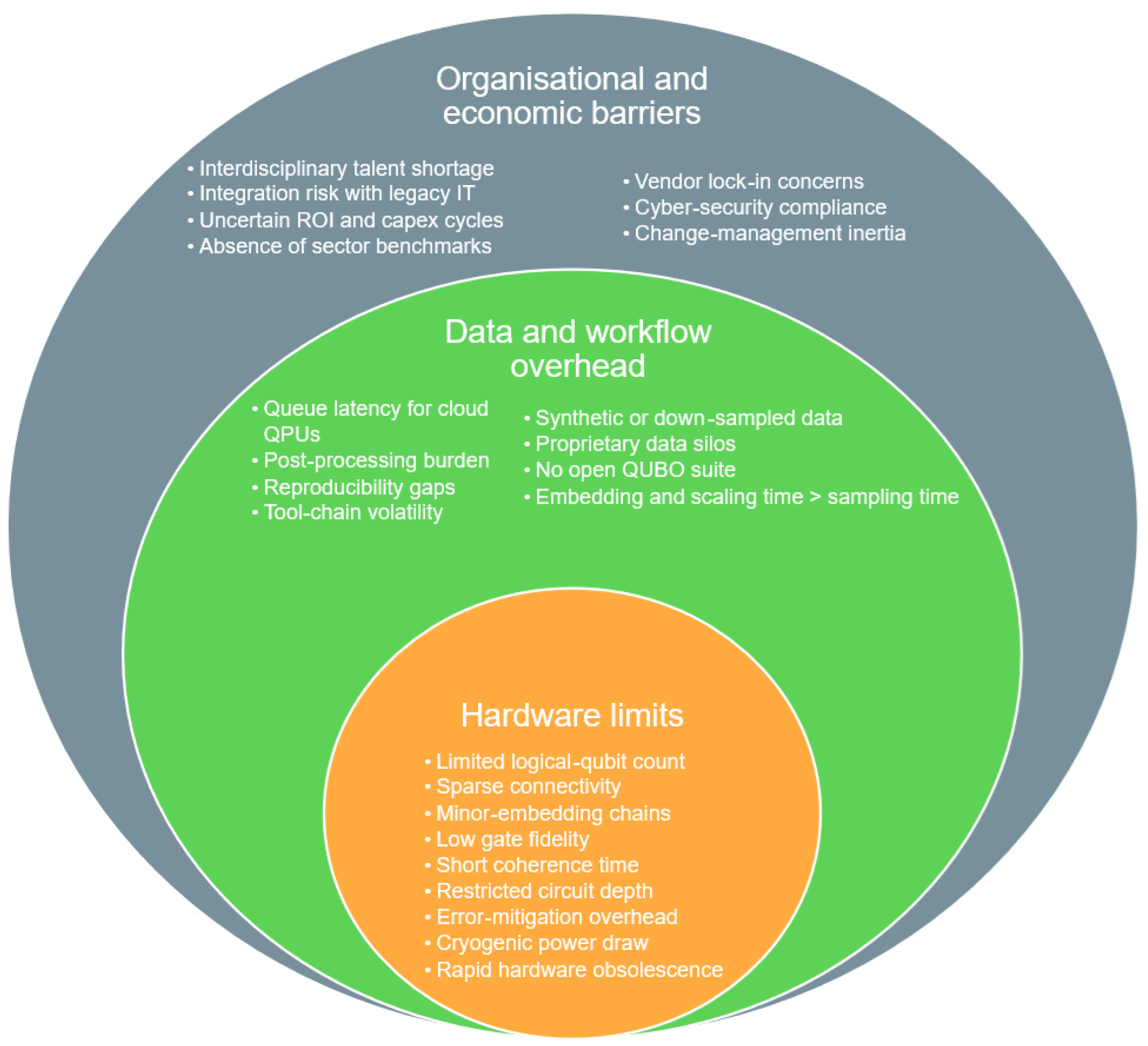
Figure 5.
PRISMA 2020 flow diagram.
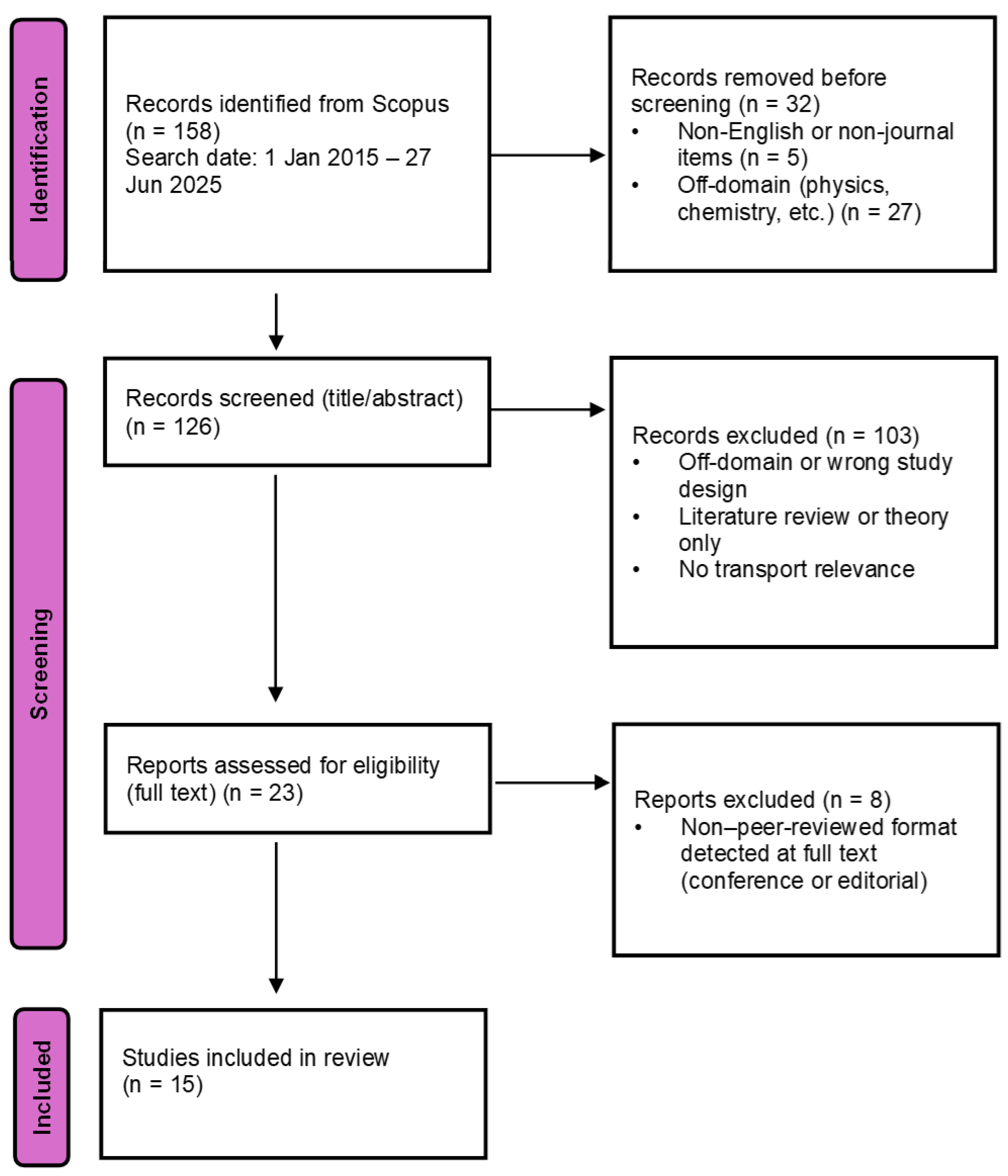
Figure 6.
Frequency distribution of application domains among the fifteen reviewed studies
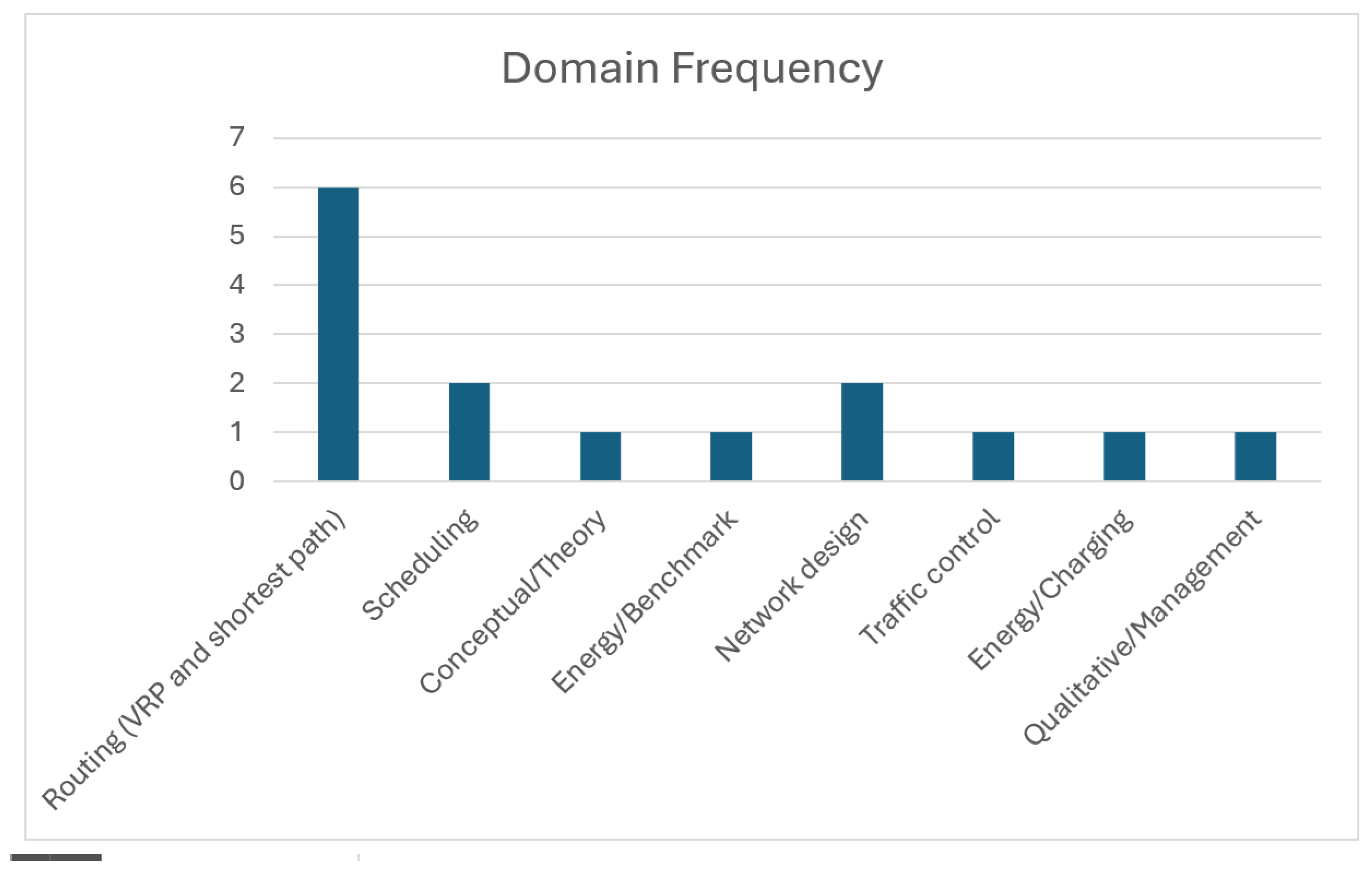
Figure 7.
Distribution of quantum and quantum-inspired techniques across the fifteen primary studies.
Figure 7.
Distribution of quantum and quantum-inspired techniques across the fifteen primary studies.
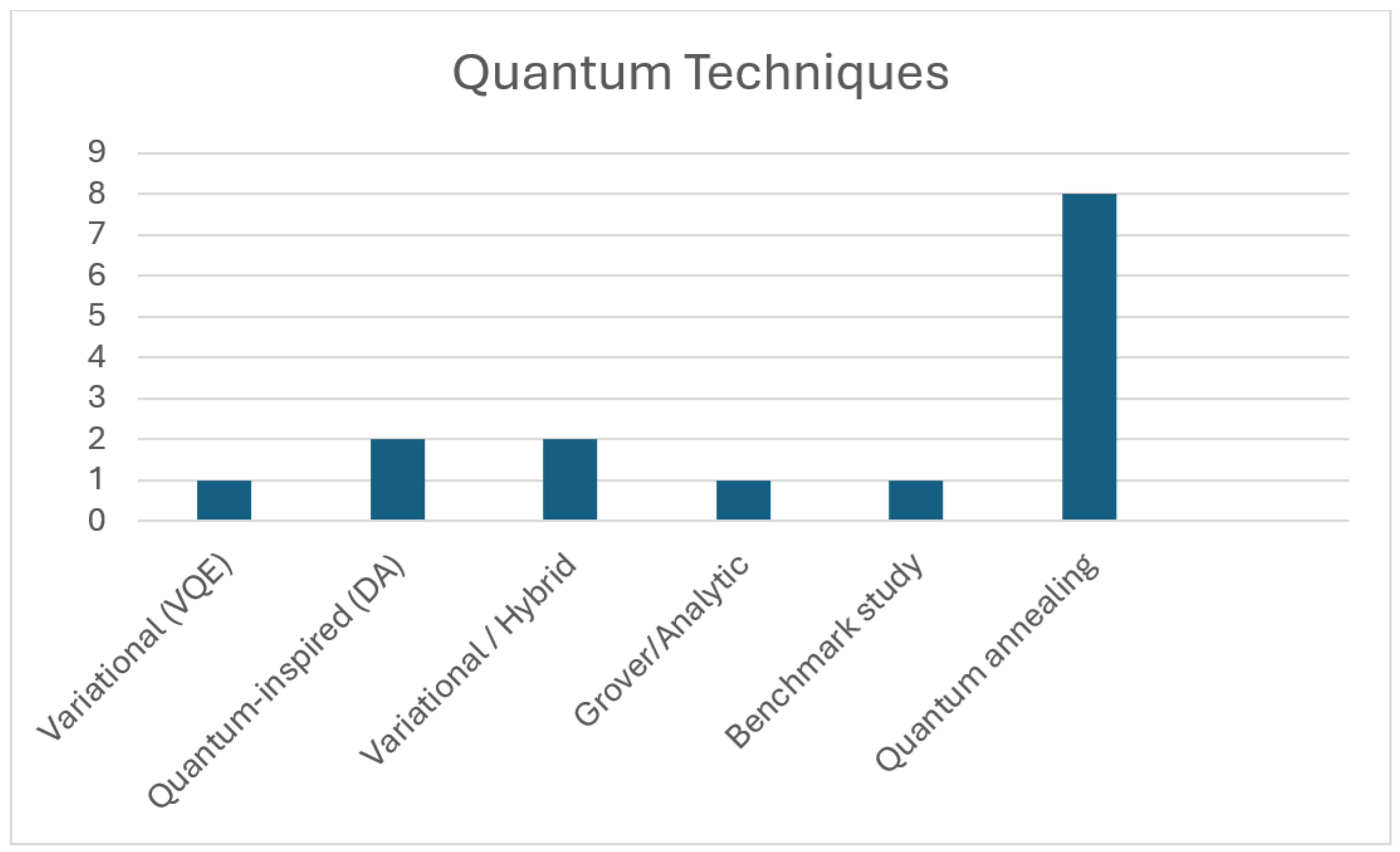
Figure 8.
Measured and estimated energy cost of solving a small optimisation task
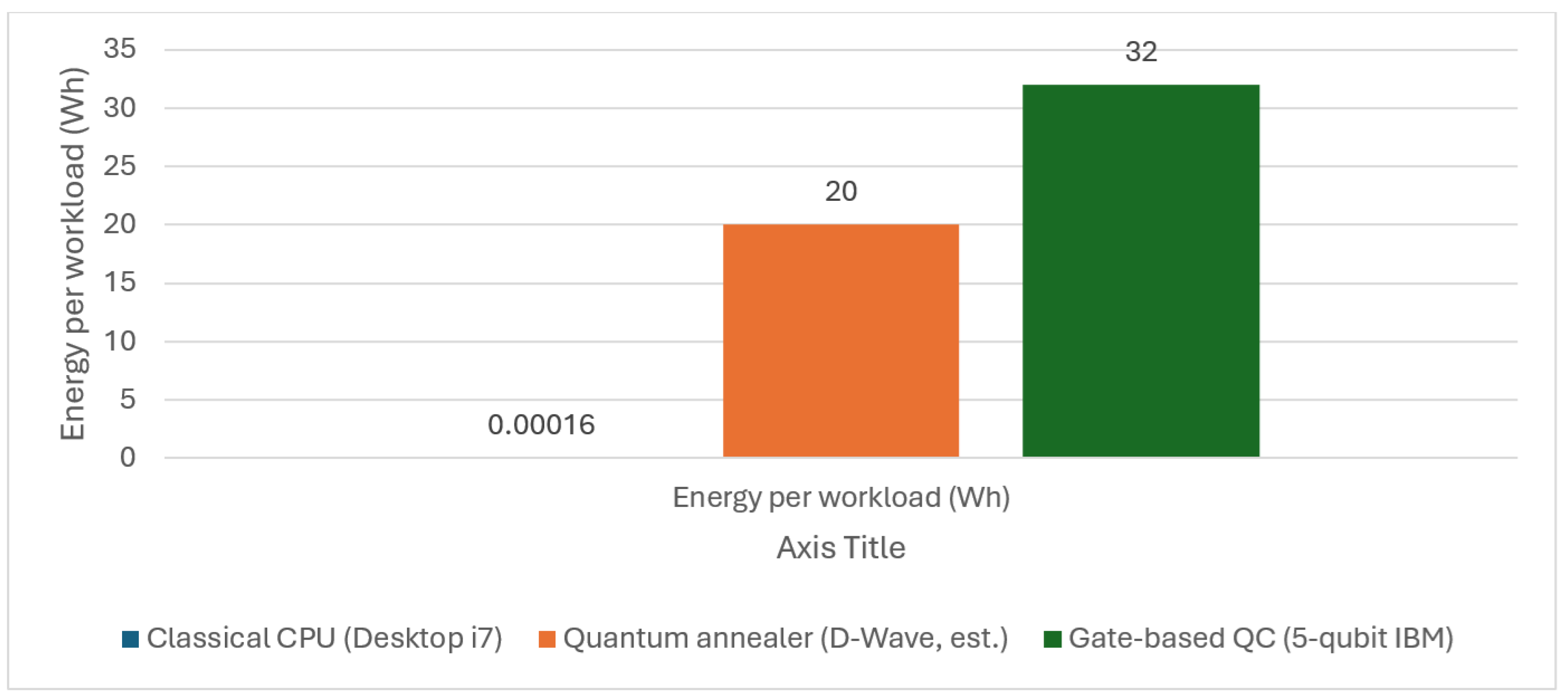
Figure 9.
Illustrative end-to-end latency path for a cloud-based quantum optimisation job
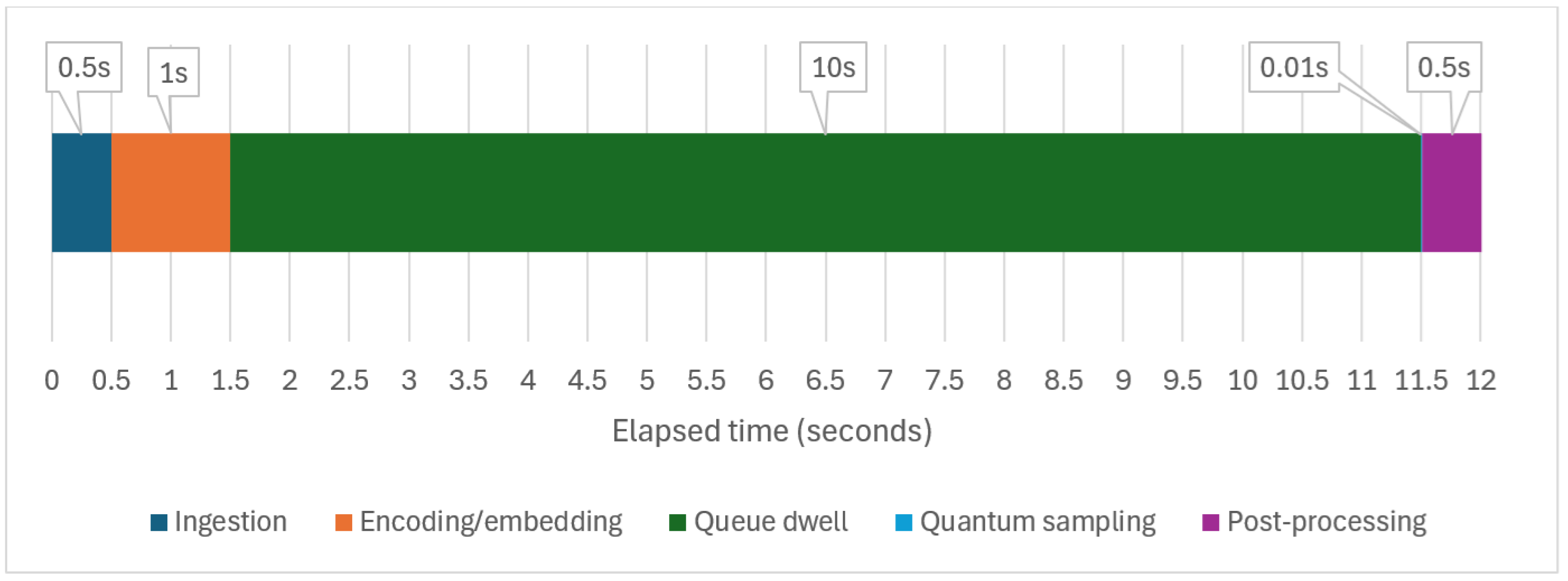
Table 1.
Quantum research in transport clusters into five problem families.
| Cluster | Primary studies | Typical quantum model |
|---|---|---|
| Vehicle- & fleet-routing (VRP/VRPTW) | [33,34,35,36,37,38] | Ising/QUBO on D-Wave, log-qubit-encoded variational circuits |
| Factory / robot scheduling | [39,40] | Q-inspired Digital Annealer, hybrid QAOA |
| Network-design & supply-chain location | [10,41] | Hybrid QA with classical improvement loops |
| Traffic-operations optimisation | [42] | QUBO for traffic-signal timing |
| Energy & charging management | [43] | Noise-enhanced QA for plug-in hybrid charging |
Table 2.
Study map by problem family. Abbreviations: QA – quantum annealing; DA – Digital Annealer; VRP – vehicle routing problem; VRPTW – vehicle routing with time windows; QUBO – quadratic unconstrained binary optimisation; UAM – urban air mobility.
Table 2.
Study map by problem family. Abbreviations: QA – quantum annealing; DA – Digital Annealer; VRP – vehicle routing problem; VRPTW – vehicle routing with time windows; QUBO – quadratic unconstrained binary optimisation; UAM – urban air mobility.
| Study ID | Author-year | Short title | Category |
|---|---|---|---|
| 1 | Mohanty et al., 2023 [33] | Vehicle-routing VQE | Routing (VRP and shortest path) |
| 2 | Leib et al., 2023 [39] | Robot-lab scheduling DA | Scheduling |
| 3 | Zhou & Zhao, 2023 [40] | AGV QMQAOA | Scheduling |
| 4 | Cooper, 2022 [72] | Transport modelling concept | Conceptual/Theory |
| 5 | Desdentado et al., 2024 [17] | QC energy footprint | Energy/Benchmark |
| 6 | Ding et al., 2021 [41] | Hybrid QA network design | Network design |
| 7 | Marchesin et al., 2023 [42] | Traffic-light QUBO | Traffic control |
| 8 | Syrichas & Crispin, 2017 [34] | PI-QA CVRP | Routing (VRP and shortest path) |
| 9 | Xin et al., 2021 [43] | NE-QA PHEV charging | Energy/Charging |
| 10 | Mori & Furukawa, 2023 [35] | Adjuster routing QA | Routing (VRP and shortest path) |
| 11 | Dixit & Niu, 2023 [10] | QA transport NDP | Network design |
| 12 | Dixit et al., 2024 [73] | Stochastic TD path QC | Routing (VRP and shortest path) |
| 13 | Núñez-Merino et al., 2024 [36] | QiC agility cases | Qualitative/Management |
| 14 | Leonidas et al., 2024 [37] | Qubit-efficient VRPTW | Routing (VRP and shortest path) |
| 15 | Haba et al., 2025 [38] | UAM QA routing | Routing (VRP and shortest path) |
Table 3.
Study map by quantum technique.
| Study ID | Author-year | Short title | Algorithm |
|---|---|---|---|
| 1 | Mohanty et al., 2023 [33] | Vehicle-routing VQE | Variational (VQE) |
| 2 | Leib et al., 2023 [39] | Robot-lab scheduling DA | Quantum-inspired (DA) |
| 3 | Zhou & Zhao, 2023 [40] | AGV QMQAOA | Variational / Hybrid |
| 4 | Cooper, 2022 [72] | Transport modelling concept | Grover/Analytic |
| 5 | Desdentado et al., 2024 [17] | QC energy footprint | Benchmark study |
| 6 | Ding et al., 2021 [41] | Hybrid QA network design | Quantum annealing |
| 7 | Marchesin et al., 2023 [42] | Traffic-light QUBO | Quantum annealing |
| 8 | Syrichas & Crispin, 2017 [34] | PI-QA CVRP | Quantum annealing |
| 9 | Xin et al., 2021 [43] | NE-QA PHEV charging | Quantum annealing |
| 10 | Mori & Furukawa, 2023 [35] | Adjuster routing QA | Quantum annealing |
| 11 | Dixit & Niu, 2023 [10] | QA transport NDP | Quantum annealing |
| 12 | Dixit et al., 2024 [73] | Stochastic TD path QC | Quantum annealing |
| 13 | Núñez-Merino et al., 2024 [36] | QiC agility cases | Quantum-inspired (DA) |
| 14 | Leonidas et al., 2024 [37] | Qubit-efficient VRPTW | Variational / Hybrid |
| 15 | Haba et al., 2025 [38] | UAM QA routing | Quantum annealing |
Table 4.
Quantitative findings.
| Finding | Evidence |
|---|---|
| QA can reach ≤1 % optimality gaps on facility-location NDPs faster than SA/Tabu search. | [41] (study 6): closed to 0.7% of the known optimum on twelve benchmark NDP instances and used 35% fewer iterations than tuned tabu search. |
| Log-qubit encoding retains Gurobi-level quality on VRPTW up to 4 k routes (simulated). | [37] (study 14): mean gap 0.18% across ten VRPTW instances after 2000 circuit evaluations on a noise-free simulator. |
| Traffic-signal QUBO reduces average delay vs rule-based control but only in simulation. | [42] (study 7): 14 % reduction in mean delay on a forty-eight-intersection synthetic network; queue latency and hardware overhead not reported. |
| No study reports end-to-end timing including QPU queue time; latency claims remain speculative. | Corpus-wide observation: all fifteen studies publish partial timing measures only, making real-time feasibility speculative. |
Table 5.
Risk-of-bias classification for the fifteen included studies.
| Study ID | Author-year | Short title | Risk |
|---|---|---|---|
| 1 | Mohanty et al., 2023 [33] | Vehicle-routing VQE | High |
| 2 | Leib et al., 2023 [39] | Robot-lab scheduling DA | Moderate |
| 3 | Zhou & Zhao, 2023 [40] | AGV QMQAOA | Moderate |
| 4 | Cooper, 2022 [72] | Transport modelling concept | Moderate |
| 5 | Desdentado et al., 2024 [17] | QC energy footprint | High |
| 6 | Ding et al., 2021 [41] | Hybrid QA network design | Moderate |
| 7 | Marchesin et al., 2023 [42] | Traffic-light QUBO | Moderate |
| 8 | Syrichas & Crispin, 2017 [34] | PI-QA CVRP | Moderate |
| 9 | Xin et al., 2021 [43] | NE-QA PHEV charging | High |
| 10 | Mori & Furukawa, 2023 [35] | Adjuster routing QA | High |
| 11 | Dixit & Niu, 2023 [10] | QA transport NDP | Moderate |
| 12 | Dixit et al., 2024 [73] | Stochastic TD path QC | High |
| 13 | Núñez-Merino et al., 2024 [36] | QiC agility cases | High |
| 14 | Leonidas et al., 2024 [37] | Qubit-efficient VRPTW | Moderate |
| 15 | Haba et al., 2025 [38] | UAM QA routing | Moderate |
Table 6.
Key unresolved research gaps in quantum optimisation for transport and logistics.
| Gap | Why it matters | Possible remedy |
|---|---|---|
| Real-world deployments | No live traffic or logistics pilot yet | Partner with city traffic-management centres or parcel carriers for sandbox trials |
| Standardised benchmarks | Current studies use private toy data | Launch an open “Quantum-Transport Benchmark Suite (QTBS)” with VRP, NDP, signal-timing QUBOs |
| Statistical robustness | Single-shot results overstate gains | Adopt 30-run multi-seed protocols and report variance |
| Energy & latency accounting | Adoption hinges on cost-benefit | Publish full energy/wait-time audits alongside solution quality |
Disclaimer/Publisher’s Note: The statements, opinions and data contained in all publications are solely those of the individual author(s) and contributor(s) and not of MDPI and/or the editor(s). MDPI and/or the editor(s) disclaim responsibility for any injury to people or property resulting from any ideas, methods, instructions or products referred to in the content. |
© 2025 by the authors. Licensee MDPI, Basel, Switzerland. This article is an open access article distributed under the terms and conditions of the Creative Commons Attribution (CC BY) license (http://creativecommons.org/licenses/by/4.0/).
Copyright: This open access article is published under a Creative Commons CC BY 4.0 license, which permit the free download, distribution, and reuse, provided that the author and preprint are cited in any reuse.


