

Submitted:
24 October 2025
Posted:
27 October 2025
You are already at the latest version
Abstract
The study examines the impact of social innovation on sustainability in rural organiza-tions in southern Sonora, within a context where these entities face economic, social, and environmental challenges that constrain regional development. A quantitative correla-tional design was employed, using a 34-item questionnaire administered to 200 members of rural organizations in southern Sonora, Mexico. Sociodemographic data were pro-cessed using IBM SPSS version 23, and a structural equation model was constructed with SmartPLS to analyze the relationships among the variables. The results indicate a neutral trend in the responses, likely associated with the size and level of development of the or-ganizations, mostly micro and small enterprises with limited infrastructure and technol-ogy. Regarding the impact of social innovation dimensions on sustainability, the strongest effect was found in the social impact dimension, followed by type of innovation, economic viability, replicability, and intersectoral collaboration, the latter showing the weakest ef-fect. It is concluded that five hypotheses were accepted and one—related to intersectoral collaboration—was rejected, providing evidence on how social innovation contributes to the sustainable strengthening of rural organizations.
Keywords:
social innovation
; organizational sustainability
; rural organizations
; social impact
; economic viability
; intersectoral collaboration
; regional development
1. Introduction
Human capital management has evolved considerably since the 1980s, becoming an essential practice for organizational success and sustainability [1]. Internationally recognized institutions such as the World Federation of People Management Associations (WFPMA), the Boston Consulting Group (BCG), and the United Nations Development Programme (UNDP) have implemented personnel management strategies that have enabled them to maintain a competitive advantage in their respective markets [2]. Attention to the biopsychosocial component of employees is considered a key factor in optimizing productivity and fostering a healthy organizational environment [1].
In the current context, rural organizations play a significant role in the economic and social development of their communities, particularly in Latin America, where these enterprises face challenges related to access to formal markets and the optimization of local resources [3]. Organizational sustainability, understood as the integration of economic, social, and environmental dimensions, has become a key criterion for competitiveness, as evidenced by global initiatives such as the United Nations Sustainable Development Goals and UNESCO’s implementation programs [4].
Social innovation, in turn, emerges as a mechanism for transforming and improving the quality of life in communities, promoting collaboration among diverse stakeholders, and strengthening both individual and collective capacities [5,6]. In higher education institutions, it has been linked to significant trends such as sustainable development, where other variables, including social entrepreneurship, digital transformation, research, and an innovation-oriented culture, also stand out [7]. From a similar perspective, both conceptual and empirical analyses have examined how universities manage social innovation by integrating it into research, teaching, and institutional responsibility [8,9]. Notably, the incorporation of challenge-based learning and collaborative approaches has been shown to foster social innovation among university students [10].
The application of social innovation in rural organizations has demonstrated its potential to generate economic and social value by encouraging community participation, job creation, and the development of local leadership [3,11,12]. Research in this field seeks to identify effective strategies to strengthen social innovation and promote sustainability, thereby contributing to the economic, social, and environmental growth of the region [8,13,14,15]. In recent decades, social innovation has emerged as a transformative approach capable of generating significant changes across economic, social, and environmental domains, transcending established norms and promoting ethical and responsible management practices [6,15]. Its implementation aims to enhance employee well-being, improve mental health, and consolidate competitive advantages through the development of human capital skills and capabilities [14,16].
At the international level, social innovation has been used as a tool to address global challenges such as economic crises, inequality, and climate change, encouraging the adoption of more efficient processes, the responsible use of resources, and the integration of innovative technologies [11,17,18]. In Latin America, countries have sought to reshape the ways in which goods and services are produced and managed to ensure sustainable and competitive development, where both technological and social innovation are considered essential for productivity and organizational growth [19,20].
In Mexico, social innovation has gained importance at both governmental and business levels. National development programs and organizations such as the National Council of Science and Technology promote the implementation of innovative strategies that positively impact society and enhance the competitiveness of organizations [21,22]. At the state level, in Sonora and other regions, the adoption of Corporate Social Responsibility (CSR) and the modernization of processes through organizational innovation contribute to sustainable economic development and the improvement of quality of life in local communities [15].
Sustainability, meanwhile, is defined as the ability to meet present needs without compromising those of future generations, integrating economic, social, and environmental dimensions [23,24]. Its incorporation into business management enhances process efficiency, product and service quality, and the generation of sustainable competitive advantages [25]. Recent studies indicate that the combination of social innovation and sustainability is a determining factor for organizational success, particularly in small and medium-sized enterprises and rural sectors where the adoption of responsible practices produces benefits for both companies and their communities [26,27,28].
Despite its relevance, regional studies integrating social innovation and sustainability remain limited, especially in southern Sonora, Mexico. The present research aims to analyze the effect of social innovation dimensions on the sustainability of rural organizations in southern Sonora. It seeks to understand how factors such as social impact, economic viability, type of innovation, intersectoral collaboration, and replicability contribute to the sustainable development of these organizations. The study is grounded in a review of international and national literature, as well as in empirical evidence demonstrating the importance of integrating innovative and sustainable practices within today’s business environment [29,30].
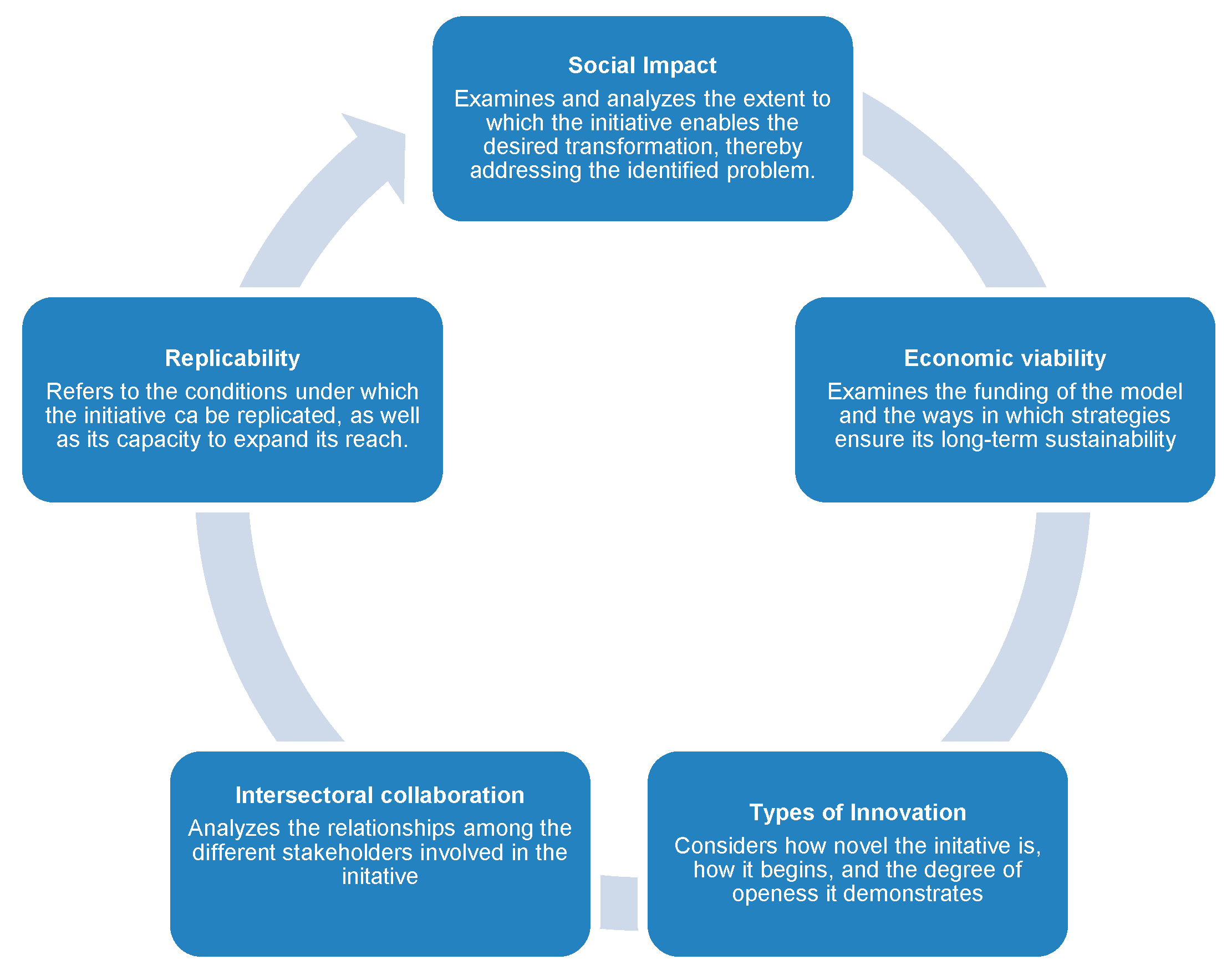
Figure 1.
Dimensions of social innovation. Source: Own elaboration, 2024.
During the theoretical review on social innovation and sustainability at the state level, it was identified that research on these topics remains limited, and studies applied at the local level are even more scarce. Therefore, based on the foregoing, the following research question is proposed:
What is the effect of the dimensions of social innovation on the sustainability of rural organizations in southern Sonora?
From this question, the following hypotheses are formulated:
General Hypothesis
Social innovation has a positive and significant effect on the sustainability of rural organizations in southern Sonora. Organizational sustainability is understood as the ability of enterprises to generate economic, environmental, and social progress for both current and future generations [13]. In this regard, social innovation enables rural organizations to integrate responsible practices that strengthen their resilience and competitiveness [14,15].
H1. Social impact has a positive and significant effect on the sustainability of rural organizations in southern Sonora. The social impact of innovation lies in engaging diverse stakeholders in addressing community challenges, fostering well-being and social cohesion, which in turn strengthens the sustainable development of organizations [15].
H2. Economic viability has a positive and significant effect on the sustainability of rural organizations in southern Sonora. Social innovation in the economic sphere promotes ethical and efficient management models oriented toward financial sustainability and value creation within organizations [14]. This contributes to maintaining a balance between the economic dimension and the social and environmental dimensions.
H3. Type of innovation has a positive and significant effect on the sustainability of rural organizations in southern Sonora. The type of innovation implemented is key to determining the social value that organizations can generate and their capacity to adapt to environmental changes [31]. Selecting a flexible innovation model aligned with the organizational structure supports sustainability.
H4. Intersectoral collaboration has a positive and significant effect on the sustainability of rural organizations in southern Sonora. Collaboration across sectors fosters the creation of support networks that strengthen organizational resources and expand the reach of social innovation [32,33]. Moreover, the formation of strategic alliances contributes to the recognition and consolidation of organizations within their communities [33].
H5. Replicability has a positive and significant effect on the sustainability of rural organizations in southern Sonora. The ability to replicate innovative practices has been identified as a decisive factor in promoting regional economic and social development. The OECD [34] emphasizes that the dissemination of innovative ideas and models is essential for ensuring the sustainability and growth of organizations in both the present and the future.
2. Materials and Methods
The present study is grounded in a positivist paradigm characterized by its quantitative approach, aimed at obtaining precise, measurable, and replicable results supported by scientific rigor. This paradigm allows for the systematization, comparison, and verification of knowledge, as well as the identification of causes and the establishment of generalizations based on observed phenomena [21]. The research follows a quantitative and correlational design focused on analyzing the relationship between the independent variable, social innovation, and the dependent variable, sustainability, in organizations located in the municipality of Cajeme.
A five-point Likert-scale questionnaire consisting of 34 items was administered to a representative sample. The data collected were subjected to statistical analysis to test the proposed hypotheses [35]. Furthermore, the research is classified as a non-experimental cross-sectional study, as data collection was conducted at a single point in time without deliberate manipulation of the variables, allowing for the determination of how one variable influences the other [35,36].
Participants
For data collection, the study was conducted in southern Sonora, involving various organizations engaged in different economic activities and located in rural areas, specifically in the communities of Esperanza, Cócorit, Providencia, Pueblo Yaqui, and San Ignacio Río Muerto. To ensure that participants adequately represented the target population, a non-probabilistic sampling method was used. The main selection criterion was that the organizations had a rural character and provided services or marketing products, regardless of their sector or size [35].
The sample was selected based on convenience, meaning that participants were chosen according to their accessibility and availability to the researcher [36]. In total, questionnaires were administered to 200 participants, with the expectation that the results obtained could be generalized to the target population, following the principles outlined by [21].
Instrument
The data collection instrument used in this research was structured using a five-point Likert scale, where a value of one (1) corresponds to “strongly disagree” and a value of five (5) to “strongly agree.” The instrument consisted of 34 items distributed across two main variables. The first variable, Social Innovation (SI), comprised five dimensions and a total of 20 items. The second variable, Sustainability, included 14 items [37]. Once the information was collected, the reliability of the instrument was assessed through Cronbach’s Alpha analysis, yielding positive and significant results. The closer the obtained value is to one (1), the greater the reliability of the instrument, thus confirming the internal consistency of the evaluated variables [37,38] (See Table 1).
Pilot test for Application for Data Collection
A preliminary application of the instrument was conducted to validate its reliability and assess the variables of social innovation and sustainability, adapted to the context of rural organizations located in the communities of Cócorit, Esperanza, Providencia, San Ignacio Río Muerto, and Pueblo Yaqui, in southern Sonora. The application was carried out in person, with the informed consent of all participants.
The process began by contacting several organizations to request authorization to administer the questionnaire, receiving a positive response in most cases. Additionally, some questionnaires were applied to collaborators outside their workplaces, who voluntarily agreed to participate. The response rate was satisfactory, with a total of 40 participants completing the instrument in full, providing valuable information for the preliminary validation of the questionnaire.
During the pilot test, several issues were identified and considered for improvement. In the section of general information, the question regarding the sector to which the organization belonged generated multiple responses, although participants were only expected to specify whether it was public or private. Likewise, in the item related to seniority within the organization, some participants did not record their response because the designated space appeared on a lower line, causing confusion. This issue was addressed at the time of data collection by asking participants to complete the missing information, and adjustments were planned in the format to prevent this in future applications. Finally, one participant expressed uncertainty regarding item 1.16, which referred to the opportunity for students to develop educational projects in external organizations. Consequently, this item was reviewed for possible modification or removal to improve the clarity and relevance of the instrument.
Procedure
The research process was developed in several stages. First, a theoretical review of the study variables, social innovation and sustainability, was carried out based on academic articles, books, scientific journals, digital sources, and previous studies. Subsequently, a pilot test was administered to 40 active collaborators to assess the reliability of the instrument. Once validated, the final questionnaire was applied to 200 collaborators from different rural organizations located in southern Sonora.
The data collected were entered into a database created using SPSS Version 23, incorporating both sociodemographic variables and questionnaire responses. Statistical analyses were then performed using SmartPLS, evaluating both the measurement and structural models. Finally, the results were reviewed and interpreted considering previous studies and the theoretical framework. This process led to the development of a comprehensive report from which the conclusions, discussion, recommendations, and suggestions for future research were derived.
Results
Based on the preliminary findings, a descriptive analysis of the sociodemographic data was conducted to characterize the study participants in terms of gender, age, job position, and length of employment. The results revealed a balanced participation between men and women. Regarding job positions, participants included employees, supervisors, managers, business owners, and sales personnel, with a greater representation of supervisory staff. In terms of age, most participants were between 20 and 50 years old, while approximately 70% reported a length of employment ranging from one month to ten years within the organization. These results provide a general overview of the profile of the rural collaborators included in this study (see Table 2).
Regarding the results obtained for the study variables, the presentation of social innovation and sustainability is summarized in Table 3.
The results indicate that the responses for the dimensions of the social innovation variable, as well as for sustainability, fall within a medium range, with values close to three (3).
Measurement Model Evaluation
The measurement model allows for the analysis of relationships between constructs and indicators using various metrics, enabling the verification of their reliability and supporting the proposed model [39].
Internal Consistency
Cronbach’s alpha coefficient ranges from 0 to 1, with 0.70 considered the minimum acceptable value [40]. Values below this threshold indicate low consistency, while values above 0.90 may suggest item redundancy. A composite reliability ≥ 0.7 is acceptable, and ≥ 0.8 is considered ideal [41]. In this study, both consistency indicators meet the established criteria, as all values exceed 0.8, demonstrating that the internal consistency tests are significant and reliable (see Table 4).
Convergent Validity
Once the data were obtained, they were processed using SPSS, allowing the reliability of the variables to be assessed through Cronbach’s alpha analysis. The closer the value is to 1, the higher the reliability of the instrument [37,38]. In the present study, the results indicated high reliability for both dimensions. The social innovation dimension achieved a value of 0.949, while the sustainability dimension reached 0.860. Furthermore, the complete instrument yielded a value of 0.951, indicating that the scale is highly reliable and suitable for measuring the variables (see Table 5).
Discriminant validity
Discriminant validity refers to the ability of a construct to measure exclusively what it is intended to measure, distinguishing it from other related constructs. For a measure to be valid, it must show strong correlations with its own indicators while exhibiting lower correlations with other constructs [42]. Three main criteria are considered for its evaluation: Fornell-Larcker criterion, cross-loadings, and the Heterotrait-Monotrait (HTMT) ratio.
According to the Fornell-Larcker criterion, the average variance extracted (AVE) of each construct must exceed the shared variance with other constructs. In other words, the square root of the AVE for each variable should be greater than its correlations with other constructs [43]. After analyzing these correlations, it was verified that each AVE is indeed higher than the squared correlations between variables, thereby confirming the discriminant validity of the model (see Table 6).
Regarding cross-loadings, this criterion was also met, as each item associated with a construct showed higher values when compared to the corresponding values of other constructs. In other words, the items within each dimension presented the highest loadings on their respective constructs [43]. This procedure ensures discriminant validity by demonstrating that each item correlates more strongly with its own construct than with other constructs evaluated in the model (see Table 7).
Regarding the Heterotrait-Monotrait (HTMT) ratio, this criterion was also satisfied, as no correlation between variables exceeded 1. For HTMT to be reliable, all values must be below 1 for each established criterion [43] (see Table 8).
Structural model evaluation
Once the reliability and validity of the measurement model were verified, the next step involved evaluating the structural model. This evaluation considered indicators such as collinearity levels using the Variance Inflation Factor (VIF), the coefficient of determination (R²), effect size (f²), and path coefficients.
Collinearity
Since the objective of this study was to conduct a statistical analysis to determine the relationships between variables, collinearity among constructs was assessed using the VIF. This analysis provides information on potential multicollinearity risks. VIF values should not exceed 5.0, while values above 2.0 are considered within the minimally acceptable range [44]. In this study, no variable exceeded these thresholds, indicating that there is no collinearity risk and that the results are reliable for structural analysis (see Table 9).
Coefficient of determination (R²) and adjusted R²
The coefficient of determination measures the predictive capacity of the estimated model. Values should be ≥ 0.10 [20]. According to the results, R² for sustainability is 0.595 (approximately 59%), and the adjusted R² is 0.585 (approximately 58%) (see Table 10).
Effect size
Effect size was calculated to interpret the results and compare them with other studies. According to established thresholds, effect sizes can be classified as small (0.02), medium (0.15), and large (0.35) [45]. The results show that the effect of social impact, replicability, type of innovation, and economic viability is small, whereas the effect of intersectoral collaboration on sustainability is negligible (see Table 11).
Path Coefficient
To determine the significance of the relationship between the dependent variable (sustainability) and the independent variable (social innovation), path coefficients were examined. These coefficients indicate the relationship between the dimensions of social innovation and sustainability. The following classification is used: imperceptible (0.0 < β ≤ 0.09), perceptible (0.10 < β ≤ 0.15), considerable (0.16 < β ≤ 0.19), important (0.20 < β ≤ 0.29), strong (0.30 < β ≤ 0.50), and very strong (β > 0.50) [46]. The results indicate that intersectoral collaboration is imperceptible, social impact, replicability, and economic viability are important, and type of innovation is considerable (see Table 12).
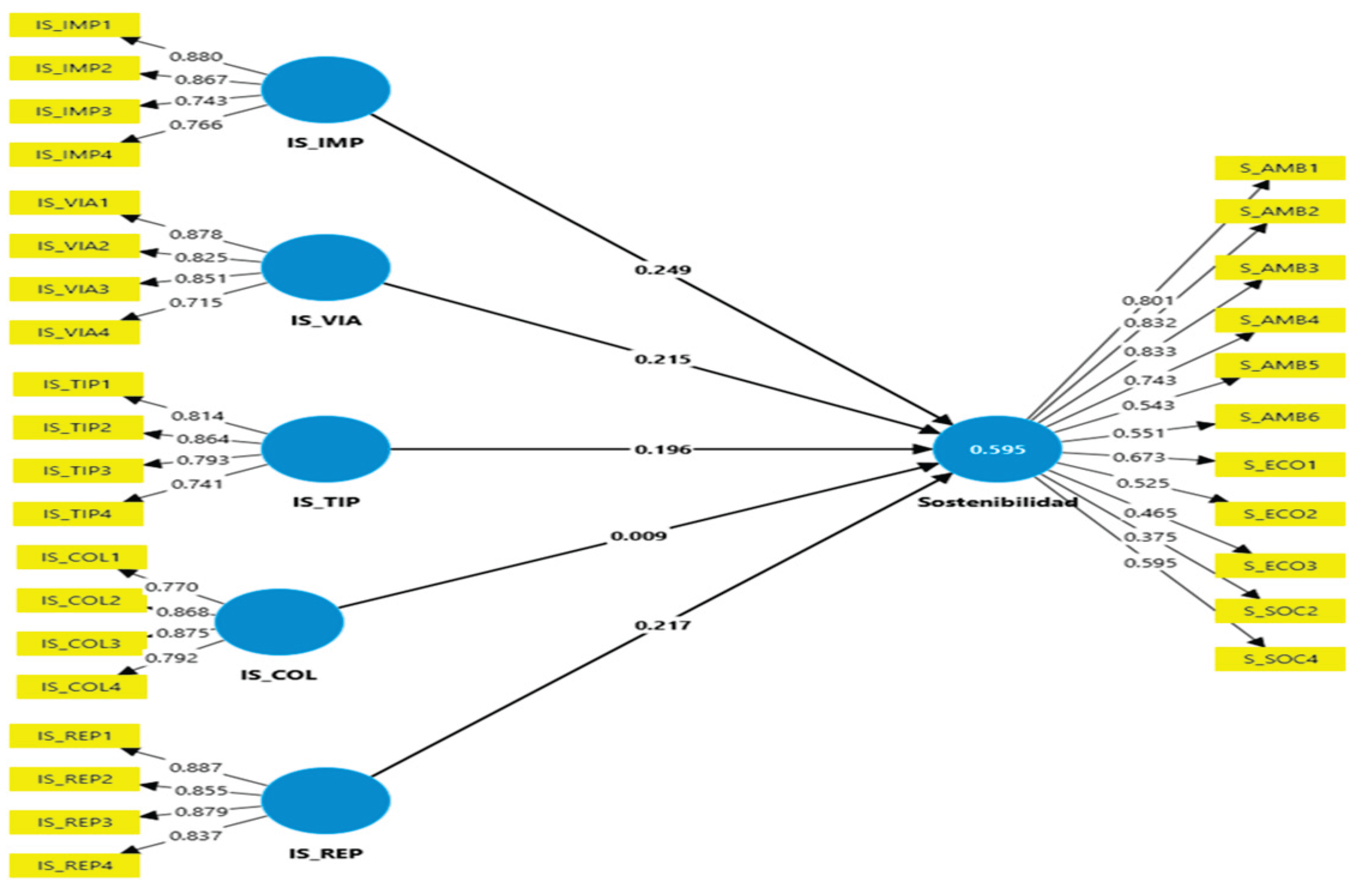
In Figure 1, the structural model is presented. The model explains 59.5% of the variance in sustainability. It is classified as reflective, as the latent variable acts as the cause of the observed measures [47]. By analyzing the Beta coefficients (β), which allow for comparison of the relative influence of each construct on the dependent variable, social impact shows the greatest effect on sustainability (β = 0.249), followed by replicability (β = 0.217), economic viability (β = 0.215), type of innovation (β = 0.196), and finally intersectoral collaboration (β = 0.009). These results identify which dimensions of social innovation have the strongest influence on sustainability in the studied organizations.
Figure 1.
Structural Model Verification. Note: Own elaboration using SmartPLS.
After evaluating the previous results, the next step involved verifying the research hypotheses, of which five out of six were accepted, with only H4 (intersectoral collaboration) being rejected. Using Student’s t-statistics and p-values, it is possible to determine the beta coefficients of the model and their statistical significance [44]. In this study, hypotheses H1, H2, H3, H5, and Hi presented t-values ≥ 2.0, which, according to the literature, indicates statistical significance.
Regarding the p-value, obtained through the Bootstrap procedure in the PLS-SEM software, the following classification criteria were applied: p ≤ 0.05 (significant), p ≤ 0.01 (highly significant), and p ≤ 0.001 (very highly significant). Following these criteria, it was confirmed that hypotheses Hi (very highly significant), H1 (very highly significant), H2 (highly significant), H3 (significant), and H5 (significant) were accepted, while H4 was rejected as its value fell outside the established significance range. Similarly, the analysis of the Path coefficient indicates that only H4 was discarded, being considered imperceptible, whereas the remaining hypotheses demonstrated a positive effect on the sustainability dimensions of rural organizations in southern Sonora, confirming their relevance and statistical significance (see Table 13).
3. Discussion
The present study aimed to analyze the effect of the dimensions of social innovation on sustainability in rural organizations in southern Sonora. The results showed that hypotheses Hi, H1, H2, H3, and H5 were accepted, demonstrating a positive effect, whereas H4, related to intersectoral collaboration, was rejected due to insufficient evidence of effective interaction among different stakeholders. The findings indicate that social innovation contributes to organizational well-being and the strengthening of sustainability, encompassing economic, social, and environmental dimensions. Specifically, the rural organizations analyzed, mostly developing SMEs, exhibited neutral levels in the implementation of social projects, economic management, and the use of technology for productivity. Likewise, the replicability of initiatives and collaboration with other sectors remained limited, consistent with previous studies highlighting challenges in financing, resistance to change, and lack of intersectoral support [20,48].
Regarding sustainability, the neutral results reflect a moderate participation of these organizations in projects benefiting society, resource optimization, fund management, and environmental care. This aligns with the literature emphasizing the need to balance economic, social, and environmental dimensions to achieve comprehensive sustainability [4,23,29]. Moreover, social innovation is perceived as a mechanism that, when implemented ethically, fosters organizational adaptation to global changes, enhances productivity, and contributes to employee well-being [15,50].
Despite these positive outcomes, areas of opportunity were identified to strengthen intersectoral collaboration, increase participation in social projects, and improve the replicability of innovative initiatives. Future research could explore strategies to facilitate integration among private, public, and community organizations, as well as assess the impact of social innovation in companies of varying sizes and regions, aiming to expand knowledge on rural sustainability and its relationship with social innovation. In summary, this study demonstrates that social innovation has a positive effect on sustainability in rural organizations, although greater development in collaboration, social participation, and replicability strategies is required to consolidate more sustainable and long-term results.
4. Conclusions
The research findings confirm that the applied instrument presents high reliability, validated through Cronbach’s Alpha, and that the statistical analyses conducted using SPSS Version 23 and SmartPLS V.4.0 are consistent for evaluating the study variables. The objective of analyzing the effect of the dimensions of social innovation on sustainability in rural organizations in southern Sonora revealed that, in general, responses were at a neutral level, likely due to the characteristics of the studied organizations, primarily developing micro and small enterprises with limited infrastructure and technology. This underscores the need to train skilled social innovators capable of driving job creation and organizational development, engaging both managers and employees.
Regarding the impact of the dimensions of social innovation on sustainability, social impact was identified as having the greatest influence, followed by replicability, economic viability, type of innovation, and finally, intersectoral collaboration, which had minimal effect. Organizations face constant changes in their environment, making social innovation a key strategy to improve competitiveness, generate employment, optimize infrastructure, and promote local economic growth. To ensure sustainability, it is essential that social innovation be applied strategically and oriented toward effective projects that respond to community needs and enhance the capacity of organizations to deliver products and services sustainably.
Author Contributions
Conceptualization, A.E.A.I. and J.G.F.L.; data curation, J.G.F.L. and B.A.F.G.; formal analysis, S.O.J.; investigation, A.E.A.I.; methodology, A.E.A.I. and J.G.F.L.; resources, S.O.J.; software, S.O.J and B.A.F.G.; writing—original draft, A.E.A.I. and J.G.F.L.; writing—review and editing, J.G.F.L., S.O.J., B.A.F.G. All authors have read and agreed to the published version of the manuscript.
Funding
The authors received financial support by the Program for Promotion and Support of Research (PROFAPI) of the Sonora Institute of Technology (ITSON) for the research and publication of this article.
Institutional Review Board Statement
The study was conducted according to the guidelines of the Declaration of Helsinki and was approved by the Institutional Review Board of the Sonora Institute of Technology (File Number 257, 23 September 2024).
Informed Consent Statement
Informed consent was obtained from all subjects involved in the study.
Data Availability Statement
The data presented in this study are available upon request from the corresponding author due to the potential identification of data or information of the people who participated as informants in the research.
Conflicts of Interest
The authors declare no conflicts of interest.
References
- Cuesta Santos, A.; Valencia Rodríguez, M. Capital humano: Contexto de su gestión. Desafíos para Cuba. Revista Cubana de Ingeniería 2018, 34, 135–145. [Google Scholar]
- Magallanes, M.A. The impact of business sustainability over organizational culture. NovaRua 2020, 12, 45–56. [Google Scholar] [CrossRef]
- Quiñonez, C.; Laverde, L. Construcción participativa de modelos de negocios en organizaciones rurales. Telos 2019, 21. [Google Scholar] [CrossRef]
- Plasencia Soler, J.A.; Marrero Delgado, F.; Bajo Sanjuán, A.M.; Nicado García, M. Modelos para evaluar la sostenibilidad de las organizaciones. Estudios Gerenciales 2018, 34, 63–73. [Google Scholar] [CrossRef]
- Hidalgo, F.; Chávez, G.; Puyana, J.; Mitrovic, K.; Zuleta, M. (2022). Sustentabilidad en las empresas como oportunidad de negocio: Valor según los ejecutivos. Boston Consulting Group. https://web-assets.bcg.com/55/1f/1c7b5bb9437f9c75765fa25eabc7/esg-ssa-sustentabilidad-como-oportunidad.pdf.
- Ortega, A.; Marín, K. (2019). La innovación social como herramienta para la transformación social de comunidades rurales. Revista Virtual Universidad Católica del Norte, (57), 87–99. [CrossRef]
- La, P.B.; Le, H.N.T.; Hazenberg, R. (2025). The growth of social innovation research in higher education institutions (HEIs). International Journal Of Sustainability In Higher Education. [CrossRef]
- Planells-Aleixandre, E.; García-Aracil, A.; Isusi-Fagoaga, R. University’s Contribution to Society: Benchmarking of Social Innovation. Sustainability 2025, 17, 3427. [Google Scholar] [CrossRef]
- Zafra, M.Á. C.; Céspedes Gallegos, S.; Sánchez Leyva, J.L. Reflexión sobre innovación social responsable desde la óptica de la educación superior. Tendencias 2025, 26, 243–274. [Google Scholar] [CrossRef]
- Villanueva-Paredes, G.X.; Juarez-Alvarez, C.R.; Cuya-Zevallos, C.; Mamani-Machaca, E.S.; Esquicha-Tejada, J.D. Enhancing social innovation through design thinking, challenge-based learning, and collaboration in university students. Sustainability 2024, 16, 10471. [Google Scholar] [CrossRef]
- Parada, J.; Ganga, F.; Rivera, Y. Estado del arte de la innovación social: Una mirada a la perspectiva de Europa y Latinoamérica. Opción 2017, 33, 563–587. [Google Scholar]
- Pineda Celaya, L.C. (2022). Cultura organizacional de innovación: Análisis de las empresas proveedoras de servicios de la paraestatal PEMEX del sureste de la república mexicana [Tesis doctoral, Universidad de Málaga, España]. UMA Editorial. https://riuma.uma.es/xmlui/bitstream/handle/10630/26239/TD_PINEDA_CELAYA_Lourdes_del_Carmen.pdf?sequence=1.
- Briñeza, M.; Penagos, M. La sostenibilidad como estrategia competitiva en empresas del sector construcción del departamento de Antioquía, Colombia. Dimensión Empresarial 2021, 19, 85–101. [Google Scholar] [CrossRef]
- Garcés Medina, C.M. (2022). El impacto de la innovación en la sostenibilidad o continuidad de las empresas. Revista Reflexiones y Saberes, (16), 46–55. https://revistavirtual.ucn.edu.co/index.php/RevistaRyS/article/view/1447.
- Montoya, C.; Jesús, N.; Zazueta, U.; Luisa, M.; Ramírez, T.; Mercedes, L.; Araujo, V. (2022). Áreas de responsabilidad social empresarial en empresas sinaloenses: Un análisis desde la innovación social. Revista de Ciencias Sociales, 28, 157–177. [CrossRef]
- Sanchís Palacio, J.R.; Campos Climent, V. (2008). La innovación social en la empresa: El caso de las cooperativas y de las empresas de economía social en España. Economía Industrial, 187–196. https://dialnet.unirioja.es/servlet/articulo?codigo=2672088.
- Alberto, J. Innovación social: ¿Nueva cara de la responsabilidad social? Revista de Ciencias Sociales 2021, 27. [Google Scholar] [CrossRef]
- Orellana Daube, D. Bases de la gestión de la innovación en las organizaciones. Gestión de las Personas y Tecnología 2011, 3, 62–72. [Google Scholar]
- Castellanos, R.; Iruarrizaga, H.; Olaizola, I.; Molina, V.; Azucena, M. (2011). Innovadora: Propuesta de factores explicativos. Revista de Estudios Empresariales. Segunda Época, (1), 107–117. https://www.redalyc.org/pdf/2741/274119499007.pdf.
- Rodríguez, A.; García, C.; Salmerón, R.; García, C. (2018). El coeficiente de determinación en la regresión de cresta. https://dialnet.unirioja.es/descarga/articulo/6641075.pdf.
- Pérez, M.B. (2019). Paradigmas de investigación. En El proceso de investigación (pp. 32–57). Ediciones Universidad de Guadalajara. [CrossRef]
- Rivera, I. Emprendimiento e innovación social en México. Projectics / Proyéctica / Projectique 2019, 23, 5–6. [Google Scholar] [CrossRef]
- Larrouyet, M.C. (2015). Desarrollo sustentable: Origen, evolución y su implementación para el cuidado del planeta (Trabajo de grado, Universidad Nacional de Quilmes). Repositorio Institucional Digital de Acceso Abierto. https://ridaa.unq.edu.ar/bitstream/handle/20.500.11807/154/TFI_2015_larrouyet_003.pdf?sequence=1.
- Prieto Sandoval, V.; Jaca, C.; Ormazabal, M. (2017). Economía circular: Relación con la evolución del concepto de sostenibilidad y estrategias para su implementación. Memoria Investigaciones en Ingeniería, 15, 85–95. https://revistas.um.edu.uy/index.php/ingenieria/article/view/308.
- Cantú Mata, J.L. Desempeño de innovación sustentable y ventaja competitiva sustentable en organizaciones manufactureras. Interciencia 2022, 47, 264–270. [Google Scholar]
- Ortiz Palafox, K. Sustentabilidad como estrategia competitiva en la gerencia de pequeñas y medianas empresas en México. Revista Venezolana de Gerencia 2019, 24, 678–695. [Google Scholar] [CrossRef]
- Maycotte de la Peña, M.L.; Robles Parra, J.M.; Paz Luna, J.L. Sustentabilidad corporativa en las organizaciones productoras de uva de mesa sonorense. Epistemus 2023, 18, 1–17. [Google Scholar] [CrossRef]
- Hernández Gracia, J.F.; Avendaño Hernández, V.; Buitrón Ramírez, H.A. La innovación social en las PYMES como estrategia para generar una ventaja competitiva en el mercado empresarial. Boletín Científico de la Escuela Superior Atotonilco de Tula 2021, 8, 1–8. [Google Scholar] [CrossRef]
- Calderón, R.; Jiménez, J. (2018). La percepción ciudadana sobre la innovación social en México: Retos y áreas de oportunidad. Foro Consultivo Científico y Tecnológico. https://www.foroconsultivo.org.mx/FCCyT/documentos/Innovacion_social_Tomo_2_2018.pdf.
- Carrillo-Punina, A.P.; Galarza Torres, S.P. Reportes de sostenibilidad de organizaciones sudamericanas. Ciencias Administrativas 2022, 18, e103. [Google Scholar] [CrossRef]
- Maldonado Villalpando, E.; Rodríguez Velázquez, J.R. (2017). Innovación social para la gestión de la sustentabilidad. Ciencia Nicolaita, (69), 1–18. [CrossRef]
- Colpas, F.; Taron, A.; y Fuentes, L. Innovación social y sostenibilidad en América Latina: Panorama actual Social. Revista Espacios 2019, 40, 30. [Google Scholar]
- Sánchez de Pablo, J. D.; Jiménez Estévez, P. Evaluación de la cooperación empresarial como estrategia competitiva en el sector agroalimentario: El caso español. Ecos De Economía 2008, 12, 101–144. [Google Scholar]
- Organización para la Cooperación y Desarrollo Económicos. (2009). Innovación en las empresas. Una perspectiva microeconómica. https://www.oecd.org/content/dam/oecd/es/publications/reports/2009/11/innovation-in-firms_g1g191df/9789264208322-es.pdf.
- Hernández-Sampieri, R.; Mendoza, C. (2018). Metodología de la investigación: Las rutas cuantitativa, cualitativa y mixta (6.ª ed.). McGraw-Hill Education.
- Hernández González, O. Aproximación a los distintos tipos de muestreo no probabilístico que existen. Revista Cubana de Medicina General Integral 2021, 37. https://revmgi.sld.cu/index.php/mgi/article/view/1442.
- Salguero, Y. ; Flores, [Inicial]. (2023). [Falta información para completar referencia].
- Soler, S.; Soler, L. The usage of the Cronbach Coefficient alpha in the analysis of the written instruments. Revista Médica Electrónica 2012, 34, 1–6. [Google Scholar]
- Chiner, E. (2011). La validez. Universidad de Alicante. https://rua.ua.es/dspace/bitstream/10045/19380/25/Tema%206-Validez.pdf.
- Oviedo, H.C.; Campo-Arias, A. Aproximación al uso del coeficiente alfa de Cronbach. Revista Colombiana de Psiquiatría 2005, 34, 572–580. [Google Scholar]
- Moral de la Rubia, J. Revisión de los criterios para validez convergente estimada a través de la varianza media extraída. Psychologia: Avances de la Disciplina 2019, 13, 31–43. [Google Scholar] [CrossRef]
- Martínez-García, J.; Martínez-Caro, L. La validez discriminante como criterio de evaluación de escalas: ¿Teoría o estadística? Universitas Psychologica 2009, 8, 39–49. [Google Scholar]
- Martínez, M.; Fierro, E. Aplicación de la técnica PLS-SEM en la gestión del conocimiento: Un enfoque técnico práctico. Revista Conocimiento Global 2018, 3, 76–91. [Google Scholar]
- Hair, J.F.; Ringle, C.M.; Sarstedt, M. PLS-SEM: Indeed a silver bullet. Journal of Marketing Theory and Practice 2014, 19, 139–152. [Google Scholar] [CrossRef]
- Cárdenas, M.; Arancibia, H. Potencia estadística y cálculo del tamaño del efecto en G*Power. Revista de Psicología (Universidad de Antofagasta) 2014, 23, 43–49. [Google Scholar]
- Rositas-Martínez, J. (2005). Factores críticos de éxito en la gestión de calidad y su grado de presencia e impacto en la industria manufacturera mexicana. http://eprints.uanl.mx/1675/1/1080127411.
- Hair, J.F.; Hult, G.T.M.; Ringle, C.M.; Sarstedt, M. (2017). Introducción al modelado de ecuaciones estructurales por mínimos cuadrados parciales (PLS-SEM) (3.ª ed., trad. al español). Sage Publishing.
- Martínez-Celorrio, X. (2017). La innovación social: Orígenes, tendencias y ambivalencias. En J. Subirats, M. Gómez, & M. González (Eds.), Innovación social y políticas urbanas en España (pp. 33–45). Icaria Editorial. https://dialnet.unirioja.es/servlet/articulo?codigo=6062961.
- Cortés Mura, H.G.; Peña Reyes, J.L. (2015). De la sostenibilidad a la sustentabilidad: Modelo de desarrollo sustentable para su implementación en políticas y proyectos. Revista EAN, (78), 40–55. https://www.redalyc.org/pdf/206/20640430004.pdf.
- García Flores, V. (2021). Innovación social: Factores, características y áreas de impacto [Tesis doctoral, Universidad de Sevilla]. Repositorio de la Universidad de Sevilla. https://portalinvestigacion.um.es/documentos/647b7ba188c57a26460448f3.

Table 1.
Reliability of the variables.
| Cronbach’s Alpha | Cronbach’s Alpha Based on Standardized Items | Number of Items | ||
|---|---|---|---|---|
| Social Innovation | .945 | .947 | 20 | |
| Sustainability | .928 | .929 | 14 |
Note. Elaborated by [37].
Table 2.
Sample characterization.
| Characteristics | n | % |
| Genre | ||
| Female | 93 | 46.5 |
| Male | 107 | 53.5 |
| Age | ||
| 20 - 25 | 23 | 11.5% |
| 26 - 30 | 34 | 17% |
| 31 - 35 | 18 | 9% |
| 36 - 40 | 23 | 11.5% |
| 41 - 45 | 19 | 9.5% |
| 45 - 50 | 28 | 14% |
| 51 - 55 | 22 | 11% |
| 56 - 60 | 16 | 8% |
| 61 - 85 | 17 | 8.5% |
| Length | ||
| 1 month - 5 years | 101 | 50.5% |
| 6 - 10 years | 38 | 19.5% |
| 11 - 19 years | 20 | 10% |
| 20 - 25 years | 20 | 10% |
| 26 - 30 years | 6 | 3% |
| 31 - 35 years | 6 | 3% |
| Number of employees | 200 | 100% |
Note. Own elaboration using IBM Statistics SPSS.
Table 3.
Descriptive Statistics of the Variables.
| Variable | Dimension | N | Min | Max | Mean | SD |
|
Social Innovation |
Social Impact | 200 | 1.00 | 5.00 | 3.0388 | 1.02301 |
| Type of Innovation | 200 | 1.00 | 5.00 | 2.7525 | .96157 | |
| Economic viability | 200 | 1.00 | 5.00 | 3.0800 | 1.03784 | |
| Intersectoral collaboration | 200 | 1.00 | 5.00 | 2.8263 | 1.03403 | |
| Replicability | 200 | 1.00 | 5.00 | 2.5425 | 1.00160 | |
|
Sustainability |
||||||
| 200 | 1.00 | 5.00 | 3.1722 | .71680 | ||
Note. Own elaboration using IBM Statistics SPSS.
Table 4.
Internal Consistency Indicators.
| Dimensions | Cronbach’s Alpha | Composite Reliability (rho_a) |
| Intersectoral Collaboration | 0.849 | 0.879 |
| Social Impact | 0.833 | 0.851 |
| Replicability | 0.888 | 0.893 |
| Innovation Type | 0.817 | 0.823 |
| Economic Viability | 0.837 | 0.864 |
| Sustainability | 0.855 | 0.884 |
Note. Own elaboration using SmartPLS V. 4.0.
Table 5.
Indicator Reliability.
| Cronbach’s Alpha | Cronbach’s Alpha based on standardized elements | Number of elements | |
|---|---|---|---|
| Social Innovation | .949 | .949 | 20 |
| Social impact | .833 | 4 | |
| Economic viability | .836 | 4 | |
| Innovation type | .817 | 4 | |
| Intersectoral collaboration | .849 | 4 | |
| Replicability | .887 | 4 |
|
| Sustainability |
.860 | .861 | 14 |
| Complete Instrument | .951 | .950 | 34 |
Note: Own elaboration.
Table 6.
Fornell-Larcker Criterion.
| Collaboration | Social impact | Replicability | Innovation type | Economic Viability | Sustainability | |
| Collaboration | 0.827 | |||||
| Social impact | 0.734 | 0.816 | ||||
| Replicability | 0.790 | 0.630 | 0.865 | |||
| Innovation type | 0.723 | 0.693 | 0.683 | 0.804 | ||
| Economic viability | 0.648 | 0.735 | 0.614 | 0.719 | 0.820 | |
| Sustainability | 0.644 | 0.686 | 0.647 | 0.676 | 0.675 | 0.648 |
Note. Own elaboration using SmartPLS V. 4.0.
Table 7.
Cross Loadings.
| Item | Collaboration | Social impact | Replicability | Innovation type | Economic viability | Sustainability |
| COL1 | 0.770 | 0.489 | 0.426 | 0.428 | 0.398 | 0.411 |
| COL2 | 0.868 | 0.653 | 0.758 | 0.732 | 0.599 | 0.593 |
| COL3 | 0.875 | 0.676 | 0.733 | 0.664 | 0.618 | 0.641 |
| COL4 | 0.792 | 0.581 | 0.636 | 0.502 | 0.482 | 0.428 |
| IMP1 | 0.617 | 0.880 | 0.607 | 0.621 | 0.620 | 0.640 |
| IMP2 | 0.662 | 0.867 | 0.559 | 0.669 | 0.685 | 0.609 |
| IMP3 | 0.562 | 0.743 | 0.412 | 0.469 | 0.504 | 0.450 |
| IMP4 | 0.553 | 0.766 | 0.451 | 0.476 | 0.577 | 0.516 |
| REP1 | 0.773 | 0.641 | 0.887 | 0.655 | 0.598 | 0.617 |
| REP2 | 0.617 | 0.464 | 0.855 | 0.577 | 0.454 | 0.527 |
| REP3 | 0.677 | 0.541 | 0.879 | 0.538 | 0.537 | 0.570 |
| REP4 | 0.653 | 0.519 | 0.837 | 0.590 | 0.526 | 0.516 |
| TIP1 | 0.525 | 0.561 | 0.478 | 0.814 | 0.659 | 0.542 |
| TIP2 | 0.629 | 0.587 | 0.617 | 0.864 | 0.590 | 0.601 |
| TIP3 | 0.594 | 0.589 | 0.602 | 0.793 | 0.543 | 0.535 |
| TIP4 | 0.577 | 0.487 | 0.493 | 0.741 | 0.487 | 0.490 |
| VIA1 | 0.610 | 0.673 | 0.579 | 0.716 | 0.878 | 0.674 |
| VIA2 | 0.541 | 0.626 | 0.556 | 0.550 | 0.825 | 0.553 |
| VIA3 | 0.550 | 0.609 | 0.523 | 0.546 | 0.851 | 0.540 |
| VIA4 | 0.388 | 0.476 | 0.304 | 0.478 | 0.715 | 0.405 |
| SAMB1 | 0.513 | 0.554 | 0.582 | 0.604 | 0.502 | 0.801 |
| SAMB2 | 0.501 | 0.528 | 0.521 | 0.579 | 0.556 | 0.832 |
| SAMB3 | 0.514 | 0.529 | 0.558 | 0.609 | 0.559 | 0.833 |
| SAMB4 | 0.376 | 0.457 | 0.463 | 0.476 | 0.500 | 0.743 |
| SAMB5 | 0.338 | 0.355 | 0.250 | 0.252 | 0.278 | 0.543 |
| SAMB6 | 0.309 | 0.360 | 0.270 | 0.251 | 0.303 | 0.551 |
| SECO1 | 0.465 | 0.485 | 0.524 | 0.517 | 0.566 | 0.673 |
| SECO2 | 0.398 | 0.443 | 0.266 | 0.302 | 0.453 | 0.525 |
| SECO3 | 0.219 | 0.278 | 0.151 | 0.298 | 0.273 | 0.465 |
| SSOC2 | 0.287 | 0.307 | 0.156 | 0.184 | 0.240 | 0.375 |
| SSOC4 | 0.534 | 0.488 | 0.524 | 0.443 | 0.392 | 0.595 |
Note. Own elaboration using SmartPLS.
Table 8.
HTMT Matrix.
| Collaboration | Social impact | Replicability | Innovation type | Viability | Sustainability | |
| Collaboration | ||||||
| Social impact | 0.862 | |||||
| Replicability | 0.882 | 0.718 | ||||
| Innovation type | 0.843 | 0.830 | 0.799 | |||
| Viability | 0.737 | 0.866 | 0.692 | 0.844 | ||
| Sustainability | 0.727 | 0.802 | 0.692 | 0.767 | 0.762 |
Note. Own elaboration using SmartPLS.
Table 9.
Collinearity.
| VIF | |
| Collaboration -> Sustainability | 3.726 |
| Social impact -> Sustainability | 2.965 |
| Replicability -> Sustainability | 2.895 |
| Innovation type -> Sustainability | 2.815 |
| Economic viability -> Sustainability | 2.663 |
Note. Own elaboration using Smart PLS.
Table 10.
Coefficient of determination (R²) and adjusted R².
| R² | Adjusted R² | |
| Sustainability | .595 | .585 |
Note. Own elaboration using Smart PLS.
Table 11.
Effect size f².
| F² | |
| Collaboration-> Sustainability | 0.000 |
| Social impact -> Sustainability | 0.052 |
| Replicability -> Sustainability | 0.040 |
| Innovation type-> Sustainability | 0.034 |
| Economic viability-> Sustainability | 0.043 |
Note: Own elaboration using SmartPLS.
Table 12.
PATH Coefficient Analysis.
| Path Coefficient | |
| Collaboration-> Sustainability | 0.009 |
| Social impact -> Sustainability | 0.249 |
| Replicability -> Sustainability | 0.217 |
| Innovation type-> Sustainability | 0.196 |
| Economic viability-> Sustainability | 0.215 |
Note: Own elaboration using SmartPLS.
Table 13.
Hypothesis results.
| Hypothesis | T Student | P Value | Path Coefficient | Result |
| Hi. The variable social innovation has a positive and significant effect on the variable sustainability. |
14.086 | .000 | Accepted | |
| H1. Social impact has a positive and significant effect on sustainability. | 3.260 | 0.001 |
.249 Important |
Accepted |
| H2. Economic viability has a positive and significant effect on sustainability. |
2.752 |
0.006 |
.215 Important |
Accepted |
| H3. Type of innovation has a positive and significant effect on sustainability. | 2.139 | 0.032 | .196 Considerable |
Accepted |
| H4. Intersectoral collaboration has a positive and significant effect on sustainability. |
.093 |
0.926 |
. 009 Imperceptible |
Rejected |
| H5. Replicability has a positive and significant effect on sustainability. | 2.00 |
0.048 | .217 Important |
Accepted |
Note: Own elaboration using SmartPLS.
Disclaimer/Publisher’s Note: The statements, opinions and data contained in all publications are solely those of the individual author(s) and contributor(s) and not of MDPI and/or the editor(s). MDPI and/or the editor(s) disclaim responsibility for any injury to people or property resulting from any ideas, methods, instructions or products referred to in the content. |
© 2025 by the authors. Licensee MDPI, Basel, Switzerland. This article is an open access article distributed under the terms and conditions of the Creative Commons Attribution (CC BY) license (http://creativecommons.org/licenses/by/4.0/).
Copyright: This open access article is published under a Creative Commons CC BY 4.0 license, which permit the free download, distribution, and reuse, provided that the author and preprint are cited in any reuse.


