

Submitted:
25 October 2025
Posted:
27 October 2025
You are already at the latest version
Abstract
The inter-brain synchrony mechanisms during the role-playing and role-reversal phases of improvisational music psychodrama remain insufficiently explored. To address this research gap, the present study employed functional near-infrared spectroscopy hyperscanning to examine inter-brain synchrony (IBS) in 46 participant dyads during role-playing and role-reversal tasks in improvisational music psychodrama. Behavioral results demonstrated significantly lower negative emotion questionnaire scores post-intervention compared to baseline. Neural findings revealed that the role-reversal task elicited significantly stronger intra-brain activation in the right frontopolar brain region relative to the role-playing task. Furthermore, the role-reversal condition induced notably higher IBS values in the right supramarginal gyrus compared to the role-playing condition. These findings elucidate the neural mechanisms underlying role reversal in music psychodrama and provide empirical evidence for future intervention studies.
Keywords:
improvisational music psychodrama
; role reversal
; functional near-infrared spectroscopy (fNIRS)
; inter-brain synchrony
; hyperscanning
1. Introduction
Psychodrama, founded by psychiatrist Jacob Levy Moreno in the 1930s, is defined as “a science that explores truth through dramatic methods.” It aims to reveal not only external behaviors but also clients’ inner experiences—unspoken thoughts, emotions, and imagined perspectives [1]. A typical session comprises three stages: warm-up, enactment, and sharing, guided by five key elements: director, protagonist, auxiliary egos, audience, and stage [2]. Common techniques include role playing and role reversal [3]. Since the 1950s, international research on psychodrama has mainly focused on two aspects: empirical evaluation and theoretical development. Quantitative studies, often randomized controlled trials, assess its effectiveness in treating disorders such as eating disorders, substance addiction, and depression [4,5,6]. Theoretical reviews, in turn, aim to elucidate the mechanisms of its therapeutic action and refine its conceptual framework [7].
Both music therapy and psychodrama foster spontaneity and emotional expression, engaging clients as active participants in the therapeutic process. Building on these shared principles, Joseph J. Moreno integrated the two methods to create musical psychodrama, which combines musical improvisation and imagery with traditional psychodramatic techniques to achieve synergistic therapeutic effects. In this hybrid approach, the protagonist receives musical support while engaging in verbal interaction, allowing rhythm to deepen emotional and interpersonal resonance [8]. In 1980, Moreno’s article Musical Psychodrama: A New Direction in Music Therapy formally established this sub-discipline, followed by his foundational book Acting Your Inner Music, now translated into multiple languages and distributed worldwide [8,9].
The advent of hyperscanning has transformed social cognitive neuroscience by enabling the simultaneous measurement of brain activity across individuals, thus revealing mechanisms of inter-brain synchrony (IBS) during social interaction [10,11]. Functional near-infrared spectroscopy (fNIRS), though lower in temporal and spatial resolution than electroencephalography (EEG) and functional magnetic resonance imaging (fMRI), offers advantages such as high ecological validity, low cost, and strong motion tolerance, making it ideal for studying naturalistic cooperative behaviors [12,13]. Hyperscanning dynamically captures IBS—the coordination of neural activity between interacting individuals—particularly in joint musical performance and appreciation. IBS is typically quantified using correlation, coherence, phase synchronization, and causality metrics, reflecting the strength and timing of neural coupling during shared tasks [14,15,16].
Musical psychodrama is an integrative therapeutic approach that combines music therapy techniques—such as musical improvisation and guided imagery—with traditional psychodrama. Rooted in Moreno’s psychodramatic theory, it emphasizes spontaneity, emotional expression, and self-exploration through creative musical engagement. Theoretically, musical psychodrama bridges psychodynamic and experiential frameworks, viewing music as a medium that enhances affective communication and facilitates catharsis [8,9]. Empirical studies have demonstrated that this hybrid modality effectively promotes emotional release, disrupts rigid response patterns, and deepens self-awareness, showing greater therapeutic impact than either music therapy or psychodrama alone [17,18].
This study centers on two core techniques in musical psychodrama: role reversal and musical improvisation.Role reversal, often referred to as the engine of psychodrama, requires clients to exchange roles with their interaction partners, thereby viewing themselves from others’ perspectives. This process facilitates empathy, self-reflection, and integration of fragmented self-concepts. Empirical evidence confirms its strong therapeutic efficacy—meta-analyses and systematic reviews identify role reversal as one of the most effective and frequently applied psychodramatic techniques, significantly enhancing mental health and interpersonal functioning [19,20,21,22].
According to Clark’s Predictive Processing theory, humans cope with environmental uncertainty by constructing internal models that generate top-down predictions continuously compared with sensory input. The mismatch between prediction and perception produces prediction error [23]. In depression, rigid negative priors and cognitive immunization maintain pessimistic expectations, reinforcing maladaptive feedback loops [24]. Role reversal in psychodrama helps break these loops by enabling individuals to revise maladaptive priors through experiential perspective-taking. This process promotes flexible reappraisal of negative events and alignment between internal expectations and external reality. Through dialogical interaction between the protagonist and the auxiliary ego, role reversal facilitates the integration of prediction errors into a coherent self-model, enhancing psychological adaptation. The mechanism involves three interconnected processes: signal modification, model updating, and generative reconstruction of interpersonal models.
Musical improvisation is a form of musical creativity conceptualized as participatory sense-making, where musical choices emerge through continuous feedback with a dynamically changing context [25]. Biasutti and Frezza identified five key dimensions—anticipation, emotional communication, flow, feedback, and repertoire use—and emphasized the importance of musical practice and foundational skills for fluent, expressive improvisation [26]. Empirical findings show that musical improvisation can be either structured (for trained musicians) or free (for untrained individuals). Studies revealed significant interactions between instrument type and skill level, as well as enhanced creativity during mind-wandering compared to focused states [26,27]. In therapeutic and educational contexts, musical improvisation facilitates emotional expression and reward activation in children, supports self-expression and social reintegration in dementia patients, and enhances memory performance in children more effectively than musical reproduction activities [28,29].
Although psychodrama has been shown to effectively alleviate negative emotions, the mechanisms underlying musical psychodrama remain underexplored. Building on findings from role reversal and musical improvisation research, the former disrupts maladaptive cognitive cycles through perspective-shifting, while the latter facilitates emotional expression, reduces anxiety, and enhances social engagement without reliance on verbal processing [30,31]. Yet, empirical evidence on the neural basis of musical psychodrama remains scarce. This study proposes that integrating role reversal and musical improvisation within musical psychodrama fosters emotional release and self-regulation through experiential interaction. We introduce an innovative paradigm—improvisational role reversal with the double technique—to investigate its neural correlates. Musical improvisation enhances intuitive affective expression and engagement, while the double technique externalizes and integrates implicit emotions [32,33,34].
Neuroimaging evidence indicates that role reversal engages prefrontal and mirror neuron systems (vmPFC, dmPFC, IFG, IPL, STS), supporting empathy, perspective-taking, and self–other integration [35,36,37,38]. Moreover, musical improvisation primarily recruits right-hemisphere regions (PFC.R, TPJ.R), enhancing connectivity within emotion and reward networks [39,40]. Accordingly, we propose: H1: Role reversal elicits stronger intra-brain activation in the FT.R region; H2: The role-reversal condition produces higher IBS in the right supramarginal gyrus (SMG.R) than the role-playing condition.
2. Methods
2.1. Participants
A pre-power analysis using G*Power software (version 3.1.9.7, Windows 32-bit) revealed that to detect at least a moderate effect size with a test power of 0.95 in a central single-sample statistical analysis, 84 participants (i.e., 42 pairs) were required. However, due to data quality issues and the inevitable discarding of fNIRS channels with poor or lost data during the preprocessing stage, the final recruitment number decreased. Finally, through convenience sampling, 46 peer dyads with social anxiety were recruited from the research participation pools of undergraduate and postgraduate students at a university in China (N = 92; 36 female–female dyads, 10 female–male dyads). Participants were aged between 18 and 28 years (M = 20.130), and all had social anxiety scores of 30 or above. All participants declared that they had no confirmed medical or mental illness, were right-handed, and had normal or corrected vision. This study was approved by the local ethics committee of the first author’s affiliated institution. All participants are required to provide a written informed consent form before participating. A reward of 50 yuan can be obtained for the activity.
2.2. Experimental Tasks and Procedure
The experiment was carried out in a quiet room. The two participants of the duo sat face to face. Before the experiment began, after determining the theme and role to be role-played, the participants answered open-ended prompts on a paper template to familiarize themselves with the theme and role they had identified. The experimental tasks were explained in detail to each pair. The experiment consists of a task integrating an impromptu role-playing with a stand-in. The task lasts for 3 minutes, with 3 minutes of sitting still before and after the experiment. Before and after the experiment, participants were required to complete a brief questionnaire, in which they rated their negative emotions on a Likert scale (1 = completely inconsistent, 5 = completely consistent). These data are used for confirmatory analysis to ensure that the experiences under different role-playing conditions are comparable.
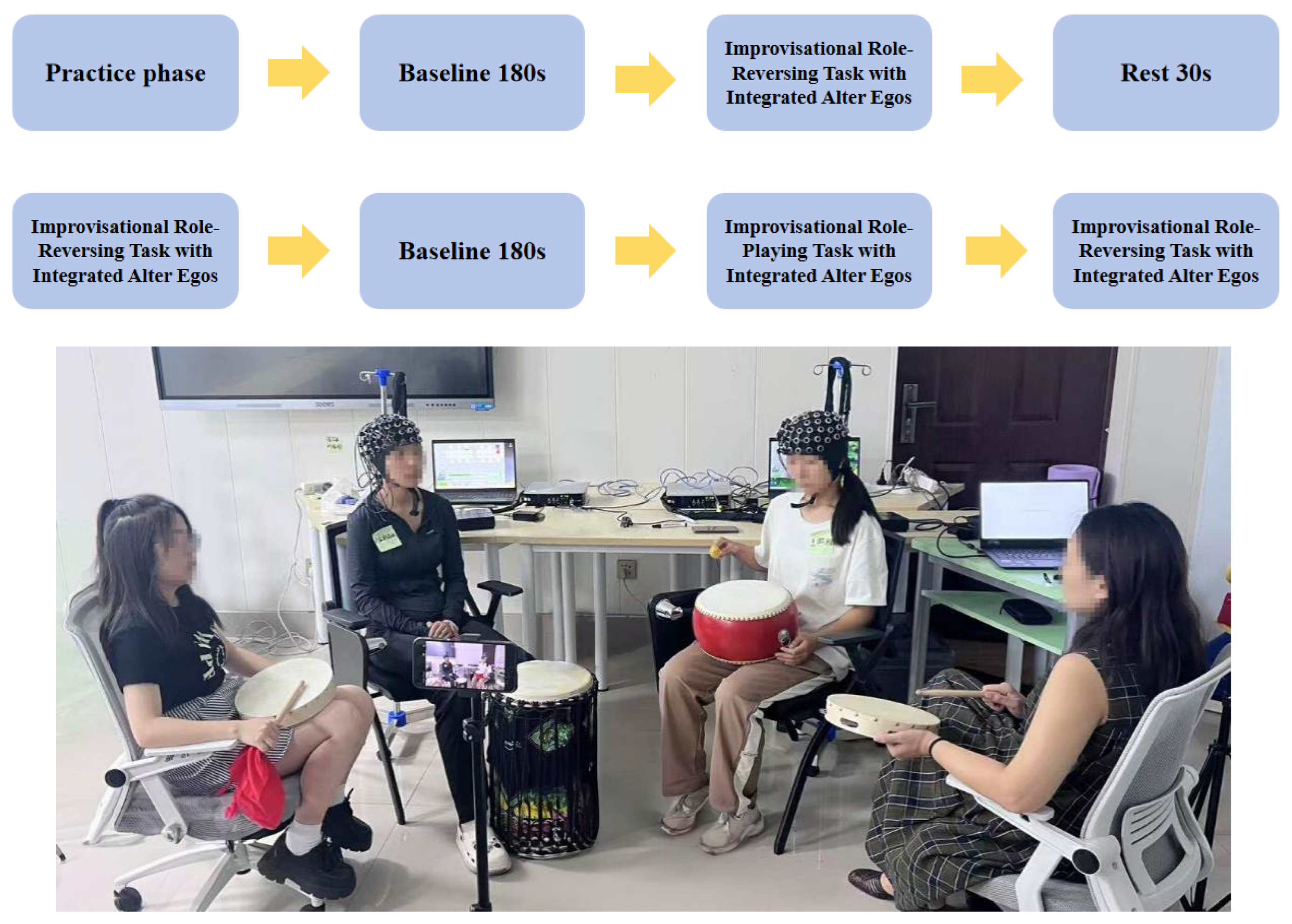
The experimental task was an impromptu role-playing situation. Two professionally trained substitute teachers sat at a 45-degree Angle to the right rear of each participant (this position provided the protagonist with the greatest sense of security and support, and reduced distractions, symbolizing the protagonist’s inner strength and unperceived emotions). Before this, the two participants selected specific themes and roles for warm-up. The supporting role and stunt double teachers were already aware of the key information expressed by the main character, the core theme, as well as the emotions and conflicting events presented. The specific experimental procedure is illustrated in Figure 1.
2.3. fNIRS Data Acquisition
The instrument used in the experiment was a fNIRS system (SHIMADZU, Inc., JPN), model Lightnirs. This device employs continuous-wave measurements at three wavelengths (780 nm, 805 nm, and 830 nm) to assess cortical hemodynamic activity. Changes in oxygenated hemoglobin, deoxygenated hemoglobin, and total hemoglobin concentrations were monitored using a modified Beer-Lambert law [33]. The system sampling frequency was 13.33 Hz. Each unit was equipped with 8 emitters and 8 detectors, forming 20 measurement channels on the scalp surface. The source-detector distance was set to 3 cm, with each source-detector pair defined as a measurement site for a specific brain region. These channels covered the right PFC, right dorsolateral prefrontal cortex (DLPFC), and the right TPJ. Regions of interest (ROIs) were identified using the fOLD toolbox (fNIRS Optodes’ Location Decider) in MATLAB [34]. Subsequently, the anatomical positions of the optodes and channel distribution were evaluated in a standardized 3D head model using the NIRS_SPM toolbox (http://www.nitrc.org/projects/nirs_spm/)based on MATLAB, yielding Montreal Neurological Institute (MNI) coordinates for the optodes and cortical localization probabilities for all 20 channels [35,36] (see Table 1).

Table 1.
The MNI coordinates and probabilistic cortical localization of all 20 channels. The corresponding Brodmann areas were identified using a brain atlas. Individual channels could cover multiple brain regions, with the sum of probabilities for overlapping areas not exceeding 1. Only channels covering more than 10% of a brain area were reported.
Table 1.
The MNI coordinates and probabilistic cortical localization of all 20 channels. The corresponding Brodmann areas were identified using a brain atlas. Individual channels could cover multiple brain regions, with the sum of probabilities for overlapping areas not exceeding 1. Only channels covering more than 10% of a brain area were reported.
| Channels | MNI x | MNI y | MNI z | Brodmann’s Area | P |
|---|---|---|---|---|---|
| CH01 | 12 | 59 | 40 | 9 – Dorsolateral prefrontal cortex | 0.82731 |
| CH02 | 13 | 73 | 15 | 10 – Frontopolar area | 1 |
| CH03 | 42 | 29 | 50 | 8 – Includes Frontal eye fields | 0.93886 |
| CH04 | 20 | 46 | 50 | 8 – Includes Frontal eye fields | 0.91266 |
| CH05 | 24 | 65 | 26 | 10 – Frontopolar area | 0.92015 |
| CH06 | 28 | 69 | 10 | 10 – Frontopolar area | 1 |
| CH07 | 52 | 28 | 39 | 9 – Dorsolateral prefrontal cortex | 0.67993 |
| CH08 | 34 | 49 | 39 | 9 – Dorsolateral prefrontal cortex | 0.891 |
| CH09 | 37 | 65 | 10 | 10 – Frontopolar area | 1 |
| CH10 | 45 | 49 | 15 | 10 – Frontopolar area | 0.53648 |
| CH11 | 64 | -64 | 6 | 6 – Pre-Motor and Supplementary Motor Cortex | 0.97193 |
| CH12 | 66 | 8 | 19 | 6 – Pre-Motor and Supplementary Motor Cortex | 0.45307 |
| CH13 | 70 | -35 | 19 | 40 – Supramarginal gyrus part of Wernicke’s area | 0.9125 |
| CH14 | 65 | -29 | 50 | 40 – Supramarginal gyrus part of Wernicke’s area | 0.45353 |
| CH15 | 69 | -9 | 31 | 6 – Pre-Motor and Supplementary Motor Cortex | 0.61489 |
| CH16 | 71 | -10 | 0 | 21 – Middle Temporal gyrus | 0.55882 |
| CH17 | 69 | -49 | 13 | 22 – Superior Temporal gyrus | 0.82026 |
| CH18 | 61 | -38 | 40 | 40 – Supramarginal gyrus part of Wernicke’s area | 0.65116 |
| CH19 | 72 | -22 | 42 | 42 – Primary and Auditory Association Cortex | 0.63125 |
| CH20 | 73 | -35 | 21 | 21 – Middle Temporal gyrus | 0.59621 |
2.4. Data Analysis
2.4.1. Behavioral Data Analysis
Participants completed both the Negative Emotion Questionnaire and the Visual Analogue Scale (commonly used in short-term intervention studies to assess pre-post changes in anxiety) before and after the music psychodrama intervention. Independent-samples t-tests were conducted to compare pre- and post-test scores, in order to determine whether the intervention effectively alleviated negative emotions.
2.4.2. fNIRS Data Analysis
Preprocessing: All raw fNIRS recordings were preprocessed using the NIRS-KIT toolbox implemented in MATLAB 2024a [41]. Initially, signal quality was checked by visual inspection. Channels lacking a distinct cardiac rhythm (~1 Hz) in the wavelet spectrum were classified as invalid [42]. Overall, 96.576% of the recorded channels met the criteria and were retained for further analysis. Dyads were excluded only if more than 50% of their channels were flagged as invalid [43]; in the present dataset, no dyads were removed at this stage. Next, the optical density signals from the 20 measurement channels were converted into light intensity values according to the modified Beer–Lambert law using NIRS-KIT, and subsequently transformed into concentration changes of oxy- and deoxy-hemoglobin [41]. To address motion-related artifacts, polynomial regression was first employed to capture and subtract linear or nonlinear signal drifts. Correlation-based signal improvement (CBSI) was then applied to further correct motion-induced noise [44]. Finally, to minimize systemic and environmental interference, a noise regression step was carried out to suppress global physiological signals such as scalp blood flow. A temporal band-pass filter (0.01–0.20 Hz) was subsequently applied to retain task-related fluctuations while removing slow drifts and high-frequency noise [45].
Intra-brain activation: We concentrated on oxygenated hemoglobin (HbO) responses, as HbO is considered a more reliable indicator of neural activity than deoxygenated hemoglobin (HbR) [46]. To estimate task-related changes, a general linear model (GLM) was applied to each participant’s HbO time series. In this procedure, task epochs were convolved with a canonical hemodynamic response function (HRF) to build the design matrix, and β coefficients were obtained for every experimental condition [47]. Finally, independent-sample t-tests were performed on the β-values derived from the role-playing and role-reversal tasks to evaluate condition-related differences in intra-brain activation.
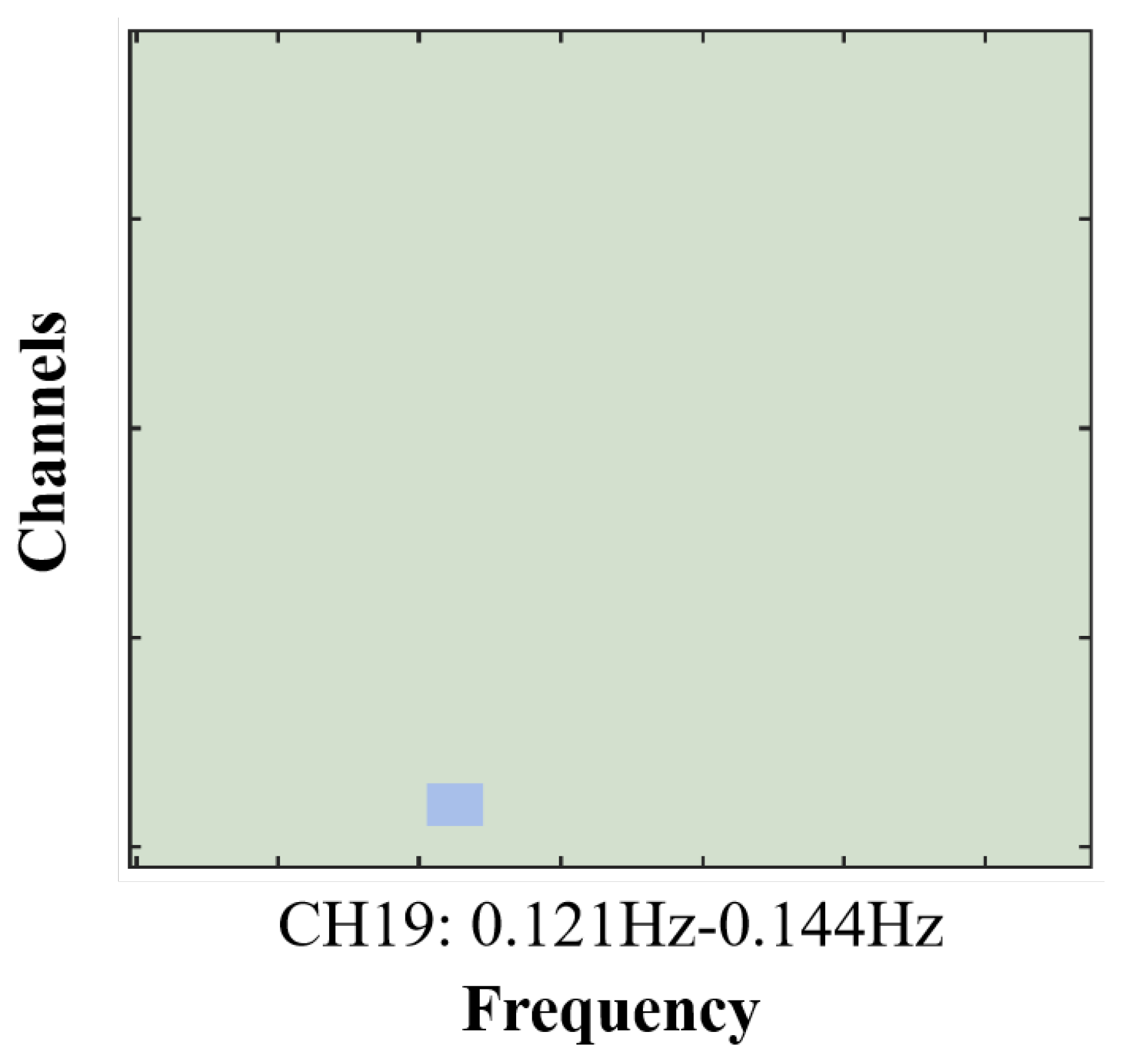
Inter-brain synchrony: The preprocessed HbO signals (prior to filtering) were imported into MATLAB 2024a, and inter-brain coherence was computed using the Wavelet Transform Coherence (WTC) toolbox [48]. For each dyad, coherence values were obtained across 20 channel pairs, providing a measure of the temporal correspondence between participants’ HbO time series. The resulting coherence estimates were then converted using Fisher’s Z transformation to normalize the distribution. To identify relevant frequency ranges, a data-driven approach was applied to compare coherence values across the two task conditions (role-playing vs. role-reversal) [49]. Independent-sample t-tests revealed a significant difference within the 0.121–0.144 Hz band, which was defined as the frequency of interest (FOI; see Figure 2). This FOI was further confirmed through post hoc FDR correction. Importantly, this range excluded major sources of physiological noise, including blood pressure oscillations (~0.1 Hz), respiratory rhythms (~0.2–0.3 Hz), and cardiac cycles (~1 Hz), thereby minimizing contamination from systemic artifacts [50].
Figure 2.
FDR-adjusted p-value map for task comparison. Inter-brain synchrony (IBS) was markedly greater in the role-reversal condition than in the role-playing condition, with the significant frequency window spanning 0.121–0.144 Hz. The blue boxes highlight the designated frequency of interest (FOI).
Figure 2.
FDR-adjusted p-value map for task comparison. Inter-brain synchrony (IBS) was markedly greater in the role-reversal condition than in the role-playing condition, with the significant frequency window spanning 0.121–0.144 Hz. The blue boxes highlight the designated frequency of interest (FOI).
3. Results
3.1. Behavioral Results
An independent-samples t-test was performed on both the Negative Emotion Questionnaire and the Visual Analogue Scale scores, revealing a significant main effect of time (negative emotion: t = 3.417, p = 0.001; anxiety: t = 2.655, p = 0.009). Follow-up analyses showed that both negative emotion and anxiety scores were significantly higher at pre-test compared with post-test (negative emotion: p = 0.001; anxiety: p = 0.009).
3.2. Intra-Brain Activation Results
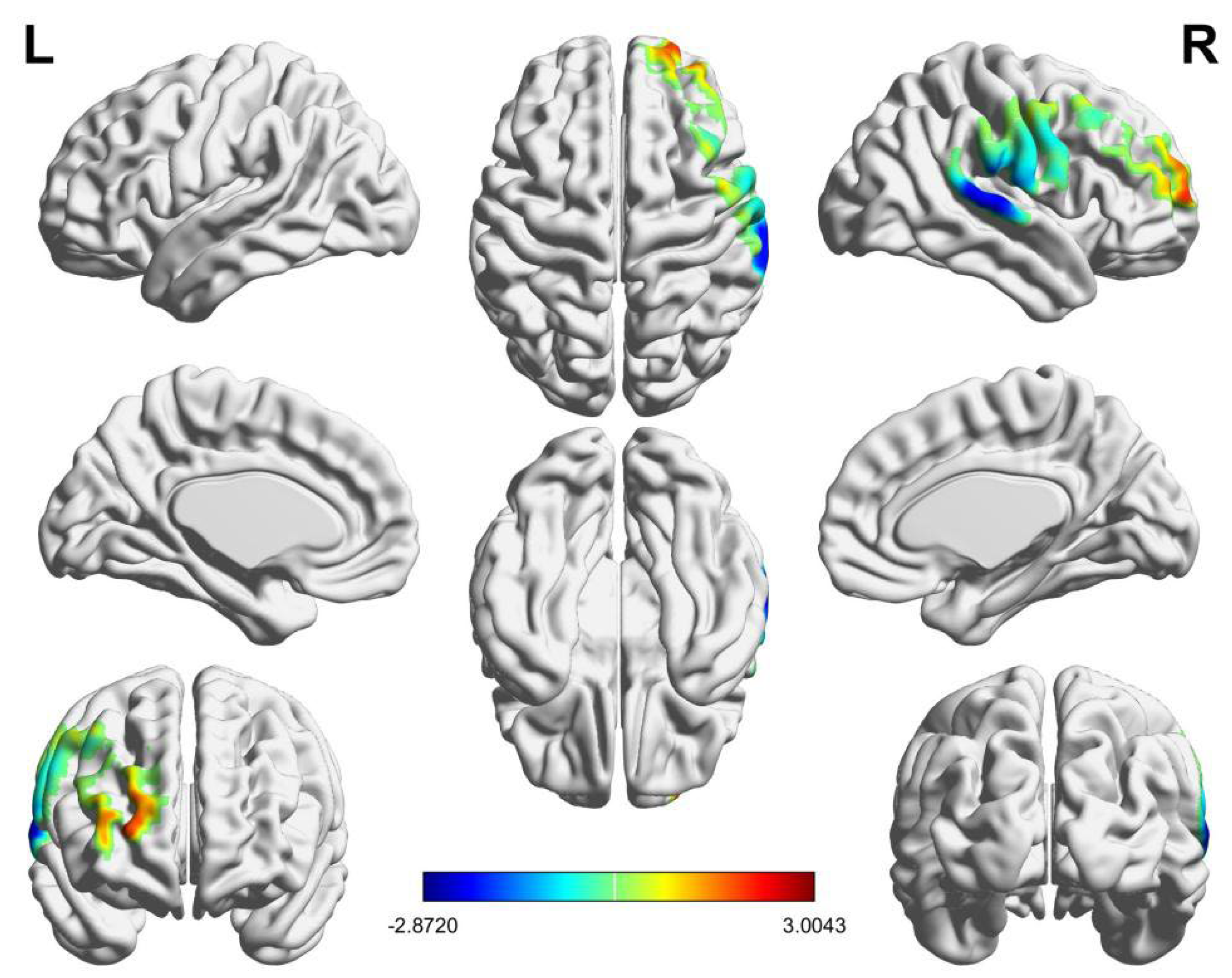
Independent-sample t-tests were applied to assess the influence of task type on intra-brain activation across 20 measurement channels. A significant effect of task condition emerged in CH05, located in the right frontopolar region (FT.R). Specifically, CH05 showed a reliable difference (t = 3.004, p = 0.049), with post hoc comparisons confirming that the role-reversal task elicited greater intra-brain activation than the role-playing task (p = 0.049). A visualization of intra-brain activation patterns is displayed in the heatmaps shown in Figure 3.
Figure 3.
Heatmap of intra-brain activation by task condition. Neural activation was greater in the role-reversal task compared with the role-playing task. The highlighted red region marks the significant channel, CH05.
Figure 3.
Heatmap of intra-brain activation by task condition. Neural activation was greater in the role-reversal task compared with the role-playing task. The highlighted red region marks the significant channel, CH05.
3.3. Inter-Brain Synchrony Results
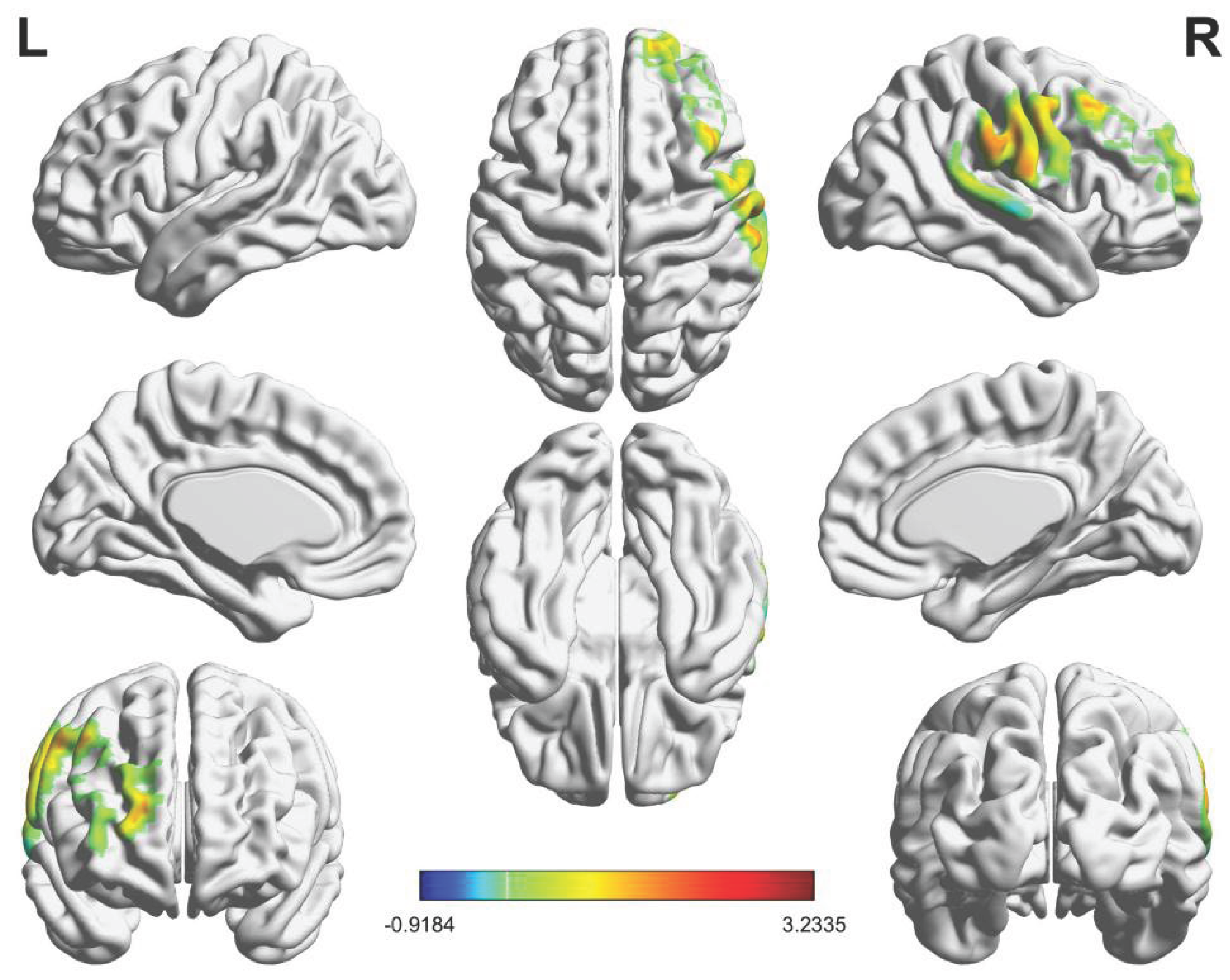
Independent-sample t-tests were performed to evaluate task-related differences in IBS across 20 channels. A significant effect of task type emerged in CH19, corresponding to the right supramarginal gyrus (SMG.R). Specifically, CH19 showed a reliable difference (t = 3.234, p = 0.046), with follow-up analyses indicating that the role-reversal condition elicited stronger IBS values compared with the role-playing condition (p = 0.046). The spatial distribution of these effects is illustrated in the IBS heatmaps shown in Figure 4.
Figure 4.
Heatmap of inter-brain synchrony (IBS) across task conditions. The role-reversal task elicited stronger IBS than the role-playing task. The red-highlighted area marks the significant channel, CH19.
Figure 4.
Heatmap of inter-brain synchrony (IBS) across task conditions. The role-reversal task elicited stronger IBS than the role-playing task. The red-highlighted area marks the significant channel, CH19.
4. Discussion
Although prior studies have examined cerebral activation and inter-brain synchronization during psychodramatic role-playing and role-reversal, the distinct neural mechanisms underlying improvisational music psychodrama remain unclear. To address this gap, the present study employed an improvisational role-reversal task incorporating the alter ego technique and fNIRS hyperscanning to explore how musical psychodrama regulates negative emotions and its neural correlates. Results revealed a significant reduction in negative affect following the intervention. At the individual level, the role-reversal task elicited stronger intra-brain activation, particularly in the right frontopolar cortex (FP.R); at the inter-brain level, it induced higher synchronization in the right supramarginal gyrus (SMG.R). Activation in the frontopolar cortex suggests enhanced cognitive control during emotional regulation [51], while increased SMG.R synchrony indicates engagement of the mirror neuron system, facilitating action understanding, empathy, and interpersonal resonance [52,53]. Collectively, these findings provide neuroscientific evidence that role-reversal in musical psychodrama alleviates negative emotions by activating prefrontal regulatory networks and mirror neuron–based social cognition systems.
Research indicates that role reversal, a core technique of musical psychodrama, effectively helps children understand and express emotions, enhancing emotional comprehension, empathy, and social interaction [54]. In psychodrama integrating role and object relations theories, role reversal externalizes internal objects and bypasses repression mechanisms [55]. Musical improvisation has demonstrated therapeutic benefits across clinical populations, including mitigation of neurological and psychological symptoms, reduction of stress and anxiety, and improvement of communication and joint attention in children with autism. Free improvisation has been shown to significantly reduce performance anxiety [56], while improvisational psychodynamic music therapy alleviates depressive and anxiety symptoms through modulation of cortical activity in fronto-temporal and temporo-parietal regions [57]. Furthermore, the double technique activates the mirror neuron system through observation and imitation, fostering intuitive understanding, emotional resonance, and perceived social support, which in turn reduces loneliness and negative affect [58]. Taken together, these findings provide empirical support for Hypothesis 1: Role reversal–based musical psychodrama significantly alleviates negative emotions, establishing its efficacy in emotion regulation and psychological support.
This study yielded two principal findings. First, the role-reversal task elicited significantly greater intra-brain activation in the FT.R than the role-playing task. According to predictive processing theory, role reversal involves integrating adaptive elements from others’ cognitive models rather than abandoning one’s own, following a “adopt–enact–create” pattern. The inclusion of musical improvisation introduces emotional memory updating, consistent with the functional role of the frontopolar/orbitofrontal cortex in emotional memory revision and reversal learning [23,59,60]. This finding also aligns with prior research showing that musical improvisation enhances connectivity within emotion and reward networks while modulating activity in the right PFC and TPJ [39,40]. Second, the role-reversal condition produced significantly stronger IBS in SMG.R. This effect reflects mirror neuron system (MNS) engagement, supporting imitation, intention inference, and empathic processing. The SMG.R functions as a higher-order hub integrating perceptual–motor information for social cognition, consistent with evidence that both SMG and IFG exhibit perception–action coupling during self- and other-related actions [34,52]. Furthermore, prior meta-analytic findings demonstrate that musical activities enhance IBS across frontal, parietal, and temporal regions [61]. These results collectively provide empirical support for Hypothesis 2.
This study has several limitations. First, the fNIRS device’s limited channel capacity confined measurement to PFC.R and TPJ.R; future studies should examine additional brain regions to enhance generalizability. Second, as this work focused solely on improvisational role reversal, subsequent research should compare musical improvisation with verbally based traditional role reversal to clarify the distinct neurobehavioral mechanisms underlying musical psychodrama. Finally, gender effects were not analyzed; future investigations should systematically explore how gender influences behavioral performance, brain activation, and inter-brain synchronization to advance understanding of interactive dynamics in musical psychodrama.
5. Conclusions
This study employed fNIRS-based hyperscanning to examine the neural mechanisms through which role-reversal techniques in musical psychodrama alleviate negative emotions. Results showed a significant reduction in negative affect among participants engaged in musical psychodrama role-reversal. Compared with role-playing, the role-reversal task elicited stronger intra-brain activation in FT.R and higher IBS in SMG.R. These findings elucidate the neurobiological basis of emotion regulation in musical psychodrama and suggest that IBS may serve as a potential neural marker of therapeutic efficacy, offering new directions for future research on psychodrama mechanisms.
Author Contributions
Conceptualization, Y.W.; M.Z.; Methodology, Y.W.; Software, Y.W.; Validation, Y.W.; M.Z.; Formal analysis, Y.W.; Investigation, Y.W.; K.P.; Y.Z.; Y.Y; Z.Z; F.Z.; Resources, Y.W.; Data curation, Y.W.; K.P.; Y.Z.; Y.Y.; Z.Z.; F.Z. Writing—original draft, Y.W.; Writing—review & editing, Y.W.; M.Z.; Visualization, Y.W.; M.Z.; Supervision, Y.W.; M.Z.; All authors have read and agreed to the published version of the manuscript.
Funding
This research received no external funding.
Institutional Review Board Statement
This study was conducted in accordance with the Declaration of Helsinki and was approved by the Academic Ethics Committee of the Faculty of Psychology at the first author’s institution.
Informed Consent Statement
Written informed consent was obtained from all participants involved in the study.
Data Availability Statement
The data presented in this study are available on request from the corresponding author.
Acknowledgments
The authors gratefully acknowledge all participants for their contributions to this study.
Conflicts of Interest
The authors declare no conflict of interest.
References
- Sang, Z. Q.; Huang, H. M.; Benko, A.; Wu, Y. The spread and development of psychodrama in mainland China. Front. Psychol. 2018, 9, 1368. [Google Scholar] [CrossRef]
- Landis, H.; Skolnik, S. Periphery to core: scenes from a psychodrama. Soc. Work Groups 2024, 47, 208–218. [Google Scholar] [CrossRef]
- Cruz, A.; Sales, C. M.; Alves, P.; Moita, G. The core techniques of Morenian psychodrama: A systematic review of literature. Front. Psychol. 2018, 9, 1263. [Google Scholar] [CrossRef]
- Pellicciari, A.; Rossi, F.; Iero, L.; Di Pietro, E.; Verrotti, A.; Franzoni, E. Drama therapy and eating disorders: a historical perspective and an overview of a Bolognese project for adolescents. J. Altern. Complement. Med. 2013, 19, 607–612. [Google Scholar] [CrossRef] [PubMed]
- Somov, P. G. A psychodrama group for substance use relapse prevention training. Arts Psychother. 2008, 35, 151–161. [Google Scholar] [CrossRef]
- Wang, Q.; Ding, F.; Chen, D.; Zhang, X.; Shen, K.; Fan, Y.; Li, L. Intervention effect of psychodrama on depression and anxiety: A meta-analysis based on Chinese samples. Arts Psychother. 2020, 69, 101661. [Google Scholar] [CrossRef]
- Blatner, A. Psychodrama: The state of the art. Arts Psychother. 1997, 24, 23–30. [Google Scholar] [CrossRef]
- Moreno, J. J. Acting Your Inner Music: Music Therapy and Psychodrama; MMB Music: St. Louis, MO, USA, 1999. [Google Scholar]
- Moreno, J. J. Musical psychodrama: A new direction in music therapy. J. Music Ther. 1980, 17, 34–42. [Google Scholar] [CrossRef]
- Müller, V.; Lindenberger, U. Dynamic orchestration of brains and instruments during free guitar improvisation. Front. Integr. Neurosci. 2019, 13, 50. [Google Scholar] [CrossRef]
- Zhang, H.; Yang, J.; Ni, J.; De Dreu, C. K.; Ma, Y. Leader–follower behavioural coordination and neural synchronization during intergroup conflict. Nat. Hum. Behav. 2023, 7, 2169–2181. [Google Scholar] [CrossRef]
- Cui, X.; Bryant, D.M.; Reiss, A.L. NIRS-based hyperscanning reveals increased interpersonal coherence in superior frontal cortex during cooperation. Neuroimage 2012, 59, 2430–2437. [Google Scholar] [CrossRef]
- Liu, Q.; Cui, H.; Huang, B.; Huang, Y.; Sun, H.; Ru, X.; Zhang, M.; Chen, W. Interbrain neural mechanism and influencing factors underlying different cooperative behaviors: a hyperscanning study. Brain Struct. Funct. 2023, 229, 75–95. [Google Scholar] [CrossRef] [PubMed]
- Montague, P.R.; Berns, G.S.; Cohen, J.D.; McClure, S.M.; Pagnoni, G.; Dhamala, M.; Fisher, R.E. Hyperscanning: simultaneous fMRI during linked social interactions. Neuroimage 2002, 16, 1159–1164. [Google Scholar] [CrossRef]
- Yu, X.; Liu, T.; He, L.; Li, Y. Micro-foundations of strategic decision-making in family business organisations: a cognitive neuroscience perspective. Long Range Plan 2023, 56, 102198. [Google Scholar] [CrossRef]
- Hakim, U.; De Felice, S.; Pinti, P.; Zhang, X.; Noah, J.; Ono, Y.; Burgess, P.W.; Hamilton, A.; Hirsch, J.; Tachtsidis, I. Quantification of inter-brain coupling: a review of current methods used in haemodynamic and electrophysiological hyperscanning studies. NeuroImage 2023, 280, 120354. [Google Scholar] [CrossRef] [PubMed]
- Moreno, J. J. Musical psychodrama in Naples. Arts Psychother. 1991, 18, 331–339. [Google Scholar] [CrossRef]
- Moreno, J. J. Musical psychodrama in Paris. Music Ther. Perspect. 1984, 1, 2–6. [Google Scholar] [CrossRef]
- Lim, M.; Carollo, A.; Bizzego, A.; Chen, S. A.; Esposito, G. Decreased activation in left prefrontal cortex during role-play: an fNIRS study of the psychodrama sociocognitive model. Arts Psychother. 2024, 87, 102098. [Google Scholar] [CrossRef]
- Fávero, M.; Sousa, R.; Budal-Oliveira, L.; Sousa-Gomes, V. Psychodrama: Comprehensive review of the effectiveness of psychodrama in sexual abuse trauma. Eur. Psychol. 2024, 29, 17. [Google Scholar] [CrossRef]
- Kipper, D.; Ritchie, T. The effectiveness of psychodramatic techniques: A metaanalysis. Group Dyn.: Theory Res. Pract. 2003, 7, 13–25. [Google Scholar] [CrossRef]
- Cruz, A.; Sales, C. M.; Alves, P.; Moita, G. The core techniques of Morenian psychodrama: A systematic review of literature. Front. Psychol. 2018, 9, 1263. [Google Scholar] [CrossRef]
- Clark, A. Whatever next? Predictive brains, situated agents, and the future of cognitive science. Behav. Brain Sci. 2013, 36, 181–204. [Google Scholar] [CrossRef]
- Kube, T.; Schwarting, R.; Rozenkrantz, L.; Glombiewski, J. A.; Rief, W. Distorted cognitive processes in major depression: A predictive processing perspective. Biol. Psychiatry 2020, 87, 388–398. [Google Scholar] [CrossRef]
- Bergamin, J. A. Habitually breaking habits: Agency, awareness, and decision-making in musical improvisation. Phenomenol. Cogn. Sci. 2024, 1–29. [Google Scholar] [CrossRef]
- Biasutti, M.; Frezza, L. Dimensions of music improvisation. Creat. Res. J. 2009, 21, 232–242. [Google Scholar] [CrossRef]
- Barrett, K. C.; Barrett, F. S.; Jiradejvong, P.; Rankin, S. K.; Landau, A. T.; Limb, C. J. Classical creativity: A functional magnetic resonance imaging (fMRI) investigation of pianist and improviser Gabriela Montero. NeuroImage 2020, 209, 116496. [Google Scholar] [CrossRef] [PubMed]
- Barrett, K. C.; Jiradejvong, P.; Jacobs, L.; and Limb, C. J. Children engage neural reward structures for creative musical improvisation. Sci. Rep. 2025, 15, 11346. [Google Scholar] [CrossRef] [PubMed]
- Diaz Abrahan, V.; Bossio, M.; Benítez, M.; Justel, N. Musical strategies to improve children’s memory in an educational context. Psychol. Music 2022, 50, 727–741. [Google Scholar] [CrossRef]
- MacDonald, R. A.; Wilson, G. B. Musical improvisation and health: a review. Psychol. Well-Being 2014, 4, 20. [Google Scholar] [CrossRef]
- Abeditehrani, H.; Dijk, C.; Toghchi, M. S.; Arntz, A. Integrating cognitive behavioral group therapy and psychodrama for social anxiety disorder: An intervention description and an uncontrolled pilot trial. Clin. Psychol. Eur. 2020, 2, e2693. [Google Scholar] [CrossRef]
- Raglio, A.; Oasi, O.; Gianotti, M.; Rossi, A.; Goulene, K.; Stramba-Badiale, M. Improvement of spontaneous language in stroke patients with chronic aphasia treated with music therapy: a randomized controlled trial. Int. J. Neurosci. 2016, 126, 235–242. [Google Scholar] [CrossRef] [PubMed]
- Kipper, D. A. The cognitive double: Integrating cognitive and action techniques.J. Group Psychother. Psychodrama Sociom. 2002, 55, 93–106. [Google Scholar] [CrossRef]
- Yaniv, D. Revisiting Morenian psychodramatic encounter in light of contemporary neuroscience: Relationship between empathy and creativity. Arts Psychother. 2011, 38, 52–58. [Google Scholar] [CrossRef]
- Ames, D. L.; Jenkins, A. C.; Banaji, M. R.; Mitchell, J. P. Taking another person’s perspective increases self-referential neural processing. Psychol. Sci. 2008, 19, 642–644. [Google Scholar] [CrossRef] [PubMed]
- Majdandžić, J.; Amashaufer, S.; Hummer, A.; Windischberger, C. , and Lamm, C. The selfless mind: How prefrontal involvement in mentalizing with similar and dissimilar others shapes empathy and prosocial behavior. Cognition 2016, 157, 24–38. [Google Scholar] [CrossRef]
- di Pellegrino, G.; Fadiga, L.; Fogassi, L.; Gallese, V.; Rizzolatti, G. Understanding motor events: a neurophysiological study. Exp. Brain Res. 1992, 91, 176–180. [Google Scholar] [CrossRef]
- Penagos-Corzo, J. C.; Cosio van-Hasselt, M.; Escobar, D.; Vázquez-Roque, R. A.; Flores, G. Mirror neurons and empathy-related regions in psychopathy: Systematic review, meta-analysis, and a working model. Soc. Neurosci. 2022, 17, 462–479. [Google Scholar] [CrossRef]
- Beaty, R. E. The neuroscience of musical improvisation. Neurosci. Biobehav. Rev. 2015, 51, 108–117. [Google Scholar] [CrossRef]
- Sasaki, M.; Iversen, J.; Callan, D. E. Music improvisation is characterized by increase EEG spectral power in prefrontal and perceptual motor cortical sources and can be reliably classified from non-improvisatory performance. Front. Hum. Neurosci. 2019, 13, 435. [Google Scholar] [CrossRef]
- Hou, X.; Zhang, Z.; Zhao, C.; Duan, L.; Gong, Y.; Li, Z.; Zhu, C. NIRS-KIT: a MATLAB toolbox for both resting-state and task fNIRS data analysis. Neurophotonics 2021, 8, 010802–010802. [Google Scholar] [CrossRef]
- Nguyen, T.; Schleihauf, H.; Kayhan, E.; Matthes, D.; Vrtička, P.; Hoehl, S. The effects of interaction quality on neural synchrony during mother-child problem solving. Cortex 2020, 124, 235–249. [Google Scholar] [CrossRef] [PubMed]
- Lu, K.; Yu, T.; Hao, N. Creating while taking turns, the choice to unlocking group creative potential. NeuroImage 2020, 219, Article–117025. [Google Scholar] [CrossRef]
- Cui, X.; Bray, S.; Reiss, A. L. Functional near infrared spectroscopy (NIRS) signal improvement based on negative correlation between oxygenated and deoxygenated hemoglobin dynamics. Neuroimage 2010, 49, 3039–3046. [Google Scholar] [CrossRef] [PubMed]
- Emberson, L. L.; Crosswhite, S. L.; Goodwin, J. R.; Berger, A. J.; Aslin, R. N. Isolating the effects of surface vasculature in infant neuroimaging using short-distance optical channels: a combination of local and global effects. Neurophotonics 2016, 3, 031406–031406. [Google Scholar] [CrossRef]
- Zhang, M.; Yin, Z.; Zhang, X.; Zhang, H.; Bao, M.; Xuan, B. Neural mechanisms distinguishing two types of cooperative problem-solving approaches: An fNIRS hyperscanning study. NeuroImage 2024, 291, 120587. [Google Scholar] [CrossRef]
- Wang, H. Y.; You, H. L.; Song, C. L.; Zhou, L.; Wang, S. Y.; Li, X. L.; ... Zhang, B. W. Shared and distinct prefrontal cortex alterations of implicit emotion regulation in depression and anxiety: An fNIRS investigation. J. Affect. Disord. 2024, 354, 126–135. [CrossRef]
- Grinsted, A.; Moore, J. C.; Jevrejeva, S. Application of the cross wavelet transform and wavelet coherence to geophysical time series. Nonlin. Process. Geophys. 2004, 11, 561–566. [Google Scholar] [CrossRef]
- Yin, Z.; Xuan, B.; Liu, C.; Yi, J.; Zheng, X.; Zhang, M. The influence of task and interpersonal interdependence on cooperative behavior and its neural mechanisms. npj Sci. Learn. 2025, 10, 9. [Google Scholar] [CrossRef]
- Nozawa, T.; Sasaki, Y.; Sakaki, K.; Yokoyama, R.; Kawashima, R. Interpersonal frontopolar neural synchronization in group communication: an exploration toward fNIRS hyperscanning of natural interactions. Neuroimage 2016, 133, 484–497. [Google Scholar] [CrossRef] [PubMed]
- Fonzo, G. A.; Goodkind, M. S.; Oathes, D. J.; Zaiko, Y. V.; Harvey, M.; Peng, K. K.; ... Etkin, A. Selective effects of psychotherapy on frontopolar cortical function in PTSD. Am. J. Psychiatry 2017, 174, 1175–1184. [CrossRef]
- Macuga, K. L.; Frey, S. H. Selective responses in right inferior frontal and supramarginal gyri differentiate between observed movements of oneself vs. another. Neuropsychologia 2011, 49, 1202–1207. [Google Scholar] [CrossRef]
- Buccino, G.; Solodkin, A.; Small, S. L Functions of the mirror neuron system: implications for neurorehabilitation. Cogn. Behav. Neurol. 2006, 19, 55–63. [Google Scholar] [CrossRef]
- Vidanagamage, S. D.; Bhaumik, A. O.; Irugalbandara, A. I. Role reversal in psychodrama: Enhancing empathy and emotional understanding among institutionalized children in Sri Lanka. Int. J. Res. Innov. Soc. Sci. 2024, 8, 1550–1561. [Google Scholar] [CrossRef]
- Usluoglu, F. The effects of psychodrama on relationship between the self and others: a case study. Curr. Psychol. 2023, 42, 30863–30877. [Google Scholar] [CrossRef]
- Allen, R. Free improvisation and performance anxiety among piano students. Psychol. Music 2013, 41, 75–88. [Google Scholar] [CrossRef]
- Fachner, J.; Gold, C.; Erkkilä, J. Music therapy modulates fronto-temporal activity in rest-EEG in depressed clients. Brain Topogr. 2013, 26, 338–354. [Google Scholar] [CrossRef]
- Sinigaglia, C.; Rizzolatti, G. Through the looking glass: self and others. Conscious. Cogn. 2011, 20, 64–74. [Google Scholar] [CrossRef]
- Budhani, S.; Marsh, A. A.; Pine, D. S.; Blair, R. J. R. Neural correlates of response reversal: considering acquisition. Neuroimage 2007, 34, 1754–1765. [Google Scholar] [CrossRef] [PubMed]
- Kringelbach, M. L.; Rolls, E. T. Neural correlates of rapid reversal learning in a simple model of human social interaction. Neuroimage 2003, 20, 1371–1383. [Google Scholar] [CrossRef]
- Cheng, S.; Wang, J.; Luo, R.; Hao, N. Brain to brain musical interaction: A systematic review of neural synchrony in musical activities. Neurosci. Biobehav. Rev. 2024, 164, 105812.53. [Google Scholar] [CrossRef] [PubMed]
Figure 1.
Schematic diagram of the experimental design. Practice phase → Resting phase → Formal experimental phase → 30 s rest period (followed by one additional cycle). During the task, two participants engaged in a 20-minute joint practice session to familiarize themselves with the theme of improvisational role-playing. This was followed by a 3-minute resting period after which the formal experiment commenced. In the formal task, the two participants first performed musical improvisation while the double provided verbal expression simultaneously. Subsequently, the double performed musical improvisation while the participants supplemented with verbal responses. Each task block lasted 3 minutes, followed by a 30-second rest period, after which the task cycle was repeated once.
Figure 1.
Schematic diagram of the experimental design. Practice phase → Resting phase → Formal experimental phase → 30 s rest period (followed by one additional cycle). During the task, two participants engaged in a 20-minute joint practice session to familiarize themselves with the theme of improvisational role-playing. This was followed by a 3-minute resting period after which the formal experiment commenced. In the formal task, the two participants first performed musical improvisation while the double provided verbal expression simultaneously. Subsequently, the double performed musical improvisation while the participants supplemented with verbal responses. Each task block lasted 3 minutes, followed by a 30-second rest period, after which the task cycle was repeated once.
Disclaimer/Publisher’s Note: The statements, opinions and data contained in all publications are solely those of the individual author(s) and contributor(s) and not of MDPI and/or the editor(s). MDPI and/or the editor(s) disclaim responsibility for any injury to people or property resulting from any ideas, methods, instructions or products referred to in the content. |
© 2025 by the authors. Licensee MDPI, Basel, Switzerland. This article is an open access article distributed under the terms and conditions of the Creative Commons Attribution (CC BY) license (http://creativecommons.org/licenses/by/4.0/).
Copyright: This open access article is published under a Creative Commons CC BY 4.0 license, which permit the free download, distribution, and reuse, provided that the author and preprint are cited in any reuse.


