

Submitted:
23 October 2025
Posted:
24 October 2025
You are already at the latest version
Abstract
This document explores the evolution of battery management systems (BMS) through the integration of cloudbased analytics. It details the system architecture for data acquisition, storage, and processing, emphasizing the role of cloud computing in enabling sophisticated algorithms for battery state estimation and safety diagnostics. The study focuses on improvements in state of charge (SOC) and state of health (SOH) predictions, as well as the implementation of advanced thermal anomaly detection within the BMS framework. Challenges and solutions related to data processing, algorithm deployment, and system scalability are specifically addressed from a battery management perspective.
Keywords:
battery management system (BMS)
; cloud computing
; state of charge (SOC)
; state of health (SOH)
; thermal anomaly detection
; data analytics
; system scalability
; predictive maintenance
1. Introduction
The rise of electric vehicles (EVs) and large-scale energy storage systems has highlighted the need for intelligent battery management systems (BMS) that ensure safety, reliability, and longevity, particularly for lithium-ion batteries [1,2]. Traditional BMS rely on low-power embedded controllers, limiting advanced monitoring of SOC, SOH, and thermal conditions.
Cloud-integrated BMS, or the “Battery Cloud,” leverages high-performance computing and large-scale storage to enable remote diagnostics, machine learning-based SOC/SOH estimation, and predictive analytics from distributed battery data [3,4]. Secure IoT gateways aggregate real-time voltage, current, temperature, and metadata, enabling cloud-based algorithms unsuitable for onboard microcontrollers [5,6].
Machine learning models, such as artificial neural networks (ANNs), improve SOC estimation under varying charging conditions. SOH estimation using electrochemical techniques like Incremental Capacity Analysis (ICA) and Differential Voltage Analysis (DVA) benefits from cloud scalability [7,8]. Cloud analytics also enable proactive thermal anomaly detection, reducing risks like thermal runaway [9,10]. Secondary applications include manufacturing optimization, end-of-life diagnostics, and second-life battery assessments.
Contributions. (1) Cloud–edge BMS architecture for real EV and ESS deployments; (2) Federated digital-twin hybrid for SOC/SOH estimation (Sec. Section 3.8); (3) Shape-based thermal anomaly detection with early warnings; (4) Quantitative study of latency, scalability, cost, and performance improvements over traditional methods.
2. System Architecture and Cloud Integration
Cloud-integrated BMS combine IoT telemetry, scalable data pipelines, and computing platforms to monitor batteries across their lifecycle [6,11].

Table 1.
Battery datasets and test conditions
| Domain | Chemistry | Temp (∘C) | #Packs | Split |
|---|---|---|---|---|
| EV | LFP | –45 | TBD | 70/15/15 |
| EV | NMC | –45 | TBD | 70/15/15 |
| ESS | NCA | 0–50 | TBD | 70/15/15 |
Table 2.
System performance comparison
| Config | Latency (ms) | Throughput (msgs/s) |
|---|---|---|
| Onboard-only | TBD | TBD |
| Cloud+Edge (proposed) | TBD | TBD |
2.1. Data Acquisition
Data is collected during cell production, module assembly, EV/ESS deployment, and end-of-life testing. Sensors record voltage, current, temperature, cycle count, and operational logs, transmitted via secure IoT gateways using 4G/5G or isolated networks [12].
2.2. Cloud Infrastructure and Databases
2.3. Visualization and Analytics
Dashboards (Grafana, Kibana) support real-time monitoring and historical analysis. Machine learning models and digital twins simulate battery behavior for SOC/SOH estimation and thermal anomaly detection [3]. Data-driven insights also optimize manufacturing quality, battery reuse, and recycling [8].
2.4. Security and Compliance
Battery data is secured via encryption, role-based access, and auditing, adhering to ISO 27001 and NERC CIP standards for ESS deployments [9].
2.5. Datasets and Testing Conditions
The study employs three representative battery datasets covering different domains and chemistries. Two datasets correspond to electric vehicle (EV) applications with lithium iron phosphate (LFP) and nickel manganese cobalt (NMC) cells, while one dataset represents stationary energy storage systems (ESS) using lithium nickel cobalt aluminum (NCA) cells. Testing conditions vary across temperature ranges from C to C, reflecting realistic operational scenarios. Data are split into training, validation, and test subsets using a 70/15/15 ratio to ensure robust evaluation of the proposed algorithms.
2.6. Performance Metrics
System performance is evaluated using latency and throughput metrics, reflecting the responsiveness and processing capacity of different configurations. Two configurations are considered: an onboard-only approach and the proposed cloud+edge hybrid system. Latency measures the time taken to process and respond to battery management requests, while throughput indicates the number of messages processed per second. These metrics enable a comparative assessment of computational efficiency and scalability of the proposed framework.
3. Cloud-Based State of Charge (SOC) Estimation
Estimating the State of Charge (SOC) of lithium-ion batteries accurately and efficiently remains a foundational requirement in electric vehicle (EV) and energy storage systems. Traditional SOC estimation approaches such as Coulomb counting and model-based estimators, though widely used, suffer from accumulated drift errors and model dependency, respectively [7]. With the advent of cloud-integrated battery management, machine learning models—especially neural networks—have become viable for more robust and adaptive SOC estimation across varied environmental and usage conditions.
3.1. Limitations of Traditional Methods
Coulomb counting calculates SOC by integrating the current over time. Despite its simplicity, the method is sensitive to measurement inaccuracies and initialization errors. Over time, these cumulative errors can result in significant divergence from actual SOC, especially under dynamic loading conditions. On the other hand, model-based methods such as Kalman Filters (KF) and Extended Kalman Filters (EKF) depend heavily on the accuracy of the battery’s equivalent circuit model, which may not generalize well across different battery chemistries or aging states [8].
3.2. ANN-Based Estimation with Cloud Support
To overcome these limitations, Artificial Neural Networks (ANNs) can be trained on historical and real-time cloud-collected battery data to learn complex nonlinear relationships between measurable parameters—such as voltage, current, and temperature—and SOC. Cloud-based training allows the model to generalize across different packs, usage cycles, and environmental conditions. Once trained, a lightweight version of the ANN can be deployed on the onboard microcontroller, enabling real-time SOC estimation with minimal computational overhead [7].
3.3. Neural Network Architecture and Training
The ANN model includes time-series inputs of current, voltage, and temperature, sampled at multiple past intervals. The hidden layers extract temporal and nonlinear patterns, while the output layer produces the SOC estimate at the current time. Figure 1 shows a simplified feed-forward ANN structure designed for SOC prediction.
3.4. Model Training and Deployment
The model is trained using data obtained from cloud storage, comprising charging and discharging cycles under varying temperatures and load profiles. The training process uses the Levenberg–Marquardt optimization algorithm, which is known for rapid convergence in regression tasks. Once training is complete, the model is converted to embedded C code and flashed onto the microcontroller of the battery management system.
3.5. Performance Evaluation
To validate performance, the model was evaluated on both hardware-in-the-loop (HIL) simulation and live vehicle testing. The root mean square error (RMSE) across different test cases was consistently below 2%, surpassing industry benchmarks. Notably, the ANN trained exclusively on DC charging data also performed reliably during AC charging tests, indicating strong generalization capabilities [3].
3.6. Advantages of Cloud-Aided SOC Estimation
By leveraging centralized cloud platforms, the model benefits from exposure to diversified datasets, which enrich its ability to generalize across different battery usage patterns. Moreover, periodic retraining can be performed seamlessly using newly aggregated data, ensuring model relevance even as battery cells age or environmental patterns shift. This cloud-based model lifecycle management facilitates adaptive battery control and helps mitigate performance degradation in real-world deployments.
3.7. Robustness Across Battery Types
Another advantage of the ANN-based SOC estimator is its configurability across various battery chemistries—such as LFP, NMC, and NCA—simply by modifying the training dataset. This versatility removes the need to redesign algorithmic pipelines for each new chemistry, streamlining deployment across a fleet of heterogeneous systems [11].
Overall, cloud-supported ANN-based SOC estimation provides an efficient and scalable solution for modern BMS applications, outperforming traditional methods in both accuracy and adaptability.
3.8. Federated Digital-Twin Hybrid SOC/SOH
We couple cloud-side physics-informed digital twins with federated learning across fleets. Edge nodes train local SOC/SOH updaters; the cloud aggregates model deltas, calibrates the twin with fleet statistics, and pushes lightweight updates to BMS.
Protocol:
- Edge: train/update local SOC/SOH heads on recent traces.
- Cloud: aggregate gradients (FedAvg), calibrate twin parameters.
- Serve: deploy compressed models to edge; schedule periodic re-sync.
4. Advanced State of Health (SOH) Prediction Techniques
Monitoring and predicting the State of Health (SOH) of lithium-ion batteries is essential to ensuring the long-term reliability and safety of battery-powered systems. SOH reflects the remaining usable capacity and performance capability of a battery relative to its original condition. As battery packs degrade over time due to repeated cycling and environmental factors, advanced SOH estimation techniques have emerged to provide timely diagnostics and prolong service life [1].
4.1. Understanding Battery Degradation
Lithium-ion battery degradation occurs due to various electrochemical and mechanical mechanisms. These include loss of lithium inventory (LLI), degradation of active materials in the anode and cathode (LAMA, LAMC), growth of the solid electrolyte interphase (SEI), and electrolyte decomposition [16]. These mechanisms manifest as capacity fade, increased internal resistance, and voltage anomalies. Accurately modeling these behaviors is critical for estimating SOH.
4.2. Limitations of Traditional Approaches
Conventional methods such as Coulomb counting and impedance-based assessments often fail to capture the complexity of battery degradation. These methods require frequent calibration and may not adapt well to real-world usage variability. Additionally, lab-based testing techniques like full charge/discharge cycles are impractical for in-field use due to their intrusiveness and time demands [17].
4.3. Cloud-Based SOH Analytics
The rise of cloud computing enables the use of big data and machine learning for real-time SOH estimation. Cloud platforms collect operational data from thousands of batteries, facilitating large-scale feature extraction and trend modeling. These platforms can identify degradation patterns across diverse conditions, offering better generalization than localized onboard estimators [3].
4.4. Feature-Based Methods: DVA and ICA
Two prominent techniques for extracting SOH-relevant features are Differential Voltage Analysis (DVA) and Incremental Capacity Analysis (ICA). Both methods rely on low-current charge/discharge data to generate voltage-capacity derivative curves. Specific curve features—such as peak position, spacing, and height—correlate strongly with internal cell degradation. Figure 2 illustrates the typical ICA and DVA curves for a lithium-ion cell.
4.5. Data-Driven Mapping Techniques
After extracting features from DVA and ICA, mapping functions—such as regression models or neural networks—are used to estimate SOH. These models are trained using labeled cycling data and refined using cloud-resident aging profiles. Lookup tables (LUTs) or polynomial fits can also serve as lightweight approximators for deployment in embedded BMS firmware [4].
4.6. Benefits of Cloud-Based SOH Estimation
Cloud-based SOH methods offer several advantages. First, the models can be continuously retrained with updated data, improving their adaptability over time. Second, centralized analysis enables cross-fleet health monitoring and the identification of emerging failure trends. Third, because analysis is performed off-board, more computationally intensive models can be utilized without compromising the real-time performance of the onboard BMS [8].
4.7. Second-Life and End-of-Life Decisions
SOH estimation is also vital for determining battery second-life applications. Batteries with sufficient residual capacity can be redeployed for stationary storage or less demanding tasks. Accurate SOH metrics assist in assessing safety risks, predicting end-of-life (EOL), and informing recycling protocols. This contributes to sustainability efforts and reduces the total cost of battery ownership [18].
In summary, integrating DVA/ICA-based analysis with cloud-enhanced machine learning offers a powerful, scalable solution for predicting battery aging and guiding lifecycle decisions.
5. Cloud-Assisted Thermal Anomaly Detection
Thermal stability is one of the most critical aspects of battery safety. Lithium-ion batteries are highly sensitive to temperature deviations, and prolonged exposure to thermal stress may trigger irreversible damage, capacity loss, or even catastrophic failures such as thermal runaway. Detecting early signs of thermal anomalies can prevent system-level hazards, especially in large battery installations. Traditional onboard BMS are limited in their ability to detect nuanced thermal deviations due to constrained computational resources. Cloud-assisted thermal monitoring leverages data-driven algorithms for proactive thermal management [9].
5.1. Causes of Thermal Anomalies
Thermal anomalies originate from both internal and external sources. Internally, overcharging, internal short circuits, and high current flow increase Joule heating. Externally, poor thermal design or faulty cooling systems can lead to heat accumulation. Other contributors include aging-induced impedance rise, electrolyte decomposition, and cell imbalance. These phenomena often manifest as localized hotspots, which, if undetected, escalate to dangerous conditions [19].
5.2. Challenges with Onboard Detection
Onboard detection systems rely on thermocouples or surface temperature sensors that capture thermal data at limited resolution. The small number of sensors cannot always detect early-stage heat propagation, especially in tightly packed battery modules. Additionally, embedded BMS microcontrollers typically lack the processing power to execute pattern-recognition or anomaly-detection algorithms in real time [20].
5.3. Cloud-Based Anomaly Detection Pipeline
In the cloud-based approach, raw thermal data from the BMS is transmitted periodically to a centralized server. The data is cleaned, segmented, and normalized before applying clustering algorithms that identify deviations from normal behavior. One such method is shape-based clustering using the K-shape algorithm, which compares temporal patterns of temperature curves rather than just absolute values [10]. Figure 3 shows the structure of this anomaly detection pipeline.
5.4. Advantages of Pattern-Based Detection
Unlike threshold-based approaches, pattern-based detection accounts for the dynamics of heat generation. It can differentiate between natural warming due to charging and abnormal heating caused by faults. Since the method is shape-aware, it handles sensor offsets, noise, and gradual changes more robustly than traditional limit-checking algorithms [21].
5.5. Case Study and Early Warning Benefits
In a field deployment, cloud-assisted monitoring was able to detect an impending thermal anomaly 90 minutes before the onboard system issued an alert. The early warning was triggered by a divergence in one sensor’s heating trend, flagged as an outlier by the clustering algorithm. This gave operators ample time to isolate the affected module and prevent propagation. Such early detection capabilities are invaluable in high-energy applications like electric buses and grid-scale storage systems [10].
Table 3.
Comparative performance (fill with measured values).
| Task | Baseline | Proposed | Metric | Gain |
|---|---|---|---|---|
| SOC estimation | EKF / Coulomb | Cloud-ANN (edge deploy) | RMSE (%) | TBD |
| SOH prediction | ICA/DVA-only | Hybrid (Section 3.8) | MAE (%) | TBD |
| Thermal detection | Onboard thresholds | Cloud pattern-based | Lead time (min) | TBD |
6. Quantitative Comparative Results
6.1. System Integration and Feedback Loop
Detected anomalies are visualized on operator dashboards, where flagged signals are correlated with operational parameters such as load, SOC, and charging state. This contextual information improves interpretability and accelerates root cause diagnosis. The system can also trigger automated responses such as reducing current, shutting down modules, or sending maintenance alerts [9].
6.2. Future Directions
The use of hybrid models that combine physical battery models with machine learning is an emerging trend. These hybrid digital twins can offer more explainable results while retaining the predictive power of data-driven techniques. Additionally, federated learning could allow distributed systems to collaboratively improve their detection models without sharing raw data, enhancing privacy and scalability.
In summary, cloud-based thermal anomaly detection significantly enhances the ability to identify and respond to early-stage faults, making it a vital component of next-generation battery management.
7. Challenges, Solutions, and Future Outlook
7.1. Challenges and Mitigation Strategies
The integration of cloud computing with battery management introduces new levels of intelligence and scalability, but it also presents notable challenges that must be addressed for real-world deployment. One of the foremost issues is data latency. While cloud systems offer immense computational resources, the time taken to transmit large volumes of real-time battery telemetry from edge devices to the cloud can introduce delays. This is particularly critical for safety-sensitive applications such as electric vehicles and grid-scale storage. Edge computing architectures and hybrid cloud-BMS models can be employed to offload immediate decisions to local systems while deferring deeper analytics to the cloud [6].
Another key challenge is ensuring data security and privacy. Battery telemetry can be sensitive, especially in industrial or transportation contexts. Unauthorized access or data breaches can compromise operational integrity and user trust. To address this, end-to-end encryption, authentication protocols, and compliance with standards like ISO/IEC 27001 or NIST cybersecurity frameworks are essential [9].
Model generalization and validation also remain complex. Machine learning algorithms trained on data from one fleet or battery chemistry may not transfer well to another. Domain adaptation, federated learning, and continuous retraining mechanisms are promising strategies to maintain high prediction accuracy across heterogeneous fleets [5].
Moreover, cloud cost optimization is crucial. Real-time analytics over massive datasets may incur substantial cloud infrastructure expenses. Intelligent data sampling, prioritization of mission-critical metrics, and batch processing for non-urgent tasks can help balance performance with affordability.
Finally, regulatory compliance poses an operational constraint. Different countries may impose distinct data residency, privacy, and telecommunication regulations, particularly for EVs and ESSs operating across borders. Multi-region cloud deployments and configurable data handling policies are potential solutions.
7.2. Future Outlook and Conclusion
Looking forward, the fusion of cloud analytics with battery management is expected to become a defining feature of future energy and transportation systems. As battery-powered platforms expand into autonomous vehicles, drones, and distributed microgrids, their management systems must evolve to support predictive intelligence, self-healing capabilities, and adaptive optimization [3].
The growing adoption of digital twin technologies will enable dynamic simulations of battery behavior, calibrated in real-time by live telemetry. This allows more precise lifetime estimation, maintenance scheduling, and anomaly prediction. Combined with advancements in physics-informed machine learning, these twins will offer both accuracy and interpretability.
Sustainability is another major driver. Cloud-based SOH tracking supports second-life battery applications by identifying cells suitable for reuse, thus reducing electronic waste and improving lifecycle economics. Integration with recycling infrastructures will also benefit from accurate degradation and material composition insights.
Additionally, regulatory and industry-standard efforts are aligning toward interoperable BMS frameworks. Initiatives such as OpenBMS and cloud-native APIs can enable vendors to plug into a unified data ecosystem, improving cross-vendor analytics and innovation.
In conclusion, cloud-enhanced analytics represent a transformative leap for battery management systems, enabling predictive intelligence, operational safety, and lifecycle optimization. While challenges exist in latency, security, generalization, and cost, ongoing advances in edge-cloud architectures, AI models, and standardization are rapidly closing these gaps. Future battery ecosystems will increasingly depend on such intelligent, scalable, and secure platforms.
References
- Birkl, C.R.; Roberts, M.R.; McTurk, E.; Bruce, P.G.; Howey, D.A. Degradation diagnostics for lithium ion cells. Journal of Power Sources 2017, 341, 373–386. [Google Scholar] [CrossRef]
- Hannan, M.A.; Lipu, M.S.H.; Hussain, A.; Mohamed, A. A review of lithium-ion battery state of charge estimation and management system in electric vehicle applications: Challenges and recommendations. Renewable and Sustainable Energy Reviews 2017, 78, 834–854. [Google Scholar] [CrossRef]
- Li, W.; Rentemeister, M.; Badeda, J.; Jöst, D.; Schulte, D.; Sauer, D.U. Digital twin for battery systems: Cloud battery management system with online state-of-charge and state-of-health estimation. Journal of Energy Storage 2020, 30, 101557. [Google Scholar] [CrossRef]
- Xiong, R.; Li, L.; Tian, J. Towards a smarter battery management system: A critical review on battery state of health monitoring methods. Journal of Power Sources 2018, 405, 18–29. [Google Scholar] [CrossRef]
- Lombardo, T.; Duquesnoy, M.; El-Bouysidy, H.; Årén, F.; Gallo-Bueno, A.; Jørgensen, P.B.; Bhowmik, A.; Demortière, A.; Ayerbe, E.; Alcaide, F.; et al. Artificial Intelligence Applied to Battery Research: Hype or Reality? Chemical Reviews 2021. [Google Scholar] [CrossRef] [PubMed]
- Xu, L.D.; He, W.; Li, S. Internet of things in industries: A survey. IEEE Transactions on Industrial Informatics 2014, 10, 2233–2243. [Google Scholar] [CrossRef]
- Chemali, E.; Kollmeyer, P.J.; Preindl, M.; Emadi, A. State-of-charge estimation of Li-ion batteries using deep neural networks: A machine learning approach. Journal of Power Sources 2018, 400, 242–255. [Google Scholar] [CrossRef]
- Berecibar, M.; Gandiaga, I.; Villarreal, I.; Omar, N.; Van Mierlo, J.; Van Den Bossche, P. Critical review of state of health estimation methods of Li-ion batteries for real applications. Renewable and Sustainable Energy Reviews 2016, 56, 572–587. [Google Scholar] [CrossRef]
- Liao, Z.; Zhang, S.; Li, K.; Zhang, G.; Habetler, T.G. A survey of methods for monitoring and detecting thermal runaway of lithium-ion batteries. Journal of Power Sources 2019, 436, 226879. [Google Scholar] [CrossRef]
- Li, X.; Li, J.; Abdollahi, A.; Jones, T.; Habeebullah, A. Data-driven Thermal Anomaly Detection for Batteries using Unsupervised Shape Clustering. In Proceedings of the 2021 IEEE 30th International Symposium on Industrial Electronics (ISIE). IEEE; 2021; pp. 1–6. [Google Scholar]
- Schnell, J.; Nentwich, C.; Endres, F.; Kollenda, A.; Distel, F.; Knoche, T.; Reinhart, G. Data mining in lithium-ion battery cell production. Journal of Power Sources 2019, 413, 360–366. [Google Scholar] [CrossRef]
- How Gotion Monitors its EV Battery Solution with InfluxDB, Grafana and AWS, 2022. Available at: https://www.influxdata.com/resources/how-gotion-monitors-its-ev-battery-solution-with-influxdb-grafana-and-aws/.
- Apache Hadoop, 2022. Available at: https://hadoop.apache.org/.
- InfluxDB Overview, 2022. Available at: https://www.influxdata.com/products/influxdb-overview/.
- Amazon Web Services, 2022. Available at: https://aws.amazon.com/.
- Kabir, M.M.; Demirocak, D.E. Degradation mechanisms in Li-ion batteries: a state-of-the-art review. International Journal of Energy Research 2017, 41, 1963–1986. [Google Scholar] [CrossRef]
- Dubarry, M.; Truchot, C.; Liaw, B.Y. Synthesize battery degradation modes via a diagnostic and prognostic model. Journal of Power Sources 2012, 219, 204–216. [Google Scholar] [CrossRef]
- Wood, E.; Alexander, M.; Bradley, T.H. Investigation of battery end-of-life conditions for plug-in hybrid electric vehicles. Journal of Power Sources 2011, 196, 5147–5154. [Google Scholar] [CrossRef]
- Feng, X.; Ouyang, M.; Liu, X.; Lu, L.; Xia, Y.; He, X. Thermal runaway mechanism of lithium ion battery for electric vehicles: A review. Energy Storage Materials 2018, 10, 246–267. [Google Scholar] [CrossRef]
- Han, X.; Lu, L.; Zheng, Y.; Feng, X.; Li, J.; Ouyang, M. A review on the key issues of the lithium ion battery degradation among the whole life cycle. eTransportation 2019, 1, 100005. [Google Scholar] [CrossRef]
- Wang, Q.; Ping, P.; Zhao, X.; Chu, G.; Sun, J.; Chen, C. Thermal runaway caused fire and explosion of lithium ion battery. Journal of Power Sources 2012, 208, 210–224. [Google Scholar] [CrossRef]
Figure 1.
Feed-forward neural network for SOC estimation using voltage, current, and temperature as input features.
Figure 1.
Feed-forward neural network for SOC estimation using voltage, current, and temperature as input features.
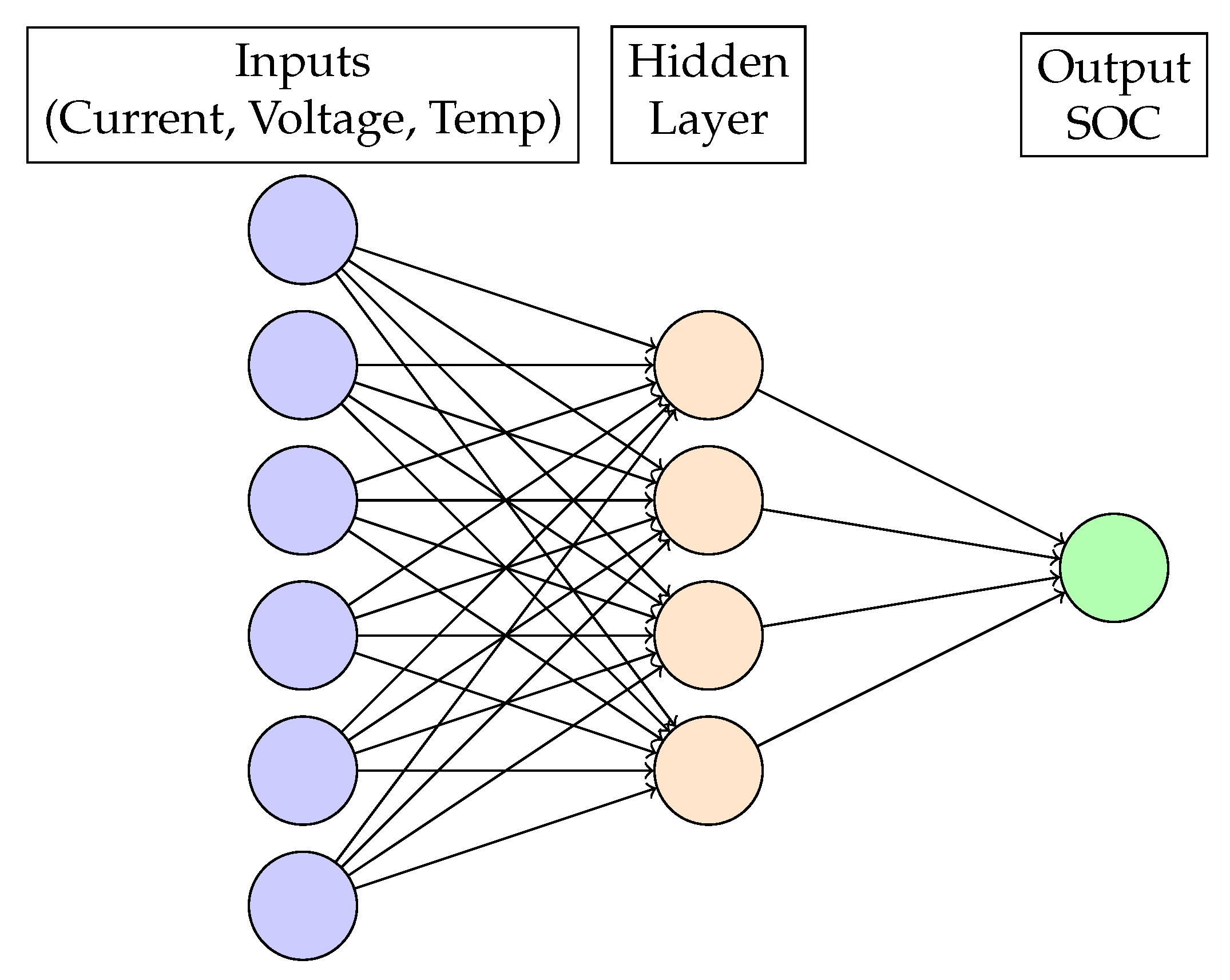
Figure 2.
Typical ICA and DVA profiles used in SOH analysis. Shifts in peaks indicate aging.
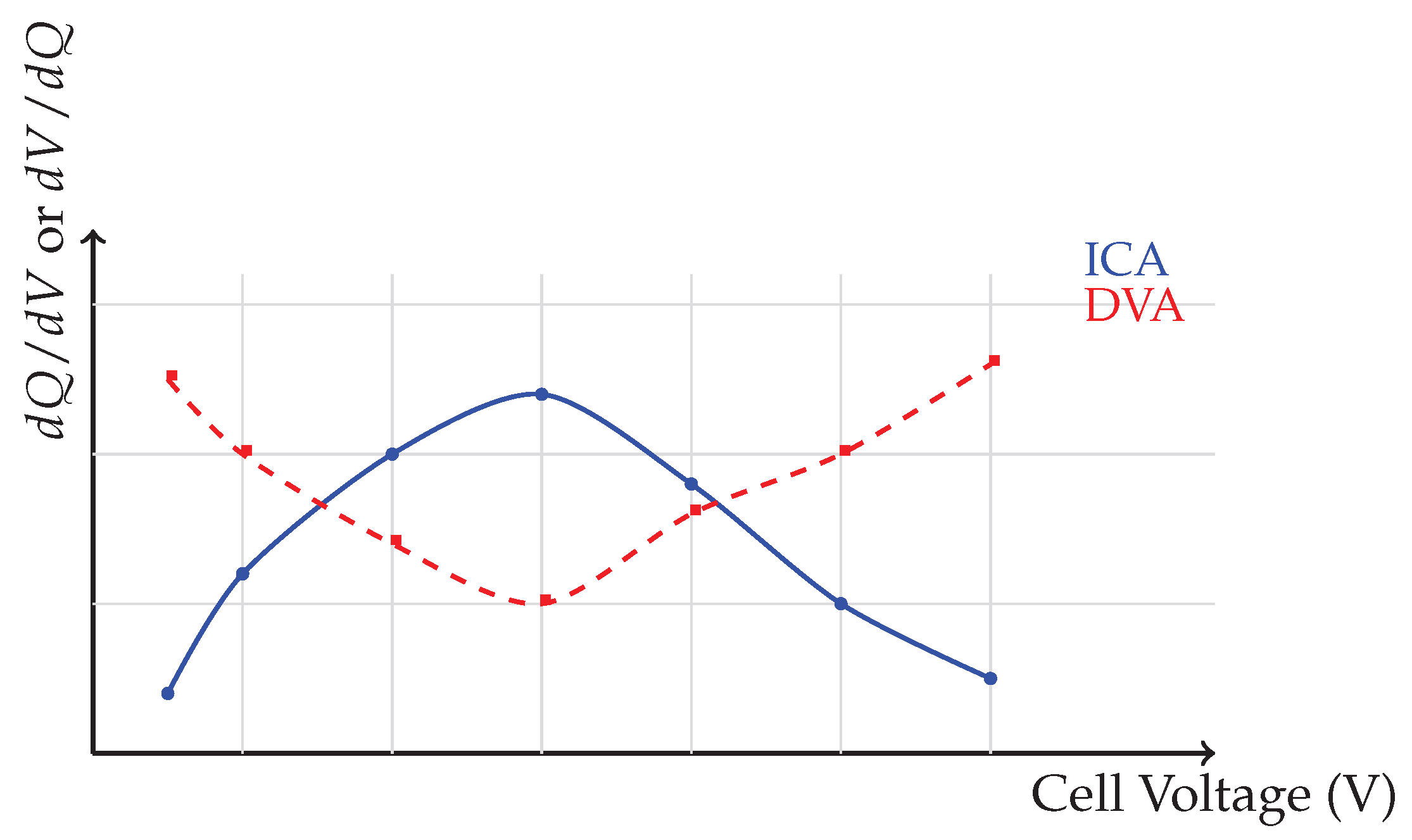
Figure 3.
Minimal pipeline for thermal anomaly detection

Disclaimer/Publisher’s Note: The statements, opinions and data contained in all publications are solely those of the individual author(s) and contributor(s) and not of MDPI and/or the editor(s). MDPI and/or the editor(s) disclaim responsibility for any injury to people or property resulting from any ideas, methods, instructions or products referred to in the content. |
© 2025 by the authors. Licensee MDPI, Basel, Switzerland. This article is an open access article distributed under the terms and conditions of the Creative Commons Attribution (CC BY) license (http://creativecommons.org/licenses/by/4.0/).
Copyright: This open access article is published under a Creative Commons CC BY 4.0 license, which permit the free download, distribution, and reuse, provided that the author and preprint are cited in any reuse.


