
Submitted:
21 October 2025
Posted:
24 October 2025
You are already at the latest version
Abstract
This study is our sincere effort and service towards Hindustani Classical Music. The raag which we are writing about in this article is Raag Shankara. We have researched multiple resources, which include books, websites, other digital media and multiple performances of various artists. The artists range from vocal, sitar, sarod, surbahar and flute. The aim of this article on Raag Shankara is to bring together the knowledge and historical background of Raag Shankara based on theory, structure, patterns and various ways the artists have expressed it over decades of performances. This article also serves as a unique learning resource for students of various skills, knowledge and performance levels, who are in the process of becoming performers and learners of Hindustani Classical Music. We are not endorsing or following a specific gharana system of music. Rather, we are aiming to keep the structure as it is and the readers are free to apply it to any gharana system or not. We have also included a big list of websites which have performances on Raag Shankara, and this will serve the learner in a multitude of ways.
Keywords:
Raag
; Shankara
; Hindustani
; classical music
1. Introduction and History of Raag Shankara
1.1. Origins
Raag Shankara is a Hindustani classical music raag which is performed by vocalists and instrumentalists alike. It is considered by many as a raag with a high level of difficulty. Shankara is another name for the hindu deity Lord Shiva and the presentation of the raag is expected to demonstrate limitless energy. In this article we will not go into the details of the Hindustani Classical Music because we have already described it in [1].
Figure 1.
Picture taken from [2]. “Shankara, putra of Megha: The epithet ‘Shankara’ [‘auspicious’, ‘joy-bringing’] is usually associated with Shiva, Chief of the Storm Gods. However in this case he is represented as Vishnu, the Preserver, being praised by fellow deities, including Shiva as a five-headed, ash-covered ascetic, with tiger skin dhoti, garland of skulls, and cobra necklace – with the four-faced Brahma, elephant-headed Ganesha, and Indra, Vedic King of the Gods. Interestingly, the verse does not describe him as Vishnu, but merely mentions his appearance: his splendid garment, crown, ornaments, and lotus-like eyes…” [2,3].
Figure 1.
Picture taken from [2]. “Shankara, putra of Megha: The epithet ‘Shankara’ [‘auspicious’, ‘joy-bringing’] is usually associated with Shiva, Chief of the Storm Gods. However in this case he is represented as Vishnu, the Preserver, being praised by fellow deities, including Shiva as a five-headed, ash-covered ascetic, with tiger skin dhoti, garland of skulls, and cobra necklace – with the four-faced Brahma, elephant-headed Ganesha, and Indra, Vedic King of the Gods. Interestingly, the verse does not describe him as Vishnu, but merely mentions his appearance: his splendid garment, crown, ornaments, and lotus-like eyes…” [2,3].

1.2. Mood
Raag Shankara has been said to have a mood which expresses humility, and to shake off ego and arrogance. It is a Raag which focuses on the surrendering oneself to the soul and gives a feeling of devotion [4]. This devotion can be in the form of love, spiritual, or even to the vastness of this Universe. This can be felt through the melodies and various compositions. According to [4], "Raga Shankara is performed at a time when nature or the universe creates an ambience of complete surrender to the Ultimate, after a hectic day. The raga of Shankara emits when nature takes all the living beings in her lap with kindness and generosity". Raag Shankara is generally spoken of as a raag of the experts and is also known as the king of all raags. This is because it has intricate movements and vakra or asymmetrical structure. The nature of the raag is complex and some notes are just to touch while singing or playing rather than regular or strongly emphasizing.
This mood of Raag Shankara, can be of bhakti (devotion), gambhir (deep, profound, sober, reserved) and love. It can also be expressed as a mood of introspection, sould searching, connect with ones inner self and also connecting and understanding ones own emotions with a feeling of surrender. The variations of the mood of Raag Shankara are literally numerous and can be approached through various ways.
2. Structure of Raag Shankara
The details and structure of Raag Shankara are as follows.
2.1. Thaat, Jaati, Aaroh, Avroh
Thaat (type of a Scale in Hindustani Classical Music that classifies a raag): Bilaaval
Jaati (classification Based on the number of notes while ascending or descending): Audhav-Shaadav Vakra. Audav means a raag with 5 notes, Shaadav means a raag with 6 notes and Vakra means crooked or curved.
Aaroh (ascend): Sa, Ga, Pa, Ni, Dha, , Ni,
Avroh (descend): , Ni, Pa, Ga, Pa, Re, Ga, Re, Sa
2.2. Vaadi Swar, Samvaadi Swar, Time of Playing
Vaadi Swar (main note): Ga
Samvaadi Swar (second main note): Ni
Time of Playing: Third prahar of night, which is usually round 12:00am-03:00am. (Note: since concerts are organized and held based on the performer’s availability, hence it is regularly performed without any time constraints)
2.3. Pakad
Pakad(musical phrase or phrases which show the essence of raag):
2.4. Chalan
Chalan (series of patterns of notes which show the development of a raag): There are multiple ways the chalan of a particular raag can be developed. It is based on the aaroh, avroh and pakad. Here we have mentioned some chalans which are popular and are used frequently by artists in parts and/or as a whole.
-
Chalan taken from [6]:[ Sa], [ Sa], [P̣ Sa], [ Sa], [ Sa Ga], [Ga Pa Ga], [Sa Ga Pa Ga], [(Pa)(Dha) (Pa)(Pa) Ga], [Pa Ga], [Da (Re)(Sa)], [ Sa Ga Ga Pa], [Pa Ni Dha Ni], [Ni Pa], [Ga Pa Ni Ni ], [ Ni], [Ni Dha Ni Pa Ga], [Pa Ga Re Sa]
-
Chalan taken from [3]:[ Sa Ga], [(Ga)Pa (Re)Ga Re Ss], [Ga Pa Ni Dha Ni Pa Ga], [Ga Pa Ni Dha Ni Ṡ], [ Ni Ni Dha Ni], [(Dha)Pa Ga], [Ga Pa Ni Pa Ga], [Ga Pa (Re)Ga (Re)Sa]
There are numerous combinations which can be constructed using the Chalan patterns as shown above.
2.5. Swar-Vistaar
Swar-Vistaar (slow and detailed elaboration of a raag in phrases based on the aaroh, avroh, pakad and chalan): The swar-vistaar mentioned below are just some which mostly performers and learners play. Using the aaroh, avroh and chalan, numerous groups of swar-vistaars can be constructed.
-
Swar Vistaar taken from [7]:[ ], [Ga Pa Ni], [Sa Ga Pa Ni], [Pa Ni Dha Ni], [Ga Pa Ni ], [ Ni], [Ni Pa], [Ga Pa Ga Sa]
-
Swar Vistaar taken from [8]:[Sa], [Re Sa Sa ], [ Sa Ga Sa], [ Sa ], [ Sa], [Sa Pa Ga Pa], [Ga Pa Re Ga Sa]
There are numerous combinations which can be constructed using the Swar Vistaar patterns as shown above.
3. Recordings of Raag Shankara
In this section we are mentioning some videos which the learner or performer of any level would find extremely interesting. These videos will serve as a great source of learning for all levels of musicians. Here we will be categorizing the videos based on vocal and performed on various instruments.
There are numerous videos on youtube and other resources. We have selected some videos based on what we have enjoyed and based on what we think will help the learners and musicians of all level. There are multiple instruments which are used in Hindustani Classical Music. We have chosen some instruments based purely on what we enjoyed. This does not, in any way, imply that the other videos, or artists, or instruments are not good or substandard. These videos are just a short list from a long list of our favorite videos.
3.1. Vocal
- https://www.youtube.com/watch?v=Gf96sPfHitw&list=RDGf96sPfHitw&start_radio=1 – Artist: Pt. Jasraj
- https://www.youtube.com/watch?v=W1q_rh1d-Mw&list=RDW1q_rh1d-Mw&start_radio=1 – Artist: Pt. Venkatesh Kumar
- https://www.youtube.com/watch?v=fGmC1e1jDz4&list=RDfGmC1e1jDz4&start_radio=1 – Master Deenanath Mangeshkar
- https://www.youtube.com/watch?v=oK7z3vjEBS0&list=RDoK7z3vjEBS0&start_radio=1o – Pt. Kumar Gandharva
- https://www.youtube.com/watch?v=0ry0i1RU9kk&list=RD0ry0i1RU9kk&start_radio=1 – Artist: Ut. Rashid Khan
3.2. Sitar
- https://www.youtube.com/watch?v=83K8gVjISkA&list=RD83K8gVjISkA&start_radio=1 – Artist: Pt. Buddhaditya Mukherjee
- https://www.youtube.com/watch?v=vtsmtZYtQTs&list=RDvtsmtZYtQTs&start_radio=1 – Artist: Ut. Vilayat Khan
- https://www.youtube.com/watch?v=gj6hmKzGR6I&list=RDgj6hmKzGR6I&start_radio=1 – Artist: Pt. Ravi Shankar
- https://www.youtube.com/watch?v=mswFzDuRzhA&list=RDmswFzDuRzhA&start_radio=1 – Artist: Pt. Nikhil Banerjee
3.3. Sarod
- https://www.youtube.com/watch?v=8ZyCmB3JRso&list=RD8ZyCmB3JRso&start_radio=1&t=158s – Artist: Pt. Brij Narayan
- https://www.youtube.com/watch?v=FtmlebCHC_o&list=RDFtmlebCHC_o&start_radio=1 – Artist: Ut. Amjad Ali Khan
- https://www.youtube.com/watch?v=pxXSyOvd1_A&list=RDpxXSyOvd1_A&start_radio=1 – Artist: Pt. Tejendra Narayan Majumdar
3.4. Saarangi
- https://www.youtube.com/watch?v=vXwoY6-xYmA&list=RDvXwoY6-xYmA&start_radio=1 – Artist: Ut. Munir Khan
- https://www.youtube.com/watch?v=HJcT8Jn8BjM&list=RDHJcT8Jn8BjM&start_radio=1 – Artist: Pt. Ram Narayan
4. Conclusion and Future Work
In this study, we have attempted to bring together all possible aspects of Raag Shankara to a learner and musician of Hindustani Classical Music. This will enable the learner and a musician to learn from one robust source rather than looking for various resources and spending time away from practice. We do not make any claim that this is the most complete resource for Raag Shankara, but this is a resource which the learners and musicians can refer to and find all aspects of Raag Shankara in one place. We also believe that a Raag cannot be limited to any one article or study and this study serves only as a reference and a robust one.
Our future work involves studying and compiling similar articles which talk about various raags and other aspects of Hindustani Classical Music.
Funding
The authors Kamal Hyder and Preet Sharma did not receive any type of external funding for this study.
Acknowledgments
The authors acknowledge various resources from which they have studied from. The authors also acknowledge a lot of people who have indirectly shown us through their flawed teaching, directionless learning and unacceptable performing as to what not to do during the learning and performing process.
Conflicts of Interest
The authors, Kamal Hyder and Preet Sharma declare no conflict of interest.
Glossary
For glossary, please refer to [1].
Appendix A
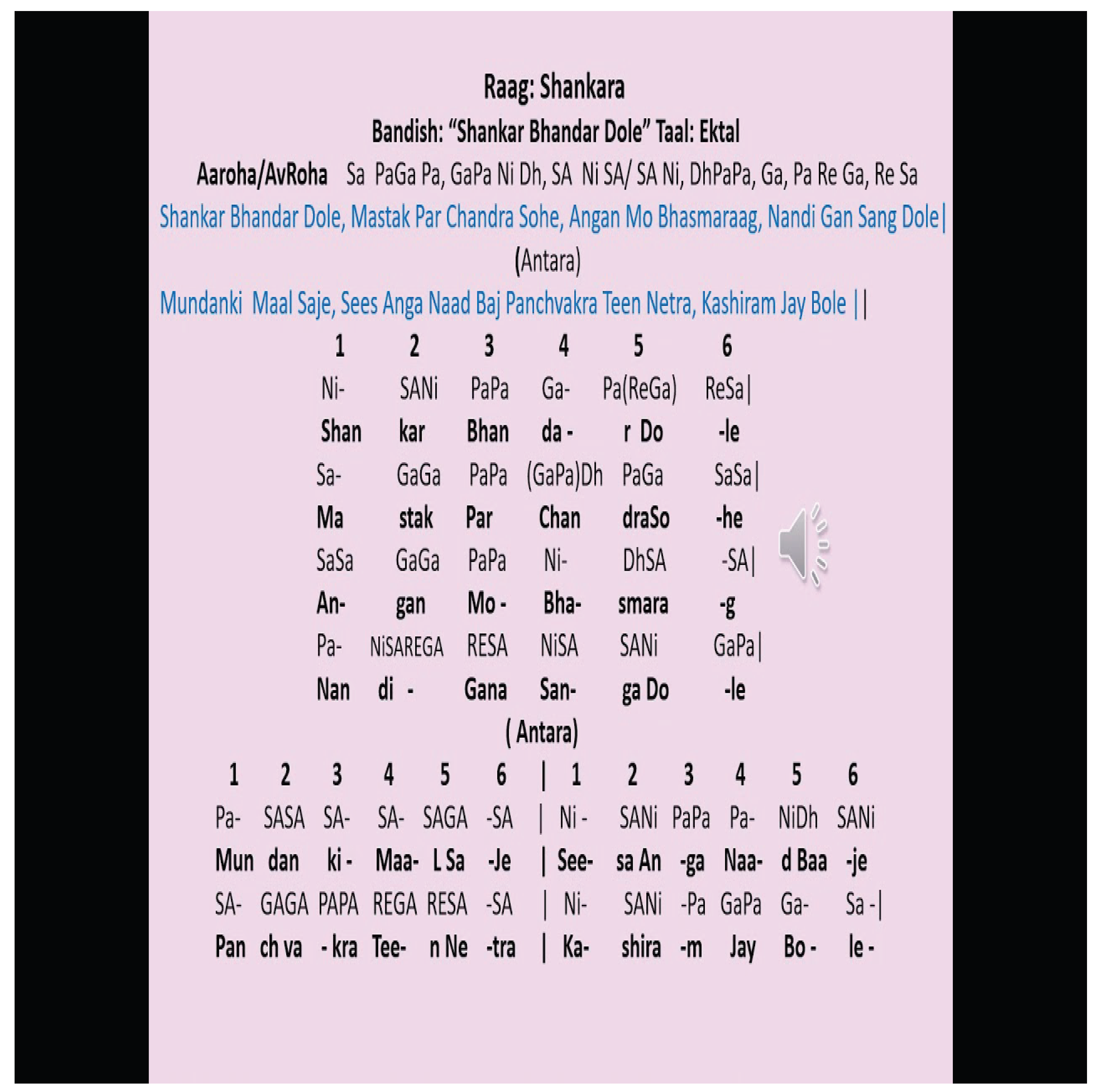
We have included one composition in Raag Shankara. This will enable learners to sing and/or play on their instruments for practice and/or performances. There are numerous compositions in Raag Shankara in books, websites and other resources. Although, each one of them is equally fascinating and important to us, we still cannot include all of them in this article. We have chosen some of them based on random selection. They are,
Figure A1.
Picture taken from [9].
Figure A1.
Picture taken from [9].
References
- K.H. Preet Sharma, Raag yaman, preprints.org preprint ID-181812 (2025) 16.
- C.A. Glynn, R. Skelton, A.L. Dallapiccola, R.P. Dulwich Picture Gallery et al., Ragamala: paintings from india, (No Title) (2011).
- G. Howlett, “Raag Shankara.” https://ragajunglism.org/ragas/shankara/.
- www.meetkalakar.com, “Raga Shankara — meetkalakar.com.” https://meetkalakar.com/Artipedia/Shankara, copyright 2010-2013.
- “- Raagtime — raagtime.com.” https://raagtime.com/ragas/shankara.
- tanarang, “Raag Shankara - Tanarang Music — tanarang.com.” https://tanarang.com/raag-shankara/.
- sharda, “Vocal Raag Shankara - Swar Vistaar of Ni — sharda.org.” https://www.sharda.org/vocal/raga-shankara-vistaar-n/, copyright 2025.
- J. Tilavat, “- YouTube — youtube.com.” https://www.youtube.com/watch?v=EX-J63ICjxs, 2024.
- raagabasics, “- YouTube — youtube.com.” https://www.youtube.com/watch?v=q_fGkCrFaYo&list=PLRBjV8OC4OwWA6IDh23tu-l35A1t_fKtK, 2019.
Disclaimer/Publisher’s Note: The statements, opinions and data contained in all publications are solely those of the individual author(s) and contributor(s) and not of MDPI and/or the editor(s). MDPI and/or the editor(s) disclaim responsibility for any injury to people or property resulting from any ideas, methods, instructions or products referred to in the content. |
© 2025 by the authors. Licensee MDPI, Basel, Switzerland. This article is an open access article distributed under the terms and conditions of the Creative Commons Attribution (CC BY) license (http://creativecommons.org/licenses/by/4.0/).
Copyright: This open access article is published under a Creative Commons CC BY 4.0 license, which permit the free download, distribution, and reuse, provided that the author and preprint are cited in any reuse.


