

Submitted:
22 October 2025
Posted:
23 October 2025
You are already at the latest version
Abstract
In sub-Saharan Africa, land degradation and climate change threaten food security by reducing soil productivity and water availability. Soil and water conservation (SWC) technologies can restore soil health, enhance moisture retention, and support crop growth under adverse conditions. This review identifies SWC technologies applied in climatically similar African regions with the aim of informing adoption in Senegal, particularly in Sédhiou and Tambacounda regions. Using K-means clustering on 19 WorldClim bioclimatic variables, 35 comparable countries were identified, of which 17 met inclusion criteria based on data availability and ≥60% climatic similarity. Around 85 technologies were reviewed, including water harvesting, soil-moisture conservation, and erosion control, assessed for their compatibility across rainfall patterns, and land gradients and uses. The review highlights 12 successful technologies across Africa with high potential for cross-border transfer and upscaling in Senegal’s agroecological context. While countries such as Burkina Faso, Kenya, and Malawi lead in technology adoption and diversity, Senegal lags behind due to institutional gaps, limited funding, and weak extension systems. The findings highlight the importance of site-specific water management for improving soil conservation, biodiversity protection, climate adaptation, and food security, and emphasize the need for policy integration, stakeholder empowerment, private-sector engagement, and cross-border learning to accelerate adoption.
Keywords:
climate resilience
; sustainable intensification
; soil conservation
; water‐management technology
; climate analogues
; k‐means clustering
; sub‐Saharan Africa
1. Introduction
Soil and water are the most important agriculture resources, serving as the foundation for food production and environmental sustainability [1]. However, global transformations have caused climate change, population expansion, deforestation, urbanization, intensified agricultural practices, and the migration of subsistence farming to less fertile lands. These challenges underscore an urgent need to preserve these resources [2] along with a need for robust soil and water conservation (SWC) efforts within the larger framework of ensuring food security. The United Nations' 2023 World Water Development Report [3] highlights a concerning trajectory: the number of urban populations affected by water shortage is projected to rise from 933 million in 2016 to between 1.7 and 2.4 billion people by 2050 [3]. This projected escalation in water stress necessitates both rigorous scientific research and the implementation of adaptive, evidence-based management practices. The urgency is particularly concerning for small-scale farmers in Africa, who are disproportionately affected by the multifaceted impacts of climate change and land degradation [4].
Understanding the biophysical roles of soil and water is essential for formulating effective conservation strategies. Soil provides a medium for plant growth, carbon sequestration, nutrient cycling, water retention and root growth, making its quality a critical determinant of crop productivity [5,6]. On the other hand, water acts as a vital carrier of nutrients and a key driver of metabolic processes crucial for plant growth [7]. The intricate relationship between soil and water management is central to optimizing agricultural productivity and ensuring food security [8]. The degradation of these two pillars—through erosion, nutrient depletion, salinization, and erratic rainfall—threatens food systems and livelihoods, particularly in sub-Saharan Africa.
Sub-Saharan Africa exemplifies the urgency of this challenge, as land degradation continues to undermine agricultural systems and environmental sustainability [8]. The African Union Commission estimates that 65% of African arable land is affected by degradation, contributing to declining soil fertility and agricultural productivity [9]. The United Nations Environment Programme (UNEP) reports that desertification affects around 45% of Africa’s land area, with 55% of this area at high or very high risk of further degradation [10]. A study by the Food and Agriculture Organization (FAO) highlights that soil erosion alone impacts roughly 43% of agricultural land across the continent [11]. These statistics reveal the crises and reinforce the need for comprehensive strategies to combat land degradation, enhance climate resilience, and ensure long-term food security for the region’s growing populations.
Land degradation, soil-water scarcity, and climate change are intricately interconnected, collectively posing serious threats to agricultural sustainability and food security [12,13]. As climate change intensifies, shifting precipitation patterns and rising temperatures heighten the risk of land degradation. Intensive agricultural practices exacerbate this issue by contributing to soil erosion and nutrient depletion, accelerating degradation [14]. Simultaneously, land degradation reduces the soil's water retention capacity, exacerbating soil-water scarcity [15]. These interconnected challenges form a negative feedback loop, where degraded land becomes increasingly incapable of withstanding climate impacts, leading to a downward spiral of declining agricultural productivity. Breaking this cycle requires widespread adoption of sustainable land-management (SLM) practices. Through measures such as erosion control, water conservation, afforestation, conservation tillage, and watershed management, farmers can maintain soil health and improve water retention. Maintaining soil organic matter, coupled with installing SWC structures enhances overall ecosystem resilience. Education and extension services further ensure the widespread adoption of sustainable practices. By addressing the interconnected challenges of soil erosion, water scarcity, and climate change, these management strategies create a foundation for sustainable agriculture, fostering resilience, enhancing biodiversity, and securing long-term ecosystem viability [16].
Senegal, situated in West Africa, experiences a predominantly arid to semi-arid climate, posing significant challenges to agriculture. The population has grown steadily, with a current estimate of over 18 million people in 2023 with a density of 92 people per km2 [17]. Agriculture is mostly rainfed, where less than 5% of cultivated land is irrigated [18]. The agricultural economy is dominated by smallholder farmers cultivating maize, millet, rice, and sorghum for subsistence purposes [19]. Recurrent droughts, periodic flooding, and land degradation driven by climate change are major factors contributing to stagnating farm productivity [20]. Adoption of land and water management technologies among small-scale farmers in Senegal remains low [21] compared to other African countries [35], especially the neighboring countries of Burkina Faso and Niger. This is mainly due to weak institutional and policy frameworks, inadequate land tenure incentives, and fragmented, project-based implementation approaches [22]. Many farmers still rely on harmful practices like bush burning, which degrades the soil, depletes organic matter, and increases erosion risks [23]. Despite these impacts, traditional methods persist due to limited awareness of sustainable alternatives [24]. Effective awareness campaigns, training, and supportive policies are essential for driving this transition [25].
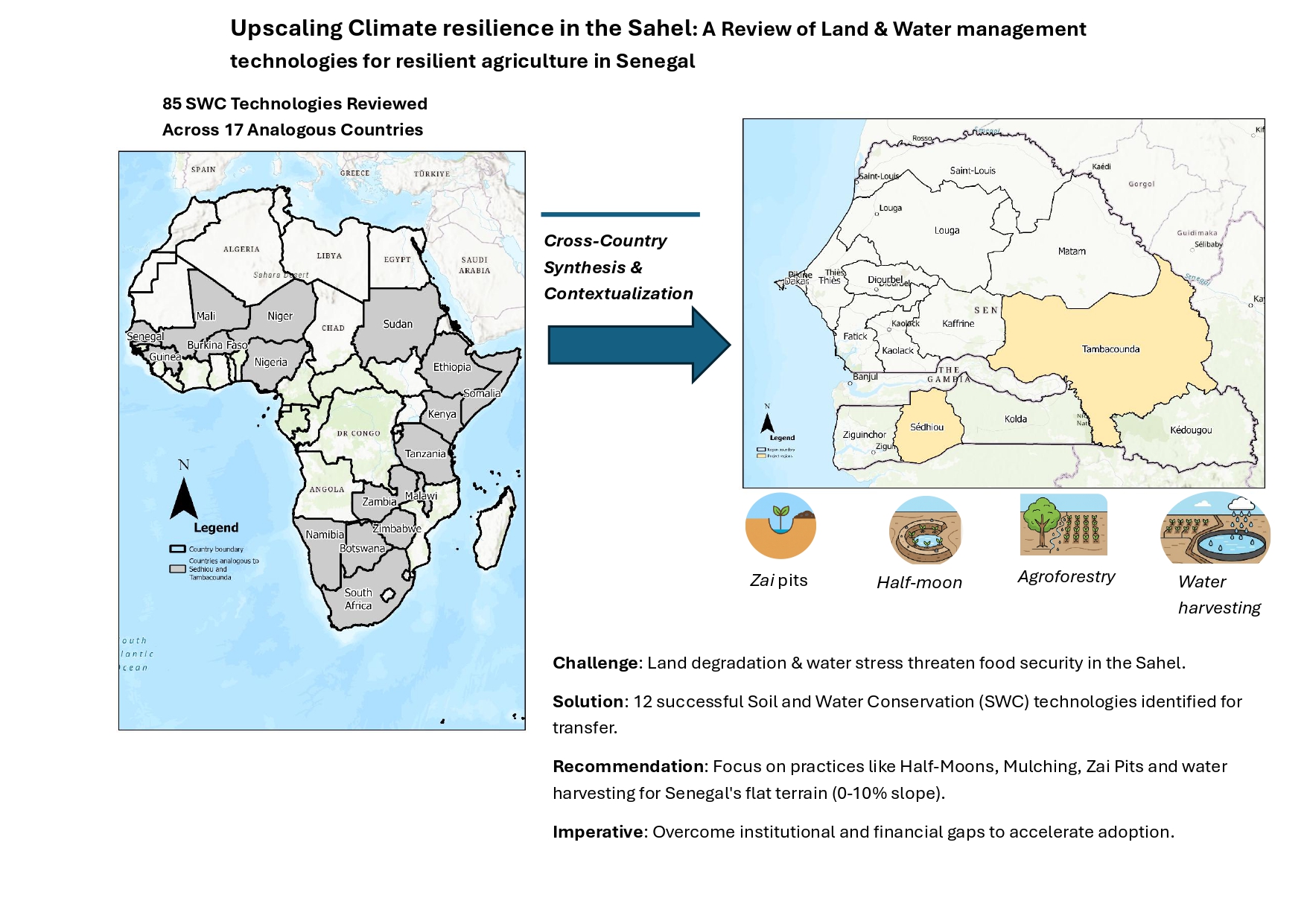
This review examines existing literature to identify effective soil and water management practices adopted across 17 selected sub-Saharan African countries, particularly in arid and semi-arid regions with climatic and agricultural conditions similar to those in Senegal and the broader Sahel. The objective is to highlight successful technologies that have been effectively implemented in these climate-analogous regions but remain underutilized in Senegal. The documented practices will be recorded and those that fit the Senegalese landscape and climate of Sédhiou and Tambacounda regions will be selected and recommended for adoption. By synthesizing regionally tested practices and aligning them with local needs, this review contributes to a deeper understanding of sustainable water resource management and their potential to transform agriculture in the region. Ultimately, it supports the development of resilient agricultural systems and a more secure future for communities in water-stressed environments. It informs technology transfer and adoption in the Sahel, with a focus on Senegal.
2. Materials and Methods
The review process followed a structured and replicable methodology which first employed K-means clustering to identify regions across Africa that exhibit similar climatic conditions to the Sahel areas of Sédhiou and Tambacounda. This analysis utilized bioclimatic variables obtained from WorldClim historical data [26] to categorize regions based on climate similarity.
Following Rockström et al. [27], the identified water-management technologies were classified into three categories of systems that: (i) Prolong the duration of soil-moisture availability in the soil, for example mulching practices; (ii) Promote infiltration of rainwater into the soil. These techniques include pitting, ridging/furrowing and terracing, or (iii) Store surface and sub-surface runoff water for later use, for example, rainwater harvesting systems with storage for supplementary irrigation [28].
2.1. Clustering Approach and Justification
The study applied the widely used K-means clustering algorithm to categorize regions across Africa exhibiting climatic conditions akin to the targeted Sahel areas and specifically Sédhiou and Tambacounda, due to its efficiency in handling large datasets and its ability to identify distinct groups based on proximity to cluster centroids [29]. This method was deemed appropriate for:
- Scalability: It effectively processes high-dimensional climatic data across Africa. K-means' straightforward iterative structure makes scaling to large amounts of data comparatively simple [30].
- Flexibility: The iterative process refines clusters based on climatic homogeneity [29].
- Interpretability: The clusters provide insights into identifying comparable regions and informing land and water management strategies.
The algorithm works by iteratively assigning data points to clusters based on their proximity to cluster centers and updating these centers [31]. In this context, it helped identify areas in other countries that share similar climatic characteristics with the study areas, forming clusters of analogous conditions. To determine the optimal number of clusters (k), the Elbow Method was applied, evaluating within-cluster variance across different values of k. The final model adopted a 60% climate similarity threshold, determined via Geometric Interval classification, to account for non-normal distributions in bioclimatic variables, thus ensuring that only significantly comparable regions were selected.
K-means clustering facilitated a preliminary systematic exploration of sustainable land and water management practices, providing valuable insights into strategies for on-farm or off-farm rainwater harvesting and storage, which is particularly crucial during periods of drought and intense, short-duration rainfall that are associated with climate change.
2.2. Bioclimatic Variables
Table 1 presents the statistics of bioclimatic variables used in clustering. These variables capture temperature and precipitation patterns, which are critical for assessing climatic similarity and rainwater management potential. The selection of bioclimatic variables (such as temperature seasonality (BIO4) and precipitation of the driest month (BIO14)) was guided by their relevance to water management in semi-arid regions. These variables capture critical aspects of climate variability that influence soil-moisture availability and rainwater-harvesting potential.
2.3. Regional Selection and Literature Review
This approach enabled researchers to pinpoint regions with analogous conditions, subsequently facilitating a comprehensive literature review on water-management technologies. The goal was to explore strategies for rainwater storage in the soil and rainwater harvesting that support crop growth through to maturity, particularly during droughts and intense, short-duration rainfall associated with climate change. By pinpointing regions with analogous climatic conditions, this study contributes to international research on climate adaptation and water-resource management. The findings offer a transferable framework for identifying areas where successful water-management strategies could be replicated, making them valuable for development organizations, farmers, policymakers, and researchers.
The clustering process identified 35 African countries with comparable climatic conditions (Figure 1). However, only 17 countries (bolded in the list below), were included in the literature review due to lack of adequate literature (as shown in Table 2, at the end of the results section). The countries encompassed, Botswana, Burkina Faso, Ethiopia, Guinea, Kenya, Malawi, Mali, Namibia, Niger, Nigeria, Senegal, Somalia, South Africa, Sudan, Tanzania, Zambia, Zimbabwe, Angola, Benin, Cameroon, Central African Republic, Chad, Côte d’Ivoire, Eritrea, Egypt, Gambia, Ghana, Guinea Bissau, Libya, Mauritania, Mozambique, Morocco, South Sudan, Togo, and Tunisia.
2.4. Review Methodology
To achieve the research objective, we conducted a systematic analysis of peer-reviewed and published articles, technical reports, and working papers. The review followed the Preferred Reporting Items for Systematic Reviews and Meta-Analyses (PRISMA) protocol as outlined by Moher et al. [32]and Page et al. [33] (Fig. 2). A comprehensive search was carried out across multiple platforms, including Google Scholar, Web of Science, Scopus, and Google, using search strings that combined terms such as “water management,” “soil and water management,” “sustainable land management,” “rainwater harvesting” with additional keywords like “technologies,” “practices,” “arid regions,” “semi-arid Africa,” and country-specific identifiers (e.g., “Ethiopia,” “Kenya,” “Sahel”).
From an initial pool of approximately 520 documents, 200 documents were excluded because they contained research from countries that had not been selected from the pool of 17 after the country clustering process. From the remaining 320 documents, duplicates, book chapters, reviews, and irrelevant grey literature were removed (n = 108). The remaining 212 documents were screened based on title and abstract for relevance to water management technology adoption in semi-arid regions. At this stage, 140 studies were excluded as irrelevant. A final set of 72 articles were selected for detailed assessment (Figure 2), and a total of 136 articles are cited in this paper.
Each study was analyzed to document the type of technology (e.g., in-situ/ex-situ water harvesting, soil-moisture conservation, efficient irrigation), its agroecological suitability (e.g., slope, rainfall, temperature), and the context and challenges of implementation. The review covered the period 2005–2023, ensuring that findings reflect current climatic realities and technological advances.
While this review focuses on the Sahel regions of Sédhiou and Tambacounda, the methodology is designed to be replicable in other semi-arid regions globally. For instance, the bioclimatic variables used in this analysis are universally applicable, and the clustering approach can be adapted to identify regions with similar climatic challenges in other parts of the world as any area of study. The water management strategies identified, such as rainwater harvesting and mulching, have been successfully implemented in semi-arid regions of Africa and could be adapted to other regions facing similar climatic pressures.
This methodology provides broader applicability beyond Sédhiou and Tambacounda by:
- Identifying transferable water management strategies applicable to regions with similar climate profiles.
- Enhancing climate adaptation frameworks by linking findings to global agricultural resilience policies (FAO, UNDP).
- Providing a replicable model for future studies assessing climate-adaptation-based agricultural interventions in semi-arid regions worldwide.
This study contributes to advancing the field by addressing the critical gap in the adoption of land and water management technologies in Senegal. By leveraging K-means clustering to identify comparable climatic regions and conducting a systematic literature review, this study introduces a data-driven approach to technology transfer. The findings provide a scientifically grounded framework for farmers, policymakers and development practitioners to adopt proven water management strategies, ensuring that innovations are tailored to the specific needs of Senegalese farmers. In doing so, this study aligns with international research efforts on climate adaptation, land management, and sustainable agriculture, reinforcing the global discourse on improving agricultural resilience in semi-arid regions.
Compiling Water Management and Conservation Technologies Across the Selected Countries
A comprehensive collection of water conservation and management technologies as implemented in various African countries, was compiled and organized on a country-by-country basis into tables after sorting them into, in-situ and ex-situ water harvesting, soil-moisture management and efficient irrigation techniques (Table A1, Table A2, Table A3, Table A4 and Table A5, fully listed in the supplementary material in the Appendix).
The technologies were further analyzed in the context of Senegal’s land gradient (Table 3). This assessment was crucial to prioritizing feasible technologies, by identifying the best-suited technologies for Senegal’s topography and to ensure that the technologies align with local farming practices and socio-economic conditions, increasing their practicality and acceptance by farmers. Slope suitability is a critical factor for successfully implementing most soil and water conservation measures. Each technology has specific slope thresholds, influencing its effectiveness and minimizing risks like erosion or inefficiency.
3. Results
3.1. Water Conservation and Management
Water conservation and management involve the following measures: (i) in-situ and ex-situ water harvesting; (ii) soil-moisture management which adopts technologies that help retain soil moisture, reducing the need for irrigation; (iii) using efficient irrigation techniques; (iv) suitable crop selection; (v) applying precision agriculture, and (vi) planting drought resistant/tolerant varieties [34]. In this review we focus on i‒iii, in-situ and ex-situ water harvesting, soil-moisture management and efficient irrigation techniques. This is because the review prioritizes practices that are cost-effective and accessible to Senegalese smallholder farmers, as we focus on the goal of evaluating water-management strategies that directly address soil and water dynamics, such as capturing, storing, and efficiently utilizing water. Future studies can complement this work by exploring agronomic practices and technological advancements such as crop selection, precision agriculture, and drought-tolerant varieties.
3.2. Ex-Situ Water Harvesting Practices
Ex-situ water harvesting is a technique that involves collecting water in an area external to where it falls, storing it for future use. Examples of ex-situ water harvesting techniques include the capture and storage of water in dams, wells, ponds, and cisterns. This approach helps to effectively manage water resources, hence addressing water-scarcity challenges [35].
Small earthen dams are intended to store upstream water that can be later used for irrigation. Generally, constructing small earthen dams provides water for domestic use, provides a water storage system for livestock, and supports crop growth.
Similarly, sand dams are simple, low cost and low maintenance structures that provide an improved, year-round local water supply for domestic and agricultural uses. Structurally, they comprise stone masonry barriers placed across a seasonal sandy riverbed that traps rainwater and sand flowing down the catchment. Sand dams are applicable in drylands with seasonal rivers with sandy sediments and accessible bedrock.
3.3. In-Situ Water Harvesting
In-situ rainwater harvesting is a technique designed to enhance soil-water retention, effectively collecting water at its point of origin. This method ensures that rainwater is captured and utilized with minimal distance between the collection and usage areas. For example, practices like terracing, pitting, and conservation tillage are employed as in-situ water-harvesting methods. These measures are also used for soil conservation [36].
In-situ water-harvesting structures include Zai pits in Burkina Faso, and tassa pits in Niger constructed in soil-capped/crusted or degraded croplands with the aim of optimizing both the rainfall and runoff capture and increasing water infiltration for millet and sorghum cultivation. Others include stone lines laid on gently sloping fields in West Africa (Burkina Faso, Mali, Niger), and terraces that are locally known as fanya juu and fanya chini in East Africa (Ethiopia, Kenya, Tanzania, and Uganda). These terraces are constructed through excavation of trenches and ditches along the contour. Soil is piled uphill to generate bench terraces, preventing soil and water loss thereby improving plant growth conditions.
3.3.1. Soil-Moisture Management
Soil-moisture management techniques are practices designed to optimize the amount of water retained in the soil to support crop growth and improve water-use efficiency. These techniques are especially important in regions with irregular rainfall, such as arid and semi-arid areas. Some key soil-moisture management techniques include agroforestry; applying soil amendments; conservation tillage; contour farming and terracing; cover cropping, and mulching.
3.3.2. Efficient Irrigation Techniques
Efficient irrigation techniques minimize water wastage and maximize water delivery to crops, improving water-use efficiency and reducing environmental impacts. These techniques are particularly important in areas where water is scarce, for reduced water consumption. These techniques include drip-, flood-, sprinkler-, pivot-, or surface irrigation.
3.4. Studies and Innovations on Water Conservation and Management Technologies in Selected African Countries
This section presents a comprehensive collection of water conservation and management technologies as implemented in various African countries, organized on a country-by-country basis. Around 85 technologies were identified (some similar in practice) across the 17 countries, with Malawi adopting 22, Kenya 17 and South Africa, 13 (see table 2 and table A1 in the appendix). Additionally, detailed definitions and explanations of key technical terms related to soil and water management have been provided in the Table A2, Table A3, Table A4 and Table A5.
3.4.1. Botswana
Double ploughing is effective for weed control and boosting crop yields, while deep tillage and single moldboard ploughing of loamy and clod-forming soils increases water infiltration and crop yields. Surface-residue management and minimum tillage also enhance soil moisture [37]. There is extensive use of compacted ridges, strip tillage, and reservoir tillage [38] while ponds and small dams are being used to capture runoff [37]. Compacted ridges use plastic-covered ridging, compacted ridges/furrows, and loose ridges/furrows. The bottoms of the furrows are left loose. This type is very effective in harvesting water in events of low intensity rainfalls (≤ 10mm/hr.). Reservoir tillage consists of a series of regular pits, traditionally 1.5m square by 0.1 ‒ 0.5m deep with the crops grown on the ridges around the pits. Strip tillage involves cultivating only narrow seed rows and leaving the rest of the soil undisturbed, combining the soil health benefits of no-till systems with the seedbed precision of conventional tillage.
3.4.2. Burkina Faso
In Burkina Faso, contour ploughing, earth bunds, grass strips, stone rows/strips, and Zai pits, have been extensively adopted [39,40]. Agroforestry, filter walls, half-moons and rock bunds are also widespread in Burkina Faso [41]. Zai involves dry-season digging of pits of 30–50cm in diameter and 10–20cm deep every 0.8–1.2m apart and piling the soil on the lower slope to form crescents [42]. Stone strips are anti-erosion structures constructed through judicious arrangements of stones along the contour line. They reduce the speed of running water, allowing it to percolate into the soil while properly draining the excess. Runoff water collection practices for complementary irrigation include 'boulis' reservoirs, Geres reservoirs, and micro-reservoirs [43]. Boulis are oval or circular structures 60m long and 4 to 6m deep for collecting runoff water for market-gardening, or agroforestry production during the dry season, and overwintering rice cultivation [44]. Other technologies include: i) the Banka , which is a runoff water catchment basin that allows runoff to be collected for additional irrigation during in-season droughts [45]; ii) a filter bund, which is built along a temporary flowing watercourse; iii) a lowland or a drainage axis using rubble stones of different sizes to reduce the velocity of runoff, control soil erosion and water infiltration [46]; iv) a Tiarako bund , which is an anti-erosion device composed of blocks of rubble or stones to break the force of runoff water while allowing excess water to pass in order to avoid concentrations of water upstream, or to cause a slower flow of water downstream; v) permeable rock dams, which are structures built in gullies using loose rocks and stones and sometimes reinforced with gabions used to fill in gullies and control water flow, spreading the water over adjacent land improving it’s infiltration [47]; vi) a Vallerani system which involves a special tractor-pulled plow that constructs micro-catchments combining the traditional techniques of rainwater harvesting with mechanization for large-scale land rehabilitation [48].; vii) Ados which are earth bunds arranged in contour lines that stops runoff water and allows infiltration, increasing soil water-retention and storage capacity [49], and viii) permeable rock dikes which are erosion-control structures built along the natural contours, and designed to reduce runoff [47].
3.4.3. Ethiopia
Use of stone-faced soil bunds results in higher soil moisture compared to other conservation measures [50]. Other technologies used to improve soil moisture include soil bunds, soil-faced, deep-trench bunds, grass strips and terraces (e.g., fanya juu terraces with grass). A terrace is a slope-controlling barrier made of earth, stone, or another suitable material. Each terrace retains water that can improve soil fertility and crop productivity. A soil bund on the other hand, is a structural measure that consists of a soil and/or stone embankment built along the contour and stabilized with vegetation such as grass and fodder trees. The height of bunds is determined by the quantity of stones available. These bunds slow the speed of runoff and control soil erosion by trapping water and enabling it to infiltrate. Additionally, they contribute to groundwater replenishment [50]. Trash lines [51], micro-catchments and ponds [52,53], ridge and basin [54], and runoff/floodwater farming [55,56] enhance soil and water conservation through residue management. In addition, water infiltrates slowly into the soil increasing soil moisture [52].
3.4.4. Guinea
Guinea uses improved wells, hill reservoirs and micro-dams [57]. Improved wells promote the use of groundwater to meet potable water needs and create pastoral water points. In Guinea, these are supplemented by the use of hill reservoirs and micro-dams for irrigation of plains and lowlands and for domestic and pastoral water needs.
3.4.5. Kenya
Soil and water conservation efforts in Kenya were first formally initiated by the colonial government in the early 1930s. These efforts have played a pivotal role in mitigating soil erosion and boosting agricultural yields. Kenya has implemented a range of water-management technologies, especially in the lower eastern regions of the country, which receive less than 500mm of rainfall annually. These initiatives have been crucial in enhancing food production and agricultural sustainability. In Kenya, as outlined by Kimani et al. [58] a range of rainwater harvesting technologies (RWHTs) are actively employed in the lower eastern counties. Macro-catchment methods like earth dams; water pans and sand/sub-surface dams; micro-catchment practices such as Zai pits; strip catchment; conservation tillage; terracing; contour and semi-circular bunds; as well as rooftop rainwater harvesting techniques. Notably, rooftop catchment stands out as the most widely adopted approach among these methods.
The above-mentioned water conservation techniques encompass a range of methods employed to manage and harness rainwater efficiently. Earth dams refer to the construction of large reservoirs or embankments to store rainfall runoff. Sand and sub-surface dams involve the use of sand barriers and underground structures to trap and store rainwater. Water pans, often referred to as water pans or pans, are shallow excavated depressions designed to collect and store rainwater efficiently [59]. They usually have storage capacities that do not exceed 20,000m3 and have a shallow depth of less than 5m [60]. Zai pits are small pits dug into the ground to enhance soil-moisture retention and crop growth [61]. Strip catchments, tillage techniques, contour farming, and semi-circular bunds are key land and water management strategies designed to enhance water use efficiency and reduce soil degradation in water-scarce regions. Strip catchments involve constructing channels and physical structures to direct and capture rainwater, while tillage techniques improve soil infiltration and reduce surface runoff [60]. Contour farming aligns planting along the natural contours of the land, minimizing erosion and improving rainwater retention [62]. Semi-circular bunds—crescent-shaped earth barriers—trap rainfall and promote its gradual absorption into the soil [63]. Together, these techniques offer a sustainable approach to managing water resources, mitigating soil erosion, and improving agricultural productivity in arid and semi-arid environments.
Zai pits concentrate rainwater within a smaller area resulting in a higher soil water content per unit volume of soil, consequently elevating the water level in the soil [64]. This creates favorable conditions for crop nutrient uptake, ultimately contributing to increased crop yields. [65] documented Negarims, Grass strips, stone lines, and trash lines and added them to the list of technologies adopted in Kenyan dry areas. Negarim, a distinctive agricultural intervention, entails creating diamond-shaped, small runoff micro-basins enclosed by low earth bunds [66]. Primarily employed for cultivating trees and bushes in arid and semi-arid regions, Negarim simultaneously serves as a valuable measure against soil erosion. Meanwhile, grass strips, which involve linear plantings of grass or vegetation within agricultural fields, act as natural erosion barriers, slowing runoff, stabilizing soil, and promoting water infiltration [67]. Stone lines, characterized by stone or rock barriers across fields, effectively control soil erosion by capturing sediment and reducing surface runoff water velocity, allowing for enhanced rainwater infiltration [61]. Similarly, trash lines, formed from crop residues or organic materials arranged in fields, contribute to improved water infiltration, reduced runoff, and soil erosion prevention, reinforcing comprehensive soil and water management practices. These techniques collectively offer essential tools for sustainable agricultural and environmental management, emphasizing conservation, water harvesting, and erosion control while catering for various agricultural needs in arid and semi-arid areas.
Other technologies include Retention ditches (also known as infiltration ditches); Cut-off drains/diversion ditches; Artificial waterways; Bench terraces; Reverse sloping; Terraces with soil thrown upslope; channel terraces; grass strips; trash lines; road runoff; planting pits/nine maize pits; agroforestry and tree planting; woodlots; trees on boundary; irrigation; blue water structures; roof catchment into a surface tank (individual); communal water pans and earth dams [68]. Trash lines; stone lines; check dams; grassed waterways; grass strips; small earth dams and ponds, are very popular among farmers in selected highland water catchments of Kenya [69]. Others include open and tied ridges which are commonly adopted in lower eastern and coastal Kenya [70]. In addition, earthen bunds have been used for water harvesting in semiarid regions of Africa. These are various forms of earth-shaping, created for ponding runoff water [71]. The variations of earthen bunds include contour bunds, semi-circular bunds and Negarim micro-catchments which have been used in arid and semi-arid regions where the seasonal rainfall can be as low as 150mm [72].
3.4.6. Malawi
The use above-ground tanks for domestic application have been the most popular technique for rainwater harvesting in Malawi [73]. Concrete lined underground tanks have mostly been built to collect runoff from ground surfaces, for example, in school grounds, on hill sides and as road runoff. Other measures include: i) compost manure making and application; ii) constructing earth dams for irrigation; iii) in-situ or soil storage rainwater harvesting by constructing box ridges, check dams, conservation agriculture, infiltration pits, marker ridges, percolation ponds, or swales; iv) mulching and crop-residue management, and v) planting grass strips/hedges along the contours [74]. Ponds and hand-dug wells store rainwater that is used productively in watering vegetables and fruit trees [73]. Flood-based farming systems include: i) Flood-plain agriculture (cultivation of flood plains using either receding or rising flood water); ii) Inundation canals (where cultivated fields are fed through a networks or canals by temporarily high water levels in perennial rivers); iii) Using residual moisture (as the moisture dries up farmers will use water from shallow wells using watering cans or treadle pumps to irrigate crops); and iv) Spate irrigation (diversion of short-term flood flows from seasonal rivers to field by means of small earth canals) [73].
There is also an extensive use of treadle pumps for irrigation [75]. The treadle pump is a simple, low-cost pump that was promoted for adoption by smallholder farmers owing to its simplicity, as farmers mostly repair and maintain them using locally available materials. The treadle pump is ideal for small areas (up to 0.4ha) which is appropriate for Malawian landholding sizes. This pump is appropriate where there are low pumping heads (<7m) with a nearby water source (<200m). The irrigation methods commonly used with treadle pumps in Malawi are basin and furrow irrigation.
3.4.7. Mali
In Mali, various soil-water management technologies are employed to address runoff and erosion issues. These include: i) non-permeable dikes used primarily in rice production but prone to waterlogging and requiring extensive maintenance; ii) vegetative strips planted with perennial grasses to combat wind and water erosion (though they can pose weeding challenges and provide cover for snakes); iii) half-moons [76], which are earthen ridges promoting water infiltration, often combined with using organic fertilizer; iv) living hedges planted on field boundaries and made of perennial species. They protect crops, improve soil quality, and offer additional benefits like forage and roofing materials; and v) stone bunds or lines, which reduce runoff, erosion, and waterlogging, while creating a micro-climate favoring natural vegetation growth. These diverse methods for managing soil and water effectively cater for the specific needs and conditions of different agricultural contexts in the region [77]. In addition, there are check dams, contour ridges, grass strips, stone rows, and water evacuation dikes [78]. Contour bunding is widely adopted in farmers’ fields to improve land and water resource management [79], as well as contour ridge tillage [80].
3.4.8. Namibia
Namibians use contour ditches and bunds to trap rainwater and rehabilitate soil [81]. In addition, ripping, planting basins, composting and drip irrigation are being adopted [82]. The deep ripping method also known as “deep tillage” is a water conservation practice that involves the use of strong, deep working tines (spikes) that penetrate compacted soil and mechanically break up the hard sub-soil plough pan. Nombete (meaning ‘beds’) is a low-cost indigenous irrigation technique, involving the making of small irrigation beds for vegetable production that is practiced along the Okavango River [83]. Simple rainwater harvesting could easily be introduced, by creating tied ridges between the raised beds. Irrigation is done by watering cans using river water. Treadle/manual pumps could reduce the labor requirement for irrigation, but would need to be easy to carry, since people walk significant distances to their gardens.
3.4.9. Niger
In Niger, Zai (locally called tassa) and half-moon catchment (demi-lunes) are the most promising, as both techniques are simply applicable, and use locally available materials that require little investment, making them affordable to small-scale subsistence farmers for boosting yields [84]. In addition to Zai pits [85], half-moons are also adopted. Fallow, mulching, stone strips, fallow and tree planting are also practiced [86]. There are also reports of an improved version of ‘tassa’ and half-crescent-shaped earthen mounds which are the half-moons [87]. Planting pits / basins are commonly used in the sub-region with various modifications including Zai pits (Tassa) in Burkina Faso, Niger and in Mali, and half-moon (demi-lunes) in Niger.
A study in Niger reported higher yields on Zai treatments compared to flat planting [88]. This was attributed to a build-up in soil organic matter which may increase the soil’s water-holding capacity in the Zai treatments. Additional conservation techniques include half-moons, promoting/protecting natural regeneration, riverbanks, rock dikes and stabilizing gullies and sand dunes [89].
3.4.10. Nigeria
There are two types of practices for soil and water conservation in Nigeria: mechanical (engineering, otherwise known as structural), and biological measures [90]. Mechanical measures include bunding, check dams, crib walls, gabion structures, loose/stone boulders, ridging, terracing, and trenching. Biological measures (otherwise known as agronomic or agricultural and agroforestry) are the vegetative measures which include agricultural/agronomic practices, agroforestry, forestry, and horticulture. Others include check dams [91], cut-off drains, diversion ditches, earth dams [92] and terraces.
3.4.11. Senegal
In Senegal, stone lines with live hedges combine physical structures and plant practices to slow the speed of flows (upstream) and reinforce the impact of gabions (downstream) in a watershed system. Anti-salt and runoff retention dikes retain runoff water and reduce land salinity. Piterki retention basins are used to retain runoff water longer during the dry season for use in irrigating crops during the dry season. These traditional ponds/water retention basins form part of a storage infrastructure to mobilize and recover runoff water [93]. Low pressure micro-irrigation uses drip irrigation and water reservoirs to limit the loss of topsoil through runoff and to encourage water-table replenishment [94].
3.4.12. Somalia
3.4.13. South Africa
In South Africa, the adoption and application of contour ridges, mulching, rainwater harvesting, and terraces in Mpumalanga province has been widely documented (see below) [97]. Overall, the following 14 technologies are deployed in South Africa: i) Ama-pitsi or homestead ponds are hand-dug pits or small dams into which the surface runoff is diverted via small furrows and then stored for crops and domestic use ; ii) contouring; iii) diversion furrows; iv) granite dome water harvesting; v) Gelesha (a soil-turning method) Gelesha is the tilling of soil immediately after harvest. The practice ensures that any rain, dew or frost infiltrates the tilled soil, rather than ponding and evaporating or running off, thus increasing water availability for the next crop.; vi) grass strips on the contour (grown between fields to act as traps for increased infiltration); vii) klipplate and vanggate (hardened surface and catchment tanks), where a natural hardened and impermeable surface is cleaned and compacted, and rainwater is channeled from this surface to an underground tank; viii) modified tied ridges (locally called in-field rainwater harvesting); ix) mulching; x) ploegvore (mechanized pitting); xi) rock packs around individual maize plants that act as small basins intercepting and pooling overland runoff. These increase infiltration and seem to be a combination of micro-terracing and pitting. They consist of rocks packed into large crevices in granite and basalt domes, filled with soil and planted with maize and other crops. The cracks and crevices are the natural flow path of water running off the domes and this water is concentrated into the soil on the rock pack.; xii) saaidamme (floodwater harvesting) involves, fertile, silt-laden floodwater, usually from distant mountains (up to 150km away) being diverted by large weirs into a series of flat fields annually or biennially. Each field is between 1 and 100ha in size and is surrounded by a low earth wall 1–2m high. Together, the field and the wall form a flat, shallow dam, the floor of which is cultivated with crops––hence the name saaidam or ‘planting dam.;’ xiii) terracing; and xiv) trench beds [98].
3.4.14. Sudan
The Sudanese use contour farming, half-moon basins, low-lying crescents, mulching, and ridging to ensure longer-term rainwater retention on the cropped area to ensure infiltration [99]. The use of ridge-furrow has proven highly effective in conserving water in the root zone in semi-arid to sub-humid regions, particularly when ridges have cross ties in the furrows (known as tied-ridging, furrow blocking, or basin tillage). Tied ridging is likely to reduce surface runoff and increase retained water within the field, if carefully designed across the slope or along the contour lines [99]. Also documented are the application of the low-lying crescents [76].
3.4.15. Tanzania
In Tanzania, the World Agroforestry Center introduced Chololo pits [100]. Chololo pits are a technology that helps conserve soil moisture and improve soil fertility, increasing crop production and mitigating drought effects [101]. Tied ridges are also used and are commonly adopted in maize and millet crops [102]. Matengo pits are another water management technology that combines the anti-erosion techniques of pits and ridges on steep slopes. They were introduced in the 19th century in Mbinga district and used in producing staple crops [103]. Chaco dams are used for harvesting runoff water for domestic, livestock and agriculture use during both the rainy and dry seasons [104].
In Arusha and Kilimanjaro regions of Tanzania, an evaluation of flat planting, open ridges, potholes (small holes), and tied ridges, as water-harvesting techniques showed significant maize yield increases under tied ridging, as this method retained more moisture than the other methods. The recommendations were that tied ridges were not suitable where the average annual rainfall is more than 800 mm, as they may cause waterlogging. In areas with sandy soils, tied ridging is not recommended due to high water percolation and waterlogging respectively, while in drier areas with about 500mm rainfall, tied ridging is recommended to farmers who have easy access to capital resources, while potholing is recommended to farmers with scarce resources. Other recommendations included the crest- and side-seed placement in ridges to eliminate water logging.
3.4.16. Zambia
Zambians use construction of small earth dams to curb the increased frequency of droughts [105]. Micro-basin water harvesting is used in rainfed agriculture. The basins act as water harvesting basins that store water for a much longer time [106] and can significantly increase productivity, for example doubling maize yields to 3 tons/ha [107]. River flood-plain recession irrigation is practiced along Lake Kariba in which crops are planted following a receding flood in the flat flood areas along the riverbanks. The crops utilize the residual soil moisture in these alluvial soils. Inland valley swamp irrigation (Dambos) is implemented in low-lying areas where the water-table is high, enabling crops to be grown. Other water-management technologies include clay pot (sub-surface irrigation), also called ‘pitcher’ irrigation, and low-cost bucket- or drum-kit drip-irrigation. Micro-basins are constructed by making low earth ridges on all sides; they are normally circular, and square or diamond-shaped micro-catchments, 1-2m wide and about 0.5m deep [72].
3.4.17. Zimbabwe
In Zimbabwe, tied ridging and mulch ripping conserved higher topsoil moisture levels, especially at the beginning of the cropping season [28]. Mulching protected the soil from erosion and promoted infiltration. Inter-field-water harvesting techniques are promoted throughout southern Zimbabwe and include dead-level contours with or without infiltration pits, graded contour ridges and Fanya Juus. Infiltration pits within contour ridges are also being used in these areas [28]. Other technologies include dead-level and ordinary contours, dead-level contours with underground storage tanks, and infiltration pits. In-situ water-management techniques include planting basins and deep winter ploughing [28]. The micro-catchment structures include dead-level contours with or without infiltration pits [108]. Others include the tied contour ridges for water harvesting [76]. The tied-furrow system (1.5m‒2.0m) offers advantages for crop production on soils with a relatively high clay content and under dry conditions, in terms of water concentration, soil conservation and productivity [37]. Table 2 below summarizes the technologies available by country.
The slope-specific requirements (Table 3), emphasize the need for topographical considerations in recommending technologies. For example: Bench terraces are suitable for steep terrain to mitigate erosion, while creating level planting surfaces; and check dams perform well on low-gradient land to store water and slow its flow.
Additionally, contour bunds, stone lines, and trash lines provide adaptable solutions for areas with moderate slopes, balancing water retention with erosion control. Understanding these requirements ensures that farmers implement technologies that are both effective and sustainable for their specific landscapes.
In this review, the most widespread technologies based on the frequency of adoption across countries include bunds, grass strips, residues, stone lines, terracing and Zai pits.

Table 4.
Most adopted land and water management technologies by functional category.
| Technology (Functional Category) | Countries | No. of Countries |
|---|---|---|
| Bunds (stone, earth, contour, tied, etc.) | Burkina Faso, Ethiopia, Kenya, Mali, Namibia, Senegal, Sudan, Zimbabwe | 8 |
| Mulching / Residue Management | Ethiopia, Kenya, Malawi, South Africa, Sudan, Zambia, Zimbabwe | 7 |
| Grass Strips / Vegetative Barriers | Burkina Faso, Ethiopia, Kenya, Malawi, Somalia, South Africa | 6 |
| Ponds / Micro-dams / Water pans | Botswana, Ethiopia, Guinea, Kenya, Malawi, Zambia | 6 |
| Stone Lines / Stone Rows | Burkina Faso, Ethiopia, Kenya, Mali, Senegal | 5 |
| Terracing / Contour Ridges | Ethiopia, Kenya, Nigeria, Zimbabwe | 4 |
| Zai Pits / Planting Pits / Chololo Pits | Burkina Faso, Kenya, Niger, Tanzania | 4 |
| Check Dams / Water-Retention Dams | Malawi, Nigeria, Kenya, Zimbabwe | 4 |
| Drip Irrigation / Efficient Techniques | Namibia, Senegal, Tanzania, Zambia | 4 |
| Compost / Manure Application | Malawi, Namibia, Zimbabwe | 3 |
| Tillage Techniques (Minimum/Precision) | Botswana, Kenya, Zambia | 3 |
| Flood Recession Farming / Spate Irrigation | Malawi, Ethiopia, Zambia | 3 |
| Agroforestry / Tree Planting | Nigeria, Niger, Malawi | 3 |
| Infiltration Pits / Percolation Pits | Malawi, Zimbabwe | 2 |
There is a significant adoption of traditional, low-cost, and community-driven technologies across West Africa, particularly in arid and semi-arid zones. Countries like Burkina Faso, Mali, Niger, Nigeria, and Senegal lead in these methods. Zai pits have been widely adopted in Burkina Faso and Niger with Stone lines and bunds being prominent in Burkina Faso, Mali, and Senegal. Agroforestry and tree planting practices have been widely adopted in Nigeria and Niger, while Earth bunds, Tiarako bunds, contour ploughing, and living hedges are also common, reflecting an emphasis on moisture retention and erosion control. These technologies often combine Indigenous knowledge with labor-intensive, soil- and water-conservation methods suitable for subsistence and smallholder farming systems. East Africa shows significant adoption of integrated land- and water-management technologies, especially in highland areas with steep slopes and high rainfall variability. Conservation tillage, grass strips and terracing (Fanya Juu), are common in Ethiopia and Kenya, helping manage erosion on slopes and in moisture retention particularly vegetative barriers. Tanzania and Sudan use Chololo pits and tied ridges to adapt to erratic rains while Zai pits, semi-circular bunds, and contour bunds are also applied in Kenya and Tanzania. These technologies are typically more diverse, blending traditional with modern scientific approaches to water harvesting and soil fertility.
Southern Africa leads in water-efficient technologies with the adoption of improved water harvesting, irrigation, and residue-management technologies, particularly in Botswana, Malawi, Namibia, South Africa, Zambia, and Zimbabwe. Unlike West and East Africa, where soil conservation prevails, southern Africa integrates conservation agriculture with small-scale irrigation, supporting both rainfed and semi-commercial farming. Composting, crop-residue management, and mulching are widely used in Malawi, South Africa, and Zimbabwe while bucket-, clay-pot- and drip-irrigation are widely used in Namibia and Zambia for their water-use efficiency in smallholder and dryland systems. Micro-dams, ponds, and water pans are widely built in Botswana, Malawi, Zambia, and Zimbabwe, emphasizing ex-situ water harvesting while check dams, infiltration pits, and percolation ponds are used in Malawi and Zimbabwe. In addition, dead level contours, planting basins, and tied ridges, are used for in-situ moisture management in drier areas in both Namibia and Zimbabwe. Southern Africa combines conservation agriculture principles with investment in low-cost irrigation and infrastructure, suitable for both rainfed and semi-commercial systems.
section may be divided by subheadings. It should provide a concise and precise description of the experimental results, their interpretation, as well as the experimental conclusions that can be drawn.
4. Discussion
The adoption of land- and water-management technologies across sub-Saharan Africa is uneven, with notable regional differences driven by agroecological suitability, institutional support, and socio-economic conditions [113].
The results show that West African countries like Burkina Faso, Mali, and Niger have made considerable strides in the uptake of practices such as half-moons, stone bunds, and Zai pits. This success can be attributed to decades of implementation by NGOs, and participatory projects that have aligned technologies with traditional farming systems [114]. Zai is a traditional rehabilitation technique that was developed in the early 1960s by farmers in northern Burkina Faso to restore their damaged land, deal with drought, and retain soil-moisture [115] while half-moons originated from the Sahel in the 1980s, in West Africa. Therefore, the two technologies are common in the Sahel, and hence their great uptake in Burkina Faso, Mali and Niger. In contrast, despite its similar climatic conditions Senegal has demonstrated relatively lower uptake of these technologies [116]. This lag may be due to institutional weaknesses, limited funding, and a lack of integrated policy strategies tailored to dryland agriculture particularly among farmers who have not been exposed to government, development and NGO programs [117]. In East Africa, countries like Ethiopia and Kenya lead in adopting agroforestry, terracing, and water harvesting, due to strong government programs and land-restoration incentives. This is coupled with collaborations between government agencies and NGOs [118]. Southern Africa has shown preference for conservation agriculture and cover crops, with support from national research institutions and regional policy harmonization [119]. This cross-country synthesis shows that successful technology adoption is not just a function of environmental necessity, but of institutional readiness, community involvement, and sustained policy investment.
Policy frameworks and institutional strength are crucial in shaping the diffusion and sustainability of land and water management technologies [120]. In countries like Kenya, where land-tenure systems are more secure and supported by decentralization policies, farmers are more willing to invest labor and resources in long-term land improvements [121]. Additionally, extension services and farmer training programs, especially those provided by community cooperatives and field schools, raise awareness and boost adoption rates. [122]. The review underscores the importance of enabling environments for successful implementation. For example, Ethiopia’s widespread adoption of soil and water conservation practices is facilitated by integrated watershed-management policies and active government involvement [123]. Conversely, Senegal's lower adoption can be linked to fragmented institutional roles and inconsistent policy incentives for sustainable agriculture [124]. Awareness-raising mechanisms, such as demonstration plots, local champions, and community-based resource groups, have played a significant role in improving technology uptake in Kenya, Malawi, and Tanzania [125].
Land- and water-management technologies carry important economic and social implications [126]. Technologies such as Zai pits and terracing, while effective, often demand substantial labor inputs and upfront costs, limiting accessibility for resource-constrained farmers [127]. Economic evaluations are rarely reported, but the results suggest that smallholders prioritize practices that show clear, short-term benefits, with minimal additional financial burden [128]. Gender dimensions are also critical [128], but under-researched and under-reported. Access to land, extension services, and credit significantly influence adoption [129], and women often face systemic barriers in all three [130]. Technologies that are labor-intensive or require land tenure security tend to exclude women unless tailored support is provided [131]. Youth engagement remains a largely unexplored frontier. With increasing rural youth unemployment, promoting technologies that are mechanized, entrepreneurial, or digitally supported could create new entry points for youth involvement. However, current literature lacks robust analysis on how land and water technologies affect or are adopted by young farmers. These gaps indicate a need for gender-responsive and youth-inclusive research and programming to ensure equitable access and impact.
This review identifies several limitations in the current body of research. First, there is a lack of long-term trials that assess how soil- and water-management technologies perform over multiple years under changing climate conditions [132]. Second, the economic dimensions of technology adoption are rarely analyzed in depth [133]. Yield gains are commonly reported, but data on labor costs, return on investment, and financial barriers are scarce. Without this, it is difficult to assess feasibility or incentivize scaling. Third, there is an absence of gender-disaggregated and youth-specific data [134]. Although women and youth play critical roles in agriculture, few studies explore how these groups interact with land- and water technologies or benefit from them. This lack of inclusivity weakens the evidence base for equitable development strategies. Finally, many technologies are assumed to be transferable across contexts without thorough testing. Technologies that are effective in one region may underperform elsewhere due to differences in community norms, institutions, soils, or topography [135]. This assumption of universality may reduce the effectiveness of technologies and reduce uptake.
To ensure that land- and water-management technologies are effective, inclusive, and scalable, future research should focus on several areas to benefit smallholder farmers across Africa’s drylands. First, there is a critical need for long-term impact assessments. Lack of long-term trials limits understanding of the durability of sustainable land-management technologies under prolonged drought, soil stress, or changing climate. Future studies should therefore track soil health, water retention, yield stability, and farmer satisfaction over multiple seasons and under variable weather and land-use conditions. This will help smallholder farmers manage risk and plan better for the future. In addition, studying the economic viability of these technologies is equally important. This will help smallholder farmers to make decisions regarding the most promising technology investment options. Inadequate finance to cover labor and input cost make smallholder farmers reluctant to adopt even these promising technologies. Therefore, future studies should include simple cost-benefit analyses, developed in partnership with farmers, to identify technologies with the best returns on investment. This will enable farmers to minimize risks and enhance access to microfinance or subsidies according to their profitability.
Disaggregated research on gender and youth is also crucial. Despite their significant contributions in agriculture, women and youth are frequently excluded from innovation and adoption pathways. Women face structural barriers such as insecure land tenure and limited access to information and tools [134], while youths have limited access to land, or find agriculture unattractive [136]. Future research must explore how land- and water technologies can be adapted to meet the specific needs of these groups. Doing so would ensure that more people benefit from sustainable practices, reduce inequality within farming communities, and build intergenerational interest in land management.
Additionally, future studies can assess and validate the adaptability of the diverse soil and water management practices in different locations. Technologies that are successful in one agroecological zone or region might not be effective in another. Soil type, rainfall variability, cultural preferences, and institutional environments differ greatly across the Sahel and sub-Saharan Africa. Evaluating and customizing technology to suit certain local conditions, prior to widespread promotion will save resource wastage and dissatisfaction. For farmers, this would require recommendations that are tailored to their field conditions and landscapes.
There is also a need to effectively integrate Indigenous and local knowledge into research and activities. This is because small-scale farmers across Africa have acquired generations of knowledge in managing scarce water, maintaining soil fertility, and coping with climate extremes. Investing in participatory research would enhance and improve current practices in addition to documenting local knowledge. This can promote cultural relevance, improve farmer ownership, and facilitate the adoption of new initiatives.
Finally, to engage the young generation and assist smallholder decision-making, there is a need to explore digital tools and rural innovations. These include using mobile phones and low-cost weather and soil sensors, which have become increasingly accessible. These can provide real-time guidance on where to access inputs, how to control runoff, and when to plant. Similarly, digital input supply agribusiness models involving water-harvesting and irrigation kits, or leasing farm equipment, can create opportunities for youth and local entrepreneurs. For smallholder farmers, digital and entrepreneurial innovations offer not only better access to information but also new income streams through job creation. These prospective research avenues promise to convert land- and water management from fragmented technical solutions into farmer-centric, contextually relevant techniques that enhance livelihoods, equality, and resilience within dryland agricultural systems.
Selection of Technologies for Adoption in Sédhiou and Tambacounda
Senegal has largely flat terrain, with the highest point being Baunez ridge situated 2.7km southeast of Nepen Diakha at 648m. Tambacounda lies at an elevation of 24m while Sédhiou lies at 33m. Therefore, adoption of soil- and water-management technologies needs to take slope into consideration, for more feasibility. Considering that most agricultural fields lie between a slope of 0 and 10%, the recommended technologies would include: agroforestry, deep ripping, drip irrigation, half-moons, infiltration pits, manure application, minimum tillage, mulching, residual moisture, road runoff water harvesting into pans and ponds, tied ridges, trash lines, water pans, and Zai/Tassa pits.
5. Conclusions
This review presents a synthesis of around 85 land- and water-management technologies implemented across 17 climate-analogous countries in sub-Saharan Africa, identified using K-means clustering based on bioclimatic variables. The technologies reviewed offer substantial potential for improving resilience and productivity in Senegal’s semi-arid zones, particularly Sédhiou and Tambacounda. These areas face declining yields, water stress, and land degradation which are challenges that demand site-appropriate, scalable solutions.
Despite the development of numerous effective soil- and water-conservation techniques across Africa, their adoption in the Sahel—and particularly in Senegal—remains limited due to weak institutional, financial, and political support, coupled with inadequate extension and monitoring systems [22]. Scaling these technologies is further constrained by insufficient financing and capacity within civil society, local authorities, and the private sector. Yet appropriate water management is essential for achieving optimal economic growth, food security, poverty reduction, climate resilience, biodiversity conservation, and sustainable agriculture. The review underscores that success depends not only on technology but also on systems that foster local ownership, stakeholder participation, and context-specific design. In arid regions, water management is as much a social and economic imperative as a technical one, requiring farmer empowerment, capacity building, and inclusive approaches for youth and women. Proven practices such as half-moons, mulching, rainwater harvesting into pans and ponds, trash lines, and Zai pits are especially well-suited to Sédhiou and Tambacounda’s terrain. Evidence from cross-country experiences shows that adoption is strongest where awareness, funding, institutions, and policies converge, highlighting the need for integrated strategies to translate technologies into lasting resilience.
Unlocking the full potential of soil- and water-conservation technologies requires governments and development partners to invest in knowledge transfer, demonstration sites, and cross-country learning platforms, while embedding conservation into multisectoral policies, increasing local financing, and ensuring inclusive participation of women, youth, and local leaders. Success depends on early and meaningful stakeholder engagement, which fosters ownership, integrates local knowledge, and enhances the appropriateness of decisions, even in contexts where mistrust or conflicts of interest often undermine adoption. Sustainable implementation also requires balancing economic, environmental, and social factors, and demonstrating both on-site and off-site benefits through an Integrated Water Resources Management approach. Strong policy support is pivotal, with governments shaping land-use decisions through legislation and regulations, while public education and improved knowledge-sharing mechanisms bridge gaps between science, policy, and practice. Without these measures, proven solutions risk remaining fragmented and failing to drive the agricultural transformation urgently needed in the Sahel.
Recommendations/Future Steps
- Integration into multi-sectoral policy frameworks: Water management and conservation practices should be seamlessly integrated into multi-sectoral policy frameworks in the region. Given the inherently cross-sectoral nature of such projects, policy frameworks should reflect the interconnectedness of water management and conservation initiatives, from local to regional levels.
- Adequate funding: To upscale water-management and -conservation practices, there is a critical need for both internal and external resource mobilization. Adequate funding should be secured to implement techniques and technologies beyond the capacities of local communities, including water-harvesting technologies, soil-fertility improvement techniques, afforestation, and forest management, as well as capacity-building initiatives.
- Private-sector involvement: The advisory roles of technical services, especially the participation of the private sector, should be improved to bring on board more key stakeholders, promote scaling up and sustainability of the practices in the long term. This can be achieved through developing harmonized planning and the promotion of marketable goods and services derived from the implementation of Sustainable Land Management practices.
- Empowering stakeholders: Soil and water conservation stakeholders should engage in careful planning to better conserve and use their soil and water resources. The ultimate goal is to empower farmers with the necessary tools and technical knowledge to effectively conserve these resources that will translate into improved agricultural productivity and livelihoods. Initiatives should be designed according to participatory and inclusive approaches that integrate ethnic, gender, and youth perspectives and knowledge.
- Capacity building, research, education, and extension: Emphasis should be placed on regular research, education, and extension (training) focused on soil- and water-conservation technologies for stakeholders, especially farmers. Continuous learning, awareness building, and knowledge dissemination are essential for the successful implementation of these conservation practices.
- Site-Specific Approaches: Soil- and water-conservation practices should be site-specific, considering the variations in soil types, crops, and climatic conditions among other factors, such as the technologies’ installation and maintenance costs across various ecological zones in the country. Tailoring interventions to specific contexts will enhance their effectiveness.
- Government Involvement: Governments at all levels should be actively involved in providing technical support and incentives for improving land- and water-management practices. This involvement is crucial for minimizing land degradation and improving water quality, contributing to achieving relevant Sustainable Development Goals.
- Arising from the review, the authors recommend that the technologies listed in table 5 below be considered for adoption in Sédhiou and Tambacounda, Senegal and the Sahel region:
Table 5.
Recommended land- and water-management technologies to boost Senegal's agricultural resilience.
Table 5.
Recommended land- and water-management technologies to boost Senegal's agricultural resilience.
| Management approach | Technology | |
|---|---|---|
| Efficient irrigation | 1 | Drip irrigation |
| 2 | Residual moisture irrigation | |
| Soil-moisture management | 3 | Agroforestry |
| 4 | Deep ripping | |
| 5 | Manure application | |
| 6 | Minimum tillage | |
| 7 | Mulch application | |
| 8 | Trash lines | |
| Water harvesting | 9 | Constructing half-moons |
| 10 | Constructing infiltration pits | |
| 11 | Road runoff water-harvesting into pans & ponds | |
| 12 | Establishing tied ridges | |
| 13 | Establishing Zai/Tassa pits | |
This is mainly because Sédhiou and Tambacounda regions have a fairly undulating terrain which limits the application of most of the researched technologies, which are only applicable in areas with greater slopes.
Author Contributions
Conceptualization; methodology; software; validation; formal analysis; investigation; resources; data curation; writing—original draft preparation, Wilson Nguru and Issa Ouedraogo; writing—review and editing; visualization, Cyrus Muriithi, Stanley Karanja, Michael Kinyua and Alex Ndua.; supervision; project administration; funding acquisition, Issa Ouedraogo. All authors have read and agreed to the published version of the manuscript.
Funding
This paper is part of the AVENIR project's activities (Adaptation and Valorization of Entrepreneurship in Irrigated Agriculture) in the Tambacounda and Sédhiou Regions of Senegal, funded by Global Affairs Canada (GAC), Project No. P005390, and implemented by Mennonite Economic Development Associates (MEDA) in collaboration with the International Center for Tropical Agriculture (CIAT).
Acknowledgments
We acknowledge Vincent Johnson (Consultant to the Alliance of Bioversity International and CIAT Science Editing Unit) for copy editing and editorial review of this paper. During the preparation of this manuscript, the authors used R (version 4.5.0) to run the k-means algorithm. The authors have carefully reviewed and refined the results and take full responsibility for the content of this publication.
Conflicts of Interest
The authors declare no conflicts of interest. The funders had no role in the design of the study; in the collection, analyses, or interpretation of data; in the writing of the manuscript; or in the decision to publish the results.
Abbreviations
The following abbreviations are used in this manuscript:
| AVENIR | Adaptation and Valorization of Entrepreneurship in Irrigated Agriculture |
| CIAT | International Center for Tropical Agriculture |
| FAO | Food and Agriculture Organization |
| GAC | Global Affairs Canada |
| MEDA | Mennonite Economic Development Associates |
| NGO | Non-Governmental Organizations |
| PRISMA | Preferred Reporting Items for Systematic Reviews and Meta-Analyses |
| SLM | Sustainable Land-Management |
| SWC | Soil and Water Conservation |
| UNDP | United Nations Development Programme |
| UNEP | United Nations Environment Programme |
Appendix A
Table A1.
Summary of 85 water conservation & management technologies by country.
| strategy | measures | Technology | Kenya | Tanzania | Ethiopia | Somalia | Zambia | Zimbabwe | Botswana | Namibia | Malawi | South Africa | Sudan | Niger | Mali | Burkina Faso | Nigeria | Guinea | Senegal | |
| Water Harvesting (In-situ) | irrigation | 1 | Inland valley swamp Irrigation | |||||||||||||||||
| ridges/ terraces | 2 | Ados | ||||||||||||||||||
| 3 | box ridges | |||||||||||||||||||
| 4 | Contour ridges and terraces | Vallerani system | ||||||||||||||||||
| 5 | Marker ridges | |||||||||||||||||||
| 6 | Ridges | open & tied | Tied | Tied; contour | Tied; compacted | contour | tied | |||||||||||||
| 7 | Terracing | fanya juus | Fanya Juus | |||||||||||||||||
| 8 | Dead level contours, | |||||||||||||||||||
| catchment | 9 | Gabion structures (rock barrier cages) | ||||||||||||||||||
| 10 | Strip catchment | strips | ||||||||||||||||||
| 11 | check dams | |||||||||||||||||||
| 12 | Concrete lined underground tanks | |||||||||||||||||||
| 13 | Earth dams | check dams | ||||||||||||||||||
| 14 | micro-basins | Negarims | Half-moon | |||||||||||||||||
| 15 | Percolation ponds | |||||||||||||||||||
| 16 | Piterki retention basin | |||||||||||||||||||
| 17 | planting basins | |||||||||||||||||||
| 18 | Ponds | |||||||||||||||||||
| 19 | Rainwater harvesting, | |||||||||||||||||||
| 20 | Retention ditches | Contour ditches | trenching | Anti-salt & runoff retention dike, | ||||||||||||||||
| 21 | Soil bunds | contour & semi circular | Stone faced/ Soil faced deep trench | contour | Low-lying crescents, | C, Tiarako bunds, | ||||||||||||||
| 22 | Stone lines | |||||||||||||||||||
| soil | 23 | compost | ||||||||||||||||||
| 24 | conservation agriculture | |||||||||||||||||||
| 25 | grass strips | |||||||||||||||||||
| 26 | hedges | |||||||||||||||||||
| 27 | Mulching | |||||||||||||||||||
| 28 | Tillage | conservation | deep winter ploughing/ ripping | double ploughing/ Furrow & precision strip tillage | deep ripping | contour ploughing | ||||||||||||||
| drainage | 29 | Cut-off drains, | ||||||||||||||||||
| 30 | diversion ditches | |||||||||||||||||||
| 31 | infiltration pits | |||||||||||||||||||
| 32 | Pits | Zai | Chololo & Matengo | Infiltration pits | ploegvore (mechanized pitting), | Zai pits (tassa) | Zai pits, | |||||||||||||
| 33 | Swales (runoff channels) | |||||||||||||||||||
| Water Harvesting (Ex-situ) | dams | 34 | Small earth dams, | Chaco dams | ||||||||||||||||
| 35 | sub-surface dams | |||||||||||||||||||
| 36 | Sand dams | |||||||||||||||||||
| 37 | Non-permeable dikes | |||||||||||||||||||
| 38 | Permeable rock dams | |||||||||||||||||||
| basins | 39 | Water pans | ||||||||||||||||||
| 40 | Ponds | Ama-pitsi | ||||||||||||||||||
| 41 | Banka | |||||||||||||||||||
| 42 | Micro-basin water harvesting | |||||||||||||||||||
| reservoirs/tanks | 43 | Dead level contours with underground storage tanks, | ||||||||||||||||||
| 44 | Concrete-lined underground tanks | |||||||||||||||||||
| 45 | Klipplate and vanggate (hardened surface & catchment tanks), | |||||||||||||||||||
| 46 | Boulis reservoirs | |||||||||||||||||||
| 47 | Hill reservoirs, | |||||||||||||||||||
| pits | 48 | Infiltration pits | ||||||||||||||||||
| soil | 49 | Gelesha (soil turning), | ||||||||||||||||||
| water harvesting | 50 | Saaidamme (floodwater harvesting), | ||||||||||||||||||
| 51 | Granite dome water harvesting, | |||||||||||||||||||
| 52 | Improved wells, | |||||||||||||||||||
| 53 | Rock packs | |||||||||||||||||||
| Soil Moisture Management | soil management | 54 | Compost | |||||||||||||||||
| 55 | Contour farming, | |||||||||||||||||||
| 56 | Crop residue management | |||||||||||||||||||
| 57 | Fallow | |||||||||||||||||||
| 58 | Grass strips | on contour | ||||||||||||||||||
| 59 | Hedgerows | |||||||||||||||||||
| 60 | Manure | |||||||||||||||||||
| 61 | Minimum tillage | |||||||||||||||||||
| 62 | Mulching, | |||||||||||||||||||
| 63 | Planting basins | |||||||||||||||||||
| 64 | Ridge-furrow | |||||||||||||||||||
| 65 | Ripping | |||||||||||||||||||
| 66 | Stone strips | |||||||||||||||||||
| 67 | Trash lines | |||||||||||||||||||
| 68 | Tree planting | |||||||||||||||||||
| 69 | vegetative strips | |||||||||||||||||||
| water mgt | 70 | Inter field-water harvesting | ||||||||||||||||||
| 71 | Drip irrigation | |||||||||||||||||||
| Efficient Irrigation Techniques | soil | 72 | Furrow & precision strip tillage, | |||||||||||||||||
| water | 73 | Micro basins | ||||||||||||||||||
| irrigation | 74 | Spate irrigation, | ||||||||||||||||||
| 75 | Clay pot (sub-surface) irrigation, | |||||||||||||||||||
| 76 | drip irrigation, | drum kit | ||||||||||||||||||
| 77 | In-land Valley swamp Irrigation (Dambos) | |||||||||||||||||||
| 78 | Low-cost Bucket irrigation | |||||||||||||||||||
| 79 | Low-cost treadle/manual pumps, | |||||||||||||||||||
| 80 | Nombete low-cost indigenous irrigation technique | |||||||||||||||||||
| 81 | Recession Irrigation | |||||||||||||||||||
| excess water | 82 | flood-plain agriculture, | ||||||||||||||||||
| 83 | Runoff/ floodwater farming | |||||||||||||||||||
| 84 | Use of residual moisture | |||||||||||||||||||
| plants | 85 | Agroforestry | ||||||||||||||||||
| #technologies/country | 17 | 4 | 9 | 2 | 11 | 11 | 6 | 12 | 22 | 13 | 10 | 7 | 5 | 11 | 11 | 3 | 5 | |||
Table A2.
In-situ water harvesting technologies (52).
| Technology | Country | Definition |
|---|---|---|
| Ados | Burkina Faso | Earth bunds arranged in contour lines to stop runoff water and allow infiltration, increasing water retention in the soil. |
| Ama-pitsi/homestead ponds | South Africa | Hand-dug pits or small dams into which surface runoff is diverted and stored for crop and domestic use. |
| Banka | Burkina Faso | A traditional water conservation technique involves the construction of small earthen bunds. |
| Bench terraces | Kenya | Horizontal platforms with a raised embankment along the contour of sloping land to reduce soil erosion and enhance water retention. |
| Box ridges | Malawi | Elevated ridges, created to enhance soil moisture in the topsoil, particularly at the beginning of the cropping season. |
| Chololo pits | Tanzania | Pits designed to conserve moisture in the soil and improve fertility, ultimately increasing crop production. |
| Clay pot (sub-surface irrigation) | Zambia | A system using clay pots for sub-surface irrigation, providing controlled water supply to plants. |
| Compacted ridges | Botswana | Ridges consisting of plastic-covered structures that effectively harvest water during low-intensity rainfalls. |
| Contour ridges and terraces (fanya juu, fanya chini) | Kenya, Zimbabwe, South Africa, Ethiopia | Earth structures created along the contour of sloping land to minimize erosion and retain water. |
| Crib wall | Nigeria | A structure made of interlocking wooden or concrete elements to prevent soil erosion and retain water. |
| Cut-off drain/diversion ditch | Nigeria, Kenya | A constructed drain or ditch designed to divert water away from an area or prevent soil erosion. |
| Dead level contours with or without infiltration pits | Zimbabwe | Contour lines with or without pits constructed to improve water retention and prevent runoff. |
| Deep ripping | Namibia |
Water conservation practice involving the use of deep working tines to break up compacted soil and enhance infiltration. |
| Demi-lunes/half moons | Niger, Mali, Burkina Faso | Earthen ridges promoting water infiltration, often combined with organic fertilizer application. |
| Diversion ditches | Nigeria | Constructed ditches designed to divert water away from an area or manage water flow. |
| Earth bunds | Kenya, Burkina Faso | Structural measures consisting of soil or stone embankments built along the contour to reduce runoff speed and prevent erosion. |
| Earthen bunds - contour bunds, semi-circular bunds, and Negarims micro-catchments | Kenya, Ethiopia, Somalia, Namibia | Various forms of earth bunds created for ponding runoff water and water harvesting. |
| Filter bund | Burkina Faso | A water and soil conservation technology built in a flowing watercourse to reduce runoff velocity and control soil erosion. |
| Gelesha | South Africa | Tilling soil immediately after harvest to ensure rain, dew, or frost infiltrates the tilled soil. |
| Graded contour ridges and Fanya Juus | Zimbabwe, Kenya, Tanzania, Uganda, Ethiopia | Ridges and structures created along the contour to enhance water retention and prevent erosion. |
| Grassed waterways | Kenya | Waterways with planted grass or vegetation to slow runoff, stabilize soil, and promote water infiltration. |
| Infiltration pits | Zimbabwe, Malawi, Kenya | Small pits dug into the ground to enhance soil-moisture retention and promote water infiltration. |
| In-land valley swamp irrigation (Dambos) | Zambia | Low-lying areas with a high-water table used for growing crops. |
| Klipplate and vanggate | South Africa | Water conservation practices involving the creation of compacted ridges and reservoir tillage. |
| Low-lying crescents | Sudan | Crescent-shaped structures used to break the force of runoff water and enhance infiltration. |
| Matengo pits | Tanzania | Excavated pits designed to harvest and store rainwater for agricultural use. |
| Micro-basin water harvesting | Zambia | Harvesting rainwater in small micro-basins to enhance water availability for agriculture. |
| Mulch ripping | Zimbabwe | Incorporating mulch into the soil using ripping equipment to improve water retention. |
| Nombete (meaning ‘beds’) | Namibia | Low-cost indigenous irrigation technique involving small beds for vegetable production, often practiced along rivers. |
| Open ridges | Tanzania | Ridges created with an open design, likely used for water harvesting purposes. |
| Percolation ponds | Malawi | Ponds designed to enhance water infiltration, often constructed for rainwater harvesting. |
| Piterki retention basin traditional ponds/water retention ponds | Senegal |
Traditional ponds or basins constructed to retain water for agricultural use. |
| Planting basin | Zimbabwe, Namibia | Depressions or basins created for planting crops, enhancing water retention and infiltration. |
| Ploegvore (mechanized pitting) | South Africa | Structures or practices promoting water retention and infiltration in agricultural fields. |
| Ridging | Tanzania, Zimbabwe, Botswana, Kenya, Ethiopia, Sudan | Creating ridges in the soil to improve water retention and prevent soil erosion. |
| River floodplain recession irrigation | Zambia | Utilizing river floodplains for crop irrigation during the recession phase of flooding. |
| Rocks packs | South Africa | Water harvesting technique involves filling crevices with soil and planting crops to capture runoff. Rocks are packed into large crevices in granite and basalt domes, filled with soil and planted with maize and other crops. |
| Saaidamme | South Africa | A traditional practice involving the bunding of waterlogged areas for rice cultivation. |
| Sand dunes stabilization | Niger | Stabilizing sand dunes to prevent soil erosion and enhance water retention. |
| Semi-circular bunds | Kenya, Tanzania, Burkina Faso | Earth bunds constructed in a semi-circular shape to retain water and prevent erosion. |
| Spate irrigation | Malawi | Utilizing floodwaters for irrigation, often practiced in arid and semi-arid regions. |
| Stabilization of gullies and riverbanks | Niger | Techniques and structures used to stabilize eroded gullies and riverbanks. |
| Stone bunds or lines | Mali, Kenya, Ethiopia | Bunds or lines made of stones to control soil erosion and manage water flow. |
| Strip catchment | Kenya, | Collecting runoff water using strips of impermeable material to enhance water availability. |
| Swales | Malawi | Shallow channels or depressions in the landscape designed to manage water flow and enhance infiltration. |
| Tassa and half-crescent shaped earthen mounds (the half-moons). | Niger, Mali, Burkina Faso | Mounds and structures designed to enhance water retention and infiltration. |
| Terracing | Kenya, Somalia, South Africa, Nigeria | Creating terraces on sloping land to minimize erosion and improve water retention. |
| Tiarako bund | Burkina Faso | Bunds constructed in a specific shape to enhance water retention and soil moisture. |
| Tied contour ridges for water harvesting/Tied ridges | Kenya, Tanzania, Zimbabwe, Botswana, South Africa, Sudan, Namibia | Ridges constructed along contours and tied together to enhance water retention and infiltration. |
| Vallerani system | Burkina Faso | A system designed for rainwater harvesting, involving the construction of embankments and check dams. |
| Zai pits | Kenya, Burkina Faso, Niger, Mali | Small pits dug into the ground to enhance water infiltration and soil fertility, commonly used in agroforestry. |
Table A3.
Table 8: Ex-situ water harvesting technologies (25).
| Technology | Country | Definition |
|---|---|---|
| Above-ground tanks for domestic application | Malawi | Tanks designed for storing water above the surface, typically used for domestic purposes. |
| Anti-salt and runoff retention dike | Senegal | A technology designed to retain runoff water and reduce land salinity. |
| Artificial waterways | Kenya | Manufactured channels or water passages created for the purpose of managing water flow. |
| Blue-water structures | Kenya | Infrastructure designed to manage surface water, ensuring its availability for various uses. |
| Boulis reservoirs | Burkina Faso | Oval or circular structures dug into the ground to collect runoff water for different agricultural purposes. |
| Chaco dams | Tanzania | Dams used for harvesting runoff water for domestic, livestock, and agricultural use during both rainy and dry seasons. |
| Check dams | Kenya, Malawi, Mali, Nigeria | Small structures built across drainage channels to reduce water flow velocity and control soil erosion. |
| Compacted ridges | Botswana | Ridges consisting of plastic-covered structures that effectively harvest water during low-intensity rainfalls. |
| Concrete-lined underground tanks | Malawi | Underground tanks with concrete lining, often used to collect runoff from various surfaces. |
| Dead level contours with underground storage tanks | Zimbabwe |
Contour lines with underground tanks for storing water and preventing soil erosion. |
| (Granite) Dome water harvesting | South Africa | Harvesting rainwater on natural hardened and impermeable surfaces like granite domes. |
| Earth dams | Kenya, Zambia, Malawi, Nigeria | Large reservoirs or embankments constructed to store rainfall runoff. |
| Flood-plain agriculture | Ethiopia, Zambia, Malawi, South Africa | Cultivation of floodplains using receding or rising floodwaters for crop production. |
| Geres reservoir | Burkina Faso | A reservoir used to collect runoff water for various agricultural purposes. |
| Hill reservoirs | Guinea | Reservoirs constructed on hills to collect and store rainwater for various agricultural purposes. |
| Low-cost bucket/drum-kit drip-irrigation | Zambia | Drip-irrigation system using low-cost buckets or drums for water supply. |
| Low-pressure micro-irrigation (including drip irrigation and water reservoirs) | Senegal | Micro-irrigation methods with low water pressure, including drip irrigation and water reservoirs. |
| Micro-catchments and ponds | Ethiopia, Kenya, Zambia, Burkina Faso | Small catchment areas designed to collect runoff water and store it in ponds. |
| Pans and small dams | Kenya, | Shallow excavated depressions designed to collect and store rainwater efficiently. |
| Road runoff | Kenya, Malawi | Capturing and utilizing runoff water from roads for agricultural purposes. |
| Sand and sub-surface dams | Kenya, | Dams constructed with sand and other materials below the surface to store water. |
| Small earth dams and ponds | Kenya | Small-scale dams and ponds constructed to collect and store rainwater for agriculture. |
| Use of treadle pump for irrigation | Malawi | Utilizing treadle pumps for irrigation to enhance water availability for crops. |
| Water pans | Kenya | Depressions or ponds constructed to collect and store rainwater for agricultural use. |
| Water storage | Somalia, Botswana | Various methods and structures for storing water, including tanks, reservoirs, and ponds. |
Table A4.
Planting crop or trees and residue management methods (4).
| Method | Country | Definition |
|---|---|---|
| Agroforestry | Nigeria, Burkina Faso, Tanzania, Kenya | A land-use management system that integrates trees and shrubs with crops and/or livestock, promoting environmental sustainability. |
| Crop residues and mulching | Niger, Sudan, south Africa, Malawi, Zimbabwe, Kenya | The practice of leaving crop residues on the field or applying mulch to improve soil moisture and prevent erosion. |
| Grass strips along the contour | Kenya, Ethiopia, Somalia, Malawi, South Africa, Mali, Burkina Faso | Linear plantings of grass or other vegetation within agricultural fields to act as natural erosion barriers |
| Trash lines | Kenya, Ethiopia | Lines of crop residue or other material used to slow water runoff and enhance infiltration. |
Table A5.
Efficient irrigation techniques (4).
| Technology | Country | Definition |
|---|---|---|
| Drip irrigation | Zambia, Namibia, Kenya | Precise irrigation method delivering water directly to the plant roots using a network of tubes and emitters. |
| Spate irrigation | Malawi | Utilizing floodwaters for irrigation, often practiced in arid and semi-arid regions. |
| Use of residual moisture | Zambia, Malawi | as the moisture dries up, farmers will use water from shallow wells, using watering cans or treadle pumps to irrigate crops |
| Use of treadle pump for irrigation | Malawi | Utilizing treadle pumps for irrigation to enhance water availability for crops. |
References
- Nyamekye, C.; Thiel, M.; Schönbrodt-Stitt, S.; Zoungrana, B.J.B.; Amekudzi, L.K. Soil and Water Conservation in Burkina Faso, West Africa. Sustainability 2018, 10, 3182. [Google Scholar] [CrossRef]
- Lanckriet, S.; Derudder, B.; Naudts, J.; Bauer, H.; Deckers, J.; Haile, M.; Nyssen, J. A political ecology perspective of land degradation in the north Ethiopian highlands. Land Degrad. Dev. 2015, 26, 521–530. [Google Scholar] [CrossRef]
- UNESCO. The United Nations World Water Development Report 2023: partnerships and cooperation for water. <b>2023</b>, p. UNESCO. The United Nations World Water Development Report 2023: partnerships and cooperation for water. 2023, p. 189.
- Critchley, W.; Harari, N.; Mollee, E.; Mekdaschi-Studer, R.; Eichenberger, J. Sustainable Land Management and Climate Change Adaptation for Small-Scale Land Users in Sub-Saharan Africa. Land 2023, 12, 1206. [Google Scholar] [CrossRef]
- FAO. The state of the world’s land and water resources for food and agriculture (SOLAW) – Managing systems at risk. 2011.
- Miner, G.L.; Delgado, J.A.; Ippolito, J.A.; Stewart, C.E. Soil health management practices and crop productivity. Agric. Environ. Lett. 2020, 5. [Google Scholar] [CrossRef]
- Hake, K.D.; Grimes, D.W. Crop Water Management to Optimize Growth and Yield. In Physiology of Cotton; Springer: Dordrecht, 2010; pp. 255–264. [Google Scholar] [CrossRef]
- Khan, S.; Hanjra, M.A.; Mu, J. Water management and crop production for food security in China: A review. Agric. Water Manag. 2009, 96, 349–360. [Google Scholar] [CrossRef]
- Nkonya, E.; Johnson, T.; Kwon, H.Y.; Kato, E. Economics of Land Degradation in Sub-Saharan Africa. In Economics of Land Degradation and Improvement – A Global Assessment for Sustainable Development; Springer International Publishing: Cham, 2016; pp. 215–259. [Google Scholar] [CrossRef]
- UNEP. The Economics of Land Degradation in Africa: Benefits of Action Outweigh the Costs;A complementary report to the ELD Initiative. 2016. Available online: https://www.unep.org/resources/report/economics-land-degradation-africa-benefits-action-outweigh-costsa-complementary (accessed on 15 November 2023).
- FAO; AUDA-NEPAD. Review of forest and landscape restoration in Africa 2021. 2021. [CrossRef]
- Debnath, K. Water security for a sustainable planet. In Water Security, Conservation and Management; Springer: 2020.
- Singh, A.; Saha, D.; Tyagi, A.C. Emerging Issues in Water Resources Management: Challenges and Prospects. In Water Resources Management; Springer: 2019; pp. 1–23. [CrossRef]
- Mythili, M. Intensive agriculture and its impact on land degradation. In Land Degradation in India: Issues and Concerns; 2013.
- Gomiero, T. Soil degradation, land scarcity and food security: Reviewing a complex challenge. Sustainability 2016, 8, 281. [Google Scholar] [CrossRef]
- Miralles-Wilhelm, F. Nature-based solutions in agriculture: Sustainable management and conservation of land, water and biodiversity; Food and Agriculture Org.: Rome, 2021. [Google Scholar]
- Chandrasekaran, P.T.; Javaid, M.S.; Sadiq, A. Resources of water. In Water Resources and Management; 2021.
- Diouf, N.S.; Ouedraogo, I.; Zougmoré, R.B.; Ouedraogo, M.; Partey, S.T.; Gumucio, T. Factors influencing gendered access to climate information services for farming in Senegal. Gend. Technol. Dev. 2019, 23, 93–110. [Google Scholar] [CrossRef]
- Tappan, G.G.; Sall, M.; Wood, E.C.; Cushing, M. Ecoregions and land cover trends in Senegal. J. Arid Environ. 2004, 59, 427–462. [Google Scholar] [CrossRef]
- Reardon, T.; Kelly, V.A.; Crawford, E.W.; Jayne, T.S.; Savadogo, K.; Clay, D.C. Determinants of farm productivity in Africa: a synthesis of four case studies. MSU Int. Dev. Work. Pap. 1996. [Google Scholar]
- Ewulo, T.A.; Akinseye, F.M.; Teme, N.; Agele, S.O.; Yessoufou, N.; Kumar, S. Factors driving Climate-Smart Agriculture adoption: a study of smallholder farmers in Koumpentum, Senegal. Front. Agron. 2025, 7, 1552720. [Google Scholar] [CrossRef]
- World Bank. Senegal - Sustainable Land Management Project. Washington, DC, 2009. Available online: https://documents.worldbank.org/en/publication/documents-reports/documentdetail/169131468167666256 (accessed on 6 October 2025).
- Gaudreau, K.; Gibson, R.B. Sustainability Assessment of the Agricultural and Energy Systems of Senegal. Energies 2015, 8, 3503–3528. [Google Scholar] [CrossRef]
- Diop, A.M. Sustainable agriculture: New paradigms and old practices? Increased production with management of organic inputs in Senegal. Environ. Dev. Sustain. 1999, 1, 285–296. [Google Scholar] [CrossRef]
- Nyam, Y.S.; Kotir, J.H.; Jordaan, A.J.; Ogundeji, A.A.; Turton, A.R. Drivers of change in sustainable water management and agricultural development in South Africa: a participatory approach. Sustain. Water Resour. Manag. 2020, 6, 1–20. [Google Scholar] [CrossRef]
- Fick, S.E.; Hijmans, R.J. WorldClim 2: new 1-km spatial resolution climate surfaces for global land areas. Int. J. Climatol. 2017, 37, 4302–4315. [Google Scholar] [CrossRef]
- Rockström, J.; Barron, J.; Fox, P. Rainwater management for increased productivity among small-holder farmers in drought prone environments. Phys. Chem. Earth Parts A/B/C 2002, 27, 949–959. [Google Scholar] [CrossRef]
- Mupangwa, W.; Love, D.; Twomlow, S. Soil–water conservation and rainwater harvesting strategies in the semi-arid Mzingwane Catchment, Limpopo Basin, Zimbabwe. Phys. Chem. Earth Parts A/B/C 2006, 31, 893–900. [Google Scholar] [CrossRef]
- Ikotun, A.M.; Ezugwu, A.E.; Abualigah, L.; Abuhaija, B.; Heming, J. K-means clustering algorithms: A comprehensive review, variants analysis, and advances in the era of big data. Inf. Sci. 2023, 622, 178–210. [Google Scholar] [CrossRef]
- Bahmani, B.; Moseley, B.; Vattani, A.; Kumar, R.; Vassilvitskii, S. Scalable K-Means++. Proc. VLDB Endow. 2012, 5, 622–633. [Google Scholar] [CrossRef]
- Kanungo, T.; Mount, D.M.; Netanyahu, N.S.; Piatko, C.D.; Silverman, R.; Wu, A.Y. An efficient k-means clustering algorithm: Analysis and implementation. IEEE Trans. Pattern Anal. Mach. Intell. 2002, 24, 881–892. [Google Scholar] [CrossRef]
- Moher, D.; Liberati, A.; Tetzlaff, J.; Altman, D.G. Preferred Reporting Items for Systematic Reviews and Meta-Analyses: The PRISMA Statement. J. Clin. Epidemiol. 2009, 62, 1006–1012. [Google Scholar] [CrossRef]
- Page, M.J.; McKenzie, J.E.; Bossuyt, P.M.; Boutron, I.; Hoffmann, T.C.; Mulrow, C.D.; Shamseer, L.; Tetzlaff, J.M.; Akl, E.A.; Brennan, S.E.; et al. The PRISMA 2020 statement: An updated guideline for reporting systematic reviews. Int. J. Surg. 2021, 88, 105906. [Google Scholar] [CrossRef] [PubMed]
- Anantha, K.H.; Garg, K.K.; Barron, J.; Dixit, S.; Venkataradha, A.; Singh, R.; Whitbread, A.M. Impact of best management practices on sustainable crop production and climate resilience in smallholder farming systems of South Asia. Agric. Syst. 2021, 194, 103276. [Google Scholar] [CrossRef]
- Watkiss, P.; Downing, T.; Dyszynski, J. ADAPT cost project: Analysis of the economic costs of climate change adaptation in Africa. 2010.
- Barron, J.; Salas, J. Rainwater Harvesting: A Lifeline for Human Well-Being; UNEP: Nairobi, Kenya, 2009. [Google Scholar]
- Moroke, T.; Mzuku, M.; Kashe, K.; Pule-Meulenberg, F.; Patrick, C. Water Harvesting and Conservation Techniques for Dryland Crop Production in Botswana: A Review. AMA Agric. Mech. Asia Afr. Lat. Am. 2010, 41, 9–16. [Google Scholar]
- Kethobile, E. An investigation of tillage systems and implement design for water conservation in semi arid conditions in Botswana. PhD Thesis, University of South Africa, Pretoria, South Africa, 2006. [Google Scholar]
- Korodjouma, O.; Idriss, S.; Salif, B.; Prosper, Z. Soil and water conservation, and soil fertility management effects on rain water productivity of maize hybrid in Burkina Faso. Afr. J. Agric. Res. 2017, 12, 1014–1021. [Google Scholar] [CrossRef]
- Sidibé, A. Farm-level adoption of soil and water conservation techniques in northern Burkina Faso. Agric. Water Manag. 2005, 71, 211–224. [Google Scholar] [CrossRef]
- Pretty, J.N.; Williams, S.; Toulmin, C. Using Soil and Water Conservation Techniques to Rehabilitate Degraded Lands in Northwestern Burkina Faso. In Sustainable Intensification; Routledge: 2012; pp. 120–128.
- Sidibé, A. Farm-level adoption of soil and water conservation techniques in northern Burkina Faso. Agric. Water Manag. 2005, 71, 211–224. [Google Scholar] [CrossRef]
- Ouattara, B.; Hien, V. ; L.-E. soil water use: the key To, and U. 1999. Development of water management technologies for rainfed crops in Burkina Faso. In Soil Water Use: The Key to Sustainable Crop Production; 1999.
- Belemviré, A. Impact de la conservation de l’eau et des sols sur la régénération naturelle assistée. Rapp. Trav. 2003, 1. [Google Scholar]
- Sawadogo, H. Using soil and water conservation techniques to rehabilitate degraded lands in Northwestern Burkina Faso. Int. J. Agric. Sustain. 2011, 9, 120–128. [Google Scholar] [CrossRef]
- Ministre de l’Agriculture. DÉVELOPPEMENT DE L ’ AGROÉCOLOGIE ( SND -AE ). <b>2023</b>, pp. Ministre de l’Agriculture. DÉVELOPPEMENT DE L ’ AGROÉCOLOGIE ( SND -AE ). 2023, pp. 2023–2027.
- GIZ. Good Practices in Soil and Water Conservation: A contribution to adaptation and farmers´ resilience towards climate change in the Sahel. KOLUMNENTITEL VERSAL 2012, 95, 22. [Google Scholar] [CrossRef]
- Conedera, M.; et al. Reconstitution des écosystèmes dégradés sahéliens. Bois For. Trop. 2010, 304, 61. [Google Scholar] [CrossRef]
- Ouessar, M.; Hessel, R.; Sghaier, M.; Ritsema, C. Report on water harvesting inventory history and success stories. 2012.
- Abiye, W. Soil and Water Conservation Nexus Agricultural Productivity in Ethiopia. Adv. Agric. 2022, 2022, 8611733. [Google Scholar] [CrossRef]
- Mushir, A.; Kedru, S. Soil and Water Conservation Management Through Indigenous and Traditional Practices in Ethiopia: A Case Study. Ethiop. J. Environ. Stud. Manag. 2012, 5. [Google Scholar] [CrossRef]
- Abdelkdair, A.; Schultz, R.C. Water harvesting in a ‘runoff-catchment’ agroforestry system in the dry lands of Ethiopia. Agrofor. Syst. 2005, 63, 291–298. [Google Scholar] [CrossRef]
- Alemu, E.; Hundessa, M. Micro-Catchment Water Harvesting Systems for Tree Establishment in Dryland areas of Gara Adulala, Ethiopia. Agrofor. Syst. 2012. [Google Scholar]
- Brhane, G.; Wortmann, C.S.; Mamo, M.; Gebrekidan, H.; Belay, A. Micro-Basin Tillage for Grain Sorghum Production in Semiarid Areas of Northern Ethiopia. Agron. J. 2006, 98, 124–128. [Google Scholar] [CrossRef]
- Desta, G.; Legesse, G.; Amede, T.; Van, F. Rooyen, A. ; Whitbread, A.M. Unlocking the potential of flood farming to reduce flood risks and boost dryland production in Ethiopia. 2021. [Google Scholar]
- Gumma, M.K.; et al. Assessing potential locations for flood-based farming using satellite imagery: a case study of Afar region, Ethiopia. Renew. Agric. Food Syst. 2022, 37, S28–S42. [Google Scholar] [CrossRef]
- JPost. Guinée: profil des projets du pana. <b>2008</b>, pp. JPost. Guinée: profil des projets du pana. 2008, pp. 1–51.
- Kimani, A.G.; Ndunge, D. Rainwater Harvesting Technologies in Makueni County, Kenya. 2015. [CrossRef]
- Mati, B.M.; Best Practices for Rainwater Harvesting from Open Surfaces with Storage in Structures. Training Manual, 2020. Available online: https://www.researchgate.net/profile/Bancy-Mati/publication/344035633_Training_Manual_2-Best_Practices_for_Water_harvesting_from_Open_Surfaces/links/5f4e8a3ca6fdcc9879c0065b/Training-Manual-2-Best-Practices-for-Water-harvesting-from-Open-Surfaces.pdf (accessed on 7 May 2025).
- Kimani, M.W.; Gitau, A.N.; Ndunge, D. Rainwater harvesting technologies in makueni county, Kenya. J. Eng. Sci. 2015, 5, 39–49. Available online: https://www.academia.edu/download/37016676/F52039049.pdf (accessed on 7 May 2025).
- Karuku, G.N. Soil and water conservation measures and challenges in Kenya; A review. Int. J. Agron. Agric. Res. 2018, 12, 116–145. Available online: http://erepository.uonbi.ac.ke/handle/11295/154705 (accessed on 7 May 2025). [CrossRef]
- Amankwaa-Yeboah, P.; et al. Soil and water conservation measures for cereal-legume cropping systems: A training manual for farmers and agriculture extension officers. 2024. Available online: https://cgspace.cgiar.org/bitstreams/c80c84b4-8afe-441f-8691-0766721dd990/download (accessed on 8 May 2025).
- Kurdekar, A.; Ashoka, P.; et al.; Modern Techniques in Soil and Water Conservation In Advanced Farming Technologies for Pollution Reduction and Increased Crop Productivity; 2023. Available online: https://www.researchgate.net/profile/Samikhya-Bhuyan/publication/382827154_Advanced_Farming_Technologies_for_Pollution_Reduction_and_Increased_Crop_Productivity/links/66ad9946299c327096a798c3/Advanced-Farming-Technologies-for-Pollution-Reduction-and-Increased-Crop-Productivity.pdf#page=7 (accessed on 8 May 2025).
- Tisdale, S.; Nelson, W.; Beaton, J. Soil Fertility and Fertilizers; Macmillan Publishing Company: New York, NY, USA, 1985. [Google Scholar]
- Muriu-Ng’ang’a, F.W.; Mucheru-Muna, M.; Waswa, F.; Mairura, F.S. Socio-economic factors influencing utilisation of rain water harvesting and saving technologies in Tharaka South, Eastern Kenya. Agric. Water Manag. 2017, 194, 150–159. [Google Scholar] [CrossRef]
- Ngigi, S. Climate Change Adaptation Strategies: Water Resources Management Options for Smallholder Farming Systems in Sub-Saharan Africa; CRC Press: Boca Raton, FL, USA, 2009. [Google Scholar]
- Kinama, J.M.; Stigter, C.J.; Ong, C.K.; Ng’ang’a, J.K.; Gichuki, F.N. Contour hedgerows and grass strips in erosion and runoff control on sloping land in semi-arid Kenya. Arid Land Res. Manag. 2007, 21, 1–19. [Google Scholar] [CrossRef]
- Recha, J.W.; Mati, B.M.; Nyasimi, M.; Kimeli, P.K.; Kinyangi, J.M.; Radeny, M. Changing rainfall patterns and farmers’ adaptation through soil water management practices in semi-arid eastern Kenya. Arid Land Res. Manag. 2016, 30, 229–238. [Google Scholar] [CrossRef]
- Mcharo, M.; Maghenda, M. Cost-benefit analysis of sustainable land and water management practices in selected highland water catchments of Kenya. Sci. Afr. 2021, 12, e00779. [Google Scholar] [CrossRef]
- Mutuku, M.M.; Nguluu, S.N.; Akuja, T.E.; Bernard, P. Factors Affecting Adoption of Soil and Water Management Practices in Machakos County, Kenya. J. Adv. Agric. Technol. 2016, 3, 292–295. [Google Scholar] [CrossRef]
- Ibraimo, N.; Munguambe, P. Rainwater Harvesting Technologies for Small Scale Rainfed Agriculture in Arid and Semi-arid Areas. 2007. Available online: https://sswm.info/sites/default/files/reference_attachments/IBRAIMO%20&%20MUNGUAMBE%202007%20Rainwater%20Harvesting%20Technologies%20for%20Small%20Scale%20Rainfed%20Agriculture%20in%20Arid%20and%20Semi-arid%20Areas.pdf (accessed on 13 January 2025).
- Mati, B.M. Overview of Water and Soil Nutrient Management under Smallholder Rain-Fed Agriculture in East Africa; IWMI: Colombo, Sri Lanka, 2006. [Google Scholar]
- Nthara, M. Rainwater harvesting for improved food security and environmental conservation; Experiences from Malawi. In Water Harvesting in Sub-Saharan Africa; Routledge: London, UK, 2020. [Google Scholar]
- Nthara, M.; Rainwater harvesting for improved food security and environmental conservation; Experiences from Malawi. In Espíndola JAG, Flores CAC; Pacheco-Vega R and Montes MRP (eds); 2020. Available online: https://library.oapen.org/bitstream/handle/20.500.12657/43802/1/external_content.pdf#page=167 (accessed on 8 May 2025).
- Kadyampakeni, D.M.; Kazombo-Phiri, S.; Mati, B.; Fandika, I.R.; Kadyampakeni, D.M. Impacts of Small-Scale Water Management Interventions on Crop Yield, Water Use and Productivity in Two Agro-Ecologies of Malawi. Agric. Sci. 2014, 2014, 454–465. [Google Scholar] [CrossRef]
- Nyamadzawo, G.; Wuta, M.; Nyamangara, J.; Gumbo, D. Opportunities for optimization of in-field water harvesting to cope with changing climate in semi-arid smallholder farming areas of Zimbabwe. Springerplus 2013, 2, 1–9. [Google Scholar] [CrossRef]
- Loeffen, M.; Ndjeunga, J.; Kelly, V.; Sylla, M.L.; Traore, B.; Tessougue, M. Uptake of Soil and Water Conservation Technologies in West Africa: A Case Study of the Office de la Haute Vallée du Niger (OHVN) in Mali. 2008.
- Bodnár, F.; De Graaff, J. Factors influencing adoption of soil and water conservation measures in southern Mali. Land Degrad. Dev. 2003, 14, 515–525. [Google Scholar] [CrossRef]
- Birhanu, Z.B.; Tabo, R.; Sogoba, B.; Nicolas, F.; Wani, S.P. Assessment of Contour Bunding Technology for Improved Land and Water Management in Mali : Technical Document Produced for the CGIAR Program on Water, Land and Ecosystem (WLE), Research Report No. 63. ICRISAT 2014. [Google Scholar]
- Traore, K.; Birhanu, B.Z. Soil Erosion Control and Moisture Conservation Using Contour Ridge Tillage in Bougouni and Koutiala, Southern Mali. J. Environ. Prot. 2019, 10, 1333–1360. [Google Scholar] [CrossRef]
- Wijesinghe, A.; Thorn, J.P.R. Governance of Urban Green Infrastructure in Informal Settlements of Windhoek, Namibia. Sustainability 2021, 13, 8937. [Google Scholar] [CrossRef]
- Amukuhu, B.N. Factors affecting the adoption of sustainable water conservation practices in smallholder farming systems: A case study of smallholder farmers in Omusati region, Namibia. MSc Thesis, University of Namibia, Windhoek, Namibia, 2020. [Google Scholar]
- Mudamburi, B.; Ogunmokun, A.; Lutaaya, E.; Ogunmokun, A.A. Experiences with micro agricultural water management technologies: Namibia. Water SA 2018, 41, 181–199. [Google Scholar]
- Wildemeersch, J.C.J.; et al. Assessing the Constraints to Adopt Water and Soil Conservation Techniques in Tillaberi, Niger. Land Degrad. Dev. 2015, 26, 491–501. [Google Scholar] [CrossRef]
- Wildemeersch, J. Integrated biophysical and socio-economic evaluation of water and soil conservation techniques : a case study from Niger. PhD Thesis, Ghent University, Ghent, Belgium, 2015. [Google Scholar]
- Karidjo, B.Y.; Wang, Z.; Boubacar, Y.; Wei, C. Factors Influencing Farmers’ Adoption of Soil and Water Control Technology (SWCT) in Keita Valley, a Semi-Arid Area of Niger. Sustainability 2018, 10, 288. [Google Scholar] [CrossRef]
- Baidu-Forson, J. Factors influencing adoption of land-enhancing technology in the Sahel: lessons from a case study in Niger. Agric. Econ. 1999, 20, 231–239. [Google Scholar] [CrossRef]
- Adeoti, A.; Barry, B.; Adoption Driver and Constraints of Resource Conservation Technologies in Sub-Saharan Africa. FAO 2006. Available online: http://www.fao.org/ag/agl/agll/wocat/wocatqt.asp (accessed on 18 October 2019).
- Gabou, M.H.; Maisharou, A. Management Practices/Techniques Commonly Used in Niger Republic, West Africa. In Sustainable Intensification to Advance Food Security and Enhance Climate Resilience in Africa. In Sustainable Intensification to Advance Food Security and Enhance Climate Resilience in Africa; Springer: Cham, Switzerland, 2015; pp. 305–314. [Google Scholar] [CrossRef]
- Ahuchaogu, I.; Udoumoh, I.; Ehiomogue, P. Soil and Water Conservation Practices in Nigeria: A Review. Niger. J. Soil Water Conserv. 2022. [Google Scholar]
- Junge, B.; Deji, O.; Abaidoo, R.; Chikoye, D.; Stahr, K. Farmers’ Adoption of Soil Conservation Technologies: A Case Study from Osun State, Nigeria. J. Agric. Educ. Ext. 2009, 15, 257–274. [Google Scholar] [CrossRef]
- Iyilade, A.O.; Alalade, O.A.; Longe, M.P.; Olubunmi, A.A.; Blessing, A.S. Factors influencing adoption of sustainable soil and water conservation practices among smallholder farmers in Kwara State, Nigeria. J. Agric. Ext. 2020, 24, 113–121. [Google Scholar] [CrossRef]
- Sall, M.; Ba, B.; Kane, L.; des, P. Nationaux, D. Drought conditions and management strategies in Senegal. UNW-DPC.
- Ray, S.; Majumder, S. Water management in agriculture: Innovations for efficient irrigation. Available online: https://www.researchgate.net/profile/Sitabhra-Majumder/publication/381867727_Water_Management_in_Agriculture_Innovations_for_Efficient_Irrigation/links/6682e3530a25e27fbc1a4edc/Water-Management-in-Agriculture-Innovations-for-Efficient-Irrigation.pdf (accessed on 2 April 2025).
- Asmare, B.; Demeke, S.; Tolemariam, T.; Tegegne, F.; Wamatu, J.; Rischkowsky, B. Determinants of the utilization of desho grass (Pennisetum pedicellatum) by farmers in Ethiopia. Trop. Grassl.-Forrajes Trop. 2016, 4, 112–121. [Google Scholar] [CrossRef]
- Boitt, M.K.; Langat, F.C.; Kapoi, J.K. Geospatial agro-climatic characterization for assessment of potential agricultural areas in Somalia, Africa. J. Agric. Inform. 2018, 9. [Google Scholar] [CrossRef]
- Agholor, A.I.; Nkosi, M. Sustainable Water Conservation Practices and Challenges among Smallholder Farmers in Enyibe Ermelo Mpumalanga Province, South Africa. J. Agric. Ext. 2020, 24, 112–123. [Google Scholar] [CrossRef]
- Denison, J.A.; Wotshela, L. AN OVERVIEW OF INDIGENOUS, INDIGENISED AND CONTEMPORARY WATER HARVESTING AND CONSERVATION PRACTICES IN SOUTH AFRICA. Irrig. Drain. 2012, 61, 7–23. [Google Scholar] [CrossRef]
- Elramlawi, H.R.; Mohammed, H.I.; Elamin, A.W.; Abdallah, O.A.; Taha, A.A.A.M. Adaptation of Sorghum (Sorghum bicolor L. Moench) Crop Yield to Climate Change in Eastern Dryland of Sudan. In Handbook of Climate Change Resilience; Springer: Cham, Switzerland, 2019; pp. 1–25. [Google Scholar] [CrossRef]
- Ismail, Z.K.; Kaswamila, A.; Maro, F. Socio-economic Factors Affecting the Sustainability of Chololo Pits Technology in Semi-Arid Dodoma: The Case of Chamwino District, Tanzania. J. Geogr. Assoc. Tanzan. 2022, 42, 70–82. [Google Scholar] [CrossRef]
- Ismail, Z.K.; Kaswamila, A.; Maro, F. Prospects and Challenges of the Chololo Pits Technology In Enhancing Crop Production in Semi-Arid Areas Of Central Tanzania. Tanzan. J. Popul. Stud. Dev. 2023, 30, 45–62. [Google Scholar] [CrossRef]
- Gamba, A. Resilience and economic benefits of climate smartagriculture practices in semi-arid Tanzania. Sokoine University of Agriculture 2020. [Google Scholar] [CrossRef]
- Malekela, A.A.; Lusiru, S.N. Climate change adaptation strategies through traditional farming practices. The case of Matengo pits in Mbinga District, Tanzania. Int. J. Res. Publ. Rev. 3033. [Google Scholar] [CrossRef]
- Ernest, S.; Hagai, M.; Kasahigili, J.J. Water and Pasture Availability on Livestock Routes Under a Changing Climate: A Case of Ilemela and Magu Districts in Tanzania. J. Geogr. Assoc. Tanzan. 2016, 36, 35–44. [Google Scholar] [CrossRef]
- Sichingabula, H.M. Problems of sedimentation in small dams in Zambia. IAHS Publ. 1997, 245. [Google Scholar]
- Namara, R.; Awulachew, S.B.; Merrey, D.J. Review of agricultural water management technologies and practices. In Agricultural Water Management Technologies for Small Scale Farmers in Ethiopia; IWMI: Colombo, Sri Lanka, 2006. [Google Scholar]
- Daka, A.E. Experiences with Micro Agricultural Water Management Technologies : Zambia. IWMI 2006. [Google Scholar]
- Nyagumbo, I.; Nyamadzawo, G.; Madembo, C. Effects of three in-field water harvesting technologies on soil water content and maize yields in a semi-arid region of Zimbabwe. Agric. Water Manag. 2019, 216, 206–213. [Google Scholar] [CrossRef]
- Korodjouma, O.; Idriss, S.; Salif, B.; Prosper, Z. Soil and water conservation, and soil fertility management effects on rain water productivity of maize hybrid in Burkina Faso. Afr. J. Agric. Res. 2017, 12, 1014–1021. [Google Scholar] [CrossRef]
- Mangisoni, J.H.; Chigowo, M.; Katengeza, S. Determinants of adoption of rainwater-harvesting technologies in a rain shadow area of southern Malawi. AFBM J. 2019, 14, 106–119. [Google Scholar] [CrossRef]
- Njiru, E.N. Effect of Fanya Juu Terraces With Varying Ditch Dimensions on Selected Soil Properties and Crop Yields in Semi-arid Eastern Kenya. PhD Thesis, University of Nairobi, Nairobi, Kenya, 2023. Available online: http://erepository.uonbi.ac.ke/handle/11295/164622. Available online: http://erepository.uonbi.ac.ke/handle/11295/164622 (accessed on 9 May 2025).
- Namirembe, S.; Nzyoka, J.M.; Gathenya, J.M. A guide for selecting the right soil and water conservation practices for small holder farming in Africa. World Agrofor. Cent. (ICRAF) 2015. [Google Scholar]
- Sithole, A.; Olorunfemi, O.D. Sustainable Agricultural Practices in Sub-Saharan Africa: A Review of Adoption Trends, Impacts, and Challenges Among Smallholder Farmers. Sustainability 2024, 16, 9766. [Google Scholar] [CrossRef]
- Bado, V.; Savadogo, P.; Manzo, M.L.S.; Restoration of Degraded Lands in West Africa Sahel: Review of experiences in Burkina Faso and Niger. ICRISAT 2016. Available online: https://hdl.handle.net/20.500.11766/4897 (accessed on 14 May 2025).
- Ehiakpor, D.S.; Danso-Abbeam, G.; Dagunga, G.; Ayambila, S.N. Impact of Zai technology on farmers’ welfare: Evidence from northern Ghana. Technol. Soc. 2019, 59, 101189. [Google Scholar] [CrossRef]
- THE WORLD BANK. Climate Risk and Adaptation Country Profile – Senegal. Washington, DC, 2011. Available online: www.worldclim.org/current.
- CIAT; BFS/USAID. Climate-Smart Agriculture in Senegal. CSA Country Profiles for Africa Series. International Center for Tropical Agriculture (CIAT); Bureau for Food Security, United States Agency for International Development (BFS/USAID), 2016, p. 20.
- MENR. Kenya Strategic Investment Framework for Sustainable Land Management, 2017-2027. MINISTRY OF ENVIRONMENT AND NATURAL RESOURCES, 2017. Available online: https://www.fao.org/faolex/results/details/en/c/LEX-FAOC198041/ (accessed on 14 May 2025).
- FAO. Southern Africa Investment Plans and Opportunities. Hand in Hand Regional Initiative for Southern Africa, 2024. Available online: https://www.fao.org/hand-in-hand/previous-editions/hih-IF-2024/southern-africa/en (accessed on 14 May 2025).
- Mburu, B.N.; Kirui, L.; Karugia, J.T.; Adam, R. Policy and institutional landscape analysis in Kenya’s food, land, and water systems: Flagship report. 2024. Available online: https://hdl.handle.net/10568/149279 (accessed on 15 May 2025).
- Akhter, M.W.; Antonio, D.; Beyene, A.M.; Chigbu, U.E.; Dealca, R.L.; Zhang, X. Land tenure security in selected countries: Synthesis report. UN-Habitat Rep. 2014, 2, 2014. [Google Scholar]
- Evans, C.L. Review of agricultural extension interventions in unlocking agriculture potential through medium sized farms, Kenya. Available online: https://erepository.uonbi.ac.ke/handle/11295/81391 (accessed on 15 May 2025).
- Chesterman, N.S.; Entwistle, J.; Chambers, M.C.; Liu, H.C.; Agrawal, A.; Brown, D.G. The effects of trainings in soil and water conservation on farming practices, livelihoods, and land-use intensity in the Ethiopian highlands. Land Use Policy 2019, 87, 104051. [Google Scholar] [CrossRef]
- Cissé, F.; Diémé, J.; Sy, M.; Daniels, C.; Diallo, M.; Ting, B.; Developing a Transformative Innovation Policy Approach: The Case of Senegal. TIPC 2019. Available online: https://www.tipconsortium.net/wp-content/uploads/2019/07/Senegal-5-pager.pdf (accessed on 20 May 2025).
- Mogoi, J.; Masuki, K.; Tanui, J.; Mutua, J. Beyond coping mechanisms: adaptation of communities to climate change through landcare in East Africa. Available online: https://www.cifor-icraf.org/publications/downloads/Publications/PDFS/PP09259.pdf (accessed on 15 May 2025).
- Winterbottom, R.; et al. Improving Land and Water Management. Available online: https://www.wri.org/research/improving-land-and-water-management (accessed on 16 May 2025).
- Ngara, T.; Climate-smart agriculture manual for agriculture education in Zimbabwe. FAO 2017. Available online: https://orbit.dtu.dk/files/159520287/Climate_smart_Agriculture_Manual_FINAL_2_2_sent_in_Sierra_leones.pdf (accessed on 16 May 2025).
- Kansanga, M.M.; Luginaah, I.; Bezner Kerr, R.; Dakishoni, L.; Lupafya, E. Determinants of smallholder farmers’ adoption of short-term and long-term sustainable land management practices. Renew. Agric. Food Syst. 2021, 36, 265–277. [Google Scholar] [CrossRef]
- Bayisa, H.; Kebede, B.; Benti, F. Factors Influencing the Implementation and Adoption of Sustainable Land Management Practices on Wacaca Mountain in Central Highlands of Ethiopia. Environ. Model. Assess. 2024. [Google Scholar] [CrossRef]
- Awoke, M.D.; et al. Exploring gender dynamics in climate-smart agriculture adoption: a study in semi-arid Dodoma, Tanzania. Front. Sustain. Food Syst. 2024, 8, 1507540. [Google Scholar] [CrossRef]
- Doss, C.; Meinzen-Dick, R. Land tenure security for women: A conceptual framework. Land Use Policy 2020, 99, 105080. [Google Scholar] [CrossRef]
- Mhlanga, B.; Thierfelder, C. Long-term conservation agriculture improves water properties and crop productivity in a Lixisol. Geoderma 2021, 398, 115107. [Google Scholar] [CrossRef]
- Giger, M.; Liniger, H.; Sauter, C.; Schwilch, G. Economic benefits and costs of sustainable land management technologies: An analysis of WOCAT’s global data. Land Degrad. Dev. 2018, 29, 962–974. [Google Scholar] [CrossRef]
- UNCCCD. GENDER-RESPONSIVE SUSTAINABLE LAND MANAGEMENT. 2022.
- Eichler Inwood, S.E.; López-Ridaura, S.; Kline, K.L.; Gérard, B.; Monsalue, A.G.; Govaerts, B. Assessing sustainability in agricultural landscapes: a review of approaches1,2. Environ. Rev. 2018, 26, 299–315. [Google Scholar] [CrossRef]
- Mangole, C.D.; et al. Adoption of sustainable land and water management practices and their impact on crop productivity among smallholder farmers in sub-Saharan Africa. Land Use Policy 2025, 153, 107533. [Google Scholar] [CrossRef]
Figure 1.
A map of Africa showing areas climatically analogous to the Sédhiou and Tambacounda regions of Senegal.
Figure 1.
A map of Africa showing areas climatically analogous to the Sédhiou and Tambacounda regions of Senegal.
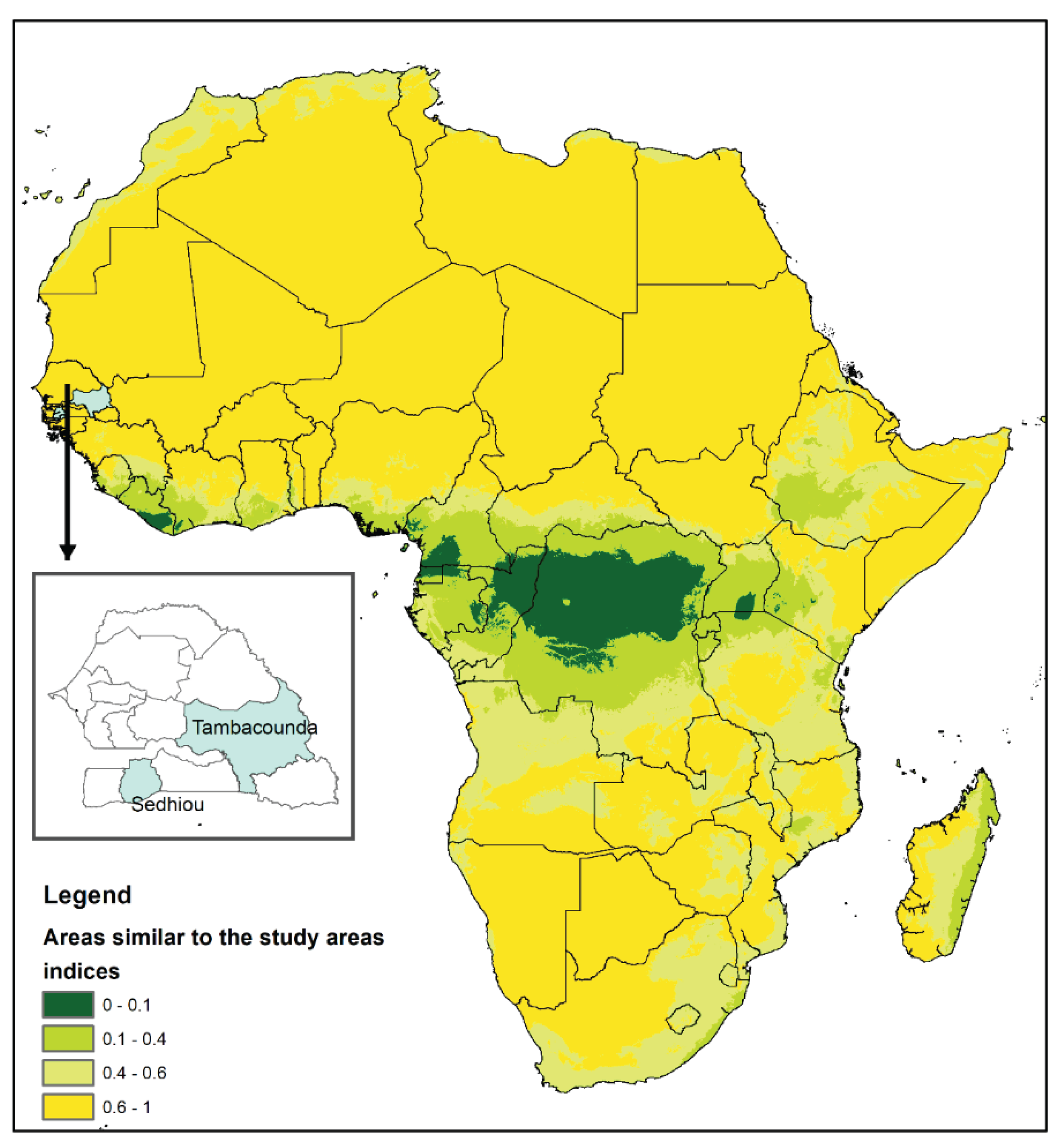
Figure 2.
PRISMA statement describing the steps for systematic literature review.
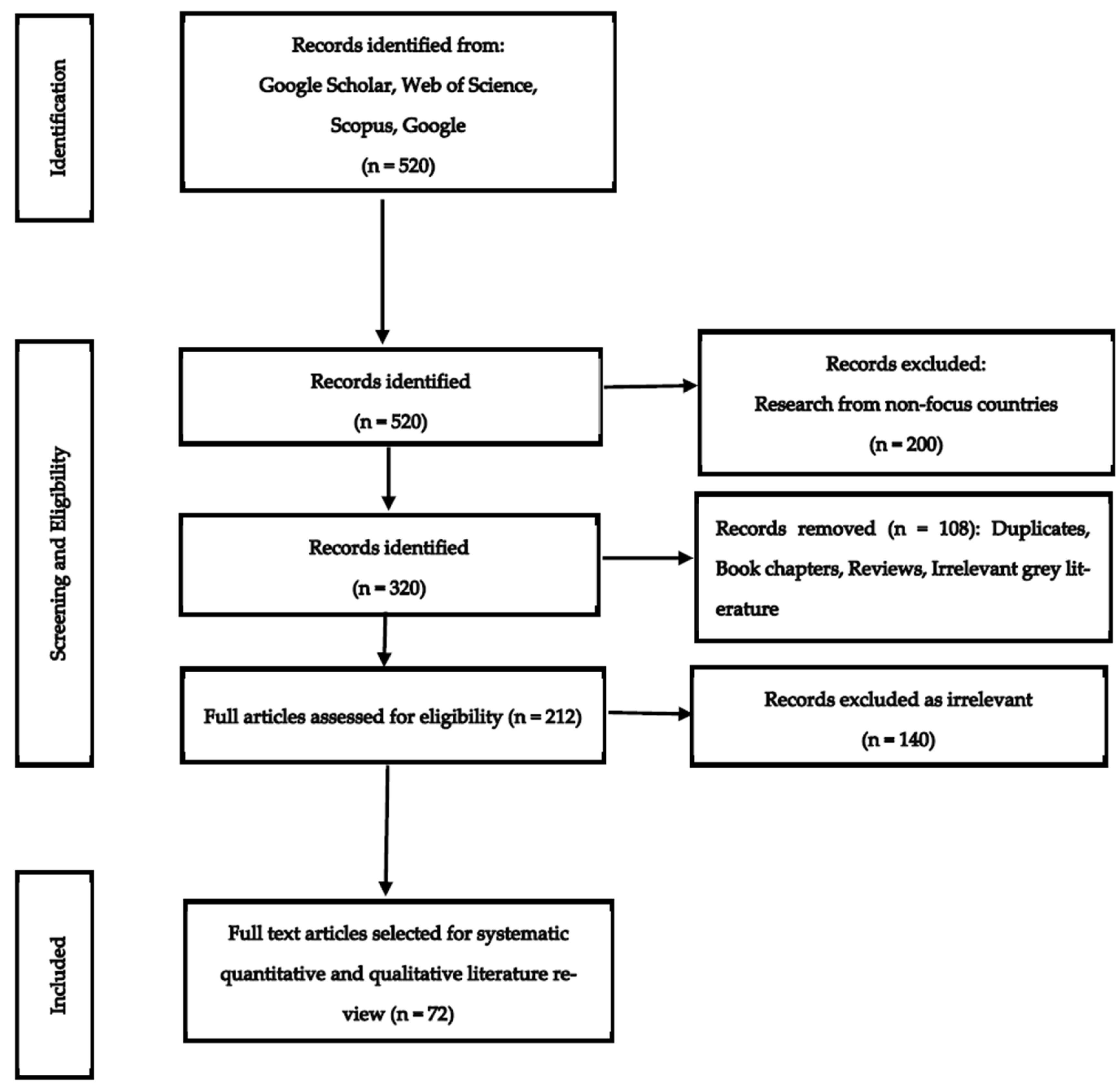
Table 1.
Bio-climatic variables as used in the k-means clustering.
| Variable | Description | MIN | MAX | MEAN | STD |
|---|---|---|---|---|---|
| BIO1 | Annual Mean Temperature | -3.2 | 31.1 | 23.9 | 3.6 |
| BIO2 | Mean Diurnal Range (Mean of monthly (max temp - min temp)) | 1 | 19.6 | 13.36 | 2.3 |
| BIO3 | Isothermality (BIO2/BIO7) (×100) | 27.1 | 100 | 58.9 | 12.5 |
| BIO4 | Temperature Seasonality (standard deviation ×100) | 0 | 931.0 | 359.0 | 244.6 |
| BIO5 | Max Temperature of Warmest Month | 0.5 | 48.6 | 35.5 | 4.9 |
| BIO6 | Min Temperature of Coldest Month | -12.5 | 24.8 | 11.4 | 5.64 |
| BIO7 | Temperature Annual Range (BIO5-BIO6) | 1 | 41.5 | 24.1 | 7.73 |
| BIO8 | Mean Temperature of Wettest Quarter | -4.1 | 38.0 | 24.3 | 5.6 |
| BIO9 | Mean Temperature of Driest Quarter | -4.4 | 36.3 | 22.8 | 5.0 |
| BIO10 | Mean Temperature of Warmest Quarter | -2.4 | 38.5 | 28.1 | 4.3 |
| BIO11 | Mean Temperature of Coldest Quarter | -7.6 | 29.3 | 19.2 | 5.0 |
| BIO12 | Annual Precipitation | 0 | 4566 | 647.7 | 622.1 |
| BIO13 | Precipitation of Wettest Month | 0 | 1119 | 130.3 | 113.1 |
| BIO14 | Precipitation of Driest Month | 0 | 196 | 6.0 | 15.1 |
| BIO15 | Precipitation Seasonality (Coefficient of Variation) | 0 | 224. 8 | 87.8 | 37.3 |
| BIO16 | Precipitation of Wettest Quarter | 0 | 2736 | 334.3 | 297.0 |
| BIO17 | Precipitation of Driest Quarter | 0 | 602 | 26.4 | 58.0 |
| BIO18 | Precipitation of Warmest Quarter | 0 | 1291 | 160.4 | 178.0 |
| BIO19 | Precipitation of Coldest Quarter | 0 | 2736 | 111.3 | 230.1 |
Table 2.
Summary of water-conservation, and management technologies by country.
| Country | Water Harvesting | Soil-Moisture Management | Efficient Irrigation Techniques | Sources | |
| (In situ) | (Ex situ) | ||||
| Botswana | Compacted ridges, Double ploughing, Furrow- and precision-strip tillage systems, Tied-ridging | Ponds, Small dams | Minimum tillage, Surface-residue management | [37,38] | |
| Burkina Faso | Stone rows/strips, Zai pits, Earth bunds, Contour ploughing, Tiarako bunds, Vallerani system, Ados | Boulis reservoirs, Micro-reservoirs, the Banka, Permeable rock dams | Grass strips | [41,42,43,44,45,46,47,48,49,109] | |
| Ethiopia | Stone-faced soil bunds, Soil bunds, Soil-faced deep trench bunds, Grass strips, Terraces (fanya juu terraces), Ridge & basin, Micro-catchments | Ponds | Trash lines, residue management | Runoff/floodwater farming | [50,51,52,53,54,55,56] |
| Guinea | Improved wells, Hill reservoirs, Micro-dams | [57] | |||
| Kenya | Zai pits, Strip catchment, Conservation tillage, Terracing, Contour bunds, Semi-circular bunds, Negarims, Stone lines, retention ditches, open and tied ridges | Earth dams, Water pans, sub-surface dams, Sand dams | Trash lines, Grass strips | Furrow & precision strip tillage, Micro-basins | [58,59,60,61,62,63,64,65,66,67,68,69,70,71,72] |
| Malawi | Concrete-lined underground tanks, Earth dams, swales, infiltration pits, check dams, percolation pond, conservation agriculture, box ridges, Marker ridges, Ponds | Concrete lined underground tanks, earth dams, | Crop residues management, mulching, compost manure, grass strips/hedge-grows | Low-cost treadle pump, flood-plain agriculture, spate irrigation, use of residual moisture | [73,75,110] |
| Mali | Half-moons, Living hedges, Stone bunds/lines | Non-permeable dikes | vegetative strips | [76,77,78,79,80] | |
| Namibia | Contour ditches & bunds, deep ripping, planting basins, compost | Ripping, Planting basins, Compost, Drip irrigation | Low-cost treadle/manual pumps, drip irrigation, Nombete low-cost indigenous irrigation technique | [81,82,83] | |
| Niger | Zai pits (tassa), Half-moons (demi-lunes), Planting pit, | Fallow, Mulching, Stone strips, Tree plantation | [84,85,86,88,89] | ||
| Nigeria | Terracing, Bunding, Ridging, Trenching, Gabion structures, Cut-off drains, Terraces, Diversion ditches, Check dams | Earth dams | Agroforestry | [90,91,92] | |
| Senegal | Stone lines with live hedges, Anti-salt & runoff retention dike, Piterki retention basins | Water reservoirs | Drip irrigation | [93,94] | |
| Somalia | Soil bunds | Grass strips | [95,96] | ||
| South Africa | Mulching, Rainwater harvesting, Contour ridges and terraces, ploegvore (mechanized pitting), | Gelesha (soil turning), Ama-pitsi (homestead ponds), Saaidamme (floodwater harvesting), Klipplate and vanggate (hardened surface & catchment tanks), granite dome water harvesting, Rock packs | Mulching, Grass strips on contour, | [97,98] | |
| Sudan | Half-moon basins, Low-lying crescents, tied Ridging | Contour farming, Mulching, Ridge-furrow | [76,99] | ||
| Tanzania | Chololo pits, Tied ridges, Matengo pits | Chaco dams | Drip irrigation | [100,102,103,104] | |
| Zambia | In-land Valley swamp Irrigation | Small earth dams, Ponds, Micro-basin water harvesting | Surface residue management, Minimum tillage | Clay pot (sub-surface) irrigation, Low-cost Bucket/Drum kit Drip Irrigation, river Flood Plain Recession Irrigation, In-land Valley swamp Irrigation (Dambos) | [105,106,107] |
| Zimbabwe | Tied ridging, Infiltration pits within contour ridges, Dead level contours, Fanya Juus, planting basins and deep winter ploughing | Dead level contours with underground storage tanks, Infiltration pits | Mulching, inter field-water harvesting techniques | [28,37,76,108,111] | |
Table 3.
Slope requirements of soil and water technologies requirements.
| Technology | Slope requirement |
|---|---|
| Bench terraces | Medium to steep slopes (12–47%). Bench terraces are not recommended for slopes less than 12% |
| Check dams | less than 2% |
| Contour bunds and hedgerows | Gentle to moderate slopes (0.5–3%) |
| ‘Fanya juu’ terraces | Moderate slopes (less than 20%) |
| Planting Pits / Zai pits | Gentle slopes (less than 5 %) |
| Stone lines | Gentle to moderate slopes (less than 10%) |
| Trash lines | Slopes 2–30% |
| Grass strips | Fairly gentle slopes (0–6%) |
| Grassed waterway | Slopes of less than 20% |
| Retention ditches | Flat or gentle sloping land |
| Cut-off Drains | Hilly to steep slopes |
| Demilunes | Gentle slopes (less than 5 %) |
Source: [112].
Disclaimer/Publisher’s Note: The statements, opinions and data contained in all publications are solely those of the individual author(s) and contributor(s) and not of MDPI and/or the editor(s). MDPI and/or the editor(s) disclaim responsibility for any injury to people or property resulting from any ideas, methods, instructions or products referred to in the content. |
© 2025 by the authors. Licensee MDPI, Basel, Switzerland. This article is an open access article distributed under the terms and conditions of the Creative Commons Attribution (CC BY) license (http://creativecommons.org/licenses/by/4.0/).
Copyright: This open access article is published under a Creative Commons CC BY 4.0 license, which permit the free download, distribution, and reuse, provided that the author and preprint are cited in any reuse.


