
Submitted:
19 October 2025
Posted:
20 October 2025
You are already at the latest version
Abstract
Research on culture-led urban change in China has shifted from inner-city flagships to peripheral zones where formal planning meets managed informality. Yet two blind spots persist: artists are still cast as long-term tenants, and land is analysed largely at the macro scale of municipal supply and branding. This paper examines the Blue Roof Art District on Chengdu’s south-eastern fringe to show how selective studio ownership on collective land constituted the assetisation of artistic production and reorganised suburban governance. Drawing on fieldwork, interviews and policy/registration materials, we reconstruct the move from precarious rental sheds to a property-rights regime that bound producers to land value. We conceptualise assetisation as a meso-level governance technology: rights are engineered (enclosure, qualification, use, transfer, collateral) so that coordination is internalised to owners and operators, while the state shifts to rule-setting and boundary maintenance. The outcome is a trade-off between stability and enclave: production security increases as public interfaces narrow. We argue that attending to rights design bridges macro land regimes and micro practice, and clarifies how asset-based governance shapes the politics of urban peripheries.
Keywords:
assetisation
; property rights design
; peri-urban governance
; cultural districts (China)
; state entrepreneurialism
1. Introduction
Over the past three decades, culture has been repeatedly for urban regeneration [1,2], place branding [3,4] and economic repositioning [5,6,7,8,9]. The academic work that followed, and the policy frameworks it inspired, largely concentrated on inner-city cultural districts and flagship projects, where artistic activity is closely tied to gentrification, property valorisation and urban competitiveness [10,11,12]. Yet the geography of cultural production has shifted. In China in particular, experimentation now gathers at the urban fringe. Here, state-owned urban land meets collectively owned rural land, planning tools are flexible. This enables improvisation, regularisation and displacement can occur in quick succession [13,14]. These peripheral environments are generative for cultural practice but remain under-analysed.
Two research gaps are significant. First, artists are still too often cast as permanent tenants (eg. [15,16,17]), either as pioneers who open rent gaps or as flexible occupants in operator portfolios. As a result, the institutional design of land and property rights for cultural space rarely becomes an object of explanation in its own right. Second, even when land does enter the frame, especially in debates on state entrepreneurialism and land finance, analysis tends to remain at the macro level of municipal land supply, platform companies and branding [18,19,20], whilst paying scant attention to the micro-level foundations of regional governance. The studio ownership, contractual arrangements, and transfer rules, along with their everyday effects on order, publicness and power, are often implicitly overlooked.
To address these gaps, this paper develops a meso-level analytical framework based on the spatial transformation of Chengdu’s Blue Roof Art District. It concentrates on the establishment phase of assetisation and poses three core questions. First, how are property rights designed to assetise studio space on the metropolitan periphery, including enclosure, eligibility, use and transfer. Second, how does ownership redistribute governance functions and turn potential conflicts into matters of contract and compliance. Third, what spatial consequences arise when government strategies are re-allocated elsewhere, especially the trade-offs between stability and enclave formation.
Chengdu provides a comparable and revealing context. As a leading inland metropolis and cultural hub in Southwest China, it sits in the same tier as Beijing, Shanghai and Guangzhou. The city has more than twenty million residents and its GDP has long ranked within the national top ten. It also has a mature and systematic trajectory in cultural-industry development. Its policy style, however, has long been pragmatically hybrid. It is neither vertically integrated and centralised in the manner of Beijing, nor laissez-faire and market-liberal in the manner of Guangzhou. Chengdu tends to intervene selectively. It experiments with platform companies, targeted incentives and flexible implementation, while maintaining credible overall oversight. This configuration is well suited to observing how state entrepreneurialism operates not only through macro instruments such as land supply and branding, but also through the micro-engineering of property rights in specific cultural sites.
The Blue Roof Art District offers a concrete setting in which to examine the governance effects of assetisation. This arts district is located near Sansheng Flower Village on the south-eastern urban edge of Jinjiang District, close to the administrative boundary with Shuangliu District. It occupies a suburban landscape historically characterised by a hybrid collective land ownership and tourism-oriented development. It combines the bottom-up integration of artists, producer ownership on collective land, and a subsequent ecological reconfiguration. This sequence is uncommon and makes the effects of rights design clearly visible.
Methodologically, the study adopts a qualitative case-study design. Evidence comes from multiple field visits, on-site observation, semi-structured interviews with artists, operators and officials, and a close reading of policy, planning and registration documents. The analysis is deliberately confined to the establishment of assetisation. It does not follow later rent extraction or financial layering. This scope allows a clearer identification of how rights design reshapes governance and produces spatial outcomes.
The case evolved in several phases. At first, the “Old Blue Roof” consisted of affordable yet precarious rented workshops in industrial sheds at the urban edge. They faced rent volatility, environmental hazards and the risk of eviction. Later, supported by a government-backed development platform, the arts district underwent restructuring in new areas through the transfer of collective construction land. Artists were able to purchase long-term studio use rights on collectively owned land. Studios were designated as units eligible for registration within cultural-use zoning; Eligibility, use and transfer restrictions were clarified; Registration and mortgage frameworks were extended to creative space. Public projects and festivals were occasionally coordinated by the district government, but day-to-day issues such as curation, order and compliance were increasingly internalised by owners and the operator. This marked a shift from administrative dominance to asset management. After 2018, as city strategy pivoted toward ecological regulation, retail and leisure facilities in the surrounding area were scaled back. The Blue Roof core persisted as a legally protected production enclave. The stabilisation of cultural production and the weakening of public interfaces were not incidental by-products. To a significant extent they were endogenous outcomes of a property regime that secured artists’ tenure.
This paper makes three contributions. First, for research on culture-led urban transformation, it shifts the unit of analysis from tenancy politics to producer ownership. It shows how the design and selective allocation of rights shape identity politics, collective agency and the emergence of publicness in peri-urban arts districts. Second, for debates linking assetisation theory to urban geography, it defines assetisation as a meso-level, constitutive-stage concept. In this reading, assetisation is a process of rights engineering that embeds temporal expectations (such as durations, holding periods and mortgage terms) in spatial rules (such as boundaries, zoning and eligibility territories). It produces governance effects regardless of capital-market depth. Third, for discussions of state entrepreneurialism in China, the paper identifies a micro-mechanism of market governance: property-rights design combined with selective allocation to producers. This explains gains in efficiency and stability, as well as distributional and public costs that appear as depoliticisation, hierarchisation and enclave formation. The study also offers practical implications. Framing cultural districts as asset-based governance structures points to policy levers that can balance stability and openness at the metropolitan edge. Options include inclusive ownership quotas, land leasing or shared-equity models, and incentive-based approaches to maintaining a public interface.
2. Culture-led Urban Regeneration: An Actor-Centred Perspective
Since the late twentieth century, culture has occupied a central place in urban regeneration strategies [6,21,22]. Florida’s creative-city paradigm framed talent, technology and inclusivity as drivers of regional competitiveness and urged cities to attract a “creative class” through placemaking, amenities and cultural vitality [7]. Building on this idea, related research translated the paradigm into operational policy toolkits, accelerating the global diffusion of the creative-city agenda [8,23,24]. The approach has faced sustained criticism for its portability and thin analytical grounding. Among the critics, scholars have highlighted the distinct labour politics of artists and the limited explanatory power of a universalised “creative class” formula for urban development outcomes [25,26,27]. Culture-led inner-city regeneration serves both as a growth strategy and a vehicle for socio-spatial restructuring, yet it often produces unequal effects [28,29]. Cultural production has also moved in parallel with waves of gentrification: artists’ occupation of industrial lofts has converted derelict spaces into symbolic and financial assets, [11,12,30] laying the groundwork for subsequent property valorisation [11,12,30]. In various cities, cultural districts, festive events and brand promotional activities underpin redevelopment cycles; in certain instances, the reappraisal of heritage sites driven by cultural preservation has similarly catalysed retail expansion and displacement dynamics (e.g. [31,32]). Purpose-built “cultural districts” and curated creative clusters, combining studios, galleries and consumer services, have been closely tied to tourism and city branding [33,34,35].
Post-reform Chinese cities absorbed these ideas, but their translation relied on distinctive institutions and state capacity [36,37]. Early policy discourse on “creative industries” and “creative clusters” drew on imported templates, but soon quickly converged on local development priorities and concerns over cultural governance. Much of the literature focuses on megacities such as Beijing [38,39,40], where arts districts often emerged through the intersection of policy recalibration, state-owned enterprise property legacies and international cultural markets [41,42]. Adaptive governance and bottom-up negotiation are significant: researchers examine how artist networks, platform operators and officials co-produce cultural space [43,44]. On the one hand, local authorities and platform companies tested time-limited incentives, flexible zoning and selected tenant mixes [43,45]. On the other hand, artist communities responded to shifting rules through informal renting, strategic visibility and alliance-building [43,44,46]. In the 798 case, artists mobilised symbolic capital and global discourses to resist demolition and gained temporary leverage; subsequent institutionalisation folded the area into a bureaucratically managed, curated art brand [35,41]. This trajectory is well captured as “branding through resistance”, followed by the consolidation of operator-led control. Within this model, technocratic and hybrid [38–40are key. High-profile actors attract attention, while non-commercial practices are often marginalised.
3. Cultural-Space Production: A land-Institutions-Centred Perspective
Another influential line of research places land institutions at the centre of analysis. It treats them as foundational structural factors that displace a focus on stakeholder groups and, in doing so, alter the development pathways of cultural industries under liberalised planning regimes. This work has produced a strong mainstream narrative that explains outcomes through the macro framework of land politics and land-based political economy [18,19,20]. From this view, China’s dual land regime—state ownership in urban areas and collective ownership in rural areas—together with the marketisation of land-use rights since the late 1980s, are seen as the basic structural forces shaping cultural-industry trajectories. Scholars widely observe that local governments are not deregulators in a neoliberal sense. They act as “state entrepreneurs” [44,47,48]. By monopolising the primary land market, assembling public-private redevelopment coalitions, and using planning and leasing tools flexibly, they steer capital into flagship projects such as creative-industry parks, thereby driving urban growth. This model of state entrepreneurialism has deeply influenced the governance of cultural space. A large body of work argues that cultural parks are essentially extensions of land and property strategies rather than the outcome of independent arts industry policies [18,49]. Studies of areas such as Beijing’s 798 show how the re-use of state-owned factory legacies is reclassified as “cultural real estate” through area planning and national branding [20]. The core logic serves municipal fiscal extraction and symbolic capital, rather than the building of producer-owned infrastructure. Artists and cultural organisations are cast mainly as “temporary” or “pioneer” tenants whose role is to catalyse rent gaps and warm up the market for subsequent commercial development [35].
As cultural clusters have moved beyond traditional cores to seek lighter regulation and affordable workspace—in post-industrial suburbs and rural zones, research has linked land institutions to suburban and peri-urban governance. These areas are marked by informal renting, partial self-governance and non-agricultural uses. They underpin the production of “urban villages” and hybrid peri-urban landscapes of mixed land rights where cultural activity can cluster rapidly [50,51,52]. Yet studies also note that when municipalities channel growth to the fringe through selective land-use conversion and quota management, culture again shifts from a site of creative labour to a programmable land asset [49]. Symbolic imagery can be mobilised to integrate centre and periphery, or re-positioned as priorities change.
Across this literature, cultural production spaces play three recurring roles within land-centred narratives. First, they absorb and rework deindustrialised or collectively managed fringe land, converting low-yield spaces into rent-bearing assets and narrative anchors for regional branding [53]. Second, they operate as flexible tenants within municipal toolkits. Through time-limited incentives and curated leasing portfolios, city and regional authorities can turn cultural visibility on or off to match shifting goals [49], without altering underlying property control. Third, they serve as policy-readable nodes for planning techniques, which helps fold peri-urban belts into metropolitan strategies while retaining options to repurpose land as fiscal or regulatory conditions change [54]. These dynamics are not confined to early inner-city heritage districts. They have been reproduced at the urban edge, aligning with logics of clustering, festivalisation and scenic development, and with land-use conversion instruments, to form new modes of suburban governance.
A key gap nevertheless persists across Western and Chinese research. The concrete design of land and property rights within cultural spaces seldom becomes a primary object of analysis. Actor-centred studies detailed the micro-politics and negotiations through which arts districts emerge, but they remain framed by a rental paradigm in which artists appear as pioneer tenants who temporarily occupy urban space. This framing systematically obscures the more fundamental institutional question of property rights. In the Chinese literature, rich descriptions of cluster promotion, state entrepreneurialism, urban-village governance and land finance are largely “top down”. Ownership allocation over studios and workspaces, especially at the junction of collective rural land and urban planning boundaries. They tend to be treated as technical background. In Beijing, relocation is traced to rent shocks and clearances [55]. In Shanghai, interventions and investment mechanisms are detailed [56]. In Shenzhen, industrial-chain formation and labour dynamics take centre stage [57].
It is in response to this gap that we turn to recent debates on assetisation. This work conceptualises how diverse resources are converted into tradable assets through legal enclosure, standardisation and collateralisation, and it offers a bridge between macro land-finance regimes and operator-led clustering on the one hand, and the micro politics of property rights inside cultural space on the other.
4. Assetising Space: A Meso-level Framework
Assetisation theory arises from political–economic insights into changing modes of capital accumulation. It describes how things that are not originally commodities are transformed into capital assets capable of generating sustained future income, through social, legal and technical processes [58]. This is not simple commodification, which relies on exchange governed by labour time and market competition. Rather, it signals a shift from a logic of production to a logic of rent [59]. Assetisation is grounded in “economic rent” and “enclosure”, its core is the conversion of things into income-bearing resources. It does not primarily aim at immediate sale, but at the creation of property rights that can yield continuous revenue streams [60]. In other words, assetisation creates rent-bearing property whose value depends on expectations about future earnings and on capitalisation. For geographers, this is crucial because it expresses “the degree of control over society that the asset secures” [61].
Recent research has further linked the process of assetisation to both spatial dimensions (enclosure, zoning, demarcation) and temporal dimensions (expected returns) [60]. In doing so, it reshapes urban governance, distributive conflicts and the tempo of redevelopment. Research on “land as a financial asset” shows how formal mechanisms and valuation practices reorganise urban land and real-estate markets and produce concrete geographical effects [62,63,64]. Yet a marked “financialisation turn” is evident in much of this literature (e.g. [60,65]). Many studies move quickly to later financial techniques such as asset-backed securities and real-estate investment trusts, or to how capital markets use specific calculative practices to pull future rents into present circulation as fictitious capital [30,66]. Assetisation is then treated as a subset or prelude to financialisation, with heavy emphasis on valuation techniques, risk pricing and capital flows, and less attention to the political foundations, governing practices and social power relations that assetisation entails.
Two limits follow. First, as critics note, assetisation is broader than financialisation [67]. Assets are any resources recorded on a balance sheet, not all assets are financialised. Thus, financialisation is one possible expression of assetisation, not its essence. Second, the political and governance structures underpinning assetisation often recede from view. Assetisation is a socio-political process. The notion of the “asset condition” makes this explicit: assetisation installs a social and political logic that defines who may benefit from an asset, how they benefit, and what rights structures exclude other democratic claims or social concerns [68]. A purely financial lens cannot grasp these dimensions.
Against the backdrop of China’s dual land system and locally embedded forms of state entrepreneurialism, the assetisation of artistic production spaces presents a distinctive model of government-market collaboration. This represents far more than mere physical space development or cultural content cultivation; it constitutes a profound process of spatial value creation and governance. Local governments use planning approvals, land transfers, infrastructure investment and branding to deliver an initial “value endorsement” for targeted areas, markedly raising their rent premium [69,70]. This initiates an assetisation sequence: the diffuse “atmospheric value” generated by artist communities and cultural practice is systematically converted into priced, and potentially financeable, spatial assets. Land-use controls, planning adjustments and the legal definition of title then translate ambiguous cultural spaces into assets with clear property rights and capitalisable qualities, thereby completing a process of lawful enclosure. Finally, government-backed platform companies integrate, package and operate these assets, turning cultural space into a manageable and controllable policy or fiscal instrument (e.g. [20,35,41]). In this way, local government combine the soft governance of cultural policy with the hard demands of land finance. Culture is no longer an autonomous domain. It is drawn deeply into a machine of spatial value production as a lever for enhancing land assets and serving urban growth objectives.
On this basis, the study advances a key theoretical shift. Assetisation should be treated as a tool and lens of spatial governance in its own right, not only as a prelude to financialisation. Our focus is not on what follows after assetisation in financial terms, but on how assetisation is deployed by local governments as a governing technology. By shaping how cultural value is formed and codified, authorities can restructure urban space, steer social activity and consolidate growth-oriented paradigms. Assetisation reconfigures social relations among artists, residents, developers and the state. Artists move from users of space to payers of rent or provisional generators of asset value, and their practice faces the risks of domestication and alienation. From this perspective, financialisation may be one downstream economic outcome, but it is not the analytical core. Only by restoring assetisation to the centre of governance analysis can we move beyond the limits of financialisation narratives and grasp the political economy of contemporary urban transformation in China. By focusing on the governing practices, power relations and spatial reorganisation embedded in asset formation, we can better reveal the complexity and tensions of cultural-space production in Chinese urbanisation, and provide a more comprehensive framework for understanding the development of arts districts.
5. Chengdu’s Blue Roof Art District: From Spontaneous Aggregation to Assetisation Enclaves
5.1. Bottom-up Cohesion: the Emergence of the Old Blue Roof (1994–2005)
The origins of the Blue Roof community can be traced to a series of small moves made by a group of Chengdu painters in the 1990s. In 1994, artists including He Duoling and Zhang Xiaogang (representative painters of Contemporary Art in Chengdu) relocated their studios from cramped domestic rooms to a modest shared space at Shaziyan on Yulin Road. The decision was pragmatic rather than strategic: the site was relatively quiet, close to the city centre, and large enough to accommodate work on big canvases.
“Our choice of this place was largely coincidental. We were simply drawn to its proximity to the city centre and the quieter creative environment compared to the urban area. We hadn't anticipated such a significant impact, but our friends do look back fondly on those days. We discussed art exclusively, nothing else.”(Interview with Artist A)
By the early 2000s, the group began searching for more space. In 2003 they acquired several units in a rural industrial estate near Tuqiao Airport Road, close to the Taipingsi military airfield. The sheds there were topped with distinctive blue corrugated roofs. The artists rented a number of courtyards and gradually converted them into studios. By the end of 2003, five clusters known locally as A to E had become active, with close to sixty artists in residence. The term “Old Blue Roof” later came to refer to this period. Working conditions improved markedly compared with the earlier inner-city sites. The generous floor plates and flexible layouts suited painting. Rents were low. The semi-rural setting offered a pastoral Chinese aesthetic. During the same period, several exhibitions, including “Living in Chengdu” and the 2004 Shenzhen Contemporary Oil Painting Exhibition, featured works by Chengdu artists and drew wider attention. Distance from the political centre made local media unusually receptive to contemporary art, while the city’s market for cultural consumption continued to expand. After the central government shifted from resisting cultural industries to endorsing them—recognising them as a new driver of growth in the years following Beijing’s successful 2001 Olympic bid, Chengdu rapidly followed trends seen in Guangzhou and Beijing. Real-estate projects proliferated and commercial galleries multiplied. This phase also brought the first signs of differentiation within the artist community. Some artists achieved high sales and gradually formed an “elite” cohort. Yet the group shared a common priority for the period: securing a stable place to work.
However, the essence of the Old Blue Roof was the temporary occupation of disused fringe space by artists acting as “tenants”. The model was fundamentally fragile. Artists continually face rent volatility, environmental deterioration (such as the severe dust pollution caused by neighbouring shoe and furniture factories in 2006), and the constant risk of eviction. They lack long-term control and security over their living spaces, their existence rested on informal, unstable rental arrangements. This condition characterises the majority of arts districts in China, where artistic production is treated as a short-lived, transitional urban activity. At the same time, citywide reforms were redirecting planning and investment towards peripheral tourism and cultural facilities. In this emerging policy environment, the Old Blue Roof’s predicament intersected with Chengdu’s broader urban strategy. The result was the birth of the “New Blue Roof”, whose core was the assetisation of the means of artistic production.
5.2. Top-down restructuring: the New Blue Roof and the assetisation of artistic production (2006–2012)
Chengdu's shift from tourism-led brand development in the first five years of the 21st century towards driving economic growth through cultural industries, has provided the policy foundation for Blue Roof's transformation. The municipal government retained national-level content review but avoided adding extra layers of control. It adopted selective and time-limited promotional instruments: municipal financing platforms, state-owned enterprises to build and manage projects, and later, wider access for non-public capital to support cultural initiatives expected to enhance the city’s reputation or catalyse emerging sectors.
“We cannot possibly have the multi-tiered cultural regulation seen in Beijing, nor do we have the same number of officials to conduct reviews. Our primary concern is whether it demonstrates innovation and can generate new commercial value, rather than debating cultural merits and justifications. [...] We have also expanded the scope of loans available to non-publicly owned cultural entities, including land use rights, trademark rights, intellectual property rights, and patent rights, all of which can now receive financial support.”(Interview with policymaker A)
Within this pragmatic hybrid of state entrepreneurialism, institutional engineering was deployed where markets were thin and routine regulatory tools proved inadequate. A key driver was Chengdu’s designation as a “National Pilot City for Urban–Rural Integration”. This opened a legal pathway to restructure and circulate collectively owned construction land for specified cultural uses, to register use rights, and to stabilise production space through property certification.
Data Source: Google Maps, Drawn by Authors
The transition from Old to New Blue Roof originated in Sansheng Flower Village. Located on Chengdu’s south-eastern edge, this floral belt was being developed by the municipality and Jinjiang District as a comprehensive scenic area (see Figure 1). Within this zone, the “Hetang Yuese” themed area was envisaged as the principal attraction (a phonetic transcription of the Chinese, the actual meaning is a large lotus pond, see Figure 2). Since tourism struggled to generate distinct content, Sansheng officials proposed building a higher-value cultural ecosystem by introducing a renowned artist cohort. Initial efforts followed conventional templates. In 2005, Sansheng funded several “painters’ buildings” within a planned community and invited artists to lease units. Take-up was poor. The standardised layouts failed to meet studio practice requirements: ceiling heights, north light and clear spans were all unsuitable. By the end of 2006, the street altered its strategy, transferring control over studio design to the artists.
The institutional core relied on the transfer mechanism for collectively owned construction land under Chengdu’s urban–rural integration reforms. Once the pilot status was secured, Jinjiang District, neighbouring Shuangliu District and local rural collective economic organisations could lawfully restructure collective construction land and transfer use rights for cultural purposes. The government establishes planning boundaries, consolidates and provides indicators, and ensures legality through registration. In 2009, Blue Roof Development Co., Ltd. was established as the operating platform. Under a memorandum with Shuangliu District, it brought in local non-public capital. Established artists were invited to purchase studios directly within the cultural-use zoning of collective construction land, gaining long-term use rights. For those unable to buy, particularly early-career practitioners, the developer worked with government to assemble idle plots in surrounding villages. Through a similar transfer mechanism, this land was converted to lawful cultural use and refurbished into clusters of small studios. The operator leased these spaces in batches to recent graduates and early-career artists, forming what became known as the “Blue Roof Youth Art Village”.
Data Source: Google Maps, Drawn by Authors
The entire arts district was constructed in phases. In January 2009, the first dedicated complex opened, comprising fourteen studio buildings (mainly for invited renowned artists) arranged around a central art museum and a clubhouse. The second phase of development primarily created so-called “self-owned studios”, with units sold to individual artists (for external sale). This project started in 2011 and was largely completed by 2012. A third phase added mixed-use cultural venues, complementing the core area and linking it to the adjacent Youth Art Village (see Figure 2 and Figure 3b). The main site straddled the administrative seam between Sansheng Subdistrict in Jinjiang District and the edge of Shuangliu District. Smaller spillover clusters emerged nearby, including Hexiang Ruiyuan, a residential complex near Gardenia Street that attracted many young artists (see Figure 1). A torrential downpour in 2011 severely damaged the leased workshops at the Old Blue Roof, while artists at the New Blue Roof were unaffected. The event precipitated a mass exodus from the old site. By June 2012, the last long-term tenant had left, bringing the end of an informal art district, Old Blue Roof.
5.3. A shift in Governance: from Administration to “Depoliticised” Rule
Assetisation brought a profound change in the mode of governance. In the first five years, government worked with the operator to coordinate public projects. Following the opening of the new Blue Roof Art Museum (see Figure 3a), exhibitions are held on a regular basis. Municipal and district departments continued to support major events such as city-level arts festivals, positioning Blue Roof as a flagship for contemporary art in Southwest China. Blue Roof Development Co. retained a cultural division alongside its development and property functions and collaborated with public bodies to organise Biennials (one of China's most renowned art exhibitions). On site, a balanced mix emerged of studios, semi-galleries and service businesses catering to artists and audiences. Established artists remained central figures and collective activities such as public lectures and charity performances took place from time to time.
Gradually, however, the role of government shifted. It moved from direct administrative intervention to setting rules and maintaining boundaries, while the complex routines of operation, management and order-keeping were internalised by asset owners—the artists, and Blue Roof Development Co. Specifically, the municipality expanded collateral frameworks so that cultural intellectual property and land-use rights could secure credit, while maintaining a streamlined content review rather than tiered approvals. Where the scenic-area rationale called for public events, the subdistrict helped to organise festivals; where private initiative was sufficient, it stepped back. By 2014/15, core construction was complete and selective ownership had reshaped the site’s physical form and its community structure.
Photos by Authors
A multi-layered Blue Roof ecosystem took shape. Phases One and Two formed the core property zone, comprising studios with collective land certificates, a functioning gallery and museum platform, and a suite of supporting cultural enterprises. Roughly one third of visible frontage consisted of artist-run studios or semi-galleries (see Figure 4a and Figure 4b). A smaller share housed institutional galleries and non-profit spaces. About one-third of the visible space comprises the artist's own open studio or semi-gallery; a small portion hosts institutional galleries and non-profit spaces; over half of the ground-floor street-facing space supports for-profit cultural enterprises, such as furniture workshops, photography studios, and design firms serving the cluster. On the periphery, the Youth Art Village soperated as a rental zone for early-career painters and designers. Further out, places such as Gardenia Street evolved into an informal satellite network, where interactions with the main site rely more on non-geographical, internal community connections (see Figure 1 and Figure 2).
5.4. After 2018: Ecological Reorientation and the Consolidation of an “Enclave”
Tensions were present from the outset and surfaced as policy priorities shifted. Land-use commitments were clear: cultural uses were to be protected from conversion to ordinary commercial or residential functions, and studios were not to be turned into non-art spaces. In practice, enforcement was uneven. As the operator, Blue Roof Co. is essentially a property company, and its commercial imperatives sit uneasily with artists’ desire for a pure creative environment. The actions of property owners are more difficult to control. Some studios were resold or leased to commercial entities, in exchange for increased rental value, corroding the area’s artistic ethos (see Figure 5a and Figure 5b).
Photos by Authors
Elsewhere, artists informally converted parts of their studios into live–work spaces, reducing shared open areas and altering footfall patterns. Proposals emerged to formalise artist-led rules, including advisory committees for programme curation and tenant review. Artists voiced similar concerns in interviews and informal meetings, but these rarely escalated into collective action and binding mechanisms did not materialise.
“If I were merely renting a studio, I could be more forgiving of it, as I'd have no grounds to demand anything of others. If one day this arts district becomes too commercialised and I can't accept it, then I'll choose to leave and live elsewhere - that's not uncommon for artists. But since I bought a property here, I can't bear to see the place where I've lived long-term gradually overtaken by all sorts of tourists and shops."(Interview with Artist C)
Within the operating company, disagreements grew after most unit sales had been completed. Managers debated how long costly cultural programming could be maintained and to what extent stricter tenant vetting would dampen returns.
“Our company incurred exceptionally high operational costs for the Blue Roof Art Museum and the entire district, with a very difficult return on investment. Consequently, these departments have now been largely disbanded, retaining only essential liaison personnel.”(Interview with Staff Member A)
At the same time, the artist community itself fragmented along generational lines, degrees of market dependence and institutional affiliation. Established artists enjoyed stable property rights. Younger practitioners struggled to remain in the Youth Art Village as rents rose and leases shortened, leading to high mobility. The absence of effective collective consultation diminished the ability to forge shared values or joint negotiating power, and a pyramid-like internal structure became more pronounced.
Photos by Authors
More decisive change came from top-down. Chengdu recalibrated its citywide strategy by prioritising ecological protection and drawing tighter green-belt lines at the urban edge. In this adjustment, the municipal government's active promotion of Blue Roof has gradually diminished. the Chengdu Biennale secured a new primary venue under fresh administrative sponsorship. Blue Roof hosted several parallel exhibitions, but the intensity of official support declined. The operator scaled back its cultural division to the minimum needed for venue management and liaison. The cumulative effect was an inward turn: studios remained occupied, private shows continued, and small exhibitions circulated through local networks, but the outward-facing pulse slowed (see Figure 6).
“Blue Roof was once very busy, but things are different now. In fact, after 2015, a series of curated events and related activities largely disappeared. There are still some professional curators and associations within the art district, and private exhibitions continue to take place.”(Interview with Artist D)
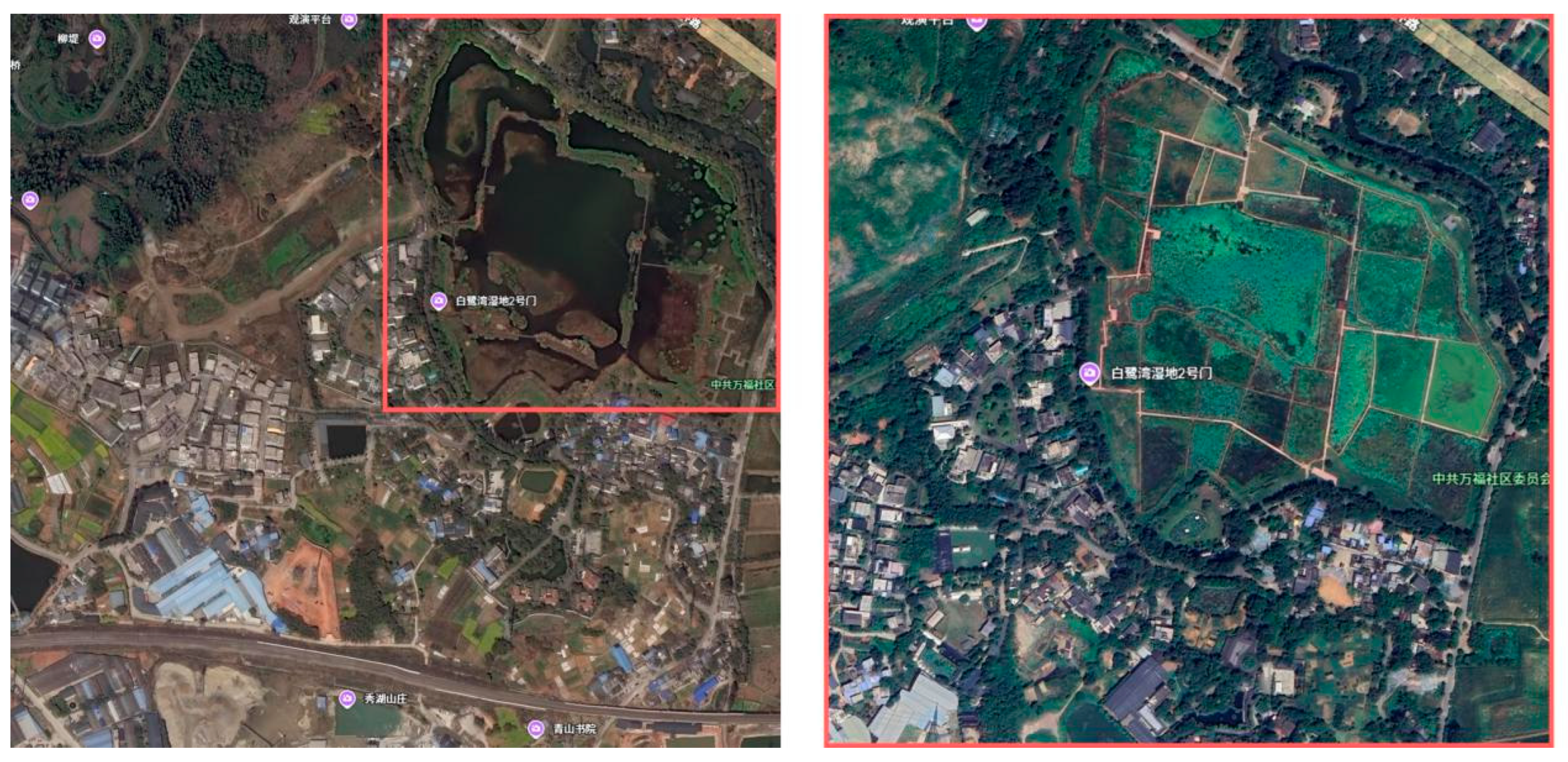
The surrounding landscape changed more visibly. During the tourism-led phase, the “Hetang Yuese” scenic area had been densely packed with cafés, teahouses and leisure businesses. With the ecological turn after 2018, many such structures were demolished for non-compliance and parts of the area reverted to agriculture. The lotus ponds that had given the theme park its name were filled in or reduced, farmland reclaimed the ground (see Figure 7).
Data Source: Google Maps, Drawn by Authors
By 2022–2023, the core Blue Roof cluster remained intact and continued to house established and mid-career artists. Many no longer relied primarily on local sales, placing greater emphasis on ties with leading markets in Beijing and Shanghai. A handful of galleries and cultural enterprises still operated on site, but most activity moved into private spheres. Artists who had once rented affordably in Youth Art Village were displaced by shorter leases and higher rents.
“Over the past few years, our rent has multiplied several times over, and many former friends have moved away. Presently, fewer than 20 tenants at Blue Roof Youth Art Village are engaged in the arts, with perhaps no more than five artists in the traditional sense. [...] Simply relying on the sale of artworks to sustain this place is unrealistic.”(Interview with Artist E)
“A nursery previously offered a substantial sum to purchase one of Blue Roof's spacious buildings, but our company declined their proposal as it lacked artistic merit.”(Interview with Staff Member B)
Screening of commercial tenants within the art district persisted and non-art proposals were rejected, while the broader retail and leisure belts beyond the boundary had largely been removed. The entire area resembled an island of studios and galleries set within an increasingly green matrix.
The present configuration is the joint outcome of its assetised origin and the subsequent policy shift. Legal property rights gave artists valuable, stable assets. These insulated the core area from stronger policy and market swings in adjacent neighbourhoods and protected the district’s physical fabric. At the same time, the same rights hardened physical and social boundaries and cut many of the spillover channels that had once surrounded it. Retail and entertainment belts that formerly amplified its influence were displaced by new urban priorities, further lowering public visibility and internalising transformation. What remains is an enclave for stable production and small-scale exchange, extending outward mainly through non-geographical networks rather than acting as a driver of spatial change.
6. Discussion: Asset-based Governance at the Urban Fringe
The Blue Roof case shifts focus from creative districts or land finance to the practical dimensions of governance: the design and distribution of rights within cultural spaces. Interpreting the research through this lens reveals that assetisation is not a by-product of finance, but an independent governance process. What matters is the establishment work that renders studios describable in law, allocable to particular producers, subject to contractual conditions. This enables future users to transfer rights in accordance with stipulated terms. Once established, this framework of rights not only stabilises spatial occupation but also reconfigures daily norms, channelling conflicts towards institutionalised forums. Ultimately, it transforms the spatial form of the entire area.
A sequence becomes visible. Ambiguous workshops are first brought under legal description and planning frameworks; this attaches the symbolic value produced by artists to particular parcels rather than to a diffuse atmosphere. Access rules and pricing mechanisms screened users, determining which producers gained usage rights. This was not a neutral allocation, as it converged the interests of a property owners' coalition—whose motivations centred on site stability, reputation management, and risk management. Use, transfer and holding are subsequently constrained by contractual clauses and eligibility lists. These rules not only regulate behaviour but also transform disputes into compliance issues, manageable through operators, owners' committees, and membership procedures. Ultimately, daily management functions, once relying on administrative discretion, migrated inward into the field of asset management. Curation, opening hours, signage, tenant mix and reputation are increasingly governed by owners' associations and platform companies. Overall, politics moves from the street and the media into charters, contracts and committee rooms, with the language of rights becoming the developmental demands that interpret and define divergences in property values.
The temporal and spatial effects of this design help to explain Blue Roof’s dual outcome of resilience and enclosure. Temporally, anticipated returns are written into present rules on duration, resale and collateral, which disciplines current action and expectations (The studio holds a 50-year leasehold title and is legally transferable under government tax regulations. Property values across the entire area have now reached 8 to 10 times their original purchase price). Spatially, the same design works through boundary setting, zoning and eligibility territories that fix where public interfaces thicken and where they thin out. When citywide priorities pivoted toward ecological belts, the core endured because title and use rules held the line, while earlier spillovers and leisure interfaces contracted. Stability and enclave formation therefore appear not as external shocks but as consequences internal to the property regime that secured tenure. The case shows how long-term asset returns, alongside the spatial politics of boundary work, combine to produce a resilient core and a selectively permeable edge.
This meso-level account refines state entrepreneurialism by identifying the micro-mechanism through which governing through the market actually operates. Existing narratives emphasise municipal land supply, platform companies and branding; the Chengdu sequence adds the rights engineering that pre-structures the market order in law before transactions occur. Predictability, fewer frictions and lower coordination costs, often celebrated as virtues of entrepreneurial governance, appear here as products of this rights mediation. So do the drawbacks: selective exclusion, a contraction of public interfaces and a narrowing of experimental practices at the margin. Crucially, both advantages and costs stem from the same institutional source, namely the selective empowerment of property rights. If adjustment is sought, the lever is not a return to ad temporary administrative control but a recalibration of the rights mix itself. There are instruments that retain assetisation but temper enclosure. Examples include inclusive title quotas for early-career practitioners or non-profit entities, and ground-lease or shared-equity models with clear resale conditions. Cities may also advance the development of public interfaces aligned with incentive mechanisms through design guidance, small-scale project funding, and prioritisation in municipal cultural calendars, rather than relying on mandatory directives.
Bringing producer ownership into cultural geography also clarifies the internal social field of art districts. Title-holding artists acquired voice and authority over curation, norms and reputational thresholds; younger or more precarious practitioners in rental peripheries experienced higher turnover rates and diminished bargaining power. This stratification is not simply a socio-economic gradient; it is a constitutional effect of the rights architecture that defines who counts as a member with standing, who participates conditionally and who is relegated to the position of visitor or audience. Publicness likewise changes character. Events persist, but they are increasingly calibrated to protect asset value and manage risk. What had been an expansive claim on urban space becomes a managed interface that can be tuned up or down as conditions change. This shift is reflected in the artist's strategy of moving from protecting spaces to defending boundaries.
From these findings, several propositions follow that can orient comparison beyond Chengdu, thereby contributing to broader urban geography debates. Where urban production space are assetised under selective entry, governance is likely to move from administrative steering to owner-led asset management with a reduction in visible contention. Where title security coincides with strong boundary rules, a stability–enclave trade-off can be expected, visible as resilience of core functions and diminish of spillovers. Where title is concentrated in established cohorts, internal stratification solidifies and experimental practices become more fragile. By adjusting combinations of rights that balance liquidity, such as partial equity, qualification quotas, or resale restrictions, governance outcomes can be altered more directly than through post hoc cultural regulation. The value of this lens is that it connects macro land regimes to micro institutional practice without collapsing into financialisation. Even when stepping outside the capital market discourse, governance and spatial forms can be reshaped through rights design alone. It also explains why similar macro instruments yield divergent results across cities, since variation in entry, property rights configurations, and transfer regulations alter the internal logic of local governance and the depth of its public interfaces.
7. Conclusions
This paper has shown that the stable reconfiguration of a peripheral cultural district can be explained at the missing middle of urban governance: the establishment of property rights inside creative space. Assetisation here is not a financial epilogue but a governing move. Once studios are enclosed in law, selectively allocated and conditioned by covenants, routine rule shifts from administrative discretion to asset management. The result is a durable production core, together with a thinner public interface. These are not side effects; they flow from the rights architecture itself.
Three contributions are formed. First, it reframes culture-led urban transformation around producer ownership. Title, terms and transfer rules shape identity politics, collective agency and the forms of publicness that are possible. Second, it specifies assetisation as a meso-level, constitutive stage that binds future expectations into present rules and ties them to territory; governance effects follow even without deep capital markets. Third, it refines state entrepreneurialism by identifying rights engineering as the micro-mechanism through which “governing through the market” actually operates, clarifying both the gains in predictability and the costs for openness.
The analysis has limits. It is a single case and focuses on the establishment phase rather than later financial layering or welfare outcomes. That scoping isolates causal mechanisms but calls for broader tests. Comparative work across cities can vary entry rules, title mixes and transfer regimes. Longitudinal studies can track how designs evolve as titles change hands or as policy priorities pivot. Mixed methods, such as registry and covenant analysis paired with ethnography and programme data, can show how publicness is made and remade under different rights mixes.
Seen this way, cultural districts are one instance of a wider urban condition: spaces of production organised as asset-based governance formations. Their internal property constitutions are primary levers that shape power, publicness and spatial destinies at the urban fringe. Paying attention to rights design connects macro land regimes to micro practice and gives policymakers tractable options for balancing stability with openness.
8. Patents
Funding
This research was funded by the International Partnership Program of Chinese Academy of Sciences [No. 059GJHZ2023104MI] and the CAS-ANSO’s Visiting Scientists Fellowship 2025[CAS-ANSO-FS-2025-05].
Conflicts of Interest
The authors declare no conflicts of interest.
References
- Bayliss, D. "The rise of the creative city: Culture and creativity in copenhagen." European planning studies 15 (2007): 889–903. [CrossRef]
- Redaelli, E. and D. Stevenson. Arts and the city in the 21st century. 44. Taylor & Francis, 2022, 455–55. [CrossRef]
- Andersson, I. "Placing place branding: An analysis of an emerging research field in human geography." Geografisk Tidsskrift-Danish Journal of Geography 114 (2014): 143–55. [CrossRef]
- Pike, A. "Geographies of brands and branding." Progress in human geography 33 (2009): 619–45.
- Amin, A. and N. Thrift. "Cultural-economy and cities." Progress in human geography 31 (2007): 143–61. [CrossRef]
- Comunian, R. "Rethinking the creative city: The role of complexity, networks and interactions in the urban creative economy." Urban studies 48 (2011): 1157–79.
- Florida, R. The rise of the creative class. Basic books, 2019.
- Scott, A. J. "The cultural economy of cities: Essays on the geography of image-producing industries." (2000).
- Scott, A. J. "Cultural-products industries and urban economic development: Prospects for growth and market contestation in global context." Urban affairs review 39 (2004): 461–90.
- Bain, A. L. "Artists as property owners and small-scale developers." Urban Geography 39 (2018): 844–67. [CrossRef]
- Gainza, X. "Industrial spaces for grassroots creative production: Spatial, social and planning facets." European planning studies 26 (2018): 792–811. [CrossRef]
- Ley, D. "Artists, aestheticisation and the field of gentrification." Urban studies 40 (2003): 2527–44. [CrossRef]
- Chung, H. "Rural transformation and the persistence of rurality in china." Eurasian Geography and Economics 54 (2013): 594–610. [CrossRef]
- Yongchun, Y. "Chinese cities in transition: Mixed spatial structures produced by a hybrid institutional model." Geographical Research 34 (2015): 2021–34.
- Reid, H., A. Drencheva and M. Patterson. "Temporary art spaces: A conceptual framework." In Creative (and cultural) industry entrepreneurship in the 21st century: Policy challenges for and by policymakers. 18. Emerald Publishing Limited, 2024, 23–34.
- Rochelandet, F. "Transitory urbanism." In Arts, ecologies, transitions. Routledge, 2024, 188–91.
- Stevens, Q. "Temporary uses of urban spaces: How are they understood as'creative'?" Archnet-IJAR: international journal of architectural research 12 (2018): 90.
- Jiang, R. and G. C. Lin. "The drunkard’s intention lies not on the wine: Reinterpreting culture-led urban redevelopment in china amidst profound regime changes." Environment and Planning A: Economy and Space 57 (2025): 241–68. [CrossRef]
- Rithmire, M. E. "Land institutions and chinese political economy: Institutional complementarities and macroeconomic management." Politics & Society 45 (2017): 123–53.
- Yin, Y., Z. Liu, M. Dunford and W. Liu. "The 798 art district: Multi-scalar drivers of land use succession and industrial restructuring in beijing." Habitat International 46 (2015): 147–55. [CrossRef] [PubMed]
- Della Spina, L., C. Giorno and R. Galati Casmiro. "Bottom-up processes for culture-led urban regeneration scenarios." Presented at International Conference on Computational Science and Its Applications, 2019. Springer, 93–107.
- Miles, M. "Interruptions: Testing the rhetoric of culturally led urban development." Urban studies 42 (2005): 889–911. [CrossRef]
- Evans, G. "Creative cities, creative spaces and urban policy." Urban studies 46 (2009): 1003–40. [CrossRef]
- Pratt, A. C. "Creative cities: The cultural industries and the creative class." Geografiska annaler: series B, human geography 90 (2008): 107–17. [CrossRef]
- Flew, T. "Toward a cultural economic geography of creative industries and urban development: Introduction to the special issue on creative industries and urban development." The information society 26 (2010): 85–91. [CrossRef]
- Lysgård, H. K. "Creativity, culture and urban strategies: A fallacy in cultural urban strategies." European planning studies 20 (2012): 1281–300. [CrossRef]
- Markusen, A. "Urban development and the politics of a creative class: Evidence from a study of artists." Environment and planning A 38 (2006): 1921–40. [CrossRef]
- Evans, G. "Measure for measure: Evaluating the evidence of culture's contribution to regeneration." Culture-led urban regeneration (2020): 116–40.
- Mckenzie, M. and T. Hutton. "Culture-led regeneration in the post-industrial built environment: Complements and contradictions in victory square, vancouver." In Creative milieux. Routledge, 2017, 18–37. [CrossRef]
- Birch, K. "What is the asset condition?-f. Muniesa, l. Doganova, h. Ortiz, a. Pina-stranger, f. Paterson, a. Bourgoin, v. Ehrenstein, pa. Juven, d. Pontille, b. Saraç-lesavre and g. Yon, capitalization: A cultural guide (paris, presses des mines, 2017)." European Journal of Sociology/Archives Européennes de Sociologie 59 (2018): 500–06.
- Mathews, V. "Incoherence and tension in culture-led redevelopment." International journal of urban and regional research 38 (2014): 1019–36. [CrossRef]
- Shin, H. B. "Urban conservation and revalorisation of dilapidated historic quarters: The case of nanluoguxiang in beijing." Cities 27 (2010): S43–S54. [CrossRef]
- Alvarez, M. D. "Creative cities and cultural spaces: New perspectives for city tourism." International journal of culture, tourism and hospitality research 4 (2010): 171–75. [CrossRef]
- Chapain, C. and D. Sagot-Duvauroux. "Cultural and creative clusters–a systematic literature review and a renewed research agenda." Urban Research & Practice 13 (2020): 300–29. [CrossRef]
- McCarthy, J. and Y. Wang. "Culture, creativity and commerce: Trajectories and tensions in the case of beijing's 798 art zone." International planning studies 21 (2016): 1–15. [CrossRef]
- Shan, S.-l. "Chinese cultural policy and the cultural industries." City, Culture and Society 5 (2014): 115–21. [CrossRef]
- Xiaoming, Z. "From institution to industry: Reforms in cultural institutions in china." International Journal of Cultural Studies 9 (2006): 297–306.
- Fung, A. Y. and J. N. Erni. "Cultural clusters and cultural industries in china." Inter-Asia Cultural Studies 14 (2013): 644–56. [CrossRef]
- Liu, K. "Creative edge of cities: A comparative analysis of the top 500 creative industries businesses in beijing and shanghai." Creative Industries Journal 1 (2009): 227–44. [CrossRef]
- Zhang, X., M. Xie and G. Huang. "Connecting chinese cities with the global performing arts market: The geographies of performing-arts consumption in china." Urban Geography 43 (2022): 387–408. [CrossRef]
- Currier, J. "Art and power in the new china: An exploration of beijing's 798 district and its implications for contemporary urbanism." Town Planning Review 79 (2008): 237–65. [CrossRef]
- Yang, C. and Z. Qian. "“Art district without artists”: Urban redevelopment through industrial heritage renovation and the gentrification of industrial neighborhoods in china." Urban Geography 45 (2024): 1006–28. [CrossRef]
- Keane, M. "Great adaptations: China's creative clusters and the new social contract." Continuum 23 (2009): 221–30. [CrossRef]
- Yang, Y. "Policy experimentation, everyday state informality, and contested cultural-creative entrepreneurial practices in urbanizing china." International Journal of Cultural Policy (2025): 1–17. [CrossRef]
- Ouyang, Y., X. Bai, X. Wang, Y. Chen, G. Huang and D. Xie. "Case study on cultural industry empowerment in urban renewal: A focus on guangzhou, china." Sustainability 17 (2025): 439. [CrossRef]
- Zielke, P. and M. Waibel. "Creative spaces and the local state in china: The case of guangzhou's redtory art+ design factory." City, Culture and Society 6 (2015): 27–35. [CrossRef]
- Wu, F. and F. Zhang. Governing urban development in china: Critical urban studies. Taylor & Francis, 2024.
- Zheng, J. "The “entrepreneurial state” in “creative industry cluster” development in shanghai." Journal of urban affairs 32 (2010): 143–70.
- Ren, X. and M. Sun. "Artistic urbanization: Creative industries and creative control in beijing." International journal of urban and regional research 36 (2012): 504–21. [CrossRef]
- Ho, S. P. and G. C. Lin. "Non-agricultural land use in post-reform china." The China Quarterly 179 (2004): 758–81. [CrossRef]
- Li, J., R. Qiu, K. Li and W. Xu. "Informal land development on the urban fringe." Sustainability 10 (2018): 128. [CrossRef]
- Zhao, P. and M. Zhang. "The role of villages and townships in informal land development in china: An investigation on the city fringe of beijing." Sustainability 8 (2016): 255. [CrossRef]
- Liang, S. and Q. Wang. "Cultural and creative industries and urban (re) development in china." Journal of Planning Literature 35 (2020): 54–70. [CrossRef]
- Chen, L., O. Golubchikov and J. Spinney. "Culture-led peripheral centrality: The story of songzhuang, the world's largest arts district." (2025).
- Zhang, A. Y. "Placing arts districts within markets: A case study of 798 arts district in beijing." International journal of urban and regional research 43 (2019): 1028–45. [CrossRef]
- Michel, B. "Art, creativity, and tourism in creative quarters: Trajectory and tensions of the cultural scene of the m50 art district in shanghai." Cybergeo: European Journal of Geography (2021). [CrossRef]
- Li, S.-m., H.-h. Cheng and J. Wang. "Making a cultural cluster in china: A study of dafen oil painting village, shenzhen." Habitat International 41 (2014): 156–64. [CrossRef]
- Birch, K. and F. Muniesa. Assetization: Turning things into assets in technoscientific capitalism. MIT press, 2020.
- Appadurai, A. The social life of things: Commodities in cultural perspective. Cambridge University Press, 1988. [CrossRef]
- Birch, K. and C. Ward. "Assetization and the ‘new asset geographies’." Dialogues in human geography 14 (2024): 9–29.
- Gagnon, M.-A. "Capital, power and knowledge according to thorstein veblen: Reinterpreting the knowledge-based economy." Journal of Economic Issues 41 (2007): 593–600. [CrossRef]
- Kaika, M. and L. Ruggiero. "Class meets land: The social mobilization of land as catalyst for urban change." Antipode 47 (2015): 708–29. [CrossRef]
- Swyngedouw, E. and C. Ward. "Land as an asset." In The political economy of land. Routledge, 2022, 40–55.
- Ward, C. and E. Swyngedouw. "Neoliberalisation from the ground up: Insurgent capital, regional struggle, and the assetisation of land." Antipode 50 (2018): 1077–97. [CrossRef]
- Aalbers, M. B. "The variegated financialization of housing." International journal of urban and regional research 41 (2017): 542–54. [CrossRef]
- MacKenzie, D. Material markets: How economic agents are constructed. Oxford University Press, 2009.
- Chiapello, E. "So what is assetization? Filling some theoretical gaps." Dialogues in human geography 14 (2024): 43–46. [CrossRef]
- Langley, P. "Assets and assetization in financialized capitalism." Review of international political economy 28 (2020): 382–93.
- Aveline-Dubach, N. "Land value capture and its large-scale application in northeast asia." Globalization and dynamics of urban production (2023): 127–54.
- Yew, C. P. "Pseudo-urbanization? Competitive government behavior and urban sprawl in china." Journal of Contemporary China 21 (2012): 281–98. [CrossRef]
Figure 1.
Location of the Blue Roof Art District.
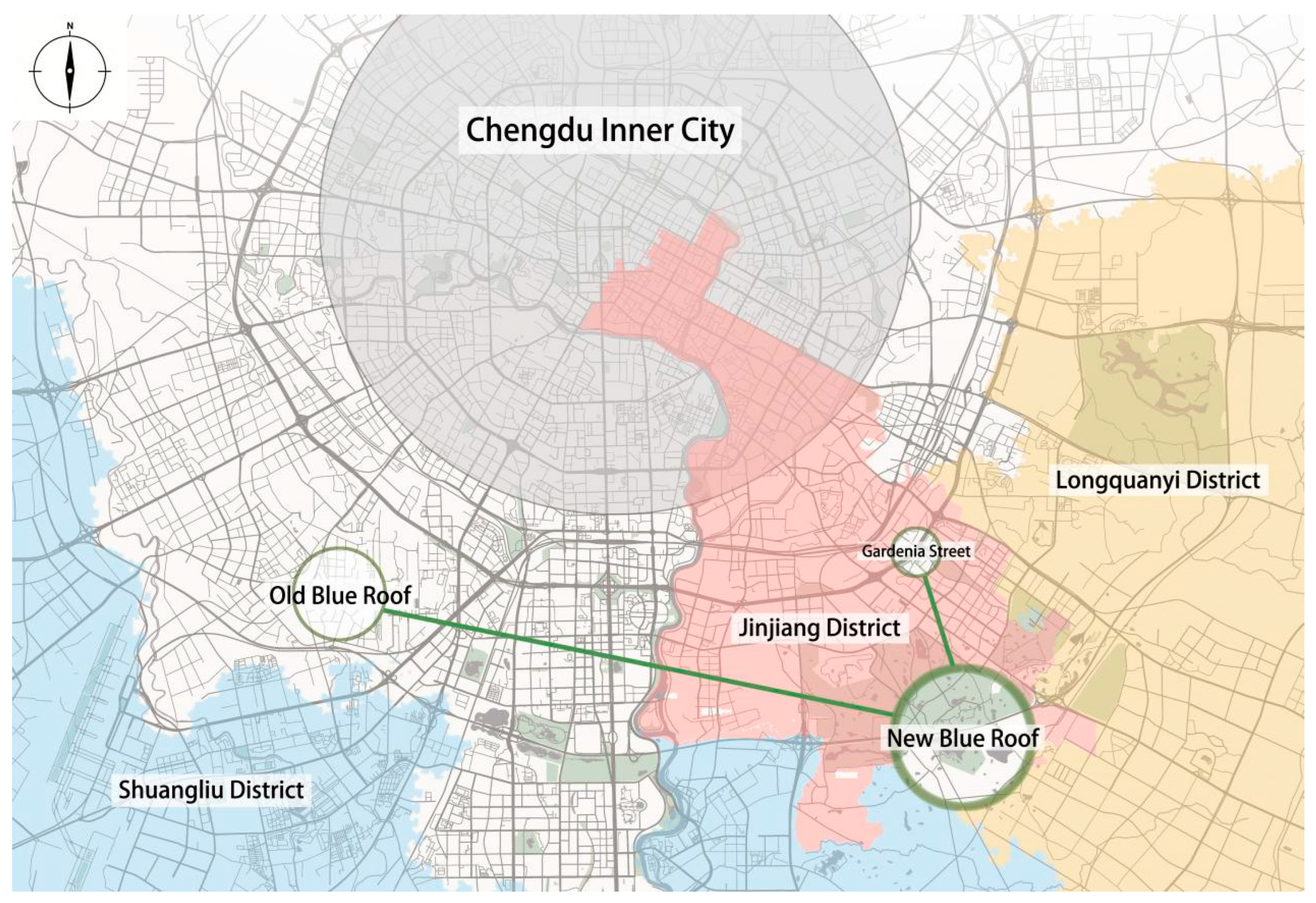
Figure 2.
The spatial configuration of the Blue Roof Art District and surrounding areas.
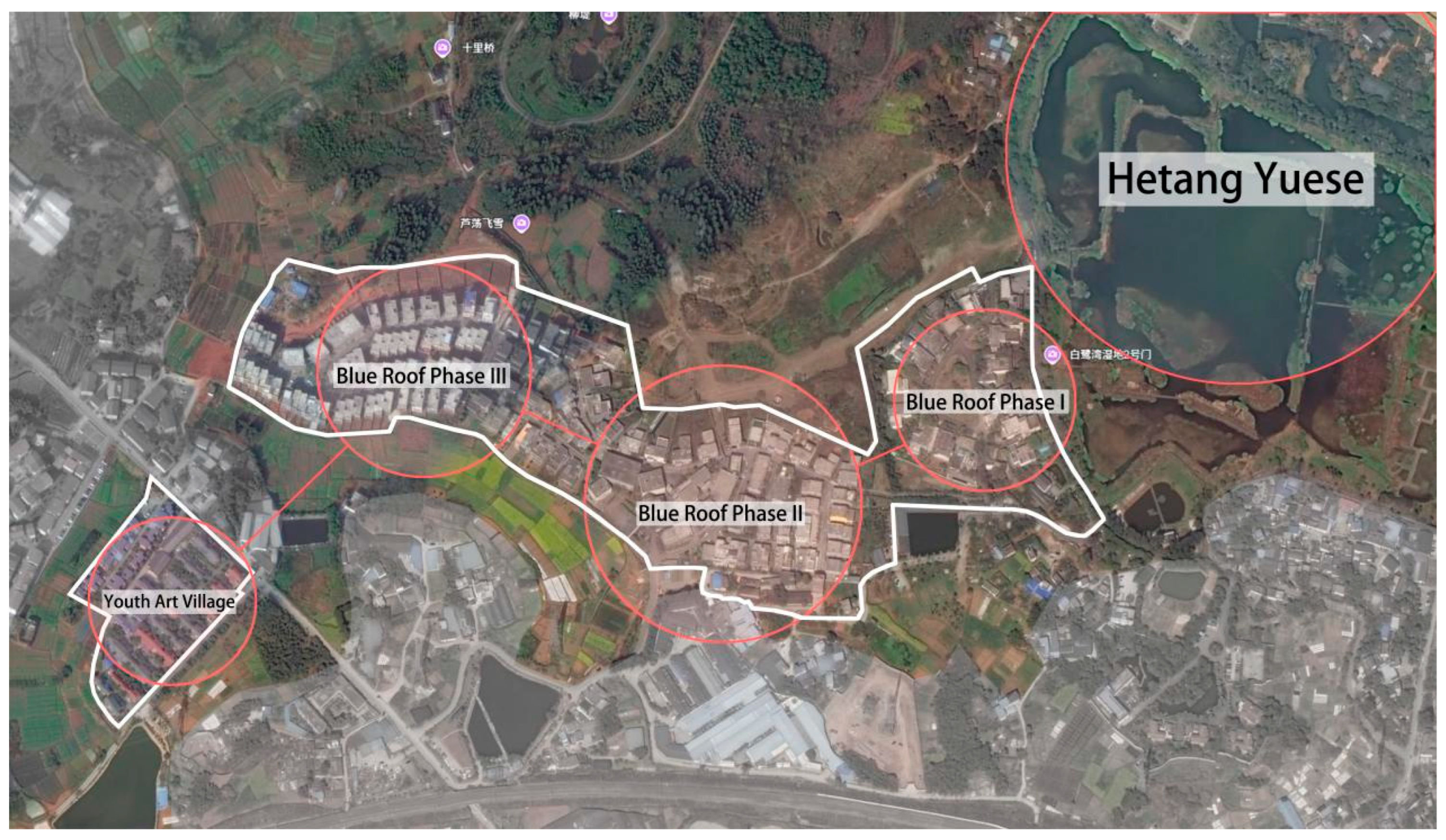
Figure 3.
(a) Blue Roof Art Museum; (b) Youth Art Village.
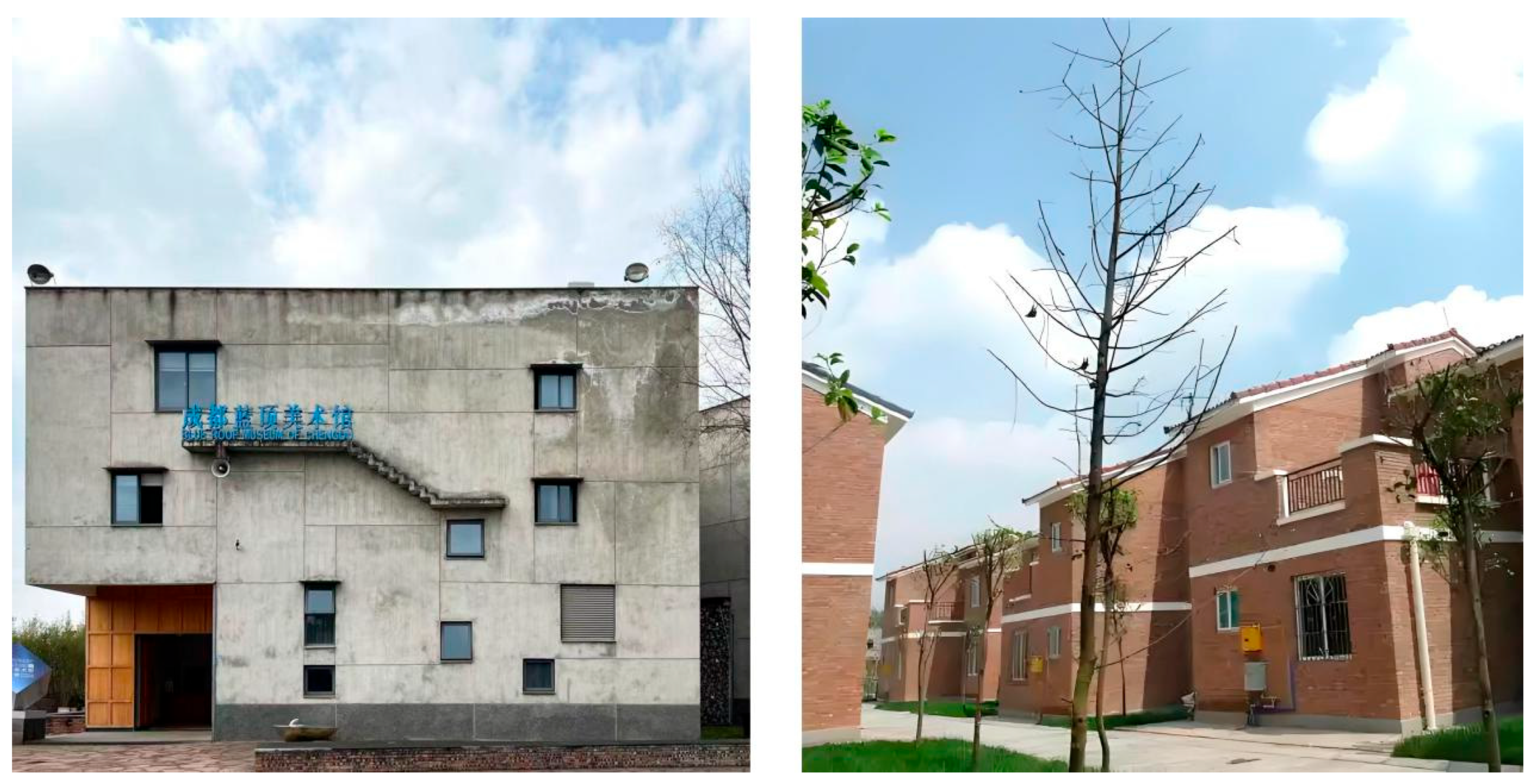
Figure 4.
(a) Some public art spaces; (b) The interior of an artist's studio.
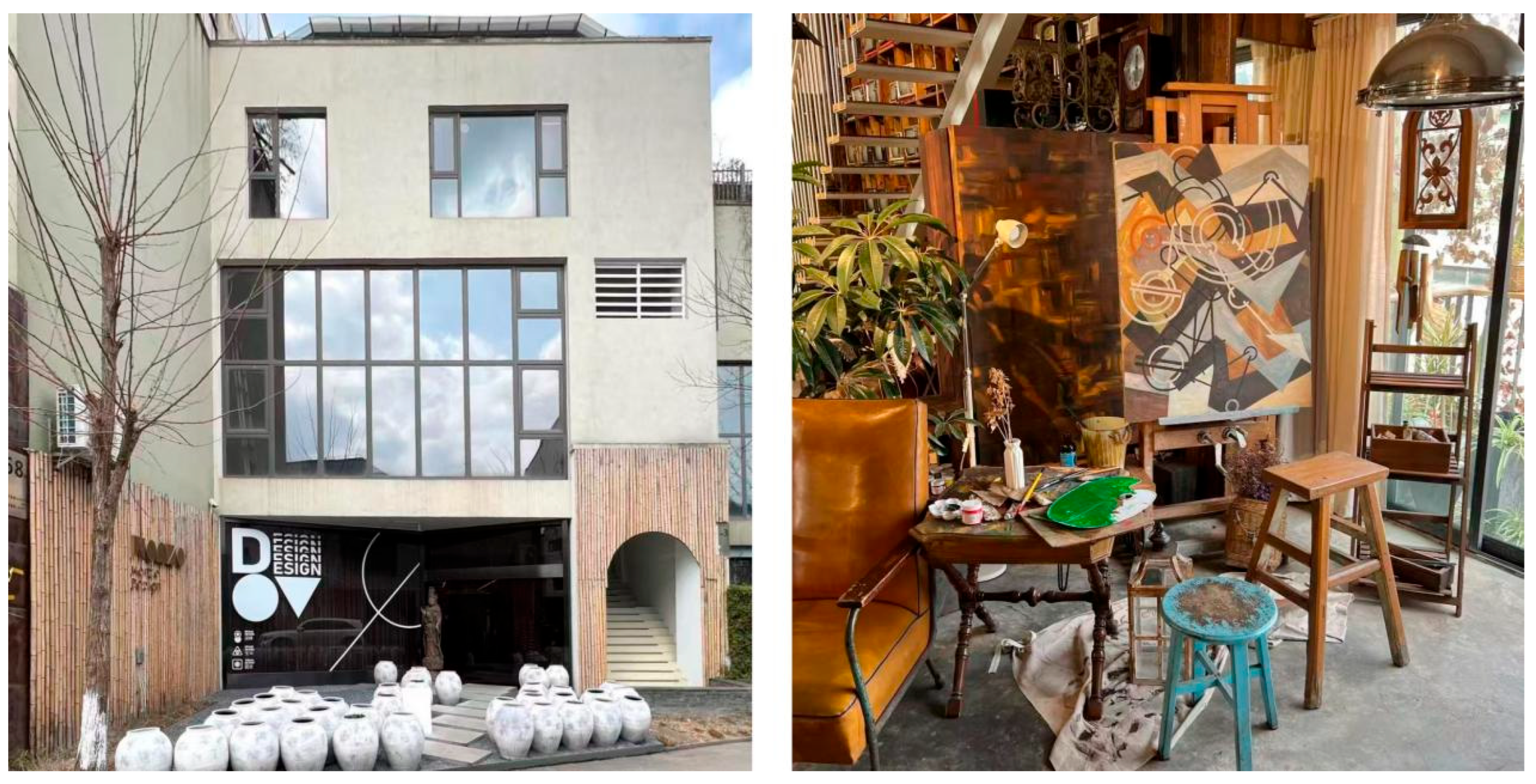
Figure 5.
(a) Numerous commercial enterprises moved in, such as wedding photography companies; (b) Some artists sold their studios and moved away.
Figure 5.
(a) Numerous commercial enterprises moved in, such as wedding photography companies; (b) Some artists sold their studios and moved away.
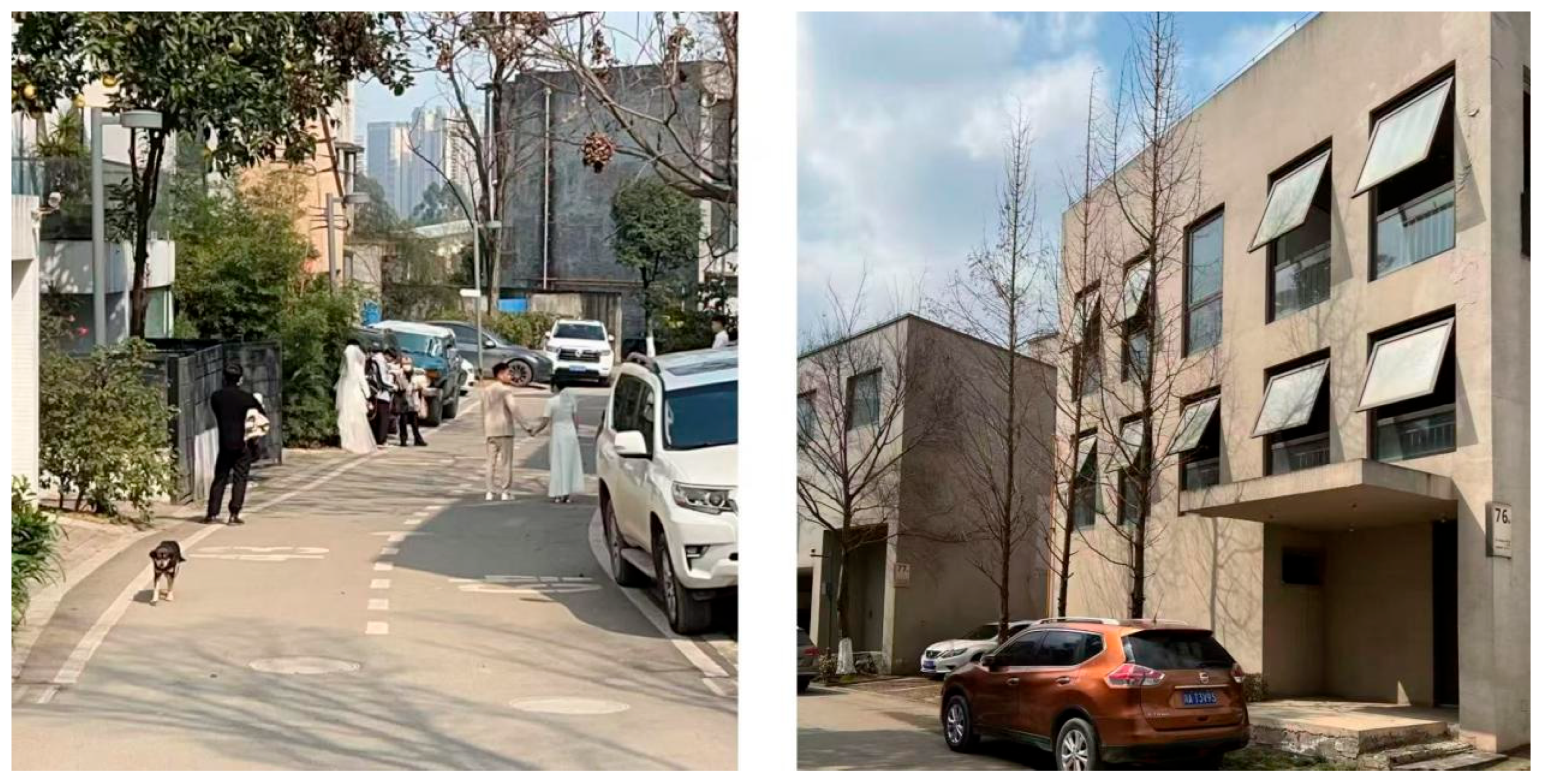
Figure 6.
Some Private art exhibitions.
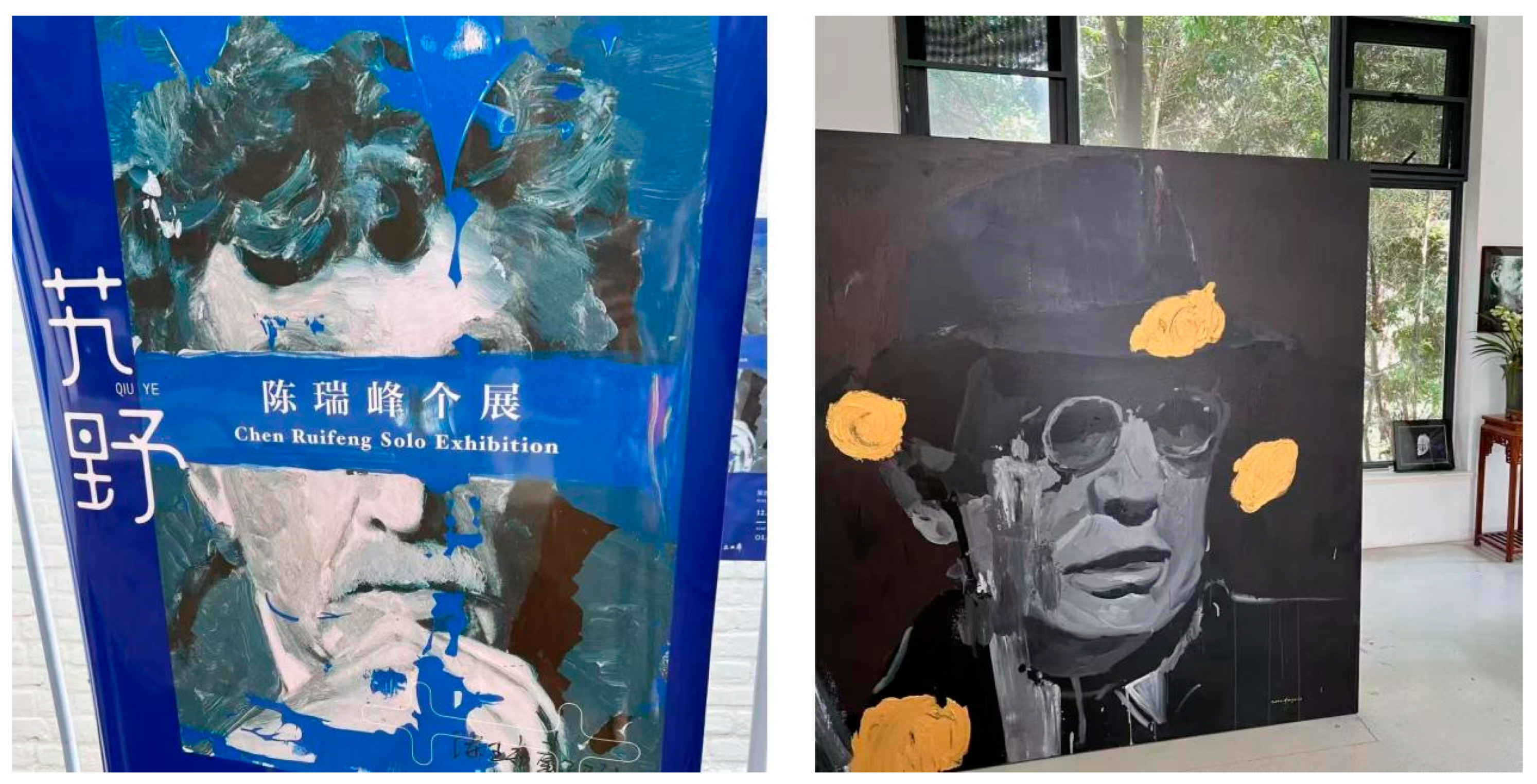
Figure 7.
Following ecological regulation, extensive surrounding areas were reconverted into agricultural land/ecological woodland, including Hetang Yuese.
Figure 7.
Following ecological regulation, extensive surrounding areas were reconverted into agricultural land/ecological woodland, including Hetang Yuese.
Disclaimer/Publisher’s Note: The statements, opinions and data contained in all publications are solely those of the individual author(s) and contributor(s) and not of MDPI and/or the editor(s). MDPI and/or the editor(s) disclaim responsibility for any injury to people or property resulting from any ideas, methods, instructions or products referred to in the content. |
© 2025 by the authors. Licensee MDPI, Basel, Switzerland. This article is an open access article distributed under the terms and conditions of the Creative Commons Attribution (CC BY) license (http://creativecommons.org/licenses/by/4.0/).
Copyright: This open access article is published under a Creative Commons CC BY 4.0 license, which permit the free download, distribution, and reuse, provided that the author and preprint are cited in any reuse.


