

Submitted:
19 October 2025
Posted:
20 October 2025
You are already at the latest version
Abstract
In today's physics, the prevailing view is that consciousness acts as the observer. The scientific mind is creating models about the world, and consciousness is acting as an observer who watches the scientific mind's activities. In this article, we will explore consciousness's ability to be aware of human mind activity and serve as a tool to improve science with the paradigm shift of conscious research methodology. Development of conscious thinking, where consciousness becomes the supervisor of the mind, is the only way to progress education, so that it will be in the service of the peace and prosperity of human civilization.
Keywords:
consciousness
; mind
; education
; knowledge
Introduction
A famous Albert Einstein quote has deep insight: “We cannot solve our problems with the same thinking we used when we created them«. Consciousness possesses a unique quality of observing mental activity from a distance, free from any kind of mental prejudices. So-called conscious observation of the mind activity gives the possibility to see the problem from a totally new perspective and solve it, or to see that the problem was the pseudo-problem created by the mind itself. This is because consciousness, from the perspective of ontology, is higher than the mind. The scientific mind experiences this world in the frame of psychological time; consciousness experiences world directly without being placed in time and elaborated by the analytical scientific mind (Šorli, Čelan, 2022).
Figure 1.
Analytical scientific experience and conscious experience.
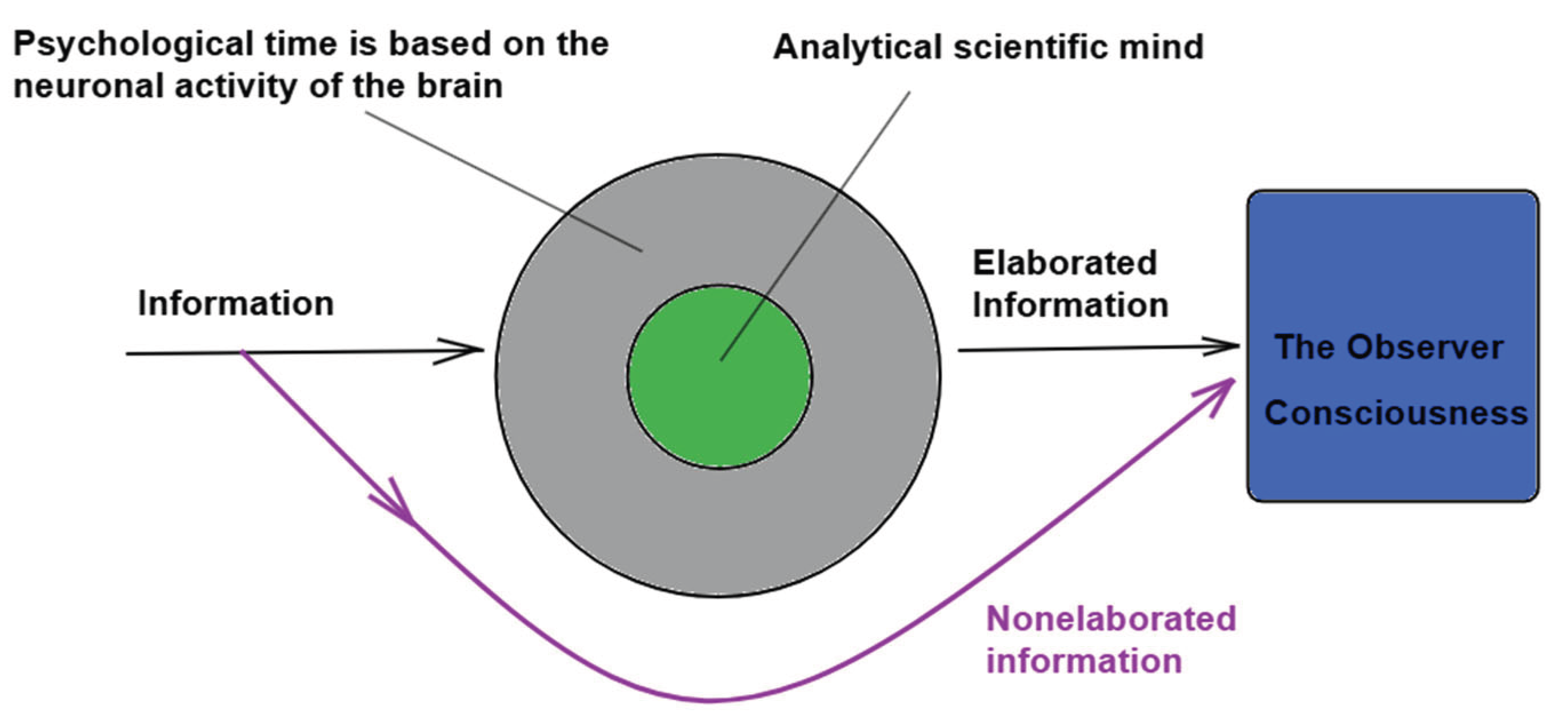
When the observer is identified with the scientific mind, he experiences the information through the scientific mind. When the observer is aware of the scientific mind activity, he also has a conscious experience that is beyond the linear psychological time and beyond scientific mind analysis. Conscious experience transcends psychological time, offering the observer the opportunity to perceive how the scientific mind's analysis distorts the world's information.
The Theory of Relativity of Albert Einstein has created the so-called "twin paradox": the twin on the Moon ages faster than the twin on Earth. The scientific mind at the beginning of the 20th century imagined that both twins age in the space and in time, which is the 4th dimension of space. It was contradictory that twins live in two different times that have different speeds. Today, the problem is solved by the introduction of the model where universal space is time-invariant and both twins age in the same time-invariant space. Twin on the Moon's surface ages faster than the twin on Earth's surface because gravity on the Moon is smaller than on Earth's surface. Clocks run with the lower rate on the Earth than on the Moon, but both clocks run in the same time-invariant space that we humans experience as NOW (Sorli 2025a).
Methods and Results
Put your hand in front of your eyes and observe it for a few seconds. Then you close your eyes and imagine your hand in your inner vision. Your mind can imagine your hand, and consciousness can observe the image of the hand. This exercise is proof that consciousness can watch the mind. In this experiment, the human being is the apparatus, and the experience itself is the experimental proof.
The author designed a method to practice the observation of the mind activity with full effectiveness. You observe the moving line on your computer screen, then you close your eyes and observe the motion of the line in your inner space (Šorli, 2025b). This practice will greatly increase your ability to be aware of your mind activity.
The practice of watching your breath is also very effective. Your breath is normal. You observe the stream of breath coming into the lungs and moving out of the lungs. This is the principal Buddhist technique to awaken the consciousness called Vipassana – conscious breath. The result of regular practice of the activity of the mind or the activity of breathing is that you become aware that you are not only mind and body; essentially, you are the observer, which is consciousness.
The first step into conscious experience is stepping out of the psychological time. The observer who is out of psychological time is partially anchored in consciousness. The second step is disidentification with the scientific mind, where the mind becomes a perfect tool for building scientific models of reality that is used by the consciousness. When scientific models are created exclusively by the mind, often unnecessary new elements are introduced to explain reality. A nice example is the introduction of dark matter, which was never discovered because it is non-existent (Sorli et al., 2023).
Conscious experience and analytical scientific experience are complementary. Conscious experience can highly improve scientific research methodology, because the scientist becomes aware of how his own mind influences the scientific models of reality. For example, the model of space-time is a creation of the scientific mind, and for more than 100 years, we have believed that time has a physical dimension as the 4th dimension of space, despite there is no experimental evidence for such a belief. Consciousness experience introduced a new advanced scientific model where universal space is time-invariant and time is a duration of motion in space when measured by the observer (Sorli 2025a).
Consciousness Unifies Humanity
Integration of consciousness into education worldwide will generate a new generation on this planet that will be free of all kinds of mental identifications: religious, national, racial, and all others. Any kind of identification is a potential conflict. To avoid conflicts, we have to raise human society to the next ontological level: from mind to consciousness. From the evolutionary point of view, the development of the mind has greatly increased the survival capacities of our ancestors, but today, identification with the mind has become the main reason for violence, wars, and destruction. We have to integrate consciousness and life into cosmology (Sorli, 2023) and see the larger picture in which the jump from the mind to consciousness is the only evolutionary possibility to avoid the self-destruction of humankind.
In every human being, consciousness acts as the observer of the mind. This is an enormous potential for the unification of human society into a planetary society where national, religious, and all other partial identifications will be secondary. We are different in the mind, religiously, culturally, historically, but we are one in consciousness. This oneness in consciousness has the potential to reintegrate the human population on this planet and bring the end of today's collective madness, where people are killed only because belonging to another state, religion, or race.
Conscious experience of this world is free of religious, racial, or cultural identification and is the neutralizer of potential tension among them.
Figure 2.
Conscious experience is the neutralizer of tensions and the unifying element of human society.
Figure 2.
Conscious experience is the neutralizer of tensions and the unifying element of human society.
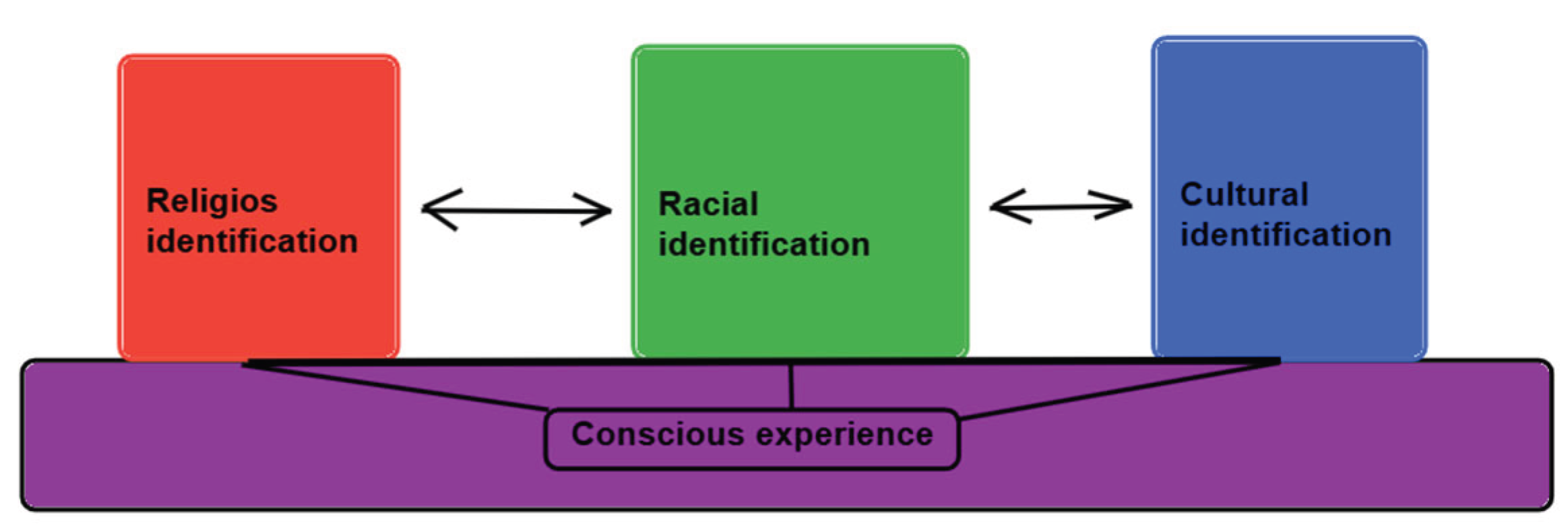
Different religions, races, and cultures are the expressions of the variety of existence and represent the richness of our world. From a historical point of view, we see that the excessive mind identification with these varieties leads to violence and destruction. Awakening of consciousness worldwide through education seems the best way to bring the human civilization to the next evolutionary level of natural harmony and peace. Harmony and peace are the intrinsic properties of consciousness.
Experiential Consciousness Research as a Part of Physics Curriculum
The unproven conviction of mainstream science is that consciousness is the result of biological evolution. A recent article is challenging this idea and opening the other possibilities where consciousness is ontologically higher than mater: “Many Indigenous scholars write about an understanding of consciousness that exists and extends beyond the brain, originates from a spiritual source, infuses all of nature, survives bodily death, provides learning, guidance, and wisdom, and connects all living things” (Waterman & Walton, 2024). In his recent presentation, world-renowned researcher on consciousness Prof. Stuart Hameroff suggested that consciousness was before the evolution of life on our planet (Hameroff, 2025). The author of this article developed the model where consciousness is the primordial reality of the universe, and the material universe and life are embedded in consciousness. Atoms are three-dimensional, atomic particles are four-dimensional, and consciousness is n-dimensional. Consciousness is a non-created immanent reality; it has no entropy, which is governing only the world of atoms (matter). This discussion will continue in the next decades, but in my view is not of huge importance. What counts is that we can awaken the full potential of consciousness in every human being in the process of education. Physics classes have the same curriculum in all educational systems on this planet. With the introduction of lectures on the origins of the observer in physics, we will bring the research of experiential consciousness to every physics curriculum on this planet.
The view that consciousness is a cosmic phenomenon which plays essential role in quantum physics is entering mainstream science (Ponte & Schäfer, 2023). It is important that we do not remain only on the mental study of consciousness, and we also introduce experiential research on consciousness. Consciousness is subjective and must be sought in a subjective way, where the human being becomes an apparatus. When this apparatus experiences that it can observe its mind, we must recognize this as an experimental confirmation of the fact that consciousness is beyond the mind.
Mainstream science is coming closer to the mystical view, namely, that consciousness is not situated in the brain (Wahbeh et al., 2022). The next step is that science integrates the dimension of mystical experience in a way that it will be comprehensible to the scientific mind. The comprehensible model proposed in this article is that consciousness acts as the human ability to observe (watch) the mind. This definition is based on experience and can be widely accepted. The main scientific interest is how consciousness works; what consciousness is from the point of quantum mechanics is of secondary importance. Perhaps quantum mechanics will never fully grasp consciousness because consciousness is far beyond its reach. There is a similarity between consciousness and gravity: we don't know exactly the origin of either, but we do know how they work.
Descartes' quote “I’m thinking, so I’m” is the milestone of human civilization development. For Descartes, the stream of thought that constantly flows in my head gives me substantial assurance that I exist. We are now in a new era where the rule "I'm aware of my thinking, so I'm" applies. The important quest of today's science and education is: “Who is the observer of the stream of thoughts”? The answer is "consciousness," but it is not satisfactory. Because consciousness is not only about understanding, it is primary about experiencing. The answer is "consciousness," but it is not satisfactory. Because consciousness is not only about understanding, it is also about experiencing, which begins when you take distance from your own mind. Becoming aware of your mind stream is the beginning of individual experiential consciousness research, which is the most extraordinary adventure of mankind ever. The idea that the development of consciousness is the only way to peace and prosperity on this globe is gaining actuality in mainstream journals (Cameron, 2023). This is a good sign. It is important to point out that only thinking about consciousness will not make any change; only the real, alive experience of what consciousness is will change the world. Consciousness is the ultimate mystery of the universe that will never be solved, but we can use it to enlighten the human mind. Max Planck was right: “Science cannot solve the ultimate mystery of nature. And that is because, in the last analysis, we ourselves are a part of the mystery that we are trying to solve.”
Conclusions
Consciousness has an immense potential to enrich humanity. The human mind is a biocomputer; its proper work needs a supervisor, which is the consciousness. History confirms that no international agreements and declarations accepted on the level of the human mind have been useful in avoiding wars. The only way to peace and prosperity is the integration of consciousness into the educational system worldwide.
References
- Cameron, J. (2023). The Rise of Consciousness in Social Practices: A Pathway to Peace and Benevolence. In: Pereira Jr, A., Sousa, F. (eds) Principles for Governance. Sustainable Development Goals Series. Springer, Cham. [CrossRef]
- Ponte, Diogo Valadas, and Lothar Schäfer (2013). "Carl Gustav Jung, Quantum Physics and the Spiritual Mind: A Mystical Vision of the Twenty-First Century" Behavioral Sciences 3, no. 4: 601-618. [CrossRef]
- Sorli, Čelan, (2022). Time, observer and consciousness, Physics Essays 35, 2 https://bijective-physics.org/pdf/2022-Time-observer-and-consciousness.pdf.
- Sorli, (2023) Bio-Cosmology Integration of Life and Consciousness into Cosmology, Advanced Studies in Theoretical Physics Vol. 17, no. 1, 9 - 20 HIKARI https://www.m-hikari.com/astp/astp2023/astp1-4-2023/91969.html.
- Sorli et al., (2023). Dark Energy, Superfluid Space, Ether, and Missing Dark Matter, Advanced Studies in Theoretical Physics Vol. 17, no. 1, 31 - 42 HIKARI https://www.m-hikari.com/astp/astp2023/astp1-4-2023/91995.html.
- Sorli (2025a). Implications of Time-Invariant Superfluid Quantum Space Model in Fundamental Physics and Cosmology, Applies Physics Research 10.5539/apr.v17n1p98.
- Sorli (2025b). Experiential consciousness research https://www.youtube.com/watch?v=27qF_aN7kqo.
- Stuart Hameroff (2025). Consciousness existed before life https://www.youtube.com/watch?v=YvLd9YUHLSs.
- Waterman, L., & Walton, J. (2024). Consciousness education: Why an enquiry into consciousness is an educational and spiritual imperative. Journal for the Study of Spirituality, 14(2), 169–182. [CrossRef]
- Wahbeh H, Radin D, Cannard C, Delorme A (2022). What if consciousness is not an emergent property of the brain? Observational and empirical challenges to materialistic models. Front Psychol. 2022 Sep 7;13:955594. PMCID: PMC9490228. [CrossRef] [PubMed]
Disclaimer/Publisher’s Note: The statements, opinions and data contained in all publications are solely those of the individual author(s) and contributor(s) and not of MDPI and/or the editor(s). MDPI and/or the editor(s) disclaim responsibility for any injury to people or property resulting from any ideas, methods, instructions or products referred to in the content. |
© 2025 by the authors. Licensee MDPI, Basel, Switzerland. This article is an open access article distributed under the terms and conditions of the Creative Commons Attribution (CC BY) license (http://creativecommons.org/licenses/by/4.0/).
Copyright: This open access article is published under a Creative Commons CC BY 4.0 license, which permit the free download, distribution, and reuse, provided that the author and preprint are cited in any reuse.


