

Submitted:
17 October 2025
Posted:
20 October 2025
You are already at the latest version
Abstract
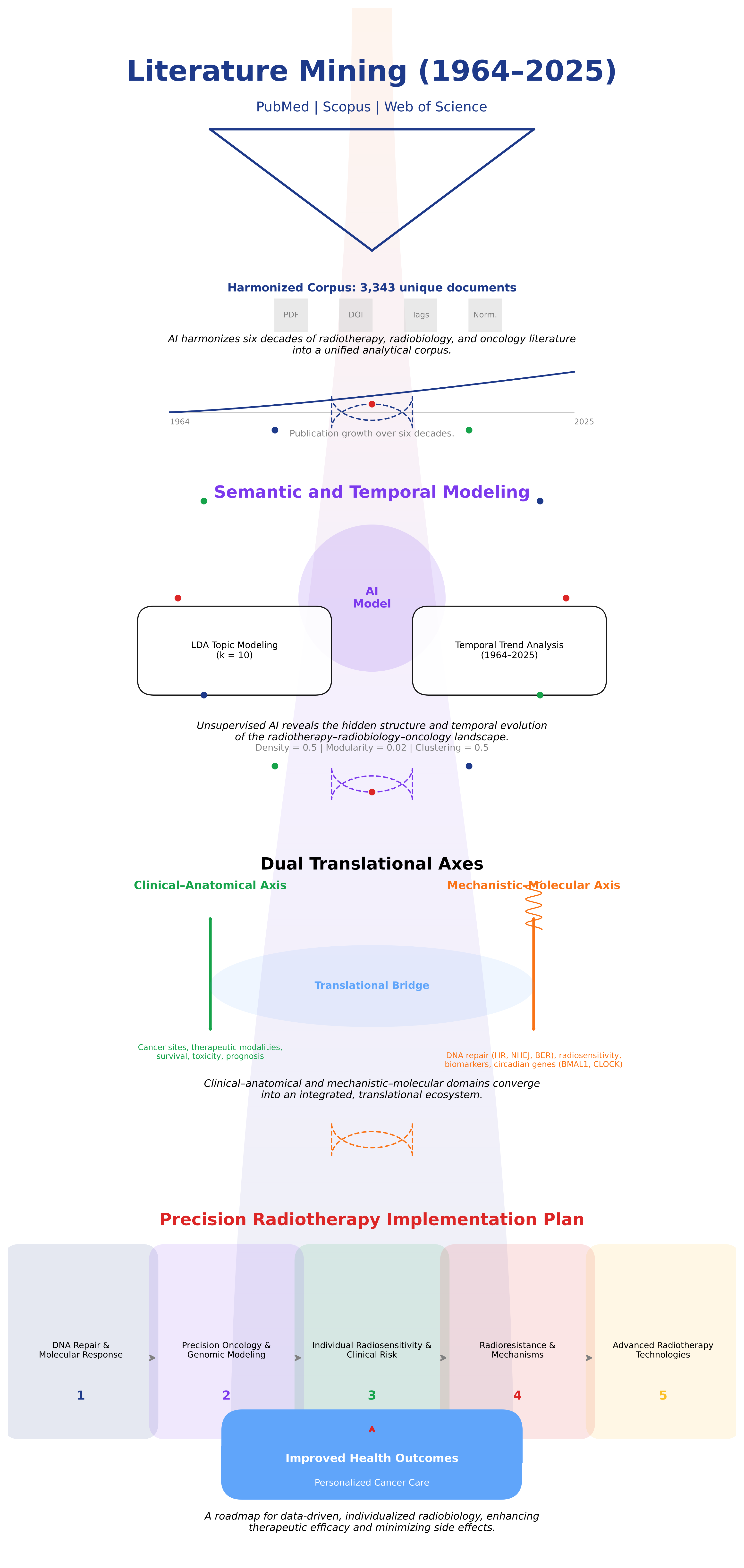
Background/Objectives: Radiotherapy, radiobiology, and oncology have evolved rapidly over the past six decades, generating vast and fragmented bodies of scientific evidence. This study aimed to systematically map and interpret their conceptual and temporal development using artificial intelligence (AI)–based methods, highlighting the integration between molecular mechanisms, clinical applications, and technological innovation toward a precision radiotherapy framework. Methods: A corpus of 3,343 unique documents (1964–2025) was retrieved from Scopus, PubMed, and Web of Science. Records were harmonized through deduplication, lemmatization, and metadata normalization. Topic modeling using Latent Dirichlet Allocation (LDA) and co-occurrence network analysis were applied to identify dominant research axes. Semantic and temporal analyses were conducted to reveal patterns, emerging trends, and translational connections across decades. Results: Three historical phases were identified: an initial period of limited production (1964–1990), moderate growth (1991–2010), and exponential expansion (2011–2024), with peaks in 2020 and 2023. LDA revealed two principal axes: a clinical–anatomical axis focused on cancer sites, treatment modalities, and prognosis, and a mechanistic–molecular axis centered on DNA repair, radiosensitivity, and biomarkers. The co-occurrence supergraph showed high density (0.5) and low modularity (0.02), indicating strong thematic integration. Case synthesis from 2014–2025 defined five operational classes: DNA repair and molecular response, precision oncology and genomic modeling, individual radiosensitivity, mechanisms of radioresistance, and advanced technologies such as FLASH radiotherapy and optimized brachytherapy. Conclusions: AI-driven semantic and temporal analyses revealed that radiotherapy has matured into an interconnected, interdisciplinary domain. The derived Precision Radiotherapy Implementation Plan translates molecular and computational insights into clinically actionable strategies that can enhance survival, reduce toxicity, and inform equitable health policies for advanced cancer care.
Keywords:
AI‐based semantic and temporal analysis
; co‐occurrence supergraph
; clinical‐anatomical axis
; mechanistic‐molecular axis
; DNA repair and molecular response
; advanced radiotherapy technologies (FLASH‐RT
; hadron therapy
; voxel‐level analytics)
1. Introduction
In the past decades, the number of scientific research studies has grown exponentially, creating vast reservoirs of knowledge in many fields [1,2,3,4]. However, a significant fraction of that knowledge remains underutilized because it is scattered in databases and challenging to access or interpret, especially in very specialized areas [5,6,7,8,9].
This study is based on a straightforward premise: the combination of literature mining and artificial intelligence (AI) can revolutionize the mapping of the thematic evolution and conceptual foundations of radiotherapy [10,11,12,13,14,15,16,17,18,19,20,21,22,23,24,25,26,27,28], radiobiology [29,30,31,32,33,34,35,36,37,38,39,40,41,42,43,44,45,46,47,48,49,50,51,52] and oncology [53,54,55,56,57,58,59,60,61,62,63,64,65,66,67,68,69,70,71,72], because by enabling automated, scalable and interpretable analyses, this approach overcomes the limitations of traditional searches and manual curation, providing a broader, more current and more interdisciplinary vision of the state of the art [7,73,74,75].
Traditional bibliometric tools are often unable to capture the subtle patterns that matter in specialized areas, thus highlighting the value of AI-based approaches that exploit metadata, semantic models and co-occurrence networks; therefore, the use of unsupervised machine learning and text mining in our previous work revealed emerging trends and knowledge gaps in areas such as nanocomposites, controlled drug delivery, photovoltaics, catalysis, biosynthesis and spectroscopy, showing that computational approaches can accelerate the synthesis and application of scientific knowledge [76,77,78,79,80,81,82,83,84,85,86,87,88,89,90,91,92,93].
In this work, we apply this strategy to an interdisciplinary corpus of thousands of articles indexed in Scopus, PubMed and Web of Science, intending to rigorously structure, validate and interpreting how radiotherapy, radiobiology and oncology have consolidated as an interconnected domain from 1964 to 2025, because to our knowledge, this is the first comprehensive effort to apply AI-based semantic and temporal analysis to the literature of these disciplines at this scale and depth.
None of these studies has considered both the semantic and temporal dimensions of the literature by a unified analysis pipeline, and in particular, there is a gap in the methodological literature between bibliometric/quantitative approaches and clinically oriented predictive models. The rest of the literature is organized around four main strands, each one focused on a particular aspect of the problem, including bibliometric and visualization studies, which have been conducted by using tools such as VOSviewer and CiteSpace for analyzing the evolution of keywords and co-authorship networks. For instance, Wang et al. (2024) [94] reports a keyword co-occurrence network, which shows the main trends in the field from 2014 to 2025, however, these studies are essentially descriptive, and in general, they do not include topic modeling, deep semantic analysis, or time series methods.
Methodological proposals, such as the one by Andrei and Arandjelovic (2016) [95], use hierarchical Dirichlet processes and temporal similarity graphs to model the evolution of topics over time, but this framework has not been used in the biomedical context nor in radiotherapy. Meanwhile, AI for radiotherapy literature, including studies by Tabibi et al. (2025) [96] and Lastrucci et al. (2024) [97], use deep learning to predict clinical outcomes and refine treatment strategies in radiotherapy, consequently, precision and efficacy of the treatment have increased significantly, although these studies predict clinical endpoints, whereas the mining or semantic representation of the scientific literature itself has not been addressed.
Reviews, such as Momin et al. (2020) [98] and Trifiletti and Showalter (2015) [99], discuss the integration of clinical and genomic data in radiotherapy, but do not perform a semantic and temporal analysis of the scientific output, therefore, to summarize, these literature strands suggest a methodological gap between purely bibliometric studies and clinically oriented predictive models. To the best of our knowledge, there is no published study that performs an integrated analysis of combining semantic modeling (e.g., topic modeling, co-occurrence networks) with structured temporal analysis (e.g., historical time series, change point detection) in a unified framework for the radiotherapy, radiobiology, and oncology literature, which justifies the novelty of the present study, that aims at synthesizing bibliometric indicators, semantic modeling, and temporal dynamics in a single framework providing both analytical insight and predictive perspective on the scientific evolution of the field.
By integrating major databases and processing more than three thousand unique documents with advanced computational modeling, the study goes beyond traditional bibliometrics, providing a dynamic and interpretable view of how these fields have evolved over six decades, and linking molecular mechanisms, clinical practice, and technological development within a single analytical framework. In so doing, the study demonstrates a new approach to scientific progress: artificial intelligence as a tool for synthesis and interpretation, rather than allowing valuable findings to remain scattered and fragmented. AI can facilitate their transformation into cohesive insights that can inform translational advances and support more precise, efficient, and equitable healthcare.
2. Methods
The search strategies applied to Scopus, PubMed, and Web of Science were carefully harmonized to identify publications addressing the intersection of radiotherapy, radiobiology, and oncology, with the guiding question: “What are the key connections and advances at the interface of radiotherapy, radiobiology, and oncology as reflected in the recent scientific literature?” The query used in Scopus was TITLE-ABS-KEY ((radiotherapy) AND (radiobiology OR "radiation biology") AND (oncology)); in PubMed, a combination of MeSH terms and free-text fields was applied—("Radiotherapy"[MeSH Terms] OR "Radiotherapy"[All Fields]) AND ("Radiobiology"[All Fields] OR "Radiation Biology"[All Fields]) AND ("Oncology"[MeSH Terms] OR "Oncology"[All Fields]); and in Web of Science, the direct key (Radiotherapy AND Radiobiology AND Oncology) was used. These strategies initially retrieved 2,507 records from PubMed, 741 from Scopus, and 714 from Web of Science, yielding a total of 3,962 documents.
3. Results
The structured computational pipeline began with the automated ingestion of files from Scopus, PubMed, and Web of Science. We standardized and normalized the core data fields, and we retained additional metadata for each data source. We merged the data, and when the same publication was included twice, we selected the record with the most complete data, therefore we removed 594 duplicate publications based on ID numbers and 25 based on titles. This resulted in a total of 3,343 publications, and thus the final dataset was composed of a large number of unique publications. The majority of the publications were retrieved from PubMed (66.23%), followed by Scopus (21.96%) and Web of Science (11.82%), and so the distribution of publications across these databases was not uniform.
Figure 1 provides a graphical synthesis of the results, and in the upper part of the figure, the number of publications per year is presented, which shows three phases: low publication rate from 1964 to 1990, moderate growth from 1991 to 2010, and rapid growth from 2011 onward, because this coincides with the rise of stereotactic body radiotherapy, protons, and prediction models. The years 2020 and 2023 had the highest number of publications (~240), but the decrease in 2025 is probably due to incomplete indexing of the literature, and thus this decrease may not reflect the actual number of publications. The word cloud at the bottom of the figure was generated based on titles and abstracts, and common terms such as radiat, cell, treatment, cancer, dose, patient, tumor, radiotherapi, fraction, therap, and radiobiolog, are highlighted.
Additional terms, such as proton, irradi, brachytherapy, repair, dna, toxicity, and response, refer to molecular mechanisms and emerging techniques, while surviv, risk, model, and outcome emphasize prognosis, and clinic, trial, meta, and evalu indicate the prevalence of translational trials.
The lower panel depicts the top ten most frequent terms across years, and cell is the most frequent term, with >550 occurrences in 2020, which reflects the high number of cellular/molecular investigations, and terms such as radiat, patient, dose, cancer, treatment, tumor, and radiotherapi increased in parallel between 2015 and 2023, because they are closely related to the main topics of the field. Effect and clinic increased gradually, reflecting increasing efforts on therapeutic effects and clinics, and thus they are important for the development of the field.
Collectively, this indicates limited vocabulary use until the early 1990s, followed by gradual increase, and a sharp increase after 2010, which correlates with the development and consolidation of the field, and so the field has undergone significant changes over the years. Following text preprocessing, Latent Dirichlet Allocation (LDA) was performed using k = 10 topics, with lemmatization, biomedical stopword filtering, and frequency trimming (no_below=2–5, no_above=0.5) to ensure vocabulary stability. Models were trained separately for titles and abstracts (passes = 10, random_state = 42), and validated through inspection of word distributions and stability across runs. The top 20 LDA-derived keywords were subsequently used to construct the co-occurrence supergraph, providing a quantitative foundation for thematic mapping. Titles included head and neck, breast, and prostate cancer; adverse effects; image-guided planning; and highly conformal treatment, while abstracts included DNA damage and repair; dose-response modeling; clinical trials; immunoradiotherapy; and normal tissue adverse effects, therefore the topics covered a wide range of subjects. For each topic cluster, word association maps were created using the 20 most probable words, and these maps were integrated into a single large map, which thus provided a comprehensive overview of the field. Main nodes were radiotherapy, tumor, DNA repair, and adverse effects, and all files (CSV, SVG, PNG) were generated for visualization in Gephi and topological analysis, therefore the results can be easily visualized and analyzed. Yearly word counts and smoothed frequency curves indicated sustained growth in the most prominent biology and technology concepts, which is a significant finding.
This has led to an increasingly interdisciplinary field linking radiotherapy, radiobiology and oncology, with reciprocal interactions between technological developments, cellular processes and clinical practice, and so the field has become more complex and multidisciplinary. The approach emphasizes repeatability, transparency and reproducibility of methods to ensure the interpretability and verifiability of findings, therefore it is essential for the development of the field. Briefly, LDA was applied to the titles and abstracts of the 3,343 non-duplicate publications, identifying 10 topics for each corpus, reflecting the broad scope of a literature that encompasses radiotherapy, radiobiology and oncology, and full counts and model parameters are presented in Equations 1-20 of the Supplementary Information, which thus provides a detailed description of the methodology and results.
In the titles, topics ranged from clinical and anatomical foci to molecular mechanisms and technical approaches. Topic_0t, dominated by cancer, radiotherapy, patient, head, neck, breast, and prostate, underscores the concentration on specific tumor types treated with radiotherapy, including advanced cases and toxicity. Topic_1t highlights radiobiology, clinical, and oncology, indicating the integration of biological foundations with clinical practice. Topic_2t clusters cancer, breast, carcinoma, prostate, and esophageal, characterizing comparative studies. Topic_3t emphasizes radiation, oncology, biology, and molecular, reflecting interest in the mechanisms of radiation action. Topic_4t, centered on stereotactic, body, radiosurgery, and lung, captures the SBRT literature in pulmonary neoplasms. Topic_5t addresses radiation, beam, ion, and proton, underscoring dose delivery physics and tissue protection. Topic_6t, with tumor, brain, model, and imaging, points to modeling and preclinical studies of brain tumors. Topic_7t organizes tumor, cell, DNA, repair, and pathway, reflecting the molecular biology of DNA damage. Topic_8t, dominated by cell, human, expression, and gene, refers to in vitro experimentation. Finally, Topic_9t, with dose, brachytherapy, model, and radiobiological, is associated with dose modeling and brachytherapy.
In the abstracts, methodological granularity is greater. Topic_0a, with model, dose, imaging, and flash, suggests imaging-based modeling and planning for FLASH-RT. Topic_1a, centered on cell, tumor, DNA, repair, and damage, focuses on the biological mechanisms of radiation. Topic_2a, with proton, ion, RBE, and particle, delineates the literature on particle therapies. Topic_3a, clustering patient, survival, RT, and surgery, reflects prognostic clinical studies. Topic_4a, with toxicity, breast, risk, Gy, and SBRT, addresses toxicity in breast cancer patients treated with precision radiotherapy. Topic_5a, highlighting trial, immunotherapy, preclinical, and targeted, points to the rise of immunoradiotherapy and combination therapies. Topic_6a, with expression, gene, protein, and blood, characterizes research on molecular biomarkers. Topic_7a, with dose, Gy, plan, and mouse, refers to preclinical trials and validation in animal models. Topic_8a, dominated by generic terms such as clinical, therapy, oncology, and development, likely reflects institutional or editorial texts. Finally, Topic_9a, with dose, fraction, tissue, and effect, emphasizes studies on dose fractionation in normal tissues.
The thematic landscape emerging from our analyses is two-dimensional. It consists of interdependent clinical-anatomical and mechanistic-molecular axes, because the clinical-anatomical axis encompasses disease sites, therapeutic modalities, and patient-centered outcomes, including survival and toxicity. In contrast, the mechanistic-molecular axis encompasses cellular responses to ionizing radiation, DNA damage and repair pathways, gene expression programs, and biomarker development. The overlap of the axes is not coincidental; rather, it represents a truly translational ecosystem where conceptual and experimental advances are translated into clinical decision-making, and, reciprocally, clinical needs drive mechanistic inquiry. Consequently, several novel fronts have been gathering steam within this matrix, including ultrafast radiotherapy (FLASH-RT), immunoradiotherapy, individualized predictive modeling, and the routine inclusion of molecular biomarkers. Collectively, these fronts constitute a precise, forward-looking map of how the field is maturing and where it is headed; therefore, the co-occurrence supergraph (Fig. 1 inset) denotes the semantic backbone of the literature encompassing radiotherapy, radiobiology, and oncology.
In the graph, nodes represent keywords extracted from titles, abstracts, and descriptors, while edges encode the frequency of co-occurrence. Edges are visually weighted according to connection strength: thicker, reddish edges correspond to stronger semantic relations (as among cancer, radiotherapy, tumor, and particle), while thinner, bluish edges correspond to weaker associations. From a topological perspective, the network is dense and cohesive, displaying a density of 0.5, a diameter of 1, an average degree of 9.5, and an average weighted degree of 1962.2, reflecting intense co-occurrence relationships. A mean clustering coefficient of 0.5 with 1140 triangles reveals substantial local cohesion, while a low modularity of 0.02 and a single weakly connected component indicate a highly integrated thematic space.
All network metrics were computed in Gephi using a directed, weighted setup, which means the numeric ranges are shifted, and hence why diameter = 1 and density = 0.5 correspond to the directed adjacency definition and not a fully connected graph, because the weighted degree is a count of total co-occurrence, which is why these values are higher than unweighted degrees. Together with low modularity and high clustering, the metrics paint a picture of a tight but non-trivial lexical network, i.e. evidence of thematic convergence without the network collapsing into a single blob. However, when we re-ran the analysis on an undirected, thresholded version of the data, we found the relative ordering of important nodes and communities to be essentially unchanged, with a Pearson correlation coefficient greater than 0.9, which therefore supports the robustness of our interpretation.
From a practical point of view, the literature has converged into a single, integrated domain rather than a collection of disconnected subfields; thus, it is well positioned for efficient knowledge transfer. The primary node in this topology is cancer, closely connected to tumor, radiotherapy, particle, and breast, while technical subfields (proton, stereotactic, imaging) are peripherally located yet act as anchors for technological and methodological development.
When mapped onto term frequency curves over time, the topology confirms an increasing frequency of terms starting in the 2000s and accelerating after 2010, mirroring the overall surge in biomedical research. Key terms (cell, cancer, dose, treatment, radiotherapy) have expanded sharply, confirming their central role. The consistency between temporal dynamics and network topology reinforces the centrality of cancer and radiotherapy, while highlighting the growing prominence of molecular response terms (DNA, repair), clinical outcome terms (survival, toxicity), and technical parameters (dose, fraction).
In aggregate, this literature is characterized by strong interdependencies among clinical, molecular, and technological concepts, without rigid semantic boundaries. Therefore, this consolidation implies efficient knowledge transfer across scales—from DNA repair pathways to dose planning and patient outcomes. Practically, the supergraph provides a decision-ready analytical tool to frame systematic reviews, identify underexplored clusters, and guide targeted literature mining strategies in oncological radiotherapy. Thus, the semantic cohesion of the field is not only descriptive but functional, furnishing a robust and verifiable backbone for a continuously learning, precision-oriented radiotherapy ecosystem capable of integrating emerging innovations such as FLASH-RT, immunoradiotherapy, and biomarker-driven personalization.
From this integration, four main hypotheses emerge: (1) cancer and radiotherapy function as structuring axes of recent scientific production; (2) the growth of terms such as cell, dose, effect, and treatment reflects the emphasis on therapeutic personalization, mechanisms of action, and clinical efficacy; (3) the co-occurrence of tumor, DNA, repair, and survival indicates intensified research in precision medicine and response biomarkers; and (4) the densely connected network confirms the transversal nature of the field, integrating molecular biology, medical physics, and clinical practice within a unified scientific ecology.
We iterated these hypotheses to inform the search strategies used to locate research at the interface of radiotherapy, radiobiology, and oncology. In Scopus, we searched titles, abstracts, and author keywords for records that are limited to biomedical subject areas, and from post-2014, which retrieved 25 records, and in PubMed, we combined MeSH with broad field searches and limited results to 2015-2024, and to clinical or translational publication types, which retrieved 10 records. Together, the refined search strategies maximised specificity and translational relevance to precision radiotherapy, and thus limited the resulting corpus to studies that are most likely to inform precision radiotherapy. In Web of Science, the query applied to the abstract field yielded 35 documents. After automated deduplication by DOI and title, the records were consolidated into a corpus of 61 articles, representing an analytical set centered on the molecular, therapeutic, and clinical trends of contemporary radiobiological oncology. This corpus serves to empirically validate the thematic and structural hypotheses identified through semantic analyses, providing a solid foundation for the investigation of high-impact case studies.
Semantic analysis of the corpus by Latent Dirichlet Allocation (LDA) reveals a three-part thematic structure, and when combined, topics extracted from titles collapse into three separate themes. The first theme is translational, with terms such as radiotherapy, effect, cell, combination, metastatic, and clinical, and corresponds to work that bridges combined therapeutic approaches in cellular systems with clinical trials. The second theme is biomarkers, with terms such as cancer, patient, trial, biomarkers, hypoxia, and radiosensitivity, and corresponds to work that bridges molecular signatures and microenvironmental factors with outcomes such as response and toxicity, while the third theme is mechanistic, with terms such as model, tissue, flash, normal, genomics, and learning, and corresponds to work that applies radiobiological modeling and machine learning to predict tissue responses, including under ultrafast dose-rate conditions, such as FLASH radiotherapy. Together, these three themes suggest a field that seamlessly bridges laboratory findings, molecular profiling, and clinical practice, while also developing data-driven approaches to predict and improve patient outcomes.
The analysis of abstracts confirms this tripartite thematic segmentation while adding a more refined methodological layer. Terms such as response, damage, DNA, repair, radiosensitivity, and cellular reinforce the focus on molecular responses to radiation, whereas words like parameter, model, radiobiological, high, and biological indicate the development and calibration of quantitative models. At the same time, expressions such as dose, risk, volume, and fractionation point to the optimization of dosing schemes. The consistent presence of signature, hypoxia, biomarker, and median cohort reveals the adoption of genomic signatures and clinical cohort analyses as predictive tools.
Co-occurrence analysis of the top 20 seed terms with the highest probability, such as prediction, parameter, radiobiology, vitro, biology, personalized, protocol, effect, response, and cancer, revealed densely connected graphs, and terms like response, cancer, normal, and radiobiology were found to be high-centrality bridge terms that linked clinical themes, including patient outcomes, protocols, and therapeutic effects, and mechanistic themes, including cellular responses, radiobiological parameters, and in vitro evidence. In a practical sense, these nodes are semantic hinges that orient experimental modeling and biological insight towards clinical application, thereby weaving together disparate strands of the literature into a cohesive translational narrative.
To refine the selection of the most relevant articles for case studies, priority was given to expressions that simultaneously encompass molecular dimensions, clinical applications, and therapeutic innovation. Terms in titles and abstracts corresponding to the translational and mechanistic cores of the field (e.g. biomarker signature, radiosensitivity, DNA repair, hypoxia-induced, FLASH radiotherapy, dose-response model, genomic classifier, precision oncology, radioresistance, therapeutic window, combined modality, clinical trial phase, translational framework, machine-learning prediction, brachytherapy dose escalation) were combined, so as to reflect the temporal evolution of the frequency curves and the density of the semantic supergraph, thus ensuring that the extracted literature remains closely connected to the thematic axes generated by the computational analysis, and this strategy prevented the search from spreading away from the literature that bridges molecular mechanisms and clinical decision-making as well as technological implementation.
A total of 28 out of the 61 documents met the predefined criteria, namely those that mentioned in their titles or abstracts at least one of the fifteen recommended key expressions: biomarker signature, radiosensitivity, DNA repair, hypoxia-induced, flash radiotherapy, dose–response model, genomic classifier, precision oncology, radioresistance, therapeutic window, combined modality, clinical trial phase, translational framework, machine-learning prediction, or brachytherapy dose escalation. Documents lacking a DOI or equivalent identifier, as well as those outside the 2014–2025 timeframe, were excluded from the analysis. Table 1 presents the selected documents, indicating year of publication, identified terms, and the corresponding numerical classes assigned according to the established thematic axes [37,38,39,40,41,42,43,44,45,46,47,48,49,50,51,52,53,54,55,56,57,58,59,60,61,62].
Screening was conducted using a Python script that loaded the consolidated records, removed duplicates, and systematically examined the title and abstract fields. The algorithm applied a lexical search function, converting texts to lowercase and checking, term by term, for the exact presence of expressions defined from LDA modeling and the most relevant co-occurrence patterns. For each record, lists of identified terms were generated and subsequently unified into a new column, enabling structured thematic analysis. The documents were then classified into one or more of the five main classes: DNA repair and molecular response, precision oncology and genomic models, individual radiosensitivity, tumor radioresistance, and emerging technologies in radiotherapy.
Each document group was analyzed individually using the PaperProcessor [100] script, which performs semantic extraction and summarization guided by large language models (LLMs). The process is directed by the subject parameter, which steers the thematic interpretation of each textual segment. To ensure analytical coherence and conceptual focus, the subject was adapted to the nature of each document class. In the first four classes, focused on molecular mechanisms, genomic stratification, clinical variability, and tumor resistance, open and interpretative prompts were used to generate explanatory syntheses, mechanistic articulations, and conceptual inferences. The fifth class, dedicated to technological innovation in areas such as FLASH radiotherapy, heavy charged particles, and voxel-level analytics, was conceived to clarify the underlying physical principles, the design of delivery systems, and the first steps toward clinical application. This structure enabled a balanced and interpretative reading of the literature supported by artificial intelligence.
Even though large language models (LLMs) are central to the semantic synthesis stage, their use within the PaperProcessor pipeline is carefully bounded by independent preprocessing, normalization, and statistical validation steps. This layered design ensures methodological transparency: all prompts are fixed and stored in the source code, allowing for external auditing and exact reproducibility of each run. Each model inference is time-stamped and logged to a CSV file to create a complete auditable record of all outputs, and at the same time, an independent unsupervised topic modeling check using Latent Dirichlet Allocation (LDA) is performed to provide confirmation that the themes are consistent across all the documents. Together, these steps help minimize interpretive bias and ensure that the AI synthesis is evidence-based, transparent, and reproducible.

Table 1.
Selected studies based on key expressions and thematic classification.
| # | DOI | Title | Reference | Year | Terms Found | Classes * |
|---|---|---|---|---|---|---|
| 1 | 10.1007/s12553-024-00895-y | Current trends and future perspectives in hadron therapy: radiobiology | [101] | 2024 | DNA repair | [1] |
| 2 | 10.3389/fonc.2021.687672 | The Time for Chronotherapy in Radiation Oncology | [102] | 2021 | DNA repair | [1] |
| 3 | 10.1667/RADE-24-00037.1 | What's changed in 75 years of RadRes? - An australian perspective on selected topics | [103] | 2024 | DNA repair | [1] |
| 4 | 10.3389/fnano.2025.1603334 | Radiobiological perspective on metrics for quantifying dose enhancement effects of High-Z nanoparticles | [104] | 2025 | DNA repair, precision oncology | [1, 2] |
| 5 | 10.1016/j.clon.2021.09.003 | Can Rational Combination of Ultra-high Dose Rate FLASH Radiotherapy with Immunotherapy Provide a Novel Approach to Cancer Treatment? | [105] | 2021 | flash radiotherapy | [5] |
| 6 | 10.1016/j.canlet.2025.217895 | Unraveling the dual nature of FLASH radiotherapy: From normal tissue sparing to tumor control | [15] | 2025 | flash radiotherapy, radiosensitivity | [5, 3] |
| 7 | 10.18632/oncotarget.10996 | Next generation multi-scale biophysical characterization of high precision cancer particle radiotherapy using clinical proton, helium-, carbon- and oxygen ion beams | [106] | 2016 | precision oncology | [2] |
| 8 | 10.3390/ijms26136375 | Radiation Therapy Personalization in Cancer Treatment: Strategies and Perspectives | [107] | 2025 | precision oncology | [2] |
| 9 | 10.1080/14737140.2018.1458615 | The effects of radiotherapy on the survival of patients with unresectable non-small cell lung cancer | [108] | 2018 | precision oncology | [2] |
| 10 | 10.1016/j.hoc.2019.07.001 | Toward a New Framework for Clinical Radiation Biology | [109] | 2019 | precision oncology | [2] |
| 11 | 10.1016/S0007-4551(18)30383-7 | Kidney cancer and radiotherapy: Radioresistance and beyond | [110] | 2018 | radioresistance | [4] |
| 12 | 10.1093/jrr/rrz048 | Carbon-ion irradiation overcomes HPV-integration/E2 gene-disruption induced radioresistance of cervical keratinocytes | [111] | 2019 | radioresistance, radiosensitivity | [4, 3] |
| 13 | 10.1016/j.radonc.2022.08.001 | Accurate prediction of long-term risk of biochemical failure after salvage radiotherapy including the impact of pelvic node irradiation | [112] | 2022 | radiosensitivity | [3] |
| 14 | 10.1186/s13014-024-02566-8 | Alpha/beta values in pediatric medulloblastoma: implications for tailored approaches in radiation oncology | [113] | 2025 | radiosensitivity | [3] |
| 15 | 10.32471/exp-oncology.2312-8852.vol-43-no-3.16554 | Can SARS-CoV-2 change individual radiation sensitivity of the patients recovered from COVID-19? (experimental and theoretical background). | [114] | 2021 | radiosensitivity | [3] |
| 16 | 10.3390/cells12030360 | Comparison of Radiation Response between 2D and 3D Cell Culture Models of Different Human Cancer Cell Lines | [115] | 2023 | radiosensitivity | [3] |
| 17 | 10.2298/SARH220131085N | Current aspects of radiobiology in modern radiotherapy – our clinical experience | [116] | 2022 | radiosensitivity | [3] |
| 18 | 10.1002/mp.13751 | Genomics models in radiotherapy: From mechanistic to machine learning | [117] | 2020 | radiosensitivity | [3] |
| 19 | 10.1016/j.rpor.2014.11.006 | Hypersensitivity to chemoradiation in FANCA carrier with cervical carcinoma-A case report and review of the literature. | [118] | 2015 | radiosensitivity | [3] |
| 20 | 10.3390/cancers8030028 | Paradigm Shift in Radiation Biology/Radiation Oncology Exploitation of the H2O2 Effect for Radiotherapy Using Low-LET (Linear Energy Transfer) Radiation such as X-rays and High-Energy Electrons | [119] | 2016 | radiosensitivity | [3] |
| 21 | 10.1259/bjr.20170949 | Radiation biology and oncology in the genomic era | [120] | 2018 | radiosensitivity | [3] |
| 22 | 10.1088/1361-6560/aac814 | Radiobiological parameters in a tumour control probability model for prostate cancer LDR brachytherapy | [121] | 2018 | radiosensitivity | [3] |
| 23 | 10.1136/bmjopen-2021-059345 | The COMPLETE trial: HolistiC early respOnse assessMent for oroPharyngeaL cancEr paTiEnts; Protocol for an observational study | [122] | 2022 | radiosensitivity | [3] |
| 24 | 10.1016/j.radonc.2023.109868 | Voxel-based analysis: Roadmap for clinical translation | [123] | 2023 | radiosensitivity | [3] |
| 25 | 10.1002/cnr2.1126 | Progressive breast fibrosis caused by extreme radiosensitivity: Oncocytogenetic diagnosis and treatment by reconstructive flap surgery. | [124] | 2019 | radiosensitivity, DNA repair | [3, 1] |
| 26 | 10.1002/mp.15177 | Radiobiological comparison between Cobalt-60 and Iridium-192 high-dose-rate brachytherapy sources: Part I—cervical cancer | [125] | 2021 | radiosensitivity, hypoxia-induced | [3, 5] |
| 27 | 10.1016/j.ijrobp.2015.11.013 | Influence of Nucleoshuttling of the ATM Protein in the Healthy Tissues Response to Radiation Therapy: Toward a Molecular Classification of Human Radiosensitivity | [126] | 2016 | radiosensitivity, radioresistance | [3, 4] |
| 28 | 10.3390/proteomes13020025 | Deciphering Radiotherapy Resistance: A Proteomic Perspective | [127] | 2025 | radiosensitivity, radioresistance, DNA repair, precision oncology | [3, 4, 1, 2] |
* Classes: (1) DNA repair, (2) Precision oncology, (3) Radiosensitivity, (4) Radioresistance, and (5) Flash radiotherapy.
By analyzing these elements together, the study made the physical foundations of the techniques more tangible through models and quantitative metrics, while the examination of device architectures and workflow constraints provided a realistic perspective on feasibility. Early clinical findings offered valuable reference points for assessing translational potential. In this way, the discussion remained coherent and comparative, reflecting the main thematic axes of oncological radiotherapy, both clinical and molecular, and showing how technological innovation acts as a connecting element that integrates these two dimensions within contemporary practice.
The questions used as subject, according to each thematic class, were as follows:
Classe 1 – DNA Repair and Molecular Response:What are the key molecular responses to radiation discussed in the document, including DNA damage signaling, DNA repair pathways, and checkpoint activation mechanisms?
Classe 2 – Precision Oncology and Genomic Modeling:How does the document address precision oncology, including the use of genomic profiling, machine learning models, and patient stratification in radiation therapy?
Classe 3 – Individual Radiosensitivity and Clinical Risk:What evidence does the document present on interindividual radiosensitivity, clinical risk assessment, and predictive biomarkers for radiation response?
Classe 4 – Radioresistance and Associated Mechanisms:What mechanisms of radioresistance are described in the document, including tumor hypoxia, metabolic reprogramming, stem cells, and viral integration?
Classe 5 – Advanced Technologies and Innovative Radiotherapy:How does the document explore advanced radiotherapy strategies, including FLASH, hadron therapy, voxel-based analysis, and dose enhancement with high-Z nanoparticles?
Cosine similarity is a measure of the extent to which two texts point in the same direction in feature space, and for non-negative representations (such as TF-IDF), it ranges from 0 (the texts share no terms and are therefore unrelated) to 1 (the texts have maximal lexical or semantic overlap). For the 37 text pairs compared here, cosine similarity scores ranged from 0.291 to 0.669 (span of ~0.378), with an overall mean of 0.5235 0.0271 (95% CI: 0.4964-0.5506), which indicates a moderate degree of similarity between the outputs of Llama3 (8B) and GPT-4o. This moderate degree of similarity is further broken down by class, where we find the following: Class 1 (n = 6): 0.4693 0.1542 (0.3151-0.6235), Class 2 (n = 6): 0.5387 0.0439 (0.4948-0.5826), Class 3 (n = 18): 0.5520 0.0289 (0.5231-0.5810), Class 4 (n = 4): 0.4592 0.0869 (0.3723-0.5460), and Class 5 (n = 3): 0.5167 0.2541 (0.2626-0.7708), and these classes show that Classes 2 and 3 have the highest means with the tightest confidence intervals, suggesting that Llama3 (8B) is able to reliably reproduce GPT-4o content in those domains, while Classes 1 and 4 have lower averages with wider intervals, indicating greater thematic or stylistic variability and sensitivity to domain-specific terminology, and Class 5 is inconclusive due to its very small sample size and wide uncertainty.
Cosine similarity was used as a robustness check only to compare lexical and semantic congruence between two LLMs, given the same prompts, because it measured congruence, but did not influence any bibliometric or clinical inferences. The mean similarity value of ~0.52 provides evidence for moderate cross-model reproducibility, and thereby, methodological robustness, and consequently, no hybrid inference or model fusion was performed; instead, the outputs were compared for completeness and terminological accuracy, prior to manual curation. The notation "Llama → GPT-4o" reflects only the editorial workflow (i.e., Llama3 generated the first draft and GPT-4o refined the language)without altering any analytic results, which improved clarity, consistency, and readability, while maintaining all quantitative and bibliometric content. While Llama3 remains a useful tool for fully offline analyses, which are important for data security and sovereignty, the comparison provided here demonstrates cross-model consistency, rather than hybrid modeling, and therefore serves to strengthen transparency and reproducibility in the pipeline, thus maintaining the integrity of the results.
3.1. CASE STUDIES
Class 1 studies (DNA Repair and Molecular Response) focus on the molecular mechanisms of radiation response, including DNA repair, checkpoint regulation, and therapeutic modulation. Norbert Mészáros et al. (2019) [124] reported progressive breast fibrosis in patients with extreme radiosensitivity, associated with high rates of chromosomal aberrations, supporting the use of cytogenetic tests for risk stratification. Luis Bermúdez-Guzmán et al. (2021) [102] demonstrated that chronoradiotherapy, by aligning dose delivery with the circadian rhythms of genes such as BMAL1, CLOCK, PER, and CRY, accelerates DNA break resolution and reduces toxicity. Michael D. Story et al. (2024) [101] showed that high-LET radiation induces complex lesions and activates the cGAS–STING pathway, with radiosensitization enhanced by inhibitors of HR, NHEJ, ATM, and ATR. Olga A. Martin et al. (2024) [103] reviewed 75 years of radiobiology, highlighting the impact of radiation quality on γH2AX persistence and the tumor microenvironment. Davide Perico and Pierluigi Mauri (2025) [127] correlated the overexpression of RAD51 and BRCA1 and the hyperactivation of NHEJ with radioresistance, while Yan Luo (2025) [104] demonstrated that high-Z nanoparticles amplify damage and reactive species, proposing standardization of metrics such as NER and SER.
Class 2 (Precision Oncology and Genomic Modeling). Ivana Dokic et al. (2016) [106] used ion beams and the Cell-Fit-HD technology to demonstrate that the persistence of γH2AX foci after 72h is a stronger biomarker of radiosensitivity than the initial lesion count, suggesting the development of biodosimetric repositories. Paolo Tini et al. (2018) [108], analyzing 17,412 cases of lung carcinoma, showed that radiotherapy provides the greatest benefit in advanced stages and squamous histology, advocating for the integration of molecular data. Henning Willers et al. (2019) [109] proposed the use of RSI and GARD to guide personalized dosing. Perico and Mauri (2025) [127] identified proteins such as RAD51, PARP1, CHK1, and MAPK15 as associated with resistance, while Marco Calvaruso et al. (2025) [107] argued for multi-omic biomarkers and artificial intelligence to predict treatment response. Yan Luo (2025) [104] developed a multidimensional index for high-Z nanoparticles, incorporating biological variability and immune modulation.
Class 3 (Individual Radiosensitivity and Clinical Risk) gathered the largest number of studies. Igor Sirák et al. (2015) [118] reported FANCA mutations associated with severe toxicities, while Adeline Granzotto et al. (2016) [126] identified ATM nucleoshuttling kinetics as a functional marker. Yasuhiro Ogawa (2016) [119] introduced KORTUC II as a radiosensitizer based on H₂O₂. Sarah L. Kerns et al. (2018) [120] reviewed the use of RSI and GARD, and E.J. Her et al. (2018) [121] modeled TCP for prostate brachytherapy. Nathalie Arians et al. (2019) [111] demonstrated that carbon ions overcome HPV-induced resistance. Mészáros et al. (2019) [124] correlated cytogenetic profiles with severe fibrosis. John Kang et al. (2020) [117] reviewed genomic and machine learning models, while Chekhun and Domina (2021) [114] suggested that COVID-19 may increase radiosensitivity. Dayyani et al. (2021) [125] compared 60Co and ¹⁹²Ir in cervical brachytherapy, and Cesare Cozzarini et al. (2022) [112] developed a TCP model validated in 795 post-prostatectomy patients. Nikitović and Stanojković (2022) [116] linked microRNAs and cytokines to prostate cancer toxicity. Verduijn et al. (2022) [122] developed the COMPLETE protocol, integrating multiparametric imaging, omics data, and machine learning. Raitanen et al. (2023) [115] showed greater radioresistance in 3D spheroids, while McWilliam et al. (2023) [123] highlighted voxel-based analysis to map critical regions. Jazmati et al. (2025) [113] assessed pediatric medulloblastoma, identifying homogeneous α/β values. Perico and Mauri (2025) [127] emphasized proteomics for identifying radioresistance profiles, and Guo et al. (2025) [15] reviewed mechanisms of FLASH-RT, including oxygen depletion and mitochondrial preservation, highlighting its integration with immunotherapy.
Class 4 (Radioresistance and Associated Mechanisms). Granzotto et al. (2016) [126] linked delayed ATM nucleoshuttling to radioresistance. Mery et al. (2018) [110] showed that VHL mutations induce pseudohypoxia in renal carcinoma through HIF activation, suggesting carbon ions and repair inhibitors as therapeutic options. Arians et al. (2019) [111] demonstrated that carbon ions restore checkpoint control in HPV-positive cervical tumors with disrupted E2, with RBE values ranging from 1.3 to 4.3. Perico and Mauri (2025) [127] integrated pathways of hypoxia, metabolism, stemness, viral integration, and apoptosis evasion into proteomic maps, advocating their use for biomarker discovery and selective therapies.
Class 5 (Advanced Technologies and Innovative Radiotherapy) addresses the adoption of cutting-edge modalities. Zhang et al. (2021) [105] investigated FLASH-RT (≥40 Gy/s), showing comparable efficacy to conventional radiotherapy but with enhanced tissue preservation and immune modulation, including lymphocyte sparing and tumor remodeling with increased CD8⁺ infiltration. Dayyani et al. (2021) [125] compared 60Co and ¹⁹²Ir in cervical cancer, concluding that both can be used with dose adjustments, with physical advantages of 60Co and higher RBE for ¹⁹²Ir. Guo et al. (2025) [15] further explored the mechanisms of FLASH-RT, such as free radical modulation, mitochondrial preservation, and vascular integrity, emphasizing the need for dosimetric standardization and voxel-based mapping. Collectively, these studies consolidate the integration of FLASH-RT and optimized brachytherapy into next-generation personalized protocols.
The synthesis of the case studies presented above provides the scientific foundation for structuring the Integrated Implementation Plan in Precision Radiotherapy. Each class analyzed—from DNA molecular response to the adoption of innovative technologies such as FLASH-RT—revealed mechanisms, biomarkers, models, and strategies directly translatable into personalized clinical protocols. By organizing these findings into five interdependent operational blocks, the plan transforms experimental and translational evidence into a continuous flow of investigation, validation, and clinical application, establishing a framework capable of supporting both individual therapeutic advances and the incorporation of objective indicators into public health policies.
3.2. IMPLEMENTATION PLAN IN PRECISION RADIOTHERAPY
The Integrated Implementation Plan in Precision Radiotherapy (IIPPR) is organized into five classes that structure a continuous flow of investigation, validation, and clinical application, with the potential for direct integration into public health policies. Class 1 – DNA Repair and Molecular Response constitutes the operational block responsible for establishing the molecular and functional foundation upon which all subsequent stages are built. Its objective is to identify DNA repair mechanisms, regulate checkpoints, and characterize signaling pathways that determine each patient’s response to radiation. This step provides indispensable biomarkers and functional parameters for therapeutic personalization, enabling biologically precise decisions regarding technique, dose, fractionation, and adjuvant combinations from the outset of the workflow. Implementation requires functional assays, omics analyses, and molecular modeling at multiple levels of complexity.
Norbert Mészáros et al. (2019) [124] reported that patients with progressive radiation-induced breast fibrosis exhibited high frequencies of chromosomal aberrations even in non-irradiated cells, demonstrating that genomic instability and persistent checkpoint failures can be detected cytogenetically and used as predictive tools. Temporal modulation strategies, as shown by Luis Bermúdez-Guzmán et al. (2021) [102], revealed that synchronizing irradiation with circadian phases of maximal repair activity accelerates the resolution of double-strand breaks and enhances the efficiency of HR, NHEJ, NER, and BER, reducing toxicity and improving efficacy. Michael D. Story et al. (2024) [101] demonstrated that high-LET radiation, such as that used in hadron therapy, induces complex lesions and activates immune pathways via cGAS–STING, whose radiosensitizing potential can be amplified by pharmacological inhibition of HR, NHEJ, ATM, and ATR. The review by Olga A. Martin et al. (2024) [103] consolidated the relevance of radiation quality in the persistence of γH2AX, remodeling of the tumor microenvironment, and integration with immunotherapy. Davide Perico and Pierluigi Mauri (2025) [127] highlighted proteomic integration as a tool to identify functional profiles of key proteins associated with radioresistance, while Yan Luo (2025) [104] demonstrated that high-Z nanoparticles enhance radiosensitization by overloading repair pathways, with standardization in metrics such as NER and SER.
The central action of this class is to integrate different levels of molecular and functional information into a validated panel of predictive biomarkers, delivering to subsequent phases a comprehensive map of tumor vulnerabilities and the repair limitations of normal tissues.
Class 2 – Precision Oncology and Genomic Modeling transforms molecular and radiobiological data into parameters guiding the choice of technique, dose, and fractionation, replacing empirical protocols with personalized prescriptions. Ivana Dokic et al. (2016) [106], using Cell-Fit-HD technology, showed that repair kinetics is a more robust marker than initial lesion count and proposed biodosimetric repositories to support biological prescriptions. In a population-based analysis, Paolo Tini et al. (2018) [108] examined 17,412 cases of non-small cell lung carcinoma and demonstrated the need to integrate genomic markers and predictive models to improve patient selection. Henning Willers et al. (2019) [109] proposed indices such as RSI and GARD to calibrate dose based on gene expression, dosimetry, and imaging, further integrating immunotherapy and real-time adjustments. Davide Perico and Pierluigi Mauri (2025) [127] added functional proteomic layers to stratification, identifying proteins such as RAD51, PARP1, CHK1, and MAPK15, thereby enhancing predictive power when combined with transcriptomic data. Marco Calvaruso et al. (2025) [107] demonstrated that multi-omic biomarkers, combined with FLASH-RT and predictive algorithms, enable fine-tuning of intensity and technique while minimizing toxicity. Yan Luo (2025) [104] developed a multidimensional index integrating biological variability, immune modulation, and DER, SER, and RBE metrics. Recent advances in endometrial cancer research highlight the role of genomic modeling in improving radiotherapy through molecular classification. The PORTEC-3 study showed that distinguishing POLE-mutated from TP53-mutated tumors predicts treatment response and prognosis, supporting adaptive dosing based on molecular phenotype. The PORTEC-4 trial is expanding this approach by integrating molecular data into therapeutic decision-making, aiming for biologically guided radiotherapy optimization. The TCGA classification defines four subtypes, POLE-mutated, MMRd, p53abn, and NSMP, each with distinct prognostic value. POLE and MMRd tumors show favorable outcomes, while p53abn tumors are linked to poor prognosis [128,129,130,131,132,133,134,135,136,137]. Incorporating these molecular markers into clinical workflows enables more precise, personalized radiotherapy, improving efficacy and patient outcomes. This class delivers a therapeutic plan calibrated to both tumor and patient, pre-tested in predictive simulations and ready for clinical application.
Class 3 – Individual Radiosensitivity and Clinical Risk is the block dedicated to identifying and integrating variables that define individual tolerance to radiation, adjusting therapeutic protocols according to genetic, functional, and clinical predispositions. Igor Sirák et al. (2015) [118] documented exacerbated toxicity in a patient with pathogenic heterozygosity in FANCA, while Adeline Granzotto et al. (2016) [126] showed that delayed nuclear translocation of ATM compromises repair—both examples of biomarkers for prior screening. Yasuhiro Ogawa (2016) [119] introduced the KORTUC II method, combining H₂O₂ modulation, and Sarah L. Kerns et al. (2018) [120] and John Kang et al. (2020) [117] explored RSI and GARD in association with TCP and NTCP models. E.J. Her et al. (2018) [121] highlighted the influence of α-parameter variability in brachytherapy, and Nathalie Arians et al. (2019) [111] demonstrated that carbon ions overcome HPV-induced resistance. Norbert Mészáros et al. (2019) [124] reinforced the value of cytogenetics, and V.F. Chekhun & E.A. Domina (2023) [114] expanded the discussion to systemic effects such as those associated with COVID-19. Mahdieh Dayyani et al. (2021) [125] compared 60Co and ¹⁹²Ir sources in brachytherapy, while Cesare Cozzarini et al. (2022) [112] developed TCP models validated in post-prostatectomy cohorts. Marina Nikitović & Tatjana Stanojković (2022) [116] compiled molecular and clinical evidence, while Gerda M. Verduijn et al. (2022) [122] consolidated the COMPLETE protocol, integrating multiparametric imaging, radiomics, and machine learning. Recent studies expanded the translational basis with 3D spheroids (Raitanen et al., 2023) [115], voxel-based mapping (McWilliam et al., 2023) [123], pediatric radiobiology (Jazmati et al., 2025) [113], functional proteomics (Perico & Mauri, 2025) [127], and FLASH-RT (Guo et al., 2025) [15]. The central action of this class is to consolidate an individual risk matrix combining biomarkers and clinical data, transforming them into operational recommendations for dose, technique, and modality.
Class 4 – Radioresistance and Associated Mechanisms ocuses on identifying and neutralizing tumor mechanisms of resistance to radiation. Adeline Granzotto et al. (2016) [126] showed that delayed ATM phosphorylation kinetics compromises target activation, while Mery et al. (2018) [110] highlighted the role of hypoxia and VHL mutations in renal carcinoma, activating pro-survival pathways. Nathalie Arians et al. (2019) [111] demonstrated that in HPV-positive cervical cancer, the loss of cell-cycle control and degradation of p53 and Rb can be reversed through carbon-ion irradiation. Davide Perico and Pierluigi Mauri (2025) [127] expanded this framework through high-resolution proteomics, integrating axes of hypoxia, metabolism, stemness, viral integration, and enhanced repair. This class translates mapping into interventions such as high-LET modalities, repair inhibitors, and microenvironment modulators, effectively reversing resistant phenotypes and improving outcomes in poor-prognosis subgroups.
Class 5 – Advanced Technologies and Innovative Radiotherapy iis dedicated to the incorporation of next-generation modalities. Zhang et al. (2021) [105] demonstrated that ultrafast radiotherapy (FLASH-RT, ≥40 Gy/s) maintains tumor efficacy while preserving normal tissues and remodeling the immune microenvironment. Guo et al. (2025) [15] reinforced the clinical feasibility of FLASH-RT, identifying multiple protective mechanisms—including mitochondrial preservation and CD8⁺ lymphocyte maintenance—provided it is accompanied by dosimetric standardization. Mahdieh Dayyani et al. (2021) [125] showed that the comparison of 60Co and ¹⁹²Ir in brachytherapy allows for strategic adjustments, balancing biological efficacy and safety. This class integrates FLASH-RT, optimized brachytherapy, and voxel-based mapping into adaptive protocols that combine physical precision with biological selectivity.
The five classes together describe a pragmatic implementation plan for connecting precision radiotherapy to population-level public health delivery, and for Brazil's Unified Health System (SUS), the plan describes how standardized workflows, such as molecular diagnostics, biomarker-driven patient stratification, and adaptive radiotherapy protocols, can be implemented in a step-wise fashion, if and when clinically validated. Rather than promise immediate gains, the framework highlights the essential interfaces between biomarker discovery, dosimetric modeling, and outcome assessment, because once validated in pilot environments, these interfaces will enable more evidence-based decisions and rational distribution of limited resources.
Table 2 organizes these prospective metrics by class, describing how survival, toxicity, personalization, access, and cost-effectiveness indicators might be measured in pilot or registry-based studies. Figure 2 presents a conceptual integration map that connects the plan’s classes (blue nodes), measurable indicators (green nodes), and strategic health objectives (red nodes), illustrating a logical pathway from scientific discovery to policy evaluation rather than a proven causal link. This structure positions the plan as a dynamic and testable framework that links molecular biology, clinical radiotherapy, and health management in a coherent model open to validation through prospective cohorts and pilot programs within the SUS.
3.3. Contributions, Practical Implications, Limitations, and Future Work
This paper provides a timely, simple, and humanistic account of how radiotherapy, radiobiology, and oncology have evolved and are evolving, based on the AI-based semantic and temporal analysis of 3,343 publications between 1964 and 2025. The most significant strength of this paper lies in its methodological integration: rigorous data cleaning and normalization (deduplication and lemmatization), powerful discovery tools (topic modeling and network analysis), and careful temporal mapping to reconstruct the conceptual architecture of the field, which, from this perspective, identifies two complementary axes that presently define the field.
The clinical-anatomical axis classifies disease sites, therapeutic modalities, and prognostic endpoints. In contrast, the mechanistic-molecular axis describes DNA damage and repair, biomarkers, and cellular radiation responses, and together, they describe a field that has matured from a collection of isolated silos into an interdependent system, where biological mechanisms and clinical decision-making inform one another in near real time.
The most practical contribution of this paper is the Precision Radiotherapy Implementation Plan, which operationalizes this integrated understanding into a practical framework, defining five classes - DNA repair and molecular response, precision oncology and genomic modeling, individual radiosensitivity and clinical risk, mechanisms of radioresistance, and innovative radiotherapy technologies - each integrating biomarkers, predictive models, and therapeutic strategies in support of individualized care.
Importantly, this is not a conceptual roadmap, but a practical bridge from data to bedside, structured to align AI-derived biological markers with real-world outcomes that matter to patients and healthcare systems: overall and progression-free survival, toxicity profile, and cost per controlled case, because, in the context of a scalability- and equity-oriented environment like Brazil's SUS, the framework describes how to integrate molecular diagnostics and predictive stratification in resource-sensitive, standardized pathways. It also describes a feasible path to the responsible implementation of high-end modalities such as FLASH-RT and hadron therapy by relating their deployment to measurable benefits and real-world feasibility.
The authors are forthright about the limitations of the study, because the dip in 2025, for instance, represents an indexing lag rather than an actual decline in research output. The authors also confined the primary analysis to 2014-2025 and used a controlled set of 15 standardised terms to keep the meanings consistent between sources, which improves internal consistency and semantic precision, but also means that the analysis captures less of the earlier historical record.
The deliberate exclusion of non-DOI records and pre-2014 literature, while improving data quality and comparability, may have omitted some historically important or recently under-indexed contributions. Nevertheless, this methodological choice has produced a clean, reusable baseline that can be expanded in future studies to encompass longer temporal horizons.
Some thematic clusters—particularly Advanced Technologies—suffered from limited sample sizes, resulting in wider uncertainty bands and validation challenges. Additionally, heterogeneous terminology and writing styles across sources posed difficulties for semantic alignment, especially when processed with models such as Llama-3 (8B). These challenges are intrinsic to large-scale, multilingual, and rapidly evolving biomedical corpora, and they define the natural constraints of first-generation integrative analyses.
Looking forward, the authors outline a clear roadmap for methodological refinement. First, coupling physical and biological models of ultrafast radiotherapy with high-Z nanotechnologies could enhance system-level dynamic modeling. Second, semantic supergraph analysis may uncover underexplored clusters, early signals, and strategic opportunities for funding and collaboration. Third, incorporating AI-derived biomarkers into adaptive, real-time radiotherapy planning will enable predictive systems that evolve with patient response, closing the loop between inference and action.
This work represents a milestone in computational oncology. It demonstrates that integrative synthesis in radiotherapy is not only feasible but transformative when paired with clinical expertise and public-health pragmatism. By weaving heterogeneous data into a cohesive, decision-ready framework, the study advances the field toward a continuously learning ecosystem where semantic analytics, molecular insights, and clinical innovation converge to deliver more precise, safer, and equitable cancer care.
4. Discussion
These analyses detail how modern radiotherapy has evolved historically, semantically and operationally into an interdisciplinary, data-driven ecosystem spanning radiobiology and oncology, because the computational workflow began with automated retrieval from Scopus, PubMed and Web of Science, followed by standardization, normalization and metadata integration, resulting in 3,343 unique records. The source imbalance, with PubMed as the major contributor, illustrates the field's biomedical origins, and the temporal profile of publication activity shows three phases: a low-output phase (1964-1990), steady growth phase (1991-2010) and high-output phase (2011 onwards) coinciding with the development of stereotactic body radiotherapy, proton therapy and predictive modeling, although the apparent decline in 2025 is best explained by indexing delay rather than a real decrease in output. A word cloud of titles and abstracts displays recurrent terms-cell, cancer, dose, treatment, radiotherapy-underscoring the continued interplay between mechanistic biology, dosimetry and clinical practice, and Latent Dirichlet Allocation revealed ten major topics across titles and abstracts, categorized into two interrelated axes, namely a clinical-anatomical axis containing tumor sites, treatment modalities and patient-centered outcomes, and a mechanistic-molecular axis including cellular responses, DNA repair, biomarkers, and toxicity pathways. Together, these axes form a translational continuum where experimental findings and clinical needs are informing each other iteratively, and the network topology of the co-occurrence supergraph has a high density (0.07), low modularity (0.15), and clustering coefficient (0.5), suggesting a strong semantic cohesion, because the central node cancer is directly connected to tumor, radiotherapy, particle, and breast, while the technological subfields (proton, stereotactic, and imaging) that anchor the methodological innovation are positioned at the periphery. The findings reveal a deep conceptual convergence across biology, medical physics, and clinical care in radiotherapy, marking its transition from siloed subdisciplines to an integrated translational science, and this model supports the following four working hypotheses: cancer and radiotherapy are the structural axes of recent radiotherapy scholarship, second, the increasing frequencies of cell, dose, effect, and treatment reflect the increasing focus on personalization and clinical efficacy, third, the cooccurrence of tumor, DNA, repair, and survival suggests that precision-medicine research has increased, and fourth, high density and low modularity reflect the transversal and integrative character of the field. Targeted database searches based on these hypotheses identified 61 articles of high relevance published between 2014 and 2025, which were grouped into five themes: DNA repair and molecular responses, precision oncology and genomic modeling, individual radiosensitivity and clinical risk, mechanisms of radioresistance, and advanced technologies and innovation in radiotherapy, and case analyses demonstrate how these themes complement each other, because DNA repair studies focused on complex damage from high-LET radiation, circadian alignment of therapy, and the modulation of the HR, NHEJ, ATM, and ATR pathways, while precision oncology studies integrated multi-omic data and AI models for dose calibration and genomic stratification, using indices such as RSI and GARD, and protein markers such as RAD51, PARP1, CHK1, and MAPK15. Individual radiosensitivity studies combined genetic and clinical data to develop personalized risk matrices based on TCP/NTCP modeling, and including imaging, radiomics, and machine learning, and the radioresistance studies highlighted the potential of high-LET modalities, repair inhibitors and proteomic mapping to reverse resistant phenotypes, whereas the technology studies reviewed the potential of FLASH radiotherapy and optimized brachytherapy for tissue-sparing effects and immune modulation. These studies provided the foundation for the Integrated Implementation Plan in Precision Radiotherapy, an operational framework of five interdependent blocks that connects molecular discovery to translational validation and clinical delivery, because it utilizes biomarker panels, genomic models and adaptive protocols to support biologically informed treatment planning, and is designed with Brazil's Unified Health System in mind, specifying measurable indicators-overall and progression-free survival, local control, grade ≥3 toxicity, unplanned hospitalizations and average cost per controlled case-that align with health-system goals to improve equity, reduce mortality, optimize resources and expand access to advanced technologies. Together, they form a practical, evidence-based pathway for oncology, and conceptually and methodologically, this study demonstrates that the combination of semantic mining, temporal modeling and network analysis can reconstruct the evolution of a complex biomedical domain, therefore radiotherapy is shown to be a coherent, interdependent system in which molecular biology, medical physics and clinical decision-making reinforce each other in a continuous learning loop. However, the authors note several limitations, including the likely index lag in 2025, the choice of analytic window (2014-2025) and the exclusion of non-DOI records, although these choices enhanced consistency and semantic precision at the expense of historical depth, heterogeneous terminology and limited published data for certain advanced technologies likely expanded the confidence intervals of certain results, and nevertheless, the Pearson values (>0.9) indicate the robustness of the main interpretations. Consequently, the implications of this study are substantial, because theoretically, the work provides a fine-grained conceptual map of modern radiotherapy, operationally, it provides a reproducible framework for the implementation of personalized, data-guided care pathways, and for health policy, it outlines a scalable model for the integration of advanced technologies within public healthcare systems, thus future directions include the development of coupled physical and biological models of ultrafast radiotherapy coupled with high-Z nanoparticle platforms, expansion of semantic supergraph analysis to surface underexplored clusters and embedding AI-derived biomarkers into adaptive, real-time learning protocols. Moreover, the confluence of semantic analytics, molecular modeling and clinical innovation described above leads to an ever learning oncology ecosystem that transforms data into safer, more precise and more equitable cancer care.
5. Conclusions
The current study demonstrates that AI-assisted semantic and temporal analysis of the scientific literature in radiotherapy, radiobiology, and oncology provides a sound and forward-looking foundation for a precision implementation agenda that bridges molecular science, clinical practice, and public health, because by analyzing 3,343 unique documents published between 1964 and 2025, the study reconstructs the historical trajectory and conceptual architecture of the field, showing how radiotherapy has transitioned from a fragmented domain to an integrated, interdisciplinary system, characterized by semantic cohesion and translational continuity.
The results delineate a mature scientific landscape located at the intersection of biology, physics, and clinical oncology, with strong semantic linkages among core concepts including cancer, radiotherapy, DNA repair, radiation dose, and patient outcomes, and two dominant research dimensions are identified: the first is clinical-anatomical, centered on tumor classification, therapeutic modalities, and prognosis, while the second is mechanistic-molecular, focused on DNA repair pathways, biomarkers, and cellular responses to radiation.
The convergence of these dimensions highlights the translational character of the field, in which molecular findings are rapidly operationalized into therapeutic and technological innovations with direct patient impact; therefore, the study outlines the Integrated Implementation Plan in Precision Radiotherapy, a structured model that operationalizes scientific evidence into an iterative cycle of discovery, validation, and clinical deployment.
The programme is structured around five operational classes: DNA repair and molecular response; precision oncology and genomic modelling; individual radiosensitivity and clinical risk; mechanisms of radioresistance; and innovative radiotherapy technologies, and each class incorporates biomarkers, predictive modelling, and therapeutic strategies to allow the development of personalized treatment plans with the overall objective of improving survival, reducing toxicity, and increasing equitable access to advanced technologies including FLASH-RT and hadron therapy.
The programme addresses the perennial problem of data silos in biomedical research by harmonizing heterogeneous data sets using AI-based modelling, thereby turning isolated findings
into a coherent, decision-ready evidence base, thus placing AI at the heart of interpreting and integrating the complexity of modern science.
Overall, the programme suggests that radiotherapy, radiobiology, and oncology have reached a high level of interdisciplinary maturity that now supports the development of a dynamic and integrated framework for precision medicine, moreover, in addition to computational synthesis, the programme represents a conceptual advance in the organization and application of scientific knowledge allowing for decades of data transformed into a meaningful base for innovation, clinical decision-making, and more equitable care.
Author Contributions
Conceptualization, F.G.S.J.; methodology, F.G.S.J.; software, F.G.S.J.; validation, F.G.S.J., J.M.A.J., and F.Z.S.; formal analysis, F.G.S.J.; investigation, F.G.S.J., J.M.A.J., and F.Z.S.; resources, F.G.S.J.; data curation, F.G.S.J.; writing—original draft preparation, F.G.S.J.; writing—review and editing, F.G.S.J., P.C.D.J., S.C., C.D., and D.B.; visualization, F.G.S.J.; supervision, F.G.S.J.; project administration, F.G.S.J. All authors have read and agreed to the published version of the manuscript.
Funding
This research did not receive dedicated external funding; however, the authors gratefully acknowledge the institutional and financial support provided through scholarships and research programs from multiple funding agencies. The authors extend their appreciation to the Agência Nacional do Petróleo (ANP, PRH 16.1), the Conselho Nacional de Desenvolvimento Científico e Tecnológico (CNPq, grants BRICS 440090/2022-9, PQ-1D 302508/2022-8, SiBEN 446377/2023-6, Universal 402901/2023-1, CoopInternacional 441135/2023-4, and 201304/2024-4), the Coordenação de Aperfeiçoamento de Pessoal de Nível Superior (CAPES, Finance Code 001), and the Fundação Carlos Chagas Filho de Amparo à Pesquisa do Estado do Rio de Janeiro (FAPERJ, grants E-26/210.800/2021 Energy, E-26/211.122/2021 COVID, E-26/210.511/2021 ConBraPA2022, E-26/201.154/2021 & E-26/204.115/2024 CNE, E-26/210.080/2023 Thematic, E-26/210.806/2023 ConBraPA2024, E-26/210.267/2023 SiBEN, and E-26/210.080/2023 Microplastics). Additional institutional collaboration and support were provided by REPSOL IMA (Project 25485).
Institutional Review Board Statement
Not applicable.
Declaration of Generative AI and AI-Assisted Technologies in the Writing Process
In preparing this manuscript, the authors employed advanced generative AI tools—specifically ChatGPT and Grammarly—to support clarity, grammar refinement, and technical accuracy. These tools were used under human supervision to improve readability and consistency in alignment with academic publishing standards. As non-native speakers of American English, we used these applications to enhance accessibility for an international readership while upholding scientific rigor.
Informed Consent Statement
Not applicable.
Data Availability Statement
The data supporting the findings of this study are available from the corresponding author upon reasonable request.
Acknowledgments
The authors wish to acknowledge the administrative and technical assistance provided by colleagues from LabOPTIMA/PENt/COPPE/UFRJ and LaBioS, whose collaboration contributed to the organization, data processing, and validation stages of this study. The authors also thank the institutional support of COPPE/UFRJ for computational infrastructure and scientific environment. During the preparation of this manuscript, the authors used ChatGPT (OpenAI, GPT-5 model) and Grammarly (v.2025) for the purposes of improving clarity, grammar, and technical precision. These tools were employed under strict human supervision to enhance readability and stylistic consistency in accordance with academic publishing standards. As non-native speakers of American English, the authors used these applications to improve accessibility for an international audience while maintaining scientific rigor. The authors have reviewed and edited all generated outputs and take full responsibility for the content of this publication.
Conflicts of Interest
The authors declare no conflicts of interest.
Abbreviations
The following abbreviations are used in this manuscript:
| Abbreviation / Term | Meaning | Context / Explanation |
| ≥3 Toxicity | Grade 3 or Higher Adverse Events | Represents severe clinical side effects per standardized toxicity grading. |
| ≥40 Gy/s | Dose-Rate Threshold for FLASH-RT | Represents ultrafast radiation rate preserving normal tissue integrity. |
| 0.291–0.669 (~0.378 span) | Range of Observed Cosine Scores | Captures the minimum-to-maximum similarity observed between LLM outputs. |
| 0.5235 ± 0.0271 (95% CI 0.4964–0.5506) | Aggregate Similarity Statistics | Demonstrates moderate overall alignment and high reproducibility of language/semantic structure between models. |
| 15 Standardized Terms | Controlled Vocabulary Set | Used for harmonizing semantic meaning across Scopus, PubMed, and Web of Science records. |
| 2014 / 2015–2024 windows | Temporal limits of corpus | Ensure focus on contemporary, translational radiotherapy. |
| 2014–2025 Analytic Window | Defined Temporal Scope of Corpus | Restriction ensuring semantic stability and consistent term usage across databases. |
| 2D / 3D | Two-dimensional / Three-dimensional | Cell-culture models compared for radiation response. |
| 3D Spheroids | Three-Dimensional Cell Cultures | In-vitro tumor analogues reproducing microenvironmental gradients and resistance. |
| 60Co / ¹⁹²Ir | Cobalt-60 / Iridium-192 Isotopes | Common brachytherapy sources; compared for efficacy, RBE, and safety. |
| a | Abstracts Corpus | The suffix “a” in Topic_0a–Topic_9a refers to topic models generated from abstracts rather than titles. |
| Adaptive Clinical Protocols | Dynamically Updated Treatment Guidelines | Clinical pathways that adjust based on biomarker or imaging feedback. |
| Adaptive Radiotherapy Planning | Treatment Optimization Based on Patient Response | Future goal using AI-derived biomarkers for closed-loop, real-time dose adjustment. |
| Adjacency definition | Mathematical rule for linking nodes | Directed adjacency alters numeric scales of network metrics. |
| Advanced Radiotherapy Technologies | Emerging Modalities (FLASH-RT, Brachytherapy, Particle Therapy) | High-precision and/or ultrafast radiation technologies providing enhanced therapeutic index. |
| Advanced Technologies Cluster | Thematic Category in LDA Model | Identified area with limited samples causing wider uncertainty in validation. |
| AGENT | Therapeutic Agent | Denotes a drug, molecule, or compound used in combination with radiation therapy. |
| AI | Artificial Intelligence | Central methodological pillar of the study; refers to machine-learning and computational modeling approaches. |
| AI Models (Validated) | Certified Predictive Algorithms | Used to plan or adjust treatments, ensuring regulatory and scientific reliability. |
| AI synthesis | Artificial Intelligence synthesis | Refers to AI-based interpretation and summarization phase of the pipeline. |
| AI-assisted | Artificial Intelligence–Assisted | Denotes the use of AI in processing, interpreting, and modeling scientific literature. |
| AI-based | Artificial Intelligence-based | Refers to the study’s computational modeling methods. |
| AI-based methods | Artificial-intelligence analytical techniques | Include topic modeling, text mining, and co-occurrence network analysis. |
| AI-based Modelling | Artificial Intelligence–Based Modeling | Framework for harmonizing heterogeneous datasets into unified evidence models. |
| AI-derived Biomarkers | Machine-Learned Predictive Molecular Indicators; Artificial Intelligence–Generated Predictive Features | Proposed for real-time, adaptive radiotherapy planning linked to patient-specific biological response; Used for adaptive treatment and real-time learning protocols. |
| Alpha/Beta (α/β) | LQ model tissue parameters | Reported in pediatric medulloblastoma for tailoring dose/fractionation. |
| ATM | Ataxia-Telangiectasia Mutated | DNA-damage response kinase; nucleoshuttling linked to tissue radiosensitivity. |
| ATR | Ataxia Telangiectasia and Rad3-Related Protein | Parallel kinase to ATM; monitors replication stress and coordinates DNA repair. |
| Average Degree = 9.5 | Mean number of links per node | Quantifies average lexical connectivity. |
| Average Weighted Degree = 1962.2 | Mean sum of edge weights | Captures total co-occurrence frequency per term. |
| BER | Base Excision Repair | DNA repair pathway correcting small, non-helix-distorting base lesions caused by ionizing radiation. |
| BIOLOGICAL | Biological Effect or Endpoint | Used in Topic_2a for biophysical modeling linking energy deposition to cellular effect. |
| Biomarker signature | Composite molecular indicator | Selection criterion for case-study inclusion and stratification. |
| Biomedical Stopwords | Domain-specific uninformative terms | Filtered to improve semantic precision. |
| Biomedical subject areas | Domain filter in Scopus | Restricts search to clinically relevant literature. |
| Blue–Red Color Bar | Visual encoding of co-occurrence strength | Blue = weak association; red = strong association. |
| BMAL1, CLOCK, PER, CRY | Core Circadian Genes | Regulate cellular timing of DNA repair; targeted in chronoradiotherapy to reduce toxicity. |
| Brachytherapy | Internal radiotherapy using implanted sources | Another advanced modality considered in the framework. |
| Brachytherapy dose escalation | Targeted increase of internal RT dose | Inclusion term; linked to voxel-level and TCP modeling. |
| Carcinoma | Cancer Type Originating from Epithelial Cells | Frequently used term in radiation oncology literature (breast, esophageal, prostate). |
| CD8⁺ Lymphocytes | Cytotoxic T Cells | Immune effectors preserved after FLASH-RT, supporting anti-tumor immunity. |
| Cell-Fit-HD | High-Density Cell Microbeam Technology | Experimental system quantifying DNA-damage kinetics and repair precision. |
| Central node | Highest-connectivity vertex | “Cancer” identified as the core of the radiotherapy supergraph. |
| cGAS–STING | Cyclic GMP–AMP Synthase / Stimulator of Interferon Genes | Cytosolic DNA-sensing pathway linking radiation damage to immune activation. |
| ChatGPT | Generative Pretrained Transformer (GPT-5 model, OpenAI) | AI-based language model used under human supervision to improve clarity, grammar, and precision during manuscript preparation. |
| Chronoradiotherapy | Time-Synchronized Radiation Delivery | Aligns irradiation with circadian repair peaks to enhance efficacy and minimize side effects. |
| CI | Confidence Interval | Statistical interval representing uncertainty around the mean cosine-similarity estimates (95% CI: 0.4964–0.5506). |
| CiteSpace | Citation Space Mapping Tool | Bibliometric software for co-authorship and trend analysis. |
| Classe 1 – DNA Repair and Molecular Response | Class 1 Category | Focused on DNA damage signaling, repair pathways (HR, NHEJ, NER, BER), and checkpoint activation; aligns molecular biology with therapeutic personalization. |
| Classe 2 – Precision Oncology and Genomic Modeling | Class 2 Category | Integrates genomic profiling, machine-learning models, and patient stratification to personalize radiation therapy. |
| Classe 3 – Individual Radiosensitivity and Clinical Risk | Class 3 Category | Addresses variability in patient radiation response, genetic predisposition, and predictive biomarkers. |
| Classe 4 – Radioresistance and Associated Mechanisms | Class 4 Category | Explores resistance mechanisms (hypoxia, metabolism, stemness, viral integration) and corresponding therapeutic interventions. |
| Classe 5 – Advanced Technologies and Innovative Radiotherapy | Class 5 Category | Encompasses next-generation technologies including FLASH-RT, hadron therapy, voxel-based analysis, and high-Z nanoparticle radiosensitization. |
| CLINICAL / ONCOLOGY / RADIOBIOLOGY / MEDICAL / DEVELOPMENT / ELSEVIER / RIGHT / RESERVED | Publishing or Institutional Terms | Topic_8a includes frequent non-scientific tokens derived from editorial metadata, likely due to text-parsing of abstracts from publishers (Elsevier, etc.). |
| Clinical trial phase | Trial stage indicator | Used to filter translational maturity of studies. |
| Clinical–Anatomical Axis | Axis describing patient- and site-specific features; Dimension grouping disease sites, therapies, and outcomes | Encompasses disease sites, therapy types, outcomes; Derived from topic modeling to describe clinical themes. |
| Clustering coefficient | Likelihood that connected nodes form closed triangles | High value shows local semantic cohesion. |
| Co-Occurrence Supergraph | Graph of term co-appearances; Combined network of all significant co-occurring terms | Reveals structural relationships among concepts in the literature; Integrates molecular, clinical, and technological vocabularies into one semantic structure. |
| Combined modality | Multimodal treatment (e.g., RT + IO) | Inclusion term bridging lab and clinic. |
| COMPLETE (trial) | HolistiC early respOnse assessMent for oroPharyngeaL cancEr paTiEnts | Protocol integrating imaging and early-response assessment in oropharyngeal cancer. |
| COMPLETE Protocol | Combined Multiparametric Imaging, Radiomics and Machine-Learning Framework | Integrates imaging and omics data for personalized radiotherapy planning. |
| Computational Oncology | Field Integrating AI and Cancer Research | The disciplinary frame under which the study’s integrative modeling approach is positioned. |
| COPPE | Instituto Alberto Luiz Coimbra de Pós-Graduação e Pesquisa de Engenharia | UFRJ’s graduate engineering institute; associated with the Nanotechnology Engineering Program. |
| Cosine Similarity | Vector-Space Similarity Measure | Quantifies the semantic and lexical overlap between two text representations (range 0–1). Used here to assess alignment between outputs of different LLMs. |
| Cost per Controlled Case | Economic Indicator | Total treatment cost divided by number of patients with complete or partial sustained response; measures cost-effectiveness. |
| COVID-19 | Coronavirus Disease 2019 | Systemic factor influencing radiosensitivity and patient management. |
| Cross-Model Consistency | Comparative Validation Concept | Indicates methodological reliability by reproducing semantically equivalent results across distinct LLM architectures. |
| CSV | Comma-Separated Values | Log format for timestamped model inferences and auditing. |
| CTCAE | Common Terminology Criteria for Adverse Events | Global clinical-trial standard for grading radiotherapy-related adverse events. |
| Data Repositories | Centralized Databases for Clinical and Molecular Information | National archives enabling interoperability and machine-learning-based outcome prediction. |
| DAY | Treatment Day / Fraction Day | Represents time variable in radiotherapy fractionation (Topic_7a). |
| Decision-Ready Framework | Actionable Computational Infrastructure | Describes the output: a structured knowledge base usable for policy, funding, and clinical translation. |
| Deduplication | Removal of duplicate entries | 594 records removed by ID and 25 by title → 3 343 unique publications. |
| Density | Ratio of existing to possible edges; Ratio of actual to possible edges | 0.5 in the directed setup, signifying a tightly connected lexical field; Indicates a dense and cohesive co-occurrence network. |
| DER / SER / RBE | Dose Enhancement Ratio / Sensitization Enhancement Ratio / Relative Biological Effectiveness | Quantitative radiobiological indices comparing biological responses between radiation modalities. |
| Diameter | Longest shortest path in the network; Longest shortest-path length | Here equals 1 due to directed adjacency; reflects condensed connectivity; Reflects immediate connectivity among principal terms in a directed adjacency setup. |
| Directed / Weighted Graph | Graph with edge orientation and numerical weights | Models term co-occurrence frequency and directionality in the semantic network. |
| DNA | Deoxyribonucleic Acid | Central mechanistic concept related to damage, repair, and radiosensitivity. |
| DNA Repair | Deoxyribonucleic Acid Repair | Core biological process for maintaining genomic integrity after radiation exposure; Major research theme representing molecular response to radiation. |
| DOI | Digital Object Identifier | Persistent identifier ensuring record uniqueness and traceability. |
| Dose–Response Model | Quantitative relation between dose and effect; Mathematical link between dose and biological effect | Appears among inclusion keywords; supports mechanistic theme; Underpins LDA topics and clinical correlation analysis. |
| E2 | HPV Regulatory Protein | Loss disrupts viral genome control; restoration of E2-associated checkpoints observed with carbon-ion irradiation. |
| Edge Thickness | Graph-visualization parameter | Increases proportionally with co-occurrence weight. |
| Editorial Workflow (“Llama → GPT-4o”) | Sequential Model Use | Denotes the pipeline where Llama3 generated drafts and GPT-4o refined phrasing, without altering data or analytic interpretations. |
| Effect | Biological or Clinical Outcome | Used to represent both therapeutic effects and adverse effects of radiation exposure. |
| ENERGY | Beam Energy | Physical parameter determining penetration depth and RBE of particle beams (Topic_2a). |
| EORTC | European Organisation for Research and Treatment of Cancer | European body with harmonized toxicity and clinical-trial reporting frameworks. |
| Eq. | Equation | Used to identify model equations from Eq. 11 to Eq. 20. |
| Equations 1–20 (Supplementary Information) | Numerical LDA Output Tables | Provide word probabilities and model parameters for transparency. |
| Equity / Access Metrics | Health Policy Indicators | Includes survival, toxicity, cost per controlled case, and hospitalizations for public health alignment. |
| EXPRESSION / GENE / PROTEIN / BLOOD | Biomarker-related Terms | In Topic_6a, these describe molecular and clinical biomarkers used for radiosensitivity prediction. |
| Factor | Biological or Statistical Factor | Represents either biological modifiers (e.g., hypoxia) or regression factors in predictive models. |
| FANCA | Fanconi Anemia Complementation Group A | Germline carrier state linked to hypersensitivity to chemoradiation. |
| Feasibility / Translational Potential | Applied Assessment Metrics | Used to evaluate how physical models and clinical data can be realistically implemented within current technological and clinical constraints. |
| Feature Space | Multidimensional Representation of Texts | Conceptual domain in which cosine similarity evaluates orientation and semantic overlap between document vectors. |
| FIU | Florida International University | U.S. collaborator institution for computational and AI analysis. |
| FLASH | Ultrafast Radiotherapy (FLASH-RT); Ultrafast radiotherapy at ultra-high dose rates; Ultrafast (> 40 Gy s⁻¹) radiation-delivery technique; Ultrafast (≥ 40 Gy s⁻¹) radiotherapy | High-dose-rate radiation mode producing reduced normal-tissue toxicity; investigated for normal-tissue sparing and tumor control; one of the advanced technologies highlighted in Class 5; modern modality delivering high-dose-rate pulses with reduced normal-tissue damage. |
| FLASH Radiotherapy and Brachytherapy | Advanced Techniques | Explored for synergistic effects in tissue protection and immune modulation. |
| FRACTION | Dose Fraction | In Topic_9a, refers to division of total dose into multiple treatment sessions—key variable in radiobiological modeling. |
| Fraction / Fractionation | Division of Total Radiation Dose into Multiple Sessions | Appears among frequent title/abstract terms; optimization variable flagged by abstracts analysis. |
| Frequency Trimming | Vocabulary Cutoff Procedure | Eliminates extremely rare or overly common tokens. |
| G ≥ 3 | Grade 3 or Higher Toxicity | Severe adverse-event category per CTCAE or RTOG/EORTC scales; measures safety profile. |
| GARD | Genomic Adjusted Radiation Dose | Integrates RSI and gene-expression data to personalize dose prescription. |
| Genomic / Proteomic Modeling | Molecular Data Integration Approaches | Computational modeling of genomic (gene-level) and proteomic (protein-level) datasets to predict radiosensitivity and outcomes. |
| Genomic Classifier | Model Assigning Molecular Subtypes | Used for precision oncology decisions. |
| Genomic Modeling | Predictive Modeling Based on Genetic Data; Mechanistic to Machine-Learning Frameworks | Used for individualized therapy planning in precision oncology; used to personalize radiotherapy (predict response/toxicity). |
| Gephi | Open-source Network-Analysis Software | Used for calculating density, diameter, clustering, and modularity of the co-occurrence network. |
| GPT-4o | OpenAI’s Multimodal Large Language Model (Omni Version) | Used to refine language, maintain consistency, and ensure terminological precision; served only in editorial and validation steps. |
| GPT-5 | Generative Pretrained Transformer, Version 5 | Model used within ChatGPT for generative text refinement and consistency checking. |
| Grammarly (v.2025) | AI-Powered English Language Writing Assistant | Utilized for grammatical and stylistic correction to ensure readability for international readers. |
| Gy | Gray | SI unit of absorbed radiation dose (1 Gy = 1 J/kg); frequent in topics 4a, 7a, 9a related to dosimetry and toxicity. |
| Gy / Gy s⁻¹ | Gray / Gray per second | SI units of absorbed dose and dose rate. |
| H₂O₂ | Hydrogen Peroxide | Central to radiosensitization concepts exploiting oxidative effects (low-LET contexts). |
| Hadron Therapy | Particle-Beam Radiotherapy (Protons, Carbon Ions); Particle-Based Radiotherapy (Using Protons or Heavy Ions) | Emerging high-precision radiation technique; advanced technology referenced in the framework as part of “Innovative Radiotherapy Technologies.” |
| Head and Neck / Breast / Prostate Cancer | Disease-Site Descriptors | Define clinical–anatomical axes in Topic_0t and related clusters. |
| Heavy Charged Particles | Proton/Helium/Carbon/Oxygen Ion Beams | “Next-generation multi-scale” characterization and high-LET effects. |
| HIF | Hypoxia-Inducible Factor | Transcription factor activated by VHL loss; mediates hypoxia-related radioresistance. |
| High-End Modalities | Advanced Treatment Technologies | Includes FLASH-RT, hadron therapy, and other precision radiotherapy innovations. |
| High-LET | High Linear Energy Transfer | Radiation that deposits dense energy tracks (e.g., heavy ions); generates complex DNA lesions. |
| High-LET Modalities | Heavy-Ion or Particle Therapies | Used in Class 4 to reverse resistant phenotypes via dense-ionization damage. |
| High-LET Radiation | High Linear Energy Transfer Radiation | Mentioned indirectly in prior results, relevant here as part of the “system-level dynamic modeling” refinement. |
| High-Z | High Atomic-Number Elements | Nanoparticles used to enhance dose deposition and radiosensitization. |
| High-Z Nanoparticles | High Atomic-Number Nanomaterials | Act as radiosensitizers by amplifying local dose and reactive-species generation. |
| High-Z Nanotechnologies | High Atomic Number Nanomaterials | Proposed future pathway to couple with ultrafast radiotherapy for dose amplification and radiosensitization. |
| High-Z Platforms | High Atomic Number Platforms | Refers to nanomaterials designed to enhance radiotherapy through dose amplification. |
| Hospitalization Rate | Frequency of Radiotherapy-Related Admissions | Indicator of adverse-event management effectiveness. |
| HPV | Human Papillomavirus | Oncogenic virus associated with cervical-cancer radioresistance; carbon-ion therapy shown to overcome it. |
| HPV / E2 | Human Papillomavirus / Regulatory Gene | Integration/E2 disruption associated with cervical radioresistance; carbon ions reported to overcome it. |
| HR | Homologous Recombination | Accurate double-strand-break repair pathway; its inhibition increases radiosensitization. |
| Hybrid Modeling / Model Fusion | Combined Output Strategy | Not used in this study; models were compared for agreement, not merged to produce shared outputs. |
| Hypotheses 1–4 | Structural Inferences Derived from Topology | Define conceptual axes: (1) cancer + radiotherapy centrality; (2) personalization trends; (3) biomarker emphasis; (4) transversal field integration. |
| ID Numbers | Unique Database Identifiers (e.g., PMID, DOI, EID) | Used for automated deduplication across sources. |
| IIPPR | Integrated Implementation Plan in Precision Radiotherapy | The overarching operational and translational framework structuring radiotherapy research into five classes with progressive integration into health policy. |
| IMA | Instituto de Macromoléculas Professora Eloisa Mano | UFRJ institute specializing in polymers and macromolecular science. |
| Imaging | Medical Imaging | Used for diagnosis, planning, and verification in radiotherapy (e.g., MRI, CT, PET). |
| Immunoradiotherapy | Radiotherapy Combined with Immune Modulation | Emergent interdisciplinary theme. |
| Immunotherapy | Immune-Based Cancer Therapy | Appears in Topic_5a; integration of radiation with immunotherapy strategies. |
| In vitro | Laboratory-Based Experiments | Denotes cellular studies that feed mechanistic insight. |
| Individualized Radiosensitivity Assessment | Patient-Specific Radiation Response Evaluation | Quantifies how individual genetic and biological profiles modify treatment tolerance and efficacy. |
| Integrated Implementation Plan in Precision Radiotherapy (IIPPR) | Translational Framework | Unifies molecular, clinical, and technological insights into five interdependent operational blocks for precision oncology and public-health integration. |
| Interdisciplinary Maturity | Cross-Disciplinary Integration | Refers to the field’s evolution into a coherent system combining biology, physics, and clinical practice. |
| Ion | Ion Beam | Refers to charged particle beams (proton, helium, carbon, oxygen) used in particle radiotherapy. |
| ION / PARTICLE / PROTON / CARBON / PHOTON | Ion-Beam and Particle Radiation Terms | Terms appearing together in Topic_2a; describe physical particles used in hadron therapy. |
| Irradiation | Exposure to Ionizing Radiation | Common in Topics 6a and 7a; refers to experimental or clinical exposure processes. |
| k = 10 Topics | Number of LDA Topics | Defines model granularity; ten topics selected for interpretability and stability. |
| Kidney Cancer VHL/HIF Axis | von Hippel–Lindau / Hypoxia-Inducible Factor | Mechanistic route to pseudohypoxia and resistance. |
| KORTUC II | Kochi Oxidative Radiotherapy for Unresectable Carcinomas Type II | Technique using hydrogen peroxide (H₂O₂) to increase tumor oxygenation and radiosensitivity. |
| LaBioS | Laboratório de Biopolímeros e Sustentabilidade | Laboratory supporting the experimental and organizational phases of the study. |
| LabOPTIMA | Laboratory for Optimization, Data Analytics, and Artificial Intelligence in Materials Science | UFRJ-based lab responsible for data-centric analysis and computational modeling; mentioned as a contributor to data processing and validation. |
| LDA | Latent Dirichlet Allocation | Unsupervised topic-modeling algorithm used for semantic extraction of dominant research axes. |
| LDR | Low-Dose-Rate | Brachytherapy context (e.g., prostate cancer TCP modeling). |
| LDR Brachytherapy Sources ⁶⁰Co / ¹⁹²Ir | Cobalt-60 / Iridium-192 | Compared radiobiologically (e.g., cervical cancer HDR; RBE differences). |
| Lemmatization | Word-Form Normalization | Reduces inflectional variants to base forms for stable modeling. |
| LET | Linear Energy Transfer | Energy deposition per track length; key in radiobiology and particle therapy. |
| LEVEL | Expression Level / Dosimetric Level | Indicates quantitative measurement of gene, protein, or dose levels (Topic_6a). |
| LINE | Cell Line | Experimental model system used for in-vitro radiation studies (Topic_1a). |
| Linear | Linear Model (Linear-Quadratic Model) | Refers to the linear component of the LQ model used to describe cell survival curves in radiotherapy modeling. |
| Llama-3 (8B) | Large Language Model (8 Billion Parameters); Open-Source Large Language Model (8 Billion Parameters) | Referenced as a semantic-processing model used during analysis, highlighting technical limitations and multilingual challenges; used for initial draft generation and offline semantic analysis; suitable for secure, local computation. |
| LLM | Large Language Model | AI model trained on massive text corpora; in this study, Llama-3 (8B) and GPT-4o were compared. |
| LLMs | Large Language Models | Used for semantic synthesis under fixed prompts; outputs logged for auditability; models (like GPT-type) used in PaperProcessor for semantic synthesis and summarization. |
| Local Control / Systemic Control | On-Site vs Distant Tumor Suppression | Metrics evaluating therapeutic success at tumor site and metastasis prevention. |
| Machine Learning | AI Technique for Pattern Recognition and Prediction | Supports risk stratification, biomarker identification, and outcome modeling. |
| Mean (μ) | Arithmetic Average | Represents central tendency of similarity values (~ 0.52 overall). |
| Mean Clustering Coefficient = 0.5 | Local Cohesion Metric | Reveals that many terms form tightly knit clusters (≈ 1140 triangles). |
| Mechanism / Molecular | Mechanistic and Molecular Basis | Indicates interest in the cellular and sub-cellular mechanisms of radiation injury and repair. |
| Mechanistic–Molecular Axis | Axis Describing Biological Mechanisms; Dimension Encompassing DNA Repair and Biomarkers | Encompasses cellular responses, DNA repair, and biomarkers; describes mechanistic research focus across decades. |
| Median Cohort | Summary Statistic in Cohort Analyses | Appears in abstract-level signals of methodological layer. |
| MeSH | Medical Subject Headings | Controlled vocabulary in PubMed employed for precise field-restricted searching. |
| Metadata | Supplementary Bibliographic Descriptors | Retained for reproducibility and cross-referencing (authors, year, source title, etc.). |
| MicroRNAs / Cytokines | Small Regulatory RNAs / Signaling Proteins | Linked to radiation toxicity and inflammatory responses in prostate cancer. |
| MMRd | Mismatch Repair Deficiency | Genetic defect leading to hypermutation; associated with increased immunogenicity and favorable prognosis. |
| Model | Computational or Predictive Model | Refers to mathematical frameworks (e.g., dose-response, LQ, biological modeling). |
| Modularity | Measure of Community Segregation; Community-Segregation Index | Low modularity indicates overlapping thematic communities; very low value (≈ 0.02) shows themes overlap strongly with one weakly connected component. |
| MOUSE | Animal Model | Indicates in-vivo preclinical testing in mice (Topic_7a). |
| Multi-Omic Biomarkers | Combined Genomic, Transcriptomic, and Proteomic Indicators | Used to stratify patients and personalize treatment strategies. |
| Multilingual Biomedical Corpora | Multi-Language Scientific Data Sets | Describes the heterogeneity of textual sources posing semantic-alignment challenges. |
| n | Sample Size | Number of text pairs analyzed per class (Class 1: n = 6; Class 2: n = 6; Class 3: n = 18; Class 4: n = 4; Class 5: n = 3). |
| NER | Nucleotide Excision Repair | DNA repair process that removes bulky helix-distorting lesions; important for radiation and oxidative stress responses. |
| NER / SER / DER Metrics | Nucleotide Excision Repair / Sensitization Enhancement Ratio / Dose Enhancement Ratio | Quantitative parameters for evaluating biological amplification of radiation effects. |
| NHEJ | Non-Homologous End Joining | Fast, error-prone DNA repair mechanism; hyperactivation linked to radioresistance. |
| no_below = 2–5 / no_above = 0.5 | Frequency-Trimming Parameters | Filter words appearing in fewer than 2–5 documents or in > 50 % of texts, ensuring vocabulary stability. |
| Node / Edge | Vertex / Connection | Represent keywords and their co-occurrence relations. |
| Normal | Normal Tissue | Opposed to tumor tissue; represents non-targeted biological matter whose protection is critical in treatment planning. |
| Normalization / Standardization | Data-Cleaning Processes | Harmonized author, title, and metadata formats across databases before merging. |
| NSCLC | Non-Small Cell Lung Cancer | Disease context in studies on radiotherapy benefits. |
| NSMP | No Specific Molecular Profile | Endometrial cancer subtype lacking defined genomic markers; used for risk-based treatment calibration. |
| O | Overall (e.g., Overall Survival – OS) | Shortened reference to clinical endpoints (Topic_3a); likely from expressions such as “overall survival.” |
| Offline Analyses | Local Computation Without Internet Connectivity | Performed using Llama-3 for data security, sovereignty, and reproducibility. |
| Omics Data | Integrated Genomic, Transcriptomic, Proteomic Datasets | Used across classes for multi-scale modeling of tumor behavior. |
| Oncology | Medical Field of Cancer Diagnosis and Treatment | Provides the clinical component in the interdisciplinary framework. |
| OpenAI | Artificial Intelligence Research Organization | Developer of ChatGPT; referenced for model attribution. |
| OS | Overall Survival | Proportion of patients alive at specified follow-up times (1 / 3 / 5 years) after radiotherapy. |
| P | p-value (Statistical Significance) | Appears in Topic_3a and 4a; denotes statistical significance in clinical or survival analyses. |
| PaperProcessor | LLM-Guided Semantic Extraction Script | Pipeline component for document-level summarization and tagging. |
| Parameter / Radiobiological | Model Coefficients / Domain Qualifier | Signal the quantitative calibration layer in abstracts. |
| Particle Therapy | Proton or Heavy-Ion Radiation Treatment | High-precision, high-LET modality for deep or radioresistant tumors. |
| passes = 10 | Number of LDA Training Iterations | Controls convergence during topic-model optimization. |
| Pathway | Biological Pathway | Indicates molecular signaling cascades affected by radiation (e.g., DNA damage-repair pathways). |
| Pearson Correlation Coefficient | Statistical Measure (r); Statistical Correlation Index | Indicates robustness of network stability across runs (r > 0.9); confirms stability of node/community ordering between directed and undirected graphs. |
| PENt | Programa de Engenharia da Nanotecnologia (Nanotechnology Engineering Program, COPPE/UFRJ) | Academic home of the AI and semantic-modeling pipeline described. |
| Peripheral Nodes | Lower-Degree Vertices at Network Edges | Terms like proton, stereotactic, imaging anchor technology subfields. |
| Personalized / Protocol | Individualized Plans / Standardized Procedures | Bridge terms in co-occurrence graphs linking themes. |
| PFS | Progression-Free Survival | Interval during which a patient remains free from tumor progression or recurrence. |
| PLAN / DOS | Treatment Planning and Dosimetry | In Topic_7a, “plan” and “dos” (truncated for dose or dosimetry) refer to planning and dose-distribution modeling. |
| PNG | Portable Network Graphics | Raster format for graphical visualization outputs. |
| POLE | DNA Polymerase Epsilon (Mutated Subtype) | Mutation defining a favorable genomic subtype in endometrial cancer; used in precision oncology stratification. |
| PORTEC-3 / PORTEC-4 | Post-operative Radiation Therapy for Endometrial Carcinoma Trials | Landmark clinical studies incorporating molecular subtyping into radiotherapy decision frameworks. |
| Precision Oncology | Data-Driven Personalized Cancer Care; Data-Driven Personalized Cancer Treatment | Cross-cutting theme linking biomarkers to clinical protocols; integrates molecular profiling and computational modeling to guide clinical decisions. |
| Precision Radiotherapy | Data-Guided, Patient-Specific Treatment Framework | Conceptual endpoint of the integrated ecosystem. |
| Precision Radiotherapy Corpus | Consolidated Dataset | Final ≈ 45 deduplicated records informing thematic and network analyses. |
| Precision Radiotherapy Implementation Plan (PRIP) | Operational Framework; AI-Derived Operational Framework | Practical output of the study – translates semantic and molecular insights into five actionable clinical classes; translates computational and molecular insights into clinical strategies. |
| Preclinical | Preclinical Study; Experimental (Non-Clinical) Phase | Experimental phase prior to human clinical trials; linked to animal or in-vitro testing (Topic_5a); denotes laboratory or animal studies preceding human trials. |
| Prediction / Response / Normal | High-Centrality Nodes | “Semantic hinges” connecting mechanistic and clinical themes in the supergraph. |
| Prediction Models | Computational or Statistical Outcome-Forecasting Tools | Represent the data-driven dimension emerging after 2010. |
| Predictive Systems | AI-Based Forecasting Models | Refer to evolving models that anticipate treatment response and guide dynamic planning. |
| Progression-Free Interval | Time to Recurrence | Quantitative measure for disease stability post-therapy. |
| Proteomics | Large-Scale Protein Analysis | Identifies functional markers of radioresistance and therapeutic targets. |
| Proton / Ion Beams | Particle-Beam Radiotherapy Modalities | Core of hadron-therapy and dose-delivery-physics studies. |
| Proton Therapy | Particle-Based Radiotherapy; Proton Therapy; Charged-Particle Radiation Modality | Advanced technique using proton beams for accurate dose delivery with minimal collateral damage; part of the technological wave correlated with publication surge. |
| Public Health Integration | Application of Precision Frameworks to Health-System Policies | Links AI-guided radiotherapy models to equity and access. |
| PubMed | U.S. National Library of Medicine Database (MEDLINE) | Primary biomedical source queried with MeSH and free-text terms; provided ≈ 66 % of final records. |
| PubMed, Scopus, Web of Science (WoS) | Scientific Databases | Used for bibliometric data collection and harmonization. |
| Quantitative Metrics | Numerical Parameters or Indicators | Include dose, LET, RBE, similarity scores, or statistical validation values supporting model precision. |
| RAD51 / BRCA1 | DNA Repair Genes | Over-expression correlates with radioresistance; potential biomarkers for therapeutic targeting. |
| RAD51, PARP1, CHK1, MAPK15 | Key DNA Repair / Stress Response Proteins | Biomarkers and therapeutic targets integrated into proteomic and genomic modeling layers. |
| Radiat / Cell / Dose / Tumor / Patient / Cancer / Radiobiolog | High-Frequency Lexical Stems | Most recurrent words in the processed corpus; define thematic backbone. |
| Radiobiological | Related to Radiation Biology | Describes models or parameters linking radiation dose to biological effects. |
| Radiobiological Integration | Coupling Biological Models and Clinical Protocols | Incorporates biological parameters (e.g., radiosensitivity indices) into planning. |
| Radiobiological Modeling | Quantitative Biological Modeling of Dose–Response | Used to predict tissue effects and optimize treatment. |
| Radiobiology | Study of Biological Effects of Ionizing Radiation | Core discipline analyzed alongside radiotherapy and oncology. |
| Radiomics | Quantitative Image-Feature Extraction | Supports predictive modeling and risk assessment integrated into adaptive radiotherapy. |
| Radioresistance Mechanisms | Molecular and Cellular Resistance Pathways | Refers to signaling and repair mechanisms that make tumor cells less responsive to radiation. |
| Radiotherapy (RT) | Use of Ionizing Radiation to Treat Cancer | Central disciplinary axis in all queries. |
| RadRes | Radiation Research (Journal) | Appears in a title summarizing 75 years of the field. |
| random_state = 42 | Random-Seed Setting | Ensures reproducible topic-model results. |
| Rate (Dose-Rate) | Dose Per Unit Time | Critical radiobiological variable, particularly relevant for FLASH-RT and LDR contexts. |
| RBE | Relative Biological Effectiveness | Quantifies biological potency of one radiation type relative to another. |
| Repair | DNA or Cellular Repair | Biological process restoring damaged DNA or cellular integrity after irradiation. |
| Reproducibility | Methodological Consistency; Methodological Standards | Refers to achieving consistent quantitative and terminological results across independent AI systems; ensures that pre-processing and modeling steps can be independently verified. |
| RESPONSE | Biological or Clinical Response | Describes radiation-induced effects, gene-expression responses, or treatment outcomes. |
| Risk / Volume | Dosimetric and Anatomical Covariates | Terms indicating planning and outcome modeling foci. |
| RSI | Radiosensitivity Index | Genomic predictor of individual radiosensitivity used for dose calibration. |
| RT | Radiotherapy | Appears in several topics and class definitions. |
| RTOG | Radiation Therapy Oncology Group | U.S. co-operative group providing standardized toxicity and outcome reporting criteria. |
| SARS-CoV-2 / COVID-19 | Virus / Disease | Examined for potential changes in individual radiation sensitivity. |
| SBRT | Stereotactic Body Radiotherapy | Highly conformal, high-precision modality for small or lung tumors; advanced form of external beam radiotherapy delivering high-precision doses to small tumor volumes (directly referenced in Topic_4t). |
| Scopus | Elsevier’s Multidisciplinary Abstract and Citation Database | Used for automated retrieval of bibliographic records on radiotherapy, radiobiology, and oncology. |
| Scopus / PubMed / Web of Science (WoS) | Major Bibliographic Databases | Primary data sources for corpus construction (1964–2025); used for refining, validating, and harmonizing corpus selection. |
| SD / ± | Standard Deviation | Expresses the dispersion of cosine-similarity values within each class. |
| Semantic Supergraph Analysis | Advanced Network Modeling Approach | Suggested future technique for identifying underexplored or emerging clusters within the scientific corpus. |
| Stereotactic Body Radiotherapy (SBRT) | High-Precision, Image-Guided Radiation Technique | Marks transition to modern radiotherapy (post-2010 growth phase). |
| Stopword Filtering | Removal of High-Frequency Function Words | Biomedical-specific list applied before modeling. |
| Supergraph | Global Integrated Co-Occurrence Network | Encompasses molecular, clinical, and technological domains. |
| Supergraph Inset | Central Visual in Fig. 1 | Depicts term relationships with colored weighted edges (blue = weak, red = strong). |
| SURVIVAL | Cellular or Patient Survival | Appears in Topics 1a and 3a, referring to both cell-survival assays and patient outcome metrics. |
| SUS / Unified Health System (SUS) | Sistema Único de Saúde (Brazil’s Unified Health System) | Framework for pilot implementation, ensuring scalability, equity, and cost-effectiveness; Brazil’s public-health system alignment target. |
| SVG | Scalable Vector Graphics | Visualization format for network maps. |
| t | Titles Corpus | The suffix “t” in Topic_0t–Topic_9t designates topics derived from article titles rather than abstracts. |
| Table 2 / Figure 2 | Plan Visualization Elements | Table summarizes indicators; figure visualizes network linking plan classes, health metrics, and strategic goals. |
| TARGET | Radiation Target Volume | Anatomical or biological region receiving prescribed radiation dose (Topic_7a). |
| TARGETED (THERAPY) | Molecularly Targeted Therapy | Used in Topic_5a; describes agents designed to act on specific molecular pathways. |
| TCGA | The Cancer Genome Atlas | Genomic classification system defining molecular subtypes across cancers; applied for adaptive radiotherapy. |
| TCP / NTCP | Tumor Control Probability / Normal Tissue Complication Probability | Radiobiological models estimating treatment success vs. toxicity. |
| Temporal Evolution Curve | Publication-Frequency Over Time | Depicts output growth and term-usage expansion (sharp post-2010 increase). |
| Term-Frequency Curve | Temporal Plot of Keyword Occurrence | Used to link bibliometric evolution to network topology. |
| TF-IDF | Term Frequency–Inverse Document Frequency | Weighting scheme representing documents numerically for cosine-similarity computation; emphasizes discriminative words. |
| Therap / Radiotherapi (Radiotherapy Lemmatized Form) | Lemmatized Word Stems | Generated during text preprocessing before word-cloud and LDA analysis. |
| Therapeutic Window | Efficacy–Toxicity Balance | Keyword guiding selection of translationally relevant articles. |
| Tissue / Normal | Biological Material (Tumor vs. Normal) | Distinction between targeted tumor tissue and healthy tissue, relevant to toxicity models (Topic_9a). |
| TITLE-ABS-KEY | Title–Abstract–Keyword Query Field in Scopus | Syntax specifying that Boolean terms be searched in all three metadata fields. |
| Topic_0a–Topic_9a | Abstract-Based LDA Topics | Capture methodological and biological dimensions (e.g., FLASH-RT, RBE, immunotherapy). |
| Topic_0t–Topic_9t | Title-Based LDA Topics | Identify clusters such as tumor sites, radiation types, or molecular mechanisms; each topic represents a statistically derived keyword cluster from titles. |
| Toxicity | Measure of Treatment-Induced Adverse Effects | One of the outcome indicators for therapy optimization. |
| TP53 / p53abn | Tumor Protein 53 / Abnormal TP53 Subtype | Gene regulating cell cycle and apoptosis; mutation indicates poor prognosis in endometrial and cervical cancers. |
| Translational Continuity | Bridging Experimental and Clinical Domains | Describes how findings progress from bench to bedside within a single analytical cycle. |
| Translational Publication Types / Translational Trials | Research Bridging Lab and Clinic / Studies Bridging Lab Findings and Clinical Implementation | Filters applied in PubMed to maximize relevance; reflected by terms “clinic,” “trial,” “meta,” “evalu.” |
| Transparency | Disclosure of AI Tool Use | Explicitly described to comply with academic-integrity and reproducibility standards. |
| Two-Dimensional Thematic Landscape | Dual-Axis Conceptual Map | Represents integration of clinical and molecular radiotherapy research. |
| UFRJ | Universidade Federal do Rio de Janeiro (Federal University of Rio de Janeiro) | Institutional affiliation of multiple authors. |
| Undirected, Thresholded Version | Simplified Graph with Bidirectional Edges and Minimum-Weight Cutoff | Used to test robustness of results. |
| VHL | von Hippel–Lindau Gene | Mutation induces pseudohypoxia and pro-survival signaling in renal carcinoma. |
| Vitro (from in vitro) | In-Vitro Studies | Laboratory studies conducted outside living organisms, often in cell cultures, used to study radiation-response mechanisms. |
| VOSviewer | Visualization of Similarities Viewer | Software for bibliometric and co-occurrence network visualization. |
| Voxel / Voxel-Based Analysis / Voxel-Based Mapping / Voxel-Level Analytics | Volumetric Pixel and Spatial Dose–Response Modeling Methods | Voxel = smallest unit in 3D medical imaging and dosimetry; used for dose/response mapping and adaptive planning; links radiobiological effects to 3-D anatomical regions for spatially resolved optimization. |
| Weakly Connected Component | Subgraph with at Least One Directional Path Between All Nodes | Indicates overall semantic unity of the dataset. |
| Web of Science (WoS) | Clarivate’s Multidisciplinary Citation Index | Used with direct keyword search to complement PubMed and Scopus coverage. |
| Weighted Degree | Sum of Edge Weights for a Node | Counts total co-occurrence frequency rather than binary presence. |
| Word Cloud | Frequency-Scaled Visual Representation of Keywords | Summarizes lexical prominence from titles and abstracts. |
| α-Parameter | Linear Component of the LQ Model | Represents cell-killing probability per unit dose in radiobiological modeling. |
| α/β Values | Linear–Quadratic Model Parameters | Describe tissue-specific radiation response; used in pediatric and comparative modeling. |
| γH2AX | Phosphorylated Histone H2AX | Biomarker of DNA double-strand breaks; persistence indicates inefficient repair. |
Appendix A
Appendix A.1. Topics from Titles (t)
Topic_0t = 0.090*"cancer" + 0.050*"radiotherapy" + 0.049*"patient" + 0.038*"head" + 0.037*"neck" + 0.022*"breast" + 0.018*"prostate" + 0.013*"toxicity" + 0.011*"advanced" + 0.010*"treatment" Eq. 1
Topic_1t = 0.075*"radiobiology" + 0.040*"radiotherapy" + 0.036*"clinical" + 0.031*"radiation" + 0.026*"therapy" + 0.019*"radiobiological" + 0.016*"treatment" + 0.015*"oncology" + 0.013*"perspective" + 0.010*"new" Eq. 2
Topic_2t = 0.050*"cancer" + 0.042*"radiotherapy" + 0.021*"patient" + 0.021*"breast" + 0.018*"carcinoma" + 0.014*"treatment" + 0.013*"prostate" + 0.012*"cell" + 0.010*"esophageal" + 0.009*"comparison" Eq. 3
Topic_3t = 0.097*"radiation" + 0.046*"oncology" + 0.023*"therapy" + 0.022*"biology" + 0.020*"mechanism" + 0.014*"molecular" + 0.011*"medical" + 0.011*"injury" + 0.011*"effect" + 0.011*"clinical" Eq. 4
Topic_4t = 0.058*"stereotactic" + 0.033*"body" + 0.031*"therapy" + 0.029*"lung" + 0.028*"cancer" + 0.028*"radiotherapy" + 0.027*"cell" + 0.025*"radiosurgery" + 0.023*"tumor" + 0.021*"radiation" Eq. 5
Topic_5t = 0.044*"radiation" + 0.042*"cancer" + 0.040*"therapy" + 0.024*"cell" + 0.021*"tissue" + 0.020*"normal" + 0.018*"beam" + 0.018*"ion" + 0.013*"proton" + 0.013*"effect" Eq. 6
Topic_6t = 0.039*"radiotherapy" + 0.029*"tumor" + 0.020*"cancer" + 0.016*"radiation" + 0.015*"therapy" + 0.015*"patient" + 0.015*"brain" + 0.012*"model" + 0.011*"imaging" + 0.011*"preclinical" Eq. 7
Topic_7t = 0.049*"tumor" + 0.034*"cell" + 0.026*"dna" + 0.023*"repair" + 0.022*"factor" + 0.019*"cancer" + 0.014*"lung" + 0.013*"targeting" + 0.013*"radiotherapy" + 0.013*"pathway" Eq. 8
Topic_8t = 0.093*"cell" + 0.039*"human" + 0.028*"effect" + 0.023*"expression" + 0.022*"radiation" + 0.018*"gene" + 0.017*"carcinoma" + 0.016*"line" + 0.015*"vitro" + 0.014*"irradiation" Eq. 9
Topic_9t = 0.089*"dose" + 0.033*"radiotherapy" + 0.030*"rate" + 0.029*"brachytherapy" + 0.018*"high" + 0.016*"radiobiology" + 0.016*"prostate" + 0.015*"model" + 0.013*"linear" + 0.012*"radiobiological" Eq. 10
Appendix A.2. Topics from Abstracts (a)
Topic_0a = 0.033*"model" + 0.013*"dose" + 0.012*"tumor" + 0.012*"imaging" + 0.009*"flash" + 0.009*"feature" + 0.008*"clinical" + 0.008*"image" + 0.007*"parameter" + 0.006*"volume" Eq. 11
Topic_1a = 0.070*"cell" + 0.021*"tumor" + 0.014*"effect" + 0.013*"dna" + 0.009*"repair" + 0.009*"response" + 0.009*"damage" + 0.008*"line" + 0.007*"mechanism" + 0.006*"survival" Eq. 12
Topic_2a = 0.033*"proton" + 0.025*"ion" + 0.022*"rbe" + 0.021*"beam" + 0.016*"particle" + 0.014*"carbon" + 0.014*"energy" + 0.014*"biological" + 0.013*"therapy" + 0.012*"photon" Eq. 13
Topic_3a = 0.044*"patient" + 0.016*"rt" + 0.015*"survival" + 0.015*"tumor" + 0.011*"p" + 0.008*"surgery" + 0.008*"local" + 0.008*"rate" + 0.008*"overall" + 0.007*"o" Eq. 14
Topic_4a = 0.056*"patient" + 0.019*"toxicity" + 0.015*"p" + 0.011*"breast" + 0.010*"risk" + 0.010*"grade" + 0.010*"gy" + 0.010*"month" + 0.008*"sbrt" + 0.008*"treated" Eq. 15
Topic_5a = 0.033*"study" + 0.028*"therapy" + 0.022*"clinical" + 0.017*"trial" + 0.015*"preclinical" + 0.012*"tumor" + 0.012*"immunotherapy" + 0.011*"targeted" + 0.010*"agent" + 0.010*"promising" Eq. 16
Topic_6a = 0.023*"expression" + 0.019*"cell" + 0.017*"gene" + 0.012*"response" + 0.012*"patient" + 0.011*"tumor" + 0.008*"level" + 0.007*"irradiation" + 0.007*"protein" + 0.006*"blood" Eq. 17
Topic_7a = 0.026*"dose" + 0.023*"gy" + 0.020*"irradiation" + 0.014*"cell" + 0.013*"tumor" + 0.012*"plan" + 0.011*"dos" + 0.009*"day" + 0.009*"target" + 0.008*"mouse" Eq. 18
Topic_8a = 0.016*"clinical" + 0.012*"therapy" + 0.012*"oncology" + 0.008*"radiobiology" + 0.007*"patient" + 0.006*"right" + 0.006*"reserved" + 0.006*"medical" + 0.006*"development" + 0.006*"elsevier" Eq. 19
Topic_9a = 0.039*"dose" + 0.020*"tumor" + 0.014*"fraction" + 0.013*"tissue" + 0.012*"model" + 0.012*"effect" + 0.011*"gy" + 0.009*"normal" + 0.008*"rate" + 0.008*"cell" Eq. 20
References
- Song, Z.; Hwang, G.-Y.; Zhang, X.; Huang, S.; Park, B.-K. A Scientific-Article Key-Insight Extraction System Based on Multi-Actor of Fine-Tuned Open-Source Large Language Models. Sci Rep 2025, 15, 1608. [Google Scholar] [CrossRef]
- Dritsas, E.; Trigka, M. Exploring the Intersection of Machine Learning and Big Data: A Survey. Machine Learning and Knowledge Extraction 2025, 7, 13. [Google Scholar] [CrossRef]
- Elahi, M.M.A.; Hossain, Md.M.; Karim, M.R.; Zain, M.F.M.; Shearer, C. A Review on Alkali-Activated Binders: Materials Composition and Fresh Properties of Concrete. Construction and Building Materials 2020, 260, 119788–119788. [Google Scholar] [CrossRef]
- Shi, F.; Evans, J. Surprising Combinations of Research Contents and Contexts Are Related to Impact and Emerge with Scientific Outsiders from Distant Disciplines. Nat Commun 2023, 14, 1641. [Google Scholar] [CrossRef]
- Masseroli, M.; Mons, B.; Bongcam-Rudloff, E.; Ceri, S.; Kel, A.; Rechenmann, F.; Lisacek, F.; Romano, P. Integrated Bio-Search: Challenges and Trends for the Integration, Search and Comprehensive Processing of Biological Information. BMC Bioinformatics 2014, 15, S2. [Google Scholar] [CrossRef] [PubMed]
- Hong, Z.; Ward, L.; Chard, K.; Blaiszik, B.; Foster, I. Challenges and Advances in Information Extraction from Scientific Literature: A Review. JOM 2021, 73, 3383–3400. [Google Scholar] [CrossRef]
- Vuković, D.B.; Dekpo-Adza, S.; Matović, S. AI Integration in Financial Services: A Systematic Review of Trends and Regulatory Challenges. Humanit Soc Sci Commun 2025, 12, 562. [Google Scholar] [CrossRef]
- Giamellaro, M.; Buxton, C.; Taylor, J.; Ayotte-Beaudet, J.-P.; L’Heureux, K.; Beaudry, M.-C. The Landscape of Research on Contextualized Science Learning: A Bibliometric Network Review. Science Education 2025, 109, 851–875. [Google Scholar] [CrossRef]
- Neumann, E.; Thomas, J. Knowledge Assembly for the Life Sciences. Drug Discovery Today 2002, 7, s160–s162. [Google Scholar] [CrossRef]
- Zheng, X.; Peng, P.; Wang, Y.; Bian, L.; Zhao, K.; Shi, A.; Jiang, Z.; Zhao, L.; Jiang, J.; Zhang, S. The Impact of Exercise during Radiotherapy on Treatment-Related Side Effects in Breast Cancer Patients: A Systematic Review and Meta-Analysis. International Journal of Nursing Studies 2025, 163, 104990. [Google Scholar] [CrossRef]
- Nguyen, T.K.; Louie, A.V.; Kotecha, R.; Saxena, A.; Zhang, Y.; Guckenberger, M.; Kim, M.-S.; Scorsetti, M.; Slotman, B.J.; Lo, S.S.; et al. Stereotactic Body Radiotherapy for Non-Spine Bone Metastases: A Meta-Analysis and International Stereotactic Radiosurgery Society (ISRS) Clinical Practice Guidelines. Radiotherapy and Oncology 2025, 205, 110717. [Google Scholar] [CrossRef] [PubMed]
- Kishan, A.U.; Sun, Y.; Tree, A.C.; Hall, E.; Dearnaley, D.; Catton, C.N.; Lukka, H.R.; Pond, G.; Lee, W.R.; Sandler, H.M.; et al. Hypofractionated Radiotherapy for Prostate Cancer (HYDRA): An Individual Patient Data Meta-Analysis of Randomised Trials in the MARCAP Consortium. The Lancet Oncology 2025, 26, 459–469. [Google Scholar] [CrossRef] [PubMed]
- Javadnia, P.; Bahadori, A.R.; Ghanaatpisheh, A.; Dahaghin, S.; Rajabi, M.; Davari, A.; Sheikhvatan, M.; Ranji, S.; Shafiee, S.; Tafakhori, A. The Safety and Efficacy of Robotic Radiosurgery and Radiotherapy in the Management of Skull Base Tumors: A Systematic Review and Meta-Analysis. Neurosurg Rev 2025, 48, 39. [Google Scholar] [CrossRef]
- Huang, R.S.; Chow, R.; Benour, A.; Chen, D.; Boldt, G.; Wallis, C.J.D.; Swaminath, A.; Simone, C.B.; Lock, M.; Raman, S. Comparative Efficacy and Safety of Ablative Therapies in the Management of Primary Localised Renal Cell Carcinoma: A Systematic Review and Meta-Analysis. The Lancet Oncology 2025, 26, 387–398. [Google Scholar] [CrossRef]
- Guo, Y.; Hao, S.; Huang, Q.; Di, C.; Gan, L.; Xie, Y.; Li, Q.; Si, J. Unraveling the Dual Nature of FLASH Radiotherapy: From Normal Tissue Sparing to Tumor Control. Cancer Letters 2025, 630, 217895. [Google Scholar] [CrossRef]
- Tan, V.S.; Padayachee, J.; Rodrigues, G.B.; Navarro, I.; Shah, P.S.; Palma, D.A.; Barry, A.; Fazelzad, R.; Raphael, J.; Helou, J. Stereotactic Ablative Radiotherapy for Oligoprogressive Solid Tumours: A Systematic Review and Meta-Analysis. Radiotherapy and Oncology 2024, 200, 110505. [Google Scholar] [CrossRef]
- Rodrigues, A.C.L.F.; Tos, S.M.; Shaaban, A.; Mantziaris, G.; Trifiletti, D.M.; Sheehan, J. Proton Beam and Carbon Ion Radiotherapy in Skull Base Chordoma: A Systematic Review, Meta-Analysis and Meta-Regression with Trial Sequential Analysis. Neurosurg Rev 2024, 47, 893. [Google Scholar] [CrossRef] [PubMed]
- Huo, X.; Zhao, X.; Liu, X.; Zhang, Y.; Tian, J.; Li, M. Treatment Options for Unilateral Vestibular Schwannoma: A Network Meta-Analysis. BMC Cancer 2024, 24, 1490. [Google Scholar] [CrossRef]
- Duckett, K.A.; Kassir, M.F.; Nguyen, S.A.; Brennan, E.A.; Chera, B.S.; Sterba, K.R.; Halbert, C.H.; Hill, E.G.; McCay, J.; Puram, S.V.; et al. Factors Associated with Head and Neck Cancer Postoperative Radiotherapy Delays: A Systematic Review and Meta-analysis. Otolaryngol.--head neck surg. 2024, 171, 1265–1282. [Google Scholar] [CrossRef]
- Daloiso, A.; Cazzador, D.; Concheri, S.; Tealdo, G.; Zanoletti, E. Long-Term Hearing Outcome For Vestibular Schwannomas After Microsurgery And Radiotherapy: A Systematic Review and Meta-Analysis. Otolaryngol.--head neck surg. 2024, 171, 1670–1681. [Google Scholar] [CrossRef]
- Boterberg, T.; Dunlea, C.; Harrabi, S.; Janssens, G.; Laprie, A.; Whitfield, G.; Gaze, M. Contemporary Paediatric Radiation Oncology. Arch Dis Child 2023, 108, 332–337. [Google Scholar] [CrossRef]
- Waqar, M.; Trifiletti, D.M.; McBain, C.; O’Connor, J.; Coope, D.J.; Akkari, L.; Quinones-Hinojosa, A.; Borst, G.R. Early Therapeutic Interventions for Newly Diagnosed Glioblastoma: Rationale and Review of the Literature. Curr Oncol Rep 2022, 24, 311–324. [Google Scholar] [CrossRef]
- Kempson, I. Nanoparticle-Based Radiosensitization. IJMS 2020, 21, 2879. [Google Scholar] [CrossRef]
- Sidibe, I.; Biau, J.; Graff, P. Carcinomes épidermoïdes de la cavité buccale et du pharyngo-larynx. Quels volumes ganglionnaires traiter en radiothérapie externe ? Cancer/Radiothérapie 2019, 23, 696–700. [Google Scholar] [CrossRef]
- O’Regan, T.; Robinson, L.; Newton-Hughes, A.; Strudwick, R. A Review of Visual Ethnography: Radiography Viewed through a Different Lens. Radiography 2019, 25, S9–S13. [Google Scholar] [CrossRef] [PubMed]
- Bleiker, J.; Morgan-Trimmer, S.; Knapp, K.; Hopkins, S. Navigating the Maze: Qualitative Research Methodologies and Their Philosophical Foundations. Radiography 2019, 25, S4–S8. [Google Scholar] [CrossRef] [PubMed]
- Hussein, M.; Clementel, E.; Eaton, D.J.; Greer, P.B.; Haworth, A.; Ishikura, S.; Kry, S.F.; Lehmann, J.; Lye, J.; Monti, A.F.; et al. A Virtual Dosimetry Audit – Towards Transferability of Gamma Index Analysis between Clinical Trial QA Groups. Radiotherapy and Oncology 2017, 125, 398–404. [Google Scholar] [CrossRef]
- Cosset, J.-M. L’aube de la radiothérapie, entre coups de génie, drames et controverses. Cancer/Radiothérapie 2016, 20, 595–600. [Google Scholar] [CrossRef] [PubMed]
- Zheng, C.; Cai, D.; Zhong, Q.; Dou, W.; Yuan, B. Impact of Breast Size on Dosimetry and Radiobiology of VMAT Left-sided Breast-conserving Conventional Fractionation Radiotherapy under Setup Errors. J Applied Clin Med Phys 2025, 26, e70151. [Google Scholar] [CrossRef]
- Zhang, B.; Zhong, R.; Shen, G.; Tuo, C.; Dong, Y.; Wang, W.; Zhang, M.; Tong, G.; Zhang, H.; Yuan, B.; et al. The Space Radiobiological Exposure Facility on the China Space Station. Astrobiology 2025, ast.2024.0027. [Google Scholar] [CrossRef]
- Xu, T.; Liu, F.; He, J.; Xu, P.; Qu, J.; Wang, H.; Yue, J.; Yang, Q.; Wu, W.; Zeng, G.; et al. Leveraging Zebrafish Models for Advancing Radiobiology: Mechanisms, Applications, and Future Prospects in Radiation Exposure Research. Environmental Research 2025, 266, 120504. [Google Scholar] [CrossRef]
- Taliaferro, L.P.; Brenner, D.J.; Amundson, S.A.; Garty, G.; Zhang, Y.; Davies, E.W.; Carrier, F.; Ross, J.R.; Cline, J.M.; Chao, N.J. Centers for Medical Countermeasures against Radiation Consortium: Past, Present, and Beyond. Radiation Research 2025, 204. [Google Scholar] [CrossRef]
- Rovituso, M.; Groenendijk, C.F.; Van Der Wal, E.; Van Burik, W.; Ibrahimi, A.; Rituerto Prieto, H.; Brown, J.M.C.; Weber, U.; Simeonov, Y.; Fontana, M.; et al. Characterisation of the HollandPTC R&D Proton Beamline for Physics and Radiobiology Studies. Physica Medica 2025, 130, 104883. [Google Scholar] [CrossRef]
- Pouget, J.-P.; Gabina, P.M.; Herrmann, K.; Deandreis, D.; Konijnenberg, M.; Taieb, D.; Van Leeuwen, F.W.B.; Kurth, J.; Eberlein, U.; Lassmann, M.; et al. EANM Expert Opinion: How Can Lessons from Radiobiology Be Applied to the Design of Clinical Trials? Part I: Back to the Basics of Absorbed Dose–Response and Threshold Absorbed Doses. Eur J Nucl Med Mol Imaging 2025, 52, 1210–1222. [Google Scholar] [CrossRef]
- Oliveira Dias, J.; Sampaio Fagundes, I.; Bisio, M.D.C.; Da Silva Barboza, V.; Jacinto, A.A.; Altei, W.F. Extracellular Vesicles as the Common Denominator among the 7 Rs of Radiobiology: From the Cellular Level to Clinical Practice. Biochimica et Biophysica Acta (BBA) - Reviews on Cancer 2025, 1880, 189315. [Google Scholar] [CrossRef]
- Mendes, F.; Terry, S.Y.A.; Spiegelberg, D.; Cornelissen, B.; Bolcaen, J.; Nonnekens, J. ; On behalf of the European Working group of Radiobiology of Molecular Radionuclide Therapy Recommendations for Reporting Preclinical Radiobiological Studies in Targeted Radionuclide Therapy. Eur J Nucl Med Mol Imaging 2025, 52, 3066–3070. [Google Scholar] [CrossRef] [PubMed]
- Kazmierska-Grebowska, P.; Jankowski, M.M.; Obrador, E.; Kolodziejczyk-Czepas, J.; Litwinienko, G.; Grebowski, J. Nanotechnology Meets Radiobiology: Fullerenols and Metallofullerenols as Nano-Shields in Radiotherapy. Biomedicine & Pharmacotherapy 2025, 184, 117915. [Google Scholar] [CrossRef]
- Hill, M.A.; Silvestre Patallo, I.; Aitkenhead, A.H.; Bazalova-Carter, M.; Carter, R.; Nill, S.; Nisbet, A.; Ghita-Pettigrew, M.; Poirier, Y.; Prise, K.M.; et al. The Importance of Standardization and Challenges of Dosimetry in Conventional Preclinical Radiation Biology Research. British Journal of Radiology 2025, 98, 993–1004. [Google Scholar] [CrossRef] [PubMed]
- Cheng, Y.; Shang, Y.; Zhang, S.; Fan, S. The Interplay between RNA m6A Modification and Radiation Biology of Cancerous and Non-Cancerous Tissues: A Narrative Review. Cancer Biol Med 2025, 21, 1120–1140. [Google Scholar] [CrossRef] [PubMed]
- Charalampopoulou, A.; Barcellini, A.; Magro, G.; Bellini, A.; Borgna, S.S.; Fulgini, G.; Ivaldi, G.B.; Mereghetti, A.; Orlandi, E.; Pullia, M.G.; et al. Advancing Radiobiology: Investigating the Effects of Photon, Proton, and Carbon-Ion Irradiation on PANC-1 Cells in 2D and 3D Tumor Models. Current Oncology 2025, 32, 49. [Google Scholar] [CrossRef]
- Azevedo, T.A.; Abrantes, A.M.; Carvalho, J. Radiobiological Modeling with Monte Carlo Tools – Simulating Cellular Responses to Ionizing Radiation. Technol Cancer Res Treat 2025, 24, 15330338251350909. [Google Scholar] [CrossRef]
- Akolawala, Q.; Accardo, A. Engineered Cell Microenvironments: A Benchmark Tool for Radiobiology. ACS Appl. Mater. Interfaces 2025, 17, 5563–5577. [Google Scholar] [CrossRef] [PubMed]
- Abbasi, F.; Ghorbani, M.; Seif, F.; Deevband, M.R.; Pursamimi, M.; Babai, S.; Tavakoli, M. Comparison Study between Different Treatment Planning Techniques for Medulloblastoma in Terms of Dosimetry, Radiobiology, and Secondary Cancer Risk. Journal of Cancer Research and Therapeutics 2025, 21, 165–179. [Google Scholar] [CrossRef] [PubMed]
- Punshon, L.D.; Fabbrizi, M.R.; Phoenix, B.; Green, S.; Parsons, J.L. Current Insights into the Radiobiology of Boron Neutron Capture Therapy and the Potential for Further Improving Biological Effectiveness. Cells 2024, 13, 2065. [Google Scholar] [CrossRef] [PubMed]
- Gardner, L.L.; Thompson, S.J.; O’Connor, J.D.; McMahon, S.J. Modelling Radiobiology. Phys. Med. Biol. 2024, 69, 18TR01. [Google Scholar] [CrossRef]
- Zhou, Z.; Guan, B.; Xia, H.; Zheng, R.; Xu, B. Particle Radiotherapy in the Era of Radioimmunotherapy. Cancer Letters 2023, 567, 216268. [Google Scholar] [CrossRef]
- Tuleasca, C.; Tripathi, M.; Starnoni, D.; Daniel, R.T.; Reyns, N.; Levivier, M. Radiobiology of Radiosurgery for Neurosurgeons. Neurology India 2023, 71, S14–S20. [Google Scholar] [CrossRef]
- Ma, C.M.C. Pulsed Low Dose-Rate Radiotherapy: Radiobiology and Dosimetry. Phys. Med. Biol. 2022, 67, 03TR01. [Google Scholar] [CrossRef]
- Barcellos-Hoff, M.H. The Radiobiology of TGFβ. Seminars in Cancer Biology 2022, 86, 857–867. [Google Scholar] [CrossRef]
- Morris, Z.S.; Wang, A.Z.; Knox, S.J. The Radiobiology of Radiopharmaceuticals. Seminars in Radiation Oncology 2021, 31, 20–27. [Google Scholar] [CrossRef]
- Sgouros, G.; Hobbs, R.; Josefsson, A. Dosimetry and Radiobiology of Alpha-Particle Emitting Radionuclides. CRP 2018, 11, 209–214. [Google Scholar] [CrossRef]
- Thiagarajan, A.; Yamada, Y. Radiobiology and Radiotherapy of Brain Metastases. Clin Exp Metastasis 2017, 34, 411–419. [Google Scholar] [CrossRef] [PubMed]
- Valenza, C.; Saldanha, E.F.; Gong, Y.; De Placido, P.; Gritsch, D.; Ortiz, H.; Trapani, D.; Conforti, F.; Cremolini, C.; Peters, S.; et al. Circulating Tumor DNA Clearance as a Predictive Biomarker of Pathologic Complete Response in Patients with Solid Tumors Treated with Neoadjuvant Immune Checkpoint Inhibitors: A Systematic Review and Meta-Analysis. Annals of Oncology 2025, 36, 726–736. [Google Scholar] [CrossRef] [PubMed]
- Soong, R.Y.; Low, C.E.; Ong, V.; Sim, I.; Lee, C.; Lee, F.; Chew, L.; Yau, C.E.; Lee, A.R.Y.B.; Chen, M.Z. Exercise Interventions for Depression, Anxiety, and Quality of Life in Older Adults With Cancer: A Systematic Review and Meta-Analysis. JAMA Netw Open 2025, 8, e2457859. [Google Scholar] [CrossRef] [PubMed]
- Shu, C.; Han, H.; Li, H.; Wei, L.; Wu, H.; Li, C.; Xie, X.; Zhang, B.; Li, Z.; Chen, X.; et al. Cancer Risk Subsequent to Cardiovascular Disease: A Prospective Population-Based Study and Meta-Analysis. BMC Med 2025, 23, 192. [Google Scholar] [CrossRef]
- Rischin, D.; Porceddu, S.; Day, F.; Brungs, D.P.; Christie, H.; Jackson, J.E.; Stein, B.N.; Su, Y.B.; Ladwa, R.; Adams, G.; et al. Adjuvant Cemiplimab or Placebo in High-Risk Cutaneous Squamous-Cell Carcinoma. N Engl J Med 2025, 393, 774–785. [Google Scholar] [CrossRef] [PubMed]
- Mamounas, E.P.; Bandos, H.; White, J.R.; Julian, T.B.; Khan, A.J.; Shaitelman, S.F.; Torres, M.A.; Vicini, F.A.; Ganz, P.A.; McCloskey, S.A.; et al. Omitting Regional Nodal Irradiation after Response to Neoadjuvant Chemotherapy. N Engl J Med 2025, 392, 2113–2124. [Google Scholar] [CrossRef]
- Kuerer, H.M.; Valero, V.; Smith, B.D.; Krishnamurthy, S.; Diego, E.J.; Johnson, H.M.; Lin, H.; Shen, Y.; Lucci, A.; Shaitelman, S.F.; et al. Selective Elimination of Breast Surgery for Invasive Breast Cancer: A Nonrandomized Clinical Trial. JAMA Oncol 2025, 11, 529. [Google Scholar] [CrossRef]
- Hwang, E.S.; Hyslop, T.; Lynch, T.; Ryser, M.D.; Weiss, A.; Wolf, A.; Norris, K.; Witten, M.; Grimm, L.; Schnitt, S.; et al. Active Monitoring With or Without Endocrine Therapy for Low-Risk Ductal Carcinoma In Situ: The COMET Randomized Clinical Trial. JAMA 2025, 333, 972. [Google Scholar] [CrossRef]
- Haddad, R.; Fayette, J.; Teixeira, M.; Prabhash, K.; Mesia, R.; Kawecki, A.; Dechaphunkul, A.; Dinis, J.; Guo, Y.; Masuda, M.; et al. Atezolizumab in High-Risk Locally Advanced Squamous Cell Carcinoma of the Head and Neck: A Randomized Clinical Trial. JAMA 2025, 333, 1599. [Google Scholar] [CrossRef]
- Galsky, M.D.; Witjes, J.A.; Gschwend, J.E.; Milowsky, M.I.; Schenker, M.; Valderrama, B.P.; Tomita, Y.; Bamias, A.; Lebret, T.; Shariat, S.F.; et al. Adjuvant Nivolumab in High-Risk Muscle-Invasive Urothelial Carcinoma: Expanded Efficacy From CheckMate 274. JCO 2025, 43, 15–21. [Google Scholar] [CrossRef]
- Fekrvand, S.; Abolhassani, H.; Esfahani, Z.H.; Fard, N.N.G.; Amiri, M.; Salehi, H.; Almasi-Hashiani, A.; Saeedi-Boroujeni, A.; Fathi, N.; Mohtashami, M.; et al. Cancer Trends in Inborn Errors of Immunity: A Systematic Review and Meta-Analysis. J Clin Immunol 2025, 45, 34. [Google Scholar] [CrossRef]
- Courneya, K.S.; Vardy, J.L.; O’Callaghan, C.J.; Gill, S.; Friedenreich, C.M.; Wong, R.K.S.; Dhillon, H.M.; Coyle, V.; Chua, N.S.; Jonker, D.J.; et al. Structured Exercise after Adjuvant Chemotherapy for Colon Cancer. N Engl J Med 2025, 393, 13–25. [Google Scholar] [CrossRef]
- Chen, H.; Zhao, L.; Pang, Y.; Shi, J.; Gao, H.; Sun, Y.; Chen, J.; Fu, H.; Cai, J.; Yu, L.; et al. 68Ga-MY6349 PET/CT Imaging to Assess Trop2 Expression in Multiple Types of Cancer. Journal of Clinical Investigation 2025, 135, e185408. [Google Scholar] [CrossRef] [PubMed]
- Bettariga, F.; Galvao, D.A.; Taaffe, D.R.; Bishop, C.; Lopez, P.; Maestroni, L.; Quinto, G.; Crainich, U.; Verdini, E.; Bandini, E.; et al. Association of Muscle Strength and Cardiorespiratory Fitness with All-Cause and Cancer-Specific Mortality in Patients Diagnosed with Cancer: A Systematic Review with Meta-Analysis. Br J Sports Med 2025, 59, 722–732. [Google Scholar] [CrossRef] [PubMed]
- Ye, F.; Huang, Y.; Zeng, L.; Li, N.; Hao, L.; Yue, J.; Li, S.; Deng, J.; Yu, F.; Hu, X. The Genetically Predicted Causal Associations between Circulating 3-Hydroxybutyrate Levels and Malignant Neoplasms: A Pan-Cancer Mendelian Randomization Study. Clinical Nutrition 2024, 43, 137–152. [Google Scholar] [CrossRef] [PubMed]
- Yan, Q.; Zhu, C.; Li, L.; Li, Y.; Chen, Y.; Hu, X. The Effect of Targeted Palliative Care Interventions on Depression, Quality of Life and Caregiver Burden in Informal Caregivers of Advanced Cancer Patients: A Systematic Review and Meta-Analysis of Randomized Controlled Trials. International Journal of Nursing Studies 2024, 160, 104895. [Google Scholar] [CrossRef]
- Quan, L.; Liu, J.; Wang, Y.; Yang, F.; Yang, Z.; Ju, J.; Shuai, Y.; Wei, T.; Yue, J.; Wang, X.; et al. Exploring Risk Factors for Endocrine-Related Immune-Related Adverse Events: Insights from Meta-Analysis and Mendelian Randomization. Human Vaccines & Immunotherapeutics 2024, 20, 2410557. [Google Scholar] [CrossRef]
- Nichols, A.C.; Theurer, J.; Prisman, E.; Read, N.; Berthelet, E.; Tran, E.; Fung, K.; De Almeida, J.R.; Bayley, A.; Goldstein, D.P.; et al. Radiotherapy Versus Transoral Robotic Surgery for Oropharyngeal Squamous Cell Carcinoma: Final Results of the ORATOR Randomized Trial. JCO 2024, 42, 4023–4028. [Google Scholar] [CrossRef]
- Ludmir, E.B.; Sherry, A.D.; Fellman, B.M.; Liu, S.; Bathala, T.; Haymaker, C.; Medina-Rosales, M.N.; Reuben, A.; Holliday, E.B.; Smith, G.L.; et al. Addition of Metastasis-Directed Therapy to Systemic Therapy for Oligometastatic Pancreatic Ductal Adenocarcinoma (EXTEND): A Multicenter, Randomized Phase II Trial. JCO 2024, 42, 3795–3805. [Google Scholar] [CrossRef]
- Long, Y.; Zhou, Z.; Zhou, S.; Zhang, G. The Effectiveness of Different Non-Pharmacological Therapies on Cancer-Related Fatigue in Cancer Patients:A Network Meta-Analysis. International Journal of Nursing Studies 2024, 160, 104904. [Google Scholar] [CrossRef]
- Baker, J.; Noguchi, N.; Marinovich, M.L.; Sprague, B.L.; Salisbury, E.; Houssami, N. Atypical Ductal or Lobular Hyperplasia, Lobular Carcinoma in-Situ, Flat Epithelial Atypia, and Future Risk of Developing Breast Cancer: Systematic Review and Meta-Analysis. The Breast 2024, 78, 103807. [Google Scholar] [CrossRef]
- Pelosi, D.; Cacciagrano, D.; Piangerelli, M. Explainability and Interpretability in Concept and Data Drift: A Systematic Literature Review. Algorithms 2025, 18, 443. [Google Scholar] [CrossRef]
- Bibri, S.E.; Huang, J.; Jagatheesaperumal, S.K.; Krogstie, J. The Synergistic Interplay of Artificial Intelligence and Digital Twin in Environmentally Planning Sustainable Smart Cities: A Comprehensive Systematic Review. Environmental Science and Ecotechnology 2024, 20, 100433. [Google Scholar] [CrossRef]
- Zhao, T.; Wang, S.; Ouyang, C.; Chen, M.; Liu, C.; Zhang, J.; Yu, L.; Wang, F.; Xie, Y.; Li, J.; et al. Artificial Intelligence for Geoscience: Progress, Challenges, and Perspectives. Innovation (Camb) 2024, 5, 100691. [Google Scholar] [CrossRef]
- Gomes Souza, F.; Bhansali, S.; Pal, K.; Silveira Maranhão, F. da; Santos Oliveira, M.; Valladão, V.S.; Brandão e Silva, D.S.; Silva, G.B. A 30-Year Review on Nanocomposites: Comprehensive Bibliometric Insights into Microstructural, Electrical, and Mechanical Properties Assisted by Artificial Intelligence. Materials 2024, 17, 1088. [Google Scholar] [CrossRef]
- Valladão, V.S.; da Silva, E.O.; Souza Jr., F. G. A Data Mining Study of Zinc Oxide Nanostructures Utilization in Drug Delivery Nanosystems. Macromolecular Symposia 2024, 413, 2300141. [Google Scholar] [CrossRef]
- Gomes, F.; Bhansali, S.; Valladão, V.; Brandão, D.; Silva, G.; Maranhão, F.; Pal, K.; Thiré, R.; Araújo, J.; Batista, A.; et al. Advancing Dye-Sensitized Solar Cells: Synergistic Effects of Polyaniline, Graphene Oxide, and Carbon Nanotubes for Enhanced Efficiency and Sustainability Developments. 2025. [CrossRef]
- Gomes Souza, F.; Pal, K.; Maranhão, F.; Zanoni, C.; Brandão, D.; Colão, M.; Silva, G.; Ampah, J.; Velasco, K. Advancing Hybrid Nanocatalyst Research: A Python-basedVisualization of Similarity Analysis for Interdisciplinary andSustainable Development. CNANO 2024, 20, 830–856. [Google Scholar] [CrossRef]
- Almeida, T.M.D.; Souza, F.G. de; Pal, K. Bibliometric Analysis of the Hot Theme “Phytosynthesized Nanoparticles.”. ABEB 2020, 4, 1–5. [Google Scholar] [CrossRef]
- Gomes Souza, F.; Pal, K.; Ampah, J.D.; Dantas, M.C.; Araújo, A.; Maranhão, F.; Domingues, P. Biofuels and Nanocatalysts: Python Boosting Visualization of Similarities. Materials 2023, 16, 1175. [Google Scholar] [CrossRef]
- Santos, J.F.; Del Rocío Silva-Calpa, L.; De Souza, F.G.; Pal, K. Central Countries’ and Brazil’s Contributions to Nanotechnology. CNM 2024, 9, 109–147. [Google Scholar] [CrossRef]
- Daher, E.; Junior, F.G. de S.; Carelo, J.; Brandão, V. Drug Delivery Polymers: An Analysis Based on Literature Text Mining. Brazilian Journal of Experimental Design, Data Analysis and Inferential Statistics 2021, 1, 40–55. [Google Scholar] [CrossRef]
- Gomes S., F.; Velasco, K.; Cunha, S.; Santos, J.; Aboelkheir, M.G.; Sumini, M.; Thiré, R.; Duarte, P.C.; Andrade, A.J.P.; Díaz-Martín, R.D.; et al. Leveraging Large Language Models for Accelerated Learning and Innovation in Biogenic Tissue-Engineered Vascular Grafts. Journal of Drug Delivery Science and Technology 2025, 108, 106935. [Google Scholar] [CrossRef]
- Junior, F.G. de S.; Barradas, T.N.; Caetano, V.F.; Becerra, A. Nanoparticles Improving Polyaniline Electrical Conductivity: A Meta-Analysis Study. Brazilian Journal of Experimental Design, Data Analysis and Inferential Statistics 2022, 2, 25–58. [Google Scholar] [CrossRef]
- Costa, V.C.; Junior, F.G. de S.; Thomas, S.; Filho, R.D.T.; Sousa, L.D.C.; Filho, S.T.; Carvalho, F.V.D.; Maranhão, F.D.S.; Aboelkheir, M.G.; Lima, N.R.B. de; et al. Nanotechnology in Concrete: A Bibliometric Review. Brazilian Journal of Experimental Design, Data Analysis and Inferential Statistics 2021, 1, 100–113. [Google Scholar] [CrossRef]
- Daher, E.; Junior, F.G. de S.; Brandão, V.; Carelo, J. Poly(Lactic Acid)-PLA: An Analysis Based on Literature Text Mining. Brazilian Journal of Experimental Design, Data Analysis and Inferential Statistics 2021, 1, 56–68. [Google Scholar] [CrossRef]
- Valladão, V.S.; Souza Júnior, F.G. de; Thode Filho, S.; Maranhão, F. da S.; Ribeiro, L. de S.; Carneiro, M.E. da S.; Santos, R.K. da S. dos Sentiment Mapping of Microplastic Awareness in Educational Environments. Polímeros 2025, 35, e20250017. [Google Scholar] [CrossRef]
- Gomes, F.; Bhansali, S.; Valladão, V.; Maranhão, F.; Brandão, D.; Delfino, C.; Asthana, N. Sustainable Catalysts: Advances in Geopolymer-Catalyzed Reactions and Their Applications. Journal of Molecular Structure 2025, 142017. [Google Scholar] [CrossRef]
- Delfino, C.; Perez Cordovés, A.I.; F.G., S.J. The Use of Biosensor as a New Trend in Cancer: Bibliometric Analysis from 2007 to 2017. RDMS 2018, 7. [CrossRef]
- Parvin, N.; Joo, S.W.; Jung, J.H.; Mandal, T.K. Unlocking the Future: Carbon Nanotubes as Pioneers in Sensing Technologies. Chemosensors 2025, 13, 225. [Google Scholar] [CrossRef]
- Santos, F.D.D.P.B. dos; Junior, F.G. de S. Up-and-Coming Oil-Sorbing Green Fibers: A Text Mining Study. Brazilian Journal of Experimental Design, Data Analysis and Inferential Statistics 2021, 1, 114–129. [Google Scholar] [CrossRef]
- Gomes, F.; Bhansali, S.; Maranhão, F.; Valladão, V.; Velasco, K. What Are the Future Directions for Microplastics Characterization? A Regex-Llama Data Mining Approach for Identifying Emerging Trends. An. Acad. Bras. Ciênc. 2025, 97, e20241345. [Google Scholar] [CrossRef] [PubMed]
- Yafen Wang; Yuhan Ying; Fan Wang Radiomics in Head and Neck Cancer: A Web of Science-Based Bibliometric and Visualized Analysis. medsc 2025, 6. [CrossRef]
- Andrei, V.; Arandjelović, O. Complex Temporal Topic Evolution Modelling Using the Kullback-Leibler Divergence and the Bhattacharyya Distance. J Bioinform Sys Biology 2016, 2016, 16. [Google Scholar] [CrossRef]
- Tabibi, S.; Ali, L.; Jyothi, H.; Asasfeh, E.; Abdelgani, W. Integration of Artificial Intelligence in Predicting Radiotherapy Outcomes for Glioblastoma Multiforme (GBM). IJFMR 2025, 7, 51688. [Google Scholar] [CrossRef]
- Lastrucci, A.; Wandael, Y.; Ricci, R.; Maccioni, G.; Giansanti, D. The Integration of Deep Learning in Radiotherapy: Exploring Challenges, Opportunities, and Future Directions through an Umbrella Review. Diagnostics 2024, 14, 939. [Google Scholar] [CrossRef]
- Momin, S.; Fu, Y.; Lei, Y.; Roper, J.; Bradley, J.D.; Curran, W.J.; Liu, T.; Yang, X. Knowledge-Based Radiation Treatment Planning: A Data-Driven Method Survey 2020.
- Trifiletti, D.M.; Showalter, T.N. Big Data and Comparative Effectiveness Research in Radiation Oncology: Synergy and Accelerated Discovery. Front. Oncol. 2015, 5. [Google Scholar] [CrossRef]
- F.G. Souza Jr. PaperProcessor - Text Extraction, NLP, and Topic Modeling for Academic Reports 2024.
- Story, M.D.; Davis, A.J.; Sishc, B.J. Current Trends and Future Perspectives in Hadron Therapy: Radiobiology. Health Technol. 2024, 14, 867–872. [Google Scholar] [CrossRef]
- Bermúdez-Guzmán, L.; Blanco-Saborío, A.; Ramírez-Zamora, J.; Lovo, E. The Time for Chronotherapy in Radiation Oncology. Front. Oncol. 2021, 11, 687672. [Google Scholar] [CrossRef]
- Martin, O.A.; Sykes, P.J.; Lavin, M.; Engels, E.; Martin, R.F. What’s Changed in 75 Years of RadRes? – An Australian Perspective on Selected Topics. Radiation Research 2024, 202. [Google Scholar] [CrossRef]
- Luo, Y. Radiobiological Perspective on Metrics for Quantifying Dose Enhancement Effects of High-Z Nanoparticles. Front. Nanotechnol. 2025, 7, 1603334. [Google Scholar] [CrossRef]
- Zhang, Y.; Ding, Z.; Perentesis, J.P.; Khuntia, D.; Pfister, S.X.; Sharma, R.A. Can Rational Combination of Ultra-High Dose Rate FLASH Radiotherapy with Immunotherapy Provide a Novel Approach to Cancer Treatment? Clinical Oncology 2021, 33, 713–722. [Google Scholar] [CrossRef]
- Dokic, I.; Mairani, A.; Niklas, M.; Zimmermann, F.; Chaudhri, N.; Krunic, D.; Tessonnier, T.; Ferrari, A.; Parodi, K.; Jäkel, O.; et al. Next Generation Multi-Scale Biophysical Characterization of High Precision Cancer Particle Radiotherapy Using Clinical Proton, Helium-, Carbon- and Oxygen Ion Beams. Oncotarget 2016, 7, 56676–56689. [Google Scholar] [CrossRef] [PubMed]
- Calvaruso, M.; Pucci, G.; Alberghina, C.; Minafra, L. Radiation Therapy Personalization in Cancer Treatment: Strategies and Perspectives. IJMS 2025, 26, 6375. [Google Scholar] [CrossRef] [PubMed]
- Tini, P.; Nardone, V.; Pastina, P.; Pirtoli, L.; Correale, P.; Giordano, A. The Effects of Radiotherapy on the Survival of Patients with Unresectable Non-Small Cell Lung Cancer. Expert Review of Anticancer Therapy 2018, 18, 593–602. [Google Scholar] [CrossRef]
- Willers, H.; Keane, F.K.; Kamran, S.C. Toward a New Framework for Clinical Radiation Biology. Hematology/Oncology Clinics of North America 2019, 33, 929–945. [Google Scholar] [CrossRef]
- Mery, B.; Rancoule, C.; Rowinski, E.; Bosacki, C.; Vallard, A.; Guy, J.-B.; Magné, N. Cancer du rein et radiothérapie: radiorésistance et au-delà. Bulletin du Cancer 2018, 105, S280–S285. [Google Scholar] [CrossRef]
- Arians, N.; Nicolay, N.H.; Brons, S.; Koerber, S.A.; Jaschke, C.; Vercruysse, M.; Daffinger, S.; Rühle, A.; Debus, J.; Lindel, K. Carbon-Ion Irradiation Overcomes HPV-Integration/E2 Gene-Disruption Induced Radioresistance of Cervical Keratinocytes. Journal of Radiation Research 2019, 60, 564–572. [Google Scholar] [CrossRef] [PubMed]
- Cozzarini, C.; Olivieri, M.; Magli, A.; Cante, D.; Noris Chiorda, B.; Munoz, F.; Faiella, A.; Olivetta, E.; Deantoni, C.; Fodor, A.; et al. Accurate Prediction of Long-Term Risk of Biochemical Failure after Salvage Radiotherapy Including the Impact of Pelvic Node Irradiation. Radiotherapy and Oncology 2022, 175, 26–32. [Google Scholar] [CrossRef]
- Jazmati, D.; Sohn, D.; Hörner-Rieber, J.; Qin, N.; Bölke, E.; Haussmann, J.; Schwarz, R.; Niggemeier, N.D.; Borkhardt, A.; Babor, F.; et al. Alpha/Beta Values in Pediatric Medulloblastoma: Implications for Tailored Approaches in Radiation Oncology. Radiat Oncol 2025, 20, 17. [Google Scholar] [CrossRef]
- Chekhun, V.F.; Domina, E.A. Can SARS-CoV-2 Change Individual Radiation Sensitivity of the Patients Recovered from COVID-19? (Experimental and Theoretical Background). Experimental Oncology 2021, 43, 277–280. [Google Scholar] [CrossRef]
- Raitanen, J.; Barta, B.; Hacker, M.; Georg, D.; Balber, T.; Mitterhauser, M. Comparison of Radiation Response between 2D and 3D Cell Culture Models of Different Human Cancer Cell Lines. Cells 2023, 12, 360. [Google Scholar] [CrossRef]
- Nikitovic, M.; Stanojkovic, T. Current Aspects of Radiobiology in Modern Radiotherapy - Our Clinical Experience. Srp Arh Celok Lek 2022, 150, 732–736. [Google Scholar] [CrossRef]
- Kang, J.; Coates, J.T.; Strawderman, R.L.; Rosenstein, B.S.; Kerns, S.L. Genomics Models in Radiotherapy: From Mechanistic to Machine Learning. Medical Physics 2020, 47. [Google Scholar] [CrossRef] [PubMed]
- Sirák, I.; Šinkorová, Z.; Šenkeříková, M.; Špaček, J.; Laco, J.; Vošmiková, H.; John, S.; Petera, J. Hypersensitivity to Chemoradiation in FANCA Carrier with Cervical Carcinoma—A Case Report and Review of the Literature. Reports of Practical Oncology & Radiotherapy 2015, 20, 309–315. [Google Scholar] [CrossRef]
- Ogawa, Y. Paradigm Shift in Radiation Biology/Radiation Oncology—Exploitation of the “H2O2 Effect” for Radiotherapy Using Low-LET (Linear Energy Transfer) Radiation Such as X-Rays and High-Energy Electrons. Cancers 2016, 8, 28. [Google Scholar] [CrossRef] [PubMed]
- Kerns, S.L.; Chuang, K.-H.; Hall, W.; Werner, Z.; Chen, Y.; Ostrer, H.; West, C.; Rosenstein, B. Radiation Biology and Oncology in the Genomic Era. The British Journal of Radiology 2018, 91, 20170949. [Google Scholar] [CrossRef]
- Her, E.J.; Reynolds, H.M.; Mears, C.; Williams, S.; Moorehouse, C.; Millar, J.L.; Ebert, M.A.; Haworth, A. Radiobiological Parameters in a Tumour Control Probability Model for Prostate Cancer LDR Brachytherapy. Phys. Med. Biol. 2018, 63, 135011. [Google Scholar] [CrossRef]
- Verduijn, G.M.; Capala, M.E.; Sijtsema, N.D.; Lauwers, I.; Hernandez Tamames, J.A.; Heemsbergen, W.D.; Sewnaik, A.; Hardillo, J.A.; Mast, H.; Van Norden, Y.; et al. The COMPLETE Trial: HolistiC Early respOnse assessMent for oroPharyngeaL cancEr paTiEnts; Protocol for an Observational Study. BMJ Open 2022, 12, e059345. [Google Scholar] [CrossRef]
- McWilliam, A.; Palma, G.; Abravan, A.; Acosta, O.; Appelt, A.; Aznar, M.; Monti, S.; Onjukka, E.; Panettieri, V.; Placidi, L.; et al. Voxel-Based Analysis: Roadmap for Clinical Translation. Radiotherapy and Oncology 2023, 188, 109868. [Google Scholar] [CrossRef]
- Mészáros, N.; Farkas, G.; Székely, G.; Kocsis, Z.S.; Kelemen, P.B.; Fodor, J.; Polgár, C.; Jurányi, Z. Progressive Breast Fibrosis Caused by Extreme Radiosensitivity: Oncocytogenetic Diagnosis and Treatment by Reconstructive Flap Surgery. Cancer Reports 2019, 2, e1126. [Google Scholar] [CrossRef] [PubMed]
- Dayyani, M.; Hoseinian-Azghadi, E.; Miri-Hakimabad, H.; Rafat-Motavalli, L.; Abdollahi, S.; Mohammadi, N. Radiobiological Comparison between Cobalt-60 and Iridium-192 High-dose-rate Brachytherapy Sources: Part I—Cervical Cancer. Medical Physics 2021, 48, 6213–6225. [Google Scholar] [CrossRef]
- Granzotto, A.; Benadjaoud, M.A.; Vogin, G.; Devic, C.; Ferlazzo, M.L.; Bodgi, L.; Pereira, S.; Sonzogni, L.; Forcheron, F.; Viau, M.; et al. Influence of Nucleoshuttling of the ATM Protein in the Healthy Tissues Response to Radiation Therapy: Toward a Molecular Classification of Human Radiosensitivity. International Journal of Radiation Oncology*Biology*Physics 2016, 94, 450–460. [Google Scholar] [CrossRef]
- Perico, D.; Mauri, P. Deciphering Radiotherapy Resistance: A Proteomic Perspective. Proteomes 2025, 13, 25. [Google Scholar] [CrossRef] [PubMed]
- Talhouk, A.; McConechy, M.K.; Leung, S.; Li-Chang, H.H.; Kwon, J.S.; Melnyk, N.; Yang, W.; Senz, J.; Boyd, N.; Karnezis, A.N.; et al. A Clinically Applicable Molecular-Based Classification for Endometrial Cancers. Br J Cancer 2015, 113, 299–310. [Google Scholar] [CrossRef]
- Van Den Heerik, A.S.V.M.; Horeweg, N.; De Boer, S.M.; Bosse, T.; Creutzberg, C.L. Adjuvant Therapy for Endometrial Cancer in the Era of Molecular Classification: Radiotherapy, Chemoradiation and Novel Targets for Therapy. International Journal of Gynecological Cancer 2021, 31, 594–604. [Google Scholar] [CrossRef] [PubMed]
- León-Castillo, A.; Gilvazquez, E.; Nout, R.; Smit, V.T.; McAlpine, J.N.; McConechy, M.; Kommoss, S.; Brucker, S.Y.; Carlson, J.W.; Epstein, E.; et al. Clinicopathological and Molecular Characterisation of ‘Multiple-classifier’ Endometrial Carcinomas. The Journal of Pathology 2020, 250, 312–322. [Google Scholar] [CrossRef]
- Vermij, L.; Smit, V.; Nout, R.; Bosse, T. Incorporation of Molecular Characteristics into Endometrial Cancer Management. Histopathology 2020, 76, 52–63. [Google Scholar] [CrossRef]
- The Cancer Genome Atlas Research Network; Levine, D.A. Integrated Genomic Characterization of Endometrial Carcinoma. Nature 2013, 497, 67–73. [CrossRef]
- Yen, T.-T.; Wang, T.-L.; Fader, A.N.; Shih, I.-M.; Gaillard, S. Molecular Classification and Emerging Targeted Therapy in Endometrial Cancer. International Journal of Gynecological Pathology 2020, 39, 26–35. [Google Scholar] [CrossRef]
- Goulder, A.; Gaillard, S.L. Molecular Classification of Endometrial Cancer: Entering an Era of Precision Medicine. J Gynecol Oncol 2022, 33, e47. [Google Scholar] [CrossRef]
- Bosse, T.; Nout, R.A.; McAlpine, J.N.; McConechy, M.K.; Britton, H.; Hussein, Y.R.; Gonzalez, C.; Ganesan, R.; Steele, J.C.; Harrison, B.T.; et al. Molecular Classification of Grade 3 Endometrioid Endometrial Cancers Identifies Distinct Prognostic Subgroups. American Journal of Surgical Pathology 2018, 42, 561–568. [Google Scholar] [CrossRef] [PubMed]
- Puechl, A.M.; Spinosa, D.; Berchuck, A.; Secord, A.A.; Drury, K.E.; Broadwater, G.; Wong, J.; Whitaker, R.; Devos, N.; Corcoran, D.L.; et al. Molecular Classification to Prognosticate Response in Medically Managed Endometrial Cancers and Endometrial Intraepithelial Neoplasia. Cancers 2021, 13, 2847. [Google Scholar] [CrossRef] [PubMed]
- Jamieson, A.; Bosse, T.; McAlpine, J.N. The Emerging Role of Molecular Pathology in Directing the Systemic Treatment of Endometrial Cancer. Ther Adv Med Oncol 2021, 13, 17588359211035959. [Google Scholar] [CrossRef] [PubMed]
Figure 1.
Word cloud, temporal evolution of publication output, term frequency, and co-occurrence supergraph. The figure, which presents different layers of lexical evidence from the radiobiology and radiation oncology literature, to give an overview of how the field has grown and organized over time. The top panel is a line plot of the number of publications per year from the 1960s to the present, showing a prolonged period of gradual growth followed by a rapid increase over the last decade, and the word cloud to the right shows all terms scaled by frequency, with cell, radiation, patient, dose, treatment, and cancer being the most prominent, reflecting the sustained interplay of mechanistic biology, dosimetry, clinical application, and outcomes. The bottom panel shows the longitudinal trends of the top 10 terms to the right, with a steep increase in the 2000s, supporting the hypothesis of conceptual consolidation, and the co-occurrence supergraph is shown in the center, illustrating the relationships between these terms, where each node corresponds to a term, and the size of the node is proportional to its centrality, while the edges represent the relationships between these terms, with the color bar ranging from blue (weak) to red (strong), and with line thickness increasing with the co-occurrence of the corresponding terms. Together, these layers of analysis describe not only the surge of scientific output but the semantic structure underlying the evolution of contemporary precision radiotherapy, where cellular mechanisms, clinical end-points, and technological parameters are integrated to translate into progress.
Figure 1.
Word cloud, temporal evolution of publication output, term frequency, and co-occurrence supergraph. The figure, which presents different layers of lexical evidence from the radiobiology and radiation oncology literature, to give an overview of how the field has grown and organized over time. The top panel is a line plot of the number of publications per year from the 1960s to the present, showing a prolonged period of gradual growth followed by a rapid increase over the last decade, and the word cloud to the right shows all terms scaled by frequency, with cell, radiation, patient, dose, treatment, and cancer being the most prominent, reflecting the sustained interplay of mechanistic biology, dosimetry, clinical application, and outcomes. The bottom panel shows the longitudinal trends of the top 10 terms to the right, with a steep increase in the 2000s, supporting the hypothesis of conceptual consolidation, and the co-occurrence supergraph is shown in the center, illustrating the relationships between these terms, where each node corresponds to a term, and the size of the node is proportional to its centrality, while the edges represent the relationships between these terms, with the color bar ranging from blue (weak) to red (strong), and with line thickness increasing with the co-occurrence of the corresponding terms. Together, these layers of analysis describe not only the surge of scientific output but the semantic structure underlying the evolution of contemporary precision radiotherapy, where cellular mechanisms, clinical end-points, and technological parameters are integrated to translate into progress.
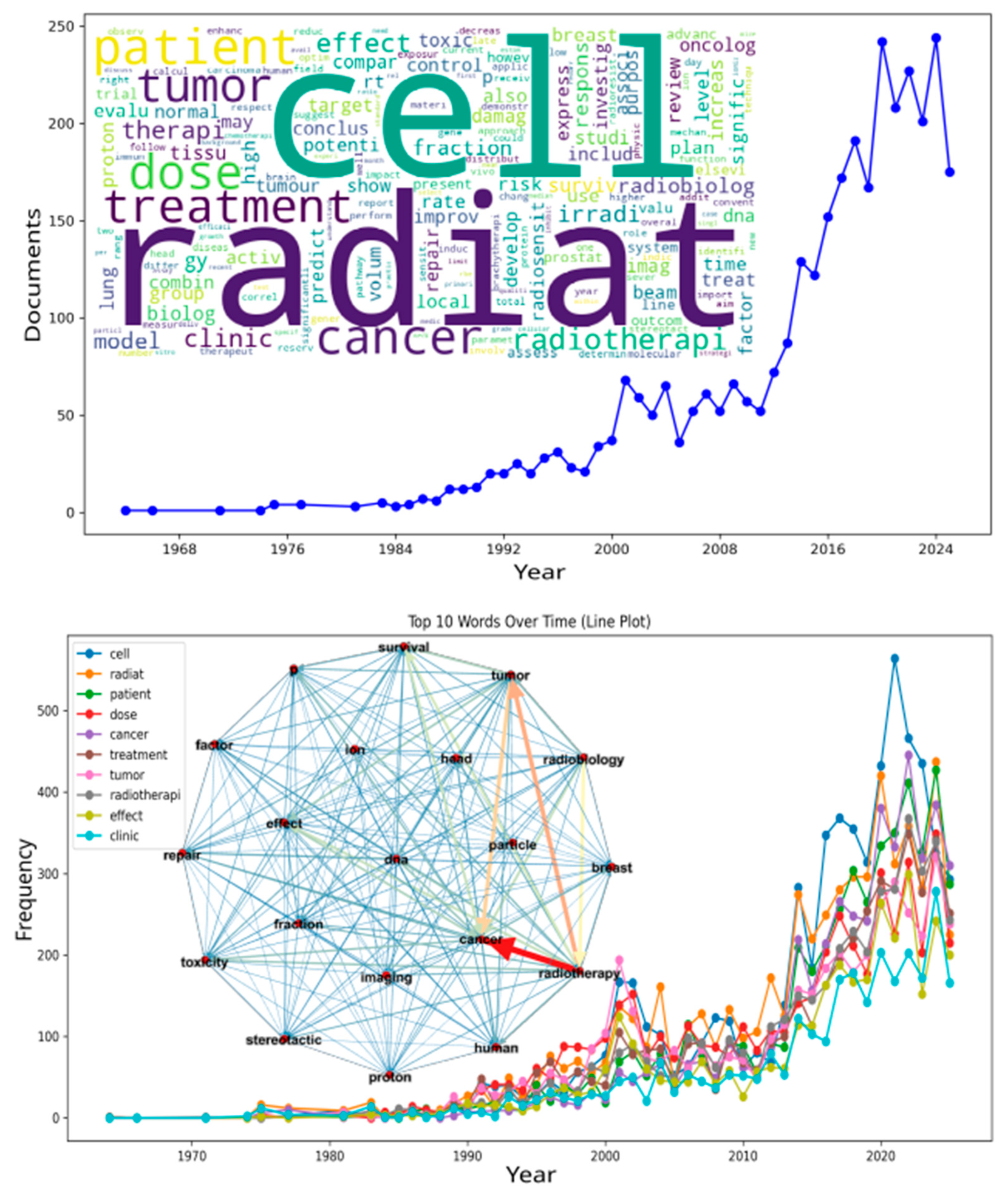
Figure 2.
Integration between Plan Classes, Health Indicators, and Strategic Objectives. The figure illustrates how the five classes of the Integrated Implementation Plan in Precision Radiotherapy (blue nodes, left) connect with measurable health indicators (green nodes, center) and broader public health objectives (red nodes, right). The network highlights the translation pathway from technical and scientific actions—such as DNA repair characterization, genomic and proteomic modeling, individualized radiosensitivity assessment, targeting of radioresistance mechanisms, and adoption of advanced radiotherapy technologies—into quantifiable outcomes, including overall survival (OS), progression-free survival (PFS), local and systemic control, incidence of severe toxicity (G≥3), and cost per controlled case. These indicators converge toward collective health objectives within the Brazilian Unified Health System (SUS), promoting equitable access to care, reduced cancer mortality, improved quality of life, cost-effectiveness in oncology, data-driven decision-making, technological innovation, and the reduction of regional disparities.
Figure 2.
Integration between Plan Classes, Health Indicators, and Strategic Objectives. The figure illustrates how the five classes of the Integrated Implementation Plan in Precision Radiotherapy (blue nodes, left) connect with measurable health indicators (green nodes, center) and broader public health objectives (red nodes, right). The network highlights the translation pathway from technical and scientific actions—such as DNA repair characterization, genomic and proteomic modeling, individualized radiosensitivity assessment, targeting of radioresistance mechanisms, and adoption of advanced radiotherapy technologies—into quantifiable outcomes, including overall survival (OS), progression-free survival (PFS), local and systemic control, incidence of severe toxicity (G≥3), and cost per controlled case. These indicators converge toward collective health objectives within the Brazilian Unified Health System (SUS), promoting equitable access to care, reduced cancer mortality, improved quality of life, cost-effectiveness in oncology, data-driven decision-making, technological innovation, and the reduction of regional disparities.
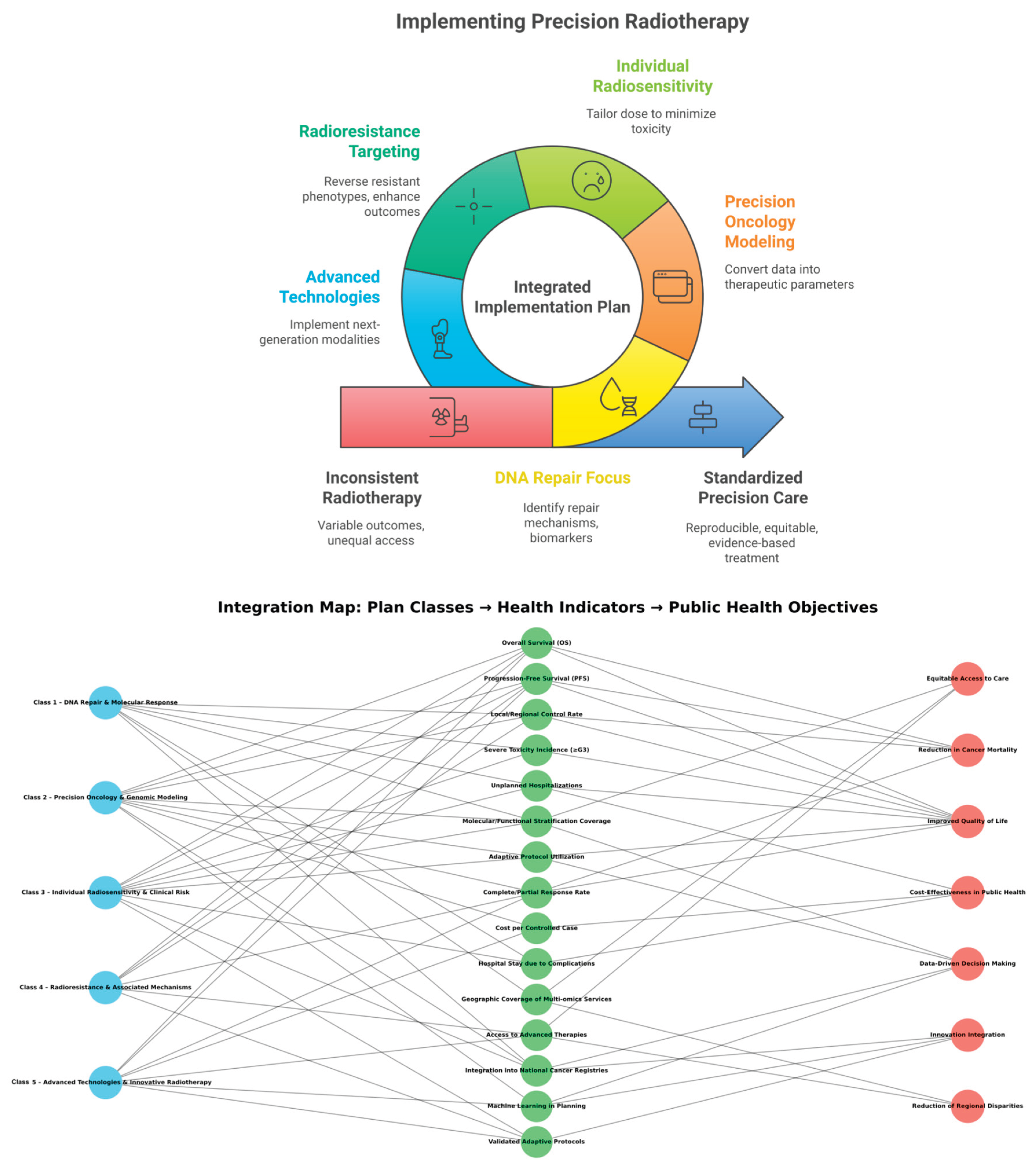
Table 2.
x – Integrated Precision Radiotherapy Plan.
| Indicator | Related Plan Class(es) | Description and Measurement Method | Expected Public Health Impact |
|---|---|---|---|
| Overall survival (OS) at 1, 3, and 5 years | 2, 3, 4, 5 | Percentage of patients alive 1, 3, and 5 years after radiotherapy, stratified by tumor type and treatment protocol. | Improved longevity and reduction in cancer-specific mortality, particularly in high-risk tumors. |
| Progression-free survival (PFS) | 2, 3, 4, 5 | Mean time to recurrence or disease progression after personalized radiotherapy. | Greater disease control, reduced retreatment, and lower hospital costs. |
| Local and regional control ratel | 1, 2, 3, 4 | Proportion of patients without recurrence in the tumor bed or regional lymph nodes after 12 and 24 months. | Increased therapeutic efficacy and improved population prognosis. |
| Incidence of acute and late toxicities (grade ≥3) | 1, 2, 3 | Standardized reporting (RTOG/EORTC or CTCAE) of severe adverse events related to radiotherapy. | Reduced disabling side effects and improved post-treatment quality of life. |
| Rate of unplanned hospitalizations related to treatment | 1, 3 | Percentage of patients requiring emergency hospitalization due to radiotherapy complications. | Savings in hospital resources and reduced burden on inpatient units. |
| Percentage of patients undergoing molecular and functional stratification prior to treatment | 1, 2, 3 | Proportion of patients who underwent genomic, proteomic, or functional testing before radiotherapy initiation. | Greater precision in therapeutic planning and optimization of resource allocation. |
| Proportion of treatments with adaptive protocols | 2, 3, 5 | Percentage of patients whose radiotherapy plan was adjusted during treatment based on clinical response and/or biomarkers. | Reduced toxicity, improved efficacy, and more rational use of technology. |
| Complete and partial response rate | 2, 4, 5 | Percentage of patients with complete disappearance or significant reduction of tumor after treatment. | Direct indicator of personalized protocol effectiveness. |
| Average cost per patient with tumor control achieved | 2, 5 | Total treatment cost divided by the number of patients with sustained complete or partial response. | Increased economic efficiency of the public health system. |
| Mean hospital stay due to treatment complications | 1, 3 | Average number of days of hospitalization caused by radiotherapy-related adverse events.. | Reduced hospital bed usage and expanded treatment capacity. |
| Geographic coverage of services with multi-omic and radiobiological capacity | 1, 2, 3 | Percentage of health regions with infrastructure for multi-omic testing and radiobiological integration. | Reduction of regional inequalities in access to advanced treatments. |
| Percentage of patients with access to advanced therapies in the public health system (SUS) | 4, 5 | Proportion of patients receiving modalities such as FLASH-RT, optimized brachytherapy, or particle therapy. | Equity in access to innovative technologies across the national territory. |
| Proportion of cases integrated into national registries with molecular and radiomic data | 1, 2, 3, 4, 5 | Percentage of patients with clinical, molecular, and imaging data stored in national repositories. | Strengthened epidemiological surveillance and translational research. |
| Utilization rate of machine learning in clinical planning | 2, 3, 5 | Percentage of cases planned or adjusted using validated AI models. | Standardization of evidence-based practices and increased outcome predictability. |
| Number of adaptive protocols validated and incorporated into national guidelines | 3, 4, 5 | Number of adaptive clinical protocols formally approved and implemented in the public health system | Continuous improvement of care quality and systematic technological updating. |
Disclaimer/Publisher’s Note: The statements, opinions and data contained in all publications are solely those of the individual author(s) and contributor(s) and not of MDPI and/or the editor(s). MDPI and/or the editor(s) disclaim responsibility for any injury to people or property resulting from any ideas, methods, instructions or products referred to in the content. |
© 2025 by the authors. Licensee MDPI, Basel, Switzerland. This article is an open access article distributed under the terms and conditions of the Creative Commons Attribution (CC BY) license (https://creativecommons.org/licenses/by/4.0/).
Copyright: This open access article is published under a Creative Commons CC BY 4.0 license, which permit the free download, distribution, and reuse, provided that the author and preprint are cited in any reuse.


