

Submitted:
17 October 2025
Posted:
20 October 2025
You are already at the latest version
Abstract
This paper analyzes the trajectory of public sector reforms presenting an extensive historical and critical analysis of administrative or governmental management reforms in Bangladesh from 1971 to 2021. It categorizes reform efforts focusing on how various political regimes and institutional actors have approached the challenge of improving management in government. The analysis reveals that despite a multitude of reform commissions and policy interventions over the decades, actual improvements in the quality of governance and service delivery have been limited. The work highlights systemic challenges and failures in implementation. A central argument is that reforms in Bangladesh have largely been top-down, fragmented, and disconnected from the realities of administrative practice and citizen service. The paper emphasizes that these reform efforts often lacked continuity, political ownership, and a citizen-centric focus. It also highlights the need for a shift from externally driven, prescriptive models to citizen-centric, context-specific strategies grounded in management principles. The recent reforms of post 2024 revolution is out of scope for the current paper and are subject to further research.
Keywords:
reforms commissions
; public sector reform
; civil service
; bangladesh government reforms
; management in government
; policy implementation
1. Introduction
Improving management in government requires grounding in the evolving discourse of Management as a Discipline (MAD)—a field traditionally applied in the private sector, now increasingly adapted in public sectors to address inefficiency, promote performance, and enhance accountability (Pollitt & Bouckaert, 2017; Hughes, 2012; Kettl, 2002). This conceptual shift marks a transition from classical public administration to management-oriented governance.
When these principles are applied within the bureaucratic and institutional settings of government, we encounter Management in Government (MIG). MIG represents the strategic use of managerial tools—such as performance metrics, strategic planning, and human capital optimization—within public institutions (Osborne, 2010; Christensen & Lægreid, 2007; Khan, 2009). The aim is to make government not just functionally operative, but responsive, accountable, and citizen-centric (UNDP, 2005).
When it comes to the idea of ‘improving management in government’ in Bangladesh, we need to look at the ‘management in government research’. One starting question is from where this idea of ‘management as discipline (MAD)’ in ‘management in government (MIG)’ comes, and what constitutes the ‘theory of improvements’ or ‘reforms’ in ‘government’. Another starting question is – what we know so far about the reforms and MIG improvement initiatives? What kind of documented experience, research, studies, and reports are there, that constitute what we call the ‘evidence’? This article focus on the second one - the analysis of the ‘reforms’ documents (and action) so far to make government work better.
Past reform commission or committee reports may be categorized based on lead initiator of the reforms document or report (who initiated, commissioned or investigated the study).
- −
- Reports by Government of Bangladesh (GOB) commissions, with or without Donor assistance (ASRC, PARC, etc.)
- −
- Reports by International Organizations (IO) and Donor Agency with or without association with GOB (UN, WB, DFID etc.)
- −
- Reports by Non-Government Research or Think Tank organizations (BIDS, CPD, PPRC etc.)
On the academic side, an inventory of research and writing on Bangladesh context of managing government for good governance or making government work, during the past two decades, showed varied topics have been covered (Ahmed, 2014; Hoque & Zafarullah, 2014):
- −
- role of the state, governance issues (transparency and open government, public accountability, integrity management), the civil service system (structural, functional and cultural dimensions), decentralization and local government, civil society and third sector organizations, access and public service delivery, e-government, public-private interface and so on
Also, several shifts and movements can be identified as scholars have covered new and more challenging issues of global innovation like:
- −
- New Public Management (NPM), deregulation, downsizing, public private partnership (PPP), citizen engagement (CE), e-government, participatory management, gender and human development, network governance, public policy and poverty analysis, citizens' trust and service delivery system, administrative culture and ethics (Aminuzzaman, 2013).
In this paper, we will analyze the reforms reports and recommendations of the government commissions and also the studies of International Donor organizations, drawing from various authoritative ‘secondary sources’ as mentioned above. These ‘sources’ are comprised of both practitioners and academicians. In the following sections, first, a brief account of past regimes and their associated reforms commissions is given. Then each reforms commissions and their major recommendations are consolidated, just to give a glimpse of focus of each ‘reforms’. Finally, an overall critical analysis is done before concluding and identifying need for further research communication or articles.
2. Regimes and Reforms by Government: 1972 to 2015
It has been found that Bangladesh government, since its birth in 1971, has formed a good number of reforms commission and task force. Bangladesh has undergone through the following regimes since 1971:
- Sheikh Mujib era (1971-75)
- Ziaur Rahman era (1976-81)
- Hussain Muhammad Ershad era (1982-90)
- Bangladesh Nationalist Party (BNP) era led by Khaleda Zia (1991-1995)
- Bangladesh Awami League (BAL) era led by Sheikh Hasina (1996-2000)
- Bangladesh Nationalist Party(BNP) era led by Khaleda Zia (2001-2006)
- Caretaker Government led by Chief Advisor Fakhruddin Ahmed (2007-2008)
- Awami League Era led by Sheikh Hasina (2009 - 2024)
There are other temporary and caretaker governments in between these major periods. They were short lived but they also commissioned reforms committees in different forms and names1. Table 1 shows various administrative reform committees and bodies constituted since the country's independence in 1971.
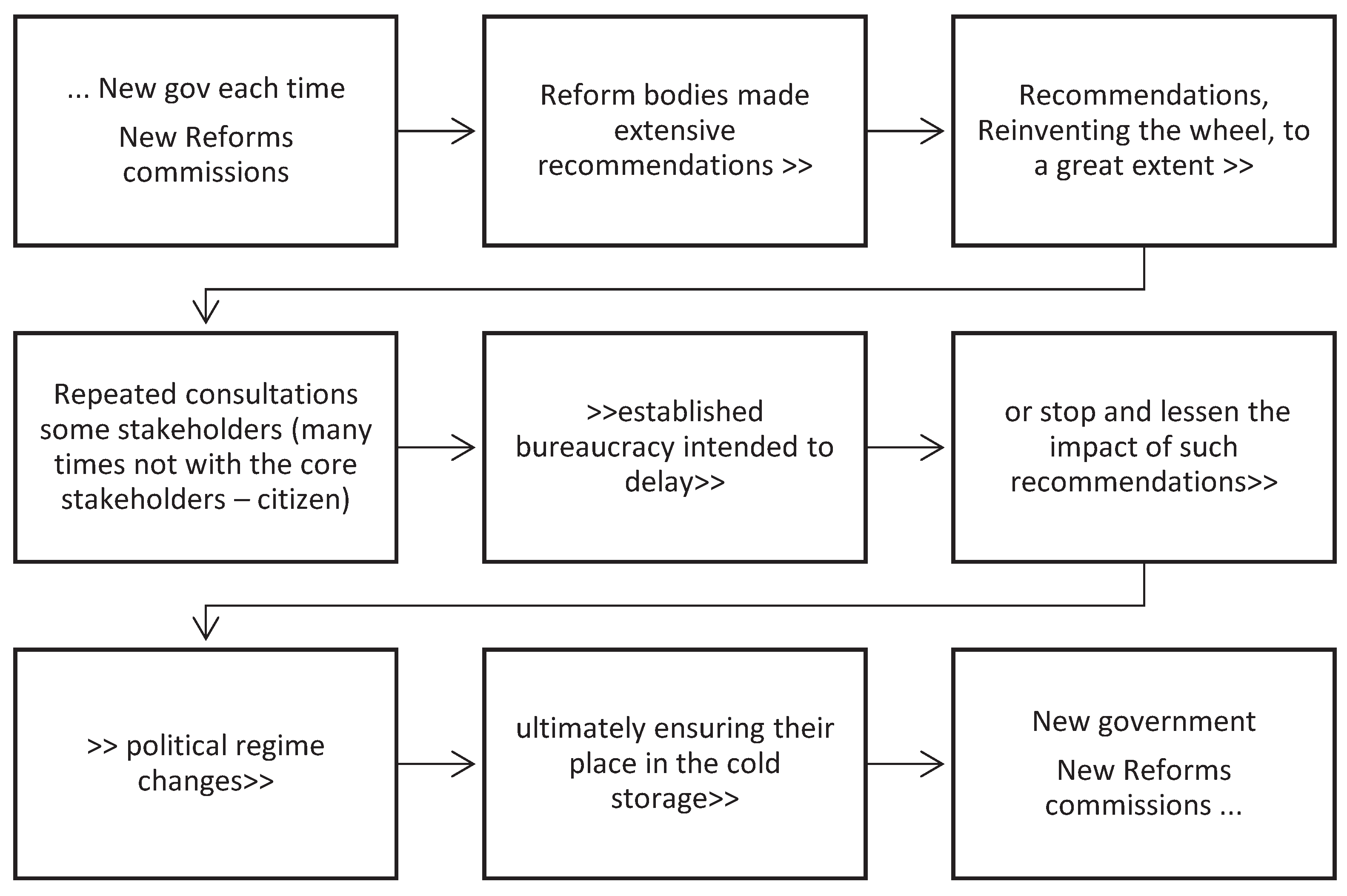
Each new government often introduces reforms anew, often without critically assessing the outcomes of previous initiatives. So, there is an obvious political dimension of forming those commissions and committees.
Some of the reports which are more mentioned in the Management Improvement discussions, are described below. These reviews heavily draws from Professor Mohabbat Khan’s two comprehensive consolidation – From Government to Governance (Khan, 2009) and Administrative Reforms in Bangladesh (Khan, 2013), and practitioners’ account like that of A. M. M. Shawkat Ali and Akbar Ali Khan, who are themselves veteran civil servants and prolific writers on public management structural issues (Ali, 2004, 2007; Khan, 2010, 2015).
Khan (2009) examined seventeen major commissions or committees, and found that seven reports dealt with entire civil service having a broad coverage; six reports dealt with matter of micro restructuring within the civil service. Of them, three bodies examined exclusively pay structure of the civil servants. The rest analyzed specific aspects of the civil service like recruitment and promotion of civil servants.
2.1. Administrative and Services Reorganization Committee (ASRC), 1972
Formed in 1972, Administrative and Services Reorganization Committee (ASRC) produced the first such comprehensive document on reforming civil service management and strategy considering a newly independent country (Khan, 2013; Khan, 2009).
ASRC recommended a single, classless, unified grading structure with an appropriate number of different pay scales matching different level qualifications, skill and responsibilities. The committee recommended several measures for developing an integrated public personnel management system encompassing a rational selection process based on merit, long term career planning, formulation of a general training policy and coordination of institutionalized training, and an employee promotion procedure based on merit-cum seniority.
But for the following reasons, ASRC vision could not be materialized due to following:
- -
- Haphazard situation all around in political, social, and economic thoughts, right after independence. The whole nation was war devastated, and day to day bread and butter was the main concern. Also continued, serious divisions in the dream of charting a roadmap for a new nation.
- -
- Widespread free reign political opportunists propped up everywhere in a new country, and corruption became all pervasive. At its worst, even all-in-all prime minister, and later president, Sheikh Mujib could not control the situation, and became frustrated and moved to less democratic mechanisms.
- -
- Bureaucratic go-slow attitude, if not resistance, due to natural fear of change, which may put their ‘colonial era’ career prospects in uncertainties (Khan, 2013; Khan, 2009).
In a sense, ASRC recommendations were transformational. It was an attempt to change the whole colonial mindset and radical redesigning of the whole civil service structure in line with People’s Republic and people’s expectation. But unfortunately, the transformational drive got a hard break with the assassination of Sheikh Mujib, founding head of the nation.
2.2. Committee Reports in Military Backed Regimes, 1976-1990
In 1976, the Pay and Services Commission was appointed by then military backed government. It recommended the creation of an all-purpose civil service; emphasis on the merit principle; constitution of a new apex cadre with experienced officers dawn from all cadres; the adoption of cadre concept in the civil service structure; and proposed 52 scales of pay to reduce multiplicity of pay scales.
Between 1982 and 1984 two major reform bodies were appointed. One was called Martial Law Committee (MLC) another committee was civilian committee. The recommendation included, reduction in the number of ministries, downsizing civil services, restructuring of the role of secretariat and other executive agencies, and delegating financial and administrative powers down the hierarchy.
It looked good and timely, but we observed that recommendations were mostly unimplemented. For example, ministry did not decrease, rather actually increased, in an effort of popularizing the administration among the politicians and through the politicians.
2.3. Public Administration Reform Commission (PARC), 2000:
Public Administration Reform Commission (PARC) appointed in 1996, submitted its report in 2000. PARC is said to be the most comprehensive and a wonderful document by the government so far. Khan (2009) mentioned that the commission, influenced by the New Public Management (NPM) concept made several significant recommendations relating to:
- -
- Public Management: improvement of service delivery, creation of functional clusters of ministries; for developing professionalism and institution of Senior Management Pool (SMP) for overcoming inter-cadre rivalries and facilitating fast track promotion.
- -
- Civil Service Structure: introduction of strictly merit-based recruitment and promotion in public service; decentralization devolution of governmental authority and reorganizational of local government bodies.
- -
- Institutions: rationalization of institutions and manpower; creation of a powerful and independent anti-corruption commission; effective parliamentary oversight on administration.
Most of the change initiatives of successive years were based on this report or were in line with it, whether referred to it or not.
2.4. Strategic Documents by Caretaker Governments
Apart from regular political and military governments, there were caretaker governments at different times since 1991. They also tried to come up with roadmaps for reforms.
Caretaker government led by Chief Adviser Justice Shahabuddin Ahmed, in 1991, allocated Professor Rehman Sobhan the Planning and External Relations Divisions. Professor Sobhan gathered over two hundred and fifty distinguished professionals and setup twenty-nine Task Forces. These task forces dealt with the entire gamut of economic and development issues facing Bangladesh and identified the development problems and policy options (Khan 2009). Similaryly, Caretaker government led by Dr. Fakhruddin Ahmad (2007-2008), produced a ‘Moving Ahead’ strategy document where they identified Strategic Blocks and Supporting Strategies.
While these recommendations were comprehensive, they were too broad an overview, and lacked implementation level guidelines. Regardless of the discussion of the details of this document, which were discussed in earlier research (Khaled, 2013), we can say that these documents were purely non-partisan and ideal, and could serve as very good starting point for any government in power in years to come.
2.5. Regulatory Reforms Commission (RRC), 2008
Caretaker Government of 2006-08, also created the Regulatory Reforms Commission (RRC) led by retired bureaucrat and scholar, Akbar Ali Khan, which worked on identifying the obsolete rules and regulations in the government. As detailed by Khan (2013), there happened to be more than 10,000 acts, rules, circulars, orders, etc. of which most were inoperative and many as old as 100 years. RRC systematically identified laws and regulations that needed exclusion or modification, and also recommended for using Regulatory Impact Assessment (RIA), a tool, to improve efficiency, transparency, and accountability of regulatory decision making.
RRC was a wonderful and timely step to identify the shortcoming of regulations, but the commission did not continue as soon as caretaker government era ended, and political government came into power in 2009.
2.6. Overall Analysis of Regimes and Reforms Implementation
If we analyze all these reforms reports and implications, we see that some progress took place, though slow. But the benefits could not be realized as expected, since these were implemented in a scattered manner, not in a strategically holistic or synergistic manner.
So far, as Khan (2010) pointed out, Bangladesh's performance in implementing important governance reforms such as civil service reforms, judicial reforms, police reforms, local government decentralization, etc. has been much disappointing. There are three main reasons for poor performance of reforms - lack of political ownership, opposition of distributional coalitions, and lack of implementation capacity (Khan, 2010).
After the independence of Bangladesh, under the leadership of Sheikh Mujibur Rahman, government of Bangladesh tried to reorganize the whole system. So, reform effort was there in the government from the beginning, though in more socialistic paradigm – in line with the mood of the developing country back then. The planners argued that lack of several objective conditions could not materialize a socialist vision - absence of political cadres who were yet to emerge; and the alienation of the government bureaucracy from the people - an attitude inherited from colonial times (Islam, 2003, 2004).
Thus, the unrealized part of these reforms can be traced back to British rule. Interestingly, so democratic in their homeland, the Britons ruled with iron hand and ICS2 ‘steel frame’ in colonies like India for so many years, crushing so many different rebellions from so many groups. But maybe we must agree, however reluctantly, that they built a ‘system’. Some senior people who saw the British rule tells that the ‘system’ they built worked better in many aspects than current ‘systems’ (Khaled, 2013).
Bangladesh civil service or pubic administration inherited the structure of Pakistan or East Pakistan civil service. Both India and Pakistan, including East Pakistan, later known as Bangladesh, kept many things of the British systems intact because the British system was itself very organized and result of many years of practices by then. That is the reason, we see many terms, policies, and systems of public administration bear the British legacy till today.
As recent signposts of reforms, the Civil Service Act was drafted in 2010. With the help of UNDP project CSCMP (civil service change management program), Citizen Charter was introduced in all the ministries and departments of the government. Then there have been all these A2I (access to information) office and digital initiatives, GIU office (Governance Innovation Unit), APA (Annual Performance Agreement), IPS-TQM (Improving Public Service- Total Quality Management), LGSP (local government support project) and similar initiatives.
But, in the end, what we see, there is progress, but which is more in forms rather than in contents. Overall, there is little qualitative change in how government works and how citizens perceive about the quality of the service delivery of the governments (Khan, 2009; 2015; Ali, 2004; 2007).
3. International Organizations and Donor Agency Reports
Many international organizations and donor agencies of developed countries, for whatever political economic reasons, provided many prescriptions and assistance at different times to different governments (Table 2). Some of the most prominent and representative ones are described below:
3.1. Public Administration Efficiency Study (PAES), USAID-1989
Public Administration Efficiency Study (PAES) was one of the first comprehensive donor efforts to reform and redesign the civil service in Bangladesh. The study was conducted from May 1989 to November 1989. Khan (2009) summarized the significant recommendations of PAES which included:
- -
- strengthening supervision through training and management support;
- -
- reducing secretariat’s operational activities through delegation of routine personnel and financial matters to departments, corporations and subordinate bodies;
- -
- reducing layers in decision making;
- -
- introduction of a two-tier career system to raise quality of the senior civil service;
- -
- increasing incentives for high performances including wider use of merit as a criteria for promotion; and
- -
- expanding practical, problem-solving training based an assessment of organizational needs (USAID, 1989)
3.2. Public Administration Sector Study (PASS), UNDP-1993
The UNDP funded Public Administration Sector Study, PASS study was conducted in 1993. The study made as many as fifty-two recommendations. The significant recommendations were:
- -
- establishing results-oriented management systems through setting up of objectives and measures of outputs and impacts throughout the government;
- -
- establishing units in each ministry, responsible for developing and applying performance criteria and measures and develop internal performance audit capability;
- -
- rationalizing government structure by reducing number of ministries and divisions;
- -
- review and streamline of government rules and regulations to eliminate red tape and redundant functions;
- -
- selection and promotion of officer based on merit within transparent process,
- -
- strengthening of Public Service Commission;
- -
- replacing grades and class system with personnel management system based on position classification system and grades; and
- -
- appointment of a reform implementation commission (UNDP, 1993)
3.3. Government that Works - World Bank, 1995
Government that Works: Reforming the Public Sector (GTW/ RPS) study of World Bank was a wide wide-ranging study. The main thrust was on defining core functions of the government and essential services to be provided to citizens. Therefore, the study recommended
- -
- redefining frontiers of public sector which means rightsizing the central government
- -
- enlarging the role of non-governmental organizations, local government, and the private sector
- -
- enhancing level and nature of accountability and responsiveness of public organizations to their owners, i.e., parliament, citizens and consumers
- -
- streamline regulations
- -
- level and process to ensure transparency, fairness and atomicity of legal and regulatory institutions, policies and practices
- -
- overhauling rules and process by which government conducts its policy and decision making functions; and
- -
- maintain an efficient, committed and professional public service (World Bank, 1996).
3.4. Opinion Survey of Government Officials, BNPP-1999
This survey was conducted on the public officials led by Professor Muzaffar Ahmed of Dhaka University and funded by the Bank Netherlands Partnership Program (BNPP). Important findings of the survey show the variety in the institutional environments within which officials work. [for example, WDB (Water Development Board), PDB (Power Development Board), LGED (Local Government Engineering Department), Ministry of Fisheries are different in management environment].
So the report concluded with the hope that Agency level reforms might be the best hope of destabilizing some of the dysfunctional public sector equilibrium, and might be driven by providing local communities with greater voice in the production of local public services. (Bank Netherlands Partnership Program (BNPP), 1999). This thesis or our research particularly draw the inspiration from this finding regarding agency level reform need.
3.5. Taming the Leviathan, by World Bank - 2002
As public-sector reform movement shifted to ‘governance’ era, “Taming the Leviathan” by the World Bank (2002) was another initiative. The metaphor of the “Leviathan” referred to an overextended and unaccountable state apparatus—characterized by patronage networks, elite capture, and widespread public distrust. While earlier efforts focused on improving efficiency within bureaucratic systems, this report took a broader and more systemic view of governance. The report offered a broad-based strategy to ensure better governance for the ‘state in a changing world’.
The strategy to promote good governance had five critical dimensions:
- Strengthening core institutions of accountability, such as the judiciary, Anti-Corruption Commission, and parliamentary oversight mechanisms.
- Building and empowering civil society to act as watchdogs and partners in governance.
- Decentralization to devolve authority and improve responsiveness through local governance structures.
- Improving administrative efficiency and effectiveness through capacity building and performance management.
- Mobilizing national consensus for reform, emphasizing inclusive dialogue with stakeholders across sectors.
As expected, despite its comprehensive approach, “Taming the Leviathan” faced typical challenges in implementation: lack of political buy-in, especially from elites benefiting from the status quo; weak institutional capacity, limiting execution of reform agendas; Resistance from distributional coalitions, such as entrenched bureaucratic and business interests.
3.6. Overall Analysis of Donor Agency Reforms Implementation
As mentioned in the previous section, the implementation was slow, intermittent, and lack a consistent road map. But taken together there were many initiatives on and off. Subsequently, at the first decade of the new century, there have been MATT (Managing at the Top) of DFID, CSCMP (Civil Service Change Management Program) of UNDP, etc. Some of the legacy projects were still running through second decade.
All major studies, PAES of USAID, PASS of UNDP, GTW/RPS, and Taming the Leviathan by World Bank, did contain many suitable and implementable suggestions. But most of the things could not be implemented, due to three reasons: Political unwillingness, bureaucratic unwillingness, and a lack of capability of government machinery to do what is required.
As Khan (2010, 2015) mentioned, what World Bank observed in 1990s is still valid. Three or more democratically elected governments completed their terms, but no significant initiative for reforms were undertaken. In this connection, the World Bank report (2002) underlines three characteristics of Bangladesh society.
- -
- Clientilism. Powerful and pervasive societal network and muscle power takes the place of rule of law and there is widespread lack of 'public trust' in the country's formal modern institutions." The politicians, therefore, view administrative reforms as sheer wastage of time.
- -
- Well-organized interest groups. Well-organized interest groups such as the military, the public bureaucracy, private business, trade unions, religious groups, NGOs, and others are frequently divided along political lines and or along narrow sectoral interest.
These interest groups act as distributional coalitions and forestall any reform that may harm them. They do not have any bottom up pressure from common citizens.
- -
- Discrepancy between the private agendas and their public agencies. the political, business, trade union and bureaucratic power structure in Bangladesh have been partially captured by an underworld that uses "muscle-power" to enforce its authority with the connivance of the police and even certain members of lower judiciary. In such an environment, politicians refuse to take any risk of change.
Then came the observation of Bangladesh conundrum (World Bank, 2007; 2011), which refers to dichotomous relationship between governance and economic development. While governance theorists postulated a positive relationship between governance and growth, Bangladesh showed a stark variation, where growth has been consistently higher despite major flaws in governance. Donors termed this unconventional relationship between governance and development as the Bangladesh Conundrum, and it raises fundamental questions about efficacy of governmental reforms. If development objectives could be attained despite slide in governance, why should the government be concerned with governance reforms!
4. Top Down Reforms Model: Searching a Break Out
In course of time, government has taken significant initiative for ‘making government work’ and ‘making government work better’, based on globally accepted paradigms like NPM (New Public Management), PVM (Public Value Management), and DEG (Digital and Electronic Government), Open Government, Whole of Government etc. A good number of initiatives are going on under Prime Minister Office (PMO), and under different ministries and departments. Tools and mechanism like privatization and Government Share offloading of SOEs, Outsourcing or contracting out or subcontracting, PPP, TQM, A2I, GIU, etc. Board of Investment and Privatization commission has been merged into Bangladesh Investment Development Authority (BIDA).
The major conclusions about reforms so far, in line with Ali (2004; 2007), can be summarized as follows:
- -
- Bangladesh has more than enough studies on civil service reforms and its management. The net results have been less than expected.
- -
- In case of externally induced donor-driven reform measures, the areas of reforms were seldom wisely chosen. The donors were more serious on economic reform measures centering on trade liberalization, fiscal and monetary reforms, (rather than system fixing).
- -
- The word ‘governance’ has become all pervasive and a precursor of more zealous economic, monetary, and fiscal reforms. Thus the focus on improving management in the public sector or public sector reform (PSR) became diluted.
- -
- The Government could not implement or showed ‘neglect’ to implement the donor-driven recommendations for reforms. Also, the governments of different periods showed even more neglect in case of home-grown studies on civil service reforms.
Analysis of common pattern of implementation failure shows that the MIG reforms approach has dominantly been top-down. That means best practices are copied from other countries and those are pushed (trickle down) through the government agencies’ hierarchy. Or, the experts, pre-dominantly donor funded and foreign, with some local experts in the team, provide prescriptions or ‘solutions’. Despite all these, capability of states remained limited in ‘making government work’ or ‘building sustainable solutions’ for poor citizen service.
About reforms in Bangladesh, Khan (2009, February 20) mentioned in an interview with ISS, Princeton University that ‘it is a highly centralized, elitist, it is a closed shop. It does not allow people to join at different levels. So it is, from my perspective, it is completely out of tune with the reality in Bangladesh’.
Top down reforms prescriptions were good but when it trickled down from top, say president or prime minister’s office, to ministries, then down to ministry divisions, departments, directorates, districts, sub-districts, up to union, little thrust and taste were left for citizens at the service delivery level. Add to this is perennial colonial structure and mindset of civil service cadre top-down hierarchy.
Figure 1.
Repeated Cycle of TOP down Reforms in MIG.
5. Conclusion and Further Research
This paper analyzed the public sector or civil service reforms in Bangladesh up to 2021 to mark the 50 years of independence since 1971. After 2015, no significant or formal ‘reforms’ commission had been formed. One possible reason might be the ‘criticism’ and ‘the fact’ that previous ‘reforms commissions’ had always been criticized for ‘non-implementation’ or at least, ‘inconsistent implementation’. Rather, it can be observed that government tried to improve its functions and activities, as it needed or wherever needed (Khaled, 2018).
Recent developments post-2015—such as the digitization of government services under the Smart Bangladesh initiative (UNDP, 2023), increased IMF and World Bank engagement in governance and financial reform (World Bank, 2023). However, these developments also reaffirm the paper’s central argument: that Bangladesh’s reform landscape has historically lacked a grounded management in government (MIG) paradigm anchored in management as a discipline (MAD) (Hughes, 2012; Khaled, 2011). While the "Taming the Leviathan" metaphor captured the need to control the unaccountable state, truly taming it requires bottom-up, citizen-centered, and context-sensitive managerial frameworks—rooted in local realities rather than transplanted best practices (Osborne, 2010; Christensen & Lægreid, 2007).
As a whole, clear ‘gap of knowledge’ exists, in the context of ‘management aspects’ in public administration discipline, and in the context of government agencies in business administration or management discipline, that is application of management as a discipline (MAD) in management of government organizations, or management in government (MIG), in Bangladesh.
So much of reforms have been designed and implemented from the top, vertically downward. In government organizations, customer centricity or citizen-oriented thinking, and management by objectives are still not common, and sometimes it is not understood at all, and worse, it is misunderstood in all the wrong ways possible. Gaps remain in terms of understanding and adopting citizen problem centric management approach. In sum, sustainable public sector reform in Bangladesh requires a paradigm shift: from donor-driven, elite-centric models to citizen-oriented, locally grounded, and strategically implemented frameworks.
This paper does not include the recent scenario after the change of government through a people’s revolution in 2024. As stated in this paper, predictably, new reforms commissions have been formed and these commissions have come up with long list of reform recommendations. The relevance and transformative potential of these reforms are subject to future research.
References
- Ahmed, N. U. (Ed.). (2014). 40 Years of Public Administration and Governance in Bangladesh. University Press Limited.
- Ahmed, N. (Ed.). (2016). Public policy and governance in Bangladesh: forty years of experience. Routledge.
- Ali, A. S. (2004). Bangladesh civil service: A political – administrative perspective. Dhaka: The University Press Limited.
- Ali, A. S. (2007). Civil service management in Bangladesh: An agenda for policy reform. Dhaka: University Press Limited.
- Aminuzzaman, S.M. (2013). Study of public administration: Contribution of the alumni of the department of public administration, University of Dhaka. Paper prepared for a seminar on the 40th Anniversary. Department of public administration, University of Dhaka.
- Christensen, T., & Lægreid, P. (2007). Transcending New Public Management: The Transformation of Public Sector Reforms. Ashgate.
- Hughes, O. E. (2012). Public Management and Administration: An Introduction (4th ed.). Palgrave Macmillan.
- Islam, N. (2004). Looking outward: Bangladesh in the world economy. Dhaka: University Press Limited.
- Islam, N. (2003). Making of a nation Bangladesh: An economist's tale. Dhaka: UPL.
- Hoque, A. S., & Zafarullah, H. (2014). Public administration as an academic discipline in Bangladesh. In N.Ahmed, 40 years of public administration and governance in Bangladesh. Dhaka: University Press Limited.
- Kettl, D. F. (2002). The Transformation of Governance: Public Administration for Twenty-First Century America. Johns Hopkins University Press.
- Khaled, M. C. (2011). What is missing in government- development theories or management basics: Cases from Bangladesh? Chittagong University Journal of Business Administration, 26(2011).
- Khaled, M. C. (2013). Improving environment through policy and regulatory reforms and applying modern business management practices in government: Case of a developing country like Bangladesh. (Unpublished M. Phil. Thesis), University of Chittagong.
- Khaled, M. C. (2017). Developing business like strategic approach in government: A framework. Proceedings of AMDISA conference, 14th South Asia Management Forum conference at MNU Business School, Maldives, April 24-26.
- Khaled, M. C. (2018). Management in Government: bottom up approach for better citizen services. (Unpublished Ph. D. Thesis), University of Chittagong.
- Khan, A. A. (2010). Friendly fires, humpty dumpty, disorder, and other essays. Dhaka: University Press Limited.
- Khan, A. A. (2015). Gresham's law syndrome and beyond. Dhaka: University Press Limited.
- Khan, M. M. (2009). From government to governance: Expanding the horizon of public administration to public management. Dhaka: University Press Limited.
- Khan, M. M. (2009, February 20). Interview with Innovations for Successful Societies (ISS) of Princeton University.
- Khan, M. M. (2013). Administrative reforms in Bangladesh. Dhaka: University Press Limited.
- Osborne, S. P. (2010). The New Public Governance? Emerging Perspectives on the Theory and Practice of Public Governance. Routledge.
- Pollitt, C., & Bouckaert, G. (2017). Public Management Reform: A Comparative Analysis – Into the Age of Austerity (4th ed.). Oxford University Press.
- UNDP (2005). Reconstructing Public Administration after Conflict: Challenges, Practices and Lessons Learned.
- United Nations Development Programme (UNDP). (2023). Smart Bangladesh: Digital governance strategy 2023–2028. UNDP Bangladesh.
- World Bank. (2002). Taming the leviathan: Reforming governance in Bangladesh. Washington, D.C.: The World Bank.
- World Bank. (2007). Bangladesh: Strategy for sustainable growth. Dhaka: World Bank.
- World Bank. (2011). Governance matters. Washington, D.C.
- World Bank. (2023). Bangladesh development update: Navigating uncertainty. Washington, DC: World Bank.
| 1 | Caretaker government of Justice Shahabuddin Ahmed in 1991, Justice Habibur Rahman in 1996, Justice Latifur Rahman in 2001, all were of three-month duration. |
| 2 | Indian Civil Service was used to be called steel frame of British rule in Indian subcontinent. |

Table 1.
List of Major Reforms Commissions dealing with Civil Service.
| Sl. | Name of Commission/ Committee | Regimes | Report year |
| 1 | Civil Administration Restoration Committee (CARC) | Sheikh Mujibur Rahman, BAL | 1971 |
| 2 | Administrative and Services Reorganisation Committee (ASRC), | Sheikh Mujib , BAL | 1972-74. |
| 3 | National Pay Commission (NPC - I) | Sheikh Mujib, BAL | 1972-73. |
| 4 | National Pay and Services Commission (NP&SC) | Ziaur Rahman, (Military) | 1976-77. |
| 5 | Martial Law Committee on examining organisational set-up of ministries/divisions, departments, directorates, and other organisations (MLC-1), | Ziaur Rahman, BNP | 1982 |
| 6 | Reorganisation Committee for Administrative Reform (CARR) | H. M. Ershad, Military | 1982. |
| 7 | Martial Law Committee for examining organisational set-up of public statutory corporations (autonomous/semi-autonomous bodies and allied organisations) (MLC-2) | H. M. Ershad, Military | 1982 |
| 8 | Committee for examining irregularities in appointments and promotions of officers and staffs in the government | H. M. Ershad, Military | 1983. |
| 9 | National Pay Commission (NPC-III) | H. M. Ershad, Military | 1984-85. |
| 10 | Secretaries' Committee on Administrative Development (SCAD) | H. M. Ershad, Military | 1985. |
| 11 | Special Committee (SC) to review the structure of the senior service pool (SSP) | H. M. Ershad, Military | 1985-86. |
| 12 | Cabinet Sub-Committee (CSC) on the Civil Service | H. M. Ershad, Military | 1987-89 |
| 13 | National Pay Commission (NPC-IV) | H. M. Ershad, Military | 1989-90 |
| 14 | Administrative Reorganisation Committee (ARC) | Khaleda Zia, BNP | 1993-96. |
| 15 | National Pay Commission (NPC-V) | Sheikh Hasina, BAL | 1996 |
| 16 | Public Administration Reform Commission (PARC) | Sheikh Hasina, BAL | 1996-2000. |
| 17 | National Pay Commission (NPC-VI) | Khaleda Zia, BNP | 2004-05. |
| 18 | National Pay Commission (NPC-VII) | Caretaker Government | 2008-09. |
| 19 | National Pay Commission (NPC-VIII) | Sheikh Hasina, BAL | 2013-15 |
| Source: Ahmed (2016); Khan (2009, 2013); Khan (2015); Compiled by Author. ** Bold ones are the reforms that addressed the issue of comprehensive reorganization of agencies and ministries, and civil service or public management structure as a whole. | |||
Table 2.
Reforms Reports by Donors.
| SL. | Name of the report | Year | Key Donor | Main Focus |
| 1 | Public Administration Efficiency Studies | 1989 | USAID | Secretariat system, relationships between ministries, departments and corporations. |
| 2 | Report on Public Administration Sector Study in Bangladesh | 1993 | UNDP | Public administration reform in the government with emphasis on certain specific areas. |
| 3 | Towards Better Government in Bangladesh (Four Secretaries Report) | 1993 | DFID | Administrative reform of priority areas in the short term; advice on preparation of a comprehensive medium-term action plan in the context of a long-term vision of redefined role of the state. |
| 4 | Government that Works: Reforming the Public Sector | 1996 | World Bank | Comprehensive administrative reform, privatization, and reduced levels of government. |
| 5 | Local Government in Bangladesh: An Agenda for Governance | 1996 | UNDP | Local government issues. |
| 6 | Taming Leviathan: Reforming Governance in Bangladesh | 2002 | World Bank | Ensure accountability and transparency in government operations. |
| 7 | Public Administration Reform in Bangladesh | 2004 | UNDP | Civil service reform issues. |
| Source: Ahmed (2016); Khan (2015); Compiled by Author | ||||
Disclaimer/Publisher’s Note: The statements, opinions and data contained in all publications are solely those of the individual author(s) and contributor(s) and not of MDPI and/or the editor(s). MDPI and/or the editor(s) disclaim responsibility for any injury to people or property resulting from any ideas, methods, instructions or products referred to in the content. |
© 2025 by the authors. Licensee MDPI, Basel, Switzerland. This article is an open access article distributed under the terms and conditions of the Creative Commons Attribution (CC BY) license (http://creativecommons.org/licenses/by/4.0/).
Copyright: This open access article is published under a Creative Commons CC BY 4.0 license, which permit the free download, distribution, and reuse, provided that the author and preprint are cited in any reuse.


