

Submitted:
16 October 2025
Posted:
17 October 2025
You are already at the latest version
Abstract
This article introduces the Olfactory Attribution Circle (OAC), a conceptual tool for integrating olfaction, color, and linguistic attributes in the design of multisensory atmospheres. Developed through a multi-method strategy, the research combined a systematic literature review, semi-structured interviews with academic and industry sources, a case study of EveryHuman (Algorithmic Perfumery), and AI-assisted exploration. The review revealed a lack of tools operationalizing olfactory design within the built environment. Interviews provided practice-based insights on inclusion, intensity calibration, and feasibility, while the case study demonstrated the potential and limitations of AI-driven personalization. AI was employed to generate mappings between 60 essences, bipolar semantic attributes, and chromatic codes, refined through authorial curation. Results highlight systematic crossmodal correspondences between scents, linguistic attributes, and chromatic values, underscoring the importance of crossmodal congruence in designing coherent sensory experiences. The OAC enables congruent, human-centered olfactory design, though cultural variability and semantic ambiguity limit universal application. The study positions the OAC as both a methodological contribution and a foundation for future empirical testing across diverse cultural contexts.
Keywords:
olfactory design
; built environments
; atmospheres
; linguistic attributes
; crossmodal congruence
1. Introduction
The design of sensory atmospheres in the built environment has increasingly attracted scholarly and professional attention, particularly in retail, hospitality, and cultural spaces [1,2,3,4,5,6,7,8,9,10,11,12]. While the visual dimension has long dominated design practice, olfaction has emerged as a critical yet underexplored sensory layer capable of shaping perception, emotion, and memory [4,5,13,14]. At the same time, artificial intelligence (AI) has begun to transform creative and design processes, offering new ways to explore semantic associations, generate correspondences across modalities, and test design hypotheses [15,16,17,18].
In the context of sensory design, AI provides not a replacement for human authorship, but a tool for expanding the creative search space and highlighting ambiguities that demand interpretation [15,17,18]. Despite the growing importance of smell in shaping user experience, the design of olfactory atmospheres remains fragmented, often relying on intuition, marketing trends, or isolated artistic explorations rather than structured methodologies. This limitation became evident when a systematic literature review was conducted to determine whether tools currently exist that guide olfactory design within the built environment.
Unlike narrative reviews, the systematic approach applies explicit inclusion and exclusion criteria, ensuring transparency and reproducibility. The review was performed using two research platforms—Scopus and Google Scholar—with keyword searches such as olfactory, smell, design, and built environment. The inclusion criteria focused on studies addressing sensory or specifically olfactory design –A branch of sensory design dedicated to the deliberate use of scent in influencing memory, affect, and spatial identity– within architecture and product design, with particular attention to research examining how scent and other sensory attributes shape user experience. Only peer-reviewed sources—journal articles, books, and conference proceedings—were considered. Exclusion criteria ruled out works unrelated to sensory or olfactory design, as well as non-peer-reviewed publications, anecdotal accounts, animal studies, investigations limited to virtual reality or digital interfaces, and studies outside the scope of human-centered design.
On Scopus, the search (2010–2025) initially yielded 43 documents. After screening, 14 articles were considered relevant, of which 5 were retained for review. These included key works such as Henshaw’s Designing with Smell (2017) and Spence’s Senses of Place (2020). On Google Scholar, 76 documents were retrieved, 17 shortlisted, and 6 retained. These included Barbara & Mikhail’s The Odor of Colors (2021) and Sarstedt et al.’s work on multisensory design of retail environments (2024). Duplicates across both databases (e.g., Henshaw, Spence) confirmed the centrality of these sources but did not expand the methodological landscape. The results demonstrate that while significant research exists on the effects of ambient scent on perception, emotion, and well-being, no study proposes a concrete, systematic tool to guide olfactory design in practice. The literature emphasizes either experiential description or empirical measurement but does not bridge into actionable approaches for designers. Thus, a clear gap emerges despite the recognition of smell’s influence and the growing discourse on multisensory design, there is no methodological tool that operationalizes olfactory design through crossmodal correspondences –Systematic associations between stimuli from different senses (e.g., colors and odors) that influence perception and behavior– with color and language [8,9,10,17,18,21,22,23,24].
In response, this article introduces the Olfactory Attribution Circle (OAC), a conceptual tool developed through the integration of systematic literature, practice-based insights, and AI-assisted exploration. The study is guided by the research question: Is it possible to develop a tool that can guide olfactory design through the systematic alignment of linguistic attributes and color correspondences, creating synesthetic relationships that inform multisensory experience? Several secondary questions support this inquiry: (a) What role can artificial intelligence play in constructing and mediating such a tool?; (b) How congruent are the AI-generated correspondences with existing knowledge from psychology, color theory, perfumery, and crossmodal research?; (c) What opportunities and limitations emerge when comparing AI-driven mappings to expert insights and real-world applications?.
The built environment constitutes a critical arena for exploring these questions, since architectural spaces function not as neutral containers but as active mediators of identity and atmosphere. Through materials, spatial layouts, and lighting, they communicate multisensory information that engages smell, vision, and touch in concert [1,2,3]. Within this perspective, olfactory design cannot be treated as an isolated sensory layer; it must instead be understood as an integral component of architectural and experiential identity. Accordingly, the purpose of this article is not to empirically test the tool in practice, but to introduce and examine the OAC as a methodological approach that aligns olfaction, color, and semantic attributes—developed with the support of AI.
1.1. Methodological Approach
To address the research questions, the study adopted a multi-method strategy comprising five complementary phases: (1) a systematic literature review, (2) semi-structured interviews (Appendix A – Table A1 and Table A2), (3) a case study of EveryHuman (Algorithmic Perfumery), (4) an AI-assisted tool construction (Appendix B and Appendix C), and (5) an analytical cross-comparison (see Table 1). First, the systematic literature review provided theoretical grounding, identifying validated bipolar attributes and crossmodal patterns while revealing a persistent research gap. The review emphasized prior evidence of crossmodal correspondences—systematic associations between olfaction, color, and language—as well as the importance of crossmodal congruence in producing coherent and emotionally resonant multisensory experiences [25]. Second, semi-structured interviews were carried out with four representatives from academia and industry—a color specialist, an olfactory design practitioner, a fragrance-branding consultant, and a representative from the manufacturing sector—yielding practice-based insights into inclusion, intensity calibration, and feasibility [26].
Third, a case study of EveryHuman (Algorithmic Perfumery) was used to investigate the intersection of olfactory design and artificial intelligence, highlighting both opportunities and limitations of computational approaches [27]. Fourth, the AI-assisted tool construction employed OpenAI’s GPT-5 model to explore associations between 60 essences (provided by the author with common and scientific names and organized into olfactory families, based on Martone’s Grammatica dei Profumi (2019), the twelve bipolar semantic attributes, and chromatic codes. GPT-5 was tasked with producing initial essence–attribute–color correspondences; these machine-generated outputs were subsequently structured by the author into a visual diagram and a consultation table (Appendix B and Appendix C), ensuring semantic coherence, chromatic accuracy, and functional usability [28].
Finally, an analytical cross-comparison triangulated evidence from the literature review, interviews, case study, and AI exploration to refine the Olfactory Attribution Circle (OAC). This triangulated design is consistent with Research-through-Design paradigms, in which knowledge is produced by iteratively generating artifacts and critically reflecting on their performance in relation to theory and practice. A key strength of the method is the explicit distinction between automatic generation (AI-assisted mapping) and human curation (authorial organization and visualization). A corresponding limitation—acknowledged as a natural avenue for future work—is the absence of an in-situ empirical validation of the OAC in multiple real-world projects and cultural contexts, which will be necessary to test generalizability and practical impact [29].
2. Literature Review
Designing with smell requires a multidisciplinary foundation that integrates history, semiotics, psychology, neuroscience, sensory design, and architecture. Perfumery has long employed taxonomies to classify fragrances, but these models rarely explain how olfaction interacts with other senses or how it functions as a semiotic system in spatial and cultural contexts. To situate the Olfactory Attribution Circle (OAC), this review examines three complementary strands: (1) the historical evolution of olfactory classifications, (2) semiotic approaches for structuring sensory meaning, and (3) empirical research on crossmodal correspondences between odor and color. Together, these strands provide the scaffolding for positioning the OAC as both a conceptual tool and a design methodology.
2.1. Historical Evolution of Olfactory Classifications
Since antiquity, scholars have attempted to impose order on the elusive domain of smell. From Aristotle’s natural groupings to Kant’s dismissal of olfaction as the “poorest” of senses, philosophy often contributed to its marginalization [30,31]. In the nineteenth century, Piesse (1857) sought analogies with music, while in the twentieth century Henning’s Olfactory Prism (1916) and Jellinek’s (1951) psychological axes pursued geometric or affective orderings, though these proved fragile under scrutiny [32,33,34,35].
Within perfumery, classification assumed more enduring forms (see Figure 1): the Drom Fragrance Wheel (c. 1911) and Michael Edwards’ Fragrance Wheel (1983) organized perfumes into coherent families such as Floral, Oriental, Woody, and Fresh, remaining widely used as communicative devices for consumers. Their clarity and usability explain their persistence, but their taxonomic and market-driven character limits their explanatory potential. They neither account for perceptual mechanisms nor for cultural and crossmodal dynamics. Contemporary initiatives, such as McLean’s Urban Smellscape Aroma Wheel (2017), show how odors can be collaboratively mapped in cities, but they too depend on visual or metaphorical translations. These models thus provide historical baselines, essential for understanding the communicative legacy on which the OAC builds, while also clarifying the need for a tool that addresses design reasoning beyond mere classification [31, p.55-60].
2.2. Semiotic Approaches for Structuring Sensory Meaning
If taxonomies sought to stabilize smell, semiotic research reframed it as a language. Krippendorff’s Semantic Turn (2006) is pivotal here: design is understood as a form of communication, and sensory descriptors function as semiotic units encoding perceptual, cultural, and affective meanings [36,37]. Classen, Howes, and Synnott (1994) demonstrated that odors act as cultural signs shaping social relations, while Pastorelli (2003, 2006) and Martone (2019) articulated grammars of perfume that resonate with this linguistic view [28,38,39,40]. Santos (2009) and Santaella (2018) further showed how product languages can be systematically structured [41,42]. Broader semiotic and cultural theories illustrate that both odors and colors carry layered symbolic codes [43,44,45,46,47,48,49,50].
Architecture and design research reinforced this perspective. Pallasmaa (2005) emphasized the phenomenology of multisensory atmospheres, while Henshaw et al. (2017) and Lupton & Lipps (2018) demonstrated the potential of smell as an active element in product and spatial experience [2,21,31]. Desmet and Hekkert (2007) linked emotional design to affective mappings between meaning and materiality, and Velasco and Spence (2019) extended this to multisensory coherence [51]. Within this trajectory, Boeri (2019) validated a system of twelve bipolar attributes—Delicate/Strong, Dynamic/Static, Fragile/Solid, Light/Heavy, Soft/Hard, Tidy/Messy—showing their inclusivity and neutrality in contrast to stereotypical commercial categories such as “masculine” or “feminine” [52,53]. Building on these precedents, the OAC operationalizes Krippendorff’s linguistic view by structuring sensory meaning into a closed grammar of twelve attributes, ensuring coherence and interpretability while allowing for contextual and cultural adaptation [36].
2.3. Crossmodal Correspondences Between Odor and Color
Empirical research confirms that smell and vision are not perceived in isolation but interact systematically [54,55,56,57,58,59,60,61,62,63,64,65,66,67,68,69,70,71,72,73,74,75]. Gilbert, Martin, and Kemp (1996, 2008) identified stable hue–odor correspondences (e.g., citrus–yellow, floral–pink), while Kemp and Gilbert (1997) demonstrated that odor intensity aligns with color value, linking stronger odors to darker tones [54,55,56]. Morrot, Brochet, and Dubourdieu (2001) famously showed that the perceived aroma of wine can be altered by its color, while Schifferstein and Tanudjaja (2004) found consistent pairings of fruity aromas with bright warm colors and woody aromas with darker, desaturated hues [57,58]. Demattè, Sanabria, and Spence (2006) highlighted the mediating role of semantics, and Stevenson, Prescott, and Boakes (2012) distinguished perceptual, semantic, and hedonic pathways for congruence [59]. Herz (2004, 2007, 2016) further demonstrated the entanglement of odors, memory, and affect, underscoring the emotional dimension of crossmodal mappings [60,61,62,63]. Levitan et al. (2014) reviewed evidence across cultures, confirming both robustness and variability, while Spence (2011, 2020) emphasized applied relevance in branding, packaging, and retail design [8,9,24,64,65].
Color psychology reinforces these findings: lighter, less saturated hues tend to be perceived as delicate, calm, or fragile, while darker, saturated tones communicate solidity, heaviness, or strength [66,67,68,69,70,71,72,73,74,75]. Boeri (2019) confirmed the semantic stability of such associations in design education. Taken together, these results show that crossmodal congruence is not incidental but systematic: when odor and color are aligned, perception becomes clearer, affective responses are intensified, and memorability increases. Conversely, incongruence can generate noise or confusion in multisensory experiences [52,53]. At this point, the role of semantic attributes becomes crucial. By translating perceptual qualities into bipolar descriptors such as Delicate/Strong, Fragile/Solid, Light/Heavy, or Soft/Hard, designers gain a shared language for aligning odor and color choices with greater precision. These attributes act as a bridge between abstract identity and material execution, enabling congruence to be deliberately designed rather than left to chance. The literature thus converges on three key insights: (1) color and odor are semantically loaded, though culturally mediated; (2) their crossmodal correspondences are systematic and design-relevant; and (3) semantic attributes provide a validated approach for ensuring congruence in practice. What remains absent, however, is a methodology that integrates these strands into a tool for application in branding and spatial atmospheres.
3. Empirical Foundation: Interviews and Case Study
3.1. Semi-Structured Interviews: Academia and Industry
To complement the theoretical review, the study incorporated four semi-structured interviews (Appendix A) with professionals representing both academic and industrial perspectives on sensory and olfactory design. This methodological choice provided a balance between conceptual depth and practice-based knowledge. Each interviewee brought a distinct angle: a professor in sensory architecture and olfactory design with extensive research on atmospheres; a pharmacist-turned-fragrance designer leading a consultancy specialized in olfactory branding; an architect and color specialist with expertise in CMF (color, material, finish) design and university-level research; and a senior representative from the fragrance manufacturing sector, engaged in bridging artisanal perfumery with industrial production and regulation. The diversity of backgrounds created a multi-layered view of sensory design in the built environment, ranging from the dramaturgic sequencing of atmospheres to regulatory and supply-chain constraints, to the symbolic and narrative roles of color and scent.
A fundamental insight was that olfactory design cannot be reduced to the diffusion of added fragrances alone. Materials themselves—woods, leathers, textiles, metals, paints, and finishes—possess intrinsic odors that actively shape the atmosphere of a space. In this sense, materials act as sensory agents, carrying olfactory as well as tactile and visual information, and thus contributing directly to the experiential identity of the built environment. This resonates with phenomenological approaches to architecture, where atmospheres emerge from the interplay of matter, light, and sensory perception [1,2,3]. For the OAC tool, it reinforces the premise that olfaction must be integrated not as an external “plug-in,” but as a layer inherently tied to materiality and crossmodal coherence. Another major theme was inclusivity. Respondents criticized the fragrance industry’s reliance on stereotypes, such as florals being cast as “feminine,” woody notes as “masculine,” or fresh notes as “youthful.” They welcomed the use of neutral bipolar semantic attributes—such as Delicate/Strong or Light/Heavy—that avoid gendered or generational bias, thus broadening participation and interpretive freedom.
Economic and operational feasibility also emerged as a concern. Consultants and manufacturers stressed that small and medium-sized enterprises often face barriers in implementing olfactory strategies, citing costs of diffusion and maintenance. However, accessible solutions such as programmable automatic diffusers controlled via mobile apps were highlighted as promising technologies for democratizing olfactory solutions. Closely tied to feasibility was the question of intensity control. All interviewees pointed out that diffusion must be carefully calibrated: overly intense aromas risk overwhelming or alienating users, while weak diffusion undermines effectiveness. This aligns with Malnar and Vodvarka’s (2004) principle of sensory control, which emphasizes balance to prevent both overload and privation [1].
Sustainability was also highlighted as an increasingly sensorial expectation. Beyond regulatory standards, participants emphasized that sustainable practices—such as refillable packaging, natural materials, and visible craft processes—are themselves perceived as sensory cues of authenticity and care. This connects directly with the OAC’s aim to align olfaction with the broader narrative and material culture of the built environment. Finally, participants converged on the strategic potential of olfactory design as a means of brand differentiation, memory encoding, and emotional resonance. Yet, a notable divergence appeared in relation to artificial intelligence. While some interviewees saw AI as a promising ally for creative exploration and systematizing correspondences, others questioned whether it could adequately capture the cultural nuances and subjective perceptions that are central to olfactory meaning.
In summary (see Table 2), the interviews revealed a set of convergences around the role of materials as olfactory agents, the value of neutral semantic attributes for inclusivity, the necessity of calibrated intensity, and the strategic potential of olfactory design. At the same time, divergences emerged regarding the role of artificial intelligence: while some participants saw AI as a promising ally for creative exploration and systematizing crossmodal correspondences, others expressed skepticism about its ability to capture cultural nuance and subjective interpretation. This divergence proved particularly relevant for the next stage of the study. To investigate the concrete possibilities and limitations of AI in olfactory design, we turned to a case study of EveryHuman’s Algorithmic Perfumery. Before presenting this case, the table below summarizes the main themes and insights from the interviews.
3.2. Case Study: EveryHuman’s Algorithmic Perfumery
This case study investigates the Algorithmic Perfumery developed by EveryHuman, a project founded by Frederik Duerinck and Anahita Mekanik that integrates art, science, and technology to enable the creation of personalized fragrances through artificial intelligence. The Copenhagen unit, inaugurated in 2024, provided the setting for this study and served as a living laboratory for observing how computational systems mediate between individual attributes, crossmodal associations, and olfactory outcomes (see Figure 2). The methodology followed an observational approach with active participation, allowing the researcher to engage in the full user journey. This included completing the online questionnaire, experiencing the AI-driven generation of fragrances, interacting with the physical store environment and its technological interface, and documenting each stage through detailed notes and photographs [27]. Such an approach ensured firsthand understanding of both the human–machine interaction and the sensory outputs produced, situating the case within broader discussions of human-centered design in multisensory environments [4,5,6].
A distinctive feature of the process was the comprehensive questionnaire, structured into 22 sections covering demographic, lifestyle, and personality descriptors, as well as abstract associations such as the “Bouba/Kiki” test and self-perception along axes like “realist” or “dreamer.” Particularly significant was the integration of an interactive color wheel, which enabled users to select from an expansive chromatic spectrum rather than being restricted to predefined swatches. This step underscored the importance of color in olfactory attribution: warm hues such as reds and oranges often aligned with gourmand or spicy accords, while cooler hues like blues and greens tended to correspond with aquatic or herbal compositions. These findings resonate with prior crossmodal research, which consistently demonstrates perceptual linkages between visual and olfactory modalities [7,8,9,58,65,66,67,68,69,70].
Once the questionnaire was completed, the AI processed the data and produced three distinct fragrance options. Each option included a breakdown of top, heart, and base notes, a chromatic representation that reflected the inferred sensory identity, and semantic mappings that linked linguistic descriptors and personality traits to olfactory families. For instance, participants who described themselves as “energetic” were directed toward citrus and aldehydic accords; those who identified as “dreamers” or “artsy” were associated with floral–woody nuances; while individuals selecting “dark” as a defining attribute received resinous or smoky formulations. These mappings illustrated the underlying principle of attribution: the transformation of verbal and chromatic input into olfactory output. The experience culminated in the physical preparation of the perfume, where robotic installations blended the chosen formula with visible mechanical precision. The process was complemented by the personalization of labels and packaging, as well as the opportunity for iterative refinement. A dedicated “scent exploration table” allowed participants to test individual fragrance notes, compare them with the generated blends, and request adjustments. This stage emphasized the role of human agency: while AI generated the initial formulations, refinement required sensory judgment, negotiation, and cultural interpretation by both staff and users.
The study revealed several key insights. First, the system demonstrated a notable capacity to translate abstract attributes into coherent olfactory formulations, supporting the notion that semantic descriptors and chromatic choices can serve as reliable inputs for fragrance design. Second, the incorporation of color confirmed the importance of crossmodal congruence, reinforcing existing literature that highlights the systematic alignment of brightness, saturation, and hue with odor intensity, volatility, and weight. Third, the case underscored that AI cannot operate independently of human authorship. Human actors remained essential in calibrating intensity, fine-tuning accords, and ensuring cultural and contextual relevance. In terms of implications for the OAC tool, the EveryHuman case demonstrates that the combination of language attributes and chromatic cues offers a viable pathway for structuring olfactory design. It also shows that effective sensory environments require iterative refinement between computational systems and human interpretation, rather than automated generation alone. Moreover, the case highlights the importance of controlling intensity and dosage—a concern raised by interviewees and consistently noted in sensory design literature (Malnar & Vodvarka, 2004)—to ensure that fragrances enrich rather than overwhelm an atmosphere. Finally, the study affirms the position that AI functions as an augmentation tool: it broadens the creative search space and reveals patterns of correspondence, but the ultimate responsibility for coherence and cultural resonance rests with the designer.
4. Results
The divergences identified in the interviews—particularly regarding the role of artificial intelligence in olfactory design—combined with the insights from the EveryHuman case study and the extensive body of literature on crossmodal correspondences, color theory, semiotics, psychology, and perfumery, provided the foundation for developing the Olfactory Attribution Circle (OAC). The OAC emerged as a hybrid tool, in which AI-assisted exploration was systematically combined with authorial design decisions. This process was intended to test whether artificial intelligence could effectively support the attribution of aromas, colors, and linguistic descriptors in a coherent and congruent manner, while also recognizing its limitations in achieving visual precision and in accounting for cultural nuance. The results are therefore presented in two parts: first, the construction of the OAC with AI, and second, its proposed application as a step-by-step tool for olfactory design in the built environment.
4.1. Construction of the OAC
The development of the OAC began with the preparation of a dataset comprising 60 essences or essential oils, each identified by both their common and scientific names and classified into established olfactory families, including Floral, Fruity, Woody, Amber/Oriental, Aromatic, Citrus, and Musky. This taxonomy was carefully curated by the author, drawing on Martone (2019), in order to guarantee coherence with perfumery literature and ensure the reliability of the input provided to the AI [. The inclusion of scientific nomenclature served a dual purpose: it eliminated ambiguity that often arises from the cultural and semantic interpretation multiplicity of common names and it situated the dataset within a rigorous academic foundation [28].
To connect the dataset with semantic dimensions, the essences were mapped onto twelve bipolar attributes widely recognized in design and color research: Delicate/Strong, Dynamic/Static, Fragile/Solid, Light/Heavy, Soft/Hard, and Tidy/Messy [7,51,52,53]. These attributes were selected for their strong validation in the literature as well as their neutrality and inclusivity, offering descriptors that move away from gendered or generational stereotypes such as “masculine” versus “feminine” or “youthful” versus “mature.” Instead, they establish a universal and accessible vocabulary, encouraging broader interpretive participation while ensuring semantic clarity. In this way, the attribute approach operated as a semantic bridge, linking abstract identity with the tangible articulation of olfactory, chromatic, and linguistic elements.
Based on these foundations, the AI was engaged in a step-by-step prompting procedure (see Table 3) designed by the author. The system was first provided with the dataset of 60 essences, each tagged with their olfactory family. Next, the twelve bipolar attributes were introduced, and the AI was instructed to distribute essences evenly across them, creating five essences per attribute. While the AI was able to generate plausible distributions, several duplications emerged—for instance, Rose was allocated simultaneously to both “Soft” and “Solid,” while Pomegranate appeared under both “Soft” and “Messy.” These duplications reflected the inherent semantic ambiguity of certain essences but also revealed the AI’s difficulty in navigating polysemic cultural meanings. At this stage, no semantic choices were made by the author; instead, the process relied on iterative prompting, whereby the AI was repeatedly asked to refine its distribution until a balanced and duplication-free outcome was achieved.
Once a balanced distribution was achieved, the AI was tasked with associating each essence with a corresponding color, initially in NCS notation and later translated into RGB for digital representation. The outputs consistently echoed crossmodal correspondences reported in the literature, such as the alignment of citrus essences with bright, luminous hues and woody or resinous notes with darker, heavier tones [7,58]. The use of the Natural Color System (NCS) was particularly relevant, as it is a widely adopted standard in architecture, interior, and environmental design, enabling precise specification of perceptual dimensions such as hue, saturation, and brightness within built environments. The subsequent translation into RGB notation provided continuity with digital platforms, allowing the OAC to bridge physical spatial applications with computational and visualization tools. These results reinforced the validity of the AI’s semantic reasoning while simultaneously confirming patterns already established by empirical research.
However, limitations quickly became evident. On the one hand, semantic ambiguity persisted as a recurring challenge: certain essences carried multiple interpretative possibilities, as exemplified by Rose oscillating between “Soft” and “Solid,” or Labdanum, which could be interpreted as both “Heavy” and “Static.” While such ambiguities can enrich discussion, they underscored the AI’s limited ability to reconcile the cultural and semiotic complexity embedded in olfactory meaning. On the other hand, visual incoherence proved even more constraining. When prompted to generate the OAC diagram, the AI consistently failed to segment the circle into twelve equal parts or to apply the provided color codes faithfully. This revealed its incapacity to incorporate structured design principles into a coherent graphical output, highlighting the boundaries of its applicability.
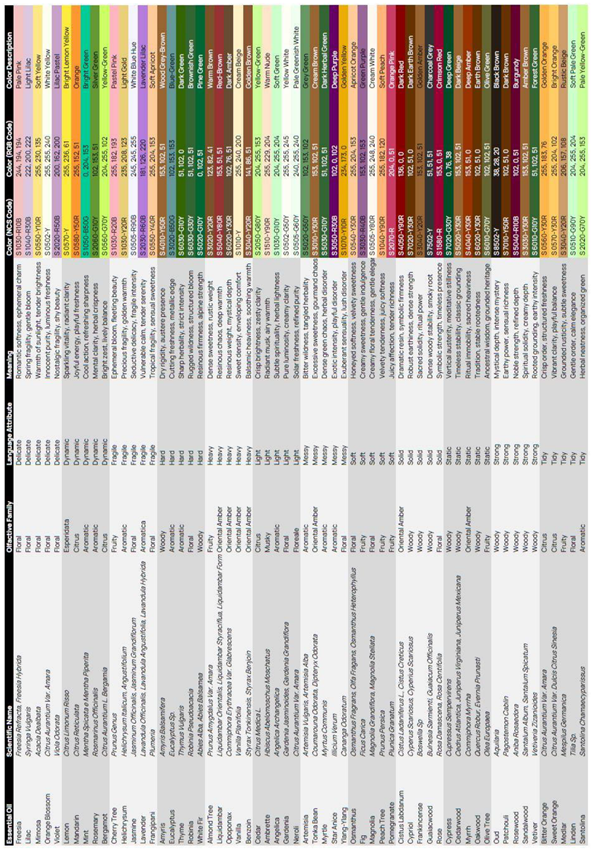
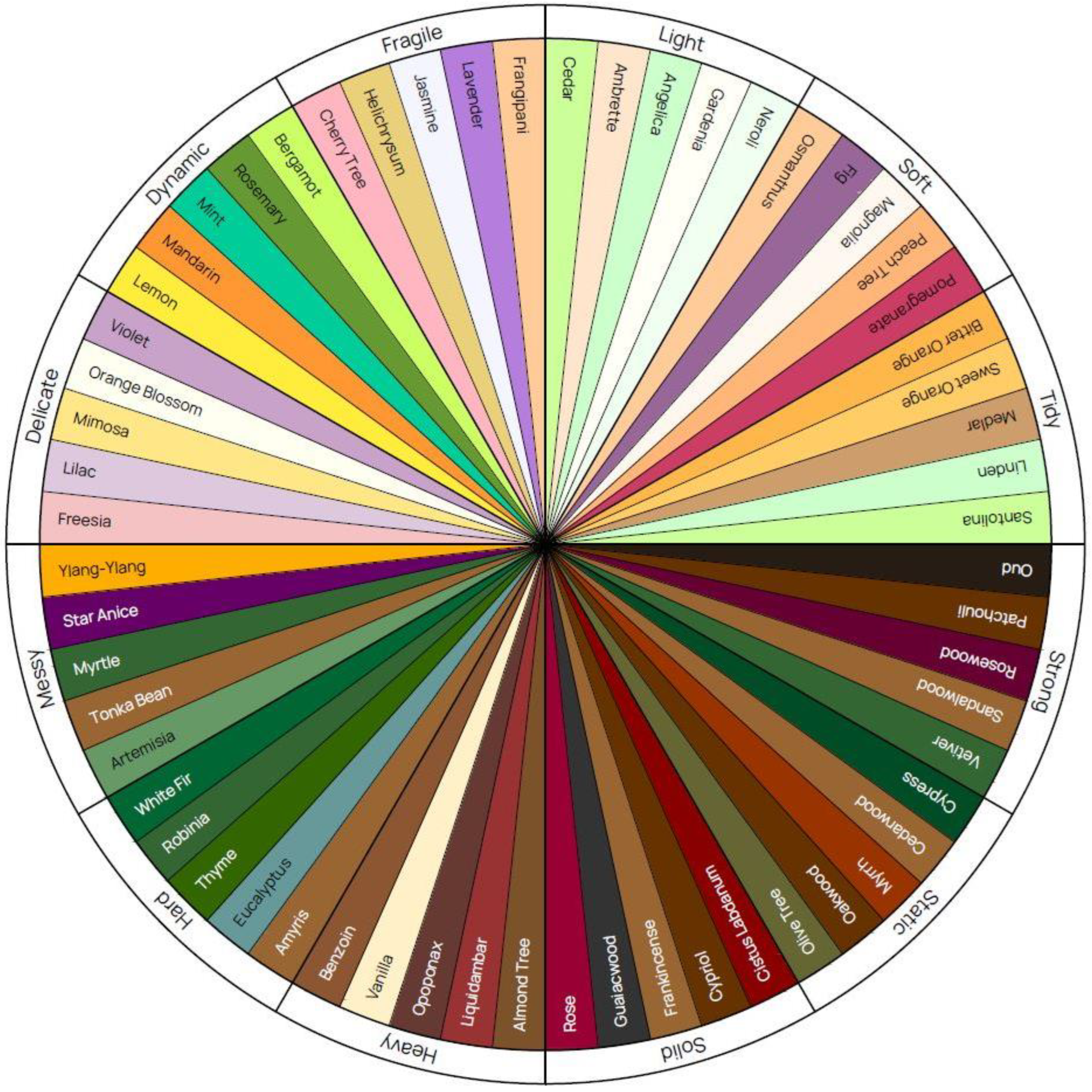
Consequently, the final consultation table (Appendix B) and the visual OAC diagram (Appendix C) were produced directly by the author, given the AI’s incapacity to generate a coherent visual representation. While the AI outputs served as raw material, they were not semantically altered: all correspondences between attributes, aromas, and colors were preserved exactly as generated by the system. The author’s role was to reorganize these outputs into a usable design tool, defining the consultation table with the categories: a) Essential Oil; b) Scientific Name; c) Olfactive Family; d) Language Attribute; e) Meaning; f) Color (NCS Code); g) Color (RGB Code) and h) Color Description. This ensured clarity, transparency, and practical usability. In addition, the author created the visual OAC diagram itself, segmenting the circle into 60 equal parts, each corresponding to one essence, represented by its associated RGB color, and grouped according to the 12 bipolar language attributes (five essences per attribute).
Importantly, the circle was organized according to a structural logic in which each attribute’s opposite occupied the diametrically opposite position on the diagram (e.g., Delicate directly opposed to Strong, Light opposite Heavy). Such geometric mirroring was intentionally adopted to enhance cognitive legibility and visual equilibrium, allowing users to immediately perceive contrasts and affinities across the sensory spectrum. By aligning opposites through spatial symmetry, the OAC facilitates comparative reasoning and supports the designer’s capacity to evaluate congruence and tension between olfactory, chromatic, and linguistic dimensions. In this sense, while the AI functioned as a generative partner, surfacing patterns and ambiguities, the construction of the consultation tool and diagram required human authorship in terms of formatting, organization, and visualization—without intervening in the semantic content of the mappings and cross-relations made by the AI.
4.2. Application of the OAC
The Olfactory Attribution Circle (OAC) is proposed as a structured tool to support designers, architects, brand managers, and consultants in integrating olfaction into spatial and brand experiences. Its application is particularly relevant in contexts such as retail, hospitality, cultural exhibitions, and brand activations, where the built environment functions as a communicative medium and sensory atmospheres play a decisive role in shaping identity and memory. The OAC follows a methodology inspired by established design approaches, structured into four iterative phases: Investigate, Attribute, Designate, and Test (see Table 4) [76,77]. Each phase connects abstract identity to material decisions, ensuring that olfactory strategies are coherent, inclusive, and feasible.
4.2.1. Investigate
The process begins with the definition of identity, which encompasses atmosphere, communicational intent, and target users. This identity is mapped through three interconnected layers: (1) Users, whose needs, perceptions, and emotional expectations must be understood; (2) Physical environment, which requires analysis of architectural features, spatial layout, materiality, lighting, and circulation; and (3) Products or services—or, in the case of ephemeral brand activations, the immersive experience itself. To capture these dimensions, the stage draws on ethnographic and observational techniques such as ethnography, observation and semi-structured interviews. Building on research into multisensory environments, it highlights that identity mapping must extend beyond material attributes to consider the cultural repertoires through which colors, aromas, and atmospheres are interpreted [4,5,6,7,8,9].
4.2.2. Attribute
In the second phase, descriptors of the intended identity are elicited through workshops or focus groups involving diverse stakeholders—designers, clients, brand managers, and architects. Participants are invited to freely generate words that describe the atmosphere, personality, or emotional tone they wish the space to convey. This first moment is intentionally open and intuitive, encouraging expressions that reflect both perceptual and affective impressions without imposing categorical limits. Once a broad vocabulary has been collected, a semantic clustering process is conducted to organize these words into relational groups. Through discussion and facilitation, participants identify affinities in tone, mood, and sensory connotation, grouping words that “speak the same emotional language.” This participatory analysis gradually leads to the twelve bipolar attributes validated in design and color research (Delicate/Strong, Dynamic/Static, Fragile/Solid, Light/Heavy, Soft/Hard, and Tidy/Messy) [7,51,52,53].
For instance, words such as calm, serene, fluid, poetic, translucent, and gentle might naturally converge into the Delicate cluster. These expressions share associations with harmony, balance, and refinement, often corresponding in design terms to lighter color values, subtle transitions, and olfactory notes that evoke clarity or openness—such as watery or fresh floral accords. In contrast, words like granular, structured, mechanical, dense, robust, and architectural may gravitate toward the Hard cluster. They evoke ideas of resistance, tension, and persistence, aligning with darker chromatic palettes and heavier aromatic profiles, such as smoky, resinous, or mineral essences.
This stage is interpretive rather than algorithmic: clustering does not seek consensus but resonance. Participants collectively negotiate meanings and nuances, translating individual perceptions into shared semantic categories. The process also reinforces inclusivity, since the attributes operate as neutral conceptual poles—free from gendered, generational, or commercial connotations—and allow each group to project its own cultural and contextual interpretations. Once the clusters are finalized, the OAC diagram is introduced as a visual and cognitive mediator. Rather than prescribing solutions, it encourages reflection and dialogue: participants explore how the chosen attributes might be embodied through congruent combinations of color, material, and aroma. In doing so, the OAC becomes a bridge between abstract identity and sensory form, guiding the translation of linguistic intention into multisensory spatial experience.
4.2.3. Designate
The Designate phase focuses on material and sensory decisions, translating abstract attributes into concrete strategies. Fragrance composition is structured much like in perfumery, combining essences through different layers: top notes, with volatile accords such as citrus or herbs, introduce brightness and energy; heart notes, often florals or fruits, sustain the atmosphere; and base notes, typically woody or resinous, provide persistence and solidity. Materiality also plays an active role, as architectural materials can function as olfactory agents in themselves. Untreated woods such as cedar or oak, as well as leathers and textiles, contribute intrinsic odors that merge with added essences to form a global olfactory identity. The color palette is equally important, reflecting the selected attributes: pastels and high-value, low-saturation tones correspond to Delicate or Fragile, while darker and more saturated tones express Strong or Heavy. Finally, technological delivery ensures feasibility and control. Contemporary solutions such as programmable diffusers connected to mobile apps enable intelligent and economic dispersion of aromas throughout the day, preventing waste, maintaining consistency, and offering flexibility aligned with budgetary and operational constraints.
A critical aspect, emphasized by Malnar and Vodvarka (2004), is the control of sensory intensity. Overstimulation risks alienating users, while insufficient intensity makes the atmosphere imperceptible [1]. Designing olfactory experiences thus requires calibrating diffusion carefully, ensuring balance and subtlety. This phase also considers economic, human, and physical resources. Olfactory design must be feasible within the constraints of the project, aligning sensory ambitions with available budgets, maintenance capabilities, and spatial affordances. As Mozota (2006) highlights, design is not only a matter of creativity but also a matter of strategic integration into organizational and material realities [76].
4.2.4. Test
The Test phase represents the final stage of the process, dedicated to evaluating whether the sensory strategy effectively communicates the intended identity. This assessment goes beyond aesthetic appreciation to examine congruence and resonance: does the atmosphere accurately reflect the chosen attributes? Do users perceive coherence between aromas, colors, and brand identity? Does the experience generate memory, satisfaction, and value? To address these questions, a variety of tools may be employed, including experience diaries, post-experience interviews, affective evaluation scales such as SAM or PAD, and behavioral indicators like dwell time in retail environments. Research consistently demonstrates that crossmodal congruence enhances recognition, engagement, and even willingness to purchase [4,5,6,7,8,9].
Taken together, these four sequential phases demonstrate how the OAC operates as a methodological bridge between linguistic expression, chromatic perception, and olfactory design. By structuring sensory choices around validated semantic attributes and aligning them with available resources, technologies, and evaluation tools, the OAC provides a process that is inclusive—by avoiding stereotypes and enabling broader participation; strategic—by integrating creativity with economic and technological feasibility; and grounded—by drawing on established theories of design methodology and multisensory research. In this sense, the OAC serves simultaneously as a creative compass and a decision-making tool, guiding the development of multisensory atmospheres that are congruent, memorable, and emotionally resonant.
5. Discussion
The Olfactory Attribution Circle (OAC) demonstrates how crossmodal correspondences between language, color, and aroma can be systematically integrated into design processes. Its results reveal not only theoretical consistency but also strong alignment with expert insights and real-world practices, while simultaneously exposing the limitations of artificial intelligence in the field of sensorial design. The congruences observed in the OAC resonate with longstanding findings in design research. The alignment of Delicate, Fragile, Light, and Soft with pastel tones of high brightness and low saturation and with floral or fruity essences reflects systematic patterns documented in crossmodal studies. Boeri (2019) demonstrated in educational experiments that design students consistently associated attributes such as Fragile and Soft with light, pastel hues—technically defined as high-value, low-chroma colors—while darker, more saturated hues corresponded to attributes such as Hard and Strong [52]. These findings echo Velasco and Spence (2019, 2020), who confirm that crossmodal congruence enhances coherence and memorability in multisensory environments [7,8,9]. Similarly, Schifferstein and Tanudjaja (2004) showed that fruity aromas align with bright, warm colors, while woody and resinous notes correspond to dark, desaturated hues. The OAC thus consolidates and visualizes these correspondences into a structured tool that bridges perceptual, semantic, and cultural dimensions [58].
From a phenomenological perspective, crossmodal congruence extends beyond cognitive or perceptual alignment and unfolds as an experiential condition that binds the senses into a unified field of awareness. Perception, as Merleau-Ponty (1945) and later Böhme (1993) observed, is not a summation of sensory inputs but an embodied synthesis
where vision, smell, and language co-constitute atmosphere. Within this unity, congruent
relations between scent and color generate what can be described as perceptual rightness—a pre-reflective sense of harmony that grounds emotional and spatial coherence [78,79]. When olfactory and visual stimuli resonate in tone, intensity, and semantic valence, they form an aesthetic continuum that stabilizes attention and enhances immersion. Conversely, incongruence introduces dissonance or tension, which, while potentially disruptive, can also be intentionally used to provoke curiosity or aesthetic friction. In this sense, congruence is not a constraint but a compositional parameter within an expanded sensory grammar. Aesthetically, crossmodal congruence can be understood as a principle of synesthetic composition, akin to musical harmony: a balance between sensory modalities that creates unity across difference. Following empirical evidence and phenomenological interpretation, Table 5 presents a synthesis on crossmodal congruence.
Through calibrated relations between chromatic value, odor weight, and linguistic tone, designers can orchestrate multisensory atmospheres that evoke affective resonance rather than mere decoration. Following Böhme’s concept of Raumstimmung (1993) and Pallasmaa’s phenomenology of atmospheres (2005), suchalignment transforms space into an active medium of feeling—an environment that is not only seen or smelled but felt as coherent [2,78]. In this view, crossmodal congruence functions as a form of aesthetic intentionality: it reflects the designer’s capacity to choreograph sensory relations that embody meaning, emotion, and care. The OAC thus does not only operationalize sensory data but also extends the scope of design ethics toward phenomenological sensitivity—where material, chromatic, and olfactory elements converge in shaping atmospheres.
Yet, analysis revealed tensions and interpretive absences that highlight the need for human discernment in applying the OAC. Notably, the AI did not assign any essences to neutral or “non-colour” categories such as grays—tones frequently employed in architectural and interior contexts to temper or harmonize sensory atmospheres. This omission points to a blind spot in AI reasoning, as these “non-colours” are critical in modulating the intensity of chromatic and olfactory experiences. Similarly, certain allocations appeared less harmonious within the circular logic—for instance, Vanilla positioned under Heavy or Pomegranate aligned with Soft. These exceptions disrupt the otherwise balanced visual rhythm of the circle but simultaneously underscore the richness and complexity of olfactory semiotics. They also signal the need for interpretive agency: designers must refine, contextualize, and, when necessary, recalibrate the OAC mappings to align with project-specific meanings. Attributes such as Messy and Tidy also emerged as semantically ambiguous, reflecting culturally relative notions of order and chaos. Unlike more physically grounded pairs (Light/Heavy, Delicate/Strong), these abstract dimensions resist universal translation, requiring contextual sensitivity and critical reflection from users of the tool. Thus, the OAC should never be interpreted as a prescriptive taxonomy but rather as a structured departure point—a tool designed to stimulate reasoning, iteration, and cultural adaptation rather than dictate fixed sensory correspondences.
The interviews reinforced and expanded these insights by grounding them in practice. Experts emphasized that materials themselves act as inherent sensory carriers. Woods, leathers, textiles, and metals emit distinct odors that interact with added essences, becoming integral to the olfactory identity of a space. This observation aligns with the Designate phase of the OAC, where the global aroma should be conceived as a layered architecture integrating both designed fragrances and material emissions. As one interviewee emphasized, the scent of cedar in an interior, for instance, can be as defining as an added perfume—confirming that materiality has agency in sensory composition. Inclusivity also emerged as a central theme. Experts applauded the choice of neutral bipolar attributes, contrasting them with gendered or generational stereotypes common in marketing (e.g., “masculine” woods, “feminine” florals). The OAC’s linguistic neutrality thus promotes cultural adaptability and fosters participation across age, gender, and background—an ethical as well as aesthetic advance in sensory design.
A recurring technical concern among all professionals was intensity control. Overly concentrated aromas risk alienating users, while insufficient diffusion results in imperceptibility. This aligns with Malnar and Vodvarka’s (2004) notion of sensory control, emphasizing the need to modulate stimuli to avoid both overload and deprivation. The Designate phase explicitly addresses this by encouraging the use of smart diffusion technologies—such as programmable scent dispensers or app-connected nebulizers—that release balanced doses throughout the day [1]. These devices not only ensure consistency and comfort but also enhance sustainability by reducing waste and optimizing the use of volatile compounds. Sustainability and provenance, in fact, constitute an essential extension of the OAC discussion. Many natural essences—such as sandalwood, oud, or ambergris—carry environmental and ethical implications related to sourcing, extraction, and biodiversity impact. Future applications of the OAC must therefore integrate sustainability criteria at the design stage, privileging ethically sourced, renewable, or synthetic alternatives verified by certification bodies (e.g., IFRA, FSC, Ecocert). This ethical dimension links directly to the experts’ insistence that olfactory design must not only create atmosphere but also express responsibility. Just as visual materials are now chosen for low embodied carbon, olfactory materials should be evaluated for their ecological footprint and supply-chain transparency.
At the same time, divergences emerged regarding the role of AI. While some professionals saw it as a powerful enabler for creativity, efficiency, and mass customization, others questioned its ability to capture cultural nuance and emotional subtlety. The study’s results affirm both positions: the AI was remarkably consistent in aligning citrus essences with luminous colors and woody ones with darker tones—findings coherent with the literature—but it faltered in semantic disambiguation and failed entirely in generating the visual diagram. Despite receiving precise chromatic codes and segmentation parameters, it could not produce a coherent circular structure. These limitations required the author to manually organize the information, creating the consultation table and diagram that now define the OAC. In this sense, AI served not as a designer but as a creative sparring partner, expanding the search space while reaffirming the indispensability of human interpretation and design sensibility.
The validity of the OAC’s conceptual model is further supported by real-world cases that exemplify congruent sensorial design. In Dolce & Gabbana’s exhibition Dal Cuore alle Mani (From the Heart to the Hands) in Milan, Rose was selected as the central essence for its embodiment of Italian craftsmanship—delicate yet strong, deeply rooted in Mediterranean culture. Within the OAC’s tool, Rose aligns with the attribute Solid, expressing tradition, mastery, and endurance—qualities mirrored in both the exhibition’s narrative and material language. Similarly, Aesop’s The Second Skin (Milan’s Fuorisalone, 2025) demonstrated the agency of materials as olfactory and tactile communicators. Cedarwood, a key ingredient in Aesop’s products, permeated the architectural installation both as matter and aroma, allowing visitors to experience its texture, scent, and symbolic depth simultaneously. In this setting, materiality itself became an active agent of meaning, confirming that matter in sensory design is communicative, not passive (see Figure 4).
By synthesizing evidence from the literature, expert interviews, and case study observation, the OAC emerges as a methodological and human-centered tool for translating semantic attributes into coherent chromatic and olfactory systems. It bridges theoretical knowledge and practical constraints, integrating sustainability, inclusivity, and feasibility. The following hypothetical applications illustrate its potential range: A fashion and accessories brand characterized by Fragile and Delicate might select pastel tones—soft pinks, violets, and yellows of high brightness and low saturation—paired with floral essences, producing an atmosphere of refinement and subtlety. Conversely, a sports car showroom anchored in Strong and Solid would gravitate toward darker, high-chroma colors and woody or resinous notes.
These examples demonstrate the OAC’s operational power: it translates abstract language attributes into sensory decisions that unify color, aroma, and material presence. It also underscores the interpretive flexibility of the tool—its ability to inform, not dictate, design practice—while demanding human discernment to maintain cultural sensitivity, ethical responsibility, and aesthetic harmony. Ultimately, the OAC positions itself as a bridge between artificial intelligence and human authorship, between sensory coherence and cultural complexity, and between creative exploration and environmental consciousness. It does not claim to deliver absolute truths but offers a systematic, reflexive, and ethically aware approach to crafting atmospheres that are coherent, memorable, and sustainable within the built environment.
7. Conclusion
This research set out to investigate whether olfactory design can be systematically oriented by linguistic attributes and chromatic associations, establishing synesthetic relations between language, color, and scent. The answer is affirmative: the Olfactory Attribution Circle (OAC) demonstrates that such relations can be structured into a coherent, replicable, and inclusive tool for multisensory branding and environmental design.
The study’s contributions can be summarized in six key outcomes (see Table 6): (1) A structured methodology: the OAC proposes a four-phase process—Investigate, Attribute, Designate, Test—grounded in design research traditions, enabling designers to move systematically from abstract identity to material and sensory decisions [76,77]; (2) Inclusive semantic attributes: by clustering descriptors into twelve bipolar attributes, the tool avoids stereotyped divisions such as masculine/feminine or young/mature, thereby promoting inclusivity and broad participation [53]; (3) Systematic congruences: the results confirmed consistent mappings, with pastel, high-value, low-saturation tones aligning with delicate florals and fruits, while dark, saturated hues corresponded to woody and resinous notes, consolidating prior crossmodal research [54,55,56,57,58,59,60,61,62,63,64,65,66,67,68,69,70,71,72,73,74,75]; (4) AI as a creative partner: artificial intelligence enriched the exploratory process by generating associations between essences, attributes, and colors, yet revealed limitations in resolving semantic ambiguities and producing visual diagrams. The final OAC diagram and consultation table were thus curated by the author, underscoring the indispensable role of human sensibility in design; (5) Importance of balance and intensity: both interviews and literature highlighted that olfactory design depends not only on selecting appropriate essences but also on calibrating their intensity and diffusion. Technologies such as programmable diffusers can help achieve this balance, ensuring that atmospheres remain perceptible yet subtle.
Extensive evidence in the literature emphasizes that without crossmodal congruence, multisensory combinations often fail to generate positive outcomes. Incongruent sensory pairings can produce confusion, cognitive dissonance, and reduced engagement. By contrast, congruent multisensory experiences are consistently associated with higher satisfaction, stronger memorability, and enhanced influence on cognitive and behavioral processes. They also contribute to brand equity and market distinctiveness, reinforcing the role of sensory design as a strategic asset. This underscores the importance of approaches like the OAC, which seek to structure sensory choices around validated correspondences rather than arbitrary associations. Future research should therefore address three main directions: (1) Cross-cultural validation: testing whether the proposed associations remain stable or shift across different cultural environments; (2) Architectural applications: exploring how the OAC can be integrated into real projects, ranging from retail and hospitality to exhibitions and workplaces; (3) Longitudinal impact: investigating how olfactory–chromatic congruence influences cognitive and behavioral responses such as memory, well-being, and brand attachment over time.
Taken together, these outcomes show that the OAC is both a creative compass and a strategic tool, aligning sensory decisions with brand identity, spatial constraints, and user experience. However, the research also revealed limitations. AI’s inability to produce coherent visual diagrams reflects the current immaturity of computational tools for sensorial design. Moreover, while the OAC provides conceptual clarity, its practical application across diverse cultural contexts remains untested. Odor–color correspondences are not universal but mediated by cultural repertoires, suggesting that the tool must be adapted and validated in situ. In conclusion, the OAC advances the field of multisensory design by bridging theory, practice, and technology. It confirms that aligning aromas, attributes, and colors enhances coherence, deepens emotional resonance, and fosters inclusivity. By balancing AI’s computational possibilities with human creativity and critical judgment, the OAC offers a path toward designing atmospheres that are not only functional but also meaningful, memorable, and profoundly human-centered. Importantly, the tool should not be understood as a universal model, but rather as an initial proposition—an open methodological orientation to be refined, challenged, and expanded. Its greatest potential lies in the fact that the logic applied to attribute–aroma–color relations can be systematically extended to other sensory domains.
Attributes such as soft and hard can guide the selection of materials and the tactile qualities they communicate; descriptors like fragile and delicate can inform the choice of musical programming, associating them with slower tempos, softer dynamics, or higher pitches; and flavors may be tested in relation to olfactory and chromatic dimensions, generating congruence between what is seen, smelled, and tasted. In this way, the OAC provides a methodological orientation for building fully crossmodal experiences in which touch, sound, and taste are not treated as isolated layers but as integrated components of a coherent sensorial narrative. Rather than an endpoint, the OAC should be seen as a foundation for further inquiry—a methodological platform capable of guiding research protocols, informing design processes, and fostering evidence-based innovation in multisensory branding and environmental design. Its value lies less in delivering definitive answers than in inviting exploration, offering designers and researchers a structured yet adaptable path toward the creation of congruent, inclusive, and human-centered multisensory environments.
Abbreviations
The following abbreviations are used in this manuscript:
| AI | Artificial Intelligence |
| CMF | Color, Material and Finish |
| GPT | Generative Pre-trained Transformer |
| NCS | Natural Colour System |
| OAC | Olfactory Attribution Circle |
| RGB | Red, Green and Blue |
| SME | Small and Medium Enterprise |
Appendix A

Table A1.
Semi-structured interview – Academia. Source: Authors (2025),.
| nº | Question |
|---|---|
| 1 | Could you tell me a bit about your professional or academic background and your involvement in research or work that, in some way, considers the sensory aspects of spaces and products and their perceptual effects on people? |
| 2 | How do you see the role of sensory stimuli, with a focus on olfactory stimuli, in experience design within built environments, such as retail spaces and exhibition spaces? What do you think are the benefits that solutions involving olfactory stimuli can bring to both people and businesses? |
| 3 | Which senses do you consider to be most explored in sensory design nowadays? Are there any, in your opinion, that are still underutilized? |
| 4 | Could you share examples of innovative solutions for each of the senses in physical environments? |
| 5 | Which companies or initiatives do you know that stand out for creating solutions for commercial and exhibition spaces? |
| 6 | What new technologies do you believe have the greatest potential to transform the field of olfactory design in built environments? |
| 7 | How can regenerative and sustainable design practices be integrated into the development of olfactory solutions in built environments? What precautions should professionals take to ensure that the solutions adopted are aware? |
| 8 | What are the main methodological challenges that arise when implementing effective olfactory design strategies in SMEs? |
| 9 | Is there a recommended approach or methodology for defining and selecting olfactory solutions to be adopted in a project? What would be the first step in this process? |
| 10 | How do you see the future of Sensory Branding and Experience Design in built environments in the coming years? |
Table A2.
Semi-structured interview – Industry. Source: Authors (2025).
| nº | Question |
|---|---|
| 1 | Could you tell me a bit about the history of the company and how it started getting involved in the development of olfactory solutions for people or built environments? |
| 2 | What are the main challenges faced in integrating olfactory solutions into different types of spaces and sectors? |
| 3 | How does the company develop olfactory solutions? What technologies and methodologies do you use? |
| 4 | Does the company collaborate with designers, architects, and marketing professionals to implement olfactory solutions? |
| 5 | What are the main emerging trends and innovations in the field of sensory experiences? |
| 6 | What benefits does the integration of your olfactory solutions offer to the user? Is there a process to measure the impact (effectiveness) of these benefits? |
| 7 | Does the company integrate sustainable and regenerative practices in the development of olfactory solutions? Which ones? |
| 8 | Does the company customize olfactory solutions for different types of brands and people? Is there a process that guides this customization? |
| 9 | How do you see the adoption of olfactory experiences by SMEs (small and medium enterprises)? What do you think are the main obstacles in implementing sensory solutions for SMEs? |
| 10 | Is there a possibility of making customized olfactory solutions more accessible and scalable for SMEs? What kind of tools or resources would be necessary? |
Appendix B
Table A3.
Consulting Table – OAC. Source: Authors (2025).
 |
Appendix C
Figure A1.
Visual Diagram – OAC. Source: Authors (2025).
References
- Malnar, J. M.; Vodvarka, F. Sensory design; University of Minnesota Press: Minneapolis, USA, 2004. [Google Scholar]
- Pallasmaa, J. The eyes of the skin: architecture and the senses; Wiley: Hoboken, USA, 2005. [Google Scholar]
- Zumthor, P. Atmospheres: architectural environments - surrounding objects; Birkhäuser: Basel, Switzerland, 2006. [Google Scholar]
- Krishna, A. (Ed.) Sensory marketing: research on the sensuality of products; Routledge: Oxfordshire, United Kingdom, 2012. [Google Scholar]
- Krishna, A. An integrative review of sensory marketing: Engaging the senses to affect perception, judgment and behavior. J. Consum. Psychol. 2012, 22, 332–351. [Google Scholar] [CrossRef]
- Hekkert, P. Design aesthetics: Principles of pleasure in design. Psychol. Sci. 2006, 48, 157–172. [Google Scholar]
- Velasco, C.; Spence, C. (Eds.) Multisensory packaging: Designing new product experiences; Palgrave Macmillan: London, United Kingdom, 2019. [Google Scholar] [CrossRef]
- Spence, C. Olfactory-colour crossmodal correspondences in art, science, and design. Cogn. Res. Princ. Implic. 2020, 5, 52. [Google Scholar] [CrossRef]
- Spence, C. Senses of place: architectural design for the multisensory mind. Cogn. Res. Princ. Implic. 2020, 5, 46. [Google Scholar] [CrossRef]
- Sarstedt, M.; Imschloss, M.; Adler, S. Scent. In Multisensory Design of Retail Environments: Vision, Sound, and Scent, 2nd ed.; Publisher: Springer Wiesbaden, Wiesbaden, Germany, 2024; pp. 53–71. [Google Scholar]
- Haverkamp, M. Synesthetic design: handbook for a multisensory approach; Birkhäuser: Basel, Switzerland, 2013. [Google Scholar]
- Engen, T. The perception of odors; Academic Press: Oxford, United Kingdom, 1982. [Google Scholar]
- Xiao, J.; Aletta, F.; Radicchi, A. Editorial: smells, well-being, and the built environment. Front. Psychol. 2022, 13. [Google Scholar] [CrossRef]
- Herz, R.S. The role of odor-evoked memory in psychological and physiological health. Brain Sci. 2016, 6, 22. [Google Scholar] [CrossRef] [PubMed]
- Boden, M. A. AI: Its nature and future; Oxford University Press: Oxford, United Kingdom, 2016. [Google Scholar]
- McCormack, J.; Gifford, T.; Hutchings, P. Autonomy, authenticity, authorship and intention in computer generated art. In Computational Intelligence in Music, Sound, Art and Design; Ekárt, A., Liapis, A., Castro Pena, M.L., Eds.; Springer: Cham, Switzerland, 2019; Lecture Notes in Computer Science; vol. 11453, pp. 35–50. [Google Scholar]
- Shneiderman, B. Human-Centered Artificial Intelligence: Three Fresh Ideas. AIS Trans. Hum.-Comput. Interact. 2020, 12, 109–124. [Google Scholar] [CrossRef]
- Shneiderman, B. Human-centered artificial intelligence: Reliable, safe & trustworthy. Int. J. Hum.-Comput. Interact. 2020, 36, 495–504. [Google Scholar] [CrossRef]
- Candy, L.; Edmonds, E. Practice-based research in the creative arts: foundations and futures from the front line. Leonardo 2018, 51, 63–69. [Google Scholar] [CrossRef]
- Kantosalo, A.; Toivonen, H. Modes for creative human-computer collaboration: Alternating and task-divided co-creativity. In Proceedings of the 7th International Conference on Computational Creativity (ICCC 2016), Paris, France, 27 June–1 July 2016. [Google Scholar]
- Henshaw, V. , McLean, K., Medway, D., Perkins, C., & Warnaby, G. (Eds.). Designing with smell: practices, techniques and challenges; Routledge: Oxfordshire, United Kingdom, 2017. [Google Scholar]
- Barbara, A.; Mikhail, R.A.A. The Odor of Colors: Correspondence from a Cross-Cultural Design Perspective. In Proceedings of the International Colour Association (AIC) Conference 2021, Milan, Italy, 30 August–3 September 2021. [Google Scholar]
- Deroy, O.; Spence, C. Crossmodal correspondences: Four challenges. Multisens. Res. 2016, 29, 29–48. [Google Scholar] [CrossRef] [PubMed]
- Spence, C. Using ambient scent to enhance well-being in the multisensory built environment. Front. Psychol. 2020, 11. [Google Scholar] [CrossRef]
- Tranfield, D.; Denyer, D.; Smart, P. Towards a methodology for developing evidence-informed management knowledge by means of systematic review. Br. J. Manag. 2003, 14, 207–222. [Google Scholar] [CrossRef]
- Kvale, S., & Brinkmann, S. (2009). InterViews: Learning the craft of qualitative research interviewing (2nd ed.). SAGE Publications.
- Yin, R. K. Case study research and applications: design and methods, 6th ed.; Sage Publications: Thousand Oaks, USA, 2018. [Google Scholar]
- Martone, G. La grammatica dei profumi; Gribaudo: Milan, Italy, 2019. [Google Scholar]
- Denzin, N.K. Triangulation 2.0. J. Mixed Methods Res. 2012, 6, 80–88. [Google Scholar] [CrossRef]
- Howes, D. (Ed.) Empire of the senses: the sensual culture reader; Berg: Oxford, United Kingdom, 2005. [Google Scholar]
- Lupton, E. , & Lipps, A. (Eds.). The senses: design beyond vision; Princeton Architectural Press: New York, USA, 2018. [Google Scholar]
- Piesse, G. W. S. The art of perfumery: And methods of obtaining the odors of plants; Lindsay & Blakiston: Philadelphia, USA, 1857. [Google Scholar]
- Jellinek, P. Die psychologischen grundlagen der parfümerie; Hüthig: Heidelberg, Germany, 1951. [Google Scholar]
- Henning, H. Der geruch; Johann Ambrosius Barth: Leipzig, Germany, 1916. [Google Scholar]
- McLean, K. Communicating and mediating smellscapes: The design and exposition of olfactory mappings. In Designing with Smell: Practices, Techniques and Challenges; Henshaw, V., McLean, K., Medway, D., Perkins, C., Warnaby, G., Eds.; Routledge: London, UK, 2017; pp. 67–77. [Google Scholar]
- Krippendorff, K. The semantic turn: a new foundation for design; CRC Press: Boca Raton, USA, 2006. [Google Scholar]
- Johnson, K.W.; Lenau, T.; Ashby, M.F. The Aesthetic and Attributes of Products. In Proceedings of the International Conference on Engineering Design (ICED ’03), Stockholm, Sweden, 19–21 August 2003. [Google Scholar]
- Classen, C.; Howes, D.; Synnott, A. Aroma: the cultural history of smell; Routledge: Oxfordshire, United Kingdom, 1994. [Google Scholar]
- Pastorelli, O. Le parole del profumo., 2nd ed.; Tecniche Nuove: Milan, Italy, 2003. [Google Scholar]
- Pastorelli, O.; Levi, S. Leggere il profumo; Tecniche Nuove: Milan, Italy, 2006. [Google Scholar]
- Santos, C.T. dos. Requisitos de Linguagem do Produto: Uma Proposta de Estruturação para as Fases Iniciais do PDP. Doctoral Thesis, Universidade Federal de Santa Catarina, Florianópolis, Brazil, 2009. [Google Scholar]
- Santaella, L. Semiotica Aplicada; Cengage: São Paulo, Brazil, 2018. [Google Scholar]
- Eco, U. A Theory of semiotics; Indiana University Press: Bloomington, USA, 1976. [Google Scholar]
- Barthes, R. Elements of semiology; (A. Lavers & C. Smith, Trans.); Hill and Wang: New York, USA, 1967. [Google Scholar]
- Pastoureau, M. Noir: Histoire d’une couleur; Seuil: Paris, France, 2008. [Google Scholar]
- Gage, J. Color and meaning: Art, science, and symbolism; University of California Press: Oakland, USA, 1999. [Google Scholar]
- Heller, E. Psychology of color: effects and symbolism, 2nd ed.; McGraw-Hill: New York, USA, 2004. [Google Scholar]
- Wright, A. The beginner’s guide to colour psychology; Kyle Cathie Ltd: London, United Kingdom, 1998. [Google Scholar]
- Kobayashi, S. Color Image Scale; Kodansha International: Tokyo, Japan, 1991. [Google Scholar]
- Albers, J. Interaction of color; Yale University Press: New Haven, USA, 1963. [Google Scholar]
- Desmet, P.M.A.; Hekkert, P. Framework of product experience. Int. J. Des. 2007, 1, 57–66. [Google Scholar]
- Boeri, C. An educational experience on the exploration and experimentation of colour associations and relationships. J. Int. Colour Assoc. 2019, 24, 1–10. [Google Scholar]
- Boeri, C. Color and the emotional character of interiors. In Proceedings of the First Russian Congress on Color, Smolensk, Russia, 18–20 September 2019. [Google Scholar]
- Gilbert, A.N.; Martin, R.; Kemp, S.E. Cross-modal correspondence between vision and olfaction: the color of smells. Am. J. Psychol. 1996, 109, 335–351. [Google Scholar] [CrossRef]
- Gilbert, A. N. What the nose knows: the science of scent in everyday life; Crown: New York, USA, 2008. [Google Scholar]
- Kemp, S.E.; Gilbert, A.N. Odor intensity and color lightness are correlated sensory dimensions. Am. J. Psychol. 1997, 110, 35–46. [Google Scholar] [CrossRef]
- Morrot, G.; Brochet, F.; Dubourdieu, D. The color of odors. Brain Lang. 2001, 79, 309–320. [Google Scholar] [CrossRef]
- Schifferstein, H. N. J., & Tanudjaja, I. (2004). Visualising fragrances through colours: The mediating role of emotions. Perception, 33(10), 1249–1266. [CrossRef]
- Demattè, M.L.; Sanabria, D.; Spence, C. Cross-modal associations between odors and colors. Chem. Senses 2006, 31, 531–538. [Google Scholar] [CrossRef] [PubMed]
- Stevenson, R.J.; Prescott, J.; Boakes, R.A. Confusing tastes and smells: how odours can influence the perception of sweet and sour tastes. Chem. Senses 1999, 24, 627–635. [Google Scholar] [CrossRef]
- Herz, R. S. The scent of desire: discovering our enigmatic sense of smell; HarperCollins: New York, USA, 2007. [Google Scholar]
- Herz, R.S. A naturalistic analysis of autobiographical memories triggered by olfactory, visual and auditory stimuli. Chem. Senses 2009, 29, 217–224. [Google Scholar] [CrossRef] [PubMed]
- Herz, R.S.; Eliassen, J.; Beland, S.; Souza, T. Neuroimaging evidence for the emotional potency of odor-evoked memory. Neuropsychologia 2004, 42, 371–378. [Google Scholar] [CrossRef] [PubMed]
- Levitan, C.A.; et al. Cross-cultural color-odor associations. PLoS One 2014, 9, e101651. [Google Scholar] [CrossRef]
- Spence, C. Crossmodal correspondences: A tutorial review. Atten. Percept. Psychophys. 2011, 73, 971–995. [Google Scholar] [CrossRef]
- Camgöz, N.; Yener, C.; Güvenç, D. Effects of hue, saturation, and brightness on preference. Color Res. Appl. 2002, 27, 199–207. [Google Scholar] [CrossRef]
- Hurlbert, A.C.; Ling, Y. Biological components of sex differences in colour preference. Curr. Biol. 2007, 17, R623–R625. [Google Scholar] [CrossRef]
- Österbauer, R.A.; Matthews, P.M.; Jenkinson, M.; Beckmann, C.F.; Hansen, P.C.; Calvert, G.A. Color of scents: Chromatic stimuli modulate odor responses in the human brain. J. Neurophysiol. 2005, 93, 3434–3441. [Google Scholar] [CrossRef] [PubMed]
- Stevenson, R.J.; Rich, A.; Russell, A. The nature and origin of cross-modal associations to odours. Perception 2012, 41, 606–619. [Google Scholar] [CrossRef]
- Stevenson, R.J.; Oaten, M. The effect of appropriate and inappropriate stimulus color on odor discrimination. Percept. Psychophys. 2008, 70, 640–646. [Google Scholar] [CrossRef]
- Tamura, K.; et al. Olfactory modulation of colour working memory: How does citrus-like smell influence the memory of orange colour? PLoS One 2018, 13, 9. [Google Scholar] [CrossRef]
- Zellner, D.A. Color–odor interactions: a review and model. Chemosens. Percept. 2013, 6, 155–169. [Google Scholar] [CrossRef]
- Zellner, D.A.; Whitten, L.A. The effect of color intensity and appropriateness on color-induced odor enhancement. Am. J. Psychol. 1999, 112, 585–604. [Google Scholar] [CrossRef] [PubMed]
- Zellner, D.A.; Kautz, M.A.; Hall, S.; Durlach, P. Influence of color on odor identification and liking ratings. Am. J. Psychol. 1991, 104, 547–561. [Google Scholar] [CrossRef]
- Gottfried, J.A.; Dolan, R.J. The nose smells what the eye sees: Crossmodal visual facilitation of human olfactory perception. Neuron 2003, 39, 375–386. [Google Scholar] [CrossRef] [PubMed]
- Mozota, B. Design management: using design to build brand value and corporate innovation. Allworth Press: New York, USA, 2003. [Google Scholar]
- Norman, D. A. Emotional design: why we love (or hate) everyday things; Basic Books: New York, USA, 2004. [Google Scholar]
- Böhme, G. Atmosphäre: essays zur neuen Ästhetik; Suhrkamp: Frankfurt am Main, Germany, 1993. [Google Scholar]
- Merleau-Ponty, M. Phénoménologie de la perception. Gallimard: Paris, France, 1945. [Google Scholar]
Figure 1.
Left – Drom Fragrance Wheel (1911) and Right – Michael Edwards’ Fragrance Wheel (1983). Source: Lupton and Lipps, 2018 (p. 58, 59).
Figure 1.
Left – Drom Fragrance Wheel (1911) and Right – Michael Edwards’ Fragrance Wheel (1983). Source: Lupton and Lipps, 2018 (p. 58, 59).
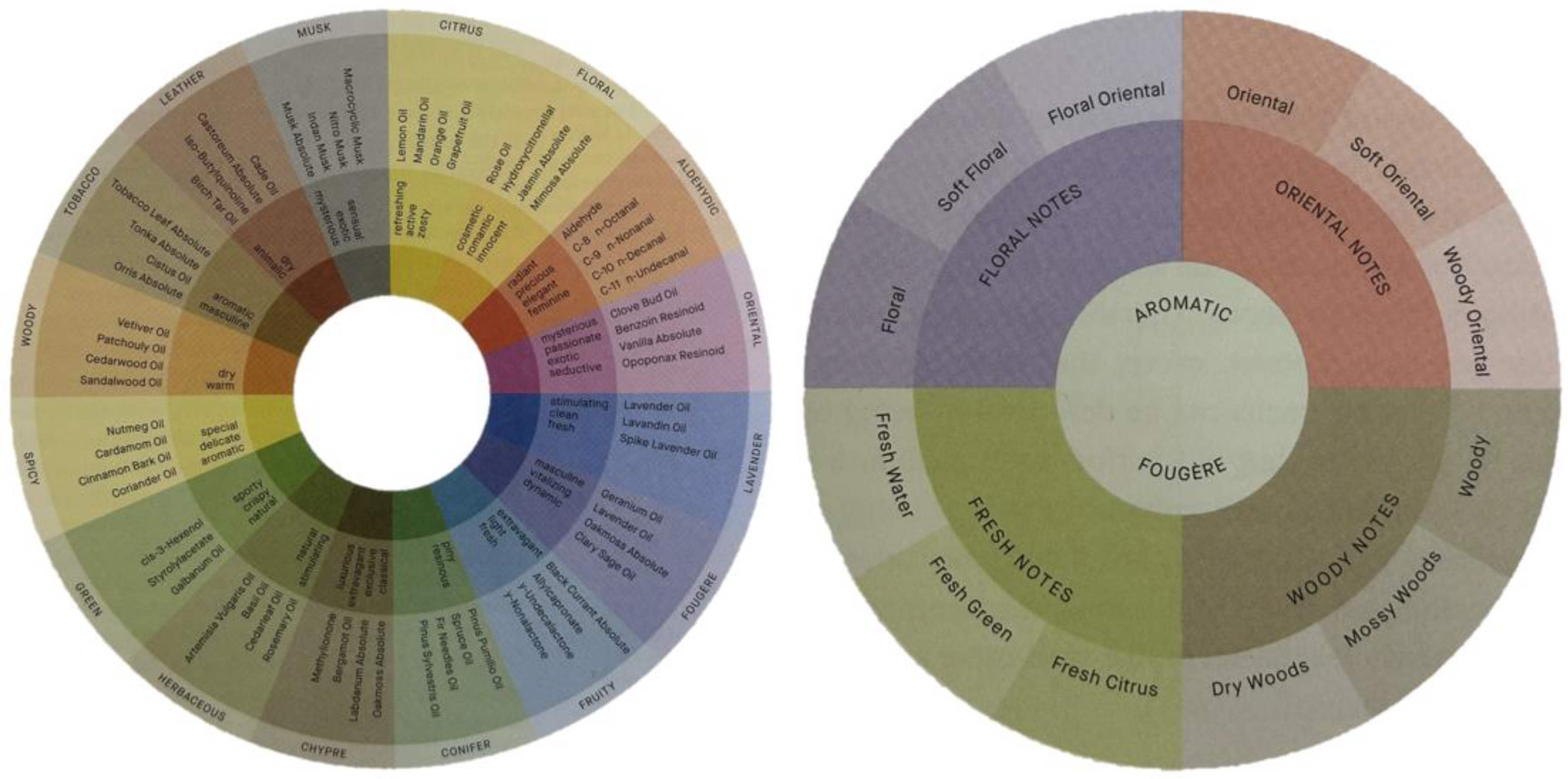
Figure 2.
Every Human’s Algorithmic Perfumery in Copenhagen. Source: Author (2025).
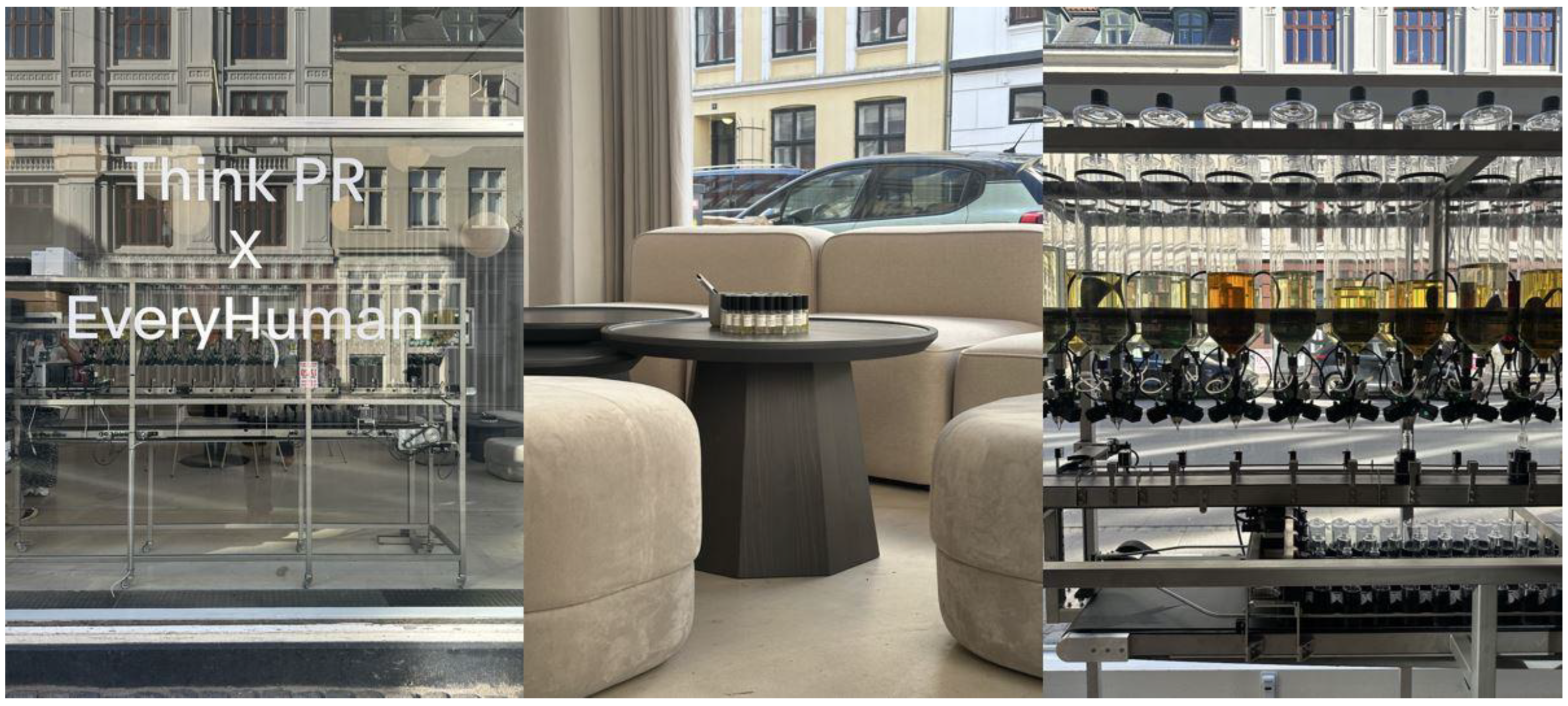
Figure 4.
Aesop’s “The Second Skin” at Milan’s Design Week 2025. Source: Author (2025).
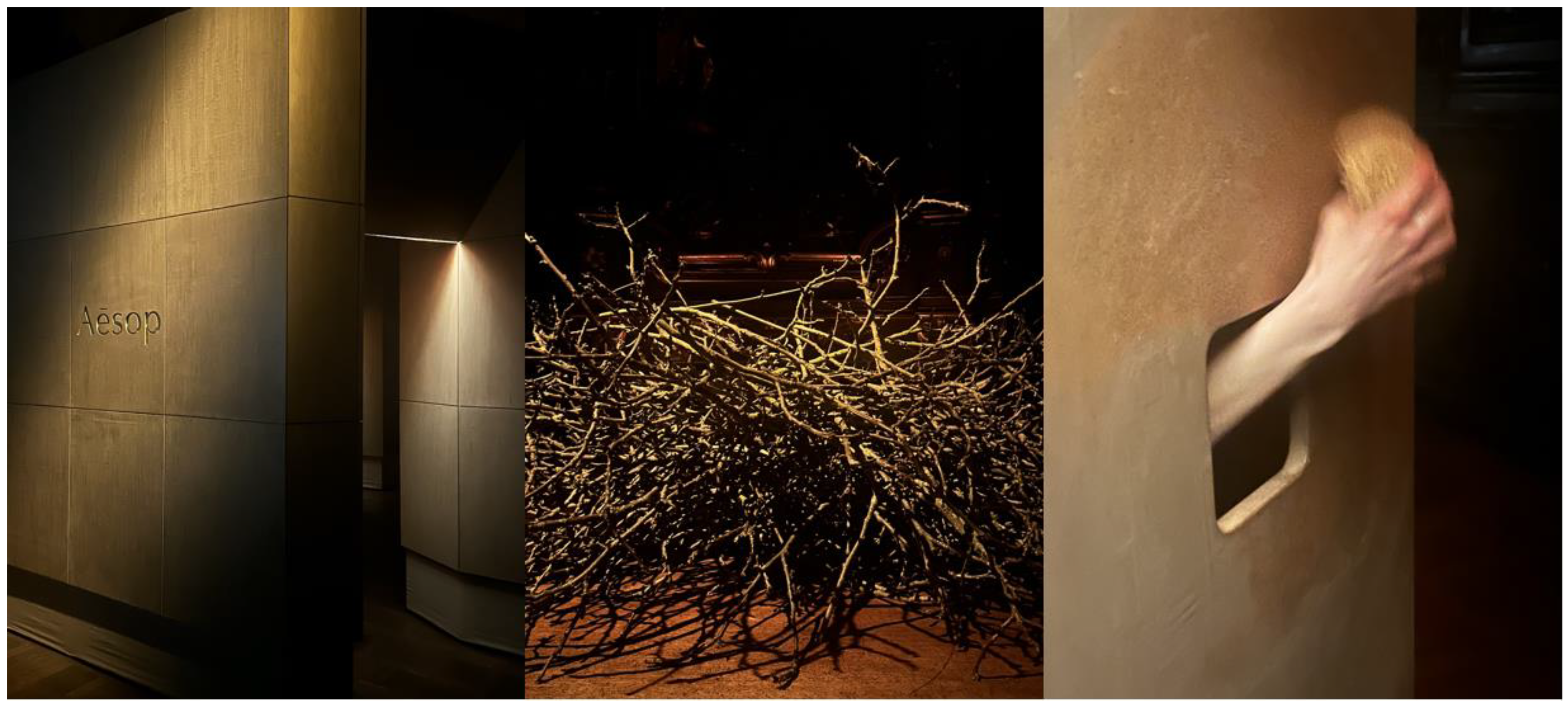
Table 1.
Overview of the Methodological Approach. Source: Author (2025).
| Phase | Method | Output | Purpose/Insight |
|---|---|---|---|
| 1 | Systematic literature review | Theoretical foundation, identification of validated attributes | Reveal research gap and conceptual grounding |
| 2 | Semi-structured interviews |
Practice-based insights | Identify inclusion, intensity and feasibility concerns |
| 3 | Case study – EveryHuman |
Observation evidence of AI-mediated olfactory personalization | Evaluate potential and limits of AI in olfactory design |
| 4 | AI-assisted exploration |
Mapping of essences- attributes-colors |
Generate crossmodal correspondences |
| 5 | Analytical cross- comparison |
Olfactory Attribution Circle (OAC) | Triangulate findings and refine tool |
Table 2.
Thematic synthesis of interview findings. Source: Author (2025).
| Theme | Key Insight |
|---|---|
| Materials | Intrinsic odors of materials shape atmospheres. |
| Inclusivity | Semantic attributes preferred over gendered/age-based categories. |
| Feasibility & SMEs | Barriers include cost and lack of design culture; need approaches and affordable technologies. |
| Intensity | Balance is critical: avoid overstimulation or imperceptibility. |
| AI Role | Potential for exploration vs. skepticism on cultural nuance. |
| Strategic Potential | Olfactory design as memory, identity, and differentiation tool. |
| Sustainability | Refill, reuse, authenticity, and crafted imperfection as sensorial values. |
Table 3.
Step-by-step procedure for AI-assisted generation of the OAC. Source: Author (2025).
| Step | Action | Purpose |
|---|---|---|
| 1 | Provide AI with dataset of 60 essences (common names, scientific names, olfactory families). | Ground the system in reliable taxonomy. |
| 2 | Introduce the 12 bipolar attributes and instruct AI to distribute essences equally (5 per attribute). | Create balance across the semantic approach. |
| 3 | Analyze outputs: resolve duplications (e.g., Rose allocated to both Solid and Soft; Pomegranate in Soft and Messy). Iterative refinement applied. | Ensure semantic clarity and uniqueness. |
| 4 | Request AI to associate each essence with a color (initially in NCS, later converted into RGB for digital applications). | Establish crossmodal correspondences aligned with chromatic coding. |
| 5 | Evaluate AI results for semantic coherence and cultural resonance; manually refine inconsistencies. | Guarantee conceptual and aesthetic accuracy. |
| 6 | Attempt to generate visual diagram (circle segmented into 12 equal parts, each with attribute, essences, and colors). | Test AI’s capacity for visual representation. |
| 7 | Recognize limitations: AI was unable to segment the circle evenly or apply color codes consistently. | Identify scope and boundaries of AI assistance. |
| 8 | Author creates final consultation table and visual OAC diagram based on AI descriptions | Assert authorship and ensure usability. |
Table 4.
Summary of OAC’s Phases and Actions. Source: Author (2025).
| Phase | Key Question | Main Actions | Expected Outcome |
|---|---|---|---|
| Investigate | What atmosphere and identity are desired? | Ethnography, observation, user insights | Cultural and sensory identity map |
| Attribute | How is identity linguistically expressed? | Workshops, word clustering, OAC mapping |
Selection of bipolar attributes |
| Designate | How can identity be materialized? | Olfactory composition, color palette, material selection |
Sensory design strategy |
| Test | Does the experience communicate the intended identity? | User evaluation, affective measures |
Validation and refinement |
Table 5.
Crossmodal Congruence Synthesis (Empirical/Phenomenological). Source: Author (2025).
| Dimension | Empirical Evidence (Literature) |
Phenomenological Interpretation |
Design Implication |
|---|---|---|---|
| Odor-Color | Schifferstein & Tanudjaja (2004); Velasco et al. (2015) | Congruent hues reinforce perceptual clarity | Harmonize chromatic and olfactory values |
| Odor-Language | Krippendorf (2006); Boeri (2019) | Semantic attributes shape sensory meaning | Use bipolar descriptors for inclusivity |
| Odor-Memory | Herz (2016); Spence (2020) | Scents evoke embodied recall | Design for emotional resonance |
| Overall Congruence | Merleau-Ponty (1945); Böhme (1993) | Embodied unity and aesthetic coherence | Design atmospheres as unified fields |
Table 6.
Key Outcomes of the Research. Source: Author (2025).
| Outcome | Description |
| Structured Methodology | Proposes a four-phase process—Investigate, Attribute, Designate, Test. |
| Inclusive Semantic Attributes |
Avoids stereotyped divisions, promoting inclusivity and broad participation. |
| Systematic Congruence | Confirms consistent mapping across attributes, scents and colors. |
| AI: Creative Partner | Reveals AI possibilities and limitations as a creative partner for designers |
| Importance of Balance and Intensity |
Evidences the importance of calibrating intensity and diffusion when designing for Smell |
Disclaimer/Publisher’s Note: The statements, opinions and data contained in all publications are solely those of the individual author(s) and contributor(s) and not of MDPI and/or the editor(s). MDPI and/or the editor(s) disclaim responsibility for any injury to people or property resulting from any ideas, methods, instructions or products referred to in the content. |
© 2025 by the authors. Licensee MDPI, Basel, Switzerland. This article is an open access article distributed under the terms and conditions of the Creative Commons Attribution (CC BY) license (http://creativecommons.org/licenses/by/4.0/).
Copyright: This open access article is published under a Creative Commons CC BY 4.0 license, which permit the free download, distribution, and reuse, provided that the author and preprint are cited in any reuse.