

Submitted:
15 October 2025
Posted:
16 October 2025
You are already at the latest version
Abstract
Various maximum power point tracking (MPPT) techniques have been proposed to optimize the efficiency of solar photovoltaic (PV) systems. These techniques differ in several aspects such as design simplicity, convergence speed, implementation types (analog or digital), decision optimal point accuracy, effectiveness range, hardware costs, and algorithmic modes. Choosing the most suitable MPPT controller is crucial in PV system design as it directly impacts the overall cost of PV solar modules. This paper presents a comprehensive exploration of 65 MPPT techniques for PV solar systems, covering optimization, traditional, intelligent, and hybrid methodologies. A comparative analysis of these techniques, considering cost, tracking speed, and system stability, indicates that hybrid approaches exhibit higher efficiency albeit with increased complexity and cost. Amidst existing PV system review literature, this paper contributes serves as an updated comprehensive reference for researchers involved in MPPT PV solar system design.
Keywords:
convergence speed
; photovoltaic (PV)
; renewable energy
; system efficiency
; maximum power point tracking (MPPT)
; maximum power point (MPP)
1. Introduction
Globally, the escalating demand of electricity has spurred researchers to focus on developing clean and highly efficient electrical power sources, considering both production and cost [1,2]. The adverse environmental impacts of fossil fuel-fired power plants emphasize the urgent need to transition towards sustainable and secure renewable energy alternatives [3,4]. Hybrid models of generating electricity generation have emerged as promising solutions, offering enhanced system reliability [5,6]. However, the intermittent nature of renewable energy sources, such as wind and solar, alongside fluctuating weather conditions, poses challenges to consistent stability [7,8]. In addition, solar photovoltaic (PV) modules, reliant on solar panels and integrated systems to harness solar energy, encounter limitations in extracting maximum power [9,10].
To address these challenges, various mechanisms are employed to track the maximum power point (MPP) in PV systems, given the variation in irradiance and temperature [11]. Achieving the MPP, a crucial determinant of the output power () in PV systems, necessitates the continuous tracking of the operating point, a task entrusted to the maximum power point tracking (MPPT) algorithms [12]. MPPT facilitates optimal power extraction from PV systems by dynamically adjusting parameters to match the impedance [13,14].
One of the main difficulties associated with the MPPT algorithms; pertains to voltage monitoring and duty ratio variation when aiming to achieve the PV maximum output power () from the PV system. Figure 1 and Figure 2 illustrate variations in voltage (V), current (I), and power (P) in a conventional solar panel in response to changes in irradiance and temperature [11,15]. As can be seen in Figure 1, the temperature variations impact the as compared to , while Figure 2 demonstrates the influence of irradiance on the I and V of a PV system.
Accordingly, the PV panel’s Pout also varies [16]. In addition, the I-V curve is never identical if under full irradiance or at partial sun shading, as Vout and PV power (PPV) change with variations in irradiance and temperature [17,18].
This paper aims to provide a comprehensive review of prevalent MPPT techniques published in the recent literature and currently employed in industry practices [19]. The main contributions of this paper can be summarized as under:
- Classification of MPPT algorithms based on their efficiency, accuracy, cost, convergence speed, and complexity using multi-criteria decision-making algorithm.
- Evaluate the efficiency performance of each MPPT technique.
- Compare PV applications’ dependency on the MPPT technique.
- Distinguish MPPT accuracy based on their precision to reach the peak point.
- Illustrate the parameters influencing the MPPT algorithms.
2. Novel Classification of MPPT Methods
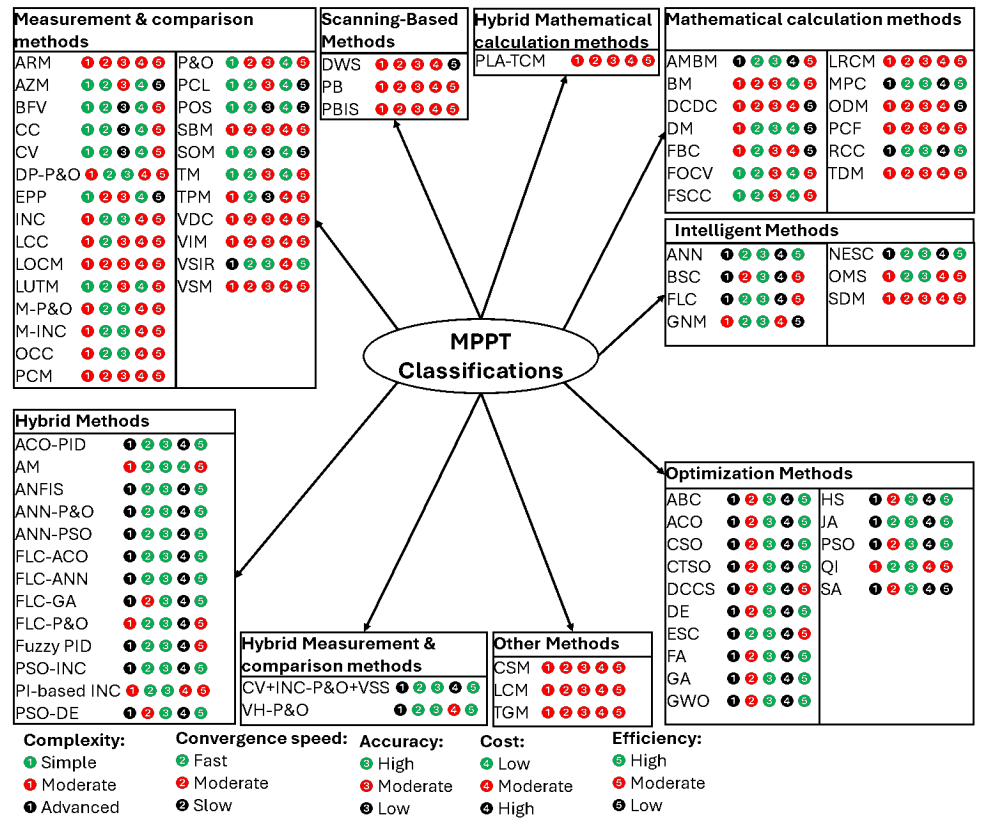
In this section, we present a novel way of classifying more than 70 different MPPT methods into a single figure stating the different tracking methods and comparing many criteria such as (1) complexity, (2) convergence speed, (3) accuracy, (4) cost, and (5) efficiency as presented in Figure 3. The letters represent the MPPT method, as an example AZM stands for Azab Method. While the numbers represent the criteria as mentioned above. The number in green circle  represents an advantage, such as low cost, high efficiency, etc. The number in red color
  represents a moderate value, such as medium cost, moderate efficiency. While the number in black circle
  represents a disadvantage, such as high cost, and low efficiency. By arranging and comparing the five above mentioned criteria of the MPPT algorithms into a single figure, it becomes much easier to select the method that meets specific requirements. As an example, if we want to select an algorithm that has a low cost, high accuracy, and medium efficiency, we look for the numbers that have the following sequence color:
 . Then, from the figure, we try to find the algorithms that have the closest performance. In this case, it is the AM (Analytic method) algorithm.
represents an advantage, such as low cost, high efficiency, etc. The number in red color represents a moderate value, such as medium cost, moderate efficiency. While the number in black circle represents a disadvantage, such as high cost, and low efficiency. By arranging and comparing the five above mentioned criteria of the MPPT algorithms into a single figure, it becomes much easier to select the method that meets specific requirements. As an example, if we want to select an algorithm that has a low cost, high accuracy, and medium efficiency, we look for the numbers that have the following sequence color: . Then, from the figure, we try to find the algorithms that have the closest performance. In this case, it is the AM (Analytic method) algorithm.For an advanced selection of the appropriate MPPT methods for very specific applications with strict requirements and criteria. We propose a novel multi-criteria decision-making optimization algorithm named Rank-Weigh-Rank (RWR) to rank and select the best MPPT method for specific applications considering many criteria and weighting factors. The main goal of the proposed optimization algorithm is to help decision-makers to select the best MPPT method that meets their requirements and specifications. The algorithm is described in Figure 4, in which it is mainly divided into three sections. The first section is to collect MPPT methods data such as the efficiencies, accuracies, convergence speed, etc. Then, associate criterion for each required dataset. The second section sorts and ranks the criteria in descending order. In addition, weighting factors are associated with each criterion in order to provide different weights for each criterion depending on its importance in the decision making and selection. The third section is used to calculate the average rank of each attribute (MPPT method). Then, the algorithm sorts all attributes based on their final ranking in order to help the decision-makers to select the best MPPT method that meets their expectations.
For the purpose of visualizing the importance of the proposed optimization algorithm for selecting the best MPPT methods, two examples will be presented considering different weighting factors for the attributes. For simplicity, 20 different MPPT methods are chosen and compared, which are: ARM, AZM, BFV, DP-P&O, EPP, INC, LOCM, LUTM, ACO-PID, AM, ANFIS, ANN-P&O, FLC-GA, FLC-P&O, Fuzzy PID, PSO-INC, PI-based INC, CSM, ANN, and PCL.
For the first example, we are more interested in having a high convergence speed, high accuracy, low cost and high efficiency. By supplying our preferences to the algorithm, the AM method is considered as the best option among all other methods as presented in Figure 5.
For the second example, we are more interested in having a high efficiency and low cost MPPT method, with less consideration to other factors. By supplying our preferences to the algorithm, the LUTM method is considered as the best option among all other methods as presented in Figure 6.
3. Scanning-Based MPPT Algorithms
An essential component of the scanning-based method is the utilization of iterative decremented step-size scanning-based MPPT algorithms [20].The variability in partial shading circumstances presents a major issue in photovoltaic structures. The power curves of these structures do not only feature a global maximum power point but also several local maximum power points [21–25].
Furthermore, these curves are subject to alterations based on climates environment, which have a direct influence on the partial shading settings [26–29]. To address this challenge, three iterative scanning-based MPPT algorithms have been introduced: decremented window scanning, peak bracketing (PB) method, and PB with initial scanning [30–33].
3.1. Decremented Window Scanning (DWS)
DWS is an algorithm employed to track the global MPP of a PV system by progressively decreasing the scanning domain range in each iteration. The duty cycle percentage of the pulse signal for the DC/DC converter is used as the unit for the scanning domain, while the converter’s output power is measured in Watts as the co-domain unit [30]. By dividing the scanning domain into ND number of scan points, an equivalent number of domain segments is established [34]. A segmented domain with the MPP within its range is then chosen as the new decremented scanning domain. Through a process of iteratively identifying and decreasing segmented scanning domains, the optimal perturbing duty cycle, which leads to the global peak power point, is ultimately determined [35–37].
3.2. Peak Bracketing (PB)
The PB algorithm employs a bisection method to trace the global maximum power point. This is achieved when the peak power point is being bracketed with three duty cycle points denoted as follow: a left duty cycle point, a right duty cycle point, and a center duty cycle point [30,38]. Through iterative reduction of the searching domain, the algorithm identifies the ultimate perturbing duty cycle point that corresponds to the global MPP [33,39,40].
3.3. Peak Bracketing with Initial Scanning (PBIS)
The PBIS is developed as a combination of the DWS and PB algorithms, which is specifically designed to decrease the cycling periods associated with locating the global maximum power point (GMPP). The initial step involves the implementation of the DWS algorithm to identify a segmental reductional window scanning. Subsequently, the PB algorithm is applied to identify the optimal perturbing duty cycle point (D), which ultimately leads to the discovery of the GMPP [30,32,41].
4. MPPT Intelligent Control Techniques
4.1. Neural Network
Deep learning suites are rooted in a specific branch of machine learning called neural networks, which are also referred to as artificial neural networks (ANNs) or in many literatures is being known as simulated neural networks (SNNs). These networks are designed to mimic the structuring and functioning of the human brain, replicating the intricate communication patterns observed in real neurons. In general, the neural network consists of different sets of layers. Three layers are commonly used as shown in Figure 7; input, output, and hidden layers. At each layer the nodes number can vary where it’s user dependent. Input variables are selected for photovoltaic system parameters such as irradiance, temperature , or any combination of those [42–45]. Whereas an output selection may be selected such as, duty cycle. As per hidden layer this can be related to the distance of an operating point is getting towards the MPP and how effective is a neural network trained. Note that all links are using a weight. As an example, nodes i and j link has link as shown in [46]. The term is determined to be as accurate as possible using a training process, to precisely detect the MPP.
4.2. Fuzzy Logic Controller (FLC)
FLC is well applied in PV systems especially in dealing with imprecise inputs. Further, it does not need to be based on a precise model of the model or an exact mathematical model which is able to cope with non-linearity systems issues [47–49]. It can also obtain MPPT under varying climatic and environmental conditions. It entails four different sections; fuzzification, inference engine, rule-base and defuzzification. Where a numerical value at the input is transformed to linguistic variable constructed using Membership Functions (MF) [49], as shown in Figure 8. Where five membership functions are used, FLC in an MPPT scenario has two inputs and an output. There are two input variables denoted as the error (E) and change of error (E), at sampling time k. Following equations show these inputs [50–53].
From Eq. (1) we can conclude whether the operation point at a k instant is either at the right or left of the MPP of a PV curve k is situated at either the right or left sides of MPP on P-V curve. Equation’s 2 input articulates the direction’s move for P-V curve’s operating point [54,55].
4.3. Artificial Neural Network (ANN) Based on the Technique of Perturb & observe (P&O)-MPPT
The role of the ANN is to predict the power value in the subsequent cycle. There is an observed difference between ANN output value and the power measured [56–59]. Thus this is applicable in changing step-value of the next cycle by applying Eq. (3);
where; is the perturbation step at ith cycle, k is a constant, is the reel power, is a function of inputoutput characteristic, is the reel current, and is the predicted value.
4.4. Gauss-Newton Method
Gauss-Newton method is a fast mechanism as compared to P&O. It applies the 1st and 2nd derivatives of parameter value changes in an attempt to approximate the distance and direction of a program shall go through to approach enhanced point. Calculation of operating point in tracking MPP, is shown in Eq. (4) [60–68].
where dp/dv is the power derivation.
4.5. Steepest-Descent Method
The steepest-descent method is used to search for the closest local MPP under the condition where a function’s gradient is calculated. MPPT tracking is shown by Eq. (5).
Knowing that value will determine the steepness of each step which is taking gradient direction. Power derivation computed as follows;
where is the local truncation error which is considered for center differentiation, that designates 2nd order accuracy. Controllers required to search for a point where is equal to zero in an MPPT context [69–72].
4.6. Newton-Like Extremum Seeking Control Method
To ensure the practicality of a MPPT control system, it is often necessary to have control over the convergence of the controller. This requirement can be met by employing the Newton-based extremum seeking approach. When equipped with knowledge of the power map, the Newton optimization algorithm can be utilized to successfully identify the maximum power point. It utilizes panel characteristic’s gradient and Hessian in estimating the operating point’s optimal value, and requiring from the side of Hessian approximation of the P-V characteristic as shown in Figure 9 [73–76].
4.7. On-Line MPP Search Algorithm
On-line MPP search algorithm works on finding a reference value of maximum power, where a comparison with the current power is achieved as shown in Figure 10. This mechanism results in having a difference; named the maximum power error. Error shall stand around zero in-order of reaching MPP. When a referenced value for MPP changes because of changes in temperature or irradiance levels this method works on adjusting the voltage’s array and search for another new MPP. When the power/current at load is lesser of that for MPP power this method cannot execute searching and regulate the MPP. More loads in this case are needed to be and get connected for increasing (Ipv) to allow the system to operate at MPP [78,79].
4.8. Particle Swarm Optimization (PSO) Algorithm
Decentralized schemes are at the core of swarm intelligence, an artificial intelligence technique that explores the study of collective conduct. Among the various paradigms within swarm intelligence, PSO has gained significant popularity. By simulating the social behavior observed in bird grouping, PSO has been developed as a worldwide optimization algorithm. This algorithm effectively addresses problems where the best solution is represented by a surface or point at an N dimensioning space.
In this sort of algorithms its primarily usage to increase the performance of MPPT. Every segment seen to be particle; whereas MPP assumed a drive move target. In this scenario a PV module can search for MPP as shown in Figure 11 [80–83].
The PSO algorithm’s effectiveness and applications existing in numerous local MPPs. PSO uses a particle with a fitness and cost values assessed to be minimized by the function. Particles hover at the search space through the following of optimum particles. This technique relies on collaboration of multi agents, where they commit themselves in making an exchange of information resulted from their individual search process [49,84–86]. State of the algorithms shown in (8), and (9)
where is the velocity of the particle, is the particles’ position, is the best local position, is the best global position, and are numbers randomly taken between [0–1], and and are learn factors.
5. Hybrid Intelligent Control Algorithms
5.1. Adaptive Neuro-Fuzzy Inference System (ANFIS)
The integration of artificial neural networks and fuzzy logic in a hybrid system has proven to be advantageous in various modeling and forecasting issues. This approach has found particular application in predicting the maximum power point (MPP) based on the exposure of Solar’s data and neighboring temperature [87–89]. This method offers several benefits, including rapid response, non-invasive sampling, reduction of total harmonic distortion, improved utilization of photovoltaic system, and straightforward training of the ANFIS algorithm [90,91].
The neuro-fuzzy method plays a crucial role in the development of fuzzy expert scheme. However, it is essential to carefully select the rules, the total number, type sort, and other various parameters of the membership functions in the fuzzy system to achieve optimal performance [92,93]. Trial and error are often employed to fine-tune these settings and attain the minimal desired level of performance. This highlights the significance of configuring the fuzzy systems appropriately. ANFIS, as a Sugeno network embedded within adaptive systems, simplifies learning and training processes [94,95]. This framework enhances the systematic nature of models and leverages expert knowledge, thereby enabling non-experts to utilize the system effectively [96,97].
5.2. Hybrid Genetic Algorithmic
Among the various evolutionary algorithms, genetic algorithms hold a prominent position in research applications. This algorithm is highly effective in exploring complex solution spaces to identify optimal or near-optimal solutions. Genetic algorithms are commonly utilized in optimizing fuzzy controllers or neural networks for the management control of the Maximum Power Point (MPP) [98–103]. The fundamental concept guiding genetic algorithms is to replicate the principles of evolution theory, leading to the determination of an optimal parameter set through the application of the "survival of the fittest" principle [104–107].
5.3. Fuzzy-PID
The PID controller, an acronym for proportional integral differential controller, is a conventional controller widely employed in various control applications [108,109]. Its output is determined by three constants: one for the proportional term, one for the integral term, and one for the differential term. To tune the PID controller and determine the appropriate proportional, integral, and differential gains, several methods exist. Among these methods, the Ziegler-Nichols tuning formula is the most commonly used [110–112]. In control systems, there are directions addressed that involve the utilization of fuzzy logic and the PID block. One to entails employing the FL block as a tuning mechanism for the PID controller [110,113,114]. This allows for the online tuning of the PID controller using the fuzzy block. Additionally, a novel adaptive fuzzy PID controller has been introduced for maximum power point tracking. Through this method, the fuzzy block is utilized to fine-tune the PID controller. Numerous studies have conducted a comparative analysis between the fuzzy tuned PID controller versus other traditional PID control schemes. These studies have demonstrated the algorithm’s exceptional tracking capabilities, highlighting the advantages of the fuzzy tuned PID controller [115–118].
5.4. Ant Colony Optimization
The Ant colony optimization (ACO) algorithm is a probabilistic method utilized for determining the optimal path as shown in Figure 12. In the context of MPPT, the Ant colony is employed in two distinct manners: initially as a direct controller aimed at identifying the optimal power point rather than the optimum path and secondly can be utilized as an optimization tool for Fuzzy controllers or PI controllers [119–123].
During the search mechanism of MPP the path seeking information is performed by using pheromone density as a first practice and an idea function, and sort out the ultimate answer in accordance with the density of pheromone.
A disperse field establishes ant colony whereas the PV output curve of a system in practice is a succeeding curve. In continuous field we use this technique and present Gaussian mutation for optimizing the algorithm and thus, realizing MPP tracking, through a combination of practical situation PV electrical production [124,125].
5.5. Fuzzy-Neural Network
In lieu of utilizing ANFIS controllers, there exists an alternative hybrid technique that combines neural network and fuzzy control. Such hybridization methods are consistently referenced in literature using two distinct structures [99, 126-128]. The initial method involves employing the neural network to estimate a specific variable for the fuzzy logic controller. Conversely, the second method entails utilizing the fuzzy logic in conjunction with the Hopfield neural network to govern the maximum power point [42,129,130].
5.6. Analytic Method
The field of MPPT for PV modules heavily relies on analytical methods. These methods often encompass a combination of theoretical control, mathematical modeling, and optimization methods. By employing these approaches, an algorithm can be derived to effectively determine the optimal operating point, thereby hitting the maximum power output. This method depends on experimental/observation results where it provides an analytical clarification to photovoltaic MPP problems. It’s based on real analysis theorem (mean value theorem). The precise manifestation neighborhood’s point of MPP is acquired and demonstrated being within a small radius ball which also handle MPP [131,132].
5.7. PI Based Incremental Conductance (INC)
Implementing PI controller through an INC is beneficial in minimizing the difference between true conductance and INC. A compensator updates the systems’ requirement. An advantage at the steady state a PI minimize ripple oscillations [133–135].
5.8. PSO-INC Structure
The performance of the INC algorithm in tracking the MPP efficiently under varying environmental conditions is enhanced by optimizing the parameters of the INC, such as the step size or perturbation value, using the PSO algorithm. This hybrid structure, which utilizes PSO to dynamically fine-tune the parameters of the INC algorithm, aims to enhance the overall efficiency and adaptability of MPPT in PV systems.
The PSO technique is employed to improve the associated parameters of the INC algorithm, including the perturbation step size/value utilized for effectively tracking the MPP. Through an iterative process, PSO systematically explores the parameter space to identify the most suitable values that enhance the performance of the INC algorithm in accurately tracking the MPP, even when faced with varying environmental circumstances [136–138].
6. Measurement MPPT Methods and Comparison
6.1. Perturb & Observe (P&O)
To start with one of the simplest and easy to implement algorithms along with a low cost is the P&O algorithm which is also called in many literatures “hill-climbing". In addition to the above features, P&O is popular due to its simplest structure along with the minimal required parameters that need to be addressed for being measured. Those measured values are related to a PV set of arrays and are; the V and I.
Figure 13 addresses a flowchart of P&O algorithm operation [8,139]. In this method, the voltage of the module is perturbed periodically in accordance with the requirement of driving the operating point through a set of fixed step size perturbation and the Pout of the module is compared with the Pout from the previous perturbation cycle. In this algorithm, a slight step size but fixed perturbation applied to system and being introduced. That perturbation would cause the solar power to vary based on the variation of perturbation step size applied [8,140]. When an increase in power is observed that would be due to the effects of the perturbation. Since perturbation led to an increment in power then; next perturbation will continue through the similar direction. The main goal is reaching MPP and thus that would be achieved when the MPP power is zero and during the next available instant the power decreases and after that the perturbation will start to go in the other reversed direction as Figure 14 shows.
Note that the P&O keeps perturbing in an effort for arriving towards MPP by decreasing and increasing perturbation steps [139]. This algorithm has the disadvantage of the oscillation that takes place around the MPP as well as it has a slower response time due to the dynamic changes that may occur to the climatic parameters; the temperature and irradiance [141].
6.2. Incremental Conductance Algorithm
Incremental Conductance (INC) MPPT algorithm is used in PV, due to its simplicity and easiness of implementation and has the benefit of providing a satisfactory performance at instances of decreased irradiance levels and when it’s getting affected by dynamic changes due to climatic conditions. INC uses the current/voltage sensors during the detection of I and V generated by the photovoltaic array [142–145].
INC operates in the following method; the PV voltage () adjustment is performed in accordance with the array voltage of PV around MPP. INC concept of operation is shown in the flowchart of illustrate in Figure 15 [146–148].
6.3. Short Circuit Current Method
In many literatures, short circuit current method is well known to be called constant current method. The short circuit current () has a linear relationship with maximum power point current () and this is illustrated in (10) [150].
Figure 16 shows at various climatic conditions (irradiance/temperature) that linear relationship between both the and [150]. to relationship does not change significantly under irradiance and temperature variations. It does not change even when the temperature changes. The Short Circuit Current () technique is a very basic MPPT method. It makes a comparison between the photovoltaic current and a reference constant current referred to . To suppress the error in the steady state, the error signal is utilized in a basic controller along an integral action [149,151].
6.4. Open Circuit Voltage Method
Open circuit voltage method refers to another naming convention as constant voltage method. PV solar voltage has a proportional relationship with open circuit voltage (). At the MPP it is considered as a reference voltage for various levels of irradiation and temperature. The employed voltage can be attuned over the measurement of a battery . To obtain the MPP we can apply the following equation [152,153];
However, the value of constant Mv is challenging in determining it where according to the literature it can range between 0.71 to 0.8 based on photovoltaic array features. An estimated value for this technique is recommended to be 0.76 [152–155].
6.5. Parasitic Capacitances ()
Parasitic capacitances algorithm is close in operation to the INC algorithm excepting parasitic effects of capacitance (). At the terminals setup is added in parallel of preceding models where it’s included in diode equation observation. Observed current () is stated in the following equations [156,157];
where is the current in . MPP exists at the point where . The result of those equations when multiplied by the voltage’s panel (V) we can deduce the power’s array along with the ability to apply a differentiation of the result. The following is applied for the power’s array [157].
There are three parameters to address;1) parasitic capacities, 2) observed instantaneous conductance, and 3) incremental conductance. Knowing that the 1st and 2nd derivations of the voltage’s array would consider ripple effects. The drawback in this algorithm is related to parasitic capacitance where it is at the minimal in each module, thus affect increasing effective capacitance accounted at MPPT [156,158].
6.6. Temperature Method
Temperature method allows avoiding changes that may take place at MPP due to temperature changes. This is implemented through a low cost temperature sensor that varies the MPP algorithm function, and upholding the appropriate MPP track [159]. A major drawback for this technique is the irregularity formation of PV distribution of array’s temperature. such sensors may not be accurately calibrated due to its quality that may generate false and inaccurate PV’s temperature measurements. The following equation is used to direct the temperature method [159–161].
where is the voltage of maximum power point, T is the temperature of surface panel, is the temperature coefficient’s of , and is the temperature of standard test condition.
6.7. System Oscillation Method
To identify the maximum power point (MPP) a perturbation-based maximum power point tracker incorporates the use of system oscillation. Rather than relying on an explicit perturbation source, the controller of the tracker is specifically engineered to induce self-oscillation within the entire system. As a result, the main switch’s duty cycle at a power conversion stage is modulated with a tiny variation in the amplitude in defined frequency about the desired steady-state value. This method relies on using a Cuk converter in the middle between solar panel and load. It depends on calculating the MPP on the switching frequency along with a portion of sinusoidal signal variation [162,163].
6.8. Constant Voltage Method
The constant voltage method assumes a fixed voltage value for the Maximum Power Point, which aligns with the voltage observed under the manufacturing Standard Test Conditions. This fixed voltage value typically varies between 72 to 80 percent of as shown in Figure 17. Subsequently, is utilized to modulate MPPT converter’s duty cycle through a feedback control loop. In general, constant voltage depends on using voltage sensor. DC-DC converter’s duty cycle is modified to maintain an output voltage (at PV). Relies on the characteristic of temperature. The algorithm has the benefit of using sole sensor, easy to implement and its advantage in tracking [161, 164-167].
6.9. Method of Look-Up Table
The process of locating the maximum power point (MPP) in this method necessitates having previous acquaintance of the PV panel material, technical data, and panel characteristics under different normal circumstances. This information is stored for future reference. The controller, taking into account the measured temperature and insolation values, compares them with the data stored in the look-up table to determine a new voltage for individual cycle. The look-up table is generated based on the specifications provided by the manufacturer or through experimental examinations conducted on the PV panel under numerous climatic situations. An offline considered method used mainly in MPP tracking. Information about technical specs, characteristics of panels for various climatic conditions, are required. PV generator’s measured voltage and current will be compared to the ones available in controlling system (stored there), that are corresponding to MPP [168,169]. A drawback of this algorithm is the necessity to implement a large memory capacities to save data in them [169].
6.10. Array Reconfiguration Method
The main purpose of PV array reconfiguration strategies is to enhance the power output when there are non-perfections in irradiance parameter. The primary goal of this method is to regulate the currents flowing through various electrical lines. This MPPT technique is used in partially shading. Where the solar units arranged in a set of series/parallel combinations allowing MPP meeting the requirements of the load. The disadvantage is consumption of time required to track MPP. There are 3 ways of arrangements; series, parallel, and parallel-series arrangements[170–173].
6.11. State-Based MPPT Method
In the realm of photovoltaic (PV) systems, State-based MPPT is utilized to optimize the output power by continuous adjustment of the operating point in solar panels and that would depend on the systems ‘current state. This approach takes into consideration a range of environment parameters and electrical status to find out the maximum power point (MPP) and guarantees that the module functions at or close to this point. State space represents a model in this method. The literature shows that it is reliable and non-sensitive to fluctuations in the parameters of a system and MPP can be attained regardless of PV partial shading [86, 174-176].
6.12. One-Cycle Control (OCC) Method
The OCC method involves a non-linear control theory specifically designed for the regulation of switching converters through the utilization of a solitary switching cycle. By employing this controller, it becomes possible to achieve instantaneous dynamic control over the average value of the switching variables subsequent to a transient event. This technique boasts numerous benefits, such as its minimal complexity and cost-effective implementation, its ability to effectively reject disturbances, its robustness, its capacity for maintaining stability, and its swift dynamic response. It is a type of inverter in which the output current can be regulated by a PV voltage to obtain . The topology of OCC contains of the following functions: It adjusts Pout based on irradiance, and it outputs an AC current into the grid. Advantages of OCC include: power factor at the highest level, easy to implement circuit, and cost efficient [177–180].
6.13. Best Fixed Voltage (BFV) Algorithm
The BFV algorithm searches for stats data regarding sun light and temperature over a period of time and finds BFV conforming to MPP. Applying controller can set the operating point to BFV or can set the output voltage towards load voltage [181,182]. Further to explain the algorithm in more details, over the span of a period of time, comprehensive statistical data is gathered to analyze the irradiance and temperature levels. This data is crucial in identifying the Best Fit Voltage (BFV) that serves as a representer of the Maximum Power Point (MPP). Subsequently, the controller adjusts either the operating point of the PV module to align with the BFV or sets the Vout to match the nominal load voltage. As a result, the operation is never precisely at the MPP, necessitating the collection of diverse data for different geographical regions. Simplicity and ease of implementation are the main benefits of this algorithm. However, the its efficiency is limited and needs an analysis of mathematical statistics in locating BFV to increase the PV array power [181–183].
6.14. Three-Point Method
Three-point method is used to suppress oscillation problem in P&O algorithm where it applies a comparison of compares only two points only; (current and perturbation point). In this three-point method it periodically perturb the PV voltage and compare output power. So, the method works on avoiding moving rapidly an operating point during varying irradiance. Those points are; (A) is the present operating point, and (B ) perturbation starting at points “A” and “C”, perturbation through the opposite direction from “A” , shown in Figure 18 [184,185].
6.15. The Method of PV Output Senseless (POS)
The primary benefit of employing Pv output senseless (POS) approach lies in the fact that the sole significant factor to be considered is the current that flows into the load. When dealing with a large photovoltaic (PV) generation system, it can be operated with a significantly higher level of safety compared to a conventional system. Here we have only the flowing current in load that require a specific consideration. Here we have only the flowing current in load that is considered. The source and load power are proportional in PV system. When the current increased at load power is increased, and thus the current at load is proportional to power at source which is the solar cell output power. Power in this method is controlled by PWM. Incrementing duty ratio leads to increase current output at the converter [187,188].
6.16. Variable Inductor MPPT Method
Variable inductor MPPT method introduces a novel MPPT topology controller for the applications of solar power, incorporating adjustable inductance against characteristics of current. It has been demonstrated that, under steady process, the pinpointed output inductor exhibits a characteristic where the inductance decreases as the current increases, corresponding to the upsurge in solar radiation incident. This technique demonstrates variable inductor slope airgap, which gradually saturating with cumulative raise in current, in meeting this requirement. This design offers the advantage of dropping the overall size of the inductor by almost 60% and expanding the range of operation of the entire tracker, enabling the retrieval of solar energy even under the lowest irradiance. It introduces variable inductance to boosting the operatable range tracking method to extract even at lower irradiance. This technique is recommended when we have low irradiance [181,189].
6.17. Variable Step-Size Incremental Resistance (INR) Method
Variable step-size algorithm is proposed to overcome the issue of fixed step size for dynamic environmental condition. An advantage of this algorithm is to switch the points and values of threshold function, as shown below [83,128,190];
where; n is assumed an index. Here we assume that the curves ‘power slope is zero on MPP, positive when it is at the left, and eventually negative when is moving to the right of MPP. Tracking MPP is done through a comparison of instantaneous resistance () along with incremental resistance().
6.18. DP-P&O MPPT
DP-P&O MPPT applies additional power measuring in the center of sampling MPPT period where no perturbation occurs, as shown below [191]. Figure 19 shows that and when they have a change in their power this is reflecting only the power changes due to weather conditions and changes. Differentiation between and holds a power change initiated an MPPT perturbation and irradiance variation. is computed [192–194];
A resultant (), is the result of modifying the MPPT algorithm
6.19. Pilot Cell
In pilot cell scheme, it is utilized to operate the pilot cells at their MPP. This method removes any photovoltaic power losses at pilot cell or else MPP measurements. Yet, there is still the issue of a missing constant value (K). However, pilot cell parameters requisite to be precisely matched to the parameters the arrays represented by the pilot cell, thus increasing the system’s energy cost. In this method MPPT can function a PV system at MPP without PV power losses in the pilot cell measurements. Nevertheless, there is still an issue of missing the value of “K” constant. The pilot cell parameters must be calibrated accordingly in an accurate manner, where each pilot cell calibration, will push for an increasing system’s energy cost [152,195–197].
6.20. Modified Perturb and Observe
Modified perturb and observe method works well in non-dynamic changing environment. However, it has some problems in detecting the MPP at rapid climatic atmosphere. Where the effects come from an inaccurate tracking of MPP. Moving over those issues, a Modified P&O (M-P&O) used to segregate the variations caused by the process of perturbation from the variations caused by irradiance or changes in weather. Since the estimation procedure terminates tracking MPP by holding PV voltage constant, modified P&O method tracking speed is around 50% of the conventional method [198–204].
6.21. Estimate Perturb and Perturb (EPP)
In EPP approach, an extended P&O method is utilized. This method involves the integration of one estimate mode and two perturb modes. The perturb process is employed to search through the issue of high nonlinear PV specifications, while the estimate process is designed to compensating for any variations in irradiance during the perturb process. Despite its complexity, this technique exhibits a superior tracking speed that is both faster and more precise than the conventional P&O method. It improves speed while maintaining the key characteristics of M-P&O algorithm. Compared to M-P&O algorithm, this method depends on using a single estimation mode for every 2 perturb approaches significantly raising track speed of MPPT with no reduction in the accuracy of tracking. Compared to M-P&O, EPP is faster by 1.5 in tracking speed time but almost has the same time delay among estimation and perturb processes [205–208].
6.22. CVT + INC-CON (P&O) + VSS Method
According to the CVT + INC-CON (P&O) + VSS method, it showed many improvements in harvesting an excellent tracking performance; however, the initial process to start is complex. Its control algorithm is straightforward. All it has to do is to check if is larger than the voltage instruction of PV arrangement. However, the change of voltage is only in one direction. Thus this causes power increasing in one direction and a suppression of oscillation [209,210].
6.23. VH-P&O MPPT Algorithm
VH-P&O MPPT algorithm is a mechanism that halts conventional perturbation during any change in irradiance but before going beyond MPP voltage and holding to of PV, where it is a fundamental tracking factor. Once irradiation change is stopped and MPP reached, step size tracking must be gradually reduced to zero. If there is any change of PV power, then the step size tracking is resettled to the original value to maintain a fast tracking. This technique will drive a photovoltaic response to irradiance change leads to a straight-lined tracking performance and is completed with suppression of oscillation at MPP [211–215].
6.24. Variable DC-Link Voltage
The design of a PV system can be limited by the impact of input voltage and current on the connection structure of PV cells. This limitation results in a reduced MPPT ranging during certain environmental conditions. However, in the case of a restricted PV connectivity structure, this algorithm aims to expand the MPPT range and reduce the increase in total harmonic distortion (THD). It achieves this by selecting the suitable DC-link , which is adjusted by comparing the sorted input voltage [212–219].
6.25. Modified INC Algorithm
Modified INC algorithm concentrates on the current rather than the voltage of PV array. It works based on varies slowly at right MPP side. Voltage variations through two sampling times is neglected. In this theory, the change of power to voltage with respect to provides a linear relation related a variation of as compared to V. Thus reference current is simple to calculate as of linear variation at , versus a complex calculation of after considering nonlinear variation of V against [220–223].
6.26. Azab Method
Azab method is considered as a P&O but modified algorithm. Azab method tracks MPP power extracted from within PV. However, any reduction in calculated MPP power is continued to the point where the error in both and is within the boundaries of the upper and lower limits [224–226].
6.27. Voltage Scanning-Based MPPT Method
The Voltage scanning-based MPPT method employs a three-step process to identify the Global MPP (GMPP) [227,228]. The primary objective is to systematically raise the reference voltage of the system at a predetermined rate, thereby enabling the identification of MPPs and their corresponding voltage values through the resulting power changes. By comparing the MPPs with the previous MPP, the Local MPP (LMPP) is eliminated, and a new GMPP is determined at each MPP. This iterative process persists until all voltage levels have been examined. The value of the voltage on GMPP is established as the reference voltage of the module to optimize power generation by leveraging both the system voltage and the change rate in the module voltage [30,35,227–229].
7. Mathematical Calculation MPPT Methods
7.1. Model-Based MPPT
The model-based MPPT approach is addressed to enhance the PV module tracking transients functioning under fast varying irradiance conditions. As an alternative of relying on heuristic methods search to determine the MPP, these techniques use a PV mathematical model to predict the MPP systematically. The value of irradiance, is necessary for resolving the model, and computed using an inverse PV model, along with the measurement conducted for current and voltage [230–233]. However, the current’s inverse PV model can’t be found in a closed arrangement, however requiring certain simple interpretations that impact the irradiance accuracy estimate and resulting in imprecise tracking. A novel shunt PV model maybe introduced due to its capability to deliver a closed form inverse to develop an enhanced structure of model based MPPT system. The enhanced precision in the estimation of irradiance leads to superior tracking accurateness and increased energy extracts compared to existing model-based trackers [231,232,234,235].
7.2. Piecewise Linear Approximation with Temperature Compensated Method
Piecewise linear approximation with temperature compensated method rapidly tracks PVs’ MPP and solve the issue of temperature drifting. Previously attained results confirm that the MPPT tracking effectiveness can hit up to 90 at various irradiances with less than 1% of tracking efficiency at a range of temperatures ranging between .
7.3. A What’s Termed Fit Line
A what’s termed fit line is used to get the MPP characteristics and perfectly operates at high irradiance versus decreased tracking efficiency at low irradiance [149,236,237].
7.4. Beta Method
Beta method is based on I-V curve of PV system and considered an accurate fast tracking of MPP using intermediate variable (), equation [47,163,238].
where denotes the reverse saturated current, q is the electronic charge, A is the ideality factor, k is Boltzmann constant, T is the temperature and is the number of cells connected in series. When operating settings change, stays constant. calculations can be done at any time through the (I) and (V) of panel and fed to conventional closed loop through constant reference.
7.5. Ripple Correlation Control (RCC)
Due to the ripples involved in a PV system this method reconsiders using ripples to accomplish MPPT. RCC works in the following structure; If (I) or (V) increased; that causes increasing power where operating point location is at the left of MPP ( and ). Either when current/voltage are increasing and power (P) is decreasing, we notice that operating point is located towards right side of MPP ( and ). As per controlling the duty ratio cycle of this method we refer to the following equations [239–243];
where is a positive constant.
7.6. Current Sweep
Current sweep applies a sweep waveform at the current of PV array system where an I-V curve ( PV module) attained accordingly within a set of fixed intervals of time[244]. The same computation can be done for so as to assure that sweep looks for and search the highest possible peak when multiple peaks exist. This method likely to be achieved if tracking consumption of power tracking lesser than increased power delivered to the system [181,245,246].
7.7. DC-Link Capacitor Droop Control
DC-link capacitor droop control method operates in cascading fashion within PV system. The duty ratio D;
Through this scheme we may be able to increase PV system power [247–249].
7.8. Feedback Control
In the realm of power systems, the expressions and , pertain to the power derivatives in relation to voltage (V) and current (I) correspondingly. Those derivatives are frequently employed in the examination of the power-voltage (P-V) and power-current (P-I) attributes of electrical classifications. The utilization of feedback control is essential in computing slope or , in P-V curve and fed to power converter. Slope calculations and signs are for past cycles where duty ratio’s incremental or decremental of the power conversion applied in arriving into the ultimate MPP [250,251].
7.9. The Method of Linear Current Control
The main purpose of PV array reconfiguration strategies is to enhance the power output when there is non-perfection in irradiance parameter. The primary goal of this method is to regulate the currents flowing through various electrical lines. Depends on an interpretational graphics of two algebraically equations, where two curves’ intersecting points on the phase plane applied [188].
7.10. Linear Reoriented Coordinates Method (LRCM)
LRCM works on solving iteratively the MPP equation and employed in finding symbolic approximation of MPP. It measures and additional parameters of P-V curve, to discover an approach of the maximum error through adopting LRCM to get to estimated MPP [252,253].
Slide mode control method
Voltage derivative slope to current utilized for finding MPP. Mathematical model can be created for many DC-DC converters such as boost, buck, etc. to find the MPP. The parameter u is considered as the converter’s switching function, where u is articulated as [254–256];
If then we have an open switch and when u = 1 we have a closed switch. S is expressed as;
7.11. Polynomial Curve Fitting (PCF)
PCF is called an offline technique. It is Established on the basis of mathematical equations. It describes the PV module electric characteristics. A 3rd order polynomial function can be applied to get a P-V curve fitting accurately using (27) [257,258].
where are found through of sampling and power in intervals. MPP is at the ultimate value when , and computed by;
Curve fitting is easy to use since differentiations calculations are not involved. However, it requires a previous acquainting knowledge of; mathematical equations and coefficients. Further it needs to have a large capacity of memory due to the number of computations which are at a high increasing rate [259].
7.12. Differentiation Method (DM)
Numerical differentiation is the main drive for DM. Here we look for seeking numerical value of the derivation of a function at a specific point [260,261].
7.13. MPP Locus Characterization
MPP locus characterization searches for linear relationship to take place between (I&V) at the MPP (MPP locus). Such relation is demonstrated through a tangent line of MPP locus curve for Ipv current where the minimal irradiance circumstance contents the method’s sensitivity [163, 262-264]. This method is represented by Equation (29). At high irradiances this technique provides reliable results, as compared to traditional methods.
where A is the ideality factor, and is the differential voltage.
8. MPPT Optimization Methods
8.1. IMPP and VMPP Computation Method
The optimization of power output in PV systems is heavily reliant on the implementation of MPPT technology. This essential technology enables solar panels to consistently operate at their MPP despite changes in environmental conditions. By continuously adjusting the operating point of the solar panels, the MPPT controller ensures that the power output is maximized. The computational approach encompasses perturbing the operating point, either by modifying the voltage or current, and then examining the consequent variation in power. Subsequently, the controller adapts the operating point in order to converge to the MPP. Measurement of photovoltaic power relies on irradiance/temperature measured by a systematic photovoltaic. A disadvantage of this method is the need for additional measurements which are sometimes hard to obtain and the need for an exact photovoltaic array model. The advantage of this method is that the MPP is accurately monitored even in varying atmospheric conditions [183, 265-267].
8.2. Numerical Method - Quadratic Interpolation (QI)
The QI method is new where it uses numerical calculation of PV power production system. It creates a parabolic scheme along quadratic interpolation. This is achieved by applying the (V&I) parameters from set of 3 sampling points. The peak of parabolic model is found by calculating the voltage value of MPP [268–271]. Basis function technique used to construct quadratic function;
where is quadratic interpolation polynomial, , , and refer to the quadratic interpolation functions. MPP achieved at a zero derivative of Equation (30). This algorithm enhances MPPT accuracy, stability and speed [108,109].
8.3. Extremum Seeking Control Method (ESC)
Nonlinear dynamic system and adaptive feedback optimizations are involved in such method. ESC designed for PV systems during the process of tracking MPP. Some of its advantages are; Maximizing power, dynamic adaptation-based feedback control is important factor used in the optimization problem in sinusoidal perturbation [272–274].
8.4. Dual Carrier Chaos Search Algorithm
The effectiveness of the chaos search algorithm is enhanced by incorporating the dual carrier approach, which effectively addresses the limitations of the conventional chaos search method. As a result, the search efficiency is significantly enhanced. Empirical evaluations demonstrate that the suggested technique enables rapid and precise tracking of the step-response, leading to superior optimization outcomes. A logistic and mapping is added to generate a carrier in this method and getting it in a step of stochastic searching [275,276]
8.5. Algorithm for Stimulated Annealing (SA)
Stimulated annealing, which involves the establishment of crystals using high-temperature heating and low-temperature cooling, is referred to as stimulated crystal formation. This can be further elucidated for the behavior of semiconductors using solid state device theory [277].
System stability increases before heating. A comparison between energy and cost function of MPPT algorithm can be performed. Where this is reflecting an inverse of (panel) that is requires to minimize it. At high temperature the likelihood to find duty cycle matching the garbage is higher. However, when the temperature is low, the likelihood of selecting duty cycle matching the higher goes up. When the temperature is low enough, the likelihood of picking duty cycle matching the maximum power is unity [278–281].
9. Comparison of MPPT Techniques
There are many differences between the MPPT techniques, which may assist in selecting a system suitable for specific applications. Multiple parameters involve such as overall implementation, types of sensor, total cost, what sort of applications to be applied, and other factors. The sensors’ number counts towards making a decision to select an MPPT algorithm. Thus sensors plays an important role in getting the most precise MPPT where increasing the number of sensors would provide better results [196,282,283]. Sensing voltage is possible to be easy as compared to current. Hitting MPP during a specific time is called convergence speed according to Walker at ref [284]. Convergence of the voltage or current required shall be low in order to get high performance. Power losses obtained by decreasing the period of time taken for reaching MPP. At partial shading conditions power losses reaches 70% when the local maximum tracking is reached as compared to actual MPP [285,286]. Performance cost is an additional factor concerning users where using analog system is cheaper as com-pared to digital system. PV selection depends on the type of applications used. For in-stance, in the case of large-scale space satellite and orbital station applications, the cost and complication of tracking MPP are the least essentials in accordance with (performance/ dependability). MPPT module may come as a direct or indirect depending on the parameters of arrays. In the direct type either V or I of photovoltaic is used. Direct methods do not depend on the previous understanding of the PV array configuration. Therefore, the P-V curve operating point does not depend on whether parameters conditions that may change during a period of time. Indirect methods has parametric database which includes data of various irradiances and temperatures or on the estimation of MPP using a series of functions derived from empirical data [287]. Table I refers to a summary of MPPT algorithm’s characteristics are utilized in comparing sets of techniques.
Through the study, we introduced a sample literature of the current MPPT algorithms. Further we made an analysis through a theoretical process previously published work and extracted the important set of parameters as shown in Table 1. Around 65 types of algorithms were gathered, where the variances between those ones shown in Table 2 which extend the findings of Ali et al [183]. From all the available algorithms it was a fact that the most commonly used ones were P&O, “hill-climbing”, incremental conductance algorithm. Below as shown in Table 2, is an overview of those known algorithms.

Table 3.
Evaluation of MPPT Algorithms (D: Digital, A: Analogue, Ir: Irradiance, T: Temperature, Voltage V, Current I)
Table 3.
Evaluation of MPPT Algorithms (D: Digital, A: Analogue, Ir: Irradiance, T: Temperature, Voltage V, Current I)
| Algorithm | PV Array Dependency | MPPT Accuracy | Type (D/A) | Periodic Tuning | Convergence Speed | Complexity | Parameters |
| Algorithm | PV Array Dependency | MPPT Accuracy | Type (D/A) | Periodic Tuning | Convergence Speed | Complexity | Parameters |
| Continued on next page | |||||||
| P&O/ HCS [288-291] | No | Yes | D and A | No | Different | Simple | V, I |
| INC Algorithm [157, 266, 290-293] | No | Yes | D | No | Different | Simple | V, I |
| Fractional Isc [290, 291, 294, 295] | Yes | No | D and A | Yes | Moderate | Moderate | I |
| Fractional Voc [290, 291, 294, 295] | Yes | No | D and A | Yes | Moderate | Simple | V |
| Parasitic Capacitances (Cp) [14, 157, 296] | No | Yes | A | No | Fast | Simple | V, I |
| FLC [183, 290, 291, 297] | Yes | Yes | D | Yes | Fast | High | Diverse |
| Temperature Methods [163, 183] | Yes | Yes | D | Yes | Moderate | Simple | V, T |
| Beta Method [183] | Yes | Yes | D | No | Fast | High | V, I |
| Neural Network [183, 291] | Yes | Yes | D | Yes | Fast | High | Diverse |
| RCC [183, 290, 298] | No | Yes | A | No | Fast | Simple | V, I |
| Current Sweep [183] | Yes | Yes | D | Yes | Low | High | V, I |
| DC Link Capacitor Droop Control [183] | No | No | D and A | No | Medium | Simple | V |
| dP/dV or dP/dI Feedback Control [183] | No | Yes | D | No | Fast | Moderate | V, I |
| System Oscillation Method [183] | Yes | No | A | No | N/A | Simple | V |
| Constant Voltage Tracker [161, 183] | Yes | No | D | Yes | Moderate | Simple | V |
| Lookup Table Method [161, 183, 289] | Yes | No | D | Yes | Fast | Moderate | V, I |
| On-line MPP Search Algorithm [183] | No | Yes | D | No | Fast | High | V, I |
| Array Reconfiguration [183] | Yes | No | D | Yes | Low | High | V, I |
| Linear Current Control [183] | Yes | No | D | Yes | Fast | Moderate | Ir |
| IMPP and VMPP Computation | Yes | Yes | D | Yes | N/A | Moderate | Ir, T |
| State Based MPPT [183] | Yes | Yes | D and A | Yes | Fast | High | V, I |
| OCC MPPT [183] | Yes | No | D and A | Yes | Fast | Moderate | I |
| BFV [183] | Yes | No | D and A | Yes | N/A | Low | None |
| LRCM | Yes | No | D | No | N/A | High | V, I |
| Slide Control [161, 183, 289, 295, 297, 299] | No | Yes | D | No | Fast | Moderate | V, I |
| Three Point Weight Comparison [183] | No | Yes | D | No | Low | Simple | V, I |
| POS Control [183] | No | Yes | D | No | N/A | Simple | Current |
| Biological Swarm Chasing MPPT [183] | No | Yes | D | No | Varies | High | V, I, Ir, T |
| Variable Inductor MPPT [183] | No | Yes | D | No | Different | Moderate | V, I |
| INR method [183] | No | Yes | D | No | Fast | Moderate | V, I |
| dP-P&O MPPT [191] | No | Yes | D | No | Fast | Moderate | V, I |
| Pilot Cell [300] | Yes | No | D and A | Yes | Moderate | Simple | V, I |
| Modified Perturb and Observe [208] | No | Yes | D | No | Fast | Moderate | V, I |
| Estimate, Perturb and Perturb EPP [208] | No | Yes | D | No | Fast | Moderate | V, I |
| Numerical Method - Quadratic Interpolation (QI) [268] | No | Yes | D | No | Fast | Moderate | V, I |
| MPP Locus Characterization [262, 299] | N/A | Yes | N/A | N/A | Fast | Simple | V, I |
| CVT + INC-CON (P&O) + VSS Method [209] | Yes | Yes | D and A | No | Fast | Moderate | V |
| Piecewise Linear Approximation with Temp Compensation [301] | Yes | Yes | D and A | Yes | Fast | Simple | V, I, Ir, T |
| PSO Algorithm [136, 298] | Yes | Yes | D | Yes | Fast | Moderate | V, I |
| PSO-INC Structure [136] | No | Yes | D | No | Fast | Simple | V, I |
| Dual carrier chaos search algorithm [275, 298] | No | Yes | D | No | Fast | Moderate | V, I |
| Algorithm for Stimulated Annealing (SA)[298, 302] | Yes | Yes | D | No | Fast | High | V, I |
| Artificil neural network (ANN) based P&O MPPT [57, 291] | No | Yes | D and A | No | Fast | Moderate | V, I |
| VH-P&O MPTT Algorithm [211] | No | Yes | D | No | Moderate | Moderate | V |
| Ant Colony Algorithm [303] | No | Yes | D | No | Fast | Moderate | V, I |
| Variable DC-Link Voltage Algorithm [216] | No | Yes | D | No | Moderate | Moderate | V |
| ESC Method [304] | No | Yes | D and A | No | Fast | Moderate | V, I |
| Gauss-Newton Method [69] | No | Yes | D | No | Fast | Simple | V, I |
| Steepest-Descent Method [69, 305] | No | Yes | D | No | Fast | Moderate | V, I |
| Analytic Method [305] | Yes | No | D and A | Yes | Moderate | High | V, I |
| PCF [257] | Yes | No | D | Yes | Low | Simple | V |
| DM [306] | No | Yes | D | Yes | Fast | High | V, I |
| IC Based on PI [163, 298] | No | Yes | D | No | Fast | Moderate | V, I |
| Azab Method [224] | Yes | Yes | D | Yes | Moderate | Simple | N/A |
| Modified INC Algorithm [191] | No | Yes | D | No | Moderate | High | V, I |
| Newton-Like Extremum Seeking Control Method [74] | No | Yes | D and A | No | Fast | Hogh | V, I |
Evaluation of MPPT Algorithms (D: Digital, A: Analogue, Ir: Irradiance, T: Temperature, Voltage V, Current I)
10. Conclusions
The exploration of numerous MPPT techniques in the context of solar PV systems presented in this paper unveils the diverse methodologies available for enhancing efficiency of solar PV systems. The comparison of MPPT techniques, considering factors such as cost, tracking speed, and system stability, underscores the trade-offs inherent in MPPT controller selection. Our findings underscore that hybrid approaches, while demonstrating higher efficiency, entail increased complexity and higher costs. A notable contribution of this research lies in the synthesis of efficiency performance metrics for MPPT algorithms emphasizing their accuracy in reaching the optimal point. The MPPT algorithms have been classified based on their dependencies, highlighting those that prioritize simplicity, and assessed their convergence speed in response to peak point detection in the power curve.
In conclusion, this comprehensive study stands as a decisive reference for the MPPT algorithms crucial to companies engaged in the production of PV systems and power charge controllers. This study also holds significant value for both researchers and practitioners, offering valuable guidance for the judicious selection of MPPT controller algorithms for PV applications.
Author Contributions
For research articles with several authors, a short paragraph specifying their individual contributions must be provided. The following statements should be used “Conceptualization, Khaled Matter and Ahmed Badawi; methodology, Khaled Matter, and Ahmed Badawi; software, I. M. Elzein, Ahmed Badawi and Claude Ziad El-bayeh; validation, I. M. Elzein, Ahmed Badawi, Alhareth Zyoud, Hassan Ali and Claude Ziad El-bayeh; formal analysis, Khaled Matter, I. M. Elzein, Ahmed Badawi, Hassan Ali and Claude Ziad El-bayeh; investigation, Khaled Matter, I. M. Elzein, Ahmed Badawi, Alhareth Zyoud, Hassan Ali and Claude Ziad El-bayeh; resources, Khaled Matter, I. M. Elzein, Ahmed Badawi, Alhareth Zyoud, Hassan Ali and Claude Ziad El-bayeh; writing—original draft preparation, Khaled Matter, I. M. Elzein, Ahmed Badawi, and Claude Ziad El-bayeh; writing—review and editing, Ahmed Badawi, I. M. Elzein, Alhareth Zyoud, Claude Ziad El-bayeh and Hassan Ali; visualization, I. M. Elzein, Alhareth Zyoud, Claude Ziad El-bayeh and Hassan Ali; project administration, Khaled Matter and Ahmed Badawi; All authors have read and agreed to the published version of the manuscript.”, please turn to the CRediT taxonomy for the term explanation. Authorship must be limited to those who have contributed substantially to the work reported.
Funding
Please add: “This research received no external funding” or “This research was funded by NAME OF FUNDER grant number XXX.” and and “The APC was funded by XXX”. Check carefully that the details given are accurate and use the standard spelling of funding agency names at https://search.crossref.org/funding, any errors may affect your future funding.
Institutional Review Board Statement
In this section, you should add the Institutional Review Board Statement and approval number, if relevant to your study. You might choose to exclude this statement if the study did not require ethical approval. Please note that the Editorial Office might ask you for further information. Please add “The study was conducted in accordance with the Declaration of Helsinki, and approved by the Institutional Review Board (or Ethics Committee) of NAME OF INSTITUTE (protocol code XXX and date of approval).” for studies involving humans. OR “The animal study protocol was approved by the Institutional Review Board (or Ethics Committee) of NAME OF INSTITUTE (protocol code XXX and date of approval).” for studies involving animals. OR “Ethical review and approval were waived for this study due to REASON (please provide a detailed justification).” OR “Not applicable” for studies not involving humans or animals. Written informed consent for publication must be obtained from participating patients who can be identified (including by the patients themselves). Please state “Written informed consent has been obtained from the patient(s) to publish this paper” if applicable.
Informed Consent Statement
Any research article describing a study involving humans should contain this statement. Please add “Informed consent was obtained from all subjects involved in the study.” OR “Patient consent was waived due to REASON (please provide a detailed justification).” OR “Not applicable” for studies not involving humans. You might also choose to exclude this statement if the study did not involve humans.
Data Availability Statement
We encourage all authors of articles published in MDPI journals to share their research data. In this section, please provide details regarding where data supporting reported results can be found, including links to publicly archived datasets analyzed or generated during the study. Where no new data were created, or where data is unavailable due to privacy or ethical restrictions, a statement is still required. Suggested Data Availability Statements are available in section “MDPI Research Data Policies” at https://www.mdpi.com/ethics.
Acknowledgments
In this section you can acknowledge any support given which is not covered by the author contribution or funding sections. This may include administrative and technical support, or donations in kind (e.g., materials used for experiments). Where GenAI has been used for purposes such as generating text, data, or graphics, or for study design, data collection, analysis, or interpretation of data, please add “During the preparation of this manuscript/study, the author(s) used [tool name, version information] for the purposes of [description of use]. The authors have reviewed and edited the output and take full responsibility for the content of this publication.”
Conflicts of Interest
Declare conflicts of interest or state “The authors declare no conflicts of interest.” Authors must identify and declare any personal circumstances or interest that may be perceived as inappropriately influencing the representation or interpretation of reported research results. Any role of the funders in the design of the study; in the collection, analyses or interpretation of data; in the writing of the manuscript; or in the decision to publish the results must be declared in this section. If there is no role, please state “The funders had no role in the design of the study; in the collection, analyses, or interpretation of data; in the writing of the manuscript; or in the decision to publish the results”.
Abbreviations
The following abbreviations are used in this manuscript:
| ABC | Artificial Bee Colony |
| ACO | Ant colony optimization |
| ACO-PID | Ant Colony Optimization (ACO) + Proportional-Integral-Derivative |
| (PID) controller | |
| AM | Analytic method |
| AMBM | Adaptive Model-Based Methods |
| ANFIS | Adaptive neuro-fuzzy inference system |
| ANN | Artificial neural network |
| ANN-P&O | Artificial Neural Network + Perturb and Observe |
| ANN-PSO | Artificial Neural Network + Particle Swarm Optimization |
| ARM | Array Reconfiguration Method |
| AZM | Azab method |
| BFV | Best fixed voltage method |
| BM | Beta Method |
| BSC | Biological Swarm Chasing method |
| CC | Constant Current (also known as Short Circuit Current Method) |
| Cp | Parasitic capacitances |
| CSM | Current Sweep Method |
| CSO | Cuckoo Search Optimization |
| CTSO | Cat Swarm Optimization |
| CV | Constant Voltage (also known as Open Circuit Voltage method) |
| CV+INC-P&O+VSS | Constant Voltage Tracking + Incremental Conductance with Perturb and |
| Observe + Variable Step Size | |
| D | Duty cycle point |
| DCDC | DC-link capacitor droop control |
| DCCS | Dual carrier chaos search |
| DE | Differential Evolution |
| DM | Differentiation method |
| DP-P&O | Dual Perturb and Observe MPPT method |
| DWS | Decremented window scanning |
| EPP | Estimate perturb and perturb |
| ESC | Extremum seeking control |
| FA | Firefly Algorithm |
| FBC | Feedback control |
| FLC | Fuzzy logic controller |
| FLC-ACO | Fuzzy Logic Controller + Ant Colony Optimization |
| FLC-ANN | Fuzzy Logic Controller + Artificial Neural Network |
| FLC-GA | Fuzzy Logic Controller + Genetic Algorithm |
| FLC-P&O | Fuzzy Logic Controller + Perturb and Observe |
| FOCV | Fractional Open Circuit Voltage |
| FSCC | Fractional Short Circuit Current Fuzzy PID (Fuzzy Logic + Proportional- |
| Integral-Derivative) | |
| HS | Harmony Search |
| GA | Genetic Algorithm |
| GMPP | Global maximum power point |
| GNM | Gauss-Newton method |
| GWO | Grey Wolf Optimization |
| INC | Incremental conductance |
| Isc | Short circuit current |
| IMPP | Maximum power point current |
| JA | Jaya Algorithm |
| LCM | Load Current Maximization |
| LCC | Linear Current Control method |
| LMPP | Local maximum power point |
| LOCM | Locus Characterization MPP Method |
| LRCM | Linear reoriented coordinates method |
| LUTM | Look-up Table Method |
| MF | Membership Functions |
| M-INC | Modified INC method |
| MPC | Model Predictive Control |
| M-P&O | Modified Perturb and Observe |
| MPP | Maximum power point |
| MPPT | Maximum power point tracking |
| NESC | Newton-based Extremum Seeking Control Method |
| OCC | One-cycle Control Method |
| ODM | One-diode model |
| OMS | Online MPP Search |
| P | Power |
| PB | Peak bracketing method |
| PBIS | Peak bracketing with initial scanning method |
| PCL | Pilot Cell method |
| PCF | Polynomial curve fitting method |
| PCM | Parasitic Capacitance Method |
| PI | Proportional Integral |
| PID | Proportional Integral Differential |
| PI-based INC | (Proportional-Integral + Incremental Conductance) |
| PLA-TCM | Piecewise linear approximation with temperature compensated method |
| P&O | Perturb and Observe |
| POS | PV Output Senseless Method |
| PPV | PV power |
| PSO | Particle swarm optimization |
| PSO-INC | (Particle Swarm Optimization + Incremental Conductance) |
| PSO-DE | (Particle Swarm Optimization + Differential Evolution) |
| PV | Photovoltaic |
| QI | Quadratic interpolation |
| RCC | Ripple correlation control |
| SA | Stimulated annealing |
| SBM | State-Based MPPT method |
| SDN | Steepest-descent method |
| SI | System Identification |
| SNNs | Simulated neural networks |
| SOM | System Oscillation Method |
| TDM | Two-diode model |
| TGM | Temperature Gradient Method |
| THD | Total harmonic distortion |
| TM | Temperature Method |
| TPM | Three-Point Method |
| V | Voltage |
| VDC | Variable DC-link voltage |
| VSM | Voltage Scanning-Based MPPT method |
| VH-P&O | Variable Hill-Climbing Perturb and Observe Maximum Power Point |
| Tracking | |
| VIM | Variable Inductor MPPT Method |
| VSIR | Variable Step-Size Incremental Resistance Method |
References
- Katche, M.L.; et al. A comprehensive review of maximum power point tracking (mppt) techniques used in solar pv systems. Energies 2023, 16, 2206. [Google Scholar] [CrossRef]
- Park, J.; et al. Simple modeling and simulation of photovoltaic panels using Matlab/Simulink. Adv. Sci. Technol. Lett. 2014, 73, 147–155. [Google Scholar]
- Chauhan, A.; Saini, R. A review on Integrated Renewable Energy System based power generation for stand-alone applications: Configurations, storage options, sizing methodologies and control. Renew. Sustain. Energy Rev. 2014, 38, 99–120. [Google Scholar] [CrossRef]
- Tseng, S.-Y.; Wang, H.-Y. A photovoltaic power system using a high step-up converter for DC load applications. Energies 2013, 6, 1068–1100. [Google Scholar] [CrossRef]
- Badawi, A.S.; et al. Practical electrical energy production to solve the shortage in electricity in palestine and pay back period. Int. J. Electr. Comput. Eng. 2019. [Google Scholar] [CrossRef]
- Natividad, L.E.; Benalcazar, P. Hybrid renewable energy systems for sustainable rural development: Perspectives and challenges in energy systems modeling. Energies 2023, 16, 1328. [Google Scholar] [CrossRef]
- Bubalo, M.; et al. Hybrid wind-solar power system with a battery-assisted quasi-Z-source inverter: Optimal power generation by deploying minimum sensors. Energies 2023, 16, 1488. [Google Scholar] [CrossRef]
- Badawi, A.S.A. Maximum power point tracking control scheme for small scale wind turbine. PhD Thesis, 2019.
- Badawi, A.; et al. Novel technique for hill climbing search to reach maximum power point tracking. Int. J. Power Electron. Drive Syst. (IJPEDS) 2020. [Google Scholar] [CrossRef]
- Awad, M.; et al. Performance evaluation of concentrator photovoltaic systems integrated with a new jet impingement-microchannel heat sink and heat spreader. Sol. Energy 2020, 199, 852–863. [Google Scholar] [CrossRef]
- Giallanza, A.; et al. A sizing approach for stand-alone hybrid photovoltaic-wind-battery systems: A Sicilian case study. J. Clean. Prod. 2018, 199, 817–830. [Google Scholar] [CrossRef]
- Dadkhah, J.; Niroomand, M. Optimization methods of MPPT parameters for PV systems: review, classification, and comparison. J. Mod. Power Syst. Clean Energy 2021, 9, 225–236. [Google Scholar] [CrossRef]
- Nkambule, M.S.; et al. Comprehensive evaluation of machine learning MPPT algorithms for a PV system under different weather conditions. J. Electr. Eng. Technol. 2021, 16, 411–427. [Google Scholar] [CrossRef]
- Hohm, D.; Ropp, M.E. Comparative study of maximum power point tracking algorithms. Prog. Photovolt. Res. Appl. 2003, 11, 47–62. [Google Scholar] [CrossRef]
- Badawi, A.S.; et al. Paper review: maximum power point tracking for wind energy conversion system. In Proceedings of the 2020 2nd International Conference on Electrical, Control and Instrumentation Engineering (ICECIE), IEEE; 2020. [Google Scholar]
- Salas, V.; et al. Review of the maximum power point tracking algorithms for stand-alone photovoltaic systems. Sol. Energy Mater. Sol. Cells 2006, 90, 1555–1578. [Google Scholar] [CrossRef]
- Shmroukh, A.N. Thermal regulation of photovoltaic panel installed in Upper Egyptian conditions in Qena. Therm. Sci. Eng. Prog. 2019, 14, 100438. [Google Scholar] [CrossRef]
- Ponce de León Puig, N.I.; Acho, L.; Rodellar, J. Design and experimental implementation of a hysteresis algorithm to optimize the maximum power point extracted from a photovoltaic system. Energies 2018, 11, 1866. [Google Scholar] [CrossRef]
- Badawi, A.S.; et al. Power prediction mode technique for Hill Climbing Search algorithm to reach the maximum power point tracking. In Proceedings of the 2020 2nd International Conference on Electrical, Control and Instrumentation Engineering (ICECIE), IEEE; 2020. [Google Scholar]
- Samanta, S.; Barik, M.; Subudhi, B. A Zero Steady-State Oscillation MPPT Algorithm Using Voltage Sensor.
- Aygül, K.; et al. Butterfly optimization algorithm based maximum power point tracking of photovoltaic systems under partial shading condition. Energy Sources Part A 2023, 45, 8337–8355. [Google Scholar] [CrossRef]
- Nadeem, A.; Hussain, A. A comprehensive review of global maximum power point tracking algorithms for photovoltaic systems. Energy Syst. 2023, 14, 293–334. [Google Scholar] [CrossRef]
- Hai, T.; Zain, J.M.; Muranaka, K. A novel global MPPT technique to enhance maximum power from PV systems under variable atmospheric conditions. Soft Comput. 2023, 1–14. [Google Scholar] [CrossRef]
- Gundogdu, H.; et al. A novel improved grey wolf algorithm based global maximum power point tracker method considering partial shading. IEEE Access 2024. [Google Scholar] [CrossRef]
- Nagadurga, T.; Devarapalli, R.; Knypiński, Ł. Comparison of Meta-Heuristic Optimization Algorithms for Global Maximum Power Point Tracking of Partially Shaded Solar Photovoltaic Systems. Algorithms 2023, 16, 376. [Google Scholar] [CrossRef]
- Youssef, A.-R.; Hefny, M.M.; Ali, A.I.M. Investigation of single and multiple MPPT structures of solar PV-system under partial shading conditions considering direct duty-cycle controller. Sci. Rep. 2023, 13, 19051. [Google Scholar] [CrossRef] [PubMed]
- Hussaian Basha, C.; et al. A novel on design and implementation of hybrid MPPT controllers for solar PV systems under various partial shading conditions. Sci. Rep. 2024, 14, 1609. [Google Scholar] [CrossRef]
- Zaki, M.; et al. Hybrid global search with enhanced INC MPPT under partial shading condition. Sci. Rep. 2023, 13, 22197. [Google Scholar] [CrossRef]
- Belhaouas, N.; et al. A new approach of PV system structure to enhance performance of PV generator under partial shading effect. J. Clean. Prod. 2021, 317, 128349. [Google Scholar] [CrossRef]
- Samman, F.A.; Rahmansyah, A.A. Iterative decremented step-size scanning-based MPPT algorithms for photovoltaic systems. In Proceedings of the 2017 9th International Conference on Information Technology and Electrical Engineering (ICITEE), IEEE; 2017. [Google Scholar]
- Arya, S.F.; Abdul Azis, S.R. Peak Bracketing and Decremented Window-Size Scanning-Based MPPT Algorithms for Photovoltaic Systems. 2018, 14, 1015.
- Mamur, H.; Üstüner, M.A.; Bhuiyan, M.R.A. Future perspective and current situation of maximum power point tracking methods in thermoelectric generators. Sustain. Energy Technol. Assess. 2022, 50, 101824. [Google Scholar] [CrossRef]
- Samman, F.A.; Piarah, W.H.; Djafar, Z. Power transfer maximization of thermoelectric generator system using peak trapping and scanning-based MPPT algorithms. ICIC Express Lett. 2019. [Google Scholar]
- Das, S.K.; et al. Shading mitigation techniques: State-of-the-art in photovoltaic applications. Renew. Sustain. Energy Rev. 2017, 78, 369–390. [Google Scholar] [CrossRef]
- Samman, F.A.; et al. MPPT algorithm using decremented window-scanning method for home scale photovoltaic-based power supply systems. Int. J. Innov. Comput. Inf. Control 2021, 17, 527–538. [Google Scholar]
- Samman, F.A.; Piarah, W.H.; Djafar, Z. Variable Step-Size Decremented Window-Size Scanning-based MPPT Algorithms for Thermoelectric Generator Systems. In Proceedings of the 2018 2nd International Conference on Applied Electromagnetic Technology (AEMT), IEEE; 2018. [Google Scholar]
- Suhaebri, T.; Samman, F.A.; Achmad, A. Microcontroller Implementation of an MPPT Algorithm using Decremented Windows Size Scanning Method for Photovoltaic Systems. In Proceedings of the 2018 IEEE 4th Southern Power Electronics Conference (SPEC), IEEE; 2018. [Google Scholar]
- Yaragatti, U.R.; Rajkiran, A.N.; Shreesha, B.C. A novel method of fuzzy controlled maximum power point tracking in photovoltaic systems. In Proceedings of the 2005 IEEE International Conference on Industrial Technology, IEEE; 2005. [Google Scholar]
- Nugraha, D.A.; Lian, K.-L. A novel MPPT method based on cuckoo search algorithm and golden section search algorithm for partially shaded PV system. Can. J. Electr. Comput. Eng. 2019, 42, 173–182. [Google Scholar] [CrossRef]
- Afroni, M.J.; Wirateruna, E.S. 4 Section method for MPPT optimization in Solar Panel Experiments under PSC v221023. In Proceedings of the 2023 International Conference on Smart-Green Technology in Electrical and Information Systems (ICSGTEIS), IEEE; 2023. [Google Scholar]
- Kota, V.R.; Bhukya, M.N. A novel global MPP tracking scheme based on shading pattern identification using artificial neural networks for photovoltaic power generation during partial shaded condition. IET Renew. Power Gener. 2019, 13, 1647–1659. [Google Scholar] [CrossRef]
- Villegas-Mier, C.G.; et al. Artificial neural networks in MPPT algorithms for optimization of photovoltaic power systems: A review. Micromachines 2021, 12, 1260. [Google Scholar] [CrossRef]
- Messalti, S.; Harrag, A.; Loukriz, A. A new variable step size neural networks MPPT controller: Review, simulation and hardware implementation. Renew. Sustain. Energy Rev. 2017, 68, 221–233. [Google Scholar] [CrossRef]
- Khaldi, N.; et al. The MPPT control of PV system by using neural networks based on Newton Raphson method. In Proceedings of the 2014 International Renewable and Sustainable Energy Conference (IRSEC), IEEE; 2014. [Google Scholar]
- Rezk, H.; Hasaneen, E.-S. A new MATLAB/Simulink model of triple-junction solar cell and MPPT based on artificial neural networks for photovoltaic energy systems. Ain Shams Eng. J. 2015, 6, 873–881. [Google Scholar] [CrossRef]
- Elobaid, L.M.; Abdelsalam, A.K.; Zakzouk, E.E. Artificial neural network-based photovoltaic maximum power point tracking techniques: A survey. IET Renew. Power Gener. 2015, 9, 1043–1063. [Google Scholar] [CrossRef]
- Li, X.; et al. A novel beta parameter based fuzzy-logic controller for photovoltaic MPPT application. Renew. Energy 2019, 130, 416–427. [Google Scholar] [CrossRef]
- Noman, A.M.; Addoweesh, K.E.; Mashaly, H.M. A fuzzy logic control method for MPPT of PV systems. In Proceedings of the IECON 2012–38th Annual Conference on IEEE Industrial Electronics Society, IEEE; 2012. [Google Scholar]
- Cheng, P.-C.; et al. Optimization of a fuzzy-logic-control-based MPPT algorithm using the particle swarm optimization technique. Energies 2015, 8, 5338–5360. [Google Scholar] [CrossRef]
- Liu, C.-L.; et al. An asymmetrical fuzzy-logic-control-based MPPT algorithm for photovoltaic systems. Energies 2014, 7, 2177–2193. [Google Scholar] [CrossRef]
- El-Khozondar, H.J.; et al. A review study of photovoltaic array maximum power point tracking algorithms. Renewables Wind. Water Sol. 2016, 3, 1–8. [Google Scholar]
- Ali, M.N.; et al. Promising MPPT methods combining metaheuristic, fuzzy-logic and ANN techniques for grid-connected photovoltaic. Sensors 2021, 21, 1244. [Google Scholar] [CrossRef]
- Hassan, T.-u.; et al. A novel algorithm for MPPT of an isolated PV system using push pull converter with fuzzy logic controller. Energies 2020, 13, 4007. [Google Scholar] [CrossRef]
- Bouchafaa, F.; Beriber, D.; Boucherit, M. Modeling and simulation of a grid-connected PV generation system with MPPT fuzzy logic control. In Proceedings of the 2010 7th International Multi-Conference on Systems, Signals and Devices, IEEE; 2010. [Google Scholar]
- Robles Algarín, C.; Taborda Giraldo, J.; Rodriguez Alvarez, O. Fuzzy logic-based MPPT controller for a PV system. Energies 2017, 10, 2036. [Google Scholar] [CrossRef]
- Kiran, S.R.; et al. Reduced simulative performance analysis of variable step size ANN-based MPPT techniques for partially shaded solar PV systems. IEEE Access 2022, 10, 48875–48889. [Google Scholar] [CrossRef]
- Amrouche, B.; Belhamel, M.; Guessoum, A. Artificial intelligence based P&O MPPT method for photovoltaic systems. Rev. Energies Renouvelables ICRESD-07 Tlemcen.
- Al-Majidi, S.D.; Abbod, M.F.; Al-Raweshidy, H.S. Design of an intelligent MPPT based on ANN using a real photovoltaic system data. In Proceedings of the 2019 54th International Universities Power Engineering Conference (UPEC), IEEE; 2019. [Google Scholar]
- Arora, A.; Gaur, P. Comparison of ANN and ANFIS based MPPT Controller for grid connected PV systems. In Proceedings of the 2015 Annual IEEE India Conference (INDICON), IEEE; 2015. [Google Scholar]
- Wedderburn, R.W. Quasi-likelihood functions, generalized linear models, and the Gauss—Newton method. Biometrika 1974, 61, 439–447. [Google Scholar]
- Loke, M.H.; Dahlin, T. A comparison of the Gauss–Newton and quasi-Newton methods in resistivity imaging inversion. J. Appl. Geophys. 2002, 49, 149–162. [Google Scholar] [CrossRef]
- Burke, J.V.; Ferris, M.C. A Gauss—Newton method for convex composite optimization. Math. Program. 1995, 71, 179–194. [Google Scholar] [CrossRef]
- Hartley, H.O. The modified Gauss-Newton method for the fitting of non-linear regression functions by least squares. Technometrics 1961, 3, 269–280. [Google Scholar] [CrossRef]
- Schweiger, M.; Arridge, S.R.; Nissilä, I. Gauss–Newton method for image reconstruction in diffuse optical tomography. Phys. Med. Biol. 2005, 50, 2365. [Google Scholar] [CrossRef]
- Gratton, S.; Lawless, A.S.; Nichols, N.K. Approximate Gauss–Newton methods for nonlinear least squares problems. SIAM J. Optim. 2007, 18, 106–132. [Google Scholar] [CrossRef]
- Bell, B.M. The iterated Kalman smoother as a Gauss–Newton method. SIAM J. Optim. 1994, 4, 626–636. [Google Scholar] [CrossRef]
- Kitanidis, P.K.; Lane, R.W. Maximum likelihood parameter estimation of hydrologic spatial processes by the Gauss-Newton method. J. Hydrol. 1985, 79, 53–71. [Google Scholar] [CrossRef]
- Cartis, C.; Roberts, L. A derivative-free Gauss–Newton method. Math. Program. Comput. 2019, 11, 631–674. [Google Scholar] [CrossRef]
- Xiao, W.; et al. Application of centered differentiation and steepest descent to maximum power point tracking. IEEE Trans. Ind. Electron. 2007, 54, 2539–2549. [Google Scholar] [CrossRef]
- Pradhan, R.; Subudhi, B. A steepest-descent based maximum power point tracking technique for a photovoltaic power system. In Proceedings of the 2012 2nd International Conference on Power, Control and Embedded Systems; 2012. [Google Scholar]
- Singh, B.; Kumar, N.; Panigrahi, B.K. Steepest descent Laplacian regression based neural network approach for optimal operation of grid supportive solar PV generation. IEEE Trans. Circuits Syst. II Express Briefs 2020, 68, 1947–1951. [Google Scholar] [CrossRef]
- Verma, D.; et al. Maximum power point tracking (MPPT) techniques: Recapitulation in solar photovoltaic systems. Renew. Sustain. Energy Rev. 2016, 54, 1018–1034. [Google Scholar] [CrossRef]
- Zazo, H.; et al. MPPT for photovoltaic modules via newton-like extremum seeking control. Energies 2012, 5, 2652–2666. [Google Scholar] [CrossRef]
- Zazo, H.; Leyva, R.; Castillo, E. Analysis of newton-like extremum seeking control in photovoltaic panels. In Proceedings of the International Conference on Renewable Energies and Power Quality (ICREPQ ‘12), Santiago de Compostela, Spain; 2012. [Google Scholar]
- Malek, H.; Dadras, S.; Chen, Y. An improved maximum power point tracking based on fractional order extremum seeking control in grid-connected photovoltaic (PV) systems. In Proceedings of the International Design Engineering Technical Conferences and Computers and Information in Engineering Conference, American Society of Mechanical Engineers; 2013. [Google Scholar]
- Chen, J.-H.; Yau, H.-T.; Hung, W. Design and study on sliding mode extremum seeking control of the chaos embedded particle swarm optimization for maximum power point tracking in wind power systems. Energies 2014, 7, 1706–1720. [Google Scholar] [CrossRef]
- Altas, I.H.; Sharaf, A.M. A novel photovoltaic on-line search algorithm for maximum energy utilization. In Proceedings of the Int. Conf. on Communication, 2007., Computer and Power (ICCCP).
- Ma, J.; et al. A hybrid MPPT method for photovoltaic systems via estimation and revision method. In Proceedings of the 2013 IEEE International Symposium on Circuits and Systems (ISCAS), IEEE; 2013. [Google Scholar]
- Ma, J.; et al. Improving power-conversion efficiency via a hybrid MPPT approach for photovoltaic systems. Elektron. Ir Elektrotechnika 2013, 19, 57–60. [Google Scholar] [CrossRef]
- Baba, A.O.; Liu, G.; Chen, X. Classification and evaluation review of maximum power point tracking methods. Sustain. Futures 2020, 2, 100020. [Google Scholar] [CrossRef]
- Chen, L.-R.; et al. A biological swarm chasing algorithm for tracking the PV maximum power point. IEEE Trans. Energy Convers. 2010, 25, 484–493. [Google Scholar] [CrossRef]
- Bouilouta, A.; Mellit, A.; Kalogirou, S.A. New MPPT method for stand-alone photovoltaic systems operating under partially shaded conditions. Energy 2013, 55, 1172–1185. [Google Scholar] [CrossRef]
- Rezk, H.; Fathy, A.; Abdelaziz, A.Y. A comparison of different global MPPT techniques based on meta-heuristic algorithms for photovoltaic system subjected to partial shading conditions. Renew. Sustain. Energy Rev. 2017, 74, 377–386. [Google Scholar] [CrossRef]
- Mao, M.; et al. A two-stage particle swarm optimization algorithm for MPPT of partially shaded PV arrays. Int. J. Green Energy 2017, 14, 694–702. [Google Scholar] [CrossRef]
- Liu, Y.; Xia, D.; He, Z. MPPT of a PV system based on the particle swarm optimization. In Proceedings of the 2011 4th International Conference on Electric Utility Deregulation and Restructuring and Power Technologies (DRPT), IEEE; 2011. [Google Scholar]
- Ishaque, K.; et al. An improved particle swarm optimization (PSO)–based MPPT for PV with reduced steady-state oscillation. IEEE Trans. Power Electron. 2012, 27, 3627–3638. [Google Scholar] [CrossRef]
- Farayola, A.M. Comparative study of different photovoltaic MPPT techniques under various weather conditions. PhD Thesis, University of Johannesburg, 2017.
- Mlakić, D.; Majdandžić, L.; Nikolovski, S. ANFIS used as a maximum power point tracking algorithm for a photovoltaic system. Int. J. Electr. Comput. Eng. (IJECE) 2018, 8, 867–879. [Google Scholar] [CrossRef]
- Sarhan, M.A.; et al. ANFIS control for photovoltaic systems with DC-DC converters. In Proceedings of the 2017 International Conference on Automation, Control and Robots; 2017. [Google Scholar]
- Zhao, S.; Blaabjerg, F.; Wang, H. An overview of artificial intelligence applications for power electronics. IEEE Trans. Power Electron. 2020, 36, 4633–4658. [Google Scholar] [CrossRef]
- Malik, A.; et al. e-Prime-Advances in Electrical Engineering, Electronics and Energy.
- Amara, K.; et al. Improved performance of a PV solar panel with adaptive neuro fuzzy inference system ANFIS based MPPT. In Proceedings of the 2018 7th International Conference on Renewable Energy Research and Applications (ICRERA), IEEE; 2018. [Google Scholar]
- Moyo, R.T.; Tabakov, P.Y.; Moyo, S. Design and modeling of the ANFIS-based MPPT controller for a solar photovoltaic system. J. Sol. Energy Eng. 2021, 143, 041002. [Google Scholar] [CrossRef]
- Lutfy, O.F.; Noor, S.B.M.; Marhaban, M.H. A simplified adaptive neuro-fuzzy inference system (ANFIS) controller trained by genetic algorithm to control nonlinear multi-input multi-output systems. Sci. Res. Essays 2011, 6, 6475–6486. [Google Scholar]
- He, Z.; et al. A comparative study of artificial neural network, adaptive neuro fuzzy inference system and support vector machine for forecasting river flow in the semiarid mountain region. J. Hydrol. 2014, 509, 379–386. [Google Scholar] [CrossRef]
- Yerokun, O.M.; Onyesolu, M.O. Developing and evaluating a neuro-fuzzy expert system for improved food and nutrition in Nigeria. Open Access Libr. J. 2021, 8, 1–21. [Google Scholar]
- Yerokun, O.; Onyesolu, M. On the Development of Neuro-Fuzzy Expert System for Detection of Leghemoglobin (NFESDL) in Legumes. J. Digit. Innov. Contemp. Res. Sci. Eng. Technol. 2021, 9, 129–140. [Google Scholar] [CrossRef]
- Garud, K.S.; Jayaraj, S.; Lee, M.Y. A review on modeling of solar photovoltaic systems using artificial neural networks, fuzzy logic, genetic algorithm and hybrid models. Int. J. Energy Res. 2021, 45, 6–35. [Google Scholar] [CrossRef]
- Fathi, M.; Parian, J.A. Intelligent MPPT for photovoltaic panels using a novel fuzzy logic and artificial neural networks based on evolutionary algorithms. Energy Rep. 2021, 7, 1338–1348. [Google Scholar] [CrossRef]
- El-Mihoub, T.A.; et al. Hybrid Genetic Algorithms: A Review. Eng. Lett. 2006, 13, 124–137. [Google Scholar]
- Kao, Y.-T.; Zahara, E. A hybrid genetic algorithm and particle swarm optimization for multimodal functions. Appl. Soft Comput. 2008, 8, 849–857. [Google Scholar] [CrossRef]
- Liaw, C.-F. A hybrid genetic algorithm for the open shop scheduling problem. Eur. J. Oper. Res. 2000, 124, 28–42. [Google Scholar] [CrossRef]
- Huang, J.; Cai, Y.; Xu, X. A hybrid genetic algorithm for feature selection wrapper based on mutual information. Pattern Recognit. Lett. 2007, 28, 1825–1845. [Google Scholar] [CrossRef]
- Han, S.; Xiao, L. An improved adaptive genetic algorithm. In Proceedings of the SHS Web of Conferences, EDP Sciences; 2022. [Google Scholar]
- Wang, Y.; et al. A Hybrid Computational Intelligence Method of Newton’s Method and Genetic Algorithm for Solving Compatible Nonlinear Equations. Appl. Math. Nonlinear Sci.
- Anwaar, A.; et al. Genetic Algorithms: Brief review on Genetic Algorithms for Global Optimization Problems. In Proceedings of the 2022 Human-Centered Cognitive Systems (HCCS), 1-6. 2022. [Google Scholar]
- Liang, X.; Du, Z. Genetic algorithm with simulated annealing for resolving job shop scheduling problem. In Proceedings of the 2020 IEEE 8th International Conference on Computer Science and Network Technology (ICCSNT), IEEE; 2020. [Google Scholar]
- Maroufi, O.; Choucha, A.; Chaib, L. Hybrid fractional fuzzy PID design for MPPT-pitch control of wind turbine-based bat algorithm. Electr. Eng. 2020, 102, 2149–2160. [Google Scholar] [CrossRef]
- Al Gizi, A. MPPT Of Solar Energy Converter With High-Sensitive Fuzzy PID Controller. WSEAS Trans. Comput. 2021, 20, 17–29. [Google Scholar] [CrossRef]
- Chamanpira, M.; et al. A novel MPPT technique to increase accuracy in photovoltaic systems under variable atmospheric conditions using Fuzzy Gain scheduling. Energy Sources Part A 2021, 43, 2960–2982. [Google Scholar] [CrossRef]
- Taghdisi, M.; Balochian, S. Maximum power point tracking of variable-speed wind turbines using self-tuning fuzzy PID. Technol. Econ. Smart Grids Sustain. Energy 2020, 5, 13. [Google Scholar] [CrossRef]
- Kumar, V.B.; et al. Industrial heating furnace temperature control system design through fuzzy-PID controller. In Proceedings of the 2021 IEEE International IoT, Electronics and Mechatronics Conference (IEMTRONICS), IEEE; 2021. [Google Scholar]
- Ardhenta, L.; et al. Improvement of PID parameters for Ćuk converter using fuzzy logic in PV system. Int. J. Smart Grid Clean Energy 2021, 10. [Google Scholar] [CrossRef]
- Al Gizi, A.J.; Atillia, C.D.; Thajeel, S.M. PLC Fuzzy PID Controller of MPPT of Solar Energy Converter. WSEAS Trans. Syst. Control 2021, 16, 1–20. [Google Scholar] [CrossRef]
- Alaas, Z.; et al. Analysis and enhancement of MPPT technique to increase accuracy and speed in photovoltaic systems under different conditions. Optik 2023, 289, 171208. [Google Scholar] [CrossRef]
- Oussama, M.; Abdelghani, C.; Lakhdar, C. Efficiency and robustness of type-2 fractional fuzzy PID design using salps swarm algorithm for a wind turbine control under uncertainty. ISA Trans. 2022, 125, 72–84. [Google Scholar] [CrossRef]
- Tong, W.; et al. Non-singleton interval type-2 fuzzy PID control for high precision electro-optical tracking system. ISA Trans. 2022, 120, 258–270. [Google Scholar] [CrossRef]
- Omar, A.; et al. A new optimal control methodology for improving MPPT based on FOINC integrated with FPI controller using AHA. Electr. Power Syst. Res. 2023, 224, 109742. [Google Scholar] [CrossRef]
- Krishnan G, S.; et al. MPPT in PV systems using ant colony optimisation with dwindling population. IET Renew. Power Gener. 2020, 14, 1105–1112. [Google Scholar] [CrossRef]
- Chao, K.-H.; Rizal, M.N. A hybrid MPPT controller based on the genetic algorithm and ant colony optimization for photovoltaic systems under partially shaded conditions. Energies 2021, 14, 2902. [Google Scholar] [CrossRef]
- Dhieb, Y.; et al. MPPT Optimization Using Ant Colony Algorithm: Solar PV Applications. In Proceedings of the 2022 IEEE 21st International Conference on Sciences and Techniques of Automatic Control and Computer Engineering (STA), IEEE; 2022. [Google Scholar]
- Huang, K.-H.; Chao, K.-H.; Lee, T.-W. An Improved Photovoltaic Module Array Global Maximum Power Tracker Combining a Genetic Algorithm and Ant Colony Optimization. Technologies 2023, 11, 61. [Google Scholar] [CrossRef]
- Zafar, M.H.; et al. A novel meta-heuristic optimization algorithm based MPPT control technique for PV systems under complex partial shading condition. Sustain. Energy Technol. Assess. 2021, 47, 101367. [Google Scholar]
- Sundareswaran, K.; et al. Development of an improved P&O algorithm assisted through a colony of foraging ants for MPPT in PV system. IEEE Trans. Ind. Inform. 2015, 12, 187–200. [Google Scholar]
- Mellit, A.; Kalogirou, S.A. MPPT-based artificial intelligence techniques for photovoltaic systems and its implementation into field programmable gate array chips: Review of current status and future perspectives. Energy 2014, 70, 1–21. [Google Scholar] [CrossRef]
- Wani, T.A. A review of fuzzy logic and artificial neural network technologies used for MPPT. Turk. J. Comput. Math. Educ. (TURCOMAT) 2021, 12, 2912–2918. [Google Scholar] [CrossRef]
- Farah, L.; Haddouche, A.; Haddouche, A. Comparison between proposed fuzzy logic and ANFIS for MPPT control for photovoltaic system. Int. J. Power Electron. Drive Syst. 2020, 11, 1065. [Google Scholar] [CrossRef]
- Aly, M.; Rezk, H. An improved fuzzy logic control-based MPPT method to enhance the performance of PEM fuel cell system. Neural Comput. Appl. 2022, 1–12. [Google Scholar] [CrossRef]
- Sahoo, B.; et al. Neural Network and Fuzzy Control Based 11-Level Cascaded Inverter Operation. Comput. Mater. Contin. 2022, 70. [Google Scholar] [CrossRef]
- Kumar, V.; et al. An adaptive robust fuzzy PI controller for maximum power point tracking of photovoltaic system. Optik 2022, 259, 168942. [Google Scholar] [CrossRef]
- Caldas, R.; et al. A systematic review of gait analysis methods based on inertial sensors and adaptive algorithms. Gait Posture 2017, 57, 204–210. [Google Scholar] [CrossRef] [PubMed]
- Elkholy, A.; Abou El-Ela, A. Optimal parameters estimation and modelling of photovoltaic modules using analytical method. Heliyon 2019, 5, e02137. [Google Scholar] [CrossRef] [PubMed]
- Feroz Mirza, A.; et al. Advanced variable step size incremental conductance MPPT for a standalone PV system utilizing a GA-tuned PID controller. Energies 2020, 13, 4153. [Google Scholar] [CrossRef]
- Sahu, T.P.; Dixit, T. Modelling and analysis of Perturb & Observe and Incremental Conductance MPPT algorithm for PV array using Ċuk converter. In Proceedings of the 2014 IEEE Students’ Conference on Electrical, Electronics and Computer Science, IEEE; 2014. [Google Scholar]
- Mirza, A.F.; et al. Advanced variable step size incremental conductance MPPT for a standalone PV system utilizing a GA-tuned PID controller. Energies 2020, 13, 1–25. [Google Scholar] [CrossRef]
- Raal Mandour, R. Optimization of maximum power point tracking (MPPT) of photovoltaic system using artificial intelligence (AI) algorithms. 2013.
- Dangi, P.; et al. A Comprehensive Study on Adaptive MPPT Control Techniques for Efficient Power Generation. In Proceedings of the Advancement in Materials, Manufacturing and Energy Engineering, Vol. I: Select Proceedings of ICAMME 2021, Springer; 2022. [Google Scholar]
- Vijayvargiya, S.P.; Sharma, V.K.; Nema, P. A novel topology for power quality improvement using EPO incremental conductance MPPT controller for SPV system with 51-level inverter. Electr. Eng. 2023, 1–20. [Google Scholar] [CrossRef]
- Femia, N.; et al. Predictive & adaptive MPPT perturb and observe method. IEEE Trans. Aerosp. Electron. Syst. 2007, 43, 934–950. [Google Scholar] [CrossRef]
- Elmelegi, A.; Ahmed, E.M. Study of Different PV Systems Configurations Case Study: Aswan Utility Company. In Proceedings of the 17th International Middle East Power Systems Conference, Mansoura University, Egypt; 2015. [Google Scholar]
- Bollipo, R.B.; Mikkili, S.; Bonthagorla, P.K. Critical review on PV MPPT techniques: classical, intelligent and optimisation. IET Renew. Power Gener. 2020, 14, 1433–1452. [Google Scholar] [CrossRef]
- Huynh, D.C.; Dunnigan, M.W. Development and comparison of an improved incremental conductance algorithm for tracking the MPP of a solar PV panel. IEEE Trans. Sustain. Energy 2016, 7, 1421–1429. [Google Scholar] [CrossRef]
- Tey, K.S.; Mekhilef, S. Modified incremental conductance algorithm for photovoltaic system under partial shading conditions and load variation. IEEE Trans. Ind. Electron. 2014, 61, 5384–5392. [Google Scholar] [CrossRef]
- Motahhir, S.; et al. Modeling of photovoltaic system with modified incremental conductance algorithm for fast changes of irradiance. Int. J. Photoenergy 2018, 2018. [Google Scholar] [CrossRef]
- Xuesong, Z.; et al. The simulation and design for MPPT of PV system based on incremental conductance method. In Proceedings of the 2010 WASE International Conference on Information Engineering, IEEE; 2010. [Google Scholar]
- Chafle, S.R.; Vaidya, U.B. Incremental conductance MPPT technique for PV system. Int. J. Adv. Res. Electr. Electron. Instrum. Eng. 2013, 2, 2720–2726. [Google Scholar]
- Sheikh Ahmadi, S.; et al. Improving MPPT performance in PV systems based on integrating the incremental conductance and particle swarm optimization methods. Iran. J. Sci. Technol. Trans. Electr. Eng. 2022, 1–13. [Google Scholar] [CrossRef]
- Badawi, A. Performance Analysis of Incremental Conductance INC and Adaptive Hill Climbing Search HCS MPPT Algorithms. Int. J. Comput. Digit. Syst. 2024. [Google Scholar] [CrossRef]
- Diaz, N.; Luna, A.; Duarte, O. Improved MPPT short-circuit current method by a fuzzy short-circuit current estimator. In Proceedings of the 2011 IEEE Energy Conversion Congress and Exposition, IEEE; 2011. [Google Scholar]
- Sher, H.A.; et al. A new sensorless hybrid MPPT algorithm based on fractional short-circuit current measurement and P&O MPPT. IEEE Trans. Sustain. Energy 2015, 6, 1426–1434. [Google Scholar]
- Ankaiah, B.; Nageswararao, J. Enhancement of solar photovoltaic cell by using short-circuit current MPPT method. Int. J. Eng. Sci. Invent. 2013, 2, 45–50. [Google Scholar]
- Baimel, D.; et al. Improved fractional open circuit voltage MPPT methods for PV systems. Electronics 2019, 8, 321. [Google Scholar] [CrossRef]
- Shebani, M.M.; Iqbal, T.; Quaicoe, J.E. Comparing bisection numerical algorithm with fractional short circuit current and open circuit voltage methods for MPPT photovoltaic systems. In Proceedings of the 2016 IEEE Electrical Power and Energy Conference (EPEC), IEEE; 2016. [Google Scholar]
- Murtaza, A.F.; et al. A novel hybrid MPPT technique for solar PV applications using perturb & observe and fractional open circuit voltage techniques. In Proceedings of the 15th International Conference MECHATRONIKA, IEEE; 2012. [Google Scholar]
- Das, P. Maximum power tracking based open circuit voltage method for PV system. Energy Procedia 2016, 90, 2–13. [Google Scholar] [CrossRef]
- Spiazzi, G.; Buso, S.; Mattavelli, P. Analysis of MPPT algorithms for photovoltaic panels based on ripple correlation techniques in presence of parasitic components. In Proceedings of the 2009 Brazilian Power Electronics Conference; 2009. [Google Scholar]
- Zainudin, H.N.; Mekhilef, S. Comparison study of maximum power point tracker techniques for PV systems. 2010.
- TOZLU, Ö.F.; ÇALIK, H. A review and classification of most used MPPT algorithms for photovoltaic systems. Hittite J. Sci. Eng. 2021, 8, 207–220. [Google Scholar] [CrossRef]
- Faranda, R.; Leva, S. Energy comparison of MPPT techniques for PV Systems. WSEAS Trans. Power Syst. 2008, 3, 446–455. [Google Scholar]
- Faranda, R.; Leva, S.; Maugeri, V. MPPT techniques for PV systems: Energetic and cost comparison. In Proceedings of the 2008 IEEE Power and Energy Society General Meeting-Conversion and Delivery of Electrical Energy in the 21st Century, IEEE; 2008. [Google Scholar]
- Coelho, R.F.; Concer, F.M.; Martins, D.C. A MPPT approach based on temperature measurements applied in PV systems. In Proceedings of the 2010 IEEE International Conference on Sustainable Energy Technologies (ICSET), IEEE; 2010. [Google Scholar]
- De Brito, M.A.; et al. Comparative analysis of MPPT techniques for PV applications. In Proceedings of the 2011 International Conference on Clean Electrical Power (ICCEP), IEEE; 2011. [Google Scholar]
- De Brito, M.A.G.; et al. Evaluation of the main MPPT techniques for photovoltaic applications. IEEE Trans. Ind. Electron. 2012, 60, 1156–1167. [Google Scholar] [CrossRef]
- Lasheen, M.; et al. Performance enhancement of constant voltage based MPPT for photovoltaic applications using genetic algorithm. Energy Procedia 2016, 100, 217–222. [Google Scholar] [CrossRef]
- Ye, Z.; Wu, X. Compensation loop design of a photovoltaic system based on constant voltage MPPT. In Proceedings of the 2009 Asia-Pacific Power and Energy Engineering Conference, IEEE; 2009. [Google Scholar]
- Aldair, A.A.; Obed, A.A.; Halihal, A.F. Design and implementation of ANFIS-reference model controller based MPPT using FPGA for photovoltaic system. Renew. Sustain. Energy Rev. 2018, 82, 2202–2217. [Google Scholar] [CrossRef]
- Zhou, X.; et al. Performance characteristics of photovoltaic cold storage under composite control of maximum power tracking and constant voltage per frequency. Appl. Energy 2022, 305, 117840. [Google Scholar] [CrossRef]
- Lapkitticharoenchai, Y.; Jangwanitlert, A. Lookup Table Technique by using Irradiation Intensity and Duty Cycle for Faster MPPT Application. In Proceedings of the 2023 8th International Conference on Business and Industrial Research (ICBIR), IEEE; 2023. [Google Scholar]
- Sulthan, S.M.; Devaraj, D.; Raj, V. Development and analysis of a Two-stage Hybrid MPPT algorithm for solar PV systems. Energy Rep. 2023, 9, 1502–1512. [Google Scholar] [CrossRef]
- Yang, B.; et al. PV arrays reconfiguration for partial shading mitigation: Recent advances, challenges and perspectives. Energy Convers. Manag. 2021, 247, 114738. [Google Scholar] [CrossRef]
- Karmakar, B.K.; Karmakar, G. A current supported PV array reconfiguration technique to mitigate partial shading. IEEE Trans. Sustain. Energy 2021, 12, 1449–1460. [Google Scholar] [CrossRef]
- Dhanalakshmi, B.; Rajasekar, N. A novel competence square based PV array reconfiguration technique for solar PV maximum power extraction. Energy Convers. Manag. 2018, 174, 897–912. [Google Scholar] [CrossRef]
- Rezazadeh, S.; et al. Photovoltaic array reconfiguration under partial shading conditions for maximum power extraction: A state-of-the-art review and new solution method. Energy Convers. Manag. 2022, 258, 115468. [Google Scholar] [CrossRef]
- Seyedmahmoudian, M.; et al. State-of-the-art artificial intelligence-based MPPT techniques for mitigating partial shading effects on PV systems–A review. Renew. Sustain. Energy Rev. 2016, 64, 435–455. [Google Scholar] [CrossRef]
- Mousa, H.H.; Youssef, A.-R.; Mohamed, E.E. State-of-the-art perturb and observe MPPT algorithms based wind energy conversion systems: A technology review. Int. J. Electr. Power Energy Syst. 2021, 126, 106598. [Google Scholar] [CrossRef]
- Mamarelis, E.; Petrone, G.; Spagnuolo, G. A two-steps algorithm improving the P&O steady-state MPPT efficiency. Appl. Energy 2014, 113, 414–421. [Google Scholar]
- Du, C.; Zhang, C.; Chen, A. Amplitude limiting for the photovoltaic (PV) grid-connected inverter with the function of active power filter. In Proceedings of the 2nd International Symposium on Power Electronics for Distributed Generation Systems, IEEE; 2010. [Google Scholar]
- Dhande, M.D.P.; Chaudhari, A.; Mahajan, G. A Review of Various MPPT Techniques for Photovoltaic System. Int. J. Innov. Eng. Res. Technol. 2015, 2, 1–11. [Google Scholar]
- Chen, Y.; Smedley, K.M. A cost-effective single-stage inverter with maximum power point tracking. IEEE Trans. Power Electron. 2004, 19, 1289–1294. [Google Scholar] [CrossRef]
- Femia, N.; et al. Optimized one-cycle control in photovoltaic grid-connected applications. IEEE Trans. Aerosp. Electron. Syst. 2006, 42, 954–972. [Google Scholar] [CrossRef]
- Eltawil, M.A.; Zhao, Z. MPPT techniques for photovoltaic applications. Renew. Sustain. Energy Rev. 2013, 25, 793–813. [Google Scholar] [CrossRef]
- Podder, A.K.; Roy, N.K.; Pota, H.R. MPPT methods for solar PV systems: a critical review based on tracking nature. IET Renew. Power Gener. 2019, 13, 1615–1632. [Google Scholar] [CrossRef]
- Ali, A.N.A.; et al. A survey of maximum PPT techniques of PV systems. In Proceedings of the 2012 IEEE Energytech, IEEE; 2012. [Google Scholar]
- Fatemi, S.M.; Shadlu, M.S.; Talebkhah, A. Comparison of three-point P&O and hill climbing methods for maximum power point tracking in PV systems. In Proceedings of the 2019 10th International Power Electronics, Drive Systems and Technologies Conference (PEDSTC), IEEE; 2019. [Google Scholar]
- Dolara, A.; Faranda, R.; Leva, S. Energy comparison of seven MPPT techniques for PV systems. J. Electromagn. Anal. Appl. 2009, 2009. [Google Scholar] [CrossRef]
- Jiang, J.-A.; et al. Maximum power tracking for photovoltaic power systems. J. Appl. Sci. Eng. 2005, 8, 147–153. [Google Scholar]
- Lee, S.-J.; et al. The experimental analysis of the grid-connected PV system applied by POS MPPT. In Proceedings of the 2007 International Conference on Electrical Machines and Systems (ICEMS), IEEE; 2007. [Google Scholar]
- Karami, N.; Moubayed, N.; Outbib, R. General review and classification of different MPPT Techniques. Renew. Sustain. Energy Rev. 2017, 68, 1–18. [Google Scholar] [CrossRef]
- Shetty, K.; Kanchan, D.S. Analysis of photovoltaic systems to achieve maximum power point tracking with variable inductor. Int. J. Electr. Electron. Eng. Telecommun. 2015, 1, 214–220. [Google Scholar]
- Yan, Z.; et al. Optimization of self-adaptive INR-MPPT for R-Mode RED stacks. In Proceedings of the 2022 IEEE Applied Power Electronics Conference and Exposition (APEC), IEEE; 2022. [Google Scholar]
- Mastromauro, R.A.; Liserre, M.; Dell’Aquila, A. Control issues in single-stage photovoltaic systems: MPPT, current and voltage control. IEEE Trans. Ind. Inform. 2012, 8, 241–254. [Google Scholar] [CrossRef]
- Sera, D.; et al. Improved MPPT method for rapidly changing environmental conditions. In Proceedings of the 2006 IEEE International Symposium on Industrial Electronics, IEEE; 2006. [Google Scholar]
- Scarpetta, F.; Liserre, M.; Mastromauro, R.A. Adaptive distributed MPPT algorithm for photovoltaic systems. In Proceedings of the IECON 2012-38th Annual Conference on IEEE Industrial Electronics Society, IEEE; 2012. [Google Scholar]
- Abouadane, H.; et al. Multiple-power-sample based P&O MPPT for fast-changing irradiance conditions for a simple implementation. IEEE J. Photovolt. 2020, 10, 1481–1488. [Google Scholar]
- Salameh, Z.M.; Dagher, F.; Lynch, W.A. Step-down maximum power point tracker for photovoltaic systems. Sol. Energy 1991, 46, 279–282. [Google Scholar] [CrossRef]
- Bayod-Rújula, Á.-A.; Cebollero-Abián, J.-A. A novel MPPT method for PV systems with irradiance measurement. Sol. Energy 2014, 109, 95–104. [Google Scholar] [CrossRef]
- Femia, N.; et al. Optimizing sampling rate of P&O MPPT technique. In Proceedings of the 2004 IEEE 35th Annual Power Electronics Specialists Conference (IEEE Cat. No. 04CH37551), IEEE; 2004. [Google Scholar]
- Killi, M.; Samanta, S. Modified perturb and observe MPPT algorithm for drift avoidance in photovoltaic systems. IEEE Trans. Ind. Electron. 2015, 62, 5549–5559. [Google Scholar] [CrossRef]
- Devi, V.K.; et al. A modified Perturb & Observe MPPT technique to tackle steady state and rapidly varying atmospheric conditions. Sol. Energy 2017, 157, 419–426. [Google Scholar] [CrossRef]
- Abdelwahab, S.A.M.; Hamada, A.M.; Abdellatif, W.S. Comparative analysis of the modified perturb & observe with different MPPT techniques for PV grid-connected systems. Int. J. Renew. Energy Res. 2020, 10, 155–164. [Google Scholar]
- Kumar, V.; Singh, M. Derated mode of power generation in PV system using modified perturb and observe MPPT algorithm. J. Mod. Power Syst. Clean Energy 2020, 9, 1183–1192. [Google Scholar] [CrossRef]
- Dileep, G.; Singh, S. Maximum power point tracking of solar photovoltaic system using modified perturbation and observation method. Renew. Sustain. Energy Rev. 2015, 50, 109–129. [Google Scholar] [CrossRef]
- Salazar-Duque, J.E.; Ortiz-Rivera, E.I.; González-Llorente, J. Modified perturb and observe MPPT algorithm based on a narrow set of initial conditions. In Proceedings of the 2016 IEEE ANDESCON, IEEE; 2016. [Google Scholar]
- Raiker, G.A.; Loganathan, U. Current control of boost converter for PV interface with momentum-based perturb and observe MPPT. IEEE Trans. Ind. Appl. 2021, 57, 4071–4079. [Google Scholar] [CrossRef]
- Ansari, F.; et al. Control of MPPT for photovoltaic systems using advanced algorithm EPP. In Proceedings of the 2009 International Conference on Power Systems; 2009. [Google Scholar]
- Samantara, S.; et al. Modeling and simulation of integrated CUK converter for grid-connected PV system with EPP MPPT hybridization. In Proceedings of the IEEE, 2015.
- Alkhawaldeh, L.; et al. An enhanced EPP-MPPT algorithm with modified control technique in solar-based inverter applications: Analysis and experimentation. IEEE Access 2021, 9, 8158–8166. [Google Scholar] [CrossRef]
- Liu, C.; Wu, B.; Cheung, R. Advanced algorithm for MPPT control of photovoltaic systems. In Proceedings of the Canadian Solar Buildings Conference, Montreal; 2004. [Google Scholar]
- Go, S.-I.; et al. Simulation and analysis of existing MPPT control methods in a PV generation system. J. Int. Counc. Electr. Eng. 2011, 1, 446–451. [Google Scholar] [CrossRef]
- Narendra, A.; et al. A comprehensive review of PV-driven electrical motors. Sol. Energy 2020, 195, 278–303. [Google Scholar] [CrossRef]
- Abdalla, I.; Zhang, L.; Corda, J. Voltage-hold perturbation & observation maximum power point tracking algorithm (VH-P&O MPPT) for improved tracking over transient atmospheric changes. In Proceedings of the 2011 14th European Conference on Power Electronics and Applications, IEEE; 2011. [Google Scholar]
- Abdel-Salam, M.; EL-Mohandes, M.-T.; Goda, M. On the improvements of perturb-and-observe-based MPPT in PV systems. Mod. Maximum Power Point Track. Tech. Photovolt. Energy Syst. 2020, 165–198. [Google Scholar]
- Abdel-Salam, M.; El-Mohandes, M.-T.; Goda, M. An improved perturb-and-observe based MPPT method for PV systems under varying irradiation levels. Sol. Energy 2018, 171, 547–561. [Google Scholar] [CrossRef]
- Abdalla, I.; Corda, J.; Zhang, L. Optimal control of a multilevel DC-link converter photovoltaic system for maximum power generation. Renew. Energy 2016, 92, 1–11. [Google Scholar] [CrossRef]
- Abdel-Salam, M.; EL-Mohandes, M.-T.; Goda, M. History of Maximum Power Point Tracking. Mod. Maximum Power Point Track. Tech. Photovolt. Energy Syst. 2020, 1–29. [Google Scholar]
- Lee, J.-S.; Lee, K.B. Variable DC-link voltage algorithm with a wide range of maximum power point tracking for a two-string PV system. Energies 2013, 6, 58–78. [Google Scholar] [CrossRef]
- Carrasco, M.; et al. A neural networks-based maximum power point tracker with improved dynamics for variable dc-link grid-connected photovoltaic power plants. Int. J. Appl. Electromagn. Mech. 2013, 43, 127–135. [Google Scholar] [CrossRef]
- Prasad, K.K.; Myneni, H.; Kumar, G.S. Power quality improvement and PV power injection by DSTATCOM with variable DC link voltage control from RSC-MLC. IEEE Trans. Sustain. Energy 2018, 10, 876–885. [Google Scholar] [CrossRef]
- Jain, C.; Singh, B. A three-phase grid tied SPV system with adaptive DC link voltage for CPI voltage variations. IEEE Trans. Sustain. Energy 2015, 7, 337–344. [Google Scholar] [CrossRef]
- Radjai, T.; et al. Implementation of a modified incremental conductance MPPT algorithm with direct control based on a fuzzy duty cycle change estimator using dSPACE. Sol. Energy 2014, 110, 325–337. [Google Scholar] [CrossRef]
- Punitha, K.; Devaraj, D.; Sakthivel, S. Artificial neural network-based modified incremental conductance algorithm for maximum power point tracking in photovoltaic systems under partial shading conditions. Energy 2013, 62, 330–340. [Google Scholar] [CrossRef]
- Farayola, A.M.; Hasan, A.N.; Ali, A. Comparison of modified incremental conductance and fuzzy logic MPPT algorithm using modified CUK converter. In Proceedings of the 2017 8th International Renewable Energy Congress (IREC), IEEE; 2017. [Google Scholar]
- Pathak, P.K.; et al. Modified incremental conductance MPPT algorithm for SPV-based grid-tied and stand-alone systems. IET Gener. Transm. Distrib. 2022, 16, 776–791. [Google Scholar] [CrossRef]
- Azab, M. A new maximum power point tracking for photovoltaic systems. Waset. Org 2008, 34, 571–574. [Google Scholar]
- Azab, M. Global maximum power point tracking for partially shaded PV arrays using particle swarm optimisation. Int. J. Renew. Energy Technol. 2009, 1, 211–235. [Google Scholar] [CrossRef]
- Azab, M. Flexible PQ control for single-phase grid-tied photovoltaic inverter. In Proceedings of the 2017 IEEE International Conference on Environment and Electrical Engineering and 2017 IEEE Industrial and Commercial Power Systems Europe (EEEIC/I&CPS Europe), IEEE; 2017. [Google Scholar]
- Celikel, R.; Yilmaz, M.; Gundogdu, A. A voltage scanning-based MPPT method for PV power systems under complex partial shading conditions. Renew. Energy 2022, 184, 361–373. [Google Scholar] [CrossRef]
- Chalh, A.; et al. Global MPPT of photovoltaic system based on scanning method under partial shading condition. SN Appl. Sci. 2020, 2, 771. [Google Scholar] [CrossRef]
- Başoğlu, M.E. An enhanced scanning-based MPPT approach for DMPPT systems. Int. J. Electron. 2018, 105, 2066–2081. [Google Scholar] [CrossRef]
- Cristaldi, L.; et al. MPPT definition and validation: A new model-based approach. In Proceedings of the 2012 IEEE International Instrumentation and Measurement Technology Conference Proceedings, IEEE; 2012. [Google Scholar]
- Mahmoud, Y.; Abdelwahed, M.; El-Saadany, E.F. An enhanced MPPT method combining model-based and heuristic techniques. IEEE Trans. Sustain. Energy 2015, 7, 576–585. [Google Scholar] [CrossRef]
- Mahmoud, Y. A model-based MPPT with improved tracking accuracy. In Proceedings of the IECON 2018-44th Annual Conference of the IEEE Industrial Electronics Society, IEEE; 2018. [Google Scholar]
- Cristaldi, L.; et al. An improved model-based maximum power point tracker for photovoltaic panels. IEEE Trans. Instrum. Meas. 2013, 63, 63–71. [Google Scholar] [CrossRef]
- Moshksar, E.; Ghanbari, T. A model-based algorithm for maximum power point tracking of PV systems using exact analytical solution of single-diode equivalent model. Sol. Energy 2018, 162, 117–131. [Google Scholar] [CrossRef]
- Ahmed, M.; et al. Performance Evaluation of PV Model-Based Maximum Power Point Tracking Techniques. Electronics 2022, 11, 2563. [Google Scholar] [CrossRef]
- Shiau, J.-K.; Wei, Y.-C.; Lee, M.-Y. Fuzzy controller for a voltage-regulated solar-powered MPPT system for hybrid power system applications. Energies 2015, 8, 3292–3312. [Google Scholar] [CrossRef]
- Yang, Y.Y.; Yi, W.D.; Jwo, K.W. High efficiency MPPT using piecewise linear approximation and temperature compensation. Adv. Mater. Res. 2013, 772, 658–663. [Google Scholar] [CrossRef]
- Li, X.; et al. An improved MPPT method for PV system with fast-converging speed and zero oscillation. IEEE Trans. Ind. Appl. 2016, 52, 5051–5064. [Google Scholar] [CrossRef]
- Hammami, M.; Grandi, G. A single-phase multilevel PV generation system with an improved ripple correlation control MPPT algorithm. Energies 2017, 10, 2037. [Google Scholar] [CrossRef]
- Kimball, J.W.; Krein, P.T. Digital ripple correlation control for photovoltaic applications. In Proceedings of the 2007 IEEE Power Electronics Specialists Conference, IEEE; 2007. [Google Scholar]
- Rafiei, M.; Abdolmaleki, M.; Mehrabi, A.H. A new method of maximum power point tracking (MPPT) of photovoltaic (PV) cells using impedance adaption by ripple correlation control (RCC). In Proceedings of the 2012 Proceedings of 17th Conference on Electrical Power Distribution; 2012. [Google Scholar]
- Mahmud, S.; et al. A two-level MPPT algorithm in dynamic partial shading condition using ripple correlation control. In Proceedings of the 2021 IEEE Applied Power Electronics Conference and Exposition (APEC), IEEE; 2021. [Google Scholar]
- Sahu, P.; Dey, R. Maximum Power Point Tracking for Photovoltaic Systems Using Ripple Correlation Control. In Proceedings of the 2021 International Conference on Control, Automation, 2021., Power and Signal Processing (CAPS).
- Tsang, K.; Chan, W.L. Maximum power point tracking for PV systems under partial shading conditions using current sweeping. Energy Convers. Manag. 2015, 93, 249–258. [Google Scholar] [CrossRef]
- Wang, N.; et al. Notice of Retraction: Research of PV Model and MPPT Methods in Matlab. In Proceedings of the 2010 Asia-Pacific Power and Energy Engineering Conference, IEEE; 2010. [Google Scholar]
- Singh, R.; et al. Analysis and comparison of PV array MPPT techniques to increase output power. In Proceedings of the 2021 International Conference on Advance Computing and Innovative Technologies in Engineering (ICACITE); 2021. [Google Scholar]
- Ramos, J.G.; Araújo, R.E. Virtual inertia and droop control using DC-link in a two-stage PV inverter. In Proceedings of the 2020 IEEE 14th International Conference on Compatibility, Power Electronics and Power Engineering (CPE-POWERENG), IEEE; 2020. [Google Scholar]
- Liu, H.; et al. Droop control with improved disturbance adaption for a PV system with two power conversion stages. IEEE Trans. Ind. Electron. 2016, 63, 6073–6085. [Google Scholar] [CrossRef]
- Al-Wesabi, I.; et al. Direct sliding mode control for dynamic instabilities in DC-link voltage of standalone photovoltaic systems with a small capacitor. Electronics 2022, 11, 133. [Google Scholar] [CrossRef]
- Lalili, D.; et al. State feedback control and variable step size MPPT algorithm of three-level grid-connected photovoltaic inverter. Sol. Energy 2013, 98, 561–571. [Google Scholar] [CrossRef]
- Park, H.-E.; Song, J.-H. A dP/dV feedback-controlled MPPT method for photovoltaic power system using II-SEPIC. J. Power Electron. 2009, 9, 604–611. [Google Scholar]
- Choi, J.-S.; et al. Tracking system and MPPT control for efficiency improvement of photovoltaic. In Proceedings of the 2008 International Conference on Control, Automation and Systems; 2008. [Google Scholar]
- Peng, F. A novel method to estimate the maximum power for a photovoltaic inverter system. In Proceedings of the 2004 IEEE 35th Annual Power Electronics Specialists Conference (IEEE Cat. No. 04CH37551), IEEE; 2004. [Google Scholar]
- Bianconi, E.; et al. A fast current-based MPPT technique employing sliding mode control. IEEE Trans. Ind. Electron. 2012, 60, 1168–1178. [Google Scholar] [CrossRef]
- Mamarelis, E.; Petrone, G.; Spagnuolo, G. Design of a sliding-mode-controlled SEPIC for PV MPPT applications. IEEE Trans. Ind. Electron. 2013, 61, 3387–3397. [Google Scholar] [CrossRef]
- Kihal, A.; et al. An improved MPPT scheme employing adaptive integral derivative sliding mode control for photovoltaic systems under fast irradiation changes. ISA Trans. 2019, 87, 297–306. [Google Scholar] [CrossRef]
- Farayola, A.M.; Hasan, A.N.; Ali, A. Curve fitting polynomial technique compared to ANFIS technique for maximum power point tracking. In Proceedings of the 2017 8th International Renewable Energy Congress (IREC), IEEE; 2017. [Google Scholar]
- González-Castaño, C.; et al. A fast-tracking hybrid MPPT based on surface-based polynomial fitting and P&O methods for solar PV under partial shaded conditions. Mathematics 2021, 9, 2732. [Google Scholar]
- Kumari, P.; Kumar, N.; Panigrahi, B.K. A framework of reduced sensor rooftop SPV system using parabolic curve fitting MPPT technology for household consumers. IEEE Trans. Consum. Electron. 2022, 69, 29–37. [Google Scholar] [CrossRef]
- Lin, C.-H.; et al. Maximum photovoltaic power tracking for the PV array using the fractional-order incremental conductance method. Appl. Energy 2011, 88, 4840–4847. [Google Scholar] [CrossRef]
- Rico-Camacho, R.I.; et al. Transient differentiation maximum power point tracker (TD-MPPT) for optimized tracking under very fast-changing irradiance: a theoretical approach for mobile PV applications. Appl. Sci. 2022, 12, 2671. [Google Scholar] [CrossRef]
- Scarpa, V.V.; Buso, S.; Spiazzi, G. Low-complexity MPPT technique exploiting the PV module MPP locus characterization. IEEE Trans. Ind. Electron. 2008, 56, 1531–1538. [Google Scholar] [CrossRef]
- Sahoo, S.K.; Bansal, M. MPPT Techniques—A Review. Adv. Mater. Res. 2014, 1055, 182–187. [Google Scholar] [CrossRef]
- Li, X.; et al. A comparative study on photovoltaic MPPT algorithms under EN50530 dynamic test procedure. IEEE Trans. Power Electron. 2020, 36, 4153–4168. [Google Scholar] [CrossRef]
- Abe, C.F.; et al. Computing solar irradiance and average temperature of photovoltaic modules from the maximum power point coordinates. IEEE J. Photovolt. 2020, 10, 655–663. [Google Scholar] [CrossRef]
- Esram, T.; Chapman, P.L. Comparison of photovoltaic array maximum power point tracking techniques. IEEE Trans. Energy Convers. 2007, 22, 439–449. [Google Scholar] [CrossRef]
- Besheer, A.; Adly, M. Ant colony system based PI maximum power point tracking for stand-alone photovoltaic system. In Proceedings of the 2012 IEEE International Conference on Industrial Technology, IEEE; 2012. [Google Scholar]
- Hu, J.; Zhang, J.; Wu, H. A novel MPPT control algorithm based on numerical calculation for PV generation systems. In Proceedings of the 2009 IEEE 6th International Power Electronics and Motion Control Conference, IEEE; 2009. [Google Scholar]
- Qaraad, M.; et al. An innovative quadratic interpolation salp swarm-based local escape operator for large-scale global optimization problems and feature selection. Neural Comput. Appl. 2022, 34, 17663–17721. [Google Scholar] [CrossRef]
- Zhang, H.; et al. A multi-strategy enhanced salp swarm algorithm for global optimization. Eng. Comput. 2022, 1–27. [Google Scholar] [CrossRef]
- Lemofouet, S.; Rufer, A. Hybrid energy storage system based on compressed air and super-capacitors with maximum efficiency point tracking (MEPT). IEEJ Trans. Ind. Appl. 2006, 126, 911–920. [Google Scholar] [CrossRef]
- Lei, P.; et al. Extremum seeking control-based integration of MPPT and degradation detection for photovoltaic arrays. In Proceedings of the 2010 American Control Conference, IEEE; 2010. [Google Scholar]
- Zazo, H.; Leyva, R.; del Castillo, E. MPPT based on newton-like extremum seeking control. In Proceedings of the 2012 IEEE International Symposium on Industrial Electronics, IEEE; 2012. [Google Scholar]
- Ghaffari, A.; Krstić, M.; Seshagiri, S. Power optimization for photovoltaic microconverters using multivariable newton-based extremum seeking. IEEE Trans. Control Syst. Technol. 2014, 22, 2141–2149. [Google Scholar] [CrossRef]
- Zhou, L.; et al. Maximum power point tracking (MPPT) control of a photovoltaic system based on dual carrier chaotic search. J. Control Theory Appl. 2012, 10, 244–250. [Google Scholar] [CrossRef]
- Salam, Z.; Ahmed, J.; Merugu, B.S. The application of soft computing methods for MPPT of PV system: A technological and status review. Appl. Energy 2013, 107, 135–148. [Google Scholar] [CrossRef]
- Chaves, E.N.; et al. Simulated Annealing-MPPT in Partially Shaded PV Systems. IEEE Lat. Am. Trans. 2016, 14, 235–241. [Google Scholar] [CrossRef]
- Wang, F.; et al. Enhanced simulated annealing-based global MPPT for different PV systems in mismatched conditions. J. Power Electron. 2017, 17, 1327–1337. [Google Scholar]
- Lian, K.; Andrean, V. A new MPPT method for partially shaded PV system by combining modified INC and simulated annealing algorithm. In Proceedings of the 2017 International Conference on High Voltage Engineering and Power Systems (ICHVEPS); 2017. [Google Scholar]
- Diab, A.A.Z. MPPT of PV system under partial shading conditions based on hybrid whale optimization-simulated annealing algorithm (WOSA). Mod. Maximum Power Point Track. Tech. Photovolt. Energy Syst. 2020, 355–378. [Google Scholar]
- Lyden, S.; Haque, M. A comprehensive study of the key parameters of the Simulated Annealing method for maximum power point tracking in photovoltaic systems. In Proceedings of the 2016 IEEE Power and Energy Society General Meeting (PESGM), IEEE; 2016. [Google Scholar]
- Carannante, G.; et al. Experimental performance of MPPT algorithm for photovoltaic sources subject to inhomogeneous insolation. IEEE Trans. Ind. Electron. 2009, 56, 4374–4380. [Google Scholar] [CrossRef]
- Hoke, A.F.; et al. Rapid active power control of photovoltaic systems for grid frequency support. IEEE J. Emerg. Sel. Top. Power Electron. 2017, 5, 1154–1163. [Google Scholar] [CrossRef]
- Walker, S.; et al. Comparative analysis of speed of convergence of MPPT techniques. In Proceedings of the 2011 6th International Conference on Industrial and Information Systems, IEEE; 2011. [Google Scholar]
- Ji, Y.-H.; et al. A real maximum power point tracking method for mismatching compensation in PV array under partially shaded conditions. IEEE Trans. Power Electron. 2010, 26, 1001–1009. [Google Scholar] [CrossRef]
- Li, G.; et al. Application of bio-inspired algorithms in maximum power point tracking for PV systems under partial shading conditions–A review. Renew. Sustain. Energy Rev. 2018, 81, 840–873. [Google Scholar] [CrossRef]
- Khatib, T.T.; et al. An improved indirect maximum power point tracking method for standalone photovoltaic systems. In Proceedings of the 9th WSEAS international conference on applications of electrical engineering, Selangor, Malaysia; 2010. [Google Scholar]
- Sera, D.; et al. Improved MPPT algorithms for rapidly changing environmental conditions. In Proceedings of the 2006 12th International Power Electronics and Motion Control Conference, IEEE; 2006. [Google Scholar]
- Abdulmajeed, Q.M.; et al. Photovoltaic maximum tracking power point system: review and research challenges. Int. J. Adv. Trends Comput. Sci. Eng. (IJATCSE) 2013, 2, 16–21. [Google Scholar]
- Jusoh, A.; et al. A Review on favourable maximum power point tracking systems in solar energy application. TELKOMNIKA (Telecommun. Comput. Electron. Control) 2014, 12, 6–22. [Google Scholar] [CrossRef]
- Kamarzaman, N.A.; Tan, C.W. A comprehensive review of maximum power point tracking algorithms for photovoltaic systems. Renew. Sustain. Energy Rev. 2014, 37, 585–598. [Google Scholar] [CrossRef]
- Yadav, A.P.K.; et al. Comparison of mppt algorithms for dc-dc converters based pv systems. Int. J. Adv. Res. Electr. Electron. Instrum. Eng. 2012, 1, 18–23. [Google Scholar]
- Rashid, M. Power Electronics Handbook [Electronic Resource]: Devices, Circuits, and Applications. Elsevier/BH: Amsterdam, 2011.
- Kumari, J.S.; Babu, C.S. Comparison of maximum power point tracking algorithms for photovoltaic system. Int. J. Adv. Eng. Technol. 2011, 1, 133. [Google Scholar]
- Lee, J. Advanced electrical and electronics engineering. Springer, 2011.
- Rekioua, D.; Matagne, E. Optimization of photovoltaic power systems: modelization,simulation and control. Springer Science & Business Media, 2012.
- Rahmani, R.; et al. Implementation of fuzzy logic maximum power point tracking controller for photovoltaic system. 2013.
- Lyden, S.; Haque, M.E. Maximum Power Point Tracking techniques for photovoltaic systems: A comprehensive review and comparative analysis. Renew. Sustain. Energy Rev. 2015, 52, 1504–1518. [Google Scholar] [CrossRef]
- Israel, J. Summary of maximum power point tracking methods for photovoltaic cells. electronic matter, retrieved on May, 2015.
- Kumar, C.K.; Dinesh, T.; Babu, S.G. Design and Modelling of PV system and Different MPPT algorithms. Int. J. Eng. Trends Technol. (IJETT) 2013, 4, 4104–4112. [Google Scholar]
- Yang, Y.; Yan, Z. A MPPT method using piecewise linear approximation and temperature compensation. 2013.
- Rahman, M.H.; Poddar, S. Efficiency comparison between different algorithms for maximum power point tracker of a solar system. Int. J. Sci. Res. Manag. (IJSRM) 2013, 1. [Google Scholar]
- Qiang, F.; Nan, T. A Strategy research on MPPT technique in photovoltaic power generation system. TELKOMNIKA Indones. J. Electr. Eng. 2013, 11, 7627–7633. [Google Scholar] [CrossRef]
- Reisi, A.R.; Moradi, M.H.; Jamasb, S. Classification and comparison of maximum power point tracking techniques for photovoltaic system: A review. Renew. Sustain. Energy Rev. 2013, 19, 433–443. [Google Scholar] [CrossRef]
- Rodriguez, C.; Amaratunga, G.A. Analytic solution to the photovoltaic maximum power point problem. IEEE Trans. Circuits Syst. I Regul. Pap. 2007, 54, 2054–2060. [Google Scholar] [CrossRef]
- Thorpe, R. A review of the numerical methods for recognising and analysing racial differentiation. Numer. Taxon. 1983, 404–423. [Google Scholar]
Figure 1.
I-V and P-V characteristics at different temperature levels.
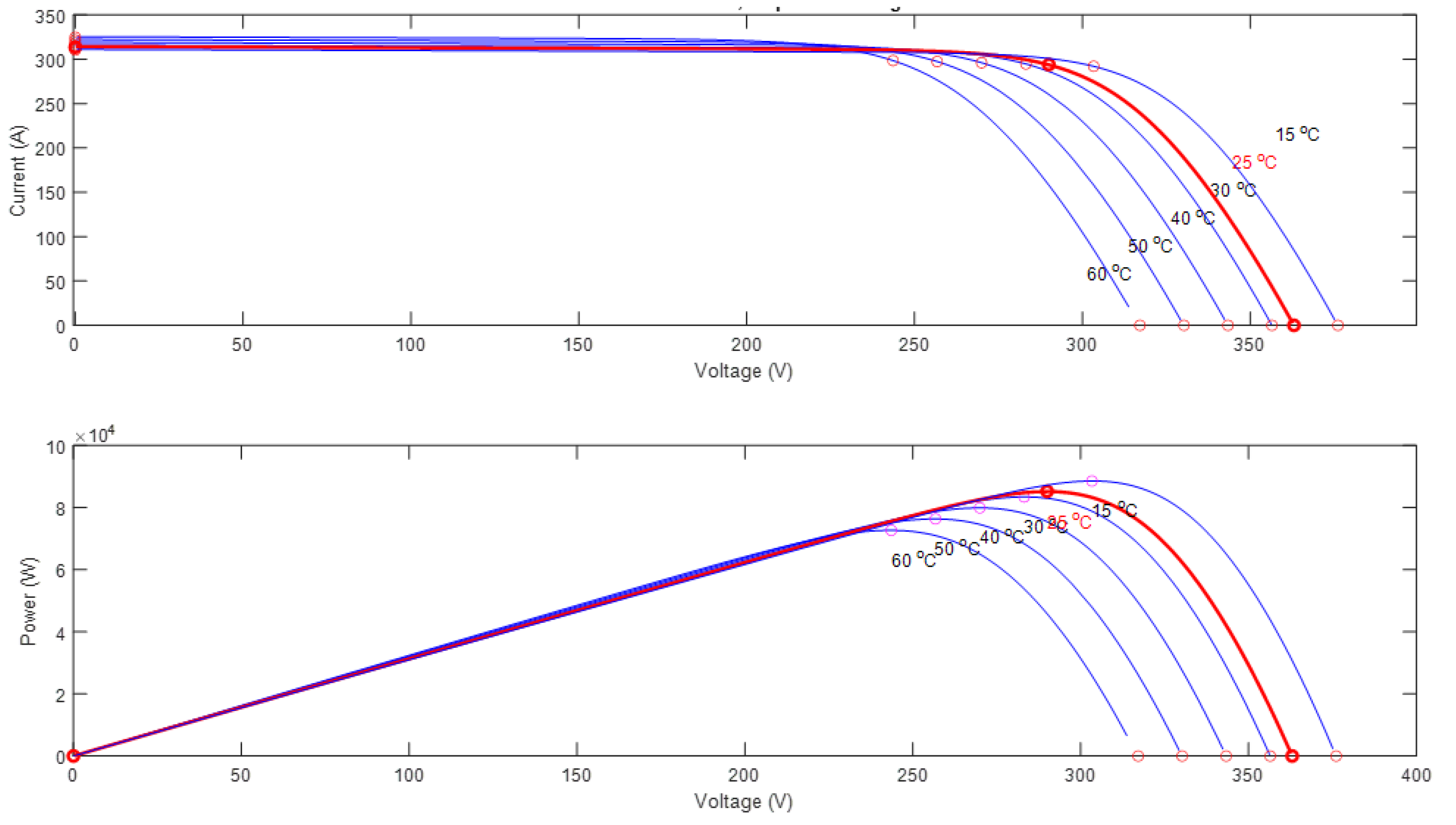
Figure 2.
Characteristic curves at different irradiances.
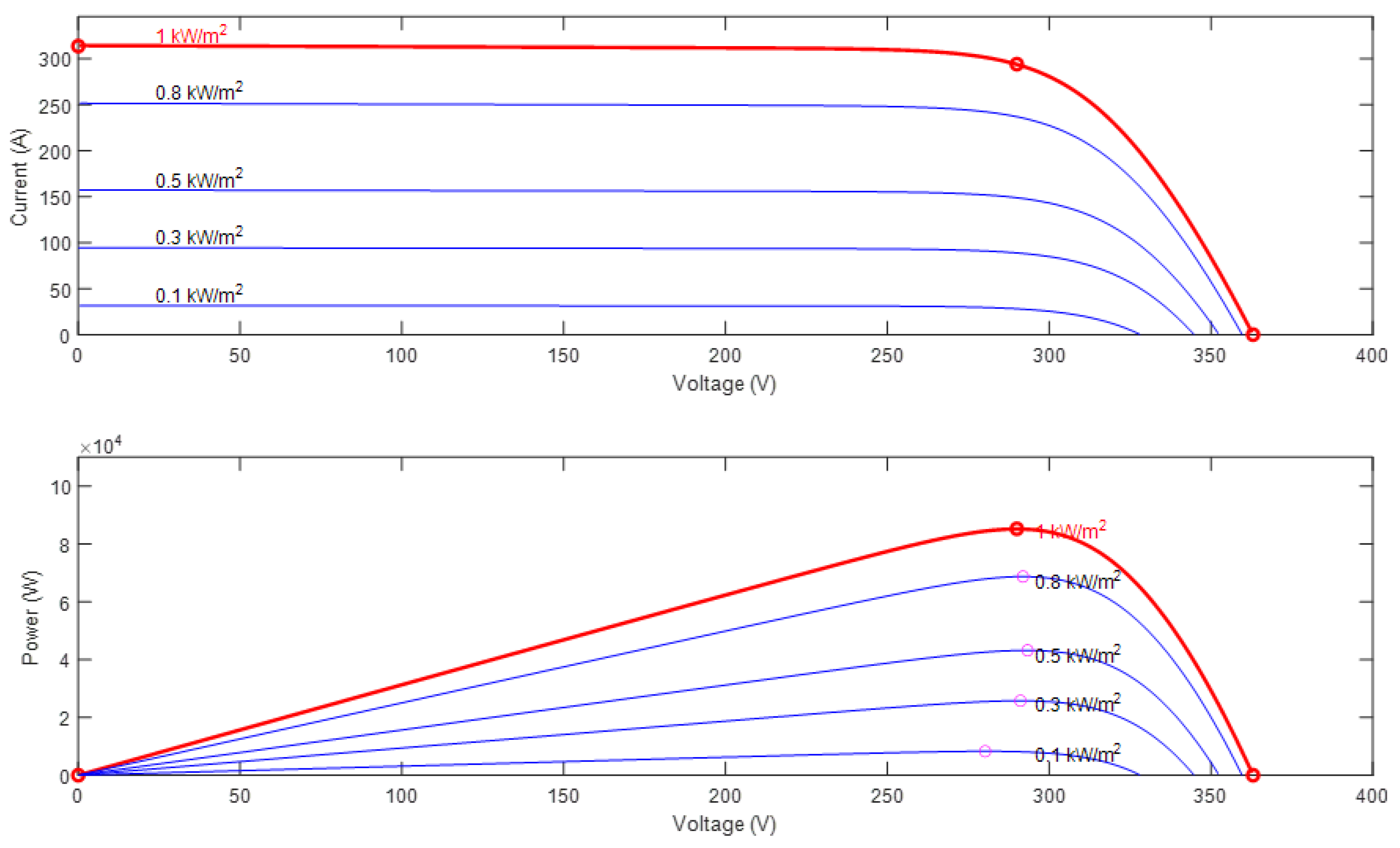
Figure 3.
Classification of MPPT Techniques
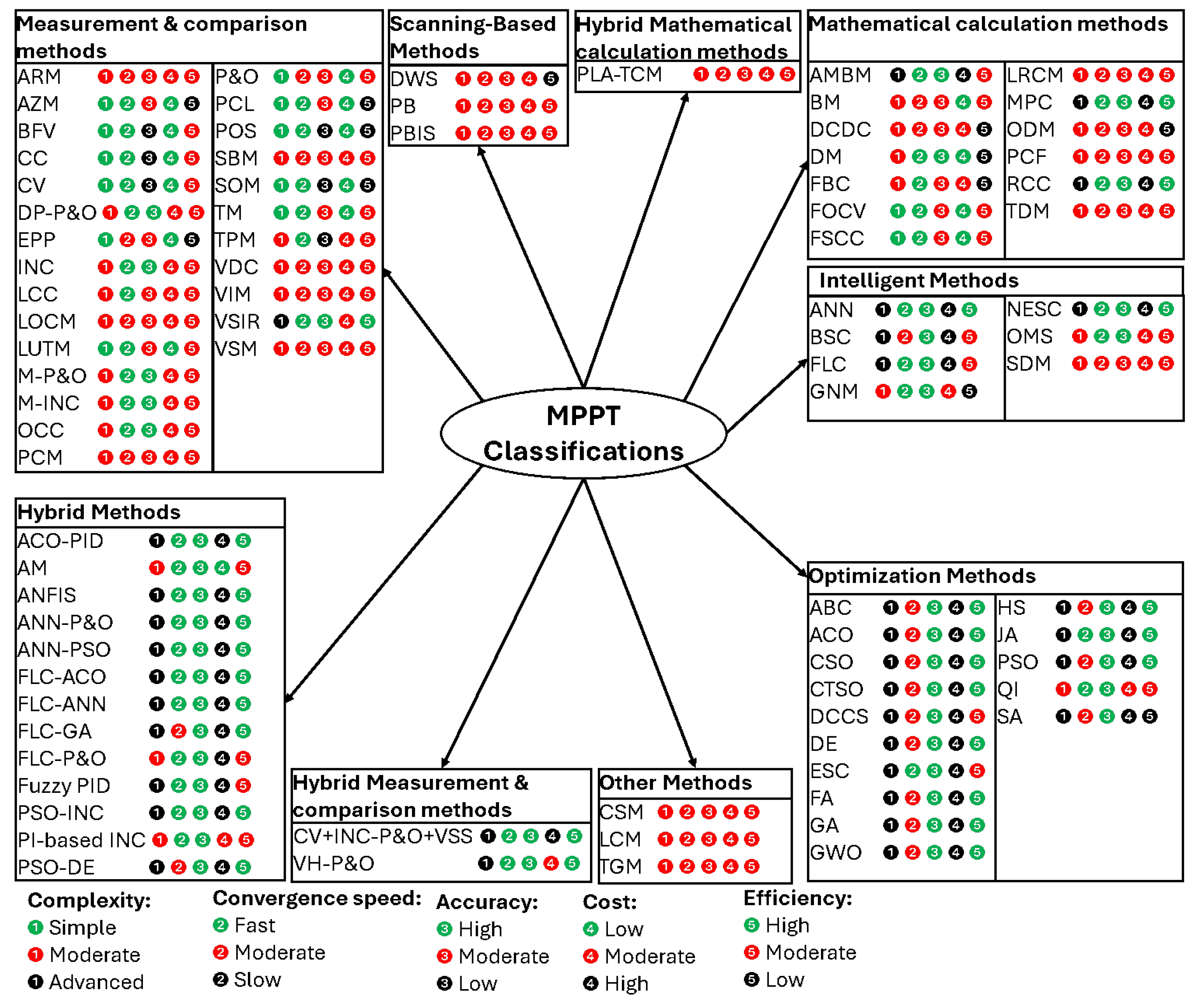
Figure 4.
Proposed multi-criteria decision-making optimization algorithm for ranking, sorting and selecting the best MPPT methods for specific applications
Figure 4.
Proposed multi-criteria decision-making optimization algorithm for ranking, sorting and selecting the best MPPT methods for specific applications
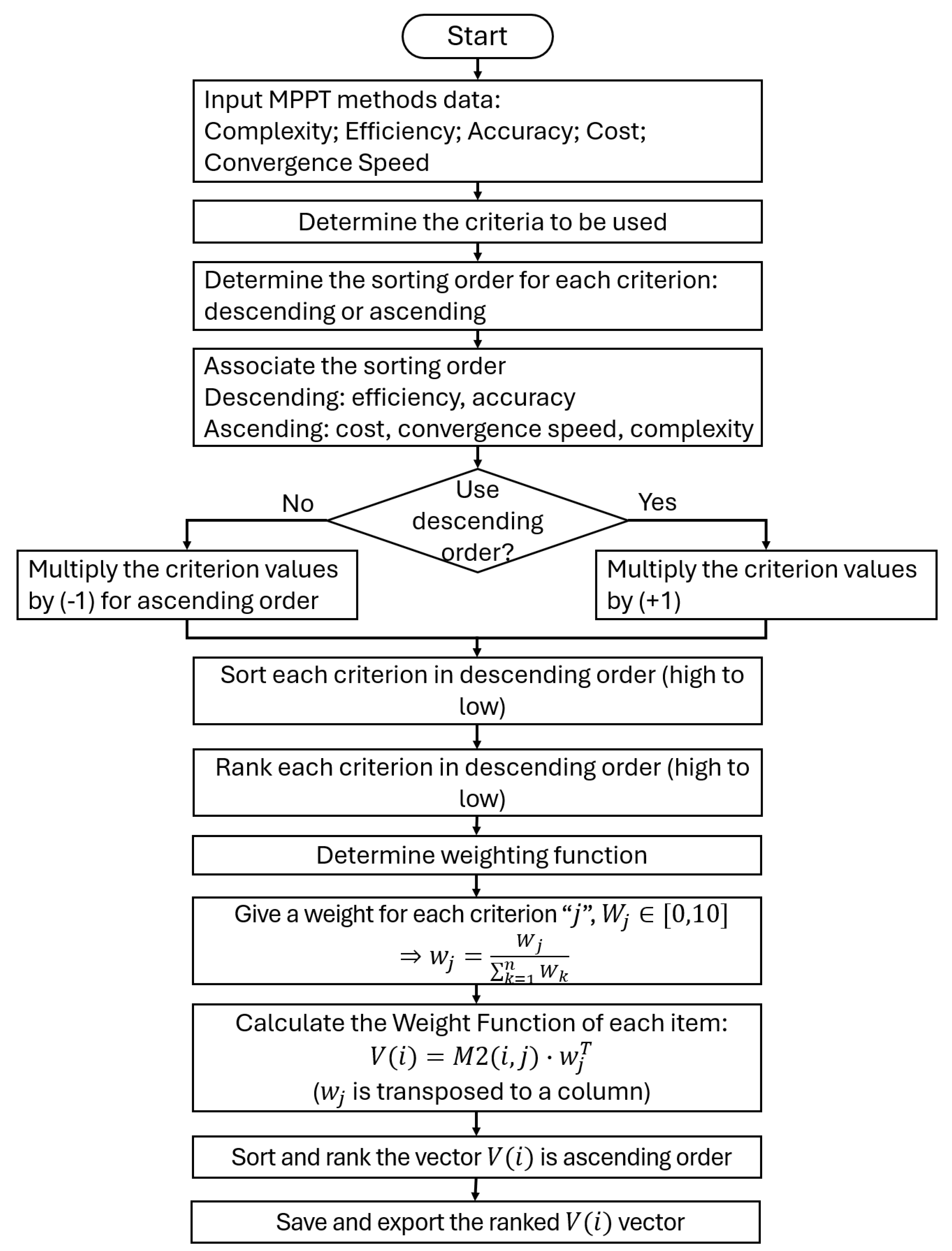
Figure 5.
Selection of the best MPPT method considering weighting factors of example 1
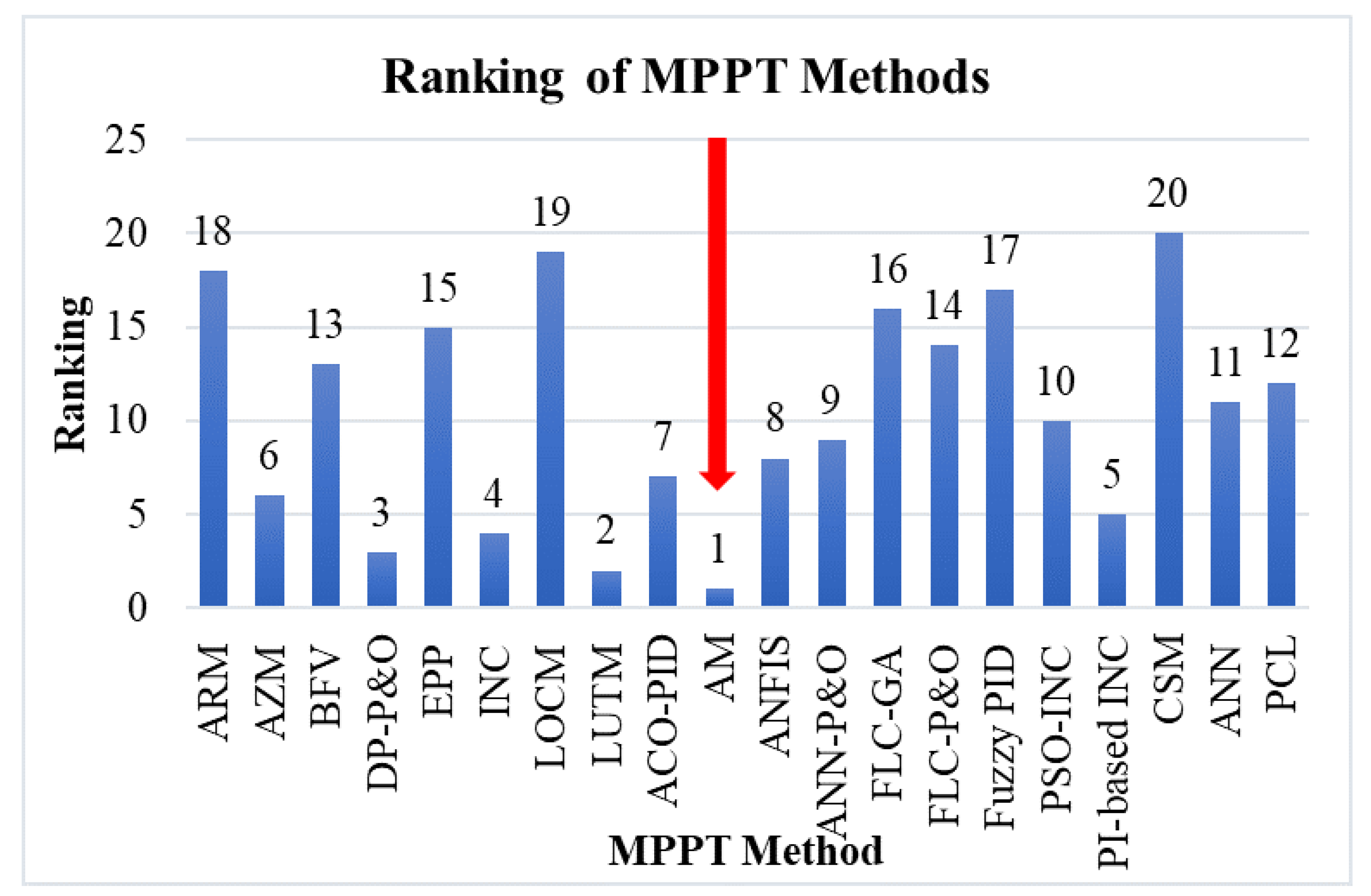
Figure 6.
Selection of the best MPPT method considering weighting factors of example 2
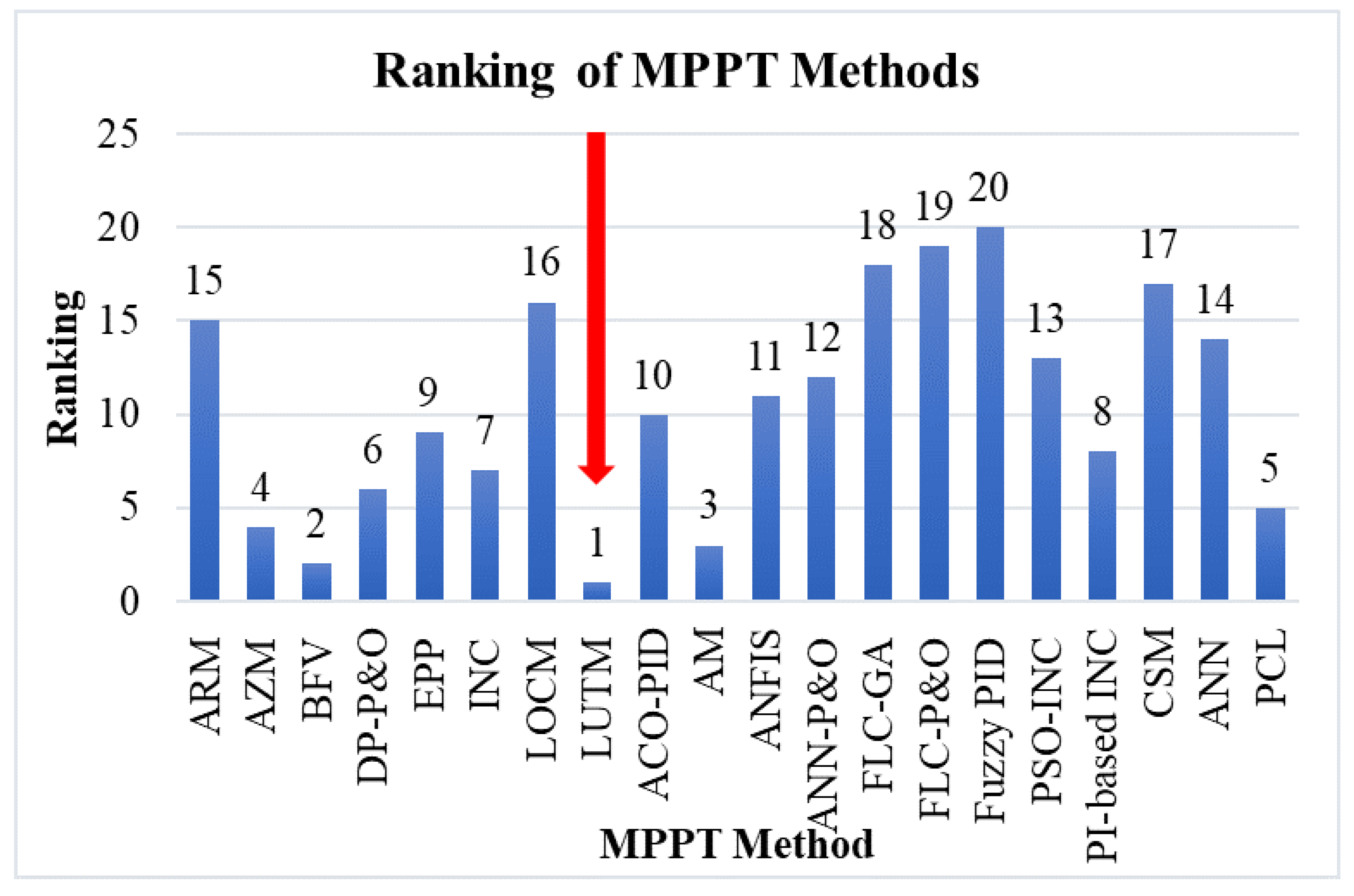
Figure 7.
The structure of an Artificial Neural Network for MPPT
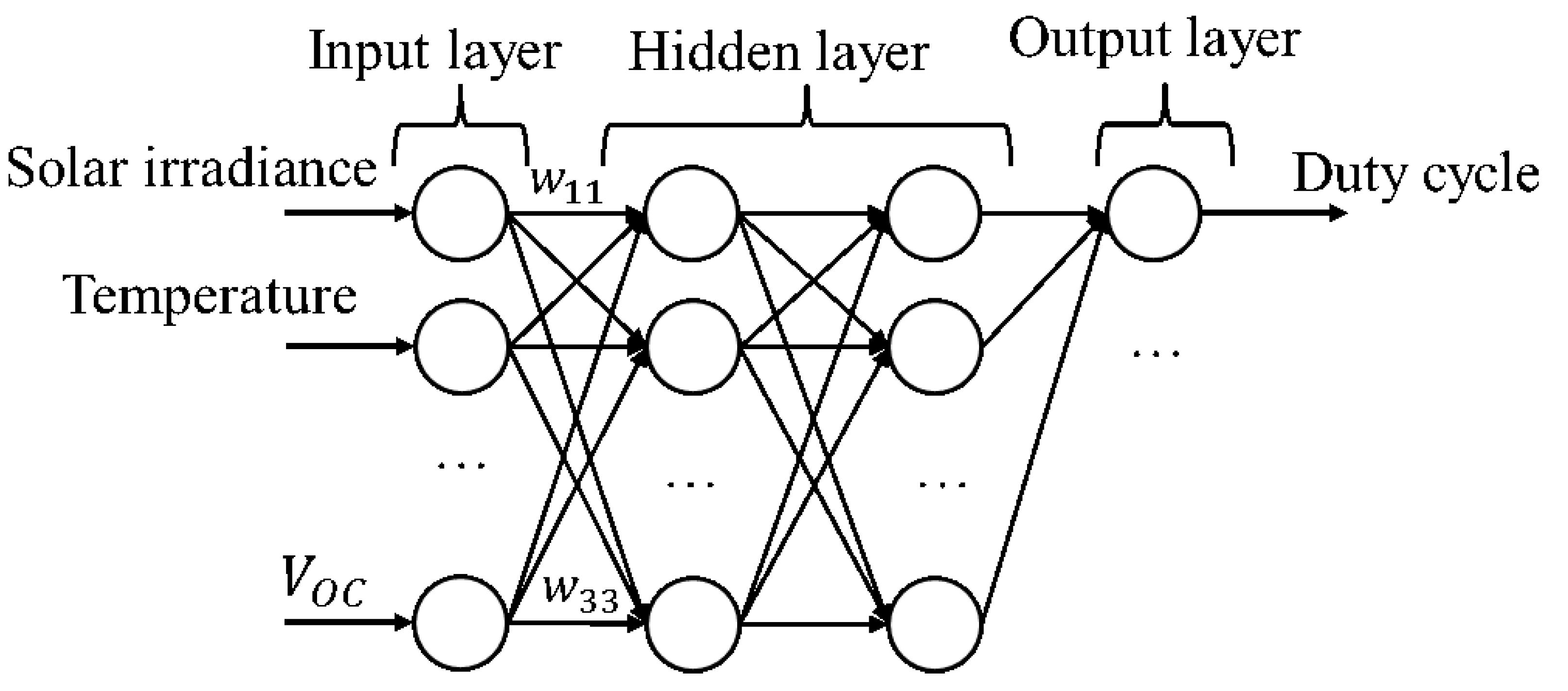
Figure 8.
MF in a fuzzy logic [50,51].
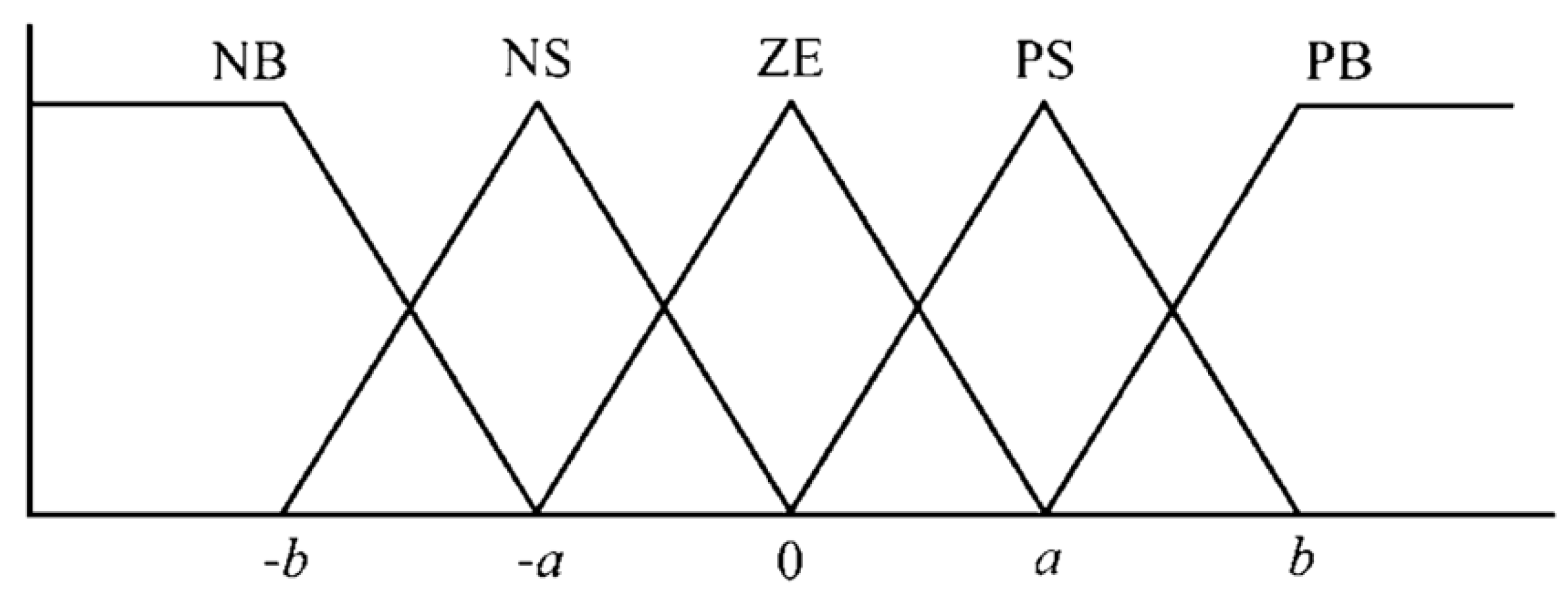
Figure 9.
Block diagram representing Newton-Like extremum seeking control method.
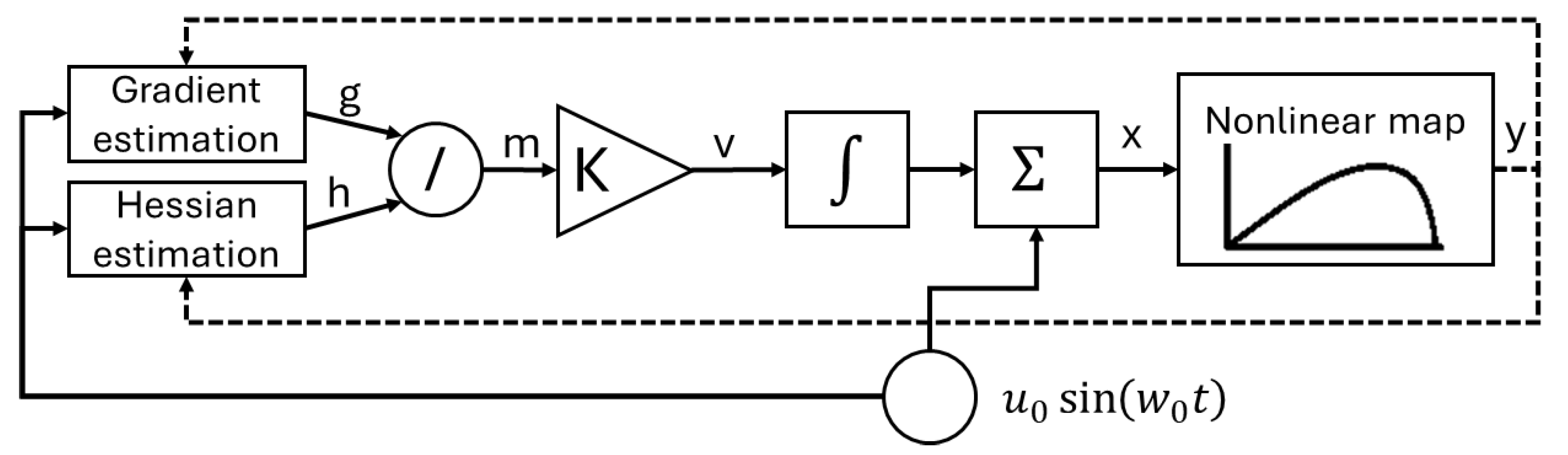
Figure 10.
Flowchart of the On-line MPP search algorithm [77]
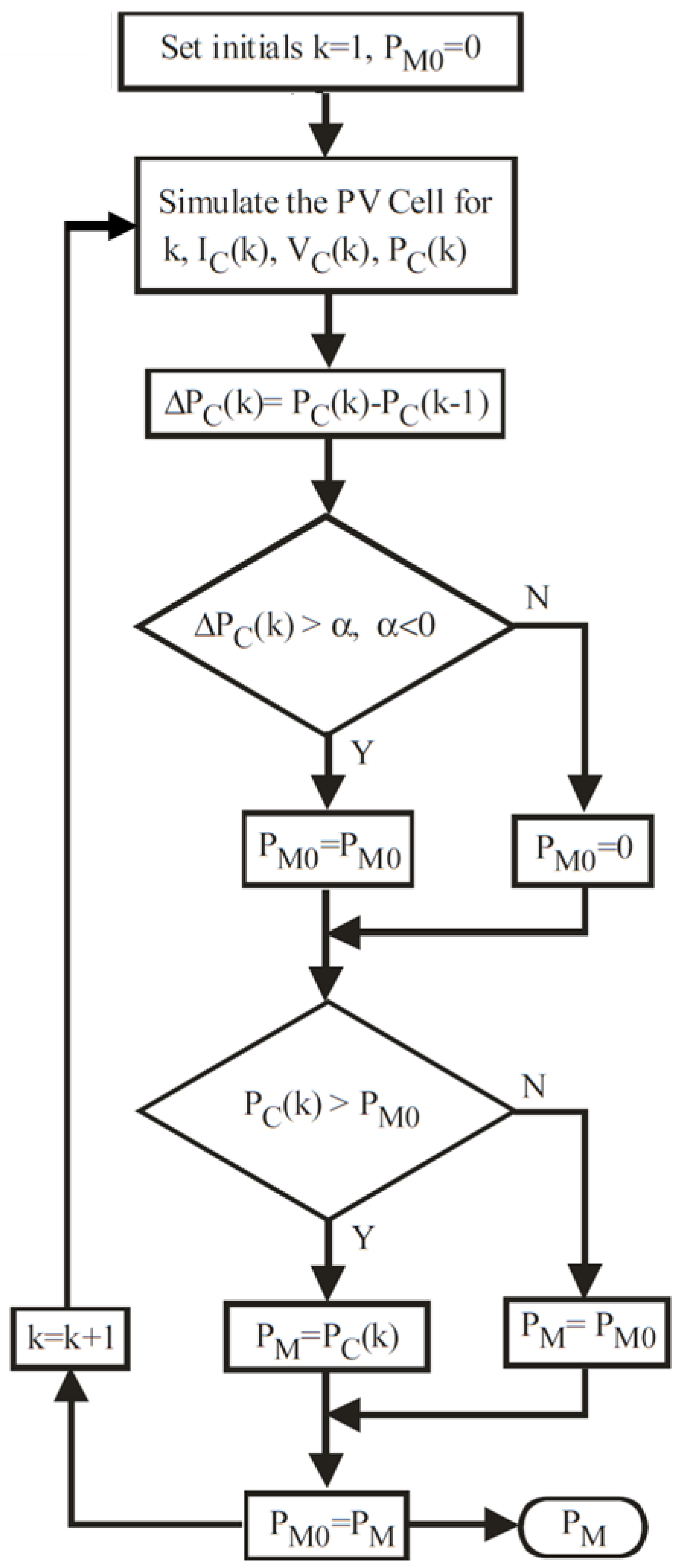
Figure 11.
Flowchart of the PSO-based MPPT method [80]
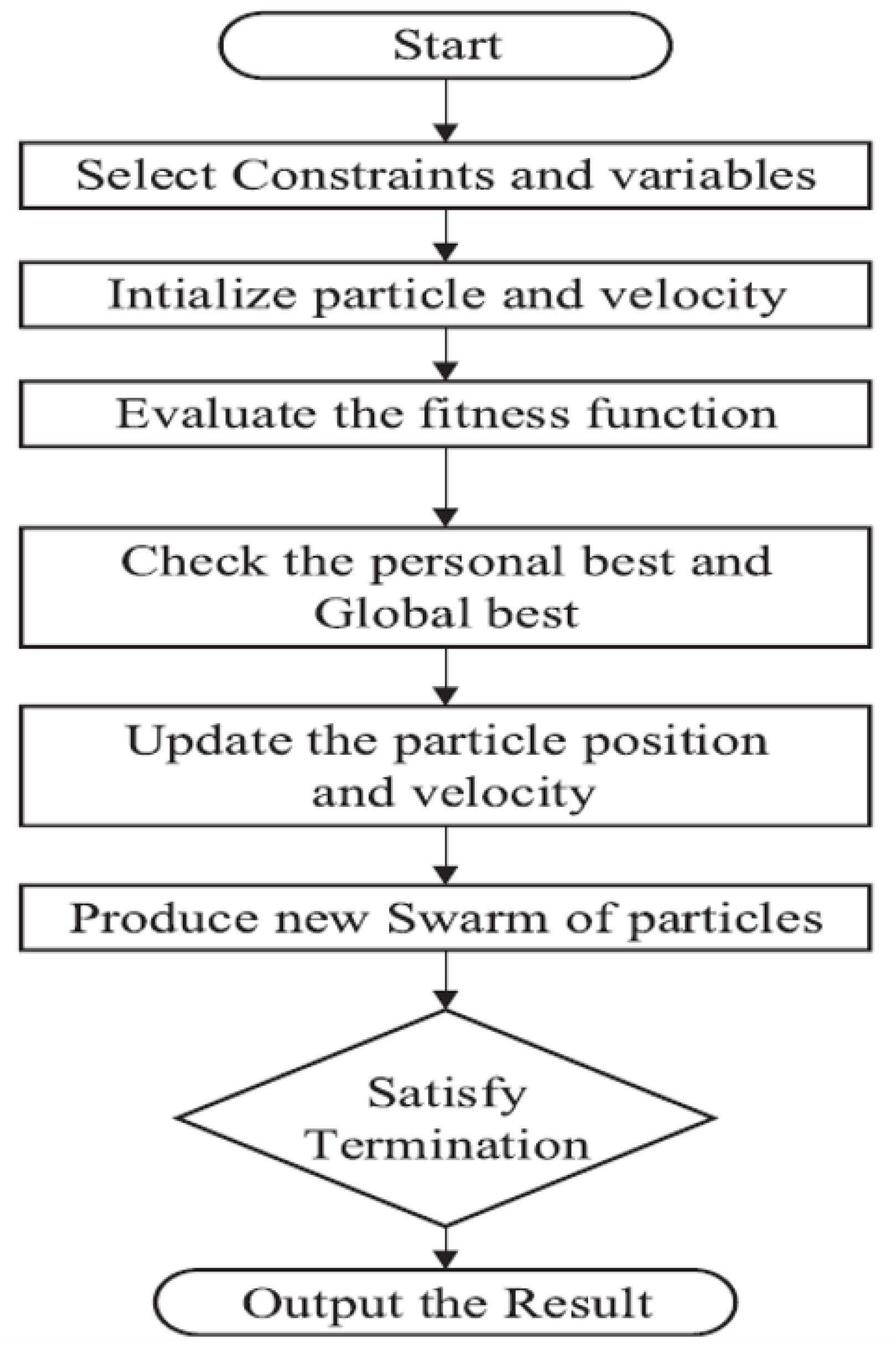
Figure 12.
Flowchart of the ACO-based MPPT method
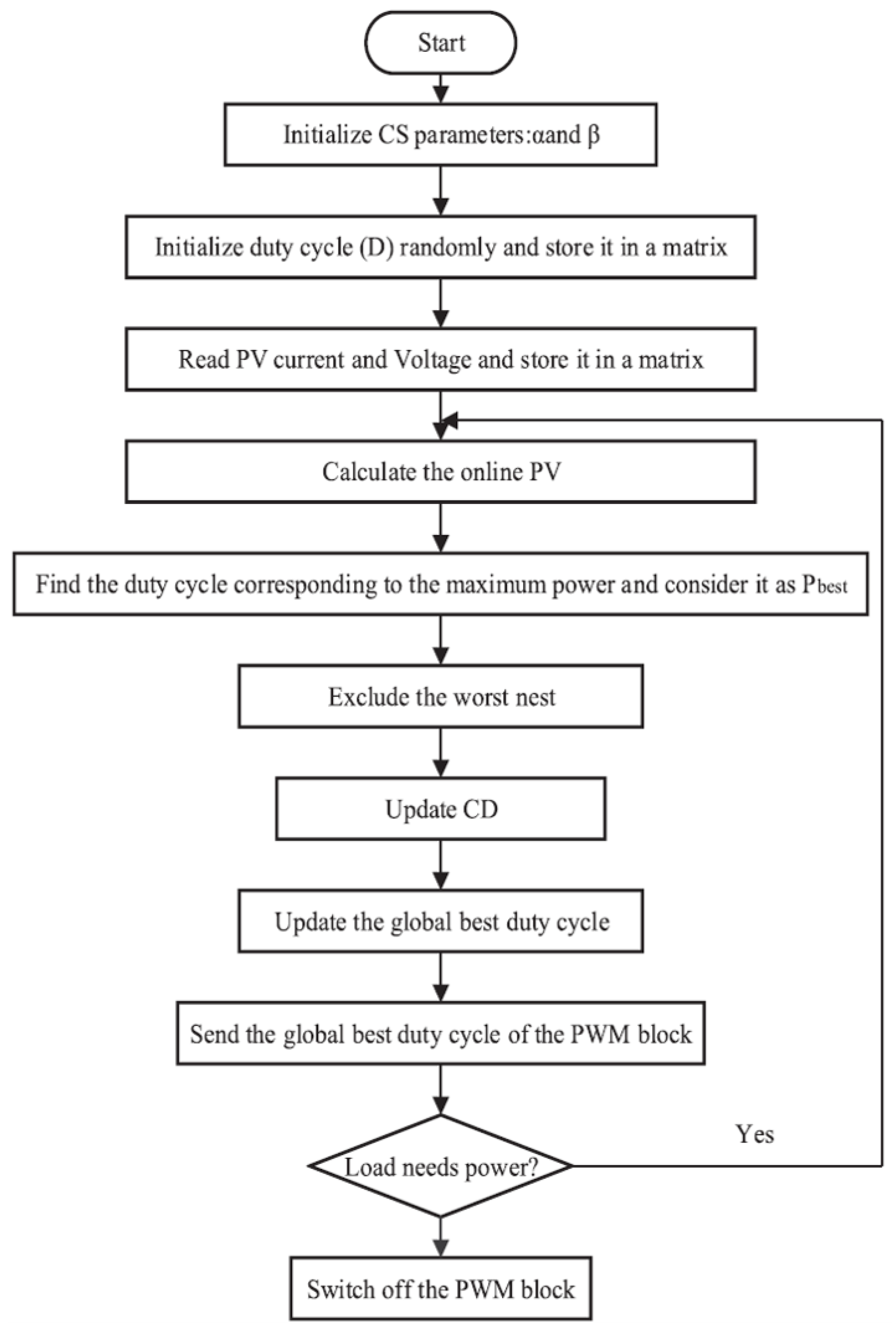
Figure 13.
P&O MPPT algorithm
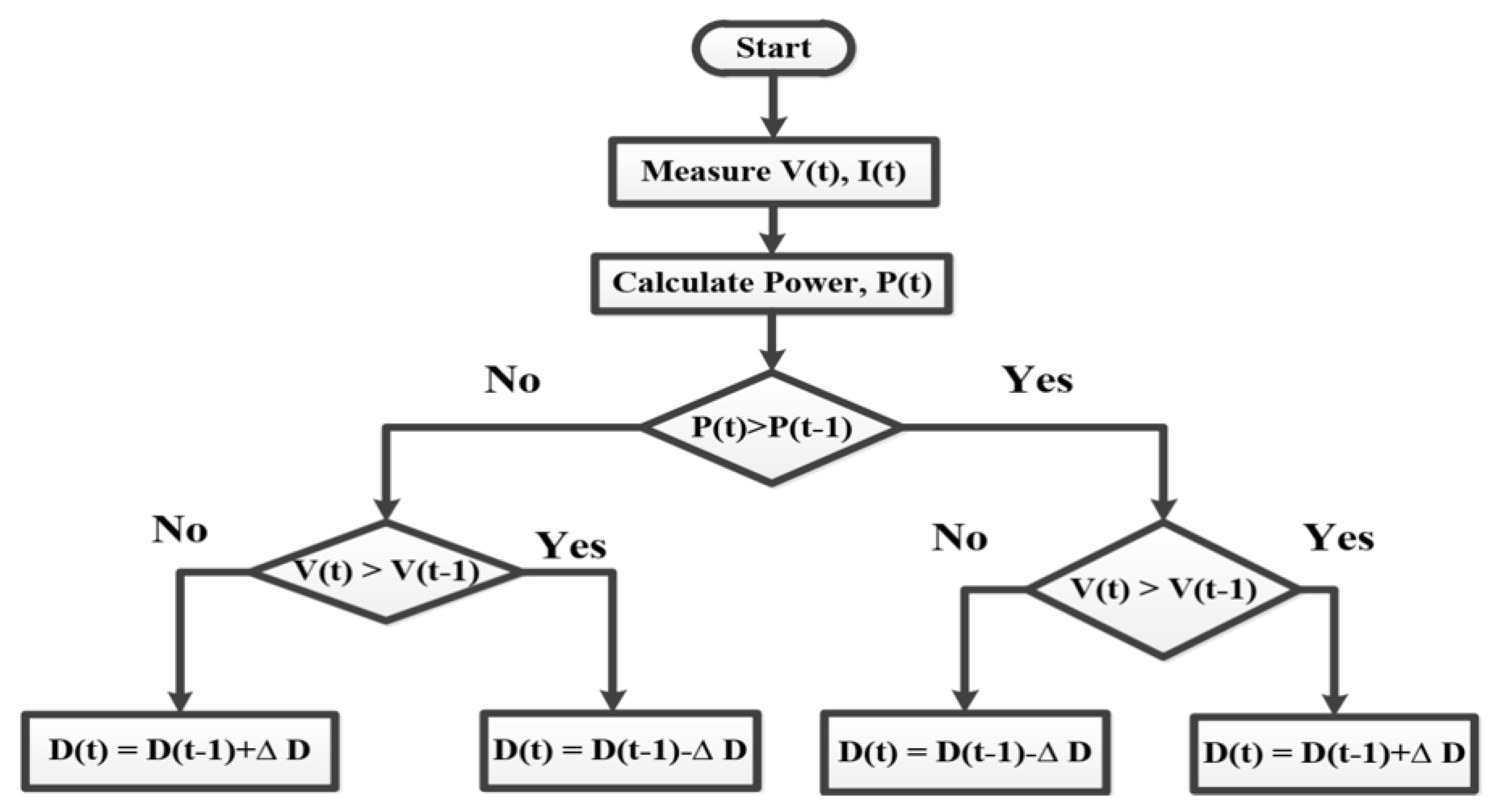
Figure 14.
P&O algorithm principle [140].
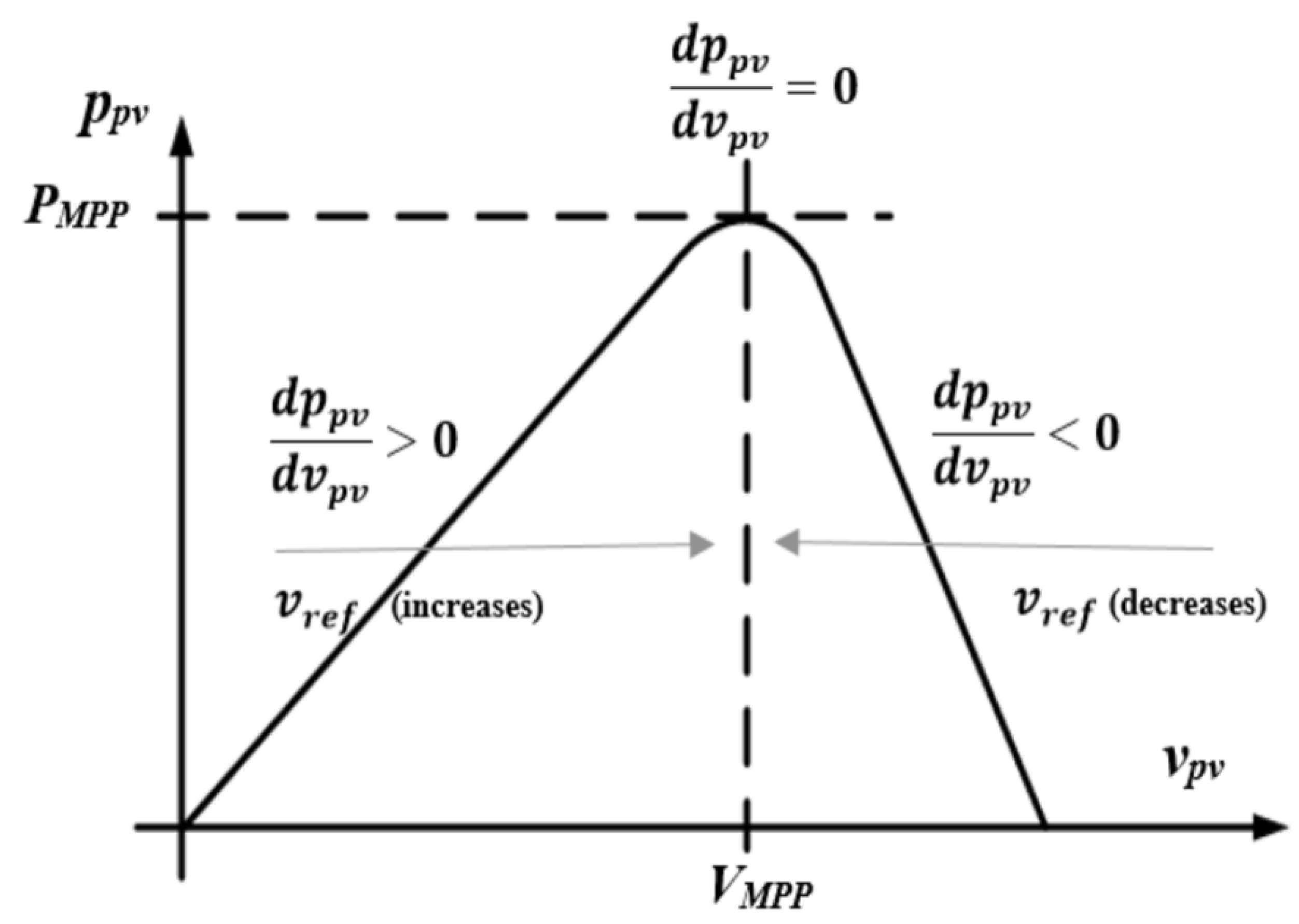
Figure 15.
INC Flowchart [148].
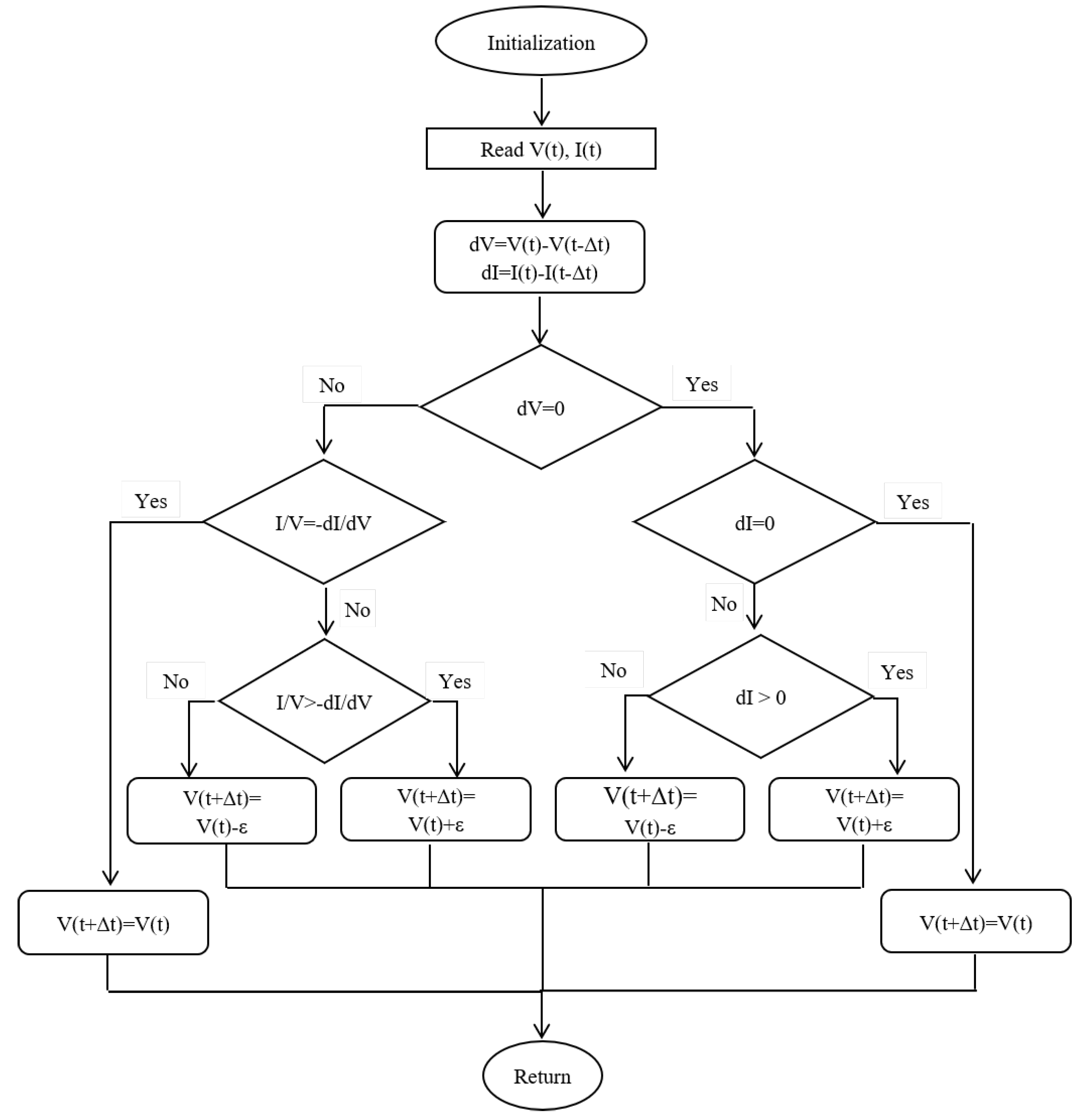
Figure 16.
Relationship between IMPP and ISC [149].
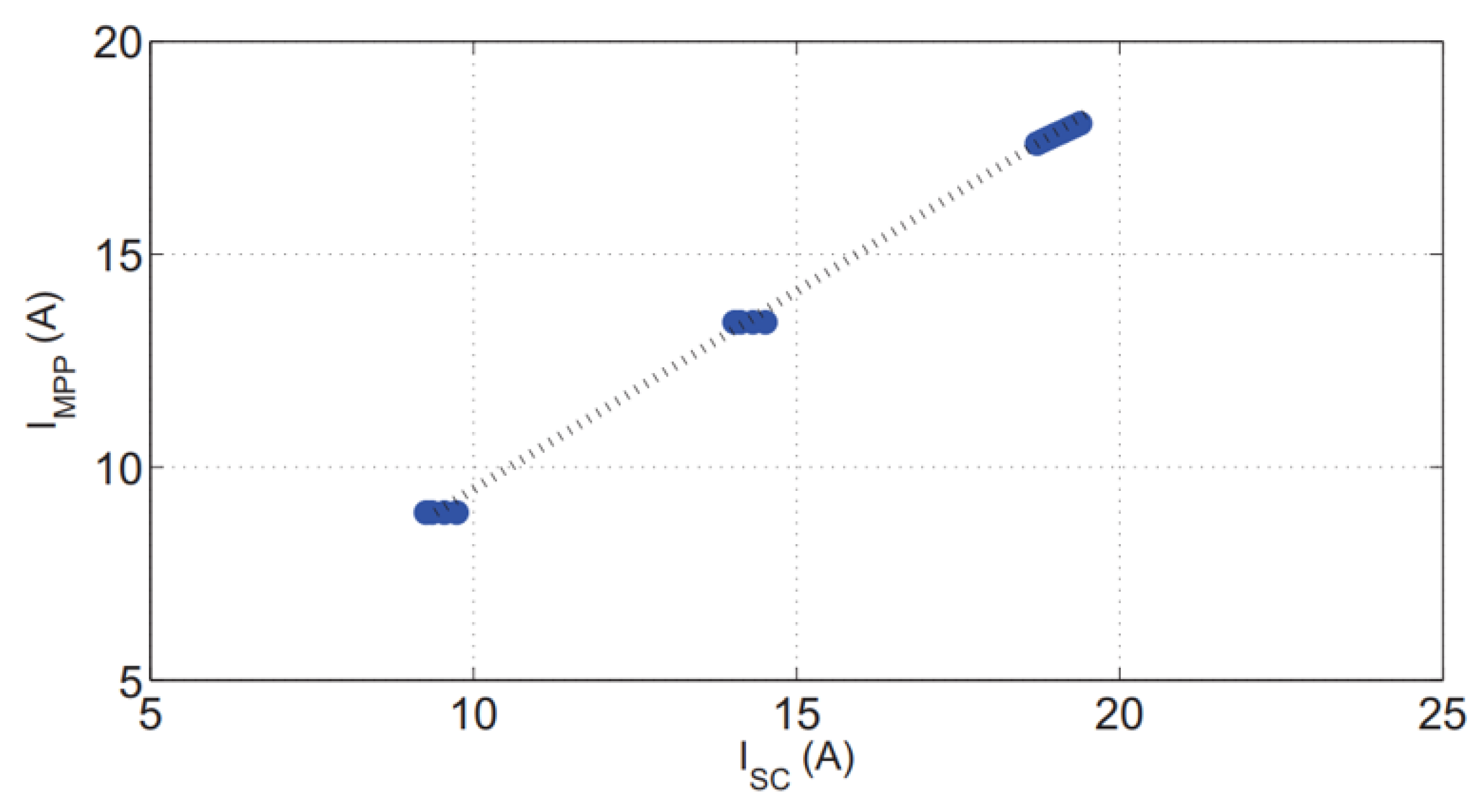
Figure 17.
Flowchart of the Constant Vlotage MPPT method [80]
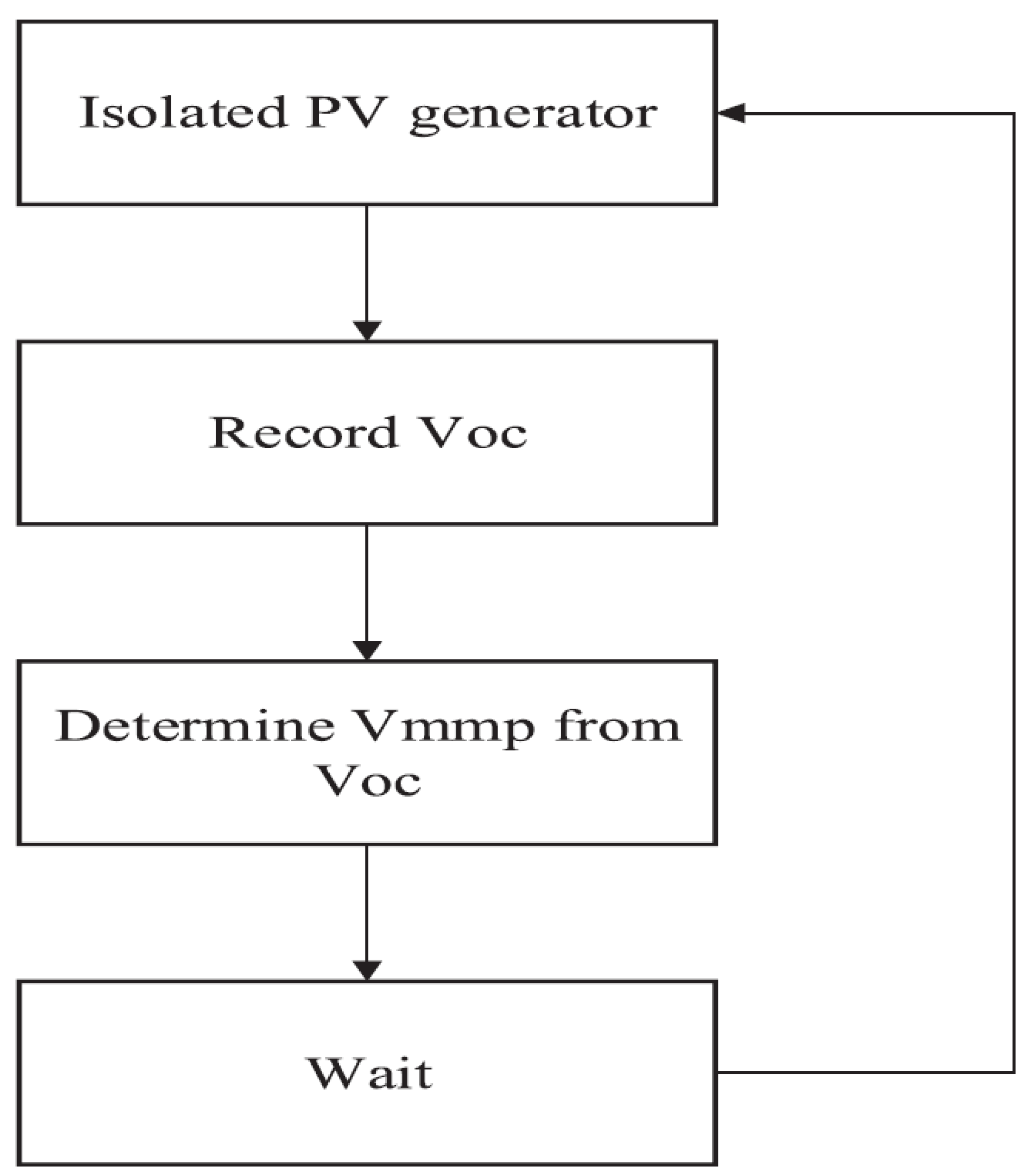
Figure 18.
Three perturbation points of possible states [186].
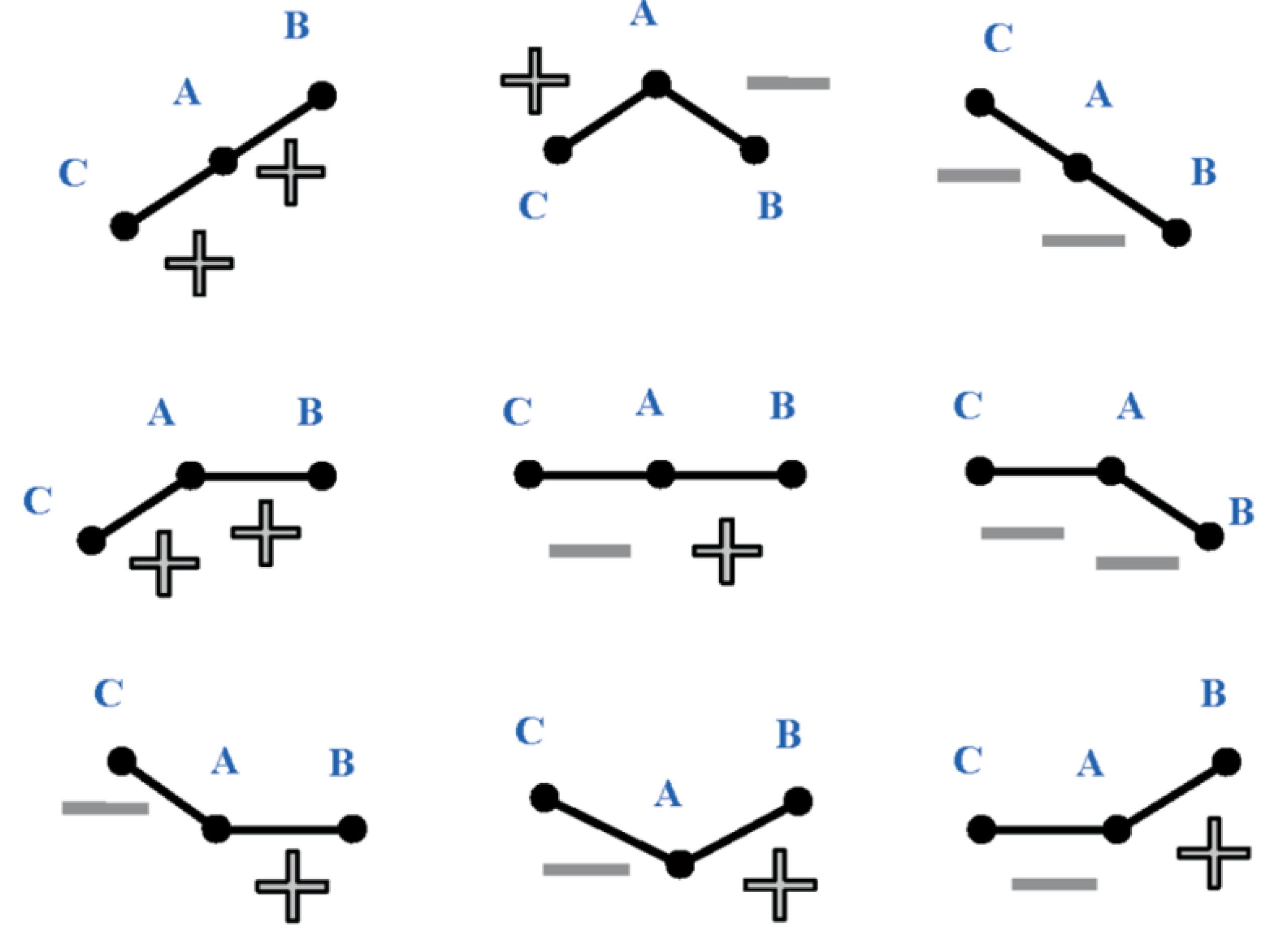
Figure 19.
Power Measurement between sampling of two MPPT [194].
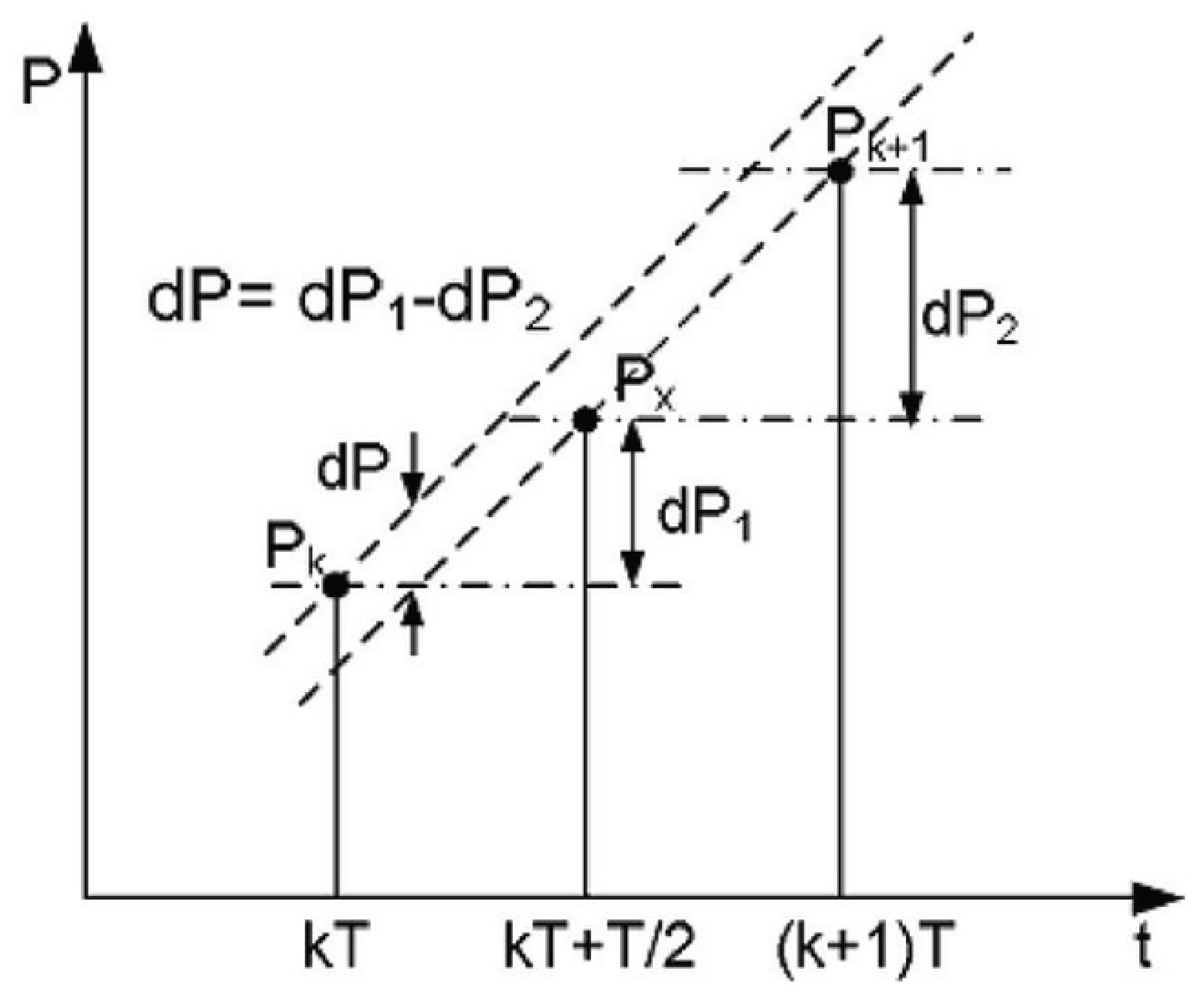
Table 1.
Two Examples of Weighting Factor Used to Weight Criteria
| Weighting Factor | |||||
|---|---|---|---|---|---|
| Complexity | Convergence Speed | Accuracy | Cost | Efficiency | |
| Example 1 | 5 | 10 | 10 | 10 | 10 |
| Example 2 | 2 | 2 | 1 | 10 | 10 |
*A value =10 means that the criterion is of high importance in the selection
Table 2.
Parameters definition for the MPPT efficiency performance comparison
| Parameter | Description |
|---|---|
| PV array dependencies | No specific configurations required or a predefined parameters value |
| MPPT accuracy | When the actual MPPT is compared to an inaccurate one, Pout will decrease with respect to the actual value. |
| Type of operation | Relies on the circuit category. |
| Tuning over periodic sets of time | Any oscillation involved in this scenario. |
| Convergence speed | How fast to converge and reach MPP. |
| Complexity | Describes the complexity of the module. |
| Parameters | Relies on variables’ factors. |
Disclaimer/Publisher’s Note: The statements, opinions and data contained in all publications are solely those of the individual author(s) and contributor(s) and not of MDPI and/or the editor(s). MDPI and/or the editor(s) disclaim responsibility for any injury to people or property resulting from any ideas, methods, instructions or products referred to in the content. |
© 2025 by the authors. Licensee MDPI, Basel, Switzerland. This article is an open access article distributed under the terms and conditions of the Creative Commons Attribution (CC BY) license (http://creativecommons.org/licenses/by/4.0/).
Copyright: This open access article is published under a Creative Commons CC BY 4.0 license, which permit the free download, distribution, and reuse, provided that the author and preprint are cited in any reuse.