
Submitted:
12 December 2025
Posted:
12 December 2025
You are already at the latest version
Abstract
In this paper we study the quantization of the cosmic critical density. Applying the generalized relational expression, we derive a quantized formula for the cosmic critical density and subsequently prove. We compare a graph of the three components of the formula, it reveals that the gravitational quantization term dominates during the very early universe and near the Planck time, suggesting it may be a consequence of a complete theory of quantum gravity. Last we find a primitive function which the Taylor expansion is this quantized formula. Our discussion is intriguing and heuristically valuable.
Keywords:
quantization
; cosmic critical density
; generalized relational expression
; formula
; Hubble constant
; Planck time
1. Introduction
The cosmic critical density [1] is a key parameter determining the geometric curvature of the universe. The primary motivation for its quantization study stems from two major conflicts: the vacuum energy catastrophe [2] and the coincidence problem [3,4,5,6,7,8,9]. Vacuum energy contributions from quantum fluctuations require renormalization, yet face fundamental contradictions [10,11]. Within the framework of loop quantum cosmology, the critical density becomes intricately linked to the discrete structure of spacetime [12]. The string landscape hypothesis leads to a random distribution of cosmic critical density among vacuum solutions, with the anthropic principle selecting habitable values, albeit lacking a dynamical mechanism [13]. Shen. J proposed a spin connection gauge theory where the local Lorentz group acts as the gauge group, preventing vacuum energy from contributing to the field equations and thus avoiding the fine-tuning problem of cosmic critical density, though resulting in third-order differential gravitational field equations [14]. J.S. Peracaula et al proposed that in the very early universe, higher powers of the Hubble constant H would dominate, leading to a period of rapid expansion, with the minimum possible driving term being [15]. The holographic principle [16] also offers an explanatory path via the multiverse; meanwhile, dynamical field models [17] and precision experiments (e.g., cold atoms, cosmological observations) [18,19] are gradually building bridges for empirical verification.
The structure of this paper is as follows. In Sec. 2, we derive the quantized formula for the cosmic critical density. In Sec. 3, prove the second and third parts of this formula. In Sec. 4, compare the three components of the formula through function graphs. In Sec. 5, find the primitive function. We conclude in Sec. 6.
2. Quantization of Cosmic Critical Density
This section applies the generalized relational expression [20] to derive the quantized formula for the cosmic critical density.
Let’s review the generalized relational expression. The basic relationship [20] is
Where A is any physical quantity, [A] = its dimensions, L, M, T, Θ and Q are the dimensions of length, mass, time, temperature and electric charge separately (here we use the LMTΘQ units), the corresponding Planck scale of A, , , , and the real number, ħ, G, c, κ and e the reduced Planck constant, gravitational constant, speed of light in vacuum, Boltzmann constant and elementary charge separately.
The Generalized Relational Expression [20] is
where is the physical quantity,the real number, and the corresponding Planck scale.
So assuming the cosmic critical density depends solely on the Hubble constant H, we obtain
where = is the Planck mass density, = the Planck Hubble constant.
Setting 2+= 0, → = ─ 2,=1, and =1, that is neglecting the quantum effect and relativistic effect, we give
~which is = [1], where is today Hubble constant.
Ordering 4+= 0, → = ─ 4,=1, it indicates neglecting the gravitational effect, obtain
it represents the quantization of the cosmic critical density.
Taking = ─ 6,find
which represents the gravitational quantization of the cosmic critical density. Thus
This is the quantized formula for the cosmic critical density. As ħ → 0, ~, consistent with the result from general relativity.
3. Proof of and
This section proves the quantized formula (6) for the cosmic critical density.
3.1. Proof of
In quantum field theory, the vacuum energy density for a free scalar field is
where is the zero-point energy [21], the frequency, and the wavenumber. For a massless scalar field, =. In three-dimensional momentum space, =4, substituting them into the above equation, we obtain
If the cutoff wavenumber is chosen as the Hubble radius =, then the minimum wavelength ==, and the maximum wavenumber is =2π=2π. Substituting into the above formula, we get
Proof completes.
3.2. Proof of
Thus, we obtain
As ħ → 0, =.
4. Comparison of , and
This section compares the three terms in Eq. (9) via function graphs.
As the universe expands, H gradually decreases. However, since Eq. (9) involves powers 2, 4, and 6 of H, a direct comparison is inconvenient. Therefore, we substitute , where is the age of the universe, yielding
Plotting the function graph gives
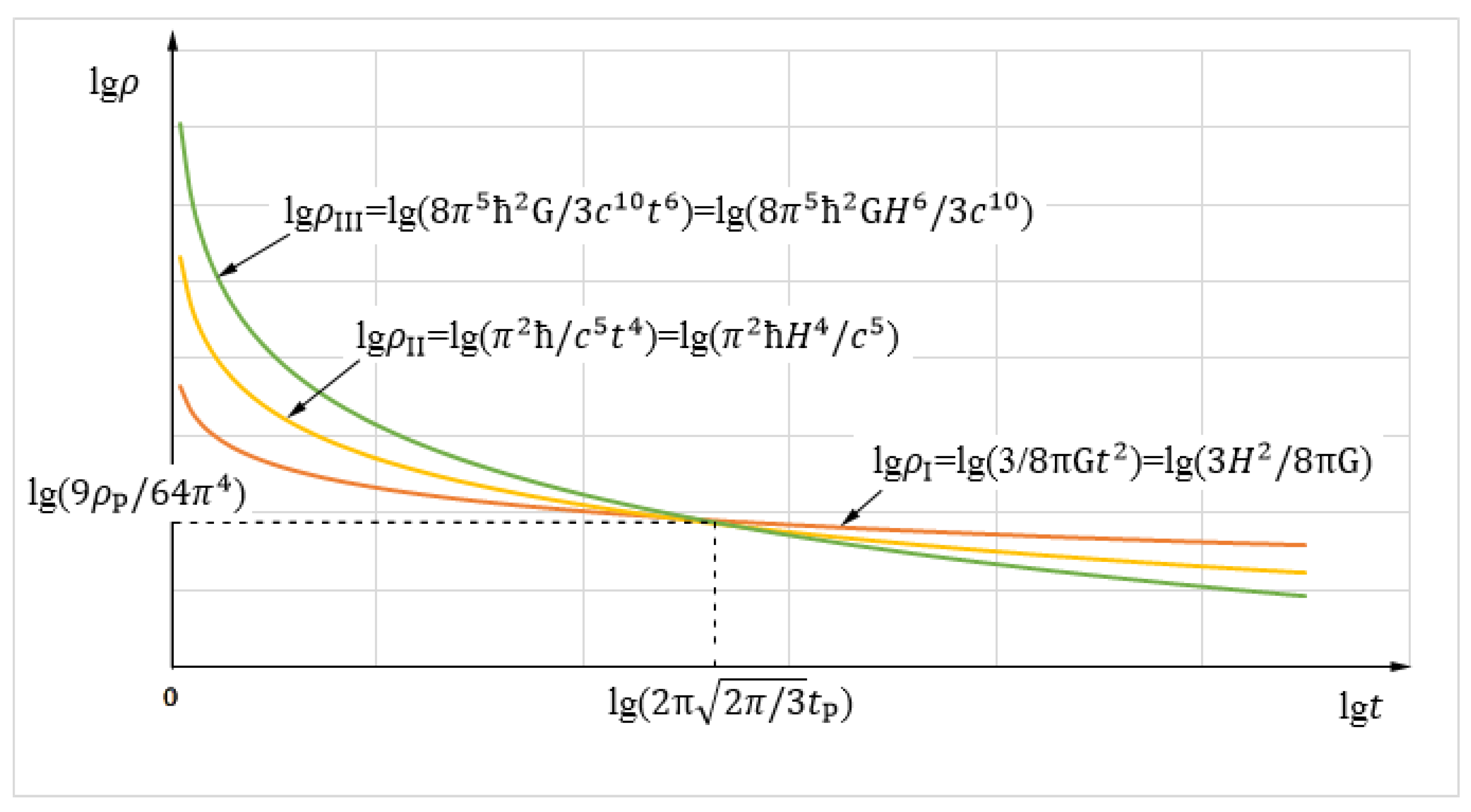
Figure 1.
Schematic diagram showing the evolution of , , and with cosmic time . (~1/) dominates at late times, (~1/) is significant at intermediate times, and (~1/) dominates at very early times near .
Figure 1.
Schematic diagram showing the evolution of , , and with cosmic time . (~1/) dominates at late times, (~1/) is significant at intermediate times, and (~1/) dominates at very early times near .
Clearly, when = (i.e., ), ===, where = and = is the Planck time.
When , 0.01,0.01, allowing and to be neglected, we obtain =.
When , 0.01,0.01, allowing and to be neglected, give =.
This indicates that the gravitational quantization term dominates from the very beginning of the universe until approximately 0.91 times the Planck time, suggesting that this may be a result of a complete theory of quantum gravity. Therefore, the cosmic critical density today differs from that during the very early universe and near the Planck time.
5. Primitive Function
If we regard Eq. (9) as the Taylor expansion of a function near , it is
As ħ → 0, = also.
Writing the coefficients of the last two terms of Eq. (9) in ratio form, we get
Then Eq. (9) can be rewrite as
The geometric series is
Therefore, the primitive function is Eq. (11)
When, , Eq. (11) has singularity, so it needs to be analyzed and extended to the rang of [, 0).
From Eq. (11), obtain
6. Conclusion
In this paper we have studied the quantization of the cosmic critical density. Applying the generalized relational expression [1], we derived a quantized formula. This formula includes the result from general relativity, a quantization term, and a gravitational quantization term. It reduces to the general relativity result when quantum effects are neglected. Then we prove the latter two terms. We compared the three components via graphs, it showed that the gravitational quantization term dominates during the very early universe until approximately 0.91times the Planck time, suggesting it is a consequence of a complete theory of quantum gravity. Note Eq. (9) is the Taylor expansion of primitive function Eq. (11) near which is analyzed and extended to the rang of [, 0). Our discussion is intriguing and provides heuristic inspiration for developing a complete theory of quantum gravity.
References
- S. Weinberg, Cosmology. Oxford University Press. (2008).
- S. Weinberg, The cosmological constant problem. Reviews of Modern Physics, 61(1), 1–23. (1989).
- P. J. E. Peebles and B. Ratra, The cosmological constant and dark energy. Reviews of Modern Physics, 75(2), 559–606. (2003).
- E. D. Valentino, et.al., Cosmology Intertwined III: fσ8 and S8. Astropart. Phys. 131, 102604 (2021); arXiv:2008.11285v4 [astro-ph].
- E. Abdalla et.al., Cosmology Intertwined: A Review of the Particle Physics, Astrophysics, and Cosmology Associated with the Cosmological Tensions and Anomalies. J. High En. Astrophys. 2204, 002 (2022); arXiv:2203.06142 [astro-ph].
- M. Shimon, Elucidation of 'Cosmic Coincidence'. arXiv:2204.02211 [astro-ph.CO].
- S. P. Ahlen, et.al., Positive Neutrino Masses with DESI DR2 via Matter Conversion to Dark Energy. Physical Review Letters. 2025. [CrossRef]
- S. Alexander, H. Bernardo, A. Hui, The Cosmological Constant from a Quantum Gravitational θ-Vacua and the Gravitational Hall Effect. arXiv:2506.14886 [gr-qc].
- R. E. Hill, Cosmic inflation from entangled qubits: a white hole model for emergent spacetime. Gen Relativ Gravit 57, 90 (2025).
- S. D. Bass, J. Krzysiak, Vacuum energy with mass generation and Higgs bosons. Physics Letters B, Volume 803, article id. 135351; arXiv:2001.01706 [hep-ph]. [CrossRef]
- J. Martin, Everything you always wanted to know about the cosmological constant problem. Comptes Rendus Physique, 13(6-7), 566–665. (2012). [CrossRef]
- Ashtekar, P. Singh, Loop quantum cosmology: a status report. Classical and Quantum Gravity, 28(21), 213001. (2011). [CrossRef]
- L. Susskind, The anthropic landscape of string theory. arXiv:0302219 [hep-th].
- Jianqi Shen, Quantum vacuum energy and its implication to gravitational gauge theory. Hans, Vol. 4 No, 4. 2014. [CrossRef]
- J.S. Peracaula, C. M-Pulido, A.G-Fuentes, Running vacuum and H4-inflation, Universe, 11(4), 118 (2025); arxiv:2025.01041 [gr-qc].
- R. Bousso, The holographic principle. Reviews of Modern Physics, 74(3), 825–874. (2002).
- E. J. Copeland, M. Sami, S. Tsujikawa, Dynamics of dark energy. International Journal of Modern Physics D, 15(11), 1753–1936. (2006).
- Planck Collaboration: N. Aghanim. et al., Planck 2018 results. VI. Cosmological parameters. Astronomy & Astrophysics, 641, A6. (2020).
- Juodžbalis et al., A direct black hole mass measurement in a Little Red Dot at the Epoch of Reionization. arxiv.2508.21748.
- Yong Bao, vixra: 1502.0101;
- C. Itzykson, J.B. Zuber. Quantum Field Theory. McGraw-Hill. (1980).
- Yong Bao, vixra: 1502.0106;
- Ashtekar, E.W-Ewing, The covariant entropy bound and loop quantum cosmology. Phys. Rev. D78: 064047. (2008); arxiv:0805.3511 [gr-qc]. [CrossRef]
- R.T. Cahill, Gravitation, the ‘Dark Matter’ Effect and the Fine Structure Constant. Aperion 12, 144-177, (2005); arxiv:0401047 [physics].
Disclaimer/Publisher’s Note: The statements, opinions and data contained in all publications are solely those of the individual author(s) and contributor(s) and not of MDPI and/or the editor(s). MDPI and/or the editor(s) disclaim responsibility for any injury to people or property resulting from any ideas, methods, instructions or products referred to in the content. |
© 2025 by the authors. Licensee MDPI, Basel, Switzerland. This article is an open access article distributed under the terms and conditions of the Creative Commons Attribution (CC BY) license (http://creativecommons.org/licenses/by/4.0/).
Copyright: This open access article is published under a Creative Commons CC BY 4.0 license, which permit the free download, distribution, and reuse, provided that the author and preprint are cited in any reuse.


