

Submitted:
02 October 2025
Posted:
16 October 2025
You are already at the latest version
Abstract
This document is a Technical Note that reports on the design and proof-of-concept of a self-distributed Selective Forwarding Unit (SFU) architecture for real-time video streaming. Unlike a full research article, this note emphasizes the practical motivation, implementation details, and observed behaviors of the system. The central idea is to address the limitations of traditional prediction-based scaling by introducing a finite state machine (FSM)-based self-stabilizing method that enables autonomous scale-out and scale-in of distributed SFUs under dynamic traffic conditions.
Keywords:
WebRTC
; SFU
; autonomous distributed topology
; FSM
; HALT metric
; real-time streaming
; scalability
1. Introduction
1.1. Background
Scaling SFU-based real-time video streaming is challenging due to unpredictable and sudden spikes in user demand. Conventional centralized scaling approaches often depend on traffic prediction and controller-driven resource allocation, which fail to react quickly enough during extreme fluctuations.
1.2. Gap
Prediction-based scaling cannot handle instantaneous traffic surges, leading to bottlenecks, instability, and degraded user experience.
1.3. Scope
This Technical Note introduces a self-distributed FSM-based SFU architecture that autonomously handles replication and redundancy. It outlines the design principles, FSM protocols, and practical implementation details, with observations from proof-of-concept testing.
2. Design and Method
2.1. Self-Distributed Topology
The architecture eliminates central bottlenecks by enabling each SFU node to participate in an autonomous distribution topology. Nodes coordinate locally rather than relying on a centralized orchestrator.
As shown in Figure 1, the topology organizes nodes into a decentralized structure where replication flows outward from load hotspots, ensuring redundancy without centralized coordination.
2.2. FSM-Based Protocols
Scaling decisions are governed by a finite state machine (FSM) embedded within each node. FSM transitions define how nodes replicate under load and withdraw when demand decreases.
2.3. HALT Metric
The HALT metric is introduced to estimate node capacity and trigger FSM transitions. HALT combines latency and throughput into a simple heuristic for load estimation.
3. Implementation
3.1. Frameworks and Environment
The proof-of-concept implementation was built using
3.2. Replication and Statistics Reporting
Each node performs lightweight replication and periodically exchanges minimal statistics with peers. This minimizes coordination overhead and avoids central bottlenecks.
Figure 4 shows the replication flow and peer-to-peer exchange of statistics.
4. Evaluation / Observations
4.1. RTT Measurements
Table 1 presents round-trip time (RTT) measurements, demonstrating the effects of different edge node placements.
4.2. Effects of Edge Placement (Origin, Proxy)
Figure 5 shows the observed impact of edge node distribution on latency and stability. Placement closer to clients reduced RTT variance and improved resilience.
4.3. Scope of Results
The evaluation presented in this Technical Note is limited to proof-of-concept observations rather than a full-scale statistical study. Specifically:
- Round-trip time (RTT) measurements were conducted in a limited set of deployment scenarios and summarized in Table 1.
- Effects of edge placement were observed in small-scale experiments, as illustrated in Figure 5
- The focus is on highlighting qualitative behaviors such as reduced RTT variance and improved stability when edge nodes are closer to clients.
A large-scale evaluation of Quality of Experience (QoE) across diverse network conditions and extended time frames has not yet been performed. Future work is required to validate these findings under production-scale workloads.
5. Discussion
5.1. Practical Implications
- Elimination of central bottlenecks by relying on self-distributed coordination..
- Lightweight statistics exchange to keep overhead minimal.
- Resilient operation under unpredictable and dynamic traffic surges.
5.2. Limitations
- Large-scale Quality of Experience (QoE) evaluation remains untested.
- Additional research is required to confirm stability at production scale.
5.3. Distributed vs. Autonomously Distributed
“Distributed” ≠ “Autonomously Distributed.”
- Distributed systems may still rely on controllers, coordinators, or managers.
-
This creates bottlenecks:
- -
- Oversized statistics collection systems
- -
- High reporting costs
Our design eliminates central roles and achieves true self-stabilization.
6. Conclusions
This technical note introduced a self-stabilizing approach for dynamically redundant, autonomously distributed SFU clusters. By employing FSM-based cooperation and HALT-driven scaling decisions, the system avoids centralized bottlenecks and maintains fault tolerance through primary and redundant paths. A lightweight statistics design reduces cache interference and reporting overhead, enabling SFUs to focus on packet processing.
Our proof-of-concept deployments and RTT measurements highlight the importance of edge placement and distributed decision-making in practical cloud environments. In addition, the proposed architecture exhibits key self- properties* [13]:
6.1. Self-* Properties
- Self-configuration: Edge-SFUs autonomously replicate and join clusters.
- Self-organization: routing and topology adapt dynamically to load and failures.
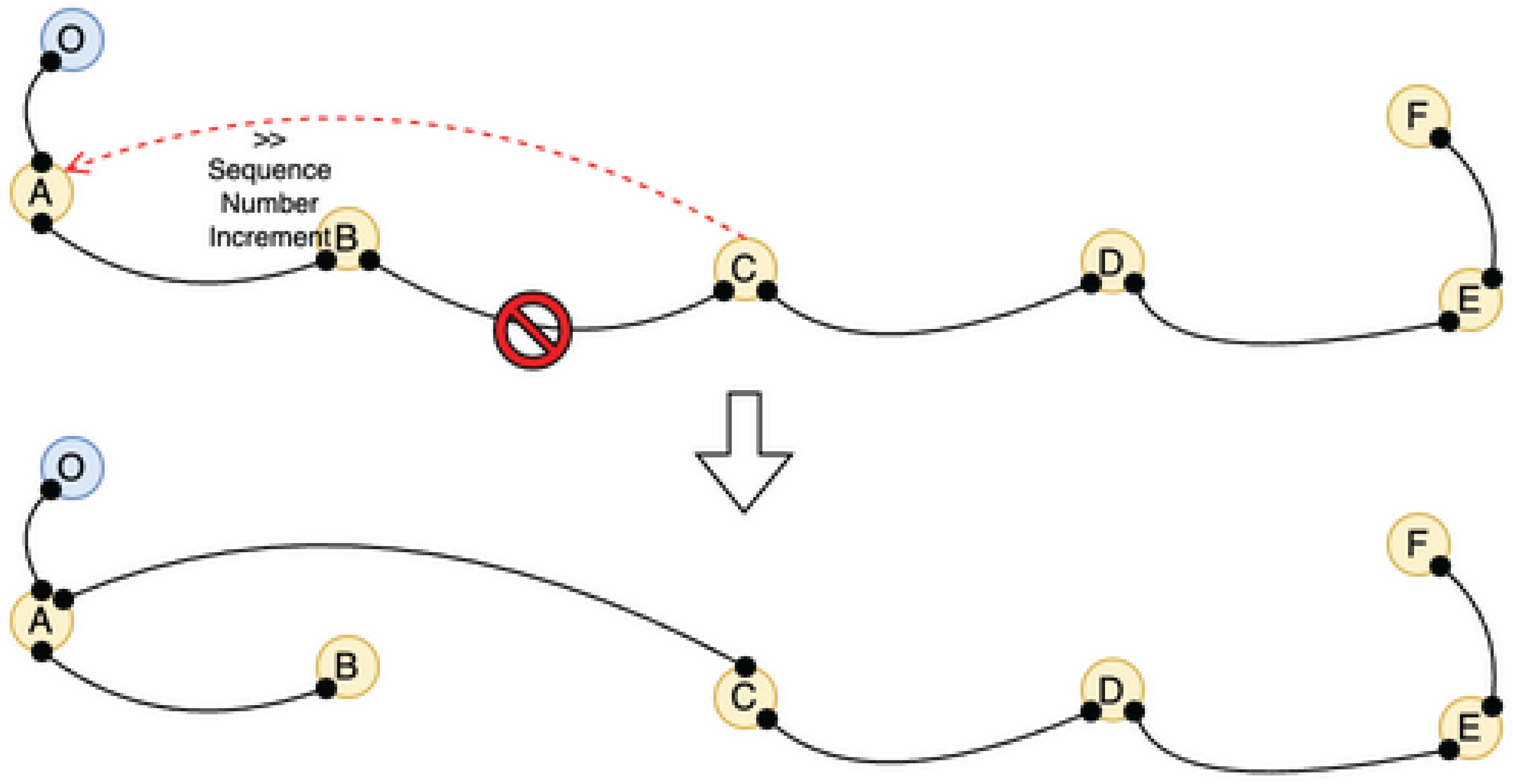
- Self-healing: nodes recover from crashes with seamless failover, Figure 15
- Self-management/optimization: HALT-driven adaptive policies (e.g., DSCP prioritization) sustain efficiency.
The contribution of this note is to provide architectural insights and implementation guidelines, rather than a full-scale evaluation, to support further development of scalable, cloud-native real-time video delivery.
7. Latency and Connection Stability
High RTTs (100–200 ms) between clients and distant Edge-SFUs cause ICE/STUN/TURN failures. Measured RTTs in Table 1 show severe degradation under mobile networks. To mitigate this, ICE timeouts must be tuned (e.g., iceGatheringTimeout, iceConnectionTimeout).
8. Related Work

Table 2.
Related Work.
| Gossip [1] Quorum Consensus Figure 6 |
Reduces monitoring cost, but only at the observation layer, not at control. |
|---|---|
| ENTS [2] (Edge Task Scheduling) Figure 7, Table 3 |
Similar use case (video analytics) but focuses on centralized scheduling, not streaming. |
| DMSA [3] Decentralized Micro- services Table 4 |
Decentralizes monitoring but retains centralized discovery queries. |
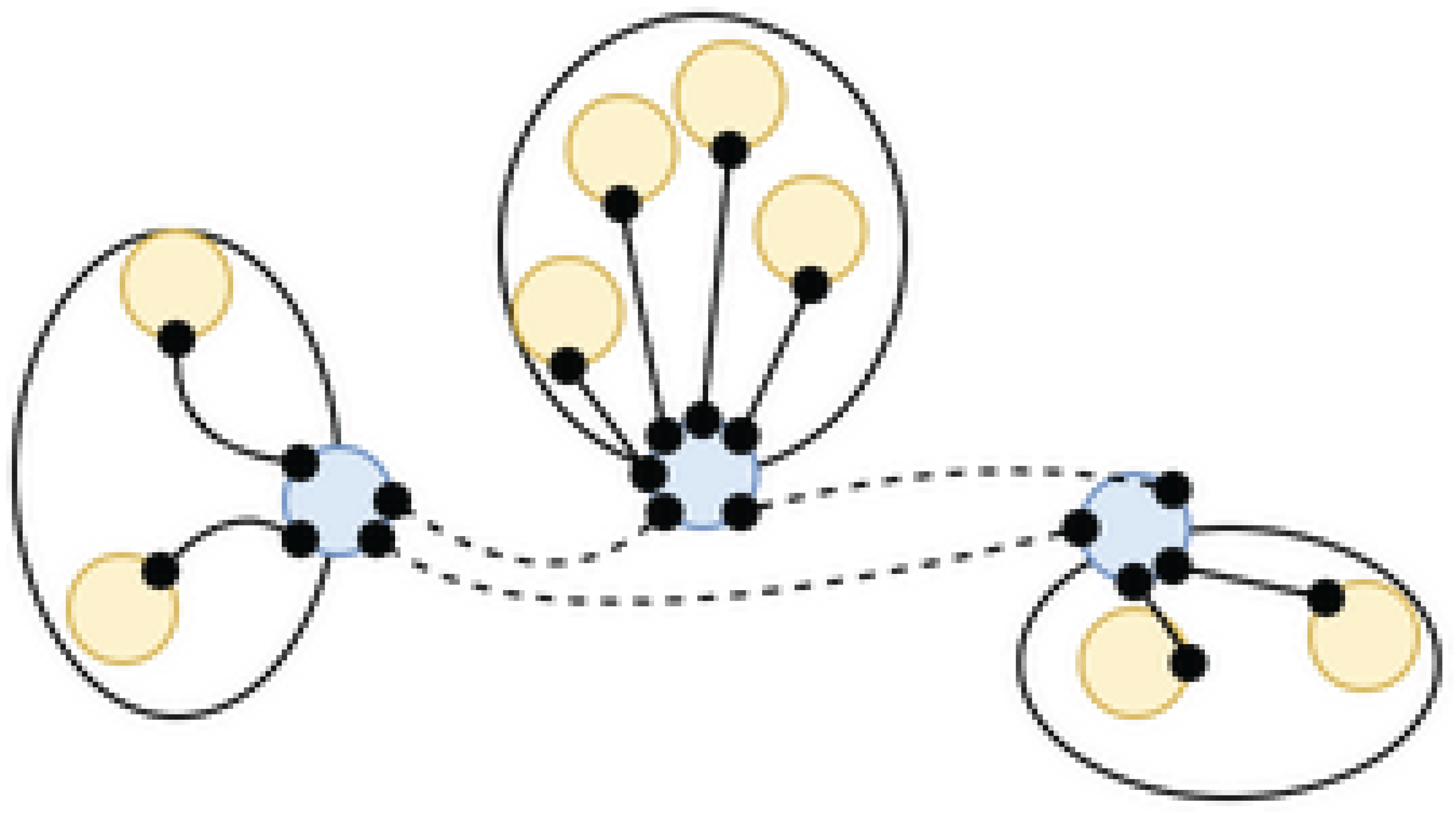
| P2P [12] Unstructured/Structured Figure 10 and Figure 11 |
Introduces hierarchical overlays with super-peers, which reintroduce centralization |
| Kademlia-based WebRTC, [6] Figure 8, Table 5 |
Efficient DHT, but requires global structure and is redundant for cloud-native environments (regions/zones already managed). |
| SDN-based Scalable conferencing, [5] |
Offloads SFU logic into P4 switches, skipping encryption/decryption, unsuitable for cloud cost-optimization |
| Enel Graph Propagation Scaling [7] |
Uses graph propagation with coordinators; unlike our fully autonomous FSM-based approach. |
| US20210218681A1 Flash Crowd Management In Real-Time Streaming [11] Table 6 |
Central servers predict and handle spikes, scaling at the cluster level. In contrast, our method uses HALT-driven autonomous Edge replication. |
| AWS Chime Media Pipelines [9] |
high abstraction and developer ease, but fully centralized, consuming extensive cloud resources. |
| Jitsi Conference Focus [10] |
similarly centralized, constrained by heavy backend control. |
Figure 6.
Self Distributed.
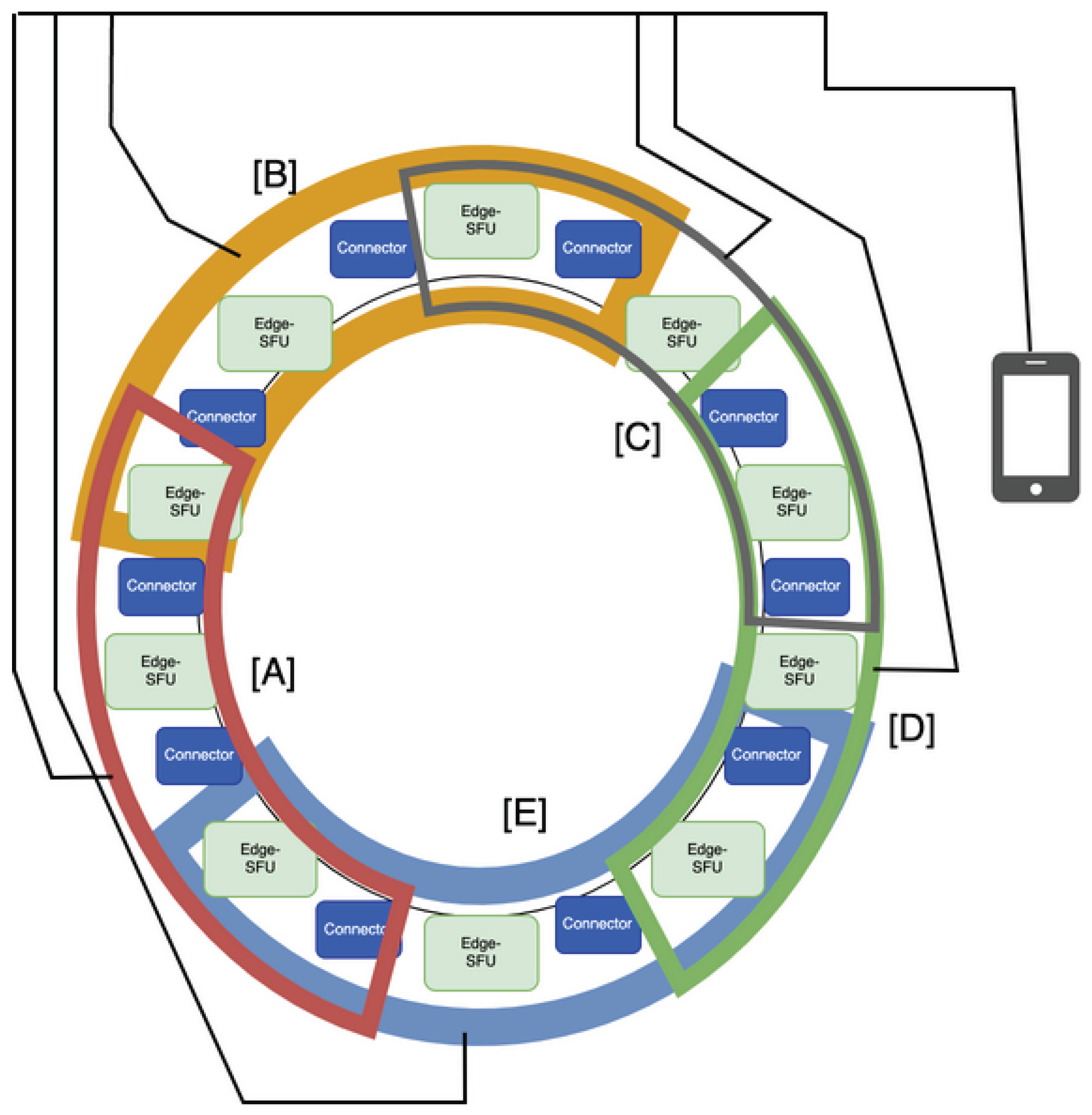
Table 3.
ENTS , This Architecture.
| Item | ENTS | This Proposal |
|---|---|---|
| Use Case | Video Analysis: Data Stream Task | Video Delivery: WebRTC |
| Scheduling | Online Algorithm+Global Optimization | Scale-in/Scale-out via Local Decisions |
Figure 7.
Semi-Intensive Conventional Monitoring.
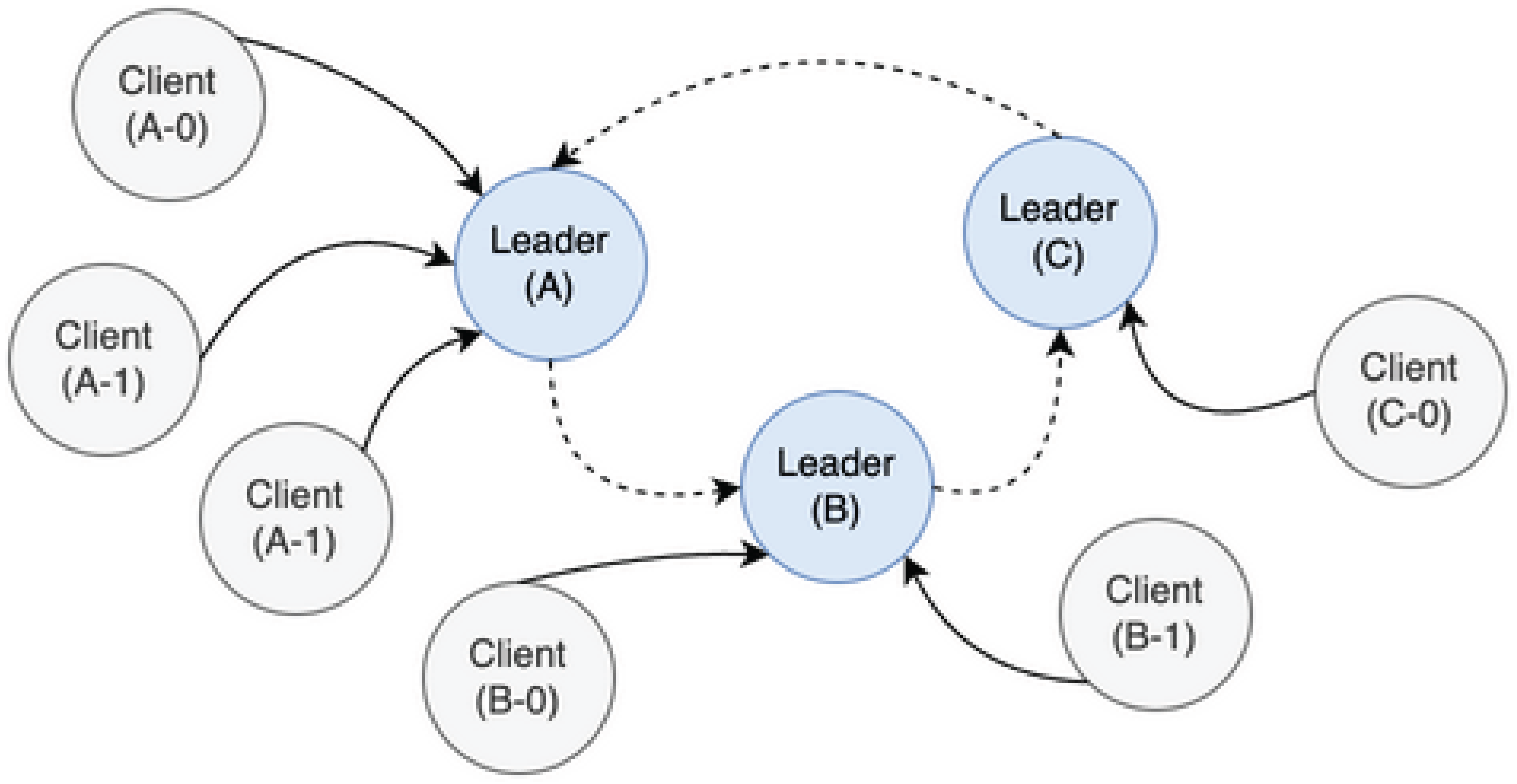
Table 4.
DMSA vs This Architecture.
| Item | DMSA | This Proposal |
|---|---|---|
| Decentrali- zation Depth |
Depends on central list, API router nature | No central list needed,self-forming topology |
| Limit, Risk | Bottlenecks in reflecting changes to overall definition, redefinition of centralization | Minimal scale-in/out load |
Table 5.
Kademlia , FSM/GCP.
| Item | Kademlia | This Proposal |
|---|---|---|
| Overview | Node search using XOR distance between node IDs | Selects optimal node using only local custom metrics per region/zone VM |
| Placement | Irregular and skewed node placement | Nodes structured logically and physically by region, zone, etc. |
| Search | O(log n) based on XOR distance | Real-time determination from RTT and HALT values of neighboring nodes |
| FSM | DHT distributed management | Nodes/devices manage only neighbor statistics |
| Failure | DHT redundancy | Nodes/devices manage only nearby statistics |
| Delay | k-bucket maintenance, DHT refresh | Node-specific local metric updates |
| Adaptability | Unspecified number of P2P nodes | GCP / Cloud, etc. Simple mechanism adapted to structured infrastructure |
Table 6.
IS20210218681A1 vs This Architecture.
| Item | US20210218681A1 | This Proposal |
|---|---|---|
| Traffic Spike Prediction |
Centralized, Central Server + Management System | Strongly Autonomous Distributed: Each Node Independently Decides, Acts |
| Scaling Granularity |
Scale-out at cluster level | Self-replication at local/neighboring Edge level |
Figure 8.
Kademlia XOR Metric.
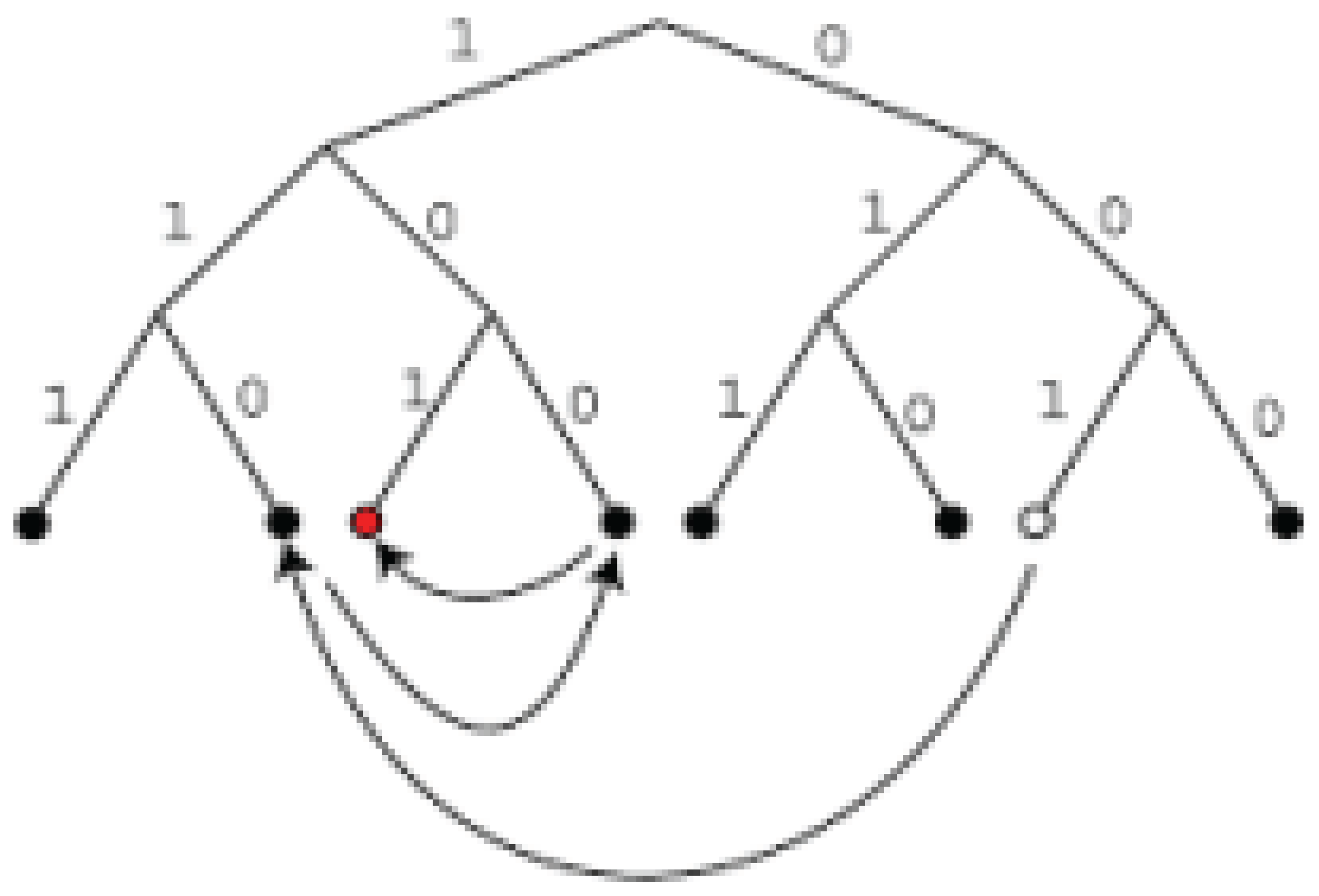
Figure 9.
Cloud Native Edge-SFU Selection.
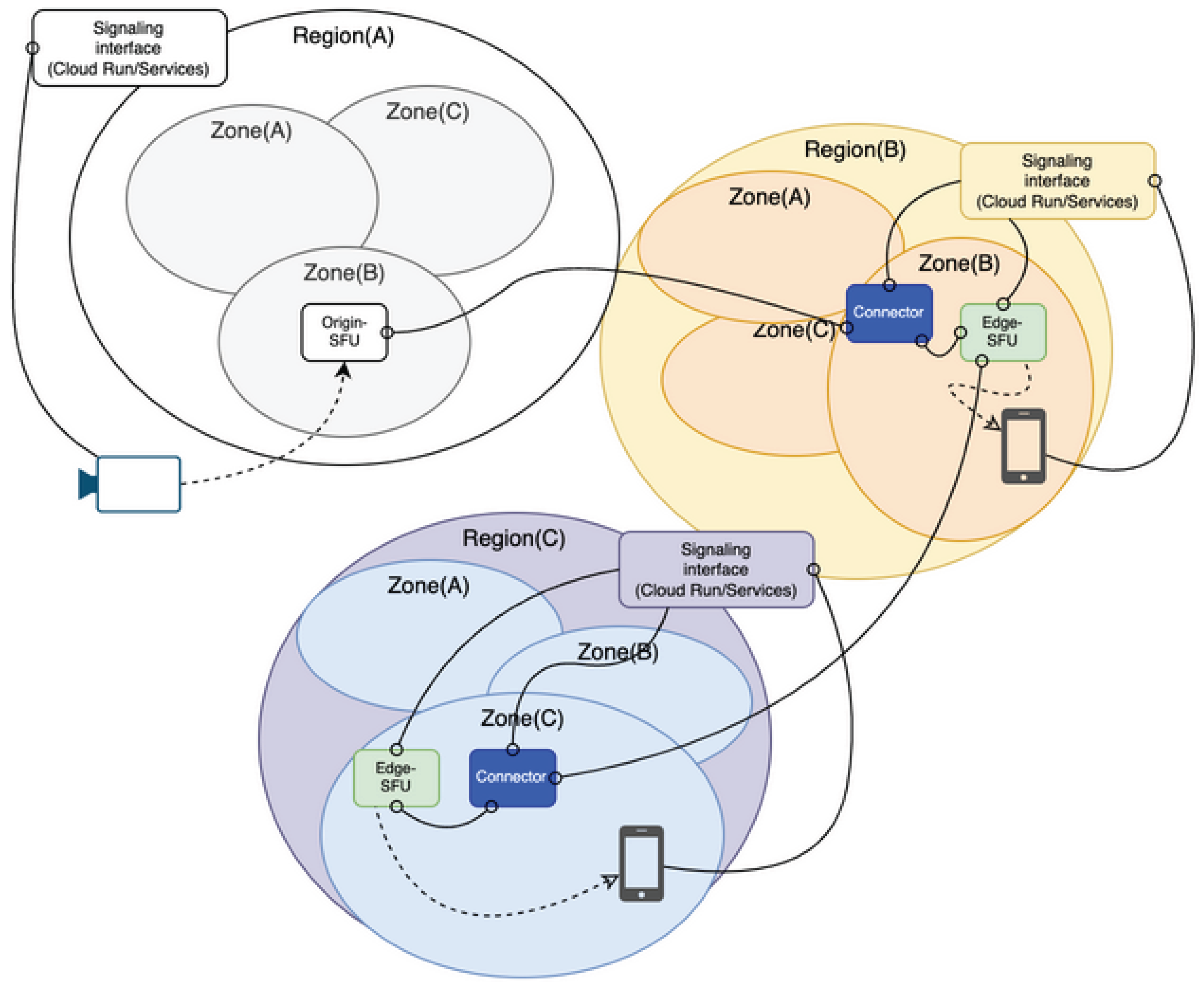
Figure 10.
Unstructured Structured 2-Layer Topology.
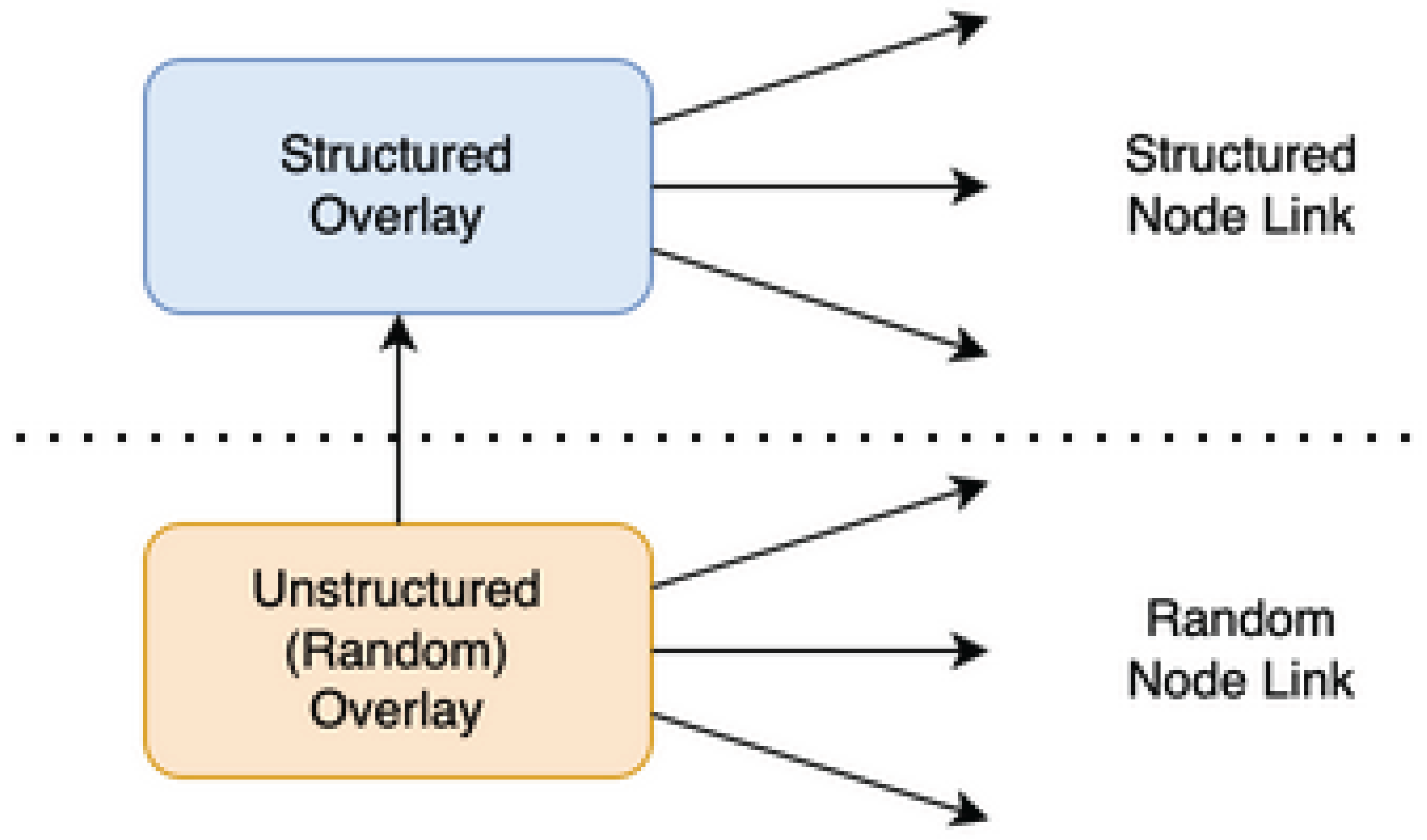
Figure 11.
Super Peer Networ.k
| Listing 1: Naming system. |
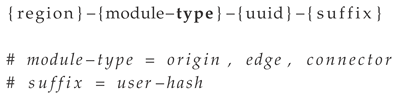 |
Shows naming and query systems used to select Edge-SFUs dynamically with HALT-based filtering.
9. Implementation
Figure 12.
Other Region.
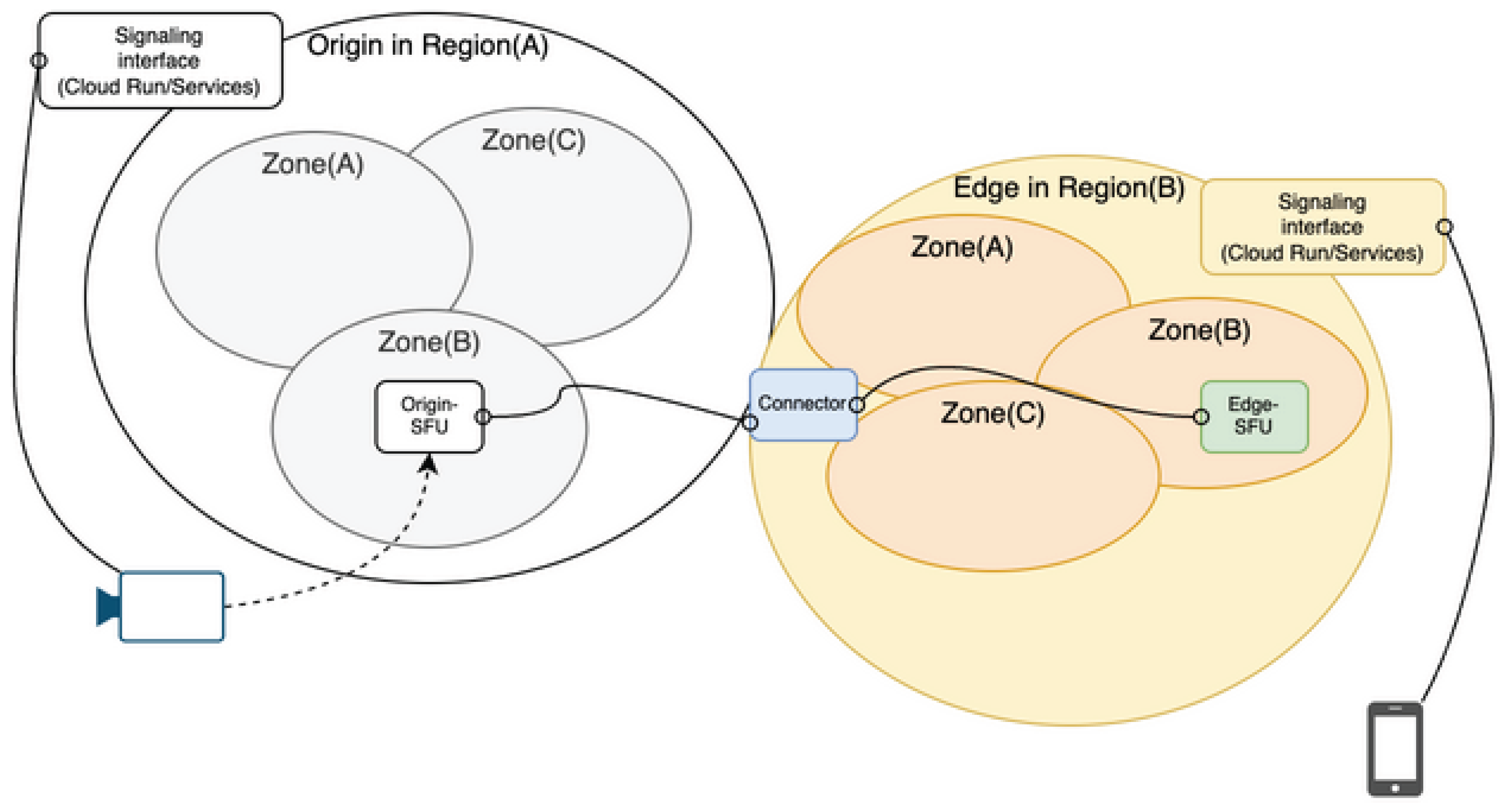
Figure 13.
Multi Region.
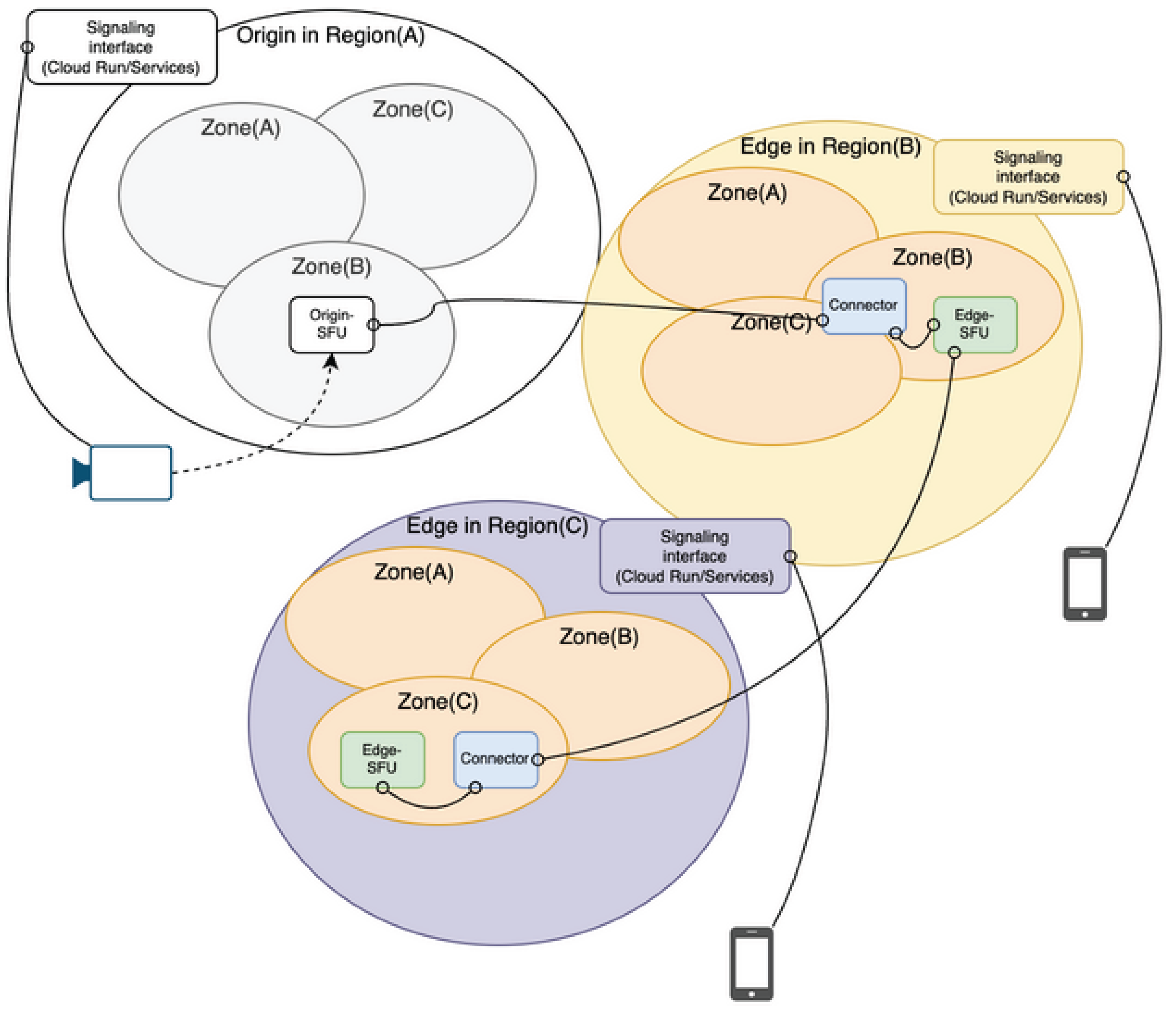
Figure 14.
Optimization and Reconfiguration of Communication Paths Based on Local Judgment.
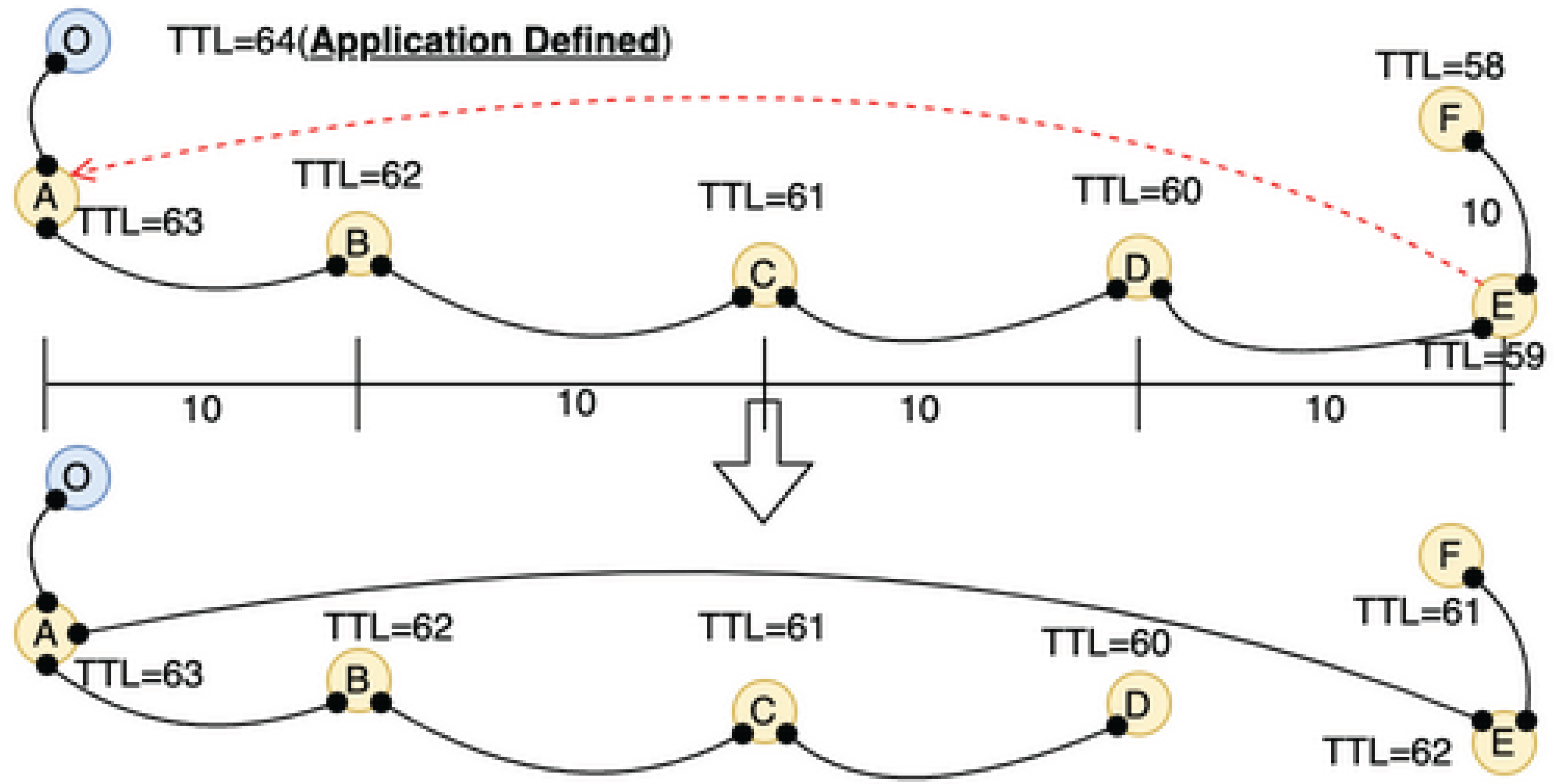
Figure 15.
Auto Failover based on local determination.
10. Appendix
10.1. Code Listings
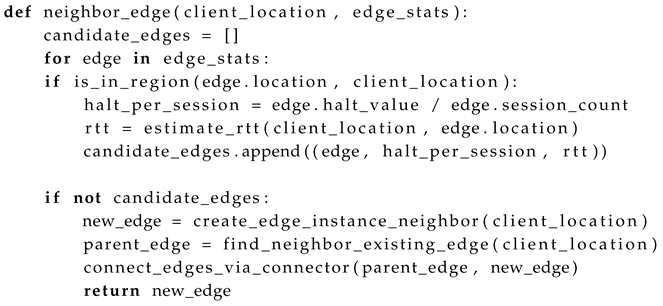
| Listing 2: Neighbor Edge Node Selection Algorithm. |
 |
 |
| Listing 3: Statistics Report. |
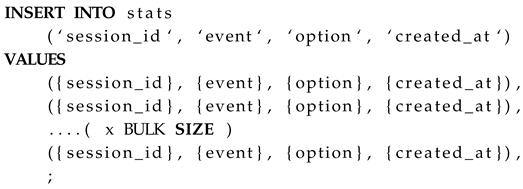 |
| Listing 4: CPU-Core-Mask. |
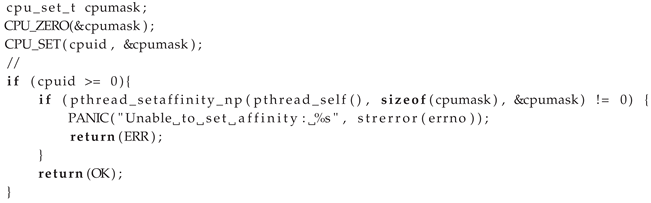 |
| Listing 5: Sample RTT measurement. |
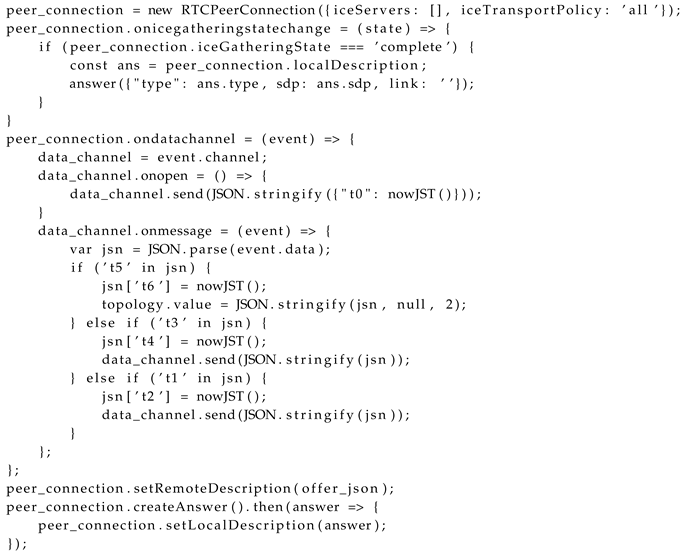 |
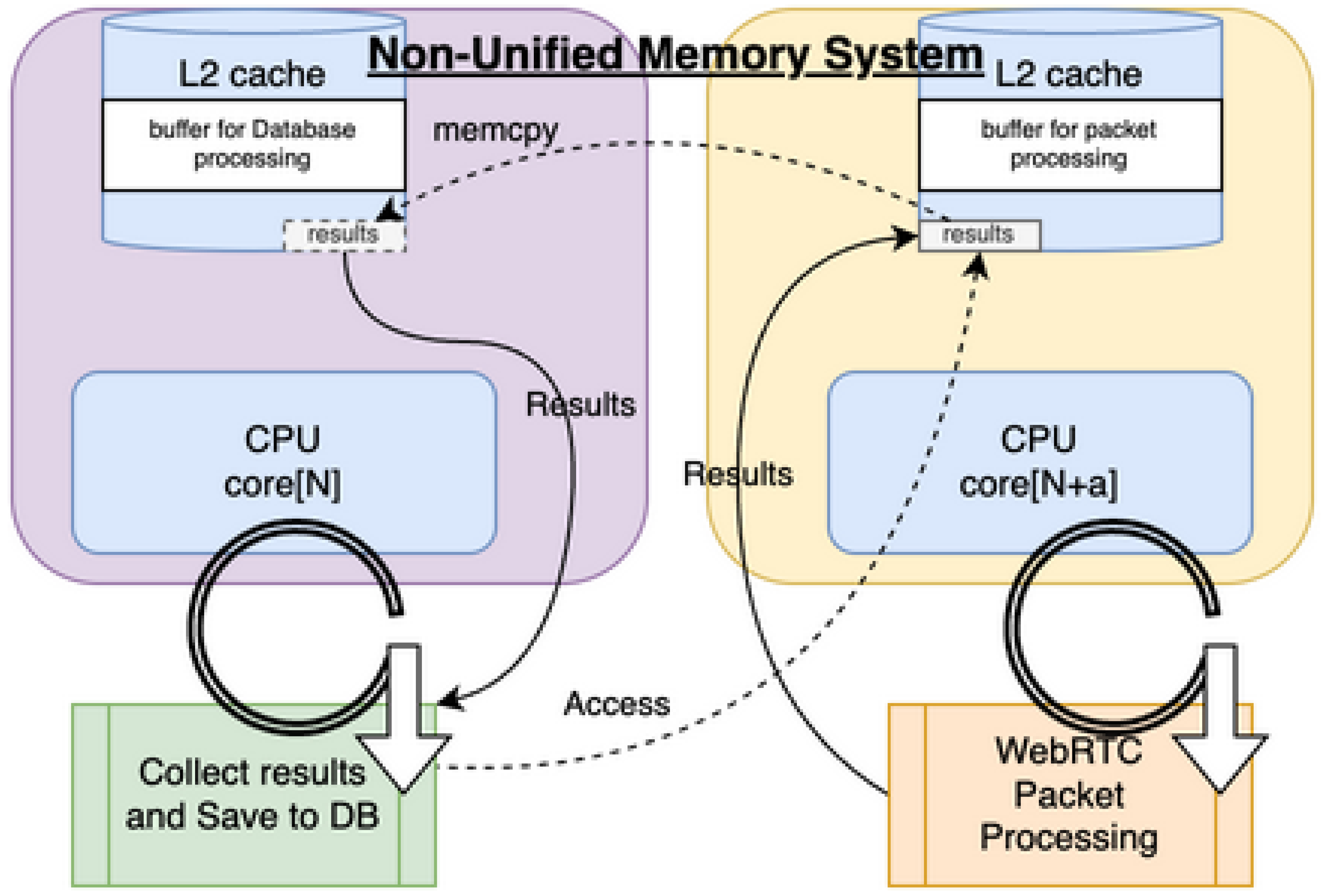
Appendix 10.2. Cache Pollution Avoidance
Edge-SFUs must prioritize packet forwarding over auxiliary tasks. Statistics collection, logging, or control messages can cause cache pollution and degrade forwarding throughput. Our implementation isolates forwarding-critical threads from reporting tasks, ensuring cache locality is preserved for real-time processing.
Figure 16.
Parallel Processin on Many-Core CPUs.
10.3. Origin-Edge Connectivity
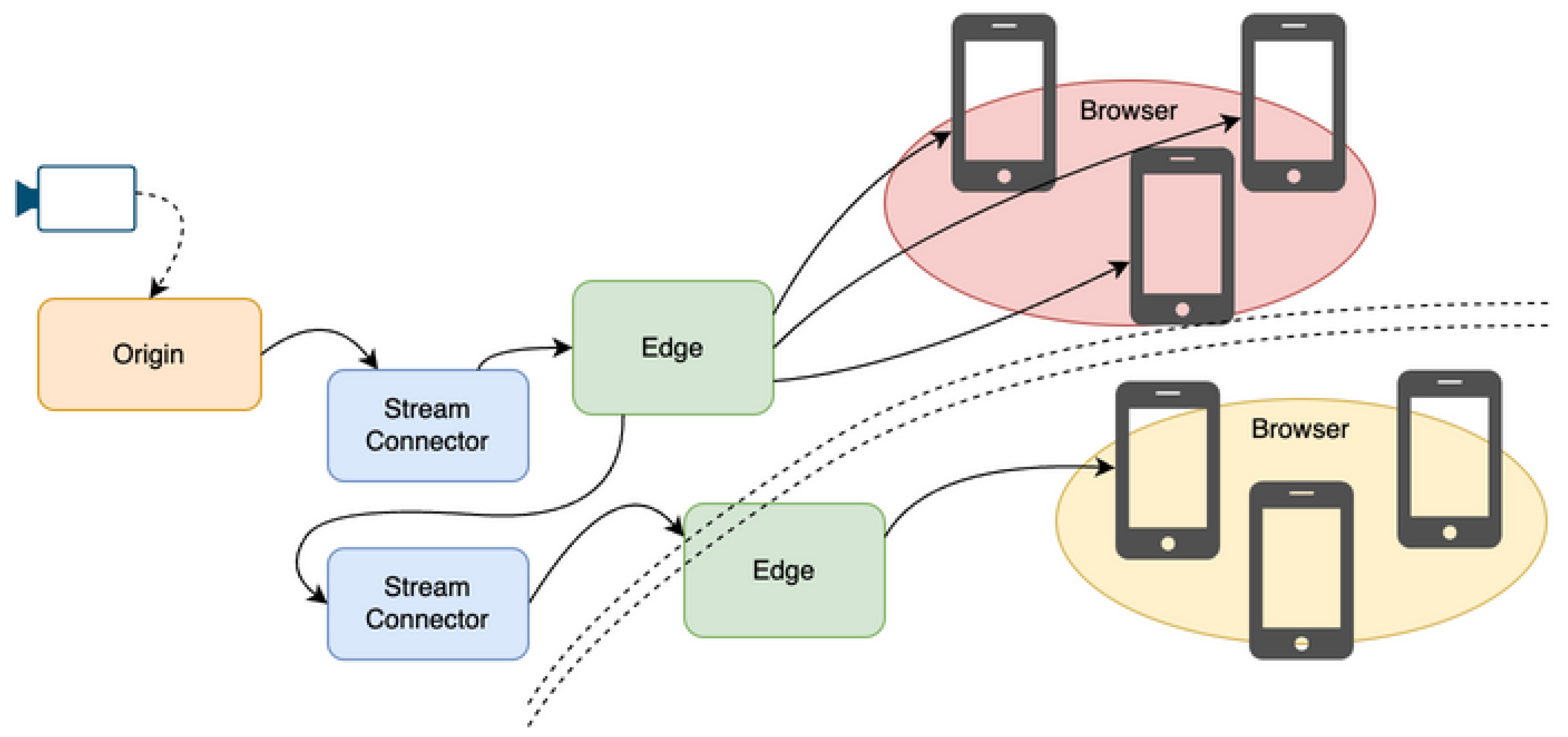
- Origin-SFUs and Edge-SFUs connect through NAT traversal connector modules.
- Clients search for nearby Edge-SFUs; if none exist, a new Edge-SFU (B) is spawned near the client.
- The new Edge-SFU automatically connects to an existing Edge-SFU (A) and integrates into the topology.
Figure 17.
Origin Edge Connectivity.
10.4. Improving Accuracy of Statistics – HALT Value
Traditional metrics (session count, CPU usage, bandwidth) fail to measure actual spare capacity.
- We introduce HALT (Hardware Available Load Threshold) as a real metric.
- HALT measures residual processing capacity after each loop, incorporating CPU idle, I/O waits, throughput, etc.
- This enables more reliable distributed decision-making
10.5. Oversized Statistics Systems
Traditional systems often suffer from bloated statistics pipelines (HTTP APIs, external analytics). These consume CPU, memory, and network resources, ironically destabilizing the system. Our approach keeps statistics simple (local MySQL + replication), enabling SFUs to focus on packet processing.
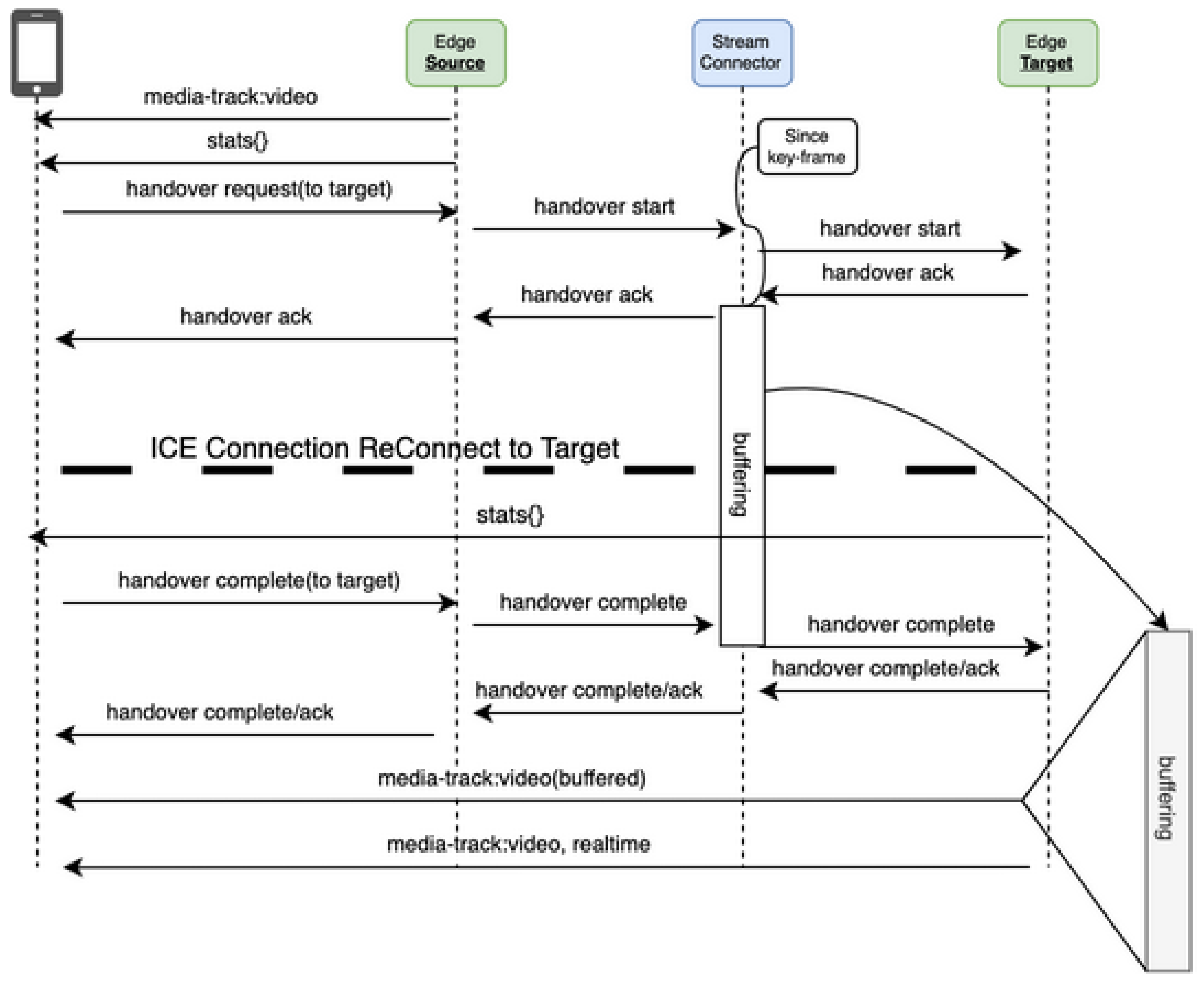
10.6. Handover
ICE/TURN negotiation introduces latency, Buffers synchronize 2–30 frames between source and target Edge-SFUs
Table 7.
Handover Entities.
| Item | Overview |
|---|---|
| Mobile Device | UE(User Equipment) |
| HandOver Origin | Currently Connected Edge-SFU |
| HandOver Dest | Target Edge-SFU |
| Connector | Stream-Connector during handover |
| Buffer | Media(video) buffering during handover |
Figure 18.
Handover Sequence
11. AI Disclosure
The author used a large language model ChatGPT, OpenAI to assist in proofreading, grammar checking, and improving the clarity of expressions. The author reviewed and is responsible for the final content.
Author Contributions
Conceptualization, Methodology, Software, Validation, Formal analysis, Investigation, Resources, Data Curation, Writing-Original Draft, Writing-Review and Editing, Visualization, Supervision, Project administration: D.Sugisawa.
Funding
This research received no external funding.
Conflicts of Interest
The author declares no conflicts of interest.
References
- SHASHIKANT ILAGER. A Decentralized and Self-Adaptive Approach for Monitoring Volatile Edge Environments. http://arxiv.org/abs/2405. 0780.
- Mingjin Zhang. ENTS: An Edge-native Task Scheduling System for Collaborative Edge Computing. http://arxiv.org/abs/2210. 0784.
- Yuang Chen. DMSA: A Decentralized Microservice Architecture for Edge Networks. https://arxiv.org/pdf/2501. 0088.
- Chmieliauskas. Evaluation of Uplink Video Streaming QoE in 4G and 5G Cellular Networks Using Real-World Measurements. [CrossRef]
- Oliver Michel. Scalable Video Conferencing Using SDN Principles. https://arxiv.org/pdf/2503. 1164.
- Ryle Zhou. Decentralized WebRTC P2P Network Using Kademlia. https://arxiv.org/abs/2206. 0768.
- Dominik Scheinert. Enel:Context-Aware Dynamic Scaling of Distributed Dataflow Jobs using Graph Propagation. https://arxiv.org/pdf/2108. 1221.
- Shaher Daoud and Yanzhen, Qu. A COMPREHENSIVE STUDY OF DSCP MARKINGS’ IMPACT ON VOIP QOS IN HFC NETWORKS. https://aircconline.com/ijcnc/V11N5/11519cnc01.
- AWS Chime Media Pipelines. https://docs.aws.amazon.com/chime-sdk/latest/dg/media-pipelines.
- jitsi. Jitsi Conference Focus. https://github.
- US20210218681A1. Flash crowd management in real-time streaming. https://patents.google. 2021.
- Tao, GU. A Hierarchical Semantic Overlay for P2P Search. https://arxiv.org/pdf/2003. 0500. [Google Scholar]
- Babaoglu. Self-star Properties in Complex Information Systems: Conceptual and Practical Foundations. [CrossRef]
| 1 | |
| 2 | |
| 3 |
Figure 1.
Cooperative autonomously distributed topology.
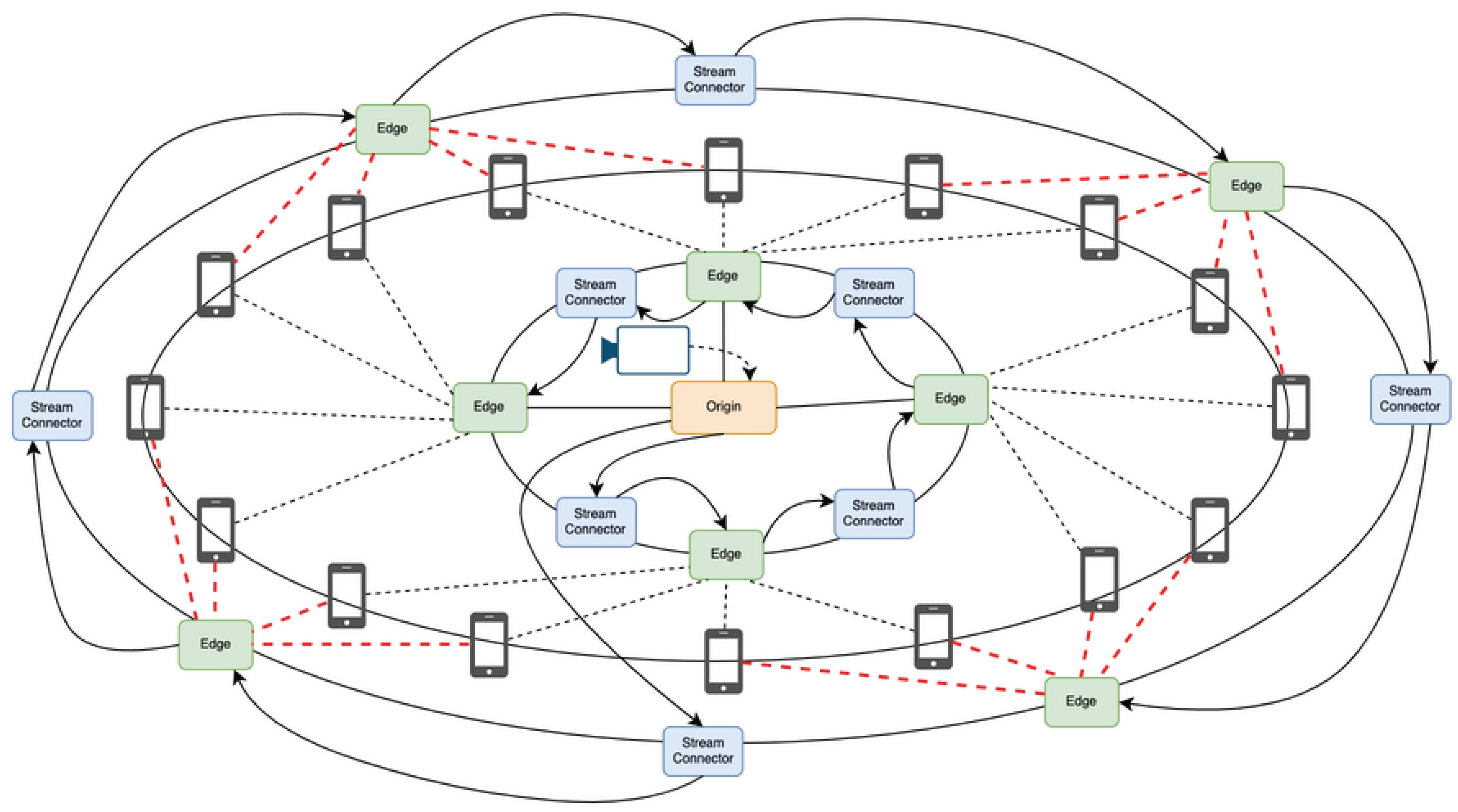
Figure 2.
Scale-Out Protocol
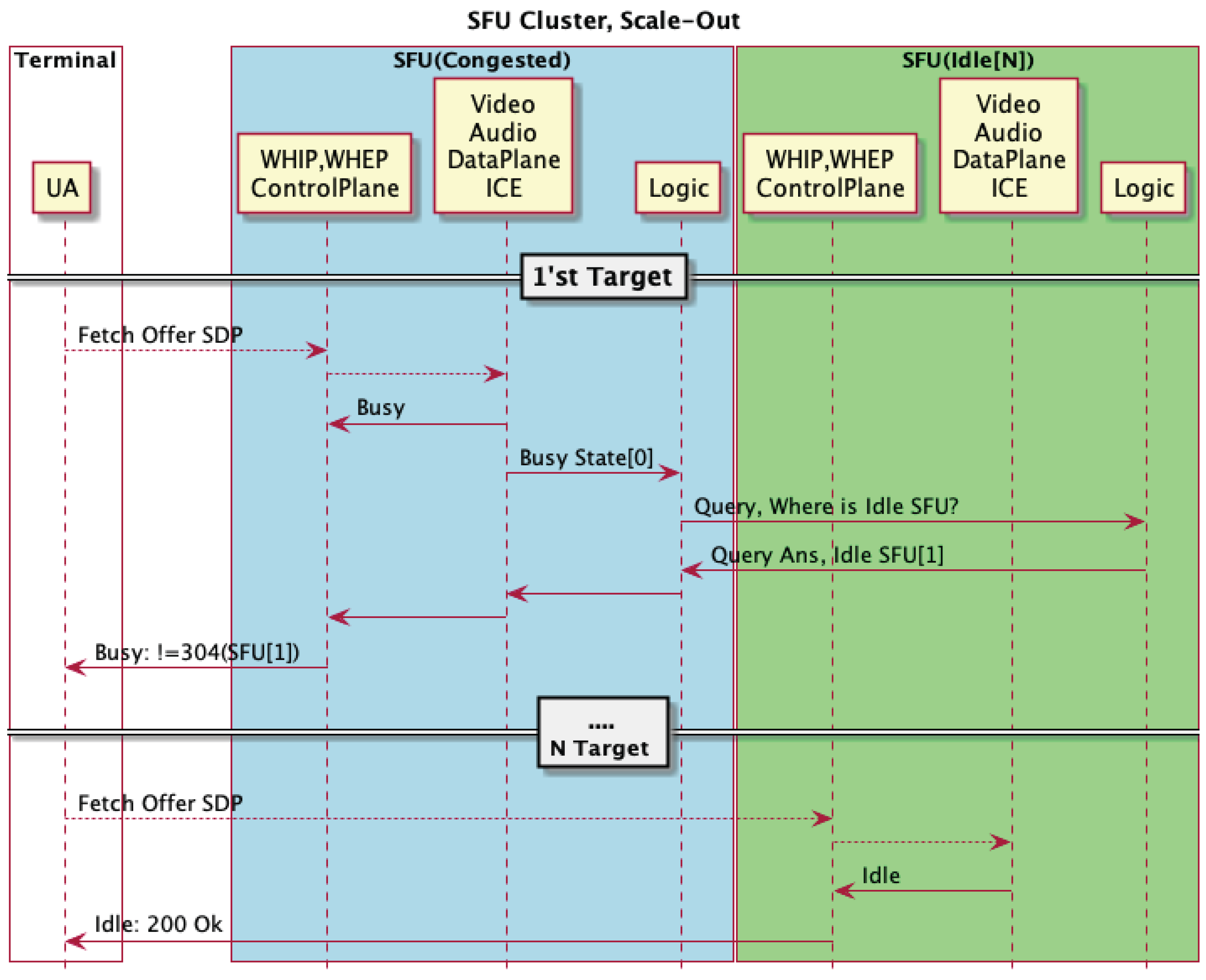
Figure 3.
Scale-In Protocol
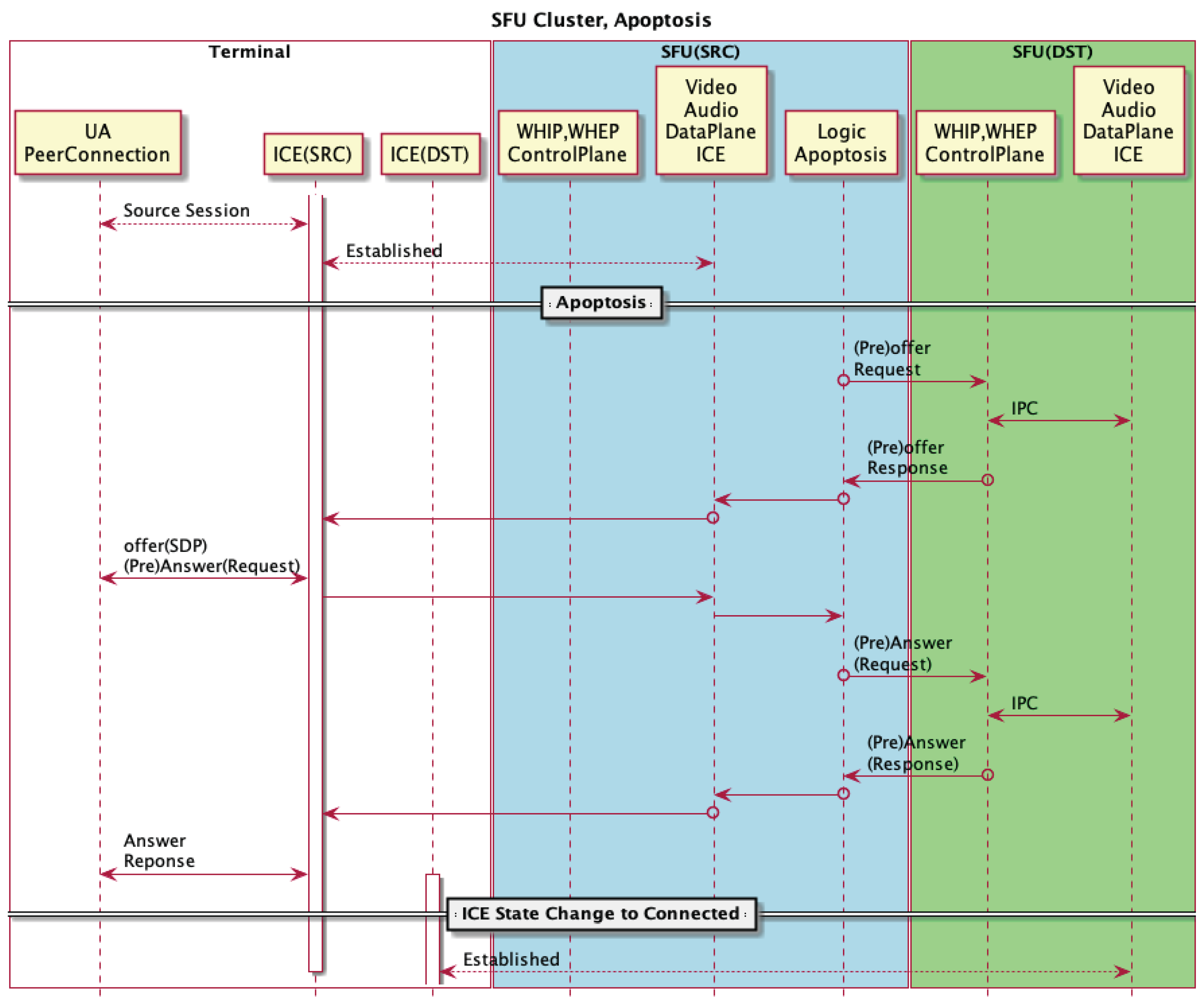
Figure 4.
Neighbor-closed topology
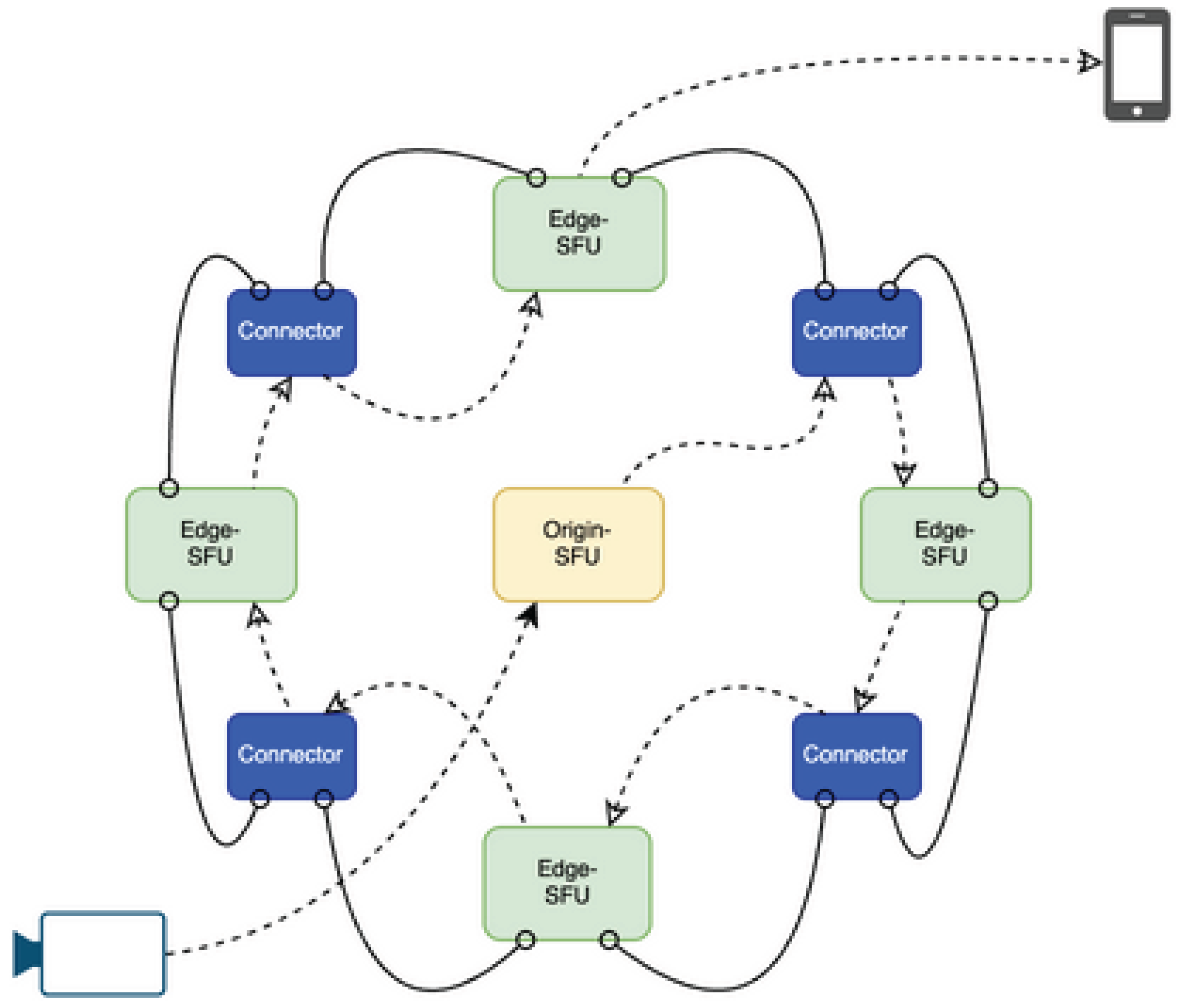
Figure 5.
Inter-Region RTT
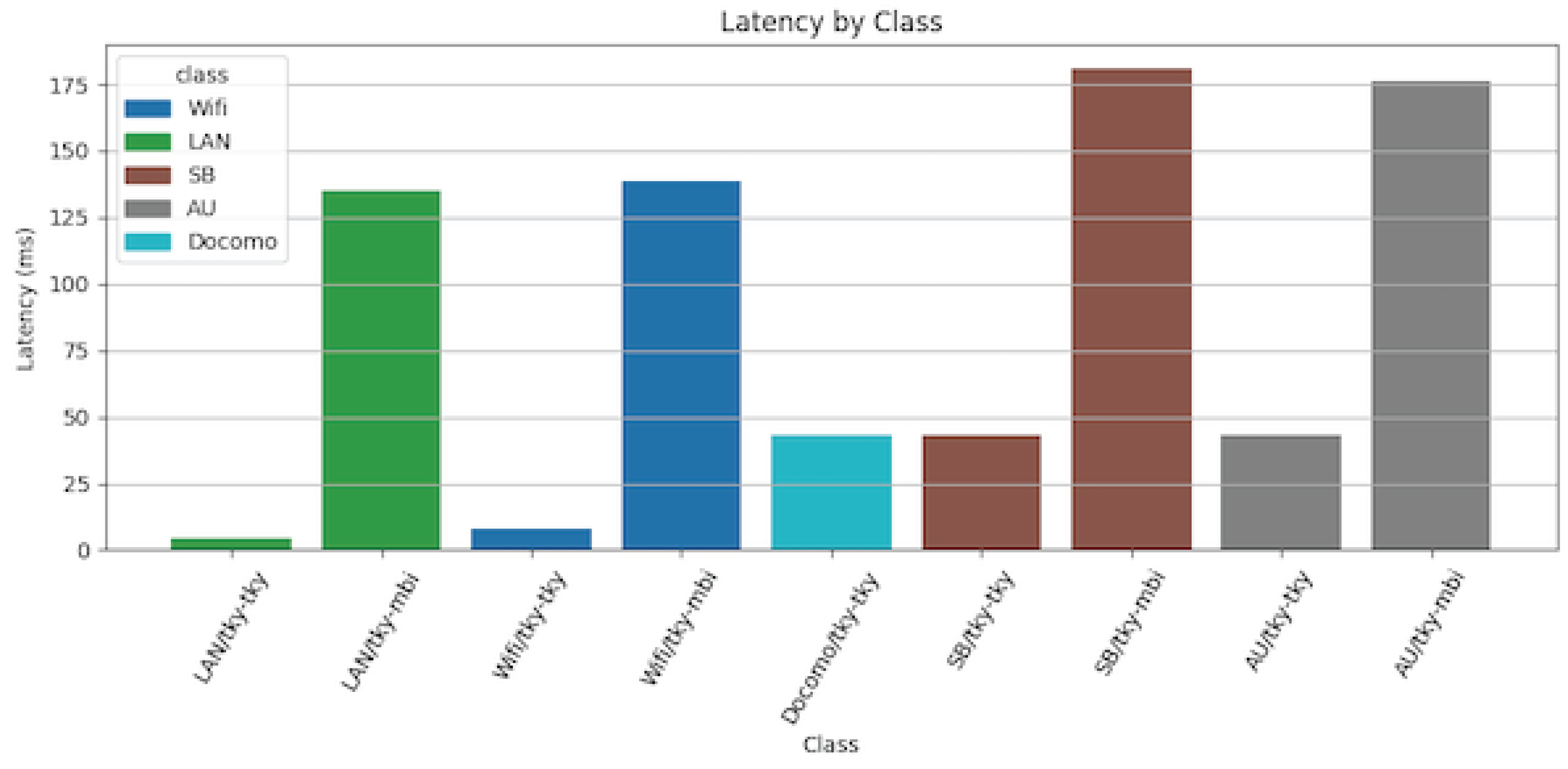
Table 1.
measured RTT Tokyo - Region
| EnterPrise LAN Tokyo-Tokyo | 4.3 ms |
|---|---|
| EnterPrise LAN Tokyo-Mumbai | 135.2 ms |
| EnterPrise Wifi Tokyo-Tokyo | 7.8 ms |
| EnterPrise Wifi Tokyo-Mumbai | 138.5 ms |
| Mobile Docomo Tokyo-Tokyo | 43.0 ms |
| Mobile Softbank Tokyo-Tokyo | 43.0 ms |
| Mobile Softbank Tokyo-Mumbai | 180.7 ms |
| Mobile AU Tokyo-Tokyo | 43.0 ms |
| Mobile AU Tokyo-Mumbai | 176.2 ms |
Disclaimer/Publisher’s Note: The statements, opinions and data contained in all publications are solely those of the individual author(s) and contributor(s) and not of MDPI and/or the editor(s). MDPI and/or the editor(s) disclaim responsibility for any injury to people or property resulting from any ideas, methods, instructions or products referred to in the content. |
© 2025 by the authors. Licensee MDPI, Basel, Switzerland. This article is an open access article distributed under the terms and conditions of the Creative Commons Attribution (CC BY) license (http://creativecommons.org/licenses/by/4.0/).
Copyright: This open access article is published under a Creative Commons CC BY 4.0 license, which permit the free download, distribution, and reuse, provided that the author and preprint are cited in any reuse.


