

Submitted:
14 October 2025
Posted:
15 October 2025
You are already at the latest version
Abstract
Urban rivers provide vital ecosystem services, benefiting both nature and people, yet they are heavily impacted worldwide, exhibiting similar symptoms collectively known as the Urban Stream Syndrome (USS). This study assessed the ecological health of the Someșul Mic River, located in Cluj-Napoca, Romania’s second-largest and rapidly developing city, through the lens of benthic invertebrate communities, recognized for their strong bioindicator value. Six sites along the main river course and four adjacent sites on tributaries and an artificial canal were analyzed. Our findings revealed the presence of USS at all sites; however, contrary to expectations, the mainstem sites showed higher water quality and greater taxonomic and functional diversity of zoobenthos. The primary drivers of this pattern were the proportion of coarse sediments and flow velocity, with river width playing a lesser role. Based on these results, eight mitigation strategies were proposed, aligned with the river ecosystem services. Their implementation could improve the ecological condition across the river, floodplain, and catchment levels, involving both scientists and the general public. Overall, the study provides a management-oriented framework for future river restoration initiatives in a growing city and a comparative reference for urban river assessments.
Keywords:
mainstem vs. adjacent sites
; Cluj-Napoca (Transylvania
; Romania)
; taxonomic & functional diversity
; drivers
; bioassessment
; mitigation
; ecosystem services
1. Introduction
The progressive anthropization of natural environments began with the establishment of early human settlements near water bodies, which served as essential resources for sustenance and hygiene [1]. Over time, water systems became transport routes, raw material sources, and waste receptors, and today this intensified interaction between the anthroposphere and urban aquatic systems exerts cumulative stress, leading to the alteration and degradation of both components [2,3,4]. The iconic profile of urban environments is often shaped by their natural water bodies—rivers, lakes, coasts, or wetlands—whose networks have been progressively incorporated into the expanding urban canvas, in a reciprocal relationship where cities reshape aquatic systems through channelization, embankments, and hydromorphological alterations [5]. Over time, natural water networks have been transformed into utilitarian systems shaped to meet the functional demands of urban development, serving purposes ranging from recreation and transport to industry and irrigation [2,6]. The parallel evolution of water supply, drainage, and wastewater treatment infrastructures has integrated these systems into the urban hydrological network, enabling the recycling and reintegration of treated water to protect ecosystems and sustain water resources.
Urbanization represents a major driver of anthropogenic pressure, encompassing increased greenhouse gas emissions, waste management challenges, and extensive transformations in land use and urban morphology [7]. Urbanization is a prevailing global trend, with over half of the world’s population already concentrated in urban centers and their catchment areas, a figure projected to exceed two-thirds by 2050 [8,9].
Smart cities represent a possible model of urban development that integrate digital technologies, communication systems, and data analytics to improve quality of life, service efficiency, and sustainability [10]. Although definitions differ, they are generally understood as cities that transform traditional services and infrastructures through information and communication technologies. Core elements include smart infrastructure, mobility, energy, healthcare, and technology systems, supported by foundational tools such as the Internet of Things (IoT) and big data [11]. By linking physical, technological, social, and economic infrastructures, smart cities strive to create greener, safer, more efficient, and more inclusive urban environments. Although the smart city concept explicitly addresses climate change and environmental degradation [10], urban biodiversity is rarely included in the metrics used to prioritize project initiatives. Yet cities play a key role in biodiversity conservation [12], while urban biodiversity enhances climate resilience, supports human health, and fosters positive attitudes toward nature [13].
In this context, Blue-Green Infrastructure (BGI) in cities - an interconnected network of natural and semi-natural areas, such as rivers, wetlands, parks, and green corridors, integrates water and vegetated systems to enhance biodiversity, ecosystem services, and urban resilience [14]. Despite the proven benefits of urban BGI, its implementation remains challenging worldwide [15], particularly in developing countries like Romania, where blue infrastructure is underrepresented in local policies and strongly shaped by the morphological and historical characteristics of cities [16].
Urban waters are among the most heavily modified ecosystems, transformed by urbanization, land cover change, industrialization, and large-scale engineering to maximize human water use [17,18]. These alterations gave rise to the concept of Urban Stream Syndrome (USS), which describes specific hydrological, chemical, and biological degradation observed in urban rivers [19]. USS refers to rivers characterized by four major features: increased flow variability, hydromorphological alterations, high pollutant loads, and the predominance of tolerant taxa [18,19,20,21]. Additional criteria have later been proposed to describe these highly impacted ecosystems, including alterations of riparian communities, ecosystem-level processes, rubbish accumulation [22], and the ecosystem services provided by the river [23].
Surface water quality is primarily assessed through biotic components of ecosystems—namely benthic invertebrates, algae, macrophytes, and fish —using standardized and legally mandated methods, e.g., the Water Framework Directive 2000/60/EC in Europe [24,25,26]. Benthic invertebrates are key components of river food webs and reliable bioindicators, due to their limited mobility, short life cycles, sediment–water interface habitat, and diverse tolerance to pollutants [27]. Benthic invertebrates are most useful for assessing responses to urbanization due to their well-documented and consistent community shifts [19]. Accordingly, numerous studies assessing water quality in urban rivers rely on zoobenthic community characteristics such as abundance or taxonomic diversity [28,29,30], or on functional traits and multi-metric indices [31,32,33].
The present study focuses on Cluj-Napoca, Romania’s second largest city after the capital, Bucharest, with nearly 400,000 inhabitants including its metropolitan area (2021 Population and Housing Census, National Institute of Statistics, https://insse.ro, accessed on 2 October 2025). The Someșul Mic River, formed upstream at the confluence of the Someșul Cald and Someșul Rece rivers, flows west to east through the city. It drains a catchment of 3,733 km² and has a total length of 100 km, about one quarter of which lies within the metropolitan sector [34]. The region holds major socio-economic importance, having experienced rapid urbanization in recent years, with the Someșul Mic River corridor identified as the main axis for the future development of the Cluj-Napoca Metropolitan Area [35]. Previous studies on river ecosystems from the city of Cluj-Napoca included both environmental analyses [36,37,38] and data on biotic communities, like diatoms and invertebrates [39,40,41,42] or fish [43].
The present study has two main objectives: (1) to investigate the ecological health of the Someșul Mic River, a key component in the sustainable development of a rapidly expanding urban region, and (2) to propose mitigation solutions for the problems revealed by data analyses. Our working hypothesis was that the river exhibits typical symptoms of an urban stream (USS), particularly along its main course and within the city center, while tributaries bring cleaner water that helps improve overall quality (1.1). To assess the USS, we examined the primary drivers of benthic invertebrate abundance and diversity, a community selected for its essential role in ecosystem functioning and its high bioindicator value (1.2). Based on the key findings, targeted solutions were identified and linked to the ecosystem services provided by the urban Someșul Mic River, with the dual aim of informing similar research in comparable regions and supporting decision-makers in future remediation programs (2).
This study provides an applied perspective by using benthic invertebrate data—taxonomic richness, biotic indices, and functional diversity—to propose realistic mitigation strategies that can restore the river role as a supporting system for the city.
2. Materials and Methods
2.1. Sampling and Environmental Parameters
Ten stations were selected for benthic invertebrate sampling, consisting of six mainstem sites along the principal course of the Someșul Mic River within the city of Cluj-Napoca (SUV, SDV, SUN, SDN, SUC, SDC) and four adjacent sites, including two on major tributaries (Valea Gârbăului VGB and Nadăș NAD) and two on Canalul Morii (CM1 and CM2) (Table S1, Figure 1). Canalul Morii, an artificial branch of the Someșul Mic River flowing roughly parallel to it for about 7 km, was created following the City Council decision from 1558, to divert the river water closer to the town through an excavated channel [44].
Numerous environmental parameters were measured in the field using portable instruments: dissolved oxygen and water temperature with a HI98193 portable oximeter, water conductivity and pH with a Hanna HI98130, flow velocity with Geopacks 4.3 flowmeter, and phosphate and nitrate concentrations with HI3817BP portable test kits (Table S1). Other field measurements included river width and depth, distance to the nearest built area, and the composition of different bed sediments, based on which the river was classified as riffle or riffle/pool according to [46] (Table S1). The adjacent sites were characterized by high water conductivity values and elevated concentrations of phosphates. The six mainstem stations exhibited greater widths and depths, higher flow velocities, and a higher proportion of boulders and pebbles in the sediments (Figure 2).
2.2. Laboratory Analyses on Benthic Invertebrates
Semiquantitative samples were collected using 250-µm mesh kick nets, with five replicates taken at each station, totaling a sampled area of 3125 cm², in accordance with standardized methods (e.g., [47]). Samples were preserved in the field with 96% ethanol, then washed in the laboratory using sediment sieves, manually sorted under Nikon SMZ 800 stereomicroscopes and Nikon YS100 microscopes, and identified to different taxonomic levels (Table S2) using standard identification keys (e.g., [48]).
Three functional traits were used to distinguish guilds within the benthic invertebrate communities: (i) body size (following [48]), (ii) dispersal ability, and (iii) feeding habit (Table S2). Body size separated taxa into large and small forms, while dispersal ability distinguished mobile taxa (with a winged stage enabling high dispersal) from sedentary taxa (lacking an aerial phase). Parasites associated with aerial hosts were also included in the mobile guild, as their dispersal potential is mediated by their winged hosts [49]. Feeding habits were classified into eight distinct trophic guilds (i.e., functional feeding groups FFG): (1) scrapers, feeding by grazing organic and mineral substrates; (2) shredders, consuming macrophytes or coarse detritus; (3) suspension feeders (filtering collectors), ingesting algal cells and fine particulate organic matter; (4) sediment feeders (gathering collectors), exploiting fine particulate organic matter deposited on the streambed; (5) engulfing predators (swallowers), consuming whole organisms or body parts; (6) piercing predators, extracting cell and tissue fluids; (7) piercing herbivores, sucking the contents of algal cells; and (8) parasites, exhibiting parasitic feeding strategies (Table S2). FFG assignment was performed following [48,50,51,52,53].
2.3. Indices and Statistical Analyses
Basic ecological indices were calculated for the benthic invertebrate communities: frequency, expressed as the percentage of samples in which each taxon was present; relative abundance, expressed as the proportion of individuals of each taxon within the community; and the index of dominance ID [54], representing the percentage contribution of the two most abundant taxa in each community. Taxonomic diversity was assessed by means of species richness, Shannon–Wiener diversity H′ [55], and the effective number of taxa, exp(H′), expressing diversity in terms of equally abundant species [56] (Table S3). The effective number of taxa ranges from 1 to the actual species richness (under perfect evenness) and offers the advantage of enabling direct site comparisons and a more intuitive interpretation than the Shannon–Wiener index, which is expressed in entropy units [56].
Water quality was assessed using two biotic indices based on aquatic invertebrates: the Extensive Biotic Index, EBI [57] and the Modified New Walley Hawkes, MNWH [46]. EBI is based on the presence and taxonomic composition of benthic invertebrates identified at family or genus level, whereas the MNWH assigns scores to families (with Oligochaeta treated as a group) using either Presence-Only (PO) data or four abundance classes (AR, Abundance Related: 1–9, 10–99, 100–999, >1000 individuals). Both EBI and MNWH classify water quality into five categories: class I, high (EBI: 10–12; MNWH: >100); class II, good (EBI: 8–9; MNWH: 71–100); class III, moderate (EBI: 6–7; MNWH: 41–70); class IV, poor (EBI: 4–5; MNWH: 11–40); and class V, bad (EBI: 0–3; MNWH: 0–10) (Table S3).
Community trait structure was examined by considering both the mean trait values of dominant taxa (community trait mean) and the dissimilarities among taxa (functional diversity). The dissimilarity matrix was calculated using the Gower distance [58] with the ‘gawdis’ function in R [59,60], integrating mixed trait types: quantitative (body size), binary (dispersal ability), and fuzzy-coded, allowing intermediate trait values (FFG) [61]. Hierarchical clustering of the resulting matrix was then performed with Ward’s minimum-variance method (method = ‘ward.D2’ in R) to construct the dendrogram. The community functional structure was analyzed by means of the Community Weighted Mean (CWM), which represents the average trait values in a community, weighted by the relative abundances of taxa, thus giving greater influence to the most abundant ones [61]. Several functional diversity indices were calculated: Functional Richness FRic, Functional Evenness FEve, Functional Divergence FDiv, Functional Dispersion FDis, Rao’s Quadratic Entropy RaoQ [62] (Table S3). Because benthic invertebrate FFGs reflect food resource availability and underlying environmental conditions, their ratios were used as proxies for river ecosystem conditions, following [52,63] (Table S3). FFGs were further used to classify taxa as specialists (assigned to a single FFG) or generalists (>1 FFG), with water mites treated as specialists since larval and adult FFGs differ.
Multivariate analyses were considered for the visualization and interpretation of datasets, using Canoco 5, version 5.15 [64]. Principal Components Analysis (PCA), an unconstrained linear ordination method [65], was applied to visualize similarities among sampling sites based on environmental factors. Constrained ordination techniques, including Redundancy Analysis (RDA, linear) and Canonical Correspondence Analysis (CCA, unimodal) [65], were employed to examine relationships between explanatory environmental variables and benthic invertebrate community attributes (abundances and Community Weighted Means). Key predictors explaining community taxonomic and trait composition were tested and selected based on the Monte Carlo permutation test (n = 999) and the simple term effects, i.e., each selected variable was considered to be independent. The p value adjusted for False Discovery Rate (FDR-adjusted p) was considered. Response curves were constructed to illustrate relationships between different environmental factors and the abundances of major benthic groups, while Van Dobben circles (t-value biplots) were used to identify taxa significantly influenced by environmental gradients [65].
Hierarchical clustering on presence/absence data was performed in R [66] using Euclidean distances. Taxonomic diversity was assessed with the vegan package [67]. Correlations between community and environmental parameters, based on Spearman’s coefficient, and multiple linear regression with backward selection of predictors were conducted using the PerformanceAnalytics package [68].
3. Results
This section may be divided by subheadings. It should provide a concise and precise description of the experimental results, their interpretation, as well as the experimental conclusions that can be drawn.
3.1. Benthic Invertebrates: Abundance, Diversity and Water Quality Indices
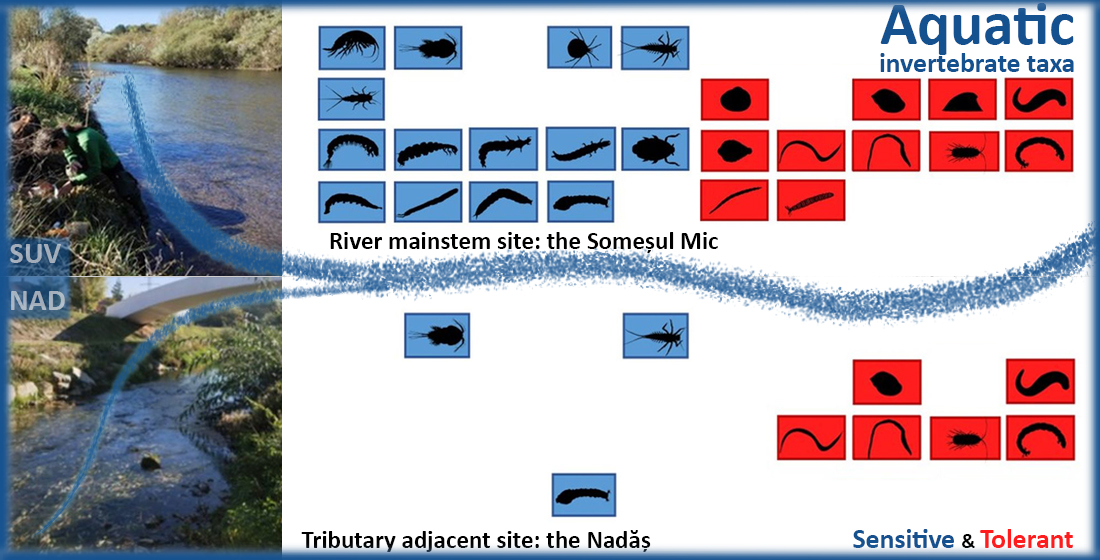
A total number of 37 benthic invertebrate taxa were identified in the sampling sites, including 34 families and three taxa treated as broader groups (Nematoda, Oligochaeta, and Ostracoda). Four taxa were present at all stations (oligochaetes, chironomid dipterans, isopods, and nematodes), whereas certain families of mayflies (Ephemeroptera: Ephemerellidae, Heptageniidae) and stoneflies (Plecoptera: Leuctridae) occurred at only one site (Figure S1). Similarity analysis using Euclidean distances separated the communities into two groups: mainstem and adjacent sites, based on presence/absence data (Figure S2). The percentage of oligochaetes and chironomid dipterans was high across most sampling stations, while at the adjacent sites it ranged from 55% to 75% (Figure S3). A similar pattern was revealed by the ID (Figure S4), with values consistently above 54%, indicating that only two taxa accounted for the majority of individuals in the community (Table S3).
Taxonomic diversity was lower at adjacent sites, with an effective number of about four equally common taxa, but differed only slightly from mainstem communities, where values ranged from 5.39 to 7.23 (Table S3). Similar results were observed for water quality assessed using benthic invertebrate biotic indices, which ranged between classes III and IV at the adjacent sites and between classes II and III along the mainstem (Table S3).
The percentage of boulders and pebbles in sediments correlated positively with taxa richness (0.77, p<0.01), diversity (0.71, p<0.01) and biotic indices (0.62, p<0.05 for EBI and 0.83, p<0.01 for MNWH-AR), but negatively with the percentage of Oligochaeta and Chironomidae (–0.75, p<0.05). As expected, taxa richness showed strong positive correlations with both biotic indices (p<0.001). Diversity was negatively related to water conductivity and phosphate concentration (–0.81, p<0.01 and –0.58, p<0.05, respectively), while the distance to the nearest built area correlated negatively with ID (–0.66, p<0.05), indicating more balanced communities further from built-up areas.
Four groups of taxa were identified within benthic invertebrate communities, based on the dissimilarity matrix constructed from functional traits (Table S2, Figure 3). Sedentary forms were clearly separated into small and large taxa, as were the mobile ones. Each group included both predatory and herbivorous / detritivorous taxa, with the exception of water mites.
Functional diversity indices indicated that taxa occupied a limited functional space (FRic < 0.25; FDis < 0.3) that was relatively evenly filled (FEve > 0.55), with dominant taxa showing extreme trait values (FDiv > 0.78), while low RaoQ values, ranging from 0.05 to 0.08, reflected small functional distances and high trait similarity among taxa (Table S3).
FFG generalist taxa were fewer than specialists at all sites, but they were more abundant in 9 of 10 cases. Ecosystem attributes derived from FFG ratios indicated that none of the sites were autotrophic, relying instead on allochthonous organic matter from upstream and riparian areas (Table S3). High loads of Fine Particulate Organic Matter FPOM were evident at all sites. Stable channel index values confirmed the presence of coarse stable substrates like boulders or pebbles, with higher averages at mainstem (1.72 ± 1.16 SD) than adjacent sites (0.75 ± 0.16 SD), while predator-to-prey ratios remained within normal ranges throughout.
3.2. Benthic Invertebrates: Main Drivers for Distribution and Diversity
At adjacent sites, taxa belonging to oligochaetes, crustaceans, and dipterans were prevalent, whereas mayflies, stoneflies, and caddisflies (EPT) dominated at mainstem sites (Figure 4). The key drivers of benthic invertebrate community structure were, in decreasing order of importance and significance: (i) the percentage of boulders and pebbles in sediments (explained 31.3% of the variation, pseudo-F = 3.6, p = 0.002, FDR-adjusted p = 0.006); (ii) water average velocity (27.2%, pseudo-F = 3.0, p = 0.005, FDR-adjusted p = 0.007); and (iii) river average width (26.5%, pseudo-F = 2.9, p = 0.007, FDR-adjusted p = 0.007) (Figure 4). The values of these key parameters were lower at adjacent sites, as were those of the Shannon–Wiener diversity index, which was represented as isolines in the ordination space to illustrate its variation in relation to environmental factors (Figure 4).
Response curves (Figure S5) showed that sensitive taxa (EPT) exhibited increased abundances at high percentages of boulders and pebbles and under elevated water velocities, whereas tolerant taxa (Oligochaeta and Chironomidae, OCH) displayed the opposite pattern. Van Dobben circles (Figure S6) showed that Trichoptera: Hydropsychidae increased with coarse substrates while oligochaetes declined. Ephemeroptera: Baetidae responded positively to higher flow velocity and Ephemeroptera: Caenidae to lower dissolved oxygen. Phosphate enrichment favored Gastropoda: Physidae, but reduced the abundance of several families of mayflies, leeches, and water mites.
Regression analyses revealed strong relationships between invertebrate community indices and environmental predictors (Table 1). Diversity and the proportion of EPT were positively influenced by water velocity and by distance from built areas (Adjusted R² = 0.95). Taxa richness was positively related to coarse substrates, while phosphate enrichment reduced EPT, and pH declines were linked to higher OCH values (Table 1).
Consistent key drivers were identified in the regression analyses relating zoobenthic community trait structure to environmental parameters (Figure 5). They were, in decreasing order of explanatory power and significance: (i) the percentage of boulders and pebbles in sediments (explaining 52.1% of the variation; pseudo-F = 8.7, p = 0.006, FDR-adjusted p = 0.0105); (ii) river average width (48.6%; pseudo-F = 7.6, p = 0.007, FDR-adjusted p = 0.0105); and (iii) water average velocity (36.7%; pseudo-F = 4.6, p = 0.028, FDR-adjusted p = 0.028).
3.3. Mitigation Strategies Anchored in Key Findings
The Someșul Mic River provides a range of ecosystem services within the urban area of Cluj-Napoca. A synthesis of its provisioning, regulating, and cultural services is presented in Table 2, adapted from [30,69,70,71].
Since urban streams share the same syndrome, but each river has its own particularities [18,21], eight targeted mitigation strategies were proposed for the Someșul Mic River in Cluj-Napoca, selected from the literature and adapted to local conditions based on the structure of benthic invertebrate communities in mainstem and adjacent sites (Table 3). The mitigation strategies span four levels: the riverbed (mitigation #1), the floodplain (#2 and #3), the catchment scale (#4, #5, and #6), and human involvement (#7 and #8) (Figure 6).
4. Discussion
4.1. Urban Stream Syndrome Indicated by Benthic Invertebrates
USS symptom 1: Flow variability in the Someșul Mic River in Cluj-Napoca results from an artificially induced regime, as the upstream Someșul Cald and Someșul Mic are regulated by reservoirs and hydropower plants with a total installed capacity of ~300 MW [34,90,91]. The Florești II Dam, located at the river’s entrance into the city, further controls discharge downstream to its confluence with the Someșul Mare near Dej (https://www.hidroelectrica.ro, accessed on 3 October 2025).
USS symptom 2: Channel alteration is particularly evident in the city center, where the river has been straightened and the banks reinforced with concrete.
USS symptom 3: High nutrient and pollutant loads have been documented in the Someșul Mic River, with elevated concentrations of trace metals, organic contaminants and microplastics detected in sediments (particularly in industrial and densely populated sectors) and increased nutrient levels, such as nitrates, recorded in the water column downstream [36,37,38].
USS symptom 4: The structure and diversity of benthic invertebrate communities in urban rivers differ markedly from those in less impacted areas.
USS symptom 4.1: Our data showed unbalanced communities, exhibiting high dominance indices that highlighted the prevalence of two tolerant taxonomic groups—typically oligochaetes and chironomids—a pattern frequently reported in the literature [19,92,93,94]. Moreover, the abundance of generalist taxa exceeded that of specialists at most sampling sites, consistent with findings from other studies [95].
USS symptom 4.2: Taxonomic diversity of benthic invertebrates and the water quality indicated by their communities were relatively modest, although conditions were generally better at mainstem sites, which showed higher diversity and correspondingly higher ecological quality (classes II–III compared to III–IV in adjacent sites). Low diversity of benthic assemblages and water quality decline associated with increasing urbanization have been widely reported in urban rivers [32,92,93,96], and earlier studies in the present area similarly documented poor water quality and a dominance of tolerant taxa downstream of SDV [39,40,41,42].
Sediment type emerged as the main driver of community composition: higher proportions of boulders and pebbles supported greater taxonomic richness and correlated positively with diversity and biotic indices, favoring Hydropsychidae caddisflies while reducing tolerant OCH taxa. Such patterns align with previous findings linking coarse substrates to higher diversity and unstable habitats to the dominance of tolerant groups [97]. Flow velocity and stream width also played key roles, as both taxonomic diversity and the proportion of sensitive EPT taxa increased with higher velocities, especially for Baëtidae mayflies. Comparable results have been reported for stream width in the eastern USA [94] and for flow fluctuations in the UK and Portugal [92,93], where conductivity and nitrate concentrations were also identified as stressors—parameters that in this study correlated negatively with diversity.
Dissolved oxygen, by contrast, was less influential here than in other studies (e.g., [94]). Notably, Caenidae mayflies increased in abundance under lower oxygen conditions, reflecting their habitat preferences as detritus feeders in fine sediments and under stones [48]. Finally, distance to the nearest built structure was negatively correlated with dominance, suggesting more balanced, EPT-dominated communities in areas further from urban development. Similar negative effects of buildings and roads on benthic invertebrate diversity have been highlighted elsewhere [98,99].
USS symptom 4.3: Functional diversity was very low across both mainstem and adjacent sites, as indicated by Functional Richness and Rao’s Quadratic Entropy, though a slight increase was observed with higher proportions of coarse substrates. Substrate composition strongly influenced functional trait community-weighted means (CWM), with adjacent sites characterized by finer sediments and poorer water quality, supporting larger and more mobile taxa in terms of dispersal ability, consistent with reports linking the “non-flyer dispersion mode” to high urbanization pressure [100] and fine-particle feeders to heavily impacted systems [32]. CWM also revealed higher proportions of engulfing predators (swallowers) in adjacent stations, associated with sand and silt dominated substrates and low flow velocity, with notable examples including Dolichopodid dipterans in VGB, elevated leech abundance in CM1, and high densities of the copepod Macrocyclops albidus in NAD and CM2, a predator of cladocerans in river macrophyte habitats [101]. While many studies report reduced top consumers and simplified trophic structures in urban rivers [32,95], others have documented predator dominance under urbanization stress [100], with FFG–substrate relationships varying with flow and food availability [102]. In this study, stream ecosystem attributes estimated via FFGs indicated an overall normal predator-to-prey ratio, though predator prevalence in more urbanized stations needs further investigation.
Exploration of the four USS symptoms confirmed the impacted state of the urban river ecosystems in Cluj-Napoca, but the initial hypothesis was rejected, as water quality and benthic invertebrate diversity proved to be higher at mainstem sites compared to adjacent ones.
4.2. Current State of the Someșul Mic River in Cluj-Napoca and Directions for Mitigation
The urban water cycle includes interconnected networks— the natural waterways, potable water supply, stormwater drainage, domestic and industrial wastewater discharge, and the treatment network that returns water to the natural system—functioning through tightly regulated, interdependent layers [103]. The functionality of Cluj-Napoca entire water system—encompassing both surface and subsurface networks—can only be maintained through coordinated management processes (investments, initiatives, and action–response plans) among all institutional stakeholders. The Someșul Mic River, the central axis of Cluj-Napoca urban water system, is undergoing a major transformation. Once undervalued, it has become a key element in sustainable urban development [35], now envisioned as a blue-green corridor integrating the entire urban and metropolitan landscape.
As part of the city’s strategy for the European Capital of Culture competition, the establishment of a joint administrative and academic body—the Water Council—was proposed to integrate representatives of public authorities and the scientific community into a unified management framework. Within the same program, the Romanian Order of Architects suggested organizing a design competition for the redevelopment of the Someșul Mic River along its urban stretch. Adopted by the Cluj-Napoca Municipality, this initiative led to the Rethinking Someș project (2015–2023), which resulted in a comprehensive structural and landscape transformation of the river corridor. The result was a clear definition of the Someșul Mic River corridor as a genuine blue–green urban park, extending for approximately 7 km downstream from the city western entrance, and an additional 2 km through the Feroviarilor and Armătura Park areas (Rethinking Someș, Cluj-Napoca, https://oar.archi/concursuri/oar/rethinking-somes-cluj-napoca/, accessed on 8 October 2025). Subsequent projects, such as the Feroviarilor Park Rehabilitation competition (Parcul Feroviar, Cluj-Napoca, https://oar.archi/concursuri/oar/reabilitarea-peisagera-si-reactivarea-parcului-feroviar-cluj-napoca/, accessed on 8 October 2025), further advanced this vision by integrating wetlands and new pedestrian crossings, reinforcing a sustainability-oriented urban water management approach. These initiatives have increased both the extent and quality of planted areas, improved pedestrian and cycling mobility (the river now serving as a near-continuous cycling route), and ensured public accessibility to the water. Another major project—the Eastern Park Development (Amenajare Parc Est, Cluj-Napoca, https://oar.archi/concursuri/oar/amenajare-parc-est-cluj-napoca/, accessed on 8 October 2025)—continues this direction, aiming to convert a vast wetland area located on a tributary of the Someșul Mic River into a public park in the coming years. In addition to large-scale infrastructural interventions, the river—and the city aquatic system as a whole—has become a key focus on the agenda of Cluj-Napoca civil society. In this context, Someș Delivery, a public awareness and micro-intervention program [104], engages with various river sections that deserve attention, organizing public events that bring together citizens and scientists, as well as cultural activities and cycling routes along the river. Since 2016, the river section known to locals as Grigorescu Beach (downstream site SDV) has hosted the Vamos a la Playa project, now in its seventh edition (Vamos a la Playa 2025, https://cluj.com/articole/vamos-a-la-playa-2025-plaja-grigorescu-cluj-napoca/, accessed on 9 October 2025), a ten-day community event promoting awareness of the river cultural and social value within the urban landscape.
The present study proposes mitigation strategies addressing the anthropogenic impacts on riverine biotic communities, directly linked to the key findings described above. These strategies primarily target the enrichment of riverbed substrates, given that our data indicate that coarse sediments, combined with higher flow velocity, support greater taxonomic and functional diversity of invertebrate communities. Measures aimed at reducing impervious surface areas and increasing riparian vegetation within the floodplain are the most challenging to implement, due to constraints imposed by national flood-control plans [105]. At the catchment scale, efforts should focus on minimizing pollution, maintaining a stable flow regime downstream the hydrotechnical works, and implementing BGI solutions in adjacent areas. However, spatial limitations restrict the feasibility of many BGI measures, such as constructed wetlands designed to retain stormwater runoff [79]. Finally, continuous monitoring and public involvement are essential for calibration, adaptation, and dissemination.
Restoration is a complex, long-term process [20] that should focus on restoring ecosystem processes rather than isolated habitats, yet success is not always guaranteed. The main reasons for failure include: planning restricted to river segments while ignoring watershed-scale pressures, reliance on a single method, failure to secure colonization of newly created habitats, neglect of environmental quality, and focus on improving physical complexity alone [18,72,106]. Moreover, the standard approaches commonly applied under the EU Water Framework Directive to assess biotic community parameters are often insufficiently sensitive to detect the outcomes of restoration in urban streams [78,107]. Additional regional barriers hinder cohesive urban and ecological regeneration: (1) the river passage through diverse urban fabrics (open floodplain, densely built areas, industrial zones), making integrated development challenging; (2) land ownership fragmentation, (3) nearby transport infrastructure causing pollution, and (4) fragmented institutional management. Transforming the Someșul Mic River into a blue-green urban corridor requires a collective shift toward sustainable behavior of citizens and institutions, and greater public awareness of the river ecological and cultural value.
5. Conclusions
The present study assessed the ecological status of several urban aquatic ecosystems in Cluj-Napoca, yielding several key findings.
(1.1) Same soup, different spices: all analyzed communities exhibited typical urban stream symptoms—low taxonomic and functional diversity and dominance of tolerant taxa. However, the initial hypothesis was invalidated, as tributaries did not supply cleaner water; instead, they displayed poorer ecological conditions than the mainstem sites.
(1.2) Our results showed that coarse substrates and higher flow velocity were the main drivers shaping the structure, taxonomic richness, and functional diversity of aquatic invertebrate communities, whereas river width, distance to nearby constructions, conductivity, and dissolved oxygen contributed to a lesser degree.
(2) Based on these findings, eight mitigation strategies were proposed and linked to the ecosystem services identified for the studied aquatic systems, encompassing in-stream, floodplain, catchment, and research & public engagement components.
Future studies should expand the research area to include additional tributaries and the rapidly growing metropolitan zone of Cluj-Napoca. Nevertheless, the present study provides a valuable tool for decision-makers in the implementation of mitigation measures and serves as a relevant example for assessing urban rivers in similar climatic regions.
Supplementary Materials
The following supporting information can be downloaded at: https://www.mdpi.com/article/doi/s1, Table S1: The sampling site codes and names, sampling dates, coordinates and main environmental parameters measured for the analyses; Table S2: Presence of benthic invertebrate taxa from the sampling sites, their codes used in the analyses and the three functional traits considered: size, dispersal ability and functional feeding group (FFG); Table S3: Benthic invertebrate indices calculated for the present study in the sampling sites; Figure S1: Frequency of benthic invertebrate families (Nematoda, Oligochaeta and Ostracoda considered as groups) in the sampling sites analyzed for the present study; larger squares indicate higher frequencies, i.e., occurrence in more sites; Figure S2: Benthic invertebrate taxa similarity, based on presence/absence data and depicted as a dendrogram constructed with Euclidean distance; Figure S3: Abundance of main groups of benthic invertebrates; Figure S4: The Index of Dominance ID (percentage of the most abundant two taxa from the community), showing the value of the index and the dominant groups in each sampling site; Figure S5: Response curves for main groups of benthic invertebrates and explanatory variables: the percentage of boulders and pebbles in sediments Pbp (%) (left); and the water average velocity Wav (m/s) (right); Figure S6: Van Dobben circles (t-values biplots), showing the benthic invertebrate taxa that best respond to: the percentage of boulders and pebbles in sediments Pbp (%) (up left); the water average velocity Wav (m/s) (up right); the dissolved oxygen values Oxg (mg/L) (down left); and the phosphate concentration Psp (mg/L) (down right).
Author Contributions
Conceptualization, K.P.B. and M.C.; methodology, K.P.B., B.I.G., M.C.; investigation, K.P.B., B.I.G., S.D.C., M.C.; writing—original draft preparation, K.P.B.; writing—review and editing, K.P.B., B.I.G., S.D.C., M.C.; All authors have read and agreed to the published version of the manuscript.
Funding
This research received no external funding.
Data Availability Statement
The original contributions presented in this study are included in the article/Supplementary Material. Further inquiries can be directed to the corresponding author.
Acknowledgments
The authors acknowledge the valuable assistance of all those who contributed to this study through their participation in field campaigns and laboratory work: Ioana-Smaranda Țîra, Iulia Cucea, Andreea Pop, Dumitru-Alexandru Ifrim, Rareș-Gabriel Mihoc, Mario-Florin Străuț. During the preparation of this manuscript, the authors used ChatGPT (OpenAI), GPT-5 model, for refinement of text translation; and ChatGPT (OpenAI), DALL·E 3 model for Figure 6 background (a hand-drawn style map illustration showing a river system on an urban background, subsequently modified by the authors) (accessed via ChatGPT Plus in October 2025). The authors have reviewed and edited the output and take full responsibility for the content of this publication.
Conflicts of Interest
The authors declare no conflicts of interest.
Abbreviations
The following abbreviations are used in this manuscript:
| BGI | Blue-Green Infrastructure |
| EBI | Extensive Biotic Index |
| EPT | Ephemeroptera, Plecoptera, Trichoptera |
| FDis | Functional Dispersion |
| FDiv | Functional Divergence |
| FDR | False Discovery Rate |
| FEve | Functional Evenness |
| FFG | Functional Feeding Groups |
| FRic | Functional Richness |
| ID | Index of Dominance |
| MNWH-AR | Modified New Walley Hawkes, Abundance Related |
| MNWH-PO | Modified New Walley Hawkes, Presence-Only |
| OCH | Oligochaeta, Chironomidae |
| RaoQ | Rao’s Quadratic Entropy |
| SD | Standard deviation |
| USS | Urban Stream Syndrome |
References
- Palmer, M.; Ruhi, A. Linkages between Flow Regime, Biota, and Ecosystem Processes: Implications for River Restoration. Science 2019, 365, eaaw2087. [Google Scholar] [CrossRef]
- Mishra, R.R.; Saxena, S. Cities and Rivers: A Symbiotic Relationship. In Managing Urban Rivers; Elsevier, 2024; pp 3–24. [CrossRef]
- Ferreira, C.S.S.; Walsh, R.P.D.; Ferreira, A.J.D. Degradation in Urban Areas. Current Opinion in Environmental Science & Health 2018, 5, 19–25. [Google Scholar] [CrossRef]
- Barles, S. Urban Metabolism and River Systems: An Historical Perspective – Paris and the Seine, 1790–1970. Hydrol. Earth Syst. Sci. 2007, 11, 1757–1769. [Google Scholar] [CrossRef]
- Steele, M.K.; Heffernan, J.B. Morphological Characteristics of Urban Water Bodies: Mechanisms of Change and Implications for Ecosystem Function. Ecological Applications 2014, 24, 1070–1084. [Google Scholar] [CrossRef]
- Gurnell, A.; Lee, M.; Souch, C. Urban Rivers: Hydrology, Geomorphology, Ecology and Opportunities for Change. Geography Compass 2007, 1, 1118–1137. [Google Scholar] [CrossRef]
- Bălteanu, D.; Dogaru, D. Geographical Perspectives on Human-Environment Relationships and Anthropic Pressure Indicators. Romanian Journal of Geography 2011, 55, 69–80. [Google Scholar]
- Siegel, F.R. Introduction. In Cities and Mega-Cities; SpringerBriefs in Geography; Springer International Publishing: Cham, 2019. [Google Scholar] [CrossRef]
- Cattaneo, A.; Nelson, A.; McMenomy, T. Global Mapping of Urban–Rural Catchment Areas Reveals Unequal Access to Services. Proc. Natl. Acad. Sci. U.S.A. 2021, 118, e2011990118. [Google Scholar] [CrossRef]
- Gracias, J.S.; Parnell, G.S.; Specking, E.; Pohl, E.A.; Buchanan, R. Smart Cities—A Structured Literature Review. Smart Cities 2023, 6, 1719–1743. [Google Scholar] [CrossRef]
- Mohanty, S.P.; Choppali, U.; Kougianos, E. Everything You Wanted to Know about Smart Cities: The Internet of Things Is the Backbone. IEEE Consumer Electron. Mag. 2016, 5, 60–70. [Google Scholar] [CrossRef]
- Lepczyk, C.A.; Aronson, M.F.; La Sorte, F.A. Cities as Sanctuaries. Frontiers in Ecol & Environ 2023, 21, 251–259. [Google Scholar] [CrossRef]
- Kowarik, I.; Fischer, L.K.; Haase, D.; Kabisch, N.; Kleinschroth, F.; Konijnendijk, C.; Straka, T.M.; Von Haaren, C. Promoting Urban Biodiversity for the Benefit of People and Nature. Nat. Rev. Biodivers. 2025, 1, 214–232. [Google Scholar] [CrossRef]
- Bagheri, A. Blue/Green Infrastructures: A Dual Solution for Urban Heat Island and Urban Flooding. Environ. Rev. 2025, 33, 1–14. [Google Scholar] [CrossRef]
- Liao, K.-H.; Deng, S.; Tan, P.Y. Blue-Green Infrastructure: New Frontier for Sustainable Urban Stormwater Management. In Greening Cities; Tan, P.Y., Jim, C.Y., Eds.; Advances in 21st Century Human Settlements; Springer Singapore: Singapore, 2017. [Google Scholar] [CrossRef]
- Iojă, C.I.; Badiu, D.L.; Haase, D.; Hossu, A.C.; Niță, M.R. How about Water? Urban Blue Infrastructure Management in Romania. Cities 2021, 110, 103084. [Google Scholar] [CrossRef]
- Vörösmarty, C.J.; McIntyre, P.B.; Gessner, M.O.; Dudgeon, D.; Prusevich, A.; Green, P.; Glidden, S.; Bunn, S.E.; Sullivan, C.A.; Liermann, C.R.; et al. Global Threats to Human Water Security and River Biodiversity. Nature 2010, 467, 555–561. [Google Scholar] [CrossRef]
- Zerega, A.; Simões, N.E.; Feio, M.J. How to Improve the Biological Quality of Urban Streams? Reviewing the Effect of Hydromorphological Alterations and Rehabilitation Measures on Benthic Invertebrates. Water 2021, 13, 2087. [Google Scholar] [CrossRef]
- Walsh, C.J.; Roy, A.H.; Feminella, J.W.; Cottingham, P.D.; Groffman, P.M.; Morgan, R.P. The Urban Stream Syndrome: Current Knowledge and the Search for a Cure. Journal of the North American Benthological Society 2005, 24, 706–723. [Google Scholar] [CrossRef]
- Hughes, R.M.; Dunham, S.; Maas-Hebner, K.G.; Yeakley, J.A.; Schreck, C.; Harte, M.; Molina, N.; Shock, C.C.; Kaczynski, V.W.; Schaeffer, J. A Review of Urban Water Body Challenges and Approaches: (1) Rehabilitation and Remediation. Fisheries 2014, 39, 18–29. [Google Scholar] [CrossRef]
- Booth, D.B.; Roy, A.H.; Smith, B.; Capps, K.A. Global Perspectives on the Urban Stream Syndrome. Freshwater Science 2016, 35, 412–420. [Google Scholar] [CrossRef]
- Richardson, M.; Soloviev, M. The Urban River Syndrome: Achieving Sustainability Against a Backdrop of Accelerating Change. IJERPH 2021, 18, 6406. [Google Scholar] [CrossRef] [PubMed]
- Ranta, E.; Vidal-Abarca, M.R.; Calapez, A.R.; Feio, M.J. Urban Stream Assessment System (UsAs): An Integrative Tool to Assess Biodiversity, Ecosystem Functions and Services. Ecological Indicators 2021, 121, 106980. [Google Scholar] [CrossRef]
- Zacharias, I.; Liakou, P.; Biliani, I. A Review of the Status of Surface European Waters Twenty Years after WFD Introduction. Environ. Process. 2020, 7, 1023–1039. [Google Scholar] [CrossRef]
- Vitecek, S.; Johnson, R.; Poikane, S. Assessing the Ecological Status of European Rivers and Lakes Using Benthic Invertebrate Communities: A Practical Catalogue of Metrics and Methods. Water 2021, 13, 346. [Google Scholar] [CrossRef]
- Feio, M.J.; Hughes, R.M.; Serra, S.R.Q.; Nichols, S.J.; Kefford, B.J.; Lintermans, M.; Robinson, W.; Odume, O.N.; Callisto, M.; Macedo, D.R.; et al. Fish and Macroinvertebrate Assemblages Reveal Extensive Degradation of the World’s Rivers. Global Change Biology 2023, 29, 355–374. [Google Scholar] [CrossRef] [PubMed]
- Allan, J.D.; Castillo, M.M.; Capps, K.A. Trophic Relationships. In Stream ecology: structure and function of running waters; Springer: Cham, Switzerland, 2021. [Google Scholar]
- Etemi, F.Z.; Bytyçi, P.; Ismaili, M.; Fetoshi, O.; Ymeri, P.; Shala–Abazi, A.; Muja-Bajraktari, N.; Czikkely, M. The Use of Macroinvertebrate Based Biotic Indices and Diversity Indices to Evaluate the Water Quality of Lepenci River Basin in Kosovo. Journal of Environmental Science and Health, Part A 2020, 55, 748–758. [Google Scholar] [CrossRef]
- Etriieki, A.M.O.; Küçükbasmacı, İ. Using Macroinvertebrate-based Biotic Indices and Diversity Indices to Assess Water Quality: A Case Study on the Karasu Stream (Kastamonu, Türkiye). Ecohydrology 2024, 17, e2627. [Google Scholar] [CrossRef]
- Calapez, R.A.; Serra, S.R.Q.; Mortágua, A.; Almeida, S.F.P.; João Feio, M. Unveiling Relationships between Ecosystem Services and Aquatic Communities in Urban Streams. Ecological Indicators 2023, 153, 110433. [Google Scholar] [CrossRef]
- Bonada, N.; Prat, N.; Resh, V.H.; Statzner, B. DEVELOPMENTS IN AQUATIC INSECT BIOMONITORING: A Comparative Analysis of Recent Approaches. Annu. Rev. Entomol. 2006, 51, 495–523. [Google Scholar] [CrossRef]
- Carrasco-Badajoz, C.; Rayme-Chalco, C.; Arana-Maestre, J.; Álvarez-Tolentino, D.; Ayala-Sulca, Y.; Sanchez-Peña, M. Aquatic Macroinvertebrate Trophic Guilds, Functional Feeding Groups, and Water Quality of an Andean Urban River. Front. Environ. Sci. 2022, 10, 1003207. [Google Scholar] [CrossRef]
- Ofogh, E.A.R.; Dorche, E.E.; Birk, S.; Fathi, P.; Shahraki, Z.M.; Bruder, A. Improving the Performance of Macroinvertebrate Based Multi-Metric Indices by Incorporating Functional Traits and an Index Performance-Driven Approach. Science of The Total Environment 2024, 931, 172850. [Google Scholar] [CrossRef]
- Perşoiu, I.; Rădoane, M. Spatial and Temporal Controls on Historical Channel Responses – Study of an Atypical Case: Someşu Mic River, Romania. Earth Surf Processes Landf 2011, 36, 1391–1409. [Google Scholar] [CrossRef]
- Dolean, B.-E.; Bilașco, Ș.; Petrea, D.; Moldovan, C.; Vescan, I.; Roșca, S.; Fodorean, I. Evaluation of the Built-Up Area Dynamics in the First Ring of Cluj-Napoca Metropolitan Area, Romania by Semi-Automatic GIS Analysis of Landsat Satellite Images. Applied Sciences 2020, 10, 7722. [Google Scholar] [CrossRef]
- Suvărășan, O.; Roșian, G.; Martonoș, I.M. Someşul Mic River (Cluj County, Romania) Water Quality Assessment under Anthropogenic Impact. Studia UBB Ambientum 2020, 87–96. [Google Scholar] [CrossRef]
- Barhoumi, B.; Beldean-Galea, M.S.; Al-Rawabdeh, A.M.; Roba, C.; Martonos, I.M.; Bălc, R.; Kahlaoui, M.; Touil, S.; Tedetti, M.; Driss, M.R.; et al. Occurrence, Distribution and Ecological Risk of Trace Metals and Organic Pollutants in Surface Sediments from a Southeastern European River (Someşu Mic River, Romania). Science of The Total Environment 2019, 660, 660–676. [Google Scholar] [CrossRef]
- Gheorghe, S.; Stoica, C.; Harabagiu, A.M.; Neidoni, D.-G.; Mighiu, E.D.; Bumbac, C.; Ionescu, I.A.; Pantazi, A.; Enache, L.-B.; Enachescu, M. Laboratory Assessment for Determining Microplastics in Freshwater Systems—Characterization and Identification along the Somesul Mic River. Water 2024, 16, 233. [Google Scholar] [CrossRef]
- Cîmpean, M. Evaluarea Influenţei Antropice Asupra Calităţii Apei Râului Someşul Mic Şi a Afluenţilor Săi Utilizând Indicele Biotic Extins (I.B.E.). [Assessment of Human Impact on the Water Quality of the Someșul Mic River and Its Tributaries Using the Extended Biotic Index (EBI), in Romanian]. Brukenthal Museum Studies & Communications, Natural Sciences 2004, 29, 179–190. [Google Scholar]
- Avram, A.; Cîmpean, M.; Jurcă, A.; Timuş, N. Water Quality Assessment Using Biotic Indices Based on Benthic Macroinvertebrates in the Someşul Mic Catchment Area. Studia UBB Biologia 2009, 54, 61–70. [Google Scholar]
- Florescu, H.M.; Cîmpean, M.; Momeu, L.; Leonte, L.; Bodea, D.; Battes, K.P. Ecological Analyses on Benthic Diatom and Invertebrate Communities from the Someșul Mic Catchment Area (Transylvania, Romania). 2015, 60, 69–87.
- Cîmpean, M. Studiul taxonomic şi ecologic asupra comunităţilor de acarieni acvatici (Acari Hydrachnidia)din bazinul de drenaj al râului Someşul Mic şi rolul lor ca indicatori ai calităţii apei [Taxonomic and ecological study of water mites (Acari, Hydrachnidia) from the Someșul Mic River basin and their role as water quality indicators, in Romanian]; Presa Universitară Clujeană: Cluj-Napoca, 2018. [Google Scholar]
- Nagy, A.A.; Erős, N.; Imecs, I.; Bóné, G.; Fülöp, A.; Pap, P.L. Distribution and Diversity of Fishes and Lampreys in Transylvania (Romania): A Complete Survey and Suggestions for New Protected Areas. ZK 2023, 1166, 351–373. [Google Scholar] [CrossRef] [PubMed]
- Lukács, J. Clujul renascentist. Aspecte privind viața cotidiană în Cluj în secolul al XVI-lea și al XVII-lea. Alimentația și gastronomia [Renaissance Cluj: Aspects of Daily Life in the 16th and 17th Centuries — Food and Gastronomy, in Romanian]. PhD Thesis, Babeș-Bolyai University, Faculty of History and Phylosophy, Cluj-Napoca Romania, 2012. [Google Scholar]
- QGIS Development Team. QGIS Geographic Information System, 2024. http://qgis.org.
- Paisley, M.F.; Trigg, D.J.; Walley, W.J. Revision of the Biological Monitoring Working Party (BMWP) Score System: Derivation of Present-only and Abundance-related Scores from Field Data. River Research & Apps 2014, 30, 887–904. [Google Scholar] [CrossRef]
- Callisto, M.; Mugnai, R.; Castro, D.M.P.; Linares, M.S. Sampling Methods for Aquatic Insects. In Measuring Arthropod Biodiversity; Santos, J.C., Fernandes, G.W., Eds.; Springer International Publishing: Cham, 2021. [Google Scholar] [CrossRef]
- Kriska, G. Freshwater Invertebrates in Central Europe: A Field Guide; Springer International Publishing: Cham, 2022. [Google Scholar] [CrossRef]
- Di Sabatino, A.; Gerecke, R.; Martin, P. The Biology and Ecology of Lotic Water Mites (Hydrachnidia). Freshwater Biology 2000, 44, 47–62. [Google Scholar] [CrossRef]
- Mihuc, T.B. The Functional Trophic Role of Lotic Primary Consumers: Generalist versus Specialist Strategies. Freshwater Biology 1997, 37, 455–462. [Google Scholar] [CrossRef]
- Wetzel, R.G. Limnology: Lake and River Ecosystems, 3rd ed.; Academic Press: San Diego, 2001. [Google Scholar]
- Merritt, R.W.; Cummins, K.W.; Berg, M.B. Trophic Relationships of Macroinvertebrates. In Methods in Stream Ecology, Volume 1; Elsevier, 2017; pp 413–433. [CrossRef]
- Hébert, M.; Beisner, B.E.; Maranger, R. A Meta-analysis of Zooplankton Functional Traits Influencing Ecosystem Function. Ecology 2016, 97, 1069–1080. [Google Scholar] [CrossRef] [PubMed]
- McNaughton, S.J.; Wolf, L.L. Dominance and the Niche in Ecological Systems: Dominance Is an Expression of Ecological Inequalities Arising out of Different Exploitation Strategies. Science 1970, 167, 131–139. [Google Scholar] [CrossRef]
- De Vries, J.; Kraak, M.H.S.; Verdonschot, P.F.M. Complementarity of Community Indices in Characterizing Aquatic Macroinvertebrate Assemblages. Global Ecology and Conservation 2023, 46, e02604. [Google Scholar] [CrossRef]
- Jost, L. Entropy and Diversity. Oikos 2006, 113, 363–375. [Google Scholar] [CrossRef]
- Bo, T.; Doretto, A.; Laini, A.; Bona, F.; Fenoglio, S. Biomonitoring with Macroinvertebrate Communities in Italy: What Happened to Our Past and What Is the Future? J Limnol 2016, 76. [Google Scholar] [CrossRef]
- Gower, J.C. A General Coefficient of Similarity and Some of Its Properties. Biometrics 1971, 27, 857. [Google Scholar] [CrossRef]
- Scrucca, L. GA : A Package for Genetic Algorithms in R. J. Stat. Soft. 2013, 53. [Google Scholar] [CrossRef]
- De Bello, F.; Botta-Dukát, Z.; Lepš, J.; Fibich, P. Towards a More Balanced Combination of Multiple Traits When Computing Functional Differences between Species. Methods Ecol Evol 2021, 12, 443–448. [Google Scholar] [CrossRef]
- De Bello, F.; Carmona, C.P.; Dias, A.T.C.; Götzenberger, L.; Moretti, M.; Berg, M.P. Handbook of Trait-Based Ecology: From Theory to R Tools, 1st ed.; Cambridge University Press, 2021. [CrossRef]
- Mammola, S.; Carmona, C.P.; Guillerme, T.; Cardoso, P. Concepts and Applications in Functional Diversity. Functional Ecology 2021, 35, 1869–1885. [Google Scholar] [CrossRef]
- Cummins, K.W.; Wilzbach, M.; Kolouch, B.; Merritt, R. Estimating Macroinvertebrate Biomass for Stream Ecosystem Assessments. IJERPH 2022, 19, 3240. [Google Scholar] [CrossRef] [PubMed]
- ter Braak, C.J.F.; Smilauer, P. Canoco Reference Manual and User’s Guide: Software for Ordination, Version 5.0., 2012.
- Šmilauer, P.; Lepš, J. Multivariate Analysis of Ecological Data Using Canoco 5, Second edition.; Cambridge University Press: Cambridge, United Kingdom ; New York, 2014. [Google Scholar]
- R Core Team. R: A Language and Environment for Statistical Computing. R Foundation for Statistical Computing. Vienna, Austria., 2025. https://www.R-project.org.
- Oksanen, J.; Simpson, G.L.; Blanchet, F.G.; Kindt, R.; Legendre, P.; Minchin, P.R.; O’Hara, R.B.; Solymos, P.; Stevens, M.H.H.; Szoecs, E.; et al. Vegan: Community Ecology Package; 2025.
- Peterson, B.G.; Carl, P. PerformanceAnalytics: Econometric Tools for Performance and Risk Analysis; 2024.
- Haines-Young, R. Common Internatonal Classificaton of Ecosystem Services (CICES) V5.2 and Guidance on the Applicaton of the Revised Structure, 2023. www.cices.eu (accessed 2025-09-25).
- Yeakley, A.J.; Ervin, D.; Chang, H.; Granek, E.F.; Dujon, V.; Shandas, V.; Brown, D. Ecosystem Services of Streams and Rivers. In River Science; Gilvear, D.J., Greenwood, M.T., Thoms, M.C., Wood, P.J., Eds.; Wiley, 2016; pp 335–352. [CrossRef]
- Sousa, M.C.; Martins, R.; Simões, N.E.; Feio, M.J. Ecosystem Services of Urban Rivers: A Systematic Review. Aquat Sci 2025, 87, 10. [Google Scholar] [CrossRef]
- Palmer, M.A.; Menninger, H.L.; Bernhardt, E. River Restoration, Habitat Heterogeneity and Biodiversity: A Failure of Theory or Practice? Freshwater Biology 2010, 55, 205–222. [Google Scholar] [CrossRef]
- Martin, F.-M.; Janssen, P.; Bergès, L.; Dupont, B.; Evette, A. Higher Structural Connectivity and Resistance against Invasions of Soil Bioengineering over Hard-Engineering for Riverbank Stabilisation. Wetlands Ecol Manage 2021, 29, 27–39. [Google Scholar] [CrossRef]
- Leblois, S.; Piton, G.; Recking, A.; Jaymond, D.; Buffet, A.; Evette, A. Riverbank Fascines Mostly Fail Due to Scouring: Consistent Evidence from Field and Flume Observations. River Research & Apps 2025, 41, 108–119. [Google Scholar] [CrossRef]
- Tang, V.T.; Fu, D.; Singh, R.P.; Rene, E.R.; Binh, T.N.; Sharma, A.K. Evaluating the Effectiveness of Ecological Restoration of Hard Bank Rivers: A Case Study from Shedu River Port, China. Journal of Water Supply: Research and Technology-Aqua 2018, 67, 824–833. [Google Scholar] [CrossRef]
- Francis, R.A.; Hoggart, S.P.G. Waste Not, Want Not: The Need to Utilize Existing Artificial Structures for Habitat Improvement Along Urban Rivers. Restoration Ecology 2008, 16, 373–381. [Google Scholar] [CrossRef]
- Palt, M.; Hering, D.; Kail, J. Context-specific Positive Effects of Woody Riparian Vegetation on Aquatic Invertebrates in Rural and Urban Landscapes. Journal of Applied Ecology 2023, 60, 1010–1021. [Google Scholar] [CrossRef]
- Weber, A.; Garcia, X.-F.; Wolter, C. Habitat Rehabilitation in Urban Waterways: The Ecological Potential of Bank Protection Structures for Benthic Invertebrates. Urban Ecosyst 2017, 20, 759–773. [Google Scholar] [CrossRef]
- Wenger, S.J.; Roy, A.H.; Jackson, C.R.; Bernhardt, E.S.; Carter, T.L.; Filoso, S.; Gibson, C.A.; Hession, W.C.; Kaushal, S.S.; Martí, E.; et al. Twenty-Six Key Research Questions in Urban Stream Ecology: An Assessment of the State of the Science. Journal of the North American Benthological Society 2009, 28, 1080–1098. [Google Scholar] [CrossRef]
- He, F.; Zarfl, C.; Tockner, K.; Olden, J.D.; Campos, Z.; Muniz, F.; Svenning, J.-C.; Jähnig, S.C. Hydropower Impacts on Riverine Biodiversity. Nat Rev Earth Environ 2024, 5, 755–772. [Google Scholar] [CrossRef]
- Bunn, S.E.; Arthington, A.H. Basic Principles and Ecological Consequences of Altered Flow Regimes for Aquatic Biodiversity. Environmental Management 2002, 30, 492–507. [Google Scholar] [CrossRef]
- <i>Nature-Based Solutions to Address Global Societal, Challenges</i>; Cohen-Shacham, E. Nature-Based Solutions to Address Global Societal Challenges; Cohen-Shacham, E., Walters, G., Janzen, C., Maginnis, S., Eds.; IUCN International Union for Conservation of Nature, 2016. [CrossRef]
- Askarizadeh, A.; Rippy, M.A.; Fletcher, T.D.; Feldman, D.L.; Peng, J.; Bowler, P.; Mehring, A.S.; Winfrey, B.K.; Vrugt, J.A.; AghaKouchak, A.; et al. From Rain Tanks to Catchments: Use of Low-Impact Development To Address Hydrologic Symptoms of the Urban Stream Syndrome. Environ. Sci. Technol. 2015, 49, 11264–11280. [Google Scholar] [CrossRef]
- Aivazidou, E.; Banias, G.; Lampridi, M.; Vasileiadis, G.; Anagnostis, A.; Papageorgiou, E.; Bochtis, D. Smart Technologies for Sustainable Water Management: An Urban Analysis. Sustainability 2021, 13, 13940. [Google Scholar] [CrossRef]
- Gourbesville, P.; Ma, Q. Smart River Management: What Is Next? River 2022, 1, 37–46. [Google Scholar] [CrossRef]
- Chien, H. Adaptive Management in Urban Stream Governance: A Review and an Urban Commoning Scenario-Building Exercise. LEX 2021, 19, 659–688. [Google Scholar] [CrossRef]
- Ahern, J. Urban Landscape Sustainability and Resilience: The Promise and Challenges of Integrating Ecology with Urban Planning and Design. Landscape Ecol 2013, 28, 1203–1212. [Google Scholar] [CrossRef]
- Shao, G.P.; Bishop, I.J. Citizen Science in River Monitoring: A Systematic Literature Review of the Whys and Hows. Front. Environ. Sci. 2025, 13, 1609084. [Google Scholar] [CrossRef]
- Dohotaru, A. Soluţii bazate pe natură la Someş; Presa Universitară Clujeană: Cluj-Napoca, 2024. [Google Scholar]
- Costea, G.; Pusch, M.T.; Bănăduc, D.; Cosmoiu, D.; Curtean-Bănăduc, A. A Review of Hydropower Plants in Romania: Distribution, Current Knowledge, and Their Effects on Fish in Headwater Streams. Renewable and Sustainable Energy Reviews 2021, 145, 111003. [Google Scholar] [CrossRef]
- Pop, N.; Pop, S.B. Reducing the Effects Caused by Floods, through Hydrological Measurements Made at the Cluj-Napoca Hydrometric Station. Agricultura 2022, 124, (3–4). [Google Scholar]
- Serra, S.R.Q.; Calapez, A.R.; Simões, N.E.; Sá Marques, J.A.A.; Laranjo, M.; Feio, M.J. Effects of Variations in Water Quantity and Quality in the Structure and Functions of Invertebrates’ Community of a Mediterranean Urban Stream. Urban Ecosyst 2019, 22, 1173–1186. [Google Scholar] [CrossRef]
- Medupin, C. Spatial and Temporal Variation of Benthic Macroinvertebrate Communities along an Urban River in Greater Manchester, UK. Environ Monit Assess 2020, 192, 84. [Google Scholar] [CrossRef]
- Ludlam, J.P.; Welsh, D.P.; Clark, E.V.; Downs, E.L.; Gordon, E.S.; Huang, J.X.; Levy, B.; O’Connor, A.M. Assessing Taxonomic and Functional Responses of Stream Macroinvertebrate Communities to Multi-Scale Influences of Urban Land Cover. River Research & Apps, 0045. [Google Scholar] [CrossRef]
- Barbosa, G.P.; Siqueira, T. Direct and Indirect Relationships of Climate and Land Use Change with Food Webs in Lakes and Streams. Global Ecol Biogeogr 2023, 32, 2153–2163. [Google Scholar] [CrossRef]
- Czerniawski, R.; Sługocki, Ł.; Krepski, T.; Wilczak, A.; Pietrzak, K. Spatial Changes in Invertebrate Structures as a Factor of Strong Human Activity in the Bed and Catchment Area of a Small Urban Stream. Water 2020, 12, 913. [Google Scholar] [CrossRef]
- Paul, M.J.; Meyer, J.L. Streams in the Urban Landscape. In Urban Ecology; Marzluff, J.M., Shulenberger, E., Endlicher, W., Alberti, M., Bradley, G., Ryan, C., Simon, U., ZumBrunnen, C., Eds.; Springer US: Boston, MA, 2008. [Google Scholar] [CrossRef]
- Vehkaoja, M.; Niemi, M.; Väänänen, V.-M. Effects of Urban Infrastructure on Aquatic Invertebrate Diversity. Urban Ecosyst 2020, 23, 831–840. [Google Scholar] [CrossRef]
- Davidson, J.; Gunn, J. Effects of Land Cover Disturbance on Stream Invertebrate Diversity and Metal Concentrations in a Small Urban Industrial Watershed. Human and Ecological Risk Assessment: An International Journal 2012, 18, 1078–1095. [Google Scholar] [CrossRef]
- Miserendino, M.L.; Williams-Subiza, E.A.; Brand, C.; Horak, C.N.; Assef, Y.A. Macroinvertebrate Functional Traits Differed with Land Use Practices at Patagonian Streams. Aquat Sci 2025, 87, 3. [Google Scholar] [CrossRef]
- Lansac-Tôha, F.A.; Velho, L.F.M.; Higuti, J.; Takahashi, E.M. Cyclopidae (Crustacea, Copepoda) from the Upper Paraná River Floodplain, Brazil. Braz. J. Biol. 2002, 62, 125–133. [Google Scholar] [CrossRef] [PubMed]
- Szałkiewicz, E.; Kałuża, T.; Grygoruk, M. Detailed Analysis of Habitat Suitability Curves for Macroinvertebrates and Functional Feeding Groups. Sci Rep 2022, 12, 10757. [Google Scholar] [CrossRef]
- Chen, S.; Brokhausen, F.; Wiesner, P.; Hegyi, D.; Citir, M.; Huth, M.; Park, S.; Rabe, J.; Thamsen, L.; Tscheikner-Gratl, F.; et al. Coupled Simulation of Urban Water Networks and Interconnected Critical Urban Infrastructure Systems: A Systematic Review and Multi-Sector Research Agenda. Sustainable Cities and Society 2024, 104, 105283. [Google Scholar] [CrossRef]
- Ilovan, O.-R.; Măgerușan, A.; Boțan, C.N.; Dulamă, M.E.; Ursu, C.-D.; Mutică, P.; Jucu, I.S. Experiencing And Bringing Back The River In The Urban Flow: Someș Delivery; 2020; pp 262–272. [CrossRef]
- Lucaciu, M. Territorial Flood Defense: A Romanian Perspective. In Transboundary Floods: Reducing Risks Through Flood Management; Marsalek, J., Stancalie, G., Balint, G., Eds.; Nato Science Series: IV: Earth and Environmental Sciences; Kluwer Academic Publishers: Dordrecht, 2006. [Google Scholar] [CrossRef]
- Violin, C.R.; Cada, P.; Sudduth, E.B.; Hassett, B.A.; Penrose, D.L.; Bernhardt, E.S. Effects of Urbanization and Urban Stream Restoration on the Physical and Biological Structure of Stream Ecosystems. Ecological Applications 2011, 21, 1932–1949. [Google Scholar] [CrossRef]
- Cantonati, M.; Poikane, S.; Pringle, C.M.; Stevens, L.E.; Turak, E.; Heino, J.; Richardson, J.S.; Bolpagni, R.; Borrini, A.; Cid, N.; et al. Characteristics, Main Impacts, and Stewardship of Natural and Artificial Freshwater Environments: Consequences for Biodiversity Conservation. Water 2020, 12, 260. [Google Scholar] [CrossRef]
Figure 1.
Location of the ten sampling sites considered for the present study (from upstream to downstream: SUV - Someșul Mic River – upstream of the confluence with Valea Gârbăului Tributary; VGB - Valea Gârbăului Tributary; SDV - Someșul Mic River, downstream of the confluence with Valea Gârbăului Tributary; CM1 - Canalul Morii waterway, site 1; SUN - Someșul Mic River – upstream of the confluence with Nadăș Tributary; NAD - Nadăș Tributary; SDN - Someșul Mic River – downstream of the confluence with Nadăș Tributary; SUC - Someșul Mic River – upstream of the Canalul Morii Outfall; CM2 - Canalul Morii waterway, site 2; SDC - Someșul Mic River – downstream of the Canalul Morii Outfall); upper left corner: location of the city of Cluj-Napoca in Romania (map source: QGIS 3.44.2 [45]).
Figure 1.
Location of the ten sampling sites considered for the present study (from upstream to downstream: SUV - Someșul Mic River – upstream of the confluence with Valea Gârbăului Tributary; VGB - Valea Gârbăului Tributary; SDV - Someșul Mic River, downstream of the confluence with Valea Gârbăului Tributary; CM1 - Canalul Morii waterway, site 1; SUN - Someșul Mic River – upstream of the confluence with Nadăș Tributary; NAD - Nadăș Tributary; SDN - Someșul Mic River – downstream of the confluence with Nadăș Tributary; SUC - Someșul Mic River – upstream of the Canalul Morii Outfall; CM2 - Canalul Morii waterway, site 2; SDC - Someșul Mic River – downstream of the Canalul Morii Outfall); upper left corner: location of the city of Cluj-Napoca in Romania (map source: QGIS 3.44.2 [45]).
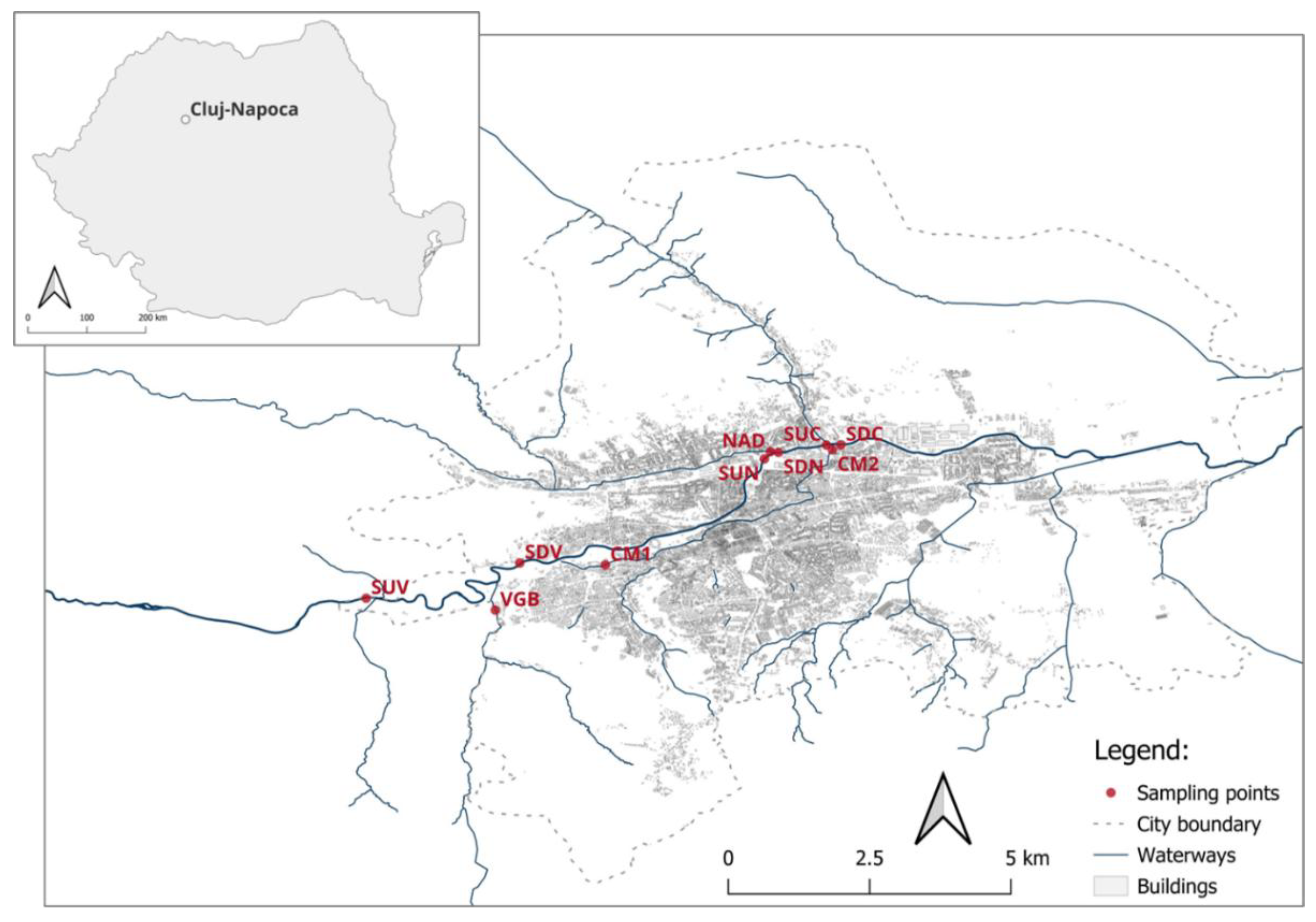
Figure 2.
Principal Component Analysis (PCA) plot showing the ordination of the sampling sites based on the following abiotic parameters: Cnd – Water conductivity (µS/cm); Elv – elevation (m a.s.l.); Nba – Nearest built area (m); Oxg – Dissolved oxygen (mg/L); Pbp – Percentage of boulders and pebbles in sediments (%); Psp – Phosphates (mg/L); Rad – river average depth (m); Raw – river average width (m); Tmp – water temperature (°C); Wav – water average velocity (m/s); explained variation (cumulative, axis 1 & 2): 61.35 (site abbreviations as in Table S1).
Figure 2.
Principal Component Analysis (PCA) plot showing the ordination of the sampling sites based on the following abiotic parameters: Cnd – Water conductivity (µS/cm); Elv – elevation (m a.s.l.); Nba – Nearest built area (m); Oxg – Dissolved oxygen (mg/L); Pbp – Percentage of boulders and pebbles in sediments (%); Psp – Phosphates (mg/L); Rad – river average depth (m); Raw – river average width (m); Tmp – water temperature (°C); Wav – water average velocity (m/s); explained variation (cumulative, axis 1 & 2): 61.35 (site abbreviations as in Table S1).
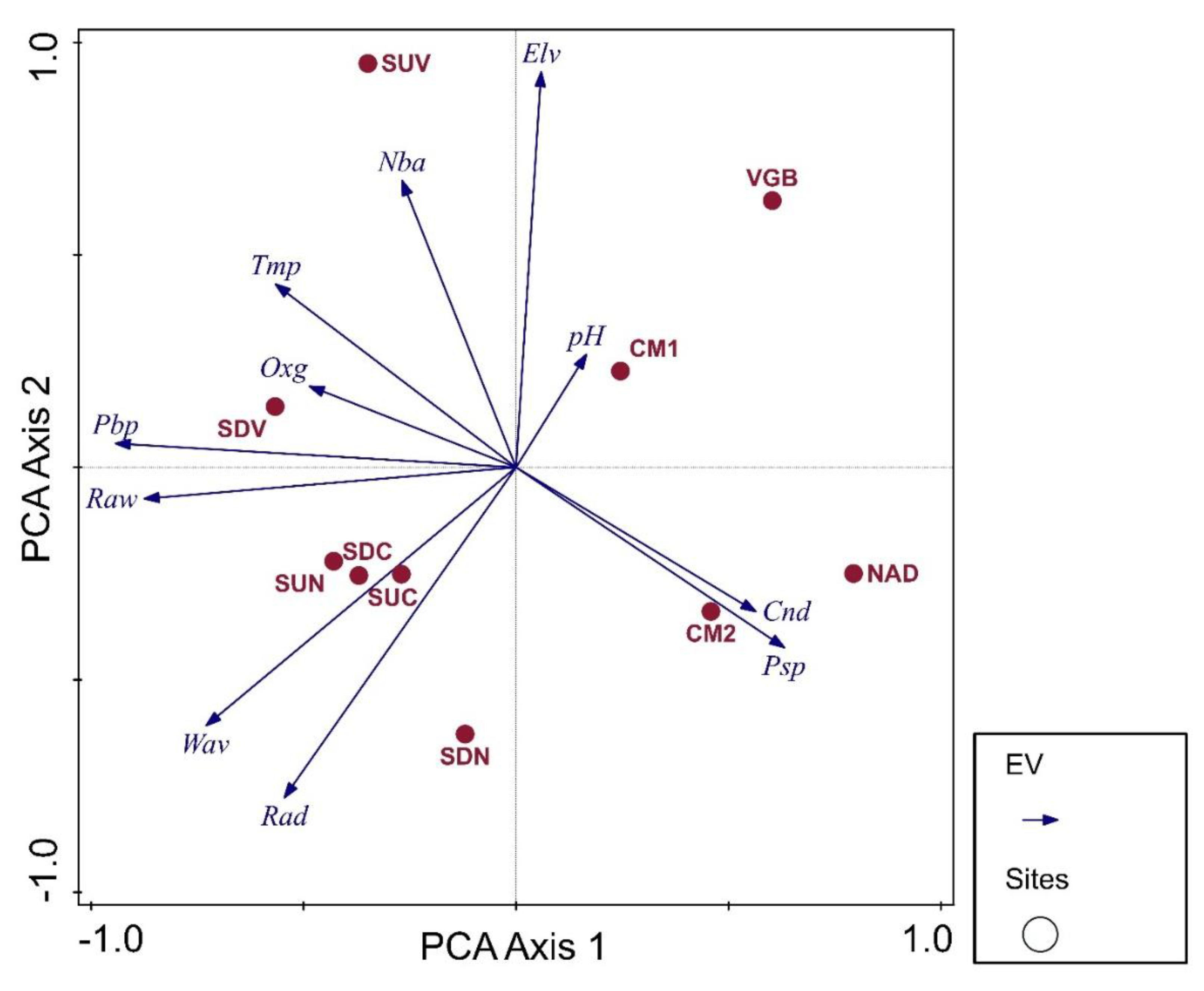
Figure 3.
Dendrogram of benthic invertebrate functional traits (size, dispersal ability and FFG), constructed from dissimilarity matrix based on Gower distance; four major groups are distinguished (from left to right): sedentary small taxa (black), sedentary large taxa (red), mobile small taxa (green), and mobile large taxa (blue); Scr - scrapers ; Shr – shredders; Cof - suspension feeders (filtering collectors); Cog - sediment feeders (gathering collectors); Prs - engulfing predators (swallowers); Par – parasites; taxa abbreviation as in Table S2.
Figure 3.
Dendrogram of benthic invertebrate functional traits (size, dispersal ability and FFG), constructed from dissimilarity matrix based on Gower distance; four major groups are distinguished (from left to right): sedentary small taxa (black), sedentary large taxa (red), mobile small taxa (green), and mobile large taxa (blue); Scr - scrapers ; Shr – shredders; Cof - suspension feeders (filtering collectors); Cog - sediment feeders (gathering collectors); Prs - engulfing predators (swallowers); Par – parasites; taxa abbreviation as in Table S2.
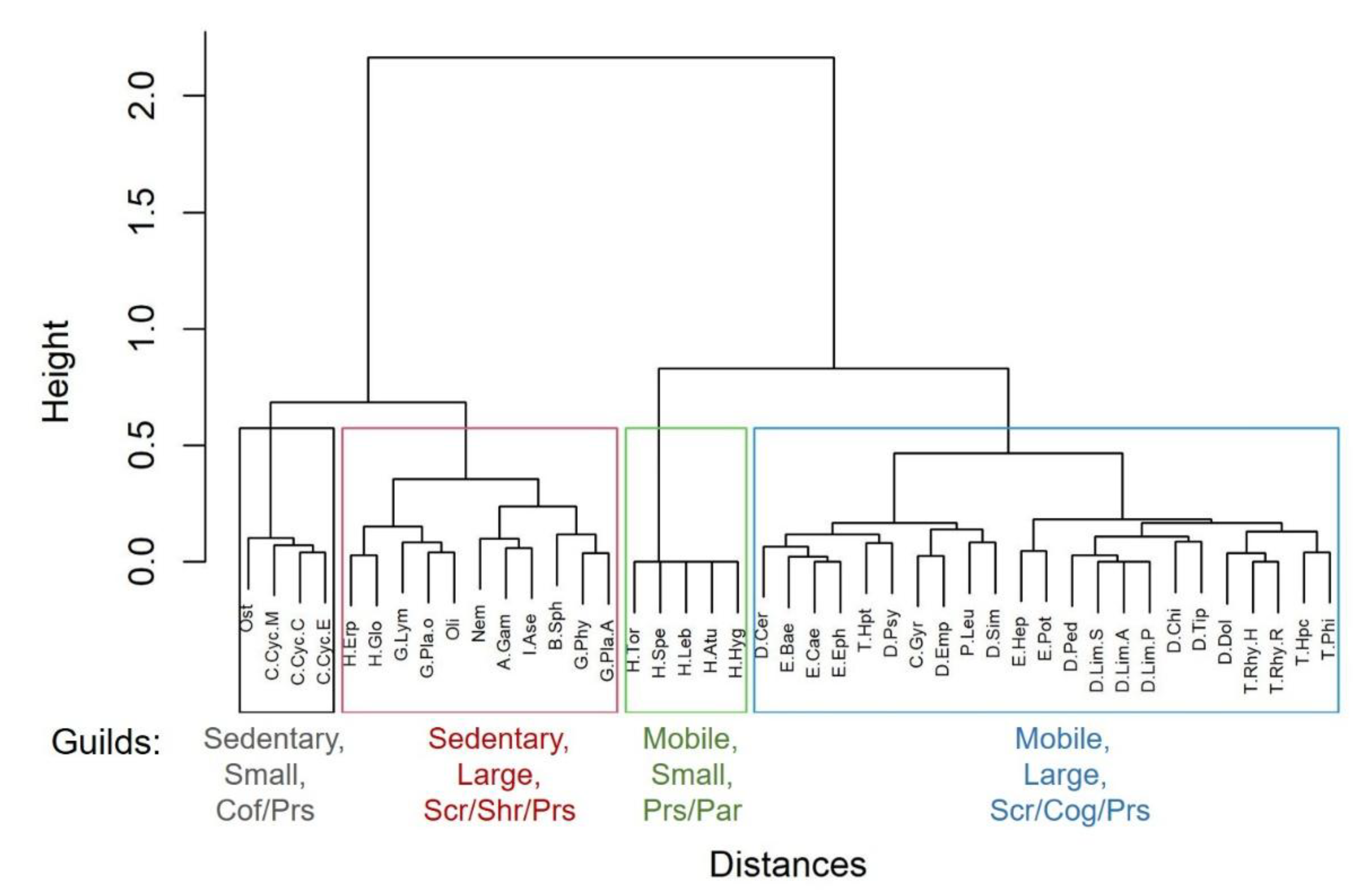
Figure 4.
Canonical Correspondence Analysis CCA biplot with benthic invertebrate taxa abundances as response variables and environmental explanatory variables (Pbp – percentage of boulders and pebbles in sediments (%); Raw – river average width (m); Wav – water average velocity (m/s)), showing isolines of Shannon-Wiener diversity H’ index values across the ordination space; site abbreviations as in Table S1; taxa abbreviations as in Table S2 (adjusted explained variation is 20.89%, Monte Carlo permutation test results on all axes: pseudo-F = 1.8, p=0.025).
Figure 4.
Canonical Correspondence Analysis CCA biplot with benthic invertebrate taxa abundances as response variables and environmental explanatory variables (Pbp – percentage of boulders and pebbles in sediments (%); Raw – river average width (m); Wav – water average velocity (m/s)), showing isolines of Shannon-Wiener diversity H’ index values across the ordination space; site abbreviations as in Table S1; taxa abbreviations as in Table S2 (adjusted explained variation is 20.89%, Monte Carlo permutation test results on all axes: pseudo-F = 1.8, p=0.025).
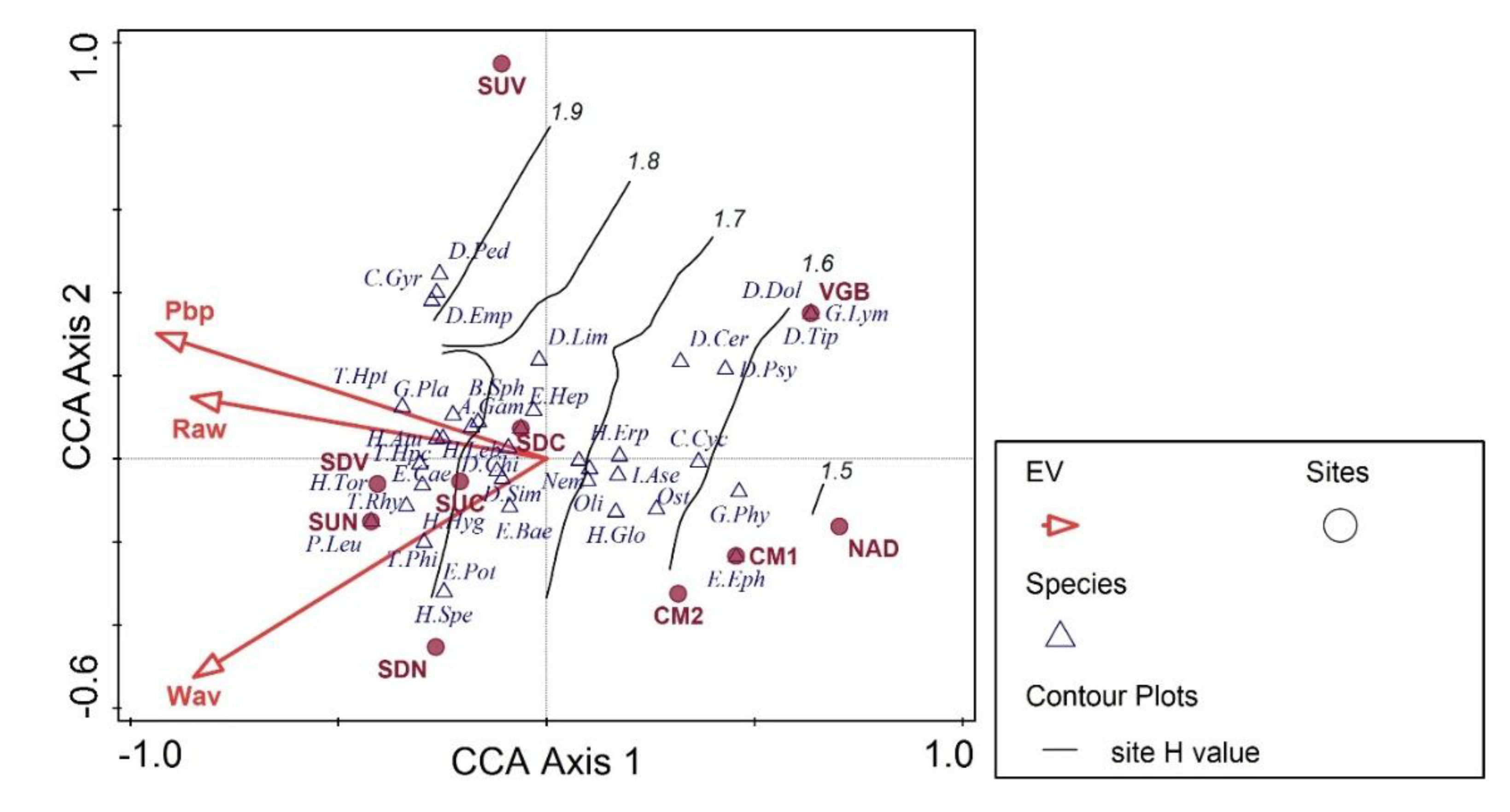
Figure 5.
Redundancy Analysis RDA biplot with the values of Community Weighted Means CWM for benthic invertebrate length (Size), dispersal ability (Mobile) and the presence of predator (Prs) and shredder (Shr) functional feeding groups FFG – as response variables; and environmental explanatory variables (Pbp – Percentage of boulders and pebbles in sediments (%); Raw – river average width (m); Wav – water average velocity (m/s)); site abbreviations as in Table S1; adjusted explained variation is 44.24%, Monte Carlo permutation test results on all axes: pseudo-F = 3.4, p=0.033.
Figure 5.
Redundancy Analysis RDA biplot with the values of Community Weighted Means CWM for benthic invertebrate length (Size), dispersal ability (Mobile) and the presence of predator (Prs) and shredder (Shr) functional feeding groups FFG – as response variables; and environmental explanatory variables (Pbp – Percentage of boulders and pebbles in sediments (%); Raw – river average width (m); Wav – water average velocity (m/s)); site abbreviations as in Table S1; adjusted explained variation is 44.24%, Monte Carlo permutation test results on all axes: pseudo-F = 3.4, p=0.033.
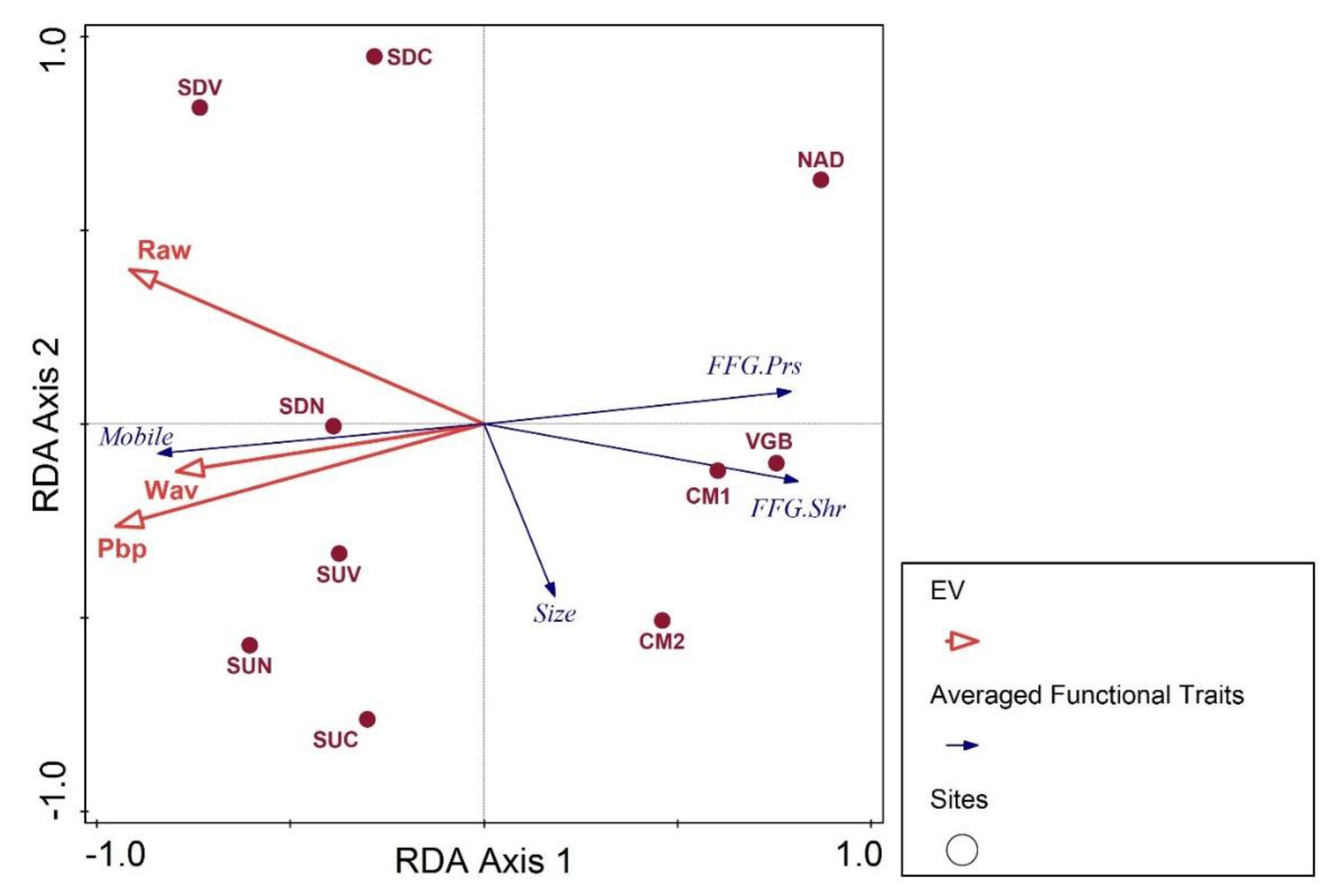
Figure 6.
Conceptual representation of the four levels of mitigation solutions proposed in the present study (base image generated using OpenAI’s ChatGPT, DALL·E 3 model, accessed on 4 October 2025, modified by the authors).
Figure 6.
Conceptual representation of the four levels of mitigation solutions proposed in the present study (base image generated using OpenAI’s ChatGPT, DALL·E 3 model, accessed on 4 October 2025, modified by the authors).
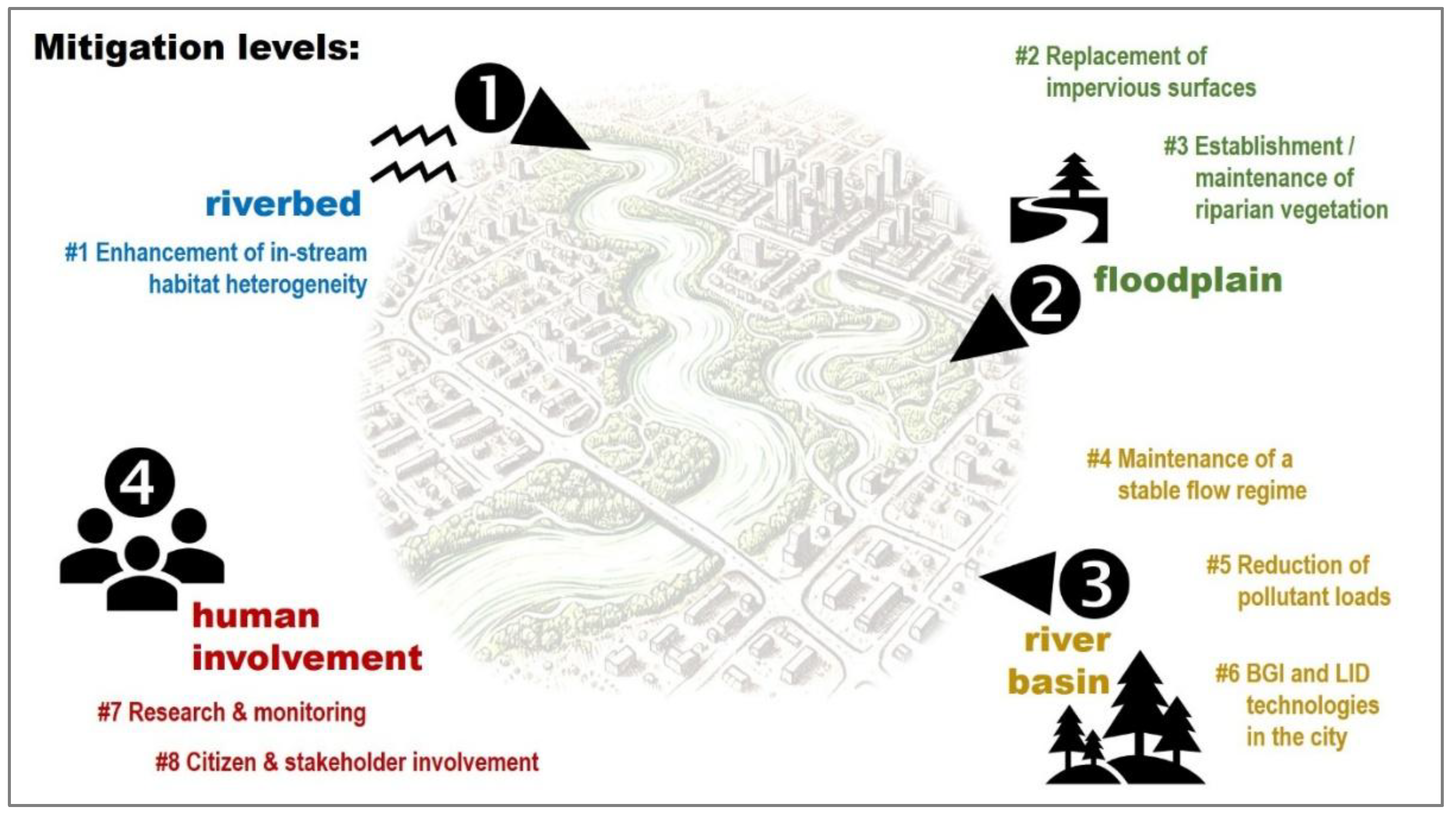

Table 1.
Results of multiple regression models relating community attributes (dependent variables: Eff.tx – Effective number of taxa; No.tx – Number of taxa; ID – Index of Dominance; EPT% – Percentage of Ephemeroptera, Plecoptera, Trichoptera; OCH% – Percentage of Oligochaeta and Chironomidae; MNWH-AR – Values of Modified New Walley Hawkes, Abundance-Related) to environmental predictors (independent variables: Wav – Water average velocity; Psp – Concentration of phosphates; Nba – Nearest built area; Pbp – Percentage of boulders and pebbles in sediments; Cnd – Water conductivity; Oxg – Dissolved oxygen; Raw – River average width); values represent regression coefficients (Estimates) with corresponding p-values for each predictor; model fit statistics (R², adjusted R², F-statistic, and significance) are reported below the table; values in bold: p<0.01.
Table 1.
Results of multiple regression models relating community attributes (dependent variables: Eff.tx – Effective number of taxa; No.tx – Number of taxa; ID – Index of Dominance; EPT% – Percentage of Ephemeroptera, Plecoptera, Trichoptera; OCH% – Percentage of Oligochaeta and Chironomidae; MNWH-AR – Values of Modified New Walley Hawkes, Abundance-Related) to environmental predictors (independent variables: Wav – Water average velocity; Psp – Concentration of phosphates; Nba – Nearest built area; Pbp – Percentage of boulders and pebbles in sediments; Cnd – Water conductivity; Oxg – Dissolved oxygen; Raw – River average width); values represent regression coefficients (Estimates) with corresponding p-values for each predictor; model fit statistics (R², adjusted R², F-statistic, and significance) are reported below the table; values in bold: p<0.01.
| Predictor | Model 1: Eff.tx |
Model 2: No.tx |
Model 3: ID |
Model 4: EPT% |
Model 5: OCH% |
Model 6: MNWH-AR |
|---|---|---|---|---|---|---|
| Intercept |
4.61 (p < 0.001) |
–2.94 (p = 0.642) |
0.57 (p < 0.001) |
–41.90 (p = 0.002) |
529.75 (p = 0.013) |
43.93 (p < 0.001) |
| Wav | 3.31 (p = 0.014) |
– | – |
130.16 (p < 0.001) |
– | – |
| Psp | –0.32 (p = 0.015) |
– | 0.029 (p = 0.016) |
–4.46 (p = 0.011) |
– | – |
| Nba | 1.84 (p = 0.009) |
– | –0.052 (p = 0.289) |
25.92 (p = 0.006) |
– | 32.12 (p = 0.066) |
| Pbp | – |
0.32 (p = 0.006) |
– | – | – | – |
| Cnd | – | – | – |
0.017 (p = 0.005) |
– | – |
| pH | – | – | – | – | –69.23 (p = 0.023) |
– |
| Oxg | – | – | – | – | 9.33 (p = 0.076) |
– |
| Raw | – | – | – | – | –1.31 (p = 0.002) |
1.22 (p = 0.002) |
|
Model fit: Model 1: R² = 0.88, Adjusted R² = 0.82, F(3,6) = 14.86, p = 0.0035 Model 2: R² = 0.63, Adjusted R² = 0.58, F(1,8) = 13.53, p = 0.0062 Model 3: R² = 0.65, Adjusted R² = 0.55, F(2,7) = 6.50, p = 0.0254 Model 4: R² = 0.97, Adjusted R² = 0.95, F(4,5) = 42.22, p < 0.001 Model 5: R² = 0.85, Adjusted R² = 0.78, F(3,6) = 11.48, p = 0.0067 Model 6: R² = 0.83, Adjusted R² = 0.78, F(2,7) = 16.71, p = 0.0022 | ||||||
Table 2.
Provisioning, regulating and cultural services provided by the Someșul Mic River ecosystem in the city of Cluj-Napoca.
Table 2.
Provisioning, regulating and cultural services provided by the Someșul Mic River ecosystem in the city of Cluj-Napoca.
| Type | Code | Ecosystem Service |
|---|---|---|
| Provisioning | P1 | Production of energy; |
| P2 | Riverfront restaurants, cafes, shops; | |
| P3 | Changes in riverfront property values; | |
| P4 | Recreational bathing; | |
| P5 | Irrigation of crops (urban gardens); | |
| P6 | Groundwater recharge. | |
| Regulation & Maintenance |
RM1 | Bio-remediation made by biota (micro-organisms, algae, plants, animals); |
| RM2 | Filtration of toxic substances by biota (macrophytes); | |
| RM3 | Sequestration of CO2 by primary producers; | |
| RM4 | Sink for organic and inorganic substances (nutrients, metals, organic pollutants); | |
| RM5 | Regulation of water chemistry made by biota (bio-geo-chemical cycles); | |
| RM6 | Support for pollinators; | |
| RM7 | Maintaining viable populations and gene pool; | |
| RM8 | Maintaining habitats (aquatic & riparian); | |
| RM9 | Regulation of temperature and humidity (climate regulation); | |
| RM10 | Control of erosion rates; | |
| RM11 | Sediment transport regulation; | |
| RM12 | Hydrological cycle - including flood regulation. | |
| Cultural | C1 | River traits that allow activities sustaining human health (walks, jogging, water sports etc.); |
| C2 | River traits that promote mental health (temporary getaway, tranquil location, meditation, feeling of safety etc.); | |
| C3 | River traits that promote social activities (festivals, artistic events etc.); | |
| C4 | River traits that allow educational & training activities (environmental awareness, nature laboratory, bird-watching, healthy value systems etc.); | |
| C5 | River traits that allow recreational activities (recreational fishing, picnics etc.); | |
| C6 | River traits with historical/heritage importance (water mills, historical bridges, places connected to the history of the city); | |
| C7 | Aesthetic experiences (panoramic viewpoint, scenic beauty, natural sounds, charismatic fauna, lack of foul odors etc.). |
Table 3.
Mitigation strategies for the Urban Stream Syndrome derived from invertebrate community patterns in the Someșul Mic River (Nbs – Nature based Solution; ES – Ecosystem Services, see Table 2).
Table 3.
Mitigation strategies for the Urban Stream Syndrome derived from invertebrate community patterns in the Someșul Mic River (Nbs – Nature based Solution; ES – Ecosystem Services, see Table 2).
| # | Mitigation measure | Output / Details | Nbs | Targeted ES |
Sources |
|---|---|---|---|---|---|
| 1. | Enhancement of in-stream habitat heterogeneity | Addition of boulders, large cobbles, gravel and/or wooden structures, artificial riffles and meanders; Using combined remediation techniques, addressing pollution sources in the catchment and maintaining refugia within the riverbed are crucial for the successful recolonization of new substrates. |
yes | RM1, RM3-8, C2, C4, C5 |
[18,72] |
| 2. | Replacement of impervious surfaces, in/near the river with more natural substrates | Impervious surfaces (e.g., concrete riverbed / banks) disrupt the connection between river and groundwater through the hyporheic zone (which acts as a refuge and a regulator of water quality and floods); There is a direct connection between the flow of the Someșul Mic River and the groundwater level beneath Cluj-Napoca; until the late 19th century, the river served as the primary water source in the city, with its discharge directly determining the water supply; More natural substrates should be used (e.g., gravel, fascines & geotextiles, porous concrete, ripraps, mixed-techniques like lower-bank ripraps with upper-bank plantings); Positive effects: urban stormwater runoff reduction; riparian habitat heterogeneity increase; in-stream habitat heterogeneity increase; unlimited connections between riverbed and riparian communities (lateral connectivity). |
yes | P6, RM1-9, RM12 C1, C2, C4, C5 |
[18,44,73,74,75] |
| 3. | Establishment and/or maintenance of riparian vegetation | Herbs, shrub or trees, native species, living directly on the river banks or on artificial substrates (like walls), acting as riparian buffers; Positive effects: urban stormwater runoff reduction and filtration, floodplain habitat increase; constant food source in the river coming from terrestrial vegetation; increased shading leading to less extreme temperatures; decreased heat stress. |
yes | P3, P6, RM1-3, RM5-12, C1-5 |
[18,76,77,78,79] |
| 4. | Maintenance of a stable flow regime, downstream Florești II Dam | The Florești II Dam regulates the flow on the Someșul Mic, in Cluj-Napoca, to its confluence with the Someșul Mare. Intermittent water releases often generate hydropeaking effects in downstream sections; high flows lead to organism removal, reduction of habitat, increases in turbidity and disturbed sediments; low flows lead to reduction of habitat and food, increased concentrations of nutrients or pollutants and decreased oxygenation. | no | P1, RM4-5, RM7-9, C2-5 |
[1,18,80,81] |
| 5. | Reduction of pollutant loads, at the catchment scale | Addressing pollution problems upstream of the city and within the tributary catchments is essential to secure good physico-chemical quality along the urban river reach. | yes | P2-6, RM2, RM4-5, C7 | [18] |
| 6. | Blue-Green Infrastructure BGI and Low-Impact Development LID technologies in the city | Examples of BGI and LID: permeable pavements, urban tree planting, green roofs, bioswales, rain gardens, infiltration trenches, biofilters, rain tanks etc.; Positive effects: reduction of runoff, filtering pollutants, and enhancing natural infiltration processes. |
yes | P5, RM6, RM9, RM12, C1-2, C4-5 | [20,82,83] |
| 7. | Continuous research & monitoring; adaptative & ecosystem-based management & design | Smart water management: the use of sensors, Internet of Things, machine learning, big data analyses, digital twins concept - in order to monitor, detect changes, predict, support decision makers etc.; Adaptive design in urban planning, together with focus of biodiversity, multifunctionality, redundancy and modularization are strategies for increasing urban resilience capacity. |
no | RM7-8, C4 |
[82,84,85,86,87] |
| 8. | Citizen & stakeholder involvement | Active involvement of the general public (including citizen science) and of all stakeholders, such as: authorities (the Romanian Waters National Administration - Someș-Tisa Water Basin Administration, the Someș Water Company, Hidroelectrica S.A., Cluj-Napoca Municipality); the County Association of Anglers, various NGOs, civic activists, riparian residents etc. | no | P2-5, C1-7 |
[88,89] |
Disclaimer/Publisher’s Note: The statements, opinions and data contained in all publications are solely those of the individual author(s) and contributor(s) and not of MDPI and/or the editor(s). MDPI and/or the editor(s) disclaim responsibility for any injury to people or property resulting from any ideas, methods, instructions or products referred to in the content. |
© 2025 by the authors. Licensee MDPI, Basel, Switzerland. This article is an open access article distributed under the terms and conditions of the Creative Commons Attribution (CC BY) license (http://creativecommons.org/licenses/by/4.0/).
Copyright: This open access article is published under a Creative Commons CC BY 4.0 license, which permit the free download, distribution, and reuse, provided that the author and preprint are cited in any reuse.


