

Submitted:
01 October 2025
Posted:
14 October 2025
You are already at the latest version
Abstract
Based on the Theory of Planned Behavior, this study systematically examines the influence mechanism of sustainable fashion consumption value perception on purchase intention among Chinese and Korean consumers, while also delving into the moderating effect of environmental concern between consumption value and purchase intention. Using a questionnaire survey method, the study collected 1,308 valid samples from university students in China and South Korea (716 Chinese samples, 592 Korean samples), employing quantitative analysis with SPSS 26.0 and AMOS 26.0.0. The research constructed an influence pathway model for sustainable fashion consumption behavior, using the five dimensions of consumption value (functional value, social value, emotional value,precious value, ethical value) as its theoretical framework. Empirical findings reveal: Each dimension of consumer value significantly and positively influences purchase intention among Chinese and Korean consumers. - Environmental concern significantly moderates the relationship between consumer value and purchase intention. Significant cross-cultural differences exist in the relationship between consumer value perception and purchase intention between Chinese and Korean consumers. Additionally, gender significantly moderates consumer value perception, providing crucial insights for targeted marketing strategies. These findings not only provide empirical support for fashion enterprises in positioning sustainable fashion products but also offer robust backing for theoretical advancement and practical innovation in sustainable fashion.
Keywords:
planned behavior theory
; sustainable fashion
; consumer value
; environmental concern
; purchase intention
; cross-cultural differences
1. Introduction
With the rapid development of the global economy and tremendous advances in modern technology, human society has consumed vast amounts of resources during its accelerated growth, causing significant damage to the ecological environment. The fashion industry has emerged as the world's second-largest polluting sector, surpassed only by the petroleum industry. Fueled by the fast fashion consumption model, every stage of the fashion supply chain—from raw material production and garment manufacturing to finished product transportation and clothing use—inevitably contributes to widespread soil contamination, water pollution, greenhouse gas emissions, and energy consumption. Consequently, the fashion industry has become the world's second-largest polluting industry. Take the cotton textile industry as an example. As a vital component of the textile sector, China's cotton textile industry currently consumes fiber resources and energy at levels 2.2 times higher than those of developed countries [1]. Moreover, the vast quantities of discarded textiles generated by fast fashion consumption represent an enormous waste of natural resources and can even cause local environmental pollution. Addressing the environmental issues stemming from the fashion industry's rapid expansion is an urgent priority.
The current linear system of clothing production, distribution, and consumption places immense pressure on resources, the environment, and ecosystems. According to the Ellen MacArthur Foundation, the global apparel industry produces approximately 53 million tons of fiber annually, with only 1% being recycled. A staggering 70% of fiber waste ultimately ends up in landfills or is incinerated [2]. Sustainable fashion extends beyond merely addressing the lifespan and environmental impact of textile products as physical entities. It encompasses reducing industrial carbon emissions, mitigating pollution and climate change, and coordinating relationships among producers, consumers, and economic, cultural, and social systems within the entire fashion ecosystem [3].
As awareness of environmental issues and social responsibility grows, an increasing number of consumers are paying attention to whether the fashion products they purchase meet sustainability standards. Consumer purchasing decisions are influenced by factors such as a product's environmental friendliness, social responsibility, and ethical production practices. Moreover, sustainable fashion products are gradually gaining widespread acceptance. Particularly in economically developed, highly educated urban areas, the concept of eco-conscious consumption is becoming increasingly prevalent. Certain university student consumer groups demonstrate significant interest in purchasing sustainable fashion products, highlighting the need for more in-depth research into their sustainable fashion consumption behaviors.
In recent years, numerous scholars have analyzed sustainable fashion products from diverse perspectives. Bielawska et al. (2021); Cho Yun-jin et al. (2022); Duan et al. (2023); Shin Jun-ho (2023); Jeon Chan-ho (2023); Jang Bo-hyun (2024); Maitree et al. (2024); Yang Iljeong (2024); Lee Eun-ah (2024) have examined the influence of consumer values on purchase intentions for sustainable fashion products. Hoo Shin-Woo (2021); Jeong Da-Woon & Kim Young-Sam (2022); Nguyen et al. (2022); Hasan (2023); Kumar (2022); Chanda et al. (2023); Gold & Terner (2023); Song Ji-An (2024); Gul et al. (2024) applied the TPB model to examine purchase intention for sustainable fashion products. Alhamad et al. (2023), Gupta et al. (2023), Neiba & Tejmani (2024), Hudayah et al. (2023), and Godrati et al. (2024) investigated the moderating role of environmental concern between consumer value and purchase intention.
Currently, sales of sustainable fashion products are on the rise and increasingly sought after by consumers, yet empirical research in this area remains incomplete. Existing prior studies on sustainable fashion products predominantly focus on isolated analyses of perceived value, environmental concern, or purchase intention, with few integrating multiple characteristics for comprehensive consumer behavior analysis based on the Theory of Planned Behavior (TPB) model. The TPB model offers a more holistic and effective framework for predicting consumer behavior. Moreover, comparative studies between China and South Korea remain scarce.
Therefore, this study, grounded in the Theory of Planned Behavior, examines the influence of perceived value on purchase intention for sustainable fashion products among university students in South Korea and China. It also verifies the moderating effect of environmental concern on the relationship between perceived value and purchase intention. Additionally, it compares the differences in the impact of perceived value on purchase intention for sustainable fashion products between South Korean and Chinese university students, and explores gender differences in this influence. Subsequently, it assesses market responses to sustainable fashion products in both countries and evaluates the current relationship between perceived value and purchase intent for sustainable fashion products. This aims to provide insights for fashion enterprises in accurately positioning sustainable fashion products while establishing a theoretical foundation for future development directions in sustainable fashion.
Theoretically, this study is the first systematic exploration of cross-cultural differences in the influence of perceived value for sustainable fashion consumption on purchase intent among Chinese and Korean consumers, grounded in the Theory of Planned Behavior (TPB). This research expands the application of the TPB model in cross-cultural consumer behavior studies, offering a new theoretical perspective for understanding consumer purchasing decisions across cultural contexts. By introducing multidimensional perceptions of consumer value, the study deepens theoretical explanations of consumer behavior, revealing the mediating or moderating role of cultural differences between perceived consumer value and purchase intention. It provides a novel theoretical framework and research pathway for cross-cultural studies of sustainable fashion consumption behavior.
At the practical level, this study provides crucial cross-cultural market strategy guidance for sustainable fashion brands and marketers. By comparing differences in consumption value perceptions and purchase intentions between Chinese and Korean consumers, it reveals distinct consumption preferences and decision-making logic across cultural groups, offering practical references for enterprises promoting sustainable fashion products in both markets. Businesses can design more targeted marketing strategies based on the value orientations of consumers from different cultural backgrounds, thereby enhancing the market acceptance and competitiveness of sustainable fashion products. Simultaneously, this study offers practical recommendations for policymakers and industry practitioners to advance sustainable fashion consumption, thereby contributing to the achievement of sustainable development goals.
In summary, through a cross-cultural comparative analysis grounded in the Theory of Planned Behavior, this research delves into the influence mechanism of sustainable fashion consumption value perceptions on purchase intentions among Chinese and Korean consumers. It not only enriches theoretical research in the field of sustainable fashion but also provides significant practical guidance for promoting sustainable fashion consumption in real-world applications.
2. Theoretical Background
2.1. Concept of Sustainable Fashion Products
2.1.1. Concept of Sustainable Fashion Products
According to the Oxford English Dictionary, the concept of sustainability encompasses two dimensions: first, human economic activities and cultural practices that do not cause environmental degradation, particularly avoiding the long-term depletion of natural resources; second, the development and utilization of natural resources through sustainable means while preserving the environment for future generations [4]. Sustainable fashion products refer to new approaches in fashion planning, design, sourcing, production, and distribution that minimize ethical and social issues throughout the entire product lifecycle, thereby achieving environmental sustainability and safeguarding future generations [5]. From product design through production and post-use recycling, these products prioritize protecting ecosystems and aligning with natural cycles for future generations. They extend product lifecycles, prevent unnecessary resource waste, and minimize environmental pollution [6]. Sustainable fashion products involve producing, using, and disposing of fashion items without compromising the resources available to future generations [7].
Sustainable fashion encompasses styles using recycled fabrics, upcycled fashion, vintage fashion, organic fashion, animal-friendly vegan fashion, zero-waste fashion minimizing cutting waste, and environmentally conscious and fair trade fashion reflecting ecological and social equity [8]. It represents a win-win collaborative structure among ethical fashion designers, brands, consumers, and partners within the industry ecosystem, grounded in the well-being of the planet and future generations [9].
Sustainable fashion products adhere to principles such as using eco-friendly materials, upholding ethical labor standards, employing waste-reduction techniques, and promoting garment longevity and durability. By integrating these concepts, they foster a more responsible and sustainable industry that benefits both society and the environment[10]. Throughout production and consumption, sustainable practices prevent resource depletion or damage by utilizing eco-friendly raw materials, minimizing chemical and fuel usage, conserving water resources, and reducing environmental impact[11].
2.1.2. Current Status of Sustainable Fashion Products in China
China's sustainable fashion industry remains in its infancy, yet a segment of Chinese consumers has begun favoring sustainable apparel purchases. There is emerging preference for eco-friendly materials and environmentally conscious brands, alongside heightened consumer awareness of sustainable fashion—indicating promising prospects for this sector in the Chinese market [12].
An increasing number of Chinese fashion enterprises are joining the movement to advance industry sustainability. Anta Sportswear collaborated with DuPont to launch cooling-tech fabric T-shirts, achieving a 37% reduction in petroleum resource consumption, 30% energy savings, and a 63% decrease in greenhouse gas emissions at the production stage. This approach minimizes environmental pollution from both design and manufacturing origins. Simultaneously, during product promotion, sustainable fashion concepts are disseminated to consumers, thereby realizing sustainability goals [13].
Chinese sustainable fashion brands increasingly prioritize organic materials and innovative eco-friendly fibers, reflecting consumers' growing emphasis on health and environmental protection. However, research indicates that due to unique cultural perspectives, Chinese fashion consumers currently exhibit low acceptance of recycled materials. Consequently, Chinese fashion brands use recycled materials at low rates in production and lack experience in their application[14].
In June 2024, the “2025 Fall/Winter Asian Sustainable Fashion Movement Trend Report” was officially released . The report proposes the “Three Suitabilities” principle for sustainable circular design—“suitable, moderate, and applicable”—tailored to the textile and apparel industry's characteristics. It integrates ancient wisdom from traditional culture with contemporary values, redefining the inheritance and innovation of classics within the “sustainable fashion” framework to better align with modern values. This further emphasizes the pivotal role of design and R&D in the sustainable activewear industry ecosystem [15].
China's sustainable fashion landscape manifests in multiple dimensions. Firstly, an increasing number of brands are adopting biodegradable, recyclable, and natural eco-friendly materials such as organic cotton, bamboo fiber, recycled polyester, and plant-based dyes. These materials not only reduce environmental impact but also minimize reliance on chemicals during production, significantly lowering ecological harm [16]. Additionally, a growing number of consumers are paying attention to environmental factors like production processes and material sourcing, increasingly choosing products aligned with sustainable principles. This trend has also contributed to the development of sustainable fashion in the Chinese market[17].
Overall, as public awareness of environmental protection and sustainable development continues to rise, the fashion industry is gradually shifting toward more eco-friendly and sustainable practices. China's sustainable fashion landscape is steadily improving, and the collective efforts of all stakeholders hold promise for greater progress in this field.
2.1.3. Current Status of Sustainable Fashion Products in South Korea
South Korea has adopted a “policy-driven +” approach in the sustainable fashion sector. On one hand, the nation has established robust regulatory frameworks for resource circulation and Extended Producer Responsibility (EPR). The Resource Circulation Framework Act and its implementing regulations provide the legal foundation for textile recovery, reuse, and producer responsibility, while also driving local governments and businesses to establish recovery and penalty mechanisms [18]. While current EPR in South Korea primarily focuses on packaging, policy initiatives to expand EPR to textiles are gaining momentum both internationally and domestically. Organizations like the Global Fashion Agenda Korea are developing innovative solutions that will create valuable institutional precedents [19].
In corporate and market practices, major Korean brands and circular economy enterprises are exploring the integration of sustainability principles with data-driven fashion. On one hand, university students and local designer brands leverage big data for trend forecasting and inventory management, excessively reducing production and stockpiling to minimize resource waste at the source [20]. On the other hand, secondhand trading platforms and rental platforms utilize data-driven recommendation systems and consumption behavior analysis to deliver personalized services and extend garment lifespans [21]. Furthermore, some brands employ blockchain and IoT technologies for product traceability management. Consumers can scan QR codes to access information on raw material origins, production processes, and environmental impacts, thereby enhancing sustainability integrity and consumer trust [22].
Recent surveys indicate that Korean consumers' willingness to pay for sustainable brands provides crucial market support for eco-friendly products. Sun-ah Kim (2025) found that young consumers particularly value brands' environmental credentials, material sourcing, and social responsibility—with these consumption value dimensions (functional value, emotional value, ethical/self-concept value) significantly influencing purchase intent [23]. Huh Eun-ju & Han Hee-jeong (2024) confirmed through direct payment and scenario experiments that some consumers are willing to pay a premium when products carry prominent carbon-neutral or recycled material labels [24].
Academic and industry reports consistently highlight that information opacity and “greenwashing” have become major barriers to sustainable fashion purchase conversion [25]. Consumers often struggle to verify the authenticity of sustainability claims made by brands. The absence of unified third-party certification mechanisms and transparent environmental disclosure likely further erodes consumer trust in brands. This has resulted in many brands' sustainability strategies remaining at conceptual measurement or small-scale pilot stages, struggling to generate widespread market impact [26]. Meanwhile, some studies suggest that emerging digital technologies like blockchain can enhance supply chain traceability through programmable solutions, thereby alleviating consumer uncertainty in secondhand or circular consumption [27].
2.2. Consumer Values
Consumer value theory can predict consumer preferences for purchasing products or services, serving as a crucial indicator for forecasting consumer attitudes or behaviors [28]. Consumer values are defined as the prevailing beliefs shaping consumer behavior or attitudes. They are considered a key determinant of consumer purchasing behavior due to their distinct influence on both personal values and buying actions [29]. Consumer value is based on the notion that consumers expect some form of value return when purchasing goods and services. It represents a key factor valued by consumers or influencing their behavior, serving as an important means to understand consumer attitudes or actions. It is defined as a predictive indicator for forecasting consumer behavior [30].
Sheth et al. (1991) developed the theory of consumer values by integrating sociology, psychology, consumer behavior, and economics to aid in explaining and predicting consumer behavior. They posited that consumer choice decisions are influenced by multiple consumer values, with each value contributing differently in any given choice situation. Consumer value encompasses five dimensions: functional value, social value, emotional value, rarity value, and situational value. In this study, sustainable fashion products differ from conventional goods due to their distinctive eco-friendly nature. Within the green sector, the most prominent characteristic of sustainable fashion products is social ethical responsibility, yet the ethical value dimension receives limited attention. Given the unique attributes of sustainable fashion products, this study incorporates ethical value into the consumer value theory framework. Therefore, drawing upon Sheth's consumer value theory [31], this research examines the influence of five dimensions—functional value, emotional value, social value, rarity value, and ethical value—on purchase intention for sustainable fashion products.
Functional value pertains to the utility associated with a product's functionality, quality, price, and service. It is defined as consumers' cognitive and perceived utility regarding practicality and physical attributes [32]. In green consumption, factors like price and quality within functional value significantly influence people's preference for eco-friendly products over traditional alternatives [33]. Social value reflects the social image or self-image consumers form through consuming, acquiring, or owning such products [34], creating value for consumer identity by enabling them to display social status and gain social recognition through purchases [35]. Emotional value represents the value individuals derive from positively or negatively expressing emotions through product purchases [36], including consumers' positive experiences when buying or using specific products [37]. The fundamental characteristic of rarity value is scarcity—the limited availability of a resource, commodity, or attribute within a market or specific context. Items possessing rarity value often exhibit uniqueness and are difficult to substitute with other goods [38]. Also termed cognitive or curiosity value, it refers to the perceived utility of sustainable fashion products stemming from their ability to evoke curiosity, offer novelty, and satisfy intellectual curiosity [39]. The precious value of sustainable fashion products can evoke novelty and curiosity in consumers while satisfying their desire for knowledge [40]. Ethical value represents the consumption value derived from considering community ethics, assuming social responsibility, and reducing environmental pollution [41], embodying the perceived utility gained through social, environmental, and human responsibility [42].
Kim et al. (2021) examined the impact of emotional, social, cognitive, and environmental values on consumer attitudes toward circular fashion apparel. Results indicated that all four value dimensions positively influenced consumers' willingness to purchase circular fashion [43]. Building on this, Cho et al. (2022) further focused their research on Gen Z consumers to analyze their purchase intentions toward ethical fashion products. Findings confirmed that ethical value and biosphere value positively influence consumers' ethical consumption attitudes and purchase intentions, while egoistic value showed no significant effect [44]. Similarly, Shin Jun-ho (2023) categorized consumption values into price-functional value, ethical value, emotional value, social value, and precious value in a study on eco-friendly baked goods, attempting to analyze their relationship with consumer attitudes, purchase intentions, and willingness to pay a premium [45].
Meanwhile, academia has also begun to focus on the consumption value dimensions of sustainable luxury goods. Essiz et al. (2024) categorized these into functional value, emotional value, cognitive value, conditional value, green value, and social value, subsequently exploring how these values influence consumer purchase intentions [46]. In the eco-friendly automotive sector, Joo (2017) employed structural equation modeling to validate causal relationships among perceived consumption value, product attitude, subjective norm, and purchase intention. Findings revealed that within the perceived value of eco-friendly vehicles, functional value and environmental value significantly and positively influenced product attitude, while social value significantly and positively impacted subjective norm. Concurrently, both product attitude and subjective norm exerted positive effects on purchase intention [47].
Regarding green apparel, Bielawska et al. (2021) examined consumer choice behavior based on consumption value theory. Findings indicated that emotional value, conditional value, and environmental value significantly and positively influenced green apparel selection, while functional value, social value, and cognitive value did not play significant roles [48]. In alignment with this, Hassan (2023) examined the influence of consumer value on eco-bag purchase intention, using green consumption attitude as a mediating variable. Findings revealed that economic value, social value, and environmental value positively influence green consumption attitude, which further serves as a key determinant of purchase intention among young consumers [49].
Furthermore, consumer value has been validated in studies concerning carbon-labeled products and recycled fiber products. Duan et al. (2023) found that despite low public awareness of carbon labeling systems, college students exhibited strong purchase intentions for carbon-labeled products. Functional value, emotional value, and cognitive value all positively influenced purchase intentions. The study also revealed significant age-related differences in purchase intentions, while gender, income, occupation, and education level showed no significant variations [50]. In contrast, Lee Eun-ah (2024) applied rational choice theory to regenerated fiber fashion products. Results indicated that social, ethical, and hedonic values within consumption value not only significantly positively influenced subjective norms but also further impacted brand satisfaction and purchase intention [51].
Finally, regarding vegan cosmetics, Jang Bohyun (2024)‘s empirical analysis indicates that consumers prioritize functional value in their consumption value hierarchy, followed by economic and ethical values. The study highlights that consumers’ consumption values significantly influence the likelihood of continued vegan cosmetic consumption, while their interest and satisfaction with such products also substantially determine this likelihood [52].
2.3. Theory of Planned Behavior
The Theory of Planned Behavior (TPB) posits that behavioral attitudes, subjective norms, and perceived behavioral control are the three primary variables influencing behavioral intentions [53]. An individual's behavior is determined by their intention to perform that behavior, and their intention is influenced by three factors: attitude toward the behavior, subjective behavioral norms, and perceived behavioral control [54]. <Figure 1> illustrates this theory in a structural diagram.
Subjective norms are one of the core variables in the Theory of Planned Behavior, referring to the influence exerted by influential individuals or groups on an individual's decision to adopt a specific behavior—that is, the perceived social pressure an individual experiences when engaging in that behavior [55]. In the context of sustainable fashion consumption, subjective norms are typically understood as the constraining force of social influence (such as friends, family, or public opinion) on an individual's purchasing decisions. Research indicates that among young consumers, subjective norms significantly influence their willingness to purchase sustainable fashion [56].
Correspondingly, attitude represents another crucial factor in the Theory of Planned Behavior. Attitude is generally defined as an individual's belief and evaluation regarding the potential outcomes of a behavior [57], and can be specifically understood as the degree of favorability toward purchasing sustainable products [58]. Existing research consistently demonstrates that positive attitudes significantly enhance consumers' purchase intentions.
Furthermore, perceived behavioral control is a key variable in the Theory of Planned Behavior, referring to an individual's perceived ease or difficulty in executing a specific behavior. Generally, stronger perceived behavioral control correlates with greater willingness to adopt the behavior [59]. In sustainable fashion consumption, perceived behavioral control encompasses both consumers' self-efficacy perceptions and their awareness of factors facilitating or hindering sustainable fashion practices. This cognition extends beyond the perceived difficulty of engaging in circular fashion practices, embracing slow fashion principles, and making sustainable consumption decisions. It also includes consumers' confidence in their ability to overcome these barriers—a confidence that largely determines their willingness to incorporate sustainable fashion into consumption plans [60].
Based on this, academia has conducted extensive empirical research on sustainable fashion consumption across diverse cultural contexts. Hushinwei (2021), studying Chinese consumers, validated that attitudes, subjective norms, and perceived behavioral control all significantly influence purchase intent—stronger attitudes, subjective norms, and perceived behavioral control toward sustainable fashion products correlate with higher purchase intent [61]. Similarly, Chanda et al. (2023) employed an extended Theory of Planned Behavior model in their Bangladesh study to examine the role of environmental knowledge and environmental sensitivity in influencing green purchase intention. Results revealed significant positive relationships between subjective norm, attitude, and perceived behavioral control and green purchase intention [62].
In a study conducted in Vietnam, Nguyen et al. (2022) integrated the value identification–personal norm model with the Theory of Planned Behavior, finding that personal norms and attitudes serve as crucial mediating variables in explaining consumers' green purchase intentions. Specifically, environmental self-identity and personal norms exerted significant influence on attitudes, while attitudes emerged as the strongest predictor of green purchase intentions, followed by subjective norms and perceived behavioral control [63]. Furthermore, Gul et al. (2024) demonstrated in a study among Indian youth that perceived behavioral control exerted the most significant influence on eco-friendly apparel purchase intention, followed by personal moral norms, general attitudes, and perceived consumer efficacy. Concurrently, environmental concern indirectly influenced purchase intention through the BNT variables and personal moral norms [64].
In summary, existing research thoroughly demonstrates that the Theory of Planned Behavior effectively explains consumers' sustainable fashion consumption intentions. Among these, attitude, subjective norm, and perceived behavioral control are key variables influencing purchase intention. Therefore, this study proposes to use the Theory of Planned Behavior as its theoretical framework to explore the impact of consumer values on the purchase intention of sustainable fashion products and further validate the role mechanisms of attitude, subjective norm, and perceived behavioral control within this framework.
2.4. Purchase Intention
Purchase intention serves as a crucial indicator for predicting consumers' actual purchasing behavior and is frequently employed to evaluate potential sales opportunities and market demand [65]. Specifically, purchase intention can be regarded as consumers' subjective inclination toward selecting specific products. It has been demonstrated as a key variable in forecasting consumption patterns, typically formed based on consumers' attitudes to reflect the likelihood of future purchases of certain products or services [66]. From an academic perspective, purchase intention serves both as a mediating process between consumer attitudes and actual purchasing behavior and as an individual psychological inclination that drives future purchasing actions [67]. Generally, stronger purchase intention correlates with a higher likelihood of consumers translating their intentions into actual purchases [68].
In empirical research, Gold & Terner (2023) applied the Extended Theory of Planned Behavior to sustainable fashion consumption in Japan, examining the role of sociocultural barriers on purchase intention. Results indicated that attitudes and perceived behavioral control significantly predicted sustainable fashion purchase intention, while subjective norms showed no significant effect. This outcome was interpreted as reflecting Japan's lack of discourse on sustainable fashion, which weakens the influence of subjective norms on younger generations [69]. Concurrently, Yang Iljeong (2024) examined the mediating role of perceived value in the relationship between upcycled product design attributes and consumer purchase intention. Findings revealed that emotional and social value positively influenced purchase intention, while upcycled product design attributes—including emotional, functional, ethical, and aesthetic aspects—significantly enhanced purchase intention [70].
Further research underscores the importance of social value and environmental knowledge. Smelt & Famke (2024) found that social influence value plays a crucial role in enhancing consumers' likelihood to purchase sustainable fashion, particularly through social recognition and recommendations from friends, family, and social networks [71]. Similarly, Maitree et al. (2024) identified functional value, social value, emotional value,precious value, and cognitive value as primary dimensions when assessing green consumers' perceived value of vegan leather bags made from mango waste. Findings indicate that vegan leather bags are favored for their durability and versatility; simultaneously, social media, family, and peer groups significantly influence sustainable product choices, while affective value and esteem value exert a significant positive effect on purchase intention [72].
Finally, Song Jian (2024) analyzed key factors influencing consumers' intention to purchase upcycled fashion products based on the Theory of Planned Behavior. Findings revealed that attitudes, subjective norms, and perceived behavioral control all positively influence purchase intention. Environmental value not only enhances consumers' attitudes and subjective norms but also further strengthens perceived behavioral control, thereby indirectly promoting purchase intention [73].
2.5. Environmental Concern
Environmental concern is a crucial psychological factor in explaining consumers' green consumption behavior, with its connotation defined in various ways within academia. Some scholars view environmental concern as encompassing interest, attitudes, and willingness toward the environment—that is, an individual's awareness or ideas about addressing environmental issues [74]. Others define it as an individual's cognitive level regarding efforts to solve environmental problems, along with their willingness to support or personally contribute to environmental solutions [75]. Furthermore, environmental concern is viewed as an individual's emotional investment in environmental issues, manifested as determination to mitigate environmental problems and support for eco-friendly initiatives [76]. From a value orientation perspective, environmental concern represents a general attitude toward environmental protection, reflecting an individual's level of concern for environmental conservation [77].
Empirical research has demonstrated a strong association between environmental concern and green consumption intention. Alhamad et al. (2023), studying Turkish consumers, found that both environmental concern and attitude directly influence the willingness to purchase green products [78]. Gupta et al. (2023) further indicated that individuals with high environmental concern are more attentive to their social image, making them more susceptible to social values. This manifests as heightened sensitivity to social norms and expectations, a trait that further enhances their willingness to purchase sustainable products [79].
Concurrently, the role of environmental concern has been validated across multiple theoretical frameworks. Neiba & Tejmani (2024) integrated Consumer Value Theory, the Stimulus-Organism-Response Model, and Theory of Planned Behavior to examine the relationships among green marketing, green consumption value, and green purchase intention. Findings revealed that green advertising, green word-of-mouth, functional value, affective value, green organic products, and eco-labels all exerted significant positive effects on organic purchase intention. Environmental concern significantly mediated the relationship between green consumption value (functional, social, and affective value) and organic purchase intention [80]. Similarly, Hudayah et al. (2023) found that functional value, conditional value, and environmental concern significantly and positively influenced purchase intention for green products among Indonesian Gen Z consumers. Additionally, environmental concern positively mediated the effect of social value on green product purchase intention, indicating that consumers with stronger environmental awareness were more likely to be driven by social value in their purchasing decisions [81].
Furthermore, Godrati et al. (2024) revealed the mediating and moderating effects of environmental concern between values and green purchase intention. The study found that environmental values not only directly and positively influenced green product purchase intention but also significantly and positively influenced environmental concern. Concurrently, environmental concern partially mediated the relationship between environmental values and green product purchase intention, while green trust moderated the relationship between environmental concern and green product purchase intention [82].
3. Research Methodology
3.1. Research Model
This study aims to analyze the influence of perceived value on consumers' purchase intention for sustainable fashion products based on the Theory of Planned Behavior (TPB) model. It also compares differences between Korean and Chinese university students in how perceived value affects their purchase intention for sustainable apparel products. Furthermore, it explores gender differences—specifically, the distinct mechanisms through which perceived value influences purchase intention among Male and female consumers. Through cross-national and gender comparisons, the study seeks to provide empirical references and practical insights for formulating sustainable apparel marketing strategies.
Building upon prior research and theoretical review, this study constructs a research model using TPB as the theoretical framework (Figure 2). As illustrated in Figure 2, consumer values (functional value, social value, affective value, precious value, and ethical value) are set as independent variables. These values not only indirectly influence purchase intention through subjective norms, attitudes, and perceived behavioral control but also exert a direct effect on purchase intention. Furthermore, this study hypothesizes that environmental concern plays a positive moderating role between consumer values and purchase intention.
3.2. Research Hypothesis Setting
H1.
Consumer value will positively influence consumers' planned behavior (subjective norm, attitude, perceived behavioral control).
H1-1
The functional value of consumer value will positively influence the subjective norm of consumers' planned behavior.
H1-2
The social value of consumer value will positively influence the subjective norm of consumers' planned behavior.
H1-3
The emotional value of consumer value will positively influence the subjective norm of consumers' planned behavior.
H1-4
The esteem value of consumption value will positively influence consumers' planned behavior in terms of subjective norm.
H1-5
The ethical value of consumption value will positively influence consumers' planned behavior in terms of subjective norm.
H1-6
The instrumental value of consumption value will positively influence consumers' planned behavior in terms of attitude.
H1-7
The social value of consumption value will positively influence consumers' planned behavior in terms of attitude.
H1-8
The affective value of consumption value will positively influence the attitude toward planned consumer behavior.
H1-9
The rarity value of consumption value will positively influence the attitude toward planned consumer behavior.
H1-10
The ethical value of consumption value will positively influence the attitude toward planned consumer behavior.
H1-11
The functional value of consumption value will positively influence the perceived behavioral control of planned consumer behavior.
H1-12
The social value of consumption will positively influence the perceived behavioral control of consumer planned behavior.
H1-13
The emotional value of consumption will positively influence the perceived behavioral control of consumer planned behavior.
H1-14
The rarity value of consumption will positively influence the perceived behavioral control of consumer planned behavior.
H1-15
The ethical value of consumption will positively influence the perceived behavioral control of consumer planned behavior.
H2.
Consumer planned behavior (subjective norm, attitude, perceived behavioral control) will positively influence purchase intention for sustainable fashion products.
H2-1
The subjective norm of consumer planned behavior will positively influence purchase intention for sustainable fashion products.
H2-2
The attitude toward consumer planned behavior will positively influence purchase intention for sustainable fashion products.
H2-3
The perceived behavioral control of consumer planned behavior will positively influence purchase intention for sustainable fashion products.
H3.
Consumer value will positively influence purchase intent for sustainable fashion products.
H3-1
The functional value of consumer value will positively influence purchase intent for sustainable fashion products.
H3-2
The social value of consumer value will positively influence purchase intention for sustainable fashion products.
H3-3
The emotional value of consumer value will positively influence purchase intention for sustainable fashion products.
H3-4
The precious value of consumer value will positively influence purchase intention for sustainable fashion products.
H3-5
The ethical value of consumer value will positively influence purchase intention for sustainable fashion products.
H4.
Environmental concern will exert a positive moderating effect between consumer value and purchase intention.
H4-1.
Environmental concern will exert a positive moderating effect between the functional value of consumer value and purchase intention.
H4-2.
Environmental concern will exert a positive moderating effect between the social value of consumer value and purchase intention.
H4-3.
Environmental concern will exert a positive moderating effect between the emotional value of consumer value and purchase intention.
H4-4.
Environmental concern will exert a positive moderating effect between the precious value of consumption value and purchase intention.
H4-5.
Environmental concern will exert a positive moderating effect between the ethical value of consumption value and purchase intention.
3.3. Research Subjects
This study focuses on college students enrolled in universities in Busan, South Korea, and Guangzhou, China, employing a questionnaire survey method for data collection. The rationale for selecting these two locations is as follows: Busan is South Korea's largest port city and second-largest metropolis. As of 2024, its registered population stands at approximately 3.293 million, with a regional GDP of 104.296 trillion KRW and a per capita regional income of 32.29 million KRW, demonstrating significant regional economic representativeness (Busan Research Institute, 2024). Guangzhou, as a major central city in China and an international trade and transportation hub, is also classified as a first-tier city. In 2023, its permanent resident population was approximately 18.876 million, with a regional GDP of 2.8839 trillion yuan, placing it among the nation's leading economic regions (Baidu Encyclopedia, 2024). Based on these indicators, researchers infer that university students in these regions possess relatively higher household economic backgrounds and consumption capacity, making them suitable subjects for studies related to fashion consumption. Furthermore, Guangzhou boasts concentrated educational resources, with 84 higher education institutions and approximately 1.55 million enrolled students as of 2023 (Higher Education Statistics Bureau, 2023), further validating its selection as a research sample area.
Regarding questionnaire implementation, 650 paper-based surveys were distributed and collected in Busan, South Korea, from September 7 to 11, 2024. In Guangzhou, China, 740 online surveys were distributed via the “QuestionStar” platform from September 5 to 10, 2024. After screening and excluding invalid questionnaires (58 in Korea, 24 in China), a total of 1,308 valid samples were obtained. This comprised 592 valid Korean questionnaires (276 Male, 316 feMale) and 716 valid Chinese questionnaires (356 Male, 360 feMale). All valid data were incorporated into subsequent analyses.
3.4. Questionnaire Design and Structure
This study focuses on the influence mechanism of sustainable fashion product consumption value on purchase intention. The questionnaire design was revised based on existing research findings in related fields. Measured variables primarily include consumption value, Theory of Planned Behavior, purchase intention, environmental concern, and demographic characteristics. Except for demographic characteristics, all measurements were scored using a five-point Likert scale.
The measurement items for consumption value were referenced from [47,48,49,50,51,52], comprising 29 questions; items related to the Theory of Planned Behavior were set based on [60,61,62,63,64], totaling 15 questions; the measurement of purchase intention referenced [55,56,57,58,59,60,61], including 5 questions; and the environmental concern dimension drew from [69,70,71,72,73], with 4 questions established. The specific measurement indicators and corresponding items for each variable are detailed in Table 1.
3.5. Data Processing and Analysis Methods
This study employed SPSS 26.0 and AMOS 26.0.0 statistical analysis tools to sequentially conduct descriptive statistics, exploratory factor analysis, confirmatory factor analysis, reliability analysis, and correlation analysis. Structural equation modeling was utilized to test the research hypotheses.
First, descriptive statistics were applied to analyze the overall demographic characteristics of the student samples from Busan, South Korea, and Guangzhou, China. Subsequently, exploratory factor analysis, reliability analysis, and confirmatory factor analysis were conducted to examine the measurement validity and reliability of variables including consumption value (functional value, social value, emotional value, precious value, ethical value), subjective norm, attitude, perceived behavioral control, environmental concern, and purchase intention. Finally, to validate the hypothesized relationships among variables—including consumption value, subjective norms, attitudes, perceived behavioral control, environmental concern, and purchase intention—for sustainable fashion products, this study first examined discriminant validity and multicollinearity among variables through correlation analysis. Subsequently, a structural equation model was constructed using AMOS 26.0.0 to test path relationships, followed by moderation effect analysis via the PROCESS plugin in SPSS.
4. Empirical Analysis
4.1. Sample Characteristics Analysis
4.1.1. Demographic Characteristics
Frequency analysis of demographic characteristics in the Chinese sample revealed a total of 740 questionnaires collected, comprising 370 Male and 370 female respondents. After excluding 24 invalid questionnaires, 716 valid questionnaires were obtained, yielding a validity rate of 96.76%. Table 2 presents the descriptive statistics of the sample. The data indicate a relatively balanced gender distribution within the group: 356 males (49.72%) and 360 females (50.28%). Grade distribution showed a gradual decrease from first to fourth year: 193 students (26.96%), 186 students (25.98%), 177 students (24.72%), and 160 students (22.35%). This indicates relatively balanced enrollment across grades with a slight overall downward trend. Regarding academic majors, engineering disciplines had the highest enrollment with 142 students (19.83%), followed by teacher education (119 students, 16.62%) and business/economics (104 students, 14.53%). Natural sciences and healthcare disciplines had relatively lower enrollment at 74 students (10.34%) and 67 students (9.36%), respectively; Regarding monthly allowance distribution, the largest group received between 2000-3000 RMB, totaling 208 students (29.05%). This was followed by those receiving under 2000 RMB (191 students, 26.68%), and then those receiving 3000-4000 RMB (155 students, 21.65%). Students with allowances between 4,000 and 5,000 RMB and over 5,000 RMB were relatively fewer, at 102 (14.25%) and 60 (8.38%), respectively.
Second, the demographic frequency analysis of the Korean sample revealed that 650 questionnaires were collected. After excluding 58 invalid responses, 592 valid questionnaires were obtained, yielding a response rate of 91.11%. Table 4-1 presents the descriptive statistics for the sample. The data indicates a higher proportion of female students in this group, with 316 females (53.38%); while males numbered 276 (46.62%). Grade distribution was relatively balanced across years 1 to 4: 160 students (27.03%), 163 students (27.53%), 139 students (23.48%), and 130 students (21.96%), respectively. Regarding program selection, the Art and Design series had the largest enrollment with 180 students (30.41%), followed by the Health Care series and Humanities and Social Sciences series with 148 students (25.00%) and 114 students (19.26%), respectively. Enrollment in the Natural Sciences series and Teacher Education series was relatively low at 7 students (1.18%) and 3 students (0.51%), respectively; Regarding monthly allowance distribution, the largest group received between 2000-3000 RMB, totaling 195 students (32.94%). This was followed by those receiving under 2000 RMB (187 students, 31.59%), and then those receiving 3000-4000 RMB (119 students, 20.10%). Students with allowances between 4,000 and 5,000 RMB and over 5,000 RMB were relatively fewer, at 33 (5.57%) and 58 (9.80%), respectively.
4.1.2. General Characteristics
First, based on the frequency analysis of general characteristics in the Chinese sample, data in Table 3 shows that among primary purchasing channels, official brand websites on e-commerce platforms were the most popular online (456 respondents, 63.69%), followed by social media (396 respondents, 55.31%) and mobile applications (374 respondents, 52.23%). For offline channels, brand boutiques (463 respondents, 64.66%) and department stores (376 respondents, 52.51%) are the primary outlets. Regarding motivations for purchasing sustainable fashion products, environmental protection (437 respondents, 61.03%) and resource reuse (394 respondents, 55.03%) were the primary reasons consumers chose sustainable products. Consumers also prioritized functionality and practicality (299 respondents, 41.76%) and personal health (270 respondents, 37.71%); Regarding interest in sustainable fashion products, most consumers expressed high interest, with 70.25% willing to purchase, while only 13.41% explicitly stated unwillingness. In terms of product categories, clothing was the most purchased sustainable product category (479 respondents, 66.90%), followed by accessories (jewelry, scarves, hats, etc.) (377 people, 52.65%). Regarding factors influencing purchasing decisions, personal awareness (435 people, 60.75%) and past purchasing experience (413 people, 57.68%) were the most significant factors affecting the purchase of sustainable products. Additionally, celebrity endorsements and others wearing the product (392 people, 54.75%), television and radio advertisements (354 people, 49.44%), and print advertisements in magazines, newspapers, flyers, etc. (344 people, 48.04%) also significantly influenced purchasing decisions. Regarding the most important considerations when purchasing sustainable fashion products, design (493 respondents, 68.85%) ranked highest, followed by trendiness (410 respondents, 57.26%), material (395 respondents, 55.17%), and quality (361 respondents, 50.42%).
Secondly, the frequency analysis of general characteristics in the Korean sample (Table 4-2) shows that among primary purchasing channels, e-commerce brand official websites are the most popular online option (363 respondents, 61.32%), followed by mobile applications (257 respondents, 43.41%) and social media (119 respondents, 20.1%). For offline channels, brand boutiques (373 respondents, 63.01%) and department stores (230 respondents, 38.85%) were the primary outlets. Regarding reasons for purchasing sustainable fashion products, functionality and practicality (210 respondents, 35.47%) and personal value pursuit (195 respondents, 32.94%) were the primary motivations. Consumers also prioritized environmental protection (193 respondents, 32.6%) and comfortable wearability (105 respondents, 17.74%); Regarding interest in sustainable fashion products, most consumers expressed high interest, with 60.98% willing to purchase, while only 2.36% explicitly stated unwillingness. In terms of sustainable product categories, clothing was the most purchased (433 respondents, 73.14%), followed by bags and accessories (160 respondents, 27.03%). Regarding purchase decision factors, personal awareness (358 people, 60.47%), online and mobile advertisements (173 people, 29.22%), and recommendations from family and friends (137 people, 23.14%) were the most influential factors in purchasing sustainable products; Regarding the most important considerations when purchasing sustainable fashion products, design (365 respondents, 61.66%) ranked highest, followed by quality (181 respondents, 30.57%), materials (145 respondents, 24.49%), and price (127 respondents, 21.45%).
4.1.3. Testing Differences in Purchase Intentions Across Demographic Variables
Table 4 presents the results of testing differences in purchase intentions across demographic variables. It reveals significant differences in purchase intentions for sustainable products between China and South Korea, with South Korea exhibiting significantly higher purchase intentions for sustainable products than China.

Table 4.
Differences in Purchase Intentions Across Demographic Variables.
| Variable | Category | Number of people | Average | t/F | P |
|---|---|---|---|---|---|
| Country | China | 716 | 3.035±0.685 | -5.618 | 0.000 |
| South Korea | 592 | 3.277±0.843 | |||
| Gender | FeMale | 672 | 3.114±0.779 | -1.473 | 0.141 |
| Male | 636 | 3.176±0.760 | |||
| Grade | Freshman | 353 | 3.167±0.760 | 1.224 | 0.300 |
| Sophomore | 349 | 3.107±0.784 | |||
| Junior | 316 | 3.199±0.771 | |||
| Senior | 290 | 3.101±0.763 | |||
| Professional | Arts and Design Series | 273 | 3.159±0.805 | 1.301 | 0.246 |
| Humanities and Social Sciences Series | 215 | 3.196±0.785 | |||
| Teacher Education Series | 122 | 3.192±0.681 | |||
| Engineering Series | 242 | 3.136±0.763 | |||
| Natural Sciences Series | 81 | 3.057±0.647 | |||
| Business and Economics Series | 118 | 2.988±0.648 | |||
| Health Sciences Series | 215 | 3.145±0.851 | |||
| Other | 42 | 3.295±0.812 | |||
| Monthly allowance | Under 2000 RMB | 378 | 3.199±0.761 | 2.015 | 0.074 |
| 2000-3000RMB | 403 | 3.18±0.807 | |||
| 3000-4000RMB | 274 | 3.106±0.758 | |||
| 4000-5000RMB | 135 | 2.988±0.735 | |||
| Over 5000 RMB | 90 | 3.147±0.717 |
4.2. Reliability and Validity Analysis
4.2.1. Reliability Analysis of Measurement
This study employed a questionnaire comprising 53 items: 29 items measuring perceived value, 4 items measuring subjective norms, 6 items measuring attitude, 5 items measuring perceived behavioral control, 5 items measuring purchase intention, and 4 items measuring environmental concern.
Following reliability analysis in this study, feasibility analysis was conducted. In reliability analysis, Cronbach's α coefficient was employed as a method to enhance reliability by considering internal consistency. This involves identifying items that undermine reliability when multiple items measure the same concept and excluding them from the measurement tool. An α coefficient above 0.5 indicates acceptable reliability for the measurement tool, while a value above 0.8 signifies high reliability.
The reliability verification results for the measured variables are shown in Table 5. The Cronbach's α values for functional value, social value, emotional value, sentimental value, ethical value, subjective norm, attitude, perceived behavioral control, purchase intention, and environmental concern all exceeded 0.9. This indicates that these variables were judged to be valid and possess high reliability.
4.2.2. Feasibility Analysis of Variables
Feasibility refers to the accuracy with which researchers measure desired concepts, typically categorized into content feasibility, criterion feasibility, and conceptual feasibility. Factor analysis is a technique that identifies inherent systematic structures among multiple variables based on their interrelationships, simplifying complex information into fewer factors.
Prior to factor analysis in this study, the KMO test and Bartlett's sphericity test were employed to verify the suitability of the questionnaire for factor analysis. The KMO test assesses the correlation and partial correlation among variables, with KMO values ranging from 0 to 1. A KMO value above 0.8 indicates high feasibility, 0.7–0.8 indicates good feasibility, 0.6–0.7 indicates acceptable feasibility, and below 0.6 indicates poor feasibility. Additionally, factor analysis can only proceed when both KMO > 0.5 and Bartlett's sphericity test yields a P-value < 0.05.
This study employed principal component analysis for factor extraction, using Varimax rotation with orthogonal rotation. Only factors with eigenvalues exceeding 1.0 were selected for extraction. To assess the feasibility of questionnaire variables, factor analysis was conducted on 5 independent variables (functional value, social value, emotional value, sentimental value, ethical value), 3 parameters (subjective norm, attitude, perceived behavioral control), 1 moderator variable (environmental concern), and the items measuring the dependent variable purchase intention.
(1) Factor Analysis of Independent Variables
This study conducted an appropriateness analysis of the independent variable “consumption value,” as shown in Table 6. The commonality values for all research items exceeded 0.4, indicating that the information from these items can be effectively extracted.
Regarding the validation results for factor analysis fit, the KMO (Kaiser-Meyer-Olkin) sample fit index was 0.934, exceeding the threshold of 0.6. This confirms the data's suitability for effective extraction and indicates an ideal variable selection for factor analysis. Bartlett's sphericity test yielded a value of 49853.289 with a P-value of 0.000, confirming the presence of common factors. When KMO's standard fit value is below 0.5, factor analysis is unsuitable; values above 0.6 indicate moderate suitability; and values above 0.9 signify highly ideal conditions for factor analysis.
Additionally, the variance explained by the five factors was 17.709%, 17.618%, 17.429%, 17.079%, and 15.501%, respectively. After rotation, the cumulative variance explained reached 85.336%, exceeding 50%. This indicates that the information in the research items can be effectively extracted.
Therefore, the factor analysis of the sustainable fashion product consumption value measurement items in this study is deemed valid. Based on the factor analysis results, Factor 1 is identified as “Functional Value,” Factor 2 as “Ethical Value,” Factor 3 as “Social Value,” Factor 4 as “Emotional Value,” and Factor 5 as “Rarity Value.” The gray-shaded sections in Table 6 correspond to the KMO values for each consumption value factor.
(2) Factor Analysis of Parameters
This study conducted a sufficiency analysis of the parametric planning behavior theory. As shown in Table 7, the commonality values for all research items exceeded 0.4, indicating that the information from the research items can be effectively extracted.
Regarding the validation results for factor analysis fit, the Kaiser-Meyer-Olkin (KMO) sample fit index was 0.912, exceeding the threshold of 0.6. This confirms the data's suitability for effective extraction and indicates an ideal variable selection for factor analysis. Bartlett's sphericity test yielded a value of 23996.000 with a P-value of 0.000, confirming the presence of common factors. When the KMO standard fit index is below 0.5, factor analysis is unsuitable; values above 0.6 indicate moderate suitability, while values above 0.9 signify highly ideal conditions. Additionally, the variance explained ratios for the three factors were 33.055%, 26.884%, and 24.767%, respectively. After rotation, the cumulative variance explained reached 84.706%, exceeding 50%. This indicates that the information from the research items can be effectively extracted.
Therefore, the factor analysis of the planned behavior theory measurement items for sustainable fashion products in this study is deemed valid. Based on the factor analysis results, Factor 1 is identified as “Attitude,” Factor 2 as “Perceived Behavioral Control,” and Factor 3 as “Subjective Norm.”The gray-shaded sections in Table 7 represent the KMO values corresponding to the factors of the Theory of Planned Behavior.
(3) Factor Analysis of the Dependent Variable
This study conducted an appropriateness analysis on the dependent variable of purchase intention. As shown in Table 8, the commonality values for all research items exceeded 0.4, indicating that the information from the research items can be effectively extracted.
Regarding the validation results for factor analysis fit, the KMO (Kaiser-Meyer-Olkin) sample fit index was 0.909, exceeding the threshold of 0.6. This confirms the data can be effectively extracted, indicating an ideal variable selection for factor analysis. Bartlett's sphericity test yielded a value of 8082.670 with a P-value of 0.000, confirming the presence of common factors. When the KMO standard fit index is below 0.5, factor analysis is unsuitable; values above 0.6 indicate moderate suitability, while values above 0.9 signify highly ideal conditions. Additionally, the variance explained by the factors reached 86.136%, exceeding 50%. This confirms that the information from the research items can be effectively extracted.
Therefore, the factor analysis of the purchase intention measurement items used in this study is deemed valid. The factor analysis results confirm the purchase intention factor. The gray-shaded sections in Table 8 represent the KMO values corresponding to the purchase intention factors.
(4) Factor Analysis of Moderating Variables
This study conducted an appropriateness analysis of the moderating variable environmental concern, as shown in Table 9. The commonality values for all research items exceeded 0.4, indicating that the research item information could be effectively extracted.
Regarding the validation results for factor analysis fit, the Kaiser-Meyer-Olkin (KMO) sample fit index was 0.864, exceeding the threshold of 0.6. This confirms the data's suitability for effective extraction and indicates an ideal variable selection for factor analysis. Bartlett's sphericity test yielded a value of 10333.795 with a P-value of 0.000, confirming the presence of common factors. When the KMO standard fit index is below 0.5, factor analysis is unsuitable; values above 0.6 indicate moderate suitability, while values above 0.9 signify highly ideal conditions. Additionally, the variance explained by the factors reached 93.821%, exceeding 50%. This confirms that the information from the research items can be effectively extracted.
Therefore, the factor analysis of the environmental concern measurement items used in this study is deemed valid. The factor analysis results confirm the environmental concern factor. The gray-shaded section in Table 9 shows the KMO values corresponding to the environmental concern factor.
4.3. Confirmatory Factor Analysis
Confirmatory factor analysis (CFA) involves researchers establishing relationships between variables based on theoretical frameworks to identify single dimensions constituting research units within multi-item studies. It validates the underlying factors and hypotheses of these relationships. CFA is widely employed in existing research to assess model fit.
The goodness-of-fit indices for all variables are presented in <Table 10>. Although the overall applicability of the survey items and the results of the internal structure analysis were not entirely satisfactory, they can be evaluated as acceptable. <Table 10> presents the CFA results for each scale. All scale item loadings exceed 0.8, AVE values surpass 0.5, and CR values exceed 0.7, indicating strong structural validity across scales.
In the measurement model estimation, CFA was conducted for each latent factor, yielding the results shown in <Table 10>:
The measurement model for consumer value demonstrated satisfactory fit indices: GFI=0.966, AGFI=0.960, NFI=0.987, CFI=0.994 (values above 0.9 indicate excellent fit), and an RMR value of 0.011 (values below 0.05 are considered excellent). On the other hand, the CMIN/DF value for the measurement model used in this study was 1.846 (recommended maximum below 5.0 for large sample sizes, typically below 2–3). This value falls below the recommended threshold, confirming the excellence of the measurement model employed in this research.
The goodness-of-fit indices for the Theory of Planned Behavior measurement model are GFI=0.978, AGFI=0.970, NFI=0.991, CFI=0.995 (values above 0.9 are excellent), and RMR=0.010 (values below 0.05 are excellent). This indicates a relatively satisfactory fit of the measurement model. On the other hand, the CMIN/DF value of the measurement model used in this study was 2.510 (recommended maximum below 5.0 for large sample sizes, typically below 2–3), falling below the recommended threshold, confirming the excellence of the measurement model employed in this study;
The goodness-of-fit indices for the purchase intention measurement model are GFI=0.993, AGFI=0.980, NFI=0.997, CFI=0.998 (values above 0.9 are excellent), and the RMR value is 0.004 (values below 0.05 are excellent). This indicates a relatively satisfactory fit of the measurement model. On the other hand, the CMIN/DF value for the measurement model used in this study was 4.541 (recommended maximum below 5.0 for large sample sizes, typically below 2–3), which is below the recommended level, confirming the excellence of the measurement model employed in this study;
The goodness-of-fit indices for the environmental concern measurement model are GFI=0.999, AGFI=0.994, NFI=1.000, CFI=1.000 (values above 0.9 are excellent), and RMR=0.001 (values below 0.05 are excellent). This indicates a relatively satisfactory fit of the measurement model. On the other hand, the CMIN/DF value of the measurement model used in this study was 1.576 (recommended maximum below 5.0 for large sample sizes, typically below 2–3), which is below the recommended level, confirming the excellence of the measurement model employed in this study;
For each variable measurement item, factor standardization coefficients above 0.5, AVE values above 0.5, and CR values (concept reliability) above 0.7 are considered appropriate. Therefore, since both factor loadings and composite reliability indicators meet standard values, the measurement model is deemed suitable for the survey of Korean and Chinese university students.
4.4. Correlation Analysis
Table 11 presents the correlation analysis results. It indicates that functional value is significantly positively correlated with subjective norm (r = 0.153, P < 0.05), attitude (r = 0.247, P < 0.05), perceived behavioral control (r = 0.311, P < 0.05), and purchase intention (r = 0.445, P < 0.05). purchase intention (r=0.445, P<0.05). Social value showed significant positive correlations with subjective norm (r=0.284, P<0.05), attitude (r=0.230, P<0.05), perceived behavioral control (r=0.273, P<0.05), purchase intention (r = 0.505, P < 0.05). purchase intention (r=0.419, P<0.05). purchase intention (r = 0.443, P < 0.05). Ethical value showed significant positive correlations with subjective norm (r = 0.233, P < 0.05), attitude (r = 0.266, P < 0.05), perceived behavioral control (r = 0.237, P < 0.05), purchase intention (r = 0.458, P < 0.05). Subjective norm (r = 0.343, P < 0.05), attitude (r = 0.387, P < 0.05), and perceived behavioral control (r = 0.389, P < 0.05) were all significantly positively correlated with purchase intention.
4.5. Hypothesis Verification
4.5.1. Hypothesis Testing Results for Cross-National Comparative Analysis of Consumption Value's Influence on the Theory of Planned Behavior
To examine differences between China and South Korea, this study employed AMOS 26.0.0 to construct structural equation models. Table 12 presents the hypothesis testing results for both countries, indicating that all models met fit criteria and all hypotheses were supported.
First, for both China and South Korea, consumer value (functional value, social value, emotional value, precious value, ethical value) exerted a significant positive influence on the Theory of Planned Behavior (subjective norm, attitude, perceived behavioral control). In China, social value and ethical value had a greater impact on subjective norm, while emotional value and functional value exerted a stronger influence on attitude and perceived behavioral control. For South Korea, functional value exerts the strongest influence on subjective norm, while functional and ethical values significantly affect attitudes. Functional value also exerts the strongest influence on perceived behavioral control.
Second, for both China and South Korea, the Theory of Planned Behavior (subjective norm, attitude, perceived behavioral control) significantly and positively influences purchase intention. Specifically: For South Korea, attitude has the strongest influence on purchase intention, followed by perceived behavioral control, while subjective norm has the weakest impact.
Finally, for both China and South Korea, consumer value (functional value, social value, emotional value, rarity value, ethical value) exerts a significant positive influence on purchase intention. Specifically, for China, functional value and social value exert a greater influence on purchase intention; for South Korea, emotional value, ethical value, and social value exert a greater influence on purchase intention.
4.5.2. Hypothesis Testing Results for Overall Gender Differences in the Influence of Consumption Value on the Theory of Planned Behavior
To examine gender differences, this study employed AMOS 26.0.0 to construct structural equation models separately using male and female data. Table 13 presents the hypothesis testing results for the overall male and female samples, indicating that all models met the required fit indices.
First, except for the non-significant effect of functional value (β=0.050, P>0.05) on the subjective norm of planned behavior among female consumers, consumption values significantly and positively influenced all components of the Theory of Planned Behavior (subjective norrecious value m, attitude, perceived behavioral control) for both males and females. Specifically: For males, social value and ethical value exert greater influence on subjective norm, ethical value and functional value have a stronger impact on attitude, while functional value andsignificantly affect perceived behavioral control.
Second, both males' and females' consumption values positively influence purchase intention for sustainable fashion products. Among females, social value exerts the strongest influence on purchase intention, followed by ethical value and then functional value; For males, social value has the strongest influence on purchase intention, followed by functional value, then ethical value.
Finally, both genders' consumer behavioral intentions (subjective norms, attitudes, perceived behavioral control) positively influence purchase intention for sustainable fashion products. Among females, perceived behavioral control has the strongest influence on purchase intention, followed by attitude, with subjective norms having the weakest impact. For males, attitude has the strongest influence on purchase intention, followed by perceived behavioral control, with subjective norms having the weakest impact.
For female consumers overall, functional value does not significantly influence subjective norms. The reasons are as follows:
First, both China and South Korea possess rich fashion cultures. For women, fashion is largely a form of self-expression and pursuit of beauty. When selecting sustainable fashion products, aesthetic factors—such as product design and the cultural connotations conveyed by the brand—dominate decision-making. For instance, Korean women may prioritize whether a product aligns with Korean fashion aesthetics, while Chinese women may focus more on whether it incorporates traditional Chinese elements. This aesthetic inclination diminishes the importance of functional value (such as waterproofing or breathability) when they evaluate whether a product aligns with the fashion norms of their social circle (subjective norms). Second, in terms of consumption mindset, purchasing sustainable fashion products for Chinese and Korean women is more akin to an act of supporting environmental protection and fashion trends. When considering whether a product aligns with the values of their peer group (subjective norms), they focus more on whether the brand demonstrates strong performance in environmental certifications and social responsibility, rather than functional value.
4.5.3. Hypothesis Testing Results on Gender Differences in China Regarding the Influence of Consumption Value on the Theory of Planned Behavior
To examine gender differences in China, this study employed AMOS 26.0.0 to construct structural equation models separately using male and female data. Table 14 presents the hypothesis testing results for Chinese males and females, indicating that all models met the required fit indices.
It is evident that for female consumers, the affective value (β=0.083, P>0.05) and precious value (β=0.074, P>0.05) of consumption value did not significantly influence the subjective norm of planned behavior. Similarly, the ethical value (β=0.096, P>0.05) did not significantly affect the attitude toward planned behavior. Furthermore, social value exerted the strongest influence on subjective norm, while emotional value and functional value exerted the strongest influence on attitude and perceived behavioral control. For Male consumers, the perceived value of scarcity (β=0.086, P>0.05) did not significantly influence the subjective norm of planned consumer behavior, and the perceived value of ethics (β=0.054, P>0.05) did not significantly influence the perceived behavioral control of planned consumer behavior. Moreover, social value and ethical value exerted the strongest influence on subjective norm, functional value had the greatest impact on attitude, and emotional value and functional value exerted the strongest influence on perceived behavioral control.
Both males' and females' consumer planned behavior (subjective norm, attitude, perceived behavioral control) positively influenced purchase intention for sustainable fashion products. Among males, subjective norm exerted the strongest influence on purchase intention, followed by attitude, while perceived behavioral control had the weakest impact. For female consumers, attitude exerts the strongest influence on purchase intention, followed by subjective norm, with perceived behavioral control having the weakest impact.
Both male and female consumers' perceived values positively influence purchase intention for sustainable fashion products. Among males, functional value and social value exert the strongest influence on purchase intention, while affective value, precious value, and ethical value have relatively weaker effects. For females, functional value, social value, and ethical value exert the strongest influence, with affective value having a relatively weaker effect.
For Chinese women, emotional value and precious value do not significantly influence subjective norms. The reason is that, first, in China, fashion concepts are influenced by a combination of factors, including trends, social media, and celebrity effects. When evaluating whether sustainable fashion products align with others' perceptions (subjective norms), Chinese women prioritize whether the product's style is currently trendy over its emotional value (e.g., brand attachment) or rarity value (e.g., limited edition status). For instance, upon seeing popular sustainable fashion outfits on social media, they are more inclined to emulate these styles to conform to their peers' fashion expectations. Secondly, Chinese women's social circles prioritize practical styling outcomes and mass acceptance in fashion choices. When discussing clothing among close friends, conversations focus more on practical factors like whether a garment's cut is flattering or its color is versatile, rather than how the emotional value (e.g., the brand's story) or precious value (e.g., special rare materials) of sustainable fashion products might influence others' perceptions (subjective norms).
For Chinese women, ethical values do not significantly influence their attitudes. The reasons are as follows: First, in China, some sustainable fashion brands do not sufficiently promote the ethical value of their products—such as eco-friendly production processes or fair trade practices—in a deep and widespread manner. Chinese women may have limited awareness of these ethical messages, making it difficult for them to form clear attitudes based on ethical values. For instance, some smaller brands may employ eco-friendly production methods but fail to highlight this on product packaging or in marketing. Consequently, consumers remain unaware of these ethical attributes during purchase, preventing any attitudinal impact. Secondly, even when brands promote ethical credentials, the authenticity and reliability of such claims are often questionable. This skepticism among Chinese women diminishes the influence of ethical values on their attitudes. For instance, some brands claim their products are made from organic cotton, yet consumers cannot verify this, undermining trust in the ethical claims and thus failing to significantly influence attitudes.
For Chinese women, emotional value does not significantly impact purchase intent. The reason is that when buying sustainable fashion products, Chinese women typically maintain a rational consumption mindset. They comprehensively consider factors such as product quality, price, and practicality. For instance, when purchasing sustainable athletic wear, they prioritize practical factors like breathable fabrics, good elasticity, and reasonable pricing over brand-associated emotional appeal. Even if they hold positive emotional feelings toward a brand, they are unlikely to develop purchase intent if the brand's products lack advantages in quality or price.
For Chinese men, precious value has no significant impact on subjective norms. This stems from their tendency to prioritize practicality and cost-effectiveness when purchasing fashion items. Regarding preciousness attributes in sustainable fashion—such as limited-edition designs or rare materials—they may perceive these as offering little tangible enhancement to the product's actual utility. Their consumption mindset renders precious value inconsequential when evaluating whether a purchase aligns with societal expectations. Secondly, Chinese men exhibit relatively rational consumption decisions, which holds true for sustainable fashion purchases. They comprehensively evaluate a product's price and quality. If a product's premium value leads to excessive pricing without commensurate quality improvements, they are unlikely to alter their purchasing behavior to align with others' expectations (subjective norms) solely due to this premium value.
For Chinese men, ethical value does not significantly influence perceived behavioral control. This stems from the fact that some sustainable fashion brands in China inadequately or ambiguously communicate the ethical value of their products. Chinese men may lack sufficient channels to learn about ethical information such as environmental measures during production or labor rights protections. For instance, certain sustainable fashion brands fail to highlight ethical value points like organic materials or fair trade in their packaging and promotions. This results in consumers lacking awareness of these ethical values during purchase, preventing them from incorporating these factors into perceived behavioral control. Second, practical needs and personal preferences often dominate Chinese men's fashion purchases. They prioritize factors like whether a product's style aligns with their aesthetic or fits their body type. For instance, when buying sustainable jeans, they focus more on whether the cut and color suit their style, while giving insufficient weight to ethical production values (such as water-saving dyeing) in their perceived behavioral control.
4.5.4. Hypothesis Testing Results on Gender Differences in Korea Regarding the Influence of Consumption Value on the Theory of Planned Behavior
To examine gender differences in Korea, this study employed AMOS 26.0 to construct structural equation models separately using Male and female data. Table 15 presents the hypothesis testing results for Korean males and females, indicating that all models met the required fit indices.
First, among female consumers, the functional value of consumption (β=0.101, P>0.05) did not significantly influence the subjective norm of planned behavior, and the social value (β=0.061, P>0.05) did not significantly affect the attitude toward planned behavior. Furthermore, social value exerted the strongest influence on subjective norms, while functional and ethical values significantly impacted attitudes. Functional value exerted the strongest influence on perceived behavioral control. For Male consumers, the precious value (β=0.090, P>0.05) of consumption values did not significantly influence the subjective norm of planned behavior, and the emotional value (β=0.065, P>0.05) did not significantly affect the perceived behavioral control of planned behavior. Furthermore, functional value exerted the strongest influence on subjective norm, while ethical and functional values significantly impacted attitude. Preciousness and functional values exerted the strongest influence on perceived behavioral control.
Second, both Male and female consumers' perceived values positively influence purchase intention for sustainable fashion products. Among females, social value, emotional value, and ethical value exert greater influence, while functional value has the least impact. For males, ethical value, emotional value, and functional value significantly influence purchase intention, with perceived value having the least effect.
Finally, both Male and female consumers' planned behaviors (subjective norm, attitude, perceived behavioral control) positively influence purchase intention for sustainable fashion products. Specifically, perceived behavioral control exerts the strongest influence on purchase intention among female consumers, followed by attitude, with subjective norm having the least impact. For Male consumers, subjective norm exerts the strongest influence on purchase intention, followed by attitude, with perceived behavioral control having the least impact.
For Korean female consumers, functional value does not significantly influence subjective norm. Social value does not significantly influence attitude. The reason is that in Korean culture, perceptions of women may be complex, with traditional values intertwined with modern concepts. Korean women may prioritize group identity within a collectivist culture, such as the opinions of family or close-knit friends. In such contexts, functional value (e.g., the actual features a product offers) can be overshadowed by the group's subjective norms. Additionally, the diversity of information channels allows Korean women to access varied perspectives. Through social media and online communities, they encounter global viewpoints. Regarding functional value, they may hear differing evaluations of product features from international consumers; and regarding social value, they observe differing attitudes toward similar matters across cultural contexts. This diversity of information weakens the influence functional value and social value should inherently exert on subjective norms and attitudes within the local cultural environment.
For Korean men, the impact of precious value on subjective norms is insignificant. The effect of emotional value on perceived behavioral control is also negligible. The reason lies in Korean sociocultural norms, where men may be constrained by traditional notions of masculinity. Regarding sentimental value, they tend to view it as a personal preference rather than a factor influenced by surrounding subjective norms. Korean men are raised to suppress emotions, leading to the suppression of sentimental value in their behavioral decision-making. In terms of perceived behavioral control, they are more accustomed to relying on rational planning and practical operational methods. Korean men place greater emphasis on factors that directly contribute to their success in action. Under these circumstances, the role of sentimental value in perceived behavioral control is diminished.
4.5.5. Hypothesis Verification Results on Gender Differences in China and South Korea Regarding the Influence of Consumer Value on the Theory of Planned Behavior
To examine differences between Chinese and South Korean female students, this study employed AMOS 26.0 to construct structural equation models separately using Male and female data. Table 16 presents the hypothesis testing results for Chinese and South Korean female students, indicating that all models met the required fit indices.
First, for Chinese female consumers, the emotional value (β=0.083, P>0.05) and precious value (β=0.074, P>0.05) of consumption value did not significantly influence the subjective norm of planned behavior. Similarly, the ethical value (β=0.096, P>0.05) did not significantly affect the attitude toward planned behavior. Moreover, social value exerted the strongest influence on subjective norm, while emotional value and functional value most significantly impacted attitude and perceived behavioral control. For Korean female consumers, functional value (β=0.101, P>0.05) did not significantly affect the subjective norm of planned behavior, and social value (β=0.061, P>0.05) did not significantly influence the attitude toward planned behavior. Moreover, social value exerted the strongest influence on subjective norm, while functional value and ethical value significantly impacted attitude. Functional value exerted the strongest influence on perceived behavioral control.
Second, the consumption values of Chinese and Korean female consumers positively influenced purchase intention for sustainable fashion products. Among Chinese female consumers, functional value, social value, and ethical value exerted the strongest influence, while sentimental value exerted the weakest influence. Among Korean female consumers, social value, sentimental value, and ethical value exerted the strongest influence, while functional value exerted the weakest influence.
Finally, the consumer-planned behavior (subjective norm, attitude, perceived behavioral control) of Chinese and Korean female consumers positively influences purchase intention for sustainable fashion products. Among Chinese female consumers, attitude exerts the strongest influence on purchase intention, followed by subjective norm, with perceived behavioral control having the weakest impact. For Korean female consumers, perceived behavioral control exerts the strongest influence on purchase intention, followed by attitude, with subjective norm having the weakest impact.
For Chinese women, the affective and preciousness dimensions of consumption value do not significantly influence the subjective norm of consumer planning behavior. This is because Chinese women may be influenced by family, friends, and society during purchases, leading them to prioritize others' expectations and evaluations over personal emotional experiences or perceptions of preciousness in decision-making. Ethical value did not significantly influence attitudes toward consumer planned behavior, as traditional Chinese culture and societal values may emphasize practicality and economy over ethical attributes. The affective value of consumption did not significantly affect purchase intention; while affective value may influence purchasing decisions in certain contexts, it does not necessarily directly impact purchase intention.
For Korean women, functional value of consumption does not significantly influence the subjective norm of consumer planned behavior, and social value does not significantly affect attitudes toward consumer planned behavior. This is primarily because they prioritize social recognition, emotional experiences, and other values over purely functional or social value during decision-making. This phenomenon reflects the complexity of cultural contexts and individual decision-making processes.
4.5.6. Hypothesis Testing Results on Differences in the Influence of Consumption Value on Planned Behavior Theory Between Korean and Chinese Males
To examine differences between Chinese and Korean males, this study employed AMOS 26.0 to construct structural equation models separately using Male and female data. <Table 17> presents the hypothesis testing results for Chinese and Korean males, indicating that all models met the required fit indices.
First, among Chinese males, the precious value of consumption (β=0.086, P>0.05) did not significantly influence the subjective norm of consumer planned behavior, and the ethical value (β=0.054, P>0.05) did not significantly affect the perceived behavioral control of consumer planned behavior. Moreover, social value and ethical value exerted the strongest influence on subjective norm, functional value most strongly influenced attitude, and emotional value and functional value most strongly influenced perceived behavioral control. For Korean Male consumers, the precious value (β=0.090, P>0.05) did not significantly affect the subjective norm of planned consumer behavior, and the emotional value (β=0.065, P>0.05) did not significantly affect the perceived behavioral control of planned consumer behavior. Moreover, functional value exerted the strongest influence on subjective norm, while ethical and functional values significantly impacted attitudes. Perceived behavioral control was most strongly influenced by preciousness and functional values.
Second, consumption values among Chinese and Korean Male consumers positively influenced purchase intentions for sustainable fashion products. Among Chinese males, functional and social values exerted the strongest influence on purchase intentions, while affective, preciousness, and ethical values had lesser effects. For Korean males, ethical value, emotional value, and functional value exert greater influence on purchase intention, while rarity value has the smallest impact.
Finally, the consumer-planned behaviors (subjective norm, attitude, perceived behavioral control) of Chinese and Korean males positively influence purchase intention for sustainable fashion products. For both groups, subjective norm exerts the strongest influence on purchase intention, followed by attitude, while perceived behavioral control has the smallest impact.
For both Chinese and Korean males, sentimental value does not significantly influence subjective norms. Within the cultural contexts of both countries, males may prioritize social recognition and group expectations over purely sentimental value. When making purchasing decisions, males may be more inclined to choose products that align with social standards and prevailing trends rather than solely based on product scarcity.
For Korean males, emotional value did not significantly influence perceived behavioral control. This is because within Korean culture, males may prioritize social expectations and group identification over personal emotional experiences. Social norms and others' expectations likely hold greater weight in their decision-making, thereby diminishing the impact of emotional value on perceived behavioral control.
For Chinese males, ethical value does not significantly influence perceived behavioral control. This is because perceived behavioral control is influenced by multiple factors, including personal confidence, external environmental support, and resource availability. Ethical value may not be a primary influencing factor among these elements, resulting in its insignificant impact on perceived behavioral control.
4.5.7. Test Results for the Moderating Role of Environmental Concern on Consumption Value and Purchase Intention (Cross-Country Comparison)
Table 18 presents the moderation effect tests for China and South Korea respectively. For China, the coefficients for all three interactions (Ethical Value × Environmental Concern) are greater than 0, with P-values below 0.05. However, the P-values for Functional Value × Environmental Concern, Social Value × Environmental Concern, Emotional Value × Environmental Concern × Environmental Concern, and precious value × Environmental Concern are all greater than 0.05. This indicates that environmental concern positively moderates the relationship between ethical value and purchase intention within consumption value, but does not moderate the relationships between functional value, social value, emotional value, precious value, and purchase intention. For South Korea, all cross-term coefficients were greater than 0, and P-values were less than 0.05. This indicates that environmental concern positively moderates the relationship between functional value, social value, emotional value, precious value, ethical value, and purchase intention.
For Chinese consumers, environmental concern does not moderate the relationship between functional value, social value, emotional value, precious value, and purchase intention. The reasons are as follows:
First, functional value typically refers to a product's practicality and performance. For many consumers, purchasing decisions are primarily based on a product's functionality and utility, rather than its environmental impact. Therefore, environmental concern may not significantly influence consumers' assessments of functional value.
Second, social value involves consumers' consideration of social responsibility and ethics during purchases. In China, while an increasing number of consumers are beginning to focus on sustainability and social responsibility, this does not mean all consumers will prioritize environmental factors as the main basis for their purchasing decisions. Many may prioritize brand recognition and social status over environmental performance.
Third, emotional value refers to the emotional and psychological satisfaction consumers experience during purchase. While some may feel pride or fulfillment from eco-friendly products, most consumers' emotional value is more closely tied to personal needs and brand image. Thus, environmental concerns may exert weaker moderating effects in this dimension.
Fourth, prestige value typically relates to a product's scarcity and uniqueness. Consumers may prefer purchasing items perceived as rare or distinctive, without necessarily considering their environmental attributes. In such cases, environmental concerns may not moderate the relationship between prestige value and purchase intent.
In summary, the reason environmental concern does not moderate the relationship between functional value, social value, emotional value,Precious value, and purchase intention for Chinese consumers primarily lies in the multifaceted nature of their purchasing decisions, where environmental factors are not decisive. When selecting products, consumers often prioritize practical benefits such as utility, brand image, and price over environmental impact.
4.5.8. Test Results for the Moderating Effect of Environmental Concern on Consumption Value and Purchase Intention (Overall Gender Comparison)
Table 19 presents the moderation effect test results for males and females separately. For females, the coefficients of all interaction terms are greater than 0, and the P-values are less than 0.05. This indicates that environmental concern positively moderates the relationship between functional value, social value, emotional value,Precious value, ethical value of consumption value and purchase intention. For males, the coefficients for social value × environmental concern, emotional value × environmental concern, and precious value × environmental concern are all greater than 0, with P-values less than 0.05. However, the P-values for functional value × environmental concern and ethical value × environmental concern are greater than 0.05. This indicates that environmental concern positively moderates the relationship between social value, emotional value,Precious value, and purchase intention, but does not moderate the relationship between functional value, ethical value, and purchase intention.
For Male consumers, reasons why environmental concern does not moderate the relationship between functional value, ethical value, and purchase intention include: First, men often prioritize a product's practicality and performance when making purchases. Environmental concern may not significantly influence their assessment of functional value, as they are more concerned with whether the product meets their practical needs. Second, although ethical value involves social responsibility and moral considerations, Male consumers may pay less attention to ethical issues during purchase decisions compared to female consumers. Many men may prioritize a product's cost-effectiveness and brand image over its societal and environmental impacts. Additionally, many men may be more inclined to pursue short-term benefits rather than long-term environmental consequences. Therefore, environmental concerns may not play a pivotal role in shaping purchase intent.
In summary, the reason environmental concerns do not mediate between functional value, ethical value, and purchase intent primarily lies in men's greater emphasis on practical benefits—such as utility, brand image, and cost-effectiveness—over environmental and ethical factors during purchasing decisions. This trend likely stems from multiple influences including sociocultural factors, gender roles, and individual values.
4.5.9. Test Results for the Moderating Effect of Environmental Concern on Perceived Value and Purchase Intentions (Gender Comparison in China)
Table 20 presents the moderation effect test results for Chinese males and females separately. For females, the P-values for all interaction coefficients exceed 0.05, indicating that environmental concern does not moderate the relationship between perceived value and purchase intention. For Male consumers, the coefficient for Ethical Value × Environmental Concern is greater than zero, with a P-value less than 0.05. However, the P-values for Functional Value × Environmental Concern, Social Value × Environmental Concern, Emotional Value × Environmental Concern, and precious value × Environmental Concern are all greater than 0.05. This indicates that environmental concern does not moderate the relationship between functional value, social value, emotional value,Precious value, and purchase intention, but it does exert a positive moderating effect on the relationship between ethical value and purchase intention.
First, for both Male and female consumers in China, environmental concern does not moderate the relationship between functional value and purchase intention. The reason is that although environmental awareness among Chinese men and women is gradually increasing, in actual purchasing decisions, they place greater emphasis on product performance and practicality rather than its environmental attributes. Therefore, the moderating effect of environmental concern between functional value and purchase intention is not significant.
Second, for both Male and female consumers in China, environmental concern does not moderate the relationship between social value and purchase intention. The rationale is that although women generally exhibit higher awareness of social responsibility, brand recognition and social acceptance may hold greater weight in actual consumption. Consequently, environmental concern does not significantly moderate the relationship between social value and purchase intention. Additionally, men demonstrate relatively lower attention to social value, with purchase decisions more heavily influenced by factors like brand and price. Thus, environmental concern does not significantly moderate the relationship between social value and purchase intention.
Third, for Chinese consumers of both genders, environmental concern does not mediate the relationship between emotional value and purchase intention. The rationale is that women may prioritize emotional connections and brand narratives over a product's eco-friendly attributes during purchase. Moreover, men typically exhibit weaker emotional value orientation than women, with purchase decisions often grounded in rational analysis. Consequently, environmental concern exhibits weak mediating effects between emotional value and purchase intention.
Fourth, for both Chinese Male and female consumers, environmental concern does not moderate the relationship between perceived value and purchase intention. This is because Chinese consumers may be more inclined to pursue fashionable and scarce products, traits that are not strongly linked to environmental concern. Consequently, environmental concern does not significantly moderate the relationship between perceived value and purchase intention.
Fourth, for Chinese female consumers, environmental concern does not moderate the relationship between ethical value and purchase intention. The reason is that although women show higher concern for ethical values, these values may not significantly influence purchase intent in actual decision-making. Women might consider ethical factors in certain situations, but overall, environmental concern does not significantly moderate the relationship between ethical values and purchase intent. However, for Chinese Male consumers, environmental concern does moderate the relationship between ethical values and purchase intent. The reason is that the positive moderating effect among men may stem from their growing emphasis on social responsibility. As environmental awareness increases, more men are paying attention to a product's ethical value, particularly when selecting brands. They may consider a brand's social responsibility and environmental measures, thereby influencing their purchase intent. Therefore, environmental concern moderates the relationship between ethical values and purchase intent.
4.5.10. Test Results for the Moderating Effect of Environmental Concern on Consumption Value and Purchase Intentions (Gender Comparison in South Korea)
Table 21 presents the moderation effect test results for South Korean males and females separately. It can be observed that for both female and Male respondents, the coefficients for each interaction term are greater than 0, and the corresponding P-values are all less than 0.05. This indicates that environmental concern exerts a positive moderating effect on the relationship between consumption value and purchase intention for both groups.
4.5.11. Test Results for the Moderating Effect of Environmental Concern on Perceived Value and Purchase Intention (Comparative Analysis of female Consumers Across Countries)
Table 22 Test Results for Moderating Effects Among Chinese and Korean female Consumers. For Chinese female consumers, the P-values for all interaction coefficients exceed 0.05, indicating that environmental concern does not moderate the relationship between consumption value and purchase intention. For Korean female consumers, all interaction coefficients are greater than zero and their P-values are below 0.05, suggesting that environmental concern positively moderates the relationship between consumption value and purchase intention.
China's consumer culture places greater emphasis on practicality and cost-effectiveness. Chinese female consumers may prioritize well-known brands and high-value products over environmental attributes during purchases. This cultural context diminishes the moderating effect of environmental concern between consumption value and purchase intention. Emotional factors and social recognition likely play a more significant role in Chinese women's purchasing decisions. They may focus more on relationships with friends and family than on a product's eco-friendly characteristics.
South Korean society exhibits relatively high environmental awareness, with many consumers considering a product's eco-friendliness during purchases. Korean women may prefer brands and products aligned with sustainable development principles. Furthermore, they tend to prioritize social responsibility and ethical values in consumption, often scrutinizing a brand's social responsibility performance. Additionally, emotional factors may intertwine with environmental consciousness in Korean women's purchasing decisions. They may feel pride in choosing eco-friendly products, thereby strengthening brand loyalty. Consequently, environmental awareness plays a positive moderating role between consumer values and purchase intent.
In summary, environmental awareness does not moderate the relationship between consumer values and purchase intent among Chinese women, primarily due to their prioritization of practicality and cost-effectiveness. Conversely, for Korean women, heightened environmental consciousness and social responsibility cause environmental awareness to exert a positive moderating effect between consumer values and purchase intent.
4.5.12. Test Results for the Moderating Effect of Environmental Concern on Perceived Value and Purchase Intention (Comparison Among Male Consumers Across Countries)
Table 23 presents the moderation effect test results for Chinese and Korean males separately. For Chinese males, the coefficients for both Ethical Value × Environmental Concern are greater than 0, with P-values less than 0.05. The P-values for the remaining interaction terms are all greater than 0.05. This indicates that environmental concern positively moderates the relationship between ethical value and purchase intention, but does not moderate the relationship between the other dimensions of consumption value and purchase intention. For Korean males, all interaction coefficients are greater than 0 with P-values below 0.05. This indicates that environmental concern positively moderates the relationship between consumption values and purchase intention in all dimensions.
Chinese males exhibit a positive moderating effect between ethical value and purchase intention, reflecting a growing emphasis on social responsibility. However, environmental concern exerts a lesser influence on other consumption values, primarily due to the prioritization of practicality and cost-effectiveness. In contrast, Korean males demonstrate a positive moderating effect across all consumption values and purchase intention, indicating higher environmental awareness and social responsibility. This disparity reflects differences in consumption culture, social responsibility, and environmental consciousness between the two countries.
5. Conclusion
5.1. Research Summary and Implications
5.1.1. Research Summary
This study examines the relationships among the consumption value, subjective norms, attitudes, perceived behavioral control, environmental concern, and purchase intention of sustainable fashion products among university students in Busan, South Korea, and Guangzhou, China. The findings provide insights for future marketing strategies and new product development in the fashion industries of both countries.
An empirical analysis of Korean and Chinese university students was conducted. A total of 1,390 questionnaires were distributed, with 82 excluded due to incomplete responses or apparent falsification. The final analysis utilized 1,308 valid samples (592 from Korea and 716 from China). SPSS 26.0 and AMOS 26.0.0 were employed for data analysis.
Based on empirical findings, the comparative results between China and South Korea are summarized as follows:
① Demographic Comparisons
Regarding gender distribution, China exhibited relatively balanced Male-female ratios, while South Korea had a higher proportion of female students.
In terms of grade distribution, both countries showed relatively balanced numbers across grades 1 to 4.
Regarding major selection, the Chinese cohort had the highest number of students in engineering disciplines, followed by teacher education and business/economics disciplines, while natural sciences and health disciplines had relatively fewer students. In contrast, the South Korean cohort had the highest number of students in art and design disciplines, followed by health disciplines and humanities/social sciences, while natural sciences and teacher education disciplines had relatively fewer students.
Regarding monthly average allowances, the largest group in both countries receives between 2000-3000 RMB, followed by those receiving under 2000 RMB, then 3000-4000 RMB. Fewer students receive allowances between 4000-5000 RMB or over 5000 RMB.
② Comparison of General Characteristics
Regarding primary purchasing channels, consumers in both China and South Korea favor online channels such as official brand websites and mobile applications. Offline channels include brand boutiques and department stores, which serve as key purchasing points for consumers in both countries.
When it comes to reasons for purchasing sustainable fashion products, Chinese consumers place greater emphasis on environmental protection and resource reuse, while South Korean consumers prioritize product functionality, practicality, and personal value pursuit.
Regarding interest in sustainable fashion products, the majority of consumers in both countries express high interest, with only a small minority explicitly stating reluctance.
In terms of product categories, clothing remains the most frequently purchased sustainable product category for consumers in both China and South Korea.
Regarding factors influencing purchasing decisions, personal interest is the most significant factor for consumers in both countries. Additionally, factors influencing Chinese consumers include past purchasing experiences, followed by celebrity endorsements, and television/radio advertisements. For Korean consumers, key factors are online and mobile advertisements, along with recommendations from family and friends.
Regarding the most important considerations when purchasing sustainable fashion products, design ranks as the top priority for consumers in both countries. For Chinese consumers, this is followed by trends, materials, and quality. For Korean consumers, the subsequent priorities are quality, materials, and price.
③ Comparative Analysis of China and South Korea
First, for both China and South Korea, consumer value (functional value, social value, emotional value, rarity value, ethical value) exerts a significant positive influence on the Theory of Planned Behavior (subjective norm, attitude, perceived behavioral control). In China, social value and ethical value exert a greater influence on subjective norm, while emotional value and functional value exert a greater influence on attitude and perceived behavioral control. For South Korea, functional value exerts the strongest influence on subjective norm, while functional and ethical values significantly affect attitudes. Functional value also exerts the strongest influence on perceived behavioral control.
Second, for both China and South Korea, the Theory of Planned Behavior (subjective norm, attitude, perceived behavioral control) significantly and positively influences purchase intention. Specifically: For South Korea, attitude has the strongest influence on purchase intention, followed by perceived behavioral control, while subjective norm has the weakest impact.
Third, for both China and South Korea, consumption value (functional value, social value, emotional value,Precious value, ethical value) exerts a significant positive influence on purchase intention. Specifically, for China, functional value and social value exert greater influence on purchase intention; for South Korea, emotional value, ethical value, and social value exert greater influence on purchase intention.
Finally, the moderating effects were tested separately for China and South Korea. For China, environmental concern positively moderates the relationship between ethical value and purchase intention, but does not moderate the relationships between functional value, social value, emotional value, or rarity value and purchase intention. For South Korea, environmental concern positively moderates the relationships between functional value, social value, emotional value, rarity value, ethical value, and purchase intention.
④ Comparative Analysis of Chinese and Korean female Consumers
First, for Chinese female consumers, the affective and prestige values of consumption do not significantly influence the subjective norm of consumer planned behavior, and the ethical value does not significantly influence the attitude toward consumer planned behavior. Additionally, the social value exerts the strongest influence on the subjective norm, while the affective and functional values exert the strongest influence on attitude and perceived behavioral control. For Korean female consumers, the functional value of consumption does not significantly influence the subjective norm of consumer planned behavior, and the social value does not significantly influence the attitude toward consumer planned behavior. Moreover, social value exerted the strongest influence on subjective norms, while functional and ethical values significantly impacted attitudes. Functional value exerted the strongest influence on perceived behavioral control.
Second, the consumption values of Chinese and Korean female consumers positively influence purchase intentions for sustainable fashion products. Among Chinese female consumers, functional, social, and ethical values exerted the strongest influence, while emotional value had a relatively minor impact. Among Korean female consumers, social, emotional, and ethical values exerted significant influence, while functional value had the least impact.
Third, the consumer-planned behaviors (subjective norm, attitude, perceived behavioral control) of Chinese and Korean female consumers positively influence purchase intention for sustainable fashion products. Among Chinese female consumers, attitude exerts the strongest influence on purchase intention, followed by subjective norm, with perceived behavioral control having the weakest effect. For Korean female consumers, perceived behavioral control exerts the strongest influence on purchase intention, followed by attitude, with subjective norm having the weakest effect.
Finally, the results of moderation effect tests for Chinese and Korean women separately. For Chinese women, environmental concern does not moderate the relationship between consumption value and purchase intention. For Korean women, environmental concern positively moderates the relationship between consumption value and purchase intention.
⑤ Comparative Analysis of Chinese and Korean Male Consumers
First, the precious value of Chinese Male consumers' consumption values does not significantly influence the subjective norm of consumer planned behavior, nor does the ethical value significantly affect the perceived behavioral control of consumer planned behavior. Furthermore, social value and ethical value exert the greatest influence on subjective norms, functional value has the strongest impact on attitudes, and emotional value and functional value exert the greatest influence on perceived behavioral control. For Korean males, the precious value of consumption does not significantly influence the subjective norm of consumer planned behavior, nor does the emotional value significantly affect the perceived behavioral control of consumer planned behavior. Furthermore, functional value has the greatest impact on subjective norms, ethical and functional values significantly influence attitudes, and preciousness and functional values exert the strongest influence on perceived behavioral control.
Second, the consumption values of Chinese and Korean males positively influence purchase intentions for sustainable fashion products. Specifically, functional value and social value exert the strongest influence on purchase intention among Chinese males, while affective value,Precious value, and ethical value have lesser effects. Among Korean males, ethical value, affective value, and functional value significantly impact purchase intention, with precious value having the smallest effect.
Third, the consumer planned behavior (subjective norm, attitude, perceived behavioral control) of Chinese and Korean males positively influences purchase intention for sustainable fashion products. For both groups, subjective norm exerted the strongest influence on purchase intention, followed by attitude, while perceived behavioral control had the weakest effect.
Finally, the results of moderation effect tests for Chinese and Korean males:
For Chinese males, environmental concern positively moderated the relationship between ethical value and purchase intention but did not moderate the relationship between other dimensions of consumption value and purchase intention.
For Korean males, environmental concern positively moderated the relationship between all dimensions of consumption value and purchase intention.
5.1.2. Implications of the Findings
The empirical analysis of this study reveals significant differences between Chinese and Korean consumers in the moderating role of environmental concern on the relationship between consumption value dimensions and purchase intention. Specifically, through overall China-Korea comparisons, gender-stratified comparisons (including overall Male-female comparisons, Chinese Male-female comparisons, and Korean Male-female comparisons), and cross-national gender group comparisons (Chinese-Korean female comparisons and Chinese-Korean Male comparisons), the study finds heterogeneous moderation patterns across different groups. The most pronounced differences emerged at the national level: For Chinese consumers, environmental concern exerted a positive moderating effect only between ethical value and purchase intention, while showing no significant moderating effect between functional value, social value, emotional value,Precious value, and purchase intention. In contrast, for Korean consumers, environmental concern significantly and positively moderated purchase intention across all five value dimensions: functional, social, emotional, precious, and ethical.
This core finding indicates that environmental concern plays a more comprehensive and pivotal role in Korean consumers' purchase decisions, where their eco-consciousness actively strengthens the driving effect of multiple consumption value dimensions on purchase intention. In contrast, among Chinese consumers, the influence of environmental concern is relatively limited, primarily confined to the specific dimension of ethical value. This stark contrast strongly suggests that Korean consumers generally demonstrate a higher level of emphasis on environmental protection and sustainability issues, making their consumption behavior more susceptible to environmental concerns. Conversely, the role of environmental awareness in guiding Chinese consumers' purchase decisions is relatively narrow in scope and weaker in intensity, reflecting that the current level of environmental protection awareness among the Chinese public still needs to be strengthened.
Delving into the root causes of this divergence between Chinese and Korean consumers cannot be attributed to a single factor. Although both nations share deep Asian cultural roots and Confucian traditional values (such as emphasizing collective harmony and frugality, which could provide a cultural foundation for environmentalism), differing political-economic systems and development paths over the past decades have led to divergent societal values. As a developed capitalist economy, South Korea underwent rapid industrialization and democratization, placing environmental issues early on the public agenda. Sustained efforts by the government, media, and NGOs fostered a strong environmentalist movement, supported by robust regulations and policies—such as strict waste sorting and green certification systems—deeply embedding environmental consciousness into citizens' daily lives and consumption habits. China, as the largest developing nation, has prioritized rapid economic growth under its socialist market economy framework over the past decades. Although “ecological civilization construction” has recently been elevated to a national strategic priority, the depth and breadth of public awareness regarding environmental issues, as well as its translation into sustained consumer behavior, remain in a developmental stage. Certain regions or groups may still prioritize economic affordability and basic functional needs. Therefore, this disparity stems from the complex interplay of multiple factors, including political systems, stages of economic development, cultural shifts, and policy orientations.
Based on these findings, this study offers the following key insights:
5.2. Limitations of the Study and Future Research Directions
The limitations of this study and future research directions are outlined below.
First, the survey conducted for data collection was restricted to university student consumers residing in Busan, South Korea, and Guangzhou, China. This resulted in insufficient sample diversity, limited timeliness, geographical constraints, and incomplete consideration of the impact of technological advancements on consumer behavior. These constraints not only limit the generalizability of the findings but also restrict the depth and breadth of the theoretical model. Therefore, the results should not be interpreted as universally representative of university student consumers in Korea and China. Consequently, we believe caution is warranted when extending the applicability of the analysis.
Second, during the development of the questionnaire required for this study, although improvements were made through preliminary surveys, it remains challenging to directly apply the linguistic nuances of Korean and Chinese translations. Consequently, the vocabulary used in the survey may fail to convey the intended meaning accurately, leaving room for improvement.
Third, while this study focuses on university students in Korea and China—a group widely recognized as representative of sustainable fashion consumers—current young consumer demographics lack purchasing power and experience. This disparity in consumer groups limits the applicability of findings across different demographic segments. Therefore, future research necessitates surveys of sustainable fashion consumers across the entire populations of Korea and China, examining different age groups and socioeconomic strata. By incorporating comparative studies to identify variations, the structural model linking sustainable fashion consumption value, subjective norms, attitudes, perceived behavioral control, environmental concern, and purchase intention can be refined.
Fourth, by examining research themes from prior studies on Koreans and Chinese, this study demonstrates that consumption value influences attitudes, subjective norms, and perceived behavioral control as expected. Attitudes, subjective norms, and perceived behavioral control also affect purchase intention, while environmental concern positively mediates the relationship between consumption value and purchase intention. These findings hold significant implications. Although differences exist between the Korean and Chinese findings, as well as between Male and female participants, the overall research model yields statistically significant results.
Fifth, regional limitations of the study. This research draws conclusions through comparative analysis. However, the analyzed national samples are limited to Korea and China, both Asian countries with nearly identical consumer cultures. Other nations worldwide possess distinct consumer cultures, warranting comparative studies. Moving forward, we aim to continue our research by selecting appropriate variables for comparative studies on sustainable fashion products in other regions, such as the United States and Europe.
Finally, future research necessitates expanding the scope and sample size to include comparative studies across different age groups and consumer segments, thereby enhancing the study's applicability. This approach will not only provide empirical evidence for understanding differences between consumer groups but also facilitate the development of more precise and effective marketing strategies for sustainable fashion products.
References
- Wang, Y. (2020). "Research on clothing design methods and applications based on the concept of sustainable development”, (Master’s thesis, Wuhan Textile University), pp. 18–21.
- Design Home. Ellen MacArthur Foundation and BottleDream hold “Design for Circularity” workshop. 2022. Available online: https://m.sj33.cn/news/59182.html(accessed on 27 July 2025).
- Dangelico, Rosa Maria, Letizia Alvino, & Luca Fraccascia(2022), "Investigating the antecedents of consumer behavioral intention for sustainable fashion products: Evidence from a large survey of Italian consumers”,Technological Forecasting and Social Change 185: 122010. [CrossRef]
- Oxford English Dictionary. n.d. Oxford English Dictionary Online. Oxford University Press. https://www.oed.com/?tl=true(accessed on 6 July 2025).
- Jang, Nam-Kyung & Lee, Mi-Young (2022), "Developing Policy Tasks for the Growth of Domestic Sustainable and Ethical Fashion Industry Networks," Journal of the Korean Society of Fashion Design, Vol.22(1), pp.1-18.
- Yoo, Hong-Sik (2012), "Ethical Fashion in the Fashion Industry - Focusing on Cases of Sustainable Fashion Practice -," Journal of the Korean Society of Fashion Design, Vol.12(2), pp.39-57.
- Park, Yu-Shin & Kim, Ji-Hye (2020), "Development of a Sustainable Fashion Design Prototype from the Perspective of Clothing Construction - Focusing on Pattern Classes," Fashion Business, Vol.24(5), pp48-66.
- Heo, Eun-Ju & Han, Hee-Jung (2024), "A Qualitative Study on Consumer Consciousness According to Purchase Experience of Sustainable Fashion Products," Journal of Basic Design & Art, Vol.25(1), pp.459-473.
- Lee Kyoung Ja & Kim Il(2018), "Sustainable Fashion Runways: A Study of Ethical Fashion Brands”, A Journal of Brand Design Association of Korea, Vol. 16(2), pp.5-19.
- Panjaitan F A B K.(2024), "Consumption Patterns And Sustainable Fashion In Indonesia: An Analysis Of Attitudes, Intentions, Behaviours And Beliefs Towards The Environment”, Moneta: Journal of Economics and Finance, Vol.2(2), pp.81-96.
- Floriano M D P, Matos C A.(2022), "Understanding Brazilians’ Intentions in Consuming Sustainable Fashion”, BBR. Brazilian Business Review, 2022, Vol.19(5), pp.525-545. [CrossRef]
- Oh, Ye-ji (2020), "The Effect of Sustainable Fashion Brand Authenticity on Purchase Intention -Focusing on the Mediating Effect of Brand Trust-," Yonsei University, Master's Thesis, pp.32-68.
- China Textile Import & Export Chamber. (2017, December 15). Clothing sales to reach 160 million tons by 2050: Serious pollution demands alternative paths. Sohu. Available online: https://www.sohu.com/a/210788685_313396(accessed on 27 June 2025).
- Jeon, Jun-yang (2022), "The Effect of Perceived Value of Green Fashion Products on Relationship Quality, Satisfaction, and Loyalty -Focusing on the Post-00s Generation in China-," Tongmyong University, Doctoral Dissertation, pp.54-89.
- East Money. (2024, June 30). "Trend Report on Sustainable Fashion Movements in Asia, Autumn/Winter 2025", EastMoney Finance.Available online: https://finance.eastmoney.com/a/202406303117728176.html(accessed on 20 June 2025).
- Weixin Official Account. (2025.January.). "Sustainability and Fashion: Emerging Future Trends". . Available online: https://mp.weixin.qq.com/s?(accessed on 12 June 2025).
- National Business Daily. (2025, April 15). Exploring pathways to eliminate pollution in the garment and textile industry: Launch of “China Sustainable Fashion Consumption Survey”. National Business Daily. .Available online: http://www.nbd.com.cn/rss/toutiao/articles/1425614.html(accessed on 15 June 2025).
- Korean Legislation Research Institute. (2011). Special Act on Cadastral Resurvey. Act No. 11062, September 16, 2011. Available online: https://elaw.klri.re.kr/eng_service/lawView.do?hseq=38578&lang=ENG(accessed on 5 June 2025).
- Global Fashion Agenda. (2025). Mapping of global extended producer responsibility (EPR) for textiles.Available online: https://globalfashionagenda.org/resource/mapping-of-global-extended-producer-responsibility-for-textiles-epr/(accessed on 5 July 2025).
- Goedertier, F., Van den Bergh, J., & Weijters, B. (2024, July 15). South Korea and Singapore top the world in willingness to pay for sustainable, inclusive brands. Vlerick Business School. Available online: https://www.vlerick.com/en/insights/south-korea-and-singapore-top-the-world-in-willingness-to-pay-for-sustainable-inclusive-brands/(accessed on 10 August 2025).
- Lee, YK, & DeLong, M. (2022). Promoting sustainable clothing behaviors in South Korea, focused on second-hand clothing users. Vol.19(2), pp.239–260.
- Eom, YS (2022). Consumer acceptance and willingness to pay for environmentally friendly material products in a circular economy: A case study of microplastic-reducing material clothing. Vol.15(1), pp.1–30.
- Sun-ah Kim(2025),”The Impact of Consumption Values for Fashion Products on Sustainable Fashion Consumption Behavior”,Journal of Beauty Art Management,Vol.19 No.2,pp.145-160.
- Eun-ju Heo & Hee-jeong Han(2024) ,‘Qualitative Study on Consumer Consciousness based on Purchase Experience of Sustainable Fashion Products’,Bulletin of Korean Society of Basic Design & Art,Vol.25 No.1,pp.459-473.
- Balchandani, A., Rölkens, F., D’Auria, G., Barrelet, D., González Méndez, P., & Amed, I. (2024, November 11). The State of Fashion 2025: Challenges at every turn. McKinsey & Company. Retrieved from:https://www.mckinsey.com/industries/retail/our-insights/state-of-fashion.
- Yoon-jin Lee & Woo-jin Choi(2025). “The Impact of Digital Twin Displays and Sustainability Messaging on Consumers’ Product Evaluations in Online Retail”,Journal of the Korean Society of Clothing and Textiles,Vol.49 No.3, pp.570-587.
- Youn, S.-y., Hwang, J., & Ju, N. (2025). “The role of blockchain transparency in reducing uncertainty and price awareness in secondhand luxury goods shopping”, Fashion & Textiles, Vol. 12 (10). pp. 17-37.
- JiMin, P. Y. O., & Seong Soo CHA(2023),, "Effects of ESG Management of Retail Companies on Consumer Values and Attitudes”, Journal of Distribution Science,Vol.21(4), pp.113-119. [CrossRef]
- Ahn Young-mi (2023), "The Impact of MZ Generation Consumers' Consumption Values on Vegan Cosmetics Purchase Intention and Satisfaction," Chungbuk National University, Master's thesis, pp. 36-37.
- Jeong Su-hyeon, Gu Hye-gyeong, Kim Jae-hwan, and Kim Sook-yeon (2014), "The Impact of Product Consumption Values by Company Type on Attitude and Loyalty," Journal of Service Management, Vol. 15(5), pp. 255-276.
- Sheth, J. N., Newman, B. I., & Gross, B. L.(1991), "Why we buy what we buy: A theory of consumption values”, Journal of Business Research, Vol.22(2), pp.159−170. [CrossRef]
- Lee, Mok-Yang (2016), "The Influence of Korea's National Image on Korean Cosmetics Brand Familiarity and Visit Intention: Focusing on Chinese Consumers," Master's thesis, Keimyung University, pp. 17-22.
- & Tarun,T.(2021), "Effect of consumption values on customers’ green purchase intention: A mediating role of green trust”, Social Responsibility Journal, Vol.17(8), pp.1320–1336. [CrossRef]
- Sweeney, J. C. & Soutar, G. N.(2001), "Consumer Perceived Value: The Development of a Multiple Item Scale”, Journal of Retailing, Vol.77(2), pp.46–57. [CrossRef]
- Wu, S.-I. & Chang, H.-L. (2016), "The Model of Relationship between the Perceived Values and the Purchase Behaviors toward Innovative Products”, Journal of Management and Strategy, Vol.7(2), pp.25-46. [CrossRef]
- Gu Myeong-jin, Kim Nan-do, Kim So-yeon, Na Jong-yeon, Yeo Jeong-seong, and Choi Ja (2015), “A Study on the Development of a Scale for Measuring Consumption Value,” Consumer Studies, Vol. 26(6), pp. 235-264.
- Khan, S. N., & Mohsin, M. (2017), "The power of emotional value: Exploring the effects of values on green product consumer choice behavior”, Journal of Cleaner Production, Vol.150(6), pp.65-74. [CrossRef]
- Lee Seon-hee (1997), "A Study on Hospital Selection Days Based on Consumption Value Theory," Journal of Preventive Medicine, Vol. 30(2), pp. 413-427.
- Eom Tae-kyung (2022), "A Study on the Attributes of Sustainable Fashion Product Design and Consumption Value," Hanyang University, Ph.D. dissertation, pp. 180-190.
- Nekmahmud, Md, Haywantee Ramkissoon, & Maria Fekete-Farkas(2022), "Green purchase and sustainable consumption: A comparative study between European and non-European tourists”, Tourism Management Perspectives, Vol.(43), p.100980. [CrossRef]
- Woo Rae-pyeong (2020), "Chinese Consumers' Purchase Intentions for Korean Cosmetics - Focusing on Sheth's Theory of Consumption Value," Pusan National University, Master's thesis, pp. 54-56.
- Kim Soo-jung and Kim Yun-hee (2022), "A Case Study of Luxury Brand Wearable Devices in Relation to Changes in Consumption Value," Asia-Pacific Journal of Convergence Research, Vol. 8(12), pp. 213-230.
- Kim Y J, Kim H S.(2021), "A study on the consumption value of customer using the extended theory of planned behavior: Focused on upscale Korean restaurant”, Culinary Science & Hospitality Research, Vol.27(2), pp.32-46.
- Jo Yoon-jin, Lee Sang-kwon, and Jeong In-hee (2022), "A Study on Generation Z's Purchasing Intentions for Social Enterprise Fashion Products," Business Convergence Research, Vol. 7(1), pp. 33-40.
- Shin Jun-ho (2023), "The Impact of Consumption Valueson Eco-Friendly Bakery Products on Product Attitudes, Purchase Intentions, and Premium Price Paying," Dong-eui University, Master's Thesis, pp. 23-51.
- Essiz, Oguzhan, & Aysu Senyuz(2024), "Predicting the value-based determinants of sustainable luxury consumption: A multi-analytical app.roach and pathway to sustainable development in the luxury industry”, Business Strategy and the Environment, Vol.33(3), pp.1721-1758. [CrossRef]
- Joo Jin-hyeok, Ahn Dae-cheon, Wang Jin, and Hwang Sa-yeon (2017), “A Study on the Usage Behavior of Eco-friendly Vehicles Based on Perceived Value,” Journal of Product Studies, Vol. 35(1), pp. 67-78.
- Bielawska, Karolina, and Magdalena Grebosz-Krawczyk(2021). "Consumers’ choice behaviour toward green clothing”, European Research Studies Journal,Volume XXIV, Vol.(2), pp.238-256.
- Hassan, Siti Hasnah, Jasmine AL Yeap, and Nabil Hasan Al-Kumaim.(2022), "Sustainable fashion consumption: advocating philanthropic and economic motives in clothing disposal behaviour”, Sustainability, Vol.14(3), p.1875. [CrossRef]
- Duan, Jingyang, Mingyang Zhang, & Baodong Cheng(2023), "Study on consumers’ purchase intentions for carbon-labeled products”, Sustainability, Vol.15(2), p.1116. [CrossRef]
- Lee Eun-ah (2024), "The Impact of MZ Generation's Consumption Values on Attitudes, Brand Satisfaction, and Purchase Intention toward Recycled Fiber Fashion Products: Focusing on the Theory of Reasoned Action (TRA)", Doctoral dissertation, Konkuk University, pp. 48-68.
- Jang Bo-hyeon (2024), "A Study on the Potential for Sustainable Consumption Based on Consumer Consumption Values and Satisfaction with Vegan Cosmetics", Master's dissertation, Ajou University, pp. 63-65.
- Ajzen, I. The theory of planned behavior. Organ. Behav. Hum. Decis. processes 1991, 50, 179–211.
- Tornikoski, E.; Maalaoui, A. Critical reflections—The Theory of Planned Behaviour: An interview with Icek Ajzen with implications for entrepreneurship research. Int. Small Bus. J. Res. Entrep. 2019, 37, 536–550. [CrossRef]
- He Guoqiang & Ji Xiangfei (2024), "A study on college students' red culture learning behavior based on the theory of planned behavior", Today's Media, Vol.32(03), pp.134-142.
- Fatima Y.(2024), "Sustainable fashion purchasing intent among university students in estonia”,Tallinn University of Technology,Master’s thesis, pp.15-18.
- Brandao, A., da Costa, A.G., (2021), "Extending the theory of planned behaviour to understand the effects of barriers towards sustainable fashion consumption”, Eur. Bus. Rev. [CrossRef]
- Jackson T(2005), "Motivating sustainable consumption”, Sustainable Development Research Network. Available online:https://timjackson.org.uk/wp-content/uploads/2018/04/Jackson.-2005.-Motivating Sustainable-Consumption.pdf (accessed on 25 November 2023).
- Adnan N,Nordin SM & Bin Abu Bakar Z.(2017), "Understanding and facilitating sustainable agricultural practice:a comprehensive analysis of adoption behaviour among malaysian paddy farmers”, Land Use Policy, Vol.(68), pp.372-382.
- Fraguito  S(2023), "Consumers' Sustainable Fashion Consumption Intention: A Focus on Circular Fashion Practices and Slow Fashion”, PORTO FACULDADE DE ECONOMIA UNIVERSIDADE , Master’s thesis, pp.10-11.
- Hu Xinwei (2021), "A Study on the Determinants of Sustainable Fashion Consumption among Chinese Consumers: Focusing on the Theory of Planned Behavior," Journal of the Korean Society of Apparel Industry, Vol. 23, No. 4, pp. 458-468.
- Chanda, Razib Chandra, Salmi Mohd Isa, & Tofayel Ahmed(2023), "Factors influencing customers’ green purchasing intention: evidence from developing country”, Journal of Science and Technology Policy Management. [CrossRef]
- Nguyen P M, Vo N D, Nguyen-Nhu-Y H(2022), "Exploring green purchase intention of fashion products: A transition country perspective”, Asian Journal of Business Research, Vol.12(2), pp.87-107. [CrossRef]
- Gul S, Ahmed W(2024), "Enhancing the Theory of Planned Behavior with Perceived Consumer Effectiveness and Environmental Concern towards Pro-Environmental Purchase Intentions for Eco-Friendly App.arel: A Review Article”, Bulletin of Business and Economics (BBE), Vol.13(1), pp53-78. [CrossRef]
- Wahlen, S., & Stroude, A.(2023), “Sustainable consumption, resonance, and care”, Frontiers in Sustainability, Vol.4, p.1013810. [CrossRef]
- Park, H., Lee, M. Y., & Koo, W.(2017), "The four faces of app.arel consumers: Identifying sustainable consumers for app.arel”, Journal of Global Fashion Marketing, Vol.8(4), pp.298-312.
- Kim N, Lee K.(2023), "Environmental consciousness, purchase intention, and actual purchase behavior of eco-friendly products: the moderating impact of situational context”, International Journal of Environmental Research and Public Health, Vol.20(7), p.5312. [CrossRef]
- Yang Han (2021), "The Effect of Social Comparison Brand Identification on Purchase Intention," Honam Normal University, Master's thesis, pp. 10-16.
- Gold F K, Terner A (2023), "Luxury, Fashion, and Idols-App.lying an extended theory of planned behavior to examine barriers toward sustainable fashion consumption in Japan”,Graduate School, Master thesis, pp.57-73.
- Yang Il-jeong (2024), "A Study on the Design Characteristics of Upcycled Products and the Purchase Intention of Chinese Consumers: The Mediating Effect of Perceived Value," Ph.D. Dissertation, Korea University, pp. 134-140.
- Smelt, Famke(2024), "Determinants influencing consumers’ purchase intention of sustainable fashion: the moderating roles of green skepticism and environmental concern”, MS thesis. University of Twente, pp.45-63.
- Maitree, Neeranuch, Phaninee Naruetharadhol, & Sasichakorn Wongsaichia(2024), "Encouraging sustainable consumption: Investigating consumer inclination to purchase products made from mango wastes”, Cleaner Materials, Vol.(11), p.100232. [CrossRef]
- Song Ji-an (2024), "A Study on the Antecedents of Purchase Intention for Upcycled Fashion Products - Focusing on Environmentally Friendly Values and the Theory of Planned Behavior -", Korea Design Forum, Vol. 29(2), pp. 7-20.
- Yang Seon-jeong (2022), "An Analysis of the Influence of Consumers' Environmental Awareness, Perceived Value, and Risk on Purchase Intention and Ethical Purchase Behavior for Sustainable Knit Fashion Products - Focusing on Recycling, Upcycling, and Reuse Knit Products", Doctoral Dissertation, Graduate School, Kyung Hee University, pp. 6-10.
- Kim, I., Jung, H.J. & Lee, Y. (2021), "Consumers’ value and risk perceptions of circular fashion:comparison between second-hand, upcycled, and recycled clothing”, Sustainability, Vol.13(3), p.1208. [CrossRef]
- Prakash, G., Singh, P. K., Ahmad, A., & Kumar, G. (2023), "Trust, convenience and environmental concern in consumer purchase intention for organic food," Spanish Journal of Marketing - ESIC, Vol.27(3), pp.367–388. [CrossRef]
- Sreen, N., Purbey, S., & Sadarangani, P(2018), "Impact of culture, behavior and gender on green purchase intention”,J. Retail. Consum. Serv, Vol.4(1), pp.177–189. [CrossRef]
- Alhamad A, Ahmed E R & Akyürek M, et al.(2023), "The impact of environmental awareness and attitude on green purchase intention: An empirical study of turkish consumers of green product”, Malatya Turgut Özal Üniversitesi İşletme ve Yönetim Bilimleri Dergisi, Vol.4(1), pp. 22-36.
- Gupta, Manisha, Nishtha Ujjawal Ujjawal, and Shagun Sharma.(2023), "Factor influencing purchase intension of sustainable app.arels among millennials”, Sustainability, Vol.12(1), pp.1123-1149.
- Neiba and N. Tejmani Singh(2024). "Effect of Green Marketing, Green Consumption Values and Green Marketing App.roaches on Organic Purchase Intention: Evidence from the Manipur”, International Review of Management and Marketing Vol.14(5), pp.18-31. [CrossRef]
- Hudayah, Syarifah, et al.(2023), "Green perceived value and green product purchase intention of Gen Z consumers: Moderating role of environmental concern”, Environmental Economics, Vol.14(2),pp.87-102. [CrossRef]
- Godrati, Sajjad, and Ramin Bashirkhodaparasti(2024), "Investigating the Effect of Environmental Values on Green Product Purchase Intention with the Mediating Role of Environmental Concerns and the Moderating Role of Green Trust (Case Study: Green Food Consumers in Tabriz)”, Environmental Education and Sustainable Development , Vol.12(3) , pp.157-173.
Figure 1.
Model of the Theory of Planned Behavior[53].
Figure 1.
Model of the Theory of Planned Behavior[53].
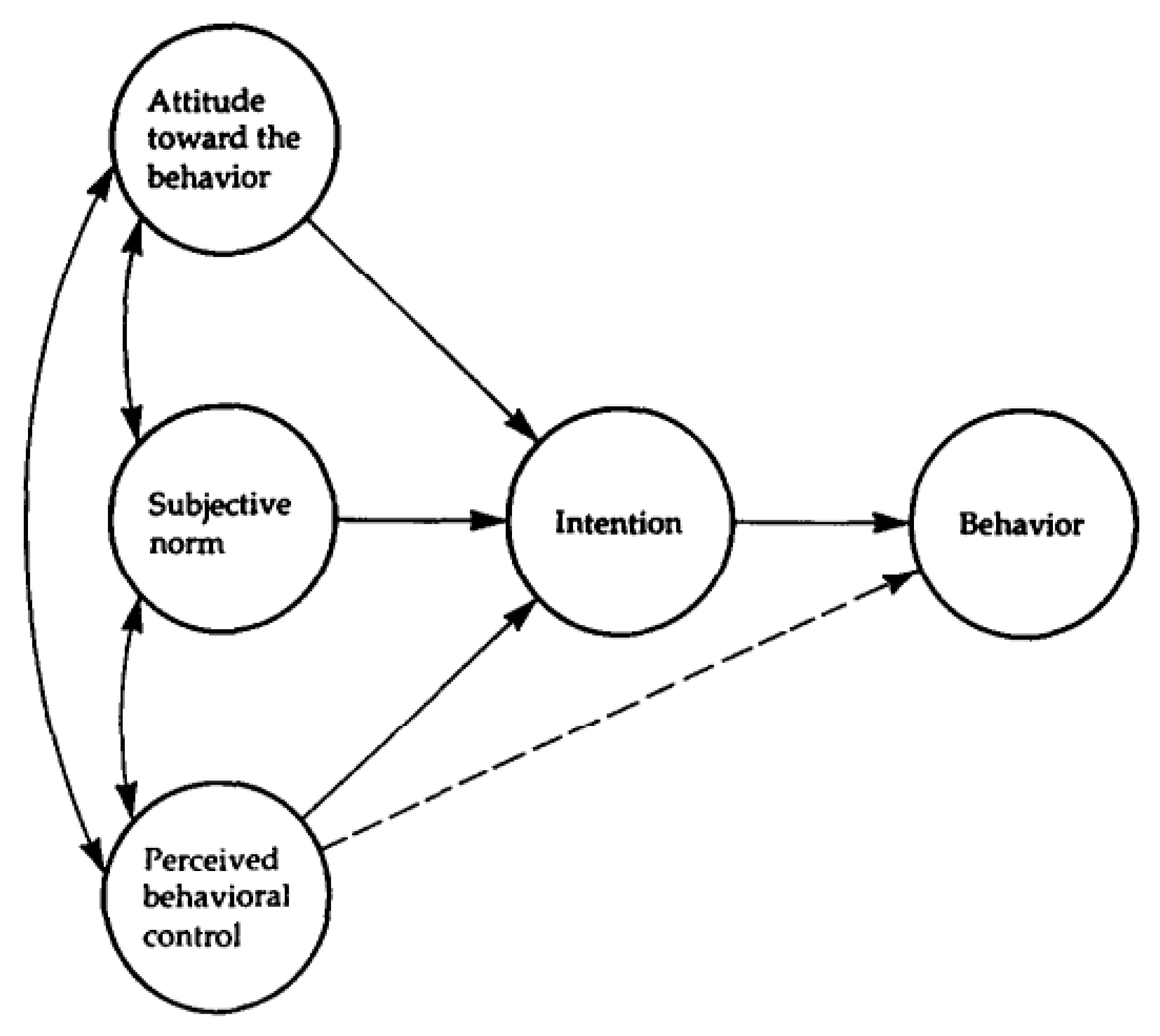
Figure 2.
Research Model.
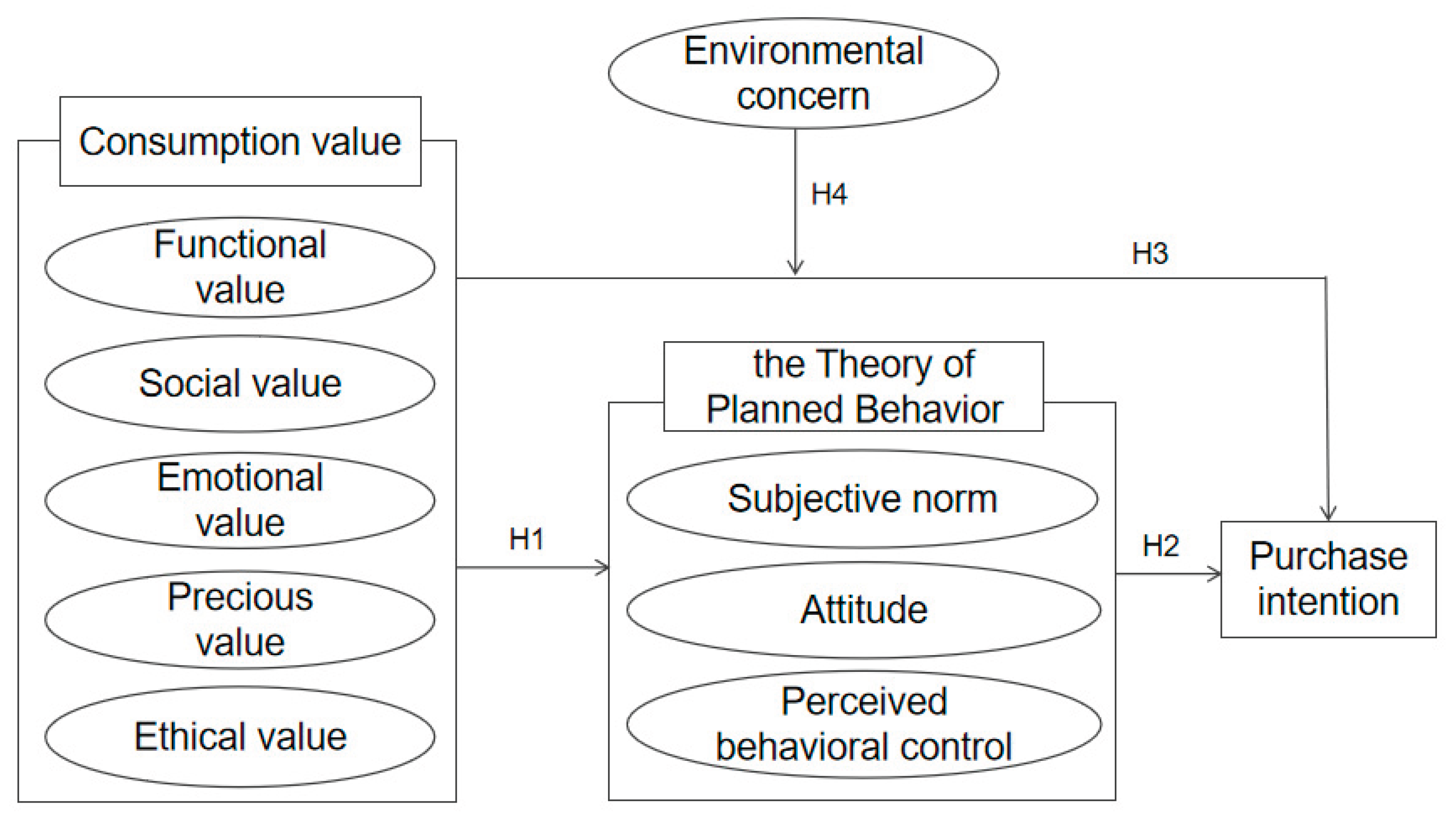
Table 1.
Measured Variables and Survey Items.
| Factors | Questions | |||
|---|---|---|---|---|
| I. Consumption Value | functional value | I-1 | Sustainable fashion products perform well. | |
| I-2 | Sustainable fashion products are durable. | |||
| I-3 | Sustainable fashion products are cost-effective. | |||
| I-4 | Sustainable fashion products are available at affordable prices. | |||
| I-5 | Sustainable fashion products are safe. | |||
| I-6 | Sustainable fashion products have a positive impact on physical health. | |||
| social value | I-7 | Sustainable fashion products are in line with my social status and taste. | ||
| I-8 | Buying sustainable fashion products can make a good impression on others. | |||
| I-9 | I think buying sustainable fashion would fit in well with group values (i.e., academic discipline, sports club, etc.). | |||
| I-10 | Buying sustainable fashion products can garner social recognition. | |||
| I-11 | Buying sustainable fashion products is a good reflection of my social identity. | |||
| I-12 | Buying sustainable fashion products increases my value. | |||
| emotional value | I-13 | Buying sustainable fashion brings me joy. | ||
| I-14 | I can achieve happiness by purchasing sustainable fashion products. | |||
| I-15 | There is satisfaction in buying sustainable fashion products. | |||
| I-16 | Buying sustainable fashion products satisfies the image I aspire to have. | |||
| I-17 | I feel good about buying sustainable fashion. | |||
| I-18 | Buying sustainable fashion makes me feel confident. | |||
| precious value | I-19 | Sustainable fashion products are what make me unique. | ||
| I-20 | Sustainable fashion products spark my curiosity. | |||
| I-21 | Sustainable fashion products are very unique in style and color. | |||
| I-22 | Sustainable fashion products can provide me with a sense of freshness. | |||
| I-23 | Buying sustainable fashion is a new experience. | |||
| ethical value | I-24 | Companies that produce sustainable fashion products refrain from exploiting labor. | ||
| I-25 | Sustainable fashion products can be ethically produced. | |||
| I-26 | The production of sustainable fashion products can address problems caused by the unfair distribution of services. | |||
| I-27 | Sustainable fashion products help improve environmental pollution. | |||
| I-28 | Sustainable fashion products can awaken corporate ethical responsibility. | |||
| I-29 | Buying sustainable fashion products can help society eliminate inequality. | |||
| II. Theory of Planned Behavior | Subjective norm | II-1 | I think most people who are important to me would support me in buying sustainable fashion. | |
| II-2 | Most people who are important to me would agree that I should buy sustainable fashion. | |||
| II-3 | Most of the people who are important to me think highly of me and influence me to buy sustainable fashion products. | |||
| II-4 | Most people who are important to me want me to buy sustainable fashion. | |||
| Attitude | II-5 | I think buying sustainable fashion is helpful. | ||
| II-6 | I think buying sustainable fashion is beneficial. | |||
| II-7 | I think it’s smart to buy sustainable fashion. | |||
| II-8 | I think buying sustainable fashion is a positive. | |||
| II-9 | I think it makes sense to buy sustainable fashion. | |||
| II-10 | I think buying sustainable fashion is a great idea. | |||
| Perceived behavioral control | II-11 | I think it’s totally my decision whether or not to buy sustainable fashion. | ||
| II-12 | I think I have complete control over the amount of sustainable fashion I want to buy. | |||
| II-13 | I think we have the resources, time, and inclination to buy sustainable fashion. | |||
| II-14 | I think I can afford to buy the sustainable fashion I need. | |||
| II-15 | I think it’s easy to buy sustainable fashion through effective channels. | |||
| III. Purchase Intention | III-1 | I intentionally buy sustainable fashion whenever possible. | ||
| III-2 | I try to buy sustainable fashion as much as possible. | |||
| III-3 | I plan to buy sustainable fashion products in the near future. | |||
| III-4 | I plan to prioritize sustainable fashion when I buy fashion products. | |||
| III-5 | I will invest more time and energy into sustainable fashion products. | |||
| IV. Environmental Concern | IV-1 | I feel like I know more about recycling than anyone else. | ||
| IV-2 | I know how to choose products and packaging that will reduce the amount of waste that goes to landfill. | |||
| IV-3 | I understand the environmental words and symbols on product packaging. | |||
| IV-4 | I understand the environmental issues of the fashion product manufacturing business, such as the impact of fashion clothing manufacturing on the environment. | |||
| V. General characteristics of sustainable fashion product purchases | V1. Through what channels do you mainly purchase sustainable fashion products? (Multiple choice) | V1-1. Online channels ① E-commerce official brand website ② Social media ③ Live streaming ④ Mobile application ⑤ Others |
||
| V1-2. Offline channels ① Brand store ② Department store ③ Market ④ Others | ||||
| V2. What are your reasons for choosing to buy your sustainable fashion products? (Multiple choice) ① Environmental protection ② Personal health ③ Personal value pursuit ④ Human care and social recognition ⑤ Good wearing feeling ⑥ Functionality and practicality ⑦ Resource recycling ⑧ Others | ||||
| V3. How interested are you in sustainable fashion products? ① Don’t care at all ② Don’t care ③ Moderate ④ Care ⑤ Very concerned | ||||
| V4. Are you willing to buy sustainable fashion products in the future? ① Willing ② Unwilling ③ I don’t know | ||||
| V5. What are the items that you purchase sustainable fashion products for? (Multiple choice) ① Clothes (tops/pants/underwear, etc.) ② Bags and similar items ③ Sundries (accessories, scarves, hats, etc.) ④ Miscellaneous items | ||||
| V6. What factors have the greatest influence on your purchasing decisions for sustainable fashion products? (Multiple choice) ① Personal concern ② Recommendations from family and friends ③ Online and mobile phone ads ④ TV and radio ads ⑤ Print ads such as magazines, newspapers, and flyers ⑥ Worn by celebrities and others ⑦ Past purchase experience ⑧ Recommendations from store staff ⑨ Others | ||||
| V7. What factors do you consider most when purchasing sustainable fashion products? (Multiple choice) ① Design (color/style) ② Material ③ Popularity ④ Quality (feeling/functionality) ⑤ Price ⑥ Brand ⑦ Others | ||||
| F. Demographic characteristics | F1. What is your gender? ① female ② Male | |||
| F2. What year are you in? ① 1st year ② 2nd year ③ 3rd year ④ 4th year | ||||
| F3. What is your major? ① Art and Design Series ② Humanities and Social Sciences Series ③ Teacher Education Series ④ Engineering Series ⑤ Natural Science Series ⑥ Business and Economics Series ⑦ Health Care Series ⑧ Others | ||||
| F4. What is your average monthly pocket money? (Currency unit: RMB) ① Below RMB 2000 ② RMB 2000–3000 ③ RMB 3000–4000 ④ RMB 4000–5000 ⑤ More than RMB 5000 | ||||
Table 2.
Demographic Information.
| Item | Category | Number of People (%) | ||
|---|---|---|---|---|
| Overall (1308) | China (716) | South Korea (592) | ||
| Gender | Male | 636 (48.62%) | 356 (49.72%) | 276 (46.62%) |
| FeMale | 672 (51.38%) | 360 (50.28%) | 316 (53.38%) | |
| Grade | 1st Year | 353 (26.99%) | 193 (26.96%) | 160 (27.03%) |
| 2nd Year | 349 (26.68%) | 186 (25.98%) | 163 (27.53%) | |
| 3rd Year | 316 (24.16%) | 177 (24.72%) | 139 (23.48%) | |
| 4th Year | 290 (22.17%) | 160 (22.35%) | 130 (21.96%) | |
| Major | Art and Design Series | 273 (20.87%) | 93 (12.99%) | 180 (30.41%) |
| Humanities and Social Sciences Series | 215 (16.44%) | 101 (14.11%) | 114 (19.26%) | |
| Teacher Training Series | 122 (9.33%) | 119 (16.62%) | 3 (0.51%) | |
| Engineering Series | 242 (18.5%) | 142 (19.83%) | 100 (16.89%) | |
| Natural Sciences Series | 81 (6.19%) | 74 (10.34%) | 7 (1.18%) | |
| Business and Economics Series | 118 (9.02%) | 104 (14.53%) | 14 (2.36%) | |
| Health Series | 215 (16.44%) | 67 (9.36%) | 148 (25.00%) | |
| Other | 42 (3.21%) | 16 (2.23%) | 26 (4.39%) | |
| Average Monthly Pocket Money | Below RMB 2000 | 378 (28.9%) | 191 (26.68%) | 187 (31.59%) |
| RMB 2000–3000 | 403 (30.81%) | 208 (29.05%) | 195 (32.94%) | |
| RMB 3000–4000 | 274 (20.95%) | 155 (21.65%) | 119 (20.10%) | |
| RMB 4000–5000 | 135 (10.32%) | 102 (14.25%) | 33 (5.57%) | |
| Above RMB 5000 | 118 (9.02%) | 60 (8.38%) | 58 (9.80%) | |
*Note: Exchange rate situation in China (calculated based on the average value for December 2024); RMB 1 ≈ USD 0.137.
Table 3.
General Characteristics.
| Item | Category | Number of People (%) | |||
|---|---|---|---|---|---|
| Overall | China | South Korea | |||
| Where do you mainly purchase fashion products | Online Channels | Official Brand Websites | 819 (62.61%) | 456 (63.69%) | 363 (61.32%) |
| Social Media | 515 (39.37%) | 396 (55.31%) | 119 (20.1%) | ||
| Live Streaming | 222 (16.97%) | 197 (27.51%) | 25 (4.22%) | ||
| Mobile Applications | 631 (48.24%) | 374 (52.23%) | 257 (43.41%) | ||
| Others | 95 (7.26%) | 57 (7.96%) | 38 (6.42%) | ||
| Offline Channels | Brand Specialty Stores | 836 (63.91%) | 463 (64.66%) | 373 (63.01%) | |
| Department Stores | 606 (46.33%) | 376 (52.51%) | 230 (38.85%) | ||
| Markets | 215 (16.44%) | 166 (23.18%) | 49 (8.28%) | ||
| Others | 134 (10.24%) | 70 (9.78%) | 64 (10.81%) | ||
| Reasons for purchasing sustainable fashion products | Environmental Protection | 630 (48.17%) | 437 (61.03%) | 193 (32.6%) | |
| Personal Health | 345 (26.38%) | 270 (37.71%) | 75 (12.67%) | ||
| Pursuit of Personal Values | 368 (28.13%) | 173 (24.16%) | 195 (32.94%) | ||
| Human Care and Social Recognition | 171 (13.07%) | 117 (16.34%) | 54 (9.12%) | ||
| Good Wearing Feeling | 251 (19.19%) | 146 (20.39%) | 105 (17.74%) | ||
| Functionality and Practicality | 509 (38.91%) | 299 (41.76%) | 210 (35.47%) | ||
| Resource Reuse | 488 (37.31%) | 394 (55.03%) | 94 (15.88%) | ||
| Others | 66 (5.05%) | 50 (6.98%) | 16 (2.7%) | ||
| Interest in sustainable fashion products | Indifferent | 74 (5.66%) | 42 (5.87%) | 32 (5.41%) | |
| Unconcerned | 169 (12.92%) | 76 (10.61%) | 93 (15.71%) | ||
| Average | 341 (26.07%) | 101 (14.11%) | 240 (40.54%) | ||
| Concerned | 531 (40.6%) | 361 (50.42%) | 170 (28.72%) | ||
| Very Concerned | 193 (14.76%) | 136 (18.99%) | 57 (9.63%) | ||
| Willingness to purchase sustainable fashion products | Willing | 864 (66.06%) | 503 (70.25%) | 361 (60.98%) | |
| Unwilling | 110 (8.41%) | 96 (13.41%) | 14 (2.36%) | ||
| Don’t Know | 334 (25.54%) | 117 (16.34%) | 217 (36.66%) | ||
| Categories of purchased sustainable fashion products | Clothing (tops/pants/underwear, etc.) | 912 (69.72%) | 479 (66.9%) | 433 (73.14%) | |
| Baggage Goods | 464 (35.47%) | 304 (42.46%) | 160 (27.03%) | ||
| Sundries (accessories, scarves, hats, etc.) | 489 (37.39%) | 377 (52.65%) | 112 (18.92%) | ||
| Others | 124 (9.48%) | 93 (12.99%) | 31 (5.24%) | ||
| Most influential factors in purchasing decisions | Personal Attention | 793 (60.63%) | 435 (60.75%) | 358 (60.47%) | |
| Family and Friends’ Recommendations | 335 (25.61%) | 198 (27.65%) | 137 (23.14%) | ||
| Online and Mobile Advertising | 468 (35.78%) | 295 (41.2%) | 173 (29.22%) | ||
| Television Advertising | 375 (28.67%) | 354 (49.44%) | 21 (3.55%) | ||
| Print Advertising (magazines, newspapers, flyers, etc.) | 376 (28.75%) | 344 (48.04%) | 32 (5.41%) | ||
| Celebrity and Others’ Wearing | 461 (35.24%) | 392 (54.75%) | 69 (11.66%) | ||
| Past Purchase Experience | 472 (36.09%) | 413 (57.68%) | 59 (9.97%) | ||
| Sales Staff’s Recommendations | 202 (15.44%) | 186 (25.98%) | 16 (2.7%) | ||
| Others | 67 (5.12%) | 32 (4.47%) | 35 (5.91%) | ||
| Most important factors when purchasing sustainable fashion products | Design (color/style) | 858 (65.60%) | 493 (68.85%) | 365 (61.66%) | |
| Material | 540 (41.28%) | 395 (55.17%) | 145 (24.49%) | ||
| Fashion | 486 (37.16%) | 410 (57.26%) | 76 (12.84%) | ||
| Quality (wear comfort/functionality) | 542 (41.44%) | 361 (50.42%) | 181 (30.57%) | ||
| Price | 416 (31.8%) | 289 (40.36%) | 127 (21.45%) | ||
| Brand | 371 (28.36%) | 311 (43.44%) | 60 (10.14%) | ||
| Others | 58 (4.43%) | 43 (6.01%) | 15 (2.53%) | ||
Table 5.
Reliability analysis.
| Factors | Measurement Variables | Number of Items | Cronbach’s α |
|---|---|---|---|
| Consumption value | Functional value | 6 | 0.964 |
| Social value | 6 | 0.960 | |
| Emotional value | 6 | 0.955 | |
| Precious value | 5 | 0.971 | |
| Ethical value | 6 | 0.963 | |
| Theory of Planned Behavior | Subjective norms | 4 | 0.972 |
| Attitude | 6 | 0.956 | |
| Perceived behavioral control | 5 | 0.937 | |
| Purchase intention | Purchase intention | 5 | 0.957 |
| Environmental concern | Environmental concern | 4 | 0.976 |
Table 6.
Exploratory Factor Analysis of the Consumer Value Scale.
| Item | Factor | Communality | ||||
|---|---|---|---|---|---|---|
| Functional Value | Ethical Value | Social Value | Emotional Value | Precious Value | ||
| I-1 | 0.966 | 0.054 | 0.103 | 0.034 | 0.071 | 0.953 |
| I-2 | 0.936 | 0.067 | 0.105 | 0.038 | 0.075 | 0.899 |
| I-3 | 0.871 | 0.034 | 0.054 | 0.038 | 0.068 | 0.769 |
| I-4 | 0.912 | 0.040 | 0.077 | 0.009 | 0.058 | 0.843 |
| I-5 | 0.873 | 0.027 | 0.132 | 0.041 | 0.044 | 0.784 |
| I-6 | 0.931 | 0.054 | 0.103 | 0.026 | 0.061 | 0.885 |
| I-7 | 0.109 | 0.061 | 0.920 | 0.084 | 0.072 | 0.874 |
| I-8 | 0.095 | 0.053 | 0.926 | 0.068 | 0.063 | 0.878 |
| I-9 | 0.085 | 0.055 | 0.877 | 0.053 | 0.080 | 0.789 |
| I-10 | 0.095 | 0.053 | 0.911 | 0.092 | 0.062 | 0.854 |
| I-11 | 0.075 | 0.068 | 0.868 | 0.094 | 0.065 | 0.777 |
| I-12 | 0.117 | 0.061 | 0.919 | 0.094 | 0.085 | 0.878 |
| I-13 | 0.016 | 0.090 | 0.095 | 0.923 | 0.101 | 0.880 |
| I-14 | 0.054 | 0.087 | 0.077 | 0.905 | 0.094 | 0.844 |
| I-15 | 0.041 | 0.083 | 0.064 | 0.851 | 0.103 | 0.747 |
| I-16 | 0.012 | 0.092 | 0.082 | 0.888 | 0.091 | 0.812 |
| I-17 | 0.011 | 0.067 | 0.081 | 0.860 | 0.087 | 0.758 |
| I-18 | 0.054 | 0.112 | 0.080 | 0.931 | 0.111 | 0.901 |
| I-19 | 0.077 | 0.104 | 0.086 | 0.126 | 0.966 | 0.973 |
| I-20 | 0.073 | 0.088 | 0.084 | 0.125 | 0.957 | 0.952 |
| I-21 | 0.052 | 0.091 | 0.080 | 0.114 | 0.883 | 0.810 |
| I-22 | 0.076 | 0.094 | 0.093 | 0.119 | 0.958 | 0.955 |
| I-23 | 0.090 | 0.108 | 0.071 | 0.092 | 0.892 | 0.829 |
| I-24 | 0.048 | 0.919 | 0.069 | 0.079 | 0.087 | 0.865 |
| I-25 | 0.055 | 0.926 | 0.055 | 0.098 | 0.072 | 0.878 |
| I-26 | 0.035 | 0.857 | 0.055 | 0.081 | 0.096 | 0.754 |
| I-27 | 0.034 | 0.933 | 0.069 | 0.095 | 0.075 | 0.891 |
| I-28 | 0.068 | 0.872 | 0.046 | 0.081 | 0.081 | 0.780 |
| I-29 | 0.035 | 0.955 | 0.058 | 0.098 | 0.086 | 0.934 |
| Eigenvalues | 5.135 | 5.109 | 5.054 | 4.953 | 4.495 | — |
| Percentage % | 17.709 | 17.618 | 17.429 | 17.079 | 15.501 | — |
| Cumulative Percentage % | 17.709 | 35.326 | 52.755 | 69.835 | 85.336 | — |
| KMO | 0.934 | |||||
| Bartlett’s Test of Sphericity | Approximate Chi-Square | 49853.289 | ||||
| Degrees of Freedom | 406 | |||||
| Significance | 0.000 | |||||
Table 7.
Exploratory factor analysis of the Theory of Planned Behavior scale.
| Item | Factor | Communality | ||
|---|---|---|---|---|
| Attitude | Perceived Behavioral Control | Subjective Norm | ||
| Ⅱ-1 | 0.095 | 0.082 | 0.978 | 0.972 |
| Ⅱ-2 | 0.098 | 0.063 | 0.971 | 0.956 |
| Ⅱ-3 | 0.076 | 0.061 | 0.906 | 0.830 |
| Ⅱ-4 | 0.094 | 0.070 | 0.969 | 0.953 |
| Ⅱ-5 | 0.892 | 0.115 | 0.104 | 0.820 |
| Ⅱ-6 | 0.911 | 0.108 | 0.074 | 0.847 |
| Ⅱ-7 | 0.860 | 0.097 | 0.050 | 0.752 |
| Ⅱ-8 | 0.910 | 0.091 | 0.070 | 0.841 |
| Ⅱ-9 | 0.870 | 0.119 | 0.084 | 0.778 |
| Ⅱ-10 | 0.956 | 0.112 | 0.080 | 0.933 |
| Ⅱ-11 | 0.123 | 0.908 | 0.072 | 0.845 |
| Ⅱ-12 | 0.111 | 0.901 | 0.046 | 0.826 |
| Ⅱ-13 | 0.099 | 0.838 | 0.059 | 0.716 |
| Ⅱ-14 | 0.091 | 0.923 | 0.068 | 0.865 |
| Ⅱ-15 | 0.128 | 0.868 | 0.053 | 0.773 |
| Eigenvalues | 4.958 | 4.033 | 3.715 | — |
| Percentage % | 33.055 | 26.884 | 24.767 | — |
| Cumulative Percentage % | 33.055 | 59.939 | 84.706 | — |
| KMO | 0.912 | |||
| Bartlett’s Test of Sphericity | Approximate Chi-Square | 23996.000 | ||
| Degrees of Freedom | 105 | |||
| Significance | 0.000 | |||
Table 8.
Results of the exploratory factor analysis of the purchase intention scale.
| Item | Factor | Communality |
|---|---|---|
| Purchase Intention | ||
| Ⅲ-1 | 0.954 | 0.910 |
| Ⅲ-2 | 0.946 | 0.895 |
| Ⅲ-3 | 0.881 | 0.776 |
| Ⅲ-4 | 0.968 | 0.937 |
| Ⅲ-5 | 0.889 | 0.790 |
| Eigenvalues | 4.307 | — |
| Percentage % | 86.136 | — |
| Cumulative Percentage % | 86.136 | — |
| KMO | 0.909 | |
| Bartlett’s Test of Sphericity | Approximate Chi-Square | 8082.670 |
| Degrees of Freedom | 10 | |
| Significance | 0.000 | |
Table 9.
Results of the exploratory factor analysis of the environmental concern scale.
| Item | Factor | Communality | |
|---|---|---|---|
| Environmental Concern | |||
| IV-1 | 0.988 | 0.976 | |
| IV-2 | 0.984 | 0.968 | |
| IV-3 | 0.919 | 0.845 | |
| IV-4 | 0.982 | 0.964 | |
| Eigenvalues | 3.753 | — | |
| Percentage % | 93.821 | — | |
| Cumulative Percentage % | 93.821 | — | |
| KMO | 0.864 | ||
| Bartlett’s Test of Sphericity | Approximate Chi-Square | 10333.795 | |
| Degrees of Freedom | 6 | ||
| Significance | 0.000 | ||
Table 10.
Confirmatory Factor Analysis for Each Scale.
| Scale | Dimension | Item | Path Coefficient |
Standardized Path Coefficient |
C.R. | AVE | CR | Fit Indices |
|---|---|---|---|---|---|---|---|---|
| Consumption value | Functional value | I-1 | 1 | 0.988 | — | 0.827 | 0.966 | CMIN/DF = 1.846, GFI = 0.966, AGFI = 0.960, NFI = 0.987, CFI = 0.994, RMR = 0.011, RMSEA = 0.025, IFI = 0.994, TLI = 0.993 |
| I-2 | 0.897 | 0.935 | 86.250 *** | |||||
| I-3 | 0.620 | 0.844 | 54.410 *** | |||||
| I-4 | 0.858 | 0.897 | 68.630 *** | |||||
| I-5 | 0.628 | 0.847 | 55.243 *** | |||||
| I-6 | 0.898 | 0.938 | 87.644 *** | |||||
| Social value | 1–7 | 1 | 0.928 | — | 0.810 | 0.962 | ||
| I-8 | 0.930 | 0.927 | 61.574 *** | |||||
| I-9 | 0.685 | 0.857 | 48.779 *** | |||||
| I-10 | 0.916 | 0.909 | 57.786 *** | |||||
| I-11 | 0.671 | 0.846 | 47.260 *** | |||||
| I-12 | 0.939 | 0.930 | 62.265 *** | |||||
| Emotional value | I-13 | 1 | 0.932 | — | 0.790 | 0.957 | ||
| I-14 | 0.920 | 0.901 | 56.707 *** | |||||
| I-15 | 0.656 | 0.828 | 45.185 *** | |||||
| I-16 | 0.902 | 0.883 | 53.477 *** | |||||
| I-17 | 0.654 | 0.833 | 45.882 *** | |||||
| I-18 | 0.960 | 0.948 | 67.760 *** | |||||
| Precious value | I-19 | 1 | 0.997 | — | 0.882 | 0.974 | ||
| I-20 | 0.907 | 0.977 | 155.188 *** | |||||
| I-21 | 0.630 | 0.857 | 59.372 *** | |||||
| I-22 | 0.930 | 0.981 | 168.508 *** | |||||
| I-23 | 0.648 | 0.874 | 64.248 *** | |||||
| Ethical value | I-24 | 1 | 0.916 | — | 0.822 | 0.965 | ||
| I-25 | 0.958 | 0.930 | 60.240 *** | |||||
| I-26 | 0.680 | 0.829 | 44.346 *** | |||||
| I-27 | 0.974 | 0.935 | 61.248 *** | |||||
| I-28 | 0.677 | 0.847 | 46.579 *** | |||||
| I-29 | 0.987 | 0.973 | 70.811 *** | |||||
| Theory of Planned Behavior | Subjective norms | II-1 | 1 | 0.992 | 0.907 | 0.975 | CMIN/DF = 2.510, GFI = 0.978, AGFI = 0.970, NFI = 0.991, CFI = 0.995, RMR = 0.010, RMSEA = 0.034, IFI = 0.995, TLI = 0.993 |
|
| II-2 | 0.911 | 0.977 | 141.910 *** | |||||
| II-3 | 0.653 | 0.858 | 58.624 *** | |||||
| II-4 | 0.909 | 0.977 | 142.102 *** | |||||
| Attitude | II-5 | 1 | 0.887 | 0.795 | 0.959 | |||
| II-6 | 0.926 | 0.902 | 50.348 *** | |||||
| II-7 | 0.692 | 0.828 | 41.676 *** | |||||
| II-8 | 0.922 | 0.902 | 50.238 *** | |||||
| II-9 | 0.685 | 0.848 | 43.742 *** | |||||
| II-10 | 0.994 | 0.976 | 62.019 *** | |||||
| Perceived behavioral control | II-11 | 1 | 0.902 | 0.758 | 0.940 | |||
| II-12 | 0.908 | 0.889 | 48.948 *** | |||||
| II-13 | 0.673 | 0.789 | 38.112 *** | |||||
| II-14 | 0.947 | 0.924 | 53.802 *** | |||||
| II-15 | 0.692 | 0.842 | 43.305 *** | |||||
| Purchase intention | Purchase intention | III-1 | 1 | 0.949 | 0.830 | 0.960 | CMIN/DF = 4.541, GFI = 0.993, AGFI = 0.980, NFI = 0.997, CFI = 0.998, RMR = 0.004, RMSEA = 0.052, IFI = 0.998, TLI = 0.996, |
|
| III-2 | 0.912 | 0.938 | 71.253 *** | |||||
| III-3 | 0.631 | 0.832 | 47.763 *** | |||||
| III-4 | 0.935 | 0.976 | 86.519 *** | |||||
| III-5 | 0.662 | 0.850 | 50.535 *** | |||||
| Environmental concern | Environmental concern | IV-1 | 1 | 0.996 | 0.921 | 0.979 | CMIN/DF = 1.576, GFI = 0.999, AGFI = 0.994, NFI = 1.000, CFI = 1.000, RMR = 0.001, RMSEA = 0.021, IFI = 1.000, TLI = 1.000 |
|
| IV-2 | 0.927 | 0.986 | 182.679 *** | |||||
| IV-3 | 0.632 | 0.866 | 61.674 *** | |||||
| IV-4 | 0.925 | 0.984 | 173.345 *** |
Table 11.
Correlation analysis.
| Functional Value | Social Value | Emotional Value | Precious Value | Ethical Value | Subjective Norms | Attitude | Perceived Behavioral Control | Purchase Intention | Environmental Concern | |
|---|---|---|---|---|---|---|---|---|---|---|
| Functional value | 1 | |||||||||
| Social value | 0.218 *** | 1 | ||||||||
| Emotional value | 0.088 ** | 0.193 *** | 1 | |||||||
| Precious value | 0.162 *** | 0.187 *** | 0.246 *** | 1 | ||||||
| Ethical value | 0.114 *** | 0.146 *** | 0.209 *** | 0.209 *** | 1 | |||||
| Subjective norms | 0.153 *** | 0.284 *** | 0.203 *** | 0.195 *** | 0.233 *** | 1 | ||||
| Attitude | 0.247 *** | 0.230 *** | 0.277 *** | 0.262 *** | 0.266 *** | 0.187 *** | 1 | |||
| Perceived behavioral control | 0.311 *** | 0.273 *** | 0.273 *** | 0.296 *** | 0.237 *** | 0.149 *** | 0.243 *** | 1 | ||
| Purchase intention | 0.445 *** | 0.505 *** | 0.419 *** | 0.443 *** | 0.458 *** | 0.343 *** | 0.387 *** | 0.389 *** | 1 | |
| Environmental concern | 0.599 *** | 0.536 *** | 0.523 *** | 0.531 *** | 0.509 *** | 0.280 *** | 0.365 *** | 0.434 *** | 0.718 *** | 1 |
Note::*P<0.05,**P<0.01,***P<0.001.
Table 12.
Hypothesis Testing Results for Cross-National Comparative Analysis of the Influence of Consumer Value on the Theory of Planned Behavior.
Table 12.
Hypothesis Testing Results for Cross-National Comparative Analysis of the Influence of Consumer Value on the Theory of Planned Behavior.
| Hypothesis Result | Country | Estimate | S.E. | Standardized estimates | C.R. | P | Remarks | ||||
|---|---|---|---|---|---|---|---|---|---|---|---|
| H1 | H1-1 | Functional value | → | Subjective norms | China | 0.104 | 0.035 | 0.105 | 2.973 | 0.003 | Established |
| South Korea | 0.205 | 0.032 | 0.246 | 6.382 | *** | Established | |||||
| H1-2 | Social value | → |
Subjective norms | China | 0.308 | 0.041 | 0.271 | 7.477 | *** | Established | |
| South Korea | 0.136 | 0.030 | 0.176 | 4.584 | *** | Established | |||||
| H1-3 | Emotional value | → | Subjective norms | China | 0.129 | 0.041 | 0.112 | 3.121 | 0.002 | Established | |
| South Korea | 0.169 | 0.057 | 0.152 | 2.964 | 0.003 | Established | |||||
| H1-4 | Precious value | → | Subjective norms | China | 0.078 | 0.034 | 0.079 | 2.270 | 0.023 | Established | |
| South Korea | 0.079 | 0.029 | 0.107 | 2.776 | 0.005 | Established | |||||
| H1-5 | Ethical value | → | Subjective norms | China | 0.244 | 0.041 | 0.213 | 5.946 | *** | Established | |
| South Korea | 0.098 | 0.028 | 0.135 | 3.506 | *** | Established | |||||
| H1-6 | Functional value | → | Attitude | China | 0.193 | 0.031 | 0.222 | 6.204 | *** | Established | |
| South Korea | 0.209 | 0.033 | 0.236 | 6.259 | *** | Established | |||||
| H1-7 | Social value | → | Attitude | China | 0.167 | 0.036 | 0.168 | 4.624 | *** | Established | |
| South Korea | 0.069 | 0.031 | 0.084 | 2.239 | 0.025 | Established | |||||
| H1-8 | Emotional value | → | Attitude | China | 0.239 | 0.037 | 0.238 | 6.468 | *** | Established | |
| South Korea | 0.118 | 0.030 | 0.147 | 3.903 | *** | Established | |||||
| H1-9 | Precious value | → | Attitude | China | 0.100 | 0.030 | 0.117 | 3.333 | *** | Established | |
| South Korea | 0.147 | 0.030 | 0.186 | 4.936 | *** | Established | |||||
| H1-10 | Ethical value | → | Attitude | China | 0.140 | 0.036 | 0.140 | 3.894 | *** | Established | |
| South Korea | 0.175 | 0.029 | 0.228 | 6.042 | *** | Established | |||||
| H1-11 | Functional value | → | Perceived behavioral control | China | 0.179 | 0.026 | 0.249 | 6.773 | *** | Established | |
| South Korea | 0.227 | 0.038 | 0.230 | 6.012 | *** | Established | |||||
| H1-12 | Social value | → | Perceived behavioral control | China | 0.121 | 0.030 | 0.147 | 3.976 | *** | Established | |
| South Korea | 0.158 | 0.035 | 0.173 | 4.530 | *** | Established | |||||
| H1-13 | Emotional value | → | Perceived behavioral control | China | 0.207 | 0.031 | 0.248 | 6.592 | *** | Established | |
| South Korea | 0.088 | 0.034 | 0.099 | 2.574 | 0.010 | Established | |||||
| H1-14 | Precious value | → | Perceived behavioral control | China | 0.135 | 0.026 | 0.190 | 5.264 | *** | Established | |
| South Korea | 0.150 | 0.034 | 0.171 | 4.457 | *** | Established | |||||
| H1-15 | Ethical value | → | Perceived behavioral control | China | 0.096 | 0.030 | 0.116 | 3.170 | 0.002 | Established | |
| South Korea | 0.132 | 0.033 | 0.154 | 4.031 | *** | Established | |||||
| China | CMIN/DF=1.570,GFI=0.917,AGFI=0.907,NFI=0.961,CFI=0.985,RMR=0.102,RMSEA=0.028,IFI=0.985,TLI=0.984 | ||||||||||
| South Korea | CMIN/DF=1.713,GFI=0.898,AGFI=0.886,NFI=0.971,CFI=0.988,RMR=0.070,RMSEA=0.035,IFI=0.988,TLI=0.987 | ||||||||||
| H2 | H2-1 | Subjective norms | → | Purchase intention | China | 0.215 | 0.024 | 0.301 | 8.84 | *** | Established |
| South Korea | 0.385 | 0.043 | 0.311 | 9.010 | *** | Established | |||||
| H2-2 | Attitude | → | Purchase intention | China | 0.246 | 0.028 | 0.306 | 8.706 | *** | Established | |
| South Korea | 0.387 | 0.040 | 0.335 | 9.709 | *** | Established | |||||
| H2-3 | Perceived behavioral control | → | Purchase intention | China | 0.238 | 0.034 | 0.248 | 6.954 | *** | Established | |
| South Korea | 0.341 | 0.036 | 0.327 | 9.490 | *** | Established | |||||
| China | CMIN/DF=2.262,GFI=0.948,AGFI=0.935,NFI=0.976,CFI=0.987,RMR=0.099,RMSEA=0.042,IFI=0.987,TLI=0.985 | ||||||||||
| South Korea | CMIN/DF=1.854,GFI=0.950,AGFI=0.937,NFI=0.985,CFI=0.993,RMR=0.075,RMSEA=0.038,IFI=0.993,TLI=0.992 | ||||||||||
| H3 | H3-1 | Functional value | → | Purchase intention | China | 0.261 | 0.023 | 0.371 | 11.381 | *** | Established |
| South Korea | 0.350 | 0.015 | 0.373 | 23.098 | *** | Established | |||||
| H3-2 | Social value | → | Purchase intention | China | 0.280 | 0.027 | 0.347 | 10.340 | *** | Established | |
| South Korea | 0.368 | 0.014 | 0.425 | 26.271 | *** | Established | |||||
| H3-3 | -Emotional value | → | Purchase intention | China | 0.063 | 0.026 | 0.077 | 2.392 | 0.017 | Established | |
| South Korea | 0.376 | 0.014 | 0.443 | 27.352 | *** | Established | |||||
| H3-4 | Precious value | → | Purchase intention | China | 0.104 | 0.022 | 0.149 | 4.750 | *** | Established | |
| South Korea | 0.327 | 0.013 | 0.393 | 24.305 | *** | Established | |||||
| H3-5 | Ethical value | → | Purchase intention | China | 0.219 | 0.027 | 0.270 | 8.211 | *** | Established | |
| South Korea | 0.355 | 0.013 | 0.437 | 27.002 | *** | Established | |||||
| China | CMIN/DF=1.861,GFI=0.923,AGFI=0.912,NFI=0.963,CFI=0.983,RMR=0.115,RMSEA=0.035,IFI=0.983,TLI=0.981 | ||||||||||
| South Korea | CMIN/DF=1.759,GFI=0.918,AGFI=0.906,NFI=0.979,CFI=0.991,RMR=0.108,RMSEA=0.036,IFI=0.991,TLI=0.990 | ||||||||||
Table 13.
Hypothesis Testing Results of Gender Differences Regarding the Influence of Consumption Value on Theory of Planned Behavior.
Table 13.
Hypothesis Testing Results of Gender Differences Regarding the Influence of Consumption Value on Theory of Planned Behavior.
| Hypothesis Result | Gender | Estimate | S.E. | Standardized estimates | C.R. | P | Remarks | ||||
| H1 | H1-1 | Functional value | → | Subjective norms | Female | 0.042 | 0.031 | 0.050 | 1.362 | 0.173 | Not established |
| Male | 0.092 | 0.032 | 0.109 | 2.846 | 0.004 | Established | |||||
| H1-2 | Social value | → | Subjective norms | Female | 0.233 | 0.036 | 0.241 | 6.483 | *** | Established | |
| Male | 0.192 | 0.038 | 0.198 | 5.094 | *** | Established | |||||
| H1-3 | Emotional value | → | Subjective norms | Female | 0.104 | 0.036 | 0.109 | 2.931 | 0.003 | Established | |
| Male | 0.106 | 0.038 | 0.108 | 2.780 | 0.005 | Established | |||||
| H1-4 | Precious value | → | Subjective norms | Female | 0.082 | 0.032 | 0.094 | 2.583 | 0.010 | Established | |
| Male | 0.084 | 0.035 | 0.093 | 2.433 | 0.015 | Established | |||||
| H1-5 | Ethical value | → | Subjective norms | Female | 0.195 | 0.035 | 0.207 | 5.608 | *** | Established | |
| Male | 0.119 | 0.037 | 0.125 | 3.228 | 0.001 | Established | |||||
| H1-6 | Functional value | → | Attitude | Female | 0.129 | 0.030 | 0.160 | 4.267 | *** | Established | |
| Male | 0.141 | 0.029 | 0.184 | 4.943 | *** | Established | |||||
| H1-7 | Social value | → |
Attitude | Female | 0.101 | 0.035 | 0.110 | 2.912 | 0.004 | Established | |
| Male | 0.110 | 0.033 | 0.125 | 3.316 | *** | Established | |||||
| H1-8 | Emotional value | → | Attitude | Female | 0.160 | 0.035 | 0.176 | 4.634 | *** | Established | |
| Male | 0.165 | 0.034 | 0.187 | 4.916 | *** | Established | |||||
| H1-9 | Precious value | → | Attitude | Female | 0.122 | 0.031 | 0.147 | 3.946 | *** | Established | |
| Male | 0.131 | 0.031 | 0.159 | 4.275 | *** | Established | |||||
| H1-10 | Ethical value | → | Attitude | Female | 0.124 | 0.034 | 0.139 | 3.684 | *** | Established | |
| Male | 0.197 | 0.033 | 0.228 | 5.982 | *** | Established | |||||
| H1-11 | Functional value | → | Perceived behavioral control | Female | 0.207 | 0.028 | 0.271 | 7.375 | *** | Established | |
| Male | 0.171 | 0.028 | 0.232 | 6.091 | *** | Established | |||||
| H1-12 | Social value | → | Perceived behavioral control | Female | 0.153 | 0.032 | 0.176 | 4.748 | *** | Established | |
| Male | 0.127 | 0.032 | 0.151 | 3.920 | *** | Established | |||||
| H1-13 | Emotional value | → | Perceived behavioral control | Female | 0.153 | 0.032 | 0.176 | 4.764 | *** | Established | |
| Male | 0.142 | 0.033 | 0.168 | 4.336 | *** | Established | |||||
| H1-14 | Precious value | → | Perceived behavioral control | Female | 0.126 | 0.029 | 0.159 | 4.388 | *** | Established | |
| Male | 0.152 | 0.030 | 0.193 | 5.068 | *** | Established | |||||
| H1-15 | Ethical value | → | Perceived behavioral control | Female | 0.134 | 0.031 | 0.158 | 4.294 | *** | Established | |
| Male | 0.092 | 0.032 | 0.111 | 2.908 | 0.004 | Established | |||||
| Female | CMIN/DF=1.752,GFI=0.903,AGFI=0.892,NFI=0.961,CFI=0.983,RMR=0.099,RMSEA=0.033,IFI=0.983,TLI=0.982 | ||||||||||
| Male | CMIN/DF=1.676,GFI=0.903,AGFI=0.892,NFI=0.960,CFI=0.984,RMR=0.094,RMSEA=0.033,IFI=0.984,TLI=0.983 | ||||||||||
| H2 | H2-1 | Subjective norms | → | Purchase intention | Female | 0.231 | 0.032 | 0.248 | 7.256 | *** | Established |
| Male | 0.261 | 0.033 | 0.283 | 8.025 | *** | Established | |||||
| H2-2 | Attitude | → | Purchase intention | Female | 0.277 | 0.034 | 0.284 | 8.126 | *** | Established | |
| Male | 0.305 | 0.036 | 0.307 | 8.472 | *** | Established | |||||
| H2-3 | Perceived behavioral control | → | Purchase intention | Female | 0.349 | 0.035 | 0.349 | 9.845 | *** | Established | |
| Male | 0.301 | 0.038 | 0.288 | 7.883 | *** | Established | |||||
| Female | CMIN/DF=2.059,GFI=0.951,AGFI=0.939,NFI=0.980,CFI=0.989,RMR=0.092,RMSEA=0.040,IFI=0.989,TLI=0.988 | ||||||||||
| Male | CMIN/DF=2.288,GFI=0.941,AGFI=0.926,NFI=0.976,CFI=0.987,RMR=0.081,RMSEA=0.045,IFI=0.987,TLI=0.985 | ||||||||||
| H3 | H3-1 | Functional value | → | Purchase intention | Female | 0.232 | 0.022 | 0.314 | 10.761 | *** | Established |
| Male | 0.265 | 0.021 | 0.369 | 12.808 | *** | Established | |||||
| H3-2 | Social value | → | Purchase intention | Female | 0.328 | 0.025 | 0.389 | 12.908 | *** | Established | |
| Male | 0.315 | 0.024 | 0.384 | 12.976 | *** | Established | |||||
| H3-3 | Emotional value | → | Purchase intention | Female | 0.220 | 0.025 | 0.261 | 8.864 | *** | Established | |
| Male | 0.206 | 0.024 | 0.249 | 8.518 | *** | Established | |||||
| H3-4 | Precious value | → | Purchase intention | Female | 0.200 | 0.022 | 0.262 | 9.092 | *** | Established | |
| Male | 0.207 | 0.022 | 0.269 | 9.433 | *** | Established | |||||
| H3-5 | Ethical value | → | Purchase intention | Female | 0.273 | 0.024 | 0.331 | 11.253 | *** | Established | |
| Male | 0.282 | 0.024 | 0.349 | 11.688 | *** | Established | |||||
| Female | CMIN/DF=2.053,GFI=0.910,AGFI=0.898,NFI=0.966,CFI=0.982,RMR=0.127,RMSEA=0.040,IFI=0.982,TLI=0.981 | ||||||||||
| Male | CMIN/DF=1.754,GFI=0.921,AGFI=0.910,NFI=0.969,CFI=0.986,RMR=0.122,RMSEA=0.034,IFI=0.986,TLI=0.985 | ||||||||||
Table 14.
Hypothesis Testing Results of China Gender Differences Regarding the Impact of Consumption Value on Theory of Planned Behavior.
Table 14.
Hypothesis Testing Results of China Gender Differences Regarding the Impact of Consumption Value on Theory of Planned Behavior.
| Hypothesis Result | Gender | Estimate | S.E. | Standardized estimates | C.R. | P | Remarks | |||||
| H1 | H1-1 | Functional value | → | Subjective norms | Female | 0.107 | 0.051 | 0.104 | 2.102 | 0.036 | Established | |
| Male | 0.102 | 0.048 | 0.105 | 2.126 | 0.033 | Established | ||||||
| H1-2 | Social value | → | Subjective norms | Female | 0.357 | 0.062 | 0.292 | 5.740 | *** | Established | ||
| Male | 0.270 | 0.053 | 0.258 | 5.041 | *** | Established | ||||||
| H1-3 | Emotional value | → | Subjective norms | Female | 0.098 | 0.059 | 0.083 | 1.658 | 0.097 | Not established | ||
| Male | 0.169 | 0.057 | 0.152 | 2.964 | 0.003 | Established | ||||||
| H1-4 | Precious value | → | Subjective norms | Female | 0.073 | 0.048 | 0.074 | 1.518 | 0.129 | Not established | ||
| Male | 0.083 | 0.048 | 0.086 | 1.727 | 0.084 | Not established | ||||||
| H1-5 | Ethical value | → | Subjective norms | Female | 0.301 | 0.055 | 0.270 | 5.424 | *** | Established | ||
| Male | 0.174 | 0.060 | 0.147 | 2.888 | 0.004 | Established | ||||||
| H1-6 | Functional value | → | Attitude | Female | 0.200 | 0.046 | 0.224 | 4.336 | *** | Established | ||
| Male | 0.191 | 0.041 | 0.226 | 4.609 | *** | Established | ||||||
| H1-7 | Social value | → | Attitude | Female | 0.186 | 0.055 | 0.175 | 3.360 | *** | Established | ||
| Male | 0.141 | 0.046 | 0.155 | 3.094 | 0.002 | Established | ||||||
| H1-8 | Emotional value | → | Attitude | Female | 0.202 | 0.054 | 0.195 | 3.744 | *** | Established | ||
| Male | 0.264 | 0.050 | 0.272 | 5.285 | *** | Established | ||||||
| H1-9 | Precious value | → | Attitude | Female | 0.102 | 0.044 | 0.117 | 2.335 | 0.020 | Established | ||
| Male | 0.104 | 0.041 | 0.123 | 2.532 | 0.011 | Established | ||||||
| H1-10 | Ethical value | → | Attitude | Female | 0.093 | 0.050 | 0.096 | 1.872 | 0.061 | Not established | ||
| Male | 0.205 | 0.052 | 0.198 | 3.932 | *** | Established | ||||||
| H1-11 | Functional value | → | Perceived behavioral control | Female | 0.180 | 0.038 | 0.248 | 4.742 | *** | Established | ||
| Male | 0.183 | 0.037 | 0.254 | 5.008 | *** | Established | ||||||
| H1-12 | Social value | → | Perceived behavioral control | Female | 0.133 | 0.046 | 0.153 | 2.925 | 0.003 | Established | ||
| Male | 0.116 | 0.040 | 0.148 | 2.888 | 0.004 | Established | ||||||
| H1-13 | Emotional value | → | Perceived behavioral control | Female | 0.185 | 0.045 | 0.220 | 4.160 | *** | Established | ||
| Male | 0.230 | 0.044 | 0.278 | 5.231 | *** | Established | ||||||
| H1-14 | Precious value | → | Perceived behavioral control | Female | 0.134 | 0.036 | 0.190 | 3.726 | *** | Established | ||
| Male | 0.137 | 0.036 | 0.191 | 3.787 | *** | Established | ||||||
| H1-15 | Ethical value | → | Perceived behavioral control | Female | 0.138 | 0.041 | 0.174 | 3.357 | *** | Established | ||
| Male | 0.047 | 0.045 | 0.054 | 1.061 | 0.289 | Not established | ||||||
| Female | CMIN/DF=1.404,GFI=0.863,AGFI=0.847,NFI=0.931,CFI=0.979,RMR=0.110,RMSEA=0.034,IFI=0.979,TLI=0.978 | |||||||||||
| Male | CMIN/DF=1.403,GFI=0.865,AGFI=0.849,NFI=0.933,CFI=0.980,RMR=0.101,RMSEA=0.034,IFI=0.980,TLI=0.978 | |||||||||||
| H2 | H2-1 | Subjective norms | → | Purchase intention | Female | 0.204 | 0.033 | 0.299 | 6.203 | *** | Established | |
| Male | 0.226 | 0.036 | 0.302 | 6.259 | *** | Established | ||||||
| H2-2 | Attitude | → | Purchase intention | Female | 0.238 | 0.039 | 0.306 | 6.171 | *** | Established | ||
| Male | 0.257 | 0.042 | 0.308 | 6.160 | *** | Established | ||||||
| H2-3 | Perceived behavioral control | → | Purchase intention | Female | 0.253 | 0.047 | 0.272 | 5.385 | *** | Established | ||
| Male | 0.227 | 0.050 | 0.229 | 4.555 | *** | Established | ||||||
| Female | CMIN/DF=2.262,GFI=0.948,AGFI=0.935,NFI=0.976,CFI=0.987,RMR=0.099,RMSEA=0.042,IFI=0.987,TLI=0.985 | |||||||||||
| Male | CMIN/DF=1.942,GFI=0.916,AGFI=0.894,NFI=0.961,CFI=0.980,RMR=0.088,RMSEA=0.051,IFI=0.981,TLI=0.978 | |||||||||||
| H3 | H3-1 | Functional value | → | Purchase intention | Female | 0.255 | 0.034 | 0.360 | 7.560 | *** | Established | |
| Male | 0.264 | 0.031 | 0.377 | 8.604 | *** | Established | ||||||
| H3-2 | Social value | → | Purchase intention | Female | 0.280 | 0.041 | 0.330 | 6.752 | *** | Established | ||
| Male | 0.289 | 0.035 | 0.381 | 8.355 | *** | Established | ||||||
| H3-3 | Emotional value | → | Purchase intention | Female | 0.034 | 0.039 | 0.041 | 0.878 | 0.380 | Not established | ||
| Male | 0.089 | 0.035 | 0.111 | 2.526 | 0.012 | Established | ||||||
| H3-4 | Precious value | → | Purchase intention | Female | 0.098 | 0.031 | 0.142 | 3.115 | 0.002 | Established | ||
| Male | 0.117 | 0.030 | 0.167 | 3.915 | *** | Established | ||||||
| H3-5 | Ethical value | → | Purchase intention | Female | 0.194 | 0.036 | 0.251 | 5.333 | *** | Established | ||
| Male | 0.246 | 0.039 | 0.286 | 6.290 | *** | Established | ||||||
| Female | CMIN/DF=1.696,GFI=0.869,AGFI=0.850,NFI=0.935,CFI=0.972,RMR=0.123,RMSEA=0.044,IFI=0.972,TLI=0.970 | |||||||||||
| Male | CMIN/DF=1.455,GFI=0.889,AGFI=0.874,NFI=0.945,CFI=0.982,RMR=0.114,RMSEA=0.036,IFI=0.982,TLI=0.981 | |||||||||||
Table 15.
Hypothesis Testing Results of Consumption Value on Theory of Planned Behavior in Korean Gender Differences.
Table 15.
Hypothesis Testing Results of Consumption Value on Theory of Planned Behavior in Korean Gender Differences.
| Hypothesis Result | Gender | Estimate | S.E. | Standardized estimates | C.R. | P | Remarks | ||||
| H1 | H1-1 | Functional value | → | Subjective norms | Female | 0.087 | 0.046 | 0.101 | 1.870 | 0.061 | Not established |
| Male | 0.310 | 0.043 | 0.385 | 7.166 | *** | Established | |||||
| H1-2 | Social value | → | Subjective norms | Female | 0.137 | 0.038 | 0.192 | 3.570 | *** | Established | |
| Male | 0.134 | 0.045 | 0.159 | 2.954 | 0.003 | Established | |||||
| H1-3 | Emotional value | → | Subjective norms | Female | 0.112 | 0.038 | 0.157 | 2.912 | 0.004 | Established | |
| Male | 0.100 | 0.043 | 0.124 | 2.306 | 0.021 | Established | |||||
| H1-4 | Precious value | → | Subjective norms | Female | 0.075 | 0.038 | 0.107 | 1.990 | 0.047 | Established | |
| Male | 0.071 | 0.042 | 0.090 | 1.682 | 0.093 | Not established | |||||
| H1-5 | Ethical value | → | Subjective norms | Female | 0.096 | 0.039 | 0.132 | 2.452 | 0.014 | Established | |
| Male | 0.104 | 0.039 | 0.144 | 2.673 | 0.008 | Established | |||||
| H1-6 | Functional value | → | Attitude | Female | 0.204 | 0.050 | 0.214 | 4.081 | *** | Established | |
| Male | 0.211 | 0.044 | 0.257 | 4.753 | *** | Established | |||||
| H1-7 | Social value | → | Attitude | Female | 0.048 | 0.042 | 0.061 | 1.166 | 0.244 | Not established | |
| Male | 0.101 | 0.046 | 0.119 | 2.193 | 0.028 | Established | |||||
| H1-8 | Emotional value | → | Attitude | Female | 0.141 | 0.042 | 0.178 | 3.385 | *** | Established | |
| Male | 0.091 | 0.044 | 0.111 | 2.046 | 0.041 | Established | |||||
| H1-9 | Precious value | → | Attitude | Female | 0.129 | 0.041 | 0.166 | 3.158 | 0.002 | Established | |
| Male | 0.171 | 0.043 | 0.214 | 3.965 | *** | Established | |||||
| H1-10 | Ethical value | → | Attitude | Female | 0.155 | 0.042 | 0.192 | 3.667 | *** | Established | |
| Male | 0.189 | 0.040 | 0.258 | 4.761 | *** | Established | |||||
| H1-11 | Functional value | → | Perceived behavioral control | Female | 0.292 | 0.055 | 0.273 | 5.293 | *** | Established | |
| Male | 0.171 | 0.052 | 0.189 | 3.322 | *** | Established | |||||
| H1-12 | Social value | → | Perceived behavioral control | Female | 0.178 | 0.046 | 0.200 | 3.877 | *** | Established | |
| Male | 0.132 | 0.054 | 0.139 | 2.452 | 0.014 | Established | |||||
| H1-13 | Emotional value | → | Perceived behavioral control | Female | 0.116 | 0.046 | 0.131 | 2.533 | 0.011 | Established | |
| Male | 0.059 | 0.052 | 0.065 | 1.148 | 0.251 | Not established | |||||
| H1-14 | Precious value | → | Perceived behavioral control | Female | 0.124 | 0.045 | 0.141 | 2.744 | 0.006 | Established | |
| Male | 0.172 | 0.050 | 0.195 | 3.431 | *** | Established | |||||
| H1-15 | Ethical value | → | Perceived behavioral control | Female | 0.138 | 0.047 | 0.153 | 2.961 | 0.003 | Established | |
| Male | 0.133 | 0.046 | 0.164 | 2.887 | 0.004 | Established | |||||
| Female | CMIN/DF=1.534,GFI=0.841,AGFI=0.823,NFI=0.953,CFI=0.983,RMR=0.082,RMSEA=0.041,IFI=0.983,TLI=0.982 | ||||||||||
| Male | CMIN/DF=1.539,GFI=0.820,AGFI=0.799,NFI=0.946,CFI=0.980,RMR=0.063,RMSEA=0.044,IFI=0.980,TLI=0.979 | ||||||||||
| H2 | H2-1 | Subjective norms | → | Purchase intention | Female | 0.354 | 0.062 | 0.271 | 5.674 | *** | Established |
| Male | 0.430 | 0.058 | 0.369 | 7.399 | *** | Established | |||||
| H2-2 | Attitude | → | Purchase intention | Female | 0.380 | 0.056 | 0.325 | 6.811 | *** | Established | |
| Male | 0.379 | 0.056 | 0.334 | 6.720 | *** | Established | |||||
| H2-3 | Perceived behavioral control | → | Purchase intention | Female | 0.366 | 0.050 | 0.351 | 7.370 | *** | Established | |
| Male | 0.311 | 0.052 | 0.299 | 6.011 | *** | Established | |||||
| Female | CMIN/DF=1.546,GFI=0.926,AGFI=0.907,NFI=0.977,CFI=0.992,RMR=0.075,RMSEA=0.042,IFI=0.992,TLI=0.991 | ||||||||||
| Male | CMIN/DF=1.97,GFI=0.896,AGFI=0.870,NFI=0.967,CFI=0.983,RMR=0.088,RMSEA=0.079,IFI=0.983,TLI=0.981 | ||||||||||
| H3 | H3-1 | Functional value | → | Purchase intention | Female | 0.341 | 0.021 | 0.340 | 15.914 | *** | Established |
| Male | 0.358 | 0.021 | 0.410 | 16.654 | *** | Established | |||||
| H3-2 | Social value | → | Purchase intention | Female | 0.378 | 0.018 | 0.455 | 21.207 | *** | Established | |
| Male | 0.356 | 0.022 | 0.391 | 15.861 | *** | Established | |||||
| H3-3 | Emotional value | → | Purchase intention | Female | 0.373 | 0.018 | 0.449 | 20.945 | *** | Established | |
| Male | 0.375 | 0.022 | 0.430 | 17.373 | *** | Established | |||||
| H3-4 | Precious value | → | Purchase intention | Female | 0.322 | 0.018 | 0.394 | 18.385 | *** | Established | |
| Male | 0.331 | 0.021 | 0.389 | 15.806 | *** | Established | |||||
| H3-5 | Ethical value | → | Purchase intention | Female | 0.371 | 0.018 | 0.439 | 20.475 | *** | Established | |
| Male | 0.340 | 0.019 | 0.435 | 17.618 | *** | Established | |||||
| Female | CMIN/DF=1.566,GFI=0.871,AGFI=0.853,NFI=0.965,CFI=0.987,RMR=0.125,RMSEA=0.042,IFI=0.987,TLI=0.986 | ||||||||||
| Male | CMIN/DF=1.585,GFI=0.857,AGFI=0.837,NFI=0.960,CFI=0.985,RMR=0.095,RMSEA=0.046,IFI=0.985,TLI=0.984 | ||||||||||
Table 16.
Hypothesis verification results of the difference between Chinese and Korean women in the impact of consumption value on the theory of planned behavior.
Table 16.
Hypothesis verification results of the difference between Chinese and Korean women in the impact of consumption value on the theory of planned behavior.
| Hypothesis Result | Country | Estimate | S.E. | Standardized estimates | C.R. | P | Remarks | ||||
| H1 | H1-1 | Functional value | → | Subjective norms | China | 0.107 | 0.051 | 0.104 | 2.102 | 0.036 | Established |
| South Korea | 0.087 | 0.046 | 0.101 | 1.870 | 0.061 | Not established | |||||
| H1-2 | Social value | → | Subjective norms | China | 0.357 | 0.062 | 0.292 | 5.740 | *** | Established | |
| South Korea | 0.137 | 0.038 | 0.192 | 3.570 | *** | Established | |||||
| H1-3 | Emotional value | → | Subjective norms | China | 0.098 | 0.059 | 0.083 | 1.658 | 0.097 | Not established | |
| South Korea | 0.112 | 0.038 | 0.157 | 2.912 | 0.004 | Established | |||||
| H1-4 | Precious value | → | Subjective norms | China | 0.073 | 0.048 | 0.074 | 1.518 | 0.129 | Not established | |
| South Korea | 0.075 | 0.038 | 0.107 | 1.990 | 0.047 | Established | |||||
| H1-5 | Ethical value | → | Subjective norms | China | 0.301 | 0.055 | 0.270 | 5.424 | *** | Established | |
| South Korea | 0.096 | 0.039 | 0.132 | 2.452 | 0.014 | Established | |||||
| H1-6 | Functional value | → | Attitude | China | 0.200 | 0.046 | 0.224 | 4.336 | *** | Established | |
| South Korea | 0.204 | 0.050 | 0.214 | 4.081 | *** | Established | |||||
| H1-7 | Social value | → | Attitude | China | 0.186 | 0.055 | 0.175 | 3.360 | *** | Established | |
| South Korea | 0.048 | 0.042 | 0.061 | 1.166 | 0.244 | Not established | |||||
| H1-8 | Emotional value | → | Attitude | China | 0.202 | 0.054 | 0.195 | 3.744 | *** | Established | |
| South Korea | 0.141 | 0.042 | 0.178 | 3.385 | *** | Established | |||||
| H1-9 | Precious value | → | Attitude | China | 0.102 | 0.044 | 0.117 | 2.335 | 0.020 | Established | |
| South Korea | 0.129 | 0.041 | 0.166 | 3.158 | 0.002 | Established | |||||
| H1-10 | Ethical value | → | Attitude | China | 0.093 | 0.050 | 0.096 | 1.872 | 0.061 | Not established | |
| South Korea | 0.155 | 0.042 | 0.192 | 3.667 | *** | Established | |||||
| H1-11 | Functional value | → | Perceived behavioral control | China | 0.180 | 0.038 | 0.248 | 4.742 | *** | Established | |
| South Korea | 0.292 | 0.055 | 0.273 | 5.293 | *** | Established | |||||
| H1-12 | Social value | → | Perceived behavioral control | China | 0.133 | 0.046 | 0.153 | 2.925 | 0.003 | Established | |
| South Korea | 0.178 | 0.046 | 0.200 | 3.877 | *** | Established | |||||
| H1-13 | Emotional value | → | Perceived behavioral control | China | 0.185 | 0.045 | 0.220 | 4.160 | *** | Established | |
| South Korea | 0.116 | 0.046 | 0.131 | 2.533 | 0.011 | Established | |||||
| H1-14 | Precious value | → | Perceived behavioral control | China | 0.134 | 0.036 | 0.190 | 3.726 | *** | Established | |
| South Korea | 0.124 | 0.045 | 0.141 | 2.744 | 0.006 | Established | |||||
| H1-15 | Ethical value | → | Perceived behavioral control | China | 0.138 | 0.041 | 0.174 | 3.357 | *** | Established | |
| South Korea | 0.138 | 0.047 | 0.153 | 2.961 | 0.003 | Established | |||||
| China | CMIN/DF=1.404,GFI=0.863,AGFI=0.847,NFI=0.931,CFI=0.979,RMR=0.110,RMSEA=0.034,IFI=0.979,TLI=0.978 | ||||||||||
| South Korea | CMIN/DF=1.534,GFI=0.841,AGFI=0.823,NFI=0.953,CFI=0.983,RMR=0.082,RMSEA=0.041,IFI=0.983,TLI=0.982 | ||||||||||
| H2 | H2-1 | Subjective norms | → | Purchase intention | China | 0.204 | 0.033 | 0.299 | 6.203 | *** | Established |
| South Korea | 0.354 | 0.062 | 0.271 | 5.674 | *** | Established | |||||
| H2-2 | Attitude | → | Purchase intention | China | 0.238 | 0.039 | 0.306 | 6.171 | *** | Established | |
| South Korea | 0.380 | 0.056 | 0.325 | 6.811 | *** | Established | |||||
| H2-3 | Perceived behavioral control | → | Purchase intention | China | 0.253 | 0.047 | 0.272 | 5.385 | *** | Established | |
| South Korea | 0.366 | 0.050 | 0.351 | 7.370 | *** | Established | |||||
| China | CMIN/DF=2.262,GFI=0.948,AGFI=0.935,NFI=0.976,CFI=0.987,RMR=0.099,RMSEA=0.042,IFI=0.987,TLI=0.985 | ||||||||||
| South Korea | CMIN/DF=1.970,GFI=0.896,AGFI=0.870,NFI=0.967,CFI=0.983,RMR=0.088,RMSEA=0.079,IFI=0.983,TLI=0.981 | ||||||||||
| H3 | H3-1 | Functional value | → | Purchase intention | China | 0.255 | 0.034 | 0.360 | 7.560 | *** | Established |
| South Korea | 0.341 | 0.021 | 0.340 | 15.914 | *** | Established | |||||
| H3-2 | Social value | → | Purchase intention | China | 0.280 | 0.041 | 0.330 | 6.752 | *** | Established | |
| South Korea | 0.378 | 0.018 | 0.455 | 21.207 | *** | Established | |||||
| H3-3 | Emotional value | → | Purchase intention | China | 0.034 | 0.039 | 0.041 | 0.878 | 0.380 | Not established | |
| South Korea | 0.373 | 0.018 | 0.449 | 20.945 | *** | Established | |||||
| H3-4 | Precious value | → | Purchase intention | China | 0.098 | 0.031 | 0.142 | 3.115 | 0.002 | Established | |
| South Korea | 0.322 | 0.018 | 0.394 | 18.385 | *** | Established | |||||
| H3-5 | Ethical value | → | Purchase intention | China | 0.194 | 0.036 | 0.251 | 5.333 | *** | Established | |
| South Korea | 0.371 | 0.018 | 0.439 | 20.475 | *** | Established | |||||
| China | CMIN/DF=1.696,GFI=0.869,AGFI=0.850,NFI=0.935,CFI=0.972,RMR=0.123,RMSEA=0.044,IFI=0.972,TLI=0.970 | ||||||||||
| South Korea | CMIN/DF=1.566,GFI=0.871,AGFI=0.853,NFI=0.965,CFI=0.987,RMR=0.125,RMSEA=0.042,IFI=0.987,TLI=0.986 | ||||||||||
Table 17.
Hypothesis verification results on the difference in the impact of consumption value on the theory of planned behavior between Korean and Chinese men.
Table 17.
Hypothesis verification results on the difference in the impact of consumption value on the theory of planned behavior between Korean and Chinese men.
| Hypothesis Result | Gender | Estimate | S.E. | Standardized estimates | C.R. | P | Remarks | ||||||
| H1 | H1-1 | Functional value | → | Subjective norms | China | 0.102 | 0.048 | 0.105 | 2.126 | 0.033 | Established | ||
| South Korea | 0.310 | 0.043 | 0.385 | 7.166 | *** | Established | |||||||
| H1-2 | Social value | → | Subjective norms | China | 0.270 | 0.053 | 0.258 | 5.041 | *** | Established | |||
| South Korea | 0.134 | 0.045 | 0.159 | 2.954 | 0.003 | Established | |||||||
| H1-3 | Emotional value | → | Subjective norms | China | 0.169 | 0.057 | 0.152 | 2.964 | 0.003 | Established | |||
| South Korea | 0.100 | 0.043 | 0.124 | 2.306 | 0.021 | Established | |||||||
| H1-4 | Precious value | → | Subjective norms | China | 0.083 | 0.048 | 0.086 | 1.727 | 0.084 | Not established | |||
| South Korea | 0.071 | 0.042 | 0.090 | 1.682 | 0.093 | Not established | |||||||
| H1-5 | Ethical value | → | Subjective norms | China | 0.174 | 0.060 | 0.147 | 2.888 | 0.004 | Established | |||
| South Korea | 0.104 | 0.039 | 0.144 | 2.673 | 0.008 | Established | |||||||
| H1-6 | Functional value | → | Attitude | China | 0.191 | 0.041 | 0.226 | 4.609 | *** | Established | |||
| South Korea | 0.211 | 0.044 | 0.257 | 4.753 | *** | Established | |||||||
| H1-7 | Social value | → | Attitude | China | 0.141 | 0.046 | 0.155 | 3.094 | 0.002 | Established | |||
| South Korea | 0.101 | 0.046 | 0.119 | 2.193 | 0.028 | Established | |||||||
| H1-8 | Emotional value | → | Attitude | China | 0.264 | 0.050 | 0.272 | 5.285 | *** | Established | |||
| South Korea | 0.091 | 0.044 | 0.111 | 2.046 | 0.041 | Established | |||||||
| H1-9 | Precious value | → | Attitude | China | 0.104 | 0.041 | 0.123 | 2.532 | 0.011 | Established | |||
| South Korea | 0.171 | 0.043 | 0.214 | 3.965 | *** | Established | |||||||
| H1-10 | Ethical value | → | Attitude | China | 0.205 | 0.052 | 0.198 | 3.932 | *** | Established | |||
| South Korea | 0.189 | 0.040 | 0.258 | 4.761 | *** | Established | |||||||
| H1-11 | Functional value | → | Perceived behavioral control | China | 0.183 | 0.037 | 0.254 | 5.008 | *** | Established | |||
| South Korea | 0.171 | 0.052 | 0.189 | 3.322 | *** | Established | |||||||
| H1-12 | Social value | → | Perceived behavioral control | China | 0.116 | 0.040 | 0.148 | 2.888 | 0.004 | Established | |||
| South Korea | 0.132 | 0.054 | 0.139 | 2.452 | 0.014 | Established | |||||||
| H1-13 | Emotional value | → | Perceived behavioral control | China | 0.230 | 0.044 | 0.278 | 5.231 | *** | Established | |||
| South Korea | 0.059 | 0.052 | 0.065 | 1.148 | 0.251 | Not established | |||||||
| H1-14 | Precious value | → | Perceived behavioral control | China | 0.137 | 0.036 | 0.191 | 3.787 | *** | Established | |||
| South Korea | 0.172 | 0.050 | 0.195 | 3.431 | *** | Established | |||||||
| H1-15 | Ethical value | → | Perceived behavioral control | China | 0.047 | 0.045 | 0.054 | 1.061 | 0.289 | Not established | |||
| South Korea | 0.133 | 0.046 | 0.164 | 2.887 | 0.004 | Established | |||||||
| China | CMIN/DF=1.403,GFI=0.865,AGFI=0.849,NFI=0.933,CFI=0.980,RMR=0.101,RMSEA=0.034,IFI=0.980,TLI=0.978 | ||||||||||||
| South Korea | CMIN/DF=1.539,GFI=0.820,AGFI=0.799,NFI=0.946,CFI=0.980,RMR=0.063,RMSEA=0.044,IFI=0.980,TLI=0.979 | ||||||||||||
| H2 | H2-1 | Subjective norms | → | Purchase intention | China | 0.226 | 0.036 | 0.302 | 6.259 | *** | Established | ||
| South Korea | 0.430 | 0.058 | 0.369 | 7.399 | *** | Established | |||||||
| H2-2 | Attitude | → | Purchase intention | China | 0.257 | 0.042 | 0.308 | 6.160 | *** | Established | |||
| South Korea | 0.379 | 0.056 | 0.334 | 6.720 | *** | Established | |||||||
| H2-3 | Perceived behavioral control | → | Purchase intention | China | 0.227 | 0.050 | 0.229 | 4.555 | *** | Established | |||
| South Korea | 0.311 | 0.052 | 0.299 | 6.011 | *** | Established | |||||||
| China | CMIN/DF=1.942,GFI=0.916,AGFI=0.894,NFI=0.961,CFI=0.980,RMR=0.088,RMSEA=0.051,IFI=0.981,TLI=0.978 | ||||||||||||
| South Korea | CMIN/DF=1.97,GFI=0.896,AGFI=0.870,NFI=0.967,CFI=0.983,RMR=0.088,RMSEA=0.079,IFI=0.983,TLI=0.981 | ||||||||||||
| H3 | H3-1 | Functional value | → | Purchase intention | China | 0.264 | 0.031 | 0.377 | 8.604 | *** | Established | ||
| South Korea | 0.358 | 0.021 | 0.410 | 16.654 | *** | Established | |||||||
| H3-2 | Social value | → | Purchase intention | China | 0.289 | 0.035 | 0.381 | 8.355 | *** | Established | |||
| South Korea | 0.356 | 0.022 | 0.391 | 15.861 | *** | Established | |||||||
| H3-3 | Emotional value | → | Purchase intention | China | 0.089 | 0.035 | 0.111 | 2.526 | 0.012 | Established | |||
| South Korea | 0.375 | 0.022 | 0.430 | 17.373 | *** | Established | |||||||
| H3-4 | Precious value | → | Purchase intention | China | 0.117 | 0.030 | 0.167 | 3.915 | *** | Established | |||
| South Korea | 0.331 | 0.021 | 0.389 | 15.806 | *** | Established | |||||||
| H3-5 | Ethical value | → | Purchase intention | China | 0.246 | 0.039 | 0.286 | 6.290 | *** | Established | |||
| South Korea | 0.340 | 0.019 | 0.435 | 17.618 | *** | Established | |||||||
| China | CMIN/DF=1.455,GFI=0.889,AGFI=0.874,NFI=0.945,CFI=0.982,RMR=0.114,RMSEA=0.036,IFI=0.982,TLI=0.981 | ||||||||||||
| South Korea | CMIN/DF=1.585,GFI=0.857,AGFI=0.837,NFI=0.960,CFI=0.985,RMR=0.095,RMSEA=0.046,IFI=0.985,TLI=0.984 | ||||||||||||
Table 18.
Results of the test on the moderating effect of environmental concern on consumption value and purchase intention (comparison between countries).
Table 18.
Results of the test on the moderating effect of environmental concern on consumption value and purchase intention (comparison between countries).
| Model | Country | Variable | B | se | t | p | Result |
| H4-1 | China | Constant | 3.048 | 0.022 | 137.644 | 0.000 | Not established |
| Functional value | 0.166 | 0.029 | 5.716 | 0.000 | |||
| Environmental Concern | 0.422 | 0.029 | 14.633 | 0.000 | |||
| Functional value×Environmental Concern | -0.037 | 0.028 | -1.339 | 0.181 | |||
| South Korea | Constant | 3.240 | 0.013 | 251.751 | 0.000 | Established | |
| Functional value | 0.062 | 0.017 | 3.598 | 0.000 | |||
| Environmental Concern | 1.025 | 0.017 | 59.501 | 0.000 | |||
| Functional value×Environmental Concern | 0.152 | 0.019 | 8.146 | 0.000 | |||
| H4-2 | China | Constant | 3.040 | 0.023 | 130.357 | 0.000 | Not established |
| Social value | 0.124 | 0.031 | 3.963 | 0.000 | |||
| Environmental Concern | 0.437 | 0.031 | 14.185 | 0.000 | |||
| Social value×Environmental Concern | -0.015 | 0.030 | -0.492 | 0.623 | |||
| South Korea | Constant | 3.222 | 0.013 | 247.430 | 0.000 | Established | |
| Social value | 0.058 | 0.016 | 3.556 | 0.000 | |||
| Environmental Concern | 1.022 | 0.019 | 55.185 | 0.000 | |||
| Social value×Environmental Concern | 0.161 | 0.017 | 9.517 | 0.000 | |||
| H4-3 | China | Constant | 3.051 | 0.023 | 134.015 | 0.000 | Not established |
| Emotional value | -0.139 | 0.031 | -4.424 | 0.000 | |||
| Environmental Concern | 0.585 | 0.030 | 19.633 | 0.000 | |||
| Emotional value×Environmental Concern | -0.045 | 0.030 | -1.515 | 0.130 | |||
| South Korea | Constant | 3.203 | 0.013 | 238.974 | 0.000 | Established | |
| Emotional value | 0.041 | 0.016 | 2.504 | 0.013 | |||
| Environmental Concern | 1.047 | 0.019 | 53.913 | 0.000 | |||
| Emotional value×Environmental Concern | 0.196 | 0.018 | 10.721 | 0.000 | |||
| H4-4 | China | Constant | 3.027 | 0.023 | 129.089 | 0.000 | Not established |
| Precious value | -0.053 | 0.031 | -1.734 | 0.083 | |||
| Environmental Concern | 0.544 | 0.032 | 17.011 | 0.000 | |||
| Precious value×Environmental Concern | 0.018 | 0.027 | 0.676 | 0.499 | |||
| South Korea | Constant | 3.215 | 0.013 | 254.233 | 0.000 | Established | |
| Precious value | 0.058 | 0.016 | 3.732 | 0.000 | |||
| Environmental Concern | 1.041 | 0.018 | 56.861 | 0.000 | |||
| Precious value×Environmental Concern | 0.174 | 0.015 | 11.442 | 0.000 | |||
| H4-5 | China | Constant | 3.057 | 0.023 | 132.813 | 0.000 | Established |
| Ethical value | 0.013 | 0.030 | 0.429 | 0.668 | |||
| Environmental Concern | 0.503 | 0.030 | 16.614 | 0.000 | |||
| Ethical value×Environmental Concern | -0.059 | 0.028 | -2.091 | 0.037 | |||
| South Korea | Constant | 3.220 | 0.014 | 237.536 | 0.000 | Established | |
| Ethical value | 0.044 | 0.016 | 2.805 | 0.005 | |||
| Environmental Concern | 1.037 | 0.019 | 53.429 | 0.000 | |||
| Ethical value×Environmental Concern | 0.154 | 0.018 | 8.750 | 0.000 |
Table 19.
Results of the Moderating Effect of Environmental Concern on Consumption Value and Purchase Intention (Comparison of Overall Gender).
Table 19.
Results of the Moderating Effect of Environmental Concern on Consumption Value and Purchase Intention (Comparison of Overall Gender).
| Model | Gender | Variable | B | se | t | p | Result |
| H4-1 | Female | Constant | 3.057 | 0.024 | 127.049 | 0.000 | Established |
| Functional value | 0.019 | 0.029 | 0.648 | 0.517 | |||
| Environmental Concern | 0.588 | 0.027 | 21.845 | 0.000 | |||
| Functional value×Environmental Concern | 0.115 | 0.024 | 4.734 | 0.000 | |||
| Male | Constant | 3.152 | 0.024 | 129.699 | 0.000 | Not established | |
| Functional value | 0.056 | 0.030 | 1.911 | 0.056 | |||
| Environmental Concern | 0.560 | 0.028 | 20.015 | 0.000 | |||
| Functional value×Environmental Concern | 0.047 | 0.025 | 1.874 | 0.061 | |||
| H4-2 | Female | Constant | 3.075 | 0.023 | 131.173 | 0.000 | Established |
| Social value | 0.151 | 0.029 | 5.164 | 0.000 | |||
| Environmental Concern | 0.516 | 0.026 | 19.700 | 0.000 | |||
| Social value×Environmental Concern | 0.087 | 0.025 | 3.405 | 0.001 | |||
| Male | Constant | 3.149 | 0.023 | 139.744 | 0.000 | Established | |
| Social value | 0.151 | 0.029 | 5.134 | 0.000 | |||
| Environmental Concern | 0.527 | 0.025 | 20.880 | 0.000 | |||
| Social value×Environmental Concern | 0.070 | 0.026 | 2.721 | 0.007 | |||
| H4-3 | Female | Constant | 3.066 | 0.023 | 131.099 | 0.000 | Established |
| Emotional value | 0.056 | 0.029 | 1.894 | 0.059 | |||
| Environmental Concern | 0.565 | 0.026 | 21.997 | 0.000 | |||
| Emotional value×Environmental Concern | 0.119 | 0.027 | 4.491 | 0.000 | |||
| Male | Constant | 3.143 | 0.023 | 134.842 | 0.000 | Established | |
| Emotional value | 0.027 | 0.030 | 0.891 | 0.373 | |||
| Environmental Concern | 0.583 | 0.026 | 22.338 | 0.000 | |||
| Emotional value×Environmental Concern | 0.083 | 0.027 | 3.027 | 0.003 | |||
| H4-4 | Female | Constant | 3.051 | 0.024 | 129.436 | 0.000 | Established |
| Precious value | 0.092 | 0.029 | 3.152 | 0.002 | |||
| Environmental Concern | 0.553 | 0.027 | 20.497 | 0.000 | |||
| Precious value×Environmental Concern | 0.128 | 0.023 | 5.489 | 0.000 | |||
| Male | Constant | 3.142 | 0.022 | 140.618 | 0.000 | Established | |
| Precious value | 0.069 | 0.028 | 2.506 | 0.013 | |||
| Environmental Concern | 0.572 | 0.025 | 23.132 | 0.000 | |||
| Precious value×Environmental Concern | 0.094 | 0.025 | 3.768 | 0.000 | |||
| H4-5 | Female | Constant | 3.093 | 0.023 | 133.959 | 0.000 | Established |
| Ethical value | 0.107 | 0.028 | 3.832 | 0.000 | |||
| Environmental Concern | 0.542 | 0.025 | 21.588 | 0.000 | |||
| Ethical value×Environmental Concern | 0.055 | 0.026 | 2.134 | 0.033 | |||
| Male | Constant | 3.158 | 0.023 | 136.684 | 0.000 | Not established | |
| Ethical value | 0.111 | 0.028 | 3.964 | 0.000 | |||
| Environmental Concern | 0.536 | 0.026 | 20.477 | 0.000 | |||
| Ethical value×Environmental Concern | 0.041 | 0.024 | 1.679 | 0.094 |
Table 20.
Results of Testing the Moderating Effect of Environmental Concern on Consumption Value and Purchase Intention (Gender Comparison in China).
Table 20.
Results of Testing the Moderating Effect of Environmental Concern on Consumption Value and Purchase Intention (Gender Comparison in China).
| Model | Gender | Variable | B | se | t | p | Result |
| H4-1 | Female | Constant | 3.016 | 0.033 | 91.803 | 0.000 | Not established |
| Functional value | 0.174 | 0.042 | 4.154 | 0.000 | |||
| Environmental Concern | 0.371 | 0.042 | 8.940 | 0.000 | |||
| Functional value×Environmental Concern | -0.023 | 0.041 | -0.576 | 0.565 | |||
| Male | Constant | 3.082 | 0.030 | 103.614 | 0.000 | Not established | |
| Functional value | 0.153 | 0.040 | 3.776 | 0.000 | |||
| Environmental Concern | 0.480 | 0.040 | 12.012 | 0.000 | |||
| Functional value×Environmental Concern | -0.058 | 0.038 | -1.541 | 0.124 | |||
| H4-2 | Female | Constant | 3.022 | 0.035 | 86.672 | 0.000 | Not established |
| Social value | 0.131 | 0.047 | 2.774 | 0.006 | |||
| Environmental Concern | 0.385 | 0.046 | 8.416 | 0.000 | |||
| Social value×Environmental Concern | -0.035 | 0.043 | -0.812 | 0.417 | |||
| Male | Constant | 3.055 | 0.031 | 98.670 | 0.000 | Not established | |
| Social value | 0.125 | 0.042 | 3.016 | 0.003 | |||
| Environmental Concern | 0.489 | 0.041 | 11.855 | 0.000 | |||
| Social value×Environmental Concern | 0.017 | 0.042 | 0.412 | 0.681 | |||
| H4-3 | Female | Constant | 3.020 | 0.034 | 89.805 | 0.000 | Not established |
| Emotional value | -0.156 | 0.046 | -3.407 | 0.001 | |||
| Environmental Concern | 0.544 | 0.043 | 12.680 | 0.000 | |||
| Emotional value×Environmental Concern | -0.036 | 0.044 | -0.821 | 0.412 | |||
| Male | Constant | 3.083 | 0.031 | 100.720 | 0.000 | Not established | |
| Emotional value | -0.121 | 0.043 | -2.827 | 0.005 | |||
| Environmental Concern | 0.631 | 0.041 | 15.313 | 0.000 | |||
| Emotional value×Environmental Concern | -0.059 | 0.041 | -1.443 | 0.150 | |||
| H4-4 | Female | Constant | 2.994 | 0.035 | 84.671 | 0.000 | Not established |
| Precious value | -0.050 | 0.047 | -1.053 | 0.293 | |||
| Environmental Concern | 0.498 | 0.049 | 10.091 | 0.000 | |||
| Precious value×Environmental Concern | 0.027 | 0.038 | 0.699 | 0.485 | |||
| Male | Constant | 3.055 | 0.031 | 98.691 | 0.000 | Not established | |
| Precious value | -0.048 | 0.040 | -1.189 | 0.235 | |||
| Environmental Concern | 0.588 | 0.042 | 14.137 | 0.000 | |||
| Precious value×Environmental Concern | 0.017 | 0.039 | 0.431 | 0.667 | |||
| H4-5 | Female | Constant | 3.018 | 0.034 | 89.440 | 0.000 | Not established |
| Ethical value | 0.017 | 0.043 | 0.385 | 0.701 | |||
| Environmental Concern | 0.455 | 0.042 | 10.745 | 0.000 | |||
| Ethical value×Environmental Concern | -0.030 | 0.043 | -0.699 | 0.485 | |||
| Male | Constant | 3.097 | 0.031 | 99.353 | 0.000 | Established | |
| Ethical value | 0.007 | 0.043 | 0.166 | 0.868 | |||
| Environmental Concern | 0.558 | 0.044 | 12.820 | 0.000 | |||
| Ethical value×Environmental Concern | -0.086 | 0.038 | -2.287 | 0.023 |
Table 21.
Results of Moderation Test of Environmental Concern on the Relationship Between Consumption Value and Purchase Intention (Comparison of Korean Genders).
Table 21.
Results of Moderation Test of Environmental Concern on the Relationship Between Consumption Value and Purchase Intention (Comparison of Korean Genders).
| Model | Gender | Variable | B | se | t | p | Result |
| H4-1 | Female | Constant | 3.209 | 0.018 | 180.454 | 0.000 | Established |
| Functional value | 0.056 | 0.025 | 2.270 | 0.024 | |||
| Environmental Concern | 1.002 | 0.023 | 44.620 | 0.000 | |||
| Functional value×Environmental Concern | 0.130 | 0.030 | 4.398 | 0.000 | |||
| Male | Constant | 3.272 | 0.019 | 174.973 | 0.000 | Established | |
| Functional value | 0.064 | 0.024 | 2.646 | 0.009 | |||
| Environmental Concern | 1.070 | 0.028 | 38.841 | 0.000 | |||
| Functional value×Environmental Concern | 0.182 | 0.025 | 7.355 | 0.000 | |||
| H4-2 | Female | Constant | 3.173 | 0.018 | 181.073 | 0.000 | Established |
| Social value | 0.071 | 0.021 | 3.369 | 0.001 | |||
| Environmental Concern | 1.006 | 0.024 | 41.706 | 0.000 | |||
| Social value×Environmental Concern | 0.161 | 0.021 | 7.764 | 0.000 | |||
| Male | Constant | 3.276 | 0.020 | 167.031 | 0.000 | Established | |
| Social value | 0.039 | 0.026 | 1.499 | 0.135 | |||
| Environmental Concern | 1.043 | 0.029 | 35.630 | 0.000 | |||
| Social value×Environmental Concern | 0.170 | 0.030 | 5.750 | 0.000 | |||
| H4-3 | Female | Constant | 3.152 | 0.019 | 168.746 | 0.000 | Established |
| Emotional value | 0.036 | 0.022 | 1.597 | 0.111 | |||
| Environmental Concern | 1.031 | 0.026 | 39.583 | 0.000 | |||
| Emotional value×Environmental Concern | 0.198 | 0.025 | 7.987 | 0.000 | |||
| Male | Constant | 3.263 | 0.019 | 168.902 | 0.000 | Established | |
| Emotional value | 0.045 | 0.025 | 1.844 | 0.066 | |||
| Environmental Concern | 1.065 | 0.029 | 36.305 | 0.000 | |||
| Emotional value×Environmental Concern | 0.194 | 0.027 | 7.100 | 0.000 | |||
| H4-4 | Female | Constant | 3.155 | 0.017 | 184.198 | 0.000 | Established |
| Precious value | 0.064 | 0.021 | 3.002 | 0.003 | |||
| Environmental Concern | 1.037 | 0.025 | 41.854 | 0.000 | |||
| Precious value×Environmental Concern | 0.188 | 0.019 | 9.725 | 0.000 | |||
| Male | Constant | 3.281 | 0.019 | 174.818 | 0.000 | Established | |
| Precious value | 0.056 | 0.023 | 2.403 | 0.017 | |||
| Environmental Concern | 1.041 | 0.027 | 38.047 | 0.000 | |||
| Precious value×Environmental Concern | 0.157 | 0.024 | 6.448 | 0.000 | |||
| H4-5 | Female | Constant | 3.176 | 0.019 | 169.106 | 0.000 | Established |
| Ethical value | 0.019 | 0.022 | 0.856 | 0.393 | |||
| Environmental Concern | 1.041 | 0.026 | 39.826 | 0.000 | |||
| Ethical value×Environmental Concern | 0.153 | 0.025 | 6.246 | 0.000 | |||
| Male | Constant | 3.270 | 0.020 | 166.703 | 0.000 | Established | |
| Ethical value | 0.069 | 0.022 | 3.161 | 0.002 | |||
| Environmental Concern | 1.032 | 0.029 | 35.447 | 0.000 | |||
| Ethical value×Environmental Concern | 0.155 | 0.026 | 6.041 | 0.000 |
Table 22.
Results of the Moderating Effect of Environmental Concern on Consumption Value and Purchase Intention (Comparison of female in Different Countries).
Table 22.
Results of the Moderating Effect of Environmental Concern on Consumption Value and Purchase Intention (Comparison of female in Different Countries).
| Model | Country | Variable | B | se | t | p | Result |
| H4-1 | China | Constant | 3.016 | 0.033 | 91.803 | 0.000 | Not established |
| Functional value | 0.174 | 0.042 | 4.154 | 0.000 | |||
| Environmental Concern | 0.371 | 0.042 | 8.940 | 0.000 | |||
| Functional value×Environmental Concern | -0.023 | 0.041 | -0.576 | 0.565 | |||
| South Korea | Constant | 3.209 | 0.018 | 180.454 | 0.000 | Established | |
| Functional value | 0.056 | 0.025 | 2.270 | 0.024 | |||
| Environmental Concern | 1.002 | 0.023 | 44.620 | 0.000 | |||
| Functional value×Environmental Concern | 0.130 | 0.030 | 4.398 | 0.000 | |||
| H4-2 | China | Constant | 3.022 | 0.035 | 86.672 | 0.000 | Not established |
| Social value | 0.131 | 0.047 | 2.774 | 0.006 | |||
| Environmental Concern | 0.385 | 0.046 | 8.416 | 0.000 | |||
| Social value×Environmental Concern | -0.035 | 0.043 | -0.812 | 0.417 | |||
| South Korea | Constant | 3.173 | 0.018 | 181.073 | 0.000 | Established | |
| Social value | 0.071 | 0.021 | 3.369 | 0.001 | |||
| Environmental Concern | 1.006 | 0.024 | 41.706 | 0.000 | |||
| Social value×Environmental Concern | 0.161 | 0.021 | 7.764 | 0.000 | |||
| H4-3 | China | Constant | 3.020 | 0.034 | 89.805 | 0.000 | Not established |
| Emotional value | -0.156 | 0.046 | -3.407 | 0.001 | |||
| Environmental Concern | 0.544 | 0.043 | 12.680 | 0.000 | |||
| Emotional value×Environmental Concern | -0.036 | 0.044 | -0.821 | 0.412 | |||
| South Korea | Constant | 3.152 | 0.019 | 168.746 | 0.000 | Established | |
| Emotional value | 0.036 | 0.022 | 1.597 | 0.111 | |||
| Environmental Concern | 1.031 | 0.026 | 39.583 | 0.000 | |||
| Emotional value×Environmental Concern | 0.198 | 0.025 | 7.987 | 0.000 | |||
| H4-4 | China | Constant | 2.994 | 0.035 | 84.671 | 0.000 | Not established |
| Precious value | -0.050 | 0.047 | -1.053 | 0.293 | |||
| Environmental Concern | 0.498 | 0.049 | 10.091 | 0.000 | |||
| Precious value×Environmental Concern | 0.027 | 0.038 | 0.699 | 0.485 | |||
| South Korea | Constant | 3.155 | 0.017 | 184.198 | 0.000 | Established | |
| Precious value | 0.064 | 0.021 | 3.002 | 0.003 | |||
| Environmental Concern | 1.037 | 0.025 | 41.854 | 0.000 | |||
| Precious value×Environmental Concern | 0.188 | 0.019 | 9.725 | 0.000 | |||
| H4-5 | China | Constant | 3.018 | 0.034 | 89.440 | 0.000 | Not established |
| Ethical value | 0.017 | 0.043 | 0.385 | 0.701 | |||
| Environmental Concern | 0.455 | 0.042 | 10.745 | 0.000 | |||
| Ethical value×Environmental Concern | -0.030 | 0.043 | -0.699 | 0.485 | |||
| South Korea | Constant | 3.176 | 0.019 | 169.106 | 0.000 | Established | |
| Ethical value | 0.019 | 0.022 | 0.856 | 0.393 | |||
| Environmental Concern | 1.041 | 0.026 | 39.826 | 0.000 | |||
| Ethical value×Environmental Concern | 0.153 | 0.025 | 6.246 | 0.000 |
Table 23.
Results of the Moderating Effect of Environmental Concern on Consumption Value and Purchase Intention (Comparison of Male in Different Countries).
Table 23.
Results of the Moderating Effect of Environmental Concern on Consumption Value and Purchase Intention (Comparison of Male in Different Countries).
| Model | Country | Variable | B | se | t | p | Result |
| H4-1 | China | Constant | 3.082 | 0.030 | 103.614 | 0.000 | Not established |
| Functional value | 0.153 | 0.040 | 3.776 | 0.000 | |||
| Environmental Concern | 0.480 | 0.040 | 12.012 | 0.000 | |||
| Functional value×Environmental Concern | -0.058 | 0.038 | -1.541 | 0.124 | |||
| South Korea | Constant | 3.272 | 0.019 | 174.973 | 0.000 | Established | |
| Functional value | 0.064 | 0.024 | 2.646 | 0.009 | |||
| Environmental Concern | 1.070 | 0.028 | 38.841 | 0.000 | |||
| Functional value×Environmental Concern | 0.182 | 0.025 | 7.355 | 0.000 | |||
| H4-2 | China | Constant | 3.055 | 0.031 | 98.670 | 0.000 | Not established |
| Social value | 0.125 | 0.042 | 3.016 | 0.003 | |||
| Environmental Concern | 0.489 | 0.041 | 11.855 | 0.000 | |||
| Social value×Environmental Concern | 0.017 | 0.042 | 0.412 | 0.681 | |||
| South Korea | Constant | 3.276 | 0.020 | 167.031 | 0.000 | Established | |
| Social value | 0.039 | 0.026 | 1.499 | 0.135 | |||
| Environmental Concern | 1.043 | 0.029 | 35.630 | 0.000 | |||
| Social value×Environmental Concern | 0.170 | 0.030 | 5.750 | 0.000 | |||
| H4-3 | China | Constant | 3.083 | 0.031 | 100.720 | 0.000 | Not established |
| Emotional value | -0.121 | 0.043 | -2.827 | 0.005 | |||
| Environmental Concern | 0.631 | 0.041 | 15.313 | 0.000 | |||
| Emotional value×Environmental Concern | -0.059 | 0.041 | -1.443 | 0.150 | |||
| South Korea | Constant | 3.263 | 0.019 | 168.902 | 0.000 | Established | |
| Emotional value | 0.045 | 0.025 | 1.844 | 0.066 | |||
| Environmental Concern | 1.065 | 0.029 | 36.305 | 0.000 | |||
| Emotional value×Environmental Concern | 0.194 | 0.027 | 7.100 | 0.000 | |||
| H4-4 | China | Constant | 3.055 | 0.031 | 98.691 | 0.000 | Not established |
| Precious value | -0.048 | 0.040 | -1.189 | 0.235 | |||
| Environmental Concern | 0.588 | 0.042 | 14.137 | 0.000 | |||
| Precious value×Environmental Concern | 0.017 | 0.039 | 0.431 | 0.667 | |||
| South Korea | Constant | 3.281 | 0.019 | 174.818 | 0.000 | Established | |
| Precious value | 0.056 | 0.023 | 2.403 | 0.017 | |||
| Environmental Concern | 1.041 | 0.027 | 38.047 | 0.000 | |||
| Precious value×Environmental Concern | 0.157 | 0.024 | 6.448 | 0.000 | |||
| H4-5 | China | Constant | 3.097 | 0.031 | 99.353 | 0.000 | Established |
| Ethical value | 0.007 | 0.043 | 0.166 | 0.868 | |||
| Environmental Concern | 0.558 | 0.044 | 12.820 | 0.000 | |||
| Ethical value×Environmental Concern | 0.153 | 0.025 | 6.246 | 0.000 | |||
| South Korea | Constant | 3.270 | 0.020 | 166.703 | 0.000 | Established | |
| Ethical value | 0.069 | 0.022 | 3.161 | 0.002 | |||
| Environmental Concern | 1.032 | 0.029 | 35.447 | 0.000 | |||
| Ethical value×Environmental Concern | 0.155 | 0.026 | 6.041 | 0.000 |
Disclaimer/Publisher’s Note: The statements, opinions and data contained in all publications are solely those of the individual author(s) and contributor(s) and not of MDPI and/or the editor(s). MDPI and/or the editor(s) disclaim responsibility for any injury to people or property resulting from any ideas, methods, instructions or products referred to in the content. |
© 2025 by the authors. Licensee MDPI, Basel, Switzerland. This article is an open access article distributed under the terms and conditions of the Creative Commons Attribution (CC BY) license (http://creativecommons.org/licenses/by/4.0/).
Copyright: This open access article is published under a Creative Commons CC BY 4.0 license, which permit the free download, distribution, and reuse, provided that the author and preprint are cited in any reuse.