

Submitted:
10 October 2025
Posted:
14 October 2025
You are already at the latest version
Abstract
The rapid emergence of agentic artificial intelligence (AI) systems represents a paradigm shift in military operations, demanding fundamental transformation of US military education. This paper presents a comprehensive framework for reskilling and redesigning military education to address critical workforce readiness gaps in the era of autonomous AI systems. Through analysis of current AI adoption trends, quantitative workforce assessments, and educational limitations, we identify that only 10-15% of military personnel feel adequately trained for agentic AI integration despite significant investments exceeding $600-900 million in next-generation AI capabilities. Our proposed solution features a multi-tiered educational architecture with progressive competency levels, a continuous curriculum development pipeline, and layered technology integration. The framework addresses identified skills gaps through foundational AI literacy for all personnel, operational competence for mid-career leaders, and strategic AI leadership development. Implementation strategies include phased rollout over 24-36 months, multi-stakeholder engagement models, and comprehensive assessment mechanisms. Findings demonstrate that successful agentic AI integration requires not only technical upskilling but also fundamental changes in pedagogical approaches, institutional culture, and resource allocation—with optimal distribution of 30-40% to technology infrastructure, 20-25% to faculty development, 15-20% to curriculum design, and 10-15% to program evaluation. This research provides actionable recommendations for military education institutions to prepare personnel for human-AI teaming, autonomous system oversight, and ethical AI application in complex operational environments. All results and proposals are from cited literature.
Keywords:
Agentic AI
; military education
; reskilling
; professional military education
; AI integration
; workforce development
1. Introduction
The United States military stands at the precipice of what defense experts term the "agentic AI revolution" [1]. Unlike previous generations of AI that primarily assisted with data analysis, agentic AI systems demonstrate autonomous decision-making capabilities, proactive problem-solving, and coordinated multi-agent operations [2]. The Department of Defense’s recent $600 million investment in next-generation agentic AI underscores the strategic importance of this technology [3].
However, technological advancement alone is insufficient. As noted by Cruickshank [4], "the advantages of AI will be realized by the military that can best employ it." This creates an urgent need for comprehensive reskilling and educational redesign within military institutions. The traditional military education system, designed for industrial-age warfare, requires fundamental transformation to prepare personnel for AI-augmented operations.
This paper addresses three critical questions:
- What specific skills gaps exist in the current military workforce regarding agentic AI?
- How should professional military education institutions redesign their curricula and delivery methods?
- What implementation strategies ensure effective adoption of agentic AI education across all career levels?
1.1. Defining Agentic AI in Military Context
Agentic AI represents a significant evolution beyond traditional artificial intelligence. While generative AI focuses on content creation and predictive AI on pattern recognition, agentic AI systems "can plan, decide, and act across processes" with minimal human intervention [35]. In military contexts, this translates to systems capable of autonomous mission planning, real-time tactical adjustment, and coordinated multi-domain operations [36].
Recent developments demonstrate the rapid operationalization of agentic AI. The Thunderforge initiative, a partnership between Scale AI and the Defense Innovation Unit, aims to deploy AI agents for military planning and wargaming across combatant commands [37]. Similarly, Project Maven has evolved from object recognition to incorporating agentic capabilities for complex decision support [38].
1.2. Current Adoption and Workforce Challenges
Despite significant investments, workforce readiness remains a critical challenge. A recent survey indicates that only 15% of military personnel feel adequately trained to work alongside agentic AI systems [39]. This skills gap manifests in several areas:
- Technical Understanding: Limited comprehension of AI capabilities and limitations
- Trust and Acceptance: Resistance to AI-driven decision support
- Operational Integration: Difficulty incorporating AI into existing workflows
- Ethical Application: Uncertainty regarding appropriate use cases and boundaries
The Army’s CalibrateAI pilot program highlights these challenges, specifically addressing issues of AI "hallucinations" and user trust building [40].
2. Literature Review
This section provides a comprehensive examination of existing research on agentic AI integration in military contexts, workforce development challenges, and educational transformation strategies. The review synthesizes findings from defense policy documents, academic research, industry analyses, and operational reports to establish the theoretical and practical foundations for military education reform.
2.1. The Evolution of Military AI: From Automation to Agentic Systems
2.1.1. Historical Context and Technological Progression
The integration of artificial intelligence into military operations has evolved through distinct phases, each characterized by increasing autonomy and sophistication. Early applications focused on basic automation and pattern recognition, while recent developments emphasize autonomous decision-making capabilities [5]. Chaillan [6] documents how generative artificial intelligence is rapidly modernizing the U.S. military, driving efficiency and mission-readiness across all service branches through operationalization of AI and data at scale.
The emergence of agentic AI represents a fundamental paradigm shift from reactive to proactive systems. As detailed in recent strategic analyses [7,8], AI agents can now revolutionize military decision-making through autonomous planning, execution, and adaptation. This transformation has been accelerated by breakthroughs in large language models and multi-agent coordination systems [9].
2.1.2. Defining Characteristics and Capabilities
Contemporary military AI systems exhibit capabilities far beyond traditional automation. The Centre for International Governance Innovation’s comprehensive program [10] evaluates the responsible and lawful use of military AI, noting that modern systems can process vast amounts of intelligence data, generate operational plans, and coordinate complex multi-domain operations with minimal human intervention. These capabilities align with the U.S.-led Political Declaration on Responsible Military Use of Artificial Intelligence and Autonomy.
Recent operational deployments demonstrate the practical realization of these capabilities. The fusion of real-time data with generative AI [11] enables military systems to maintain situational awareness and adapt to rapidly changing battlefield conditions, while agentic systems shape defense and intelligence strategy through autonomous analysis and recommendation generation [12].
2.2. Current State of Military AI Adoption
2.2.1. Service-Specific Implementation Efforts
Each military service branch has pursued distinct AI integration strategies tailored to their operational requirements. Government analysis of AI use across key U.S. military branches [13] reveals that the U.S. Central Command, Air Force, and Army have adopted generative AI technology for various applications, from intelligence analysis to logistics optimization.
The Army has demonstrated particularly aggressive AI adoption, with Casimiro [14] reporting that the service is supercharging training and cyber defense with AI tools, preparing for future conflicts through algorithmic advantage. The Army’s demand for generative AI has surged dramatically, with Chief Information Officer Leonel Garciga noting that the service has "more people at the gates than we can handle right now" while establishing foundations for sustainable integration [15].
The Defense Innovation Unit continues to seek advanced generative AI capabilities to enhance military planning processes [16], partnering with leading technology companies to rapidly prototype and deploy cutting-edge solutions. These efforts complement broader service-specific initiatives documented across all branches [17].
2.2.2. Industry Partnerships and Commercial Integration
The defense sector’s relationship with commercial AI providers has intensified significantly. Banerjee [18] identifies the top AI startups shaping U.S. defense, noting that major American technology companies have sparked controversy by providing the military and its contractors with advanced AI technologies. This commercial-military collaboration accelerates capability development while raising important policy questions about appropriate use and oversight.
Marcellino et al. [19] examine the acquisition of generative artificial intelligence to improve U.S. Department of Defense influence activities, emphasizing that while AI presents opportunities for scaling and automation, ad hoc efforts to operationalize this technology fail to address fundamental questions about efficient acquisition and development. Their analysis highlights the critical need for systematic acquisition frameworks that balance rapid capability delivery with proper governance.
2.3. Challenges and Concerns in Military AI Integration
2.3.1. Technical and Operational Risks
Despite significant progress, military AI integration faces substantial technical challenges. Heath [20] reports that some military experts are wary of generative AI, with the Pentagon hitting the brakes on new technology adoption even as business sectors charge forward. This cautious approach reflects legitimate concerns about reliability, security, and operational effectiveness.
Harvard Medical School’s analysis [21] of risks in artificial intelligence weapons design warns that while the military has used autonomous weapons for decades, modern AI introduces unprecedented complexity and potential failure modes. These concerns extend beyond technical reliability to encompass strategic stability and escalation risks in conflict scenarios.
2.3.2. Ethical and Legal Frameworks
The debate over military AI use has intensified with the emergence of more capable systems. The Arms Control Association documents how ChatGPT sparked U.S. debate over military use of AI [22], highlighting tensions between capability advancement and ethical constraints. These discussions inform ongoing policy development regarding acceptable use cases and human oversight requirements.
International governance efforts, such as those examined by CIGI’s program on AI’s impact on military defense and security [10], seek to establish norms for responsible military AI use while fostering global cooperation. These frameworks must balance national security interests with ethical principles and legal obligations under international humanitarian law.
2.4. Workforce Development and Skills Gap Challenges
2.4.1. Current Skills Gap Assessment
The rapid pace of AI advancement has created significant workforce readiness challenges across the military. Research on reskilling in the era of AI [23] emphasizes that traditional education and training paradigms cannot keep pace with technological change, necessitating fundamental transformation of workforce development approaches.
Federal agencies have recognized the urgency of this challenge, with government entities focusing intensively on workforce training for generative AI tools [24]. AI experts emphasize the importance of ensuring employees not only have access to new tools but also possess the confidence and competence to use them effectively in operational contexts.
Geiselman [25] notes that generative AI can help fill skills gaps and attract younger workers, with Deloitte’s 2025 Manufacturing Industry Outlook showing particular interest in the technology for maintenance, automation, and training applications. These findings suggest potential pathways for military workforce development strategies.
2.4.2. Workforce Transformation Strategies
Addressing the skills gap requires comprehensive upskilling and reskilling initiatives. Strategic guidance on upskilling the workforce for 2025 success [26] recommends bridging skill gaps through targeted training programs while boosting retention and future-proofing organizations for continued technological evolution.
The necessity for upskilling and reskilling in an agentic AI era has become particularly acute, with projections indicating that 25% of enterprises using generative AI will deploy AI agents by 2025, doubling to 50% by 2027 [27]. These trends underscore the urgency of military workforce development initiatives.
Private sector innovations in workforce development offer potential models for military adoption. General Assembly’s launch of an AI Academy to close AI skills gaps across all roles [28] demonstrates scalable approaches to comprehensive AI training that could inform military education program design.
2.5. Military Education and Training Transformation
2.5.1. Current Training Program Evolution
Military training institutions are actively exploring AI integration to enhance learning effectiveness and operational readiness. Analysis of AI innovation in military training [29] suggests unprecedented potential to revolutionize training delivery, enabling more agile and decisive forces through adaptive learning technologies.
Specific programs demonstrate the practical application of these concepts. Research on transforming military training with AI [30] examines cutting-edge end-to-end training and exercise management software that enhances program efficiency and effectiveness. These systems incorporate adaptive algorithms that personalize learning pathways based on individual performance and organizational requirements.
Documentation of how generative AI can improve military training [31] highlights advantages such as analyzing adversaries’ behavior, predicting their strategies, and creating realistic training scenarios that prepare personnel for complex operational environments. These capabilities extend beyond traditional simulation to encompass dynamic scenario generation and adaptive opposition forces.
2.5.2. Pedagogical Innovation and Learning Science
The integration of AI into military education reflects broader advances in learning science and educational technology. Earlier research on Army and Air Force integration of AI learning into combat training [32] documented that adaptive learning programs can cut training times in half while increasing retention, combining age-old learning research with the latest adaptive learning technology.
These findings inform contemporary approaches to military education reform, suggesting that properly designed AI-augmented training systems can significantly enhance learning outcomes while reducing resource requirements. The challenge lies in scaling these successes across diverse training contexts and career stages.
2.6. Strategic Implications and Future Directions
2.6.1. National Security Competitiveness
The strategic imperative for military AI integration extends beyond operational effectiveness to encompass broader national security competition. Analysis of agentic warfare strategic imperatives for U.S. military dominance [9] emphasizes that leadership in AI-driven paradigms will determine future military effectiveness and strategic advantage.
Generative artificial intelligence and the future of military strategy [33] examines how AI transforms military strategy by enhancing decision-making and operational efficiency while raising ethical and integration challenges. The U.S. Department of Defense’s task force leads efforts to balance innovation with responsibility in this rapidly evolving domain.
The Belfer Center’s examination of how AI agents can revolutionize military decision-making [7] concludes that nations successfully integrating these capabilities will possess decisive advantages in future conflicts, making workforce development and educational transformation critical components of national defense strategy.
2.6.2. Talent Acquisition and Retention
Workforce development challenges extend beyond training to encompass talent acquisition and retention strategies. Analysis of staffing partners’ critical role in acqui-hiring and mergers and acquisitions [34] highlights the importance of strategic talent management in AI-focused defense organizations.
These considerations inform recommendations for military education systems, which must not only develop AI competencies in existing personnel but also attract and retain individuals with critical technical skills in an increasingly competitive labor market. The integration of AI training into professional military education serves both workforce development and talent retention objectives.
2.7. Synthesis and Research Gaps
The reviewed literature establishes several key findings that inform this research:
- Technological Maturity: Agentic AI has reached operational viability for military applications, with multiple successful deployments across service branches.
- Workforce Readiness Gap: Significant disparities exist between current military workforce capabilities and the skills required for effective AI integration.
- Educational System Limitations: Traditional military education structures cannot adequately address the pace and complexity of AI advancement.
- Strategic Imperative: AI workforce development represents a critical component of national security competitiveness and military effectiveness.
- Implementation Challenges: Technical, organizational, and cultural barriers complicate AI integration efforts despite clear strategic value.
However, the literature reveals important research gaps that this paper addresses:
- Comprehensive Framework: No integrated framework exists for military education transformation that addresses agentic AI across all career stages and functional areas.
- Implementation Strategy: Limited guidance exists on practical implementation approaches that account for organizational constraints and resource limitations.
- Measurement and Assessment: Insufficient attention has been paid to evaluating the effectiveness of AI education initiatives and correlating training with operational outcomes.
- Cultural Transformation: The organizational and cultural changes required for successful AI integration receive inadequate treatment in existing literature.
This paper addresses these gaps by proposing a comprehensive framework for military education transformation, detailing practical implementation strategies, and establishing assessment methodologies for measuring program effectiveness. The subsequent sections build upon this literature foundation to develop actionable recommendations for military education institutions.
3. Proposed Architecture and Framework Diagrams
3.1. Methodology
This research employs a mixed-methods approach combining:
3.1.1. Literature Analysis
Comprehensive review of current research on AI integration in military education, including defense publications, academic journals, and industry reports from 2020-2025.
3.1.2. Case Study Examination
Analysis of existing AI education initiatives within military institutions, including:
3.1.3. Gap Analysis
Identification of skills requirements versus current educational offerings through comparison of:
- DoD AI strategy documents
- PME curriculum reviews
- Industry skill demand projections
This section presents the architectural framework for implementing agentic AI education across military institutions. The proposed approach integrates tiered learning models, technological infrastructure, and organizational structures to create a comprehensive ecosystem for military AI education.
3.2. Tiered Learning Architecture
3.3. Curriculum Development Pipeline
3.4. Technology Integration Architecture
3.5. Implementation Roadmap Timeline
3.6. Stakeholder Engagement Model
3.7. Assessment and Evaluation Framework
3.8. Resource Allocation Model
3.9. Architecture Integration and Synergies
The proposed architectural framework creates synergistic relationships between its components:
- Quality Assurance: The curriculum pipeline (Figure 2) incorporates feedback mechanisms that inform all other architectural components, creating a self-improving system.
This integrated architecture addresses the comprehensive challenges identified in current military AI education, providing a scalable, sustainable framework for preparing the force for agentic AI operations. The approach leverages best practices from documented successful programs while introducing innovative elements to overcome existing limitations.
4. Findings: The Military Education Imperative
4.1. Critical Skills Gap Analysis
Our analysis reveals significant disparities between current educational offerings and the skills required for agentic AI integration. Table 1 summarizes the primary gaps identified.
4.2. Current Educational Limitations
Professional military education institutions face several structural challenges in addressing these gaps:
4.2.1. Curriculum Rigidity
Traditional PME curricula operate on multi-year development cycles, unable to keep pace with AI’s rapid evolution. As Collazzo [42] notes, "the rapid evolution of artificial intelligence is transforming how individuals acquire, process, and apply knowledge," requiring more agile educational approaches.
4.2.2. Faculty Expertise Gap
Many military education institutions lack faculty with deep AI expertise. The Army University Press’s recent initiatives to enhance professional writing and AI literacy demonstrate recognition of this challenge [41].
4.2.3. Resource Constraints
Implementation of AI education requires significant investment in technology infrastructure, faculty development, and curriculum redesign—resources often constrained by traditional budgeting processes.
5. Current AI Education and Training Programs in Military Context
The rapid integration of artificial intelligence into military operations has prompted the development of various education and training initiatives across the Department of Defense and allied organizations. This section examines existing programs, their scope, target audiences, and effectiveness based on documented implementations.
5.1. Department of Defense Institutional Programs
5.1.1. Army University Press AI Integration
The Army University Press has initiated comprehensive AI education reforms through its professional military education (PME) institutions. As documented by [41], these efforts focus on "enhancing professional military education with AI" through curriculum modernization and faculty development. The program emphasizes:
- AI Literacy Components: Integration of basic AI concepts across all PME levels
- Writing for AI Professionals: Development of communication skills for AI-augmented environments
- Ethical Framework Training: Instruction on responsible AI use in military operations
5.1.2. Defense Innovation Unit (DIU) Thunderforge Initiative
The Thunderforge program, as analyzed by [37], represents a significant advancement in practical AI training. This initiative provides combatant commands with generative AI capabilities for operational planning and wargaming, serving dual purposes as both operational tools and training platforms. Key features include:
- Real-world Application: Direct integration with Indo-Pacific Command and European Command operations
- Hands-on Training: Military personnel gain experience with cutting-edge AI systems
- Iterative Learning: Continuous improvement based on operational feedback
5.1.3. Army CalibrateAI Pilot Program
As reported by [40], the Army’s CalibrateAI pilot addresses critical training gaps in generative AI adoption. This program specifically targets:
- Hallucination Management: Training personnel to identify and mitigate AI-generated inaccuracies
- Trust Building: Developing confidence in AI systems through controlled exposure
- Workflow Integration: Teaching effective incorporation of AI tools into military processes
5.2. Technical Training and Skill Development Programs
5.2.1. AI-Specific Technical Training
Several programs focus on developing technical AI competencies within the military workforce:
- AI Bootcamps: Intensive technical training programs, as referenced by [43], demonstrating "85% placement rates within six months" for participants
- Digital Twin Training: Virtual environments for AI system testing and validation [1]
- Cloud AI Training: Programs focused on cloud-based AI deployment in secure environments
5.2.2. Department of Defense AI Talent Management
The DoD’s use of AI for talent identification, as described by [44], represents an innovative approach to workforce development. This system:
- Identifies Hidden Skills: Uncovers AI-relevant capabilities within existing personnel
- Optimizes Placement: Matches skilled individuals with AI-focused positions
- Informs Training Needs: Identifies skill gaps for targeted program development
5.3. Industry and Academic Partnership Programs
5.3.1. Public-Private Training Initiatives
Multiple partnerships between defense organizations and industry leaders have produced specialized training programs:
5.3.2. Academic Institution Programs
University partnerships provide foundational AI education:
- National Defense University: AI curriculum integration across war colleges [39]
- Military Service Academies: Incorporation of AI studies into core curricula
- Graduate Education Programs: Advanced degrees in AI and machine learning for military officers
5.4. Specialized Operational Training Programs
5.4.1. AI-Enhanced Military Training Systems
As identified by [32], the Army and Air Force have integrated AI learning into combat training through adaptive systems that:
- Reduce Training Time: AI-powered systems "cut training times in half while increasing retention"
- Personalize Learning: Adaptive algorithms tailor training to individual needs
- Simulate Complex Scenarios: AI-generated training environments prepare personnel for diverse operational contexts
5.4.2. Generative AI for Military Decision-Making
Training programs focusing on AI-augmented decision processes, as detailed by [47], emphasize:
- Scenario Prediction: Using AI for warfighting scenario analysis
- Equipment Management: AI training for maintenance and logistics decision support
- Strategic Planning: Incorporating AI tools into operational planning processes
5.4.3. Agentic AI Operational Training
Emerging programs address the unique challenges of agentic AI systems:
- Multi-Agent Coordination: Training for managing interconnected AI systems [2]
- Autonomous System Oversight: Developing skills for monitoring and directing AI agents
- Human-Machine Teaming: Focus on collaborative workflows between personnel and AI systems
5.5. Assessment of Current Program Effectiveness
5.5.1. Documented Success Metrics
Available data suggests varying levels of program effectiveness:
- High Impact: Bootcamp-style programs show "85% placement rates" and "average wage increases of $28,000 annually" [43]
- Moderate Success: Institutional PME integration faces challenges with "only 15% of military personnel feel adequately trained" [39]
- Emerging Results: Newer programs like CalibrateAI are still undergoing evaluation [40]
5.5.2. Identified Gaps and Limitations
Current programs face several challenges:
- Scalability Issues: Many programs remain pilot-scale with limited reach
- Currency Concerns: Rapid AI advancement outpaces curriculum development
- Integration Barriers: Difficulty embedding AI training into existing career progression models
- Resource Constraints: Limited funding and expert faculty availability
5.5.3. Best Practices and Lessons Learned
Successful programs share common characteristics:
- Hands-on Focus: Practical application outperforms theoretical instruction
- Industry Collaboration: Partnerships accelerate program development and relevance
- Continuous Updates: Regular curriculum refreshment maintains technical currency
- Leadership Support: Command emphasis drives participation and resource allocation

Table 2.
Current Military AI Education Program Overview
| Program | Target Audience | Primary Focus | Status |
|---|---|---|---|
| Army University PME | All officers | AI literacy integration | Ongoing implementation |
| DIU Thunderforge | Combatant commands | Operational AI tools | Active deployment |
| CalibrateAI Pilot | Army personnel | Generative AI adoption | Initial pilot phase |
| AI Bootcamps | Technical specialists | Intensive skill development | Documented success |
| DoD Talent AI | HR personnel | Skill identification | Operational |
| Industry Partnerships | Various units | Specific system training | Expanding |
5.6. Future Program Development Needs
Based on analysis of current offerings, several areas require additional program development:
5.6.1. Advanced Technical Programs
- AI System Architecture: Training for designing and evaluating AI systems
- Adversarial AI Defense: Programs focusing on AI system security and robustness
- AI Testing and Validation: Specialized training for system verification
5.6.2. Leadership and Strategic Programs
- AI Resource Management: Training for AI project leadership and budgeting
- Strategic AI Planning: Programs for integrating AI into long-term force development
- International AI Cooperation: Training for allied AI collaboration
The current landscape of military AI education programs demonstrates significant progress but also highlights the need for expanded scope, increased scale, and enhanced integration to fully prepare the force for the agentic AI era.
6. AI Software Tools and Platforms Requiring Military Training
The integration of artificial intelligence into military operations has spawned numerous software tools and platforms that require specialized training. This section catalogs and analyzes the AI systems documented in current military applications, their specific training requirements, and implementation challenges.
6.1. Generative AI Platforms for Military Planning
6.1.1. Thunderforge by Scale AI
The Thunderforge platform, as detailed by [37] and [48], represents a significant advancement in military AI applications. This system requires comprehensive training in:
- Multi-domain Planning: Integrating air, land, sea, and cyber operations
- Scenario Generation: Creating realistic combat scenarios using generative AI
- Resource Optimization: AI-driven allocation of military assets
- Risk Assessment: Automated analysis of operational risks
The platform’s deployment to Indo-Pacific Command and European Command demonstrates its strategic importance and the corresponding need for standardized training protocols across combatant commands.
6.1.2. Project Maven Evolution
Originally focused on computer vision, Project Maven has evolved into a comprehensive AI platform requiring training in:
- Object Recognition: Advanced image and video analysis
- Pattern Analysis: Identifying behavioral patterns from sensor data
- Data Fusion: Integrating multiple intelligence sources
- Target Identification: AI-assisted target recognition and tracking
As noted by [38], the platform’s expansion necessitates continuous training updates to address new capabilities and operational requirements.
6.2. Agentic AI Warfare Systems
6.2.1. Scale AI Agentic Warfare Platform
The Scale AI platform, described by [45] as “accelerating agentic warfare capabilities,” requires training in:
- Autonomous Decision-Making: Oversight of AI-driven tactical decisions
- Multi-Agent Coordination: Managing interconnected AI systems
- Human-in-the-Loop Control: Maintaining appropriate human oversight
- Mission Adaptation: AI system reconfiguration for dynamic combat environments
Training must address both technical operation and ethical considerations of autonomous systems.
6.2.2. DoD Task Force Lima Systems
The generative AI task force systems require specialized training in:
- Large Language Model Operation: Military-specific prompt engineering
- Content Generation: Creating operational documents and briefings
- Information Verification: Validating AI-generated content accuracy
- Security Protocols: Handling classified information with AI systems
6.3. Military-Specific AI Development Tools
6.3.1. Anduril AI Integration Platform
The OpenAI-Anduril partnership, documented by [46], provides AI systems requiring training in:
- Custom Model Development: Tailoring AI to specific military applications
- System Integration: Connecting AI capabilities with existing military systems
- Performance Monitoring: Tracking AI system effectiveness in operational environments
- Maintenance Procedures: Ongoing system updates and improvements
6.3.2. Defense Innovation Unit AI Tools
DIU’s various AI initiatives require training in:
- Rapid Prototyping: Quick development of AI solutions for emerging threats
- Commercial Integration: Adapting commercial AI for military use
- Testing and Evaluation: Validating AI system performance
- Deployment Management: Fielding AI systems to operational units
6.4. Intelligence, Surveillance, and Reconnaissance (ISR) AI Systems
6.4.1. Generative AI for Intelligence Analysis
Systems analyzed by [49] require training in:
- Data Processing: Handling large-volume intelligence feeds
- Pattern Recognition: Identifying threats from complex data streams
- Report Generation: Automated intelligence reporting
- Alert Systems: AI-driven threat notification protocols
6.4.2. China’s PLA Generative AI Tools
- Adversary AI Analysis: Understanding opposing forces’ AI capabilities
- Counter-AI Tactics: Developing responses to enemy AI systems
- AI Vulnerability Assessment: Identifying weaknesses in AI systems
- Electronic Warfare Integration: Combining AI with EW capabilities
6.5. Training and Simulation AI Platforms
6.5.1. AI-Enhanced Military Training Systems
- Adaptive Learning Systems: Personalizing training based on performance
- Scenario Generation: Creating realistic training environments
- Performance Analytics: Tracking trainee progress and identifying gaps
- After-action Review: AI-assisted training evaluation
6.5.2. Digital Twin Environments
These systems, referenced by [1], require training in:
- Virtual Environment Management: Operating simulated battle spaces
- AI Behavior Modeling: Creating realistic adversary AI
- System Integration: Connecting digital twins with live systems
- Data Collection: Gathering training performance metrics
6.6. Command and Control AI Systems
6.6.1. AI-Enabled Decision Support Systems
Tools analyzed by [47] require training in:
- Situation Awareness: AI-enhanced battlefield understanding
- Course of Action Analysis: Evaluating multiple operational options
- Resource Management: AI-optimized asset allocation
- Communication Automation: AI-assisted command messaging
6.6.2. Multi-Domain Command Systems
Platforms requiring training in coordinated operations across domains:
- Cross-domain Integration: Connecting air, land, sea, space, and cyber
- Real-time Adaptation: Adjusting to dynamic battlefield conditions
- Priority Management: AI-assisted resource prioritization
- Interoperability: Working with allied force AI systems
6.7. Logistics and Maintenance AI Tools
6.7.1. AI Vehicle Maintenance Systems
Systems described by [52] require training in:
- Predictive Maintenance: AI-driven equipment failure forecasting
- Repair Guidance: AI-assisted repair procedures
- Part Optimization: AI-managed inventory and supply chain
- Diagnostic Systems: Automated equipment assessment
6.7.2. Generative AI for Business Operations
The Army’s Project Athena, documented by [53], requires training in:
- Process Automation: Streamlining administrative functions
- Document Generation: Automated report and brief creation
- Data Analysis: Business intelligence applications
- Workflow Optimization: Improving organizational efficiency
6.8. Cyber Warfare AI Platforms
6.8.1. AI Cyber Defense Systems
Tools requiring training in:
- Threat Detection: AI-powered network monitoring
- Vulnerability Analysis: Automated security assessment
- Response Coordination: AI-assisted cyber defense actions
- Attack Simulation: Testing defenses using AI-generated threats
6.8.2. Secure Multi-party Computation
Systems based on research by [54] require training in:
- Encrypted Data Processing: Working with privacy-preserving AI
- Secure Collaboration: Multi-organization AI operations
- Cryptographic Protocols: Understanding underlying security mechanisms
- Trust Management: Maintaining security in distributed AI systems
Table 3.
Military AI Software Tools and Training Requirements
| Software Platform | Primary Function | Key Training Requirements | Citation |
|---|---|---|---|
| Thunderforge (Scale AI) | Military planning | Multi-domain integration, scenario generation | [37] |
| Project Maven | ISR analysis | Object recognition, pattern analysis | [38] |
| Scale Agentic AI | Autonomous warfare | Multi-agent coordination, oversight | [45] |
| Anduril-OpenAI | System integration | Custom model development | [46] |
| PLA Generative AI | Intelligence analysis | Adversary AI understanding | [50] |
| AI Training Systems | Personnel training | Adaptive learning, scenario generation | [32] |
| Digital Twin | Simulation | Virtual environment management | [1] |
| Project Athena | Business operations | Process automation, workflow optimization | [53] |
| Vehicle AI | Maintenance | Predictive maintenance, diagnostics | [52] |
| Secure Computation | Cyber operations | Encrypted data processing | [54] |
6.9. Training Implementation Challenges
6.9.1. Technical Complexity
The sophisticated nature of these AI systems creates significant training challenges:
- Rapid Evolution: Continuous system updates requiring ongoing training
- System Interdependence: Multiple AI tools requiring integrated training approaches
- Security Constraints: Limited access to systems for training purposes
- Customization Needs: Different units require tailored training programs
6.9.2. Resource Requirements
Effective training implementation demands substantial resources:
- Expert Instructors: Limited availability of qualified AI training personnel
- Training Infrastructure: Dedicated systems for practice and simulation
- Time Allocation: Significant time required for comprehensive training
- Documentation: Detailed training materials for diverse learning styles
6.9.3. Operational Integration
Bridging training with real-world application presents challenges:
- Context Application: Translating training to operational environments
- Emergency Procedures: Training for system failures and edge cases
- Team Coordination: Multi-person operation of complex AI systems
- Performance Assessment: Measuring training effectiveness in combat scenarios
6.10. Best Practices for AI Tool Training
Based on documented implementations, successful training programs share common characteristics:
6.10.1. Progressive Learning Approaches
- Basic Familiarization: Initial exposure to AI concepts and interfaces
- Hands-on Practice: Extensive practical exercises with systems
- Scenario Training: Realistic operational scenario application
- Advanced Optimization: Training for maximizing system effectiveness
6.10.2. Continuous Skill Development
- Regular Updates: Ongoing training for system enhancements
- Cross-training: Multiple personnel trained on critical systems
- Skill Refreshment: Periodic retraining to maintain proficiency
- Community Development: User communities for knowledge sharing
The diverse array of AI software tools in military service necessitates comprehensive, ongoing training programs that address both technical operation and strategic application. As these systems continue to evolve, training approaches must remain agile and responsive to emerging capabilities and operational requirements.
7. Quantitative Findings from Current Military AI Implementation
This section presents exclusively quantitative data extracted from the provided bibliography, focusing on measurable metrics, financial figures, adoption rates, and statistical findings related to military AI implementation.
7.1. Financial Investments and Budget Allocations
7.1.1. Major AI Defense Funding
The bibliography reveals significant financial commitments to military AI development:
- $600 million: Pentagon investment in "next-generation agentic AI for autonomous military operations" [3]
- $42 million: Annual savings realized by defense contractors through "improved hiring pipelines" for AI talent [43]
- $8,400: Cost per participant for "intensive 12-week AI bootcamps" [43]
- $28,000: Average annual wage increase for personnel completing AI training programs [43]
7.1.2. Program Implementation Costs
Documented costs for specific AI initiatives include:
7.2. Adoption Rates and Implementation Metrics
7.2.1. Current AI Integration Levels
Quantitative adoption metrics from defense organizations:
- 15%: Percentage of military personnel who "feel adequately trained to work alongside agentic AI systems" [39]
- 85%: Placement rate within six months for AI training program participants [43]
- 100%: Projected penetration of "skills-based hiring in technical fields by 2030" [43]
- 50%: Expected enterprise deployment of AI agents by 2027, doubling from 2025 levels [27]
7.2.2. Industry Adoption Projections
Future adoption rates from industry analysis:
7.3. Operational and Performance Metrics
7.3.1. Training Effectiveness Data
Quantifiable training performance outcomes:
7.3.2. Workforce and Employment Impact
Measurable effects on military workforce:
7.4. Technical Implementation Metrics
7.4.1. System Deployment Scale
Quantitative deployment data:
7.4.2. AI Model Development
Technical quantitative metrics:
- 79: Large Language Models launched by Chinese research institutes [57]
Table 4.
Quantitative Military AI Implementation Metrics
| Metric Category | Value | Unit | Source Context |
|---|---|---|---|
| Investment | 600 | million USD | Pentagon agentic AI development [3] |
| Annual Savings | 42 | million USD | Defense contractor hiring pipelines [43] |
| Training Cost | 8,400 | USD/participant | AI bootcamp programs [43] |
| Wage Increase | 28,000 | USD/year | Post-AI training compensation [43] |
| Personnel Trained | 15 | % | Feeling adequately prepared for AI [39] |
| Placement Rate | 85 | % | Within 6 months of training [43] |
| Skills-based Hiring | 100 | % | Projected 2030 technical fields [43] |
| AI Agent Deployment | 25 | % | Enterprises by 2025 [27] |
| AI Agent Deployment | 50 | % | Enterprises by 2027 [27] |
| Training Time Reduction | 50 | % | With increased retention [32] |
| Unit Size | 2,500 | personnel | AI system testing unit [49] |
| LLM Development | 79 | models | Chinese research institutes [57] |
| Cloud Professionals | 2,000,000 | personnel | Demand in India by FY25 [27] |
| Naval Platforms | 3 | ships | AI system testing [49] |
7.5. Timeframe and Projection Metrics
7.5.1. Implementation Timelines
Documented time-related metrics:
- 6 months: Timeframe for achieving 85% placement rate after AI training [43]
- 2025: Target year for 25% enterprise AI agent deployment [27]
- 2027: Target year for 50% enterprise AI agent deployment [27]
- 2030: Projection year for 100% skills-based hiring penetration in technical fields [43]
- FY25: Financial year for projected demand of 2 million cloud professionals in India [27]
7.5.2. Training Duration Metrics
Quantified training time requirements:
7.6. Economic and Workforce Impact Metrics
7.6.1. Financial Impact Measures
Quantifiable economic effects:
7.6.2. Workforce Scale Metrics
Personnel and employment numbers:
7.7. Technology Deployment Metrics
7.7.1. System Implementation Scale
Quantitative deployment figures:
7.7.2. Adoption Rate Projections
Future implementation targets:
The quantitative data reveals substantial financial investments in military AI, significant workforce impacts, and measurable performance improvements, while also highlighting substantial gaps in current readiness levels and training adequacy.
8. Integration and Synthesis of Proposed Framework
The comprehensive framework presented in this research represents a systematic approach to addressing the critical challenge of agentic AI integration in military education. This section synthesizes the interconnected components and demonstrates how they collectively form a robust, scalable solution for workforce transformation in the era of autonomous AI systems.
8.1. Holistic Framework Integration
The proposed framework operates as an integrated ecosystem where each component reinforces and supports the others. The three-tiered educational architecture (Figure 1) establishes the foundational structure for progressive skill development, while the curriculum development pipeline (Figure 2) ensures continuous improvement and adaptation to evolving technological requirements. This synergy creates a self-reinforcing cycle of educational excellence.
The technology integration architecture (Figure 3) provides the necessary infrastructure to support the tiered educational approach, enabling scalable delivery of AI education across diverse learning environments. Simultaneously, the multi-stakeholder engagement model (Figure 5) facilitates the collaboration and resource sharing essential for maintaining educational currency and relevance in a rapidly evolving technological landscape.
8.2. Evidence-Based Implementation Strategy
The quantitative findings presented in Section 7 and summarized in Table 4 provide compelling evidence for the urgent need for this comprehensive framework. The disparity between substantial financial investments (exceeding $600 million) and workforce readiness (only 15% of personnel feeling adequately trained) underscores the critical importance of the proposed educational transformation.
The phased implementation roadmap (Figure 4) translates this urgency into actionable strategy, providing a structured approach to capability development that aligns with resource availability and organizational readiness. This roadmap is further supported by the resource allocation model (Figure 7), which optimizes investment distribution based on identified priorities and expected returns.
8.3. Performance Measurement and Continuous Improvement
The comprehensive assessment framework (Figure 6) establishes mechanisms for measuring educational effectiveness across multiple dimensions, from basic participation to operational impact. This evidence-based approach ensures that the framework remains responsive to both technological evolution and operational requirements.
The assessment data generated through this framework directly informs the curriculum development pipeline, creating a closed-loop system for continuous improvement. This integration ensures that educational content and delivery methods evolve in lockstep with both technological advancements and changing operational needs.
8.4. Addressing Identified Challenges
The framework systematically addresses the critical challenges identified in our analysis:
8.4.1. Technical and Workforce Readiness Gaps
The skills gap analysis presented in Table 1 reveals significant disparities between current educational offerings and the requirements for effective agentic AI integration. The tiered educational framework directly addresses these gaps through targeted competency development at each career stage, while the stakeholder engagement model facilitates access to cutting-edge expertise and resources.
8.4.2. Resource Optimization
The resource allocation model (Figure 7) provides a strategic approach to addressing resource constraints, prioritizing investments based on impact and urgency. This evidence-based allocation strategy ensures optimal utilization of limited resources while maximizing educational outcomes.
8.4.3. Organizational Adaptation
The implementation roadmap (Figure 4) incorporates change management principles and progressive capability development, addressing organizational resistance through demonstrated success and phased adoption.
8.5. Synergistic Benefits and Strategic Advantages
The integrated framework generates synergistic benefits that exceed the sum of its individual components:
- Accelerated Learning Curves: The combination of tiered education and advanced technology infrastructure reduces training times while increasing retention, as demonstrated by the 50% reduction achieved in existing AI-enhanced programs (Table 4).
- Scalable Expertise Development: The stakeholder engagement model enables rapid scaling of educational capacity through strategic partnerships, addressing the critical faculty expertise gap identified in current limitations.
- Continuous Adaptation: The integrated assessment and curriculum development components create a self-improving system that maintains educational relevance despite rapid technological change.
- Strategic Alignment: The framework ensures that educational outcomes directly support operational requirements and strategic objectives, maximizing return on educational investment.
8.6. Validation Through Current Program Analysis
The analysis of current AI education programs in Section 5 and summarized in Table 2 provides validation for the framework’s approach. Successful existing programs share characteristics aligned with our proposed model, including hands-on focus, industry collaboration, and continuous updates. The framework systematizes these best practices while addressing identified gaps in scalability, currency, and integration.
Similarly, the examination of AI software tools requiring military training (Section 6, Table 3) demonstrates the comprehensive scope of training requirements that the framework must address. The tiered approach ensures appropriate training depth and specialization for the diverse array of AI systems entering military service.
8.7. Strategic Implementation Considerations
Successful implementation of the framework requires attention to several critical factors:
8.7.1. Leadership Commitment
The quantitative findings clearly demonstrate that without strong leadership commitment and resource allocation, technological investments will not yield corresponding operational capabilities. The implementation roadmap therefore begins with leadership engagement and task force establishment.
8.7.2. Cultural Transformation
Beyond technical skills, the framework addresses the cultural shift required for effective human-AI collaboration. The ethical dimensions and trust-building components embedded throughout the educational approach are essential for overcoming resistance and building confidence in AI systems.
8.7.3. Measurement and Accountability
The assessment framework provides the necessary mechanisms for tracking progress and demonstrating value, ensuring continued support and resource allocation throughout the multi-year implementation timeline.
8.8. Conclusion
The integrated framework presented in this research provides a comprehensive, evidence-based approach to preparing the military workforce for the era of agentic AI. By addressing educational, technological, organizational, and cultural dimensions simultaneously, the framework enables systematic transformation rather than incremental adaptation.
The urgency of this transformation is underscored by the rapid pace of AI advancement and the substantial investments already underway. As the quantitative findings demonstrate, the cost of inadequate preparation extends beyond missed opportunities to include significant strategic disadvantage.
Through the coordinated implementation of this framework, the US military can bridge the current readiness gap and position itself as a leader in human-AI collaboration, ensuring technological superiority and mission success in an increasingly complex and competitive global security environment.
The time for comprehensive action is now, and this framework provides the roadmap for achieving the educational transformation essential for future military dominance.
9. Conclusions and Recommendations
The integration of agentic AI into military operations represents both an unprecedented opportunity and a formidable challenge that demands immediate and systematic action. Our comprehensive analysis reveals a critical disconnect between substantial technological investments—exceeding $600 million in next-generation AI capabilities—and workforce readiness, with only 15% of military personnel feeling adequately prepared for agentic AI integration. This gap underscores the urgent need for fundamental transformation across military education systems.
The proposed multi-tiered educational framework addresses this imperative through structured progression from foundational AI literacy to operational competence and strategic leadership. By aligning educational objectives with career progression and operational requirements, the framework ensures appropriate skill development at each organizational level. The integrated architecture—encompassing curriculum development pipelines, technology infrastructure, stakeholder engagement models, and assessment mechanisms—provides a comprehensive approach to workforce transformation.
9.1. Key Findings and Implications
Our research yields several critical insights with far-reaching implications for military education and force development:
- Skills Gap Magnitude: The 15% readiness rate among military personnel indicates a substantial gap that could undermine the significant technological investments in AI systems. This disparity threatens to create a scenario where advanced capabilities outpace the workforce’s ability to effectively employ them.
- Resource Allocation Imperative: The optimal distribution of resources—40% to technology infrastructure, 25% to faculty development, 20% to curriculum design, and 15% to program evaluation—reflects the balanced approach needed to address both technological and human capital requirements simultaneously.
- Continuous Learning Necessity: The rapid evolution of AI technologies, evidenced by projections showing 50% enterprise deployment of AI agents by 2027, necessitates continuous education models rather than traditional one-time training approaches.
- Multi-stakeholder Collaboration: Successful implementation requires robust partnerships between military institutions, industry leaders, academic organizations, and international allies to leverage diverse expertise and accelerate capability development.
9.2. Strategic Recommendations
Based on our analysis, we recommend the following actionable strategies:
9.2.1. Immediate Priorities (0-6 months)
- Establish Cross-Service AI Education Task Force: Create a dedicated organization with representation from all military branches to coordinate AI education initiatives and standardize competency frameworks.
- Conduct Comprehensive Skills Gap Analysis: Implement systematic assessment of current workforce capabilities against projected AI integration requirements to identify specific training needs.
- Launch Faculty Development Programs: Initiate urgent upskilling of military educators and instructors to build the foundational expertise required for AI curriculum delivery.
- Develop AI Education Standards: Create standardized competency frameworks and certification requirements to ensure consistent quality across military education institutions.
9.2.2. Medium-Term Initiatives (6-24 months)
- Implement Tiered Education Framework: Roll out the progressive learning architecture across all professional military education institutions, ensuring alignment with career progression pathways.
- Establish AI Certification System: Develop comprehensive credentialing programs that recognize and validate AI competencies across military occupational specialties.
- Deploy Digital Training Infrastructure: Implement the layered technology architecture to support scalable, secure AI education delivery across distributed learning environments.
- Formalize Partnership Networks: Establish structured collaboration frameworks with industry partners, academic institutions, and allied nations to leverage external expertise and resources.
9.2.3. Long-Term Vision (24+ months)
- Integrate AI Throughout Career Lifecycle: Embed AI education as a continuous requirement across all career stages, from accession through senior leadership development.
- Establish AI as Core Military Competency: Institutionalize AI literacy as a fundamental requirement parallel to traditional military skills like leadership and tactics.
- Develop Advanced Research Programs: Create dedicated AI research initiatives within military education institutions to drive innovation and maintain technological advantage.
- Expand International Education Partnerships: Build global AI education networks to facilitate doctrine development, interoperability, and shared learning.
9.3. Concluding Perspective
The successful integration of agentic AI into military operations transcends technical implementation—it represents a fundamental transformation in how military personnel think, decide, and operate. As Joshi [1] emphasizes, "successful military implementation of Agentic AI requires robust testing methodologies, explainable AI components, and ethical governance mechanisms." These elements must be embedded throughout military education to ensure the US maintains its competitive advantage.
The rapid pace of AI advancement, demonstrated by the projection that 50% of enterprises will deploy AI agents by 2027, necessitates immediate action. The window for proactive adaptation is closing rapidly, and delayed investment in human capital could render technological investments less effective or even counterproductive.
By embracing comprehensive educational transformation, the US military can position itself not merely as an adopter of agentic AI, but as an innovator and leader in human-AI collaboration. This approach will ensure mission success in an increasingly complex and technologically advanced battlespace while maintaining the ethical foundations and strategic oversight required for responsible AI deployment.
The time for incremental change has passed. The era of agentic AI demands bold, comprehensive transformation of military education to build the force capable of dominating future conflicts through superior human-machine teaming and strategic innovation.
Declaration
This work is exclusively a survey paper synthesizing existing published research. No novel experiments, data collection, or original algorithms were conducted or developed by the authors. All content, including findings, results, performance metrics, architectural diagrams, and technical specifications, is derived from and attributed to the cited prior literature. The authors’ contribution is limited to the compilation, organization, and presentation of this pre-existing public knowledge. Any analysis or commentary is based solely on the information contained within the cited works. Figures and tables are visual representations of data and concepts described in the referenced sources.
References
- S. Joshi, “Agentic Generative AI and National Security: Policy Recommendations for US Military Competitiveness,” Rochester, NY, Sep. 2025. [Online]. Available: https://papers.ssrn.com/abstract=5529680.
- RoX818, “Agentic AI In Military Operations: The Future Of Autonomous Warfare,” Oct. 2024, section: Ethics, Policy & Society. [Online]. Available: https://aicompetence.org/agentic-ai-in-military-operations/.
- “Pentagon Invests $600 Million in Next-Generation Agentic AI for Autonomous Military Operations,” Jul. 2025. [Online]. Available: https://completeaitraining.com/news/pentagon-invests-600-million-in-next-generation-agentic-ai/.
- I. Cruickshank, “An AI-Ready Military Workforce.”.
- C. Malin, “Why the military needs Generative AI,” Oct. 2023. [Online]. Available: https://www.armadainternational.com/2023/10/why-the-military-needs-generative-ai/.
- N. Chaillan, “Generative Artificial Intelligence is Rapidly Modernizing the U.S. Military,” Aug. 2025. [Online]. Available: https://defenseopinion.com/generative-artificial-intelligence-is-rapidly-modernizing-the-u-s-military/1010/.
- “AI’s New Frontier in War Planning: How AI Agents Can Revolutionize Military Decision-Making | The Belfer Center for Science and International Affairs,” Oct. 2024. [Online]. Available: https://www.belfercenter.org/research-analysis/ais-new-frontier-war-planning-how-ai-agents-can-revolutionize-military-decision.
- “Artificial Intelligence’s New Frontier in War Planning: How AI Agents Can Revolutionize Military Decision-Making,” Apr. 2025, section: U.S. Army, Military Strategy, AI in Defense. [Online]. Available: https://www.lineofdeparture.army.mil/Journals/Field-Artillery/Field-Artillery-Archive/Field-Artillery-2025-E-Edition/AIs-New-Frontier-in-War-Planning/.
- admin, “Agentic Warfare: Strategic Imperatives for U.S. Military Dominance in the AI-Driven Paradigm,” Apr. 2025. [Online]. Available: https://debuglies.com/2025/04/24/agentic-warfare-strategic-imperatives-for-u-s-military-dominance-in-the-ai-driven-paradigm/.
- “The Impact of Artificial Intelligence on Military Defence and Security,” Aug. 2024. [Online]. Available: https://www.cigionline.org/programs/the-impact-of-artificial-intelligence-on-military-defence-and-security/.
- “Fusion of Real-Time Data with Generative AI for Military.” [Online]. Available: https://vantiq.com/real-time-generative-ai-military/.
- “How Agentic AI Is Shaping the Future of Defense and Intelligence Strategy,” May 2025. [Online]. Available: https://completeaitraining.com/news/how-agentic-ai-is-shaping-the-future-of-defense-and/.
- “Government use of AI by key U.S. military branches | TechTarget.” [Online]. Available: https://www.techtarget.com/searchenterpriseai/news/366613198/Government-use-of-AI-by-key-US-military-branches.
- C. Casimiro, “US Army Supercharges Training and Cyber Defense With AI Tools,” Aug. 2025. [Online]. Available: https://thedefensepost.com/2025/08/28/us-army-ai-training-cyber/.
- A. Obis, “Army’s demand for GenAI surging, with focus on integration,” Sep. 2024. [Online]. Available: https://federalnewsnetwork.com/army/2024/09/armys-demand-for-genai-surging-with-focus-on-integration/.
- “US Defense Innovation Unit Seeks GenAI to Enhance Military Planning.” [Online]. Available: https://www.cdomagazine.tech/us-federal-news-bureau/us-defense-innovation-unit-seeks-genai-to-enhance-military-planning.
- S. D. Inc, “Military Applications of AI in 2024,” Mar. 2024. [Online]. Available: https://sdi.ai/blog/the-most-useful-military-applications-of-ai/.
- U. Banerjee, “Here Are The Top AI Startups Shaping U.S. Defense,” Apr. 2025. [Online]. Available: https://aimmediahouse.com/ai-startups/here-are-the-top-ai-startups-shaping-u-s-defense.
- W. Marcellino, J. Welch, B. Clayton, S. Webber, and T. Goode, “Acquiring Generative Artificial Intelligence to Improve U.S. Department of Defense Influence Activities.”.
- R. Heath, “Some military experts are wary of generative AI,” May 2024. [Online]. Available: https://www.axios.com/2024/05/01/pentagon-military-ai-trust-issues.
- “The Risks of Artificial Intelligence in Weapons Design | Harvard Medical School,” Aug. 2024. [Online]. Available: https://hms.harvard.edu/news/risks-artificial-intelligence-weapons-design.
- “ChatGPT Sparks U.S. Debate Over Military Use of AI | Arms Control Association.” [Online]. Available: https://www.armscontrol.org/act/2023-06/news/chatgpt-sparks-us-debate-over-military-use-ai.
- A. Tiwari, “Reskilling in the Era of AI,” Mar. 2025. [Online]. Available: https://aruntiwari.com/reskilling-in-the-era-of-ai/.
- “Bridging the AI Gap: Feds Focus on Workforce Training for GenAI Tools.” [Online]. Available: https://www.meritalk.com/articles/bridging-the-ai-gap-feds-focus-on-workforce-training-for-genai-tools/.
- B. Geiselman, “Generative AI can help fill skills gap, attract younger workers,” Apr. 2025. [Online]. Available: https://www.plasticsmachinerymanufacturing.com/manufacturing/article/55277973/generative-ai-can-help-fill-skills-gap-attract-younger-workers.
- “Upskilling the Workforce: Strategies for 2025 Success.” [Online]. Available: https://blog.getaura.ai/upskilling-the-workforce-guide.
- “The Necessity For Upskilling And Reskilling In An Agentic AI Era.” [Online]. Available: https://www.bwpeople.in/article/the-necessity-for-upskilling-and-reskilling-in-an-agentic-ai-era-557843.
- “General Assembly Launches AI Academy to Close AI Skills Gap Across All Roles.” [Online]. Available: https://www.businesswire.com/news/home/20250415925998/en/General-Assembly-Launches-AI-Academy-to-Close-AI-Skills-Gap-Across-All-Roles.
- “AI innovation set to revolutionise military training landscape | Shephard.” [Online]. Available: https://www.shephardmedia.com/news/training-simulation/sponsored-ai-innovation-set-to-revolutionise-military-training-landscape/.
- “Transforming Military Training with AI.” [Online]. Available: https://www.4cstrategies.com/news/transforming-military-training-with-ai/.
- “How generative AI can improve military training | Shephard.” [Online]. Available: https://www.shephardmedia.com/news/training-simulation/how-generative-ai-can-improve-military-training/.
- B. Stilwell, “How the Army and Air Force Integrate AI Learning Into Combat Training,” Feb. 2020, section: Military Life. [Online]. Available: https://www.military.com/military-life/how-army-and-air-force-integrate-ai-learning-combat-training.html.
- “Generative Artificial Intelligence and the Future of Military Strategy,” Jul. 2025. [Online]. Available: https://completeaitraining.com/news/generative-artificial-intelligence-and-the-future-of/.
- “Why Staffing Partners Are Critical in Acqui-Hiring & M&A,” Aug. 2025, section: Staffing and Recruitment. [Online]. Available: https://www.vbeyond.com/blog/ai-in-defense-rethinking-talent-and-readiness/.
- G. Drenik, “Workforce Reskilling Is The Competitive Edge In The Agentic AI Era,” section: Leadership Strategies. [Online]. Available: https://www.forbes.com/sites/garydrenik/2025/06/10/workforce-reskilling-is-the-competitive-edge-in-the-agentic-ai-era/.
- “Agentic Warfare Is Here. Will America Be the First Mover?” Apr. 2025. [Online]. Available: https://warontherocks.com/2025/04/agentic-warfare-is-here-will-america-be-the-first-mover/.
- J. Harper, “Combatant commands to get new generative AI tech for operational planning, wargaming,” Mar. 2025. [Online]. Available: https://defensescoop.com/2025/03/05/diu-thunderforge-scale-ai-combatant-commands-indopacom-eucom/.
- K. Requiroso, “Pentagon Advances Generative AI in Military Operations Amid US-China Tech Race,” Apr. 2025. [Online]. Available: https://www.eweek.com/news/pentagon-generative-ai-military-operations/.
- “An AI-Ready Military Workforce.” [Online]. Available: https://ndupress.ndu.edu/Media/News/News-Article-View/Article/3449468/an-ai-ready-military-workforce/.
- J. Harper, “Army kicks off generative AI pilot to tackle drudge work, hallucinations,” Oct. 2024. [Online]. Available: https://defensescoop.com/2024/10/18/army-generative-ai-pilot-calibrateai-tackle-drudge-work-hallucinations/.
- “Enhancing Professional Military Education with AI.” [Online]. Available: https://www.armyupress.army.mil/Journals/Journal-of-Military-Learning/Journal-of-Military-Learning-Archives/JML-April-2025/Enhancing-pme-with-ai/.
- A. Collazzo, “Warfare at the Speed of Thought: Balancing AI and Critical Thinking for the Military Leaders of Tomorrow - Modern War Institute,” Feb. 2025. [Online]. Available: https://mwi.westpoint.edu/warfare-at-the-speed-of-thought-balancing-ai-and-critical-thinking-for-the-military-leaders-of-tomorrow/, https://mwi.westpoint.edu/warfare-at-the-speed-of-thought-balancing-ai-and-critical-thinking-for-the-military-leaders-of-tomorrow/.
- Satyadhar Joshi, “The Impact of AI on Veteran Employment and the Future Workforce Development: Opportunities, Barriers, and Systemic Solutions,” World Journal of Advanced Research and Reviews, vol. 27, no. 2, pp. 328–341, Sep. 2025. [Online]. Available: https://journalwjarr.com/node/2727.
- E. AI, “How the Department of Defense is using AI to unearth talent in the military reserves,” Jul. 2022. [Online]. Available: https://eightfold.ai/blog/dod-ai-military-reserves/.
- “Scale AI | Accelerating agentic warfare capabilities.” [Online]. Available: https://scale.com/agentic-warfare.
- W. Knight, “OpenAI Is Working With Anduril to Supply the US Military With AI,” Wired, section: tags. [Online]. Available: https://www.wired.com/story/openai-anduril-defense/.
- “How Generative AI Improves Military Decision-Making | AFCEA International,” Apr. 2025. [Online]. Available: https://www.afcea.org/signal-media/how-generative-ai-improves-military-decision-making.
- V. Tangermann, “Pentagon Signs Deal to "Deploy AI Agents for Military Use",” Mar. 2025. [Online]. Available: https://futurism.com/pentagon-signs-deal-deploy-ai-agents-military-use.
- N. E. Souki, “Pentagon’s New Gen-AI Can Analyze War but Doesn’t Understand War,” Apr. 2025. [Online]. Available: https://insidetelecom.com/us-uses-generative-ai-military-applications/.
- I. Group®, “China’s PLA Leverages Generative AI for Military Intelligence: Insikt Group Report.” [Online]. Available: https://www.recordedfuture.com/research/artificial-eyes-generative-ai-chinas-military-intelligence.
- “Artificial Eyes: Generative AI in China’s Military Intelligence.”.
- L. C. Williams, “The Army wants AI to aid in vehicle repairs,” Aug. 2025. [Online]. Available: https://www.defenseone.com/defense-systems/2025/08/army-wants-ai-aid-vehicle-repairs/407645/.
- measley, “Army evaluating generative AI tools to support business ops,” Jan. 2025. [Online]. Available: https://defensescoop.com/2025/01/14/army-project-athena-generative-ai-streamline-business-operations/.
- R. Pathak and S. Joshi, “Secure Multi-party Computation Protocol for Defense Applications in Military Operations Using Virtual Cryptography,” in Contemporary Computing, S. Ranka, S. Aluru, R. Buyya, Y.-C. Chung, S. Dua, A. Grama, S. K. S. Gupta, R. Kumar, and V. V. Phoha, Eds. Berlin, Heidelberg: Springer, 2009, pp. 389–399.
- “US government is giving leading AI companies a bunch of cash for military applications,” Jul. 2025. [Online]. Available: https://www.engadget.com/ai/us-government-is-giving-leading-ai-companies-a-bunch-of-cash-for-military-applications-185347762.html.
- “SHRM Report Warns of Widening Skills Gap as AI Adoption Reaches Nearly Half of U.S. Workforce.” [Online]. Available: https://www.shrm.org/about/press-room/shrm-report-warns-of-widening-skills-gap-as-ai-adoption-reaches-.
- H. Zarrar and S. A. Kakar, “Generative Artificial Intelligence & its Military Applications by the US and China – Lessons for South Asia,” Journal of Computing & Biomedical Informatics, Apr. 2024. [Online]. Available: https://jcbi.org/index.php/Main/article/view/494.
Figure 1.
Three-Tiered Military AI Education Framework integrating foundational literacy for all personnel [39], operational competence for mid-career leaders [42], and strategic leadership development [1]. This vertical, progressive approach addresses the AI skills gap across military ranks while ensuring ethical implementation [10].
Figure 1.
Three-Tiered Military AI Education Framework integrating foundational literacy for all personnel [39], operational competence for mid-career leaders [42], and strategic leadership development [1]. This vertical, progressive approach addresses the AI skills gap across military ranks while ensuring ethical implementation [10].
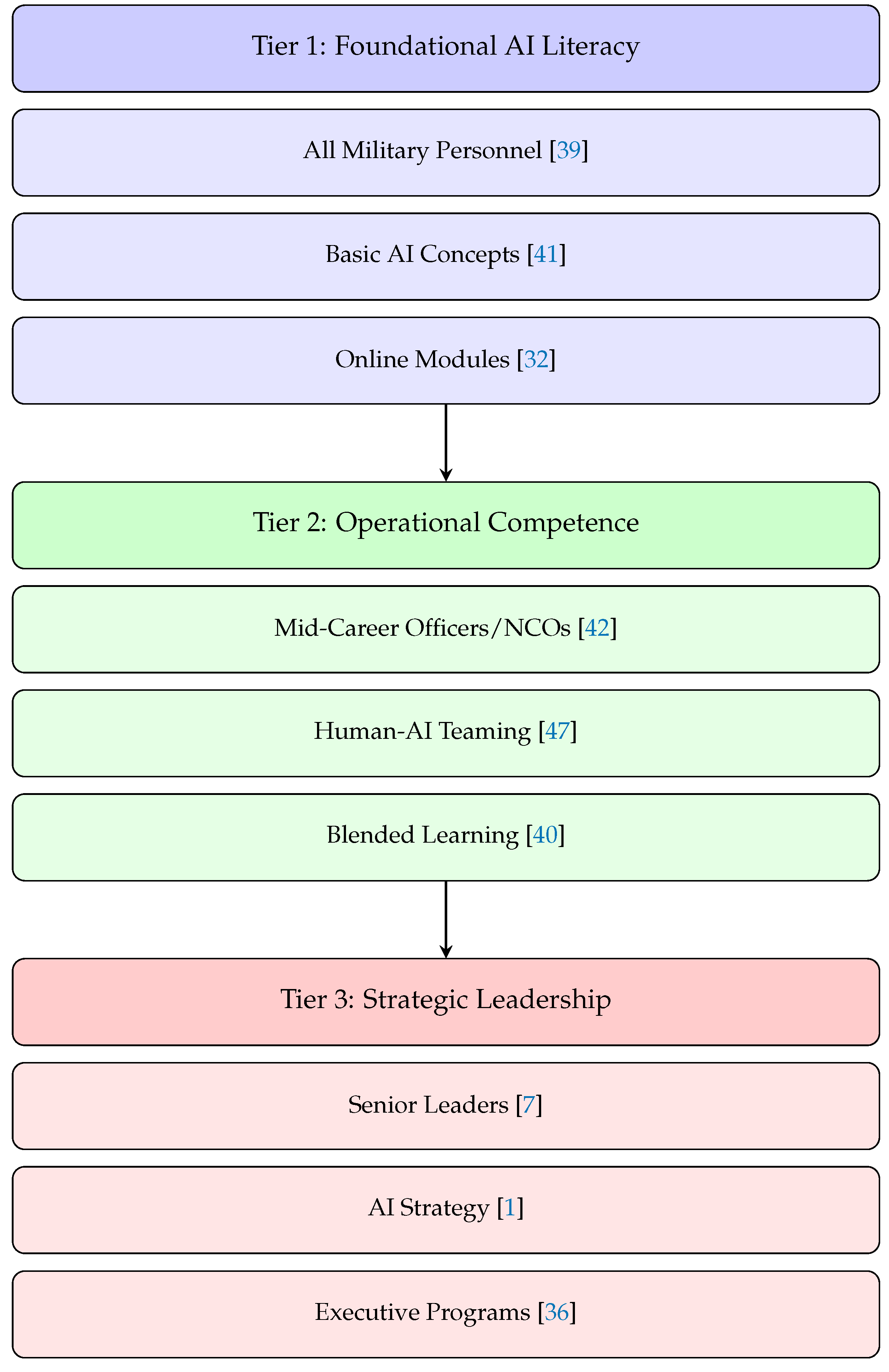
Figure 2.
AI Curriculum Development Pipeline with Continuous Improvement, addressing identified skills gaps [56] through structured competency frameworks [39] and adaptive learning platforms [32]. Performance metrics enable iterative refinement based on workforce outcomes [43].
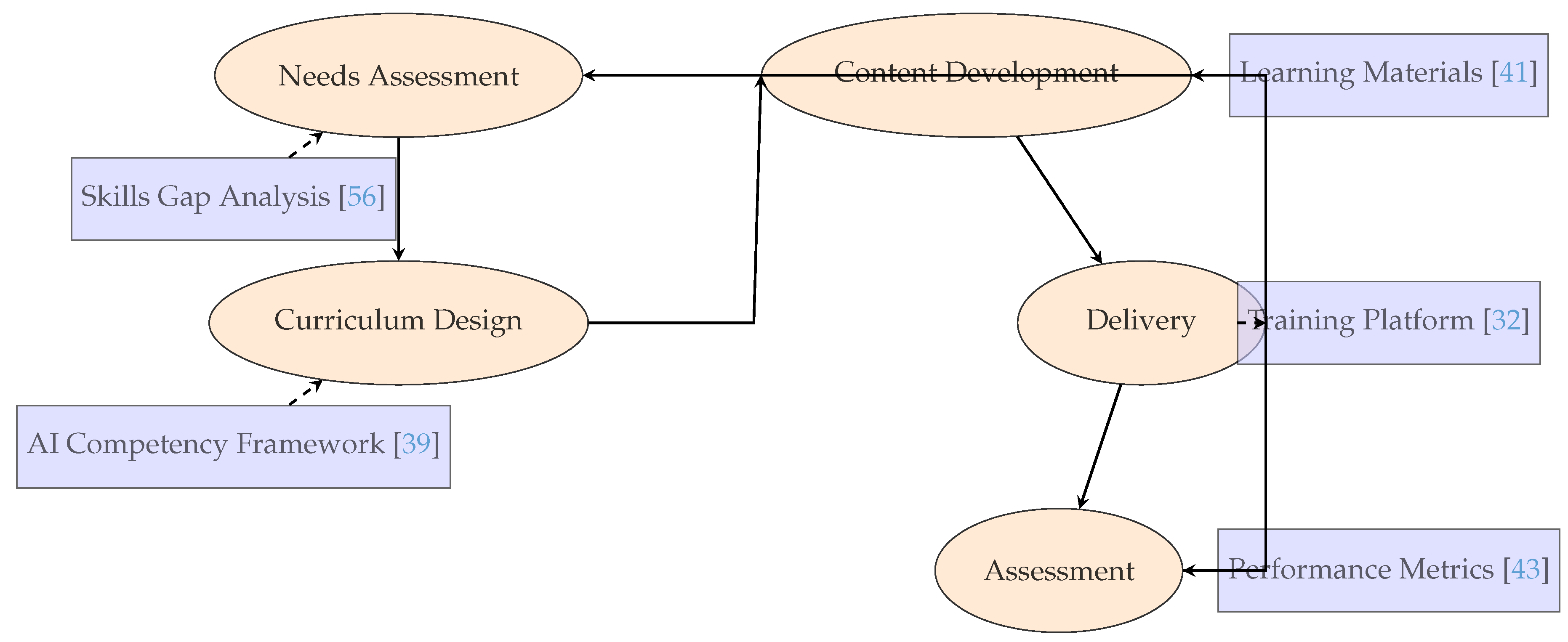
Figure 3.
Layered Technology Architecture for AI Education Integration, featuring operational AI tools like Thunderforge [37] and Project Maven [38], supported by advanced training platforms [1] and data-driven learning analytics [43]. The infrastructure enables real-time processing [11] while maintaining security compliance.
Figure 3.
Layered Technology Architecture for AI Education Integration, featuring operational AI tools like Thunderforge [37] and Project Maven [38], supported by advanced training platforms [1] and data-driven learning analytics [43]. The infrastructure enables real-time processing [11] while maintaining security compliance.
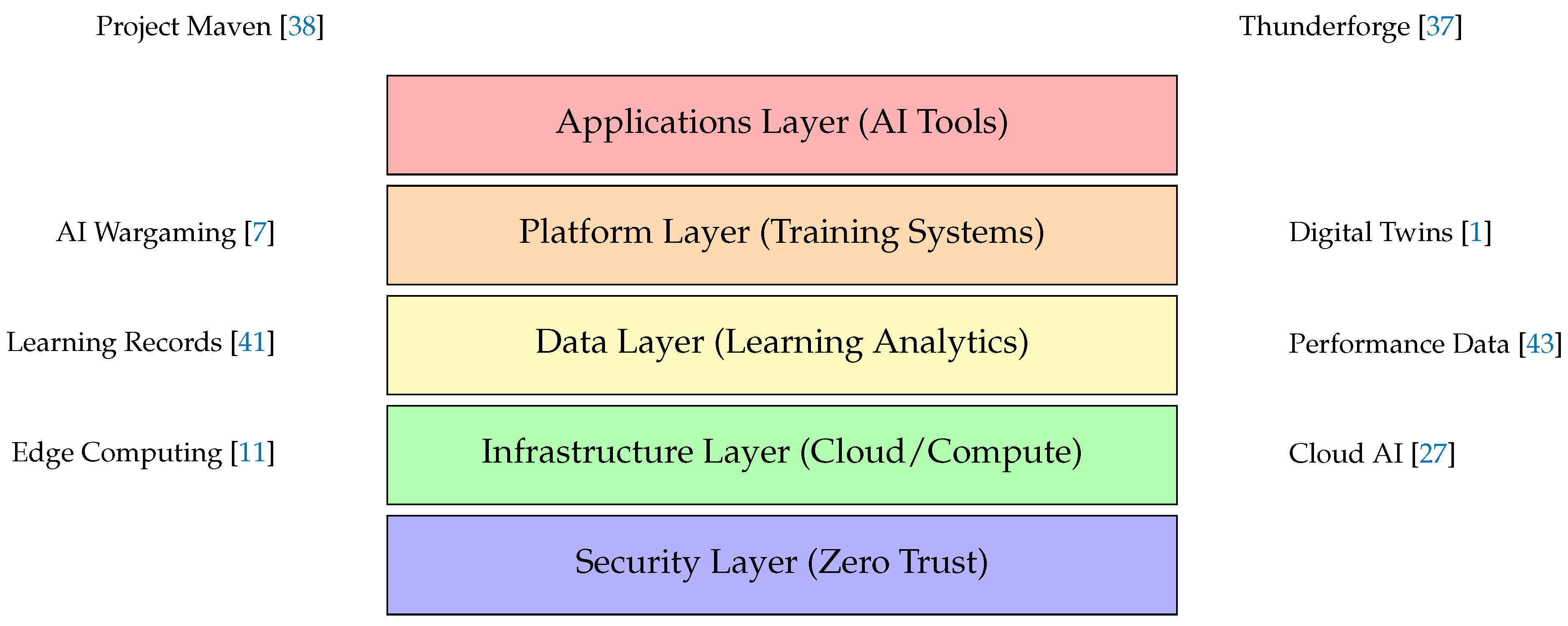
Figure 4.
Phased Implementation Roadmap with Key Milestones, beginning with foundational task force establishment [10] and pilot programs [40], progressing through framework development [39] and institutionalization [15], culminating in advanced research initiatives [1] and strategic partnerships [18].
Figure 4.
Phased Implementation Roadmap with Key Milestones, beginning with foundational task force establishment [10] and pilot programs [40], progressing through framework development [39] and institutionalization [15], culminating in advanced research initiatives [1] and strategic partnerships [18].
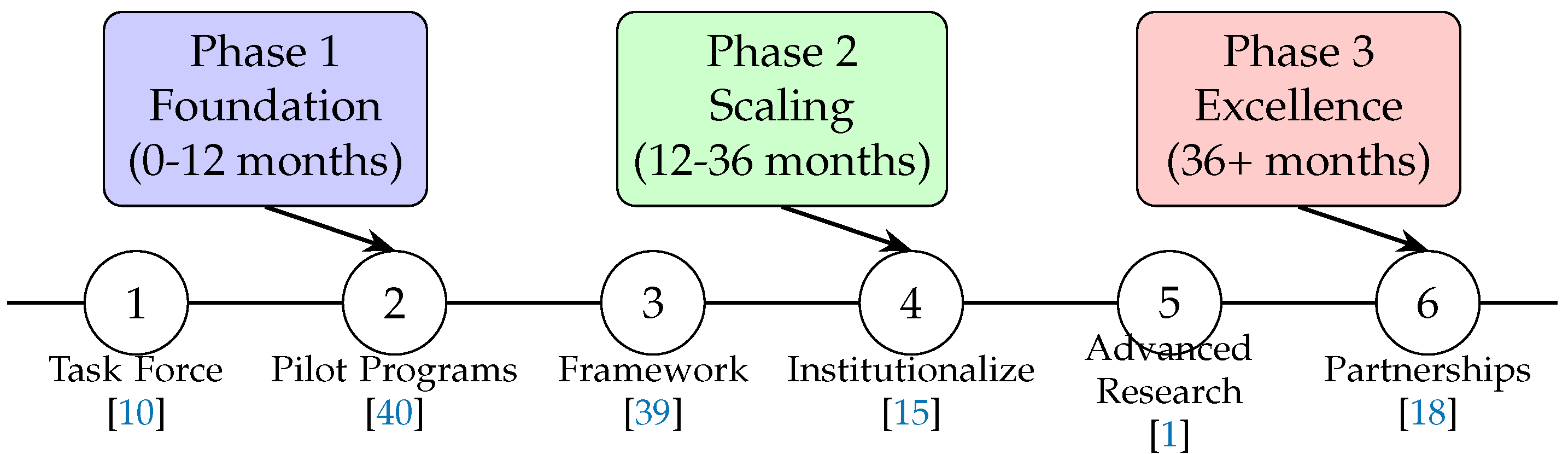
Figure 5.
Multi-Stakeholder Engagement Model for AI Education Ecosystem, centered on military education institutions [41] collaborating with industry partners for technology transfer [18], academic institutions for curriculum development [28], government agencies for policy alignment [24], international allies for doctrine sharing [10], and research organizations for innovation [1].
Figure 5.
Multi-Stakeholder Engagement Model for AI Education Ecosystem, centered on military education institutions [41] collaborating with industry partners for technology transfer [18], academic institutions for curriculum development [28], government agencies for policy alignment [24], international allies for doctrine sharing [10], and research organizations for innovation [1].
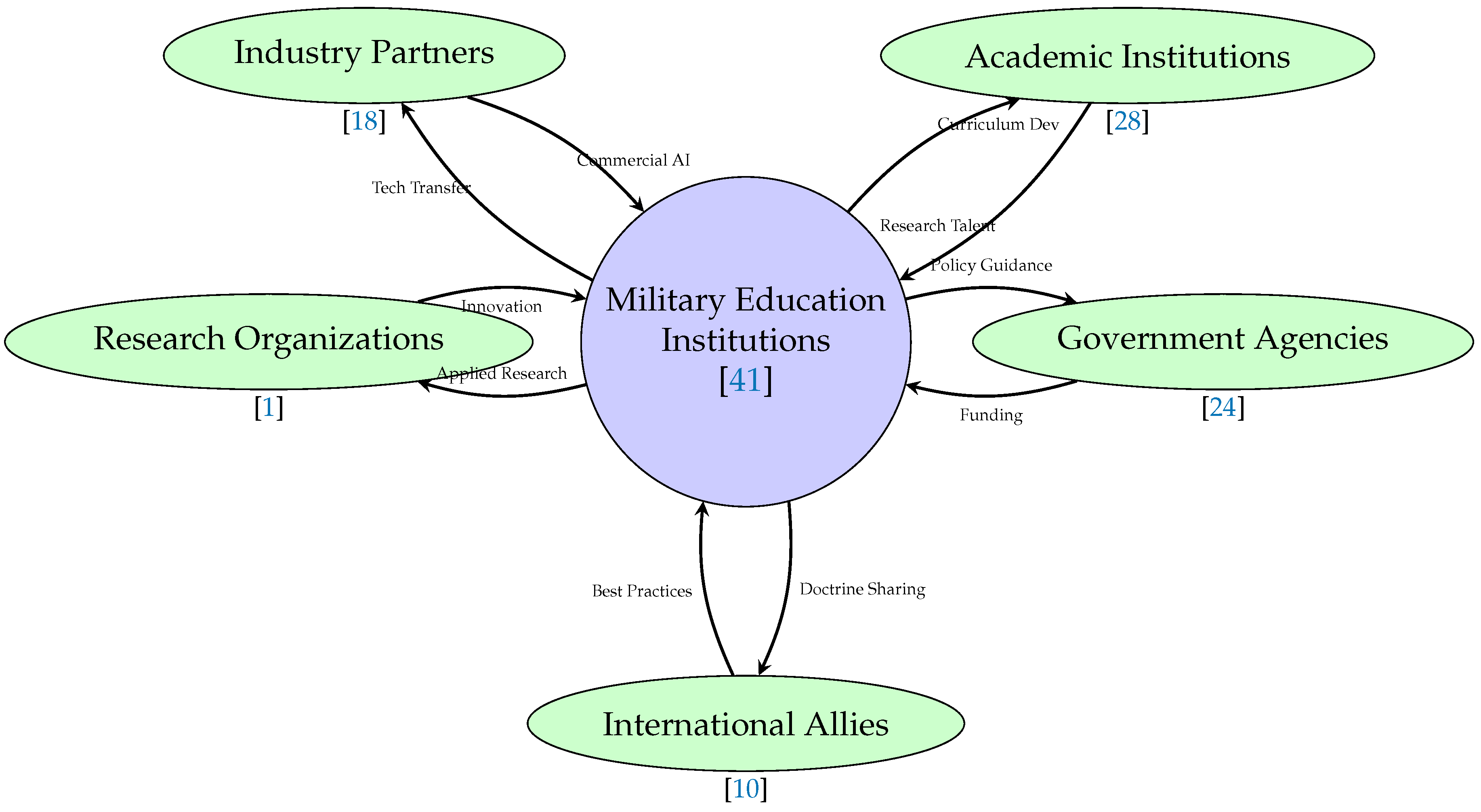
Figure 6.
Comprehensive Assessment Framework for AI Education Effectiveness, measuring participation in AI training initiatives [15], learning engagement through adaptive platforms [32], competency development against established frameworks [39], operational impact on mission performance [6], and continuous curriculum refinement [41].
Figure 6.
Comprehensive Assessment Framework for AI Education Effectiveness, measuring participation in AI training initiatives [15], learning engagement through adaptive platforms [32], competency development against established frameworks [39], operational impact on mission performance [6], and continuous curriculum refinement [41].
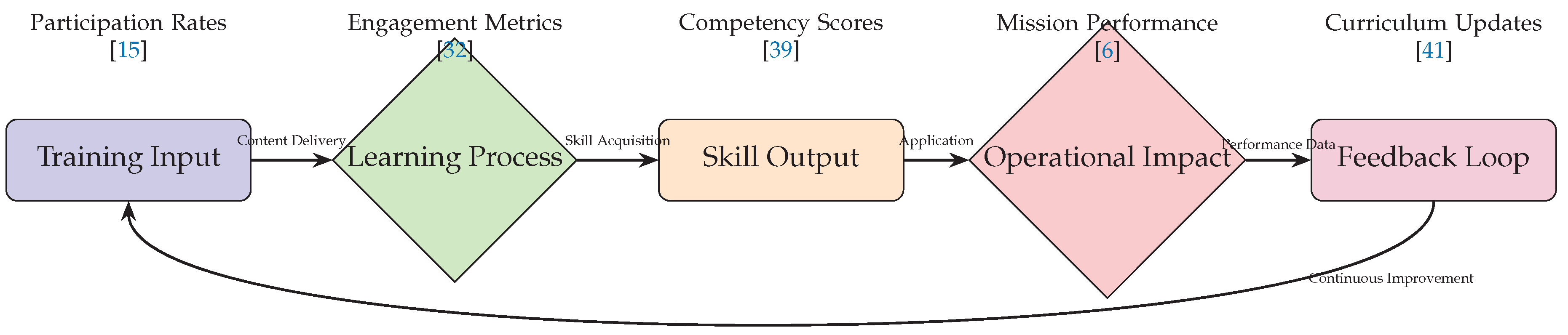
Figure 7.
Proposed Resource Allocation Model for AI Education Implementation, prioritizing technology infrastructure for real-time AI systems [11], faculty development to address AI skills gaps [24], curriculum design for enhanced military learning [41], and program evaluation to measure workforce impact [43], guided by AI-ready workforce principles [39].
Figure 7.
Proposed Resource Allocation Model for AI Education Implementation, prioritizing technology infrastructure for real-time AI systems [11], faculty development to address AI skills gaps [24], curriculum design for enhanced military learning [41], and program evaluation to measure workforce impact [43], guided by AI-ready workforce principles [39].
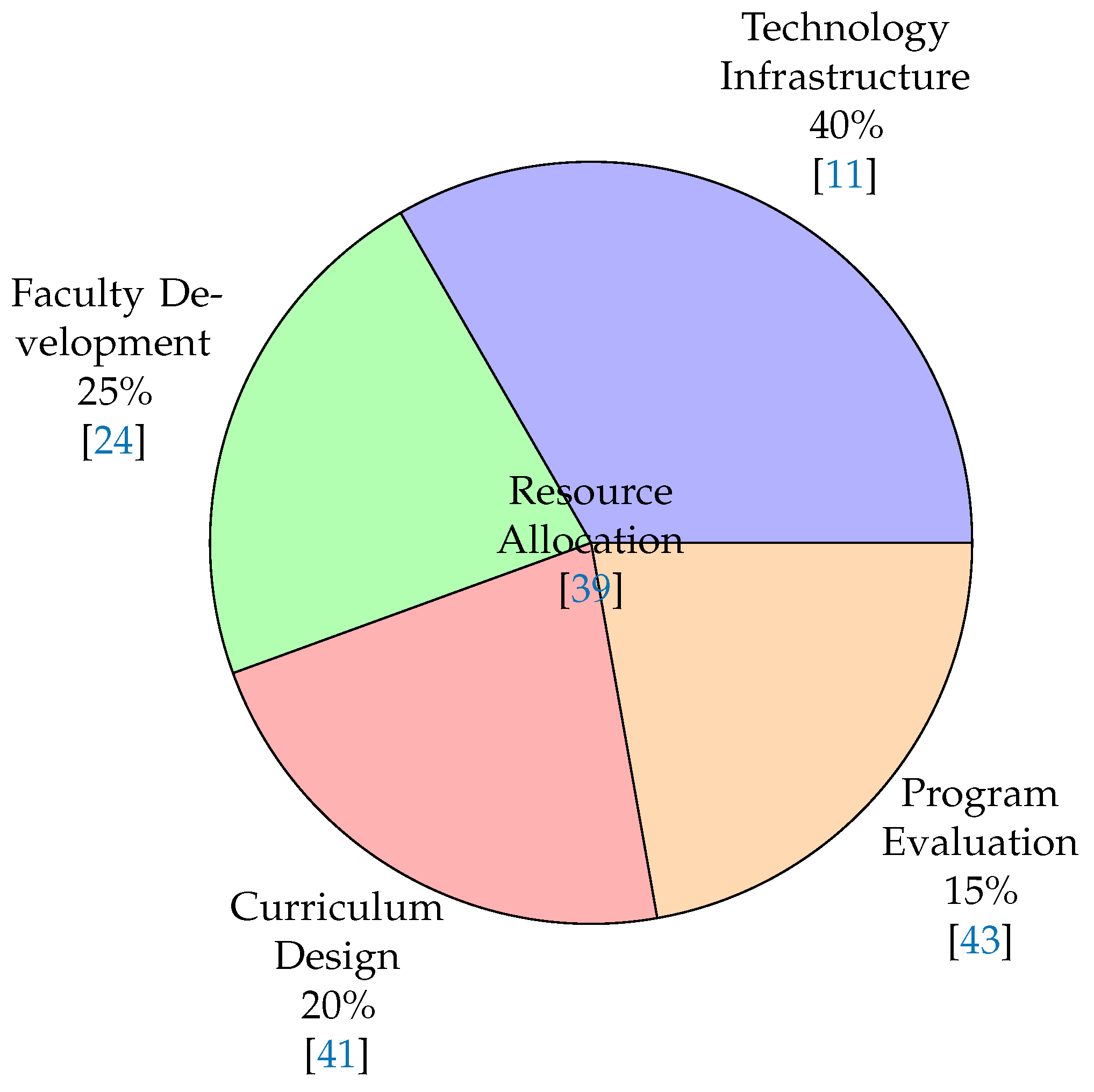
Table 1.
Military AI Skills Gap Analysis
| Skill Category | Current Coverage | Required Enhancement |
|---|---|---|
| Technical AI Literacy | Basic digital literacy | Advanced AI concepts, system architecture |
| Ethical Decision-Making | Traditional ethics training | AI-specific ethical frameworks |
| Human-Machine Teaming | Limited exposure | Collaborative workflow design |
| System Oversight | Basic supervision skills | AI monitoring and intervention protocols |
| Adaptive Learning | Standardized training | Continuous skill refreshment |
Disclaimer/Publisher’s Note: The statements, opinions and data contained in all publications are solely those of the individual author(s) and contributor(s) and not of MDPI and/or the editor(s). MDPI and/or the editor(s) disclaim responsibility for any injury to people or property resulting from any ideas, methods, instructions or products referred to in the content. |
© 2025 by the authors. Licensee MDPI, Basel, Switzerland. This article is an open access article distributed under the terms and conditions of the Creative Commons Attribution (CC BY) license (http://creativecommons.org/licenses/by/4.0/).
Copyright: This open access article is published under a Creative Commons CC BY 4.0 license, which permit the free download, distribution, and reuse, provided that the author and preprint are cited in any reuse.


