

Submitted:
12 October 2025
Posted:
13 October 2025
You are already at the latest version
Abstract
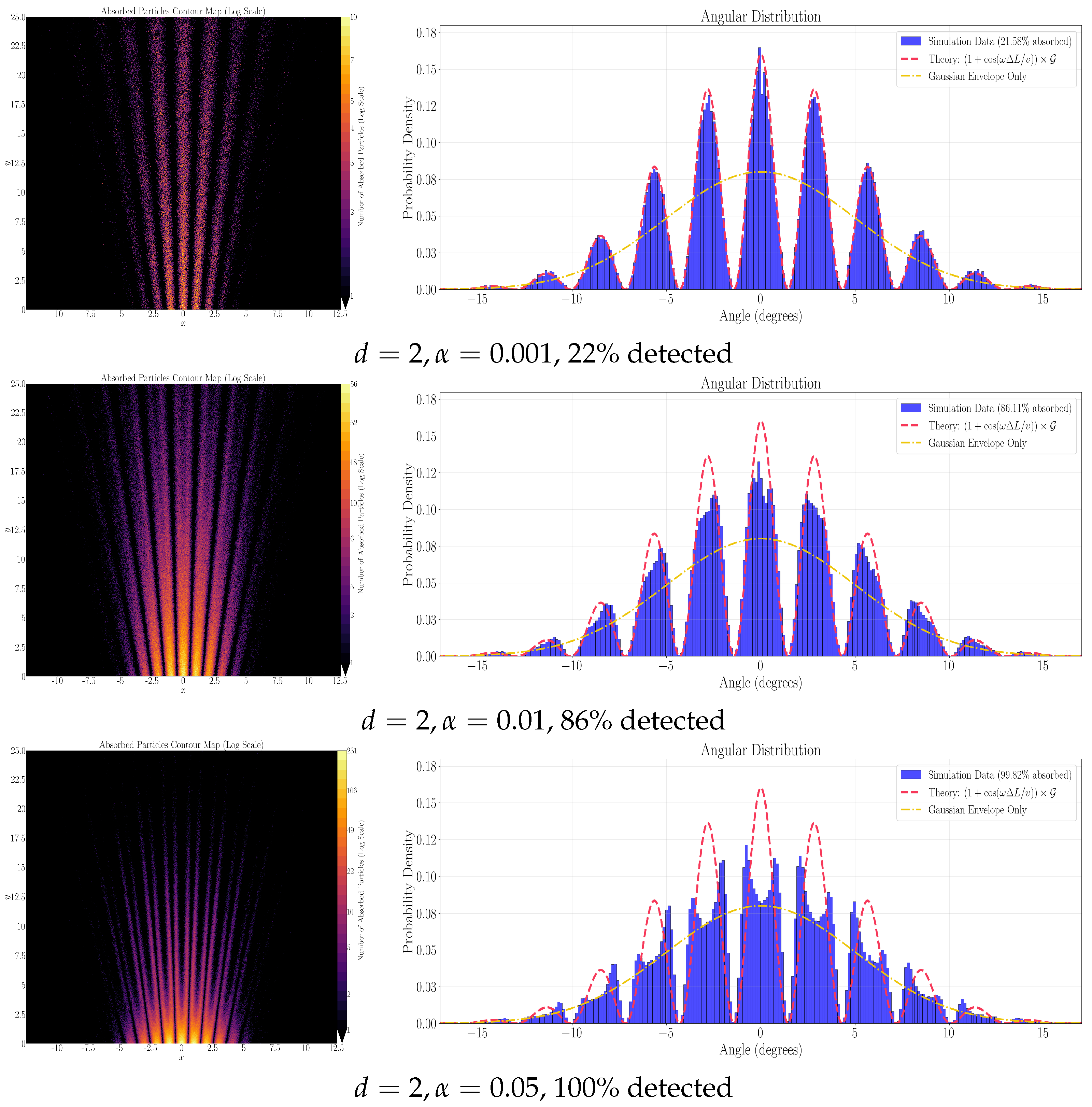
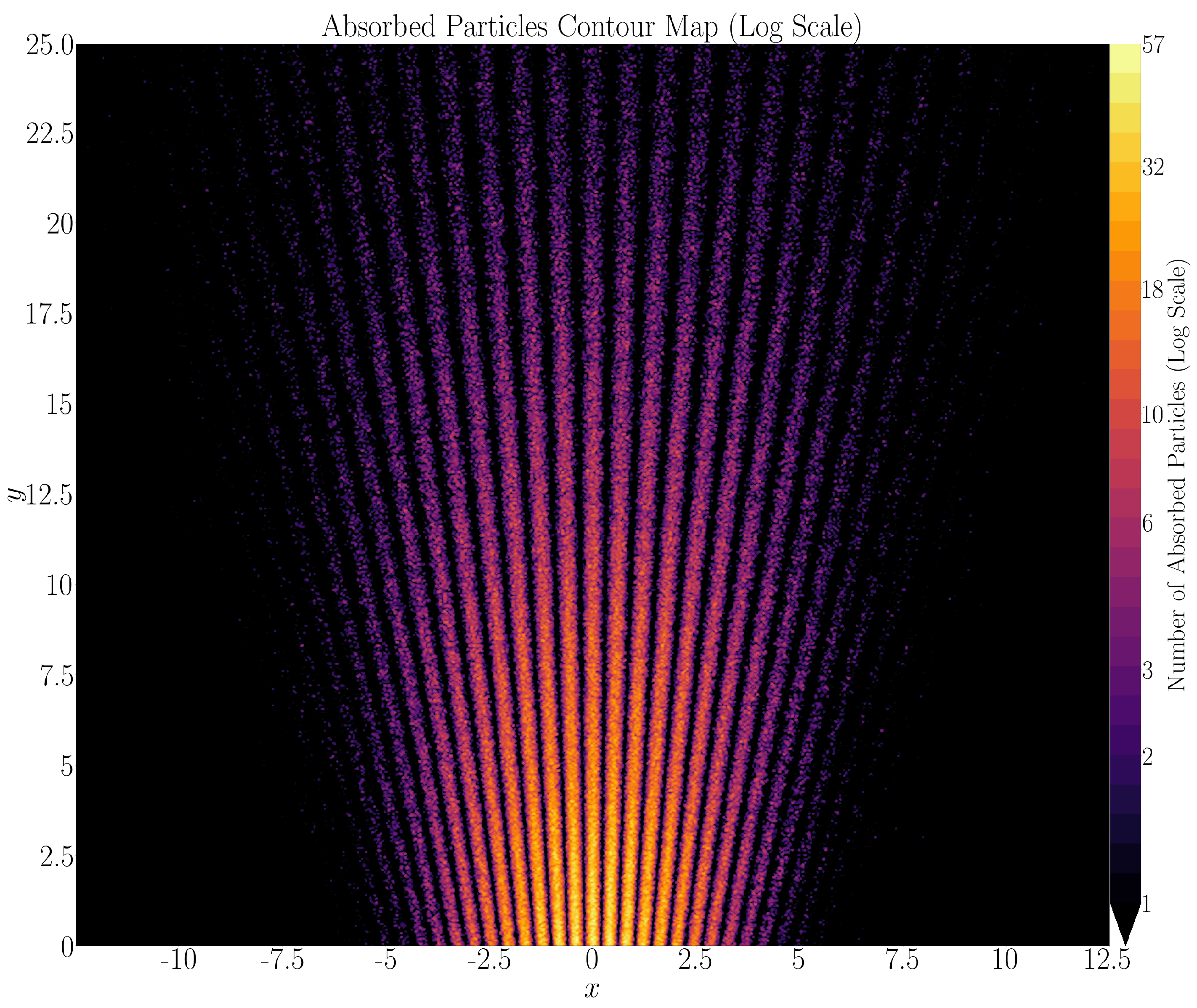
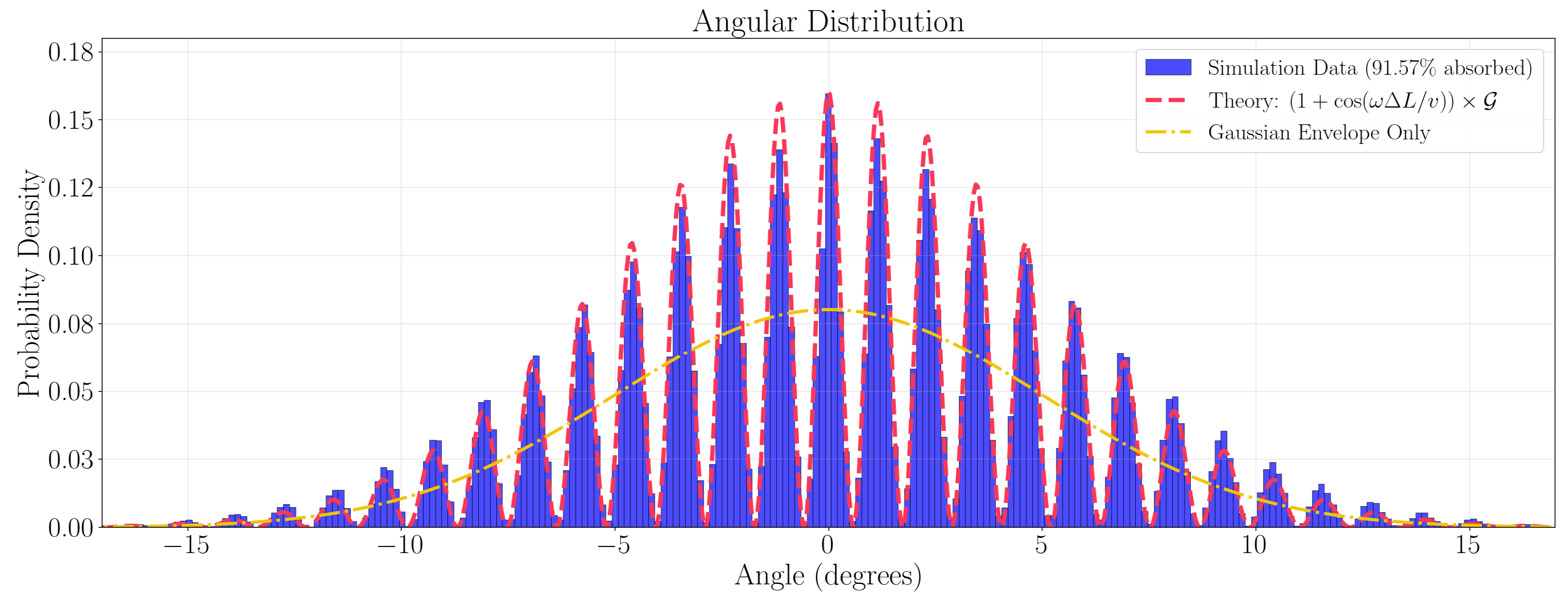
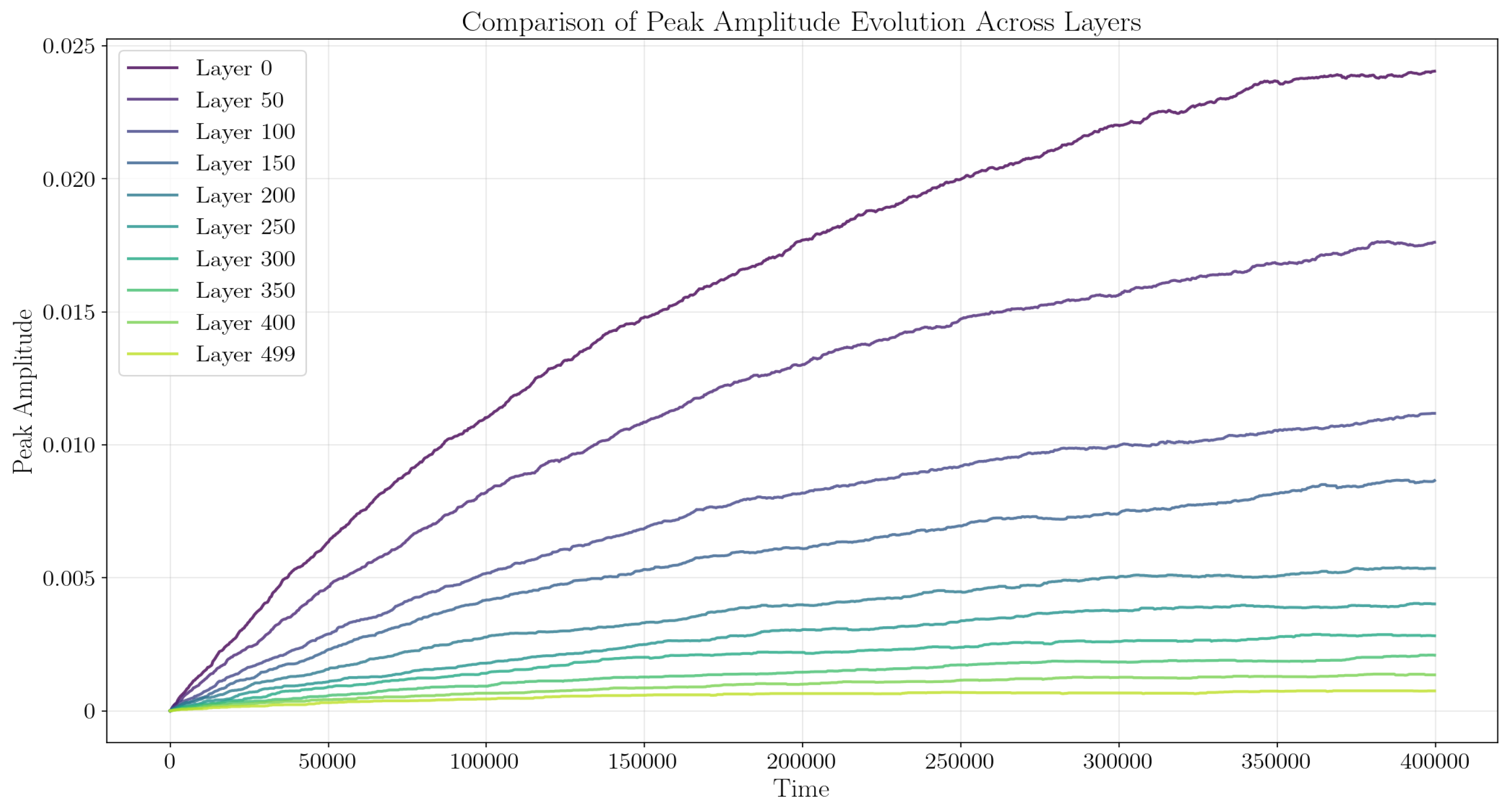
We present a numerical implementation of the proposed Source-Detector Resonance (SDR) that mimics a Double-Slit Interference Experiment. Two periodic streams of particles are emitted from two point sources at random integer multiples of a fundamental period \( P \) and corresponding frequency \( \omega=2\pi/P \), and fly out towards a detection screen. The screen consists of a deep set of identical oscillators with eigenfrequency \( \omega_0=2\pi/P_0 \). In the SDR scenario, \( \omega\approx \omega_0 \). When the particles reach the screen, they implement a periodic forcing of its oscillators at the stream's fundamental frequency \( \omega_0 \). As a result, an oscillating pattern develops along the screen. The amplitude of oscillation of each oscillator saturates at a value that is determined by the balance between the periodic particle forcing and the damping of each oscillator. This is clearly proportional to the number of particles that reach a certain oscillator per unit time, times the fraction of particles that reach it at its resonant frequency. The latter fraction is equal to the ratio of the Power Spectral Density (PSD) of the time series of the particles that reach the oscillator at its resonance frequency PSD(\( \omega_0 \)), over the PSD at zero frequency PSD(0). If we further assume that each oscillator absorbs a particle and announces a detection with a probability that is proportional to the square of the ratio PSD(\( \omega_0 \))/PSD(0), the pattern of particle detections that develops over a thick layer of oscillators is shown to be the same as that of a Double-Slit Interference Experiment. Our result implies that when classical macroscopic detectors interact with and detect periodic streams of elementary particles, they may create the illusion of an interference measurement. Our results apply both to Classical Interference with particles (e.g. electromagnetic wave interference with photons) and Quantum Mechanics.
Keywords:
1. Introduction
"is it possible to manifest interference with non-interacting elementary particles?",
2. An Oscillator Driven by a Resonant Stream of Particles
3. An Oscillator Driven by Two Resonant Streams of Particles
4. A Numerical Experiment with a Thick Layer of Resonant Oscillators
5. Summary and Conclusions
Funding
Data Availability Statement
Acknowledgments
Conflicts of Interest
Appendix A. Numerics of the Particle Pusher
- At , and .
- and will both stay zero till a particle reaches this particular oscillator.
- After a particle interacts for the first time with this oscillator at time it will impart to it an extra velocity .
- Beyond time and before the next interaction at time
- In general,for i.e. between the and particle collisions.
- From the above we also deduce that the amplitude of oscillation immediately following a particle collision is equal to
References
- Bacciagaluppi, G.; Valentini, A. Quantum Theory at the Crossroads: Reconsidering the 1927 Solvay Conference; Cambridge University Press: Cambridge, UK, 2009. [Google Scholar]
- Bassi, A.; Lochan, K.; Satin, S.; Singh, T.P.; Ulbricht, H. Models of wave-function collapse, underlying theories, and experimental tests. Rev. Mod. Phys. 2013, 85, 471. [Google Scholar] [CrossRef]
- Bohm, D. A Suggested Interpretation of the Quantum Theory in terms of ’Hidden’ Variables, I and II. Phys. Rev. 1952, 85, 166–193. [Google Scholar] [CrossRef]
- Contopoulos, I.; Tzemos, A. C.; Zanias, F.; Contopoulos, G. , Interference with Non-Interacting Free Particles and a Special Type of Detector. Particles 2023, 6, 121. [Google Scholar] [CrossRef]
- Contopoulos, I. , Wave-like Behavior in the Source-Detector Resonance. Particles 2025, 85, 471. [Google Scholar] [CrossRef]
- Everett, H., III. “Relative state” formulation of quantum mechanics. Rev. Mod. Phys. 1957, 8, 24. [Google Scholar] [CrossRef]
- Harrigan, N.; Spekkens, R.W. Einstein, incompleteness, and the epistemic view of quantum states. Found. Phys. 2010, 40, 125–157. [Google Scholar] [CrossRef]
- Holland, P.R. The Quantum Theory of Motion: An Account of the de Broglie-Bohm Causal Interpretation of Quantum Mechanics; Cambridge University Press: Cambridge, UK, 1995. [Google Scholar]
- Maudlin, T. Foundations of Quantum Mechanics: An Exploration of the Physical Meaning of Quantum Theory. Am. J. Phys. 2018, 86, 953–955. [Google Scholar] [CrossRef]
- Merzbacher, E. Quantum Mechanics; John Wiley & Sons: New York, NY, USA, 1998. [Google Scholar]
- Nelson, E. Derivation of the Schrödinger equation from Newtonian mechanics. Phys. Rev. 1966, 150, 1079. [Google Scholar] [CrossRef]
- Nelson, E. Quantum Fluctuations; Princeton University Press: Princeton, NJ, USA, 1985. [Google Scholar]
- Nelson, E. Review of stochastic mechanics. J. Phys. Conf. Ser. 2012, 361, 012011. [Google Scholar] [CrossRef]
- Styer, D.F.; Balkin, M.S.; Becker, K.M.; Burns, M.R.; Dudley, C.E.; Forth, S.T.; Gaumer, J.S.; Kramer, M.A.; Oertel, D.C.; Park, L.H.; et al. Nine formulations of quantum mechanics. Am. J. Phys. 2002, 70, 288–297. [Google Scholar] [CrossRef]
- Jin, F.; Yuan, S.; De Raedt, H.; Michielsen, K.; Miyashita, S. Corpuscular model of two-beam interference and double-slit experiments with single photons. J. Phys. Soc. Jpn. 2010, 79, 074401. [Google Scholar] [CrossRef]
- Feynman, R.P. The Feynman Lectures on Physics; Addison-Wesley: Boston, MA, USA, 1965; Volume III. [Google Scholar]
Disclaimer/Publisher’s Note: The statements, opinions and data contained in all publications are solely those of the individual author(s) and contributor(s) and not of MDPI and/or the editor(s). MDPI and/or the editor(s) disclaim responsibility for any injury to people or property resulting from any ideas, methods, instructions or products referred to in the content. |
© 2025 by the authors. Licensee MDPI, Basel, Switzerland. This article is an open access article distributed under the terms and conditions of the Creative Commons Attribution (CC BY) license (http://creativecommons.org/licenses/by/4.0/).