

Submitted:
10 October 2025
Posted:
14 October 2025
You are already at the latest version
Abstract
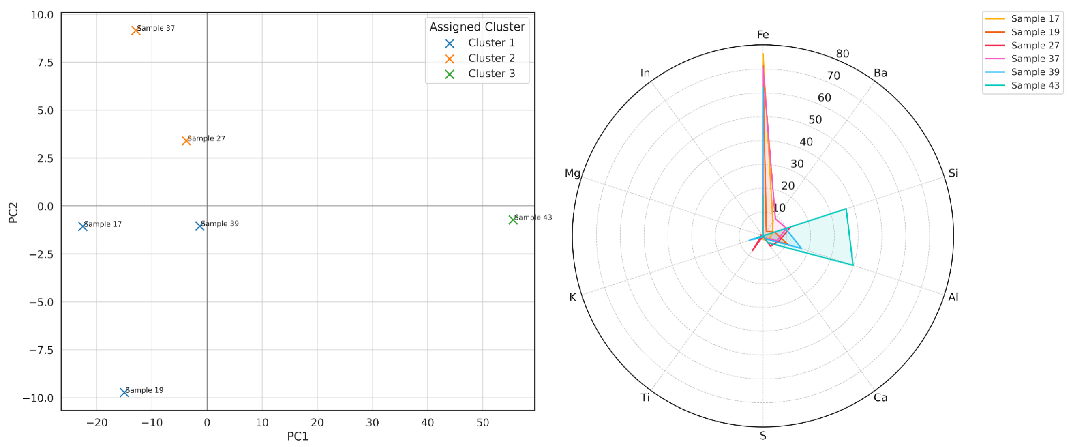
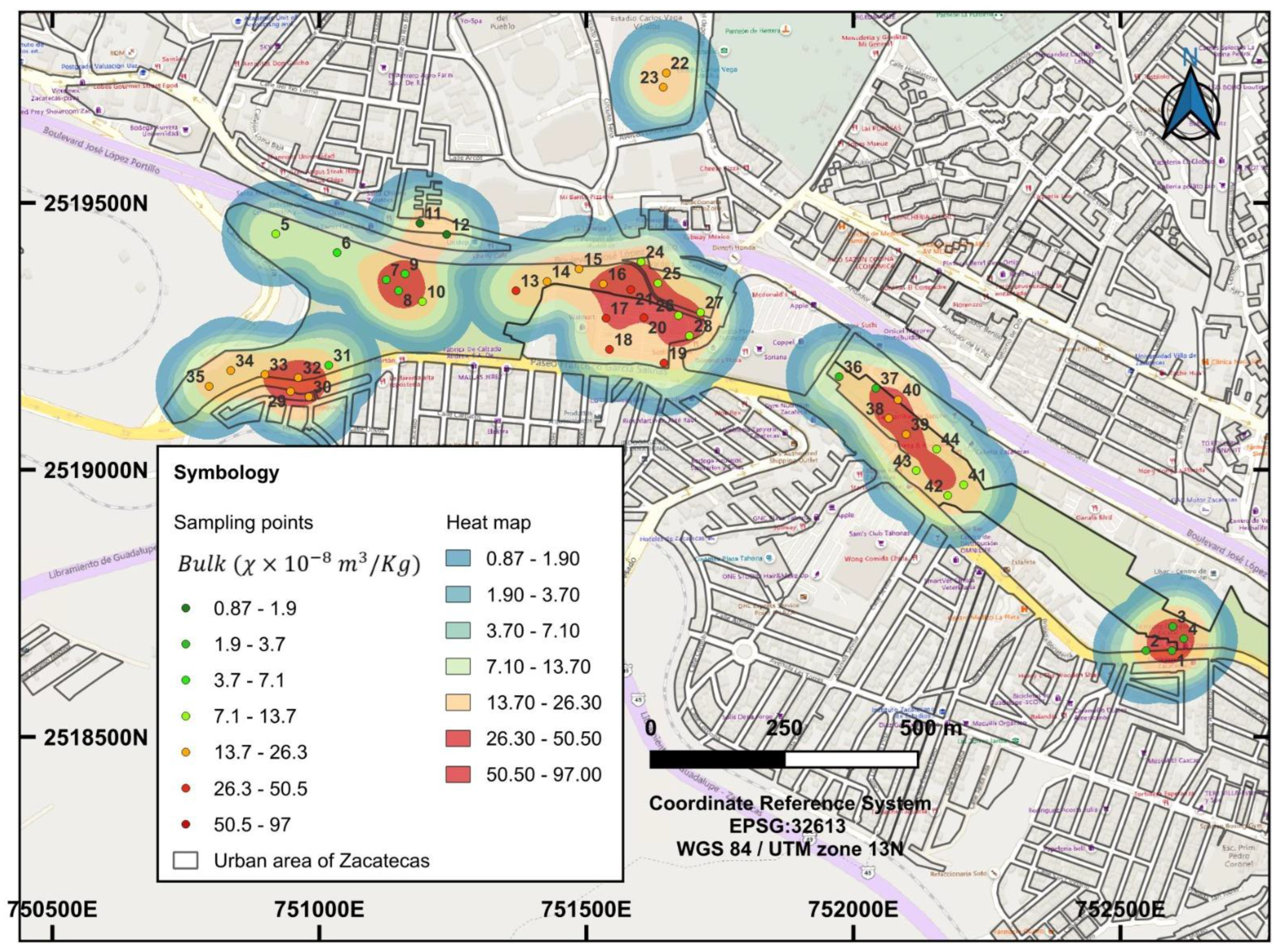
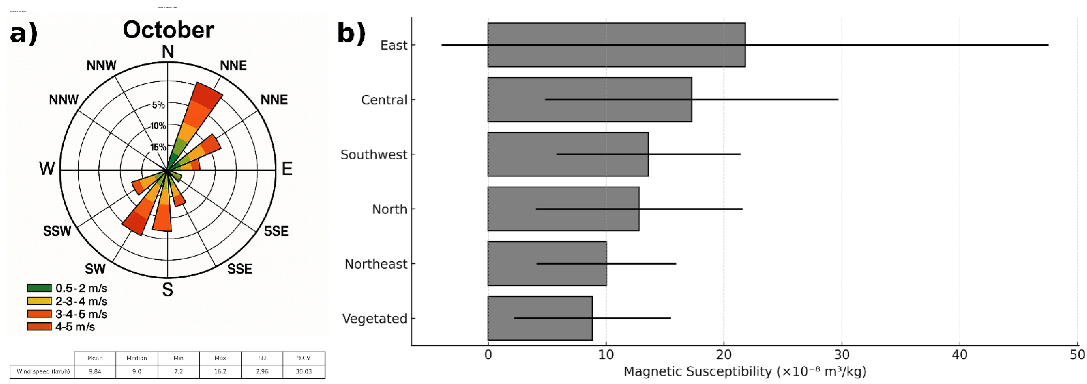
This study assessed the spatial distribution and composition of airborne particulate matter within a 10-km long urban green corridor in Zacatecas, Mexico, using magnetic biomonitoring with Tillandsia recurvata and SEM-EDS particle characterization. A total of 44 samples were collected from distinct urban park contexts (e.g., commercial zones, malls, bus stop), revealing mass-specific magnetic susceptibility χ values ranging from 0.87 to 97.0 × 10⁻⁸ m3kg−1. Three compositional groups were identified based on a PCA performed using elemental concentrations from SEM-EDS and magnetic data, which are associated with traffic emissions and industrial inputs. SEM-EDS images confirmed abundant magnetite-like particles (1–8 μm) with hazardous metals including Pb (up to 5.6 wt.%), Ba (up to 67.6 wt.%), and Cr (up to 31.5 wt.%). Wind direction data indicated predominant SSW-NNE transport, correlating with hotspots in central and northeastern park areas. Overall, vegetated zones displayed significantly lower magnetic loads (mean χ = 8.84 × 10⁻⁸ m3kg−1, σ = 6.65 × 10⁻⁸ m3kg−1) compared to traffic-exposed sites (mean χ = 17.27 × 10⁻⁸ m3kg−1, σ = 12.44 × 10⁻⁸ m3kg−1), emphasizing the pollution mitigation role of green barriers. This research highlights the applicability of combined magnetic and microscopic techniques for evaluating the dynamics of airborne pollution in urban parks and supports their use as biofunctional filters in cities facing vehicular air pollution.
Keywords:
1. Introduction
2. Materials and methods
2.1. Study Area
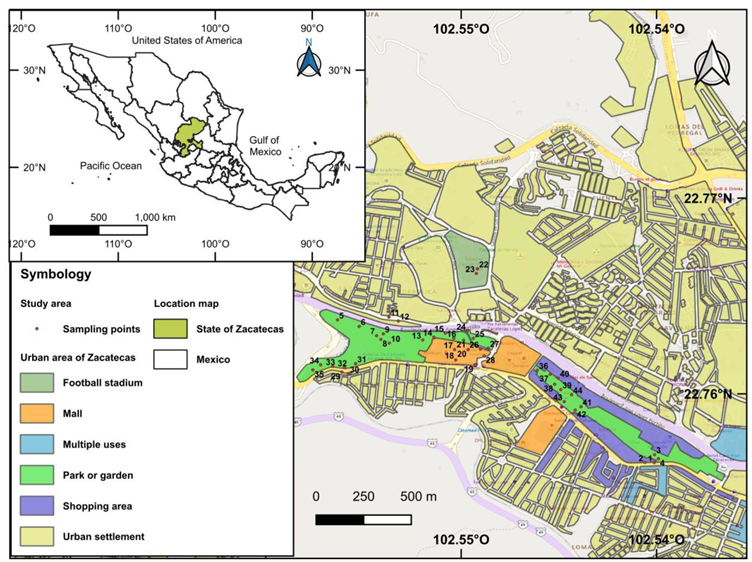
2.2. Sampling
2.3. Magnetic Measurements
2.4. Microscopy and Elemental Studies
2.5. Statistical Analysis
3. Results and Discussion
3.1. Magnetic Properties
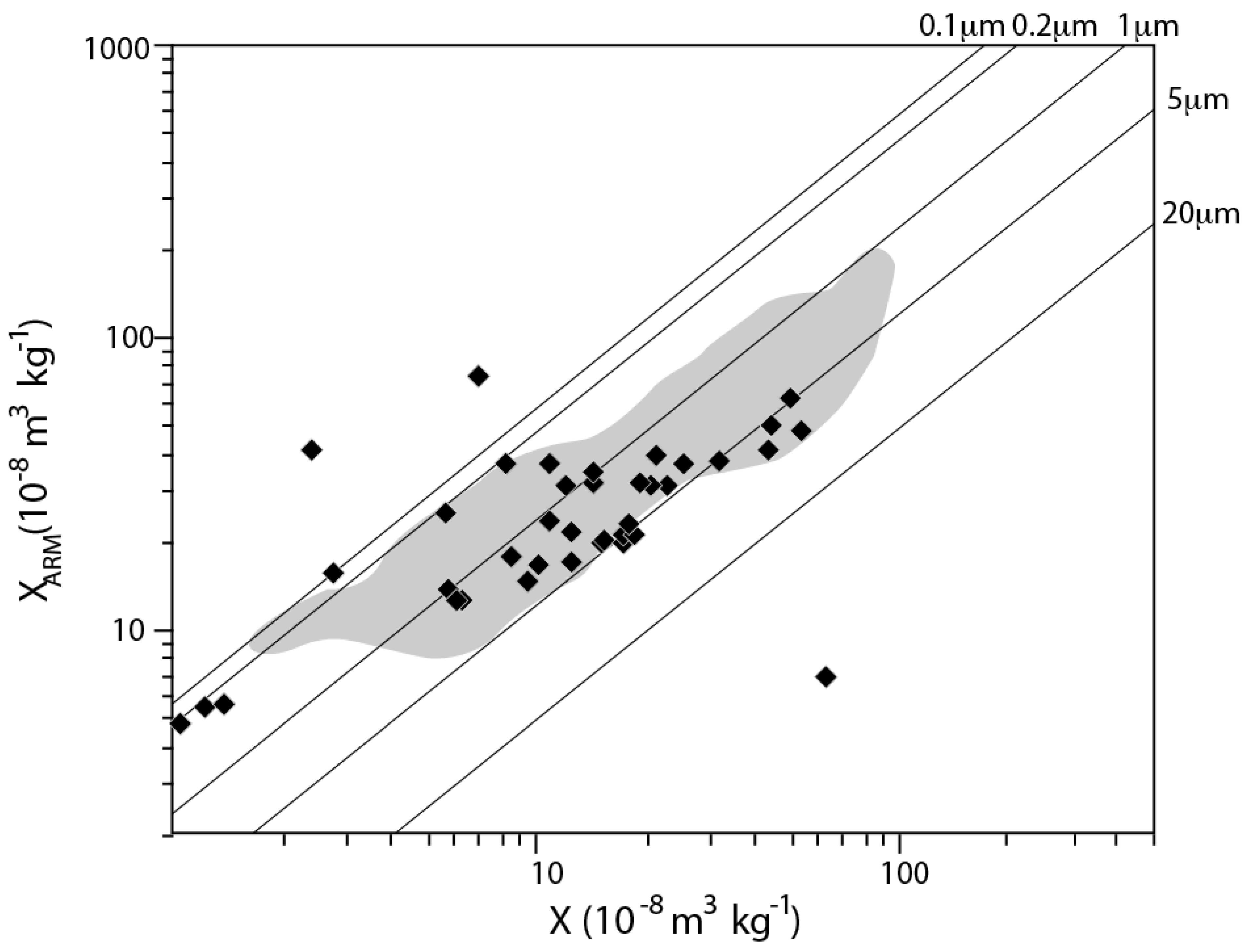
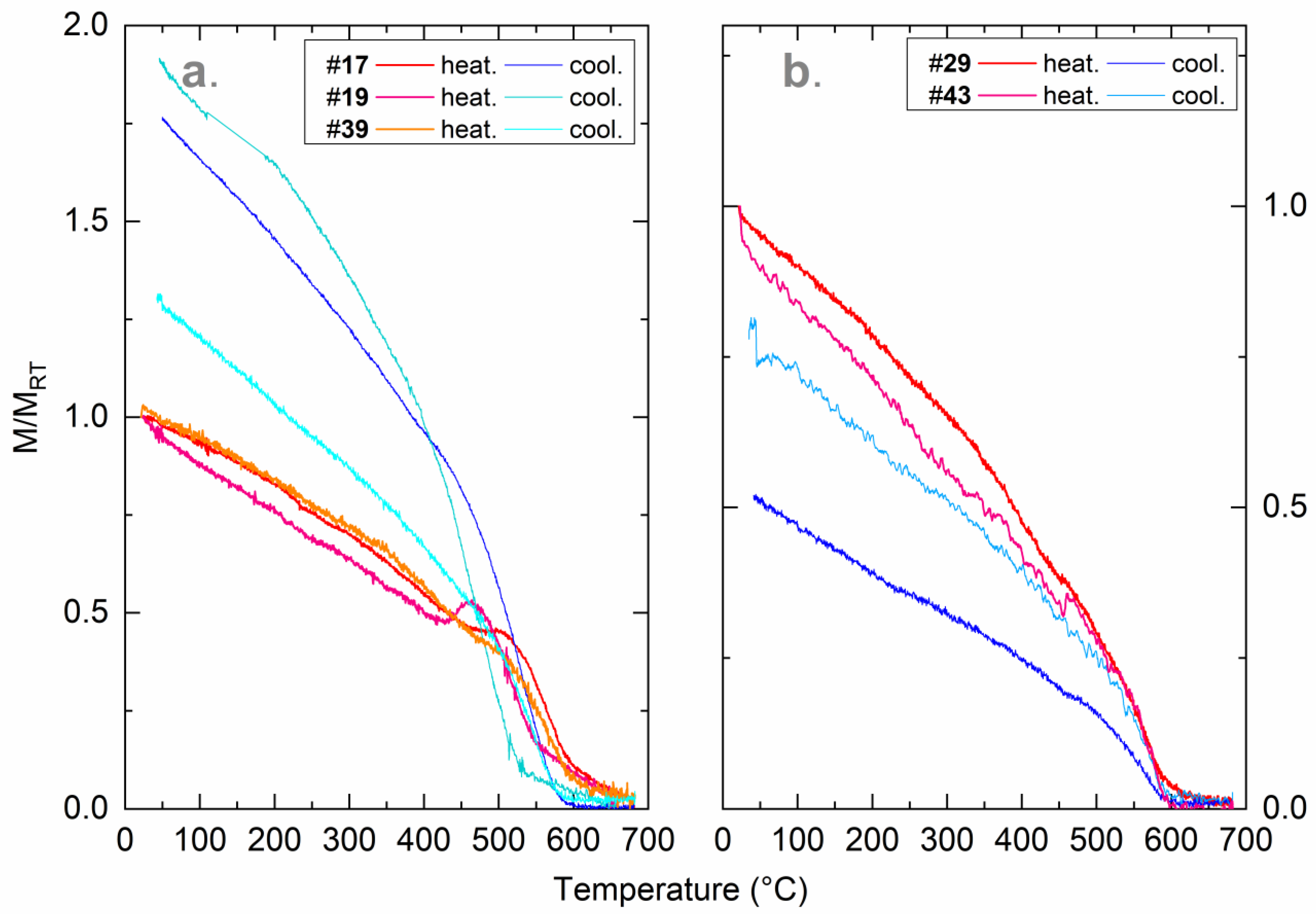
3.2. SEM Observations and Elemental Content
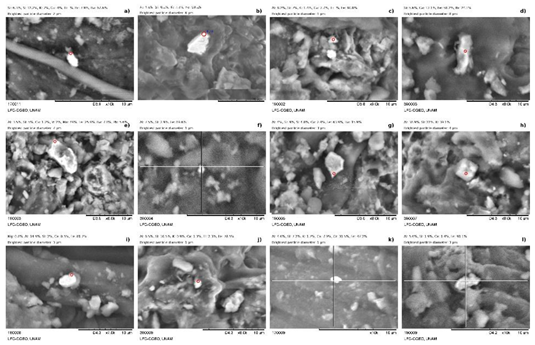
3.3. Statistical Analysis.
3.4. Magnetic Monitoring
4. Conclusions
Acknowledgments
Data availability
Funding
Conflicts of Interest
References
- Adamiec, E.; Jarosz-Krzemińska, E.; Wieszała, R. Heavy metals from non-exhaust vehicle emissions in urban and motorway road dusts. Environmental monitoring and assessment 2016, 188, 1–11. [Google Scholar] [CrossRef]
- Ali, M.U.; Liu, G.; Yousaf, B.; Ullah, H.; Abbas, Q.; Munir, M.A.M. A systematic review on global pollution status of particulate matter-associated potential toxic elements and health perspectives in urban environment. Environmental geochemistry and health 2019, 41, 1131–1162. [Google Scholar] [CrossRef] [PubMed]
- Apeagyei, E.; Bank, M.S.; Spengler, J.D. Distribution of heavy metals in road dust along an urban-rural gradient in Massachusetts. Atmospheric Environment 2011, 45, 2310–2323. [Google Scholar] [CrossRef]
- Buitrago Posada, D.; Chaparro, M.A.; Duque-Trujillo, J.F. Magnetic assessment of transplanted Tillandsia spp.: Biomonitors of air particulate matter for high rainfall environments. Atmosphere 2023, 14, 213. [Google Scholar] [CrossRef]
- Castanheiro, A.; Samson, R.; De Wael, K. Magnetic and particle-based techniques to investigate metal deposition on urban green. Science of the Total Environment 2016, 571, 594–602. [Google Scholar] [CrossRef]
- Castaneda-Miranda, A.G.; Böhnel, H.N.; Molina-Garza, R.S.; Chaparro, M.A. Magnetic evaluation of TSP-filters for air quality monitoring. Atmospheric environment 2014, 96, 163–174. [Google Scholar] [CrossRef]
- Castañeda-Miranda, A.G.; Chaparro, M.A.; Chaparro, M.A.; Böhnel, H.N. Magnetic properties of Tillandsia recurvata L. and its use for biomonitoring a Mexican metropolitan area. Ecological Indicators 2016, 60, 125–136. [Google Scholar] [CrossRef]
- Castañeda-Miranda, A.G.; Chaparro, M.A.; Pacheco-Castro, A.; Chaparro, M.A.; Böhnel, H.N. Magnetic biomonitoring of atmospheric dust using tree leaves of Ficus benjamina in Querétaro (Mexico). Environmental Monitoring and Assessment 2020, 192, 382. [Google Scholar] [CrossRef]
- Chaparro, M.A.E.; Chaparro, M.A.E.; Castañeda Miranda, A.G.; Böhnel, H.N.; Sinito, A.M. (2015). An interval fuzzy model for magnetic biomonitoring using the species Tillandsia recurvata L.
- Chaparro, M.A.; Posada, D.B.; Chaparro, M.A.; Molinari, D.; Chiavarino, L.; Alba, B.; Marié, D.C.; Natal, M.; Böhnel, H.N.; Vaira, M. Urban and suburban airborne magnetic particles accumulated on Tillandsia capillaris. Science of The Total Environment 2024, 907, 167890. [Google Scholar] [CrossRef]
- Chaparro, M.A.E.; Chaparro, M.A.E.; Molinari, D.A. A fuzzy-based analysis of air particle pollution data: An index IMC for magnetic biomonitoring. Atmosphere 2024, 15, 435. [Google Scholar] [CrossRef]
- Chen, L.; Liu, C.; Zou, R.; Yang, M.; Zhang, Z. Experimental examination of the effectiveness of vegetation as a bio-filter of particulate matter in the urban environment. Environmental Pollution 2016, 208, 198–208. [Google Scholar] [CrossRef]
- Comisión Nacional del Agua. Servicio Meteorológico Nacional. (2023). Boletines climatológicos y pronósticos diarios de precipitación. Gobierno de México. Recuperado de https://smn.conagua.gob.mx/.
- CONAGUA. (2023). Programa Hídrico Regional Visión 2030: Región Hidrológica Administrativa VI - Río Bravo. Comisión Nacional del Agua. https://www.gob.mx/conagua.
- Cori, L.; Donzelli, G.; Gorini, F.; Bianchi, F.; Curzio, O. Risk perception of air pollution: A systematic review focused on particulate matter exposure. International Journal of Environmental Research and Public Health 2020, 17, 6424. [Google Scholar] [CrossRef] [PubMed]
- Fang, G.C.; Zhuang, Y.J.; Cho, M.H.; Huang, C.Y.; Xiao, Y.F.; Tsai, K.H. Review of total suspended particles (TSP) and PM2.5 concentration variations in Asia during the years of 1998–2015. Environmental Geochemistry and Health 2018, 40, 1127–1144. [Google Scholar] [CrossRef] [PubMed]
- Gargiulo, J.D.; Kumar, R.S.; Chaparro, M.A.; Chaparro, M.A.; Natal, M.; Rajkumar, P. Magnetic properties of air-suspended particles in 38 cities from South India. Atmospheric Pollution Research 2016, 7, 626–637. [Google Scholar] [CrossRef]
- Givehchi, R.; Arhami, M.; Tajrishy, M. Contribution of the Middle Eastern dust source areas to PM10 levels in urban receptors: Case study of Tehran, Iran. Atmospheric environment 2013, 75, 287–295. [Google Scholar] [CrossRef]
- Gonet, T.; Maher, B.A. Airborne, vehicle-derived Fe-bearing nanoparticles in the urban environment: A review. Environmental Science & Technology 2019, 53, 9970–9991. [Google Scholar] [CrossRef]
- González, L. (2022). Diagnóstico de movilidad urbana en Zacatecas-Guadalupe. Universidad Autónoma de Zacatecas.
- Górka-Kostrubiec, B. The magnetic properties of indoor dust fractions as markers of air pollution inside buildings. Building and Environment 2015, 90, 186–195. [Google Scholar] [CrossRef]
- Goudie, A.S. Desert dust and human health disorders. Environment international 2014, 63, 101–113. [Google Scholar] [CrossRef]
- Gupta, V. (2019). Vehicle-generated heavy metal pollution in an urban environment and its distribution into various environmental components. In Environmental Concerns and Sustainable Development: Volume 1: Air, Water and Energy Resources (pp. 113–127). Singapore: Springer Singapore.
- Hagler, G.S.; Lin, M.Y.; Khlystov, A.; Baldauf, R.W.; Isakov, V.; Faircloth, J.; Jackson, L.E. Field investigation of roadside vegetative and structural barrier impact on near-road ultrafine particle concentrations under a variety of wind conditions. Science of the Total Environment 2012, 419, 7–15. [Google Scholar] [CrossRef]
- Halvorsen, J.Ø. (2021). Exposure assessment and particle characterization of workplace aerosols in Norwegian metal laser-cutting industry (Doctoral dissertation, Norwegian University of Life Sciences).
- Hofman, J.; Maher, B.A.; Muxworthy, A.R.; Wuyts, K.; Castanheiro, A.; Samson, R. Biomagnetic monitoring of atmospheric pollution: A review of magnetic signatures from biological sensors. Environmental Science & Technology 2017, 51, 6648–6664. [Google Scholar] [CrossRef]
- Hooper, J.; Marx, S.K.; May, J.H.; Lupo, L.C.; Kulemeyer, J.J.; Pereira, E.D.L. Á. . & Zawadzki, A. Dust deposition tracks late-Holocene shifts in monsoon activity and the increasing role of human disturbance in the Puna-Altiplano, northwest Argentina. The Holocene 2020, 30, 519–536. [Google Scholar] [CrossRef]
- INEGI. (2020). Anuario estadístico y geográfico de Zacatecas 2020. Instituto Nacional de Estadística y Geografía. https://www.inegi.org.mx/app/biblioteca/ficha.html?upc=889463541662.
- King, J.W.; Banerjee, S.K.; and Marvin, J. A new rock-magnetic approach to selecting samples for geomagnetic paleointensity studies: Applications to paleointensity for the last 4000 years. Journal of Geophysical Research 1983, 88, 5911–5921. [Google Scholar] [CrossRef]
- Kumar, P. (2024). Epiphytes as a Sustainable Biomonitoring Tool for Environmental Pollutants. In Biomonitoring of Pollutants in the Global South (pp. 359–390). Singapore: Springer Nature Singapore.
- LEE, I.S.R. (2007). Design and Development of a Passive Large Particle.
- Li, S.; Wang, G.; Geng, Y.; Wu, W.; Duan, X. Lung function decline associated with individual short-term exposure to PM1, PM2.5 and PM10 in patients with allergic rhinoconjunctivitis. Science of the Total Environment 2022, 851, 158151. [Google Scholar] [CrossRef] [PubMed]
- Li, M.Y.; Peng, Z.X.; Zhang, B.W.; Wang, S.K.; Wang, X.S. Morphology, mineralogical composition, and heavy metal enrichment characteristics of magnetic fractions in coal fly ash. Environmental Earth Sciences 2023, 82, 227. [Google Scholar] [CrossRef]
- Liang, F.; Liu, F.; Huang, K.; Yang, X.; Li, J.; Xiao, Q.; Chen, J.; Liu, X.; Cao, J.; Shen, C.; et al. Long-term exposure to fine particulate matter and cardiovascular disease in China. Journal of the American College of Cardiology 2020, 75, 707–717. [Google Scholar] [CrossRef]
- Liu, L.; Guan, D.; Peart, M.R.; Wang, G.; Zhang, H.; Li, Z. The dust retention capacities of urban vegetation—A case study of Guangzhou, South China. Environmental Science and Pollution Research 2013, 20, 6601–6610. [Google Scholar] [CrossRef]
- Liu, L.; Zhang, Q.; Gui, J.; Zhang, B.; Yang, H.; Lu, D.; Chen, Z.; Liu, Q.; Li, Z.; Jiang, G. Traffic-derived magnetite pollution in soils along a highway on the Tibetan Plateau. Environmental Science: Nano 2022, 9, 621–631. [Google Scholar] [CrossRef]
- Maher, B.A. Magnetic properties of some synthetic sub-micron magnetites. Geophysical Journal International 1988, 94, 83–96. [Google Scholar] [CrossRef]
- Maher, B.A. Airborne magnetite-and iron-rich pollution nanoparticles: Potential neurotoxicants and environmental risk factors for neurodegenerative disease, including Alzheimer’s disease. Journal of Alzheimer’s Disease 2019, 71, 361–375. [Google Scholar] [CrossRef]
- Manisalidis, I.; Stavropoulou, E.; Stavropoulos, A.; Bezirtzoglou, E. Environmental and health impacts of air pollution: A review. Frontiers in public health 2020, 8, 14. [Google Scholar] [CrossRef]
- Marié, D.C.; Chaparro, M.A.; Gogorza, C.S.; Navas, A.; Sinito, A.M. Vehicle-derived emissions and pollution on the road Autovia 2 investigated by rock-magnetic parameters: A case study from Argentina. Studia Geophysica et Geodaetica 2010, 54, 135–152. [Google Scholar] [CrossRef]
- Marié, D.C.; Chaparro, M.A.; Lavornia, J.M.; Sinito, A.M.; Miranda, A.G.C.; Gargiulo, J.D.; Böhnel, H.N. Atmospheric pollution assessed by in situ measurement of magnetic susceptibility on lichens. Ecological Indicators 2018, 95, 831–840. [Google Scholar] [CrossRef]
- Maher, B.A. Airborne magnetite-and iron-rich pollution nanoparticles: Potential neurotoxicants and environmental risk factors for neurodegenerative disease, including Alzheimer’s disease. Journal of Alzheimer’s Disease 2019, 71, 361–375. [Google Scholar] [CrossRef]
- Mejía-Echeverry, D.; Chaparro, M.A.E.; Duque-Trujillo, J.F.; Chaparro, M.A.E.; Castañeda-Miranda, A.G. Magnetic biomonitoring of air pollution in a tropical valley using a Tillandsia sp. Atmosphere 2018, 9, 283. Atmosphere 2018, 9, 283. [Google Scholar] [CrossRef]
- Miranda, A.G.C.; Chaparro, M.A.; Chaparro, M.A.; Böhnel, H.N. Magnetic properties of Tillandsia recurvata L. and its use for biomonitoring a Mexican metropolitan area. Ecological Indicators 2016, 60, 125–136. [Google Scholar] [CrossRef]
- Niedźwiedź, T.; Łupikasza, E.B.; Małarzewski, Ł.; Budzik, T. Surface-based nocturnal air temperature inversions in southern Poland and their influence on PM10 and PM2.5 concentrations in Upper Silesia. Theoretical and Applied Climatology 2021, 146, 897–919. [Google Scholar] [CrossRef]
- Park, H.Y.; Gilbreath, S.; Barakatt, E. Respiratory outcomes of ultrafine particulate matter (UFPM) as a surrogate measure of near-roadway exposures among bicyclists. Environmental Health 2017, 16, 6. [Google Scholar] [CrossRef] [PubMed]
- Pietrelli, L.; Di Vito, S.; Lacolla, E.; Piozzi, A.; Scocchera, E. Characterization of urban park litter pollution. Waste Management 2025, 193, 95–104. [Google Scholar] [CrossRef] [PubMed]
- Pope, C.A.; Dockery, D.W. Health effects of fine particulate air pollution: Lines that connect. Journal of the Air & Waste Management Association 2006, 56, 709–742. [Google Scholar] [CrossRef] [PubMed]
- Prendez Bolívar, M.M.; Carvallo, C.; Godoy, N.; Egas, C.; Aguilar Reyes, B.O.; Calzolai, G.; Fuentealba, R.; Lucarelli, F.; Nava, S. Magnetic and elemental characterization of the particulate matter deposited on leaves of urban trees in Santiago, Chile. Environ. Geochem. Heal. 2023, 45, 2629–2643. [Google Scholar] [CrossRef]
- Rodríguez-Trejo, A.; Böhnel, H.N.; Ibarra-Ortega, H.E.; Salcedo, D.; González-Guzmán, R.; Castañeda-Miranda, A.G.; Sánchez-Ramos, L.E.; Chaparro, M.A. Air Quality Monitoring with Low-Cost Sensors: A Record of the Increase of PM2.5 during Christmas and New Year’s Eve Celebrations in the City of Queretaro, Mexico. Atmosphere 2024, 15, 879. [Google Scholar] [CrossRef]
- Sawidis, T.; Krystallidis, P.; Veros, D.; Chettri, M. A study of air pollution with heavy metals in Athens city and Attica basin using evergreen trees as biological indicators. Biological trace element research 2012, 148, 396–408. [Google Scholar] [CrossRef]
- Tiwari, A.; Kumar, P. Integrated dispersion-deposition modelling for air pollutant reduction via green infrastructure at an urban scale. Science of the Total Environment 2020, 723, 138078. [Google Scholar] [CrossRef]
- Tran, P.T.; Adam, M.G.; Tham, K.W.; Schiavon, S.; Pantelic, J.; Linden, P.F.; Sofianopoulou, E.; Sekhar, S.C.; Cheong, D.K.W.; Balasubramanian, R. Assessment and mitigation of personal exposure to particulate air pollution in cities: An exploratory study. Sustainable Cities and Society 2021, 72, 103052. [Google Scholar] [CrossRef]
- Varrica, D.; Bardelli, F.; Dongarra, G.; Tamburo, E. Speciation of Sb in airborne particulate matter, vehicle brake linings, and brake pad wear residues. Atmospheric environment 2013, 64, 18–24. [Google Scholar] [CrossRef]
- Vashist, M.; Kumar, T.V.; Singh, S.K. A comprehensive review of urban vegetation as a Nature-based Solution for sustainable management of particulate matter in ambient air. Environmental Science and Pollution Research 2024, 31, 26480–26496. [Google Scholar] [CrossRef] [PubMed]
- Wang, X.; Zhou, Z.; Xiang, Y.; Peng, C.; Peng, C. Effects of street plants on atmospheric particulate dispersion in urban streets: A review. Environmental Reviews 2024, 32, 114–130. [Google Scholar] [CrossRef]
- World Health Organization (WHO). (2021). WHO global air quality guidelines: Particulate matter (PM2.5 and PM10), ozone, nitrogen dioxide, sulfur dioxide and carbon monoxide. https://www.who.int/publications/i/item/9789240034228.
- Wróblewska, K.; Jeong, B.R. Effectiveness of plants and green infrastructure utilization in ambient particulate matter removal. Environmental Sciences Europe 2021, 33, 110. [Google Scholar] [CrossRef]
- Yin, P.Y. A Review on PM 2.5 Sources, Mass Prediction, and Association Analysis: Research Opportunities and Challenges. Sustainability 2025, 17, 1101. [Google Scholar] [CrossRef]
- Zhang, D.; Li, H.; Luo, X.S.; Huang, W.; Pang, Y.; Yang, J.; Tang, M.; Mehmood, T.; Zhao, Z. Toxicity assessment and heavy metal components of inhalable particulate matters (PM2.5 & PM10) during a dust storm invading the city. Process Safety and Environmental Protection 2022, 162, 859–866. [Google Scholar] [CrossRef]
Disclaimer/Publisher’s Note: The statements, opinions and data contained in all publications are solely those of the individual author(s) and contributor(s) and not of MDPI and/or the editor(s). MDPI and/or the editor(s) disclaim responsibility for any injury to people or property resulting from any ideas, methods, instructions or products referred to in the content. |
© 2025 by the authors. Licensee MDPI, Basel, Switzerland. This article is an open access article distributed under the terms and conditions of the Creative Commons Attribution (CC BY) license (http://creativecommons.org/licenses/by/4.0/).