

Submitted:
09 October 2025
Posted:
13 October 2025
You are already at the latest version
Abstract
This study explores the factors influencing pro-environmental behavioral intention among local visitors to heritage sites, aiming to inform effective heritage site management strategies. Extending the framework of norm activation theory (NAT), the study integrates place attachment to elucidate pro-environmental behavioral intention in the Hail region heritage site of the Kingdom of Saudi Arabia. A self-administered questionnaire was used to collect data from a simple random sample of local visitors to Hail, which was then subjected to multiple statistical analyses to test the hypotheses. Out of 600 questionnaires, 543 local visitors participated, resulting in a 90.4% response rate. 503 were deemed valid for research. Structural analysis revealed significant relationships within the adapted NAT model, particularly in the context of cultural relics. Place attachment emerged as the strongest predictor of pro-environmental behavioral intentions among heritage site visitors.
Keywords:
heritage
; norm activation theory
; pro-environmental behavioral intention
; Hail
Introduction
In recent decades, attention has grown on managing and protecting heritage sites. Locals’ concerns about the value of cultural heritage are key obstacles to adopting sustainable communities [1]. Heritage tourism depends on sustainable management and local environmental responsibility, requiring a balance between visitation, authenticity, and conservation, as high tourist numbers can have negative effects [2]. Various management strategies have been proposed to mitigate these impacts and promote responsible behavior among heritage visitors [3,4].
Historical sites, as remnants of their communities, should be preserved as symbols of ethnicity, culture, and history. Awareness of attachment to these places fosters cultural consciousness and a sense of belonging [5]. Environmentally conscious behavior is essential for heritage tourism, enhancing cultural heritage sustainability while benefiting the local economy and environment, though its development remains poorly understood.
Despite extensive research on heritage site development and management [6,7,8], few studies have examined local visitors’ heritage responsibility behaviors.
To understand both general and site-specific sustainable behaviors of local visitors, this study conceptualizes sustainable behavior within heritage tourism, drawing on environmental psychology and tourism literature. It examines the antecedents of heritage resource conservation behaviors from a traditional cultural heritage protection perspective. An extended Norm Activation Model (NAM), widely used to explain pro-environmental behavior, is applied, incorporating place attachment as an additional variable.
Place attachment reflects the emotional connection residents or locals feel toward a location, which strengthens with social connections [9]. This has important implications for heritage site management, as visitors’ appreciation and experiences at heritage sites can enhance support for heritage preservation and promote sustainable tourism development [10].
This study aims to provide tourist organizations and heritage managers with insights to enhance sustainable heritage tourism planning by leveraging locals’ responsible behaviors. The success of sustainable tourism at cultural sites largely depends on local behaviors that support heritage management efforts. Accordingly, the study investigates whether local visitors’ awareness of negative consequences, ascribed responsibility, personal norms, and place attachment influence their pro-environmental behaviors, using the Norm Activation Theory as a framework.
The Kingdom of Saudi Arabia (KSA), with its rich cultural heritage, has seen growing demand for cultural heritage tourism due to economic development. Sustainable heritage development requires scientifically grounded guidelines. Accordingly, this study focuses on Hail, one of KSA’s prominent cultural heritage sites, known for its historical significance. The research addresses the following questions:
How does awareness of negative consequences influence ascribed responsibility?
What is the impact of personal norms on ascribed responsibility?
How does ascribed responsibility mediate the relationship between awareness of consequences and personal norms?
To what extent do personal norms positively affect pro-environmental behavioral intentions?
How does place attachment positively influence pro-environmental behavioral intentions?
The tourism industry and cultural heritage are closely linked, as effective tourism management supports destinations and heritage resources, making them financially sustainable. The concept of "heritage" is multifaceted and evolving [11], encompassing people, places, activities, monuments, artifacts, landscapes, and nature, with European heritage recognizing seven categories, including folk customs and traditions [12]. Cultural heritage is defined as the artistic or symbolic material passed from one culture to another, representing a legacy for all humanity [13]. Heritage tourism, a subset of cultural tourism, centers on heritage as the primary motivation for tourists [14].
Heritage tourism is rapidly expanding internationally, driven by rising income, education, technological advancements, global awareness, and interest in historical, cultural, and natural sites [15]. Cultural heritage tourism, which emphasizes cultural, historic, and environmental values, has become a key sector, attracting attention from scholars and professionals for its management and protection [16,17]. It supports the preservation of indigenous cultures, arts, crafts, and historical traditions while stimulating the economy and increasing employment [18,19]. Sustainability is essential to balance heritage conservation, tourism, and economic development, as neglecting economic and social factors can lead to irreversible heritage loss [20]. Heritage tourism depends on sustainable resource management and local attitudes toward environmental and cultural preservation. Effective heritage-based tourism fosters sustainable development, though management approaches can produce both positive and negative outcomes, making the prioritization of cultural assets and sustainability critical [21,22].
Researchers use various terms to describe behaviors aimed at environmental conservation, including pro-environmental, environmentally significant, responsible, sustainable, and environmentally concerned behaviors [23,24,25]. Pro-environmental behavior is defined as actions that reduce harm to built and natural environments, requiring individuals to balance personal interests with environmental benefits and can be single- or multi-dimensional [26,27,28]. At heritage sites, it encompasses local visitors’ awareness of site values, willingness to preserve resources, and actions to safeguard cultural and natural assets for future generations [29]. Encouraging pro-environmental behavior helps protect these assets, though balancing visitor numbers, authenticity, and preservation is essential for long-term sustainability [30].
Norm Activation Theory (NAT) posits that altruistic behavior arises from a moral obligation to prevent harm to valued objects [31]. The NAT framework has been applied to environmentally responsible behavior in contexts such as green hotels, heritage destinations, ecologically responsible conventions, cruise tourism, and environmental education [32,33,34,35]. NAT comprises four constructs: awareness of consequences (AC), ascription of responsibility (AR), personal norms, and environmentally responsible behavior intention [36,37]. According to NAT, individuals’ pro-social or altruistic intentions—such as volunteering—are shaped by personal norms, awareness of problems, and ascribed responsibility, all stemming from a sense of moral obligation [38]. Awareness of potential negative consequences activates personal norms, guiding individuals to choose actions that avoid harm [39].
In this research, NAT is extended by integrating place attachment into the formation of heritage tourists’ environmentally responsible behavior, emphasizing heritage site preservation. AC reflects an individual’s awareness of the negative consequences of non-social actions, including environmental impacts, while AR represents the sense of accountability for these negative outcomes [40].
Research shows that simply recognizing environmental issues does not automatically foster responsibility; individuals must be aware of the impact of their actions [41]. Eco-friendly behavior links environmental issues to personal actions, promoting accountability [42]. In tourism, assigning accountability increases awareness of stakeholders’ actions, encouraging responsible behavior among tourists [43,44]. However, generational differences exist: while all generations recognize over-tourism, younger individuals often show indifference [45]. Moreover, raising awareness alone is insufficient for responsible travel, as tourists frequently struggle to understand tourism impacts and sustainability information, resulting in a denial of responsibility [46,47].
The hypothesis is as follows:
H1: Ascribed responsibility is affected positively by awareness of the negative consequences.
Within the Norm Activation Theory (NAT) framework, personal norm (PN) reflects a moral obligation to act, originating from individuals and enhancing pride and self-esteem [48]. PN highlights an internal commitment to pro-environmental behavior, shaped by awareness of environmental consequences and personal responsibility. Ascribed responsibility (AR) involves feeling accountable for the negative outcomes of non-pro-social actions, often linked to guilt and belief in one’s impact on others [49]. NAT posits that norms are activated when individuals recognize the benefits of their behavior and feel responsible for its negative consequences [50]. Evidence from conservation and tourist behavior indicates that moral obligation drives environmentally responsible actions [51], and assigning responsibility triggers personal norms, with stronger ascription leading to behaviors aligned with these norms [52,53,54].
The hypothesis is as follows.
H2: Ascribed responsibility affects positively the personal norms.
Research on pro-social and pro-environmental behavior emphasizes the strong links between problem awareness, ascribed responsibility, and personal norms [50]. According to NAT, self-awareness of potential negative outcomes activates personal norms, fostering responsible behavior [31]. Personal norms have both direct and mediating roles in amplifying the effects of awareness of consequences and ascribed responsibility on altruistic behavior [55,56]. Studies show that problem awareness and ascribed responsibility significantly influence travelers’ environmentally conscious choices, with ascribed responsibility directly shaping personal norms [31,40]. Additionally, awareness of negative consequences enhances a sense of responsibility and strengthens personal norms, which in turn positively impacts behavior [35,57]. Based on these findings, the following hypothesis is proposed:
Hypothesis 3: Ascribed responsibility moderates significantly the impact of awareness of consequences on the personal norms.
Personal norm, moral norm, and moral duty are often used interchangeably in the literature [58], guiding pro-environmental and pro-social behavior. Individuals’ sense of moral duty to minimize harm strengthens when they perceive wrongdoing [59]. Personal norms represent internalized social norms and moral obligations [32], and are long-lasting beliefs about personal responsibility, making them key drivers of environmentally sustainable behavior. Research shows that personal moral norms strongly predict support for pro-environmental interventions and behavioral intentions [60]. A heightened sense of moral obligation can promote eco-friendly actions by eliciting anticipated guilt and pride, with evidence indicating that individuals are more likely to engage in pro-environmental behaviors when they perceive them as morally required [44,61]. Planned environmentally sensitive behavior is also influenced by personal norms [62].
Therefore, we proposed the following hypotheses in the heritage tourism setting.
Hypothesis 4: Personal norms affect positively pro-environmental behavioral intention.
Place attachment, derived from attachment theory, is a key concept in environmental psychology, reflecting social and emotional bonds to specific environments such as places, houses, landscapes, and cities [63,64]. Its dimensionality varies across studies, with some viewing it as one-dimensional and others identifying dimensions such as place identity, place affect, place dependence, and place social bonding [65,66]. Place identity captures an individual’s connection to their environment through memories, perceptions, concepts, and emotions [67]; place affect reflects sentimental attachment [68]; place dependence denotes the importance of a location for specific activities [25]; and place social bonding represents social connections among people, communities, and cultures at a location [66,69]. Overall, place attachment represents the emotional investment and value individuals place on a particular environment [70]. Empirical research shows that place attachment plays a significant role in shaping pro-environmental intentions and behaviors [68,71,72,73,74,75], and it strongly influences heritage protection through tourists’ attachment to heritage sites and destinations [76,77]. Based on these findings, the following hypothesis is proposed:
Hypothesis 5: Place attachment positively affects positively pro-environmental behavioral intention.
The remainder of this paper is organized as follows. In the next section, we give a short review of the associated theory, which results in the development of the conceptual model and hypotheses. Then, we describe the data collection and analysis. Next, the results are presented. The article closes with a profound discussion of the findings, implications, the limitations and future research.
Methodology
This section covers the research's demographics and sample, as well as the instruments and procedures utilized to collect the data and the statistical techniques used to analyze it. A self-complete questionnaire was used to collect data, and various statistical analysis were run to examine the hypotheses. A quantitative method was used due to the nature of the data.
Area of Study
Ha’il is located about 600 km northwest of Riyadh in Saudi Arabia (Figure 1). It is one of the major heritage regions in Saudi Arabia, which is in a unique landscape from volcanic rocks spread (volcanic mountains and harrat) and Pleistocene/Holocene pavements (Nefud desert) [78] and was interspersed with several lakes and rivers during the middle Pleistocene era [79]. The archaeological sites discovered in the Nefud oasis, Jubbah basin, Al-Huwaidy, al-Ha’it, and Faid districts showed that the region is full of interesting heritage including Paleolithic, Neolithic, and Bronze Age sites [80,81,82]. As well, Ha’il was a geographical link between Arabian, Levant, and Mesopotamia during the pre-Islamic times, whereas the longest ancient trade routes cross the region, such as Darb Al-Hira, which have been used during early Islamic for hajj road, so-called Darb Zubaida (Kufi Hajj Route) [83]. There are many heritage sites in Ha’il are considered as international and local tourist destinations for various tourist groups [84]. The major sites are Jubbah and Shuwaimis contained a unique heritage of prehistory from remains of workshops, settlement and rock arts that are registered in the UNESCO World Heritage List [85]. Today, it is considered an attractive scientific field and a global and local tourist attraction.
The areas of Jubbah, al-Ha’it and Al-Hufair represent thousands of complex stone structures, mustatil, hunting traps, huge walls, fortification walls, stone towers, and pendants of Neolithic and Bronze Age heritage (Figure 2) [81,86].
In addition, there are many early Islamic towns and villages in Ha’il, such as Fadak, and Faid on Darb Zubaydah, which contained several monumental buildings, including Kharash Palace, walls, fortifications, mosques, water wells, irrigation canals, ponds, houses, ovens, and beautiful artifacts [83]. As well, several traditional heritage buildings found in Ha’il, such as palaces, tradition villages, and markets belonging to the first and second Saudi states, including Towarin, Al-Qashla palace, and Barzan tradition market (Figure 3), they represent fundamental case of ancient Saudi architecture visited by many tourists [87]. And natural tourist attractions close to heritage areas, such as Nefud Desert near the site of Jubbah, volcanic mountains and deserts, valleys, and pastoral and agricultural plains, which are visited by many tourists, especially during the spring.
There are many traditional markets, public parks, and annual events, such as Ha’il Rally, the Saudi National Day, the Darb Zubaida celebration, camel markets, and perfume markets. Thus, there are many tourist destination areas in the region, including heritage, popular, and marketing areas.
The above mentioned of heritage tourism resources confirm the tourism importance in the region of Ha’il and the abundance of local tourists there, which has led us to study their behavior during their visits to those sites to identify the extent of their impact on the site environment and the necessary protection methods needed to protect the heritage tourism areas as an important cultural heritage. According to [88] the number of trips during the year 2023 was estimated by 193,266 for business, 538,007 for Leisure, 69,244 for other and 1,035,300 for visiting friends and relatives' purposes.
Sampling and Data Collection
Data was gathered from the local visitors in the Hail region. It is known for cultural heritage locations. Questionnaires were initially prepared in Arabic and then translated into English using the back translation method [90]. The survey questionnaire was pre-tested by 5 professors who are known for their expertise in tourism management. Based on their feedback, slight changes have been made. The questionnaire was pretested on a pilot sample of 50 respondents to ensure that the questions were easy to understand and unambiguous. When preparing and administering the questionnaire, we paid particular attention to avoiding methodological biases such as those described in [90]. To reduce scoring concerns and social desirability bias, respondents were assured that there were no right or wrong answers and were specifically encouraged to answer questions honestly.
This study has been reviewed and approved by the Research Ethics Committee (REC) at University of Hail (H-2024-004). Once the questionnaire was refined, it was ready for distribution among local visitors. From January to February of 2024, a field survey-based study design was used to gather the data. The participants were requested for their voluntary participation and were assured about the confidentiality of the data collected.
Questionnaires were distributed using a simple random sampling method among the local residents. Simple random sampling, where each sampling unit has an equal probability of being selected, is the sampling method employed for this investigation [91]. Choosing a case of element more than once is avoided with this method. According to [92], the sample that was chosen at random is then referred to as representative of the total population.
It is possible for researchers to draw broad conclusions about a particular community while accounting for bias when they employ simple random sampling. Without having to survey or gather data from every member of the population, inferences and predictions about it can be produced using statistical techniques [93].
Respondents were asked for permission, and they were given a proper introduction about the research theme and with the required instructions; they were requested to fill the questionnaires. From 600 questionnaire distributed, a total of 543 local visitors agreed to participate representing a response rate of 90.4 % and after careful analysis of each of them, further 30 responses were removed due to inaccuracies and missing data. Therefore, 503 questionnaires were found suitable for further study.
Measurement Instruments and Procedures
There were two main sections of the questionnaire employed in this study. The purpose of the first section of the questionnaire was to gather basic socio-demographic information from the respondents, including gender, age, occupation, and education level. The purpose of the second section was to measure the research construct items. Every item for each of the five components was modified based on results from earlier studies on environmental behavior. There were 21 items in the measurement set.
This study proposed the theoretical relationship between constructs. For measuring the relationship between the identified constructs, a scale as a survey instrument was adapted from previous studies. The survey was limited for local residents in Hail region. Socio-demographic profiles of the respondents were collected such as age, gender, marital status, and education. Constructs and items of the measure were adopted from prior literature.
We used a five-point Likert type scale from 1 (strongly disagree) to 5 (strongly agree) to measure each item. The questionnaire included four NAT constructs were generated from previous research in the context of the NAM (ref.). The study extended the norm activation theory by adding place attachment variable.
Analytic Approach
There were four steps involved in the data analysis for this study. In order to evaluate the reliability and validity of each construct in the model, the initial step included creating the measurement model. By taking this step, the measurement model was confirmed to meet the suggested requirements. The structural model was the subject of the second phase. The goodness-of-fit model, effect size (f2), predictive relevance (Q2), and coefficient of determination (R2) were all evaluated in order to achieve this. Using a bootstrapping method with a 95% confidence interval (CI), the hypotheses were evaluated.
The third phase tested the suggested model (Figure 4) and related assumptions using partial least squares structural equation modeling, or PLS-SEM. Because PLS-SEM does not presuppose a particular data distribution and is well-suited for exploratory investigations, it was determined that it was appropriate for this particular study. The PLS algorithm and the bootstrapping process were carried out at the fourth step using the Smart PLS 4 software.
Since 2013, partial least squares structural equation modeling (PLS-SEM) has become more and more popular [95]. However, the heritage discipline has not fully utilized PLS-SEM, so the field of PLS-SEM in heritage tourism research is still in its infancy. Consequently, we utilized this new and quite well-liked variance-based SEM strategy of PLS [96,97] rather than the normally employed covariance-based SEM (CB-SEM) [98].
Because (1) mediation analysis is a process rather than a step in PLS-SEM; (2) path modeling's prediction orientation in PLS; (3) high-level model complexity favors the PLS-SEM procedure; (6) PLS-SEM does not rely on strict data assumptions like CB-SEM does; and (7) the multimedia ion effects test in an incomplete model, this method was chosen [99]. In this study, we used SmartPLS (v 3.2.7) software [96].
Results
Respondents’ Demographic Characteristics
45.3% of the 503 responders were women and 54.7% of the respondents were men. Furthermore, 50.9% of the respondents were between the ages of 21 and 30. Regarding the educational background of the interviewees, 49.9% had a university degree, followed by a high school degree (34.4%) and a postgraduate degree (8.2%). In terms of respondents' socioeconomic status, 64.6% were single and 33.0% were married. In terms of the respondents' occupations, 21.5% were employed and 55.9% were students (see Table 2).
Means and Standard Deviation
Table 3 displays the descriptive statistics, including mean and standard deviation, for each item. The respondent ranked the following factors as follows: location attachment (mean = 4.19008), behavioural intention (mean = 4.22765), awareness of consequences (mean = 4.29556), ascribed responsibility (mean = 4.4354), personal norm (mean = 4.5675).
Measurement Model
The dataset was analyzed using the measurement model to look for indications of reliability. Several statistical tests, such as outer loading, Cronbach's alpha, Rho A, and composite reliability (CR) were used to assess the dependability of the model structures (see Table 4). Considering this, our investigation demonstrated that the measurement model met the outer loading thresholds. Notably, Cronbach's alpha, Rho A, and CR values for all constructs ranged from 0.7 to 0.95, indicating a significant correlation between the items [100]. A set of questions with high Cronbach's alpha values indicates that participant answer values are consistent. For example, when participants provide high ratings to one item, they are more likely to give high ratings to the other items. We are able to assess the items' indication reliability thanks to the outside loading's measurement instrument, which is displayed in Table 4. As per [100], it is generally recommended to ensure that every table item has an outer loading value of 0.7 or above. Table 4 illustrates that all of the outer loading values are more than 0.7, indicating that the measurement model met the outer loading thresholds. This suggests a close relationship between the constructs and their indicators, as it can be deduced that the constructions account for more than 50% of the indicator's variability. Convergence validity was assessed using the average variance extracted (AVE), with a value of 0.5 or higher being satisfactory (see Table 4).
Discriminant Validity
The heterotrait-monotrait (HTMT) ratio of correlations and the Fornell-Larcker criterion were employed to evaluate the discriminant validity. Results for each variable's HTMT are shown in Table 5 for assessments of the discriminant validity scores in the matrix. It was noted by [101] that HTMT levels ought to be lower than 0.85. It is possible to conclude from an analysis of the values in this study that they are sufficient, meaning that discriminant validity is unaffected. The results of the Fornell-Larcker tests are shown in Table 6. This method states that the AVE of a factor should be greater than the squared sum of all of its correlations with the other model components. It is implied by the results in Table 6 that our model complies with this condition. Table 6 demonstrates that the model meets the discriminant validity criterion since the ratios are below the 0.90 cutoff. Consequently, the model's discriminant validity was determined to be good using both techniques.
Assessment of Structural Model
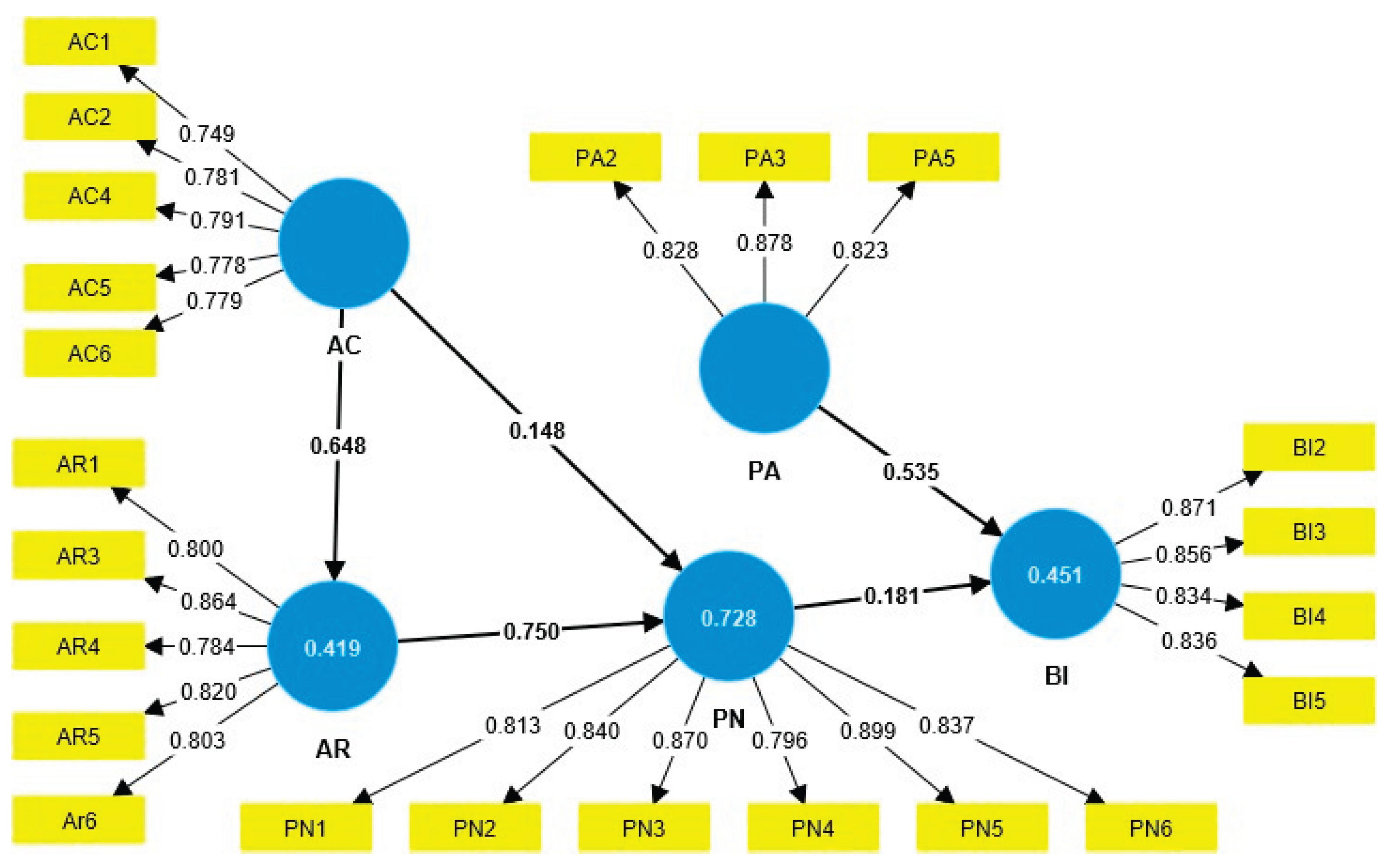
Now that the validity and reliability of the measurement model have been established, the next stage is to investigate the research model's predictive power and the relationships among the components. Path coefficients and the coefficient of determination (R2 value) were used to evaluate the structural model. To guarantee the validity of the results, the model's collinearity was first evaluated. The structural model's constructs were measured for every set of predictors, yielding the Variance Inflation Factor (VIF). The findings indicated that there is no problem with multi collinearity in the model because the variables had a good correlation (VIF < 5.00) (see Table 9). The PLS-SEM technique and a bootstrapping procedure using 5000 randomly generated sub-samples were used to demonstrate the relevance of calculated route coefficients because all requirements were met. Figure 4 shows the outcomes of the PLS estimation. The PLS algorithm approach was also utilized to obtain the R-square values of the endogenous latent construct. Second, the R-square values of all latent variables exceeds the minimal value of 0.10 specified by [102], which is a desirable level (see, Table 7). [103] f-square can be used to calculate the effect size for each effect in the path model. It tells you if an exogenous latent variable has a significant impact on an endogenous latent variable. For the three endogenous latent variables—ascribed responsibility, personal norms and behavioural intention—the values of R-square, a measure of predictive accuracy, are 0.419, 0.728 and, 0.451, respectively. The increase in R-square relative to the proportion of variance of the endogenous latent variable that remains unexplained yields the impact size f2. [103] defined minor, medium, and large effects as f-square values greater than 0.02, 0.15 and 0.35, respectively. Table 8 shows the f-square values for the AC, AR, PN, PA, and VALUE in our model are 0.047, 1.203, and 0.032, and 0.281 respectively, meaning poor and modest impacts.

Table 7.
R-square.
| R-square | R-square adjusted | ||||
| AR | 0.419 | 0.418 | |||
| BI | 0.451 | 0.449 | |||
| PN | 0.728 | 0.727 |
Source: authors.
Table 8.
f-square.
| AC | AR | BI | PA | PN | |
| AC | 0.722 | 0.047 | |||
| AR | 1.203 | ||||
| BI | |||||
| PA | 0.281 | ||||
| PN | 0.032 |
Source: authors.
Table 9.
Collinearity statistics (VIF).
| VIF | |
| AC | 1.7516 |
| AR | 2.1112 |
| BI | 2.44675 |
| PA | 1.7963 |
| PN | 2.71333 |
Source: authors.
Path Analysis
Following a good analysis of the measurement model, the structural model is analyzed in the PLS-SEM. This involves hypothesized construct-to-construct links and a statistical test. At a significance level of 0.05, the projected values of the path coefficients experimentally supported two direct pathways and rejected one. Third, as indicated in Table 10, the significant values of the path coefficients were determined using the bootstrapping technique (with 5000 bootstrap samples and 503 bootstrap instances). P-values and t-values were used to test hypotheses, as shown in Table 10. According to[100], in a one-tail test, the hypothesis is unsupported at the 0.05 percent level of significance if the t-values are less than 1.65 and the p-values are more than 0.05. PLS estimate outcomes are displayed in Table 10 and Figure 4. The findings indicate that awareness of consequences value predicts ascribed responsibility path (Coeff. =13.308, p-value 0.000). It was found that ascribed responsibility had a positive significant effect on personal norms (path Coeff. =17.487, p-value = 0.002). It was also found that there is a significant positive relationship between personal norms and behavioral intention (path Coeff. =3.025, p-value = 0.003). Place attachment had a substantial positive effect on behavioral intention (path Coeff. =10.485, p-value 0.000).
Items AC4 and AC2 are the most effective in measuring the construct of awareness of consequences. They had the highest loadings (0.791 and 0.781, respectively), in comparison to other items. Indicators AR3 through AR5 had the highest loadings (0.864 to 0.820) for the ascribed responsibility construct. For the PN1–PN6 items, the personal norms variable has adequate loading values ranging from 0.796 to 0.870. The place attachment construct is best measured by item PA3 which has the greatest loading (0.878). The behavioral intention construct has the highest loadings (0.871 and 0.856, respectively) for indicators BI2 and BI3. These useful items are measures of each latent construct in the measurement model shown in Figure 4.
Figure 4.
The Study’s Model and, the outcomes of the PLS estimation. Source: authors.
Discussion
The topic of environmentally responsible behavior in heritage sites has not received much research attention. By including place attachment construct into the original NAT, the current study aims to improve understanding of environmentally responsible behavior of local visitors. This study examined the correlations that exist between the intention to act in an ecologically responsible manner, personal norms, place attachment, responsibility ascription, and the intention to act in a way that is ecologically friendly.
The findings showed that the suggested model has a higher capacity for predicting the environmentally responsible actions of local visitors in heritage sites. The NAT's conceptual framework played a crucial role in illuminating the environmentally conscious actions of heritage site visitors. In particular, the results showed that awareness of consequences directly affects ascribed responsibility, and that both awareness of consequences and ascribed responsibility drive personal norms, which in turn affects visitors' behavioral intention. According to [104], among others, these findings are consistent with the first stream in the connection between the three basic variables in the NAT. To sum up, every hypothesis was validated, and every study goal was accomplished.
The research findings make multiple contributions to the literature on sustainable heritage tourism. Firstly, the study applied the NAT approach to the literature on heritage tourism, which broadened its scope in comparison to earlier studies (e.g., [35] by incorporating a significant variable (place attachment).
Overall, the application of environmental psychology's insights into the field of tourism management regarding the connections between place attachment, personal norms, awareness of consequences, and pro-environmental behavior strengthens the validity of the NAT framework in the context of heritage tourism. This is because the inclusion of place attachment has been shown to be crucial in activating locals' pro-environmental behavior. Second, the issue of sustainable heritage tourism for the unique context of Hail is relevant in practice despite the theory and model used in this research, since other destinations facing a similar issue may find the article's analysis useful from a managerial standpoint.
The results confirm that there is a significant relationship between awareness of the consequences and ascription of responsibility to mitigating possible damage to heritage sites. The strong correlation might be attributed to the community's sense of concern and responsibility for the long-term preservation and development of cultural heritage resources. This finding is consistent with previous empirical environmental research suggesting that attribution of responsibility is “activated” by awareness of consequences [35,44,105]. When tourists are more conscious of and worried about the effects, they are more inclined to behave responsibly [44]. To cultivate strong responsibility ascription and environmentally conscious behavior, it is crucial to raise awareness of the consequences of tourism [31].
Additionally, the original norm activation model with empirical evidence predictably indicates that the relationship between awareness of consequences and personal norm is entirely mediated by the ascription of responsibility [48]. However, other studies did not confirm a significant relationship between awareness of the consequences and ascription of responsibility. For example, in order to encourage appropriate travel behavior, [46] found that raising awareness alone would not be sufficient. Visitors found it difficult to grasp how to react to the effects of tourism and had a poor level of awareness of them. Therefore, as hypothesized in H1 and H3, personal norms are influenced by both awareness of consequences and ascription of responsibility. Ascription of responsibility is strongly related to personal norms. Ascribed responsibility has a stronger impact on personal norms than being aware of the consequences. This demonstrates how crucial the notion of Ascription of responsibility is in establishing the personal norms of visitors. This finding aligns with earlier environmentalism-related empirical research, which argues that personal norms will be "activated" by consequences awareness and awareness of consequences [51,53,54,106]. The NAT model states that when people are aware of the benefits of their actions and take responsibility for the consequences of acting in a non-pro-social way, they are more likely to activate norms [50]. Furthermore, the intention of tourists to support heritage places and their personal norms were shown to be significantly correlated. The significance of personal norms in forecasting pro-environmental conduct corroborates the findings of [60]. This finding demonstrate how engaging in environmentally friendly activity can be prompted by a stronger awareness of one's own personal norms. Further emphasizing this point, [62] state that people are more likely to plan to conduct an environmentally good activity when they sense profound obligation.
The findings also confirm that there is a significant relationship between place attachment and behavioral intention to mitigate possible damage to heritage sites. This finding is consistent with previous empirical environmental research [30,74]. Researchers came to the conclusion that "place attachment" may play a major role in forecasting visitors' behavioral intentions toward the area after discovering that travelers and their destination had to have an emotional tie [107]. Furthermore, [105] found that pro-environmental behaviors are more strongly influenced by place attachment than by awareness of consequences of disasters.
The results of this study contribute to the literature on environmentally sustainable tourism in several ways. First, the results of this study are of theoretical value because the process of forming individuals' pro-environmental behavioral intentions to reduce negative impacts on heritage sites is described for the first time in Saudi Arabia. Second, this study was motivated by the researchers' call to promote local visitors` support for cultural heritage tourism. Third, in order to test the interplay of relationships between residents' intentions to support cultural heritage tourism and their awareness of the consequences, ascription of responsibility, subjective norms, and place attachment in a single integrative model, we drew on literature on environmental psychology, environmental social psychology, and sustainable tourism. Fourth, by including the place attachment concept, this study expanded on the norm activation theory. It has been shown that place attachment construct increases the predictive value of NAT in predicting the behavioral intentions of visitors from the area. Put differently, the behavioral intentions of local visitors are more accurately predicted by PA when combined with NAT constructs. As a result, the current study provides a clearer explanation of people's intents to support cultural sites through eco-friendly behavior. These findings provide insights into how place attachment influences the ability of local visitors in heritage sites to behave sustainably and offer strategies for raising the expected feelings of tourists.
Several managerial implications emerge from the present research:
- Raise awareness of negative consequences of irresponsible behavior at heritage sites to foster responsibility and promote ecologically conscious conduct. Destination managers and local governments can run campaigns and increase sensitivity to environmental issues related to heritage tourism.
- Promote eco-friendly personal norms among tourists visiting historic sites. Encourage tourists to engage in environmentally friendly practices and educate them about the detrimental effects of careless actions on heritage resources.
- Incorporate environmental protection advice into scenic maps and tickets to visually and audibly educate local visitors about the conservation of heritage treasures.
- Educate local visitors about the significance of practicing ecologically responsible behavior and the negative effects of inappropriate behavior on the ecosystem. This will enhance their personal norms and sense of responsibility for conserving heritage sites.
- Utilize various environmentally friendly communication methods to alert local visitors of their responsibility for environmental issues resulting from their activities. Emphasize ascribed responsibility to activate the personal norms of the community's citizens.
- Implement initiatives that support the instillation of environmental protection duty in local visitors.
Destination managers and policy makers should improve and cultivate a sense of responsibility toward environmental issues, for instance, by communicating the consequences of individual behaviors that, although individually bearable, when thousands of people become intolerable (like littering in heritage sites).
This study showed that the level of visitors ' place attachment is high and that place attachment in the heritage of the Hail area is an important predictor of pro-environmental behavior. It's important to strength community visitors' place attachment via creating opportunities to participate in heritage sites planning and decision-making. Furthermore, government should try their best to develop tourism and balance the residents' dependence and identity of local economy, society, culture and environment in heritage sites at the same time, as any aspect of place attachment may affect environmental conservation behaviors positively.
The promotion of their cultural tourism and heritage industries depends on a number of tourist locations' heritage sources. The discourse surrounding cultural resource conservation and visitation has grown over time, with calls for the implementation of more sustainable solutions that are nevertheless essential for heritage locations. This is also a result of how heritage management has evolved, which demands combining a more visitor-focused strategy that takes into account visitors' choices and the quality of their individual experiences with a more conventional curatorial approach motivated by the necessity of conservation. By examining the shared impacts of awareness of environmental consequences, ascribed responsibility, personal norms, and place attachment on pro-environmental behavioral intention, this study adds to the body of knowledge already available on pro-environmental behavioral intention. The suggested model's empirical testing yielded the following results: That awareness of consequences directly affects ascription of responsibility; awareness of consequences and ascription of responsibility drive PN; The ascription of responsibility completely mediates the link between awareness of consequences and personal norm; Ascription of responsibility have a greater influence on personal norms than awareness of consequences ; There was a significant correlation found between tourists' intention to support heritage sites and their personal norms; and Place attachment directly affects behavioral intention to mitigate possible damage to heritage sites.
The study also revealed that the region of Ha’il is rich in heritage sites, which are frequented by many visitors. To ensure its sustainability, future visions must be developed on local community awareness about the importance of heritage and its role in sustainable tourism development, and to clarify ways to protect the heritage sites through workshops, lectures, and official media. As well as trying to create a partnership between decision-makers, stakeholders, and visitors to develop tourist behavior in these heritage sites and ensure their preservation for future generations.
Limitation
Despite its contribution to tourism heritage research, subsequent studies should carefully consider the following limitations: This study, reliant on self-reported data, may have led to respondents overestimating their behaviors. Additionally, due to the empirical nature of the study and constraints in sample size arising from demographic factors, caution should be exercised in generalizing the findings. The questionnaire's closed-ended format restricted respondents to predetermined options. While the model exhibited commendable predictive ability, it incompletely accounted for all behavioral variances.
Future Research
To develop a more thorough understanding, future research should investigate the integration of various socio-psychological theories, such as place attachment theory and value-belief-norm theory.
Future research could build on it by include more variables that take into consideration things like personality qualities and self-identity of the subjects. Subsequent studies may also explore the relationship between emotional solidarity and enhanced sustainable tourism. Future studies might also concentrate on the steps that destination managers and legislators might take to educate locals about their environmental impact on heritage sites.
Informed Consent Statement
Written Informed consent was obtained from all subjects involved in the study.
Conflicts of Interest
The authors declare no conflicts of interest.
Funding Details
We would like to express our profound gratitude to the Deanship of Scientific Research at Hail University for their assistance and their financial support of our research project ID: RG – 23 164.
Author Contributions
Conception and design, Ahmed, T., Nassr, A. and Ragab, A.; methodology, Kassem, A., Ahmed, T., Eric, N., and Nassr, A.; analysis and interpretation of the data, Nassr, A.. and Kassem, A.; validation, Ahmed, T. and Ragab, A.; data collection, Ahmed, A., Eric, N., Ragab, A, and Nassr, A.; writing—original draft preparation, Ahmed, A.; writing—review and editing, Ahmed, T. A., Nassr, A., Eric, N. All authors have read and agreed to the published version of the manuscript.
Data availability
The data that support the findings of this study are available from the corresponding author, [Tarek Sayed Adelazim Ahmed], upon reasonable request.
References
- Radzuan, I. S. M., Ahmad, Y., Zainal, R., Shamsudin, Z., Wee, S. T., & Mohamed, S. (2019). Conservation of a cultural heritage incentives programme in a Malay village: assessing its effectiveness. Journal of Heritage Management, 4(1), 7-21. [CrossRef]
- McKercher, B., Ho, P. S., & Du Cros, H. (2005). Relationship between tourism and cultural heritage management: evidence from Hong Kong. Tourism management, 26(4), 539-548. [CrossRef]
- Alazaizeh, M. M., Hallo, J. C., Backman, S. J., Norman, W. C., & Vogel, M. A. (2016). Value orientations and heritage tourism management at Petra Archaeological Park, Jordan. Tourism Management, 57, 149-158. [CrossRef]
- Chiu, Y. T. H., Lee, W. I., & Chen, T. H. (2014). Environmentally responsible behavior in ecotourism: Antecedents and implications. Tourism management, 40, 321-329. [CrossRef]
- Jaafar, M., Noor, S. M., & Rasoolimanesh, S. M. (2015). Perception of young local residents toward sustainable conservation programmes: A case study of the Lenggong World Cultural Heritage Site. Tourism management, 48, 154-163. [CrossRef]
- Wu, H. C., & Li, T. (2017). A study of experiential quality, perceived value, heritage image, experiential satisfaction, and behavioral intentions for heritage tourists. Journal of Hospitality & Tourism Research, 41(8), 904-944. [CrossRef]
- Zhang, H., Xiong, K., Fei, G., Jin, A., & Zhang, S. (2023). Factors Influencing the Conservation Intentions of Visitors to a World Heritage Site: A Case Study of Libo Karst. Sustainability, 15(6), 5370. [CrossRef]
- Zhong, X., & Chen, X. (2017). Demolition, rehabilitation, and conservation: Heritage in Shanghai’s urban regeneration, 1990–2015. Journal of Architecture and Urbanism, 41(2), 82-91. [CrossRef]
- Buta, N., Holland, S. M., and Kaplanidou, K. (2014). Local communities and protected areas: the mediating role of place attachment for pro-environmental civic engagement. J. Outdoor Recreat. Tour. 5–6, 1–10. [CrossRef]
- Ramkissoon, H. (2015). Authenticity, satisfaction, and place attachment: A conceptual framework for cultural tourism in African island economies. Development Southern Africa, 32(3), 292-302. [CrossRef]
- Fairclough, G. (2009). New heritage frontiers. Heritage and beyond. (pp. 29–44). Paris: Council of Europe Publishing. ISBN 978-92-871-6636-4.
- Copeland, T. (2006). European democratic citizenship, heritage education and identity. Strasbourg: Council of Europe. Strasbourg: Department of Culture and Cultural Heritage Directorate General IV: Education, Culture and Heritage, Youth and Sport Council of Europe.
- UNESCO. (1989). Draft -medium term plan (1990–1995). General conference, twenty fifth session, Paris.
- Swarbrooke, J. (1994). The future of the past: Heritage tourism in to the 21st century. In A. V. Seaton (Ed.), Tourism, the state of the art (pp. 222–229). Chichester: Wiley.
- Timothy, D. J., & Boyd, S. W. (2006). Heritage tourism in the 21st century: Valued traditions and new perspectives. Journal of heritage tourism, 1(1), 1-16. [CrossRef]
- Abdelazim Ahmed, T. S. (2017). Assessment of students’ awareness of the national heritage (Case study: The preparatory year students at the University of Hail, Saudi Arabia). Cogent Social Sciences, 3(1), 1306202. [CrossRef]
- Zhang, S., & Lo, Y. H. (2024). Tourists’ perceived destination image and heritage conservation intention: a comparative study of heritage and film-induced images. International Journal of Tourism Cities, 10(2), 469-490. [CrossRef]
- Kumar, A. (2017). Cultural and heritage tourism: A tool for sustainable development. Global Journal of Commerce & Management Perspective, 6(6), 56-59. [CrossRef]
- Poria, Y., Butler, R., & Airey, D. (2003). The core of heritage tourism. Annals of tourism research, 30(1), 238-254. [CrossRef]
- Loulanski, T., & Loulanski, V. (2011). The sustainable integration of cultural heritage and tourism: A meta-study. Journal of sustainable tourism, 19(7), 837-862. [CrossRef]
- Hall, C. M., & McArthur, S. (1993). Heritage management in New Zealand and Australia: visitor management, interpretation and marketing. edited by C. Michael Hall and Simon McArthur. Auckland, New Zealand ; New York : Oxford University Press.
- Weng, L., He, B. J., Liu, L., Li, C., & Zhang, X. (2019). Sustainability assessment of cultural heritage tourism: Case study of pingyao ancient city in China. Sustainability, 11(5), 1392. [CrossRef]
- Ajuhari, Z., Isa, S.S., Aziz, A. (2016). Promoting Pro-environmental Behavior in Ecotourism Destination. In: Abdullah, M., Yahya, W., Ramli, N., Mohamed, S., Ahmad, B. (eds) Regional Conference on Science, Technology and Social Sciences (RCSTSS 2014). Springer, Singapore. [CrossRef]
- Hedlund-de Witt, A. (2014). The Integrative Worldview and its Potential for Sustainable Societies: A Qualitative Exploration of the Views and Values of Environmental Leaders. Worldviews: Global Religions, Culture, and Ecology, 18(3), 191-229. [CrossRef]
- Buonincontri, P., Marasco, A., & Ramkissoon, H. (2017). Visitors’ experience, place attachment and sustainable behaviour at cultural heritage sites: A conceptual framework. Sustainability, 9(7), 1112. [CrossRef]
- Kollmuss, A., & Agyeman, J. (2002). Mind the gap: why do people act environmentally and what are the barriers to pro-environmental behavior?. Environmental education research, 8(3), 239-260. [CrossRef]
- Li, Q. C., & Wu, M. Y. (2019). Rationality or morality? A comparative study of pro-environmental intentions of local and nonlocal visitors in nature-based destinations. Journal of Destination Marketing & Management, 11, 130-139. [CrossRef]
- Rao, X., Qiu, H., Morrison, A. M., Wei, W., & Zhang, X. (2022). Predicting private and public pro-Environmental behaviors in rural tourism contexts using SEM and fsQCA: The role of destination image and relationship quality. Land, 11(3), 448. [CrossRef]
- Marie, M., & Zaki, H. (2018). Enhancing Pro Environmental Behavior at Heritage Sites: The Effect of Place Attachment. International Academic Journal Faculty of Tourism and Hotel Management, 4(4), 146-168.
- Ramkissoon, H., Weiler, B., & Smith, L. D. G. (2012). Place attachment and pro-environmental behaviour in national parks: The development of a conceptual framework. Journal of Sustainable tourism, 20(2), 257-276. [CrossRef]
- Confente, I., & Scarpi, D. (2021). Achieving environmentally responsible behavior for tourists and residents: A norm activation theory perspective. Journal of Travel Research, 60(6), 1196-1212. [CrossRef]
- Schwartz, S. H. (1973). Normative explanations of helping behavior: A critique, proposal, and empirical test. Journal of experimental social psychology, 9(4), 349-364. [CrossRef]
- Littlejohn, K., Needham, M. D., Szuster, B. W., & Jordan, E. J. (2016). Pre-trip expectations and post-trip satisfaction with marine tour interpretation in Hawaii: Applying the norm activation model. The Journal of Environmental Education, 47(3), 202-212. [CrossRef]
- Han, H., Hwang, J., Kim, J., & Jung, H. (2015). Guests’ pro-environmental decision-making process: Broadening the norm activation framework in a lodging context. International Journal of Hospitality Management, 47, 96-107. [CrossRef]
- Gao, J., Huang, Z., & Zhang, C. (2017). Tourists' perceptions of responsibility: An application of norm-activation theory. Journal of Sustainable Tourism, 25(2), 276-291. [CrossRef]
- Kiatkawsin, K., Sutherland, I., & Lee, S. K. (2020). Determinants of smart tourist environmentally responsible behavior using an extended norm-activation model. Sustainability, 12(12), 4934. [CrossRef]
- Zhu, P., Chi, X., Ryu, H. B., Ariza-Montes, A., & Han, H. (2022). Traveler pro-social behaviors at heritage tourism sites. Frontiers in Psychology, 13, 901530. [CrossRef]
- Meng, B., Chua, B. L., Ryu, H. B., & Han, H. (2020). Volunteer tourism (VT) traveler behavior: Merging norm activation model and theory of planned behavior. Journal of Sustainable Tourism, 28(12), 1947-1969. [CrossRef]
- Kim, J. J., & Hwang, J. (2020). Merging the norm activation model and the theory of planned behavior in the context of drone food delivery services: Does the level of product knowledge really matter?. Journal of Hospitality and Tourism Management, 42, 1-11. [CrossRef]
- Han, H. (2014). The norm activation model and theory-broadening: Individuals' decision-making on environmentally-responsible convention attendance. Journal of environmental psychology, 40, 462-471. [CrossRef]
- Wang, P., Liu, Q., & Qi, Y. (2014). Factors influencing sustainable consumption behaviors: a survey of the rural residents in China. Journal of cleaner production, 63, 152-165. [CrossRef]
- Juvan, E., & Dolnicar, S. (2014). The attitude–behaviour gap in sustainable tourism. Annals of tourism research, 48, 76-95. [CrossRef]
- Goodwin, H. (2011). Taking responsibility for tourism (pp. 1-256). Woodeaton: Goodfellow Publishers Limited.
- Han, J. H., Lee, M. J., & Hwang, Y. S. (2016). Tourists’ environmentally responsible behavior in response to climate change and tourist experiences in nature-based tourism. Sustainability, 8(7), 644. [CrossRef]
- Szromek, A. R., Hysa, B., & Karasek, A. (2019). The perception of overtourism from the perspective of different generations. Sustainability, 11(24), 7151. [CrossRef]
- Miller, G., Rathouse, K., Scarles, C., Holmes, K., & Tribe, J. (2010). Public understanding of sustainable tourism. Annals of tourism research, 37(3), 627-645. [CrossRef]
- Tölkes, C. (2020). The role of sustainability communication in the attitude–behaviour gap of sustainable tourism. Tourism and Hospitality Research, 20(1), 117-128. [CrossRef]
- Schwartz, S. H., & Howard, J. A. (1981). A Normative Decision-Making Model of Altruism. Altruism and Helping Behaviour: Personality and Developmental Perspectives. JP Rushton and R. M. Sorrentino. Hillsdale et al. Hillsdale et al, 189-211.
- Fredvig-Erichsen, C. (2020). Norm-Activation Theory and Tourists’ Perception of Responsibility (Master's thesis, University of Stavanger, Norway).
- De Groot, J. I., & Steg, L. (2009). Morality and prosocial behavior: The role of awareness, responsibility, and norms in the norm activation model. The Journal of social psychology, 149(4), 425-449. [CrossRef]
- Wu, J., Wu, H. C., Hsieh, C. M., & Ramkissoon, H. (2022). Face consciousness, personal norms, and environmentally responsible behavior of Chinese tourists: Evidence from a lake tourism site. Journal of Hospitality and Tourism Management, 50, 148-158. [CrossRef]
- Steg, L., & Nordlund, A. (2018). Theories to explain environmental behaviour. In L. Steg, & J. I. M. de Groot (Eds.), Environmental psychology: An introduction 217-227. (2dn ed.). John Wiley & Sons Ltd. [CrossRef]
- Rezvani, Z., Jansson, J., & Bengtsson, M. (2017). Cause I'll feel good! An investigation into the effects of anticipated emotions and personal moral norms on consumer pro-environmental behavior. Journal of Promotion Management, 23(1), 163-183. [CrossRef]
- Zhao, X., Wang, X., & Ji, L. (2020). Evaluating the effect of anticipated emotion on forming environmentally responsible behavior in heritage tourism: Developing an extended model of norm activation theory. Asia Pacific Journal of Tourism Research, 25(11), 1185-1198. [CrossRef]
- Bamberg, S., & Möser, G. (2007). Twenty years after Hines, Hungerford, and Tomera: A new meta-analysis of psycho-social determinants of pro-environmental behaviour. Journal of environmental psychology, 27(1), 14-25. [CrossRef]
- Shi, H., Fan, J., & Zhao, D. (2017). Predicting household PM2. 5-reduction behavior in Chinese urban areas: An integrative model of Theory of Planned Behavior and Norm Activation Theory. Journal of Cleaner Production, 145, 64-73. [CrossRef]
- Schultz, P. W., Gouveia, V. V., Cameron, L. D., Tankha, G., Schmuck, P., & Franěk, M. (2005). Values and their relationship to environmental concern and conservation behavior. Journal of cross-cultural psychology, 36(4), 457-475. [CrossRef]
- Denley, T. J., Woosnam, K. M., Ribeiro, M. A., Boley, B. B., Hehir, C., & Abrams, J. (2020). Individuals’ intentions to engage in last chance tourism: Applying the value-belief-norm model. Journal of Sustainable Tourism, 28(11), 1860-1881. [CrossRef]
- Chi, X., Han, H., & Kim, S. (2022). Protecting yourself and others: Festival tourists’ pro-social intentions for wearing a mask, maintaining social distancing, and practicing sanitary/hygiene actions. Journal of Sustainable Tourism, 30(8), 1915-1936. [CrossRef]
- Han, H. (2020). Theory of green purchase behavior (TGPB): A new theory for sustainable consumption of green hotel and green restaurant products. Business Strategy and the Environment, 29(6), 2815-2828. [CrossRef]
- Ghazali, E. M., Nguyen, B., Mutum, D. S., & Yap, S. F. (2019). Pro-environmental behaviours and Value-Belief-Norm theory: Assessing unobserved heterogeneity of two ethnic groups. Sustainability, 11(12), 3237. [CrossRef]
- Ünal, A. B., Steg, L., & Gorsira, M. (2018). Values versus environmental knowledge as triggers of a process of activation of personal norms for eco-driving. Environment and behavior, 50(10), 1092-1118. [CrossRef]
- Bowlby, J. (1980). Attachment and loss: Loss (vol. 3). Loss, Sadness and Depression. New York: Basic Books.
- Latiff, K., Imm, S., Abdul, Y., & Kamal, N. (2020). Antecedent and outcome of place attachment in heritage sites. Journal of Applied Structural Equation Modeling, 4(1), 81-90.
- Williams, D. R., & Vaske, J. J. (2003). The measurement of place attachment: Validity and generalizability of a psychometric approach. Forest science, 49(6), 830-840. [CrossRef]
- Kyle, G., Graefe, A., & Manning, R. (2005). Testing the dimensionality of place attachment in recreational settings. Environment and behavior, 37(2), 153-177. [CrossRef]
- Isa, S. M., Ariyanto, H. H., & Kiumarsi, S. (2019). The effect of place attachment on visitors’ revisit intentions: evidence from Batam. Tourism Geographies. [CrossRef]
- Ramkissoon, H., Smith, L. D. G., & Weiler, B. (2013). Testing the dimensionality of place attachment and its relationships with place satisfaction and pro-environmental behaviours: A structural equation modelling approach. Tourism management, 36, 552-566. [CrossRef]
- Han, J. H., Kim, J. S., Lee, C. K., & Kim, N. (2019). Role of place attachment dimensions in tourists’ decision-making process in Cittáslow. Journal of destination marketing & management, 11, 108-119. [CrossRef]
- Moore, R. L., & Graefe, A. R. (1994). Attachments to recreation settings: The case of rail-trail users. Leisure Sciences, 16(1), 17–31. [CrossRef]
- Cheng, T. M., C. Wu, H., & Huang, L. M. (2013). The influence of place attachment on the relationship between destination attractiveness and environmentally responsible behavior for island tourism in Penghu, Taiwan. Journal of Sustainable tourism, 21(8), 1166-1187. [CrossRef]
- Kaltenborn, B. P. (1998). Effects of sense of place on responses to environmental impacts: A study among residents in Svalbard in the Norwegian high Arctic. Applied Geography, 18(2), 169-189. [CrossRef]
- Vaske, J. J., & Kobrin, K. C. (2001). Place attachment and environmentally responsible behavior. The Journal of environmental education, 32(4), 16-21. [CrossRef]
- Stedman, R. C. (2002). Toward a social psychology of place: Predicting behavior from place-based cognitions, attitude, and identity. Environment and behavior, 34(5), 561-581. [CrossRef]
- Halpenny, E. A. (2010). Pro-environmental behaviours and park visitors: The effect of place attachment. Journal of environmental psychology, 30(4), 409-421. [CrossRef]
- Su, Q., & Qian, S. (2012). Influence relationship and mechanism of tourists’ sense of place in world heritage sites: A case study of the classical gardens of Suzhou. Acta Geogr. Sin, 67, 1137-1148.
- Nian, S., Zhang, H., Mao, L., Zhao, W., Zhang, H., Lu, Y., ... & Xu, Y. (2019). How outstanding universal value, service quality and place attachment influences tourist intention towards world heritage conservation: A case study of Mount Sanqingshan National Park, China. Sustainability, 11(12), 3321. [CrossRef]
- Ali, S., & Alshammari, A. S. (2021). Genesis of gabbroic intrusions in the Arabian Shield, Saudi Arabia: Mineralogical, geochemical and tectonic fingerprints of the Neoproterozoic arc magmatism. Geological Magazine, 158(9), 1639–1656. [CrossRef]
- Jennings, R. P., Singarayer, J., Stone, E. J., Krebs-Kanzow, U., Khon, V., Nisancioglu, K. H., Pfeiffer, M., Zhang, X., Parker, A., Parton, A., Groucutt, H. S., White, T. S., Drake, N. A., & Petraglia, M. D. (2015). The greening of Arabia: Multiple opportunities for human occupation of the Arabian Peninsula during the Late Pleistocene inferred from an ensemble of climate model simulations. Quaternary International, 382, 181–199. [CrossRef]
- Nassr, A. H., al-Hajj, M., Tueaiman, A., & Elhassan, A. (2022). Reconnaissance a new Palaeolithic site at Al-Huwaidy in Ha’il region, northwest Saudi Arabia. Journal of Lithic Studies, 9(1), 14-p. [CrossRef]
- Nassr, A., Elhassan, A., Tueaiman, A., & al-Hajj, M. (2023a). Monumental Stone Structure Archaeology in Northwest Saudi Arabia: New Investigations from the Al Ha’it Oasis. Journal of Eastern Mediterranean Archaeology and Heritage Studies, 11(1), 45-81. [CrossRef]
- Lucarini, G., Guagnin, M., Shipton, C., Radini, A., Alsharekh, A. M., & Petraglia, M. (2023). Plant, pigment, and bone processing in the Neolithic of northern Arabia–New evidence from Use-wear analysis of grinding tools at Jebel Oraf. PLOS ONE, 18(10), e0291085. [CrossRef]
- Nassr, A., Elhassan, A., al-Hajjj, M., & Tueaiman, A. (2023b). Dating of Stratified Settlement Remains in Faid Pilgrim Station, Northwest of Saudi Arabia. Journal of Islamic Archaeology, 10(1). [CrossRef]
- Ibrahim, A. O., Baqawy, G. A., & Mohamed, M. A. S. (2021). Tourism attraction sites: Boasting the booming tourism of Saudi Arabia. International Journal of Advanced and Applied Sciences, 8(4), 1–11. [CrossRef]
- Al-Baqawy, G. A. S. (2018). Architectural Heritage in Saudi Arabia Between Laws, Organizational Structures and Implementation. The University of Liverpool (United Kingdom).
- Repper, R., Kennedy, M., McMahon, J., Boyer, D., Dalton, M., Thomas, H., & Kennedy, D. (2022). Kites of AlUla County and the Ḥarrat ʿUwayriḍ, Saudi Arabia. Arabian Archaeology and Epigraphy, 33(1), 3–22. [CrossRef]
- Noaime, E., Alnaim, M. M., Bay, M. A., Albaqawy, G. A., Abdelhafez, M. H. H., & Elkhayat, K. (2022). The Rehabilitation of the Historic Barzan Traditional Market and Its Impact on Cultural Tourism in Hail City. Land, 11(11), 2058. [CrossRef]
- General Authority for Statistics (2020). Tourism establishment statistics for 2020. Kingdom of Saudi Arabia.
- Perrewé, P. L., Hochwarter, W. A., Rossi, A. M., Wallace, A., Maignan, I., Castro, S. L., ... & Van Deusen, C. A. (2002). Are work stress relationships universal? A nine-region examination of role stressors, general self-efficacy, and burnout. Journal of International management, 8(2), 163-187. [CrossRef]
- Podsakoff, P. M., MacKenzie, S. B., Lee, J. Y., & Podsakoff, N. P. (2003). Common method biases in behavioral research: a critical review of the literature and recommended remedies. Journal of Applied Psychology, 88(5), 879–903. [CrossRef]
- Alvi, M. (2016). A manual for selecting sampling techniques in research. PRA Paper, ID 70218.
- Mora, R. J., & Kloet, B. (2010). Digital forensic sampling. Sans Institute Publication, 1-9.
- Noor, S., Tajik, O., & Golzar, J. (2022). Simple random sampling. International Journal of Education & Language Studies, 1(2), 78-82. [CrossRef]
- Kaplanidou, K., Jordan, J. S., Funk, D., & Ridinger, L. L. (2012). Recurring sport events and destination image perceptions: Impact on active sport tourist behavioral intentions and place attachment. Journal of Sport Management, 26(3), 237-248. [CrossRef]
- Avkiran, N. K. (2018). Rise of the partial least squares structural equation modeling: An application in banking. Partial least squares structural equation modeling: Recent advances in banking and finance, 1-29. [CrossRef]
- Hair Jr, J. F., Hult, G. T. M., Ringle, C. M., Sarstedt, M., Danks, N. P., Ray, S., ... & Ray, S. (2021). An introduction to structural equation modeling. Partial least squares structural equation modeling (PLS-SEM) using R: a workbook, 1-29. [CrossRef]
- Nitzl, C., & Chin, W. W. (2017). The case of partial least squares (PLS) path modeling in managerial accounting research. Journal of Management Control, 28, 137-156. [CrossRef]
- Sarstedt, M., Hair, J. F., Ringle, C. M., Thiele, K. O., & Gudergan, S. P. (2016). Estimation issues with PLS and CBSEM: Where the bias lies!. Journal of business research, 69(10), 3998-4010. [CrossRef]
- Henseler, J., Dijkstra, T. K., Sarstedt, M., Ringle, C. M., Diamantopoulos, A., Straub, D. W., Ketchen, D. J., Jr., Hair, J. F., Hult, G. T. M., & Calantone, R. J. (2014). Common beliefs and reality about PLS: Comments on Rönkkö and Evermann (2013). Organizational Research Methods, 17(2), 182–209. [CrossRef]
- Hair, J. F., Risher, J. J., Sarstedt, M., & Ringle, C. M. (2019). When to use and how to report the results of PLS-SEM. European business review, 31(1), 2-24. [CrossRef]
- Henseler, J., Hubona, G., & Ray, P. A. (2016). Using PLS path modeling in new technology research: updated guidelines. Industrial management & data systems, 116(1), 2-20. [CrossRef]
- Falk, R. F., & Miller, N. B. (1992). A primer for soft modeling. University of Akron Press.
- Cohen, J. (1988). Statistical power analysis for the behavioral sciences 2nd ed.(Hillsdale, NJ: L. Erlbaum Associates), Publishers.
- Schwartz, S. H. (1977). Normative influences on altruism. In Advances in experimental social psychology (Vol. 10, pp. 221-279). Academic Press. [CrossRef]
- Zhang, Y., Zhang, H. L., Zhang, J., & Cheng, S. (2014). Predicting residents' pro-environmental behaviors at tourist sites: The role of awareness of disaster's consequences, values, and place attachment. Journal of Environmental Psychology, 40, 131-146. [CrossRef]
- Ritchie, B. W., Prideaux, B., Thompson, M., & Demeter, C. (2022). Understanding tourists’ attitudes toward interventions for the Great Barrier Reef: an extension of the norm activation model. Journal of Sustainable Tourism, 30(6), 1364-1383. [CrossRef]
- Pandey, A., & Sahu, R. (2020). Modeling the relationship between service quality, destination attachment and eWOM intention in heritage tourism. International Journal of Tourism Cities, 6(4), 769-784. [CrossRef]
Figure 1.
Location of Ha’il and the major heritage sites in the region. Source: Esri, Maxar, Earthstar Geographics, and the GIS User Community.
Figure 1.
Location of Ha’il and the major heritage sites in the region. Source: Esri, Maxar, Earthstar Geographics, and the GIS User Community.
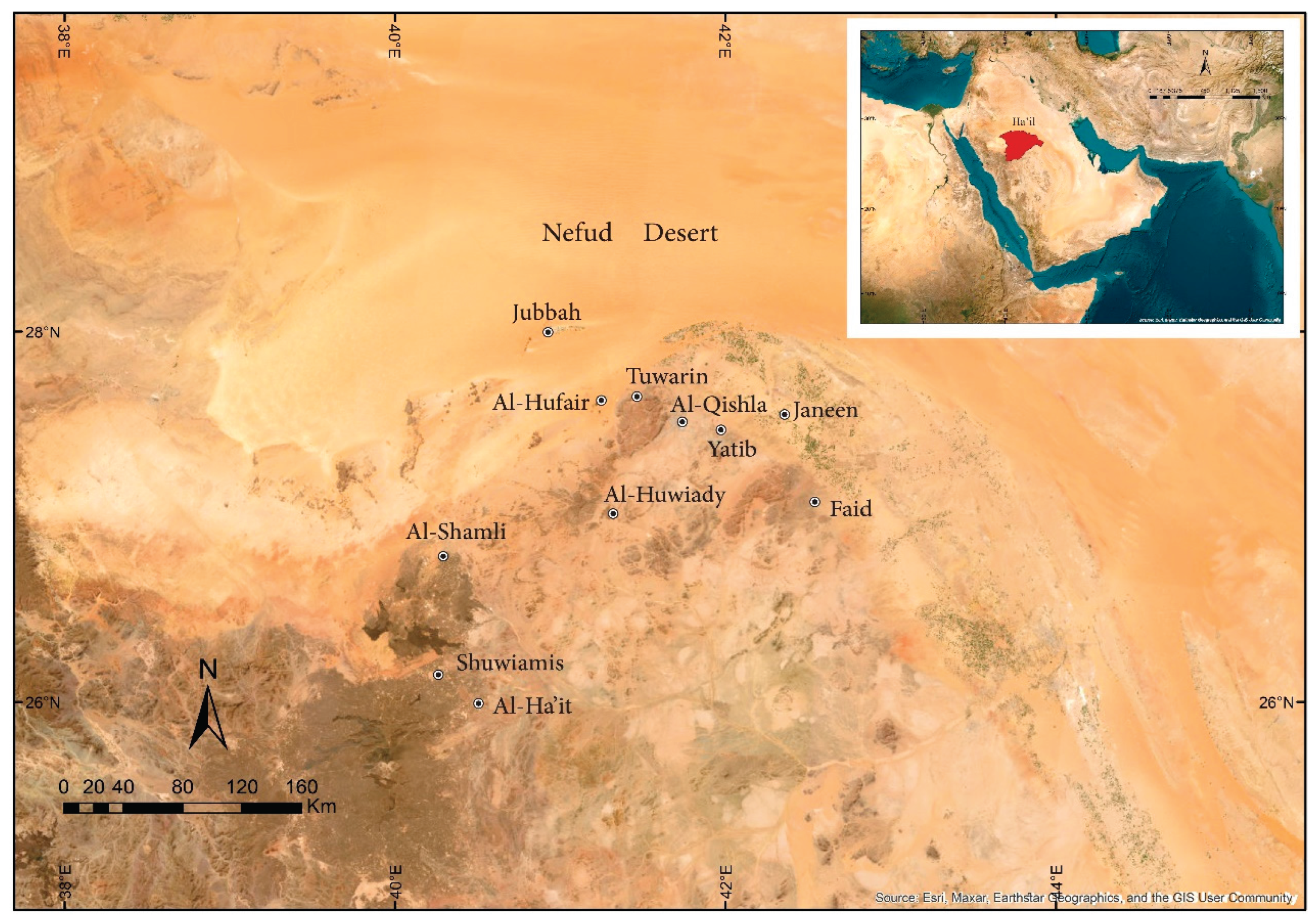
Figure 2.
Examples of heritage sites in the region of Ha’il: A) Rock arts from Shuwaymis site B) Stone structures view from al-Ha’it. Source: A: (Bednarik, 2017); B: (Nassr et al., 2023a).
Figure 2.
Examples of heritage sites in the region of Ha’il: A) Rock arts from Shuwaymis site B) Stone structures view from al-Ha’it. Source: A: (Bednarik, 2017); B: (Nassr et al., 2023a).
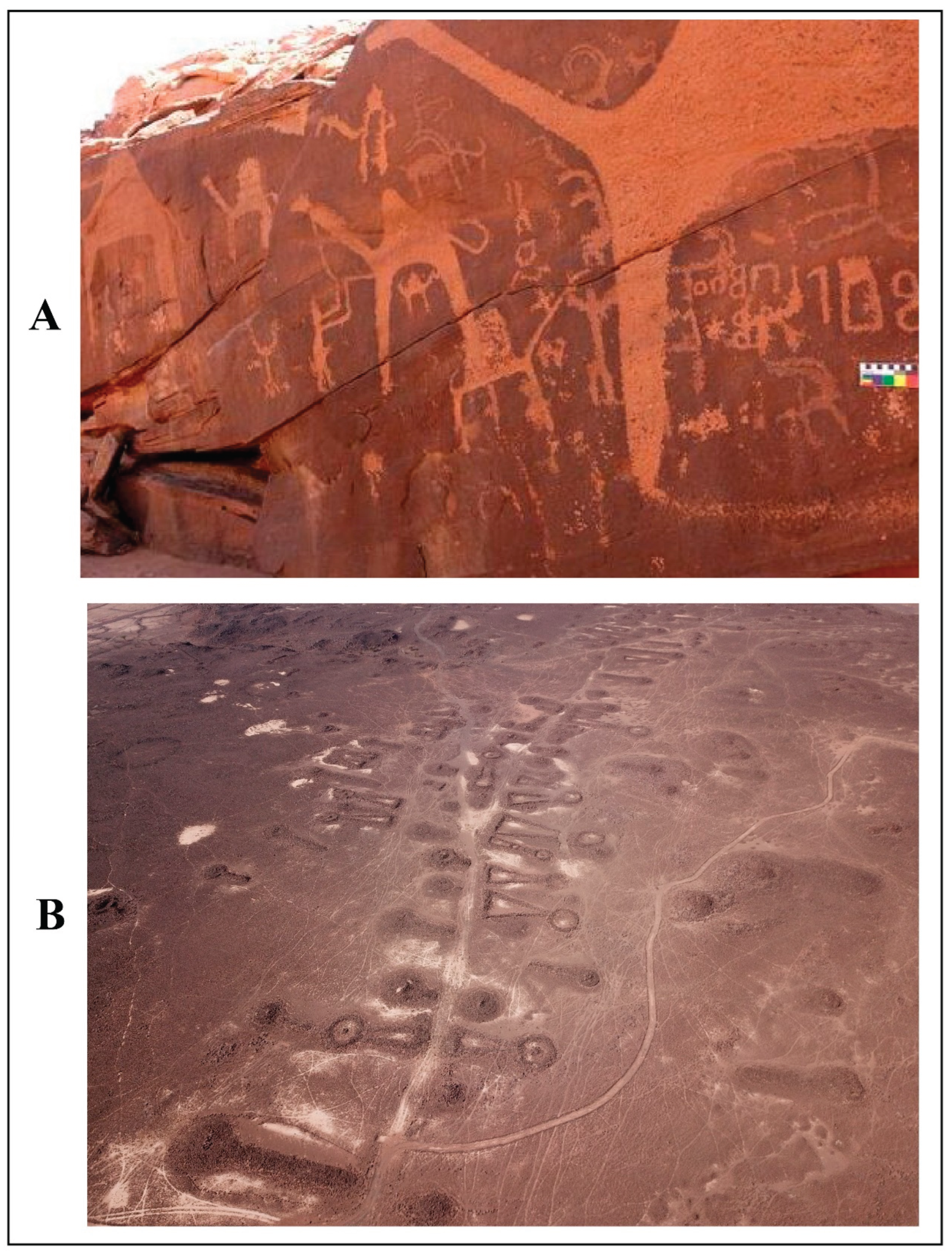
Figure 3.
Islamic and traditional heritage sites in Ha’il, A) Faid Islamic town monumental, B) Al-Qashla traditional building in Ha’il. Source: A: (Nassr et al., 2023b), B: (Google earth, 2024).
Figure 3.
Islamic and traditional heritage sites in Ha’il, A) Faid Islamic town monumental, B) Al-Qashla traditional building in Ha’il. Source: A: (Nassr et al., 2023b), B: (Google earth, 2024).
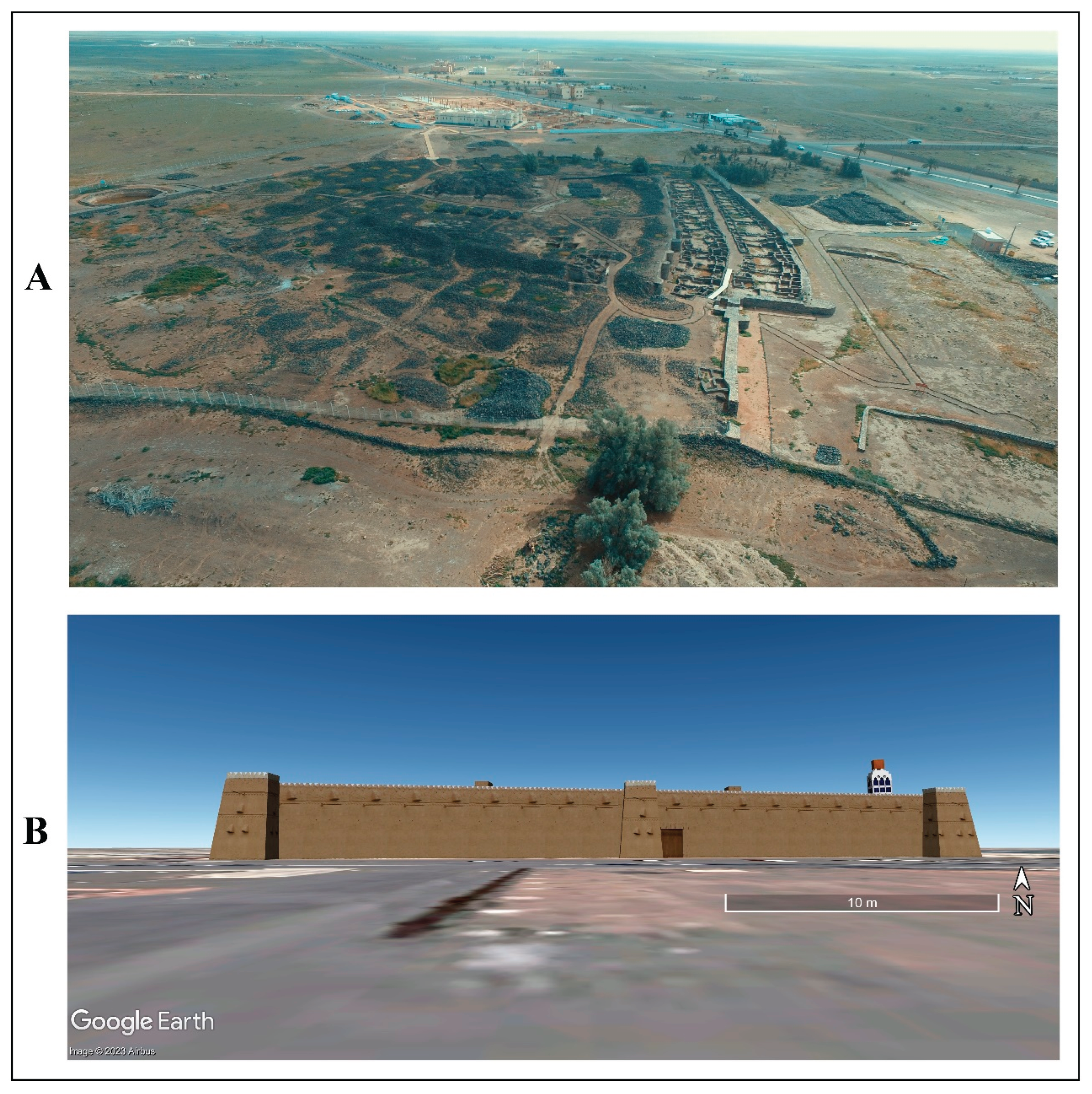
Table 1.
Adapted items.
| Constructs | Items | |
| Place attachment | This heritage site is a special place for me. | PA1 |
| The experience of visiting this heritage site is unique. | PA2 | |
| The experience of visiting this heritage site is very beneficial to me. | PA3 | |
| I feel more satisfied with the services provided in the heritage areas in Hail compared to other heritage sites. | PA4 | |
| I like this heritage site more than other sites. | PA5 | |
| Awareness of consequences | Dropping litter poses a serious threat to archaeological sites in KSA. | AC1 |
| Irresponsible behavior of visitors compromises the preservation of the heritage sites of this place. | AC2 | |
| The historic sites of this place is overcrowded because of Irresponsible behavior of tourists. | AC3 | |
| Irresponsible behavior of visitors compromises the preservation of this place’s beauty. | AC4 | |
| Irresponsible visitors' behavior causes pollution and degradation of heritage sites. | AC5 | |
| Not abiding by law of the protection of heritage sites in the Kingdom of Saudi Arabia by visitors contributes to the deterioration of its environment. | AC6 | |
| Ascribed responsibility | Preserving the environment of heritage areas is a social responsibility. | AR1 |
| I feel that every local visitors is jointly responsible for the heritage sites deterioration caused by irresponsible behavior. | AR2 | |
| I feel a sense of obligation to help protect culture and heritage in my town. | AR3 | |
| It is part of my responsibility to minimize the impacts of tourism on heritage resources. | AR4 | |
| Local visitors should be held responsible for taking actions that lessen the detrimental effects of tourism on heritage sites. | AR5 | |
| I advise and recommend to my accompanying family and friends to preserve the environment of heritage sites during the visit. | AR6 | |
| Personal norms | I feel morally obliged to practice pro-social behaviors at a heritage site by closely following the visit guidelines. | PN1 |
| I would feel guilty if I were responsible for the degradation of historic sites when dropping litters. | PN2 | |
| I feel that I should protect the heritage sites even if it is a small act of my own (through reduction wastes). | PN3 | |
| I have an obligation to dissuade anyone from damaging the historic sites and the environment. | PN4 | |
| Saving heritage sites and environment and are moral imperative for me. | PN5 | |
| Because of my principles, I feel obligated to perform environmentally responsible behavior when visiting historic sites. | PN6 | |
| Pro-environmental behavioral intention | I will abide by the guidelines in historical sites. | BI1 |
| I will volunteer my time to projects that protect environment in historical sites. | BI2 | |
| I will donate to ensure protection of heritage sites. | BI3 | |
| I will provide information to visitors to enhance their experience in historical sites in my country. | BI4 | |
| I will offer my assistance to promotional events/activities pertaining to heritage sites. | BI5 | |
| It is acceptable to pay more for a visit to a historic place for reducing pollution. | BI6 |
Table 2.
Demographic variables.
| Items | Frequency | Percent (%) |
| Gender | ||
| Male | 275 | 54.7 |
| Female | 228 | 45.3 |
| Total | 503 | 100.0 |
| Age | ||
| 15- 20 | 81 | 16.1 |
| 21 – 30 | 256 | 50.9 |
| 31 - 40 | 35 | 7.0 |
| 41 - 50 | 69 | 13.7 |
| 51 - 60 | 49 | 9.7 |
| + 60 | 13 | 2.6 |
| Total | 503 | 100.0 |
| Social status | ||
| Single | 325 | 64.6 |
| Married | 166 | 33.0 |
| Widow/ Widower | 8 | 1.6 |
| Divorced | 4 | .8 |
| Total | 503 | 100.0 |
| Education | ||
| Primary School | 10 | 2.0 |
| Prep. School | 9 | 1.8 |
| High School | 173 | 34.4 |
| University | 251 | 49.9 |
| Post graduate | 41 | 8.2 |
| Other | 19 | 3.8 |
| Total | 503 | 100.0 |
| Job | ||
| Employed | 108 | 21.5 |
| Unemployed | 50 | 9.9 |
| Student | 281 | 55.9 |
| Retired | 15 | 3.0 |
| Business man | 34 | 6.8 |
| Other (please specify) | 15 | 3.0 |
| Total | 503 | 100.0 |
| No. of visits | ||
| 0 times | 369 | 73.4 |
| 1-3 times | 52 | 10.3 |
| 4-6 times | 80 | 15.9 |
| more than 6 times | 2 | .4 |
| Total | 503 | 100.0 |
Source: authors.
Table 3.
Means and standard deviation.
| Mean | Std. Deviation | |
| AC | 4.29556 | 0.935 |
| AR | 4.4354 | 0.8222 |
| PN | 4.5675 | 0.72768 |
| PA | 4.19008 | 0.946568 |
| BI | 4.22765 | 0.94395 |
| Valid N (listwise) |
Source: authors.
Table 4.
Results of measurement model test for reliability and validity.
| Construct | Item | Factor loading | Cronbach's alpha | Composite reliability (rho_a) | Composite reliability (rho_c) | Average variance extracted (AVE) |
| Place attachment | PA2 | 0.828 | 0.798 | 0.802 | 0.881 | 0.711 |
| PA3 | 0.878 | |||||
| PA5 | 0.823 | |||||
| Awareness of consequences | AC1 | 0.749 | 0.835 | 0.836 | 0.883 | 0.601 |
| AC2 | 0.781 | |||||
| AC4 | 0.791 | |||||
| AC5 | 0.778 | |||||
| AC6 | 0.779 | |||||
| Ascribed responsibility | AR1 | 0.800 | 0.873 | 0.875 | 0.908 | 0.664 |
| AR3 | 0.864 | |||||
| AR4 | 0.784 | |||||
| AR5 | 0.820 | |||||
| AR6 | 0.803 | |||||
| Personal norms | PN1 | 0.813 | 0.918 | 0.919 | 0.936 | 0.711 |
| PN2 | 0.840 | |||||
| PN3 | 0.870 | |||||
| PN4 | 0.796 | |||||
| PN5 | 0.899 | |||||
| PN6 | 0.837 | |||||
| Behavioral intention | BI2 | 0.871 | 0.872 | 0.874 | 0.912 | 0.722 |
| BI3 | 0.856 | |||||
| BI4 | 0.834 | |||||
| BI5 | 0.836 | |||||
| BI6 | 0.871 |
Source: authors.
Table 5.
Heterotrait-monotrait ratio (HTMT) -Matrix.
| AC | AR | BI | PA | PN | |
| AC | |||||
| AR | 0.752 | ||||
| BI | 0.504 | 0.674 | |||
| PA | 0.675 | 0.771 | 0.782 | ||
| PN | 0.718 | 0.784 | 0.603 | 0.797 |
Source: authors.
Table 6.
Fornell-Larcker criterion.
| AC | AR | BI | PA | PN | |
| AC | 0.776 | ||||
| AR | 0.648 | 0.815 | |||
| BI | 0.432 | 0.591 | 0.850 | ||
| PA | 0.548 | 0.642 | 0.658 | 0.843 | |
| PN | 0.633 | 0.846 | 0.545 | 0.679 | 0.843 |
Source: authors.
Table 10.
Hypotheses testing.
| Original sample (O) | Sample mean (M) | Standard deviation (STDEV) | T statistics (|O/STDEV|) | P values | |
| AC -> AR | 0.648 | 0.648 | 0.049 | 13.308 | 0.000 |
| AC -> PN | 0.148 | 0.151 | 0.047 | 3.133 | 0.002 |
| AR -> PN | 0.750 | 0.748 | 0.043 | 17.487 | 0.000 |
| PA -> BI | 0.535 | 0.538 | 0.051 | 10.485 | 0.000 |
| PN -> BI | 0.181 | 0.181 | 0.060 | 3.025 | 0.003 |
Source: authors.
Disclaimer/Publisher’s Note: The statements, opinions and data contained in all publications are solely those of the individual author(s) and contributor(s) and not of MDPI and/or the editor(s). MDPI and/or the editor(s) disclaim responsibility for any injury to people or property resulting from any ideas, methods, instructions or products referred to in the content. |
© 2025 by the authors. Licensee MDPI, Basel, Switzerland. This article is an open access article distributed under the terms and conditions of the Creative Commons Attribution (CC BY) license (http://creativecommons.org/licenses/by/4.0/).
Copyright: This open access article is published under a Creative Commons CC BY 4.0 license, which permit the free download, distribution, and reuse, provided that the author and preprint are cited in any reuse.