Preprint
Case Report

This version is not peer-reviewed.

Physiotherapy Rehabilitation in a Pediatric Outpatient with Diffuse Axonal Injury Using the WHO PIR Guideline: A Case Report

Submitted:

06 October 2025

Posted:

11 October 2025

You are already at the latest version

Abstract

Background: Diffuse axonal injury (DAI) in children remains one of the most challenging outcomes of traumatic brain injury, characterized by widespread axonal disruption leading to complex motor, cognitive, and behavioral impairments. The pediatric brain, though endowed with remarkable plasticity, is particularly vulnerable to shearing injuries that compromise developmental milestones and participation. Rehabilitation, therefore, becomes the bridge between survival and meaningful recovery. This case report illustrates the structured application of the World Health Organization’s Package of Interventions for Rehabilitation (PIR) in the physiotherapy management of a pediatric outpatient with DAI, demonstrating the clinical and functional impact of a globally guided, play-based approach. Case Presentation: A 12-year-old boy presented to the outpatient physiotherapy unit with mild right-sided hemiparesis and gait asymmetry following a fall from a one-story building, diagnosed as diffuse axonal injury (Adams Grade III). The patient exhibited impaired coordination, poor gait toe-off, and limited endurance but intact cognitive and communication abilities. Rehabilitation goals were framed within the WHO PIR and ICF-CY domains, emphasizing motor recovery, activity participation, and environmental support. Intervention and Outcomes: Rehabilitation spanned seven months, combining weekly in-clinic physiotherapy with structured home programs guided by the caregiver. Therapy progressed from postural control and selective motor facilitation to interactive play-based activities such as obstacle courses, hopscotch, and task-oriented games designed to retrain balance, coordination, and gait mechanics. Play served not just as motivation but as a therapeutic medium linking movement, cognition, and social engagement. By week 28, the child regained independent ambulation, improved fine motor precision, and full reintegration into school and peer play. These gains reflected the adaptability and effectiveness of the WHO PIR framework in optimizing pediatric neuro-recovery within a resource-limited outpatient setting. Conclusions: This case reaffirms that physiotherapy, when guided by structured frameworks like the WHO PIR, transcends symptom relief to restore participation, confidence, and quality of life. The integration of play within a goal-oriented rehabilitation plan highlights the power of child-centered therapy to transform neuro-recovery into a holistic journey restoring not only function but the essence of childhood itself.

Keywords: 
;  ;  ;  ;  ;  ;  

1. Introduction

Among pediatric traumatic brain injuries, few conditions are as elusive yet devastating as diffuse axonal injury (DAI). Unlike focal lesions that present with clear radiological signatures, DAI often unfolds silently, driven by widespread shearing forces that disrupt axonal integrity and impair functional connectivity across the brain [1]. This invisible pathology has earned DAI the reputation of being a “hidden disruptor,” capable of producing profound cognitive, motor, and behavioral deficits despite minimal structural changes on conventional imaging. In children, the impact of DAI is even more alarming. The immature brain, while plastic and adaptive, is also highly vulnerable to shearing stresses during high-velocity trauma such as road traffic accidents and falls. Consequently, pediatric patients frequently present with fluctuating levels of consciousness, motor incoordination, and cognitive decline that extend far beyond the acute recovery phase [2,3]. Long-term sequelae often include impaired balance, reduced functional independence, and social reintegration challenges that compromise both quality of life and family well-being [4]. While acute management focuses on stabilization, mounting evidence underscores the critical role of rehabilitation in shaping long-term outcomes. Reports increasingly highlight that early, structured physiotherapy can bridge the gap between survival and functional independence, providing targeted interventions that promote neuroplasticity, restore motor performance, and improve quality of life [5,6]. Yet, despite its significance, physiotherapy in pediatric DAI remains under-documented, particularly within outpatient care settings where continuity and intensity of rehabilitation are often fragmented. This case report contributes to the growing body of knowledge by detailing the physiotherapy rehabilitation of a pediatric outpatient with DAI.

Importance of Rehabilitation in Recovery.

Survival after diffuse axonal injury is not synonymous with recovery. For many pediatric patients, the greatest burden lies not in the initial trauma but in the lingering motor, cognitive, and psychosocial deficits that compromise independence and reintegration into school and community life [7]. Traditional medical management, while essential in the acute phase, offers little in reversing the cascade of functional impairments that follow axonal disconnection. It is here that rehabilitation emerges as the defining element in the trajectory of recovery. Rehabilitation provides more than symptom management; it capitalizes on the principles of neuroplasticity, engaging surviving neural networks to reorganize and compensate for disrupted pathways [1]. Early and structured physiotherapy, in particular, has been shown to accelerate gains in motor control, balance, and endurance, thereby reducing long-term disability [3-4]. For pediatric patients, this intervention is even more critical, as functional milestones such as walking, communication, and self-care directly shape developmental trajectories and psychosocial outcomes.
Case evidence suggests that rehabilitation acts as a bridge between clinical stability and functional independence. For instance, Sasun and Qureshi demonstrated how individualized physiotherapy facilitated measurable improvements in functional independence in a DAI survivor [2], while Wu documented significant gains in gait, coordination, and social participation following a comprehensive rehabilitation approach [6]. Collectively, these findings emphasize that without sustained rehabilitation, children with DAI risk remaining trapped in cycles of dependency and limited participation. Furthermore, adopting structured frameworks such as the World Health Organization’s Package of Interventions for Rehabilitation (PIR) strengthens the delivery of evidence-based care, ensuring that rehabilitation is not improvised but aligned with global best practice. This is especially pertinent in resource-limited pediatric outpatient settings, where systematic and scalable approaches can maximize functional gains despite constrained infrastructure. Thus, rehabilitation is not an adjunct but a cornerstone of pediatric DAI recovery. It transforms survival into meaningful living, enabling children to reclaim independence, reduce caregiver burden, and reintegrate into school and community life.

Relevance of Who PIR Guideline as a Structured Rehabilitation Framework.

The rehabilitation needs of children with diffuse axonal injury extend beyond medical stabilization, requiring structured, context-sensitive, and multidisciplinary interventions. The World Health Organization’s Package of Interventions for Rehabilitation (PIR) provides such a framework, offering evidence-based guidance that integrates physiotherapy, cognitive retraining, family education, and functional reintegration strategies [8]. Its pediatric-specific modules emphasize age-appropriate, activity-based rehabilitation, family participation, and task-oriented therapy, making it especially relevant for managing long-term impairments associated with pediatric DAI [9,10]. Applying the PIR in this case not only ensured systematic delivery of rehabilitation but also aligned with global recommendations for standardizing care, bridging gaps in resource-limited outpatient settings [11]. In doing so, it offered a structured pathway to enhance functional recovery, reduce caregiver burden, and improve quality of life for both the child and family [9-10].

Aim

The aim of this case report is to present the structured physiotherapy rehabilitation of a pediatric outpatient with Diffuse Axonal Injury, guided by the World Health Organization’s Package of Interventions for Rehabilitation. Specifically, the report seeks to demonstrate how applying the PIR framework supports systematic assessment, individualized goal-setting, and targeted interventions to improve functional outcomes, while also highlighting the feasibility and clinical relevance of this guideline in a pediatric outpatient context.

2. Case Presentation

2.1. Demographics

The patient is a 12-year-old male. He is the last child in a family of four and resides with his parents in a bungalow setting. His mother is a businesswoman, and the family identifies as Sabbatean. At the time of first outpatient assessment (July 11, 2024), he was enrolled in Primary 5 and reported enjoying interaction with animals. His demographic and social background reflects a supportive family environment but with financial constraints that delayed continuity of post-discharge rehabilitation.

2.2. Case Background

The patient sustained his injury in February 2024 following a fall from a one-story building, which resulted in immediate loss of consciousness. He was admitted through the emergency unit and subsequently transferred to the intensive care unit, where he remained unconscious for approximately one month. Neuroimaging confirmed the diagnosis of diffuse axonal injury (DAI) revealing tiny hyperdense foci consistent with hemorrhagic shearing injuries, particularly at the corpus callosum and subcortical white matter regions. The magnetic resonance imaging (MRI) revealed microhemorrhages, axonal swellings, and signal abnormalities in the corpus callosum, internal capsule, and brainstem lesions. Clinically, his course was marked by prolonged coma, gradual regaining of consciousness, with quadriparesis which later resolved to right-sided hemiparesis. Based on this presentation, the case is most consistent with severe DAI (Adams Grade III), which is typically defined by coma lasting longer than 24 hours and the presence of lasting neurological impairments [1,12].

2.3. Assessment

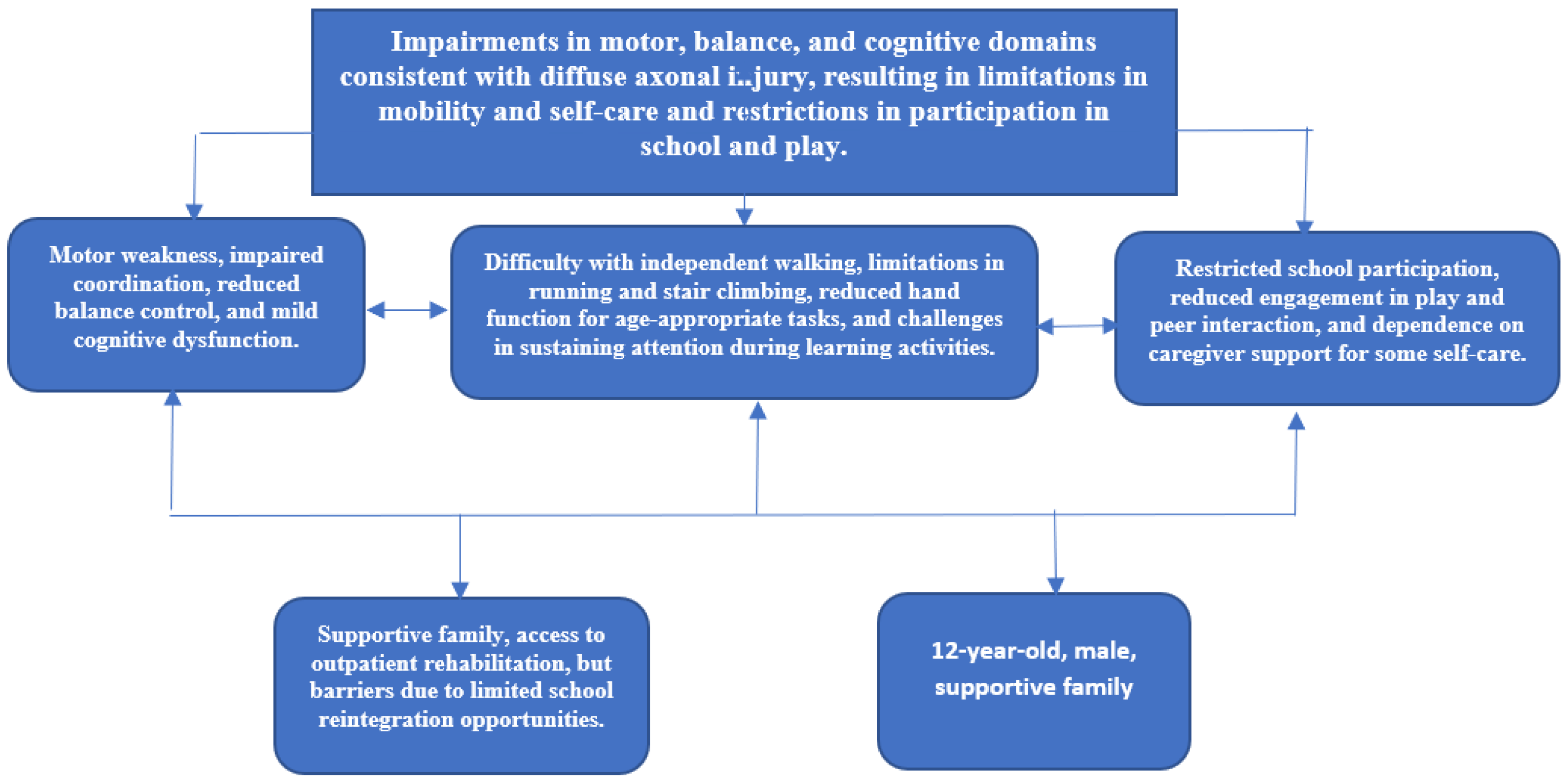
The child presented to the outpatient clinic with residual impairments consistent with diffuse axonal injury and is represented in the ICF qualifier table (Fig 1). Patient and caregiver consent were obtained prior to assessment, with full explanation of the rehabilitation process and expected outcomes. The child was referred to physiotherapy with a diagnosis of Diffuse Axonal Injury (DAI) following a fall from height. On subjective assessment, the caregiver reported persistent difficulties with balance, gait, and coordination, as well as challenges in school participation. General observation revealed reduced precision control, cautious mobility, and fatigue during prolonged walking. From a patient-centered perspective, both the child and caregiver expressed concerns about safety during mobility and the child’s ability to return to regular play and school activities. Their main expectation was to regain independence in walking and improve participation in age-appropriate activities. At baseline, the child’s highest functional activity level was limited to short-distance household ambulation with supervision, reflecting significant restrictions in community and school participation (Table 1). Overall, the child’s primary problems were categorized under motor function and mobility, activities of daily living, cognitive-emotional regulation, and participation restrictions, with underlying causes traced to axonal disconnection and subsequent neuromotor and cognitive dysfunction (Table 2). Indicators such as the Pediatric Balance Scale [13], Gross Motor Function Measure (GMFM-88) [14], 10-meter Walk Test [15], WeeFIM [16], and Pediatric Quality of Life Inventory [17] were employed to monitor progress and outcomes in alignment with WHO PIR domains.
Figure 1. International Classification of Functioning, Disability and Health Qualifier.
Preprints 179765 g001

2.4. Rehabilitation Goals (Based on WHO PIR and ICF Framework)

The physiotherapy program was structured in accordance with the World Health Organization’s Pediatric Rehabilitation (PIR) framework and guided by the International Classification of Functioning, Disability and Health for Children and Youth (ICF-CY) domains [18]. Therapy sessions were conducted once weekly over a seven-month period, with a strong emphasis on therapeutic play to facilitate engagement, motivation, and skill acquisition appropriate for the child’s developmental stage.
At baseline, intervention targeted motor recovery and postural control through interactive play tasks such as ball-catching, block stacking, and bubble-reaching exercises, designed to encourage right upper-limb activation and weight-bearing symmetry during early gait retraining. Play-based activities were integrated with task-specific exercises to promote muscle strength, coordination, and selective motor control. By the 7th week, the program advanced to dynamic balance games, obstacle play, and bilateral coordination tasks to enhance proprioception and gait rhythm. As progress continued to the 14th week, treatment emphasized functional play simulations including obstacle navigation, hopscotch, and toy-cleanup routines to reinforce daily activities and community participation. The final rehabilitation phase which started in the 21st week, focused on independent functional play, dual-task coordination, and peer interaction, promoting self-confidence and social reintegration (Table 3).
Throughout the rehabilitation process, the caregiver was actively involved through structured home-based play programs, designed to extend therapy beyond the clinic. Periodic reassessments were conducted every seven weeks using standardized pediatric outcome measures such as the Pediatric Balance Scale [13], Gross Motor Function Measure (GMFM-88) [14], and WeeFIM [16]. The program demonstrated that integrating play-based physiotherapy with WHO PIR principles can foster functional independence and meaningful participation in a pediatric outpatient recovering from Diffuse Axonal Injury.

2.5. Functional Outcomes and Progress Across Rehabilitation Phases

Over 28 weeks of physiotherapy guided by the WHO Pediatric Rehabilitation (PIR) framework, the patient exhibited consistent functional recovery. The most notable improvements were in motor coordination, right-sided gait mechanics, and fine motor dexterity, supported by progressive balance and cognitive gains. By week 28, the child achieved independent, age-appropriate physical function and full social participation, with strong caregiver engagement ensuring continuity of home-based therapy (Table 4). These progressive outcomes underscore the effectiveness of structured, goal-oriented pediatric rehabilitation guided by WHO PIR principles in facilitating recovery from diffuse axonal injury.

2.6. Prognosis

Baseline Prognosis: At initial assessment, the prognosis was said to be fair, given the diagnosis of diffuse axonal injury (DAI) and the presence of mild right-sided hemiparesis, coordination deficits during fine motor tasks, and reduced stride length. Although cognitive and communication functions were largely preserved, early limitations in motor control and endurance posed challenges to independent mobility and participation in age-appropriate play and academic activities. Nevertheless, the child’s young age, intact comprehension, and supportive family environment were strong positive predictors for recovery under a structured, multidisciplinary rehabilitation plan.
Follow-up Prognosis: After seven months of weekly physiotherapy guided by the WHO Pediatric Rehabilitation (PIR) framework, the prognosis improved to good, with progressive gains in coordination, balance, gait, and self-care performance. The integration of play-based functional exercises, task-specific training, and caregiver-led home routines enhanced neuroplastic adaptation and participation outcomes. The patient now demonstrates near age-appropriate mobility and functional independence, with only mild fine-motor limitations in the right upper limb. Continued engagement in school and community activities, alongside periodic physiotherapy review, is expected to sustain functional gains and optimize long-term outcomes.

3. Discussion

This case underscores the integral role of physiotherapy, structured within the WHO Package of Interventions for Rehabilitation (PIR) framework, in promoting functional recovery in pediatric patients with Diffuse Axonal Injury. The rehabilitation process described here aligns with a biopsychosocial understanding of recovery, emphasizing the dynamic interplay between neural repair, functional adaptation, and environmental support.
DAI remains one of the most devastating outcomes of traumatic brain injury in children, characterized by widespread disruption of axonal tracts due to shearing forces following acceleration deceleration impact [1,12]. In this patient, the fall-induced mechanism and subsequent presentation of mild right-sided hemiparesis, gait asymmetry, and fine motor coordination deficits are consistent with a Grade II DAI, typified by corpus callosum and brainstem involvement. While neuroimaging findings are critical for diagnostic confirmation, functional manifestations often dictate the rehabilitation trajectory more than radiological severity [4,7].
The progressive gains observed over the seven-month rehabilitation period reinforce evidence that early, structured, and family-centered physiotherapy plays a pivotal role in pediatric neuro-recovery. Previous authors like Sasun & Qureshi, and Lalwani have reported that timely physiotherapy not only restores mobility but also fosters cortical reorganization through repetitive, task-specific training [2-3]. In the present case, the integration of play-based exercises; a key adaptation from the WHO PIR pediatric module [9,10] enhanced engagement, compliance, and motor learning, resulting in marked improvement in dynamic balance and fine motor coordination. This aligns with de la Rosa-Arredondo, who demonstrated that multidomain rehabilitation, combining physical and cognitive tasks, augments neuroplastic outcomes in children with TBI-associated DAI [5].
The use of the WHO PIR framework provided a structured and holistic approach, guiding intervention planning across domains of body function, activity, and participation. It ensured that rehabilitation extended beyond impairment-level recovery to address contextual and environmental factors influencing participation. The patient’s steady progression from assisted mobility to near-independent ambulation with functional gait symmetry reflects the practical utility of the PIR’s domain-based intervention sequencing [8-10]. Moreover, the inclusion of caregiver-led home programs facilitated continuity of care and adherence to the rehabilitation goals, a principle emphasized in WHO’s Rehabilitation in Health Systems framework [11].
Functionally, the patient’s outcome supports growing consensus that rehabilitation intensity and consistency rather than the mere duration of injury are strong predictors of recovery in pediatric DAI [6]. The improvement in motor control and coordination observed in this case aligns with the findings of Lalwani, who reported that early intervention accelerates functional independence and minimizes secondary complications [3]. Importantly, this case also highlights the adaptability of global rehabilitation frameworks, such as WHO PIR, in low-resource outpatient contexts where access to advanced neurorehabilitation technology may be limited.
From a clinical perspective, the integration of physiotherapy within the WHO PIR framework demonstrated measurable benefits across key domains like motor function, self-care, social participation, and play engagement confirming the framework’s relevance to pediatric neurorehabilitation. This case also contributes to the growing body of evidence advocating for context-specific adaptation of international guidelines in real-world pediatric settings.
In summary, this case supports the notion that pediatric DAI rehabilitation requires an individualized, multidisciplinary approach anchored in structured frameworks like the WHO PIR, emphasizing functional recovery, family involvement, and contextual adaptation. The outcome achieved transitioning from mild hemiparesis to near-independent functional participation reflects not only the neuroplastic potential of the pediatric brain but also the transformative impact of evidence-based physiotherapy. Further work should also focus on developing standardized pediatric outcome metrics within the PIR domains to strengthen global comparability and evidence translation. Ultimately, this case affirms that the intersection of evidence-based physiotherapy and structured rehabilitation frameworks can bridge the gap between international best practice and local clinical realities transforming pediatric rehabilitation from impairment-focused recovery to participation-driven health restoration.

4. Conclusions

The journey of this pediatric outpatient recovering from diffuse axonal injury underscores the transformative potential of structured, compassionate, and evidence-based rehabilitation. Guided by the WHO Package of Interventions for Rehabilitation (PIR) framework, physiotherapy moved beyond symptom management to restoring participation, autonomy, and hope. The child’s gradual transition from guarded mobility and emotional withdrawal to purposeful play and regained functional independence illustrates how early, consistent, and family-centered rehabilitation can reshape the trajectory of pediatric neuro-recovery. This case reinforces that physiotherapy, when anchored in structured global frameworks like the WHO PIR, does not merely rehabilitate function, it restores childhood itself.

Supplementary Materials

The following supporting information can be downloaded at: Preprints.org. Informed Consent Form, Ethical Approval form.

Author Contributions

Conceptualization, A.I.O.; methodology, A.I.O.; formal analysis, A.I.O.; investigation, A.I.O.; resources, A.I.O.; data curation, A.I.O.; writing—original draft preparation, A.I.O.; writing review and editing, A.I.O.; visualization, A.I.O.; supervision, A.I.O.; project administration, A.I.O. The author has read and agreed to the published version of the manuscript.

Funding

No specific funding was received for this study. All rehabilitation interventions and related assessments were conducted as part of routine clinical care within the pediatric outpatient rehabilitation program.

Institutional Review Board Statement

Ethical review and approval were waived for this study, as it involved a single clinical case report documenting routine physiotherapy care with no experimental intervention. The case was conducted in accordance with the ethical standards of the Declaration of Helsinki (2013 revision) and the World Health Organization’s guidelines for research involving human participants. Institutional clearance was obtained from the Department of Physiotherapy, University of Nigeria Teaching Hospital (UNTH), Enugu, Nigeria, prior to documentation.

Informed Consent Statement

Written informed consent for participation and publication was obtained from the patient’s parents. In line with ethical publication practices, the parent specifically withheld consent for the use or publication of the child’s photographs or any identifiable visual materials; hence, no images are included in this report.

Data Availability Statement

No new datasets were generated or analyzed during this study. All relevant clinical data supporting the findings of this case report are contained within the manuscript. Additional patient-specific information is not publicly available due to privacy and ethical restrictions in compliance with institutional and international research ethics guidelines.

Acknowledgments

The authors extend their sincere gratitude to the patient and his caregivers for their unwavering cooperation and commitment throughout the rehabilitation process. Appreciation is also due to the multidisciplinary rehabilitation team at the pediatric outpatient unit for their clinical insight, collaborative spirit, and continued dedication to child-centered care. Special thanks to the World Health Organization for the development of the Package of Interventions for Rehabilitation (PIR) framework, which provided an invaluable guide in structuring this clinical approach.

Conflicts of Interest

The author declares no conflict of interest. The research, treatment, and documentation were conducted independently, without any commercial or institutional influence that could bias the findings or interpretations.

Abbreviations

The following abbreviations are used in this manuscript:
DAI Diffuse Axonal Injury
WHO World Health Organization
PIR Package of Interventions for Rehabilitation
ICF-CY International Classification of Functioning, Disability and Health – Children and Youth Version
MRI Magnetic Resonance Imaging
CT Computed Tomography
ICU Intensive Care Unit
TBI Traumatic Brain Injury
GMFM-88 Gross Motor Function Measure – 88 Item Version
BBS Berg Balance Scale
PBS Pediatric Balance Scale
10-MWT 10-Meter Walk Test
WeeFIM Functional Independence Measure for Children
PedsQL Pediatric Quality of Life Inventory
QoL Quality of Life
ADL Activities of Daily Living
ICF International Classification of Functioning, Disability and Health

References

  1. Sasun AR, Qureshi MI. Physiotherapy rehabilitation as an adjunct to functional independence in diffuse axonal injury: a case report. Cureus. 2022;14(10):e30255. [CrossRef]
  2. Lalwani SS, Dadgal R, Harjpal P, Saifee SS, Lakkadsha TM. Perks of early physical therapy rehabilitation for a patient with diffuse axonal injury. Cureus. 2022;14(10):e30886. [CrossRef]
  3. Dangare MS, Saklecha A, Harjpal P. A case report emphasizing an early approach in a patient with diffuse axonal injury. Cureus. 2024;16(1):e52750. [CrossRef]
  4. Smith DH, Hicks R, Povlishock JT. Therapy development for diffuse axonal injury. J Neurotrauma. 2013;30(5):307–23. [CrossRef]
  5. de la Rosa-Arredondo T, Choreño-Parra JA, Corona-Ruiz JA, Rodríguez-Muñoz PE, Pacheco-Sánchez FJ, Rodríguez-Nava AI, et al. Beneficial effects of a multidomain cognitive rehabilitation program for traumatic brain injury-associated diffuse axonal injury: a case report. J Med Case Rep. 2021;15(1):36. [CrossRef]
  6. Alkhalifah A, Alkhalifa M, Alzoayed M, Alfaraj D, Makhdom R. Unusual presentation of diffuse axonal injury: a case report. Cureus. 2022;14(11):e31336. [CrossRef]
  7. Wu XL, Liu LX, Yang LY, Zhang T. Comprehensive rehabilitation in a patient with corpus callosum syndrome after traumatic brain injury: case report. Medicine (Baltimore). 2020;99(28):e21218. [CrossRef]
  8. World Health Organization. Package of interventions for rehabilitation (PIR): introduction and overview. Geneva: WHO; 2022.
  9. World Health Organization. Package of interventions for rehabilitation (PIR): module 3 — neurological conditions. Geneva: WHO; 2023.
  10. World Health Organization. Package of interventions for rehabilitation (PIR): module 5 — neurodevelopmental disorders. Geneva: WHO; 2023.
  11. World Health Organization. Rehabilitation in health systems: a guide for action. Geneva: WHO; 2019.
  12. Adams JH, Doyle D, Ford I, Gennarelli TA, Graham DI, McLellan DR. Diffuse axonal injury in head injury: definition, diagnosis and grading. Histopathology. 1989;15(1):49–59. [CrossRef]
  13. Franjoine MR, Gunther JS, Taylor MJ. Pediatric balance scale: a modified version of the Berg Balance Scale for the school-age child with mild to moderate motor impairment. Pediatr Phys Ther. 2003;15(2):114–28. [CrossRef]
  14. Bohannon, RW. Comfortable and maximum walking speed of adults aged 20–79 years: reference values and determinants. Age Ageing. 1997;26(1):15–9. [CrossRef]
  15. Uniform Data System for Medical Rehabilitation. The WeeFIM® instrument: the functional independence measure for children. Version 5.1. Buffalo (NY): State University of New York at Buffalo; 1993.
  16. Varni JW, Seid M, Kurtin PS. PedsQL™ 4.0: reliability and validity of the Pediatric Quality of Life Inventory version 4.0 generic core scales in healthy and patient populations. Med Care. 2001;39(8):800–12. [CrossRef]
  17. Russell DJ, Rosenbaum PL, Avery LM, Lane M. Gross motor function measure (GMFM-66 & GMFM-88) user’s manual. London: Mac Keith Press; 2002.
  18. World Medical Association. World Medical Association Declaration of Helsinki: ethical principles for medical research involving human subjects. JAMA. 2013;310(20):2191–4. [CrossRef]
  19. World Health Organization. Standards and operational guidance for ethics review of health-related research with human participants. Geneva: WHO; 2011. Available from: https://www.ncbi.nlm.nih.gov/books/NBK310666/.

Table 1. WHO Rehabilitation Domain.
Domain Findings In Patient
Mental/cognitive function Mild attention deficits, slowed information processing, occasional difficulty with memory recall.
Mental/emotional function Frustration when unable to complete tasks independently; eager to return to school.
Vision impairment No visual deficits reported.
Hearing impairment Hearing intact.
Speech, language and communication Mild word-finding difficulty; reduced fluency under stress but able to communicate needs.
Ingestion function and dysphagia management No swallowing or feeding difficulties reported.
Nutrition Normal diet maintained; caregiver supervises adequate intake.
Pain management Intermittent headaches post-injury, manageable without daily analgesics.
Bowel/bladder management and toileting Independent; no incontinence reported.
Sexual function and intimate relationship Nil abnormality detected.
Respiration function Stable; no respiratory compromise.
Cardiovascular and hematological function Normal vital signs, no cardiovascular limitation.
Motor function and mobility Impaired balance and coordination; unsteady gait; reduced endurance for prolonged walking and stair use.
Activities of daily living Needs supervision with bathing and dressing for safety; able to perform feeding independently.
Exercise and fitness Reduced stamina; unable to engage in vigorous play compared to peers.
Interpersonal interaction and relationship Avoids group play due to fear of falling; interacts mainly with close family.
Education and vocation School attendance disrupted; difficulty sustaining classroom attention.
Community and social life Limited outdoor play; reduced participation in peer activities.
Family and care support Strong caregiver involvement; mother highly engaged in rehabilitation program.
Self-management Limited insight due to age; relies on caregiver support for adherence to therapy.
Lifestyle modification Family encouraged to promote safe play, structured exercise, and rest periods.
Table 2. Problem List Table.
Problem Missing Components Underlying Reasons Indicators / Outcome Measures
Impaired balance and gait instability Postural control, dynamic balance, lower limb coordination Diffuse axonal injury leading to impaired proprioceptive feedback and cerebellar pathway disruption Pediatric Balance Scale.
Reduced endurance and exercise tolerance Muscular strength, aerobic fitness Deconditioning secondary to limited mobility and inactivity post-injury 10-meter Walk Test.
Cognitive and attention deficits Sustained attention, short-term memory, concentration Diffuse white matter injury affecting prefrontal cortical connections Raven Cognitive Assessment and Wechsler Intelligence Scale for Children.
Reduced participation in school and social activities Environmental interaction, peer engagement Fatigue, anxiety, reduced confidence due to motor limitations Child and Adolescent Scale of Participation.
Dependence in activities of daily living (ADLs) Independence in self-care (bathing, dressing) Impaired balance and fine motor coordination Pediatric Functional Independence Measure (WeeFIM).
Emotional and behavioral adjustment difficulty Self-regulation, coping, motivation Psychological impact of trauma and prolonged recovery process Pediatric Quality of Life Inventory.
Poor coordination and upper limb control Fine and gross motor precision Neural disconnection from axonal damage in motor tracts Nine-Hole Peg Test, Box and Block Test.
Reduced community and outdoor participation Confidence in mobility, safety awareness Fear of falling, environmental barriers Caregiver report, frequency of outdoor activity.
Limited self-management skills Self-monitoring Pediatric age and cognitive limitations Caregiver adherence checklist.
Table 3. Intervention Plan.
PIR Domain / Functional Area Baseline Intervention 7-13 Weeks 14-20 Weeks 21-28 Weeks
Motor Function & Coordination Engaged in simple play-based fine motor tasks (pegboard, stacking blocks, ball transfer); facilitated right upper limb activation using games and PNF patterns; introduced grasp-and-release play Introduced bilateral hand coordination games (sorting toys, puzzles); object manipulation and sensory-rich play to enhance proprioceptive input Play gym sessions with resistance bands, target-throwing, and drawing activities for fine motor endurance Timed dexterity games, creative art play, and dual-task coordination challenges simulating school/playground activities
Mobility & Gait Training Assisted walking with visual feedback; focus on right toe-off facilitation and weight-shift using toy-retrieval games Obstacle course walking with colored targets; treadmill walking using storytelling play cues Hopscotch and ladder games to improve stride length and rhythm; stair games for balance Playground simulation—jumping, skipping, and sports-play tasks for independent gait control
Balance & Postural Control Seated balance play on therapy ball; bubble-catching games to encourage trunk control Dynamic balance through reaching games and step-stone play; musical freeze tasks Single-leg balance and hopping games; catching-throwing while standing on uneven surfaces Balance relay games, dual-task postural control play; eye–foot coordination tasks
Functional Activities / ADL Training Encouraged self-dressing as play, toy-cleanup routines, and snack preparation games; caregiver-assisted transfers Play-simulated daily routines (tooth brushing, toy washing) for independence Household imitation games to reinforce ADL skills Independent completion of morning routines and school readiness tasks with supervision
Cognitive & Behavioral Function Short structured play tasks (memory card games, sequencing toys) to improve attention span Problem-solving through play—building blocks, maze navigation Role-play and imaginative play to enhance memory and decision-making Independent game planning and rule-following; sustained participation without prompts
Communication & Interaction Used sing-along games and interactive storytelling to stimulate speech Peer play to enhance turn-taking and expressive communication Group therapy play and storytelling with peers Full verbal expression and cooperative play participation
Caregiver / Home Program Education on home-based play therapy and safe toy selection; encouraged family participation Home exercise games (throw–catch, hop–count) recorded in a caregiver diary Progressed to structured play sessions 20–30 mins daily emphasizing balance and strength Transitioned to self-directed functional play; caregiver supervision maintained for safety
Table 4. Functional Outcomes and Progress Across Rehabilitation Phases Table.
Outcome Domain / Measure Baseline (Week 0) After 8 Weeks (Early Phase) After 16 Weeks (Intermediate Phase) After 28 Weeks (Late Phase / Discharge)
Motor Function (GMFM-88) Mild right-sided hemiparesis; reduced coordination during fine motor tasks of the upper limb; decreased dexterity in grasp and release activities Improved fine motor coordination; able to perform bilateral hand activities with minimal assistance Near-symmetric upper limb use during reaching and object manipulation Normalized fine motor function with efficient bilateral coordination and hand control
Mobility (Gait / 10-Meter Walk Test) Independent gait with lack of toe-off on the right side; shortened stride length and mild asymmetry Improved foot clearance and partial toe-off during terminal stance; reduced limp Nearly symmetrical gait pattern; stable cadence and improved step length Normal gait with full toe-off and smooth weight transfer during ambulation
Balance (Pediatric Balance Scale) Score: 32/56 - mild instability when turning or reaching Score: 40/56 - steadier posture during transitions and static tasks Score: 48/56 - improved dynamic balance, minimal sway Score: 54/56 - independent balance; able to perform single-leg stance for 10s
Functional Independence (WeeFIM) Mostly independent; needs help in dressing and stair climbing (score: 90/126) Improved dressing and toileting independence (score: 102/126) Fully independent in most ADLs except high-demand tasks (score: 115/126) Fully independent; age-appropriate task performance (score: 123/126)
Cognitive Function (Attention & Task-following) Mild difficulty sustaining attention; forgets multi-step tasks Improved focus with structured cues Follows two-step commands reliably Sustained attention throughout tasks; independent recall of therapy routines
Emotional / Social Interaction Initially shy and withdrawn; limited interaction during sessions Engages willingly with therapist and peers Increased social confidence; responds to praise Fully expressive, active peer engagement and motivation maintained
Caregiver Burden (Zarit Short Scale) Mild stress due to home program adjustment Confidently implements exercise schedule Positive feedback on home progress Comfortable with self-management and long-term follow-up adherence
Disclaimer/Publisher’s Note: The statements, opinions and data contained in all publications are solely those of the individual author(s) and contributor(s) and not of MDPI and/or the editor(s). MDPI and/or the editor(s) disclaim responsibility for any injury to people or property resulting from any ideas, methods, instructions or products referred to in the content.
Copyright: This open access article is published under a Creative Commons CC BY 4.0 license, which permit the free download, distribution, and reuse, provided that the author and preprint are cited in any reuse.
Prerpints.org logo

Preprints.org is a free preprint server supported by MDPI in Basel, Switzerland.

Subscribe

Disclaimer

Terms of Use

Privacy Policy

Privacy Settings

© 2026 MDPI (Basel, Switzerland) unless otherwise stated