

Submitted:
10 October 2025
Posted:
13 October 2025
You are already at the latest version
Abstract
This article proposes a comprehensive examination of the philosophical evolution from traditional dialectical thinking to the emerging framework of N-alectics, viewed through the lens of neutrosophic philosophy and grounded in Latin American indigenous wisdom traditions. The research will explore how Florentin Smarandache's Neutrosophic, which extends classical dialectics by incorporating neutrality and indeterminacy, finds profound resonance in pre-Columbian philosophical systems across Mesoamerica, the Andes, and Amazonia. The proposed study will demonstrate that Latin American indigenous cultures have long employed what can now be understood as N-alectic reasoning a sophisticated philosophical approach that transcends binary oppositions to embrace multiple, simultaneous truths and the dynamic interplay of contradictory forces. Through detailed analysis of key concepts including the Andean Yanantin (complementary duality), Pachakuti (cyclical world transformation), and Ayni (sacred reciprocity); the Aymara Ch'ixi (mestizaje that maintains contradictions); the Kichwa Sumak Kawsay (good living in harmony); the Nahuatl Teotl (divine force with multiple manifestations); and the Mesoamerican cosmic balance embodied in Quetzalcóatl/Kukulkán, this research will establish N-alectics as both a natural evolution of Western dialectical thought and a formalization of ancient Latin American wisdom. The article will contribute to contemporary philosophical discourse by proposing N-alectics as a decolonizing methodology that challenges Eurocentric binary thinking while offering practical frameworks for addressing complex contemporary issues, including environmental sustainability, social justice, and intercultural dialogue. The research will conclude by presenting concrete applications of N-alectic reasoning in contemporary Latin American contexts, demonstrating its relevance for 21st-century philosophical and practical challenges. The results align with current research trends on symmetry and complexity, demonstrating how multi-Neutrosophic modeling captures the dynamic balance and recursive structure inherent in complex epistemic systems.
Keywords:
causal complexity
; decolonial methodology
; indigenous knowledge
; Latin American philosophy
; multi-neutrosophic sets
; n-alectics
; neutrosophic
; plural epistemology
; neutrosophic symmetry
1. Introduction
The history of Western philosophy has been deeply shaped by dialectical reasoning—from Plato’s dialogical inquiries and Hegel’s triadic synthesis to Marx’s materialist reinterpretation of historical processes [1]. This intellectual tradition, while profoundly influential, has remained largely confined to binary frameworks that privilege opposition and subsequent synthesis. However, the emergence of neutrosophic philosophy in the late twentieth century, pioneered by Florentin Smarandache, has opened new horizons for understanding the nature of truth, contradiction, and reasoning itself [2].
Neutrosophic, defined as “a new branch of philosophy which studies the origin, nature, and scope of neutralities, as well as their interactions with different ideational spectra” [3], departs radically from classical dialectical approaches. Rather than seeking to overcome contradictions through synthesis, Neutrosophic embraces the coexistence of truth (T), falsity (F), and indeterminacy (I) as fundamental components of reality. This triadic structure allows for more nuanced representations of complex phenomena that resist binary categorization. Building upon this foundation, Smarandache and colleagues introduced the notion of N-alectics—a framework that transcends di-alectic and tri-alectic models by incorporating multiple simultaneous perspectives and the dynamic interplay of contradictory forces [4].
What makes this philosophical development particularly significant is its convergence with Indigenous Latin American thought systems that have existed for millennia. Pre-Columbian cultures across Mesoamerica, the Andes, and Amazonia developed sophisticated cosmological and philosophical frameworks that naturally embody what can now be recognized as N-alectic principles. These systems have long embraced complementarity, multiplicity, and the coexistence of apparent contradictions as essential elements of cosmic and social order.
The Andean concept of Yanantin, for instance, represents a form of complementary duality that transcends simple binary opposition by emphasizing reciprocity and mutual interdependence [5]. Similarly, the Mesoamerican understanding of cosmic balance—embodied in the deities Quetzalcóatl and Kukulkán—reflects a triadic harmony integrating sky, earth, and underworld in a continuous cycle of transformation [6]. Amazonian cosmologies reveal even more complex, multi-dimensional systems in which spiritual and natural forces interact dynamically without requiring reduction to unified wholes [7].Despite the philosophical sophistication of these Indigenous systems and their striking resonance with contemporary neutrosophic reasoning, little scholarly attention has been paid to the intersections between N-alectics and Latin American ancestral philosophy. This gap represents both an intellectual omission and a missed opportunity for developing culturally grounded frameworks capable of addressing complex contemporary problems.
Accordingly, the research problem this article addresses is threefold.
First, it seeks to establish the theoretical foundations for understanding N-alectics as both an evolution of Western dialectical thought and a formalization of pre-existing Indigenous wisdom traditions. This entails a careful philosophical analysis of the conceptual bridges between neutrosophic logic and ancestral cosmologies.
Second, it aims to demonstrate the practical applicability of N-alectic reasoning to contemporary Latin American challenges, especially in environmental sustainability, social justice, and intercultural dialogue. This requires constructing methodological frameworks that translate neutrosophic principles into operative tools for decision-making and collective deliberation.
Third, it affirms a decolonial imperative: to recognize and validate Indigenous philosophical contributions to global intellectual discourse, challenging the historical marginalization of non-Western systems of thought within academic philosophy.
To this end, the study formulates the following research questions:
How do the fundamental principles of Neutrosophic and N-alectics align with core concepts of Latin American Indigenous philosophies?
What specific examples from Mesoamerican, Andean, and Amazonian traditions demonstrate the practical application of N-alectic reasoning?
How can N-alectic frameworks be applied to contemporary challenges in Latin America—particularly in environmental and social policy?
What are the implications of recognizing Indigenous N-alectic traditions for broader philosophical discourse and decolonial methodology?
How might the integration of neutrosophic and Indigenous approaches contribute to more effective and culturally appropriate responses to complex global problems?
By addressing these questions, this article positions N-alectics as a transcultural and decolonial philosophical framework that unites the rigor of formal logic with the relational, plural, and cyclical epistemologies of Latin American ancestral wisdom. It argues that through this synthesis, N-alectics not only extends the boundaries of Neutrosophic but also contributes to the decolonization of global philosophical inquiry.
This study contributes to the aims of the Special Issue “Symmetry and Complexity” (Symmetry, MDPI) by extending the notion of symmetry from physical and mathematical invariance to epistemic and cultural equilibrium. Through the framework of Neutrosophic and N-alectic reasoning, it formalizes complexity as the coexistence of multiple, interdependent truths, indeterminacies, and falsities within plural systems.
2. Theoretical Foundations
The theoretical foundation for this research rests primarily on the work of Florentin Smarandache, who introduced Neutrosophic in the 1980s as an extension of classical logic and dialectical thinking [8]. Smarandache's neutrosophic logic represents a significant advancement over fuzzy logic and intuitionistic logic by incorporating a third component—indeterminacy—alongside truth and falsehood [9]. This triadic structure allows for more nuanced representations of complex phenomena that resist binary categorization.
Recent developments in neutrosophic theory have led to the emergence of N-alectics as a practical philosophical framework. The seminal work "From Di-alectics to N-alectics: Indigenous Cultures and Ancestral Philosophies in Latin America" by Smarandache and Leyva Vázquez (2025) provides the most comprehensive treatment of this topic to date [4]. Their research demonstrates how N-alectic frameworks can integrate multiple subcomponents through refined neutrosophic logic, offering tools for analyzing complex cultural and philosophical systems.
The neutrosophic literature has expanded significantly in recent years, with applications ranging from mathematics and computer science to social sciences and philosophy [10]. However, most of this work has focused on formal logical systems and technical applications, with limited attention to the philosophical and cultural dimensions that this article proposes to explore.
The scholarly literature on Latin American indigenous philosophy has grown substantially over the past several decades, driven in part by decolonial movements and increased recognition of indigenous intellectual contributions [11]. Key works in this area include studies of Andean philosophy by scholars such as Josef Estermann, who has extensively analyzed concepts like Yanantin and Pachakuti [12], and research on Mesoamerican thought systems by Miguel León-Portilla and others [13].
Andean philosophical concepts have received particular attention in recent scholarship. The principle of Yanantin (complementary duality) has been analyzed as a fundamental organizing principle that differs significantly from Western binary thinking [14]. Unlike dialectical opposition, Yanantin emphasizes reciprocity, interdependence, and the necessity of apparent opposites for cosmic and social harmony. The related concept of Pachakuti (world reversal or transformation) provides a dynamic temporal dimension that incorporates cyclical change and renewal [15].
Mesoamerican philosophical traditions have been explored through analysis of codices, architectural symbolism, and surviving cultural practices [16]. The figure of Quetzalcóatl/Kukulkán represents a particularly rich example of triadic thinking that integrates celestial, terrestrial, and underworld dimensions in a dynamic cosmic balance [17]. Recent archaeological and anthropological research has revealed the sophisticated mathematical and astronomical knowledge that underpinned these philosophical systems [18].
Amazonian cosmologies present perhaps the most complex examples of multi-dimensional thinking found in indigenous Latin American traditions [19]. Anthropological studies of groups such as the Shuar, Achuar, and various Shipibo communities have documented intricate systems of spiritual and natural relationships that resist reduction to simple binary or even triadic structures [20]. These systems often involve multiple simultaneous levels of reality and complex networks of reciprocal relationships between human, natural, and spiritual entities [21].
Despite the richness of both neutrosophic and indigenous philosophical literatures, there has been remarkably little scholarly work connecting these two domains. The few existing studies that attempt such connections tend to be either highly technical (focusing on formal logical structures) or overly general (making broad claims without detailed analysis) [22,23].
Several specific gaps can be identified:
Theoretical Integration: There is a lack of systematic theoretical work that demonstrates the conceptual bridges between neutrosophic principles and indigenous philosophical concepts. While both traditions embrace multiplicity and the coexistence of contradictions, the specific mechanisms by which they do so have not been carefully compared and analyzed.
Methodological Development: The practical applications of N-alectic reasoning in contemporary Latin American contexts remain largely unexplored. While Smarandache and colleagues have provided some examples of ethical decision-making models, there is significant potential for developing more comprehensive methodological frameworks.
Cultural Validation: Much of the existing literature on indigenous philosophy has been produced by non-indigenous scholars, often without adequate attention to indigenous epistemologies and ways of knowing. There is a need for research that more fully recognizes and validates indigenous intellectual contributions on their own terms.
Contemporary Relevance: The potential applications of integrated neutrosophic-indigenous approaches to contemporary challenges such as climate change, social inequality, and cultural preservation have received minimal scholarly attention.
3. N-Alectic Principles in Latin American Indigenous Philosophies
3.1. Yanantin, Pachakuti, and Ayni
The Andean region presents perhaps the most sophisticated and well-documented examples of indigenous dialectical thinking that anticipate neutrosophic principles. The philosophical systems developed by Quechua and Aymara cultures demonstrate complex logical structures that transcend binary opposition while maintaining practical applicability to social organization and cosmic understanding.
Yanantin: Complementary Duality Beyond Binary Opposition
Yanantin represents one of the most fundamental concepts in Andean philosophy, embodying a form of complementary duality that differs significantly from Western dialectical approaches [24]. Unlike Hegelian dialectics, which seeks synthesis through the resolution of contradictions, Yanantin maintains the productive tension between complementary opposites. This concept applies across multiple dimensions of existence, from individual psychology (masculine/feminine aspects within each person) to social organization (reciprocal community roles) to cosmic order (day/night, wet/dry seasons) [25].
The philosophical sophistication of Yanantin lies in its recognition that apparent opposites are not merely contradictory but mutually constitutive. Each element of a Yanantin pair requires its complement for full realization, creating dynamic relationships that generate ongoing transformation without requiring resolution into higher unities. This principle demonstrates what neutrosophic logic would later formalize as the productive coexistence of contradictory truths [26].
Pachakuti: Cyclical Transformation and Temporal Multiplicity
The concept of Pachakuti provides a temporal framework that complements the relational dynamics of Yanantin. Pachakuti, meaning "world reversal" or "overturning of space-time," represents the Andean understanding of cyclical transformation that governs both historical change and cosmic evolution [27]. This concept embodies multiple temporal dimensions simultaneously: linear historical progression, cyclical cosmic renewal, and prophetic anticipation of future transformations.
Figure 1.
The Staff God (Viracocha or Pachacamac), central image of the Gate of the Sun (Tiwanaku). Adapted from: Pachacuti (mitología inca), Wikiwand, https://www.wikiwand.com/es/articles/Pachacuti_%28mitolog%C3%ADa_inca%29 (accessed September 20, 2025).
Figure 1.
The Staff God (Viracocha or Pachacamac), central image of the Gate of the Sun (Tiwanaku). Adapted from: Pachacuti (mitología inca), Wikiwand, https://www.wikiwand.com/es/articles/Pachacuti_%28mitolog%C3%ADa_inca%29 (accessed September 20, 2025).

Pachakuti demonstrates N-alectic thinking by maintaining multiple temporal realities without forcing them into a unified chronology. The same event can be understood as historical fact, mythical archetype, and prophetic anticipation simultaneously, embodying the neutrosophic principle of multiple simultaneous truths [28]. Contemporary Andean communities continue to use Pachakuti as a framework for understanding global transformations, demonstrating its ongoing relevance for complex contemporary challenges.
Ayni: Sacred Reciprocity as Cosmic Principle
Ayni extends the relational dynamics of Yanantin into practical social and economic organization through principles of sacred reciprocity. This concept governs not only human relationships but also interactions with natural and spiritual forces, creating comprehensive frameworks for sustainable living that anticipate contemporary environmental concerns [29].
The philosophical significance of Ayni lies in its demonstration that reciprocal relationships can maintain multiple simultaneous obligations without requiring hierarchical resolution. Community members may simultaneously owe and be owed various forms of labor, goods, or spiritual support, creating complex networks of interdependence that function through dynamic balance rather than static equilibrium [30]. This represents a practical application of N-alectic reasoning to social organization.
3.2. Aymara and the Ch’ixi Logic: Inclusion Without Synthesis
Silvia Rivera Cusicanqui's development of the Ch'ixi concept represents one of the most sophisticated contemporary applications of indigenous logical principles to decolonial theory [31]. Ch'ixi, meaning "grey" or "speckled" in Aymara, describes a form of mestizaje that maintains indigenous and non-indigenous elements simultaneously without forcing them into synthetic unity.
The theoretical power of Ch'ixi lies in its embodiment of what neutrosophic logic terms the "included middle"—the recognition that contradictory elements can coexist productively without requiring resolution [32]. This challenges both colonial mestizaje (which seeks to erase indigenous difference) and postcolonial identity politics (which often reinforces binary oppositions between indigenous and non-indigenous identities).
Ch'ixi demonstrates practical N-alectic reasoning by showing how individuals and communities can maintain multiple, contradictory identities simultaneously. A person can be simultaneously indigenous and modern, traditional and contemporary, local and global, without these identities canceling each other out or requiring synthesis into a higher unity [33]. This provides powerful tools for understanding contemporary multicultural societies and developing more inclusive approaches to cultural policy.
3.3. Mesoamerican: Teotl and the Triadic Cosmic Balance
Teotl: Divine Force and Multiple Manifestations
The Nahuatl concept of Teotl demonstrates sophisticated metaphysical thinking that parallels neutrosophic approaches to understanding complex phenomena. Teotl represents divine force as a single energy that manifests in multiple forms throughout reality, embodying both unity and multiplicity simultaneously [34].
The philosophical significance of Teotl lies in its non-dualistic approach to understanding divinity and reality. Rather than opposing material and spiritual realms, Teotl encompasses both as manifestations of a single dynamic force. This demonstrates indigenous multi-dimensional thinking that can accommodate multiple simultaneous realities without forcing them into hierarchical relationships [35].
Quetzalcóatl/Kukulkán: Triadic Cosmic Balance
The Mesoamerican understanding of cosmic balance, embodied in deities like Quetzalcóatl/Kukulkán, represents sophisticated triadic thinking that anticipates neutrosophic logic. These figures integrate celestial, terrestrial, and underworld dimensions in dynamic cosmic balance, demonstrating how multiple contradictory forces can coexist productively [36].
The mythological narratives surrounding these figures provide practical frameworks for understanding transformation and change that maintain multiple simultaneous perspectives. The same deity can be simultaneously creator and destroyer, order and chaos, wisdom and trickery, embodying the neutrosophic principle that contradictory truths can coexist [37].
3.2. Amazonian Multi-Reality Systems
Shipibo Geometric Cosmology
The geometric patterns created by Shipibo artists represent sophisticated visual expressions of multi-dimensional cosmological thinking. These patterns simultaneously depict multiple levels of reality—physical, spiritual, and visionary—without requiring hierarchical organization [38]. The same pattern can represent a river system, a spiritual pathway, and a healing song simultaneously, demonstrating practical applications of N-alectic reasoning to artistic and spiritual practice.
Figure 2.
Traditional Shipibo-Conibo textile design (Kené pattern). Taken from Wikipedia: https://en.wikipedia.org/wiki/Shipibo-Conibo#/media/File:Artesiana.jpg, accessed September 3, 2025.
Figure 2.
Traditional Shipibo-Conibo textile design (Kené pattern). Taken from Wikipedia: https://en.wikipedia.org/wiki/Shipibo-Conibo#/media/File:Artesiana.jpg, accessed September 3, 2025.

Shuar Multi-Dimensional Spirituality
Shuar cosmology presents complex systems of spiritual and natural relationships that resist reduction to simple binary or triadic structures. Multiple spiritual entities, natural forces, and human communities interact through networks of reciprocal relationships that maintain dynamic balance without requiring central coordination [39]. This demonstrates how N-alectic principles can govern complex social and spiritual systems.
3.3. Contemporary Applications and Synthesis
Sumak Kawsay: Good Living as Alternative Development
The concept of Sumak Kawsay (Kichwa) or Buen Vivir represents the contemporary political application of indigenous philosophical principles to development policy. Incorporated into the constitutions of Ecuador and Bolivia, Sumak Kawsay demonstrates how N-alectic reasoning can inform practical governance approaches [40].
Sumak Kawsay embodies neutrosophic principles by maintaining multiple simultaneous values—economic wellbeing, environmental sustainability, cultural preservation, and spiritual fulfillment—without forcing them into hierarchical relationships or requiring trade-offs between competing goods [41]. This provides practical frameworks for policy-making that can accommodate multiple stakeholder perspectives and complex value systems.
These indigenous concepts provide powerful tools for addressing contemporary challenges that resist binary solutions. Climate change, social inequality, cultural preservation, and technological development all require approaches that can maintain multiple simultaneous perspectives and accommodate contradictory demands without forcing premature resolution [42].
The integration of these concepts with neutrosophic theory creates comprehensive frameworks for N-alectic reasoning that combine formal logical rigor with practical cultural wisdom. This demonstrates the potential for developing truly intercultural philosophical approaches that can contribute to addressing global challenges while respecting cultural diversity and indigenous intellectual contributions [43].
4. N-Alectics as a Decolonial and Liberation Framework
4.1. Enrique Dussel's Analectics and the Critique of Eurocentric Dialectics
The philosophical work of Enrique Dussel represents one of the most sophisticated attempts to develop a genuinely Latin American philosophical method that can serve the cause of liberation while maintaining rigorous theoretical foundations. Dussel's development of the analéctica method emerges from a fundamental critique of European dialectical thinking, particularly its tendency toward totalization and its inability to genuinely encounter the alterity of the oppressed Other [44].
The analéctica method, as Dussel conceives it, begins not from the ego cogito of European rationalism or even the ego conquiro of colonial modernity, but from what he terms the "exteriority" of the excluded and oppressed. This exteriority represents the realm beyond the totalizing system where the voice of the Other can be heard in its irreducible distinctness [45]. Unlike Hegelian dialectics, which seeks to overcome contradictions through synthesis within a totalizing system, analectics maintains the fundamental alterity of the Other and refuses to subsume their voice into a higher unity.
This methodological innovation has profound implications for understanding the relationship between neutrosophic N-alectics and liberation philosophy. Where traditional dialectics operates within what Dussel calls "the totality," seeking to resolve contradictions through progressive synthesis, analectics opens philosophical thinking to the exteriority of those excluded from the dominant system. The analéctica method thus anticipates key insights of neutrosophic logic by recognizing that contradictions need not be resolved but can be maintained as productive tensions that generate new possibilities for understanding and action [2].
Dussel's later development of "ana-dialectics" represents an even more sophisticated integration of dialectical and analéctica approaches. This method combines the analytical power of dialectical thinking with the ethical commitment to alterity that characterizes analectics. The result is a philosophical approach that can analyze systems of domination while remaining open to the voices and experiences of those excluded from these systems [46,47]. This ana-dialectical method provides important precedents for N-alectic thinking by demonstrating how multiple logical approaches can be integrated without losing their distinctive contributions.
The political implications of Dussel's analéctica are particularly significant for understanding how N-alectics can serve as a framework for liberation. By starting from the exteriority of the oppressed, analéctica provides methodological tools for developing what Dussel calls a "philosophy of liberation" that is genuinely committed to the transformation of unjust social structures. This approach challenges the tendency of European philosophy to universalize particular cultural perspectives while claiming neutrality and objectivity [48].
4.2. Paulo Freire's Dialectical Pedagogy and Critical Consciousness
Paulo Freire's pedagogical philosophy provides another crucial foundation for understanding how N-alectic thinking can contribute to liberation processes in Latin America. Freire's approach to education as the practice of freedom demonstrates how dialectical thinking can be employed in service of liberation while avoiding the totalizing tendencies that Dussel critiques in European dialectics [49].
Freire's concept of "critical consciousness" represents a sophisticated understanding of how individuals and communities can develop the analytical tools necessary to understand and transform their social conditions. This process involves what Freire calls "problem-posing education," which replaces the "banking" model of education with dialogical inquiry that treats both teachers and students as co-investigators of reality [50]. The dialogical nature of Freire's pedagogy anticipates key aspects of N-alectic thinking by recognizing that truth emerges through the encounter between different perspectives rather than through the imposition of a single viewpoint.
The concept of praxis in Freire's work provides important insights for understanding how N-alectic reasoning can be applied to concrete liberation struggles. Praxis, understood as the unity of reflection and action directed toward transforming the world, demonstrates how theoretical understanding and practical engagement can be integrated without reducing one to the other [51]. This integration of theory and practice reflects the neutrosophic principle that apparently contradictory elements can coexist productively without requiring synthesis into a higher unity.
Freire's emphasis on dialogue as the essence of liberating education also provides methodological insights for N-alectic approaches to social transformation. True dialogue, as Freire understands it, requires mutual respect, humility, and a willingness to be transformed through encounter with others. This dialogical approach creates space for multiple perspectives to coexist and interact without requiring that differences be eliminated through synthesis [56]. Such dialogical methodology demonstrates practical applications of N-alectic principles to educational and political processes.
4.3. African Diaspora Philosophy and Relational Ontologies
The philosophical traditions of African diaspora communities in Latin America provide crucial resources for developing N-alectic approaches to liberation that integrate spiritual, cultural, and political dimensions. The Afro-Brazilian religious traditions of Candomblé and Umbanda, in particular, demonstrate sophisticated philosophical systems that anticipate key insights of neutrosophic thinking [53].
Figure 3.
Wooden carvings representing Orixás in Candomblé. Taken from Wikipedia: https://es.wikipedia.org/wiki/Candombl%C3%A9, accessed Septenber 15, 2025.
Figure 3.
Wooden carvings representing Orixás in Candomblé. Taken from Wikipedia: https://es.wikipedia.org/wiki/Candombl%C3%A9, accessed Septenber 15, 2025.
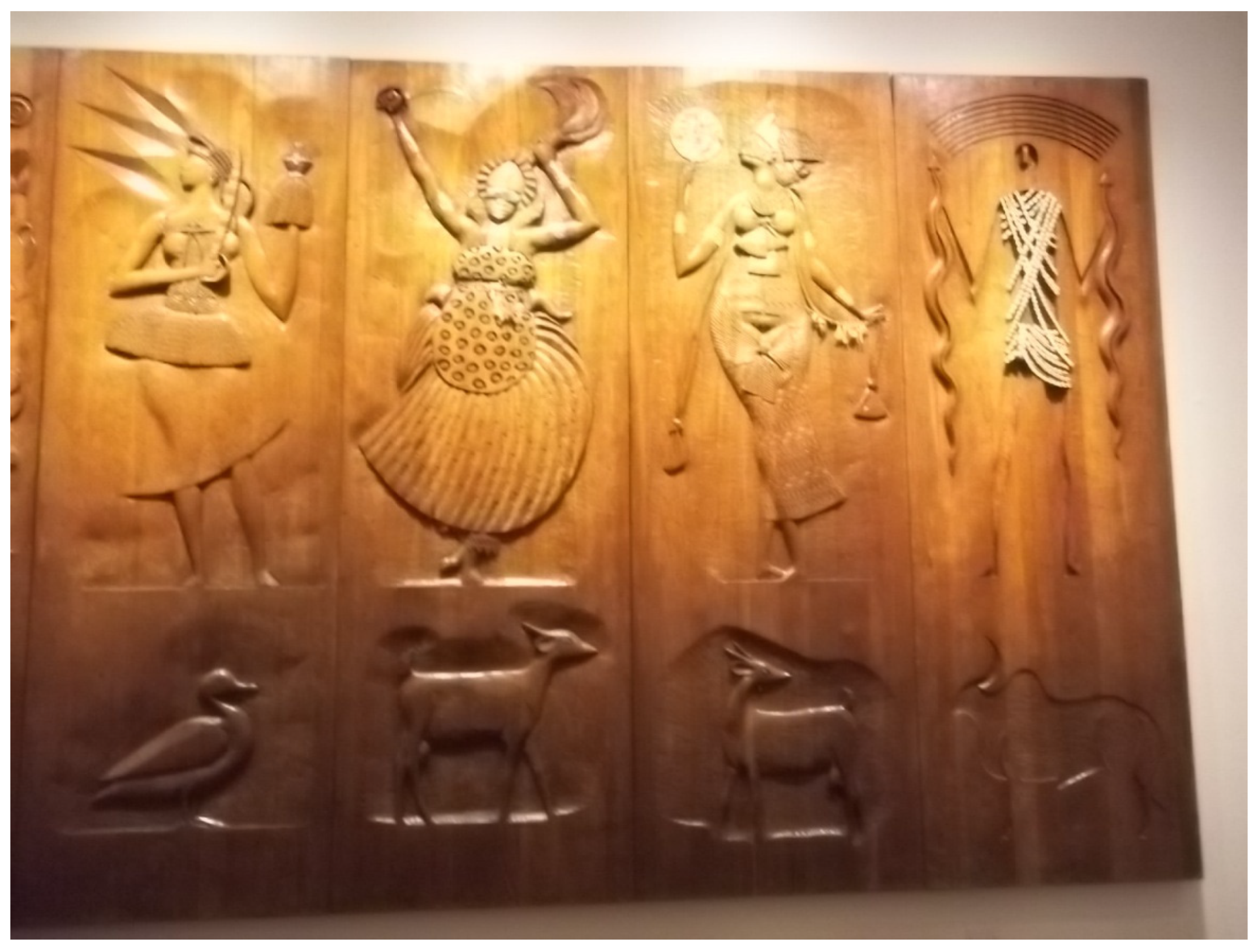
The concept of axé in Candomblé philosophy represents a dynamic understanding of reality as constituted by flowing energy that creates and sustains all forms of existence. Axé is simultaneously material and spiritual, individual and collective, creative and destructive, embodying the neutrosophic principle that contradictory aspects of reality can coexist without requiring resolution [54]. This understanding of reality as fundamentally relational and dynamic provides important alternatives to Western substance-based ontologies that tend toward binary thinking.
The Orixá system in Afro-Brazilian religions demonstrates how multiple, apparently contradictory forces can be understood as manifestations of a single underlying reality without reducing their distinctiveness. Each Orixá embodies particular aspects of natural and social forces while remaining connected to all others through the fundamental energy of axé [55]. This system provides practical examples of how N-alectic thinking can be applied to understanding complex social and spiritual realities.
The philosophy of Ubuntu, while originating in southern Africa, has found expression throughout African diaspora communities in Latin America and provides additional resources for N-alectic approaches to liberation. The Ubuntu principle that "I am because we are" demonstrates a relational understanding of personhood that challenges Western individualism while maintaining respect for individual distinctiveness [56]. This relational ontology provides foundations for collective liberation processes that honor both individual dignity and community solidarity.
The historical experience of Palenque communities throughout Latin America demonstrates how African diaspora populations have developed sophisticated strategies for maintaining cultural autonomy while engaging with dominant societies. These maroon communities created forms of social organization that integrated African traditions with indigenous and European elements without losing their distinctive character [57]. The creative syncretism developed in these communities provides practical examples of how N-alectic principles can be applied to cultural and political resistance.
In Cuba—particularly in regions such as the municipality of Calito García—this syncretic process also embraced the influence of Allan Kardec’s Spiritism, which entered the island in the 19th century and became intertwined with Afro-Cuban religious practices such as Santería and Palo Monte [58]. Kardec’s philosophical spiritism, with its emphasis on the evolution of the soul, moral progress, and the coexistence of visible and invisible realities, complements the neutrosophic triad of truth, indeterminacy, and falsity by positing that knowledge arises from the interaction between material and spiritual planes. This convergence between Kardecist Spiritism and Afro-Cuban cosmologies gave rise to complex interpretive frameworks where science, faith, and metaphysics coexist without contradiction—an exemplary manifestation of N-alectic reasoning in spiritual praxis.
Thus, Latin American syncretic philosophies—from axé to Ubuntu, from palenque resistance to Kardecist spiritualism—embody the plural, relational, and contradictory logic that Neutrosophic seeks to formalize philosophically and methodologically.
4.4. Complexity Theory Critiques and the Limitations of Traditional Dialectics
Contemporary developments in complexity theory provide important critiques of traditional dialectical thinking that support the development of N-alectic alternatives. Edgar Morin's work on "complex thinking" identifies several limitations of classical dialectical approaches that can be addressed through more sophisticated logical frameworks [59].
Traditional dialectical thinking tends toward binary reduction, oversimplifying complex phenomena into opposing pairs that must be resolved through synthesis. This binary logic fails to capture the multidimensional nature of social and natural phenomena, leading to oversimplified analyses that miss crucial aspects of complex situations [60]. Complexity theory demonstrates that many phenomena exhibit non-linear dynamics that cannot be adequately understood through simple dialectical progression.
Morin's "dialogical principle" provides an alternative to traditional dialectical synthesis by showing how contradictory elements can maintain their opposition while remaining in productive relationship. This principle anticipates key aspects of neutrosophic logic by demonstrating how the "included middle" can be maintained without forcing resolution of contradictions [61]. The dialogical principle thus provides methodological tools for N-alectic approaches that can maintain multiple perspectives simultaneously.
The recursive principle identified by complexity theory shows how effects can become causes in circular processes that challenge linear dialectical progression. This recursive causality demonstrates how social and natural systems can exhibit self-organization and emergence that cannot be predicted from simple dialectical analysis [61]. Understanding these recursive processes is crucial for developing liberation strategies that can adapt to changing conditions without losing their essential orientation.
Systems theory critiques of dialectical thinking identify additional limitations that support N-alectic alternatives. Traditional dialectics tends to focus on change at the expense of stability, missing the ways that systems maintain continuity even while undergoing transformation. Systems approaches demonstrate how stability and change can coexist in complex dynamic equilibria that resist simple dialectical analysis [62].
5. Mathematical Structures for N-Alectic Reasoning: The Role of Multi-Neutrosophic Logic
Unlike traditional Western logics, which are typically grounded in binary or dialectical structures, the n-alectic reasoning framework is inherently plural and dynamic. It does not seek a final synthesis or closure but instead embraces the coexistence of multiple, context-dependent subcomponents. Building upon Refined Neutrosophic Logic, the general dynamic of the n-alectic expands the three canonical neutrosophic components—truth (T), indeterminacy (I), and falsity (F)—into n refined subcomponents [63]:
This expansion reflects a logic of multiplicity that acknowledges ambiguity, contradiction, and complementarity as intrinsic to reality. As such, n-alectic reasoning cannot be reduced to the framework of classical Western logics but instead offers a transcultural epistemic tool capable of addressing contemporary challenges—particularly those involving uncertainty, complexity, and the interplay of diverse worldviews.
Below this point, we extend the argument to show that another way to integrate n-alectic reasoning is through MultiNeutrosophic Sets [64], which natively accommodate multiple perspectives and points of view.
In particular, the core move is to represent a “perspective” not as a single triple (T,I,F), but as a multi-dimensional structure that simultaneously records several truths, indeterminacies, and falsities. Formally, let a subject’s perspective on an entity X be encoded by a MultiNeutrosophic Set as
where each ordered sequence captures a distinct dimension of evaluation: a sequence of truths (multiple, co-existing truths perceived by sss); a sequence of indeterminacies (heterogeneous forms of ambiguity, vagueness, irrelevance, or partial ignorance); and a sequence of falsities (simultaneously held denials or counter-claims). This representation operationalizes the n-alectic thesis that plurality, context, and coexistence are first-class logical features, rather than anomalies to be “resolved” into a single closure.
Crucially, Refined Neutrosophic (SRNS) and MultiNeutrosophic (SMNS) structures are isomorphic [65]: both encode multidimensional evaluations of T, I, and F and can be translated one-to-one without loss of semantic or algebraic content. Intuitively, SRNS treats , as sub-units (sub-truths, sub-indeterminacies, sub-falsehoods) internal to a concept, whereas SMNS treats them as multiplicated components—e.g., parallel evaluations supplied by multiple frames, criteria, or experts. Under the natural identification
any theoretical or computational result formulated for one side carries over to the other, preserving interpretation and operations .
Practically, this alignment is methodologically powerful. Because, in the real world, in most cases, everything … is evaluated in general by many sources (called experts), not only one; the more sources evaluate a subject, the better the accuracy after fusing all evaluations. MultiNeutrosophic models therefore provide principled ways to fuse heterogeneous appraisals while keeping the n-alectic commitment to multiplicity, complementarity, and productive contradiction. In short, n-alectic reasoning + MultiNeutrosophic structures yields a transcultural, plural, and computable logic of perspectives—well-suited for contemporary problems marked by uncertainty, complexity, and the interplay of diverse worldviews.
6. Case Studies and Methodological Application
6.1. Case Study 1: Environmental Decision-Making under Pachamama Ethics
This case study applies neutrosophic and n-alectic principles to environmental decision-making in contexts where indigenous ethical frameworks, such as Pachamama, must be respected. A multinational company is evaluating mining in a culturally and environmentally sensitive region. Three alternatives are assessed using a weighted neutrosophic distance model.
Step 1. Defining Neutrosophic Subcomponents
The impacts are structured into benefits, indeterminacies, and harms as follows:
where:
- : sustainable economic benefit,
- : social benefit (employment, health, education),
- : indeterminacy leaning toward truth,
- : environmental uncertainties,
- : indeterminacy leaning toward falsity (legal/political risks),
- : environmental harm,
- : cultural harm.
Step 2. Ethical Weights
Weights are aligned with Pachamama ethics, privileging cultural and environmental sustainability:
Step 3. Decision Alternatives
- Option A. Co-management with indigenous leadership
- Option B. Conventional large-scale mining
- Option C. Temporary moratorium with conservation fund
Step 4. Neutrosophic Ideal Solutions
Define benefits to maximize, and costs to minimize.
For each alternative
Numerically:
Step 5. Relative Closeness
- Option A:
- Option B:
- Option C:
Relative closeness:
Ranking:
Step 6. Ethical Filter (Pachamama Constraint)
Constraints:
- A: satisfies
- B: fails
- C: satisfies
Thus, Option B is excluded ex ante.
Step 6. Results
After computation:
- Option A:
- Option C:
Ranking: A > C
The neutrosophic model shows that Option A (co-management with indigenous leadership) is the most sustainable and ethical choice, followed by Option C.
Option B is disqualified due to excessive harm. This case demonstrates how neutrosophic n-alectic modeling integrates economic, environmental, and cultural dimensions under uncertainty, in alignment with Pachamama
ethics.
6.2. Case Study 2: Intercultural Bilingual Education (EIB) Policy
We analyze the decision X = “Adopt an Intercultural Bilingual Education (EIB) curriculum in region Y” using a MultiNeutrosophic, n-alectic framework that preserves plurality while enabling integration.
- Subjects:
- MultiNeutrosophic perspective for subject sss on entity X:
- as ordered sequences.
- Relevance weights (normalized):
- Aggregation (dimensionality reduction):
- For any sequence:define an aggregation vector
- Distance and similarity (is operationalizes perspectivism (the what: many valid viewpoints) with similarity (the how: relating and synthesizing them).
2. Perspectives and Aggregation
S1—Indigenous Council
S2—Ministry of Education
S3—Teachers' Union
3. Pairwise Distances and Similarities
Interpretation: the Ministry–Union pair is structurally closest; the Council is moderately aligned
with both.
4. Consensus Fusion and Proximity
Consensus vector (weighted fusion):
The fused position sits closest to the Ministry and the Union, without being far from the Council.
5. Alignment with a Policy Target
Assume a normative EIB target
Policy levers suggested by the gap:
- Reduce indeterminacy from 0.50→≈0.400.50: teacher training in EIB, bilingual materials, clear timelines.
- Lower perceived falsity from 0.345→≈0.200.345: pilot evidence, cost-effectiveness, participatory monitoring.
6. Substantive Implications
- Coalition strategy: leverage the strong Ministry–Union proximity (Sim≈0.935) to drive implementation (training, workload norms).
- Intercultural guarantees: embed the Indigenous Council in curriculum co-design and community evaluation to raise and reduce
- N-alectic iteration: keep multiple sub-truths active (language proficiency, identity, academic outcomes) and re-aggregate V* by phase (pilot → scale-up).
6.3. Case Study 3: Conflict Resolution in River Basins
Ayni is an Andean ethical principle of reciprocity and balanced co-existence. Conceptually, it aligns with n-alectic reasoning, which accepts the co-presence of multiple truths, uncertainties, and falsities and seeks negotiated convergence rather than binary closure. In this case, Ayni provides ethical motivation for pursuing reciprocity and balance; methodologically, we implement a Multi-Neutrosophic Sets (MNS) consensus procedure that is independent of any particular cultural ritual or terminology.
Context and Proposition
A long-standing conflict exists in a River Basin among four actors regarding dry-season water allocation and ecological flow protection. We evaluate the proposition:
X = “Adopt the Water Redistribution Accord (WRA)”
using MNS within an n-alectic reasoning frame that preserves plural, co-existing truths, uncertainties, and falsities without forcing binary closure.
Stakeholders:
- (S1): Indigenous Water Council
- (S2): Provincial Water Authority
- (S3): Agribusiness Consortium
- (S4): Environmental NGO
Consensus threshold: (θ = 0.90)
Method (Multi-Neutrosophic Consensus Procedure)
Notation:
- Score:
Accuracy:
Euclidean Multi-Neutrosophic Consensus (dispersion-based):
Where
- All values in ([0, 1])
Round 1 — Initial Elicitation and Measurement
- Truth:
- Indeterminacy:
- Falsity:
Score & Accuracy:
- (
Consensus (via dispersion):
- ()
- ()
Decision:
→ No consensus yet.
Key tensions: ecological flow guarantees (NGO), dry-season irrigation (agribusiness), comanagement and cultural water rights (Indigenous Council), enforcement feasibility (Authority).
Consensus-Oriented Adjustments (Reciprocal Commitments)
A negotiation grounded in reciprocity produces the following changes:
- Co-management & guardianship: Indigenous Council gains formal co-authority on dry-season allocations; joint monitoring teams.
- Ecological flow floor: Legally binding minimum flow with adaptive drought triggers.
- Staggered irrigation windows & efficiency upgrades: Time-phased windows tied to drip-irrigation adoption; access to retrofit fund.
- Transparency & data sovereignty: Open hydrological dashboards, community data protocols, grievance mechanism.
Round 2 — Re-evaluation After Adjustments
- Truth:
- Indeterminacy: )
- Falsity:
Score & Accuracy:
Consensus:
- → High consensus achieved.
Interpretation and Implications
The reciprocal adjustments did not erase differences; they rebalanced obligations and protections so that dispersion across (T, I, F) fell markedly, pushing above the threshold.
Substantively, the accord aligns ecological integrity with water-security needs under shared
governance—offering a replicable pathway for conflicts that resist binary win/lose frames
The same pipeline applies to other conflicts (e.g., extractive concessions, urban land-use, community policing), replacing stakeholder sets and constraints while preserving the neutrosophic/n-alectic mechanics.
7. Discussion
This article argues that n-alectics, derived from Neutrosophic, not only extends classical dialectics by explicitly incorporating truth (T), indeterminacy (I), and falsity (F), but also converges deeply with Latin American Indigenous philosophies (e.g., yanantin, pachakuti, ch’ixi, teotl, sumak kawsay). Unlike dialectical synthesis, n-alectics refuses closure: it sustains plurality, complementarity, and productive tension. Three theoretical advances follow:
- It re-centers indeterminacy as a constitutive—not residual—dimension of rational inquiry.
- It establishes a transcultural bridge between formal logics and relational Indigenous ontologies.
- It positions n-alectics as a decolonizing methodology capable of displacing Eurocentric binaries without collapsing into relativism.
By representing perspectives as MultiNeutrosophic tuples and showing their isomorphism with refined neutrosophic structures, the paper provides a computable scaffold for comparison, aggregation, and negotiation among multiple viewpoints. The key elements are:
- Plural representation of T/I/F via subcomponents (p,r,s)(p, r, s)(p,r,s), avoiding reductive single-score summarization.
- Consensus measures (e.g., Euclidean dispersion–based consensus) that quantify convergence without enforcing uniformity.
- Decision procedures that integrate cultural values with technical criteria while preserving n-alectic coherence.
Across the illustrative cases (intercultural bilingual education, environmental decision-making under Pachamama ethics, and river-basin conflict resolution), the framework:
- Maps alliances and dissensus using pairwise similarity, coalition indices, proximity to normative targets, and consensus thresholds.
- Shows how iterative deliberation reduces dispersion in T/I/F, lifting consensus without silencing difference.
- Demonstrates transferability to policy arenas (e.g., prior consultation, environmental justice, intercultural curriculum design).
In dialogue with Dussel’s analectics (exteriority/alterity) and Freire’s dialogical praxis, n-alectics
sustains the voice of the Other and enables transformative dialogue rather than totalizing synthesis.
From complexity theory (e.g., Morin), the model inherits sensitivity to nonlinearity, recursion, and
coexistence of order and contradiction—limitations of classical dialectics that n-alectics addresses by
design.
Operationalizing T/I/F is contingent on the chosen elicitation instruments and calibration
schemes; accordingly, we stress rigorous traceability—instrument versioning, coding rubrics, and
anonymization—to ensure replicability and auditability.
8. Conclusions
We do not dismiss dialectics but seek to expand upon its foundations. This study shows that N-alectics, derived from Neutrosophic, formalizes insights long present in Latin American Indigenous worldviews and offers a plural epistemology in which truth, falsity, and indeterminacy are co-constitutive features of reality rather than stages to be overcome. By displacing the expectation of a final synthesis, N-alectics sustains productive tensions and enables analytical frameworks capable of handling complexity without reducing it to binaries.
Methodologically, the adoption of Multi-Neutrosophic Sets together with dispersion-based consensus measures operationalizes epistemic plurality within deliberation and decision-making. This architecture avoids homogenization through naïve averaging and instead quantifies convergence without enforcing uniformity. Because the measurement of T/I/F hinges on elicitation instruments and calibration choices, the study underscores the need for strict traceability—including instrument versioning, explicit coding rubrics, and robust anonymization—to secure replicability and auditability.
Evidence from the case studies suggests that N-alectic procedures can improve governance in value-conflict settings by enabling negotiated convergence and culturally sensitive institutional design. In domains such as environmental policy, intercultural education, and resource management, the framework helps map alliances and dissensus, reduce dispersion across T/I/F through iterative deliberation, and move agreements closer to explicit normative targets.
From a decolonial perspective, recognizing and integrating Indigenous knowledge with contemporary formal logic helps decenter Eurocentric binarism and advance an ethics of encounter and reciprocity. This gesture broadens the theoretical repertoire and repositions alterity and indeterminacy as legitimate inputs for public decision-making, strengthening both legitimacy and uptake of resulting policies.
A concrete research agenda follows: standardizing T/I/F elicitation protocols with psychometric validation; comparing consensus metrics (Euclidean versus robust alternatives); exploring Bayesian–neutrosophic fusion; integrating causal discovery and digital twins for counterfactual policy assessment; and consolidating ethical and data-governance frameworks that guarantee epistemic justice. In sum, from dialectics to N-alectics, the shift proposed here does not seek a new totality but rather practices of productive co-existence that offer pragmatic and just pathways to 21st-century challenges—without sacrificing the epistemic diversity that communities claim and deserve. In this sense, N-alectics can be understood as a theory of Neutrosophic Symmetry — one that transcends physical invariance to encompass epistemic and cultural equilibrium. By formalizing the coexistence of truth, indeterminacy, and falsity within Multi-Neutrosophic Sets, this study reframes symmetry as a plural and dynamic property of reasoning itself. This plural symmetry bridges scientific and indigenous perspectives, offering new foundations for decolonial and complexity-oriented research.
Author Contributions
Conceptualization, J.R.H.-H. and M.Y.L.V.; Methodology, M.Y.L.V. and F.S.; Software, J.R.H.-H. and M.Y.L.V.; Validation, M.Y.L.V. and F.S.; Formal analysis, J.R.H.-H. and M.Y.L.V.; Investigation, J.R.H.-H., M.Y.L.V. and F.S.; Resources, M.Y.L.V. and F.S.; Data curation, J.R.H.-H. and M.Y.L.V.; Writing—original draft, J.R.H.-H. and M.Y.L.V.; Writing—review & editing, M.Y.L.V. and F.S.; Visualization, J.R.H.-H. and M.Y.L.V.; Supervision, M.Y.L.V. and F.S.; Project administration, M.Y.L.V.; Funding acquisition, F.S. All authors have read and agreed to the published version of the manuscript.
Data Availability Statement
Data available on request from the authors.
Conflicts of Interest
The authors declare no conflicts of interest.
References
- G. W. F. Hegel, Phenomenology of Spirit, trans. A. V. Miller. Oxford: Oxford University Press, 1977. Online. . Available: https://plato.stanford.edu/entries/hegel-dialectics/.
- F. Smarandache, “Neutrosophic: A New Branch of Philosophy,” Neutrosophic Sets and Systems, vol. 1, pp. 1–10, 2013. Online. . Available: https://digitalrepository.unm.edu/math_fsp/24/.
- F. Smarandache, Neutrosophic: Neutrosophic Probability, Set, and Logic. Rehoboth, NM: American Research Press, 1998.
- F. Smarandache and M. Y. Leyva Vázquez, “From Di-alectics to N-alectics: Indigenous Cultures and Ancestral Philosophies in Latin America,” Neutrosophic Sets and Systems, vol. 81, no. 1, pp. 1–25, 2025. Online. . Available: https://digitalrepository.unm.edu/nss_journal/vol81/iss1/1/.
- J. Estermann, Filosofía Andina: Sabiduría Indígena para un Mundo Nuevo. La Paz: ISEAT, 2006.
- M. León-Portilla, Filosofía Náhuatl: Estudiada en sus Fuentes. México D.F.: UNAM, 1993.
- P. Descola, Beyond Nature and Culture. Chicago: University of Chicago Press, 2013.
- F. Smarandache, “A Unifying Field in Logics: Neutrosophic Logic,” Multiple-Valued Logic, vol. 8, no. 3, pp. 385–438, 2002. Online. . Available: https://fs.unm.edu/eBook-Neutrosophics6.pdf.
- F. Smarandache, “Neutrosophic Logic – A Generalization of the Intuitionistic Fuzzy Logic,” Multispace & Multistructure, vol. 4, pp. 396–384, 2010. Online. . Available: https://arxiv.org/pdf/math/0303009.
- M. Saqlain, J. M. Merigó, and P. Kumam, “Neutrosophic Sets and Systems: A Decade of Scientific Contribution and Growth,” Neutrosophic Sets and Systems, vol. 81, no. 1, p. 27, 2025.
- W. D. Mignolo, Local Histories / Global Designs: Coloniality, Subaltern Knowledges, and Border Thinking. Princeton: Princeton University Press, 2000.
- J. Estermann, “Andean Philosophy as a Questioning of Western Philosophy,” in Worlds and Knowledges Otherwise, W. Mignolo (Ed.). Durham: Duke University Press, 2005, pp. 1–15.
- M. León-Portilla, Aztec Thought and Culture: A Study of the Ancient Nahuatl Mind. Norman: University of Oklahoma Press, 1963.14. D. Llanque Chana, La Cultura Aymara: Desestructuración o Afirmación de Identidad. Lima: IDEA, 1990.
- I. Garcilaso de la Vega, Comentarios Reales de los Incas. Lima: Universidad Nacional Mayor de San Marcos, 1609 / 1991.
- J. Maffie, Aztec Philosophy: Understanding a World in Motion. Boulder: University Press of Colorado, 2014.
- A. L. Austin, “Myth, belief, narration, image: Reflections on Mesoamerican mythology,” Journal of the Southwest, pp. 601–620, 2004.
- A. F. Aveni, Skywatchers: A Revised and Updated Version of Skywatchers of Ancient Mexico. Austin: University of Texas Press, 2001.
- E. Viveiros de Castro, Cannibal Metaphysics: For a Post-Structural Anthropology. Minneapolis: University of Minnesota Press, 2014.
- P. Descola, In the Society of Nature: A Native Ecology in Amazonia. Cambridge: Cambridge University Press, 1994.
- E. Kohn, How Forests Think: Toward an Anthropology Beyond the Human. Berkeley: University of California Press, 2013.
- R. C. I. Licta, F. A. García, L. R. A. Ayala, and K. E. C. León, “Neutrosophic Analysis of the Judging of Contraventions Committed in Indigenous Justice,” Neutrosophic Sets and Systems, vol. 52, pp. 183–190, 2022.
- W. N. Toapanta Gamboa, C. A. García Valle, J. J. López García, and I. A. González, “Método de inferencia neutrosófico para el análisis de los beneficios indígenas en Ecuador y su impacto en la justicia social y económica,” Neutrosophic Computing and Machine Learning, vol. 38, 2025.
- H. S. Webb, Yanantin and Masintin in the Andean World: Complementary Dualism in Modern Peru. Albuquerque: University of New Mexico Press, 2012. Online. . Available: https://www.unmpress.com/9780826350732/.
- M. M. Macedo, “Yanantin: Relación, complementariedad y cooperación en el mundo andino,” Estudios de Teoría Literaria, vol. 8, no. 16, pp. 191–203, 2019.
- M. Y. Leyva Vázquez and F. Smarandache, “Formalizing Latin American Perspectivism: A Neutrosophic Multi-Perspectivism Model,” Neutrosophic Sets and Systems, vol. 88, no. 1, p. 10, 2025.
- J. Belmar Shagulian, “Pachakuti, an indigenous perspective on collapse and extinction,” Ecozon@, vol. 14, no. 2, pp. 20–35, 2023. [CrossRef]
- T. Fujita, F. Smarandache, and V. Christianto, “A concise formalization of partial falsifiability, water logic, and neither-nor logic with neutrosophic logic,” Neutrosophic Sets and Systems, vol. 83, pp. 1–26, 2025.
- M. Walsh-Dilley, “Theorizing reciprocity: Andean cooperation and the reproduction of community in highland Bolivia,” Journal of Latin American and Caribbean Anthropology, vol. 22, no. 3, pp. 514–535, 2017. [CrossRef]
- E. Ferraro, Reciprocidad, don y deuda: Relaciones y formas de intercambio en los Andes ecuatorianos: La comunidad de Pesillo. Quito: FLACSO, 2004.
- S. Rivera Cusicanqui, Ch’ixinakax utxiwa: On Decolonising Practices and Discourses. Cambridge: Polity Press, 2020. Online. . Available: https://criticaltheoryworkshop.com/wp-content/uploads/2018/05/rivera-cusicanqui-chixinakax-eng.pdf.
- P. Anthias, “Ch’ixi landscapes: Indigeneity and capitalism in the Bolivian Chaco,” Geoforum, vol. 82, pp. 268–275, 2017. [CrossRef]
- D. H. Heinrichs, “Decoloniality, Spanish and Latin American studies in Australian universities: ¿Es un mundo ch’ixi posible?,” in Decolonising Curricula and Pedagogy in Higher Education, Routledge, 2021, pp. 37–59. [CrossRef]
- J. Montiel, “Aztec Metaphysics — Two Interpretations of an Evanescent World,” Genealogy, vol. 3, no. 4, p. 59, 2019. [CrossRef]
- M. León-Portilla, “Teotl: The Nahuatl Concept of Divine Force,” Numen, vol. 42, no. 3, pp. 267–289, 1995.
- F. Smarandache and M. Y. Leyva Vázquez, “Di-aléctica, Tri-aléctica, …, n-aléctica, para n ≥ 2,” Neutrosophic Computing and Machine Learning, vol. 36, pp. 246–256, 2025.
- F. Smarandache, “Toward a New Paradigm: Insights into Neutrosophic Philosophy,” Insights into Neutrosophic Philosophy, Mar. 1, 2025.
- A. Gebhart-Sayer, “The Geometric Designs of the Shipibo-Conibo in Ritual Context,” Journal of Latin American Lore, vol. 11, no. 2, pp. 143–175, 1985.
- L. G. Abad Espinoza, “From basic to higher-order relational processes: Concepts of human-environment interactions among the Shuar,” MISC, 2025.
- K. Richter, “Cosmological limits to growth, affective abundance, and Rights of Nature: Insights from Buen Vivir / Sumak Kawsay for the cultural politics of degrowth,” Ecological Economics, vol. 228, 108442, 2025. [CrossRef]
- E. Gudynas, “Buen Vivir: Today’s Tomorrow,” Development, vol. 54, no. 4, pp. 441–447, 2011.
- C. Walsh, “Development as Buen Vivir: Institutional Arrangements and (De)colonial Entanglements,” Development, vol. 53, no. 1, pp. 15–21, 2010.
- B. de Sousa Santos, Epistemologies of the South: Justice Against Epistemicide. Boulder: Paradigm Publishers, 2014.
- E. Dussel, Método para una filosofía de la liberación. Salamanca: Sígueme, 1974. Online. . Available: https://docs.enriquedussel.com/txt/Textos_Libros/18.Metodo_para_filosofia_liberacion.pdf.
- P. González San Martín, “La filosofía de la liberación de Enrique Dussel: Una aproximación a partir de la formulación de la analéctica,” Revista de Filosofía, vol. 70, no. 2, pp. 59–78, 2014.
- E. Dussel, “El método analéctico y la filosofía latinoamericana,” Revista de Filosofía, vol. 2, no. 1, pp. 115–140, 1977.
- E. G. Sánchez, “Acerca del método anadialéctico de Enrique Dussel,” Anuario Cuyo, vol. 41, no. 1, pp. 45–67, 2024. Online. . Available: https://revistas.uncu.edu.ar/ojs3/index.php/anuariocuyo/article/view/7985.
- E. Dussel, Ética de la liberación en la edad de la globalización y de la exclusión. Madrid: Trotta, 1998.
- P. Freire, Pedagogía del Oprimido. México: Siglo XXI, 1970.
- P. Freire, La Educación como Práctica de la Libertad. México: Siglo XXI, 1969.
- M. Gaudio, “La dialéctica formativa: A propósito de la Pedagogía del Oprimido de Paulo Freire,” Ideas, vol. 6, no. 6, pp. 1–25, 2020. Online. . Available: https://revistaideas.com.ar/ojs/index.php/ideas/article/view/88.
- J. Moreira and C. R. Carola, “La Pedagogía Liberadora de Paulo Freire: Contemporaneidad de un Pensamiento Latinoamericano,” Educatio Siglo XXI, vol. 38, no. 1, pp. 33–52, 2020. [CrossRef]
- J. E. Porcher and F. Carlucci, “Afro-Brazilian religions and the prospects for a philosophy of religious practice,” Religions, vol. 14, no. 2, p. 146, 2023. [CrossRef]
- L. P. Rodrigues, “Space and the ritualization of Axé in Candomblé,” Kult, special issue Epistemologies of Transformation: The Latin American Decolonial Option and Its Ramifications, pp. 85–99, 2009.
- B. E. Schmidt, “Axé as the cornerstone of Candomblé philosophy and its significance for an understanding of well-being (bem estar),” Religious Studies, vol. 61, no. 2, pp. 453–465, 2025. [CrossRef]
- J. Mugumbate and A. Nyanguru, “Exploring African philosophy: The value of ubuntu in social work,” African Journal of Social Work, vol. 3, no. 1, pp. 82–100, 2013.
- A. Schwegler, “Orality, Identity, and Resistance in Palenque (Colombia),” Romance Languages and Linguistic Theory, vol. 16, pp. 245–278, 2017.
- I. Cordero Gómez and M. Á. Rodríguez Velásquez, “Cantos y rituales espiritistas en el municipio de Calixto García,” Investigación Sociocultural, 2003. Online. . Available: https://www.ecured.cu/Espiritismo_en_Calixto_Garc%C3%ADa.
- E. Morin, “From the concept of system to the paradigm of complexity,” Journal of Social and Evolutionary Systems, vol. 15, no. 4, pp. 371–385, 1992. [CrossRef]
- E. Cudworth and S. Hobden, “Analysing change: Complex rather than dialectical?,” Globalizations, vol. 11, no. 6, pp. 773–790, 2014. Online: . [CrossRef]
- N. Batista-Hernández, M. Y. Leyva-Vázquez, and A. R. Batista-Barallobre, “Thinking about Complexity in Latin America: Contributions of Neutrosophic in Dialogue with Edgar Morin,” Neutrosophic Sets and Systems, vol. 84, no. 1, p. 24, 2025.
- P. Y.-z. Wan, “Dialectics, complexity, and the systemic approach: Toward a critical reconciliation,” Philosophy of the Social Sciences, vol. 43, no. 4, pp. 411–442, 2013.
- F. Smarandache, “n-valued refined neutrosophic logic and its applications to physics,” Progress in Physics, 2013(4), pp. 143–147, 2013.
- F. Smarandache, “Introduction to the multineutrosophic set,” Neutrosophic Sets and Systems, vol. 61, pp. 89–98, 2023.
- F. Smarandache, X. Zhang, and M. Ali, “Algebraic structures of neutrosophic triplets, neutrosophic duplets, or neutrosophic multisets,” Symmetry, vol. 11, no. 2, p. 171, 2019. [CrossRef]
Disclaimer/Publisher’s Note: The statements, opinions and data contained in all publications are solely those of the individual author(s) and contributor(s) and not of MDPI and/or the editor(s). MDPI and/or the editor(s) disclaim responsibility for any injury to people or property resulting from any ideas, methods, instructions or products referred to in the content. |
© 2025 by the authors. Licensee MDPI, Basel, Switzerland. This article is an open access article distributed under the terms and conditions of the Creative Commons Attribution (CC BY) license (http://creativecommons.org/licenses/by/4.0/).
Copyright: This open access article is published under a Creative Commons CC BY 4.0 license, which permit the free download, distribution, and reuse, provided that the author and preprint are cited in any reuse.


