1. Introduction
Crohn’s disease (CD) is a chronic autoimmune inflammatory disease of the gastrointestinal tract with increasing incidence worldwide. Together with ulcerative colitis (UC) and indeterminate colitis, it is classified as inflammatory bowel disease (IBD), which has a confirmed impact on the risk of colorectal carcinogenesis. In these patients, the risk of colorectal cancer (CRC) is twice as high as in the general population. Furthermore, CRC is the leading cause of death in patients with IBD and accounts for about 15% of all deaths in individuals with IBD [
1,
2,
3]. Patients with IBD have a 2% risk of CRC, which is 5 to 15-fold higher than the risk in the general population over 30 years [
4]. Additionally, patients with primary biliary cholangitis are slightly more likely to have CRC [
5].
Crohn’s disease can affect any segment of the gastrointestinal tract. Compared to UC, the lesions are discontinuous, affecting the entire intestinal wall. Active CD increases the risk of mucosal dysplasia, and one-third of patients with CRC develop synchronous tumors or dysplasia in distant locations during the course of the disease [
6,
7].
Patients with colorectal CD have a relative risk of CRC of 2.5, and a cumulative risk of CRC at 10 years is 2.9%. The tumor location depends on the localization and intensity of inflammatory changes in the section of the gastrointestinal tract [
8]. In addition to CRC, patients with CD have a higher risk of other cancers of the gastrointestinal tract (e.g., gastric cancer, cholangiocarcinoma, liver cancer) and extraintestinal cancers such as lymphoma and skin cancer, which is due to the inflammatory background of the disease and the drugs used to treat the condition [
9,
10].
Autophagy is one of the primary mechanisms of cellular homeostasis and occurs by recycling damaged proteins and organelles and older or misfolded proteins [
11]. The levels of autophagy can be impaired depending on various factors, such as inflammatory diseases and cancer [
12]. It seems that autophagy can be both “an enemy and ally” of cancer, depending on pathological or physiological conditions [
13]. This appears to be associated with autophagy (macroautophagy, microautophagy, selective autophagy, chaperone-mediated autophagy) [
14]. Macroautophagy is a process consisting of several stages in which the
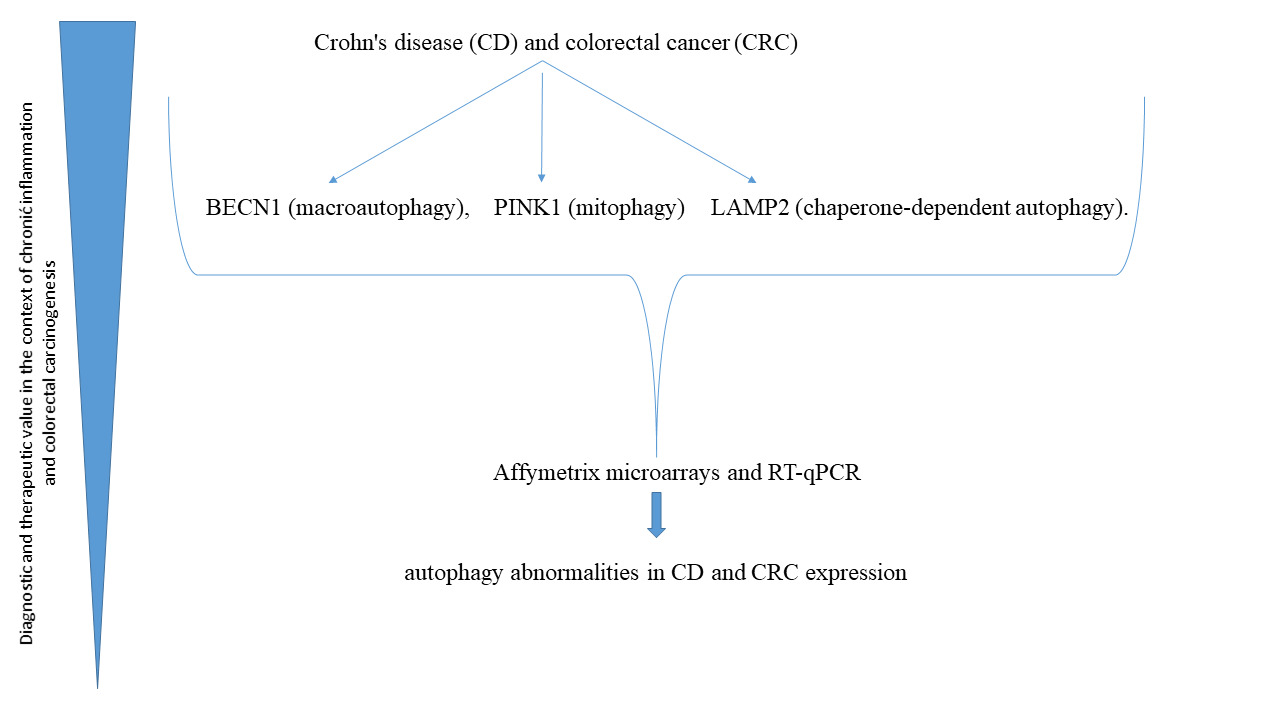
BECN1 protein is responsible for the formation of the phagophore, which leads to the formation of the autophagosome. In turn, the
PINK1 protein is involved in lysosomal mitochondrial degradation in selective autophagy (mitophagy), and the
LAMP2 protein is involved in chaperone-mediated autophagy (CMA) regulation also known as CD107b (Cluster of Differentiation 107b) and Mac-3, is a human gene [
14]. Understanding these mechanisms opens new therapeutic possibilities [
15].
The aim of the study was to investigate the potential relationship between autophagy dysregulation in patients with CD and those with colorectal cancer. Specifically, we compared the expression of genes encoding key autophagy-related proteins (BECN1, PINK1 and LAMP2) to identify similarities or differences in transcriptional activity between the two patient groups. The analysis of gene expression levels may provide insights into the shared molecular mechanisms underlying impaired autophagy in chronic intestinal inflammation and tumorigenesis. Our findings may contribute to a better understanding of the dual role of autophagy in IBD and colorectal cancer development.
2. Results and Discussion
The study included 135 patients (aged 38 to 83 years), 87 of whom underwent elective surgery for CRC at different clinical stages of the disease and 48 patients diagnosed with CD.
In the first step, the basic descriptive statistics for BECN1, PINK1 and LAMP2 gene expressions were compared in three groups: CD, CRC and CT.
The medians for
BECN1 and
LAMP2 in the CD and CRC groups were lower than in the control group. On the other hand,
PINK1 had a very high median expression in patients with CD. A significantly lower median expression of
PINK1 was reported in the group of patients with CRC, which was also higher than in the CT. The clinical characteristics of the study group with CD and CRC are given in (
Table 1,
Table 2 and
Table 3).
Table 4, shows the descriptive statistics for
BECN1,
PINK1 and
LAMP2 in the analyzed groups.
The Kruskal Wallis H test was performed to compare the results of patients with CD and CRC with the controls. The analysis showed significant differences in the values of genes between the groups. To determine the differences between the compared groups, Dunn’s post hoc pairwise comparisons test with a Bonferroni correction was applied (
Table 4). Significantly higher levels of
BECN1 were found compared to the CT (p = 0.009). Samples of patients with CD showed higher levels of
PINK1 compared to those with CRC and the controls. Significantly lower levels of
LAMP2 were found in CRC samples compared to the controls. Other differences between the groups were non-significant.
In addition, correlation analysis was performed between the expressions of the three genes using Spearman correlation analysis. In the whole sample, a weak but statistically significant positive correlation was observed between LAMP2 and PINK1 (r = 0.16, p < 0.01), while PINK1 and BECN1 were negatively correlated (r = –0.23, p < 0.01). No significant correlation was found between LAMP2 and BECN1 in this group. No statistically significant correlations were detected between the analysed genes in patients with CD. In the CRC group, LAMP2 and PINK1 showed a moderate positive correlation (r = 0.28, p < 0.01), whereas PINK1 and BECN1 were inversely correlated (r = –0.24, p < 0.05). The correlation between LAMP2 and BECN1 was not significant. Interestingly, a strong positive correlation was found between LAMP2 and PINK1 (r = 0.51, p < 0.01) in the control group, which was the most pronounced among all subgroups. No significant correlations were reported between BECN1 and the other two genes in this group.
Subsequently, the Kruskal Wallis H test was performed to compare gene expression among samples with different stages of colon cancer (CSI, CSII, CSIII and CSIV), For BECN1, the median expression decreased progressively from stage I (10245 mRNA copies/μg) to stage IV (2629 mRNA copies/μg), which suggests a potential downregulation in advanced disease. However, this trend did not reach statistical significance (p = 0.240). In contrast, PINK1 expression showed a non-linear increase, with the highest median found in stage IV (7203mRNA copies/μg) and the lowest in stage I (1.4mRNA copies/μg). The difference was not statistically significant (p = 0.196). For LAMP2, a gradual increase in expression was noted from stage I (14735 mRNA copies/μg) to stage III (19830 mRNA copies/μg) to decrease in stage IV to 17775 mRNA copies/μg. Again, the differences between the groups were not statistically significant (p = 0.602). Overall, the analysis suggests that although slight trends in gene expression across tumor stages could exist, these differences were not statistically or biologically significant in the cohort.
The pathogenesis of CRC and IBD is poorly understood. Both genetic and environmental factors are involved. Mutations, genetic instability, epigenetic changes, impaired immune response by mucosal inflammatory mediators, oxidative stress and intestinal microbiota are thought to be responsible for CRC and IBD [
16,
17].
Abnormal autophagy processes are also observed in both CRC and CD. However, their roles in the pathogenesis of these conditions are different. In both cases, autophagy disorders result from or lead to exacerbation of the disease. In CD, autophagy generally has a protective function since it maintains cellular homeostasis and limits excessive inflammatory response [
17,
18,
19,
20,
21,
22]. Ineffective autophagy results in uncontrolled inflammation, damage to the intestinal barrier, and disease progression, as confirmed by genetic studies indicating that polymorphisms in autophagy genes (e.g.,
ATG16L1,
IRGM,
NOD 2) correlate with increased susceptibility to CD [
17,
18,
19,
20,
21,
22].
In turn, altered autophagy and chronic inflammation in CRC may promote neoplastic transformation by changing the inflammatory or immunosuppressive tumor microenvironment [
18,
19]. Accumulation of damaged organelles, proteins and toxic metabolites in intestinal epithelial cells promotes induction of oxidative stress and DNA damage. Furthermore, in tumor-transformed cells, dysregulation of autophagy may enhance their ability to survive under unfavorable conditions (e.g., limited nutrient availability) and can affect resistance to anticancer treatment [
20].
In this respect, the aim of normal autophagy is to protect the body from excessive DNA damage, which directly contributes to the inhibition of carcinogenesis. Cells affected by chronic inflammation can inhibit one of the major cell proliferation pathways (mTOR). Its inhibition is a stimulus for the activation of autophagy processes aimed at degrading damaged cells, thereby preventing their potential malignant transformation [
20].
3. Materials and Methods
3.1. Patients and Methods
3.1.1. Study Design
The study included 135 patients (aged 38 to 83 years), 87 of whom underwent elective surgery for CRC at different clinical stages of the disease and 48 patients diagnosed with CD. In patients with CD, the Crohn’s Disease Activity Index (CDAI) was determined (median 188, range 74-446). Clinical characteristics did not differ significantly between the study groups in terms of parameters such as gender, height, hematocrit, and white blood cell count. Statistically significant differences were observed between the CRC and CD groups in terms of age (68 vs. 43.5 years, respectively) and BMI (26.5 vs. 21.9, respectively).
In the CRC group, the percentage of patients with particular clinical stages was as follows: I—25.3%, II—23.0%, III—37.9%, and IV—13.8%. The inclusion criteria for patients with CD and CRC were as follows: age > 18 years, any stage of disease progression and written informed consent to participate in the study (KB SUM No. KNW/0022/KB1/21/I/10).
The exclusion criteria included: severe systemic or metabolic conditions (except for obesity as an isolated disorder), a history of radio- or chemotherapy, other malignant conditions, active or a history of chronic inflammatory conditions, including IBD in patients with CRC and second surgery for the underlying disease.
Tumor and healthy control tissue samples were obtained during classical surgical resection of the colon due to cancer. The material consisted of 87 tumor samples (CRC group) and 87 healthy tissue samples obtained from an area at least 5 cm outside the histologically negative margin served as the control group, (CT). Cancer samples were obtained from the peripheral regions of the tumor to exclude the presence of necrotic tissue.
To minimize sampling errors in all 48 patients with CD, the samples were obtained from two locations of the most severe intestinal inflammatory lesions by the same surgical team. Eighty-six samples of the affected tissue were taken from 43 patient during a colonoscopy and 10 samples from 5 patients undergoing elective surgery for (sub)ileus or internal fistula (CD group, n = 96 samples in total). In patients with CD, two samples of affected tissue were collected due to the difficulties in precise determining the location of the most severe intestinal inflammatory lesions during the endoscopic examination and blurring of the macroscopic boundaries between healthy and affected tissue, which resulted in obtaining twice as many results than the real number of patients in the group. Immediately after the excision of the colonic segment or endoscopic biopsy collection, the material was placed in sterile tubes containing RNA laterTM (Sigma) in the amount of 10 µL per 1 mg of tissue (200 µL RNA laterTM per 20 mg of tissue). The samples were stored for 24 h at 4 °C. Next, the sections were frozen at -80 °C until further analysis. Molecular studies were performed at the Department of Molecular Biology of the Medical University of Silesia.
The first step of laboratory procedure was to isolate the total RNA using an electric homogenizer (Kinematica AG, Bern, Switzerland). The RNA was isolated according to the manufacturer’s instructions using the TRIzol® reagent (Life Technologies, Carlsbad, CA, USA) and was purified with the Qiagen RNeasy Mini Kit (Qiagen, Hilden, Germany) in combination with DNase I digestion. The Gene Quant II (Pharmacia Biotech, Uppsala, Sweden) spectrophotometer was used to quantify the RNA using an absorbance of 260 nm.
Confirmation of the results of the comparative analysis of transcriptomes determined by the expression microarray technique was carried out using the RT-qPCR method, which is considered the gold standard in the validation of matrix experiments. The results of the transcriptional activity analysis are given as the number of mRNA copies per 1 μg of total RNA.
The expression of BECN1, PINK1 and LAMP genes involved in ubiquitin-mediated protein degradation was investigated by RT-qPCR reaction.
The thermal profile of the RT-qPCR reaction included the following steps: reverse transcription (45ºC for 10 minutes), polymerase activation (95ºC for 2 minutes), 40 cycles including denaturation (95ºC for 5 seconds), primer attachment (60ºC for 10 seconds) and elongation (72ºC for 5 seconds). The reaction was performed using specific primer pairs for each gene (Sigma-Aldrich, St Louis, MO, USA).
The investigated genes expression was calculated based on the standard curve prepared for commercially available DNA templates of the β-actin gene using the TaqMan DNA Template Reagent (PE Applied Biosystems). Microarray analysis was validated with qRT-PCR. The transcriptional activity of genes involved in autophagy in CD and CRC was investigated and compared to the normal tissues (controls).
3.1.2. Statistical Analysis
The statistical significance of the differences in transcriptional activity of the genes involved in autophagy (p < 0.05) was evaluated by comparative analysis of RT-qPCR results performed using Data Analysis Fundamentals software (Affymetrix Inc., USA), Gene Spring GX 11.5 software (Agilent Technologies) and IBM SPSS Statistics 26.0 (StatSoft, Tulsa, OK, USA). The results were normalized using the RMA software and the Gene Spring GX 11.5 software, which enabled the selection of genes differentiating transcriptomes depending on the stage of progression of adenocarcinoma.
For each parameter, the most essential elements of descriptive statistics were determined (i.e., mean, median, standard deviation, and upper [75%] and lower [25%] quartiles).
Statistical tests were performed using the Kruskal Wallis H method to compare the groups in terms of the variables. The Dunn test with a Bonferroni correction was used for post hoc analysis. The level of significance was α = 0.05.
3.1.3. Bioethical Consent
The study received the consent of the Medical University of Silesia (KB SUM No. KNW/0022/KB1/21/I/10). All authors committed to complying with the ethical principles of clinical research based on the Declaration of Helsinki.
3.1.4. Limitations of the Study
This study has several limitations. Firstly, expression analysis was limited to the mRNA level (qPCR) without simultaneous assessment of functional autophagy activity such as LC3 or p62 protein levels and autophagosome flux dynamics. Secondly, the lack of longitudinal data makes it impossible to assess changes in autophagy gene expression over time, particularly during the transition from CD to CD-CRC, which limits the ability to identify these genes as early markers of tumor transformation. In addition, translation and protein expression levels were not assessed, which is a significant limitation since a decrease in mRNA levels is not necessarily directly associated with a decrease in functional protein levels. Furthermore, the study groups differed in terms of age, weight and BMI due to their different clinical nature. However, these variables should not significantly affect the results of the analysis.
4. Conclusions
Autophagy pathways have been reported to be significantly impaired in the pathogenesis of CD and CRC. Their interrelation plays a key role in maintaining cellular homeostasis under stress conditions leading to an immune response dependent on changes in the microenvironment and disease stage.
The study findings indicate that BECN-1 dependent macroautophagy in CRC may have a protective function at the early stage of tumor development, maintaining its anti-oncogenic properties, which are decreased or deactivated as the disease progresses. In CD, macroautophagy is activated as a protective mechanism in response to chronic inflammation. However, its dysregulation during carcinogenesis in patients with CD may contribute to the development of a more aggressive form of colorectal cancer, which is associated with a poorer prognosis and higher mortality. Decreased expression of the BECN1 gene found in CD and CRC may indicate common mechanisms of macroautophagy dysfunction underlying inflammation-induced carcinogenesis in the large intestine. However, increased PINK1 expression in CD indicates activation of protective mitophagy mechanisms in response to chronic inflammation. The importance of mitophagy in CRC increases in correlation with a decrease in the efficiency of macroautophagy at crucial stages of tumor progression (CSII, CSIV).
The decrease in LAMP2 activity in CRC and CD indicates the inhibition of the CMA pathway in CRC. In CRC, such inhibition may represent an adaptive tumor mechanism to chronic metabolic or oxidative stress, which allows temporary tolerance of damaged proteins. This phenomenon may promote the survival and proliferation of cancer cells, thus contributing to their growth under stress conditions. Significantly differentiated changes in LAMP2 activity in CD suggest its usefulness as a marker for assessing CD activity.
A strong positive correlation between PINK1 and LAMP2 in healthy tissues, which was not found in CD or CRC, indicates a profound dysregulation of mechanisms of cell quality control under pathological conditions.
Understanding the dynamically changing role of autophagy in CD and large intestine carcinogenesis has essential implications for discovering new therapeutic strategies and markers for these diseases. Our findings support the potential usefulness of BECN1, PINK1 and LAMP2 as biomarkers or therapeutic targets in CRC and CD and encourage continued research.
Author Contributions
MBL, DW, PK and MMW conceived the concept of the study. All authors contributed to the design of the research. MBL: DW, PK, MŚ, MK, MB, MMW were involved in data collection. DW, MBL, PK, analysed the data. MBL, DW, PK, MŚ, MK, MB, MMW wrote the manuscript. DW, PK MBL, MŚ, MK, MB, MMW critically revised the article. DW coordinated funding for the project. All authors edited and approved the final version of the manuscript.
Funding
This research received no specific grant from any funding agency in the public, commercial, or not-for-profit sectors.
Conflicts of Interest
None declared.
Abbreviations
| (CD) |
Crohn’s disease |
| (UC) |
ulcerative colitis |
| (IBD) |
inflammatory bowel disease |
| (CRC) |
colorectal cancer |
| BECN1 |
the human gene encoding the Beclin-1 protein |
|
PINK1—PTEN
|
induced kinase 1 |
| LAMP2 |
Lysosome-associated membrane protein 2 |
| (CMA) |
chaperone-mediated autophagy |
| (CSI, CSII, CSIII and CSIV) |
different stages of colon cancer |
| (mTOR) |
major cell proliferation pathways |
| CD107b) |
Cluster of Differentiation 107b |
References
- Verdier, J.; Breunig, I.R.; Ohse, M.C.; et al. Faecal Micro- RNAs in Inflammatory Bowel Diseases. J Crohns Colitis. 2020, 14, 110–117. [Google Scholar] [CrossRef]
- Shawki, S.; Ashburn, J.; Signs, S.A.; Huang, E. Colon Cancer: Inflammation-Associated Cancer. Surg Oncol Clin N Am. 2018, 27, 269–287. [Google Scholar] [CrossRef]
- Wanders, L.K.; Dekker, E.; Pullens, B.; et al. Cancer risk after resection of polypoid dysplasia in patients with longstanding ulcerative colitis: a meta-analysis. Clin Gastroenterol Hepatol. 2014, 12, 756–764. [Google Scholar] [CrossRef]
- Follin-Arbelet, B.; Cvancarova Småstuen, M.; Hovde, Ø.; et al. Risk of Cancer in Patients With Crohn Disease 30 Years After Diagnosis (the IBSEN Study). Crohns Colitis 2023, 5, otad057. [Google Scholar] [CrossRef]
- Hatami, B.; Pasharavesh, L.; Sharifian, A.; Zali, M.R. Concurrent inflammatory bowel disease and primary sclerosing cholangitis: a review of pre- and post-transplant outcomes and treatment options. Gastroenterol Hepatol Bed Bench. 2023, 16, 259–269. [Google Scholar]
- Puca, P.; Del Vecchio, L.E.; Ainora, M.E.; et al. Role of Multiparametric Intestinal Ultrasound in the Evaluation of Response to Biologic Therapy in Adults with Crohn’s Disease. Diagnostics (Basel). 2022, 12, 1991. [Google Scholar] [CrossRef]
- Choi, C.H.R.; Rutter, M.D.; Askari, A.; Lee, G.H.; et al. Forty-Year Analysis of Colonoscopic Surveillance Program for Neoplasia in Ulcerative Colitis: An Updated Overview. Am J Gastroenterol. 2015, 110, 1022–1034. [Google Scholar] [CrossRef]
- Gil, J.; Karpińsk, P.; Sąsiadek, M.M. Transcriptomic Profiling for the Autophagy Pathway in Colorectal Cancer. Int. J Mol Sci. 2020, 21, 7101. [Google Scholar] [CrossRef]
- He, M.M.; Lo, C.H.; Wang, K.; et al. Immune-Mediated Diseases Associated With Cancer Risks. JAMA Oncol. 2022, 8, 209–219. [Google Scholar] [CrossRef]
- Lo, B.; Zhao, M.; Vind, I.; Burisch, J. The Risk of Extraintestinal Cancer in Inflammatory Bowel Disease: A Systematic Review and Meta-analysis of Population-based Cohort Studies. Clin Gastroenterol Hepatol. 2021, 19, 1117–1138. [Google Scholar] [CrossRef]
- Levine, B.; Kroemer, G. Biological Functions of Autophagy Genes: A Disease Perspective. Cell. 2019, 176, 11–42. [Google Scholar] [CrossRef]
- Mizushima, N. A brief history of autophagy from cell biology to physiology and disease. Nat Cell Biol. 2018, 20, 521–527. [Google Scholar] [CrossRef]
- Bednarczyk, M.; Zmarzły, N.; Grabarek, B.; et al. Genes involved in the regulation of different types of autophagy and their participation in cancer pathogenesis. Oncotarget. 2018, 9, 34413–34428. [Google Scholar] [CrossRef]
- Lin, C.; Jia, S.N.; Yang, F.; et al. The transcription factor p8 regulates autophagy during diapause embryo formation in Artemia parthenogenetica. Cell Stress Chaperones. 2016, 21, 665–675. [Google Scholar] [CrossRef]
- Zhang, B.; Liu, L. Autophagy is a double-edged sword in the therapy of colorectal cancer. Oncol Lett. 2021, 21, 378. [Google Scholar] [CrossRef]
- Choi, C.H.R.; Al Bakir, I.; Ding, N.S.J.; Lee, G.H.; Askari, A.; Warusavitarne, J.; Moorghen, M.; Humphries, A.; Ignjatovic-Wilson, A.; Thomas-Gibson, S.; et al. Cumulative burden of inflammation predicts colorectal neoplasia risk in ulcerative colitis: a large single-centre study. Gut. 2019, 68, 414–422. [Google Scholar] [CrossRef]
- Xu, Y.; Shen, J.; Ran, Z. Emerging views of mitophagy in immunity and autoimmune diseases. Autophagy. 2020, 16, 3–17. [Google Scholar] [CrossRef]
- Okai, N.; Watanabe, T.; Minaga, K.; et al. Alterations of autophagic and innate immune responses by the Crohn’s disease-associated ATG16L1 mutation. World J Gastroenterol. 2022, 28, 3063–70. [Google Scholar] [CrossRef] [PubMed]
- Kaplan, G.G. The global burden of IBD: from 2015 to Nat Rev Gastroenterol Hepatol. 2015, 12, 720–727. [Google Scholar]
- Levy, J.M.M.; Towers, C.G.; Thorburn, A. Targeting autophagy in cancer. Nat Rev Cancer. 2017, 9, 528–542. [Google Scholar] [CrossRef]
- Yuan, Z.; Wang, S.; Tan, X.; Wang, D. New Insights into the Mechanisms of Chaperon- Mediated Autophagy and Implications for Kidney Diseases. Cells 2022, 11. [Google Scholar] [CrossRef] [PubMed]
- Ramjeet, M.; Hussey, S.; Philpott, D.J.; Travassos, L.H. ' Nodophagy': New crossroads in Crohn disease pathogenesis. Gut Microbes. 2010, 1, 307. [Google Scholar] [CrossRef]

Table 1.
Clinical characteristics of patients with CD and CRC.
Table 1.
Clinical characteristics of patients with CD and CRC.
| Parameter |
CD group N = 48
|
CRC group N = 87
|
p |
| Median |
Range |
Q1 |
Q3 |
Median |
Range |
Q1 |
Q3 |
| Age [y] |
43.5 |
22-78 |
31.0 |
58.5 |
68.0 |
41-82 |
59.0 |
73.0 |
0.0001 |
| Height [m] |
1.70 |
1.54-1.94 |
1.63 |
1.77 |
1.66 |
1.54-1.88 |
1.56 |
1.76 |
n.s |
| Body mass [kg] |
62.0 |
35-107 |
56.5 |
72.5 |
76.0 |
45-105 |
63.0 |
87.0 |
0.0001 |
| BMI (kg/m2) |
21.85 |
13.5-28.43 |
19.42 |
24.20 |
26.45 |
18.17-36.73 |
24.45 |
29.50 |
0.0001 |
| Ht [%] |
36.1 |
25.1-47.4 |
30.4 |
40.5 |
37.9 |
27.2-47.8 |
36.2 |
40.1 |
n.s |
| WBC [M] |
7.12 |
3.60 -25.1 |
4.84 |
9.67 |
6.56 |
2.90-15.76 |
5.09 |
8.37 |
n.s |
Table 2.
Distribution of patients by gender.
Table 2.
Distribution of patients by gender.
| Gender |
CD group |
CRC group |
p |
| N |
% |
N |
% |
| Female |
28 |
58.0 |
36 |
41.4 |
n.s. |
| Male |
20 |
42.0 |
51 |
58.6 |
n.s. |
Table 3.
Analysis of the incidence of cancer stage in patients with CRC.
Table 3.
Analysis of the incidence of cancer stage in patients with CRC.
| Cancer stage |
Number of cases |
% |
| Stage I |
22 |
25.3 |
| Stage II |
20 |
23.0 |
| Stage III |
33 |
37.9 |
| Stage IV |
12 |
13.8 |
| Total |
87 |
100.0 |
Table 4.
Comparison of gene expression in the CD, CRC, and control samples using Kruskal-Wallis H test.
Table 4.
Comparison of gene expression in the CD, CRC, and control samples using Kruskal-Wallis H test.
| Gene/group patients |
N |
Mean rank |
Median |
Q1 |
Q3 |
H |
P |
η2 |
post hoc a |
| mRNA copy/μg RNA |
| BECN1 |
CD |
96 |
121.511 |
4062.000 |
280.500 |
16890.000 |
9.421 |
0.01 |
0.030 |
CD vs CT |
| CRC |
87 |
132.823 |
6388.000 |
1571.000 |
13100.000 |
| CT |
87 |
156.433 |
10560.000 |
3853.000 |
20385.000 |
| PINK1 |
CD |
96 |
197.411 |
17380.000 |
5929.000 |
21952.000 |
89.920 |
<0.001 |
0.320 |
CD vs CRC CD vs CT |
| CRC |
87 |
119.332 |
194.000 |
0.571 |
7199.000 |
| CT |
87 |
91.701 |
13.201 |
0.073 |
1292.000 |
| LAMP2 |
CD |
96 |
126.900 |
19215.000 |
4596.500 |
24650.000 |
7.540 |
0.02 |
0.020 |
CRC vs CT |
| CRC |
87 |
122.500 |
18250.000 |
10770.000 |
29310.000 |
| CT |
87 |
151.702 |
34135.000 |
14357.500 |
51742.500 |
|
Disclaimer/Publisher’s Note: The statements, opinions and data contained in all publications are solely those of the individual author(s) and contributor(s) and not of MDPI and/or the editor(s). MDPI and/or the editor(s) disclaim responsibility for any injury to people or property resulting from any ideas, methods, instructions or products referred to in the content. |
© 2025 by the authors. Licensee MDPI, Basel, Switzerland. This article is an open access article distributed under the terms and conditions of the Creative Commons Attribution (CC BY) license (http://creativecommons.org/licenses/by/4.0/).