

Submitted:
07 October 2025
Posted:
08 October 2025
You are already at the latest version
Abstract
Indoor Air Quality (IAQ) in educational environments is a critical determinant of students’ health, well-being, and learning performance, with inadequate ventilation and pollutant accumulation consistently associated with respiratory symptoms, fatigue, and impaired cognitive outcomes. Conventional monitoring approaches—based on periodic inspections or subjective perception—provide only fragmented insights and often underestimate exposure risks. Artificial intelligence (AI) offers a transformative framework to overcome these limitations through sensor calibration, anomaly detection, pollutant forecasting, and the adaptive control of ventilation systems. This review critically synthesizes the state of AI applications for IAQ management in educational environments, drawing on twenty real-world case studies from North America, Europe, Asia, and Oceania. The evidence highlights methodological innovations ranging from decision tree models integrated into large-scale sensor networks in Boston, to hybrid deep learning architectures in New Zealand, and regression-based calibration techniques applied in Greece. Collectively, these studies demonstrate that AI can substantially improve predictive accuracy, reduce pollutant exposure, and enable proactive, data-driven ventilation management. At the same time, cross-case comparisons reveal systemic challenges—including sensor reliability and calibration drift, high installation and maintenance costs, limited interoperability with legacy building management systems, and enduring concerns over privacy and trust. Addressing these barriers will be essential for moving beyond localized pilots. The review concludes that AI holds transformative potential to shift school IAQ management from reactive practices toward continuous, adaptive, and health-oriented strategies. Realizing this potential will require transparent, equitable, and cost-effective deployment, positioning AI not only as a technological solution but also as a public health and educational priority.
Keywords:
indoor air quality
; machine learning
; deep learning
; educational buildings
; sustainable buildings
; healthy buildings
1. Introduction
The building sector is responsible for approximately 30–40% of global final energy consumption and nearly 30% of energy-related CO₂ emissions [1,2,3,4]. Consequently, research and policy have largely emphasized energy efficiency measures, renewable integration, and the deployment of smart building technologies [5,6,7,8,9]. To this end, sustainable buildings have become a cornerstone of global strategies to mitigate climate change, reduce energy demand, and enhance human well-being [10,11]. Yet, sustainability also encompasses the health and comfort of occupants, making indoor environmental quality a critical dimension of building performance. Among its components, indoor air quality (IAQ) is of particular concern because it directly influences human health, productivity, and cognitive function [12,13].
Educational environments require special attention. Children spend up to 90% of their time indoors, and schools are among the most densely occupied building types [14]. Poor IAQ in classrooms has been consistently linked to respiratory illnesses, asthma, allergies, fatigue, and impaired cognitive outcomes [15,16,17]. Empirical evidence from European and North American schools shows that carbon dioxide (CO₂) concentrations frequently exceed the recommended 1000 ppm threshold, with many classrooms reporting values above 2000 ppm due to inadequate ventilation [18,19]. High levels of particulate matter [20,21] volatile organic compounds (VOCs) [19], ozone [22], and nitrogen dioxide [23] are also common in urban schools, further compromising children’s health. These findings underline that IAQ is not only a comfort issue, but also a public health priority and a key determinant of sustainable school design.
Traditional IAQ monitoring methods face significant shortcomings. Periodic inspections offer only episodic snapshots of classroom conditions, while reliance on subjective perception often leads to underestimation of pollutant levels [24]. Even with the deployment of continuous sensor networks, technical challenges such as calibration drift, measurement noise, and heterogeneity across devices undermine reliability. This complexity calls for analytical approaches capable of managing high-frequency, multivariate, and dynamic datasets that characterize real-world classroom environments.
Artificial intelligence (AI) has emerged as a promising framework to address these challenges. Classical machine learning (ML) techniques—such as decision trees, support vector machines (SVMs), and random forests—have demonstrated strong predictive capability in pollutant trend estimation and classification of IAQ states [5]. More advanced deep learning (DL) architectures, including convolutional neural networks (CNNs), recurrent neural networks (RNNs), long short-term memory (LSTM) models, and autoencoders, extend these capabilities by automatically learning spatiotemporal dependencies, filtering noise, and enhancing anomaly detection. These methods enable a range of tasks critical for IAQ management: (i) sensor calibration using regression and feature engineering to correct biases in low-cost devices; (ii) pollutant forecasting (e.g., CO₂, particulate matter with an aerodynamic diameter of 2.5 micrometers or less, PM₂.₅) to support preemptive ventilation control; (iii) anomaly detection in time-series to flag system malfunctions or atypical occupancy; and (iv) multi-objective optimization of heating, ventilation, and air conditioning (HVAC) systems, balancing IAQ improvements with energy efficiency.
Recent reviews have proposed a systematic framework that classifies AI applications for air quality monitoring into five domains: sensor calibration, anomaly detection, air quality index estimation, short-term forecasting, and integrated control [25,26]. This framework underscores both the opportunities and the challenges of deploying AI, particularly with respect to data reliability, scalability, and system integration. By organizing diverse applications into coherent categories and evaluating their strengths and limitations, this body of work demonstrates how AI can move IAQ assessment from episodic and reactive approaches toward continuous, predictive, and adaptive management.
Despite these advances, the application of AI to IAQ in educational environments remains fragmented and underdeveloped. First, most reported studies are localized pilot projects confined to individual schools or small samples under specific climatic and infrastructural conditions [27,28]. Such narrow scopes restrict generalizability and make it difficult to evaluate the scalability of AI-based solutions across diverse educational contexts. Second, while many models achieve high predictive accuracy in controlled settings such as [27,29], few address issues of long-term sustainability [30]. Performance often deteriorates without frequent retraining, and persistent problems of sensor calibration and data drift remain unresolved. These limitations undermine the robustness and reliability of AI systems in real-world deployments. Third, the integration of AI with legacy HVAC and Building Management Systems (BMS) has received limited attention [31,32], even though automated ventilation control depends on such interoperability in most schools. Without seamless integration, AI tools risk functioning as isolated analytics rather than as actionable decision-support systems. Fourth, the social and ethical dimensions of AI adoption—including privacy protection, data security, transparency, and trust among teachers, parents, and administrators—are seldom addressed in technical studies [33,34]. Yet, these considerations are critical for acceptance in sensitive environments such as schools. Finally, to date there has been no systematic review consolidating international evidence on AI for IAQ in schools. Existing reviews tend to emphasize energy efficiency [35,36], or general air quality [25,37] leaving a gap in understanding how methodological advances, practical challenges, and contextual constraints intersect in educational settings.
The objective of this review is to critically examine the applications of AI for IAQ management in educational environments, with a focus on both methodological innovation and practical deployment. Specifically, the review seeks to:
- (a)
- Synthesize methodological advances in AI-based IAQ monitoring, prediction, and control, including the use of (ML), (DL), and hybrid models;
- (b)
- Assess outcomes across diverse geographical and socio-technical contexts, drawing on twenty representative international case studies that span North America, Europe, Asia, and Oceania;
- (c)
- Identify systemic barriers—technical (e.g. data scarcity, model generalizability), economic (e.g. cost of deployment and maintenance), and ethical (e.g. privacy and trust)—that constrain the broader adoption of AI in schools;
- (d)
- Highlight pathways for future research and implementation, emphasizing scalability, sustainability, and equity in educational settings.
The selection of literature followed a selective but comprehensive review strategy rather than a systematic database search. The main criteria guiding inclusion were: (i) relevance to AI applications for IAQ in schools; (ii) methodological rigor and empirical validation; (iii) diversity of approaches, ranging from classical ML to advanced DL and hybrid models; and (iv) practical applicability, including real-world case studies and integration with HVAC or smart campus systems. In doing so, the review provides not only a state-of-the-art synthesis of current practice, but also a forward-looking framework for advancing AI-enabled IAQ management in educational environments.
The innovation of this review lies in its integrative and critical perspective. While most prior studies have examined AI in buildings primarily for energy efficiency or in general indoor environments [32,35], few have addressed the specific challenges of schools, where children’s heightened vulnerability, high occupancy rates, and limited resources necessitate tailored approaches [27,28]. This review advances the field by offering a comparative synthesis of real-world AI applications in educational settings, explicitly linking technical performance metrics—such as forecasting accuracy, anomaly detection, and adaptive control—with broader systemic issues of scalability, equity, and privacy. Beyond framing AI as a technological solution, the review positions its adoption as both a public health imperative and an educational priority. By examining AI within the interconnected domains of sustainability, health, and education, this review extends beyond conventional technical surveys to systematically evaluate the potential of an integrated approach to IAQ management. The novelty of this work therefore lies not only in synthesizing algorithmic advances, but also in demonstrating that AI’s impact should be evaluated based on its capacity to deliver equitable, transparent, and sustainable improvements to learning environments. In doing so, this review charts clear directions for future research and practice, identifying pathways to advance from fragmented pilot studies toward globally scalable and impactful solutions.
The remainder of this paper is structured as follows: section 2 provides an overview of IAQ challenges in educational environments; section 3 reviews the main categories of AI methods (ML, DL, and hybrid models) applied to IAQ; section 4 synthesizes findings from twenty representative case studies worldwide; and finally, section 5 offers a critical discussion of implications, limitations, and future directions.
2. Indoor Air Quality in School Environments: Key Considerations and Determinants
Indoor air quality (IAQ) refers to the condition of indoor air in relation to occupants’ health, comfort, and performance, encompassing pollutant concentrations, odors, and the adequacy of ventilation [38]. In school environments, this concept acquires heightened importance because children spend extended hours indoors, exhibit higher inhalation rates per body weight compared to adults, and are physiologically more vulnerable to environmental stressors. A substantial body of evidence links inadequate IAQ in classrooms to respiratory illnesses, allergy symptoms, absenteeism, and impaired cognitive functions, thereby influencing both health and learning outcomes [14,37,39,40,41].
These challenges are compounded by structural and operational characteristics of schools, such as high occupant density, limited ventilation rates, and aging infrastructures with outdated heating, ventilation, and air-conditioning (HVAC) systems [42]. Furthermore, many educational buildings were constructed with limited consideration of modern energy and IAQ standards, leading to situations where efforts to improve ventilation and pollutant removal directly conflict with energy conservation goals [16]. As a result, ensuring satisfactory IAQ in schools requires not only identifying the predominant pollutants and their sources but also evaluating the building’s ability to balance air exchange, filtration efficiency, and energy performance [43].This dual perspective places IAQ management in schools at the intersection of public health and smart building design, underlining the need for innovative approaches, such as sensor-based monitoring and AI-driven optimization, to deliver safe, healthy, and sustainable learning environments [44,45,46].
2.1. Classification and Sources of Indoor Air Pollutants
Indoor air pollutants in schools originate from both indoor emission sources and outdoor infiltration, with their impacts often amplified by high occupant density, inadequate ventilation rates, and outdated building infrastructures [22,23,47,48,49,50]. Among the most widely studied indicators of indoor air quality, carbon dioxide (CO₂) serves as both a contaminant of concern and a widely used proxy for ventilation adequacy [51]. CO₂ is primarily generated by human respiration, with additional contributions from combustion-based heating systems. In classrooms with insufficient ventilation, concentrations frequently surpass recommended thresholds of 1000 ppm established by international standards such as ASHRAE 62.1 and EN 16798 [38,52]. Prolonged exposure to elevated CO₂ levels has been associated with symptoms including headaches, fatigue, and drowsiness, as well as with measurable decrements in students’ concentration, decision-making, and overall cognitive performance [28,42,53]. Importantly, strategies to reduce CO₂ concentrations through increased ventilation often impose significant energy penalties, particularly in climates requiring substantial heating or cooling, thereby illustrating the persistent trade-off between IAQ management and energy efficiency in educational buildings [45].
Particulate Matter (PM₂.₅ and PM₁₀) constitutes a critical pollutant group in school environments, comprising airborne particles with aerodynamic diameters below 2.5 μm and 10 μm, respectively. These particles remain suspended for extended periods and can penetrate deeply into the respiratory tract, where they are associated with adverse cardiovascular and respiratory outcomes [15]. In addition to fine and coarse fractions, ultrafine particles (UFPs, <0.1 μm) are increasingly recognized as a concern due to their ability to translocate into the bloodstream and exert systemic health effects [46,54].
In schools, PM originates from a combination of outdoor sources—notably traffic-related emissions and resuspension of playground dust—and indoor sources such as cleaning activities, combustion appliances, chalk use, and resuspension from floors and furniture. Elevated concentrations of PM₂.₅ and PM₁₀ have been consistently linked to increased incidence of asthma symptoms, reduced lung function, and higher absenteeism among children, who are physiologically more vulnerable to inhaled pollutants [46,53].
The mitigation of PM exposure in classrooms typically relies on increased ventilation or filtration efficiency, but both approaches carry significant energy implications. Enhanced ventilation dilutes indoor concentrations but increases heating and cooling demand, while advanced filtration technologies improve IAQ at the expense of higher fan energy use. This duality underscores the necessity of optimizing PM control strategies within an integrated IAQ–energy management framework [55].
Volatile Organic Compounds (VOCs) represent a diverse group of carbon-based chemicals that readily evaporate at room temperature and are frequently detected in school environments [56]. Common sources include cleaning products, paints, adhesives, flooring materials, and furnishings, with formaldehyde—a major constituent of pressed wood products such as desks and cabinets—being one of the most prevalent and well-documented indoor VOCs [57]. Acute exposure to VOCs can cause mucosal irritation, headaches, dizziness, and fatigue, whereas chronic exposure has been associated with more severe health outcomes, including asthma development, nasopharyngeal cancer, and myeloid leukemia [28,53]. Children are especially vulnerable because of their higher inhalation rates relative to body weight and their physiologically immature detoxification systems [58]. The continuous low-level release of VOCs from construction materials and consumer products results in cumulative exposures that pose risks to both health and learning performance. Strategies to mitigate VOC levels typically involve source control (selecting low-emission building materials and furnishings) and ventilation enhancement, yet these measures often entail an energy penalty. Increased ventilation raises heating and cooling demand, while advanced filtration or sorption technologies elevate operational energy use [59]. This duality underscores the importance of integrating material selection, ventilation design, and IAQ monitoring within a broader framework of energy-efficient building operation.
Biological contaminants constitute a major determinant of indoor air quality in schools, where high occupancy density and variable maintenance practices create favorable conditions for microbial growth and transmission. Fungal contamination is particularly common in damp environments, arising when relative humidity exceeds 60% or when water damage compromises walls, ceilings, carpets, or books [60]. Exposure to mold spores has been consistently associated with asthma exacerbation, allergic responses, and respiratory symptoms, with children and individuals with pre-existing conditions being the most vulnerable populations [15,61].
Beyond fungi, bacteria and viruses readily circulate in crowded classrooms through both airborne droplets and contact with contaminated surfaces [62]. Pathogens of concern include Streptococcus pneumoniae, Rhinovirus, influenza viruses, and more recently SARS-CoV-2, whose airborne transmission highlighted the central role of ventilation and filtration effectiveness in infection control [63,64]. Inadequate ventilation, poor humidity regulation, and insufficient HVAC maintenance exacerbate microbial accumulation and persistence, whereas interventions such as mechanical ventilation upgrades, high-efficiency filtration, and humidity control have been shown to mitigate transmission risks.
The presence of biological pollutants not only undermines student health but also results in increased absenteeism among pupils and staff, thereby reducing overall learning outcomes and institutional productivity. Importantly, effective mitigation strategies often require higher ventilation and filtration rates, which can substantially increase energy demand. This reinforces the need for integrated IAQ–energy management frameworks that leverage advanced monitoring, predictive modeling, and smart building operation to maintain healthy indoor environments in schools without compromising energy efficiency [42,55].
In addition to CO₂, PM, and VOCs, gaseous pollutants such as nitrogen dioxide (NO₂) and tropospheric ozone (O₃) represent significant concerns in school environments [22,23]. NO₂ originates predominantly from outdoor traffic-related emissions, with additional contributions from unvented gas appliances and combustion-based heating systems indoors. Elevated NO₂ levels have been consistently associated with airway inflammation, asthma exacerbation, and reduced lung function in children [22]. By contrast, O₃ is largely introduced from outdoor air, although it can also be generated indoors by certain electronic devices and cleaning technologies. Exposure to tropospheric ozone has been linked to eye and throat irritation, impaired pulmonary function, and worsening of asthma symptoms [23]. Both pollutants highlight the strong dependence of indoor air quality on ambient outdoor conditions and building ventilation dynamics. Schools situated near major roads or in urban pollution hotspots are especially vulnerable, as pollutant infiltration often coincides with inadequate building envelope performance and insufficient filtration. Moreover, ozone readily reacts with indoor VOCs, forming secondary pollutants such as formaldehyde and ultrafine particles, further compounding health risks [56,65]. Mitigation strategies—including enhanced filtration, demand-controlled ventilation, and selective air intake scheduling—can effectively reduce exposures but frequently increase energy demand, underlining the need for integrated IAQ–energy management solutions [66].
A synthesis of the principal pollutant groups relevant to school environments, along with their dominant sources and associated health and performance outcomes, is presented in Table 1. The table highlights the broad spectrum of contaminants typically encountered in classrooms and shows how school-specific conditions—such as high occupant density, intensive use of materials, and insufficient ventilation—can substantially exacerbate exposures. By systematically linking pollutant categories with their health and cognitive effects, Table 1 offers a structured framework for understanding the mechanisms through which indoor contaminants contribute to both acute symptoms and long-term risks in students and staff. Moreover, this synthesis emphasizes that pollutant management in schools cannot be decoupled from building operation: strategies to reduce exposure often influence energy performance, reinforcing the need for integrated approaches that jointly address IAQ, health, and sustainability objectives.
While the presence of indoor pollutants is a central concern, the overall quality of classroom air is equally governed by environmental, operational, and structural determinants that mediate exposure dynamics. Ventilation strategy, thermal and moisture conditions, building envelope performance, emission characteristics of construction materials, occupancy density, and HVAC operation and maintenance interact in complex ways to shape pollutant concentrations and their associated health outcomes [71,72]. Importantly, these same parameters also influence energy demand, underscoring the need to evaluate IAQ within the broader context of sustainable building performance [73]. Systematically addressing these determinants is therefore critical for the design of resilient, energy-efficient, and health-promoting learning environments. Table 2 synthesizes the principal factors affecting IAQ in schools and outlines targeted interventions aimed at mitigating risks while supporting both student well-being and institutional sustainability.
The determinants outlined in Table 2 demonstrate that indoor air quality in schools is shaped not only by the presence of pollutants but also by the operational, environmental, and structural characteristics of the building. Inadequate ventilation remains one of the most critical drivers of elevated CO₂ and particulate concentrations, particularly in densely occupied, naturally ventilated classrooms [15,17,38,46]. Thermal and humidity regulation is equally essential, as deviations from recommended ranges not only compromise thermal comfort but also promote microbial growth and survival, thereby amplifying respiratory health risks [16,74]. Building materials and cleaning practices act as additional emission sources, with furnishings, paints, adhesives, and detergents identified as major contributors of VOCs and allergens [15,16]. Moreover, poor maintenance of HVAC systems diminishes filtration efficiency, encourages microbial proliferation, and facilitates the accumulation of chemical and biological contaminants [38,53]. Taken together, these findings highlight the need for integrated IAQ management strategies that couple technological interventions—such as advanced filtration, humidity control, and demand-controlled ventilation—with behavioral and policy measures, including low-emission material selection, pollutant source reduction, and systematic maintenance protocols. Importantly, because many of these interventions directly affect building energy demand, IAQ management must be embedded within a broader sustainability framework that balances health protection, energy efficiency, and climate objectives.
2.2. Impacts of IAQ on Health and Educational Performance
Poor IAQ in schools has been consistently associated with adverse health outcomes and impaired academic performance, with children representing a particularly vulnerable population due to their immature respiratory and immune systems, higher ventilation rates per body weight, and longer daily occupancy indoors [78]. Exposure to pollutants such as PM₂.₅, PM₁₀, CO₂, and VOCs increases both the prevalence and severity of asthma, allergies, and other respiratory conditions, often manifested as sneezing, nasal congestion, eye irritation, coughing, and dermatological symptoms [28,79]. Acute exposures, especially elevated CO₂ concentrations in inadequately ventilated classrooms, are frequently associated with fatigue, headaches, dizziness, and discomfort, which undermine students’ physical well-being and directly reduce attention, concentration, and decision-making capacity [15].
Beyond short-term symptoms, poor IAQ has been shown to contribute to increased absenteeism, reduced standardized test scores, and diminished classroom engagement, thereby exerting measurable effects on educational outcomes [55,80]. These findings underline that the consequences of inadequate IAQ extend well beyond health risks, shaping both the learning efficiency of students and the overall productivity of school systems. These health burdens translate directly into educational performance. Students experiencing respiratory or pollutant-related symptoms are more likely to miss school, disrupting learning continuity and long-term academic progress. Even in the absence of absenteeism, poor IAQ exerts measurable effects on cognitive function: high CO₂ levels reduce alertness, concentration, and decision-making accuracy [61], while exposure to particulate matter and VOCs further impairs attention span and task completion [15,28]. The cumulative evidence demonstrates that inadequate IAQ simultaneously compromises children’s health and their capacity to learn, underscoring air quality management as a prerequisite not only for safeguarding well-being but also for sustaining academic performance in educational settings [61]. Figure 1 illustrates the pathways linking IAQ determinants to health outcomes and educational achievement.
2.3. Regulatory Framework and Standards for IAQ in School Environments
Ensuring adequate indoor air quality (IAQ) in schools is widely recognized as a fundamental prerequisite for safeguarding student health, well-being, and academic performance, and is therefore embedded within a range of international and national regulatory frameworks. Although these frameworks differ in scope, specificity, and enforcement, they share the overarching objective of defining acceptable pollutant thresholds and establishing protocols for monitoring and managing air quality in educational environments [58].
In the United States, ASHRAE has established performance-based standards for schools, most notably in ASHRAE Standard 62.1, which prescribes a minimum outdoor airflow rate of 10 L/s per person (equivalent to ~10 L/min per student), alongside criteria for air filtration, humidity regulation, and CO₂ concentration control, in order to ensure both health protection and thermal comfort [76]. Complementing these technical standards, the U.S. Environmental Protection Agency (EPA) developed the Indoor Air Quality Tools for Schools program, which provides a structured framework for pollutant monitoring, ventilation management, and stakeholder engagement, thereby facilitating the translation of regulatory guidance into operational practice within educational facilities [53].
At the European level, EN 16798-1 specifies ventilation requirements for non-residential buildings, including classrooms, with reference to both per-person airflow rates and indoor CO₂ thresholds relative to outdoor concentrations, while the World Health Organization (WHO, 2010) has issued guideline values for key pollutants such as formaldehyde, benzene, NO₂, and PM₂.₅. These frameworks highlight the dual challenge of achieving adequate IAQ while controlling the energy implications of ventilation and filtration, a balance that remains particularly difficult in aging school infrastructures with limited retrofitting capacity.
At the international level, the WHO has issued air quality guidelines that are widely referenced in the management of IAQ in schools, with recommended thresholds of 10 µg/m³ for PM₂.₅ and 20 µg/m³ for PM₁₀ (annual mean values) [21]. These guidelines underscore the heightened susceptibility of children to air pollution, linking exposure to fine particulate matter with increased respiratory morbidity and long-term health risks. In parallel, performance-based ventilation standards such as those set by ASHRAE and the European Standard EN 16798-1 specify a maximum indoor CO₂ concentration of 1000 ppm, which is commonly adopted as a benchmark for adequate classroom ventilation [76].
Within the European Union, regulatory attention to IAQ has expanded through both legislative and technical instruments. The revised Energy Performance of Buildings Directive (Directive 2018/844/EU) explicitly incorporates IAQ as a requirement for healthy indoor environments, with Article 13 encouraging the monitoring of key pollutants in high-occupancy spaces such as classrooms. Complementing this, the European Standard EN 16798 specifies performance-based ventilation requirements, including a minimum outdoor airflow of 7 L/s per person and an indoor CO₂ concentration not exceeding 1000 ppm [52]. By coupling pollutant control with energy efficiency objectives, these measures reflect a growing policy emphasis on integrated approaches that safeguard occupant health while supporting sustainability targets [19,81].
Despite the establishment of regulatory frameworks, substantial challenges and limitations remain in practice. Compliance is often hampered by financial constraints, outdated infrastructure, and inconsistent enforcement mechanisms, particularly in older or underfunded schools where resources for retrofitting are limited. Furthermore, most current regulations adopt a static, prescriptive approach that does not adequately reflect the complexity of pollutant dynamics or the variability of classroom occupancy and use. Crucially, existing standards rarely integrate emerging technologies such as AI-enabled real-time monitoring, predictive modeling, and adaptive ventilation control, which offer considerable potential for achieving dynamic, cost-effective, and energy-efficient IAQ management [13]. Addressing these gaps will require not only more rigorous implementation of existing requirements but also the systematic incorporation of smart, data-driven strategies into regulatory and operational practice, thereby aligning IAQ management with broader objectives of health protection, energy efficiency, and long-term sustainability in school environments.
2.4. IAQ in educational environments: Challenges, Innovations, and Policy Prospects
Despite decades of research, achieving adequate IAQ in educational environments remains a persistent and systemic challenge. Recurrent issues include non-standardized ventilation practices, frequent exceedances of pollutant thresholds, and limited policy prioritization, particularly in older or under-resourced educational facilities [46,64,78]. These challenges are compounded by the absence of harmonized, child-specific exposure limits and the lack of comprehensive long-term monitoring frameworks, which together constrain efforts to establish robust, evidence-based links between IAQ conditions, health outcomes, and educational performance.
At the same time, technological and analytical innovations provide promising avenues for improvement. Advances in low-cost sensor networks and real-time monitoring platforms are increasingly being deployed to track pollutant concentrations in classrooms, with growing efforts to integrate IAQ metrics with student health and cognitive performance indicators [82]. In parallel, statistical and machine learning models have quantified the effects of CO₂, PM, and other pollutants on outcomes such as attention, fatigue, and academic productivity, reinforcing the central role of IAQ in promoting both health and educational equity [83]. However, these initiatives remain fragmented and largely experimental, with limited validation across diverse climatic and socioeconomic contexts and insufficient incorporation into binding regulatory and design frameworks. Without systematic integration into school building standards and operational protocols, the potential of these innovations to deliver sustainable, scalable, and equitable improvements in IAQ will remain underutilized.
Taken together, the current body of evidence underscores the need for a coordinated, technology-enabled approach to IAQ management in schools. This requires not only the deployment of smart ventilation systems, sensor-based monitoring platforms, and predictive control strategies, but also the systematic alignment of IAQ objectives with broader health, education, and sustainability policies at both national and supranational governance levels. To support this integration, Table 3 synthesizes recent insights from the literature, structuring them into focus areas, innovation highlights, critical gaps, and future prospects, thereby providing a strategic roadmap for research, policy development, and practical implementation in school environments.
The synthesis presented in Table 3 shows that, although research on IAQ in educational environments has expanded substantially, progress remains fragmented and uneven across thematic domains. Natural ventilation and CO₂ monitoring are among the most frequently studied strategies; however, their effectiveness is limited by the lack of enforceable performance standards and the persistent over-reliance on CO₂ as a proxy for IAQ, despite its inability to capture chemical and biological exposures [37,79]. Efforts to establish links between pollutant exposure, child-specific health outcomes, and cognitive performance show considerable promise but are hindered by the absence of harmonized thresholds and the limited availability of longitudinal epidemiological datasets [13,58]. Similarly, while sensor-based monitoring, statistical modelling, and data-driven ventilation strategies offer transformative potential, their impact is curtailed by the lack of standardized calibration protocols, interoperability frameworks, and coordinated large-scale deployment, which restrict both comparability across studies and scalability in practice [53,79].
A recurrent theme is the imbalance between technological innovation and policy adoption. Programs such as the EPA’s IAQ Tools for Schools [53]provide structured governance frameworks, yet their voluntary nature and lack of enforcement limit their systemic impact. Within Europe, uneven policy prioritization and resource allocation continue to perpetuate disparities in IAQ, with disadvantaged schools disproportionately affected [63]. This reinforces the need for EU-level mandates, harmonized child-specific exposure standards, and dedicated funding mechanisms to ensure equitable protection.
Crucially, IAQ in schools cannot be considered in isolation from energy performance objectives. Strategies such as increased ventilation and advanced filtration improve pollutant control but often elevate heating, cooling, and fan energy demand. The absence of integrated frameworks to reconcile this trade-off highlights a major research and policy gap. The new row in Table 3 emphasizes that AI-driven demand-controlled ventilation and predictive IAQ–energy modelling represent a promising pathway to address this dual challenge. Embedding such approaches into building operation protocols and regulatory standards will be essential to achieve healthy, energy-efficient, and sustainable school environments.
Overall, Table 3 underscores the urgency of bridging the gap between scientific evidence, technological innovation, and regulatory enforcement. A systemic approach that combines smart monitoring technologies, predictive and adaptive ventilation control, child-focused exposure guidelines, and binding governance frameworks, while simultaneously integrating energy efficiency considerations, will be essential to translate current knowledge into effective, scalable, and sustainable practice in schools.
3. Artificial Intelligence Approaches for IAQ Assessment in Educational Environments
Artificial intelligence (AI) is increasingly regarded as a transformative framework for indoor air quality (IAQ) assessment in educational environments, where exposure is closely tied to health outcomes and learning performance. Unlike conventional statistical or rule-based methods, AI can integrate and analyze heterogeneous data sources—including pollutant concentrations, meteorological drivers, ventilation rates, and dynamic occupancy profiles—to capture the nonlinear interactions that govern IAQ variability [84,85,86]. For example, recent reviews of neural network and machine learning models in school settings highlight their superiority over linear approaches in capturing CO₂ variation under fluctuating occupancy and ventilation schedules [27]. Likewise, García-Pinilla et al. [87] demonstrated that ML-based models outperform simple methods for longer-term CO₂ forecasting in school classrooms. Machine learning (ML) and Deep Learning (DL) approaches, in particular, have been shown to enhance the accuracy of pollutant forecasting, enable anomaly detection in sensor networks (e.g., LSTM-autoencoder models achieving > 99 % accuracy in school IAQ time series [88]), and support adaptive control strategies for HVAC systems, including DL-driven fault detection and diagnostics with F-measure values exceeding 0.97 [5,6,89,90,91]. Such capabilities are especially relevant in educational buildings, where ventilation demand often fluctuates rapidly and where traditional steady-state models fail to capture transient exposure conditions. Nevertheless, the application of AI to IAQ in schools remains constrained by challenges such as limited availability of long-term, high-resolution datasets, potential overfitting of models trained on small or site-specific samples, lack of model generalization across different climatic and building contexts [27], and difficulties in ensuring model interpretability for practical building management[85]. Addressing these limitations is critical if AI is to evolve from a predictive tool toward a reliable decision-support system for sustainable and health-oriented educational environments. The hierarchical structure of AI, ML, and DL, and their respective roles in IAQ modelling, is illustrated in Figure 2.
3.1. Machine Learning Methods
Unlike traditional statistical approaches, which often assume linear relationships, ML can capture nonlinear dependencies among diverse environmental and operational variables, providing more reliable predictions of pollutant behaviour [92,93]. In general, ML methods can be grouped into four main categories according to how they learn from data [5]: (a) supervised learning, which relies on labelled datasets to establish explicit input–output mappings and is commonly applied to tasks such as pollutant classification or concentration forecasting [94], (b) unsupervised learning, which, by contrast, works with unlabeled data to identify latent structures or clusters—for instance, grouping classrooms by similar pollution profiles [95,96], (c) semi-supervised learning which bridges the two by leveraging a small set of labelled data together with a much larger body of unlabeled observations [97], and finally, (d) reinforcement learning, which uses iterative interaction between an agent and its environment to optimize long-term outcomes [98].
Among supervised approaches, Support Vector Machines (SVMs), Decision Trees (DTs), k-nearest neighbours (k-NNs), and Artificial Neural Networks (ANNs) are the most widely applied for short-term pollutant forecasting, exposure classification, and anomaly detection [99,100,101,102,103,104].
Support Vector Machines (SVMs) have demonstrated strong performance in classifying classroom air quality conditions—such as “good,” “moderate,” or “poor”—using input features including CO₂ concentration, particulate matter levels, and occupancy-related variables [103]. The method constructs an optimal separating hyperplane between classes by maximizing the margin, formulated as [95]:
where, xᵢ is the feature vector, yᵢ is the class label, w is weight vector defining the orientation of the separating hyperplane, b is bias term, and the constrain yᵢ (w·xᵢ + b) ≥ 1 ensures correct classification of all training samples with maximum margin
minimize (1/2)||w||² subject to yᵢ (w·xᵢ + b) ≥ 1 ∀i
DTs are valued for their interpretability, as they explicitly identify the dominant drivers of pollutant exceedances, such as occupancy density or inadequate ventilation [100,101,102]. DTs add value through interpretability, as they identify dominant drivers of exceedances (e.g., occupancy density, ventilation regime), making them particularly suitable for building management applications that demand transparency [100,102].
At each node, the algorithm selects the variable and threshold that minimize an impurity measure, most commonly the Gini index [95,101]:
G = 1 – Σ (pₖ²)
Where, pₖ is the proportion of samples belonging to class k in a given node, k is the number of class, and G is the impurity measure (0 = perfectly pure node, higher values = more mixed node).
k-NNs is a non-parametric algorithm that classifies or predicts outcomes by comparing a new observation with the k most similar instances in the training dataset. Similarity is typically quantified using a distance metric, most commonly the Euclidean distance[105]:
Where, are feature vectors, M is the number of features, is the Euclidean distance between two observations i and j and k is the number of nearest neighbours used to classify or predict.
In classroom applications, k-NN supports real-time anomaly detection by identifying deviations from previously observed sensor patterns, which allows for timely corrective actions—such as adjusting ventilation rates—before pollutant levels exceed health-related thresholds [1,5,6,91,99,104].
Artificial Neural Networks (ANNs), inspired by the structure of biological neurons, have been increasingly employed for IAQ prediction because of their ability to approximate nonlinear relationships between multiple input variables (e.g., occupancy, temperature, ventilation rates, outdoor meteorological conditions) and output responses (e.g., pollutant concentrations, IAQ categories). A neuron in a feed-forward ANN computes its output as[94,95]:
Where, are the input features, are the connection weights, b the bias term, the activation functions, and the predicted or estimated output.
Feed-forward ANNs trained with backpropagation are frequently applied to tasks such as pollutant forecasting and short-term IAQ classification [27,87]. These models have, for instance, been used to predict CO₂ variation in classrooms with fluctuating occupancy schedules.
Beyond classification tasks, regression-oriented ML techniques are increasingly employed to model pollutant dynamics and to examine their associations with both indoor and outdoor determinants. These methods are particularly relevant in naturally ventilated schools, where CO₂, particulate matter, and volatile organic compounds often display pronounced temporal variability shaped by occupancy density, building envelope characteristics, and local meteorological conditions [92,106]. Recent studies have further strengthened this research direction by linking ML-based pollutant forecasts with indicators of student health and cognitive performance, suggesting that accurate prediction can enable timely interventions aimed at reducing absenteeism and improving learning outcomes [79,93].
Nevertheless, several challenges continue to limit the scalability and robustness of ML applications in IAQ management. A primary constraint is the scarcity of large, high-quality training datasets, as most school-based investigations are based on short-term monitoring or restricted sample sizes, which undermines model generalizability [28,92,107]. Data uncertainties introduced by sensor calibration issues and variable measurement quality further increase the risk of systematic bias. In addition, models trained in specific climatic zones or building typologies often perform poorly when transferred to different contexts, highlighting the fragility of current approaches. Addressing these shortcomings will require coordinated initiatives to establish harmonized monitoring protocols, publicly available benchmark datasets, and rigorous validation frameworks that can guarantee reproducibility and transferability across diverse educational environments.
3.2. Deep Learning Approaches
DL constitutes a major methodological advancement in IAQ research, particularly suited to the high-dimensional datasets produced by continuous sensor networks and environmental monitoring platforms [108,109]. In contrast to conventional machine learning, which often depends on manual feature engineering, DL architectures are capable of learning hierarchical feature representations directly from raw data, thereby uncovering hidden patterns and nonlinear dependencies that traditional methods frequently fail to capture [107,110]. This feature is particularly relevant in school environments, where pollutant concentrations are shaped by rapidly changing occupancy levels, intermittent ventilation, and variable outdoor infiltration.
Among DL techniques, Convolutional Neural Networks (CNNs) have been increasingly employed in IAQ studies for their capacity to extract spatial and temporal features from multivariate time-series data. The operation of a convolutional layer can be expressed as [5,111]:
where is the output at spatial location , is the input feature map, is the convolutional kernel (or filter), is the local receptive field of the input over which the kernel is applied, is the bias term added after convolution, and is thesummation across the kernel dimensions.
By processing IAQ sensor streams, CNN-based models have achieved high predictive accuracy in forecasting CO₂ and PM₂.₅–PM₁₀ levels, while also identifying pollution hotspots linked to overcrowding, dust resuspension, or insufficient ventilation [27,112,113,114,115].
Recurrent Neural Networks (RNNs) represent another family of DL models particularly effective for sequential data. Their recursive architecture enables the modelling of temporal dependencies, making them highly suitable for pollutant forecasting where daily and weekly cycles dominate IAQ dynamics. The hidden state update of a standard RNN is defined as [5,116]:
Where, is the hidden state at time t, is the input, and are weight matrices, b is the bias, and f(⋅) is the activation function. Long Short-Term Memory (LSTM) networks extend this formulation by introducing memory cells and gating mechanisms that allow the retention of long-range dependencies, overcoming the vanishing gradient problem typical of conventional RNNs [117]. In school environments, LSTM-based models have been applied to forecast pollutant accumulation and dispersion cycles, supporting anticipatory ventilation strategies that minimize exposure during critical hours of the day [104,118,119].
LSTM networks extend conventional RNNs by introducing a dedicated cell state that preserves information across time steps. This state is regulated by three gates—input, forget, and output—which selectively update, discard, or propagate information, thereby enabling the network to retain relevant temporal dependencies while discarding redundant patterns. Such a structure effectively mitigates the vanishing and exploding gradient problems commonly observed in standard RNN training. Gated Recurrent Units (GRUs) adopt a similar gating mechanism but use a more compact architecture [120]. Specifically, GRUs merge the input and forget gates into a single update gate while retaining a reset gate, thus reducing the number of trainable parameters and computational overhead. Despite their simpler structure, GRUs have demonstrated comparable performance to LSTMs in time-series forecasting tasks, making them particularly attractive for IAQ prediction in resource-constrained environments such as school monitoring systems [106,121].
Although DL methods consistently outperform classical ML models in terms of predictive accuracy, robustness to noisy inputs, and capacity to integrate heterogeneous environmental, meteorological, and occupancy data [107,108,109], their adoption in educational environments remains constrained. Persistent barriers include the scarcity of long-term, high-quality IAQ datasets, the significant computational resources required for training and operation, and the limited interpretability of model outputs, which restricts their utility for practical building management [104,107]. Addressing these challenges will require the creation of open-access benchmark datasets tailored to school environments, the design of computationally efficient DL models suitable for real-time operation in resource-limited settings, and the integration of explainable AI (XAI) approaches capable of translating complex outputs into actionable insights for educators, facility managers, and policymakers.
3.3. Hybrid AI Models
Hybrid AI frameworks are increasingly recognized as effective solutions for IAQ monitoring in educational buildings, as they combine the complementary strengths of ML and DL to enhance robustness, generalizability, and predictive accuracy. By integrating classical algorithms such as SVMs and DTs with advanced architectures including CNNs and RNNs, hybrid approaches are able to process heterogeneous data streams comprising CO₂, PM₂.₅, PM₁₀, VOCs, and bioaerosols [93,122,123]. This integration enables simultaneous tasks such as anomaly detection, pollutant forecasting, and adaptive control of ventilation or air purification systems [28,85,124,125], thereby linking predictive analytics with automated decision-making in real time.
Several hybrid strategies have been reported in the literature. One configuration integrates SVMs with CNNs or RNNs, exploiting the discriminative capacity of SVMs for feature separation and anomaly detection while CNNs and RNNs capture spatial and temporal dependencies within IAQ data. This architecture has demonstrated effectiveness for pollutant classification and short-term forecasting in school classrooms [84,126]. A second strategy couples DTs with deep neural networks (DNNs), leveraging the interpretability of DTs to identify critical pollutant thresholds while employing DNNs to model complex nonlinear relationships between environmental drivers and indoor concentrations [127,128]. A third category involves CNN–RNN hybrids, where CNNs extract local features from sensor streams and RNNs (particularly LSTM networks) model temporal dynamics. This dual-stage design has been shown to improve forecasting accuracy in high-density classrooms where pollutant fluctuations are driven by rapid occupancy changes and variable ventilation [27,104,118].
The synthesis illustrated in Figure 3 and Table 4 confirms that hybrid AI approaches address several limitations of stand-alone ML or DL methods. Reliability is strengthened through ensemble mechanisms that reduce bias and variance across heterogeneous classroom conditions [93,124]. Effectiveness is further enhanced when classical ML techniques are applied for feature preprocessing or dimensionality reduction, thereby reducing the risk of overfitting and alleviating the intensive data requirements of DL [93,108]. Computational efficiency is also improved: lightweight ML algorithms can perform rapid preprocessing, while deeper architectures handle more complex feature extraction, enabling real-time responsiveness where decision latency directly affects student exposure [27,129].
Adaptability represents another critical advantage. Online and incremental learning mechanisms allow hybrid systems to maintain predictive accuracy under shifting environmental or occupancy regimes [118,130]. Hybrid models also exhibit resilience to noisy or incomplete sensor data by incorporating statistical preprocessing and denoising techniques [99,107]. Moreover, the integration of unsupervised components such as autoencoders facilitates early anomaly detection [84,104], while reinforcement learning modules enable continuous refinement of predictive policies in response to new data [27,79]. Collectively, these attributes position hybrid AI as a promising pathway toward adaptive and automated IAQ management in schools.
Nonetheless, large-scale deployment remains constrained by critical barriers. The absence of standardized IAQ datasets hinders model benchmarking and generalization across diverse school contexts. The interpretability of hybrid models also remains limited, raising concerns about trust and practical uptake in building operation.
Finally, integration into existing school infrastructures requires not only technical advances but also policy incentives and resource allocation. Addressing these challenges through explainable AI frameworks [85], the development of open-access IAQ datasets [28], and incentive-driven implementation strategies [125] will be essential to transition hybrid AI methods from experimental validation to sustainable deployment in educational environments.
ML, DL, and hybrid AI approaches each provide unique contributions to IAQ management in educational environments. ML offers interpretability and modest data requirements, DL captures spatiotemporal dynamics with superior accuracy, and finally hybrid systems integrate these strengths to achieve robustness and adaptability. Selecting the appropriate method depends on data availability, computational resources, and the balance between accuracy and interpretability required for decision support. Together, these approaches represent a pathway toward intelligent, adaptive, and health-oriented IAQ management in schools.
4. AI Applications for Indoor Air Quality in Educational Environments
AI is increasingly being deployed to improve IAQ in educational environments, where children’s health, comfort, and cognitive performance are especially vulnerable to pollutant exposure. Unlike traditional approaches that rely on periodic inspections, subjective perception, or static ventilation schedules, AI-based systems provide continuous monitoring, predictive forecasting, and adaptive control of indoor environments. To capture the current state of research and implementation, twenty representative case studies were reviewed, covering applications in North America, Europe, Asia, and Oceania. These are summarized in Table 5, which consolidates information on methodological approaches, monitored parameters, deployment scale, and key outcomes. Figure 4 provides a world map overview of the twenty case study locations, highlighting their geographic distribution across North America, Europe, Asia, and Oceania. The case studies span a wide range of applications, from large-scale sensor networks to small pilot projects and privacy-preserving smart classroom frameworks. Collectively, these cases illustrate both the potential of AI to strengthen IAQ management in educational environments and the persistent barriers—such as data scarcity, model transferability, and long-term operational sustainability—that constrain widespread adoption.
The case studies reviewed in Table 5 collectively demonstrate both the opportunities and limitations of applying AI to IAQ management in schools. A first insight concerns scalability. Large deployments such as Boston, with more than 3,600 sensors across 4,400 classrooms, [131,132], and the German network spanning 329 classrooms [133], confirm the technical feasibility of AI-driven monitoring at scale. These systems achieved measurable reductions in CO₂ concentrations and enabled real-time fault detection, yet they also revealed structural barriers: high installation and maintenance costs, dependence on robust digital infrastructure, and unequal adoption capacity in lower-resource schools. While scalability is therefore achievable, its equitable application remains uncertain.
Methodological innovation has been another defining feature across studies. Hybrid deep learning frameworks, such as the LSTM–autoencoder in Dunedin [88], achieved anomaly detection accuracy above 99%, outperforming classical models such as k-NN and fuzzy clustering.
Other approaches, including RF–TPE–LSTM in Central China [134], SVR with feature engineering in Athens [53], [135], temporal convolutional networks in Navarra [87], and BO–EMD–LSTM in North China [136], further advanced predictive performance, often achieving R² values close to 0.9 for CO₂ or PM₂.₅ forecasting. Comparative analyses in Codsall, UK [106] and Riga [121] highlighted the growing role of GRU-based architectures, which combined predictive accuracy with lower computational costs, reinforcing their value for energy-efficient HVAC control. Taken together, these methodological advances confirm the capacity of AI models to capture pollutant dynamics and anticipate exposure peaks, enabling proactive ventilation control. At the same time, their dependence on site-specific data raises concerns about generalizability and interpretability, which remain unresolved.
A further dimension concerns the discrepancy between subjective perception and objective measurement of IAQ. Studies in Portugal [82], the UK [137], and Finland [138] revealed systematic underestimation of pollutant exceedances by teachers and staff, even in classrooms where CO₂ and particulate matter levels regularly surpassed recommended thresholds. Feedback systems based on IoT devices reduced average CO₂ concentrations by nearly 20% [137], but behavioral constraints, such as reduced ventilation during cold weather, limited their effectiveness. These findings highlight the inadequacy of perception-driven management and underline the value of AI-based transparency in guiding both behavioral adjustments and institutional decision-making.
Beyond prediction, AI is increasingly being embedded in HVAC optimization strategies. In Seoul [139], integrated neural networks coupled with heuristic multi-objective optimization achieved up to 16% energy savings while maintaining IAQ, while in Hong Kong [140] real-time occupancy detection combined with CFD and fuzzy logic enabled dynamic balancing of thermal comfort and air quality. Similarly, Bayesian grey-box models in Montreal [141] leveraged continuous CO₂ data to infer ventilation rates and guide targeted interventions. These applications illustrate how AI can align health protection with energy performance, though their computational demands and system integration requirements may limit broader adoption in the near term.
Occupancy detection and smart campus platforms provide an additional pathway for enhancing IAQ management. The SmartUA platform in Alicante [142] applied ANN-based ventilation quality certificates with almost 98% accuracy, while MLP models in Pombal [143] predicted occupancy patterns with R² = 0.96, enabling more effective control strategies. Work in Florida [144] demonstrated how PCA–ANN models could link pollutant infiltration to envelope condition and proximity to traffic sources, showing the potential of AI to inform broader building management decisions.
Finally, issues of ethics, privacy, and contextual adaptation remain critical. Edge-based, privacy-preserving frameworks such as SITA [145] confirm that accurate IAQ management is possible without compromising data security, while studies in Beijing [146] emphasize the need for context-sensitive strategies, where portable filters and controlled ventilation outperformed generic interventions under severe outdoor pollution. These cases underscore that AI solutions cannot be universally standardized but must be adapted to local climatic, infrastructural, and socio-economic realities.
In synthesis, AI applications in schools reveal a clear trajectory: from large-scale monitoring to sophisticated predictive modelling, integration with smart HVAC, and embedding within broader smart campus platforms. Across these contexts, AI consistently enhances predictive accuracy, anomaly detection, and adaptive control compared with traditional approaches. Yet systemic challenges persist, including data scarcity, calibration and reliability issues, weak transferability across settings, high implementation costs, limited interoperability with legacy systems, and enduring concerns over privacy and interpretability. Unless these barriers are addressed through standardized open datasets, explainable AI models, cost-effective integration strategies, and supportive governance frameworks, AI risks remaining confined to isolated pilots rather than scaling into mainstream IAQ management in educational environments.
5. Concluding Remarks, Limitations and Future Challenges
This review has aimed to synthesize methodological advances, assess outcomes across diverse locations and settings, identify system barriers, and highlight future pathways.
To achieve these objectives, this review has examined the emerging role of AI in the assessment and management of IAQ in educational environments, synthesizing evidence from twenty case studies spanning different geographical regions and socio-technical contexts. The examination of outcomes has shown that AI has progressed from conceptual exploration to practical application, delivering measurable benefits in pollutant forecasting, anomaly detection, real-time fault diagnosis, and exposure mitigation. Large-scale deployments, such as the Boston initiative with more than 3,600 sensors across 4,400 classrooms [131,132] and the Lower Saxony network covering 329 classrooms [133], confirm the technical feasibility of AI-driven monitoring at scale. In parallel, smaller but methodologically innovative studies, including hybrid deep learning frameworks in Dunedin [88]and support vector regression with feature engineering in Athens [135], have shown that advanced models can outperform conventional methods, offering more reliable pollutant predictions and enabling proactive ventilation strategies. Collectively, these initiatives highlight the capacity of AI to serve as a practical instrument for safeguarding student health and enhancing educational outcomes.
Despite these advances, the transition from promising pilots to sustainable, system-wide adoption remains constrained by several barriers. Sensor reliability and calibration drift continue to undermine predictive accuracy, particularly in low-cost monitoring networks [82,135,147,148,149,150,151,152]. AI models often require periodic retraining to accommodate dynamic occupancy, HVAC variability, and evolving environmental standards [27,149,153,154], increasing both technical complexity and operational costs. Lack of interoperability with legacy HVAC and Building Management Systems (BMS) further impedes seamless integration, forcing reliance on parallel platforms [155,156,157]. Financial constraints—including installation, infrastructure, and long-term maintenance—pose additional barriers, especially for underfunded schools [82,152]. Finally, unresolved concerns regarding privacy, trust, and ethical acceptability [158] remain critical, even as edge-based frameworks such as SITA [145]. Edge-computing frameworks such as SITA offer potential pathways forward.
These challenges are not purely technical; they also carry significant social and equity implications. Schools with greater financial and technical capacity are better positioned to adopt advanced AI-driven IAQ solutions, while under-resourced institutions risk exclusion, thereby deepening existing inequalities in health and educational outcomes. Addressing these disparities requires reframing AI not only as a tool for technical optimization but also as a mechanism for promoting fairness, accessibility, and social responsibility.
Looking at future pathways, several priorities define the future research and policy agenda. First, standardized and open-access datasets are essential to support benchmarking, model validation, and cross-context generalizability. Second, advances in explainable AI (XAI) are needed to enhance transparency and foster trust among educators, parents, and policymakers. Third, innovation in low-cost yet reliable sensing technologies and cost-effective retrofitting strategies is vital for enabling equitable deployment in both new and existing school buildings. Finally, stronger integration with policy frameworks—including data governance, privacy protection, and accountability structures—will be crucial for sustainable implementation.
Ultimately, the adoption of AI for IAQ management in educational settings must be recognized as more than a technological intervention: it is a transformative public health and educational priority. Poor classroom air quality directly impacts student well-being, cognitive development, and long-term health. By embedding AI systems within broader strategies for school health, sustainability, and equity, their role can expand from fragmented pilots to globally scalable solutions.
Its long-term success, however, will depend not only on achieving algorithmic accuracy but also on overcoming systemic challenges of reliability, interoperability, cost, privacy, and trust. Addressing these interlinked issues will allow AI to deliver sustainable, transparent, and equitable improvements to learning environments, ensuring healthier conditions for future generations.
List of Abbreviations
| AI | Artificial Intelligence |
| ANN | Artificial Neural Networks |
| ASHRAE | American Society of Heating, Refrigerating and Air-Conditioning Engineers |
| BO | Bayesian Optimization |
| CNN | Convolutional Neural Networks |
| DL | Deep Learning |
| DT | Decision Tree |
| EPA | Environmental Protection Agency |
| EU | European Union |
| GRU | Gated Recurrent Units |
| HVAC | Heating, Ventilation, and Air Conditioning |
| IAQ | Indoor Air Quality |
| KNN | K-Nearest Neighbors |
| LSTM | Long Short-Term Memory |
| ML | Machine Learning |
| PM | Particulate Matter |
| RH | Relative Humidity |
| RNN | Recurrent Neural Networks |
| SL | Supervised Learning |
| SVM | Support Vector Machine |
| SVR | Support Vector Regression |
| T | Temperature |
| TCN | Temporal Convolutional Network |
| VOCs | Volatile Organic Compounds |
| WHO | World Health Organization |
References
- Giannadakis, A.; Romeos, A.; Kalogirou, I.; Dimopoulos, D.I.; Trachanas, G.P.; Marinakis, V.; Mihalakakou, G. Energy performance analysis of a passive house building. Energy Sources, Part B: Econ. Planning, Policy 2025, 20. [Google Scholar] [CrossRef]
- United Nations Environment Programme. Global Status Report for Buildings and Construction 2024/25: Not just another brick in the wall. Global Alliance for Buildings and Construction 2025. [CrossRef]
- United Nations Environment Programme. Global Status Report for Buildings and Construction: Towards a zero-emissions, efficient and resilient buildings and construction sector. Global Alliance for Buildings and Construction 2019. https://www.unep. 2019.
- Santamouris, M.; Vasilakopoulou, K. Present and future energy consumption of buildings: Challenges and opportunities towards decarbonisation. e-Prime 2021, 1. [Google Scholar] [CrossRef]
- Paravantis, J.A.; Malefaki, S.; Nikolakopoulos, P.; Romeos, A.; Giannadakis, A.; Giannakopoulos, E.; Mihalakakou, G.; Souliotis, M. Statistical and machine learning approaches for energy efficient buildings. Energy Build. 2025, 330. [Google Scholar] [CrossRef]
- Makris, D.; Antzoulatou, A.; Romaios, A.; Malefaki, S.; Paravantis, J.A.; Giannadakis, A.; Mihalakakou, G. Optimizing Energy and Cost Performance in Residential Buildings: A Multi-Objective Approach Applied to the City of Patras, Greece. Energies 2025, 18, 3361. [Google Scholar] [CrossRef]
- Mihalakakou, G.; Souliotis, M.; Papadaki, M.; Menounou, P.; Dimopoulos, P.; Kolokotsa, D.; Paravantis, J.A.; Tsangrassoulis, A.; Panaras, G.; Giannakopoulos, E.; et al. Green roofs as a nature-based solution for improving urban sustainability: Progress and perspectives. Renew. Sustain. Energy Rev. 2023, 180, 113306. [Google Scholar] [CrossRef]
- Mihalakakou, G.; Souliotis, M.; Papadaki, M.; Halkos, G.; Paravantis, J.; Makridis, S.; Papaefthimiou, S. Applications of earth-to-air heat exchangers: A holistic review. Renew. Sustain. Energy Rev. 2022, 155. [Google Scholar] [CrossRef]
- Skouras, E.D.; Tsolou, G.; Kalarakis, A.N. Hierarchical Modeling of the Thermal Insulation Performance of Novel Plasters with Aerogel Inclusions. Energies 2024, 17, 5898. [Google Scholar] [CrossRef]
- Mirasgedis, S.; Cabeza, L.F.; Vérez, D. Contribution of buildings climate change mitigation options to sustainable development. Sustain. Cities Soc. 2024, 106. [Google Scholar] [CrossRef]
- Karimi, H.; Adibhesami, M.A.; Bazazzadeh, H.; Movafagh, S. Green Buildings: Human-Centered and Energy Efficiency Optimization Strategies. Energies 2023, 16, 3681. [Google Scholar] [CrossRef]
- Jarrahi, A.; Aflaki, A.; Khakpour, M.; Esfandiari, M. Enhancing indoor air quality: Harnessing architectural elements, natural ventilation and passive design strategies for effective pollution reduction — A comprehensive review. Sci. Total. Environ. 2024, 954, 176631. [Google Scholar] [CrossRef]
- Branco, P.T.; Sousa, S.I.; Dudzińska, M.R.; Ruzgar, D.G.; Mutlu, M.; Panaras, G.; Papadopoulos, G.; Saffell, J.; Scutaru, A.M.; Struck, C.; et al. A review of relevant parameters for assessing indoor air quality in educational facilities. Environ. Res. 2024, 261, 119713. [Google Scholar] [CrossRef]
- Synnefa, A.; Polichronaki, E.; Papagiannopoulou, E.; Santamouris, M.; Mihalakakou, G.; Doukas, P.; Siskos, P.; Bakeas, E.; Dremetsika, A.; Geranios, A.; et al. An Experimental Investigation of the Indoor Air Quality in Fifteen School Buildings in Athens, Greece. Int. J. Vent. 2003, 2, 185–201. [Google Scholar] [CrossRef]
- Slezakova, K.; Kotlík, B.; Pereira Mdo, C. Air pollution in primary educational environments in a European context; 2022, ISBN 979-888697181-1; pages: 37-51. https://sigarra.up.pt/cdup/en/pub_geral.pub_view? 7160. [Google Scholar]
- Kephalopoulos S, Geiss O, Barrero-Moreno J, Agostino DD’, Paci D. Promoting healthy and highly energy performing buildings in the European Union 2017. [CrossRef]
- World Health Organization, Atkinson J, Chartier Y, Pessoa-Silva CL, Jensen P, Li Y, Seto W-H. Natural Ventilation for Infection Control in Health-Care Settings 2009, https://www.ncbi.nlm.nih.gov/books/NBK143284/.
- Satish, U.; Mendell, M.J.; Shekhar, K.; Hotchi, T.; Sullivan, D.; Streufert, S.; Fisk, W.J. Is CO2 an Indoor Pollutant? Direct Effects of Low-to-Moderate CO2Concentrations on Human Decision-Making Performance. Environ. Health Perspect. 2012, 120, 1671–1677. [Google Scholar] [CrossRef] [PubMed]
- World Health Organization. WHO guidelines for indoor air quality: selected pollutants; Chapter 5. Nitrogen dioxide. World Health Organization Regional Office for Europe 2010, 201–48. https://www.ncbi.nlm.nih.gov/books/NBK138707/.
- Simoni, M.; Annesi-Maesano, I.; Sigsgaard, T.; Norback, D.; Wieslander, G.; Nystad, W.; Canciani, M.; Sestini, P.; Viegi, G. School air quality related to dry cough, rhinitis and nasal patency in children. Eur. Respir. J. 2010, 35, 742–749. [Google Scholar] [CrossRef]
- World Health Organization. WHO global air quality guidelines. Particulate Matter (PM25 and PM10), Ozone, Nitrogen Dioxide, Sulfur Dioxide and Carbon Monoxide 2021, 1–360, https://www.who.int/europe/publications/i/item/9789240034228.
- Salonen, H.; Salthammer, T.; Morawska, L. Human exposure to ozone in school and office indoor environments. Environ. Int. 2018, 119, 503–514. [Google Scholar] [CrossRef]
- Salonen, H.; Salthammer, T.; Morawska, L. Human exposure to NO2 in school and office indoor environments. Environ. Int. 2019, 130, 104887. [Google Scholar] [CrossRef]
- Saini, J.; Dutta, M.; Marques, G. A comprehensive review on indoor air quality monitoring systems for enhanced public health. Sustain. Environ. Res. 2020, 30, 1–12. [Google Scholar] [CrossRef]
- Garcia, A.; Saez, Y.; Harris, I.; Huang, X.; Collado, E. Advancements in air quality monitoring: a systematic review of IoT-based air quality monitoring and AI technologies. Artif. Intell. Rev. 2025, 58, 1–67. [Google Scholar] [CrossRef]
- Olawade, D.B.; Wada, O.Z.; Ige, A.O.; Egbewole, B.I.; Olojo, A.; Oladapo, B.I. Artificial intelligence in environmental monitoring: Advancements, challenges, and future directions. Hyg. Environ. Heal. Adv. 2024, 12. [Google Scholar] [CrossRef]
- Dong, J.; Goodman, N.; Rajagopalan, P. A Review of Artificial Neural Network Models Applied to Predict Indoor Air Quality in Schools. Int. J. Environ. Res. Public Heal. 2023, 20, 6441. [Google Scholar] [CrossRef]
- Sadrizadeh, S.; Yao, R.; Yuan, F.; Awbi, H.; Bahnfleth, W.; Bi, Y.; Cao, G.; Croitoru, C.; de Dear, R.; Haghighat, F.; et al. Indoor air quality and health in schools: A critical review for developing the roadmap for the future school environment. J. Build. Eng. 2022, 57. [Google Scholar] [CrossRef]
- Amangeldy, B.; Tasmurzayev, N.; Imankulov, T.; Baigarayeva, Z.; Izmailov, N.; Riza, T.; Abdukarimov, A.; Mukazhan, M.; Zhumagulov, B. AI-Powered Building Ecosystems: A Narrative Mapping Review on the Integration of Digital Twins and LLMs for Proactive Comfort, IEQ, and Energy Management. Sensors 2025, 25, 5265. [Google Scholar] [CrossRef] [PubMed]
- El-Afifi, M.I.; Abdelhafeez, A.; Amein, A.S.; Elbehiery, H.; Sakr, H.A. AI-driven innovations: transforming air filtration for sustainable and healthy buildings. Discov. Appl. Sci. 2025, 7, 1–30. [Google Scholar] [CrossRef]
- Aghili, S.A.; Rezaei, A.H.M.; Tafazzoli, M.; Khanzadi, M.; Rahbar, M. Artificial Intelligence Approaches to Energy Management in HVAC Systems: A Systematic Review. Buildings 2025, 15, 1008. [Google Scholar] [CrossRef]
- Himeur, Y.; Elnour, M.; Fadli, F.; Meskin, N.; Petri, I.; Rezgui, Y.; Bensaali, F.; Amira, A. AI-big data analytics for building automation and management systems: a survey, actual challenges and future perspectives. Artif. Intell. Rev. 2022, 56, 4929–5021. [Google Scholar] [CrossRef]
- Gouseti, A.; James, F.; Fallin, L.; Burden, K. The ethics of using AI in K-12 education: a systematic literature review. Technol. Pedagog. Educ. 2024, 34, 161–182. [Google Scholar] [CrossRef]
- Huang, L. Ethics of Artificial Intelligence in Education: Student Privacy and Data Protection. Sci. Insights Educ. Front. 2023, 16, 2577–2587. [Google Scholar] [CrossRef]
- Ogundiran, J.; Asadi, E.; da Silva, M.G. A Systematic Review on the Use of AI for Energy Efficiency and Indoor Environmental Quality in Buildings. Sustainability 2024, 16, 3627. [Google Scholar] [CrossRef]
- Sadrizdeh, S. Leveraging Artificial Intelligence in Indoor Air Quality Management_ A Review of Current Status, Opportunities, and Future Challenges 2024. https://www.rehva.eu/rehva-journal/chapter/leveraging-artificial-intelligence-in-indoor-air-quality-management-a-review-of-current-status-opportunities-and-future-challenges.
- Honan, D.; Gallagher, J.; Garvey, J.; Littlewood, J. Indoor Air Quality in Naturally Ventilated Primary Schools: A Systematic Review of the Assessment & Impacts of CO2 Levels. Buildings 2024, 14, 4003. [Google Scholar] [CrossRef]
- ANSI/ASHRAE 62.1-2022, Ventilation for Indoor Air Quality - The ANSI Blog n.d. https://blog.ansi.org/ansi/ansi-ashrae-62-1-2022-ventilation-indoor-air.
- Rawat, N.; Kumar, P. Interventions for improving indoor and outdoor air quality in and around schools. Sci. Total. Environ. 2022, 858, 159813. [Google Scholar] [CrossRef]
- Cheek, E.; Guercio, V.; Shrubsole, C.; Dimitroulopoulou, S. Portable air purification: Review of impacts on indoor air quality and health. Sci. Total. Environ. 2021, 766, 142585. [Google Scholar] [CrossRef] [PubMed]
- Chithra, V.S.; Shiva Nagendra, S.M. A Review Of Scientific Evidence On Indoor Air Of School Building: Pollutants, Sources, Health Effects And Management. Asian J. Atmos. Environ. 2018, 12, 87–108. [Google Scholar] [CrossRef]
- Mendell, M.J.; Eliseeva, E.A.; Davies, M.M.; Spears, M.; Lobscheid, A.; Fisk, W.J.; Apte, M.G. Association of classroom ventilation with reduced illness absence: a prospective study in California elementary schools. Indoor Air 2013, 23, 515–528. [Google Scholar] [CrossRef] [PubMed]
- Santamouris, M.; Synnefa, A.; Asssimakopoulos, M.; Livada, I.; Pavlou, K.; Papaglastra, M.; Gaitani, N.; Kolokotsa, D.; Assimakopoulos, V. Experimental investigation of the air flow and indoor carbon dioxide concentration in classrooms with intermittent natural ventilation. Energy Build. 2008, 40, 1833–1843. [Google Scholar] [CrossRef]
- Daisey, J.M.; Angell, W.J.; Apte, M.G. Indoor air quality, ventilation and health symptoms in schools: an analysis of existing information. Indoor Air 2003, 13, 53–64. [Google Scholar] [CrossRef]
- Wargocki, P.; Wyon, D.P. Providing better thermal and air quality conditions in school classrooms would be cost-effective. Build. Environ. 2013, 59, 581–589. [Google Scholar] [CrossRef]
- Madureira, J.; Paciência, I.; Rufo, J.; Ramos, E.; Barros, H.; Teixeira, J.P.; de Oliveira Fernandes, E. Indoor air quality in schools and its relationship with children's respiratory symptoms. Atmos. Environ. 2015, 118, 145–156. [Google Scholar] [CrossRef]
- Ma, X.; Longley, I.; Gao, J.; Salmond, J. Assessing schoolchildren's exposure to air pollution during the daily commute - A systematic review. Sci. Total. Environ. 2020, 737, 140389. [Google Scholar] [CrossRef]
- Osborne, S.; Uche, O.; Mitsakou, C.; Exley, K.; Dimitroulopoulou, S. Air quality around schools: Part II - Mapping PM2.5 concentrations and inequality analysis. Environ. Res. 2021, 197, 111038. [Google Scholar] [CrossRef]
- Osborne, S.; Uche, O.; Mitsakou, C.; Exley, K.; Dimitroulopoulou, S. Air quality around schools: Part I - A comprehensive literature review across high-income countries. Environ. Res. 2021, 196, 110817. [Google Scholar] [CrossRef] [PubMed]
- Salthammer, T.; Uhde, E.; Schripp, T.; Schieweck, A.; Morawska, L.; Mazaheri, M.; Clifford, S.; He, C.; Buonanno, G.; Querol, X.; et al. Children's well-being at schools: Impact of climatic conditions and air pollution. Environ. Int. 2016, 94, 196–210. [Google Scholar] [CrossRef] [PubMed]
- Seppanen, O.A.; Fisk, W.J.; Mendell, M.J. Association of Ventilation Rates and CO2 Concentrations with Health andOther Responses in Commercial and Institutional Buildings. Indoor Air 1999, 9, 226–252. [Google Scholar] [CrossRef] [PubMed]
- Energy Performance of Building Center. EN 16798–1, EPB Center 2019. https://epb.center/document/en-16798-1/.
- Creating Healthy Indoor Air Quality in Schools | US EPA n.d. https://www.epa.
- Morawska, L.; Ayoko, G.; Bae, G.; Buonanno, G.; Chao, C.; Clifford, S.; Fu, S.; Hänninen, O.; He, C.; Isaxon, C.; et al. Airborne particles in indoor environment of homes, schools, offices and aged care facilities: The main routes of exposure. Environ. Int. 2017, 108, 75–83. [Google Scholar] [CrossRef]
- Mendell, M.J.; Heath, G.A. Do indoor pollutants and thermal conditions in schools influence student performance? A critical review of the literature. Indoor Air 2005, 15, 27–52. [Google Scholar] [CrossRef]
- Weschler, C.J. Changes in indoor pollutants since the 1950s. Atmospheric Environ. 2009, 43, 153–169. [Google Scholar] [CrossRef]
- United States Environmental Protection Agency. Volatile Organic Compounds Impact on Indoor Air Quality. 2017. Available online: https://www.epa.gov/indoor-air-quality-iaq/volatile-organic-compounds-impact-indoor-air-quality#Health_Effects (accessed on day month year).
- Palacios Temprano J, Eichholtz P, Willeboordse M, Kok N. Indoor environmental quality and learning outcomes: Protocol on large-scale sensor deployment in schools. BMJ Open 2020;10. https://www.researchgate.net/publication/340033287_Indoor_environmental_quality_and_learning_outcomes_protocol_on_large-scale_sensor_deployment_in_schools.
- Zhang, Y.; Mo, J.; Li, Y.; Sundell, J.; Wargocki, P.; Zhang, J.; Little, J.C.; Corsi, R.; Deng, Q.; Leung, M.H.; et al. Can commonly-used fan-driven air cleaning technologies improve indoor air quality? A literature review. Atmospheric Environ. 2011, 45, 4329–4343. [Google Scholar] [CrossRef]
- CDC: Centers for Disease Control and Prevention, Homeowners and Renters Guide to Mold Cleanup After Disasters | Mold | CDC n.d. https://www.cdc.gov/mold-health/communication-resources/guide-to-mold-cleanup.
- Wargocki, P.; Wyon, D.P. The Effects of Moderately Raised Classroom Temperatures and Classroom Ventilation Rate on the Performance of Schoolwork by Children (RP-1257). HVAC&R Res. 2007, 13, 193–220. [Google Scholar] [CrossRef]
- CDC: Centers for Disease Control and Prevention, About Ventilation and Respiratory Viruses. https://www.cdc.gov/niosh/ventilation/about/index.html?CDC_AA_refVal=https%3A%2F%2Fwww.cdc.gov%2Fcoronavirus%2F2019-ncov%2Fcommunity%2Fventilation.
- Adamopoulos, I.P.; Syrou, N.F.; Mijwil, M.; Thapa, P.; Ali, G.; Dávid, L.D. Quality of indoor air in educational institutions and adverse public health in Europe: A scoping review. Electron. J. Gen. Med. 2025, 22, em632. [Google Scholar] [CrossRef]
- Morawska, L.; Tang, J.W.; Bahnfleth, W.; Bluyssen, P.M.; Boerstra, A.; Buonanno, G.; Cao, J.; Dancer, S.; Floto, A.; Franchimon, F.; et al. How can airborne transmission of COVID-19 indoors be minimised? Environ. Int. 2020, 142, 105832–105832. [Google Scholar] [CrossRef]
- Weschler, C.J. Ozone’s Impact on Public Health: Contributions from Indoor Exposures to Ozone and Products of Ozone-Initiated Chemistry. Environ. Heal. Perspect. 2006, 114, 1489–1496. [Google Scholar] [CrossRef]
- Haddad, S.; Synnefa, A.; Marcos, M.Á.P.; Paolini, R.; Delrue, S.; Prasad, D.; Santamouris, M. On the potential of demand-controlled ventilation system to enhance indoor air quality and thermal condition in Australian school classrooms. Energy Build. 2021, 238, 110838. [Google Scholar] [CrossRef]
- Hulin, M.; Simoni, M.; Viegi, G.; Annesi-Maesano, I. Respiratory health and indoor air pollutants based on quantitative exposure assessments. Eur. Respir. J. 2012, 40, 1033–1045. [Google Scholar] [CrossRef] [PubMed]
- Cogliano, V.J.; Grosse, Y.; Baan, R.A.; Straif, K.; Secretan, M.B.; El Ghissassi, F. ; the Working Group for Volume 88 Meeting Report: Summary of IARC Monographs on Formaldehyde, 2-Butoxyethanol, and 1- tert -Butoxy-2-Propanol. Environ. Heal. Perspect. 2005, 113, 1205–1208. [Google Scholar] [CrossRef] [PubMed]
- Fisk, W.J.; Lei-Gomez, Q.; Mendell, M.J. Meta-analyses of the associations of respiratory health effects with dampness and mold in homes. Indoor Air 2007, 17, 284–296. [Google Scholar] [CrossRef] [PubMed]
- Mendell, M.J.; Mirer, A.G.; Cheung, K.; Tong, M.; Douwes, J. Respiratory and Allergic Health Effects of Dampness, Mold, and Dampness-Related Agents: A Review of the Epidemiologic Evidence. Environ. Heal. Perspect. 2011, 119, 748–756. [Google Scholar] [CrossRef]
- Carrer, P.; Wargocki, P.; Fanetti, A.; Bischof, W.; Fernandes, E.D.O.; Hartmann, T.; Kephalopoulos, S.; Palkonen, S.; Seppänen, O. What does the scientific literature tell us about the ventilation–health relationship in public and residential buildings? Build. Environ. 2015, 94, 273–286. [Google Scholar] [CrossRef]
- Sundell, J.; Levin, H.; Nazaroff, W.W.; Cain, W.S.; Fisk, W.J.; Grimsrud, D.T.; Gyntelberg, F.; Li, Y.; Persily, A.K.; Pickering, A.C.; et al. Ventilation rates and health: multidisciplinary review of the scientific literature. Indoor Air 2011, 21, 191–204. [Google Scholar] [CrossRef]
- Wargocki, P.; Porras-Salazar, J.A.; Contreras-Espinoza, S.; Bahnfleth, W. The relationships between classroom air quality and children’s performance in school. Build. Environ. 2020, 173. [Google Scholar] [CrossRef]
- Arundel, A.V.; Sterling, E.M.; Biggin, J.H.; Sterling, T.D. Indirect health effects of relative humidity in indoor environments. Environ. Heal. Perspect. 1986, 65, 351–361. [Google Scholar] [CrossRef]
- US Environmental Protection Agency. Creating Healthy Indoor Air Quality in Schools | US EPA 2025. https://www.epa.gov/iaq-schools.
- ASHRAE, Standards 62.1 & 62.2 n.d., https://www.ashrae.org/technical-resources/bookstore/standards-62-1-62-2.
- Ding, E.; Zhang, D.; Bluyssen, P.M. Ventilation regimes of school classrooms against airborne transmission of infectious respiratory droplets: A review. Build. Environ. 2022, 207. [Google Scholar] [CrossRef]
- Annesi-Maesano, I.; Baiz, N.; Banerjee, S.; Rudnai, P.; Rive, S. Indoor Air Quality and Sources in Schools and Related Health Effects. J. Toxicol. Environ. Health Part B Crit. Rev. 2013, 16, 491–550. [Google Scholar] [CrossRef] [PubMed]
- Ezeamii, V.C.; Egbuchiem, A.N.; Obianyo, C.M.; Nwoke, P.; Okwuonu, L. Air Quality Monitoring in Schools: Evaluating the Effects of Ventilation Improvements on Cognitive Performance and Childhood Asthma. Cureus 2025, 17. [Google Scholar] [CrossRef] [PubMed]
- Shaughnessy, R.J.; Haverinen-Shaughnessy, U.; Nevalainen, A.; Moschandreas, D. A preliminary study on the association between ventilation rates in classrooms and student performance. Indoor Air 2006, 16, 465–468. [Google Scholar] [CrossRef]
- Directive 2018/844/EU of the European Parliament and the Council. Available online: https://eur-lex.europa.eu/legal-content/EN/TXT/?uri=CELEX:32018L0844 (accessed on 16 August 2021).
- Canha, N.; Correia, C.; Mendez, S.; Gamelas, C.A.; Felizardo, M. Monitoring Indoor Air Quality in Classrooms Using Low-Cost Sensors: Does the Perception of Teachers Match Reality? Atmosphere 2024, 15, 1450. [Google Scholar] [CrossRef]
- Fretes, G.; Llurba, C.; Palau, R.; Rosell-Llompart, J. Influence of Particulate Matter and Carbon Dioxide on Students’ Emotions in a Smart Classroom. Appl. Sci. 2024, 14, 11109. [Google Scholar] [CrossRef]
- Karaiskos, P.; Munian, Y.; Martinez-Molina, A.; Alamaniotis, M. Indoor air quality prediction modeling for a naturally ventilated fitness building using RNN-LSTM artificial neural networks. Smart Sustain. Built Environ. ahead of print. 2024. [Google Scholar] [CrossRef]
- Kataria, A.; Puri, V. AI- and IoT-based hybrid model for air quality prediction in a smart city with network assistance. IET Networks 2022, 11, 221–233. [Google Scholar] [CrossRef]
- Kallio, J.; Tervonen, J.; Räsänen, P.; Mäkynen, R.; Koivusaari, J.; Peltola, J. Forecasting office indoor CO2 concentration using machine learning with a one-year dataset. Build. Environ. 2021, 187. [Google Scholar] [CrossRef]
- Garcia-Pinilla, P.; Jurio, A.; Paternain, D. A Comparative Study of CO2 Forecasting Strategies in School Classrooms: A Step Toward Improving Indoor Air Quality. Sensors 2025, 25, 2173. [Google Scholar] [CrossRef]
- Wei, Y.; Jang-Jaccard, J.; Xu, W.; Sabrina, F.; Camtepe, S.; Boulic, M. LSTM-Autoencoder-Based Anomaly Detection for Indoor Air Quality Time-Series Data. IEEE Sensors J. 2023, 23, 3787–3800. [Google Scholar] [CrossRef]
- Kumar, A.; Singh, A.; Kumar, A.; Singh, M.K.; Mahanta, P.; Mukhopadhyay, S.C. Sensing Technologies for Monitoring Intelligent Buildings: A Review. IEEE Sensors J. 2018, 18, 4847–4860. [Google Scholar] [CrossRef]
- Kumar, P.; Morawska, L.; Martani, C.; Biskos, G.; Neophytou, M.; Di Sabatino, S.; Bell, M.; Norford, L.; Britter, R. The rise of low-cost sensing for managing air pollution in cities. Environ. Int. 2015, 75, 199–205. [Google Scholar] [CrossRef]
- Mihalakakou, G.; Giannadakis, A.; Malefaki, S.; Souliotis, M.; Georgiou, P.; Romaios, A.; Antzoulatou, A.; Nikolakopoulos, P.; Paravantis, J. Coupling simulation-based and machine learning methodologies for energy optimization and environmental impact mitigation in buildings. J. Build. Eng. 2025, 112. [Google Scholar] [CrossRef]
- Kumari, S.; Choudhury, A.; Karki, P.; Simon, M.; Chowdhry, J.; Nandra, A.; Sharma, P.; Sengupta, A.; Yadav, A.; Raju, M.P.; et al. Next-Generation Air Quality Management: Unveiling Advanced Techniques for Monitoring and Controlling Pollution. Aerosol Sci. Eng. 2025, 1–22. [Google Scholar] [CrossRef]
- Wei, W.; Ramalho, O.; Malingre, L.; Sivanantham, S.; Little, J.C.; Mandin, C. Machine learning and statistical models for predicting indoor air quality. Indoor Air 2019, 29, 704–726. [Google Scholar] [CrossRef]
- Mitchell, T.M. Machine Learning. McGraw-Hill; 1997.
- Bishop, C.M. Pattern recognition and machine learning. Springer Science + Business Media; 2009.
- Murphy, K.P. Machine learning : a probabilistic perspective. MIT Press; 2012.
- Zhu, X.; Goldberg, A.B. Introduction to Semi-Supervised Learning; Springer Nature: Durham, NC, United States, 2009; ISBN 9783031004209. [Google Scholar]
- Sutton Richard Barto Andrew, G. Reinforcement Learning: An Introduction, Second edition, 2014, 2014.
- Amado, T.M. Air Quality Characterization Using k-Nearest Neighbors Machine Learning Algorithm via Classification and Regression Training in R. 2018.
- Balta D, Yalçın N, Balta M, Özmen A. Online Monitoring of Indoor Air Quality and Thermal Comfort Using a Distributed Sensor-Based Fuzzy Decision Tree Model. Internet of Things 2022:111–34. [CrossRef]
- Breiman, L.; Friedman, J.H.; Olshen, R.A.; Stone, C.J. Classification and Regression Trees; Routledge: Boca Raton, FL, USA, 2017. [Google Scholar] [CrossRef]
- Fleischer, Y.; Podworny, S.; Biehler, R. TEACHING AND LEARNING TO CONSTRUCT DATA-BASED DECISION TREES USING DATA CARDS AS THE FIRST INTRODUCTION TO MACHINE LEARNING IN MIDDLE SCHOOL. Stat. Educ. Res. J. 2024, 23, 3–3. [Google Scholar] [CrossRef]
- Zhang X, Gu C, Lin J. Support vector machines for anomaly detection. Proceedings of the World Congress on Intelligent Control and Automation (WCICA) 2006; 1:2594–8. https://doi.org/10.1109/WCICA.2006.1712831.
- Zhao, Z.; Qin, J.; He, Z.; Li, H.; Yang, Y.; Zhang, R. Combining forward with recurrent neural networks for hourly air quality prediction in Northwest of China. Environ. Sci. Pollut. Res. 2020, 27, 28931–28948. [Google Scholar] [CrossRef]
- Cover, T.; Hart, P. Nearest neighbor pattern classification. IEEE Trans. Inf. Theory 1967, 13, 21–27. [Google Scholar] [CrossRef]
- Godasiaei, S.H.; Ejohwomu, O.A.; Zhong, H.; Booker, D. Integrating experimental analysis and machine learning for enhancing energy efficiency and indoor air quality in educational buildings. Build. Environ. 2025, 276. [Google Scholar] [CrossRef]
- Muiruri, D. Modelling Indoor Air Quality Using Sensor Data and Machine Learning Methods 2021. 10138/328527.
- Marzouk, M.; Atef, M. Assessment of Indoor Air Quality in Academic Buildings Using IoT and Deep Learning. Sustainability 2022, 14, 7015. [Google Scholar] [CrossRef]
- Michelucci, U. Convolutional and Recurrent Neural Networks. Applied Deep Learning 2018:323–64. [CrossRef]
- Abadi, M.; Chu, A.; Goodfellow, I.; McMahan, H.B.; Mironov, I.; Talwar, K.; Zhang, L. Deep Learning with Differential Privacy. In Proceedings of the 2016 ACM SIGSAC Conference on Computer and Communications Security, Vienna, Austria, 24–28 October 2016; pp. 308–318. [Google Scholar] [CrossRef]
- Lecun, Y.; Bottou, L.; Bengio, Y.; Haffner, P. Gradient-based learning applied to document recognition. Proc. IEEE 1998, 86, 2278–2324. [Google Scholar] [CrossRef]
- Esposito, E.; De Vito, S.; Salvato, M.; Bright, V.; Jones, R.; Popoola, O. Dynamic neural network architectures for on field stochastic calibration of indicative low cost air quality sensing systems. Sensors Actuators B: Chem. 2016, 231, 701–713. [Google Scholar] [CrossRef]
- Muthuraj, K.; Othmani, C.; Krause, R.; Oppelt, T.; Merchel, S.; Altinsoy, M.E. A convolutional neural network to control sound level for air conditioning units in four different classroom conditions. Energy Build. 2024, 324. [Google Scholar] [CrossRef]
- Saad, S.M.; Andrew, A.M.; Shakaff, A.Y.M.; Saad, A.R.M.; Kamarudin, A.M.Y. @.; Zakaria, A. Classifying Sources Influencing Indoor Air Quality (IAQ) Using Artificial Neural Network (ANN). Sensors 2015, 15, 11665–11684. [Google Scholar] [CrossRef]
- Zivelonghi, A.; Giuseppi, A. Smart Healthy Schools: An IoT-enabled concept for multi-room dynamic air quality control. Internet Things Cyber-Physical Syst. 2024, 4, 24–31. [Google Scholar] [CrossRef]
- Heaton, J. Ian Goodfellow, Yoshua Bengio, and Aaron Courville: Deep learning. Genet. Program. Evolvable Mach. 2017, 19, 305–307. [Google Scholar] [CrossRef]
- Hochreiter, S.; Schmidhuber, J. Long short-term memory. Neural Comput. 1997, 9, 1735–1780. [Google Scholar] [CrossRef]
- Kapoor NR, Kumar A, Kumar A, Kumar A, Arora HC. Prediction of Indoor Air Quality Using Artificial Intelligence. Machine Intelligence, Big Data Analytics, and IoT in Image Processing: Practical Applications 2023:447–69. [CrossRef]
- Yu, Y.; Si, X.; Hu, C.; Zhang, J. A Review of Recurrent Neural Networks: LSTM Cells and Network Architectures. Neural Comput. 2019, 31, 1235–1270. [Google Scholar] [CrossRef]
- Alom, M.Z.; Taha, T.M.; Yakopcic, C.; Westberg, S.; Sidike, P.; Nasrin, M.S.; Hasan, M.; Van Essen, B.C.; Awwal, A.A.S.; Asari, V.K. A State-of-the-Art Survey on Deep Learning Theory and Architectures. Electronics 2019, 8, 292. [Google Scholar] [CrossRef]
- Sudniks, R.; Ziemelis, A.; Nikitenko, A.; Soares, V.N.G.J.; Supe, A. Indoor Microclimate Monitoring and Forecasting: Public Sector Building Use Case. Information 2025, 16, 121. [Google Scholar] [CrossRef]
- Fu, L.; Li, J.; Chen, Y. An innovative decision making method for air quality monitoring based on big data-assisted artificial intelligence technique. J. Innov. Knowl. 2023, 8. [Google Scholar] [CrossRef]
- Rosa-Bilbao, J.; Butt, F.S.; Merkl, D.; Wagner, M.F.; Schäfer, J.; Boubeta-Puig, J. IoT-Based Indoor Air Quality Management System for Intelligent Education Environments. IEEE Internet Things J. 2025, 12, 18031–18041. [Google Scholar] [CrossRef]
- Xu, Y.; Liu, H.; Duan, Z. A novel hybrid model for multi-step daily AQI forecasting driven by air pollution big data. Air Qual. Atmosphere Heal. 2020, 13, 197–207. [Google Scholar] [CrossRef]
- Boquillod, Yann. Artificial intelligence and indoor air quality: better health with new technologies. Institut Veolia; 2020. https://journals.openedition.org/factsreports/6104.
- Yang, Q.; Luo, L.; Zhang, H.; Peng, H.; Chen, Z. SAMN: A Sample Attention Memory Network Combining SVM and NN in One Architecture 2023. https://arxiv.org/abs/2309. 1393. [Google Scholar]
- Wong, L.-T.; Mui, K.-W.; Tsang, T.-W. Updating Indoor Air Quality (IAQ) Assessment Screening Levels with Machine Learning Models. Int. J. Environ. Res. Public Heal. 2022, 19, 5724. [Google Scholar] [CrossRef]
- Li P, Wang X, Qin Z, Metzler D. Combining decision trees and neural networks for learning-to-rank in personal search. Proceedings of the ACM SIGKDD International Conference on Knowledge Discovery and Data Mining 2019:2032–40. [CrossRef]
- Mead, M.; Popoola, O.; Stewart, G.; Landshoff, P.; Calleja, M.; Hayes, M.; Baldovi, J.; McLeod, M.; Hodgson, T.; Dicks, J.; et al. The use of electrochemical sensors for monitoring urban air quality in low-cost, high-density networks. Atmospheric Environ. 2013, 70, 186–203. [Google Scholar] [CrossRef]
- Weyers R, Jang-Jaccard J, Moses A, Wang Y, Boulic M, Chitty C, Phipps R, Cunningham C. Low-cost Indoor Air Quality (IAQ) Platform for Healthier Classrooms in New Zealand: Engineering Issues 2018. [CrossRef]
- Ge, B.; Tieskens, K.; Vyas, P.; Martinez, M.P.B.; Yuan, Y.; Walsh, K.H.; Main, L.; Bolton, L.; Yajima, M.; Fabian, M.P. Decision tools for schools using continuous indoor air quality monitors: a case study of CO2 in Boston Public Schools. Lancet Reg. Heal. - Am. 2025, 48, 101148. [Google Scholar] [CrossRef]
- Facilities Management BPS Indoor Air Quality Monitoring and Response Action Plan. n.d. https://bostongreenschools.org/wp-content/uploads/2025/04/BPS-IAQ-Management-Plan_2025.
- Schilling, M. (PDF) Air quality monitoring survey in German school classrooms during the COVID-19 pandemic 2021 2021. https://www.researchgate.net/publication/359506363_Air_quality_monitoring_survey_in_german_school_classrooms_during_the_COVID-19_pandemic_2021.
- Dai, Z.; Yuan, Y.; Zhu, X.; Zhao, L. A Method for Predicting Indoor CO2 Concentration in University Classrooms: An RF-TPE-LSTM Approach. Appl. Sci. 2024, 14, 6188. [Google Scholar] [CrossRef]
- Apostolopoulos, I.D.; Dovrou, E.; Androulakis, S.; Seitanidi, K.; Georgopoulou, M.P.; Matrali, A.; Argyropoulou, G.; Kaltsonoudis, C.; Fouskas, G.; Pandis, S.N. Monitoring of Indoor Air Quality in a Classroom Combining a Low-Cost Sensor System and Machine Learning. Chemosensors 2025, 13, 148. [Google Scholar] [CrossRef]
- Yang, G.; Yuan, E.; Wu, W. Predicting the long-term CO2 concentration in classrooms based on the BO–EMD–LSTM model. Build. Environ. 2022, 224. [Google Scholar] [CrossRef]
- Rawat, N.; Kumar, P.; Hama, S.; Williams, N.; Zivelonghi, A. Improving classroom air quality and ventilation with IoT-driven acoustic and visual CO2 feedback system. Sci. Total. Environ. 2025, 980, 179543. [Google Scholar] [CrossRef]
- Vornanen-Winqvist, C.; Järvi, K.; Andersson, M.A.; Duchaine, C.; Létourneau, V.; Kedves, O.; Kredics, L.; Mikkola, R.; Kurnitski, J.; Salonen, H. Exposure to indoor air contaminants in school buildings with and without reported indoor air quality problems. Environ. Int. 2020, 141, 105781. [Google Scholar] [CrossRef]
- Cho, J.; Heo, Y.; Moon, J.W. An intelligent HVAC control strategy for supplying comfortable and energy-efficient school environment. Adv. Eng. Informatics 2023, 55. [Google Scholar] [CrossRef]
- Lan, H.; Hou, H. (.; Gou, Z.; Wong, M.S.; Wang, Z. Computer vision-based smart HVAC control system for university classroom in a subtropical climate. Build. Environ. 2023, 242. [Google Scholar] [CrossRef]
- Yan, S.; Zou, J.; Shu, C.; Berquist, J.; Brochu, V.; Veillette, M.; Hou, D.; Duchaine, C.; Zhou, L. (.; Zhai, Z.(.; et al. Implementing Bayesian inference on a stochastic CO2-based grey-box model. Indoor Environ. 2025, 2. [Google Scholar] [CrossRef]
- Maciá-Pérez, F.; Lorenzo-Fonseca, I.; Berná-Martínez, J.V. Dynamic ventilation certificate for smart universities using artificial intelligence techniques. Comput. Methods Programs Biomed. 2023, 236, 107572–107572. [Google Scholar] [CrossRef] [PubMed]
- Rodrigues, E.; Dias Pereira, L.; Rodrigues Gaspar, A.; Gomes, Á.; Carlos, M.; Da Silva, G.; Rodrigues, E.; Dias Pereira, L.; Gaspar, A.R.; Gomes, Á.; Gameiro Da Silva, M.C. ESTIMATION OF CLASSROOMS OCCUPANCY USING A MULTI-LAYER PERCEPTRON. n.d. https://arxiv.org/abs/1702.02125.
- Zhang, H.; Srinivasan, R.; Yang, X.; Ahrentzen, S.; Coker, E.S.; Alwisy, A. Factors influencing indoor air pollution in buildings using PCA-LMBP neural network: A case study of a university campus. Build. Environ. 2022, 225. [Google Scholar] [CrossRef]
- Van Quang, T.; Doan, D.T.; Ngarambe, J.; Ghaffarianhoseini, A.; Zhang, T. AI management platform for privacy-preserving indoor air quality control: Review and future directions. J. Build. Eng. 2025, 100. [Google Scholar] [CrossRef]
- Shu, Z.; Yuan, F.; Wang, J.; Zang, J.; Li, B.; Shahrestani, M.; Essah, E.; Awbi, H.; Holland, M.; Fang, F.; et al. Prioritising Actions for Improving Classroom Air Quality Based on the Analytic Hierarchy Process: Case Studies in China and the UK. Indoor Air 2024, 2024. [Google Scholar] [CrossRef]
- Demanega, I.; Mujan, I.; Singer, B.C.; Anđelković, A.S.; Babich, F.; Licina, D. Performance assessment of low-cost environmental monitors and single sensors under variable indoor air quality and thermal conditions. Build. Environ. 2021, 187. [Google Scholar] [CrossRef]
- Koziel, S.; Pietrenko-Dabrowska, A.; Wojcikowski, M.; Pankiewicz, B. Efficient field correction of low-cost particulate matter sensors using machine learning, mixed multiplicative/additive scaling and extended calibration inputs. Sci. Rep. 2025, 15, 1–18. [Google Scholar] [CrossRef]
- Pei, G.; Freihaut, J.D.; Rim, D. Long-term application of low-cost sensors for monitoring indoor air quality and particle dynamics in a commercial building. J. Build. Eng. 2023, 79. [Google Scholar] [CrossRef]
- García, M.R.; Spinazzé, A.; Branco, P.T.; Borghi, F.; Villena, G.; Cattaneo, A.; Di Gilio, A.; Mihucz, V.G.; Álvarez, E.G.; Lopes, S.I.; et al. Review of low-cost sensors for indoor air quality: Features and applications. Appl. Spectrosc. Rev. 2022, 57, 747–779. [Google Scholar] [CrossRef]
- Tham, K.W. Indoor air quality and its effects on humans—A review of challenges and developments in the last 30 years. Energy Build. 2016, 130, 637–650. [Google Scholar] [CrossRef]
- Yu, Y.; Gola, M.; Settimo, G.; Buffoli, M.; Capolongo, S. Feasibility and Affordability of Low-Cost Air Sensors with Internet of Things for Indoor Air Quality Monitoring in Residential Buildings: Systematic Review on Sensor Information and Residential Applications, with Experience-Based Discussions. Atmosphere 2024, 15, 1170. [Google Scholar] [CrossRef]
- Aguado, A.; Rodríguez-Sufuentes, S.; Verdugo, F.; Rodríguez-López, A.; Figols, M.; Dalheimer, J.; Gómez-López, A.; González-Colom, R.; Badyda, A.; Fermoso, J. Verification and Usability of Indoor Air Quality Monitoring Tools in the Framework of Health-Related Studies. Air 2025, 3, 3. [Google Scholar] [CrossRef]
- Qian J, Dai Y, Liu B, Shi Z. Challenges and Opportunities in Monitoring Indoor Air Quality with Low-Cost Sensors 2025. [CrossRef]
- Barros, N.; Sobral, P.; Moreira, R.S.; Vargas, J.; Fonseca, A.; Abreu, I.; Guerreiro, M.S. SchoolAIR: A Citizen Science IoT Framework Using Low-Cost Sensing for Indoor Air Quality Management. Sensors 2023, 24, 148. [Google Scholar] [CrossRef]
- Chen, L.; Xia, C.; Zhao, Z.; Fu, H.; Chen, Y. AI-Driven Sensing Technology: Review. Sensors 2024, 24, 2958. [Google Scholar] [CrossRef]
- Edwards, J.; Bunker, K. Artificial Intelligence-Powered HVAC Systems for Enhancing Comfort and Energy Efficiency in Smart Buildings. vol. 4. n.d. https://iscsitr.in/index.php/ISCSITR-IJCA/article/view/ISCSITR-IJCA_2023_04_02_001.
- Alhitmi, H.K.; Mardiah, A.; Al-Sulaiti, K.I.; Abbas, J. Data security and privacy concerns of AI-driven marketing in the context of economics and business field: an exploration into possible solutions. Cogent Bus. Manag. 2024, 11. [Google Scholar] [CrossRef]
Figure 1.
Conceptual representation of the main sources and categories of indoor air pollutants in school environments.
Figure 1.
Conceptual representation of the main sources and categories of indoor air pollutants in school environments.
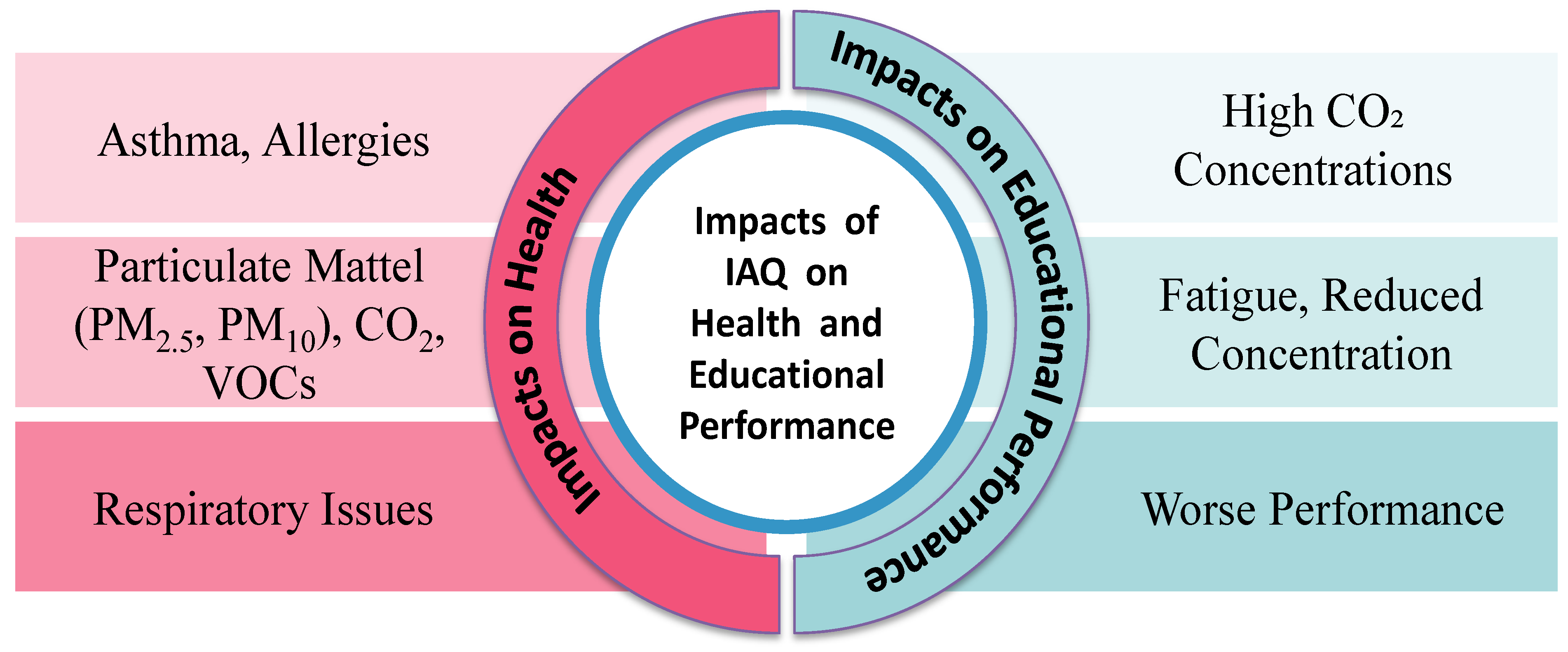
Figure 2.
Integration of ML and DL models within AI frameworks.
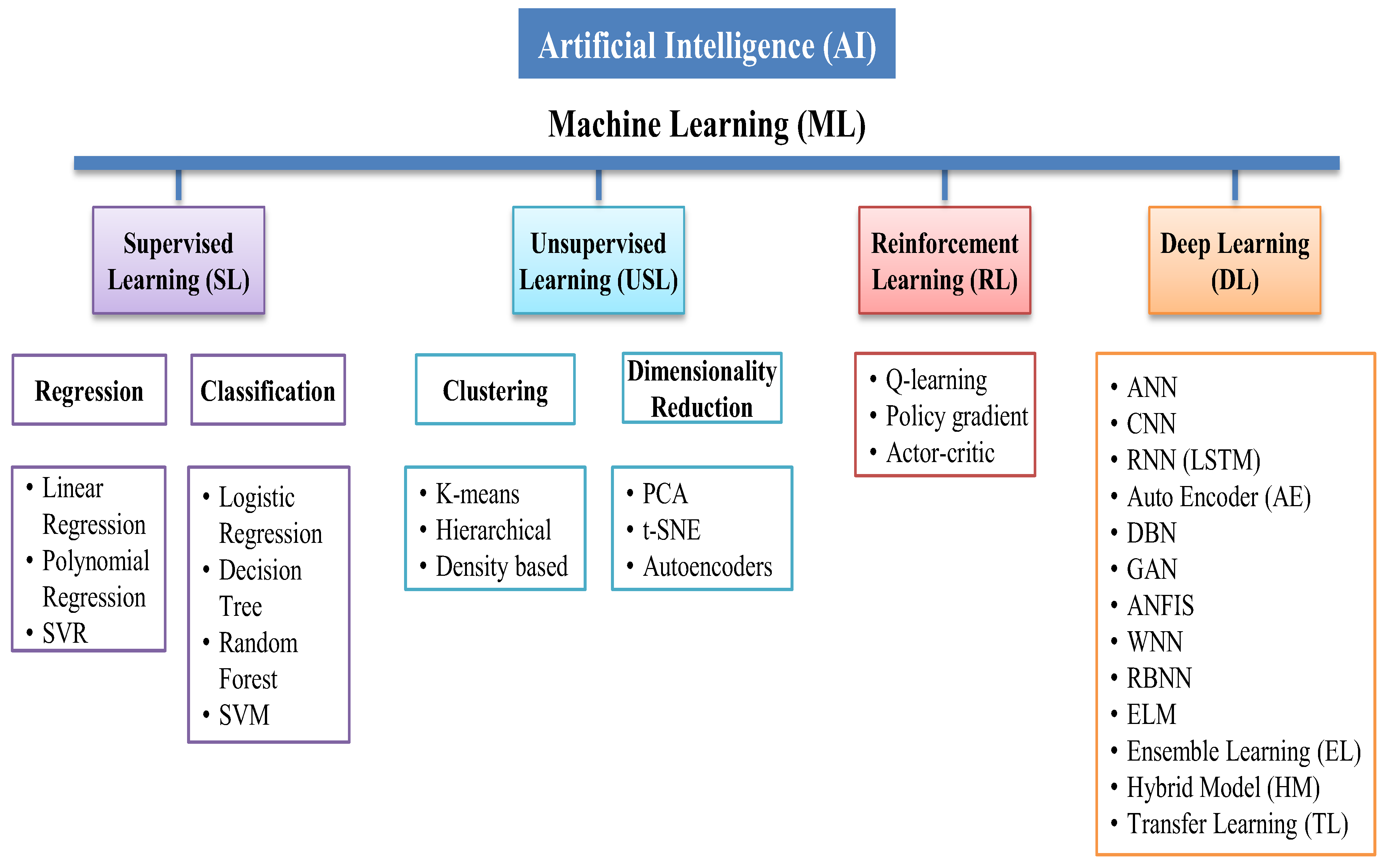
Figure 3.
Conceptual framework of hybrid AI models integrating machine learning (ML) and deep learning (DL).
Figure 3.
Conceptual framework of hybrid AI models integrating machine learning (ML) and deep learning (DL).
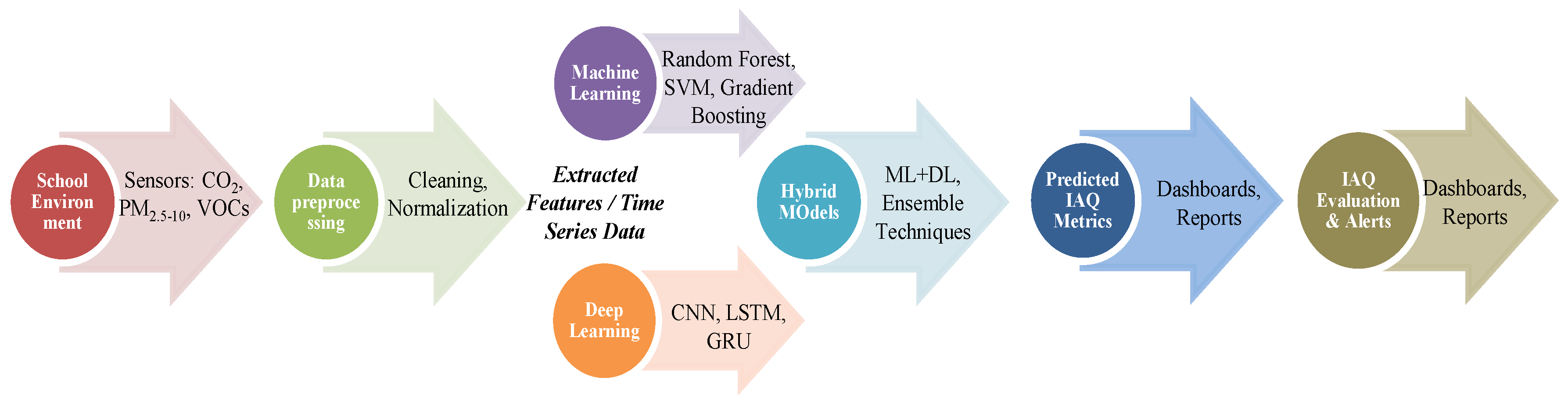
Figure 4.
Geographic distribution of the AI-based IAQ case studies in educational environments, Spanning North America, Europe, Asia, and Oceania
Figure 4.
Geographic distribution of the AI-based IAQ case studies in educational environments, Spanning North America, Europe, Asia, and Oceania
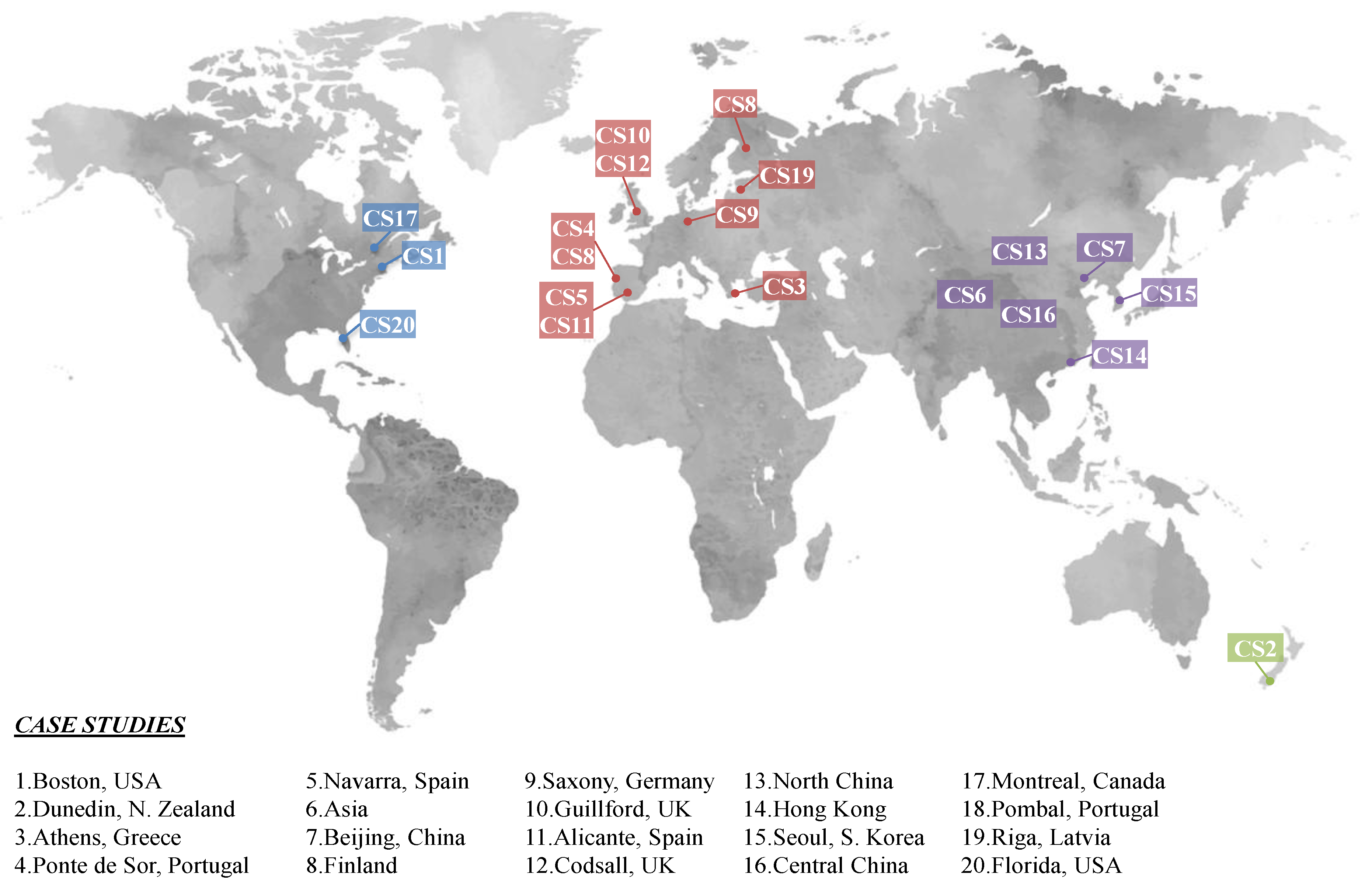

Table 1.
Major pollutant categories relevant to school environments, their typical indoor and outdoor sources, and associated health and performance impacts on students and staff.
Table 1.
Major pollutant categories relevant to school environments, their typical indoor and outdoor sources, and associated health and performance impacts on students and staff.
| Reference | Pollutant | Primary sources in schools | Main health and performance impacts |
|---|---|---|---|
| [18,19] | Carbon dioxide (CO₂) | Occupant respiration, inadequate ventilation, combustion from heating | Fatigue, drowsiness, impaired concentration, reduced cognitive performance |
| [48] | PM (PM₂.₅ / PM₁₀) | Chalk dust, resuspension of settled particles, outdoor traffic and exhaust fumes, indoor cleaning activities | Respiratory tract irritation, asthma exacerbation, increased absenteeism |
| [19,56,67,68] | VOCs | Cleaning products, paints, adhesives, furniture, carpets, wooden materials | Headaches, allergic reactions, mucosal irritation, long-term carcinogenic potential |
| [69,70] | Fungi (mould) | Elevated humidity, water damage, poor maintenance and cleanliness | Allergies, asthma onset and attacks, respiratory symptoms |
| [62,64] | Bacteria and viruses | Occupants, contaminated surfaces, airborne droplets | Respiratory infections, influenza, COVID-19, school absenteeism |
| [22,65] | Tropospheric Ozone (O3) | Outdoor infiltration from ambient air (particularly in urban areas with high photochemical smog), Indoor generation from certain devices, Secondary chemical reactions indoors | Eye and airway irritation, asthma aggravation, reduced attention, absenteeism |
| [23] | Nitrogen Dioxide (NO2) | Outdoor traffic emissions, Indoor combustion sources, Proximity to parking areas or bus drop-off zones. | Respiratory irritation, asthma exacerbation, reduced lung function, absenteeism |
Table 2.
Key environmental and structural determinants of indoor air quality in school buildings, together with their descriptions and recommended intervention measures to sustain healthy learning environments.
Table 2.
Key environmental and structural determinants of indoor air quality in school buildings, together with their descriptions and recommended intervention measures to sustain healthy learning environments.
| Reference | Key determinant | Description | Recommended Measures |
|---|---|---|---|
| [19,40,41,47,75] | Pollutant load | Particulate matter, volatile organic compounds, allergens (e.g., mould, dust mites), and chemical residues. | Use air purifiers; limit the use of high-emission cleaning products and chemical agents. |
| [16,76] | Thermal and moisture conditions | Elevated temperature and humidity favour microbial growth, while excessively low temperatures can cause respiratory discomfort | Maintain indoor temperature within comfort ranges; regulate relative humidity between 30–60% using humidifiers/dehumidifiers. |
| [15,17,77] | Ventilation efficiency | Adequate aeration removes pollutants and contaminants while supplying oxygenated air. | Implement sufficient natural or mechanical ventilation; install and maintain high-efficiency particulate filters. |
| [15,16] | Pollution sources | Emissions from smoking, cleaning products, building materials, furniture, and appliances degrade IAQ. | Prohibit indoor smoking; select low-emission, eco-certified materials; store cleaning agents safely. |
| [38,53] | Building operation and maintenance | Proper HVAC design, operation, and cleanliness directly influence IAQ levels. | Conduct regular HVAC inspection and maintenance; clean or replace filters periodically. |
Table 3.
Strategic overview of IAQ research and practice in school environments, highlighting focus areas, recent innovations, identified gaps, and future prospects for implementation.
Table 3.
Strategic overview of IAQ research and practice in school environments, highlighting focus areas, recent innovations, identified gaps, and future prospects for implementation.
| Reference | Focus area | Innovation highlight | Identified gaps | Future prospects |
|---|---|---|---|---|
| [37] | Natural ventilation and CO₂ management | Classroom-level CO₂ thresholds applied in naturally ventilated schools | Lack of enforcement and standardization for natural ventilation practices | Integration of smart alerts and continuous CO₂ feedback systems |
| [13,40,78] | Health impacts of pollutants in schools | Evidence linking IAQ to pediatric respiratory and allergic outcomes | Absence of child-specific IAQ exposure thresholds | Development of health-integrated IAQ criteria in building and education policies |
| [79] | Ventilation strategies and monitoring | Deployment of low-cost sensor-based ventilation control | Lack of harmonized IAQ monitoring protocols across schools | Establishment of standardized sensor networks for large-scale monitoring |
| [58] | Indoor environment and learning outcomes | Integration of IAQ metrics with cognitive and academic performance indicators | Limited availability of long-term outcome data | Longitudinal studies linking IAQ to learning achievements and curriculum design |
| [53] | Sensor technologies for IAQ | Advances in sensor calibration for deployment in schools | Absence of unified protocols for sensor placement and validation | Creation of open-access IAQ dashboards and data-sharing frameworks |
| [63] | Public health implications in EU schools | Regional mapping of IAQ inequalities | Low policy prioritization in disadvantaged regions | EU-level mandates and funding schemes to reduce IAQ disparities |
| [79] | CO₂ and cognition in naturally ventilated schools | Statistical modelling of CO₂ effects on student performance | Over-reliance on CO₂ as the sole IAQ indicator | Hybrid ventilation strategies integrating multi-pollutant assessment |
| [57,79] | Ventilation and cognitive performance | Quantified effects of IAQ on brain function and task performance | Limited field validation across diverse climatic and socio-economic contexts | Development of neurodevelopmental IAQ indices for schools |
| [58] | Productivity and IAQ | Meta-analyses linking CO₂ thresholds with student productivity | Insufficient attention to equity-related outcomes | Incorporation of IAQ metrics into indicators of educational access and equality |
| [53] | Governance and policy frameworks | EPA’s IAQ Tools for Schools providing an operational framework | Voluntary implementation with no binding legal effect | Introduction of mandatory IAQ audits supported by federal or state funding |
| [46,83] | IAQ–energy trade-offs and smart management | AI-driven demand-controlled ventilation and predictive IAQ–energy modelling | Limited integration of IAQ and energy metrics in existing standards | Systemic frameworks combining IAQ monitoring, adaptive ventilation, and energy efficiency for sustainable school operation |
Table 4.
Advantages and implementation strategies of hybrid AI models for IAQ monitoring in schools.
Table 4.
Advantages and implementation strategies of hybrid AI models for IAQ monitoring in schools.
| References | Description | Advantages | Implementation Strategy |
|---|---|---|---|
| [93,124] | Integration of traditional ML with DL models enhances robustness across varying classroom conditions. | Reliability | Ensemble outputs from multiple algorithms to reduce bias and improve stability. |
| [93,108] | Classical ML methods reduce the data demands of deep models. | Effectiveness | Preprocessing and feature reduction with ML before DL training. |
| [27,129] | Combines lightweight ML with high-precision DL. | Analysis Speed | Parallel use of fast ML classifiers with DL networks for real-time operation. |
| [118,130] | Models adapt to shifts in occupancy and environment. | Adaptability | Online or incremental learning for continuous updating. |
| [99,107] | Statistical preprocessing mitigates unreliable sensor signals. | Noise Reduction | Data cleaning and smoothing to handle noisy or incomplete datasets. |
| [84,104] | Detects hazardous IAQ deviations beyond normal ranges. | Anomaly Detection | Integration of unsupervised learning (e.g., autoencoders) for early detection of outliers. |
| [27,79] | Forecasts improve continuously as new data arrives. | Real-Time Improvement | Implementation of reinforcement learning and incremental parameter updates. |
Table 5.
Real world case studies on AI applications for IAQ management in schools, summarizing methods, monitored parameters, scale, and main outcomes.
Table 5.
Real world case studies on AI applications for IAQ management in schools, summarizing methods, monitored parameters, scale, and main outcomes.
| Reference | Location/Year | AI Method | Parameters Monitored | Sample size | Main results/Critical insights |
|---|---|---|---|---|---|
| [131,132], | Boston USA (2023) |
ML (Decision Trees) | CO₂, PM₂.₅, PM₁₀, CO, T, RH | 4,400 classrooms, 3,659 sensors |
|
| [88] | Dunedin New Zealand (2022) |
Hybrid DL (LSTM + Autoencoder) | CO₂ | 74 sensors, 247k readings |
|
| [53,135] | Athens Greece (2024) |
SVR | PM₂.₅, CO, NO₂, O₃, CO₂ | 1 classroom (25 students) |
|
| [82] | Ponte de Sor Portugal (2023) | Statistical Analysis + Teacher Surveys | CO₂, PM₁₀, T, RH | 9 classrooms, 171 sessions |
|
| [87] | Navarra Spain (2022) |
DL (TCN)&ML Forecasting | CO₂ | 15 schools |
|
| [145] | Smart Classrooms (SITA) Asia (2023) |
Privacy-preserving ML (SITA, edge AI) | CO₂, PM, VOCs, T | IoT deployment |
|
| Reference | Location/Year | AI Method | Parameters Monitored | Sample size | Main results/Critical insights |
| [146] | Beijing China (2023) |
AHP + ML-supported decision | PM₂.₅, CO₂, TVOCs, T, RH | 15 schools |
|
| [138] | Finland (2017) | Supervised ML + participatory feedback | CO₂, VOCs, T, RH, bioaerosols | 6 schools + national program |
|
| [133] | Lower Saxony Germany (2021) | Continuous monitoring, trend analysis | CO₂, noise, T, RH | 329 classrooms, 50 schools |
|
| [137] | Guilford UK (2024) |
IoT-based visual and visual-acoustic CO₂ feedback systems (real-time AI feedback) | CO₂, PM₂.₅, PM₁₀ | 1 classroom |
|
| [142] | Alicante Spain (2023) |
Artificial Neural Networks (ANN) | CO₂, Real-time occupancy, Environmental variables | University classrooms |
|
| [106] | Codsall UK (2025) |
Machine Learning (ML) models: RNN, LSTM, GRU, CNN | CO₂, PM, T, RH, Formaldehyde, environmental variables | Two classrooms (35 students each) |
|
| Reference | Location/Year | AI Method | Parameters Monitored | Sample size | Main results/Critical insights |
| [136] | North China (2018-2019) |
Hybrid model EMD (Empirical Mode Decomposition), LSTM, BO (Bayesian Optimization) | Indoor CO₂ concentration (time-series data) | Long-term dataset covering one full academic year |
|
| [140] | Hong Kong (2022) |
- YOLOv5 (computer vision, deep learning) - CFD simulation - Fuzzy logic control for dynamic HVAC adjustment |
Occupant number & spatial distribution - Thermal comfort index (PMV) - Air temperature & air velocity |
University classrooms |
|
| [139] | Seoul South Korea (2021) |
Integrated Neural Network (INN) | PMV, CO₂, PM₁₀ | 1 school |
|
| [134] | Central China (2022) |
RF (Random Forest)-TPE Tree-structured Parzen Estimator -LSTM Hybrid model | CO₂, PM, T, H, O2, Illumination, Indoor population |
One university classroom monitored for ~1.5 months |
|
| [141] | Montreal Canada (2020-21) |
Bayesian parameter estimation to infer ventilation rates, CO₂ emission, and noise levels | CO₂, Ventilation, Noise | 2 classrooms |
|
| Reference | Location/Year | AI Method | Parameters Monitored | Sample size | Main results/Critical insights |
| [143] | Pombal Portugal (2013) |
Multi-Layer Perceptron (MLP) neural network |
CO₂, T, H | 2 classrooms |
|
| [121] | Riga Latvia (2024) |
Machine Learning (ML) models: Prophet, Transformer, Kolmogorov–Arnold Networks (KAN), LSTM, GRU |
CO₂, T, H | 128 sensors |
|
| [144] | Florida USA (2021) |
Hybrid PCA (Principal Component Analysis)– LMBP (Levenberg Marquardt Back propagation model | PM₂.₅, PM₁₀, NO₂, O₃ | Multiple building types: classrooms, offices, laboratories; continuous monitoring at 10-min intervals over two-week periods |
|
Disclaimer/Publisher’s Note: The statements, opinions and data contained in all publications are solely those of the individual author(s) and contributor(s) and not of MDPI and/or the editor(s). MDPI and/or the editor(s) disclaim responsibility for any injury to people or property resulting from any ideas, methods, instructions or products referred to in the content. |
© 2025 by the authors. Licensee MDPI, Basel, Switzerland. This article is an open access article distributed under the terms and conditions of the Creative Commons Attribution (CC BY) license (http://creativecommons.org/licenses/by/4.0/).
Copyright: This open access article is published under a Creative Commons CC BY 4.0 license, which permit the free download, distribution, and reuse, provided that the author and preprint are cited in any reuse.


