

Submitted:
06 October 2025
Posted:
07 October 2025
You are already at the latest version
Abstract
Modern agriculture relies on pesticides for pest management and yield improvement; however, pesticide soil persistence creates major environmental and health threats through bioaccumulation, groundwater contamination, and harm to non-target organisms. This comprehensive review synthesizes current research findings on pesticide breakdown by soil bacteria and discusses their mechanisms and implications for sustainable agriculture. The persistence of pesticide classes, including organophosphates, carbamates, pyrethroids, neonicotinoids, triazines, and organochlorines, in soil varies from days to years, based on chemical structure and environmental conditions. Soil bacteria Pseudomonas, Rhodococcus, Arthrobacter, and Bacillus break down these compounds using enzymatic pathways, including hydrolysis, oxidation, and nitroreduction, while plasmid-encoded genes and horizontal gene transfer boost soil bacterial efficiency. Pesticide degradation rates are heavily influenced by environmental factors, including pH, temperature, moisture, and organic matter, as optimal conditions enhance microbial activity, whereas stressors like drought act as inhibitors. Bioremediation methods, including natural attenuation, bioaugmentation, and synthetic consortia, offer environmentally friendly solutions, with omics technologies and synthetic biology enabling the development of better degraders. Combining microbial isolation techniques with kinetic assays and met-agenomics enables researchers to identify pathways. The use of modified soil bacteria in agriculture adheres to regulatory standards, ensuring safety while addressing scalability issues in developing regions. Bacterial pesticide breakdown reduces residue levels, enhances soil fertility, and supports resilient agroecosystems. Field-scale validation and AI-driven predictive models are essential for optimizing degradation under climate change conditions and demonstrate solutions as an interdisciplinary approach to mitigate pesticide impacts and support sustainable agriculture.
Keywords:
soil bacteria
; pesticide degradation
; bioremediation
; soil bacterial enzymes
; sustainable agriculture
; omics technologies
; synthetic biology
1. Introduction
Modern agriculture depends on pesticides to enhance crop production while managing pests, weeds, and diseases [1,2]. However, their widespread use causes significant environmental and health problems, including soil and water contamination, damage to food chains, non-target organisms, and human health [3,4,5,6]. Persistent pesticides, including organophosphates, carbamates, pyrethroids, and neonicotinoids, accumulate in living organisms and cause long-lasting ecological harm[4,5]. The need for sustainable solutions has positioned degradation by soil bacteria as a natural and eco-friendly approach [7,8,9]. Soil bacteria possess diverse metabolic functions, enabling them to decompose complex pesticide compounds into less toxic substances through enzymatic processes [10,11,12]. This review explores pesticide degradation mechanisms by soil bacteria, their pathways, environmental factors influencing these processes, bioremediation strategies, and their impact on sustainable agriculture. Drawing on recent studies, it highlights the progress in omics technologies and synthetic biology and regulatory challenges [13,14,15,16]. Recent field studies show that soil bacteria play a vital role in breaking down pesticide residues in both tropical and temperate farming systems, helping to support global sustainability efforts[9,16,17].
The urgency of soil bacteria-based remediation is underscored by global reports indicating escalating pesticide usage and associated risks, as evidenced by the UNEP’s Global Chemicals Outlook, which calls for innovative solutions for managing contaminants [18]. Research on endocrine-disrupting pesticides reveals their dual threat to reproductive health and biodiversity, positioning bacterial degradation as a critical countermeasure [8]. Isolating degraders from contaminated sites, such as sugarcane farms, demonstrates how indigenous bacteria, like those degrading chlorpyrifos, can be used for targeted bioremediation practices [19].
2. Pesticide Classes and Environmental Persistence
Major pesticide categories are classified by chemical composition and mode of action, including organophosphates (e.g., chlorpyrifos), carbamates (e.g., carbofuran), pyrethroids (e.g., cypermethrin), neonicotinoids (e.g., imidacloprid), triazines (e.g., atrazine), and organochlorines (e.g., DDT, endosulfan) [20,21,22,23,24,25]. Their half-lives vary significantly for soil persistence, as shown in Table 1, with glyphosate exhibiting a short half-life of 3–5 days, while organochlorines persist for 2–15 years. Neurotoxic organophosphates and carbamates inhibit acetylcholinesterase activity, persisting in soils for weeks to months, depending on environmental factors [26,27]. Pyrethroids, synthetic analogs of pyrethrins, possess hydrophobic properties and persist for several months to years in anaerobic soils, causing aquatic toxicity [28,29,30]. Systemic neonicotinoids dissolve easily in water, leading to groundwater contamination and extended exposure risks for pollinators [31,32,33]. The herbicide atrazine, a triazine, exhibits a moderate persistence of 60–100 days and often contaminates surface water bodies [34]. Organochlorines, owing to their stability, persist in the environment, despite restrictions on their use [3]. Pesticide persistence is influenced by soil organic matter content, pH levels, and microbial activity, with some pesticide metabolites becoming resistant to degradation, exacerbating pollution [22,33,35,36,37,38,39]. These residues are widespread, impacting natural environments [25,40].
Phenylpyrazoles and sulfonylureas exhibit rapid degradation under high temperatures but elevated leaching risks, as observed in field studies [41,42,43]. Glyphosate exhibits strong binding to soil particles, but its potential to contaminate groundwater remains a concern, necessitating integrated monitoring [35,36]. Neonicotinoid persistence varies between regions, as shown in Colombian tomato production research, which found higher residue levels in greenhouses than open fields [20]. Table 1 illustrates pesticide classes, their half-lives, and persistence categories, highlighting their environmental behaviors.

Table 1.
Pesticide classes and their environmental persistence.
| Pesticide class | Representative compounds | Average soil half-life (DT₅₀) | Persistence category | Sources |
|---|---|---|---|---|
| Organophosphates | Chlorpyrifos, Parathion |
30-60 days | Moderate | [27,44] |
| Carbamates | Carbofuran, Aldicarb |
10-50 days | Low to Moderate | [23,45] |
| Pyrethroids | Cypermethrin, Permethrin |
30-100 days (up to years in anaerobic conditions) | Moderate to High | [29,30,46] |
| Neonicotinoids | Imidacloprid, Acetamiprid |
40-150 days (dry conditions longer) | Moderate | [31,32,33,47,48] |
| Triazines | Atrazine, Simazine |
60-100 days | Moderate | [34,49] |
| Organochlorines | DDT, Chlordane | 2-15 years | High | [3,12] |
| Others (e.g., Glyphosate) | Glyphosate | 3-5 days (variable) | Low | [35,36] |
3. Bacterial Taxa Involved in Pesticide Degradation
Soil bacteria are the primary agents of pesticide breakdown in soil, with various species in contaminated sites exhibiting diverse degradation capabilities [9,10,11]. Table 2 presents key genera, including Pseudomonas, which degrades organophosphates and pyrethroids through hydrolytic enzymes [10,50,51,52]. Rhodococcus species, such as R. koreensis, degrade endosulfan and triazines, producing metabolites like endosulfan diol monosulfate [53,54]. Arthrobacter strains, such as A. aurescens and A. sp. AD26, mineralize s-triazines like atrazine via dechlorination and ring cleavage [52,55].
Bacillus species, including B. subtilis and B. sp. Za, degrade pyrethroids and diphenyl ethers through esterase activity and nitroreduction [57,59,60,61]. Actinobacteria, such as Streptomyces, participate in the degradation of carbamates, organophosphates, and other pesticides [47]. Azotobacter isolates from sugarcane soils remediate chlorpyrifos and other toxic pesticides [16]. These bacterial taxa often thrive in pesticide-enriched environments, adapting via horizontal gene transfer and plasmid-encoded degradative genes [15,63,75]. Research in malaria-endemic regions demonstrates simultaneous degradation of DDT and pyrethroids by indigenous bacteria [3,15]. This degradation process is enhanced by fungal-bacterial interactions, but bacteria remain the primary agents for rapid mineralization [9,26]. Recent studies have revealed additional bacterial genera, including Sphingomonas and Alcaligenes, which can break down neonicotinoids and organochlorines through oxidative and reductive pathways. These findings broaden our understanding of the diversity of pesticide-degrading soil bacteria[28,39,76].
Figure 1 illustrates detailed pathways of microbial pesticide degradation.
Genomic analysis of metaldehyde-degraders shows that different strains share similar pathways, suggesting selection pressure drives degradative capabilities [75]. Rhodococcus and other endosulfan degradation capabilities of earthworm gut isolates demonstrate their adaptation to specific ecological niches [54]. Recent global perspectives highlight the diversity of microbial degraders, with new isolation techniques identifying strains for recalcitrant compounds [11,26]. Key bacterial genera, their pesticide targets, and degradation processes are presented in Table 2.
4. Enzymatic and Genetic Mechanisms of Degradation
Soil bacteria degrade pesticides through enzymatic reactions that cleave chemical bonds via oxidation and hydrolysis [10,22,23,77]. Table 3 outlines key enzyme classes and their roles in pesticide degradation. Phosphotriesterases in Pseudomonas cleave P-O bonds in organophosphates, yielding non-toxic alcohols and acids [10,78,79]. Carbamate degradation occurs through carboxylesterases and amidases, with microbial genomes conserving motifs that enable ring [23,45,77]. Pyrethroids undergo initial ester hydrolysis by carboxylesterases before being oxidized into carboxylic acids [29,46,56]. Neonicotinoids are metabolized via nitroreduction and demethylation by Rhodococcus and Bacillus using nitroreductases [39,80,81]. Genetic mechanisms include plasmid-borne operons (e.g., opd for organophosphates) and chromosomal genes (e.g., atz for atrazine degradation in Pseudomonas and Arthrobacter) [52,55].
Metagenomic analyses reveal that CRISPR-Cas systems enable microbes to adapt to environmental conditions [82]. Pesticide degradation via cometabolism occurs when pesticides serve as carbon sources, with 3,5,6-trichloro-2-pyridinol from chlorpyrifos undergoing further mineralization [15]. Synthetic biology clarifies these mechanisms through gene knockouts, showing esterases' pivotal role in multi-pesticide degradation [77,83]. Laccase-assisted systems can degrade recalcitrant pesticides [84]. Studies have identified cytochrome P450 monooxygenases in Sphingomonas and Alcaligenes, which enable the oxidative breakdown of neonicotinoids and organochlorines, respectively, thereby expanding the enzymatic toolkit available for bioremediation [29,85,86]. Carbamate degradation exhibits evolutionary conservation across microbes via hydrolysis and oxidation, central to detoxification [23]. Organophosphate-degrading enzymes extend beyond remediation, serving as medical countermeasures for poisoning [87]. Studies of pyrethroid catalysis demonstrate how microbial adaptation enhances degradation efficiency [46].
Table 3.
Enzymatic mechanisms of pesticide degradation.
| Enzyme class | Pesticide type | Mechanism | Bacterial examples | Sources |
|---|---|---|---|---|
| Phosphotriesterases / Organophosphorus hydrolases (PTE/OPH) | Organophosphates (e.g., chlorpyrifos, diazinon, methyl parathion) | Hydrolysis of P-O bonds |
Pseudomonas Roseomonas, Sphingobium, Bacillus, Arthrobacter |
[10,78,79,88,89] |
| Carboxylesterases / Esterases | Carbamates, Pyrethroids |
Ester hydrolysis, Ring opening |
Bacillus, Pseudomonas, Rhodococcus, Acinetobacter, Stenotrophomonas |
[21,29,46,56] |
| Nitroreductases | Neonicotinoids, Diphenyl ethers, Nitroaromatic |
Nitroreduction, Demethylation, Nitroreduction |
Bacillus, Rhodococcus Arthrobacter, Enterobacter, Klebsiella |
[39,80,81] |
| Cytochrome P450 Monooxygenases/ Other Monooxygenases |
Neonicotinoids, Organochlorines, Pyrethroids, Fungicides |
Oxidative degradation (hydroxylation, dealkylation, N-oxidation) |
Sphingomonas, Alcaligenes, Pseudomonas, Bacillus, Streptomyces |
[90,91,92,93] |
| Amidases/Hydrolases | Carbamates, Triazines |
Amide bond cleavage |
Arthrobacter, Pseudomonas, Burkholderia, Variovorax, Paenarthrobacter |
[23,45,52,94] |
| Oxidases (e.g., Laccases, Peroxidases, Multicopper oxidases) |
Recalcitrant Pesticides, Aromatics, Dyes |
Oxidation of aromatic rings, radical-mediated reactions |
Pseudomonas, Ochrobactrum, Bacillus, Azospirillum, Streptomyces |
[83,84,95,96,97] |
5. Environmental Factors Affecting Degradation
Pesticide degradation rates in soil ecosystems are controlled by abiotic and biotic factors [5,20,49], as shown in Table 4. Pyrethroid persistence increases in acidic conditions, but organophosphate hydrolysis accelerates in neutral pH [35,49,98]. An optimal temperature range of 25–30°C and field capacity moisture levels enhance enzyme kinetics [99,100]. Organic matter content binds pesticides, reducing bioavailability but promoting microbial adaptation [37,98,101]. Drought and climate change exacerbate persistence by altering microbial communities and increasing pesticide application rates [100,102]. Biochar amendments limit mobility and enhance microbial colonization but can inhibit degradation if over-applied [98,103]. Heavy metals and co-contaminants compete for enzymatic sites, slowing degradation [104].
Prior pesticide use influences microbial diversity, enhancing resilience as degraders are more prevalent after repeated exposure [63,99]. Studies of tropical and greenhouse soils reveal that high humidity accelerates degradation but heightens leaching risks [20,41]. Heavy metals, such as copper and zinc, can inhibit soil bacterial degradation by altering enzyme active sites or reducing microbial diversity, necessitating strategies like biochar amendment to mitigate these effects [105,106,107]. Table 4 summarizes these factors and their impacts on degradation efficiency. Biochar critically influences pesticide fate by altering soil properties, with balanced application recommended to optimize microbial activity [98]. Climate change-driven increases in pesticide use necessitate adaptive measures to maintain degradation efficiency [102]. Historical pesticide use has shaped soil microbiomes, influencing their degradation capacity [99].
6. Bioremediation Strategies
Bioremediation leverages soil bacteria to detoxify pesticide-contaminated sites, offering cost-effective alternatives to chemical methods [7,13,108,109,110]. Table 5 outlines bioremediation strategies for pesticide degradation.
6.1. Natural Attenuation
Natural attenuation relies on native microbial populations to break down pesticides through a cost-effective but slow process, independent of human intervention [13,108,110,111]. Attenuation of chlorpyrifos and endosulfan involves hydrolysis and oxidation, accelerated by microbial adaptation in periurban environments [111]. This process is slow, limited by natural factors and pesticide stability [77]. It is effective for low pesticide pollution, but its slow pace and incomplete mineralization pose challenges [22,112]. Success depends on diverse soil bacterial populations with specific pesticide degradation capabilities, whose abundance varies between soil types and geographic locations [83]. Sites with prior pesticide treatment harbor soil bacterial populations that degrade contaminants at accelerated rates through soil bacterial priming [14].
Table 4.
Environmental factors affecting pesticide degradation.
| Environmental Factor | Effect on Degradation | Optimal Range | Negative Impact Examples | Source |
|---|---|---|---|---|
| pH | Influences sorption and enzyme activity | Neutral (6-7) | Acidic soils slow pyrethroid breakdown | [35,49,98] |
| Temperature | Affects enzyme kinetics and microbial metabolism | 25-30°C | Low temps (<10°C) reduce rates | [99,102] |
| Moisture | Enhances microbial growth and substrate diffusion | Field capacity (60-80%) | Drought inhibits activity | [82,76] |
| Organic Matter | Increases sequestration but aids adaptation | High content | Low OM reduces bioavailability | [37,98,101] |
| Aeration/Oxygen | Promotes aerobic degradation | Well-aerated soils | Anaerobic conditions prolong persistence | [29,30,35] |
Reviews confirm natural attenuation is effective in agricultural fields with diverse taxonomic species [108,110]. Optimized soil conditions, including higher organic matter content and pH adjustments, enhance the activity of indigenous microorganisms, particularly for organophosphate degradation [60,101]. Biochar addition enhances natural pesticide attenuation by creating improved environments for microorganisms and increasing pesticide bioavailability to microbial action [113]. In Brazilian soils, natural attenuation combined with other remediation techniques achieves better performance [112]. Variable microbial responses necessitate site-specific assessments to ensure effective results [11].
6.2. Bioaugmentation
Bioaugmentation accelerates pesticide degradation in contaminated soils by introducing specific microbial strains or consortia [31,114]. Bacillus sp. degrades chlorpyrifos in contaminated soil systems, and kinetic experiments verify first-order degradation [60]. Bacillus and Sphingomonas consortia exhibit successful degradation of pyrethroids and neonicotinoids [14,56]. Rhodococcus pyridinivorans Y6 efficiently degrades multiple pyrethroids [57]. Strain survival and competition are mitigated with carrier materials [113,114]. Advanced delivery systems, encasing microorganisms in biodegradable carriers, enhance performance in challenging soil conditions [15,115]. Combining biochar or compost with biological methods yields synergistic effects, enhancing bacterial survival, pesticide bioavailability, and activity [116]. Bioaugmentation, combined with these methods, enhances degradation speed and microbial retention, making it suitable for large-scale remediation [101].
Field experiments in Brazil demonstrate its global applicability [115]. Studies in Argentine horticultural soils show bioaugmentation is an effective approach to reduce endosulfan residues [111]. Genetically modified Bacillus strains effectively reduce organochlorine residues [72]. Cyclodextrin-based technologies enhance herbicide removal in contaminated soil systems [117].
6.3. Synthetic Microbial Consortia
Engineered soil bacterial communities, comprising Pseudomonas, Bacillus, Streptomyces, and Sphingomonas, demonstrate enhanced pesticide degradation efficiency over individual strains [39,77,118]. These consortia achieve synergistic degradation by combining multiple strains [107,117,118,119]. These consortia enhance degradation through complementary hydrolytic, oxidative, and reductive enzymatic activities [57,119]. Quorum sensing regulates esterases expression in Bacillus subtilis, ensuring synchronized metabolic processes [61]. Advanced genetic tools, such as CRISPR-Cas9, enable optimization of consortia performance by enhancing metabolic output and stability under variable soil conditions [120,121]. These consortia improve efficiency and offer applications in soil fertility recovery [118,122,123].
Bioinformatics and machine learning predict strain interactions, enabling effective bioremediation [122,124]. Pesticide-tolerant consortia effectively remediate multi-contaminated sites [123]. Modular consortia designed for neonicotinoids and triazines include built-in stress tolerance to withstand heavy metals and extreme pH [14,116,123]. Novel Pseudomonas and Streptomyces consortia exhibit enhanced degradation capabilities for field-based pesticide residue removal [3,22]. Studies of complex consortium development show combined strains achieve complete mineralization through synergistic reactions [119]. Quorum sensing circuits and synthetic regulatory elements ensure stable function in contaminated soils [61,125,126]. Their application to soil fertility enhancement demonstrates broader agricultural benefits, though deployment requires detailed ecological and regulatory considerations [118].
6.4. Field-Scale Applications
Field-scale bioremediation represents a critical step in translating laboratory innovations into practical strategies for managing pesticide contamination in agricultural systems. Common approaches include the use of biomixtures and biobeds, soil amendments with biochar or compost, phytoremediation, and application of adapted microbial consortia[127,128,129,130]. Biomixtures and biobed systems consistently demonstrate effective pesticide dissipation under field and pilot conditions, often exceeding 50% removal and, in optimized designs, achieving near-complete dissipation within approximately 30–90 days. However, degradation rates remain highly dependent on pesticide formulation, biomixture maturity (pre-incubation period), hydraulic load, and climatic conditions [131,132,133,134]. Evidence from Mediterranean and temperate regions highlights that composition, moisture content, and pre-incubation strongly determine the dissipation efficiency of pesticides such as chlorpyrifos and triazine herbicides [129,135,136].
Formulation strategies that enhance pesticide bioavailability (e.g., inclusion complexes) or combine adsorption capacity (via biochar) with active degraders tend to accelerate degradation rates and improve microbial persistence. Nonetheless, the effectiveness of biochar remains strongly dependent on feedstock type, pyrolysis conditions, and environmental context [137,138,139,140]. Regional field studies further corroborate these outcomes: European and Brazilian biobed systems have shown high removal efficiencies for organophosphates, triazines, and glyphosate, while tropical systems employing alternative biomixture substrates such as banana stems, pine litter, or vermicompost can also sustain rapid degradation when properly aged and [128,134,141,142].
Advances in synthetic biology have enabled the development of engineered strains and designer microbial consortia, such as multi-enzyme Pseudomonas putida constructs, which exhibit strong capacity for degrading mixed pesticide residues at laboratory and pilot scales. However, their environmental application remains limited due to biosafety concerns and regulatory constraints [50,128,143,144]. Integrating biochar or compost amendments with microbial inocula or plant-assisted systems shows promise in enhancing microbial survival, modifying pesticide sorption and bioavailability, and accelerating dissipation, though outcomes remain site-specific and require systematic optimization and monitoring[140,141,145,146] To achieve scalable, environmentally safe, and socially acceptable applications, standardized field monitoring protocols, ecological risk assessments, and active engagement with regulatory bodies and stakeholders are essential[115,127,133,134].
Table 5.
Bioremediation strategies for pesticide degradation.
| Strategy | Description | Mechanism | Advantages | Limitation | Examples | Sources |
|---|---|---|---|---|---|---|
| Natural Attenuation | Relies on indigenous microbes for passive degradation | Hydrolysis and oxidation by native enzymes | Cost-effective, minimal ecological disruption | Slow rates, incomplete mineralization (varies with soil conditions) | Chlorpyrifos and endosulfan attenuation | [13,108,110,111,112] |
| Bioaugmentation | Introduces specific degraders to accelerate processes, using isolates or carrier materials | Esterase-mediated hydrolysis, nitroreduction | Targets specific contaminants, accelerates degradation | Strain survival, competition with natives, cost of inoculation | Bacillus sp. for chlorpyrifos, Rhodococcus pyridinivorans Y6 for pyrethroids | [57,60,114,115] |
| Synthetic Microbial Consortia | Engineered combinations of strains for synergistic degradation, regulated by quorum sensing | Complementary enzymatic pathways (e.g., esterases, oxidases) via quorum sensing | Synergistic efficiency, adaptable to multi-contaminants | Complex engineering, regulatory hurdles (e.g., safety assessments) | Pseudomonas and Bacillus consortia | [15,77,82,117,118,122,123] |
| Field-Scale Applications | Large-scale deployment of consortia and amendments | Enhanced degradation with biochar and consortia | Scalable, high efficiency | Requires monitoring, site-specific | Biobeds for chlorpyrifos; biochar for atrazine & Chlorpyrifos |
[147,132,148] |
7. Methodology
This review systematically synthesizes knowledge on microbial pesticide breakdown. Information was collected from peer-reviewed databases, including PubMed, Scopus, and Web of Science, for publications from 1995 to 2025. Search terms included "pesticide degradation," "soil bacteria," "bioremediation," "microbial enzymes," "omics technologies," and "sustainable agriculture." The review selected scientific articles on microbial taxa, enzymatic and genetic mechanisms, environmental factors, bioremediation methods, and sustainable agricultural applications. It prioritized English peer-reviewed articles, reviews, and book chapters from high-impact journals, particularly recent developments post-2019. It examined pesticide classes, microbial degradation mechanisms, bioremediation approaches, and their regulatory and sustainability aspects. Incorporating 119 references from primary research, reviews, and policy reports, it provides a comprehensive, expert-level overview.
8. Advances in Omics Technologies and Synthetic Biology
Omics technologies have revolutionized pesticide degradation research by integrating metagenomics, transcriptomics, and proteomics to reveal soil bacterial catabolic pathways, discover new genes, enzymes, and regulatory systems [14,73,149,150,151]. Metagenomics identifies degradation genes in bacteria metabolizing chlorpyrifos and unculturable microorganisms, expanding bioremediation capabilities [14,15]. Proteomics reveals neonicotinoid degradation is enhanced by esterase and laccase activity, while transcriptomics shows how environmental stressors influence pathway regulation [152]. Integrating omics with machine learning facilitates prediction and optimization of degradation pathways, revealing complex soil bacterial community interactions and synergistic effects in contaminated sites [48,73,80,124,150,153]. Metabolomics tracks intermediary metabolites to address pathway limitations, aiding the development of efficient synthetic consortia [14].
Synthetic biology enhances bioremediation through genetic modifications of Pseudomonas putida KT2440, enabling degradation of multiple pesticides via CRISPR-Cas and E. coli strains engineered with multiple degradation genes for enhanced pollutant removal [50,82,87,116,121,152,154,155]. Epigenomics elucidates regulatory processes controlling degradation gene expression, maximizing microbial function, and AI-based models predict engineered ecosystem outcomes, enabling precise bioremediation [48,156]. Bacillus cells expressing nitroreductase accelerate herbicide degradation, and microalgae-bacteria combinations facilitate large-scale pollutant management [81,121]. Integrated omics and machine learning position microbial bioremediation as a cornerstone for sustainable environmental management [14,153]
9. Regulatory and Practical Considerations
Regulatory frameworks emphasize safety standards for genetically modified microbes [157,158]. Approving GMOs encounters challenges worldwide due to varying regulatory systems, complicating GMO authorization and ecological protection [15,159]. The Global Chemicals Outlook advocates innovative approaches, but risk evaluation is required for outdoor releases [18]. Ecological modelling-based risk assessment frameworks enhance GMO bioremediation evaluations, facilitating regulatory approvals [15,158,159].
High bioremediation costs limit widespread use in developing countries, due to scale [160,161]. Scaling laboratory solutions to field applications is challenging due to environmental variability, such as temperature fluctuations and soil composition, which reduce efficacy [77,162]. Implementing bioremediation technologies involving GMOs requires public acceptance and stakeholder engagement [14]. Standardized safety protocols and technology transfer are being developed to establish global bioremediation standards and protect freshwater ecosystems [163]. Emerging policy frameworks support sustainable agriculture by promoting pesticide reduction and ecosystem restoration to ensure long-term environmental health [2,18]. Standardized assays help address barriers to scalability and monitoring [24,164].
10. Implications for Sustainable Agriculture
Degradation by soil bacteria supports sustainable intensification by reducing pesticide concentrations in soils and enhancing soil health [165,166,167,168]. It reduces chemical contamination, enhances soil quality, biodiversity, and mitigates risks to health and ecosystems [4,9,11,166]. Bioremediation restores soil fertility and microbial diversity, facilitating nutrient cycling [109,118,149]. By restoring soil bacterial ecosystems, bioremediation fosters fertile conditions for sustainable crop cultivation within global climate-smart agricultural programs [2]. Bio-pesticides complement degradation strategies [7,159]. Integrating bioremediation with organic farming and integrated pest management facilitates a shift to sustainability by reducing chemical pesticide dependency [112,167]. Integrated pest management (IPM) combined with bioremediation reduces pesticide inputs by leveraging natural bacterial degradation processes, promoting sustainable crop production and ecosystem resilience [169,170].
Climate-resilient microbes reduce the need for increased pesticide use [102]. Microbial bioremediation enhances climate resilience by improving soil carbon storage and reducing greenhouse gas emissions from pesticide production and application [14,40]. This approach reduces cleanup costs and improves yields [160,166]. Eco-friendly farming practices in Brazil and India demonstrate global applicability [115,149]. Bioremediation supports pollinator health, enabling essential ecosystem services for sustainable agriculture [39,110]. Bacteria are critical to sustainable agriculture [167]. Recent studies confirm microbial consortia successfully restore polluted agricultural land, contributing to global ecological restoration and food security [2,116].
11. Conclusions
Soil bacteria transform harmful pesticides into harmless substances via their metabolic capabilities, offering a transformative approach to pollution. Pesticide degradation involves complex enzymatic and genetic processes, executed by Pseudomonas and Streptomyces, among other taxa. These pathways reduce environmental persistence and health risks. Bioremediation, combined with synthetic biology and multi-omics technologies, enhances effectiveness, enabling large-scale, real-world deployment. Deploying soil bacterial solutions in sustainable agricultural systems demands regulatory frameworks that evolve to ensure safety standards. These approaches reduce pesticide impacts, enhance soil health, and support resilient agroecosystems, contributing to global sustainability goals. Furthermore, ongoing research should focus on developing more robust microbial strains through genetic engineering to handle a wider range of pesticides under varying environmental conditions. Collaboration between scientists, policymakers, and farmers is crucial to implement these technologies effectively. By integrating bacterial degradation into agricultural practices, we can significantly decrease reliance on chemical pesticides, promoting biodiversity and reducing the carbon footprint of farming. Additionally, the use of AI and predictive modeling can optimize bioremediation strategies, making them more efficient and cost-effective. Ultimately, this interdisciplinary strategy not only addresses current environmental challenges but also paves the way for a more sustainable and resilient future in agriculture, ensuring food security for generations to come.
Author Contributions
Conceptualization, G.D.; methodology, G.D.; investigation, G.D.; resources, G.D.; data curation, G.D.; writing original draft preparation, G.D.; writing review and editing, G.D., writing and S.T.M.; review, T.F. All authors have read and agreed to the published version of the manuscript.
Funding
This research received no external funding.
Data Availability Statement
No new data were created or analyzed in this study
Acknowledgments
In this section, you can acknowledge any support given which is not covered by the author contribution or funding sections. This may include administrative and technical support, or donations in kind (e.g., materials used for experiments). Where GenAI has been used for purposes such as generating text, data, or graphics, or for study design, data collection, analysis, or interpretation of data, please add “During the preparation of this manuscript/study, the author(s) used [tool name, version information] for the purposes of [description of use]. The authors have reviewed and edited the output and take full responsibility for the content of this publication.”
Conflicts of Interest
The authors declare no conflicts of interest.
Abbreviations
The following abbreviations are used in this manuscript:
| CRISPR-Cas9 | Clustered Regularly Interspaced Short Palindromic Repeats and CRISPR-associated Protein 9 |
| DDT: | Dichlorodiphenyltrichloroethane |
| DT50: | Disappearance Time 50, or half-life |
| FAO: | Food and Agriculture Organization |
| GMOs: | Genetically Modified Organisms |
| AI: | Artificial Intelligence |
| SDGs: | Sustainable Development Goals |
| PTE/OPH | Phosphotriesterases/Organophosphorus Hydrolases |
| UNEP: | United Nations Environment Programme |
References
- Aktar, W.; Sengupta, D.; Chowdhury, A. Impact of pesticides use in agriculture: their benefits and hazards. Interdiscip. Toxicol. 2009, 2, 1–12. [Google Scholar] [CrossRef] [PubMed]
- FAO, “The State of Food and Agriculture 2023: Revealing the true cost of food to transform agrifood systems,” Food and Agriculture Organization of the United Nations, 2023. [Online]. Available: https://www.fao.org/documents/card/en/c/cc7724en.
- Huynh, T.; Laidlaw, W.; Singh, B.; Gregory, D.; Baker, A. Effects of phytoextraction on heavy metal concentrations and pH of pore-water of biosolids determined using an in situ sampling technique. Environ. Pollut. 2008, 156, 874–882. [Google Scholar] [CrossRef] [PubMed]
- Sharma, A.; Kumar, V.; Shahzad, B.; Tanveer, M.; Sidhu, G.P.S.; Handa, N.; Kohli, S.K.; Yadav, P.; Bali, A.S.; Parihar, R.D.; et al. Worldwide pesticide usage and its impacts on ecosystem. SN Appl. Sci. 2019, 1, 1446. [Google Scholar] [CrossRef]
- Zhang, D.; Liu, J.; Li, D.; Batchelor, W.D.; Wu, D.; Zhen, X.; Ju, H. Future climate change impacts on wheat grain yield and protein in the North China Region. Sci. Total. Environ. 2023, 902, 166147. [Google Scholar] [CrossRef]
- Nicolopoulou-Stamati, P.; Maipas, S.; Kotampasi, C.; Stamatis, P.; Hens, L. Chemical Pesticides and Human Health: The Urgent Need for a New Concept in Agriculture. Front. Public Heal. 2016, 4, 148. [Google Scholar] [CrossRef]
- Chaudhary, V.; Kumar, M.; Chauhan, C.; Sirohi, U.; Srivastav, A.L.; Rani, L. Strategies for mitigation of pesticides from the environment through alternative approaches: A review of recent developments and future prospects. J. Environ. Manag. 2024, 354, 120326. [Google Scholar] [CrossRef]
- Mnif, W.; Hassine, A.I.H.; Bouaziz, A.; Bartegi, A.; Thomas, O.; Roig, B. Effect of Endocrine Disruptor Pesticides: A Review. Int. J. Environ. Res. Public Heal. 2011, 8, 2265–2303. [Google Scholar] [CrossRef]
- Bose, S.; Kumar, P.S.; Vo, D.-V.N.; Rajamohan, N.; Saravanan, R. Microbial degradation of recalcitrant pesticides: a review. Environ. Chem. Lett. 2021, 19, 3209–3228. [Google Scholar] [CrossRef]
- Singh, B.K.; Walker, A. Microbial degradation of organophosphorus compounds. FEMS Microbiol. Rev. 2006, 30, 428–471. [Google Scholar] [CrossRef]
- V. Kumar, N. V. Kumar, N. Sharma, and S. Kumar, “Advances in microbial bioremediation of pesticides: A global perspective,” Biodegradation, vol. 35, no. 1, pp. 1–25, 2024. [CrossRef]
- M. L. Ortiz-Hernández, E. M. L. Ortiz-Hernández, E. Sánchez-Salinas, E. Dantán-González, and M. L. Castrejón-Godínez, “Pesticide biodegradation: Mechanisms, genetics and strategies to enhance the process BT - Biodegradation - Life of Science,” 2013, pp. 251–287. [CrossRef]
- Morillo, E.; Villaverde, J. Advanced technologies for the remediation of pesticide-contaminated soils. Sci. Total. Environ. 2017, 586, 576–597. [Google Scholar] [CrossRef]
- W. Zhang, Y. W. Zhang, Y. Huang, P. Bhatt, and S. Chen, “Omics-driven advances in microbial bioremediation of pesticides,” Curr. Opin. Biotechnol., vol. 81, p. 102932, 2025. [CrossRef]
- Rayu, S.; Nielsen, U.N.; Nazaries, L.; Singh, B.K. Isolation and Molecular Characterization of Novel Chlorpyrifos and 3,5,6-trichloro-2-pyridinol-degrading Bacteria from Sugarcane Farm Soils. Front. Microbiol. 2017, 8, 518. [Google Scholar] [CrossRef] [PubMed]
- G. Chennappa, N. G. Chennappa, N. Udaykumar, M. Vidya, H. Nagaraja, Y. S. Amaresh, and M. Y. Sreenivasa, “Azotobacter—A Natural Resource for Bioremediation of Toxic Pesticides in Soil Ecosystems,” New Futur. Dev. Microb. Biotechnol. Bioeng. Microb. Biotechnol. Agro-environmental Sustain., pp. 267–279, Jan. 2019. [Google Scholar] [CrossRef]
- Z. Arbeli and C. L. Fuentes, “Microbial Degradation of Pesticides in Tropical Soils,” pp. 251–274, 2010. [CrossRef]
- UNEP, “Global Chemicals Outlook II: From Legacies to Innovative Solutions,” United Nations Environment Programme, 2021. [Online]. Available: https://www.unep.
- S. Rayu, U. N. Nielsen, L. Nazaries, and B. K. Singh, “Isolation and characterization of novel microbes for bioremediation of pesticides,” Environ. Chem., vol. 14, no. 6, pp. 387–400, 2017. [CrossRef]
- Arias, L.A.; Garzón, A.; Ayarza, A.; Aux, S.; Bojacá, C.R. Environmental fate of pesticides in open field and greenhouse tomato production regions from Colombia. Environ. Adv. 2021, 3. [Google Scholar] [CrossRef]
- Bhatt, P.; Zhou, X.; Huang, Y.; Zhang, W.; Chen, S. Characterization of the role of esterases in the biodegradation of organophosphate, carbamate, and pyrethroid pesticides. J. Hazard. Mater. 2021, 411, 125026. [Google Scholar] [CrossRef]
- Fenner, K.; Canonica, S.; Wackett, L.P.; Elsner, M. Evaluating Pesticide Degradation in the Environment: Blind Spots and Emerging Opportunities. Science 2013, 341, 752–758. [Google Scholar] [CrossRef]
- Malhotra, H.; Kaur, S.; Phale, P.S. Conserved Metabolic and Evolutionary Themes in Microbial Degradation of Carbamate Pesticides. Front. Microbiol. 2021, 12. [Google Scholar] [CrossRef]
- Mdeni, N.L.; Adeniji, A.O.; Okoh, A.I.; Okoh, O.O. Analytical Evaluation of Carbamate and Organophosphate Pesticides in Human and Environmental Matrices: A Review. Molecules 2022, 27, 618. [Google Scholar] [CrossRef]
- Zhou, W.; Li, M.; Achal, V. A comprehensive review on environmental and human health impacts of chemical pesticide usage. Emerg. Contam. 2025, 11. [Google Scholar] [CrossRef]
- 26. R. Arya, R. 26. R. Arya, R. Kumar, N. K. Mishra, and A. K. Sharma, “Microbial Flora and Biodegradation of Pesticides: Trends, Scope, and Relevance,” Adv. Environ. Biotechnol., pp. 20 May; 17. [CrossRef]
- Kumar, S.; Kaushik, G.; Dar, M.A.; Nimesh, S.; López-Chuken, U.J.; Villarreal-Chiu, J.F. Microbial Degradation of Organophosphate Pesticides: A Review. Pedosphere 2018, 28, 190–208. [Google Scholar] [CrossRef]
- P. Gautam et al., “The function of microbial enzymes in breaking down soil contaminated with pesticides: a review,” Environ. Sci. Pollut. Res., vol. 9, no. 5, p. 101883, 2023. [CrossRef]
- Cycoń, M.; Piotrowska-Seget, Z. Pyrethroid-Degrading Microorganisms and Their Potential for the Bioremediation of Contaminated Soils: A Review. Front. Microbiol. 2016, 7, 1463. [Google Scholar] [CrossRef] [PubMed]
- Amweg, E.L.; Weston, D.P.; Ureda, N.M. Use and toxicity of pyrethroid pesticides in the Central Valley, California, USA. Environ. Toxicol. Chem. 2005, 24, 966–972. [Google Scholar] [CrossRef] [PubMed]
- Bonmatin, J.-M.; Giorio, C.; Girolami, V.; Goulson, D.; Kreutzweiser, D.P.; Krupke, C.; Liess, M.; Long, E.; Marzaro, M.; Mitchell, E.A.D.; et al. Environmental fate and exposure; neonicotinoids and fipronil. Environ. Sci. Pollut. Res. 2015, 22, 35–67. [Google Scholar] [CrossRef] [PubMed]
- Simon-Delso, N.; Amaralrogers, V.; Belzunces, L.P.; Bonmatin, J.M.; Chagnon, M.; Downs, C.; Furlan, L.; Gibbons, D.W.; Giorio, C.; Girolami, V.; et al. Systemic insecticides (neonicotinoids and fipronil): trends, uses, mode of action and metabolites. Environ. Sci. Pollut. Res. 2015, 22, 5–34. [Google Scholar] [CrossRef]
- Goulson, D. REVIEW: An overview of the environmental risks posed by neonicotinoid insecticides. J. Appl. Ecol. 2013, 50, 977–987. [Google Scholar] [CrossRef]
- Graymore, M.; Stagnitti, F.; Allinson, G. Impacts of atrazine in aquatic ecosystems. Environ. Int. 2001, 26, 483–495. [Google Scholar] [CrossRef]
- Borggaard, O.K.; Gimsing, A.L. Fate of glyphosate in soil and the possibility of leaching to ground and surface waters: a review. Pest Manag. Sci. 2007, 64, 441–456. [Google Scholar] [CrossRef]
- Duke, S.; Powles, S.B. Glyphosate: a once-in-a-century herbicide. Pest Manag. Sci. 2008, 64, 319–325. [Google Scholar] [CrossRef]
- Bhandari, G.; Atreya, K.; Scheepers, P.T.; Geissen, V. Concentration and distribution of pesticide residues in soil: Non-dietary human health risk assessment. Chemosphere 2020, 253, 126594. [Google Scholar] [CrossRef]
- Pang, S.; Lin, Z.; Zhang, W.; Mishra, S.; Bhatt, P.; Chen, S. Insights Into the Microbial Degradation and Biochemical Mechanisms of Neonicotinoids. Front. Microbiol. 2020, 11, 868. [Google Scholar] [CrossRef]
- Pang, S.; Lin, Z.; Zhang, W.; Mishra, S.; Bhatt, P.; Chen, S. Insights Into the Microbial Degradation and Biochemical Mechanisms of Neonicotinoids. Front. Microbiol. 2020, 11, 868. [Google Scholar] [CrossRef]
- T. Katagi et al., “Soil carbon sequestration and climate change mitigation: Role of bioremediation,” African J. Microbiol. Res., vol. 19, no. 2, pp. 643–654, 2023. [CrossRef]
- Fenet, H.; Beltran, E.; Gadji, B.; Cooper, J.F.; Coste, C.M. Fate of a Phenylpyrazole in Vegetation and Soil under Tropical Field Conditions. J. Agric. Food Chem. 2001, 49, 1293–1297. [Google Scholar] [CrossRef]
- Satapute, P.; Kaliwal, B. Biodegradation of propiconazole by newly isolated Burkholderia sp. strain BBK_9. 3 Biotech 2016, 6, 110. [Google Scholar] [CrossRef]
- Lei, Q.; Zhong, J.; Chen, S.-F.; Wu, S.; Huang, Y.; Guo, P.; Mishra, S.; Bhatt, K.; Chen, S. Microbial degradation as a powerful weapon in the removal of sulfonylurea herbicides. Environ. Res. 2023, 235, 116570. [Google Scholar] [CrossRef]
- K. D. Racke, “Environmental fate of chlorpyrifos,” Rev. Environ. Contam. Toxicol., vol. 131, pp. 1–150, 1993. [CrossRef]
- Mishra, S.; Pang, S.; Zhang, W.; Lin, Z.; Bhatt, P.; Chen, S. Insights into the microbial degradation and biochemical mechanisms of carbamates. Chemosphere 2021, 279, 130500. [Google Scholar] [CrossRef] [PubMed]
- Zhan, H.; Huang, Y.; Lin, Z.; Bhatt, P.; Chen, S. New insights into the microbial degradation and catalytic mechanism of synthetic pyrethroids. Environ. Res. 2020, 182, 109138. [Google Scholar] [CrossRef] [PubMed]
- M. S. Fuentes, A. M. S. Fuentes, A. Alvarez, and J. M. Saez, “Actinobacteria in pesticide bioremediation: A focus on Streptomyces,” Microb. Ecol., vol. 87, no. 1, p. 45, 2024. [CrossRef]
- Anandhi, G.; Iyapparaja, M. Systematic approaches to machine learning models for predicting pesticide toxicity. Heliyon 2024, 10, e28752. [Google Scholar] [CrossRef] [PubMed]
- Arias-Estévez, M.; López-Periago, E.; Martínez-Carballo, E.; Simal-Gándara, J.; Mejuto, J.-C.; García-Río, L. The mobility and degradation of pesticides in soils and the pollution of groundwater resources. Agric. Ecosyst. Environ. 2008, 123, 247–260. [Google Scholar] [CrossRef]
- Gong, T.; Liu, R.; Zuo, Z.; Che, Y.; Yu, H.; Song, C.; Yang, C. Metabolic Engineering of Pseudomonas putida KT2440 for Complete Mineralization of Methyl Parathion and γ-Hexachlorocyclohexane. ACS Synth. Biol. 2016, 5, 434–442. [Google Scholar] [CrossRef]
- Zuo, Z.; Gong, T.; Che, Y.; Liu, R.; Xu, P.; Jiang, H.; Qiao, C.; Song, C.; Yang, C. Engineering Pseudomonas putida KT2440 for simultaneous degradation of organophosphates and pyrethroids and its application in bioremediation of soil. Biodegradation 2015, 26, 223–233. [Google Scholar] [CrossRef]
- Strong, L.C.; Rosendahl, C.; Johnson, G.; Sadowsky, M.J.; Wackett, L.P. Arthrobacter aurescens TC1 Metabolizes Diverse s -Triazine Ring Compounds. Appl. Environ. Microbiol. 2002, 68, 5973–5980. [Google Scholar] [CrossRef]
- Ito, K.; Kawashima, F.; Takagi, K.; Kataoka, R.; Kotake, M.; Kiyota, H.; Yamazaki, K.; Sakakibara, F.; Okada, S. Isolation of endosulfan sulfate-degrading Rhodococcus koreensis strain S1-1 from endosulfan contaminated soil and identification of a novel metabolite, endosulfan diol monosulfate. Biochem. Biophys. Res. Commun. 2016, 473, 1094–1099. [Google Scholar] [CrossRef] [PubMed]
- Verma, K.; Agrawal, N.; Farooq, M.; Misra, R.; Hans, R. Endosulfan degradation by a Rhodococcus strain isolated from earthworm gut. Ecotoxicol. Environ. Saf. 2006, 64, 377–381. [Google Scholar] [CrossRef] [PubMed]
- Mandelbaum, R.T.; Allan, D.L.; Wackett, L.P. Isolation and Characterization of a Pseudomonas sp. That Mineralizes the s-Triazine Herbicide Atrazine. Appl. Environ. Microbiol. 1995, 61, 1451–7. [Google Scholar] [CrossRef] [PubMed]
- Zhao, T.; Hu, K.; Li, J.; Zhu, Y.; Liu, A.; Yao, K.; Liu, S. Current insights into the microbial degradation for pyrethroids: strain safety, biochemical pathway, and genetic engineering. Chemosphere 2021, 279, 130542. [Google Scholar] [CrossRef]
- Huang, Y.; Chen, S.-F.; Chen, W.-J.; Zhu, X.; Mishra, S.; Bhatt, P.; Chen, S. Efficient biodegradation of multiple pyrethroid pesticides by Rhodococcus pyridinivorans strain Y6 and its degradation mechanism. Chem. Eng. J. 2023, 469. [Google Scholar] [CrossRef]
- Li, Q.; Li, Y.; Zhu, X.; Cai, B. Isolation and characterization of atrazine-degrading Arthrobacter sp. AD26 and use of this strain in bioremediation of contaminated soil. J. Environ. Sci. 2008, 20, 1226–1230. [Google Scholar] [CrossRef]
- Tian, Y.; Zhao, G.; Cheng, M.; Lu, L.; Zhang, H.; Huang, X. A nitroreductase DnrA catalyzes the biotransformation of several diphenyl ether herbicides in Bacillus sp. Za. Appl. Microbiol. Biotechnol. 2023, 107, 5269–5279. [Google Scholar] [CrossRef]
- Farhan, M.; Ahmad, M.; Kanwal, A.; Butt, Z.A.; Khan, Q.F.; Raza, S.A.; Qayyum, H.; Wahid, A. Biodegradation of chlorpyrifos using isolates from contaminated agricultural soil, its kinetic studies. Sci. Rep. 2021, 11, 1–14. [Google Scholar] [CrossRef]
- Xiao, Y.; Lu, Q.; Yi, X.; Zhong, G.; Liu, J. Synergistic Degradation of Pyrethroids by the Quorum Sensing-Regulated Carboxylesterase of Bacillus subtilis BSF01. Front. Bioeng. Biotechnol. 2020, 8, 889. [Google Scholar] [CrossRef]
- Salunkhe, V.P.; Sawant, I.S.; Banerjee, K.; Wadkar, P.N.; Sawant, S.D. Enhanced Dissipation of Triazole and Multiclass Pesticide Residues on Grapes after Foliar Application of Grapevine-Associated Bacillus Species. J. Agric. Food Chem. 2015, 63, 10736–10746. [Google Scholar] [CrossRef] [PubMed]
- Ahmad, S.; Ahmad, H.W.; Bhatt, P. Microbial adaptation and impact into the pesticide’s degradation. Arch. Microbiol. 2022, 204, 1–25. [Google Scholar] [CrossRef] [PubMed]
- H. M. N. Bilal, M.; Ashraf, S.S. H. M. N. Bilal, M.; Ashraf, S.S.; Iqbal, “Laccase-Mediated Bioremediation of Dye-Based Hazardous Pollutants,” in Methods for Bioremediation of Water and Wastewater Pollution, A. M. Inamuddin; Ahamed, M.I.; Lichtfouse, E.; Asiri, Ed., Springer, Cham. [CrossRef]
- Zhang, L.; Yang, J.; Zhu, X.; Jia, X.; Liu, Y.; Cai, L.; Wu, Y.; Ruan, H.; Chen, J. Electrospun nanofibrous membranes loaded with IR780 conjugated MoS2-nanosheet for dual-mode photodynamic/photothermal inactivation of drug-resistant bacteria. Environ. Technol. Innov. 2023, 30. [Google Scholar] [CrossRef]
- Mahalle, S.; Bhende, R.S.; Bokade, P.; Bajaj, A.; Dafale, N.A. Emerging microbial remediation methods for rejuvenation of pesticide-contaminated sites. Total. Environ. Microbiol. 2025. [Google Scholar] [CrossRef]
- Dai, Y.; Li, N.; Zhao, Q.; Xie, S. Bioremediation using Novosphingobium strain DY4 for 2,4-dichlorophenoxyacetic acid-contaminated soil and impact on microbial community structure. Biodegradation 2015, 26, 161–170. [Google Scholar] [CrossRef]
- S. N. Fatemeh Amani Ali akabar safari sinegani, Firouz ibrahami, “Biodegradation of Chlorpyrifos and Diazinon Organophosphates by Two Bacteria Isolated from Contaminated Agricultural Soils,” Biol. J. Microorg., vol. 7, no. 28, pp. 27–39, 2017.
- Ishag, A.E.S.A.; Abdelbagi, A.O.; Hammad, A.M.A.; Elsheikh, E.A.E.; Elsaid, O.E.; Hur, J.-H. Biodegradation of endosulfan and pendimethalin by three strains of bacteria isolated from pesticides-polluted soils in the Sudan. Appl. Biol. Chem. 2017, 60, 287–297. [Google Scholar] [CrossRef]
- Leys, N.M.E.J.; Ryngaert, A.; Bastiaens, L.; Verstraete, W.; Top, E.M.; Springael, D. Occurrence and Phylogenetic Diversity ofSphingomonasStrains in Soils Contaminated with Polycyclic Aromatic Hydrocarbons. Appl. Environ. Microbiol. 2004, 70, 1944–1955. [Google Scholar] [CrossRef]
- Tang, H.; Li, J.; Hu, H.; Xu, P. A newly isolated strain of Stenotrophomonas sp. hydrolyzes acetamiprid, a synthetic insecticide. Process. Biochem. 2012, 47, 1820–1825. [Google Scholar] [CrossRef]
- Cycoń, M.; Mrozik, A.; Piotrowska-Seget, Z. Bioaugmentation as a strategy for the remediation of pesticide-polluted soil: A review. Chemosphere 2017, 172, 52–71. [Google Scholar] [CrossRef]
- Hassan, S.; Ganai, B.A. Deciphering the recent trends in pesticide bioremediation using genome editing and multi-omics approaches: a review. World J. Microbiol. Biotechnol. 2023, 39, 1–20. [Google Scholar] [CrossRef]
- Satish, G.P.; Ashokrao, D.M.; Arun, S.K. Microbial degradation of pesticide: A review. Afr. J. Microbiol. Res. 2017, 11, 992–1012. [Google Scholar] [CrossRef]
- Castro-Gutiérrez, V.; Fuller, E.; Thomas, J.C.; Sinclair, C.J.; Johnson, S.; Helgason, T.; Moir, J.W. Genomic basis for pesticide degradation revealed by selection, isolation and characterisation of a library of metaldehyde-degrading strains from soil. Soil Biol. Biochem. 2020, 142. [Google Scholar] [CrossRef]
- Dechesne, A.; Badawi, N.; Aamand, J.; Smets, B.F. Fine scale spatial variability of microbial pesticide degradation in soil: scales, controlling factors, and implications. Front. Microbiol. 2014, 5, 667. [Google Scholar] [CrossRef] [PubMed]
- Bhatt, P.; Zhou, X.; Huang, Y.; Zhang, W.; Chen, S. Characterization of the role of esterases in the biodegradation of organophosphate, carbamate, and pyrethroid pesticides. J. Hazard. Mater. 2021, 411, 125026. [Google Scholar] [CrossRef] [PubMed]
- Margaritis, A.; Bajpai, P. Continuous ethanol production from Jerusalem artichoke tubers. I. Use of free cells of Kluyveromyces marxianus. Biotechnol. Bioeng. 1982, 24, 1473–1482. [Google Scholar] [CrossRef] [PubMed]
- Pashirova, T.; Salah-Tazdaït, R.; Tazdaït, D.; Masson, P. Applications of Microbial Organophosphate-Degrading Enzymes to Detoxification of Organophosphorous Compounds for Medical Countermeasures against Poisoning and Environmental Remediation. Int. J. Mol. Sci. 2024, 25, 7822. [Google Scholar] [CrossRef]
- Gautam, P.; Dubey, S.K. Biodegradation of Neonicotinoids: Current Trends and Future Prospects. Curr. Pollut. Rep. 2023, 9, 410–432. [Google Scholar] [CrossRef]
- Cosgrove, S.C.; Miller, G.J.; Bornadel, A.; Dominguez, B. Realizing the Continuous Chemoenzymatic Synthesis of Anilines Using an Immobilized Nitroreductase. ACS Sustain. Chem. Eng. 2023, 11, 8556–8561. [Google Scholar] [CrossRef]
- Ding, W.; Zhang, Y.; Shi, S. Development and Application of CRISPR/Cas in Microbial Biotechnology. Front. Bioeng. Biotechnol. 2020, 8, 711. [Google Scholar] [CrossRef]
- Scott, C.; Pandey, G.; Hartley, C.J.; Jackson, C.J.; Cheesman, M.J.; Taylor, M.C.; Pandey, R.; Khurana, J.L.; Teese, M.; Coppin, C.W.; et al. The enzymatic basis for pesticide bioremediation. Indian J. Microbiol. 2008, 48, 65–79. [Google Scholar] [CrossRef]
- Bilal, M.; Iqbal, H.M.; Barceló, D. Persistence of pesticides-based contaminants in the environment and their effective degradation using laccase-assisted biocatalytic systems. Sci. Total. Environ. 2019, 695, 133896. [Google Scholar] [CrossRef]
- R. Jain, J. R. Jain, J. Saxena, and V. Sharma, “Synthetic biology approaches for enhancing microbial pesticide degradation,” Appl. Microbiol. Biotechnol., vol. 104, no. 11, pp. 4673–4685, 2020. [CrossRef]
- Randhawa, J.S. Microbial-assisted remediation approach for neonicotinoids from polluted environment. Bull. Natl. Res. Cent. 2024, 48, 1–17. [Google Scholar] [CrossRef]
- Aminian-Dehkordi, J.; Rahimi, S.; Golzar-Ahmadi, M.; Singh, A.; Lopez, J.; Ledesma-Amaro, R.; Mijakovic, I. Synthetic biology tools for environmental protection. Biotechnol. Adv. 2023, 68, 108239. [Google Scholar] [CrossRef] [PubMed]
- Xu, J.; Wang, B.; Wang, M.-Q.; Gao, J.-J.; Li, Z.-J.; Tian, Y.-S.; Peng, R.-H.; Yao, Q.-H. Metabolic Engineering of Escherichia coli for Methyl Parathion Degradation. Front. Microbiol. 2022, 13, 679126. [Google Scholar] [CrossRef] [PubMed]
- Aswathi, A.; Pandey, A.; Sukumaran, R.K. Rapid degradation of the organophosphate pesticide – Chlorpyrifos by a novel strain of Pseudomonas nitroreducens AR-3. Bioresour. Technol. 2019, 292, 122025. [Google Scholar] [CrossRef]
- Chen, W.-J.; Zhang, W.; Lei, Q.; Chen, S.-F.; Huang, Y.; Bhatt, K.; Liao, L.; Zhou, X. Pseudomonas aeruginosa based concurrent degradation of beta-cypermethrin and metabolite 3-phenoxybenzaldehyde, and its bioremediation efficacy in contaminated soils. Environ. Res. 2023, 236, 116619. [Google Scholar] [CrossRef]
- Sun, S.; Guo, J.; Zhu, Z.; Zhou, J. Microbial degradation mechanisms of the neonicotinoids acetamiprid and flonicamid and the associated toxicity assessments. Front. Microbiol. 2024, 15, 1500401. [Google Scholar] [CrossRef]
- Zeng, Y.; Sun, S.; Li, P.; Zhou, X.; Wang, J. Neonicotinoid Insecticide-Degrading Bacteria and Their Application Potential in Contaminated Agricultural Soil Remediation. Agrochemicals 2024, 3, 29–41. [Google Scholar] [CrossRef]
- Wei, J.; Wang, X.; Tu, C.; Long, T.; Bu, Y.; Wang, H.; Jeyakumar, P.; Jiang, J.; Deng, S. Remediation technologies for neonicotinoids in contaminated environments: Current state and future prospects. Environ. Int. 2023, 178, 108044. [Google Scholar] [CrossRef]
- Kumar, G.; Lal, S.; Soni, S.K.; Maurya, S.K.; Shukla, P.K.; Chaudhary, P.; Bhattacherjee, A.K.; Garg, N. Mechanism and kinetics of chlorpyrifos co-metabolism by using environment restoring microbes isolated from rhizosphere of horticultural crops under subtropics. Front. Microbiol. 2022, 13, 891870. [Google Scholar] [CrossRef]
- Vaithyanathan, V.K.; Vaidyanathan, V.K.; Cabana, H. Laccase-Driven Transformation of High Priority Pesticides Without Redox Mediators: Towards Bioremediation of Contaminated Wastewaters. Front. Bioeng. Biotechnol. 2022, 9, 770435. [Google Scholar] [CrossRef]
- Hu, W.; Lu, Q.; Zhong, G.; Hu, M.; Yi, X. Biodegradation of Pyrethroids by a Hydrolyzing Carboxylesterase EstA from Bacillus cereus BCC01. Appl. Sci. 2019, 9, 477. [Google Scholar] [CrossRef]
- Chauhan, P.S.; Jha, B. Pilot scale production of extracellular thermo-alkali stable laccase from Pseudomonas sp. S2 using agro waste and its application in organophosphorous pesticides degradation. J. Chem. Technol. Biotechnol. 2017, 93, 1022–1030. [Google Scholar] [CrossRef]
- Khalid, S.; Shahid, M.; Murtaza, B.; Bibi, I.; Natasha; Naeem, M. A.; Niazi, N.K. A critical review of different factors governing the fate of pesticides in soil under biochar application. Sci. Total. Environ. 2020, 711, 134645. [Google Scholar] [CrossRef]
- Kalia, A.; Gosal, S.K. Effect of pesticide application on soil microorganisms. Arch. Agron. Soil Sci. 2011, 57, 569–596. [Google Scholar] [CrossRef]
- De Silva, S.; Gamage, L.K.H.; Thapa, V.R. Impact of Drought on Soil Microbial Communities. Microorganisms 2025, 13, 1625. [Google Scholar] [CrossRef] [PubMed]
- Kumar, S. ; Anshumali Biogeochemical appraisal of carbon fractions and carbon stock in riparian soils of the Ganga River basin. Appl. Soil Ecol. 2022, 182. [Google Scholar] [CrossRef]
- Delcour, I.; Spanoghe, P.; Uyttendaele, M. Literature review: Impact of climate change on pesticide use. Food Res. Int. 2015, 68, 7–15. [Google Scholar] [CrossRef]
- Cara, I.G.; Țopa, D.; Puiu, I.; Jităreanu, G. Biochar a Promising Strategy for Pesticide-Contaminated Soils. Agriculture 2022, 12, 1579. [Google Scholar] [CrossRef]
- Qattan, S.Y.A. Harnessing bacterial consortia for effective bioremediation: targeted removal of heavy metals, hydrocarbons, and persistent pollutants. Environ. Sci. Eur. 2025, 37, 1–35. [Google Scholar] [CrossRef]
- Pande, V.; Pandey, S.C.; Sati, D.; Bhatt, P.; Samant, M. Microbial Interventions in Bioremediation of Heavy Metal Contaminants in Agroecosystem. Front. Microbiol. 2022, 13, 824084. [Google Scholar] [CrossRef]
- Varjani, S.; Kumar, G.; Rene, E.R. Developments in biochar application for pesticide remediation: Current knowledge and future research directions. J. Environ. Manag. 2019, 232, 505–513. [Google Scholar] [CrossRef] [PubMed]
- Bhatt, P.; Bhatt, K.; Sharma, A.; Zhang, W.; Mishra, S.; Chen, S. Biotechnological basis of microbial consortia for the removal of pesticides from the environment. Crit. Rev. Biotechnol. 2021, 41, 317–338. [Google Scholar] [CrossRef] [PubMed]
- S. K. Jayasekara and R. R. Ratnayake, “The bioremediation of agricultural soils polluted with pesticides,” Microb. Syntrophy-mediated Eco-enterprising, pp. 15–39, Jan. 2022. [CrossRef]
- Bala, S.; Garg, D.; Thirumalesh, B.V.; Sharma, M.; Sridhar, K.; Inbaraj, B.S.; Tripathi, M. Recent Strategies for Bioremediation of Emerging Pollutants: A Review for a Green and Sustainable Environment. Toxics 2022, 10, 484. [Google Scholar] [CrossRef]
- Raffa, C.M.; Chiampo, F. Bioremediation of Agricultural Soils Polluted with Pesticides: A Review. Bioengineering 2021, 8, 92. [Google Scholar] [CrossRef]
- Cabrera, S.; Zubillaga, M.; Montserrat, J.M. Natural attenuation and bioremediation of chlorpyrifos and endosulfan in periurban horticultural soils of Buenos Aires (Argentina) using microcosms assays. Appl. Soil Ecol. 2021, 169, 104192. [Google Scholar] [CrossRef]
- Lopes, P.R.M.; Cruz, V.H.; de Menezes, A.B.; Gadanhoto, B.P.; Moreira, B.R.d.A.; Mendes, C.R.; Mazzeo, D.E.C.; Dilarri, G.; Montagnolli, R.N. Microbial bioremediation of pesticides in agricultural soils: an integrative review on natural attenuation, bioaugmentation and biostimulation. Rev. Environ. Sci. Bio/Technology 2022, 21, 851–876. [Google Scholar] [CrossRef]
- Hou, R.; Zhang, J.; Fu, Q.; Li, T.; Gao, S.; Wang, R.; Zhao, S.; Zhu, B. The boom era of emerging contaminants: A review of remediating agricultural soils by biochar. Sci. Total. Environ. 2024, 931, 172899. [Google Scholar] [CrossRef]
- Cycoń, M.; Mrozik, A.; Piotrowska-Seget, Z. Bioaugmentation as a strategy for the remediation of pesticide-polluted soil: A review. Chemosphere 2017, 172, 52–71. [Google Scholar] [CrossRef]
- Gonçalves, C.R.; Delabona, P.d.S. Strategies for bioremediation of pesticides: challenges and perspectives of the Brazilian scenario for global application – A review. Environ. Adv. 2022, 8. [Google Scholar] [CrossRef]
- Rafeeq, H.; Afsheen, N.; Rafique, S.; Arshad, A.; Intisar, M.; Hussain, A.; Bilal, M.; Iqbal, H.M. Genetically engineered microorganisms for environmental remediation. Chemosphere 2022, 310, 136751. [Google Scholar] [CrossRef] [PubMed]
- Villaverde, J.; Rubio-Bellido, M.; Lara-Moreno, A.; Merchan, F.; Morillo, E. Combined use of microbial consortia isolated from different agricultural soils and cyclodextrin as a bioremediation technique for herbicide contaminated soils. Chemosphere 2018, 193, 118–125. [Google Scholar] [CrossRef] [PubMed]
- Chaudhary, P.; Xu, M.; Ahamad, L.; Chaudhary, A.; Kumar, G.; Adeleke, B.S.; Verma, K.K.; Hu, D.-M.; Širić, I.; Kumar, P.; et al. Application of Synthetic Consortia for Improvement of Soil Fertility, Pollution Remediation, and Agricultural Productivity: A Review. Agronomy 2023, 13, 643. [Google Scholar] [CrossRef]
- Cao, Z.; Yan, W.; Ding, M.; Yuan, Y. Construction of microbial consortia for microbial degradation of complex compounds. Front. Bioeng. Biotechnol. 2022, 10, 1051233. [Google Scholar] [CrossRef]
- Ding, W.; Zhang, Y.; Shi, S. Development and Application of CRISPR/Cas in Microbial Biotechnology. Front. Bioeng. Biotechnol. 2020, 8, 711. [Google Scholar] [CrossRef]
- Webster, L.J.; Villa-Gomez, D.; Brown, R.; Clarke, W.; Schenk, P.M. A synthetic biology approach for the treatment of pollutants with microalgae. Front. Bioeng. Biotechnol. 2024, 12, 1379301. [Google Scholar] [CrossRef]
- Ruan, Z.; Chen, K.; Cao, W.; Meng, L.; Yang, B.; Xu, M.; Xing, Y.; Li, P.; Freilich, S.; Chen, C.; et al. Engineering natural microbiomes toward enhanced bioremediation by microbiome modeling. Nat. Commun. 2024, 15, 1–19. [Google Scholar] [CrossRef]
- Shahid, M.; Khan, M.S.; Singh, U.B. Pesticide-tolerant microbial consortia: Potential candidates for remediation/clean-up of pesticide-contaminated agricultural soil. Environ. Res. 2023, 236, 116724. [Google Scholar] [CrossRef]
- Malla, M.A.; Dubey, A.; Raj, A.; Kumar, A.; Upadhyay, N.; Yadav, S. Emerging frontiers in microbe-mediated pesticide remediation: Unveiling role of omics and In silico approaches in engineered environment. Environ. Pollut. 2022, 299, 118851. [Google Scholar] [CrossRef]
- Liu, K.; Li, L.; Yao, W.; Wang, W.; Huang, Y.; Wang, R.; Li, P. Genetic engineering of Pseudomonas chlororaphis Lzh-T5 to enhance production of trans-2,3-dihydro-3-hydroxyanthranilic acid. Sci. Rep. 2021, 11, 1–9. [Google Scholar] [CrossRef]
- Zhang, W.; Li, C. Exploiting Quorum Sensing Interfering Strategies in Gram-Negative Bacteria for the Enhancement of Environmental Applications. Front. Microbiol. 2016, 6, 1535. [Google Scholar] [CrossRef] [PubMed]
- Mussali-Galante, P.; Castrejón-Godínez, M.L.; Díaz-Soto, J.A.; Vargas-Orozco, Á.P.; Quiroz-Medina, H.M.; Tovar-Sánchez, E.; Rodríguez, A. Biobeds, a Microbial-Based Remediation System for the Effective Treatment of Pesticide Residues in Agriculture. Agriculture 2023, 13, 1289. [Google Scholar] [CrossRef]
- Gonçalves, C.R.; Delabona, P.d.S. Strategies for bioremediation of pesticides: challenges and perspectives of the Brazilian scenario for global application – A review. Environ. Adv. 2022, 8. [Google Scholar] [CrossRef]
- Castillo, M.d.P.; Torstensson, L.; Stenström, J. Biobeds for Environmental Protection from Pesticide Use—A Review. J. Agric. Food Chem. 2008, 56, 6206–6219. [Google Scholar] [CrossRef] [PubMed]
- Fogg, P.; Boxall, A.B.; Walker, A.; A Jukes, A. Pesticide degradation in a ‘biobed’ composting substrate. Pest Manag. Sci. 2003, 59, 527–537. [Google Scholar] [CrossRef]
- Spliid, N.H.; Helweg, A.; Heinrichson, K. Leaching and degradation of 21 pesticides in a full-scale model biobed. Chemosphere 2006, 65, 2223–2232. [Google Scholar] [CrossRef]
- Tortella, G.; Rubilar, O.; Castillo, M.; Cea, M.; Mella-Herrera, R.; Diez, M. Chlorpyrifos degradation in a biomixture of biobed at different maturity stages. Chemosphere 2012, 88, 224–228. [Google Scholar] [CrossRef]
- Cooper, R.J.; Fitt, P.; Hiscock, K.M.; Lovett, A.A.; Gumm, L.; Dugdale, S.J.; Rambohul, J.; Williamson, A.; Noble, L.; Beamish, J.; et al. Assessing the effectiveness of a three-stage on-farm biobed in treating pesticide contaminated wastewater. J. Environ. Manag. 2016, 181, 874–882. [Google Scholar] [CrossRef]
- Dias, L.d.A.; Gebler, L.; Niemeyer, J.C.; Itako, A.T. Destination of pesticide residues on biobeds: State of the art and future perspectives in Latin America. Chemosphere 2020, 248, 126038. [Google Scholar] [CrossRef]
- Coppola, L.; Castillo, M.D.P.; Monaci, E.; Vischetti, C. Adaptation of the Biobed Composition for Chlorpyrifos Degradation to Southern Europe Conditions. J. Agric. Food Chem. 2006, 55, 396–401. [Google Scholar] [CrossRef]
- Tortella, G.; Rubilar, O.; Castillo, M.; Cea, M.; Mella-Herrera, R.; Diez, M. Chlorpyrifos degradation in a biomixture of biobed at different maturity stages. Chemosphere 2012, 88, 224–228. [Google Scholar] [CrossRef] [PubMed]
- Guo, Z.; Zhou, H.; Yin, H.; Wei, X.; Dang, Z. Functional bacterial consortium responses to biochar and implications for BDE-47 transformation: Performance, metabolism, community assembly and microbial interaction. Environ. Pollut. 2022, 313, 120120. [Google Scholar] [CrossRef] [PubMed]
- Mukherjee, S.; Sarkar, B.; Aralappanavar, V.K.; Mukhopadhyay, R.; Basak, B.; Srivastava, P.; Marchut-Mikołajczyk, O.; Bhatnagar, A.; Semple, K.T.; Bolan, N. Biochar-microorganism interactions for organic pollutant remediation: Challenges and perspectives. Environ. Pollut. 2022, 308, 119609. [Google Scholar] [CrossRef] [PubMed]
- Xiang, L.; Harindintwali, J.D.; Wang, F.; Redmile-Gordon, M.; Chang, S.X.; Fu, Y.; He, C.; Muhoza, B.; Brahushi, F.; Bolan, N.; et al. Integrating Biochar, Bacteria, and Plants for Sustainable Remediation of Soils Contaminated with Organic Pollutants. Environ. Sci. Technol. 2022, 56, 16546–16566. [Google Scholar] [CrossRef]
- Yameen, M.Z.; Naqvi, S.R.; Juchelková, D.; Khan, M.N.A. Harnessing the power of functionalized biochar: progress, challenges, and future perspectives in energy, water treatment, and environmental sustainability. Biochar 2024, 6, 1–80. [Google Scholar] [CrossRef]
- Dias, L.d.A.; Itako, A.T.; Gebler, L.; Júnior, J.B.T.; Pizzutti, I.R.; Fontana, M.E.; Janisch, B.D.; Niemeyer, J.C. Pine Litter and Vermicompost as Alternative Substrates for Biobeds: Efficiency in Pesticide Degradation. Water, Air, Soil Pollut. 2021, 232, 1–13. [Google Scholar] [CrossRef]
- Domínguez-Rodríguez, V.I.; Baltierra-Trejo, E.; Gómez-Cruz, R.; Adams, R.H. Microbial growth in biobeds for treatment of residual pesticide in banana plantations. PeerJ 2021, 9, e12200. [Google Scholar] [CrossRef]
- Gong, T.; Xu, X.; Dang, Y.; Kong, A.; Wu, Y.; Liang, P.; Wang, S.; Yu, H.; Xu, P.; Yang, C. An engineered Pseudomonas putida can simultaneously degrade organophosphates, pyrethroids and carbamates. Sci. Total. Environ. 2018, 628-629, 1258–1265. [Google Scholar] [CrossRef]
- Zuo, Z.; Gong, T.; Che, Y.; Liu, R.; Xu, P.; Jiang, H.; Qiao, C.; Song, C.; Yang, C. Engineering Pseudomonas putida KT2440 for simultaneous degradation of organophosphates and pyrethroids and its application in bioremediation of soil. Biodegradation 2015, 26, 223–233. [Google Scholar] [CrossRef]
- Wang, H.; Su, Z.; Ren, S.; Zhang, P.; Li, H.; Guo, X.; Liu, L. Combined Use of Biochar and Microbial Agents Can Promote Lignocellulosic Degradation Microbial Community Optimization during Composting of Submerged Plants. Fermentation 2024, 10, 70. [Google Scholar] [CrossRef]
- Dong, M.; He, L.; Jiang, M.; Zhu, Y.; Wang, J.; Gustave, W.; Wang, S.; Deng, Y.; Zhang, X.; Wang, Z. Biochar for the Removal of Emerging Pollutants from Aquatic Systems: A Review. Int. J. Environ. Res. Public Heal. 2023, 20, 1679. [Google Scholar] [CrossRef]
- Coppola, L.; Castillo, M.D.P.; Monaci, E.; Vischetti, C. Adaptation of the Biobed Composition for Chlorpyrifos Degradation to Southern Europe Conditions. J. Agric. Food Chem. 2006, 55, 396–401. [Google Scholar] [CrossRef]
- Singh, R.P.; Yadav, R.; Pandey, V.; Singh, A.; Singh, M.; Shanker, K.; Khare, P. Effect of biochar on soil microbial community, dissipation and uptake of chlorpyrifos and atrazine. Biochar 2024, 6, 1–17. [Google Scholar] [CrossRef]
- Giri, B.S.; Geed, S.; Vikrant, K.; Lee, S.S.; Kim, K.-H.; Kailasa, S.K.; Vithanage, M.; Chaturvedi, P.; Rai, B.N.; Singh, R.S. Progress in bioremediation of pesticide residues in the environment. Environ. Eng. Res. 2020, 26, 200446. [Google Scholar] [CrossRef]
- Sharma, P.; Singh, S.P.; Iqbal, H.M.; Tong, Y.W. Omics approaches in bioremediation of environmental contaminants: An integrated approach for environmental safety and sustainability. Environ. Res. 2022, 211, 113102. [Google Scholar] [CrossRef] [PubMed]
- Jaiswal, S.; Shukla, P. Alternative Strategies for Microbial Remediation of Pollutants via Synthetic Biology. Front. Microbiol. 2020, 11, 808. [Google Scholar] [CrossRef]
- Chia, X.K.; Hadibarata, T.; Kristanti, R.A.; Jusoh, M.N.H.; Tan, I.S.; Foo, H.C.Y. The function of microbial enzymes in breaking down soil contaminated with pesticides: a review. Bioprocess Biosyst. Eng. 2024, 47, 597–620. [Google Scholar] [CrossRef]
- Picard, M.; Scott-Boyer, M.-P.; Bodein, A.; Périn, O.; Droit, A. Integration strategies of multi-omics data for machine learning analysis. Comput. Struct. Biotechnol. J. 2021, 19, 3735–3746. [Google Scholar] [CrossRef]
- Rebello, S.; Nathan, V.K.; Sindhu, R.; Binod, P.; Awasthi, M.K.; Pandey, A. Bioengineered microbes for soil health restoration: present status and future. Bioengineered 2021, 12, 12839–12853. [Google Scholar] [CrossRef]
- Rylott, E.L.; Bruce, N.C. How synthetic biology can help bioremediation. Curr. Opin. Chem. Biol. 2020, 58, 86–95. [Google Scholar] [CrossRef]
- Chen, C.; Wang, M.; Zhu, J.; Tang, Y.; Zhang, H.; Zhao, Q.; Jing, M.; Chen, Y.; Xu, X.; Jiang, J.; et al. Long-term effect of epigenetic modification in plant–microbe interactions: modification of DNA methylation induced by plant growth-promoting bacteria mediates promotion process. Microbiome 2022, 10, 1–19. [Google Scholar] [CrossRef] [PubMed]
- Lensch, A.; Lindfors, H.A.; Duwenig, E.; Fleischmann, T.; Hjort, C.; Kärenlampi, S.O.; McMurtry, L.; Melton, E.-D.; Andersen, M.R.; Skinner, R.; et al. Safety aspects of microorganisms deliberately released into the environment. EFB Bioeconomy J. 2023, 4. [Google Scholar] [CrossRef]
- N. M. Kumar, C. N. M. Kumar, C. Muthukumaran, G. Sharmila, and B. Gurunathan, “Genetically Modified Organisms and Its Impact on the Enhancement of Bioremediation,” Energy, Environ. Sustain., pp. 53–76, 2018. [CrossRef]
- Bilal, M.; Iqbal, H.M. Microbial bioremediation as a robust process to mitigate pollutants of environmental concern. Case Stud. Chem. Environ. Eng. 2020, 2. [Google Scholar] [CrossRef]
- Orellana, R.; Cumsille, A.; Piña-Gangas, P.; Rojas, C.; Arancibia, A.; Donghi, S.; Stuardo, C.; Cabrera, P.; Arancibia, G.; Cárdenas, F.; et al. Economic Evaluation of Bioremediation of Hydrocarbon-Contaminated Urban Soils in Chile. Sustainability 2022, 14, 11854. [Google Scholar] [CrossRef]
- O’bRien, R.M.; Phelan, T.J.; Smith, N.M.; Smits, K.M. Remediation in developing countries: A review of previously implemented projects and analysis of stakeholder participation efforts. Crit. Rev. Environ. Sci. Technol. 2020, 51, 1259–1280. [Google Scholar] [CrossRef]
- K. Giri, J. P. N. K. Giri, J. P. N. Rai, and S. Mishra, “Microbial degradation of pesticides: Mechanisms and pathways,” Environ. Monit. Assess., vol. 193, no. 5, p. 312, 2021. [CrossRef]
- Li, Z.; Fantke, P. Toward harmonizing global pesticide regulations for surface freshwaters in support of protecting human health. J. Environ. Manag. 2022, 301, 113909. [Google Scholar] [CrossRef]
- Michael-Igolima, U.; Abbey, S.J.; Ifelebuegu, A.O. A systematic review on the effectiveness of remediation methods for oil contaminated soils. Environ. Adv. 2022, 9. [Google Scholar] [CrossRef]
- Sehrawat, M. Phour, R. Kumar, and S. S. Sindhu, “Bioremediation of Pesticides: An Eco-Friendly Approach for Environment Sustainability,” Microorg. Sustain., vol. 25, pp. 23–84, 2021. [CrossRef]
- Pretty, J.; Bharucha, Z.P. Sustainable intensification in agricultural systems. Ann. Bot. 2014, 114, 1571–1596. [Google Scholar] [CrossRef]
- Nadarajah, K.; Rahman, N.S.N.A. The Microbial Connection to Sustainable Agriculture. Plants 2023, 12, 2307. [Google Scholar] [CrossRef]
- P. P. Choudhury, S. P. P. Choudhury, S. Saha, S. Ray, and R. Banerjee, “Environmental impact of pesticides and their mitigation strategies,” Environ. Sci. Pollut. Res., vol. 27, no. 6, pp. 6001–6018, 2020. [CrossRef]
- Pathak, V.M.; Verma, V.K.; Rawat, B.S.; Kaur, B.; Babu, N.; Sharma, A.; Dewali, S.; Yadav, M.; Kumari, R.; Singh, S.; et al. Current status of pesticide effects on environment, human health and it’s eco-friendly management as bioremediation: A comprehensive review. Front. Microbiol. 2022, 13, 962619. [Google Scholar] [CrossRef]
- Osburn, E.D.; Yang, G.; Rillig, M.C.; Strickland, M.S. Evaluating the role of bacterial diversity in supporting soil ecosystem functions under anthropogenic stress. ISME Commun. 2023, 3, 1–10. [Google Scholar] [CrossRef]
Figure 1.
Microbial Pesticide Degradation Pathways.
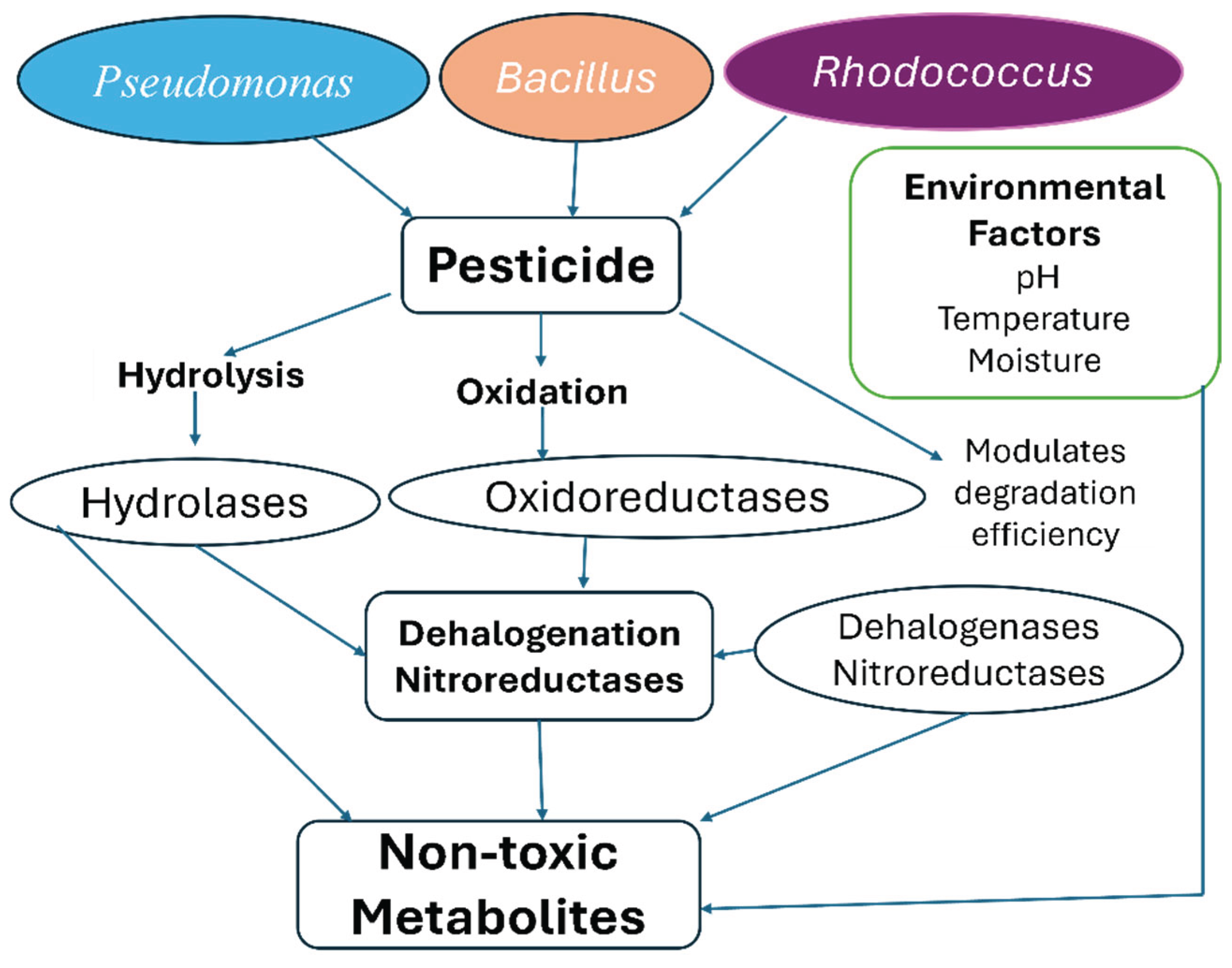
Table 2.
Microbial taxa involved in pesticide degradation.
| Bacterial genus/Species | Pesticides Degraded | Mechanism/Notes | Sources |
|---|---|---|---|
| Pseudomonas | Organophosphates, Pyrethroids, DDT, Phenolics |
Hydrolysis, Oxidation, genetically modified for phenolics; consortia synergy |
[10,50,51,52] |
| Rhodococcus | Endosulfan, Triazines, Chlorpyrifos |
Oxidative enzymes, Monooxygenases Ring Cleavage, Metabolite Formation |
[53,54,56,57] |
| Arthrobacter aurescens TC1 | Atrazine, S-Triazines |
Specialized hydrolytic pathways, Dechlorination |
[52,55,58] |
| Bacillus | Pyrethroids, Diphenyl Ethers, Carbamates |
Esterase Activity, Nitroreduction; ~85% triazoles; consortia enhance rates |
[57,59,60,61,62] |
| Burkholderia | Parathion, Carbofuran, Various Organochlorines |
Hydrolases, Oxidases, Broad-Spectrum Degradation; cometabolism with plants |
[9,11,63,64] |
| Flavobacterium | Organophosphates | Hydrolysis | [9,10,11] |
| Klebsiella | Neonicotinoids, Chlorpyrifos | Esterases | [39,65,66] |
| Novosphingobium | PAHs, Sulfonylureas, Neonicotinoids | Dioxygenases, Hydrolysis | [67] |
| Acinetobacter | Neonicotinoids, Diazinon, Organophosphates | Esterases, Hydrolysis; up to 80% diazinon removal in lab settings | [39,65,68] |
| Streptomyces | DDT,Endosulfan, Diflufenican Carbamates, Organophosphates |
Esterases, Cometablolic processes Actinobacterial Degradation |
[39,47,69] |
| Sphingomonas | Neonicotinoids, Sufonylureas | Oxidases, Hydrolysis, genetically modified for carbamates/organophosphates; biofilm enhances stability | [28,70] |
| Stenotrophomonas | Neonicotinoids, Sufonylureas | Hydrolysis, Cometabolism | [43,71] |
| Alcaligenes | Organochlorines | Reductive, Dechlorination | [72] |
| Achromobacter | Triazines | Hydrolysis, Ring Cleavage | [29,73] |
| Paracoccus | Pyrethroids | Ester Hydrolysis | [43,74] |
Disclaimer/Publisher’s Note: The statements, opinions and data contained in all publications are solely those of the individual author(s) and contributor(s) and not of MDPI and/or the editor(s). MDPI and/or the editor(s) disclaim responsibility for any injury to people or property resulting from any ideas, methods, instructions or products referred to in the content. |
© 2025 by the authors. Licensee MDPI, Basel, Switzerland. This article is an open access article distributed under the terms and conditions of the Creative Commons Attribution (CC BY) license (http://creativecommons.org/licenses/by/4.0/).
Copyright: This open access article is published under a Creative Commons CC BY 4.0 license, which permit the free download, distribution, and reuse, provided that the author and preprint are cited in any reuse.


