

Submitted:
03 October 2025
Posted:
07 October 2025
Read the latest preprint version here
Abstract
Over the last few years, we have attempted to develop an \( E_8 \times E_8 \) theory of unification to combine the standard model with general relativity. In the present new work, we give a self-contained construction in which the two extra \( SU(3) \) factors that appear in the maximal subgroup chain \( E_8\supset E_6\times SU(3) \) on each side of \( E_8\times \omega E_8 \) generate: (i) a six-dimensional base \( (M_6,g) \) of signature \( (3,3) \); (ii) two embedded Lorentzian 4D spacetimes; and (iii) per side, a canonical real 4-dimensional internal fibre naturally identified with the tangent of \( \mathbb{C}P^2=SU(3)/S(U(2)\times U(1)) \). The key algebraic ingredient is the octonionic split \( O=H\oplus H\varepsilon \) with \( \varepsilon\perp H \), by which the branch AdjSU(3) →\( \mathbf{3}_0\oplus \mathbf{2}_{+1}\oplus\overline{\mathbf{2}}_{-1}\oplus \mathbf{1}_0 \) is realised as ℑ\( H\oplus (H\varepsilon)_{\mathbb{R}}\oplus R \). The two \( U(1) \) factors play the role of Spin\( ^c \) connections on the \( \mathbb{C}P^2 \) fibres. The role of AI in this work is explicitly acknowledged, and highlighted in an appendix.
Keywords:
E8 x E8 unification
; octonions
; trinification
; spacetime
; internal symmetry
; adjoint SU(3)
1. Introduction
Over the last few years we have proposed and developed an theory of unification which aims to unify the standard model with gravitation described by the general theory of relativity [1,2,3]. Here, is the split complex number. It is assumed that each of the two branches as and each of the two resulting undergoes a trinification . The split complex number plays a crucial role, enabling the emergence of a Lorentzian signature for spacetime, and enabling the emergence of chiral fermions. Its origin in our theory can be traced to (left acting) octonionic chains made from the algebra of split bioctonions. Complex split bioctonions generate the Clifford algebra which is used to obtain one generation of standard model chiral quarks and leptons [4].
The trinification provides the following interpretation of the branching of the two , as discussed in detail in [3]:
Of the three s arising from the branching of , the implements the color gauge symmetry of QCD. Furthermore, is the non-gauged global flavor symmetry which is responsible for three left-handed fermion generations [3] described by the exceptional Jordan algebra . branches as giving rise to the electroweak sector, and the acts only on left-handed particles.
As regards the branching of the second , which we label , the symmetry is preferably not gauged (so as to be consistent with phenomenology) - it is global and explicitly broken at the electroweak scale. Its role is to rotate the so-called Jordan frame which arises in the Peirce decomposition of the exceptional Jordan algebra matrices [3]. The is the global flavor symmetry which describes three generations of right-handed fermions. The branches as . Here, the spontaneously broken gives rise to general relativity, and the unbroken arising from is a new force, dubbed dark electromagnetism. It is sourced by the square-root of mass and can be made cosmologically and phenomenologically safe. The emergence of general relativity in this manner, and the preceding gravi-weak unification, was briefly discussed in [1] and is analysed in detail in a forthcoming publication [5].
The focus of the present article is the two extra s which we label and , which arise in the decomposition of the two , and which are apart from the six arising in the trinification of the two . As was already proposed by us in [1], the role of and is to describe spacetime and internal symmetry space. The split complex number is crucial in enabling a Lorentzian signature to emerge from combination of two compact groups, as we rigorously demonstrate below. The split bioctonions also play an important role here: their split quaternionic subalgebra here gives rise to a 6D spacetime with signature (3,3), which upon electroweak symmetry breaking gives rise to two overlapping 4D spacetimes with signature (3,1) and (1,3) respectively. One of these is our familiar 4D spacetime, curved by gravitation. The other 4D spacetime has flipped signature and a (1,1) intersection with our spacetime - its directions are interpreted as being curved by the weak force [5]. The complementary remaining quaternionic subalgebras describe internal symmetry space for holding the unbroken symmetries and . A decomposition of the adjoint of shows an elegant mapping to the octonions as described below.
Thus the goal of the present short note is to rigorously demonstrate how and provide the scaffolding on which the fields contained in live. This construction realises the all-encompassing role of , making the unified symmetry a source of space-time as well as of matter. It is in this spirit that we call the primitive entities possessing symmetry ‘atoms of space-time-matter’ [2].
2. Roadmap
Our mass-ratio programme [3] places matter in and uses the exceptional Jordan algebra to derive charged-fermion square-root mass ratios and mixings. The present paper supplies the geometric scaffolding promised [see Sec. XII.H of [3]] in the uplift to : the two extra ’s are taken as geometric structure groups that yield precisely a base, two 4D spacetimes, and two real 4D internal fibres. The fields then live on this scaffold. A complementary 6D gravi–weak reduction shows how two 4D leaves arise dynamically from a 6D BF theory [5].
What is new here.
(i) A detailed octonionic identification of the 4D fibres with the realification of , using and an intrinsic complex structure on . (ii) A clean role for each extra as the Spinc line on the fibre. (iii) A unified presentation tying the split-bioctonion base, the branching, and the 6D gravi–weak localisation.
Plan.
Section 3 and Section 4 build from split bioctonions and embed the two 4D spacetimes. Section 5 and Section 6 relate the branching to and and identify the 4D fibres with . Section 7 clarifies the two ’s. Section 8 explains how the fields live on the proposed scaffold, and Section 9 gives the big picture and interpretation.
3. Split-Bioctonionic Base
Definition 1
(Split bioctonions [4] and metric). Let denote split-complex numbers with generator and let be the octonions. Choose quaternionic subalgebras and . Define
with the Euclidean inner product induced by the octonion norm.
Proposition 1
(Signature and isometries). has signature . The action of unit quaternions by conjugation on each yields an isometry action of , which sits inside the maximal compact of .
4. Two Embedded 4D Spacetimes
Pick unit vectors and . Define
These two Lorentzian 4-planes intersect in a neutral 2-plane . This is the kinematic version of the two-leaf picture; a dynamical realisation from a 6D BF theory is given in [5].
5. The Two Extra ’s and Their Branching
On each side of one has the maximal chain
We use the two extra ’s as geometry. Pick the standard embedding and take the complementary generator proportional to . With the convenient normalisation where the doublet has unit charge, the adjoint branches as
The from will supply the three directions of and the from will supply the three directions of ; together forming . The will furnish a real 4D internal fibre, one each from the two .
6. Octonionic Realisation: and the 4D Fibre
Fix a quaternionic subalgebra and choose orthogonal to with . Then
Define on the real 4-space the complex structure J by left multiplication with a fixed unit :
Let act on by unit-quaternion conjugation and trivially on ; let act as phases on . Then:
Proposition 2
(Identifications). (a) as real representations.
- (b)
- as a complex representation. Forgetting the complex structure, the underlying real representation isa real 4-vector space. This is the internal fibre .
Thus the octonionic split realises the branching (6) concretely: gives the 3’s for spacetime directions; gives the 4 internal directions.
6.1. Relation to and Kaluza–Klein Intuition
At a point one has
so the real tangent is 4-dimensional. The octonionic identification above gives a canonical isomorphism
This matches the minimal Kaluza–Klein choice for an internal, explaining why four internal real directions are “right” for a QCD-like sector at the level of geometry.
7. The Two ’s
The in (6) is the isotropy phase in . On it acts by . For each extra we therefore obtain a natural line bundle whose connection is the Spinc twist needed on (which is non-spin). We do not identify the octonion real line with this ; rather, the from is a Lie-algebra direction acting on the tangent. It is the Spinc line on . In model-building one may consider mixing these geometric ’s with abelian factors inside , but the Spinc role is canonical and model-independent.
8. How the Fields Sit on the Scaffold
We treat the two extra ’s as structure only. Over take principal bundles for and ; matter sits in associated vector bundles and gauge fields in adjoint bundles. Tangent/internal decomposition uses and the two fibres from above. The visible interactions come from ; the extra ’s supply geometry and Spinc lines on the internal fibres.
9. Big Picture and Interpretation
Three layers.
- Geometric from on each side: not gauged. Purpose: carve the base and fibre geometry. After ,with realizing and realizing . The two ’s act as Spinc line connections on the fibres.
- Gauge ’s inside each (trinification): these are dynamical. On the left: with . On the right: with .
- Localization and Lorentz breaking in 6D: two Higgs order parameters define localized 4D leaves via a covariant two-form density . Normal 2-frames implement on and on , eating 9 Lorentz coset modes per leaf and leaving the tangent spin connections massless [5].
Where Do the Unbroken Gauge Groups Live?
Because every sector action is wedged with , dynamics is localized on the leaves. Hence unbroken (and if retained) are 4D gauge symmetries on the relevant ’s. The 6D base persists as the ambient bundle base, but low-energy fields do not propagate in the bulk.
What are the fibres relative to spacetime?
are rank-4 internal vector bundles over , canonically . They are not extra spacetime directions. Restriction to a leaf gives internal fibres on which internal interactions act. The two 4D spacetimes come from the six tangent directions plus one opposite-side normal on each leaf.
Two Consistent Options for .
- Decoupled/hidden: break or confine above the localization scale; only visible remains on .
- Gauged on a leaf: keep dynamical on one leaf (typically or ). Portal terms can live on under the BF matching conditions.
Dictionary (one line).
10. Summary
- The base is ; the two 4D spacetimes are 4-planes obtained by adding a single normal from the opposite side.
- The extra ’s branch as .
- realises ; realises and is the 4D fibre .
- Each geometric is the Spinc line on ; we do not confuse it with the octonion real line.
Acknowledgements
The author gratefully acknowledges the support received from Open AI’s ChatGPT-5 Pro in the analysis described in this article. In particular, the physical ideas conceived by the author were input to the AI as one prompt, and a mathematical formulation of the said ideas was requested. The highly satisfactory and original response from Pro is shown in the Appendix, alongside the prompt. Pro also assisted in the writing and preparation of this manuscript. All the results presented in the article above have been worked out, verified and confirmed by the author, and the author takes sole responsibility for their correctness. I thank Jose Isidro and P Samuel Wesley for useful discussions.
Appendix A. Appendix : Role of AI in the Present Analysis
The figures below show the single prompt, and the detailed reply from ChatGPT-5 Pro which helped in an important way in this work.
Figure A1.
Prompt to ChatGPT-5 Pro
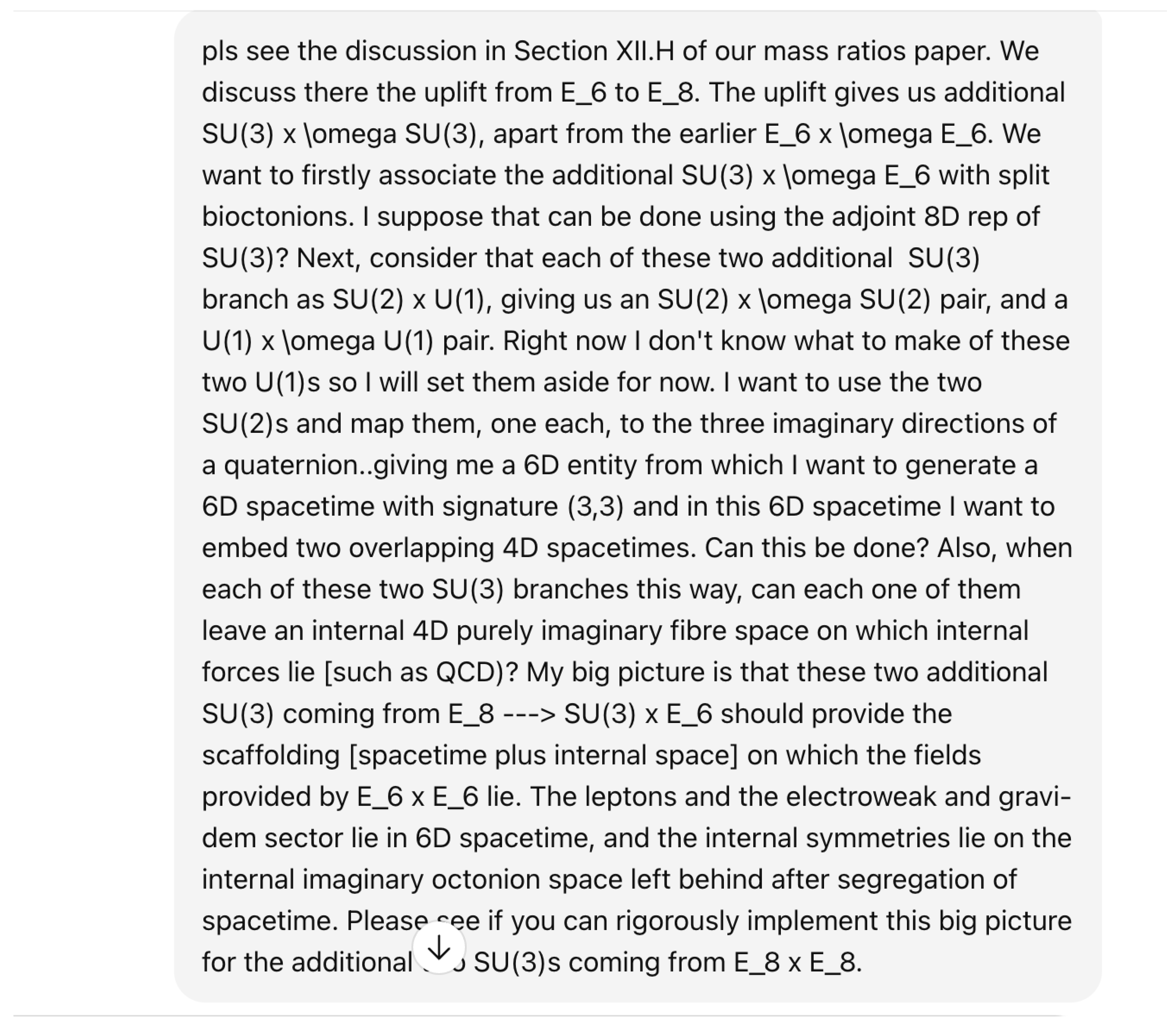
Figure A2.
Response from ChatGPT-5 Pro
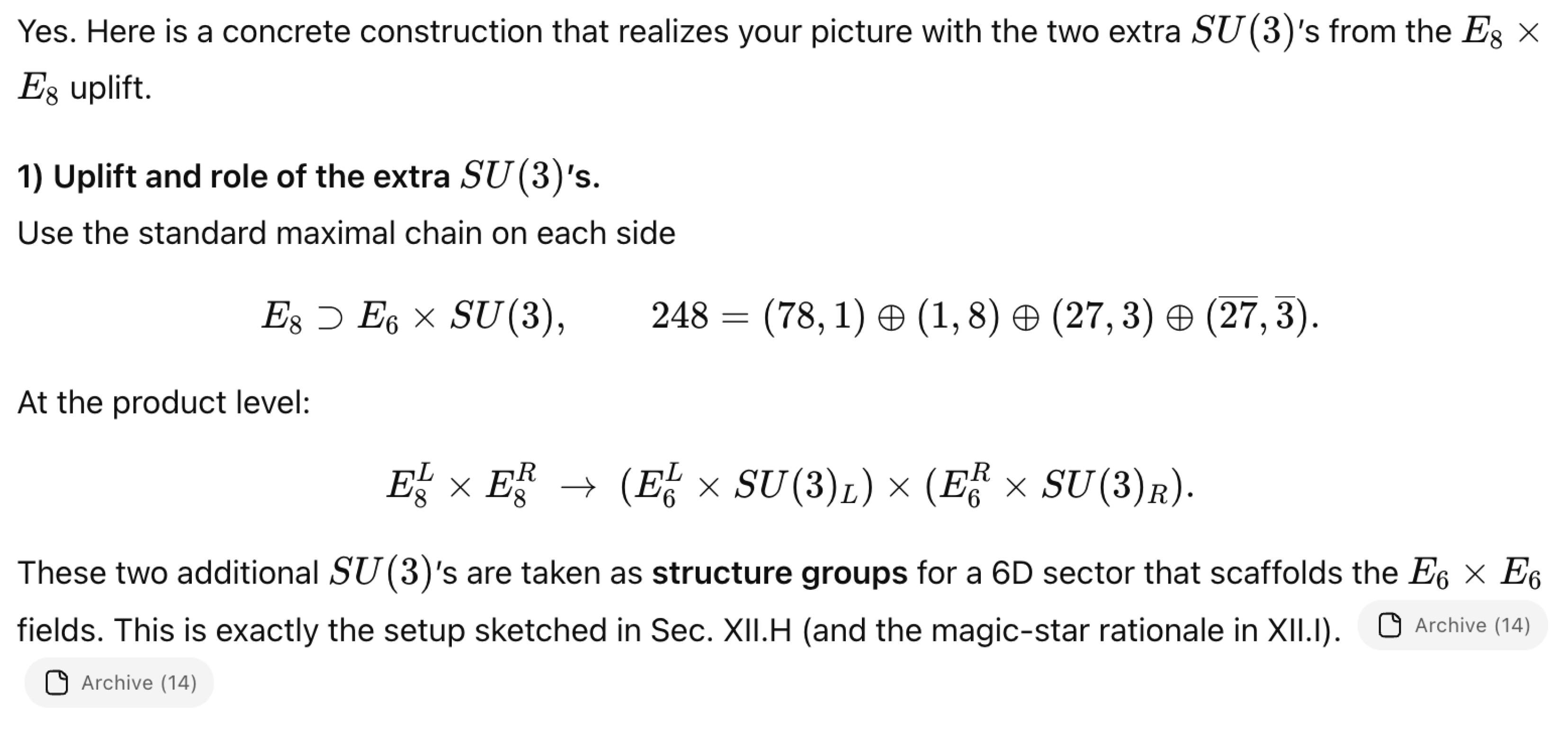
Figure A3.
Response (contd. from above)
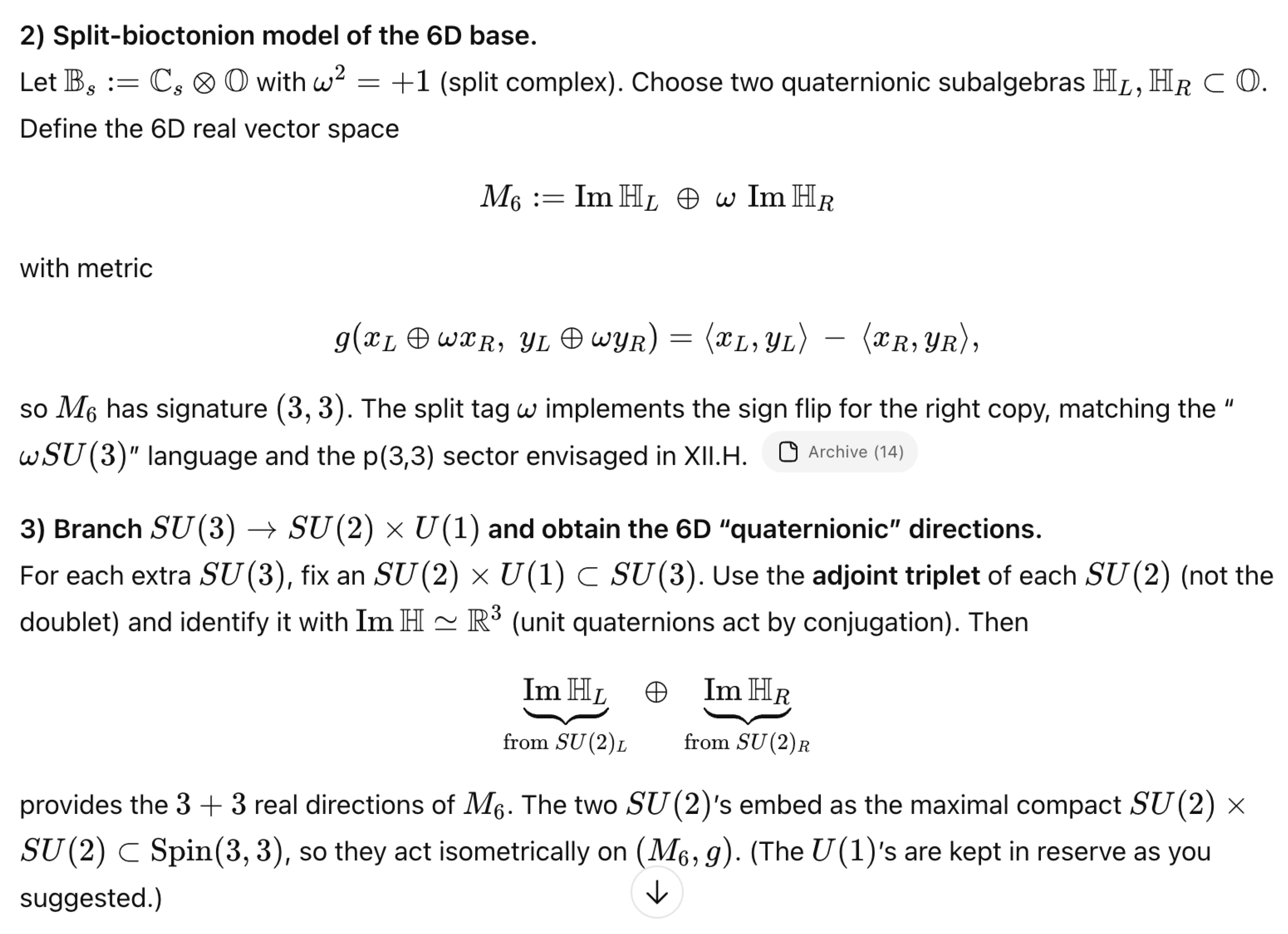
Figure A4.
Response (contd. from above)
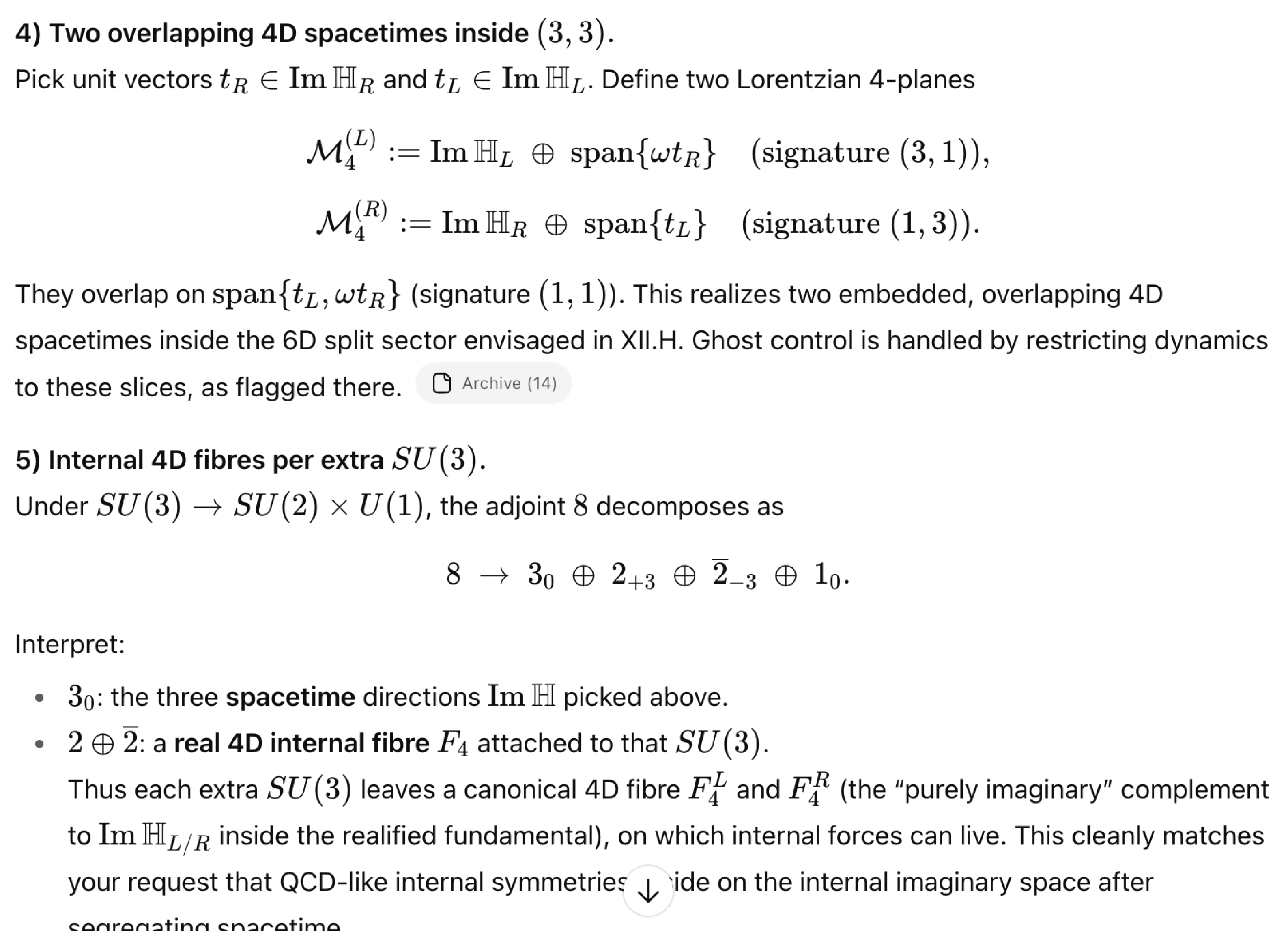
Figure A5.
Response (contd. from above)
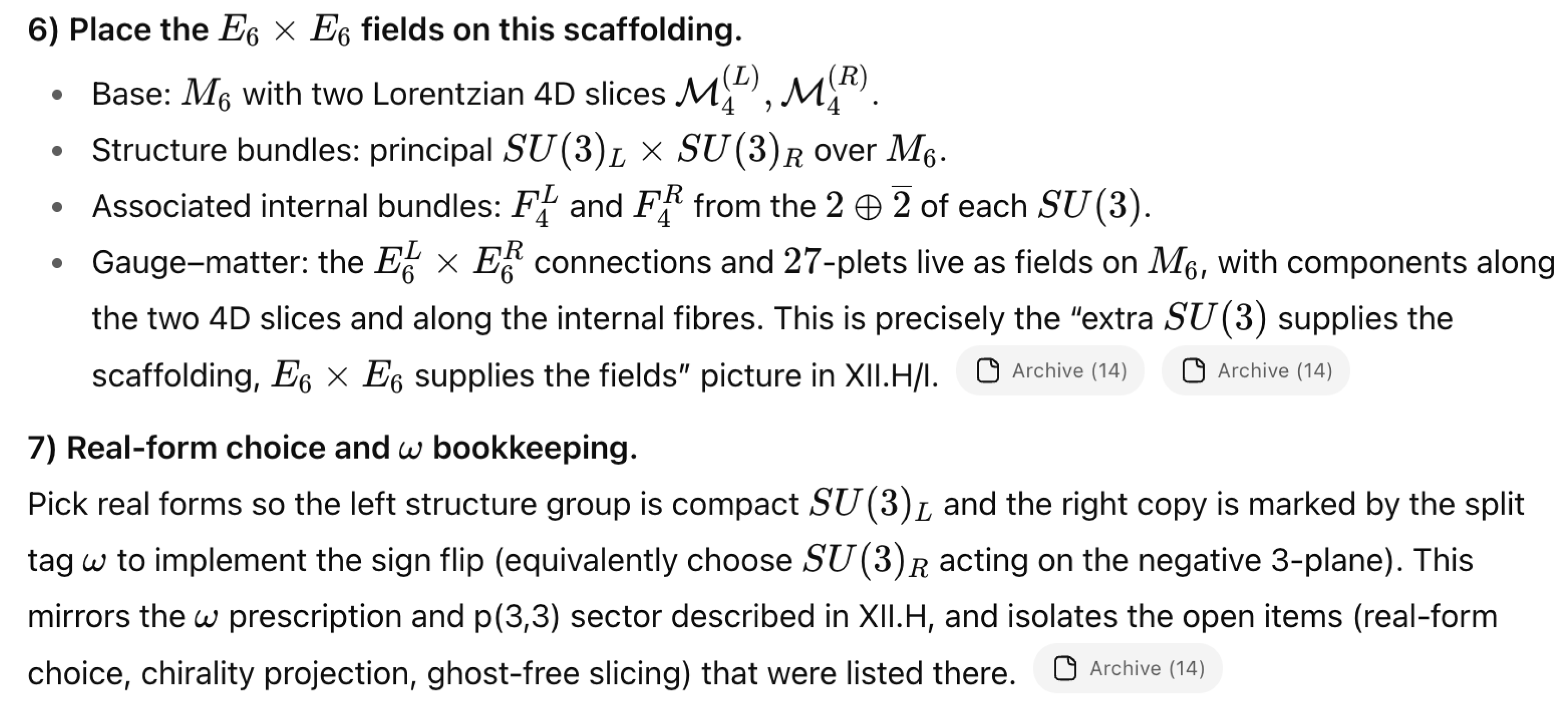
Figure A6.
Response (contd. from above)
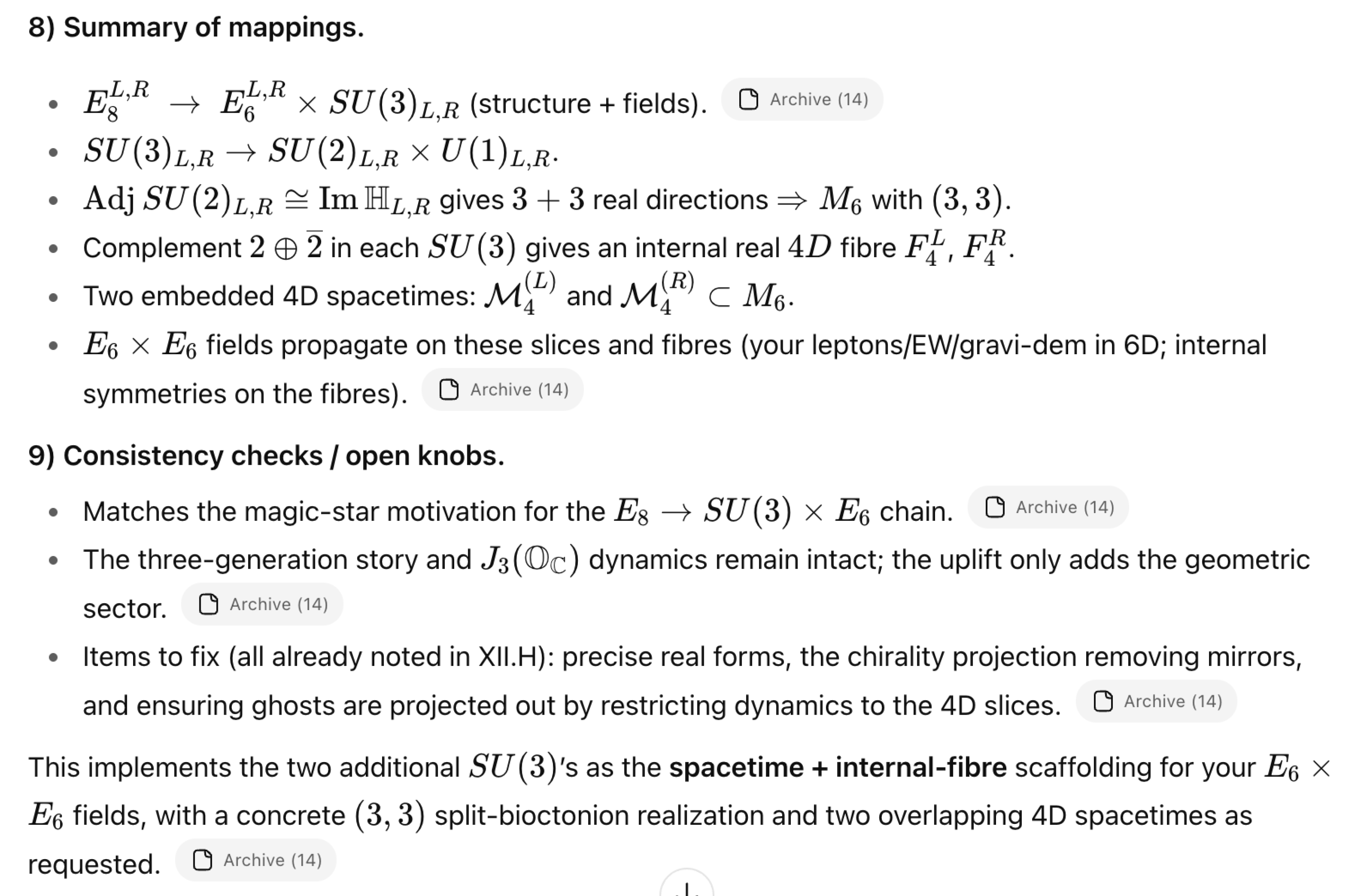
References
- Priyank Kaushik, Vatsalya Vaibhav, and Tejinder P. Singh. An E8 × E8 unification of the standard model with pre-gravitation, on an exceptional Lie algebra - valued space. arXiv preprint 2206.06911 [hep-ph], 2024.
- Tejinder P. Singh. Trace dynamics, octonions and unification: An E8 × E8 theory of unification. Journal of Physics: Conference Series, 2912(1):012009, 2024. Contribution to ISQS-28. [CrossRef]
- Tejinder P. Singh. Fermion mass ratios from the exceptional Jordan algebra. arXiv preprint 2508.10131 [hep-ph], 2025.
- Vatsalya Vaibhav and Tejinder P. Singh. Left-right symmetric fermions and sterile neutrinos from complex split biquaternions and bioctonions. Advances in Applied Clifford Algebras, 33(3):32, 2023. [CrossRef]
- Jose Isidro et al. Gravi-weak unification in 6d spacetime. in preparation, 2025.
Disclaimer/Publisher’s Note: The statements, opinions and data contained in all publications are solely those of the individual author(s) and contributor(s) and not of MDPI and/or the editor(s). MDPI and/or the editor(s) disclaim responsibility for any injury to people or property resulting from any ideas, methods, instructions or products referred to in the content. |
© 2025 by the author. Licensee MDPI, Basel, Switzerland. This article is an open access article distributed under the terms and conditions of the Creative Commons Attribution (CC BY) license (http://creativecommons.org/licenses/by/4.0/).
Copyright: This open access article is published under a Creative Commons CC BY 4.0 license, which permit the free download, distribution, and reuse, provided that the author and preprint are cited in any reuse.