

Submitted:
29 September 2025
Posted:
02 October 2025
You are already at the latest version
Abstract
Drastically cutting carbon footprints to reduce global warming is a universal norm at present, in keeping with the United Nation’s Convention on Climate Change 2015. Fit-ting in appropriately with this theme is the global proliferation of Electric Vehicles (EVs), gradually replacing the Internal Combustion Engines (ICE) automobiles. India (Niti Aayog) has also given a determined call for ‘only EV’ on road by 2030. Electric two-wheelers (E2Ws) with 80% market share will lead this transition in this country. To meet sustainability and environmental norms, this needs not only appropriate pro-duction standards but also sustainable supply chain management (SSCM) in the Indi-an E2W (IE2W) industry integrating environmental, economic and social issues. There is also a need to ensure that the battery supply chain (one of the grey areas of the in-dustry with regard to environmental concerns) follows circularity and sustainability principles. With AI having come into play in industry and manufacturing, it would obviously influence circular economy (CE) and sustainability concerns in the IE2W space too. This review aims at analysing how the IE2W industry can hugely benefit from AI in enhancing its contribution to the circular economy and sustainability. The IE2W market is still in its infancy, thereby underscoring the importance of this paper in highlighting strengths and opportunities even as we look at the challenges ahead. This will impact how the Indian EV industry, in general, exploits AI, thereby enhanc-ing value for industries, governments, the public and the environment.
Keywords:
Artificial Intelligence (AI)
; circular economy
; supply chain management
; sustainability
; electric vehicles (EV)
; electric two wheelers (E2W)
; waste management
1. Introduction
Technological progress in the world has been most conspicuously led by the giant strides in artificial intelligence (AI) in the recent past, whose capabilities are expanding in an exponential manner to find applicability in all facets of life and business. The manufacturing and automobile industry have been revolutionised by AI-powered robotics amongst other applications. The auto industry has immensely gained from AI (largely positive, though some negative like adverse job security) and its impact will continue to grow in the years ahead. Essentially, the electric vehicles (EV) industry is a step ahead of the conventional auto industry in terms of technology absorption and accordingly, AI will be sought to be used to the hilt, to render processes efficient, smoothen logistics, the supply chain, vendor management, and of course, improve the customer experience by offering better and technologically superior products with the best service support.
A logical question then is on how significant the influence of AI on sustainability in the EV industry (and for the purposes of this study, the IE2W industry), is. For the past decade and more, the world has had an increased focus on environmental and sustainability concerns. Governments and industries have had to ensure that these concerns are suitably addressed in their manufacturing, processes and products. AI will expectedly, address these concerns.
While we have conventions like the United Nations’ on Climate Change 2015 [1], making it imperative for countries to reduce their carbon footprint, we also have countries having their own regulations for this, like the European Union (EU) “Fit for 55” (to reduce net greenhouse emissions by 55% by 2030), and the United States (US) EV target of 50 percent by 2030 [2].
India is the second top net crude oil (including products) importer (85-88% of its oil needs), having imported 205.3 MT in 2019 [3,4,5,6]. This, has a negative impact on geopolitical resilience and self-sufficiency [7]. Adoption of EVs is expected to significantly usher in adoption of a circular economy especially in the IE2W industry. This is in conjunction with government regulations and policies gently nudging industry to adopt green norms, like FAME (Faster Adoption and Manufacture of Hybrid and Electric Vehicles scheme 2015), FAME II scheme [8], and Government of India (GoI) target of 'E-Vehicles Only' on the roads by 2030 [9,10]. The India EV market value of $54.41 billion in 2025, could ascend to $110.7 billion by 2029, a compounded annual growth rate (CAGR) of 19.44% over 2025-2029 [11]. Electric bikes and scooters are expected to exponentially grow in sales [12], with Indian penchant for two-wheelers (2W) and three-wheelers (3W) rather than four-wheelers/cars (4W) [13]. E2W market CAGR of 29.07% will lead to $1.3 billion in sales by 2028 [14]. Dynamic government policies should keep up with this [15,16].
India with 14 of the 20 most-polluted cities in the world, which includes six of the 10 most polluted cities in the world [17,18], needs to give environmental issues the centre-stage. Fatalities of 12.5 lakh people annually stem from this and hence calls for expeditious resolution [19]. In India (world’s 3rd largest auto market) [20], 2Ws account for 75.5% of the annual total production of 28.4 million [21]. In FY 2023-24, 2W sales increased to 1.80 crore (cr) units (from 1.59 cr in FY 2022-23) [21]. Indian 2Ws account for over 20% of the total CO2 emissions and about 30% of urban particulate emissions (PM2.5) [22]. Indian 2Ws cover a daily average of 27−33 km (maximum 86 km), covering 8,800 km annually on an average [23,24,25]. As such, pollution estimation cannot ignore 2Ws. IE2W production should be stepped up to exploit the benefits of reduced pollution and other technological benefits [26]. Also, while existing EV 4W companies are retrofitting current ICE models with electric drive-chains, IE2W is going about manufacturing from scratch, that gives them a heads-up on a circular economy (CE) and sustainability.
It is largely understood that the battery supply chain is one of the grey areas of the IE2W industry with regard to environmental concerns, as with any EV industry, which needs mitigations by following the principles of circularity and sustainability. AI has become crucial in boosting manufacturing competitiveness in the automobile industry, and with the entire automobile industry gravitating towards EVs, the IE2W industry too will be a beneficiary of the gifts of AI significantly.
2. Significance of the Study
This review aims at analysing the extent to which the IE2W industry will benefit from AI in enhancing its contribution to CE and sustainability. The IE2W industry market is still in its infancy, and this paper would highlight the path forward in exploiting AI, thereby enhancing value for said industry, government, the public and the environment. The paper will scrutinise literature available on EV adoption barriers, government role through regulations and norms, sustainability, sustainable supply chain management (SSCM), green supply chain management (GSCM), and waste management, in the context of AI and its applicability for the IE2W industry.
To summarise how AI can benefit the CE and sustainability efforts of the Indian EV (IEV)/ IE2W industry, the following outcomes are expected:
- highlighting the positive effects of AI-driven technology incorporation into this space, to the extent it aids vendor partnerships, supply chain management, and increases the sustainability of the industry, to meet the government’s environmental targets and stipulations;
- bringing awareness into the negative aspects of AI to avoid its pitfalls;
- drawing interrelationship between AI, the CE, sustainability, the IE2W industry and green innovation;
- assessing GoI and state support for AI in the IE2W industry and their impact;
- aligning the IE2W industry and its operations with the added incorporation of AI to enhance the circular economy;
- laying the foundation for research on differing variables like AI-driven technology, human aspect, investment, operations, vis-à-vis IE2W performance;
- creating awareness on IE2W opportunities for AI applications and to find solutions for supply chain challenges therein;
- academia collaboration for R&D on AI-absorption in IEV/ IE2W industry to promote sustainability;
- and, to help watchers of not only IE2W industry but also other industries at large to overcome a range of challenges pertaining to supply chain management, vendor partnerships, innovations, consumer experience, waste management, pollution control, profitability, competitiveness, flexibility, quality etc through suitable application of AI-driven technology, tools and systems.
3. Sources and Classification of Literature
In order to obtain a literary overview to understand the existing material on the subject as well as to identify gaps which would set the path for future research, over 538 numbers of different types of material as given in the table below, were perused (not all of it quoted as references in this study).

Table 1.
Material types distribution.
| Type of material | Numbers |
| Journal Article | 415 |
| Report | 44 |
| Book | 25 |
| Conference Paper | 16 |
| Web Page | 12 |
| Newspaper Article | 7 |
| Chapter | 5 |
| Symposium | 5 |
| Magazine Article | 4 |
| Newspaper | 2 |
| Working Paper | 1 |
| Research Paper | 1 |
| Thesis | 1 |
| Grand Total | 538 |
Table 2.
Material year-wise breakdown.
| Year | Material count | Percentage oftotal |
| 2025 | 98 | 18.22 |
| 2024 | 75 | 13.94 |
| 2023 | 79 | 14.68 |
| 2022 | 81 | 15.06 |
| 2021 | 56 | 10.41 |
| 2020 | 40 | 7.43 |
| 2019 | 23 | 4.28 |
| 2018 | 19 | 3.53 |
| 2017 | 14 | 2.60 |
| 2016 & prior | 53 | 9.85 |
| Total | 538 | 100 |
These included topics (apart from AI in general and AI in automobile industry in particular) like sustainability, SSCM, GSCM, vendor collaborations or strategic partnerships, automobiles, automobile engineering and EVs. Prominent publishers like Elsevier, Emerald Insight, Springer, Wiley, SAGE, MDPI, and Taylor & Francis were referred to. Relevant material in Government websites and leading national newspapers has been gone through. String searches employing filters and keywords, back-ward and forward searches in order to identify the relevant literature on the subjects already mentioned, were carried out.
The various topics on which the references were studied are given in the table below.
Table 3.
Subject-wise distribution of perused material.
| Subject | Book | Chapter | Conference Paper | Journal Article | Magazine Article | Newspaper | Newspaper Article | Report | Research Paper | Symposium | Thesis | Web Page | Working Paper | Grand Total |
| Adoption, Barriers, Purchase Behaviour & Indian Market | 5 | 49 | 3 | 17 | 2 | 1 | 77 | |||||||
| AI, Blockchain, Industry/Logistics 5.0/4.0 | 3 | 1 | 39 | 1 | 2 | 3 | 6 | 55 | ||||||
| Battery Supply Chain | 2 | 1 | 30 | 1 | 9 | 1 | 44 | |||||||
| Bibliometric Analysis | 2 | 2 | ||||||||||||
| Charging infrastructure | 2 | 6 | 1 | 9 | ||||||||||
| Circular Economy | 1 | 25 | 1 | 5 | 1 | 4 | 37 | |||||||
| Consumer Satisfaction: EVs | 2 | 2 | ||||||||||||
| Environment & Sustainability in EVs | 2 | 1 | 2 | 27 | 4 | 1 | 37 | |||||||
| EV Tech & Future Trends | 1 | 3 | 4 | |||||||||||
| Geopolitics, Rare minerals | 19 | 3 | 1 | 23 | ||||||||||
| Govt Policy & Economics | 1 | 33 | 2 | 1 | 1 | 38 | ||||||||
| Green Energy | 1 | 21 | 1 | 3 | 1 | 27 | ||||||||
| Green Manufacturing | 1 | 2 | 3 | 3 | 9 | |||||||||
| Green SCM | 1 | 1 | 15 | 17 | ||||||||||
| Industry-Academia | 1 | 1 | ||||||||||||
| Innovation | 2 | 1 | 3 | |||||||||||
| Misc/ Management/ Marketing | 1 | 3 | 4 | |||||||||||
| MSME | 1 | 1 | ||||||||||||
| Outsourcing in Auto Industry | 9 | 9 | ||||||||||||
| Profitability & Competitiveness | 1 | 17 | 18 | |||||||||||
| Quality in EVs | 1 | 1 | ||||||||||||
| Research Methodology | 3 | 1 | 4 | |||||||||||
| SCM | 1 | 10 | 11 | |||||||||||
| Skill Development and Training | 1 | 1 | ||||||||||||
| Social Aspects of Sustainability | 17 | 17 | ||||||||||||
| SSCM | 1 | 1 | 1 | 36 | 39 | |||||||||
| Top Management | 1 | 1 | ||||||||||||
| Vendor Management & Supplier Collaborations | 2 | 38 | 1 | 41 | ||||||||||
| VMI | 2 | 2 | ||||||||||||
| Waste Management & Pollution Control | 4 | 4 | ||||||||||||
| Grand Total | 25 | 5 | 16 | 415 | 4 | 2 | 7 | 44 | 1 | 5 | 1 | 12 | 1 | 538 |
The findings are enumerated in the ensuing paragraphs, and will cover the IE2W industry and sustainability; IE2W in the CE; AI in the CE of the IE2W industry; challenges, opportunities and recommendations for AI in CE of IE2W; the identified gaps and setting up a conceptual framework; and, exploration of scope and potential for future research.
4. The IE2W Industry and Sustainability
4.1. How Green Are EVs?
EVs and E2Ws, due to their very nature, are understood to be green and environment-friendly, but the following bear relevance:
- Raw materials/ minerals used in batteries, like lithium, are dependent on the mining industry which has a negative impact on the environment. The inherent significant geopolitical dynamics also bear mention [31,32,33,34,35]. Boateng & Klopp (2024) explore the transition to EVs with respect to its impact on the mineral supply chain, while Cheng et al. (2024) focus on the emergent problems due to the concentration of rare earths and minerals in selected countries.
ICE vehicles will continue to be used till its end-of-lifecycle (EoL), and as such, EVs in the near future will not be able to replace ICE fully. There are also the issues of barriers to EV adoption like range anxiety [10,41,42], safety aspects (batteries’ fire hazard) [43], not-yet-matured service support, inadequacy of charging infrastructure etc. Further, some players in the automobile industry are looking ahead at solar power or hydrogen as a propulsion source, and this discourages their whole-hearted shift to EVs [44].
4.2 Battery Environmental Issues and Potential for Recycling
Battery waste management (e-waste) [45,46,47] and recycling can boost the circular economy, and, in the process, promoting sustainability and reducing reliance on rare earths and minerals [37,48,49,50].
The rapid proliferation of EVs raises the challenge of managing EoL EV batteries (EoLEVB). Batteries’ second-life potential [51,52], and reverse supply chain [53] can help. Lithium-ion batteries (LIBs) contain hazardous materials that cause environmental and health risks unless properly disposed, and hence recycling is a viable option. While quantum of EV battery waste by 2030 is difficult to determine, its exponential growth is certain. Indian EV battery waste data year-wise from 2020 onwards is not accurately determinable, mostly since it is dominated by the informal sector and proper safeguards do not exist. To cite an example, as of 2020, a mere 10% of the total 70-90% collected retired batteries in India, were done by formal waste management entities. Improper disposal often leads to severe soil/ water contamination through toxic leaching. Ironically the government’s 18% GST on retired batteries in the formal sector has remain unchanged even after the reduced GST norms of the Indian government with effect from 22 Sep. 25. This incentivises non-compliance, which leads to black mass export (battery anode and cathode remnants) causing loss of precious minerals and material. From Oct 2022 to Sep 2023, black mass export in India totalled approx. 350 tonnes of cobalt, 71.7 tonnes of lithium, and 215 tonnes of nickel [54].
At present, India recycles <5% of its LIBs formally [45]. In spite of an estimated recycling capacity of approx. 83 kilotons per annum (KTPA), 95% of used batteries were handled by the informal sector, or ended up in landfills [55]. Some companies however have made notable strides including Tata Chemical's battery recycling plant (2019) [56], Attero’s facility in Telangana [57], Lohum Cleantech Private Limited (India's first integrated used LIB treatment facility, with a 2 GWh recycling and 300 MWh repurposing capacity) [58], and, BatX Energies (recycling target approx. 1 billion LIBs from 2022-2025, with production of 15 KTPA of black mass from input of 30,000 metric tons of batteries) [59]. These initiatives will inspire IE2W industry to follow suit.
India's Battery Waste Management Rules (BWMR) 2022 [60], seeks to increase recycling and material recovery, setting progressive collection targets up to 70%, and material recovery: beginning at 5% for FY 2027-28, 10% by FY 2028-29, 15% by FY 2029-30, and 20% by 2030-31 and onwards [60]. Automobile industry’s internal goals of 95% recycling by 2030 are also noteworthy [61]. Odisha has set a target of 100% recycling for LIB waste by 2030, which will inspire other states to announce similar initiatives [62]. NITI Aayog’s key projections [63]:
- India's LIB storage requirement estimated at 600 GWh from 2021 to 2030 (only 128 GWh recyclable by 2030; only 58-59 GWh from EV; total 349,000 tonnes).
- NITI Aayog (2024) estimates for LIB waste vary from approx. 2 lakh tonnes to 2 million metric tons by 2030, also projecting annual battery retirement of 3-16 GWh from EVs by 2030 [64].
- Confederation of Indian Industry (CII) (2022) projects that approx. 72-81 GWh of waste batteries (447-517000 tons), would be recycled from 2022 to 2030. By 2030, EV batteries will overtake consumer electronics as source of waste [65].
- Other industry reports estimate India's LIB waste from 12,000 (2020) to almost 50,000 metric tons (2025), projecting increase of battery waste 6x by 2040 and 10x by 2050 [66].
4.3. Vendor Management Issues
Various challenges exist in the setting up of a proper SSCM for Indian automobile/ IEV/ IE2W industry which need to be resolved [67,68,69]. Concepts like green logistics, reverse logistics etc [70,71] could find favour. Studies on SSCM in Indian automotive industry, from multiple stakeholders’ views [72,73]; factors that warrant sustainability in this competitive industry [74]; automotive SSCM in the context of the circular economy, setting up a strategic framework [75,76], have been ascertained. Vendor management challenges and opportunities, resilience and strategy, in the transition to EVs have been covered [77,78]. Sustainability challenges in the EV battery value chain like resource sufficiency, geographical distribution, regulations, policy etc [77,79] reveal that demand for lithium, cobalt, nickel and graphite will go up 26x, 6x, 12x and 9x respectively in the period from 2021 to 2050. IE2W manufacturers need to work collaboratively with vendors in to ensure SSCM in production ab initio to meet global environmental norms. Outsourcing is an important aspect of vendor management which needs to be gone into holistically to improve the performance of the IEV/ IE2W industries [80,81,82,83,84,85,86].
5. The Circular Economy in IE2W
5.1. The Circular Economy (CE)
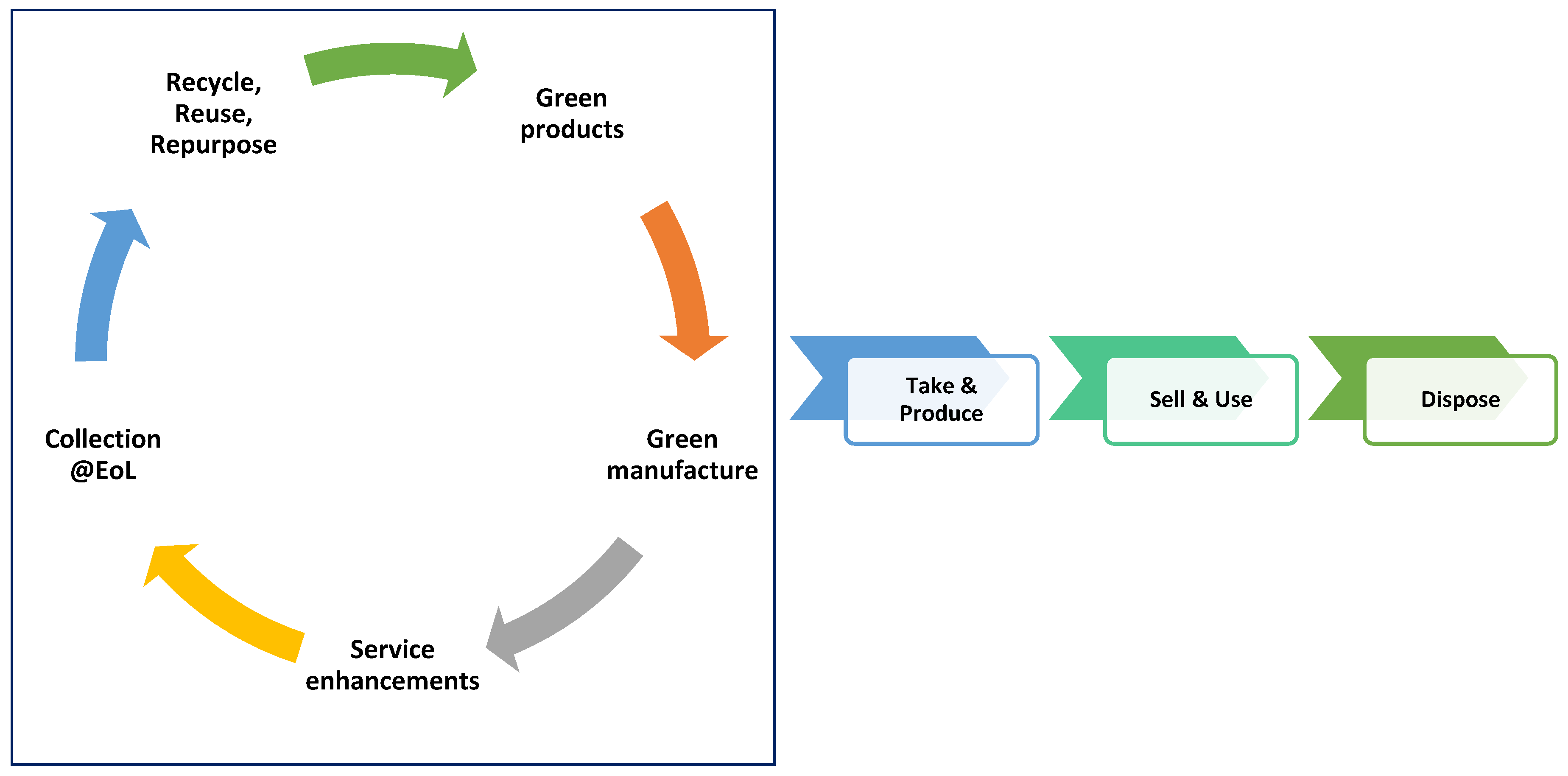
The CE is an economic model seeking to change the traditional "take-make-waste" linear economy [87], by eliminating waste and pollution, retaining products and materials in use, and regenerating natural systems. It is not merely a recycling effort, and is a paradigm shift in designing, producing how we design, produce, and consume goods. It focuses on closing material loops and decoupling economic growth from the consumption of finite resources [88]. Through the years the concept of CE has gained currency and continuously refined in its understanding by some prominent academics, thought leaders and businesses [89,90,91,92,93]. These principles are reinforced by the 3Rs (reduce, reuse, recycle) and strategies to refurbish, remanufacture, and repurpose ([88]. Digital technologies could be used to advance CE practices [94]. For countries to build their CE is a worthy objective in the present-day world bent on achieving environmental goals [95].
CE is a perfect candidate for the introduction of AI to smoothen out the challenges. AI could and is finding use in all aspects of the CE from using green raw materials, producing products in a green manner, ensuring highest standards of service so that the longevity of the product is assured, ensuring its collection at EoL, and then subjecting it to the 3Rs. CE and sustainability are intertwined and cannot be seen in isolation [87,96,97,98].
Figure 1.
The CE (Left) & Linear Economy (Right) [Source: Authors].
5.2. Green SCM & Green Manufacturing
The automotive industry in general and specifically the IEV/ IE2W industry in India, like any other industry, needs to incorporate green innovation and the CE in order to ensure sustainability and sustainable development [99,100]. The impact of green innovation [101] and CE [102] would see decreased resource usage and thereby pollution, enhanced efficiency, new market opportunities and profitability. This is where Green SCM (GSCM) comes into play, as a concept which is alternate but not entirely different from SSCM [103,104], showing that environmental factors significantly impact overall performance and organizational profitability.
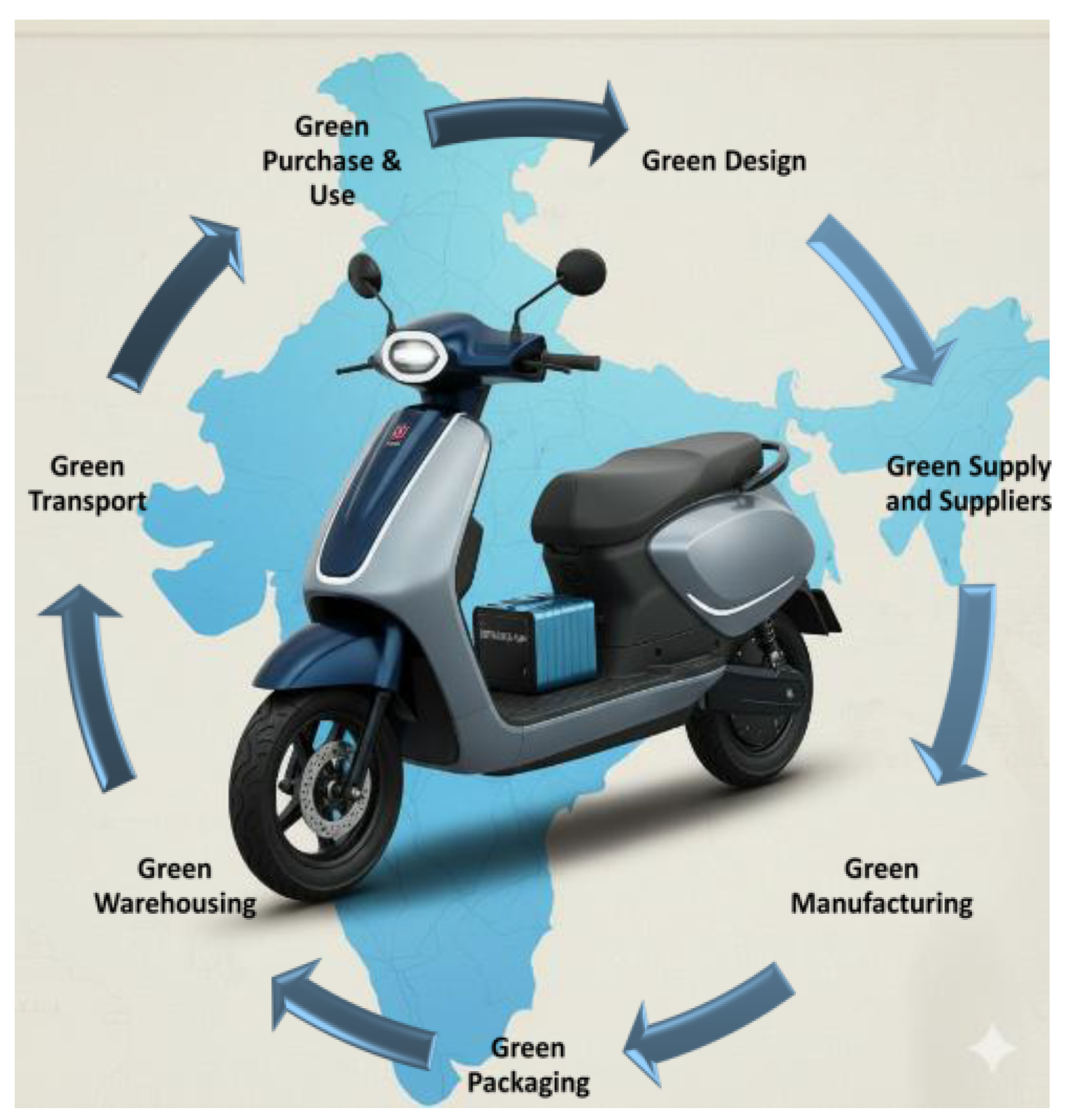
GSCM implies that all stages of the supply chain including green design, suppliers, purchase, manufacturing, packaging, warehousing, transportation and even customers, are entirely green. Green behaviour would relate to the enhanced efficiency of energy utilisation and reduction in consumption [105,106]. Environmental management vis-à-vis supply chain capabilities in the Indian automobile sector [104,107]; correlation of sustainable manufacturing and green human resources [108]; and, green manufacturing and innovation with regard to its effect on sustainability, have been examined [109]. This kind of empirical material of GSCM in the Indian automobile industry [110] is obviously relevant to the IE2W industry since most supply chain aspects and logistics would be common.
Industries attempting to implement green manufacturing significantly contribute to the greening of the Indian economy [111]. There is a need for them to follow norms in compliance of governmental regulations, establish environment-compliant processes, and adopt new technologies to promote performance and competitiveness [100].
Figure 2.
Green SCM in IE2W industry [Source: Authors].
It has been shown through research that government can facilitate EV proliferation [112] with recommendations on methodology to formulate government policies [113] which can streamline this.
The importance of GSCM in strategic vendor management and partnerships has been established. GSCM practices of firms with strategic alliances showed distinct benefits [114]. Understandably, the Indian automobile industry needs to develop a strategic sourcing model [115]. This also implies that the selection of green suppliers has to be formalised and one such “expert choice methodology” has been demonstrated [116].
Research clearly establishes that both internal and external GSCM improves performance in the automobile industry [117]. The correlation between GSCM and firm performance in the automobile industry has been shown [118]. Even the GSCM as a concept itself can be performance evaluated in the backdrop of carbon peak and carbon neutrality [119].
Interestingly, industry 4.0 has been found to be linked with GSCM especially with regard to the automobile industry [120]. The automobile industry needs to constantly innovate and launch new products which determine that an appropriate GSCM be followed [121]. Implementation of GSCM in the automobile industry will obviously not be seamless and the barriers need to be surmounted [122].
It may be noted that the tenets of GSCM are not much different between the automobile industry and the EV/ E2W industry. It also is apparent from the above that not much of study of GSCM concepts in the EV/ E2W industry have been done, and certainly not in the IE2W industry.
5.3. Green Practices of IE2W Companies
Some leading IE2W OEMs have adapted to CE significantly. Two examples follow.
5.3.1. Ather Energy
Ather Energy distinguishes itself in technology innovation, effective battery management, and contributing to the country’s clean mobility ecosystem. The firm has a Memorandum of Understanding (MoU) with Department for Promotion of Industry and Internal Trade (DPIIT) [123,124], Ministry of Commerce and Industry, to offer strategic mentorship for high-tech startups, and give infrastructure support for emerging EV companies, joint innovation programs (such as the Bharat Startup Grand Challenge), and talent and skill development initiatives. It has developed a proprietary Battery Management System (BMS) to optimize battery performance and ensure battery life, apart from initiatives like "70% battery health assurance" and extended warranty programs, offering coverage for 5 years-60,000 km or, extended 8 years-80,000 km (whichever comes first), enhancing consumer confidence. As per regulatory stipulations, Ather Energy registered and received certificates for battery recycling on the Central Pollution Control Board's (CPCB) online portal. Ather follows a policy of delaying EoLEVB to reduce waste and increase reliability.
5.3.2. Ola Electric
With a world-class "FutureFactory" project in Krishnagiri, Tamil Nadu, Ola Electric has developed one of the world's most environmentally compliant carbon-negative production facilities. This encompasses a 100-acre dedicated forest plus 2 acres of forest internal to the plant itself. Automated production is aided by 3,000+ AI-driven robots working alongside employees, to produce 10 million two-wheelers per year [125]. A vast solar array on the factory roofs, further boosts sustainability.
Ola Electric also registered for battery waste recycling on the Central Pollution Control Board (CPCB) portal to comply with BWMR 2022 [126,127]. A recent initiative was the announcement of using non-rare-material magnets in production. This adds on to its battery plant “GigaFactory” which produces its own BharatCell.
5.4. Interrelationship Between AI and CE/ Sustainability in IE2W Industry
Figure 3.
Interrelationship: AI and the CE [Source: Authors].
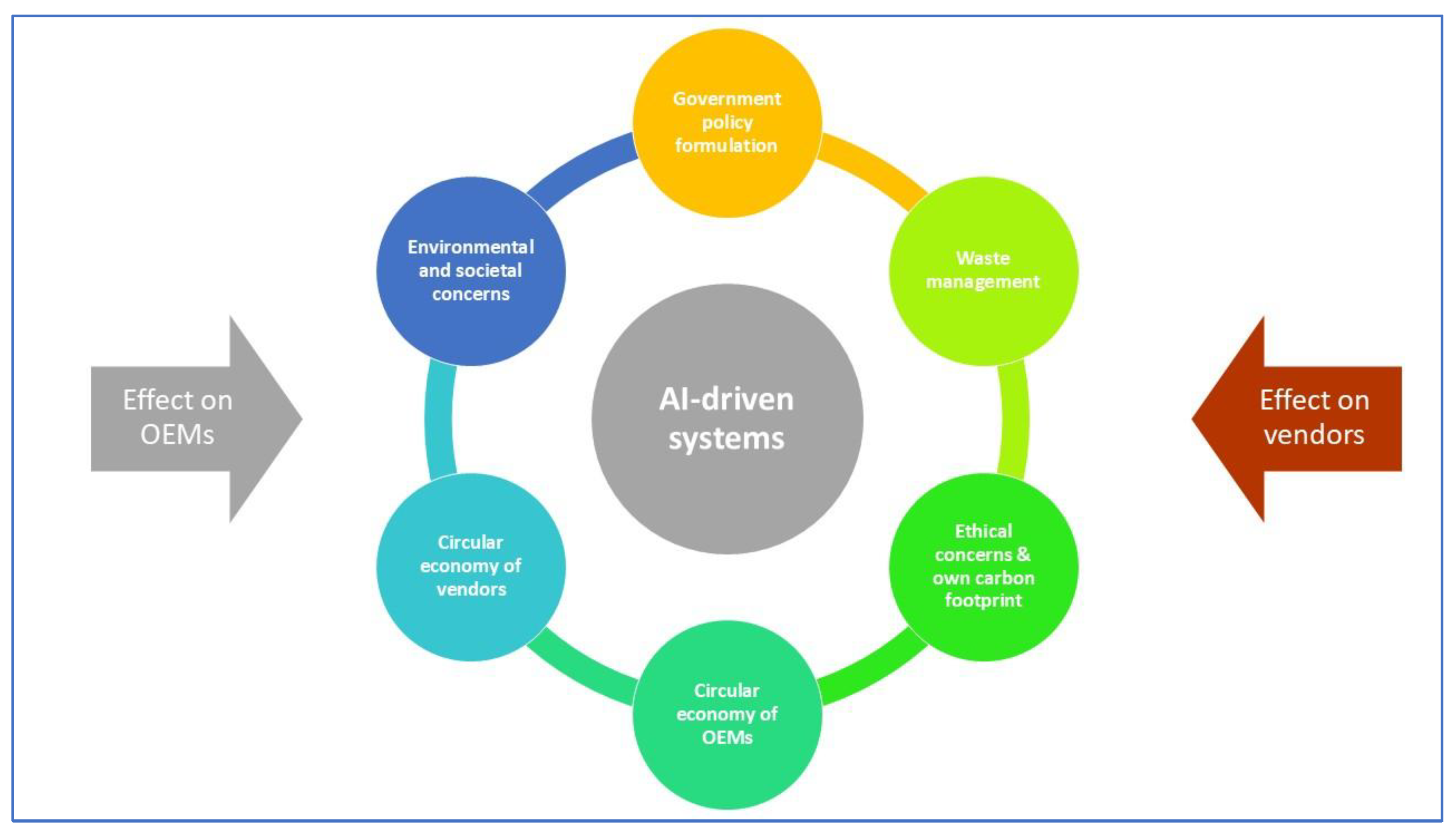
In the figure, the interplay is shown between the parameters influencing CE in the IE2W industry; with special emphasis on how AI-driven systems can influence, impact and aid each aspect of the IE2W industry including their environmental and societal concerns, CE of vendors/ OEMs, adherence by both vendors/ OEMs to governmental environmental norms/ regulations, waste management, as also how AI copes to overcome ethical concerns and its own carbon footprint. In this milieu, it would affect and be affected by vendors and OEMs separately.
5.5. Role of Government Policies and Regulations
While Indian government EV policies target adherence to CE principles, significant gaps and systemic challenges exist on-ground. Some policies include BWMR 2022 [60] to promote battery recycling [128]; Extended Producer Responsibility (EPR) to make manufacturers responsible for collecting and recycling/refurbishing EoLEVB; setting collection/ recycling targets projected at 70% and, recycling targets of 90% by 2027; recycled content in new batteries (5% by FY 2027-28 and 20% by FY 2030-31); ban on landfill/ burning, encouraging second-life applications, traceability initiatives, reducing resource import dependence, and productivity linked incentive schemes (PLI) facilitating domestic battery ecosystem. But the challenges in implementation include continued informal sector dominance (90% of battery related e-waste), inadequate collection infrastructure, storage, transportation, and advanced recycling of EoLEVB (<5% of LIBs formally recycled). The reverse logistics systems are inadequate, battery lifecycle tracking mechanisms are absent, there is no standardized battery design, setting up recycling plants are capital intensive, and then, there is low consumer awareness. It is also the government policies which have a bearing on the adoption of EVs and hence policy must be carefully designed [129].
The need of the hour hence, is to strengthen enforcement mechanisms [130], make capital investments in recycling infrastructure, address disincentives like GST on waste batteries, formalize informal sector, enforce standardized battery designs and enhance public awareness on the subject. It is also imperative that a continuous assessment of the CE policies be made, to make mid-course corrections when required to render them more effective [131]. The impact of the incentives offered by the government also needs monitoring [132,133,134,135,136]. The role of AI in the framing of policy and implications for regulations and policy is covered separately in this review.
6. AI in the CE of the IE2W industry
AI has both an environmental and ethical footprint which creates a sustainability paradox. On the other hand, it has a positive effect on the CE of the IE2W industry by benefitting the vendors and vendor management; on manufacturing aspects for the OEMs; on distribution, sales, marketing and creation of EV infrastructure; and, on the customers, who get sustainable mobility, good after sales service, and other technological benefits like ADAS, OTA updates etc.
6.1. The Sustainability Paradox: Addressing Environmental and Ethical Footprints of AI
AI shows immense potential to advance the sustainability of EVs. However, the problem lies in AI’s own sustainability, its environmental and ethical footprints. Its widespread adoption demands a critical assessment of its holistic impact.
6.1.1. The Environmental Cost of AI
The environmental costs of AI primarily stem from the immense computational power required to train and deploy advanced AI models, especially large language models (LLMs) that even India plans to acquire. This will need humungous electricity, which leads to higher CO2 emissions, since roughly 73-77% of India's total energy generation is generated through coal. Figures for May 2025 show coal as 46.12% of installed capacity but much higher in terms of actual generation [137]. Data centres are the backbone of AI operations, and contribute 1% of global greenhouse gas emissions. This figure is expected to double by 2026. AI hardware like Graphics Processing Units (GPUs), need energy-intense manufacturing and contributes significantly to electronic waste [138]. Cooling GPUs in data centres requires enormous water, which strains municipal supplies and disrupts local societies. Continuous newer releases of versions of AI, implies energy wasted in training of the previous models highlighting the environmental impact. Hence, benefits accruing to the IE2W industry would need to be weighed against these negatives for an honest assessment.
6.1.2. Ethical and Societal Concerns
Rapid deployment of AI in critical systems in the EV ecosphere cause ethical and societal concerns too. An important aspect is the algorithmic bias, arising from incorrect training data, poor feature selection, or systemic discrimination existing in legacy datasets [139]. For instance, AI-driven credit-score models used for EV financing may discriminate against some groups of people [139], which could reinforce societal biases and reduce public trust in AI.
Data privacy is another factor, as AI-driven systems in EVs and fleet management collect, store and process massive personal data, like driving patterns and location information [139], exposing people to data breaches, unauthorized access, and misuse. This can be countered through a strong regulatory framework, which will also promote transparency and accountability [140]. It is hence apparent that while AI can offer tremendous benefits towards environmental monitoring and in support of CE, albeit with ethical considerations borne in mind [141], for which it is essential to ensure human oversight for accurate and contextually sound derivations. Governments would do well to enforce robust data ethics frameworks and privacy-by-design principles to develop a responsible AI ecosystem [140].
Figure 4.
The Sustainability Paradox and AI Benefits to the IE2W Industry [Source: Authors].
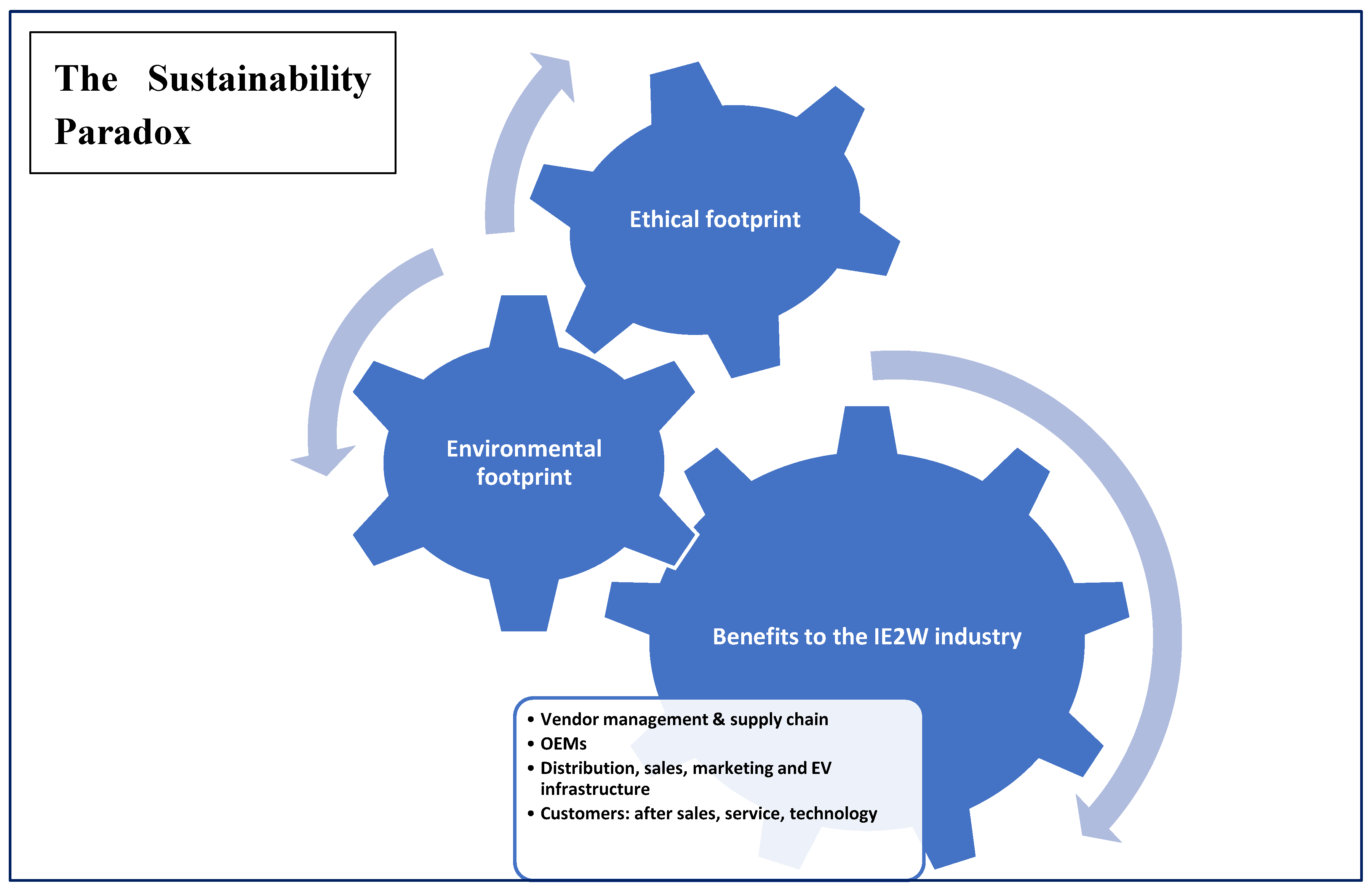
Table 4.
The AI-EV Sustainability Paradox: Risks and Mitigation Strategies.
| AI Risk/ Challenge | Impact | Mitigation Strategy |
| Environmental Cost | More carbon emissions, strain on water resources, fossil fuel-based electricity for data centres [142]. | Use of renewable energy sources to power data centres and development of more energy-efficient AI models [142]. |
| Algorithmic Bias | Discriminatory outcomes in financial services, fleet management, and other applications, reinforcing societal biases [143]. | Development of fair LLMs; robust data ethics frameworks and human oversight [143]. |
| Data Privacy & Cybersecurity | Data breaches, unauthorized access, and misuse of personal data collected from vehicles and charging networks [143]. | Implement privacy-by-design principles, strong cybersecurity risk assessment frameworks, and strict regulatory compliance [143]. |
6.2. AI in the EV/IE2W Industry
6.2.1. General Applications
Lately, the use of Artificial Intelligence (AI), Blockchain and Industry 5.0 are gaining traction. Robotics and Internet of Things (IoT) [111] have significantly influenced manufacturing and evidently, the emergent IE2W industry will benefit [144,145,[146]. AI can find great application in overall energy management systems and to ensure the sustainability of the IE2W industry as well as of the environment [101]. Industry 4.0 (and now Industry 5.0 with the sustainability edge) have been analysed [147] highlighting its importance for companies wanting to make a change. AI in Industry 5.0 is manifested through digital manufacturing which can be applied in various industries [148]. This is often called 5th Industrial Revolution (IR5.0) that will revolutionise the manufacturing sector to enable seamless and sustainable synergy between the efforts of man and machine [149,150]. Technologies like blockchain can also be applied in the EV supply chain [151] in keeping with the CE [152].
AI technology can facilitate and accelerate implementation of CE norms in the IE2W industry [153] in some fields given below:
- Supply chain optimization: AI offers solutions to address sustainability bottlenecks in the Indian EV/IE2W industry, creating a more efficient, resilient, and circular value chain. AI-powered supply chain solutions enable manufacturers to forecast parts demand, track inventory, and identify risks, thereby empowering smooth procurement and logistics. Resultantly, there would be lower emissions, reduced waste, and improved lifecycle management for key EV components, enhancing the sustainability of the value chain [154]. The aspects of vendor partnerships like vendor managed inventory (VMI) are also streamlined through AI [155,156].
- Battery management and smart charging: AI-powered battery management systems (BMS) [157,158] offers real-time energy prediction, adaptive charging, and degradation tracking, improving battery life, lowering waste, and reducing total energy consumed by IE2Ws. This can enhance safety and overall performance [158]. Some OEMs and infrastructure providers like Tata Power and Sun Mobility have integrated AI towards battery swapping, smart charging, and lifecycle assessment, improving operational and environmental performance [159]. These will be replicated by the IE2W industry. AI-driven BMSs analyse real-time data from various sensors embedded within the battery pack, including temperature, voltage, and current [160], allowing prediction of the battery's State of Health (SoH) and State of Charge (SoC) with > 95% accuracy [158] and facilitates self-diagnosing maintenance, pre-empting failure [160]. Startups like E-Vega Mobility Labs in India have a portable, AI-powered "EV Doctor" to diagnose battery health in 15 minutes (which earlier took days) [139]. According to McKinsey report, AI-driven systems can extend battery life by up to 30% and decrease maintenance costs by up to 25%, thereby reducing total cost of ownership, premature replacements and waste [160]. Further, AI algorithms optimize energy consumption by analysing driving habits and external environment, enabling efficient power allocation and regenerative braking. Battery-as-a-service (BAAS) is also gaining popularity for the customer as it offers cheaper cost and stress-free ownership [161]. Industry 5.0 concepts, incorporating AI, can also be applied to remanufacturing LIBs to render it more environmentally acceptable [108].
- AI-enabled recycling: EoL batteries pose a significant environmental and economic challenge. The CE model, promoting "5Rs"—Reduce, Reuse, Repurpose, Remanufacture, and Recycle—is critical for risk mitigation [162], which can be helped by AI to manage the transition. "Retired" EV batteries retain 70-80% of their residual capacity, which can be repurposed for large-scale energy storage systems for homes/ businesses [143]. AI health-assessment of these batteries ensures that only components with sufficient functionality are reused, thereby boosting productivity in the "second life" for these batteries [143,163,164]. There have been rapid advances in the use of AI in battery recycling [165], and it is considered that robotics and AI would lead the future of EV recycling [166]. AI is also expected to disrupt the battery supply chain and lifecycle [167]. For batteries that cannot be repurposed, AI-powered automated resource recovery, through advanced multi-sensor technology and X-ray imaging, identifies and classifies each type of battery with >98% accuracy [162], rendering raw material recovery much easier, making it possible for India to meet up to 80% of its domestic lithium and cobalt needs by 2030 (savings of approx. $2 billion a year on imports) and increasing strategic and geopolitical resilience [163].
- Predictive maintenance and manufacturing: IE2W OEMs—especially giants like Ola Electric—deploy AI for predictive maintenance analytics, early defect detection in manufacturing, and supply chain optimization. AI-driven production lines improve yields, lower energy consumption, and minimize waste through digital twins and robotics, supporting the industry’s zero-defect and zero-waste sustainability goals [163].
- Grid integration and demand management: AI optimizes demand management, aligning charging with renewable energy generation, and leverages vehicle-to-grid (V2G) technologies, preventing grid overloads and promoting the use of green energy by automatically shifting charging to off-peak hours ([154].
- Sustainable mobility and user experience: AI-driven route planning apps, over-the-air (OTA) updates, adaptive driver assistance (ADAS), and real-time system diagnostics reduce energy use, boost safety, and improve user experience. Indian cities are already witnessing deployments of AI-enabled public and private EV fleets that adapt to regional grid conditions and mobility patterns to maximize sustainability [168].
- AI for sustainability: AI has been used to optimize supply chain sustainability, by leveraging publicly available Carbon Disclosure Project (CDP) data to optimize resource allocation and make a prediction of the carbon emission levels [154].
Table 5.
AI Applications in the EV Lifecycle and Their Sustainability Impact.
| AI Application | Mechanism | Sustainability Impact |
| AI-driven BMS | Predictive analytics, ML, NNs, and RL for battery health (SOH) and charge (SOC) predictions. | Extends battery life by up to 30% and reduces maintenance costs by up to 25%, minimizing waste [160]. |
| Battery Repurposing | Data-driven assessment of residual capacity (70-80%) in end-of-life batteries. | Enables second-life applications for grid storage, preventing waste and creating value [143]. |
| Automated Recycling | AI-enabled sorting lines using multi-sensor technology and X-ray imaging for high-purity material classification. | Critical for meeting up to 80% of India's lithium and cobalt needs from recycling by 2030, saving billions in import costs [163]. |
| Fleet & Route Optimization | AI-powered route planning and fleet coordination, especially in urban logistics [169]. | Reduces delivery time by 15-20% and energy consumption by 10-25%, leading to up to a 40% decrease in emissions for last-mile logistics. |
| Smart Charging | Analysis of historical charging patterns, energy consumption, and driver behaviour. | Optimizes charging station locations and manages charging loads to support grid stability and reduce waiting times [170]. |
- Revolutionizing fleet management and urban mobility: The commercial sector is a key driver for EV proliferation and hence a natural fit for AI-powered solutions. For example, Amazon India is surpassing their goal of 10,000 EVs in India a year ahead of schedule [171], thus leveraging AI to optimize operations and reduce carbon footprint [171]. Predictive maintenance allows vehicles to self-diagnose potential issues before they occur, eliminating reliance on periodic manual inspections [172], thus minimizing downtime, maximizing fleet utilization, and ensuring operational efficiency. Indian companies like Bounce Infinity are already deploying these solutions to manage their fleets more effectively [172]. AI is also useful for route optimization and fleet coordination in urban last-mile logistics, with the ability to analyze vast data to dynamically plan routes, reducing delivery time by 15-20%, with a 10-25% gain in energy efficiency, and about 40% reduced emissions [173]. All of these, enhance profitability of firms and contribute to India's climate objectives, while reducing urban pollution and congestion [173]. The success of corporate-led electrification is a significant market dynamic which influences adoption of EVs perhaps more than the government [171] and this will benefit the IE2W industry too in terms of logistics cost savings and efficiencies, apart from being a paradigm worth emulating.
- AI in performance of the IEV/ IE2W industry: AI would have an impact on each parameter which may be used to measure the performance of the IEV/ IE2W industry like profitability [174,175,176], productivity [177], innovation [178], quality [179], flexibility [180,181] and consumer satisfaction [182,183,184,185].
6.2.2. AI in Regulatory and Policy Framing by Government
AI can play a transformative and constructive role in helping the government frame policies targeted at sustainability and circularity objectives. A few areas for this are listed below.
- Data-driven policy formulation: AI enables policymakers to analyze large-scale, real-time data on material flows, resource use, and environmental impacts, leading to greater accuracy in modelling and data-supported decisions for circular policy development through predictive analytics and scenario simulations [186].
- Adaptive and dynamic regulations: AI can create adaptable regulations that can auto-modify on fresh inputs or situational changes, which make government policies responsive rather than static. This is useful in dynamic domains like materials innovation, waste management, and reverse logistics [187].
- Effective monitoring, compliance, and transparency: Empowers real-time monitoring of supply chains, resource consumption, waste handling etc to assure circularity compliances. This aids transparency while rendering the policies more effective and targeted [188].
- Cross-sectoral collaboration: AI promotes synergy between government, industry, and academia for CE initiatives, by identifying and overcoming systemic inefficiencies. This helps government to scale up pilot projects, digital infrastructure, and skill development programs [186].
- Incentivizing circularity in industry: AI-designed policies can accommodate promotion of economic incentives that encourage investment in circular business models and sustainable technologies [191].
To summarise, AI assists policy development by offering governments and organizations advanced tools for analysis, implementation, and adaptation, thereby creating a resilient, adaptive, responsive and technologically superior regulatory environment.
6.2.3. Policies Effective for AI-Driven Circular Economies
In order to be successful, policies promoting AI-driven circular economies should take into account economic incentives, regulatory support, public infrastructure inputs, and collaborative frameworks to facilitate integration of AI with CE practices.
- Economic and financial incentives: The economic and financial incentives could be in the form of subsidies and grants to firms to adopt AI-enabled waste management, recycling, and resource efficiency solutions, to help them reduce costs and de-risk innovation [192]. Tax reductions can also be offered to firms who show tangible circularity achievements, through AI-powered resource tracking and predictive maintenance.
- Regulatory frameworks and standards: Data sharing can be mandated with privacy protection of course, enabling government, through AI, to optimize resource flows and enhance traceability [193]. The government could also mandate circularity-related product design standards requiring AI in eco-design, recyclability, and lifecycle optimization [194].
- Digital and physical infrastructure, capacity building and cross-sector collaboration: Public investments in digital infrastructure—like IoT and AI systems—allow for real-time monitoring and automation of materials, products, and energy flow [195,196]. The government can also fund AI applications in waste management, urban mining, and closed-loop supply chains to encourage industry to go in for wider adoption [197]. Integration of AI and CE concepts in curricula and skill development programs enhances availability of local talent and motivates long-term adoption. Government can facilitate multi-stakeholder partnerships and innovation clusters, uniting universities, companies, and startups to co-develop AI-based circular solutions [198].
- Consumer engagement and transparency: Making it mandatory for products and components to be digitally tracked through AI and blockchain, will keep consumers well-informed as a partner in the mutual need for circularity and recyclability [193]. Gamified incentives from government boosts circular behaviour at scale [199].
For these policies to be effective, governments need to align funding, regulation, and education to empower AI-driven CE models [200].
6.2.4. Policies for AI and Circularity: Snapshots from Other Countries
Several countries have their own policies linking AI and circularity, often integrating digital infrastructure and advanced analytics in their national strategies for sustainability. We look at a few examples.
- European Union: EU's CE Action Plan (CEAP 2020) establishes legal requirements for sustainable product design, right to repair, and digital product passports, with policies promoting AI-enabled resource tracking and eco-design. Netherlands aim for full circularity by 2050, actively investing in AI tools for waste monitoring and materials optimization [98]. Germany’s supports AI innovation hubs that help SMEs adopt digital and AI-driven resource efficiency tools, and funds university-led “Green AI” research that develops resource-efficient AI for circular production [201].
- China: China’s CE Promotion Law (CEPL) carries out AI-based monitoring for resource-use audits, sharing of resources, product life extension measures, and eco-industrial development, supported by tax cuts [194].
- Japan: “Sound Material-Cycle Society” prioritizes AI-powered recycling systems and consumer digital engagement. Over 20% of industrial input comes from recycling, with full government support for holistic circularity, traceability, and automation [194].
- India: India has the National Strategy for AI and CE roadmaps, offering financial incentives for AI adoption in recycling, e-waste management, and resource traceability, alongside policies for cloud computing and IoT-based data solutions in supply chains [193]. Examples include support for startups using AI to optimize supply chain transparency (e.g., ReshaMandi) and investment in public digital infrastructure to enable scalable CE solutions [198].
- Africa (Selected Cases): South Africa supports AI-enabled circular startups, especially in urban mining and plastics recycling, through direct funding, innovation clusters, and knowledge transfer partnerships, but faces challenges of inadequate data infrastructure and skill [202].
- Brazil: Brazil incentivizes producer cooperatives and circular innovations using AI as part of broader waste-to-energy and recycling policy measures.
Successful implementation depends on government capability to ensure effective legal frameworks, targeted incentives, open data policies, and support for digital infrastructure and AI skill development [203].
6.2.5. AI in Waste Management:
In spite of significant challenges like infrastructure gaps, emerging economies are taking to AI in a big way for waste management through digital innovations to enhance efficiency, and by optimizing resource-use by promoting circularity. AI-powered waste management is often referred to as smart waste management [204,205]. Emerging economies have the potential to leapfrog legacy waste management systems by adopting digital CE models, creating cost-effective models and promoting sustainability [206]. Accordingly, emerging economies surmount legacy challenges through AI-driven systems, to meet CE goals, often also using PPP models, public and donor funding, open-source platforms, and collaborative innovation ecosystems (DMR 2023) to overcome financial hurdles [207]. Some of the key AI applications for this, are given below.
- Waste sorting: AI-driven systems considerably improve sorting (plastics, metals, and other materials) accuracy for recyclables, and help to reduce contamination and boost recycling rates vis-à-vis manual sorting [208].
- Smart waste collection: AI in conjunction with IoT sensors predict saturation levels of waste bins and optimize collection routines, thereby reducing fuel consumption, operating costs, and emissions [209].
- Waste data analytics: AI collates and analyses waste generation data to facilitate planning and decision-making in policy, through real-time dashboards with municipal authorities and companies. This also helps to measure performance, and identify recycling loopholes [206].
- Consumer engagement: AI-powered mobile apps encourage sustainable behaviour by informing citizens about waste segregation, collection timings, and incentivizing recycling participation, thereby boosting CE principles at grassroots levels [208]. Countries like India and Kenya tackle growing electronic waste [210] and deploy mobile-first platforms linking households with informal waste collectors for more efficient recycling and reuse [211].
6.2.6. Challenges and Opportunities in Waste Management
There are challenges as well as opportunities in the deployment of AI-driven systems for waste management in developing countries. The challenges include technical, infrastructural, financial, and social barriers that impede adoption and scaling. Some of these challenges follow.
- Infrastructure and technical challenges: The inadequacy of extensive IoT networks, sensor technologies, and effective data collection systems necessitated for AI to function effectively in waste management [212]. The availability of waste data is also sporadic and inaccurate which impairs prediction in waste patterns and route-optimisation [206]. The complexity associated with the integration of AI with legacy systems and informal network, is also an issue [209].
- Financial and resource constraints: AI hardware, software, and implementation is expensive for municipalities or waste companies and need hand-holding from the government or other sources [208]. Add to this, the skill gap through the shortage of AI-trained and data science understanding personnel with exposure to waste management [211].
- Social and institutional barriers: Informal waste management agencies are inseparable part of waste collection in developing countries, and their integration into AI-driven systems can be a challenge [206]. Lack of awareness of AI’s benefits in decision-makers and society at large can adversely affect investment and adoption [208]. There is also the issue of having insufficient regulatory frameworks for data governance, privacy, and AI ethics [209].
- Environmental and operational: Uneven waste generation patterns in terms of waste types, volumes, and disposal practices across geographies, complicate AI efficiency [213]. In developing economies, due to financial and institutional shortcomings, the maintenance and adaptation of AI systems may be impacted affecting long-term sustainability [206].
These challenges necessitate tailored, context-sensitive approaches combining technological innovation with capacity building, regulatory strengthening, and inclusive stakeholder engagement to enable effective AI-driven waste management in developing countries [212].
7. Challenges, Opportunities and Recommendations
We can summarize the challenges, opportunities, and recommendations for applications of AI in the CE and sustainability of the IE2W industry:
7.1. Challenges
There are certain key challenges that arise when integrating AI into IEV/ IE2W CE models. These challenges include technical, organizational, and systemic barriers that restricts efficiency of AI systems and their positive impact on circularity and sustainability [214]. These are discussed below.
- Data quality and availability: IEV/ IE2W supply chains and recycling networks as yet do not have access to accurate, comprehensive, and real-time data, which is mandated for the training of AI models. They also lack the desired digital infrastructure and standardization across data sources [214].
- Hunger for resources and negative environmental impact: Large-scale AI models require significant computational power, necessitating high energy consumption and heavy reliance on rare earth metals, thereby negating sustainability gains [191]. There is also presently inadequate infrastructure for systematic collection, storage, transportation, and recycling of EoLEVB, and this process is dominated by the informal sector, which is another issue.
- Linear model bias: Many existing AI solutions may suffer biases arising from the legacy training data which has been obtained from linear (take-make-waste) models. This may prejudice circular production, procurement, and supply chain practices unless the AI systems are retrained appropriately [191].
- Ethical, privacy, and security concerns: AI leads to increased collection and use of supply chain and product usage data which obviously raises privacy, security, and ethical concerns. There is hence a need for robust governance systems for data security as well as to foster consumer trust [141].
- Skill and knowledge gaps: There is lack of training on skills for recycling and CE throughout the battery value chain, from recovery to transportation to testing, recycling, and refurbishment. There is also low consumer awareness on battery environmental and safety risks, leads to improper disposal. There is a shortage of professionals with cross-disciplinary knowledge in AI, CE principles, and EV technology, precluding organization exploitation of AI and implementation of AI-driven circular solutions holistically [216].
- Financial and regulatory barriers: Prohibitive capital costs for recycling plants (between Rs 220-370 crores) adds to the lower penetration and willingness to invest. 18% GST on retired batteries, disincentivizes recycling. Further, there are logistical & data gaps. High capital outlay for AI infrastructure and systems cause problems for smaller firms which are quite prevalent in the IE2W industry [216].
- Complexity of the EV value chain: The complexities involved in IEV/ IE2W parts and multiple vendors imply need for utmost coordination, efficient reverse logistics, and comprehensive adoption of circular practices—by OEMs and all other stakeholders in the value chain [217]. These challenges highlight the need for orientation of AI towards circularity, robust cross-sector collaboration, and supportive governmental frameworks to accrue maximum benefits of AI within the IEV/ IE2W CE models [214].
7.2. Opportunities
Despite challenges, India has significant opportunities to establish a thriving CE for EV batteries, as given below:
- reducing imports LIB (now at 100%);
- recycling to reduce imports of rare earths and minerals to boost geopolitical resilienc. (recent discovery of lithium reserves in India further offers long-term promise for domestic supply) [218];
- battery recycling (market estimated at $ 95 billion annually by 2040) to recover 50-95% [219], to boost profitability, economic viability and job creation (total LIB recycling market in India by 2030 is estimated at $ 11 billion);
- address environmental concerns and lower carbon emissions by up to 90%;
- exploitation of AI and other technological advances and green innovation;
- and, collaborative efforts on CE between lawmakers, automakers, vendors, battery manufacturers, recyclers, and academia.
7.3. Recommendations for Government/ Academia
- Local R&D and human capital: Policymakers should align their efforts with initiatives like "AI for India 2030" and the NITI Aayog report's recommendations [160], by incentivizing investments in local R&D for both EV technology and ethical AI. This would reduce dependency on imported technology and help the country become a global innovation leader.
- Bridge the skill gap: Universities and industry must come together to create tailor-made curricula focused on the synergies of the IEV/ IE2W and AI technologies, moving beyond traditional automotive engineering [221]. These programs can produce world-class specialists in BMS, embedded electronics, and data analytics [174].
- Robust regulatory frameworks: To promote AI transparency, mitigate algorithmic bias, and ensure data privacy within the EV ecosystem [139,140]. Other regulatory and policy initiatives through refining of BWMR implementation, standardizing the battery design, implementing a battery tracking system, addressing disincentives, and facilitating second-use of batteries.
- Infrastructure through Public-Private Partnerships (PPP): Government can accelerate growth of infrastructure through PPPs, in the EV field by significantly increasing the number of charging stations, and by aligning energy policy with EV adoption by using renewable energy sources for grid power [169]. Government also has a role to play in infrastructure and technology investments along with the industry. India continues to face barriers such as infrastructure bottlenecks, policy fragmentation, and cost pressures in localizing advanced AI solutions [215]. Coordinated PPP investment in AI R&D, government incentives for digital infrastructure, and targeted training (e.g., through NITI Aayog, IITs) can help overcome these hurdles and revolutionise sustainable scaling [215,222].
- Foster public awareness: Improving public awareness and participation through cross-sectoral alignment between policymakers, IE2W industry, vendors, academia, and local bodies, will highlight EV benefits and build support for the transition [113], apart from understanding the importance of correct battery disposal. This will also address potential resistance from established industries to ensure that societal transition is as smooth as the technological one.
- Ethical AI deployment: To build consumer confidence, government must regulate to ensure that companies implement robust data ethics frameworks and privacy-by-design principles [139].
7.4. Recommendations for the IE2W Industry
- Invest in a CE: It is important for IE2W industries to incentivize R&D and training, factoring AI into their core business strategy, from product design to supply chain management. This includes in-house capabilities for battery health diagnostics and investing in automated recycling technologies. By integrating these processes, manufacturers can reduce their reliance on imports of critical minerals and create profitable avenues from second-life applications and material recovery [143]. IE2W industry should establish an efficient reverse logistics system [53,223], standardized battery labelling, and effective battery tracking.
- Public awareness: IE2W industry can launch awareness campaigns to address public concerns on AI ethical deployment in the products and services, their technological advances and benefits, to remove misconceptions and biases to build support for the transition [113].
- Embrace ethical AI deployment: To build consumer confidence, companies must implement robust data ethics frameworks and privacy-by-design principles to promote transparency in AI deployment [139].
- Prioritize a fleet-first adoption model: Industry leaders should recognize the power of corporate-led fleet electrification as a key accelerator of market growth apart from AI-driven advancements in boosting sustainability in the IE2W industry and strengthening the supply chain, like Amazon [171]. This approach is economically driven and can provide a proof of concept for wider adoption, by the IE2W industry.
8. Gaps in Literature
From the foregoing, it would be clear that AI is not a solitary panacea but a strategic enabler to facilitate India's EV sustainability and CE goals. ROL on the subject brings out that most research has been carried out in China, SE Asian countries, and some Middle Eastern/ African countries. Few studies exist in India; and even these are limited to the manufacturing sector in general or to the automobile industry and not particularly either the IEV or the IE2W industry.
Some research gaps identified based on research, mostly based in the past decade considering the fact that AI is new and its applicability in various industries are still being explored, are:
- need for study specific to the application of AI to the CE of the IEV/ IE2W sector rather than generic to the automobile sector or industry;
- need to study specific effects of AI on environmental aspects of IEV/ IE2W industry to include waste management, pollution control, environmental impact of OEMs and actual environmental impact of their products;
- need for study specific to examining existing government policy framing mechanism, impact of AI in this, especially for policy pertaining to the IEV/ IE2W industry;
- need to research impact of AI on job creation or loss of jobs in the IEV/ IE2W industry;
- need to research impact of AI on R&D to the extent it meets the requirement of decreased dependence on lithium, a basic raw material for batteries, impacting the overall logistics and supply chain;
- need to research differences in the AI applications in the automobile ICE industries vis-à-vis IEV/ IE2W industry;
- need to research differences between AI applications in the vendor partnerships and supply chain management in automobile ICE industries vis-à-vis IEV/ IE2W industry;
- need to study specific effects of AI on the parameters of profit, innovation, flexibility, quality control, and consumer delight in the IEV/ IE2W industry;
- need for India-specific study on application of AI to the IE2W industry to study not only the benefits but also the pitfalls of AI and how and by whom these could be countered;
- need for study on the AI impacts on vendor partnerships and sustainable supply chain for the IEV/ IE2W sector;
- and, the need to focus investigation to a particular type of industry for consistency in results, which here, is the IE2W industry.
The above also cover the areas for future research.
9. A Conceptual Framework
On the identification of gaps, one can arrive at a tentative conceptual framework, as given in Figure 5.
Figure 5.
Conceptual diagram for AI role in CE and sustainability of IE2W industry.
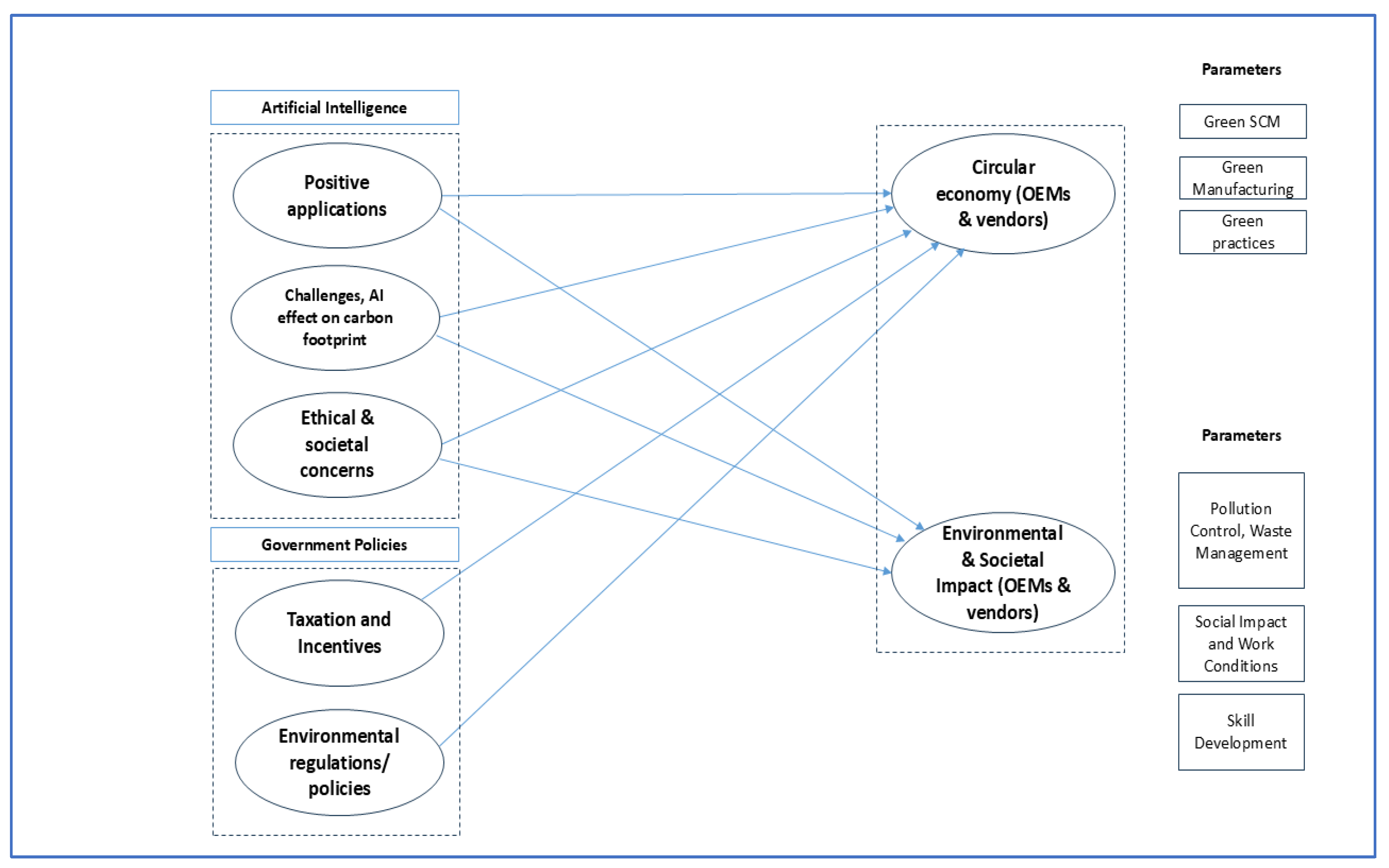
This framework considers AI and government policies as being the two independent variables with a total of 5 constructs between them which are connected to the two dependent variables of the CE; and, environmental and societal impact. These dependent variables further have parameters under them which would be influenced by AI and government policies respectively. It bears relevance that for both CE on one hand, and, environmental and societal impact on the other, it would play differently for OEMs who are the manufacturers for the IE2Ws; and the vendors, who supply parts and components to facilitate manufacture for the OEMs. Our understanding of environmental and sustainability issues would be incomplete without taking into account the societal aspects also, which has hence been included.
10. Scope for Research and Potential
10.1. Limitations of Study
Limitations for this review include lack of adequate material including empirical data in the Indian context with reference to the applicability of AI in the CE and sustainability of the EV industry and virtually none at all for the IE2W industry. Some dynamics of the automobile industry in India which have been taken as a reference point, may or may not hold good for the IEV/ IE2W industry. While AI is often spoken about and touted as being applied, the on-ground utilisation of AI-driven technology, processes and systems, may not be very widespread or mainstream, which leaves unanswered questions. Further, the country has been relatively slower off the block on AI, with most LLMs and models being of western origin. Government regulations on the same and policies are work-in-progress. With the dynamic nature of the constantly evolving IE2W industry, it may be difficult to accurately predict how AI applicability would play out in the near (5 years) and mid-term (10 years) future. Hence, present day indicators have been relied on for projections. Also, the nature of the IE2W industry itself is such that information on the same, other than what is available on the open domain, is hard to come by (except for OEMs which have gone public). Details of vendors are also hazy with no definitive directory giving their credentials with open domain information varying greatly.
10.2. Discussions
10.2.1. Theoretical
Theoretical and managerial discussion points in a research article on the role of AI in CE and sustainability of the EV industry should logically focus on both conceptual frameworks and actionable strategies for industry leaders [195]. A few theoretical discussion points are brought out below to underscore the role of AI in the CE of the IEV/ IE2W industry.
- AI enables the CE: AI facilitates product design which empowers circularity, ensures resource optimization, and facilitates decision-making using predictive analytics and tools [224].
- Sustainability in manufacturing: Deployment of AI in EV/ E2W manufacturing cuts waste, reduces carbon footprints, and advances life of products through predictive maintenance, efficient use of energy, and streamlining the supply chain [199].
- Frameworks across disciplines: When a conceptual model is devised, which combines green and sustainable manufacturing, digitalization, and circular supply chains, it demonstrates the synergy between business, technology, policy, and societal factors, which further boosts the transition towards sustainability [225].
- Data-driven innovation: AI encompasses data collation, real-time monitoring, and simulation of environmental as well as economic impact to ensure a dynamically improving circularity for the business model [226].
10.2.2 Managerial
Taking the theoretical aspects forward, we have outlined steps that can be taken by managers to adopt ‘leagile’ practices (Sharma & Sohani, 2022), supplier selection [227,228], and the application of AI in manufacturing [229]. Indian IEV/ IE2W managers should adopt global best practices while simultaneously adapting to the peculiarities of its supply chain [67,230], and this would involve the incorporation of AI too. Our work highlights the significance of AI in promoting the CE and sustainability in the IE2W industry. Certain other relevant issues for managers on this topic are given below.
- Acting upon circular strategies: This can be done by managers by leveraging AI tools to ensure circularity in the supply chain through the planned recovery, reallocation, refurbishment, sale, and disassembling of EV components, in a smooth manner [231].
- Resource optimisation and waste reduction: AI-driven solutions can be used to optimize material flow, facilitate sorting through visual recognition, and ensure effective energy management towards sustainability in resource use [232].
- Supply chain collaboration and transparency: AI facilitates real-time data sharing, stakeholders’ collaboration, and adaptive decision-making across multiple circular levels including recycling agencies, logisticians, repair and maintenance services and the OEMs [152].
- Strategic sustainability initiatives: Managers can employ AI analytics to simulate situations, forecast market developments, predict demand, and adapt circularity in their business models to enhance the profitability and competitiveness while simultaneously meeting the obligations of government regulations and environmental norms [233].
- Ethical considerations: Effective managers will not ignore the sensitivities of data security, interoperability, skill gaps, and ethical design even as they fully exploit all that AI is capable of in the quest for sustainability [199].
The above covers both the conceptual analysis and an actionable roadmap for managers to benefit from the empowerment offered by AI to drive circularity and sustainability in IE2W contexts. electric vehicle industry contexts [195].
11. Summary
India is experiencing an EV revolution, of which E2W is a major component. The enormous future potential of the IE2W industry makes it an ideal candidate for study. The path of growth of this industry is largely in consonance with the marked shift of the world towards greener technologies and processes. For the IEV/ IE2W industries, the integration of AI represents a pivotal moment, and their ability to exploit its full potential will determine success for them on a global scale. AI will become an important factor to foster increased momentum in IE2W proliferation, subject to the country being able to address the other issues of infrastructure [234]. AI offers a powerful suite of tools to enhance BMS and battery performance, foster a CE, optimize logistics, and address the important sustainability challenges in the industry. This vision of a unified AI layer that marries battery diagnostics, fleet management, and recycling is the future, bringing transformation to the entire IEV/ IE2W industry by streamlining multifarious tools into a cohesive, interconnected framework for the whole industry [165].
However, this path of AI-enabled sustainable future is not linear. The environmental and ethical costs of AI must be carefully countered to ensure that the technology used to solve one problem does not exacerbate another. This can be balanced through knowledge and awareness, by governments, industries and the public at large. In a world where environmental concerns take centre stage, India’s transition towards EV/ E2W seems to signal matured responsibility [235].
AI’s potential to destroy jobs is balanced with the perspective of its ability to create new frontiers for the work-force, which would however imply that government and academia apart from industry, should bridge the talent gap and address the human capital imperative. IEV/ IE2W industry will create millions of jobs by 2030, but skillsets in niche fields like embedded electronics, BMS, and data analytics [177] will need to be nurtured through a nation-wide strategic effort to upskill and reskill to take on the demands of a high-tech, AI-driven industry [174].
India's potential to become a global leader in sustainable mobility is immense, but its success will hinge on a commitment to a strategic, responsible, and holistic integration of technology, policy, and human capital. This approach, where technological innovation is balanced with ethical governance and a focus on human development, is the only viable path to realizing a truly green and independent future for India's E2W ecosystem.
Funding
This research received no external funding.
Data Availability Statement
Nil, being a review.
Acknowledgments
During the preparation of this manuscript/study, the authors used Gemini AI (version 2.5 Flash) for the purpose of generating background image for Figure 2. The authors have reviewed and edited the output and take full responsibility for the content of this publication.
Conflicts of Interest
The authors declare no conflicts of interest.
Abbreviations
The following abbreviations are used in this manuscript:
| 2W | Two-wheelers |
| 3W | Three-wheelers |
| 4W | Four-wheelers/ cars |
| 5Rs | Reduce, reuse, repurpose, remanufacture, and recycle |
| ADAS | Adaptive driver assistance system |
| AI | Artificial Intelligence |
| BMS | Battery management system |
| BWMR | Battery waste management rules |
| CAGR | Compounded annual growth rate |
| CDP | Carbon disclosure project |
| CE | Circular economy |
| CEPL | China’s CE promotion law |
| CII | Confederation of Indian Industry |
| CO2 | Carbon dioxide |
| DPIIT | Department for Promotion of Industry and Internal Trade |
| E2W | Electric two-wheelers |
| EoL | End-of-Life |
| EPR | Extended producer liability |
| EoLEVB | End-of-Life EV Batteries |
| EU | European Union |
| EV | Electric vehicles |
| FAME | Faster adoption and manufacture of hybrid and electric vehicles scheme |
| GPUs | Graphics processing units |
| GSCM | Green supply chain management |
| GST | Goods and Services Tax |
| ICE | Internal combustion engines |
| IEV | Indian Electric Vehicles (industry) |
| IE2W | Indian EV two-wheelers |
| IIT | Indian Institute of Technology |
| IoT | Internet of things |
| IR5.0 | 5th industrial revolution |
| KTPA | Kilotons per annum |
| LIB | Lithium-ion battery |
| LLM | Language learning model (in AI) |
| MoU | Memorandum of Understanding |
| MSME | Medium, small & micro enterprises |
| OEM | Original equipment manufacturer |
| OTA | Over-the-air (as in updates given to EVs) |
| PPP | Public-private partnerships |
| PLI | Productivity linked incentive (scheme) |
| R&D | Research & development |
| SoC | State of charge |
| SoH | State of health |
| SSCM | Sustainable supply chain management |
| US | United States |
| V2G | vehicle-to-grid technologies |
| VMI | Vendor managed inventory |
References
- India two Wheelers Go Electric-Setting Stage for the E-Revolution. Int. J. Innov. Technol. Explor. Eng. 2019, 8, 751–756. [CrossRef]
- Cornet, *!!! REPLACE !!!*; et al. , “Why the automotive future is electric,” Sep. 2021.
- P. C. Pandey, “India Imports 82% of Its Oil Needs and Aims to Reach 67% By 2022,” Climate Scorecard.
- British Petroleum, “Statistical Review of World Energy,” 2020.
- S. Sharma, “India’s oil import dependency on course to hit fresh full-year high in FY25 amid growing demand, stagnant domestic production,” The Hindu, Chennai, Mar. 22, 2025.
- R. R. Kala, “India’s crude oil import dependence rises to record 90%,” Business Line, Chennai, , 2025. 21 May.
- Dua, R.; Almutairi, S.; Bansal, P. Emerging energy economics and policy research priorities for enabling the electric vehicle sector. Energy Rep. 2024, 12, 1836–1847. [Google Scholar] [CrossRef]
- NAB, “FAME II,” National Mission for Electric Mobility. Accessed: Feb. 11, 2023. [Online]. Available: https://fame2.heavyindustries.gov.in/content/english/1_1_AboutUs.
- R. Dhawan, S. R. Dhawan, S. Gupta, R. Hensley, N. Huddar, B. Iyer, and R. Mangaleswaran, “The future of mobility in India: Challenges & opportunities for the auto component industry,” Sep. 2017.
- Khurana, A.; Kumar, V.V.R.; Sidhpuria, M. A Study on the Adoption of Electric Vehicles in India: The Mediating Role of Attitude. Vision: J. Bus. Perspect. 2019, 24, 23–34. [Google Scholar] [CrossRef]
- Mordor Intelligence, “India Electric Vehicle Market - focusing on market growth, industry analysis, size, and forecast up to 2030,” Jan. 2025.
- M. S. Khande, A. S. M. S. Khande, A. S. Patil, G. C. Andhale, and R. S. Shirsat, “Design and Development of Electric Scooter,” International Research Journal of Engineering and Technology (IRJET), vol. 7, no. 5, 20. 20 May.
- C. Jacob, “India is learning to love electric vehicles — but they’re not cars,” cnbc.com.
- Dhaked, D.K.; Birla, D. Microgrid Designing for Electrical Two-Wheeler Charging Station Supported by Solar PV and Fuel Cell. Indian J. Sci. Technol. 2021, 14, 2517–2525. [Google Scholar] [CrossRef]
- B. Norikun, “The Importance of Government Policy in Influencing the Increase in Purchasing Interest Electric Vehicles,” International Journal of Multidisciplinary Research and Growth Evaluation, vol. 6, no. 2, Mar. 2025.
- Hales, D.N.; Yun, G.; Kale, D. The Efficacy of India's Electric Vehicle Market: Can FAME Deliver Results? Mark. Glob. Dev. Rev. 2024, 9. [Google Scholar] [CrossRef]
- Mishra, S.; Malhotra, G. Is India Ready for e-Mobility? An Exploratory Study to Understand e-Vehicles Purchase Intention. Theor. Econ. Lett. 2019, 09, 376–391. [Google Scholar] [CrossRef]
- Panwar, U.; Kumar, A.; Chakrabarti, D. Barriers in implementation of electric vehicles in India. Int. J. Electr. Hybrid Veh. 2019, 11, 195–204. [Google Scholar] [CrossRef]
- D. Broom, “6 of the world’s 10 most polluted cities are in India,” World Economic Forum.
- ANI, “India tops Japan to become world’s 3rd largest auto market,” Fortune India, Jan. 09, 2023.
- SIAM, “SIAM Annual Report 2023-24,” New Delhi, 2024.
- Paladugula, A.L.; Kholod, N.; Chaturvedi, V.; Ghosh, P.P.; Pal, S.; Clarke, L.; Evans, M.; Kyle, P.; Koti, P.N.; Parikh, K.; et al. A multi-model assessment of energy and emissions for India's transportation sector through 2050. Energy Policy 2018, 116, 10–18. [Google Scholar] [CrossRef]
- Bansal, P.; Kockelman, K.M.; Schievelbein, W.; Schauer-West, S. Indian vehicle ownership and travel behavior: A case study of Bengaluru, Delhi and Kolkata. Res. Transp. Econ. 2018, 71, 2–8. [Google Scholar] [CrossRef]
- Nagpure, A.S.; Gurjar, B. Development and evaluation of Vehicular Air Pollution Inventory model. Atmospheric Environ. 2012, 59, 160–169. [Google Scholar] [CrossRef]
- Sati, L. Powell, and V. K. Tomar, “Road emission control: Electrifying personal mobility in India,” Observer Research Foundation, Oct. 2021.
- Dhairiyasamy, R.; Gabiriel, D. Sustainable mobility in India: advancing domestic production in the electric vehicle sector. Discov. Sustain. 2025, 6, 1–17. [Google Scholar] [CrossRef]
- Wei, X.; Dou, X. Application of sustainable supply chain finance in end-of-life electric vehicle battery management: a literature review. Manag. Environ. Qual. Int. J. 2022, 34, 368–385. [Google Scholar] [CrossRef]
- Deshwal, D.; Sangwan, P.; Dahiya, N. Economic Analysis of Lithium Ion Battery Recycling in India. Wirel. Pers. Commun. 2022, 124, 3263–3286. [Google Scholar] [CrossRef]
- Rajaeifar, M.A.; Ghadimi, P.; Raugei, M.; Wu, Y.; Heidrich, O. Challenges and recent developments in supply and value chains of electric vehicle batteries: A sustainability perspective. Resour. Conserv. Recycl. 2022, 180. [Google Scholar] [CrossRef]
- Tavana, M.; Sohrabi, M.; Rezaei, H.; Sorooshian, S.; Mina, H. A sustainable circular supply chain network design model for electric vehicle battery production using internet of things and big data. Expert Syst. 2023, 41. [Google Scholar] [CrossRef]
- Safari, M. A Perspective on the Battery Value Chain and the Future of Battery Electric Vehicles. Batter. Energy 2024, 4. [Google Scholar] [CrossRef]
- Graham, J.D.; Rupp, J.A.; Brungard, E. Lithium in the Green Energy Transition: The Quest for Both Sustainability and Security. Sustainability 2021, 13, 11274. [Google Scholar] [CrossRef]
- Herrington, R. Mining our green future. Nat. Rev. Mater. 2021, 6, 456–458. [Google Scholar] [CrossRef]
- Murdock, B.E.; Toghill, K.E.; Tapia-Ruiz, N. A Perspective on the Sustainability of Cathode Materials used in Lithium-Ion Batteries. Adv. Energy Mater. 2021, 11, 2102028. [Google Scholar] [CrossRef]
- Penn and, E. Lipton, “The Lithium Gold Rush: Inside the Race to Power Electric Vehicles,” The New York Times, , 2021. 06 May.
- Boateng, F.G.; Klopp, J.M. The electric vehicle transition: A blessing or a curse for improving extractive industries and mineral supply chains? Energy Res. Soc. Sci. 2024, 113. [Google Scholar] [CrossRef]
- Cheng, A.L.; Fuchs, E.R.H.; Karplus, V.J.; Michalek, J.J. Electric vehicle battery chemistry affects supply chain disruption vulnerabilities. Nat. Commun. 2024, 15, 1–11. [Google Scholar] [CrossRef]
- Schill, W.-P.; Gerbaulet, C. Power system impacts of electric vehicles in Germany: Charging with coal or renewables? Appl. Energy 2015, 156, 185–196. [Google Scholar] [CrossRef]
- Shu, T.; Papageorgiou, D.J.; Harper, M.R.; Rajagopalan, S.; Rudnick, I.; Botterud, A. From coal to variable renewables: Impact of flexible electric vehicle charging on the future Indian electricity sector. Energy 2022, 269. [Google Scholar] [CrossRef]
- N. Haitao, “Implementation of a Green Economy: Coal Industry, Electric Vehicles, and Tourism in Indonesia,” Dinasti International Journal of Economics, Finance & Accounting, no. 2022. [CrossRef]
- Jain, S.; Gautam, S.; Malik, P.; Kumar, S.; Krishnan, C. A multi-phase qualitative study on consumers’ barriers and drivers of electric vehicle use in India: Policy implications. Energy Policy 2024, 196. [Google Scholar] [CrossRef]
- Dr. M. Jagtap and Dr. S. Alvi, “Deciphering Customer Purchase Priorities: Insights from Two-Wheeler Dealer Managers In Pune,” International Journal of Research in Management & Social Science, vol. 11, no. 2, pp. 67–75, Apr. 2023.
- Digalwar, A.K.; Saraswat, S.; Rastogi, A.; Thomas, R.G. A comprehensive framework for analysis and evaluation of factors responsible for sustainable growth of electric vehicles in India. J. Clean. Prod. 2022, 378. [Google Scholar] [CrossRef]
- Venkatasatish, R.; Dhanamjayulu, C. Reinforcement learning based energy management systems and hydrogen refuelling stations for fuel cell electric vehicles: An overview. Int. J. Hydrogen Energy 2022, 47, 27646–27670. [Google Scholar] [CrossRef]
- TOI, “Can battery recycling solve EV industry’s growing e-waste problem?,” Times of India, New Delhi, , 2025. 30 May.
- Asokan, V.A.; Teah, H.Y.; Kawazu, E.; Hotta, Y. Ambitious EV policy expedites the e-waste and socio-environmental impacts in India. Resour. Conserv. Recycl. 2022, 190. [Google Scholar] [CrossRef]
- S. Shankar and S. Rachakonda, “Investing in the waste and circularity sector in India - E-Waste and Lithium-ion Battery Recycling Guide,” 2024.
- Lee, J.; Choe, H.; Yoon, H.-Y. Past trends and future directions for circular economy in electric vehicle waste battery reuse and recycling: A bibliometric analysis. Sustain. Energy Technol. Assessments 2025, 75. [Google Scholar] [CrossRef]
- Sopha, B.M.; Purnamasari, D.M.; Ma’mun, S. Barriers and Enablers of Circular Economy Implementation for Electric-Vehicle Batteries: From Systematic Literature Review to Conceptual Framework. Sustainability 2022, 14, 6359. [Google Scholar] [CrossRef]
- Baars, J.; Domenech, T.; Bleischwitz, R.; Melin, H.E.; Heidrich, O. Circular economy strategies for electric vehicle batteries reduce reliance on raw materials. Nat. Sustain. 2020, 4, 71–79. [Google Scholar] [CrossRef]
- Alatise, O.; Wu, R.; Deb, A.; Gonzalez, J.O. Second life potential of electric vehicle power electronics for more circular economies. Renew. Sustain. Energy Rev. 2024, 210. [Google Scholar] [CrossRef]
- Afroozi, M.A.; Gramifar, M.; Hazratifar, B.; Keshvari, M.M.; Razavian, S.B. Optimization of Lithium-Ion Battery Circular Economy in Electric Vehicles in Sustainable Supply Chain. Batter. Energy 2025, 4. [Google Scholar] [CrossRef]
- Alamerew, Y.A.; Brissaud, D. Modelling reverse supply chain through system dynamics for realizing the transition towards the circular economy: A case study on electric vehicle batteries. J. Clean. Prod. 2020, 254. [Google Scholar] [CrossRef]
- R. Jha, “Lithium Ion Battery Recycling in India - Need to build local refining capabilities to curb black mass export,” EV Reporter, Nov. 08, 2023. Accessed: Jul. 31, 2025. [Online]. Available: https://www.teriin.
- M. Gupta, “Building India’s Battery Circular Economy: Strategies For Sustainable Recycling And Second-Life Solutions – Report,” E-Mobility Plus, Jul. 2025, Accessed: Jul. 31, 2025. [Online]. Available: https://emobilityplus. 2025.
- U. Gupta, “Tata Chemicals launches Li-ion battery recycling operations,” PV Magazine, Sep. 02, 2019.
- TeamET, “Attero to set up lithium-ion battery recycling plant in Telangana,” The Economic Times, Nov. 03, 2022.
- Soman, K. Ganesan, and H. Kaur, “India’s Electric Vehicle Transition,” 2019.
- U. Gupta, “BatX Energies raises $1.6 million to expand battery recycling,” PV Magazine, Jun. 2022.
- CPCB, “Battery Waste Management Rules,” Central Pollution Control Board. Accessed: Jul. 31, 2025. [Online]. Available: https://cpcb.nic.
- J. Fleischmann, M. J. Fleischmann, M. Hanicke, and E. H, “Battery 2030: Resilient, sustainable, and circular,” McKinsey & Company. Accessed: Aug. 01, 2025. [Online]. Available: https://www.mckinsey. 2030. [Google Scholar]
- CEEW, “Lithium-ion battery waste recycling,” Jan. 2025.
- Gattu, A. Agrawal, and R. Bagdia, “Advanced Chemistry Cell Battery Reuse and Recycling Market in India,” New Delhi, 22. 20 May.
- Lico, “How EV Battery Recycling Will Shape Sustainable Mobility in India,” Licomat. Accessed: Aug. 02, 2025. [Online]. Available: https://licomat.
- CII, “Around 72 - 81 GWh of waste batteries (~447 – 517 thousand tons) would reach recycling firms from 2022 to 2030,” Aug. 2023. Accessed: Jul. 31, 2025. [Online]. Available: https://www.cii.in/PressreleasesDetail.aspx?
- P. Singh, “Advancing Lithium-Ion Battery Recycling in India Through Technological Innovations Economic Feasibility and Policy-Driven Sustainability,” International Journal of Innovative Research in Electrical, Electronics, Instrumentation and Control Engineering, vol. 13, no. 2, Feb. 2025.
- A. Jamwal, A. Patidar, R. Agrawal, M. Sharma, and V. K. Manupati, “Analysis of Barriers in Sustainable Supply Chain Management for Indian Automobile Industries,” in Recent Advances in Industrial Production, ICEM 2020., R. Agrawal, J. K. Jain, V. S. Yadav, V. K. Manupati, and L. Varela, Eds., Singapore: Springer, 2022, pp. 79–89. [CrossRef]
- Aruleswaran, A.; Muraliraj, J.; Zailani, S. Lean six sigma and sustainable supply chain management: a case study in electric vehicle parts manufacturing. Int. J. Lean Six Sigma 2025. [Google Scholar] [CrossRef]
- Luthra, S.; Haleem, A. Hurdles in Implementing Sustainable Supply Chain Management: An Analysis of Indian Automobile Sector. Procedia - Soc. Behav. Sci. 2015, 189, 175–183. [Google Scholar] [CrossRef]
- Ahuchogu, M.C.; Sanyaolu, T.O.; Adeleke, A.G. Exploring sustainable and efficient supply chains innovative models for electric vehicle parts distribution. Glob. J. Res. Sci. Technol. 2024, 2, 078–085. [Google Scholar] [CrossRef]
- C. Obiuto Nwankwo and E. A. Etukudoh, “Exploring Sustainable and Efficient Supply Chains Innovative Models for Electric Vehicle Parts Distribution,” International Journal of Advanced Multidisciplinary Research and Studies, vol. 4, no. 3, pp. 238–243, 2024.
- Mathivathanan, D.; Kannan, D.; Haq, A.N. Sustainable supply chain management practices in Indian automotive industry: A multi-stakeholder view. Resour. Conserv. Recycl. 2018, 128, 284–305. [Google Scholar] [CrossRef]
- Mathivathanan, D.; Agarwal, V.; Mathiyazhagan, K.; Saikouk, T.; Appolloni, A. Modeling the pressures for sustainability adoption in the Indian automotive context. J. Clean. Prod. 2022, 342. [Google Scholar] [CrossRef]
- Kumar, R.; Bangwal, D. An assessment of sustainable supply chain initiatives in Indian automobile industry using PPS method. Environ. Dev. Sustain. 2022, 25, 9703–9729. [Google Scholar] [CrossRef]
- Gopal, P.; Thakkar, J. Sustainable supply chain practices: an empirical investigation on Indian automobile industry. Prod. Plan. Control 2016, 27, 49–64. [Google Scholar] [CrossRef]
- Sonar, H.; Mukherjee, A.; Gunasekaran, A.; Singh, R.K. Sustainable supply chain management of automotive sector in context to the circular economy: A strategic framework. Bus. Strat. Environ. 2022, 31, 3635–3648. [Google Scholar] [CrossRef]
- Niri, A.J.; Poelzer, G.A.; Zhang, S.E.; Rosenkranz, J.; Pettersson, M.; Ghorbani, Y. Sustainability challenges throughout the electric vehicle battery value chain. Renew. Sustain. Energy Rev. 2023, 191. [Google Scholar] [CrossRef]
- S. Kolasani, “Revitalizing Mobility: Understanding the Supply Chain Challenges, Opportunities, strategies, and Resilience in the EV and Automotive Revolution,” International Journal of Creative Research in Computer Technology and Design, vol. 6, no. 6, 2024.
- Lehtimäki, H.; Karhu, M.; Kotilainen, J.M.; Sairinen, R.; Jokilaakso, A.; Lassi, U.; Huttunen-Saarivirta, E. Sustainability of the use of critical raw materials in electric vehicle batteries: A transdisciplinary review. Environ. Challenges 2024, 16. [Google Scholar] [CrossRef]
- Chernova, O.A.; Liu, L.; Wang, X. Role of digitalization of logistics outsourcing in sustainable development of automotive industry in China. R-Economy 2023, 9, 123–139. [Google Scholar] [CrossRef]
- Leo, E.; Bui, Q. “.; Adelakun, O. Outsourcing for Sustainable Performance: Insights from Two Studies on Achieving Innovation through Information Technology and Business Process Outsourcing. Sustainability 2022, 14, 2102. [Google Scholar] [CrossRef]
- Bevilacqua, M.; Ciarapica, F.E.; De Sanctis, I. Lean practices implementation and their relationships with operational responsiveness and company performance: an Italian study. Int. J. Prod. Res. 2016, 55, 769–794. [Google Scholar] [CrossRef]
- Ciravegna, L.; Romano, P.; Pilkington, A. Outsourcing practices in automotive supply networks: an exploratory study of full service vehicle suppliers. Int. J. Prod. Res. 2013, 51, 2478–2490. [Google Scholar] [CrossRef]
- Lacity, M.; Willcocks, L. Outsourcing Business and I.T. Services: the Evidence of Success, Robust Practices and Contractual Challenges. Leg. Inf. Manag. 2012, 12, 2–8. [Google Scholar] [CrossRef]
- McIvor, R. How the transaction cost and resource-based theories of the firm inform outsourcing evaluation. J. Oper. Manag. 2008, 27, 45–63. [Google Scholar] [CrossRef]
- Novak, S.; Stern, S. How Does Outsourcing Affect Performance Dynamics? Evidence from the Automobile Industry. Manag. Sci. 2008, 54, 1963–1979. [Google Scholar] [CrossRef]
- Rosário, A.T.; Lopes, P.; Rosário, F.S. Sustainability and the Circular Economy Business Development. Sustainability 2024, 16, 6092. [Google Scholar] [CrossRef]
- Liu, Z.; Clifton, N.; Faqdani, H.; Li, S.; Walpole, G. Implementing circular economy principles: evidence from multiple cases. Prod. Plan. Control. 2024, 36, 1774–1791. [Google Scholar] [CrossRef]
- W. Stahel, The Performance Economy, 2nd ed. Springer, 2010.
- J. M. Benyus, Innovation Inspired by Nature. Harper Perennial, 2002.
- K. E. Boulding, “The Economics of the Coming Spaceship Earth,” in Environmental Quality in a Growing Economy, 1st ed., Cambridge, Massachusetts: The MIT Press, 2011.
- G. Pauli, The Blue Economy 3.0: The Marriage of Science, Innovation and Entrepreneurship Creates a New Business Model That Transforms Society. Xlibris Corporation, 2017.
- Kirchherr, J.; Reike, D.; Hekkert, M. Conceptualizing the circular economy: An analysis of 114 definitions. Resour. Conserv. Recycl. 2017, 127, 221–232. [Google Scholar] [CrossRef]
- Hariyani, D.; Hariyani, P.; Mishra, S.; Sharma, M.K. Leveraging digital technologies for advancing circular economy practices and enhancing life cycle analysis: A systematic literature review. Waste Manag. Bull. 2024, 2, 69–83. [Google Scholar] [CrossRef]
- B. Hope, “How countries are striving to build their circular economy,” Sustainability Magazine.
- Hwang, B.; Puntha, P.; Jitanugoon, S. AI-Driven Circular Transformation: Unlocking Sustainable Startup Success Through Co-Creation Dynamics in Circular Economy Ecosystems. Sustain. Dev. 2025. [Google Scholar] [CrossRef]
- Sobanaa, M.; Prathiviraj, R.; Prathaban, M.; Kiran, G.S.; Selvin, J. Closing the Loop: Circular economy solutions for long-term environmental health. Evol. Earth 2025, 3. [Google Scholar] [CrossRef]
- N. W. A. de Moor, “Circular Strategies and Resource Preservation in the Solar Photovoltaics (PV) Industry in the Netherlands,” Utrecht University, Utrecht, 2025.
- Yamini, E.; Khazaei, H.; Soltani, M.; Alfraidi, W.; Kyriakopoulos, G.L. Emerging technologies in renewable energy: Risk analysis and major investment strategies. Sustain. Futur. 2025, 9. [Google Scholar] [CrossRef]
- Matosović, M.D.; Cerović, L. Drivers of sustainability: Economic vs. Environmental priorities in SDG performance. Sustain. Futur. 2025, 9. [Google Scholar] [CrossRef]
- Wei, S.; Jiandong, W.; Saleem, H. The impact of renewable energy transition, green growth, green trade and green innovation on environmental quality: Evidence from top 10 green future countries. Front. Environ. Sci. 2023, 10. [Google Scholar] [CrossRef]
- P. Ekins, T. Domenech Aparisi, P. Drummond, N. Hughes, L. Lotti, and R. Bleischwitz, “The Circular Economy: What, Why, How and Where,” UCL Discovery, 2020.
- M. M. C. Fritz, “Sustainable Supply Chain Management,” in Responsible Consumption and Production, Encyclopedia of the UN Sustainable Development Goals, W. L. Filho, Ed., Springer Nature Switzerland AG 2019, 2019, pp. 1–14. doi:10.1007/978-3-319-71062-4_21-1.
- Balakrishnan, A.; Suresh, J. Green supply chain management in Indian automotive sector. Int. J. Logist. Syst. Manag. 2018, 29, 502. [Google Scholar] [CrossRef]
- Sheorey, P.; Gandhi, A. Antecedents of green consumer behaviour: a study of consumers in a developing country like India. Int. J. Public Sect. Perform. Manag. 2019, 5, 278. [Google Scholar] [CrossRef]
- Akehurst, G.; Afonso, C.; Gonçalves, H.M. Re-examining green purchase behaviour and the green consumer profile: new evidences. Manag. Decis. 2012, 50, 972–988. [Google Scholar] [CrossRef]
- Liu, Y.; Srai, J.S.; Evans, S. Environmental management: the role of supply chain capabilities in the auto sector. Supply Chain Manag. Int. J. 2016, 21, 1–19. [Google Scholar] [CrossRef]
- Gedam, V.V.; Raut, R.D.; Jabbour, A.B.L.d.S.; Narkhede, B.E.; Grebinevych, O. Sustainable manufacturing and green human resources: Critical success factors in the automotive sector. Bus. Strat. Environ. 2020, 30, 1296–1313. [Google Scholar] [CrossRef]
- Sezen, B.; Çankaya, S.Y. Effects of Green Manufacturing and Eco-innovation on Sustainability Performance. Procedia - Soc. Behav. Sci. 2013, 99, 154–163. [Google Scholar] [CrossRef]
- Luthra, S.; Garg, D.; Haleem, A. Empirical Analysis of Green Supply Chain Management Practices in Indian Automobile Industry. J. Inst. Eng. (India): Ser. C 2014, 95, 119–126. [Google Scholar] [CrossRef]
- A. Naim, A. Muniasamy, A. Clementking, and R. Rajkumar, “Relevance of Green Manufacturing and IoT in Industrial Transformation and Marketing Management,” 2022, pp. 395–419. doi:10.1007/978-3-030-96429-0_19.
- Das, P.K.; Bhat, M.Y. Global electric vehicle adoption: implementation and policy implications for India. Environ. Sci. Pollut. Res. 2022, 29, 40612–40622. [Google Scholar] [CrossRef]
- Srivastava, A.; Kumar, R.R.; Chakraborty, A.; Mateen, A.; Narayanamurthy, G. Design and selection of government policies for electric vehicles adoption: A global perspective. Transp. Res. Part E: Logist. Transp. Rev. 2022, 161. [Google Scholar] [CrossRef]
- Abbas, H.; Tong, S. Green Supply Chain Management Practices of Firms with Competitive Strategic Alliances—A Study of the Automobile Industry. Sustainability 2023, 15, 2156. [Google Scholar] [CrossRef]
- Ghosh, S.; Mandal, M.C.; Ray, A. Strategic sourcing model for green supply chain management: an insight into automobile manufacturing units in India. Benchmarking: Int. J. 2021, 29, 3097–3132. [Google Scholar] [CrossRef]
- Gupta, S.; Vijayvargy, L. Selection of Green Supplier in Automotive Industry: An Expert Choice Methodology.CONFERENCE NAME, LOCATION OF CONFERENCE, COUNTRYDATE OF CONFERENCE; p. 012036.
- Li, X.; Liu, D.; Zhang, Z.; Cheng, T.; Liu, L.; Yuan, J. The impact of internal and external green supply chain management activities on performance improvement: evidence from the automobile industry. Heliyon 2022, 8, e11486. [Google Scholar] [CrossRef]
- Guzmán, G.M.; Carrillo, E.P.M.; Castro, S.Y.P. Green supply chain management and firm performance in the automotive industry. 34. [CrossRef]
- Jin, B. Research on performance evaluation of green supply chain of automobile enterprises under the background of carbon peak and carbon neutralization. Energy Rep. 2021, 7, 594–604. [Google Scholar] [CrossRef]
- Ghadge, A.; Mogale, D.; Bourlakis, M.; Maiyar, L.M.; Moradlou, H. Link between Industry 4.0 and green supply chain management: Evidence from the automotive industry. Comput. Ind. Eng. 2022, 169. [Google Scholar] [CrossRef]
- Islamic Azad University; Einizadeh, A. ; Kasraei, A. Proposing a Model of Green Supply Chain Management Based on New Product Development (NPD) in Auto Industry. J. Econ. Manag. Res. 2022, 10, 6–20. [Google Scholar] [CrossRef]
- Gahlot, N.; Bagri, G.; Gulati, B.; Bhatia, L.; Barat, S.; Das, S. Analysis of barriers to implement green supply chain management practices in Indian automotive industries with the help of ISM model. Mater. Today: Proc. 2023, 82, 330–339. [Google Scholar] [CrossRef]
- PTI, “DPIIT signs pact with Ather Energy to strengthen EV manufacturing,” The Economic Times, Jul. 29, 2025. Accessed: Jul. 31, 2025. [Online]. Available: https://economictimes.indiatimes.com/industry/renewables/dpiit-signs-pact-with-ather-energy-to-strengthen-ev-manufacturing/articleshow/122967195.cms?
- B. Seth, “Ather Energy Share Price Gains as Company Signs MoU to Boost EV Ecosystem,” Samco Trading App. Accessed: Jul. 31, 2025. [Online]. Available: https://www.samco.
- M. Toll, “This carbon-negative massive megafactory will produce an EV every 2 seconds,” Electrek. Accessed: Jul. 31, 2025. [Online]. Available: https://electrek. 2021.
- TeamET, “Ola Electric doubles down on rare earth-free motors to sidestep China curbs,” The Economic Times, Jul. 14, 2025. Accessed: Jul. 31, 2025. [Online]. Available: https://economictimes.indiatimes.com/tech/startups/ola-electric-doubles-down-on-rare-earth-free-motors-to-sidestep-china-curbs/articleshow/122432305.cms?
- V. Srinivasan, “Ola’s Future Factory to be Carbon Negative,” Sustainability Next, no. 83, Mar. 2021.
- P. Kumar, M. P. Kumar, M. Sahoo, A. Meshram, and L. Mudholkar, “Battery circularity in India: Policy, regulations, and implementation strategies,” in WRI India, Jul. 2024.
- Mekky, M.F.; Collins, A.R. The Impact of state policies on electric vehicle adoption -A panel data analysis. Renew. Sustain. Energy Rev. 2023, 191. [Google Scholar] [CrossRef]
- G. Datta, “BharatGAIN Report - Urgent Policy Reforms Needed for India EV Battery Recycling by 2030,” New Delhi, Oct. 2024. Accessed: Jul. 31, 2025. [Online]. Available: https://www.business-standard.com/content/press-releases-ani/bharatgain-report-urgent-policy-reforms-needed-for-india-ev-battery-recycling-by-2030-124101600964_1.
- Sanz-Torró, V.; Calafat-Marzal, C.; Guaita-Martinez, J.; Vega, V. Assessment of European countries’ national circular economy policies. J. Environ. Manag. 2024, 373, 123835. [Google Scholar] [CrossRef]
- Zeng, S.; Ji, M.; Huang, X. An empirical study on the impact of tax incentives on the development of new energy vehicles: Case of China. Energy Policy 2024, 198. [Google Scholar] [CrossRef]
- Fan, Y.; Shi, L. The role of government fiscal incentives in green technological innovation: A nonlinear analytical framework. Int. Rev. Econ. Finance 2025, 103. [Google Scholar] [CrossRef]
- Qian, B. Financial subsidies, tax incentives, and new energy vehicle enterprises’ innovation efficiency: Evidence from Chinese listed enterprises. PLOS ONE 2023, 18, e0293117. [Google Scholar] [CrossRef]
- Shah, R.V. Financial Incentives for Promotion of Electric Vehicles in India- An Analysis Using the Environmental Policy Framework. Nat. Environ. Pollut. Technol. 2022, 21, 1227–1234. [Google Scholar] [CrossRef]
- Abo-Khalil, A.G.; Abdelkareem, M.A.; Sayed, E.T.; Maghrabie, H.M.; Radwan, A.; Rezk, H.; Olabi, A. Electric vehicle impact on energy industry, policy, technical barriers, and power systems. Int. J. Thermofluids 2022, 13. [Google Scholar] [CrossRef]
- NitiAayog, “India Climate & Energy Dashboard,” Vasudha Foundation.
- Zewe, “Explained: Generative AI’s environmental impact,” MIT News, Jan. 17, 2025.
- Bahangulu, J.K.; Owusu-Berko, L. Algorithmic bias, data ethics, and governance: Ensuring fairness, transparency and compliance in AI-powered business analytics applications. World J. Adv. Res. Rev. 2025, 25, 1746–1763. [Google Scholar] [CrossRef]
- Salami, I.A.; Adesokan-Imran, T.O.; Tiwo, O.J.; Metibemu, O.C.; Olutimehin, A.T.; Olaniyi, O.O. Addressing Bias and Data Privacy Concerns in AI-Driven Credit Scoring Systems Through Cybersecurity Risk Assessment. Asian J. Res. Comput. Sci. 2025, 18, 59–82. [Google Scholar] [CrossRef]
- Roberts, H.; Zhang, J.; Bariach, B.; Cowls, J.; Gilburt, B.; Juneja, P.; Tsamados, A.; Ziosi, M.; Taddeo, M.; Floridi, L. Artificial intelligence in support of the circular economy: ethical considerations and a path forward. AI Soc. 2022, 39, 1451–1464. [Google Scholar] [CrossRef]
- WEF, “AI for India 2030: A blueprint for inclusive growth and global leadership,” World Economic Forum.
- Palaniswamy, S.; S, S.D.R.; Saravanan, M.; Anand, M. Social, Economic and Environmental Impact ofElectric Vehicles in India. J. Environ. Sci. Manag. 2022, 25, 64–68. [Google Scholar] [CrossRef]
- Javanmardi, E.; Hoque, M.; Tauheed, A.; Umar, M. Evaluating the Factors Affecting Electric Vehicles Adoption Considering the Sustainable Development Level. World Electr. Veh. J. 2023, 14, 120. [Google Scholar] [CrossRef]
- Rauf, M.; Kumar, L.; Zulkifli, S.A.; Jamil, A. Aspects of artificial intelligence in future electric vehicle technology for sustainable environmental impact. Environ. Challenges 2024, 14. [Google Scholar] [CrossRef]
- N. Kapoor, “The impact of AI on enhancing EV performance and efficiency,” The Statesman, Kolkata, Nov. 06, 2024.
- Golovianko, M.; Terziyan, V.; Branytskyi, V.; Malyk, D. Industry 4.0 vs. Industry 5.0: Co-existence, Transition, or a Hybrid. Procedia Comput. Sci. 2023, 217, 102–113. [Google Scholar] [CrossRef]
- Bansal, P.; Kumar, R.; Kumar, A.; Dasig, J.D.D. Artificial Intelligence and Communication Techniques in Industry 5.0; Taylor & Francis: London, United Kingdom, 2024. [Google Scholar]
- S. George and A. S. H. George, “Industrial Revolution 5.0: The Transformation of the Modern Manufacturing Process to Enable Man and Machine to Work Hand in Hand,” Journal of Seybold Report, vol. 15, no. 9, pp. 214–234, 2020.
- Narkhede, G.B.; Pasi, B.N.; Rajhans, N.; Kulkarni, A. Industry 5.0 and sustainable manufacturing: a systematic literature review. Benchmarking: Int. J. 2024, 32, 608–635. [Google Scholar] [CrossRef]
- Capocasale, V.; Bruni, M.E.; Perboli, G. Technological insights on blockchain adoption: the electric vehicle supply chain use case. Eur. J. Innov. Manag. 2025, 28, 23–48. [Google Scholar] [CrossRef]
- da Silva, E.R.; Lohmer, J.; Rohla, M.; Angelis, J. Unleashing the circular economy in the electric vehicle battery supply chain: A case study on data sharing and blockchain potential. Resour. Conserv. Recycl. 2023, 193. [Google Scholar] [CrossRef]
- S. Lu and G. Serafeim, “How AI will accelerate the circular economy,” Harvard Business Review, Jun. 12, 2023.
- Rangarajan, R.; Murugan, T.K.; Govindaraj, L.; Venkataraman, V.; Shankar, K. AI driven automation for enhancing sustainability efforts in CDP report analysis. Sci. Rep. 2025, 15, 1–15. [Google Scholar] [CrossRef]
- Bogaert, J.v.D.; van Jaarsveld, W. Vendor-managed inventory in practice: understanding and mitigating the impact of supplier heterogeneity. Int. J. Prod. Res. 2021, 60, 6087–6103. [Google Scholar] [CrossRef]
- Juned, M.; Farooquie, J.A. VMI adoption in automotive industries: two different perspectives. Int. J. Serv. Oper. Manag. 2022, 43, 227. [Google Scholar] [CrossRef]
- Vinodkumar, *!!! REPLACE !!!*; Singha, N.S. Vinodkumar; Singha, N.S. Battery Management System Health Monitoring Using Artificial Intelligence. 2023 International Conference on Sustainable Emerging Innovations in Engineering and Technology (ICSEIET). LOCATION OF CONFERENCE, IndiaDATE OF CONFERENCE; pp. 31–35.
- H. P. Bhupathi and S. Chinta, “Battery Health Monitoring With AI: Creating Predictive Models to Assess Battery Performance and Longevity,” ESP Journal of Engineering & Technology Advancements, vol. 4, no. 4, pp. 103–112, Nov. 2024.
- Sudhapriya, K.; Jaisiva, S. Implementation of artificial intelligence techniques in electric vehicles for battery management system. Int. J. Low-Carbon Technol. 2025, 20, 590–604. [Google Scholar] [CrossRef]
- N. Sankar, S. N. Sankar, S. Vasudevan, and S. Mitra, “Promoting Clean Energy Usage Through Accelerated Localization of E-Mobility Value Chain,” New Delhi, 22. 20 May.
- S. Ibrahim and F. Abbasi, “Consumer Perception of Battery-as-a-Service ( BaaS): Implications for Electric Vehicle Adoption,”. Master Thesis, in Business Administration, Linkoping University, Linkoping, 2025.
- R. Kaushal, “India’s emerging role in EV battery recycling: Creating a circular economy,” PV Magazine India, Jul. 2025.
- Cavus, M.; Dissanayake, D.; Bell, M. Next Generation of Electric Vehicles: AI-Driven Approaches for Predictive Maintenance and Battery Management. Energies 2025, 18, 1041. [Google Scholar] [CrossRef]
- Prenner, S.; Part, F.; Jung-Waclik, S.; Bordes, A.; Leonhardt, R.; Jandric, A.; Schmidt, A.; Huber-Humer, M. Barriers and framework conditions for the market entry of second-life lithium-ion batteries from electric vehicles. Heliyon 2024, 10, e37423. [Google Scholar] [CrossRef]
- Jose, S.A.; Cook, C.A.D.; Palacios, J.; Seo, H.; Ramirez, C.E.T.; Wu, J.; Menezes, P.L. Recent Advancements in Artificial Intelligence in Battery Recycling. Batteries 2024, 10, 440. [Google Scholar] [CrossRef]
- M. Guerra, “Robotics and AI Lead the Future of EV Recycling,” BatteryTechOnline.
- D. Parr, “AI Is Well Set to Disrupt the Battery Supply Chain and Life Cycle,” IDTechEx.
- H. Roopalatha, “World EV Day 2025: Steering India towards a Sustainable Tomorrow,” CEO Insights. Accessed: Sep. 14, 2025. [Online]. Available: https://www.ceoinsightsindia.com/business-inside/world-ev-day-2025-steering-india-towards-a-sustainable-tomorrow-nwid-21672.
- Ferreira, J.C.; Esperança, M. Enhancing Sustainable Last-Mile Delivery: The Impact of Electric Vehicles and AI Optimization on Urban Logistics. World Electr. Veh. J. 2025, 16, 242. [Google Scholar] [CrossRef]
- Ahangar, S.S.; Abazari, S.R.; Rabbani, M. A region-based model for optimizing charging station location problem of electric vehicles considering disruption - A case study. J. Clean. Prod. 2022, 336. [Google Scholar] [CrossRef]
- C. Williment, “Amazon India Surpasses 10,000 EVs in Sustainability Drive,” The Sustainability Magazine, Sep. 10, 2025.
- Min, H.; Fang, Y.; Wu, X.; Lei, X.; Chen, S.; Teixeira, R.; Zhu, B.; Zhao, X.; Xu, Z. A fault diagnosis framework for autonomous vehicles with sensor self-diagnosis. Expert Syst. Appl. 2023, 224. [Google Scholar] [CrossRef]
- Aldossary, M. Enhancing Urban Electric Vehicle (EV) Fleet Management Efficiency in Smart Cities: A Predictive Hybrid Deep Learning Framework. Smart Cities 2024, 7, 3678–3704. [Google Scholar] [CrossRef]
- Rajendran, S.; Prakash, C.; Shakir, M.; Alwetaishi, M.; Dhairiyasamy, R.; Rajendran, P.; Lee, I.E. Enhancing competitiveness in India’s electric vehicle industry: impact of advanced manufacturing technologies and workforce development. Sci. Rep. 2025, 15, 1–13. [Google Scholar] [CrossRef]
- Shang, M.; Baldo, N.C. Profitability and Market Competitiveness of the Electric Vehicles Geely Auto. Int. J. Glob. Econ. Manag. 2025, 7, 204–207. [Google Scholar] [CrossRef]
- Tripathi, S.; Talukder, B. Supply Chain Performance and Profitability in Indian Automobile Industry: Evidence of Segmental Difference. Glob. Bus. Rev. 2020, 24, 371–392. [Google Scholar] [CrossRef]
- Khan, R.; Islam, T.; Islam, K.S.; Hossain, A. Closing The Productivity Gap In Electric Vehicle Manufacturing: Challenges And Solutions. Innov. Eng. J. 2024, 1, 223–243. [Google Scholar] [CrossRef]
- D. Czarnitzki, R. D. Czarnitzki, R. Lepers, and M. Pellens, “Adoption of Circular Economy Innovations: The Role of Artificial Intelligence,” 2025. [CrossRef]
- Feng, D. Research on Quality Inspection and Monitoring of Electric Vehicles under Green Energy Vision. MATEC Web Conf. 2024, 399, 00012. [Google Scholar] [CrossRef]
- Sen, S.; Savitskie, K.; Mahto, R.V.; Kumar, S.; Khanin, D. Strategic flexibility in small firms. J. Strat. Mark. 2022, 31, 1053–1070. [Google Scholar] [CrossRef]
- Chirra, S.; Raut, R.D.; Kumar, D. Barriers to sustainable supply chain flexibility during sales promotions. Int. J. Prod. Res. 2020, 59, 6975–6993. [Google Scholar] [CrossRef]
- B, S.K.; Mohan, S.T. A Study on Customer Satisfaction Towards Electronic Cars in Kerala. Int. J. Res. Appl. Sci. Eng. Technol. 2024, 12, 3818–3820. [Google Scholar] [CrossRef]
- Ghosh and A., K. Dey, “Electrifying Customer Satisfaction and Loyalty: A Structural Equation Modelling Approach in the Indian Four-Wheeler Electric Vehicle Industry,” Srusti Management Review, vol. XVII, no. 1, pp. 24–37, Jun. 2024.
- Academic Society of Global Business Administration; Cheng, S. ; Lee, C.W. The Effect of Electric Vehicle Product Quality on Customer Satisfaction and Customer Loyalty : Focusing on the Chinese Market. Acad. Soc. Glob. Bus. Adm. 2023, 20, 82–103. [Google Scholar] [CrossRef]
- Kohli, A.; Singh, R. An assessment of customers’ satisfaction for emerging technologies in passenger cars using Kano model. Vilakshan - XIMB J. Manag. 2020, 18, 76–88. [Google Scholar] [CrossRef]
- Hosmani, A.; Dj, M. IMPACT OF AI ON SUSTAINABLE CIRCULAR ECONOMY: HARNESSING ARTIFICIAL INTELLIGENCE. EPRA Int. J. Res. Dev. (IJRD) 2025, 10, 75–85. [Google Scholar] [CrossRef]
- Munonye, W.C.; Ajonye, G.O.; Ahonsi, S.O.; Munonye, D.I.; Akinloye, O.A.; Chigozie, I.O. Governing circular intelligence: How AI-driven policy tools can accelerate the circular economy transition. Clean. Responsible Consum. 2025, 19. [Google Scholar] [CrossRef]
- K. Pandey, “Artificial Intelligence (AI) in Electric Vehicle Ecosystems: Challenges, Opportunities, and Models for Accelerated Adoption,” International Journal of Engineering Applied Science and Management, vol. 5, no. 12, Dec. 2024.
- Nindwani, “How Can the Environmental and Social Impacts of the EV Supply Chain, Particularly in Relation to the Sourcing of Critical Raw Materials, Be Assessed and Addressed through Responsible Sourcing Practices and International Cooperation?,” IOSR Journal of Business and Management, vol. 26, no. 10, pp. 24–38, Oct. 2024.
- Wirba, A.V. Corporate Social Responsibility (CSR): The Role of Government in promoting CSR. J. Knowl. Econ. 2023, 15, 7428–7454. [Google Scholar] [CrossRef] [PubMed]
- P. Moloney and K. Raad, “The disruptive and transformative role of AI in the circular economy transition,” Ramboll, Mar. 2025.
- Medaglia, R.; Rukanova, B.; Zhang, Z. Digital government and the circular economy transition: An analytical framework and a research agenda. Gov. Inf. Q. 2023, 41. [Google Scholar] [CrossRef]
- H. Ansari, P. H. Ansari, P. Shukla, and M. Anees, “AI-Enabled Circular Economy Strategies: Transforming Start-Up Ecosystems for Sustainable Business and Technological Progress,” International Journal for Multidisciplinary Research, vol. 7, no. 4, Aug. 2025.
- Raut, S.; Hossain, N.U.I.; Kouhizadeh, M.; Fazio, S.A. Application of artificial intelligence in circular economy: A critical analysis of the current research. Sustain. Futur. 2025, 9. [Google Scholar] [CrossRef]
- Morlet, E. Ma, and C. Pandya, “Artificial Intelligence and the Circular Economy,” 2019.
- Weißhuhn, S.; Hoberg, K. Designing smart replenishment systems: Internet-of-Things technology for vendor-managed inventory at end consumers. Eur. J. Oper. Res. 2021, 295, 949–964. [Google Scholar] [CrossRef]
- M. Sherman, “Roadmap to Digital Circular Economy in India,” International Council for Circular Economy.
- S. P. Sarma, S. G. S. P. Sarma, S. G. Bhalla, and M. Kumar, “India’s Tryst with a Circular Economy,” Apr. 2023.
- G. Johansson and O. 2025. [CrossRef]
- C. Daniel, “Circular Economy 2.0: How Artificial Intelligence is Transforming Sustainability in Water Use,” Journal of Research and Development, vol. 12, no. 2, Jun. 2024.
- EEA, “Circular economy country profile 2024 – Germany,” 2024.
- S. Ahmed, “Artificial intelligence and the circular economy in Africa: Key considerations for a just transition,” Research ICT Africa.
- Roy, “National Strategy for AI,” 2018.
- Olawade, D.B.; Fapohunda, O.; Wada, O.Z.; Usman, S.O.; Ige, A.O.; Ajisafe, O.; Oladapo, B.I. Smart waste management: A paradigm shift enabled by artificial intelligence. Waste Manag. Bull. 2024, 2, 244–263. [Google Scholar] [CrossRef]
- Andeobu, L.; Wibowo, S.; Grandhi, S. Artificial intelligence applications for sustainable solid waste management practices in Australia: A systematic review. Sci. Total. Environ. 2022, 834, 155389. [Google Scholar] [CrossRef]
- Singagerda, F.S.; Dewi, D.A.; Trisnawati, S.; Septarina, L.; Dhika, M.R. Towards a Circular Economy: Integration of AI in Waste Management for Sustainable Urban Growth. J. Lifestyle SDGs Rev. 2024, 5, e02642–e02642. [Google Scholar] [CrossRef]
- Fang, B.; Yu, J.; Chen, Z.; Osman, A.I.; Farghali, M.; Ihara, I.; Hamza, E.H.; Rooney, D.W.; Yap, P.-S. Artificial intelligence for waste management in smart cities: a review. Environ. Chem. Lett. 2023, 21, 1959–1989. [Google Scholar] [CrossRef]
- L. Mulè, “Revolutionizing waste management: the role of AI in building sustainable practices,” AI for Good.
- R. M, “The Influence of AI on Sustainable Waste Management,” Infolks.
- Gahlot, N.S.; Nautiyal, O.P. AI-driven solutions for sustainable E-Waste Management: Reducing Environmental Impact on Natural Ecosystems. Indian J. For. 2024, 47, 33–38. [Google Scholar] [CrossRef]
- DMR, “Digital Circular Economy Market By Offering,” Dec. 2023.
- Dao, S.V.; Le, T.M.; Tran, H.M.; Pham, H.V.; Vu, M.T.; Chu, T. Integrating artificial intelligence for sustainable waste management: Insights from machine learning and deep learning. Watershed Ecol. Environ. 2025, 7, 353–382. [Google Scholar] [CrossRef]
- Chien, C.-F.; Aviso, K.; Tseng, M.-L.; Fujii, M.; Lim, M.K. Solid waste management in emerging economies: opportunities and challenges for reuse and recycling. Resour. Conserv. Recycl. 2022, 188. [Google Scholar] [CrossRef]
- Zhou, Y. AI-driven digital circular economy with material and energy sustainability for industry 4.0. Energy AI 2025, 20. [Google Scholar] [CrossRef]
- Kumar, S.; Raut, R.D.; Queiroz, M.M.; Narkhede, B.E. Mapping the barriers of AI implementations in the public distribution system: The Indian experience. Technol. Soc. 2021, 67. [Google Scholar] [CrossRef]
- Chigbu, B.I. Advancing sustainable development through circular economy and skill development in EV lithium-ion battery recycling: a comprehensive review. Front. Sustain. 2024, 5, 1409498. [Google Scholar] [CrossRef]
- M. Weick and N. Ray, “Beyond batteries: Unlocking the value of circularity in electric vehicles,” EY.
- C. S. Hendrix, “India’s lithium discovery could boost green energy but creates problems in the region,” Peterson Institute for International Economics.
- Safarzadeh, H.; Di Maria, F. Progress, Challenges and Opportunities in Recycling Electric Vehicle Batteries: A Systematic Review Article. Batteries 2025, 11, 230. [Google Scholar] [CrossRef]
- V. Kumar and K. Kidwai, “Your EV battery’s second act can power India’s future,” Xynteo.
- Kaicker, A.; Mathur, P.; Kandula, A.; Kaur, S. Industry-Academia Interaction in India: The Current Scenario and the Future. J. Ecophysiol. Occup. Heal. 2023, 14–22. [Google Scholar] [CrossRef]
- Jagirdar, R.; Pathak, C. AI-DRIVEN TRANSPORTATION SOLUTIONS: LESSONS FROM DEVELOPED NATIONS FOR EMERGING ECONOMIES. 4, 37. [CrossRef]
- Alamerew, Y.A.; Brissaud, D. Modelling reverse supply chain through system dynamics for realizing the transition towards the circular economy: A case study on electric vehicle batteries. J. Clean. Prod. 2020, 254. [Google Scholar] [CrossRef]
- P. Shishodia, “Creating a circular economy through AI,” Capgemini.
- K, B.N.K.R.; D, P.; Sravanthi, B.; E, J.R. Recent AI Applications in Electrical Vehicles for Sustainability. Int. J. Mech. Eng. 2024, 11, 50–64. [Google Scholar] [CrossRef]
- H. H. Jensen, “Why you must master the circular economy and AI by 2030 to stay competitive,” Weforum.
- Meena, P.L.; Katiyar, R.; Kumar, G. Supplier performance and selection from sustainable supply chain performance perspective. Int. J. Prod. Perform. Manag. 2022, 72, 2420–2445. [Google Scholar] [CrossRef]
- Sharma, M.; Raut, R.D.; Sahu, A.K.; Sahu, N.K.; Antony, J.; Tortorella, G.L. Decision-making framework for supplier selection using an integrated MCDM approach in a lean-agile-resilient-green environment: evidence from Indian automotive sector. TQM J. 2022, 35, 964–1006. [Google Scholar] [CrossRef]
- Kilari, S.D. Use Artificial Intelligence into Facility Design and Layout Planning Work in Manufacturing Facility. Eur. J. Artif. Intell. Mach. Learn. 2025, 4, 27–30. [Google Scholar] [CrossRef]
- Digalwar, A.K.; Thomas, R.G.; Rastogi, A. Evaluation of Factors for Sustainable Manufacturing of Electric Vehicles in India. Procedia CIRP 2021, 98, 505–510. [Google Scholar] [CrossRef]
- Imarcgroup, “Impact of AI in Indian Electric Vehicle (EV) Industry,” Imarcgroup.
- Chhabra, “Artificial Intelligence and The Circular Economy: Understanding Effects, Practices & Initiatives,” Schneider Electric.
- Alshehri, M.; Alothman, N.; Leal-Arcas, R. Electric Vehicles, Artificial Intelligence, and Climate Policy. Clean Energy Sustain. 2025, 3, 10003–10003. [Google Scholar] [CrossRef]
- Shamsuddoha, M.; Nasir, T. The Road Ahead for Hybrid or Electric Vehicles in Developing Countries: Market Growth, Infrastructure, and Policy Needs. World Electr. Veh. J. 2025, 16, 180. [Google Scholar] [CrossRef]
- R. Gunaseelan, A. R. Gunaseelan, A. M, and S. C. S. P., “E-Mobility Mantra - for a Clean, Green, Responsible India,” Science, Technology and Development, vol. 9, no. 4, pp. 53–62, 2020.
Disclaimer/Publisher’s Note: The statements, opinions and data contained in all publications are solely those of the individual author(s) and contributor(s) and not of MDPI and/or the editor(s). MDPI and/or the editor(s) disclaim responsibility for any injury to people or property resulting from any ideas, methods, instructions or products referred to in the content. |
© 2025 by the authors. Licensee MDPI, Basel, Switzerland. This article is an open access article distributed under the terms and conditions of the Creative Commons Attribution (CC BY) license (https://creativecommons.org/licenses/by/4.0/).
Copyright: This open access article is published under a Creative Commons CC BY 4.0 license, which permit the free download, distribution, and reuse, provided that the author and preprint are cited in any reuse.


